Artificial Intelligence
AI -What is it?
 Artificial intelligence leverages computers and machines to
mimic the problem-solving and decision-making capabilities of
the human mind
 Combines computer science and robust datasets, to enable
problem-solving. It also encompasses sub-fields of machine
learning and deep learning, which are frequently mentioned in
conjunction with artificial intelligence

Strong Vs Weak AI
 Weak AI, also known as narrow AI, is designed and trained to
complete a specific task. Industrial robots and virtual personal
assistants, such as Apple's Siri, use weak AI
 Strong AI, also known as artificial general intelligence (AGI),
describes programming that can replicate the cognitive abilities
of the human brain. When presented with an unfamiliar task, a
strong AI system can use fuzzy logic to apply knowledge from
one domain to another and find a solution autonomously
Applications
 Speech recognition
 Automated trading
 Customer service (Chatbots etc...)
 Recommendation systems
 Computer vision
Evolution-Key Dates
 1950: Alan Turing publishes Computing Machinery and Intelligence.
 1956: John McCarthy coins the term 'artificial intelligence' at the first-ever AI
conference at Dartmouth College
 1967: Frank Rosenblatt builds the Mark 1 Perceptron, the first computer
based on a neural network that 'learned' though trial and error.
 1980s: Neural networks which use a backpropagation algorithm to train itself
 1997: IBM's Deep Blue beats then world chess champion Garry Kasparov, in
a chess match
Evolution-Key Dates
 2011: IBM Watson beats champions Ken Jennings and Brad Rutter at
Jeopardy!
 2015: Baidu's Minwa supercomputer uses a special kind of deep
neural network called a convolutional neural network to identify and
categorize images with a higher rate of accuracy than the average
human.
 2016: DeepMind's AlphaGo program, powered by a deep neural
network, beats Lee Sodol, the world champion Go player
 2022: A rise in large language models, or LLMs, such as ChatGPT
Basic Components
 Learning
 Reasoning
 Problem solving
 Perception
 Language understanding
Pros
 Good at detail-oriented jobs
 Reduced time for data-heavy tasks
 Saves labor and increases productivity
 Delivers consistent results
 Can improve customer satisfaction through personalization
 Available 24*7
Cons
 Expensive.
 Requires deep technical expertise.
 Limited supply of qualified workers to build AI tools.
 Reflects the biases of its training data, at scale.
 Lack of ability to generalize from one task to another.
 Eliminates human jobs, increasing unemployment rates
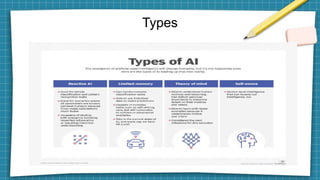
Types
 Reactive machines -AI systems have no memory and are task-
specific (Chess)
 Limited memory -AI systems have memory, so they can use
past experiences to inform future decisions (Self driving car)
 Theory of mind - When applied to AI, it means the system would
have the social intelligence to understand emotions
 Self-awareness. In this category, AI systems have a sense of
self, which gives them consciousness.
Ethical Challenges
 Bias, due to improperly trained algorithms and human bias
 Misuse, due to deepfakes and phishing
 Legal concerns, including copyright issues
 Elimination of jobs
 Data privacy concerns, particularly in the banking, healthcare
and legal fields.
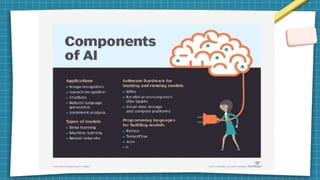
AI Technologies
 Automation
 Machine learning
 Machine vision
 Natural language processing
 Robotics
 Autonomous vehicles
 Generative AI
AI Decision making
 Speed and efficiency
 Automating workflows
 Doing complex problem solving
 Removing biases
 Outcome prediction
 Customer understanding
Deep Learning
 Deep Learning is a subfield of Machine Learning that involves the use of neural
networks to model and solve complex problems
 Neural network - method that teaches computers to process data in a way that is
inspired by the human brain.
 Neural networks (ANNs) are comprised of a node layers, containing an input
layer, one or more hidden layers, and an output layer.
 A neural network that consists of more than three layers—which would be
inclusive of the inputs and the output—can be considered a deep learning
algorithm.
 RNN, CNN
Types

AI_DGV.pptx

  • 1.
  • 2.
    AI -What isit?  Artificial intelligence leverages computers and machines to mimic the problem-solving and decision-making capabilities of the human mind  Combines computer science and robust datasets, to enable problem-solving. It also encompasses sub-fields of machine learning and deep learning, which are frequently mentioned in conjunction with artificial intelligence 
  • 3.
    Strong Vs WeakAI  Weak AI, also known as narrow AI, is designed and trained to complete a specific task. Industrial robots and virtual personal assistants, such as Apple's Siri, use weak AI  Strong AI, also known as artificial general intelligence (AGI), describes programming that can replicate the cognitive abilities of the human brain. When presented with an unfamiliar task, a strong AI system can use fuzzy logic to apply knowledge from one domain to another and find a solution autonomously
  • 4.
    Applications  Speech recognition Automated trading  Customer service (Chatbots etc...)  Recommendation systems  Computer vision
  • 5.
    Evolution-Key Dates  1950:Alan Turing publishes Computing Machinery and Intelligence.  1956: John McCarthy coins the term 'artificial intelligence' at the first-ever AI conference at Dartmouth College  1967: Frank Rosenblatt builds the Mark 1 Perceptron, the first computer based on a neural network that 'learned' though trial and error.  1980s: Neural networks which use a backpropagation algorithm to train itself  1997: IBM's Deep Blue beats then world chess champion Garry Kasparov, in a chess match
  • 6.
    Evolution-Key Dates  2011:IBM Watson beats champions Ken Jennings and Brad Rutter at Jeopardy!  2015: Baidu's Minwa supercomputer uses a special kind of deep neural network called a convolutional neural network to identify and categorize images with a higher rate of accuracy than the average human.  2016: DeepMind's AlphaGo program, powered by a deep neural network, beats Lee Sodol, the world champion Go player  2022: A rise in large language models, or LLMs, such as ChatGPT
  • 7.
    Basic Components  Learning Reasoning  Problem solving  Perception  Language understanding
  • 8.
    Pros  Good atdetail-oriented jobs  Reduced time for data-heavy tasks  Saves labor and increases productivity  Delivers consistent results  Can improve customer satisfaction through personalization  Available 24*7
  • 9.
    Cons  Expensive.  Requiresdeep technical expertise.  Limited supply of qualified workers to build AI tools.  Reflects the biases of its training data, at scale.  Lack of ability to generalize from one task to another.  Eliminates human jobs, increasing unemployment rates
  • 10.
    Types  Reactive machines-AI systems have no memory and are task- specific (Chess)  Limited memory -AI systems have memory, so they can use past experiences to inform future decisions (Self driving car)  Theory of mind - When applied to AI, it means the system would have the social intelligence to understand emotions  Self-awareness. In this category, AI systems have a sense of self, which gives them consciousness.
  • 12.
    Ethical Challenges  Bias,due to improperly trained algorithms and human bias  Misuse, due to deepfakes and phishing  Legal concerns, including copyright issues  Elimination of jobs  Data privacy concerns, particularly in the banking, healthcare and legal fields.
  • 13.
    AI Technologies  Automation Machine learning  Machine vision  Natural language processing  Robotics  Autonomous vehicles  Generative AI
  • 14.
    AI Decision making Speed and efficiency  Automating workflows  Doing complex problem solving  Removing biases  Outcome prediction  Customer understanding
  • 15.
    Deep Learning  DeepLearning is a subfield of Machine Learning that involves the use of neural networks to model and solve complex problems  Neural network - method that teaches computers to process data in a way that is inspired by the human brain.  Neural networks (ANNs) are comprised of a node layers, containing an input layer, one or more hidden layers, and an output layer.  A neural network that consists of more than three layers—which would be inclusive of the inputs and the output—can be considered a deep learning algorithm.  RNN, CNN
  • 17.