Artificial Intelligence in
Project Management
KHALED HAMDY, PH.D., PMP
Introduction of Khaled Hamdy
• Civil Engineer
• Ph.D. in Engineering
• Professional Project Manager, PMP©
• Projects Advisor in RTA
Why am I here talking about
Artificial Intelligence?
Contents
• What is Artificial Intelligence?
• Artificial Intelligence in Project Management
• Data Mining and Knowledge Engineering
Contents
• What is Artificial Intelligence?
• Artificial Intelligence in Project Management
• Data Mining and Knowledge Engineering
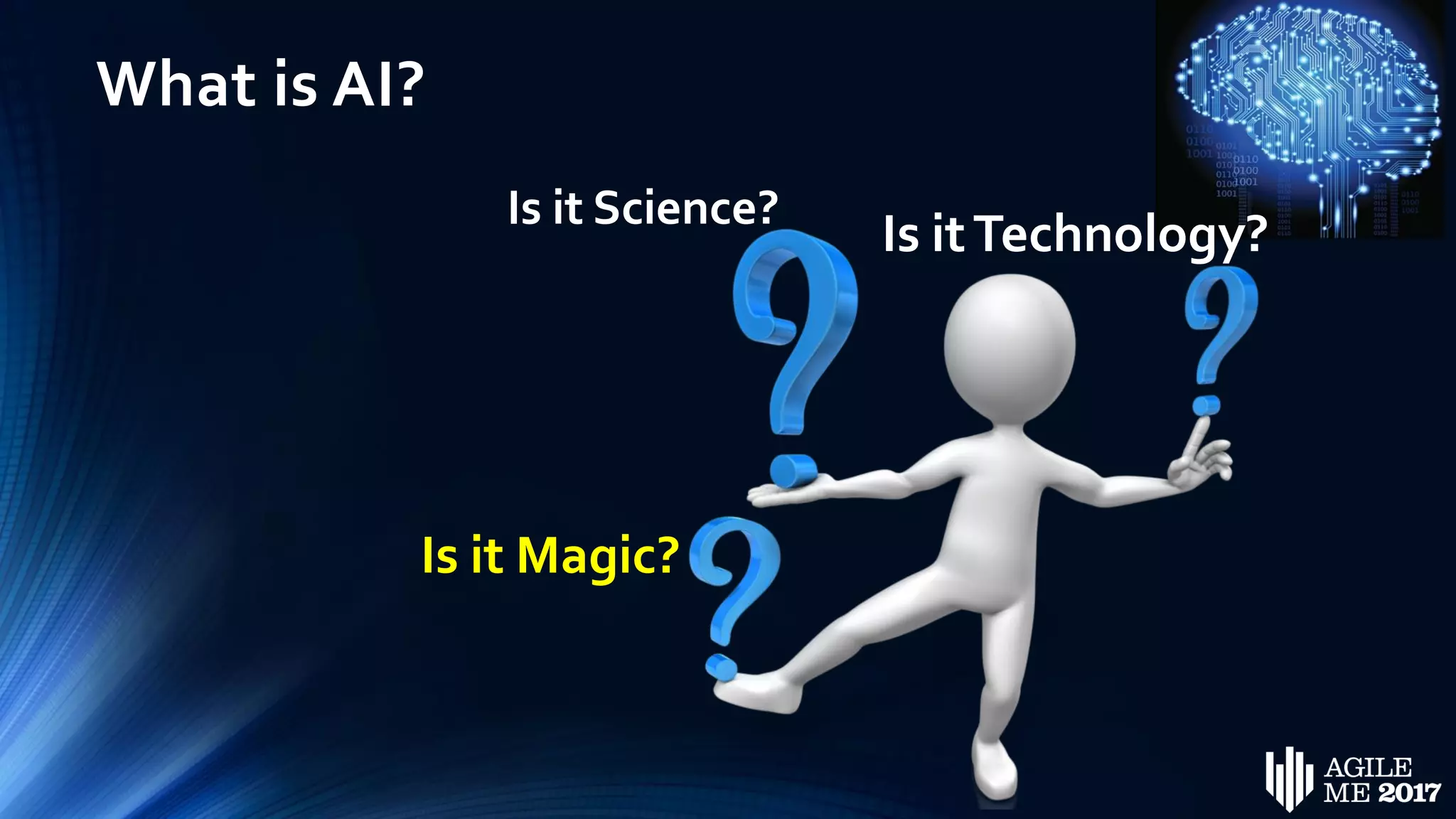
What is AI?
Is it Science?
Is itTechnology?
Is it Magic?
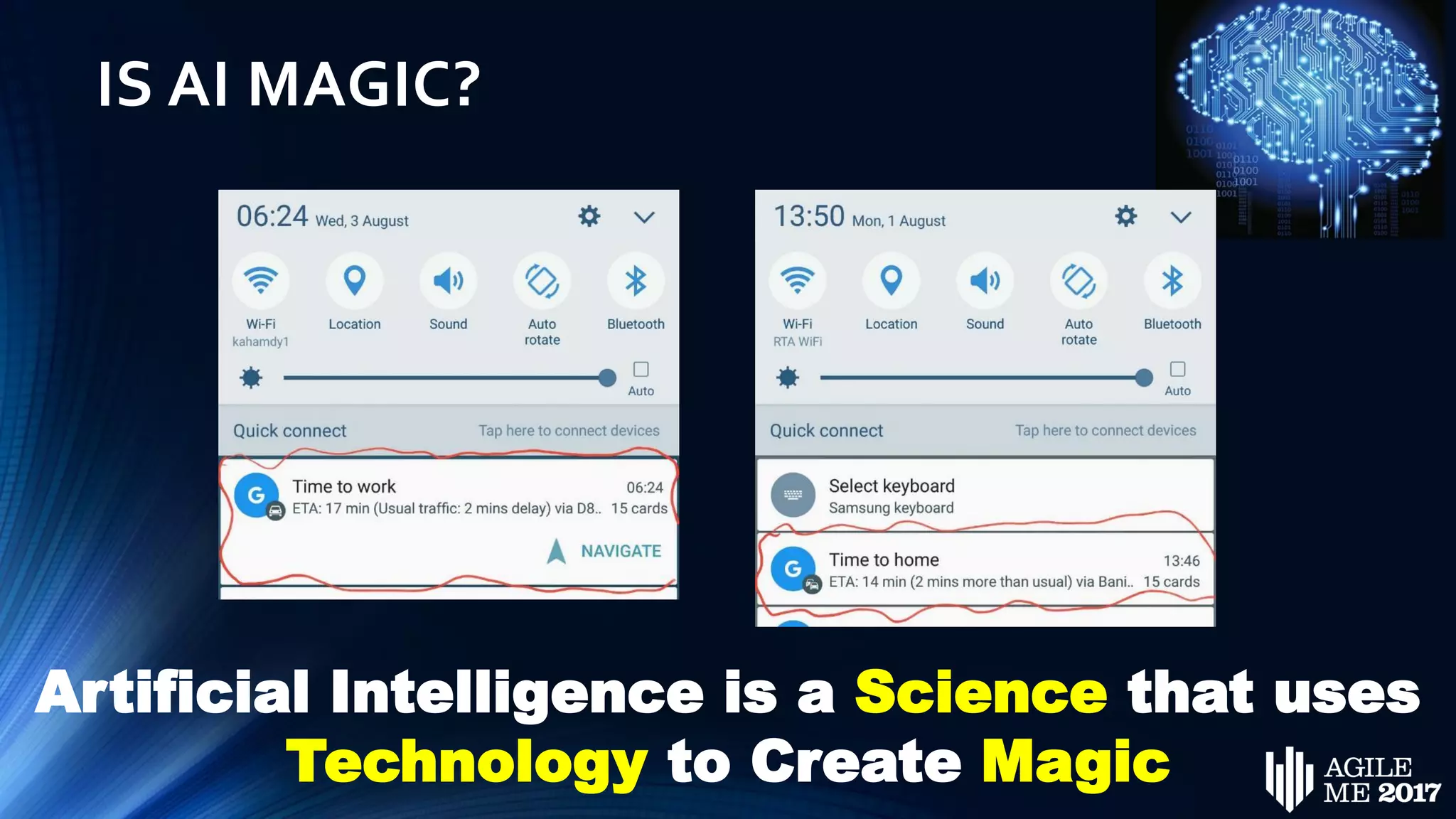
IS AI MAGIC?
Artificial Intelligence is a Science that uses
Technology to Create Magic
Contents
• What is Artificial Intelligence?
• Definition
• DifferentTypes of Artificial Intelligence
• History of Artificial Intelligence
• Theories behind Artificial Intelligence
• Artificial Intelligence in Project Management
• Engineering Design
• Cost Estimation and Bidding
• Planning and Scheduling
• Risk Management
• Prediction of Project Performance
• Data Mining and Knowledge Engineering
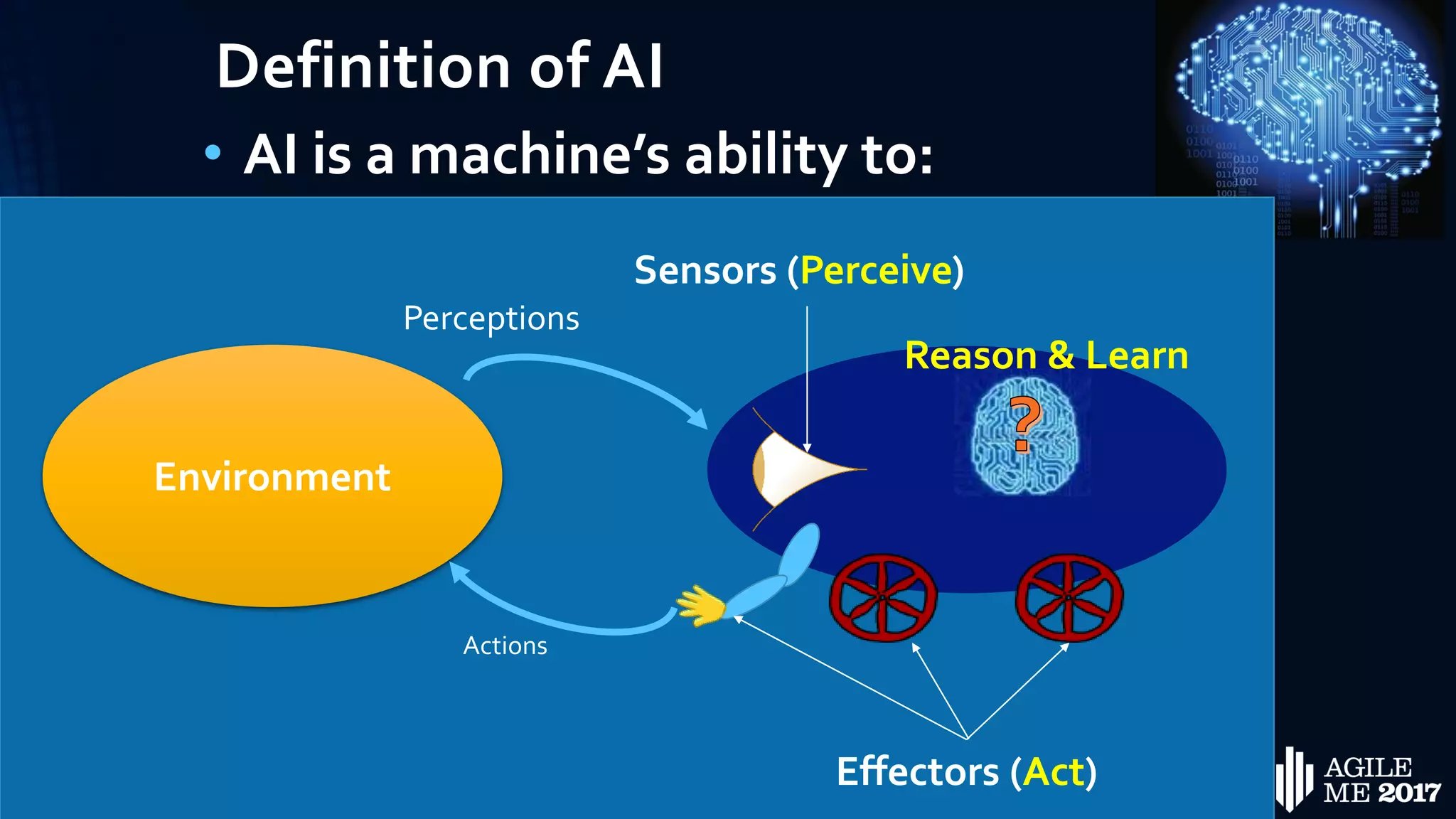
Definition of AI
• AI is a machine’s ability to:
• Perceive
• Reason
• Learn
• Act
Sensors (Perceive)
Environment
Perceptions
Actions
Effectors (Act)
Reason & Learn
Another Definition of AI
• AI is the ability of a computer (or a
machine) to perform certain tasks thought
to require intelligence including:
• Logical deduction and inference
• Learning and adaptation
• Ability to make decisions based on:
• Past Experience
• Insufficient Information
• Conflicting Information
• Ability to understand spoken/natural language
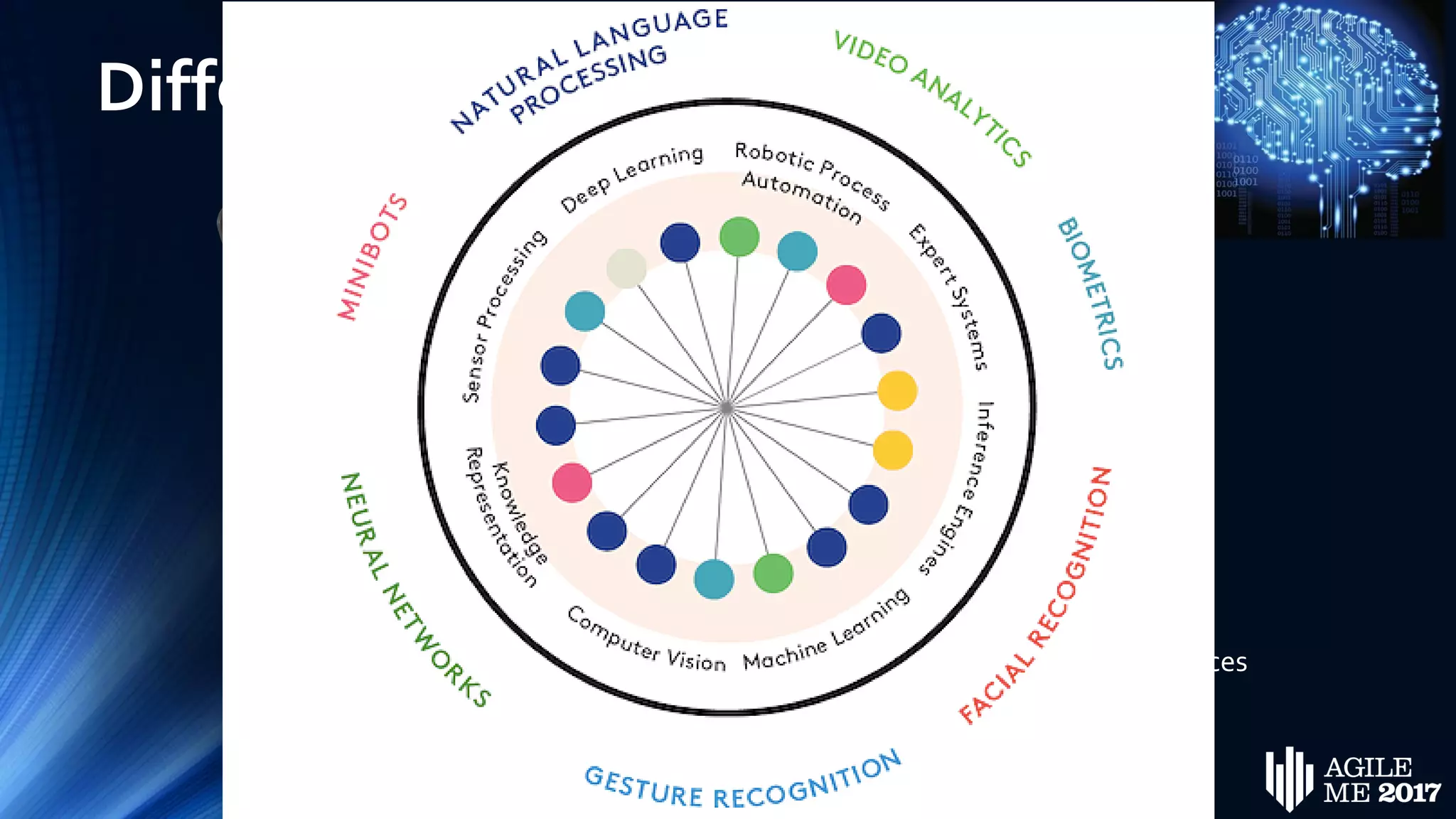
Different Types of AI
AI
Cognitive
Science
Robotics
Natural
Interface
• Expert Systems
• Learning Systems
• Fuzzy Logic
• Genetic Algorithms
• Neural Networks
• IntelligentAgents
• Visual Perception
• Tactility
• Dexterity
• Locomotion
• Navigation
• Natural Languages
• Speech Recognition
• Virtual Reality
• Multisensory Interfaces
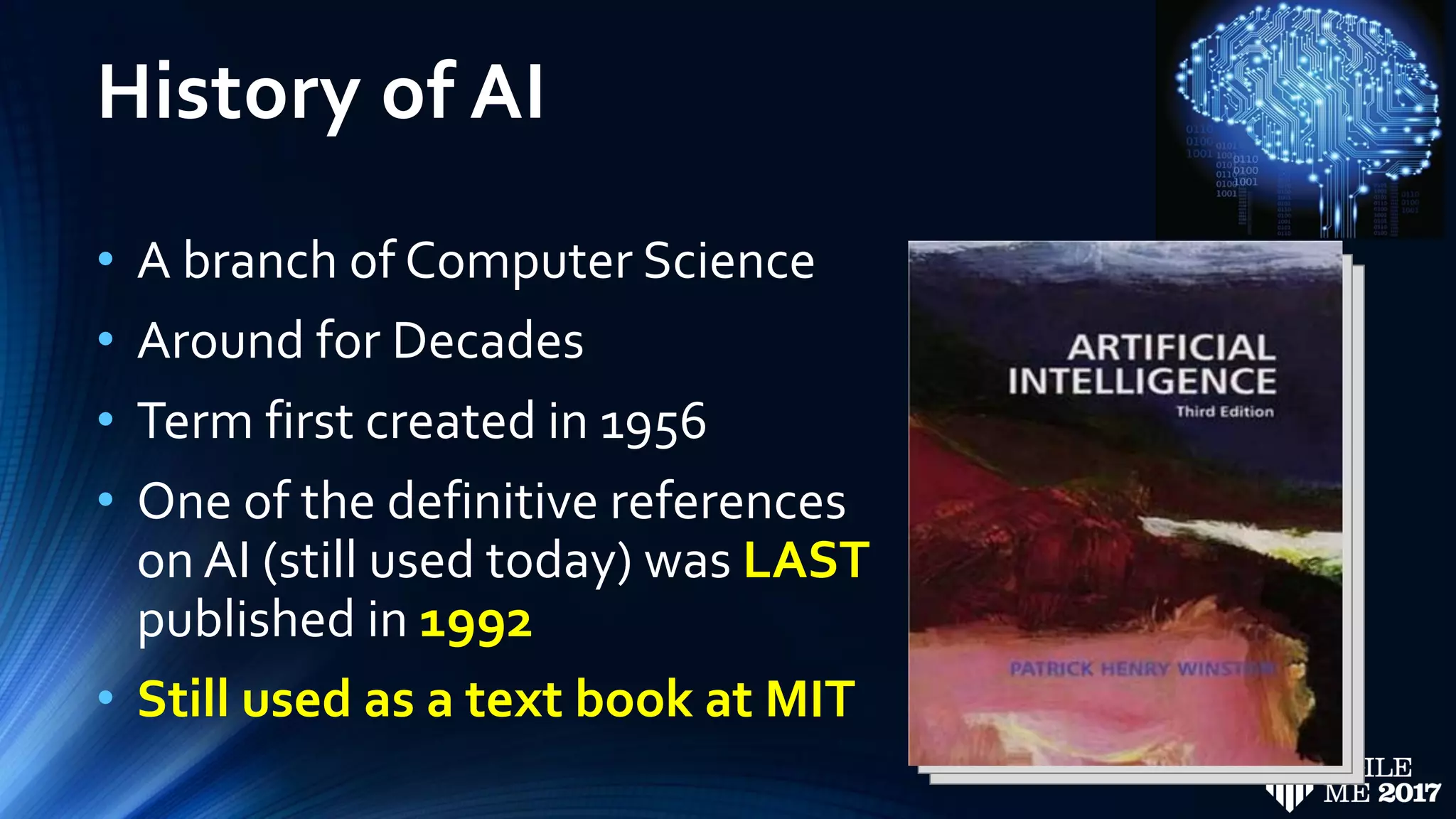
History of AI
• A branch of Computer Science
• Around for Decades
• Term first created in 1956
• One of the definitive references
on AI (still used today) was LAST
published in 1992
• Still used as a text book at MIT
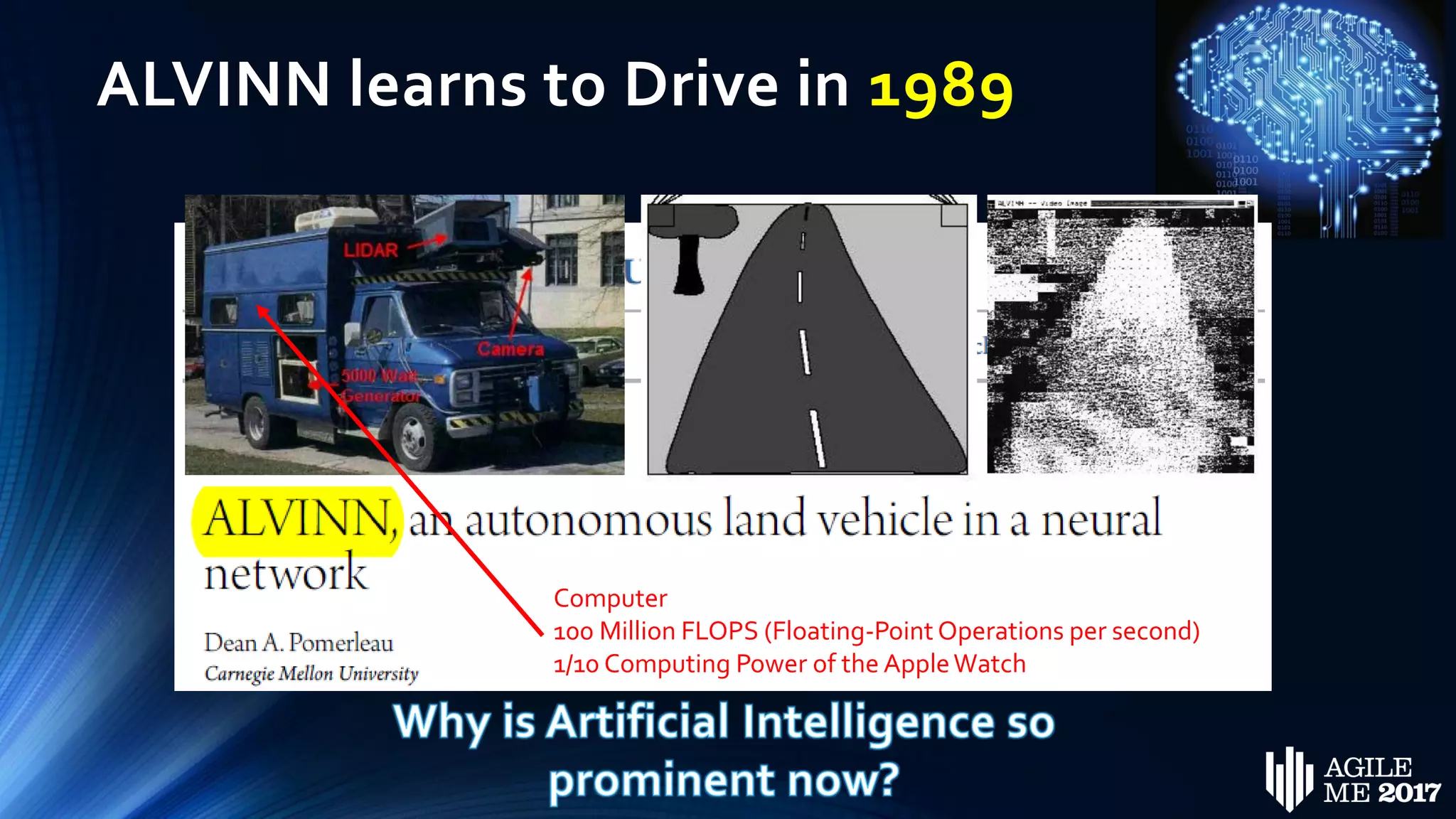
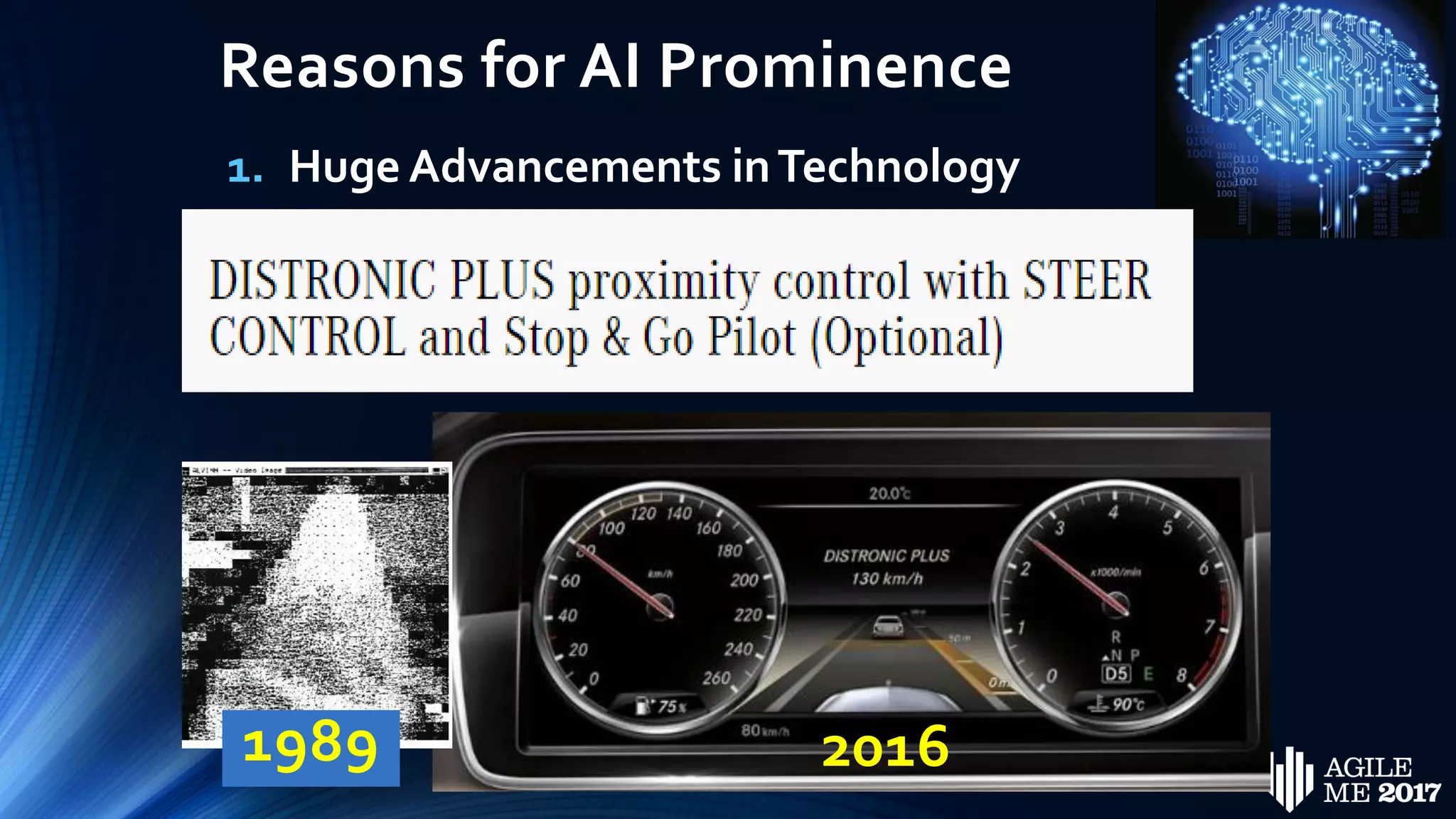
ALVINN learns to Drive in 1989
Computer
100 Million FLOPS (Floating-Point Operations per second)
1/10 Computing Power of the AppleWatch
20161989
Reasons for AI Prominence
1. Huge Advancements inTechnology
Reasons for AI Prominence
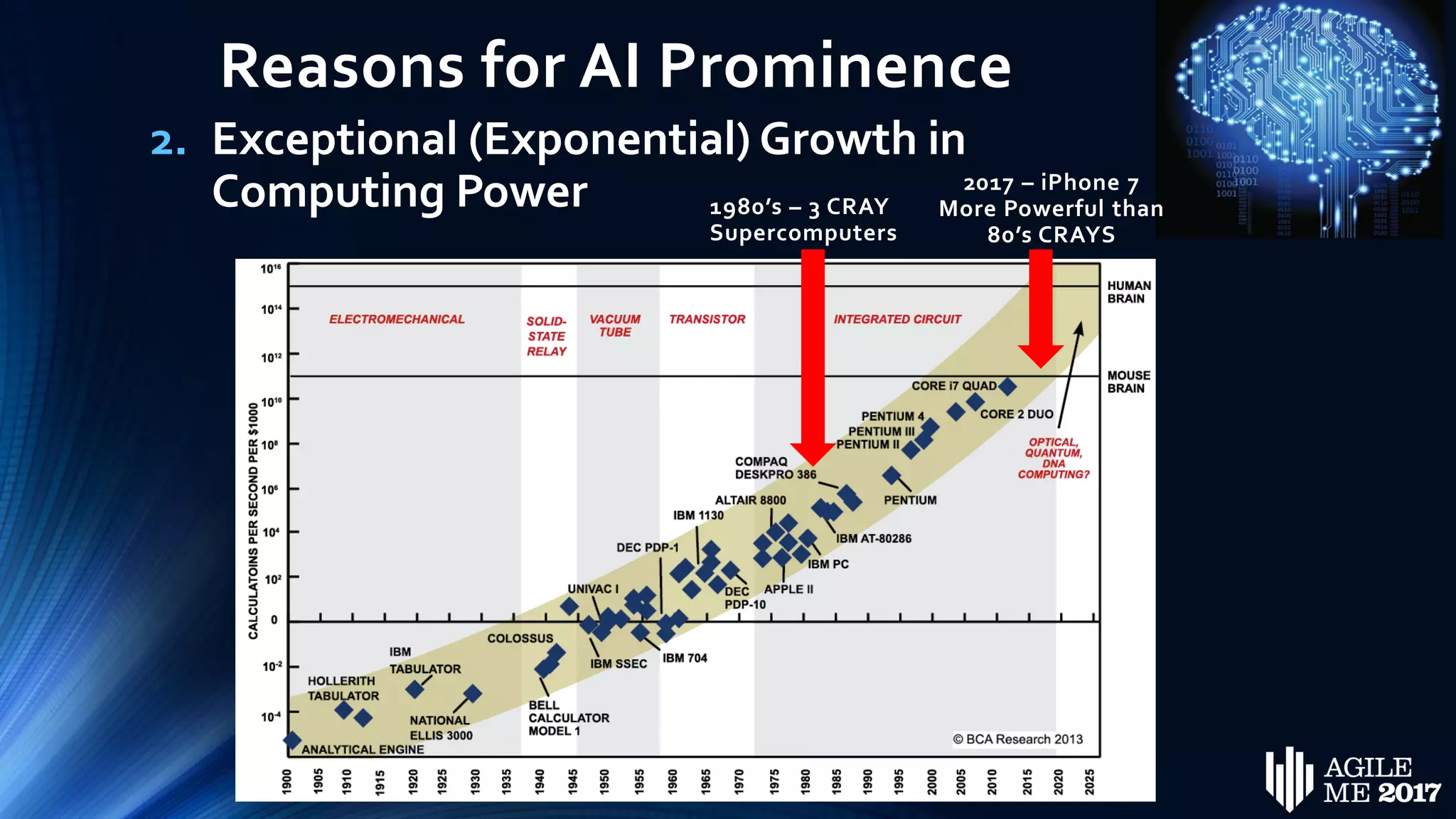
2. Exceptional (Exponential) Growth in
Computing Power 1980’s – 3 CRAY
Supercomputers
2017 – iPhone 7
More Powerful than
80’s CRAYS
Advances in Computing
• Deep Blue defeatedGarry Kasparov –
World Chess Champion in 1997
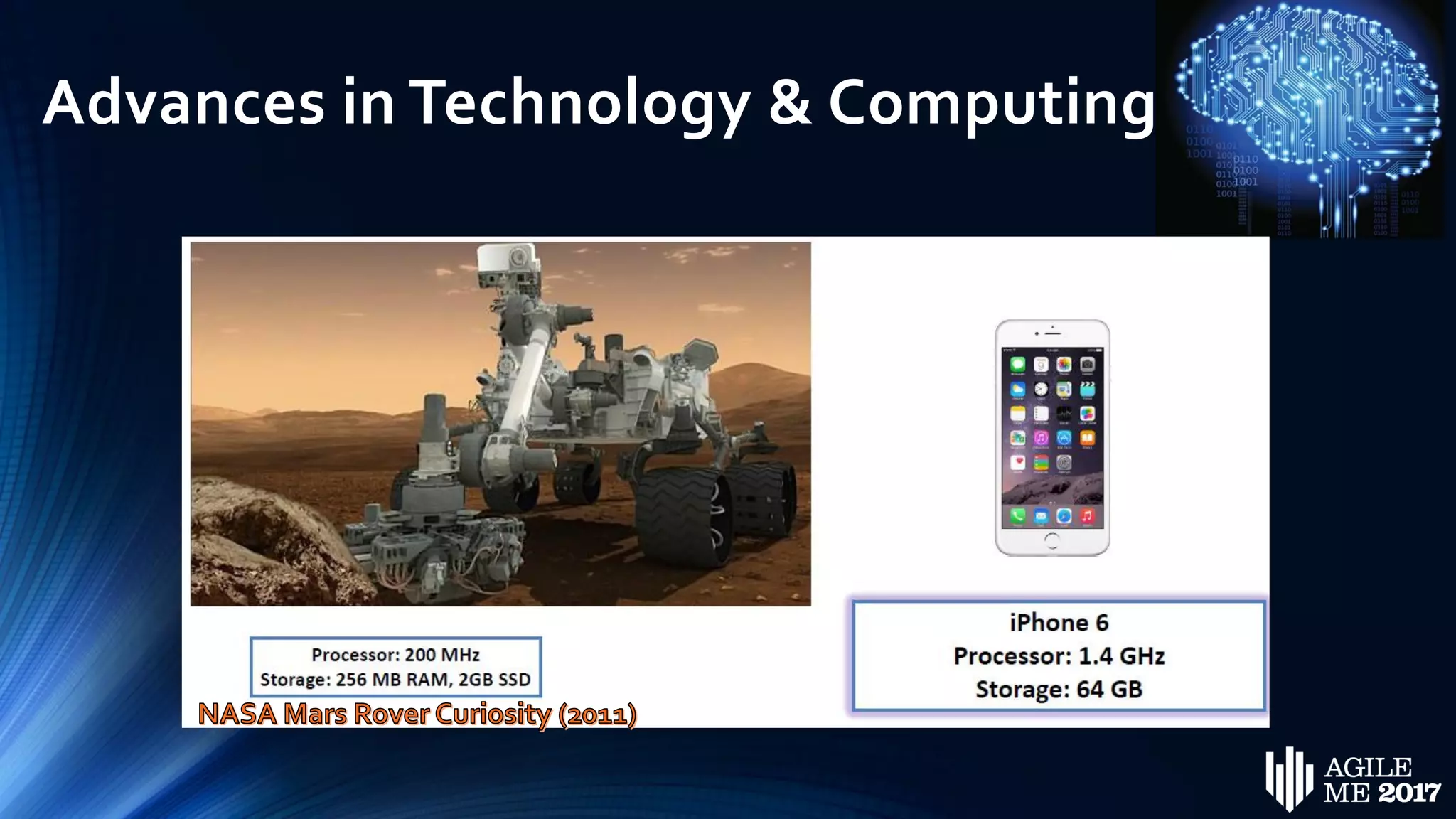
Advances in Technology & Computing
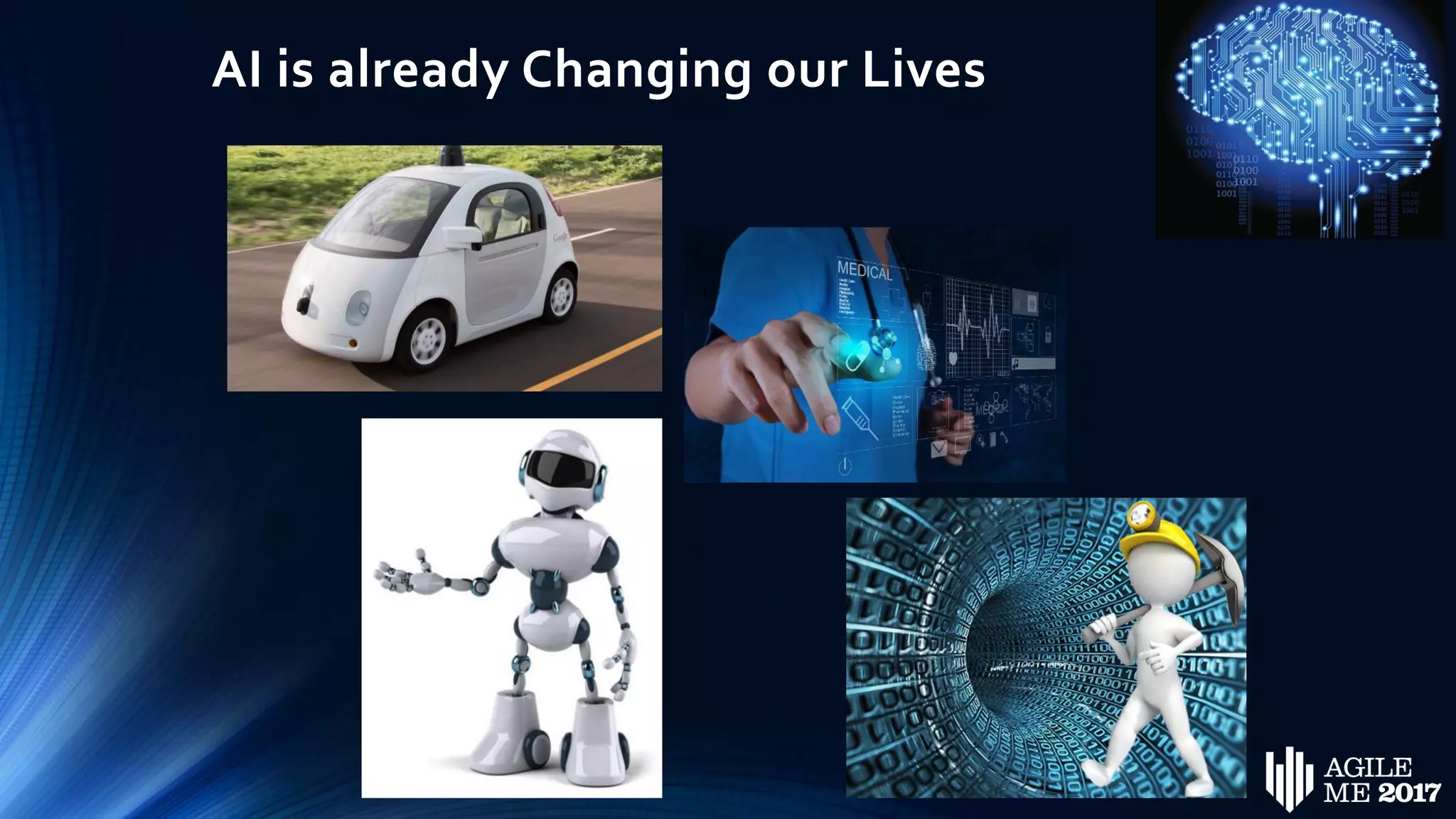
AI is already Changing our Lives
Artificial Intelligence -
The Science behind the Magic
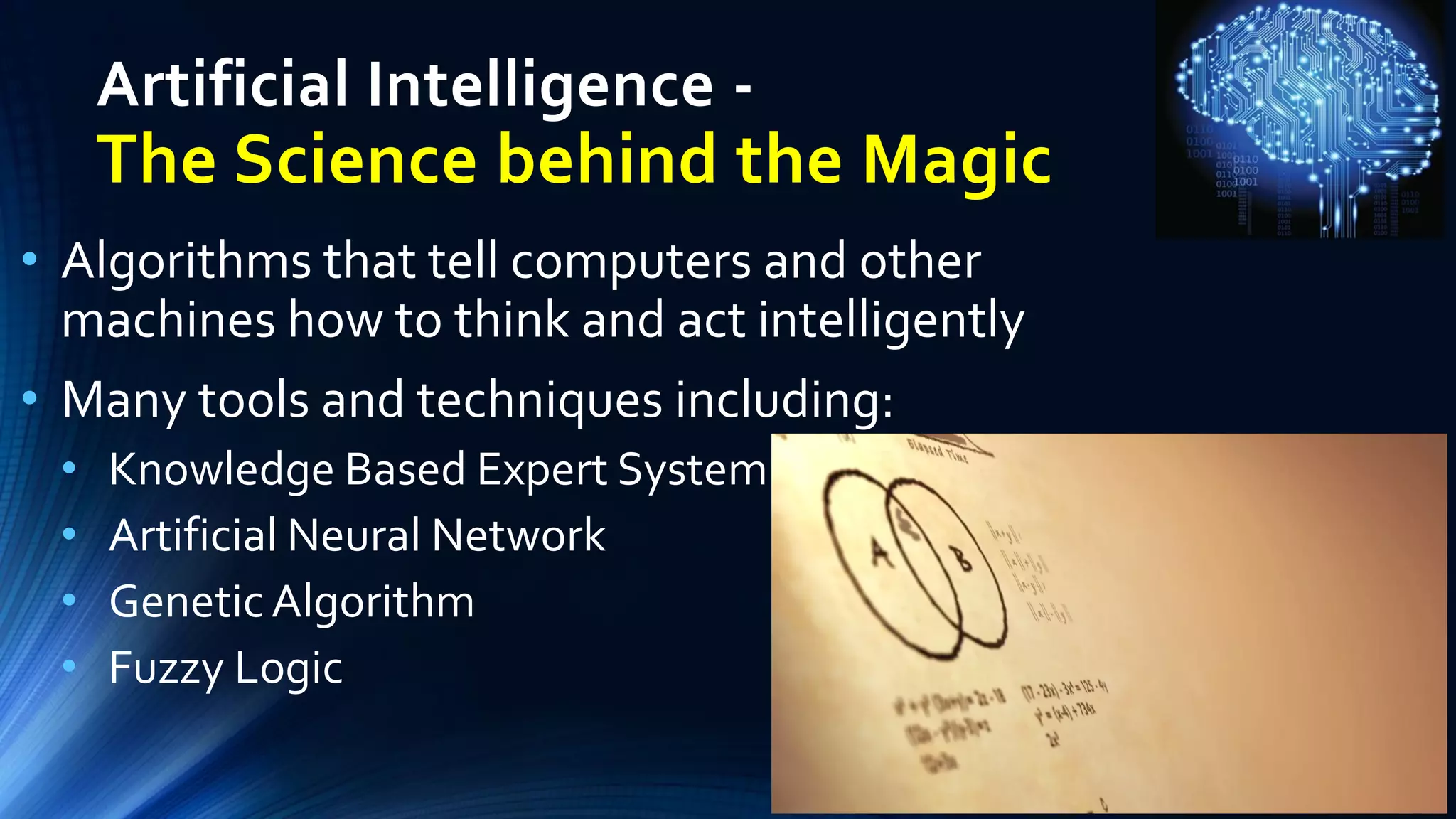
• Algorithms that tell computers and other
machines how to think and act intelligently
• Many tools and techniques including:
• Knowledge Based Expert System
• Artificial Neural Network
• GeneticAlgorithm
• Fuzzy Logic
Knowledge Based Expert System
(KBES)
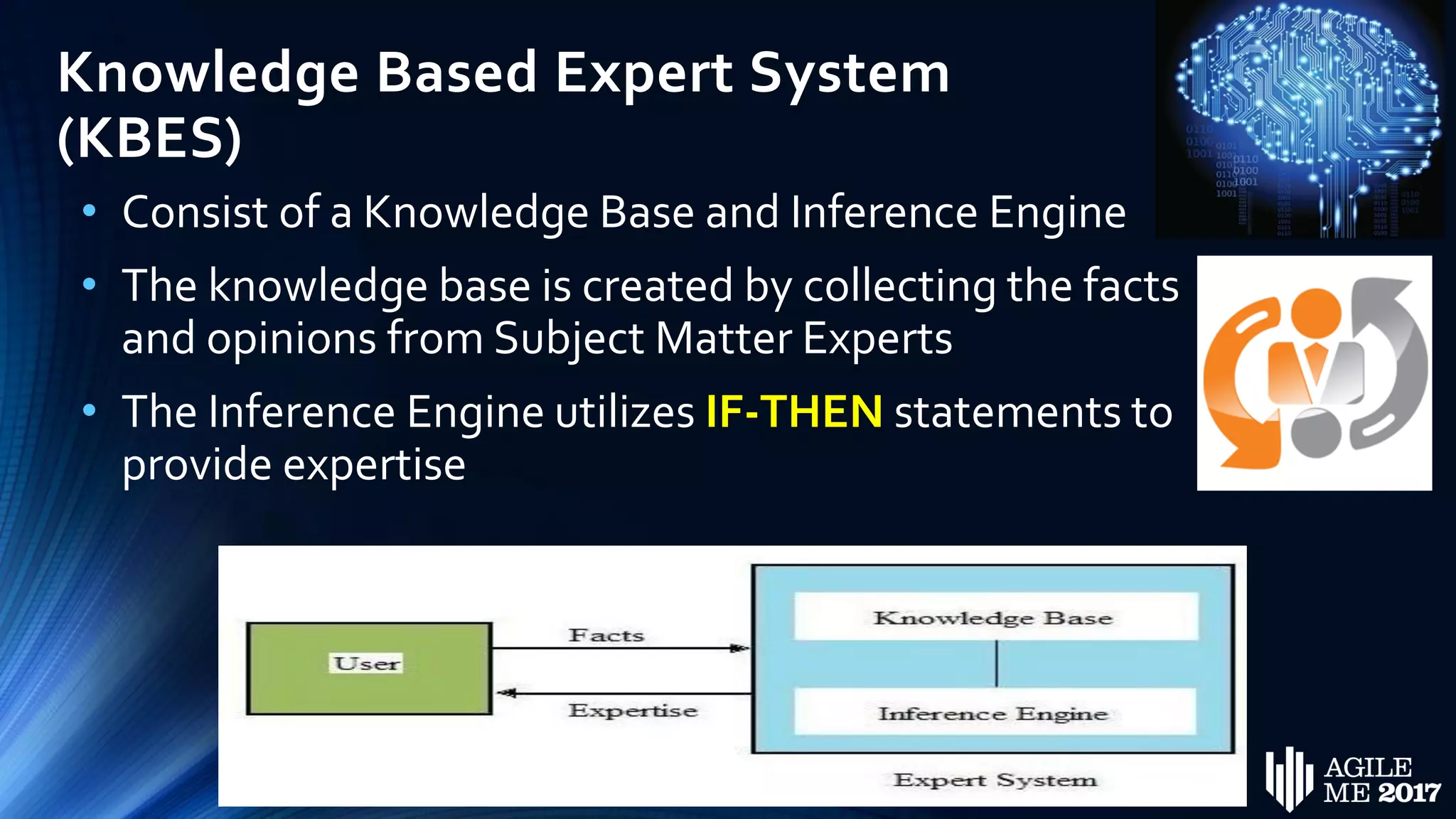
• Consist of a Knowledge Base and Inference Engine
• The knowledge base is created by collecting the facts
and opinions from Subject Matter Experts
• The Inference Engine utilizes IF-THEN statements to
provide expertise
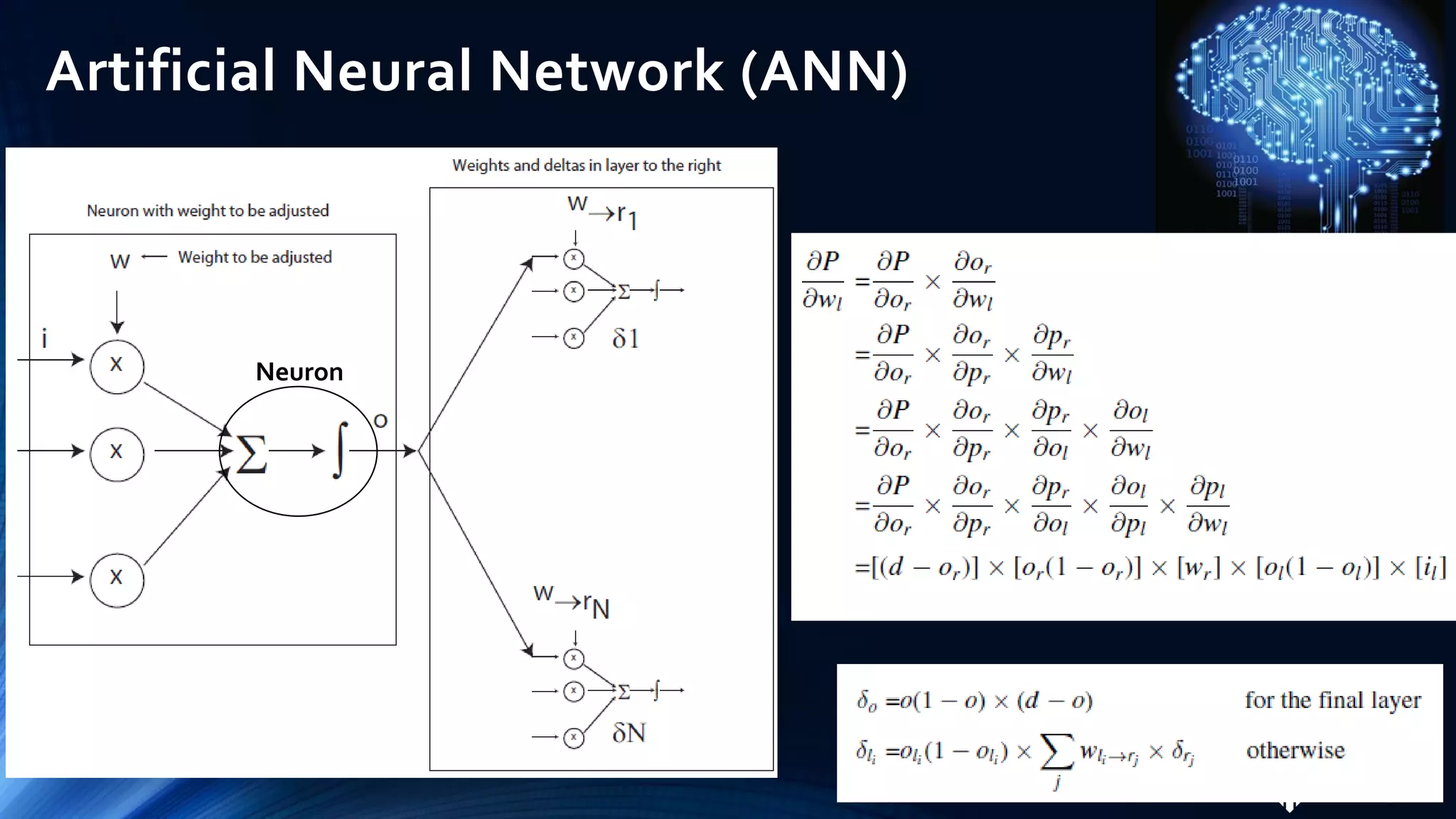
Artificial Neural Network (ANN)
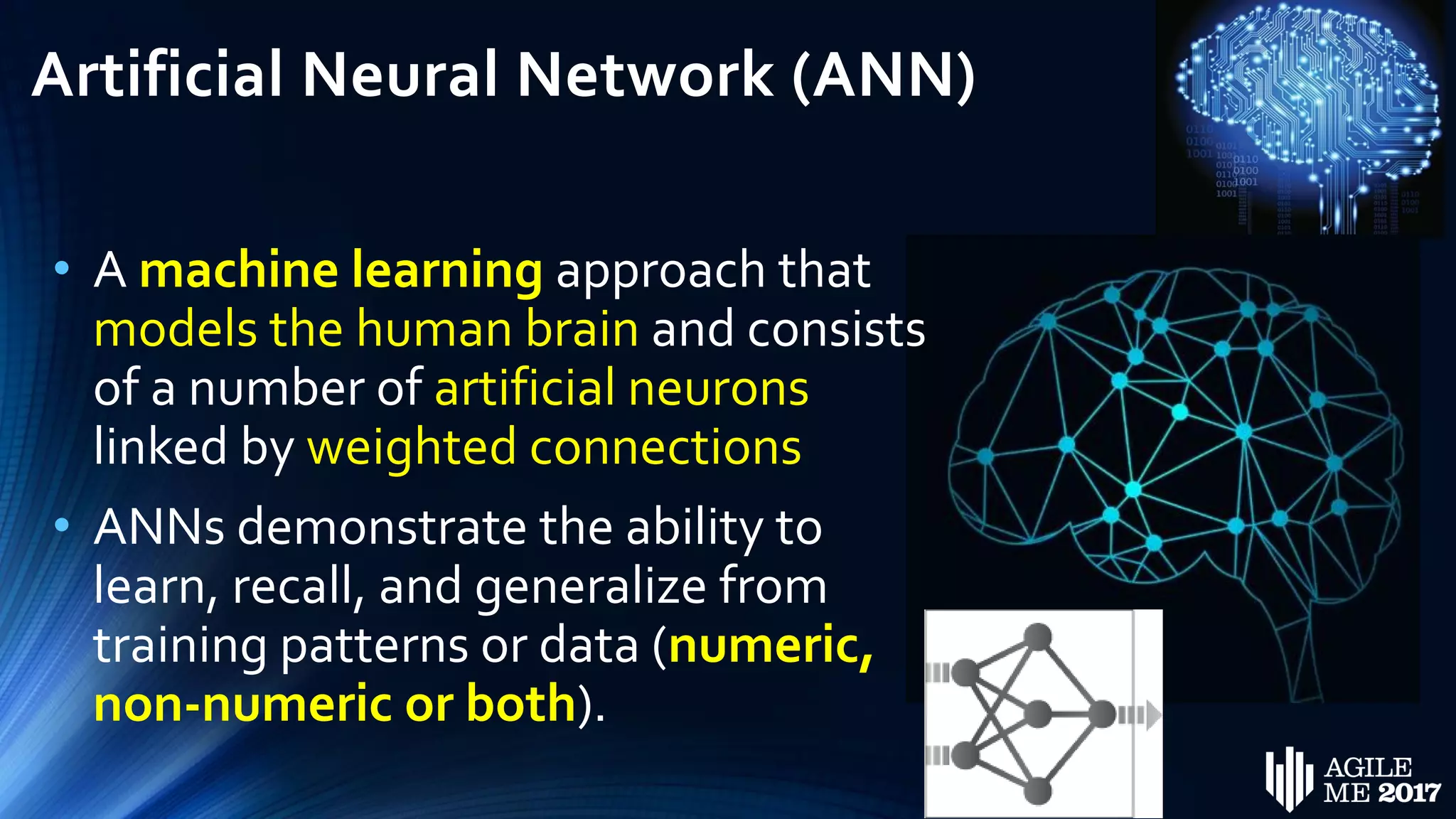
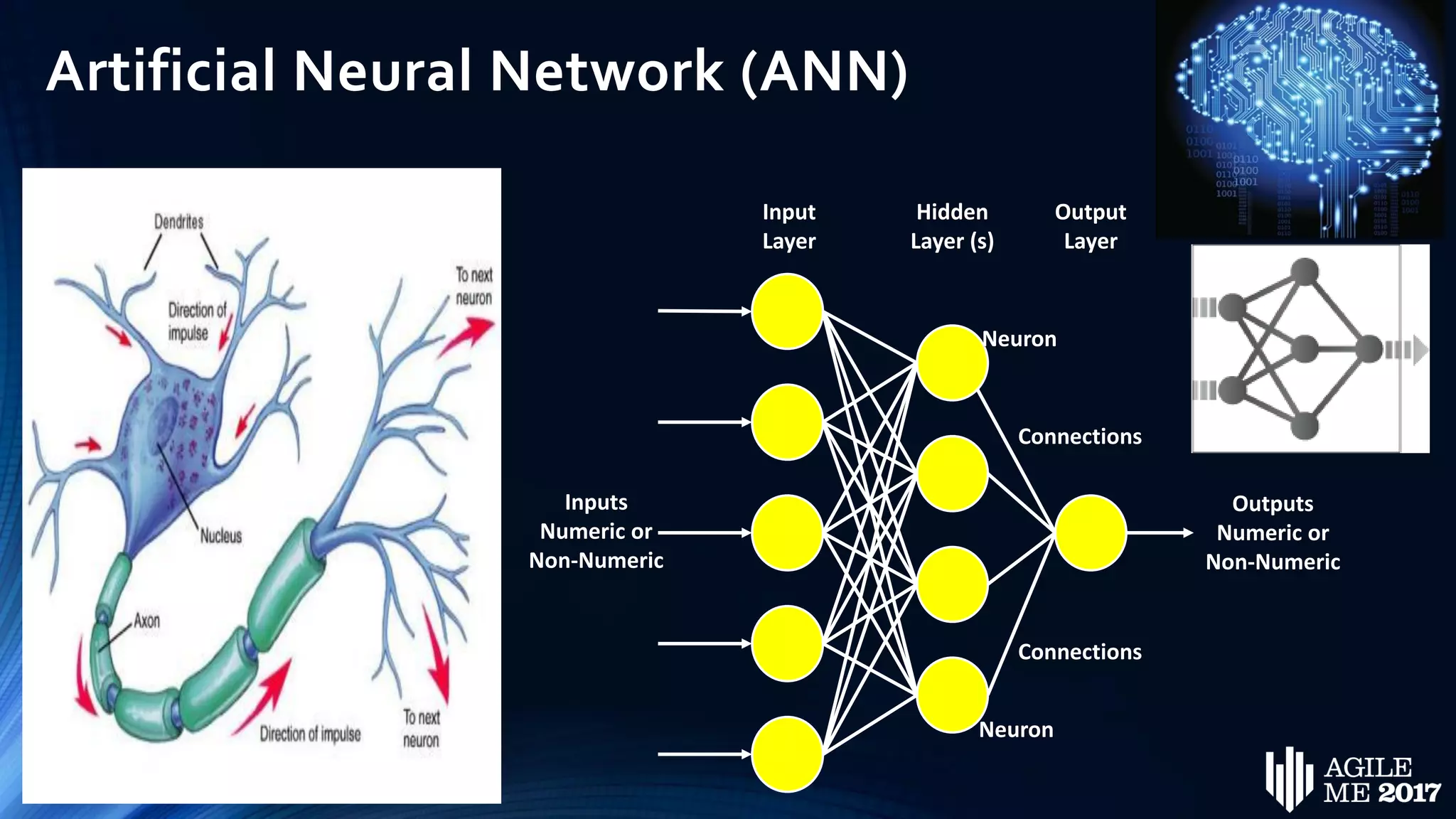
• A machine learning approach that
models the human brain and consists
of a number of artificial neurons
linked by weighted connections
• ANNs demonstrate the ability to
learn, recall, and generalize from
training patterns or data (numeric,
non-numeric or both).
Artificial Neural Network (ANN)
Input
Layer
Hidden
Layer (s)
Output
Layer
Inputs
Numeric or
Non-Numeric
Outputs
Numeric or
Non-Numeric
Neuron
Neuron
Connections
Connections
Artificial Neural Network (ANN)
Neuron
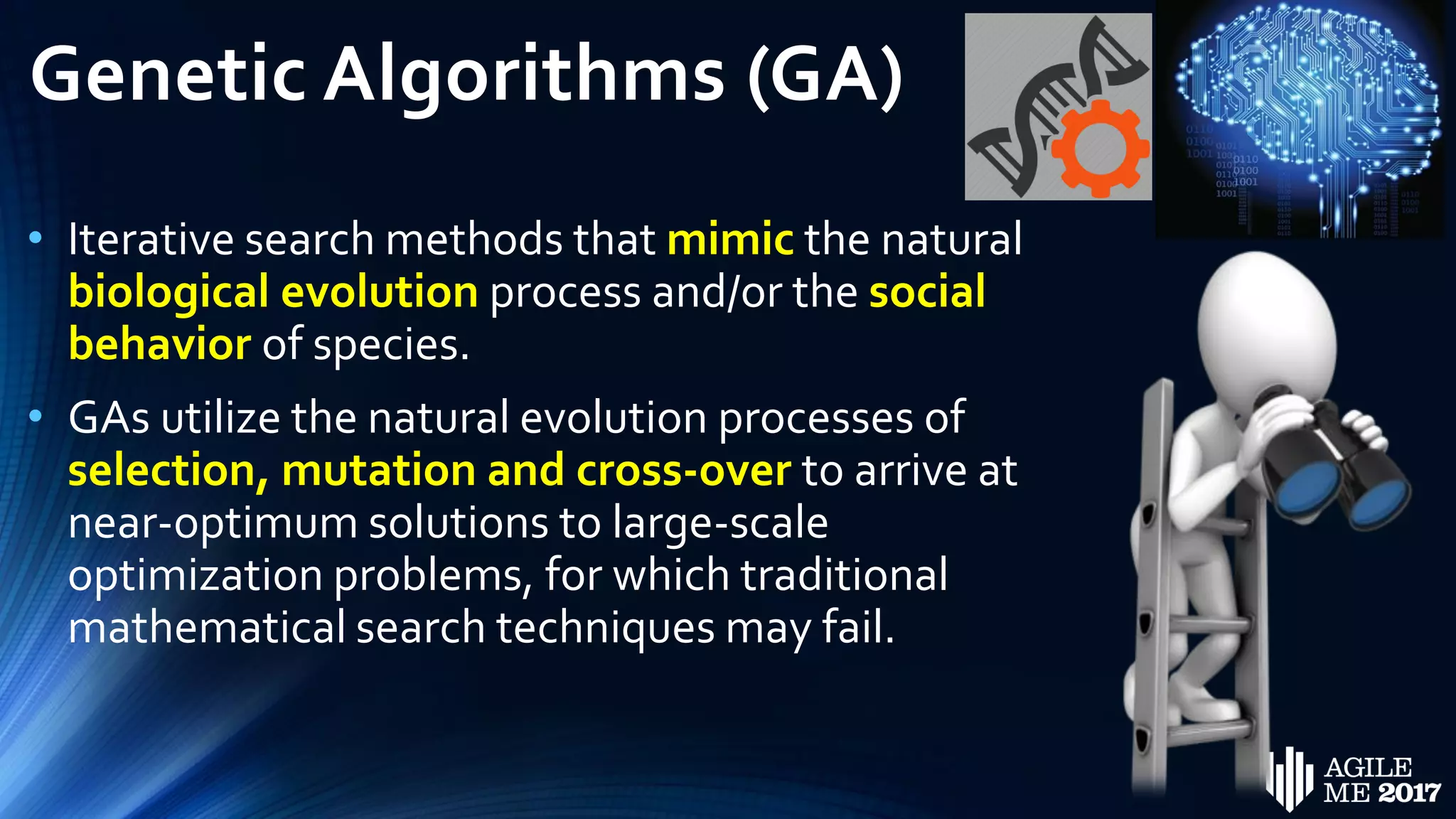
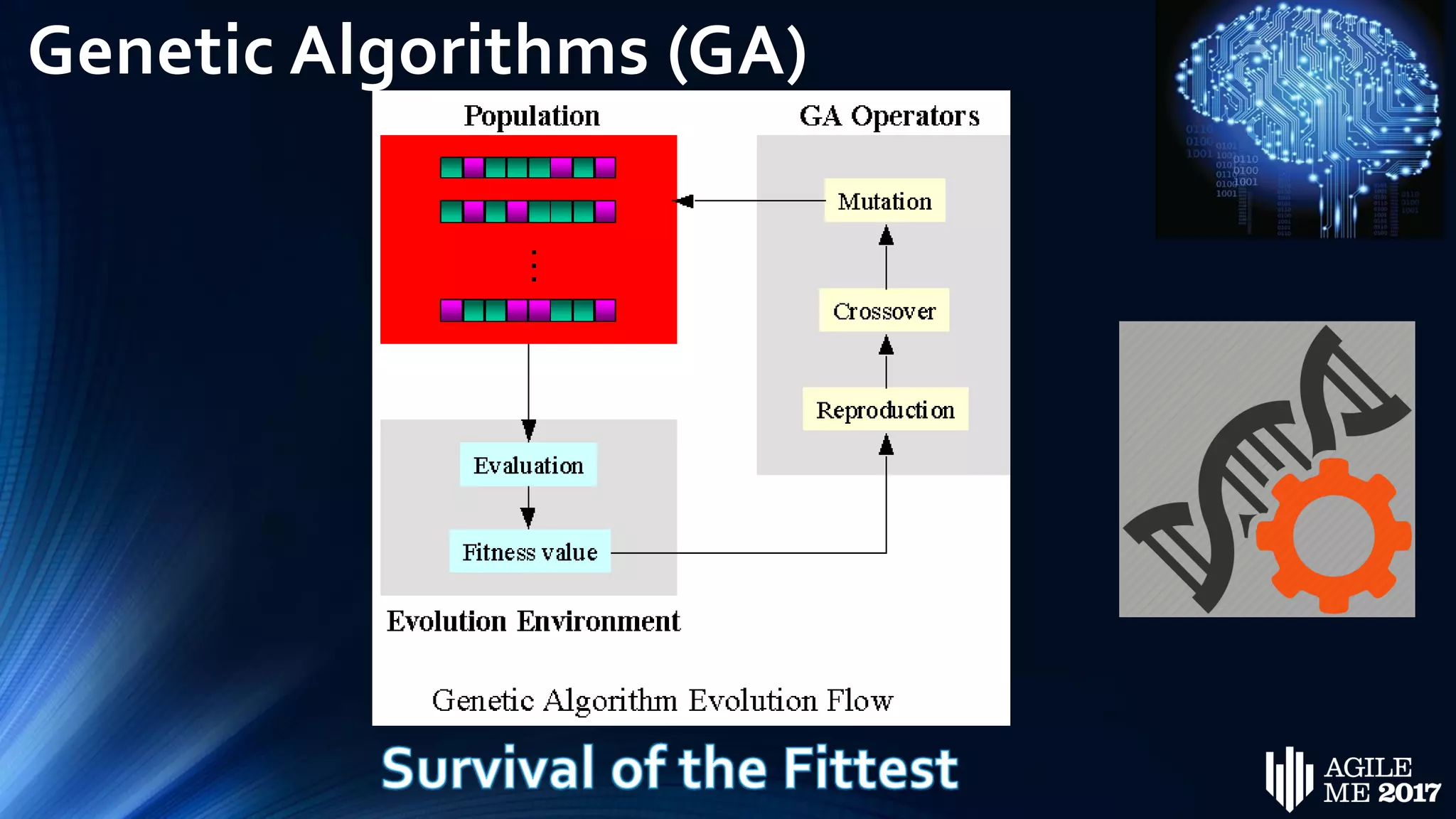
Genetic Algorithms (GA)
• Iterative search methods that mimic the natural
biological evolution process and/or the social
behavior of species.
• GAs utilize the natural evolution processes of
selection, mutation and cross-over to arrive at
near-optimum solutions to large-scale
optimization problems, for which traditional
mathematical search techniques may fail.
Genetic Algorithms (GA)
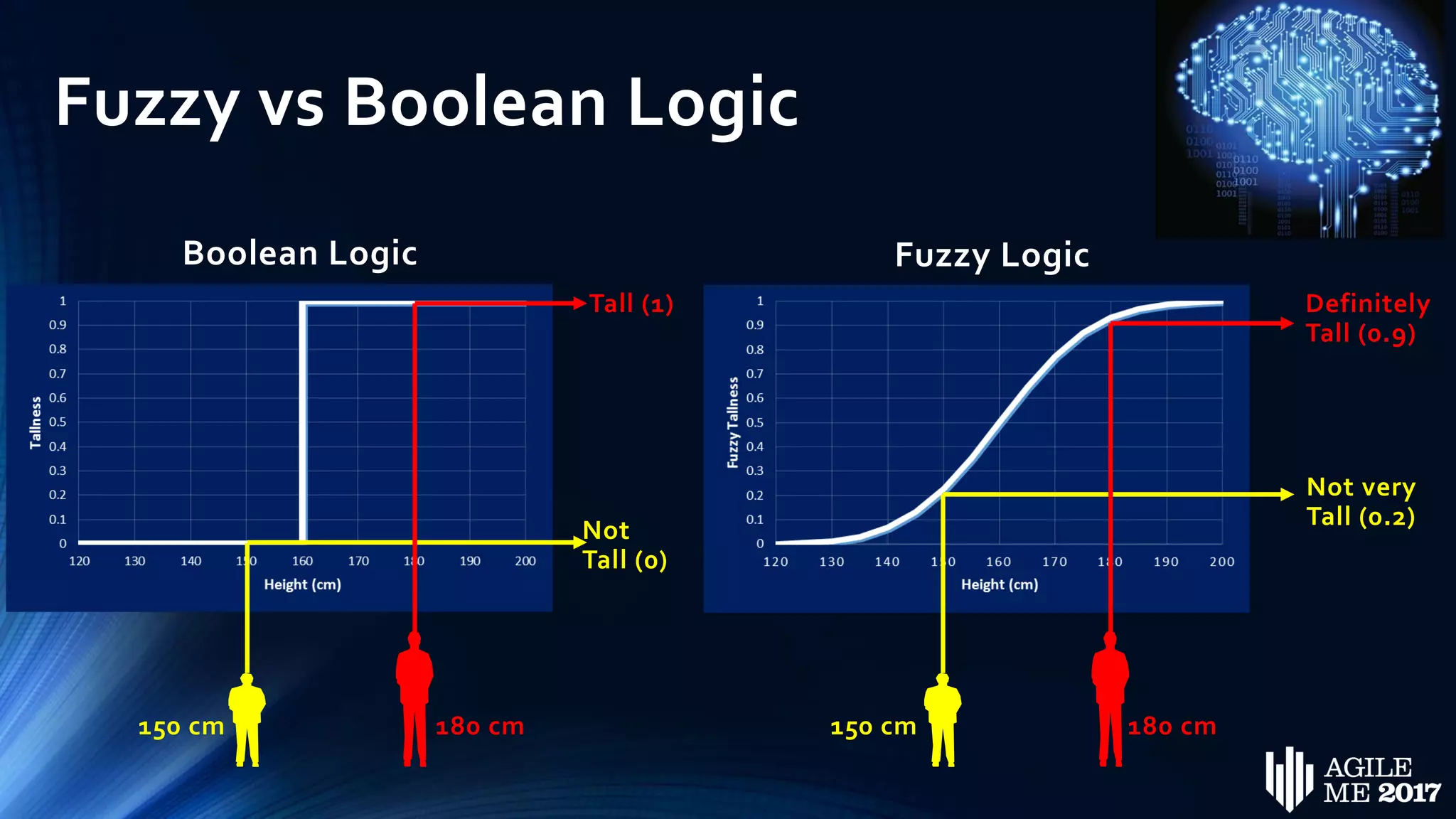
Fuzzy Logic
• Fuzzy logic is an approach to computing based on
"degrees of truth" rather than the usual "true or
false" (1 or 0) Boolean logic on which the modern
computer is based
• A form of many-valued logic in which the truth
values of variables may be any real number
between 0 and 1
Fuzzy vs Boolean Logic
Boolean Logic
Not
Tall (0)
150 cm
Tall (1)
180 cm
Fuzzy Logic
Not very
Tall (0.2)
150 cm
Definitely
Tall (0.9)
180 cm
Contents
• What is Artificial Intelligence?
• Artificial Intelligence in Project Management
• Data Mining and Knowledge Engineering
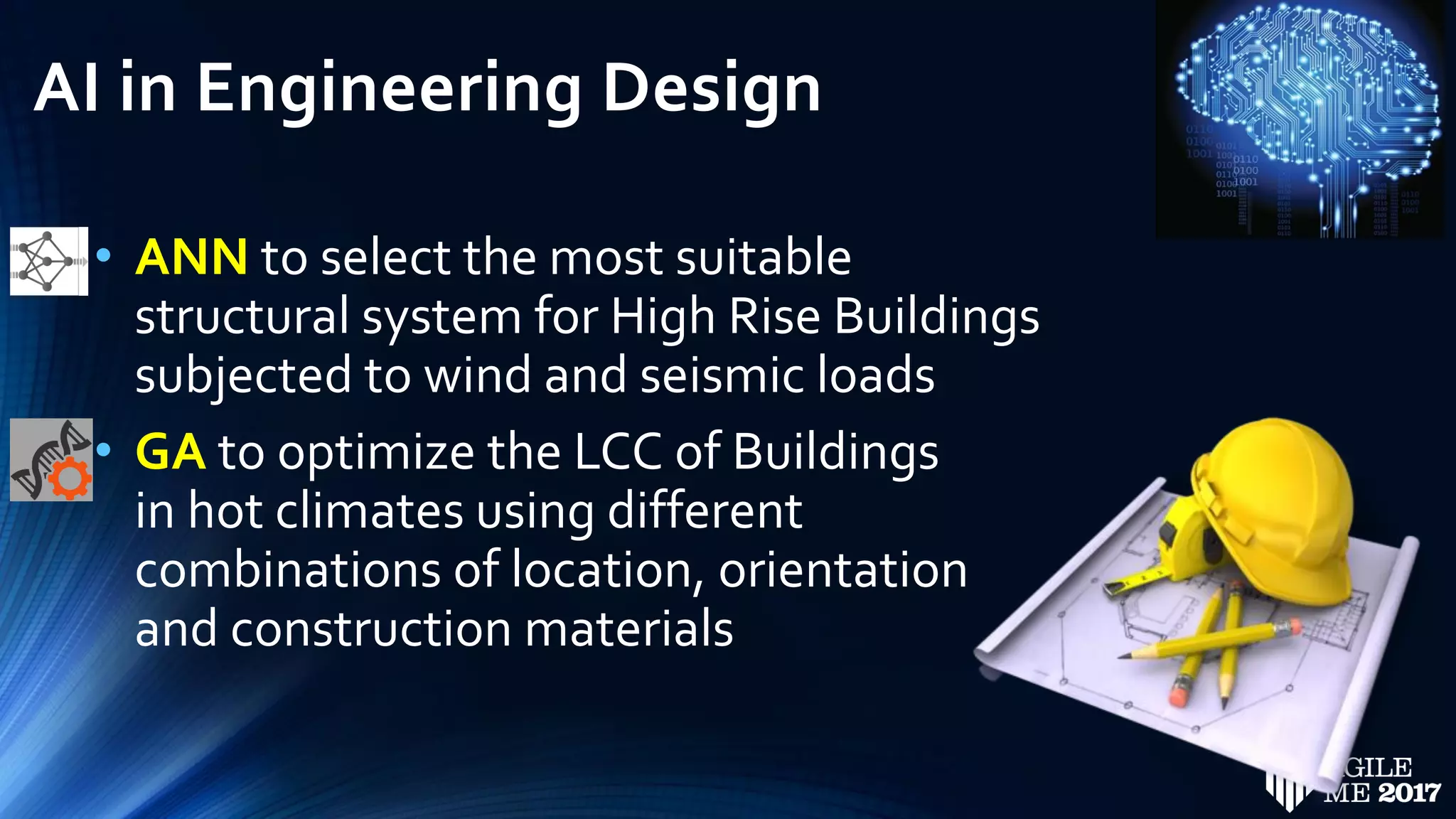
AI in Engineering Design
• ANN to select the most suitable
structural system for High Rise Buildings
subjected to wind and seismic loads
• GA to optimize the LCC of Buildings
in hot climates using different
combinations of location, orientation
and construction materials
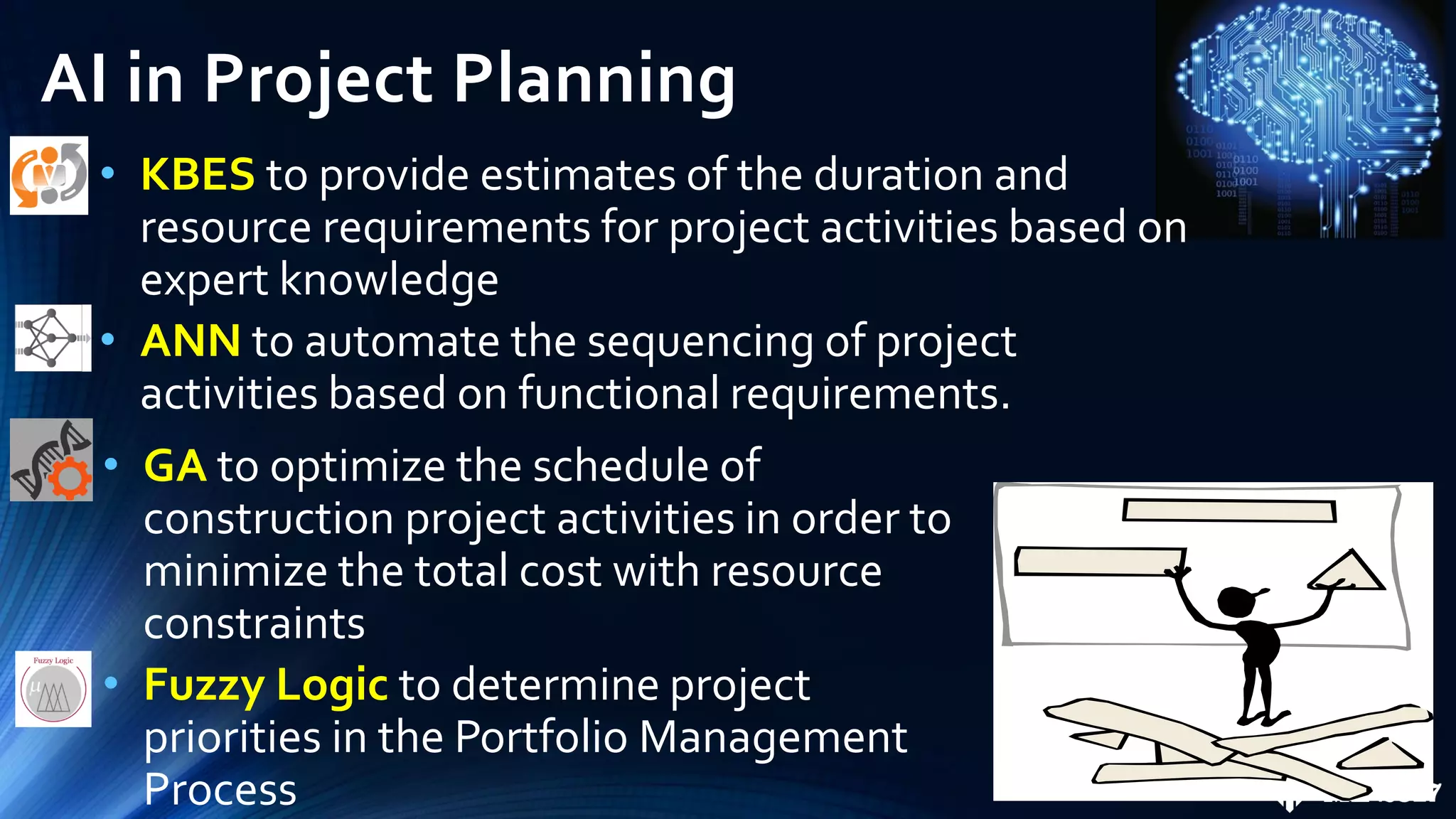
AI in Project Planning
• KBES to provide estimates of the duration and
resource requirements for project activities based on
expert knowledge
• ANN to automate the sequencing of project
activities based on functional requirements.
• GA to optimize the schedule of
construction project activities in order to
minimize the total cost with resource
constraints
• Fuzzy Logic to determine project
priorities in the Portfolio Management
Process
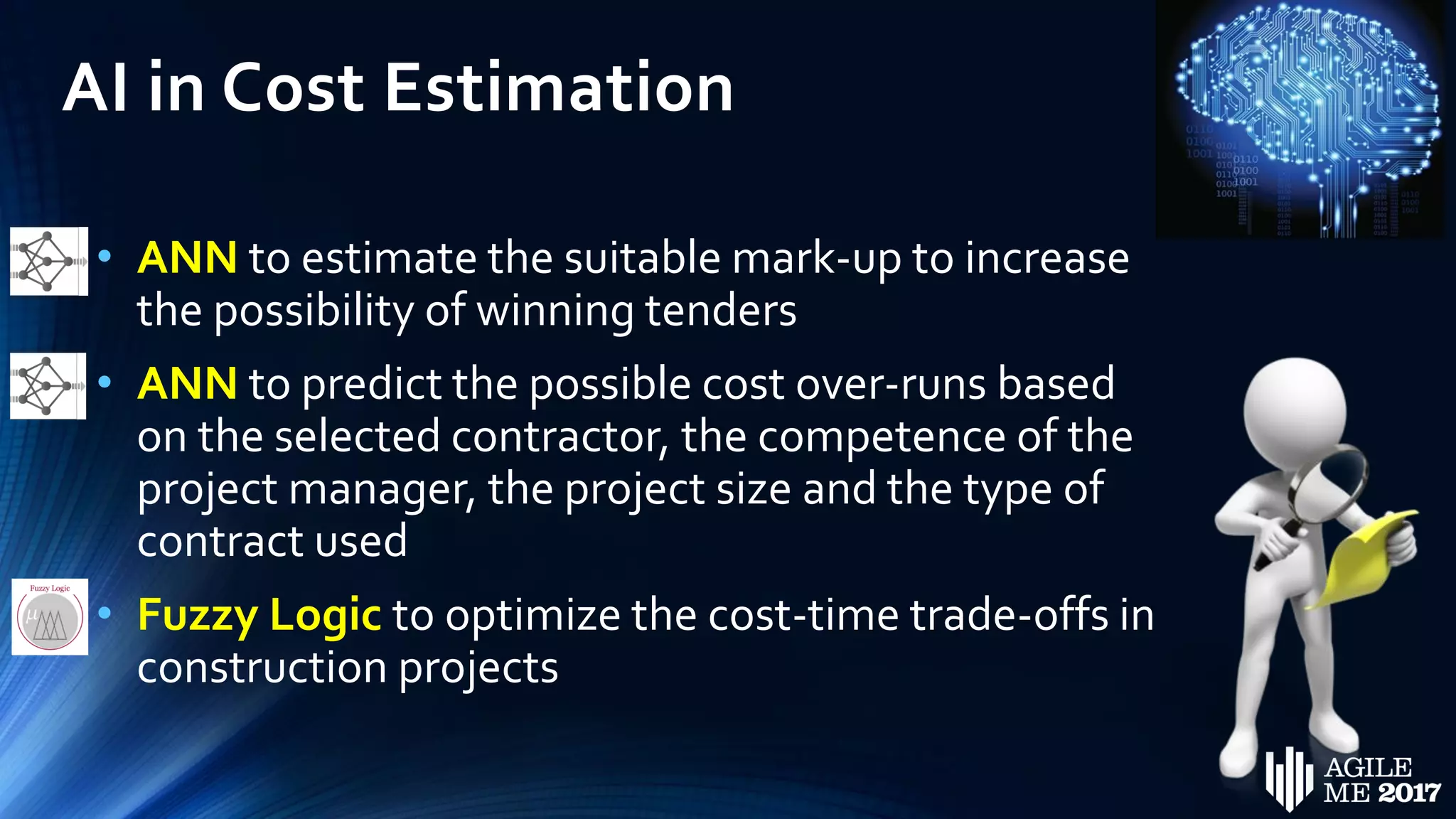
AI in Cost Estimation
• ANN to estimate the suitable mark-up to increase
the possibility of winning tenders
• ANN to predict the possible cost over-runs based
on the selected contractor, the competence of the
project manager, the project size and the type of
contract used
• Fuzzy Logic to optimize the cost-time trade-offs in
construction projects
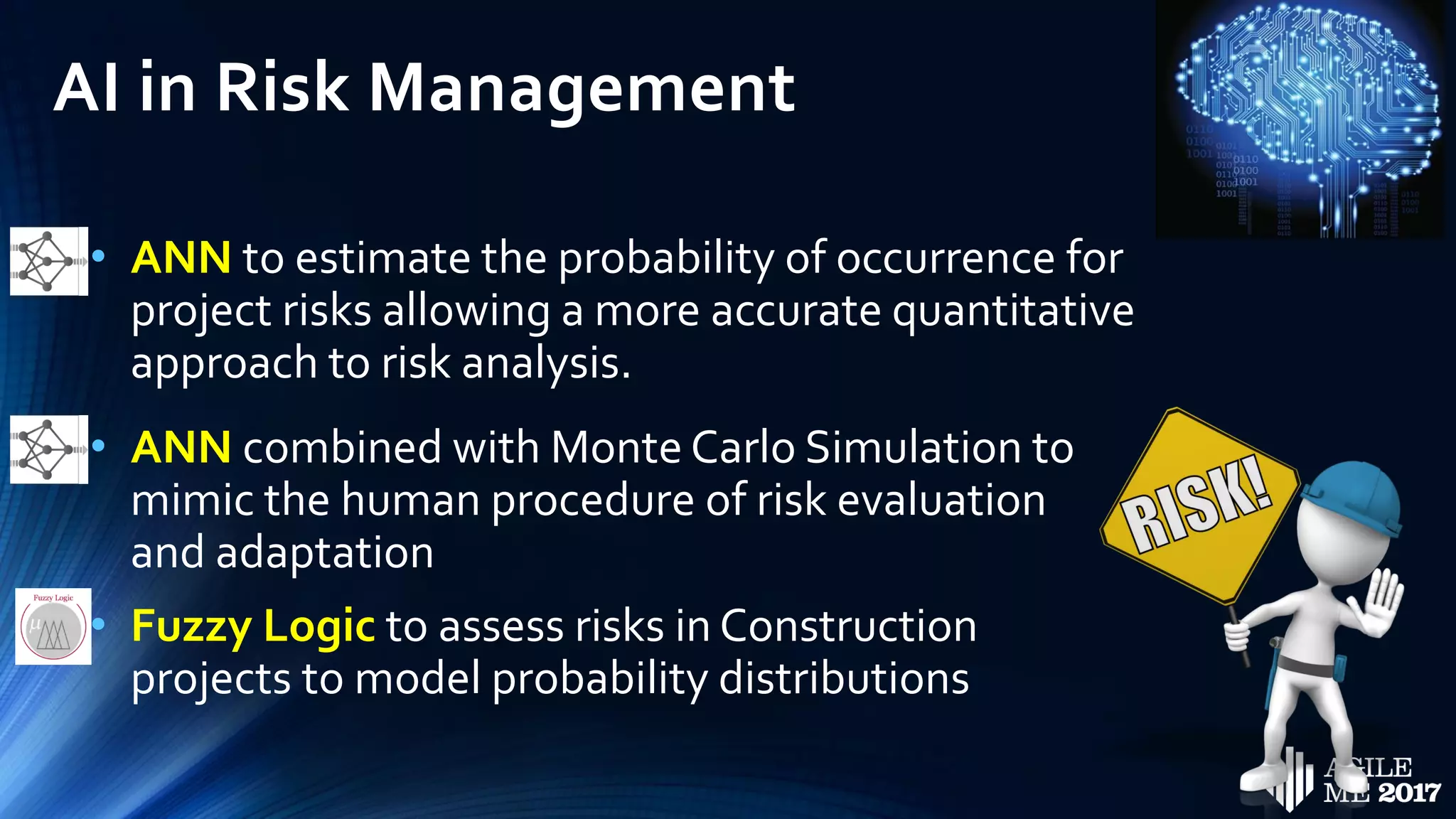
AI in Risk Management
• ANN to estimate the probability of occurrence for
project risks allowing a more accurate quantitative
approach to risk analysis.
• ANN combined with Monte Carlo Simulation to
mimic the human procedure of risk evaluation
and adaptation
• Fuzzy Logic to assess risks in Construction
projects to model probability distributions
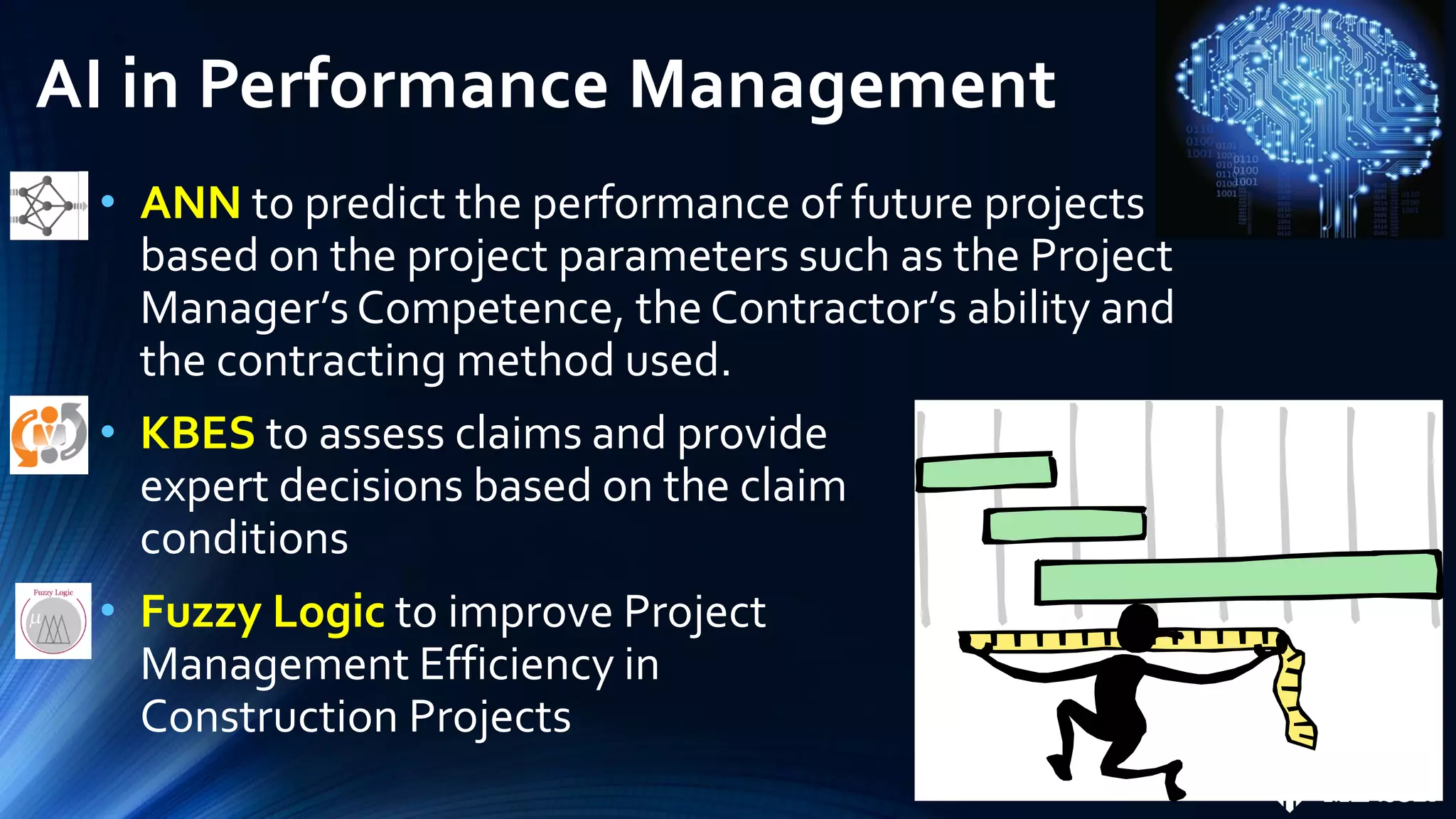
AI in Performance Management
• ANN to predict the performance of future projects
based on the project parameters such as the Project
Manager’sCompetence, the Contractor’s ability and
the contracting method used.
• KBES to assess claims and provide
expert decisions based on the claim
conditions
• Fuzzy Logic to improve Project
Management Efficiency in
Construction Projects
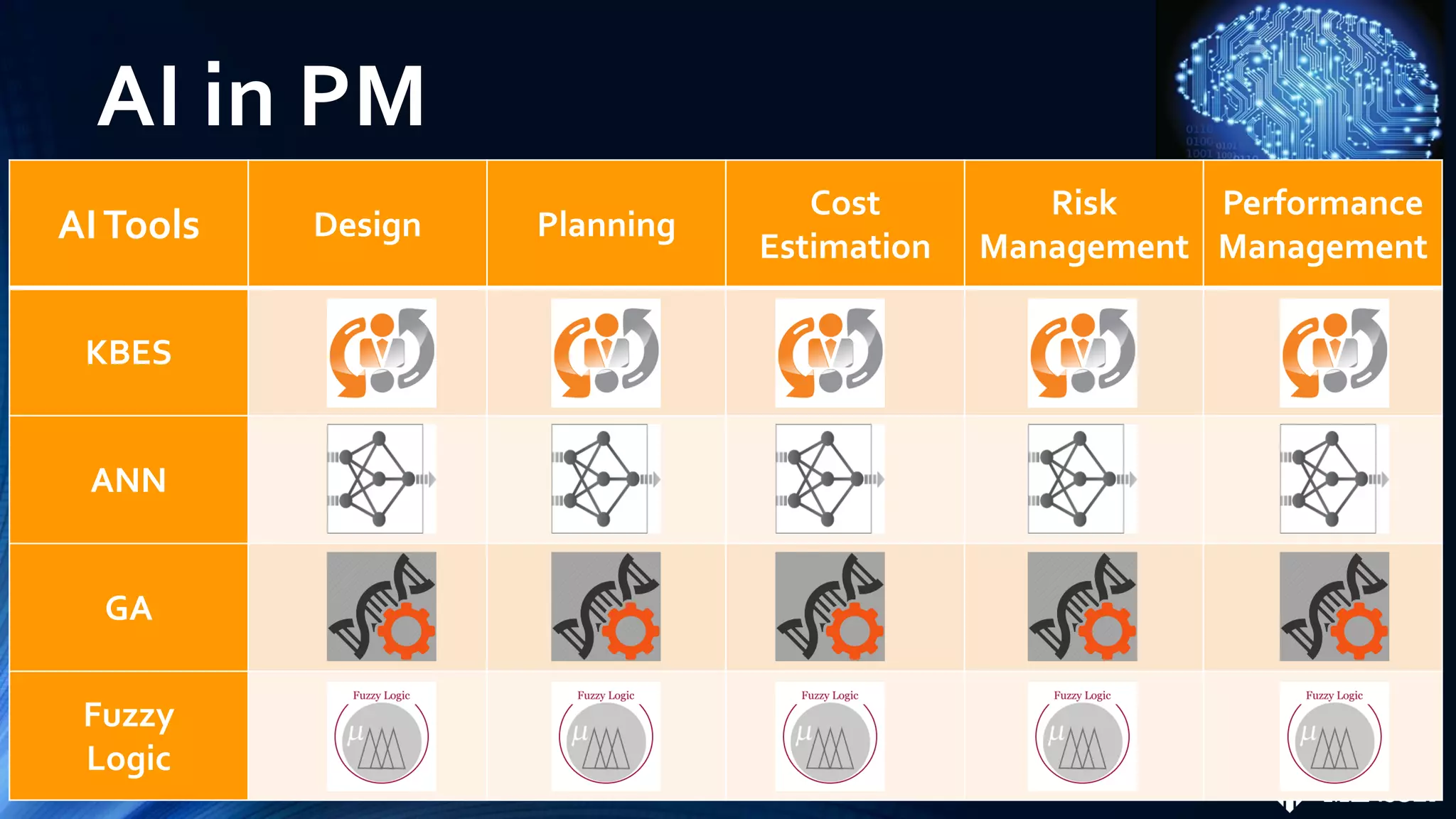
AI in PM
AITools Design Planning
Cost
Estimation
Risk
Management
Performance
Management
KBES
ANN
GA
Fuzzy
Logic
AI in PM
• AI can be and has been used in
several applications in Project
Management enabling better
project performance
• AI can make the life of project
managers less (or maybe more)
miserable
Contents
• What is Artificial Intelligence?
• Artificial Intelligence in Project Management
• Data Mining and Knowledge Engineering
Data Mining &
Knowledge Engineering
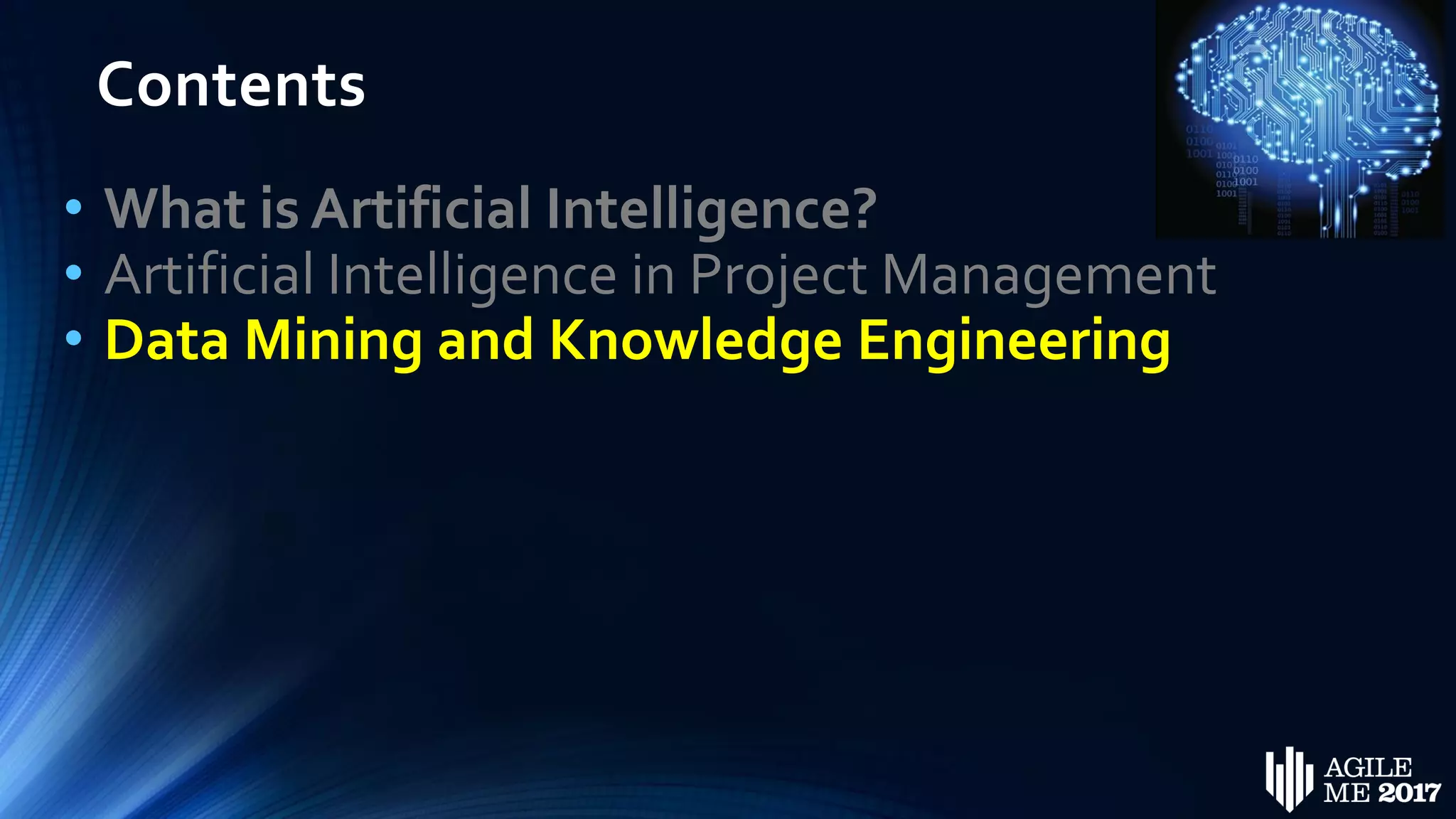
• Sources of Data:
• Machine Data
• Organizations Data
• People Data
• Data-Information-Knowledge-Wisdom
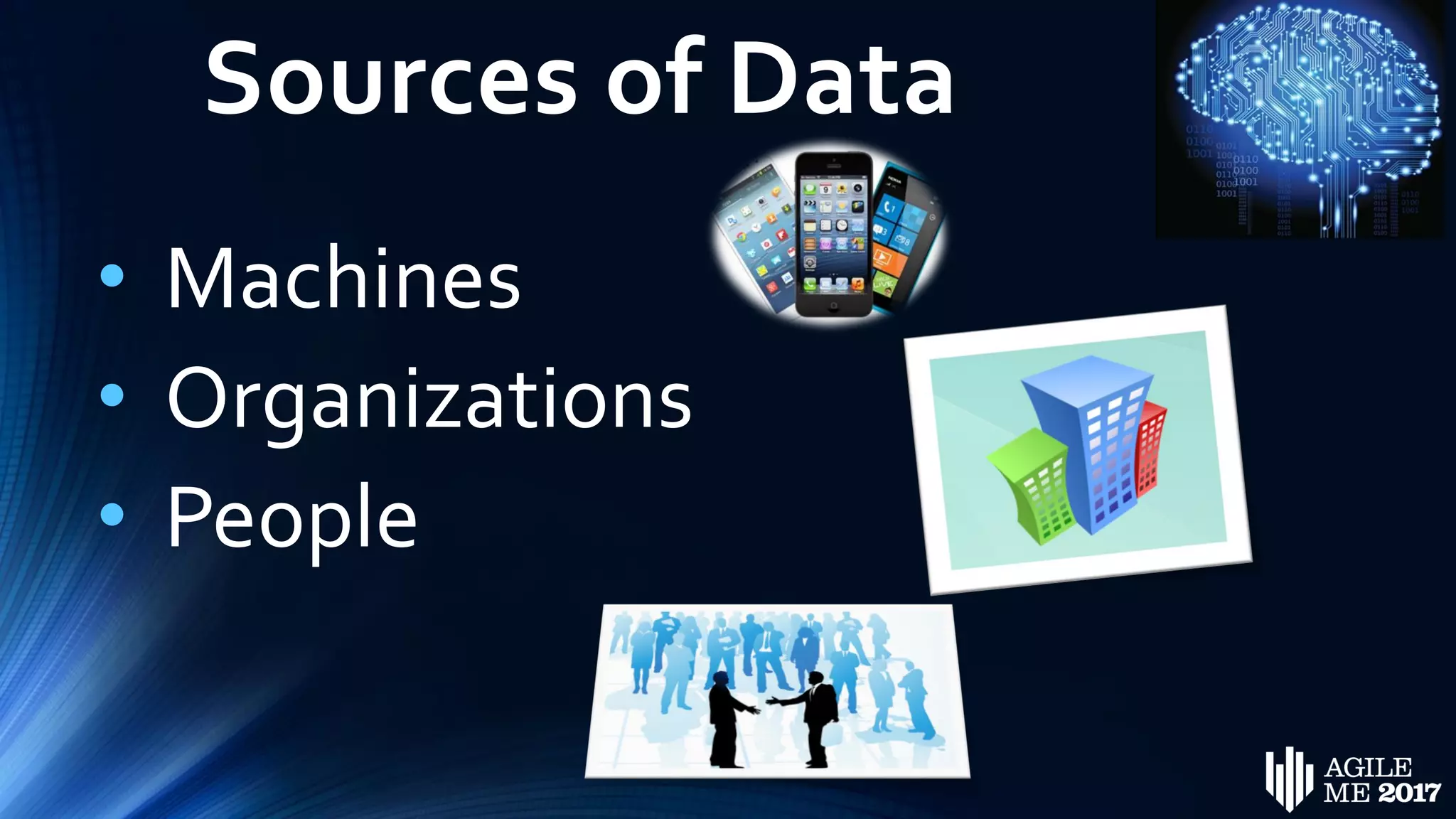
Sources of Data
• Machines
• Organizations
• People
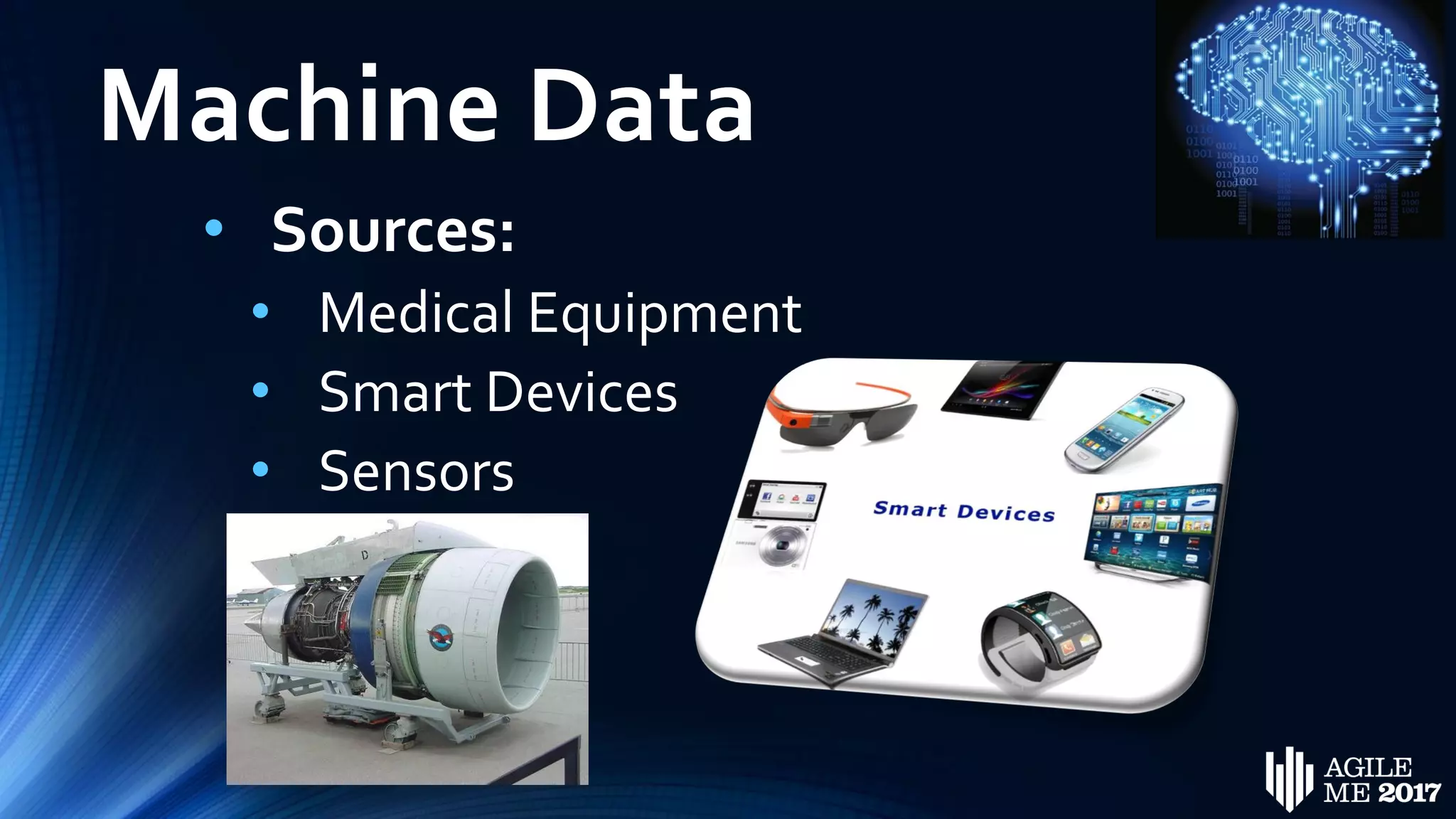
Machine Data
• Sources:
• Medical Equipment
• Smart Devices
• Sensors
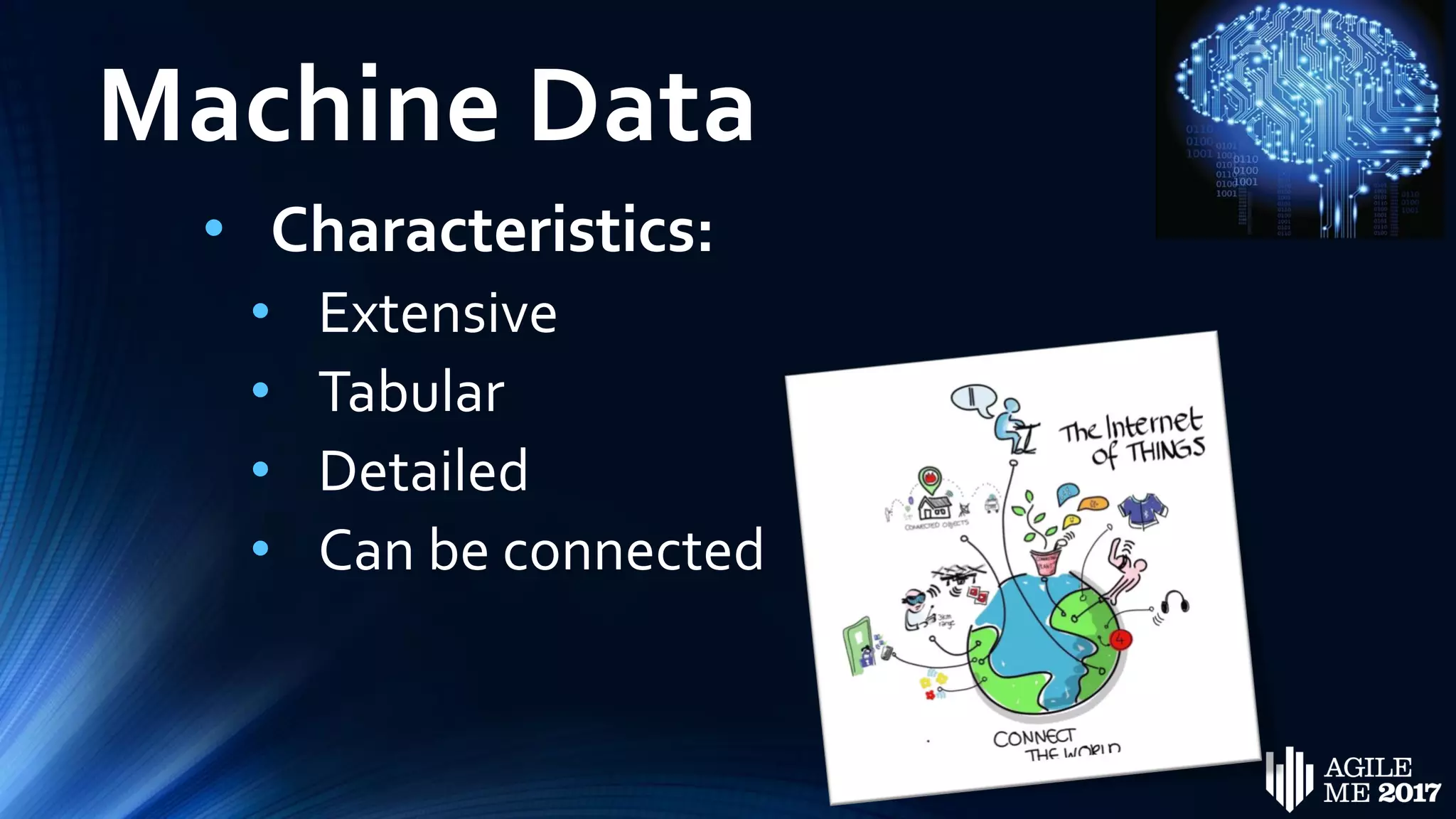
Machine Data
• Characteristics:
• Extensive
• Tabular
• Detailed
• Can be connected
Organizations Data
• Sources:
• Banks & Financial Institutions
• Hospitals
• HR Departments
• Retails Stores
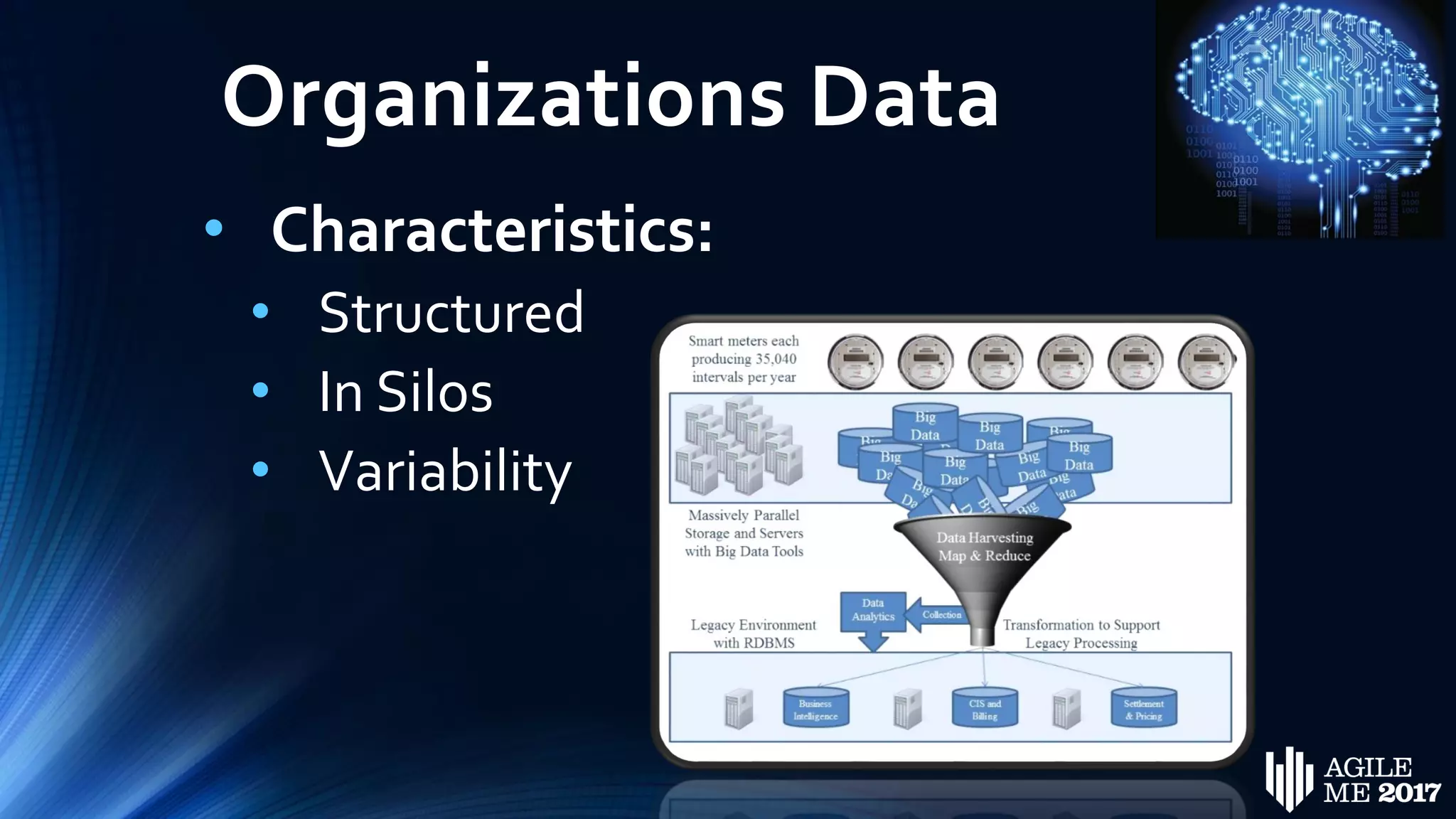
Organizations Data
• Characteristics:
• Structured
• In Silos
• Variability
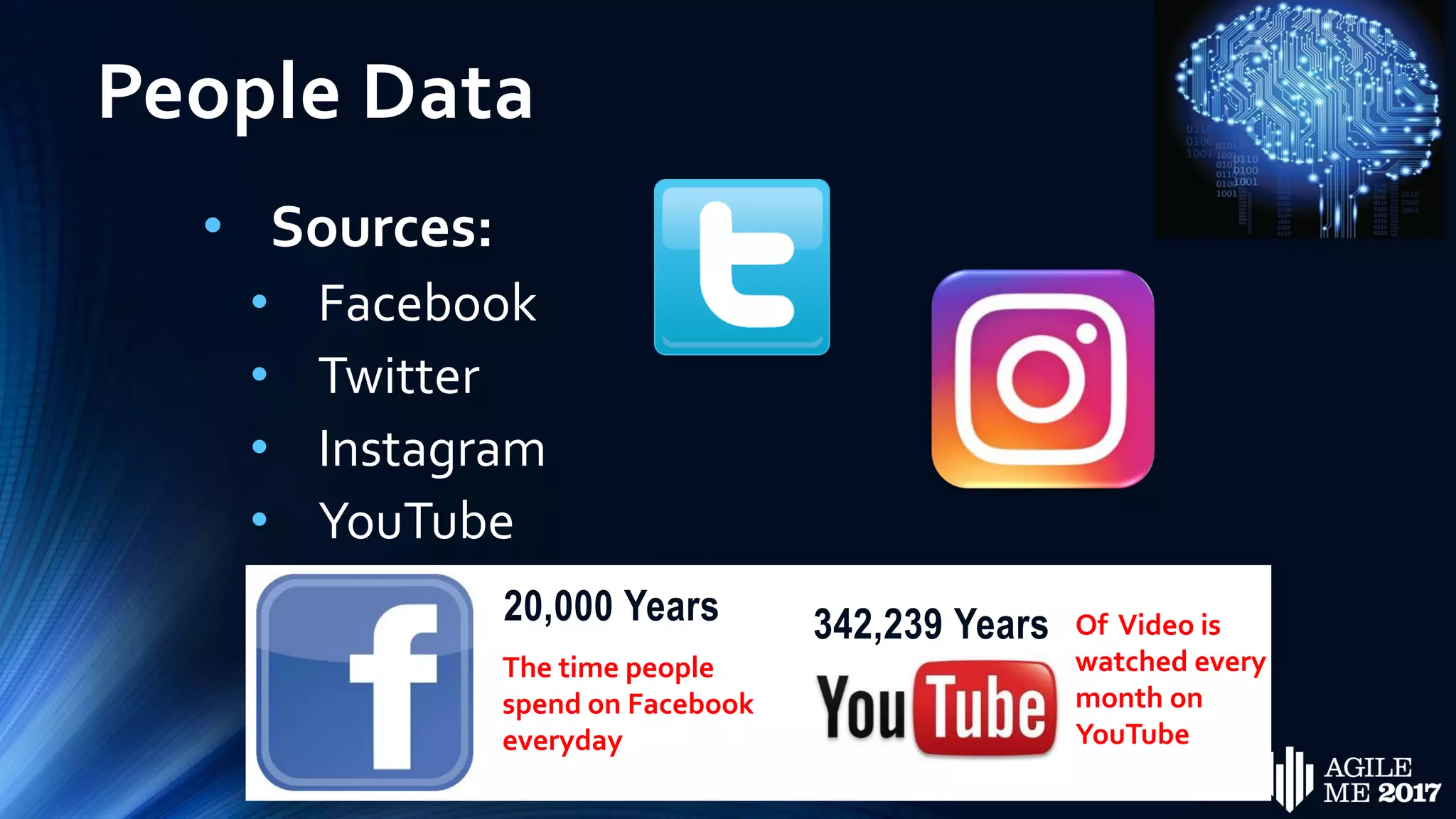
People Data
• Sources:
• Facebook
• Twitter
• Instagram
• YouTube
20,000 Years
The time people
spend on Facebook
everyday
342,239 Years Of Video is
watched every
month on
YouTube
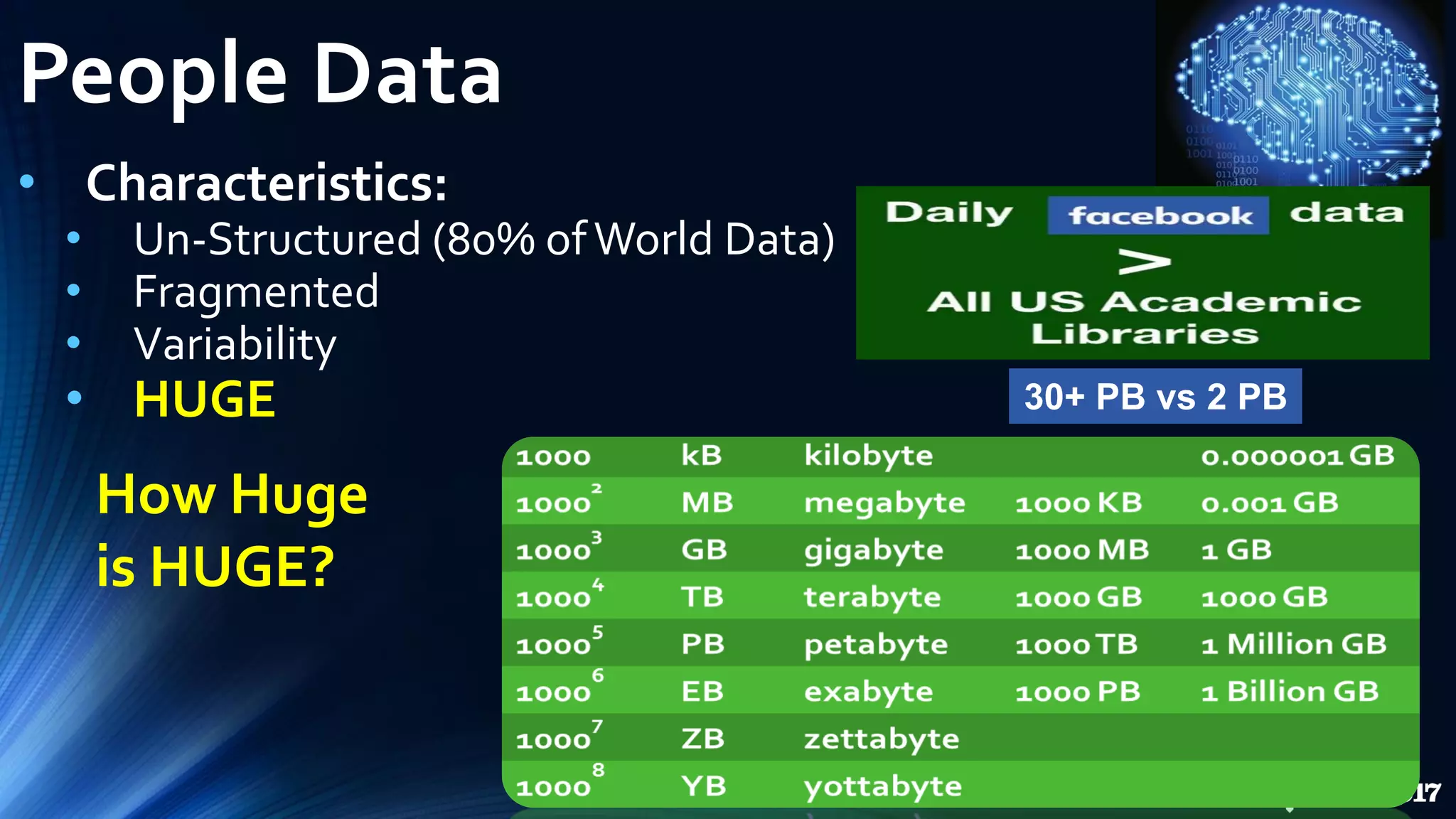
People Data
• Characteristics:
• Un-Structured (80% ofWorld Data)
• Fragmented
• Variability
• HUGE
How Huge
is HUGE?
30+ PB vs 2 PB
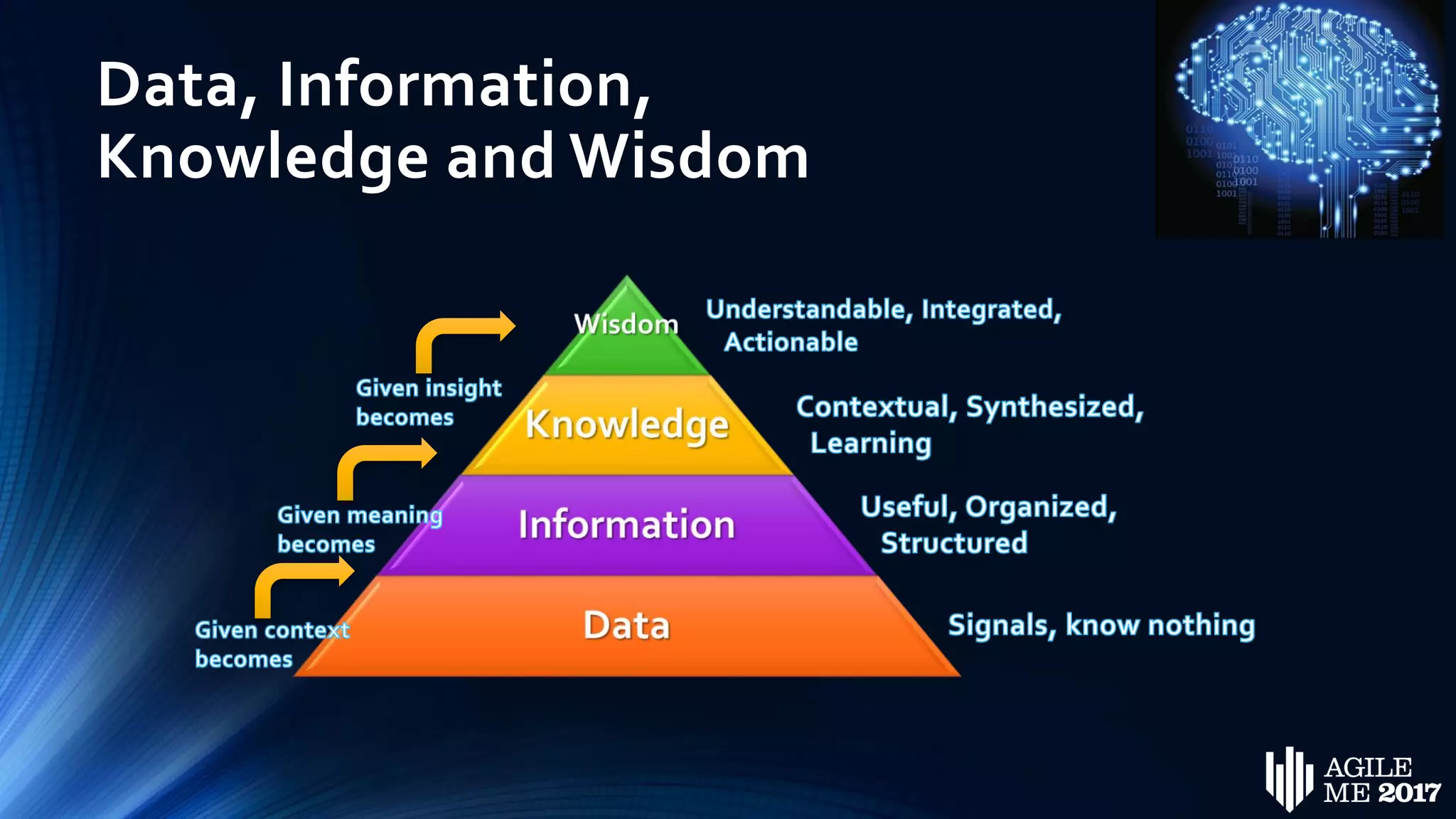
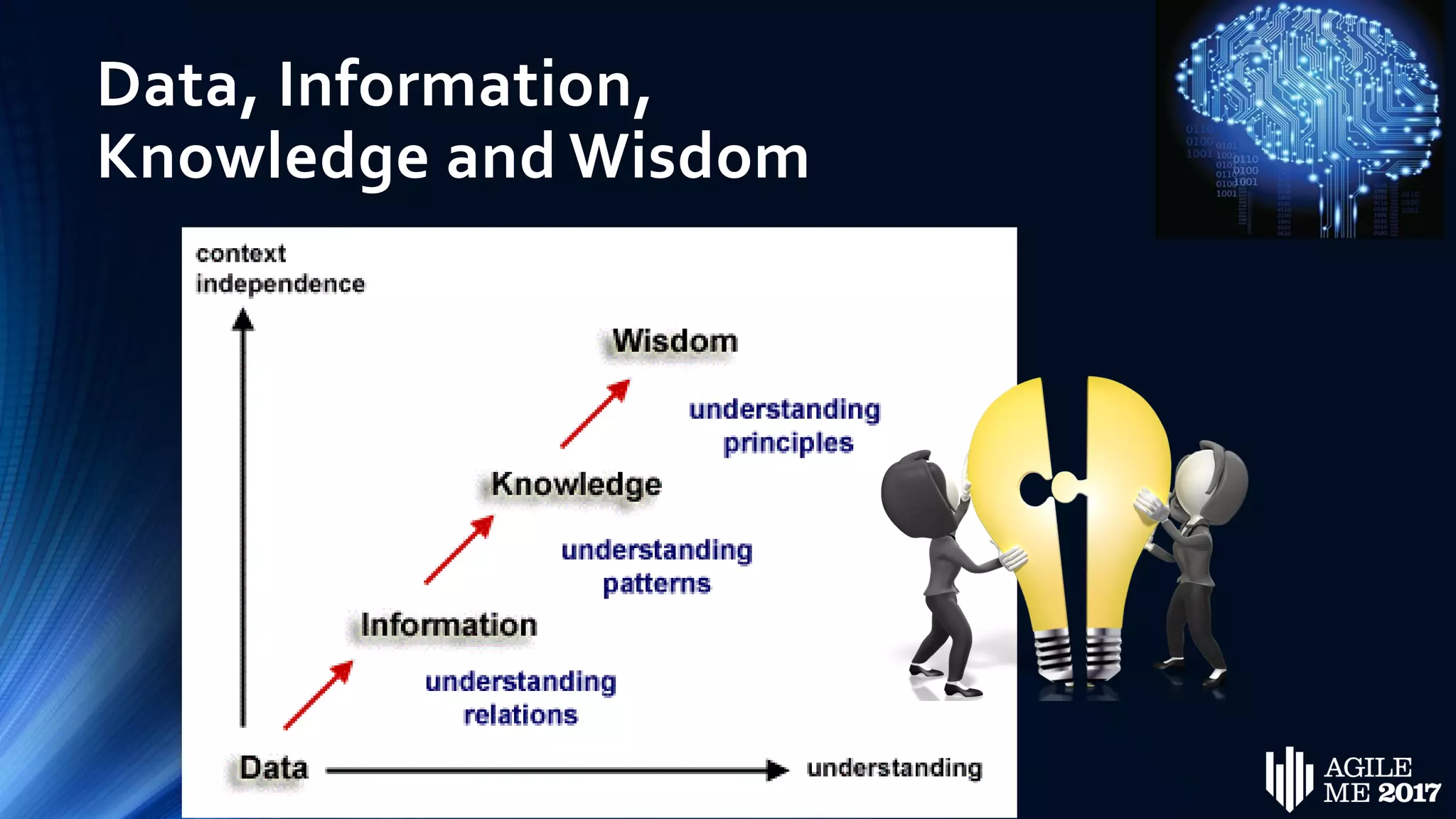
Data, Information,
Knowledge and Wisdom
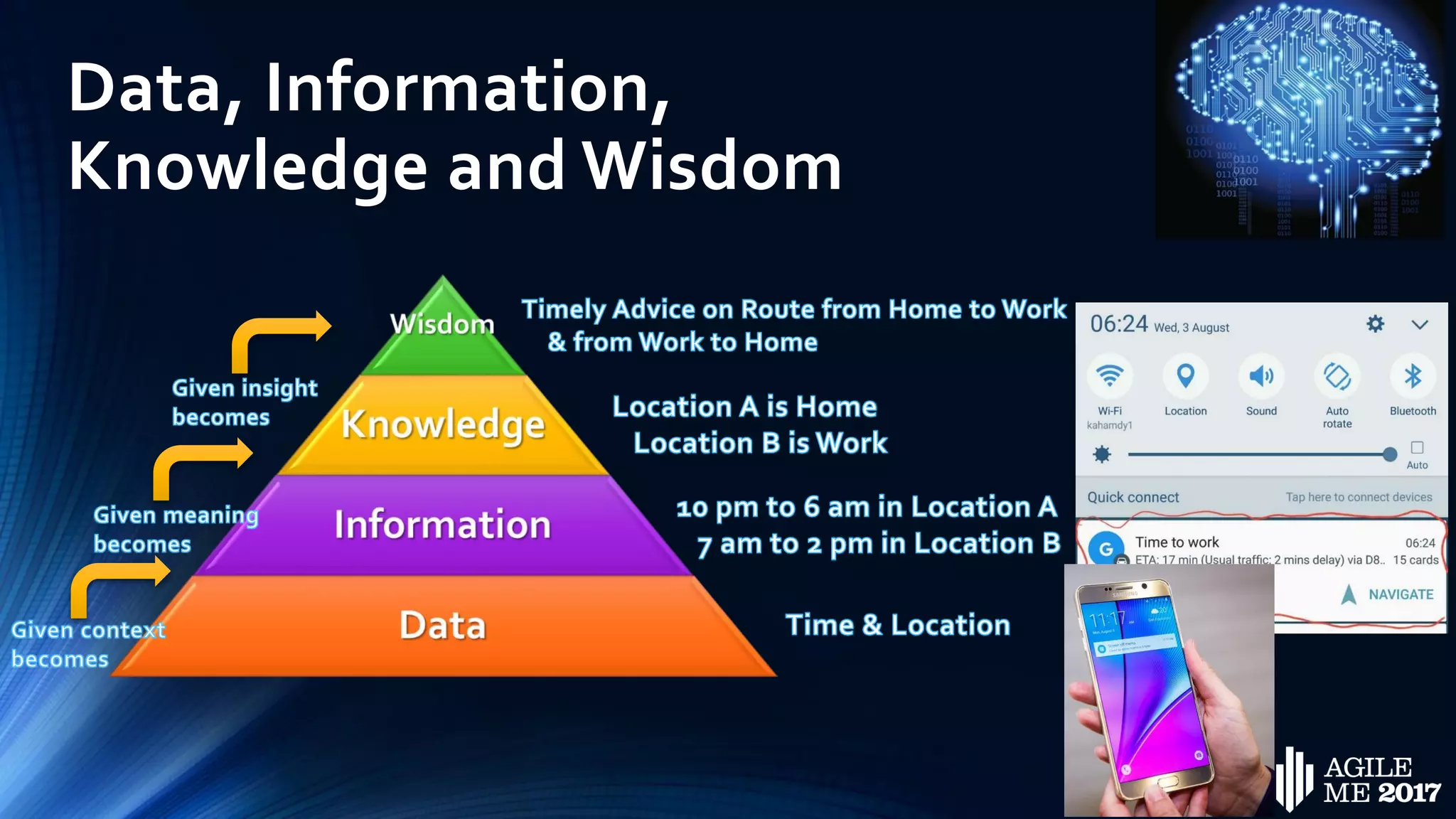
Data, Information,
Knowledge and Wisdom
Data, Information,
Knowledge and Wisdom
Data Mining in Project
Management
• Knowledge Discovery in Data (KDD) used to
extract useful knowledge from large sets of
resources data to improve resource
management practices
• Data Mining used to improve Project Cost
Estimation and Scheduling for Software
Projects
Remember
Artificial Intelligence is a
Science that uses
Technology to create
Magic
Also Remember
DATA is the
Currency of the
Future
GOLD SPONSORS
BRONZE SPONSOR SUPPORTER
MEDIA PARTNERS
SPONSORS & PARTNERS
Questions
Ask the Computer
It is Intelligent
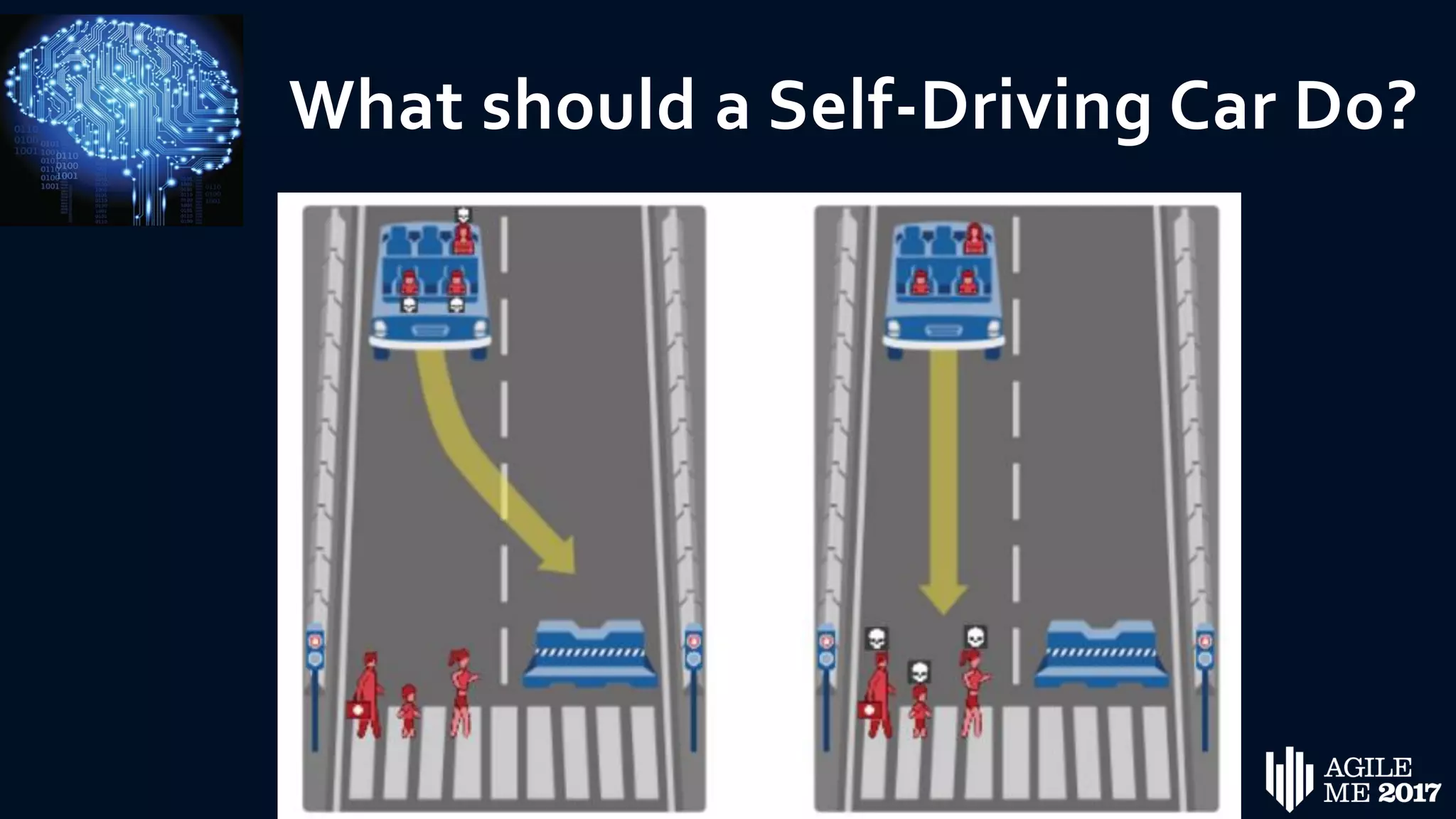
What should a Self-Driving Car Do?
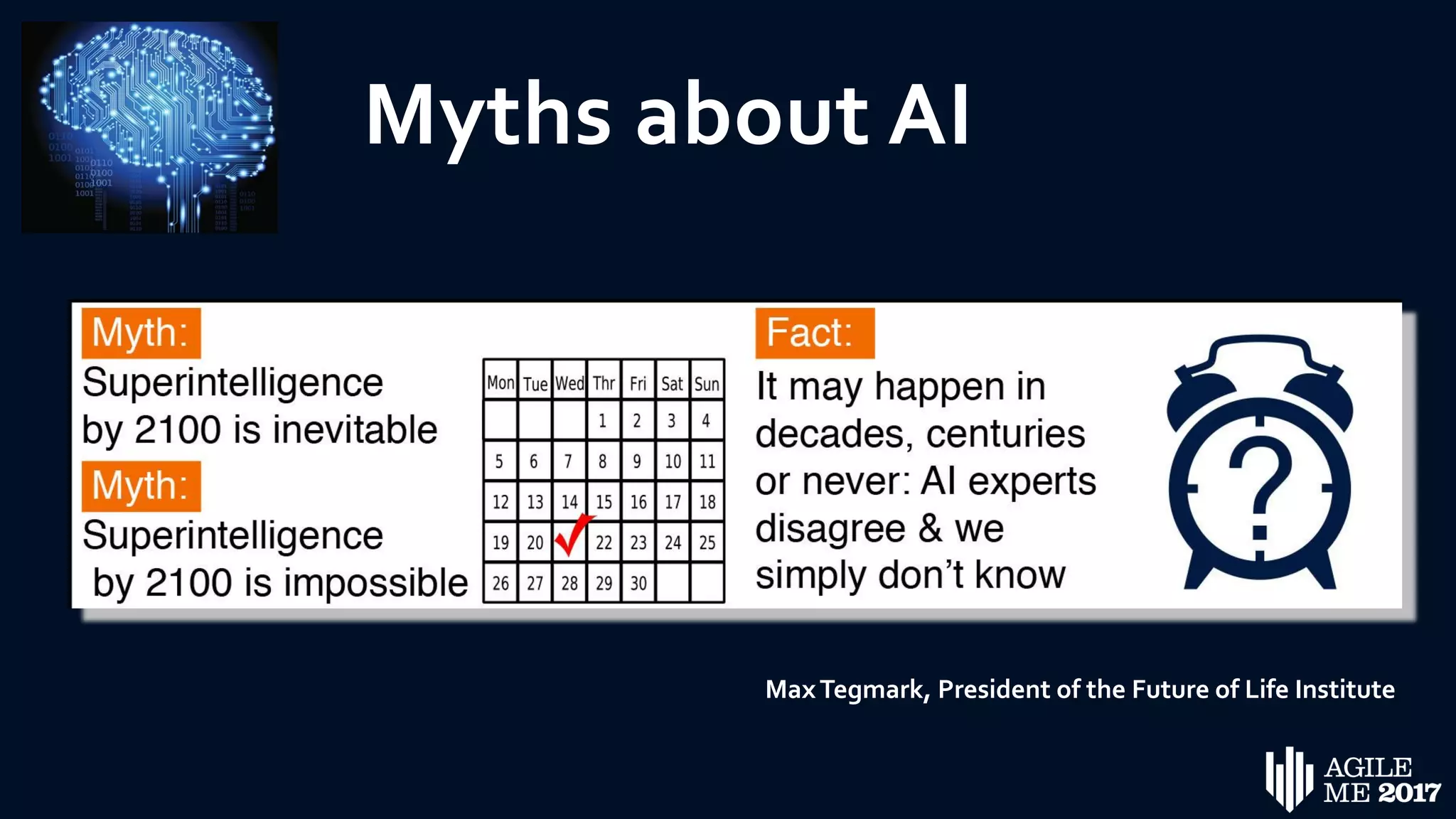
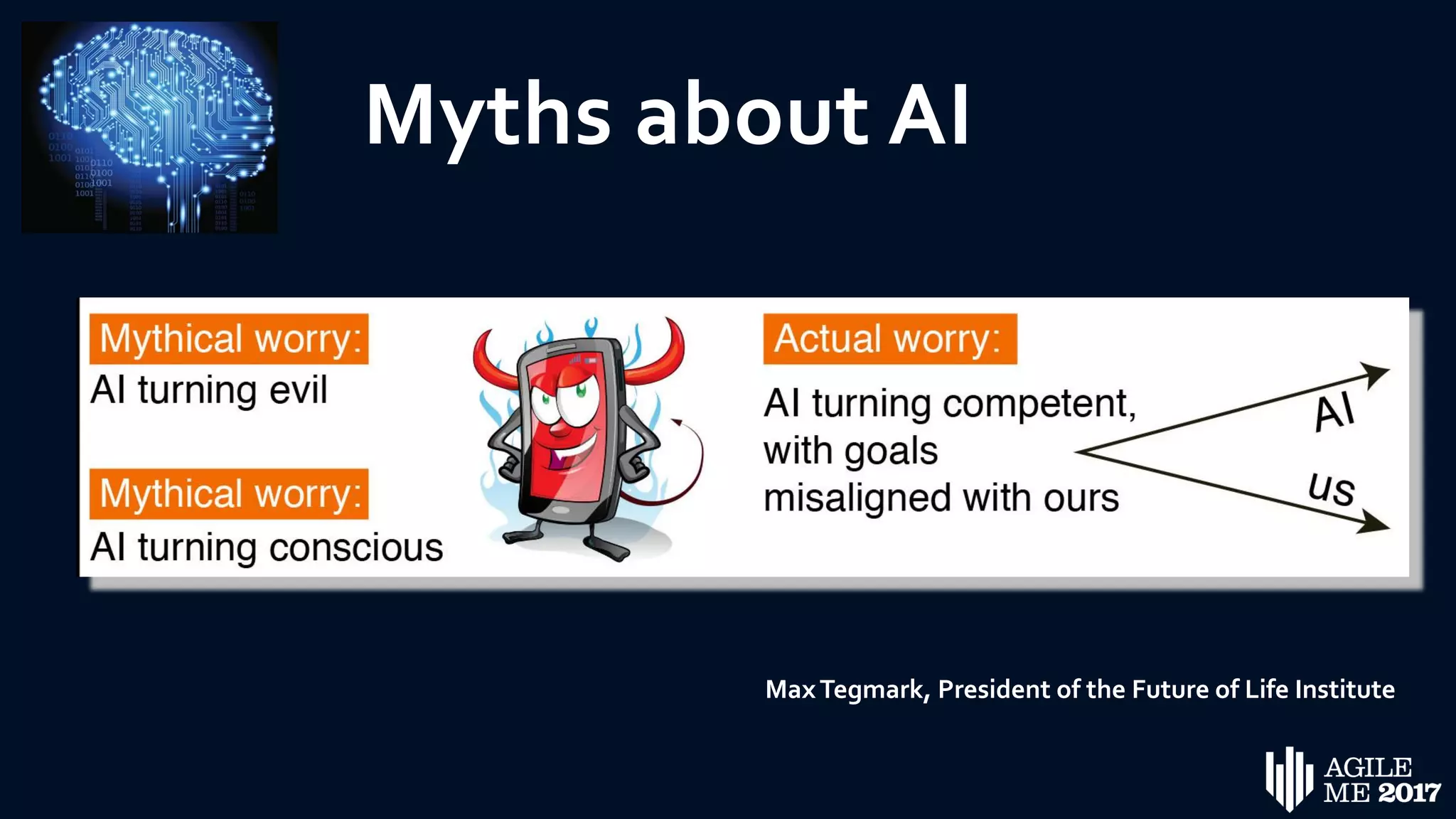
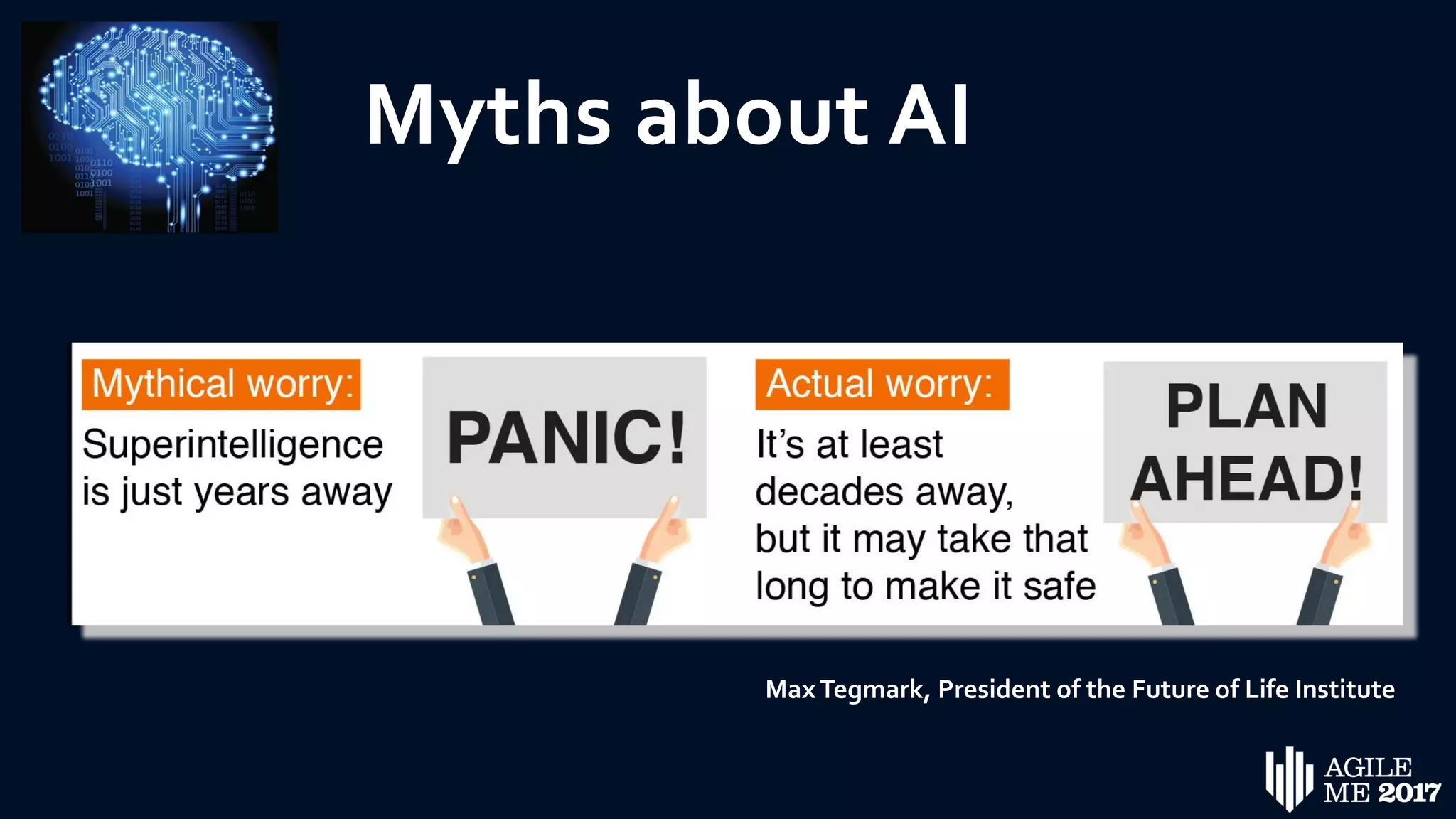
Myths about AI
MaxTegmark, President of the Future of Life Institute
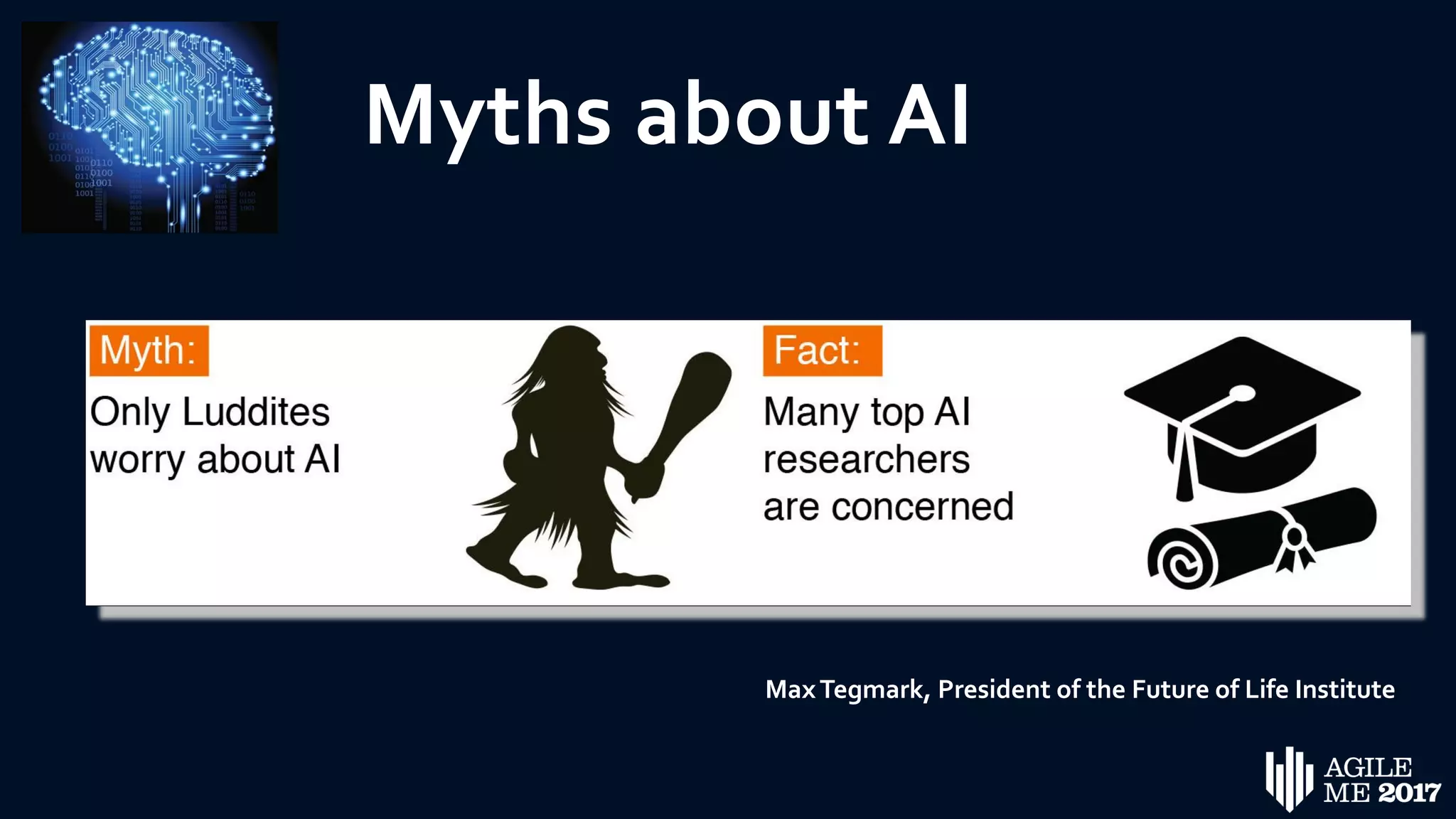
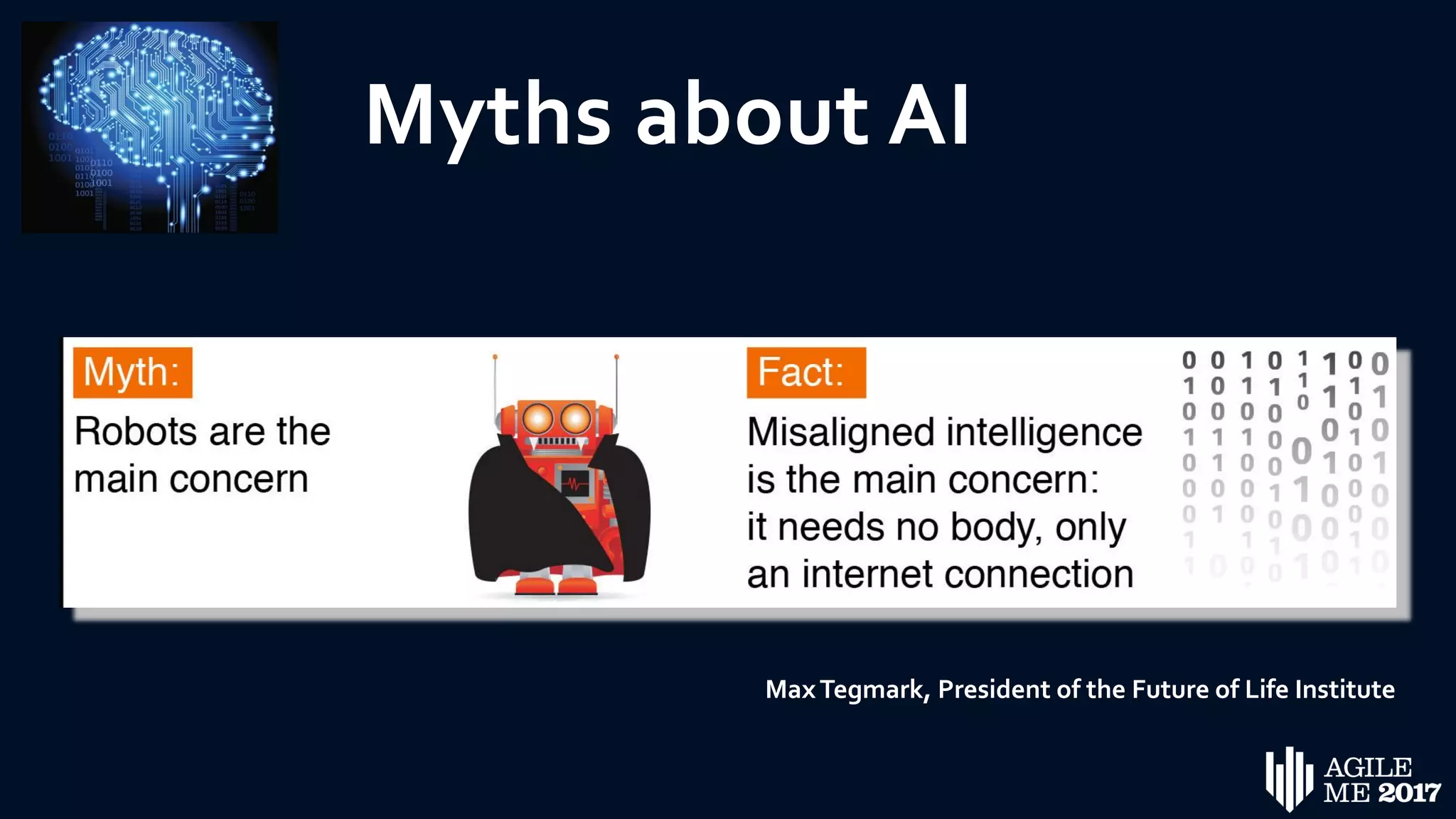
Myths about AI
MaxTegmark, President of the Future of Life Institute
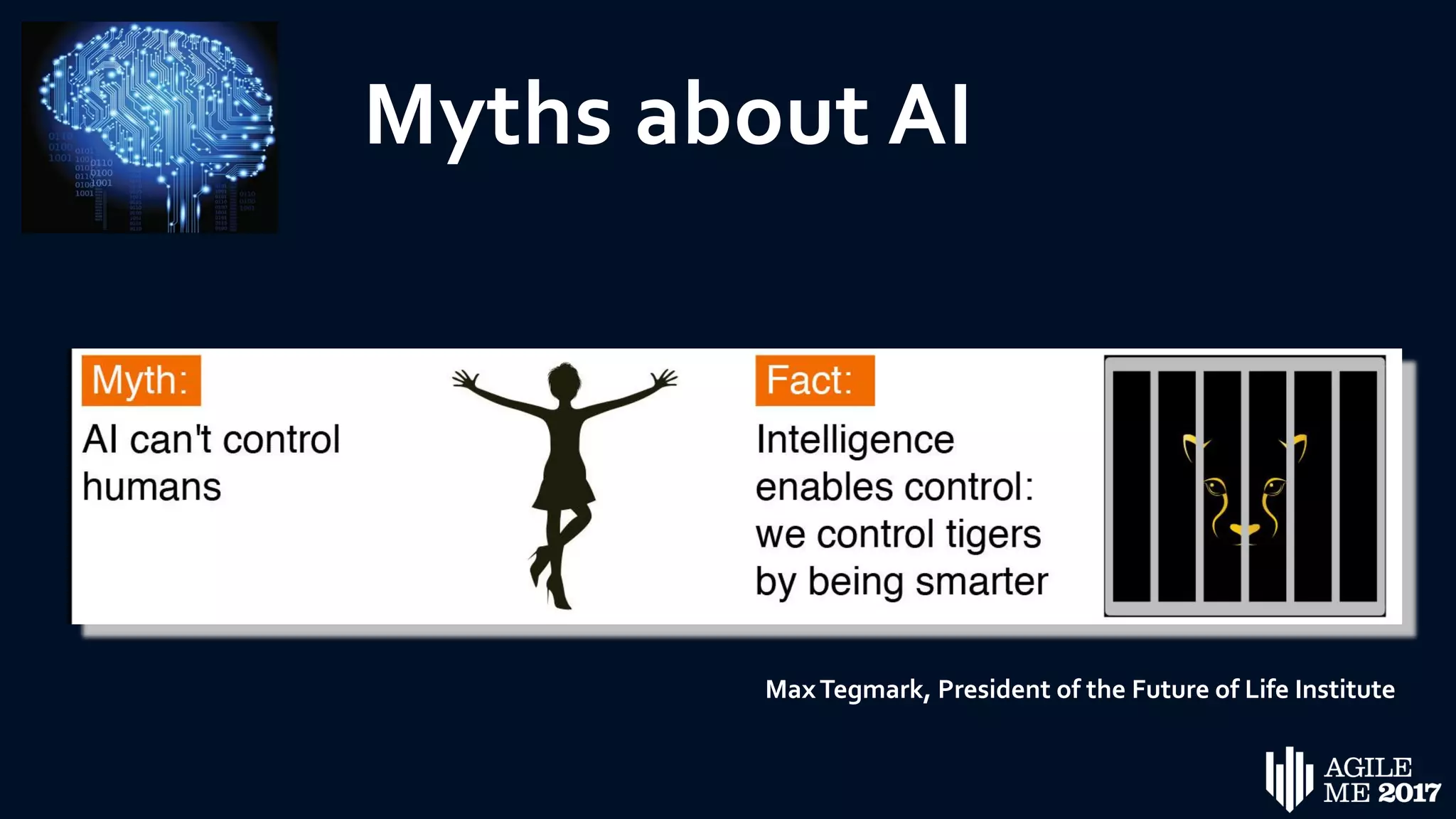
Myths about AI
MaxTegmark, President of the Future of Life Institute
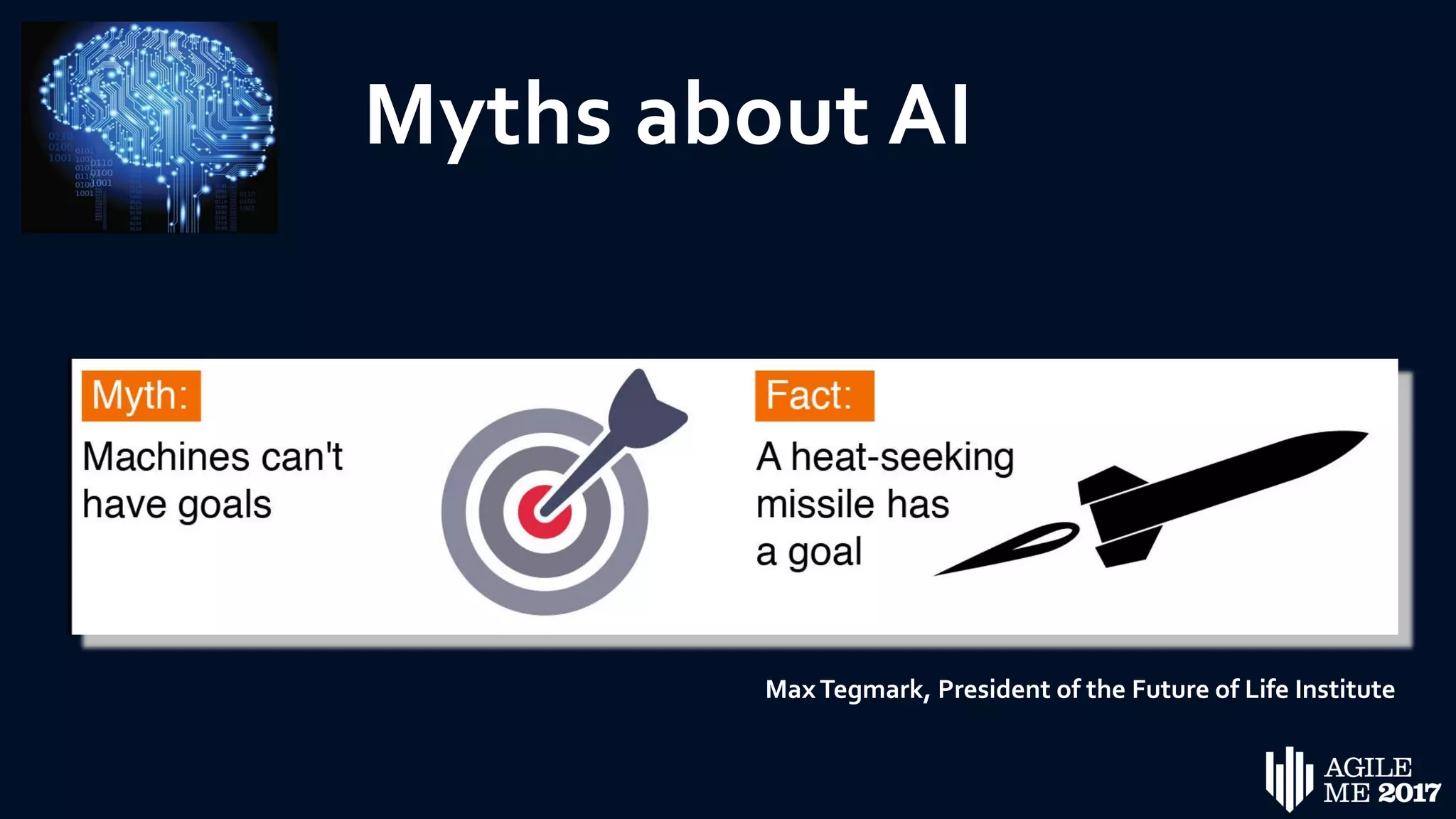
Myths about AI
MaxTegmark, President of the Future of Life Institute
Myths about AI
MaxTegmark, President of the Future of Life Institute
Myths about AI
MaxTegmark, President of the Future of Life Institute
Myths about AI
MaxTegmark, President of the Future of Life Institute

Artificial Intelligence in Project Management by Dr. Khaled A. Hamdy

  • 1.
    Artificial Intelligence in ProjectManagement KHALED HAMDY, PH.D., PMP
  • 2.
    Introduction of KhaledHamdy • Civil Engineer • Ph.D. in Engineering • Professional Project Manager, PMP© • Projects Advisor in RTA Why am I here talking about Artificial Intelligence?
  • 3.
    Contents • What isArtificial Intelligence? • Artificial Intelligence in Project Management • Data Mining and Knowledge Engineering
  • 4.
    Contents • What isArtificial Intelligence? • Artificial Intelligence in Project Management • Data Mining and Knowledge Engineering
  • 5.
    What is AI? Isit Science? Is itTechnology? Is it Magic?
  • 6.
    IS AI MAGIC? ArtificialIntelligence is a Science that uses Technology to Create Magic
  • 7.
    Contents • What isArtificial Intelligence? • Definition • DifferentTypes of Artificial Intelligence • History of Artificial Intelligence • Theories behind Artificial Intelligence • Artificial Intelligence in Project Management • Engineering Design • Cost Estimation and Bidding • Planning and Scheduling • Risk Management • Prediction of Project Performance • Data Mining and Knowledge Engineering
  • 8.
    Definition of AI •AI is a machine’s ability to: • Perceive • Reason • Learn • Act Sensors (Perceive) Environment Perceptions Actions Effectors (Act) Reason & Learn
  • 9.
    Another Definition ofAI • AI is the ability of a computer (or a machine) to perform certain tasks thought to require intelligence including: • Logical deduction and inference • Learning and adaptation • Ability to make decisions based on: • Past Experience • Insufficient Information • Conflicting Information • Ability to understand spoken/natural language
  • 11.
    Different Types ofAI AI Cognitive Science Robotics Natural Interface • Expert Systems • Learning Systems • Fuzzy Logic • Genetic Algorithms • Neural Networks • IntelligentAgents • Visual Perception • Tactility • Dexterity • Locomotion • Navigation • Natural Languages • Speech Recognition • Virtual Reality • Multisensory Interfaces
  • 12.
    History of AI •A branch of Computer Science • Around for Decades • Term first created in 1956 • One of the definitive references on AI (still used today) was LAST published in 1992 • Still used as a text book at MIT
  • 13.
    ALVINN learns toDrive in 1989 Computer 100 Million FLOPS (Floating-Point Operations per second) 1/10 Computing Power of the AppleWatch
  • 14.
    20161989 Reasons for AIProminence 1. Huge Advancements inTechnology
  • 15.
    Reasons for AIProminence 2. Exceptional (Exponential) Growth in Computing Power 1980’s – 3 CRAY Supercomputers 2017 – iPhone 7 More Powerful than 80’s CRAYS
  • 16.
    Advances in Computing •Deep Blue defeatedGarry Kasparov – World Chess Champion in 1997
  • 17.
  • 18.
    AI is alreadyChanging our Lives
  • 19.
    Artificial Intelligence - TheScience behind the Magic • Algorithms that tell computers and other machines how to think and act intelligently • Many tools and techniques including: • Knowledge Based Expert System • Artificial Neural Network • GeneticAlgorithm • Fuzzy Logic
  • 20.
    Knowledge Based ExpertSystem (KBES) • Consist of a Knowledge Base and Inference Engine • The knowledge base is created by collecting the facts and opinions from Subject Matter Experts • The Inference Engine utilizes IF-THEN statements to provide expertise
  • 21.
    Artificial Neural Network(ANN) • A machine learning approach that models the human brain and consists of a number of artificial neurons linked by weighted connections • ANNs demonstrate the ability to learn, recall, and generalize from training patterns or data (numeric, non-numeric or both).
  • 22.
    Artificial Neural Network(ANN) Input Layer Hidden Layer (s) Output Layer Inputs Numeric or Non-Numeric Outputs Numeric or Non-Numeric Neuron Neuron Connections Connections
  • 23.
  • 24.
    Genetic Algorithms (GA) •Iterative search methods that mimic the natural biological evolution process and/or the social behavior of species. • GAs utilize the natural evolution processes of selection, mutation and cross-over to arrive at near-optimum solutions to large-scale optimization problems, for which traditional mathematical search techniques may fail.
  • 25.
  • 26.
    Fuzzy Logic • Fuzzylogic is an approach to computing based on "degrees of truth" rather than the usual "true or false" (1 or 0) Boolean logic on which the modern computer is based • A form of many-valued logic in which the truth values of variables may be any real number between 0 and 1
  • 27.
    Fuzzy vs BooleanLogic Boolean Logic Not Tall (0) 150 cm Tall (1) 180 cm Fuzzy Logic Not very Tall (0.2) 150 cm Definitely Tall (0.9) 180 cm
  • 28.
    Contents • What isArtificial Intelligence? • Artificial Intelligence in Project Management • Data Mining and Knowledge Engineering
  • 29.
    AI in EngineeringDesign • ANN to select the most suitable structural system for High Rise Buildings subjected to wind and seismic loads • GA to optimize the LCC of Buildings in hot climates using different combinations of location, orientation and construction materials
  • 30.
    AI in ProjectPlanning • KBES to provide estimates of the duration and resource requirements for project activities based on expert knowledge • ANN to automate the sequencing of project activities based on functional requirements. • GA to optimize the schedule of construction project activities in order to minimize the total cost with resource constraints • Fuzzy Logic to determine project priorities in the Portfolio Management Process
  • 31.
    AI in CostEstimation • ANN to estimate the suitable mark-up to increase the possibility of winning tenders • ANN to predict the possible cost over-runs based on the selected contractor, the competence of the project manager, the project size and the type of contract used • Fuzzy Logic to optimize the cost-time trade-offs in construction projects
  • 32.
    AI in RiskManagement • ANN to estimate the probability of occurrence for project risks allowing a more accurate quantitative approach to risk analysis. • ANN combined with Monte Carlo Simulation to mimic the human procedure of risk evaluation and adaptation • Fuzzy Logic to assess risks in Construction projects to model probability distributions
  • 33.
    AI in PerformanceManagement • ANN to predict the performance of future projects based on the project parameters such as the Project Manager’sCompetence, the Contractor’s ability and the contracting method used. • KBES to assess claims and provide expert decisions based on the claim conditions • Fuzzy Logic to improve Project Management Efficiency in Construction Projects
  • 34.
    AI in PM AIToolsDesign Planning Cost Estimation Risk Management Performance Management KBES ANN GA Fuzzy Logic
  • 35.
    AI in PM •AI can be and has been used in several applications in Project Management enabling better project performance • AI can make the life of project managers less (or maybe more) miserable
  • 36.
    Contents • What isArtificial Intelligence? • Artificial Intelligence in Project Management • Data Mining and Knowledge Engineering
  • 37.
    Data Mining & KnowledgeEngineering • Sources of Data: • Machine Data • Organizations Data • People Data • Data-Information-Knowledge-Wisdom
  • 38.
    Sources of Data •Machines • Organizations • People
  • 39.
    Machine Data • Sources: •Medical Equipment • Smart Devices • Sensors
  • 40.
    Machine Data • Characteristics: •Extensive • Tabular • Detailed • Can be connected
  • 41.
    Organizations Data • Sources: •Banks & Financial Institutions • Hospitals • HR Departments • Retails Stores
  • 42.
    Organizations Data • Characteristics: •Structured • In Silos • Variability
  • 43.
    People Data • Sources: •Facebook • Twitter • Instagram • YouTube 20,000 Years The time people spend on Facebook everyday 342,239 Years Of Video is watched every month on YouTube
  • 44.
    People Data • Characteristics: •Un-Structured (80% ofWorld Data) • Fragmented • Variability • HUGE How Huge is HUGE? 30+ PB vs 2 PB
  • 45.
  • 46.
  • 47.
  • 48.
    Data Mining inProject Management • Knowledge Discovery in Data (KDD) used to extract useful knowledge from large sets of resources data to improve resource management practices • Data Mining used to improve Project Cost Estimation and Scheduling for Software Projects
  • 49.
    Remember Artificial Intelligence isa Science that uses Technology to create Magic
  • 50.
    Also Remember DATA isthe Currency of the Future
  • 52.
    GOLD SPONSORS BRONZE SPONSORSUPPORTER MEDIA PARTNERS SPONSORS & PARTNERS
  • 53.
  • 54.
    What should aSelf-Driving Car Do?
  • 55.
    Myths about AI MaxTegmark,President of the Future of Life Institute
  • 56.
    Myths about AI MaxTegmark,President of the Future of Life Institute
  • 57.
    Myths about AI MaxTegmark,President of the Future of Life Institute
  • 58.
    Myths about AI MaxTegmark,President of the Future of Life Institute
  • 59.
    Myths about AI MaxTegmark,President of the Future of Life Institute
  • 60.
    Myths about AI MaxTegmark,President of the Future of Life Institute
  • 61.
    Myths about AI MaxTegmark,President of the Future of Life Institute