© 2015 IBM Corporation
Rules in Artificial Intelligence
Dec 2015 – Presentation at Ecole 42
Pierre Feillet – IBM Decision automation architect
feillet@fr.ibm.com
© 2015 IBM Corporation
Agenda
2
 Origins
 Expert System -> Inference Engine -> Rules
 Current state
 From raw inference engine to Entreprise decision automation
 Business Rules in Bluemix
© 2015 IBM Corporation
RULES TO MIMIC HUMAN MIND
From Expert Systems to Operation Decision Management
© 2015 IBM Corporation
Expert Systems
4
 An expert system is a computer system that emulates the decision-making ability
of a human expert. Expert systems are designed to solve complex problems by
reasoning about knowledge, represented primarily as if–then rules rather than
through conventional procedural code.
 The first expert systems were created in the 1970s and then proliferated in the
1980s. Expert systems were among the first truly successful forms of AI software.
Expert systems were introduced by the Stanford Heuristic Programming Project.
Applied to domains where expertise was highly valued and complex, such as
diagnosing infectious diseases (Mycin).
 The typical expert system consisted of a knowledge base and an inference engine.
 The knowledge base stored facts about the world.
 The inference engine applied logical rules to the knowledge base and deduced
new knowledge. This process would iterate as each new fact in the knowledge
base could trigger additional rules in the inference engine.
© 2015 IBM Corporation
Rule Logic
5
 2 primarily modes of rule inference: forward chaining and backward chaining.
 Forward chaining starts with the known facts and asserts new facts.
Ex: Socrate is Human so he is mortal
 Backward chaining starts with goals, and works backward to determine what facts
must be asserted so that the goals can be achieved.
Ex: Is Socrate mortal? It would search through the knowledge base and
determine if Socrates was Human and if so would assert he is also Mortal.
 Can include a common technique was to integrate the inference engine with a
user interface to ask questions when facts are not enough and would then use
that information accordingly.
© 2015 IBM Corporation
Rule Logic
6
 An inference engine cycles through three sequential steps: match rules, select
rules, and execute rules. The execution of the rules will often result in new facts or
goals being added to the knowledge base which will trigger the cycle to repeat.
This cycle continues until no new rules can be matched.
 In the first step, match rules, the inference engine finds all of the rules that are
triggered by the current contents of the knowledge base. In forward chaining the
engine looks for rules where the antecedent (left hand side) matches some fact in
the knowledge base. In backward chaining the engine looks for antecedents that
can satisfy one of the current goals.
 In the second step select rules, the inference engine prioritizes the various rules
that were matched to determine the order to execute them.
 In the final step, execute rules, the engine executes each matched rule in the
order determined in step two and then iterates back to step one again. The cycle
continues until no new rules are matched.
 Rule engine algorithms: RETE, IBM Fastpath & Sequential, etc
 Stateless & stateful processing
© 2015 IBM Corporation
From Expert Systems to Operational Decision Management
7
 Goal: Empower Business Users to author,
test, simulate, deploy their decision logic
 Bring a Business Model on the top of Java,
XML, JSON, COBOL, etc
 Add high level rule artifacts: Decision Table
& Trees
 Provide near natural language DSLs with
editors to write your rules in your preferred
locale: Chinese, English
 Integrate the rule engine into a server to
scale, and hot deploy ruleset in a 24/7
manner
 Trace decisions for auditability
 Cloud
 PaaS & SaaS
Rule
engine
Business
Model
Localized
Business
Languages
Decision
warehouse
Decision
Server
Testing &
Simulation
Business
Rules
Tools Cloud
© 2015 IBM Corporation
IBM BUSINESS RULES
Business rules as a service in IBM Bluemix
© 2015 IBM Corporation
Your Application
Externalize Decisions from Applications into Business Rules
Manage decision logic independently from applications
Your Application
Decision logic
 Natural language rules can be easily read
 Externalized rules are easy to change
 Centralized rules enable reuse and
consistency
 Rules written in software code cannot be
read easily
 Hard coded rules are difficult to change
 Rules intertwined within applications
cannot be reused by other systems
Business Rules
© 2015 IBM Corporation
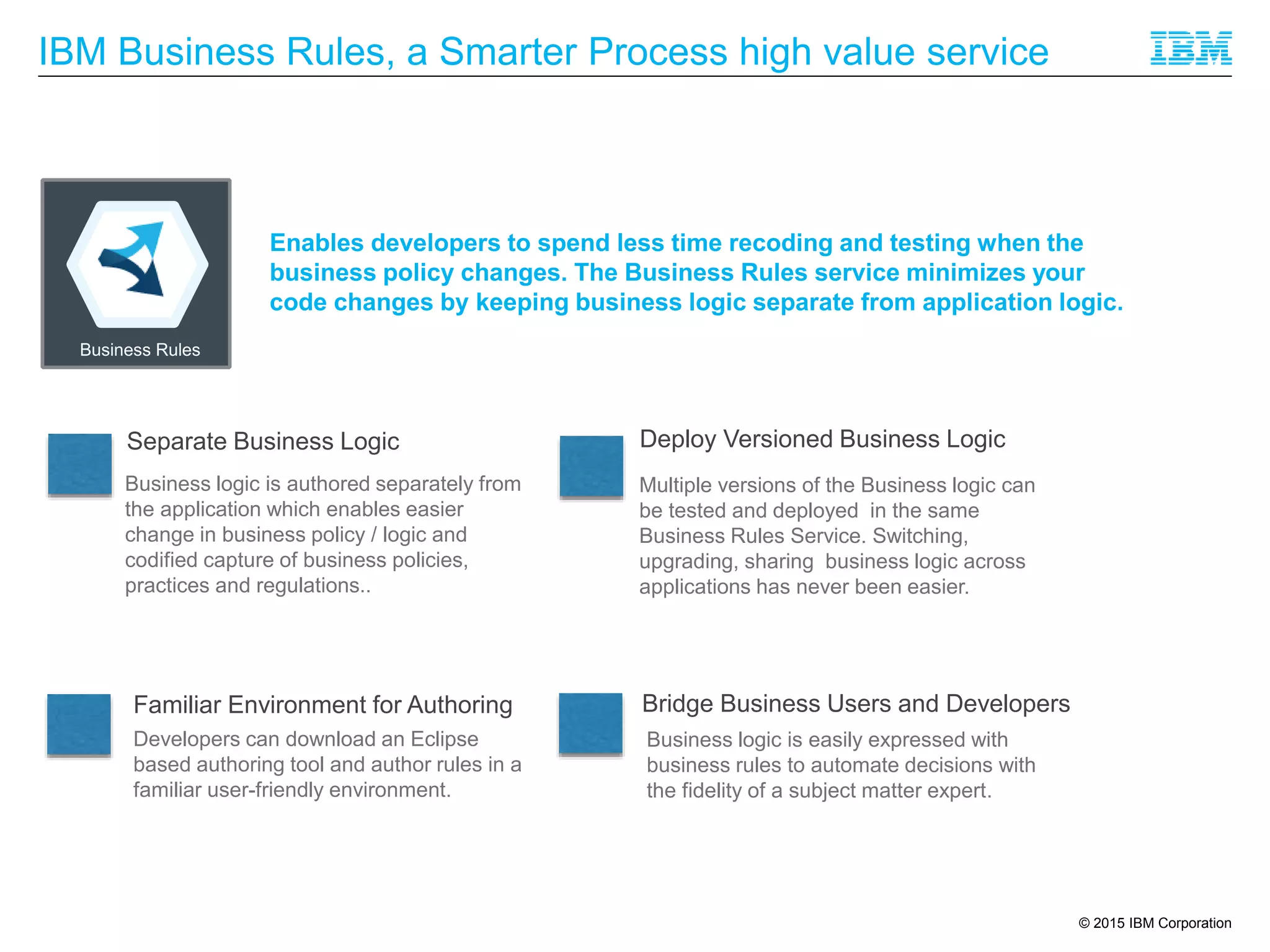
IBM Business Rules, a Smarter Process high value service
Familiar Environment for Authoring
Developers can download an Eclipse
based authoring tool and author rules in a
familiar user-friendly environment.
Separate Business Logic
Business logic is authored separately from
the application which enables easier
change in business policy / logic and
codified capture of business policies,
practices and regulations..
Business logic is easily expressed with
business rules to automate decisions with
the fidelity of a subject matter expert.
Bridge Business Users and Developers
Deploy Versioned Business Logic
Multiple versions of the Business logic can
be tested and deployed in the same
Business Rules Service. Switching,
upgrading, sharing business logic across
applications has never been easier.
Enables developers to spend less time recoding and testing when the
business policy changes. The Business Rules service minimizes your
code changes by keeping business logic separate from application logic.
Business Rules
© 2015 IBM Corporation
The Business Rules service simplifies the experience of creating and
managing mobile app business logic – making apps more adaptable
© 2015 IBM Corporation
Developing and deploying applications using the Business Rules
service
IBM Bluemix
One
app
Another
app
Business Rules
service instance
Author business rules with Rule
Designer plug-ins for Eclipse
Deploy
business
rules
Develop and push app code
Call the
service
Users access
apps from their
devices
Non-Bluemix apps
can call the service
too
Call the service
© 2015 IBM Corporation
Wrap up
13
 Rules
 From 70s IA to today enterprise decision management
 A large number of companies leverage some kinds of business rules (finance, banking)
 Empower developers and business users to automate decision making
 Provides transparency and explanation
 Dynamic deployment
 Rules are based on causality while Big Data & Machine Learning are based on correlation
 Perspectives to bridge rules & ML
 Try Business Rules in Bluemix https://console.ng.bluemix.net on London or Sydney
datacenters
Business Rules
© 2015 IBM Corporation
Q & A
14

Rules in Artificial Intelligence

  • 1.
    © 2015 IBMCorporation Rules in Artificial Intelligence Dec 2015 – Presentation at Ecole 42 Pierre Feillet – IBM Decision automation architect feillet@fr.ibm.com
  • 2.
    © 2015 IBMCorporation Agenda 2  Origins  Expert System -> Inference Engine -> Rules  Current state  From raw inference engine to Entreprise decision automation  Business Rules in Bluemix
  • 3.
    © 2015 IBMCorporation RULES TO MIMIC HUMAN MIND From Expert Systems to Operation Decision Management
  • 4.
    © 2015 IBMCorporation Expert Systems 4  An expert system is a computer system that emulates the decision-making ability of a human expert. Expert systems are designed to solve complex problems by reasoning about knowledge, represented primarily as if–then rules rather than through conventional procedural code.  The first expert systems were created in the 1970s and then proliferated in the 1980s. Expert systems were among the first truly successful forms of AI software. Expert systems were introduced by the Stanford Heuristic Programming Project. Applied to domains where expertise was highly valued and complex, such as diagnosing infectious diseases (Mycin).  The typical expert system consisted of a knowledge base and an inference engine.  The knowledge base stored facts about the world.  The inference engine applied logical rules to the knowledge base and deduced new knowledge. This process would iterate as each new fact in the knowledge base could trigger additional rules in the inference engine.
  • 5.
    © 2015 IBMCorporation Rule Logic 5  2 primarily modes of rule inference: forward chaining and backward chaining.  Forward chaining starts with the known facts and asserts new facts. Ex: Socrate is Human so he is mortal  Backward chaining starts with goals, and works backward to determine what facts must be asserted so that the goals can be achieved. Ex: Is Socrate mortal? It would search through the knowledge base and determine if Socrates was Human and if so would assert he is also Mortal.  Can include a common technique was to integrate the inference engine with a user interface to ask questions when facts are not enough and would then use that information accordingly.
  • 6.
    © 2015 IBMCorporation Rule Logic 6  An inference engine cycles through three sequential steps: match rules, select rules, and execute rules. The execution of the rules will often result in new facts or goals being added to the knowledge base which will trigger the cycle to repeat. This cycle continues until no new rules can be matched.  In the first step, match rules, the inference engine finds all of the rules that are triggered by the current contents of the knowledge base. In forward chaining the engine looks for rules where the antecedent (left hand side) matches some fact in the knowledge base. In backward chaining the engine looks for antecedents that can satisfy one of the current goals.  In the second step select rules, the inference engine prioritizes the various rules that were matched to determine the order to execute them.  In the final step, execute rules, the engine executes each matched rule in the order determined in step two and then iterates back to step one again. The cycle continues until no new rules are matched.  Rule engine algorithms: RETE, IBM Fastpath & Sequential, etc  Stateless & stateful processing
  • 7.
    © 2015 IBMCorporation From Expert Systems to Operational Decision Management 7  Goal: Empower Business Users to author, test, simulate, deploy their decision logic  Bring a Business Model on the top of Java, XML, JSON, COBOL, etc  Add high level rule artifacts: Decision Table & Trees  Provide near natural language DSLs with editors to write your rules in your preferred locale: Chinese, English  Integrate the rule engine into a server to scale, and hot deploy ruleset in a 24/7 manner  Trace decisions for auditability  Cloud  PaaS & SaaS Rule engine Business Model Localized Business Languages Decision warehouse Decision Server Testing & Simulation Business Rules Tools Cloud
  • 8.
    © 2015 IBMCorporation IBM BUSINESS RULES Business rules as a service in IBM Bluemix
  • 9.
    © 2015 IBMCorporation Your Application Externalize Decisions from Applications into Business Rules Manage decision logic independently from applications Your Application Decision logic  Natural language rules can be easily read  Externalized rules are easy to change  Centralized rules enable reuse and consistency  Rules written in software code cannot be read easily  Hard coded rules are difficult to change  Rules intertwined within applications cannot be reused by other systems Business Rules
  • 10.
    © 2015 IBMCorporation IBM Business Rules, a Smarter Process high value service Familiar Environment for Authoring Developers can download an Eclipse based authoring tool and author rules in a familiar user-friendly environment. Separate Business Logic Business logic is authored separately from the application which enables easier change in business policy / logic and codified capture of business policies, practices and regulations.. Business logic is easily expressed with business rules to automate decisions with the fidelity of a subject matter expert. Bridge Business Users and Developers Deploy Versioned Business Logic Multiple versions of the Business logic can be tested and deployed in the same Business Rules Service. Switching, upgrading, sharing business logic across applications has never been easier. Enables developers to spend less time recoding and testing when the business policy changes. The Business Rules service minimizes your code changes by keeping business logic separate from application logic. Business Rules
  • 11.
    © 2015 IBMCorporation The Business Rules service simplifies the experience of creating and managing mobile app business logic – making apps more adaptable
  • 12.
    © 2015 IBMCorporation Developing and deploying applications using the Business Rules service IBM Bluemix One app Another app Business Rules service instance Author business rules with Rule Designer plug-ins for Eclipse Deploy business rules Develop and push app code Call the service Users access apps from their devices Non-Bluemix apps can call the service too Call the service
  • 13.
    © 2015 IBMCorporation Wrap up 13  Rules  From 70s IA to today enterprise decision management  A large number of companies leverage some kinds of business rules (finance, banking)  Empower developers and business users to automate decision making  Provides transparency and explanation  Dynamic deployment  Rules are based on causality while Big Data & Machine Learning are based on correlation  Perspectives to bridge rules & ML  Try Business Rules in Bluemix https://console.ng.bluemix.net on London or Sydney datacenters Business Rules
  • 14.
    © 2015 IBMCorporation Q & A 14

Editor's Notes

  • #13 Deploy multiple rule applications to one single Business Rules service instance