PR E SE N T A T I O N B Y -
M A N I S H VE R M A
A S S T . PR OF .
C IV IL E N GI N E E RI N G
Artificial Intelligence &
Machine Learning
VISION INSTUTUTE OF TECHNOLOGY
HATHIPUR KANPUR
DEPARTMENT OF CIVIL ENGINNEERING
2.
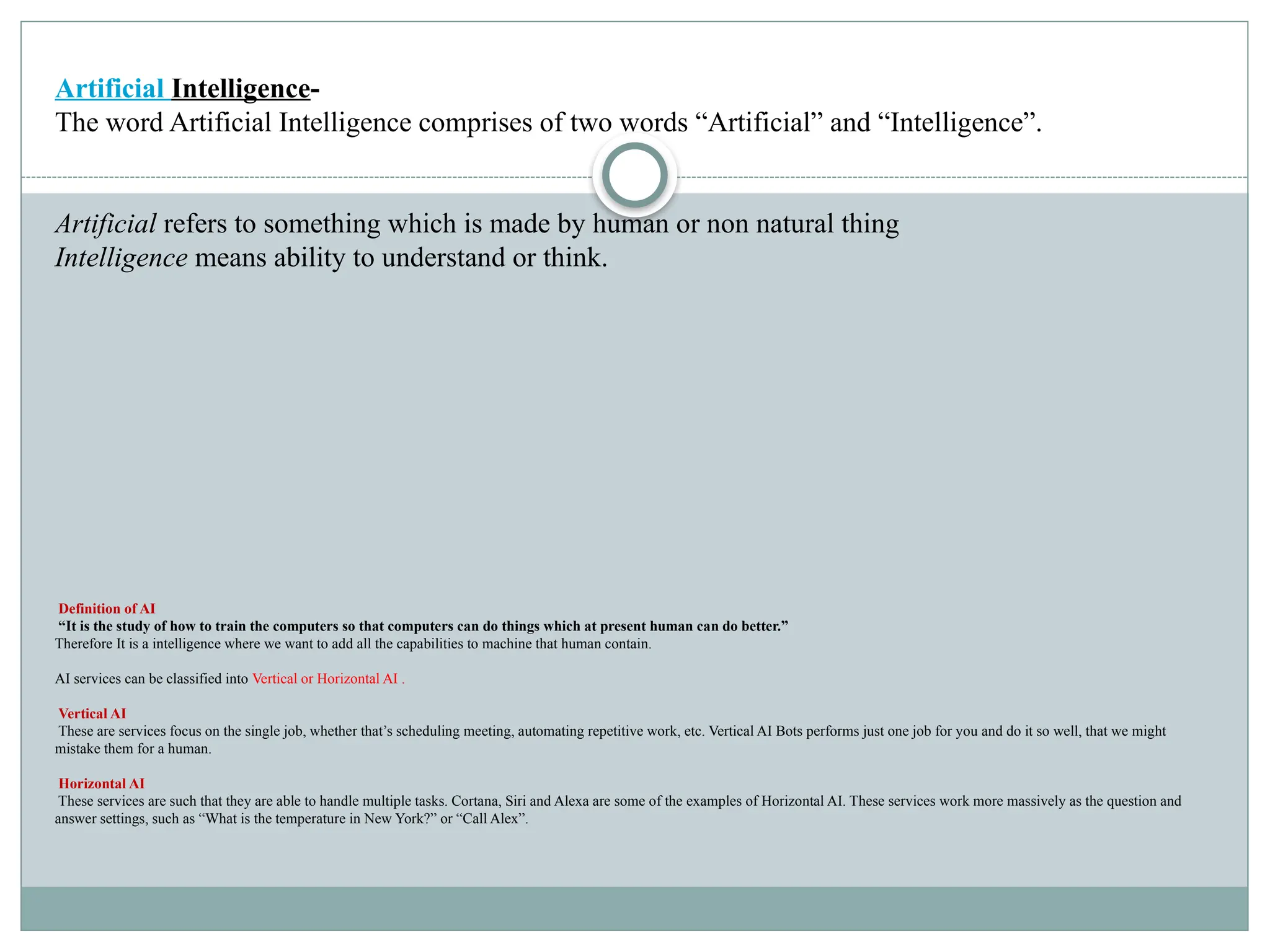
Definition of AI
“Itis the study of how to train the computers so that computers can do things which at present human can do better.”
Therefore It is a intelligence where we want to add all the capabilities to machine that human contain.
AI services can be classified into Vertical or Horizontal AI .
Vertical AI
These are services focus on the single job, whether that’s scheduling meeting, automating repetitive work, etc. Vertical AI Bots performs just one job for you and do it so well, that we might
mistake them for a human.
Horizontal AI
These services are such that they are able to handle multiple tasks. Cortana, Siri and Alexa are some of the examples of Horizontal AI. These services work more massively as the question and
answer settings, such as “What is the temperature in New York?” or “Call Alex”.
Artificial Intelligence-
The word Artificial Intelligence comprises of two words “Artificial” and “Intelligence”.
Artificial refers to something which is made by human or non natural thing
Intelligence means ability to understand or think.
3.
Applications
ML can beapplied to solve tough issues like
1. credit card fraud detection,
2. enable self-driving cars and
3. face detection and recognition
ML uses complex algorithms that constantly iterate over large data sets, analyzing
the patterns in data and facilitating machines to respond different situations for
which they have not been explicitly programmed.
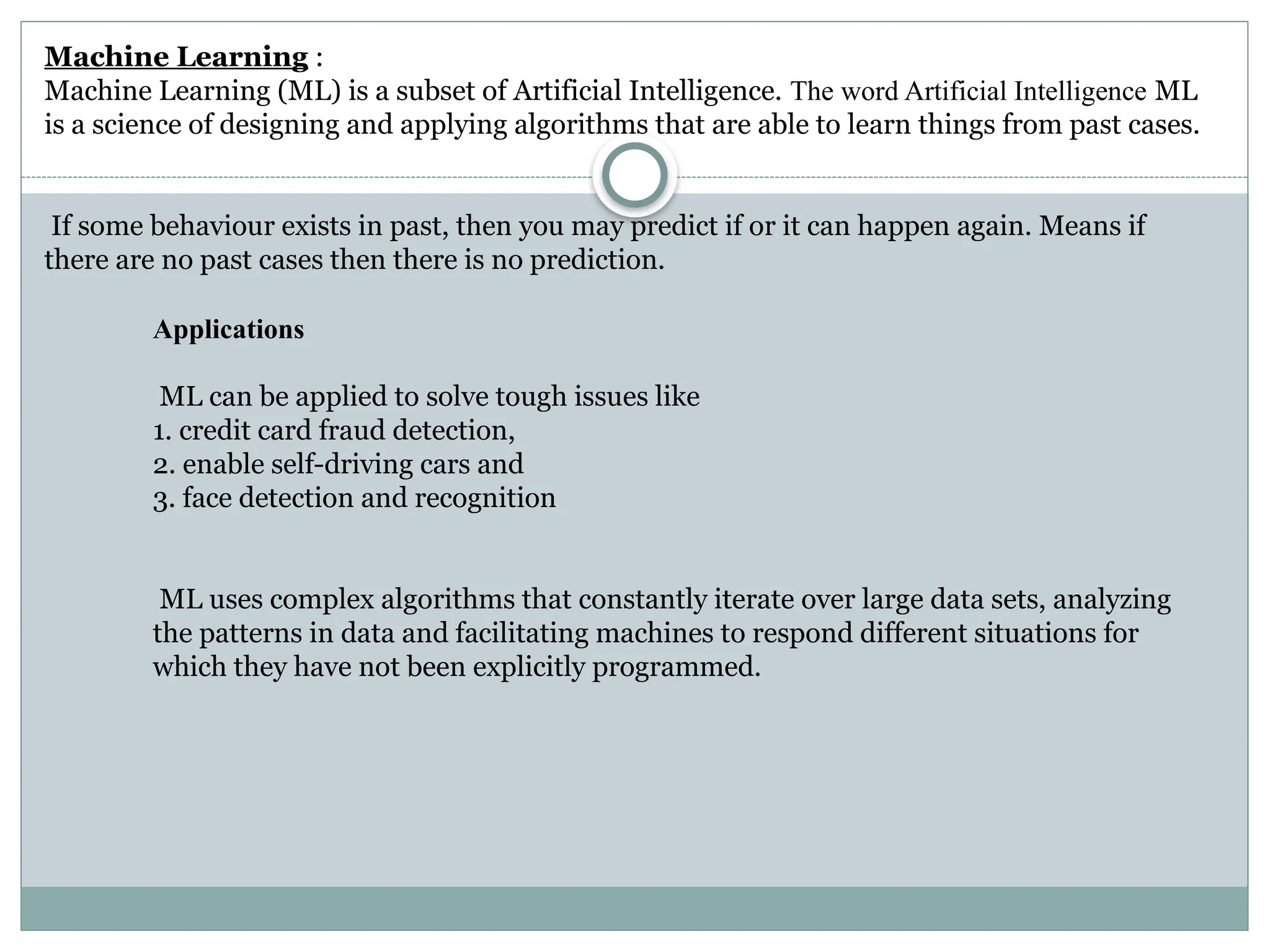
Machine Learning :
Machine Learning (ML) is a subset of Artificial Intelligence. The word Artificial Intelligence ML
is a science of designing and applying algorithms that are able to learn things from past cases.
If some behaviour exists in past, then you may predict if or it can happen again. Means if
there are no past cases then there is no prediction.
4.
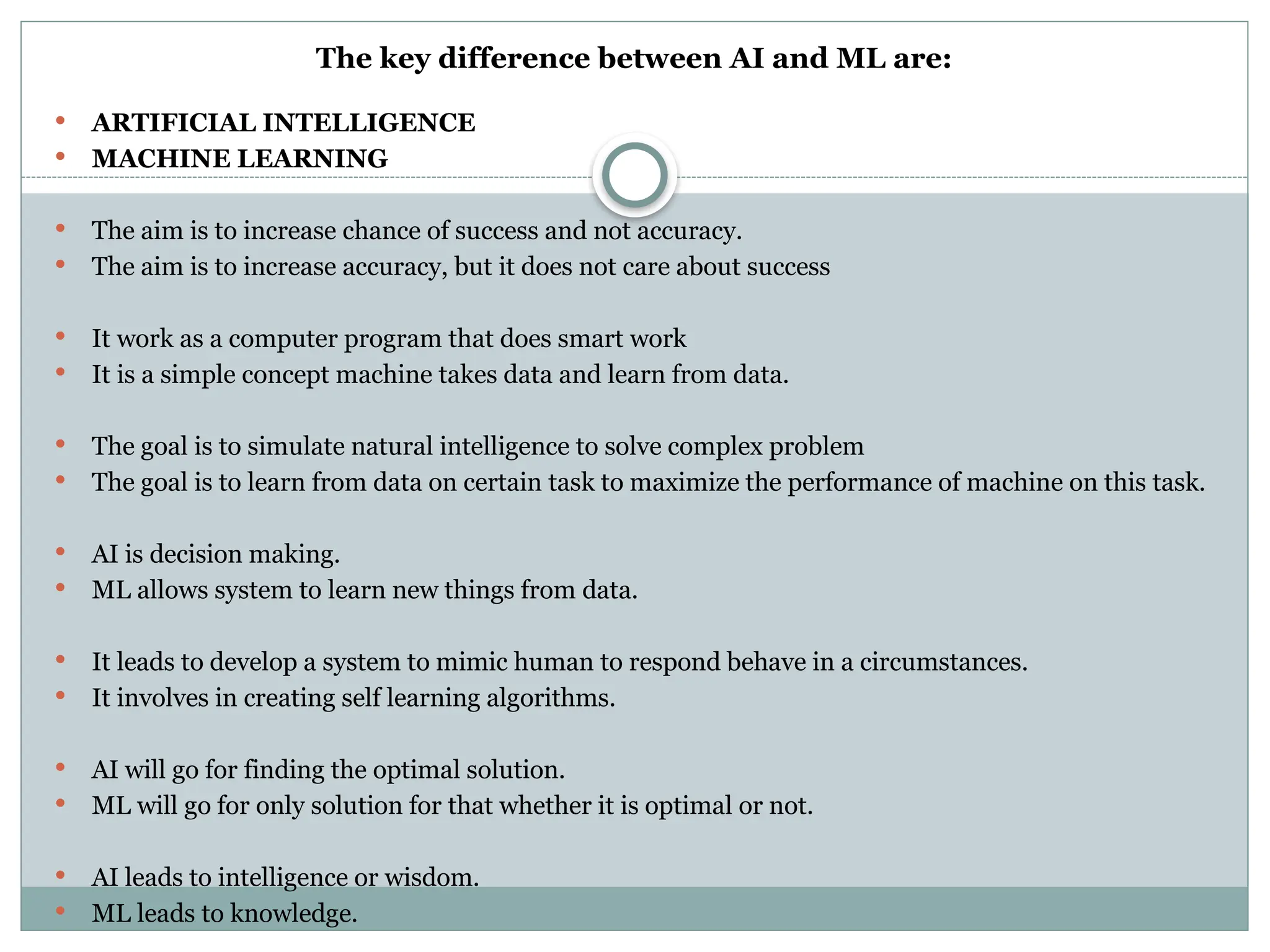
The key differencebetween AI and ML are:
ARTIFICIAL INTELLIGENCE
MACHINE LEARNING
The aim is to increase chance of success and not accuracy.
The aim is to increase accuracy, but it does not care about success
It work as a computer program that does smart work
It is a simple concept machine takes data and learn from data.
The goal is to simulate natural intelligence to solve complex problem
The goal is to learn from data on certain task to maximize the performance of machine on this task.
AI is decision making.
ML allows system to learn new things from data.
It leads to develop a system to mimic human to respond behave in a circumstances.
It involves in creating self learning algorithms.
AI will go for finding the optimal solution.
ML will go for only solution for that whether it is optimal or not.
AI leads to intelligence or wisdom.
ML leads to knowledge.
5.
AI and MachineLearning for Smart Construction
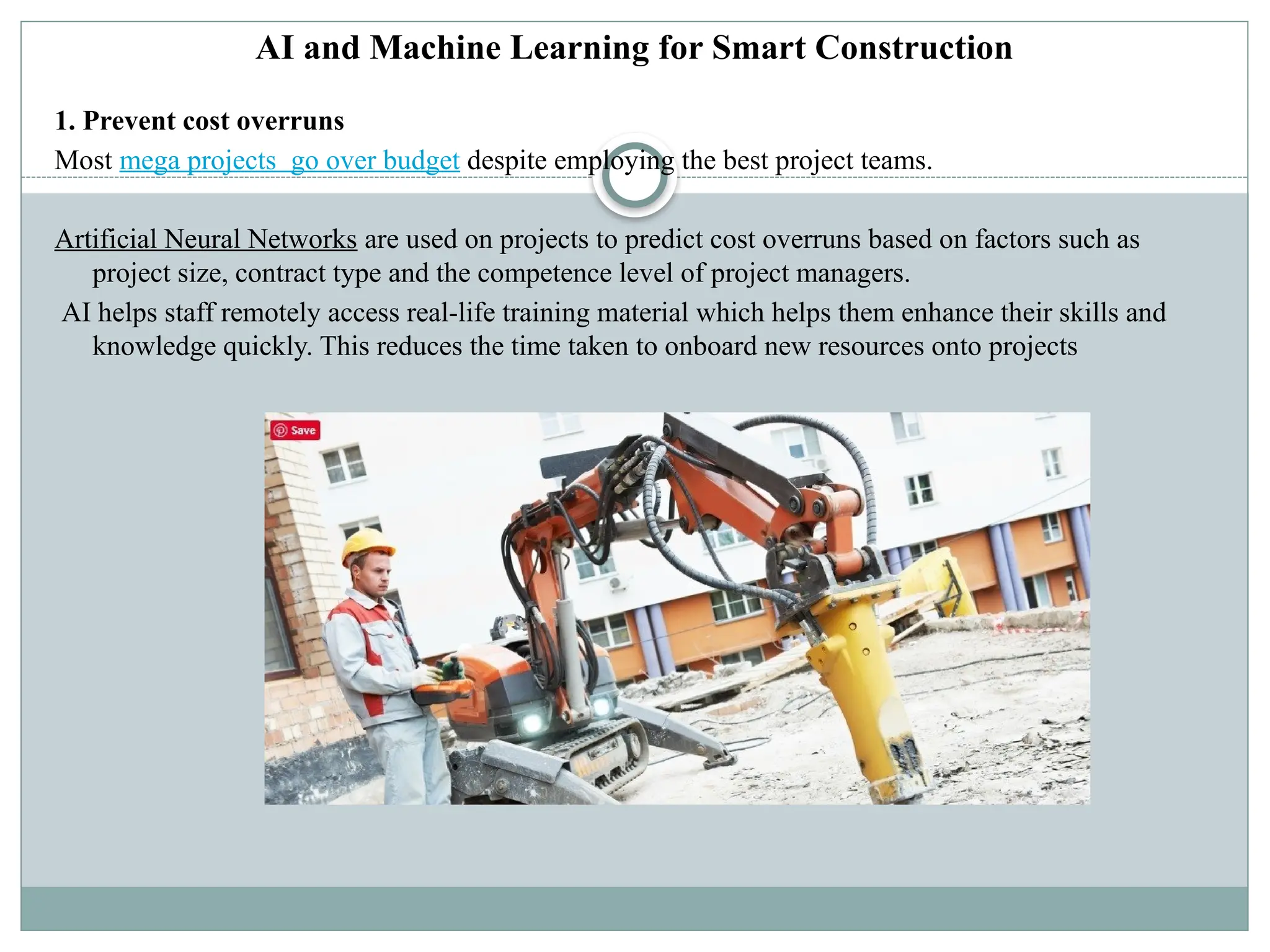
1. Prevent cost overruns
Most mega projects go over budget despite employing the best project teams.
Artificial Neural Networks are used on projects to predict cost overruns based on factors such as
project size, contract type and the competence level of project managers.
AI helps staff remotely access real-life training material which helps them enhance their skills and
knowledge quickly. This reduces the time taken to onboard new resources onto projects
6.
2. AI forBetter Design of Buildings Through Generative Design
Building Information Modeling is a 3D model-based process that gives architecture,
engineering professionals insights to efficiently plan, design, construct and manage
buildings and infrastructure.
In order to plan and design the construction of a building, the 3D models need to take
into consideration the architecture, engineering, mechanical, electrical, and plumbing
and the sequence of activities of the respective teams.
3. Risk Mitigation
construction project has some risk that comes in many forms such as Quality, Safety,
Time, and Cost Risk.
There are AI and machine learning solutions today that general contractors use to
monitor and prioritize risk on the job site, so the project team can focus their limited
time and resources on the biggest risk factors.
AI is used to automatically assign priority to issues. Subcontractors are rated based on
a risk score so construction managers can work closely with high-risk teams to mitigate
risk.
7.
4. Project Planning
The company uses robots to autonomously capture 3D scans of construction sites and
then feeds that data into a deep neural network that classifies how far along different
sub-projects are.
If things seem off track, the management team can step in to deal with small problems
before they become major issues.
Algorithms of the future will use an AI technique known as “reinforcement learning.”
5. AI Will Make Jobsites More Productive
There are companies that are starting to offer self-driving construction
machinery to perform repetitive tasks more efficiently than their human
counterparts, such as
pouring concrete,
bricklaying,
welding, and demolition.
This frees up human workers for the construction work itself and reduces the
overall time required to complete the project.
Project managers can also track job site work in real time. They use facial
recognition, onsite cameras, and similar technologies to assess worker
productivity and conformance to procedures.
8.
6. Off-site Construction
Construction companies are increasingly relying on off-site factories staffed by
autonomous robots that piece together components of a building, which are then pieced
together by human workers on-site.
Structures like walls can be completed assembly-line style by autonomous machinery
more efficiently than their human counterparts
7. AI Will Address Labor Shortages
Construction companies are starting to use AI and machine learning to better plan for
distribution of labor and machinery across jobs.
A robot constantly evaluating job progress and the location of workers and equipment
enables project managers to tell instantly which job sites have enough workers and
equipment to complete the project on schedule, and which might be falling behind
where additional labor could be deployed.



.pptx](https://cdn.slidesharecdn.com/ss_thumbnails/ai-technology-shaping-the-future11-250415095432-b429b09c-thumbnail.jpg?width=640&height=640&fit=bounds)


![[DSC Europe 25] Dunja Adzic Jovanovic - AI and Cybersecurity: Defending Data ...](https://cdn.slidesharecdn.com/ss_thumbnails/o1zylpbhrtwnixxq2xj8-7-251211083048-185086f6-thumbnail.jpg?width=640&height=640&fit=bounds)


![[DSC Europe 25] Nikolay Burlutskiy - Best Practices for Building Enterprise M...](https://cdn.slidesharecdn.com/ss_thumbnails/uirvaiuvq8y1w8hzd9tx-7-251212103249-2619edb4-thumbnail.jpg?width=640&height=640&fit=bounds)

![[DSC Europe 25] Behzad Hosseini - AI Agents in the Wild: Deploying Models tha...](https://cdn.slidesharecdn.com/ss_thumbnails/3qtejajvsjqrzwfept2c-10-251212103250-7f2b1068-thumbnail.jpg?width=640&height=640&fit=bounds)
![[DSC Europe 25] Debmalya Biswas - Agentification: the art of transforming man...](https://cdn.slidesharecdn.com/ss_thumbnails/r5azlggvtqiaiiusrqdr-4-251212103249-5a12c89b-thumbnail.jpg?width=640&height=640&fit=bounds)


![[DSC Europe 25] Katherine Forrest - AI NOW: Understanding the Velocity of Cha...](https://cdn.slidesharecdn.com/ss_thumbnails/wvvbruqfrci0sfq9xwgb-4-251212104007-e5ad1987-thumbnail.jpg?width=640&height=640&fit=bounds)

![[DSC Europe 25] Branko Urosevic -Rethinking Financial Talent: Integrating Cod...](https://cdn.slidesharecdn.com/ss_thumbnails/8jjrus8ttko6qj64f58f-3-251212103250-642c6374-thumbnail.jpg?width=640&height=640&fit=bounds)


![[DSC Europe 25] Branko Dzakula - From Defense to Attack: How AI Redefines Cyb...](https://cdn.slidesharecdn.com/ss_thumbnails/80bdzdxpr3ky2g0qvyk9-8-251211083048-ce5fc1ee-thumbnail.jpg?width=640&height=640&fit=bounds)
![[DSC Europe 25] Dusan Nesic - Securing Tomorrow’s Infrastructure: Why Cyber-P...](https://cdn.slidesharecdn.com/ss_thumbnails/qikbszfftyowjm2q6duw-1-251211083848-8f2ead6b-thumbnail.jpg?width=640&height=640&fit=bounds)
