Artificial Intelligence (AI) in Project Management
Abdelrahman Elsheikh Seedahmed , M.sc, PMOC,CBAP, PMP, RMP, ACP, PMI-SP,
KPI-A, EVM,CPRE, MCITP, MCTS, OCP, OCA, ITIL v3, CTFL, ISO20000, ISO27002
Abdelrahman Elsheikh Bio
 +15 years experience as Strategic PMO Director, Strategy Execution Consultant,
PMO Consultant, Project Manager, Business Analyst and Software Engineer.
• Master Degree in Software Engineering.
• Project Management Office Certified Practitioner (PMO-CP).
• Project Management Office Certification (PMOC).
• Certified Project Management Professional (PMP).
• Agile Certified Practitioner (PMI-ACP).
• Risk Management Professional (PMI-RMP).
• Schedule Professional (PMI-SP).
• Certified Business Analyst Professional (CBAP).
• Microsoft Certified IT Professional (MCITP).
• Key Performance Indicator Associate (KPI-A).
• OCP and OCA.
• Certified Professional for Requirement Engineer (CPRE).
• Certified Tester Foundation Level (CTFL).
• Earned Value Project Management (EVM).
• ISO/IEC 20000 Foundation.
• ISO/IEC 27002 Foundation.
• Certified ITIL Foundation Level.
Agenda
• Introduction.
• When AI Meets PMTQ.
• Six AI Technologies.
• Unlocking AI’s Value.
• AI In Action.
Agenda
• Introduction.
• When AI Meets PMTQ.
• Six AI Technologies.
• Unlocking AI’s Value.
• AI In Action.
Introduction
• Eighty-five percent of global CEOs predict Artificial Intelligence (AI)
will significantly change the way they do business in the next five
years, according to PwC (22nd Annual Global CEO Survey, PwC
(2019)).
• https://www.pwc.com/gx/en/ceo-survey/2019/report/pwc-22nd-
annual-global-ceo-survey.pdf
Introduction
• New research from Pulse of the Profession® 2019 confirms AI
disruption is happening:
– 81 percent of respondents report their organization is being
impacted by AI technologies.
– And 37 percent of respondents say adopting these AI
technologies is a high priority for their organization, sparking a
shift in project management approaches.
– Over the next three years, project professionals expect the
proportion of projects they manage using AI will jump from 23 to
37 percent.
Introduction
• Even companies in legacy industries like construction and
engineering know they can’t miss out on AI.
• When Bechtel, a U.S.-based construction and engineering firm, was
looking to improve its productivity rates, it turned to Deep Learning.
• The company now uses a 3D neural network that allows project
teams to test out different sequences virtually until they find the one
that maximizes their productivity (“Sequencing Made Simpler,” PM
Network (2018)).
Introduction
• Yet, while some organizations are leading the way on AI, others are
falling behind.
• Just over a third of respondents (36 percent) say adopting AI
technologies is a low priority at their organization, with nearly 31
percent reporting less than 5 percent of their projects have used AI
in the past three years.
Agenda
• Introduction.
• When AI Meets PMTQ.
• Six AI Technologies.
• Unlocking AI’s Value.
• AI In Action.
When AI Meets PMTQ
• Project Management Technology quotient (PMTQ) is a person’s
(organization’s) ability to adapt, manage and integrate technology
based on the needs of the organization or the project at hand.
When AI Meets PMTQ
• High PMTQ is defined by three essential traits:
1. Always-on curiosity: Looking for emerging project delivery
practices without chasing after every new digital trend.
2. All-inclusive leadership: Getting the best out of your teams,
whether they’re human or machine.
3. A future-proof talent pool: Recruiting the right people with the
mindset to keep current and keep learning while helping their
teammates do the same.
When AI Meets PMTQ
• High-PMTQ organizations—and their project leaders—see how AI
technologies are already fundamentally changing the business
landscape.
When AI Meets PMTQ
• Making the most of AI isn’t just mastering machine learning or
knowledge-based systems.
– It takes an ability to manage those technologies based on the
needs of the organization or the project at hand.
– It takes adapting to the nonstop whirl of change.
– It takes a deep under-standing of project management because
the nature of work increasingly shifts from “job for life” to
“portfolio of projects”—or “project economy.”
When AI Meets PMTQ
• To turn AI strategy into reality, you need a high project
management technology quotient (PMTQ).
Agenda
• Introduction.
• When AI Meets PMTQ.
• Six AI Technologies.
• Unlocking AI’s Value.
• AI In Action.
Six AI Technologies
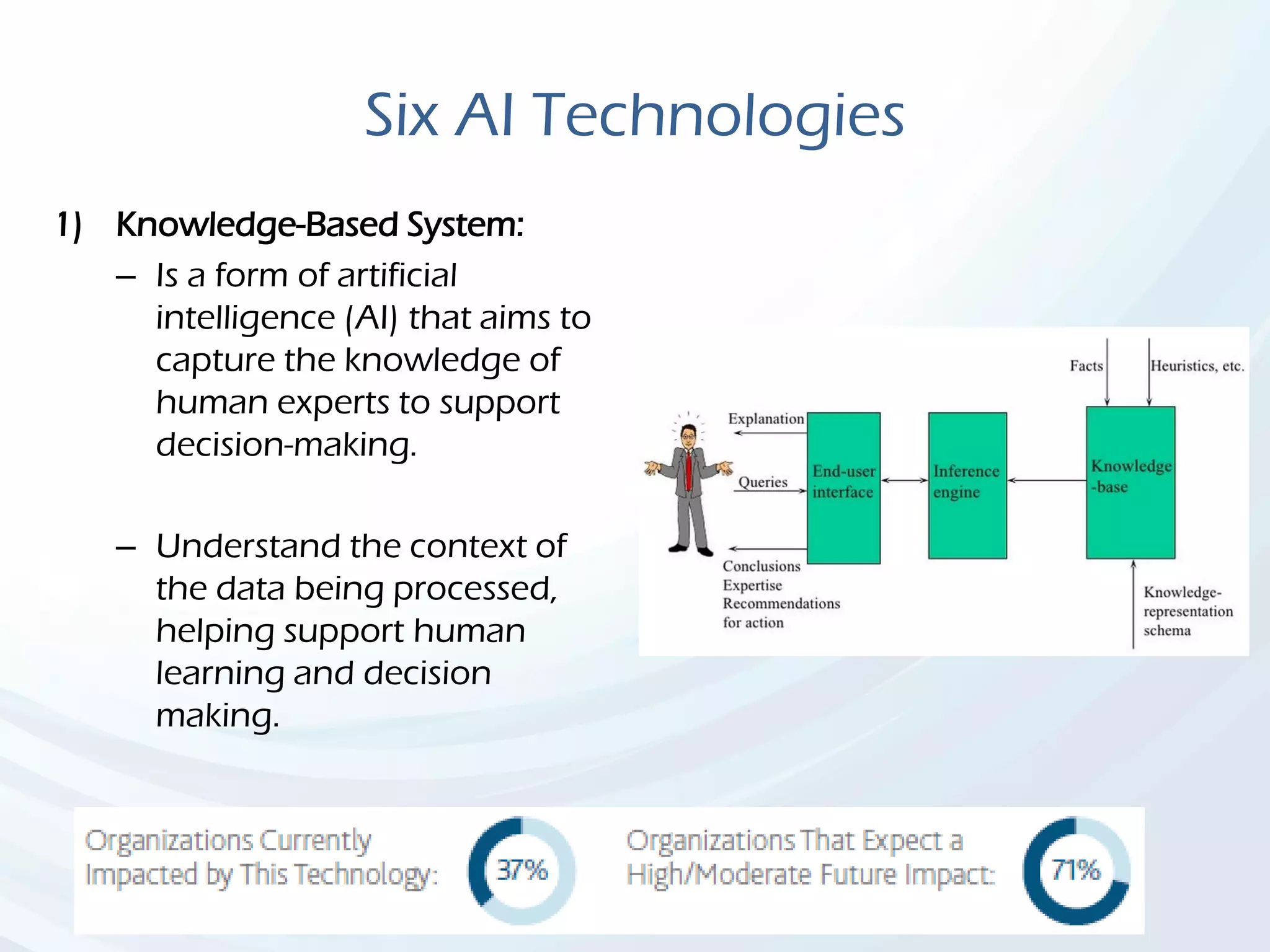
1) Knowledge-Based System:
– Is a form of artificial
intelligence (AI) that aims to
capture the knowledge of
human experts to support
decision-making.
– Understand the context of
the data being processed,
helping support human
learning and decision
making.
Six AI Technologies
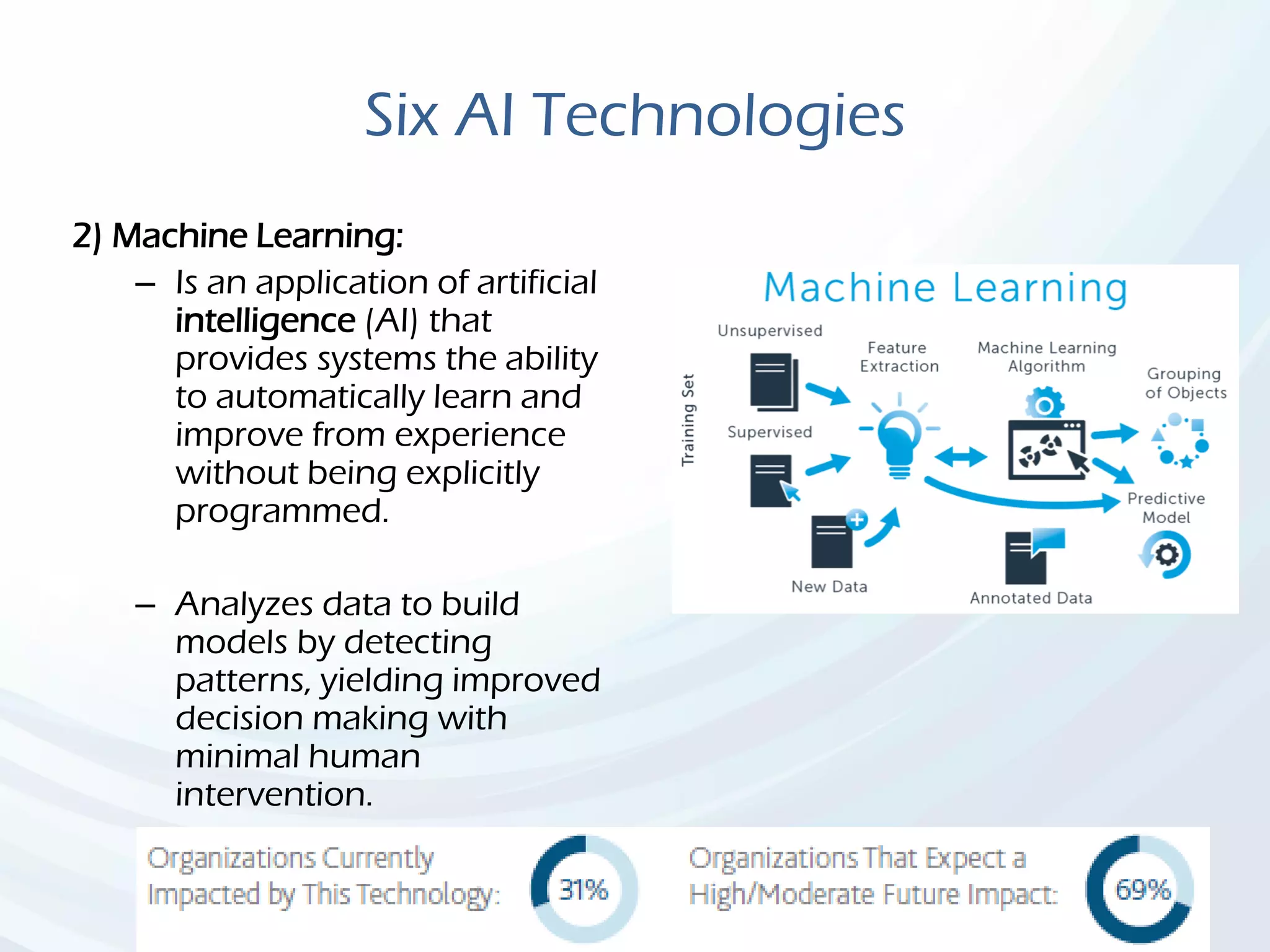
2) Machine Learning:
– Is an application of artificial
intelligence (AI) that
provides systems the ability
to automatically learn and
improve from experience
without being explicitly
programmed.
– Analyzes data to build
models by detecting
patterns, yielding improved
decision making with
minimal human
intervention.
Six AI Technologies
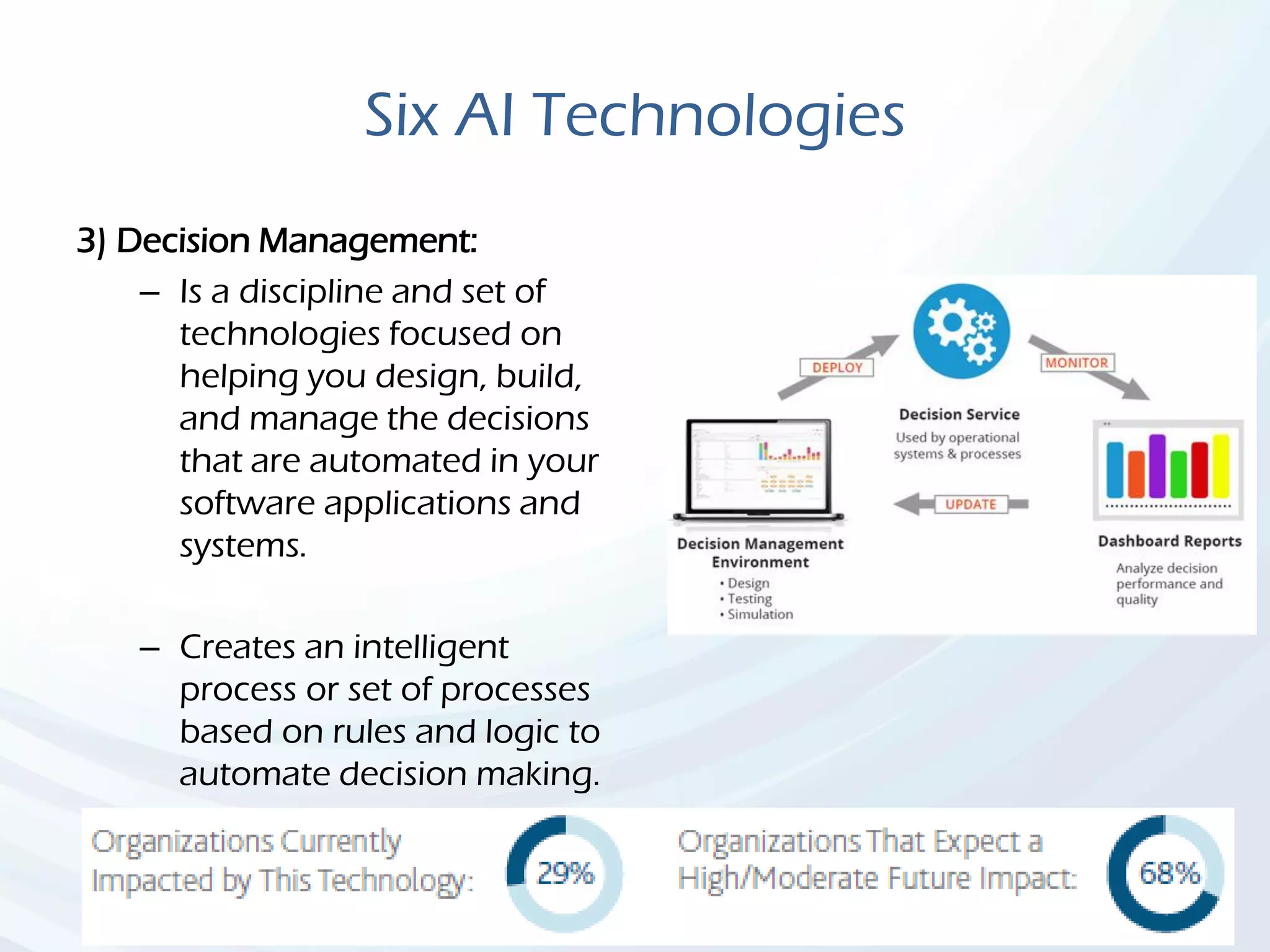
3) Decision Management:
– Is a discipline and set of
technologies focused on
helping you design, build,
and manage the decisions
that are automated in your
software applications and
systems.
– Creates an intelligent
process or set of processes
based on rules and logic to
automate decision making.
Six AI Technologies
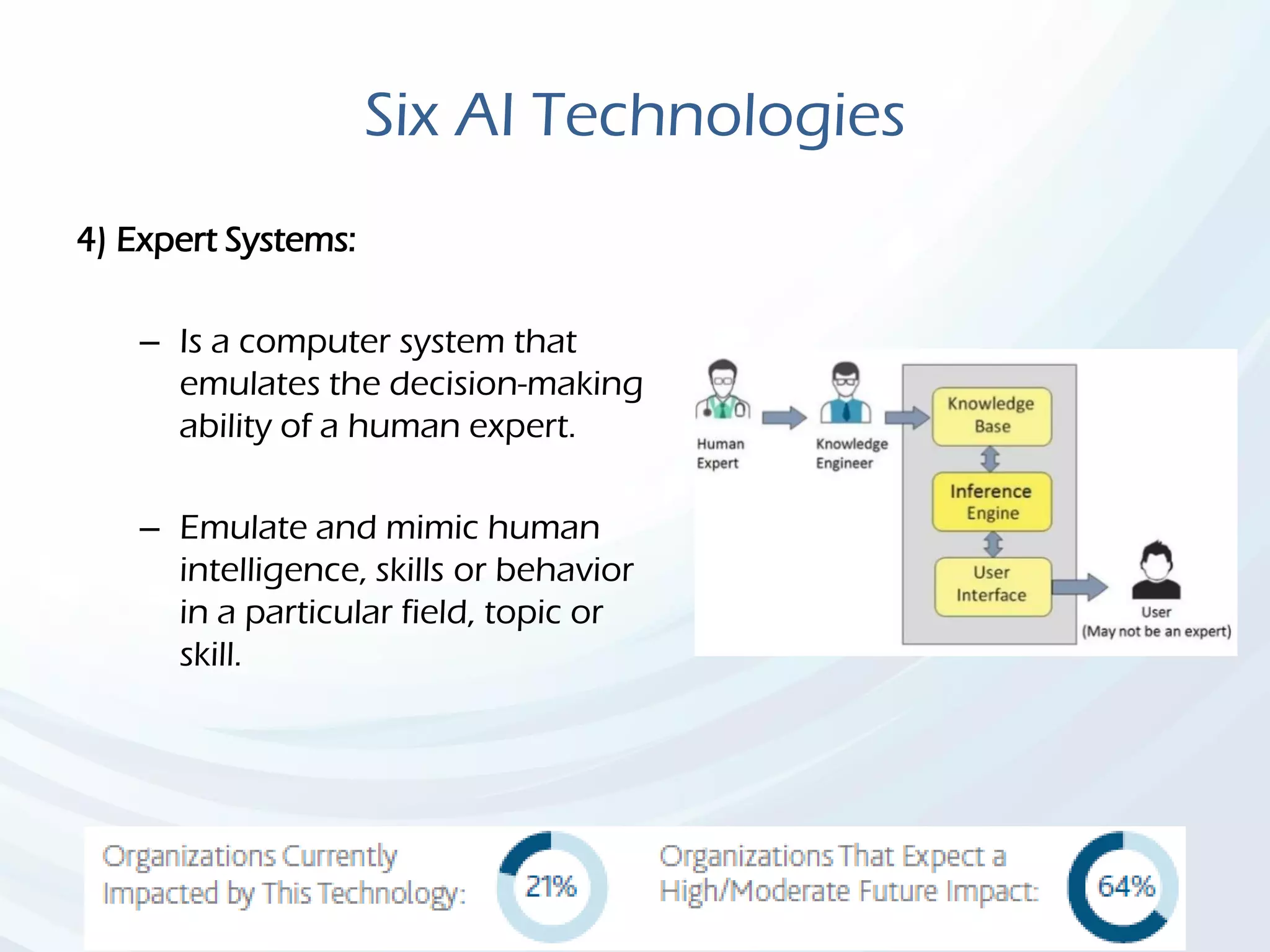
4) Expert Systems:
– Is a computer system that
emulates the decision-making
ability of a human expert.
– Emulate and mimic human
intelligence, skills or behavior
in a particular field, topic or
skill.
Six AI Technologies
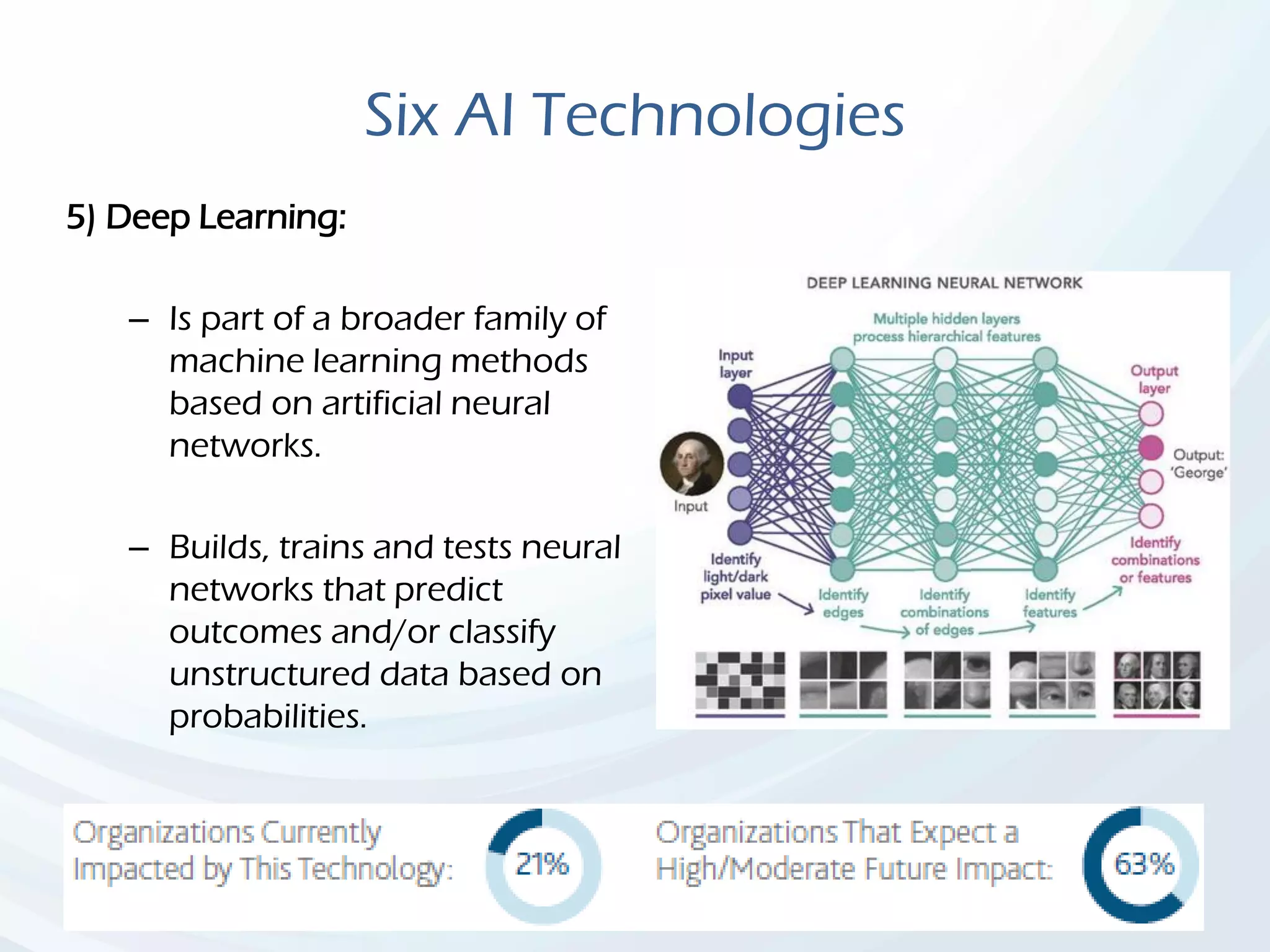
5) Deep Learning:
– Is part of a broader family of
machine learning methods
based on artificial neural
networks.
– Builds, trains and tests neural
networks that predict
outcomes and/or classify

unstructured data based on
probabilities.
Six AI Technologies
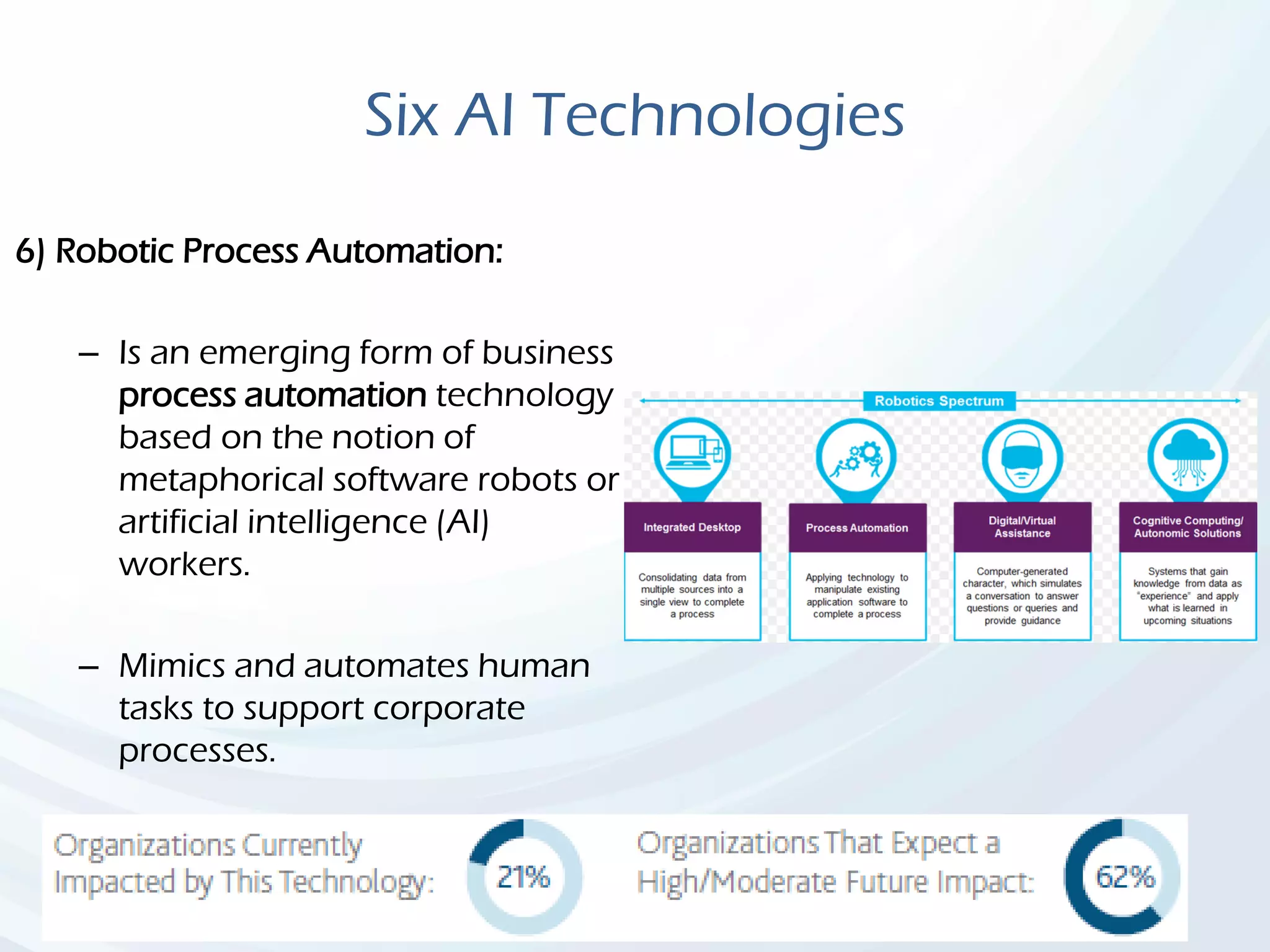
6) Robotic Process Automation:
– Is an emerging form of business
process automation technology
based on the notion of
metaphorical software robots or
artificial intelligence (AI)
workers.
– Mimics and automates human
tasks to support corporate
processes.
Agenda
• Introduction.
• When AI Meets PMTQ.
• Six AI Technologies.
• Unlocking AI’s Value.
• AI In Action.
Unlocking AI’s Value
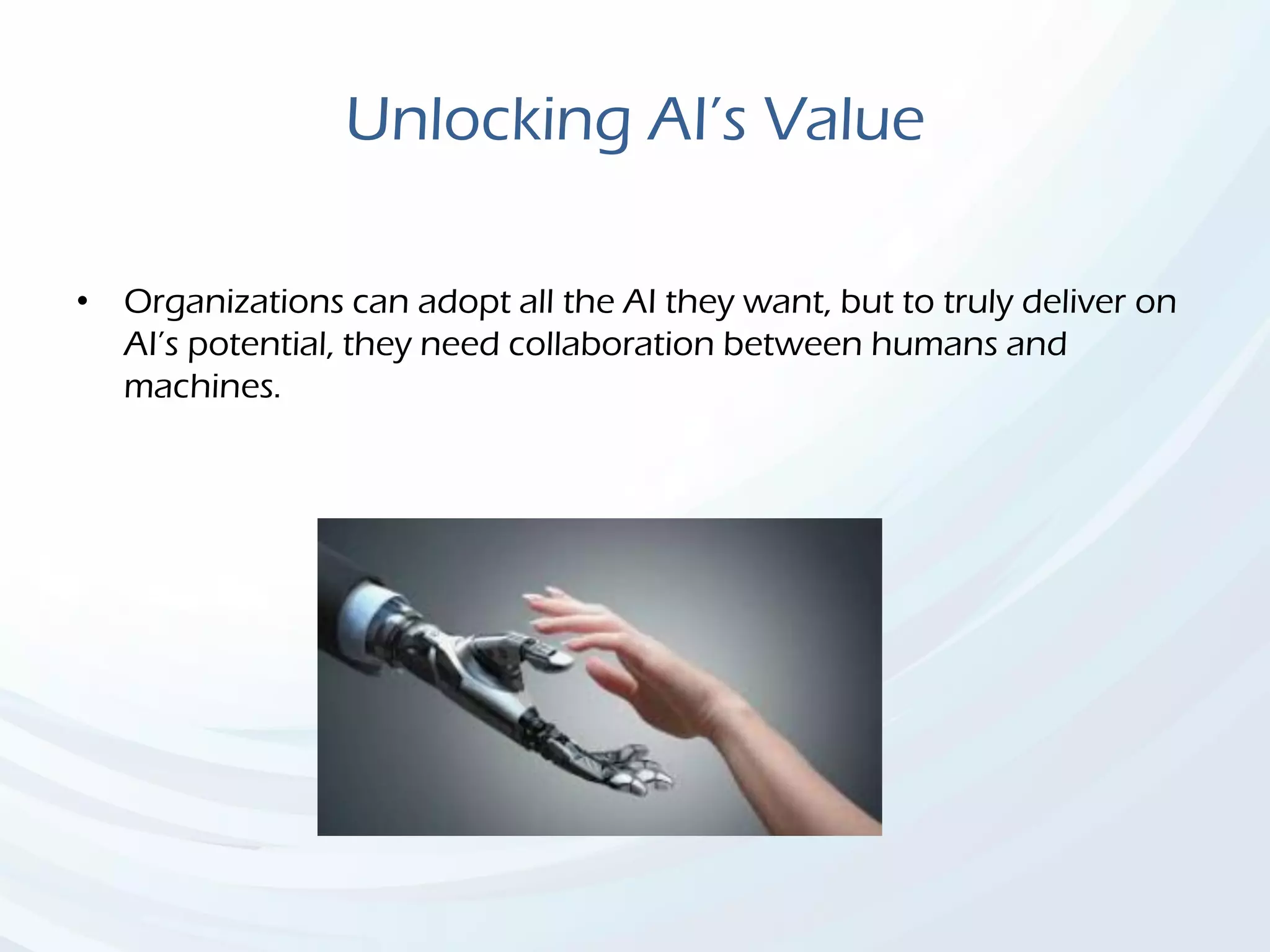
• Organizations can adopt all the AI they want, but to truly deliver on
AI’s potential, they need collaboration between humans and
machines.
Unlocking AI’s Value
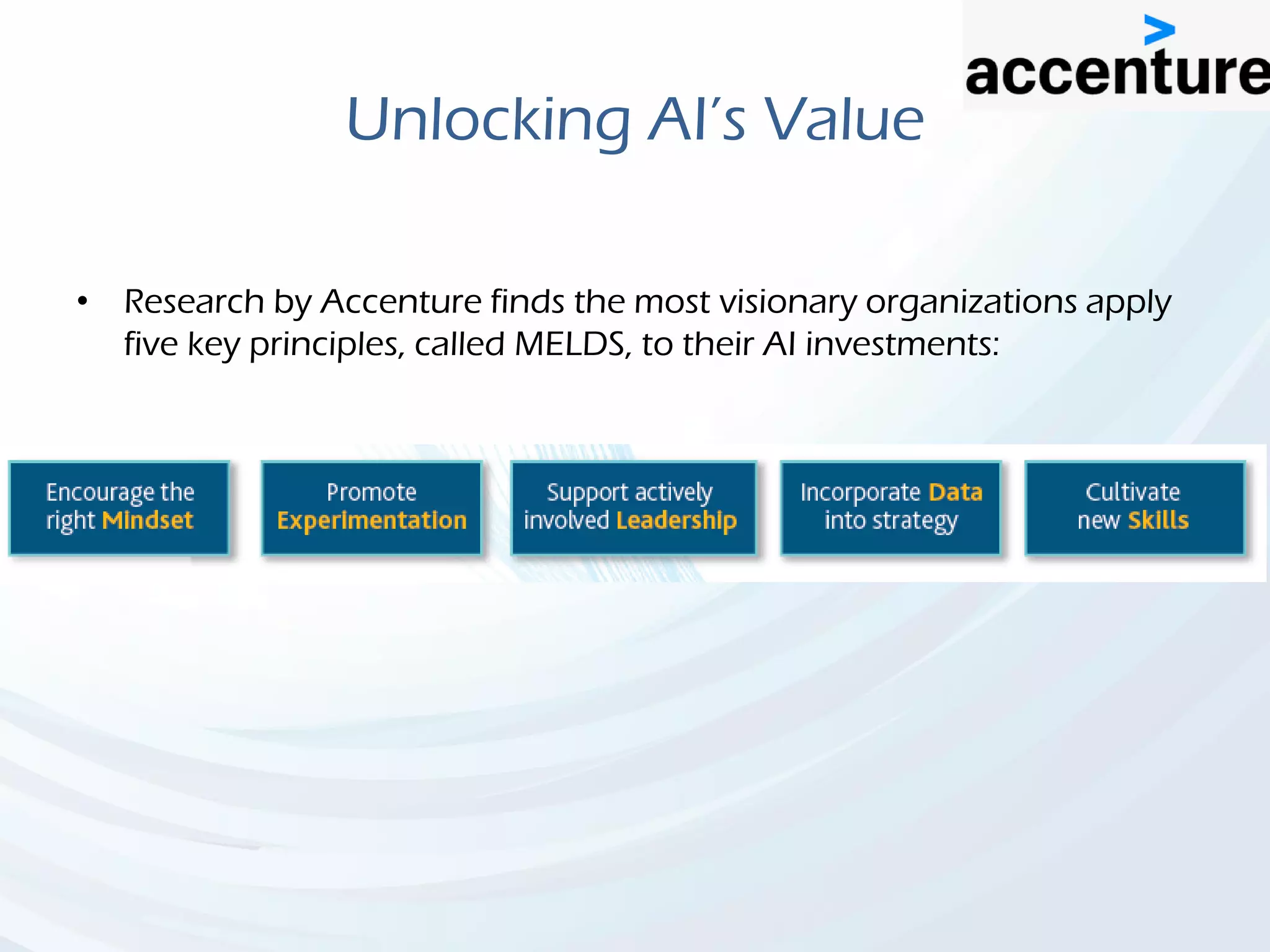
• Research by Accenture finds the most visionary organizations apply
five key principles, called MELDS, to their AI investments:
Unlocking AI’s Value
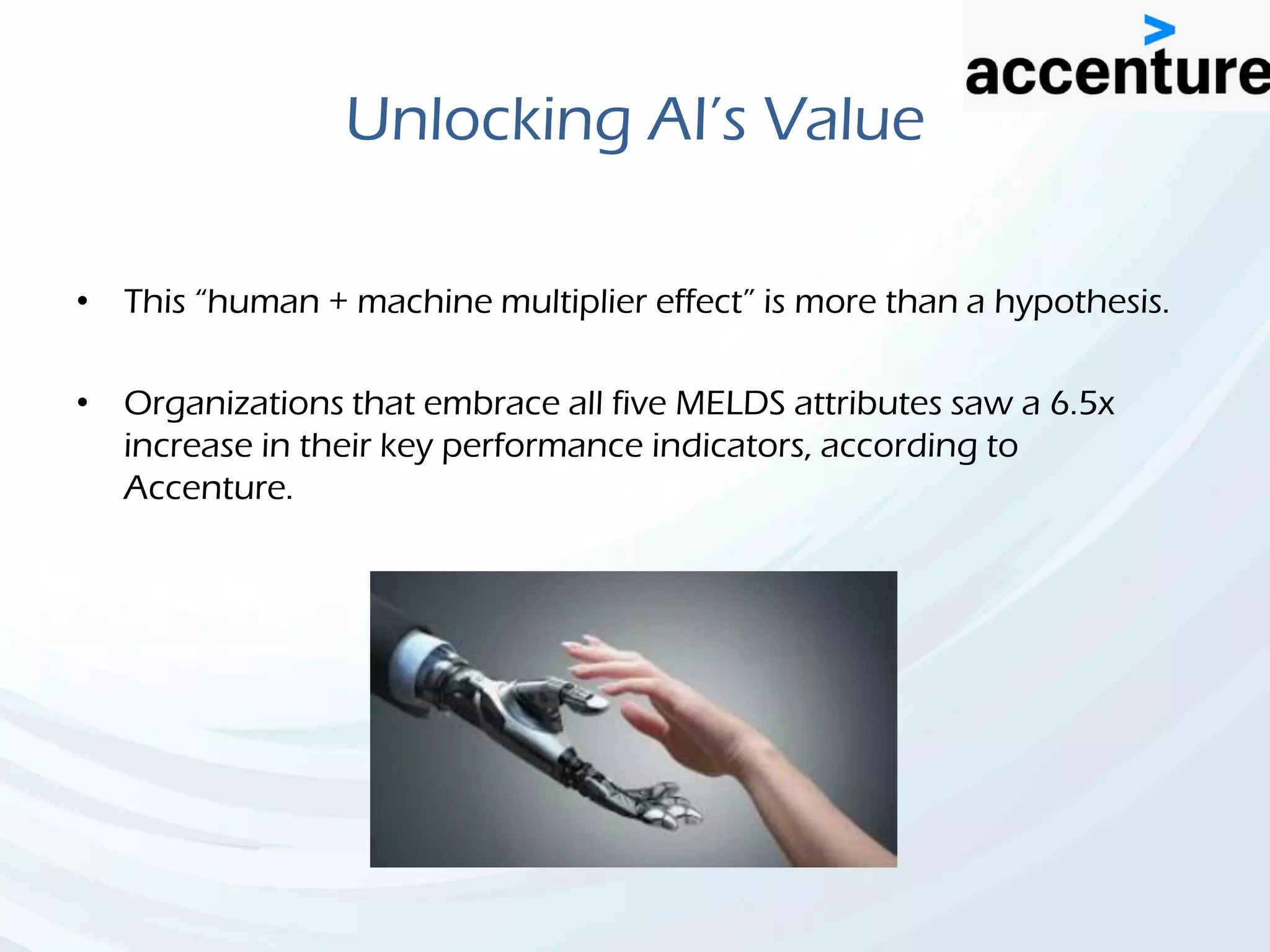
• This “human + machine multiplier effect” is more than a hypothesis.
• Organizations that embrace all five MELDS attributes saw a 6.5x
increase in their key performance indicators, according to
Accenture.
Unlocking AI’s Value
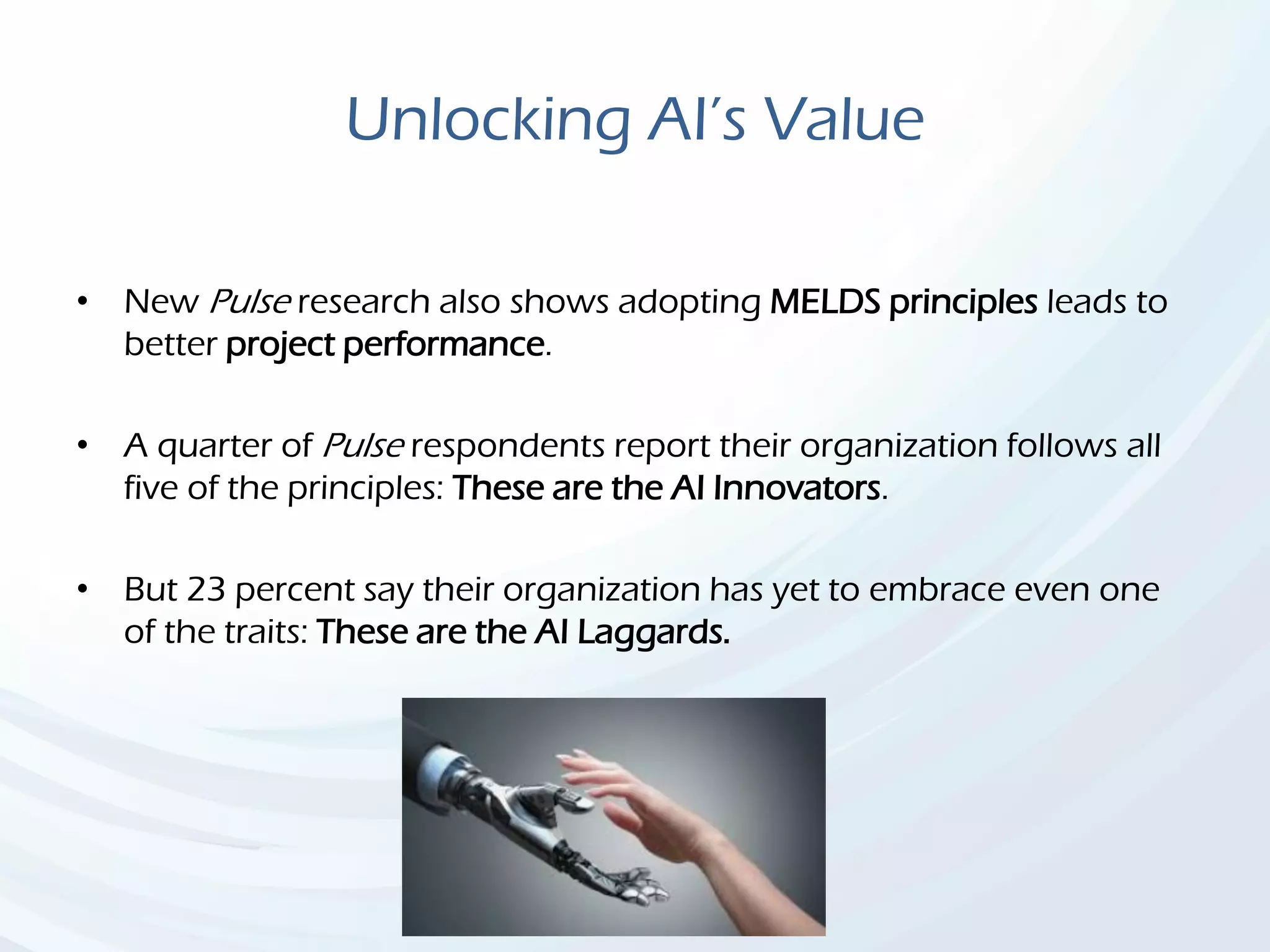
• New Pulse research also shows adopting MELDS principles leads to
better project performance.
• A quarter of Pulse respondents report their organization follows all
five of the principles: These are the AI Innovators.
• But 23 percent say their organization has yet to embrace even one
of the traits: These are the AI Laggards.
Unlocking AI’s Value
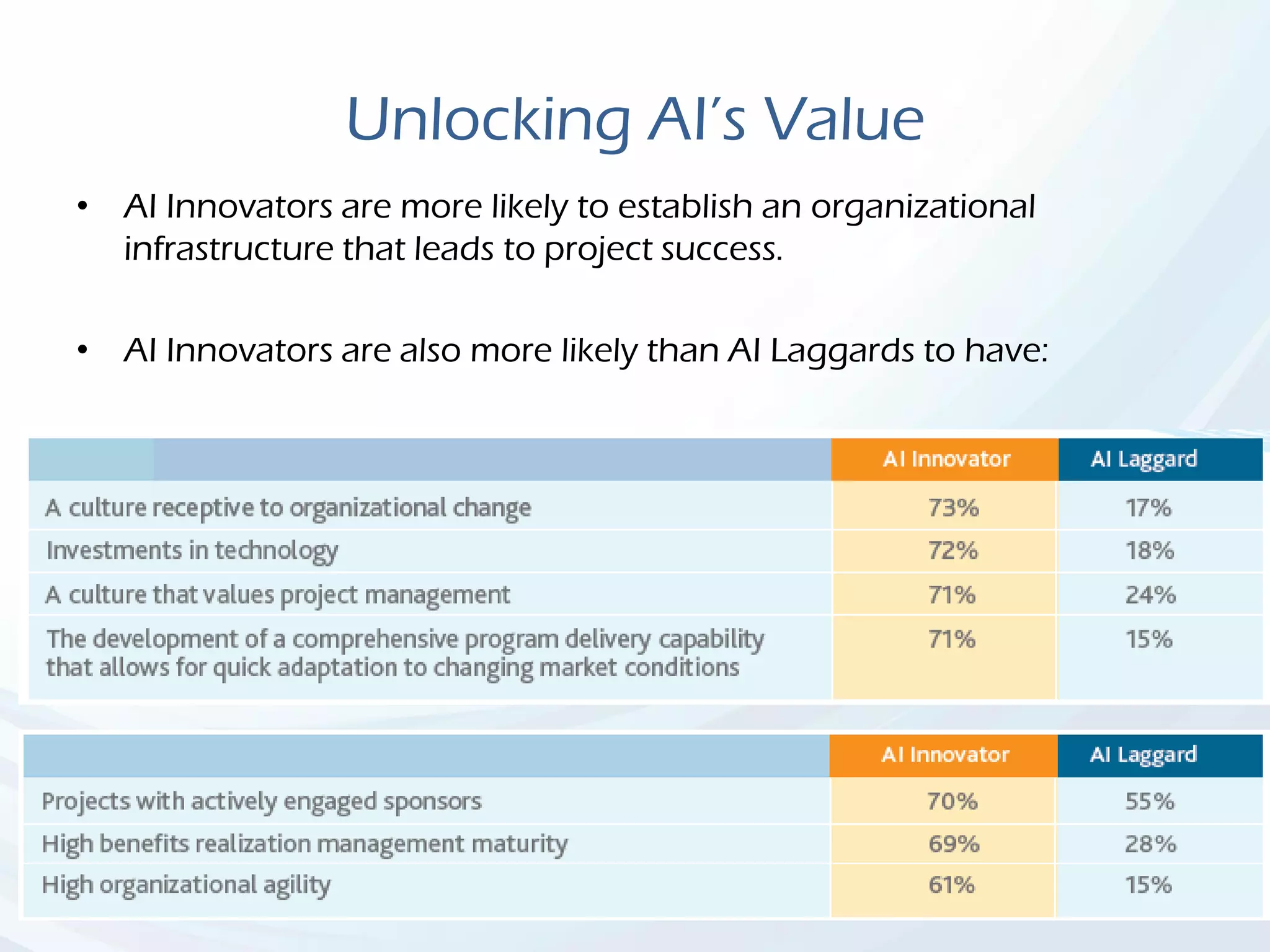
• AI Innovators are more likely to establish an organizational
infrastructure that leads to project success.
• AI Innovators are also more likely than AI Laggards to have:
Unlocking AI’s Value
• AI Innovators consistently outperform AI Laggards in several key
project metrics:
1. Better On Time Delivery: AI Innovators report they delivered 61
percent of their projects on time, versus 47 percent for AI
Laggards.
2. Superior Benefits Realization: AI Innovators report 69 percent of
their projects realized 95 percent or more of their business
benefits, compared to 53 percent of projects for AI Laggards.
3. Higher ROI: AI Innovators report 64 percent of their projects
met or exceeded their original ROI estimates, versus 52 percent
of projects for AI Laggards.
Agenda
• Introduction.
• When AI Meets PMTQ.
• Six AI Technologies.
• Unlocking AI’s Value.
• AI In Action.
AI In Action
(Robotic Process Automation)
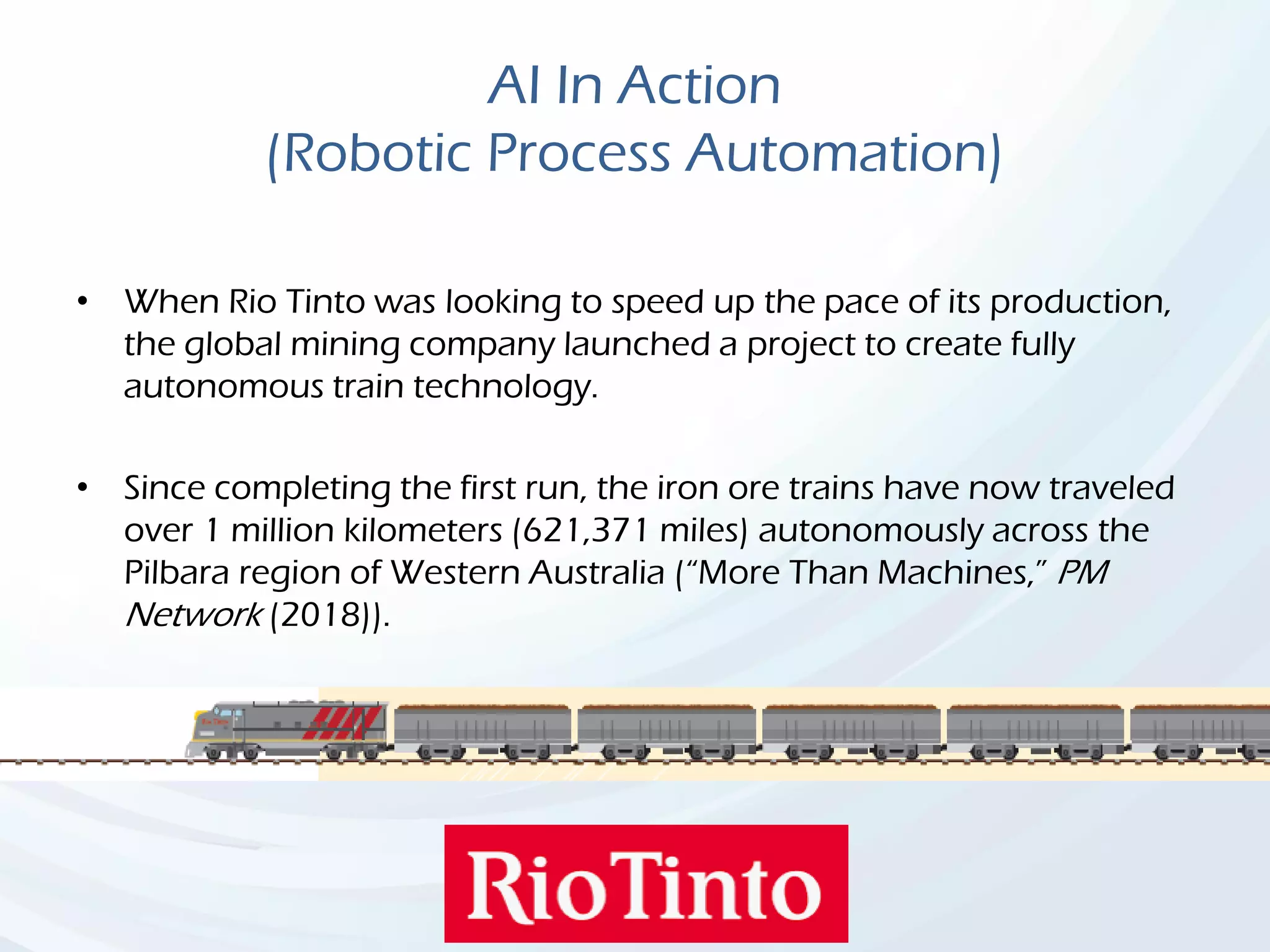
• When Rio Tinto was looking to speed up the pace of its production,
the global mining company launched a project to create fully
autonomous train technology.
• Since completing the first run, the iron ore trains have now traveled
over 1 million kilometers (621,371 miles) autonomously across the
Pilbara region of Western Australia (“More Than Machines,” PM
Network (2018)).
AI In Action
(Machine Learning)
• Software bugs can be costly for companies, leaving their systems
vulnerable to hackers, sparking crashes and delaying product
releases.
• So, French video game company Ubisoft called in the high-tech
exterminators, feeding 10 years’ worth of code from its software
library into its AI tool to teach it what mistakes had previously been
found and fixed.
AI In Action
(machine Learning)
• Rather than pointing out specific bugs, the tool tells programmers
the statistical likelihood of a bug appearing in a certain part of code.
• The company estimates the use of machine learning techniques can
catch 70 percent of the bugs before reaching testing phases
(“Artificial Exterminators,” PM Network (2019)).
Agenda
• Introduction.
• When AI Meets PMTQ.
• Six AI Technologies.
• Unlocking AI’s Value.
• AI In Action.
Source
• From paper (AI Innovators: Cracking the Code on Project
Performance (2019)).
• https://www.pmi.org/-
/media/pmi/documents/public/pdf/learning/thought-
leadership/pulse/ai-innovators-cracking-the-code-project-
performance.pdf?sc_lang_temp=en
https://www.facebook.com/abdelrahmansida/
https://www.youtube.com/c/abdelrahmanelsheikh
https://www.linkedin.com/in/abdelrahmanelsheikh/
https://twitter.com/AbdelrahmanSida
https://www.slideshare.net/abdelrahmanelsheikh1
Artificial Intelligence (AI) in Project Management

Artificial Intelligence (AI) in Project Management

  • 1.
    Artificial Intelligence (AI)in Project Management Abdelrahman Elsheikh Seedahmed , M.sc, PMOC,CBAP, PMP, RMP, ACP, PMI-SP, KPI-A, EVM,CPRE, MCITP, MCTS, OCP, OCA, ITIL v3, CTFL, ISO20000, ISO27002
  • 2.
    Abdelrahman Elsheikh Bio +15 years experience as Strategic PMO Director, Strategy Execution Consultant, PMO Consultant, Project Manager, Business Analyst and Software Engineer. • Master Degree in Software Engineering. • Project Management Office Certified Practitioner (PMO-CP). • Project Management Office Certification (PMOC). • Certified Project Management Professional (PMP). • Agile Certified Practitioner (PMI-ACP). • Risk Management Professional (PMI-RMP). • Schedule Professional (PMI-SP). • Certified Business Analyst Professional (CBAP). • Microsoft Certified IT Professional (MCITP). • Key Performance Indicator Associate (KPI-A). • OCP and OCA. • Certified Professional for Requirement Engineer (CPRE). • Certified Tester Foundation Level (CTFL). • Earned Value Project Management (EVM). • ISO/IEC 20000 Foundation. • ISO/IEC 27002 Foundation. • Certified ITIL Foundation Level.
  • 3.
    Agenda • Introduction. • WhenAI Meets PMTQ. • Six AI Technologies. • Unlocking AI’s Value. • AI In Action.
  • 4.
    Agenda • Introduction. • WhenAI Meets PMTQ. • Six AI Technologies. • Unlocking AI’s Value. • AI In Action.
  • 5.
    Introduction • Eighty-five percentof global CEOs predict Artificial Intelligence (AI) will significantly change the way they do business in the next five years, according to PwC (22nd Annual Global CEO Survey, PwC (2019)). • https://www.pwc.com/gx/en/ceo-survey/2019/report/pwc-22nd- annual-global-ceo-survey.pdf
  • 6.
    Introduction • New researchfrom Pulse of the Profession® 2019 confirms AI disruption is happening: – 81 percent of respondents report their organization is being impacted by AI technologies. – And 37 percent of respondents say adopting these AI technologies is a high priority for their organization, sparking a shift in project management approaches. – Over the next three years, project professionals expect the proportion of projects they manage using AI will jump from 23 to 37 percent.
  • 7.
    Introduction • Even companiesin legacy industries like construction and engineering know they can’t miss out on AI. • When Bechtel, a U.S.-based construction and engineering firm, was looking to improve its productivity rates, it turned to Deep Learning. • The company now uses a 3D neural network that allows project teams to test out different sequences virtually until they find the one that maximizes their productivity (“Sequencing Made Simpler,” PM Network (2018)).
  • 8.
    Introduction • Yet, whilesome organizations are leading the way on AI, others are falling behind. • Just over a third of respondents (36 percent) say adopting AI technologies is a low priority at their organization, with nearly 31 percent reporting less than 5 percent of their projects have used AI in the past three years.
  • 9.
    Agenda • Introduction. • WhenAI Meets PMTQ. • Six AI Technologies. • Unlocking AI’s Value. • AI In Action.
  • 10.
    When AI MeetsPMTQ • Project Management Technology quotient (PMTQ) is a person’s (organization’s) ability to adapt, manage and integrate technology based on the needs of the organization or the project at hand.
  • 11.
    When AI MeetsPMTQ • High PMTQ is defined by three essential traits: 1. Always-on curiosity: Looking for emerging project delivery practices without chasing after every new digital trend. 2. All-inclusive leadership: Getting the best out of your teams, whether they’re human or machine. 3. A future-proof talent pool: Recruiting the right people with the mindset to keep current and keep learning while helping their teammates do the same.
  • 12.
    When AI MeetsPMTQ • High-PMTQ organizations—and their project leaders—see how AI technologies are already fundamentally changing the business landscape.
  • 13.
    When AI MeetsPMTQ • Making the most of AI isn’t just mastering machine learning or knowledge-based systems. – It takes an ability to manage those technologies based on the needs of the organization or the project at hand. – It takes adapting to the nonstop whirl of change. – It takes a deep under-standing of project management because the nature of work increasingly shifts from “job for life” to “portfolio of projects”—or “project economy.”
  • 14.
    When AI MeetsPMTQ • To turn AI strategy into reality, you need a high project management technology quotient (PMTQ).
  • 15.
    Agenda • Introduction. • WhenAI Meets PMTQ. • Six AI Technologies. • Unlocking AI’s Value. • AI In Action.
  • 16.
    Six AI Technologies 1)Knowledge-Based System: – Is a form of artificial intelligence (AI) that aims to capture the knowledge of human experts to support decision-making. – Understand the context of the data being processed, helping support human learning and decision making.
  • 17.
    Six AI Technologies 2)Machine Learning: – Is an application of artificial intelligence (AI) that provides systems the ability to automatically learn and improve from experience without being explicitly programmed. – Analyzes data to build models by detecting patterns, yielding improved decision making with minimal human intervention.
  • 18.
    Six AI Technologies 3)Decision Management: – Is a discipline and set of technologies focused on helping you design, build, and manage the decisions that are automated in your software applications and systems. – Creates an intelligent process or set of processes based on rules and logic to automate decision making.
  • 19.
    Six AI Technologies 4)Expert Systems: – Is a computer system that emulates the decision-making ability of a human expert. – Emulate and mimic human intelligence, skills or behavior in a particular field, topic or skill.
  • 20.
    Six AI Technologies 5)Deep Learning: – Is part of a broader family of machine learning methods based on artificial neural networks. – Builds, trains and tests neural networks that predict outcomes and/or classify unstructured data based on probabilities.
  • 21.
    Six AI Technologies 6)Robotic Process Automation: – Is an emerging form of business process automation technology based on the notion of metaphorical software robots or artificial intelligence (AI) workers. – Mimics and automates human tasks to support corporate processes.
  • 22.
    Agenda • Introduction. • WhenAI Meets PMTQ. • Six AI Technologies. • Unlocking AI’s Value. • AI In Action.
  • 23.
    Unlocking AI’s Value •Organizations can adopt all the AI they want, but to truly deliver on AI’s potential, they need collaboration between humans and machines.
  • 24.
    Unlocking AI’s Value •Research by Accenture finds the most visionary organizations apply five key principles, called MELDS, to their AI investments:
  • 25.
    Unlocking AI’s Value •This “human + machine multiplier effect” is more than a hypothesis. • Organizations that embrace all five MELDS attributes saw a 6.5x increase in their key performance indicators, according to Accenture.
  • 26.
    Unlocking AI’s Value •New Pulse research also shows adopting MELDS principles leads to better project performance. • A quarter of Pulse respondents report their organization follows all five of the principles: These are the AI Innovators. • But 23 percent say their organization has yet to embrace even one of the traits: These are the AI Laggards.
  • 27.
    Unlocking AI’s Value •AI Innovators are more likely to establish an organizational infrastructure that leads to project success. • AI Innovators are also more likely than AI Laggards to have:
  • 28.
    Unlocking AI’s Value •AI Innovators consistently outperform AI Laggards in several key project metrics: 1. Better On Time Delivery: AI Innovators report they delivered 61 percent of their projects on time, versus 47 percent for AI Laggards. 2. Superior Benefits Realization: AI Innovators report 69 percent of their projects realized 95 percent or more of their business benefits, compared to 53 percent of projects for AI Laggards. 3. Higher ROI: AI Innovators report 64 percent of their projects met or exceeded their original ROI estimates, versus 52 percent of projects for AI Laggards.
  • 29.
    Agenda • Introduction. • WhenAI Meets PMTQ. • Six AI Technologies. • Unlocking AI’s Value. • AI In Action.
  • 30.
    AI In Action (RoboticProcess Automation) • When Rio Tinto was looking to speed up the pace of its production, the global mining company launched a project to create fully autonomous train technology. • Since completing the first run, the iron ore trains have now traveled over 1 million kilometers (621,371 miles) autonomously across the Pilbara region of Western Australia (“More Than Machines,” PM Network (2018)).
  • 31.
    AI In Action (MachineLearning) • Software bugs can be costly for companies, leaving their systems vulnerable to hackers, sparking crashes and delaying product releases. • So, French video game company Ubisoft called in the high-tech exterminators, feeding 10 years’ worth of code from its software library into its AI tool to teach it what mistakes had previously been found and fixed.
  • 32.
    AI In Action (machineLearning) • Rather than pointing out specific bugs, the tool tells programmers the statistical likelihood of a bug appearing in a certain part of code. • The company estimates the use of machine learning techniques can catch 70 percent of the bugs before reaching testing phases (“Artificial Exterminators,” PM Network (2019)).
  • 33.
    Agenda • Introduction. • WhenAI Meets PMTQ. • Six AI Technologies. • Unlocking AI’s Value. • AI In Action.
  • 34.
    Source • From paper(AI Innovators: Cracking the Code on Project Performance (2019)). • https://www.pmi.org/- /media/pmi/documents/public/pdf/learning/thought- leadership/pulse/ai-innovators-cracking-the-code-project- performance.pdf?sc_lang_temp=en
  • 35.