VIVA-Tech International Journal for Research and Innovation Volume 1, Issue 6 (2023)
ISSN(Online): 2581-7280
1
www.viva-technology.org/New/IJRI
AI BASED TRASH CLEANING ROBOT
Mrs. Meena Perla4
, Abhishek Khandekar1
, Vishvesh Khanvilkar2
, Aman Kutrekar 3
1
(Electronics and telecommunication , Viva institute of technology / University of Mumbai ,India)
2
(Electronics and telecommunication, Viva institute of technology / University of Mumbai ,India)
3
(Electronics and telecommunication, Viva institute of technology / University of Mumbai,India)
4
(Electronics and telecommunication, Viva institute of technology / University of Mumbai,India)
Abstract : The objective of the project is to design an automatic AI robot which can segregate the waste with
the help of object detection .It includes different partitions of water using camera with a robotic arm for picking
and placing of waste . The system will be useful in making waste management in smart cities automation, people
are busy in their professional life and they forget to pay attention to their surroundings problem which can led to
may hazardous disease. The project is aimed to minimize the human efforts to clean the waste and to make Blue
planet Blue again. From the interest and need of cleaning contaminations in the house hold, this project idea has
been created to suit the prerequisite of working in house, giving more decisions for the utilization of cleaning
garbage and waste from the floor.
Keywords - Robot; garbage; waste disposal.
I. INTRODUCTION
The Workers assigned to collect and dispose trash live an inhumane life specially in the third world countries.
They live in the risk of health hazards such as heart diseases, metabolic syndrome. A smart waste disposal system
can free these people off the burden. Those that get buried in soil prevents trees from growing there naturally. In
our project collection of thrown away trash is of main concern. Typical composition of garbage people throw in
are 5.8%metals, 3.5%glass, 1.6%plastic, 12.9% papers, 1.8% textiles and 53.7% biodegradable which means only
the remaining 20.7% of the wastes should really be going to landfills. Most harmful of these wastes are plastic
bottles because they are used to package drinks which people need a lot. Research to separate or classify plastic
bottles provides a large area of work. People tend to throw wastes outside trash bin when it is full to its capacity.
Some work has been done to identify if a trash bin full or not depending on Stereoscopic Camera System and
image processing in OpenCV. Here a message is sent to trash collecting vehicle as soon as the bin is full to come
and empty the trash bin. In the above mentioned work the trash bin is stationary and depends on disposal of trash
in the bin. A mobile system that roams and collects trash has been worked on where a robot is used to clean the
area around a dustbin using combination of Mobile Nets and Single Shot Detectors for fast, efficient deep learning
based object detection. Research has been done on autonomous bots which can collect any object in their path
from ground, river and water ways with no flow but those are without the capability to separate trash from non
trash. Robots without trash identification capability can be harmful to wild life.
VIVA-Tech International Journal for Research and Innovation Volume 1, Issue 6 (2023)
ISSN(Online): 2581-7280
2
www.viva-technology.org/New/IJRI
II. LITERATURE SURVEY
1.AUTOMATIC WASTE SEGREGATOR BIN USING ROBOTIC ARM
This research aims to design an automatic segregator bin which can segregate the waste at source that
helps in reducing the time taken for processing, and the segregation work done for large amounts of
waste in the later stages. It includes different partitions for collection of different waste using sensors,
with a LCD display which updates the status of the bin. The bin uses a robotic arm for picking and placing
of waste, also defines the path to be taken after waste detection around the bin. This robot can be useful
at places like offices, apartments, shopping malls, parks etc. This system will be useful in making waste
management in smart cities automated.
2. AUTOMATIC WASTE SEGREGATOR BIN USING ROBOTIC ARM
This research aims to design an automatic segregator bin which can segregate the waste at source that
helps in reducing the time taken for processing, and the segregation work done for large amounts of
waste in the later stages. It includes different partitions for collection of different waste using sensors,
with a LCD display which updates the status of the bin. The bin uses a robotic arm for picking and placing
of waste, also defines the path to be taken after waste detection around the bin. This robot can be useful
at places like offices, apartments, shopping malls, parks etc. This system will be useful in making waste
management in smart cities automated.
3. TRASH DETECTION AND TRACKING FOR A RIVER CLEANING ROBOT
The objective of this research work is to develop an algorithm for a river cleaning robot. This algorithm
will be able to autonomously detect and track the surface trash flowing in water from a real time video.
The state of the art works that have been implemented so far consider that the first frame of the video
contains the object to be detected. The various challenges confronting this work are the reflecting nature
of flowing objects in water, clutter and noise generated by ripples in water, changes in the HSL levels of
the surface of the water and detecting multiple objects in a single frame. Our aim was to develop an
algorithm that detects the trash flowing in the water, then keep a track of it as it progresses and then
localize the object such that it can be collected by the scooping arm of the robot. This problem has been
divided in two parts, where the first part concerns itself with the detection of moving trash and another
with tracking the detected trash objects. We did a comparative study of two main detection algorithms,
where one is the Background Subtraction in which the mobile object is detected by differencing the
current frame from the reference frame of the video feed.
VIVA-Tech International Journal for Research and Innovation Volume 1, Issue 6 (2023)
ISSN(Online): 2581-7280
3
www.viva-technology.org/New/IJRI
III. METHODOLOGY
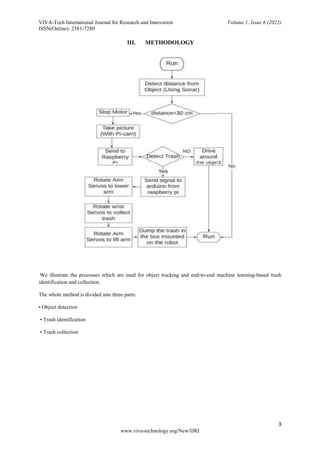
We illustrate the processes which are used for object tracking and end-to-end machine learning-based trash
identification and collection.
The whole method is divided into three parts:
• Object detection
• Trash identification
• Trash collection
VIVA-Tech International Journal for Research and Innovation Volume 1, Issue 6 (2023)
ISSN(Online): 2581-7280
4
www.viva-technology.org/New/IJRI
IV. RESULT AND DISCUSSION
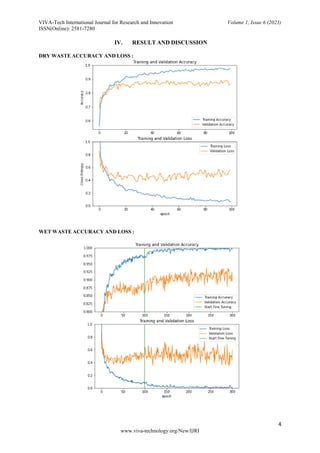
DRY WASTE ACCURACY AND LOSS :
WET WASTE ACCURACY AND LOSS :
VIVA-Tech International Journal for Research and Innovation Volume 1, Issue 6 (2023)
ISSN(Online): 2581-7280
5
www.viva-technology.org/New/IJRI
IMAGE SEGMENTATION :
V. CONCLUSION
Our purpose is to build a stable system for collecting and depositing trash in the trash container mounted on a
robot which runs on four wheels to move and collect trash. A simple and efficient object identifying algorithm
from an image is designed with keras. Upgrading waste disposal system will be beneficial to protect the nature.
Our irresponsible behavior of throwing trash here and there is creating a problem of getting non-disposable
materials into soil and water thus polluting them. We hope to solve the problem by collecting thrown away trash
and putting them in a place where those will be properly handled.
Acknowledgements
The project work carried out in this paper is a part of BE research work at Viva Institute of Technology affiliated
to Mumbai University under the guidance of Prof. Meena Perla. We would like to thank our guide for her
instruction and recommendation ; express gratitude towards our college EXTC department for their support.
REFERENCES
[1] Othman, E.H., “A Review on Current Design of Unmanned Surface Vehicles (USVs),” J. Adv. Rev. Sci. Res.,
16, 12-17, 2015.
[2] Liu, Z.; Zhang, Y.; Yu, X.; Yuan, C., “Unmanned surface vehicles: An overview of developments and
challenges,” Annu. Rev.Control, 41, 71-93, 2016.
[3] Mancini, A.; Frontoni, E.; Zingaretti, P., “Development of a low-cost Unmanned Surface Vehicle for digital
survey,” In Proceedings of the 2015 European Conference on Mobile Robots (ECMR), Lincoln, UK, 2-4, pp. 1–
6, 2015.
[4] J. Manley, “Unmanned Surface Vehicles, 15 Years of Development,” Proc. Oceans 2008 MTS/IEEE Quebec
Conference and Exhibition (Ocean’08), Sept. 2008.
VIVA-Tech International Journal for Research and Innovation Volume 1, Issue 6 (2023)
ISSN(Online): 2581-7280
6
www.viva-technology.org/New/IJRI
[5] G. Sivasankar, K. Seyatha, B. Durgalakshmi, “Autonomous Trash Collecting Robot,” International Journal of
Engineering Research & Technology (IJERT), ISSN: 2278-0181, Vol. 6, Issue 04, April-2017.
[6] Shobhit Khandare, Sunil Badak, Yugandhara Sawant, Sadiya Solkar, “Object Detection Based Garbage
Collection Robot (E-Swachh),” International Research Journal of Engineering and Technology (IRJET).
[7] R. Raghavi, K. Varshini, L. Kemba Devi, “Water Surface Cleaning Robot,” International Journal of Advanced
Research in Electrical, Electronics and Instrumentation Engineering.
[8] Keerthi Shravani N, K T Ujwal Pratap Krishna & Shri. B. V. S.Rao, “Designing and Modelling of an
Autonomous Robot for Cleaning Lake Surface,” Global Journal of Engineering Science and Researches.
[9] Kartha, J.J.; Jacob, L., “Delay and Lifetime Performance of Underwater Wireless Sensor Networks with
Mobile Element Based Data Collection,” Int. J. Distrib. Sen. Netw. 2015, 2015.
[10] Lindemuth, M.; Murphy, R.; Steimle, E.; Armitage, W.; Dreger,K.; Elliot, T.; Hall, M.; Kalyadin, D.; Kramer,
J.; Palankar, M.; etal. “Sea Robot-Assisted Inspection,” IEEE Robot. Autom. Mag.,18, 96-107, 2011.

ARTIFICIAL INTELLIGENCE (AI) BASED TRASH CLEANING ROBOT

  • 1.
    VIVA-Tech International Journalfor Research and Innovation Volume 1, Issue 6 (2023) ISSN(Online): 2581-7280 1 www.viva-technology.org/New/IJRI AI BASED TRASH CLEANING ROBOT Mrs. Meena Perla4 , Abhishek Khandekar1 , Vishvesh Khanvilkar2 , Aman Kutrekar 3 1 (Electronics and telecommunication , Viva institute of technology / University of Mumbai ,India) 2 (Electronics and telecommunication, Viva institute of technology / University of Mumbai ,India) 3 (Electronics and telecommunication, Viva institute of technology / University of Mumbai,India) 4 (Electronics and telecommunication, Viva institute of technology / University of Mumbai,India) Abstract : The objective of the project is to design an automatic AI robot which can segregate the waste with the help of object detection .It includes different partitions of water using camera with a robotic arm for picking and placing of waste . The system will be useful in making waste management in smart cities automation, people are busy in their professional life and they forget to pay attention to their surroundings problem which can led to may hazardous disease. The project is aimed to minimize the human efforts to clean the waste and to make Blue planet Blue again. From the interest and need of cleaning contaminations in the house hold, this project idea has been created to suit the prerequisite of working in house, giving more decisions for the utilization of cleaning garbage and waste from the floor. Keywords - Robot; garbage; waste disposal. I. INTRODUCTION The Workers assigned to collect and dispose trash live an inhumane life specially in the third world countries. They live in the risk of health hazards such as heart diseases, metabolic syndrome. A smart waste disposal system can free these people off the burden. Those that get buried in soil prevents trees from growing there naturally. In our project collection of thrown away trash is of main concern. Typical composition of garbage people throw in are 5.8%metals, 3.5%glass, 1.6%plastic, 12.9% papers, 1.8% textiles and 53.7% biodegradable which means only the remaining 20.7% of the wastes should really be going to landfills. Most harmful of these wastes are plastic bottles because they are used to package drinks which people need a lot. Research to separate or classify plastic bottles provides a large area of work. People tend to throw wastes outside trash bin when it is full to its capacity. Some work has been done to identify if a trash bin full or not depending on Stereoscopic Camera System and image processing in OpenCV. Here a message is sent to trash collecting vehicle as soon as the bin is full to come and empty the trash bin. In the above mentioned work the trash bin is stationary and depends on disposal of trash in the bin. A mobile system that roams and collects trash has been worked on where a robot is used to clean the area around a dustbin using combination of Mobile Nets and Single Shot Detectors for fast, efficient deep learning based object detection. Research has been done on autonomous bots which can collect any object in their path from ground, river and water ways with no flow but those are without the capability to separate trash from non trash. Robots without trash identification capability can be harmful to wild life.
  • 2.
    VIVA-Tech International Journalfor Research and Innovation Volume 1, Issue 6 (2023) ISSN(Online): 2581-7280 2 www.viva-technology.org/New/IJRI II. LITERATURE SURVEY 1.AUTOMATIC WASTE SEGREGATOR BIN USING ROBOTIC ARM This research aims to design an automatic segregator bin which can segregate the waste at source that helps in reducing the time taken for processing, and the segregation work done for large amounts of waste in the later stages. It includes different partitions for collection of different waste using sensors, with a LCD display which updates the status of the bin. The bin uses a robotic arm for picking and placing of waste, also defines the path to be taken after waste detection around the bin. This robot can be useful at places like offices, apartments, shopping malls, parks etc. This system will be useful in making waste management in smart cities automated. 2. AUTOMATIC WASTE SEGREGATOR BIN USING ROBOTIC ARM This research aims to design an automatic segregator bin which can segregate the waste at source that helps in reducing the time taken for processing, and the segregation work done for large amounts of waste in the later stages. It includes different partitions for collection of different waste using sensors, with a LCD display which updates the status of the bin. The bin uses a robotic arm for picking and placing of waste, also defines the path to be taken after waste detection around the bin. This robot can be useful at places like offices, apartments, shopping malls, parks etc. This system will be useful in making waste management in smart cities automated. 3. TRASH DETECTION AND TRACKING FOR A RIVER CLEANING ROBOT The objective of this research work is to develop an algorithm for a river cleaning robot. This algorithm will be able to autonomously detect and track the surface trash flowing in water from a real time video. The state of the art works that have been implemented so far consider that the first frame of the video contains the object to be detected. The various challenges confronting this work are the reflecting nature of flowing objects in water, clutter and noise generated by ripples in water, changes in the HSL levels of the surface of the water and detecting multiple objects in a single frame. Our aim was to develop an algorithm that detects the trash flowing in the water, then keep a track of it as it progresses and then localize the object such that it can be collected by the scooping arm of the robot. This problem has been divided in two parts, where the first part concerns itself with the detection of moving trash and another with tracking the detected trash objects. We did a comparative study of two main detection algorithms, where one is the Background Subtraction in which the mobile object is detected by differencing the current frame from the reference frame of the video feed.
  • 3.
    VIVA-Tech International Journalfor Research and Innovation Volume 1, Issue 6 (2023) ISSN(Online): 2581-7280 3 www.viva-technology.org/New/IJRI III. METHODOLOGY We illustrate the processes which are used for object tracking and end-to-end machine learning-based trash identification and collection. The whole method is divided into three parts: • Object detection • Trash identification • Trash collection
  • 4.
    VIVA-Tech International Journalfor Research and Innovation Volume 1, Issue 6 (2023) ISSN(Online): 2581-7280 4 www.viva-technology.org/New/IJRI IV. RESULT AND DISCUSSION DRY WASTE ACCURACY AND LOSS : WET WASTE ACCURACY AND LOSS :
  • 5.
    VIVA-Tech International Journalfor Research and Innovation Volume 1, Issue 6 (2023) ISSN(Online): 2581-7280 5 www.viva-technology.org/New/IJRI IMAGE SEGMENTATION : V. CONCLUSION Our purpose is to build a stable system for collecting and depositing trash in the trash container mounted on a robot which runs on four wheels to move and collect trash. A simple and efficient object identifying algorithm from an image is designed with keras. Upgrading waste disposal system will be beneficial to protect the nature. Our irresponsible behavior of throwing trash here and there is creating a problem of getting non-disposable materials into soil and water thus polluting them. We hope to solve the problem by collecting thrown away trash and putting them in a place where those will be properly handled. Acknowledgements The project work carried out in this paper is a part of BE research work at Viva Institute of Technology affiliated to Mumbai University under the guidance of Prof. Meena Perla. We would like to thank our guide for her instruction and recommendation ; express gratitude towards our college EXTC department for their support. REFERENCES [1] Othman, E.H., “A Review on Current Design of Unmanned Surface Vehicles (USVs),” J. Adv. Rev. Sci. Res., 16, 12-17, 2015. [2] Liu, Z.; Zhang, Y.; Yu, X.; Yuan, C., “Unmanned surface vehicles: An overview of developments and challenges,” Annu. Rev.Control, 41, 71-93, 2016. [3] Mancini, A.; Frontoni, E.; Zingaretti, P., “Development of a low-cost Unmanned Surface Vehicle for digital survey,” In Proceedings of the 2015 European Conference on Mobile Robots (ECMR), Lincoln, UK, 2-4, pp. 1– 6, 2015. [4] J. Manley, “Unmanned Surface Vehicles, 15 Years of Development,” Proc. Oceans 2008 MTS/IEEE Quebec Conference and Exhibition (Ocean’08), Sept. 2008.
  • 6.
    VIVA-Tech International Journalfor Research and Innovation Volume 1, Issue 6 (2023) ISSN(Online): 2581-7280 6 www.viva-technology.org/New/IJRI [5] G. Sivasankar, K. Seyatha, B. Durgalakshmi, “Autonomous Trash Collecting Robot,” International Journal of Engineering Research & Technology (IJERT), ISSN: 2278-0181, Vol. 6, Issue 04, April-2017. [6] Shobhit Khandare, Sunil Badak, Yugandhara Sawant, Sadiya Solkar, “Object Detection Based Garbage Collection Robot (E-Swachh),” International Research Journal of Engineering and Technology (IRJET). [7] R. Raghavi, K. Varshini, L. Kemba Devi, “Water Surface Cleaning Robot,” International Journal of Advanced Research in Electrical, Electronics and Instrumentation Engineering. [8] Keerthi Shravani N, K T Ujwal Pratap Krishna & Shri. B. V. S.Rao, “Designing and Modelling of an Autonomous Robot for Cleaning Lake Surface,” Global Journal of Engineering Science and Researches. [9] Kartha, J.J.; Jacob, L., “Delay and Lifetime Performance of Underwater Wireless Sensor Networks with Mobile Element Based Data Collection,” Int. J. Distrib. Sen. Netw. 2015, 2015. [10] Lindemuth, M.; Murphy, R.; Steimle, E.; Armitage, W.; Dreger,K.; Elliot, T.; Hall, M.; Kalyadin, D.; Kramer, J.; Palankar, M.; etal. “Sea Robot-Assisted Inspection,” IEEE Robot. Autom. Mag.,18, 96-107, 2011.