
Artificial
Intelligence
(AI)
Presented by
(AI)
Md. Shakil Anower Samrat; Roll: 307
Sheikh Jami Jashim; Roll: 304
01 What is artificial intelligence?
Table of contents
02 Types of artificial intelligence
03 Main uses of artificial intelligence
04 Advantages and disadvantages of AI
What is artificial
intelligence?
01
(AI)
(AI) =
Artificial
intelligence
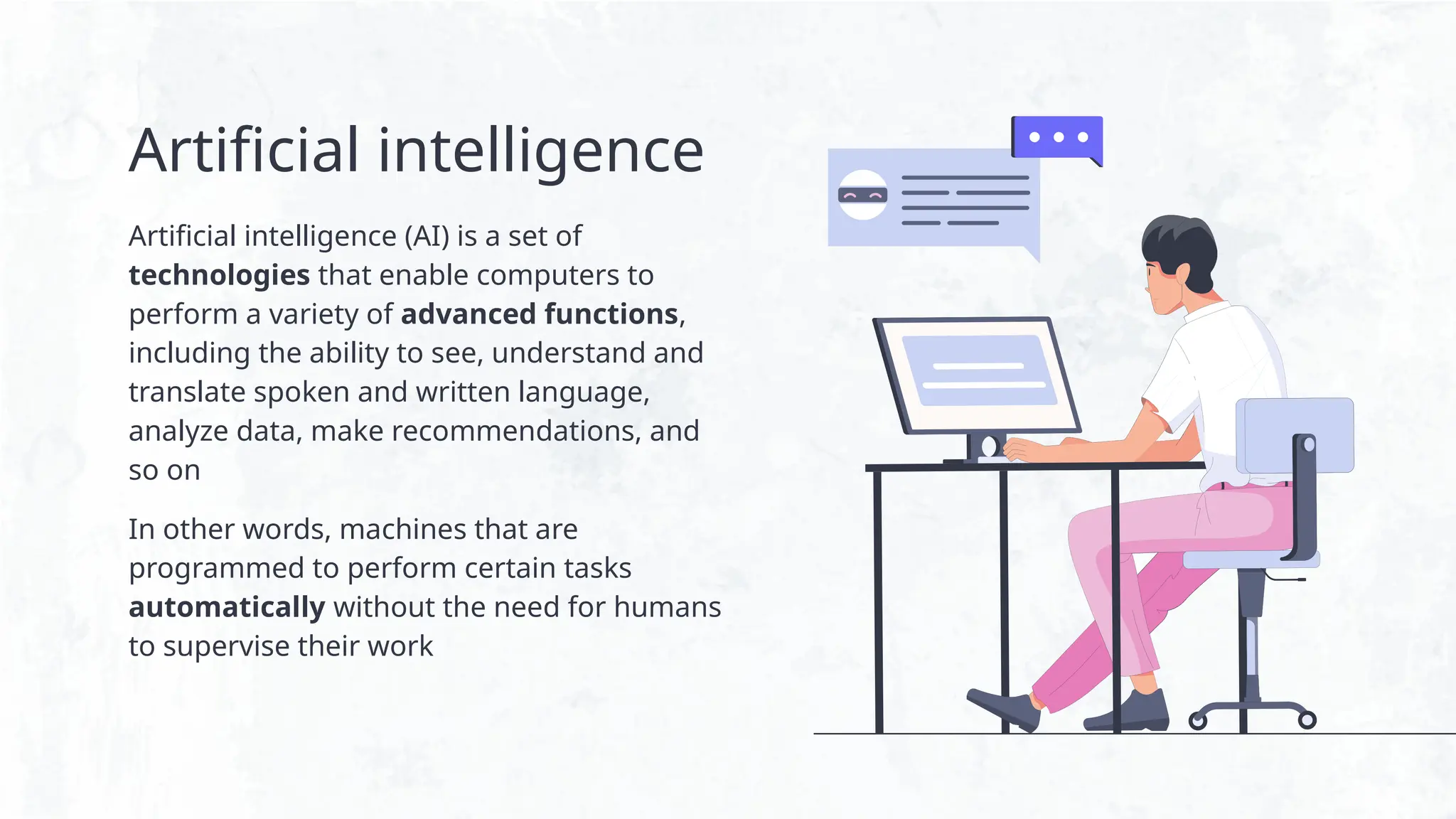
Artificial intelligence
Artificial intelligence (AI) is a set of
technologies that enable computers to
perform a variety of advanced functions,
including the ability to see, understand and
translate spoken and written language,
analyze data, make recommendations, and
so on
In other words, machines that are
programmed to perform certain tasks
automatically without the need for humans
to supervise their work
Types of artificial
intelligence
02
(AI)
Types of artificial intelligence
According to different experts, there are several types of artificial intelligence. One of the
main classifications is the following:
(a) Reactive machines
This type of AI does not have the ability to form memories or rely on past experiences to
make decisions. It is simply guided by the present or future, but has no knowledge of the
past
(b) Limited memory
They have information of the past but in a momentary way. Since their storage is not
unlimited, like the mind of a human being where it can store memories of the past, they
are machines that have information from the past but in a momentary way
Types of artificial intelligence
(c) Mind theory
These machines will be able to understand that human beings are made up of feelings
and thoughts that modify their interaction with the world. The behavior of these machines
will have to collaborate with social interaction
(d) Self-awareness
The ultimate goal of artificial intelligence is to create machines that are self-aware
Main uses of artificial
intelligence
03
(AI)
Main uses
(a) Virtual personal assistants
These are the well-known chatbots that allow us to interact with them according to our
search history
(b) Business and finance
In this case, AI brings the possibility of generating greater security, offering new
operations and being aware of relevant market information
(c) Education
It allows to personalize them according to the students, to control attendance and
evaluations, to establish teaching-learning strategies
Main uses
(d) Commercial
It allows to know and recommend what the customer needs, predicting trends and
making very detailed analysis
(e) Health
Artificial intelligence is used in healthcare, specifically in chatbots that ask us about our
symptoms in order to make a diagnosis. By combining certain characteristics in common,
a possible solution to the problem presented by the patient can be generated without the
need of a human being
Applications
(a) Chatbots and Virtual Assistants
(b) Content Creation
(c) Grammar Checkers and Rewording Tools
(d) Video Creation and Editing
(e) Image Generation
(f) Education
(g) Transcription
Advantages and
disadvantages of AI
04
(AI)
Advantages of artificial intelligence
(+) Automation of repetitive tasks
AI makes our day-to-day life much easier, as machines can perform tasks that are difficult
for us automatically
(+) Reduces human error
Fewer errors, since there is little human involvement and the tasks are performed
automatically, the probability of error is greatly reduced
(+) More room for creativity
It favors the creative process of the human being, since it leaves us with more time to
think freely about future tasks or work actions
Advantages of artificial intelligence
(+) Increased accuracy
By reducing the likelihood of error, artificial intelligence provides high accuracy in decision
making
(+) Decision making
When making decisions, AI plays a fundamental role due to its agility in the search and
connection of information and also the analysis of the data collected
Disadvantages of artificial intelligence
(-) Difficulty of access to data
For an artificial intelligence to work properly, it must have updated and reliable data. This
does not always happen in this way, because being just a machine, sometimes it does not
have all the necessary data to make decisions appropriate to the needs
(-) Lack of qualified professionals
As this is a new technology, the number of qualified professionals who can handle these
tools is very limited
Disadvantages of artificial intelligence
(-) Developing them is expensive
The cost is extremely high. In order to replace or match the human figure with machines,
it is essential to have a large amount of money that can cover the necessary development
and maintenance costs of these tools
Thanks!
Any questions?
Educational Icons Medical Icons
Business Icons Teamwork Icons
Help & Support Icons Avatar Icons
Creative Process Icons Performing Arts Icons
Nature Icons
SEO & Marketing Icons
CREDITS: This presentation template was created by Slidesgo
and includes icons by Flaticon, infographics & images by
Freepik and content by Eliana Delacour
Thanks!
Any questions?
youremail@freepik.com
+91 620 421 838
yourwebpage.com
Please, keep this slide as attribution

Artificial Intelligence-Advantages and disadvantages of AI

  • 1.
  • 2.
    Presented by (AI) Md. ShakilAnower Samrat; Roll: 307 Sheikh Jami Jashim; Roll: 304
  • 3.
    01 What isartificial intelligence? Table of contents 02 Types of artificial intelligence 03 Main uses of artificial intelligence 04 Advantages and disadvantages of AI
  • 4.
  • 5.
  • 6.
    Artificial intelligence Artificial intelligence(AI) is a set of technologies that enable computers to perform a variety of advanced functions, including the ability to see, understand and translate spoken and written language, analyze data, make recommendations, and so on In other words, machines that are programmed to perform certain tasks automatically without the need for humans to supervise their work
  • 7.
  • 8.
    Types of artificialintelligence According to different experts, there are several types of artificial intelligence. One of the main classifications is the following: (a) Reactive machines This type of AI does not have the ability to form memories or rely on past experiences to make decisions. It is simply guided by the present or future, but has no knowledge of the past (b) Limited memory They have information of the past but in a momentary way. Since their storage is not unlimited, like the mind of a human being where it can store memories of the past, they are machines that have information from the past but in a momentary way
  • 9.
    Types of artificialintelligence (c) Mind theory These machines will be able to understand that human beings are made up of feelings and thoughts that modify their interaction with the world. The behavior of these machines will have to collaborate with social interaction (d) Self-awareness The ultimate goal of artificial intelligence is to create machines that are self-aware
  • 10.
    Main uses ofartificial intelligence 03 (AI)
  • 11.
    Main uses (a) Virtualpersonal assistants These are the well-known chatbots that allow us to interact with them according to our search history (b) Business and finance In this case, AI brings the possibility of generating greater security, offering new operations and being aware of relevant market information (c) Education It allows to personalize them according to the students, to control attendance and evaluations, to establish teaching-learning strategies
  • 12.
    Main uses (d) Commercial Itallows to know and recommend what the customer needs, predicting trends and making very detailed analysis (e) Health Artificial intelligence is used in healthcare, specifically in chatbots that ask us about our symptoms in order to make a diagnosis. By combining certain characteristics in common, a possible solution to the problem presented by the patient can be generated without the need of a human being
  • 13.
    Applications (a) Chatbots andVirtual Assistants (b) Content Creation (c) Grammar Checkers and Rewording Tools (d) Video Creation and Editing (e) Image Generation (f) Education (g) Transcription
  • 14.
  • 15.
    Advantages of artificialintelligence (+) Automation of repetitive tasks AI makes our day-to-day life much easier, as machines can perform tasks that are difficult for us automatically (+) Reduces human error Fewer errors, since there is little human involvement and the tasks are performed automatically, the probability of error is greatly reduced (+) More room for creativity It favors the creative process of the human being, since it leaves us with more time to think freely about future tasks or work actions
  • 16.
    Advantages of artificialintelligence (+) Increased accuracy By reducing the likelihood of error, artificial intelligence provides high accuracy in decision making (+) Decision making When making decisions, AI plays a fundamental role due to its agility in the search and connection of information and also the analysis of the data collected
  • 17.
    Disadvantages of artificialintelligence (-) Difficulty of access to data For an artificial intelligence to work properly, it must have updated and reliable data. This does not always happen in this way, because being just a machine, sometimes it does not have all the necessary data to make decisions appropriate to the needs (-) Lack of qualified professionals As this is a new technology, the number of qualified professionals who can handle these tools is very limited
  • 18.
    Disadvantages of artificialintelligence (-) Developing them is expensive The cost is extremely high. In order to replace or match the human figure with machines, it is essential to have a large amount of money that can cover the necessary development and maintenance costs of these tools
  • 19.
  • 20.
  • 21.
  • 22.
    Help & SupportIcons Avatar Icons
  • 23.
    Creative Process IconsPerforming Arts Icons
  • 24.
  • 25.
  • 26.
    CREDITS: This presentationtemplate was created by Slidesgo and includes icons by Flaticon, infographics & images by Freepik and content by Eliana Delacour Thanks! Any questions? youremail@freepik.com +91 620 421 838 yourwebpage.com Please, keep this slide as attribution