Topic or issue: Standard and Conformity Assessment services to participate in GVCs.
1. Presentation of subject
Participate in GVCs means to market at the international products and services guaranteeing health
protection, ensuring safety of users, promoting a good quality of life and meeting the challenges of
sustainable production and consumption. Assuring that products, services, systems or processes meet the
requirements, it is necessary to know the standards and to assess the compliance of the products or
services against standards.
Standards and Conformity Assessment are like two sides of same coin: Neither side has value without the
other side.
Business today is directly linked to buy and sell at
Individual, enterprise, national, regional, international
levels.
Purchasing decisions are made based on confidence
that the product or services provided is satisfying needs.
Suppliers need to be sure that their product are
conforms to standards to be on the market.
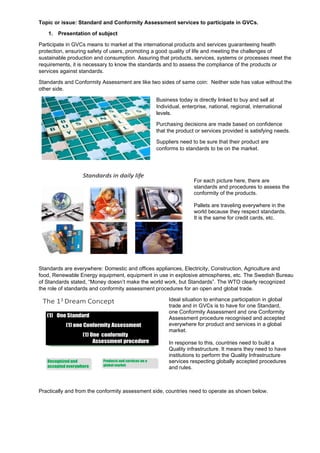
For each picture here, there are
standards and procedures to assess the
conformity of the products.
Pallets are traveling everywhere in the
world because they respect standards.
It is the same for credit cards, etc.
Standards are everywhere: Domestic and offices appliances, Electricity, Construction, Agriculture and
food, Renewable Energy equipment, equipment in use in explosive atmospheres, etc. The Swedish Bureau
of Standards stated, “Money doesn’t make the world work, but Standards”. The WTO clearly recognized
the role of standards and conformity assessment procedures for an open and global trade.
Ideal situation to enhance participation in global
trade and in GVCs is to have for one Standard,
one Conformity Assessment and one Conformity
Assessment procedure recognised and accepted
everywhere for product and services in a global
market.
In response to this, countries need to build a
Quality infrastructure. It means they need to have
institutions to perform the Quality Infrastructure
services respecting globally accepted procedures
and rules.
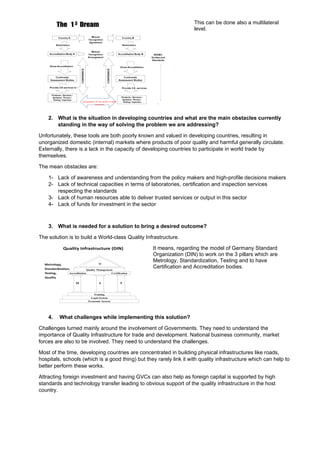
Practically and from the conformity assessment side, countries need to operate as shown below.
This can be done also a multilateral
level.
2. What is the situation in developing countries and what are the main obstacles currently
standing in the way of solving the problem we are addressing?
Unfortunately, these tools are both poorly known and valued in developing countries, resulting in
unorganized domestic (internal) markets where products of poor quality and harmful generally circulate.
Externally, there is a lack in the capacity of developing countries to participate in world trade by
themselves.
The mean obstacles are:
1- Lack of awareness and understanding from the policy makers and high-profile decisions makers
2- Lack of technical capacities in terms of laboratories, certification and inspection services
respecting the standards
3- Lack of human resources able to deliver trusted services or output in this sector
4- Lack of funds for investment in the sector
3. What is needed for a solution to bring a desired outcome?
The solution is to build a World-class Quality Infrastructure.
It means, regarding the model of Germany Standard
Organization (DIN) to work on the 3 pillars which are
Metrology, Standardization, Testing and to have
Certification and Accreditation bodies.
4. What challenges while implementing this solution?
Challenges turned mainly around the involvement of Governments. They need to understand the
importance of Quality Infrastructure for trade and development. National business community, market
forces are also to be involved. They need to understand the challenges.
Most of the time, developing countries are concentrated in building physical infrastructures like roads,
hospitals, schools (which is a good thing) but they rarely link it with quality infrastructure which can help to
better perform these works.
Attracting foreign investment and having GVCs can also help as foreign capital is supported by high
standards and technology transfer leading to obvious support of the quality infrastructure in the host
country.
5. What are the reasons that the government, private sector, and other stakeholders would
participate?
Participating in GVCs create wealth, and
recognised quality infrastructure services
are passport to the world.
Conclusion: Participating in GVCs is a big challenge. Having a recognised quality infrastructure is key.
This needs to be tackle effectively if developing countries want to be integrated in the international trade
and in GVCs.

Artifacts assignment

  • 1.
    Topic or issue:Standard and Conformity Assessment services to participate in GVCs. 1. Presentation of subject Participate in GVCs means to market at the international products and services guaranteeing health protection, ensuring safety of users, promoting a good quality of life and meeting the challenges of sustainable production and consumption. Assuring that products, services, systems or processes meet the requirements, it is necessary to know the standards and to assess the compliance of the products or services against standards. Standards and Conformity Assessment are like two sides of same coin: Neither side has value without the other side. Business today is directly linked to buy and sell at Individual, enterprise, national, regional, international levels. Purchasing decisions are made based on confidence that the product or services provided is satisfying needs. Suppliers need to be sure that their product are conforms to standards to be on the market. For each picture here, there are standards and procedures to assess the conformity of the products. Pallets are traveling everywhere in the world because they respect standards. It is the same for credit cards, etc. Standards are everywhere: Domestic and offices appliances, Electricity, Construction, Agriculture and food, Renewable Energy equipment, equipment in use in explosive atmospheres, etc. The Swedish Bureau of Standards stated, “Money doesn’t make the world work, but Standards”. The WTO clearly recognized the role of standards and conformity assessment procedures for an open and global trade. Ideal situation to enhance participation in global trade and in GVCs is to have for one Standard, one Conformity Assessment and one Conformity Assessment procedure recognised and accepted everywhere for product and services in a global market. In response to this, countries need to build a Quality infrastructure. It means they need to have institutions to perform the Quality Infrastructure services respecting globally accepted procedures and rules. Practically and from the conformity assessment side, countries need to operate as shown below.
  • 2.
    This can bedone also a multilateral level. 2. What is the situation in developing countries and what are the main obstacles currently standing in the way of solving the problem we are addressing? Unfortunately, these tools are both poorly known and valued in developing countries, resulting in unorganized domestic (internal) markets where products of poor quality and harmful generally circulate. Externally, there is a lack in the capacity of developing countries to participate in world trade by themselves. The mean obstacles are: 1- Lack of awareness and understanding from the policy makers and high-profile decisions makers 2- Lack of technical capacities in terms of laboratories, certification and inspection services respecting the standards 3- Lack of human resources able to deliver trusted services or output in this sector 4- Lack of funds for investment in the sector 3. What is needed for a solution to bring a desired outcome? The solution is to build a World-class Quality Infrastructure. It means, regarding the model of Germany Standard Organization (DIN) to work on the 3 pillars which are Metrology, Standardization, Testing and to have Certification and Accreditation bodies. 4. What challenges while implementing this solution? Challenges turned mainly around the involvement of Governments. They need to understand the importance of Quality Infrastructure for trade and development. National business community, market forces are also to be involved. They need to understand the challenges. Most of the time, developing countries are concentrated in building physical infrastructures like roads, hospitals, schools (which is a good thing) but they rarely link it with quality infrastructure which can help to better perform these works. Attracting foreign investment and having GVCs can also help as foreign capital is supported by high standards and technology transfer leading to obvious support of the quality infrastructure in the host country.
  • 3.
    5. What arethe reasons that the government, private sector, and other stakeholders would participate? Participating in GVCs create wealth, and recognised quality infrastructure services are passport to the world. Conclusion: Participating in GVCs is a big challenge. Having a recognised quality infrastructure is key. This needs to be tackle effectively if developing countries want to be integrated in the international trade and in GVCs.