Download to read offline




![15
As long as international trade was limited and manufacturers and suppliers came
from the same economic zone, no driving force existed to harmonize standards
and measuring units. Nowadays, the impacts of the steady growth of global trade
are more and more visible and many firms and industries now have organizational
structures that extend across national and regional borders. This has led to the
formation of truly global-scale economic systems; today, the process of economic
development cannot be isolated from these global systems [15]
.
Industrialized countries have had centuries to improve and come up with function-
ing metrology, standardization, testing and quality management systems (known
as MSTQ or similar abbreviations). By proving their technical competence through
several means of evaluations and comparisons, they have achieved multilateral
recognition.
In contrast, to compete with their industrialized counterparts, developing econo-
mies have to catch up fast in all relevant fields of export requirements, food safety,
consumer protection or health issues. However, a realistic view shows in many
countries a fragmented and uncoordinated system, with unclear responsibili-
ties, either accepted only for certain components on a bilateral basis, periodically
inspected and supervised by the importing country, or simply not recognized
internationally [28]
.
What is a quality infrastructure? Metrology, standards, testing and quality man-
agement are vital to products and product processes although consumers are not
always aware of it. Yet these same consumers often use quality marks from prod-
uct certifiers as a guide when making purchasing decisions. And their attention
is drawn to the area in a negative way when, for example, technical equipment
cannot be connected up abroad.
Quality infrastructure, QI, refers here to all aspects of metrology, standardization,
testing, and quality management including certification and accreditation. This
includes both public and private institutions and the regulatory framework within
which they operate.
1. WHY A NATIONAL QUALITY INFRASTRUCTURE?](https://image.slidesharecdn.com/ptbq5nationalqien-190930094222/85/Ptb-national-quality-infrastructure-15-320.jpg)
![16
Clearly defined target groups are:
• Businesses and producers in agriculture, forestry, fisheries, crafts and trades who
will benefit from a trade sector regulated by reliable QI services.
• Small and medium-sized enterprises that, unlike large companies, tend not to
have any calibration or testing capacities of their own and can call on the
support of central QI bodies. One key factor is that they are enabled to increase
sales of their product by being able to provide proof of its quality.
• Domestic trade and export/import, which rely on testing facilities, e. g. for
submitting to inspections or verification of quantity or quality.
• Regulators, who can rely on this infrastructure, thus avoiding duplicating
facilities and services, particularly in countries with limited resources,
• Research and development in enterprises, as they will have better access to all
components of quality assurance,
• Scientific and academic communities who are dependent on sound and inter-
nationally recognized measurements and testing procedures,
• Financial institutions who will be more inclined to grant credits to enterprises
capable of showing quality certifications,
• Insurance companies who may offer higher premiums to those who comply
with quality standards,
• Arbitration bodies in commercial disputes, both national and international.
The ultimate target group is, in fact, the entire population, because more competi-
tive companies, greater integration into the world trading system, and improved
consumer and environmental protection, have a positive impact on the labor mar-
ket, income levels and quality of life [13]
.](https://image.slidesharecdn.com/ptbq5nationalqien-190930094222/85/Ptb-national-quality-infrastructure-16-320.jpg)
![17
1.1. Challenges from free trade and globalization
All countries should be enabled to enjoy the advantages of globalization while ef-
fectively protecting themselves from its risks [13]
.
Standards and their enforcement can mean new entry barriers. An example: in
developing countries, expensive certification procedures mean that agricultural
smallholders and cooperatives that do not have access to technical assistance are
at a serious disadvantage. Public institutions are increasingly unable to defend
the interests of producers, especially small-scale ones. The result is that, in many
instances, small producers in developing countries have been completely cut off
from the process of standard setting and monitoring [27]
.
Formerly, only tariffs were in principle recognized as restrictions to export/import
and international trading. However, with the globalization of economies, the days
when nations could afford to indulge in bilateral tariff-cutting negotiations have
largely gone. Attention has shifted to so-called technical, or non-tariff, barriers to
trade [7]
.
The Agreement on Technical; Barriers to Trade (TBT) – sometimes referred to
as the Standards Code – is one of the legal texts of the WTO Agreement which
obliges WTO Members to ensure that technical regulations, voluntary standards
and conformity assessment procedures do not create unnecessary obstacles to
trade [34]
.](https://image.slidesharecdn.com/ptbq5nationalqien-190930094222/85/Ptb-national-quality-infrastructure-17-320.jpg)
![18
A national quality infrastructure is essential in breaking down technical barriers to
trade. It is thus the key to the greater integration of the partner countries into the
international trading system [13]
.
Bilateral and multilateral free trade agreements make more and more reference to
recognized technical competence through equivalent QI structures. For instance,
the World Trade Organization (WTO) Agreement on Technical Barriers to Trade
(TBT) states clearly that Central Government Bodies shall ensure acceptance of
conformity assessment procedures based on adequate technical competence and
verified compliance through accreditations. This is a requirement that cannot be
fulfilled without having an internationally recognized QI structure in place [28]
.
For conscientious manufacturers and service providers, having their products
assessed and certified as conforming to ISO International Standards allows them
to distinguish themselves from less reputable suppliers. When public health,
safety or the environment may be at stake, conformity assessment is usually
made obligatory by government regulations. Without official assessment and
approval, goods may be barred from sale, or suppliers disqualified from bidding
for government procurement contracts [5]
.
WTO – TBT Agreement, Article 6: Recognition of Conformity Assessment
by Central Government Bodies – Article 6.1.1 requires:
... adequate and enduring technical competence ...
... confidence in the reliability of conformity assessment results ...
... verified compliance ... through accreditations ...
... with relevant guides and recommendations issued by
international standardizing bodies ...](https://image.slidesharecdn.com/ptbq5nationalqien-190930094222/85/Ptb-national-quality-infrastructure-18-320.jpg)
![19
In addition to the requirements of the WTO committee on technical barriers to
trade, known as TBT, another WTO committee, on Sanitary and Phytosanitary
Measures – SPS, also imposes a series of requirements albeit specifying that
"...sanitary and phytosanitary measures shall not be applied in a manner which
would constitute a disguised restriction on international trade". These include
aspects related to control, inspection procedures, quarantine treatment, etc., and
compliance relies on a sound quality infrastructure [30]
.
Recent multilateral trade agreements, such as "DR-CAFTA – TBT" (the agreement
on technical barriers to trade of the Dominican Republic and Central American
Free Trade Agreement), are becoming even more specific in their requirements.
For instance, DR-CAFTA specifies in a footnote that any reference to a standard,
technical regulation or conformity assessment procedure includes those related to
metrology [12]
.
There are nowadays several levels of compliance to be reckoned with:
• national laws on, for instance, safety and sanitary registers; they are considered a
minimum for access to national markets,
• additional demands from national clients, such as supermarkets or any com-
pany that defines standards to be met by its suppliers; these are national market
requirements,
• international laws such as EU directives, US FDA regulations, food safety
regulations; these can be seen as minimum requirements for access to inter-
national markets and they may vary from one destination to another,
• additional individual demands from international clients such as international
retailers (EurepGAP), global players, additional food safety standards.
The Agreement on the Application of Sanitary and Phytosanitary Measures
(SPS) sets out the basic rules for food safety and animal and plant health stan-
dards. It allows countries to set their own standards. But it also says regulations
must be based on science. They should be applied only to the extent necessary
to protect human, animal or plant life or health. And they should not arbitrarily
or unjustifiably discriminate between countries where identical or similar condi-
tions prevail [34]
.](https://image.slidesharecdn.com/ptbq5nationalqien-190930094222/85/Ptb-national-quality-infrastructure-19-320.jpg)
![20
Being able to fulfill all these requirements and demonstrate the corresponding
compliance is a difficult and costly process, the more so for countries lacking a QI,
one capable of immediate response to the needs of the private entrepreneurial
sector. This requires at the very least, access to a national standards organization;
it will support setting up standards, give access to existing standards and, more im-
portant, it can help entrepreneurs in the use of standards to meet the requirements
set up by their national and international clients. A national metrology institute
is another requirement; it is the custodian of the national measurement standards
with their international traceability and it transfers this traceability to secondary
and industrial measurement standards as well as eventually offering reliable cali-
bration services at a reasonable cost. The third indispensable entity is a national
accreditation body; its aim is to ensure the technical competence of laboratories,
of inspection bodies, and of the quality certifications granted in the country [3]
.
Fig. 1
It should however be noted that national schemes can be varied.
Ideally, there will be technical (not political!) bodies, totally independent and with
entrepreneurial management. In fact, there exist several possible mixes of two and
three functions in the same body. This can work when functions are strictly sepa-
rated, that is when management is the only shared aspect and there is no political
hierarchy. If not, independence and impartiality which are internationally required
for recognition will never be attained. Following sections will deal further with this.](https://image.slidesharecdn.com/ptbq5nationalqien-190930094222/85/Ptb-national-quality-infrastructure-20-320.jpg)
![21
1.2. Innovation and competitiveness
The capacity for innovation is the capacity of enterprises and of a society as a
whole to take advantage of knowledge and know-how in national and internation-
al markets [30]
. Relatively recent examples of innovation are: transistor radios, credit
or debit cards, and cell phones, all of which have resulted in dramatic changes in
the habits and quality of life of millions of persons the world over.
An innovation doesn’t necessarily have to be a technological breakthrough, like
the Internet. It can be changes in the way things are done – such as "lean manu-
facturing", first introduced by Toyota, to increase the quality and reduce the cost
of assembly-line production – or adaptations of existing ideas or techniques – such
as "green" roofs built with a final layer of living plants and dirt or synthetic soil as
insulation [6]
.
Developing countries should be focusing innovation in those areas that currently
represent high import costs and/or high environmental damage, such as energy,
fuels, transport, some uses of plastic, pest control, etc.
The invention of the credit card, introduced by Bank of America Corp. in 1958,
has given countless people access to easy and immediate credit, and the pos-
sibility of international commerce [10]
.
In India, the "Jaipur foot", an artificial limb, allows Indians to comfortably squat,
sit cross-legged, and walk barefoot, as is often their custom [6]
.](https://image.slidesharecdn.com/ptbq5nationalqien-190930094222/85/Ptb-national-quality-infrastructure-21-320.jpg)
![22
1.3. Access to international markets and preservation of domestic markets
Globalization means that participation in markets is more and more decided based
on quality of the products and services, rather than on their price. In many enter-
prises competitiveness is often limited because their products, services and proce-
dures do not comply with the minimum requirements for quality that are nowa-
days imperative in commercial transactions, national or international, particularly in
regulated markets. This is valid for crafts, small and medium-sized enterprises, and
it is partly due to the lack of information and a proper national quality infrastruc-
ture, working in accordance with international standards [3]
.
The services provided by several quality infrastructure institutions help boost
competitiveness and allow production to be based on a division of labor. They are
important for the establishment of regional markets, to allow goods to be traded
internationally, and they are one of a range of instruments used to dismantle tech-
nical barriers to trade [13]
.
A national quality infrastructure – QI, helps to promote sustainable development
mainly through boosting the private sector by making companies more competi-
tive.
Harmonizing conformity assessment procedures around the world has far-
reaching benefits for international trade in general. Agreements among nations
or regions on the mutual acceptability of requirements, assessment methods,
inspection or test results, etc., can all help to reduce or remove so-called tech-
nical barriers to trade. These are procedures or requirements relating to impor-
tation and to market access that vary from country to country and may bar a
foreign product [5]
.](https://image.slidesharecdn.com/ptbq5nationalqien-190930094222/85/Ptb-national-quality-infrastructure-22-320.jpg)
![23
To export, producers in the developing countries must meet the demands of the
target markets in terms of quality, safety, reliability, environmental compatibility
and hygiene and they must be able to provide credible proof of this. This is all the
more true for agricultural products. A prerequisite is thus the existence of a quality
infrastructure that meets international standards and that monitors the production
chains and furnishes the proof required. If this infrastructure is not in place or if it is
underdeveloped, the lack of acceptable proof can constitute a technical barrier to
trade. Indeed, with the growing number of standards and technical rules imposed
by the market and the ever higher demands, technical barriers to trade are be-
coming an increasingly important issue. Today, they represent a major obstacle to
poverty reduction through trade [13]
.
In order to create regional markets, standardized regulations are required. Na-
tional regulations and standards need to be harmonized or replaced by regional
regulations and standards. At the same time, an acceptable national quality infra-
structure needs to be built to establish the technical and administrative require-
ments for the testing and control of these standards. The process of expansion of
the European Union is an example of how wide-ranging a process this is and how
much time, advice and expense is involved [13]
.
Standardization of screw threads across countries solves what has
been a major headache for manufacturers and product users [26]
.
Without the standardized dimensions of freight containers, inter-
national trade would be slower and more expensive [25]
.](https://image.slidesharecdn.com/ptbq5nationalqien-190930094222/85/Ptb-national-quality-infrastructure-23-320.jpg)
![24
For the domestic market, the national quality infrastructure has, amongst other
things, a protective function. It provides the necessary structure for effective mar-
ket monitoring and for consumer protection. To ensure fair trade, both imports
and local production must be strictly submitted to the same rules; this protects
domestic producers and at the same time provides incentives for their competi-
tiveness. For this purpose, products, either imported or locally produced, are, for
example, examined to ensure that they conform to safety regulations or for protec-
tion against hazardous characteristics. Quantitative measurements are also required
(weight, volume, length) so as to protect the producer (often small farmers) or the
consumer from being charged false prices and to create the necessary conditions
for fair trade and, therefore, social justice [13]
.
Quality of life is affected when disabled persons find that dimen-
sions of wheel-chairs and of entrances have not been standar-
dized [25]
.](https://image.slidesharecdn.com/ptbq5nationalqien-190930094222/85/Ptb-national-quality-infrastructure-24-320.jpg)
![25
1.4. Consumer protection (health, safety, environment)
The national legislature is responsible for the definition of the desired level of
protection of the country and its people. All regulations related to this protection
should be harmonized as much as possible with regional and international recom-
mendations; however, they must take into account the national technical quality
infrastructure necessary for enforcement. These regulations must apply both to
locally produced goods and services and to imports.
From the point of view of legal certainty and development of the legal system,
technical regulations are required to identify the role of the statutory measuring
and testing system and to make stipulations for business e. g. in terms of consumer
protection, health and safety and environmental protection. These should be inte-
grated into the economic and legal system.
Why is it necessary to strengthen the national quality infrastructure?
From the perspective of consumer protection, in the areas of :
• health,
• safety and food safety,
• environment.
Fig. 2
For instance, measurements are a key daily feature of medical practice (body
temperature, blood pressure, composition of the blood etc.). They are required for
recognizing and treating illnesses and are used when making decisions on required
therapies. False measurements and the resulting false decisions can, at best, gener-
ate additional costs and, at worst, can be harmful to health or even fatal.
Consumers benefit from conformity assessment because it provides them with
a basis for selecting products or services. They may have more confidence in
products or services that bear a mark or certificate of conformity that attests to
quality, safety or other desirable characteristics [5]
.](https://image.slidesharecdn.com/ptbq5nationalqien-190930094222/85/Ptb-national-quality-infrastructure-25-320.jpg)
![26
As part of effective environmental and consumer protection, products and techni-
cal equipment that present a potential risk must be tested for safety by competent
bodies, licensed by independent authorities in accordance with the appropriate
technical regulations, and their use should be monitored (market access and moni-
toring).
Many current natural disasters such as droughts, floods, harsher hurricanes and
tsunamis, are blamed on climate changes; the increase in the incidence of skin
cancers has also been tied up to an increase in UV radiations due, at least in part,
to damage to the ozone layer and this damage is attributed to increased pollution.
For instance, we use up a lot of energy to cool us in summer and this results in
warmer summers which then require even more cooling creating an endless spiral
of consumption. Many regulations concerning the use of natural resources and
the impact of human activities on the environment are tied to measurable param-
eters (e. g. regulations concerning consumption of resources, water and energy,
and limits on the amount of pollutants emitted in waste gas and wastewater).
Controls must be carried out to monitor adherence to the relevant environmental
standards, the standards must be developed or adapted and sanctions must be im-
posed for any non-compliance with the regulations. The QI establishes the neces-
sary technical framework [13]
.](https://image.slidesharecdn.com/ptbq5nationalqien-190930094222/85/Ptb-national-quality-infrastructure-26-320.jpg)
![27
1.5. Assistance to regulators and mediators in carrying out their duties
In their function as protectors of consumers, environment, national territory, etc.,
regulatory bodies in ministries have to define technical regulations and supervise
enforcement. They can be assisted in these functions by using the national qual-
ity infrastructure – which can include private entities such as a standards body, an
accreditation body, testing and calibration laboratories, certifiers, etc. – as their
technical arm for implementation of these regulations. This allows the concerned
ministries to make better use of their limited resources by not duplicating trained
personnel and laboratories when there is no critical mass to justify their continued
existence with all its implications. They can concentrate on their core business
to assure functioning of the system by managing it without necessarily having in
place a technical infrastructure of their own.
Regulators benefit from conformity assessment which gives them a means of en-
forcing governmental health, safety and environmental legislation [5]
.
Mediators are the organizations at meso (middle) level, either regionally or in indi-
vidual countries, such as:
• legal metrology institutions for consumer, health or environmental protection,
• calibration services – they provide the necessary services, particularly for small
and medium-sized enterprises,
• national metrology institutes – they hold in readiness the national measurement
standards in the country to be used as a reference, ensure that the right mea-
sures are passed on, and conduct international comparisons,
• standards organizations and information centers – they support the dismantling
of technical barriers to trade, disseminate knowledge on international technical
regulations and provide access to relevant sources; information is a must,
• testing institutes – they conduct professional and independent tests on pro-
ducts, such as foodstuffs, for the purpose of consumer protection,
• accreditation bodies - they assess the competence of certifiers and calibration
and testing services, and thus provide an assurance of international acceptance
for the certificates, these being increasingly required in such fields as manage-
ment of quality, the environment, health and safety at work, and hygiene,](https://image.slidesharecdn.com/ptbq5nationalqien-190930094222/85/Ptb-national-quality-infrastructure-27-320.jpg)
![28
• quality associations – they collect know-how on the issues of quality and mana-
gement systems, develop that know-how and offer their services as trainers and
staff certifiers for the training of quality professionals,
• chambers of commerce and industry associations as representatives of industry
– they can act as an interface between their members and other mediators and
can also operate as multipliers through awareness-raising measures.
Assistance measures must be accompanied – and in some cases preceded – by
activities at the higher political level. These are aimed at decision-makers who set
the political and legal framework in the countries and regions [13]
.
Beneficiaries and multipliers
• legal metrology institutions,
• calibration services,
• national metrology institutes,
• standards organizations and information centres,
• testing institutes,
• accreditation bodies,
• quality associations,
• chambers of commerce and industry associations.](https://image.slidesharecdn.com/ptbq5nationalqien-190930094222/85/Ptb-national-quality-infrastructure-28-320.jpg)
![29
1.6. Assistance to economic development
The national quality infrastructure – QI is to be seen as part of the whole requi-
site infrastructure of the country, with the same level of importance as roads and
highways, schools, basic medical services, etc. Without a QI neither development
nor competitiveness are possible. Adequate infrastructure is a necessary, if not
sufficient, condition for enhancing the creation and application of science, technol-
ogy and innovation in development [32]
.The key concern should be to promote and
assist small and medium-sized enterprises because, unlike most large companies,
they usually do not have the capacity and resources to conduct all the necessary
quality controls themselves and they must rely on external services [13]
.
Why is it necessary to strengthen the national quality infrastructure?
From the perspective of economic development:
For competitive products in:
• national markets,
• international markets.
Fig. 3
If producers wish to offer competitive products, those products must possess the
properties prescribed in the normative documents of the target markets and they
must pass the relevant tests. Often, there is insufficient knowledge of these require-
ments. It is all the more difficult to prove conformity with these standards and
rules if the measuring and testing institutions are not in place or if the results are
not recognized because tests were not carried out in accordance with international
standards.](https://image.slidesharecdn.com/ptbq5nationalqien-190930094222/85/Ptb-national-quality-infrastructure-29-320.jpg)
![30
These deficiencies then continue at a higher level. A lack of relevant experience at
the technical level makes it harder for developing countries to be involved in shap-
ing international regimes. The vicious circle is then complete, because the interests
of these countries are not properly taken into account. As a result, their competi-
tiveness suffers as well as the diversification of their economies and their equal
integration into the global economy.
MSTQ helps to promote sustainable development mainly by:
• paving the way towards further integration of the partner countries in the
interests of a fairer global trade regime,
• establishing institutions and influencing the enabling environment at the
national level.
Shaping the domestic environment for business and society so that it conforms to
development objectives is a major task of the legislature. It is the task of the State
to regulate matters relating to the applied system of measurements, the regula-
tions and standards for the environment, health and safety, and the responsibilities
of state and private organizations. States with efficient public structures – including
a large number of quality infrastructure institutions – are better able to articulate
the interests of their citizens in the framework of global policy-making, and to
implement international regimes. Yet, not all tasks relating to the QI need to be
performed by state bodies. By relieving the public administration of such tasks, ca-
pacities can be freed up for other tasks, the state can be encouraged to use public
resources responsibly and the groups concerned are motivated to take the initiative
[13]
.](https://image.slidesharecdn.com/ptbq5nationalqien-190930094222/85/Ptb-national-quality-infrastructure-30-320.jpg)
![31
1.7. Assistance to regional integration
Assistance in the field of quality infrastructure also has a positive impact on re-
gional integration processes. A dialogue focusing initially on technical issues can
have a confidence-building impact. This can then foster closer contacts at the
political level. The establishment of a fully formed national infrastructure of the
necessary breadth and depth requires investment and ties up resources over a long
period. For many countries, this is neither feasible nor useful. Regional coopera-
tion can compensate for this, for example through agreements for the joint use of
a complementary infrastructure or by strengthening dialogue between experts. As
a result, support of this kind can help with the development of regional economic
areas. As an example, thanks to the harmonization of European directives, the
European Union has a single Enquiry Point and a single Notification Authority for
the SPS Agreement.
Conversely, a structure solely at regional level, as a replacement for autonomous
national structures, has proved in the past to be inadequate.
So that the desired improvements are maintained when foreign assistance mea-
sures have come to an end, it should be borne in mind that continuity and sustain-
ability are of vital importance in the establishment of quality infrastructures [13]
.](https://image.slidesharecdn.com/ptbq5nationalqien-190930094222/85/Ptb-national-quality-infrastructure-31-320.jpg)
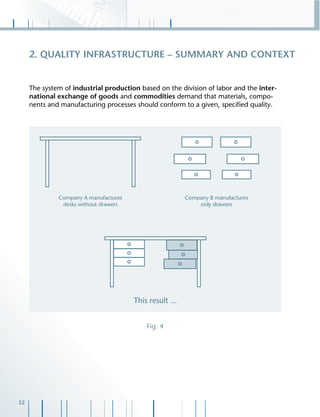
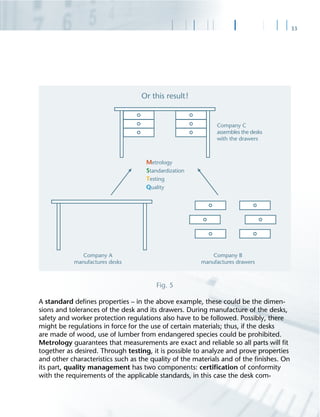
![34
ponents and the desks themselves, and accreditation – the formal recognition of
the technical competence of the certifying body and testing or calibration labora-
tories. Thus, all parties involved in the manufacture of the desks, can be secure in
the reliability of their counterparts.
Fig. 6
Reliable quality services are necessary for the diversification of production and for a
lasting creation of added value, as well as to ensure competitiveness and the rights
of enterprises. This applies in particular to small and medium-sized companies,
which have to rely on the support of services from a national quality infrastructure
– QI.
The institutional form the QI will have and the range of services supplied within
the individual components, must take into account the needs as well as the re-
sources and limitations of the country [13]
.](https://image.slidesharecdn.com/ptbq5nationalqien-190930094222/85/Ptb-national-quality-infrastructure-34-320.jpg)
![35
The rules and guidelines help to ensure:
• safer, healthier, more environmentally sound products,
• improved quality and reliability,
• better operational compatibility between products,
• greater consistency in the delivery of services,
• easier access to and greater choice in goods and services,
• better product information,
• suitable products for vulnerable populations,
• lower costs and greater competition, hence lower prices
for consumers. [17]
A national quality infrastructure is required to protect health, safety and environ-
ment when importing products and services that must comply with national verifi-
able requirements. Equity in commercial transactions is a result of working, under
equal conditions, to give confidence to exporters of their compliance with the
requirements of the destination markets, and other basic voluntary standards such
as:
• Quality Management Systems (ISO 9001),
• Environmental Management Systems (ISO 14000),
• Food Safety Management Systems (ISO 22000),
• HACCP (Hazard Analysis and Critical Control Points),
• GMP (Good Manufacturing Practice). [3]
A QI is not a punitive system, rather it seeks to support technical competence and
compliance with international requirements.
Such a national quality structure, comprised of Metrology, Standardization, Testing
and Quality management with its components Certification and Accreditation, is
widely known as a MSTQ Structure or similar abbreviations, or simply a QI (qual-
ity infrastructure), and represents a mainly voluntary system. Technical competence
makes it reliable for every kind of application so that, instead of setting up costly
parallel structures, industries, consumers, public sector and regulatory bodies can
all benefit from it for quality and for consumer protection purposes. When prop-
erly implemented and recognized by governments, it reduces use of resources in
each ministry to a “one-stop shop” and serves for any kind of product and service.](https://image.slidesharecdn.com/ptbq5nationalqien-190930094222/85/Ptb-national-quality-infrastructure-35-320.jpg)
![36
Although requirements for automotive parts, agricultural products, or health care
are different, the general QI structure applies to all of them and can, once installed
and internationally recognized, easily be extended to other products/services or
adjusted to new requirements [28]
.
Technical Regulations and Legal Metrology, are compulsory by definition; never-
theless, compulsory components should also refer to their voluntary counterparts
and use their existing technical infrastructure.
Fig. 7
The system is designed to be mainly voluntary and follows technical require-
ments which can and should be used by regulatory bodies for compulsory
application thus avoiding duplications.](https://image.slidesharecdn.com/ptbq5nationalqien-190930094222/85/Ptb-national-quality-infrastructure-36-320.jpg)
![37
A well-structured and coordinated QI, with the transversal and interdisciplinary
character of its components, needs strong support and acceptance from all ben-
efiting sectors in order to be developed properly and to meet the various expecta-
tions within the quality assurance systems of relevant fields, such as all types of
industries, health, environment, food processing, safety aspects, etc. Otherwise QI
components become vulnerable to being developed and used as isolated solutions
for a specific sector. Ministries or strong industrial sectors tend to set up QI compo-
nents such as laboratories or standards activities for their own clientele, not con-
sidering that they are employing huge resources to set up parallel systems, which
serve exactly the same objectives. Taking into account that a QI structure with all
components will need extensive financial and human resources and, according to
experience, between five and ten years until it becomes accepted through multi-
lateral recognition agreements, efforts should be concentrated on implementing a
single national structure [28]
.
National Quality Infrastructure, QI
Quality systems in enterprises, testing and calibration laboratories require a nation-
al infrastructure capable of:
• ensuring access to traceable calibrations (for instance, through a National
Metrology Institute),
• ensuring internationally recognized accreditations (for instance, through a
national accreditation body),
• compliance with international requirements (ISO standards, CODEX),
• traceability of its national measurement standards,
• participation in international intercomparisons,
• mutual recognition with other countries.](https://image.slidesharecdn.com/ptbq5nationalqien-190930094222/85/Ptb-national-quality-infrastructure-37-320.jpg)
![38
2.1. Components of a QI
Detailed descriptions of each QI component follow in the next sections. It should
become obvious that these components are closely interrelated and cannot be
reliably implemented without all of them being actively working, integrated and
internationally recognized.
In this sense, standards serve, for example, to describe the state of the art, point
technical developments in the right direction at an early stage, define the require-
ments to be met by products and procedures, facilitate the interchangeability of
technical components and set technical specifications for product testing. This
gives market participants a uniform basis for assessing product quality and for
goods to be labeled accordingly. Standardization promotes the rapid spread of
technical knowledge and thus helps to make enterprises, particularly small and
medium-sized, more competitive and innovative [13]
.
Standards do not stifle innovation or competition. Rather, they are the foundation
for both. The standardized electrical plug and socket have not prevented anyone
from producing new, interesting and innovative appliances. Instead, they have
meant that anyone (in one or several countries) can buy a new gadget, safe in the
knowledge they’ll be able to power it [11]
.
Standards provide a reference framework or a common technical language
between suppliers and their customers – that facilitates trade and the transfer of
technology [21]
.
Have you ever stopped to wonder why it is you can use your bank card almost
anywhere in the world?](https://image.slidesharecdn.com/ptbq5nationalqien-190930094222/85/Ptb-national-quality-infrastructure-38-320.jpg)
![39
This and many other examples of convenience for consumers in everyday life are
the result of international standardization by the International Organization for
Standardization, ISO, and its partners [17]
.
As a part of the mandatory technical regulations, standards are an integral compo-
nent of the economic and legislative system and a basic element in such important
areas as environmental protection and health and safety at work.
The main tasks of a standardization organization are the support of the standard-
ization process, harmonization and coordination (e. g. with current working stan-
dards). There are often systems in place, run by the private sector, thus ensuring a
strong involvement of industry and other interest groups. Standardization organi-
zations can also be public institutions [13]
.
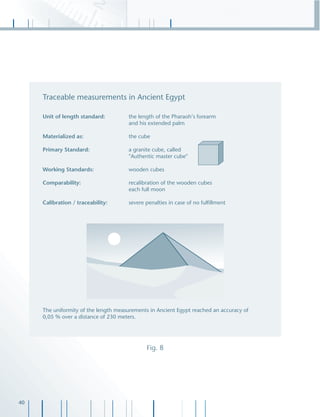
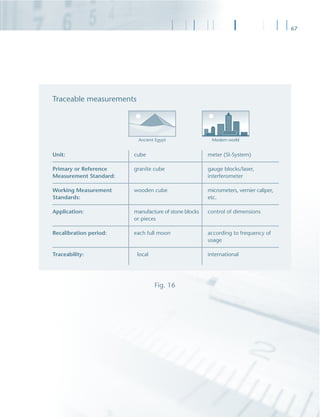
Measures are not a natural phenomenon. They have to be defined, described and
made known; this is not new as figure 8 shows. Nowadays, these are the tasks of
a national metrology institute. Measures are disseminated to users on a voluntary
basis via a network of calibration laboratories, which have normally undergone a
process of accreditation as proof of their competence. In the field of legal metrol-
ogy, this task is also performed by the verification service that checks measuring
instruments subject to legal control for compliance with the regulations, provides
identifications, and punishes infringements [13]
.
The increasing globalization of trade and the emergence of new knowledge-
based industries will increasingly depend on highly precise measurements to
support their growth [19]
.](https://image.slidesharecdn.com/ptbq5nationalqien-190930094222/85/Ptb-national-quality-infrastructure-39-320.jpg)
![41
Protective provisions and standards are meaningless unless testing is carried out to
ensure that they are being complied with. The tests are as varied as the areas that
must be regulated. They can range from a simple visual check to testing under spe-
cial laboratory conditions. If the test is passed, a special inspection stamp is often
issued, such as a test badge for cars, or a verification mark for measuring instru-
ments [13]
.
The general requirements for laboratories or other organizations to be considered
competent to carry out testing, calibration and sampling are specified in the joint
International Standard ISO/IEC 17025 [16]
.
Proof that a quality management system is in place is normally issued through a
certification procedure. Increasingly, such proof is being demanded before con-
tracts are signed. Usually, the standard ISO 9001 is taken as a basis; it is the most
widely internationally used system standard for quality management systems [13]
.
A business successful in its home market decides to compete in a number of export
markets. The problem is that the business is unknown in these markets so it first
needs to create confidence among potential customers that it can meet their qual-
ity requirements. To do so, the business aligns its processes with the internationally
recognized quality management system standard, ISO 9001. It then has the system
assessed by an independent, specialized body which issues the business with
an ISO 9001 certificate confirming conformity to the standard. In approaching
potential customers, the business can use its ISO 9001 certification/registration to
establish itself as a reliable organization in which they can have confidence [20]
.
Testing is perhaps the most common form of conformity assessment. It can
include other activities like measurement and calibration. Testing also provides
the basis for other forms – for example, it is the main technique used in product
certification [16]
.
The aim of quality management is to prevent mistakes and to guarantee and
improve the quality of products and processes.](https://image.slidesharecdn.com/ptbq5nationalqien-190930094222/85/Ptb-national-quality-infrastructure-41-320.jpg)
![42
Conformity assessment is based on systematic testing to examine whether a prod-
uct or a process fulfils certain requirements as specified in standards or normative
documents. There are also standards defining the requirements for the conformity
assessment authorities. If the test has been carried out by an independent third
party, a conformity certification is issued. This is different from the conformity
declaration made by manufacturers or by the customer, for example as part of a
supply agreement. Often, declarations or certification of conformity must be pro-
vided before a contract is concluded or before a product is brought to the market.
For instance, the CE mark denotes that a product meets European Union (EU) stan-
dards and facilitates free trade within the EU of products bearing this certificate [13]
.
One of the main difficulties that exporters face is costly multiple testing and/or
certification of products. Non-transparent or discriminatory conformity assess-
ment procedures can become effective protectionist tools, or technical barriers
to trade.
Achieving transparent, reliable and efficient conformity assessment practices is
therefore a key to facilitating trade in goods and services while ensuring bal-
anced, regulated public protection and fair industrial competition [7]
.
First-party assessment. This is the technical term used when conformity as-
sessment to a standard, specification or regulation is carried out by the supplier
organization itself. In other words, it is a self-assessment. This is known as a
supplier‘s declaration of conformity.
Second-party assessment. This indicates that the conformity assessment is
carried out by a customer of the supplier organization. For example, the sup-
plier invites a potential customer to verify that the products which it is offering
conform to relevant standards.](https://image.slidesharecdn.com/ptbq5nationalqien-190930094222/85/Ptb-national-quality-infrastructure-42-320.jpg)
![43
Examples of certification marks are the German originated GS product safety label
and the VDE label for electrical and electronic equipment, components and cables
that are issued once the certification procedure has been successfully completed,
and that indicate that the manufacturing process and the products are regularly
inspected [13]
.
Accreditation is the procedure by which an authoritative body gives formal recog-
nition that a body or person is competent to carry out specific tasks [21]
. It is thus
the formal confirmation, based on international standards, by an independent
third party, that a body is competent to perform certain tasks. Accreditation is a
means of building confidence in the work and the findings of testing and calibra-
tion laboratories and of inspection and certification bodies (conformity testing
bodies). It applies for a fixed period of time and includes monitoring measures. It
facilitates the mutual recognition of certificates of conformity and promotes inter-
national trade [13]
.
Accreditation reduces risk for business and its customers by assuring them that ac-
credited bodies are competent to carry out the work they undertake. Accreditation
by an IAF MLA member assures users that the accredited body is independent and
competent, and delivers its services in the most time and cost effective way [1]
.
Third-party assessment. In this case, the conformity assessment is performed
by a body that is independent of both supplier and customer organizations [16]
.
The TBT Agreement promotes the recognition of others‘ conformity assessment
results as a way of reducing barriers to trade. It emphasizes that confidence in
the continued reliability of conformity assessment results is a prerequisite to
recognition of assessments [7]
.](https://image.slidesharecdn.com/ptbq5nationalqien-190930094222/85/Ptb-national-quality-infrastructure-43-320.jpg)
![44
Accreditation bodies are established in many countries, often by government or
with the encouragement of government, with the primary purpose of ensuring
that certification/registration bodies in the country are subject to supervision by
an authoritative body. Accreditation reduces risk for government, business and
customers by ensuring, through regular surveillance, that certification/registration
bodies are both independent and competent [1]
.
Users of certification/registration are protected from poor services when they are
satisfied that the certification/registration body they use is accredited by an accred-
itation body which is an IAF MLA member. Accreditation bodies visit certification/
registration bodies regularly, and witness their staff conducting audits, to ensure
that both the body and its staff remain competent to undertake operations. Ac-
creditation bodies require the bodies they accredit to be free of conflicts of interest
or undue influence from interests that may benefit from a certification decision [1]
.
2.2. Inter-relationships between QI components
It should be clear that all components of the QI are closely related.
A standard, using dimensions and tolerances, cannot be defined without reference
to reliable measurements.
Measurements must in turn be internationally standardized to avoid costly
equivalences.
A product must be submitted to testing in order to determine conformity with
the requirements defined in standards or technical regulations.
International compatibility requires that testing procedures be standardized, and
also relies on reliable measurements.
Accreditation, based on international standards, is the procedure by which the
whole process becomes reliable and trustworthy, leading to international trade and
competitiveness.](https://image.slidesharecdn.com/ptbq5nationalqien-190930094222/85/Ptb-national-quality-infrastructure-44-320.jpg)
![45
2.3. International integration
International cooperation is a vital tool to dismantle technical trade barriers. It was
the increase in international trade of industrial products in the mid-19th century
that led to the founding of the Convention of the Metre in 1875, whose aim was
to develop and introduce a standardized international system of units of measure-
ment. Today, its work focuses on ensuring that the national metrology institutes
are carrying out correctly their work of measuring and calibrating; it does this by
means of confidence-building measures, such as comparison measurements. This
ensures that measures are internationally comparable and facilitates mutual recog-
nition of measurements and calibration.
For pragmatic reasons, the large number of existing national public institutes
means there is a need for close regional formalized cooperation, on which the
Convention of the Metre relies. Regional metrology organizations – RMOs ensure
the accuracy of measurements within the region and promote the regional use of
national measurement and calibration capabilities [13]
.
There are currently several such RMOs: the Interamerican Metrology System (SIM),
the European Collaboration in Measurement Standards (EUROMET), the Middle
East-North African Cooperation in Metrology (MENAMET), the South African
Development Community Cooperation in Metrology Traceability (SADCMET), the
Euro-Asian Cooperation of National Metrological Institutes (COOMET), and the
Asia-Pacific Metrology Program (APMP).
The need to agree on international standards led in the late 1940s to the found-
ing of the International Electro-technical Commission (IEC) and the International
Organization for Standardization (ISO). Although over 70 per cent of ISO member
organizations come from developing countries, their role in international standard-
ization efforts has so far been small [13]
.
Regional organizations of accreditation include: the European Cooperation for Ac-
creditation (EA), the Inter-American Accreditation Cooperation (IAAC), the Pacific
Accreditation Cooperation (PAC), the Southern African Development Community
Cooperation in Accreditation (SADCA) [1]
.](https://image.slidesharecdn.com/ptbq5nationalqien-190930094222/85/Ptb-national-quality-infrastructure-45-320.jpg)
![46
International organizations of accreditation bodies, such as the International Ac-
creditation Forum (IAF) and the International Laboratory Accreditation (ILAC) pro-
mote the foundation of relevant regional organizations, build trust in the compe-
tency of their members and thus facilitate international recognition of certificates.
At the European level, the European Organization for Quality promotes develop-
ment of and information on quality management systems. It develops harmonized
training programmes with internationally recognized qualifications in the field of
quality, the environment, and health and safety in the work place.
Within the World Trade Organization (WTO), the committees relevant to quality
infrastructure – those on Technical Barriers to Trade (TBT) and on Sanitary and Phy-
tosanitary Measures (SPS) – offer a forum to discuss questions relating to technical
cooperation in this field. They conduct analyses of needs and endeavor to boost
the exchange of information and experience between member states. In order to
overcome technical barriers to trade, the members of the World Trade Organiza-
tion (WTO) are called upon to promote the establishment of the appropriate infra-
structure in developing countries and to help them implement these agreements
[13]
.
In the long run, what is desirable is the avoidance of multiple standards, regula-
tions, tests and accreditations. Nowadays, there is much emphasis on the concept
of what is called "One-stop shop" to achieve worldwide acceptance.
World-wide product acceptance
"One-stop shop" to achieve world-wide acceptance means:
one product > one world-wide technical regulation
one product > one world-wide written standard
one product > one world-wide accreditation
one product > one world-wide test or measurement](https://image.slidesharecdn.com/ptbq5nationalqien-190930094222/85/Ptb-national-quality-infrastructure-46-320.jpg)
![47
This ambitious aim requires a worldwide-accepted system that comprises all com-
ponents of the "one-stop shop", and is carried out by recognized competent tech-
nical organizations operating worldwide. As long as every economy implements
the same structure on the national level, acceptance should easily be obtained. The
strictest rule for success is that the systems be impartial and free of external influ-
ences. Recognition is granted by regional or international organizations based on
technical competence and evaluated by peer groups. Results cannot be politically
negotiated [28]
.
2.4. Impact of a QI on value (productive or supply) chains
Whilst it is relatively easy to calculate the costs of establishing and operating a
quality infrastructure, it is hard to quantify its benefits. A functioning national
quality infrastructure helps increase competitiveness in manufacturing and service
delivery. This, in turn, increases productivity, helps create jobs, encourages invest-
ment and can promote more careful use of natural resources. A national quality
infrastructure also helps to bring about improvements in health care and a more
equal distribution of national wealth [13]
.
Third-party assessment may be required in certain business sectors by govern-
ment regulations. It may be specified by the customer, or the supplier organization
may choose it as a way of differentiating its product or service from others on the
market [16]
.](https://image.slidesharecdn.com/ptbq5nationalqien-190930094222/85/Ptb-national-quality-infrastructure-47-320.jpg)
![51
tions such as ISO, Codex Alimentarius or regional standardization organizations
such as COPANT (Comisión Panamericana de Normas Técnicas) in the Western
Hemisphere [28]
.
3.1.1. Standards (voluntary environment)
As long as they intend to be widely recognized, all QI activities, including qual-
ity management systems, best practices, certification and accreditation, depend
on consensus between all parties involved regarding the agreed parameters and
their permissible tolerances. This ensures that all parts of a product, irrespective of
source, fit together with the same measure of accuracy. The same applies to the
procedures employed for the manufacture of defined products, the drafting of
standard-practice specifications, etc. [28]
.
Standards, technical codes and directives are needed to make the reproducibility
and comparability of measurements, test results and quality parameters indepen-
dent of the performing organization. While these do constitute a voluntary agree-
ment, they nonetheless form an obligatory basis for M, T and Q components when
harmonization for mutual recognition purposes is compelling. In addition to politi-
cal intent, their implementation requires a private or public institution (National
Standards Institute or formerly National Bureau of Standards) with the personnel
and resources necessary to comply with their worldwide identical defined tasks:
identifying areas of importance, bringing together interested groups (formation
and management of standardization committees), adopting the elaborated drafts
(approval), implementing them as national standards (information office, library of
standards, publishing office).
Standard:
Document approved by a recognized body, that provides, for common and re-
peated use, rules, guidelines or characteristics for products or related processes
and production methods with which compliance is not mandatory [31]
.](https://image.slidesharecdn.com/ptbq5nationalqien-190930094222/85/Ptb-national-quality-infrastructure-51-320.jpg)
![52
As the procedures for the elaboration of every type of standard are the same and
should follow international guidelines, only one National Standards Institute per
country is necessary and economically justified to avoid duplication of efforts. The
technical competence has to come from the different standardization committees
comprising experts in the respective fields, e.g. for industrial standards, food stan-
dards, health standards or environmental standards. This structure guarantees that
all national standards are developed according to the same procedure but with
the respective expertise, and that they are registered in one national system or
database. Any national or international user can thus find the entire and updated
information in one location [28]
.
Standards can be cost reducing. As an example, a standard for interior doors has
been set up by the productive sector, so that the building industry and the final
users do not need custom-made doors and all interior doors produced locally can
be interchangeable. If the Government puts out bids to build a group of schools,
instead of going into detailed specifications for doors, bid conditions can specify
that interior doors to be used follow that industry standard, thus reducing manu-
facturing costs and delivery delays. The same could be said for water and drain
piping, electrical systems, materials for roofing and floors, etc.
Standardizing bodies should comply with the Code of Good Practice for the
Preparation, Adoption and Application of Standards, also known as the "Standards
Code", given as annex 3 of the WTO Agreement on Technical Barriers to Trade [31]
.](https://image.slidesharecdn.com/ptbq5nationalqien-190930094222/85/Ptb-national-quality-infrastructure-52-320.jpg)
![53
Fig. 9
Without a functional system of standardization, particularly with respect to metro-
logical, testing and quality standards in all fields of national interest, the M, T and
Q scopes could perhaps be established as ends unto themselves, but not as provid-
ers of industry-oriented or customer protection oriented services [28]
.
On the other hand, in many industries international commerce would be impos-
sible if countries adopt different standards. For example telecommunications, infor-
mation processing, banking and financial services could not operate across national
boundaries if they did not all obey the same rules [1]
.](https://image.slidesharecdn.com/ptbq5nationalqien-190930094222/85/Ptb-national-quality-infrastructure-53-320.jpg)
![54
Nowadays, standards will not be newly "developed" in each country but mainly
adopted from international standards, e.g. ISO standards. In this case the standards
are already accepted worldwide and have only to be adopted within the national
system. Further harmonization processes are unnecessary [28]
.
In some cases of only local interest, really new standards have to be drawn up;
this might be standards for llama meat in the Andean countries of South America.
Sometimes local adjustments may be necessary if a country does not have the
technical or structural conditions to implement the international standard.
The format of the credit cards, phone cards, and "smart" cards that have be-
come commonplace, is derived from an ISO International Standard. Adhering
to the standard, which defines such features as an optimal thickness (0,76 mm),
means that the cards can be used worldwide [1]
.](https://image.slidesharecdn.com/ptbq5nationalqien-190930094222/85/Ptb-national-quality-infrastructure-54-320.jpg)
![55
A similar situation can be found in specific sectors where the international recom-
mendations do not come from ISO. In the food sector, for instance, standardized
recommendations are elaborated by Codex Alimentarius committees [28]
.
The Codex Alimentarius Commission was created in 1963 by the United Nations
Food and Agriculture Organization (FAO) and the World Health Organization
(WHO), to develop food standards, guidelines and related texts such as codes of
practice under the Joint FAO/WHO Food Standards Program. The main purposes
of this Program are to protect the health of the consumers and to ensure fair trade
practices in the food trade, and to promote coordination of all food standards work
undertaken by international governmental and non-governmental organizations
[28]
.
3.1.2. Technical Regulations (mandatory environment)
In some fields related to safety, health, environment and consumer-protection is-
sues, directives have to be compulsory. As the term standard is used exclusively for
voluntary application, a different term is internationally used for compulsory imple-
mentation: Technical Regulations. Development and enforcement of compulsory
technical regulations are a sovereign task of a nation, and thus governmental
bodies – in general ministries – are responsible for their respective field of authority.
Again, to avoid duplication of efforts, technical regulations should make refer-
ence to pertinent national standards as much as possible. If there are no national
standards for the field to be regulated, the regulatory body could encourage the
National Standards Institute to develop a standard in this particular field which will
then be referred to by the respective ministry when issuing a technical regulation.
This means that part of a voluntary standard, or the standard itself, may become a
technical regulation As competent representatives of the ministries normally work
actively in standardization committees, they will already have in mind which parts
of the newly developed standards should be adopted in the future as technical
regulations under their ministry [28]
.](https://image.slidesharecdn.com/ptbq5nationalqien-190930094222/85/Ptb-national-quality-infrastructure-55-320.jpg)
![56
The difference between a standard and a technical regulation can be seen in the
following example. There are standards for bottles and standards for bottle clo-
sures; a mineral water bottler can buy each of these from a different supplier and
be sure they will fit. On the other hand, in order to protect consumers, the Health
Ministry may want to make sure there are no contaminants in the mineral water
being sold; it will issue a technical regulation stating what materials can be used in
the manufacture of bottles and their closures, and what concentrations of which
elements are the only ones acceptable in mineral water.
With this concept, the voluntary standards and compulsory technical regulations
are clearly separated and delegated to the entities responsible, although contradic-
tory or multiple actions are ruled out [28]
.
Technical regulation:
Document which lays down product characteristics or their related processes
and production methods, including the applicable administrative provisions,
with which compliance is mandatory. It may also include or deal exclusively
with terminology, symbols, packaging, marking or labeling requirements as
they apply to a product, process or production method [31]
.](https://image.slidesharecdn.com/ptbq5nationalqien-190930094222/85/Ptb-national-quality-infrastructure-56-320.jpg)
![57
Fig. 10
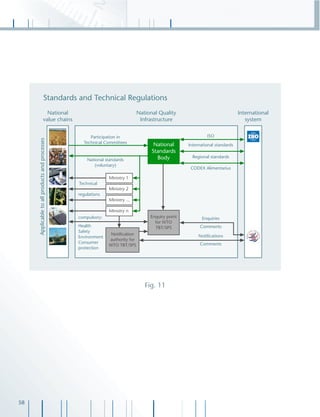
Under the WTO agreement it is also the obligation of a signatory country to
establish a National Notification Authority (NNA); this has to be a single govern-
ment authority, responsible for the implementation of notification procedures, and
to notify approved technical regulations to the TBT or SPS Secretariat at WTO in
Geneva.
Additionally, an Enquiry Point has to be established, that is responsible for the
provision of answers and documentation to all reasonable questions from inter-
ested members [28, 31]
.](https://image.slidesharecdn.com/ptbq5nationalqien-190930094222/85/Ptb-national-quality-infrastructure-57-320.jpg)

![61
framework. This harmonization started in Paris in 1875 with the Convention of the
Metre.
The Convention of the Metre is a diplomatic treaty which gives authority to the
General Conference on Weights and Measures (Conférence Générale des Poids et
Mesures, CGPM), the International Committee for Weights and Measures (Comité
International des Poids et Mesures, CIPM) and the International Bureau of Weights
and Measures (Bureau International des Poids et Mesures, BIPM) to act in matters
of world metrology, particularly concerning the demand for measurement stan-
dards of ever increasing accuracy, range and diversity, and the need to demon-
strate equivalence among national measurement standards.
Representatives of seventeen nations signed the Convention in Paris, in 1875.
As well as founding the BIPM and laying down the way in which the activities of
the BIPM should be financed and managed, the Metre Convention established a
permanent organizational structure for member governments to act in common
accord on all matters relating to units of measurement.
The 11th General Conference on Weights and Measures in 1960 adopted the
name Système International d‘Unités (International System of Units, international
abbreviation SI), for the recommended practical system of units of measurement
[28]
.
The 11th CGPM laid down rules for the prefixes, the derived units, and other mat-
ters. The base units are a choice of seven well-defined units, which by convention
are regarded as dimensionally independent: the metre, the kilogram, the second,
the ampere, the kelvin, the mole, and the candela. Derived units are those formed
by combining base units according to the algebraic relations linking the corre-
sponding quantities [28, 29]
.
Apart from the internationally operating CIPM the continents have set up Regional
Metrology Organizations (RMO), to compare and harmonize their metrological
systems. The relevant RMO for the Asian countries is called Asia Pacific Metrol-
ogy Program (APMP), in Latin America it is the SIM – Sistema Interamericano de
Metrología.](https://image.slidesharecdn.com/ptbq5nationalqien-190930094222/85/Ptb-national-quality-infrastructure-61-320.jpg)
![62
In order to ensure that dimensions of supplied automotive parts or threshold values
of contaminants in food products meet the requirements exactly, measurements
have to be as accurate as necessary for the purpose. Additionally, it has to be borne
in mind that every measurement has an "uncertainty", as do test results and ana-
lytical research, due to statistical, human, or technical deviations [28]
.
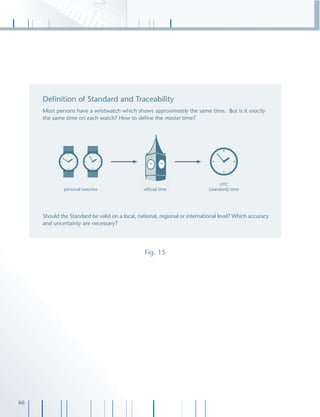
How to guarantee that a kilogram, a meter, a second or fractions and multiples of
the same are measured with identical results, independently of operator, location,
environmental conditions and characteristics of the measuring instruments?
Fig. 12](https://image.slidesharecdn.com/ptbq5nationalqien-190930094222/85/Ptb-national-quality-infrastructure-62-320.jpg)
![65
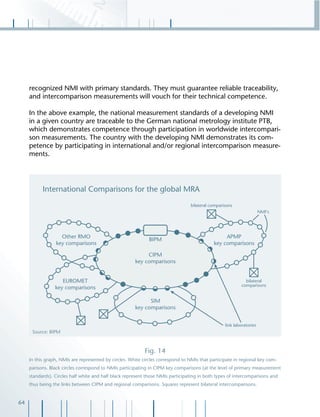
Assessments by peer groups and successful results of comparison measurements
are prerequisites to be accepted by the club members. A key criterion is not the
highest precision of measurement but the highest reliability of the declared mea-
surement capabilities. These so-called Calibration and Measurement Capabilities
(CMC) are listed in a database administered by the BIPM in Paris and published
on the Internet. The database is frequently updated and extended; it shows the
national measurement capabilities of each country for physical quantities and it has
recently been extended to chemical quantities related to analytical capabilities e.g.
for the determination of heavy metals, pesticides or antibiotics. These data play an
important role in international trade when it comes to the level of contaminants
in agricultural or food products where internationally recognized certificates are
required. Therefore, free trade agreements are beginning to refer to these mea-
surement capabilities.
The measurement needs of industry are defined by quality aspects of the products,
manufacturing processes and clients‘ requirements, which are generally defined in
written standards. International quality standards (ISO 9000, ISO/IEC 17025, etc)
require traceability of measurements. The concept of traceability (not to be con-
fused with the documentation traceability in food processing from "farm to fork",
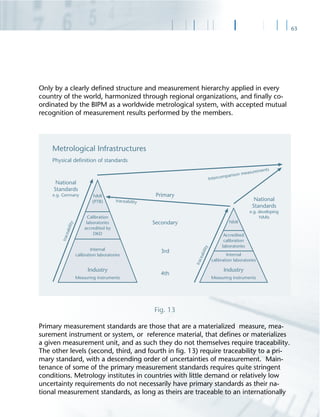
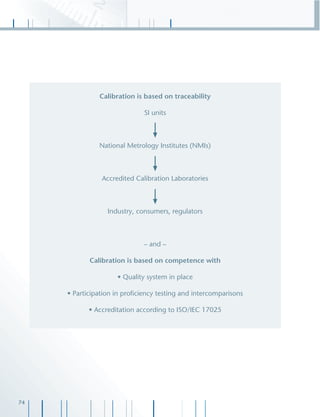
see chapter 5) means an uninterrupted chain of comparison measurements with
increasingly higher accuracy instruments (smaller measurement uncertainty), start-
ing at the instrument used in industry up to the national measurement standard.
This regularly repeated measurement to compare a measuring instrument against a
measurement standard with higher accuracy is called "calibration" [28]
.](https://image.slidesharecdn.com/ptbq5nationalqien-190930094222/85/Ptb-national-quality-infrastructure-65-320.jpg)
![68
3.2.2. National Metrology Institute
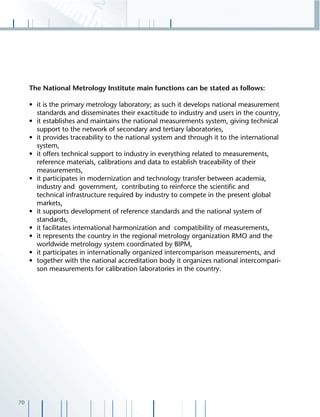
In general, every country has a National Metrology Institute – NMI, which is
responsible for the development and maintenance of the national measurement
standards in physical and chemical quantities. Irrespective of whether these stan-
dards physically have the highest achievable accuracy (primary standards), when
they are declared as the national measurement standard of a nation, they repre-
sent the countries‘ capability. Calibration activities are also an essential part of the
national metrology system and thus of the national quality system. As the NMI is
indispensable and part of the national quality system, it must be mentioned in the
structure of a National Quality Act. Additionally, its creation, function, tasks and
institutional status should be defined in a National Metrology Act [28]
.
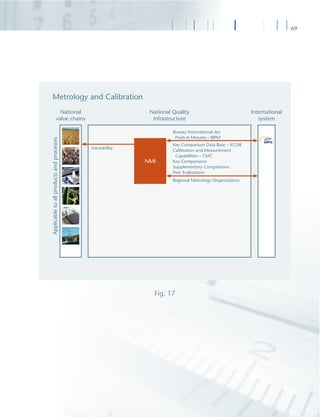
The National Metrology Institute – NMI, can be considered the national custodian
and verifier of reference standards and as such it must obtain, conserve, develop
and disseminate the basic measurement units and the highest level of calibration
standards. It provides traceability to the national system and it ensures that inter-
national technical guidelines are followed for the metrological performance and
testing procedures of measuring instruments subject to legal controls, and from
the point of view of manufacturers it ensures that their products meet international
specifications for metrological performance and testing.](https://image.slidesharecdn.com/ptbq5nationalqien-190930094222/85/Ptb-national-quality-infrastructure-68-320.jpg)

![72
3.2.3. Calibration laboratories
It is important to note that defective calibrations can result in serious problems and
even accidents, and that these must be avoided.
The task of a National Metrology Institute is to develop and disseminate measure-
ment standards in the country, and calibration of measuring instruments. In small
economies, with little demand for calibration, the NMI can cover almost every
demand. This is not the case in industrialized nations. As an example, in Germany
where many millions of measuring instruments in industry are traceable to PTB
– the national metrology body – only those instrument of higher accuracy are
calibrated there; other levels are handled by secondary and tertiary calibration
laboratories. A number of secondary calibration laboratories all over the country
are necessary to satisfy this demand in a customer-oriented manner [28]
.
Calibration laboratories can be private or public enterprises, using secondary or
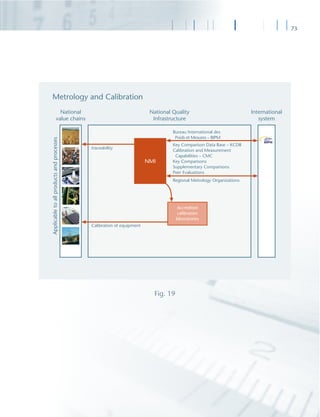
working measurement standards traceable to their NMI to calibrate customer
instruments. The uninterrupted chain of traceability from an industrial measuring
instrument to the National Measurement Standard remains guaranteed within
given uncertainties [28]
.
Besides the traceability of the reference standards used for customer calibrations,
a calibration laboratory has to implement a quality system according to ISO/IEC
17025 and to demonstrate its technical competence through an accreditation of
the calibration scope offered to its clients.](https://image.slidesharecdn.com/ptbq5nationalqien-190930094222/85/Ptb-national-quality-infrastructure-72-320.jpg)
![75
3.2.4. Metrology in Chemistry – MIC
In former times metrological infrastructures were mainly related to physical mea-
surands. With more emphasis on environment, health, food, and genetic manipu-
lations, the reliability of chemical analysis is becoming increasingly important [28]
.
The simple hierarchical principle as it works in physical quantities cannot be ap-
plied in the chemical field, as there are thousands of known parameters which are
not directly linkable to SI units. Other measurement standards with worldwide
acceptance have to be defined. A system complementary to SI is being developed,
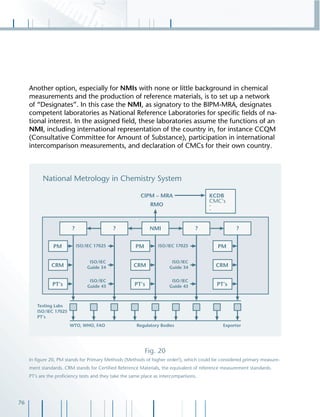
which is based on "Certified Reference Materials" and "Primary Methods". As in the
case of physical quantities, the rest of the known environment such as inter-com-
parisons between NMIs, or declarations of Calibration and Measurement Capa-
bilities (CMCs), the publication of results on the BIPM website, and regional or
worldwide technical committees, is already functioning.
In some countries, besides the physical parameters, the NMIs try to also develop
chemical measurement standards; this is the case in the USA – NIST, in Mexico
– CENAM, and in Korea – KRISS.
Public concern in Europe about unanticipated adverse effects of the use of
transgenic seeds and consumption of transgenic foods has led to demands for
mandatory labeling of such seeds and foods and represent a major threat to
Canadian exports of canola, wheat and potatoes (Canola alone represents over
$2B in Canadian farm gate value). Since any such technical barrier to trade will
be based on measurement of GMO (Genetically Modified Organisms) content
in commodity foods or food products, accurate and equitable internationally
accepted measurement standards will be of critical importance to the Canadian
agricultural industry. In the future, market acceptance of any GMO product
may be subject to internationally traceable measurement standards [19]
.](https://image.slidesharecdn.com/ptbq5nationalqien-190930094222/85/Ptb-national-quality-infrastructure-75-320.jpg)
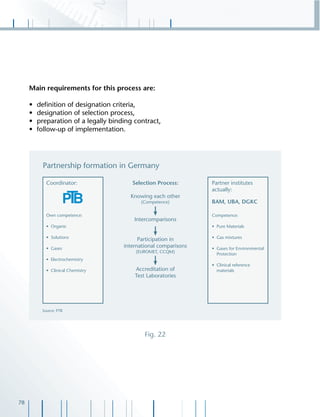
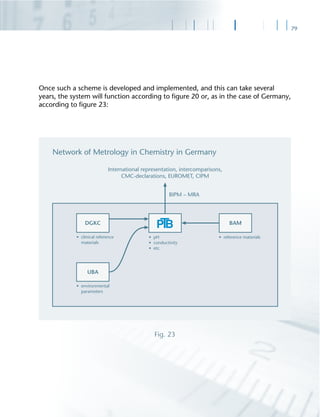
![80
For developing NMIs particularly, networking in MIC represents a great opportu-
nity to benefit from existing laboratory capabilities in the chemical parameters of
interest (food safety, environment, minerals, fossil fuels, etc.) for export compliance
or consumer protection purposes.
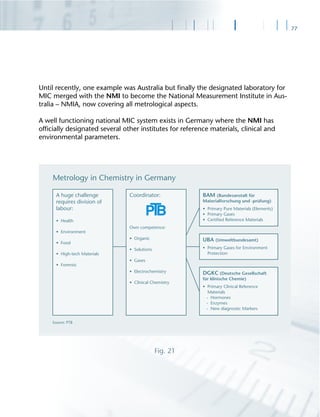
Thailand and Chile are countries presently developing a network type of system for
metrology in chemistry. The difference lies in the fact that Thailand has a NMI for
physical and a few chemical quantities and it wishes to expand national coverage
through institutes designated for complementary fields. Chile does not have a cen-
tralized NMI but rather a network of laboratories acting as custodians of national
measurement standards – LCPN – for physical quantities and expanded with na-
tional reference laboratories in chemical quantities with the purpose of establishing
a "virtual NMI", equivalent to a classical NMI.
According to ISO/IEC 17025, the concept of measurement traceability must also
be applied to chemical measurements. A system with calibration of instruments
and National Measurement Standards is also necessary for chemical measurements
[28]
.
The BIPM has a Consultative Committee for Amount of Substance (CCQM) with
working groups for organic, inorganic, gas, surface analysis and bio-analysis.
Annex 1 gives more details on the CCQM measurement categories for amount of
substance.
There is no specific recipe for the development of MIC; national requirements
can be very different but economies will normally emphasize the development of
reliable and traceable measurement of chemical parameters requested by tar-
get markets for their main export products such as seafood, wine or vegetables.
National consumer protection purposes are mainly related to drinking water, food
and pharmaceuticals. In contrast to the relatively few physical standards, there are
thousands of chemical parameters and matrices to consider so that priority selec-
tion of measurements is indispensable.](https://image.slidesharecdn.com/ptbq5nationalqien-190930094222/85/Ptb-national-quality-infrastructure-80-320.jpg)

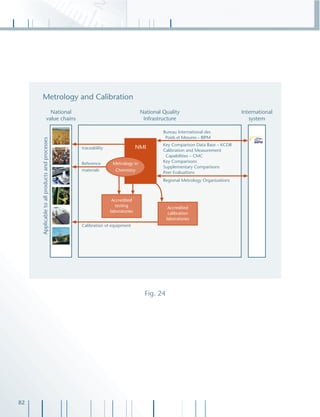
![83
3.2.5. Legal Metrology
Customers who buy a kilogram of sugar, fill up tank at a gasoline station or just use
a metered taxi, have to rely on the amounts shown when they pay for the product
or service. They have no possibility of verifying on an individual basis all commer-
cial transactions, and so they need to have a protector assuming this responsibil-
ity for the consumers. It is a sovereign task of a government to protect its citizens
from unintended or fraudulent losses, and thus it is a legal matter to control
correct measuring results related to commercial transactions and to impose and
enforce fines [28]
.
In contrast to the described calibration of measuring instruments for quality
aspects, what legal metrology officers do is to verify measuring instruments, that
is, to check if the indicated value is within the acceptable tolerance defined in, for
instance, a Technical Regulation [28]
.
Calibration (industrial metrology):
regularly repeated measurement to compare a measuring instrument against a
measurement standard with higher accuracy to obtain information about the
necessary correction and measurement uncertainty to be considered for said
measurement instrument.
Verification (legal metrology):
verification that values given by measuring instrument are within the acceptable
tolerances specified in a Technical Regulation (pass or no pass!).](https://image.slidesharecdn.com/ptbq5nationalqien-190930094222/85/Ptb-national-quality-infrastructure-83-320.jpg)
![84
Verification offices usually count on their own technical infrastructure, mainly mo-
bile to be able to verify in-situ, but they trace their verification standards back to
the same National Measurement Standards in the National Metrology Institute as
does a calibration laboratory in industry [28]
.
The Organisation Internationale de Métrologie Légale (OIML), organizes the inter-
national harmonization where recommendations for standardized measurement
and verification procedures are elaborated. In some continents, regional organiza-
tions are also established, such as the Asia-Pacific Legal Metrology Forum (APLMF)
in Asia [28]
, and the Legal Metrology Working Group of the Interamerican Metrol-
ogy System, SIM.
Fig. 25](https://image.slidesharecdn.com/ptbq5nationalqien-190930094222/85/Ptb-national-quality-infrastructure-84-320.jpg)
![85
As in other fields, such as the Codex Alimentarius, these OIML recommendations
can be adopted by the National Standards Institute as national standards. Later on,
the ministry responsible for consumer protection or legal transactions, the Minis-
try of Commerce for instance, releases technical regulations by referring to these
national standards [28]
.
Metrology is based on recognition
BIPM, CIPM-MRA, KCDB
Regional organizations, such as SIM and APMP
National metrology institutes (NMIs)](https://image.slidesharecdn.com/ptbq5nationalqien-190930094222/85/Ptb-national-quality-infrastructure-85-320.jpg)
![86
3.3. Testing
In all areas, testing serves as a means of studying the characteristics, contents
and/or quality-determining parameters of products, components, substances, etc.
Depending on the respective testing field (chemical, microbiological, physical test-
ing, etc.), the methods of analysis, test and/or inspection will differ along with their
respective analytical equipment and test apparatus. All tests of whatever type are
decisively dependent on universally applicable, recognized guidelines defining how
and under what circumstances the test in question is to be implemented. In this
connection, standardization again assumes a major role, since many test methods
are standardized in order to guarantee that the results obtained will be mutually
comparable and reproducible [28]
.
The reliability of tests conducted depends, of course, on the correct operation
and accuracy of test and measuring equipment, and the latter in turn depends on
traceable calibration [28]
.
Results from testing and analysis can serve different purposes. If used as a routine
test in the production process as part of the quality system, testing will normally be
done by a small internal laboratory of the company, focusing on internal demand.
In this case supplier and customer represent the same owner. No third party is
involved, external evaluation is not required. The internal testing laboratory can
perfectly be integrated into the ISO 9000 quality system of the company. Technical
competence is a requirement within the company’s quality policy, and traceability
of measurements and tests are also required in ISO 9000 [28]
.
It would be extremely costly for every single producer, consumer group or govern-
ment agency in a country to set up laboratories for all the testing required. It is
thus advantageous to make use of existing specialized laboratories and to set up
only those that are not yet available. These laboratories can either be private or
they can function at government agencies; what matters is that proper accredita-
tion makes them available and reliable for different purposes. Commercial testing
laboratories offer their capabilities to any client seeking this service. In this case the
client will trust the testing results only if the laboratory can show, without doubt,
its technical competence. As the customer normally has no means of evaluation,
the solution is a third party assessment according to defined criteria by a compe-
tent and recognized body.](https://image.slidesharecdn.com/ptbq5nationalqien-190930094222/85/Ptb-national-quality-infrastructure-86-320.jpg)
![87
Fig. 26
This type of system is harmonized and established worldwide. The quality manage-
ment and technical competence criteria are defined in the international standard
ISO/IEC 17025, which applies exactly the same criteria to all kinds of testing and
calibration laboratories. There is only one exception, that for clinical and medical
laboratories where the derived standard ISO/IEC 15189 is applied to better meet
the requirements of this field. An accreditation body will perform assessment and
surveillance [28]
.](https://image.slidesharecdn.com/ptbq5nationalqien-190930094222/85/Ptb-national-quality-infrastructure-87-320.jpg)
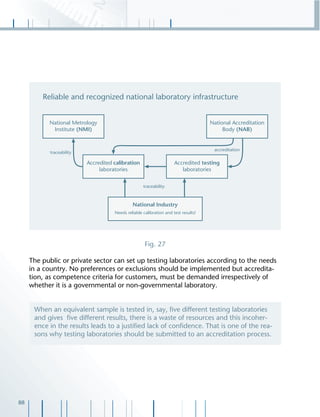
![89
Testing is also a means to determine and to ensure compliance in the application
of technical regulations.
Test reports can be used for voluntary or compulsory purposes, as long as the con-
ditions set by the regulatory body, and which are defined in technical regulations,
are fulfilled. To avoid double testing structures, regulatory bodies should make use
of a laboratory, whether public or private, as long as it is accredited by an interna-
tionally recognized body. The key criterion "technical competence according to in-
ternational standards" can and should also be recognized by regulatory bodies [28]
.
To summarize: without the standardization and metrology components and with-
out accreditation, no reliable, internationally recognized testing component can
emerge within the scope of quality policy.
Testing is based on proven technical competence
ILAC-MLA
National Accreditation Body
Evaluation, proficiency testing, intercomparisons
Testing](https://image.slidesharecdn.com/ptbq5nationalqien-190930094222/85/Ptb-national-quality-infrastructure-89-320.jpg)
![90
3.4. Certification
Through assessments, certification confirms conformity with requirements defined
in written standards. Recognition can be achieved by using standards and as-
sessment procedures which are implemented worldwide (ISO-Standards, Codex
Alimentarius recommendations, etc.). Similar to the situation described for testing
and calibration laboratories, a third party assessment of the competence of the
Certification Body and regular surveillance visits by an accreditation body will con-
firm reliability and facilitate international recognition [28]
.
Different kinds of certifications are known:
3.4.1. Certification of management systems
Management systems demonstrate that the enterprise in question has implement-
ed procedures to structure and document its administration and management
processes. It does not automatically lead to a good and competitive product or
service but, due to clearly defined internal structures independent of the personal-
ity of the employees, it does avoid a lot of possible errors. The documentation of all
processes facilitates the detection and tracing of errors in order to take corrective
actions [28]
.
Conformity assessment:
Checking that products, materials, services, systems or people, measure up to
the specifications of a relevant standard or technical regulation [25]
.](https://image.slidesharecdn.com/ptbq5nationalqien-190930094222/85/Ptb-national-quality-infrastructure-90-320.jpg)
![91
Some worldwide-accepted management systems which can be certified by Certifi-
cation Bodies are:
• Quality Management Systems according to the ISO 9000 series
• Environmental Management Systems according to the ISO 14000 series
• Occupational Health and Safety Systems according to the OHSAS 18000 series
• Hygienic Systems: Hazard Analysis and Critical Control Point – HACCP
• Good Practices (Good Manufacturing Practice, GMP) etc.
Although some certifications are according to ISO standards and others accord-
ing to FAO/WHO Codex Alimentarius standards, the same Certification Body can
certify both types.
Harmonization processes between ISO and Codex Alimentarius have already led to
the ISO 22000, a combination of ISO 9000 and HACCP, specifying requirements
for a food safety management system where an organization in the food chain
needs to demonstrate its ability to control food safety hazards in order to ensure
that food is safe at the time of human consumption [28]
.
3.4.2. Certification of products
Product certification proves that production processes, contents, properties, etc. of
a product comply with the requirements of a written standard. This type of certifi-
cation is mainly demanded for products where security aspects, health care or food
safety, play an important role.
Product certificates with their respective marks exist in most countries of the world.
Many of those have only national acceptance if issued by a national certification
body that does not have an internationally recognized accreditation.
Some examples of product certifications related to general safety aspects which
also have international relevance are [28]
:
• CE: European Union Compliance Mark
• VDE: Electrical Equipment Quality Mark
• GS: Safety Certification](https://image.slidesharecdn.com/ptbq5nationalqien-190930094222/85/Ptb-national-quality-infrastructure-91-320.jpg)
![92
Examples of specific food aspects are [28]
:
• Organic or Bio product certification
• GMO (Genetically Modified Organisms)
• Halal (Muslim food requirements)
• Kosher (Jewish Food requirements)
• EurepGAP
By making a self-declaration of conformity, a supplier organization avoids the costs
of third-party assessment. A supplier may decide to take this option if it believes
that it enjoys a sufficiently high market reputation for it to dispense with inde-
pendent confirmation of conformity. However, supplier‘s declarations may not be
appropriate in all cases, particularly where the health, safety or environmental risks
of the product concerned are higher. A self-declaration does not exempt the sup-
plier from its responsibility to meet relevant regulations – for example, in relation
to product liability – and such declarations generally need to be accompanied by
effective post-market surveillance [16]
.
A wide field of product certification is related to food safety. In this case certain
properties of food commodities, or levels of contaminants or residues are certi-
fied, mostly according to Codex standards or technical regulations of importing
countries. Compliance exists when test results from analytical laboratories confirm
conformity.
Certifying bodies for food safety related issues are in many countries under govern-
mental departments or ministries, which are authorized by law but have not neces-
sarily proven their technical competence. A reliable certification system should, on
the other hand, not depend on nationally delegated tasks but on demonstrated
technical competence, accredited by an internationally recognized accreditation
body. As long as this is not the case, frequent and costly inspections by importing
countries is the only alternative [28]
.
Clearly, product certifiers depend heavily on a reliable S, M and T structure. If the
test results from the subcontracted laboratory cannot be trusted, there is no basis
for a reliable product certificate [28]
.](https://image.slidesharecdn.com/ptbq5nationalqien-190930094222/85/Ptb-national-quality-infrastructure-92-320.jpg)
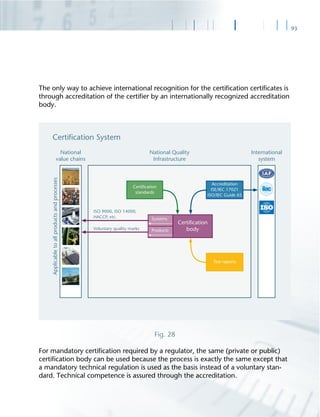
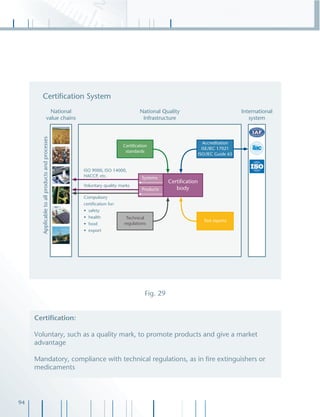
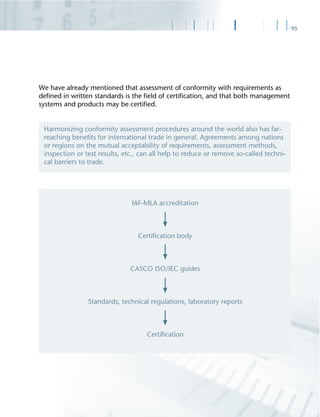
![96
ISO has a specific committee, CASCO (Conformity Assessment Committee), whose
work is centered on the areas covered by the ISO/IEC Guides:
• Vocabulary and general principles of conformity assessment
• The development of technical specifications suitable for use in conformity
assessment
• Code of good practice for conformity assessment
• Operation of testing and calibration laboratories
• Proficiency testing by interlaboratory comparisons
• Inspection bodies and activities
• Supplier‘s declaration of conformity (SDoC)
• Product certification bodies and activities
• Management system audit and certification bodies and activities
• Personnel certification bodies and activities
• Marks of conformity
• Accreditation
• Peer assessment
• Mutual recognition of conformity assessment results. [17]
To facilitate trade at the international, regional, national and sub-national level,
ISO/IEC Guide 60:2004, Conformity assesment – Code of good practice , recom-
mends good practices for all elements of conformity assessment, including nor-
mative documents, bodies, systems, schemes and results. It is intended for use by
individuals and bodies who wish to provide, promote or use ethical and reliable
conformity assessment services [16]
.
Several ISO/IEC Guides are related to production certification. In particular, ISO/IEC
Guide 67:2004 [Conformity assessment – Fundamentals of product certification]
gives guidance on product certification systems by identifying their various ele-
ments based on current practices. It is intended for use by product certification
bodies and other interested parties wishing to understand, develop, establish or
compare third-party product certification systems. This Guide is not intended to
describe all existing forms of product certification. It does not address first- and
second-party product conformity assessment [16]
.](https://image.slidesharecdn.com/ptbq5nationalqien-190930094222/85/Ptb-national-quality-infrastructure-96-320.jpg)
![97
Many variants exist. For example, product certification may consist of initial testing
of a product combined with assessment of its supplier‘s quality management sys-
tem. This may be followed up by surveillance that takes into account the suppli-
er‘s quality management system plus testing of samples from the factory and/or
the open market. Other product certification schemes comprise initial testing and
surveillance testing, while still others rely on the testing of a sample product – this
is known as type testing [16]
.
ISO/IEC Guide 28:2004 [Conformity assessment – Guidance on a third-party certifi-
cation system for products] offers general rules for a model third-party certification
system for products. ISO/IEC Guide 65 [General requirements for bodies operating
product certification systems] states the general requirements that a third party
operating a product certification system must meet if it is to be recognized as com-
petent and reliable [16]
.
ISO/IEC Guide 53:2005 [Conformity assessment – Guidance on the use of an orga-
nization’s quality management system in product certification] outlines a general
approach by which certification bodies can develop and apply product certification
schemes utilizing requirements of an organization‘s quality management system.
The provisions given are not requirements for the accreditation of a product certifi-
cation body and do not substitute the requirements of ISO/IEC Guide 65 [16]
.](https://image.slidesharecdn.com/ptbq5nationalqien-190930094222/85/Ptb-national-quality-infrastructure-97-320.jpg)
![98
3.5. Accreditation
Accreditation and Certification are often confused or seen as equivalent, which is
a misconception. Accreditation is much more than a certification. Although some
procedures are similar, an accreditation contains an additional component which
can be derived from the word itself: to give "credit" requires first to find out if
the person, institution or laboratory is creditworthy, i.e. can be trusted regarding
its competence. This cannot be noticed by just following a checklist to confirm
compliance with a standard. To prove technical competence it is essential to assess
not only the correct implementation of the quality standards but also to evaluate
the capabilities and the technical results. A technical consultant needs to be an
expert in the field of assessment with at least the same level of competence as the
assessed entity so as to be able to confirm not only conformity with standards, but
also the technical competence mentioned in article 6.1.1 of the WTO TBT Agree-
ment [28]
.
Accreditation is a term sometimes wrongly used as a synonym for certification
or registration. In fact, accreditation is the procedure by which an authoritative
body gives formal recognition that a body or person is competent to carry out
specific tasks.](https://image.slidesharecdn.com/ptbq5nationalqien-190930094222/85/Ptb-national-quality-infrastructure-98-320.jpg)
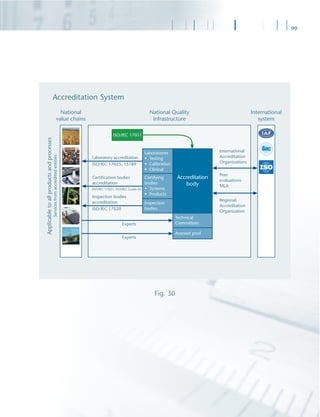
![100
Accreditations are granted in many different fields. A typical structure of an
accreditation body might comprise departments for the accreditation of:
• Testing and calibration laboratories according to ISO/IEC 17025
• Inspection Bodies according to ISO/IEC 17020
• Certifying Bodies for Quality Management Systems according to ISO/IEC 17021
(former Guide ISO/IEC 62)
• Certifying Bodies for Environmental Management Systems according to ISO/IEC
17021 (former Guide ISO/IEC 66)
• Certifying Bodies for Product Certification according to ISO/IEC Guide 65
• Certifying Bodies for Person Certification according to ISO/IEC 17024. [28]
The Accreditation Body itself must maintain conformance with ISO/IEC standard
17011 [Conformity Assessment – General requirements for accreditation bodies
accrediting conformity assessment bodies]. This standard substitutes former Guides
58 and 61.
All types of accreditation, although they are conducted according to different
guidelines, follow the same pattern. It consists mainly of an assessment of the
implemented quality system in the entity to be accredited and an evaluation of the
professional competence in the area of accreditation. For the second part, a rec-
ognized expert is generally subcontracted to join the assessment team. This gives
the Accreditation Body an immense flexibility and the opportunity to extend its
accreditation activities to every new field by always adding new recognized experts
to the "consultant pool". Similar to the work of a Standards Body, an Accreditation
Body operates technical committees with external experts as know-how support
for the different fields of accreditation scopes.
Laws or decrees of any ministry can recognize test results of a given laboratory, but
this will only be accepted on a national level. Non accredited international recog-
nition requires regular inspections by the importing countries according to their
rules, and this can result in the need for maintenance of several parallel quality
structures to satisfy all kinds of inspectors.
A similar problem arises on the national level if one laboratory performs for exam-
ple the same chemical analysis for clients from different sectors, e.g. for industry,
environmental surveillance, health issues or food safety aspects. Should this labo-](https://image.slidesharecdn.com/ptbq5nationalqien-190930094222/85/Ptb-national-quality-infrastructure-100-320.jpg)
![101
ratory maintain four different types of surveillances or accreditations with parallel
quality systems, which would be very costly, just to satisfy four different ministries?
Accreditation by one body recognized worldwide would reduce these efforts to a
minimum.
The policy of the regional organizations is to have only one Accreditation Body per
country in the MLA. Countries generally tend to establish a national accreditation
system and define the structure in a National Accreditation Act to avoid compet-
ing entities and recognition complications within the country, as well as to reduce
costs for duplicating national structures and for international memberships and
representations. The solution is one National Accreditation Body for all fields of
accreditations.
An Accreditation Body must be absolutely independent and impartial and it must
mainly be able to be a good organizing, administrative and managing organi-
zation, which can be run with a small staff. All technical expertise is then sub-
contracted depending on the actual needs. Availability of experts in all possible
accreditation scopes as permanent staff within an Accreditation Body is extremely
costly and not efficient. Therefore, a lean-structured Accreditation Body is able to
cover all national accreditation demands and, once international recognition has
been achieved, can easily extend its accreditation activities to new fields. [28]
Small economies with low accreditation demand will suffer from two main
problems:
• insufficient income to sustain the accreditation body; permanent subsidies from
the government will be necessary to maintain the accreditation body,
• due to lack of practice, the consultants will probably never gain the same experi-
ence and technical competence as their counterparts in larger accreditation
bodies.](https://image.slidesharecdn.com/ptbq5nationalqien-190930094222/85/Ptb-national-quality-infrastructure-101-320.jpg)
![102
Based on experiences around the world, an accreditation body should have accred-
ited approximately 200-300 entities to count on expertise and economic stability
for international recognition. Other options are:
• set up a small office only, as a focal point and collaborate with accreditation
bodies from neighbouring countries, already ILAC-MLA recognized,
• set up a regional network of complementing capabilities, with exchange of
consultants and expertise,
• set up a regional accreditation body,
• set up an accreditation body for national purposes and collaborate for interna-
tionally recognized accreditation with an ILAC-MLA recognized accreditation
body from another country.
Accreditation can be expensive. However, it should be kept in mind that, in the
long run, the lack of accreditation and its concomitant lack of proof of technical
competence and thus of trust, will turn out to be much more expensive for every-
one.
Relevant to trade issues are accreditations of testing and calibration laboratories
whose calibration certificates or test reports need to be recognized abroad (to
avoid costly repetition of the same test), or accreditations of certification bodies
where management systems and especially product certificates need to be recog-
nized by the importing countries. In the agricultural and food processing sector
particularly, mutual recognition of product certificates is essential. Frequent rejec-
tion of foodstuff on EU, USA or other countries‘ borders and the implementation of
rapid alert systems for agricultural products show very clearly how many deficien-
cies still exist until a worldwide "one-stop test or certificate" becomes reality [28]
.
Mutual recognition plays an increasingly important role in accreditation. Clients
of accreditation bodies are laboratories and certification bodies. Most of these are
not able to establish individually mutual recognition agreements with their coun-
terparts all over the world. Being recognized worldwide by only one accreditation
is much simpler, easier and less costly to achieve and maintain. This requires a lean
accreditation structure to facilitate mutual recognition agreements. The structure
of the accreditation system is similar to that of metrological system with its region-
al organizations and one international umbrella organization [28]
.](https://image.slidesharecdn.com/ptbq5nationalqien-190930094222/85/Ptb-national-quality-infrastructure-102-320.jpg)
![103
Adoption of an international standard, called ISO/IEC 17025, as the basis for the
accreditation of testing and calibration laboratories, has helped countries adopt
a uniform approach to determining laboratory competence. This uniform ap-
proach allows countries with similar accreditation systems to establish agreements
between themselves, based on mutual evaluation and acceptance of each other‘s
accreditation systems [2]
.
Such international agreements, usually called mutual recognition arrangements
(MRAs), are crucial in enabling test data to be accepted between these countries.
In effect, each partner in such an arrangement recognizes the other partner‘s ac-
credited laboratories as if they themselves had undertaken the accreditation of the
other partner‘s laboratories [2]
.
In addition to an accreditation, participation in proficiency tests must be obliga-
tory. A proficiency test means a comparison of test results issued by a number of
laboratories analyzing the same sample. The evaluation consists of a comparison
of the mean values and the stated uncertainties. If results deviate from a tolerable
range, the reliability of the laboratory is questionable and corrective actions have
to be taken [28]
.
Accreditation is based on peer evaluation
ILAC/IAF
Peer evaluation leads to worldwide MLA
APLAC/PAC, EA, IAAC
Peer evaluation leads to regional MLA
National accreditation bodies](https://image.slidesharecdn.com/ptbq5nationalqien-190930094222/85/Ptb-national-quality-infrastructure-103-320.jpg)
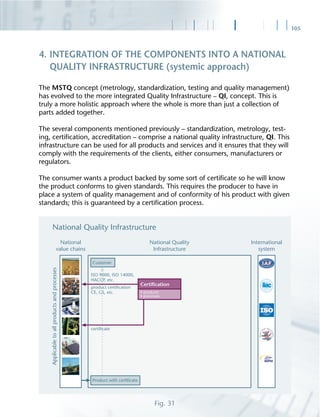
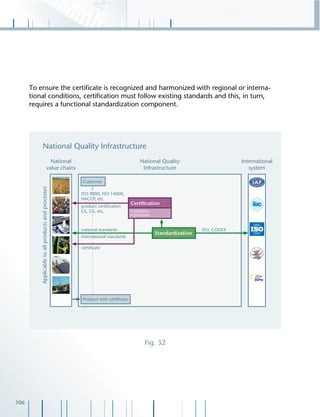
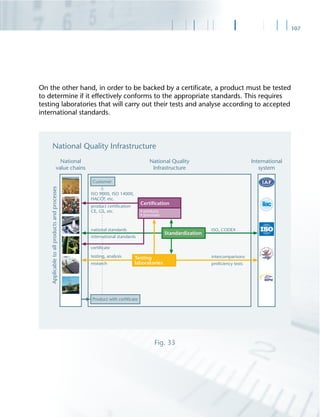
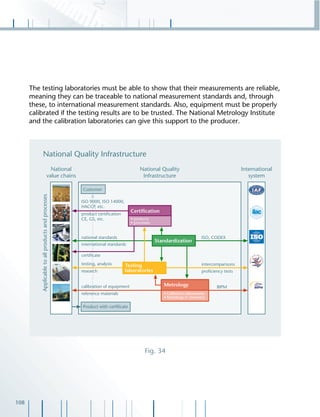
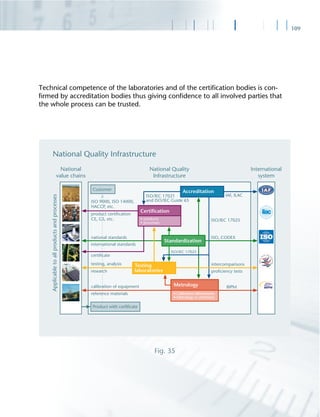
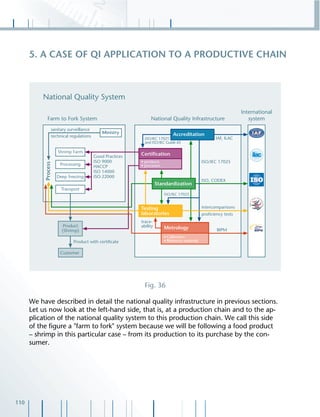

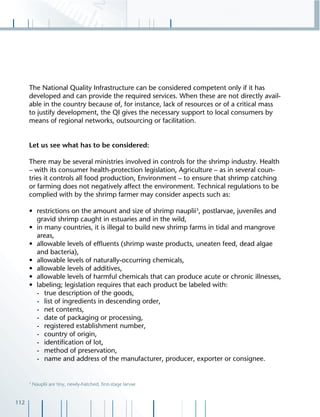
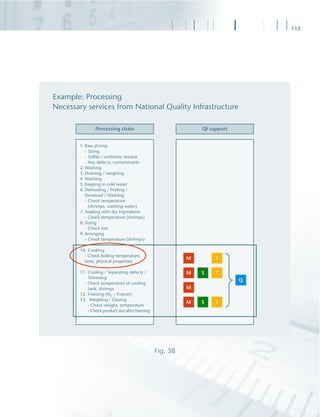
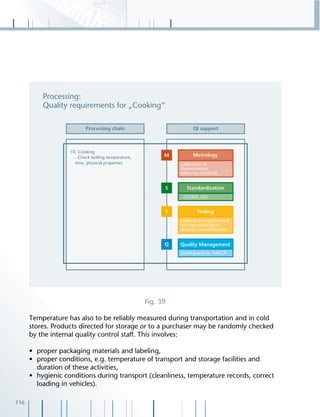
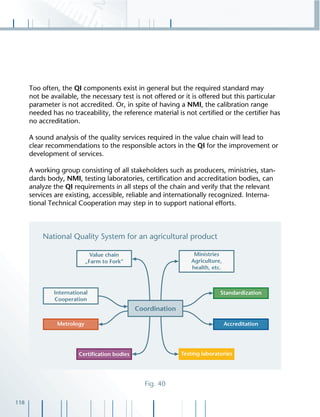
![119
6.1. National law on quality
The purpose of a national law on quality is to set up the national quality system
as the infrastructure in charge of developing and promoting quality, promoting
competitiveness in local enterprises, to make transactions of goods and services
more trustworthy, facilitate compliance with international agreements pertaining
to conformity evaluation, give technical support to regulators [3]
.
Laws and regulations are addressed to the general public and to the courts of law
and as such they must be written in the language approved by legal authorities of
the country.
There usually is a fairly long time between formulation of a law and its being in
effect, and thus it is recommended to promote a simple basic law model and cover
further details in regulations as these are easier to approve and/or modify [23]
.
Key aspects to be considered for the legal framework are:
• the policy for the development of the national quality infrastructure, the ad-
justments of the services to national needs, and assuring the functioning and
the stability of the system. These should be steered by a National Quality
Council; its members should be the relevant heads of ministries from the pub-
lic sector, and representatives from private sector groups such as chambers of
commerce or exporters, industry associations, academe and consumer protec-
tion. The balance of power between private and public sectors is indispensable
for wide acceptance,
• creation of national standards body, national metrology institute, and national
accreditation body as absolutely independent and impartial entities with the
autonomy and financing necessary to comply with their national and interna-
tional technical tasks,
• definition of functions and tasks as much as possible with reference to interna-
tional guidelines and practices. Changes in these guidelines will then not require
changes in the law itself,
6. SOME RECOMMENDATIONS BASED ON EXPERIENCE](https://image.slidesharecdn.com/ptbq5nationalqien-190930094222/85/Ptb-national-quality-infrastructure-119-320.jpg)
![121
6.3. Use of the quality infrastructure by regulating bodies
The conformance risks spring mainly from increasing concerns about product
safety, labor standards and environmental standards; producers in developing
countries are expected to meet requirements that frequently do not (yet) apply to
their domestic markets. This creates a gap between the capabilities required for the
domestic market and those required for the export market. Therefore, parameter
setting and enforcement may be required to ensure that products and processes
meet the required standards. If the gap has to be closed quickly, buyers will need
to invest in a few selected suppliers of services and help them to upgrade (or rely
on the regulating bodies) [18]
.
The corollary of this is that the need for parameter setting along the chain may
decrease as the capabilities of developing country suppliers improve and diffuse.
At the initial stages of a supply relationship, buyers may feel the need to provide
detailed instructions and undertake close monitoring of supplier performance. As
the suppliers become more experienced, and as they are able to demonstrate their
reliability to the customer, the latter may begin to indicate the standards to be
met, but leave it to the supplier to work out how to meet them [18]
.
Once parameters have been set by firms in the chain or by agents outside of the
chain, how are they enforced?
Compliance with product parameters can usually be monitored and enforced
through inspection and testing. This can take place at various stages, including at
the design and pre-production stages, depending upon the extent to which the
supplier is responsible for the design. In some cases, government agencies will also
inspect products prior to their introduction in the national or regional market [18]
.](https://image.slidesharecdn.com/ptbq5nationalqien-190930094222/85/Ptb-national-quality-infrastructure-121-320.jpg)
![122
6.4. Public and private sectors
Buyers, mostly of the private sector, very often specify process parameters. They
may also be deeply involved in their supplier’s quality systems and in specifications
of process parameters in relation to labor and environmental standards. In some
cases, the buyer may merely refer to the process standards to be attained. In other
cases, the buyer will specify precisely how particular standards should be attained
by requiring and perhaps helping to introduce particular production processes,
monitoring procedures, etc. [18]
.
On the other hand, government agencies and international organizations regulate
product design and manufacture, not only with a view to consumer safety, but also
in order to create transparent markets (for example, by defining standard weights
and sizes or technical norms). Examples of such parameter setting by agents exter-
nal to the productive chain include food safety standards, norms with regard to the
safety of products such as children‘s toys, electrical equipment and motor vehicles
and control of hazardous substances in a wide range of products. Once again,
these norms can refer to the product (are its physical characteristics and design in
conformance with requirements?) or to the process (is it being produced in ways
which conform to particular standards?). In some cases, process norms are pursued
as a means to achieving product standards (for example, hygienic food preparation
systems are designed to produce safe food) and in others because of the intrinsic
value of particular types of processes (for example, animal welfare requirements).
Governments may set standards that are compulsory and have legal force and
which are then called technical regulations. Standards may also be set by non-legal
agreements (code of conduct, etc.) and by a variety of unofficial agencies, such as
NGOs, that put pressure for compliance with labor and environmental standards
[18]
.](https://image.slidesharecdn.com/ptbq5nationalqien-190930094222/85/Ptb-national-quality-infrastructure-122-320.jpg)
![123
Thus, one agent in the value chain either enforces compliance with parameters
of other agents, or translates these parameters into a set of requirements which it
then monitors and/or enforces [18]
; this is particularly true in global value chains.
These "others" might be other agents within the chain (for example, UK super-
markets requiring their importers to monitor the quality systems of horticultural
producers and exporters), or third party specifically hired for the task, as happens
when NGOs or independent monitors are hired by companies to verify labor
standards at suppliers. The key point here is not whether the firm or an agent does
this work, but that the firm defines the parameters to be met and arranges for
compliance to be monitored. There are cases where the parameters are specified
by agents external to the chain (such as government agencies) and the monitor-
ing processes are also in the hands of agents external to the chain. In this case, no
individual firm in the chain takes responsibility for defining or enforcing the param-
eters; they apply to all the firms in the chain.
Firms are expected not to use suppliers that employ child labour, but this ex-
pectation is not accompanied by any system for enforcing the ban. The firms
have to develop their own enforcement systems.
The EU requires that surgical instrument manufacturers exporting to the Eu-
ropean market must be ISO 9000 certified. This certification is carried out by
independent certification agencies.
The US Department of Agriculture (DoA) requires certain regions exporting
melons to the US market to have a State administered fruit-fly monitoring and
eradication program which has to be approved by the Department of Agricul-
ture [18]
.](https://image.slidesharecdn.com/ptbq5nationalqien-190930094222/85/Ptb-national-quality-infrastructure-123-320.jpg)
![124
The decision to insist on a standard is made by the lead firm (it is not imposed
from outside), but if the standard is widely known and adopted, then it is likely
that organizations (standards agencies, consultancy firms, etc.) exist both to certify
companies and to help firms meet the specified standard [18]
.
For this process to take place, it is necessary for the parameters being specified to
be widely applicable across different firms and to have credible means of external
monitoring and enforcement. It may be the case that in the early stages of the
development of new process parameters, such as labor standards, these are initially
enforced by lead firms within the chain. As standards become more generalized,
then external systems of enforcement develop, such as the SA 8000 labor standard
[18]
of the Council on Economic Priorities Accreditation Agency (CEPAA).
If it were the case that certification systems demonstrating adherence to a range
of process standards, including quality, environmental and labor standards, were
developed, this might substitute for process controls by lead firms. Direct monitor-
ing and control of suppliers could be substituted by certification processes [18]
.
As the competence of these suppliers increases, chain governance through the
buyers can be expected to loosen – provided that the increasing competence of
suppliers is accompanied by the emergence of local agents who can monitor and
enforce the compliance with general or buyer specific standards.
Business-to-Business (B2B) electronic commerce is being promoted world-wide
as a means of enabling developing country producers to sell in advanced country
markets and transform the relationship between producer and buyer; all forms of
e-procurement are likely to require mechanisms to contain buyer risk, such as cer-
tification. Monitoring and accreditation agencies will be of increasing importance;
there may be a shift to parameter setting and enforcement by agents outside the
chain, i.e. mediators. The more conformance/compliance with parameters can be
codified, generalized and credibly applied, the less need there is for governance
from within the chain [18]
.](https://image.slidesharecdn.com/ptbq5nationalqien-190930094222/85/Ptb-national-quality-infrastructure-124-320.jpg)
![125
6.5. Alliances and networks
Regional cooperation promotes the mutual recognition of national structures (and
standards) and thus breaks down technical barriers to trade. If an institutional
infrastructure is to be built up from scratch, it often makes more sense to do so
in a complementary way through regional groupings and to use it jointly (one
example is expensive laboratory equipment). This can lend impetus to the process
of regional integration [13]
.
Greater use should be made of the sector‘s potential to foster regional integra-
tion processes. Action is demanded from the partner countries in terms of spread-
ing and implementing regional trade agreements; the way to do this is through
regional cooperation. As an example, German development cooperation is already
promoting the joint use of national structures that have been developed in a
complementary way; it must however take account from the outset of the fact that
regional coordination processes take more time [13]
.
For instance, in the specific case of chemistry, implementation of a national infra-
structure is challenging due to the huge amount of chemical parameters, and to
set priorities requires good knowledge of the demand, which is generally related
to export goods, environment and health. The development of the entire chemical
infrastructure in only one institute, as is frequent for physical quantities, is practi-
cally an illusion. The trend in many countries is to incorporate technical capabili-
ties already existing and to establish a network of National Reference Laboratories
to cover all the important parameters. The National Metrology Institute as the
only signatory to the BIPM MRA (Multilateral Recognition Agreement) has to be
the internationally recognized coordinator while the technical competence for
the national and international tasks pertains to the designated National Reference
Laboratories [28]
.
The primary objective is to give users confidence that requirements applicable to
products, services, systems, processes and materials have been met. One of the
reasons why internationally traded goods and services are subject to repeated con-
formity assessment controls is a lack of confidence by users in one country regard-
ing the competence of bodies carrying out these activities in other countries.](https://image.slidesharecdn.com/ptbq5nationalqien-190930094222/85/Ptb-national-quality-infrastructure-125-320.jpg)
![126
Therefore, measures are needed to increase the confidence of both private and
public sector purchasers, and of regulators, in the work of conformity assessment
bodies and accreditation bodies – particularly those in other countries [16]
.
Mutual Recognition Agreements (MRAs) and Multilateral Recognition Arrange-
ments, (MLAs), seek to provide users with the assurance that equivalent bodies
in other countries operate to the same standard as those in their own country.
International experts may subject the MRA/MLA members to rigorous operational
evaluations before and during their MRA/MLA membership to ensure that high
standards are maintained. This reduces costs and adds value to industry and con-
sumers [1]
.
BIPM-MRA
In 1999 the CGPM implemented the Mutual recognition arrangement, MRA,
to achieve more transparency and equivalence between National Metrology
Institutes. It is administrated by BIPM.
The MRA is based on verified information about the participating NMI's,
documented in KCDB Key Comparison Data Base (www.bipm.fr):
• participating institutes,
• results of key comparisons and supplementary comparisons,
• best measurement capability,
• uncertainty,
• information about implementation of quality system.](https://image.slidesharecdn.com/ptbq5nationalqien-190930094222/85/Ptb-national-quality-infrastructure-126-320.jpg)
![127
As an example, Annex 2 lists the CCQM key comparisons areas for chemistry.
Certificates in the fields of management systems, products, services, personnel and
other similar programs of conformity assessment issued by bodies accredited by
IAF MLA members are also relied upon in international trade.
The mechanism by which IAF implements its objective is the IAF Multilateral Recog-
nition Arrangement (MLA). Accreditation body members of IAF are admitted to the
MLA only after a most stringent evaluation of their operations by a peer evaluation
team which is charged with ensuring that the applicant member complies fully
with both the international standards and the IAF requirements. Once an accredita-
tion body is a member of the MLA it is required to recognize the certificates issued
by certification/registration bodies accredited by all other members of the MLA [1]
.](https://image.slidesharecdn.com/ptbq5nationalqien-190930094222/85/Ptb-national-quality-infrastructure-127-320.jpg)
![128
6.6. International recognition
The national quality system of a country should seek international recognition so
that verification of the quality of its products and services does not become a tech-
nical barrier to its trade.
Whenever standards are not specified by the supplier or buyer but rather devel-
oped locally, they, and also technical regulations, must be coherent with interna-
tional requirements.
For metrology, it is possible to establish regional mutual recognition agreements
(CIPM-MRA, MLAs) and the national metrology laboratory or institute must be
accredited by an ILAC member. One can also envisage a virtual national metrology
institute, through a network of national reference laboratories, delegating functions
for given areas and magnitudes as is done in countries such as France, Germany,
and Spain.
Internationally recognized accreditation of testing laboratories and of certifying
bodies is also a requirement for results to be accepted throughout the chain and
for the One-stop test to achieve worldwide acceptance to become a reality.
Accreditation can be carried out at lower costs if the national body works as a
"branch" of a recognized entity.
The need for the One-stop test to achieve worldwide acceptance:
A CASE: An instrument with state-of-the-art capabilities and barely three or four
competing instruments worldwide, was calibrated and traceable to NIST in the
USA. However, Canadian non-tariff trade standards required traceability to NRC
in Canada. NRC calibration merely verifies conformity to NRC measurements, it
does not improve the quality of the instrument or the uncertainty of its mea-
surements in any way. This process is costly, and it introduces significant delays
in delivery. Both buyer and seller had nothing to gain from it [32]
.](https://image.slidesharecdn.com/ptbq5nationalqien-190930094222/85/Ptb-national-quality-infrastructure-128-320.jpg)
![131
[1] About IAF, International Accreditation Forum, www.iaf.nu
[2] About ILAC, International Laboratory Accreditation Cooperation,
www.ilac.org
[3] Anteproyecto de Ley del Sistema Nacional para la Calidad. Consejo Nacional
de la Calidad, Tegucigalpa, Honduras, agosto del 2005
[4] Asian Development Bank, 2003. "Competitiveness in Developing Asia" in
Asian Development Outlook 2003, Hong Kong, China: Oxford University
Press for the Asian Development Bank, www.adb.org
[5] Benefits of conformity assessment, n.d. International Organization for
Standardization, www.iso.org
[6] Business Week, Oct. 11, 2004
[7] CASCO and the World Trade Organization, 2005-04-13. International Organi-
zation for Standardization, www.iso.org
[8] CASCO publications, 2006-03-16. International Organization for Standardiza-
tion, www.iso.org
[9] CASCO terms of reference, n.d. International Organization for Standardiza-
tion, www.iso.org
[10 Consultative Committee for Amount of Substance, CCQM, of the BIPM.
Report by President Robert Kaarls, 13-17 october 2003.
[11] Cooperatively produced standards enable competition, not prevent it,
www.zdnet.co.uk
[12] Dominican Republic – Central America – United States Free Trade Agreement,
Chapter 7. www.sice.oas.org
[13] Druckversion Sektorkonzept MNPQ, Federal Ministry for Economic Coopera-
tion and Development, Division of Development Education and information“,
Bonn, July 2004, www.bmz.de
[14] Gereffi, Gary. The Governance of Global Value Chains, Review of International
Political Economy, www.tandf.co.uk
[15] Global Value Chain Initiative, www.globalvaluechains.org
[16] How conformity assessment works, 2005-04-13. International Organization
for Standardization, www.iso.org
[17] How standards help consumers, n.d., International Organization for Standard-
ization, www.iso.org
[18] Humphrey, John and Hubert Schmtiz. Governance in Global Value Chains.
First published in the IDS Bulletin, 32, 3, 2001, copyright IDS 2001.
www.ids.ac.uk
[19] Innovation in Canada, www.innovationstrategy.gc.ca
8. REFERENCES](https://image.slidesharecdn.com/ptbq5nationalqien-190930094222/85/Ptb-national-quality-infrastructure-131-320.jpg)
![132
[20] ISO and conformity assessment, n.d. International Organization for Standard-
ization, www.iso.org
[21] ISO strategies, 2005-07-04, International Organization for Standardization,
www.iso.org
[22] La France de la Technologie. Ministère des Affaires Étrangères, adpf, 2003.
[23] Legal Metrology. Rocío M.Marbán and Julio A.Pellecer C.,OAS/PTB/SIM, Orga-
nization of the American States, OAS, 2003
[24] National Laboratories of Metrology in the Western Hemisphere. Their role in
economic and social development. Oscar Harasic and Rocío M. Marbán.
Quality Progress, vol. 32 #3, March 1999, pp.59-65.
[25] Overview of the ISO system, 2005-07-04, International Organization for Stan-
dardization, www.iso.org
[26] Perfil del Comité ISO/CASCO sobre la evaluación de conformidad. ICONTEC
– Colombia, Normas y Calidad 29, segundo trimestre 1996, pp. 13-16.
[27] Ponte, Stefano. Quality Conventions and the Governance of Global Value
Chains, www.diis.dk/sw152.asp
[28] Sanetra, Clemens et al. Study on Metrology, Standards, Testing and Quality
Assurance (MSTQ) in Thailand. On behalf of GTZ/PTB, July 2004
[29] SI Guide, International System of Units. Geneva, ISO, 1998
[30] SPS agreement, World Trade Organization, www.wto.org
[31] TBT Agreement, 1994-04-15, World Trade Organization, www.wto.org
[32] Trade and Quality by Dr. May Lowe Good, U.S. Department of Commerce,
Nov. 1995.
[33] UN Millenium Project 2005. Innovation: Applying Knowledge in Develop-
ment. Task Force on Science, Technology and Innovation. Coordinators:
Calestous Juma and Lee Yee-Cheong. UNDP, 2005.
[34] WTO, ISO, IEC and World Trade. ISO/IEC Information Centre, 2006-03-03.
International Organization for Standardization, www.iso.org
Illustrations in this book are the intellectual property of Dr.-Ing. Clemens Sanetra.
They were prepared during his work in technical cooperation for the PTB.](https://image.slidesharecdn.com/ptbq5nationalqien-190930094222/85/Ptb-national-quality-infrastructure-132-320.jpg)
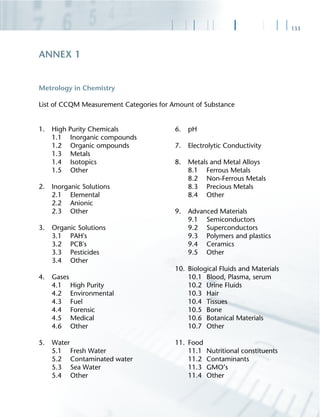

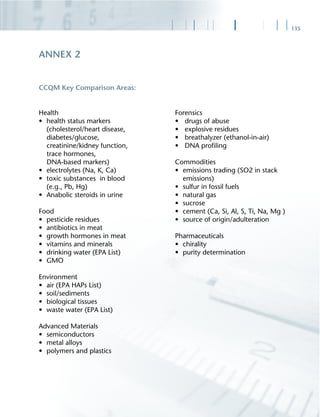
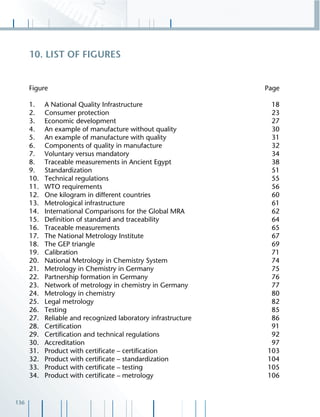




This document discusses the importance of establishing a National Quality Infrastructure (QI) to address challenges from globalization and trade. A QI consists of five key components - standardization, metrology, testing, certification, and accreditation. It helps countries and companies ensure quality, comply with international standards, and gain access to global markets. The document outlines how each QI component works and how they interconnect. It argues that a strong QI assists economic development by improving competitiveness, innovation, and market access while also protecting consumers. A QI is thus an important tool for countries to effectively engage in international trade and development.


