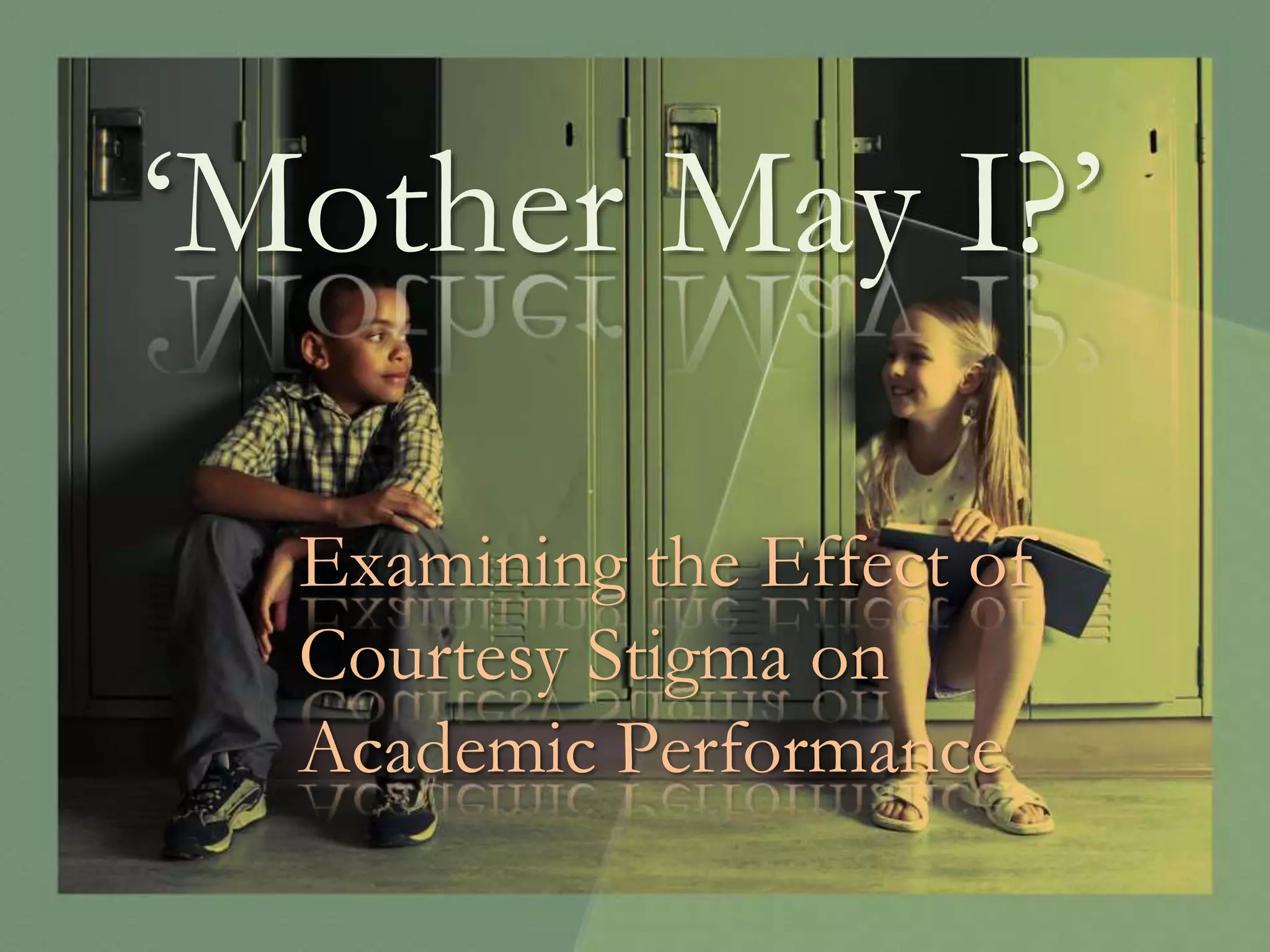
‘Mother May I?’
Examining the Effect of
Courtesy Stigma on
Academic Performance
Introduction
• The public’s perception (overwhelmingly pejorative)
toward African American students is in a state of
continuity, heavily affixed with the language of a
certain pathology, deficiency and crisis (Dixon-Roman,
2012).
• These sanctions can impose a certain stigma on
African-American students.
• For instance, the African-American male has a
propensity to academically underperform than their
white counterparts in education. (Larson, 2010)
•This research is theory
based and is an
exploratory study which
negates a hypothesis
from this research
Abstract
• Dominant ideology often imposes negative
stigmas onto Black single mother heads of
household. These stigmas question the
parental skills, abuse of social services,
intelligence, and lifestyle choices of these
women. These stigmas are potentially harmful
to their children since they are easily
transferrable to them through a process of
courtesy stigmatization
Literature Review
• Teacher Expectancy Effect
• Self-Fulfilling Prophecy
• Stigma & The Single Mother
Teacher Expectancy Effect
• Prior studies have reported that subtle variances in a
teacher’s pedagogy can impair a student’s academic
performance
• These studies illicit certain racial undertones and implications
considering the dominant ideology.
• “…teachersform expectationsabout their students’ minds
and students come to understand…what is in their teachers’
minds about their ability, reality is formed for both…” (McFall,
2004)
• Teacher effect- stigma is imposed upon the student
• Self-fulfilling prophecy- stigma is internalized by student
• Courtesy stigma is stigma by association
– An individual’s mere association with a
stigmatized person stigmatizes that person
as well
Statement of Purpose
• This African-American child coming from a female-
headed, single parent household represents a unique
social group because he or she is stigmatized from the
negative effects of race and gender (Harper, 2012).
• There is the sense of urgency for society to
categorically define divergent social groups (Stets and
Burke, 2009).
• Without this process it would be difficult for some to
gauge how they are expected to interact with out-group
members.
• As a result, out-group members risk becoming
arbitrarily or narrowly defined (White, 2009).
Stereotypes About African-American
Students
• Brezina & Winder Study (2003)
• Their study systematically aggregated a holistic survey from
almost 2,000 adults, with a focal point of 1,500 European
American respondents, the outcome revealed that the
European American are more inclined to stereotype the
African-American as lazy versus hardworking, (Brezina and
Winder, 2003)
• Variance in expectation could impair the performance of an
individual.
Stigma & The Single Mother
• The stereotype of the single mother
“intersects class, race, gender, sexuality,
ability…”
• ‘Racialized’ image of a single mother
dependent upon assistance.
• Pew Research Poll (2007)
• Fixated on centralizing the idea of the ‘broken
home’ to only belong to the African
American single mother household.
Stigma and the Single Mother ctn’d
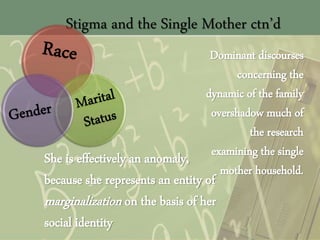
Dominant discourses
concerning the
dynamic of the family
overshadow much of
the research
examining the single
mother household.
She is effectively an anomaly,
because she represents an entity of
marginalization on the basis of her
social identity
Data
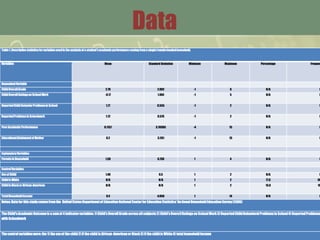
Table1.Descriptivestatisticsforvariablesusedin the analysisof a student'sacademicperformancecomingfroma singlefemaleheadedhousehold.
Variables Mean Standard Deviation Minimum Maximum Percentage Frequen
DependentVariable
ChildOverallGrade 2.79 2.092 -1 6 N/A N
ChildOverallRatingson SchoolWork -0.17 1.464 -1 5 N/A N
ReportedChild BehaviorProblemsin School 1.77 0.555 -1 2 N/A N
ReportedProblemsin Schoolwork 1.72 0.576 -1 2 N/A N
PoorAcademicPerformance 6.1157 3.70385 -4 15 N/A N
EducationalAttainmentof Mother 6.2 3.281 -1 13 N/A N
ExplanatoryVariables
Parentsin Household 1.39 0.736 1 4 N/A N
ControlVariables
Sex of Child 1.48 0.5 1 2 N/A N
Childis White N/A N/A 1 2 77.8 90
Childis Blackor African-American N/A N/A 1 2 15.6 18
TotalHouseholdIncome 9.4 4.056 1 14 N/A N
Notes:Dataforthis studycomesfromthe UnitedStatesDepartmentof EducationNationalCenterforEducationStatistics’NationalHouseholdEducationSurvey(2005)
TheChild'sAcademicOutcomeis a sumof 4 indicatorvariables:1)Child'sOverallGradeacrossallsubjects2)Child'sOverallRatingson SchoolWork3)ReportedChildBehavioralProblemsin School4) ReportedProblems
with Schoolwork
Thecontrolvariableswere:the 1)the sexof the child2)if the childis African-Americanor Black3)If the childis White4) totalhouseholdincome
Methodology ctn’d
• Chronbach Alpha was used to test the reliability of the newly
created dependent variable. A Chronbach Alpha value of .6
was reported suggesting a good reliability for “Poor
Academic Performance.”
• Linear Regression was employed to examine the relationship
between Household Type, Poor Academic Performance,
controlling for the race of the child, the sex of the child and
household income.
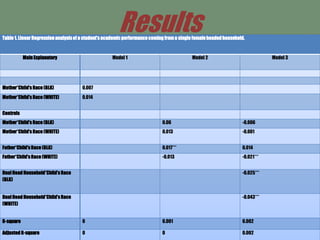
ResultsTable1. Linear Regressionanalysisof a student'sacademicperformance coming froma single femaleheadedhousehold.
MainExplanatory Model 1 Model 2 Model 3
Mother*Child'sRace (BLK) 0.007
Mother*Child'sRace (WHITE) 0.014
Controls
Mother*Child'sRace (BLK) 0.06 -0.006
Mother*Child'sRace (WHITE) 0.013 -0.001
Father*Child'sRace (BLK) 0.017*** 0.014
Father*Child'sRace (WHITE) -0.013 -0.021***
DualHead Household*Child'sRace
(BLK)
-0.025***
DualHead Household*Child'sRace
(WHITE)
-0.043***
R-square 0 0.001 0.002
Adjusted R-square 0 0 0.002
Discussion
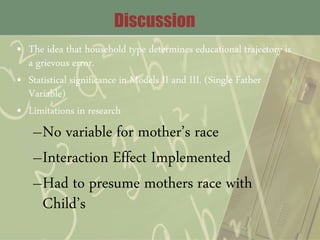
• The idea that household type determines educational trajectory is
a grievous error.
• Statistical significance in Models II and III. (Single Father
Variable)
• Limitations in research
–No variable for mother’s race
–Interaction Effect Implemented
–Had to presume mothers race with
Child’s
Conclusion
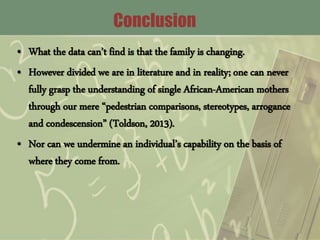
• What the data can’t find is that the family is changing.
• However divided we are in literature and in reality; one can never
fully grasp the understanding of single African-American mothers
through our mere “pedestrian comparisons, stereotypes, arrogance
and condescension” (Toldson, 2013).
• Nor can we undermine an individual’s capability on the basis of
where they come from.
Thank You!
An Examination of Courtesy Stigma
on Academic Performance
John Arthur Jackson, III
School of Liberal Arts
Department of Sociology
Dr. Janice Allen-Kelsey, Acting Dean
Dr. Earl Mowatt, Advisor

Mother May I Student Academic Showcase Presentation.

  • 1.
    ‘Mother May I?’ Examiningthe Effect of Courtesy Stigma on Academic Performance
  • 2.
    Introduction • The public’sperception (overwhelmingly pejorative) toward African American students is in a state of continuity, heavily affixed with the language of a certain pathology, deficiency and crisis (Dixon-Roman, 2012). • These sanctions can impose a certain stigma on African-American students. • For instance, the African-American male has a propensity to academically underperform than their white counterparts in education. (Larson, 2010)
  • 3.
    •This research istheory based and is an exploratory study which negates a hypothesis from this research
  • 4.
    Abstract • Dominant ideologyoften imposes negative stigmas onto Black single mother heads of household. These stigmas question the parental skills, abuse of social services, intelligence, and lifestyle choices of these women. These stigmas are potentially harmful to their children since they are easily transferrable to them through a process of courtesy stigmatization
  • 5.
    Literature Review • TeacherExpectancy Effect • Self-Fulfilling Prophecy • Stigma & The Single Mother
  • 6.
    Teacher Expectancy Effect •Prior studies have reported that subtle variances in a teacher’s pedagogy can impair a student’s academic performance • These studies illicit certain racial undertones and implications considering the dominant ideology. • “…teachersform expectationsabout their students’ minds and students come to understand…what is in their teachers’ minds about their ability, reality is formed for both…” (McFall, 2004)
  • 7.
    • Teacher effect-stigma is imposed upon the student • Self-fulfilling prophecy- stigma is internalized by student • Courtesy stigma is stigma by association – An individual’s mere association with a stigmatized person stigmatizes that person as well
  • 8.
    Statement of Purpose •This African-American child coming from a female- headed, single parent household represents a unique social group because he or she is stigmatized from the negative effects of race and gender (Harper, 2012). • There is the sense of urgency for society to categorically define divergent social groups (Stets and Burke, 2009). • Without this process it would be difficult for some to gauge how they are expected to interact with out-group members. • As a result, out-group members risk becoming arbitrarily or narrowly defined (White, 2009).
  • 9.
    Stereotypes About African-American Students •Brezina & Winder Study (2003) • Their study systematically aggregated a holistic survey from almost 2,000 adults, with a focal point of 1,500 European American respondents, the outcome revealed that the European American are more inclined to stereotype the African-American as lazy versus hardworking, (Brezina and Winder, 2003) • Variance in expectation could impair the performance of an individual.
  • 10.
    Stigma & TheSingle Mother • The stereotype of the single mother “intersects class, race, gender, sexuality, ability…” • ‘Racialized’ image of a single mother dependent upon assistance. • Pew Research Poll (2007) • Fixated on centralizing the idea of the ‘broken home’ to only belong to the African American single mother household.
  • 11.
    Stigma and theSingle Mother ctn’d Dominant discourses concerning the dynamic of the family overshadow much of the research examining the single mother household. She is effectively an anomaly, because she represents an entity of marginalization on the basis of her social identity
  • 12.
    Data Table1.Descriptivestatisticsforvariablesusedin the analysisofa student'sacademicperformancecomingfroma singlefemaleheadedhousehold. Variables Mean Standard Deviation Minimum Maximum Percentage Frequen DependentVariable ChildOverallGrade 2.79 2.092 -1 6 N/A N ChildOverallRatingson SchoolWork -0.17 1.464 -1 5 N/A N ReportedChild BehaviorProblemsin School 1.77 0.555 -1 2 N/A N ReportedProblemsin Schoolwork 1.72 0.576 -1 2 N/A N PoorAcademicPerformance 6.1157 3.70385 -4 15 N/A N EducationalAttainmentof Mother 6.2 3.281 -1 13 N/A N ExplanatoryVariables Parentsin Household 1.39 0.736 1 4 N/A N ControlVariables Sex of Child 1.48 0.5 1 2 N/A N Childis White N/A N/A 1 2 77.8 90 Childis Blackor African-American N/A N/A 1 2 15.6 18 TotalHouseholdIncome 9.4 4.056 1 14 N/A N Notes:Dataforthis studycomesfromthe UnitedStatesDepartmentof EducationNationalCenterforEducationStatistics’NationalHouseholdEducationSurvey(2005) TheChild'sAcademicOutcomeis a sumof 4 indicatorvariables:1)Child'sOverallGradeacrossallsubjects2)Child'sOverallRatingson SchoolWork3)ReportedChildBehavioralProblemsin School4) ReportedProblems with Schoolwork Thecontrolvariableswere:the 1)the sexof the child2)if the childis African-Americanor Black3)If the childis White4) totalhouseholdincome
  • 13.
    Methodology ctn’d • ChronbachAlpha was used to test the reliability of the newly created dependent variable. A Chronbach Alpha value of .6 was reported suggesting a good reliability for “Poor Academic Performance.” • Linear Regression was employed to examine the relationship between Household Type, Poor Academic Performance, controlling for the race of the child, the sex of the child and household income.
  • 14.
    ResultsTable1. Linear Regressionanalysisofa student'sacademicperformance coming froma single femaleheadedhousehold. MainExplanatory Model 1 Model 2 Model 3 Mother*Child'sRace (BLK) 0.007 Mother*Child'sRace (WHITE) 0.014 Controls Mother*Child'sRace (BLK) 0.06 -0.006 Mother*Child'sRace (WHITE) 0.013 -0.001 Father*Child'sRace (BLK) 0.017*** 0.014 Father*Child'sRace (WHITE) -0.013 -0.021*** DualHead Household*Child'sRace (BLK) -0.025*** DualHead Household*Child'sRace (WHITE) -0.043*** R-square 0 0.001 0.002 Adjusted R-square 0 0 0.002
  • 15.
    Discussion • The ideathat household type determines educational trajectory is a grievous error. • Statistical significance in Models II and III. (Single Father Variable) • Limitations in research –No variable for mother’s race –Interaction Effect Implemented –Had to presume mothers race with Child’s
  • 16.
    Conclusion • What thedata can’t find is that the family is changing. • However divided we are in literature and in reality; one can never fully grasp the understanding of single African-American mothers through our mere “pedestrian comparisons, stereotypes, arrogance and condescension” (Toldson, 2013). • Nor can we undermine an individual’s capability on the basis of where they come from.
  • 17.
  • 18.
    An Examination ofCourtesy Stigma on Academic Performance John Arthur Jackson, III School of Liberal Arts Department of Sociology Dr. Janice Allen-Kelsey, Acting Dean Dr. Earl Mowatt, Advisor

Editor's Notes

  • #7 Essentially, the greater the expectation placed upon a student the better they perform. Teachers expectations influence student performance.
  • #9 African-American children are stigmatized via Courtesy Stigma ‘Stigma By Association’ Sense of urgency to categorically define people, W/O this process it’ll be difficult to gauge how they are expected to interact with out group members. Consequently, out group members face inevitable, arbitrary definition, which may hinder or impede on an individual’s ability to succeed. This has been proven true especially adhere to informal social sanctions.
  • #10 According to previous research done by Brezina and Winder (2003), the inaccurate and misconstrued perception of the African-American male by European Americans has a direct correlation to the negative stereotypes that is ensued about him.
  • #11 Since Courtesy Stigma is predicated on stigma by associated, the children are inextricably tied to their mother, who is the stigmatized one, therefore her children are stigmatized as being the child of a single black mother. 70 Percent of Respondents- SM are bad for society.
  • #13 This data for this study was extracted from the Inter-University Consortium for Political and Social Research’s After-School Programs and Activities Survey of the National Household Education Surveys Program (2005) Main Explanatory Variable- Head of Household Dependent Variable- Poor Academic Performance Three Controls – Race of the Child, Gender of The Child and Household Income.
  • #14 Dummy variables were then created for “Black” and “White” for the child’s race. Dummy variables were also created for “Mother Single Head of Household,” “Father Single Head of Household,” and “Dual Head of Household.”
  • #15 Upon the conclusion of the research, the data demonstrated that there was no statistical significance between the race of the mother, and child’s academic underperformance; implementing linear regression to measure the child’s academic outcome, it was found that the data didn’t fully support the hypothesis. The p-level had to be below .05, but my variable was measured at a .07.
  • #17 In a land of opportunity we are what we choose to be, there are enough affluent people committing crimes and Section 8 stories to affirm it. You are not a product of your environment, and equally not a future of people’s expectations. For a society that is predicated on change, why are we so keen on keeping the family the same?