"Threefold liability rule"
• holds that the wrongful acts or omissions of a
public officer may give rise to
1. civil,
2. criminal and
3. administrative
liability.
Art 203. Who Are Public Officers.
Requisites:
To be a public officer, one must be -
1. Taking part in the performance of public functions in the Government, or
performing public duties as an employee, agent or subordinate official, of
any rank or class, in the government or any of its branches; and
2. That his authority to take part in the performance of public functions or to
perform public duties must be -
a. by direct provision of the law, or
b. by popular election, or
c. by appointment by competent authority.
MALFEASANCE AND
MISFEASANCE IN OFFICE
Bribery
1. Direct bribery
2. Indirect bribery
3. Qualified Bribery
4. Corruption of Public officials
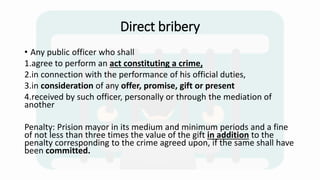
Direct bribery
• Any public officer who shall
1.agree to perform an act constituting a crime,
2.in connection with the performance of his official duties,
3.in consideration of any offer, promise, gift or present
4.received by such officer, personally or through the mediation of
another
Penalty: Prision mayor in its medium and minimum periods and a fine
of not less than three times the value of the gift in addition to the
penalty corresponding to the crime agreed upon, if the same shall have
been committed.
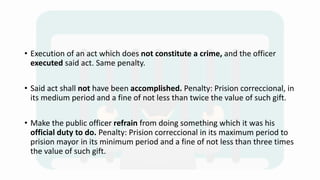
• Execution of an act which does not constitute a crime, and the officer
executed said act. Same penalty.
• Said act shall not have been accomplished. Penalty: Prision correccional, in
its medium period and a fine of not less than twice the value of such gift.
• Make the public officer refrain from doing something which it was his
official duty to do. Penalty: Prision correccional in its maximum period to
prision mayor in its minimum period and a fine of not less than three times
the value of such gift.
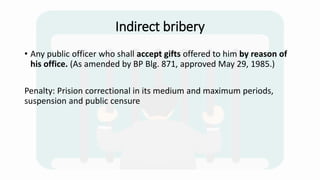
Indirect bribery
• Any public officer who shall accept gifts offered to him by reason of
his office. (As amended by BP Blg. 871, approved May 29, 1985.)
Penalty: Prision correctional in its medium and maximum periods,
suspension and public censure
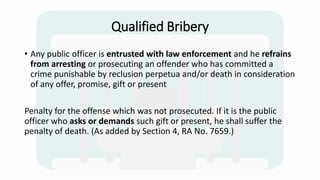
Qualified Bribery
• Any public officer is entrusted with law enforcement and he refrains
from arresting or prosecuting an offender who has committed a
crime punishable by reclusion perpetua and/or death in consideration
of any offer, promise, gift or present
Penalty for the offense which was not prosecuted. If it is the public
officer who asks or demands such gift or present, he shall suffer the
penalty of death. (As added by Section 4, RA No. 7659.)
FRAUDS AND ILLEGAL EXACTIONS
AND TRANSACTIONS
1. Frauds against the public treasury and similar offenses
2. Other frauds
3. Possession of prohibited interest by a public officer
Frauds against the public treasury
1. Offender is a public officer;
2. He should have taken advantage of his office, that is, he intervened in the
transaction in his official capacity;
3. He entered into an agreement with any interested party or speculator or
made use of any other scheme with regard to:
a. Furnishing supplies
b. The making of contracts or
c. The adjustment or settlement of accounts relating to public property
or funds; and
• 4. Accused had intent to defraud the Government.
Penalty: Prision correccional in its medium period to prision mayor in its
minimum period or a fine ranging from 200 to 10,000 pesos.
Other frauds
Elements:
1. Offender is a public officer;
2. He takes advantage of his official position; and
3. He commits any of the frauds or deceits enumerated in Arts. 315-
318
• In addition to the penalties prescribed
Title Ten - Crimes against Property, Chapter Six - Swindling and Other
Deceits
- Swindling (estafa)
- Other forms of swindling
- Swindling a minor
- Other deceits
Penalty: Temporary special disqualification in its maximum period to
perpetual special disqualification.
Possession of prohibited interest by a public officer
• A public officer who directly or indirectly, shall become interested in
any contract or business in which it is his official duty to intervene.
Penalty: Arresto mayor in its medium period to prision correccional in
its minimum period, or a fine ranging from 200 to 1,000 pesos, or both.
MALVERSATION OF PUBLIC
FUNDS OR PROPERTY
1. Malversation of public funds or property
2. Failure of accountable officer to render accounts
3. Failure of a responsible public officer to render accounts before
leaving the country
4. Illegal use of public funds or property
5. Failure to make delivery of public funds or property
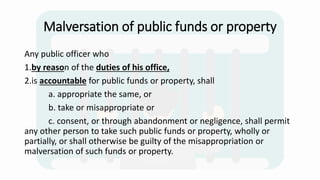
Malversation of public funds or property
Any public officer who
1.by reason of the duties of his office,
2.is accountable for public funds or property, shall
a. appropriate the same, or
b. take or misappropriate or
c. consent, or through abandonment or negligence, shall permit
any other person to take such public funds or property, wholly or
partially, or shall otherwise be guilty of the misappropriation or
malversation of such funds or property.
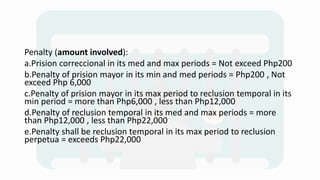
Penalty (amount involved):
a.Prision correccional in its med and max periods = Not exceed Php200
b.Penalty of prision mayor in its min and med periods = Php200 , Not
exceed Php 6,000
c.Penalty of prision mayor in its max period to reclusion temporal in its
min period = more than Php6,000 , less than Php12,000
d.Penalty of reclusion temporal in its med and max periods = more
than Php12,000 , less than Php22,000
e.Penalty shall be reclusion temporal in its max period to reclusion
perpetua = exceeds Php22,000
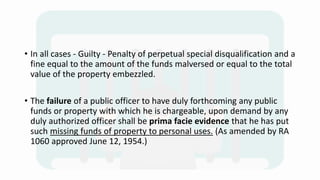
• In all cases - Guilty - Penalty of perpetual special disqualification and a
fine equal to the amount of the funds malversed or equal to the total
value of the property embezzled.
• The failure of a public officer to have duly forthcoming any public
funds or property with which he is chargeable, upon demand by any
duly authorized officer shall be prima facie evidence that he has put
such missing funds of property to personal uses. (As amended by RA
1060 approved June 12, 1954.)
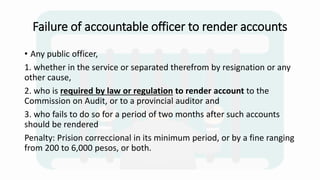
Failure of accountable officer to render accounts
• Any public officer,
1. whether in the service or separated therefrom by resignation or any
other cause,
2. who is required by law or regulation to render account to the
Commission on Audit, or to a provincial auditor and
3. who fails to do so for a period of two months after such accounts
should be rendered
Penalty: Prision correccional in its minimum period, or by a fine ranging
from 200 to 6,000 pesos, or both.
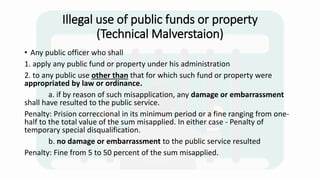
Illegal use of public funds or property
(Technical Malverstaion)
• Any public officer who shall
1. apply any public fund or property under his administration
2. to any public use other than that for which such fund or property were
appropriated by law or ordinance.
a. if by reason of such misapplication, any damage or embarrassment
shall have resulted to the public service.
Penalty: Prision correccional in its minimum period or a fine ranging from one-
half to the total value of the sum misapplied. In either case - Penalty of
temporary special disqualification.
b. no damage or embarrassment to the public service resulted
Penalty: Fine from 5 to 50 percent of the sum misapplied.
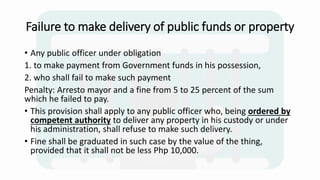
Failure to make delivery of public funds or property
• Any public officer under obligation
1. to make payment from Government funds in his possession,
2. who shall fail to make such payment
Penalty: Arresto mayor and a fine from 5 to 25 percent of the sum
which he failed to pay.
• This provision shall apply to any public officer who, being ordered by
competent authority to deliver any property in his custody or under
his administration, shall refuse to make such delivery.
• Fine shall be graduated in such case by the value of the thing,
provided that it shall not be less Php 10,000.
INFIDELITY OF PUBLIC OFFICERS
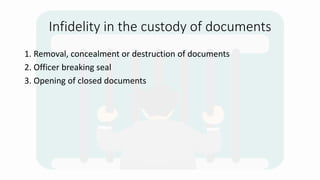
Infidelity in the custody of documents
1. Removal, concealment or destruction of documents
2. Officer breaking seal
3. Opening of closed documents
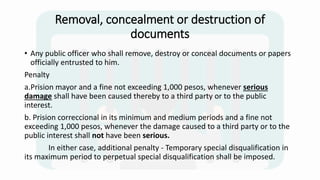
Removal, concealment or destruction of
documents
• Any public officer who shall remove, destroy or conceal documents or papers
officially entrusted to him.
Penalty
a.Prision mayor and a fine not exceeding 1,000 pesos, whenever serious
damage shall have been caused thereby to a third party or to the public
interest.
b. Prision correccional in its minimum and medium periods and a fine not
exceeding 1,000 pesos, whenever the damage caused to a third party or to the
public interest shall not have been serious.
In either case, additional penalty - Temporary special disqualification in
its maximum period to perpetual special disqualification shall be imposed.
Officer breaking seal
• Any public officer
1. charged with the custody of papers or property
2. sealed by proper authority,
3. who shall break the seals or permit them to be broken
Penalty: Prision correccional in its minimum and medium periods,
temporary special disqualification and a fine not exceeding 2,000
pesos.
Opening of closed documents
• Any public officer
1. not included in the provisions of the next preceding article
2. who, without proper authority,
3. shall open or shall permit to be opened any closed papers,
documents or objects entrusted to his custody
Penalty: Arresto mayor, temporary special disqualification and a fine
not exceeding 2,000 pesos.
Revelation of Secrets
1. Revelation of secrets by an officer
2. Public officer revealing secrets of private individual
Revelation of secrets by an officer
• Any public officer who shall
1. reveal any secret known to him by reason of his official capacity, or
2. shall wrongfully deliver papers or copies of papers of which he may have
charge and which should not be published
Penalty:
a. if it caused serious damage to the public interest - Prision correccional
in its medium and maximum periods, perpetual special disqualification and a
fine not exceeding 2,000 pesos;
b. otherwise - Prision correccional in its minimum period, temporary
special disqualification and a fine not exceeding 500 pesos
Public officer revealing secrets of private individual
• Any public officer to whom the secrets of any private individual shall
become known by reason of his office who shall reveal such secrets
Penalty: Arresto mayor and a fine not exceeding 1,000 pesos.
Anticipation, prolongation, and abandonment of
the duties and powers of public office
1. Prolonging performance of duties and powers
2. Abandonment of office or position
Prolonging performance of duties and powers
• Any public officer who shall
1. continue to exercise the duties and powers of his office, employment
or commission,
2. beyond the period provided by law, regulations or special provisions
applicable to the case
Penalty: Prision correccional in its minimum period, special temporary
disqualification in its minimum period and a fine not exceeding 500
pesos.
Abandonment of office or position
• Any public officer who, before the acceptance of his resignation, shall
abandon his office to the detriment of the public service
• Penalty: Arresto mayor
Abuses against chastity
• Any public officer who shall solicit or make immoral or indecent
advances to a woman interested in matters pending before such
officer for decision, or with respect to which he is required to submit
a report to or consult with a superior officer.
Penalty: Prision correccional in its medium and maximum periods and
temporary special disqualification

REVISED PENAL CODE CRIMINAL LIABILITY.pptx

  • 1.
    "Threefold liability rule" •holds that the wrongful acts or omissions of a public officer may give rise to 1. civil, 2. criminal and 3. administrative liability.
  • 3.
    Art 203. WhoAre Public Officers. Requisites: To be a public officer, one must be - 1. Taking part in the performance of public functions in the Government, or performing public duties as an employee, agent or subordinate official, of any rank or class, in the government or any of its branches; and 2. That his authority to take part in the performance of public functions or to perform public duties must be - a. by direct provision of the law, or b. by popular election, or c. by appointment by competent authority.
  • 4.
  • 5.
    Bribery 1. Direct bribery 2.Indirect bribery 3. Qualified Bribery 4. Corruption of Public officials
  • 6.
    Direct bribery • Anypublic officer who shall 1.agree to perform an act constituting a crime, 2.in connection with the performance of his official duties, 3.in consideration of any offer, promise, gift or present 4.received by such officer, personally or through the mediation of another Penalty: Prision mayor in its medium and minimum periods and a fine of not less than three times the value of the gift in addition to the penalty corresponding to the crime agreed upon, if the same shall have been committed.
  • 7.
    • Execution ofan act which does not constitute a crime, and the officer executed said act. Same penalty. • Said act shall not have been accomplished. Penalty: Prision correccional, in its medium period and a fine of not less than twice the value of such gift. • Make the public officer refrain from doing something which it was his official duty to do. Penalty: Prision correccional in its maximum period to prision mayor in its minimum period and a fine of not less than three times the value of such gift.
  • 8.
    Indirect bribery • Anypublic officer who shall accept gifts offered to him by reason of his office. (As amended by BP Blg. 871, approved May 29, 1985.) Penalty: Prision correctional in its medium and maximum periods, suspension and public censure
  • 9.
    Qualified Bribery • Anypublic officer is entrusted with law enforcement and he refrains from arresting or prosecuting an offender who has committed a crime punishable by reclusion perpetua and/or death in consideration of any offer, promise, gift or present Penalty for the offense which was not prosecuted. If it is the public officer who asks or demands such gift or present, he shall suffer the penalty of death. (As added by Section 4, RA No. 7659.)
  • 10.
    FRAUDS AND ILLEGALEXACTIONS AND TRANSACTIONS
  • 11.
    1. Frauds againstthe public treasury and similar offenses 2. Other frauds 3. Possession of prohibited interest by a public officer
  • 12.
    Frauds against thepublic treasury 1. Offender is a public officer; 2. He should have taken advantage of his office, that is, he intervened in the transaction in his official capacity; 3. He entered into an agreement with any interested party or speculator or made use of any other scheme with regard to: a. Furnishing supplies b. The making of contracts or c. The adjustment or settlement of accounts relating to public property or funds; and • 4. Accused had intent to defraud the Government. Penalty: Prision correccional in its medium period to prision mayor in its minimum period or a fine ranging from 200 to 10,000 pesos.
  • 13.
    Other frauds Elements: 1. Offenderis a public officer; 2. He takes advantage of his official position; and 3. He commits any of the frauds or deceits enumerated in Arts. 315- 318
  • 14.
    • In additionto the penalties prescribed Title Ten - Crimes against Property, Chapter Six - Swindling and Other Deceits - Swindling (estafa) - Other forms of swindling - Swindling a minor - Other deceits Penalty: Temporary special disqualification in its maximum period to perpetual special disqualification.
  • 15.
    Possession of prohibitedinterest by a public officer • A public officer who directly or indirectly, shall become interested in any contract or business in which it is his official duty to intervene. Penalty: Arresto mayor in its medium period to prision correccional in its minimum period, or a fine ranging from 200 to 1,000 pesos, or both.
  • 16.
  • 17.
    1. Malversation ofpublic funds or property 2. Failure of accountable officer to render accounts 3. Failure of a responsible public officer to render accounts before leaving the country 4. Illegal use of public funds or property 5. Failure to make delivery of public funds or property
  • 18.
    Malversation of publicfunds or property Any public officer who 1.by reason of the duties of his office, 2.is accountable for public funds or property, shall a. appropriate the same, or b. take or misappropriate or c. consent, or through abandonment or negligence, shall permit any other person to take such public funds or property, wholly or partially, or shall otherwise be guilty of the misappropriation or malversation of such funds or property.
  • 19.
    Penalty (amount involved): a.Prisioncorreccional in its med and max periods = Not exceed Php200 b.Penalty of prision mayor in its min and med periods = Php200 , Not exceed Php 6,000 c.Penalty of prision mayor in its max period to reclusion temporal in its min period = more than Php6,000 , less than Php12,000 d.Penalty of reclusion temporal in its med and max periods = more than Php12,000 , less than Php22,000 e.Penalty shall be reclusion temporal in its max period to reclusion perpetua = exceeds Php22,000
  • 20.
    • In allcases - Guilty - Penalty of perpetual special disqualification and a fine equal to the amount of the funds malversed or equal to the total value of the property embezzled. • The failure of a public officer to have duly forthcoming any public funds or property with which he is chargeable, upon demand by any duly authorized officer shall be prima facie evidence that he has put such missing funds of property to personal uses. (As amended by RA 1060 approved June 12, 1954.)
  • 21.
    Failure of accountableofficer to render accounts • Any public officer, 1. whether in the service or separated therefrom by resignation or any other cause, 2. who is required by law or regulation to render account to the Commission on Audit, or to a provincial auditor and 3. who fails to do so for a period of two months after such accounts should be rendered Penalty: Prision correccional in its minimum period, or by a fine ranging from 200 to 6,000 pesos, or both.
  • 22.
    Illegal use ofpublic funds or property (Technical Malverstaion) • Any public officer who shall 1. apply any public fund or property under his administration 2. to any public use other than that for which such fund or property were appropriated by law or ordinance. a. if by reason of such misapplication, any damage or embarrassment shall have resulted to the public service. Penalty: Prision correccional in its minimum period or a fine ranging from one- half to the total value of the sum misapplied. In either case - Penalty of temporary special disqualification. b. no damage or embarrassment to the public service resulted Penalty: Fine from 5 to 50 percent of the sum misapplied.
  • 23.
    Failure to makedelivery of public funds or property • Any public officer under obligation 1. to make payment from Government funds in his possession, 2. who shall fail to make such payment Penalty: Arresto mayor and a fine from 5 to 25 percent of the sum which he failed to pay. • This provision shall apply to any public officer who, being ordered by competent authority to deliver any property in his custody or under his administration, shall refuse to make such delivery. • Fine shall be graduated in such case by the value of the thing, provided that it shall not be less Php 10,000.
  • 24.
  • 25.
    Infidelity in thecustody of documents 1. Removal, concealment or destruction of documents 2. Officer breaking seal 3. Opening of closed documents
  • 26.
    Removal, concealment ordestruction of documents • Any public officer who shall remove, destroy or conceal documents or papers officially entrusted to him. Penalty a.Prision mayor and a fine not exceeding 1,000 pesos, whenever serious damage shall have been caused thereby to a third party or to the public interest. b. Prision correccional in its minimum and medium periods and a fine not exceeding 1,000 pesos, whenever the damage caused to a third party or to the public interest shall not have been serious. In either case, additional penalty - Temporary special disqualification in its maximum period to perpetual special disqualification shall be imposed.
  • 27.
    Officer breaking seal •Any public officer 1. charged with the custody of papers or property 2. sealed by proper authority, 3. who shall break the seals or permit them to be broken Penalty: Prision correccional in its minimum and medium periods, temporary special disqualification and a fine not exceeding 2,000 pesos.
  • 28.
    Opening of closeddocuments • Any public officer 1. not included in the provisions of the next preceding article 2. who, without proper authority, 3. shall open or shall permit to be opened any closed papers, documents or objects entrusted to his custody Penalty: Arresto mayor, temporary special disqualification and a fine not exceeding 2,000 pesos.
  • 29.
    Revelation of Secrets 1.Revelation of secrets by an officer 2. Public officer revealing secrets of private individual
  • 30.
    Revelation of secretsby an officer • Any public officer who shall 1. reveal any secret known to him by reason of his official capacity, or 2. shall wrongfully deliver papers or copies of papers of which he may have charge and which should not be published Penalty: a. if it caused serious damage to the public interest - Prision correccional in its medium and maximum periods, perpetual special disqualification and a fine not exceeding 2,000 pesos; b. otherwise - Prision correccional in its minimum period, temporary special disqualification and a fine not exceeding 500 pesos
  • 31.
    Public officer revealingsecrets of private individual • Any public officer to whom the secrets of any private individual shall become known by reason of his office who shall reveal such secrets Penalty: Arresto mayor and a fine not exceeding 1,000 pesos.
  • 32.
    Anticipation, prolongation, andabandonment of the duties and powers of public office 1. Prolonging performance of duties and powers 2. Abandonment of office or position
  • 33.
    Prolonging performance ofduties and powers • Any public officer who shall 1. continue to exercise the duties and powers of his office, employment or commission, 2. beyond the period provided by law, regulations or special provisions applicable to the case Penalty: Prision correccional in its minimum period, special temporary disqualification in its minimum period and a fine not exceeding 500 pesos.
  • 34.
    Abandonment of officeor position • Any public officer who, before the acceptance of his resignation, shall abandon his office to the detriment of the public service • Penalty: Arresto mayor
  • 35.
    Abuses against chastity •Any public officer who shall solicit or make immoral or indecent advances to a woman interested in matters pending before such officer for decision, or with respect to which he is required to submit a report to or consult with a superior officer. Penalty: Prision correccional in its medium and maximum periods and temporary special disqualification

Editor's Notes

  • #4 Public officers include every public servant from the lowest to the highest rank provided that they exercise public functions. A government laborer is not a public officer. However, temporary performance by a laborer of public functions makes him a public officer. Officers and employees of government owned and controlled corporations but not those of a sequestered corporations.
  • #5 Malfeasance Performance of an act which a public officer should not have done Malfeasance: 1. Direct bribery 2. Indirect bribery Misfeasance Improper performance of an act which a person might lawfully do Nonfeasance Omission of an act which ought to be performed
  • #7 Bribery refers to the act of the receiver. The act of the giver is corruption of public official under Art.212. Bribery exists (1) WHEN THE GIFT IS OFFERED VOLUNTARILY, by a private person, or (2) WHEN THE GIFT IS SOLICITED by a public officer. CRIME - The moment there is a meeting of the minds, even withoutthe delivery of the consideration, even without the public officer performing the act amounting to a crime, bribery is already committed on the part of the public officer. Corruption is already committed on the part of the supposed giver.
  • #8 xCRIME - If the act or omission does not amount to a crime, the consideration must be delivered by the corrupter before a public officer can be prosecuted for bribery. Mere agreement is not enough to constitute the crime because the act to be done in the first place is legitimate or in the performance of the official duties of the public official. Act = Unjust
  • #9 The gift is given in anticipation of future favor from the public officer. PD 46 (Making it punishable for public officials and employees to receive and for private persons to give, gifts on any occasion, including Christmas) is committed in the same way.
  • #10 The crime involved in qualified bribery is a heinous crime. Republic Act 7659, the law signed in 1993 and which imposed the death penalty, says that heinous crimes include: Treason Piracy in general and mutiny on the high seas in Philippine waters Qualified piracy Qualified bribery Parricide Murder Infanticide Kidnapping and serious illegal detention Robbery with violence against or intimidation of persons Destructive arson Rape Importation, distribution, manufacturing and possession of illegal drugs These crimes were considered heinous “for being grievous, odious and hateful offenses and which, by reason of their inherent or manifest wickedness, viciousness, atrocity and perversity are repugnant and outrageous to the common standards and norms of decency and morality in a just, civilized and ordered society.” This, however, was eventually reduced to reclusion perpetua after the abolition of the death penalty in 2006 under then-president Gloria Arroyo through RA 9436. Reclusion perpetua entails imprisonment of at least 20 years and a day up to a maximum of 40 years, after which a prisoner can be eligible for parole – unless otherwise specified.
  • #19 Accountable public officer - one who has custody or control of public funds or property by reason of the duties of his office. The nature of the duties of the public officer or employee, the fact that as part of his duties he received public money for which he is bound to account and failed to account for it, is the factor which determines whether or not malversation is committed by the accused public officer or employee. An accountable public officer may be convicted of rnalversation even if there is no direct evidence of misappropriation and the only evidence is that there is a shortage in his accounts which he has not been able to satisfactorily explain. If the public officer has no authority to receive the money for the Government, the crime committed is estafa, not malversation since he cannot be considered an accountable officer in that situation.
  • #20 The return of the money malversed is merely a mitigating circumstance. It cannot exempt the accused from criminal liability.
  • #23 It is the commission of an act as defined by the law, and not the character or effect thereof, which determines whether or not the provision has been violated. Hence, malice or criminal intent is completely irrelevant.
  • #28 The act is being punished because the public officer, in breaking the seal or opening the envelope, violates the confidence or trust reposed on him. The public officer liable under this article must be one who breaks seals without authority to do so.
  • #31 The "secrets" referred to in this article are those which have an official or public character, the revelation of which may prejudice public interest.
  • #34 The officers contemplated by this article are those who have been suspended, separated, declared overaged, or dismissed.
  • #35 The final or conclusive act of a resignation's acceptance Is the notice of acceptance.
  • #36 The essence of the crime is the mere making of immoral or indecent solicitation or advances. The crime can be committed by mere proposal, and it is not necessary for the woman solicited to yield to the proposal of the offender. Proof of solicitation is not necessary when there is sexual intercourse.