Artfully Embracing
Change
Susan E. Smiley - DuPont
MaryLynn Frantz – Herr Foods
Engineering – What does it mean to us?
en·gi·neer·ing / enjə niriNG/ˌ ˈ
noun
noun: engineering
the branch of science and technology concerned with the design,
building, and use of engines, machines, and structures.
• the work done by, or the occupation of, an engineer.
• the action of working artfully to bring something about.
Art – What does it mean to us?
synonyms: fine art, artwork "he studied art"
Art1 /ärt/
noun
plural noun: the arts
1.1.
the expression or application of human creative skill and imagination, typically in a visual form
such
as painting or sculpture, producing works to be appreciated primarily for their beauty or
emotional power.
• works produced by human creative skill and imagination.
• creative activity resulting in the production of paintings, drawings, or sculpture.
3.2.
the various branches of creative activity, such as painting, music, literature, and dance.
Change – What does it mean to us?
Change (/CHānj/)
verb
verb: change; 3rd person present: changes; past tense: changed; past participle: changed; gerund
or present participle: changing
1.1.
make or become different.
• make or become a different substance entirely; transform.
• alter in terms of.
• (of traffic lights) move from one color of signal to another.
• (of the moon) arrive at a fresh phase; become new.
3.2.
take or use another instead of.
Change – What does it mean to us?
(cont.!!)
Change (/CHānj/)
noun
noun: change; plural noun: changes; noun: Change; plural noun: Changes
1.1.
the act or instance of making or becoming different.
• the substitution of one thing for another.
• an alteration or modification.
• a new or refreshingly different experience.
• a clean garment or garments as a replacement for clothes one is wearing.
• the moon's arrival at a fresh phase, typically at the new moon.
• Baseball: another term for change-up.
•Informal: menopause. (noun: the change)
3.2.
coins as opposed to paper currency.
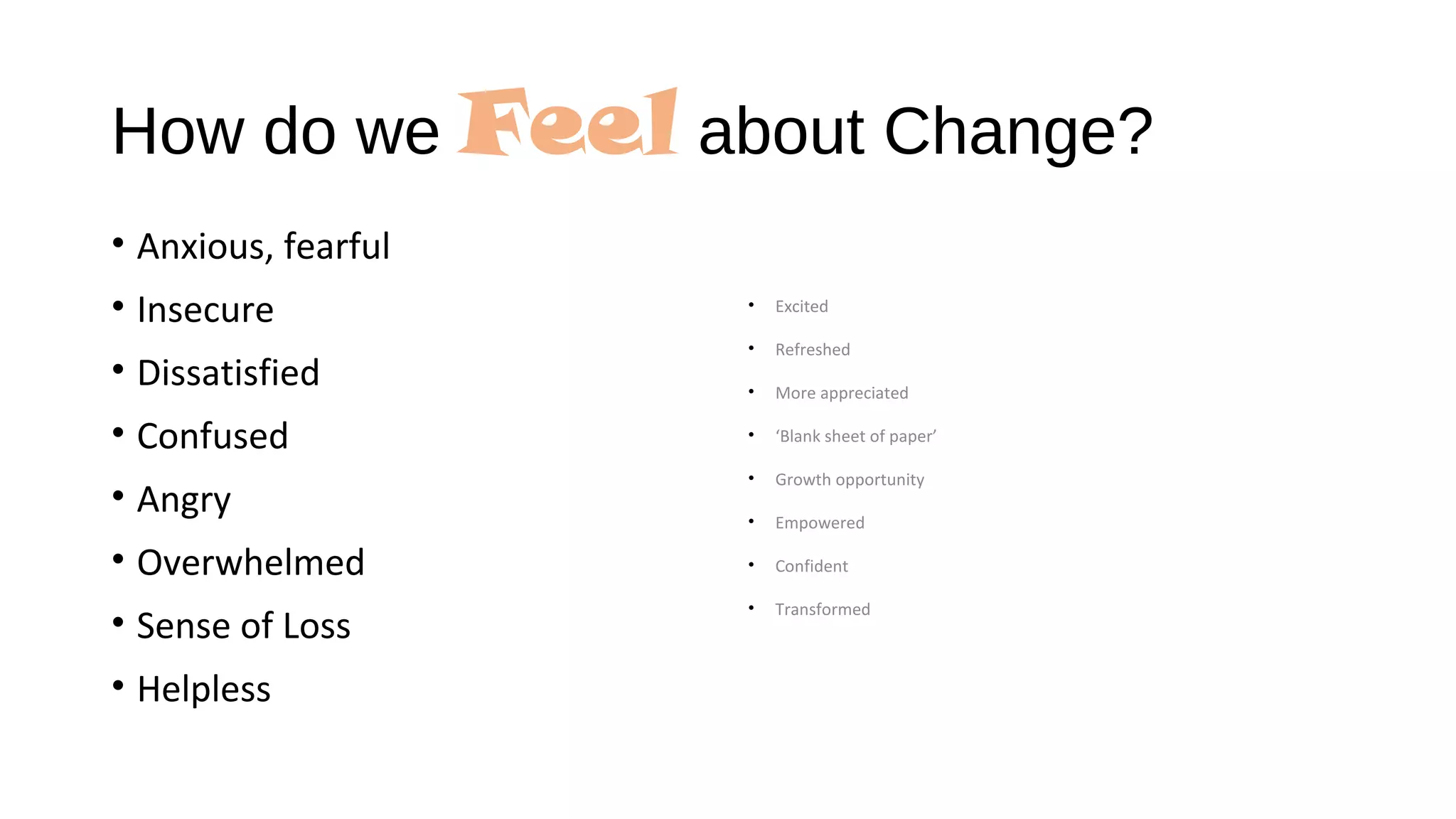
How do we Feel about Change?
• Anxious, fearful
• Insecure
• Dissatisfied
• Confused
• Angry
• Overwhelmed
• Sense of Loss
• Helpless
• Excited
• Refreshed
• More appreciated
• ‘Blank sheet of paper’
• Growth opportunity
• Empowered
• Confident
• Transformed
The Five Freedoms (Virginia Satir)
 The freedom to see and hear what is here, instead of what
“should” be, was, or will be.
 The freedom to say what you feel and think, instead of what you
“should” feel and think.
 The freedom to feel what you feel, instead of what you “ought” to
feel.
 The freedom to ask for what you want, instead of always waiting
for permission.
 The freedom to take risks on you own behalf, instead of choosing
to be only “secure”.
Can Art help? Artists think so…
9. Getting to be yourself
28. Feeding your need to create
33. Experiencing flow
39. The moments…when all the fear and troubles simply fall away
56. Peace and relaxation
74. Living in a world of possibilities and ideas
83. Living life on your own terms
98. Feeling like the whole world makes sense when you create
Source: www.rightbrainrockstar.com “101 Great Reasons to be an Artist” by Dan Johnson
My Experiences with Art
• Piano lessons, band
• Science Fair
• ‘70’s Rock & Roll
• English classes – and my sister-in-law
• Aerobics
• DuPont Theatre and MLK Diversity Choir
• Tai Chi and Guo Hua
• SWE poetry writing
• Wine and Paint events
• Hamilton
And the learnings…
• In balancing work and life, variety is important
• The arts engage people – this is critical for change and growth
• Art teaches you about ambiguity and encourages comfort with uncertainty
• You need different tools to manage different kinds of change
• Exercising your body and your senses helps you access your mind
• Art is a way for people to express and process difficult emotions
• Creating follows the laws of thermodynamics
• And (as you know): Engineering is Art
And now for some practice!
Exercises you can use and share to increase your resilience
Painting / Drawing
Breakout Activity #1
Music
Breakout Activity #2
Literature
Breakout Activity #3
Dance
Breakout Activity #4
Reflections on the Exercises
• What did you observe?
• What did you feel?
• Do you think this could help you address change in your life?
• Would you use something like this in your workplace?
• Which exercise was easiest? Hardest? Why?
Relaxation Techniques you may like
• Breathing meditation
• Rhythmic movement
• Progressive muscle relaxation
• Body scan meditation
• Mindful meditation
• Visualization meditation
• Yoga and tai chi
• Massage therapy
Source: www.HELPGUIDE.org Adapted with permission from Stress Management: Approaches for Preventing and Reducing Stress,
a special health report published by Harvard Health Publications.
Opportunities / Resources
• Bergado, Gabe. Science Shows Art Can Do Incredible Things for Your Mind and Body. .Mic. 15 December 2014
• Friedman, Michael. Art Can be Good for Mental Health. Huffington Post. 28 August 2012.
• Heath, Chip and Dan Heath. Switch: How to Change Things When Change Is Hard
• Johnson, Dan. 100 Great Reasons to be an Artist. Rightbrainrockstar.com
• Kerka, Sandra. Adult Learning in and through the Arts. ERIC Digest. 2003
• Satir, Viginia. “The Five Freedoms”.
• Stress Management: Approaches for Preventing and Reducing Stress. Harvard Health Publications. 2013
• www.HELPGUIDE.org
• Zambon, Kat. How Engaging With Art Affects the Human Brain. American Association for the Advancement of
Science, 13 November 2013

WE16 - Artfully Embracing Change

  • 1.
    Artfully Embracing Change Susan E.Smiley - DuPont MaryLynn Frantz – Herr Foods
  • 2.
    Engineering – Whatdoes it mean to us? en·gi·neer·ing / enjə niriNG/ˌ ˈ noun noun: engineering the branch of science and technology concerned with the design, building, and use of engines, machines, and structures. • the work done by, or the occupation of, an engineer. • the action of working artfully to bring something about.
  • 3.
    Art – Whatdoes it mean to us? synonyms: fine art, artwork "he studied art" Art1 /ärt/ noun plural noun: the arts 1.1. the expression or application of human creative skill and imagination, typically in a visual form such as painting or sculpture, producing works to be appreciated primarily for their beauty or emotional power. • works produced by human creative skill and imagination. • creative activity resulting in the production of paintings, drawings, or sculpture. 3.2. the various branches of creative activity, such as painting, music, literature, and dance.
  • 4.
    Change – Whatdoes it mean to us? Change (/CHānj/) verb verb: change; 3rd person present: changes; past tense: changed; past participle: changed; gerund or present participle: changing 1.1. make or become different. • make or become a different substance entirely; transform. • alter in terms of. • (of traffic lights) move from one color of signal to another. • (of the moon) arrive at a fresh phase; become new. 3.2. take or use another instead of.
  • 5.
    Change – Whatdoes it mean to us? (cont.!!) Change (/CHānj/) noun noun: change; plural noun: changes; noun: Change; plural noun: Changes 1.1. the act or instance of making or becoming different. • the substitution of one thing for another. • an alteration or modification. • a new or refreshingly different experience. • a clean garment or garments as a replacement for clothes one is wearing. • the moon's arrival at a fresh phase, typically at the new moon. • Baseball: another term for change-up. •Informal: menopause. (noun: the change) 3.2. coins as opposed to paper currency.
  • 6.
    How do weFeel about Change? • Anxious, fearful • Insecure • Dissatisfied • Confused • Angry • Overwhelmed • Sense of Loss • Helpless • Excited • Refreshed • More appreciated • ‘Blank sheet of paper’ • Growth opportunity • Empowered • Confident • Transformed
  • 7.
    The Five Freedoms(Virginia Satir)  The freedom to see and hear what is here, instead of what “should” be, was, or will be.  The freedom to say what you feel and think, instead of what you “should” feel and think.  The freedom to feel what you feel, instead of what you “ought” to feel.  The freedom to ask for what you want, instead of always waiting for permission.  The freedom to take risks on you own behalf, instead of choosing to be only “secure”.
  • 8.
    Can Art help?Artists think so… 9. Getting to be yourself 28. Feeding your need to create 33. Experiencing flow 39. The moments…when all the fear and troubles simply fall away 56. Peace and relaxation 74. Living in a world of possibilities and ideas 83. Living life on your own terms 98. Feeling like the whole world makes sense when you create Source: www.rightbrainrockstar.com “101 Great Reasons to be an Artist” by Dan Johnson
  • 9.
    My Experiences withArt • Piano lessons, band • Science Fair • ‘70’s Rock & Roll • English classes – and my sister-in-law • Aerobics • DuPont Theatre and MLK Diversity Choir • Tai Chi and Guo Hua • SWE poetry writing • Wine and Paint events • Hamilton
  • 10.
    And the learnings… •In balancing work and life, variety is important • The arts engage people – this is critical for change and growth • Art teaches you about ambiguity and encourages comfort with uncertainty • You need different tools to manage different kinds of change • Exercising your body and your senses helps you access your mind • Art is a way for people to express and process difficult emotions • Creating follows the laws of thermodynamics • And (as you know): Engineering is Art
  • 11.
    And now forsome practice! Exercises you can use and share to increase your resilience
  • 12.
  • 13.
  • 14.
  • 15.
  • 16.
    Reflections on theExercises • What did you observe? • What did you feel? • Do you think this could help you address change in your life? • Would you use something like this in your workplace? • Which exercise was easiest? Hardest? Why?
  • 17.
    Relaxation Techniques youmay like • Breathing meditation • Rhythmic movement • Progressive muscle relaxation • Body scan meditation • Mindful meditation • Visualization meditation • Yoga and tai chi • Massage therapy Source: www.HELPGUIDE.org Adapted with permission from Stress Management: Approaches for Preventing and Reducing Stress, a special health report published by Harvard Health Publications.
  • 18.
    Opportunities / Resources •Bergado, Gabe. Science Shows Art Can Do Incredible Things for Your Mind and Body. .Mic. 15 December 2014 • Friedman, Michael. Art Can be Good for Mental Health. Huffington Post. 28 August 2012. • Heath, Chip and Dan Heath. Switch: How to Change Things When Change Is Hard • Johnson, Dan. 100 Great Reasons to be an Artist. Rightbrainrockstar.com • Kerka, Sandra. Adult Learning in and through the Arts. ERIC Digest. 2003 • Satir, Viginia. “The Five Freedoms”. • Stress Management: Approaches for Preventing and Reducing Stress. Harvard Health Publications. 2013 • www.HELPGUIDE.org • Zambon, Kat. How Engaging With Art Affects the Human Brain. American Association for the Advancement of Science, 13 November 2013