Feel Better with Art
• Art Therapy
• Three of the Benefits of doing Art
– Brain Activity
– Self-care
– Mental Health & Well-being
• Research & Studies
– Brain Tune-Up
– Visual Art Study
• PEARLS
• Suggestions for Art Activities
• Supplies you may already have at home
• Art demonstration
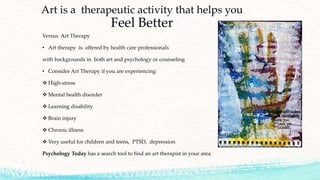
Art is a therapeutic activity that helps you
Feel Better
Versus Art Therapy
• Art therapy is offered by health care professionals
with backgrounds in both art and psychology or counseling
• Consider Art Therapy if you are experiencing:
 High-stress
 Mental health disorder
 Learning disability
 Brain injury
 Chronic illness
 Very useful for children and teens, PTSD, depression
Psychology Today has a search tool to find an art therapist in your area
Three Important Prongs that Art
promotes:
• 1. Brain Activity
• 2. Provides Self-Care
• 3. Increases Positive Mental Health & Well-being
Promote Brain Activity
• Promotes self-awareness
• Relieves stress, anxiety and confusion through a sense of empowerment
• Increases socialization when done with others
• Helps to cope with transitions
• Facilitates communication
• Stimulates self-expression of feelings
• Enhances memory care and creative thinking
• Improves motor and cognitive skills
• Art boosts self-esteem
• And Creative pursuits provide a sense of accomplishment
(Deane Alban, 2018)
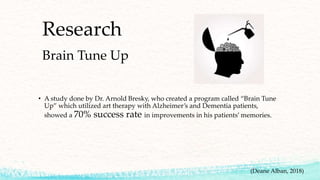
• Doing art involves getting both hemispheres of your brain communicating
with each other.
• Boosts your drive, focus, and concentration
• Stimulates the brain to grow new neurons
• Every time you engage in a new or complex activity, your brain creates new
connections between brain cells.
• Your brain’s ability to grow connections and change throughout your
lifetime is called brain neuroplasticity.
• Neuroplasticity: Your brain can change by forming new brain cells and
neural connections, improving its capabilities throughout your life.
Research
Brain Tune Up
• A study done by Dr. Arnold Bresky, who created a program called “Brain Tune
Up” which utilized art therapy with Alzheimer’s and Dementia patients,
showed a 70% success rate in improvements in his patients’ memories.
(Deane Alban, 2018)
What is Self-Care?
Self-Care means doing things that
help you manage the day-to-day
stress so that it doesn’t build up too
much.
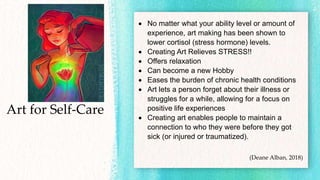
Art for Self-Care
 No matter what your ability level or amount of
experience, art making has been shown to
lower cortisol (stress hormone) levels.
 Creating Art Relieves STRESS!!
 Offers relaxation
 Can become a new Hobby
 Eases the burden of chronic health conditions
 Art lets a person forget about their illness or
struggles for a while, allowing for a focus on
positive life experiences
 Creating art enables people to maintain a
connection to who they were before they got
sick (or injured or traumatized).
(Deane Alban, 2018)
Increases
Positive Mental
Health &
Well-being
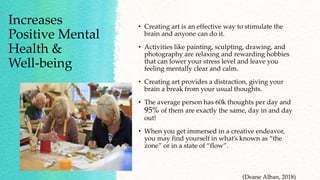
• Creating art is an effective way to stimulate the
brain and anyone can do it.
• Activities like painting, sculpting, drawing, and
photography are relaxing and rewarding hobbies
that can lower your stress level and leave you
feeling mentally clear and calm.
• Creating art provides a distraction, giving your
brain a break from your usual thoughts.
• The average person has 60k thoughts per day and
95% of them are exactly the same, day in and day
out!
• When you get immersed in a creative endeavor,
you may find yourself in what’s known as “the
zone” or in a state of “flow”.
(Deane Alban, 2018)
Creating art increases the “feel good” neurotransmitter dopamine
(Deane Alban, 2018).
• Dopamine stimulates the creation of new neurons and prepares
your brain for learning
 Leonardo da Vinci said, “Painting embraces all the ten functions of
the eye; that is to say, darkness, light, body and color, shape and
location, distance and closeness, motion and rest.”
 Creating art trains you to concentrate on detail and pay more
attention to your environment, which in a way acts like mediation.
 Art hobbies of all kinds: knitting, quilting, sewing, drawing,
photography, woodworking, gardening, and Do-It-Yourself (DIY)
home repair ALL increase dopamine, which wards off depression
and promotes healthy aging of the brain.
Increases Positive Mental
Health & Well-being
(Deane Alban, 2018)
The Connection Between Art, Healing,
and Public Health
A Visual Arts Study, by: Stuckey & Noble, 2010
• Art helps people express experiences that are too difficult to put into words.
Some people with illnesses explore the meanings of past, present, and future
during art therapy, thereby integrating said illness into their life story and
giving it meaning.
• Many chronic diseases are associated with psychosocial difficulties such as
depression and chronic stress, contributing to negative cardiovascular
outcomes. Engagement with creative activities has the potential to contribute
toward reducing stress and depression and can serve as a vehicle for
alleviating the burden of chronic disease.
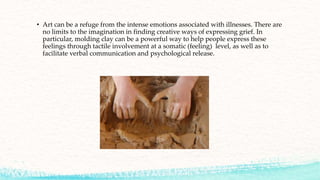
• Art can be a refuge from the intense emotions associated with illnesses. There are
no limits to the imagination in finding creative ways of expressing grief. In
particular, molding clay can be a powerful way to help people express these
feelings through tactile involvement at a somatic (feeling) level, as well as to
facilitate verbal communication and psychological release.
When you find yourself feeling not so good…
• It is normal to experience feelings of sadness, loneliness, or “the blues” from time
to time
• There may be times when it becomes more difficult to shake off those feelings
and we could start feeling stuck in a cycle
• These feelings can be seen as symptoms, like a cold, that can be addressed before
they increase
PEARLS
Program to Encourage Active
and Rewarding Lives for
Seniors
1-800-675-6694
• Individuals 60 years and older living in Riverside
County
• Evidence-based program that focuses on
decreasing the symptoms of depression and
increasing the quality of life
• Works with participant in their home/community
– As of April 2020 sessions are offered virtually by
phone & video
• Building problem-solving skills
– Help recognize the link between depressive
symptoms and current problems
• Increasing social, physical, and other pleasant
activities
“Do more, feel better”
New program at
ICRC
FREE!
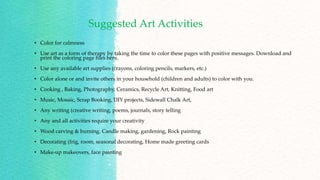
Suggested Art Activities
• Color for calmness
• Use art as a form of therapy by taking the time to color these pages with positive messages. Download and
print the coloring page files here.
• Use any available art supplies (crayons, coloring pencils, markers, etc.)
• Color alone or and invite others in your household (children and adults) to color with you.
• Cooking , Baking, Photography, Ceramics, Recycle Art, Knitting, Food art
• Music, Mosaic, Scrap Booking, DIY projects, Sidewall Chalk Art,
• Any writing (creative writing, poems, journals, story telling
• Any and all activities require your creativity
• Wood carving & burning. Candle making, gardening, Rock painting
• Decorating (frig, room, seasonal decorating, Home made greeting cards
• Make-up makeovers, face painting
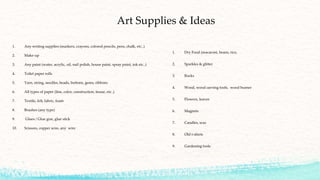
Art Supplies & Ideas
1. Any writing supplies (markers, crayons, colored pencils, pens, chalk, etc..)
2. Make-up
3. Any paint (water, acrylic, oil, nail polish, house paint, spray paint, ink etc..)
4. Toilet paper rolls
5. Yarn, string, needles, beads, buttons, gems, ribbons
6. All types of paper (line, color, construction, tissue, etc..)
7. Textile, felt, fabric, foam
8. Brushes (any type)
9. Glues / Glue gun, glue stick
10. Scissors, copper wire, any wire
1. Dry Food (macaroni, beans, rice,
2. Sparkles & glitter
3. Rocks
4. Wood, wood carving tools, wood burner
5. Flowers, leaves
6. Magnets
7. Candles, wax
8. Old t-shirts
9. Gardening tools
HOPE RELAXATION JOY
GRATITUDE TRANSFORMATION
PAINT UNTIL YOUR HEART
IS CONTENT!
References
Alban, Deane. (2018). The Mental Health Benefits of Art Are for Everyone. Be Brain Fit.
Bebrainfit.com
Noble, J. MD. & Stuckey, H. L. (2010). The Connection Between Art, Healing, and Public Health:
A Review of Current Literature. Public Health.
https://www.ncbi.ni.gov/pmc/articles/PMC284629/

PowerPoint-Feel-better-with-art.-1.10.21 copy.pptx

  • 1.
  • 2.
    • Art Therapy •Three of the Benefits of doing Art – Brain Activity – Self-care – Mental Health & Well-being • Research & Studies – Brain Tune-Up – Visual Art Study • PEARLS • Suggestions for Art Activities • Supplies you may already have at home • Art demonstration
  • 3.
    Art is atherapeutic activity that helps you Feel Better Versus Art Therapy • Art therapy is offered by health care professionals with backgrounds in both art and psychology or counseling • Consider Art Therapy if you are experiencing:  High-stress  Mental health disorder  Learning disability  Brain injury  Chronic illness  Very useful for children and teens, PTSD, depression Psychology Today has a search tool to find an art therapist in your area
  • 4.
    Three Important Prongsthat Art promotes: • 1. Brain Activity • 2. Provides Self-Care • 3. Increases Positive Mental Health & Well-being
  • 5.
    Promote Brain Activity •Promotes self-awareness • Relieves stress, anxiety and confusion through a sense of empowerment • Increases socialization when done with others • Helps to cope with transitions • Facilitates communication • Stimulates self-expression of feelings • Enhances memory care and creative thinking • Improves motor and cognitive skills • Art boosts self-esteem • And Creative pursuits provide a sense of accomplishment (Deane Alban, 2018)
  • 6.
    • Doing artinvolves getting both hemispheres of your brain communicating with each other. • Boosts your drive, focus, and concentration • Stimulates the brain to grow new neurons • Every time you engage in a new or complex activity, your brain creates new connections between brain cells. • Your brain’s ability to grow connections and change throughout your lifetime is called brain neuroplasticity. • Neuroplasticity: Your brain can change by forming new brain cells and neural connections, improving its capabilities throughout your life.
  • 7.
    Research Brain Tune Up •A study done by Dr. Arnold Bresky, who created a program called “Brain Tune Up” which utilized art therapy with Alzheimer’s and Dementia patients, showed a 70% success rate in improvements in his patients’ memories. (Deane Alban, 2018)
  • 8.
  • 9.
    Self-Care means doingthings that help you manage the day-to-day stress so that it doesn’t build up too much.
  • 10.
    Art for Self-Care No matter what your ability level or amount of experience, art making has been shown to lower cortisol (stress hormone) levels.  Creating Art Relieves STRESS!!  Offers relaxation  Can become a new Hobby  Eases the burden of chronic health conditions  Art lets a person forget about their illness or struggles for a while, allowing for a focus on positive life experiences  Creating art enables people to maintain a connection to who they were before they got sick (or injured or traumatized). (Deane Alban, 2018)
  • 11.
    Increases Positive Mental Health & Well-being •Creating art is an effective way to stimulate the brain and anyone can do it. • Activities like painting, sculpting, drawing, and photography are relaxing and rewarding hobbies that can lower your stress level and leave you feeling mentally clear and calm. • Creating art provides a distraction, giving your brain a break from your usual thoughts. • The average person has 60k thoughts per day and 95% of them are exactly the same, day in and day out! • When you get immersed in a creative endeavor, you may find yourself in what’s known as “the zone” or in a state of “flow”. (Deane Alban, 2018)
  • 12.
    Creating art increasesthe “feel good” neurotransmitter dopamine (Deane Alban, 2018). • Dopamine stimulates the creation of new neurons and prepares your brain for learning  Leonardo da Vinci said, “Painting embraces all the ten functions of the eye; that is to say, darkness, light, body and color, shape and location, distance and closeness, motion and rest.”  Creating art trains you to concentrate on detail and pay more attention to your environment, which in a way acts like mediation.  Art hobbies of all kinds: knitting, quilting, sewing, drawing, photography, woodworking, gardening, and Do-It-Yourself (DIY) home repair ALL increase dopamine, which wards off depression and promotes healthy aging of the brain. Increases Positive Mental Health & Well-being (Deane Alban, 2018)
  • 13.
    The Connection BetweenArt, Healing, and Public Health A Visual Arts Study, by: Stuckey & Noble, 2010 • Art helps people express experiences that are too difficult to put into words. Some people with illnesses explore the meanings of past, present, and future during art therapy, thereby integrating said illness into their life story and giving it meaning. • Many chronic diseases are associated with psychosocial difficulties such as depression and chronic stress, contributing to negative cardiovascular outcomes. Engagement with creative activities has the potential to contribute toward reducing stress and depression and can serve as a vehicle for alleviating the burden of chronic disease.
  • 14.
    • Art canbe a refuge from the intense emotions associated with illnesses. There are no limits to the imagination in finding creative ways of expressing grief. In particular, molding clay can be a powerful way to help people express these feelings through tactile involvement at a somatic (feeling) level, as well as to facilitate verbal communication and psychological release.
  • 15.
    When you findyourself feeling not so good… • It is normal to experience feelings of sadness, loneliness, or “the blues” from time to time • There may be times when it becomes more difficult to shake off those feelings and we could start feeling stuck in a cycle • These feelings can be seen as symptoms, like a cold, that can be addressed before they increase
  • 16.
    PEARLS Program to EncourageActive and Rewarding Lives for Seniors 1-800-675-6694 • Individuals 60 years and older living in Riverside County • Evidence-based program that focuses on decreasing the symptoms of depression and increasing the quality of life • Works with participant in their home/community – As of April 2020 sessions are offered virtually by phone & video • Building problem-solving skills – Help recognize the link between depressive symptoms and current problems • Increasing social, physical, and other pleasant activities “Do more, feel better” New program at ICRC FREE!
  • 17.
    Suggested Art Activities •Color for calmness • Use art as a form of therapy by taking the time to color these pages with positive messages. Download and print the coloring page files here. • Use any available art supplies (crayons, coloring pencils, markers, etc.) • Color alone or and invite others in your household (children and adults) to color with you. • Cooking , Baking, Photography, Ceramics, Recycle Art, Knitting, Food art • Music, Mosaic, Scrap Booking, DIY projects, Sidewall Chalk Art, • Any writing (creative writing, poems, journals, story telling • Any and all activities require your creativity • Wood carving & burning. Candle making, gardening, Rock painting • Decorating (frig, room, seasonal decorating, Home made greeting cards • Make-up makeovers, face painting
  • 18.
    Art Supplies &Ideas 1. Any writing supplies (markers, crayons, colored pencils, pens, chalk, etc..) 2. Make-up 3. Any paint (water, acrylic, oil, nail polish, house paint, spray paint, ink etc..) 4. Toilet paper rolls 5. Yarn, string, needles, beads, buttons, gems, ribbons 6. All types of paper (line, color, construction, tissue, etc..) 7. Textile, felt, fabric, foam 8. Brushes (any type) 9. Glues / Glue gun, glue stick 10. Scissors, copper wire, any wire 1. Dry Food (macaroni, beans, rice, 2. Sparkles & glitter 3. Rocks 4. Wood, wood carving tools, wood burner 5. Flowers, leaves 6. Magnets 7. Candles, wax 8. Old t-shirts 9. Gardening tools
  • 19.
    HOPE RELAXATION JOY GRATITUDETRANSFORMATION PAINT UNTIL YOUR HEART IS CONTENT!
  • 20.
    References Alban, Deane. (2018).The Mental Health Benefits of Art Are for Everyone. Be Brain Fit. Bebrainfit.com Noble, J. MD. & Stuckey, H. L. (2010). The Connection Between Art, Healing, and Public Health: A Review of Current Literature. Public Health. https://www.ncbi.ni.gov/pmc/articles/PMC284629/

Editor's Notes

  • #2 Introductions by class members- list any involvement in art/crafts/hobbies/ past or present Color Personality test for Icebreaker
  • #9 Brain Storm what it is and WHY do it
  • #20 Right and left brain discussion---how this helps