design of a self-sustained, completely synthet-
ic carbon metabolism in artificial or minimal
cells (37).
REFERENCES AND NOTES
1. I. A. Berg, Appl. Environ. Microbiol. 77, 1925–1936
(2011).
2. G. Fuchs, Annu. Rev. Microbiol. 65, 631–658 (2011).
3. M. Aresta, in Greenhouse Gases: Mitigation and Utilization,
CHEMRAWN-XVII and ICCDU-IX Conference, July 8 to 12, 2007,
E. Buncel, Ed. (Queen’s University, Kingston, Ontario,
Canada, 2009), pp. 123–149.
4. S. M. Glueck, S. Gümüs, W. M. F. Fabian, K. Faber, Chem. Soc.
Rev. 39, 313–328 (2010).
5. L. Rosgaard, A. J. de Porcellinis, J. H. Jacobsen, N. U. Frigaard,
Y. Sakuragi, J. Biotechnol. 162, 134–147 (2012).
6. B. J. Walker, A. VanLoocke, C. J. Bernacchi, D. R. Ort, Annu.
Rev. Plant Biol. 67, 107–129 (2016).
7. T. J. Erb, J. Zarzycki, Curr. Opin. Chem. Biol. 34, 72–79 (2016).
8. D. N. Greene, S. M. Whitney, I. Matsumura, Biochem. J. 404,
517–524 (2007).
9. N. E. Kreel, F. R. Tabita, PLOS ONE 10, e0138351 (2015).
10. P. M. Shih, J. Zarzycki, K. K. Niyogi, C. A. Kerfeld, J. Biol. Chem.
289, 9493–9500 (2014).
11. R. Kebeish et al., Nat. Biotechnol. 25, 593–599 (2007).
12. M. Mattozzi, M. Ziesack, M. J. Voges, P. A. Silver, J. C. Way,
Metab. Eng. 16, 130–139 (2013).
13. M. W. Keller et al., Proc. Natl. Acad. Sci. U.S.A. 110, 5840–5845 (2013).
14. N. Antonovsky et al., Cell 166, 115–125 (2016).
15. A. Bar-Even, E. Noor, N. E. Lewis, R. Milo, Proc. Natl. Acad. Sci.
U.S.A. 107, 8889–8894 (2010).
16. P. H. Opgenorth, T. P. Korman, J. U. Bowie, Nat. Chem. Biol. 12,
393–395 (2016).
17. S. Billerbeck, M. Bujara, C. Hold, R. Pellaux, S. Panke, FEBS J.
277 (suppl. 1), 23 (2010).
18. C. E. Hodgman, M. C. Jewett, Metab. Eng. 14, 261–269 (2012).
19. J. A. Rollin, T. K. Tam, Y. H. P. Zhang, Green Chem. 15,
1708–1719 (2013).
20. S. P. Long, E. A. Ainsworth, A. Rogers, D. R. Ort, Annu. Rev.
Plant Biol. 55, 591–628 (2004).
21. R. J. Spreitzer, M. E. Salvucci, Annu. Rev. Plant Biol. 53,
449–475 (2002).
22. M. Könneke et al., Proc. Natl. Acad. Sci. U.S.A. 111, 8239–8244
(2014).
23. L. Schada von Borzyskowski, R. G. Rosenthal, T. J. Erb,
J. Biotechnol. 168, 243–251 (2013).
24. T. J. Erb et al., Proc. Natl. Acad. Sci. U.S.A. 104, 10631–10636
(2007).
25. D. M. Peter et al., Angew. Chem. Int. Ed. 54, 13457–13461
(2015).
26. T. J. Erb, V. Brecht, G. Fuchs, M. Müller, B. E. Alber, Proc. Natl.
Acad. Sci. U.S.A. 106, 8871–8876 (2009).
27. M. Volpers et al., PLOS ONE 11, e0157851 (2016).
28. T. J. Erb, G. Fuchs, B. E. Alber, Mol. Microbiol. 73, 992–1008
(2009).
29. B. W. Carlson, L. L. Miller, J. Am. Chem. Soc. 105, 7453–7454
(1983).
30. V. de Lorenzo, A. Sekowska, A. Danchin, FEMS Microbiol. Rev.
39, 96–119 (2015).
31. C. Lerma-Ortiz et al., Biochem. Soc. Trans. 44, 961–971
(2016).
32. C. L. Linster et al., J. Biol. Chem. 286, 42992–43003
(2011).
33. N. L. Gale, J. V. Beck, J. Bacteriol. 94, 1052–1059
(1967).
34. F. Jacob, Science 196, 1161–1166 (1977).
35. D. R. Ort et al., Proc. Natl. Acad. Sci. U.S.A. 112, 8529–8536
(2015).
36. R. K. Yadav et al., J. Am. Chem. Soc. 134, 11455–11461
(2012).
37. C. A. Hutchison III et al., Science 351, aad6253
(2016).
38. P. C. Hinkle, BBA Bioenergetics 1706, 1–11 (2005).
39. D. M. Kramer, J. R. Evans, Plant Physiol. 155, 70–78
(2011).
40. L. Schada von Borzyskowski, M. Remus-Emsermann,
R. Weishaupt, J. A. Vorholt, T. J. Erb, ACS Synth. Biol. 4,
430–443 (2015).
ACKNOWLEDGMENTS
We thank G. Fuchs for introducing us to the fundamental principles
of microbial CO2 fixation. We thank U. Oppermann for the
expression plasmid p2BP1, K. Castiglione for the expression
plasmid of Fdh (D221A), J. Andexer for the expression plasmid for
Pkk2 and the purified enzyme, and J. Zarzycki and B. Vögeli for
contributions during pathway design. The work conducted by the
U.S. Department of Energy Joint Genome Institute, a DOE Office of
Science User Facility, is supported under contract DE-AC02-
05CH11231. Also supported by European Research Council grant
ERC 637675 “SYBORG,” Swiss National Science Foundation
Ambizione grant PZ00P3_136828/1, ETH Zürich grant ETH-41 12-2,
and the Max Planck Society. Supporting data are available in the
supplementary materials. Author contributions: T.J.E. conceived
the project; T.J.E., L.S.v.B., and T.S. designed the experiments,
analyzed the data, and wrote the manuscript; T.J.E., T.S., and
L.S.v.B. performed experiments; S.B. assisted in experiments; and
N.S.C. performed mass spectrometry and analyzed the data.
SUPPLEMENTARY MATERIALS
www.sciencemag.org/content/354/6314/900/suppl/DC1
Materials and Methods
Supplementary Text
Figs. S1 to S14
Tables S1 to S8
References (41–63)
8 July 2016; accepted 5 October 2016
10.1126/science.aah5237
◥NEURODEGENERATION
Site-specific phosphorylation of tau
inhibits amyloid-b toxicity in
Alzheimer’s mice
Arne Ittner,1
* Sook Wern Chua,1
Josefine Bertz,1
Alexander Volkerling,1
Julia van der Hoven,1
Amadeus Gladbach,1
Magdalena Przybyla,1
Mian Bi,1
Annika van Hummel,1,2
Claire H. Stevens,1
Stefania Ippati,1
Lisa S. Suh,1,3
Alexander Macmillan,4
Greg Sutherland,3
Jillian J. Kril,3
Ana P. G. Silva,5
Joel Mackay,5
Anne Poljak,6
Fabien Delerue,1,7
Yazi D. Ke,2
Lars M. Ittner1,7,8
*
Amyloid-b (Ab) toxicity in Alzheimer’s disease (AD) is considered to be mediated by
phosphorylated tau protein. In contrast, we found that, at least in early disease, site-specific
phosphorylation of tau inhibited Ab toxicity.This specific tau phosphorylation was mediated
by the neuronal p38 mitogen-activated protein kinase p38g and interfered with postsynaptic
excitotoxic signaling complexes engaged by Ab. Accordingly, depletion of p38g exacerbated
neuronal circuit aberrations, cognitive deficits, and premature lethality in a mouse model of AD,
whereas increasing the activity of p38g abolished these deficits. Furthermore, mimicking
site-specific tau phosphorylation alleviated Ab-induced neuronal death and offered protection
from excitotoxicity. Our work provides insights into postsynaptic processes in AD pathogenesis
and challenges a purely pathogenic role of tau phosphorylation in neuronal toxicity.
A
lzheimer’s disease (AD), the most prevalent
form of dementia, is neuropathologically
characterized by extracellular amyloid-b (Ab)
plaques and intracellular tau-containing
neurofibrillary tangles (1, 2). Growing evi-
dence suggests that Ab and tau together orches-
trate neuronal dysfunction in AD (3), although
their molecular connections remain poorly under-
stood. Aberrant tau phosphorylation is the first
step in a cascade leading to its deposition and to
cognitive dysfunction (4, 5). Ab is thought to trig-
ger toxic events, including tau phosphorylation
(6). Accordingly, the depletion of tau prevents Ab
toxicity in AD models (7–9). Ab-induced neuronal
network and synaptic dysfunction is associated
with aberrant glutamatergic synaptic transmis-
sion (10). N-methyl-D-aspartate (NMDA)–type
glutamatergic receptors (NRs) drive glutamate-
induced neuronal excitotoxicity (11) and mediate
Ab toxicity by downstream responses that pro-
mote neuronal dysfunction (12).
Multiple factors, including p38 kinases, con-
tribute to NR-mediated toxicity (12). Although in-
hibition of p38a and p38b improves Ab-induced
long-term potentiation deficits (13, 14), it in-
creases hyperexcitability in Ab precursor protein
(APP) transgenic mice (15). However, the speci-
ficity of p38 inhibitors remains debatable (16, 17).
Other p38 kinases, p38g and p38d, have not been
studied in AD. To understand the roles of p38
kinases in AD, we induced excitotoxic seizures
with pentylenetetrazole (PTZ), an approach wide-
ly used for studying excitotoxicity in AD mouse
models (8, 9). We used mice with individual de-
letion of p38a, p38b, p38g, or p38d (fig. S1). Sur-
prisingly, only p38g depletion (p38g−/−
), but not
systemic p38b, p38d, or neuronal p38a (p38aDneu
)
904 18 NOVEMBER 2016 • VOL 354 ISSUE 6314 sciencemag.org SCIENCE
1
Dementia Research Unit, School of Medical Sciences, University
of New South Wales (UNSW), Sydney, New South Wales 2052,
Australia. 2
Motor Neuron Disease Unit, School of Medical
Sciences, UNSW, Sydney, New South Wales 2052, Australia.
3
Discipline of Pathology, Sydney Medical School, University of
Sydney, Sydney, New South Wales 2050, Australia. 4
Biomedical
Imaging Facility, Mark Wainwright Analytical Centre, UNSW,
Sydney, New South Wales 2052, Australia. 5
School of Molecular
Bioscience, University of Sydney, Sydney, New South Wales
2050, Australia. 6
Biomedical Mass Spectrometry Facility, Mark
Wainwright Analytical Centre, UNSW, Sydney, New South Wales
2052, Australia. 7
Transgenic Animal Unit, Mark Wainwright
Analytical Centre, UNSW, Sydney, New South Wales 2052,
Australia. 8
Neuroscience Research Australia, Sydney, New South
Wales 2031, Australia.
*Corresponding author. Email: a.ittner@unsw.edu.au (A.I.); l.ittner@
unsw.edu.au (L.M.I.)
RESEARCH | REPORTS
onNovember24,2016http://science.sciencemag.org/Downloadedfrom
knockout, changed PTZ-induced seizures (Fig.
1A and fig. S2). Pan-p38 inhibition in wild-type
(WT) mice augmented seizures, similar to the
effects of p38g depletion (fig. S3). Consistent
with a postsynaptic role, only p38g localized to
dendritic spines and postsynaptic densities
(PSDs) of neurons and was enriched in PSD
preparations (Fig. 1B and fig. S4). Hence, of all
p38 kinases, only p38g localized to postsynap-
ses and limited excitotoxicity.
To test whether p38g−/−
augments Ab-induced
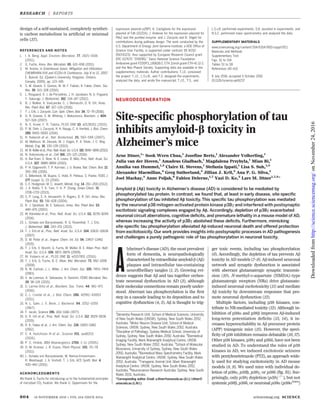
deficits, we crossed p38g−/−
with Ab-forming
APP23 mice. APP23 mice present with prema-
ture mortality, memory deficits, neuronal circuit
aberrations with epileptiform brain activity,
SCIENCE sciencemag.org 18 NOVEMBER 2016 • VOL 354 ISSUE 6314 905
Fig. 1. Depletion of postsynaptic p38g exacerbates excitotoxicity and
deficits in APP transgenic mice. (A) Reduced seizure latency (linear regression
slopes) and increased seizure severity in p38g−/−
mice compared with p38g+/+
animals injected with 30 mg/kg pentylenetetrazole (PTZ) (n = 10 to 12 mice).
(B) Colocalization of p38g and postsynaptic PSD-95 (arrows), but not pre-
synaptic synaptophysin (Syp), in neurons. Scale bars, 1 mm. (C) Mortality in
APP23.p38g+/+
mice was further augmented in APP23.p38g−/−
animals,
whereas p38g+/+
and p38g−/−
mice survived normally (n = 43 to 62). (D to F)
Memory deficits in 4-month-old APP23.p38g+/+
and APP23.p38g−/−
mice
(memory deficits were exacerbated in the APP23.p38g−/−
animals). Morris
water maze (MWM) test: (D) Representative MWM path traces to a hidden
platform. (E) Increased escape latency and (F) reduced time in the target
quadrant during probe trials in APP23.p38g+/+
and, more so, APP23.p38g−/−
mice compared with p38g+/+
and p38g−/−
mice (n = 8 to 10). (G to H)
Increased (G) spike train and (H) spike frequency in APP23.p38g+/+
and
APP23.p38g−/−
mice but not p38g+/+
and p38g−/−
mice (n = 6 to 8). (I) Rep-
resentative phase-amplitude comodulograms of interictal hippocampal
local field potential recordings showed reduced and virtually lost cross-
frequency coupling (CFC) (~8 Hz) in APP23.p38g+/+
and APP23.p38g−/−
mice,
respectively, compared with p38g+/+
and p38g−/−
mice. (J) Reduced modu-
lation index in APP23.p38g+/+
mice and, more so, in APP23.p38g−/−
mice
compared with p38g+/+
and p38g−/−
animals (n = 6 to 8). For (A), (C), (E) to (H),
and (J): ****P < 0.0001, ***P < 0.001, **P < 0.01, *P < 0.05; ns, not significant.
Error bars indicate SEM.
RESEARCH | REPORTS
onNovember24,2016http://science.sciencemag.org/Downloadedfrom
906 18 NOVEMBER 2016 • VOL 354 ISSUE 6314 sciencemag.org SCIENCE
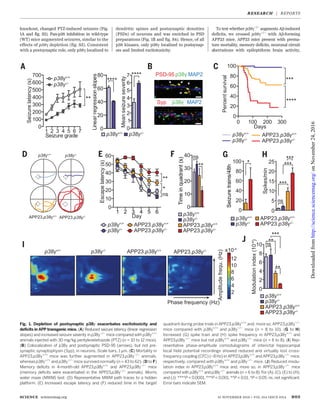
Fig. 2. Tau is required
for p38g-mediated
inhibition of Ab and
excitotoxicity.
(A) Normal survival of
APP23.p38g−/−
.tau−/−
compared with APP23.
p38g−/−
and APP23.
p38g+/+
mice (n = 42 to
62). (B and C) Normal
memory in 12-month-
old APP23.p38g−/−
.tau−/−
mice compared with
APP23.p38g−/−
and
APP23.p38g+/+
mice (n =
10 to 12). MWM test:
(B) Escape latency and
(C) time in target quad-
rant during probe trials.
(D to F) (D) Further reduc-
tion in seizure latencies,
shown by linear regression
analysis (E). (F) Further
enhanced mean seizure
severity following 30 mg/kg
PTZ in Alz17.p38g−/−
mice versus those already
reduced in p38g−/−
compared with p38g+/+
and Alz17.p38g+/+
mice
(n = 10 to 12). (G to I)
(G) Seizure latencies
after 30 mg/kg PTZ were
reduced, as shown by linear regression analysis (H), and mean seizure severity was increased in tau+/+
.p38g−/−
compared with tau+/+
.p38g+/+
mice (I). However,
latencies were markedly increased (G) and severities similarly reduced (I) in both tau−/−
.p38g+/+
and tau−/−
.p38g−/−
mice (n = 10 to 12). For all panels: ****P < 0.0001,
***P < 0.001, **P < 0.01, *P < 0.05; ns, not significant. Error bars indicate SEM.
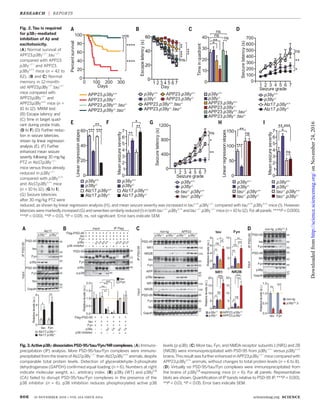
Fig. 3. Activep38g dissociates PSD-95/tau/Fyn/NRcomplexes.(A) Immuno-
precipitation (IP) analysis. More PSD-95/tau/Fyn complexes were immuno-
precipitated from the brains of Alz17.p38g−/−
than Alz17.p38g+/+
animals, despite
comparable total protein levels. Detection of glyceraldehyde-3-phosphate
dehydrogenase (GAPDH) confirmed equal loading (n = 6). Numbers at right
indicate molecular weight. a.i., arbitrary index. (B) p38g (WT) and p38gCA
(CA) failed to disrupt PSD-95/tau/Fyn complexes in the presence of the
p38 inhibitor (n = 6). p38 inhibition reduces phosphorylated active p38
levels (p-p38). (C) More tau, Fyn, and NMDA receptor subunits 1 (NR1) and 2B
(NR2B) were immunoprecipitated with PSD-95 from p38g−/−
versus p38g+/+
brains.This result was further enhanced in APP23.p38g−/−
mice compared with
APP23.p38g+/+
animals, without changes to total protein levels (n = 6 to 8).
(D) Virtually no PSD-95/tau/Fyn complexes were immunoprecipitated from
the brains of p38gCA
-expressing mice (n = 6). For all panels: Representative
blots are shown. Quantification of IP bands relative to PSD-95 IP. ***P < 0.001;
**P < 0.01; *P < 0.05. Error bars indicate SEM.
RESEARCH | REPORTS
onNovember24,2016http://science.sciencemag.org/Downloadedfrom
and Ab pathology (9, 15, 18). Compared with
APP23.p38g+/+
mice, APP23.p38g−/−
animals had
increased sensitivity to PTZ-induced seizures
(fig. S5). Ab pathology was comparable inthe brains
of APP23.p38g−/−
and APP23.p38g+/+
mice (fig. S6),
but p38g deletion aggravated premature mortality
and memory deficits of APP23 mice (Fig. 1, C to F,
and fig. S7). p38g−/−
mice showed no deficits and
had normal motor function (fig. S8). Electroen-
cephalography showed enhanced spontaneous
epileptiform activity and interictal hypersynchro-
nous discharges in APP23.p38g−/−
compared with
APP23.p38g+/+
mice (Fig. 1, G and H, and fig. S9).
Hippocampal theta and gamma oscillations and
cross-frequency coupling (CFC) through theta-
phase modulation of gamma power are measures
of network activity related to memory, including
in humans (19–22). These measures are compro-
mised in APP transgenic mice (15). Compromised
spectral power and CFC of APP23.p38g+/+
mice
were significantly more affected in APP23.p38g−/−
recordings (Fig. 1, I and J, and fig. S9). Recordings of
p38g−/−
and p38g+/+
mice were indistinguishable.
In summary, p38g depletion exacerbated excito-
toxicity, neuronal circuit synchronicity, mortal-
ity, and memory deficits in APP23 mice, without
changes in Ab pathology. In addition, p38g levels
were reduced in aged APP23 and APPNL-G-F
mice
and humans with AD (fig. S10), further suggesting
that the loss of p38g-mediated neuroprotection
may contribute to AD pathogenesis.
To determine whether the Ab toxicity–limiting
effects of p38g were tau-dependent, we crossed
SCIENCE sciencemag.org 18 NOVEMBER 2016 • VOL 354 ISSUE 6314 907
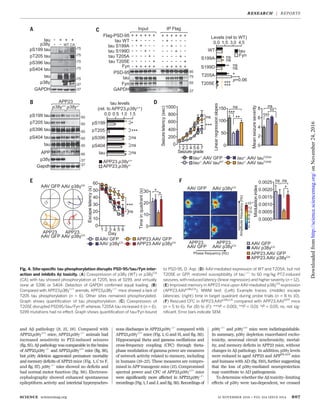
Fig. 4. Site-specific tau phosphorylation disrupts PSD-95/tau/Fyn inter-
action and inhibits Ab toxicity. (A) Coexpression of p38g (WT) or p38gCA
(CA) with tau showed phosphorylation at T205, less at S199, and virtually
none at S396 or S404. Detection of GAPDH confirmed equal loading. (B)
Compared with APP23.p38g+/+
animals, APP23.p38g−/−
mice showed a lack of
T205 tau phosphorylation (n = 6). Other sites remained phosphorylated.
Graph shows quantification of tau phosphorylation. (C) Coexpression of
T205E disrupted PSD95/tau/Fyn IP, whereas T205A tau increased it (n = 6).
S199 mutations had no effect. Graph shows quantification of tau/Fyn bound
to PSD-95. D, Asp. (D) AAV-mediated expression of WT and T205A, but not
T205E or GFP, restored susceptibility of tau−/−
to 50 mg/kg PTZ-induced
seizures, with reduced latency (linear regression) and higher severity (n = 12).
(E) Improved memory in APP23 mice upon AAV-mediated p38gCA
expression
(APP23.AAVp38gCA
). MWM test: (Left) Example traces; (middle) escape
latencies; (right) time in target quadrant during probe trials (n = 8 to 10).
(F) Rescued CFC in APP23.AAVp38gCA
compared with APP23.AAVGFP
mice
(n = 5 to 6). For (B) to (F): ***P < 0.001; **P < 0.01; *P < 0.05; ns, not sig-
nificant. Error bars indicate SEM.
RESEARCH | REPORTS
onNovember24,2016http://science.sciencemag.org/Downloadedfrom
APP23.p38g−/−
with tau−/−
mice. The exacer-
bating effects of p38g loss on reduced survival,
memory deficits, and neuronal network dys-
function of APP23 mice were virtually abolished
in APP23.p38g−/−
.tau−/−
mice (Fig. 2, A to C, and
fig. S11). These data also showed that, com-
pared with APP23 mice, APP23.p38g−/−
animals
had aggravated memory deficits that persisted
with aging. In contrast, increasing tau levels in
p38g−/−
mice [brought about by crossing with
nonmutant tau-expressing Alz17 mice (23)] sig-
nificantly enhanced PTZ-induced seizures in
Alz17.p38g−/−
mice (Fig. 2, D to F). Conversely,
when compared to tau−/−
.p38g+/+
mice, tau−/−
.
p38g−/−
animals showed similar protection from
PTZ-induced seizures (Fig. 2, G to I). Taken
together, the effects of p38g on excitotoxicity
and Ab toxicity were tau-dependent.
We have previously shown that postsynaptic
PSD-95/tau/Fyn complexes mediate Ab-induced
excitotoxicity (9). PSD-95/tau/Fyn interaction was
enhanced in Alz17.p38g−/−
animals versus Alz17.
p38g+/+
mice (Fig. 3A and fig. S12). Conversely, no
PSD-95/tau/Fyn complexes were isolated from
tau−/−
and tau−/−
.p38g−/−
brains (fig. S12). In-
creasing p38g levels compromised PSD-95/tau/
Fyn interaction in cells, and expression of a con-
stitutively active p38g variant (p38gCA
) com-
pletely abolished this interaction (Fig. 3B and
fig. S13). Pan-p38 inhibition stopped p38g/p38gCA
-
induced disruption of PSD-95/tau/Fyn complexes
(Fig. 3B). PSD-95 copurified more tau and Fyn
from p38g−/−
versus p38g+/+
brains, and even
more from APP23.p38g−/−
compared with APP23.
p38g+/+
and p38g−/−
brains (Fig. 3C). Conversely,
PSD-95/tau/Fyn interaction was reduced in trans-
genic mice with neuronal expression of p38gCA
(Fig. 3D and fig. S14). PTZ transiently increased
PSD-95/tau/Fyn complex formation in p38g+/+
animals; this effect was even more noticeable
in p38g−/−
mice (fig. S12). Fyn-mediated NR2B
phosphorylation at Tyr1472
(Y1472) facilitates
PSD-95/NR2B interaction (24). Consistent with
increased PSD-95/tau/Fyn complex formation,
NR2B phosphorylation at Y1472 was increased
in p38g−/−
brains (fig. S15). Conversely, cellular
expression of p38g and p38gCA
—but not p38aCA
,
p38bCA
, or p38dCA
—reduced Y1472 phosphoryl-
ation of NR2B (fig. S15). Hence, p38g regulated
PSD-95/tau/Fyn complexes, likely at the level of
PSD-95/tau interaction (fig. S16).
Although p38g hyperphosphorylates tau dur-
ing long-term in vitro kinase assays (25), the
temporal profile of p38g-induced tau phospho-
rylation in acute signaling remains unknown.
Short-term in vitro kinase reactions using phos-
phorylation site–specific tau antibodies revealed
phosphorylation at Ser199
(S199), Thr205
(T205),
S396, and S404 (fig. S17). Mass spectrometric
analysis confirmed these and 14 additional,
though low-abundant, sites (figs. S17C and S18
and table S4). Coexpression of p38g or p38gCA
and tau in cells revealed tau phosphorylation
(p) at T205, less at S199, and hardly any at S396
or S404 (Fig. 4A). Similarly, T205 (and, less so,
S199 and S396) were phosphorylated in p38gCA
transgenic mice (fig. S19). pT205 increased after
PTZ in p38g+/+
animals but was virtually abolished
in p38g−/−
mice, whereas pS199, pS396, and pS404
were induced in both p38g+/+
and p38g−/−
mice
(fig. S19). Similarly, pT205 was markedly reduced
in APP23.p38g−/−
animals compared with APP23.
p38g+/+
mice (Fig. 4B). In primary neurons,
pT205 (but not p199) was markedly reduced by
pan-p38 inhibition (fig. S20). Taken together,
these findings indicate that pT205 was a primary
p38g site in tau.
Next, we showed that a phosphorylation-
mimicking Thr205
→Glu205
(T205E) tau variant
coprecipitated significantly less with PSD-95 as
compared with nonmutant and T205A (A, Ala) tau
(Fig. 4C and fig. S21). In contrast, phosphorylation-
mimicking mutants of all other identified sites
had no effect on PSD-95/tau/Fyn interaction (fig.
S18). Microscale thermophoresis and glutathione
S-transferase–pulldown in vitro and fluorescence-
lifetime imaging microscopy (FLIM)–fluorescence
resonance energy transfer (FRET) analysis in
live cells confirmed the markedly compromised
interaction of T205E tau with PSD-95 (fig. S22).
The T205E mutation did not hinder tau/Fyn
interaction (fig. S21). Phosphorylation of T205 by
p38gCA
was required for disrupting PSD-95/tau/
Fyn complexes (fig. S21). Hence, p38g regulated
PSD-95/tau/Fyn complexes via phosphorylating
tau at T205.
The disruption of NR/PSD-95/tau/Fyn com-
plexes prevents excitotoxicity and Ab toxicity (9).
Hence, phosphorylation of tau at T205 should
similarly mitigate neurotoxicity. Ab caused cell
death in WT and T205A neurons but signifi-
cantly less in T205E tau-expressing neurons
(fig. S23). Similarly, neurons expressing p38g
and, more so, p38gCA
were significantly more
resistant to Ab-induced cell death than controls
(fig. S24). PTZ-induced seizures are reduced in
tau−/−
mice (8, 9). Adeno-associated virus (AAV)–
mediated expression of WT and T205A neurons,
but not T205E tau or green fluorescent protein
(GFP), in the forebrains of tau−/−
mice enhanced
PTZ-induced seizures (Fig. 4D and fig. S25). In
contrast, expression of p38gCA
in WT mice using
AAV or in Thy1.2-p38gCA
transgenic mice de-
creased PTZ-induced seizures (fig. S25). AAV-
mediated p38gCA
expression in APP23 mice
rescued memory deficits and network aberra-
tions; the same was true for crossing APP23
with Thy1.2-p38gCA
mice (Fig. 4, E and F, and
figs. S26 and S27). In summary, the levels of
active p38g kinase and tau phosphorylation at
T205 determined susceptibility to excitotoxicity
and Ab toxicity.
Here we have shown that T205 phosphoryl-
ation of tau is part of an Ab toxicity–inhibiting
response. This is contrary to the current view
that tau phosphorylation downstream of Ab tox-
icity is a pathological response (3). However, this
finding is in line with the idea that tau is in-
volved in normal physiologic NR signaling events
in neurons (12). Finally, we found that tau-
dependent Ab toxicity was modulated by site-
specific tau phosphorylation, which inhibited
postsynaptic PSD-95/tau/Fyn complexes, reveal-
ing an Ab toxicity–limiting role of p38g in AD
that is distinct and opposite to the effects of
p38a and p38b (11, 13, 14).
REFERENCES AND NOTES
1. C. Ballatore, V. M. Lee, J. Q. Trojanowski, Nat. Rev. Neurosci. 8,
663–672 (2007).
2. C. Haass, D. J. Selkoe, Nat. Rev. Mol. Cell Biol. 8, 101–112
(2007).
3. L. M. Ittner, J. Götz, Nat. Rev. Neurosci. 12, 67–72
(2011).
4. K. Iqbal, F. Liu, C.-X. Gong, A del C. Alonso,
I. Grundke-Iqbal, Acta Neuropathol. 118, 53–69
(2009).
5. E. M. Mandelkow, E. Mandelkow, Cold Spring Harb. Perspect.
Med. 2, a006247 (2012).
6. E. S. Musiek, D. M. Holtzman, Nat. Neurosci. 18, 800–806
(2015).
7. M. Rapoport, H. N. Dawson, L. I. Binder, M. P. Vitek,
A. Ferreira, Proc. Natl. Acad. Sci. U.S.A. 99, 6364–6369
(2002).
8. E. D. Roberson et al., Science 316, 750–754 (2007).
9. L. M. Ittner et al., Cell 142, 387–397 (2010).
10. J. J. Palop, L. Mucke, Nat. Neurosci. 13, 812–818
(2010).
11. G. E. Hardingham, H. Bading, Nat. Rev. Neurosci. 11, 682–696
(2010).
12. L. Mucke, D. J. Selkoe, Cold Spring Harb. Perspect. Med. 2,
a006338 (2012).
13. Q. Wang, D. M. Walsh, M. J. Rowan, D. J. Selkoe,
R. Anwyl, J. Neurosci. 24, 3370–3378 (2004).
14. S. Li et al., J. Neurosci. 31, 6627–6638 (2011).
15. A. A. Ittner, A. Gladbach, J. Bertz, L. S. Suh, L. M. Ittner, Acta
Neuropathol. Commun. 2, 149 (2014).
16. M. A. Fabian et al., Nat. Biotechnol. 23, 329–336 (2005).
17. M. B. Menon, S. Dhamija, A. Kotlyarov, M. Gaestel, Autophagy
11, 1425–1427 (2015).
18. C. Sturchler-Pierrat et al., Proc. Natl. Acad. Sci. U.S.A. 94,
13287–13292 (1997).
19. G. Buzsáki, E. I. Moser, Nat. Neurosci. 16, 130–138
(2013).
20. R. Goutagny, J. Jackson, S. Williams, Nat. Neurosci. 12,
1491–1493 (2009).
21. R. T. Canolty et al., Science 313, 1626–1628 (2006).
22. A. B. Tort, R. W. Komorowski, J. R. Manns, N. J. Kopell,
H. Eichenbaum, Proc. Natl. Acad. Sci. U.S.A. 106,
20942–20947 (2009).
23. A. Probst et al., Acta Neuropathol. 99, 469–481
(2000).
24. M. Aarts et al., Science 298, 846–850 (2002).
25. M. Goedert et al., FEBS Lett. 409, 57–62 (1997).
ACKNOWLEDGMENTS
We thank the staff of the Biological Resources
Centre of UNSW for animal care, E. Hinde for help
with FLIM-FRET experiments, D. Sullivan and T. Foo
for APOE genotyping of human samples, and T. Saito
and T. C. Saido for APPNL-G-F
mice. The data
from mass spectrometry experiments can be found
in the supplementary materials. This work was
funded by the National Health and Medical Research
Council (grants 1081916, 1037746, and 1003083),
the Australian Research Council (grants DP130102027
and DE130101591), Alzheimer’s Association (grant
NIRG000070035), Alzheimer’s Australia (grants
DGP14-39 and DGP14-95), the NIH (grant R28AA012725),
and UNSW Australia. A.I. and L.M.I. are inventors
on Australian patent application number APO/2016/900764,
submitted by UNSW, which covers increasing p38g
activity to prevent neuronal toxicity.
SUPPLEMENTARY MATERIALS
www.sciencemag.org/content/354/6314/904/suppl/DC1
Materials and Methods
Figs. S1 to S27
Tables S1 to S5
References (26–53)
22 July 2016; resubmitted 9 October 2016
Accepted 19 October 2016
10.1126/science.aah6205
908 18 NOVEMBER 2016 • VOL 354 ISSUE 6314 sciencemag.org SCIENCE
RESEARCH | REPORTS
onNovember24,2016http://science.sciencemag.org/Downloadedfrom
(6314), 904-908. [doi: 10.1126/science.aah6205]354Science
Ke and Lars M. Ittner (November 17, 2016)
Ana P. G. Silva, Joel Mackay, Anne Poljak, Fabien Delerue, Yazi D.
Lisa S. Suh, Alexander Macmillan, Greg Sutherland, Jillian J. Kril,
Mian Bi, Annika van Hummel, Claire H. Stevens, Stefania Ippati,
Julia van der Hoven, Amadeus Gladbach, Magdalena Przybyla,
Arne Ittner, Sook Wern Chua, Josefine Bertz, Alexander Volkerling,
in Alzheimer's mice
toxicityβSite-specific phosphorylation of tau inhibits amyloid-
Editor's Summary
, this issue p. 904Science
phosphorylation only mediates toxic processes.
the postsynapse. A protective role of phosphorylated tau in disease challenges the dogma that tau
in early Alzheimer's disease. This protection involves specific tau phosphorylation at threonine 205 at
found evidence for a protective role of tauet al.Working in Alzheimer's disease mouse models, Ittner
induces phosphorylation of tau, which in turn mediates neuronal dysfunction.βthe field is that A
) plaques and tau tangles. The prevailing idea inβ(AβAlzheimer's disease presents with amyloid-
not all bad−−Tau phosphorylation
This copy is for your personal, non-commercial use only.
Article Tools
http://science.sciencemag.org/content/354/6314/904
article tools:
Visit the online version of this article to access the personalization and
Permissions
http://www.sciencemag.org/about/permissions.dtl
Obtain information about reproducing this article:
is a registered trademark of AAAS.ScienceAdvancement of Science; all rights reserved. The title
Avenue NW, Washington, DC 20005. Copyright 2016 by the American Association for the
in December, by the American Association for the Advancement of Science, 1200 New York
(print ISSN 0036-8075; online ISSN 1095-9203) is published weekly, except the last weekScience
onNovember24,2016http://science.sciencemag.org/Downloadedfrom

Artículo alzheimer

  • 1.
    design of aself-sustained, completely synthet- ic carbon metabolism in artificial or minimal cells (37). REFERENCES AND NOTES 1. I. A. Berg, Appl. Environ. Microbiol. 77, 1925–1936 (2011). 2. G. Fuchs, Annu. Rev. Microbiol. 65, 631–658 (2011). 3. M. Aresta, in Greenhouse Gases: Mitigation and Utilization, CHEMRAWN-XVII and ICCDU-IX Conference, July 8 to 12, 2007, E. Buncel, Ed. (Queen’s University, Kingston, Ontario, Canada, 2009), pp. 123–149. 4. S. M. Glueck, S. Gümüs, W. M. F. Fabian, K. Faber, Chem. Soc. Rev. 39, 313–328 (2010). 5. L. Rosgaard, A. J. de Porcellinis, J. H. Jacobsen, N. U. Frigaard, Y. Sakuragi, J. Biotechnol. 162, 134–147 (2012). 6. B. J. Walker, A. VanLoocke, C. J. Bernacchi, D. R. Ort, Annu. Rev. Plant Biol. 67, 107–129 (2016). 7. T. J. Erb, J. Zarzycki, Curr. Opin. Chem. Biol. 34, 72–79 (2016). 8. D. N. Greene, S. M. Whitney, I. Matsumura, Biochem. J. 404, 517–524 (2007). 9. N. E. Kreel, F. R. Tabita, PLOS ONE 10, e0138351 (2015). 10. P. M. Shih, J. Zarzycki, K. K. Niyogi, C. A. Kerfeld, J. Biol. Chem. 289, 9493–9500 (2014). 11. R. Kebeish et al., Nat. Biotechnol. 25, 593–599 (2007). 12. M. Mattozzi, M. Ziesack, M. J. Voges, P. A. Silver, J. C. Way, Metab. Eng. 16, 130–139 (2013). 13. M. W. Keller et al., Proc. Natl. Acad. Sci. U.S.A. 110, 5840–5845 (2013). 14. N. Antonovsky et al., Cell 166, 115–125 (2016). 15. A. Bar-Even, E. Noor, N. E. Lewis, R. Milo, Proc. Natl. Acad. Sci. U.S.A. 107, 8889–8894 (2010). 16. P. H. Opgenorth, T. P. Korman, J. U. Bowie, Nat. Chem. Biol. 12, 393–395 (2016). 17. S. Billerbeck, M. Bujara, C. Hold, R. Pellaux, S. Panke, FEBS J. 277 (suppl. 1), 23 (2010). 18. C. E. Hodgman, M. C. Jewett, Metab. Eng. 14, 261–269 (2012). 19. J. A. Rollin, T. K. Tam, Y. H. P. Zhang, Green Chem. 15, 1708–1719 (2013). 20. S. P. Long, E. A. Ainsworth, A. Rogers, D. R. Ort, Annu. Rev. Plant Biol. 55, 591–628 (2004). 21. R. J. Spreitzer, M. E. Salvucci, Annu. Rev. Plant Biol. 53, 449–475 (2002). 22. M. Könneke et al., Proc. Natl. Acad. Sci. U.S.A. 111, 8239–8244 (2014). 23. L. Schada von Borzyskowski, R. G. Rosenthal, T. J. Erb, J. Biotechnol. 168, 243–251 (2013). 24. T. J. Erb et al., Proc. Natl. Acad. Sci. U.S.A. 104, 10631–10636 (2007). 25. D. M. Peter et al., Angew. Chem. Int. Ed. 54, 13457–13461 (2015). 26. T. J. Erb, V. Brecht, G. Fuchs, M. Müller, B. E. Alber, Proc. Natl. Acad. Sci. U.S.A. 106, 8871–8876 (2009). 27. M. Volpers et al., PLOS ONE 11, e0157851 (2016). 28. T. J. Erb, G. Fuchs, B. E. Alber, Mol. Microbiol. 73, 992–1008 (2009). 29. B. W. Carlson, L. L. Miller, J. Am. Chem. Soc. 105, 7453–7454 (1983). 30. V. de Lorenzo, A. Sekowska, A. Danchin, FEMS Microbiol. Rev. 39, 96–119 (2015). 31. C. Lerma-Ortiz et al., Biochem. Soc. Trans. 44, 961–971 (2016). 32. C. L. Linster et al., J. Biol. Chem. 286, 42992–43003 (2011). 33. N. L. Gale, J. V. Beck, J. Bacteriol. 94, 1052–1059 (1967). 34. F. Jacob, Science 196, 1161–1166 (1977). 35. D. R. Ort et al., Proc. Natl. Acad. Sci. U.S.A. 112, 8529–8536 (2015). 36. R. K. Yadav et al., J. Am. Chem. Soc. 134, 11455–11461 (2012). 37. C. A. Hutchison III et al., Science 351, aad6253 (2016). 38. P. C. Hinkle, BBA Bioenergetics 1706, 1–11 (2005). 39. D. M. Kramer, J. R. Evans, Plant Physiol. 155, 70–78 (2011). 40. L. Schada von Borzyskowski, M. Remus-Emsermann, R. Weishaupt, J. A. Vorholt, T. J. Erb, ACS Synth. Biol. 4, 430–443 (2015). ACKNOWLEDGMENTS We thank G. Fuchs for introducing us to the fundamental principles of microbial CO2 fixation. We thank U. Oppermann for the expression plasmid p2BP1, K. Castiglione for the expression plasmid of Fdh (D221A), J. Andexer for the expression plasmid for Pkk2 and the purified enzyme, and J. Zarzycki and B. Vögeli for contributions during pathway design. The work conducted by the U.S. Department of Energy Joint Genome Institute, a DOE Office of Science User Facility, is supported under contract DE-AC02- 05CH11231. Also supported by European Research Council grant ERC 637675 “SYBORG,” Swiss National Science Foundation Ambizione grant PZ00P3_136828/1, ETH Zürich grant ETH-41 12-2, and the Max Planck Society. Supporting data are available in the supplementary materials. Author contributions: T.J.E. conceived the project; T.J.E., L.S.v.B., and T.S. designed the experiments, analyzed the data, and wrote the manuscript; T.J.E., T.S., and L.S.v.B. performed experiments; S.B. assisted in experiments; and N.S.C. performed mass spectrometry and analyzed the data. SUPPLEMENTARY MATERIALS www.sciencemag.org/content/354/6314/900/suppl/DC1 Materials and Methods Supplementary Text Figs. S1 to S14 Tables S1 to S8 References (41–63) 8 July 2016; accepted 5 October 2016 10.1126/science.aah5237 ◥NEURODEGENERATION Site-specific phosphorylation of tau inhibits amyloid-b toxicity in Alzheimer’s mice Arne Ittner,1 * Sook Wern Chua,1 Josefine Bertz,1 Alexander Volkerling,1 Julia van der Hoven,1 Amadeus Gladbach,1 Magdalena Przybyla,1 Mian Bi,1 Annika van Hummel,1,2 Claire H. Stevens,1 Stefania Ippati,1 Lisa S. Suh,1,3 Alexander Macmillan,4 Greg Sutherland,3 Jillian J. Kril,3 Ana P. G. Silva,5 Joel Mackay,5 Anne Poljak,6 Fabien Delerue,1,7 Yazi D. Ke,2 Lars M. Ittner1,7,8 * Amyloid-b (Ab) toxicity in Alzheimer’s disease (AD) is considered to be mediated by phosphorylated tau protein. In contrast, we found that, at least in early disease, site-specific phosphorylation of tau inhibited Ab toxicity.This specific tau phosphorylation was mediated by the neuronal p38 mitogen-activated protein kinase p38g and interfered with postsynaptic excitotoxic signaling complexes engaged by Ab. Accordingly, depletion of p38g exacerbated neuronal circuit aberrations, cognitive deficits, and premature lethality in a mouse model of AD, whereas increasing the activity of p38g abolished these deficits. Furthermore, mimicking site-specific tau phosphorylation alleviated Ab-induced neuronal death and offered protection from excitotoxicity. Our work provides insights into postsynaptic processes in AD pathogenesis and challenges a purely pathogenic role of tau phosphorylation in neuronal toxicity. A lzheimer’s disease (AD), the most prevalent form of dementia, is neuropathologically characterized by extracellular amyloid-b (Ab) plaques and intracellular tau-containing neurofibrillary tangles (1, 2). Growing evi- dence suggests that Ab and tau together orches- trate neuronal dysfunction in AD (3), although their molecular connections remain poorly under- stood. Aberrant tau phosphorylation is the first step in a cascade leading to its deposition and to cognitive dysfunction (4, 5). Ab is thought to trig- ger toxic events, including tau phosphorylation (6). Accordingly, the depletion of tau prevents Ab toxicity in AD models (7–9). Ab-induced neuronal network and synaptic dysfunction is associated with aberrant glutamatergic synaptic transmis- sion (10). N-methyl-D-aspartate (NMDA)–type glutamatergic receptors (NRs) drive glutamate- induced neuronal excitotoxicity (11) and mediate Ab toxicity by downstream responses that pro- mote neuronal dysfunction (12). Multiple factors, including p38 kinases, con- tribute to NR-mediated toxicity (12). Although in- hibition of p38a and p38b improves Ab-induced long-term potentiation deficits (13, 14), it in- creases hyperexcitability in Ab precursor protein (APP) transgenic mice (15). However, the speci- ficity of p38 inhibitors remains debatable (16, 17). Other p38 kinases, p38g and p38d, have not been studied in AD. To understand the roles of p38 kinases in AD, we induced excitotoxic seizures with pentylenetetrazole (PTZ), an approach wide- ly used for studying excitotoxicity in AD mouse models (8, 9). We used mice with individual de- letion of p38a, p38b, p38g, or p38d (fig. S1). Sur- prisingly, only p38g depletion (p38g−/− ), but not systemic p38b, p38d, or neuronal p38a (p38aDneu ) 904 18 NOVEMBER 2016 • VOL 354 ISSUE 6314 sciencemag.org SCIENCE 1 Dementia Research Unit, School of Medical Sciences, University of New South Wales (UNSW), Sydney, New South Wales 2052, Australia. 2 Motor Neuron Disease Unit, School of Medical Sciences, UNSW, Sydney, New South Wales 2052, Australia. 3 Discipline of Pathology, Sydney Medical School, University of Sydney, Sydney, New South Wales 2050, Australia. 4 Biomedical Imaging Facility, Mark Wainwright Analytical Centre, UNSW, Sydney, New South Wales 2052, Australia. 5 School of Molecular Bioscience, University of Sydney, Sydney, New South Wales 2050, Australia. 6 Biomedical Mass Spectrometry Facility, Mark Wainwright Analytical Centre, UNSW, Sydney, New South Wales 2052, Australia. 7 Transgenic Animal Unit, Mark Wainwright Analytical Centre, UNSW, Sydney, New South Wales 2052, Australia. 8 Neuroscience Research Australia, Sydney, New South Wales 2031, Australia. *Corresponding author. Email: a.ittner@unsw.edu.au (A.I.); l.ittner@ unsw.edu.au (L.M.I.) RESEARCH | REPORTS onNovember24,2016http://science.sciencemag.org/Downloadedfrom
  • 2.
    knockout, changed PTZ-inducedseizures (Fig. 1A and fig. S2). Pan-p38 inhibition in wild-type (WT) mice augmented seizures, similar to the effects of p38g depletion (fig. S3). Consistent with a postsynaptic role, only p38g localized to dendritic spines and postsynaptic densities (PSDs) of neurons and was enriched in PSD preparations (Fig. 1B and fig. S4). Hence, of all p38 kinases, only p38g localized to postsynap- ses and limited excitotoxicity. To test whether p38g−/− augments Ab-induced deficits, we crossed p38g−/− with Ab-forming APP23 mice. APP23 mice present with prema- ture mortality, memory deficits, neuronal circuit aberrations with epileptiform brain activity, SCIENCE sciencemag.org 18 NOVEMBER 2016 • VOL 354 ISSUE 6314 905 Fig. 1. Depletion of postsynaptic p38g exacerbates excitotoxicity and deficits in APP transgenic mice. (A) Reduced seizure latency (linear regression slopes) and increased seizure severity in p38g−/− mice compared with p38g+/+ animals injected with 30 mg/kg pentylenetetrazole (PTZ) (n = 10 to 12 mice). (B) Colocalization of p38g and postsynaptic PSD-95 (arrows), but not pre- synaptic synaptophysin (Syp), in neurons. Scale bars, 1 mm. (C) Mortality in APP23.p38g+/+ mice was further augmented in APP23.p38g−/− animals, whereas p38g+/+ and p38g−/− mice survived normally (n = 43 to 62). (D to F) Memory deficits in 4-month-old APP23.p38g+/+ and APP23.p38g−/− mice (memory deficits were exacerbated in the APP23.p38g−/− animals). Morris water maze (MWM) test: (D) Representative MWM path traces to a hidden platform. (E) Increased escape latency and (F) reduced time in the target quadrant during probe trials in APP23.p38g+/+ and, more so, APP23.p38g−/− mice compared with p38g+/+ and p38g−/− mice (n = 8 to 10). (G to H) Increased (G) spike train and (H) spike frequency in APP23.p38g+/+ and APP23.p38g−/− mice but not p38g+/+ and p38g−/− mice (n = 6 to 8). (I) Rep- resentative phase-amplitude comodulograms of interictal hippocampal local field potential recordings showed reduced and virtually lost cross- frequency coupling (CFC) (~8 Hz) in APP23.p38g+/+ and APP23.p38g−/− mice, respectively, compared with p38g+/+ and p38g−/− mice. (J) Reduced modu- lation index in APP23.p38g+/+ mice and, more so, in APP23.p38g−/− mice compared with p38g+/+ and p38g−/− animals (n = 6 to 8). For (A), (C), (E) to (H), and (J): ****P < 0.0001, ***P < 0.001, **P < 0.01, *P < 0.05; ns, not significant. Error bars indicate SEM. RESEARCH | REPORTS onNovember24,2016http://science.sciencemag.org/Downloadedfrom
  • 3.
    906 18 NOVEMBER2016 • VOL 354 ISSUE 6314 sciencemag.org SCIENCE Fig. 2. Tau is required for p38g-mediated inhibition of Ab and excitotoxicity. (A) Normal survival of APP23.p38g−/− .tau−/− compared with APP23. p38g−/− and APP23. p38g+/+ mice (n = 42 to 62). (B and C) Normal memory in 12-month- old APP23.p38g−/− .tau−/− mice compared with APP23.p38g−/− and APP23.p38g+/+ mice (n = 10 to 12). MWM test: (B) Escape latency and (C) time in target quad- rant during probe trials. (D to F) (D) Further reduc- tion in seizure latencies, shown by linear regression analysis (E). (F) Further enhanced mean seizure severity following 30 mg/kg PTZ in Alz17.p38g−/− mice versus those already reduced in p38g−/− compared with p38g+/+ and Alz17.p38g+/+ mice (n = 10 to 12). (G to I) (G) Seizure latencies after 30 mg/kg PTZ were reduced, as shown by linear regression analysis (H), and mean seizure severity was increased in tau+/+ .p38g−/− compared with tau+/+ .p38g+/+ mice (I). However, latencies were markedly increased (G) and severities similarly reduced (I) in both tau−/− .p38g+/+ and tau−/− .p38g−/− mice (n = 10 to 12). For all panels: ****P < 0.0001, ***P < 0.001, **P < 0.01, *P < 0.05; ns, not significant. Error bars indicate SEM. Fig. 3. Activep38g dissociates PSD-95/tau/Fyn/NRcomplexes.(A) Immuno- precipitation (IP) analysis. More PSD-95/tau/Fyn complexes were immuno- precipitated from the brains of Alz17.p38g−/− than Alz17.p38g+/+ animals, despite comparable total protein levels. Detection of glyceraldehyde-3-phosphate dehydrogenase (GAPDH) confirmed equal loading (n = 6). Numbers at right indicate molecular weight. a.i., arbitrary index. (B) p38g (WT) and p38gCA (CA) failed to disrupt PSD-95/tau/Fyn complexes in the presence of the p38 inhibitor (n = 6). p38 inhibition reduces phosphorylated active p38 levels (p-p38). (C) More tau, Fyn, and NMDA receptor subunits 1 (NR1) and 2B (NR2B) were immunoprecipitated with PSD-95 from p38g−/− versus p38g+/+ brains.This result was further enhanced in APP23.p38g−/− mice compared with APP23.p38g+/+ animals, without changes to total protein levels (n = 6 to 8). (D) Virtually no PSD-95/tau/Fyn complexes were immunoprecipitated from the brains of p38gCA -expressing mice (n = 6). For all panels: Representative blots are shown. Quantification of IP bands relative to PSD-95 IP. ***P < 0.001; **P < 0.01; *P < 0.05. Error bars indicate SEM. RESEARCH | REPORTS onNovember24,2016http://science.sciencemag.org/Downloadedfrom
  • 4.
    and Ab pathology(9, 15, 18). Compared with APP23.p38g+/+ mice, APP23.p38g−/− animals had increased sensitivity to PTZ-induced seizures (fig. S5). Ab pathology was comparable inthe brains of APP23.p38g−/− and APP23.p38g+/+ mice (fig. S6), but p38g deletion aggravated premature mortality and memory deficits of APP23 mice (Fig. 1, C to F, and fig. S7). p38g−/− mice showed no deficits and had normal motor function (fig. S8). Electroen- cephalography showed enhanced spontaneous epileptiform activity and interictal hypersynchro- nous discharges in APP23.p38g−/− compared with APP23.p38g+/+ mice (Fig. 1, G and H, and fig. S9). Hippocampal theta and gamma oscillations and cross-frequency coupling (CFC) through theta- phase modulation of gamma power are measures of network activity related to memory, including in humans (19–22). These measures are compro- mised in APP transgenic mice (15). Compromised spectral power and CFC of APP23.p38g+/+ mice were significantly more affected in APP23.p38g−/− recordings (Fig. 1, I and J, and fig. S9). Recordings of p38g−/− and p38g+/+ mice were indistinguishable. In summary, p38g depletion exacerbated excito- toxicity, neuronal circuit synchronicity, mortal- ity, and memory deficits in APP23 mice, without changes in Ab pathology. In addition, p38g levels were reduced in aged APP23 and APPNL-G-F mice and humans with AD (fig. S10), further suggesting that the loss of p38g-mediated neuroprotection may contribute to AD pathogenesis. To determine whether the Ab toxicity–limiting effects of p38g were tau-dependent, we crossed SCIENCE sciencemag.org 18 NOVEMBER 2016 • VOL 354 ISSUE 6314 907 Fig. 4. Site-specific tau phosphorylation disrupts PSD-95/tau/Fyn inter- action and inhibits Ab toxicity. (A) Coexpression of p38g (WT) or p38gCA (CA) with tau showed phosphorylation at T205, less at S199, and virtually none at S396 or S404. Detection of GAPDH confirmed equal loading. (B) Compared with APP23.p38g+/+ animals, APP23.p38g−/− mice showed a lack of T205 tau phosphorylation (n = 6). Other sites remained phosphorylated. Graph shows quantification of tau phosphorylation. (C) Coexpression of T205E disrupted PSD95/tau/Fyn IP, whereas T205A tau increased it (n = 6). S199 mutations had no effect. Graph shows quantification of tau/Fyn bound to PSD-95. D, Asp. (D) AAV-mediated expression of WT and T205A, but not T205E or GFP, restored susceptibility of tau−/− to 50 mg/kg PTZ-induced seizures, with reduced latency (linear regression) and higher severity (n = 12). (E) Improved memory in APP23 mice upon AAV-mediated p38gCA expression (APP23.AAVp38gCA ). MWM test: (Left) Example traces; (middle) escape latencies; (right) time in target quadrant during probe trials (n = 8 to 10). (F) Rescued CFC in APP23.AAVp38gCA compared with APP23.AAVGFP mice (n = 5 to 6). For (B) to (F): ***P < 0.001; **P < 0.01; *P < 0.05; ns, not sig- nificant. Error bars indicate SEM. RESEARCH | REPORTS onNovember24,2016http://science.sciencemag.org/Downloadedfrom
  • 5.
    APP23.p38g−/− with tau−/− mice. Theexacer- bating effects of p38g loss on reduced survival, memory deficits, and neuronal network dys- function of APP23 mice were virtually abolished in APP23.p38g−/− .tau−/− mice (Fig. 2, A to C, and fig. S11). These data also showed that, com- pared with APP23 mice, APP23.p38g−/− animals had aggravated memory deficits that persisted with aging. In contrast, increasing tau levels in p38g−/− mice [brought about by crossing with nonmutant tau-expressing Alz17 mice (23)] sig- nificantly enhanced PTZ-induced seizures in Alz17.p38g−/− mice (Fig. 2, D to F). Conversely, when compared to tau−/− .p38g+/+ mice, tau−/− . p38g−/− animals showed similar protection from PTZ-induced seizures (Fig. 2, G to I). Taken together, the effects of p38g on excitotoxicity and Ab toxicity were tau-dependent. We have previously shown that postsynaptic PSD-95/tau/Fyn complexes mediate Ab-induced excitotoxicity (9). PSD-95/tau/Fyn interaction was enhanced in Alz17.p38g−/− animals versus Alz17. p38g+/+ mice (Fig. 3A and fig. S12). Conversely, no PSD-95/tau/Fyn complexes were isolated from tau−/− and tau−/− .p38g−/− brains (fig. S12). In- creasing p38g levels compromised PSD-95/tau/ Fyn interaction in cells, and expression of a con- stitutively active p38g variant (p38gCA ) com- pletely abolished this interaction (Fig. 3B and fig. S13). Pan-p38 inhibition stopped p38g/p38gCA - induced disruption of PSD-95/tau/Fyn complexes (Fig. 3B). PSD-95 copurified more tau and Fyn from p38g−/− versus p38g+/+ brains, and even more from APP23.p38g−/− compared with APP23. p38g+/+ and p38g−/− brains (Fig. 3C). Conversely, PSD-95/tau/Fyn interaction was reduced in trans- genic mice with neuronal expression of p38gCA (Fig. 3D and fig. S14). PTZ transiently increased PSD-95/tau/Fyn complex formation in p38g+/+ animals; this effect was even more noticeable in p38g−/− mice (fig. S12). Fyn-mediated NR2B phosphorylation at Tyr1472 (Y1472) facilitates PSD-95/NR2B interaction (24). Consistent with increased PSD-95/tau/Fyn complex formation, NR2B phosphorylation at Y1472 was increased in p38g−/− brains (fig. S15). Conversely, cellular expression of p38g and p38gCA —but not p38aCA , p38bCA , or p38dCA —reduced Y1472 phosphoryl- ation of NR2B (fig. S15). Hence, p38g regulated PSD-95/tau/Fyn complexes, likely at the level of PSD-95/tau interaction (fig. S16). Although p38g hyperphosphorylates tau dur- ing long-term in vitro kinase assays (25), the temporal profile of p38g-induced tau phospho- rylation in acute signaling remains unknown. Short-term in vitro kinase reactions using phos- phorylation site–specific tau antibodies revealed phosphorylation at Ser199 (S199), Thr205 (T205), S396, and S404 (fig. S17). Mass spectrometric analysis confirmed these and 14 additional, though low-abundant, sites (figs. S17C and S18 and table S4). Coexpression of p38g or p38gCA and tau in cells revealed tau phosphorylation (p) at T205, less at S199, and hardly any at S396 or S404 (Fig. 4A). Similarly, T205 (and, less so, S199 and S396) were phosphorylated in p38gCA transgenic mice (fig. S19). pT205 increased after PTZ in p38g+/+ animals but was virtually abolished in p38g−/− mice, whereas pS199, pS396, and pS404 were induced in both p38g+/+ and p38g−/− mice (fig. S19). Similarly, pT205 was markedly reduced in APP23.p38g−/− animals compared with APP23. p38g+/+ mice (Fig. 4B). In primary neurons, pT205 (but not p199) was markedly reduced by pan-p38 inhibition (fig. S20). Taken together, these findings indicate that pT205 was a primary p38g site in tau. Next, we showed that a phosphorylation- mimicking Thr205 →Glu205 (T205E) tau variant coprecipitated significantly less with PSD-95 as compared with nonmutant and T205A (A, Ala) tau (Fig. 4C and fig. S21). In contrast, phosphorylation- mimicking mutants of all other identified sites had no effect on PSD-95/tau/Fyn interaction (fig. S18). Microscale thermophoresis and glutathione S-transferase–pulldown in vitro and fluorescence- lifetime imaging microscopy (FLIM)–fluorescence resonance energy transfer (FRET) analysis in live cells confirmed the markedly compromised interaction of T205E tau with PSD-95 (fig. S22). The T205E mutation did not hinder tau/Fyn interaction (fig. S21). Phosphorylation of T205 by p38gCA was required for disrupting PSD-95/tau/ Fyn complexes (fig. S21). Hence, p38g regulated PSD-95/tau/Fyn complexes via phosphorylating tau at T205. The disruption of NR/PSD-95/tau/Fyn com- plexes prevents excitotoxicity and Ab toxicity (9). Hence, phosphorylation of tau at T205 should similarly mitigate neurotoxicity. Ab caused cell death in WT and T205A neurons but signifi- cantly less in T205E tau-expressing neurons (fig. S23). Similarly, neurons expressing p38g and, more so, p38gCA were significantly more resistant to Ab-induced cell death than controls (fig. S24). PTZ-induced seizures are reduced in tau−/− mice (8, 9). Adeno-associated virus (AAV)– mediated expression of WT and T205A neurons, but not T205E tau or green fluorescent protein (GFP), in the forebrains of tau−/− mice enhanced PTZ-induced seizures (Fig. 4D and fig. S25). In contrast, expression of p38gCA in WT mice using AAV or in Thy1.2-p38gCA transgenic mice de- creased PTZ-induced seizures (fig. S25). AAV- mediated p38gCA expression in APP23 mice rescued memory deficits and network aberra- tions; the same was true for crossing APP23 with Thy1.2-p38gCA mice (Fig. 4, E and F, and figs. S26 and S27). In summary, the levels of active p38g kinase and tau phosphorylation at T205 determined susceptibility to excitotoxicity and Ab toxicity. Here we have shown that T205 phosphoryl- ation of tau is part of an Ab toxicity–inhibiting response. This is contrary to the current view that tau phosphorylation downstream of Ab tox- icity is a pathological response (3). However, this finding is in line with the idea that tau is in- volved in normal physiologic NR signaling events in neurons (12). Finally, we found that tau- dependent Ab toxicity was modulated by site- specific tau phosphorylation, which inhibited postsynaptic PSD-95/tau/Fyn complexes, reveal- ing an Ab toxicity–limiting role of p38g in AD that is distinct and opposite to the effects of p38a and p38b (11, 13, 14). REFERENCES AND NOTES 1. C. Ballatore, V. M. Lee, J. Q. Trojanowski, Nat. Rev. Neurosci. 8, 663–672 (2007). 2. C. Haass, D. J. Selkoe, Nat. Rev. Mol. Cell Biol. 8, 101–112 (2007). 3. L. M. Ittner, J. Götz, Nat. Rev. Neurosci. 12, 67–72 (2011). 4. K. Iqbal, F. Liu, C.-X. Gong, A del C. Alonso, I. Grundke-Iqbal, Acta Neuropathol. 118, 53–69 (2009). 5. E. M. Mandelkow, E. Mandelkow, Cold Spring Harb. Perspect. Med. 2, a006247 (2012). 6. E. S. Musiek, D. M. Holtzman, Nat. Neurosci. 18, 800–806 (2015). 7. M. Rapoport, H. N. Dawson, L. I. Binder, M. P. Vitek, A. Ferreira, Proc. Natl. Acad. Sci. U.S.A. 99, 6364–6369 (2002). 8. E. D. Roberson et al., Science 316, 750–754 (2007). 9. L. M. Ittner et al., Cell 142, 387–397 (2010). 10. J. J. Palop, L. Mucke, Nat. Neurosci. 13, 812–818 (2010). 11. G. E. Hardingham, H. Bading, Nat. Rev. Neurosci. 11, 682–696 (2010). 12. L. Mucke, D. J. Selkoe, Cold Spring Harb. Perspect. Med. 2, a006338 (2012). 13. Q. Wang, D. M. Walsh, M. J. Rowan, D. J. Selkoe, R. Anwyl, J. Neurosci. 24, 3370–3378 (2004). 14. S. Li et al., J. Neurosci. 31, 6627–6638 (2011). 15. A. A. Ittner, A. Gladbach, J. Bertz, L. S. Suh, L. M. Ittner, Acta Neuropathol. Commun. 2, 149 (2014). 16. M. A. Fabian et al., Nat. Biotechnol. 23, 329–336 (2005). 17. M. B. Menon, S. Dhamija, A. Kotlyarov, M. Gaestel, Autophagy 11, 1425–1427 (2015). 18. C. Sturchler-Pierrat et al., Proc. Natl. Acad. Sci. U.S.A. 94, 13287–13292 (1997). 19. G. Buzsáki, E. I. Moser, Nat. Neurosci. 16, 130–138 (2013). 20. R. Goutagny, J. Jackson, S. Williams, Nat. Neurosci. 12, 1491–1493 (2009). 21. R. T. Canolty et al., Science 313, 1626–1628 (2006). 22. A. B. Tort, R. W. Komorowski, J. R. Manns, N. J. Kopell, H. Eichenbaum, Proc. Natl. Acad. Sci. U.S.A. 106, 20942–20947 (2009). 23. A. Probst et al., Acta Neuropathol. 99, 469–481 (2000). 24. M. Aarts et al., Science 298, 846–850 (2002). 25. M. Goedert et al., FEBS Lett. 409, 57–62 (1997). ACKNOWLEDGMENTS We thank the staff of the Biological Resources Centre of UNSW for animal care, E. Hinde for help with FLIM-FRET experiments, D. Sullivan and T. Foo for APOE genotyping of human samples, and T. Saito and T. C. Saido for APPNL-G-F mice. The data from mass spectrometry experiments can be found in the supplementary materials. This work was funded by the National Health and Medical Research Council (grants 1081916, 1037746, and 1003083), the Australian Research Council (grants DP130102027 and DE130101591), Alzheimer’s Association (grant NIRG000070035), Alzheimer’s Australia (grants DGP14-39 and DGP14-95), the NIH (grant R28AA012725), and UNSW Australia. A.I. and L.M.I. are inventors on Australian patent application number APO/2016/900764, submitted by UNSW, which covers increasing p38g activity to prevent neuronal toxicity. SUPPLEMENTARY MATERIALS www.sciencemag.org/content/354/6314/904/suppl/DC1 Materials and Methods Figs. S1 to S27 Tables S1 to S5 References (26–53) 22 July 2016; resubmitted 9 October 2016 Accepted 19 October 2016 10.1126/science.aah6205 908 18 NOVEMBER 2016 • VOL 354 ISSUE 6314 sciencemag.org SCIENCE RESEARCH | REPORTS onNovember24,2016http://science.sciencemag.org/Downloadedfrom
  • 6.
    (6314), 904-908. [doi:10.1126/science.aah6205]354Science Ke and Lars M. Ittner (November 17, 2016) Ana P. G. Silva, Joel Mackay, Anne Poljak, Fabien Delerue, Yazi D. Lisa S. Suh, Alexander Macmillan, Greg Sutherland, Jillian J. Kril, Mian Bi, Annika van Hummel, Claire H. Stevens, Stefania Ippati, Julia van der Hoven, Amadeus Gladbach, Magdalena Przybyla, Arne Ittner, Sook Wern Chua, Josefine Bertz, Alexander Volkerling, in Alzheimer's mice toxicityβSite-specific phosphorylation of tau inhibits amyloid- Editor's Summary , this issue p. 904Science phosphorylation only mediates toxic processes. the postsynapse. A protective role of phosphorylated tau in disease challenges the dogma that tau in early Alzheimer's disease. This protection involves specific tau phosphorylation at threonine 205 at found evidence for a protective role of tauet al.Working in Alzheimer's disease mouse models, Ittner induces phosphorylation of tau, which in turn mediates neuronal dysfunction.βthe field is that A ) plaques and tau tangles. The prevailing idea inβ(AβAlzheimer's disease presents with amyloid- not all bad−−Tau phosphorylation This copy is for your personal, non-commercial use only. Article Tools http://science.sciencemag.org/content/354/6314/904 article tools: Visit the online version of this article to access the personalization and Permissions http://www.sciencemag.org/about/permissions.dtl Obtain information about reproducing this article: is a registered trademark of AAAS.ScienceAdvancement of Science; all rights reserved. The title Avenue NW, Washington, DC 20005. Copyright 2016 by the American Association for the in December, by the American Association for the Advancement of Science, 1200 New York (print ISSN 0036-8075; online ISSN 1095-9203) is published weekly, except the last weekScience onNovember24,2016http://science.sciencemag.org/Downloadedfrom