Philippine Contemporary Cinema
Arman Lopez Jacinto, MPA
What is Cinema?
Cinema, or motion picture, is
the art of moving images; a
visual medium that tells
stories and exposes reality.
What is
Film?
Film, also called a movie or motion
picture, is a series of still or moving
images. It is produced by recording
photographic images with cameras, or
by creating images using animation
techniques or visual effects. The
process of filmmaking has developed
into an art form and industry.
What is
Movie?
Movie is a sequence of
photographs projected onto a
screen with sufficient rapidity as
to create the illusion of motion
and continuity.
Innovation of
Silent movie
Silent film studios became
obsolescent, and new
investments had to be made
for expensive new equipment,
technological innovations,
and sound-proofed stages.
• First Filipino filmmakers
The first film produced by a Filipino is José
Nepomuceno's Dalagang Bukid (Country Maiden) in
1919 based on a highly-acclaimed musical play by
Hermogenes Ilagan and León Ignacio. Early
filmmakers, even with meagre capital, followed some
of the genres provided by Hollywood movies. The
main sources of movie themes during this period
were theatre pieces from popular dramas or
zarzuelas. Another source of movie themes at that
time was Philippine literature.
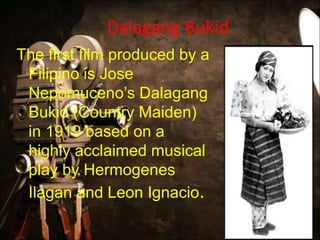
Dalagang Bukid
The first film produced by a
Filipino is Jose
Nepomuceno’s Dalagang
Bukid (Country Maiden)
in 1919 based on a
highly acclaimed musical
play by Hermogenes
Ilagan and Leon Ignacio.
1950
• The 1950s was labeled as the first golden age of
Philippine cinema. Four big production studios (LVN
Pictures, Sampaguita Pictures, Premiere Productions
and Lebran International) were at their peak in
filmmaking, employing premier directors like Gerardo
de León, Eddie Romero and César Gallardo while
contracting the biggest stars of that period. The Filipino
film industry was one of the busiest and bustling film
communities in Asia, releasing an average of 350 films
a year making Philippines second to Japan in terms of
film productions a year.
Famous Actors of the Golden Cinema
FPJ, SUSAN ROCES
Amalia Fuentes and Romano
Castellvi
Most Popular Stars
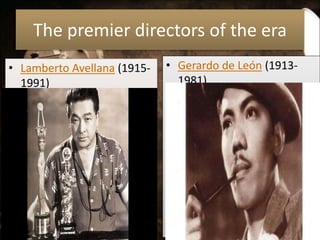
The premier directors of the era
• Lamberto Avellana (1915-
1991)
• Gerardo de León (1913-
1981)
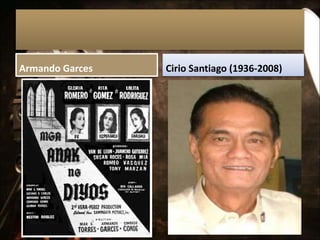
Gregorio Fernández César Gallardo
Armando Garces Cirio Santiago (1936-2008)
Post-war Visayan Cinema and its
resurgence
• In the Visayas after the second world war, a
resurgence of Visayan films came about through
Lapu-Lapu Pictures, which produced Timbu Mata
(1948), starring Eva de Villa and Lino Ramas and
Damgo ni Adan (Adan's Dream), produced by Rudy
Robles. Then came Mactan Films which produced
Tahas (Mission; 1950), starring Luz Celeste and Dakay;
Mat Ranillo was in this film. Then Balud (Wave; 1950)
which starred Luz Celeste and Mat Ranillo. Another
independent picture, Sa Kabukiran (In the Fields;
1948), was also produced during this time.
Post War Visayas
the Cebuano musical Honi sa Gugma
(Song of Love), topbilled by Priscilla
Cellona and Mat Ranillo who came from
Cebu.
Post War Visayan Actors
Matt Ranillo Jr. Gloria Sevilla
Visayan Era
• By 1951, Azucena Productions was established by
the Arong Family (owners of Rene and Liberty
Theaters). They produced Princesa Tirana (Princess
Tirana), 1951 with Mat Ranillo and Gloria Sevilla
(her first feature title role after she was discovered
through a declamation contest at the University of
the Visayas) as lead players. Their first feature
together made such a box office success in the
Visayas and Mindanao that other features
immediately.
• followed: Leonora (1951), Pailub Lang (Be
Forebearing; 1951), Utlanan(Border;
1952), Handumanan (Memoir;
1953), Inahan (Mother; 1952), starring Mat
Ranillo and Caridad Sanchez; Antigan (1952) with
Virgie Postigo and Arise Roa; Carmen 1 and
2 (from the famous radio drama in Cebu;
1953), Paabuta Lang Ako (Wait for Me;
1953), Gloria Kong Anak (Gloria My Child; 1953),
and Gihigugma Kong Ikaw (I Love You; 1954). Mat
and Gloria then became synonymous to Visayan
pictures, and since then were called as the King
and Queen of Visayan Movies
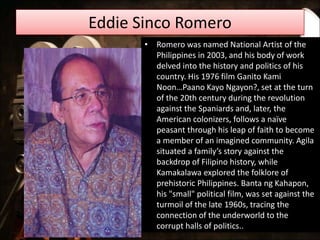
Eddie Sinco Romero
• Romero was named National Artist of the
Philippines in 2003, and his body of work
delved into the history and politics of his
country. His 1976 film Ganito Kami
Noon…Paano Kayo Ngayon?, set at the turn
of the 20th century during the revolution
against the Spaniards and, later, the
American colonizers, follows a naïve
peasant through his leap of faith to become
a member of an imagined community. Agila
situated a family’s story against the
backdrop of Filipino history, while
Kamakalawa explored the folklore of
prehistoric Philippines. Banta ng Kahapon,
his "small" political film, was set against the
turmoil of the late 1960s, tracing the
connection of the underworld to the
corrupt halls of politics..
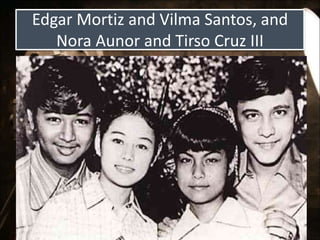
Edgar Mortiz and Vilma Santos, and
Nora Aunor and Tirso Cruz III
1970
• The 1970s saw the emergence of more Visayan talents in
the Tagalog film industry. Actresses such as Chanda
Romero, Caridad Sanchez, Alma Moreno, Tessie Sevilla,
Rebecca Torres, Aurora Villa, Eva de Villa, Rosita
Fernandez, Virgie Postigo, Virgie Solis, Olivia Solis, Cora
Real, Diana Arong, Luz Celeste, Annabelle Rama, Suzette
Ranillo, Lady Ramos, Pilar Pilapil, and others stepped
into the limelight. Male leads (to name a few) were Bert
Nombrado, Ber Lopez, Tony Delgado, Riel Ylaya, Lino
Ramas, Arturo Blanco, Arturo de Castille, Frankie Navaja
Jr, Tony Cruz, Undo Juezan, Felix de Catalina, Arsie Roa,
Warfi Engracia, Kadyo Roma and Romy Kintanar (who is
now a sports commentator).
• In 1972, the Philippines was placed under the
martial law, and films were used as propaganda
vehicles. President Ferdinand Marcos and his
technocrats sought to regulate filmmaking through
the creation of the Board of Censors for Motion
Pictures (BCMP). Prior to the start of filming, a
finished script was required to be submitted to the
Board and incorporate the "ideology" of the New
Society Movement such as, a new sense of
discipline, uprightness and love of country. Annual
festivals were revived, and the Bomba films as well
as political movies critical of the Marcos
administration were banned
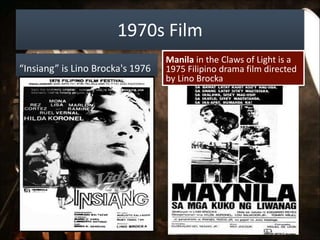
1970s Film
“Insiang” is Lino Brocka's 1976
Manila in the Claws of Light is a
1975 Filipino drama film directed
by Lino Brocka
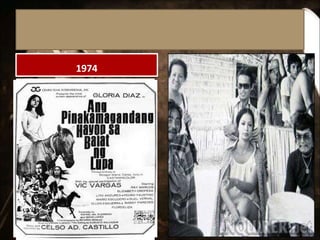
• The notorious genre of sex or bomba films still
existed but in a milder, less overt way like female
stars swimming in their underwear or taking a
bath in their chemise, labeled as the "wet look."
An example of the trend was the 1974 hit movie
Ang Pinakamagandang Hayop sa Balat ng Lupa
(The Most Beautiful Animal on the Face of the
Earth) which featured former Miss Universe
Gloria Díaz and filmed in the famed Sicogon
Island in Carles, Iloilo.
1974
Experimental Cinema of the Philippines
• The Experimental Cinema of the Philippines
(ECP) was a government-owned corporation
of the Republic of the Philippines created to
promote the growth and development of the
local film industry. Created in 1982 after the
first Manila International Film Festival through
Executive Order 770, the ECP was primarily
known as a production company
Experimental Cinema
Himala Oro Plata Mata
Peque Gallaga
• Peque Gallaga (born Maurice
Ruiz de Luzuriaga Gallaga on
August 25, 1943) is a multi-
awarded Filipino film-maker. His
most significant achievement in
film is "Oro, Plata, Mata", which
he directed after winning a
scriptwriting contest sponsored
by the Experimental Cinema of
the Philippines. He has received
an award from the International
Film Festival of Flanders-Ghent,
Belgium in 1983; a Special Jury
Award from the Manila
International Film Festival; and
the 2004 Gawad CCP Para sa
Sining.
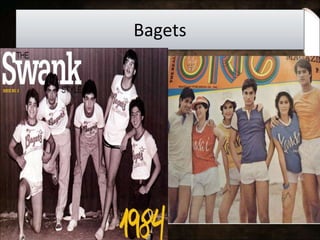
Bagets
80S BIGGIST LOVE TEAM
1980s to 1900
• Around this period, most Filipino films were
mass-produced with quality sacrificed for
commercial success. Story lines were
unimaginative and predictable, comedy was
slapstick, and the acting was either mediocre or
overly dramatic. Producers were antipathetic to
new ideas, or risk-taking. Instead, they resorted
to formulas that worked well in the past that
cater to the standards and tastes of the masses.
Teen-oriented films, massacre movies, and soft
pornographic pictures composed the majority of
the genre produced
1980s Teen
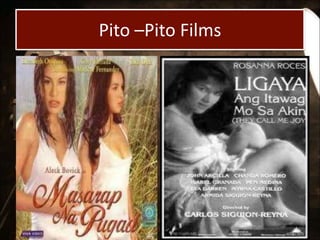
1990 Bomba Films or Pito-Pito Films
• The film industry prospered and produced
more than 200 films a year. Majority of them
were pito-pito films, shot in seven to ten days
and aimed at quickly recouping their minimal
costs. Attendance in theaters rose and several
productions became huge successes. New
laws were also introduced that gave more
rights to women, causing several female
directors to launch careers
Pito –Pito Films
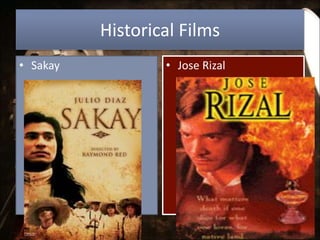
Historical Films
• Sakay • Jose Rizal
Comedy Film
2000's Decline of Movies and
Emergence of Indie Films
• The dawn of this era saw a dramatic decline of the Philippine
movie industry. Hollywood films dominated mainstream
cinema even more, and fewer than twenty quality local films
were being produced and shown yearly. Many producers and
production houses later stopped producing films after losing
millions of pesos. There after, a new sense of excitement and
trend enveloped the industry with the coming of digital and
experimental cinema. Seemingly signalling this was the
winning of the Palme d'Or at the Cannes Film Festival 2000 of
Raymond Red's short film ANINO (Shadows). But truly
pioneering this digital revolution was the 1999 digital feature
film "STILL LIVES" by Jon Red. Many other digital filmmakers
soon followed suit. Cheaper production cost using digital
media over film has helped the rebirth of independent
filmmaking.
Gay theme Films
Philippines in the International Film
circle
• The year 2009 brought the highest
international esteem to a Filipino filmmaker
when Brillante Mendoza was judged as the
Best Director at the 62nd Cannes Film Festival
for his film Kinatay (literally "Butchered"),
about murder and police brutality. The film
was notorious for being critically panned by
Roger Ebert, a distinguished and world-
famous film critic, who declared it the worst
film ever to be shown at the Cannes Film
Festival.
2010s: Commercial Renaissance
• In the year 2009, presence of box-office films in the Philippine Box Office
has surged, with You Changed My Life starring Sarah Geronimo and John
Lloyd Cruz generated ₱230 million, making it the first Filipino movies to
breach the 200 million pesos mark. This started the commercial box office
success trend in the Philippine Cinema.
• In 2011 is the most fruitful year in Philippine Cinema history as 3 of its
films (all from Star Cinema) landed in the top 3 of the highest grossing
Filipino Film of All-Time. Vice Ganda's The Unkabogable Praybeyt
Benjamin grossed ₱331.6 million in box office and became the highest
grossing local film in the Philippines.[65] No Other Woman grossed
₱278.39 million while 2011 Metro Manila Film Festival ("MMFF") entry
Enteng Ng Ina Mo, has a gross income of ₱237.89 million (as of January 7,
2012) and considered as the highest grossing MMFF entry of all time.
However, Sisterakas , a Kris Aquino-Ai Ai delas Alas-Vice Ganda movie,
replaced the title of Enteng ng Ina Mo and the Unkabogable Praybeyt
Benjamin as it became the highest grossing Filipino film and highest
grossing MMFF entry of all time.
Commercial Renaissance
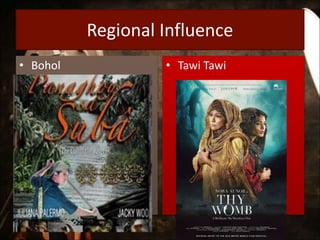
Regional Influence
• Bohol • Tawi Tawi
Pampanga Palawan
Iloilo Dumaguete
Thank you so much

Artapp sphilippinecontemporarycinema aj

  • 1.
  • 2.
  • 3.
    Cinema, or motionpicture, is the art of moving images; a visual medium that tells stories and exposes reality.
  • 4.
  • 5.
    Film, also calleda movie or motion picture, is a series of still or moving images. It is produced by recording photographic images with cameras, or by creating images using animation techniques or visual effects. The process of filmmaking has developed into an art form and industry.
  • 6.
  • 7.
    Movie is asequence of photographs projected onto a screen with sufficient rapidity as to create the illusion of motion and continuity.
  • 8.
  • 9.
    Silent film studiosbecame obsolescent, and new investments had to be made for expensive new equipment, technological innovations, and sound-proofed stages.
  • 10.
    • First Filipinofilmmakers The first film produced by a Filipino is José Nepomuceno's Dalagang Bukid (Country Maiden) in 1919 based on a highly-acclaimed musical play by Hermogenes Ilagan and León Ignacio. Early filmmakers, even with meagre capital, followed some of the genres provided by Hollywood movies. The main sources of movie themes during this period were theatre pieces from popular dramas or zarzuelas. Another source of movie themes at that time was Philippine literature.
  • 11.
    Dalagang Bukid The firstfilm produced by a Filipino is Jose Nepomuceno’s Dalagang Bukid (Country Maiden) in 1919 based on a highly acclaimed musical play by Hermogenes Ilagan and Leon Ignacio.
  • 12.
    1950 • The 1950swas labeled as the first golden age of Philippine cinema. Four big production studios (LVN Pictures, Sampaguita Pictures, Premiere Productions and Lebran International) were at their peak in filmmaking, employing premier directors like Gerardo de León, Eddie Romero and César Gallardo while contracting the biggest stars of that period. The Filipino film industry was one of the busiest and bustling film communities in Asia, releasing an average of 350 films a year making Philippines second to Japan in terms of film productions a year.
  • 13.
    Famous Actors ofthe Golden Cinema FPJ, SUSAN ROCES Amalia Fuentes and Romano Castellvi
  • 14.
  • 15.
    The premier directorsof the era • Lamberto Avellana (1915- 1991) • Gerardo de León (1913- 1981)
  • 16.
  • 17.
    Armando Garces CirioSantiago (1936-2008)
  • 18.
    Post-war Visayan Cinemaand its resurgence • In the Visayas after the second world war, a resurgence of Visayan films came about through Lapu-Lapu Pictures, which produced Timbu Mata (1948), starring Eva de Villa and Lino Ramas and Damgo ni Adan (Adan's Dream), produced by Rudy Robles. Then came Mactan Films which produced Tahas (Mission; 1950), starring Luz Celeste and Dakay; Mat Ranillo was in this film. Then Balud (Wave; 1950) which starred Luz Celeste and Mat Ranillo. Another independent picture, Sa Kabukiran (In the Fields; 1948), was also produced during this time.
  • 19.
    Post War Visayas theCebuano musical Honi sa Gugma (Song of Love), topbilled by Priscilla Cellona and Mat Ranillo who came from Cebu.
  • 20.
    Post War VisayanActors Matt Ranillo Jr. Gloria Sevilla
  • 21.
    Visayan Era • By1951, Azucena Productions was established by the Arong Family (owners of Rene and Liberty Theaters). They produced Princesa Tirana (Princess Tirana), 1951 with Mat Ranillo and Gloria Sevilla (her first feature title role after she was discovered through a declamation contest at the University of the Visayas) as lead players. Their first feature together made such a box office success in the Visayas and Mindanao that other features immediately.
  • 22.
    • followed: Leonora(1951), Pailub Lang (Be Forebearing; 1951), Utlanan(Border; 1952), Handumanan (Memoir; 1953), Inahan (Mother; 1952), starring Mat Ranillo and Caridad Sanchez; Antigan (1952) with Virgie Postigo and Arise Roa; Carmen 1 and 2 (from the famous radio drama in Cebu; 1953), Paabuta Lang Ako (Wait for Me; 1953), Gloria Kong Anak (Gloria My Child; 1953), and Gihigugma Kong Ikaw (I Love You; 1954). Mat and Gloria then became synonymous to Visayan pictures, and since then were called as the King and Queen of Visayan Movies
  • 23.
    Eddie Sinco Romero •Romero was named National Artist of the Philippines in 2003, and his body of work delved into the history and politics of his country. His 1976 film Ganito Kami Noon…Paano Kayo Ngayon?, set at the turn of the 20th century during the revolution against the Spaniards and, later, the American colonizers, follows a naïve peasant through his leap of faith to become a member of an imagined community. Agila situated a family’s story against the backdrop of Filipino history, while Kamakalawa explored the folklore of prehistoric Philippines. Banta ng Kahapon, his "small" political film, was set against the turmoil of the late 1960s, tracing the connection of the underworld to the corrupt halls of politics..
  • 24.
    Edgar Mortiz andVilma Santos, and Nora Aunor and Tirso Cruz III
  • 25.
    1970 • The 1970ssaw the emergence of more Visayan talents in the Tagalog film industry. Actresses such as Chanda Romero, Caridad Sanchez, Alma Moreno, Tessie Sevilla, Rebecca Torres, Aurora Villa, Eva de Villa, Rosita Fernandez, Virgie Postigo, Virgie Solis, Olivia Solis, Cora Real, Diana Arong, Luz Celeste, Annabelle Rama, Suzette Ranillo, Lady Ramos, Pilar Pilapil, and others stepped into the limelight. Male leads (to name a few) were Bert Nombrado, Ber Lopez, Tony Delgado, Riel Ylaya, Lino Ramas, Arturo Blanco, Arturo de Castille, Frankie Navaja Jr, Tony Cruz, Undo Juezan, Felix de Catalina, Arsie Roa, Warfi Engracia, Kadyo Roma and Romy Kintanar (who is now a sports commentator).
  • 26.
    • In 1972,the Philippines was placed under the martial law, and films were used as propaganda vehicles. President Ferdinand Marcos and his technocrats sought to regulate filmmaking through the creation of the Board of Censors for Motion Pictures (BCMP). Prior to the start of filming, a finished script was required to be submitted to the Board and incorporate the "ideology" of the New Society Movement such as, a new sense of discipline, uprightness and love of country. Annual festivals were revived, and the Bomba films as well as political movies critical of the Marcos administration were banned
  • 27.
    1970s Film “Insiang” isLino Brocka's 1976 Manila in the Claws of Light is a 1975 Filipino drama film directed by Lino Brocka
  • 28.
    • The notoriousgenre of sex or bomba films still existed but in a milder, less overt way like female stars swimming in their underwear or taking a bath in their chemise, labeled as the "wet look." An example of the trend was the 1974 hit movie Ang Pinakamagandang Hayop sa Balat ng Lupa (The Most Beautiful Animal on the Face of the Earth) which featured former Miss Universe Gloria Díaz and filmed in the famed Sicogon Island in Carles, Iloilo.
  • 29.
  • 30.
    Experimental Cinema ofthe Philippines • The Experimental Cinema of the Philippines (ECP) was a government-owned corporation of the Republic of the Philippines created to promote the growth and development of the local film industry. Created in 1982 after the first Manila International Film Festival through Executive Order 770, the ECP was primarily known as a production company
  • 31.
  • 32.
    Peque Gallaga • PequeGallaga (born Maurice Ruiz de Luzuriaga Gallaga on August 25, 1943) is a multi- awarded Filipino film-maker. His most significant achievement in film is "Oro, Plata, Mata", which he directed after winning a scriptwriting contest sponsored by the Experimental Cinema of the Philippines. He has received an award from the International Film Festival of Flanders-Ghent, Belgium in 1983; a Special Jury Award from the Manila International Film Festival; and the 2004 Gawad CCP Para sa Sining.
  • 33.
  • 34.
  • 35.
    1980s to 1900 •Around this period, most Filipino films were mass-produced with quality sacrificed for commercial success. Story lines were unimaginative and predictable, comedy was slapstick, and the acting was either mediocre or overly dramatic. Producers were antipathetic to new ideas, or risk-taking. Instead, they resorted to formulas that worked well in the past that cater to the standards and tastes of the masses. Teen-oriented films, massacre movies, and soft pornographic pictures composed the majority of the genre produced
  • 36.
  • 37.
    1990 Bomba Filmsor Pito-Pito Films • The film industry prospered and produced more than 200 films a year. Majority of them were pito-pito films, shot in seven to ten days and aimed at quickly recouping their minimal costs. Attendance in theaters rose and several productions became huge successes. New laws were also introduced that gave more rights to women, causing several female directors to launch careers
  • 38.
  • 39.
  • 40.
  • 41.
    2000's Decline ofMovies and Emergence of Indie Films • The dawn of this era saw a dramatic decline of the Philippine movie industry. Hollywood films dominated mainstream cinema even more, and fewer than twenty quality local films were being produced and shown yearly. Many producers and production houses later stopped producing films after losing millions of pesos. There after, a new sense of excitement and trend enveloped the industry with the coming of digital and experimental cinema. Seemingly signalling this was the winning of the Palme d'Or at the Cannes Film Festival 2000 of Raymond Red's short film ANINO (Shadows). But truly pioneering this digital revolution was the 1999 digital feature film "STILL LIVES" by Jon Red. Many other digital filmmakers soon followed suit. Cheaper production cost using digital media over film has helped the rebirth of independent filmmaking.
  • 42.
  • 43.
    Philippines in theInternational Film circle • The year 2009 brought the highest international esteem to a Filipino filmmaker when Brillante Mendoza was judged as the Best Director at the 62nd Cannes Film Festival for his film Kinatay (literally "Butchered"), about murder and police brutality. The film was notorious for being critically panned by Roger Ebert, a distinguished and world- famous film critic, who declared it the worst film ever to be shown at the Cannes Film Festival.
  • 44.
    2010s: Commercial Renaissance •In the year 2009, presence of box-office films in the Philippine Box Office has surged, with You Changed My Life starring Sarah Geronimo and John Lloyd Cruz generated ₱230 million, making it the first Filipino movies to breach the 200 million pesos mark. This started the commercial box office success trend in the Philippine Cinema. • In 2011 is the most fruitful year in Philippine Cinema history as 3 of its films (all from Star Cinema) landed in the top 3 of the highest grossing Filipino Film of All-Time. Vice Ganda's The Unkabogable Praybeyt Benjamin grossed ₱331.6 million in box office and became the highest grossing local film in the Philippines.[65] No Other Woman grossed ₱278.39 million while 2011 Metro Manila Film Festival ("MMFF") entry Enteng Ng Ina Mo, has a gross income of ₱237.89 million (as of January 7, 2012) and considered as the highest grossing MMFF entry of all time. However, Sisterakas , a Kris Aquino-Ai Ai delas Alas-Vice Ganda movie, replaced the title of Enteng ng Ina Mo and the Unkabogable Praybeyt Benjamin as it became the highest grossing Filipino film and highest grossing MMFF entry of all time.
  • 45.
  • 46.
  • 47.
  • 48.
  • 49.