Copyright © 2006-2011 Marshall Cavendish International (Singapore) Pte. Ltd.
How are electrons arranged in the
atom?
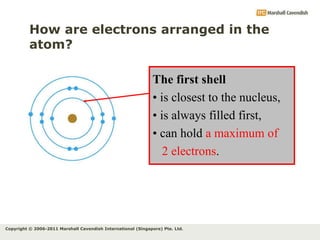
The first shell
• is closest to the nucleus,
• is always filled first,
• can hold a maximum of
2 electrons.
Copyright © 2006-2011 Marshall Cavendish International (Singapore) Pte. Ltd.
How are electrons arranged in the
atom?
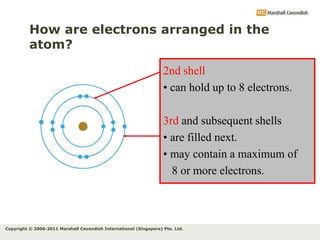
2nd shell
• can hold up to 8 electrons.
3rd and subsequent shells
• are filled next.
• may contain a maximum of
8 or more electrons.
Copyright © 2006-2011 Marshall Cavendish International (Singapore) Pte. Ltd.
Example: A magnesium atom
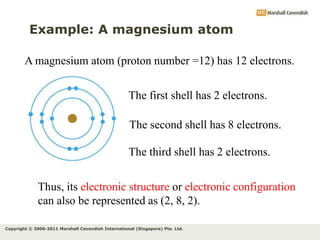
A magnesium atom (proton number =12) has 12 electrons.
The first shell has 2 electrons.
The second shell has 8 electrons.
The third shell has 2 electrons.
Thus, its electronic structure or electronic configuration
can also be represented as (2, 8, 2).
Copyright © 2006-2011 Marshall Cavendish International (Singapore) Pte. Ltd.
What are valence electrons?
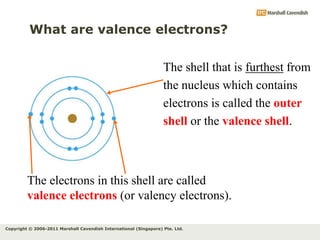
The shell that is furthest from
the nucleus which contains
electrons is called the outer
shell or the valence shell.
The electrons in this shell are called
valence electrons (or valency electrons).
Copyright © 2006-2011 Marshall Cavendish International (Singapore) Pte. Ltd.
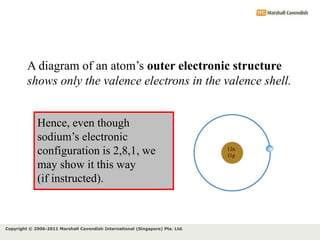
A diagram of an atom’s outer electronic structure
shows only the valence electrons in the valence shell.
Hence, even though
sodium’s electronic
configuration is 2,8,1, we
may show it this way
(if instructed).
12n
11p
Copyright © 2006-2011 Marshall Cavendish International (Singapore) Pte. Ltd.
The Importance of Valence Electrons
The chemical properties of an element
depend on the number of valence electrons.
For example, sodium (2, 8, 1) and potassium (2, 8, 8, 1)
have similar chemical properties
because in each case there is 1 electron in the outer shell.
Copyright © 2006-2011 Marshall Cavendish International (Singapore) Pte. Ltd.
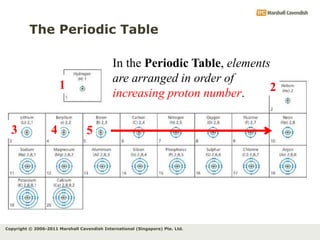
The Periodic Table
In the Periodic Table, elements
are arranged in order of
increasing proton number.
1 2
3 4 5
Copyright © 2006-2011 Marshall Cavendish International (Singapore) Pte. Ltd.
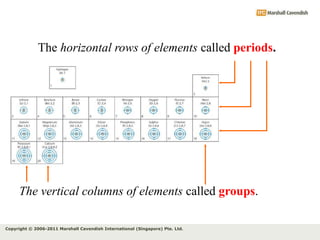
The vertical columns of elements called groups.
The horizontal rows of elements called periods.
Copyright © 2006-2011 Marshall Cavendish International (Singapore) Pte. Ltd.
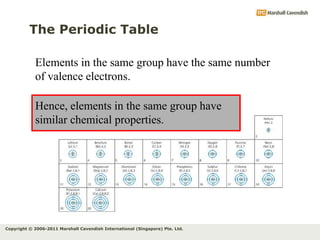
The Periodic Table
Elements in the same group have the same number
of valence electrons.
Hence, elements in the same group have
similar chemical properties.
Arrangement and Periodic Table.ppt

  • 1.
    Copyright © 2006-2011Marshall Cavendish International (Singapore) Pte. Ltd. How are electrons arranged in the atom? The first shell • is closest to the nucleus, • is always filled first, • can hold a maximum of 2 electrons.
  • 2.
    Copyright © 2006-2011Marshall Cavendish International (Singapore) Pte. Ltd. How are electrons arranged in the atom? 2nd shell • can hold up to 8 electrons. 3rd and subsequent shells • are filled next. • may contain a maximum of 8 or more electrons.
  • 3.
    Copyright © 2006-2011Marshall Cavendish International (Singapore) Pte. Ltd. Example: A magnesium atom A magnesium atom (proton number =12) has 12 electrons. The first shell has 2 electrons. The second shell has 8 electrons. The third shell has 2 electrons. Thus, its electronic structure or electronic configuration can also be represented as (2, 8, 2).
  • 4.
    Copyright © 2006-2011Marshall Cavendish International (Singapore) Pte. Ltd. What are valence electrons? The shell that is furthest from the nucleus which contains electrons is called the outer shell or the valence shell. The electrons in this shell are called valence electrons (or valency electrons).
  • 5.
    Copyright © 2006-2011Marshall Cavendish International (Singapore) Pte. Ltd. A diagram of an atom’s outer electronic structure shows only the valence electrons in the valence shell. Hence, even though sodium’s electronic configuration is 2,8,1, we may show it this way (if instructed). 12n 11p
  • 6.
    Copyright © 2006-2011Marshall Cavendish International (Singapore) Pte. Ltd. The Importance of Valence Electrons The chemical properties of an element depend on the number of valence electrons. For example, sodium (2, 8, 1) and potassium (2, 8, 8, 1) have similar chemical properties because in each case there is 1 electron in the outer shell.
  • 7.
    Copyright © 2006-2011Marshall Cavendish International (Singapore) Pte. Ltd. The Periodic Table In the Periodic Table, elements are arranged in order of increasing proton number. 1 2 3 4 5
  • 8.
    Copyright © 2006-2011Marshall Cavendish International (Singapore) Pte. Ltd. The vertical columns of elements called groups. The horizontal rows of elements called periods.
  • 9.
    Copyright © 2006-2011Marshall Cavendish International (Singapore) Pte. Ltd. The Periodic Table Elements in the same group have the same number of valence electrons. Hence, elements in the same group have similar chemical properties.