ANTIFUNGAL ACTIVITY OF BACTERIAL
DERIVER FROM SILVERNANOPARTICLES
AGAINST CAUSING GUVA WILT CAUSING
FUSARIUM SP.
BY
G.ARJUN
II M.Sc. Applied Microbiology
Sacred Heart College (Autonomous)
Tirupattur.
INTRODUCTION
Plant disease result in an annual estimate loss of 10 to 15% of the world major crop
with direct economic losses of up to hundred of billion of dollars. Of these disease
70 to 80 % cause by pathogenic fungi. Plant pathogenic fungi have adverse effect
on crop growth and yield. Silver nanoparticles synthesised from bacterial are
applied to agriculture showing good potential result agianst insects, fungi, bacterial,
and viruses. Fusarium species are important plant pathogens causing various diseases
such as crown rot, head blight, and scab on cereal grains (72), and they may
occasionally cause infection in animals (32).
AIM
 To analyze the antifungal efficacy of biosynthesized silver
nanoparticles against Gauva wilt causing Fusarium sp.
OBJECTIVES
 To isolate Phytopathogenic fungi from Psidium guajava tree
 • To Identify isolated fungi using Morphological and Microscopic observation.
 • To perform Preliminary Screening for Silver nanoparticles by collected bacteria.
 • To synthesize Silver Nanoparticles Extracellularly from the potent bacterium.
 • To characterize the synthesized Silver Nanoparticles.
 • To perform antifungal activity of synthesized Silver Nanoparticles against
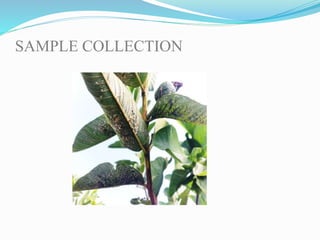
SAMPLE COLLECTION
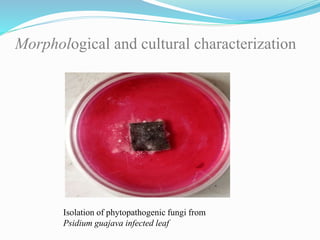
Morphological and cultural characterization
Isolation of phytopathogenic fungi from
Psidium guajava infected leaf
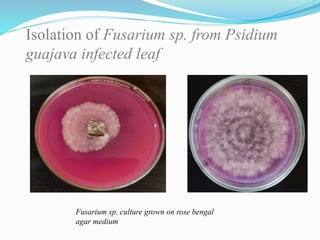
Fusarium sp. culture grown on rose bengal
agar medium
Isolation of Fusarium sp. from Psidium
guajava infected leaf
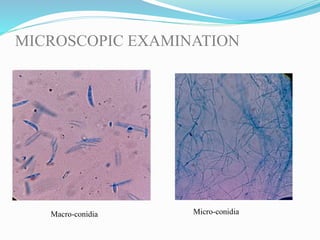
MICROSCOPIC EXAMINATION
Macro-conidia Micro-conidia
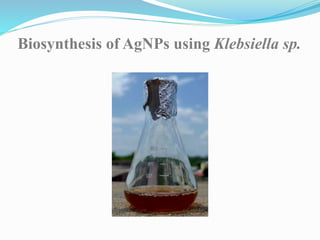
Biosynthesis of AgNPs using Klebsiella sp.
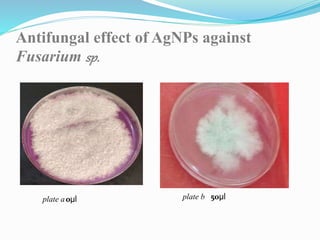
0µl 50µl
Antifungal effect of AgNPs against
Fusarium sp.
plate a plate b
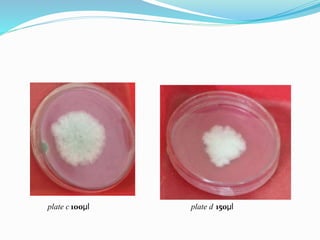
100µl 150µl
plate c plate d
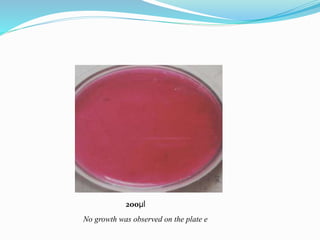
200µl
No growth was observed on the plate e
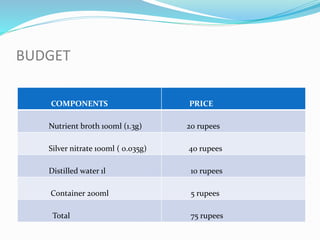
BUDGET
COMPONENTS PRICE
Nutrient broth 100ml (1.3g) 20 rupees
Silver nitrate 100ml ( 0.035g) 40 rupees
Distilled water 1l 10 rupees
Container 200ml 5 rupees
Total 75 rupees
RESULT
 The antifungal effect of AgNPs against Fusarium sp. was then performed in
concentration dependant manner. Compared to the control group (no silver
nanoparticles), the growth of Fusarium sp. was obviously inhibited by the
silver nanoparticles in a concentration-dependent manner. The size of the
colonies decreased with the increasing concentration of silver
nanoparticles. When the concentration of silver nanoparticles was 200 μl,
no growth was observed on the plate but when the concentration was 50 μl,
the silver nanoparticles showed no inhibitory effect on colony growth. This
silvernanoparticles in our study showed positive inhibitory effect against
Fusarium sp.
ARJUN PPT.pptx

ARJUN PPT.pptx

  • 2.
    ANTIFUNGAL ACTIVITY OFBACTERIAL DERIVER FROM SILVERNANOPARTICLES AGAINST CAUSING GUVA WILT CAUSING FUSARIUM SP. BY G.ARJUN II M.Sc. Applied Microbiology Sacred Heart College (Autonomous) Tirupattur.
  • 3.
    INTRODUCTION Plant disease resultin an annual estimate loss of 10 to 15% of the world major crop with direct economic losses of up to hundred of billion of dollars. Of these disease 70 to 80 % cause by pathogenic fungi. Plant pathogenic fungi have adverse effect on crop growth and yield. Silver nanoparticles synthesised from bacterial are applied to agriculture showing good potential result agianst insects, fungi, bacterial, and viruses. Fusarium species are important plant pathogens causing various diseases such as crown rot, head blight, and scab on cereal grains (72), and they may occasionally cause infection in animals (32).
  • 4.
    AIM  To analyzethe antifungal efficacy of biosynthesized silver nanoparticles against Gauva wilt causing Fusarium sp.
  • 5.
    OBJECTIVES  To isolatePhytopathogenic fungi from Psidium guajava tree  • To Identify isolated fungi using Morphological and Microscopic observation.  • To perform Preliminary Screening for Silver nanoparticles by collected bacteria.  • To synthesize Silver Nanoparticles Extracellularly from the potent bacterium.  • To characterize the synthesized Silver Nanoparticles.  • To perform antifungal activity of synthesized Silver Nanoparticles against
  • 6.
  • 7.
    Morphological and culturalcharacterization Isolation of phytopathogenic fungi from Psidium guajava infected leaf
  • 8.
    Fusarium sp. culturegrown on rose bengal agar medium Isolation of Fusarium sp. from Psidium guajava infected leaf
  • 9.
  • 10.
    Biosynthesis of AgNPsusing Klebsiella sp.
  • 11.
    0µl 50µl Antifungal effectof AgNPs against Fusarium sp. plate a plate b
  • 12.
  • 13.
    200µl No growth wasobserved on the plate e
  • 14.
    BUDGET COMPONENTS PRICE Nutrient broth100ml (1.3g) 20 rupees Silver nitrate 100ml ( 0.035g) 40 rupees Distilled water 1l 10 rupees Container 200ml 5 rupees Total 75 rupees
  • 15.
    RESULT  The antifungaleffect of AgNPs against Fusarium sp. was then performed in concentration dependant manner. Compared to the control group (no silver nanoparticles), the growth of Fusarium sp. was obviously inhibited by the silver nanoparticles in a concentration-dependent manner. The size of the colonies decreased with the increasing concentration of silver nanoparticles. When the concentration of silver nanoparticles was 200 μl, no growth was observed on the plate but when the concentration was 50 μl, the silver nanoparticles showed no inhibitory effect on colony growth. This silvernanoparticles in our study showed positive inhibitory effect against Fusarium sp.