Are You Content Because You Don't Know? Your Competitor Isn't. Page 1 of 3
Are You Content Because You Don't Know? Your Competitor Isn't.
Humberto N. Stevens/J. Nelson Company, October 25, 2016
What is the average age of your customer? Who are they and what is their impact to your business?
What can you do to mitigate existing or potential losses? These are questions you have either already
looked into, been contemplating or never thought about. If you represent the latter, you represent an
unfortunate portion of small businesses and large corporations out there. That said, your competitor might
be the one already working to take your existing market share and the opportunity you ignored.
Is your market share represented most by the "BABY BOOMER"
population? That's great if your business exists to service the many
thriving retiree communities or needs; however, if you are not then you
might seriously think about this: You must find alternatives to mitigate
possible losses.
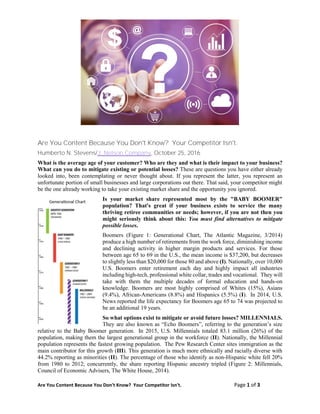
Boomers (Figure 1: Generational Chart, The Atlantic Magazine, 3/2014)
produce a high number of retirements from the work force, diminishing income
and declining activity in higher margin products and services. For those
between age 65 to 69 in the U.S., the mean income is $37,200, but decreases
to slightly less than $20,000 for those 80 and above (I). Nationally, over 10,000
U.S. Boomers enter retirement each day and highly impact all industries
including high-tech, professional white collar, trades and vocational. They will
take with them the multiple decades of formal education and hands-on
knowledge. Boomers are most highly comprised of Whites (15%), Asians
(9.4%), African-Americans (8.8%) and Hispanics (5.5%) (I). In 2014, U.S.
News reported the life expectancy for Boomers age 65 to 74 was projected to
be an additional 19 years.
So what options exist to mitigate or avoid future losses? MILLENNIALS.
They are also known as “Echo Boomers”, referring to the generation’s size
relative to the Baby Boomer generation. In 2015, U.S. Millennials totaled 83.1 million (26%) of the
population, making them the largest generational group in the workforce (II). Nationally, the Millennial
population represents the fastest growing population. The Pew Research Center sites immigration as the
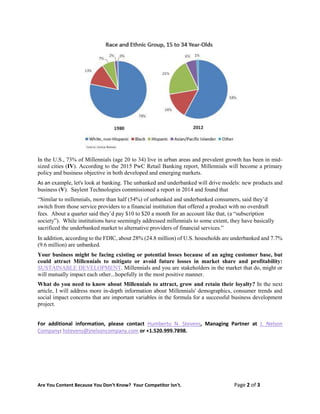
main contributor for this growth (III). This generation is much more ethnically and racially diverse with
44.2% reporting as minorities (II). The percentage of those who identify as non-Hispanic white fell 20%
from 1980 to 2012; concurrently, the share reporting Hispanic ancestry tripled (Figure 2: Millennials,
Council of Economic Advisers, The White House, 2014).
Are You Content Because You Don't Know? Your Competitor Isn't. Page 2 of 3
In the U.S., 73% of Millennials (age 20 to 34) live in urban areas and prevalent growth has been in mid-
sized cities (IV). According to the 2015 PwC Retail Banking report, Millennials will become a primary
policy and business objective in both developed and emerging markets.
As an example, let's look at banking. The unbanked and underbanked will drive models: new products and
business (V). Saylent Technologies commissioned a report in 2014 and found that
“Similar to millennials, more than half (54%) of unbanked and underbanked consumers, said they’d
switch from those service providers to a financial institution that offered a product with no overdraft
fees. About a quarter said they’d pay $10 to $20 a month for an account like that, (a “subscription
society”). While institutions have seemingly addressed millennials to some extent, they have basically
sacrificed the underbanked market to alternative providers of financial services.”
In addition, according to the FDIC, about 28% (24.8 million) of U.S. households are underbanked and 7.7%
(9.6 million) are unbanked.
Your business might be facing existing or potential losses because of an aging customer base, but
could attract Millennials to mitigate or avoid future losses in market share and profitability:
SUSTAINABLE DEVELOPMENT. Millennials and you are stakeholders in the market that do, might or
will mutually impact each other...hopefully in the most positive manner.
What do you need to know about Millennials to attract, grow and retain their loyalty? In the next
article, I will address more in-depth information about Millennials' demographics, consumer trends and
social impact concerns that are important variables in the formula for a successful business development
project.
For additional information, please contact Humberto N. Stevens, Managing Partner at J. Nelson
Company: hstevens@jnelsoncompany.com or +1.520.999.7898.
Are You Content Because You Don't Know? Your Competitor Isn't. Page 3 of 3
ENDNOTES
I. U.S. News: 12 Baby Boomer Retirement Trends, On Retirement Blog (7/22/2014)
II. U.S. Census Bureau: Millennials Outnumber Baby Boomers and Are Far More Diverse (6/25/2015)
III. Pew Research Center: Millennials surpass Gen Xers as the largest generation in U.S. labor force
(5/11/2015)
IV. Council of Economic Advisers, The White House: Millennials (2014), Council of Economic Advisers, The
White House: Millennials (2014)
V. Credit Union Times: Slash Fees to Win Over Millennials, Underbanked (5/13/2015)
VI. Destinationcrm.com: Financial Institutions Should Bank on Knowing Their Customers (9/8/2015)

Are You Content...Your Competitor Isn't

  • 1.
    Are You ContentBecause You Don't Know? Your Competitor Isn't. Page 1 of 3 Are You Content Because You Don't Know? Your Competitor Isn't. Humberto N. Stevens/J. Nelson Company, October 25, 2016 What is the average age of your customer? Who are they and what is their impact to your business? What can you do to mitigate existing or potential losses? These are questions you have either already looked into, been contemplating or never thought about. If you represent the latter, you represent an unfortunate portion of small businesses and large corporations out there. That said, your competitor might be the one already working to take your existing market share and the opportunity you ignored. Is your market share represented most by the "BABY BOOMER" population? That's great if your business exists to service the many thriving retiree communities or needs; however, if you are not then you might seriously think about this: You must find alternatives to mitigate possible losses. Boomers (Figure 1: Generational Chart, The Atlantic Magazine, 3/2014) produce a high number of retirements from the work force, diminishing income and declining activity in higher margin products and services. For those between age 65 to 69 in the U.S., the mean income is $37,200, but decreases to slightly less than $20,000 for those 80 and above (I). Nationally, over 10,000 U.S. Boomers enter retirement each day and highly impact all industries including high-tech, professional white collar, trades and vocational. They will take with them the multiple decades of formal education and hands-on knowledge. Boomers are most highly comprised of Whites (15%), Asians (9.4%), African-Americans (8.8%) and Hispanics (5.5%) (I). In 2014, U.S. News reported the life expectancy for Boomers age 65 to 74 was projected to be an additional 19 years. So what options exist to mitigate or avoid future losses? MILLENNIALS. They are also known as “Echo Boomers”, referring to the generation’s size relative to the Baby Boomer generation. In 2015, U.S. Millennials totaled 83.1 million (26%) of the population, making them the largest generational group in the workforce (II). Nationally, the Millennial population represents the fastest growing population. The Pew Research Center sites immigration as the main contributor for this growth (III). This generation is much more ethnically and racially diverse with 44.2% reporting as minorities (II). The percentage of those who identify as non-Hispanic white fell 20% from 1980 to 2012; concurrently, the share reporting Hispanic ancestry tripled (Figure 2: Millennials, Council of Economic Advisers, The White House, 2014).
  • 2.
    Are You ContentBecause You Don't Know? Your Competitor Isn't. Page 2 of 3 In the U.S., 73% of Millennials (age 20 to 34) live in urban areas and prevalent growth has been in mid- sized cities (IV). According to the 2015 PwC Retail Banking report, Millennials will become a primary policy and business objective in both developed and emerging markets. As an example, let's look at banking. The unbanked and underbanked will drive models: new products and business (V). Saylent Technologies commissioned a report in 2014 and found that “Similar to millennials, more than half (54%) of unbanked and underbanked consumers, said they’d switch from those service providers to a financial institution that offered a product with no overdraft fees. About a quarter said they’d pay $10 to $20 a month for an account like that, (a “subscription society”). While institutions have seemingly addressed millennials to some extent, they have basically sacrificed the underbanked market to alternative providers of financial services.” In addition, according to the FDIC, about 28% (24.8 million) of U.S. households are underbanked and 7.7% (9.6 million) are unbanked. Your business might be facing existing or potential losses because of an aging customer base, but could attract Millennials to mitigate or avoid future losses in market share and profitability: SUSTAINABLE DEVELOPMENT. Millennials and you are stakeholders in the market that do, might or will mutually impact each other...hopefully in the most positive manner. What do you need to know about Millennials to attract, grow and retain their loyalty? In the next article, I will address more in-depth information about Millennials' demographics, consumer trends and social impact concerns that are important variables in the formula for a successful business development project. For additional information, please contact Humberto N. Stevens, Managing Partner at J. Nelson Company: hstevens@jnelsoncompany.com or +1.520.999.7898.
  • 3.
    Are You ContentBecause You Don't Know? Your Competitor Isn't. Page 3 of 3 ENDNOTES I. U.S. News: 12 Baby Boomer Retirement Trends, On Retirement Blog (7/22/2014) II. U.S. Census Bureau: Millennials Outnumber Baby Boomers and Are Far More Diverse (6/25/2015) III. Pew Research Center: Millennials surpass Gen Xers as the largest generation in U.S. labor force (5/11/2015) IV. Council of Economic Advisers, The White House: Millennials (2014), Council of Economic Advisers, The White House: Millennials (2014) V. Credit Union Times: Slash Fees to Win Over Millennials, Underbanked (5/13/2015) VI. Destinationcrm.com: Financial Institutions Should Bank on Knowing Their Customers (9/8/2015)