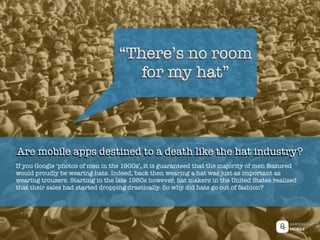
If you Google ‘photos of men in the 1900s’, it is guaranteed that the majority of men featured
would proudly be wearing hats. Indeed, back then wearing a hat was just as important as
wearing trousers. Starting in the late 1960s however, hat makers in the United States realised
that their sales had started dropping drastically. So why did hats go out of fashion?
Are mobile apps destined to a death like the hat industry?
“There’s no room
for my hat”
It turns out the decline of hats had nothing
to do with the hat industry at all, but the
new industries that were taking off around
them. It was very simple. People stopped
wearing hats because they didn’t need to go
out as much. They called each other
instead. And when they did go out, the
headroom in their cars wasn’t high enough
to keep their hats on, so they didn’t bring
hats with them anymore. As adoption rates
for direct phone lines, the telegram and the
personal car increased, men stopped
needing hats and so they stopped buying
them. By the time hat manufacturers
realised that there was a definite relation
between the sale of hats and the new
communication media, a lot of hat making
companies went out of business.
So why did hats go out
of fashion?
Fast forward to early 2015 and we can see the same thing starting to happen in
the mobile app industry. Despite there being a predicted 2.5 billion smartphone
users by the close of the year, and there being an app for everything, brand
engagement via mobile apps is still confusingly low. We suspect that brands still
don’t quite understand how to use the mobile channel to full effect, and
commissioned a piece of consumer research to see why:
Will Mobile Apps
Face the Same Fate?
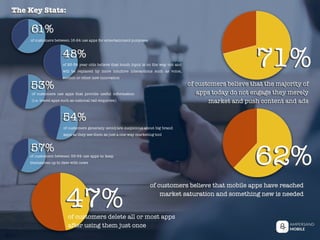
of 25-34 year olds believe that touch input is on the way out and
will be replaced by more intuitive interactions such as voice,
motion or other new innovation
48%
53%
of customers use apps that provide useful information
(i.e. travel apps such as national rail enquiries)
of customers generally avoid/are suspicious about big brand
apps as they see them as just a one-way marketing tool
54%
57%
of customers between 55-64 use apps to keep
themselves up to date with news 62%
71%
of customers believe that the majority of
apps today do not engage they merely
market and push content and ads
of customers believe that mobile apps have reached
market saturation and something new is needed
61%
of customers between 16-24 use apps for entertainment purposes
47%of customers delete all or most apps
after using them just once
The Key Stats:
Most marketers are still trying to interact with mobile consumers
the way they once did with desktop consumers – which is akin to
selling hats to those guys sitting in the offices around their desk
phones and fax machines. In the last decade, the whole fabric of
communication has changed. Consumption is not primarily
happening in ‘free time’, but throughout the day due to the
portable, ‘always on’ nature of mobile phones. Add location into
the mix and what you consume and why you consume it is going
to be very different when you’re sitting at home around a desktop
computer than when you’re travelling from work to drinks with a
mobile phone.
Now add device inter-operability and the Internet of Things into
the same mix and what you are now getting is an even more
complex picture. Gone are the days when free time meant
spending a few minutes trying to connect on dial-up and then
clicking on blinking banner ads on Yahoo.com. Now, as soon as you
get home, interacting with your smartphone could mean watching
something on your 32-inch television, turning on your shower or
glancing at the data collected by your wearable device.
Where is it All Going Wrong?
Why has mobile engagement become so bland? Possibly because
marketers don’t fully understand the main reason why users are looking
at their screens in the first place. Getting the mobile mindset is crucial
here: customers want quick, simple, relevant and elegant. Mobile real
estate is scarce. Attention span is short. Battery life is precious. One tap
or one scroll: that is what real mobility is about.
At the same time, don’t forget that our mobile phones are the most
intimate devices we own and through which most personal
communications happen. If you are thinking generic, above the line
marketing communications, do not think mobile. Just because your
brand advertising has established your tone of voice it doesn’t mean that
your users will regard your brand the same way on the mobile channel.
Why still operate a “push” strategy in a “pull” environment? Why spend
precious marketing dollars to get your users onboard never to see any
activity from them again? As the most engaging interactions on mobile
are between people and people, think about your brand personality on
mobile as you do about your personal brand. Think Richard Branson
communicating 24/7 with Virgin customers on social media. Your mobile
brand is as memorable and captivating as your intelligence, your sense
of humour or your quirkiness.
In a Nutshell...What Can Brands Do?
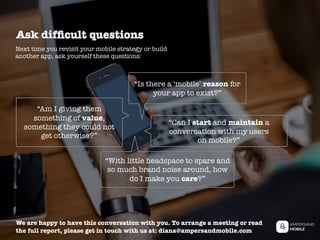
Next time you revisit your mobile strategy or build
another app, ask yourself these questions:
Ask difficult questions
We are happy to have this conversation with you. To arrange a meeting or read
the full report, please get in touch with us at: diana@ampersandmobile.com
“Is there a ‘mobile’ reason for
your app to exist?”
“Can I start and maintain a
conversation with my users
on mobile?”
“Am I giving them
something of value,
something they could not
get otherwise?”
“With little headspace to spare and
so much brand noise around, how
do I make you care?”

Are branded apps dead?

  • 1.
    If you Google‘photos of men in the 1900s’, it is guaranteed that the majority of men featured would proudly be wearing hats. Indeed, back then wearing a hat was just as important as wearing trousers. Starting in the late 1960s however, hat makers in the United States realised that their sales had started dropping drastically. So why did hats go out of fashion? Are mobile apps destined to a death like the hat industry? “There’s no room for my hat”
  • 2.
    It turns outthe decline of hats had nothing to do with the hat industry at all, but the new industries that were taking off around them. It was very simple. People stopped wearing hats because they didn’t need to go out as much. They called each other instead. And when they did go out, the headroom in their cars wasn’t high enough to keep their hats on, so they didn’t bring hats with them anymore. As adoption rates for direct phone lines, the telegram and the personal car increased, men stopped needing hats and so they stopped buying them. By the time hat manufacturers realised that there was a definite relation between the sale of hats and the new communication media, a lot of hat making companies went out of business. So why did hats go out of fashion?
  • 3.
    Fast forward toearly 2015 and we can see the same thing starting to happen in the mobile app industry. Despite there being a predicted 2.5 billion smartphone users by the close of the year, and there being an app for everything, brand engagement via mobile apps is still confusingly low. We suspect that brands still don’t quite understand how to use the mobile channel to full effect, and commissioned a piece of consumer research to see why: Will Mobile Apps Face the Same Fate?
  • 4.
    of 25-34 yearolds believe that touch input is on the way out and will be replaced by more intuitive interactions such as voice, motion or other new innovation 48% 53% of customers use apps that provide useful information (i.e. travel apps such as national rail enquiries) of customers generally avoid/are suspicious about big brand apps as they see them as just a one-way marketing tool 54% 57% of customers between 55-64 use apps to keep themselves up to date with news 62% 71% of customers believe that the majority of apps today do not engage they merely market and push content and ads of customers believe that mobile apps have reached market saturation and something new is needed 61% of customers between 16-24 use apps for entertainment purposes 47%of customers delete all or most apps after using them just once The Key Stats:
  • 5.
    Most marketers arestill trying to interact with mobile consumers the way they once did with desktop consumers – which is akin to selling hats to those guys sitting in the offices around their desk phones and fax machines. In the last decade, the whole fabric of communication has changed. Consumption is not primarily happening in ‘free time’, but throughout the day due to the portable, ‘always on’ nature of mobile phones. Add location into the mix and what you consume and why you consume it is going to be very different when you’re sitting at home around a desktop computer than when you’re travelling from work to drinks with a mobile phone. Now add device inter-operability and the Internet of Things into the same mix and what you are now getting is an even more complex picture. Gone are the days when free time meant spending a few minutes trying to connect on dial-up and then clicking on blinking banner ads on Yahoo.com. Now, as soon as you get home, interacting with your smartphone could mean watching something on your 32-inch television, turning on your shower or glancing at the data collected by your wearable device. Where is it All Going Wrong?
  • 6.
    Why has mobileengagement become so bland? Possibly because marketers don’t fully understand the main reason why users are looking at their screens in the first place. Getting the mobile mindset is crucial here: customers want quick, simple, relevant and elegant. Mobile real estate is scarce. Attention span is short. Battery life is precious. One tap or one scroll: that is what real mobility is about. At the same time, don’t forget that our mobile phones are the most intimate devices we own and through which most personal communications happen. If you are thinking generic, above the line marketing communications, do not think mobile. Just because your brand advertising has established your tone of voice it doesn’t mean that your users will regard your brand the same way on the mobile channel. Why still operate a “push” strategy in a “pull” environment? Why spend precious marketing dollars to get your users onboard never to see any activity from them again? As the most engaging interactions on mobile are between people and people, think about your brand personality on mobile as you do about your personal brand. Think Richard Branson communicating 24/7 with Virgin customers on social media. Your mobile brand is as memorable and captivating as your intelligence, your sense of humour or your quirkiness. In a Nutshell...What Can Brands Do?
  • 7.
    Next time yourevisit your mobile strategy or build another app, ask yourself these questions: Ask difficult questions We are happy to have this conversation with you. To arrange a meeting or read the full report, please get in touch with us at: diana@ampersandmobile.com “Is there a ‘mobile’ reason for your app to exist?” “Can I start and maintain a conversation with my users on mobile?” “Am I giving them something of value, something they could not get otherwise?” “With little headspace to spare and so much brand noise around, how do I make you care?”