Architectural Innovation
Erandika lak
mali
Thilini Daush
What is an innovation?
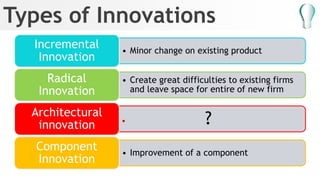
Types of Innovations
• Minor change on existing product
Incremental
Innovation
• Create great difficulties to existing firms
and leave space for entire of new firm
Radical
Innovation
• ?
Architectural
innovation
• Improvement of a component
Component
Innovation
What is an Architecture?
“The style of design and method of construction of buildings a
nd
other physical structures”
(Shorter Oxford English Dictionary ,1993)
• Innovation of an architecture of any product that
changes or modifies
the way various components of the systems link or rel
ate to each other
• However, the key technologies at the component le
vel remain unchanged
• Changing the overall design of the system or the wa
y the components
interact Materials
• The new components can be introduced
Architectural Innovation
Features
Change the way in which the components of a product are
linked together
Leave the core design concepts untouched
Basic knowledge underlying the components are not changed
Firm knows is useful
Need Architectural knowledge: knowledge about the ways in
which the components are integrated and linked together into a
coherent whole
Sometimes destroys the usefulness of a firm's architectural
knowledge but preserves the usefulness of its knowledge about
the product's components
Examples
Digital Desktop photocopier
– Compact
– Can fit in any small office
– Multifunctional
– Can do several tasks
– Before the desktop photocopiers,
there were stand-alone photocopiers. A stand-
alone photocopier is a single unit dedicated to
copying functions.
– Now small businesses do not need extra sp
ace for
photocopying
– Desktop photocopiers are an architectural
shift of the
stand-alone photocopiers
Multi-core Processor
– Combined circuit that two or more proc
essors have been connected
– Enhanced performance
– Low power performance
– More efficient in processing multi-tasks.
– Reach the maximum physical limits poss
ible in terms of speed and complexity.
– architectural shift of single-core proces
sor to the multi-core processor.
Drawbacks
Information about architectural innovation need to be
screened out by information filters
Rely on old beliefs about the world that a rational
evaluation of new information should lead them to
discard
Switch to a new mode of learning and then invest
time and resources in learning about the new
architecture is hard
Usually takes time-Embedded in channels, filters, and
strategies, the discovery process and the process of
creating new information (and rooting out the old)
Benefits for Organizations
Improve commun
ication between
different
business units of
the
organization
Improve the cap
ability
to attack big
companies
Preserves usefu
lness of compan
y’s product com
ponent knowled
ge
Develop an eff
ective
intra-firm kno
wledge transfe
r system to
excel R&D
Help to exit fr
om old
technology str
ucture & conce
pt of product
& process
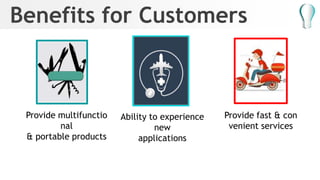
Benefits for Customers
Provide multifunctio
nal
& portable products
Provide fast & con
venient services
Ability to experience
new
applications
Thank You

Architectural Innovation.pptx

  • 1.
  • 2.
    What is aninnovation?
  • 3.
    Types of Innovations •Minor change on existing product Incremental Innovation • Create great difficulties to existing firms and leave space for entire of new firm Radical Innovation • ? Architectural innovation • Improvement of a component Component Innovation
  • 4.
    What is anArchitecture? “The style of design and method of construction of buildings a nd other physical structures” (Shorter Oxford English Dictionary ,1993)
  • 5.
    • Innovation ofan architecture of any product that changes or modifies the way various components of the systems link or rel ate to each other • However, the key technologies at the component le vel remain unchanged • Changing the overall design of the system or the wa y the components interact Materials • The new components can be introduced Architectural Innovation
  • 6.
    Features Change the wayin which the components of a product are linked together Leave the core design concepts untouched Basic knowledge underlying the components are not changed Firm knows is useful Need Architectural knowledge: knowledge about the ways in which the components are integrated and linked together into a coherent whole Sometimes destroys the usefulness of a firm's architectural knowledge but preserves the usefulness of its knowledge about the product's components
  • 7.
    Examples Digital Desktop photocopier –Compact – Can fit in any small office – Multifunctional – Can do several tasks – Before the desktop photocopiers, there were stand-alone photocopiers. A stand- alone photocopier is a single unit dedicated to copying functions. – Now small businesses do not need extra sp ace for photocopying – Desktop photocopiers are an architectural shift of the stand-alone photocopiers Multi-core Processor – Combined circuit that two or more proc essors have been connected – Enhanced performance – Low power performance – More efficient in processing multi-tasks. – Reach the maximum physical limits poss ible in terms of speed and complexity. – architectural shift of single-core proces sor to the multi-core processor.
  • 8.
    Drawbacks Information about architecturalinnovation need to be screened out by information filters Rely on old beliefs about the world that a rational evaluation of new information should lead them to discard Switch to a new mode of learning and then invest time and resources in learning about the new architecture is hard Usually takes time-Embedded in channels, filters, and strategies, the discovery process and the process of creating new information (and rooting out the old)
  • 9.
    Benefits for Organizations Improvecommun ication between different business units of the organization Improve the cap ability to attack big companies Preserves usefu lness of compan y’s product com ponent knowled ge Develop an eff ective intra-firm kno wledge transfe r system to excel R&D Help to exit fr om old technology str ucture & conce pt of product & process
  • 10.
    Benefits for Customers Providemultifunctio nal & portable products Provide fast & con venient services Ability to experience new applications
  • 11.

Editor's Notes

  • #3 The process of translating an idea or invention into a good or service that creates value or for which customers will pay
  • #4 The process of translating an idea or invention into a good or service that creates value or for which customers will pay
  • #10 Samsung manufacturing of Integrated Chips (IC) ,encourage expert’s opinion at all levels i.e. from junior staff and engineers to senior executives. mobile related product business has strong integration with other business units like Telecommunications network divisions, Digital media divisions, Consumer electronics division and Semiconduc or divisions. 2) Samsung maintains a comprehensive database containing detailed information from development and production processes 3) simply taking the lessons, skills and overall technology and applying them within a different market.   This innovation is amazing at increasing new customers 4) helps to exit from the old technology structure and concept of product and process, which helps to influence technical development as well as open up new possibilities in linkages to market and customers
  • #11 safety of aircraft cushions.  They succeeded by creating a new type of foam, which reacts to the pressure applied to it, yet magically forms back to its original shape.    medical equipment table pads and sports equipment, before having larger success as use in mattresses.   This “slow spring back foam” technology falls under architectural innovation.  It is commonly known as memory foam.