`
1 | P a g e
SCHOOL OF ARCHITECTURE, BUILDING & DESIGN
Modern Architecture Studies in Southeast Asia (MASSA) Research Unit
Bachelor of Science (Honours) in Architecture
ARCHITECTURE DESIGN STUDIO 1 [ARC 60105]
Project 2: Self Expression through Architectural Space’ Furnitecture’
Project 2 Group (of 6-8 members)
LO
1,2,3,
5
30% of
total mark
Verbal
presentation
A3 panels + study
models+ 1:1 model
installation
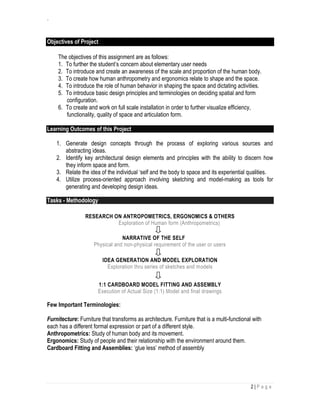
Introduction
The main aim of Project 2 is to expand the interpretation of the self (or multiple self) by exploring
the relationships between human body and designed form. The student or students as the user or
users will define the intention of the space and its form based on their personality and human body.
In this project students will also be introduced to basic design principles such as rudimentary ways
in which to order and organize spaces and forms. Furthermore develop an understanding of scale
and proportion with relation to the human body.
Project 2 will be divided into 2 stages; first we shall explore the notions of scale and proportion.
This is done through a series of exploratory in-class exercises where we explore human form
(anthropometry). We will then progress on to understanding how the human body relates to space,
and further developing an understanding of scale and proportion in relationship with body and
space.
The 2 stages mentioned will be presented by groups in the intention to enhance the ability to
articulate space and form from interpretations of the self. This development will be through a series
tests and investigations involving scaled models ‘study models’. The Final Design will then be
produced as a full 1:1 scaled cardboard assembly and installation.
Student will specifically translate their personality and design intentions thru designing
‘Furnitecture’, furniture that transforms to architecture using cardboard and cardboard fittings and
assemblies. Cardboard furnitecture must be highly functional and usable.
`
2 | P a g e
Objectives of Project
The objectives of this assignment are as follows:
1. To further the student’s concern about elementary user needs
2. To introduce and create an awareness of the scale and proportion of the human body.
3. To create how human anthropometry and ergonomics relate to shape and the space.
4. To introduce the role of human behavior in shaping the space and dictating activities.
5. To introduce basic design principles and terminologies on deciding spatial and form
configuration.
6. To create and work on full scale installation in order to further visualize efficiency,
functionality, quality of space and articulation form.
Learning Outcomes of this Project
1. Generate design concepts through the process of exploring various sources and
abstracting ideas.
2. Identify key architectural design elements and principles with the ability to discern how
they inform space and form.
3. Relate the idea of the individual ‘self and the body to space and its experiential qualities.
4. Utilize process-oriented approach involving sketching and model-making as tools for
generating and developing design ideas.
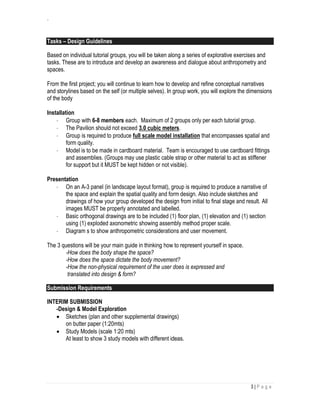
Tasks - Methodology
RESEARCH ON ANTROPOMETRICS, ERGONOMICS & OTHERS
Exploration of Human form (Anthropometrics)
NARRATIVE OF THE SELF
Physical and non-physical requirement of the user or users
IDEA GENERATION AND MODEL EXPLORATION
Exploration thru series of sketches and models
1:1 CARDBOARD MODEL FITTING AND ASSEMBLY
Execution of Actual Size (1:1) Model and final drawings
Few Important Terminologies:
Furnitecture: Furniture that transforms as architecture. Furniture that is a multi-functional with
each has a different formal expression or part of a different style.
Anthropometrics: Study of human body and its movement.
Ergonomics: Study of people and their relationship with the environment around them.
Cardboard Fitting and Assemblies: ‘glue less’ method of assembly
`
3 | P a g e
Tasks – Design Guidelines
Based on individual tutorial groups, you will be taken along a series of explorative exercises and
tasks. These are to introduce and develop an awareness and dialogue about anthropometry and
spaces.
From the first project; you will continue to learn how to develop and refine conceptual narratives
and storylines based on the self (or multiple selves). In group work, you will explore the dimensions
of the body
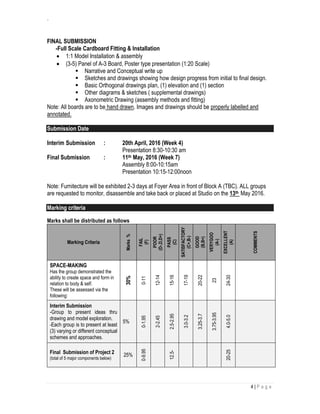
Installation
 Group with 6-8 members each. Maximum of 2 groups only per each tutorial group.
 The Pavilion should not exceed 3.0 cubic meters.
 Group is required to produce full scale model installation that encompasses spatial and
form quality.
 Model is to be made in cardboard material. Team is encouraged to use cardboard fittings
and assemblies. (Groups may use plastic cable strap or other material to act as stiffener
for support but it MUST be kept hidden or not visible).
Presentation
 On an A-3 panel (in landscape layout format), group is required to produce a narrative of
the space and explain the spatial quality and form design. Also include sketches and
drawings of how your group developed the design from initial to final stage and result. All
images MUST be properly annotated and labelled.
 Basic orthogonal drawings are to be included (1) floor plan, (1) elevation and (1) section
using (1) exploded axonometric showing assembly method proper scale.
 Diagram s to show anthropometric considerations and user movement.
The 3 questions will be your main guide in thinking how to represent yourself in space.
-How does the body shape the space?
-How does the space dictate the body movement?
-How the non-physical requirement of the user does is expressed and
translated into design & form?
Submission Requirements
INTERIM SUBMISSION
-Design & Model Exploration
 Sketches (plan and other supplemental drawings)
on butter paper (1:20mts)
 Study Models (scale 1:20 mts)
At least to show 3 study models with different ideas.
`
4 | P a g e
FINAL SUBMISSION
-Full Scale Cardboard Fitting & Installation
 1:1 Model Installation & assembly
 (3-5) Panel of A-3 Board, Poster type presentation (1:20 Scale)
 Narrative and Conceptual write up
 Sketches and drawings showing how design progress from initial to final design.
 Basic Orthogonal drawings plan, (1) elevation and (1) section
 Other diagrams & sketches ( supplemental drawings)
 Axonometric Drawing (assembly methods and fitting)
Note: All boards are to be hand drawn. Images and drawings should be properly labelled and
annotated.
Submission Date
Interim Submission : 20th April, 2016 (Week 4)
Presentation 8:30-10:30 am
Final Submission : 11th May, 2016 (Week 7)
Assembly 8:00-10:15am
Presentation 10:15-12:00noon
Note: Furnitecture will be exhibited 2-3 days at Foyer Area in front of Block A (TBC). ALL groups
are requested to monitor, disassemble and take back or placed at Studio on the 13th May 2016.
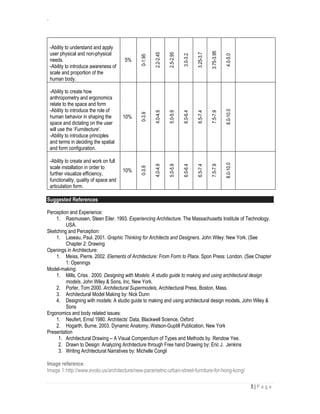
Marking criteria
Marks shall be distributed as follows
Marking Criteria
Marks%
FAIL
(F)
POOR
(D-,D,D+)
PASS
(C)
SATISFACTORY
(C+,B-)
GOOD
(B,B+)
VERYGOO
(A-)
EXCELLENT
(A)
COMMENTS
SPACE-MAKING
Has the group demonstrated the
ability to create space and form in
relation to body & self.
These will be assessed via the
following:
30%
0-11
12-14
15-16
17-19
20-22
23
24-30
Interim Submission
-Group to present ideas thru
drawing and model exploration.
-Each group is to present at least
(3) varying or different conceptual
schemes and approaches.
5%
0-1.95
2-2.45
2.5-2.95
3.0-3.2
3.25-3.7
3.75-3.95
4.0-5.0
Final Submission of Project 2
(total of 5 major components below)
25%
0-9.95
12.5-
20-25
`
5 | P a g e
-Ability to understand and apply
user physical and non-physical
needs.
-Ability to introduce awareness of
scale and proportion of the
human body.
5%
0-1.95
2.2-2.45
2.5-2.95
3.0-3.2
3.25-3.7
3.75-3.95
4.0-5.0
-Ability to create how
anthropometry and ergonomics
relate to the space and form
-Ability to introduce the role of
human behavior in shaping the
space and dictating on the user
will use the ‘Furnitecture’.
-Ability to introduce principles
and terms in deciding the spatial
and form configuration.
10%
0-3.9
4.0-4.9
5.0-5.9
6.0-6.4
6.5-7.4
7.5-7.9
8.0-10.0
-Ability to create and work on full
scale installation in order to
further visualize efficiency,
functionality, quality of space and
articulation form.
10%
0-3.9
4.0-4.9
5.0-5.9
6.0-6.4
6.5-7.4
7.5-7.9
8.0-10.0
Suggested References
Perception and Experience:
1. Rasmussen, Steen Eiler. 1993. Experiencing Architecture. The Massachusetts Institute of Technology.
USA.
Sketching and Perception:
1. Laseau, Paul. 2001. Graphic Thinking for Architects and Designers. John Wiley: New York. (See
Chapter 2: Drawing
Openings in Architecture:
1. Meiss, Pierre. 2002. Elements of Architecture: From Form to Place. Spon Press: London. (See Chapter
1: Openings
Model-making:
1. Mills, Criss . 2000. Designing with Models: A studio guide to making and using architectural design
models, John Wiley & Sons, Inc, New York.
2. Porter, Tom 2000. Architectural Supermodels, Architectural Press, Boston, Mass.
3. Architectural Model Making by: Nick Dunn
4. Designing with models: A studio guide to making and using architectural design models, John Wiley &
Sons
Ergonomics and body related issues:
1. Neufert, Ernst 1980. Architects’ Data, Blackwell Science, Oxford
2. Hogarth, Burne, 2003. Dynamic Anatomy, Watson-Guptill Publication, New York
Presentation
1. Architectural Drawing – A Visual Compendium of Types and Methods by. Rendow Yee.
2. Drawn to Design: Analyzing Architecture through Free hand Drawing by: Eric J. Jenkins
3. Writing Architectural Narratives by: Michelle Congli
Image reference:
Image 1:http://www.evolo.us/architecture/new-parametric-urban-street-furniture-for-hong-kong/

Architectural design studio 1 project 2 brief march2016

  • 1.
    ` 1 | Pa g e SCHOOL OF ARCHITECTURE, BUILDING & DESIGN Modern Architecture Studies in Southeast Asia (MASSA) Research Unit Bachelor of Science (Honours) in Architecture ARCHITECTURE DESIGN STUDIO 1 [ARC 60105] Project 2: Self Expression through Architectural Space’ Furnitecture’ Project 2 Group (of 6-8 members) LO 1,2,3, 5 30% of total mark Verbal presentation A3 panels + study models+ 1:1 model installation Introduction The main aim of Project 2 is to expand the interpretation of the self (or multiple self) by exploring the relationships between human body and designed form. The student or students as the user or users will define the intention of the space and its form based on their personality and human body. In this project students will also be introduced to basic design principles such as rudimentary ways in which to order and organize spaces and forms. Furthermore develop an understanding of scale and proportion with relation to the human body. Project 2 will be divided into 2 stages; first we shall explore the notions of scale and proportion. This is done through a series of exploratory in-class exercises where we explore human form (anthropometry). We will then progress on to understanding how the human body relates to space, and further developing an understanding of scale and proportion in relationship with body and space. The 2 stages mentioned will be presented by groups in the intention to enhance the ability to articulate space and form from interpretations of the self. This development will be through a series tests and investigations involving scaled models ‘study models’. The Final Design will then be produced as a full 1:1 scaled cardboard assembly and installation. Student will specifically translate their personality and design intentions thru designing ‘Furnitecture’, furniture that transforms to architecture using cardboard and cardboard fittings and assemblies. Cardboard furnitecture must be highly functional and usable.
  • 2.
    ` 2 | Pa g e Objectives of Project The objectives of this assignment are as follows: 1. To further the student’s concern about elementary user needs 2. To introduce and create an awareness of the scale and proportion of the human body. 3. To create how human anthropometry and ergonomics relate to shape and the space. 4. To introduce the role of human behavior in shaping the space and dictating activities. 5. To introduce basic design principles and terminologies on deciding spatial and form configuration. 6. To create and work on full scale installation in order to further visualize efficiency, functionality, quality of space and articulation form. Learning Outcomes of this Project 1. Generate design concepts through the process of exploring various sources and abstracting ideas. 2. Identify key architectural design elements and principles with the ability to discern how they inform space and form. 3. Relate the idea of the individual ‘self and the body to space and its experiential qualities. 4. Utilize process-oriented approach involving sketching and model-making as tools for generating and developing design ideas. Tasks - Methodology RESEARCH ON ANTROPOMETRICS, ERGONOMICS & OTHERS Exploration of Human form (Anthropometrics) NARRATIVE OF THE SELF Physical and non-physical requirement of the user or users IDEA GENERATION AND MODEL EXPLORATION Exploration thru series of sketches and models 1:1 CARDBOARD MODEL FITTING AND ASSEMBLY Execution of Actual Size (1:1) Model and final drawings Few Important Terminologies: Furnitecture: Furniture that transforms as architecture. Furniture that is a multi-functional with each has a different formal expression or part of a different style. Anthropometrics: Study of human body and its movement. Ergonomics: Study of people and their relationship with the environment around them. Cardboard Fitting and Assemblies: ‘glue less’ method of assembly
  • 3.
    ` 3 | Pa g e Tasks – Design Guidelines Based on individual tutorial groups, you will be taken along a series of explorative exercises and tasks. These are to introduce and develop an awareness and dialogue about anthropometry and spaces. From the first project; you will continue to learn how to develop and refine conceptual narratives and storylines based on the self (or multiple selves). In group work, you will explore the dimensions of the body Installation  Group with 6-8 members each. Maximum of 2 groups only per each tutorial group.  The Pavilion should not exceed 3.0 cubic meters.  Group is required to produce full scale model installation that encompasses spatial and form quality.  Model is to be made in cardboard material. Team is encouraged to use cardboard fittings and assemblies. (Groups may use plastic cable strap or other material to act as stiffener for support but it MUST be kept hidden or not visible). Presentation  On an A-3 panel (in landscape layout format), group is required to produce a narrative of the space and explain the spatial quality and form design. Also include sketches and drawings of how your group developed the design from initial to final stage and result. All images MUST be properly annotated and labelled.  Basic orthogonal drawings are to be included (1) floor plan, (1) elevation and (1) section using (1) exploded axonometric showing assembly method proper scale.  Diagram s to show anthropometric considerations and user movement. The 3 questions will be your main guide in thinking how to represent yourself in space. -How does the body shape the space? -How does the space dictate the body movement? -How the non-physical requirement of the user does is expressed and translated into design & form? Submission Requirements INTERIM SUBMISSION -Design & Model Exploration  Sketches (plan and other supplemental drawings) on butter paper (1:20mts)  Study Models (scale 1:20 mts) At least to show 3 study models with different ideas.
  • 4.
    ` 4 | Pa g e FINAL SUBMISSION -Full Scale Cardboard Fitting & Installation  1:1 Model Installation & assembly  (3-5) Panel of A-3 Board, Poster type presentation (1:20 Scale)  Narrative and Conceptual write up  Sketches and drawings showing how design progress from initial to final design.  Basic Orthogonal drawings plan, (1) elevation and (1) section  Other diagrams & sketches ( supplemental drawings)  Axonometric Drawing (assembly methods and fitting) Note: All boards are to be hand drawn. Images and drawings should be properly labelled and annotated. Submission Date Interim Submission : 20th April, 2016 (Week 4) Presentation 8:30-10:30 am Final Submission : 11th May, 2016 (Week 7) Assembly 8:00-10:15am Presentation 10:15-12:00noon Note: Furnitecture will be exhibited 2-3 days at Foyer Area in front of Block A (TBC). ALL groups are requested to monitor, disassemble and take back or placed at Studio on the 13th May 2016. Marking criteria Marks shall be distributed as follows Marking Criteria Marks% FAIL (F) POOR (D-,D,D+) PASS (C) SATISFACTORY (C+,B-) GOOD (B,B+) VERYGOO (A-) EXCELLENT (A) COMMENTS SPACE-MAKING Has the group demonstrated the ability to create space and form in relation to body & self. These will be assessed via the following: 30% 0-11 12-14 15-16 17-19 20-22 23 24-30 Interim Submission -Group to present ideas thru drawing and model exploration. -Each group is to present at least (3) varying or different conceptual schemes and approaches. 5% 0-1.95 2-2.45 2.5-2.95 3.0-3.2 3.25-3.7 3.75-3.95 4.0-5.0 Final Submission of Project 2 (total of 5 major components below) 25% 0-9.95 12.5- 20-25
  • 5.
    ` 5 | Pa g e -Ability to understand and apply user physical and non-physical needs. -Ability to introduce awareness of scale and proportion of the human body. 5% 0-1.95 2.2-2.45 2.5-2.95 3.0-3.2 3.25-3.7 3.75-3.95 4.0-5.0 -Ability to create how anthropometry and ergonomics relate to the space and form -Ability to introduce the role of human behavior in shaping the space and dictating on the user will use the ‘Furnitecture’. -Ability to introduce principles and terms in deciding the spatial and form configuration. 10% 0-3.9 4.0-4.9 5.0-5.9 6.0-6.4 6.5-7.4 7.5-7.9 8.0-10.0 -Ability to create and work on full scale installation in order to further visualize efficiency, functionality, quality of space and articulation form. 10% 0-3.9 4.0-4.9 5.0-5.9 6.0-6.4 6.5-7.4 7.5-7.9 8.0-10.0 Suggested References Perception and Experience: 1. Rasmussen, Steen Eiler. 1993. Experiencing Architecture. The Massachusetts Institute of Technology. USA. Sketching and Perception: 1. Laseau, Paul. 2001. Graphic Thinking for Architects and Designers. John Wiley: New York. (See Chapter 2: Drawing Openings in Architecture: 1. Meiss, Pierre. 2002. Elements of Architecture: From Form to Place. Spon Press: London. (See Chapter 1: Openings Model-making: 1. Mills, Criss . 2000. Designing with Models: A studio guide to making and using architectural design models, John Wiley & Sons, Inc, New York. 2. Porter, Tom 2000. Architectural Supermodels, Architectural Press, Boston, Mass. 3. Architectural Model Making by: Nick Dunn 4. Designing with models: A studio guide to making and using architectural design models, John Wiley & Sons Ergonomics and body related issues: 1. Neufert, Ernst 1980. Architects’ Data, Blackwell Science, Oxford 2. Hogarth, Burne, 2003. Dynamic Anatomy, Watson-Guptill Publication, New York Presentation 1. Architectural Drawing – A Visual Compendium of Types and Methods by. Rendow Yee. 2. Drawn to Design: Analyzing Architecture through Free hand Drawing by: Eric J. Jenkins 3. Writing Architectural Narratives by: Michelle Congli Image reference: Image 1:http://www.evolo.us/architecture/new-parametric-urban-street-furniture-for-hong-kong/