©RA
Communication Skills :
• Ability to act and communicate ideas through
collaboration, speaking, numeracy, writing,
drawing, modeling, and evaluation.
• Ability to utilize manual and electronic graphic
and model-making capabilities to explore,
develop, define, and communicate a design
proposal.
This particular course has two main sessions :
• 1st is “Anthropometrics and Ergonomics”
• 2nd is “ Architectural drawing standards”
1st session: we will
• Study the human physique with its various
measurements and have a better understanding of
what we will design for.
• Study the relationship between a human with its
environment.
2nd session: we will
• See different types of drawings
• Learn about Architectural drawing and its
standards
Date: May, 2024
Prepared by: Robel Abebe
CHAPTER -1
ANTHROPOMETRY & ERGONOMICS
BAHIRDAR UNIVERSITY
INSTITUTE OF LAND ADMINISTRATION
DEPARTMENT OF ARCHITECTURE
©RA
1: BASIC TERMINOLOGIES
2: ANTHROPOMETRY
2.1 : BASICS OF ANTHROPOMETRY
2.2 : THEORIES OF ANTHROPOMETRY
2.3 : APPLICATIONS OF ANTHROPOMETRY
3: ERGONOMICS
3.1 : BASICS OF ERGONOMICS
3.2 : APPLICATIONS OF ERGONOMICS
CONTENT
©RA
A great building must begin with the unmeasurable, must
go through measurable means when it is being designed
and in the end must be unmeasurable.
Louis Kahn
BASIC TERMINOLOGIES
©RA
First, let us see different keywords that are very important
to this course. [Proportion and Scale]
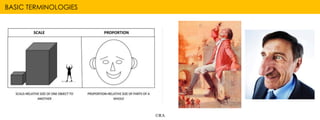
PROPORTION: is a central principle of architectural
theory and an important connection between mathematics
and art. It is the visual effect of the relationship of the
various objects and spaces that make up a structure to one
another and to the whole.
Proportion in architecture was discussed by Vitruvius, Leon Battista Alberti,
Andrea Palladio, and Le Corbusier among others. Classical architecture
(Greece)
radii of columns
Vitruvian man
(Roman)
measurement units digit,
foot, and cubit
Le Corbusier
(Modern)
golden ratio and a man
with a raised arm as the
scalable modules of
proportion.
BASIC TERMINOLOGIES
©RA
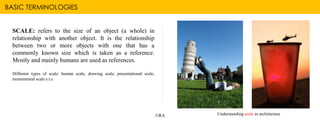
SCALE: refers to the size of an object (a whole) in
relationship with another object. It is the relationship
between two or more objects with one that has a
commonly known size which is taken as a reference.
Mostly and mainly humans are used as references.
Different types of scale: human scale, drawing scale, presentational scale,
monumental scale e.t.c
Understanding scale in architecture
BASIC TERMINOLOGIES
©RA
BASIC TERMINOLOGIES
©RA
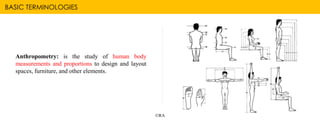
Anthropometry: is the study of human body
measurements and proportions to design and layout
spaces, furniture, and other elements.
BASIC TERMINOLOGIES
©RA
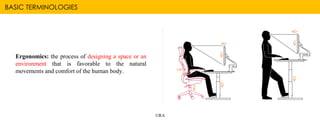
Ergonomics: the process of designing a space or an
environment that is favorable to the natural
movements and comfort of the human body.
BASIC TERMINOLOGIES
©RA
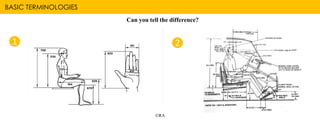
Can you tell the difference?
1 2
ANTHROPOMETRY: BASICS
©RA
Applications of Anthropometry
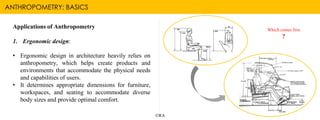
1. Ergonomic design:
• Ergonomic design in architecture heavily relies on
anthropometry, which helps create products and
environments that accommodate the physical needs
and capabilities of users.
• It determines appropriate dimensions for furniture,
workspaces, and seating to accommodate diverse
body sizes and provide optimal comfort.
Which comes first
?
ANTHROPOMETRY: BASICS
©RA
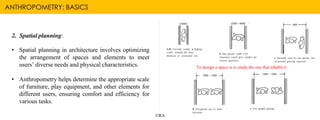
2. Spatial planning:
• Spatial planning in architecture involves optimizing
the arrangement of spaces and elements to meet
users’ diverse needs and physical characteristics.
• Anthropometry helps determine the appropriate scale
of furniture, play equipment, and other elements for
different users, ensuring comfort and efficiency for
various tasks.
To design a space is to study the one that inhabit it
ANTHROPOMETRY: BASICS
©RA
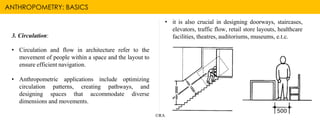
3. Circulation:
• Circulation and flow in architecture refer to the
movement of people within a space and the layout to
ensure efficient navigation.
• Anthropometric applications include optimizing
circulation patterns, creating pathways, and
designing spaces that accommodate diverse
dimensions and movements.
• it is also crucial in designing doorways, staircases,
elevators, traffic flow, retail store layouts, healthcare
facilities, theatres, auditoriums, museums, e.t.c.
ERGONOMICS: BASICS
©RA
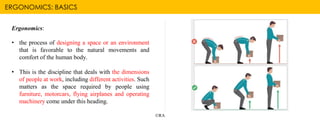
Ergonomics:
• the process of designing a space or an environment
that is favorable to the natural movements and
comfort of the human body.
• This is the discipline that deals with the dimensions
of people at work, including different activities. Such
matters as the space required by people using
furniture, motorcars, flying airplanes and operating
machinery come under this heading.
ERGONOMICS: BASICS
©RA
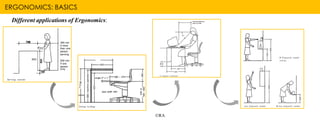
Different applications of Ergonomics:

1- Basic Anthropometry & ergonomics RA.pdf

  • 1.
    ©RA Communication Skills : •Ability to act and communicate ideas through collaboration, speaking, numeracy, writing, drawing, modeling, and evaluation. • Ability to utilize manual and electronic graphic and model-making capabilities to explore, develop, define, and communicate a design proposal. This particular course has two main sessions : • 1st is “Anthropometrics and Ergonomics” • 2nd is “ Architectural drawing standards” 1st session: we will • Study the human physique with its various measurements and have a better understanding of what we will design for. • Study the relationship between a human with its environment. 2nd session: we will • See different types of drawings • Learn about Architectural drawing and its standards
  • 2.
    Date: May, 2024 Preparedby: Robel Abebe CHAPTER -1 ANTHROPOMETRY & ERGONOMICS BAHIRDAR UNIVERSITY INSTITUTE OF LAND ADMINISTRATION DEPARTMENT OF ARCHITECTURE
  • 3.
    ©RA 1: BASIC TERMINOLOGIES 2:ANTHROPOMETRY 2.1 : BASICS OF ANTHROPOMETRY 2.2 : THEORIES OF ANTHROPOMETRY 2.3 : APPLICATIONS OF ANTHROPOMETRY 3: ERGONOMICS 3.1 : BASICS OF ERGONOMICS 3.2 : APPLICATIONS OF ERGONOMICS CONTENT
  • 4.
    ©RA A great buildingmust begin with the unmeasurable, must go through measurable means when it is being designed and in the end must be unmeasurable. Louis Kahn
  • 5.
    BASIC TERMINOLOGIES ©RA First, letus see different keywords that are very important to this course. [Proportion and Scale] PROPORTION: is a central principle of architectural theory and an important connection between mathematics and art. It is the visual effect of the relationship of the various objects and spaces that make up a structure to one another and to the whole. Proportion in architecture was discussed by Vitruvius, Leon Battista Alberti, Andrea Palladio, and Le Corbusier among others. Classical architecture (Greece) radii of columns Vitruvian man (Roman) measurement units digit, foot, and cubit Le Corbusier (Modern) golden ratio and a man with a raised arm as the scalable modules of proportion.
  • 6.
    BASIC TERMINOLOGIES ©RA SCALE: refersto the size of an object (a whole) in relationship with another object. It is the relationship between two or more objects with one that has a commonly known size which is taken as a reference. Mostly and mainly humans are used as references. Different types of scale: human scale, drawing scale, presentational scale, monumental scale e.t.c Understanding scale in architecture
  • 7.
  • 8.
    BASIC TERMINOLOGIES ©RA Anthropometry: isthe study of human body measurements and proportions to design and layout spaces, furniture, and other elements.
  • 9.
    BASIC TERMINOLOGIES ©RA Ergonomics: theprocess of designing a space or an environment that is favorable to the natural movements and comfort of the human body.
  • 10.
    BASIC TERMINOLOGIES ©RA Can youtell the difference? 1 2
  • 11.
    ANTHROPOMETRY: BASICS ©RA Applications ofAnthropometry 1. Ergonomic design: • Ergonomic design in architecture heavily relies on anthropometry, which helps create products and environments that accommodate the physical needs and capabilities of users. • It determines appropriate dimensions for furniture, workspaces, and seating to accommodate diverse body sizes and provide optimal comfort. Which comes first ?
  • 12.
    ANTHROPOMETRY: BASICS ©RA 2. Spatialplanning: • Spatial planning in architecture involves optimizing the arrangement of spaces and elements to meet users’ diverse needs and physical characteristics. • Anthropometry helps determine the appropriate scale of furniture, play equipment, and other elements for different users, ensuring comfort and efficiency for various tasks. To design a space is to study the one that inhabit it
  • 13.
    ANTHROPOMETRY: BASICS ©RA 3. Circulation: •Circulation and flow in architecture refer to the movement of people within a space and the layout to ensure efficient navigation. • Anthropometric applications include optimizing circulation patterns, creating pathways, and designing spaces that accommodate diverse dimensions and movements. • it is also crucial in designing doorways, staircases, elevators, traffic flow, retail store layouts, healthcare facilities, theatres, auditoriums, museums, e.t.c.
  • 14.
    ERGONOMICS: BASICS ©RA Ergonomics: • theprocess of designing a space or an environment that is favorable to the natural movements and comfort of the human body. • This is the discipline that deals with the dimensions of people at work, including different activities. Such matters as the space required by people using furniture, motorcars, flying airplanes and operating machinery come under this heading.
  • 15.