https://www.slideshare.net/Kevlin/what-we-talk-about-when-we-talk-about-unit-testing
Jacek Gębal
twitter: @GebalJacek
mail: jgebal@gmail.com
blog: oraclethoughts.com
Principal Software Engineer
@Fidelity Investments - Ireland
co-author & maintainer of: utPLSQL
Test your PL/SQL
not your patience
About me
● Software engineer since ~2000 - mainly Oracle database
● Infected with testing and automation since ~2013
● Key contributor, author and maintainer of utPLSQL v3
● Active developer, learner, testing advocate
Why?
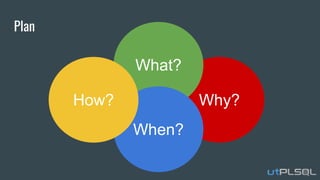
Plan
What?
When?
How?
Why test?
Why do we test?
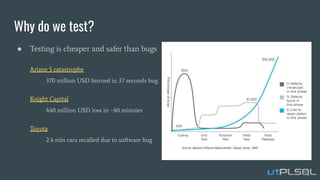
● Testing is cheaper and safer than bugs
Ariane 5 catastrophe
370 million USD burned in 37 seconds bug
Knight Capital
440 million USD loss in ~40 minutes
Toyota
2.4 mln cars recalled due to software bug
Why do we test?
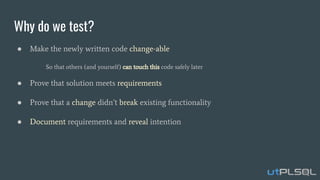
● Make the newly written code change-able
So that others (and yourself) can touch this code safely later
● Prove that solution meets requirements
● Prove that a change didn’t break existing functionality
● Document requirements and reveal intention
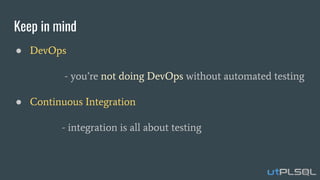
Keep in mind
● DevOps
- you’re not doing DevOps without automated testing
● Continuous Integration
- integration is all about testing
What
should be
tested?
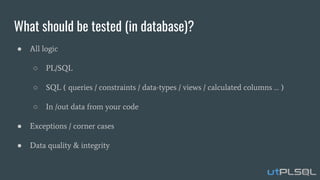
What should be tested (in database)?
● All logic
○ PL/SQL
○ SQL ( queries / constraints / data-types / views / calculated columns … )
○ In /out data from your code
● Exceptions / corner cases
● Data quality & integrity
When
should I
test?
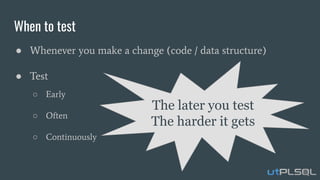
When to test
● Whenever you make a change (code / data structure)
● Test
○ Early
○ Often
○ Continuously
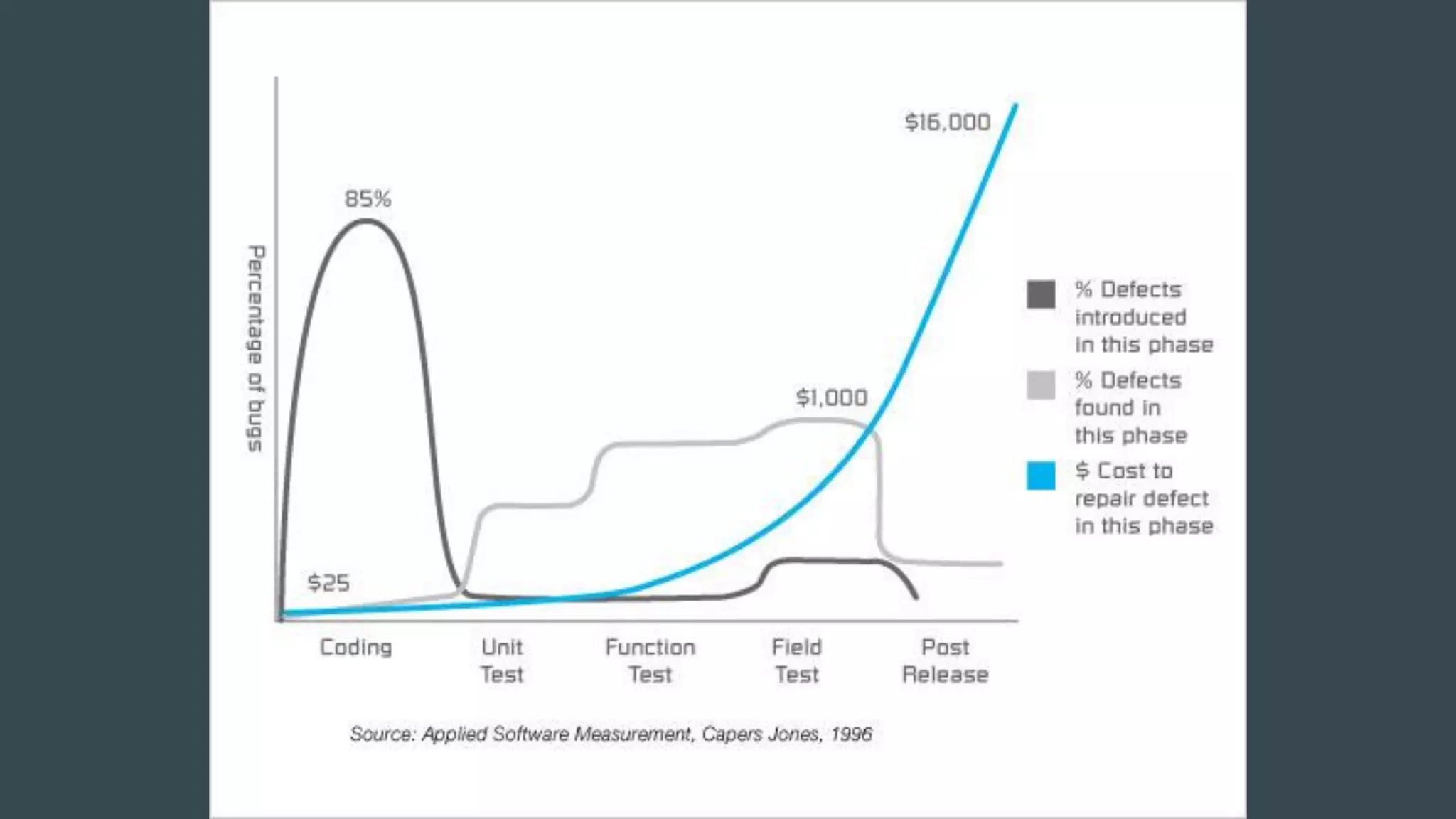
The later you test
The harder it gets
How should
I test?
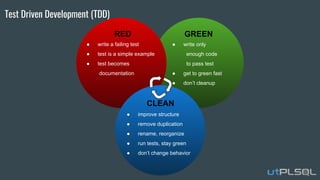
● write only
enough code
to pass test
● get to green fast
● don’t cleanup
● write a failing test
● test is a simple example
● test becomes
documentation
● improve structure
● remove duplication
● rename, reorganize
● run tests, stay green
● don’t change behavior
RED GREEN
CLEAN
Test Driven Development (TDD)
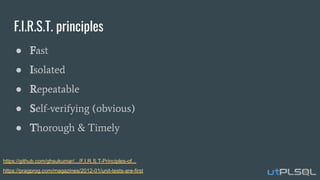
F.I.R.S.T. principles
● Fast
● Isolated
● Repeatable
● Self-verifying (obvious)
● Thorough & Timely
https://github.com/ghsukumar/.../F.I.R.S.T-Principles-of...
https://pragprog.com/magazines/2012-01/unit-tests-are-first
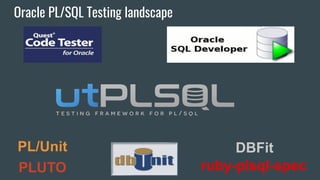
PLUTO
PL/Unit
ruby-plsql-spec
DBFit
Oracle PL/SQL Testing landscape
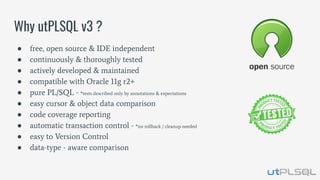
● free, open source & IDE independent
● continuously & thoroughly tested
● actively developed & maintained
● compatible with Oracle 11g r2+
● pure PL/SQL - *tests described only by annotations & expectations
● easy cursor & object data comparison
● code coverage reporting
● automatic transaction control - *no rollback / cleanup needed
● easy to Version Control
● data-type - aware comparison
Why utPLSQL v3 ?
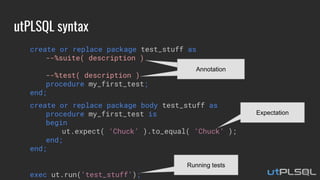
utPLSQL syntax
create or replace package test_stuff as
--%suite( description )
--%test( description )
procedure my_first_test;
end;
create or replace package body test_stuff as
procedure my_first_test is
begin
ut.expect( ‘Chuck’ ).to_equal( ‘Chuck’ );
end;
end;
exec ut.run(‘test_stuff’);
Expectation
AnnotationAnnotation
Running tests
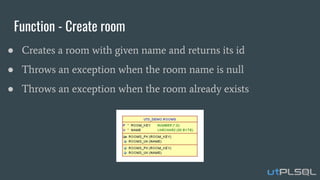
Function - Create room
● Creates a room with given name and returns its id
● Throws an exception when the room name is null
● Throws an exception when the room already exists
TDD & utPSQL
demo
utPLSQL & TDD
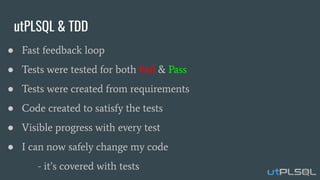
● Fast feedback loop
● Tests were tested for both Fail & Pass
● Tests were created from requirements
● Code created to satisfy the tests
● Visible progress with every test
● I can now safely change my code
- it’s covered with tests
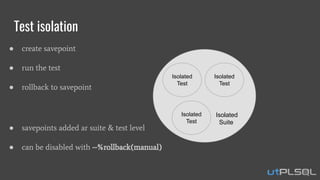
Isolated
Suite
Isolated
Test
Isolated
Test
Isolated
Test
Test isolation
● create savepoint
● run the test
● rollback to savepoint
● savepoints added ar suite & test level
● can be disabled with --%rollback(manual)
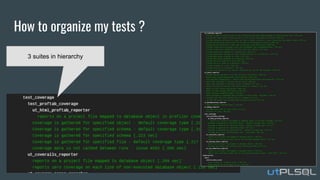
How to organize my tests ?
3 suites in hierarchy
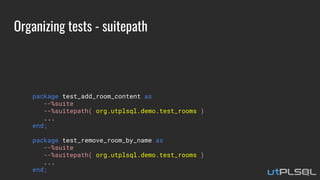
Organizing tests - suitepath
package test_add_room_content as
--%suite
--%suitepath( org.utplsql.demo.test_rooms )
...
end;
package test_remove_room_by_name as
--%suite
--%suitepath( org.utplsql.demo.test_rooms )
...
end;
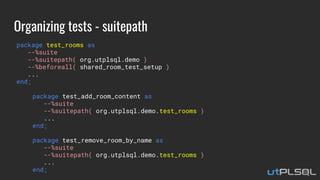
Organizing tests - suitepath
package test_rooms as
--%suite
--%suitepath( org.utplsql.demo )
--%beforeall( shared_room_test_setup )
...
end;
package test_add_room_content as
--%suite
--%suitepath( org.utplsql.demo.test_rooms )
...
end;
package test_remove_room_by_name as
--%suite
--%suitepath( org.utplsql.demo.test_rooms )
...
end;
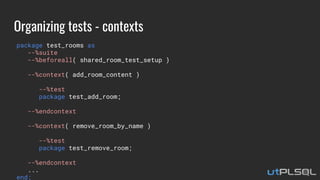
Organizing tests - contexts
package test_rooms as
--%suite
--%beforeall( shared_room_test_setup )
--%context( add_room_content )
--%test
package test_add_room;
--%endcontext
--%context( remove_room_by_name )
--%test
package test_remove_room;
--%endcontext
...
end;
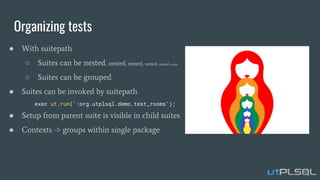
Organizing tests
● With suitepath
○ Suites can be nested, nested, nested, nested, nested, nested
○ Suites can be grouped
● Suites can be invoked by suitepath
exec ut.run(‘:org.utplsql.demo.test_rooms’);
● Setup from parent suite is visible in child suites
● Contexts -> groups within single package
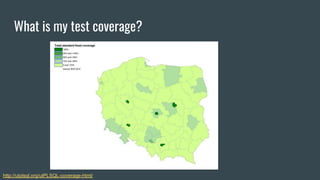
What is my test coverage?
http://utplsql.org/utPLSQL-coverage-html/
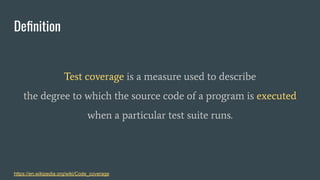
Definition
Test coverage is a measure used to describe
the degree to which the source code of a program is executed
when a particular test suite runs.
https://en.wikipedia.org/wiki/Code_coverage
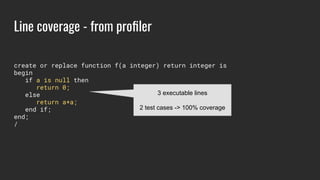
Line coverage - from profiler
create or replace function f(a integer) return integer is
begin
if a is null then
return 0;
else
return a*a;
end if;
end;
/
3 executable lines
2 test cases -> 100% coverage
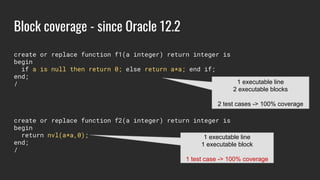
Block coverage - since Oracle 12.2
create or replace function f1(a integer) return integer is
begin
if a is null then return 0; else return a*a; end if;
end;
/
create or replace function f2(a integer) return integer is
begin
return nvl(a*a,0);
end;
/
1 executable line
2 executable blocks
2 test cases -> 100% coverage
1 executable line
1 executable block
1 test case -> 100% coverage
utPLSQL coverage
utPLSQL combines profiler line coverage
with Oracle 12.2 block coverage
to provide statement coverage
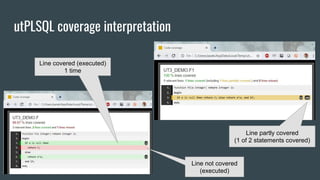
utPLSQL coverage interpretation
Line covered (executed)
1 time
Line partly covered
(1 of 2 statements covered)
Line not covered
(executed)
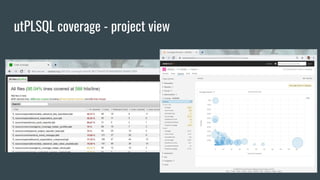
utPLSQL coverage - project view
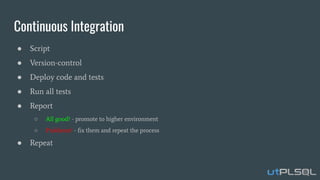
Continuous Integration
● Script
● Version-control
● Deploy code and tests
● Run all tests
● Report
○ All good? - promote to higher environment
○ Problems? - fix them and repeat the process
● Repeat
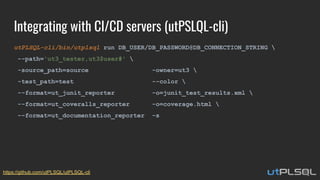
Integrating with CI/CD servers (utPSLQL-cli)
utPLSQL-cli/bin/utplsql run DB_USER/DB_PASSWORD@DB_CONNECTION_STRING 
--path='ut3_tester,ut3$user#' 
-source_path=source -owner=ut3 
-test_path=test --color 
--format=ut_junit_reporter -o=junit_test_results.xml 
--format=ut_coveralls_reporter -o=coverage.html 
--format=ut_documentation_reporter -s
https://github.com/utPLSQL/utPLSQL-cli
Integration
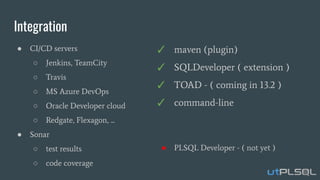
● CI/CD servers
○ Jenkins, TeamCity
○ Travis
○ MS Azure DevOps
○ Oracle Developer cloud
○ Redgate, Flexagon, ...
● Sonar
○ test results
○ code coverage
✓ maven (plugin)
✓ SQLDeveloper ( extension )
✓ TOAD - ( coming in 13.2 )
✓ command-line
● PLSQL Developer - ( not yet )
Recap
● Test to prevent bugs and avoid losses
● Tests are documentation for your code
● Test as early as possible
● Group and organize your tests
● Use automatic rollback to minimize need for complex cleanup
● Analyze your test results and code coverage to measure progress
● Automate deployment and testing
Questions?
● Ask now :)
● utPLSQL SLACK channel
● github.com/utPLSQL/utPLSQL/issues
● @utPLSQL twitter
Supported data-types
● cursors
● objects
● nested tables
● varrays
● json
● number
● varchar2
● date
● boolean
● clob, blob
● timestamp (with (local) timezone)
● interval (day to second / year to month)
Matchers
equal( expected )
be_null / be_not_null
be_true / be_false
be_like( mask [, escape_char] )
match( pattern [, modifiers] )
contain( expected )
ut.expect( actual ).to_...
ut.expect( actual ).not_to_...
be_between( lower, upper )
be_greater_than( expected )
be_less_than( expected )
be_greater_or_equal( expected )
be_less_or_equal( expected )
have_count( count ) / be_empty
Matchers:
http://utplsql.org/utPLSQL/latest/userguide/expectations.html
Annotations
Package:
--%suite(<description>)
--%suitepath(<path>)
--%rollback(auto/manual)
--%disabled
--%tags(<tag>[,...])
--%context(<name>) --%endcontext
--%beforeall(<proc_name>[,...])
--%afterall(<proc_name>[,...])
--%beforeeach(<proc_name>[,...])
--%aftereach(<proc_name>[,...])
Procedure:
--%test(<description>)
--%throws(<error>[,...])
--%rollback(auto/manual)
--%disabled
--%tags(<tag>[,...])
--%beforetest(<proc_name>[,...])
--%aftertest(<proc_name>[,...])
--%beforeall --%afterall
--%beforeeach --%aftereach
http://utplsql.org/utPLSQL/latest/userguide/annotations.html
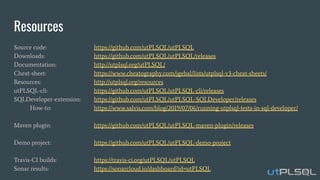
Resources
Source code: https://github.com/utPLSQL/utPLSQL
Downloads: https://github.com/utPLSQL/utPLSQL/releases
Documentation: http://utplsql.org/utPLSQL/
Cheat-sheet: https://www.cheatography.com/jgebal/lists/utplsql-v3-cheat-sheets/
Resources: http://utplsql.org/resources
utPLSQL-cli: https://github.com/utPLSQL/utPLSQL-cli/releases
SQLDeveloper-extension: https://github.com/utPLSQL/utPLSQL-SQLDeveloper/releases
How-to: https://www.salvis.com/blog/2019/07/06/running-utplsql-tests-in-sql-developer/
Maven plugin: https://github.com/utPLSQL/utPLSQL-maven-plugin/releases
Demo project: https://github.com/utPLSQL/utPLSQL-demo-project
Travis-CI builds: https://travis-ci.org/utPLSQL/utPLSQL
Sonar results: https://sonarcloud.io/dashboard?id=utPLSQL

Bgoug 2019.11 test your pl sql - not your patience

  • 2.
  • 3.
  • 4.
    Jacek Gębal twitter: @GebalJacek mail:jgebal@gmail.com blog: oraclethoughts.com Principal Software Engineer @Fidelity Investments - Ireland co-author & maintainer of: utPLSQL Test your PL/SQL not your patience
  • 5.
    About me ● Softwareengineer since ~2000 - mainly Oracle database ● Infected with testing and automation since ~2013 ● Key contributor, author and maintainer of utPLSQL v3 ● Active developer, learner, testing advocate
  • 6.
  • 7.
  • 8.
    Why do wetest? ● Testing is cheaper and safer than bugs Ariane 5 catastrophe 370 million USD burned in 37 seconds bug Knight Capital 440 million USD loss in ~40 minutes Toyota 2.4 mln cars recalled due to software bug
  • 9.
    Why do wetest? ● Make the newly written code change-able So that others (and yourself) can touch this code safely later ● Prove that solution meets requirements ● Prove that a change didn’t break existing functionality ● Document requirements and reveal intention
  • 10.
    Keep in mind ●DevOps - you’re not doing DevOps without automated testing ● Continuous Integration - integration is all about testing
  • 11.
  • 12.
    What should betested (in database)? ● All logic ○ PL/SQL ○ SQL ( queries / constraints / data-types / views / calculated columns … ) ○ In /out data from your code ● Exceptions / corner cases ● Data quality & integrity
  • 13.
  • 14.
    When to test ●Whenever you make a change (code / data structure) ● Test ○ Early ○ Often ○ Continuously The later you test The harder it gets
  • 15.
  • 16.
    ● write only enoughcode to pass test ● get to green fast ● don’t cleanup ● write a failing test ● test is a simple example ● test becomes documentation ● improve structure ● remove duplication ● rename, reorganize ● run tests, stay green ● don’t change behavior RED GREEN CLEAN Test Driven Development (TDD)
  • 17.
    F.I.R.S.T. principles ● Fast ●Isolated ● Repeatable ● Self-verifying (obvious) ● Thorough & Timely https://github.com/ghsukumar/.../F.I.R.S.T-Principles-of... https://pragprog.com/magazines/2012-01/unit-tests-are-first
  • 18.
  • 19.
    ● free, opensource & IDE independent ● continuously & thoroughly tested ● actively developed & maintained ● compatible with Oracle 11g r2+ ● pure PL/SQL - *tests described only by annotations & expectations ● easy cursor & object data comparison ● code coverage reporting ● automatic transaction control - *no rollback / cleanup needed ● easy to Version Control ● data-type - aware comparison Why utPLSQL v3 ?
  • 20.
    utPLSQL syntax create orreplace package test_stuff as --%suite( description ) --%test( description ) procedure my_first_test; end; create or replace package body test_stuff as procedure my_first_test is begin ut.expect( ‘Chuck’ ).to_equal( ‘Chuck’ ); end; end; exec ut.run(‘test_stuff’); Expectation AnnotationAnnotation Running tests
  • 21.
    Function - Createroom ● Creates a room with given name and returns its id ● Throws an exception when the room name is null ● Throws an exception when the room already exists
  • 22.
  • 23.
    utPLSQL & TDD ●Fast feedback loop ● Tests were tested for both Fail & Pass ● Tests were created from requirements ● Code created to satisfy the tests ● Visible progress with every test ● I can now safely change my code - it’s covered with tests
  • 24.
    Isolated Suite Isolated Test Isolated Test Isolated Test Test isolation ● createsavepoint ● run the test ● rollback to savepoint ● savepoints added ar suite & test level ● can be disabled with --%rollback(manual)
  • 25.
    How to organizemy tests ? 3 suites in hierarchy
  • 26.
    Organizing tests -suitepath package test_add_room_content as --%suite --%suitepath( org.utplsql.demo.test_rooms ) ... end; package test_remove_room_by_name as --%suite --%suitepath( org.utplsql.demo.test_rooms ) ... end;
  • 27.
    Organizing tests -suitepath package test_rooms as --%suite --%suitepath( org.utplsql.demo ) --%beforeall( shared_room_test_setup ) ... end; package test_add_room_content as --%suite --%suitepath( org.utplsql.demo.test_rooms ) ... end; package test_remove_room_by_name as --%suite --%suitepath( org.utplsql.demo.test_rooms ) ... end;
  • 28.
    Organizing tests -contexts package test_rooms as --%suite --%beforeall( shared_room_test_setup ) --%context( add_room_content ) --%test package test_add_room; --%endcontext --%context( remove_room_by_name ) --%test package test_remove_room; --%endcontext ... end;
  • 29.
    Organizing tests ● Withsuitepath ○ Suites can be nested, nested, nested, nested, nested, nested ○ Suites can be grouped ● Suites can be invoked by suitepath exec ut.run(‘:org.utplsql.demo.test_rooms’); ● Setup from parent suite is visible in child suites ● Contexts -> groups within single package
  • 30.
    What is mytest coverage? http://utplsql.org/utPLSQL-coverage-html/
  • 31.
    Definition Test coverage isa measure used to describe the degree to which the source code of a program is executed when a particular test suite runs. https://en.wikipedia.org/wiki/Code_coverage
  • 32.
    Line coverage -from profiler create or replace function f(a integer) return integer is begin if a is null then return 0; else return a*a; end if; end; / 3 executable lines 2 test cases -> 100% coverage
  • 33.
    Block coverage -since Oracle 12.2 create or replace function f1(a integer) return integer is begin if a is null then return 0; else return a*a; end if; end; / create or replace function f2(a integer) return integer is begin return nvl(a*a,0); end; / 1 executable line 2 executable blocks 2 test cases -> 100% coverage 1 executable line 1 executable block 1 test case -> 100% coverage
  • 34.
    utPLSQL coverage utPLSQL combinesprofiler line coverage with Oracle 12.2 block coverage to provide statement coverage
  • 35.
    utPLSQL coverage interpretation Linecovered (executed) 1 time Line partly covered (1 of 2 statements covered) Line not covered (executed)
  • 36.
    utPLSQL coverage -project view
  • 37.
    Continuous Integration ● Script ●Version-control ● Deploy code and tests ● Run all tests ● Report ○ All good? - promote to higher environment ○ Problems? - fix them and repeat the process ● Repeat
  • 38.
    Integrating with CI/CDservers (utPSLQL-cli) utPLSQL-cli/bin/utplsql run DB_USER/DB_PASSWORD@DB_CONNECTION_STRING --path='ut3_tester,ut3$user#' -source_path=source -owner=ut3 -test_path=test --color --format=ut_junit_reporter -o=junit_test_results.xml --format=ut_coveralls_reporter -o=coverage.html --format=ut_documentation_reporter -s https://github.com/utPLSQL/utPLSQL-cli
  • 39.
    Integration ● CI/CD servers ○Jenkins, TeamCity ○ Travis ○ MS Azure DevOps ○ Oracle Developer cloud ○ Redgate, Flexagon, ... ● Sonar ○ test results ○ code coverage ✓ maven (plugin) ✓ SQLDeveloper ( extension ) ✓ TOAD - ( coming in 13.2 ) ✓ command-line ● PLSQL Developer - ( not yet )
  • 40.
    Recap ● Test toprevent bugs and avoid losses ● Tests are documentation for your code ● Test as early as possible ● Group and organize your tests ● Use automatic rollback to minimize need for complex cleanup ● Analyze your test results and code coverage to measure progress ● Automate deployment and testing
  • 41.
    Questions? ● Ask now:) ● utPLSQL SLACK channel ● github.com/utPLSQL/utPLSQL/issues ● @utPLSQL twitter
  • 42.
    Supported data-types ● cursors ●objects ● nested tables ● varrays ● json ● number ● varchar2 ● date ● boolean ● clob, blob ● timestamp (with (local) timezone) ● interval (day to second / year to month)
  • 43.
    Matchers equal( expected ) be_null/ be_not_null be_true / be_false be_like( mask [, escape_char] ) match( pattern [, modifiers] ) contain( expected ) ut.expect( actual ).to_... ut.expect( actual ).not_to_... be_between( lower, upper ) be_greater_than( expected ) be_less_than( expected ) be_greater_or_equal( expected ) be_less_or_equal( expected ) have_count( count ) / be_empty Matchers: http://utplsql.org/utPLSQL/latest/userguide/expectations.html
  • 44.
  • 45.
    Resources Source code: https://github.com/utPLSQL/utPLSQL Downloads:https://github.com/utPLSQL/utPLSQL/releases Documentation: http://utplsql.org/utPLSQL/ Cheat-sheet: https://www.cheatography.com/jgebal/lists/utplsql-v3-cheat-sheets/ Resources: http://utplsql.org/resources utPLSQL-cli: https://github.com/utPLSQL/utPLSQL-cli/releases SQLDeveloper-extension: https://github.com/utPLSQL/utPLSQL-SQLDeveloper/releases How-to: https://www.salvis.com/blog/2019/07/06/running-utplsql-tests-in-sql-developer/ Maven plugin: https://github.com/utPLSQL/utPLSQL-maven-plugin/releases Demo project: https://github.com/utPLSQL/utPLSQL-demo-project Travis-CI builds: https://travis-ci.org/utPLSQL/utPLSQL Sonar results: https://sonarcloud.io/dashboard?id=utPLSQL