Industrial Tribunal & National Tribunal &
Arbitration
Prepared by,
Vishnupriya M.G.
II MBA (HRM & MM)
SNIT B-SCHOOL
ADOOR
Introduction
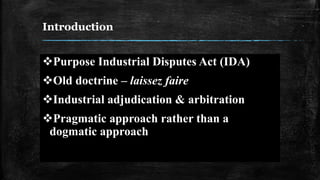
Purpose Industrial Disputes Act (IDA)
Old doctrine – laissez faire
Industrial adjudication & arbitration
Pragmatic approach rather than a
dogmatic approach
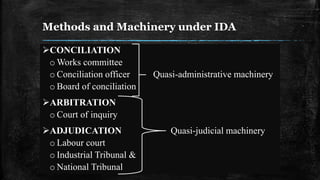
Methods and Machinery under IDA
CONCILIATION
o Works committee
o Conciliation officer Quasi-administrative machinery
o Board of conciliation
ARBITRATION
o Court of inquiry
ADJUDICATION Quasi-judicial machinery
o Labour court
o Industrial Tribunal &
o National Tribunal
ARBITRATION
▪ Arbitration is a non-judicial process for the settlement of disputes
where an independent third party - an arbitrator - makes a decision that
is binding.
▪ Arbitration is a form of Alternative Dispute Resolution in which the
parties work out the disputed issue without going to court.
▪ Arbitrator - chosen by the parties, meeting - outside court - much like a
hearing (presenting testimony and evidence).
▪ An arbitrator may or may not be an attorney, retired judges. Arbitrators
have knowledge of, and experience in, the subject of the disputes they
hear.
▪ Example: An employment law attorney, or retired administrator in the
state’s employment division, may be effective in resolving an
employment dispute.
Examples of Cases Settled in Arbitration
In 2009, Republic Airways Holdings purchase of Midwest Airlines,
more than 400 Midwest Airlines flight attendants complained of a
contract violation, as hundreds founds themselves laid off in favor of
non-Midwest employees & paid as much as 70 percent less. As it turned
out, the Midwest flight attendants’ union contract contained specific
provisions protecting their jobs in the event the airline was purchased by
another company. As these provisions had been violated, the Association
of Flight Attendants (AFA) filed a grievance accusing Republic Airways
of violating their contract.
The AFA struck a major victory in the March 2011 arbitration ruling
that required a settlement to be negotiated between Republic Airways
and the union to be in the best interest of the former Midwest flight
attendants.
The Arbitration Process
▪ One party files a claim-detailing the dispute-individuals or entities
involved-dates & type of relief sought( whether monetary, interest, or
specific performance).
Claimant & Respondent
▪ Respondent - written Answer - facts and defenses to the stated claim.
▪ Arbitrator - selected by the parties - single or panel
▪ Prehearing conference (phone) & Discovery (exchange of documents,
information & evidence)
▪ Format - trial like - less formal
▪ Decision - in 30-90 days.
ADJUDICATION
▪ Adjudication involves intervention in the dispute by a third party
appointed by the government for the purpose of deciding the nature of
final settlement.
▪ Failure of conciliation leads to adjudication.
▪ Rationale
o Developing countries cant afford Loss of production due Strikes and Lockouts
o Trade union movement is not strong
o Cant rely only on collective bargaining
 Adjudication is considered at par with decisions on fundamental rights
under constitution.
Methods of Adjudication
Labour court
Industrial Tribunal
National Tribunal
Industrial Tribunal
▪ Industrial Tribunals are independent judicial bodies that hear and
determine claims to do with employment matters. ie; Industrial
disputes relating to any matter specified in the Second schedule or the
Third schedule.
▪ These include a range of claims relating to unfair dismissal, breach of
contract, wages/other payments, as well as discrimination on the
grounds of sex, race, disability, sexual orientation, age, part time
working or equal pay.
▪ An Industrial Tribunal may be appointed for a limited period on an ad
hoc basis or permanently.
Matters specified in the third schedule of
the Act:
 Wages including the period and mode of payment;
 Hours of work and rest intervals;
 Leave with wages and holidays
 Compensatory and other allowances
 Bonus, profit sharing, provident fund and gratuity ;
 Shift working otherwise than in accordance with standing orders;
 Classification by grades
 Rates of discipline
 Rationalization
 Retrenchment of workmen and closure of establishment;
 Any other matter that may be prescribed.
Composition of Industrial Tribunal
Tribunal consist of one person – appointed by the
government.
Qualifications:
He should be an independent person and age – below 65 years.
He is or has been judge of a High court, or District judge for a
period of not less than 3years, or has held the office of the chairman
or any member of the labour appellate tribunal or any tribunal for a
period not less than 2years.
Appropriate government may, if so thinks fit, appoints two
persons as assessors – To advice the tribunal & to submit
award to the appropriate government on the conclusion of
the proceedings.
National Tribunal
According to Section 7B of The Industrial Disputes Act, 1947, the
Central Government may by notification in the Official Gazette
constitute one or more National Industrial Tribunals for the
adjudication of industrial disputes:
o Involving questions of national importance or
o Are of such a nature that industrial establishments situated in more
than one State are likely to be interested in or affected by such
disputes.
When a national tribunal has been referred to, no Labour court or
Industrial tribunal shall have any jurisdiction to adjudicate upon such a
matter.
Composition is same that of Industrial tribunal.
Duties of Tribunals
▪ To hold adjudication proceedings expeditiously.
▪ The whole objective of the Industrial Disputes Act,1947 is to assure
peace and harmony in the functioning of the industry with a view to
achieve maximum industrial productivity.
▪ In addition to these, the functions and duties are very much like
those body discharging judicial functions.
SETTLEMENT
▪ According to Section 2 (p) of the Industrial Dispute Act,
1947 “Settlement” means a settlement arrived at in the
course of conciliation proceeding and includes a written
agreement between the employer and workmen arrived at
otherwise than in the course of conciliation proceeding.
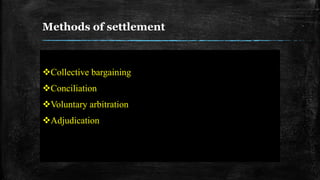
Methods of settlement
Collective bargaining
Conciliation
Voluntary arbitration
Adjudication
THANK YOU

Arbitration and Adjudication

  • 1.
    Industrial Tribunal &National Tribunal & Arbitration Prepared by, Vishnupriya M.G. II MBA (HRM & MM) SNIT B-SCHOOL ADOOR
  • 2.
    Introduction Purpose Industrial DisputesAct (IDA) Old doctrine – laissez faire Industrial adjudication & arbitration Pragmatic approach rather than a dogmatic approach
  • 3.
    Methods and Machineryunder IDA CONCILIATION o Works committee o Conciliation officer Quasi-administrative machinery o Board of conciliation ARBITRATION o Court of inquiry ADJUDICATION Quasi-judicial machinery o Labour court o Industrial Tribunal & o National Tribunal
  • 4.
    ARBITRATION ▪ Arbitration isa non-judicial process for the settlement of disputes where an independent third party - an arbitrator - makes a decision that is binding. ▪ Arbitration is a form of Alternative Dispute Resolution in which the parties work out the disputed issue without going to court. ▪ Arbitrator - chosen by the parties, meeting - outside court - much like a hearing (presenting testimony and evidence). ▪ An arbitrator may or may not be an attorney, retired judges. Arbitrators have knowledge of, and experience in, the subject of the disputes they hear. ▪ Example: An employment law attorney, or retired administrator in the state’s employment division, may be effective in resolving an employment dispute.
  • 5.
    Examples of CasesSettled in Arbitration In 2009, Republic Airways Holdings purchase of Midwest Airlines, more than 400 Midwest Airlines flight attendants complained of a contract violation, as hundreds founds themselves laid off in favor of non-Midwest employees & paid as much as 70 percent less. As it turned out, the Midwest flight attendants’ union contract contained specific provisions protecting their jobs in the event the airline was purchased by another company. As these provisions had been violated, the Association of Flight Attendants (AFA) filed a grievance accusing Republic Airways of violating their contract. The AFA struck a major victory in the March 2011 arbitration ruling that required a settlement to be negotiated between Republic Airways and the union to be in the best interest of the former Midwest flight attendants.
  • 6.
    The Arbitration Process ▪One party files a claim-detailing the dispute-individuals or entities involved-dates & type of relief sought( whether monetary, interest, or specific performance). Claimant & Respondent ▪ Respondent - written Answer - facts and defenses to the stated claim. ▪ Arbitrator - selected by the parties - single or panel ▪ Prehearing conference (phone) & Discovery (exchange of documents, information & evidence) ▪ Format - trial like - less formal ▪ Decision - in 30-90 days.
  • 7.
    ADJUDICATION ▪ Adjudication involvesintervention in the dispute by a third party appointed by the government for the purpose of deciding the nature of final settlement. ▪ Failure of conciliation leads to adjudication. ▪ Rationale o Developing countries cant afford Loss of production due Strikes and Lockouts o Trade union movement is not strong o Cant rely only on collective bargaining  Adjudication is considered at par with decisions on fundamental rights under constitution.
  • 8.
    Methods of Adjudication Labourcourt Industrial Tribunal National Tribunal
  • 9.
    Industrial Tribunal ▪ IndustrialTribunals are independent judicial bodies that hear and determine claims to do with employment matters. ie; Industrial disputes relating to any matter specified in the Second schedule or the Third schedule. ▪ These include a range of claims relating to unfair dismissal, breach of contract, wages/other payments, as well as discrimination on the grounds of sex, race, disability, sexual orientation, age, part time working or equal pay. ▪ An Industrial Tribunal may be appointed for a limited period on an ad hoc basis or permanently.
  • 10.
    Matters specified inthe third schedule of the Act:  Wages including the period and mode of payment;  Hours of work and rest intervals;  Leave with wages and holidays  Compensatory and other allowances  Bonus, profit sharing, provident fund and gratuity ;  Shift working otherwise than in accordance with standing orders;  Classification by grades  Rates of discipline  Rationalization  Retrenchment of workmen and closure of establishment;  Any other matter that may be prescribed.
  • 11.
    Composition of IndustrialTribunal Tribunal consist of one person – appointed by the government. Qualifications: He should be an independent person and age – below 65 years. He is or has been judge of a High court, or District judge for a period of not less than 3years, or has held the office of the chairman or any member of the labour appellate tribunal or any tribunal for a period not less than 2years. Appropriate government may, if so thinks fit, appoints two persons as assessors – To advice the tribunal & to submit award to the appropriate government on the conclusion of the proceedings.
  • 12.
    National Tribunal According toSection 7B of The Industrial Disputes Act, 1947, the Central Government may by notification in the Official Gazette constitute one or more National Industrial Tribunals for the adjudication of industrial disputes: o Involving questions of national importance or o Are of such a nature that industrial establishments situated in more than one State are likely to be interested in or affected by such disputes. When a national tribunal has been referred to, no Labour court or Industrial tribunal shall have any jurisdiction to adjudicate upon such a matter. Composition is same that of Industrial tribunal.
  • 13.
    Duties of Tribunals ▪To hold adjudication proceedings expeditiously. ▪ The whole objective of the Industrial Disputes Act,1947 is to assure peace and harmony in the functioning of the industry with a view to achieve maximum industrial productivity. ▪ In addition to these, the functions and duties are very much like those body discharging judicial functions.
  • 14.
    SETTLEMENT ▪ According toSection 2 (p) of the Industrial Dispute Act, 1947 “Settlement” means a settlement arrived at in the course of conciliation proceeding and includes a written agreement between the employer and workmen arrived at otherwise than in the course of conciliation proceeding.
  • 15.
    Methods of settlement Collectivebargaining Conciliation Voluntary arbitration Adjudication
  • 16.