Routing in adhoc networks of mobile hosts
                            SUBMITTED BY

                              S.Aravind
                             (09491A0423)


      Department of Electronics and Communication Engineering

      QIS COLLEGE OF ENGINEERING AND TECHNOLOGY
                                   .
What is an Ad hoc Network
• Collection of mobile wireless nodes forming a network
  without the aid of any infrastructure or centralized
  administration
• Nodes have limited transmission range
• Nodes act as a routers
DIFFERENCE B/W ADHOC AND
    NORMAL WIRELESS MODE
ADHOC MODE      NORM.WIRELESS MODE
WHY IT IS ADHOC
• IN NORMAL WIRELESS MODE BACK LOG IS
  INFRASTRUCTURE..
• IN ADHOC THERE IS NO INFRASTRUCTURE..SO
  IT IS PREFERRED TO OTHER N/W’S
• WI-FI,WI-MAX,BLUETOOTH ARE SOME OF
  INFRASTRUCTURED N/W’S
• MANET,VANET ARE SOME OF THE ADHOC
  NETWORKS
ROUTING IN ADHOC
• ROUTING IS NOTHING BUT THE WAY OF DATA
  TRANSFERRING B/W THE NODES.
• IN ADHOC EVERY COMPUTER ,MOBILE,PDA
  ACTS AS NODE,DATA IS TRANSFERRED B/W
  THE NODES
• DATA IS TRANSFERRED B/W THE NODES IN
  THE FORM OF PACKETS
TYPES OF ROUTING PROTOCOLS IN
               ADHOC
• Proactive routing: This type of protocols maintains
  fresh lists of destinations and their routes by
  periodically distributing routing tables throughout the
  network
• Reactive (on demand ) routing: This type of protocols
  finds a route on demand by flooding the network with
  Route Request packets
• Flow oriented routing: This type of protocols finds a
  route on demand by following present flows.
• Hybrid (both proactive &reactive routing):This type of
  protocols combines the advantages of proactive and of
  reactive routing
• Hierarchical routing protocols:With this type of protocols
  the choice of proactive and of reactive routing depends on
  the hierarchic level where a node resides.
• Backpressure routing:This type of routing does not pre-
  compute paths. It chooses next-hops dynamically as a
  packet is in progress toward its destination. These decisions
  are based on congestion gradients of neighbor nodes
• Host specific routing protocols:This type of protocols
  requires thorough administration to tailor the routing to a
  certain network layout and a distinct flow strategy
• Power aware routing protocols:Here the data is tranferred
  by calculating power of the next node.Highest power node
  is selected for transferring of data
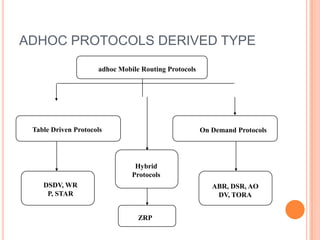
ADHOC PROTOCOLS DERIVED TYPE
                     adhoc Mobile Routing Protocols


 Table Driven Protocols                               On Demand Protocols


                                Hybrid
                               Protocols
    DSDV, WR                                             ABR, DSR, AO
     P, STAR                                              DV, TORA


                                 ZRP
Security Challenges in Ad Hoc
                Networks
• Lack of Infrastructure or centralized control
   – Key management becomes difficult
• Dynamic topology
   – Challenging to design sophisticated & secure routing
     protocols
• Communication through Radio Waves
   – Difficult to prevent eavesdropping
• Vulnerabilities of routing mechanism
   – Non-cooperation of nodes
• Vulnerabilities of nodes
   – Captured or Compromised
ENERGY EFFICIENT ROUTING
          PROTOCOLS FOR ADHOC
• 1. DYNAMIC SOURCE ROUTING (DSR):The key feature of
  DSR is the use of source routing. That is ,the sender knows
  the complete hop by hop route to destination .These routes
  are stored in route cache.
• 2. MINIMUM BATTERY COST ROUTING (MBCR):The
  minimum battery cost routing model uses the remaining
  battery capacity of the node to measure the node life
  time, and path is choosed as per the good life time basis.
• 3. MINIMUM MAXIMUM BATTERY COST ROUTING
  (MMBCR):The main objective of MMBCR is to make sure
  that route selection is done based on the battery capacity
  of all the individual nodes. It selects the path having more
  battery capacity
ADVANTAGES AND DISADVANTAGES
ADVANTAGES:
• Can be accessible to remote areas where a wlan cannot reach.
• Can be established and destroyed easily.
• There is no need of long wires and cables and infrastructure
   equipment.
• It can be considered as fastest operation.
• Can be accessed at anywhere with the same ip address
DISADVANTAGES:
• No security in data transfer.
• If the battery power consumed the node will be destroyed.
• Threats from compromised nodes inside the network
• Lack of centralized management facility
PRACTICAL XP ADHOC SETUP
FUTURE REASERCHES
•   Routing Protocol Optimization
•   QoS Support
•   Simulation
•   Security
•   Standardization and Interoperability
CONCLUSION
• THOUGH ADHOC HAS SOME DEMERITS..LIKE
  SECURITY AND OTHER ,IT IS SOLVING SO
  MUCH PROBLEMS IN OUR DAY TO DAY
  LIFE…SO THINK FOR BETTER ADHOC…..ING
THANK YOU FOR YOUR
       CONCENTRATION


ANY QUESTIONS FROM YOUR SIDE…?

Aravindsikharam

  • 1.
    Routing in adhocnetworks of mobile hosts SUBMITTED BY S.Aravind (09491A0423) Department of Electronics and Communication Engineering QIS COLLEGE OF ENGINEERING AND TECHNOLOGY .
  • 2.
    What is anAd hoc Network • Collection of mobile wireless nodes forming a network without the aid of any infrastructure or centralized administration • Nodes have limited transmission range • Nodes act as a routers
  • 3.
    DIFFERENCE B/W ADHOCAND NORMAL WIRELESS MODE ADHOC MODE NORM.WIRELESS MODE
  • 4.
    WHY IT ISADHOC • IN NORMAL WIRELESS MODE BACK LOG IS INFRASTRUCTURE.. • IN ADHOC THERE IS NO INFRASTRUCTURE..SO IT IS PREFERRED TO OTHER N/W’S • WI-FI,WI-MAX,BLUETOOTH ARE SOME OF INFRASTRUCTURED N/W’S • MANET,VANET ARE SOME OF THE ADHOC NETWORKS
  • 5.
    ROUTING IN ADHOC •ROUTING IS NOTHING BUT THE WAY OF DATA TRANSFERRING B/W THE NODES. • IN ADHOC EVERY COMPUTER ,MOBILE,PDA ACTS AS NODE,DATA IS TRANSFERRED B/W THE NODES • DATA IS TRANSFERRED B/W THE NODES IN THE FORM OF PACKETS
  • 6.
    TYPES OF ROUTINGPROTOCOLS IN ADHOC • Proactive routing: This type of protocols maintains fresh lists of destinations and their routes by periodically distributing routing tables throughout the network • Reactive (on demand ) routing: This type of protocols finds a route on demand by flooding the network with Route Request packets • Flow oriented routing: This type of protocols finds a route on demand by following present flows. • Hybrid (both proactive &reactive routing):This type of protocols combines the advantages of proactive and of reactive routing
  • 7.
    • Hierarchical routingprotocols:With this type of protocols the choice of proactive and of reactive routing depends on the hierarchic level where a node resides. • Backpressure routing:This type of routing does not pre- compute paths. It chooses next-hops dynamically as a packet is in progress toward its destination. These decisions are based on congestion gradients of neighbor nodes • Host specific routing protocols:This type of protocols requires thorough administration to tailor the routing to a certain network layout and a distinct flow strategy • Power aware routing protocols:Here the data is tranferred by calculating power of the next node.Highest power node is selected for transferring of data
  • 8.
    ADHOC PROTOCOLS DERIVEDTYPE adhoc Mobile Routing Protocols Table Driven Protocols On Demand Protocols Hybrid Protocols DSDV, WR ABR, DSR, AO P, STAR DV, TORA ZRP
  • 9.
    Security Challenges inAd Hoc Networks • Lack of Infrastructure or centralized control – Key management becomes difficult • Dynamic topology – Challenging to design sophisticated & secure routing protocols • Communication through Radio Waves – Difficult to prevent eavesdropping • Vulnerabilities of routing mechanism – Non-cooperation of nodes • Vulnerabilities of nodes – Captured or Compromised
  • 10.
    ENERGY EFFICIENT ROUTING PROTOCOLS FOR ADHOC • 1. DYNAMIC SOURCE ROUTING (DSR):The key feature of DSR is the use of source routing. That is ,the sender knows the complete hop by hop route to destination .These routes are stored in route cache. • 2. MINIMUM BATTERY COST ROUTING (MBCR):The minimum battery cost routing model uses the remaining battery capacity of the node to measure the node life time, and path is choosed as per the good life time basis. • 3. MINIMUM MAXIMUM BATTERY COST ROUTING (MMBCR):The main objective of MMBCR is to make sure that route selection is done based on the battery capacity of all the individual nodes. It selects the path having more battery capacity
  • 11.
    ADVANTAGES AND DISADVANTAGES ADVANTAGES: •Can be accessible to remote areas where a wlan cannot reach. • Can be established and destroyed easily. • There is no need of long wires and cables and infrastructure equipment. • It can be considered as fastest operation. • Can be accessed at anywhere with the same ip address DISADVANTAGES: • No security in data transfer. • If the battery power consumed the node will be destroyed. • Threats from compromised nodes inside the network • Lack of centralized management facility
  • 12.
  • 15.
    FUTURE REASERCHES • Routing Protocol Optimization • QoS Support • Simulation • Security • Standardization and Interoperability
  • 16.
    CONCLUSION • THOUGH ADHOCHAS SOME DEMERITS..LIKE SECURITY AND OTHER ,IT IS SOLVING SO MUCH PROBLEMS IN OUR DAY TO DAY LIFE…SO THINK FOR BETTER ADHOC…..ING
  • 17.
    THANK YOU FORYOUR CONCENTRATION ANY QUESTIONS FROM YOUR SIDE…?