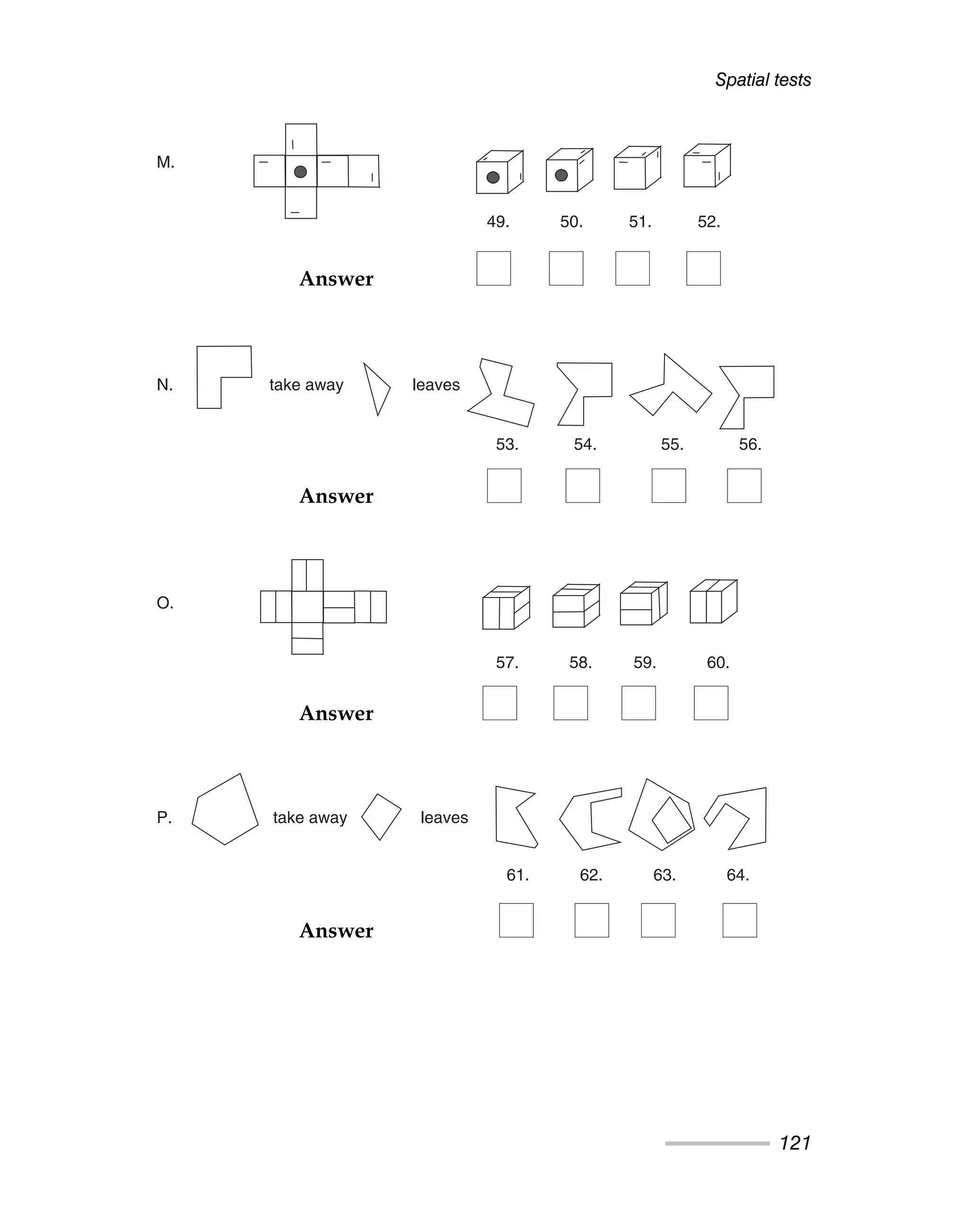
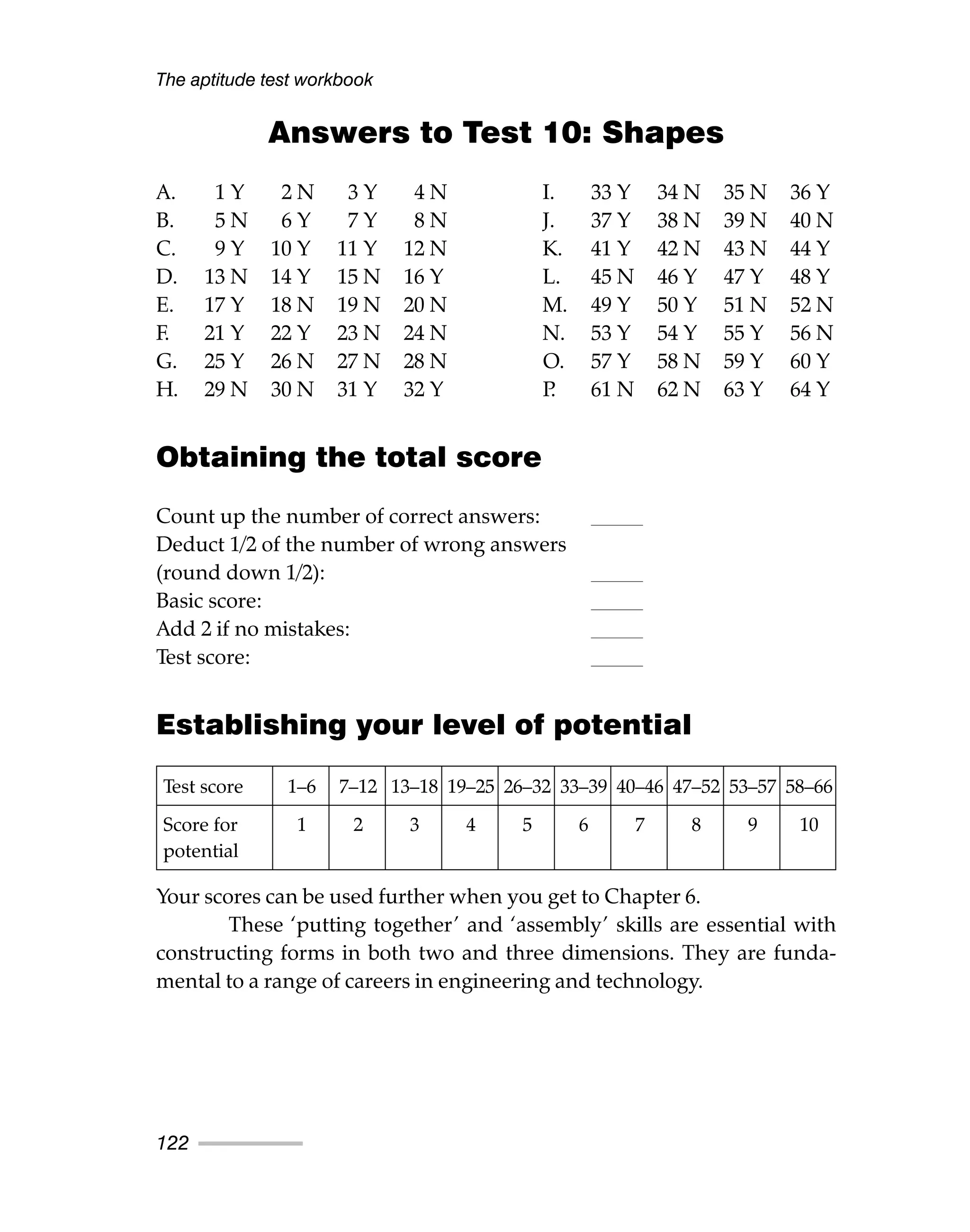
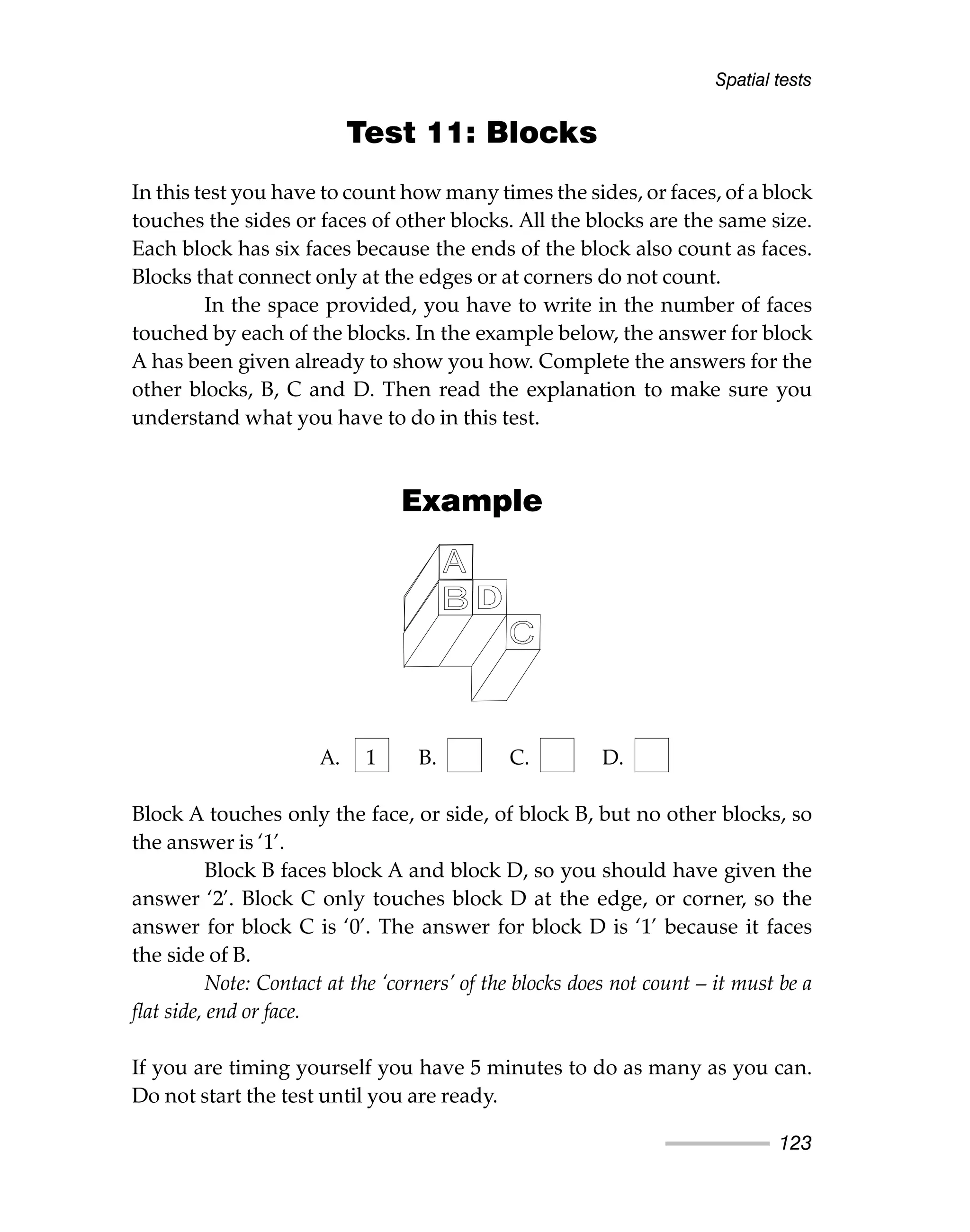
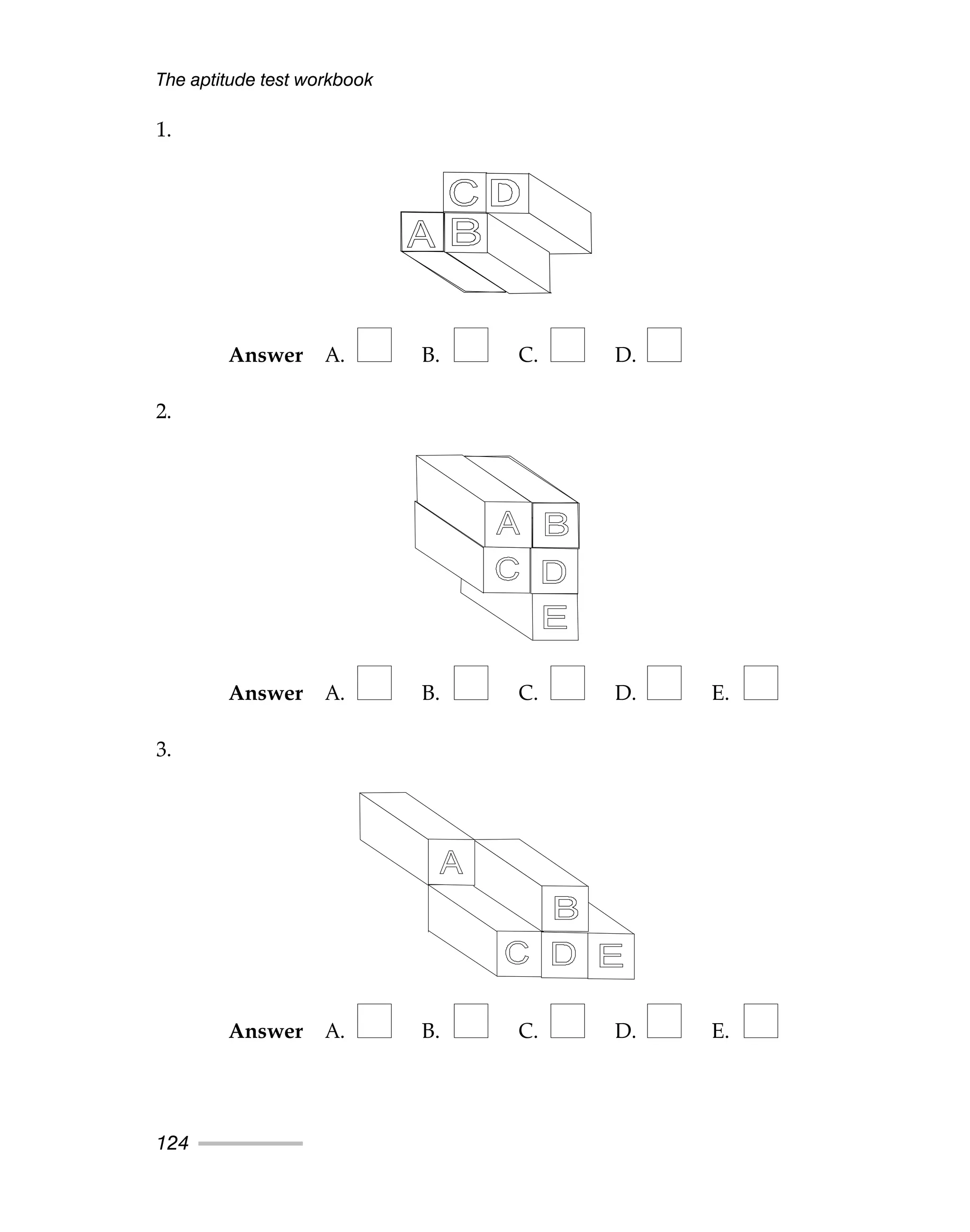
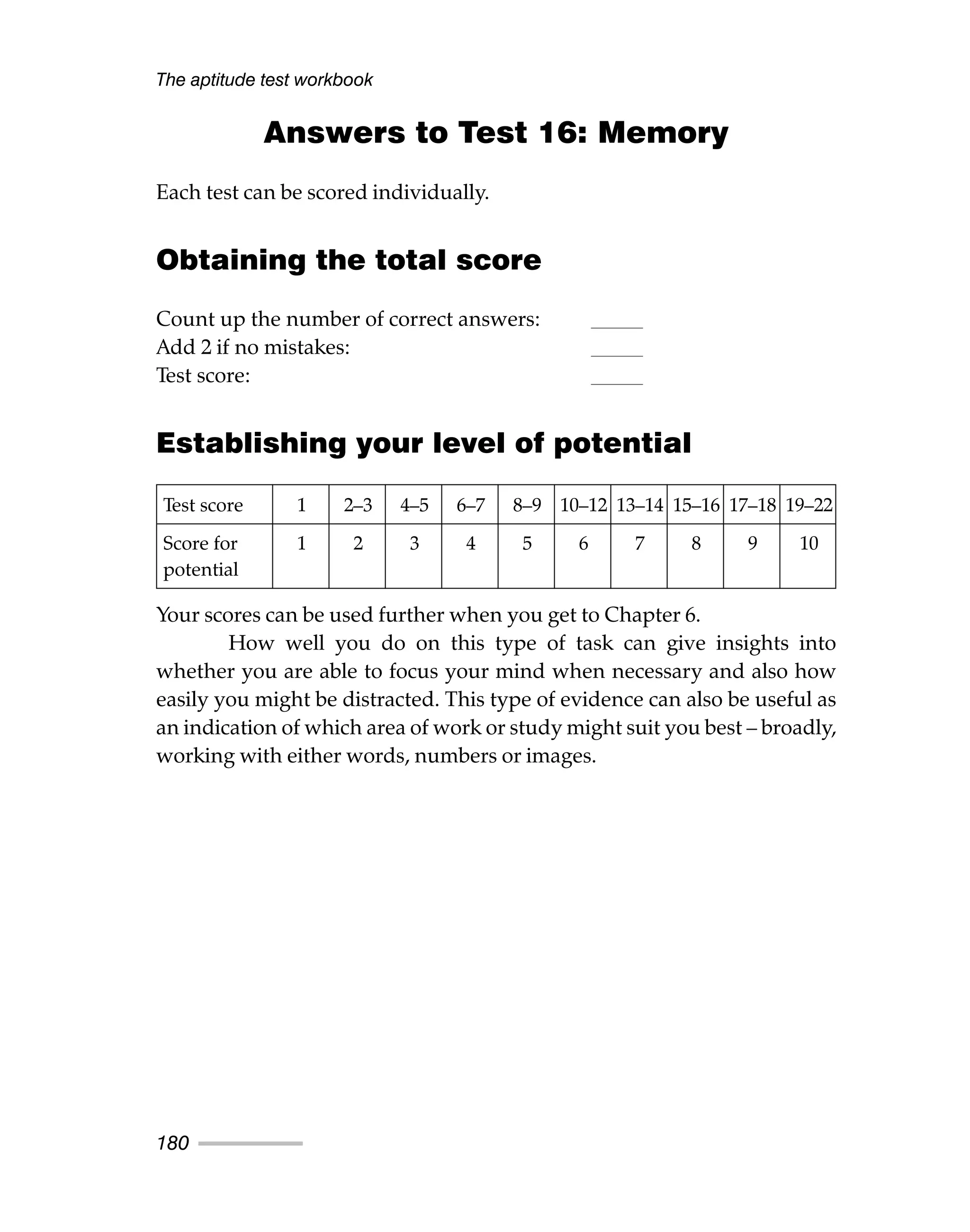
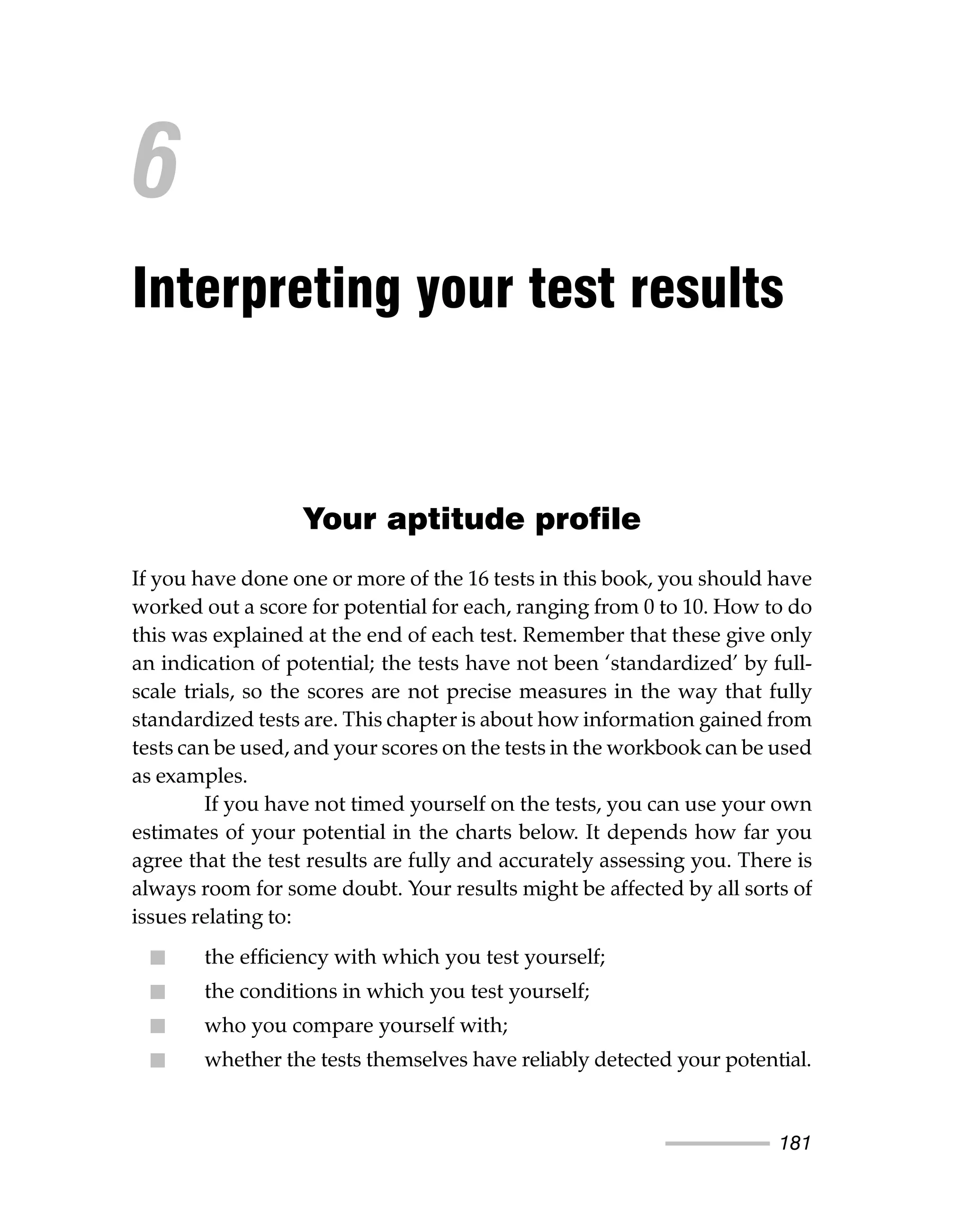
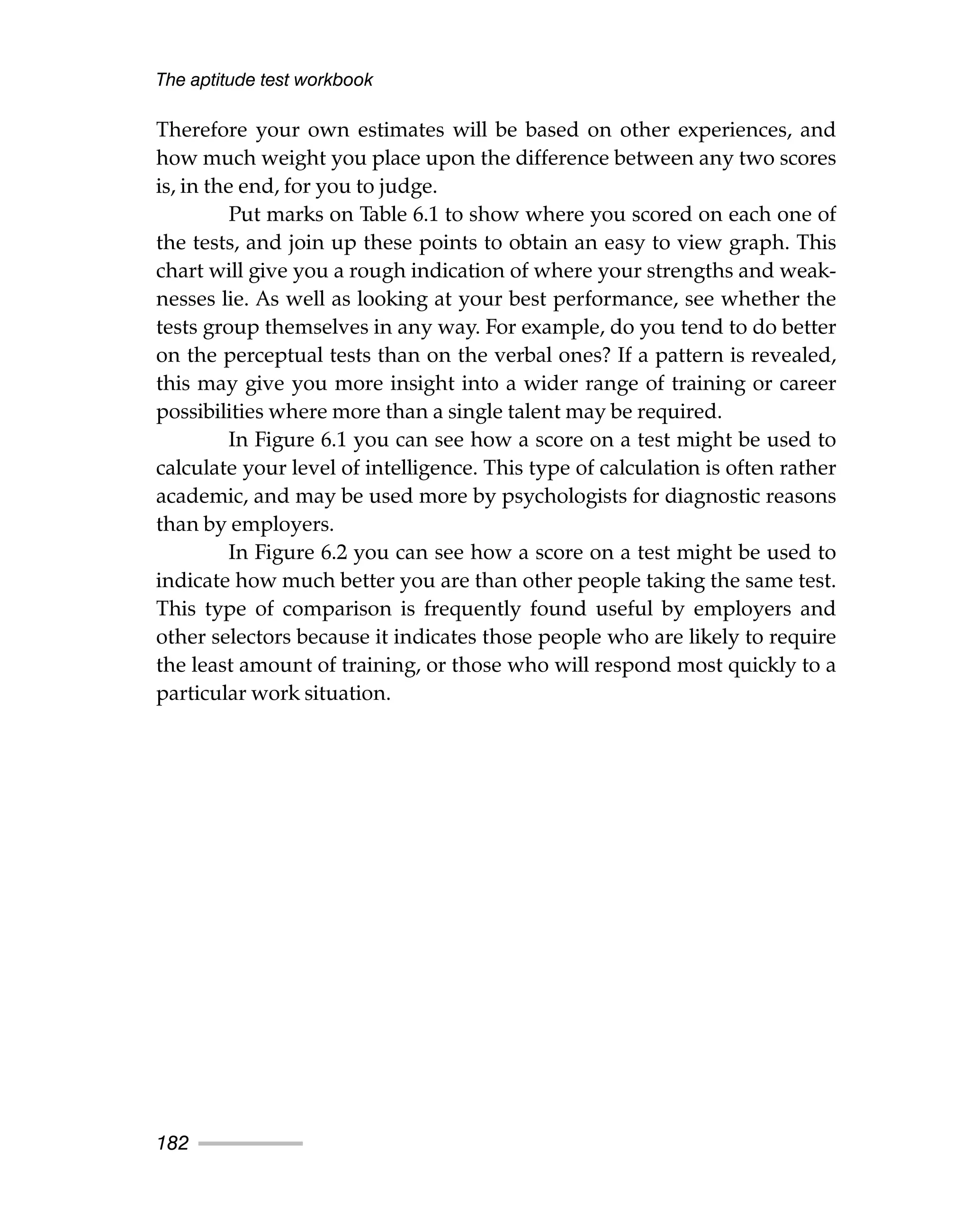
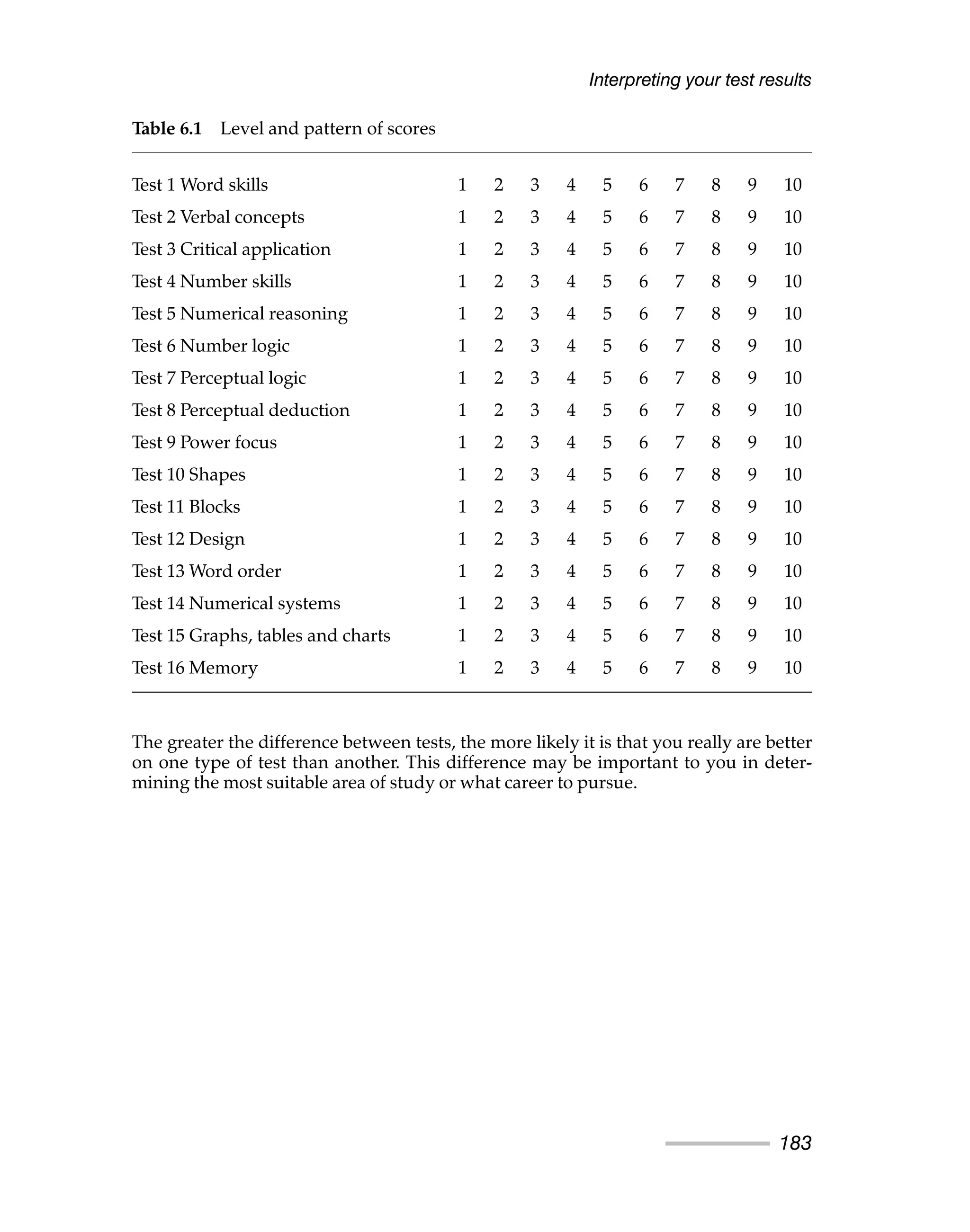
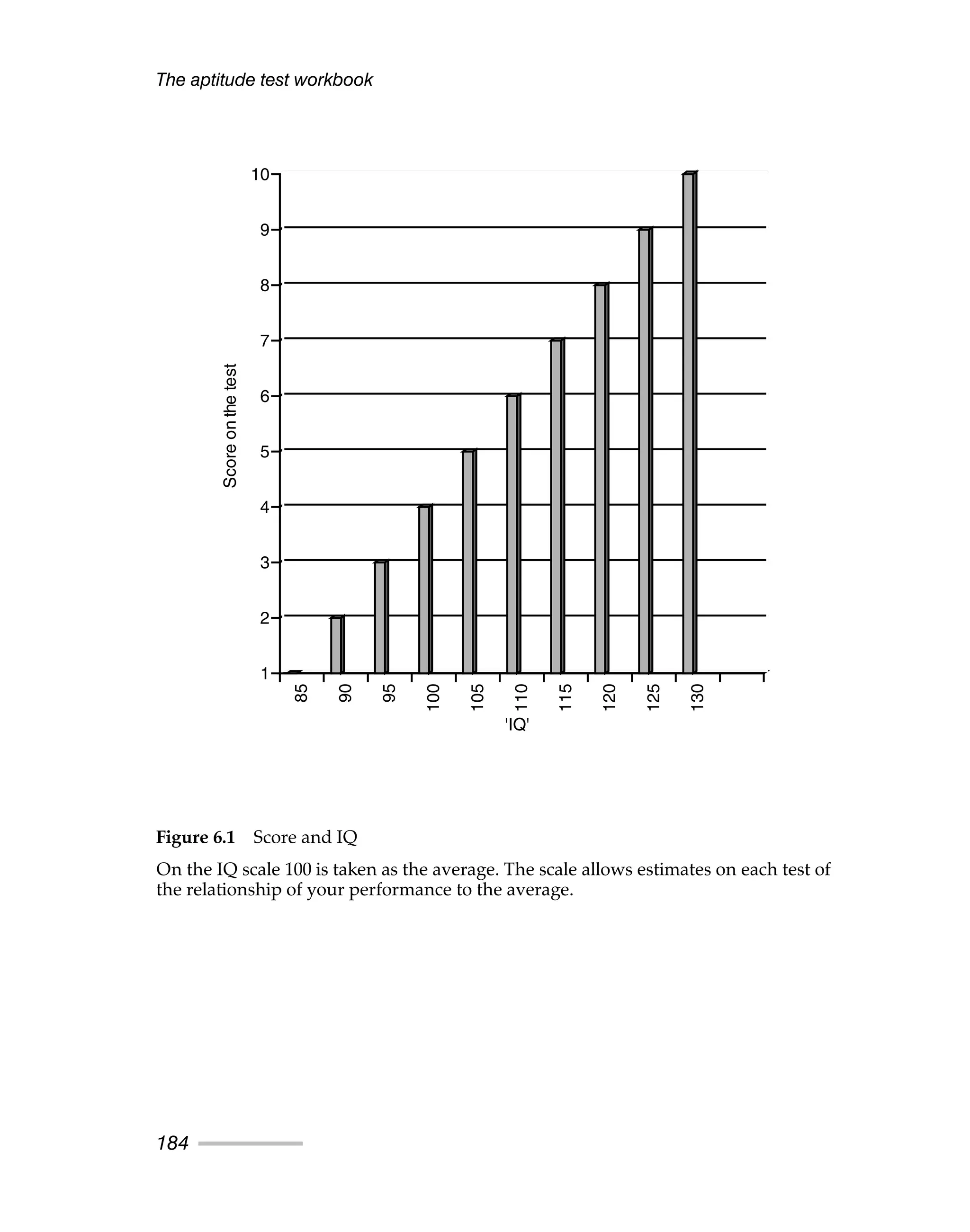
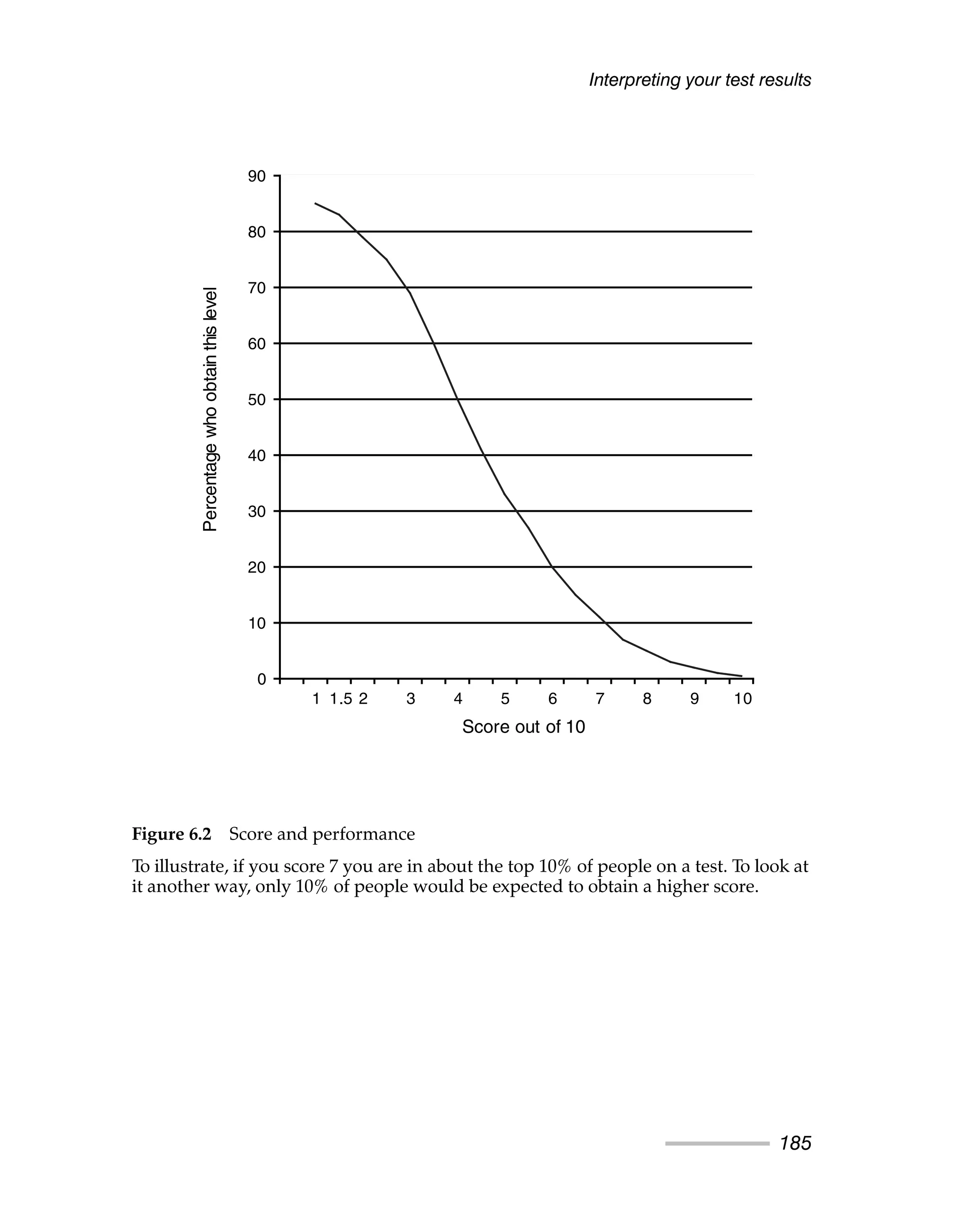
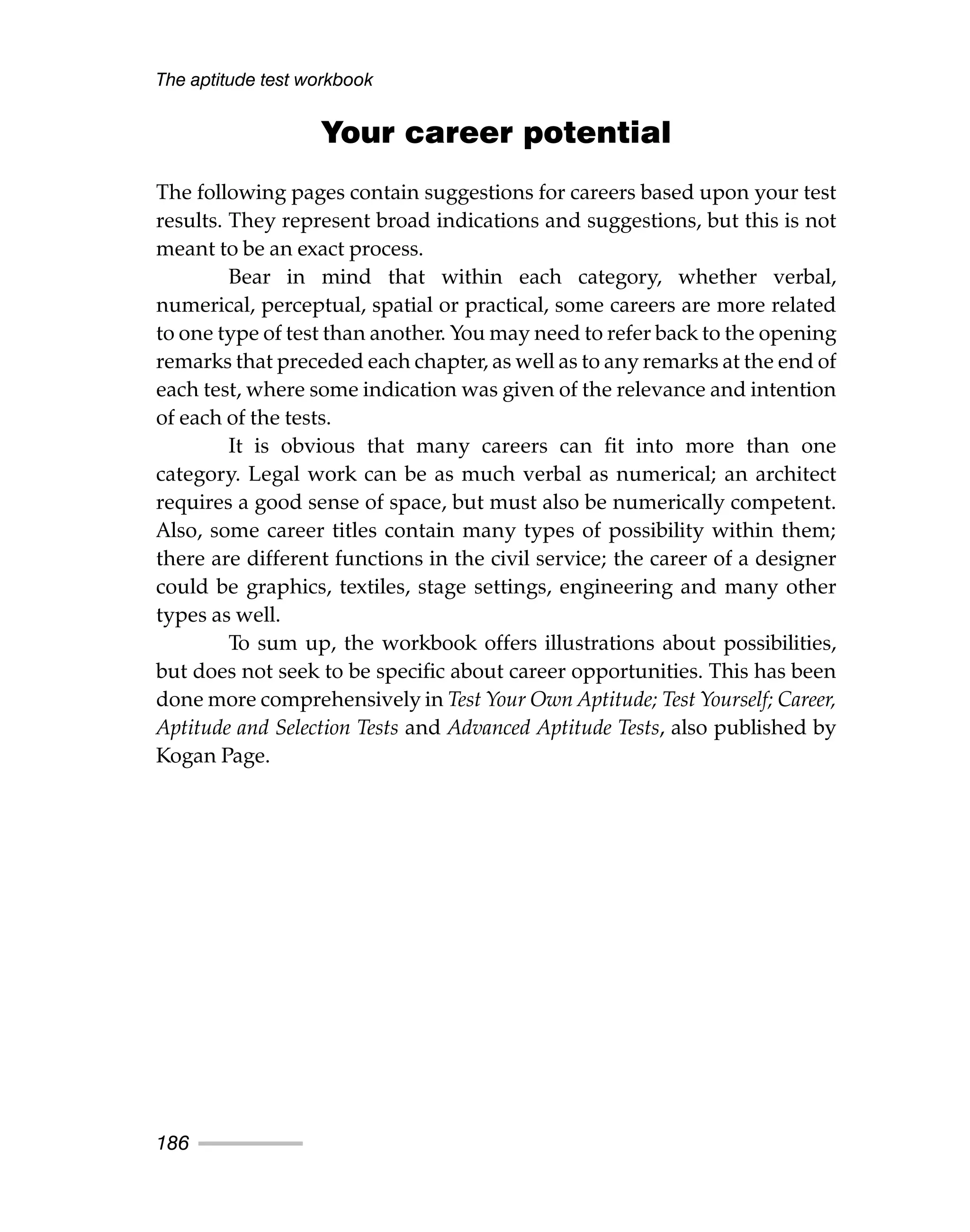
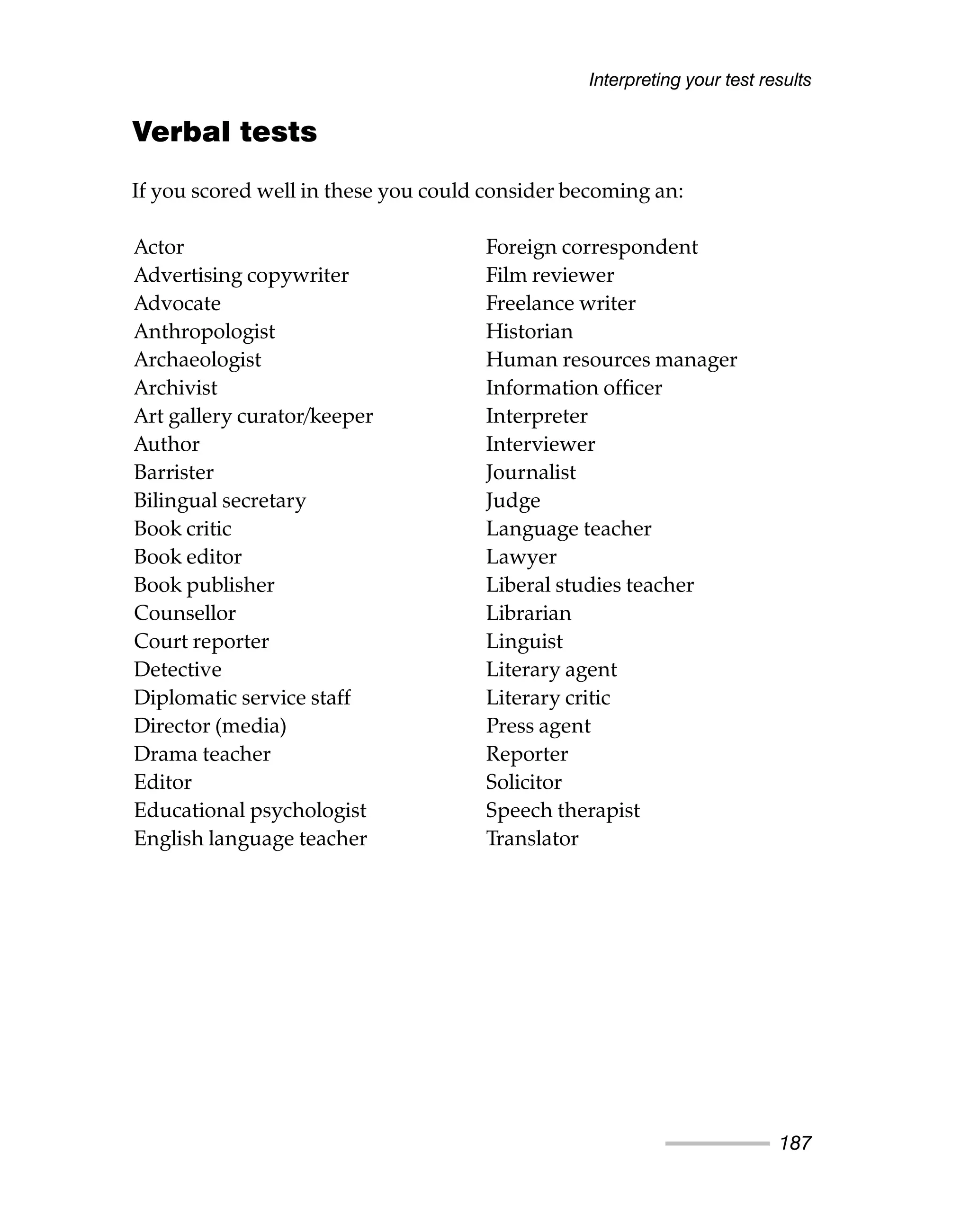
i
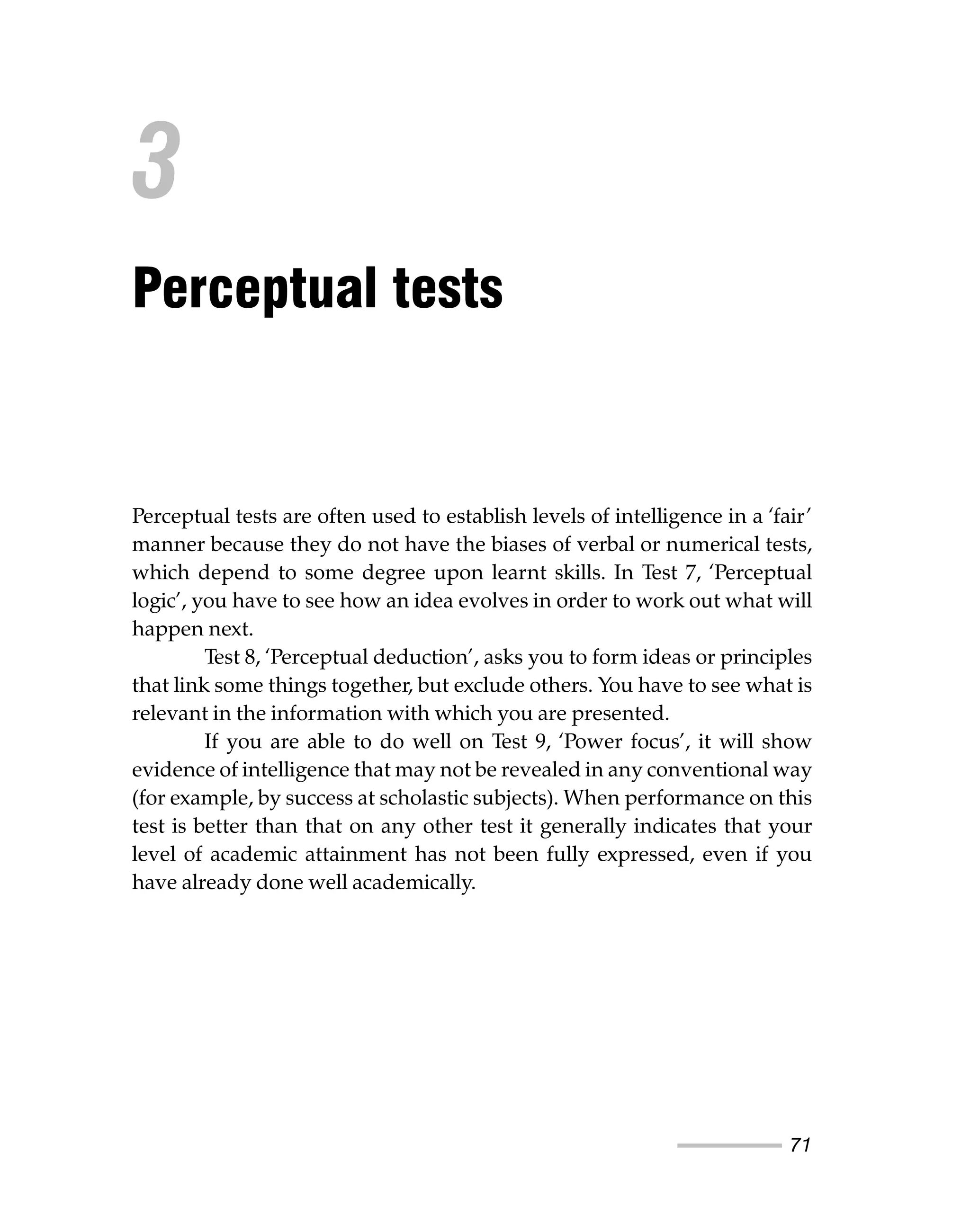
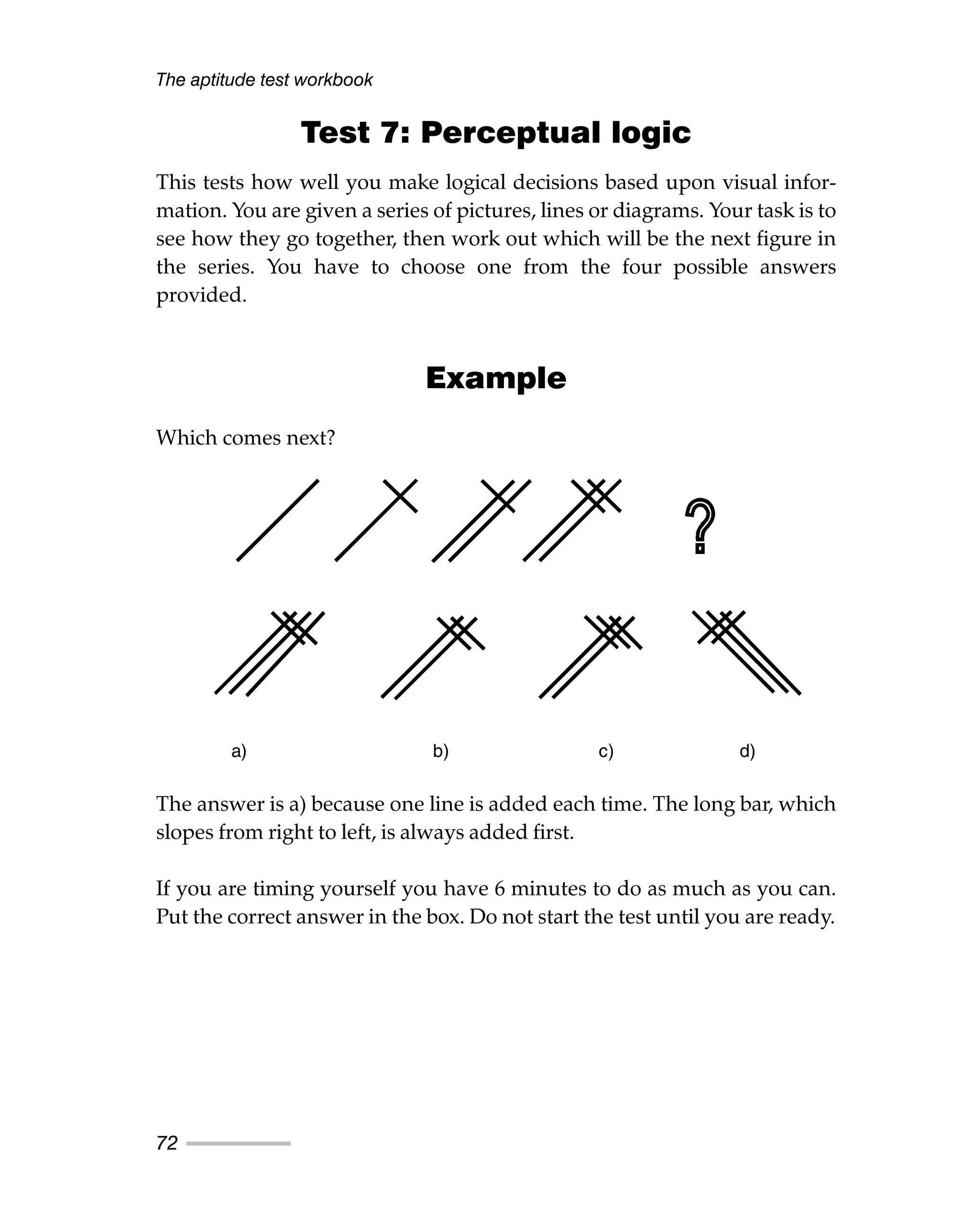
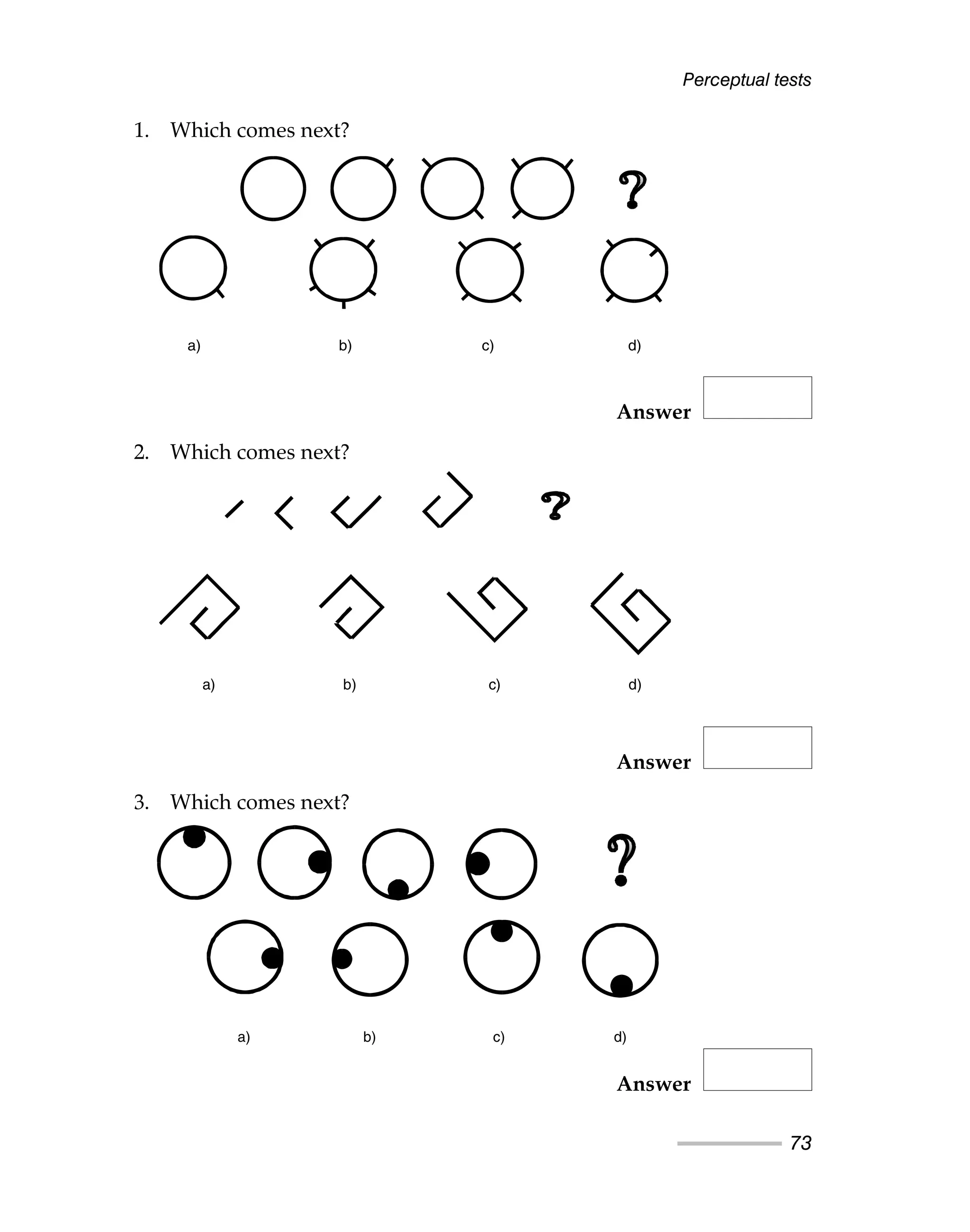
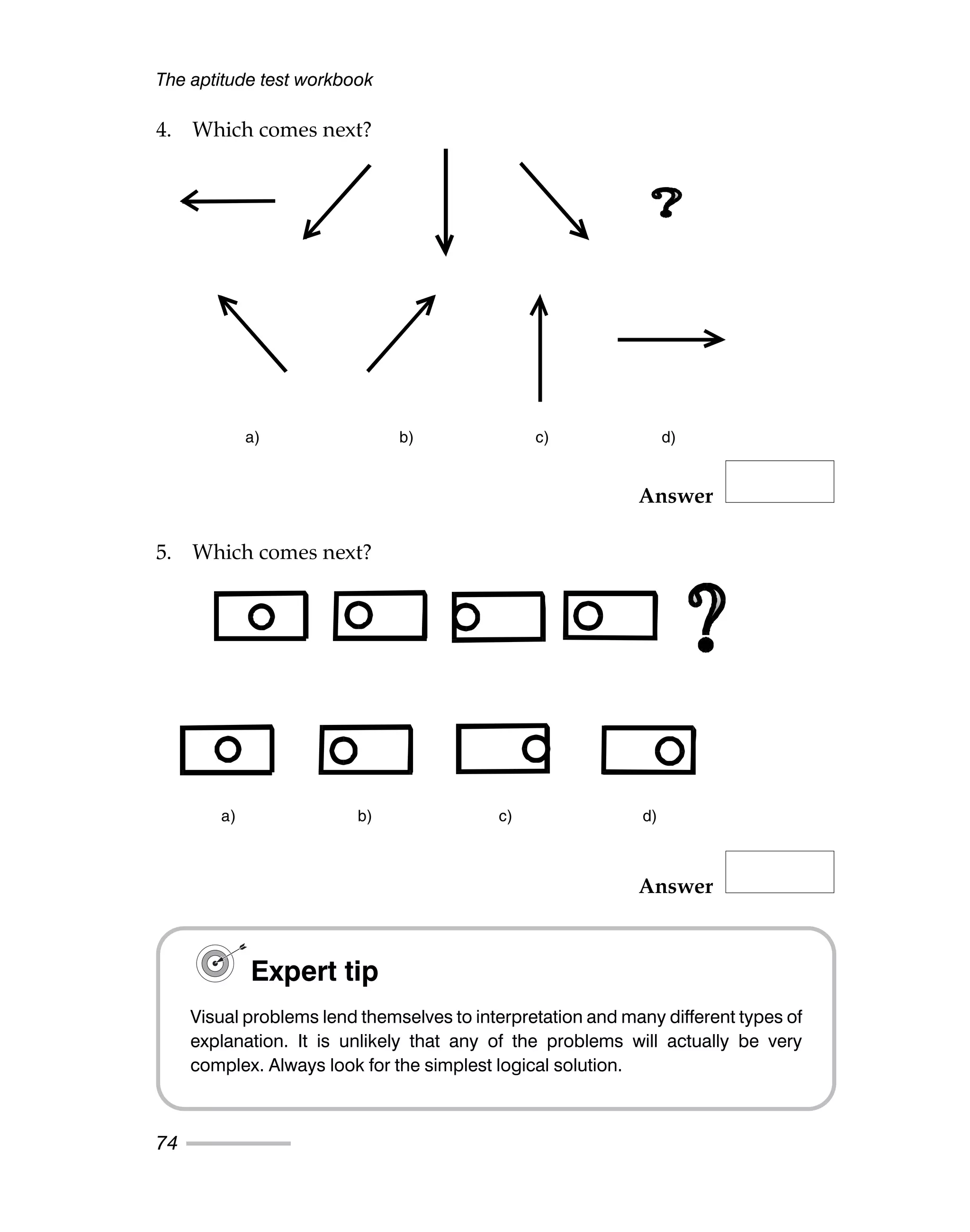
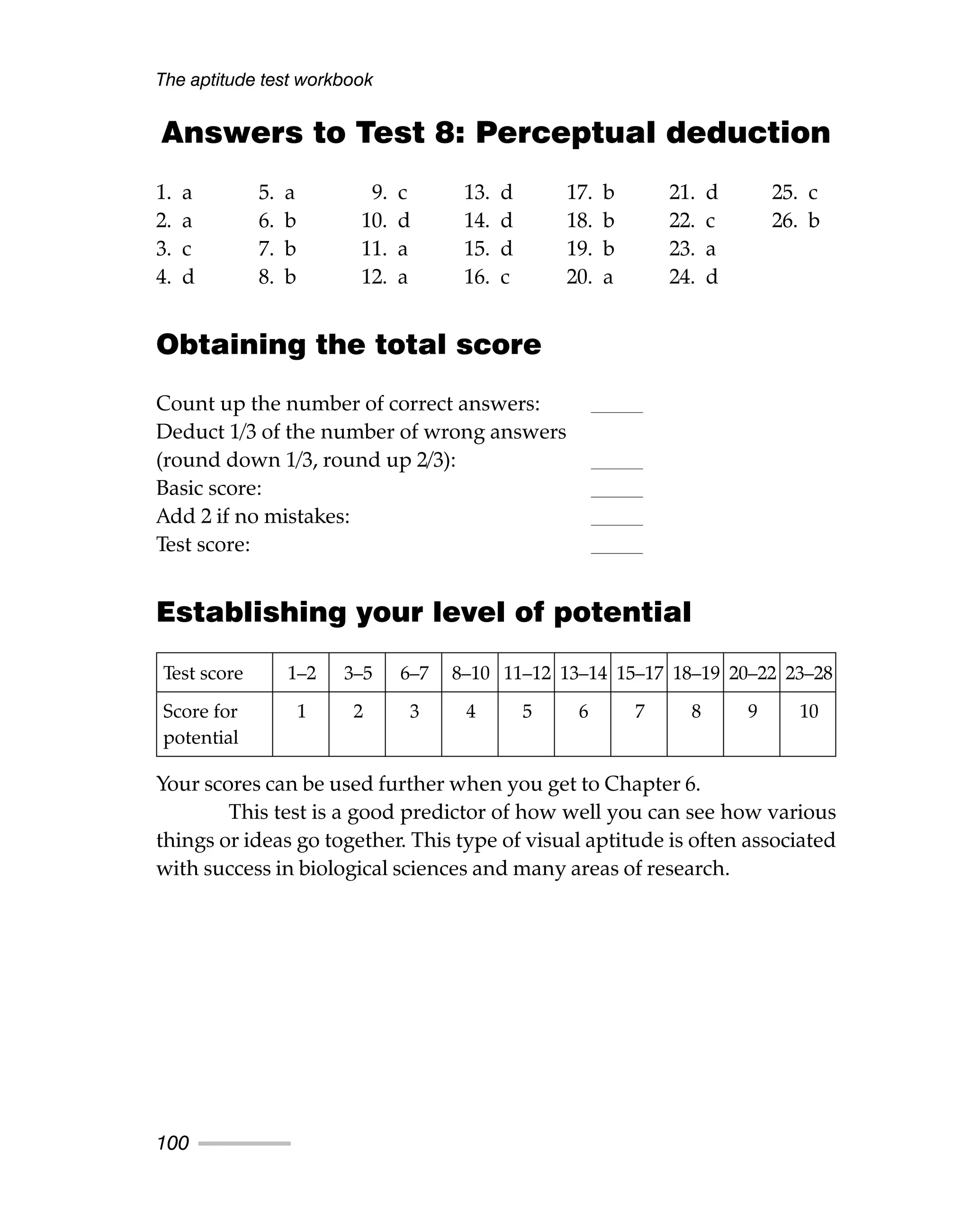
THE APTITUDE
TEST WORKBOOK
ii
JIM BARRETT
Revised edition
THE APTITUDE
TEST WORKBOOK
London and Philadelphia
Discover your potential and improve
your career options with practice psychometric tests
iii
iv
First published in Great Britain in 2004
Reprinted 2004, 2005, 2007 (twice)
Revised edition 2008
Apart from any fair dealing for the purposes of research or private study, or criticism or
review, as permitted under the Copyright, Designs and Patents Act 1988, this publication
may only be reproduced, stored or transmitted, in any form or by any means, with the prior
permission in writing of the publishers, or in the case of reprographic reproduction in accor-
dance with the terms and licences issued by the CLA. Enquiries concerning reproduction
outside these terms should be sent to the publishers at the undermentioned addresses:
120 Pentonville Road 525 South 4th Street, #241
London N1 9JN Philadelphia PA 19147
United Kingdom USA
www.koganpage.com
© Jim Barrett, 2004, 2008
The right of Jim Barrett to be identified as the author of this work has been asserted by him in
accordance with the Copyright, Designs and Patents Act 1988.
ISBN 978 0 7494 5237 7
British Library Cataloguing in Publication Data
A CIP record for this book is available from the British Library.
Library of Congress Cataloging-in-Publication Data
Barrett, Jim.
The aptitude test workbook : discover your potential and improve your career options
with practice psychometric tests / Jim Barrett. — rev. 1st ed.
p. cm.
ISBN 978-0-7494-5237-7
1. Vocational interests—Testing. 2. Occupational aptitude tests. 3. Vocational
guidance. I. Title.
HF5381.5.B26 2008
153.9⬘4--dc22
2008010355
Typeset by Saxon Graphics Ltd, Derby
Printed and bound in Great Britain by MPG Books Ltd, Bodmin, Cornwall
Whilst the author has made every effort to ensure that the content of this book is
accurate, please note that occasional errors can occur in books of this kind. If you suspect
that an error has been made in any of the tests included in this book, please inform the
publishers at the address printed below so that it can be corrected at the next reprint.
Contents
Introduction 1
1 Verbal tests 8
Test 1: Word skills 10
Test 2: Verbal concepts 24
Test 3: Critical application 33
2 Numerical tests 43
Test 4: Number skills 46
Test 5: Numerical reasoning 57
Test 6: Number logic 63
3 Perceptual tests 71
Test 7: Perceptual logic 72
Test 8: Perceptual deduction 87
Test 9: Power focus 101
4 Spatial tests 115
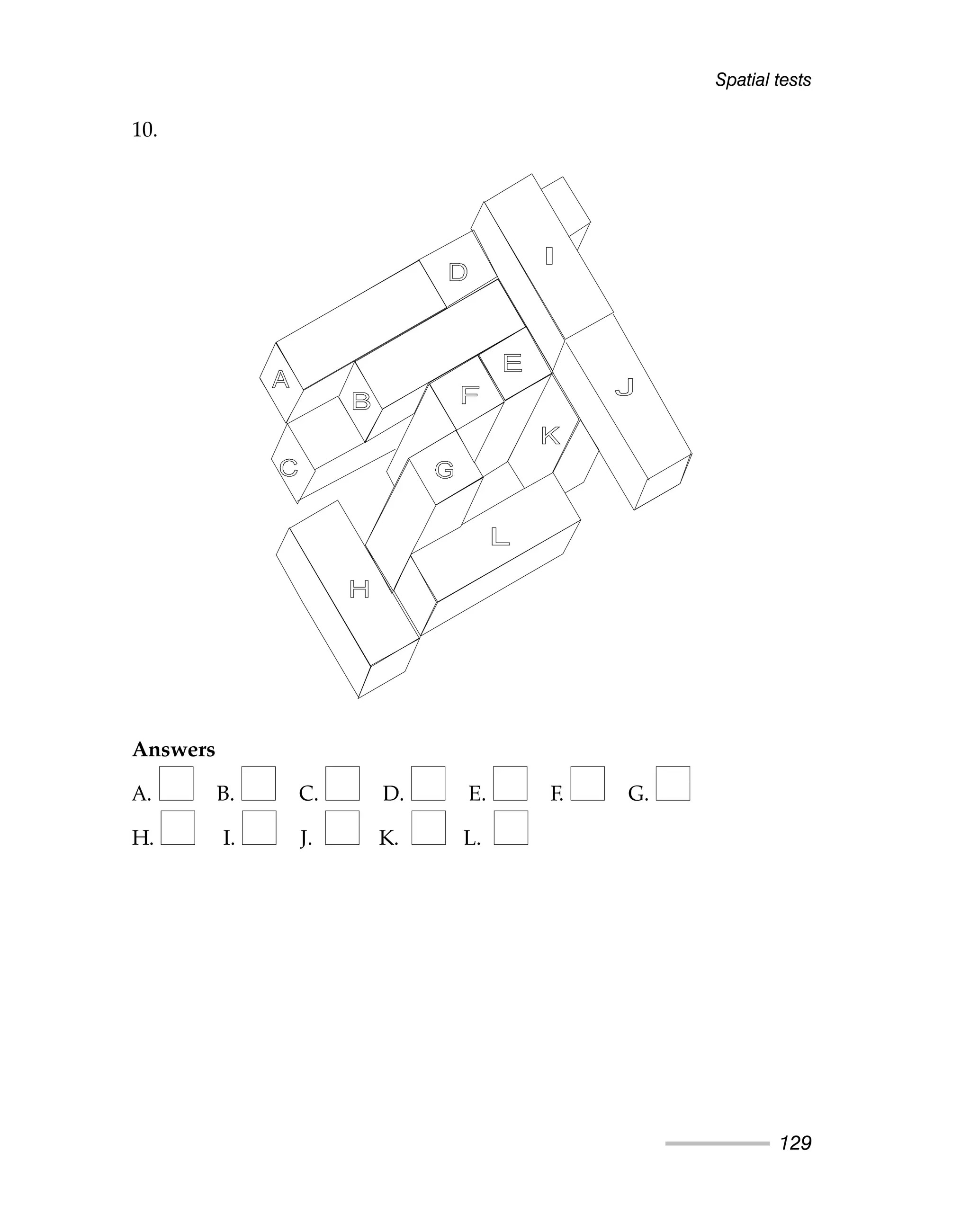
Test 10: Shapes 116
Test 11: Blocks 123
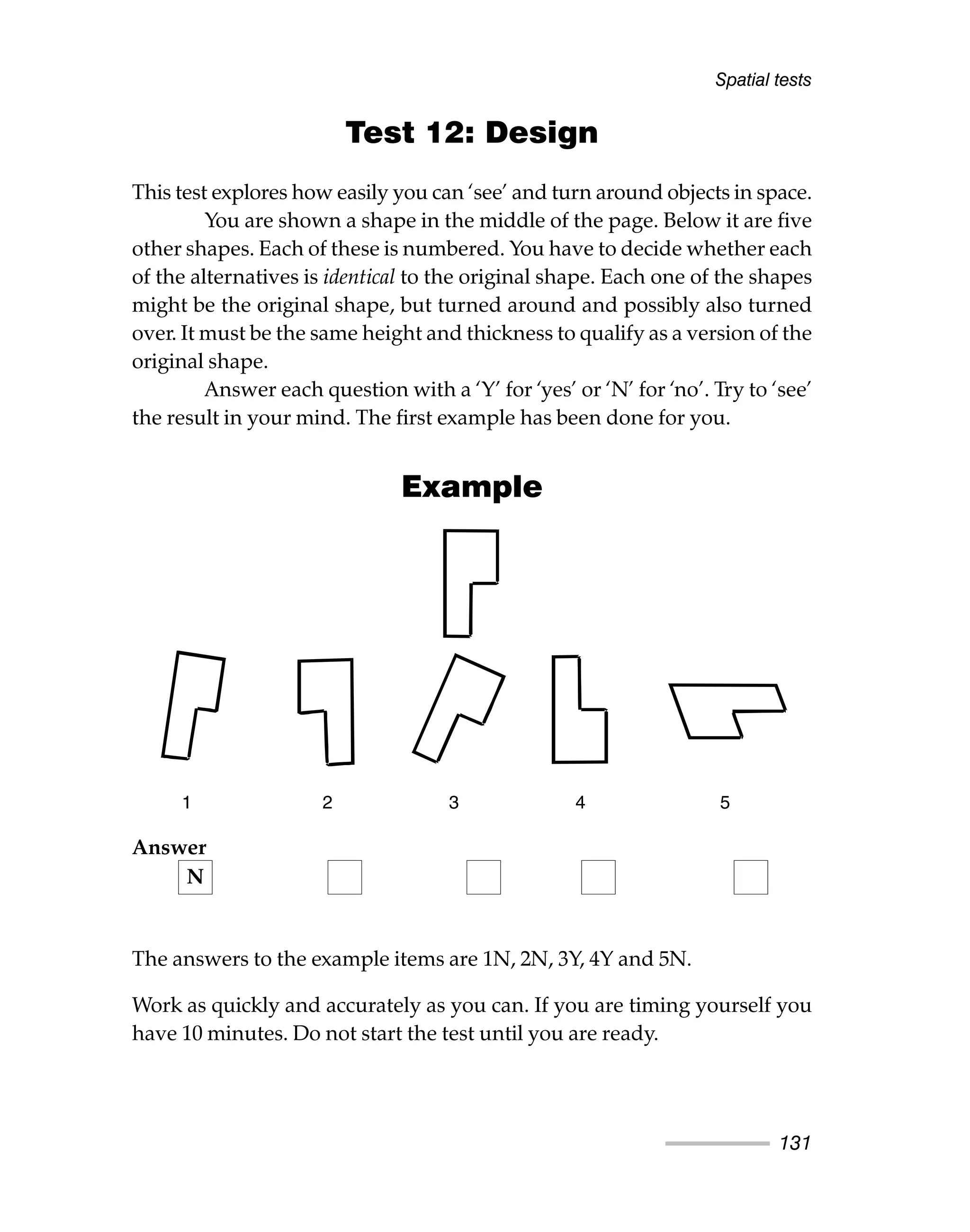
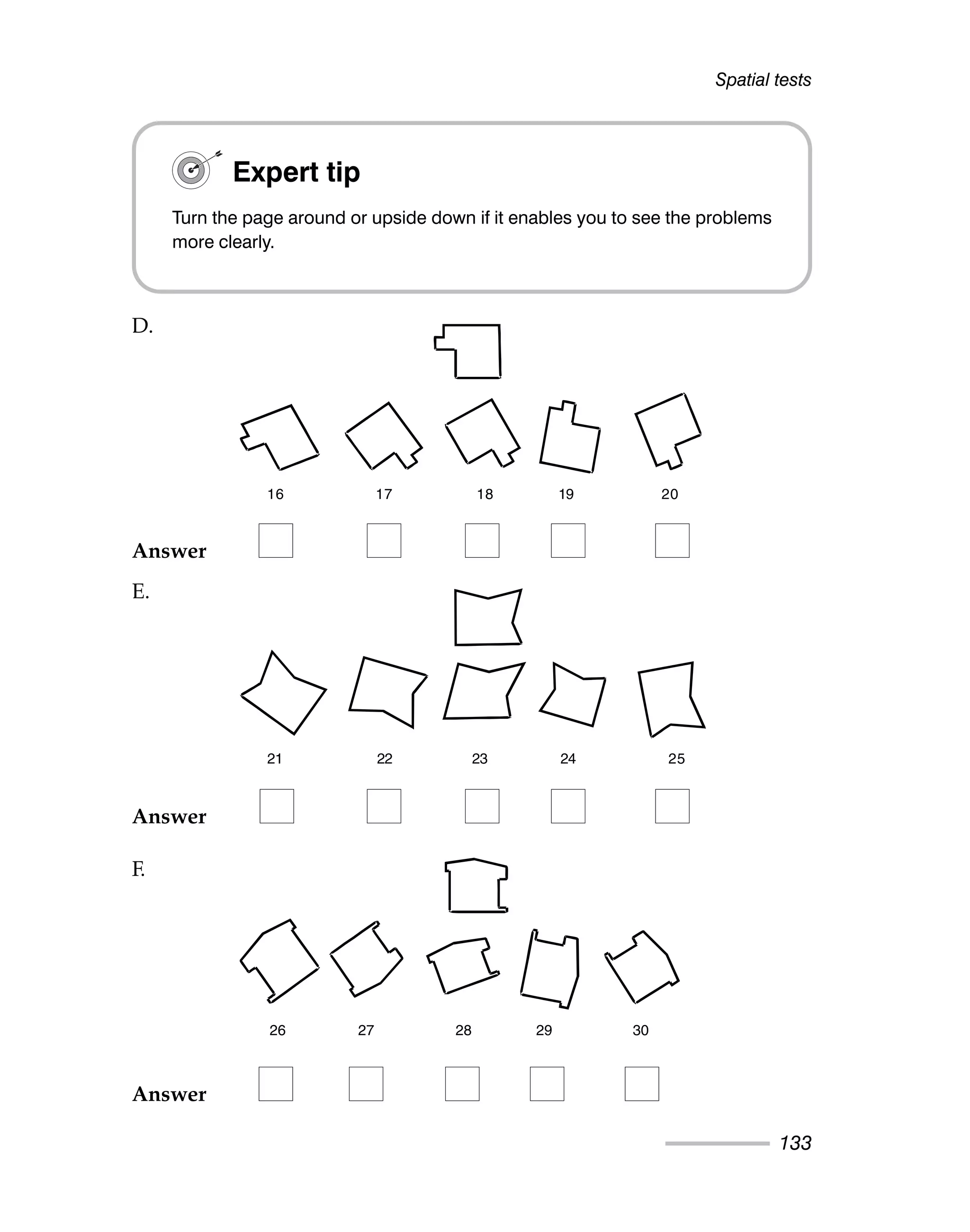
Test 12: Design 131
v
5 Practical tests 139
Test 13: Word order 140
Test 14: Numerical systems 151
Test 15: Graphs, tables and charts 161
Test 16: Memory 171
6 Interpreting your test results 181
Your aptitude profile 181
Your career potential 186
Further reading from Kogan Page 193
Contents
vi
1
This book contains tests of a psychological type. They will be of interest to
people who want to practise tests in order to gain greater awareness of their
aptitudes and abilities, or to prepare for ‘real test’ situations. The tests are
representative of many tests used for academic, assessment, recruitment or
selection purposes, and will help you to:
• get into the ‘way of thinking’ that is required when taking tests;
• see where you may be able to improve key skills;
• gain awareness of strengths and where they can take you.
The inclusion of two new psychological tests makes this revised edition
even more comprehensive. The new tests of Word Skills and Numerical
Skills are longer and have a wider range than the tests they replace. They
are typical of the tests that are used for selection and assessment purposes
in order to reveal what standard has been attained by a candidate. They
are used as assessments for further training or as criterion measures for
certain jobs where specific skills are required.
Aptitudes and abilities
Most organizations as well as many educational institutions use some
form of psychological testing as part of their selection or employment
Introduction
procedure. Testing has become routine because it is often perceived as
essential, even though there may exist evidence of prior learning (school,
college or professional qualifications) or previous experience (job record
and other attainments). The main reasons are:
• to give an indication of long-term potential for a course, training
or job;
• to give up to date information;
• to provide data that is relevant and fair.
Employers and educational bodies are in a position to compare people’s
performance on tests with other measures of success. For these reasons
what tests seek to discover is:
• What can you do now – have you got the ability?
• What potential have you – have you got the aptitude?
This workbook has a comprehensive range of tests of the types commonly
presented to intending students and job applicants.
‘Real test’ situations
Preparation is not ‘cheating’. Far from it, because if you are not prepared
you may not properly show people what you are capable of achieving. Too
many people appear to ‘fail’ tests for all the wrong reasons, such as:
• not knowing what was expected;
• feeling nervous;
• not understanding the instructions;
• never having seen anything like that before;
• not knowing whether it was possible to ask a question.
There is no shame in failing something you really cannot do, but it is a
waste to fail at something you can. You may have missed the opportunity
of your lifetime, and this may well be a loss to other people as well.
To give yourself the best chance possible, prepare yourself well in
advance. If you have used this workbook, you will have gained plenty of
The aptitude test workbook
2
experience of what you are likely to meet when it comes to ‘the real thing’.
In addition, make sure that you do not let yourself in for any surprises.
Therefore, before you even approach any test situation you should:
• Ask exactly why you are taking the test and what it is for.
• Ask how the results will be used and whether you will get the
results.
• Ask what the test consists of, how long it takes and whether
there is any practice material you can look at.
• Make sure you are comfortable and ready to take a test. You must
not feel any unnecessary stress, either physical or mental.
• Wear clothes that are appropriate to the situation and check
whether you are expected to provide any materials or anything
else yourself.
Getting into the ‘way of thinking’
when taking tests
The tests in this book are representative samples of tests, but tests, like the
people who take them, come in all shapes and sizes. What they all have in
common is a requirement for discipline and attention. You can take your
time and study the tests in your own way. Each is presented as a ‘real’ test
in the way you would see it in a real test situation. Therefore, you are likely
to get most from the tests in this book if you work through them as if you
were taking them for real. This involves timing yourself and completing
them exactly in the way that would be asked of you if you were in ‘exami-
nation conditions’. In any test situation:
• Give yourself plenty of time before the test starts and whilst
looking through instructions.
• Do not be afraid to ask questions (this often helps others as much
as you).
• Always work through practice examples. Take your time and
make sure you thoroughly understand the process.
Introduction
3
• Do not start until you are ready. Do not be frightened of ‘holding
others up’ or that you may look stupid by requiring extra time to
make sure you understand.
• Work as quickly as you can.
• Be accurate (this is more important than trying to get to the end
of the test).
• Do not guess (it is better to move to the next question).
Up to the moment the test actually commences you owe it to yourself to
do everything you can to reduce any uncertainty you may feel.
See where you may be able to improve
key skills
In working through the tests in this volume you will gain from becoming
familiar with different types of test, and from putting yourself in an exam-
ination situation so that it becomes almost routine, and apprehension
about taking tests wears off. This is as far as you can reasonably expect to
go with some of the abstract tests, because you cannot learn how to do
them in the same way as you can learn how to multiply in arithmetic.
However, some of the tests do require specific skills. These include:
• knowledge of words;
• spelling ability;
• knowing how to interpret graphs;
• familiarity with the rules of numbers.
There is no reason you should not attempt to improve your level of vocab-
ulary or practise multiplication and division. The whole point of doing so
is to be able to represent yourself fairly. There is a point at which you will
be unable to push yourself further, either because you really have reached
your ceiling or because these types of test do not motivate you.
It may be that you prefer one of the more abstract types of test
which depend less upon prior learning. Even so, abstract tests also follow
certain rules and have a pattern, so that practice on these should increase
The aptitude test workbook
4
your confidence with material that may at first sight look daunting merely
because it is unfamiliar.
Gain awareness of strengths and where
they might lead
Whether you are sitting a test in the hope of being selected or for your own
purposes, as in completing the tests in this book, you should try to gain from
the experience. Even appearing to ‘fail’ a test can be a valuable learning
experience, although admittedly it is unfortunate if this is in relation to a job,
place or position you have applied for. However, you may learn to be better
prepared next time. You may even have learnt that, if the test is any indi-
cation of what you are expected to do if you succeed, the job is not for you!
Although most likely their intention is to be fair, some organiza-
tions use tests that are not appropriate for the purpose they intend. In such
circumstances it is the tests that fail – not you – because they may not have
been the correct tests to assess your talent. Although it is difficult not to be
discouraged if you believe that the tests were, in this respect, unable to
reveal your potential, try at least to view the experience as one that can be
useful in making you stronger on future occasions. Do not be discouraged.
Remember also that a test result is only a test result. This may
sound a silly statement, but what it means is that, although important, any
test is only an indication; your talent in that area may indeed be higher.
You may have done less well than you really can because:
• the test itself was wrongly selected as an effective measure;
• the circumstances in which you took the test were inadequate;
• your own attitude of mind prevented you from demonstrating
what you can really achieve;
• you have talents that are special or different.
The tests in this volume are designed so that you can practise and become
familiar with the purposes for which tests are used as well as with the
process of testing. You can also find out what you might achieve in
different types of test, although the main aim is not to provide you with
Introduction
5
precise indications of how much better you are on one test rather than
another, or how much better you are on a test than other people. This is
because the tests have not been standardized on sufficient numbers of
people of any age, sex or background to provide reliable statistics. Also,
because the tests are in a workbook, you may not have applied yourself to
the test problems in the way you might have done in a properly adminis-
tered test situation. Nonetheless, depending upon how you approached
and completed the tests, you will be able to gain a general idea of your
strengths and weaknesses.
At the end of the book, in Chapter 6, you can see how your scores
provide ways of calculating your intelligence (in terms of intelligence
quotient or IQ), and gain an approximate idea of how well you are
performing. All psychologists and test administrators have training so that
they interpret test results with caution. Similarly, with the tests in this volume
you must bear in mind that the scores and the charts provided for you are
intended only to illustrate the processes that employers and selectors use.
The important questions for you to consider are, first, which test,
tests or type of tests do I feel most confident doing, and second, which
tests am I interested in and do I enjoy? The answers to these two key
questions may well be the same, and for almost everybody, they will
reflect the tests at which they score best. If you wish, you can relate the
revealed potential from your test results to relevant course or career
opportunities. Again, while there is no claim for precision in matching
your results from the tests to careers, you can see how this process
operates at the end of Chapter 6. More comprehensive matching of test
results to careers is explored in the companion volumes Test Your Own
Aptitude; Career, Aptitude and Selection Tests and Advanced Aptitude Tests,
also published by Kogan Page.
There are two ways of doing each of
the tests
The instructions to each of the tests, as well as the test questions themselves,
are presented in the same form that you will encounter in tests in live situa-
tions. But how far you place yourself under test conditions is up to you.
The aptitude test workbook
6
One option is to time yourself strictly and take the test as though
you are in a real test situation. Once you start the test, you should ignore
any further expert tips that are provided, until your time is up. This will
result in a score that will give you a reasonably good idea of your true
aptitude. It will enable you to place all your various results together in
Chapter 6 so that you obtain a reasonably accurate picture of how much
better you may be on some tests than on others.
Alternatively you can ignore the nominal time allowed for taking
the tests and work through them at your own pace. As you proceed you
can make sure you understand each problem, and you will have all the
time you want to study the expert tips when these are provided. This
approach helps with learning, but will not be as accurate with regard to
your potential, as the tests will not have been done under strictly timed
test conditions. When you come to Chapter 6 you can use your own esti-
mates of your potential to see how results are interpreted and to what
your results might lead.
Introduction
7
8
Test 1, ‘Word skills’, is a test of how well you understand words. Language
tests are often the most complex, because a word may be used in many
different ways. Words are slippery, with alternative, deeper or hidden
meanings.
In Test 2, ‘Verbal concepts’, vocabulary is still important, but less so
than perceiving what idea or association connects some words and not
others. Rather than recognize the individual meanings of words, you are
expected to work out those that form a ‘set’ or group. This test requires
both a level of learning and experience and quickness in thinking.
In Test 3, ‘Critical application’, vocabulary is far less important
than the ability to reason. While you will find that in Tests 1 and 2 you will,
more or less, either know the answer or not, with Test 3 you may need to
take your time until you arrive at the answer. Possible ways of doing this
are explained later on.
Preparation and revision (optional)
We use the parts of speech every day without thinking. They make sense
of what we say. We have grown up to learn to use them properly in order
that people can understand us and we are able to understand them. But, if
1
Verbal tests
Verbal tests
you are going to take any kind of verbal test, make sure you understand
the difference between the following:
Adjective makes exact the meaning of a noun (eg blue, short, happy)
Noun name of a person, place or thing (eg shirt, person, stone,
life, love)
Verb describes action (eg ran, flew, shouted, wrote)
Adverb word that describes how the action of the verb was done
(quickly, badly, strongly, now)
Pronoun word used instead of a noun (eg she, him, it, they, you)
Preposition shows the relationship between one word or part of a
sentence to another (eg in, at, through, for)
Conjunction used to join different sentences or parts in order to make
a connection (eg but, so, therefore, and)
Interjection word used to express strong feeling (eg oh, ah, hurray).
Take a few moments to practise. A good exercise is to take a word, using a
dictionary if you like, and put it into a sentence. Then try to use it as
another part of speech. As you will find this difficult, you will quickly learn
to recognize the different parts of speech.
9
Test 1: Word skills
This test is to check your spelling, your understanding of words and whether
you use them correctly. You are asked a question and you have to find the
answer from the words provided. You have to write the word clearly and
spelt correctly in the answer box on the right hand side of the page. Examples
1 and 2 have been done already to show you how to answer:
Examples
1. wind the is
Which word needs to be added to the above to make a proper
sentence?
house dog night cold fury
Answer
2. One of these words is spelt incorrectly. Write the correct spelling.
nite free laugh paper engine
Answer
3. salt pass please
Which word needs to be added to the above to make a proper
sentence?
help and the pepper odd
Answer
4. One of these words is spelt incorrectly. Write the correct spelling.
frend parcel solid fortunate lonely
Answer
The aptitude test workbook
10
cold
night
Verbal tests
11
Explanation
In Example 1 a proper sentence could be ‘The wind is cold.’ None of the
other words provided would make a proper sentence with the words –
‘wind the is’. In Example 1 it would only be possible to use other words,
apart from ‘cold’, if you were trying to be poetical, for example, to create a
sentence such as, ‘The wind is fury’. But, this is not grammatically correct
because ‘fury’ is a noun, whilst ‘cold’ is an adjective. Although it would be
correct to use the word ‘fury’ as a metaphor by changing it and saying,
‘The wind is furious,’ this is not the word that was given.
In Example 2 ‘nite’ is not a recognized spelling. In Example 3: the
answer is ‘the’ because the only correct sentence is ‘Please pass the salt’ or
‘Pass the salt, please.’ In Example 4: the answer is ‘friend’ because ‘frend’ is
not a correct word. In Example 2 there is only one correct spelling for a
word that sounds like ‘nite’, which is ‘night’. Example 4 is just the same as
‘frend’ and ‘friend’ are pronounced identically. Be careful – a common
mistake is to reverse the position of the ‘i’ and the ‘e’. Example 3 is the
same type of problem as Example 1. Although it is likely that someone
would understand you if, at dinner, you said, ‘Salt. Pass please,’ this is still
an incorrect sentence.
Remember to write down the word clearly and spelt correctly,
otherwise it will not count. Ask now if you have any questions.
If you are timing yourself you have 12 minutes for this test. You have to do
as many as you can in the time allowed. Work as quickly as you can, but do
not make mistakes. Do not start the test until you are ready.
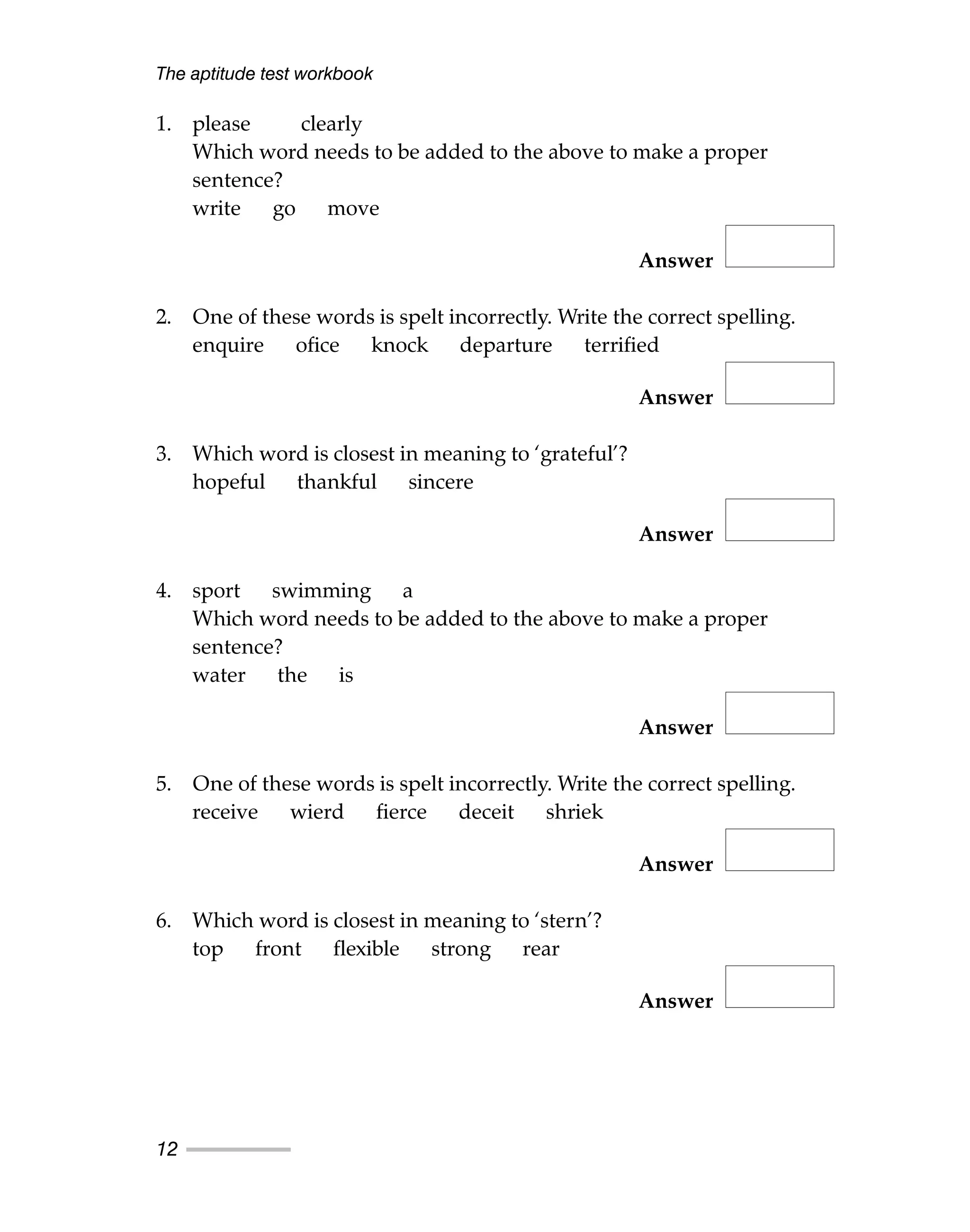
1. please clearly
Which word needs to be added to the above to make a proper
sentence?
write go move
Answer
2. One of these words is spelt incorrectly. Write the correct spelling.
enquire ofice knock departure terrified
Answer
3. Which word is closest in meaning to ‘grateful’?
hopeful thankful sincere
Answer
4. sport swimming a
Which word needs to be added to the above to make a proper
sentence?
water the is
Answer
5. One of these words is spelt incorrectly. Write the correct spelling.
receive wierd fierce deceit shriek
Answer
6. Which word is closest in meaning to ‘stern’?
top front flexible strong rear
Answer
The aptitude test workbook
12
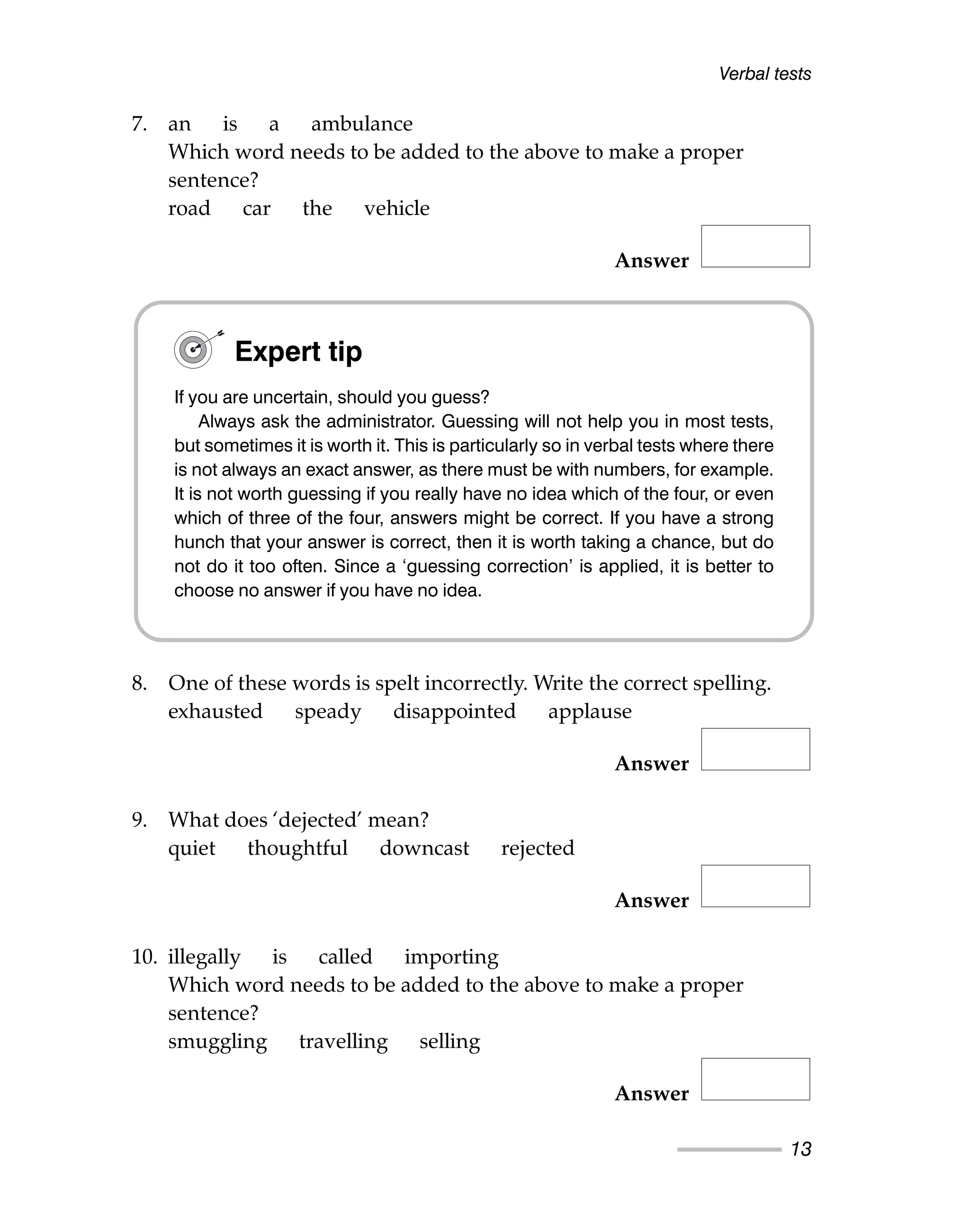
7. an is a ambulance
Which word needs to be added to the above to make a proper
sentence?
road car the vehicle
Answer
8. One of these words is spelt incorrectly. Write the correct spelling.
exhausted speady disappointed applause
Answer
9. What does ‘dejected’ mean?
quiet thoughtful downcast rejected
Answer
10. illegally is called importing
Which word needs to be added to the above to make a proper
sentence?
smuggling travelling selling
Answer
Verbal tests
13
Expert tip
If you are uncertain, should you guess?
Always ask the administrator. Guessing will not help you in most tests,
but sometimes it is worth it. This is particularly so in verbal tests where there
is not always an exact answer, as there must be with numbers, for example.
It is not worth guessing if you really have no idea which of the four, or even
which of three of the four, answers might be correct. If you have a strong
hunch that your answer is correct, then it is worth taking a chance, but do
not do it too often. Since a ‘guessing correction’ is applied, it is better to
choose no answer if you have no idea.
The aptitude test workbook
14
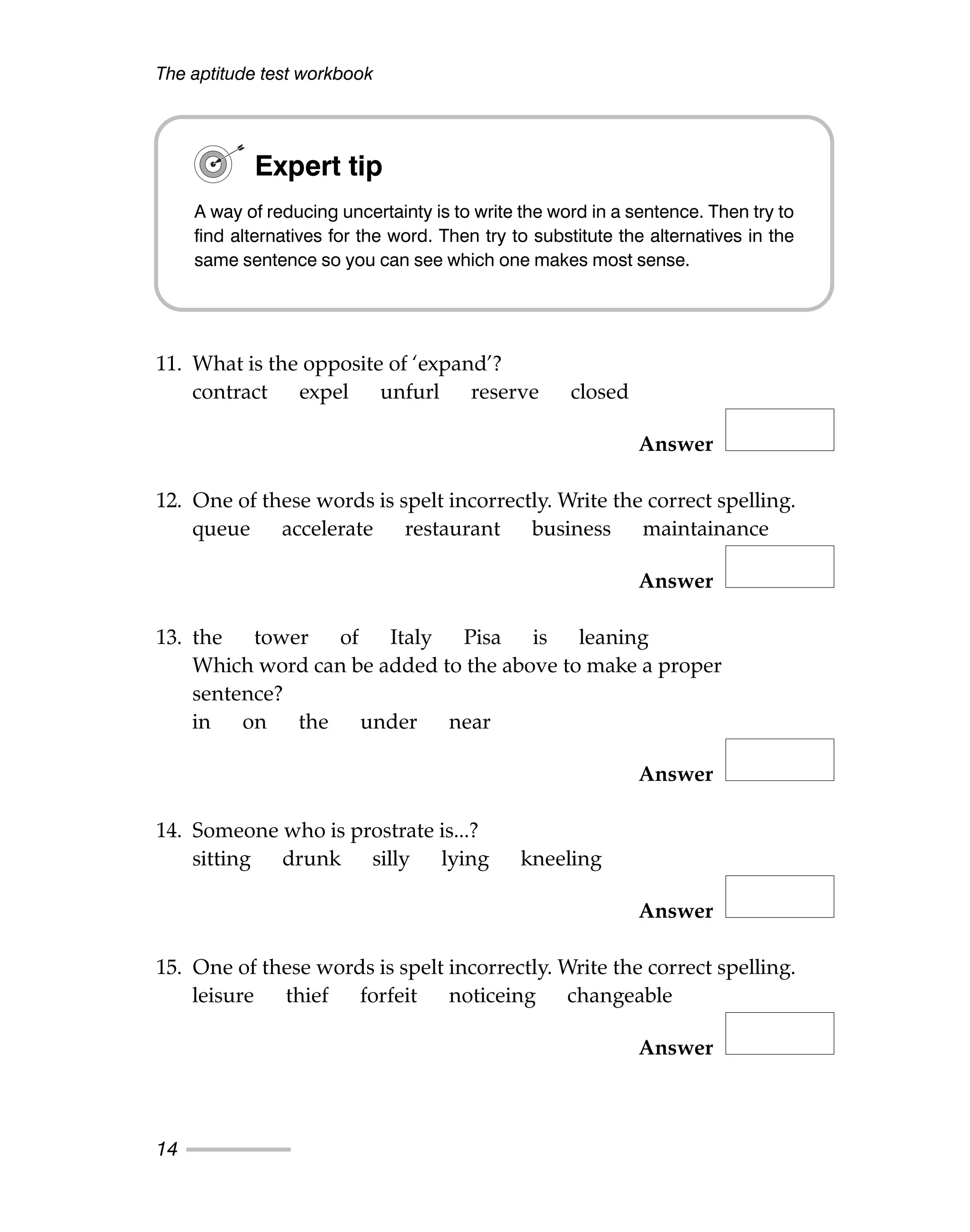
11. What is the opposite of ‘expand’?
contract expel unfurl reserve closed
Answer
12. One of these words is spelt incorrectly. Write the correct spelling.
queue accelerate restaurant business maintainance
Answer
13. the tower of Italy Pisa is leaning
Which word can be added to the above to make a proper
sentence?
in on the under near
Answer
14. Someone who is prostrate is...?
sitting drunk silly lying kneeling
Answer
15. One of these words is spelt incorrectly. Write the correct spelling.
leisure thief forfeit noticeing changeable
Answer
Expert tip
A way of reducing uncertainty is to write the word in a sentence. Then try to
find alternatives for the word. Then try to substitute the alternatives in the
same sentence so you can see which one makes most sense.
Verbal tests
15
16. investigation enquiry an means
Which word needs to be added to the above to make a proper
sentence?
the an hurried telephone
Answer
17. What is the opposite of ‘lessen’?
assignment augment greater warning
Answer
18. One of these words is spelt incorrectly. Write the correct spelling.
advertisement emmigration courageous temporarily
schedule
Answer
19. in prepared a is bakery
Which word needs to be added to the above to make a proper
sentence?
on baker oven bread made
Answer
Expert tip
If you do not know the meaning of the word you are given, it is probably
better use of your time to leave the question and go on to the next. Timed
tests will contain plenty of questions so the one on which you have become
‘stuck’ is not going to be critical.
The aptitude test workbook
16
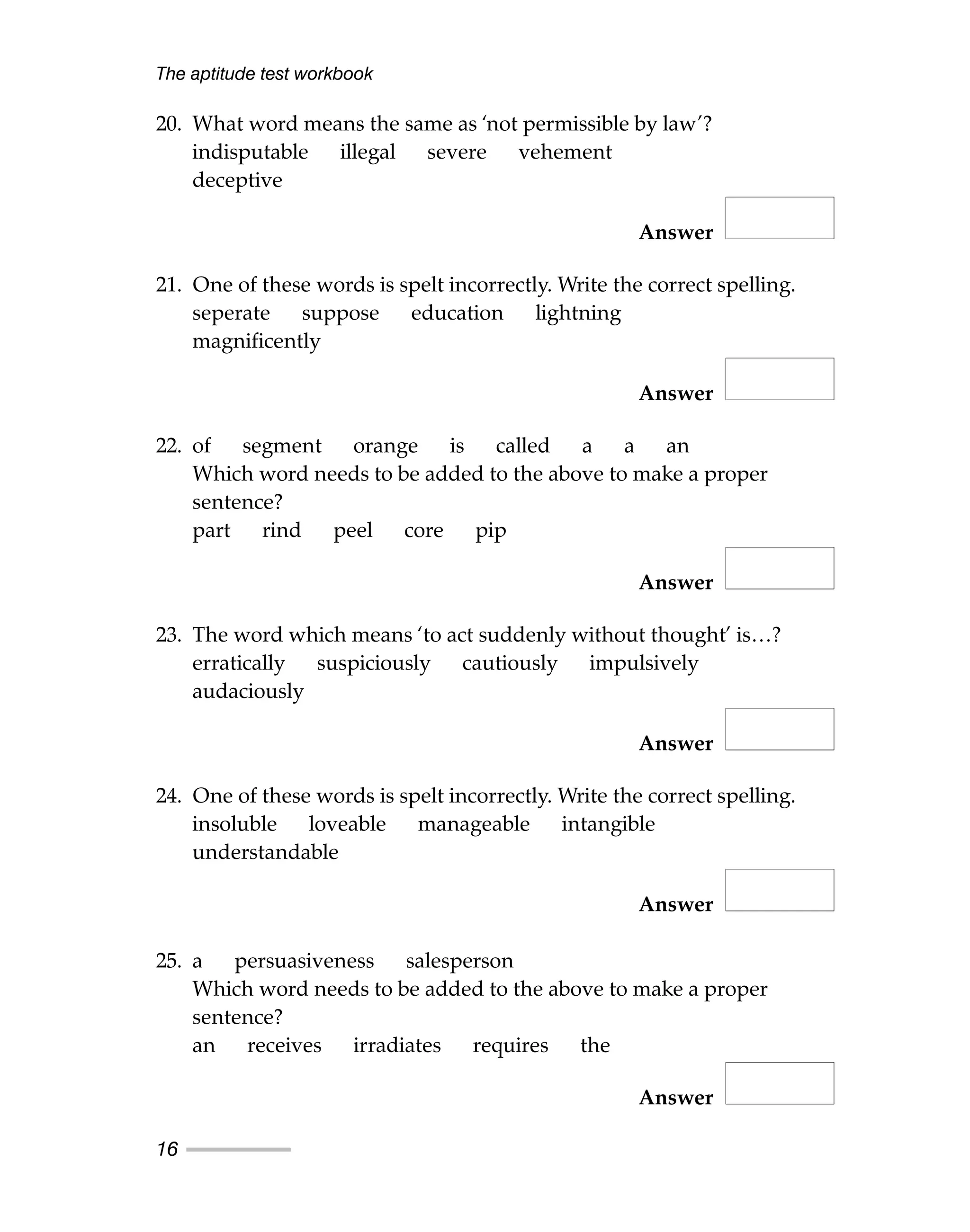
20. What word means the same as ‘not permissible by law’?
indisputable illegal severe vehement
deceptive
Answer
21. One of these words is spelt incorrectly. Write the correct spelling.
seperate suppose education lightning
magnificently
Answer
22. of segment orange is called a a an
Which word needs to be added to the above to make a proper
sentence?
part rind peel core pip
Answer
23. The word which means ‘to act suddenly without thought’ is…?
erratically suspiciously cautiously impulsively
audaciously
Answer
24. One of these words is spelt incorrectly. Write the correct spelling.
insoluble loveable manageable intangible
understandable
Answer
25. a persuasiveness salesperson
Which word needs to be added to the above to make a proper
sentence?
an receives irradiates requires the
Answer
Verbal tests
17
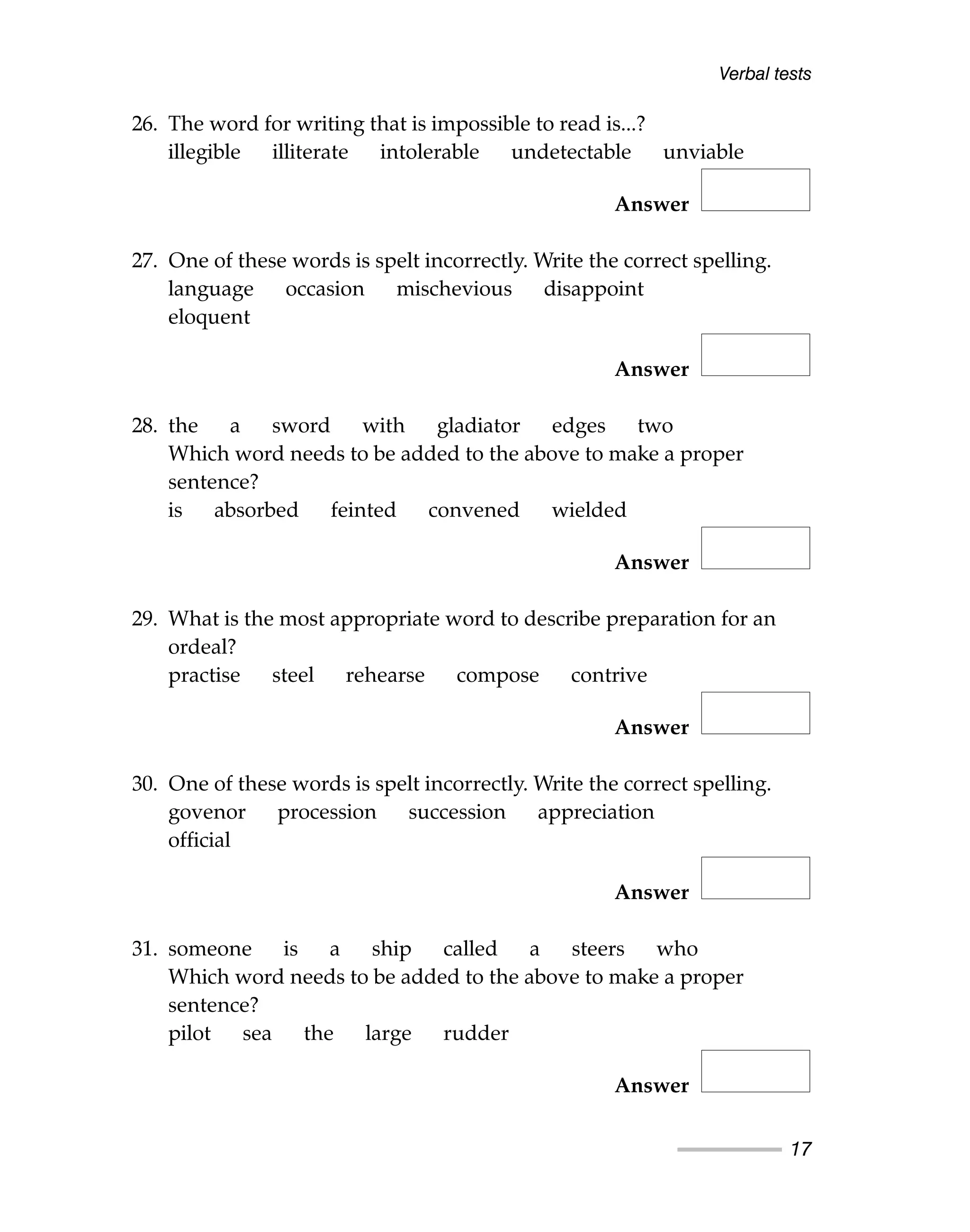
26. The word for writing that is impossible to read is...?
illegible illiterate intolerable undetectable unviable
Answer
27. One of these words is spelt incorrectly. Write the correct spelling.
language occasion mischevious disappoint
eloquent
Answer
28. the a sword with gladiator edges two
Which word needs to be added to the above to make a proper
sentence?
is absorbed feinted convened wielded
Answer
29. What is the most appropriate word to describe preparation for an
ordeal?
practise steel rehearse compose contrive
Answer
30. One of these words is spelt incorrectly. Write the correct spelling.
govenor procession succession appreciation
official
Answer
31. someone is a ship called a steers who
Which word needs to be added to the above to make a proper
sentence?
pilot sea the large rudder
Answer
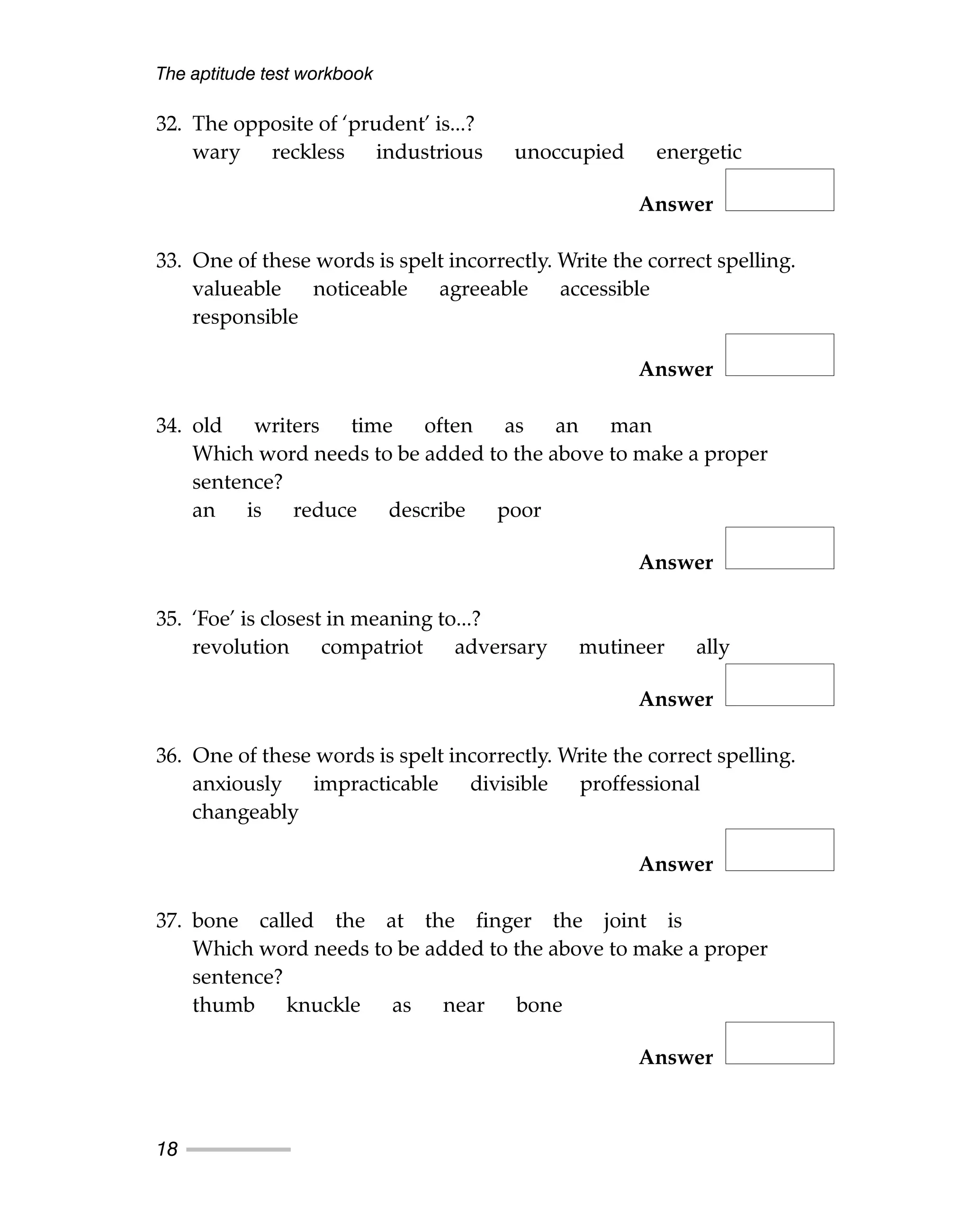
32. The opposite of ‘prudent’ is...?
wary reckless industrious unoccupied energetic
Answer
33. One of these words is spelt incorrectly. Write the correct spelling.
valueable noticeable agreeable accessible
responsible
Answer
34. old writers time often as an man
Which word needs to be added to the above to make a proper
sentence?
an is reduce describe poor
Answer
35. ‘Foe’ is closest in meaning to...?
revolution compatriot adversary mutineer ally
Answer
36. One of these words is spelt incorrectly. Write the correct spelling.
anxiously impracticable divisible proffessional
changeably
Answer
37. bone called the at the finger the joint is
Which word needs to be added to the above to make a proper
sentence?
thumb knuckle as near bone
Answer
The aptitude test workbook
18
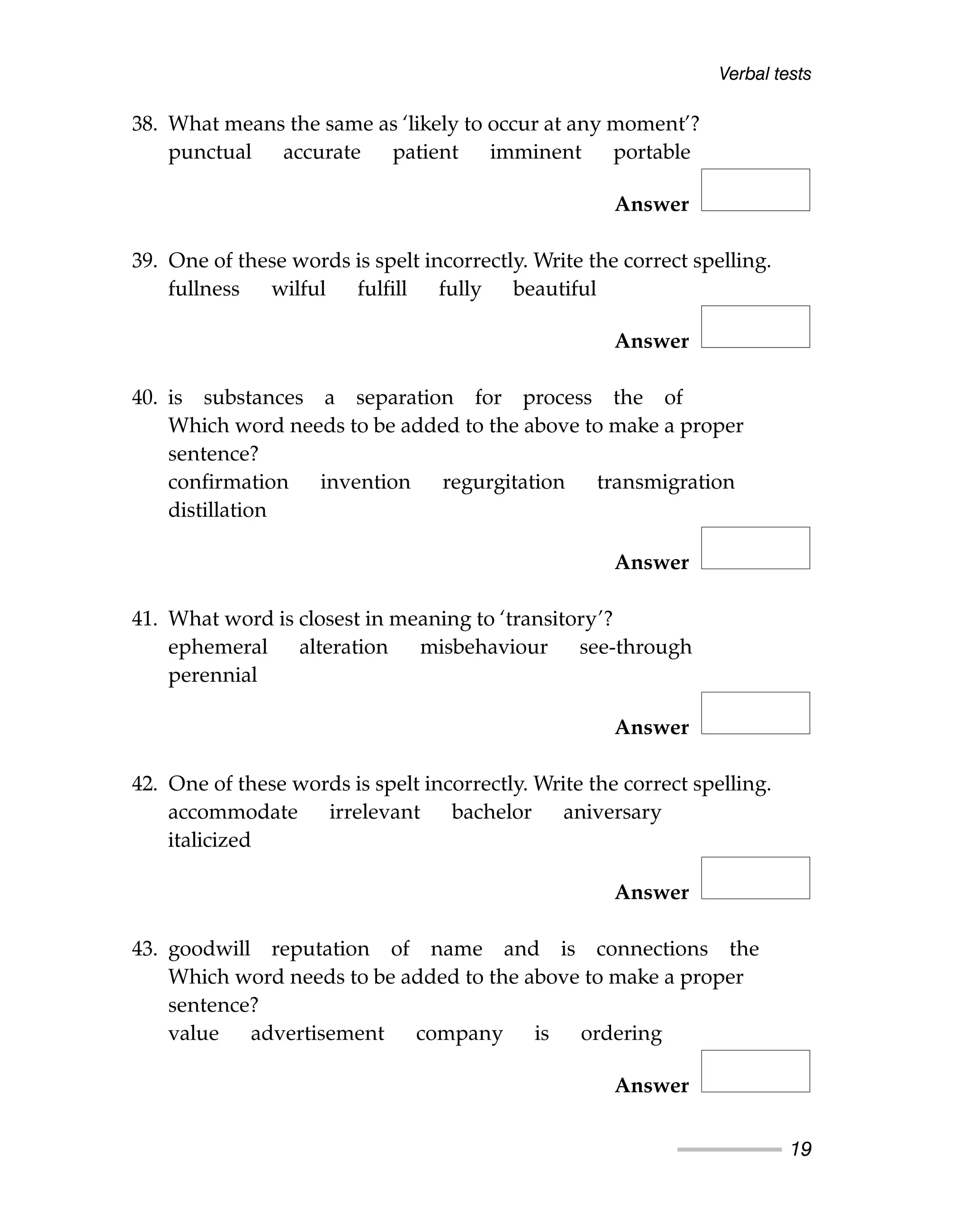
38. What means the same as ‘likely to occur at any moment’?
punctual accurate patient imminent portable
Answer
39. One of these words is spelt incorrectly. Write the correct spelling.
fullness wilful fulfill fully beautiful
Answer
40. is substances a separation for process the of
Which word needs to be added to the above to make a proper
sentence?
confirmation invention regurgitation transmigration
distillation
Answer
41. What word is closest in meaning to ‘transitory’?
ephemeral alteration misbehaviour see-through
perennial
Answer
42. One of these words is spelt incorrectly. Write the correct spelling.
accommodate irrelevant bachelor aniversary
italicized
Answer
43. goodwill reputation of name and is connections the
Which word needs to be added to the above to make a proper
sentence?
value advertisement company is ordering
Answer
Verbal tests
19
The aptitude test workbook
20
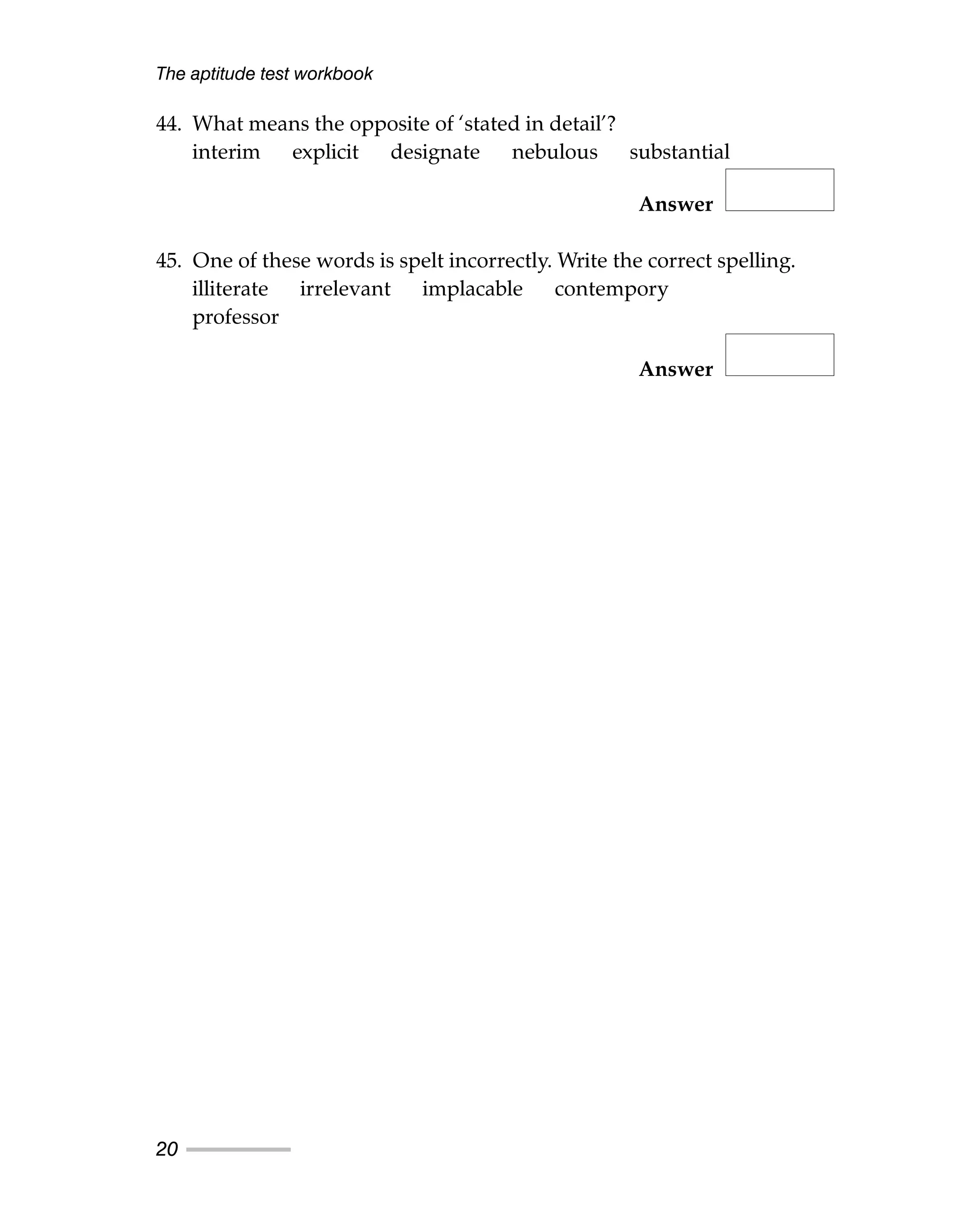
44. What means the opposite of ‘stated in detail’?
interim explicit designate nebulous substantial
Answer
45. One of these words is spelt incorrectly. Write the correct spelling.
illiterate irrelevant implacable contempory
professor
Answer
21
THIS PAGE HAS BEEN INTENTIONALLY LEFT BLANK
Answers to Test 1: Word skills
Suggestion
You could get more from this exercise if you check out where you made
errors. Look up any words that you were unsure of the meaning of, or
were unfamiliar to you.
Obtaining the total score
Count up the number of correct answers:
Deduct 1/3 of the number of wrong answers
(round down 1/3 and round up 2/3):
Basic score:
Add 4 if aged under 16; add 2 if aged 17–20
Test score:
The aptitude test workbook
22
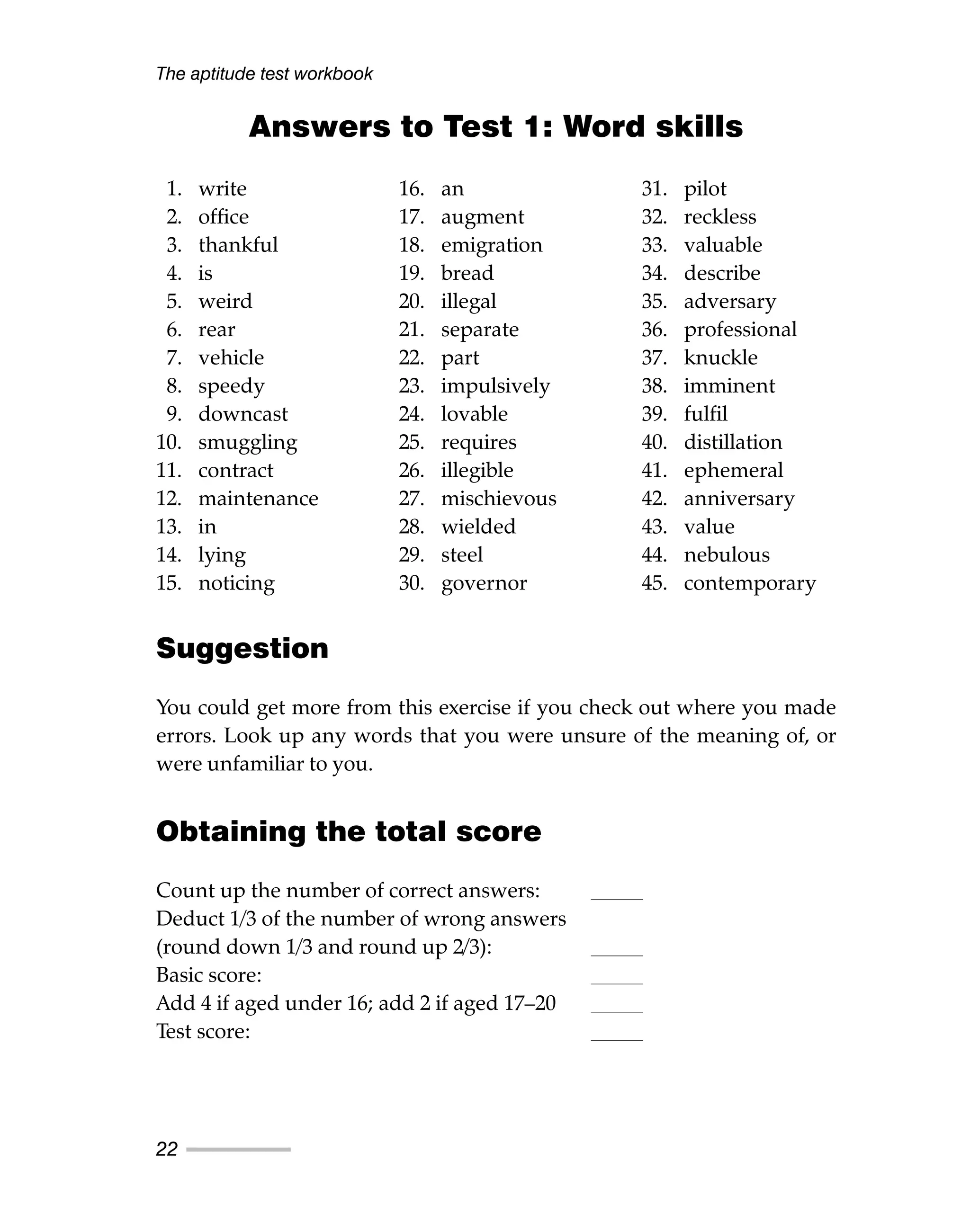
1. write
2. office
3. thankful
4. is
5. weird
6. rear
7. vehicle
8. speedy
9. downcast
10. smuggling
11. contract
12. maintenance
13. in
14. lying
15. noticing
16. an
17. augment
18. emigration
19. bread
20. illegal
21. separate
22. part
23. impulsively
24. lovable
25. requires
26. illegible
27. mischievous
28. wielded
29. steel
30. governor
31. pilot
32. reckless
33. valuable
34. describe
35. adversary
36. professional
37. knuckle
38. imminent
39. fulfil
40. distillation
41. ephemeral
42. anniversary
43. value
44. nebulous
45. contemporary
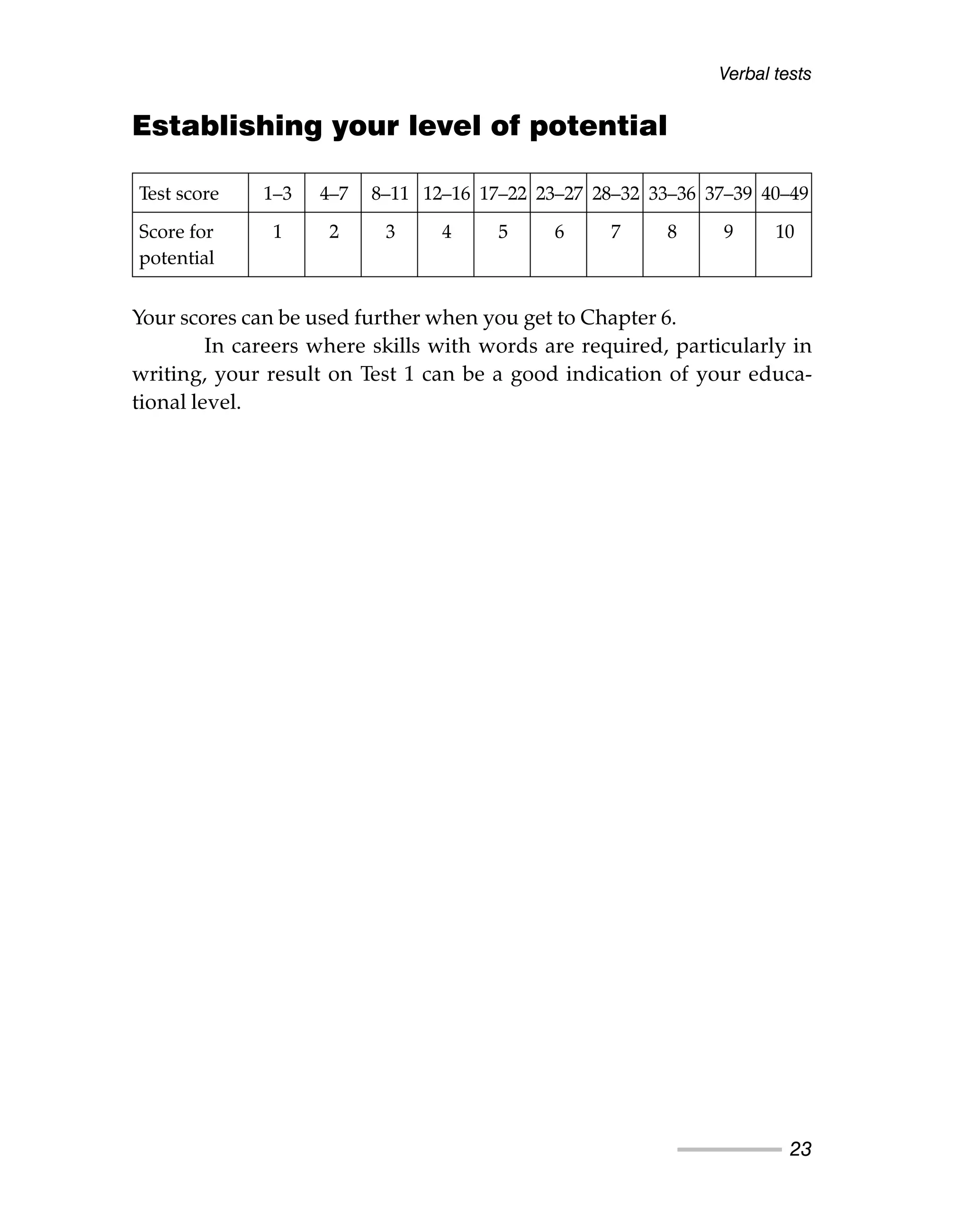
Establishing your level of potential
Your scores can be used further when you get to Chapter 6.
In careers where skills with words are required, particularly in
writing, your result on Test 1 can be a good indication of your educa-
tional level.
Verbal tests
23
Test score 1–3 4–7 8–11 12–16 17–22 23–27 28–32 33–36 37–39 40–49
Score for 1 2 3 4 5 6 7 8 9 10
potential
The aptitude test workbook
24
Test 2: Verbal concepts
This test is to see how well you understand the ideas that words express.
Sometimes the meaning is not always exact, but you have to find the
general principle that connects different words. You are given a problem
and you have to select the best answer from the alternatives given. For
each question there are alternative answers. The first one has been done to
show you how.
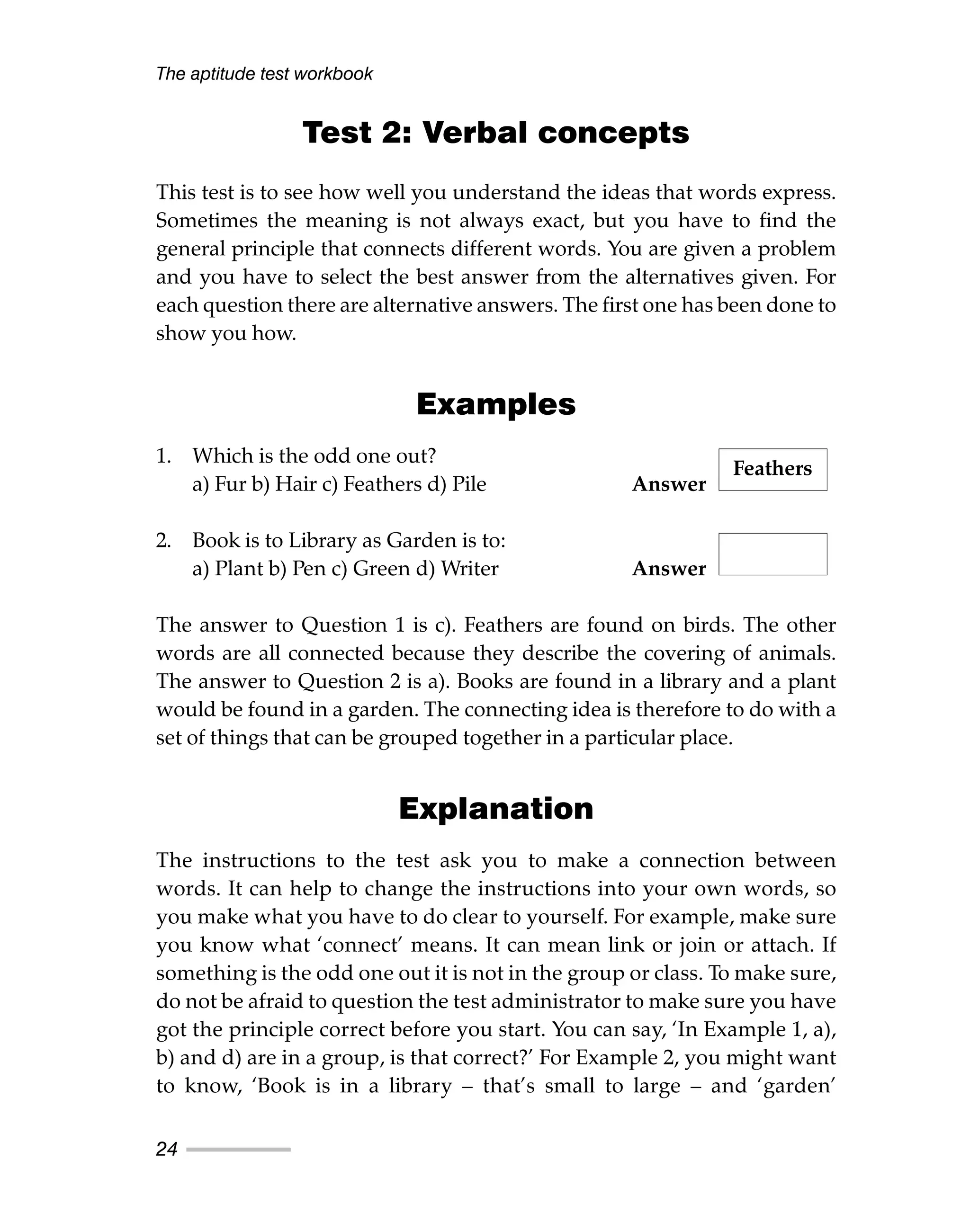
Examples
1. Which is the odd one out?
a) Fur b) Hair c) Feathers d) Pile Answer
2. Book is to Library as Garden is to:
a) Plant b) Pen c) Green d) Writer Answer
The answer to Question 1 is c). Feathers are found on birds. The other
words are all connected because they describe the covering of animals.
The answer to Question 2 is a). Books are found in a library and a plant
would be found in a garden. The connecting idea is therefore to do with a
set of things that can be grouped together in a particular place.
Explanation
The instructions to the test ask you to make a connection between
words. It can help to change the instructions into your own words, so
you make what you have to do clear to yourself. For example, make sure
you know what ‘connect’ means. It can mean link or join or attach. If
something is the odd one out it is not in the group or class. To make sure,
do not be afraid to question the test administrator to make sure you have
got the principle correct before you start. You can say, ‘In Example 1, a),
b) and d) are in a group, is that correct?’ For Example 2, you might want
to know, ‘Book is in a library – that’s small to large – and ‘garden’
Feathers
Verbal tests
25
contains ‘plants’ – that’s large to small, so does it matter that the
question goes small to large and then large to small?’ The answer, of
course, is that it does not. Anything else you are uncertain about?
If you are doing this test under timed conditions, you have 10 minutes to
complete it. You must work accurately and quickly. Do not start the test
until you are ready.
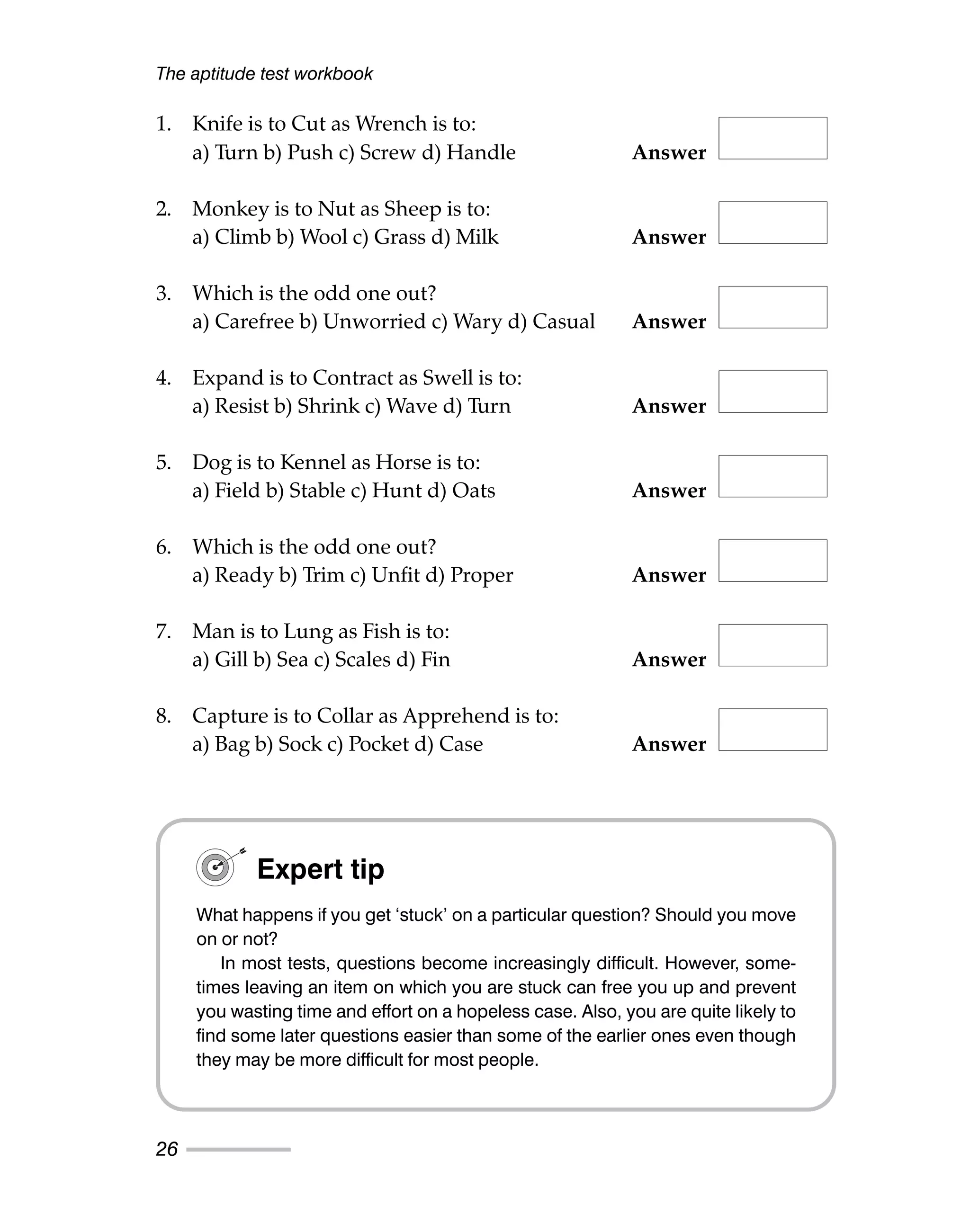
1. Knife is to Cut as Wrench is to:
a) Turn b) Push c) Screw d) Handle Answer
2. Monkey is to Nut as Sheep is to:
a) Climb b) Wool c) Grass d) Milk Answer
3. Which is the odd one out?
a) Carefree b) Unworried c) Wary d) Casual Answer
4. Expand is to Contract as Swell is to:
a) Resist b) Shrink c) Wave d) Turn Answer
5. Dog is to Kennel as Horse is to:
a) Field b) Stable c) Hunt d) Oats Answer
6. Which is the odd one out?
a) Ready b) Trim c) Unfit d) Proper Answer
7. Man is to Lung as Fish is to:
a) Gill b) Sea c) Scales d) Fin Answer
8. Capture is to Collar as Apprehend is to:
a) Bag b) Sock c) Pocket d) Case Answer
The aptitude test workbook
26
Expert tip
What happens if you get ‘stuck’ on a particular question? Should you move
on or not?
In most tests, questions become increasingly difficult. However, some-
times leaving an item on which you are stuck can free you up and prevent
you wasting time and effort on a hopeless case. Also, you are quite likely to
find some later questions easier than some of the earlier ones even though
they may be more difficult for most people.
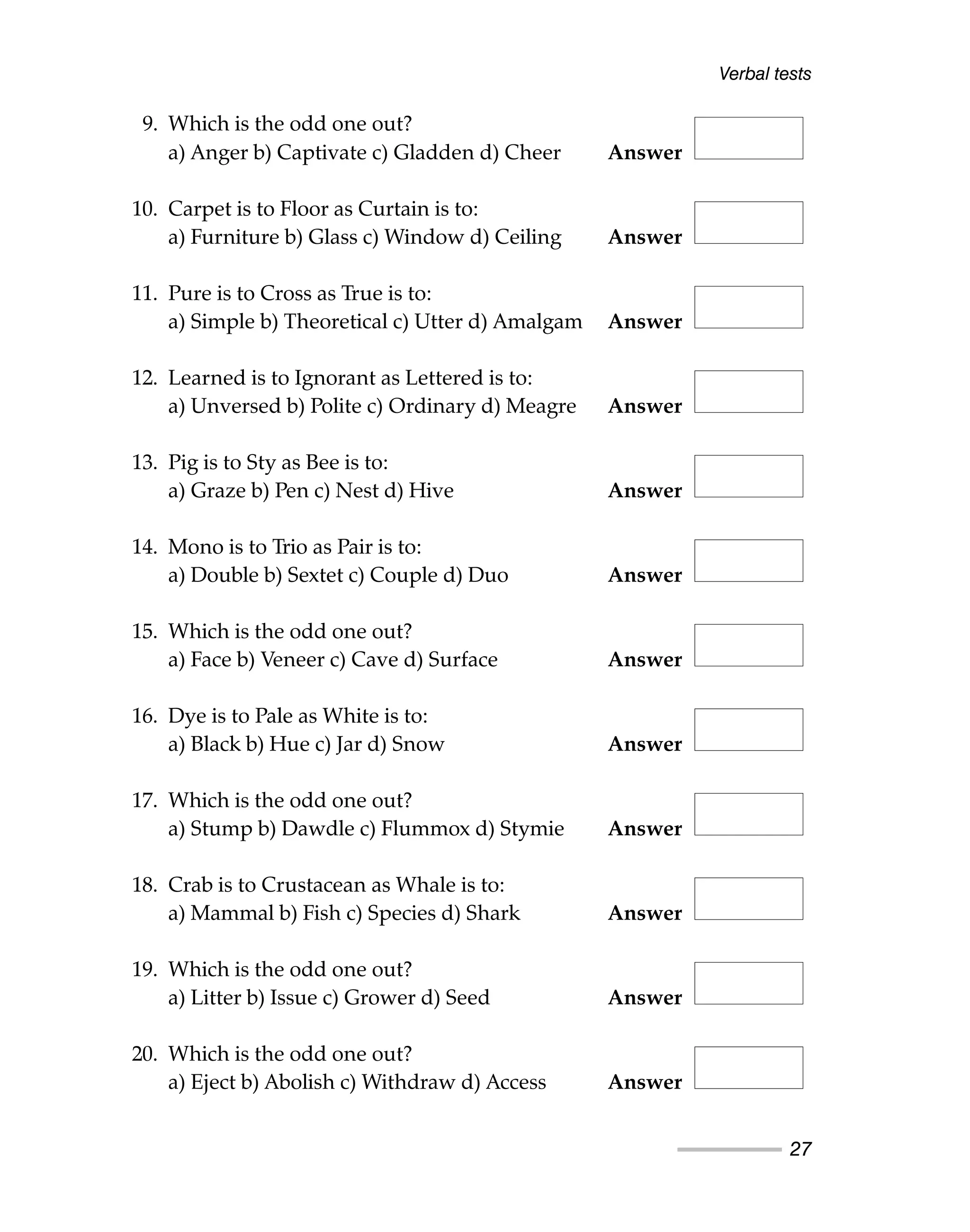
9. Which is the odd one out?
a) Anger b) Captivate c) Gladden d) Cheer Answer
10. Carpet is to Floor as Curtain is to:
a) Furniture b) Glass c) Window d) Ceiling Answer
11. Pure is to Cross as True is to:
a) Simple b) Theoretical c) Utter d) Amalgam Answer
12. Learned is to Ignorant as Lettered is to:
a) Unversed b) Polite c) Ordinary d) Meagre Answer
13. Pig is to Sty as Bee is to:
a) Graze b) Pen c) Nest d) Hive Answer
14. Mono is to Trio as Pair is to:
a) Double b) Sextet c) Couple d) Duo Answer
15. Which is the odd one out?
a) Face b) Veneer c) Cave d) Surface Answer
16. Dye is to Pale as White is to:
a) Black b) Hue c) Jar d) Snow Answer
17. Which is the odd one out?
a) Stump b) Dawdle c) Flummox d) Stymie Answer
18. Crab is to Crustacean as Whale is to:
a) Mammal b) Fish c) Species d) Shark Answer
19. Which is the odd one out?
a) Litter b) Issue c) Grower d) Seed Answer
20. Which is the odd one out?
a) Eject b) Abolish c) Withdraw d) Access Answer
Verbal tests
27
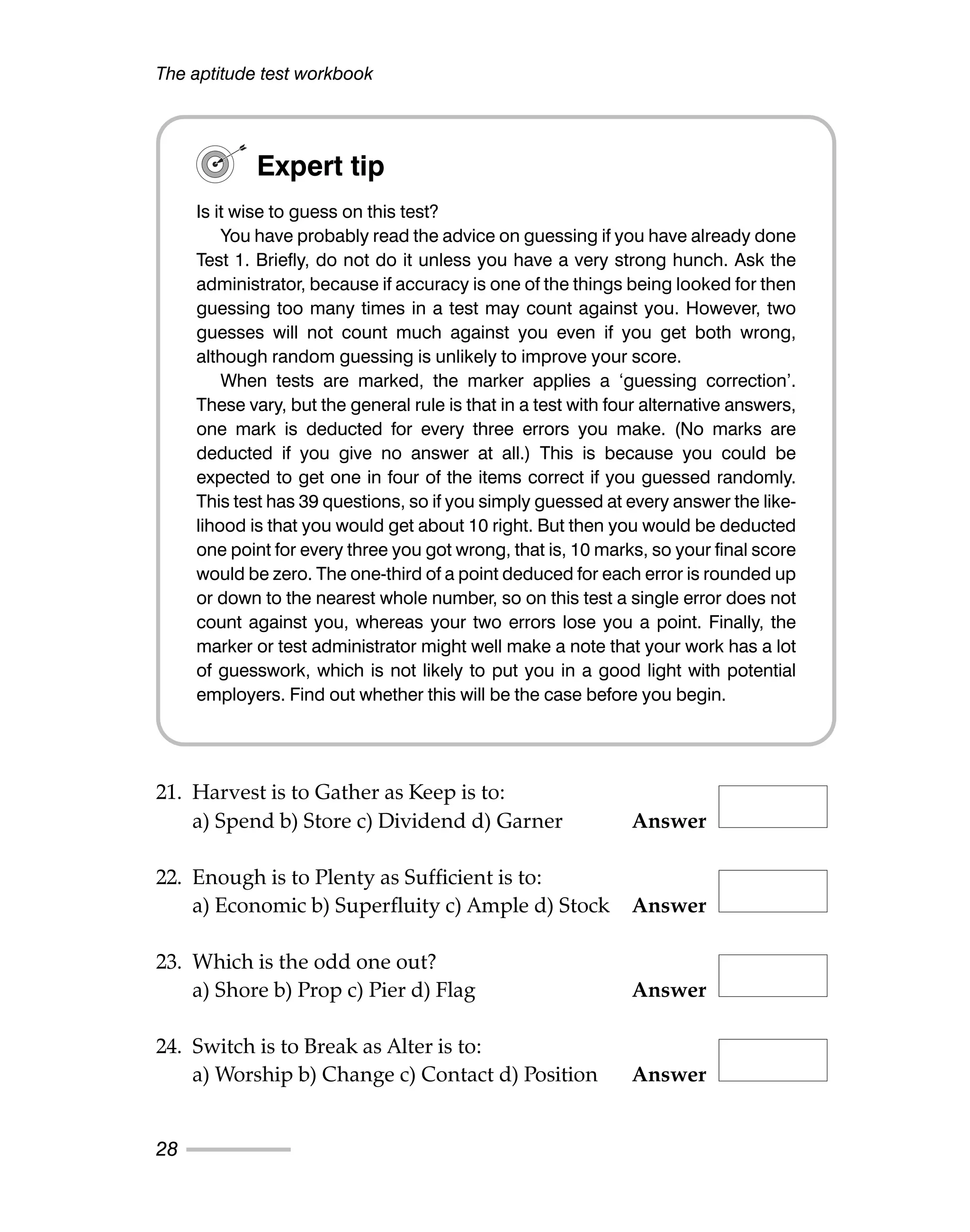
21. Harvest is to Gather as Keep is to:
a) Spend b) Store c) Dividend d) Garner Answer
22. Enough is to Plenty as Sufficient is to:
a) Economic b) Superfluity c) Ample d) Stock Answer
23. Which is the odd one out?
a) Shore b) Prop c) Pier d) Flag Answer
24. Switch is to Break as Alter is to:
a) Worship b) Change c) Contact d) Position Answer
The aptitude test workbook
28
Expert tip
Is it wise to guess on this test?
You have probably read the advice on guessing if you have already done
Test 1. Briefly, do not do it unless you have a very strong hunch. Ask the
administrator, because if accuracy is one of the things being looked for then
guessing too many times in a test may count against you. However, two
guesses will not count much against you even if you get both wrong,
although random guessing is unlikely to improve your score.
When tests are marked, the marker applies a ‘guessing correction’.
These vary, but the general rule is that in a test with four alternative answers,
one mark is deducted for every three errors you make. (No marks are
deducted if you give no answer at all.) This is because you could be
expected to get one in four of the items correct if you guessed randomly.
This test has 39 questions, so if you simply guessed at every answer the like-
lihood is that you would get about 10 right. But then you would be deducted
one point for every three you got wrong, that is, 10 marks, so your final score
would be zero. The one-third of a point deduced for each error is rounded up
or down to the nearest whole number, so on this test a single error does not
count against you, whereas your two errors lose you a point. Finally, the
marker or test administrator might well make a note that your work has a lot
of guesswork, which is not likely to put you in a good light with potential
employers. Find out whether this will be the case before you begin.
Verbal tests
29
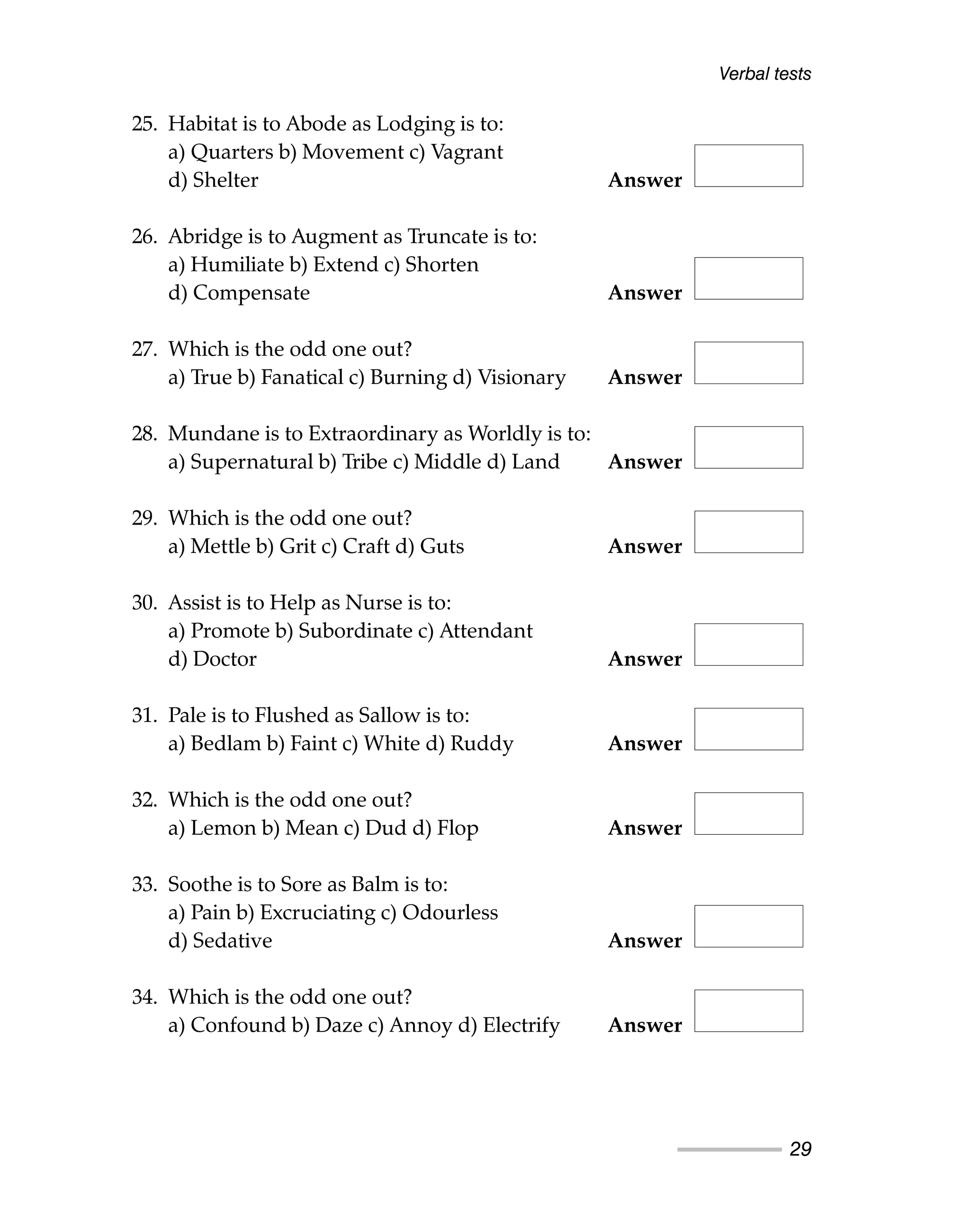
25. Habitat is to Abode as Lodging is to:
a) Quarters b) Movement c) Vagrant
d) Shelter Answer
26. Abridge is to Augment as Truncate is to:
a) Humiliate b) Extend c) Shorten
d) Compensate Answer
27. Which is the odd one out?
a) True b) Fanatical c) Burning d) Visionary Answer
28. Mundane is to Extraordinary as Worldly is to:
a) Supernatural b) Tribe c) Middle d) Land Answer
29. Which is the odd one out?
a) Mettle b) Grit c) Craft d) Guts Answer
30. Assist is to Help as Nurse is to:
a) Promote b) Subordinate c) Attendant
d) Doctor Answer
31. Pale is to Flushed as Sallow is to:
a) Bedlam b) Faint c) White d) Ruddy Answer
32. Which is the odd one out?
a) Lemon b) Mean c) Dud d) Flop Answer
33. Soothe is to Sore as Balm is to:
a) Pain b) Excruciating c) Odourless
d) Sedative Answer
34. Which is the odd one out?
a) Confound b) Daze c) Annoy d) Electrify Answer
35. Where is to Metre as When is to:
a) Infinity b) Speed c) Hour d) Time Answer
36. Which is the odd one out?
a) Wanton b) Adrift c) Fallen d) Oaf Answer
37. Merciful is to Cruelty as Sparing is to:
a) Brutality b) Fight c) Pitying d) Benignant Answer
38. Sound is to Silence as Air is to:
a) Tuneless b) Solemnity c) Vacuum
d) Peacefulness Answer
39. Which is the odd one out?
a) Humid b) Heavy c) Far d) Oppressive Answer
The aptitude test workbook
30
31
THIS PAGE HAS BEEN INTENTIONALLY LEFT BLANK
The aptitude test workbook
32
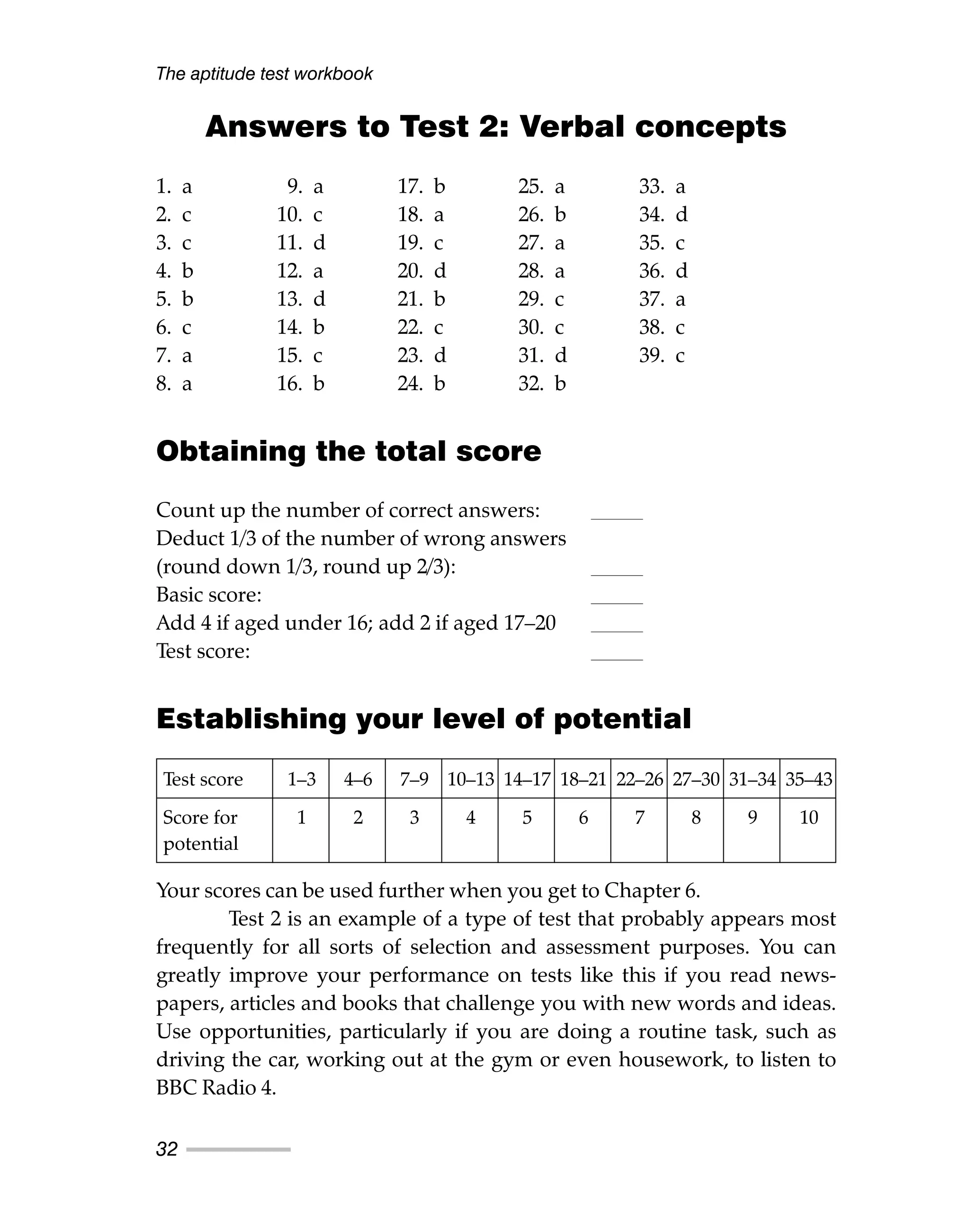
Answers to Test 2: Verbal concepts
1. a 9. a 17. b 25. a 33. a
2. c 10. c 18. a 26. b 34. d
3. c 11. d 19. c 27. a 35. c
4. b 12. a 20. d 28. a 36. d
5. b 13. d 21. b 29. c 37. a
6. c 14. b 22. c 30. c 38. c
7. a 15. c 23. d 31. d 39. c
8. a 16. b 24. b 32. b
Obtaining the total score
Count up the number of correct answers:
Deduct 1/3 of the number of wrong answers
(round down 1/3, round up 2/3):
Basic score:
Add 4 if aged under 16; add 2 if aged 17–20
Test score:
Establishing your level of potential
Your scores can be used further when you get to Chapter 6.
Test 2 is an example of a type of test that probably appears most
frequently for all sorts of selection and assessment purposes. You can
greatly improve your performance on tests like this if you read news-
papers, articles and books that challenge you with new words and ideas.
Use opportunities, particularly if you are doing a routine task, such as
driving the car, working out at the gym or even housework, to listen to
BBC Radio 4.
Test score 1–3 4–6 7–9 10–13 14–17 18–21 22–26 27–30 31–34 35–43
Score for 1 2 3 4 5 6 7 8 9 10
potential
Test 3: Critical application
In this test you have to make conclusions from the information you have
been given. Because of the amount of information you are sometimes asked
to deal with, it is recommended that you have some scrap paper available.
You are given some facts from which you must answer the question. Only
one of the alternative answers is correct.
Examples
1. Pete swims faster than Bill, but is not as fast as Jan,
whilst Jean always beats Jan. Who is fastest?
a) Pete b) Bill c) Jan d) Jean Answer
In Example 1 you should have answer d).
The problems in this test are complicated, so it is unwise to try to
keep all the information in your head. Working out the possibilities is
difficult this way. Instead, it is helpful to get into the habit of putting the
information you have down in a way that helps you to arrange it and
make sense of it. Although this may seem to slow you down, it will
actually increase the certainty of obtaining a correct answer.
Explanation
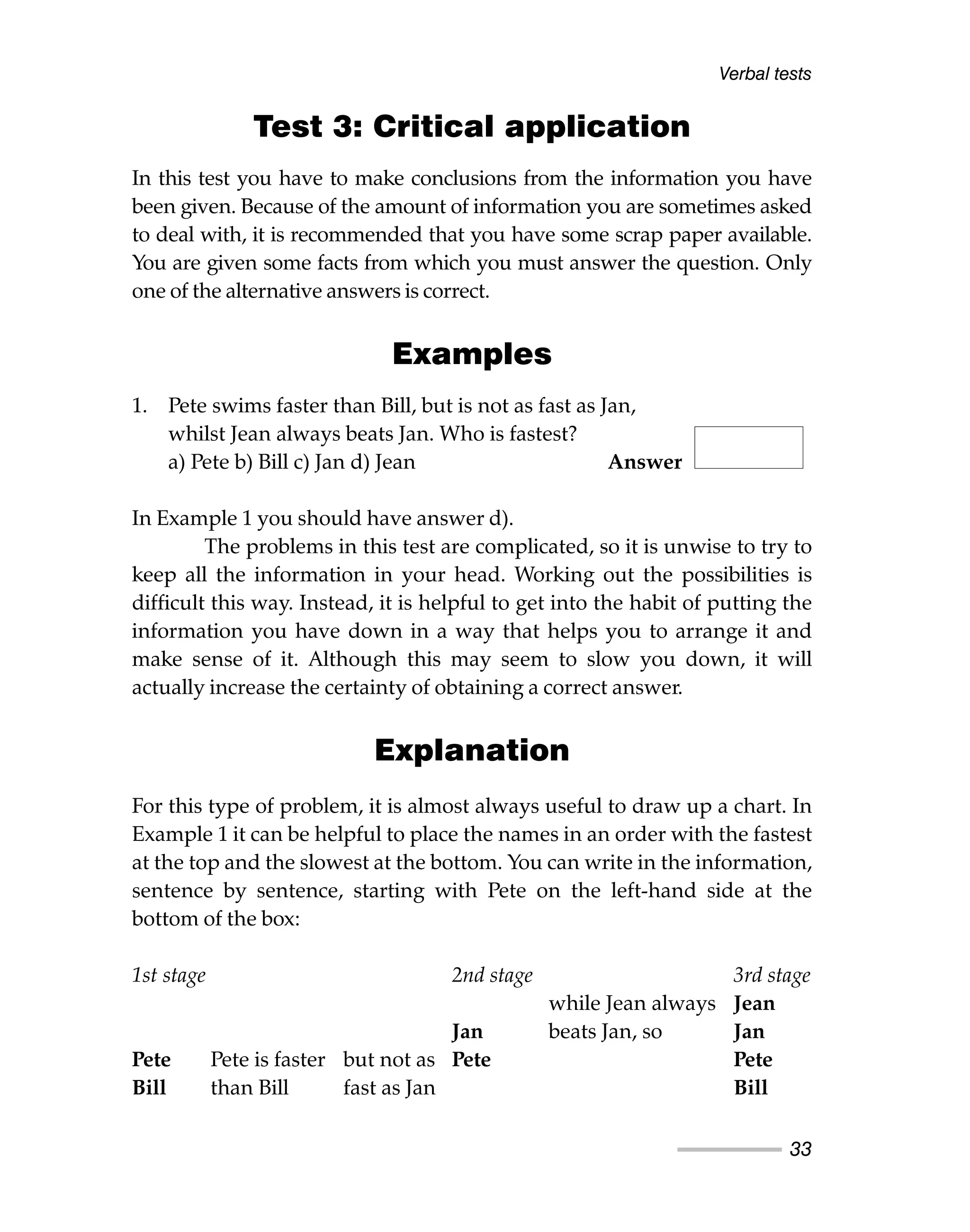
For this type of problem, it is almost always useful to draw up a chart. In
Example 1 it can be helpful to place the names in an order with the fastest
at the top and the slowest at the bottom. You can write in the information,
sentence by sentence, starting with Pete on the left-hand side at the
bottom of the box:
1st stage 2nd stage 3rd stage
while Jean always Jean
Jan beats Jan, so Jan
Pete Pete is faster but not as Pete Pete
Bill than Bill fast as Jan Bill
Verbal tests
33
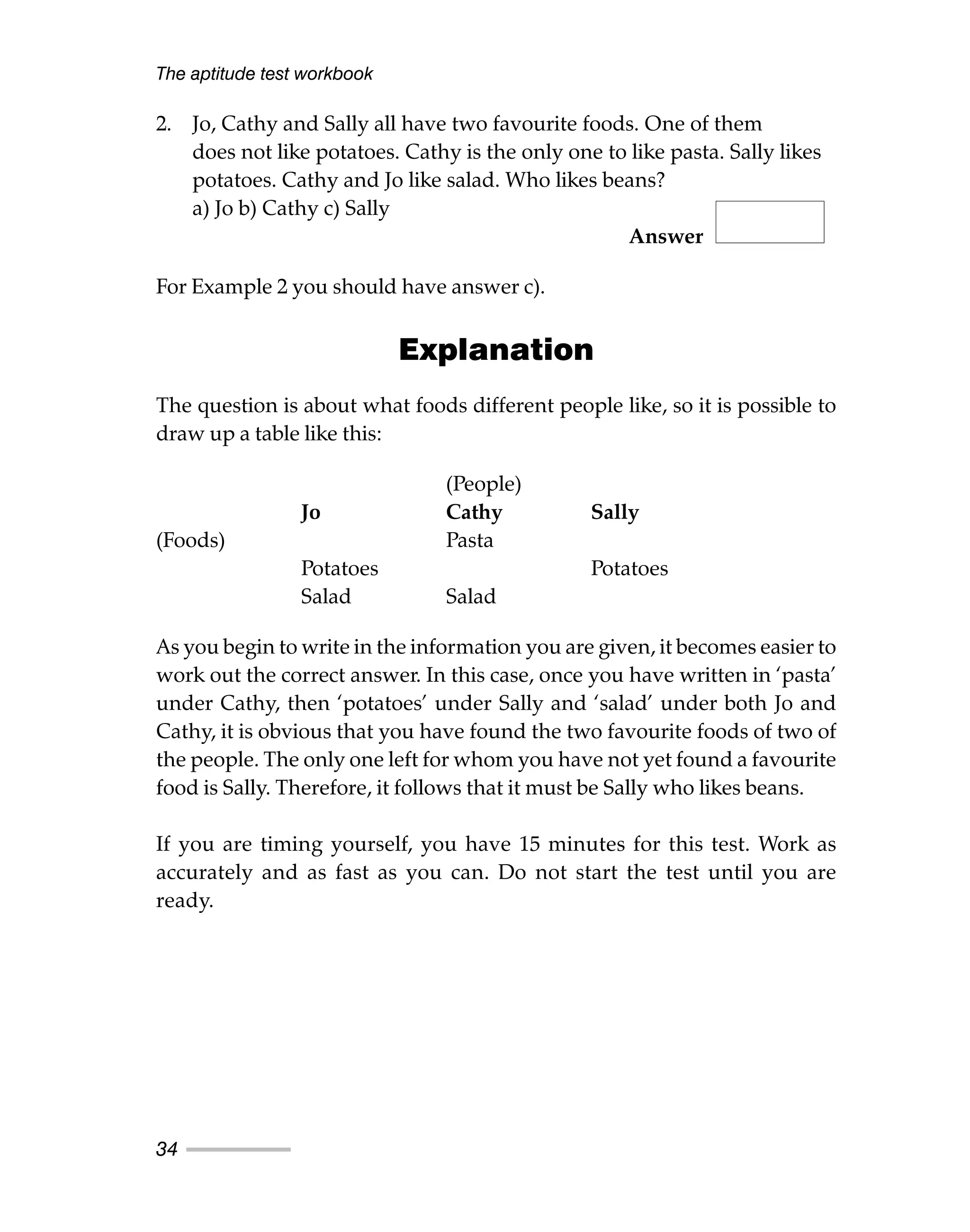
2. Jo, Cathy and Sally all have two favourite foods. One of them
does not like potatoes. Cathy is the only one to like pasta. Sally likes
potatoes. Cathy and Jo like salad. Who likes beans?
a) Jo b) Cathy c) Sally
Answer
For Example 2 you should have answer c).
Explanation
The question is about what foods different people like, so it is possible to
draw up a table like this:
(People)
Jo Cathy Sally
(Foods) Pasta
Potatoes Potatoes
Salad Salad
As you begin to write in the information you are given, it becomes easier to
work out the correct answer. In this case, once you have written in ‘pasta’
under Cathy, then ‘potatoes’ under Sally and ‘salad’ under both Jo and
Cathy, it is obvious that you have found the two favourite foods of two of
the people. The only one left for whom you have not yet found a favourite
food is Sally. Therefore, it follows that it must be Sally who likes beans.
If you are timing yourself, you have 15 minutes for this test. Work as
accurately and as fast as you can. Do not start the test until you are
ready.
The aptitude test workbook
34
Problem A
John is taller than Mary. Jacky is taller than John.
1. Who is tallest?
a) John b) Mary c) Jacky Answer
Problem B
Chris and Peter play football, but John and Andy play basketball. Chris
and Andy play tennis.
2. Who plays football and tennis?
a) Chris b) Peter c) John d) Andy Answer
3. Who plays tennis and basketball?
a) Chris b) Peter c) John d) Andy Answer
Verbal tests
35
Expert tip
Problem A is done in just the same way as Example 1.
Expert tip
Problem B is done in just the same way as Example 2. On your scrap paper,
place the names in a line, then write the activities under each name.
Problem C
Bill has fewer hobbies than Tom, but has more than John. However, Sam
and Sarah also have more hobbies than Bill.
4. Who has the least number of hobbies?
a) Bill b) Tom c) John d) Sam e) Sarah Answer
Problem D
Jenny, Peter and Susan all go to a school where there is a uniform. Uniform
is not worn at the school attended by Bill, Sally and Harry. Susan, Bill and
Sally wear black shoes. Sally, Peter and Harry wear a white shirt or blouse.
5. Who wears a white shirt or blouse with a uniform?
a) Jenny b) Peter c) Susan d) Bill e) Sally
f) Harry Answer
6. Who does not wear a uniform and does not have black
shoes?
a) Jenny b) Peter c) Susan d) Bill e) Sally
f) Harry Answer
Problem E
Joe, Mabel, Ed and Angie start off in this order of descending height. Joe
grows quickly, but is still just beaten by Angie. Ed is shortest for a time, until
his place is taken by Mabel.
7. Who is now the tallest?
a) Joe b) Mabel c) Ed d) Angie Answer
8. Who is now shorter than Ed?
a) Joe b) Mabel c) Ed d) Angie Answer
The aptitude test workbook
36
Verbal tests
37
Problem F
Only the houses of Fred and Joe have a computer. Fred, John, Garth and
Joe own their own houses. Fred and John have single-storey properties
while the houses of the others are on two floors. John and Joe have
gardens while the others do not.
9. Who has a computer in his two-storey house with a garden?
a) Fred b) Joe c) John d) Garth
Answer
10. Who has neither a garden nor a computer?
a) Fred b) Joe c) John d) Garth Answer
Problem G
Different foods are to be found on three shelves in a fridge. Butter is kept
below the eggs while cheese is kept above the milk. The butter is also
above the milk, but the eggs are on the same shelf as the yoghurt. The ice
cream is above the cheese.
11. What is on the bottom shelf?
a) Butter b) Eggs c) Cheese d) Milk e) Ice cream
Answer
12. Which are on the same shelf?
a) Butter and cheese b) Ice cream and milk c) Butter and ice cream
d) Cheese and milk e) None of these
Answer
Problem H
Casey, Stuart, Ritchie, Billie and Colin all have their own single tents to go
to camp. Casey and Billie have nylon tents. The others have canvas ones.
Casey and Colin have zips with their tents, while the others have draw-
strings. Ritchie and Casey have sewn-in groundsheets as well as plastic
sheets for the ground. The others only have plastic sheets for the ground.
13. Who has a zip on the nylon tent?
a) Casey b) Stuart c) Ritchie d) Billie e) Colin Answer
14. How many people have plastic sheets in tents that are not made of
canvas and have no zips?
a) 5 b) 4 c) 3 d) 2 e) 1 f) none
Answer
15. Who has a canvas tent that has a zip, but does not have a
groundsheet?
a) Casey b) Stuart c) Ritchie d) Billie e) Colin Answer
The aptitude test workbook
38
Expert tip
The same method is used for putting items in order, one above the other,
although the number of items has increased and, finally you have to work
out where items go by a process of elimination. For example, you cannot
work out which shelf the cheese is on by being told, ‘The cheese is above
the milk’ until you are also told that ‘The ice cream is above the cheese’, so
the cheese can only be placed between the other two items on the middle
shelf. You have to make more deductions as problems like this become
longer. Using scrap paper to put everything down makes it easier to deal
with all the information and how each piece relates to the others.
Verbal tests
39
Problem I
Sharon, Kelly, Robina and Sam have travelled to different countries with
their parents. Kelly and Sam are the only ones to have been to both France
and Mexico. Robina and Sharon are the only two who have been to Spain
as well as India. Sharon and Kelly are the only ones to have been to both
Greece and France.
16. Who has been to Spain, but not to France?
a) Sharon b) Kelly c) Robina d) Sam Answer
17. Who has been to India, but not to France?
a) Sharon b) Kelly c) Robina d) Sam Answer
18. Who has travelled to the most countries?
a) Sharon b) Kelly c) Robina d) Sam Answer
19. Which is the only country that Sharon has not visited?
a) France b) India c) Greece d) Spain
e) Mexico Answer
Problem J
There are five houses in Ditton Road, which belong to Mr and Mrs
Bagshaw, Miss Jenkins, Mrs Chance, Mr Fleming, and Mr and Mrs Marx.
The Marxes’ and Bagshaws’ houses have green curtains. The other houses
have white ones. The Bagshaws and Mrs Chance have their window
frames painted the same colour as their doors. Miss Jenkins has black
window frames. Mr Fleming’s and the Marxes’ have green ones. The
doors of the houses are white apart for Miss Jenkins’ and Mr Fleming’s
which are black.
20. Who has a house with white curtains, window frames and a white
door?
a) Mr and Mrs Bagshaw b) Miss Jenkins c) Mrs Chance
d) Mr Fleming e) Mr and Mrs Marx Answer
21. Who has window frames and door painted white, but green curtains?
a) Mr and Mrs Bagshaw b) Miss Jenkins c) Mrs Chance
d) Mr Fleming e) Mr and Mrs Marx
Answer
22. Who has window frames and door painted black, but white curtains?
a) Mr and Mrs Bagshaw b) Miss Jenkins c) Mrs Chance
d) Mr Fleming e) Mr and Mrs Marx
Answer
Problem K
Costello, Emrik, Fuji and Herz are finalists in a wrestling match. They
must each wrestle each other. In all, there are six fights until the winner is
decided. Herz is beaten by Costello. Emrik beats Herz. Costello and Fuji
beat Emrik. Fuji beats Costello and Herz.
23. How many fights does Emrik win?
a) 1 b) 2 c) 3 d) 4 e) 0 Answer
24. How many fights does Costello win?
a) 1 b) 2 c) 3 d) 4 e) 0 Answer
25. Who is the final champion?
a) Costello b) Emrik c) Fuji d) Herz Answer
Problem L
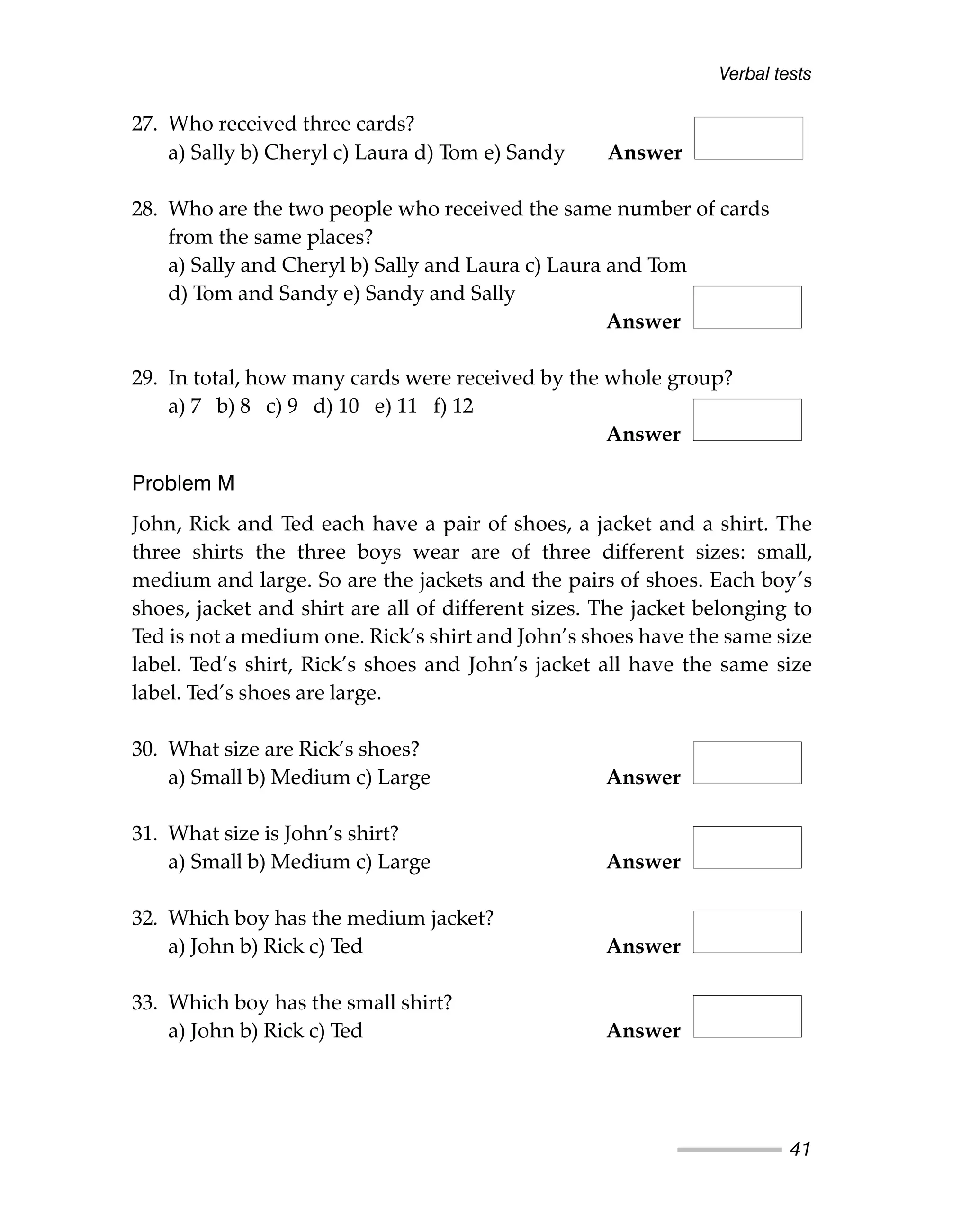
Sally, Cheryl, Laura, Tom and Sandy receive postcards from friends who
are holidaying abroad. Four of them get postcards from France. Cheryl
and Tom do not get postcards from Germany as the others all do. Cheryl
only gets a single card, which is from Italy. Only Sally and Sandy did not
get postcards from Italy.
26. Who received a postcard from only Italy and France?
a) Sally b) Cheryl c) Laura d) Tom e) Sandy Answer
The aptitude test workbook
40
27. Who received three cards?
a) Sally b) Cheryl c) Laura d) Tom e) Sandy Answer
28. Who are the two people who received the same number of cards
from the same places?
a) Sally and Cheryl b) Sally and Laura c) Laura and Tom
d) Tom and Sandy e) Sandy and Sally
Answer
29. In total, how many cards were received by the whole group?
a) 7 b) 8 c) 9 d) 10 e) 11 f) 12
Answer
Problem M
John, Rick and Ted each have a pair of shoes, a jacket and a shirt. The
three shirts the three boys wear are of three different sizes: small,
medium and large. So are the jackets and the pairs of shoes. Each boy’s
shoes, jacket and shirt are all of different sizes. The jacket belonging to
Ted is not a medium one. Rick’s shirt and John’s shoes have the same size
label. Ted’s shirt, Rick’s shoes and John’s jacket all have the same size
label. Ted’s shoes are large.
30. What size are Rick’s shoes?
a) Small b) Medium c) Large Answer
31. What size is John’s shirt?
a) Small b) Medium c) Large Answer
32. Which boy has the medium jacket?
a) John b) Rick c) Ted Answer
33. Which boy has the small shirt?
a) John b) Rick c) Ted Answer
Verbal tests
41
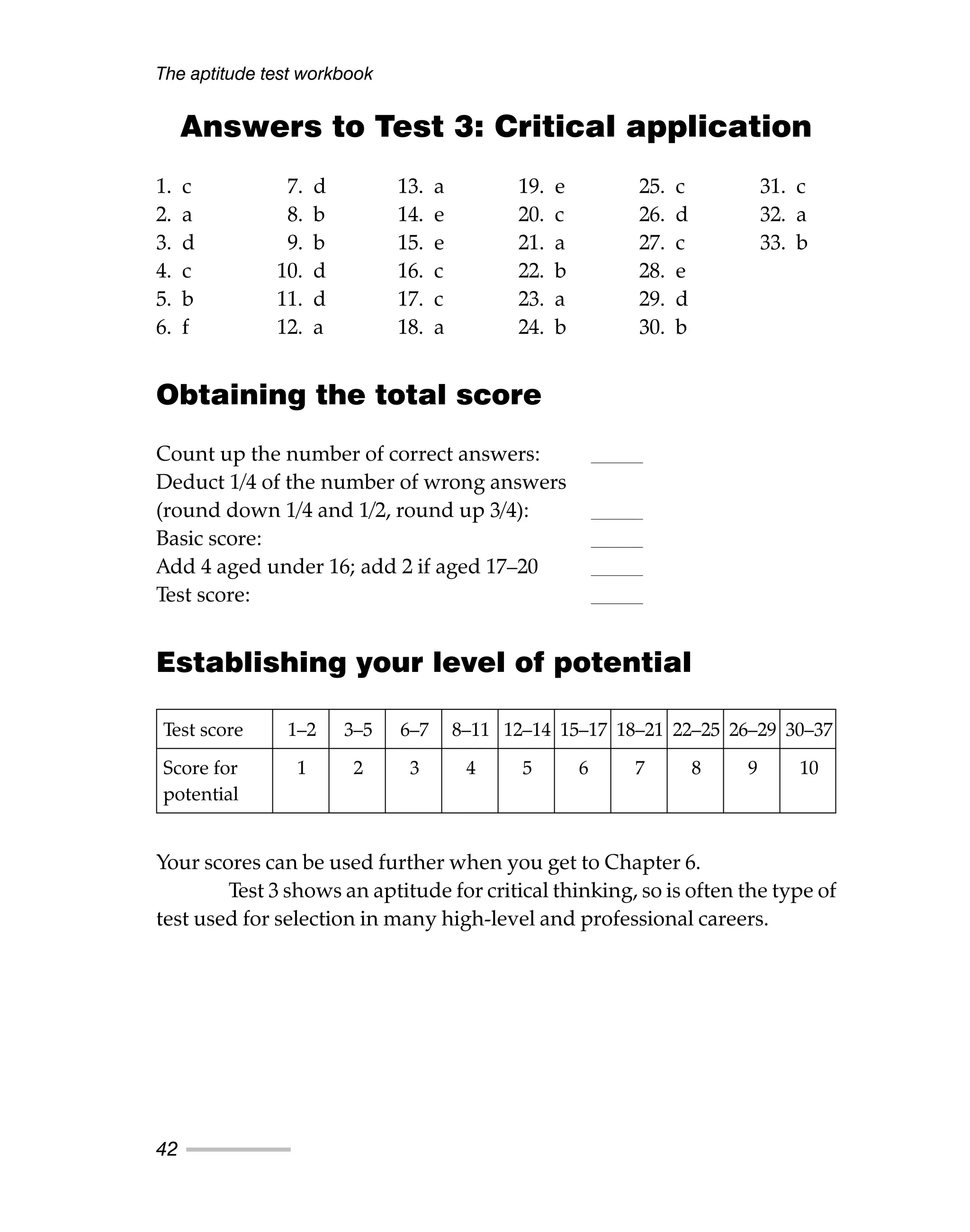
Answers to Test 3: Critical application
1. c 7. d 13. a 19. e 25. c 31. c
2. a 8. b 14. e 20. c 26. d 32. a
3. d 9. b 15. e 21. a 27. c 33. b
4. c 10. d 16. c 22. b 28. e
5. b 11. d 17. c 23. a 29. d
6. f 12. a 18. a 24. b 30. b
Obtaining the total score
Count up the number of correct answers:
Deduct 1/4 of the number of wrong answers
(round down 1/4 and 1/2, round up 3/4):
Basic score:
Add 4 aged under 16; add 2 if aged 17–20
Test score:
Establishing your level of potential
Your scores can be used further when you get to Chapter 6.
Test 3 shows an aptitude for critical thinking, so is often the type of
test used for selection in many high-level and professional careers.
The aptitude test workbook
42
Test score 1–2 3–5 6–7 8–11 12–14 15–17 18–21 22–25 26–29 30–37
Score for 1 2 3 4 5 6 7 8 9 10
potential
43
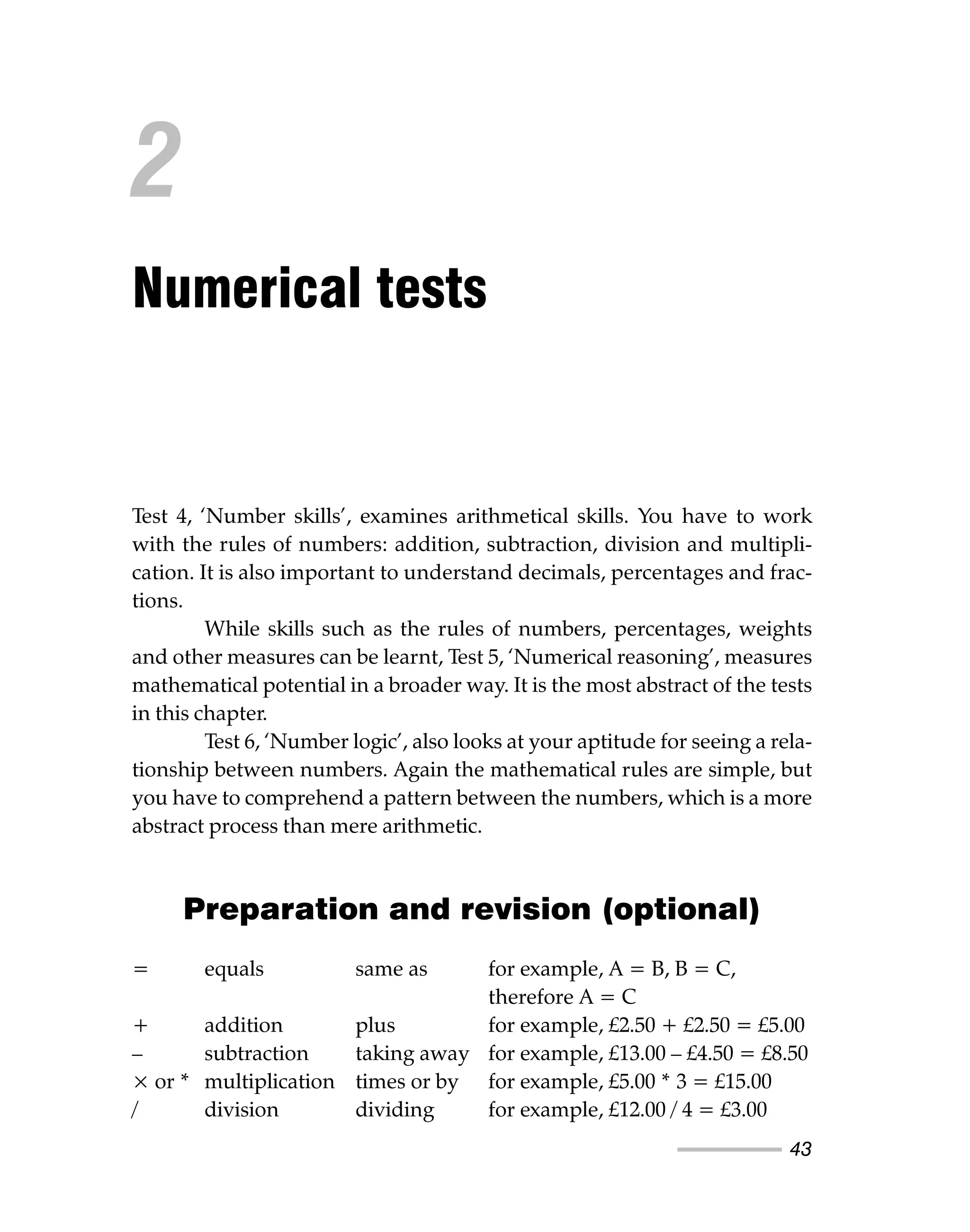
Test 4, ‘Number skills’, examines arithmetical skills. You have to work
with the rules of numbers: addition, subtraction, division and multipli-
cation. It is also important to understand decimals, percentages and frac-
tions.
While skills such as the rules of numbers, percentages, weights
and other measures can be learnt, Test 5, ‘Numerical reasoning’, measures
mathematical potential in a broader way. It is the most abstract of the tests
in this chapter.
Test 6, ‘Number logic’, also looks at your aptitude for seeing a rela-
tionship between numbers. Again the mathematical rules are simple, but
you have to comprehend a pattern between the numbers, which is a more
abstract process than mere arithmetic.
Preparation and revision (optional)
= equals same as for example, A = B, B = C,
therefore A = C
+ addition plus for example, £2.50 + £2.50 = £5.00
– subtraction taking away for example, £13.00 – £4.50 = £8.50
× or * multiplication times or by for example, £5.00 * 3 = £15.00
/ division dividing for example, £12.00 / 4 = £3.00
2
Numerical tests
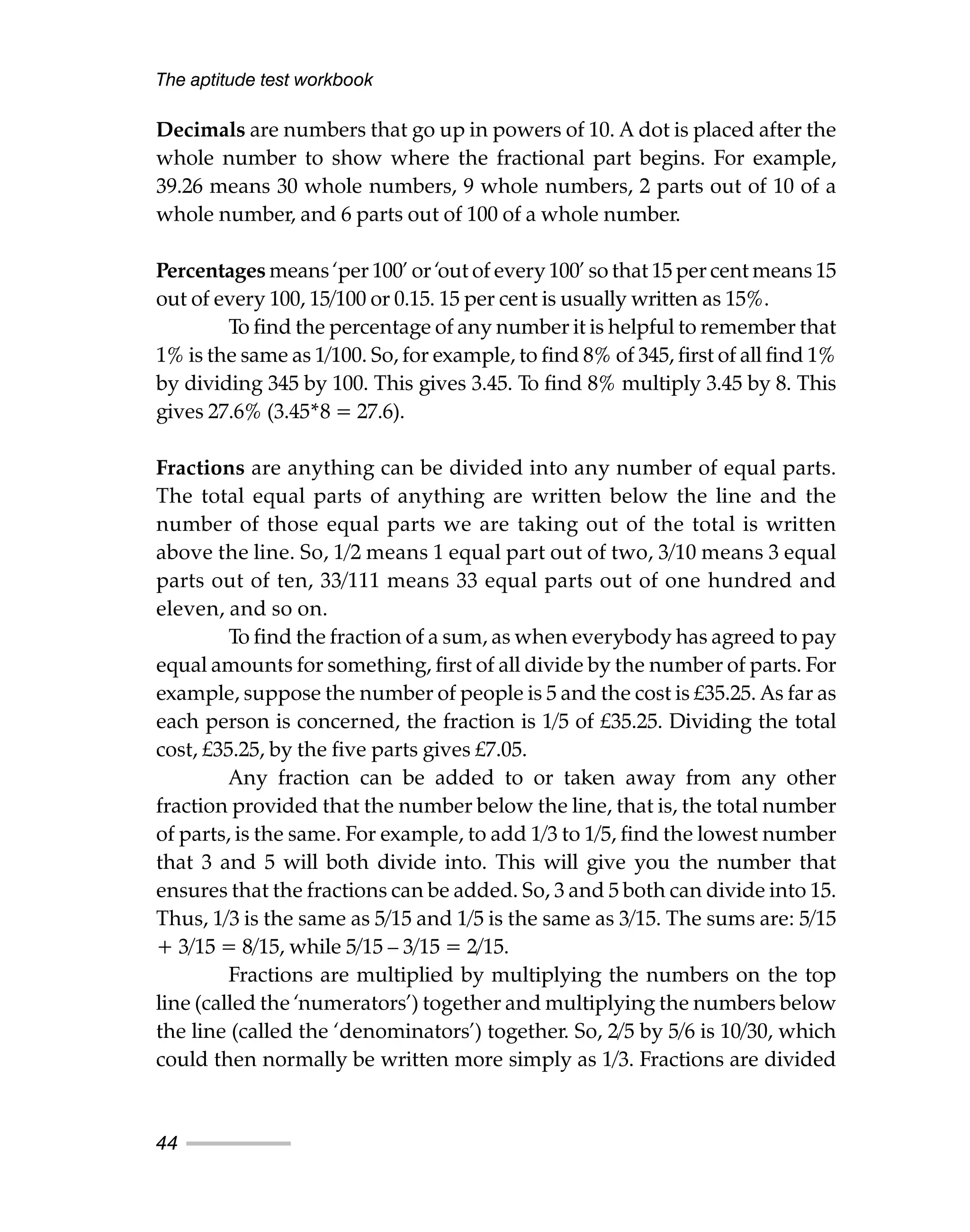
Decimals are numbers that go up in powers of 10. A dot is placed after the
whole number to show where the fractional part begins. For example,
39.26 means 30 whole numbers, 9 whole numbers, 2 parts out of 10 of a
whole number, and 6 parts out of 100 of a whole number.
Percentages means ‘per 100’ or ‘out of every 100’ so that 15 per cent means 15
out of every 100, 15/100 or 0.15. 15 per cent is usually written as 15%.
To find the percentage of any number it is helpful to remember that
1% is the same as 1/100. So, for example, to find 8% of 345, first of all find 1%
by dividing 345 by 100. This gives 3.45. To find 8% multiply 3.45 by 8. This
gives 27.6% (3.45*8 = 27.6).
Fractions are anything can be divided into any number of equal parts.
The total equal parts of anything are written below the line and the
number of those equal parts we are taking out of the total is written
above the line. So, 1/2 means 1 equal part out of two, 3/10 means 3 equal
parts out of ten, 33/111 means 33 equal parts out of one hundred and
eleven, and so on.
To find the fraction of a sum, as when everybody has agreed to pay
equal amounts for something, first of all divide by the number of parts. For
example, suppose the number of people is 5 and the cost is £35.25. As far as
each person is concerned, the fraction is 1/5 of £35.25. Dividing the total
cost, £35.25, by the five parts gives £7.05.
Any fraction can be added to or taken away from any other
fraction provided that the number below the line, that is, the total number
of parts, is the same. For example, to add 1/3 to 1/5, find the lowest number
that 3 and 5 will both divide into. This will give you the number that
ensures that the fractions can be added. So, 3 and 5 both can divide into 15.
Thus, 1/3 is the same as 5/15 and 1/5 is the same as 3/15. The sums are: 5/15
+ 3/15 = 8/15, while 5/15 – 3/15 = 2/15.
Fractions are multiplied by multiplying the numbers on the top
line (called the ‘numerators’) together and multiplying the numbers below
the line (called the ‘denominators’) together. So, 2/5 by 5/6 is 10/30, which
could then normally be written more simply as 1/3. Fractions are divided
The aptitude test workbook
44
by turning the number that is doing the dividing upside down and then
multiplying in the usual way. For example, 2/5 divided by 5/6 becomes 2/5
multiplied by 6/5, which gives 12/25.
Numerical tests
45
Test 4: Number skills
You are asked to make some calculations and write down the answers. The
answer has to be written clearly on the right hand side of the page in the
space provided. If this book is not your own, record your answers on a
separate sheet. In the examples below, the first and second have been
done for you. Do the others yourself, writing in your answers clearly. You
can do the sums in your head if you want to or you can do your working
out on spare paper. You will see some working out that has been done in a
spare space for Example 1 and Example 2.
Examples
1. How many is 27 and 54?
27
+54
=81
Answer
2. Two people spend exactly the same amount. Their total together is
£15.00. How much does one person spend?
15 / 2 = 7.5
Answer
3. What is the total of 1.5 and 1.8?
Answer
4. What is 10% of £150.00?
Answer
Explanation
For example 3, the answer is 3.3. The answer to example 4 is £15.
Remember that you can have some spare paper for working out.
Do not mark this book if it is not your own.
The aptitude test workbook
46
81
£7.50
If you are timing yourself you will have 12 minutes for this test. It is
unlikely that you will be able to complete the whole test as there are too
many questions for the time allowed. You have to do as many as you can,
working quickly, but not making mistakes. Do not start the test until you
are ready.
Numerical tests
47
1. How many is 13 and 8?
Answer
2. Two people spend £6.00 each. How much did they spend together?
Answer
3. What is the total of 0.5 and 1.0?
Answer
4. What is 50% of £10.00?
Answer
5. How many is 16 added to 23?
Answer
6. What does £9.50 and £10.50 come to?
Answer
The aptitude test workbook
48
Expert tip
When adding decimals, place the decimal points of all the numbers under
each other. This makes sure that tens of units come under each other, units
come under each other, as well as tenths, hundredths, thousandths and so
on. So if you need to add, say, 3.08 and 10.003 and 4.94, write the sum down
as below. Add the numbers from the right-hand side in the normal way:
3.08
+ 10.003
+ 4.94
= 18.023
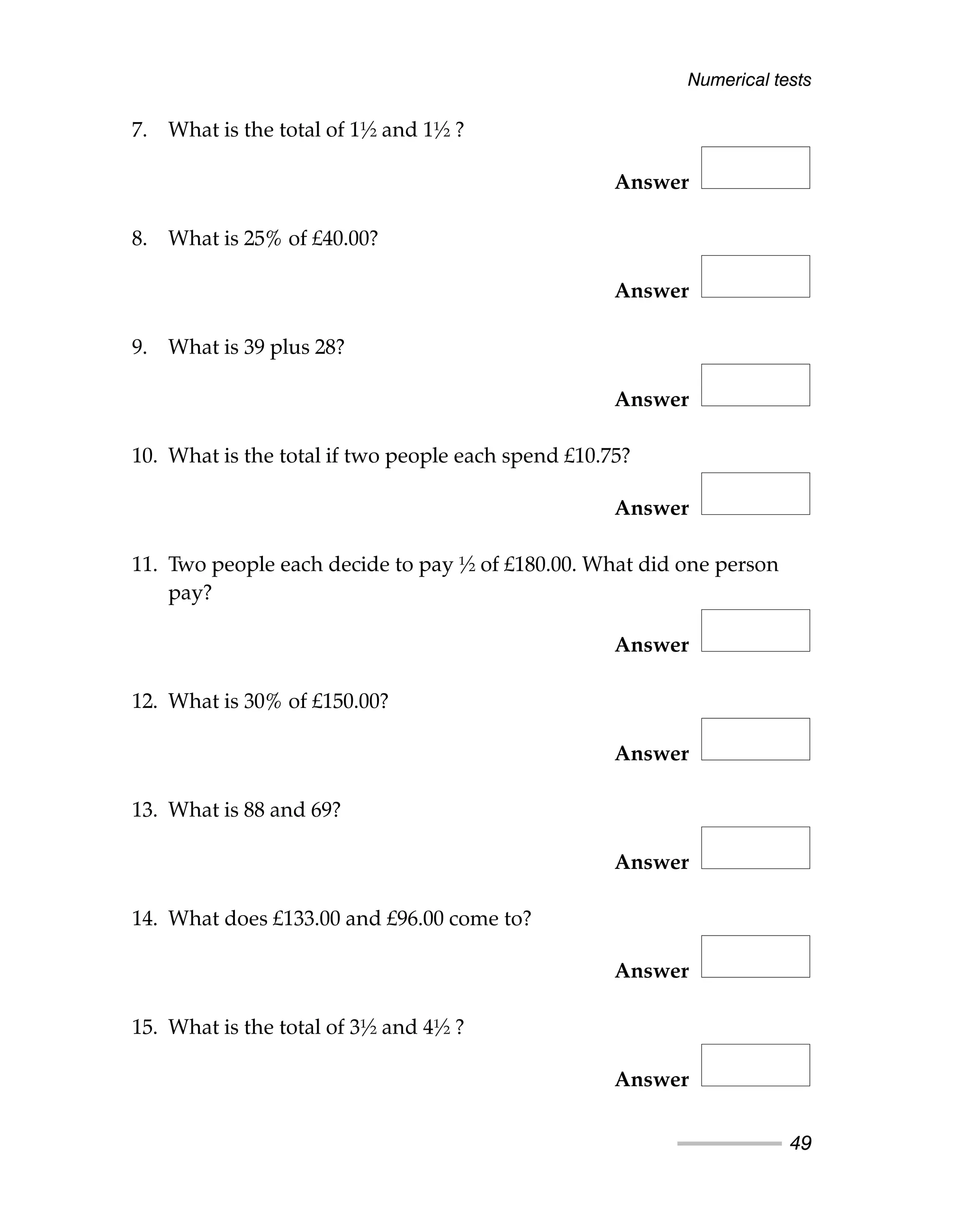
7. What is the total of 1½ and 1½ ?
Answer
8. What is 25% of £40.00?
Answer
9. What is 39 plus 28?
Answer
10. What is the total if two people each spend £10.75?
Answer
11. Two people each decide to pay ½ of £180.00. What did one person
pay?
Answer
12. What is 30% of £150.00?
Answer
13. What is 88 and 69?
Answer
14. What does £133.00 and £96.00 come to?
Answer
15. What is the total of 3½ and 4½ ?
Answer
Numerical tests
49
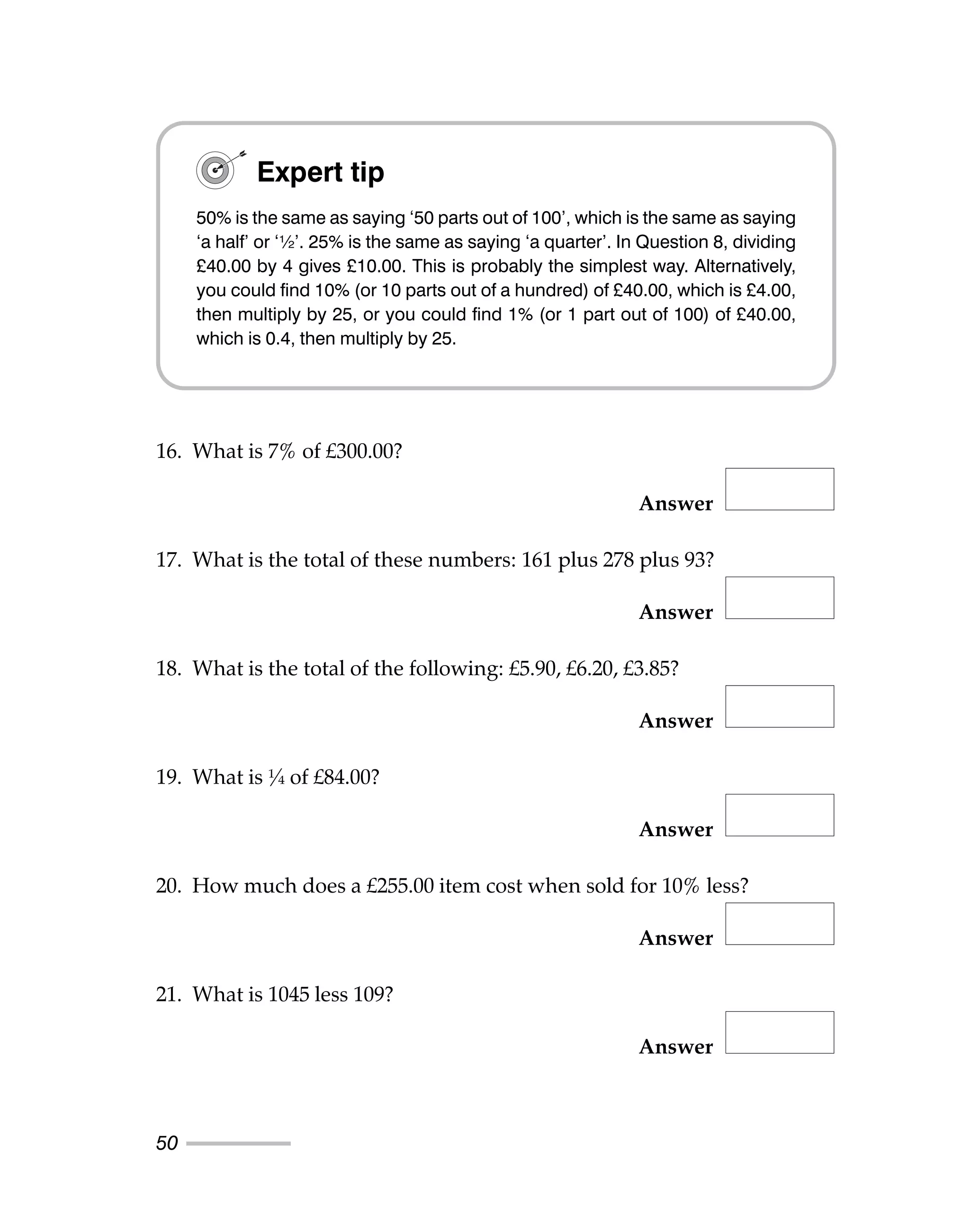
16. What is 7% of £300.00?
Answer
17. What is the total of these numbers: 161 plus 278 plus 93?
Answer
18. What is the total of the following: £5.90, £6.20, £3.85?
Answer
19. What is ¼ of £84.00?
Answer
20. How much does a £255.00 item cost when sold for 10% less?
Answer
21. What is 1045 less 109?
Answer
50
Expert tip
50% is the same as saying ‘50 parts out of 100’, which is the same as saying
‘a half’ or ‘½’. 25% is the same as saying ‘a quarter’. In Question 8, dividing
£40.00 by 4 gives £10.00. This is probably the simplest way. Alternatively,
you could find 10% (or 10 parts out of a hundred) of £40.00, which is £4.00,
then multiply by 25, or you could find 1% (or 1 part out of 100) of £40.00,
which is 0.4, then multiply by 25.
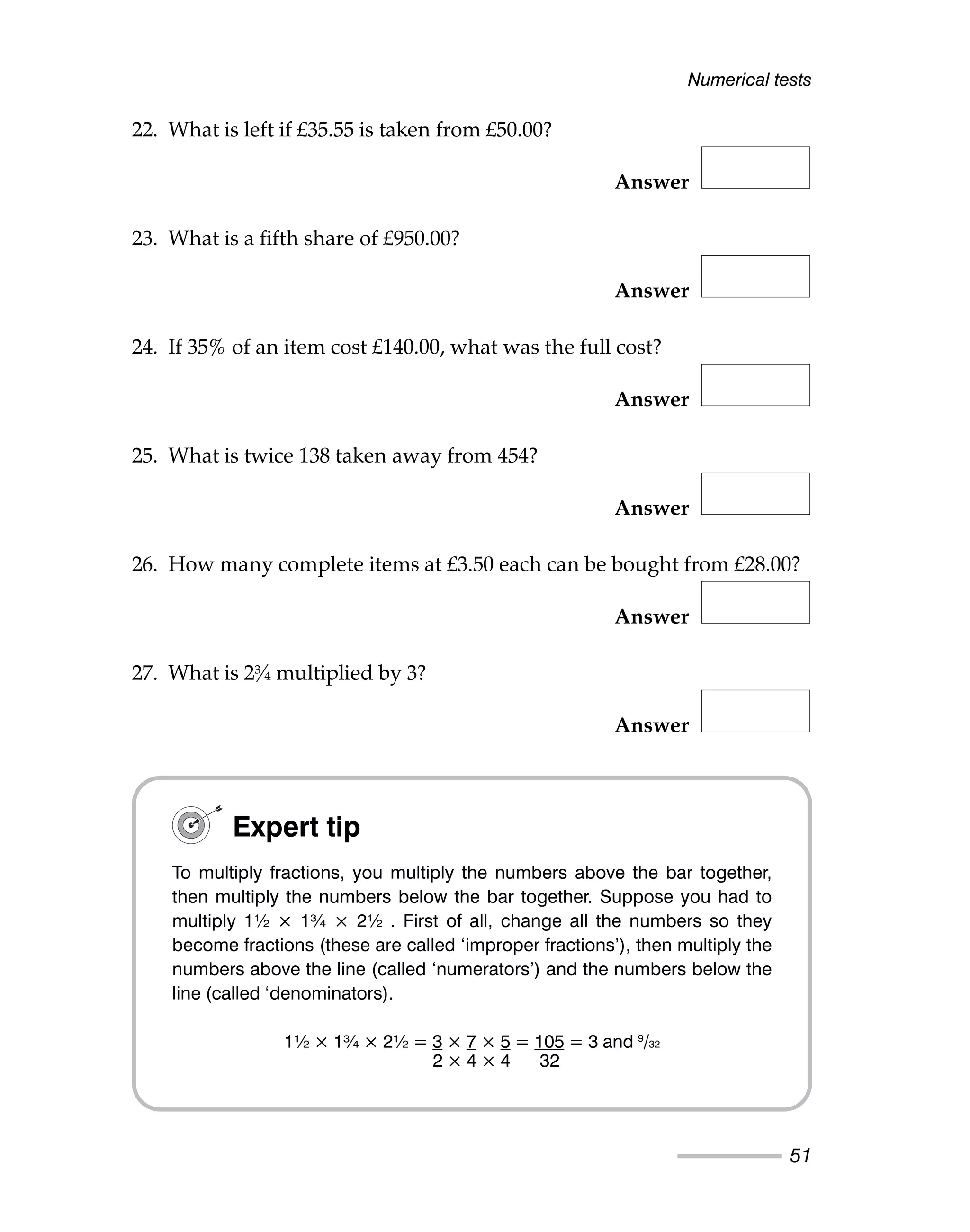
22. What is left if £35.55 is taken from £50.00?
Answer
23. What is a fifth share of £950.00?
Answer
24. If 35% of an item cost £140.00, what was the full cost?
Answer
25. What is twice 138 taken away from 454?
Answer
26. How many complete items at £3.50 each can be bought from £28.00?
Answer
27. What is 2¾ multiplied by 3?
Answer
Numerical tests
51
Expert tip
To multiply fractions, you multiply the numbers above the bar together,
then multiply the numbers below the bar together. Suppose you had to
multiply 1½ × 1¾ × 2½ . First of all, change all the numbers so they
become fractions (these are called ‘improper fractions’), then multiply the
numbers above the line (called ‘numerators’) and the numbers below the
line (called ‘denominators).
1½ × 1¾ × 2½ = 3 × 7 × 5 = 105 = 3 and 9
/32
2 × 4 × 4 32
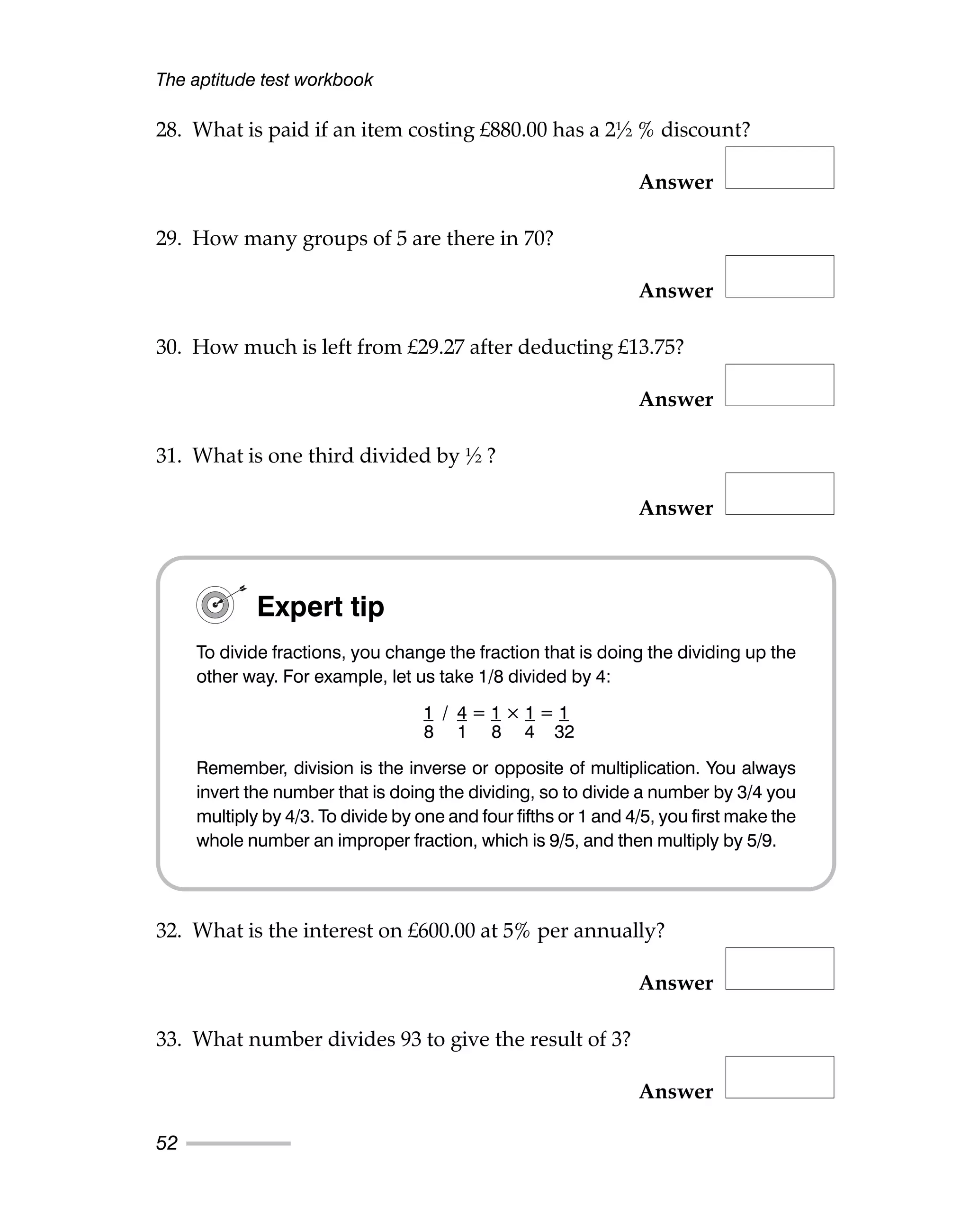
28. What is paid if an item costing £880.00 has a 2½ % discount?
Answer
29. How many groups of 5 are there in 70?
Answer
30. How much is left from £29.27 after deducting £13.75?
Answer
31. What is one third divided by ½ ?
Answer
32. What is the interest on £600.00 at 5% per annually?
Answer
33. What number divides 93 to give the result of 3?
Answer
The aptitude test workbook
52
Expert tip
To divide fractions, you change the fraction that is doing the dividing up the
other way. For example, let us take 1/8 divided by 4:
1 / 4 = 1 × 1 = 1
8 1 8 4 32
Remember, division is the inverse or opposite of multiplication. You always
invert the number that is doing the dividing, so to divide a number by 3/4 you
multiply by 4/3. To divide by one and four fifths or 1 and 4/5, you first make the
whole number an improper fraction, which is 9/5, and then multiply by 5/9.
34. What is 2.95 divided by 0.05?
Answer
35. If one share costs £8.00, what is the cost of 3½ shares plus 2¼ shares?
Answer
36. What is 1% of £10.00 added to 2% of £100.00?
Answer
37. What has to be added to 1003 to give 2171?
Answer
38. If 20 parts cost £1000.00, how much is 5½ parts?
Answer
39. What is 1/5 less 1/15 ?
Answer
Numerical tests
53
Expert tip
To divide decimals first make the number that is doing the dividing (called
the ‘divisor’) into a whole number. In Question 34 this is done by moving the
decimal point two places to the right, which is 5.0, a whole number. What
you do to one number must also be done to the other so that 2.95 becomes
295. Now divide 5 into 295 in the normal way.
40. What is 17½ % of £50.00?
Answer
41. Making up sets of 12, how many will be left over from a group of
165?
Answer
42. If there are 250 rials to the pound sterling, how many pounds
sterling can be bought for 5000.00 (five thousand) rials?
Answer
The aptitude test workbook
54
55
THIS PAGE HAS BEEN INTENTIONALLY LEFT BLANK
Answers to Test 4: Number skills
Obtaining the total score
Count up the number of correct answers:
Deduct 1/4 of the number of wrong answers
(round down 1/4 and 1/2, round up 3/4):
Basic score:
Add 2 if no mistakes:
Test score:
Establishing your level of potential
Your scores can be used further when you get to Chapter 6.
If you do well in Test 4 and enjoy arithmetic and other problems
involving calculations you may want to consider careers that have a
strong numerical element, such as those in accountancy, finance, adminis-
tration and economics.
The aptitude test workbook
56
1. 21
2. £12.00
3. 1.5
4. £5.00
5. 39
6. £20.00
7. 3
8. £10.00
9. 67
10. £21.50
11. £90.00
12. £45.00
13. 157
14. £229.00
15. 8
16. £21.00
17. 532
18. £15.95
19. 21
20. £229.50
21. 936
22. £14.45
23. £190.00
24. £400.00
25. 178
26. 8
27. 8 1/4
28. £858.00
29. 14
30. £15.52
31. 1/6
32. £30.00
33. 31
34. 59
35. £46.00
36. £2.10
37. 1168
38. £275.00
39. 2/15
40. £8.75
41. 9
42. £20.00
Test score 1–2 3–4 5–8 9–12 13–16 17–20 21–25 26–30 31–35 36–44
Score for 1 2 3 4 5 6 7 8 9 10
potential
Test 5: Numerical reasoning
This is a test of how easily you perceive how numbers relate to each
other. You are given a series of numbers. Your task is to see how they
form a relationship with each other. You then have to choose the
number that would go next in the series, choosing one from the four
possible answers provided. It is advisable to have a piece of scrap paper
and a pencil to do any working out that may be necessary. The first
example below has been done already to show you how.
Examples
1. 5 10 15 20 25 ?
a) 6 b) 35 c) 30 d) 50 Answer
2. 15 12.5 10 7.5 5 ?
a) 2.5 b) 5 c) 1 d) 0 Answer
3. 2 5 11 23 47 ?
a) 70 b) 57 c) 58 d) 95 Answer
The answer to Example 1 is c) because the numbers are a series increasing
by 5.
The answer to Example 2 is a) because the series is reducing by 2.5,
so you should take 2.5 away from 5.
The answer to Example 3 is d) because the gaps between the
numbers are 3, 6, 12 and 24, so 48 is needed to fill the gap between the
last and missing number. So, 48 added to 47 is 95. Alternatively, this
series can be done by doubling each of the numbers in the series and
adding 1.
If you are timing yourself you have 10 minutes to do as much as you can.
You must work as quickly and as accurately as possible. Do not start until
you are ready.
Numerical tests
57
30
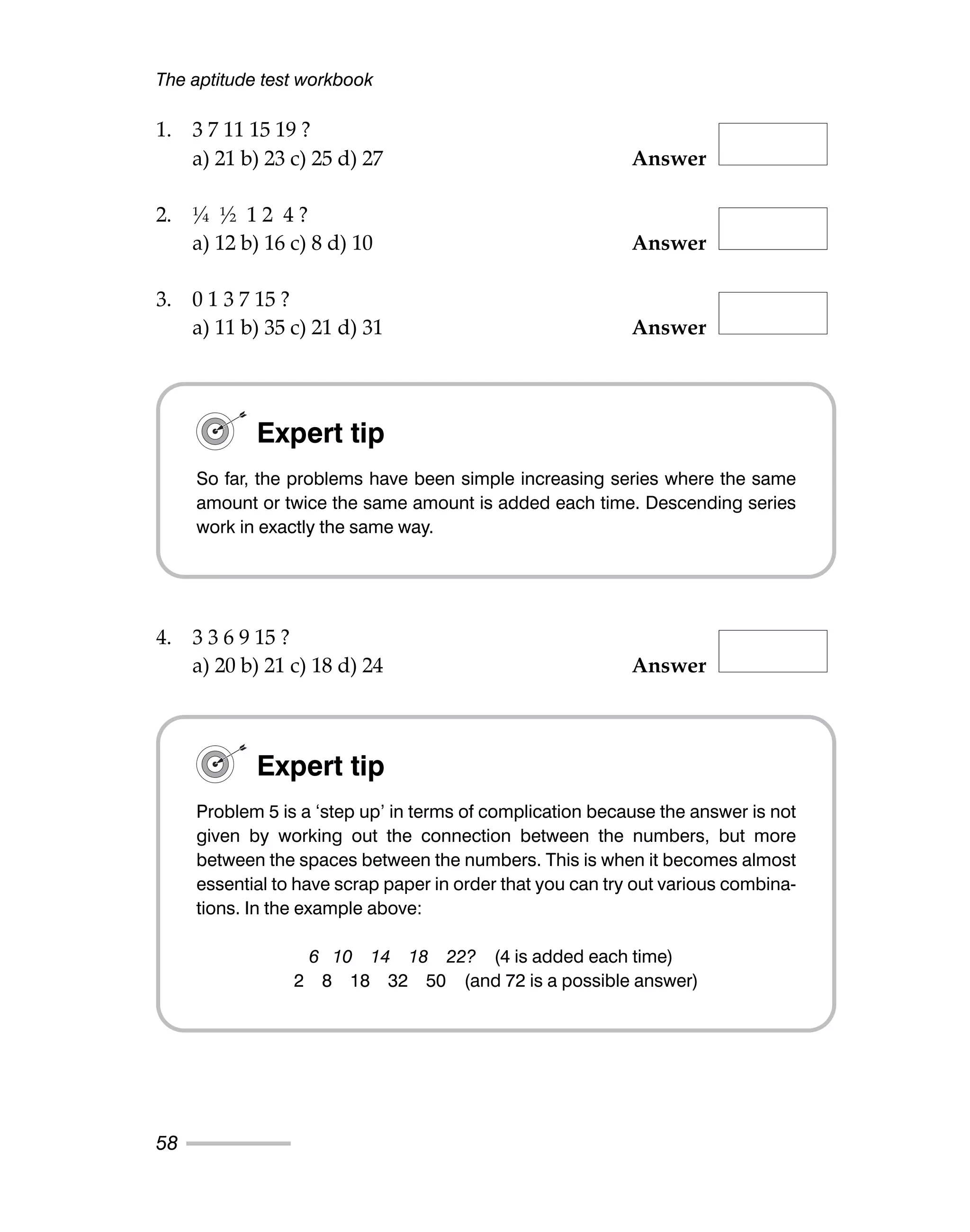
1. 3 7 11 15 19 ?
a) 21 b) 23 c) 25 d) 27 Answer
2. ¼ ½ 1 2 4 ?
a) 12 b) 16 c) 8 d) 10 Answer
3. 0 1 3 7 15 ?
a) 11 b) 35 c) 21 d) 31 Answer
4. 3 3 6 9 15 ?
a) 20 b) 21 c) 18 d) 24 Answer
The aptitude test workbook
58
Expert tip
So far, the problems have been simple increasing series where the same
amount or twice the same amount is added each time. Descending series
work in exactly the same way.
Expert tip
Problem 5 is a ‘step up’ in terms of complication because the answer is not
given by working out the connection between the numbers, but more
between the spaces between the numbers. This is when it becomes almost
essential to have scrap paper in order that you can try out various combina-
tions. In the example above:
6 10 14 18 22? (4 is added each time)
2 8 18 32 50 (and 72 is a possible answer)
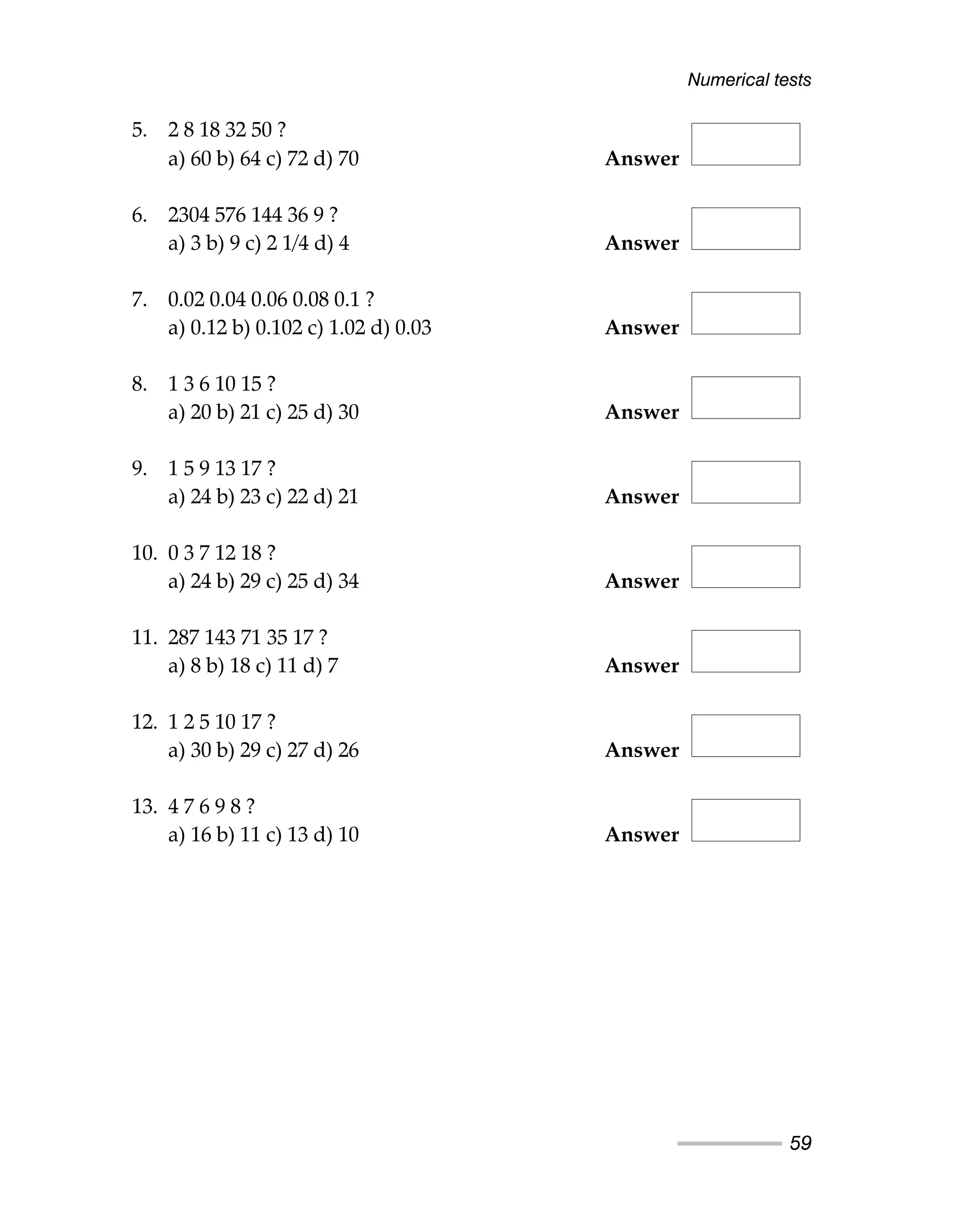
5. 2 8 18 32 50 ?
a) 60 b) 64 c) 72 d) 70 Answer
6. 2304 576 144 36 9 ?
a) 3 b) 9 c) 2 1/4 d) 4 Answer
7. 0.02 0.04 0.06 0.08 0.1 ?
a) 0.12 b) 0.102 c) 1.02 d) 0.03 Answer
8. 1 3 6 10 15 ?
a) 20 b) 21 c) 25 d) 30 Answer
9. 1 5 9 13 17 ?
a) 24 b) 23 c) 22 d) 21 Answer
10. 0 3 7 12 18 ?
a) 24 b) 29 c) 25 d) 34 Answer
11. 287 143 71 35 17 ?
a) 8 b) 18 c) 11 d) 7 Answer
12. 1 2 5 10 17 ?
a) 30 b) 29 c) 27 d) 26 Answer
13. 4 7 6 9 8 ?
a) 16 b) 11 c) 13 d) 10 Answer
Numerical tests
59
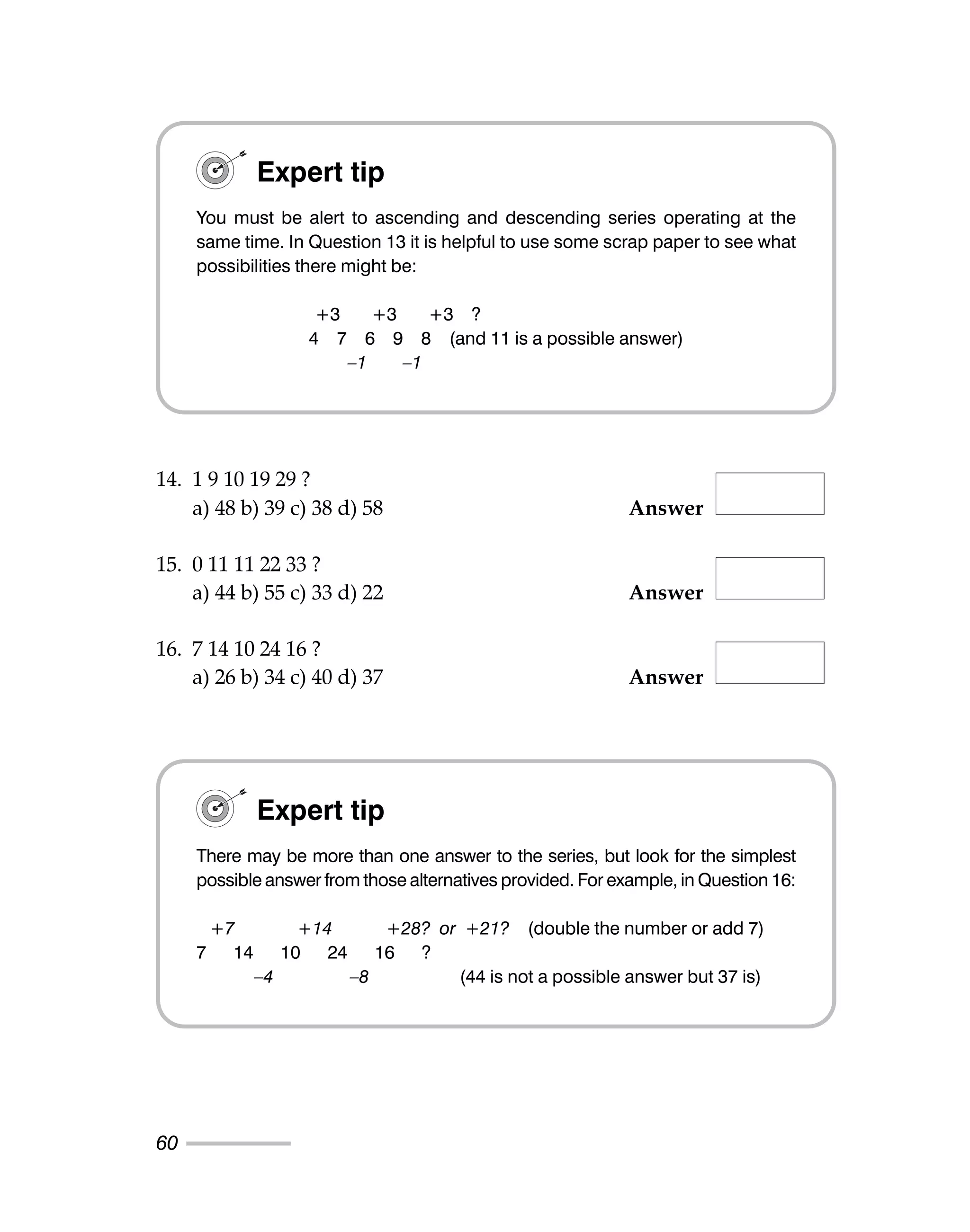
14. 1 9 10 19 29 ?
a) 48 b) 39 c) 38 d) 58 Answer
15. 0 11 11 22 33 ?
a) 44 b) 55 c) 33 d) 22 Answer
16. 7 14 10 24 16 ?
a) 26 b) 34 c) 40 d) 37 Answer
60
Expert tip
You must be alert to ascending and descending series operating at the
same time. In Question 13 it is helpful to use some scrap paper to see what
possibilities there might be:
+3 +3 +3 ?
4 7 6 9 8 (and 11 is a possible answer)
–1 –1
Expert tip
There may be more than one answer to the series, but look for the simplest
possible answer from those alternatives provided. For example, in Question 16:
+7 +14 +28? or +21? (double the number or add 7)
7 14 10 24 16 ?
–4 –8 (44 is not a possible answer but 37 is)
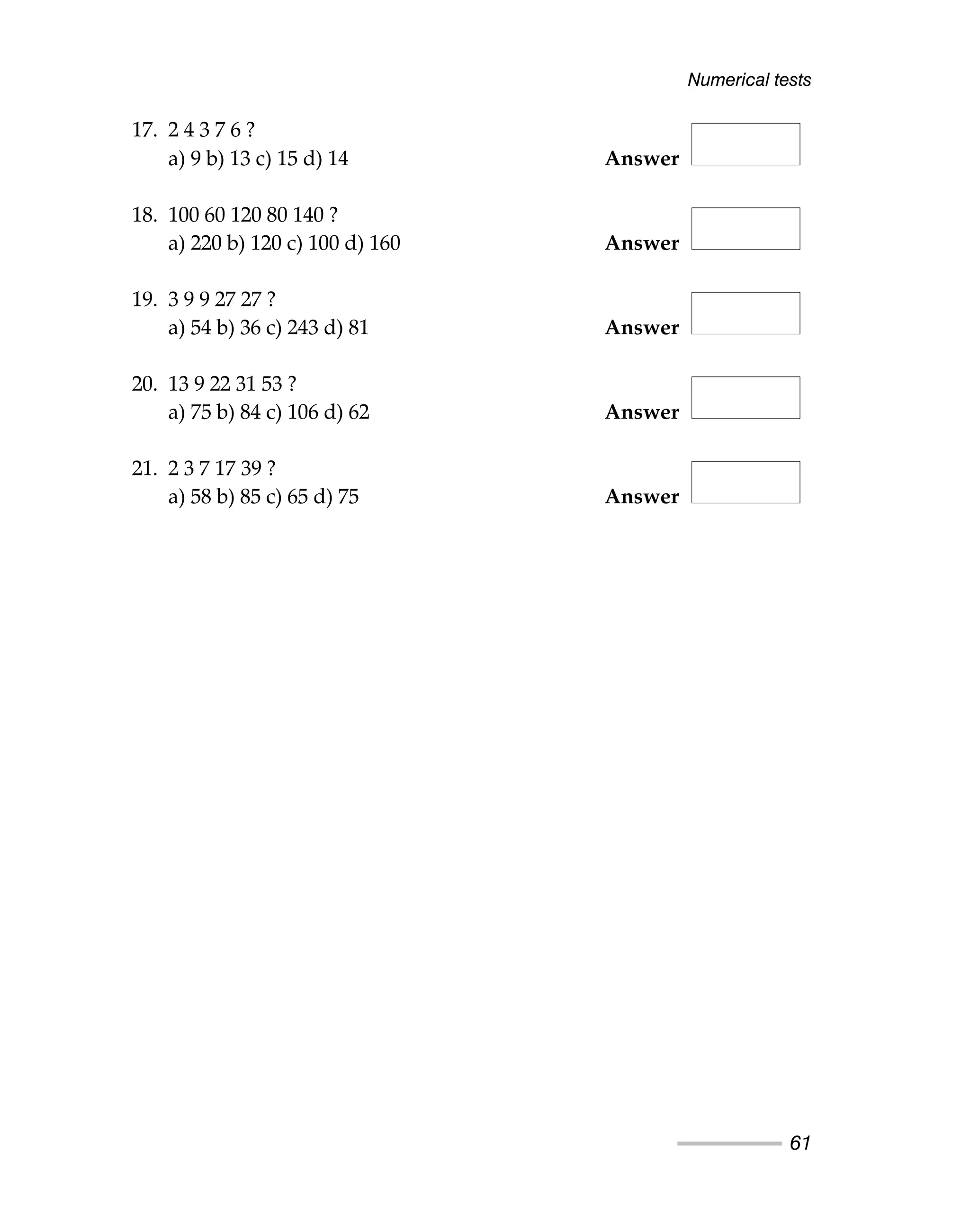
17. 2 4 3 7 6 ?
a) 9 b) 13 c) 15 d) 14 Answer
18. 100 60 120 80 140 ?
a) 220 b) 120 c) 100 d) 160 Answer
19. 3 9 9 27 27 ?
a) 54 b) 36 c) 243 d) 81 Answer
20. 13 9 22 31 53 ?
a) 75 b) 84 c) 106 d) 62 Answer
21. 2 3 7 17 39 ?
a) 58 b) 85 c) 65 d) 75 Answer
Numerical tests
61
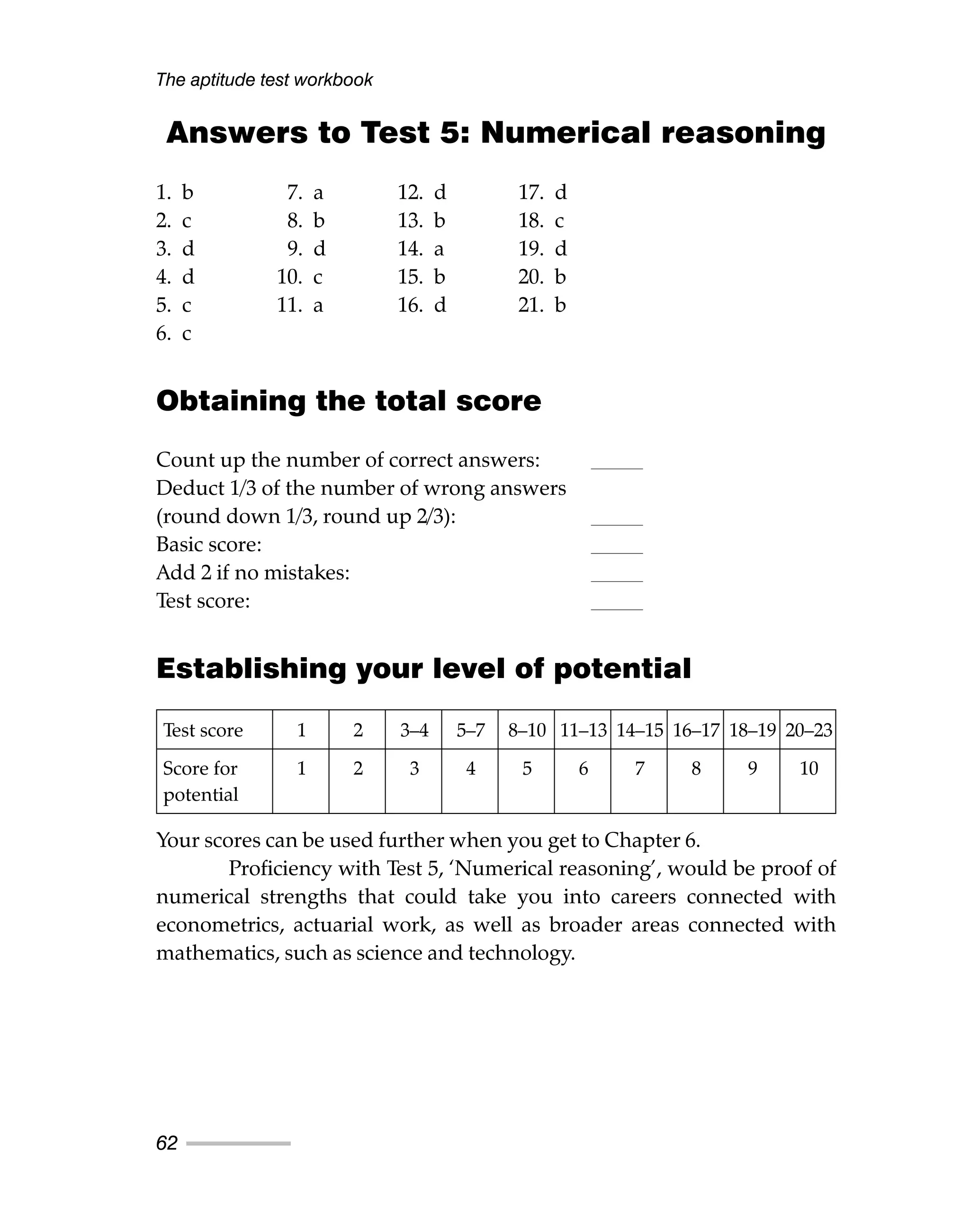
Answers to Test 5: Numerical reasoning
1. b 7. a 12. d 17. d
2. c 8. b 13. b 18. c
3. d 9. d 14. a 19. d
4. d 10. c 15. b 20. b
5. c 11. a 16. d 21. b
6. c
Obtaining the total score
Count up the number of correct answers:
Deduct 1/3 of the number of wrong answers
(round down 1/3, round up 2/3):
Basic score:
Add 2 if no mistakes:
Test score:
Establishing your level of potential
Your scores can be used further when you get to Chapter 6.
Proficiency with Test 5, ‘Numerical reasoning’, would be proof of
numerical strengths that could take you into careers connected with
econometrics, actuarial work, as well as broader areas connected with
mathematics, such as science and technology.
The aptitude test workbook
62
Test score 1 2 3–4 5–7 8–10 11–13 14–15 16–17 18–19 20–23
Score for 1 2 3 4 5 6 7 8 9 10
potential
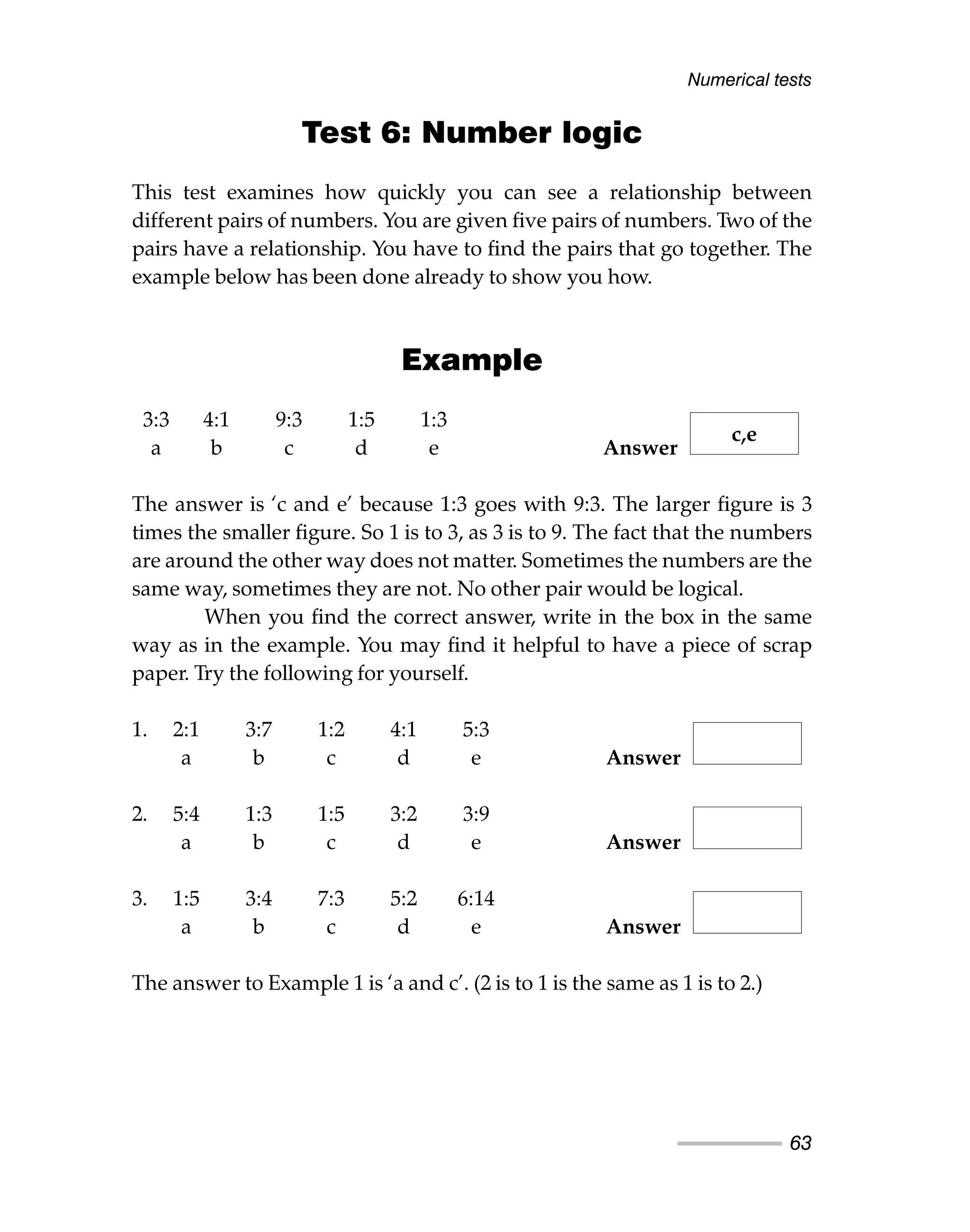
Test 6: Number logic
This test examines how quickly you can see a relationship between
different pairs of numbers. You are given five pairs of numbers. Two of the
pairs have a relationship. You have to find the pairs that go together. The
example below has been done already to show you how.
Example
3:3 4:1 9:3 1:5 1:3
a b c d e Answer
The answer is ‘c and e’ because 1:3 goes with 9:3. The larger figure is 3
times the smaller figure. So 1 is to 3, as 3 is to 9. The fact that the numbers
are around the other way does not matter. Sometimes the numbers are the
same way, sometimes they are not. No other pair would be logical.
When you find the correct answer, write in the box in the same
way as in the example. You may find it helpful to have a piece of scrap
paper. Try the following for yourself.
1. 2:1 3:7 1:2 4:1 5:3
a b c d e Answer
2. 5:4 1:3 1:5 3:2 3:9
a b c d e Answer
3. 1:5 3:4 7:3 5:2 6:14
a b c d e Answer
The answer to Example 1 is ‘a and c’. (2 is to 1 is the same as 1 is to 2.)
Numerical tests
63
c,e
The answer to Example 2 is ‘b and e’ because the larger number in
both pairs is 3 times the smaller number. (1 is to 3 is the same as 3 is to 9.)
In the third example, the answer is ‘c and e’ because one pair is
twice the other pair. (7 is half of 14, 3 is half of 6.)
Work as quickly and accurately as you can. Do not guess, because that
counts against you. You have 10 minutes. Do not start the test until you are
ready.
64
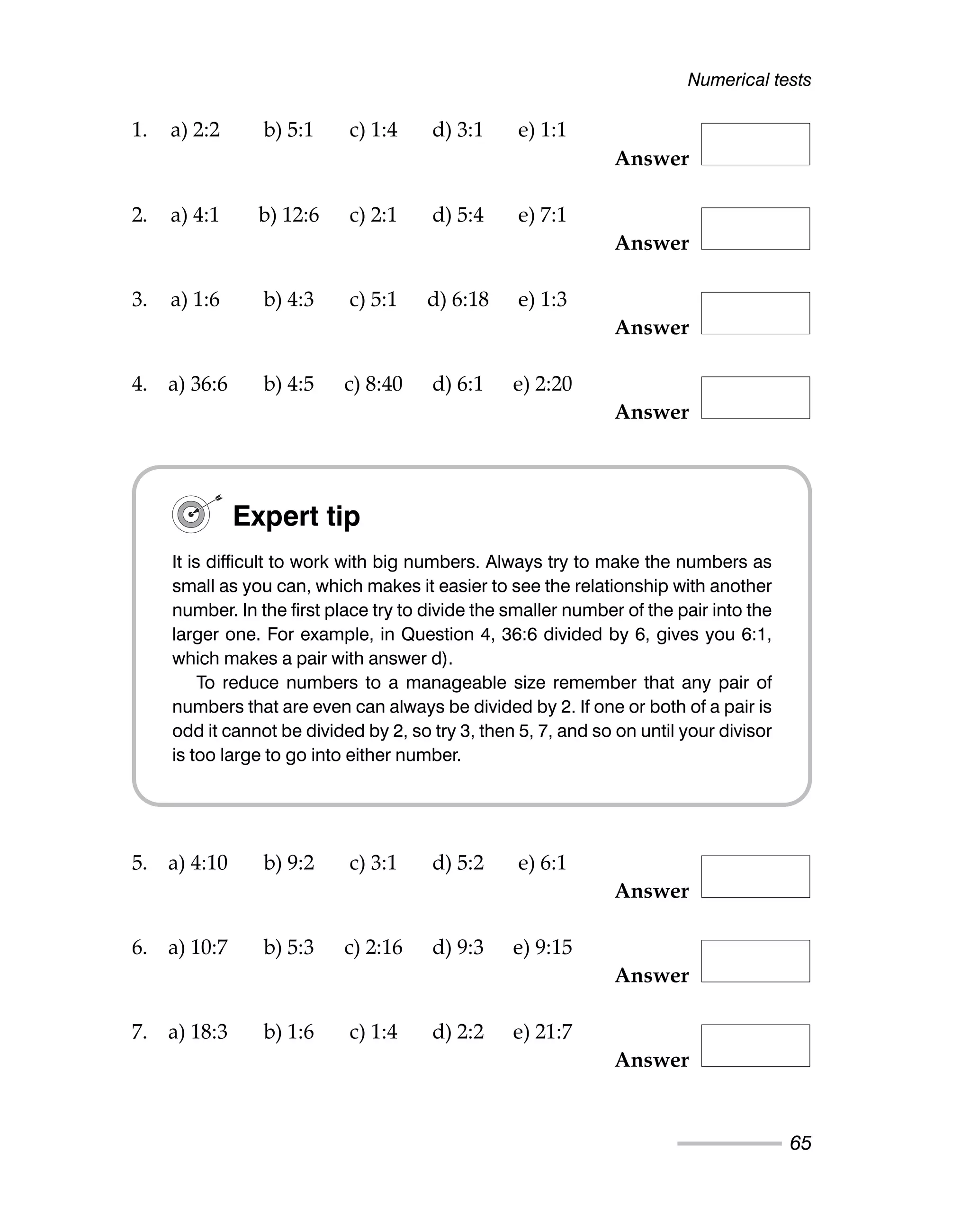
1. a) 2:2 b) 5:1 c) 1:4 d) 3:1 e) 1:1
Answer
2. a) 4:1 b) 12:6 c) 2:1 d) 5:4 e) 7:1
Answer
3. a) 1:6 b) 4:3 c) 5:1 d) 6:18 e) 1:3
Answer
4. a) 36:6 b) 4:5 c) 8:40 d) 6:1 e) 2:20
Answer
5. a) 4:10 b) 9:2 c) 3:1 d) 5:2 e) 6:1
Answer
6. a) 10:7 b) 5:3 c) 2:16 d) 9:3 e) 9:15
Answer
7. a) 18:3 b) 1:6 c) 1:4 d) 2:2 e) 21:7
Answer
Numerical tests
65
Expert tip
It is difficult to work with big numbers. Always try to make the numbers as
small as you can, which makes it easier to see the relationship with another
number. In the first place try to divide the smaller number of the pair into the
larger one. For example, in Question 4, 36:6 divided by 6, gives you 6:1,
which makes a pair with answer d).
To reduce numbers to a manageable size remember that any pair of
numbers that are even can always be divided by 2. If one or both of a pair is
odd it cannot be divided by 2, so try 3, then 5, 7, and so on until your divisor
is too large to go into either number.
The aptitude test workbook
66
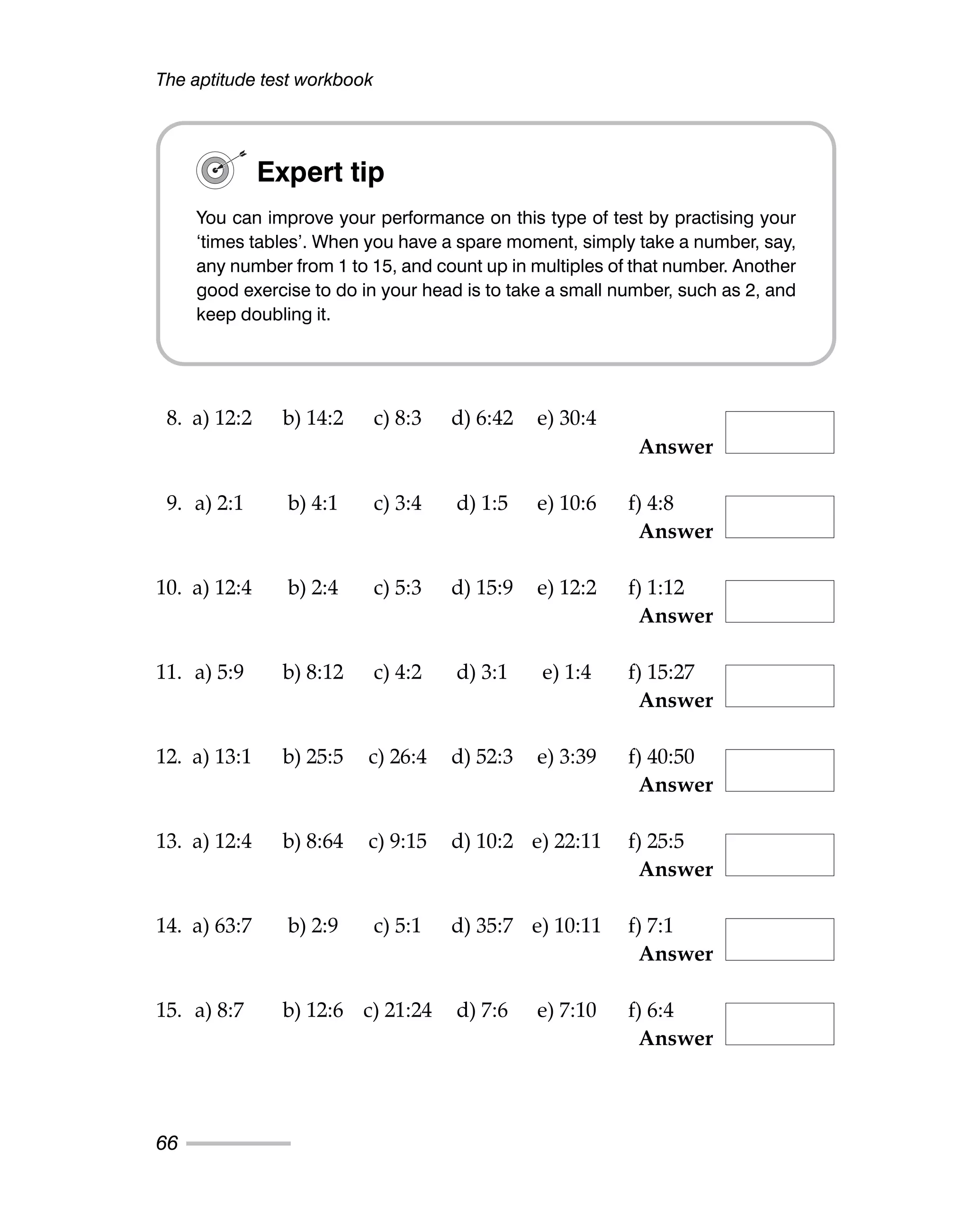
8. a) 12:2 b) 14:2 c) 8:3 d) 6:42 e) 30:4
Answer
9. a) 2:1 b) 4:1 c) 3:4 d) 1:5 e) 10:6 f) 4:8
Answer
10. a) 12:4 b) 2:4 c) 5:3 d) 15:9 e) 12:2 f) 1:12
Answer
11. a) 5:9 b) 8:12 c) 4:2 d) 3:1 e) 1:4 f) 15:27
Answer
12. a) 13:1 b) 25:5 c) 26:4 d) 52:3 e) 3:39 f) 40:50
Answer
13. a) 12:4 b) 8:64 c) 9:15 d) 10:2 e) 22:11 f) 25:5
Answer
14. a) 63:7 b) 2:9 c) 5:1 d) 35:7 e) 10:11 f) 7:1
Answer
15. a) 8:7 b) 12:6 c) 21:24 d) 7:6 e) 7:10 f) 6:4
Answer
Expert tip
You can improve your performance on this type of test by practising your
‘times tables’. When you have a spare moment, simply take a number, say,
any number from 1 to 15, and count up in multiples of that number. Another
good exercise to do in your head is to take a small number, such as 2, and
keep doubling it.
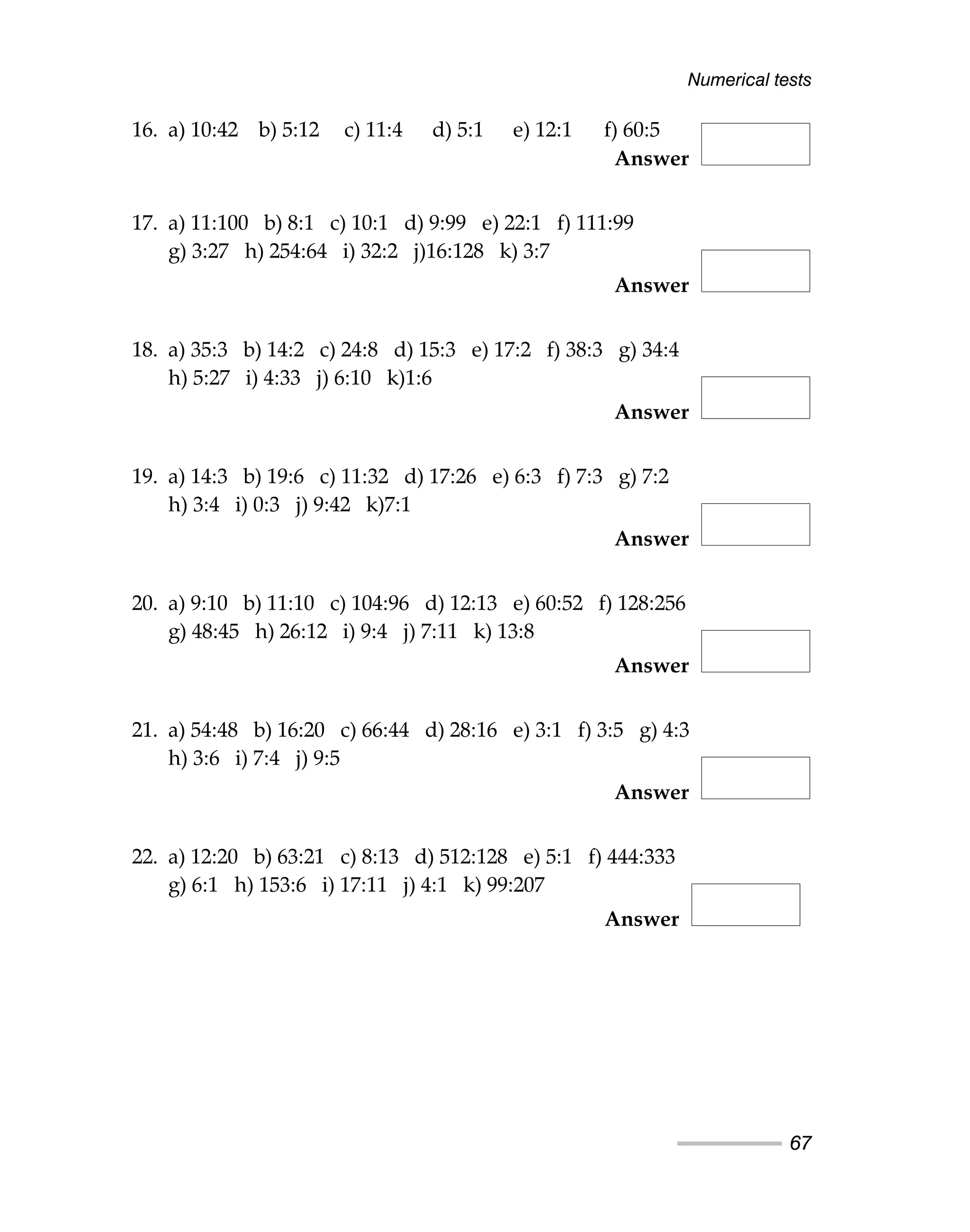
16. a) 10:42 b) 5:12 c) 11:4 d) 5:1 e) 12:1 f) 60:5
Answer
17. a) 11:100 b) 8:1 c) 10:1 d) 9:99 e) 22:1 f) 111:99
g) 3:27 h) 254:64 i) 32:2 j)16:128 k) 3:7
Answer
18. a) 35:3 b) 14:2 c) 24:8 d) 15:3 e) 17:2 f) 38:3 g) 34:4
h) 5:27 i) 4:33 j) 6:10 k)1:6
Answer
19. a) 14:3 b) 19:6 c) 11:32 d) 17:26 e) 6:3 f) 7:3 g) 7:2
h) 3:4 i) 0:3 j) 9:42 k)7:1
Answer
20. a) 9:10 b) 11:10 c) 104:96 d) 12:13 e) 60:52 f) 128:256
g) 48:45 h) 26:12 i) 9:4 j) 7:11 k) 13:8
Answer
21. a) 54:48 b) 16:20 c) 66:44 d) 28:16 e) 3:1 f) 3:5 g) 4:3
h) 3:6 i) 7:4 j) 9:5
Answer
22. a) 12:20 b) 63:21 c) 8:13 d) 512:128 e) 5:1 f) 444:333
g) 6:1 h) 153:6 i) 17:11 j) 4:1 k) 99:207
Answer
Numerical tests
67
23. a) 52:26 b) 15:14 c) 14:21 d) 13:11 e) 16:2 f) 66:26
g) 52:99 h) 62:93 i) 14:4 j) 39:55 k) 15:12
Answer
24. a) 77:11 b) 17:8 c) 19:13 d) 17:31 e) 21:20 f) 39:43
g) 210:86 h) 88:17 i) 84:7 j) 48:95 k) 85:155
Answer
The aptitude test workbook
68
69
THIS PAGE HAS BEEN INTENTIONALLY LEFT BLANK
The aptitude test workbook
70
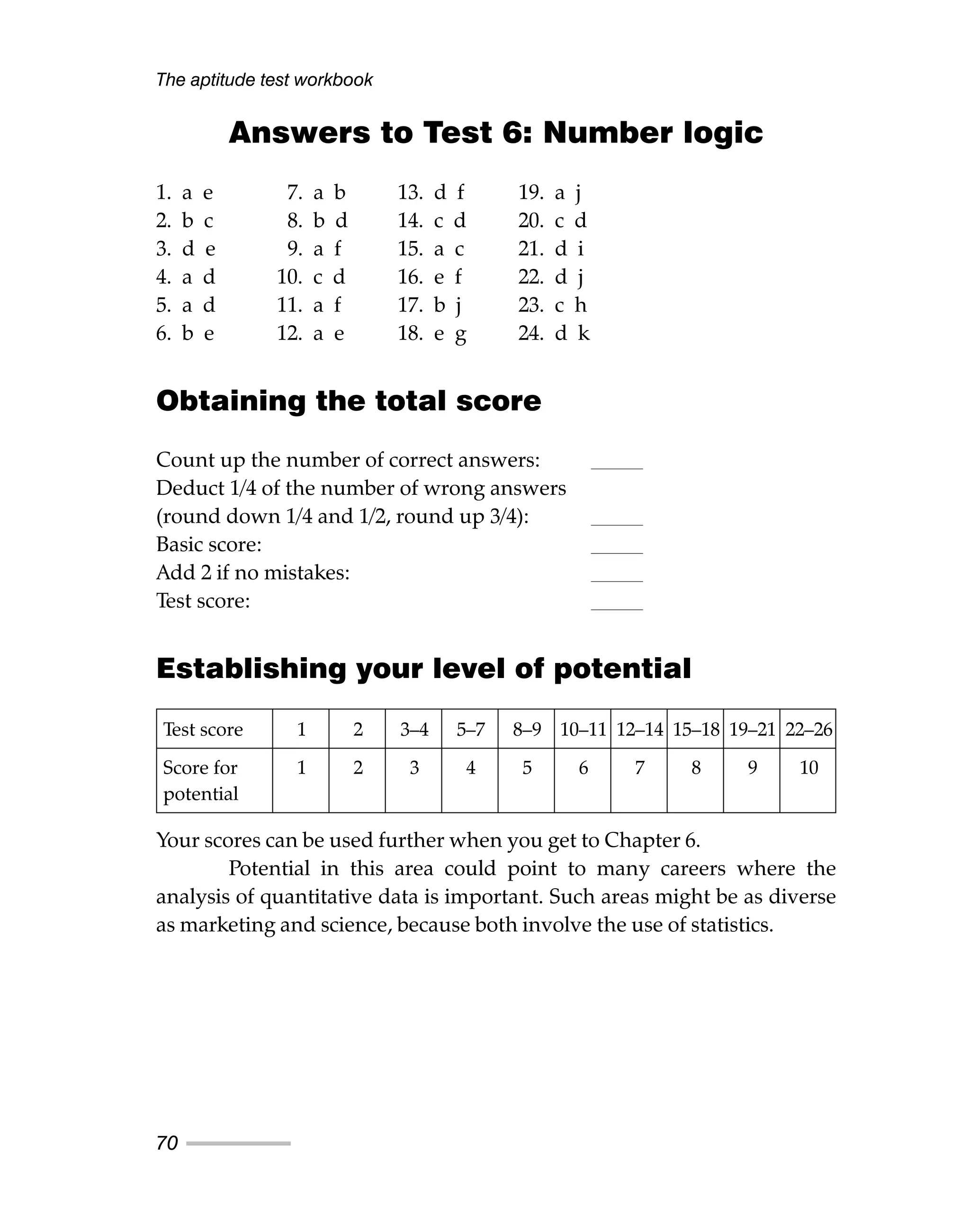
Answers to Test 6: Number logic
1. a e 7. a b 13. d f 19. a j
2. b c 8. b d 14. c d 20. c d
3. d e 9. a f 15. a c 21. d i
4. a d 10. c d 16. e f 22. d j
5. a d 11. a f 17. b j 23. c h
6. b e 12. a e 18. e g 24. d k
Obtaining the total score
Count up the number of correct answers:
Deduct 1/4 of the number of wrong answers
(round down 1/4 and 1/2, round up 3/4):
Basic score:
Add 2 if no mistakes:
Test score:
Establishing your level of potential
Your scores can be used further when you get to Chapter 6.
Potential in this area could point to many careers where the
analysis of quantitative data is important. Such areas might be as diverse
as marketing and science, because both involve the use of statistics.
Test score 1 2 3–4 5–7 8–9 10–11 12–14 15–18 19–21 22–26
Score for 1 2 3 4 5 6 7 8 9 10
potential
71
Perceptual tests are often used to establish levels of intelligence in a ‘fair’
manner because they do not have the biases of verbal or numerical tests,
which depend to some degree upon learnt skills. In Test 7, ‘Perceptual
logic’, you have to see how an idea evolves in order to work out what will
happen next.
Test 8, ‘Perceptual deduction’, asks you to form ideas or principles
that link some things together, but exclude others. You have to see what is
relevant in the information with which you are presented.
If you are able to do well on Test 9, ‘Power focus’, it will show
evidence of intelligence that may not be revealed in any conventional way
(for example, by success at scholastic subjects). When performance on this
test is better than that on any other test it generally indicates that your
level of academic attainment has not been fully expressed, even if you
have already done well academically.
3
Perceptual tests
The aptitude test workbook
72
Test 7: Perceptual logic
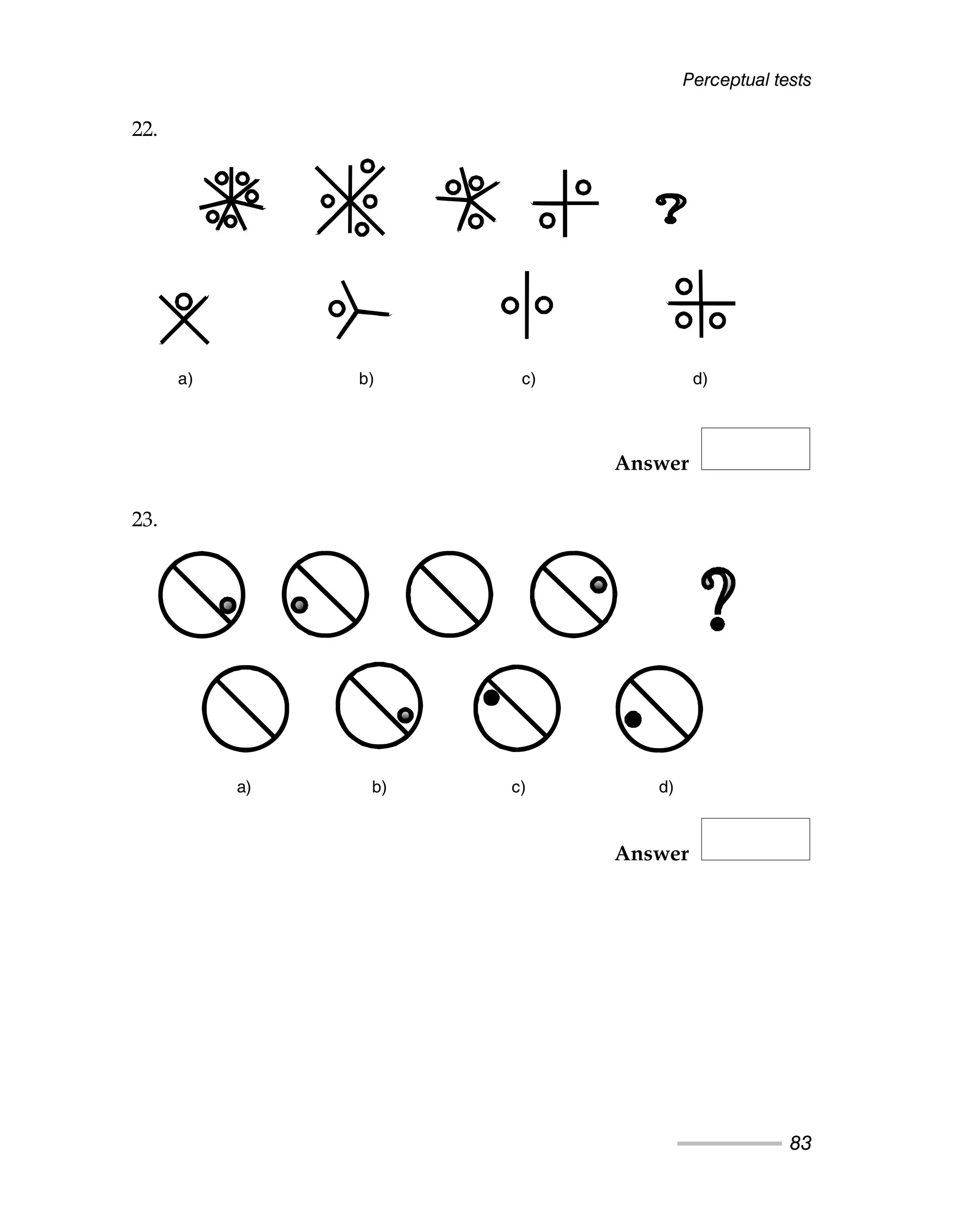
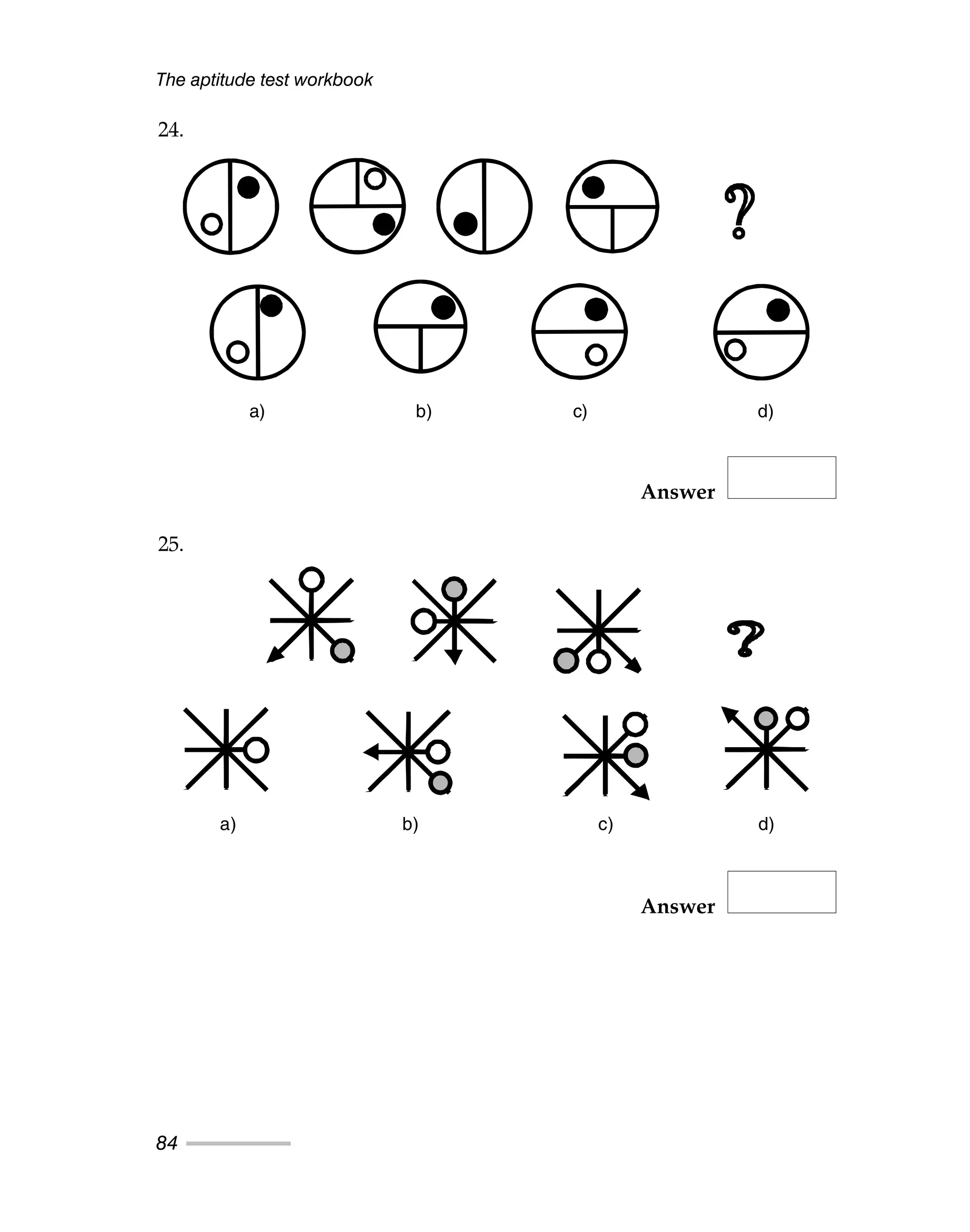
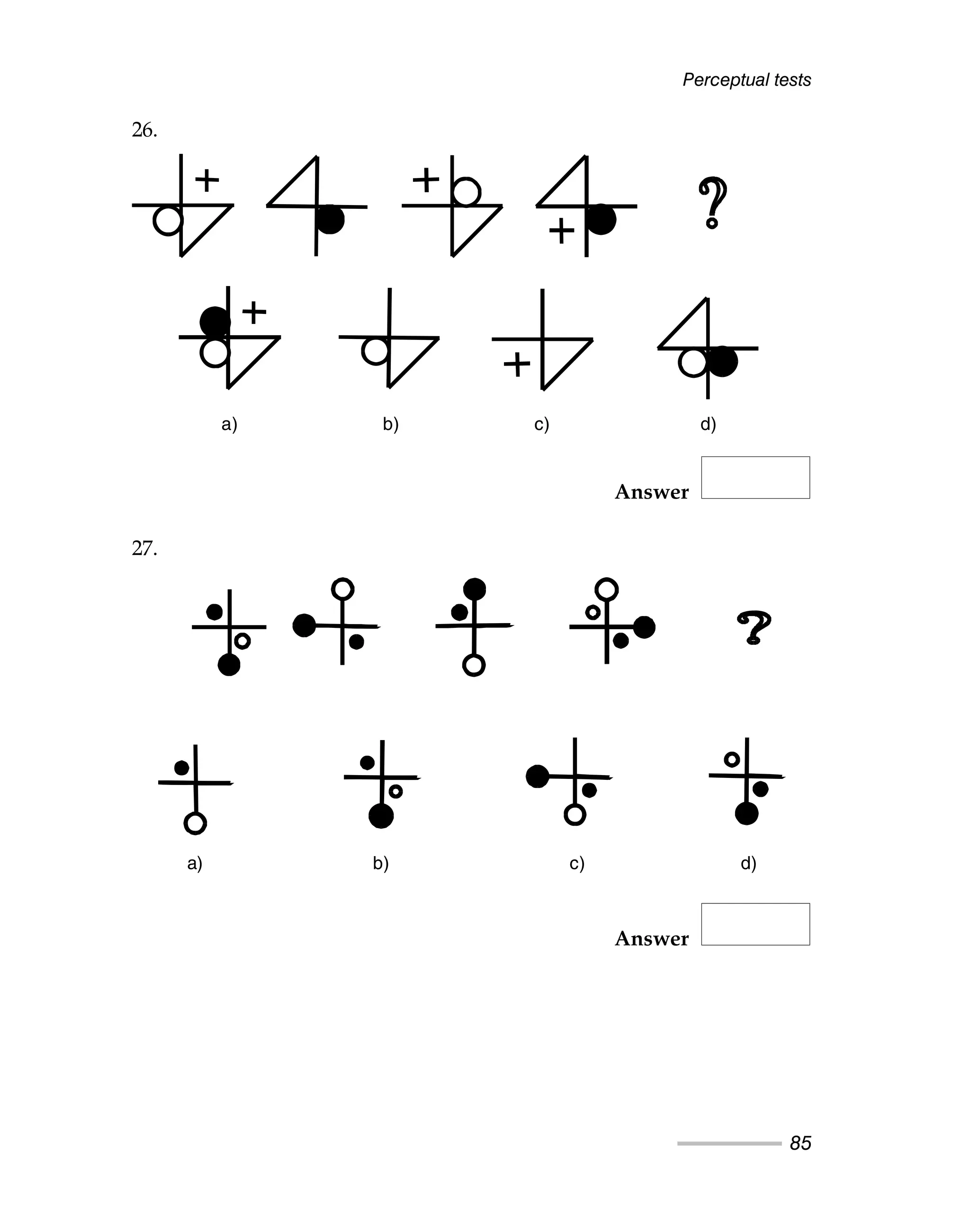
This tests how well you make logical decisions based upon visual infor-
mation. You are given a series of pictures, lines or diagrams. Your task is to
see how they go together, then work out which will be the next figure in
the series. You have to choose one from the four possible answers
provided.
Example
Which comes next?
The answer is a) because one line is added each time. The long bar, which
slopes from right to left, is always added first.
If you are timing yourself you have 6 minutes to do as much as you can.
Put the correct answer in the box. Do not start the test until you are ready.
a) b) c) d)
Perceptual tests
73
1. Which comes next?
Answer
2. Which comes next?
Answer
3. Which comes next?
Answer
a) b) c) d)
a) b) c) d)
a) b) c) d)
The aptitude test workbook
74
4. Which comes next?
Answer
5. Which comes next?
Answer
a) b) c) d)
a) b) c) d)
Expert tip
Visual problems lend themselves to interpretation and many different types of
explanation. It is unlikely that any of the problems will actually be very
complex. Always look for the simplest logical solution.
Perceptual tests
75
6.
Answer
7.
Answer
a) b) c) d)
a) b) c) d)
The aptitude test workbook
76
8.
Answer
9.
Answer
a) b) c) d)
a) b) c) d)
Perceptual tests
77
10.
Answer
11.
Answer
a) b) c) d)
a) b) c) d)
The aptitude test workbook
78
12.
Answer
13.
Answer
a) b) c) d)
a) b) c) d)
Perceptual tests
79
14.
Answer
Expert tip
You may be presented by an image that becomes ‘hidden’ or ‘masked’ by
another image in the series. You have to hold the image in your mind while
working out the rest of the problem, and mentally constructing where the
image is going to emerge. In Question 13 the white circle is moving up and
down while the black circle is moving around the big circle. The white circle
may ‘mask’ the black circle where they come together.
Sometimes, as in Question 14, you have to be able to separate what
happens with the image in the ‘foreground’ from what happens to the image
in the ‘background’.
a) b) c) d)
The aptitude test workbook
80
15.
Answer
16.
Answer
a) b) c) d)
a) b) c) d)
Perceptual tests
81
17.
Answer
18.
Answer
a) b) c) d)
a) b) c) d)
The aptitude test workbook
82
19.
Answer
20.
Answer
21.
Answer
a) b) c) d)
a) b) c) d)
a) b) c) d)
Perceptual tests
83
22.
Answer
23.
Answer
a) b) c) d)
a) b) c) d)
The aptitude test workbook
84
24.
Answer
25.
Answer
a) b) c) d)
a) b) c) d)
Perceptual tests
85
26.
Answer
27.
Answer
a) b) c) d)
a) b) c) d)
The aptitude test workbook
86
Answers to Test 7: Perceptual logic
1. c 6. d 11. b 16. b 21. a 26. b
2. a 7. a 12. a 17. d 22. b 27. b
3. c 8. b 13. a 18. a 23. a
4. d 9. d 14. b 19. d 24. a
5. a 10. d 15. b 20. a 25. a
Obtaining the total score
Count up the number of correct answers:
Deduct 1/3 of the number of wrong answers
(round down 1/3, round up 2/3):
Basic score:
Add 2 if no mistakes:
Test score:
Establishing your level of potential
Your scores can be used further when you get to Chapter 6.
Those who do well on this visual test are often good at research
and ordering information, for example, in social or historical research as
well as other sciences connected with biology.
Test score 1 2–3 4–6 7–9 10–12 13–15 16–18 19–21 22–24 25–29
Score for 1 2 3 4 5 6 7 8 9 10
potential
Perceptual tests
87
Test 8: Perceptual deduction
This tests how well you make a conclusion from visual information you
have been given. In one type of problem you are given an example of how
two pictures relate to one another and you have to see how the next
picture relates to one of the four possible answers provided. In the second
type of problem you have to see how one of the objects is different from
the others.
Examples
Example 1
Answer
Example 2: Which is the odd one out?
Answer
This is to this as this is to
a) b) c) d)
a) b) c) d)
This is to this as this is to
a) b) c) d)
a) b) c) d)
The aptitude test workbook
88
In Example 1 the answer is d) because the figure is inverted top to bottom
and left to right and the small circles are white instead of black in the same
way as the first two drawings related to each other.
In Example 2 the answer is b) because it is the only one where
one figure does not fit inside another and because both figures are the
same size.
If you are timing yourself you have 6 minutes to do as much as you can.
Do not start the test until you are ready.
Perceptual tests
89
1.
Answer
2. Which is the odd one out?
Answer
This is to this as this is to
a) b) c) d)
a) b) c) d)
Expert tip
Sometimes it is easier to make notes on the test itself, rather than use scrap
paper. If you are unsure whether this is allowed, ask the test administrator. If
you are working from a book like this, or from a booklet, unless you are given
permission you should not mark the booklet in any way. You are almost
bound to lose out if you do not follow the instructions given, especially in
regard to damaging property that is not yours. If you are allowed to draw, or
do calculations or whatever is necessary, do not worry what your rough work
looks like: it is only your answer that counts.
This is to this as this is to
a) b) c) d)
a) b) c) d)
The aptitude test workbook
90
3. Which is the odd one out?
Answer
4. Which is the odd one out?
Answer
a) b) c) d)
a) b) c) d)
a) b) c) d)
a) b) c) d)
Perceptual tests
91
5. Which is the odd one out?
Answer
6.
Answer
Expert tip
Always look for the simplest possible logical answer. Although it is sometimes
possible to say that each of the figures is odd, being different from the others,
you must look for the easiest logical solution, not a complex one. For
example, in Question 4, a) is the only diagram to have two shapes that also
overlap, while b) is the only square. Shape c) is the only triangle, while d) is
the only shape that does not fill a space. Although a), b) and c) are all ‘odd’ for
some reason, they all possess something that makes them distinctly different
from d): a closed shape.
a) b) c) d)
This is to this as this is to
a) b) c) d)
a) b) c) d)
This is to this as this is to
a) b) c) d)
7.
Answer
8. Which is the odd one out?
Answer
9. Which is the odd one out?
Answer
The aptitude test workbook
92
This is to this as this is to
a) b) c) d)
a) b) c) d)
a) b) c) d)
This is to this as this is to
a) b) c) d)
a) b) c) d)
a) b) c) d)
Perceptual tests
93
10.
11.
Answer
12. Which is the odd one out?
This is to this as this is to
a) b) c) d)
a) b) c) d)
a) b) c) d)
This is to this this is to
as
Answer
Answer
This is to this as this is to
a) b) c) d)
This is to this as this is to
a) b) c) d)
a) b) c) d)
The aptitude test workbook
94
13.
Answer
14. Which is the odd one out?
Answer
15. Which is the odd one out?
Answer
This is to this as this is to
a) b) c) d)
a) b) c) d)
a) b) c) d)
This is to this as this is to
a) b) c) d)
a) b) c) d)
a) b) c) d)
Perceptual tests
95
16. Which is the odd one out?
Answer
17. Which is the odd one out?
Answer
18.
Answer
a) b) c) d
a) b) c) d)
This is to this as this is to
a) b) c) d)
This is to this as this is to
a) b) c) d)
a) b) c) d)
a) b) c) d)
The aptitude test workbook
96
19. Which is the odd one out?
Answer
20. Which is the odd one out?
Answer
21.
Answer
a) b) c) d)
a) b) c) d)
This is to this as this is to
a) b) c) d)
This is to this as this is to
a) b) c) d)
a) b) c) d)
a) b) c) d)
Perceptual tests
97
22. Which is the odd one out?
Answer
23. Which is the odd one out?
Answer
24. Which is the odd one out?
Answer
a) b) c) d)
a) b) c) d)
a) b) c) d)
a) b) c) d)
a) b) c) d)
a) b) c) d)
The aptitude test workbook
98
25. Which is the odd one out?
Answer
26. Which is the odd one out?
Answer
a) b) c) d)
a) b) c) d)
a) b) c) d)
a) b) c) d)
99
THIS PAGE HAS BEEN INTENTIONALLY LEFT BLANK
The aptitude test workbook
100
Answers to Test 8: Perceptual deduction
1. a 5. a 9. c 13. d 17. b 21. d 25. c
2. a 6. b 10. d 14. d 18. b 22. c 26. b
3. c 7. b 11. a 15. d 19. b 23. a
4. d 8. b 12. a 16. c 20. a 24. d
Obtaining the total score
Count up the number of correct answers:
Deduct 1/3 of the number of wrong answers
(round down 1/3, round up 2/3):
Basic score:
Add 2 if no mistakes:
Test score:
Establishing your level of potential
Your scores can be used further when you get to Chapter 6.
This test is a good predictor of how well you can see how various
things or ideas go together. This type of visual aptitude is often associated
with success in biological sciences and many areas of research.
Test score 1–2 3–5 6–7 8–10 11–12 13–14 15–17 18–19 20–22 23–28
Score for 1 2 3 4 5 6 7 8 9 10
potential
Perceptual tests
101
Test 9: Power focus
In this test you have to concentrate upon abstract information. Decide the
picture that comes next at the bottom of each line and select your answers
from the chart on page 102. The answer will always need to have two
letters which reference the row and column on the chart at which the
answer is found. In the three examples number 1 has been done already to
show you how.
Examples
1 2 3
? ? ?
AM
Answer
The aptitude test workbook
102
Reference chart for the power focus test
The answer to Example 2 is EK (or KE) because a shaded square is at that
point when you look along the row and down the column in the chart.
In Example 3 the shaded five-sided figure appears every other time.
It will appear next in line. Looking this figure up in the chart you can see it
comes under row L and column C, so the answer to Example 3 is CL (or LC).
Expert tip
Have plenty of scrap paper ready. Follow this rule whenever you take a test.
In this particular test where it is necessary to remember more and more
information, you will find it helpful to make a note of what you are doing as
you work out the problem. In the case of this test, you may find it more
convenient to draw any figures that need to be remembered.
Perceptual tests
103
If you are timing yourself you have 20 minutes to do as much as you can.
You will need to keep looking back at the reference chart on page 102 as
you do the test. Have scrap paper and a pencil in case you need it. Do not
start the test until you are ready.
The aptitude test workbook
104
1 2 3 4
? ? ? ?
Answer
Perceptual tests
105
5 6 7 8
? ? ? ?
Expert tip
One way to work out these problems is to break them down into parts and do
each part separately. For example, in Question 7, take the shape, which has a
sequence, circle, circle, polygon, circle, circle, polygon, so that the next will
be circle. Write it down or draw it on your scrap paper. Then consider the
shades, which are alternately shaded then white, so the next will be shaded.
You now have a shaded circle. From the chart this is EM or ME.
Answer
The aptitude test workbook
106
9 10 11 12
? ? ? ?
Answer
Perceptual tests
107
13 14 15 16
? ? ? ?
Expert tip
Your working notes or drawings will not be judged. In most tests you will
have to hand in any rough notes. This is merely disposed of: it is not eval-
uated because it is not a part of the test itself. It is your answer that counts,
not any workings out that you used to get to your answer. Scrap paper is
only collected to ensure that no details of the test ‘leak out’.
Answer
The aptitude test workbook
108
17 18 19 20
? ? ? ?
Answer
Perceptual tests
109
21 22 23 24
? ? ? ?
Answer
The aptitude test workbook
110
25 26 27 28
? ? ? ?
Answer
Perceptual tests
111
29 30 31 32
? ? ? ?
Answer
The aptitude test workbook
112
33 34 35 36
? ? ? ?
Answer
Perceptual tests
113
37 38 39 40
? ? ? ?
Answer
114
Answers to Test 9: Power focus
1. CK 9. CQ 17. BP 25. DL 33. DL
2. AM 10. EO 18. AM 26. EK 34. FO
3. AN 11. FQ 19. AO 27. AN 35. BO
4. BL 12. EN 20. BM 28. AQ 36. DM
5. EN 13. AN 21. EL 29. BN 37. AK
6. CL 14. AK 22. FP 30. BL 38. AQ
7. EM 15. EO 23. DM 31. FL 39. BL
8. CK 16. BM 24. AK 32. DK 40. DN
Obtaining the total score
Count up the number of correct answers:
Deduct 1/4 of the number of wrong answers
(round down 1/4 and 1/2, round up 3/4):
Basic score:
Add 2 if no mistakes:
Test score:
Establishing your level of potential
Your scores can be used further when you get to Chapter 6.
This test often reveals decision making and managerial potential,
and people who do well display the ability to see through a problem, and
how to deal with it in the most simple, direct way. They are therefore often
perceived as the people who can ‘come up with the solution’ and often as
the people who ‘can do’. For these reasons, people with this type of talent
are often regarded as natural leaders. Why such an abstract test is able to
reveal talent in this way is not yet properly understood.
Test score 1–2 3–4 5–8 9–12 13–16 17–21 22–25 26–29 30–35 36–42
Score for 1 2 3 4 5 6 7 8 9 10
potential
115
The tests in this chapter are looking for key practical as well as abstract
aptitudes. In many of the problems that follow you will be expected to
rotate an image in your mind so that you can ‘see’ what the reverse side
looks like. We do this all the time in our daily lives, without giving it a
thought, but psychologists have not yet discovered how a solid, three-
dimensional shape is held in the mind, let alone what mental processes
allow us to turn it around in our heads. It is a vital skill anyway, and one
that some people are better at than others, as with most skills, which is the
reason it is tested.
In Test 10, ‘Shapes’, you have to work out how patterns are formed
and what remains when part of a shape is removed.
Test 11, ‘Blocks’, is a test of ‘sculptural’ and ‘construction’ potential.
Test 12, the ‘Design’ test, is in its nature more fluid than the
previous tests. The shapes become increasingly rounded until precise defi-
nition is almost lost.
4
Spatial tests
The aptitude test workbook
116
Test 10: Shapes
This test looks at how well you can see how shapes fit together. There are
two types of problem. Look at the examples below to see how the test is
done.
Examples
Example 1. If the figure below on the left was folded together it would
make a box. Imagine the box is made of paper or card, so that you cannot
see through it. On this box, a line has been drawn across one of the sides.
You have to say which of the alternatives would be made from the
unfolded figure on the left.
Answer ‘Y’ for ‘yes’ or ‘N’ for ‘no’ for each of the alternatives given. In the
example, the answer to (a) is ‘Y’ for yes, and the answer to (b) is also ‘Y’.
The answer to (c) is ‘N’, because the line on one of the sides does not go
from corner to corner. The answer to (d) is also ‘N’, as only one of the sides
should have a line across it.
Example 2
A. B. C. D.
take away leaves
A. B. C. D.
Answer
Answer
Y Y N N
Spatial tests
117
You would answer ‘N’ to A, as the triangle has not been taken away.
Answer ‘N’ to B too, because if you took the triangle away from the square
it would not leave this shape. The answers to both C and D are ‘Y’, even
though the shape remaining has been turned around or over.
In both types of problem, remember that the answers might have
been turned around or turned over, but still could be correct.
Answer ‘Y’ or ‘N’ to each question. If you are timing yourself, you have
6 minutes. Do not start the test until you are ready.
The aptitude test workbook
118
A.
1. 2. 3. 4.
B. take away leaves
5. 6. 7. 8.
C.
9. 10. 11. 12.
D. take away leaves
13. 14. 15. 16.
Answer
Answer
Answer
Answer
Spatial tests
119
E.
17. 18. 19. 20.
F. take away leaves
21. 22. 23. 24.
G.
25. 26. 27. 28.
H. take away leaves
29. 30. 31. 32.
Expert tip
You can turn the test paper around or upside down if it enables you to see
the problem more clearly.
Answer
Answer
Answer
Answer
The aptitude test workbook
120
I.
33. 34. 35. 36.
J. take away leaves
37. 38. 39. 40.
K.
41. 42. 43. 44.
L. take away leaves
45. 46. 47. 48.
Answer
Answer
Answer
Answer
Spatial tests
121
M.
49. 50. 51. 52.
N. take away leaves
53. 54. 55. 56.
O.
57. 58. 59. 60.
P. take away leaves
61. 62. 63. 64.
Answer
Answer
Answer
Answer
Answers to Test 10: Shapes
A. 1 Y 2 N 3 Y 4 N I. 33 Y 34 N 35 N 36 Y
B. 5 N 6 Y 7 Y 8 N J. 37 Y 38 N 39 N 40 N
C. 9 Y 10 Y 11 Y 12 N K. 41 Y 42 N 43 N 44 Y
D. 13 N 14 Y 15 N 16 Y L. 45 N 46 Y 47 Y 48 Y
E. 17 Y 18 N 19 N 20 N M. 49 Y 50 Y 51 N 52 N
F. 21 Y 22 Y 23 N 24 N N. 53 Y 54 Y 55 Y 56 N
G. 25 Y 26 N 27 N 28 N O. 57 Y 58 N 59 Y 60 Y
H. 29 N 30 N 31 Y 32 Y P
. 61 N 62 N 63 Y 64 Y
Obtaining the total score
Count up the number of correct answers:
Deduct 1/2 of the number of wrong answers
(round down 1/2):
Basic score:
Add 2 if no mistakes:
Test score:
Establishing your level of potential
Your scores can be used further when you get to Chapter 6.
These ‘putting together’ and ‘assembly’ skills are essential with
constructing forms in both two and three dimensions. They are funda-
mental to a range of careers in engineering and technology.
The aptitude test workbook
122
Test score 1–6 7–12 13–18 19–25 26–32 33–39 40–46 47–52 53–57 58–66
Score for 1 2 3 4 5 6 7 8 9 10
potential
Test 11: Blocks
In this test you have to count how many times the sides, or faces, of a block
touches the sides or faces of other blocks. All the blocks are the same size.
Each block has six faces because the ends of the block also count as faces.
Blocks that connect only at the edges or at corners do not count.
In the space provided, you have to write in the number of faces
touched by each of the blocks. In the example below, the answer for block
A has been given already to show you how. Complete the answers for the
other blocks, B, C and D. Then read the explanation to make sure you
understand what you have to do in this test.
Example
A. 1 B. C. D.
Block A touches only the face, or side, of block B, but no other blocks, so
the answer is ‘1’.
Block B faces block A and block D, so you should have given the
answer ‘2’. Block C only touches block D at the edge, or corner, so the
answer for block C is ‘0’. The answer for block D is ‘1’ because it faces
the side of B.
Note: Contact at the ‘corners’ of the blocks does not count – it must be a
flat side, end or face.
If you are timing yourself you have 5 minutes to do as many as you can.
Do not start the test until you are ready.
Spatial tests
123
The aptitude test workbook
124
1.
Answer A. B. C. D.
2.
Answer A. B. C. D. E.
3.
Answer A. B. C. D. E.
Spatial tests
125
4.
Answer A. B. C. D. E. F.
5.
Answer A. B. C. D. E.
6.
Answers
A. B. C. D. E. F. G.
H. I.
The aptitude test workbook
126
Expert tip
With this type of test you either ‘see’ the answer easily or not. As there is no
proper working out to do, apart from counting the number of sides, it
wastes time to draw the figure yourself. The quickest way to do the test is
simply to count as you go along.
Many people do not do as well as they could on this test because they
spend too much time on checking. If you make a careful count as you
proceed, checking will rarely be necessary, while a very occasional error is
unlikely to count against you.
Spatial tests
127
7.
Answers
A. B. C. D. E. F. G.
H. I. J.
8.
Answers
A. B. C. D. E. F. G.
H. I. J.
9.
Answers
A. B. C. D. E. F. G.
H. I. J.
The aptitude test workbook
128
10.
Answers
A. B. C. D. E. F. G.
H. I. J. K. L.
Spatial tests
129
Answers to Test 11: Blocks
1. A 1, B 2, C 2, D 1 7. A 2, B 2, C 3, D 4, E 4, F 3,
2. A 2, B 2, C 2, D 3, E 1 G 3, H 2, I 5, J 2
3. A 0, B 1, C 1, D 3, E 1 8. A 5, B 4, C 4, D 1, E 2, F 2,
4. A 1, B 3, C 2, D 3, E 1, F 2 G 3, H 5, I 3, J 1
5. A 2, B 3, C 3, D 1, E 1 9. A 2, B 3, C 4, D 3, E 5, F 7,
6. A 1, B 2, C 3, D 3, E 1, F 3, G 4, H 4, I 3, J 3
G 2, H 3, I 2 10. A 2, B 5, C 2, D 3, E 2, F 3,
G 1, H 0, I 2, J 2, K 1, L 1
Obtaining the total score
Count up the number of correct answers:
Deduct 1/4 of the number of wrong answers
(round down 1/4 and 1/2, round up 3/4):
Basic score:
Add 2 if no mistakes:
Test score:
Establishing your level of potential
Your scores can be used further when you get to Chapter 6.
This is the type of test that has been used as one way of estab-
lishing a talent for architecture and engineering, which require various
operations of forming, molding and modelling.
The aptitude test workbook
130
Test score 1–7 8–14 15–22 23–29 30–37 38–45 46–53 54–61 62–68 69–78
Score for 1 2 3 4 5 6 7 8 9 10
potential
Test 12: Design
This test explores how easily you can ‘see’ and turn around objects in space.
You are shown a shape in the middle of the page. Below it are five
other shapes. Each of these is numbered. You have to decide whether each
of the alternatives is identical to the original shape. Each one of the shapes
might be the original shape, but turned around and possibly also turned
over. It must be the same height and thickness to qualify as a version of the
original shape.
Answer each question with a ‘Y’ for ‘yes’ or ‘N’ for ‘no’. Try to ‘see’
the result in your mind. The first example has been done for you.
Example
The answers to the example items are 1N, 2N, 3Y, 4Y and 5N.
Work as quickly and accurately as you can. If you are timing yourself you
have 10 minutes. Do not start the test until you are ready.
Spatial tests
131
1 2 3 4 5
Answer
N
The aptitude test workbook
132
A.
1 2 3 4 5
B.
6 7 8 9 10
C.
11 12 13 14 15
Answer
Answer
Answer
A.
B.
C.
Spatial tests
133
Expert tip
Turn the page around or upside down if it enables you to see the problems
more clearly.
16 17 18 19 20
21 22 23 24 25
26 27 28 29 30
Answer
Answer
Answer
D.
E.
F.
The aptitude test workbook
134
Expert tip
If you do not ‘see’ the answer quickly you may be tempted to guess, but this
will count against you. It is better to leave out an item you are unsure of. You
will not be penalized for omitting items. It is the final score that is important.
31 32 33 34 35
36 37 38 39 40
41 42 43 44 45
Answer
Answer
Answer
G.
H.
I.
Spatial tests
135
46 47 48 49 50
K.
51 52 53 54 55
L.
56 57 58 59 60
Answer
Answer
Answer
J.
K.
L.
The aptitude test workbook
136
61 62 63 64 65
66 67 68 69 70
Answer
Answer
M.
N.
137
THIS PAGE HAS BEEN INTENTIONALLY LEFT BLANK
Answers to Test 12: Design
A. 1 N 2 N 3 Y 4 Y 5 Y H. 36 Y 37 Y 38 N 39 Y 40 Y
B. 6 Y 7 N 8 N 9 Y 10 N I. 41 N 42 N 43 Y 44 Y 45 N
C. 11 Y 12 N 13 N 14 Y 15 Y J. 46 N 47 Y 48 N 49 Y 50 N
D. 16 N 17 Y 18 Y 19 Y 20 Y K. 51 N 52 N 53 N 54 N 55 Y
E. 21 Y 22 Y 23 N 24 N 25 Y L. 56 N 57 Y 58 Y 59 N 60 N
F. 26 N 27 Y 28 N 29 N 30 Y M. 61 N 62 N 63 Y 64 Y 65 Y
G. 31 N 32 N 33 N 34 N 35 N N. 66 Y 67 N 68 Y 69 Y 70 N
Obtaining the total score
Count up the number of correct answers:
Deduct the number of wrong answers:
Basic score:
Add 2 if no mistakes:
Test score:
Establishing your level of potential
Your scores can be used further when you get to Chapter 6.
If you do well on this test you must have a talent for design visual-
ization that has probably emerged already in some artistic way. This
potential can be used in many areas of study and work. These range from
art and design work itself, to almost any kind of problem where infor-
mation has to be fitted together to create a final picture. This is why many
people who work in web design, for example, have this talent.
The aptitude test workbook
138
Test score 1–6 7–13 14–20 21–26 27–33 34–40 41–47 48–54 55–62 63–72
Score for 1 2 3 4 5 6 7 8 9 10
potential
139
This chapter is intended to prepare you for tests that investigate some
specific abilities.
Test 13, ‘Word order’, demands that you use the alphabet. What is
also being measured is how well you can maintain your concentration.
Test 14, ‘Numerical systems’, looks at the basic numerical skills of
addition, subtraction, multiplication and division. At the same time, you
have to substitute symbols for numbers, thus making the task more complex.
In Test 15, ‘Graphs, tables and charts’, your ability to interpret
information from a diagram or list is being assessed.
Test 16, ‘Memory’, requires you to concentrate on a number of
items and then to remember as many as possible. The test is in three parts,
to enable you to see whether you are more proficient with words, numbers
or pictures.
Practice on all of the tests in this chapter can improve your
performance.
5
Practical tests
Test 13: Word order
This is a test of how quickly you are able to use the alphabet. You are given
a list of names. Your task is to decide which one comes first in alphabetical
order and which one comes last. Look at the example to see how you are to
give your answer.
Examples
Example 1
List of names Alphabetical order
First Last
A Cole A A
B Booker B B
C John C C
D Graft D D
E Zimmer E E
F Munny F F
In Example 1 the letter ‘B’ has been underlined because this is the first in
alphabetical order. Alphabetically, ‘Booker’ comes before any of the other
names. The letter ‘E’ has been underlined because this is the last in alpha-
betical order. The answer is ‘B’ and ‘E’. Both letters must be marked
correctly to score a point. Do the next example yourself.
Example 2
List of names Alphabetical order
First Last
A Chase A A
B Friend B B
C Foster C C
D Moby D D
E Muerte E E
F Challenor F F
The aptitude test workbook
140
In Example 2, ‘Challenor’ comes first alphabetically and ‘Muerte’ comes last.
You should have marked ‘F’ and ‘E’ with an underline, tick or circle. You
must get both letters correct and also in the correct order to score a point.
If you are timing yourself you have 5 minutes to do as many as you can.
Do not start the test until you are ready.
Practical tests
141
Expert tip
Remember not to guess; accuracy is what is being looked for and this may
be more important than the overall total.
List of names Alphabetical order
1. First Last
A Monte A A
B Avery B B
C Caute C C
D Strong D D
E Halley E E
F Doppel F F
2. First Last
A Attfield A A
B Fome B B
C Paste C C
D Roomer D D
E Caster E E
F Zene F F
3. First Last
A Moncado A A
B Frost B B
C Prewer C C
D Stirling D D
E Haven E E
F Bird F F
4. First Last
A Badrucin A A
B Elmore B B
C Priest C C
D Moreau D D
E Burgess E E
F Bevan F F
5. First Last
A Sater A A
B Stenson B B
C Trewer C C
D Magee D D
E Hollister E E
F Huckister F F
The aptitude test workbook
142
6. First Last
A Wheeler A A
B Wells B B
C Sorrell C C
D Reed D D
E Reid E E
F White F F
7. First Last
A Florry A A
B Forcett B B
C Fostbinder C C
D Cabby D D
E Carney E E
F Cash F F
8. First Last
A Mony A A
B Millicent B B
C Mauleverer C C
D Maughton D D
E Naughton E E
F Mede F F
9. First Last
A Reynolds A A
B Revnell B B
C Tolly C C
D Singer D D
E Troll E E
F Raspe F F
10. First Last
A Sund A A
B Suthar B B
C Suggett C C
D Solly D D
E Swift E E
F Suarez F F
Practical tests
143
11. First Last
A Collis A A
B Coleman B B
C Clebatch C C
D Colman D D
E Clutch E E
F Cliffe F F
12. First Last
A Hutton A A
B Hunjan B B
C Hunton C C
D Hutten D D
E Hushiar E E
F Hunte F F
13. First Last
A Mongal A A
B Moores B B
C Morby C C
D Mordecai D D
E Moncur E E
F Moon F F
14. First Last
A Tailor A A
B Tennock B B
C Teal C C
D Tennoux D D
E Tedbury E E
F Templeman F F
15. First Last
A Ageros A A
B Aglen B B
C Adorah C C
D Agass D D
E Adamson E E
F Acmed F F
The aptitude test workbook
144
16. First Last
A Carrasco A A
B Canaway B B
C Carniy C C
D Carbonnier D D
E Canniff E E
F Carpentieri F F
17. First Last
A Watkins A A
B Weaver B B
C Webber C C
D Waterworth D D
E Wazak E E
F Wearn F F
18. First Last
A Zeitzen A A
B Zedde B B
C Zederberg C C
D Zeidler D D
E Zbinden E E
F Zames F F
19. First Last
A Slade A A
B Sladkova B B
C Slayter C C
D Slaughter D D
E Slattery E E
F Slarke F F
20. First Last
A Eigner A A
B Ekeledo B B
C Ekineh C C
D Ekins D D
E Eilbeck E E
F Ekoku F F
Practical tests
145
21. First Last
A Masware A A
B Masters B B
C Massiah C C
D Masundian D D
E Mathialiagen E E
F Matalamaki F F
22. First Last
A Rowlinson A A
B Rowley B B
C Rowntree C C
D Rowswell D D
E Rowlott E E
F Rowsell F F
23. First Last
A Leenslag A A
B Leeson B B
C Lefevre C C
D Leech D D
E Leedham E E
F Leeming F F
24. First Last
A Homatenos A A
B Holton B B
C Homerstone C C
D Holverson D D
E Holyoake E E
F Holroyde F F
25. First Last
A Preece A A
B Prefumo B B
C Premaradah C C
D Prendergast D D
E Prempeh E E
F Premkumar F F
The aptitude test workbook
146
26. First Last
A Coppard A A
B Cooper B B
C Copley C C
D Cooppen D D
E Copeman E E
F Cooter F F
27. First Last
A Doorgachurn A A
B Doonar B B
C Dooley C C
D Doocey D D
E Doomasia E E
F Doolin F F
28. First Last
A Harle A A
B Harewood B B
C Harhalikis C C
D Harland D D
E Harjuk E E
F Hariharan F F
29. First Last
A Quinnell A A
B Quinney B B
C Quinlan C C
D Quintana D D
E Quinton E E
F Quincey F F
30. First Last
A Rattue A A
B Ratcliffe B B
C Ratnosothy C C
D Ratclife D D
E Rattenbury E E
F Ratneswaren F F
Practical tests
147
31. First Last
A Whiddett A A
B Whideway B B
C Whidewone C C
D Whigham D D
E Whigiame E E
F Whidwhy F F
32. First Last
A Fogelmate A A
B Fofie B B
C Fofeiter C C
D Foggett D D
E Foale E E
F Foist F F
33. First Last
A Dibble A A
B Dibbins B B
C Dibbiens C C
D Dibblain D D
E Dibbiest E E
F Dibblaite F F
34. First Last
A Gopalakrishnin A A
B Gopaul B B
C Gorden C C
D Gorczynska D D
E Gopisepti E E
F Gopinath F F
35. First Last
A Kineard A A
B Kindersley B B
C Kinchin C C
D Kinane D D
E Kimpuani E E
F Kimnell F F
The aptitude test workbook
148
36. First Last
A Matcheswala A A
B Mastropietro B B
C Masundian C C
D Maswaure D D
E Matatodes E E
F Matembeka F F
37. First Last
A Sopitt A A
B Sorgugu B B
C Sopwith C C
D Soreling D D
E Sornarih E E
F Sorensen F F
38. First Last
A Odumangani A A
B Oestmann B B
C Offergelt C C
D Oesterreicher D D
E Odyseous E E
F Oducuwhy F F
39. First Last
A Patient A A
B Patience B B
C Pathience C C
D Patil D D
E Patocka E E
F Patiel F F
40. First Last
A Herbert A A
B Herapath B B
C Heraud C C
D Hentenaar D D
E Heptinstall E E
F Heppelthwaite F F
Practical tests
149
Answers to Test 13: Word order
1. BD 11. CD 21. CE 31. AE
2. AF 12. BA 22. BD 32. EF
3. FD 13. ED 23. DC 33. CA
4. AC 14. AD 24. FC 34. AC
5. EC 15. FB 25. AD 35. FA
6. DF 16. BA 26. BA 36. BF
7. DC 17. DC 27. DA 37. AE
8. DE 18. FA 28. BA 38. FC
9. FE 19. AC 29. FE 39. CE
10. DE 20. AF 30. DA 40. DA
Obtaining the total score
Count up the number of correct answers:
Add 2 if no mistakes:
Test score:
Establishing your level of potential
Your scores can be used further when you get to Chapter 6.
Test 13 is regarded as a good predictor of orderliness with admin-
istrative tasks, but looks in a broader way at habits of accuracy and
attention to detail.
The aptitude test workbook
150
Test score 1–2 3–4 5–8 9–12 13–16 17–20 21–24 25–27 28–33 34–42
Score for 1 2 3 4 5 6 7 8 9 10
potential
Test 14: Numerical systems
In this test you are given information in the form of symbols. The symbols
represent numbers. You have to work out different sums by adding,
subtracting, multiplying and dividing. You then have to choose the
symbols that represent the correct answer. The first example will show
you how, then do the other examples yourself.
Examples
Example 1. If these symbols represent the numbers below them:
then the answer to the sum:
Answer
Remember the following:
+ means plus – means minus (or take away)
/ means divide by * means multiply (or times)
Practical tests
151
☯
1 2 3 4 5 6 7 8 9 0
☯ +  = ?
is: a. ☯ b.  c.  d.  e. 
The answer is ‘c’ because ☯ plus  represents 45 plus 5,
which equals 50. The number ‘50’ turned back into symbols is
represented by ‘’.
Further explanation
☯ (45) +  (5) =  (50)
C
Example 2. If these symbols represent the numbers below them:
then the answer to the sum:
Answer
Example 3.
Answer
Example 4.
Answer
In Example 2 the symbols represent 4 plus 8, so the answer is 12. You
should have found the symbols that represent ‘12’. These are ‘ ’. You
should have the answer ‘d’.
Further explanation for Example 2:
In Example 3 the symbols represent 33 minus 13, which gives ‘20’. The
symbols for ‘20’ are ‘ ’, so you should have ‘b’ as the correct answer.
The aptitude test workbook
152
☯
1 2 3 4 5 6 7 8 9 0
☯ + = ?
is: a. b. c. d. e.
– = ?
a. b. c. d. e.
/ ☯ = ?
a. b. c. d. e.
☯ (4) +  (8) = (12)
In Example 4 the sum is 20 divided by 4, which gives 5, so the answer is ‘e’.
Work quickly and accurately to get as many correct as you can. If you are
testing yourself you have 10 minutes. Do not start the test until you are
ready.
Practical tests
153
Expert tip
It is useful to be able to write in the numbers besides the symbols. This
means you do not have to keep the value of each symbol in your head and
makes the final computation easier. Therefore, if this is not your book, you
should photocopy the pages of this test before you start. In any test,
remember not to mark any test booklet without permission.
Answer
Answer
Answer
Answer
The aptitude test workbook
154
 	 
 ☯      
1 2 3 4 5 6 7 8 9 0
1. ☯ + 	 = ?
a.  b. 	 c.  d. 	 e. 
2.  +  = ?
a. 
 b. 

 c.  d.  e. 
3.  +  = ?
a.  b. 	 c.  d. 	 e.
4. ☯ +  = ?
a.
 b. 	
 c. 	 d. 	 e. ☯
1.
2.
3.
4.
Answer
Practical tests
155
Expert tip
Do not rush through the test. Most people cannot do all of the items in the
time given. Work at the pace at which you believe you are getting the items
correct. Accuracy is essential.
5.  – ☯ = ?
a.  b. 
 c. 	 d.  e.
Expert tip
Take note of the fact that some of the values of the symbols may alter in the
next table.
 	 
 ☯      
1 2 3 4 5 6 7 8 9 0
5.
The aptitude test workbook
156
Answer
Answer
Answer
Answer
Answer
☯
1 2 3 4 5 6 7 8 9 0
6. – = ?
a. b. c. d. e.
7. – = ?
a. b. c. d. e.
8. / = ?
a. b. c. d. e.
9. * = ?
a. b. c. d. e.
10. * = ?
a. b. c. d. e.
6.
7.
8.
9.
10.
Practical tests
157
Answer
Answer
Answer
Answer
Answer
☯
1 2 3 4 5 6 7 8 9 0
11. / = ?
a. b. c. d. e.
12. – = ?
a. b. c. d. e.
13. – = ?
a. b. c. d. e.
14. + = ?
a. b. c. d. e.
15. / = ?
a. b. ☯ c. d. e.
11.
12.
13.
14.
15.
The aptitude test workbook
158
Answer
Answer
Answer
Answer
Answer
1 2 3 4 5 6 7 8 9 0
16. * = ?
a. b. c. d. e.
17. – = ?
a. b. c. d. e.
18. * = ?
a. b. c. d. e.
19. – ?
a. b. c. d. e.
20. / = ?
a. b. c. d. e.
16.
17.
18.
19.
20.
Practical tests
159
Answer
Answer
Answer
Answer
Answer
1 2 3 4 5 6 7 8 9 0
21. / = ?
a. b. c. d. e.
22. * = ?
a. b. c. d. e.
23. / = ?
a. b. c. d. e.
24. – = ?
a. b. c. d. e.
25. / = ?
a. b. c. d. e.
21.
22.
23.
24.
25.
The aptitude test workbook
160
Answers to Test 14: Numerical systems
1. a 6. c 11. d 16. b 21. b
2. d 7. b 12. a 17. c 22. b
3. c 8. b 13. a 18. b 23. d
4. e 9. e 14. a 19. d 24. d
5. e 10. c 15. e 20. a 25. e
Obtaining the total score
Count up the number of correct answers:
Add 2 if no mistakes:
Test score:
Establishing your level of potential
Your scores can be used further when you get to Chapter 6.
The test attempts to imitate the systems tasks that are found in
many organizational tasks where dealing with information and data is
important. Accuracy in this task is essential so the number you actually get
right may not be the deciding factor in whether you are offered a job.
Someone who is slow, but makes no or very few errors, may be preferable
to a higher scorer who also makes lots of faulty judgements.
Test score 1–2 3–4 5–7 8–11 12–13 14–15 16–17 18–19 20–22 23–27
Score for 1 2 3 4 5 6 7 8 9 10
potential
Test 15: Graphs, tables and charts
This is a test of how quickly you are able to work out facts from infor-
mation given in a graph or table. You have to write down the answer.
Make sure you do this clearly. Look at the example to see what you have to
do. The first question has been answered already. Write in the answers to
the next two questions yourself.
Example
The graph shows how many cars of different colours were sold in a
showroom during one year.
Answer
1. How many blue cars were sold during the year? 160
2. Which colour of car becomes less popular during the
year?
3. In which quarter are most cars sold?
The answer to Question 1 is 160, since this is the total of 20, 30, 80 and 30,
the numbers for each quarter.
The answer to Question 2 is ‘red’, since the graph shows that fewer
red cars were sold for each succeeding quarter during the year. The
number of sales went from 60 to 40, then 30 and then 20.
Practical tests
161
0
10
20
30
40
50
60
70
80
90
1st Qtr 2nd Qtr 3rd Qtr 4th Qtr
Blue
Red
White
You should have written in ‘3rd’ as your answer to the third
question, since most cars of all colours combined, blue, red and white,
were sold in the third quarter. The total for this quarter was 150, that is, 80
blue, 30 red and 40 white.
You need to work quickly and accurately. If you are timing yourself you
have 10 minutes to do as many as you can. Have some scrap paper ready so
that you can do any rough working as necessary. Do not start the test until
you are ready.
The aptitude test workbook
162
The graph below shows the results of a survey of the way children travel
to school.
Answer
1. What is the most popular form of transport?
2. How many more children travel by car than by train?
3. How many children do not walk to school?
4. What fraction go by train compared with those who
walk?
5. What percentage of children cycle?
Practical tests
163
Expert tip
Charts are intended to make the interpretation of information as easy as
possible. In the graph above, your eye can guide you to the answer quickly.
Interpreting a chart like this is usually no more than simple addition or
subtraction of column totals.
0
5
10
15
20
25
30
35
40
Cycle Walk Train Car Bus
The graph below converts pounds sterling to dollars.
Answer
6. How many dollars would be exchanged for 4 pounds?
7. How many dollars could be exchanged for 10 pounds?
8. How many pounds would you get for 12 dollars?
9. What is a dollar worth in pounds?
10. A meal cost £26 in London and $34 in New York.
What is the difference in price in dollars?
11. What is the ratio of dollars to pounds?
The aptitude test workbook
164
0
1
2
3
4
5
6
7
8
1.5 3 4.5 6 7.5 9
$ dollars
£
pounds
Expert tip
‘Ratio’ is just another word for rate, which is generally used for currencies. The
ratio of one quantity to another is the proportion that the first is to the second.
Each side keeps the same proportion when divided or multiplied by the same
number, so that 1 : 1½ is the same as 10 : 15 or ½ : ¾ (multiplying both sides by
ten or dividing by ½ ).
Because of an anticipated extra demand, a bus company runs three extra
buses. The timetable below shows the schedule of stops for regular buses
and for the three extra buses, X, Y and Z. Where no time is given, there is
no stop.
The regular service departs from the station every hour on the
hour commencing at 00.00.
Regular Bus X Bus Y Bus Z
departure
Station 00.00 14.05 14.15 14.35
Bank 00.07 – 14.21 14.42
Main Road 00.12 14.17 – 14.47
Main Road North 00.18 14.23 14.30 14.53
Theatre Avenue 00.24 14.30 – 14.59
Central Square 00.40 14.45 14.50 15.15
Answer
12. Of the three extra buses, which is the quickest?
13. If you miss Bus X at Main Road, how long will you
have to wait for the next bus?
14. Which bus must you take at Bank, if you have an
appointment at Theatre Avenue for 14.45?
15. If you miss Bus Z, but take the next bus, what time will
you arrive at Central Square?
Practical tests
165
The graph shows average temperatures at a certain place for the first six
months of the year.
Answer
16. What is the average temperature for the first
three months?
17. By how many times is it hotter in May than January?
18. If trends continue, how hot is it likely to be in July?
19. Temperatures for the months July to December were
25, 20, 15, 10, 5 and 0. What was the average
temperature for the year?
The aptitude test workbook
166
0
5
10
15
20
25
30
35
Jan Feb Mar Apr May Jun
Expert tip
An average is found by adding together the quantities and dividing by the
number of quantities involved. For example, the average of 9, 6, 7, 3, 10
and 4 is 6½.
Practical tests
167
The graph below shows the journeys of a bus, a train and a car. The
increasing lines show the outward journeys and the reducing lines show
the homeward journeys. The horizontal axis shows the time and the
vertical axis the distance in miles. The bus and the train begin their
journeys at 08.00. The car begins its journey at 08.30.
Answer
20. For how long did the car stop during the morning?
21. How many times did the bus and train pass each other?
22. What was the average speed of travel of the train from
09.00 until 11.00 including any halts?
23. How many miles in total did the car travel?
24. What was the average speed of the bus including
any halts?
0
10
20
30
40
50
60
70
80
90
100
800
830
900
930
1000
1030
1100
1130
1200
1230
1300
1330
1400
1430
1500
1530
1600
Car Bus Train
The aptitude test workbook
168
The chart below shows how a government authority accounted for
expenditure in different sectors.
Answer
25. If the cost of Water was £4 million, what was the cost of
all the services combined?
26. How much did Security cost?
27. What fraction of the total was the combined
expenditure of Security, Education and Miscellaneous?
28. What is the ratio of the combined expenditure on
Planning and Administration to Health?
Security
16%
Cleaning
10%
Water
5%
Health
25%
Education
26%
Planning
5%
Miscellaneous
8%
Administration
5%
Expert tip
This type of chart is usually called a ‘pie chart’ (since it is a little like looking
down on a cake divided into slices). It is useful as it is easy to see how the
different segments or slices contribute to the total pie.
169
THIS PAGE HAS BEEN INTENTIONALLY LEFT BLANK
Answers to Test 15:
Graphs, tables and charts
1. car 9. 67p (£0.67) 16. 10 24. 20 mph
2. 30 10. 5 17. 5 times 25. £80m
3. 80 11. 1.5 : 1.0 or 3 : 2 18. 35 26. £12.8m
4. ½ 12. Y 19. 15 27. ½
5. 16.66% 13. 30 minutes 20. 1 hour 28. 2:5
6. 6 14. Regular 21. 3 times
7. 15 departure at 14.07 22. 35 mph
8. 8 15. 15.40 23. 180
Obtaining the total score
Count up the number of correct answers:
Add 2 if no mistakes:
Test score:
Establishing your level of potential
Your scores can be used further when you get to Chapter 6.
Charts are used in order to convey information in a simple, logical
way; they are not designed to be problems, but are intended to be easy.
What is being measured is how quickly you can read and make sense of
them. This interest and ability is a vital component which fits with many
numerical and administrative professions, particularly those connected
with economic disciplines.
The aptitude test workbook
170
Test score 1–2 3–4 5–6 7–8 9–12 13–16 17–20 21–24 25–26 27–30
Score for 1 2 3 4 5 6 7 8 9 10
potential
Practical tests
171
Test 16: Memory
In this test you must remember as many items as you can. You have a
minute to concentrate upon a page of items. When you turn the page you
have to write down as many as you can of the items you have seen. Make
sure you write clearly. Look at the example to see what you have to do.
Example
Look at the following information. There are pictures, words and numbers
for you to concentrate on and to remember. If you are timing yourself, give
yourself 2 minutes. Time yourself exactly. After this exact time, turn the
page and write down as many of the items as you can. Give yourself a
further 2 minutes to do this. When you turn over, you will see that some of
the items have already been written in for you to show you how.
table 9
6 5
fish
10 shoe 3 12 pen
flower cat
You have 2 minutes to write down as many items as you can from the
example. You can write them in any order.
After 2 minutes count up how many items you remembered. Check your
answers by looking back at the previous page.
Do not start the test until you are ready. If you are timing yourself, do this
exactly.
The aptitude test workbook
172
bird pen church
_______________ _______________ _______________
_______________ _______________ _______________
_______________ _______________ _______________
_______________ ______________ _______________
_______________ _______________ _______________
_______________ _______________ _______________
Expert tip
Memory tests are the most critical as regards timing of all tests. This is
because any lapse of concentration can drastically affect your score. For
the same reason, make sure, as always, that you will not be disturbed or
distracted during the critical period. This is so essential because the mind
does not lapse in concentration so much as naturally begin to process
other thoughts and seek other sources to stimulate it.
1. You have exactly 2 minutes to look at the following numbers, then go
on to the next page. You will then have 2 minutes to write down as
many as you can remember.
Practical tests
173
99 23
16
4 17 52
31
8 13 132
2 46
22 18
81
104
79 40
58 63
Write down as many of the numbers as you can. You have exactly 2 minutes.
The aptitude test workbook
174
_______________ _______________
_______________ _______________
_______________ _______________
_______________ _______________
_______________ _______________
_______________ _______________
_______________ _______________
_______________ _______________
_______________
_______________
_______________
_______________
Practical tests
175
2. You have 2 minutes to look at the following words, then go on to the
next page. You will then have 2 minutes to write down as many as
you can remember.
rope computer
tree book
coat
monkey pencil
cup vase
carpet chair
hat
ticket picture
necklace boat
baby motorbike
glove
bridge
Write down as many of the words as you can. You have exactly 2 minutes.
The aptitude test workbook
176
_______________ _______________
_______________ _______________
_______________ _______________
_______________ _______________
_______________ _______________
_______________ _______________
_______________ _______________
_______________ _______________
_______________
_______________
_______________
_______________
3. You have exactly 2 minutes to look at the following pictures, then go
on to the next page. You will then have 2 minutes to write down as
many as you can remember.
Practical tests
177
Write down as many of the pictures as you can. You have exactly 2 minutes.
The aptitude test workbook
178
_______________ _______________
_______________ _______________
_______________ _______________
_______________ _______________
_______________ _______________
_______________ _______________
_______________ _______________
_______________ _______________
_______________
_______________
_______________
_______________
179
THIS PAGE HAS BEEN INTENTIONALLY LEFT BLANK
Answers to Test 16: Memory
Each test can be scored individually.
Obtaining the total score
Count up the number of correct answers:
Add 2 if no mistakes:
Test score:
Establishing your level of potential
Your scores can be used further when you get to Chapter 6.
How well you do on this type of task can give insights into
whether you are able to focus your mind when necessary and also how
easily you might be distracted. This type of evidence can also be useful as
an indication of which area of work or study might suit you best – broadly,
working with either words, numbers or images.
The aptitude test workbook
180
Test score 1 2–3 4–5 6–7 8–9 10–12 13–14 15–16 17–18 19–22
Score for 1 2 3 4 5 6 7 8 9 10
potential
181
Your aptitude profile
If you have done one or more of the 16 tests in this book, you should have
worked out a score for potential for each, ranging from 0 to 10. How to do
this was explained at the end of each test. Remember that these give only
an indication of potential; the tests have not been ‘standardized’ by full-
scale trials, so the scores are not precise measures in the way that fully
standardized tests are. This chapter is about how information gained from
tests can be used, and your scores on the tests in the workbook can be used
as examples.
If you have not timed yourself on the tests, you can use your own
estimates of your potential in the charts below. It depends how far you
agree that the test results are fully and accurately assessing you. There is
always room for some doubt. Your results might be affected by all sorts of
issues relating to:
ᔡ the efficiency with which you test yourself;
ᔡ the conditions in which you test yourself;
ᔡ who you compare yourself with;
ᔡ whether the tests themselves have reliably detected your potential.
6
Interpreting your test results
The aptitude test workbook
182
Therefore your own estimates will be based on other experiences, and
how much weight you place upon the difference between any two scores
is, in the end, for you to judge.
Put marks on Table 6.1 to show where you scored on each one of
the tests, and join up these points to obtain an easy to view graph. This
chart will give you a rough indication of where your strengths and weak-
nesses lie. As well as looking at your best performance, see whether the
tests group themselves in any way. For example, do you tend to do better
on the perceptual tests than on the verbal ones? If a pattern is revealed,
this may give you more insight into a wider range of training or career
possibilities where more than a single talent may be required.
In Figure 6.1 you can see how a score on a test might be used to
calculate your level of intelligence. This type of calculation is often rather
academic, and may be used more by psychologists for diagnostic reasons
than by employers.
In Figure 6.2 you can see how a score on a test might be used to
indicate how much better you are than other people taking the same test.
This type of comparison is frequently found useful by employers and
other selectors because it indicates those people who are likely to require
the least amount of training, or those who will respond most quickly to a
particular work situation.
Table 6.1 Level and pattern of scores
Test 1 Word skills 1 2 3 4 5 6 7 8 9 10
Test 2 Verbal concepts 1 2 3 4 5 6 7 8 9 10
Test 3 Critical application 1 2 3 4 5 6 7 8 9 10
Test 4 Number skills 1 2 3 4 5 6 7 8 9 10
Test 5 Numerical reasoning 1 2 3 4 5 6 7 8 9 10
Test 6 Number logic 1 2 3 4 5 6 7 8 9 10
Test 7 Perceptual logic 1 2 3 4 5 6 7 8 9 10
Test 8 Perceptual deduction 1 2 3 4 5 6 7 8 9 10
Test 9 Power focus 1 2 3 4 5 6 7 8 9 10
Test 10 Shapes 1 2 3 4 5 6 7 8 9 10
Test 11 Blocks 1 2 3 4 5 6 7 8 9 10
Test 12 Design 1 2 3 4 5 6 7 8 9 10
Test 13 Word order 1 2 3 4 5 6 7 8 9 10
Test 14 Numerical systems 1 2 3 4 5 6 7 8 9 10
Test 15 Graphs, tables and charts 1 2 3 4 5 6 7 8 9 10
Test 16 Memory 1 2 3 4 5 6 7 8 9 10
The greater the difference between tests, the more likely it is that you really are better
on one type of test than another. This difference may be important to you in deter-
mining the most suitable area of study or what career to pursue.
Interpreting your test results
183
The aptitude test workbook
184
1
2
3
4
5
6
7
8
9
10
Score
on
the
test
85
90
95
100
105
110
115
120
125
130
'IQ'
Figure 6.1 Score and IQ
On the IQ scale 100 is taken as the average. The scale allows estimates on each test of
the relationship of your performance to the average.
Interpreting your test results
185
0
10
20
30
40
50
60
70
80
90
1 1.5 2 3 4 5 6 7 8 9 10
Score out of 10
Percentage
who
obtain
this
level
Figure 6.2 Score and performance
To illustrate, if you score 7 you are in about the top 10% of people on a test. To look at
it another way, only 10% of people would be expected to obtain a higher score.
Your career potential
The following pages contain suggestions for careers based upon your test
results. They represent broad indications and suggestions, but this is not
meant to be an exact process.
Bear in mind that within each category, whether verbal,
numerical, perceptual, spatial or practical, some careers are more related
to one type of test than another. You may need to refer back to the opening
remarks that preceded each chapter, as well as to any remarks at the end of
each test, where some indication was given of the relevance and intention
of each of the tests.
It is obvious that many careers can fit into more than one
category. Legal work can be as much verbal as numerical; an architect
requires a good sense of space, but must also be numerically competent.
Also, some career titles contain many types of possibility within them;
there are different functions in the civil service; the career of a designer
could be graphics, textiles, stage settings, engineering and many other
types as well.
To sum up, the workbook offers illustrations about possibilities,
but does not seek to be specific about career opportunities. This has been
done more comprehensively in Test Your Own Aptitude; Test Yourself; Career,
Aptitude and Selection Tests and Advanced Aptitude Tests, also published by
Kogan Page.
The aptitude test workbook
186
Verbal tests
If you scored well in these you could consider becoming an:
Interpreting your test results
187
Actor
Advertising copywriter
Advocate
Anthropologist
Archaeologist
Archivist
Art gallery curator/keeper
Author
Barrister
Bilingual secretary
Book critic
Book editor
Book publisher
Counsellor
Court reporter
Detective
Diplomatic service staff
Director (media)
Drama teacher
Editor
Educational psychologist
English language teacher
Foreign correspondent
Film reviewer
Freelance writer
Historian
Human resources manager
Information officer
Interpreter
Interviewer
Journalist
Judge
Language teacher
Lawyer
Liberal studies teacher
Librarian
Linguist
Literary agent
Literary critic
Press agent
Reporter
Solicitor
Speech therapist
Translator
Numerical tests
If you scored well in these you could consider becoming an:
The aptitude test workbook
188
Account executive
Account planner
Accountant
Actuary
Administrator
Astronomer
Auditor
Business consultant
Civil servant
Company secretary
Economist
Financial analyst
Lawyer
Management consultant
Managing director
Mathematician
Merchandiser
Operational researcher
Patent examiner
Purchasing manager
Quantity surveyor
Producer (films)
Programmer
Science teacher
Securities analyst
Tax inspector
Solicitor
Statistician
Stockbroker
Systems analyst
Tax adviser
Underwriter
Perceptual tests
If you scored well in these you could consider becoming an:
Interpreting your test results
189
Acupuncturist
Air traffic controller
Anthropologist
Antique dealer
Applications programmer
Archaeologist
Aromatherapist
Bacteriologist
Biologist
Botanist
Chemist
Chiropodist
Clinical psychologist
Computer systems analyst
Conservation officer
Curator
Dentist
Ecologist
Educational psychologist
Environmental health officer
Food scientist
Genealogist
Herbalist
Homeopath
Horticulturalist
Market gardener
Medical illustrator
Microbiologist
Nurse
Nutritionist
Occupational therapist
Police officer
Pharmacist
Psychotherapist
Reflexologist
Science teacher
Science writer
Social scientist
Social worker
Training officer
Spatial tests
If you scored well in these you could consider becoming an:
The aptitude test workbook
190
Architect
Art editor
Art gallery curator/keeper
Artist
Art therapist
Blacksmith/farrier
Boat builder
Cabinet maker
Camera operator
Carpenter
Carpet fitter
Cartographer
Cartoon animator
Chef
Civil engineer
Clothing designer
Decorator
Designer
Display artist
Diver
Engineer
Florist
Furniture maker
Illustrator
Landscape architect
Manufacturing engineer
Model maker
Photographer
Picture framer
Pilot
Restorer
Shop fitter
Sign writer
Silversmith
Stone mason
Surveyor
Teacher of art/craft
Upholsterer
Vision mixer
Practical tests
If you scored well in these you could consider becoming an:
Interpreting your test results
191
Accountant
Administrator
Broker
Building society manager
Bursar
Buyer
Cashier
Civil servant
Currency trader
Customs officer
Elementary school teacher
Estate agent
Estimator
Financial controller
Health and safety inspector
Health services administrator
Hotel manager
Housing manager
Importer/exporter
Insurance agent
Investment advisor
Medical records officer
Merchandiser
Negotiator
Office manager
Organization and method officer
Purchasing manager
Purser
Quantity surveyor
Rating valuation officer
Retail manager
Securities analyst
Shipping and forwarding officer
Tax inspector
Trading standards officer
Post office clerk
Programmer
Retail manager
Sales manager
Stockbroker
Stock controller
Store keeper
Transport manager
Turf accountant
192
THIS PAGE HAS BEEN INTENTIONALLY LEFT BLANK
Further reading from Kogan Page
The following titles in our testing series are also available:
Advanced IQ Tests, Philip Carter
Aptitude, Personality and Motivation Tests, Jim Barrett, 2004
Career, Aptitude and Selection Tests, Jim Barrett, 2006
How to Master Nursing Calculations, Chris John Tyreman, 2008
How to Master Psychometrics Tests, 4th edition, Mark Parkinson 2008
How to Pass Advanced Aptitude Tests, revised edition, Jim Barrett, 2008
How to Pass Advanced Numeracy Tests, revised edition, Mike Bryon, 2008
How to Pass Advanced Verbal Reasoning Tests, Mike Bryon, 2008
How to Pass Graduate Psychometric Tests, 3rd edition, Mike Bryon, 2007
How to Pass Numeracy Tests, 3rd edition, Harry Tolley and Ken Thomas,
2006
How to Pass Numerical Reasoning Tests, revised editon, Heidi Smith, 2006
How to Pass Professional Level Psychometric Tests, Sam Al-Jajjoka, 2004
How to Pass the Civil Service Qualifying Tests, 3rd edition, Mike Bryon, 2007
How to Pass the GMAT, Mike Bryon, 2007
How to Pass the UK's National Firefighter Selection Process, Mike Bryon, 2008
How to Pass the New Police Selection System, Harry Tolley, Catherine Tolley,
Billy Hodge, February 2007
How to Pass Selection Tests, Mike Bryon and Sanjay Modha, 2005
How to Pass Verbal Reasoning Tests, Harry Tolley and Ken Thomas, 2006
How to Succeed at a Selection Centre, Harry Tolley and Robert Wood, 2005
IQ and Aptitude Tests, Philip Carter, 2007
IQ and Personality Tests, Philip Carter, 2007
IQ and Psychometric Tests, 2nd edition, Philip Carter, 2007
IQ and Psychometric Test Workbook, Philip Carter, 2005
Succeed at IQ tests, Philip Carter and Ken Russell, 2008
Test and Assess Your IQ, Philip Carter and Ken Russell, 2008
Test Your IQ, Philip Carter and Ken Russell, 2006
Test Your Numerical Aptitude, Jim Barrett, 2007
Test Your Own Aptitude, Jim Barrett and Geoff Williams, 2003
The Advanced Numeracy Test Workbook, Mike Bryon, 2003
193
The Graduate Psychometric Test Workbook, Mike Bryon, 2005
The Numeracy Test Workbook, Mike Bryon, 2006
The Ultimate IQ Test Book, Philip Carter and Ken Russell, 2007
The Ultimate Psychometric Test Book, Mike Bryon, 2006
The Verbal Reasoning Test Workbook, Mike Bryon, 2008
For further information please contact the publishers at:
Kogan Page
120 Pentonville Road
London N1 9JN
United Kingdom
www.koganpage.com
195
ALSO AVAILABLE FROM KOGAN PAGE
ISBN: 978 0 7494 4969 8
Paperback 2008
ISBN: 978 0 7494 5229 2
Paperback 2008
www.koganpage.com
Buy online at:
ISBN: 978 0 7494 4421 1
Paperback 2005
ISBN: 978 0 7494 5064 9
Paperback 2007
196
ALSO AVAILABLE FROM KOGAN PAGE
ISBN: 978 0 7494 5106 6
Paperback 2007
ISBN: 978 0 7494 4852 3
Paperback 2007
www.koganpage.com
Buy online at:
ISBN: 978 0 7494 4954 4
Paperback 2007
ISBN: 978 0 7494 5165 3
Paperback 2008
197
ALSO AVAILABLE FROM KOGAN PAGE
ISBN: 978 0 7494 4819 6
Paperback 2006
ISBN: 978 0 7494 4931 5
Paperback 2007
www.koganpage.com
Buy online at:
ISBN: 978 0 7494 5237 7
Paperback 2008
ISBN: 978 0 7494 3887 6
Paperback 2003
198
ALSO AVAILABLE FROM KOGAN PAGE
ISBN: 978 0 7494 4946 9
Paperback 2007
ISBN: 978 0 7494 4853 0
Paperback 2007
www.koganpage.com
Buy online at:
ISBN: 978 0 7494 4274 3
Paperback 2004
ISBN: 978 0 7494 5161 5
Paperback 2008
199
THIS PAGE HAS BEEN INTENTIONALLY LEFT BLANK
200
You’re reading one of the thousands of books
published by Kogan Page, Europe’s largest
independent business publisher. We publish a range
of books and electronic products covering business,
management, marketing, logistics, HR, careers and
education. Visit our website today and sharpen your
mind with some of the world’s finest thinking.
Don’t let anyone
tell you that
the world is flat
www.koganpage.com
Fresh thinking for
business today

aptitude-test-workbook.pdf

  • 1.
  • 2.
  • 3.
    JIM BARRETT Revised edition THEAPTITUDE TEST WORKBOOK London and Philadelphia Discover your potential and improve your career options with practice psychometric tests iii
  • 4.
    iv First published inGreat Britain in 2004 Reprinted 2004, 2005, 2007 (twice) Revised edition 2008 Apart from any fair dealing for the purposes of research or private study, or criticism or review, as permitted under the Copyright, Designs and Patents Act 1988, this publication may only be reproduced, stored or transmitted, in any form or by any means, with the prior permission in writing of the publishers, or in the case of reprographic reproduction in accor- dance with the terms and licences issued by the CLA. Enquiries concerning reproduction outside these terms should be sent to the publishers at the undermentioned addresses: 120 Pentonville Road 525 South 4th Street, #241 London N1 9JN Philadelphia PA 19147 United Kingdom USA www.koganpage.com © Jim Barrett, 2004, 2008 The right of Jim Barrett to be identified as the author of this work has been asserted by him in accordance with the Copyright, Designs and Patents Act 1988. ISBN 978 0 7494 5237 7 British Library Cataloguing in Publication Data A CIP record for this book is available from the British Library. Library of Congress Cataloging-in-Publication Data Barrett, Jim. The aptitude test workbook : discover your potential and improve your career options with practice psychometric tests / Jim Barrett. — rev. 1st ed. p. cm. ISBN 978-0-7494-5237-7 1. Vocational interests—Testing. 2. Occupational aptitude tests. 3. Vocational guidance. I. Title. HF5381.5.B26 2008 153.9⬘4--dc22 2008010355 Typeset by Saxon Graphics Ltd, Derby Printed and bound in Great Britain by MPG Books Ltd, Bodmin, Cornwall Whilst the author has made every effort to ensure that the content of this book is accurate, please note that occasional errors can occur in books of this kind. If you suspect that an error has been made in any of the tests included in this book, please inform the publishers at the address printed below so that it can be corrected at the next reprint.
  • 5.
    Contents Introduction 1 1 Verbaltests 8 Test 1: Word skills 10 Test 2: Verbal concepts 24 Test 3: Critical application 33 2 Numerical tests 43 Test 4: Number skills 46 Test 5: Numerical reasoning 57 Test 6: Number logic 63 3 Perceptual tests 71 Test 7: Perceptual logic 72 Test 8: Perceptual deduction 87 Test 9: Power focus 101 4 Spatial tests 115 Test 10: Shapes 116 Test 11: Blocks 123 Test 12: Design 131 v
  • 6.
    5 Practical tests139 Test 13: Word order 140 Test 14: Numerical systems 151 Test 15: Graphs, tables and charts 161 Test 16: Memory 171 6 Interpreting your test results 181 Your aptitude profile 181 Your career potential 186 Further reading from Kogan Page 193 Contents vi
  • 7.
    1 This book containstests of a psychological type. They will be of interest to people who want to practise tests in order to gain greater awareness of their aptitudes and abilities, or to prepare for ‘real test’ situations. The tests are representative of many tests used for academic, assessment, recruitment or selection purposes, and will help you to: • get into the ‘way of thinking’ that is required when taking tests; • see where you may be able to improve key skills; • gain awareness of strengths and where they can take you. The inclusion of two new psychological tests makes this revised edition even more comprehensive. The new tests of Word Skills and Numerical Skills are longer and have a wider range than the tests they replace. They are typical of the tests that are used for selection and assessment purposes in order to reveal what standard has been attained by a candidate. They are used as assessments for further training or as criterion measures for certain jobs where specific skills are required. Aptitudes and abilities Most organizations as well as many educational institutions use some form of psychological testing as part of their selection or employment Introduction
  • 8.
    procedure. Testing hasbecome routine because it is often perceived as essential, even though there may exist evidence of prior learning (school, college or professional qualifications) or previous experience (job record and other attainments). The main reasons are: • to give an indication of long-term potential for a course, training or job; • to give up to date information; • to provide data that is relevant and fair. Employers and educational bodies are in a position to compare people’s performance on tests with other measures of success. For these reasons what tests seek to discover is: • What can you do now – have you got the ability? • What potential have you – have you got the aptitude? This workbook has a comprehensive range of tests of the types commonly presented to intending students and job applicants. ‘Real test’ situations Preparation is not ‘cheating’. Far from it, because if you are not prepared you may not properly show people what you are capable of achieving. Too many people appear to ‘fail’ tests for all the wrong reasons, such as: • not knowing what was expected; • feeling nervous; • not understanding the instructions; • never having seen anything like that before; • not knowing whether it was possible to ask a question. There is no shame in failing something you really cannot do, but it is a waste to fail at something you can. You may have missed the opportunity of your lifetime, and this may well be a loss to other people as well. To give yourself the best chance possible, prepare yourself well in advance. If you have used this workbook, you will have gained plenty of The aptitude test workbook 2
  • 9.
    experience of whatyou are likely to meet when it comes to ‘the real thing’. In addition, make sure that you do not let yourself in for any surprises. Therefore, before you even approach any test situation you should: • Ask exactly why you are taking the test and what it is for. • Ask how the results will be used and whether you will get the results. • Ask what the test consists of, how long it takes and whether there is any practice material you can look at. • Make sure you are comfortable and ready to take a test. You must not feel any unnecessary stress, either physical or mental. • Wear clothes that are appropriate to the situation and check whether you are expected to provide any materials or anything else yourself. Getting into the ‘way of thinking’ when taking tests The tests in this book are representative samples of tests, but tests, like the people who take them, come in all shapes and sizes. What they all have in common is a requirement for discipline and attention. You can take your time and study the tests in your own way. Each is presented as a ‘real’ test in the way you would see it in a real test situation. Therefore, you are likely to get most from the tests in this book if you work through them as if you were taking them for real. This involves timing yourself and completing them exactly in the way that would be asked of you if you were in ‘exami- nation conditions’. In any test situation: • Give yourself plenty of time before the test starts and whilst looking through instructions. • Do not be afraid to ask questions (this often helps others as much as you). • Always work through practice examples. Take your time and make sure you thoroughly understand the process. Introduction 3
  • 10.
    • Do notstart until you are ready. Do not be frightened of ‘holding others up’ or that you may look stupid by requiring extra time to make sure you understand. • Work as quickly as you can. • Be accurate (this is more important than trying to get to the end of the test). • Do not guess (it is better to move to the next question). Up to the moment the test actually commences you owe it to yourself to do everything you can to reduce any uncertainty you may feel. See where you may be able to improve key skills In working through the tests in this volume you will gain from becoming familiar with different types of test, and from putting yourself in an exam- ination situation so that it becomes almost routine, and apprehension about taking tests wears off. This is as far as you can reasonably expect to go with some of the abstract tests, because you cannot learn how to do them in the same way as you can learn how to multiply in arithmetic. However, some of the tests do require specific skills. These include: • knowledge of words; • spelling ability; • knowing how to interpret graphs; • familiarity with the rules of numbers. There is no reason you should not attempt to improve your level of vocab- ulary or practise multiplication and division. The whole point of doing so is to be able to represent yourself fairly. There is a point at which you will be unable to push yourself further, either because you really have reached your ceiling or because these types of test do not motivate you. It may be that you prefer one of the more abstract types of test which depend less upon prior learning. Even so, abstract tests also follow certain rules and have a pattern, so that practice on these should increase The aptitude test workbook 4
  • 11.
    your confidence withmaterial that may at first sight look daunting merely because it is unfamiliar. Gain awareness of strengths and where they might lead Whether you are sitting a test in the hope of being selected or for your own purposes, as in completing the tests in this book, you should try to gain from the experience. Even appearing to ‘fail’ a test can be a valuable learning experience, although admittedly it is unfortunate if this is in relation to a job, place or position you have applied for. However, you may learn to be better prepared next time. You may even have learnt that, if the test is any indi- cation of what you are expected to do if you succeed, the job is not for you! Although most likely their intention is to be fair, some organiza- tions use tests that are not appropriate for the purpose they intend. In such circumstances it is the tests that fail – not you – because they may not have been the correct tests to assess your talent. Although it is difficult not to be discouraged if you believe that the tests were, in this respect, unable to reveal your potential, try at least to view the experience as one that can be useful in making you stronger on future occasions. Do not be discouraged. Remember also that a test result is only a test result. This may sound a silly statement, but what it means is that, although important, any test is only an indication; your talent in that area may indeed be higher. You may have done less well than you really can because: • the test itself was wrongly selected as an effective measure; • the circumstances in which you took the test were inadequate; • your own attitude of mind prevented you from demonstrating what you can really achieve; • you have talents that are special or different. The tests in this volume are designed so that you can practise and become familiar with the purposes for which tests are used as well as with the process of testing. You can also find out what you might achieve in different types of test, although the main aim is not to provide you with Introduction 5
  • 12.
    precise indications ofhow much better you are on one test rather than another, or how much better you are on a test than other people. This is because the tests have not been standardized on sufficient numbers of people of any age, sex or background to provide reliable statistics. Also, because the tests are in a workbook, you may not have applied yourself to the test problems in the way you might have done in a properly adminis- tered test situation. Nonetheless, depending upon how you approached and completed the tests, you will be able to gain a general idea of your strengths and weaknesses. At the end of the book, in Chapter 6, you can see how your scores provide ways of calculating your intelligence (in terms of intelligence quotient or IQ), and gain an approximate idea of how well you are performing. All psychologists and test administrators have training so that they interpret test results with caution. Similarly, with the tests in this volume you must bear in mind that the scores and the charts provided for you are intended only to illustrate the processes that employers and selectors use. The important questions for you to consider are, first, which test, tests or type of tests do I feel most confident doing, and second, which tests am I interested in and do I enjoy? The answers to these two key questions may well be the same, and for almost everybody, they will reflect the tests at which they score best. If you wish, you can relate the revealed potential from your test results to relevant course or career opportunities. Again, while there is no claim for precision in matching your results from the tests to careers, you can see how this process operates at the end of Chapter 6. More comprehensive matching of test results to careers is explored in the companion volumes Test Your Own Aptitude; Career, Aptitude and Selection Tests and Advanced Aptitude Tests, also published by Kogan Page. There are two ways of doing each of the tests The instructions to each of the tests, as well as the test questions themselves, are presented in the same form that you will encounter in tests in live situa- tions. But how far you place yourself under test conditions is up to you. The aptitude test workbook 6
  • 13.
    One option isto time yourself strictly and take the test as though you are in a real test situation. Once you start the test, you should ignore any further expert tips that are provided, until your time is up. This will result in a score that will give you a reasonably good idea of your true aptitude. It will enable you to place all your various results together in Chapter 6 so that you obtain a reasonably accurate picture of how much better you may be on some tests than on others. Alternatively you can ignore the nominal time allowed for taking the tests and work through them at your own pace. As you proceed you can make sure you understand each problem, and you will have all the time you want to study the expert tips when these are provided. This approach helps with learning, but will not be as accurate with regard to your potential, as the tests will not have been done under strictly timed test conditions. When you come to Chapter 6 you can use your own esti- mates of your potential to see how results are interpreted and to what your results might lead. Introduction 7
  • 14.
    8 Test 1, ‘Wordskills’, is a test of how well you understand words. Language tests are often the most complex, because a word may be used in many different ways. Words are slippery, with alternative, deeper or hidden meanings. In Test 2, ‘Verbal concepts’, vocabulary is still important, but less so than perceiving what idea or association connects some words and not others. Rather than recognize the individual meanings of words, you are expected to work out those that form a ‘set’ or group. This test requires both a level of learning and experience and quickness in thinking. In Test 3, ‘Critical application’, vocabulary is far less important than the ability to reason. While you will find that in Tests 1 and 2 you will, more or less, either know the answer or not, with Test 3 you may need to take your time until you arrive at the answer. Possible ways of doing this are explained later on. Preparation and revision (optional) We use the parts of speech every day without thinking. They make sense of what we say. We have grown up to learn to use them properly in order that people can understand us and we are able to understand them. But, if 1 Verbal tests
  • 15.
    Verbal tests you aregoing to take any kind of verbal test, make sure you understand the difference between the following: Adjective makes exact the meaning of a noun (eg blue, short, happy) Noun name of a person, place or thing (eg shirt, person, stone, life, love) Verb describes action (eg ran, flew, shouted, wrote) Adverb word that describes how the action of the verb was done (quickly, badly, strongly, now) Pronoun word used instead of a noun (eg she, him, it, they, you) Preposition shows the relationship between one word or part of a sentence to another (eg in, at, through, for) Conjunction used to join different sentences or parts in order to make a connection (eg but, so, therefore, and) Interjection word used to express strong feeling (eg oh, ah, hurray). Take a few moments to practise. A good exercise is to take a word, using a dictionary if you like, and put it into a sentence. Then try to use it as another part of speech. As you will find this difficult, you will quickly learn to recognize the different parts of speech. 9
  • 16.
    Test 1: Wordskills This test is to check your spelling, your understanding of words and whether you use them correctly. You are asked a question and you have to find the answer from the words provided. You have to write the word clearly and spelt correctly in the answer box on the right hand side of the page. Examples 1 and 2 have been done already to show you how to answer: Examples 1. wind the is Which word needs to be added to the above to make a proper sentence? house dog night cold fury Answer 2. One of these words is spelt incorrectly. Write the correct spelling. nite free laugh paper engine Answer 3. salt pass please Which word needs to be added to the above to make a proper sentence? help and the pepper odd Answer 4. One of these words is spelt incorrectly. Write the correct spelling. frend parcel solid fortunate lonely Answer The aptitude test workbook 10 cold night
  • 17.
    Verbal tests 11 Explanation In Example1 a proper sentence could be ‘The wind is cold.’ None of the other words provided would make a proper sentence with the words – ‘wind the is’. In Example 1 it would only be possible to use other words, apart from ‘cold’, if you were trying to be poetical, for example, to create a sentence such as, ‘The wind is fury’. But, this is not grammatically correct because ‘fury’ is a noun, whilst ‘cold’ is an adjective. Although it would be correct to use the word ‘fury’ as a metaphor by changing it and saying, ‘The wind is furious,’ this is not the word that was given. In Example 2 ‘nite’ is not a recognized spelling. In Example 3: the answer is ‘the’ because the only correct sentence is ‘Please pass the salt’ or ‘Pass the salt, please.’ In Example 4: the answer is ‘friend’ because ‘frend’ is not a correct word. In Example 2 there is only one correct spelling for a word that sounds like ‘nite’, which is ‘night’. Example 4 is just the same as ‘frend’ and ‘friend’ are pronounced identically. Be careful – a common mistake is to reverse the position of the ‘i’ and the ‘e’. Example 3 is the same type of problem as Example 1. Although it is likely that someone would understand you if, at dinner, you said, ‘Salt. Pass please,’ this is still an incorrect sentence. Remember to write down the word clearly and spelt correctly, otherwise it will not count. Ask now if you have any questions. If you are timing yourself you have 12 minutes for this test. You have to do as many as you can in the time allowed. Work as quickly as you can, but do not make mistakes. Do not start the test until you are ready.
  • 18.
    1. please clearly Whichword needs to be added to the above to make a proper sentence? write go move Answer 2. One of these words is spelt incorrectly. Write the correct spelling. enquire ofice knock departure terrified Answer 3. Which word is closest in meaning to ‘grateful’? hopeful thankful sincere Answer 4. sport swimming a Which word needs to be added to the above to make a proper sentence? water the is Answer 5. One of these words is spelt incorrectly. Write the correct spelling. receive wierd fierce deceit shriek Answer 6. Which word is closest in meaning to ‘stern’? top front flexible strong rear Answer The aptitude test workbook 12
  • 19.
    7. an isa ambulance Which word needs to be added to the above to make a proper sentence? road car the vehicle Answer 8. One of these words is spelt incorrectly. Write the correct spelling. exhausted speady disappointed applause Answer 9. What does ‘dejected’ mean? quiet thoughtful downcast rejected Answer 10. illegally is called importing Which word needs to be added to the above to make a proper sentence? smuggling travelling selling Answer Verbal tests 13 Expert tip If you are uncertain, should you guess? Always ask the administrator. Guessing will not help you in most tests, but sometimes it is worth it. This is particularly so in verbal tests where there is not always an exact answer, as there must be with numbers, for example. It is not worth guessing if you really have no idea which of the four, or even which of three of the four, answers might be correct. If you have a strong hunch that your answer is correct, then it is worth taking a chance, but do not do it too often. Since a ‘guessing correction’ is applied, it is better to choose no answer if you have no idea.
  • 20.
    The aptitude testworkbook 14 11. What is the opposite of ‘expand’? contract expel unfurl reserve closed Answer 12. One of these words is spelt incorrectly. Write the correct spelling. queue accelerate restaurant business maintainance Answer 13. the tower of Italy Pisa is leaning Which word can be added to the above to make a proper sentence? in on the under near Answer 14. Someone who is prostrate is...? sitting drunk silly lying kneeling Answer 15. One of these words is spelt incorrectly. Write the correct spelling. leisure thief forfeit noticeing changeable Answer Expert tip A way of reducing uncertainty is to write the word in a sentence. Then try to find alternatives for the word. Then try to substitute the alternatives in the same sentence so you can see which one makes most sense.
  • 21.
    Verbal tests 15 16. investigationenquiry an means Which word needs to be added to the above to make a proper sentence? the an hurried telephone Answer 17. What is the opposite of ‘lessen’? assignment augment greater warning Answer 18. One of these words is spelt incorrectly. Write the correct spelling. advertisement emmigration courageous temporarily schedule Answer 19. in prepared a is bakery Which word needs to be added to the above to make a proper sentence? on baker oven bread made Answer Expert tip If you do not know the meaning of the word you are given, it is probably better use of your time to leave the question and go on to the next. Timed tests will contain plenty of questions so the one on which you have become ‘stuck’ is not going to be critical.
  • 22.
    The aptitude testworkbook 16 20. What word means the same as ‘not permissible by law’? indisputable illegal severe vehement deceptive Answer 21. One of these words is spelt incorrectly. Write the correct spelling. seperate suppose education lightning magnificently Answer 22. of segment orange is called a a an Which word needs to be added to the above to make a proper sentence? part rind peel core pip Answer 23. The word which means ‘to act suddenly without thought’ is…? erratically suspiciously cautiously impulsively audaciously Answer 24. One of these words is spelt incorrectly. Write the correct spelling. insoluble loveable manageable intangible understandable Answer 25. a persuasiveness salesperson Which word needs to be added to the above to make a proper sentence? an receives irradiates requires the Answer
  • 23.
    Verbal tests 17 26. Theword for writing that is impossible to read is...? illegible illiterate intolerable undetectable unviable Answer 27. One of these words is spelt incorrectly. Write the correct spelling. language occasion mischevious disappoint eloquent Answer 28. the a sword with gladiator edges two Which word needs to be added to the above to make a proper sentence? is absorbed feinted convened wielded Answer 29. What is the most appropriate word to describe preparation for an ordeal? practise steel rehearse compose contrive Answer 30. One of these words is spelt incorrectly. Write the correct spelling. govenor procession succession appreciation official Answer 31. someone is a ship called a steers who Which word needs to be added to the above to make a proper sentence? pilot sea the large rudder Answer
  • 24.
    32. The oppositeof ‘prudent’ is...? wary reckless industrious unoccupied energetic Answer 33. One of these words is spelt incorrectly. Write the correct spelling. valueable noticeable agreeable accessible responsible Answer 34. old writers time often as an man Which word needs to be added to the above to make a proper sentence? an is reduce describe poor Answer 35. ‘Foe’ is closest in meaning to...? revolution compatriot adversary mutineer ally Answer 36. One of these words is spelt incorrectly. Write the correct spelling. anxiously impracticable divisible proffessional changeably Answer 37. bone called the at the finger the joint is Which word needs to be added to the above to make a proper sentence? thumb knuckle as near bone Answer The aptitude test workbook 18
  • 25.
    38. What meansthe same as ‘likely to occur at any moment’? punctual accurate patient imminent portable Answer 39. One of these words is spelt incorrectly. Write the correct spelling. fullness wilful fulfill fully beautiful Answer 40. is substances a separation for process the of Which word needs to be added to the above to make a proper sentence? confirmation invention regurgitation transmigration distillation Answer 41. What word is closest in meaning to ‘transitory’? ephemeral alteration misbehaviour see-through perennial Answer 42. One of these words is spelt incorrectly. Write the correct spelling. accommodate irrelevant bachelor aniversary italicized Answer 43. goodwill reputation of name and is connections the Which word needs to be added to the above to make a proper sentence? value advertisement company is ordering Answer Verbal tests 19
  • 26.
    The aptitude testworkbook 20 44. What means the opposite of ‘stated in detail’? interim explicit designate nebulous substantial Answer 45. One of these words is spelt incorrectly. Write the correct spelling. illiterate irrelevant implacable contempory professor Answer
  • 27.
    21 THIS PAGE HASBEEN INTENTIONALLY LEFT BLANK
  • 28.
    Answers to Test1: Word skills Suggestion You could get more from this exercise if you check out where you made errors. Look up any words that you were unsure of the meaning of, or were unfamiliar to you. Obtaining the total score Count up the number of correct answers: Deduct 1/3 of the number of wrong answers (round down 1/3 and round up 2/3): Basic score: Add 4 if aged under 16; add 2 if aged 17–20 Test score: The aptitude test workbook 22 1. write 2. office 3. thankful 4. is 5. weird 6. rear 7. vehicle 8. speedy 9. downcast 10. smuggling 11. contract 12. maintenance 13. in 14. lying 15. noticing 16. an 17. augment 18. emigration 19. bread 20. illegal 21. separate 22. part 23. impulsively 24. lovable 25. requires 26. illegible 27. mischievous 28. wielded 29. steel 30. governor 31. pilot 32. reckless 33. valuable 34. describe 35. adversary 36. professional 37. knuckle 38. imminent 39. fulfil 40. distillation 41. ephemeral 42. anniversary 43. value 44. nebulous 45. contemporary
  • 29.
    Establishing your levelof potential Your scores can be used further when you get to Chapter 6. In careers where skills with words are required, particularly in writing, your result on Test 1 can be a good indication of your educa- tional level. Verbal tests 23 Test score 1–3 4–7 8–11 12–16 17–22 23–27 28–32 33–36 37–39 40–49 Score for 1 2 3 4 5 6 7 8 9 10 potential
  • 30.
    The aptitude testworkbook 24 Test 2: Verbal concepts This test is to see how well you understand the ideas that words express. Sometimes the meaning is not always exact, but you have to find the general principle that connects different words. You are given a problem and you have to select the best answer from the alternatives given. For each question there are alternative answers. The first one has been done to show you how. Examples 1. Which is the odd one out? a) Fur b) Hair c) Feathers d) Pile Answer 2. Book is to Library as Garden is to: a) Plant b) Pen c) Green d) Writer Answer The answer to Question 1 is c). Feathers are found on birds. The other words are all connected because they describe the covering of animals. The answer to Question 2 is a). Books are found in a library and a plant would be found in a garden. The connecting idea is therefore to do with a set of things that can be grouped together in a particular place. Explanation The instructions to the test ask you to make a connection between words. It can help to change the instructions into your own words, so you make what you have to do clear to yourself. For example, make sure you know what ‘connect’ means. It can mean link or join or attach. If something is the odd one out it is not in the group or class. To make sure, do not be afraid to question the test administrator to make sure you have got the principle correct before you start. You can say, ‘In Example 1, a), b) and d) are in a group, is that correct?’ For Example 2, you might want to know, ‘Book is in a library – that’s small to large – and ‘garden’ Feathers
  • 31.
    Verbal tests 25 contains ‘plants’– that’s large to small, so does it matter that the question goes small to large and then large to small?’ The answer, of course, is that it does not. Anything else you are uncertain about? If you are doing this test under timed conditions, you have 10 minutes to complete it. You must work accurately and quickly. Do not start the test until you are ready.
  • 32.
    1. Knife isto Cut as Wrench is to: a) Turn b) Push c) Screw d) Handle Answer 2. Monkey is to Nut as Sheep is to: a) Climb b) Wool c) Grass d) Milk Answer 3. Which is the odd one out? a) Carefree b) Unworried c) Wary d) Casual Answer 4. Expand is to Contract as Swell is to: a) Resist b) Shrink c) Wave d) Turn Answer 5. Dog is to Kennel as Horse is to: a) Field b) Stable c) Hunt d) Oats Answer 6. Which is the odd one out? a) Ready b) Trim c) Unfit d) Proper Answer 7. Man is to Lung as Fish is to: a) Gill b) Sea c) Scales d) Fin Answer 8. Capture is to Collar as Apprehend is to: a) Bag b) Sock c) Pocket d) Case Answer The aptitude test workbook 26 Expert tip What happens if you get ‘stuck’ on a particular question? Should you move on or not? In most tests, questions become increasingly difficult. However, some- times leaving an item on which you are stuck can free you up and prevent you wasting time and effort on a hopeless case. Also, you are quite likely to find some later questions easier than some of the earlier ones even though they may be more difficult for most people.
  • 33.
    9. Which isthe odd one out? a) Anger b) Captivate c) Gladden d) Cheer Answer 10. Carpet is to Floor as Curtain is to: a) Furniture b) Glass c) Window d) Ceiling Answer 11. Pure is to Cross as True is to: a) Simple b) Theoretical c) Utter d) Amalgam Answer 12. Learned is to Ignorant as Lettered is to: a) Unversed b) Polite c) Ordinary d) Meagre Answer 13. Pig is to Sty as Bee is to: a) Graze b) Pen c) Nest d) Hive Answer 14. Mono is to Trio as Pair is to: a) Double b) Sextet c) Couple d) Duo Answer 15. Which is the odd one out? a) Face b) Veneer c) Cave d) Surface Answer 16. Dye is to Pale as White is to: a) Black b) Hue c) Jar d) Snow Answer 17. Which is the odd one out? a) Stump b) Dawdle c) Flummox d) Stymie Answer 18. Crab is to Crustacean as Whale is to: a) Mammal b) Fish c) Species d) Shark Answer 19. Which is the odd one out? a) Litter b) Issue c) Grower d) Seed Answer 20. Which is the odd one out? a) Eject b) Abolish c) Withdraw d) Access Answer Verbal tests 27
  • 34.
    21. Harvest isto Gather as Keep is to: a) Spend b) Store c) Dividend d) Garner Answer 22. Enough is to Plenty as Sufficient is to: a) Economic b) Superfluity c) Ample d) Stock Answer 23. Which is the odd one out? a) Shore b) Prop c) Pier d) Flag Answer 24. Switch is to Break as Alter is to: a) Worship b) Change c) Contact d) Position Answer The aptitude test workbook 28 Expert tip Is it wise to guess on this test? You have probably read the advice on guessing if you have already done Test 1. Briefly, do not do it unless you have a very strong hunch. Ask the administrator, because if accuracy is one of the things being looked for then guessing too many times in a test may count against you. However, two guesses will not count much against you even if you get both wrong, although random guessing is unlikely to improve your score. When tests are marked, the marker applies a ‘guessing correction’. These vary, but the general rule is that in a test with four alternative answers, one mark is deducted for every three errors you make. (No marks are deducted if you give no answer at all.) This is because you could be expected to get one in four of the items correct if you guessed randomly. This test has 39 questions, so if you simply guessed at every answer the like- lihood is that you would get about 10 right. But then you would be deducted one point for every three you got wrong, that is, 10 marks, so your final score would be zero. The one-third of a point deduced for each error is rounded up or down to the nearest whole number, so on this test a single error does not count against you, whereas your two errors lose you a point. Finally, the marker or test administrator might well make a note that your work has a lot of guesswork, which is not likely to put you in a good light with potential employers. Find out whether this will be the case before you begin.
  • 35.
    Verbal tests 29 25. Habitatis to Abode as Lodging is to: a) Quarters b) Movement c) Vagrant d) Shelter Answer 26. Abridge is to Augment as Truncate is to: a) Humiliate b) Extend c) Shorten d) Compensate Answer 27. Which is the odd one out? a) True b) Fanatical c) Burning d) Visionary Answer 28. Mundane is to Extraordinary as Worldly is to: a) Supernatural b) Tribe c) Middle d) Land Answer 29. Which is the odd one out? a) Mettle b) Grit c) Craft d) Guts Answer 30. Assist is to Help as Nurse is to: a) Promote b) Subordinate c) Attendant d) Doctor Answer 31. Pale is to Flushed as Sallow is to: a) Bedlam b) Faint c) White d) Ruddy Answer 32. Which is the odd one out? a) Lemon b) Mean c) Dud d) Flop Answer 33. Soothe is to Sore as Balm is to: a) Pain b) Excruciating c) Odourless d) Sedative Answer 34. Which is the odd one out? a) Confound b) Daze c) Annoy d) Electrify Answer
  • 36.
    35. Where isto Metre as When is to: a) Infinity b) Speed c) Hour d) Time Answer 36. Which is the odd one out? a) Wanton b) Adrift c) Fallen d) Oaf Answer 37. Merciful is to Cruelty as Sparing is to: a) Brutality b) Fight c) Pitying d) Benignant Answer 38. Sound is to Silence as Air is to: a) Tuneless b) Solemnity c) Vacuum d) Peacefulness Answer 39. Which is the odd one out? a) Humid b) Heavy c) Far d) Oppressive Answer The aptitude test workbook 30
  • 37.
    31 THIS PAGE HASBEEN INTENTIONALLY LEFT BLANK
  • 38.
    The aptitude testworkbook 32 Answers to Test 2: Verbal concepts 1. a 9. a 17. b 25. a 33. a 2. c 10. c 18. a 26. b 34. d 3. c 11. d 19. c 27. a 35. c 4. b 12. a 20. d 28. a 36. d 5. b 13. d 21. b 29. c 37. a 6. c 14. b 22. c 30. c 38. c 7. a 15. c 23. d 31. d 39. c 8. a 16. b 24. b 32. b Obtaining the total score Count up the number of correct answers: Deduct 1/3 of the number of wrong answers (round down 1/3, round up 2/3): Basic score: Add 4 if aged under 16; add 2 if aged 17–20 Test score: Establishing your level of potential Your scores can be used further when you get to Chapter 6. Test 2 is an example of a type of test that probably appears most frequently for all sorts of selection and assessment purposes. You can greatly improve your performance on tests like this if you read news- papers, articles and books that challenge you with new words and ideas. Use opportunities, particularly if you are doing a routine task, such as driving the car, working out at the gym or even housework, to listen to BBC Radio 4. Test score 1–3 4–6 7–9 10–13 14–17 18–21 22–26 27–30 31–34 35–43 Score for 1 2 3 4 5 6 7 8 9 10 potential
  • 39.
    Test 3: Criticalapplication In this test you have to make conclusions from the information you have been given. Because of the amount of information you are sometimes asked to deal with, it is recommended that you have some scrap paper available. You are given some facts from which you must answer the question. Only one of the alternative answers is correct. Examples 1. Pete swims faster than Bill, but is not as fast as Jan, whilst Jean always beats Jan. Who is fastest? a) Pete b) Bill c) Jan d) Jean Answer In Example 1 you should have answer d). The problems in this test are complicated, so it is unwise to try to keep all the information in your head. Working out the possibilities is difficult this way. Instead, it is helpful to get into the habit of putting the information you have down in a way that helps you to arrange it and make sense of it. Although this may seem to slow you down, it will actually increase the certainty of obtaining a correct answer. Explanation For this type of problem, it is almost always useful to draw up a chart. In Example 1 it can be helpful to place the names in an order with the fastest at the top and the slowest at the bottom. You can write in the information, sentence by sentence, starting with Pete on the left-hand side at the bottom of the box: 1st stage 2nd stage 3rd stage while Jean always Jean Jan beats Jan, so Jan Pete Pete is faster but not as Pete Pete Bill than Bill fast as Jan Bill Verbal tests 33
  • 40.
    2. Jo, Cathyand Sally all have two favourite foods. One of them does not like potatoes. Cathy is the only one to like pasta. Sally likes potatoes. Cathy and Jo like salad. Who likes beans? a) Jo b) Cathy c) Sally Answer For Example 2 you should have answer c). Explanation The question is about what foods different people like, so it is possible to draw up a table like this: (People) Jo Cathy Sally (Foods) Pasta Potatoes Potatoes Salad Salad As you begin to write in the information you are given, it becomes easier to work out the correct answer. In this case, once you have written in ‘pasta’ under Cathy, then ‘potatoes’ under Sally and ‘salad’ under both Jo and Cathy, it is obvious that you have found the two favourite foods of two of the people. The only one left for whom you have not yet found a favourite food is Sally. Therefore, it follows that it must be Sally who likes beans. If you are timing yourself, you have 15 minutes for this test. Work as accurately and as fast as you can. Do not start the test until you are ready. The aptitude test workbook 34
  • 41.
    Problem A John istaller than Mary. Jacky is taller than John. 1. Who is tallest? a) John b) Mary c) Jacky Answer Problem B Chris and Peter play football, but John and Andy play basketball. Chris and Andy play tennis. 2. Who plays football and tennis? a) Chris b) Peter c) John d) Andy Answer 3. Who plays tennis and basketball? a) Chris b) Peter c) John d) Andy Answer Verbal tests 35 Expert tip Problem A is done in just the same way as Example 1. Expert tip Problem B is done in just the same way as Example 2. On your scrap paper, place the names in a line, then write the activities under each name.
  • 42.
    Problem C Bill hasfewer hobbies than Tom, but has more than John. However, Sam and Sarah also have more hobbies than Bill. 4. Who has the least number of hobbies? a) Bill b) Tom c) John d) Sam e) Sarah Answer Problem D Jenny, Peter and Susan all go to a school where there is a uniform. Uniform is not worn at the school attended by Bill, Sally and Harry. Susan, Bill and Sally wear black shoes. Sally, Peter and Harry wear a white shirt or blouse. 5. Who wears a white shirt or blouse with a uniform? a) Jenny b) Peter c) Susan d) Bill e) Sally f) Harry Answer 6. Who does not wear a uniform and does not have black shoes? a) Jenny b) Peter c) Susan d) Bill e) Sally f) Harry Answer Problem E Joe, Mabel, Ed and Angie start off in this order of descending height. Joe grows quickly, but is still just beaten by Angie. Ed is shortest for a time, until his place is taken by Mabel. 7. Who is now the tallest? a) Joe b) Mabel c) Ed d) Angie Answer 8. Who is now shorter than Ed? a) Joe b) Mabel c) Ed d) Angie Answer The aptitude test workbook 36
  • 43.
    Verbal tests 37 Problem F Onlythe houses of Fred and Joe have a computer. Fred, John, Garth and Joe own their own houses. Fred and John have single-storey properties while the houses of the others are on two floors. John and Joe have gardens while the others do not. 9. Who has a computer in his two-storey house with a garden? a) Fred b) Joe c) John d) Garth Answer 10. Who has neither a garden nor a computer? a) Fred b) Joe c) John d) Garth Answer Problem G Different foods are to be found on three shelves in a fridge. Butter is kept below the eggs while cheese is kept above the milk. The butter is also above the milk, but the eggs are on the same shelf as the yoghurt. The ice cream is above the cheese. 11. What is on the bottom shelf? a) Butter b) Eggs c) Cheese d) Milk e) Ice cream Answer 12. Which are on the same shelf? a) Butter and cheese b) Ice cream and milk c) Butter and ice cream d) Cheese and milk e) None of these Answer
  • 44.
    Problem H Casey, Stuart,Ritchie, Billie and Colin all have their own single tents to go to camp. Casey and Billie have nylon tents. The others have canvas ones. Casey and Colin have zips with their tents, while the others have draw- strings. Ritchie and Casey have sewn-in groundsheets as well as plastic sheets for the ground. The others only have plastic sheets for the ground. 13. Who has a zip on the nylon tent? a) Casey b) Stuart c) Ritchie d) Billie e) Colin Answer 14. How many people have plastic sheets in tents that are not made of canvas and have no zips? a) 5 b) 4 c) 3 d) 2 e) 1 f) none Answer 15. Who has a canvas tent that has a zip, but does not have a groundsheet? a) Casey b) Stuart c) Ritchie d) Billie e) Colin Answer The aptitude test workbook 38 Expert tip The same method is used for putting items in order, one above the other, although the number of items has increased and, finally you have to work out where items go by a process of elimination. For example, you cannot work out which shelf the cheese is on by being told, ‘The cheese is above the milk’ until you are also told that ‘The ice cream is above the cheese’, so the cheese can only be placed between the other two items on the middle shelf. You have to make more deductions as problems like this become longer. Using scrap paper to put everything down makes it easier to deal with all the information and how each piece relates to the others.
  • 45.
    Verbal tests 39 Problem I Sharon,Kelly, Robina and Sam have travelled to different countries with their parents. Kelly and Sam are the only ones to have been to both France and Mexico. Robina and Sharon are the only two who have been to Spain as well as India. Sharon and Kelly are the only ones to have been to both Greece and France. 16. Who has been to Spain, but not to France? a) Sharon b) Kelly c) Robina d) Sam Answer 17. Who has been to India, but not to France? a) Sharon b) Kelly c) Robina d) Sam Answer 18. Who has travelled to the most countries? a) Sharon b) Kelly c) Robina d) Sam Answer 19. Which is the only country that Sharon has not visited? a) France b) India c) Greece d) Spain e) Mexico Answer Problem J There are five houses in Ditton Road, which belong to Mr and Mrs Bagshaw, Miss Jenkins, Mrs Chance, Mr Fleming, and Mr and Mrs Marx. The Marxes’ and Bagshaws’ houses have green curtains. The other houses have white ones. The Bagshaws and Mrs Chance have their window frames painted the same colour as their doors. Miss Jenkins has black window frames. Mr Fleming’s and the Marxes’ have green ones. The doors of the houses are white apart for Miss Jenkins’ and Mr Fleming’s which are black. 20. Who has a house with white curtains, window frames and a white door? a) Mr and Mrs Bagshaw b) Miss Jenkins c) Mrs Chance d) Mr Fleming e) Mr and Mrs Marx Answer
  • 46.
    21. Who haswindow frames and door painted white, but green curtains? a) Mr and Mrs Bagshaw b) Miss Jenkins c) Mrs Chance d) Mr Fleming e) Mr and Mrs Marx Answer 22. Who has window frames and door painted black, but white curtains? a) Mr and Mrs Bagshaw b) Miss Jenkins c) Mrs Chance d) Mr Fleming e) Mr and Mrs Marx Answer Problem K Costello, Emrik, Fuji and Herz are finalists in a wrestling match. They must each wrestle each other. In all, there are six fights until the winner is decided. Herz is beaten by Costello. Emrik beats Herz. Costello and Fuji beat Emrik. Fuji beats Costello and Herz. 23. How many fights does Emrik win? a) 1 b) 2 c) 3 d) 4 e) 0 Answer 24. How many fights does Costello win? a) 1 b) 2 c) 3 d) 4 e) 0 Answer 25. Who is the final champion? a) Costello b) Emrik c) Fuji d) Herz Answer Problem L Sally, Cheryl, Laura, Tom and Sandy receive postcards from friends who are holidaying abroad. Four of them get postcards from France. Cheryl and Tom do not get postcards from Germany as the others all do. Cheryl only gets a single card, which is from Italy. Only Sally and Sandy did not get postcards from Italy. 26. Who received a postcard from only Italy and France? a) Sally b) Cheryl c) Laura d) Tom e) Sandy Answer The aptitude test workbook 40
  • 47.
    27. Who receivedthree cards? a) Sally b) Cheryl c) Laura d) Tom e) Sandy Answer 28. Who are the two people who received the same number of cards from the same places? a) Sally and Cheryl b) Sally and Laura c) Laura and Tom d) Tom and Sandy e) Sandy and Sally Answer 29. In total, how many cards were received by the whole group? a) 7 b) 8 c) 9 d) 10 e) 11 f) 12 Answer Problem M John, Rick and Ted each have a pair of shoes, a jacket and a shirt. The three shirts the three boys wear are of three different sizes: small, medium and large. So are the jackets and the pairs of shoes. Each boy’s shoes, jacket and shirt are all of different sizes. The jacket belonging to Ted is not a medium one. Rick’s shirt and John’s shoes have the same size label. Ted’s shirt, Rick’s shoes and John’s jacket all have the same size label. Ted’s shoes are large. 30. What size are Rick’s shoes? a) Small b) Medium c) Large Answer 31. What size is John’s shirt? a) Small b) Medium c) Large Answer 32. Which boy has the medium jacket? a) John b) Rick c) Ted Answer 33. Which boy has the small shirt? a) John b) Rick c) Ted Answer Verbal tests 41
  • 48.
    Answers to Test3: Critical application 1. c 7. d 13. a 19. e 25. c 31. c 2. a 8. b 14. e 20. c 26. d 32. a 3. d 9. b 15. e 21. a 27. c 33. b 4. c 10. d 16. c 22. b 28. e 5. b 11. d 17. c 23. a 29. d 6. f 12. a 18. a 24. b 30. b Obtaining the total score Count up the number of correct answers: Deduct 1/4 of the number of wrong answers (round down 1/4 and 1/2, round up 3/4): Basic score: Add 4 aged under 16; add 2 if aged 17–20 Test score: Establishing your level of potential Your scores can be used further when you get to Chapter 6. Test 3 shows an aptitude for critical thinking, so is often the type of test used for selection in many high-level and professional careers. The aptitude test workbook 42 Test score 1–2 3–5 6–7 8–11 12–14 15–17 18–21 22–25 26–29 30–37 Score for 1 2 3 4 5 6 7 8 9 10 potential
  • 49.
    43 Test 4, ‘Numberskills’, examines arithmetical skills. You have to work with the rules of numbers: addition, subtraction, division and multipli- cation. It is also important to understand decimals, percentages and frac- tions. While skills such as the rules of numbers, percentages, weights and other measures can be learnt, Test 5, ‘Numerical reasoning’, measures mathematical potential in a broader way. It is the most abstract of the tests in this chapter. Test 6, ‘Number logic’, also looks at your aptitude for seeing a rela- tionship between numbers. Again the mathematical rules are simple, but you have to comprehend a pattern between the numbers, which is a more abstract process than mere arithmetic. Preparation and revision (optional) = equals same as for example, A = B, B = C, therefore A = C + addition plus for example, £2.50 + £2.50 = £5.00 – subtraction taking away for example, £13.00 – £4.50 = £8.50 × or * multiplication times or by for example, £5.00 * 3 = £15.00 / division dividing for example, £12.00 / 4 = £3.00 2 Numerical tests
  • 50.
    Decimals are numbersthat go up in powers of 10. A dot is placed after the whole number to show where the fractional part begins. For example, 39.26 means 30 whole numbers, 9 whole numbers, 2 parts out of 10 of a whole number, and 6 parts out of 100 of a whole number. Percentages means ‘per 100’ or ‘out of every 100’ so that 15 per cent means 15 out of every 100, 15/100 or 0.15. 15 per cent is usually written as 15%. To find the percentage of any number it is helpful to remember that 1% is the same as 1/100. So, for example, to find 8% of 345, first of all find 1% by dividing 345 by 100. This gives 3.45. To find 8% multiply 3.45 by 8. This gives 27.6% (3.45*8 = 27.6). Fractions are anything can be divided into any number of equal parts. The total equal parts of anything are written below the line and the number of those equal parts we are taking out of the total is written above the line. So, 1/2 means 1 equal part out of two, 3/10 means 3 equal parts out of ten, 33/111 means 33 equal parts out of one hundred and eleven, and so on. To find the fraction of a sum, as when everybody has agreed to pay equal amounts for something, first of all divide by the number of parts. For example, suppose the number of people is 5 and the cost is £35.25. As far as each person is concerned, the fraction is 1/5 of £35.25. Dividing the total cost, £35.25, by the five parts gives £7.05. Any fraction can be added to or taken away from any other fraction provided that the number below the line, that is, the total number of parts, is the same. For example, to add 1/3 to 1/5, find the lowest number that 3 and 5 will both divide into. This will give you the number that ensures that the fractions can be added. So, 3 and 5 both can divide into 15. Thus, 1/3 is the same as 5/15 and 1/5 is the same as 3/15. The sums are: 5/15 + 3/15 = 8/15, while 5/15 – 3/15 = 2/15. Fractions are multiplied by multiplying the numbers on the top line (called the ‘numerators’) together and multiplying the numbers below the line (called the ‘denominators’) together. So, 2/5 by 5/6 is 10/30, which could then normally be written more simply as 1/3. Fractions are divided The aptitude test workbook 44
  • 51.
    by turning thenumber that is doing the dividing upside down and then multiplying in the usual way. For example, 2/5 divided by 5/6 becomes 2/5 multiplied by 6/5, which gives 12/25. Numerical tests 45
  • 52.
    Test 4: Numberskills You are asked to make some calculations and write down the answers. The answer has to be written clearly on the right hand side of the page in the space provided. If this book is not your own, record your answers on a separate sheet. In the examples below, the first and second have been done for you. Do the others yourself, writing in your answers clearly. You can do the sums in your head if you want to or you can do your working out on spare paper. You will see some working out that has been done in a spare space for Example 1 and Example 2. Examples 1. How many is 27 and 54? 27 +54 =81 Answer 2. Two people spend exactly the same amount. Their total together is £15.00. How much does one person spend? 15 / 2 = 7.5 Answer 3. What is the total of 1.5 and 1.8? Answer 4. What is 10% of £150.00? Answer Explanation For example 3, the answer is 3.3. The answer to example 4 is £15. Remember that you can have some spare paper for working out. Do not mark this book if it is not your own. The aptitude test workbook 46 81 £7.50
  • 53.
    If you aretiming yourself you will have 12 minutes for this test. It is unlikely that you will be able to complete the whole test as there are too many questions for the time allowed. You have to do as many as you can, working quickly, but not making mistakes. Do not start the test until you are ready. Numerical tests 47
  • 54.
    1. How manyis 13 and 8? Answer 2. Two people spend £6.00 each. How much did they spend together? Answer 3. What is the total of 0.5 and 1.0? Answer 4. What is 50% of £10.00? Answer 5. How many is 16 added to 23? Answer 6. What does £9.50 and £10.50 come to? Answer The aptitude test workbook 48 Expert tip When adding decimals, place the decimal points of all the numbers under each other. This makes sure that tens of units come under each other, units come under each other, as well as tenths, hundredths, thousandths and so on. So if you need to add, say, 3.08 and 10.003 and 4.94, write the sum down as below. Add the numbers from the right-hand side in the normal way: 3.08 + 10.003 + 4.94 = 18.023
  • 55.
    7. What isthe total of 1½ and 1½ ? Answer 8. What is 25% of £40.00? Answer 9. What is 39 plus 28? Answer 10. What is the total if two people each spend £10.75? Answer 11. Two people each decide to pay ½ of £180.00. What did one person pay? Answer 12. What is 30% of £150.00? Answer 13. What is 88 and 69? Answer 14. What does £133.00 and £96.00 come to? Answer 15. What is the total of 3½ and 4½ ? Answer Numerical tests 49
  • 56.
    16. What is7% of £300.00? Answer 17. What is the total of these numbers: 161 plus 278 plus 93? Answer 18. What is the total of the following: £5.90, £6.20, £3.85? Answer 19. What is ¼ of £84.00? Answer 20. How much does a £255.00 item cost when sold for 10% less? Answer 21. What is 1045 less 109? Answer 50 Expert tip 50% is the same as saying ‘50 parts out of 100’, which is the same as saying ‘a half’ or ‘½’. 25% is the same as saying ‘a quarter’. In Question 8, dividing £40.00 by 4 gives £10.00. This is probably the simplest way. Alternatively, you could find 10% (or 10 parts out of a hundred) of £40.00, which is £4.00, then multiply by 25, or you could find 1% (or 1 part out of 100) of £40.00, which is 0.4, then multiply by 25.
  • 57.
    22. What isleft if £35.55 is taken from £50.00? Answer 23. What is a fifth share of £950.00? Answer 24. If 35% of an item cost £140.00, what was the full cost? Answer 25. What is twice 138 taken away from 454? Answer 26. How many complete items at £3.50 each can be bought from £28.00? Answer 27. What is 2¾ multiplied by 3? Answer Numerical tests 51 Expert tip To multiply fractions, you multiply the numbers above the bar together, then multiply the numbers below the bar together. Suppose you had to multiply 1½ × 1¾ × 2½ . First of all, change all the numbers so they become fractions (these are called ‘improper fractions’), then multiply the numbers above the line (called ‘numerators’) and the numbers below the line (called ‘denominators). 1½ × 1¾ × 2½ = 3 × 7 × 5 = 105 = 3 and 9 /32 2 × 4 × 4 32
  • 58.
    28. What ispaid if an item costing £880.00 has a 2½ % discount? Answer 29. How many groups of 5 are there in 70? Answer 30. How much is left from £29.27 after deducting £13.75? Answer 31. What is one third divided by ½ ? Answer 32. What is the interest on £600.00 at 5% per annually? Answer 33. What number divides 93 to give the result of 3? Answer The aptitude test workbook 52 Expert tip To divide fractions, you change the fraction that is doing the dividing up the other way. For example, let us take 1/8 divided by 4: 1 / 4 = 1 × 1 = 1 8 1 8 4 32 Remember, division is the inverse or opposite of multiplication. You always invert the number that is doing the dividing, so to divide a number by 3/4 you multiply by 4/3. To divide by one and four fifths or 1 and 4/5, you first make the whole number an improper fraction, which is 9/5, and then multiply by 5/9.
  • 59.
    34. What is2.95 divided by 0.05? Answer 35. If one share costs £8.00, what is the cost of 3½ shares plus 2¼ shares? Answer 36. What is 1% of £10.00 added to 2% of £100.00? Answer 37. What has to be added to 1003 to give 2171? Answer 38. If 20 parts cost £1000.00, how much is 5½ parts? Answer 39. What is 1/5 less 1/15 ? Answer Numerical tests 53 Expert tip To divide decimals first make the number that is doing the dividing (called the ‘divisor’) into a whole number. In Question 34 this is done by moving the decimal point two places to the right, which is 5.0, a whole number. What you do to one number must also be done to the other so that 2.95 becomes 295. Now divide 5 into 295 in the normal way.
  • 60.
    40. What is17½ % of £50.00? Answer 41. Making up sets of 12, how many will be left over from a group of 165? Answer 42. If there are 250 rials to the pound sterling, how many pounds sterling can be bought for 5000.00 (five thousand) rials? Answer The aptitude test workbook 54
  • 61.
    55 THIS PAGE HASBEEN INTENTIONALLY LEFT BLANK
  • 62.
    Answers to Test4: Number skills Obtaining the total score Count up the number of correct answers: Deduct 1/4 of the number of wrong answers (round down 1/4 and 1/2, round up 3/4): Basic score: Add 2 if no mistakes: Test score: Establishing your level of potential Your scores can be used further when you get to Chapter 6. If you do well in Test 4 and enjoy arithmetic and other problems involving calculations you may want to consider careers that have a strong numerical element, such as those in accountancy, finance, adminis- tration and economics. The aptitude test workbook 56 1. 21 2. £12.00 3. 1.5 4. £5.00 5. 39 6. £20.00 7. 3 8. £10.00 9. 67 10. £21.50 11. £90.00 12. £45.00 13. 157 14. £229.00 15. 8 16. £21.00 17. 532 18. £15.95 19. 21 20. £229.50 21. 936 22. £14.45 23. £190.00 24. £400.00 25. 178 26. 8 27. 8 1/4 28. £858.00 29. 14 30. £15.52 31. 1/6 32. £30.00 33. 31 34. 59 35. £46.00 36. £2.10 37. 1168 38. £275.00 39. 2/15 40. £8.75 41. 9 42. £20.00 Test score 1–2 3–4 5–8 9–12 13–16 17–20 21–25 26–30 31–35 36–44 Score for 1 2 3 4 5 6 7 8 9 10 potential
  • 63.
    Test 5: Numericalreasoning This is a test of how easily you perceive how numbers relate to each other. You are given a series of numbers. Your task is to see how they form a relationship with each other. You then have to choose the number that would go next in the series, choosing one from the four possible answers provided. It is advisable to have a piece of scrap paper and a pencil to do any working out that may be necessary. The first example below has been done already to show you how. Examples 1. 5 10 15 20 25 ? a) 6 b) 35 c) 30 d) 50 Answer 2. 15 12.5 10 7.5 5 ? a) 2.5 b) 5 c) 1 d) 0 Answer 3. 2 5 11 23 47 ? a) 70 b) 57 c) 58 d) 95 Answer The answer to Example 1 is c) because the numbers are a series increasing by 5. The answer to Example 2 is a) because the series is reducing by 2.5, so you should take 2.5 away from 5. The answer to Example 3 is d) because the gaps between the numbers are 3, 6, 12 and 24, so 48 is needed to fill the gap between the last and missing number. So, 48 added to 47 is 95. Alternatively, this series can be done by doubling each of the numbers in the series and adding 1. If you are timing yourself you have 10 minutes to do as much as you can. You must work as quickly and as accurately as possible. Do not start until you are ready. Numerical tests 57 30
  • 64.
    1. 3 711 15 19 ? a) 21 b) 23 c) 25 d) 27 Answer 2. ¼ ½ 1 2 4 ? a) 12 b) 16 c) 8 d) 10 Answer 3. 0 1 3 7 15 ? a) 11 b) 35 c) 21 d) 31 Answer 4. 3 3 6 9 15 ? a) 20 b) 21 c) 18 d) 24 Answer The aptitude test workbook 58 Expert tip So far, the problems have been simple increasing series where the same amount or twice the same amount is added each time. Descending series work in exactly the same way. Expert tip Problem 5 is a ‘step up’ in terms of complication because the answer is not given by working out the connection between the numbers, but more between the spaces between the numbers. This is when it becomes almost essential to have scrap paper in order that you can try out various combina- tions. In the example above: 6 10 14 18 22? (4 is added each time) 2 8 18 32 50 (and 72 is a possible answer)
  • 65.
    5. 2 818 32 50 ? a) 60 b) 64 c) 72 d) 70 Answer 6. 2304 576 144 36 9 ? a) 3 b) 9 c) 2 1/4 d) 4 Answer 7. 0.02 0.04 0.06 0.08 0.1 ? a) 0.12 b) 0.102 c) 1.02 d) 0.03 Answer 8. 1 3 6 10 15 ? a) 20 b) 21 c) 25 d) 30 Answer 9. 1 5 9 13 17 ? a) 24 b) 23 c) 22 d) 21 Answer 10. 0 3 7 12 18 ? a) 24 b) 29 c) 25 d) 34 Answer 11. 287 143 71 35 17 ? a) 8 b) 18 c) 11 d) 7 Answer 12. 1 2 5 10 17 ? a) 30 b) 29 c) 27 d) 26 Answer 13. 4 7 6 9 8 ? a) 16 b) 11 c) 13 d) 10 Answer Numerical tests 59
  • 66.
    14. 1 910 19 29 ? a) 48 b) 39 c) 38 d) 58 Answer 15. 0 11 11 22 33 ? a) 44 b) 55 c) 33 d) 22 Answer 16. 7 14 10 24 16 ? a) 26 b) 34 c) 40 d) 37 Answer 60 Expert tip You must be alert to ascending and descending series operating at the same time. In Question 13 it is helpful to use some scrap paper to see what possibilities there might be: +3 +3 +3 ? 4 7 6 9 8 (and 11 is a possible answer) –1 –1 Expert tip There may be more than one answer to the series, but look for the simplest possible answer from those alternatives provided. For example, in Question 16: +7 +14 +28? or +21? (double the number or add 7) 7 14 10 24 16 ? –4 –8 (44 is not a possible answer but 37 is)
  • 67.
    17. 2 43 7 6 ? a) 9 b) 13 c) 15 d) 14 Answer 18. 100 60 120 80 140 ? a) 220 b) 120 c) 100 d) 160 Answer 19. 3 9 9 27 27 ? a) 54 b) 36 c) 243 d) 81 Answer 20. 13 9 22 31 53 ? a) 75 b) 84 c) 106 d) 62 Answer 21. 2 3 7 17 39 ? a) 58 b) 85 c) 65 d) 75 Answer Numerical tests 61
  • 68.
    Answers to Test5: Numerical reasoning 1. b 7. a 12. d 17. d 2. c 8. b 13. b 18. c 3. d 9. d 14. a 19. d 4. d 10. c 15. b 20. b 5. c 11. a 16. d 21. b 6. c Obtaining the total score Count up the number of correct answers: Deduct 1/3 of the number of wrong answers (round down 1/3, round up 2/3): Basic score: Add 2 if no mistakes: Test score: Establishing your level of potential Your scores can be used further when you get to Chapter 6. Proficiency with Test 5, ‘Numerical reasoning’, would be proof of numerical strengths that could take you into careers connected with econometrics, actuarial work, as well as broader areas connected with mathematics, such as science and technology. The aptitude test workbook 62 Test score 1 2 3–4 5–7 8–10 11–13 14–15 16–17 18–19 20–23 Score for 1 2 3 4 5 6 7 8 9 10 potential
  • 69.
    Test 6: Numberlogic This test examines how quickly you can see a relationship between different pairs of numbers. You are given five pairs of numbers. Two of the pairs have a relationship. You have to find the pairs that go together. The example below has been done already to show you how. Example 3:3 4:1 9:3 1:5 1:3 a b c d e Answer The answer is ‘c and e’ because 1:3 goes with 9:3. The larger figure is 3 times the smaller figure. So 1 is to 3, as 3 is to 9. The fact that the numbers are around the other way does not matter. Sometimes the numbers are the same way, sometimes they are not. No other pair would be logical. When you find the correct answer, write in the box in the same way as in the example. You may find it helpful to have a piece of scrap paper. Try the following for yourself. 1. 2:1 3:7 1:2 4:1 5:3 a b c d e Answer 2. 5:4 1:3 1:5 3:2 3:9 a b c d e Answer 3. 1:5 3:4 7:3 5:2 6:14 a b c d e Answer The answer to Example 1 is ‘a and c’. (2 is to 1 is the same as 1 is to 2.) Numerical tests 63 c,e
  • 70.
    The answer toExample 2 is ‘b and e’ because the larger number in both pairs is 3 times the smaller number. (1 is to 3 is the same as 3 is to 9.) In the third example, the answer is ‘c and e’ because one pair is twice the other pair. (7 is half of 14, 3 is half of 6.) Work as quickly and accurately as you can. Do not guess, because that counts against you. You have 10 minutes. Do not start the test until you are ready. 64
  • 71.
    1. a) 2:2b) 5:1 c) 1:4 d) 3:1 e) 1:1 Answer 2. a) 4:1 b) 12:6 c) 2:1 d) 5:4 e) 7:1 Answer 3. a) 1:6 b) 4:3 c) 5:1 d) 6:18 e) 1:3 Answer 4. a) 36:6 b) 4:5 c) 8:40 d) 6:1 e) 2:20 Answer 5. a) 4:10 b) 9:2 c) 3:1 d) 5:2 e) 6:1 Answer 6. a) 10:7 b) 5:3 c) 2:16 d) 9:3 e) 9:15 Answer 7. a) 18:3 b) 1:6 c) 1:4 d) 2:2 e) 21:7 Answer Numerical tests 65 Expert tip It is difficult to work with big numbers. Always try to make the numbers as small as you can, which makes it easier to see the relationship with another number. In the first place try to divide the smaller number of the pair into the larger one. For example, in Question 4, 36:6 divided by 6, gives you 6:1, which makes a pair with answer d). To reduce numbers to a manageable size remember that any pair of numbers that are even can always be divided by 2. If one or both of a pair is odd it cannot be divided by 2, so try 3, then 5, 7, and so on until your divisor is too large to go into either number.
  • 72.
    The aptitude testworkbook 66 8. a) 12:2 b) 14:2 c) 8:3 d) 6:42 e) 30:4 Answer 9. a) 2:1 b) 4:1 c) 3:4 d) 1:5 e) 10:6 f) 4:8 Answer 10. a) 12:4 b) 2:4 c) 5:3 d) 15:9 e) 12:2 f) 1:12 Answer 11. a) 5:9 b) 8:12 c) 4:2 d) 3:1 e) 1:4 f) 15:27 Answer 12. a) 13:1 b) 25:5 c) 26:4 d) 52:3 e) 3:39 f) 40:50 Answer 13. a) 12:4 b) 8:64 c) 9:15 d) 10:2 e) 22:11 f) 25:5 Answer 14. a) 63:7 b) 2:9 c) 5:1 d) 35:7 e) 10:11 f) 7:1 Answer 15. a) 8:7 b) 12:6 c) 21:24 d) 7:6 e) 7:10 f) 6:4 Answer Expert tip You can improve your performance on this type of test by practising your ‘times tables’. When you have a spare moment, simply take a number, say, any number from 1 to 15, and count up in multiples of that number. Another good exercise to do in your head is to take a small number, such as 2, and keep doubling it.
  • 73.
    16. a) 10:42b) 5:12 c) 11:4 d) 5:1 e) 12:1 f) 60:5 Answer 17. a) 11:100 b) 8:1 c) 10:1 d) 9:99 e) 22:1 f) 111:99 g) 3:27 h) 254:64 i) 32:2 j)16:128 k) 3:7 Answer 18. a) 35:3 b) 14:2 c) 24:8 d) 15:3 e) 17:2 f) 38:3 g) 34:4 h) 5:27 i) 4:33 j) 6:10 k)1:6 Answer 19. a) 14:3 b) 19:6 c) 11:32 d) 17:26 e) 6:3 f) 7:3 g) 7:2 h) 3:4 i) 0:3 j) 9:42 k)7:1 Answer 20. a) 9:10 b) 11:10 c) 104:96 d) 12:13 e) 60:52 f) 128:256 g) 48:45 h) 26:12 i) 9:4 j) 7:11 k) 13:8 Answer 21. a) 54:48 b) 16:20 c) 66:44 d) 28:16 e) 3:1 f) 3:5 g) 4:3 h) 3:6 i) 7:4 j) 9:5 Answer 22. a) 12:20 b) 63:21 c) 8:13 d) 512:128 e) 5:1 f) 444:333 g) 6:1 h) 153:6 i) 17:11 j) 4:1 k) 99:207 Answer Numerical tests 67
  • 74.
    23. a) 52:26b) 15:14 c) 14:21 d) 13:11 e) 16:2 f) 66:26 g) 52:99 h) 62:93 i) 14:4 j) 39:55 k) 15:12 Answer 24. a) 77:11 b) 17:8 c) 19:13 d) 17:31 e) 21:20 f) 39:43 g) 210:86 h) 88:17 i) 84:7 j) 48:95 k) 85:155 Answer The aptitude test workbook 68
  • 75.
    69 THIS PAGE HASBEEN INTENTIONALLY LEFT BLANK
  • 76.
    The aptitude testworkbook 70 Answers to Test 6: Number logic 1. a e 7. a b 13. d f 19. a j 2. b c 8. b d 14. c d 20. c d 3. d e 9. a f 15. a c 21. d i 4. a d 10. c d 16. e f 22. d j 5. a d 11. a f 17. b j 23. c h 6. b e 12. a e 18. e g 24. d k Obtaining the total score Count up the number of correct answers: Deduct 1/4 of the number of wrong answers (round down 1/4 and 1/2, round up 3/4): Basic score: Add 2 if no mistakes: Test score: Establishing your level of potential Your scores can be used further when you get to Chapter 6. Potential in this area could point to many careers where the analysis of quantitative data is important. Such areas might be as diverse as marketing and science, because both involve the use of statistics. Test score 1 2 3–4 5–7 8–9 10–11 12–14 15–18 19–21 22–26 Score for 1 2 3 4 5 6 7 8 9 10 potential
  • 77.
    71 Perceptual tests areoften used to establish levels of intelligence in a ‘fair’ manner because they do not have the biases of verbal or numerical tests, which depend to some degree upon learnt skills. In Test 7, ‘Perceptual logic’, you have to see how an idea evolves in order to work out what will happen next. Test 8, ‘Perceptual deduction’, asks you to form ideas or principles that link some things together, but exclude others. You have to see what is relevant in the information with which you are presented. If you are able to do well on Test 9, ‘Power focus’, it will show evidence of intelligence that may not be revealed in any conventional way (for example, by success at scholastic subjects). When performance on this test is better than that on any other test it generally indicates that your level of academic attainment has not been fully expressed, even if you have already done well academically. 3 Perceptual tests
  • 78.
    The aptitude testworkbook 72 Test 7: Perceptual logic This tests how well you make logical decisions based upon visual infor- mation. You are given a series of pictures, lines or diagrams. Your task is to see how they go together, then work out which will be the next figure in the series. You have to choose one from the four possible answers provided. Example Which comes next? The answer is a) because one line is added each time. The long bar, which slopes from right to left, is always added first. If you are timing yourself you have 6 minutes to do as much as you can. Put the correct answer in the box. Do not start the test until you are ready. a) b) c) d)
  • 79.
    Perceptual tests 73 1. Whichcomes next? Answer 2. Which comes next? Answer 3. Which comes next? Answer a) b) c) d) a) b) c) d) a) b) c) d)
  • 80.
    The aptitude testworkbook 74 4. Which comes next? Answer 5. Which comes next? Answer a) b) c) d) a) b) c) d) Expert tip Visual problems lend themselves to interpretation and many different types of explanation. It is unlikely that any of the problems will actually be very complex. Always look for the simplest logical solution.
  • 81.
  • 82.
    The aptitude testworkbook 76 8. Answer 9. Answer a) b) c) d) a) b) c) d)
  • 83.
  • 84.
    The aptitude testworkbook 78 12. Answer 13. Answer a) b) c) d) a) b) c) d)
  • 85.
    Perceptual tests 79 14. Answer Expert tip Youmay be presented by an image that becomes ‘hidden’ or ‘masked’ by another image in the series. You have to hold the image in your mind while working out the rest of the problem, and mentally constructing where the image is going to emerge. In Question 13 the white circle is moving up and down while the black circle is moving around the big circle. The white circle may ‘mask’ the black circle where they come together. Sometimes, as in Question 14, you have to be able to separate what happens with the image in the ‘foreground’ from what happens to the image in the ‘background’. a) b) c) d)
  • 86.
    The aptitude testworkbook 80 15. Answer 16. Answer a) b) c) d) a) b) c) d)
  • 87.
  • 88.
    The aptitude testworkbook 82 19. Answer 20. Answer 21. Answer a) b) c) d) a) b) c) d) a) b) c) d)
  • 89.
  • 90.
    The aptitude testworkbook 84 24. Answer 25. Answer a) b) c) d) a) b) c) d)
  • 91.
  • 92.
    The aptitude testworkbook 86 Answers to Test 7: Perceptual logic 1. c 6. d 11. b 16. b 21. a 26. b 2. a 7. a 12. a 17. d 22. b 27. b 3. c 8. b 13. a 18. a 23. a 4. d 9. d 14. b 19. d 24. a 5. a 10. d 15. b 20. a 25. a Obtaining the total score Count up the number of correct answers: Deduct 1/3 of the number of wrong answers (round down 1/3, round up 2/3): Basic score: Add 2 if no mistakes: Test score: Establishing your level of potential Your scores can be used further when you get to Chapter 6. Those who do well on this visual test are often good at research and ordering information, for example, in social or historical research as well as other sciences connected with biology. Test score 1 2–3 4–6 7–9 10–12 13–15 16–18 19–21 22–24 25–29 Score for 1 2 3 4 5 6 7 8 9 10 potential
  • 93.
    Perceptual tests 87 Test 8:Perceptual deduction This tests how well you make a conclusion from visual information you have been given. In one type of problem you are given an example of how two pictures relate to one another and you have to see how the next picture relates to one of the four possible answers provided. In the second type of problem you have to see how one of the objects is different from the others. Examples Example 1 Answer Example 2: Which is the odd one out? Answer This is to this as this is to a) b) c) d) a) b) c) d) This is to this as this is to a) b) c) d) a) b) c) d)
  • 94.
    The aptitude testworkbook 88 In Example 1 the answer is d) because the figure is inverted top to bottom and left to right and the small circles are white instead of black in the same way as the first two drawings related to each other. In Example 2 the answer is b) because it is the only one where one figure does not fit inside another and because both figures are the same size. If you are timing yourself you have 6 minutes to do as much as you can. Do not start the test until you are ready.
  • 95.
    Perceptual tests 89 1. Answer 2. Whichis the odd one out? Answer This is to this as this is to a) b) c) d) a) b) c) d) Expert tip Sometimes it is easier to make notes on the test itself, rather than use scrap paper. If you are unsure whether this is allowed, ask the test administrator. If you are working from a book like this, or from a booklet, unless you are given permission you should not mark the booklet in any way. You are almost bound to lose out if you do not follow the instructions given, especially in regard to damaging property that is not yours. If you are allowed to draw, or do calculations or whatever is necessary, do not worry what your rough work looks like: it is only your answer that counts. This is to this as this is to a) b) c) d) a) b) c) d)
  • 96.
    The aptitude testworkbook 90 3. Which is the odd one out? Answer 4. Which is the odd one out? Answer a) b) c) d) a) b) c) d) a) b) c) d) a) b) c) d)
  • 97.
    Perceptual tests 91 5. Whichis the odd one out? Answer 6. Answer Expert tip Always look for the simplest possible logical answer. Although it is sometimes possible to say that each of the figures is odd, being different from the others, you must look for the easiest logical solution, not a complex one. For example, in Question 4, a) is the only diagram to have two shapes that also overlap, while b) is the only square. Shape c) is the only triangle, while d) is the only shape that does not fill a space. Although a), b) and c) are all ‘odd’ for some reason, they all possess something that makes them distinctly different from d): a closed shape. a) b) c) d) This is to this as this is to a) b) c) d) a) b) c) d) This is to this as this is to a) b) c) d)
  • 98.
    7. Answer 8. Which isthe odd one out? Answer 9. Which is the odd one out? Answer The aptitude test workbook 92 This is to this as this is to a) b) c) d) a) b) c) d) a) b) c) d) This is to this as this is to a) b) c) d) a) b) c) d) a) b) c) d)
  • 99.
    Perceptual tests 93 10. 11. Answer 12. Whichis the odd one out? This is to this as this is to a) b) c) d) a) b) c) d) a) b) c) d) This is to this this is to as Answer Answer This is to this as this is to a) b) c) d) This is to this as this is to a) b) c) d) a) b) c) d)
  • 100.
    The aptitude testworkbook 94 13. Answer 14. Which is the odd one out? Answer 15. Which is the odd one out? Answer This is to this as this is to a) b) c) d) a) b) c) d) a) b) c) d) This is to this as this is to a) b) c) d) a) b) c) d) a) b) c) d)
  • 101.
    Perceptual tests 95 16. Whichis the odd one out? Answer 17. Which is the odd one out? Answer 18. Answer a) b) c) d a) b) c) d) This is to this as this is to a) b) c) d) This is to this as this is to a) b) c) d) a) b) c) d) a) b) c) d)
  • 102.
    The aptitude testworkbook 96 19. Which is the odd one out? Answer 20. Which is the odd one out? Answer 21. Answer a) b) c) d) a) b) c) d) This is to this as this is to a) b) c) d) This is to this as this is to a) b) c) d) a) b) c) d) a) b) c) d)
  • 103.
    Perceptual tests 97 22. Whichis the odd one out? Answer 23. Which is the odd one out? Answer 24. Which is the odd one out? Answer a) b) c) d) a) b) c) d) a) b) c) d) a) b) c) d) a) b) c) d) a) b) c) d)
  • 104.
    The aptitude testworkbook 98 25. Which is the odd one out? Answer 26. Which is the odd one out? Answer a) b) c) d) a) b) c) d) a) b) c) d) a) b) c) d)
  • 105.
    99 THIS PAGE HASBEEN INTENTIONALLY LEFT BLANK
  • 106.
    The aptitude testworkbook 100 Answers to Test 8: Perceptual deduction 1. a 5. a 9. c 13. d 17. b 21. d 25. c 2. a 6. b 10. d 14. d 18. b 22. c 26. b 3. c 7. b 11. a 15. d 19. b 23. a 4. d 8. b 12. a 16. c 20. a 24. d Obtaining the total score Count up the number of correct answers: Deduct 1/3 of the number of wrong answers (round down 1/3, round up 2/3): Basic score: Add 2 if no mistakes: Test score: Establishing your level of potential Your scores can be used further when you get to Chapter 6. This test is a good predictor of how well you can see how various things or ideas go together. This type of visual aptitude is often associated with success in biological sciences and many areas of research. Test score 1–2 3–5 6–7 8–10 11–12 13–14 15–17 18–19 20–22 23–28 Score for 1 2 3 4 5 6 7 8 9 10 potential
  • 107.
    Perceptual tests 101 Test 9:Power focus In this test you have to concentrate upon abstract information. Decide the picture that comes next at the bottom of each line and select your answers from the chart on page 102. The answer will always need to have two letters which reference the row and column on the chart at which the answer is found. In the three examples number 1 has been done already to show you how. Examples 1 2 3 ? ? ? AM Answer
  • 108.
    The aptitude testworkbook 102 Reference chart for the power focus test The answer to Example 2 is EK (or KE) because a shaded square is at that point when you look along the row and down the column in the chart. In Example 3 the shaded five-sided figure appears every other time. It will appear next in line. Looking this figure up in the chart you can see it comes under row L and column C, so the answer to Example 3 is CL (or LC). Expert tip Have plenty of scrap paper ready. Follow this rule whenever you take a test. In this particular test where it is necessary to remember more and more information, you will find it helpful to make a note of what you are doing as you work out the problem. In the case of this test, you may find it more convenient to draw any figures that need to be remembered.
  • 109.
    Perceptual tests 103 If youare timing yourself you have 20 minutes to do as much as you can. You will need to keep looking back at the reference chart on page 102 as you do the test. Have scrap paper and a pencil in case you need it. Do not start the test until you are ready.
  • 110.
    The aptitude testworkbook 104 1 2 3 4 ? ? ? ? Answer
  • 111.
    Perceptual tests 105 5 67 8 ? ? ? ? Expert tip One way to work out these problems is to break them down into parts and do each part separately. For example, in Question 7, take the shape, which has a sequence, circle, circle, polygon, circle, circle, polygon, so that the next will be circle. Write it down or draw it on your scrap paper. Then consider the shades, which are alternately shaded then white, so the next will be shaded. You now have a shaded circle. From the chart this is EM or ME. Answer
  • 112.
    The aptitude testworkbook 106 9 10 11 12 ? ? ? ? Answer
  • 113.
    Perceptual tests 107 13 1415 16 ? ? ? ? Expert tip Your working notes or drawings will not be judged. In most tests you will have to hand in any rough notes. This is merely disposed of: it is not eval- uated because it is not a part of the test itself. It is your answer that counts, not any workings out that you used to get to your answer. Scrap paper is only collected to ensure that no details of the test ‘leak out’. Answer
  • 114.
    The aptitude testworkbook 108 17 18 19 20 ? ? ? ? Answer
  • 115.
    Perceptual tests 109 21 2223 24 ? ? ? ? Answer
  • 116.
    The aptitude testworkbook 110 25 26 27 28 ? ? ? ? Answer
  • 117.
    Perceptual tests 111 29 3031 32 ? ? ? ? Answer
  • 118.
    The aptitude testworkbook 112 33 34 35 36 ? ? ? ? Answer
  • 119.
    Perceptual tests 113 37 3839 40 ? ? ? ? Answer
  • 120.
    114 Answers to Test9: Power focus 1. CK 9. CQ 17. BP 25. DL 33. DL 2. AM 10. EO 18. AM 26. EK 34. FO 3. AN 11. FQ 19. AO 27. AN 35. BO 4. BL 12. EN 20. BM 28. AQ 36. DM 5. EN 13. AN 21. EL 29. BN 37. AK 6. CL 14. AK 22. FP 30. BL 38. AQ 7. EM 15. EO 23. DM 31. FL 39. BL 8. CK 16. BM 24. AK 32. DK 40. DN Obtaining the total score Count up the number of correct answers: Deduct 1/4 of the number of wrong answers (round down 1/4 and 1/2, round up 3/4): Basic score: Add 2 if no mistakes: Test score: Establishing your level of potential Your scores can be used further when you get to Chapter 6. This test often reveals decision making and managerial potential, and people who do well display the ability to see through a problem, and how to deal with it in the most simple, direct way. They are therefore often perceived as the people who can ‘come up with the solution’ and often as the people who ‘can do’. For these reasons, people with this type of talent are often regarded as natural leaders. Why such an abstract test is able to reveal talent in this way is not yet properly understood. Test score 1–2 3–4 5–8 9–12 13–16 17–21 22–25 26–29 30–35 36–42 Score for 1 2 3 4 5 6 7 8 9 10 potential
  • 121.
    115 The tests inthis chapter are looking for key practical as well as abstract aptitudes. In many of the problems that follow you will be expected to rotate an image in your mind so that you can ‘see’ what the reverse side looks like. We do this all the time in our daily lives, without giving it a thought, but psychologists have not yet discovered how a solid, three- dimensional shape is held in the mind, let alone what mental processes allow us to turn it around in our heads. It is a vital skill anyway, and one that some people are better at than others, as with most skills, which is the reason it is tested. In Test 10, ‘Shapes’, you have to work out how patterns are formed and what remains when part of a shape is removed. Test 11, ‘Blocks’, is a test of ‘sculptural’ and ‘construction’ potential. Test 12, the ‘Design’ test, is in its nature more fluid than the previous tests. The shapes become increasingly rounded until precise defi- nition is almost lost. 4 Spatial tests
  • 122.
    The aptitude testworkbook 116 Test 10: Shapes This test looks at how well you can see how shapes fit together. There are two types of problem. Look at the examples below to see how the test is done. Examples Example 1. If the figure below on the left was folded together it would make a box. Imagine the box is made of paper or card, so that you cannot see through it. On this box, a line has been drawn across one of the sides. You have to say which of the alternatives would be made from the unfolded figure on the left. Answer ‘Y’ for ‘yes’ or ‘N’ for ‘no’ for each of the alternatives given. In the example, the answer to (a) is ‘Y’ for yes, and the answer to (b) is also ‘Y’. The answer to (c) is ‘N’, because the line on one of the sides does not go from corner to corner. The answer to (d) is also ‘N’, as only one of the sides should have a line across it. Example 2 A. B. C. D. take away leaves A. B. C. D. Answer Answer Y Y N N
  • 123.
    Spatial tests 117 You wouldanswer ‘N’ to A, as the triangle has not been taken away. Answer ‘N’ to B too, because if you took the triangle away from the square it would not leave this shape. The answers to both C and D are ‘Y’, even though the shape remaining has been turned around or over. In both types of problem, remember that the answers might have been turned around or turned over, but still could be correct. Answer ‘Y’ or ‘N’ to each question. If you are timing yourself, you have 6 minutes. Do not start the test until you are ready.
  • 124.
    The aptitude testworkbook 118 A. 1. 2. 3. 4. B. take away leaves 5. 6. 7. 8. C. 9. 10. 11. 12. D. take away leaves 13. 14. 15. 16. Answer Answer Answer Answer
  • 125.
    Spatial tests 119 E. 17. 18.19. 20. F. take away leaves 21. 22. 23. 24. G. 25. 26. 27. 28. H. take away leaves 29. 30. 31. 32. Expert tip You can turn the test paper around or upside down if it enables you to see the problem more clearly. Answer Answer Answer Answer
  • 126.
    The aptitude testworkbook 120 I. 33. 34. 35. 36. J. take away leaves 37. 38. 39. 40. K. 41. 42. 43. 44. L. take away leaves 45. 46. 47. 48. Answer Answer Answer Answer
  • 127.
    Spatial tests 121 M. 49. 50.51. 52. N. take away leaves 53. 54. 55. 56. O. 57. 58. 59. 60. P. take away leaves 61. 62. 63. 64. Answer Answer Answer Answer
  • 128.
    Answers to Test10: Shapes A. 1 Y 2 N 3 Y 4 N I. 33 Y 34 N 35 N 36 Y B. 5 N 6 Y 7 Y 8 N J. 37 Y 38 N 39 N 40 N C. 9 Y 10 Y 11 Y 12 N K. 41 Y 42 N 43 N 44 Y D. 13 N 14 Y 15 N 16 Y L. 45 N 46 Y 47 Y 48 Y E. 17 Y 18 N 19 N 20 N M. 49 Y 50 Y 51 N 52 N F. 21 Y 22 Y 23 N 24 N N. 53 Y 54 Y 55 Y 56 N G. 25 Y 26 N 27 N 28 N O. 57 Y 58 N 59 Y 60 Y H. 29 N 30 N 31 Y 32 Y P . 61 N 62 N 63 Y 64 Y Obtaining the total score Count up the number of correct answers: Deduct 1/2 of the number of wrong answers (round down 1/2): Basic score: Add 2 if no mistakes: Test score: Establishing your level of potential Your scores can be used further when you get to Chapter 6. These ‘putting together’ and ‘assembly’ skills are essential with constructing forms in both two and three dimensions. They are funda- mental to a range of careers in engineering and technology. The aptitude test workbook 122 Test score 1–6 7–12 13–18 19–25 26–32 33–39 40–46 47–52 53–57 58–66 Score for 1 2 3 4 5 6 7 8 9 10 potential
  • 129.
    Test 11: Blocks Inthis test you have to count how many times the sides, or faces, of a block touches the sides or faces of other blocks. All the blocks are the same size. Each block has six faces because the ends of the block also count as faces. Blocks that connect only at the edges or at corners do not count. In the space provided, you have to write in the number of faces touched by each of the blocks. In the example below, the answer for block A has been given already to show you how. Complete the answers for the other blocks, B, C and D. Then read the explanation to make sure you understand what you have to do in this test. Example A. 1 B. C. D. Block A touches only the face, or side, of block B, but no other blocks, so the answer is ‘1’. Block B faces block A and block D, so you should have given the answer ‘2’. Block C only touches block D at the edge, or corner, so the answer for block C is ‘0’. The answer for block D is ‘1’ because it faces the side of B. Note: Contact at the ‘corners’ of the blocks does not count – it must be a flat side, end or face. If you are timing yourself you have 5 minutes to do as many as you can. Do not start the test until you are ready. Spatial tests 123
  • 130.
    The aptitude testworkbook 124 1. Answer A. B. C. D. 2. Answer A. B. C. D. E. 3. Answer A. B. C. D. E.
  • 131.
    Spatial tests 125 4. Answer A.B. C. D. E. F. 5. Answer A. B. C. D. E.
  • 132.
    6. Answers A. B. C.D. E. F. G. H. I. The aptitude test workbook 126 Expert tip With this type of test you either ‘see’ the answer easily or not. As there is no proper working out to do, apart from counting the number of sides, it wastes time to draw the figure yourself. The quickest way to do the test is simply to count as you go along. Many people do not do as well as they could on this test because they spend too much time on checking. If you make a careful count as you proceed, checking will rarely be necessary, while a very occasional error is unlikely to count against you.
  • 133.
    Spatial tests 127 7. Answers A. B.C. D. E. F. G. H. I. J. 8. Answers A. B. C. D. E. F. G. H. I. J.
  • 134.
    9. Answers A. B. C.D. E. F. G. H. I. J. The aptitude test workbook 128
  • 135.
    10. Answers A. B. C.D. E. F. G. H. I. J. K. L. Spatial tests 129
  • 136.
    Answers to Test11: Blocks 1. A 1, B 2, C 2, D 1 7. A 2, B 2, C 3, D 4, E 4, F 3, 2. A 2, B 2, C 2, D 3, E 1 G 3, H 2, I 5, J 2 3. A 0, B 1, C 1, D 3, E 1 8. A 5, B 4, C 4, D 1, E 2, F 2, 4. A 1, B 3, C 2, D 3, E 1, F 2 G 3, H 5, I 3, J 1 5. A 2, B 3, C 3, D 1, E 1 9. A 2, B 3, C 4, D 3, E 5, F 7, 6. A 1, B 2, C 3, D 3, E 1, F 3, G 4, H 4, I 3, J 3 G 2, H 3, I 2 10. A 2, B 5, C 2, D 3, E 2, F 3, G 1, H 0, I 2, J 2, K 1, L 1 Obtaining the total score Count up the number of correct answers: Deduct 1/4 of the number of wrong answers (round down 1/4 and 1/2, round up 3/4): Basic score: Add 2 if no mistakes: Test score: Establishing your level of potential Your scores can be used further when you get to Chapter 6. This is the type of test that has been used as one way of estab- lishing a talent for architecture and engineering, which require various operations of forming, molding and modelling. The aptitude test workbook 130 Test score 1–7 8–14 15–22 23–29 30–37 38–45 46–53 54–61 62–68 69–78 Score for 1 2 3 4 5 6 7 8 9 10 potential
  • 137.
    Test 12: Design Thistest explores how easily you can ‘see’ and turn around objects in space. You are shown a shape in the middle of the page. Below it are five other shapes. Each of these is numbered. You have to decide whether each of the alternatives is identical to the original shape. Each one of the shapes might be the original shape, but turned around and possibly also turned over. It must be the same height and thickness to qualify as a version of the original shape. Answer each question with a ‘Y’ for ‘yes’ or ‘N’ for ‘no’. Try to ‘see’ the result in your mind. The first example has been done for you. Example The answers to the example items are 1N, 2N, 3Y, 4Y and 5N. Work as quickly and accurately as you can. If you are timing yourself you have 10 minutes. Do not start the test until you are ready. Spatial tests 131 1 2 3 4 5 Answer N
  • 138.
    The aptitude testworkbook 132 A. 1 2 3 4 5 B. 6 7 8 9 10 C. 11 12 13 14 15 Answer Answer Answer A. B. C.
  • 139.
    Spatial tests 133 Expert tip Turnthe page around or upside down if it enables you to see the problems more clearly. 16 17 18 19 20 21 22 23 24 25 26 27 28 29 30 Answer Answer Answer D. E. F.
  • 140.
    The aptitude testworkbook 134 Expert tip If you do not ‘see’ the answer quickly you may be tempted to guess, but this will count against you. It is better to leave out an item you are unsure of. You will not be penalized for omitting items. It is the final score that is important. 31 32 33 34 35 36 37 38 39 40 41 42 43 44 45 Answer Answer Answer G. H. I.
  • 141.
    Spatial tests 135 46 4748 49 50 K. 51 52 53 54 55 L. 56 57 58 59 60 Answer Answer Answer J. K. L.
  • 142.
    The aptitude testworkbook 136 61 62 63 64 65 66 67 68 69 70 Answer Answer M. N.
  • 143.
    137 THIS PAGE HASBEEN INTENTIONALLY LEFT BLANK
  • 144.
    Answers to Test12: Design A. 1 N 2 N 3 Y 4 Y 5 Y H. 36 Y 37 Y 38 N 39 Y 40 Y B. 6 Y 7 N 8 N 9 Y 10 N I. 41 N 42 N 43 Y 44 Y 45 N C. 11 Y 12 N 13 N 14 Y 15 Y J. 46 N 47 Y 48 N 49 Y 50 N D. 16 N 17 Y 18 Y 19 Y 20 Y K. 51 N 52 N 53 N 54 N 55 Y E. 21 Y 22 Y 23 N 24 N 25 Y L. 56 N 57 Y 58 Y 59 N 60 N F. 26 N 27 Y 28 N 29 N 30 Y M. 61 N 62 N 63 Y 64 Y 65 Y G. 31 N 32 N 33 N 34 N 35 N N. 66 Y 67 N 68 Y 69 Y 70 N Obtaining the total score Count up the number of correct answers: Deduct the number of wrong answers: Basic score: Add 2 if no mistakes: Test score: Establishing your level of potential Your scores can be used further when you get to Chapter 6. If you do well on this test you must have a talent for design visual- ization that has probably emerged already in some artistic way. This potential can be used in many areas of study and work. These range from art and design work itself, to almost any kind of problem where infor- mation has to be fitted together to create a final picture. This is why many people who work in web design, for example, have this talent. The aptitude test workbook 138 Test score 1–6 7–13 14–20 21–26 27–33 34–40 41–47 48–54 55–62 63–72 Score for 1 2 3 4 5 6 7 8 9 10 potential
  • 145.
    139 This chapter isintended to prepare you for tests that investigate some specific abilities. Test 13, ‘Word order’, demands that you use the alphabet. What is also being measured is how well you can maintain your concentration. Test 14, ‘Numerical systems’, looks at the basic numerical skills of addition, subtraction, multiplication and division. At the same time, you have to substitute symbols for numbers, thus making the task more complex. In Test 15, ‘Graphs, tables and charts’, your ability to interpret information from a diagram or list is being assessed. Test 16, ‘Memory’, requires you to concentrate on a number of items and then to remember as many as possible. The test is in three parts, to enable you to see whether you are more proficient with words, numbers or pictures. Practice on all of the tests in this chapter can improve your performance. 5 Practical tests
  • 146.
    Test 13: Wordorder This is a test of how quickly you are able to use the alphabet. You are given a list of names. Your task is to decide which one comes first in alphabetical order and which one comes last. Look at the example to see how you are to give your answer. Examples Example 1 List of names Alphabetical order First Last A Cole A A B Booker B B C John C C D Graft D D E Zimmer E E F Munny F F In Example 1 the letter ‘B’ has been underlined because this is the first in alphabetical order. Alphabetically, ‘Booker’ comes before any of the other names. The letter ‘E’ has been underlined because this is the last in alpha- betical order. The answer is ‘B’ and ‘E’. Both letters must be marked correctly to score a point. Do the next example yourself. Example 2 List of names Alphabetical order First Last A Chase A A B Friend B B C Foster C C D Moby D D E Muerte E E F Challenor F F The aptitude test workbook 140
  • 147.
    In Example 2,‘Challenor’ comes first alphabetically and ‘Muerte’ comes last. You should have marked ‘F’ and ‘E’ with an underline, tick or circle. You must get both letters correct and also in the correct order to score a point. If you are timing yourself you have 5 minutes to do as many as you can. Do not start the test until you are ready. Practical tests 141 Expert tip Remember not to guess; accuracy is what is being looked for and this may be more important than the overall total.
  • 148.
    List of namesAlphabetical order 1. First Last A Monte A A B Avery B B C Caute C C D Strong D D E Halley E E F Doppel F F 2. First Last A Attfield A A B Fome B B C Paste C C D Roomer D D E Caster E E F Zene F F 3. First Last A Moncado A A B Frost B B C Prewer C C D Stirling D D E Haven E E F Bird F F 4. First Last A Badrucin A A B Elmore B B C Priest C C D Moreau D D E Burgess E E F Bevan F F 5. First Last A Sater A A B Stenson B B C Trewer C C D Magee D D E Hollister E E F Huckister F F The aptitude test workbook 142
  • 149.
    6. First Last AWheeler A A B Wells B B C Sorrell C C D Reed D D E Reid E E F White F F 7. First Last A Florry A A B Forcett B B C Fostbinder C C D Cabby D D E Carney E E F Cash F F 8. First Last A Mony A A B Millicent B B C Mauleverer C C D Maughton D D E Naughton E E F Mede F F 9. First Last A Reynolds A A B Revnell B B C Tolly C C D Singer D D E Troll E E F Raspe F F 10. First Last A Sund A A B Suthar B B C Suggett C C D Solly D D E Swift E E F Suarez F F Practical tests 143
  • 150.
    11. First Last ACollis A A B Coleman B B C Clebatch C C D Colman D D E Clutch E E F Cliffe F F 12. First Last A Hutton A A B Hunjan B B C Hunton C C D Hutten D D E Hushiar E E F Hunte F F 13. First Last A Mongal A A B Moores B B C Morby C C D Mordecai D D E Moncur E E F Moon F F 14. First Last A Tailor A A B Tennock B B C Teal C C D Tennoux D D E Tedbury E E F Templeman F F 15. First Last A Ageros A A B Aglen B B C Adorah C C D Agass D D E Adamson E E F Acmed F F The aptitude test workbook 144
  • 151.
    16. First Last ACarrasco A A B Canaway B B C Carniy C C D Carbonnier D D E Canniff E E F Carpentieri F F 17. First Last A Watkins A A B Weaver B B C Webber C C D Waterworth D D E Wazak E E F Wearn F F 18. First Last A Zeitzen A A B Zedde B B C Zederberg C C D Zeidler D D E Zbinden E E F Zames F F 19. First Last A Slade A A B Sladkova B B C Slayter C C D Slaughter D D E Slattery E E F Slarke F F 20. First Last A Eigner A A B Ekeledo B B C Ekineh C C D Ekins D D E Eilbeck E E F Ekoku F F Practical tests 145
  • 152.
    21. First Last AMasware A A B Masters B B C Massiah C C D Masundian D D E Mathialiagen E E F Matalamaki F F 22. First Last A Rowlinson A A B Rowley B B C Rowntree C C D Rowswell D D E Rowlott E E F Rowsell F F 23. First Last A Leenslag A A B Leeson B B C Lefevre C C D Leech D D E Leedham E E F Leeming F F 24. First Last A Homatenos A A B Holton B B C Homerstone C C D Holverson D D E Holyoake E E F Holroyde F F 25. First Last A Preece A A B Prefumo B B C Premaradah C C D Prendergast D D E Prempeh E E F Premkumar F F The aptitude test workbook 146
  • 153.
    26. First Last ACoppard A A B Cooper B B C Copley C C D Cooppen D D E Copeman E E F Cooter F F 27. First Last A Doorgachurn A A B Doonar B B C Dooley C C D Doocey D D E Doomasia E E F Doolin F F 28. First Last A Harle A A B Harewood B B C Harhalikis C C D Harland D D E Harjuk E E F Hariharan F F 29. First Last A Quinnell A A B Quinney B B C Quinlan C C D Quintana D D E Quinton E E F Quincey F F 30. First Last A Rattue A A B Ratcliffe B B C Ratnosothy C C D Ratclife D D E Rattenbury E E F Ratneswaren F F Practical tests 147
  • 154.
    31. First Last AWhiddett A A B Whideway B B C Whidewone C C D Whigham D D E Whigiame E E F Whidwhy F F 32. First Last A Fogelmate A A B Fofie B B C Fofeiter C C D Foggett D D E Foale E E F Foist F F 33. First Last A Dibble A A B Dibbins B B C Dibbiens C C D Dibblain D D E Dibbiest E E F Dibblaite F F 34. First Last A Gopalakrishnin A A B Gopaul B B C Gorden C C D Gorczynska D D E Gopisepti E E F Gopinath F F 35. First Last A Kineard A A B Kindersley B B C Kinchin C C D Kinane D D E Kimpuani E E F Kimnell F F The aptitude test workbook 148
  • 155.
    36. First Last AMatcheswala A A B Mastropietro B B C Masundian C C D Maswaure D D E Matatodes E E F Matembeka F F 37. First Last A Sopitt A A B Sorgugu B B C Sopwith C C D Soreling D D E Sornarih E E F Sorensen F F 38. First Last A Odumangani A A B Oestmann B B C Offergelt C C D Oesterreicher D D E Odyseous E E F Oducuwhy F F 39. First Last A Patient A A B Patience B B C Pathience C C D Patil D D E Patocka E E F Patiel F F 40. First Last A Herbert A A B Herapath B B C Heraud C C D Hentenaar D D E Heptinstall E E F Heppelthwaite F F Practical tests 149
  • 156.
    Answers to Test13: Word order 1. BD 11. CD 21. CE 31. AE 2. AF 12. BA 22. BD 32. EF 3. FD 13. ED 23. DC 33. CA 4. AC 14. AD 24. FC 34. AC 5. EC 15. FB 25. AD 35. FA 6. DF 16. BA 26. BA 36. BF 7. DC 17. DC 27. DA 37. AE 8. DE 18. FA 28. BA 38. FC 9. FE 19. AC 29. FE 39. CE 10. DE 20. AF 30. DA 40. DA Obtaining the total score Count up the number of correct answers: Add 2 if no mistakes: Test score: Establishing your level of potential Your scores can be used further when you get to Chapter 6. Test 13 is regarded as a good predictor of orderliness with admin- istrative tasks, but looks in a broader way at habits of accuracy and attention to detail. The aptitude test workbook 150 Test score 1–2 3–4 5–8 9–12 13–16 17–20 21–24 25–27 28–33 34–42 Score for 1 2 3 4 5 6 7 8 9 10 potential
  • 157.
    Test 14: Numericalsystems In this test you are given information in the form of symbols. The symbols represent numbers. You have to work out different sums by adding, subtracting, multiplying and dividing. You then have to choose the symbols that represent the correct answer. The first example will show you how, then do the other examples yourself. Examples Example 1. If these symbols represent the numbers below them: then the answer to the sum: Answer Remember the following: + means plus – means minus (or take away) / means divide by * means multiply (or times) Practical tests 151 ☯ 1 2 3 4 5 6 7 8 9 0 ☯ + = ? is: a. ☯ b. c. d. e. The answer is ‘c’ because ☯ plus represents 45 plus 5, which equals 50. The number ‘50’ turned back into symbols is represented by ‘’. Further explanation ☯ (45) + (5) = (50) C
  • 158.
    Example 2. Ifthese symbols represent the numbers below them: then the answer to the sum: Answer Example 3. Answer Example 4. Answer In Example 2 the symbols represent 4 plus 8, so the answer is 12. You should have found the symbols that represent ‘12’. These are ‘ ’. You should have the answer ‘d’. Further explanation for Example 2: In Example 3 the symbols represent 33 minus 13, which gives ‘20’. The symbols for ‘20’ are ‘ ’, so you should have ‘b’ as the correct answer. The aptitude test workbook 152 ☯ 1 2 3 4 5 6 7 8 9 0 ☯ + = ? is: a. b. c. d. e. – = ? a. b. c. d. e. / ☯ = ? a. b. c. d. e. ☯ (4) + (8) = (12)
  • 159.
    In Example 4the sum is 20 divided by 4, which gives 5, so the answer is ‘e’. Work quickly and accurately to get as many correct as you can. If you are testing yourself you have 10 minutes. Do not start the test until you are ready. Practical tests 153 Expert tip It is useful to be able to write in the numbers besides the symbols. This means you do not have to keep the value of each symbol in your head and makes the final computation easier. Therefore, if this is not your book, you should photocopy the pages of this test before you start. In any test, remember not to mark any test booklet without permission.
  • 160.
    Answer Answer Answer Answer The aptitude testworkbook 154 ☯ 1 2 3 4 5 6 7 8 9 0 1. ☯ + = ? a. b. c. d. e. 2. + = ? a. b. c. d. e. 3. + = ? a. b. c. d. e. 4. ☯ + = ? a. b. c. d. e. ☯ 1. 2. 3. 4.
  • 161.
    Answer Practical tests 155 Expert tip Donot rush through the test. Most people cannot do all of the items in the time given. Work at the pace at which you believe you are getting the items correct. Accuracy is essential. 5. – ☯ = ? a. b. c. d. e. Expert tip Take note of the fact that some of the values of the symbols may alter in the next table. ☯ 1 2 3 4 5 6 7 8 9 0 5.
  • 162.
    The aptitude testworkbook 156 Answer Answer Answer Answer Answer ☯ 1 2 3 4 5 6 7 8 9 0 6. – = ? a. b. c. d. e. 7. – = ? a. b. c. d. e. 8. / = ? a. b. c. d. e. 9. * = ? a. b. c. d. e. 10. * = ? a. b. c. d. e. 6. 7. 8. 9. 10.
  • 163.
    Practical tests 157 Answer Answer Answer Answer Answer ☯ 1 23 4 5 6 7 8 9 0 11. / = ? a. b. c. d. e. 12. – = ? a. b. c. d. e. 13. – = ? a. b. c. d. e. 14. + = ? a. b. c. d. e. 15. / = ? a. b. ☯ c. d. e. 11. 12. 13. 14. 15.
  • 164.
    The aptitude testworkbook 158 Answer Answer Answer Answer Answer 1 2 3 4 5 6 7 8 9 0 16. * = ? a. b. c. d. e. 17. – = ? a. b. c. d. e. 18. * = ? a. b. c. d. e. 19. – ? a. b. c. d. e. 20. / = ? a. b. c. d. e. 16. 17. 18. 19. 20.
  • 165.
    Practical tests 159 Answer Answer Answer Answer Answer 1 23 4 5 6 7 8 9 0 21. / = ? a. b. c. d. e. 22. * = ? a. b. c. d. e. 23. / = ? a. b. c. d. e. 24. – = ? a. b. c. d. e. 25. / = ? a. b. c. d. e. 21. 22. 23. 24. 25.
  • 166.
    The aptitude testworkbook 160 Answers to Test 14: Numerical systems 1. a 6. c 11. d 16. b 21. b 2. d 7. b 12. a 17. c 22. b 3. c 8. b 13. a 18. b 23. d 4. e 9. e 14. a 19. d 24. d 5. e 10. c 15. e 20. a 25. e Obtaining the total score Count up the number of correct answers: Add 2 if no mistakes: Test score: Establishing your level of potential Your scores can be used further when you get to Chapter 6. The test attempts to imitate the systems tasks that are found in many organizational tasks where dealing with information and data is important. Accuracy in this task is essential so the number you actually get right may not be the deciding factor in whether you are offered a job. Someone who is slow, but makes no or very few errors, may be preferable to a higher scorer who also makes lots of faulty judgements. Test score 1–2 3–4 5–7 8–11 12–13 14–15 16–17 18–19 20–22 23–27 Score for 1 2 3 4 5 6 7 8 9 10 potential
  • 167.
    Test 15: Graphs,tables and charts This is a test of how quickly you are able to work out facts from infor- mation given in a graph or table. You have to write down the answer. Make sure you do this clearly. Look at the example to see what you have to do. The first question has been answered already. Write in the answers to the next two questions yourself. Example The graph shows how many cars of different colours were sold in a showroom during one year. Answer 1. How many blue cars were sold during the year? 160 2. Which colour of car becomes less popular during the year? 3. In which quarter are most cars sold? The answer to Question 1 is 160, since this is the total of 20, 30, 80 and 30, the numbers for each quarter. The answer to Question 2 is ‘red’, since the graph shows that fewer red cars were sold for each succeeding quarter during the year. The number of sales went from 60 to 40, then 30 and then 20. Practical tests 161 0 10 20 30 40 50 60 70 80 90 1st Qtr 2nd Qtr 3rd Qtr 4th Qtr Blue Red White
  • 168.
    You should havewritten in ‘3rd’ as your answer to the third question, since most cars of all colours combined, blue, red and white, were sold in the third quarter. The total for this quarter was 150, that is, 80 blue, 30 red and 40 white. You need to work quickly and accurately. If you are timing yourself you have 10 minutes to do as many as you can. Have some scrap paper ready so that you can do any rough working as necessary. Do not start the test until you are ready. The aptitude test workbook 162
  • 169.
    The graph belowshows the results of a survey of the way children travel to school. Answer 1. What is the most popular form of transport? 2. How many more children travel by car than by train? 3. How many children do not walk to school? 4. What fraction go by train compared with those who walk? 5. What percentage of children cycle? Practical tests 163 Expert tip Charts are intended to make the interpretation of information as easy as possible. In the graph above, your eye can guide you to the answer quickly. Interpreting a chart like this is usually no more than simple addition or subtraction of column totals. 0 5 10 15 20 25 30 35 40 Cycle Walk Train Car Bus
  • 170.
    The graph belowconverts pounds sterling to dollars. Answer 6. How many dollars would be exchanged for 4 pounds? 7. How many dollars could be exchanged for 10 pounds? 8. How many pounds would you get for 12 dollars? 9. What is a dollar worth in pounds? 10. A meal cost £26 in London and $34 in New York. What is the difference in price in dollars? 11. What is the ratio of dollars to pounds? The aptitude test workbook 164 0 1 2 3 4 5 6 7 8 1.5 3 4.5 6 7.5 9 $ dollars £ pounds Expert tip ‘Ratio’ is just another word for rate, which is generally used for currencies. The ratio of one quantity to another is the proportion that the first is to the second. Each side keeps the same proportion when divided or multiplied by the same number, so that 1 : 1½ is the same as 10 : 15 or ½ : ¾ (multiplying both sides by ten or dividing by ½ ).
  • 171.
    Because of ananticipated extra demand, a bus company runs three extra buses. The timetable below shows the schedule of stops for regular buses and for the three extra buses, X, Y and Z. Where no time is given, there is no stop. The regular service departs from the station every hour on the hour commencing at 00.00. Regular Bus X Bus Y Bus Z departure Station 00.00 14.05 14.15 14.35 Bank 00.07 – 14.21 14.42 Main Road 00.12 14.17 – 14.47 Main Road North 00.18 14.23 14.30 14.53 Theatre Avenue 00.24 14.30 – 14.59 Central Square 00.40 14.45 14.50 15.15 Answer 12. Of the three extra buses, which is the quickest? 13. If you miss Bus X at Main Road, how long will you have to wait for the next bus? 14. Which bus must you take at Bank, if you have an appointment at Theatre Avenue for 14.45? 15. If you miss Bus Z, but take the next bus, what time will you arrive at Central Square? Practical tests 165
  • 172.
    The graph showsaverage temperatures at a certain place for the first six months of the year. Answer 16. What is the average temperature for the first three months? 17. By how many times is it hotter in May than January? 18. If trends continue, how hot is it likely to be in July? 19. Temperatures for the months July to December were 25, 20, 15, 10, 5 and 0. What was the average temperature for the year? The aptitude test workbook 166 0 5 10 15 20 25 30 35 Jan Feb Mar Apr May Jun Expert tip An average is found by adding together the quantities and dividing by the number of quantities involved. For example, the average of 9, 6, 7, 3, 10 and 4 is 6½.
  • 173.
    Practical tests 167 The graphbelow shows the journeys of a bus, a train and a car. The increasing lines show the outward journeys and the reducing lines show the homeward journeys. The horizontal axis shows the time and the vertical axis the distance in miles. The bus and the train begin their journeys at 08.00. The car begins its journey at 08.30. Answer 20. For how long did the car stop during the morning? 21. How many times did the bus and train pass each other? 22. What was the average speed of travel of the train from 09.00 until 11.00 including any halts? 23. How many miles in total did the car travel? 24. What was the average speed of the bus including any halts? 0 10 20 30 40 50 60 70 80 90 100 800 830 900 930 1000 1030 1100 1130 1200 1230 1300 1330 1400 1430 1500 1530 1600 Car Bus Train
  • 174.
    The aptitude testworkbook 168 The chart below shows how a government authority accounted for expenditure in different sectors. Answer 25. If the cost of Water was £4 million, what was the cost of all the services combined? 26. How much did Security cost? 27. What fraction of the total was the combined expenditure of Security, Education and Miscellaneous? 28. What is the ratio of the combined expenditure on Planning and Administration to Health? Security 16% Cleaning 10% Water 5% Health 25% Education 26% Planning 5% Miscellaneous 8% Administration 5% Expert tip This type of chart is usually called a ‘pie chart’ (since it is a little like looking down on a cake divided into slices). It is useful as it is easy to see how the different segments or slices contribute to the total pie.
  • 175.
    169 THIS PAGE HASBEEN INTENTIONALLY LEFT BLANK
  • 176.
    Answers to Test15: Graphs, tables and charts 1. car 9. 67p (£0.67) 16. 10 24. 20 mph 2. 30 10. 5 17. 5 times 25. £80m 3. 80 11. 1.5 : 1.0 or 3 : 2 18. 35 26. £12.8m 4. ½ 12. Y 19. 15 27. ½ 5. 16.66% 13. 30 minutes 20. 1 hour 28. 2:5 6. 6 14. Regular 21. 3 times 7. 15 departure at 14.07 22. 35 mph 8. 8 15. 15.40 23. 180 Obtaining the total score Count up the number of correct answers: Add 2 if no mistakes: Test score: Establishing your level of potential Your scores can be used further when you get to Chapter 6. Charts are used in order to convey information in a simple, logical way; they are not designed to be problems, but are intended to be easy. What is being measured is how quickly you can read and make sense of them. This interest and ability is a vital component which fits with many numerical and administrative professions, particularly those connected with economic disciplines. The aptitude test workbook 170 Test score 1–2 3–4 5–6 7–8 9–12 13–16 17–20 21–24 25–26 27–30 Score for 1 2 3 4 5 6 7 8 9 10 potential
  • 177.
    Practical tests 171 Test 16:Memory In this test you must remember as many items as you can. You have a minute to concentrate upon a page of items. When you turn the page you have to write down as many as you can of the items you have seen. Make sure you write clearly. Look at the example to see what you have to do. Example Look at the following information. There are pictures, words and numbers for you to concentrate on and to remember. If you are timing yourself, give yourself 2 minutes. Time yourself exactly. After this exact time, turn the page and write down as many of the items as you can. Give yourself a further 2 minutes to do this. When you turn over, you will see that some of the items have already been written in for you to show you how. table 9 6 5 fish 10 shoe 3 12 pen flower cat
  • 178.
    You have 2minutes to write down as many items as you can from the example. You can write them in any order. After 2 minutes count up how many items you remembered. Check your answers by looking back at the previous page. Do not start the test until you are ready. If you are timing yourself, do this exactly. The aptitude test workbook 172 bird pen church _______________ _______________ _______________ _______________ _______________ _______________ _______________ _______________ _______________ _______________ ______________ _______________ _______________ _______________ _______________ _______________ _______________ _______________ Expert tip Memory tests are the most critical as regards timing of all tests. This is because any lapse of concentration can drastically affect your score. For the same reason, make sure, as always, that you will not be disturbed or distracted during the critical period. This is so essential because the mind does not lapse in concentration so much as naturally begin to process other thoughts and seek other sources to stimulate it.
  • 179.
    1. You haveexactly 2 minutes to look at the following numbers, then go on to the next page. You will then have 2 minutes to write down as many as you can remember. Practical tests 173 99 23 16 4 17 52 31 8 13 132 2 46 22 18 81 104 79 40 58 63
  • 180.
    Write down asmany of the numbers as you can. You have exactly 2 minutes. The aptitude test workbook 174 _______________ _______________ _______________ _______________ _______________ _______________ _______________ _______________ _______________ _______________ _______________ _______________ _______________ _______________ _______________ _______________ _______________ _______________ _______________ _______________
  • 181.
    Practical tests 175 2. Youhave 2 minutes to look at the following words, then go on to the next page. You will then have 2 minutes to write down as many as you can remember. rope computer tree book coat monkey pencil cup vase carpet chair hat ticket picture necklace boat baby motorbike glove bridge
  • 182.
    Write down asmany of the words as you can. You have exactly 2 minutes. The aptitude test workbook 176 _______________ _______________ _______________ _______________ _______________ _______________ _______________ _______________ _______________ _______________ _______________ _______________ _______________ _______________ _______________ _______________ _______________ _______________ _______________ _______________
  • 183.
    3. You haveexactly 2 minutes to look at the following pictures, then go on to the next page. You will then have 2 minutes to write down as many as you can remember. Practical tests 177
  • 184.
    Write down asmany of the pictures as you can. You have exactly 2 minutes. The aptitude test workbook 178 _______________ _______________ _______________ _______________ _______________ _______________ _______________ _______________ _______________ _______________ _______________ _______________ _______________ _______________ _______________ _______________ _______________ _______________ _______________ _______________
  • 185.
    179 THIS PAGE HASBEEN INTENTIONALLY LEFT BLANK
  • 186.
    Answers to Test16: Memory Each test can be scored individually. Obtaining the total score Count up the number of correct answers: Add 2 if no mistakes: Test score: Establishing your level of potential Your scores can be used further when you get to Chapter 6. How well you do on this type of task can give insights into whether you are able to focus your mind when necessary and also how easily you might be distracted. This type of evidence can also be useful as an indication of which area of work or study might suit you best – broadly, working with either words, numbers or images. The aptitude test workbook 180 Test score 1 2–3 4–5 6–7 8–9 10–12 13–14 15–16 17–18 19–22 Score for 1 2 3 4 5 6 7 8 9 10 potential
  • 187.
    181 Your aptitude profile Ifyou have done one or more of the 16 tests in this book, you should have worked out a score for potential for each, ranging from 0 to 10. How to do this was explained at the end of each test. Remember that these give only an indication of potential; the tests have not been ‘standardized’ by full- scale trials, so the scores are not precise measures in the way that fully standardized tests are. This chapter is about how information gained from tests can be used, and your scores on the tests in the workbook can be used as examples. If you have not timed yourself on the tests, you can use your own estimates of your potential in the charts below. It depends how far you agree that the test results are fully and accurately assessing you. There is always room for some doubt. Your results might be affected by all sorts of issues relating to: ᔡ the efficiency with which you test yourself; ᔡ the conditions in which you test yourself; ᔡ who you compare yourself with; ᔡ whether the tests themselves have reliably detected your potential. 6 Interpreting your test results
  • 188.
    The aptitude testworkbook 182 Therefore your own estimates will be based on other experiences, and how much weight you place upon the difference between any two scores is, in the end, for you to judge. Put marks on Table 6.1 to show where you scored on each one of the tests, and join up these points to obtain an easy to view graph. This chart will give you a rough indication of where your strengths and weak- nesses lie. As well as looking at your best performance, see whether the tests group themselves in any way. For example, do you tend to do better on the perceptual tests than on the verbal ones? If a pattern is revealed, this may give you more insight into a wider range of training or career possibilities where more than a single talent may be required. In Figure 6.1 you can see how a score on a test might be used to calculate your level of intelligence. This type of calculation is often rather academic, and may be used more by psychologists for diagnostic reasons than by employers. In Figure 6.2 you can see how a score on a test might be used to indicate how much better you are than other people taking the same test. This type of comparison is frequently found useful by employers and other selectors because it indicates those people who are likely to require the least amount of training, or those who will respond most quickly to a particular work situation.
  • 189.
    Table 6.1 Leveland pattern of scores Test 1 Word skills 1 2 3 4 5 6 7 8 9 10 Test 2 Verbal concepts 1 2 3 4 5 6 7 8 9 10 Test 3 Critical application 1 2 3 4 5 6 7 8 9 10 Test 4 Number skills 1 2 3 4 5 6 7 8 9 10 Test 5 Numerical reasoning 1 2 3 4 5 6 7 8 9 10 Test 6 Number logic 1 2 3 4 5 6 7 8 9 10 Test 7 Perceptual logic 1 2 3 4 5 6 7 8 9 10 Test 8 Perceptual deduction 1 2 3 4 5 6 7 8 9 10 Test 9 Power focus 1 2 3 4 5 6 7 8 9 10 Test 10 Shapes 1 2 3 4 5 6 7 8 9 10 Test 11 Blocks 1 2 3 4 5 6 7 8 9 10 Test 12 Design 1 2 3 4 5 6 7 8 9 10 Test 13 Word order 1 2 3 4 5 6 7 8 9 10 Test 14 Numerical systems 1 2 3 4 5 6 7 8 9 10 Test 15 Graphs, tables and charts 1 2 3 4 5 6 7 8 9 10 Test 16 Memory 1 2 3 4 5 6 7 8 9 10 The greater the difference between tests, the more likely it is that you really are better on one type of test than another. This difference may be important to you in deter- mining the most suitable area of study or what career to pursue. Interpreting your test results 183
  • 190.
    The aptitude testworkbook 184 1 2 3 4 5 6 7 8 9 10 Score on the test 85 90 95 100 105 110 115 120 125 130 'IQ' Figure 6.1 Score and IQ On the IQ scale 100 is taken as the average. The scale allows estimates on each test of the relationship of your performance to the average.
  • 191.
    Interpreting your testresults 185 0 10 20 30 40 50 60 70 80 90 1 1.5 2 3 4 5 6 7 8 9 10 Score out of 10 Percentage who obtain this level Figure 6.2 Score and performance To illustrate, if you score 7 you are in about the top 10% of people on a test. To look at it another way, only 10% of people would be expected to obtain a higher score.
  • 192.
    Your career potential Thefollowing pages contain suggestions for careers based upon your test results. They represent broad indications and suggestions, but this is not meant to be an exact process. Bear in mind that within each category, whether verbal, numerical, perceptual, spatial or practical, some careers are more related to one type of test than another. You may need to refer back to the opening remarks that preceded each chapter, as well as to any remarks at the end of each test, where some indication was given of the relevance and intention of each of the tests. It is obvious that many careers can fit into more than one category. Legal work can be as much verbal as numerical; an architect requires a good sense of space, but must also be numerically competent. Also, some career titles contain many types of possibility within them; there are different functions in the civil service; the career of a designer could be graphics, textiles, stage settings, engineering and many other types as well. To sum up, the workbook offers illustrations about possibilities, but does not seek to be specific about career opportunities. This has been done more comprehensively in Test Your Own Aptitude; Test Yourself; Career, Aptitude and Selection Tests and Advanced Aptitude Tests, also published by Kogan Page. The aptitude test workbook 186
  • 193.
    Verbal tests If youscored well in these you could consider becoming an: Interpreting your test results 187 Actor Advertising copywriter Advocate Anthropologist Archaeologist Archivist Art gallery curator/keeper Author Barrister Bilingual secretary Book critic Book editor Book publisher Counsellor Court reporter Detective Diplomatic service staff Director (media) Drama teacher Editor Educational psychologist English language teacher Foreign correspondent Film reviewer Freelance writer Historian Human resources manager Information officer Interpreter Interviewer Journalist Judge Language teacher Lawyer Liberal studies teacher Librarian Linguist Literary agent Literary critic Press agent Reporter Solicitor Speech therapist Translator
  • 194.
    Numerical tests If youscored well in these you could consider becoming an: The aptitude test workbook 188 Account executive Account planner Accountant Actuary Administrator Astronomer Auditor Business consultant Civil servant Company secretary Economist Financial analyst Lawyer Management consultant Managing director Mathematician Merchandiser Operational researcher Patent examiner Purchasing manager Quantity surveyor Producer (films) Programmer Science teacher Securities analyst Tax inspector Solicitor Statistician Stockbroker Systems analyst Tax adviser Underwriter
  • 195.
    Perceptual tests If youscored well in these you could consider becoming an: Interpreting your test results 189 Acupuncturist Air traffic controller Anthropologist Antique dealer Applications programmer Archaeologist Aromatherapist Bacteriologist Biologist Botanist Chemist Chiropodist Clinical psychologist Computer systems analyst Conservation officer Curator Dentist Ecologist Educational psychologist Environmental health officer Food scientist Genealogist Herbalist Homeopath Horticulturalist Market gardener Medical illustrator Microbiologist Nurse Nutritionist Occupational therapist Police officer Pharmacist Psychotherapist Reflexologist Science teacher Science writer Social scientist Social worker Training officer
  • 196.
    Spatial tests If youscored well in these you could consider becoming an: The aptitude test workbook 190 Architect Art editor Art gallery curator/keeper Artist Art therapist Blacksmith/farrier Boat builder Cabinet maker Camera operator Carpenter Carpet fitter Cartographer Cartoon animator Chef Civil engineer Clothing designer Decorator Designer Display artist Diver Engineer Florist Furniture maker Illustrator Landscape architect Manufacturing engineer Model maker Photographer Picture framer Pilot Restorer Shop fitter Sign writer Silversmith Stone mason Surveyor Teacher of art/craft Upholsterer Vision mixer
  • 197.
    Practical tests If youscored well in these you could consider becoming an: Interpreting your test results 191 Accountant Administrator Broker Building society manager Bursar Buyer Cashier Civil servant Currency trader Customs officer Elementary school teacher Estate agent Estimator Financial controller Health and safety inspector Health services administrator Hotel manager Housing manager Importer/exporter Insurance agent Investment advisor Medical records officer Merchandiser Negotiator Office manager Organization and method officer Purchasing manager Purser Quantity surveyor Rating valuation officer Retail manager Securities analyst Shipping and forwarding officer Tax inspector Trading standards officer Post office clerk Programmer Retail manager Sales manager Stockbroker Stock controller Store keeper Transport manager Turf accountant
  • 198.
    192 THIS PAGE HASBEEN INTENTIONALLY LEFT BLANK
  • 199.
    Further reading fromKogan Page The following titles in our testing series are also available: Advanced IQ Tests, Philip Carter Aptitude, Personality and Motivation Tests, Jim Barrett, 2004 Career, Aptitude and Selection Tests, Jim Barrett, 2006 How to Master Nursing Calculations, Chris John Tyreman, 2008 How to Master Psychometrics Tests, 4th edition, Mark Parkinson 2008 How to Pass Advanced Aptitude Tests, revised edition, Jim Barrett, 2008 How to Pass Advanced Numeracy Tests, revised edition, Mike Bryon, 2008 How to Pass Advanced Verbal Reasoning Tests, Mike Bryon, 2008 How to Pass Graduate Psychometric Tests, 3rd edition, Mike Bryon, 2007 How to Pass Numeracy Tests, 3rd edition, Harry Tolley and Ken Thomas, 2006 How to Pass Numerical Reasoning Tests, revised editon, Heidi Smith, 2006 How to Pass Professional Level Psychometric Tests, Sam Al-Jajjoka, 2004 How to Pass the Civil Service Qualifying Tests, 3rd edition, Mike Bryon, 2007 How to Pass the GMAT, Mike Bryon, 2007 How to Pass the UK's National Firefighter Selection Process, Mike Bryon, 2008 How to Pass the New Police Selection System, Harry Tolley, Catherine Tolley, Billy Hodge, February 2007 How to Pass Selection Tests, Mike Bryon and Sanjay Modha, 2005 How to Pass Verbal Reasoning Tests, Harry Tolley and Ken Thomas, 2006 How to Succeed at a Selection Centre, Harry Tolley and Robert Wood, 2005 IQ and Aptitude Tests, Philip Carter, 2007 IQ and Personality Tests, Philip Carter, 2007 IQ and Psychometric Tests, 2nd edition, Philip Carter, 2007 IQ and Psychometric Test Workbook, Philip Carter, 2005 Succeed at IQ tests, Philip Carter and Ken Russell, 2008 Test and Assess Your IQ, Philip Carter and Ken Russell, 2008 Test Your IQ, Philip Carter and Ken Russell, 2006 Test Your Numerical Aptitude, Jim Barrett, 2007 Test Your Own Aptitude, Jim Barrett and Geoff Williams, 2003 The Advanced Numeracy Test Workbook, Mike Bryon, 2003 193
  • 200.
    The Graduate PsychometricTest Workbook, Mike Bryon, 2005 The Numeracy Test Workbook, Mike Bryon, 2006 The Ultimate IQ Test Book, Philip Carter and Ken Russell, 2007 The Ultimate Psychometric Test Book, Mike Bryon, 2006 The Verbal Reasoning Test Workbook, Mike Bryon, 2008 For further information please contact the publishers at: Kogan Page 120 Pentonville Road London N1 9JN United Kingdom www.koganpage.com
  • 201.
    195 ALSO AVAILABLE FROMKOGAN PAGE ISBN: 978 0 7494 4969 8 Paperback 2008 ISBN: 978 0 7494 5229 2 Paperback 2008 www.koganpage.com Buy online at: ISBN: 978 0 7494 4421 1 Paperback 2005 ISBN: 978 0 7494 5064 9 Paperback 2007
  • 202.
    196 ALSO AVAILABLE FROMKOGAN PAGE ISBN: 978 0 7494 5106 6 Paperback 2007 ISBN: 978 0 7494 4852 3 Paperback 2007 www.koganpage.com Buy online at: ISBN: 978 0 7494 4954 4 Paperback 2007 ISBN: 978 0 7494 5165 3 Paperback 2008
  • 203.
    197 ALSO AVAILABLE FROMKOGAN PAGE ISBN: 978 0 7494 4819 6 Paperback 2006 ISBN: 978 0 7494 4931 5 Paperback 2007 www.koganpage.com Buy online at: ISBN: 978 0 7494 5237 7 Paperback 2008 ISBN: 978 0 7494 3887 6 Paperback 2003
  • 204.
    198 ALSO AVAILABLE FROMKOGAN PAGE ISBN: 978 0 7494 4946 9 Paperback 2007 ISBN: 978 0 7494 4853 0 Paperback 2007 www.koganpage.com Buy online at: ISBN: 978 0 7494 4274 3 Paperback 2004 ISBN: 978 0 7494 5161 5 Paperback 2008
  • 205.
    199 THIS PAGE HASBEEN INTENTIONALLY LEFT BLANK
  • 206.
    200 You’re reading oneof the thousands of books published by Kogan Page, Europe’s largest independent business publisher. We publish a range of books and electronic products covering business, management, marketing, logistics, HR, careers and education. Visit our website today and sharpen your mind with some of the world’s finest thinking. Don’t let anyone tell you that the world is flat www.koganpage.com Fresh thinking for business today