8 7
6 5
Originally Compiled in Gujarati by :
Dr. Niruben Amin
Aptavani - 9
As expounded by the
Gnani Purush Dada Bhagwan
Publisher : Mr. Ajit C. Patel
Mahavideh Foundation
Tri-Mandir, Simandhar City,
Ahmedabad-Kalol Highway, Adalaj,
Dist.-Gandhinagar-382421,
Gujarat, India.
Tel. : +91 79 3983 0100, 23974100
E-Mail : info@dadabhagwan.org
© : All Rights Reserved Mr. Deepakbhai Desai
Tri-Mandir, Simandhar City, Adalaj-382421
Dist.-Gandhinagar-, Gujarat, India.
Edition : 1000 copies, November 2007
Price : Ultimate Humality
(leads to Universal oneness) and
Awareness of "I Don't Know Anything"
Rs. 100.00
Printer : Mahavideh Foundation
Basement, Parshwanath Chambers,
Nr. RBI, Usmanpura,
Ahmedabad-380014
Gujarat, India.
Tel. : +91 79 27542964 / 30004823
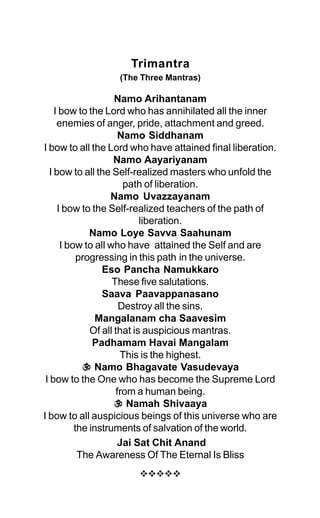
Trimantra
(The Three Mantras)
Namo Arihantanam
I bow to the Lord who has annihilated all the inner
enemies of anger, pride, attachment and greed.
Namo Siddhanam
I bow to all the Lord who have attained final liberation.
Namo Aayariyanam
I bow to all the Self-realized masters who unfold the
path of liberation.
Namo Uvazzayanam
I bow to the Self-realized teachers of the path of
liberation.
Namo Loye Savva Saahunam
I bow to all who have attained the Self and are
progressing in this path in the universe.
Eso Pancha Namukkaro
These five salutations.
Saava Paavappanasano
Destroy all the sins.
Mangalanam cha Saavesim
Of all that is auspicious mantras.
Padhamam Havai Mangalam
This is the highest.
C
C
C
C
C Namo Bhagavate Vasudevaya
I bow to the One who has become the Supreme Lord
from a human being.
C
C
C
C
C Namah Shivaaya
I bow to all auspicious beings of this universe who are
the instruments of salvation of the world.
Jai Sat Chit Anand
The Awareness Of The Eternal Is Bliss
™™™™™
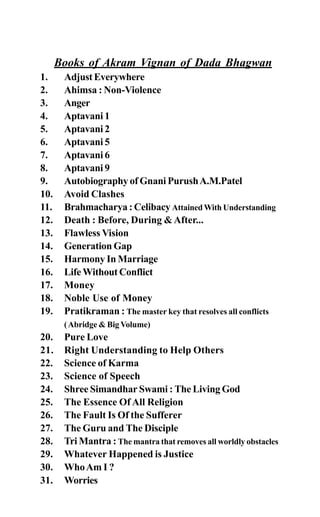
Books of Akram Vignan of Dada Bhagwan
1. AdjustEverywhere
2. Ahimsa : Non-Violence
3. Anger
4. Aptavani 1
5. Aptavani 2
6. Aptavani 5
7. Aptavani 6
8. Aptavani 9
9. Autobiography of Gnani PurushA.M.Patel
10. Avoid Clashes
11. Brahmacharya : CelibacyAttained With Understanding
12. Death : Before, During &After...
13. Flawless Vision
14. Generation Gap
15. Harmony In Marriage
16. Life Without Conflict
17. Money
18. Noble Use of Money
19. Pratikraman : The master key that resolves all conflicts
(Abridge & Big Volume)
20. Pure Love
21. Right Understanding to Help Others
22. Science of Karma
23. Science of Speech
24. Shree Simandhar Swami : The Living God
25. The Essence Of All Religion
26. The Fault Is Of the Sufferer
27. The Guru and The Disciple
28. Tri Mantra : The mantra that removes all worldly obstacles
29. Whatever Happened is Justice
30. WhoAm I ?
31. Worries
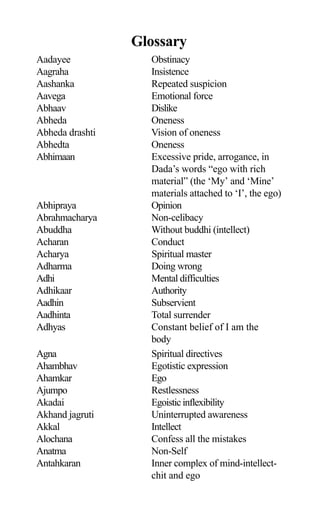
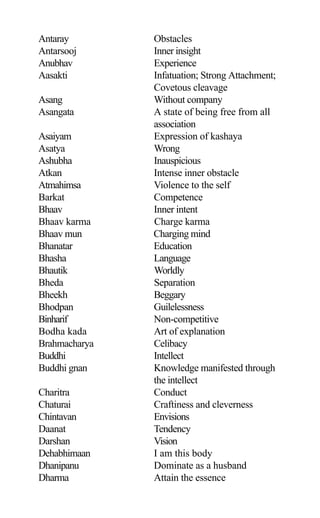
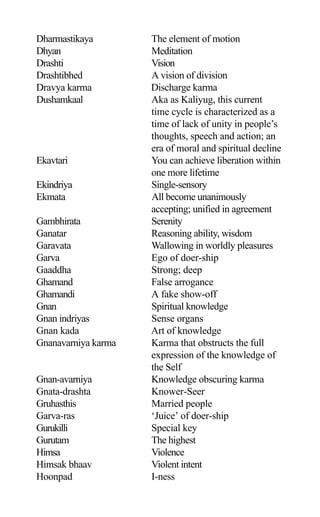
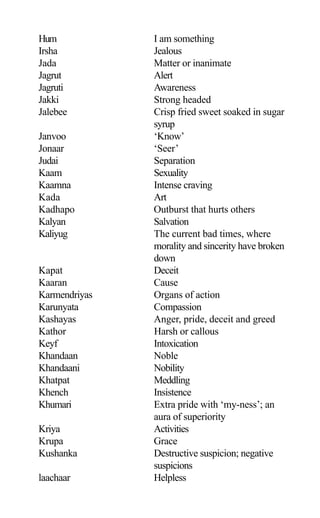
Note About This Translation
The Gnani Purush Ambalal M. Patel, also commonly known
as Dadashri or Dada, had said that it would be impossible to
translate his satsangs and the knowledge about the Science of
Self-Realization verbatim into English because some of the
meanings would be lost in the process. Therefore, in order to
understand precisely the science of Akram Vignan and Self-
Realization He stressed the importance of learning Gujarati.
Dadashri did however grant his blessings to translate his
words into English and other languages so that spiritual seekers
could benefit to a certain degree and later progress through their
own efforts.
This is a humble attempt to present to the world, the
essence of His Knowledge. This is not a literal translation but
great care has been taken to preserve His original words and the
essence of His message. For certain Gujarati words, several
English words or even sentences are needed to convey the exact
meaning; hence, many Gujarati words have been retained within
the English text for better reading flow. At the first encounter,
the Gujarati word will be italicized followed by an immediate
explanation of its meaning in brackets. Thereafter the Gujarati
word will be used in the text that follows. This serves as a two-
fold benefit: firstly ease of translation and reading and secondly
it will make the reader more familiar with the Gujarati words
critical for a deeper understanding of this science. A glossary of
all the Gujarati words is provided at the back of the book. For
additional glossary, visit our website at :
www.dadabhagwan.org
Many people have worked diligently towards achieving
this goal and we thank them all. Please note that any errors
encountered in this translation are entirely those of the translators.
™™™™™
5
Introduction to The Gnani
One June evening, in 1958 at around six o’clock, Ambalal
Muljibhai Patel, a family man, and a contractor by profession,
was sitting on a bench on the busy platform number three at
Surat’s train station. Surat is a city in south Gujarat, a western
state in India. What happened within the next forty-eight minutes
was phenomenal. Spontaneous Self-Realization occurred within
Ambalal M. Patel. During this event, his ego completely melted
and from that moment onwards, he became completely detached
from all ofAmbalal’s thoughts, speech, and actions. He became
the Lord’s living instrument for the salvation of humankind, through
the path of knowledge. He called this Lord, ‘Dada Bhagwan.’
To everyone he met, he would say, “This Lord, Dada Bhagwan
is fully manifested within me. He also resides within all living
beings. The difference is that within me He is completely
expressed and in you, he has yet to manifest.”
Who are we? What is God? Who runs this world? What
is karma? What is liberation? Etc. All the world’s spiritual
questions were answered during this event. Thus, nature offered
absolute vision to the world through the medium of Shree Ambalal
Muljibhai Patel.
Ambalal was born in Tarasali, a suburb of Baroda and
was later raised in Bhadran, Gujarat. His wife’s name was Hiraba.
Although he was a contractor by profession, his life at home and
his interactions with everyone around him were exemplary, even
prior to his Self-Realization. After becoming Self-Realized and
attaining the state of a Gnani, (The Awakened One, Jnani in
Hindi), his body became a ‘public charitable trust.’
Throughout his entire life, he lived by the principle that
there should not be any commerce in religion, and in all
commerce, there must be religion. He also never took money
from anyone for his own use. He used the profits from his business
to take his devotees for pilgrimages to various parts of India.
6
His words became the foundation for the new, direct, and
step-less path to Self-Realization calledAkram Vignan. Through
his divine original scientific experiment (The Gnan Vidhi), he
imparted this knowledge to others within two hours. Thousands
have received his grace through this process and thousands
continue to do so even now. ‘Akram’ means without steps; an
elevator path or a shortcut, whereas ‘Kram’ means an orderly,
step-by-step spiritual path. Akram is now recognized as a direct
shortcut to the bliss of the Self.
Who is Dada Bhagwan?
When he explained to others who ‘Dada Bhagwan’ is, he
would say :
“What you see here is not ‘Dada Bhagwan’. What you
see is ‘A. M. Patel.’ I am a Gnani Purush and ‘He’ that is
manifested within me, is ‘Dada Bhagwan’. He is the Lord within.
He is within you and everyone else. He has not yet manifested
within you, whereas within me he is fully manifested. I myself am
not a Bhagwan. I too bow down to Dada Bhagwan within me.”
Current link for attaining the knowledge of
Self-Realization (Atma Gnan)
“I am personally going to impart siddhis (special spiritual
powers) to a few people. After I leave, will there not be a need
for them? People of future generations will need this path, will
they not?” ~ Dadashri
Param Pujya Dadashri used to go from town to town, and
country to country, to give satsang and impart the knowledge of
the Self as well as knowledge of harmonious worldly interaction
to all who came to see him. During his final days, in the fall of
1987, he gave his blessing to Dr. Niruben Amin and bestowed
his special siddhis upon her, to continue his work. “You will have
to become a mother to this whole world, Niruben” He told her
as he blessed her. There was no doubt in Dadashri’s mind that
Niruben was destined to be just that. She had served him with
utmost devotion day and night for over twenty years. Dadashri
7
in turn had molded her and prepared her to take on this
monumental task.
From the time of Pujya Dadashri’s mortal departure on
January 2 1988 to her own mortal departure on March 19th
2006, Pujya Niruma as she lovingly came to be called by
thousands remained true to her promise to Dadashri to carry on
his mission of the world’s salvation. She became Dadashri’s
representative of Akram Vignan and became instrumental in
spreading the knowledge ofAkram Vignan throughout the world.
She also became an exemplary of pure and unconditional love.
Thousands of people from all walks of life and from all over the
world have attained Self-Realization through her and are
established in the experience of the pure Soul, while carrying out
their worldly duties and obligations. They experience freedom
here and now, while living their daily life.
The link of Akram Gnanis now continues with the current
spiritual master Pujya Deepakbhai Desai whom Pujya Dadashri
had also graced with special siddhis to continue to teach the
world about Atma Gnan and Akram Vignan. He was further
molded and trained by Pujya Niruma who blessed him to conduct
Gnan Vidhi in 2003. Dadashri had said that Deepakbhai will
become the decorum that will add splendor to the Lord’s reign.
Pujya Deepakbhai, in keeping with Dada’s and Niruma’s tradition
travels extensively within India and abroad, giving satsangs and
imparting the knowledge of the Self to all who come seeking.
Powerful words in scriptures help the seeker in increasing
his desire for liberation. The knowledge of the Self is the final
goal of all one’s seeking. Without the knowledge of the Self
there is no liberation. This knowledge of the Self (Atma Gnan)
does not exist in books. It exists in the heart of a Gnani. Hence,
the knowledge of the Self can only be acquired by meeting a
Gnani. Through the scientific approach of Akram Vignan, even
today one can attain Atma Gnan, but it can only occur by meeting
a living Atma Gnani and receiving the Atma Gnan. Only a lit
candle can light another candle.
8
EDITORIAL
Life after life, human beings have been struggling for
liberation (moksha). Many times, one has made progress and
many times he has fallen down. What holds one back from
achieving the desired result? Those who are performing the
practices or helping to perform the practices of attaining liberation,
achieve to some degree the success in knowing the ‘Helpful
causes’. To know and see the ‘Harmful causes’ and to remain
unattached from them, can only be done by a Gnani Purush who
manifests very rarely. Once a Gnani Purush has visibly manifested
among us, the path to liberation (moksha marg) opens up
completely. And with that, one can reach all the way to the end
of that path!
One finds the ways up to the path of liberation but while
going up, there are ‘Danger points’ and ‘red signals’ that alerts
one to these danger points, and usually these are not shown. As
significant the upward road is, the knowledge and precautions
for the slippery slopes along the way is of much more significance.
Therefore, without those precautions, no matter how much labor
one exerts, he inevitably falls back.
The success in Self-realization does not occur without the
extremely sharp awareness of where one becomes an impediment
to his own self. This means, in the endeavor of Self-realization,
it is extremely important to stop the losses than to gain the profit.
Once the seeker meets the Gnani Purush and knows and
understands Him, he begins the worship of the path of liberation.
Prior to meeting the Gnani, those who were deeply entrenched
in the worldly life (sansar), now turn towards the path of
liberation. However in their remaining worldly obligations, which
they must fulfill and complete, often knowingly or unknowingly,
they get dragged and immersed back into the worldly life. Who
can show them this ‘leakage’ (their weakness)? To ‘seal’ that
‘leakage’, here in this Aptavani is shown the practical knowledge
9
(vyavahar gnan), the spiritual knowledge (Gnan), the Science
of spiritual knowledge (Vignan), the art of knowledge (gnan
kada) as well as the art of explanation (bodha kada) of the
Gnani Purush.
Moksha-marg means the path to freedom; it is the path of
attaining freedom from all worldly attachments. Whatever practice
one resorts to believing them to be instrumental for his freedom,
it does not give him the experience of freedom. His attachments
are not broken in spite of performing many different practices.
Where is the mistake being made? One should serve the ‘causes
of freedom’ in order to achieve freedom, and whatever causes
one serves, if he experiences freedom and detachment; then only
can he say that the causes served are those for liberation. Instead,
his attachments are not broken in spite of serving the causes for
freedom. Why is that?
The Gnani Purush has seen the complete path to final
liberation. He has known that path, He has the experience of it
and he has completed it. Therefore, he can show us the mistakes
obstructing that path; he can show us the difficulties, obstacles
and dangers along that path. To those who have embarked on
the path of liberation, the Gnani can give complete knowledge
and complete remedy as to how to eradicate those mistakes.
There are mistakes, which cause bondage. People in this
world cannot see those mistakes and so because of constant
bondage due to those mistakes and supporting them, people
have turned away from the path of final liberation altogether.
The Gnanis of the past had cautioned people about the
mistakes that hinder the path to final liberation. However, one
can steadily progress on the path, if the truly desirous devotee
has, prior to achieving the path and after being on the path, a
detailed description of the mistakes that hinder him. Nevertheless,
the correct path is to complete it by completely surrendering to
the Gnani Purush.
10
11
The Gnanis have said that bondage and obstruction on the
path of liberation is because of kashayas (anger, pride, deceit
and greed). Being absolutely rid of these faults one attains final
liberation. All faults within a person are encompassed in anger,
pride, deceit and greed, but how do these faults unfold and
manifest in worldly interactions? This can only be understood
when The Gnani Purush explains them to us in detail.
Gnani Purush is perfect light, and in his manifest illumination,
it is inevitable that, in order to break free from all one’s mistakes,
one must review and confess all the mistakes (alochana) to the
Gnani Purush. The Gnani Purush, by direct interaction with the
seeker can erase all his inner mistakes. Whenever one has suffered
from pain, has experienced difficulties, uneasiness or lack of
spiritual experience, or has troubling attachments, and he does
detailed alochana to the Gnani Purush, the Gnani will show him
the light. And in that light, he can see all his mistakes, and find
a way to get rid of them.
The main issue is that these mistakes or faults have
remained in the form of ‘tubers’. These tubers are always buried
‘underground’ (they remain hidden within). Under the right
circumstances, when these tubers get ‘water’, they germinate
and sprout into branches and leaves, and from that, one can
discover which kind of tuber he has; he can discover what
‘disease’ lies within him. Unless the nature of the mistakes is
identified, the mistakes continue to get support and nourishment.
By coming to the satsang of the Gnani Purush, by repeatedly
listening to his speech, and by repeatedly understanding his
interaction with specific questioners, the seeker develops
awareness and gets the strength to identify and visualize his own
mistakes and faults. After that, he gains awareness to weed out
the sprouts and by effectively practicing this; he can completely
eradicate the tuber. However, this process has to be carried out
under the guidance and instructions (Agnas) from the Gnani Purush
12
who shows him his mistakes in detail, helps to identify the nature
of those mistakes, thus helping him become free from them.
Thus is perfected the path of final liberation (moksha marg).
Here in this Aptavani is the speech of Dadashri who is the
manifest form of pure Absolute knowledge. This compilation of
the causes that obstruct the path to final liberation is presented
in an eloquent, basic and heart-touching discussion, for all on the
path of liberation. It will help the spiritual practitioner at every
step from falling down. In this Aptavani, if the informed reader
finds any defect or shortcoming, it is not because of the Gnani’s
speech, but because of the defect of compilation. For that, we
offer apology and prayer.
- Dr. Niruben Amin
™™™™™
PREFACE
By Dr. Niruben Amin
From time immemorial, prakruti, which is the non-self
complex (also known as the relative-self), is characteristically
bound by worldly affinities. When one meets a ‘Gnani Purush’,
he enters into spirituality i.e. non-worldly affinities. However the
prakruti, which was created in the past life and its inherent
tendency to remain bound to the worldly life, will not refrain
from manifesting when circumstances of nature pressure it. And
in the current time cycle of Kaliyug, the effects of past karma of
the relative-self are such that they oppose and mostly obstruct
final liberation. In such times, to win the conflict between worldly
entanglements and spiritual efforts to attain the real Self, the
Gnani Purush gives many explanations of His experiential
understanding here.
1. Obstinacy (aadayee) : To be upset and noncommunicative
(risavu) : Manipulative tantrum (tragu)
Those who are straight and simple achieve straight and
simple liberation. Gnani Purush is straight and simple in every
way. His statements are proven true in all three times; the past,
present and future. For any man who comprehends the
statements of such a Gnani Purush, his liberation is at arms
length. Gnani Purush says that obstinacy is an obstruction on the
path to liberation, and if one can straighten out, then he can
become God. What is wrong in becoming straight through your
own understanding as opposed to becoming straight after taking
a beating from others?
If you admit to your obstinacies, they will go away but if
you deny them, they become stronger. You can only win over
obstinacies by acknowledging and then ‘seeing and knowing’
them.
You have the right to see only your own obstinacies.
13
14
However, you can only see them when you attain impartial
vision, or if someone points them out to you and you examine
them. Then that would be the scope to remove your obstinacies.
However, if you see other people’s obstinacies, it is regarded as
your own obstinacy. Your obstinacies will vanish the moment
you start to see them.
One becomes God when his obstinacies are completely
gone.
When a true statement that is satisfying to the heart is not
accepted, that verily is the nature of obstinacy. Obstinate people
behave according to their own opinions. Obstinacies end in
those who behave according to the Gnani’s opinion.
The finest qualities of the prakruti (the innate nature of
one’s relative Self) are freely available to everyone on the path
to liberation. These qualities are ultimate humility, extreme
simplicity, spontaneous forgiveness, and total lack of obstinacy.
These qualities can be regarded as measures of spiritual
progress.
To be aware of one’s own obstinacies is verily called
awareness!
Obstinacies may have lessened, however if one has ‘my-
ness’ (mamata), then he is absorbed in the worldly life only.
Whereas, if there is no ‘my-ness’ and if the subtlest obstinacies
have ended, one will become a Gnani.
The root of obstinacy is the ego. If a person has faith in
the opinion of ‘people will only shape up if I sulk, remain
obstinate, upset and non-communicative (risavu)’, then obstinacy
will not refrain from manifesting in his behavior.
If you become obstinate with the Gnani Purush, you will
not get any support or encouragement from Him. There, in front
of the Gnani, one has no choice but straighten out and shape up!
Obstinacies succumb and bow down to the one who is
15
nispruha (without any inclination towards needs, or desire, of
any material things of this world). The one who has the virtue of
being straight will naturally receive the grace of the Gnani Purush
who himself is completely straightforward in everything.
One is considered to have become straightforward when
he knows his own obstinacies. The obstinacies can be identified
only if one has the Knowledge of his real Self. And only then
can they be reduced and ultimately eradicated. On the other
hand, the one who is obstinate will completely miss the whole
path of liberation.
Obstinacy arises in making others do according to your
will. By doing according to the will of others, obstinacies come
to an end.
“To have the knowledge ‘the one who is obstinate is not
I’ is called Akram Vignan, which is a step-less (short-cut) path
to Self- realization and ‘the one who is obstinate is I and I have
to straighten out’, is called Kramic path, which is a step by step
path (you progress one step at a time).”
~ Dadashri
To be upset and non-communicative (risavu) is also a
type of obstinacy. Who is at a loss from becoming upset and
non-communicative? Will the train wait for the one who remains
upset and non-communicative? The train will leave right in front
of him. The world will not stop for him at all.
If someone is being upset and non-communicative (risavu)
with you, he is being so with the one that is a risad in you; i.e.
the one that gets upset and non-communicative within you. The
risad within you is seeing the one who is upset and non-
communicative. The risad within you is not the real Self. The
one who is upset and non-communicative (risavu) with you is
not the real Self either. The Self sees the Self; the Self sees the
pure (shuddha) only. Inherent in this, is the path of liberation.
16
If someone is upset and non-communicative (risavu) with
the Gnani Purush, how does the Gnani Purush deal with him?
Only the Gnani can explain the state of absolute detachment
(vitaragata)! The excellence of the manifest Gnani Purush is in
His unattached state, along with his nishkaran karuna (Gnani’s
compassion for us in which He has no ‘personal gain’ or
agenda. This is the only ‘reason’ and ‘purpose’ of the Gnani’s
compassion is to take us to our Ultimate Freedom, or Moksha).
As a result, we become free of faults and become steady on the
path of liberation and attain the bliss of the Self.
In the advancing stages of obstinacies, one becomes upset
and non-communicative (risavu) and then if things don’t happen
as per his intentions, he will resort to manipulative tantrums
(tragu).
The characteristics of a tragu is where one will create a
commotion like banging his or her head, crying out loud and
resorting to any means possible in order to put others in his or
her own grip. So much so that it scares people into submitting
under the control of the one doing a tragu! With such people,
explaining everything to them and reasoning with them can
achieve a resolution, but otherwise it is best to walk away from
them.
It is an art to do a tragu (manipulative tantrum).
Tremendous energies are wasted in doing one. One incurs
tremendous loss and as a result, risks bypassing the animal
kingdom altogether and takes birth straight in hell.
Dadashri, the Akram Vignani shows us ways to be saved
from manipulative tantrums. He opens up the vision to get
freedom from all kinds of deformed personalities by looking at
them and experiencing them from all the phases; so that we too,
in our own lives can open up and develop that vision and make
ourselves free from our obstinacies (aadayee), adamancy
towards non-communication (risavu), and tragu (manipulative
17
tantrums), or we can escape from people who are obstinate,
upset and non-communicative, or do tragu. Through the
Science of Akram, the Gnani Purush gives us the understanding
of the art and the knowledge to become free from our relative
self and to not get entangled in the relative self of others; this
becomes extremely helpful to remove the obstacles in the path
to our final liberation!
2. Emotional agitation (udvega) : suspicion (shanka) :
intense mental note (nondha)
In order to make others do what one wants, one starts
with obstinacy, then becomes upset and non-communicative and
if he is not successful, he starts to do tragu (manipulative
tantrum). And still if things do not happen according to his
wishes, he develops extreme emotional agitation (udvega). If
the tendency to make others do what one wants is eroded, he
gets freedom from the pain and suffering of emotional agitation
(udvega).
Emotional agitation is created when attachment (moha)
with ego reaches extremes. In a state of extreme emotional
agitation, terrible new karmas are bound.
Only the Gnani Purush can show the subtle clarity of the
speed and force of the prakruti and of emotional agitation! And
it is from the Gnani Purush that the keys to becoming free from
causes that become instrumental in causing emotional agitation
can be easily obtained to tackle the problem.
In order to become free from emotional agitation, one
should find its causes and stay away from them or leave the
issue altogether, no matter how priceless. But one must remove
the root causes of emotional agitation, because as long as there
is slightest emotional agitation, the path to liberation is not there
at all.
In Akram Vignan, one enjoys the freedom as a result of
18
simply ‘seeing’ the relative self (prakruti) that is caught in
emotional agitation. However, because of ignorance he takes it
upon himself by claiming, ‘I am caught in this emotional
agitation.’ And as a consequence he actually becomes trapped!
What causes emotional agitation? It is the intellect
(buddhi). It is the intellect that brings one from vega towards
aavega and ultimately towards udvega, meaning it is the
intellect that takes one from non-consequential motion or a
neutral state (vega), into emotional force (aavega) and ultimately
emotional agitation (udvega) and it is the intellect that gives rise
to suspicions (shanka).
When the power of intellect does not bring about a
solution, one gets puzzled and then suspicions are created.
Suspicion means one has deep ignorance.
In Akram Vignan, in order to save one’s self from the
ravages of suspicion, by understanding the scientific knowledge
of vyavasthit (this is the subtle coming together and functioning
of ‘scientific circumstantial evidences’ in all actions), as given in
the form of Agna (spiritual directives) by the Gnani Purush, one
can remain in a steady suspicion-less state (nihshank).
If suspicion enters into the mind as a result of seeing a
snake entering the house; that suspicion will not go away until
the snake is seen leaving the house. Suspicion will not be born
at all if the knowledge of ‘scientific circumstantial evidence’
(vyavasthit) is understood.
The Vignan (science) that has manifested through the
divine words of the Gnani is the extract of his analysis of his
experiences of countless past lives. The original knowledge of
freedom attained as a result of going through every phase of
numerous innate natures (prakrutis), is the research of the
Gnani Purush!
Many incidents occur in the lives of men, wherein they
19
don’t have any suspicion (they accept their circumstances) about
what is taking place, then why should there be suspicion where
everything is happening as a natural order? In the matter of
digesting food, is there any suspicion whether digestion will
occur or not?
What benefit is there from being laden with suspicion?
The condition of an intensely suspicious person is that of a
corpse even though he may be alive! What happens when there
is suspicion about the daughters when they go off to college?
That suspicion creates constant restlessness. It only creates pain
and hurts one’s own self.
It is a tremendous risk to have suspicion about someone’s
character. How can such a risk be taken? One can remain
suspicion-free as long as he does not happen to see anything.
But does that mean it was not there before? Did it happen
overnight? No. Therefore, if there is suspicion, one should
conciliate that it was there before. This world is only an illusion.
The Soul has no wife and no daughter. Those who don’t want to
miss out on their progress in the path towards their final liberation
should not dwell deeper in any place other than the Soul.
In the effect of Kaliyug, the current bad times, where
morality and sincerity have broken down between husband and
wife, where lies any meaningful pleasure? In Kaliyug, the wife
will not be your own. There are tendencies for sheer deceit and
fraud flowing in this aspect! So, where is the ground for
suspicion? The best way to conduct oneself in this respect is to
take the vow of having only one spouse; otherwise it can only
be called a ‘toilet’, is that not so? The toilet is where everyone
goes!! Is it not true that the insatiable desire and lure for sex
gives rise to suspicion? Once there is freedom from sex,
freedom from suspicion will be there. If one does not become
free from suspicion that arises as a consequence of his sexual
indulgences, not only this life, but his infinite lives to come will
20
be ruined! The one on the path of liberation should be without
suspicion.
Once there is suspicion about a person, there is separation
from that person. The echoes of suspicion will inevitably reach
the other person. Therefore, there should be no suspicion, and
as soon as suspicion occurs, it should be removed with
awareness.
What happens when the daughters go off to college and
parents begin to suspect their character? It only creates
unhappiness! Children try to look for love from outsiders
because they do not receive any at home, and consequently slip.
This can be avoided by living with them as their friends and
having love for them. However, if the daughter takes a wrong
step, can you kick her out of the house? One must give
protection with love and avoid losses! Caution in the beginning
is welcome, but one should never be suspicious!
Where there is no suspicion, there is no unhappiness of
any kind.
To have suspicion is the result of past karma, but to keep
suspicion is not a result of past karma. That will cause worsening
of one’s inner intent.
Suspicion is the greatest weakness; it kills the self.
If someone has suspicion about the Gnani Purush, the
Gnani Purush will know everything and yet behave in a natural
way as if nothing has happened. The Gnani does not have the
slightest separation from the person who is suspicious about him.
His inseparability, his oneness will only make the other person
become free from suspicion.
It is better to slap someone than to suspect him, at least
this way there is an instant solution but to suspect someone will
eat you up day and night all the way to death.
21
Suspicious people can never succeed in any task. Success
selects those who do not harbor suspicion. Suspicion is
removed by remaining in a suspicion-less state, in the state of the
Self.
Does anyone ever become suspicious about death? One
quickly removes any suspicion there.
As long as the Gnani Purush is there to help, all kinds of
suspicions can be resolved completely and thereafter there will
be no obstacles in the path to liberation.
Having suspicion is double the loss. First, there is the
direct suffering and secondly there is a loss (karmic) of seeing
faults in the other person.
Akram Vignan says ‘You’tell the one (your relative-self)
who harbors suspicion ‘don’t suspect anyone’. The one who
does the telling is separate from the one who has suspicions!
Can one give a car to a driver who has suspicions about
getting into an accident? You should not be in the company of
a suspicion-laden person at all; otherwise he will engulf you in
suspicions too.
Those with suspicion get into trouble, that is the law of
nature and those who do not listen to suspicion have no
difficulties at all.
Why should one be consumed by suspicion in a world
where even what is witnessed with one’s own eyes is proven
wrong?
A single seed of suspicion will grow into an entire jungle!
As we do in Algebra, we should just cross out suspicions.
Finally, one should remove all suspicions by separating one’s
Self from the one (relative-self) who suspects, by employing
Gnan and by scolding and threatening the relative self.
22
When one suspects, suffering occurs right away. But, at
the same time, a new seed is sown that will bring suffering even
in the next life!
Suspicion is removed by doing proper pratikraman. One
has to repent against suspicion. One should not become careless
about it. The one who did the suspecting, the one who was in
violation, should be made the doer of repenting.
After becoming the Self, if the mind shows disorderly
things inside, how can we listen to it? All feelings of attachment
are the qualities of the innate self, they are inanimate qualities,
relative qualities; they are not the qualities of the pure Soul at all.
You are the owner of infinite powers, how can anyone do
anything to You? This fearlessness results in a state that is free
of all suspicion.
It is necessary only to raise awareness against suspicion.
The knower-seer state can only be maintained if there is
awareness and consequently all suspicion is eradicated.
When someone suspects you, it is not unfounded. There
is some fault on your part there. The fault may not have
occurred now; it may be from the past, but only then would this
happen. The world has never been outside the law of nature, not
even for one second.
Only the Gnani Purush can create suspicion over illusory
wrong knowledge (mithya-gnan). And that knowledge will be
gone once there is suspicion about it. There is never any
suspicion about real knowledge.
“Who am I?” One has never suspected or questioned his
real identity or his state of being the owner of the name in any
past lives. That is where one has to have suspicion. If suspicion
is created about one’s own deep-rooted wrong beliefs, it is
called the beginning of realization of the Self.
23
What is the Soul? What is it like? This kind of suspicion
is most difficult to get rid of without the help of a Gnani Purush.
Who is the owner of anger, pride, deceit, and greed? How is
one to understand this? Only the Gnani can make us understand
and help us be rid of them.
What is the Soul? What is it like? Life is to be spent
thinking about this, not in the bedroom or cinema or hotels!!
When do all the different types of suspicions go away?
They go away, when one becomes free from attachments
(vitarag) and free from all fears.
Who has suspicion about the Soul? The Self does not
have suspicions at all. Actually, the ‘relative self’ suspects the
existence of the Self.
He who becomes suspicion-free in the matter of the Soul
is in a state of permanent liberation!
Up until now whatever knowledge one moved around
with, whatever tools of knowledge he utilized, starting from the
time he became suspicious about that knowledge and the tools,
to the point of becoming completely suspicion-less (nihshankta)
regarding the Soul, (the Self), that entire duration of period in
spirituality is regarded as having suspicion with reference to the
Soul. Once that suspicion-less-ness (nihshankta) occurs, one
becomes free of fears (nirbhayta)! And where there is
fearlessness, there is a state of nonattachment (asangata) in the
presence of all attachments!
Akram Vignan is to be applauded in wonder that within
one hour of the miraculous Gnan Vidhi (the one hour spiritual
process of Self-realization), one becomes permanently suspicion-
free about the Soul.
Suspicion about the Soul cannot go away by reading
books. A manifest Gnani is required there. As one knows more
24
and more information from the scriptures, his suspicion increases
more and more; once he reaches a stage of ‘I don’t know
anything’, he is ready for real knowledge. The knowledge that
gets rid of kashayas i.e. anger, greed, pride, deceit, is real
knowledge; it is Gnan. Where there is suspicion, there is agony.
The sign of knowing the Soul is a permanent suspicion free state.
To have suspicion is to have an awareness of a kind, ‘Did
I do this or did someone else do it?’ To have such a suspicion
is called higher awareness. ‘I became engrossed (with the
relative-self)’, this suspicion that occurs after Self-realization is
also a form of awareness of knowledge. In the final stage there
prevails, at all times, an awareness of: ‘I never become
tanmayakar (engrossed) at all.’
In Gnani Purush’s state, all the worldly interactions are
done by the pudgal, the relative self and He remains vitarag
(detached). In spite of interacting with the world at every
moment, for Him there is no intense mental note (nondha) of
anything. One’s vision becomes muddy when an intense mental
note (nondha) is made. Always seen in the eyes of the Gnani
Purush is vitaragata, a state of freedom from all attachments.
Where there is true love, there is no intense mental note
(nondha). Where there is no intense mental note, there is a
tension free state!
The worldly love is the love that keeps intense mental
notes, it is known as attraction-fondness (aasakti). Love that
vacillates; love that goes up and down is called infatuation only.
The moment one says ‘This is what you said to me that
day!’ is regarded as keeping an intense mental note and as a
result, one’s love will vanish. By keeping such a note about the
wife who is considered to be your own, will result in turning a
loving life in to a poisonous one.
First comes into one’s conviction (pratiti) the opinion of
25
‘it is wrong to keep an intense mental note’ then it will come into
his experience (anubhav) and then ultimately it will express in
his conduct (charitra). This is the scientific process through
which things express in one’s conduct.
There will be revenge (vair) in the mind if an intense
mental note (nondha) is kept. Half the pain vanishes by not
keeping such a note. Gnani Purush never keeps a note. When
you keep a note, the opposing party will also keep one too.
First begins the taking of a note (nondha), then starts the
mind’s battle, then the battle of words and finally it can end up
in a physical battle. Therefore, it is best to pluck out the root!
The person wanting liberation must get rid of the
‘notebook’. For those who stop taking notes (nondha), their
worldly interactions come to an end.
Those who are certain in the worldly interactions remain
uncertain about liberation. Certainty in the world means supporting
the worldly interactions.
In order to dissolve the innate nature (prakruti) of taking
notes, what does Akram Vignan say? It says that note taking is
done by the innate nature (prakruti) and the real Self has to
simply know that. It is not objectionable that a note is made, but
if the Self’s agreement with taking notes goes away; the note too
will go away.
The habit of ‘taking note nondha’ will not be given up
without the help of the Science (Vignan). The innate worldly
nature will choose to die rather than give up taking intense
mental notes.
How can a note be made of the karmas that are changing;
karmas that are constantly rising and setting?
What is the process of making a note? For whatever
reason, if one has the slightest like or dislike via a nimit (an
26
apparent doer who is simply instrumental in the process), an
intense mental note is made about it. But if no note is made
about the nimit, such inner spiritual effort (purusharth) will lead
one to liberation.
There is always engrossment with the relative self when a
note (nondha) is made. Thereafter it will go under the authority
of the relative self. The Self’s realm and energy will be blocked.
When note is taken, the mind becomes poisonous
towards that person. The one who has stopped taking notes is
considered to have turned to the state of becoming a vitarag.
3. Commonsense : Welding
These days commonsense has been sidelined, proclaims
the Gnani Purush.
“Commonsense means it is everywhere applicable,
theoretical as well as practical.” This definition of commonsense
is quite original and wonderful.
The one with commonsense will open all the locks, no
matter how rusty they are. He does not clash with anyone; he
avoids clashes by using his commonsense at home, outside, in
the workplace and everywhere else. He does not allow
separation due to difference of opinions, with his wife at home.
No matter how intelligent a person may be but if there is
no practicality in him i.e. if there is no commonsense, there will
be clashes.
As one’s ego goes down, his ‘dealing’ will become
proportionately beautiful with everyone.
Commonsense develops by talking about various things
with everyone in an affable way. Commonsense is lessened by
scorn for the worldly life. The one with commonsense is in tune
with everyone.
27
In the worldly life, commonsense is useful to make
decisions and to avoid clashes. A simple man will get cheated
but in return his commonsense will develop.
Commonsense can be effective to the point where one
can allow no ‘depression’ to occur, no matter how many insults
he is subjected to.
Commonsense does not develop when there is selfishness
or plotting because it is used up in the plotting or in deceitful
intents.
If one becomes an expert in any one aspect, his
commonsense becomes obstructed.
The one with commonsense has studied the innate nature
(prakruti) of the other person and that is why he can open any
type of locks.
Commonsense is a type of an insight and insight is a
natural gift. Intellect (buddhi) shows worldly profit and loss. The
direct light of the Soul (pragnya) is born only after achieving the
light of knowledge, Gnan. Commonsense can open up all the
locks in the world but it can’t open a single lock for one’s
salvation (moksha) whereas pragnya will take one to moksha.
To adjust everywhere, one can observe how the Gnani
Purush conducts himself by adjusting everywhere in everyway.
And the one who has learned how to adjust everywhere has
surmounted the world.
It is better to ‘adjust’ rather than complain. If your light is
brighter, dim your light in order to adjust with the person with
the dim light.
The Gnani Purush gives us the key to avoid separation
due to difference of opinion (matbhed) and this key is, ‘We are
all one and there is no difference in us.’ One should repeat this
sentence five times every morning, then one day; a time will
come when you will not have any matbhed with anyone.
28
How can anyone create a wedge in our unity? Those who
do are plotters with deceitful gossip. How can they be allowed
to interfere? How can one afford to be immature and allow
himself to be instigated by others?
One should always do the ‘welding’ (patching up)
whenever a wedge is created with anyone. It is considered a
great quality of virtue to do the ‘welding’ for others, even if there
is suffering and difficulty on the part of the one doing the
welding.
In these times, the one who does the welding i.e. unifies
others, will suffer. After the welding, the two estranged parties
will unite and the welder will be at a loss! After this kind of
suffering the welder backs off. However, the one who wants to
improve for the Self should weld in spite of the suffering!
If one is not comfortable in doing the welding, he should
maintain the intention in his mind of, ‘I want to do the welding’
but he should not have the negative intention of, ‘It is better if
they are separated.’
Those who break up relationships are found everywhere
but those who unite people are rarely to be found.
4. My-ness (mamata): intense insatiable greed (lalacha)
While life is short, how can a single minute be wasted?
You should pass through this world without any ‘dirt’touching
you. Where there are no expectations of any kind at all, no
blemish of any kind at all, where there is complete purity, there
is the status of the Gnani! The Gnani Purush does not have any
attachment even for his body. The Gnani Purush is without ego
or ‘my-ness’.
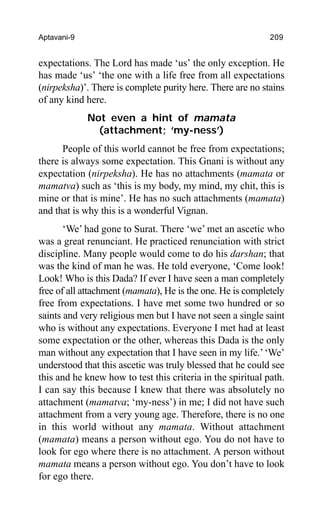
Mamata (my-ness) means ‘mine’ and as a result of this
my-ness, ‘I’ has continued to exist. The span of my-ness can
expand from ‘my body’ to ‘my wife, my house, my town, my
country, my world.’ Etc.
29
My-ness should be there with a boundary. The boundary
of my-ness means, it will exist as long as one is alive, for
example the ‘my-ness’with the body. Any further extension of
my-ness should not be there, including the ‘my-ness’ for an
only son. Otherwise, that extended my-ness will only be
painful.
If an insured ship sinks, how much worrying does the
insurance agent have? If one’s my-ness is of this kind, it will not
cause any pain.
If a bungalow burns down after it is sold and all the
documents are signed, would one feel anything? No; if ‘my-
ness’ can vanish simply by signing papers of agreement, can it
not go away by correct understanding? Otherwise, the bungalow
will say, ‘Boss, either I will go or you will go.’
What are the rules in a museum? You are allowed to see
everything and tour around but you can’t take anything with you.
In the same token, people have to leave everything behind and
go with respect, lying down in a funeral bier! In such a world,
why have all these headaches?
What is indicated by the ‘my-ness’ that causes clashes?
Why is there pain when the wife who is really not your own,
dies? At the time of the marriage ceremony this my-ness
becomes completely binding as the husband begins to think ‘this
is my wife…my wife…my wife...’ Because of this, there is a
psychological effect and the ‘my-ness’ about the wife enters
within. This is what causes pain and freedom from this pain
occurs when the complex knots of ‘my-ness’ are untangled by
saying, ‘not mine…not mine...etc.’
Worldly things are not the impediments to liberation but
my-ness is. The object for which there is my-ness will be the
binding object. In fact, what object belongs to us when in the
end, even the body does not accompany us!
30
The one, who dies without my-ness, attains liberation. The
one with my-ness is not allowed entry in liberation.
To have the knowledge of ‘my-ness is wrong,’ is the
highest earning in life.
Akram Vignan clarifies this all the way, that the one who
has my-ness is not the Self.
‘My-ness’ (mamata) in the one who has attained Self-
realization is ‘dramatic’ my-ness. It is the same my-ness as that
in a drama (the same my-ness an actor has playing his role; it
is perfunctory).
The pleasure that is there when there is no my-ness is the
pleasure of the free mind!
The person who has no intense insatiable greed (lalacha)
in life will find God!
A person with only one type of greed is called greedy.
There is a difference between a lalachu (an intensely greedy
person) and a lobhi (greedy). The greedy has greed in one
aspect only, whereas a lalachu person is greedy in all aspects.
He has an intense insatiable greed to enjoy this way and that
way. For such a person, it is difficult to be free. Intense
insatiable greed makes one lose sight of the goal. He will be
trapped everywhere. The lalachu will self-destruct in every
manner.
The intense insatiable greed arises out of the desire to
enjoy worldly pleasures. With such greed, there is no rule or
law. One will snatch pleasure from here or there, by any means
he can.
Horrible pains are invited by the intense insatiable greed
for sexual pleasure. Disgust towards sexual pleasure will give
freedom from sexuality. As long as there is intense insatiable
greed for any sexual pleasure, clashes will be there. One binds
31
terrible enmity through greed of sexual pleasure. The one who
is intensely greedy for sexual pleasure, will even use intimidation
as a final resort in order to enjoy sexual pleasure.
The intense insatiable greed for sexual pleasure will make
one helpless. So the wife will make him dance like a monkey.
And later, will there not be revenge against each other?
A lalachu person will not only have lalacha for sexual
pleasures but he will also have lalacha for eating, drinking and
traveling; he is lalachu in all things.
It is an inner spiritual endeavor (purusharth) to change
thoughts for intense insatiable greed when they occur. Then, one
is not responsible and if those thoughts are not changed.
A lalachu person, due to being stricken with the intense
insatiable greed, will take all kinds of risks.
A lalachu wants everything. In the same way as a disease
attracts the remedy, all objects of intense insatiable greed are
attracted to the intensely greedy one.
Only those businesses that are in one’s prakruti (innate
nature) can be performed. Out of intense insatiable greed one
gets into imaginary businesses and consequently gets into
trouble.
Why should there be intense insatiable greed (lalacha) for
temporary things? When a decision ‘I don’t want any temporary
thing in this world’ is made, lalacha will go away.
Lalacha is an inborn thing. At the time of death, the seed
of lalacha will carry forward with one and it will grow in the
next life.
If intense insatiable greed (lalacha) is opposed by the
ego, it will go away. But then later, that ego must be washed
away too. Any ailment can be removed in the presence of a
32
Gnani Purush. The other remedy to be free from lalacha is to
stop doing all things that cause it. One must not think about them
and if they come into his thoughts, he should do pratikraman,
and then one day, he may be free from all that tempts him.
The lalachu is a betrayer. He will completely ignore and
bypass the Agnas of the Gnani Purush; therefore the grace of
Gnani Purush will stay away from him. Only if he makes a strong
decision to remain in the Gnani’s Agnas, and becomes very
strong with his mind, body and speech, then there is a possibility
that the intense insatiable greed (lalacha) will leave.
The lalachu can’t give happiness to anyone in the world;
he will give only pain.
The effect of bad company, leads to an intense insatiable
greed creeping within one. The effect of bad company is worse
than poison.
Lalacha does not let Gnan express. It stops at the level
of the intellect only.
At first, one sees his own mistakes, and then the pratiti
(conviction of ‘it is wrong to have these mistakes’) is established.
Once this is firmly established, these mistakes of lalacha can be
rid of by one’s inner spiritual endeavor (purusharth).
The intense insatiable greed to be worshipped will make
one organize groups that will worship him. What is the outcome
of doing this? He will go to hell. To become a guru and enjoy
that status is also the same as having an intense insatiable greed!
This intense insatiable greed is regarded as a terrible disease. If
you want to get rid of this horrible disease that perpetuates the
worldly life, spend one lifetime in subservience to the Gnani
Purush. One should not open up his own ‘shop’ after meeting
the Gnani Purush.
Even God will not question the one who has no greed for
anything at all.
33
5. Pride (maan) : Ego of doer-ship (garva) : Wallowing
in worldly pleasures (garavata)
The Gnani Purush informs us that gnanavarniya karma
i.e. the karma that obstructs the full expression of the knowledge
of the Self, goes once mohaniya karma i.e. the karma that
causes the illusion, is removed. Speaking about himself, The
Gnani Purush asks, ‘What kind of moha (illusion-attachment)
did I have prior to enlightenment?’ He says ‘I did not have any
moha of any kind. I had no inclination for money or sex. The
only thing I did have was pride (maan); great attachment with
pride. However, there was no abhimaan which is pride with
‘my-ness (mamata)’. Abhimaan can only exist if there is my-
ness (mamata). This was pride without any my-ness – this was
maan without mamata.
If from a young age one has been subjected to only
insults, he will have a strong appetite to gain respect. In the same
token if one had nothing but respect given to him in childhood,
the appetite for respect will not be there later on.
When a maani (one with a tuber of pride) gets respect,
his tuber of greed (lobh) will decrease. Whereas a lobhi will not
let go of his tuber of greed; there will be no decrease in his
greed, even when he gets a lot of respect.
From the perspective of liberation, simple pride is
tolerable, but for one to be constantly using his energies in being
preoccupied with, ‘where will I get respect from, how can I get
respect and recognition in the eyes of the world?’ is gravely
dangerous. Pride can be removed but it is extremely difficult to
eradicate the hunger for pride.
If people give you respect, you should enjoy it but do not
become habituated by it. You should be careful not to become
attracted and then attached to the one who gives you respect.
In the process of enjoying respect, awareness of the Self
34
is diminished and if deceit enters into making one wanting
respect, there will be total darkness. There is no objection in
enjoying respect that comes naturally but if it leads to
covetousness for wanting more respect (maan will increase)
then this deformity of pride results in intoxication of pride; that
is objectionable. The very existence of pride makes one ugly,
and then he cannot be attractive. One’s pride persists because
there is an inherent belief in one that others are inferior.
Can the one who loves respect, love insult with the same
intensity? A constant awareness that avoids being insulted is
verily beggary for pride.
Who is the one who receives insults and respects? Is it the
Soul i.e. the real Self? No. This is the affliction of the ego. If you
are the Self, no one can insult you. Does respect or insult have
any connection to the Soul?
In Akram Vignan, You become separate the moment You
say, ‘the one who was insulted is not I’.
If you see the person insulting you as obliging you, then it
will erode the pride within.
In the ignorant state (non-Self-realization state) if the fear
of insult leaves, one becomes shameless and hurtful to others,
whereas if the fear of insult leaves after one receives Gnan, one
becomes completely independent.
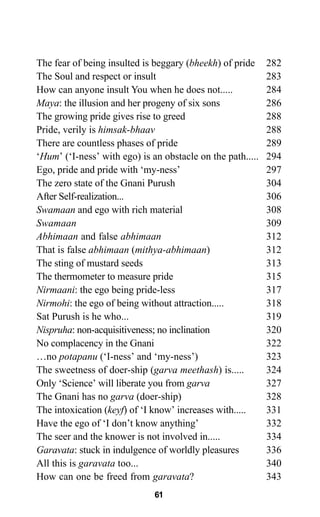
There are various phases of pride (maan): Pride with my-
ness (abhimaan), false arrogance (ghamand), hot temper
(tumakhi), head strong (tundmijaji), self-respect (swamaan),
false pride and false my-ness (mithyabhimaan).
When one says, ‘My name is Lalvo’, recognize that he is
only egotistic. There is only ego. (Lalvo is a nickname for Lallu.
Nicknames are typically used for peons.). When he says, ‘I am
Lallubhai’, means that there is also pride along with the ego
35
(with ‘bhai’ there is emphasis on the self – adding ‘bhai’ to a
name is similar to adding the title of ‘Mr.’). ‘I am Lallubhai the
lawyer, did you not recognize me?’ That is ego with rich
materials (ego of showing of his material wealth and
achievements); it is pride with my-ness (abhimaan.) When a
person claims ‘I can beat you’ but he has no strength to do so;
that is called ghamand. If a person does not have a drop of
knowledge nor any money and yet has a lot of arrogance, he is
called a tundmijaji. The one with tumakhi will insult and scorn
respected members of the community! A ghemraji is someone
who has no substance within and without, and yet puts everyone
down. He would say, ‘I can travel around the whole world’
when he is not capable of going even two miles.
Hum is different and ahamkar is different. ‘Hum…hum…I
am everything’ is different, and the ego (ahamkar) is different.
Ego can go away but the ‘Hum’ does not go away easily, it
arises where there is nothing. ‘Hum’ is different from ‘I am
something’!
Ego is the false imposition of the Self, saying ‘I am’ where
the ‘I’ is really not. The ego is present in everyone except in the
Gnani Purush.
Extension of ego is pride (maan). Pride associated with
my-ness (mamata) is abhimaan. To show off, ‘this is my
house…this is my car… is ego with my-ness (abhimaan).
Where there is abhimaan, there is no saiyam; meaning a
state without inner anger, pride, deceit or greed (kashayas);
there is only ignorance there.
The belief of ‘I am Chandulal’ is ego and ‘I am pure Soul’
is the egoless state. After Self-realization, the main ego, the
charging ego that charges new karma is gone but the results of
previous charging which is the discharge ego, still remains.
Absolute knowledge will arise when all the results of this
discharge ego are gone.
36
One must uphold the intention of ‘Let no living being be
hurt through this ego’. Yet, if someone gets hurt one should do
pratikraman for it and move on.
What is the difference between pride (maan) and self-
respect (swamaan)? Pride is ego with my-ness and self-respect
is pride with a boundary, pride for which one is qualified. Self-
respect is engaged in protection of this pride. In the worldly life,
self-respect is a virtue but the one who wants liberation will have
to let go of this self-respect also. To set up protection against
insult is self-respect.
An abhimaani person will exhibit all his possessions but
the person with false pride with my-ness (mithyabhimaani) will
boast ‘we have this and we have that’; when really he has
nothing.
Insult is the ‘thermometer’, i.e. a gauge to measure pride.
When insulted, if one gets affected, that verily shows the
existence of pride.
A nirmaani person i.e. one who claims or holds the belief
within of ‘I am without pride’ will have the ego of, ‘I am without
pride.’ This ego is very subtle. Such ego too will have to go if
he wants liberation.
The Gnani Purush is with and without inclination (spruha).
He is completely disinclined towards the non-self of others
(nispruha) and completely inclined (saspruha) towards the
Souls of others.
There is no unmattata (reaction of swelling with pride) in
the Gnani Purush. People swell with pride when they have
money in their pockets and in the Gnani, there is no such
reaction even when he is surrounded with luxury.
The Gnani Purush does not have any ‘I-ness’ (potapanu).
He is not the owner of the mind, speech or body at all.
37
The Gnani Purush has no ego of doer-ship (garva). ‘I am
doing this’ or ‘I have done that’ is all ego of doer-ship. There
is no doer-ship in the state of the real Self. Garva-ras is ‘juice’
of doer-ship; it is very sweet. The instant one feels ‘I did it’, he
tastes the sweetness of the ego of doer-ship. It is also, tasting
the ego of doer-ship if one maintains from within ‘It happened
because I was there’. In this world, there is nothing sweeter than
the taste of the ego of doer-ship.
How does the taste of the ego of doer-ship go away? It
goes away by knowing the science (Vignan). Which science? To
know, ‘Who is doing all this?’This science will make you know
that you are not the doer. After that the taste of the ego of doer-
ship of ‘I am doing’ is not there. The Gnani Purush does not
have ‘I did’ with any of his actions.
The intoxication of ‘I know’ is a terrible danger! That
disease will never go away without the Gnani’s help. It is more
dangerous than poison. If you want to have an ego, have the ego
of, ‘I don’t know anything.’
When people praise you and you are in an intoxicated
state for the whole day; that is called praise intoxication. And
garavata is, ‘I did such a great job!’ Doer-ship as in ‘I am the
doer’ creates the habit of further tasting the ego of doer-ship.
What should one do to not taste the ego of doer-ship?
Nothing is to be done. The awareness of, ‘I am the Self,’
separates one from, ‘I am the doer,’ and the taste of doer-ship.
The one who has acquired Self-realization simply needs to know
‘I am not the one tasting the ego of doer-ship’; he simply needs
to maintain that awareness.
There is no wallowing in worldly pleasures (garavata) in
the Gnani Purush. The garavata of human beings is like a
buffalo sitting in the comfort of cool wet mud on a hot summer
day. Nothing would make it budge. Similarly, those who are
38
engrossed in worldly pleasures such as success, achievements
and prosperity, or for that matter the knowledge of scriptures –
they are all in garavata and it will not let them come out of the
worldly life. They are stuck there and they make no spiritual
progress. Only the compassion of the Gnani Purush can bring
them out of it.
With explanation and later through Gnan (Self-Realization)
given by the Gnani Purush, one understands that there is no real
happiness in the worldly life and gets the conviction (pratiti) that
real happiness lies only in the Self. Once there is a firm decision
on his part, it will help get rid of garavata. Akram Vignan says
that the one who is experiencing garavata, is not the real Self.
Garavata gradually dissolves away with this awareness.
The Gnani Purush has no doer-ship (garva), no pleasure
indulgence (garavata), no inner or outer inclination (spruha),
no swelling with pride (unmattata), no ‘I-ness’ (potapanu).
Surrendering to such a One, who is in a magnificent state of
Gnan, a seeker’s (spiritual) losses of infinite past lives are
recouped in just one lifetime and he attains the guarantee of
liberation (moksha).
6. Laghutam : Gurutam
The state of the Gnani Purush is such, that in matters of
worldly interactions (vyavahar) he is laghutam i.e. he is the
smallest; the lowliest and in matters of the Soul, the real Self
(nischaya), he is gurutam, the highest. The Gnani Purush is
never the guru of anyone. He is not anyone’s superior and no
one is his superior, not even God. Even God is pleased with the
one who has no ego and ‘my-ness’.
The one who becomes the most ‘junior’in the world will
be the most ‘senior’ in the whole universe.
In mathematics, the smallest and the final indivisible
amount is the lowest common multiple. From this definition, in
39
His childhood, Dadashri discovered God; God is the smallest in
all living beings (laghutam) and common in all. Since that time,
his inclination towards becoming laghutam in worldly interactions
led him in becoming laghutam in the worldly life, while
simultaneously there manifested the state of absolute gurutam
as the Self.
Being laghutam (lowest; smallest) bestows one with
permanent security. The laghutam has no fear of falling.
In the world, everyone likes to be gurutam (biggest,
highest) not laghutam (the smallest; lowest). The one who tries
to become gurutam will wander around in the world of the four
life forms and the one who becomes the smallest will soon go
towards final liberation.
What does Akram Vignan say? It says for one to be the
smallest in the relative world and biggest in the real and neither
big nor small (aguru-laghu) in the Self-form! The one who is
the smallest in the relative world, by law, becomes the biggest
in the real! In that stage, God will embrace that person.
One should not become the world’s guru but should make
the world his guru. A guru without the ‘guru-key’ (gurukilli)
becomes very heavy. He will drown himself and will drown
those who follow him. The guru-key must be obtained from the
Gnani Purush. Guru-key means a constant awareness of ‘I am
a disciple of all disciples; I am the smallest.’
Everyone needs a guru that fits his or her level of spiritual
development. Kindergarten teachers, first standard or second
standard teachers, college teacher and the ultimate teacher is the
one who makes the whole world his teacher; the ultimate guru
is the one who makes the whole world his guru.
Until one’s intention of becoming the biggest in the world
is gone, unless ones inner belief of ‘I am something’ is gone, the
intention to be the smallest cannot take hold.
40
It is very difficult to achieve the status of the smallest. It
is achieved by the one who has a constant awareness about the
line of demarcation between the real and the relative with the
help of Gnani Purush. He who remains within the Agnas
(spiritual directives) of the Gnani Purush can attain the status of
the smallest; his vision is towards the state of laghutam and the
goal is of only that, so he will become that.
What is the characteristic of being the smallest? One
should know that he has become the smallest when if he is sitting
in the car and is asked to get out of the car, is called back to
sit in the car, asked to get out again; if this happens nine times
over and each time he is not affected, then that is the sign of
becoming laghutam.
‘To remain in the intent of becoming the smallest; to have
laghutam bhaav and to keep the vision of oneness (abheda
drashti) is the foundation of Akram Vignan.’
~Dadashri
The worldly life has been created from the ego of being
the biggest, and with the ego of becoming the smallest it comes
to an end.
The race in the race-course starts when one enters the
race to become number one. In the intent to come last, there is
no race.
While running the race to become number one, everyone
dies panting while the prize is awarded only to one.
Criticism (teeka) and competitiveness (spardha) are
some of the manifestation of the ego. Everyone is undergoing the
effects of their own karma, how can anyone be criticized? To
criticize means to ruin your own self.
The one with the ego of having skills and the know-how
will get exhausted in this worldly race. Instead, one can sit on
41
the side, enjoy and take it easy by saying, ‘I have no skills’. The
Gnani Purush clearly says ‘I don’t even know how to shave,
even at this age!’
The one with the ego of having skills doesn’t know that
his mistakes are buried under the nature’s ‘factor of safety’and
he believes, ‘I am so skillful.’
People will keep on doing work as long as there is the
ego of being skillful. What is to be done by those without skills?
The knowledge of skill has continued on the basis of ego. How
can the skill continue where there is no ego or where the ego has
ended?
The Gnani Purush repeatedly reiterates that He has no
skills but people do not believe it. People say ‘Dada knows
everything’. Then, He says, ‘I know about the Self. I know that
the ‘Soul’is the knower-seer. Whatever the ‘Soul’can ‘see’, ‘I’
can ‘see’. I do not know anything else.’
When the other person insists (khench), the Gnani lets go
slowly and leaves and moves ahead. If someone insists, and you
insist in return, it will hinder your progress. The other person
insists according to what he ‘sees’, therefore, where is he at
fault?
The one who wants to attain final liberation, the world will
call him crazy; the world will beat him up and throw him out.
Yet, he should accept defeat and sit down. The way of the
Gnanis is to win the world by letting others win! Therefore, in
this world, it is worth learning how to be defeated. Only then,
he can be free from this world. Otherwise, he who is trying to
win is considered as defeated. This research of the Gnani is
worth adopting.
Gnani Purush Himself has become abuddha (intellect-
free; without any use of intellect), whereas the world is trying to
become intelligent or making attempts to be called intelligent!
42
One can be an expert in one subject at the most. Instead
to be ‘ignorant in everything’ is best. When one becomes
ignorant in everything his life will run smoothly. Because you can
hire experts in everything; you can hire a lawyer, a doctor, an
accountant, a solicitor, even a manager to run the factory is
available for hire!
Once you say, ‘I don’t have any skills’; you are freed
from the race-course. Instead of others calling us unskilled, why
not say it ourselves and become free from this world?
What is the outcome of running in a horse race? Today
you may be first, but at some time or other you may also be last.
So you should refuse even if God were to tempt you to run in
a horse race!
Your personality will shine once you have moved away
from the horse race. Horse race (competitiveness) and personality
cannot exist side by side.
Once the short and sweet course of Akram Vignan is
completed, your debt of infinite lifetimes is paid off in one
lifetime. Then, there is fearlessness (nirbhayta), non-association
(asangata) and non-attachment (vitaragata).
7. Insistence (khench) : deceit (kapat) : point-man (the
one who leads you astray)
Akram Vignan is the science of Gnani Purush’s experiences
that is capable of solving all kinds of worldly or spiritual puzzles.
How should life be for the one who has attained Akram
Vignan? Life should be without any insistence. When you make
a true statement but no one accepts it, there should not be a
need to prove it. And if insistence arises, on account of the
effect of your baggage of previous karma, then by simply
‘seeing’ it, You will become free from it.
In the path of liberation, there is no law. Whatever
43
happens naturally is correct! No law-law! Otherwise, while
making a law, a whole mountain of laws will have to be created.
Where there is law, there is no naturalness. Liberation is for the
one who becomes natural (sahaj).
To start rivalry is like falling from your own position. If
you are true but hold on to the truth; that too is considered as
ego. The world’s truth is not the absolute truth; it is a relative
truth. Why should you hold on to it? The Gnani Purush is
completely without insistence.
Know that you are on the correct path if you become the
one without any separation due to differences of opinion
(matbhed); there should be no hold or insistence anywhere. He
who bends to any shape is called straightforward (sarad).
Of all the kashayas of anger, greed, pride, and deceit that
obstruct right knowledge and behavior, deceit (kapat) is the
toughest. This is because deceit has a sweet face and can’t be
seen. All kinds of accounts of karma are created due to deceit
(kapat). Deceit verily means that the owner (the one having
deceit) is unaware of its existence and its operation and for that
reason it is difficult to remove it.
To gain advantage in worldly life by pulling others towards
your opinion and taking them into your confidence is called
deceit (kapat). The person being deceitful does not know or is
not aware of his deceitfulness. The constant awareness of
‘Except for liberation, I don’t want anything at all,’ will make
deceit leave. Saying this five times every morning will let the
awareness arise to defeat deceit.
Due to deceit (kapat) that exists and to finish the game of
deceit, a person will win over others by employing craftiness
(chaturai). The one who understands what is good for him and
what is bad will not enter into this trap of craftiness.
By repeatedly and deeply keeping the intention ‘I want to
44
get rid of all my faults, I want to attain final liberation (moksha)
only,’ one can be free from deceit.
As long as any sweetness is experienced in worldly
interaction, the uninterrupted awareness as the Self cannot
prevail. Bitterness is not objectionable. With sweetness there will
be interruptions and dozing in the awareness of the Self.
Having met the Gnani Purush, one’s train for liberation is
on the main line to the final destination of liberation. But, if some
‘point-man’ comes across on the way, there is no guarantee of
staying on course. The whole track may change! The ‘point-
man’ talks in such a way, that you will not even know that the
track has been switched.
The seeker will realize that the track changed when the
Gnani Purush alerts him. Then, analyzing minutely, he will
recognize where the change started, what happened, who did it,
on what ground it happened and which intense insatiable greed
(lalacha) within led to this, and when easiness (nirakudata) left
and when did uneasiness (akudata) set in. All this has to be
known in the awareness (jagruti). The one whose worldly
interaction (vyavahar) becomes unsteady, will become shaky in
the Self (nischaya).
Progress is made when one is not swayed by anything that
has no relation with the goal of liberation. This prevents the
switching of the ‘tracks’, and ensures spiritual progress. Stick to
only the talk that liberates. Any talk that sways from this goal
and the right vision should not be allowed to enter the mind. The
Gnani is not so guileless (bhoda). He will not be distracted if
someone were to try to change the track.
Where there is deceit (kapat), there is guilelessness
(bhodpan). Believing anything negative about anyone to be true
is guilelessness. The remedy for this is to listen dramatically (to
pretend to listen earnestly while really listening only superficially),
45
not to object to it and to rely only upon the right vision.
Everyone will speak according to what they understand but you
should rely only on the right vision.
No matter what worldly obstructions may arise in the path
of liberation, Akram Vignan is such and its path is such that one
can surmount all of them. If one says, ‘it is difficult…it is
difficult,’ then it will become difficult for him.
‘Why should I care?’ is one statement that should not be
uttered by anyone. Saying this creates separation. Where ‘what
do I care, what is it to me?’ exists, one should do pratikraman
and turn it around. The one who says, ‘What do I care?’ has
become (nispruha), rejecting attitude. This is a grave danger for
the Self.
One has to ensure; be continuously aware that the path to
final liberation is not missed.
The path to final liberation is missed if one asks, ‘what
were they saying about me when I was gone?’ Let people say
whatever they want to about you. Such questions come up only
if one has deceit (kapat). To engage in such a practice is to hide
the Self.
It is considered a grave disease to eavesdrop in order to
catch something being said about you. The world will talk if you
are at fault, so why should there be any objection? If anyone
speaks negatively about you, let him, it is of benefit to You. You
need to remain strong. Even a small mistake in this matter can
create terrible problems. The deceit in you leads the mind to
secretly listen in on other people’s conversation.
If you happen to listen to what others are saying about
you, it will disrupt your sanity. The one talking might have said
it casually without much thought, but look how it ruins your mind
and sleep.
46
Some people say that they employ deceit and deception
out of fear, but fear of what? The one with the fault will have
fear, is that not so?
He who has the intense burning desire and craving for
liberation will not be touched by any hindrances in the path of
liberation.
‘I know’ is the biggest hindrance in the path of liberation!
It causes death of the Self. ‘I know’ brings on intoxication that
is very difficult to remove! The face of the one without the
intoxication of ‘I know’ is attractive. The rising of the belief of
‘I know’ after Gnan is tremendous lack of awareness.
If one attempts to solve problems with the attitude of ‘I
know’, it will only complicate matters further.
If sweetness prevails in ‘I know’, it will sprout. There, one
should erase it quickly, as soon as it sprouts, pluck it out.
Otherwise, this ailment will grow and it will ruin the awareness
of the Self.
All the danger signals in the path to liberation should be
known from the Gnani Purush. Then only, will the safe-side be
maintained. Otherwise, there is no telling where the ‘ship’ will
end up.
The law is: the one who wants to attain only liberation will
always find the correct path.
8. Awareness (jagruti) : Desire to be worshipped
(poojavani kaamna)
By matching our understanding with the Gnani’s
understanding, we walk parallel to Him. If we don’t, there is no
telling when the path to liberation will change direction. On the
path to final liberation, not a single degree of an individual’s own
understanding will work. One has been wandering around life
after life because he has not attained the right understanding.
47
The answer to a seeker’s question can only be given to
his satisfaction and full resolution, if the ego of the one answering
the questions is completely gone. Even the discharge ego has to
leave completely. The speech that accepts all viewpoints and
does not hurt anyone to the slightest extent will not come forth
as long as one tastes the sweet juice of doer-ship (garvaras).
Thus, there should not be any ego or intellect in the speech that
comes forth. People will not get any benefit if the ego of the one
trying to preach is not gone. It will feel good to the listener’s ear,
so he will praise the preacher but it will cause a terrible loss to
the preacher. The ego will take all the credit and divert him from
the path of liberation.
In the path of Akram Vignan the Gnani Purush shows the
‘red light’ (danger signal) to those who want to be preachers
(updeshak). Dadashri gives this ‘red signal’: ‘If as much as a
hair of ‘our’ knowledge is told to people, people will flock;
people have not seen such bliss, they have not heard anything
like this, therefore, they will flock here! But the ego that is sitting
inside will laugh.’ If you want to achieve completion (the
absolute state of the Soul), don’t show your immaturity by
answering when anyone asks questions.
The fire is covered under the ashes. As long as the
intellect has not been eradicated, as long as the ego has not been
eradicated, as long as worldly desires are not eradicated and as
long as there are thoughts of sexual pleasure (vishaya), there is
no predicting when that fire will ignite. Unless the kashayas and
vishaya that have been covered up are eradicated, preaching to
people is very dangerous and risky.
One will not be able to find his mistakes as long as one
is partial to his own self. Partiality towards the relative self will
keep one in illusion and perpetuate the illusion. When the force
of karma unfolds, one becomes absorbed in it, the awareness
(jagruti) is blocked and the application of knowledge (upayog)
is missed. There, the awareness will be regained if one remains
in the satsang of the Gnani Purush.
Awareness (jagruti) is a different matter and Gnan
(experiential knowledge as the Self), is a different matter. To
awaken from sleep is called awareness. In awareness, kashayas
are dormant but when kashayas are annihilated, it is called
Gnan, anubhav. As the awareness increases, pending karmas
do not remain and there occurs complete purity within.
As long as there is deceit for pride within, it will not allow
awareness to surface. Deceit means to hide and to cover up and
it always takes one on the wrong path. Deceit and ego that
supports anger, pride, illusion and greed will take you on the
wrong path.
When deceit in any form does not remain, when no
thoughts of passion for sensual pleasures remains, and when the
kashayas are eradicated, then the awareness that arises will
result in ‘knowledge’ (gnan).
When one moves away from the shelter of the Gnani
Purush, kashayas will invade with all their family members.
These kashayas will try by any means to make one leave the
shelter of the Gnani Purush. If a slightest of sweetness is tasted,
the kashayas get their nourishment. If the kashayas are not
given any food at all, they will come to extinction. But they
become strong if they are fed!
The status of Gnani is achieved when there comes a level
of awareness that not a single kashaya ever gets any feeding;
such awareness is needed. Kashayas can be won over only if
one is subservient (aadhin) to the Gnani and remains under His
shelter and never leaves it.
Unless the Gnani Purush certifies you, don’t even attempt
to preach. All the faults within you are ready and waiting to
attack at a moments notice. When all the kashayas are
48
eradicated, such a stage (of becoming certified) arrives by itself!
Awareness is the state where the ‘thief of kashaya’ is not
allowed to enter. In such awareness, one can see all his faults
and his ego. This ego is definitely there and it makes one taste
the sweet juice of doer-ship (garvaras). When someone says,
‘you did well’, he tastes the sweetness of doer-ship right away.
This will cause his fall later on! Gnan exists where there is no
difference between bitter or sweet.
In satsang, explanations to anyone’s questions should not
be given by anyone other than the Gnani Purush. Only simple
and natural talks are allowed, but the slightest weight given to
the relative self, will give rise to the poison that will kill the Self.
The kashayas that are lying dormant are eradicated by
the increasing awareness. The one in whom awareness has
taken hold, should take advantage of the awareness by doing
samayik and pratikraman, meaning introspective meditation and
repentance respectively, to annihilate the faults.
There is great fun in walking behind Dada as His child.
Dada will pick you up if you become Dada’s child whereas, if
your ego expresses like a grown up, then you have to walk by
your self and wander around aimlessly! Then after taking a
beating, you will turn around.
The intense greed and desire to be worshipped is a
terrible disease, it is suicidal; someone will bow to you and then
it will become a habit.
The Soul (Self) is already revered by all and one is trying
to get his body worshipped, which is going to become ashes one
day! Liberation is prevented because of this disease.
When one creates a path that is slightly independent from
the Gnani’s, he enters into a terrible maze. Once you have been
told that you should follow the Gnani, how can you afford to
49
have a diversion? How can you take such a risk? In the end, it
will cause a terrible fall!
Whatever comes across as hindrance in the path to
liberation should be quickly plucked and thrown out. Then only
can one stay focused on the goal. If the goal is set for liberation
but the intentions are impure, one will lose the goal. That which
makes one lose the goal is the enemy.
When one wants liberation, he has to become so strong
and make a decision that ‘come what may, whatever may
become of this body, let it be, but I will not forsake the path of
liberation. I want to accomplish my goal’, and for such a one the
work, the goal will be accomplished. Only this intent and a firm
decision have to be made.
After knowing from the Gnani Purush these dangerous
chasms that exist on the way to liberation, one has to be in a
constantly cautious state about them. It is worth being free from
the faults by expressing them directly to the Gnani and by turning
away from them. Do not attempt to gain any recognition or
worship in the path to liberation. The goal of salvation for the
world cannot be harbored with any intent or sense of doer-ship
and there is no place for ego in it. One has to walk in the path
of liberation without being recognized. One must not give up
Gnani Purush’s Satsang or the Gnani’s shelter all the way to the
final liberation.
One should not see the faults of the Gnani Purush; he
should not find mistakes in the Gnani Purush. If nine of the
Gnani’s statements are understood and one statement is not, that
one statement should be put aside and one should ‘wait and
watch’. It will be understood later.
9. ‘I-ness’ (potapanu) : The Supreme Soul (parmatma)
The Gnani Purush has oneness (abhedta) with the whole
world; he has no separation from anyone. Separation will be
50
there only if the Gnani Purush had buddhi (intellect)! He who is
without buddhi (intellect) has oneness with the universe.
Oneness increases the experience of Gnan and separation
scatters all the energies. When ‘I-ness’ is gone the separation is
gone and there is oneness with everyone.
This A. M. Patel has given up all His ‘I-ness’ and has
offered it to the Lord. Know that the one whose ‘I-ness’ is gone
has achieved oneness with God.
‘I-ness’ is completely gone from the Gnani Purush. He
behaves completely according to the circumstances and without
ego. Like a ‘bundle’, He goes everywhere He has to go! One
can remain in his natural state when ‘I-ness’ is gone. He does
not have any opinion of his own at all! Yet, His life’s interactions
are ideal. He remains ‘dramatic’ (superficial) all the time. One
can only remain dramatic if his ‘I-ness’ is gone.
It is ‘I-ness’ to protect the relative self. To protect the
relative self in a deceitful way is known as gaaddha potapanu
(severely deep rooted ‘I-ness’).
What is the test to check whether the ‘I-ness’ is gone? If
there is no change in the facial expression or within, even after
one is asked to get in and out of a car nine times over, then his
‘I-ness’ is gone. The knowledge of scientific circumstantial
evidence (vyavasthit) frees one from ‘I-ness’ (potapanu).
Except for the Gnani Purush, everyone has ‘I-ness’.
When the ‘I-ness’ is gone, one becomes God!
Once ‘I-ness’ is gone; it is gone forever.
After receiving Gnan, the ego that charges karma is gone
but the discharge ego still remains and that discharge ego is
known as ‘I-ness’. When the entire discharge ego is gone, one
is said to be free from potapanu.
51
‘I-ness’ is decreased in proportion to the level of
awareness. What kind of awareness is required to get rid of ‘I-
ness’? The awareness of, ‘This is ‘I’ (the real Self) and this is
not I’, a constant awareness of the Self, following the Agnas of
the Gnani Purush and seeing others as faultless and as non-
doers; all these are required.
No matter what the result is, saying ‘I am not this’ makes
one free.
Where ‘I-ness’ is gone; there is no ego of doer-ship, and
no wallowing in worldly pleasures (garavata).
To favor the side of the ego, to favor the side of
ignorance, to step away from the Self; is called ‘I-ness’
(potapanu).
Not to become absorbed (tanmayakar) in the scientific
circumstantial evidence is purusharth (Self oriented effort).
Pragnya, which is the force of the Soul, prevents this
absorption process in the unfolding scientific circumstantial
evidence of the non-self, whereas agnya i.e. the intellect will
make one get absorbed in the unfolding scientific circumstantial
evidence.
Everyone has ‘I-ness’ in the unfolding karma. After
attaining Gnan, as one employs purusharth in the unfolding
karma, the ‘I-ness’ decreases and gradually vanishes.
The one who can recognize and see the departure of ‘I-
ness’ in the Gnani Purush, is eternally blessed and graced.
With the departure of ‘I-ness’ (aapopu), one becomes
the supreme Self (parmatma). Thereafter, scientific circumstantial
evidence will take care of Him.
Jai Sat Chit Anand
™™™™™
52
Contents
[1] Obstinacy (aadayee) : Sulking (risavu) :
Manipulative tantrums (tragu)
The Gnani Purush’s words are worth understanding 1
Will you not have to become straight? 2
If you admit to be being obstinate, you will defeat the obstinacy. 3
Obstinacy: Common and Uncommon 4
Obstinacy in men and women 4
You have to see your own obstinacy 5
When obstinacy leaves… 6
Obstinacy is the only obstacle 7
Nature of obstinacy 8
Becoming straight through understanding 9
Necessities for progress along the path of moksha 10
Obstinacy during the early years of Ambalal Patel.... 13
The ego is the basis 16
Never say, ‘I cannot do it’ 17
The knowledge guides one’s conduct 18
Everyone’s obstinacy is different 18
Those obstinacies will end 19
Straight and yet there were subtle obstinacies 19
In those situations you should be alert 20
Only a Gnani can straighten him out 21
The Gnani is pleased with the one who becomes sarad 21
A Dramatic ego! 22
Obstinacy leaves by ‘knowing’ that it has occurred 23
It should not be so 25
‘You’ are not the obstinate ‘one’ 26
This Akram Vignan is like that 27
If you become upset and noncompliant, you will miss..... 28
Who is the loser? 30
53
Thereafter he never became upset and non-communicative 32
Only the ‘one’ who reacts sees the one who..... 33
The unique method of vitaragata (the state of non-attachment) 34
Vitarag and yet meddlesome 36
That is called tragu - manipulative tantrum 37
That is not a tragu - manipulative tantrum 38
Keep your distance from manipulative tantrum (tragu) 38
Consequences of a tragu 40
In opposing the one doing a tragu (manipulative tantrum) 40
That is shameless open blackmail (naagai) 43
Dealing with taipho 43
Tragu for salvation of the world 44
Tragu, is an art too 49
Vigilance with understanding 50
Tragu became a heavy liability for a lady 51
Ingrained in the prakruti 51
Beware of those doing tragu! 52
Adjustment to save yourself 54
[2] Udvega (emotional agitation) : Shanka (suspicion) :
Nondha (making a deep intense mental note)
Against emotional agitation: udvega 56
Where there is no expectation, there is no emotional agitation 57
Motion (Vega), emotion (Aavega) and emotional..... 58
Udvega - so many difficulties 60
Move away from that aspect of your relationship..... 62
Intellect is what brings on udvega 60
The ‘one’ who experiences udvega, is not the Self 64
The root of suspicion (shanka) 66
Suspicion is constant death 67
Suspicion and inquisitiveness 68
For devotees... 69
54
Keep a medicine for suspicions 70
It all depends on the sub-atomic particles (parmanus) 71
Does suspicion result in prejudice? 72
Solution for suspicion 73
Passing through every phase 76
The ‘one’ who is beyond worldly interactions, ‘settles’ it 77
Suspicion leads to destruction 77
The one who is suspicion-laden is a living dead 77
Why have suspicions where everything happens automatically? 78
Suspicion is harmful at all times 79
The dangers are grave 80
How much strain should you put on your eyes in the dark?81
For those going to moksha 83
‘Safe-side’ related marital conduct 84
What a betrayal this is 85
How can there be moha (attachment due to illusion)..... 86
Solution for situations of extreme suspicion 87
That is a dangerous disease 88
Effects of suspicions 88
Intellect ruins the worldly life 89
Suspicion, continued suspicion and destructive suspicion 90
The unawareness of moha (illusionary attachment) 92
Unconstructive criticism 92
Beware! Parents of daughters 93
Suspicion? No, take care of her 95
Free from kashayas on the path of moksha 96
Solution for suspicions 98
Vyavasthit eliminates suspicion 98
If you want to go to moksha... 100
It is your own weakness 102
Dada listens to suspicions through the magic of Gnan 102
No separation between him and us, even when reprimanding104
55
Instead of being suspicious... 106
Even if it is true do not harbor suspicion 107
Suspicion even after entrusting someone? 107
When you remember what you loaned 107
Suspicion and astrology 109
Nihshankta: total absence of suspicion 109
No one will have suspicions of this kind 111
Solution from the Gnani Purush 111
Then have suspicion all the way to the end 112
…otherwise do not harbor suspicions 114
Be cautious but not suspicious 114
Never have suspicions, even when knowing everything 115
The ‘doer’ and the ‘sayer’ are separate 116
Fearlessness is required there 117
Precaution is taken by the worldly self, not..... 119
From a seed to a jungle 121
A suspicion-laden mind is separate and ‘You’are separate 127
Purity through pratikraman 128
Suspicion that never goes away charges new karma 129
The non-Self was and is separate from the Self 130
Awareness of Gnan against suspicion 131
Opposing suspicion about the other person 133
The world remains suspicion less where suspicion is needed 134
Doubt over wrong knowledge 135
Doubt only over the ego 136
Suspicion-free about ‘I am Chandulal’ for.... 137
Suspicion-free in regards to the Soul 138
One cannot waste this precious human life this way 139
That is when suspicions and uncertainties go away 140
Who has suspicion about the Atma? 141
Pragnya (the direct light of the Self) is biased only..... 143
Nihshankta (suspicion-less-ness): Nirbhayta..... 144
56
This is what happens in the Gnan Vidhi 145
The Science of Separation through Akram 147
Then there is no liability 148
Suspicion does not depart through reading books 149
Knowing causes suspicion 150
After Gnan, there is no one left to suspect 153
Gnan shows its presence, where such a suspicion arises 154
Suspicion-free as to the purity of the Self 155
Where is the basis for suspicion? 157
Dealings are of the pudgal (the relative-Self) and..... 158
Where there is love, there is no nondha..... 159
Destroy mistakes scientifically 162
Making intense mental notes increases enmity 163
Vyavasthit eliminates intense mental notes 164
Being exact in worldly life will impede your liberation 165
Intense mental notes perpetuates the worldly life 166
Intense mental note taker is notYou: Do not agree with him 168
‘We’ are separate from the one making the note 169
Why keep a note of changing karmas? 170
The likes and dislikes make one take nondha 172
Authority to give opinion? 172
The authority of the non-Self reigns where there is nondha173
Intense mental notes and opinion 174
You need awareness, not an intense mental note 176
Where there is an intense mental note there is the sting 176
Absolute darshan of The Gnani 177
Along the path of the vitarag... 178
[3] Commonsense : Welding
Deficiency in commonsense 179
‘Everywhere applicable’ 179
57
The Yard stick of commonsense 181
Lack of practical understanding 182
Your worldly interactions are at their best when..... 182
Commonsense increases with a mixing nature..... 183
‘Singing’ in harmony is the key 184
Commonsense avoids conflicts 185
How to stop swachhand (to act according to one’s.....) 185
Straightness increases commonsense 186
Solution with commonsense 187
Selfishness prevents full commonsense 187
Insight (sooj) is a different thing altogether 188
Selflessness leads to full commonsense 189
Buddhi (intellect), Sooj (insight) and Pragnya..... 194
Only one key to open all the locks 195
Learn only this in the worldly life 196
Complaint? No just adjust! 196
Coming down to the level of others 197
This is how you attain oneness 198
Do not encourage negative talk by listening to others 198
‘Welding’: Settling disputes and reuniting 200
To the Welder... 201
Do not let your bhaav turn into abhaav 202
Insight of welding from the beginning 203
Welding is an art! 204
Happiness everywhere with welding 206
Gnani’s original talk 207
Everyone breaks but rare is the One who patches up 207
[4] Mamata (Attachment – my-ness) :
Lalacha (Covetousness)
Better to stay away from sticky wet mud 208
The Gnani is without any expectations 208
58
Not even a hint of mamata (attachment; ‘my-ness’) 209
Where there is no ‘my-ness’ there exists the supreme Self 210
The nature of mamata 211
The extent of mamata (my-ness) 212
The boundary of mamata (my-ness) 213
Mamata of the Insurance Agent 214
You can have mamata for this body only 215
Remove mamata through understanding 217
The rules in a museum 218
Saying, ‘mine’ makes it stick; saying ‘not mine’ makes it leave 221
Achieve everything even without mamata 223
Entrapment is the consequence of greed (lalacha) 223
Subtle observation of one’s own nature 224
Belief that creates mamata (my-ness) 224
The one with mamata is not the Self 225
Mamata (my-ness) such as the one in a drama 226
Enjoying without my-ness 227
He attains liberation 227
One loses all sense in intense inner greed (lalacha) 228
Gluttonous greed for pleasure makes one miss the.... 229
Which is harmful, lobh (greed) or lalacha..... 231
The craving for pleasure from every which way 235
Lalacha for sex, what a demeaning state 237
Conflicts because of it 239
From intense greed (lalacha) to helplessness and..... 241
The touch of a lalachu person will ruin samskar... 241
That is purusharth 241
Covetous people take on a liability 243
A covetous person is always seeking pleasure 243
Why has intense greed (lalacha) for this? 244
Swachhand (intense inner impediment of doing things..... 244
59
60
The tubers of intense greed (lalacha) 245
Such resolution can make you free from lalacha 246
Removing lalacha through the ego 247
That is when intense greed (lalacha) goes away 248
A person hurts others because of his intense greed (lalacha) 248
Make sure you do not abuse it in this way 249
Effect of bad company 250
Veils over lalacha are very heavy 250
The ultimate solution is to follow Agnas 251
Intense greed (lalacha) for wanting reverence 258
Live one life by surrendering to the Gnani 260
Life surrender to gnan 261
Your intention should be for the absolute state 262
It is not found in scriptures, it has not even been heard... 263
[5] Maan : Garva : Garavata
Maan without mamata: pride without ‘my-ness’ 265
The pride was a belief only in the mind 266
It was all for maan 268
Frightful heat of anger in reaction to obstruction of pride 270
The Ego before and after Gnan 270
Ego of a noble man 272
Craving for respect 274
‘Tasting’ respect releases one from having greed for it 275
The beggary for respect 276
Enjoy the respect people give you but... 277
Deceit in pride: Distortion of pride 278
Distortion of pride: Intoxication of ego 278
You should be indebted to the one insulting you 279
Love for insults 280
Education and wisdom 281
Pratikraman for the attack 281
The fear of being insulted is beggary (bheekh) of pride 282
The Soul and respect or insult 283
How can anyone insult You when he does not..... 284
Maya: the illusion and her progeny of six sons 286
The growing pride gives rise to greed 288
Pride, verily is himsak-bhaav 288
There are countless phases of pride 289
‘Hum’ (‘I-ness’ with ego) is an obstacle on the path..... 294
Ego, pride and pride with ‘my-ness’ 297
The zero state of the Gnani Purush 304
After Self-realization... 306
Swamaan and ego with rich material 308
Swamaan 309
Abhimaan and false abhimaan 312
That is false abhimaan (mithya-abhimaan) 312
The sting of mustard seeds 313
The thermometer to measure pride 315
Nirmaani: the ego being pride-less 317
Nirmohi: the ego of being without attraction..... 318
Sat Purush is he who... 319
Nispruha: non-acquisitiveness; no inclination 320
No complacency in the Gnani 322
…no potapanu (‘I-ness’ and ‘my-ness’) 323
The sweetness of doer-ship (garva meethash) is..... 324
Only ‘Science’ will liberate you from garva 327
The Gnani has no garva (doer-ship) 328
The intoxication (keyf) of ‘I know’ increases with..... 331
Have the ego of ‘I don’t know anything’ 332
The seer and the knower is not involved in..... 334
Garavata: stuck in indulgence of worldly pleasures 336
All this is garavata too... 340
How can one be freed from garavata? 343
61
Attain Liberation with help of the Gnani 346
[6] Laghutam (lightest): Gurutam (heaviest)
The state of the Gnani is laghutam and gurutam 348
Laghutam must be your intent 349
God is very pleased with the one without mamata 350
Junior of the junior 351
LCM: Lowest common factor is God 352
Only the laghutam state has value 352
Laghuta takes you towards guruta 353
Instead of being helpless in all respects…become laghutam 354
Consequences of guruta 355
Laghutam in the world leads to the ultimate..... 358
Undertake the yoga of laghutam 360
The world’s guru? No the world is the guru 361
What is a gurukilli? 362
‘Exactness’ through laghutam 363
The world’s disciple is the world’s superior (upari) 364
The precise manner in which Akram Vignan arose 365
Know the State of the Gnani 366
One’s conduct should be of laghutam intent 367
Line of Demarcation 368
The intent of Laghutam makes one follow..... 370
Where there is total laghutam, there is the state of the absolute372
The goal of becoming laghutam 373
The Grandeur of the state of Laghutam 374
To attain the Self is verily the gurutam 375
Test examination of the laghutam 375
The Foundation of Akram Science 376
Liberation with the laghutam ego 377
There is no racecourse in laghutam 377
62
The racecourses of the worldly life and..... 378
Criticism ruins everything for the one who criticizes 379
The escape from the racecourse 380
The misuse of intellect in daily life 381
The zero ego state of The Gnani 383
Win in this world by losing 385
You are correct by your viewpoint 386
Find the ways to lose in life 388
Expert in One, but in everything else... 389
The racecourse of life 391
The prize goes to the winner, the rest die panting 394
There is no winner when there is jealousy 396
Let others win 397
The Course of Akram Vignan 398
[7] Insistence (khench) : deceit (kapat) :
‘point-man’ (the one who leads you astray)
The Science of Akram Vignan unravels all entanglements 400
When one is insistent, the Gnani becomes silent 400
There should be no insistence for that 404
Bring a closure by becoming straight (sarad) 406
The ego after Gnan is lifeless and the prakruti dissipates 406
Deceit (kapat) and craftiness (chaturai) 407
‘Point-man’ on the path of liberation 417
‘What do I care?’ (‘Maarey shoo?’) 426
The deception that deludes and throws one off the..... 430
The belief of ‘I know’ is spiritual suicide 435
[8] Awareness (Jagruti) : The desire to be worshipped
Do not rush to answer questions about Gnan 443
On the path of full enlightenment... 444
Upsham - it is nothing but a smoldering fire 445
63
Partiality towards the self veils the reign of the Self 447
That is when awareness leads to the experience of Gnan 449
Starve the kashayas for three years 450
Certification for doing Satsang 452
The sweetness of doer-ship (garvaras) makes one fall 452
Grace and awareness are different 454
Subtle change of ownership when talking..... 455
Become a child of The Gnani 456
Hold the silence to attain the ultimate state of liberation 458
The intense greed and craving to be worshipped 459
Danger zones in the path of moksha 461
To move on inconspicuously 464
Subservience to the Gnani Purush 465
Behold the compassion of the Gnani 466
[9] I-ness (potapanu) : Supreme Soul (Parmatma)
Oneness with the entire universe 469
I-ness (potapanu) 470
The Gnani does not have ‘I-ness’ 471
Naturalness is attained synchronously as the last..... 473
Drama begins when ‘I-ness’ decreases 474
Still the ‘I-ness’ remains 475
The authority is gone, the ‘I-ness’ remains 476
I, the lawyer, Mangaddas 478
Protection of the prakruti is the potapanu 479
Aggression is intense potapanu 480
The ‘seer’ does not have ‘I-ness’ 482
The Test of ‘I-ness’ 483
That is when ‘I-ness’ will go away 485
‘I-ness’ in the things one likes 489
Purusharth should begin with the right intent 487
64
65
‘I-ness’ melts as karmas are cleared 489
Discharge ego is ‘I-ness’ 490
Relationship between karma, ‘I-ness’ and awareness 491
The Exact Awareness of Separation 492
‘I-ness’ melts away with real experience 496
All this is also ‘I-ness’ 497
Purusharth is needed in whatever is unfolding in front of you 497
There lies the strength of Pragnya - the direct light of..... 498
This is how the experience as the Self grows 499
Specific details of ‘seeing and knowing’ 500
The attainment in Akram Vignan 502
The one whose prakruti has become upsham..... 503
The grave danger of leaving the Gnani Purush 503
Speech without ownership is the sign of the Gnani 504
Only understand this Vignan, you need not do anything else 505
Only the one who understands this will attain 505
One whose ‘I-ness’ is gone becomes Parmatma 506
™ ™ ™ ™ ™
Note to the reader
The words ‘You’or ‘Self’when they begin with an initial
capital ‘Y’or ‘S’respectively, refers to the Soul or the real Self
or the Atma. Otherwise, they are used for the non-self, also
referred to as the relative-self, ‘Chandulal’ or the prakruti.
Whenever Dadashri uses the name ‘Chandulal’ or the name
of the person Dadashri is addressing, the reader should insert his
or her name for exact understanding.
Whenever Dadashri uses the term ‘we’, he is referring to
the Gnani Purush and ‘Dada Bhagwan’ who is the fully enlightened
Lord within him.
The words Self and Soul are interchangeable. The Soul is
one’s real Self.
™™™™™
66
208 Aptavani-9
[4]
Mamata (Attachment – my-ness) : Lalacha
(Covetousness)
Better to stay away from sticky wet mud
Everyone is a guest in this ‘home’; the world. One is a
guest as long as he stays and then one day he will leave. Have
you not seen them leave? Those with attachment (mamata) and
those without attachment eventually leave, do they not?
Therefore, do not waste even a minute. Why would you
want to waste even a minute of the five or fifty years you are
going to stay? You will pick up ‘stains’ (bind karma). The
clothes (body) will remain here and the stain (karma) will stick
to you and go with you to the next life. So why would you allow
yourself to pick up any stain? Now (after Gnan) you do not pick
up stain everywhere. All you have to do is to be careful while
walking close to ‘sticky wet mud’ (grave circumstances or
incidents that pull you away from Gnan). We are not concerned
about all the ‘flying dust’ (trivial incidents) that dust will fall off
on its own but the mud will stick to you. You can easily shake
the dust off your clothes but you cannot remove the mud so
easily and it will stain your cloth. Therefore, stay away from wet
sticky mud.
The Gnani is without any expectations
Absolute purity (shuddhata) is rare in this world because
the lives of agnanis (worldly people) are relative and are filled
with expectations (sapeksha). Even the lives of the Gnanis of
the Kramic path (traditional religious path) are filled with
Aptavani-9 209
expectations. The Lord has made ‘us’ the only exception. He
has made ‘us’ ‘the one with a life free from all expectations
(nirpeksha)’. There is complete purity here. There are no stains
of any kind here.
Not even a hint of mamata
(attachment; ‘my-ness’)
People of this world cannot be free from expectations;
there is always some expectation. This Gnani is without any
expectation (nirpeksha). He has no attachments (mamata or
mamatva) such as ‘this is my body, my mind, my chit, this is
mine or that is mine’. He has no such attachments (mamata)
and that is why this is a wonderful Vignan.
‘We’ had gone to Surat. There ‘we’ met an ascetic who
was a great renunciant. He practiced renunciation with strict
discipline. Many people would come to do his darshan; that
was the kind of man he was. He told everyone, ‘Come look!
Look! Who is this Dada? If ever I have seen a man completely
free of all attachment (mamata), He is the one. He is completely
free from expectations. I have met some two hundred or so
saints and very religious men but I have not seen a single saint
who is without any expectations. Everyone I met had at least
some expectation or the other, whereas this Dada is the only
man without any expectation that I have seen in my life.’‘We’
understood that this ascetic was truly blessed that he could see
this and he knew how to test this criteria in the spiritual path.
I can say this because I knew that there was absolutely no
attachment (mamatva; ‘my-ness’) in me; I did not have such
attachment from a very young age. Therefore, there is no one
in this world without any mamata. Without attachment
(mamata) means a person without ego. You do not have to
look for ego where there is no attachment. A person without
mamata means a person without ego. You don’t have to look
for ego there.
210 Aptavani-9
So what is a Gnani Purush like? He is without any
attachment and He is ego-less. He lives the way nature keeps
him. He does not have any ‘I-ness’ (potapanu).
Where there is no ‘my-ness’ there exists the
supreme Self
Where one has any selfish interest, where there is even a
trace of my-ness (mamata), there cannot be any salvation. God
manifests where there is no my-ness. Ego exists only due to
attachment (this is mine; mamata).
Questioner: Is it possible that mamata gives rise to the
ego, which in turn gives rise to raag (attachment)?
Dadashri: No, it is mamata which gives rise to
everything. Why does the ‘I’ exist? It exists because of ‘my’.
Otherwise, the ‘I’ is the absolute Self (parmatma). ‘My’ means
mamata. Once there is a separation between the ‘I’ and the
‘my’, then what is left? The ‘I’ and that ‘I’ verily is the pure
Soul.
Questioner: Would everyone become a Gnani if they
became free from mamata?
Dadashri: Yes. A person will become a Gnani if he
becomes free of mamata. All those who became tirthankaras,
they were all free from mamata. Mamata can never exist
there.
Questioner: What gives rise to this ‘my-ness’
(mamatva)?
Dadashri: It arises out of greed (lalacha); greed of any
kind.
Questioner: Is it because of what had been done in the
past life?
Dadashri: It is only because you have come into this
Gnan that you are able to understand that everything one
Aptavani-9 211
experiences is due to his actions of the past life. But other
people will not understand this. This is all due to their lalacha
(greed). Their greed is very obvious and visible and wherever
there is greed, mamata is bound to be there without fail. ‘We’
had lot of pride (maan) but ‘we’ did not have any mamata
at all.
Questioner: So does the ego exist because of greed
(lalacha) and my-ness (mamata)?
Dadashri: ‘I’ exists because of ‘my’. Otherwise, the ‘I’
part is the pure Soul if you get rid of the ‘my’ part. The ego will
exist as long as ‘my’ is associated with the ‘I’. He whose ‘my’
is gone, loses his ego and becomes the supreme Soul
(parmatma)! This is as clear as daylight!
The nature of mamata
That in which ‘my-ness’, enters; that wherein one projects
the self, is what we call mamata. For example, when you say,
‘this teacup is mine’, you give ‘my-ness’ to it and so what
happens when it breaks? There is problem even when your
teacup breaks! In fact, if I tell this child to throw away this
teacup, he will shrug his shoulders and say, ‘How can I throw
it away?’ Can you not understand the mamata in this? Why
does he shrug his shoulders right away? Then if you tell him,
‘throw out Dadaji’s shoes’he will say, ‘I cannot do that.’Look
how particular those who have understanding can be, it is only
because of the ego that everything has gone wrong. The ego of
‘Hum, hum, hum! Hum means ‘I’.
Questioner: Does the ego dissolve through Gnan?
Dadashri: Ego means ignorance. And Gnan means
absence of ego; an egoless state. So there is no ego that
cannot be dissolved through Gnan. Gnan is the egoless state
and ignorance is a state with ego; there are only these two
states.
212 Aptavani-9
The extent of mamata (my-ness)
The world keeps nurturing and watering the plant of
mamata. One keeps nurturing it by projecting, ‘This is
mine’…‘this is mine.’ If you ask them what is not theirs, they will
tell you ‘this is not ours. This is my brother’s’Then a few years
later they tell you, ‘My brother has taken away some of our
things’, and then they will go to court. Then they die and their
children will fight complaining about the same thing. Now will
you not call such a person ‘a sack of misguided intellect’? If he
tries to sell this ‘sack of intellect’, no one will pay even a dime
for it, will they?
Their mamata; their ‘my-ness’ goes even as far as, ‘This
country of India, is ours.’ Then what do they claim about the
state of Gujarat? They will say, ‘Gujarat is ours.’And in Gujarat
some will say, ‘Our district of Charotar is very good.’ One
becomes the owner of entire Charotar! Then in Charotar, a
person from the town of Anand will say, ‘We the people of
Anand are like this’ and a person from the town of Bhadran will
say, ‘Our Bhadran people are like this.’ He becomes the owner
of the whole village. Then people from two different streets from
the same village will argue, ‘Our street is better than yours.’
Then two families from the same street argue about their
families. This goes down all the way to two brothers arguing
about who is better. So it is the same everywhere and people
try to protect their little ownerships. They try to protect (own)
the whole country, and the whole state of Gujarat. What is the
point of spreading ownership all throughout India? One has not
done anything for his own salvation and yet he is busy claiming
and spreading ownership all around.
Now who creates this drashtibhed (a vision of division)?
The intellect (buddhi) creates it. It will be so divisive that it will
make one say, ‘I have nothing to do with those other people.’
‘This is our home, this is ours and that is ours. We do not have
anything to do with anyone else,’ this is how divisive it is; these
Aptavani-9 213
are the kind of divisiveness it creates. If you were to ask
someone, ‘Since you claim this is your home; then you must not
have any separation due to differences in your home.’ He will
tell you, ‘No there is no matbhed (separation due to differences)
in our home.’ But what do they do when they fight with each
other in the home? Do two people not fight with each other in
the home?
Questioner: Yes they do.
Dadashri: What do they do at that time? Will they not
say, ‘You are like this’, and she will say, ‘You are like that.’
Where do these differences end up? It all comes down to,
‘From now on, I am all alone. No one is mine. No one else is
mine.’ This same old divisive vision of ‘yours and mine, yours
and mine’ continues over and over again.
The boundary of mamata (my-ness)
One man tells me, ‘I cannot get rid of my mamata.’ I told
him, ‘How can you get rid of it? As far as you know, whatever
falls within the boundary of your property is yours, is that
correct? Or do you claim you own things beyond that
boundary? You are able to define certain boundaries, are you
not? So can you show me the boundary of mamata? What is
the boundary of mamata? Other people too can show you the
boundary of your house but do you not need to define the
boundary of mamata as well?
People have not seen the boundary of mamata. Everything
looks good with a boundary. Do you look beyond the
boundaries of your home and say that the house next door is
also yours?
Questioner: No.
Dadashri: Does the house not have a boundary too? You
don’t claim the neighbor’s house as yours do you? So, what I
am saying is let mamata be but it should be within a boundary.
214 Aptavani-9
So what should be the boundary of mamata? Your boundary is:
whatever you have mamata for will come with you when you
die; that is the boundary of mamata. So what does the
boundary of mamata mean? It means that as long as you are
living, it will remain yours and not after you die. The Lord has
said to have mamata towards your finger; according to the
Lord you may say, ‘this is ‘my’finger’, but He has said that we
should not have mamata for the ring on the finger. Why,
because the ring will be taken away; it will be left behind. Will
they not take away the ring? And sometimes if the ring does not
come out, they will even break the finger in order to take it out!
So do not have mamata there.
So that which no longer exists after one leaves this world
is the limit for one’s mamata. Mamata beyond this boundary
should be removed. So what kind of mamata should go away?
The mamata, (my-ness) towards your one and only son
should go away and similarly any other such mamata
elsewhere should also go away. This is not just mere talk.
Elsewhere people can multiply the non-truth with non-truth and
still pass the exam. But one cannot pass the examination of the
Gnani. Here one cannot get by with just idle talks. With the
Gnani you need ‘exactness’.
Mamata of the Insurance Agent
If a ship is sinking and the insurance agent is watching, will
it have an effect on him? If the ship ends up sinking, will he not
have to pay money?
Questioner: Yes, he has to pay.
Dadashri: But will he be affected by it personally?
Questioner: He will not be affected personally.
Dadashri: Why is that? So if something belonging to a
business is lost, who will worry about it? Everyone claims, ‘this
is our’, but do they have any mamata?
Aptavani-9 215
So there should be two kinds of mamata. You should
have full mamata over your body. And mamata that has
spread towards external things should be like this mamata.
‘This house is mine, this watch is mine, this ring is mine,’
all this is extended mamata. But really, they will remove all your
jewelry and everything else when you leave (die).
There should be a boundary (limitations) for mamata.
Should there not be a boundary for everything? So should there
not be a boundary for mamata too?
Questioner: So does that mean one should not have
raag-dwesh towards things of extended mamata?
Dadashri: You should be like the insurance agent who
does not become affected by any losses.
You can have mamata for this body only
So have mamata for only those things that will come with
you. Otherwise, is there anything that will no longer be there
after one leaves? ‘This leg is mine, this arm is mine, this nose is
mine, ear is mine, this eye is mine, this finger is mine, all the
thirty-two teeth are mine…’- there are many such things in the
body. This much mamata is more than enough. Then there is no
interference. There is no need for external and extended
mamata. People have mistakenly created the extended mamata.
It has come about because of a lack of understanding.
Otherwise, mamata should not be extended externally.
Questioner: Does that mean mamata should be for only
the body?
Dadashri: Only for this body and you should have full
mamata for it. You should give it food and drink; there is great
happiness in such mamata. But people do not enjoy that
happiness and instead they take pleasure of, ‘This house is
mine…that is mine…this is my wife, etc.’ No body is going to
be yours! Whatever you believe to be ‘yours’, will not come
216 Aptavani-9
with you. ‘You’ are permanent. Temporary things will not suit
you.
Ultimately when even your own body is not going to be
yours, then how can the wife be yours? Is the wife going to be
yours? What if you keep having mamata towards the wife and
one day she divorces you? There is no such problem with this
body, is there?
Questioner: But what is there in this body that merits
having unnecessary mamata?
Dadashri: Then what on the outside is worth having
more mamata for? So there is nothing that is yours. Whatever
is yours, will come with you; that is the principle. And anything
that is not yours is not going to. So is it not meaningless to have
mamata for anything that is not yours?
Questioner: But how much mamata can there be
towards the body?
Dadashri: There are many things in the body. There are
thirty-two teeth and a tongue that work the whole day but does
not get crushed between the teeth. So it is more than enough if
you increase this much mamata towards the body.
Questioner: What is the benefit in keeping this much
mamata?
Dadashri: When you keep this much mamata for the
body, there is an adjustment for the body. There is arrangement
for everything the body needs. Everything is orderly. What the
eyes need, what the ears need, what the stomach needs,
everything will get what is needed.
Questioner: What if the mamata gets focused exclusively
on the body?
Dadashri: When that happens, just relax and go to sleep
peacefully! But people do not even sleep peacefully.
Aptavani-9 217
Questioner: But people’s mamata is spread out is it
not?
Dadashri: But at whose expense are they extending it?
Everyone has desires, do they not? How much land does a
farmer desire? And there is a limit on the amount of available
land, is there not? People’s desire for land is endless. One
person will say, ‘I want five-hundred acres.’Another will say, ‘I
want one hundred acres,’ and a third person will say, ‘I want
hundred acres.’ How can this be possible? People suffer
miserably in the process but achieve nothing.
Remove mamata through understanding
One man had a beautiful bungalow. He started to cry
when talks about selling it came up. He said, ‘Do not sell this
bungalow, no matter what.’He had to sell it anyway because of
financial problems. After the transfer of papers, the bungalow
burnt down. Someone asked him, ‘Hey did your bungalow burn
down?’ He replied, ‘What do I have to do with it?’ The young
man replied, ‘But that was your bungalow!’ so the older man
says, ‘But I had sold it.’ Now it was such a wonderful bungalow
when he lived in it, so why did his mamata towards it go away
a day later?
Questioner: Because he sold it.
Dadashri: But how can his mamata go away?
Questioner: His mamata went away because he let go
of it.
Dadashri: He did not let go of it but he was forced to
let go, was he not? On the contrary, when the bungalow burnt
down, he was relieved. So, did his ‘my-ness’ not go away on
the same day when he sold his property? And what did he get
in return? Papers? Will one’s ‘my-ness’ go away with papers?
Yes it will; did you not see that? And will papers go away or
not? Yes, they will too. So if a mere paper can remove the
218 Aptavani-9
feelings of ‘my-ness’, then what is wrong in you removing it by
way of understanding? And can it not be removed through
understanding? Then one would not cry even if his home were
to burn down, would he?
Questioner: But if the court rules that the transfer of
papers was invalid, then he will start crying again.
Dadashri: Yes, he will start crying again.
Questioner: So why did his mamata not go away till
today?
Dadashri: It will not until he finds a way to do so. And
eventually what does the bungalow of a half million say? It says,
‘Hey! Nagindas sheth, either you will have to leave me or I will
have to leave you.’ So Nagindas sheth says, ‘Where are you
going to go?’ And the bungalow says, ‘I will have to go when
you file bankruptcy. Or else, you are going to go away anyway
(die) and I will remain standing here.’ Now when the bungalow
says this, would one not feel ashamed?
So, people have needlessly extended their mamata. Why
do houses and bungalows not extend their mamata by claiming,
‘only this owner is mine?’ and yet man extends his mamata
towards the whole world.
Questioner: But in the eyes of the world, a man is
considered big if his mamata is well extended.
Dadashri: Yes, he is considered big, but he is just as
miserable. People have needlessly extended their mamata.
The rules in a museum
What causes one to have mamata? It is caused by the
tendency to be worldly (sansari swabhav). This tendency to be
worldly is binding. This binding, the feeling of ‘my-ness’ is
mamata. For that matter has the intellect (buddhi) done
anything less? The world has been made wonderful through the
Aptavani-9 219
intellect and I am telling you not to get trapped; not to become
attached to it. You may eat, drink and enjoy but do not get
trapped and yet people get attached. Do not get attached. Enjoy
it and go to sleep!
What is this world? It is the largest museum! It is a
museum just like the one we have in Baroda. What are the rules
when you enter a museum with your ticket? The conditions are
‘Go in, take your time and observe; and enjoy as much and for
as long as you want to. Eat and drink as much as you want to,
if and when you want. You can enjoy doing all that in the
museum. But you cannot take anything with you when you leave.
If you do, you will be guilty and incur a liability.’ Then why
would you want to mess with anything once you enter in? Just
enjoy the different collections in the museum. You cannot take
anything with you when you leave. This world is a museum that
you have entered. There is a problem only if you touch things or
try to take things out of it. Then one will say, ‘Sir, the problem
is only when I carry it out physically, is it not?’No, the law says,
you cannot carry it out even in your mind and not with your
speech either. Do not take anything out. Yet, you are free to
enjoy it all. Is there anything wrong with this law?
Questioner: That is true.
Dadashri: Now is it not possible to leave the world in
this same way? But people keep taking things, some even put
things in their pockets and walk out but then they get caught
there, in the next life. And people take many things in their mind,
‘Ah! There is no one like the girl I saw,’ and she will say, ‘I
have never seen anyone like him in my entire life.’ Hey, you!!
What are you going to do with them now?
Questioner: But this ‘museum’ is such that it gives rise to
all kinds of covetousness (lalacha).
Dadashri: Museums are always like that. But when the
law is such that you cannot take anything with you, then what?
220 Aptavani-9
Do you have a custom of taking things away with you in your
town?
Questioner: No.
Dadashri: Then why do you fret and worry in this way?
Simply ‘see’ and ‘know’ (joovo ane jaano)! When the
Alphanso mango arrives, enjoy it at leisure. Enjoy them. There
is no problem. Turn on the fan, turn on the air conditioner, sit
peacefully and enjoy your mangos. But you cannot take them
with you and you must not worry about anything. So the whole
world is a museum where you can eat, drink and enjoy. People
do not know how to enjoy. They eat as if there is a dagger
hanging over their head (under stress). Darn your eating! The
heck with it all! If you are afraid of the dagger, before you sit
down to eat, tell the dagger, ‘fall whenever you want to. I am
sitting here to eat.’ Such is the state of everyone; they sit to
dine with the weight of a dagger hanging overhead. And you
can see it on their faces. Do you not see their castor-oil-
ingested faces?
Questioner: Yes.
Dadashri: So eat and drink whatever you like. Enjoy
your comforts. Women are not the problem, either. Do not get
married if possible, but if you do, keep it as a worldly relation;
understand that it is a temporary state. Do not get married
thinking and believing she is yours forever. People marry as if the
relationship is going to last forever. Do they not?
Questioner: Yes they do!
Dadashri: Now, You (mahatma, the one who has taken
Gnan) get married and so do others. Others say ‘my wife, my
wife, my wife…’whereas You understand that You are settling
the account of that file (of the wife) with equanimity, because
You have taken the Gnan. But are you able to take anything with
you even though you have claimed it as yours by saying,
‘mine…mine?’ Has anyone been able to do so?
Aptavani-9 221
Questioner: No, no one has so far.
Dadashri: So if there is no allowance and agreement of
taking anything with you, then why this unnecessary hassle? So
do not take anything from this ‘museum of the world’ even if you
like it a lot. If you do, you will have to suffer the consequences.
But instead people put things in their pockets and they try to
sneak out from the other side. Then they have to face the
consequences of their actions when they are caught in their next
life. So do not take anything; enjoy everything but do not make
it ‘mine’. Can you say ‘this is mine’ to anything in the museum?
What do you think?
Questioner: That is true.
Dadashri: Wherever there is quarrel, there verily is my-
ness within (mamata). There is no quarrel with anyone on the
outside. Then he will say, ‘my wife is no good.’You fool, why
do you say, ‘my’? He still does not let go of his ‘my-ness’. He
would not let go of that, would he?
Questioner: These words ‘my’ and ‘no-good’ are
being used at the same time; such a thought never occurs to
anyone!
Dadashri: Yes, he will even say, ‘my wife is no good.
She is worth divorcing.’ Spoken words have an effect. Every
spoken word will have an effect. The effect of, ‘She is not mine’
remains and the effect of ‘she is mine,’ remains.
Saying, ‘mine’ makes it stick; saying ‘not
mine’ makes it leave
A friend of ours was married for ten years and then his
wife died leaving behind three young children. He used to cry
and so I had gone to console him, as did many others. I asked
him, ‘Why are you crying? What is the point of it now?’ he told
me, ‘But what about these three children? I am lost without her.’
I asked him, ‘but what will you do? Is she going to come back?’
222 Aptavani-9
he replied, ‘But I do not like it without her, what should I do
about that?’I told him, ‘You do not like being without your wife
now but what if the two of you had met on a train eleven years
ago? You would have shoved past her. You married her ten
years ago but is it possible that even ten days prior to your
marriage, you would have ignored her? Is that possible or not?’
he said, ‘But I did not know her then, did I?’I told him, ‘Would
you not have insisted that she vacate your reserved seat on the
train had you met her prior to your marriage?’ He asked me
what my point was. I told him that when he sat across from her
under their wedding canopy and looked at her; that was when
he twisted the first knot of ‘my-ness’ with her. The knot of
mamata with her was tied by saying ‘this is my wife’ and she
did the same by saying ‘this is my husband’. I told him, ‘neither
of you had the mamata prior to your wedding day. From the
time you got married, up until now, you have continuously
twisted and tightened the knots of attachment of ‘my, my,
my…’ This created a mental effect; it has created a
psychological effect. You will create a psychological effect
even by saying it just once, whereas this is an effect of ten
years worth.’ He replied, ‘Yes I do agree that a psychological
effect has taken over me. How can I get rid of it now?’ I told
him, ‘Now keep saying, ‘not mine…not mine…not mine…’
and thus unwind the knots exactly the way you had wound
them! This is the only solution.’
In reality there is no bondage. It is merely a psychological
effect that takes place; then when the wife dies leaving three
children behind, the poor man cries. He became happy after I
explained things to him this way. As such there is no relation. It
is all because one believes ‘she is my wife…she is mine…mine’
that the attachment and my-ness (mamata) takes hold. And this
effect will go away simply by saying, ‘she is not mine, not
mine….’ This ‘we’ guarantee you!
Anything that you get attached to by saying ‘my or mine,’
Aptavani-9 223
can be removed by saying ‘Not mine, not mine.’ And if you
want to get attached again, then instead of saying ‘not mine’, say
‘mine’and you will get attached. Do you understand that? You
do not need any glue for this; it will stick without glue!
Achieve everything even without mamata
This is just a ghost of mamata (my-ness) that has
possessed you. It will go away if I remove it for you. Mamata
is the demon witch and I am the exorcist for it. So if you move
around in this world without mamata, you will get a lot of
respect. But no one lets go of his or her my-ness. I ask people,
‘what do you want?’ What do you crave for?’ and they say, ‘I
have a craving for respect (maan).’ What else? Then they will
say, ‘Something to eat and drink.’So then let go of this my-ness
(mamata) and you will get whatever you need. But people tell
me, ‘If I let go, I will lose whatever I do have.’ And so they will
not let go.
Entrapment is the consequence of greed
(lalacha)
Greed (lalacha) makes a monkey force his hand through
the narrow opening of a pot, thinking ‘I will take out some nuts’.
He forces his hand through, grabs the nuts in a fist but cannot
pull his hand out because his fist is too wide. He starts screaming
because he cannot pull his hand out. Now why won’t he let go
of what is inside his fist? All he understands is ‘since I was able
to put my hand in, I should be able to pull it out, but why I
can’t? Maybe somebody has grabbed hold of me from the
inside!’ But he will not let go of the nuts in his fist, and he keeps
on screaming. In trying to free himself he tries to pick up the pot
but he cannot because it is stuck in the ground. Then people will
gather around and catch him. This is how people catch
monkeys. People are clever too because they have been there.
They know their ‘relatives’! Don’t they catch monkeys this
way? You will have to understand all this, won’t you?
224 Aptavani-9
Subtle observation of one’s own nature
In the old days, people used to make yogurt in small clay
pots. Cats have a habit of drinking milk and yogurt so what do
they do? They stick their heads in the pot to taste the yogurt
because they can smell it. They will not leave the pot alone.
When no one is around, the cat will force its head inside the pot.
It has the strength to force its head in but not to pull it out. So
then, it walks around with the pot around its head! I have seen
cats do this. Have you not seen such a thing? I used to be very
mischievous so I would find ways of playing tricks. If I could not
then others would teach me. You have to be mischievous in
order to play games like this. It was because of my nature that
I found such tricks.
Questioner: All of us are walking around with our heads
in a pot, Dada.
Dadashri: Arey! People walk around doing just that,
don’t they? I see them all the time. I have broken the pots for
many people, what can the poor people do? How long can they
go around with their heads in a pot? Poor fellows, they cannot
even see.
Questioner: How many such ‘pots’ have you broken?
Dadashri: I will not tell you the number but I have
broken the pots for sure. Now that they can see, they say, ‘I will
not stick my head in the pot again!’ They learn from their
experiences. Having learnt from their experience, they will not
repeat the mistake again.
Belief that creates mamata (my-ness)
There is nothing in the worldly life that hinders you. What
is there in the world to hinder you? Where nothing is truly yours,
you believe it to be yours. Have you made a decision that
nothing is yours? What kind of belief is this? Say if you believe
a certain bank to be yours. And one day when you go there and
Aptavani-9 225
tell the manager, ‘This bank is mine so why don’t you leave?’
What will he tell you? So everything that you believe to be yours
will one day put you in ‘jail’ (causes bondage). So then why
would you want to believe this? Besides what good does simply
‘believing’ do? There should be a firm decision about what is
exact and precise; beliefs have no basis. On the contrary, you
will be ridiculed and thrown in jail.
Everything binds you because you created my-ness
towards it. Nothing belongs to you, not even the body. It would
be your friend if it were truly yours. But look how much pain
and suffering it gives you before it leaves and ‘You’ have to
vacate the ‘home’. In which past life have you departed without
my-ness (mamata)? You have died as an uncle, you have died
as a father; you have done all this. Dying without my-ness is the
entrance to liberation. And if you die with mamata then this
world is always there for you to come back to. You have died
in every past life but that mamata has not gone, has it? It still
remains. Now you have also attained the knowledge that this
mamata is not real and yet it has not gone. It is very difficult to
attain the knowledge that teaches you ‘mamata is not real’; it
is extremely rare and difficult.
The one with mamata is not the Self
I have made you without mamata; attachment or my-ness
and you still do not validate this by saying so. I have made you
without mamata but you still do not say, ‘I too am without
mamata.’
Questioner: But how can mamata go away?
Dadashri: Your mamata is gone after attaining this
Gnan. So now why would you want to remove it again? Your
‘shop’ was a partnership between you and Chandulal and now
it is divided. Chandulal is the one with mamata and there is no
problem with that, but You are without mamata, now. The
partnership in the shop has been divided so with whom does the
226 Aptavani-9
mamata go with? It goes with ‘Chandulal’. It did not come with
You, so Your problem is solved.
This is a museum. It is like a hotel so we drink tea and
so do others. But what do other people do in the museum? They
give all kinds of opinions ‘This tea is very good, the other one
was not. This tea is strong, the other was weak.’We (the Gnani
and His mahatmas) on the other hand, do not do this. We deal
with whatever comes our way, with equanimity.
Mamata (my-ness) such as the one in a
drama
The Lord has not forbidden one to keep mamata; you
can have mamata but it should be like the one played out in a
drama; it should be perfunctory. Just like the mamata an actor
would show in a play. Do actors in a play not show mamata
(attachment or my-ness)? In the play, King Bhartruhari will
come and then Queen Pingda will come. King Bhartruhari will
cry, but it is all a drama (for the sake of the play). So there
is no bondage or liability from that mamata. Similarly; you
should carry out your part of ‘acting’; eat, drink and enjoy
yourself but do it dramatically. ‘We’ too do the ‘drama’, do
‘we’ not?
Questioner: Can you find anyone with ‘dramatic mamata’
in this day and age?
Dadashri: There cannot be any dramatic mamata. But I
do the drama. How I inquire about Hiraba’s (Dadashri’s wife)
welfare! Once a fortnight she would tell my nephew, ‘Please ask
Dada to come and have dinner today.’ And so ‘we’ have to
go, ‘we’ have to make the time, no matter how busy ‘we’ are
and go there for dinner. ‘We’ have to please her. ‘We’ would
lose whatever little respect there was, if she were to get upset.
But ‘we’ make sure she never gets upset. So ‘we’ go to
Hiraba’s home for dinner. If Hiraba tells ‘us’‘Come tomorrow’,
then ‘we’ would go again. Everyone will also comment, ‘Dada
Aptavani-9 227
had come today to eat.’ But what a drama ‘we’ play, even
Hiraba would not realize ‘we’ are acting. ‘We’ would even tell
her, ‘I do not like it if you are not with me.’ She would not
know that ‘we’ are saying it ‘dramatically’. I am telling you
this.
Enjoying without my-ness
When you come here to stay for a few days, you can
enjoy the comforts of a bed, mattress, chair, etc.; there is no
problem with that, but do so without any mamata towards it.
That is called ‘enjoying’, so you have to experience everything
without mamata, enjoy with an understanding of ‘this is not
mine’. Now if the head of the house understands that although
he is the landlord but nothing belongs to him even though he is
the landlord, then how well he would enjoy everything in a
mamata-free state. Then even if children were to jump on his
bed and break it, he would not be affected because he does
not have any mamata; attachment through ownership of that
bed.
Therefore, it is worth knowing all this from the Gnani
Purush. Otherwise you have done nothing but wander for
countless past lives, you have not left any place to wander and
yet the ‘Central station’ (for liberation) has not arrived. Here,
when you meet the Gnani Purush, you have finally arrived at
your destination.
He attains liberation
Now this – liberation through Akram Vignan – is the
Central Station. You do not have to go any further from this
point; your journey ends here. There are no mental difficulties
(adhi), physical difficulties (vyadhi) or externally induced
difficulties (upadhi). Otherwise there is nothing but wandering at
every station anyway and people do exactly just that. People
wander from here to there and from there to here because of
their intense greed (lalacha) of ‘I want this and I want that’. The
228 Aptavani-9
Lord says, ‘Once you fulfill your intense greed (lalacha), come
take my shelter. Then, you and I are one.’ But people have
intense unsatisfied greed for so many things that their wanderings
never cease.
A person can attain liberation on his own if he did not
harbor any intense greed (lalacha). He can discover liberation
if he is not bound by his lalacha. But people keep wandering
(caught up in the life-death cycle) as a result of their intense
greed and they suffer tremendously in the process.
I asked one man who had come here, ‘Do you have any
intense greed (lalacha)?’ he replied, ‘I do not harbor any greed
whatsoever!’ I told him, ‘That is a great adjustment.’ The one
who has never had intense greed can reach the Self.
One loses all sense in intense inner greed
(lalacha)
Questioner: Is there just one kind of lalacha or are
there many?
Dadashri: There is no problem if there were just one
kind. Then it is called greed of one kind.
Questioner: But the intense greed you are talking about
is that of one kind?
Dadashri: No there are all kinds of intense greed
(lalacha). People want to extract happiness from wherever they
can.
Questioner: Is it an illusionary happiness?
Dadashri: Yes, that is it. What else? There is no limit to
it. It is fine if there is lalacha for only sex. Then it is considered
lobh (just greed). Then he would not have an intense greed
(lalacha) for anything else, would he? No. But a person with
intense greed will have all kinds of intense greed (lalacha) he
will be absorbed in all kinds of lalacha.
Aptavani-9 229
Gluttonous greed for pleasure makes one
miss the goal of liberation
If you show a piece of poori (fried Indian flat bread) to
a dog, he will forget his entire family. He will forget everyone,
his puppies, his territory where he lives, the general vicinity of his
residence and he will stray far away from his location. He wags
his tail from lalacha for a single poori! I am a strong opponent
of such lalacha (addictive avarice). I am amazed when I see
this in people, what kind of greed! It is open poison! One
should eat what comes in front, but such addictive greed must
not exist.
Questioner: One’s needs are satisfied without having to
resort to such covetousness.
Dadashri: Therefore, the trouble is for only the covetous
people. Otherwise everything is available right at home. I do not
have any desire for anything and yet I get everything. There is
no desire for anything let alone any avarice.
Questioner: What is the difference between avarice and
desire?
Dadashri: Everyone is free to harbor desire, of any kind.
There is no problem in having desire, but there is with avarice
(lalacha). If you dangle a piece of bread in front of a dog, he
will run from anywhere to anywhere because a gluttonous greed
has taken hold.
Questioner: So with such addictive avarice one loses
sense of what is right and what is wrong?
Dadashri: Insatiable avarice (gluttonous greed; lalacha),
it gives you the right to label a man as an animal! It is an animal
roaming around in the human form.
Questioner: What are the consequences if we perform
religious activities in a gluttonous greed for prestige and fame?
230 Aptavani-9
Dadashri: That is not gluttonous greed (lalacha). It is
natural for one to seek recognition. As long as there is the
worldly life, there will always be a desire to make a name for
oneself; there will be other desires too. That is not considered
gluttonous greed (lalacha). The kind of lalacha I am talking
about is the kind in the example of the dog. If a dog sees a
poori, he will keep hovering around it. He will lose awareness
that he has strayed far away from his location and family. He
loses all awareness.
Everyone has at least some element of such gluttonous
avarice but the term lalachu (the addicted glutton) is reserved
for the one who behaves like an animal in human form.
Say a man brings home some wonderful sweets and
another man (visiting him) loves those sweets. He will sit around
for hours, because of his avarice and greed, hoping he will be
offered some of it. He will leave only when you give him some.
He sits for a long time because of his insatiable greed within. On
the other hand an egoistic person—one who is heavily laden
with the sense of the self—will say, ‘the heck with it, I would
rather go home.’ He will take off. He does not covet. Therefore
this world is bound by such lalacha (excessive greed or
gluttonous avarice) and promise of pleasure. Hey, the dogs and
donkeys have such lalacha, not humans! How dare we humans
have such avarice?
When does a mouse enter a cage? When does it get
trapped in the cage?
Questioner: When there is excessive greed (lalacha).
Dadashri: Yes, it smells a dhebru (small spicy deep-fried
bread) and when it goes to eat it, it gets trapped. When it sees
the dhebru in the cage, it sits outside impatiently thinking, ‘When
shall I go in? When shall I go in?’ and once it enters, the cage
door shuts behind him automatically. Therefore insatiable greed
for pleasure (lalacha) is the cause of all misery.
Aptavani-9 231
Which is harmful, lobh (greed) or lalacha
(covetousness or intense greed)?
Questioner: What makes one intensely greedy and
covetous? Is it the mind?
Dadashri: It is the mind but it is one of the main attributes
of the ego, is it not? Intense greed (lalacha) of past life are
expressed through the mind in this life, and because of the ego,
one will continue to have on going lalacha (intense greed).
Questioner: Which kashayas (anger, pride, deceit and
greed) does intense greed (lalacha) fall under?
Dadashri: Lalacha is a raag kashaya i.e. it is a
kashaya of attachment. When attachment and deceit (raag and
kapat respectively) come together, they give rise to intense
greed lalacha.
Questioner: Does it not come under illusion (moha) as
well, Dada?
Dadashri: You can call it whatever you want, but intense
greed (lalacha) is different.
Questioner: Is deceit (kapat) like intense greed?
Dadashri: This is not even deceit (kapat). This is all
intense greed. Even you would know how to deceive. This is
intense greed. The main thing in intense greed (lalacha) is greed
(lobh).
Questioner: Does that greed (lobh) gradually change to
intense greed (lalacha)?
Dadashri: No. Greed (lobh) arises only after intense
greed (lalacha) arises. There is no problem with being greedy
(lobhi). At least a person with greed will win some day but not
the person with intense greed (lalacha).
A man with intense (lalacha) greed is worse than a man
232 Aptavani-9
with greed (lobh). At least a greedy person will not let swindlers
or con artists starve. Who will make the swindlers go hungry?
Everyone except a man with greed (lobh). A person’s greed is
food for the con artist.
Questioner: Then what is the difference between a
greedy man (lobhi) and a man with intense greed (lalacha)?
Dadashri: A man with intense greed (lalacha) will be
tempted by anything that promises pleasure whereas a greedy
man is greedy about only one thing, for example, his greed
maybe only for money. He will have greed for anything that will
help him get money. Whereas a man with intense greed
(lalacha) will go after whatever he can. He will go for anything
that will give him pleasure. When such a man gets upset, he will
throw a tantrum (tragu). He will try to get what he wants by
scaring people; he will make statements like, ‘I will kill myself.
I will commit suicide.’
Questioner: What kind of intense greed (lalacha) does
he have that he would do that?
Dadashri: He wants pleasure out of something and when
he is denied that pleasure, he throws tantrums like, ‘I will do
this…I will commit suicide.’
Questioner: Usually the intense greed is for sex, is it not?
Dadashri: For sex as well as everything else.
Questioner: So does that include other things like pride
or the need to be worshipped and respected, etc.?
Dadashri: Yes, that too. He will do the same if he is
denied alcohol.
Questioner: Is the intense greed lalacha for the material
thing itself or is it for the pleasure derived from those material
things?
Dadashri: It is all about pleasure; it is not for the actual
Aptavani-9 233
material thing. What is he going to do with things? The intense
greed (lalacha) is for what is derived from such things.
Questioner: Is it not the same for a greedy (lobhi)
person?
Dadashri: A greedy person is better because he has
greed for only certain things. He does not worry about anything
else. Sometimes he does not even care about women or other
things. The only problem he has is with his greed (lobh).
Questioner: Which is worse, greed or intense greed?
Dadashri: Intense greed (lalacha)! A person with intense
greed will not get the opportunity for liberation. Straight people
do not have any such difficulties. The life of a person with
intense greed (lalacha) will remain full of insults and difficulties.
Questioner: But does he feel hurt by the insults?
Dadashri: If that were the case, his inclination towards
intense greed (lalacha) would subside. A person with too much
intense greed (lalacha) is openly shameless (naffat).
Questioner: So the one who has pride (maan) and
wants respect, does not care about intense greed (lalacha)?
Dadashri: The one who is concerned about his pride and
status is not likely to give into other weaknesses. This is because
he is afraid of being insulted.
Questioner: But what if intense greed for pride enters
into it?
Dadashri: Yes, that intense greed is there too. That is the
intense greed (lalacha)! We call that beggary (bheekh) for
respect (maan).
Questioner: But can a greedy (lobhi) person also be a
(lalachu) (one with intense greed)?
Dadashri: No, there is a big difference between the two.
234 Aptavani-9
Greedy means greedy and intensely greedy (lalachu) means
intensely greedy and covetous. A greedy person has awareness
but a person with intense greed (lalacha) and avarice moves
about without any care or awareness (bebhaan) of what is
beneficial or harmful to him; he is constantly harming himself.
Questioner: Does he realize he is harming himself?
Dadashri: No, he does not. He is not aware of it at all.
That is why a person with greed (lobh) can become free
some day. Which kind of person becomes free first? It is a
maani (one with a lot of pride; one who wants a lot of
importance) and a krodhi (someone with anger). These people
are naïve and are easily deceived. Others can see their
shortcomings and will point them out to them however; greed
(lobh) cannot be seen. The one with greed cannot see his own
greed. Greed can be so deep that even the owner cannot see
it. ‘We’ have to point it out to him!
Questioner: Greed will not go away, is it because it is so
deep?
Dadashri: Yes, it will not go away that easily, it will work
a person to death. Nevertheless, a greedy person has some
principles. A person with avarice and intense greed (lalacha) on
the other hand, has no principles. A person with lalacha will not
abide by or practice the Gnani’s Agnas at all. He would not be
able to do so even if he wants to.
Questioner: But what if he has good inner intent and
feelings for the Gnani Purush?
Dadashri: He would not be able to attain anything even
if he has good intentions. So a lobhi (greedy person) can be
freed but not a lalachu – one with avarice and intense greed.
After this Gnan, a little of greed remains somewhat alive
whereas lalacha (intense greed) remains completely alive. But
the greedy person has a ‘safe-side’ (his liberation will occur at
Aptavani-9 235
sometime in future) whereas the person with lalacha does not
have a ‘safe-side’. I have seen this in many places.
A person with greed, most of the time will not be able to
abide by the Gnani’sAgnas, although at times he will be able to.
A person with intense greed (lalacha) will not be able to follow
the Agnas at all. This is the difference between a greedy person
and a covetous (lalachu) one. A lalachu commits spiritual
suicide; he is constantly killing the self.
The craving for pleasure from every which
way
Questioner: What other things are included in this
lalacha (gluttonous greed for pleasure)?
Dadashri: Everything falls into it.
Questioner: Yes, but what type of greed is included in it?
Dadashri: Greed for all kinds of pleasure. Nothing is left
out!
Questioner: Please, explain it to us with some examples.
Dadashri: Everyone understands this. Would anyone
have lalacha for getting beaten? Would anyone have any
lalacha for verbal abuse? Can people not understand what kind
of lalacha there is? It is lalacha of ‘let me enjoy this, let me
enjoy that; let me enjoy everything’; that verily is lalacha (the
insatiable greed).
Questioner: But on what basis is such lalacha maintained
and sustained?
Dadashri: On the basis of enjoying pleasure. Such a
person wants to experience pleasure from whatever and
whichever source available. There is no meaningful goal in life.
Such a person does not care for public recognition or respect
and is impervious to defamation and insults. He runs after
pleasure in a shameless manner. There is no respect for any man
made laws or discipline.
236 Aptavani-9
Questioner: So what is the cause of this kind of
gluttony? How do these avarices originate?
Dadashri: It is to enjoy pleasure from wherever and by
whatever means, to snatch away from whomever he can. There
is no law or principle to what he does. He is not concerned
about how shameful his conduct is in the eye of the society and
much of his gluttony for pleasure is along the lines of public
censure (loknindya) and disgrace. Therefore such gluttony leads
a person into disgraceful acts and does not let him remain
human.
Questioner: So what kinds of bhaav (intents) arise
within such a state of gluttony?
Dadashri: One is driven towards experiencing pleasure
from anything that comes in front of him. Lalacha means to
intensely seek pleasure from the physical and the relative world
all day long.
Questioner: Meaning he wants to experience pleasure at
any cost?
Dadashri: Yes, correct. Our mahatmas who have
attained this Gnan do not seek such pleasures. They settle their
‘files’ (a term used by Dadashri for all non-Self karmic accounts
that come forth in this life after Self-Realization) with equanimity.
Whatever comes his way, he settles with equanimity, he does not
go looking for it.
This intense greed has never been purged in any previous
life and that is why all these miseries exist now. One will find
misery in endless lives but he will not find happiness in any life.
This lalacha is the very cause for all miseries in life. This intense
greed has existed not only in the past life but also in many
previous lives. Now if one were to fracture it in this life, then
everything will be fine and smooth from hereon. As long as it
exists, the danger remains.
Aptavani-9 237
What does our Gnan (Self-knowledge) say? What is in
this world worth enjoying? You are needlessly struggling in
pursuit of these pleasures. The bliss of the Self is the only
experience worth pursuing.
Questioner: The bliss that exists in the Self does not exist
anywhere else.
Dadashri: Where else can bliss exist? All those pleasures
are imaginary. If you imagine happiness (project happiness in
something), you feel happy. One person says, ‘I like jalebee
(crisp fried sweet soaked in sugar syrup) very much,’ and
another person says, ‘when I see jalebee I feel like throwing
up.’ So these pleasures are imagined, not real.
The whole world accepts gold as something precious and
pleasing but the Gnani Purush does not. Even the Jain saints
reject it. The world has imagined pleasure to exist in sex. Sexual
interaction is nothing but sheer filth. How can bliss exist there?
Lalacha for sex; what a demeaning state
Questioner: Are all conflicts and quarrels results of one
taking pleasure from sex?
Dadashri: All this has arisen from sex and there is no
pleasure in it. In the morning, these people’s faces look like they
just took some castor oil!
Questioner: It sends shivers through my body to see
people go through so much suffering just for such a momentary
pleasure.
Dadashri: That is lalacha; intense greed (lalacha) of
enjoying sex. Then when he experiences the miseries of a life in
hell, he comes to the realization of ‘what is there to enjoy in it?’
You can call a man having lalacha for sex, an animal. Sex will
stop only when one shudders with horror at the thought of it.
How can it stop otherwise? That is why Krupadudev has said
that one would not like to even spit at it.
238 Aptavani-9
Questioner: Is it because of lack of awareness (jagruti)
that these faults in matters of sexuality arise?
Dadashri: Awareness cannot remain where there is intense
greed (lalacha). The root cause is intense greed for pleasure.
Questioner: So how does one get rid of his intense
greed (lalacha)? Does he do it by saying, ‘I do not want sex’?
Dadashri: He has to understand facts about sexuality. He
has to understand everything about it very clearly. Sex is
something that does not appeal to any of the senses; the eyes do
not like it, the ears do not like to hear it, the nose does not like
to smell it, the tongue does not like to taste it. It does not appeal
to any of the five senses; he has to understand all this. ‘We’find
it hard to understand why one is stuck with this intense greed for
sex when even the mind, the intellect and the ego do not like it.
Questioner: One experiences momentary pleasure in it.
Dadashri: No, it is not a question of momentary
pleasure. Everyone is stuck in it because the world indulges in
it and finds it pleasurable.
It is something even the sense organs do not accept.
There is no problem with eating jalebee. Jalebee too is a
vishaya (object of pleasure) but there is no problem with it. It
looks appealing to the eyes and when you break it, you can hear
it crack. It smells fragrant and it appeals to the taste buds. Even
the fingers like to touch it. So, what ‘we’ are saying is that if
your senses accept it, eat the jalebee. But with sex, the sense
of smell finds it so repugnant that one will not feel like eating for
three days!
A lalachu man will beg and bow down to a woman for
sex. That is how unaware a man can become. What I am saying
is that, what is the need for seeking any other pleasure after
experiencing the bliss of the Self?
Sex is nothing but filth! It is covered up filth. One would
Aptavani-9 239
realize it when it is exposed. It is all filth covered with a ‘silk
cloth’. It is a betrayal. One does not remember all this and that
is why he finds himself in this predicament. And what will a
covetous man do? In his intense greed (lalacha), if the woman
tells him to lick the pus coming out of a boil on her arm, he will
do it! Even dogs would not lick in this way! That is avarice and
intense greed (lalacha). His ego will not bother him there; it will
not arise to question, ‘How can I do this? The hell with it, I do
not want this.’ Intense greed (lalacha) can kill a person. The
rule is that if a person eats a lot of onions, he will not be able
to smell onions even if he is sitting next to them. And the person
who does not eat them will be able to smell it even if he is sitting
three rooms away. Similarly, a covetous person is completely
impervious and unaware.
Sex means bestiality! It is a sign of animalistic behavior. Is
it a human behavior? Sex should only be for having two or three
children. After that, is sex even meant for humans?
Conflicts because of it
Questioner: When a person is not successful in his
intense greed (lalacha) for sex, does he not start becoming
suspicious?
Dadashri: He will do everything when he does not
succeed. He will become suspicious and have negative thoughts
disguised in many ways. After that, may the Lord have mercy on
him! It will give rise to further avarice but on top of that, it will
disgrace him. Once it takes control over him, it will disgrace him
without fail.
There is absolutely no relation with the ‘wife’ through the
mind, body, thoughts or speech and so a man should not behave
like he owns her or try to boss her around (do dhanipanu;
dominate as a husband). What is considered dhanipanu? It is
considered dhanipanu, as long as he maintains a bestial
relationship through his mind, speech and body.
240 Aptavani-9
Questioner: But he exercises his dominance (dhanipanu)
and bosses her around only when sex is involved, is that not so?
Dadashri: Bossiness as a husband means to threaten the
wife into having sex. But then he will pay the price for it in his
next life.
Questioner: What will happen?
Dadashri: It binds vengeance (vair). Is any soul likely to
remain suppressed?
When husband and wife have a lot of conflicts, he will say
to her, ‘Why do you walk around sulking?’ She will sulk even
more and she will keep that disdain on her mind. She will say
to herself, ‘I will take care of him when the time comes.’ She
will not refrain from remembering and avenging her disdain.
Every living being will do the same; every living being harbors
this inner grudge of vengeance (rees); all it takes is a little
prodding and teasing and it will express. No one will remain
suppressed by anyone. Each and every soul lives independently
and they have no real connections with one another. It is only
through illusion that everything appears as ‘mine’ and ‘yours’.
Women remain suppressed under societal pressure against
their will and they take revenge in their next life. They may even
bite back as a snake in the next life.
From intense greed (lalacha) to helplessness
and humiliation
One woman used to make her husband prostrate in front
of her four times before she would even let him touch her. The
fool! Instead it would be better for him to jump in the sea and
kill himself! For what do you prostrate four times before her?
Questioner: Why does a woman do that?
Dadashri: That is one kind of ego.
Questioner: But what does she get out of it?
Aptavani-9 241
Dadashri: She does not gain anything; it is the ego that
claims ‘See how I straightened him out?’ And that poor man out
of intense greed lalacha will do whatever she asks. But then she
will pay the price later, will she not?
Questioner: Is she protecting her womanhood (prakruti
nature as a woman - streepanu) by doing that?
Dadashri: No, it is not protection of streepanu. It is a
show of the ego. She treats him like a little monkey. Would there
not be a reaction to that later? He too will remember what she
put him through. He will remember, ‘You took advantage of me
and disgraced me when I was under your control. Wait until you
come under my control.’ Then he will disgrace her and destroy
her in no time.
The touch of a lalachu person will ruin
samskar (moral values)
An avaricious (lalachu) person should not even touch
young boys and girls. His influence will corrupt their values. So
it is better if he does not even touch them. A covetous man will
entice young girls and play with them for his own pleasure; he
will not do that with unattractive children. He will play with
children that look like beautiful rosebuds; that too for his own
pleasure. Now there is no sex involved in this, is there? But still
it is better if he does not touch the children. It is because the
mind of an avaricious person will keep going there over and
over again. Sex is not the only thing that attracts. And in this
case there is no sex, but the attraction is there all the same.
Instead it is better if nothing becomes defiled.
That is purusharth
Is there intense greed only for sex? No, there are all kinds
of intense greed. Eating and drinking, are all these not intense
greed (lalacha)? There is nothing wrong in eating but there
should not be any intense greed for it.
242 Aptavani-9
Questioner: Does intense greed (lalacha) mean that one
gets excited at the mere sight of something?
Dadashri: He will get very excited. But it is good if he
recognizes it as intense greed.
The moment a covetous person sees someone he knows,
he thinks, ‘We will go eat together.’ What should one do for
such an intense greed? He should tell himself ‘I just had
something to eat. I am not interested.’ Should there not be
some self-respect and dignity? People will take you out for
dinner and that impression will remain in your mind, will it not?
Does it get erased from your mind? So when you see that
person again, you will immediately have the thought, ‘it will be
nice if he takes me out again,’ will you not? It is Your job to
turn such thoughts around. That is called purusharth. And you
are at risk for not turning that around - if you don’t, that risk
remains.
Questioner: If we decline his invitation to eat out are we
not insulting and rejecting (tarchhod) him?
Dadashri: How can that be rejecting him? What if
someone tells you, ‘Let us go out for a drink?’ where is the
rejection in that? Why are you looking for sorry excuses like
that? If he invites you, you should go and if you do not like the
food, take it and put it aside. Surely, you should know how to
handle yourself in such situations!
If one eats only one thing, even then there is no problem.
He does not have any other intense greed (lalacha). If he has
intense greed for just one thing, even then there is no problem;
at least he will be preoccupied with just one thing. But avaricious
people are tempted by anything and everything. So wherever
thieving tendencies of intense greed (lalacha) creep in, a
person has to create a safe-side for himself. Intense greed is
very poisonous. There is no problem if lalacha is limited to
only one thing.
Aptavani-9 243
Covetous people take on a liability
Questioner: Is it just one intense greed that is to the
extreme, which traps a person?
Dadashri: Yes, that is what happens. If he has an
important date at the court and he is tempted by something, he
will not show up at the court; by doing this he makes his
problems worse.
Questioner: Such a person is considered very
irresponsible.
Dadashri: Leave alone irresponsibility but he is taking
on tremendous liabilities. He remains undaunted because of his
intense greed (lalacha) and so he takes on tremendous
liability.
A covetous person is always seeking
pleasure
But a covetous person (lalachu) is the owner of every
‘port’. His ship will stop at every port. And the rule is that a
merchant will always find customers.
Questioner: But that is what he is looking for, is he not?
Dadashri: No, not because he is looking for it, but that
is the law. Because when you take some medicine, where does
it go? It goes where there is a problem. How does the medicine
you take through your mouth go to where the problem is? That
is the law; it is attracted there. So what am I saying? Pain
attracts the medicine; it is not the medicine that traps the pain.
So it is the pain that attracts the medicine. You may not be able
to find your medicine anywhere in the stores but your friend
comes along saying, ‘I could not find this medicine anywhere. I
found just this one bottle. The man I bought it from had only
one’, I would tell him ‘Yes, I understand. I understand without
you even telling me!’
244 Aptavani-9
Why has intense greed (lalacha) for this?
Questioner: Is it possible for an avaricious person
(lalachu) to not like working because of his intense greed?
Dadashri: He will not find a job and neither does he like
working.
Now people will tempt you with all kinds of new things
and you will start to wonder, ‘should I take one or the whole
bunch?’You will come across something to tempt you when
you are about to lose your hard earned money. People will
tempt you but if your intense greed (lalacha) arises, you will
find yourself in a predicament. You should do business that will
help you. You will be successful only if you do business that
suits your prakruti. If you try to do any business that is merely
castles in the air, then you are doomed. One’s own prakruti
too is gullible to such ‘castles in the air’ businesses. The
moment a con artist comes with a proposal, one becomes
tempted and goes for it. It is all ‘castles in the air’. This had
happened to ‘us’ also. ‘We’ have seen all such fake
businesses.
Whether you harbor simple expectations, intense greed
(lalacha) or no greed at all in this world, you will reap the same
fruits. Why then should you have intense greed (lalacha)? These
are perishable, temporary things. They will come back even if
you were to kick them out and on the other hand no matter how
much you beg for them to come, they will not because it is all
mechanical, scientific circumstantial evidence.
Swachhand (intense inner impediment of
doing things according to self-guided ego)
and lalacha (intense greed)
This intense greed that still remains within will kill you.
That is why ‘we’ keep cautioning you repeatedly. Otherwise,
even a very strong person will not make any progress.
Aptavani-9 245
Questioner: But can he not progress if his intense greed
(lalacha) goes away or is overcome?
Dadashri: But alas! The lalacha does not go away. It
takes a long time to get rid of intense greed (lalacha).
Questioner: What is the difference between an avaricious
person (lalachu) and the one who proceeds according to his
will and intellect (swachhandi)?
Dadashri: There is no problem with being swachhandi
but there is a big problem with being a lalachu.
Questioner: What is the difference between atkan
(intense inner obstruction) that impedes one’s spiritual progress
and intense greed (lalacha)?
Dadashri: Atkan is a different thing. It is possible to get
rid of atkan; everyone has intense inner obstacle (atkan) for
sure, but it can be removed. There are many who have atkan
and yet they are also able to abide by ‘our’Agnas. Atkan is not
the problem. But an avaricious person (lalachu) will not be able
to follow ‘our’Agnas because when he is faced with situations
that create lalacha within him, he becomes deluded. He will not
be able to maintain awareness.
The tubers of intense greed (lalacha)
Questioner: Is a person born with intense greed
(lalacha) or does it arise through mixing in the wrong company?
Dadashri: One is born with tubers of intense greed
(lalacha).
Questioner: So is the intense greed lalacha from this life
or is it from the previous one?
Dadashri: It is from one’s previous life but in this life he
becomes deluded. If he did not become deluded at the critical
times, then the lalacha can depart. But it is not possible for him
to not fall under delusion.
246 Aptavani-9
Intense greed (lalacha) is the worst thing. It will go away
only when one dies. But because there is the presence of the
seed of lalacha (intense greed), it will arise again in his next life.
Intense greed will not go away and it kills people. Intense greed
is the sign of ignorance (agnan).
Such resolution can make you free from
lalacha
The gluttonous intense greed (lalacha) will disappear
once he makes a resolution, ‘I do not want any temporary things
of this world.’ Otherwise this intense greed in itself is a risk, is
it not? Action is not the risk; avarice and gluttony are. It is a
different thing when you say, ‘I do not want anything temporary
in this world’, and then you accept it if it comes to you naturally.
Excess gluttonous greed is rare amongst ‘us’ (Dadashri’s
mahatmas). Such greed can drag you to hell and will not let you
progress in the Gnan.
Questioner: Will this intense greed (lalacha) persist
even after one attains this Gnan?
Dadashri: It may persist in a rare individual.
Questioner: How can one become free from these
avarices (lalacha) if he wants to?
Dadashri: If he resolves to be rid of it, then it will leave.
One should become free from lalacha, should one not? It is for
one’s own benefit, isn’t it? Once you make a firm decision
(nischaya) that you want to be free from lalacha, you will
become free and you will experience happiness. One has fear of
losing happiness. On the contrary, you will become even happier
and experience bliss once you are free of lalacha.
Questioner: But a person cannot get that benefit until the
fear of losing the pleasure leaves, can he? As long as the fear
exists, it will not allow him to make that resolution (nischaya),
will it? He will not be inclined to leave the greed will he?
Aptavani-9 247
Dadashri: So the intense greed will not leave because of
fear.And he has fear, ‘This pleasure of mine will go away.’Why
don’t you let it go? Only then will that bliss arrive.
Removing lalacha through the ego
Questioner: In a sense, is intense greed (lalacha) not the
fruition of one’s karma; is it not the effect of one’s karma?
Dadashri: Yes it is, but it is wrong, is it not?
Questioner: So then what causes it to arise?
Dadashri: When the right circumstances arise, intense
greed will arise.
Questioner: Will it go away if he scornfully rejects
(tiraskar) the things he has an intense greed for?
Dadashri: Scorn or not but when he rejects one thing,
there will arise intense greed for another. And there are many
things out there, which create an intense greed within. Just as
there are many things in a grocery store, similarly there are many
things within a lalachu. The problem is solved only when he gets
rid of everything, the whole entire stock all at once! Otherwise,
rejection with scorn (tiraskar) for one thing will cause him to
sink deeper into another. One day, by sitting in our satsangs, it
will go away, but it will not go away suddenly; lalacha is not
easy to get rid of.
There is no way to get rid of intense greed unless you do
it through the ego. You have to have tremendous ego in order
to get rid of it. It can be done; ask Dada for the strength and
then awaken the ego, then you will be able to get rid of it
through the ego. It cannot be rid of otherwise. How can you get
rid of that which has become natural to one’s daily life (sahaj)?
You can get rid of it through your ego, but then you have to get
rid of that ego later. First, you have to get rid of the intense
greed (lalacha) and then the ego.
248 Aptavani-9
So you can also get rid of it through the ego. Then ‘we’
can get rid of the ego for you. Otherwise, how long will it take
to remove this disease of countless past lives? If it is going to
come out, it will come out in the presence of someone like ‘us’
otherwise you can forget about it!
That is when intense greed (lalacha) goes
away
Questioner: Are there any other solutions for one to
become free from his lalacha?
Dadashri: Lalacha will only go away if he lets go of it
himself. If he destroys it completely in every way, then only will
it happen. Otherwise, it is suicidal by nature. Intense greed
(lalacha) means to commit suicide. There is no written solution
for it.
Questioner: How can one get rid of it completely if he
wants to?
Dadashri: No it will not go away completely. If he stops
everything that tempts him, if he does not indulge in his intense
greed (lalacha) for twelve months, then he will be able to forget
it. He needs to remove himself from indulging in experiencing the
pleasure. The lalachu will be ready even if the temptation arises
at two in the morning. He does not even care for sleep.
If he puts aside everything that tempts him and does not
even think about it and does pratikraman when he happens to
think about it, then he can be free. Otherwise, even writers of
scriptures do not have any solution for it. Everything has a
solution, but there is no solution for lalacha. There is a solution
for lobh (greed). When a greedy person incurs a heavy loss, his
greed (lobh) will go away in a hurry.
A person hurts others because of his intense
greed (lalacha)
He runs around whole day in intense greed. Intense greed
Aptavani-9 249
causes inner turmoil. As long as he is in satsang, he feels at
peace and that is why he comes here. Otherwise, he spends his
whole day in intense greed (lalacha).
Even the Gnani Purush’s grace does not work for him.
Even the Gnani’s grace will be defeated there. Lalacha means
deceit. He would not even follow the Gnani’s Agnas, so how
can he be blessed with the Gnani’s grace? He never gives
anyone any happiness and on the contrary because of his intense
greed, he hurts people. All other kashayas (inner enemies of
anger, pride, deceit and greed) face only one death but lalacha
faces the death of countless lives.
Make sure you do not abuse it in this way
Questioner: He will pay for his intense greed (lalacha),
will he not?
Dadashri: He will pay very dearly.
Questioner: Will he not turn it around?
Dadashri: When one’s intense greed (lalacha) hurts him,
he will indulge in another to heal the wound from the previous
one.
Questioner: So he has many ways to heal his problems!
Dadashri: Yes. Still if he remains as the Self, abides by
the Agnas and lets go of everything else, then he will be fine.
However, he is oblivious to the fact that he has intense greed
(lalacha). He is not even aware of it. Would he not free himself
if he were? It is only when ‘we’ point out his intense greed to
him that he becomes aware of it. He believes he is dealing with
everything, with equanimity. How can one be dealing with
equanimity when his behavior is socially unacceptable? How is
that possible? There is no problem if he is intimate with his own
wife, but if his conduct is not socially acceptable and then he
believes he is abiding by Dada’s Agnas, then it is a serious
misuse of the Agnas. It is the ultimate misuse of the Agnas. Even
250 Aptavani-9
an ordinary person misuses the Gnani’s Agnas, but a covetous
person (lalachu) commits suicide when he does; he is destroying
himself. If he has the merit karma (punya), he will become
aware of his lalacha but not otherwise. How can he possibly
become aware? As long as he has interest in it, he is likely to
lose himself in it.
Therefore the seed of lalacha is not destroyed and so it
will sprout if it is ‘watered’. It has not ‘sprouted’ because the
circumstances have not been right for it to do so. However the
moment the right circumstances arise, it will sprout immediately.
We may not see any roots or tubers there, but the tubers are
hidden beneath for sure. They will sprout the moment they get
water. So you should not be of the opinion that it is gone. The
intense greed (lalacha) does not decrease that way, how can it?
An end will come for everyone but not for the lalachu.
Effect of bad company
For countless lives, only this has been ruined; the ruin is
internal, due to the kashaya of intense greed. Man ruins his life
as well as of those around him.
This happens because of bad company (kusang). These
‘tubers’ will not go away once they become established. These
tubers become huge. They would go away if they were small. If
a magnet is large, it will attract and pull a small needle. But what
happens if you try to pull a large piece of iron? Even the magnet
will be pulled towards it. Even if you try to hang on to the
magnet, your hand will get pulled away. That is what bad
company (kusang) is like.
That is why writers of scriptures have said it is better to
take poison and die than be affected by the influence of bad
company (kusang).
Veils over lalacha are very heavy
It is not possible for one to be free from any intense greed
Aptavani-9 251
(lalacha). So when a person with intense greed comes here,
I tell him directly, ‘Shape up here! You have taken a lot of
beating and suffered for countless lives and yet the intense
greed (lalacha) within has not gone. If after coming here to the
Gnani Purush you cannot take care of this problem, what good
is it?’
The speech of the Gnani Purush is vitarag (speech free
from all attachment). So the lashings one gets from this vitarag
speech will hurt a lot, nevertheless these lashings are very
effective. It brings about a tremendous change from within,
however it is not evident externally.
The main attribute of intense greed at work is such that it
will completely disregard even the words of the Gnani Purush.
It will crush the Gnani’s words and discard them. Intense greed
- lalacha! The ego in the form of intense greed in a person will
not break. When ‘we’ give Gnan, this particular ego does not
break; this part remains alive. That is what puts people in such
a grave danger life after life.
The ultimate solution is to follow Agnas
Questioner: Does intense greed (lalacha) not go away
after attaining this Gnan?
Dadashri: It remains alive.
Questioner: So does that mean the Gnan does not have
the desired result for him?
Dadashri: Certain portion of Gnan has given results but
the intense greed (lalacha) is still alive.
Questioner: So does that mean that Gnan has not
produced the kind of results one needs and is that why this
happens?
Dadashri: No. The Gnan cannot give results because
one is a lalachu. Intense greed (lalacha) is at the core; there
252 Aptavani-9
is a tuber of intense greed within! This intense greed (lalacha)
will not allow the Gnan to give result. That is why the scriptures
say a covetous person (lalachu) gradually works his way down
to hell. He will not leave anything alone.
Questioner: Is it possible to remain as the knower-seer
(gnata-drashta) of intense greed (lalacha) after attaining
Gnan?
Dadashri: No. When the time comes, temptation arises
and the intense greed (lalacha) will drag him there and make
him slip. The place where he ‘slips’ is where he loses
awareness. In all other matters he remains very aware, but
during situations, which cause him to slip, he is not able to
maintain awareness.
Questioner: But Dada, he has attained the state of
Shuddhatma. So does He (the Self), not keep ‘seeing’ that?
Dadashri: But he is not able to ‘see’ in situations where
he slips. He sees everywhere else but not there. And he slips
because of intense greed lalacha.
Questioner: Does he slip because he does not remain in
the Gnani’s Agnas at that time?
Dadashri: It is because of intense greed that he cannot
remain in the Gnani’s Agnas. Because of the lalacha he
becomes the self, i.e. he becomes absorbed with the relative-self
(Chandulal). Therefore, he needs to make a great purusharth
(effort) there.
Questioner: Will his intense greed (lalacha) go if he
takes Gnan again?
Dadashri: No it will not. Is it going to go away just by
sitting in the Gnan Vidhi? It will happen only when he makes an
effort to abide by the Agnas and he makes a firm decision to
constantly abide by them. If he breaches the Agna then he must
do pratikraman for it, then he will make progress.
Aptavani-9 253
If he is going to turn around, he will do so by being close
to the Gnani. There, he can turn around if he remains strong
through unity of his mind, body and speech and speaks with a
pure chit; then something can be done and he can turn around.
But intense greed will not allow the chit to become pure
(shuddha). His decision cannot remain firm. Intense greed
(lalacha) will break that determination.
Questioner: But does he not feel on occasion, that he
wants to get out of that trap?
Dadashri: Of course, that may be there, but intense
greed is such that it has to go first, then he can get out.
Questioner: Will it not come to an end if he remains in
the Gnani Purush’s Agnas?
Dadashri: It will come to an end if he gets rid of his
intense greed (lalacha). If he makes an effort and determination
that he absolutely wants to remain in the Gnani’s Agnas and
does pratikraman when he cannot, then he will make progress.
Then he must become ‘regular’; be without conflict with
everyone at home. If he abides by the Agna in order to deal with
equanimity with all his files, then he will become ‘regular’will he
not? Then he should continue to observe the ‘real-relative’; he
will have to abide by the Agnas.
Even then ‘we’ have to ask him whether he has ‘seen’
everything according to the Agnas. This would not be the
outcome if he had, would it? The result of ‘seeing’ through Agna
would be instant. This is all done through the intellect (buddhi),
which does not help at all. All the talks here in this regard are
also through the intellect.
Questioner: So does he adjust to all the Agnas through
the intellect (buddhi)?
Dadashri: Yes, through the intellect; not through Gnan.
Questioner: So what kinds of result will that produce?
254 Aptavani-9
Dadashri: Nothing at all. The intellect actually destroys
everything. The intellect is temporary and therefore whatever
happens through the intellect is also temporary.
Questioner: No, but how is it with Gnan? What is the
difference between practicing the Agna through the intellect or
through the Gnan?
Dadashri: Agna practiced through Gnan will give results
everywhere whereas application of Agna through the intellect
will not produce any results.
Questioner: What lies where there is such result?
Dadashri: Everything will be settled when it is done with
equanimity.
Questioner: So the results become evident?
Dadashri: It definitely will. He will pass. However
nothing has ever been settled, if you really look. Not even for
a day or an hour for that matter.
Questioner: So the belief, ‘I am abiding by the Agnas.
I have attained everything’ was all wrong?
Dadashri: It is all wrong, what else? It is all a play of the
intellect (buddhi). Anything he says to anyone, whenever he
talks to others, it is all through his intellect. It does not have any
effect but the other person will think, ‘what a great man’. ‘We’
have to tell the other person that truly there is nothing there.
Otherwise, you can easily see the results; you will
experience the ‘fragrance’.
Questioner: So does that mean that one is practicing the
Agnas through the intellect if it does not produce visible results?
I am asking this question for other mahatmas.
Dadashri: No, not for others, it does not affect other
mahatmas. I am talking about those who have intense greed
Aptavani-9 255
(lalacha); if a person is avaricious and covetous, then Gnan has
not really given results in him.
The entire Gnan of ‘ours’ will be present in a lalachu
person; but it will be through the medium of the intellect.
Therefore, it abandons him in the moment of need. It will not
help him during the time of need, it will move aside. It will
appear to look just like this Gnan; one cannot tell the difference.
But in a person with intense greed, the Gnan will slip away at
the crucial moment, but not so for others.
Questioner: Does Gnan through the intellect mean he has
understood this Gnan through the intellect?
Dadashri: For him, this knowledge has manifested
through the intellect (buddhi gnan). Because of the impurity of
intense greed (lalacha) Gnan will not arise. It is a huge problem
for the poor man. He repents a lot but what can he do? There
is not a minute of bliss for him.
Questioner: What if he confesses and repents; does
pratikraman in front of the Gnani for all the mistakes he has
made and then again he follows, with firm determination
(nischaya) what the Gnani shows him?
Dadashri: How can he do pratikraman when he cannot
even see his mistakes? He will be able to see his mistakes
gradually as he progresses forward according to my instructions.
Right now, he cannot even see the mistakes he has already made.
Therefore, when he starts to abide by ‘our’Agnas, and
then as he takes care of those in his home and everyone around
him, he will begin to see all his own faults and mistakes. And
when he reaches a certain stage of seeing his own faults, then
even ‘we’ will pave the way for him. But what happens is that
when any intense greed (lalacha) arises, he gets sucked into it,
so all his energies get used up in that. The energies that ‘we’
bestow upon him become exhausted in his intense greed
(lalacha). The liability of this falls on ‘our’ shoulders. After
256 Aptavani-9
some positive result, when ‘we’ are convinced, then ‘we’ will
place ‘our’ energies behind him otherwise those energies are
used up in this lalacha and then they become a tonic for
wrong use.
Therefore, it is worth instilling some energy when I can
see he has attained some level of freedom from his kashaya
(saiyam). Otherwise his current predicament is because he has
been getting all the energies, is it not? I have come to this
conclusion.
Questioner: But then you will tell him the ways by which
he can benefit, will you not?
Dadashri:Yes, I will tell him the ways he can benefit. But
if he ever does what I tell him, if he changes his ways with
everyone at home, then he will benefit. Furthermore, he will not
even have any shortage of money.
So first he has to realize and be convinced about his
mistakes. Then his mistake will begin to be destroyed. Then
intense inner spiritual endeavor (purusharth) of a focused
nature has to be made. This mistake is not such that it will go
away without purusharth. It needs tremendous inner spiritual
endeavor (purusharth). Then this will give rise to an energy that
is say twenty-fold. This twenty-fold energy is applied exclusively
to remove this mistake. Then the inner energy will rise forty-fold,
this is the benefit. Tremendous energy will arise in this manner.
Questioner: If he makes an inner intent (bhavna) that he
definitely wants to stay in the Agna, will that give result?
Dadashri: One should remain in the Agnas, should one
not? So he should deal with everything, with equanimity. Then
everyone at home will say, ‘Dadaji, we do not have any
complaints about him.’Will it not show results within a month?
The correct remedy will always give results. False remedy will
have a result too. Therefore, ‘we’ say take care of those at
home first; bring about some solution right there.
Aptavani-9 257
Only if he brings forth results, will he benefit, right? If he
brings forth a little result, by that I mean if he brings resolution
for ten things, he will get the energy to resolve twenty. Then
spending the energy for twenty will bring forth the energy of
forty. That energy will double again. Then only one will realize
that his energy has increased, otherwise all the energy is
‘dissolved’ and wasted.
Until now he has not been in Agna even for a minute.
Would people at home be hurt if he was abiding by the Agna?
How wonderfully he would win the love of his family by dealing
with them with equanimity. But he does not remain in theAgnas;
he does not even know what the Agnas are. He knows the
Agnas only through the medium of his intellect or words but he
does not understand what it really means. Those abiding by the
Agnas may have some separation due to differences of opinions
(matbhed) but they do not have quarrels. People at home will
not get fed up with him.
Questioner: So in practical terms one has to remain as
the pure Self, do pratikraman and stay away from that which
makes him slip?
Dadashri: Yes, and he should be able to adjust with his
family members. ‘Settling files with equanimity’, is the main
Agna, is it not? And should he not see the pure Soul in everyone
at home? But he does not even think that way; he does not even
have this much awareness.
The solution for this is to make a firm decision that you
want to remain in Dada’sAgnas and then start practicing it from
the next day. Then do pratikraman for the times you did not
remain in the Agna. Please everyone at home by dealing with
them, with equanimity. Despite doing all this, if anyone in the family
gets upset, just ‘see’ that incident and continue ‘seeing’ it. They
are acting that way because of the past karmic account. It is only
today that you have made the decision to abide by the Agnas, so
258 Aptavani-9
win the family over with love. Then, you will notice that things
are beginning to settle down. But you can only believe this if
your family members agree that things are changing and settling
down for the better. Eventually the family will always be there for
the one who has overcome this disastrous kashaya of lalacha.
Then you should not dominate and boss your wife around
(dhanipanu). You are not her boss or her owner (dhani), so
why behave like one? You are a husband in name only so why
behave as an owner (dhani)? There is no problem if you really
were her dhani. Would problems not arise if you try to boss her
around when you are not even her boss? Therefore, you should
not be bossy. When she bosses you around, accept it with a
smile and tell yourself, ‘Oh ho ho! Even you made me pay up
a pending account!’ Isn’t it good that she is making you pay off
your accounts?
There is no problem if you constantly remain in Dada’s
Agnas. Do pratikraman if you cannot remain in His Agnas.
Intense greed (lalacha) for wanting
reverence
There is no telling when intense greed (lalacha) to be
worshipped and revered will sprout within. All one needs is five
to seven people. That is all. These five to seven will tell the entire
city of Mumbai that a ‘Gnani’ has come to town; they will even
make all the arrangements. They will go to the extent of propping
him up, making him presentable, giving him a wig if he is bald!
Alas, one has done only this for countless lives. These
verily are the attributes of it; all the misery and the obstacles are
the consequences of doing just that, this is all one has done. All
he needs is a handful of people to blow the horn, create publicity
and things will start to roll. A person does not realize the
consequences of doing this. It will be great if he becomes free
in this life but that only happens if he understands all this.
Otherwise, intense greed (lalacha) to be worshipped and
revered will not allow him to attain liberation.
Aptavani-9 259
Questioner: But what are the consequences of gathering
people and ‘blowing your own horn’ (preaching Gnan) and
becoming a ‘Gnani’?
Dadashri: That is nothing but a ravaging fire! A life in
hell! He will experience a life in hell and then return here to the
same old thing. Intense greed (lalacha) that exists within will not
go away, will it? He will change a little in the presence of a Gnani
Purush.
Not even a moth will hover (bother) around you if you
have no intense greed (lalacha). A man without lalacha for
reverence is the king of the world. And the one with such greed
will achieve nothing, no matter how hard he tries.
Intense greed can stay alive and get stronger only if you
give it a cause to. Then you have to do pratikraman. You should
say to the relative self, ‘Chandulal, you should not go there again.’
You may have a lalacha (strong desire) to become free
from the need to be worshipped and respected, but this lalacha
will obstruct you. If you keep this in mind to eradicate it, just as
one keeps in mind an external enemy, then you will be able to
do so. Otherwise it is not easy to get rid of this desire to be
worshipped.
Questioner: This intense greed (lalacha) is a dangerous
disease!
Dadashri: It is a disease that has prevailed from
countless past lives. This disease makes him want others to listen
to him and follow him. He is preoccupied with, ‘how can I make
them listen and follow me?’ The moment one sees a mango
dangling on the tree, something within starts stirring too. Just the
mere site of a mango stirring in the wind will cause stirring within
him. The lalacha within will take over the minute he encounters
the right circumstances.
Questioner: Some people are such that they want to be
260 Aptavani-9
the center of attention in a group of a hundred, no matter what
it takes.
Dadashri: That is because he has a habit of being a guru
of five or ten. He does not even know how to be a disciple and
he wants to be a guru. Such a person will sit down wherever he
finds a ‘customer’ (anyone who would listen to him). It is all
because of his intense greed (lalacha) to enjoy everything. He
does not want to leave out a single thing.
Live one life by surrendering to the Gnani
That is why I have told you not to leave the oneness of
this satsang. Otherwise one would want to start something on his
own. But he will not know anything. People will throw him out.
This is not acceptable, how can it be? For how long can a fake
tiger last? Would it work if one disguises himself as a tiger? That
is why I have told you so that you do not let any such root grow
here. You have to spend this life of yours in surrender, do not
let go of your dependency on the Gnani Purush. You will be able
to form your own group or crowd if you try, you will have one,
but it will harm you as well as others.
One man had gone off and started a ‘business’ of his own
in the name of Dada. He attracted large crowds and conducted
satsang. I told him, ‘You will pay a heavy price eventually. How
long will you be able to hide under covers?’ He would return to
us on and off. He was not obstinate. But his intense greed
(lalacha) would lead him astray again and he would say, ‘Now
I will go and do something’, and he was capable of doing that.
One time he managed to gather over a thousand people. He
could do that because his face was attractive and he had an aura
about him. But I cautioned him, ‘If you fail in your obedience to
Dada, you will go to hell. Where are you going to get the
words? You will have to use my words for people. If you try to
use new words, you will spend a life in hell.’
Therefore, I have to caution you. There is this intense
Aptavani-9 261
greed (lalacha) to move away from Dada in an independent
direction. You have now become independent; you are not
dependent are you? It would be a different matter if you were
suppressed or controlled by me. It is a different matter if you
were under the control of those other gurus and you tried to be
independent. Here no one is suppressed, there is no control
over you and I even say, ‘I am everyone’s disciple’, so where
is the problem? But because of the habit of endless past lives,
one has fun in being independent; there is interest in that. Let go
of this interest! Why don’t you remain only in this satsang?
Questioner: But Dada, rather than independence, it is to
show off to people ‘I know something’.
Dadashri: That is the problem, he believes ‘I know
everything’ and yet he knows nothing.
Now spend one life in total surrender (adheenta) to the
Gnani.
Questioner: It is better to remain surrendered; at least
we will not have any externally induced problems (upadhi).
Dadashri: Yes, no upadhi. Everyone has surrendered
and is free from upadhi. But if someone has a root that is
crooked, it will not refrain from playing its part. He will start a
different group. He will dance to a different tune.
Life surrender to gnan
There are many who tell me, ‘Do you not hold back some
‘keys’ with you?’ Why would I hang on to some keys? I would
do that only if I want to remain as a guru and show my
superiority. But I neither want to be anyone’s guru nor do I want
to be a superior. To me, you are the guru now. Those who want
to be gurus will not bestow their full knowledge (gnan) on to
others. They do that so that their disciples will not run away and
their ‘business’ can remain in operation.
And here, everyone has freedom. I tell those who live
262 Aptavani-9
here that they are free to leave whenever they like. I will not
stop them even if they were to put me in a difficulty. So then
where is the problem? Why would I want to take on their
responsibility? The gurus who have intense greed (lalacha) for
reverence will resort to doing such things.
Even the Lord would not question the one who has no
intense greed (lalacha). Because if the Lord were to question
him ‘where have you been?’ then the Lord would be in trouble.
How can he question the one who has no lalacha at all? It
would be a mistake on His part. No one has the right to
question the one who is free from all intense greed (lalacha),
not even God! Once a person lets go of intense greed (lalacha),
he has attained everything.
Your intention should be for the absolute
state
Have you seen excessive intense greed (lalacha)?
Questioner: You know what Dada? I myself was very
covetous and greedy.
Dadashri: Is that so? In what matters?
Questioner: Oh! In everything; I was excessively greedy
about satsang too!
Dadashri: Greed for me (Dada, the Gnani purush) is not
considered greed but it is considered greed if it is for all other
things. Greed for satsang is not called greed. Selfishness is not
considered selfishness if it is for me; it is considered the ultimate
aim (parmarth).
Questioner: Now we are greedy for Dada.
Dadashri: No, with me it is not considered greed. With
me it is not considered selfishness. With me if you become
selfish it is for the ultimate good (parmarth). With the world
even if you try to do the ultimate good it becomes a selfish
Aptavani-9 263
interest. There, even if you try to do the ultimate good, it will
become your selfish interest. People wonder and ask, ‘How can
we be selfish for you Dada?’Hey, go ahead and be selfish about
me. It will be for your ultimate good—parmarth.
Questioner: I came here because I was attracted but I
have come for the lalacha (greed) to attain Gnan, is that not so?
Dadashri: That is the best lalacha (greed). That is the
highest kind of lalacha worth having. If one does not have such
a lalacha, I would tell him, ‘You are not very shrewd, you have
a deficiency in this area.’ There is nothing in this worldly life that
merits having greed (lalacha) for. Greed (lalacha) for this; the
Gnani and the Gnan is greed worth having. It is great that you
have greed for this.
Questioner: But is this not greed for Gnan?
Dadashri: It is the intention behind the greed that is taken
into consideration, because greed does great work if the
intention is good.
Questioner: This can be considered greed for a good
cause, can it not?
Dadashri: It is not greed for a good (shubha) cause but
it is for the absolute (shuddha) cause. Even giving to charity or
doing something similar is considered an auspicious cause. Then
comes the inauspicious (ashubha) intent. But wherever there is
pure (shuddha) intention, where the ultimate is to be gained; that
is the pure intention.
It is not found in scriptures, it has not even
been heard of…
Questioner: Now who besides a Gnani would clarify
things in this way? Otherwise it is so difficult to become liberated
from this world.
Dadashri: There is no such awareness, is there? It will be
very good even if a person were to recognize that he is in
264 Aptavani-9
bondage. However, because he is in bondage, he feels,
‘Everyone else is doing it’ and so he finds an excuse to do the
same. You fool! Everyone will jump in a well, but does that
mean you have to do the same?
A person becomes ‘fragrant’ if his intense greed (lalacha)
goes away!
Questioner: I have never heard the word lalacha with
reference to spirituality.
Dadashri: No one would make such a distinction, would
they? Who would do that? ‘We’explain to you things in details.
Those who have read the scriptures will tell you that they speak
about the four kashayas: anger-pride-deceit-greed! So someone
may claim, ‘Sir, but that is in the scriptures too. Tell us
something new.’ Therefore, this has been going on from time
immemorial. When the scriptures were created it was written, ‘It
is an illusion when one sees a snake in a charred rope. Similarly,
this world appears as an illusion.’ Until today there has been no
one to change or alter these words. Everything has been going
on based on these words. This is a simile. They do not know
any other simile. The greatest of men have given the same simile.
Another simile is, ‘One sees silver in a shell’. These two similes
have been used from the time scriptures were written. So why
not say something new? Go ahead and say something new! The
words should be new or they should be with a new effective
design (designed to be effective), and they should be practical.
They should bring about a meaningful change in human beings.
Otherwise, of what good is anything that has been carrying on for
a long time? I too would have found that simile if I were to read!
That is why Krupadudev has said that it is not to be found
in the scriptures, it has not been heard before and yet the one
whose speech gives you the experience, is considered a Gnani.
Otherwise, he cannot be called a Gnani.
* * * * *
Aptavani-9 265
[5]
Maan (False pride, self-importance, the need
to be recognized and respected) : Garva
(Ego of doer-ship) : Garavata (Wallowing in
worldly pleasures)
Maan without mamata :
pride without ‘my-ness’
You can ask the Gnani Purush anything. This Akram
Vignan is such that you can ask anything. You ask anything
about the forty-five Agamas (Scriptures of Jain religion) or the
Vedantas (the end of the Vedas, ancient scriptures of the Hindu
teachings). This Akram Vignan is considered one of the
greatest wonder; it is the eleventh wonder (spiritual) that has
occurred naturally. Here, all your work is attained within an hour.
Questioner: When you had so many good karmas from
your past life, why did Gnan manifest in you at such an old age?
Why not earlier?
Dadashri: It is like this, the gnan-avarniya karma i.e.
knowledge obscuring karma can only break once the mohaniya
karma - karma that is delusive and causes attachment, comes
to an end. When is the knowledge-obscuring veil (gnan-
avarniya karma) destroyed? It is when the mohaniya karma
comes to an end. What moha (attachment due to illusion) was
there within ‘us’? ‘We’did not have moha for anything, not for
money, sex or anything. The only moha was that for maan
(pride, the need to be recognized and respected).
Questioner: Yes, can you explain that to us please?
266 Aptavani-9
Please explain in detail, your inner state prior to Gnan
manifesting within you in 1958.
Dadashri: Yes, before Gnan manifested in me amidst the
kashayas of krodha-maan-maya-lobh and raag-dwesh (the
inner enemies of anger-pride-attachment-greed and attachment-
abhorrence respectively), the force of maan was the most
dominant. The rest of the kashayas were alive under the reign
and domain of maan (pride). It was the reign of the maan and
not of abhimaan (excessive pride). Abhimaan is maan with
mamata, i.e. this excessive pride is associated with a sense of
‘my-ness’. The pride that I had was without mamata (my-ness).
Questioner: What is pride without my-ness (mamata)
like?
Dadashri: ‘I only’ ‘I am something’ ‘I am something!’
that is what it is.
Questioner: That is called mamata (my-ness).
Dadashri: No mamata is something different. ‘This is
mine’ is extra pride (abhimaan). ‘This is mine. What do you
think of it? It is mine,’ that is extra pride. The extra weight that
is given to the ‘I’ is pride maan. It is natural to have pride; there
is nothing wrong with that. Extra pride (abhimaan) indicates
attachment. Extra pride is the display of my-ness (mamata).
Extra pride will be there only if there is my-ness (mamata). My-
ness was hardly existent in me. Only this pride of ‘I am
something’ was there and it was all wrong. One does not gain
or attain anything from it. He simply has the belief of ‘I am
something’.
I am talking about my life before attaining Gnan. The other
kashayas of anger-deceit-greed were subservient to this pride.
There was no trace of mamata from the very beginning.
The pride was a belief only in the mind
So he (Ambalal) used to think a lot of himself, ‘there is no
Aptavani-9 267
one like me in the entire world.’ Behold! What he thought about
himself! He had nothing to speak of; no wealth, only ten-vigha
land (four acres) and a home. Besides these, he had nothing but
he went around in arrogance thinking he was the king of the
Charotar villages (northern Gujarat). This is because people of
the surrounding six villages had put me on a pedestal as a
‘bachelor-with-dowry’. Pay the dowry and the bachelor would
agree to marry! A bachelor from these six villages could demand
any amount of dowry before he would agree to marry. These
kinds of comments had fed much arrogance in this mind. And
something in addition, was brought forth from the past life, which
supported such arrogance in the mind.
My elder brother was a very proud man. I used to call my
elder brother a maani (one laden with heavy self importance
and pride) and he accused me of the same. So one day do you
know what he told me? ‘I have never seen a maani like you.’
I asked him, ‘Where do you see the maan (self-importance) in
me?’ and he replied, ‘in everything you do.’
So then I investigated within and I could see that my
maan surfaced everywhere and that was the very thing that had
gnawed away at me. Let me tell you what I did to gain respect.
Everyone used to address me as, ‘Amba-lal-bhai’ (the term
‘bhai’ is a form of respect, similar to Mr. or sir); no one
would call me just ‘Ambalal’. And so I became accustomed to
being addressed as ‘Ambalal-bhai’. Now because I had a lot of
pride, I protected that pride. If someone was in a hurry and
failed to call me by my full name, was it such a terrible thing to
do? How can a person say such a long name in a hurry?
Questioner: But you have that expectation, don’t you?
Dadashri: Then I weighed the incident in my mind. ‘He
called me Ambalal? Who does he think he is? Could he not say
Ambalal-bhai?’ Now he (Ambalal) had some land in the village
and nothing else but what did he think of himself? ‘I am an
268 Aptavani-9
‘Amin’ from the six-village of Vakad—rightful demanders of
dowry from the bride’s parents.’ Don’t we also have ‘Desais’
of Vakad? Even they think a fat lot of themselves, too!
Now if someone failed to address me as ‘Ambalal-bhai’,
I would not be able to sleep. I would be restless the whole night.
What was I going to get out of that? Was it going to sweeten
my mouth? How selfish can a man be? Such selfishness has no
taste, yet one assumes it and takes it on due to societal
influence (lokasangnya). People elevated him - Ambalal; they
put him on a pedestal and they believed he was praiseworthy
too. Hey! What are you going to do with what people think
and believe?
Just because the cows and the buffalos look at you and
wag their ears back and forth, does it mean they are looking
upon you with respect or they are admiring you? This is how
everything is. You might think they are watching you with
respect. It is simply in your head. But really everyone is caught
up in his own miseries; everyone is caught up in his own worries.
No one has time for you.
It was all for maan
I had told everyone, ‘Come and get your work done from
me, whatever it may be; whether it is advice, consolation or
whatever else. I will also give you money if I have some. You
do not have to do my work but I will do yours. This way you
will not have any fear or uncertainties from my end because you
do not have to do anything for me. If I am going home after a
late night movie and happen to stop by your house, you might
think, ‘He has never done this before, he must want something
and that is why he is here.’ On the contrary, thinking this way
about me is the same as looking lustfully at a sati (chaste
woman). I do not need anything and when others look at me
negatively and get worried that I may ask them for something;
that was not acceptable. Therefore, I told everyone, ‘These
Aptavani-9 269
hands are not for taking, they are for giving; you can ask me for
anything you need.’ And this is how everyone stopped having
any kind of fear about me.
Everyday there would be several cars parked in front of
my home in Mamani Poda in Baroda. I used to pay fifteen
rupees rent for that house in a well-respected area. How many
people lived in bungalows some forty-four years ago? Mamani
Poda was considered a very good location. People normally
lived in homes paying seven rupees for rent and I was paying
fifteen rupees for our home. I was looked upon as a very
successful contractor. So those who lived in that area would
drive their cars to my home whenever they had any difficulties.
They would come to me having done something illegal and yet
I would help them escape through a ‘back-door’ (find an
underhanded solution or a loop-hole for them) solution for them.
I would show them the ‘back door’ and tell them to ‘leave’
from there. Now they were the ones who committed the crime
and I would find a way for them to escape. So I took the
responsibility (karmic) of their crime upon myself. Why is that?
It was to feed my maan! Is it not a crime to find a ‘back-door’
for others? I would use my good judgment to show them the
way out and help them escape. So they would treat me with
respect, but I was the one left to face the consequences; I
took on the liability of facing the consequences. Later I
realized that it was sheer unawareness on my part that led me
to take on the liability of such consequences and all because
of maan. That was when I recognized the maan within. What
worries it had caused me!! What anxieties I had for just
wanting maan (respect)!
Questioner: How did you destroy that maan once you
‘caught’ it?
Dadashri: Maan cannot be destroyed; it can be covered
(upsham) so that it does not hurt so much but it cannot be
270 Aptavani-9
destroyed. How can it be destroyed when the one who is
destroying it will be destroyed? How can one kill one’s own
self? Do you understand that? So I covered that maan and dealt
with it as much as I could and let the days pass.
Frightful heat of anger in reaction to
obstruction of pride
I did not have any greed from my very childhood. But I
had tremendous maan and therefore the anger that comes along
with it.
Questioner: Does that mean that you would get very
angry at the slightest interference if your maan was hurt,
restricted or obstructed?
Dadashri: Even the slightest of agitation in that respect
would incite such anger in me that people around me would
tremble with fear. That anger was so intense that it would cause
the other person to ‘burn’ also! The anger was that bad,
because there was no other greed, only the greed for this
respect (maan). Prior to Gnan, if the anger ever erupted, it
would ‘kill’ the victim on the spot. One Sikh almost died; I had
to go and pacify him in order to turn things around.
So that was the state ‘we’ were in. At home there was
hardly any money, only this superficial pompousness. And
because of that, there were endless difficulties and worries.
The Ego before and after Gnan
What would people around me say? ‘He is a very happy
man!’ I had a contract business; money flowed in and out. I had
lot of love towards people and people could see it in my eyes;
they said I was God-like. They said I was very happy! People
thought I was a happy man but I used to worry incessantly. One
day I could not sleep because I could not stop worrying. So I
‘wrapped’ my worries in a ‘package’, did a vidhi on it with
some mantras and placed it between two pillows and went off
Aptavani-9 271
to sleep and I had a good night sleep. Next morning I put that
‘package’ in the Vishvamitri River and then my worries started to
decrease. But when Gnan manifested, ‘I’ ‘saw-understood’
(joyu) and ‘knew-experienced’ (jaanyu) the entire world as it is.
Questioner: But even before Gnan you had the awareness
that it was the ego, did you not?
Dadashri: Yes, I did have that awareness. I also knew
that it was the ego, but I liked it. But it was when it bothered
me so much that I realized there was no fun in it; it was then
that I realized that the ego was not my friend but rather, my
foe.
Questioner: When did you begin to recognize the ego to
be a foe?
Dadashri: When I could not sleep at night, I realized then
what kind of an ego it was. That is why that night I ‘wrapped
the worries in a package’and dropped it off in the Vishvamitri
River the next morning. What else could I do?
Questioner: So what did you place in the package?
Dadashri: The entire ego! The heck with it! What good
was it for me? What was it for? I had nothing to gain from it.
People would make comments about me such as, ‘there is no
end to his happiness’ whereas I could not see even a drop of
happiness in me. The ego caused me continued worries and
problems within.
The slightest jolt to the ego and I would be up all night,
unable to sleep. I would not sleep the whole nightlong. Before
when I attended weddings, if someone greeted me but I did not
see them do so, it would create chaos within me. I thought
myself to be so great! And yet there was nothing there. It would
have been different if I had some wealth in estates, but I did not
have anything. I just had pomp without the wealth. That is what
pompous people are like. And the clothes I wore, as if I was
272 Aptavani-9
a great paternal relative of the Gayakvad of the Royal Family!
Now what can be gained from all this? It eventually came ‘down
to earth’.
Questioner: Did you remain separate from the ego at
that time? Was it something like that?
Dadashri: No. This state of worries occurred because
there was no separation. That is why I could not sleep. If I were
separate at that time, would I not have been able to shut the
ego, right away?
But the ego was the only thing that was being nurtured.
Except for the ego, there was absolutely no deceit (kapat)
within; no my-ness (mamata) either. There was no mamata for
money. I did not know anything and yet I had an enormous ego.
All I knew was how to help others.
Ego of a noble man
So, I had tremendous maan. I believed myself to be
somebody great because I was born in a Kshatriya family
(warrior class family). Patels are Kshatriya, so people give them
dowries. So from the time one is born, people around him talk
about the ‘check’ (dowry) that will be forthcoming. I had
worthy attributes too. People don’t just pay dowries without a
reason. They pay for the attributes of the family lineage; they pay
for the social status. The lineage alone would not suffice, they
also look at the family and it’s prestige and honorable
upstanding. Would they give dowries otherwise? What is a
person from an honorable family like? He is noble. Noble
means he has some good family qualities. He does not cheat
anyone; he has no attributes of deceit within him. When he is
from an honorable family and good caste, then he is worthy of
a good dowry.
Now what is the definition of a noble (khandaan)
person? It is someone who ‘sheds’ readily i.e. someone who
Aptavani-9 273
gives readily when it comes to giving or taking. Like a piece of
log; it sheds wood when you pull the saw and also when you
push it. So, a noble man is very humble - he gives even in the
act of receiving; he allows himself to be cheated when he gives
to others. He gives more than he should so that the other
person does not feel hurt. So he allows himself to lose when
giving and also when he receives. Such a man is a noble
(khandaan) man.
And there is no problem with the ego of such nobility.
Such an ego will preserve nobility; one loses his nobility and
becomes morally bankrupt if such an ego is not present.
My elder brother lives here in Baroda so whenever I
visited him, his friends would ask me, ‘Bring back a pair of
pants’, or ‘bring me a vest’ or ‘bring me a shirt’. Friends do this
don’t they? And what was my nature? I would buy from the first
vendor I stopped at to inquire about the goods. Then I would
accept his prices whether they were high or low. I would buy
from him so that he would not feel hurt. Therefore, I knew my
nature and I also knew the nature of the people who asked me
to buy things for them. They would go to seven different shops,
insult the vendors while bargaining with them and then they
would make their purchases. I knew these people would buy
things even two aanaas cheaper than what I would buy for.
Therefore, I would automatically deduct two aanaas and then
one extra aanaa from the price I paid for their goods. If I paid
twelve aanaas, I would tell them I paid nine. This way they
could not accuse me of charging them a ‘commission’. They
would say, ‘I paid ten aanaas for the same thing and you are
taking your commission by charging me twelve aanaas?’ I
have never taken any commission. I have not learnt to charge
any commission.
I have never taken commission in my life. If someone
asked me for a favor - ‘Can you make arrangements for them
274 Aptavani-9
to release my goods, when you go there?’ Now that person may
have goods worth twenty-five thousand rupees. What if I were
to charge a commission of three hundred rupees or so in that?
Would he even think that I would charge a commission? Is that
why he asked me for help? No. He asked me because he
trusts me, so would I violate his trust in this way? This did not
suit me.
Questioner: But this is all natural, is it not?
Dadashri: What is natural? Can you take money this
way? Not to do so is nobility. If one does not try to preserve
this ego of nobility, in the absence of Gnan, then he will become
completely bankrupt. We are noble people! Noble people
cannot do anything wrong. Nobility is to not do anything that is
socially unacceptable. A noble person cannot do anything that
people will criticize him for. It is false nobility if a person claims
to be noble when he carries out deeds that are socially
unacceptable. No one will accept that. There is contradiction in
a situation when one claims to be noble but others criticize him;
this equation does not work.
If you do something and then say, ‘I did it,’ then the
nobility (khandaani) goes away. A noble man will give both
the times, when he comes and also when he goes. He is like
the sawdust that sheds whether you pull on the saw or you
push on it; he gives when he gives but he also gives when he
takes.
Craving for respect
Now if a person was given a lot of respect (maan) when
he was growing up, he will not be hungry for it when he grows
up. If his hunger for respect (maan) has been satisfied in his
childhood, then he has no hunger for it later on. A human life can
be destroyed if one has been scarred with contempt in his
childhood. If a person is subject to repeated insults in his
childhood to the point where his need for respect was rejected,
Aptavani-9 275
then he makes a firm inner resolution (niyanu) exclusively for
earning maan (respect). Such a person grows to be a big
maani (one perpetually hungry for respect and recognition).
From a very young age he makes a decision of, ‘now I want
to get ahead of everybody and be successful’. So he makes
this his main goal. He will say, ‘I will prove that I am better
than everybody and will go farther than everyone’, and he will
accomplish this too. Yes, he will do whatever it takes; give his
all for it and will progress further ahead. A person who has
been given a lot of maan growing up will not have this extra
drive.
Now if one receives lots of respect then his appetite for
it would be satisfied. If a person gets excessive, then his hunger
for it is fulfilled. He will then begin to dislike respect people give
him. Do you think people don’t give me enough respect? If you
too were to get such abundant respect, your appetite for it will
be finished, too.
‘Tasting’ respect releases one from having
greed for it
Do you like respect?
Questioner: Dada, up until today, I used to be intimidated
by the fear of being insulted or by losing respect. Because of this
fear I would not take part in any activities and I used to be
depressed. But now all that has gone away. As I got respect and
recognition (maan) I began to feel free.
Dadashri: No, that is lobh-granthi - a ‘tuber’ of greed
(lobh – greed. Granthi or gaanth - tuber). That is why when
one gets respect and the taste he gets out of it, will break his
tuber of greed. As he gets to taste respect, his tuber of greed
will begin to dissolve very fast.
Now if a person has a tuber of pride (maan), it will make
him run around for respect and recognition. Wherever he gets
276 Aptavani-9
respect he will be there. If they tell him, ‘We will hang a plaque
with your name on the wall’, he will say, ‘Put me down for fifty
thousand rupees.’ When a maani person gets respect he will let
go of his greed, whereas a greedy (lobhi) person will not let go
of his greed even for million times the respect. It is very difficult
to find such greedy people in this current time cycle. There is
no one as such. Such greedy people were to be found during
the third and the fourth Ara (past eras of the present cosmic
time cycle). They were very greedy. In the current time cycle
there is no telling where pride (maan) lies or where greed
(lobh) lies.
The beggary for respect
He who says, ‘I do not want anything’, his work gets
done. Even when things come before him naturally, there is no
want in him. And you, you still have needs and wants, do you
not? What do you want?
Questioner: I recognize that I want respect (maan).
Dadashri: There is no problem with wanting respect, but
are you preoccupied with attaining it? Are you caught up with
‘how can I get respect’?
Questioner: No, not that kind of preoccupation.
Dadashri: Then what if you do not get any respect?
Questioner: Then there is no problem.
Dadashri: Then there is no problem with that. If you
have an intense desire (kaamna) for respect, it is considered
beggary (bheekh). An intense desire for anything is called
beggary. Intense desire or beggary is not a (karmic) discharge.
Words like kaamna and bheekh (intense desire and beggary)
are very similar. But nothing will affect You if Your upayog,
meaning applied awareness as the Self is maintained. Therefore,
our spiritual path is not obstructed by simple pride. But it can be
Aptavani-9 277
said that the one who has beggary for respect, has deviated
from the path.
Questioner: Is it considered beggary for respect when
we feel good when someone gives us respect?
Dadashri: No. It is natural to feel good. Do you like tea
with or without sugar? It is natural to like tea with sugar. But if
someone insists, ‘I only like tea without sugar, so there!’then I
would say that is an ego. Why don’t you quietly drink the tea
with sugar? It is tasty. Is that true or not?
Questioner: What is it called if someone likes respect?
Dadashri: There is nothing wrong in liking respect. One
is bound to like it, is one not? Go ahead and let respect be fun.
There is nothing wrong there. If someone says, ‘I cannot get rid
of my pride and need for respect’, then I will tell him, ‘If you
cannot get rid of it in this life, you can do it in the next life.’ But
enjoy your respect with leisure!
Enjoy the respect people give you but…
Enjoy the respect people give you but you should not
have any desire for it. When someone respects you, when it
lands in your plate, enjoy it. Enjoy it leisurely. But you should not
harbor a desire for it.
Questioner: But when he ‘cashes in’ the respect, will he
not have problems?
Dadashri: What is wrong with cashing in the respect?
You can cash it in, it will get used up, but the desire for it does
not arise again, does it? Enjoy the respect, I am telling you to
enjoy it. Are you going to enjoy it ‘there’? Are you going to
receive any respect in the Siddha gati (abode of the completely
liberated Souls)? So, whatever you receive here, enjoy it as
much as you can, but do not make a habit of it. Do not become
habituated.
278 Aptavani-9
Questioner: Does respect not make a person fall?
Dadashri: Rather it is the abhimaan (extra or excessive
pride) that makes one fall. So there is nothing wrong with
enjoying maan (respect) others give you, however at the same
time you should maintain the awareness of ‘this should not be
so.’ Now, ‘we’ have given you the freedom to accept respect
but you should not become attached (have raag) to those who
give you respect. There is no restriction on accepting respect but
you should not have any attachment (raag) for the one who
gives you respect.
Deceit in pride (kapat in maan): Distortion
of pride (vikruti of maan)
Questioner: Does enjoying respect not weaken the
awareness (jagruti) Dada?
Dadashri: It will definitely reduce the awareness (jagruti).
Awareness will not arise where there is deceit in pride – where
there is kapat in maan. When one’s deceit is operational in his
pride, he cannot see his pride.
Distortion of pride: Intoxication of ego (keyf)
Questioner: There is no problem in enjoying respect
(maan) that comes spontaneously and naturally. But then there
is a possibility of it becoming complex and distorted (vikruti),
and then will arise the desire for respect. Is this likely to happen?
Dadashri: Something of the sort happens but there
should not be any desire (ichchha) at all. Desire is harmful.
Questioner: What kinds of distortion (vikruti) of pride
and how far does it stretch?
Dadashri: There are many kinds of distortions of pride
and that is what makes one fall. There is nothing wrong in
enjoying respect. If someone tells you, ‘Welcome sir…welcome’,
then enjoy that respect. You will feel good inside; enjoy it with
Aptavani-9 279
leisure, but do not become intoxicated (keyf) with it. The
intoxication of pride will make it ugly. One appears ugly and
unattractive when there is such an intoxicated ego for pride.
Even a handsome face will appear ugly.
Why does pride or the need for importance exist? It exists
because one sees others as inferior. Therefore do not see others
as inferior and tell yourself that they are superior to you. Then
that pride will disappear.
You should be indebted to the one insulting
you
Questioner: Respects-insults are very bothersome, how
can I be free from them?
Dadashri: What bothers you, is it the insult (upmaan) or
the respect (maan)?
Questioner: Actually, it is the insult.
Dadashri: Even respect can be very bothersome! A man
will get up immediately if someone gives him too much respect.
If a man gets too much respect, he will run away from there. If
everyday people keep giving him a lot of respect, he will get
tired and run away from there, whereas he would not be able
to tolerate insults even for a short time. He will like respect even
for a short time. Nevertheless man can tolerate insult but he will
not be able to tolerate respect (excessive). Yes, to tolerate
respect is like swallowing lead. When a newly married man
bows at his father’s feet for blessings, the father immediately
gets up from his seat. If you ask him, ‘Why did you get up?’ He
will tell you he cannot handle it.
Questioner: And yet he does not like insult, what is that?
Dadashri: It is very wrong not to like insults. No body
likes insults. The shakti (the energy or the ability) to like insult
has not arisen in anyone. People should hire someone to insult
them, but no one does! And when people are truly insulted, they
280 Aptavani-9
get hurt and feel let down. One should be thankful to the person
insulting him but instead he feels hurt and let down. He should
not feel hurt and let down after an insult, but should feel obliged
to the person hurling the insult. If someone truly insults you,
consider him your upkari i.e. someone who does you a great
favor. You should think, ‘it would be great if he is around me all
the time.’
Love for insults
When a person insults you, he is simply a nimit
(instrumental in the process of your unfolding karmas; an
apparent doer) in the fruition of your past karma. How can that
poor man be the guilty one when you have to endure the fruits
of your own karma? So try looking at it this way. Understand
that it is a fruition of your own karma when someone insults you.
What would you do if a piece of rock were to fall from a hill
and hit you on the head?
Questioner: I would get hurt if it were in my fate.
Dadashri: No, not so. When the rock comes tumbling
down and hits you, you look up to see who threw it and when
you find no one up there, you do not get upset; you do not do
kashaya with anyone. But if someone throws a stone at you,
you will do kashaya, you get angry with him. What is the reason
behind this? It is because there is a difference in your
understanding. In the former case, the hill threw the stone at you
and in the latter, it also a ‘hill’ that throws the stone. There is no
pure consciousness (shuddha chetan) in a person; it is
mishrachetan (a mixture of the non-Self and the Self; the
worldly being). He too is a ‘rock’; he is a ‘hill’, the poor
fellow! If you ‘see’and ‘understand’it this way, then it is more
than enough.
You cannot love insults, can you? You cannot love insults
as much as respect, can you? Can a person like losses as much
as he likes profits?
Aptavani-9 281
Education and wisdom
What would you do if someone were to insult you? What
‘we’ are saying is where you do not have any authority and the
power (satta) to change anything; you simply have to say ‘I like
it’. What do you have to do when you have no energy (shakti)
or control? If you say ‘I do not like it’, it will gnaw away at you
from within. It will eat away at you all nightlong, do you
understand? Has this ever happened to you?
Questioner: It will bite and bother me the whole
nightlong; it feels like I am being beaten!
Dadashri: Alas! Just look at the way people spend their
days! Education is bhanatar. Reasoning ability, wisdom is
ganatar. Educated people will reduce their upadhi (externally
induced difficulties and pains). If they can, they will completely
get rid of their difficulties (upadhis); they will leave nothing
pending. But if a person is not able to do anything, he becomes
entangled. Educated people who do not have a reasoning power
(ganatar) will get entangled; they have education (bhanatar)
but they do not have the wisdom of reasoning (ganatar).
Reasoning is a different thing. I have not learnt education
(bhanatar) but I did learn very good reasoning (ganatar). I
failed my matriculation grade but I have tremendous reasoning
energy and wisdom (ganatar).
Pratikraman for the attack
Questioner: What should I do when I do not like being
insulted?
Dadashri: No problem with that, but you do not attack
(humlo) the person who insults you, do you?
Questioner: Attacking speech does come out; the attack
is done through words.
Dadashri: But that is not your inner intent (bhaav), is it?
Questioner: Absolutely not! I feel bad after speaking
282 Aptavani-9
such words. But when such words do come out, does it not
mean both internal and external asaiyam (expression of
kashaya) has occurred? There is no benefit in that is there?
Dadashri: The first saiyam (absence of kashayas) within
is, ‘No. This should not be so. Why does this happen?’ That is
the first saiyam. However, this saiyam must commence. This
verily is the true saiyam. Then the last saiyam will come
gradually.
Questioner: Sometimes when I am insulted in such a
manner, the attack of the mind continues, although it may not
manifest in speech.
Dadashri: We are not concerned with whatever happens
at that time. Even if it ends up in a physical attack, the worldly
interaction (vyavahar) is dependant upon whatever energy
(shakti) exists within. The one in whom the shakti has
manifested completely, his attack from even the mind will cease.
Still what do ‘we’say? You simply have to do pratikraman if an
attack from the mind or speech occurs, or even if a physical
attack occurs. Do pratikraman if the weakness of all three kinds
of attacks arises.
Questioner: Say if someone insults me and my pride is
hurt so badly that a tragu (state of severe obstinacy) arises
within me, but only against myself, how far will I fall? In other
words, I do not follow your instructions about how to deal with
the insult.
Dadashri: One has already fallen, has he not? The fact
that obstinacy arises is the fall in itself. Severe obstinacy (tragu)
is the greatest danger. One has fallen completely; he cannot go
down any further.
The fear of being insulted is beggary
(bheekh) of pride
What do ‘we’ say? It is not a problem if you do not like
Aptavani-9 283
being insulted but you should not harbor beggary or a desire
for respect.
Questioner: But do we not have to get rid of this
weakness of fearing insults?
Dadashri: That will go down, as you get insulted.
Whatever you have dished out will be returned. The problem
lies in being a beggar for respect.
Questioner: What does it mean to be constantly
preoccupied (laksha) with the feeling of not wanting to be
insulted?
Dadashri: Such a laksha where one is constantly
concerned about not being insulted is verily beggary for respect.
Otherwise, charitra mohaniya (conduct with moha; attachment
to the relative self) is a discharge moha; it will come and go. The
Self has nothing to do with it.
The Soul and respect or insult
Therefore, respect and disrespect is all the beggary of the
pudgal – the physical or the relative self. If someone were to
slap ‘us’, ‘we’ do not have any problem with that.
Questioner: All these talks about respect and insults,
who is the one that becomes aware of it; it is not the body, it
is the soul, the self, is it not?
Dadashri: The Atma (the Self) does not have respect or
disrespect. The Self is not a beggar that it has anything to do
with respect or disrespect. The Self is the King of the entire
universe; it is the Lord of the Universe.
Questioner: But when that reaches within, is it not the
soul that gets hurt?
Dadashri: No, it does not hurt the Soul (Atma); it does
not touch the Soul, the Self at all.
284 Aptavani-9
Questioner: The body is the non-Self (anatma), what
effects do respect-insults have on the non-Self?
Dadashri: What happens when you touch a block of ice
with a flame? Will the flame scorch the ice?
Questioner: It will not scorch it, but it will melt the ice.
Dadashri: On the contrary, its cooling attribute cools that
flame. Similarly, pain and misery do not touch the Self. They do
not affect even the body or the Self.
Questioner: Then what does it affect?
Dadashri: Who is the one that endures the suffering? It
is the ego! It is the ego that suffers. Nothing touches the Self.
The Self does not accept anything that is not of its own.
How can anyone insult You when he does
not even know You?
What happens if someone were to insult Chandulal? He
will not be able to sleep at night, will he? It will keep bothering
him from within. The person who insulted him sleeps peacefully
while Chandulal feels the hurt and will not be able to sleep.
What kind of weakness is it that does not let you sleep when
someone insults you? Why should You not sleep just because
someone insulted you? And besides, it is not You that was
insulted, it is someone else. If they insulted You, you should not
tolerate it, but he did not insult ‘You’, so why fret over it?
Someone else is being insulted and You take it personally. You
should not take it as ‘I am being insulted’, should You? Yes,
nobody should insult You, but no one will insult You either. How
can they when they do not even know You? They know
Chandulal but not You.
When you regard the person insulting you as someone
who obliges you; then your desire for respect (maan) will end.
Who is to be insulted? ‘Ambalal Muljibhai’ (reader to insert
Aptavani-9 285
their names here – the relative self); ‘Insult him as much as you
want. What relation do I have with him? He is ‘our’neighbor.’
If he is hurt and cries, I will pacify him.
But the poor man will not get any sleep because he
believes ‘I am insulted’. Otherwise, there is tremendous energy
(shakti) in each and every Indian. All they need is someone to
awaken it for them. Still, look at how helpless people have
become? Wherever you look, you see them standing in queues.
That is how helpless they have become. Otherwise, what were
these people like? If they felt a slightest shun in an invitation, they
would refuse to go. But look at them now! They drag
themselves everywhere and stand in lines. If you ask them,
‘Why are you waiting in a line?’ They will say, ‘We have to
take a bus.’ Why do you have to go by bus everyday? Do you
not know how to find an alternative and an independent way of
going? They will ask, ‘What other way can I find when I have
to work?’ So the whole life is fractured. Otherwise, in the past
they would not go to anyone’s home for dinner if they felt the
slightest of insult. They paid too much importance to insults.
So ‘our’ intention is to give people such knowledge that
wherever they go, whichever countries they visit, no one can
depress them; no one will be able to depress them. Any one
who causes depression to others will become depressed
himself. This is for sure. No matter how important the other
person is or even the whole world for that matter, how can
anyone shake us?
Nevertheless, if the fear of being insulted goes away in a
person, who is not Self-realized, then that person will become
shameless (naffat). People have some sense of shame due to
this fear of being insulted. Would they have any bounds
otherwise? And for the one who is Self-realized, when the fear
of being insulted goes away, he becomes liberated. Here, in our
satsang, you will be liberated if your fear of insult goes away.
286 Aptavani-9
Maya: the illusion and her progeny of six sons
Is everyone not concerned about respect and disrespect?
Questioner: But Dada, has this not been the case from
the very beginning?
Dadashri: This is the same old stock from endless time.
The phenomenon of respect and insults begins from the time one
enters the human life form. There is nothing like this in other life
forms; it is only here in the human life form and the celestial life
form that there is a lot of it.
Questioner: Does one forget about respect-insult when
he goes into another life form?
Dadashri: He forgets. He forgets the moment he leaves
from here, he does not remember. Do you remember what you
ate four days ago?
Questioner: No. Why does an embodied soul (jiva)
‘remember’vengeance-enmity (vair-zair), respect-insults (maan-
upmaan) and forgets all this?
Dadashri: No, he does not remember even that. He only
‘remembers’ anger-pride-deceit-greed. These four remain
constantly as sangnya (subtle inner association). Vengeance and
enmity occur later on. That does not come into one’s memory
(yaad). The moment one is insulted, he starts yelling. What do
you call those sweets children eat?
Questioner: Peppermint.
Dadashri: Now if this young girl and boy were to take
some peppermint from here, the greedy one (lobhio) of the two
will take more. From that we will know which of the two is
greedy. A greedy person will be recognized. A greedy person
is always the first one in line.
Questioner: Man should confront all his difficulties
peacefully, but that does not happen. So what should he do?
Aptavani-9 287
Dadashri: How can he confront his problems when there
is weakness of anger-pride-deceit-greed within him? Anger
does not stand-alone. It always accompanies the enemy called
pride (maan). Anger is there to protect maan. Therefore, as
long as there is a presence of pride there will also be a presence
of its bodyguard, anger, for sure.
Questioner: So does that mean that one has to learn to
tolerate insults?
Dadashri: The energy (shakti) to tolerate will come
when one’s pride (maan) goes away; anger is the bodyguard of
pride. Pride has employed a bodyguard and told him to teach
a lesson to anyone who comes to insult. Greed (lobh) also has
employed a bodyguard; it is deceit (kapat) – that verily is
maya itself. That maya will go away when greed (lobh) goes
away. Anger is the bodyguard of pride. If someone tells you,
‘Are you a fool? Don’t you have any sense?’ you should tell
him, ‘Sir, this is not something new; I have always been like
this.’
People try to fight their anger do they not? Some try to
fight their pride. But what does maya (illusion) say? It says, ‘I
have six sons: krodha-maan-maya (kapat)-lobh-raag and
dwesh (anger-pride-deceit-greed-attachment and abhorrence)
and I am the seventh. No one except a Gnani Purush has been
able to wipe out my family till today. No matter how much you
destroy my anger and greed, as long as my son, pride (maan)
is alive; everyone will become alive again.’
The Gnani Purush kills maya’s (illusion’s) son named
pride (maan); He does not actually kill him, he does not even
evict him from his seat. He simply changes the seat for him. If
the Gnani were to kill pride, then he would be guilty of himsa
(violence). The word ‘kill’ implies himsa. There cannot be any
himsa. He will not beat the ego.
288 Aptavani-9
The growing pride gives rise to greed
Questioner: From the kashayas of sexuality-anger-
illusion-greed and pride (kaam-krodha-moha-lobh and mada
or maan respectively), which one is the worst?
Dadashri: Pride (mada) is the worst.
Questioner: Why is pride the worst? Is greed not the
worst?
Dadashri: Should we not look at what supports all the
other kashayas? It is based on pride (mada, maan). Nothing
would stick around if that support were not there.
Questioner: Then what is mada?
Dadashri: What do they call a baby elephant?
Questioner: Madaniyu (mada-niyu).
Dadashri: That is it.
Questioner: All these things can be brought under
control, but not greed (lobh), correct?
Dadashri: But if the one having greed is brought under
control, then everything will automatically come under control,
will it not? Have I ever told anyone to get rid of his greed? I
catch the one responsible for greed and throw him off his throne
and then everything collapses! As soon as the king is killed, his
army scatters away. When there is talk amongst the soldiers
about the king dying, none of them will stay to fight. Therefore,
the king has to be captured, that is all. If there is mada (pride)
then there will be greed (lobh), otherwise there will not be any
greed, will there? Greed will not remain if mada (pride) leaves.
Those who are poor do not have any greed do they? There is
no pride so where is the greed?
Pride, verily is himsak-bhaav
Anger-pride-deceit-greed (krodha-maan-maya-lobh) are
Aptavani-9 289
verily himsak-bhaav (violent intent); it is all considered himsa
indeed. Deceit (kapat) is a major himsa. Maya here means
deceit (kapat). Maya is also used for illusion as well; it is that
which veils the Soul (the Self). Anger is overt himsa; it is open
violence.
Questioner: You said that there is himsak bhaav
(violent intent) in kashaya (anger-pride-deceit-greed), so please
explain what kind of himsak bhaav is inherent in pride (maan)?
Dadashri: Pride itself is himsak bhaav (violent intent).
The one with pride does himsa towards others, however, if that
other person has any self-interest or feels he may benefit or gain
personally, then he will put up with the person who has pride.
But how does one generally feel about proud people? Anger is
always associated with pride; there is always contempt in it.
Pride means contempt (tiraskar)! The aura of ‘I am something!’
leads to contempt (tiraskar) for others. Pride is verily contempt.
An abhimaani - a person that has pride with ‘my-ness’
(mamata), will be even more contemptuous.
A man with pride (maani) is different. A person with
pride with ‘my-ness’ (abhimaan) is different. A tundmijaji is
different and a ghemraji is different.
There are countless phases of pride
There are many phases of pride and there are words for
each phase of maan.
Questioner: Tundmijaji, ghamand, are these some of
the phases?
Dadashri: Yes. Those are all different words. People
have their own understanding and meaning of different words.
For example, people have their own understanding of the words
garva (doer-ship) and garavata (to wallow in worldly
indulgence). Some people even refer to abhimaan (pride with
‘my-ness’), as garva. What is the definition of ahamkar (ego),
290 Aptavani-9
what is abhimaan, what is maan (pride), what is garva and
what is tumakhi?
Questioner: What is the meaning of khumari?
Dadashri: Khumari is a kind of abhimaan – excessive
pride. These are different types of abhimaan. Then there is the
word ghamandi! A ghamandi is someone who has no
substance but will make claims such as ‘I can defeat even the
lawyer’s father!’You should realize that he is a ghamandi – a
fake show-off. There are all kinds of people with all kinds of
baggage. Then a machharayelo is someone whose bite stings
like a mosquito. Then people also say, ‘that man has a lot of
ghemraji.’ These are all different phases of pride and that is
why they have been given different names.
Questioner: But all these different phases of pride such
as abhimaan, ghamand etc., do they not manifest after a
certain age? A young child does not have any of these
kashayas.
Dadashri: A child does not have them at all. But as the
intellect increases, so do the kashayas and their consequences.
So the phases of these words are very immense. It is very
difficult to understand these phases. You can only know them
from a Gnani Purush.
Questioner: Please explain them individually.
Dadashri: If you call out to a laborer passing by, ‘Hey
you! What is your name?’he will reply, ‘Lalvo’. Now he did not
call himself, ‘Lallubhai’, so you should realize that he has only
the ego (ahamkar). (‘Lalvo’ is a nickname for Lallu and ‘-bhai’
is a formality like ‘Mr.’)
If we ask another person his name and he says
‘Lallubhai’, you should realize that, he is also a maani (he has
an ego as well as pride. He called himself Lallu with ‘bhai’
attached at the end).
Aptavani-9 291
If he answers, ‘I am Lallubhai, the lawyer, did you not
recognize me?’ you can say he also has abhimaan (pride with
‘my-ness’).
So these are all its traits.
Abhimaan arises when ahamkar associates with mamata,
i.e. when the ego associates with ‘my-ness’. This ‘my-ness’ can
be of any kind. When the ego is by itself, without ‘my-ness’
(mamata), it is called simply ego (ahamkar).
Questioner: Then there is the word tundmijaji? What is
the definition of that?
Dadashri: Tundmijaji! This is a person who does not
have any understanding or money and yet he has endless
arrogance (mijaj). He cannot even get married (no body will
have him!) ‘Why are you being so arrogant when you can’t even
get married?’ That is called tundmijaji.
Then we have a tumakhi. Some seventy-five years ago
the collectors, police, D.S.P. (District Superintendent of Police)
all had tumakhi - as if they were God. They used to beat up
prominent businessmen. What tumakhi! I witnessed that not too
long ago. Because of my business as a contractor, I had to meet
with these officers and so I have seen these traits in them. In a
train, a person could not sit in front of a collector in the first
class. They were honest and disciplined but they had infinite
tumakhi. What tumakhi! They petrified people. An executive
engineer, who used to come to our business, would create a
very intense situation. He would do as he pleased because he
had authority.
I have seen such tumakhi, but now it makes me laugh
when I look at these collectors. In the past they displayed such
authority with arrogance, as if they were God visiting offices. But
today these very people walk around with slippers and if you
accidentally step on their toes, they say ‘please! please!’
292 Aptavani-9
whereas before if someone were to do the same to them, they
would hit that person with a ‘hunter’ (leather cane), but today
they are reduced to being subservient. They have straightened
up after a lot of beating. Their arrogance- tumakhi has gone
down. Before a person could not utter even a word to these
collectors on the train but look how they have mellowed from
all the beatings. Now they will tell you, ‘Yes, it is fine. It will do.’
They even succumb to their wives, ‘Yes, yes it will do.’Before
they would never say, ‘It will do’ and now?
They have calmed down considerably. Today people can
criticize prominent people without any repercussions. See how
they have mellowed and straightened up. They are going to
straighten up more with further beating.
Questioner: Next, what are the qualities of a ghemraji?
Dadashri: What does ghemraji mean?
Questioner: Does it mean ghamand?
Dadashri: No, ghamand is different and ghemraji is
different. People are very shrewd. Up to a certain point there is
ghamand and if it goes beyond this point then we call it
ghemraji. It becomes distinctive the moment there is a change
in intensity. People are very smart.
Ghemraji is someone who boasts and brags. He will say,
‘I can go all over the world,’ when he can’t even travel three
miles. People needlessly walk around boasting and bragging like
this. It is all in their mind but there are people who bring them
down to earth. People will openly make comments about them
‘he is a ghamandi or ghemraji.’ ‘He has abhimaan.’ People
will comment this way.
What is a ghemraji? A ghemraji is someone who snubs
people wherever he goes, ‘move away from here!’We can tell
him, ‘Arey! Let me sit for a while!’ but he will not let you sit;
he will ask you to move. Such people do not value anyone. To
Aptavani-9 293
them everyone appears to be like animals. Now tell me, such
are the ghemrajis. Where do you think this word came from?
Is it a Persian word?
Questioner: This is the vintage native Charotari (district
in the state of Gujarat) language.
Dadashri: Yes, Charotari (Gujarati dialect) language-
bhasha. People will comment, ‘so and so is very ghemraji. He
has nothing and yet he is a ghemraji.’ Is this not in our Gujarati
language? Now where did this word come from? What is its
root cause? I am looking but I cannot find it. I can find the root
cause of abhimaan and all that.
Questioner: So these words are not as simple as they
seem. There is a deep hidden meaning in them.
Dadashri: Yes. These words are full of meanings. One
should not define them superficially. There is an absolute
meaning (parmarth) within but this can only be realized when
many layers are discarded.
Questioner: You said, ‘There was a lot of ego (Dada
had a lot of ego before Gnan)’, so did you experience all these
phases through that ego?
Dadashri: Yes. I experienced them from all the sides. I
also saw their ‘perspective view’ (three dimensional) too. I
could ‘see’ what the ‘perspective’ ego looks like.
Questioner: What does it look like?
Dadashri: I recognize it. I recognize its front elevation,
back elevation; a perspective view. I would know from all these
views. I can see what ‘Dada’ looks like in back elevation, in
front elevation and from the perspective view. I can see and
know what the nose looks like.
Questioner: The nose is part of the body but what do
the phases of the ego look like?
294 Aptavani-9
Dadashri: I can see the ego in the same way too. Once
you see that perspective of the body, then you will see that of
the ego too. The ego will melt but these are ‘body parts’ and
they are dependent upon the body.
Questioner: What do you mean by ‘body parts’?
Dadashri: If a person has a small nose, his ego is small
too and if his nose is big, his ego is big. Therefore, however it
is with the body, it is the same with the ego.
‘Hum’ (‘I-ness’ with ego) is an obstacle on
the path to moksha
Questioner: What is the difference between ahamkar
and ego?
Dadashri: They are the same thing.
Questioner: When one says, ‘Hum’, is that also an ego
(ahamkar)?
Dadashri: ‘Hum’ is different and ego is different.
Generally it is considered that wife and children are major
obstacles in attaining liberation. Are these the only things that
hinder liberation? There are many other things that hinder one’s
liberation. How do the poor wife and children hinder him? They
sleep in their own beds so how are they a hindrance to you?
Do they get inside your stomach and go to sleep? If they did
then you can consider them a hindrance, but is that what they
do? Each sleeps in his or her own bed, so where is the
problem for you?
But this ‘hum’ ego gets into your stomach and hinders by
saying, ‘hum, hum, hum?’ This ‘I am something, I am
something,’ does not go away, it will go wherever one goes.
Have you ever seen this ‘hum’? It is not visible. But from its
trait you will know, ‘here comes the ‘hum’; you can see it in
the eyes.’
Aptavani-9 295
One is free from everything except the ‘hum’, and this
‘hum’ is very wrong. Instead it would be better to have two
wives; at least his ‘I am something’ (the hum) would go away.
Would that not happen when the wife curses or insults him? But
who will curse this useless bull-like man when he lives by
himself? When he does not have a wife and never comes under
anyone’s control, the ‘hum’ will increase. In addition he has
countless inner spiritual blocks (atkan).
One does not create ego; it is something that is natural to
one’s being. It is there. One is caught in the forces of
circumstances. Ego is nothing but a wrong belief and so one can
become free from it. Whereas this ‘hum-I am something’ is a
different thing. I have seen all those ‘hums’. When one keeps
saying, ‘hum’ ‘hum’. I know what is going to become of him.
I will immediately know what seat he has reserved for himself
(rebirth in a lower life form). Would I not know that?
Questioner: So is this ‘hum-I am someone great’ a
strong ego?
Dadashri: No, ‘hum’ does not touch the ego. The ego
may subside but the ‘hum’ will not.
‘Hum’ will do whatever it chooses. These poor policemen
do not have ‘hum’ of this kind. The ego will subside if you
reason with it or coax it, but this ‘hum’ is a completely different
thing. The ‘hum’ of worldly people will leave after it takes a
beating.
Questioner: Is this ‘hum’ connected with adhyas (the
constant belief of I am the body)?
Dadashri: Adhyas? No. This is all considered adhyas
but ‘hum’ surpasses even adhyas. The belief of ‘I am the
body,’ is a different thing. But you cannot deal with the belief of
‘hum’. The poor body is naïve and so is anger-pride-deceit-
greed. But there is nothing like ‘hum’ in this world because it is
automatically born on its own when there is nothing there.
296 Aptavani-9
I would recognize a person with ‘hum’. He has a certain
sound just as a counterfeit coin has a certain sound. Have you
ever seen a counterfeit coin?
Questioner: Certain people with ‘hum-I am something
great’ that walk around are recognizable, are they not?
Dadashri: No. ‘I am something’ is a different thing.
Those people around you with ‘I am something’ are people
living a worldly life. Their ‘hum’ will go away sooner or later.
As soon as they experience any suffering, their ‘hum’ goes
away. But who will get rid of ‘hum’ in those others (so called
ascetics)? That ‘hum’ is then taken into ‘sohum’ (I am that)!
Questioner: Does a person have some quality in order
for this ‘hum’ to arise? Does he have any substance?
Dadashri: What substance? They have nothing. Hum
arises because how is one to live otherwise? What is the basis
of his existence? He exists on this ‘hum’. Before his living was
based on material things and now he lives on ‘hum’. Even
though he is alone, he gets food to eat and water to drink
because of his merit karma (punya). He gets to eat and drink
and his ‘hum’ will continue to increase. He claims, ‘Just look
what I get! I get everything. There is nothing that I cannot get.’
Yes! We agree that you get everything you want, but how can
you know where you are getting them from? Then when your
‘hum’ gets bigger and stronger, who will remove it for you?
Questioner: So how can one get rid of the ‘hum’?
Dadashri: Is ‘hum’ ever likely to go away? How can
‘hum’ go away? How can that which one created himself ever
go away? The ego will go but not the ‘hum’. The definition of
ego (ahamkar) is to claim to be at a place where one is not.
Such ego can go away. One does not do anything and yet he
claims to be the doer; that is ahamkar. Whereas, he himself has
given birth to ‘hum’, so how can it leave? The ‘hum…hum’
continues.
Aptavani-9 297
Questioner: Does that ‘hum’ ever go away; is there any
solution for it?
Dadashri: There is no solution for it. He will go to a
lower life form and take continuous beating there. That is where
the ‘hum’ will be crushed.
When does ‘hum’ sprout? It starts when he becomes
bankrupt everywhere. What then does he live on? Then comes
this hum of ‘my Grandfather was so and so…’ Thus begins the
hum.
Hum—‘I am something great’ is born when there is
nothing there. Whereas the condition that gave rise to the ego is
still there. Now, when does the ego go down? It goes down
when a thug mugs him and takes away his clothes, that is when
his ego will go away!
Questioner: Is this discussion for those who are not Self-
realized?
Dadashri: It is for the one who is not Self-realized. In
Gnan, there is no ego. The ego does not decrease or leave in
the one who has ego (those who are not Self-realized). Such a
person will encounter people who will increase his ego. The ego
will decrease from incidents such as if someone were to rob him
or beat him up or even if he incurs a loss of 1.5 million rupees
when his income is only a million rupees.
Questioner: But then the ego will go in another corner,
will it not?
Dadashri: No, it will go down; it will not increase. Ego
and mamata (‘my-ness’) are naturally attained things; they are not
created. This hum of ‘I am something great’ is a created thing.
Ego, pride and pride with ‘my-ness’
(ahamkar, maan and abhimaan)
Questioner: What is the difference between ego
298 Aptavani-9
(ahamkar), pride (maan) and pride with ‘my-ness’ (abhimaan)?
Dadashri: The extended form of ego is called pride
(maan) and if it is associated with ‘my-ness’ (mamata), then it
is called abhimaan. When there is even the slightest of
mamata, one will say things like, ‘this is my car.’Why does a
person show people his car? It is because of his abhimaan. If
he has good-looking children, he will say, ‘Wait till I show you
my four children.’ That is mamata and abhimaan. So where
there is abhimaan he will keep showing you such things. And
pride (maan) is an extended form of the ego.
Questioner: Is abhimaan born out of maan?
Dadashri: No. When is abhimaan born? It is born when
‘my-ness’ (mamata) is present.
Ego (ahamkar) is a different state and abhimaan is a
different state. People have no awareness of this whatsoever
and yet they go around using inappropriate words; they say
whatever comes to their mind. They will say, ‘He is an
abhimaani man, he is ahamkari man.’ Every human being is
ahamkari; there is not a single person who is not. Only the
Gnani and his followers are not ahamkari, everyone else is.
What is ego (ahamkar)? It is to claim to be something
you are not. One does not know who he really is and he claims
to be what he is not. That is ego. So to whom does this
statement apply? It applies to everyone; everyone is considered
ahamkari. Ego implies independence. It does not depend on
any other thing. What is his belief? He believes to be what he
is not. The ‘I’ (the real Self) is not Chandulal but he believes ‘I
am Chandulal’ and that is ego (ahamkar)! Therefore, if one is
‘Shuddhatma (the pure soul)’, then there is no ego. There is ego
in ‘I am Chandulal’. Then, ‘I am this lady’s husband’, is another
ego. Then, ‘I am this child’s father’, is a third ego. So how many
different forms of egos are there? Then even if he does not have
Aptavani-9 299
abhimaan (ego with ‘my-ness’) about his home, people will still
say that this is his ego.
It is not wrong to have an ego. Ego is just to claim to be
what one is not. That is the only error of the ego, nothing more.
Now what is maan (pride)? It is when one wears nice
clothes but rolls up his sleeves so that people can see a three-
thousand-rupee watch on his wrist. Then when someone asks,
‘How are you sheth?’ you can clearly see his pride. Maan is
“ego with rich materials”. He will wear expensive clothes,
jewels, etc. That is maan.
Questioner: What is the difference between an ahamkari
and a maani person?
Dadashri: An ahamkari (egotistic) person does not
have any fear of being insulted (upmaan) whereas a maani
(person with pride) does. If a person has pride (maan) then
he will be affected by insults (upmaan), but what if he has no
pride?
Questioner: But when his ego is broken, will he not feel
insulted?
Dadashri: No that is simply called breaking the ego. But
only if there is maan, there will be upmaan.
What is abhimaan (pride with ‘my-ness’)? If a person
has possessions, he will tell others about them; that is what we
call abhimaan. Everyone does this; people cannot refrain from
telling others about their possessions. But when is it considered
abhimaan? The ego is there for sure but suppose you are going
to a shop and you are in hurry, someone you know stops you,
you ask him, ‘What is it? I am in a hurry’, he will say, ‘These
are my homes, these two buildings and those two buildings are
mine.’That is called abhimaan. ‘Why are you telling me now,
I have to go. Why are you bothering me?’ But he is showing
abhimaan. He will tell you how good something is even when
300 Aptavani-9
you do not ask. What is the reason behind it? He has that
abhimaan. It is a different matter if you had asked him, but if
he tells you without being asked, it is abhimaan. When he is
itching to tell you, it is abhimaan.
Questioner: Is it because of abhimaan one says, ‘Mine
is higher (better) than his?’
Dadashri: Yes, it is because of abhimaan. Abhimaan
means he gives examples of ‘this is better, this is mine’. This is
my property; that is my property, this is my car etc.’ so based
on this he is trying to say that his is better than others’. He does
not say it directly. Abhimaan is when one has more than what
is necessary and makes a show of it. He believes, ‘How happy
I am.’ Thus he tries to make others feel inferior. This is
abhimaan.
So an abhimaani will show off all his possessions, he will
even show you his expensive eyeglasses he bought. He will say,
‘Did you see my glasses?’ What am I going to do with your
glasses that you keep showing them to me? But he does it to
feed his abhimaan. He will also show off his clothes or the
shoes he bought. That is abhimaan.
He will go so far as to show off his son-in-law if he is
educated and good-looking. He will tell you, ‘Come and see my
son-in-law.’What is so special about your son-in-law? Everyone
has one, what is there to see? But he will say, ‘No, you have
to meet my son-in-law.’Then when you tell him ‘you have found
yourself a good son-in-law. What a good looking man!’ he is
satisfied. Then he will also take you out to dinner. He will say,
‘You have to dine with us today. You cannot leave without
having something to eat.’
Abhimaan means to exhibit pride (maan) wherever one
can. Even if his brother’s house is small, he will show it to you,
‘This is my brother’s house, this is my uncle’s house and that is
my house.’ Whenever he tries to show anything big, that is
Aptavani-9 301
abhimaan. His abhimaan (pride with ‘my-ness’) is at work
there. Abhimaan is to show off your possession in order to
impress others. Why does he show off? For pride - maan!
When he goes beyond maan, he will not be satisfied even with
abhimaan. Nature will sort him out by punishing him and then
he will get back on track. Just because you have four cars, you
should not have any ego or abhimaan about it. If one exhibits
abhimaan, it is the beginning of departure of the very things he
has abhimaan over. One should maintain humbleness. As you
begin to acquire worldly comforts, you should maintain
humility.
When a man claims ‘I have four sons, this son is a
Chartered Accountant, etc.,’ it is all abhimaan. ‘I am fair
skinned, I am slim…, all that is abhimaan too. ‘I am fairer than
other people; they have a dark complexion’, all that is
abhimaan. Do people not have pride (mada) because of their
looks?
Questioner: Yes they do.
Dadashri: If someone has a beautiful wife, he has mada
(pride) of, ‘There is no one like my wife.’ Does that happen or
not?
Questioner: Yes it does.
Dadashri: Now, this beauty is not going to remain the
same. It does not take long for this beauty to become ugly.
What will happen to that beauty when the face becomes
covered with small pox blisters? Would the beauty remain with
the scars of pockmarks even if the face used to be very
beautiful? Is any of this under our control? Therefore, one
should not have an ego about beauty. ‘There is no one better
looking than me,’ is abhimaan—pride with ‘my-ness’. So when
someone says, ‘I am fair’ it is not considered ego. It is
abhimaan. People have no understanding at all of what ego is.
A person with abhimaan is easily recognized.
302 Aptavani-9
Questioner: This abhimaan is clearly visible when they
take a group picture.
Dadashri: Yes. The photographer can also see that a
person is affected with the abhimaan. But photographers will
take my pictures the moment they see me because they do not
see any abhimaan (ego) in me. A person with the abhimaan
will stiffen up this way or that way, whereas I remain natural.
Questioner: Is abhimaan not like the ego (ahamkar)?
Dadashri: No, ego is better. It can be removed.
However, abhimaan causes tremendous misery. What is the job
of nature? Nature’s job is to reduce abhimaan. As soon as
abhimaan increases in a person, he will be brought down with
a beating. There is no problem with ego (ahamkar).
What is the difference between abhimaan and ego? ‘I am
Chandulal’, is ego (ahamkar). To claim to be where one is not,
is ego and to show off, ‘this is my bungalow, this is my car etc.’
is abhimaan. If that is the case, then why don’t you show
people your grey hair? ‘Look I have grey hair’ but nowadays
people dye their hair black instead. Ego has arisen out of
ignorance and abhimaan has arisen with understanding. When
a person takes garva (pride here), ‘Look at this, look at my
estate,’ we should recognize that abhimaan is rising.
If someone here were to sing a song and it pleases
everyone and so he sings two or three more songs; that is
abhimaan.
Do you understand now what abhimaan is? It is to
believe the weight of the non-Self (pudgal) to be ‘your own’
weight. You have gold, jewelry, expensive watches, house, car
etc., these are all non-Self weights and to believe those weights
to be your own weight is abhimaan. A person may believe the
weight of his bungalow to be his weight. People consider it an
ego when someone brags about his home, they will call him
ahamkari, but it is not ego; it is abhimaan. The material
Aptavani-9 303
possessions are there, but to claim them as yours and to enjoy
the taste that results from displaying them, is abhimaan. The
taste of abhimaan can be very sweet. Pleasure arises within, the
moment he says, ‘These are my homes.’ Then it becomes a
habit for him, like going to the Havmor ice cream parlor.
Questioner: You had once said that the whole world is
trapped in ‘Havmor’ (brand name for ice-cream).
Dadashri: In ‘Havmor’! I do not need this Havmor and
therefore I am not trapped by it, nevertheless I will eat ice-
cream if someone offers me some. That (the pursuit of pleasure)
is the aim of worldly people and for me such aim is meaningless.
My goal is different.
Havmor becomes a habit for people because of ajagruti
(unawareness); they do not have the awareness of its benefits
versus harm. When can one become habituated? When he is not
aware of what is right and what is wrong. If someone feeds me
ice-cream everyday, I would not even remember (think of) it the
next day. I would not miss it for a second, even if he feeds me
ice cream everyday for months and then stops suddenly. I would
give compliments and say, ‘the ice-cream is very good’I would
say this, but superfluously! If the ice cream were to continue
giving its sweet taste after it is gone, then I would accept that it
is a good thing. After we finish eating it, no matter how much we
say, ‘give me more taste’, it will not, will it? So what is the use
of such a taste? Many people become so engrossed in the taste
that as their portion of the ice cream gets smaller; they leave it
longer in their mouth and savor it for as long as they can. What
happens when only the last bite is left? After you swallow it, the
taste will no longer be there.
Do you now understand what abhimaan is and what
ahamkar is?
Questioner: And when one attains saiyam, (absence of
kashaya) will his abhimaan not increase too?
304 Aptavani-9
Dadashri: There is no abhimaan where there is saiyam
(absence of kashaya). Abhimaan is blind and where there is
saiyam, you will not find abhimaan. Not only abhimaan but
you will not find ego (ahamkar) there either.
The zero state of the Gnani Purush
‘We’ are allowed to have abhimaan about attaining the
status of the Lord of the whole universe and yet ‘we’ have less
abhimaan than even a young child. ‘We’ do not have an ego
ahamkar at all. ‘We’would not be able to attain all this if ‘we’
had ego. The one who has no ownership of the body, the mind,
the speech; he becomes the owner of the entire universe.
Questioner: But some people say that one can often see
abhimaan in a Gnani Purush. How can that be?
Dadashri: Where there is abhimaan, there is no Gnan,
and where there is Gnan, there cannot be any abhimaan.
Questioner: Does that mean that Gnan and abhimaan
cannot co-exist?
Dadashri: Gnan and abhimaan can never co-exist.
There is either Gnan or abhimaan. If you see abhimaan when
you slap the ‘Gnani’, then that is ignorance (agnan) and you will
clearly see that he cannot be a Gnani.
Yes, until ‘we’attained Gnan, deh-abhimaan (abhimaan
of ‘I am this body’) existed. It increased, as I grew older. When
I was born it was about 25% but as I grew up, it increased
150%! It used to gnaw at me even when it was about 25% so
do you think it did not bite me more as it increased? When it
bites or gnaws at you, it is abhimaan and when there is
internal suffering, it is the ahamkar ego. Abhimaan is a
constant gnawing.
Instead of just mere ego, I had abhimaan (pride with
‘my-ness’). I was also a tundmijaji (someone who does not
Aptavani-9 305
have any understanding, no money and yet he has endless
arrogance) and some even used to say that I had lot of
ghemraji (such people do not value anyone). I did not have
Gnan at that time, but because I had collected baggage (karmic)
of such high quality from my past life, I felt that I was somebody.
I knew that and consequently had ghemraji about it.
I have awareness of what the ego (ahamkar) should be
and what abhimaan should be. Today you cannot find a person
with only ego (ahamkar); there is always some degree of
perversion of the ego and for sure it has progressed to the stage
of abhimaan.
A person with ego only is considered spontaneous and
natural. It is a natural ego but such a person is not to be found
in this current time cycle. Where can one find such an ‘ego only’
person? Today we have people with abhimaan. What is ego?
It is the belief, ‘I am Chandulal’, but that is a natural state and
he is not at fault for having this belief. But what is abhimaan?
When someone says, ‘see this bungalow of mine, see this
hospital of mine, see this factory of mine’ then realize what is
talking; his abhimaan is talking.
Questioner: But you said that your abhimaan had
increased, then how did it go down to zero?
Dadashri: All of a sudden! I did not do anything. ‘This
is but natural’; it occurred naturally. That is why I tell people
they should not try to imitate this. What are you going to do
when it is a natural phenomenon? Now come to me and I will
show you the way. I have found a path. But if you try to follow
the path that I took to get to this stage, you will die, because my
abhimaan had gone from 25% to 150%, and I could not bear
it. Only I know how I managed to pass those days!
Questioner: There is a saying, ‘one had abhimaan
worth a quarter of a pound. As he became learned it increased
306 Aptavani-9
four times and when he became a guru, it increased forty times.’
Now the only thing of importance is how one can come down
to the level of zero.
Dadashri: Now after attaining Gnan, where is your
purusharth (independent spiritual endeavor) of day and night
taking you? This purusharth is taking you towards zero. What
was the case before? It used to increase three fold, and it was
headed in the direction of growth. Now You are headed
towards its dissolution. So it is futile to look for solutions here.
Everything here is very systematic. You are headed towards the
‘zero state’, and that state will come for sure.
After Self-realization…
After attaining Gnan, you have no ego at all. What is the
definition of ego? To decide and believe, ‘I am Chandulal’ is
ego (ahamkar). Now you have doubt over the knowledge of
‘I am Chandulal’. So now that you are not Chandulal, but the
pure Soul (Shuddhatma), you do not have ego. ‘You’ are
egoless.
Questioner: So you consider ‘I am Chandulal’ as the
ego?
Dadashri: Yes, that is called ego (ahamkar).
Questioner: That ego part is gone, but does our
abhimaan still remain?
Dadashri: Yes, but there is no problem with abhimaan.
It is a discharge (nikali). You do not have ego left at all. There
is no problem with abhimaan. Maan and abhimaan are a
discharge. Then beyond this there is garva (doer-ship) and
other things. The main ego is gone but the effect of that ego
remains, does it not? The root cause is gone but the branches
still remain, however they will eventually dry up.
Questioner: So is abhimaan the result of the old ego?
Aptavani-9 307
Dadashri: Yes, abhimaan is a result of the ego. That
result remains but the root cause is gone. The ego is gone.
Kevalgnan (absolute enlightenment) occurs when all the results
of the ego go away.
Questioner: But abhimaan is a result of the ego, so
does kevalgnan come when abhimaan goes away?
Dadashri: No, abhimaan is not the only result of ego;
there are many other results too. One achieves kevalgnan when
they are all gone.
Questioner: Then what are the other results of the ego
(ahamkar)?
Dadashri: There are many different kinds of results.
Questioner: What should we do so that our abhimaan
does not cause anyone any difficulty and makes them happy
instead?
Dadashri: All you have to do is have such an inner intent,
nothing else. Your intent should be, ‘My abhimaan should not
hurt anyone but it should make them happy.’And if someone
still gets hurt, then do pratikraman and move on. What else can
you do? Do you have to sit there the whole night? You cannot
sit there even if you want to, so what can you do?
Nevertheless you should proceed in a way that it does not
hurt anyone.
Questioner: Is the worldly life not supported by the
result of the ego, ‘I am Chandulal’?
Dadashri: But that ego is gone after attaining this Gnan.
If the ego remained it would continue to produce results, would
it not? New results do not arise after attaining this Gnan. The old
ones will dissipate; only the old ones will dissipate. So then the
problem is solved. The karmic ‘tank’ does not refill. One person
may have a fifty-gallon tank; another may have a tank of twenty-
308 Aptavani-9
five hundred thousand gallons! The bigger the tank the longer it
takes to empty out, but it is emptying all the same. So what does
it matter for the one whose tank is emptying?
Questioner: But while it is emptying, it will sweep one
away like the floodwaters; it will topple someone and it will hurt
someone.
Dadashri: Yes, but all those are ‘his’consequences; it is
a result. What do You have to do with that? However, you
should do pratikraman for it if someone gets hurt in the process.
Swamaan and ego with rich material
Questioner: What is the difference between maan
(pride) and swamaan (pride within limits)?
Dadashri: Maan means ‘ego with rich materials’ (materials
attached through ‘my’ or ‘mine’ with the ego) and swamaan is
confined to having pride over one’s own qualities; it is
associated with one’s own personal attributes, such as, ‘I am a
graduate’ – that is the extent of his pride. That is pride within
limits; that is swamaan. He asks to be recognized for what he
has achieved and nothing more. When that is violated he feels,
‘Why are they doing this when I am a graduate?’ so his
expectations are confined to him being a graduate. He considers
it important for him and so you should not violate that. You
should not violate someone’s swamaan (pride within limits).
And what is maan? In maan one is not concerned
whether he has a degree or any specific qualification. In fact,
forget about qualification; it is ‘ego with rich materials’. He
wears a long coat (fancy clothes), a three-thousand dollar
watch, gold frame glasses, that is maan!
Questioner: What is the difference between hurting
one’s ego ahamkar and hurting one’s swamaan?
Dadashri: A lot! The one whose swamaan is hurt will
bind vengeance (vair).
Aptavani-9 309
Questioner: So one would not avenge his ego getting
hurt?
Dadashri: No, nothing. There is no problem with the
ego. But the wealthy do not have an ego; only the poor have
an ego. If a person remains unaffected when you say to him,
‘Come along you useless person!’; it is so because there is
only the ego ahamkar. Still it is not always like that. It may or
may not affect his ego but wealthy people do not have just the
ego alone.
Questioner: Then what do the wealthy people have?
Dadashri: They have pride maan, abhimaan, swamaan;
they have all these different things. They have everything else
along with the ego. And the poor do not have any thing; all they
have is the ego.
Questioner: A person will have abhimaan if he does
something good, but what if he becomes proud about humiliating
someone?
Dadashri: That is not considered abhimaan.
Questioner: So then what is the difference between the
two?
Dadashri: Maan and abhimaan both are with rich
material.
Questioner: So are maan and abhimaan connected to
material wealth?
Dadashri: Yes, nothing else.
Swamaan
Questioner: What is the difference between swamaan
and abhimaan?
Dadashri: Swamaan, what kind of pride is that? It is
one, which maintains, ‘no one must instigate me or shake my
310 Aptavani-9
tranquility’, it is confined to only this. He keeps only this much
pride so that no one can irritate him. Abhimaan is when a
person will say, ‘The property of my bungalow starts from here
and it goes all the way up that line. And you haven’t even seen
what is behind it.’ Then he shows off all the jewelry he bought
for his daughter. He does that to feed his abhimaan. He will
show you all the real estate he owns, ‘these 200 acres belong
to me’. He will keep looking in the mirror to see how good-
looking he is. When people talk about their grandfather and
family lineage and how great it is, that is abhimaan; that is not
swamaan.
A person with swamaan is involved in a worldly
exchange of give and take. Swamaan is to respect others and
be respected in return. Therefore, to respect people is a worldly
interaction of the worldly life. You have to make do with things
to the point where you do not violate anyone’s swamaan. For
us all, having attained this path of liberation, we are not
concerned with swamaan. But we do have to accept swamaan
as a necessary thing for worldly interactions, otherwise, one is
considered shameless. In the non-realized state (agnan) one
should have swamaan. Should one at least not maintain this
boundary? How can you cross that boundary? Swamaan is the
protection one employs to insulate oneself from insult.
Swamaan is a great thing. It is the limit of a positive
attribute of a non-Self-realized state. I have praised swamaan
a lot in a sense that it is the limit of positive attribute of a non-
self-realized state. Are there not positive attributes of a non-self-
realized state? This is the limit of it.
Questioner: Is swamaan a pardonable or not?
Dadashri: If one has taken Gnan, then swamaan is
pardonable. Even otherwise one should maintain swamaan.
Even in the absence of Self-realization, one should have
swamaan. If a person does not have swamaan, he will become
Aptavani-9 311
shameless and brazen. Once that happens, he crosses the
boundary.
Questioner: But is there a part of the ego in swamaan?
Dadashri: Let it be; there is ego there for sure but at
least he will not become shameless. Because of the swamaan,
he will remain within the boundary; he will never cross that line.
Therefore swamaan is needed even in worldly interaction in the
absence of Self-realization.
Questioner: Now everyone has swamaan. So should
we not keep ours too?
Dadashri: Why should You keep your swamaan now
that You have attained this Gnan? Now there is no swamaan.
Questioner: But under certain circumstances if something
happens, should we not maintain our swamaan?
Dadashri: But now we all have nothing to do with
swamaan. Pride and limits of pride are all gone. It is like this,
if the ‘swa’ (the self) has not changed, then one must maintain
swamaan. Chandulal has to maintain his boundaries swamaan,
not You. Now, for you the ‘swa’ has changed. The self is no
longer Chandulal. You are the Self. Do you understand this?
Questioner: But should one not keep a ‘dramatic’
swamaan?
Dadashri: That will be there. Whatever there is, it is
good. But there is no need to keep swamaan. Why would you
want to start such new business?
Swamaan means ‘I am Chandulal’ and to maintain the
boundary of that pride and respect. But that is as long as you
are ‘Chandulal’, and now that You are a Shuddhatma, where is
the need for such a discussion? After this Gnan, one has become
the Self. Then where is the place for swamaan? Swamaan is
the pride of ‘I am Chandulal; I am the body’. But now that
312 Aptavani-9
‘You’ are the ‘Self’, there does not remain any swamaan.
Whatever swamaan there is, it is a discharge. And we are not
concerned with that which is a discharge.
Abhimaan and false abhimaan
Questioner: What is the difference between abhimaan
and mithyabhimaan (false abhimaan)?
Dadashri: Abhimaan is when one shows off his
possessions where as mithya-abhimaan is when one does not
have anything; not even food to eat but he still goes around
telling people, ‘We have so many comforts’; have you not seen
such people? Mithya-abhimaan means to show false pride and
boast without having anything to show for it; it means to brag
unnecessarily. Whereas people know that, ‘as an abhimaani he
has wealth and he is being ostentatious. He has something to
show for his abhimaan, although he should not be abhimaani.
He should not boast about his wealth.’ Abhimaani means
people will always give him more respect because he is wealthy.
But when he brags about his wealth, they are put off and think
‘why did you have to say that? We may give you a lot of
importance but all you have to do is to listen!’
That is false abhimaan (mithya-abhimaan)
Questioner: Can you please give an example of false
abhimaan?
Dadashri: What is false abhimaan? It is when a person
has nothing and yet he brags, ‘I have lot of wealth’; that is false
abhimaan.
One Patel from our village was sitting with a nice man
from another village on a train. The man asked, ‘Uncle, where
are you going?’ Our Patel said, ‘I am going to Bhadran.’ When
the man asked, ‘How long are you going for?’ he responded, ‘I
am going only for ten to twelve days but it will take two days
just to have our home cleaned.’ The man said, ‘It takes only two
Aptavani-9 313
or three hours to clean a house, does it not?’ Patel told him, ‘It
may take two to four days just to clean the lower floor. Then
the second and the third floor will need to be cleaned. There
are bathrooms and other things that need cleaning also. There
might be about hundred to hundred fifty mattresses which will
need to be dusted.’ He started to brag this way and the other
man just kept listening. This is how the Patel kept painting the
picture.
Then his wife came to me and said, ‘Look Dada, this is
what he was telling the man on the train.’ Then her husband tells
me, ‘I was talking to that man and telling him all this and she
ruined my reputation. She told him not to believe me because
we had nothing of the sort. You cannot believe this but I was
trying to build a reputation for myself. I was trying to gain
respect and she goes and destroys it!’ How was this going to
build his reputation? Whose reputation was going to increase?
What nonsense is this? This is false abhimaan. You live as a
renter and you talk so big!
People even rent the clothes they wear and then they go
around saying, ‘I have two bungalows with gardens and a farm’
His jacket may be well ironed but it is rented. Your jacket may
be at the laundry for cleaning but the laundry man will have
rented it out to this man! Then you end up wearing the jacket
someone else wore. So look at the world! Then you brag that
you do not wear hand-me-down-clothes! This is how the world
works. I have seen all this. You may even recognize that the
other man was wearing a jacket just like yours. It even had a
stain in the same place as your jacket has. But what can you say
to that man? That is how this world is.
The sting of mustard seeds
What is the saying people use? They say, ‘Your head is
full of mustard seeds (rai).’Yes some say mustard seeds and
others say potatoes!
314 Aptavani-9
Questioner: Dada, why do they say mustard seeds?
Dadashri: Because whenever he says anything, it stings!
He will say something and it will give you a migraine!
Questioner: Everyone has ‘mustard seeds’ in their heads
for sure.
Dadashri: Is that so? Is that true? Mustard is cheap in
Gujarat, is it not? That is why people eat it. Has the ‘mustard’
gone away from your head or not?
Questioner: Yes, it has gone.
Dadashri: Since it is gone, everything is resolved.
Questioner: Does the expression ‘filled with mustard’
mean that a person has more abhimaan?
Dadashri: Those with abhimaan are different and those
with ‘mustard seeds’ are different. One with mustard seeds does
not have any wealth. There is nothing to be proud of and yet his
head is full of mustard seeds. Who can be an abhimaani? It is
someone who owns large homes; someone who has wealth to
show for it. Those who have some real estate can be
abhimaani. What is the point of filling your head with mustard
seeds when all you have is an apartment of ten-twenty thousand
rupees? It is acceptable for a person to have abhimaan when
his wealth is not affected regardless of what rules and regulations
the government imposes.
People have a right to be proud of their possessions like
a car or a flat etc., but there is no reason to be abhimaani.
Even if you have a lot of real estate, what will you gain by
abhimaan? On the contrary, your possession went away, did it
not? Besides when a person has abhimaan, his crown will be
one of thorns. There is no telling when someone will come to
attack you and that is why it is better if you don’t wear the
crown. It is only recently that people have started to call their
living quarters ‘my flat’ otherwise they used to call them ‘nests’
Aptavani-9 315
– a nest of a sparrow and pigeon. But here even if a person has
a one-room kitchen, they call it ‘diwan khanu’(prime minister’s
living room).
The thermometer to measure pride
Questioner: Do people not have pride for things other
than material possessions? Saints and ascetics do not have any
material possessions and yet they have tremendous pride. What
kind of pride is that?
Dadashri: They have pride about knowing the scriptures.
But this too is a kind of a wealth, is it not? ‘I know all the
scriptures’, is that not wealth too? These are all considered
materials. It is all maan.
Questioner: It is also possible for a person to have pride
(maan) even when he knows nothing?
Dadashri: Yes, that happens because that is what he
believes. If a person does not accept the respect people give
him, even in his mind, he starts believing that he has overcome
his pride. He may think to himself that he has no maan left in
him because he is not affected by the respect people give him;
he does not accept it from within either. Furthermore, he
behaves in such a way that he does not offend anyone. He
knows in his mind that the level of the ‘mercury’ of the gauge
that measures his pride does not rise (i.e. he does not become
flattered from within) and therefore he has no pride left.
Otherwise would the level not rise, if someone were to give
him lot of importance? If people give him importance and he
accepts it (swells up with pride) is that not considered an
increase in the level?
So the level will not rise if he does not internally accept
the respect people give him. So then I ask him, ‘You do not
have any maan left, have you? Now check with that
‘thermometer’ (gauge) to see whether the fever goes up or
316 Aptavani-9
down?’ He asks me ‘What thermometer?’ I tell him, ‘If there
are fifteen or twenty relatives of yours sitting here and someone
tells you, ‘you have no sense’, that comment will affect you, so
where did it all go? I thought you said you do not have any
maan left! There is no maan like that of an insult (upmaan). All
other forms of pride have no significance but there is no pride
like the effect of an insult. He who cannot bear an insult is a
proud person (maani). A person can accept respect people
give him but he cannot bear an insult. Such a person is
considered the biggest maani. I have all kinds of
‘thermometers’. I employ these thermometers whenever
someone comes along. A ‘thermometer’ is such a thing that
you will know immediately.
People build castles in the air like Shekhchalli. He started
day dreaming because of a cooking pot; ‘I will get married, I
will do this, I will do that.’ A mere cooking pot gave rise to his
entire worldly life, did it not? ‘I will bring a lamb. I will bring this.
I will bring that and I will get married. Then I will have a son.
Then he will come to call me, ‘Dad, come and have dinner.’But
what I do is I topple over people’s ‘pots’and bring them down
to earth so that everything will vanish in the air. Once the pot
topples over nothing will remain, right? Hence, I would quickly
topple over his pot and so his ‘marriage, wife, son, lamb etc.,’
will have no basis. What else can I do? However, people are
not at fault here either.
Therefore, people have come to merely believe and
accept certain things in this way. The ascetics too have come to
believe certain things without any reason. Not all ascetics are
bad; there are many good ones. By good I mean, if you call
them ‘Bapji…bapji…(call them with respect), they will be
happy. They do not care for money; they do not care about sex
or any worldly pleasures. If you call them ‘Bapji’, they are
happy, but in their mind they believe, ‘I do not have any duality
in me anymore. I am beyond all duality.’ But just a single word
Aptavani-9 317
of disrespect will set them off. When just one word sets you off,
what will you do when the whole load falls on you and you have
to deal with it? It takes just one word to tear you apart. Say if
you add 5 pounds of salt in 100 gallons of milk, the milk has the
capacity to absorb it; it will not curdle up. But here with just one
word, you fall apart!
Nirmaani: the ego of being pride-less
There are many ‘saints’ who walk around claiming to be
‘nirmaani’ (free from wanting maan i.e. free from wanting
respect and importance). This will not work in religion. Have
you ever seen a nirmaani person? A nirmaani person can be
considered nirahamkari, can he not?
Questioner: Yes, ego-free.
Dadashri: Be careful; do not ever say that. People, who
are nirmaani, have the ego of being nirmaani (free from
wanting maan). They have the ego of, ‘I am a nirmaani’. And
proud people (maani) have the ego of maan. The ego of a
proud man is better, but in which lifetime will a nirmaani get rid
of his ego of being nirmaani? The ego of not having pride is a
subtle ego, once you have it; it is very hard to get rid of. Such
a nirmaani will keep telling everyone, ‘I am nirmaani … I am
nirmaani.’ There is a subtle ego behind that. Gross ego is better
because even other people will tell you that you have so much
ego that you walk around with an inflated chest. Would people
say that or not? But in the other case, there is no one to tell him
so – no one to tell him off, so his ego will continue to grow day
by day. That is why I have to say this directly to such nirmaani
people, ‘understand this otherwise you will end up wandering
around. You will have to become ego-free (nirahamkari). Just
being nirmaani alone will not do.’ Do you understand what
nirmaani means?
When I give you Gnan, you become nirahamkari (ego-
free). It is a big ego to be a nirmaani. Alas! That lafru
318 Aptavani-9
(something that possess a person) is very big. This lafru of
maan i.e. wanting importance and recognition is better; it is
docile. Someone will come and tell you, ‘why are you walking
around with your chest inflated?’Will people not comment this
way? You yourself may comment to a maani, ‘Even I don’t
walk around with inflated chest when I am working, so why are
you?’ But no one will make a comment or say anything to a
nirmaani. The state of a nirmaani is a state of subtle ego.
What does this mean? It means his external ‘horns’ have been
cut off but his internal ones still remain. Neither external nor
internal ‘horns’ are acceptable. Internal horns will create an
internal sting but he does not hurt anyone externally, does he?
For him everything on the outside is clean and proper. His
servants take out the bedbugs and mosquitoes for him, so he
does not have anything bothering him on the outside and
neither does he have any external problems or afflictions. But
how will the inner stinging leave him alone? The inner stinging
is more intense. Have you ever seen or experienced inner
stinging?
Questioner: I have seen it and experienced it too.
Dadashri: So one will have to become ego-free, being
nirmaani alone will not do.
Nirmohi: the ego of being without attraction
or infatuation
Questioner: Dada then there is another word ‘nirmohi’
that needs clarification.
Dadashri: Nirmohi is not a complete word. Nirmohi
does not mean that one is completely without attachment. We
cannot use the word nirmohi for a person whose illusion has
gone away completely. Therefore, nirmohi is not a state of the
end of his illusion (moha). We can use the word anasakta,
which means free from fascination or infatuation, but we cannot
use the word nirmohi. Where is the word nirmohi applicable?
Aptavani-9 319
It is applicable to a person who pushes away his attraction
(moha) through his ego; we can call him nirmohi. This means
that the ego itself is still present but he has reduced everything
else. If someone insults him or swears at him, he will say,
‘What is it to me?’ But his ego still remains. His ego of being
nirmaani or nirmohi remains. Will this ego not have to be
removed in the end?
The Gnani can get rid of the ego of a maani. However,
the ego of not being proud in a nirmaani is so subtle that even
the Lord cannot remove it. If such an ego were to arise within
you, it will destroy you. So ask someone before you do anything
along these lines.
That is why Krupadudev has written, ‘why does one not
attain liberation?’ Then He said it is not greed or any such
problems but if maan were not there, one would attain liberation
here and now!
This is written to give encouragement to people; a
viewpoint is stated. It is correct. It is to show those who do not
have Self-realization that everything else will be overlooked but
one must not lose his focus of his maan. Maan (pride) is the
cause of the worldly life.
Sat Purush is he who…
Krupadudev has said that a Sat Purush is the one who has
continuous focused awareness (upayog) of the Self. Therefore,
the one, who never misses his upayog, not even for a second,
is called Sat Purush. Then it is the one whose speech is not
found in scriptures; it is a speech that has never been heard
before and it is a speech that gives experience. His words can
create new scriptures. A person can achieve liberation if he
hears just one word of the one who has a constant awareness
as the Self, day and night. Because His speech has vachanbud
i.e. it has energy and power in it. He does not have any inner
desires whatsoever; such non-visible is His conduct. There are
320 Aptavani-9
infinite other such virtues besides these. That is where you can
find a Sat Purush.
Krupadudev has gone as far as writing:
“Sansar kevad ashata mai che…ek ansha shata thi
karine poorna kamta soodhi ni sarva samadhi tenu sat
purush je kaaran che”
‘The worldly life is filled with nothing but ashata -
suffering… underlying the phenomena in which, from the point of
a fraction of easiness (shata) to the entire expression of the state
of eternal bliss, lies the exclusive cause (kaaran), and that cause
is a Sat Purush. Despite having amazing prowess and capability,
he has no spruha (acquisitiveness or inclination of anything), no
relative sense of accomplishment (unmattata), no sense of ‘I-
ness’ (potapanu), no doer-ship (garva), no indulgence in
worldly comforts (garavata); to such an awe inspiring Sat
Purush, I reminisce over and over again and I bow.’
Nispruha: non-acquisitiveness; no inclination
Questioner: When Shrimad Rajchandra says that the Sat
Purush has no spruha - in what regard?
Dadashri: Shrimad Rajchandra said ‘there is no spruha
(no inclination)’. Many people in India are nispruhi (non-
acquisitive) so are these people acceptable? No these nispruhi
people will not do. There are countless such people.
All hermits, ascetics etc., are nispruhis; complete nispruhi.
They reject everything; they are non-acquisitive in worldly
matters. Such ascetics claim in scornful tones, ‘What do I care?
I do not need anything.’ People bring them milk thinking, ‘Bapji
(the ascetic) will be pleased and he will be helpful to me some
day. Besides my son does not have any children.’ The ascetic
on the other hand responds, ‘I do not need anything. Go away
from here, why did you come?’ he also curses at them. But
people are greedy and so the ascetic’s work gets done. And
Aptavani-9 321
there is the principle of vyavasthit. People bring them food and
drink even if they call them names and curse them. The
ascetics survive this way. It is the principle of vyavasthit so it
will not fail to provide them with food and drink. People also
comment, ‘the man is crazy but what great renunciation! Let’s
take him some food.’ They will bring him food even if he
curses them. Now when one says, ‘I do not want anything,’
that too is considered a spruha (inclination). That too is an ego
of ‘not wanting anything’. Have you ever seen such nispruhi
men? I have.
One such nispruhi had come to me. He showed me his
padlock. He had made a hole through his penis and put a lock
through it. He removed his clothes and told me, ‘Look!’You
fool! Why do you have to put a lock on a sense organ? What
crime did the organ commit that you are putting a lock on it? I
did not have Gnan in those days, so I was strong and biased and
one-sided. I asked him, ‘Why are you here? Why are you doing
this? Why are you showing me this?’ So he tells me, ‘I have put
on a lock, can’t you see it?’ I told him, ‘I do see it. Why did
you put it only in one place? Why not put it over here too?’ He
retorted, ‘Why do you talk to me like this?’ I asked him, ‘so
what do you want from me?’ He says, ‘Give me five rupees
right now.’I told him, ‘I do not have any rupees if you threaten
me, but I do have money if you were to ask me for it. I have
all the money that you ask for but I do not have any money for
your threats. My guru has told me to give to anyone who
requests it but not to anyone who demands it from me.’ So he
became belligerent, ‘I am going to do this to you! I am going to
take care of you!’ I told him, ‘You are a big man. You can do
whatever you choose. I have nothing so what am I capable of
doing? And the money I have is for those who ask with
humility’ He then said, ‘Is there nothing for me?’ So I told him,
‘Take one rupee.’ He did not say anything right away and as
he started to walk out of the gate I invited him back and
322 Aptavani-9
served him some tea and gave him five more rupees. Then he
did not say anything more.
So these nispruhi people go around saying, ‘What is it to
me…what is it to me…?’ They end up wandering life after life
and they take others on the same path. And what is a Gnani
Purush like? He has spruha i.e. he has acquisitiveness and
inclination for the Self in you and is interested in your salvation.
He is nispruha – non-acquisitive and non-inclined - in your
worldly matters. He does not want anything worldly. His only
inclination (spruha) is how salvation can be attained for all. Yet,
he is not completely without inclination (nispruha). This means
‘we’, the Gnani Purush is nispruha-saspruha; which is a state
of being non-acquisitive towards the non-Self, and acquisitive of
the Self. What does this mean? Neither that shore nor this shore;
neither at the shore of the non-Self nor at the shore of the
absolute Self – that is where ‘we’ are at. Therefore, ‘we’ are
nispruha towards your relative self and saspruha towards your
real Self. Therefore even if you were to swear at ‘us’ or insult
us, ‘we’ keep spruha (inclination) for You. ‘We’place an inner
protection even for the unfortunate person that does wrong by
‘us’. Do you understand?
No complacency (unmattata) in the Gnani
What is another attribute of the Sat Purush?
Questioner: There is no unmattata, meaning an
overflowing sense of satisfaction and inflated pride, in the Gnani.
Dadashri: Yes. What is unmattata? Do you understand
this? I will explain it to you in your language.
What kind of an ego do people have? If we see a person
passing by, he walks in a straightforward manner. He is
spontaneous, natural and is walking along in a very orderly
fashion. As he passes by again we notice a change in him. His
face has a different expression; he appears smug and self-
Aptavani-9 323
satisfied. We can see that the man has changed; there has been
an ‘effect’ on him of some kind.
So we say to him, ‘Come in, come and have some tea.’
We offer him tea, not for his air of superiority but to inquire into
his changed disposition. He believes we are offering him tea
because of his superior stand. We give him tea and ask him,
‘Where did you go?’He will reply smugly, ‘I needed to collect
the five thousand rupees from him, now I have them.’ He gets
five thousand rupees in his pocket and he becomes self-satisfied
(unmattata). He now has the disease of swelling with pride -
unmattata. So the ‘eggplant’ becomes ‘tight’, otherwise the
‘eggplant’ becomes limp.
Now if a person has unmattata with just five thousand
rupees, then as far as the Gnani Purush is concerned, the Lord
of three worlds is pleased with Him. So tell me, how much
‘unmattata’ will He be in? And yet there is none. Is that not a
wonder? But no, that is precisely where true laghuta - smaller
than the smallest, lies. ‘We’ are like a little child.
…no potapanu (‘I-ness’ and ‘my-ness’)
Then what is the third sentence Shrimad Rajchandra
writes?
Questioner: There is no potapanu (no sense of ‘I-ness’
and ‘my-ness’).
Dadashri: Potapanu means ‘I am this and this is mine.’
What does ‘no potapanu’ mean? This body is not mine. This
body verily is not mine, so all that belongs to the body is not
mine. This mind (mun) is not mine. This speech is not mine.
This speech that is being spoken is not ‘my speech’. This
is the ‘original taped record’ that is speaking. He (Ambalal) is
the speaker (vakta). You are the listener (shrota) ‘I’ am the
knower-seer (gnata-drashta). This is the interaction (vyavahar)
of these three. ‘We’ are not the owner of the speech. ‘We’ are
324 Aptavani-9
not the owner of the body. ‘We’ are not the owner of the mind.
The sweetness of doer-ship (garva
meethash) is the cause of worldly life
Questioner: What is garva? Is there a difference
between garva and abhimaan (pride with ‘my-ness’)?
Dadashri: What happens when you place garva and
abhimaan on the opposite sides of the scale? Do they weigh the
same? Abhimaan will be a quarter of a pound and garva will
be forty pounds.
Questioner: How is that, can you please explain that?
Dadashri: People do not understand abhimaan or
garva. Abhimaan is different, garva is different and ahamkar
is different.
Questioner: So does garva mean ‘I-ness’ (hoonpad)?
Dadashri: No, the ‘I-ness’ (hoonpad) is ego. ‘I am
Chandulal’ is ego. At times you may or may not have
abhimaan, you may not even have garva. Hoonpad (I-ness) is
to believe to be where you are not. Those who are not in the
swapad (the Self), are in the hoonpad.
But what is garvaras? Garvaras is very sticky.
Abhimaan is mild and docile in comparison. It is very light,
whereas garva is very heavy.
Questioner: Can you explain garvaras with an example?
Dadashri: In abhimaan one does not have the sense ‘I
am the doer of all this.’In garvaras he believes ‘I am the doer’.
So being the doer in one thing, he also believes he is the doer
in the entire universe. So garvaras extends very far and wide.
Does anyone do garva? There is garva in everything. The
sense of, ‘I am doing’ is all garva.
When the awareness of ‘I am doing’ went away for
Aptavani-9 325
Krupadudev, he attained right vision (samkit) and he sang,
‘Mityon udayakarma no garva re (The sense of doer-ship in
the fruition of karma is gone)’. The whole world is in garva
(doer-ship) of fruition of the karma. There is no exception to
that. This is because as long as one has not attained the Self,
he is verily elsewhere (in the non-Self), and therefore garva
(doer-ship) remains.
Why did egoism creep in, in the first place? It is because
of ignorance. Ignorance of what? Ignorance about who the doer
is in all this. That is why Narsinh Mehta said:
‘Hoon Karoo, hoon Karoo eyj agnanta,
Shakata no bhaar jeym shwan taaney,
Shrushti mandaan chhe sarva eni perey,
Jogi Jogeshwara kok jaaney!’
‘I am the doer, I am the doer, is verily the ignorance,
It is like the dog believing, ‘I am pulling the cart
(which the bullocks are pulling),
Everything in the universe goes on, on its own,
This is known by the rare yogi or the fully enlightened
One’
Is Narsinh Mehta saying anything wrong? Many people
claim, ‘I did this, I did swadhyaya – religious study, I did
penance, I did chants etc.’ so what is the truth? ‘I am the doer.
I am the doer’ is ignorance so how can man proceed further?
And what is garva? It is when one takes credit of doing
something, when in fact he is not the doer of anything. He does
not do anything, things just happen. But what do people claim
instead?
Questioner: ‘I did it.’
Dadashri: That is called garva.
326 Aptavani-9
Questioner: Can it be said that one can have garva of
Gnan?
Dadashri: We can accept garva of Gnan because it is
something good. But this is garva of ignorance.
Questioner: Garva is also used in a positive way; for
example one says, ‘this is something worth taking garva for.’
Dadashri: There it is used in a positive way. But the main
garva of the world is here (doer-ship). They have taken it to
denote something good.
Garva means to believe ‘I am the doer’, when in fact one
is not the doer. And when a person takes credit for doing, it
creates ‘sweetness’ (garvaras) within him and so he gets
enjoyment out of ‘doing’; he gets sweetness in claiming ‘I did it’.
Questioner: And the circumstances around him are such
that people reinforce it by further accolades and respect, in the
form of garlands, complimentary letters etc, to the nimit, by
saying, ‘you are the one who did it, what a great job!’
Dadashri: Yes they latch on to him by saying, ‘You are
the one who did it; you did it!’
Some people take garva for doing something good for
others. They even take garva for doing something bad. A
person will take garva for killing someone great and famous or
take garva of making others rich. He would say, ‘I have made
quite a few millionaires.’ That is not call swamaan (pride within
limits) or abhimaan (pride with ‘my-ness)’.
Sometimes it is hard to find good paan (mouth freshener
made from beetle nut leaf) but if someone manages to find one,
he will tell you three times, ‘It was not available anywhere, but
I got it.’ That is garvaras. He will tell you, ‘I went out and
looked for it everywhere. I found it otherwise you would not
have been able to enjoy it.’ He takes garvaras in this. He
enjoys it very much.
Aptavani-9 327
Questioner: It is wrong to take garva, is it not?
Dadashri: The worldly life is based on garva (doer-
ship). The seed for the worldly life is garva, not ego.
Questioner: How is garva a seed?
Dadashri: There is no sweetness in the ego (ahamkar).
The ego offers no enjoyment but garvaras (doer-ship), is very
sweet! Pride and abhimaan have some sweetness also but not
as much as garvaras. There is nothing as tasteful as garvaras.
Only ‘Science’ will liberate you from garva
So we are not the real doers, some other entity is the
doer. One makes false claims of doer-ship (arop); he makes the
aropit bhaav of ‘I am doing this.’Then he gets to taste the juice
of doer-ship (garvaras), which tastes very sweet, and that
binds karma. You bind karma the moment you take false pride
and taste the sweetness of doing something,
However, one can be liberated if he knows the reality
exactly as it is; that is if he knows that he is not the doer but
vyavasthit is. One should have such a science (Vignan) within.
Then there will be absolutely no attachment (raag) or abhorrence
(dwesh), will there? He will be able to realize through this
Vignan ‘I am not this (the body).’All this knowledge that I am
talking of is not my Vignan (science); it is the Vignan of the
Vitarags, the Vignan of the twenty-four tirthankaras. How can
one attain the Self without this Vitarag Vignan and see it as it is?
Questioner: According to your ‘theory’, it is vyavasthit
that runs everything nevertheless garvaras continues to occur
within, does it not?
Dadashri: No, garva will not occur. Garva only occurs,
as long as you have decided, ‘I am Chandulal’. There is garva
as long as this wrong belief exists. Once this wrong belief leaves,
garva will not remain.
328 Aptavani-9
Questioner: But that wrong belief does not go away that
easily does it?
Dadashri: The wrong belief does go away for sure.
‘We’ remove it for you. There are many people whose wrong
belief has gone and there is not just one wrong belief; ‘I am
his brother, his uncle, etc’ there are so many such wrong
beliefs.
Questioner: But that wrong belief does not go away until
You make us realize the Self (swaroop), does it?
Dadashri: No, it will not. That awareness (bhan) has to
be attained. The awareness ‘I am not Chandulal, Chandulal is
just for the worldly drama,’has to occur. Then saiyam (the state
without kashaya) will prevail within. One will not taste
garvaras when inner saiyam prevails, he will not take delight in
the sweetness of the juice of doer-ship. So much bliss of saiyam
arises that one has no need to taste garvaras. One takes
garvaras because he has no inner bliss. When such bliss is not
there, there is at least the sweetness of garvaras.
The Gnani has no garva (doer-ship)
Indulging in garvaras will continue to increase keyf
(intoxication) of ego. Then one becomes very intoxicated. How
will this keyf come down? How will the intoxication of the
illusion (moha) that has risen come down? In life, the profits that
come are mandatory (farajiyat) and so are the losses. But
when a person makes a profit, he claims, ‘I earned it.’ And
when he incurs a loss, he says, ‘God did it’ or ‘my stars are not
favorable.’
One wants to taste the sweetness of the garvaras and
that is the cause of the worldly life. The worldly life is not
perpetuated by drinking alcohol, smoking cigarettes or drinking
tea. It is this garvaras that perpetuates the worldly life.
Garvaras is the only thing that no one likes to get rid of.
Aptavani-9 329
What does garva mean? I will explain this to you. When
someone tells you he did four samayiks (introspective meditation),
you will see great happiness on his face. Then if you ask him
how many samayik some other person did, he will tell you, ‘He
cannot do samayik. He did only one’. If you ask him, ‘You do
four samayiks?’ he will respond, ‘Then who else? I am the one
who did them.’ That is when we realize how intoxicated he is
with the sense of doer-ship (keyf of garvaras)! He may have
all kinds of notions of greatness. Then if you ask him the next
day ‘How many samayiks did you do today?’ he will tell you
he could not do any because his legs were hurting or he had a
headache. So did he do the samayik yesterday or his legs?
Who did it? If you did the samayik then do not use your legs
as an excuse. You were able to do a samayik because your legs
were fine and your head or your stomach was not hurting you.
When everything is regular and the circumstances are conducive,
then you can do the samayik. So why do you alone take the
doer-ship for it; take credit for it? Therefore when something is
dependent on other circumstances, what part in it is yours? Do
people take such doer-ship or not? It is just egoism that one
continues to do so. Scientific circumstantial evidences do
everything but one claims ‘I am doing it’ and that is garvaras.
The worldly life continues as long as this habit of tasting
garvaras continues. Will you not have to understand this? Can
such wrong belief continue to prevail?
Questioner: But are we not born with all this?
Dadashri: Yes, one is born with it but that awareness
does not stay does it? And he continues to enjoy garvaras.
‘He’ likes the garvaras a lot. The moment he says, ‘I did four
samayiks,’ he swells with pride and then he feels sorry for the
person who does only one samayik. He will say that this poor
man cannot do samayiks. First, he feels sorry for the man and
then he becomes contemptuous; he has tiraskar towards him.
So the worldly life is perpetuated as a result of garvaras. That
330 Aptavani-9
is a big mistake. What can the Lord do in all this? That is why
Krupadudev has said,
‘Das varshey re dhara ullasi, mityon udaya karma no
garva re.’
‘At the age of ten, the brim of the ocean of bliss was
reached, along with the loss of the sense of doer-ship in the
fruition of karma.’
Does any man understand ‘udaya karma no garva’ –
the sweetness of doer ship of the fruition of karma? Who in
India can understand this? One can understand it only after ‘we’
explain it to him.
Fruition of karma (udayakarma) means that the udaya
(fruition of karma) is doing the samayik, not me. Then he has
no garva (doer-ship) if he maintains this. But people cannot
refrain from tasting the garvaras, right? Do they taste it or not?
‘I did four samayiks’ one will say and when you ask ‘why do
you say four?’ he will reply, ‘this man did only one’. I will
understand right away that this man is headed for moksha, for
sure (!)
What happens by taking garva? Your ‘neck’ gets
caught in a noose. Forget about moksha, but you create
thousands of lifetimes worth of obstacles towards moksha. He
did garva of samayik! Garva of the worldly life such as ‘we
went to this place’ and ‘we went to that place’ occurs. Does
one not take garva about going to different places? As if he
achieved something! As if his worries are gone. That is called
garva.
That is why people use the expression ‘a noose on the
neck’. It is a noose around your neck when you say you did
samayik, or you did pratikraman, or you did penance; that is
called taking garva.
Now what does it mean when people say, ‘A Sat Purush
Aptavani-9 331
does not have garva?’ No matter how much peace a Sat
Purush gives to others, he does not have a sense of, ‘I am giving
him peace, I am doing it.’ He knows that He is merely
instrumental (nimit) in the process and that He is merely
unfolding His own bliss for him.
Therefore He (the Gnani) does not have garva of
anything because when there is no ego at all, how can there be
any garva? There is garva when the ego is present.
‘We’ do not have that garva. ‘We’ do not have any
sense of, ‘I performed this action or I did this.’ It is because
people indulge in the taste of doer-ship that they are able to live.
Today even renowned readers of scriptures live on the basis of
taking garva, ‘I am doing it’; they are caught up in its euphoria!
In the presence of this garvaras, which he enjoys so
much, he does not like anything else. One will say, ‘I renounced
everything. I renounced my wife, I have come here leaving
millions of rupees behind, so I must be here for liberation!’ So
I tell him, ‘you know the reason you have come here but how
can we tell what other tastes you like to enjoy? You do not like
money, but there are many other tastes of garva out there; there
is garva of fame. As long as a person enjoys any garvaras, he
should not talk about liberation (moksha).
If we pour water on a drunk, will he not lose his
intoxication? The poor man will say, ‘Sir, there is no fool like
me. I do not understand anything. Sir punish me if you have to
but give me something.’‘We’will liberate him first, because he
has become worthy of liberation. This is all the worthiness one
needs for liberation.
The intoxication (keyf) of ‘I know’ increases
with garvaras
One has read scriptures for many lives without attaining
anything. That is why Krupadudev said, ‘there is no solution (for
332 Aptavani-9
liberation) in the scriptures; the solution is through experiential
knowledge. Therefore, go to a Gnani instead of wrecking your
brain and ruining your eyes reading the scriptures.’ But then
people brag unnecessarily! Then the intoxication (keyf) of ‘I
know’ increases. That is a very strong intoxication. The
intoxication from alcohol comes down if we pour water over a
drunk but this intoxication can never come down, not even if
the Lord himself was to come down to decrease it. People
also have their own ideas about God because of the
intoxication (keyf) of ‘I know it’ has arisen within. When will
all this end for them?
Along with this keyf, one also harbors a desire for maan;
he wants importance and respect from others. As it is, he has
the habit of enjoying garvaras (taste of doer-ship). He would
not let go of garvaras, would he? It is very sweet. His
garvaras keeps increasing every time he says, ‘I did this’ and
‘I did that.’ How good he feels when he tells people what he has
done! Does he not feel good?
Have the ego of ‘I don’t know anything’
When does one attain the essence (dharma) of anything?
When he reads with intense devotion the words of great men;
highly evolved spiritual being with an inner intent of (bhavna) ‘I
do not know anything’, he binds merit karma (punya) and when
he does it with the intent of ‘I know it’, then he binds demerit
karma (paap) for sure.
Questioner: But it used to happen with only the bhaav
of ‘I know it’.
Dadashri: Nevertheless, what I am saying is that this is
all contrary. People merely believe they are binding merit
karmas; at least it is better than gambling.
Questioner: But how does that bind demerit karma
(paap)? That is not his intention. No one even gets hurt.
Aptavani-9 333
Dadashri: It is not to hurt anyone. He wants to enjoy and
keep on tasting doer-ship (garvaras) in it. There is no
substance in whatever he does when he enjoys the greatest
garvaras of, ‘I know it, I understand it’. Anything is done with
the foundation of this assumption has no substance. It is not
worth mentioning. Do not expose it too much. I expose it to
some extent and it looks bad. As long as one harbors the belief,
‘I know’, his face will never look fresh.
Questioner: But how can that be attained without the
ego?
Dadashri: What kind of ego does one need to maintain?
The ego one needs to maintain is where anything is done, it is
done with the ego of, ‘I do not know anything’. Such an ego will
give benefits, otherwise how can it? Otherwise it will only serve
to increase the ‘poison’, the poison within will keep increasing
for sure. If someone who knows all the four Vedas comes and
tells me, ‘I know all that’, then I will tell him in just one sentence,
‘you have not known even a drop worth!’ The definition of
knowing is that where one does not need to say anything.
Questioner: Can a person attain the goal if his ego is
saatvik i.e. if the ego is good and worthy?
Dadashri: It is difficult to maintain a saatvik ego. It is
very difficult to define such an ego. Saatvik ego, worthy ego is
that which maintains, ‘I do not know anything’.
Questioner: It is that which happens spontaneously and
naturally.
Dadashri: No, it is simply the ego of ‘I do not know
anything’. Therefore everyone is searching in vain. The whole
world is searching in vain. It is not possible to find even a single
word of truth. This truth is not such that it can be discovered.
The truth people have found is temporary truth; it is truth that
will perish.
334 Aptavani-9
Nothing can be achieved without realizing the Self. Until
then one has to keep wandering. This is because the Self cannot
be found in books. Where can you find it? The Soul can be
attained only from a Gnani but Gnanis are very rarely around.
That is why Krupadudev has said, ‘it (to find a Gnani) is rare,
rare, rare, rare.’ Gnani is never to be found. Where will you
find one?
The seer and the knower is not involved in
tasting garvaras
Questioner: What is a compliment (swaprashansa) and
what is garva? And what is the cause behind tasting garva?
What is the solution for avoiding it?
Dadashri: Compliment is when someone says, ‘you are
a very nice and likable person. It is hard to find a man like you.’
When someone says this to him, he will forget everything and all
day long he will do everything that person asks him.
And garva means to claim ‘I did such a great job! I did
it so well’. He enjoys the sweetness from saying, ‘how
wonderful a job’ about a task he accomplishes.
What is the reason behind wanting to enjoy garvaras? It
is the ego. There is ego behind it; the ego of ‘I am something’.
And what is the solution for avoiding and overcoming it?
After attaining this Gnan, all that has been done away with. Now
whatever remains is in the form of discharge. ‘You’ have to
remain separate from all ‘that’.
Questioner: Dada how can we maintain awareness; how
can we remain jagrut during the discharge (discharging effects
of karma)?
Dadashri: ‘You’ just have to ‘see’whatever ‘Chandulal’
does. You have to ‘see’ even when ‘Chandulal’ is taking
garvaras and also continue ‘seeing’ him when he feels pleased
when someone gives him a compliment.
Aptavani-9 335
Questioner: And if he has done something good, he will
tell ten other people, ‘I did this and I did that’. What should be
done if that happens?
Dadashri: Yes, but it will only arise if he tells others about
his deeds. Garvaras is that which arises when he tells others.
He gets enjoyment from that. And if the other person is asleep,
he will not be satisfied until he wakes him up and tells him!
Questioner: But does he not get encouragement when
that happens?
Dadashri: He gets encouragement but what increases as
a result? Is the soul likely to increase? It is the ego that
increases.
Questioner: As the ego continues to get encouragement
does the soul not lose by that much?
Dadashri: That does happen.
Questioner: Now when it is in the form of a discharge
and one continues to ‘see’ it as a discharge, without interruption;
what is the process of that ‘seeing’?
Dadashri: When you watch a movie, what is being used
in the process? Your sthool (external) eyes and your sookshma
(subtle) eyes, both are used. When it is needed, these external
eyes are used for external things and the inner eye is used for
subtle understanding of internal things. So keep ‘seeing’ what ‘it’
(the pudgal-the relative self) is doing, that is all! Know what it
is doing.
Keep seeing all the garvaras the relative-self tastes, and
later, admonish him a little by saying, ‘Chandulal, why do you
still taste this? Why don’t you smarten up a little bit?’ That is all.
Questioner: Sometimes I tell him, ‘Be quiet and sit down
you bundle of nonsense!’
Dadashri: Yes, he will straighten out if you call him a
336 Aptavani-9
‘bundle of nonsense’. Tell him he will not get even four pennies
for his sense! Before they used to say, ‘akkal na baardaan
aviya’ ‘here comes the one laden with intellect’.
Now, is that garvaras bitter or sweet?
Questioner: It tastes sweet. But what should a person
do in order not to taste it?
Dadashri: You do not have to do anything. Our Gnan is
to simply know: ‘I am not the taster of garvaras.’You have to
maintain the awareness (laksha) of who you are. There is
nothing to be done there, is there?
Our Gnan is such that you will not be able to take
garvaras and even if you do, you will do instant pratikraman.
If at any time, due to past habits the tendencies (vrutti) move
in that direction, then it will immediately uproot them.
Therefore those who have taken Gnan, our mahatmas, do not
taste garvaras. Others do because they have not found the
right path yet.
Garavata : stuck in indulgence of worldly
pleasures
Questioner: Then Krupadudev has used the word
garavata. Please explain the word garavata in detail.
Dadashri: What do you call garavata? What does
garavata mean? It is a different thing. Humans have garavata
and so do cows and buffalos. All humans, even our mahatmas,
have garavata. Even now people are immersed in garavata.
Now what is garavata? If you want to personally witness
garavata let me give you an analogy. Usually there are ditches
of fetid water near factories. These ditches are full of wastewater
from the factories. Because of the salt in the water, the soil in the
ditch breaks down to mud. There is a small amount of pitch-
black water and mud about two feet deep. In order to escape
the hot summer sun, the water buffalos look for trees or other
Aptavani-9 337
things to cool down. Water buffalos are more warm-blooded
than the cows therefore they cannot tolerate as much sun. Cows
and goats can tolerate it. So a water buffalo looks to see ‘is
there a cool place anywhere?’ Don’t people do the same too?
They look for an air-conditioned room. So when the buffalo
sees water in the ditch, she goes in and when she finds mud in
there, she makes herself comfortable in the ditch.
So the buffalo goes and sits in it. On a hot day, the water
gets warm but the mud inside remains cool. The buffalo sits in
it peacefully. As she sits in it, the mud rises and covers her like
a coat. Her whole body feels as if it has been placed in a
refrigerator. The mud covers it completely up to her neck,
leaving only her head exposed. Only her neck is sticking out and
then she looks around. The coolness of the mud makes her feel
as if she is sitting in a fridge. The buffalos sit in this kind of ‘air-
condition’ and humans sit in their rooms with air-conditioners.
Do you understand this? The buffalo feels as if she is sitting
inside an air-conditioned room! She will not leave this ‘fridge’,
no matter what you give her.
Now the owner usually milks his buffalo at three in the
afternoon so he starts to look for her and when he cannot find
her anywhere, he comes to the ditch. When he sees her sitting
in the ditch, he wonders how she is ever going to come out. He
brings her some hay and tries to entice her, standing at the edge
of the ditch, ‘Come get it, come and get it.’ The buffalo raises
her ears, looks at him and turns her head away but she will not
get up. Every day she gets excited when she sees hay but today
she is being obstinate. What is so good about that water? It is
the ‘coolness of the fridge’! Is she likely to come out from the
‘air conditioning’ and go back into the scorching heat of the sun?
This is called garavata. The owner realizes he cannot tempt her
with just hay, so he might try offering something tastier, perhaps
then she will get up. He realizes that for the time being she does
not care and will not come out until she is enticed with something
338 Aptavani-9
else. So, he brings some un-ginned cotton and jaggery and
shows it to her. He occasionally feeds her this and so he shows
it to her, to see if she recognizes it. She sees it and knows what
it is, but no matter what, she will not move away from this
garavata! She does not budge. She will not pay attention to
anything because the pleasure she feels in the ditch is not to be
found anywhere else. That is why she will not come out of the
mud. She will look but she will not budge. She thinks to
herself, ‘Who would leave such pleasure?’ This verily is
garavata.
This is considered the pleasure of garavata. This is how
everyone in the world takes pleasure in the garavata of the
worldly life. They will not come out of it. Men and women do
not budge at all! How can they when they believe the worldly
life to be the ‘fridge’ just as the water buffalo does? Do you
understand what garavata is? One can understand garavata
only when the Gnani explains it. So, understand the exact
meaning of what Krupadudev is saying. This analogy of the
coolness of mud in the ditch is given as a comparison with the
coolness people have found in the garavata of the worldly life.
Many Sat Purush – enlightened beings and Gnanis - have said
thus but people continue to sit in the garavata of the worldly
life, they give mere lip service to spiritual talks and remain sitting
in the ‘fridge’.
The Sat Purush is not in such garavata. They do not
remain in the ‘fridge’ anywhere. Even if you seat them in a
‘fridge’ or in a warm place, they will come out of it. They do
not like such garavata. People on the other hand enjoy the
garavata of the worldly life and remain in it all day long, they
do not even go to listen to spiritual discourses. That apathy is
garavata. People remain in worldly garavata and the buffalos
remain in the other garavata. People’s garavata is the pleasure
of the five senses. Carefree! Therefore, the whole world is
trapped in garavata.
Aptavani-9 339
The water buffalo does not realize that she will
eventually have to go home when the sun sets. So why not
shape up and get out. There is food at home and at the same
time she will also maintain her owner’s respect and her self-
dignity. But she will not get up. Will she not have to go home
at night? When she feels cold she will come out of the ditch but
as long as she remains in the ditch, it is called a state of
garavata. When one becomes restless from the heat of a hot
summer day and indulges in three scoops of ice cream; that is
garavata.
See the garavata! The buffalo’s garavata is mud and the
human’s garavata is this worldly life. Buffalos have garavata of
only certain places but humans have garavata of women, air-
conditioners etc! A father will smile ear to ear because he thinks,
‘I have three sons so I will have three daughter-in-laws. I want
to build three homes for them.’ All such garavata arises. Just
as the water buffalo sits in the smelly ditch, the whole world is
stuck in garavata. People sit in the stench - nothing but the
stench of sense pleasures. In order to indulge in the stench of
such pleasures, they will put up with bitterness of quarrels.
People take pleasure of garavata from their looks, garavata of
sex, garavata of taste, garavata of illusion and greed and this
is why they do not like to come out of it.
Questioner: Dada, can it be said that we have become
like the buffalos because of wealth, fame, respect, status, etc.,
that we have attained?
Dadashri: Yes, you have become like the buffalos!
Questioner: Do we not need someone to get us out of
that garavata?
Dadashri: Yes you do need someone to get you out.
Who would do the enticing and the coaxing? What would it take
to entice you? What will the buffalo respond to when she will
not budge even with un-ginned cotton and jaggery? Is the
340 Aptavani-9
buffalo likely to ever come out? Such a pleasure is called
garavata.
Questioner: Which entity in the antahkaran–the inner
mechanism of mind, intellect, chit and ego - indulges in
garavata?
Dadashri: Which can it be? It is the ego; it is not anything
else. The intellect will explain this is garavata and it is pleasant.
Questioner: But the main involvement in garavata is of
the chit vrutti – the tendencies of chit, is it not?
Dadashri: The chit will have a tendency to rove around
there.
Questioner: In the places of garavata?
Dadashri: Yes, just like a fly, it roves and hovers around
there.
The mind (mun) is born out of opinions; a lot of
importance is given to the mind. Now how does an opinion
arise? Vishesh-bhaav - the sense of ‘I am Chandulal’ as
opposed to ‘I am Shuddhatma’ - gives rise to the ego and the
ego gives rise to opinions. Opinions give rise to the mind, which
in turn begins to make the chit impure. And as the chit begins
to become impure, one starts to sink in the mud. Now, who will
pull him out of that mud? In addition to that, there is the issue
of garavata! There is ras-garavata, which is garavata of
taste, riddhi-garavata, which is garavata of wealth, and
siddhi-garavata, which is garavata of special energies! A
person is trapped in these three kinds of garavata, so who will
pull him out of these garavata?
All this is garavata too…
Questioner: Can you explain this ras-garavata?
Dadashri: All the juices, like the juice of mangos, other
types of juices, the taste of basundi (ambrosia milk) etc.
Aptavani-9 341
Questioner: Are you referring to the tastes of food?
Dadashri: Yes, the taste; all those are called ras-
garavata. Some people like certain foods a lot. If he is going
to get his favorite food for dinner, his chit will be in it from the
morning till it is cooked. His chit will be in it even after he
finishes eating. That is called ras-garavata.
The buffalo sitting in the mud is ras-garavata. Humans
have garavata in the taste of the five senses. One will not budge
from there; that is the ras-garavata of sense organs.
Then there is riddhi-garavata. ‘I have a mill…I have five
children…I have a bungalow…’ it is all riddhi-garavata.
Riddhi means anything related to money; worldly possession is
riddhi.
Questioner: What comes under siddhi?
Dadashri: Siddhi is spiritual.
Questioner: Give us an example of siddhi.
Dadashri: There is no problem for a tiger and a lamb
to come together in the presence of an ahimsak human being
– a person who is non-violent through the mind, body and
speech. Or if an angry person comes here (in this satsang), he
will forget everything when he sees ‘us’. It will make him forget
his nature.
The saints, ascetics and spiritual leaders have siddhi-
garavata. When someone comes to them saying, ‘I have such
and such an ailment’, they cash in their siddhi, they use their
special spiritual energy and then they remain in its garavata.
They feel happy when people give them respect and recognition.
People will bring them good food as a token of their
appreciation and they will eat and enjoy it. This is the kind of
garavata they enjoy. If they happen to attain certain siddhis,
they will live in the garavata of that siddhi. They do not think
of advancing themselves further.
342 Aptavani-9
Questioner: So does garavata halt progress?
Dadashri: Yes, because he becomes happy when people
start respecting him.
Therefore there is garavata of spiritual energy, wealth
and sense pleasures. There are many such garavata. There is
garavata even in scriptures.
Questioner: Is there garavata of scriptures too?
Dadashri: Simply put, garavata is anywhere where one
does not feel like moving away from; it is all garavata.
Otherwise, progress must be made everyday.
Questioner: Therefore, on the way to the final destination,
one should not stop anywhere, no matter what the location is
like.
Dadashri: You should not get stuck in any kind of
pleasures or happiness that comes along the way. A person will
feel good when he reads scriptures. He will feel at peace
because the words he reads are the words of a Gnani Purush.
If someone acquires a kingdom and becomes stuck in enjoying
it; it is all garavata.
People do not understand garavata; they do not
understand what it is.
Questioner: We understood very clearly from the
example you gave us of the buffalo.
Dadashri: Having heard this example, when people see
a water-buffalo sitting in a ditch, they will say, ‘Hey, there
comes garavata. Dada look at that garavata.’ I tell them,
‘Yes, you do remember!’
No one has defined garavata. The meaning of garavata
is not in any books and that is why I have exposed its meaning
with an example.
Aptavani-9 343
How can one be freed from garavata?
Questioner: So this illusion bhranti of pleasure, is a form
of garavata?
Dadashri: Everything is garavata.
Questioner: Does one not bring all the circumstances of
garavata one encounters from his past life? Is it not his karmic
account?
Dadashri: It has all been done and decided and he has
brought it with him.
Questioner: But even then he clings on to it again?
Dadashri: If one is not Self-realized (agnani) he clings
on to them. If one has Gnan and abides by the five Agnas, he
will not hang on.
Questioner: Can he still not break free from it? He has
to endure the suffering from it does he not?
Dadashri: He had endorsed it. (He had taken on the
liability by being the doer in the past life)
Questioner: Is he not endorsing it again by taking
pleasure from the current garavata again?
Dadashri: No, not if he has taken our Gnan.
Questioner: In this garavata, so far in this life, are the
tendencies of the chit not spread out?
Dadashri: It is all spread out. That is why focused
concentration cannot be achieved.
Questioner: So is this garavata not the height of
spiritual laziness (pramaad)?
Dadashri: Pramaad is a different thing and this garavata
is different. Garavata means one does not even think about
getting out. But a person with pramaad will think, ‘I am being
344 Aptavani-9
lazy (pramaadi), I need to do something higher’. Whereas the
one in garavata is not even aware or he does not even think
‘I am in garavata’. The whole world is in garavata. Up until
now everything is considered garavata. The water buffalo will
not get up.
Questioner: The sun will eventually set and the water
buffalo will have to come out. But do circumstances not change
in this way in order for human beings to come out of their
garavata?
Dadashri: No, it likes this. Even when the buffalo’s
owner feeds her good food, she will say, ‘No, I don’t want to
do anything with him’but when she gets very hungry, she will not
perceive pleasure sitting in the ditch. She will get up if the hunger
pangs hurt her. She will get up if she is very hungry or if the
temperature outside cools down and it is no longer comfortable
to remain in the ditch.
Questioner: But there must be a key to getting out of
garavata?
Dadashri: When the temperature cools down she will
automatically come out.
Questioner: But do such circumstances arise in the life of
these human beings in garavata?
Dadashri: No, no. Right now they are all in garavata.
Are they likely to go from Pedar Road (luxurious area of
Mumbai) to Santa Cruz (working class neighborhood)? They
will only go when they become bankrupt. They will go when
they have no money, when they have nothing or when they get
evicted.
Questioner: So people cannot get out of garavata at
all?
Dadashri: Garavata! O ho ho! But are they even
prepared to come out of garavata? No, they are happy where
Aptavani-9 345
they are so they will remain there forever.
Questioner: But the real happiness is not there, is it?
Dadashri: It is not, is it? And yet the whole world
remains in garavata.
Questioner: So how can this garavata go away for
human beings?
Dadashri: It will go away if they see happiness elsewhere.
Questioner: Will it go away when they see happiness of
another kind, which is better?
Dadashri: Yes, then one can be freed. Happiness of
another kind will become established in his conviction (pratiti).
He will become convinced about the happiness, which he has
never seen before; ‘It is exactly what Dada says’, then it will go
away.
Questioner: Do our mahatmas have this garavata?
Dadashri: Yes, and they are able to understand that they
are possessed by garavata but they still like it.
Questioner: What is the solution for not wanting to stay
in the garavata and to come out of it?
Dadashri: The solution is to decide in your mind,
‘whether I have this or that, it does not make any difference to
me. They are both the same.’ Then there is a solution. Equal –
samaan! They are both equal in your eyes!
Questioner: So the pleasure one gets from garavata…
Dadashri: He considers the value of this and the value of
that to be equal; he makes them both equal.
Questioner: But what two values?
Dadashri: The value of this garavata and the value of
other things like food and drink that is available. It (garavata)
346 Aptavani-9
will go away when the value of the two is made equal. When he
comes to know and experience that there is no pleasure in either
of them, then it will go way.
People do not understand garavata.
Questioner: But for those who have taken this Gnan is
there any other solution to get out of garavata?
Dadashri: But who comes under the effect of garavata
‘Chandulal’ or the ‘Shuddhatma’? If the effect of garavata
remains, then he is ‘Chandulal’ and if not, then he has become
‘Shuddhatma’.
Questioner: But Dada we have come here to do Dada’s
darshan, we want to sit with Dada, we have interest in that too,
is that also not garavata?
Dadashri: No. That is not garavata. How can you call
it garavata? This is the main thing. This is like nectar. ‘We’do
not have any garavata. ‘We’ do not have ras-garavata, ‘We’
do not have riddhi-garavata or siddhi-garavata; no form of
garavata whatsoever. The whole world is rotting in garavata.
The Gnani is never in garavata.
Attain Liberation with help of the Gnani.
God is very pleased with ‘us’. What kind of attributes
does a Gnani with whom God is pleased, have? He does not
have garva (doer-ship), he does not have garavata (any
worldly indulgence); he is nispruha (no inner inclinations) and
no unmattata (smugness).
Questioner: All these things go away when one becomes
highly spiritually elevated, do they not?
Dadashri: No. But one is considered a Gnani only when
all these kashaya go away. After they go away, ‘we’say ‘It (the
Gnani’s speech) is a ‘taped record’ that is speaking.’ Nobody
in the world says, ‘It is a taped record’ (about their speech). If
Aptavani-9 347
they say something good, they swell with pride and say, ‘I
spoke so well. Look how well I spoke!’ Whereas ‘we’ say, ‘it
is a taped record that is speaking,’ because it is the speech that
has no ownership.’ Then there is no question of garva or
garavata. There is nothing of the sort. There is no other hassle.
The only sense of bondage is the inner intent (bhaav) from the
past life of wanting others to attain the same bliss that I have
attained. That is the only activity (kriya). This (the status of
Gnani) is the fruit of that intent.
Therefore, this is considered alaukik - beyond this world;
it is not worldly (laukik). Here ‘our’ speech (vani), conduct
(vartan) and humility (vinaya), all three win over your mind.
That eventually has to happen. You too will have to become like
that. If you follow the one who has become like that, will you
not become like Him too?
Questioner: Yes, we will.
Dadashri: That is all; there is nothing else to be done.
You should go after Him. Losses of countless past lives have to
be recouped in this one life. So you will have to be careful,
won’t you? This loss is from how many lifetimes? From
countless past lives!
* * * * *
348 Aptavani-9
[6]
Laghutam : Gurutam
(Laghutam – smallest, lightest, lowest, absolute humility.
Gurutam – largest, heaviest, highest)
The state of the Gnani is laghutam and
gurutam
‘We’are not concerned even if ‘our’liberation is delayed
by one more lifetime, but ‘our’ wish is that this Vignan be
propagated and that the world should benefit from it. That is
why I have come to explain it. I have the time. I have nothing
to do. I do not have any problems because I am the idlest
person in the world and absolutely without any intellect. I am
on my own and so I do not have any hassles. You have many
hassles. Otherwise, I am no better than you. Do you feel that?
It is only for the worldly interactions I am sitting on this high
seat.
In addition to that, do you know what my ‘height’ is (how
high I am)? Laghutam! What does laghutam mean? I am the
smallest and the lightest of all the jivas (living beings) in this
world. That is my ‘height’. As far as the worldly life is
concerned, I am the smallest. When it comes to name, fame,
looks, wealth, pride etc., I am laghutam (the lightest; lowest)
and from the perspective of the Self (the Soul), I am gurutam
(heaviest, highest). Therefore, in the home department – the Self
- I am gurutam and in the foreign department – the non-Self -
I am laghutam.
So what is laghutam?
Aptavani-9 349
Questioner: It means smallest of the small but can we
call it the best of all?
Dadashri: No, not the best. Laghutam! It is not the best
from this perspective. Laghu means small. Laghutam means
the smallest; there is no living being (jiva) smaller than the one
who is laghutam. That is the definition of laghutam.
Questioner: Is it the same as when people say, ‘I am
dasanudas – I am the servant of servants’ – the humble most?
Dadashri: No. People have reached a state of being a
servant of servants (dasanudas) but no one has reached the
state of laghutam. Whereas I am in a laghutam state and that
is why people will attain salvation. In the worldly sense, from the
relative perspective, I am laghutam and in nischaya – from the
real or absolute perspective, I am gurutam. I am nobody’s
guru. I consider the whole world as being my guru. I consider
you all, my guru. If I am sitting on the floor here, someone will
ask, ‘Why are you sitting here?’ People will not let me sit on the
floor. They will make me get up and sit higher up. Otherwise, I
prefer sitting down on the floor. Therefore, I am not in a state
of being a superior (gurupad), I am laghutam.
Laghutam must be your intent
So I am not your superior. You are my superior. I have
never thought myself as being superior, so you do not have a
problem do you? You will be afraid of me only if I was superior
to you, you may feel ‘He is a big man, what will he say?’You
may scold me but I will not scold you. If I scold you then it
means I am in the wrong place. And if you scold me, it is
because of a misunderstanding on your part. You do it because
there is weakness in you, is that not so? Otherwise, the whole
world is my superior because I am laghutam. How many
superiors do you have? Why don’t you say something?
Questioner: I am not ready to accept laghutam.
350 Aptavani-9
Dadashri: Why? Is it not possible? It is like this,
gurutam means to climb higher. When you have to climb a
mountain, does it take more effort to climb up or down?
Questioner: To climb up.
Dadashri: So laghutam means to come down; that can
be done very effortlessly, can’t it? ‘We’ did it very easily. So
always, have an inner intent of laghutam. The more the inner
intent (bhaav) of laghutam you have the greater will be your
progress towards gurutam - the Self. And you attain a state of
gurutam only when you become laghutam in the relative life
God is very pleased with the one without
mamata
That is why in the worldly interactions (vyavahar) I am
laghutam and in nischaya – in the realm of the Self - I am
actually gurutam. I do not have any superiors. Even God, the
fully enlightened One, is very pleased with me. Then what else
remains for me?
People tell me, ‘You call yourself ‘Dada Bhagwan’?’I tell
them, ‘No Why would I do that? When God, the fully
enlightened One within, is pleased with me, then why would I
have a need to be called Bhagwan (God)? The ‘ruler’ of the
fourteen worlds has become pleased with me and your ‘ruler’
within you too, will be pleased with you if you do what I tell you.
It is better to have the Lord within be pleased with you. What
will anyone gain from being a God? Let him be the God,
whoever he is. The ruler of the fourteen worlds has become
pleased with me and I am showing you the way in which you too
can attain the same.
There is great danger in being a God and I would invite
tremendous liability on my head. What do you have to lose?
Why would I get into that? Why would I want to do that? God
has become very pleased with me, what is wrong in that?
Aptavani-9 351
So is it better to be a God or to have God become very
pleased with you? Which state is better?
Questioner: The state where God becomes very pleased
with us.
Dadashri: Now who would give up a higher state for a
lower one? And I assure you that God is very pleased with me.
I also tell him, ‘Why don’t you leave?’ and he tells me, ‘Where
can I go? I will tell you if there is any place.’ I told him, ‘If you
manifest within someone else, I do not have any problems with
that. You have stayed here for many days.’But surely there has
to be a suitable place where He can go, right? That location has
to be without mamata – without ‘my-ness’; without ego, only
then can God manifest there. Such a ‘room’ is needed. Does he
not need a good place?
God can become pleased with anyone. If a person has a
little ego there is no problem, however God will inevitably
become pleased with the one in whom all mamata (‘my-ness’)
is gone. He will be very pleased with the one whose mamata
is completely gone.
Junior of the junior
I am the only junior in this world. A person can become
a senior of the entire universe if he becomes a junior of juniors.
I am the only remaining junior. Do you want to make me a
senior? If you do, you will become the junior of a junior.
Questioner: But as compared to you, we are like little
children!
Dadashri: That is a different matter altogether and what
I am talking about is different. People think I am a guru, but I
am not a guru; I am laghutam. Laghutam means junior.
Everyone and everything around me are my seniors. The trees,
the leaves, they are all senior to me. So would you like to be
a senior or a junior from now on?
352 Aptavani-9
Questioner: In that sense, I would like to be a junior of
all juniors.
Dadashri: Yes, yes. There is benefit in it. Then you can
become a senior of all seniors. Those who want to remain as a
junior of all juniors; they will be able to become the senior of a
senior.
LCM: Lowest common factor is God
When I was young, a teacher in a Gujarati School told us
to learn laghutam (LCM). So I asked him, ‘What do you mean
by laghutam? How can something be laghutam?’ He replied,
‘You have to find the smallest indivisible number, a number that
cannot be further divided, from the numbers I have given you.’
At that age, do you know what term I used for people and
individuals? I used to say, ‘this ‘number’(rakam) is no good.’
Therefore, this subject suited me. I used the same terminology.
So then it occurred to me, ‘it is the same in these ‘numbers’
(humans) too, is it not?’ I thought to myself, is it not the same
in these ‘numbers’ (human beings) too? God dwells in everyone
in an indivisible form.
From that moment onwards, my nature began to lean
towards laghutam. It did not become laghutam but it began to
lean towards laghutam and then eventually it became laghutam.
Now “by relative view point I am completely laghutam and by
real view point I am completely gurutam.” Therefore, in matters
concerning worldly dealings, I am laghutam. I was able to
adopt this theory of laghutam right from the beginning.
Only the laghutam state has value
Questioner: So Dada why do you give so much
importance to the laghutam state?
Dadashri: This laghutam is forever a safe side. The one
who is gurutam has fears. There is no fear of falling if I say
laghutam, is there? Those who sit higher have fear of falling.
Aptavani-9 353
Nobody in the world is in a laghutam state; the world is in a
gurutam state. Those who become gurutam are the ones who
will fall. That is why I have become laghutam. My intent
(bhaav) towards the world is laghutam and that is why I do
not have any fear of falling; nothing affects me and nothing
hinders me.
In the ‘relative’ realm, I am laghutam. I say, ‘Sir, I am
smaller than you. I am even smaller (lower) than the word you
use to insult me with.’At the most, he can call me a donkey.
But I am way smaller (lower) than a donkey. Being a donkey
is a heavy load, is it not! And I am without any load. So if you
want to curse me, I am laghutam. Laghutam is like space -
akaash. Laghutam does not feel anything; he will not be
affected if he is insulted; nothing affects the one who is
laghutam.
What I am really saying is that if you want to show-off
your importance (rof) towards me then I am laghutam and if
you want me to be important, then I am gurutam.
Laghuta takes you towards guruta
If someone calls you unworthy, then an unworthy person
will not have any grounds to argue, will he? Unworthy means
laghutam. So is there only one kind of lineage of people in the
world? Everything has been going on from the beginning of time,
and as such there are no unworthy people but the worthy
people call them unworthy and those unworthy people call
these worthy people, unworthy. I investigated this deeper and
found that they call each other unworthy. So it is not easy to
find justice in this.
Questioner: Laghutam is the justice.
Dadashri: Yes, laghutam is the justice. Everyone shapes
up when a laghutam person comes along. Then there is nothing
to worry. And those who are worthy, no matter how much you
354 Aptavani-9
try to make them laghutam they will take you towards
gurutam.
Instead of being helpless in all
respects…become laghutam
So eventually will you not have to have intent (bhaav) of
being laghutam? Otherwise, does a man miserable from a
sickness not become helpless and dependent (laachaar) before
a doctor?
Questioner: He does!
Dadashri: It is better to become laghutam than to
become helpless and dependent (laachaar). You should not
become helpless, no matter what.
All these prominent people, if they get a stomachache,
they will say ‘I will do whatever you tell me, doc.’ They become
helpless at that time. They are very helpless; they cannot tolerate
pain, ‘please save me from this pain, doctor.’They have tried
lifelong to be gurutam and their constitution becomes weak and
sensitive. One needs to have a strong constitution to become
laghutam. A laghutam person will take the approach of ‘do
what you have to, doctor’ but they will not become helpless
(laachaar).
‘We’have never shown any helplessness in ‘our’life, not
even if they were to cut ‘us’. To be helpless (laachaar) in all
areas is tremendous violence (himsa) towards the Self. It is
atmahimsa - violence towards the self. There is bound to be
pain and suffering as long as there is a body. There is no way
out of that. But you should not become helpless. You should
become laghutam instead.
One’s real Self is the Soul - the owner of infinite energy.
So when you say, ‘I am helpless’, how low a state is that? How
can you be helpless? How can something that has Soul be
Aptavani-9 355
helpless? There is no helplessness where there is the Self. Why
not become laghutam instead?
Consequences of guruta
Do you have a desire to be laghutam?
Questioner: Yes.
Dadashri: That is very good.
Questioner: They say, ‘Prabhuta se prabhu door’
meaning God distances himself from the one who wants to
become God.
Dadashri: Yes and that is why I have said that I remain
liberated and laghutam. Still I enjoy the grandeur of a gurutam
state. My appearance and conduct is laghutam. For the world
I am the smallest; I am laghutam and for those who want to
attain Gnan, I am the greatest, I am gurutam. So, if you want
liberation, I am gurutam and there is no one higher than me.
And if you want to be great in the worldly life, then I am
laghutam. Now if people want liberation and if I do not say I
am gurutam, then nothing will be achieved. And what do
people want to be in this world?
Questioner: They want to be gurutam.
Dadashri: Where did you see that?
Questioner: I have seen it in me.
Dadashri: But that is not the case with people outside, is
it? Are there any gurutam people out there?
Questioner: Yes.
Dadashri: Is that so? Are they all not in gurutam? They
all believe ‘this, the relative self, is the atma and we have to
make it gurutam.’ Everyone has a desire to be gurutam.
Everyone wants gurutam. They get the slightest of respect and
they are happy and their gurutam increases. They want
356 Aptavani-9
liberation and yet they become gurutam. Now is that a
contradiction or not? That is a sign for wandering for countless
lives because all those who have tried to be gurutam in the
worldly life, have fallen. They all became trapped. Tell me, did
they get trapped or not? Only those who became laghutam
were able to swim (through the ocean of life). This path is not
for those who want to be gurutam. Those who try to be
gurutam take a beating and in the end become senseless, and
create obstacles (antaray) in their path to liberation. Do you
understand what I mean by obstacles?
Questioner: How can one get rid of those obstacles
(antaray)?
Dadashri: You have to have the bhaav of laghutam –
the inner intent of beings small - then the obstacles will all go
away. All the obstacles will go away by doing ‘plus-minus’. The
obstacles arose from the inner intent of wanting to be gurutam
and with intent of becoming laghutam, they will all go away.
What do you need gurutam for? What is the advantage
of it? The higher one goes the harder he falls. Instead, what is
wrong with staying at the bottom? Then there will be no
problems!Your bliss will remain with you and when it is time for
your liberation, dharmastikaya - the element of motion - will
automatically take you there; you do not have to do anything.
So become laghutam and everything will be resolved. To
become laghutam is your absolute state (purnapad). This is
my laghutam form and only then can there be a gurutam
form. No one has become gurutam without becoming
laghutam first.
And where I have become laghutam, people are trying
to be gurutam. People want to be guru in the relative world.
They try to be guru only of the relative world. Guru means one
has an inner intent of ‘I want to become someone big and
famous’. Those who try to be laghutam in the relative world
Aptavani-9 357
will go to a higher life form. But no one shows any signs of trying
to be laghutam in the relative world. Whose fault is it if people
bind karma of a life in the animal kingdom by trying to become
gurutam? They try to be gurutam where they should be
laghutam and consequently they increase their ‘number of legs’
(subsequent birth in the animal kingdom); they go from two legs
to four and they even get a tail! This is because in the gurutam
state their certain actions will cause them to bind karmas such
that in the next life they will have two extra legs and a tail.
Whereas with the laghutam belief, whatever you do will be
done wonderfully. But the whole world is looking towards
gurutam.
Questioner: So one becomes laghu - light and humble?
Dadashri: No, no, not laghu. They become animals with
four legs! As they try to become gurutam in the relative world,
gurutam will enter into the picture again. Then do we not need
a solution to get rid of that gurutam? They go from ‘two legs’
to ‘four legs’ so that they do not fall! Otherwise, from where
will we get donkeys? Where will you get these cows and water
buffalos? These poor people are nice enough they become
cows and water buffalos and clear their karmic debts with
each other.
It is all because they became gurutam in the worldly life
and deprived others of their possessions. Do people not do
that?
There are two things people do. In the relative life guruta
works in two ways: one as a super human being and the other
as a beast. If a person conducts his life as a super human being
where he does good deeds, he will get a life in the celestial form.
The other consequence of guruta is that he will go into the
animal life form first and come back into the human form after
he gets rid of (pays for) all the entanglements he created. I have
personally witnessed this law of nature. People do not realize
358 Aptavani-9
what justice is going to be served to them. They will go from a
two-legged human to a four-legged creature with a tail!
However, we cannot say this to these people. At the moment
they are living a carefree life. What do they say? ‘We will worry
about all that when we fall’. So let them flaunt their superiority
(rof) for the time being.
Laghutam in the world leads to the ultimate
gurutam, the Self
The whole world looks for gurutam in the relative. So to
begin with there is a desire to be guru and then they show their
superiority (guruta). Then he tries to be gurutam - the highest
of all, after becoming a superior. But no one has become
gurutam this way. What does our Vignan – our spiritual science
- say? It says, ‘Laghutam in the relative and gurutam in the
real.’ That is our main thing.
What does every religion claim? They say liberation is
through their religion. Does anyone say there is no liberation
through their religion? Everyone will tell you, ‘Our religion is the
best.’ Who is the only one that can say his religion is the lowest?
The one who has found the path of the Vitarags can say, ‘Our
religion is lower, but yours is higher.’Children will always call
that which is small, big. Those who are not mature will be
impressed by anything and anyone. Older, mature people place
themselves lower and make others feel higher and more
important; they are content with that.
And we are not anyone’s superior; are we? On the
contrary we are below him and that is why he behaves well; he
remains straightforward otherwise he would not. He will oppose
you if you try to be his superior. If you say, ‘I am your disciple’,
he will be straight with you.’ Everyone enjoys being a guru and
thus showing superiority in the relative world. There is also
competition with one another. One guru will claim ‘I have one
hundred sixty disciples’and other will say, ‘I have one hundred
Aptavani-9 359
twenty disciples.’ All this is superiority (guruta). One needs to
be laghutam in the relative. Then he will not fall; there is no
suffering or misery in laghutam.
Otherwise, one will have to become a cow or a buffalo
from here. When a person dies, he will take anger-pride-deceit-
greed along with him. Separation due to differences of opinions
(matbhed) is not going to go away easily in this life! They will
go automatically when one’s life form changes but not otherwise.
There are no such straight men around, are there? On the
contrary, one claims, ‘I am something.’You fool! What do you
think you are?’
Now, who would want to be laghutam in the relative?
Does anyone seek this state? If you were to look for such a
person, are you likely to find one in this car, train or anywhere
else; can you find such a person? Will you find one amongst the
ascetics? Every ascetic keeps saying, ‘hum, hum, hum, I know
this many scriptures…I know this…I know that etc.’
Whatever degree of laghutam you have in the relative
world, you will attain that much gurutam in the real - in the
realm of the Self. I became laghutam and that is why I attained
the state of gurutam. The path is not difficult. The difficulty lies
in understanding this.
God will definitely come to you if you take up the
laghutam yoga -union with laghutam. People are all in the
gurutam yoga - union of gurutam - in this world. ‘I am greater
than him, I am greater than them…’ So why don’t you start
becoming smaller. If you become smaller in worldly interactions,
you will become bigger in nischaya, the realm of the Self, and
if you try to become gurutam in the relative world, you will
remain laghutam in nischaya (in the realm of the Self). So if
one holds on to the union of laghutam, then when he achieves
the laghutam state, he will begin to be gurutam on the other
side (real). He who becomes laghutam in the worldly life,
360 Aptavani-9
becomes gurutam in the realm of the Self, and thus God
becomes very pleased with him. So do become laghutam.
Union of laghutam is a little difficult. It is difficult in the
beginning and then it becomes easy. Is there any fear for those
who want to be small? That is why I became laghutam first;
only then did I attain the state of gurutam. I have not tried to
be a guru. Those who become guru will continue to wander in
the cycles of different life forms. When they bind merit karma,
they are born as celestial beings. Then they return here as a
human beings and bind demerit karma, which takes them to a
life in the animal kingdom.
People have practiced all other yogas for so long. Man
has practiced them for countless past lives, then when someone
gives him a little respect, he loses whatever little he gained. Once
he gets a little respect he will start, ‘Not this, bring me this, bring
me that and this...’ So then he loses whatever he had gained
from all the yogas, whereas laghutam yoga is better because in
that practice, no one will come to do your darshan.
Undertake the yoga of laghutam
So ‘our’ yoga is of laghutam. Nobody in the world has
such yoga.
Questioner: What does a person have to do in such
yoga?
Dadashri: You have to become lighter day by day. You
have to become laghu, not guru (heavy); you have to become
lighter. By becoming a disciple (shishya) of everyone you will
become a disciple of the whole world, even of the dogs,
donkeys, trees, leaves; disciple of everybody and so you will
become laghutam. You become laghutam by making everyone
gurutam. Do you like this yoga of laghutam or not?
Questioner: I do like it.
Aptavani-9 361
Dadashri: This is the very meaning of yoga. One gets
hold of either yoga of gurutam, excelling in worldly life, or yoga
of laghutam; it is one or the other.
With the yoga of gurutam one becomes heavy; he
becomes gurutam. Guru means heavy and when something is
heavy; it will sink. As he sinks, he also takes down everyone
around with him. When does a guru not sink? He will not sink
when he has the gurukilli – the key that helps him float. Laghu
means light and guru means heavy. Those who want to be big
and famous have grabbed on to the gurutam yoga. Everyone
wants to be big and they have all taken a beating in the process,
they have died in such beatings, life after life. No one succeeds
because how many can take the first prize in a horse race? How
many horses win the trophy? If five million ‘horses’ run a race,
how many come first? The first prize goes only to the winning
horse, does it not? The rest die huffing and puffing. Therefore,
practice laghutam yoga.
Questioner: Yes, but what is the vidhi - special process
- for it?
Dadashri: The vidhi is to become a disciple of everyone
in this world. If someone calls you unworthy then become his
disciple by saying, ‘You are my guru because you made me
aware that I am unworthy.’
The world’s guru? No the world is the guru
And people tell me, ‘We want to make you our guru.’ I
tell them, ‘No. Do not make me a guru. There are many gurus
elsewhere. I have made the whole world my guru. I consider
you all as my guru. Why are you making me a guru?’
I am nobody’s guru. I am a laghutam Purush. I am not
naïve that I would become a guru. I have never been anyone’s
guru. I live as the disciple of the whole world and I tell everyone
to become laghutam. Whoever wants to become a guru let him
362 Aptavani-9
be. But how can a guru swim across the ocean of the worldly
life and help others swim across too? Such gurus have to keep
a gurukilli (special key) with them so that they are able to swim
and help others do the same. The Gnani can give them the
gurukilli to become laghutam, and then they may become a
guru. Otherwise, to become a guru in the current time cycle is
a sign of going down to a lower life form. Gurus of the Dwapar
and Tretayug - the previous eras of the present cosmic time
cycle - were true gurus. And now? Now they do not even have
the gurukilli as a guru. So I tell the gurus, ‘Do not become a
guru otherwise you will sink and drown and you will drown
others too. Take the gurukilli from me.’ One has to have the
gurukilli. When ‘we’ give that gurukilli, his work will be done.
Gurus should be certified, they must be free of all kashayas and
they should also have the gurukilli.
What is a gurukilli ?
Questioner: What is a gurukilli?
Dadashri: A guru should keep in mind his role as guru
and which path he needs to take so that he does not sustain a
loss, and that all his disciples benefit. Therefore, his guru should
have taught him to remain laghutam: remain laghutam and then
carry out your duties as a guru. Yes, this is the gurukilli. He will
pay a heavy price, while playing the role of the guru, he
becomes gurutam – assumes superiority. If he remains laghutam
and then plays his role as a guru or whatever else, then the real
fruit of his actions will be a gurutam state, the expression of the
state of the Self. But for the time being, he continues to be
laghutam.
Questioner: But what should that guru do in order to
become laghutam?
Dadashri: He just has to maintain an inner intent (bhaav)
of wanting to be laghutam. When someone refers to him as a
Aptavani-9 363
‘guru’ – and there is no other word for this worldly interaction
vyavahar, then he should say, ‘Yes, I am his guru’, but from
within he should know that he is laghu.
Therefore everyone in the relative world should try to
maintain a state of being small to the smallest. One should not
try to be guru - superior.
‘Exactness’ through laghutam
Questioner: You say, ‘I am the most laghutam of atma.
There is no superior over me. I am absolutely independent.’
How can others not remain free in this way? Why is it necessary
to follow the agna of a guru?
Dadashri: Everyone is independent indeed! What is the
need to abide by a guru’s instructions (agna)? One has to
remain in the agna of the one within, but the kashayas of anger-
pride-deceit-greed within continue to beat him up incessantly.
So who can become free and independent? The one whose
anger-pride-deceit-greed is gone, can be free. Otherwise he
cannot be, can he?
And the disciple will follow the guru’s agnas if they are
acceptable or he will not if they are not. These Agnas (the five
Agnas) are not mine. They are one’s ‘own’. I never scold
anyone. I have never scolded anyone to this day. I have told
everyone that I am his or her disciple. By the relative viewpoint
I am everyone’s disciple; I am laghutam and by real viewpoint
I am gurutam. Therefore, from the viewpoint of worldly
interaction (vyavaharik), there is no one inferior to me;
everyone is superior to me. And through the real viewpoint, the
viewpoint of the Lord, there is no one superior to me. That is
what I am saying. Do you understand? So is everyone not my
superior? I am the disciple of everyone.
Questioner: But they come here to you to attain (gnan)
from you. How can a guru come to you?
364 Aptavani-9
Dadashri: ‘We’ have already become laghutam. They
have not become laghutam yet, have they?
One will become like me when he becomes laghutam.
But Gnan and everything has been given. I have given the kind
of Gnan, which alleviates all worries, which abolishes all
attachments and abhorrence, even while conducting worldly
business. But one cannot attain the state as ‘ours’ until he
becomes laghutam.
Questioner: You refer to everyone as guru, so when will
they become disciples? And how will they become disciples?
Dadashri: Now that is the very effort everyone has
gradually started of ‘I want to be like Dada.’ ‘We’ have only
one condition, and that is ‘we’ do not scold anyone. You just
have to observe me and become like me, that is all. (Watch the
Gnani and become like him). Become laghutam and only then
will ‘exactness’ come. Therefore, that much work is left.
The world’s disciple is the world’s superior
(upari)
In our Vignan (science), ‘Dada’becomes your disciple. I
have given Gnan to so many people; I am the disciple of every
one of them. I am a disciple of the whole world. Who can
become the supreme being of the whole world? The one who
has not become a disciple of the whole world cannot be the
supreme most. Who can become supreme (upari)? None
except the one who has become the disciple of the entire
world.
Questioner: Lord Dattatraya adopted good attributes
from wherever he could and from whomever he could and it is
said that He had twenty-four gurus. Now the scriptures say that
one should have only one guru. Please shed some light on this.
Dadashri: One needs to make the whole world his guru.
Attain gnan (knowledge) from wherever you can, but what
Aptavani-9 365
does it mean when they say there should be one guru? It means
that one guru is needed for the kindergarten level, one for the
first standard, one for the second standard etc. The person who
goes to college will need twenty-four gurus and the one going to
graduate school-university level will need to become a disciple
of the whole world. That is why ‘we’ have become a disciple
of the whole world. This will be the case for the upper level
college. But before that, how long should a person have only
one guru? One guru is fine for the levels of the kindergarten, the
first standard, the second standard; one guru will suffice for the
lower standards where children are taught ‘for the time being,
do only this much and do not look anywhere else’. Otherwise,
everything will be ruined. In this way they establish a base for
them. Then as the standards progress, they have to make the
whole world their guru. The lower standards have to make only
one guru. If a person tells me, ‘Sir I have made one guru’, then
I would understand right away that he is in the second standard.
I will tell him, ‘You are right.’Does that answer your question?
Questioner: Yes, it does.
Dadashri: Ultimately, it is worth making every living
being on the earth your guru. What did Lord Mahavir do? He
made every living being of this world his guru and he lived as
their disciple. That is because there is always something to learn
from every living being.
The precise manner in which Akram Vignan
arose
This Akram Science of ‘ours’ is one which I have come
to learn from you all and you tell me, ‘You are giving us the
Knowledge.’This Akram Vignan is not to be found in books so
where did it come from? It has come from everyone. They left
their (gnan) knowledge for me and took other gnan with them.
They left behind the gnan they could not digest and took with
them the knowledge they could. So all that gnan, which they
366 Aptavani-9
could not digest accumulated with ‘me’ and that Gnan came to
manifest as Akram.
Questioner: But did such Akram Vignan come out of
worthless people like us?
Dadashri: No, not worthless. It was the gnan that you
could not digest, it lay around, it all came to me here; and you
took from here, all that you could digest. So the full Gnan; “the
full stop Gnan” (the absolute knowledge) came to me!
Now how can people understand this talk? The educated
(bhanela) and the wise (ganela) will understand this but others
will not. This is not for those other poor people, is it? This is
scientific (vignanik). This means this science is such that even
the scientists of foreign countries will accept it if they sit and
listen to it.
Know the State of the Gnani
No body actually touches my feet although they seem to
think they are. ‘I’ do not remain in this body even for a minute;
‘I’ have not been in this body for a moment in the past twenty-
five years. People, on the other hand, are constantly in the state
of ‘I am this body. This hand is me, this leg is me, this head is
also me and all this is me too.’
‘I’ remain absolutely separate from this mind, body and
speech. So if someone was to insult or strike ‘this’ (the body;
non-Self), ‘I’ (Self) will not have any problems, will ‘I’? People
do not know ‘me’ so how can they insult ‘me’? Those who
know me, know me as the Parmatma (Absolute Self), so they
would never insult me or behave negatively towards me. People
know me either as A. M. Patel or they know me as a guru. But
I am not any one’s guru. I am a laghutam Purush. I am what
people call ‘Gnani’. As a Gnani, ‘I’ am absolutely laghutam.
‘We’ have attained this state because ‘we’ do not have
any beggary. The state that is the highest of all, the greatest state
Aptavani-9 367
there is in the universe, I have attained, because there is no
beggary (bheekh) of any kind at all. ‘We’ do not have any
beggary for money. Even if people were to bring heaps of gold,
‘we’ have no use for it. There are no thoughts of sex. Even if
the celestial goddesses were to come down here to earth, there
would be no untoward thoughts. There is no beggary for maan
(respect). There is no beggary for disciples. There is no beggary
of wanting to build temples.
Now if you understand me as a Gnani, then you too will
become a Gnani. If you understand me as an acharya - spiritual
master - then you will become an acharya. I do not have any
problems if you think of me as an acharya, but you will become
an acharya. So whatever state you desire to be, see me as
being that state and you will attain that state. I do not want to
become anything; I have already attained the state. I am a man
who has failed by four degrees (in attaining the Absolute state)!
Having failed, I sit here as a laghutam Purush. Therefore, this
state of ‘ours’, however one understands it as, ‘that’ is the state
he will become. If one understands this, then his work is done.
One’s conduct should be of laghutam intent
There is no state smaller than that of the laghutam. So if
you attain this bhaav of laghutam, do you have anything to
fear? You cannot become prominent by simply having the intent
(bhavna) to be so. You can only become gurutam if you
remain in a state of laghutam. So if the worldly interactions are
in a laghutam state, if ‘Chandulal’ remains in a laghutam state,
then the gurutam state will be attained automatically but not
otherwise.
Questioner: Does not the Gnan you give us, make us
attain the state of laghutam?
Dadashri: Yes, it will give you a laghutam state but this
bhaav –the deep inner intent - of gurutam within you has not
gone yet, has it? The intent of wanting to be gurutam in the
368 Aptavani-9
interactions of worldly life (vyavahar) has not gone, has it? You
have to get rid of anything residual like, ‘I am something’. There
is a solution if you understand this point, but otherwise it is not
possible.
There is no state other than the state of laghutam if one
wants to become absolute (purna). The most difficult bhaav in
the world is that of laghutam. How can the world attain the
intent of laghutam? Not a single person in the world can attain
the state of laghutam that you all (mahatmas) have attained; it
is not an easy thing to attain; it is the most difficult state to attain.
People may ask you, ‘how is it going?’ Then you should
say, ‘I lose my friend. I give up.’ Now, when you say, ‘I lose’,
then in the realm of the real, you become gurutam automatically
and naturally. Therefore you should have an inner intent of
becoming laghutam. Otherwise there is wandering around in
different life forms if you become gurutam. The enlightened
ones in human form are never ‘gurutam’. Only the partially
filled ‘pots’ try to become ‘gurutam’. The absolute beings
never make a sound (to draw attention to themselves).
Is there anyone who would not want to become
gurutam? The prominent people in society may also appear of
wanting to be laghutam; they appear to be laghutam on the
outside but within, their bhaav is that of gurutam. It is a bhaav
of, ‘I am something compared to everyone else’. On the outside
they are respected, but they can never attain the vastu - the
Self, the Soul. That state can only be attained when one
maintains a line of demarcation between the real and the relative.
Otherwise, worldly conflicts can never decrease.
Line of Demarcation
“The world is the puzzle itself”; it has puzzled itself. God
has not puzzled this world at all.” It has become a deep puzzle
by itself. ‘There are two view points to solve this puzzle. One
is a relative viewpoint and the other is the real viewpoint.’
Aptavani-9 369
If the Gnani Purush can draw a line of demarcation for
you between the ‘real’ and the ‘relative’, then this puzzle can be
solved.
Besides the Tirthankara Lords, no one had this line of
demarcation. The twenty-four Tirthankaras had placed this line
of demarcation correctly as did some others who became
Gnanis. Then, ‘we’ have placed a precise and exact line of
demarcation. Whom can you call a Gnani? You need Gnanis like
the Tirthankaras, who differ only slightly and who place a
precise line of demarcation between what is real and what is
relative. They make it clear: “This is real and this is relative.”
What has happened in the world is people believe the
relative to be real and then they go about their life with this
belief. They have not attained the reality even for a day and they
accomplish nothing. They wander around for countless births
from one life to another. There has never been a line of
demarcation between the real and the relative and that is why
the world is in a state of confusion. Because of this people
believe the relative to be real and they try to make the relative
gurutam; give it increasing and undue importance. They make
gurutam of that which is to be made laghutam; that which
needs to be devalued. This verily is the illusion (bhranti). Then
what do they claim? ‘We are removing the illusion’, but the
illusion is actually increasing. Don’t you think so?
Say a scientist carries out a certain experiment and I carry
out the same experiment. If I do not know how to conduct the
experiment, what is likely to happen?
Questioner: A sudden fire.
Dadashri: Yes and all the ingredients would be wasted.
All my efforts would be wasted and on top of that I will burn
my fingers. What would happen if I stuck my finger in the
experiment to test it? And if the scientist were to stick his
370 Aptavani-9
finger to check it, he would not get burnt. Do you understand?
Therefore, the one conducting the experiment should be
familiar with it. I have given you the line of demarcation
between the ‘relative’ and the ‘real’ and so you do not have
to worry.
The intent of Laghutam makes one follow
The Five Agnas
Now what are ‘we’saying? You now have the exact line
of demarcation of what is real and what is relative. The line of
demarcation delineates exactly, ‘this much is real and this much
is relative’. In the ‘real’ there is the Shuddhatma, the Self. And
in ‘the relative’, you have been given the five sentences (the Five
Agnas). Everything else is nikali - simply a discharge of past
karmas - it is of no concern to You, the real Self.
Questioner: Does the discharge continue to take place?
Dadashri: Yes, the discharge is taking place on its own.
A person does not have to wait in anticipation to go to the
bathroom in order to relieve himself. The one who sits and waits
is a fool. Thus, everything else is a discharge. So what do you
have to become?
Questioner: Laghutam.
Dadashri: Laghutam! Yes, just simply this bhaav. And
Dada’s Agnas are in the laghutam bhaav. So now, you simply
have to become laghutam in the relative. When the line of
demarcation between the ‘real’ and the ‘relative’ is established,
and when you become laghutam in the relative, then you will
have inner bliss amidst all the worldly miseries. That is true
samadhi.
How laghutam have you become?
Questioner: That only Dada can know. I do not have a
‘thermometer’ to gauge that.
Aptavani-9 371
Dadashri: But have you become somewhat laghutam?
Two cents or four cents worth?!
Questioner: But how can we measure that?
Dadashri: You will know that you have not become
completely laghutam when you are fighting with someone. You
still have the tendency to attack people, ‘who does he think he
is?’ So now you have to look for laghutam. Do you want to
become gurutam or laghutam?
Questioner: Laghutam.
Dadashri: You like it when people give you importance
and yet you say you want to become laghutam? When people
put their hands together and do ‘namaste’ to you, you feel
happy, and then you say, ‘I want to become laghutam.’ The
baggage within is so difficult and complicated; everywhere there
is baggage of only gurutam. Despite this, what should your
vision (drashti) be?
Questioner: To become laghutam.
Dadashri: Then the soul within will continue to become
gurutam. ‘We’ sit here having become laghutam. ‘Our’Self is
gurutam. You too have to cultivate the same vision. What else,
there is nothing difficult in this.
What does our Vignan say? What does Akram Vignan
say? However much laghutam you become in the relative, You
will become gurutam by that much in the real; You will become
absolute. Is there anything wrong in this? Otherwise, the entire
world is trying to be gurutam in the relative. That is why we
have bulls and buffalos here! What is the basis for their
existence? It is simply because of this mistake of wanting to be
gurutam in the relative. So should you not break this mistake
once you are born as a human? Don’t you think the mistake
needs to be broken?
372 Aptavani-9
Where there is total laghutam, there is the
state of the absolute
The one who has attained a state of ‘devaluation’
(devaluing the relative-self) in the relative becomes absolute in
the real. Therefore, devaluation in the relative is needed. You
may eat, drink and enjoy, but there must be devaluation, nothing
else. Does the devaluation of the rupees that occurs sometimes,
affect people? Life goes on. Sometimes there is devaluation and
sometimes there is elevation. But does that affect people at
large? Similarly there is no harm in devaluing the relative life. On
the contrary, there is nothing but gain. You just have to live
happily. Just look at me. I am sitting here having gone through
the process of devaluation. What fun it is.
Now what am I saying? Your absolute state will blossom
as your devaluation of the relative increases. So is this not the
easiest way? Is anything difficult in this? There is nothing else to
understand here and laghutam will not make you worry about
anything. See is there any worry about money after devaluation?
Before, how many worries did you have when there was
‘valuation’? People had anxieties and fear about being attacked
on their way to the bank. Now there is nobody there to attack
and no worries. There is no problem after devaluation.
If you are a millionaire but you know how to maintain
humility, if you know how to sit low, you begin to become
laghutam (be humble) in other ways; you will become gurutam
at the other end, the Self.
The one who tries to be laghutam in the relative, will
become gurutam in the real; his state will become absolute. You
do not have to do anything in order to become gurutam. So in
your worldly interactions, when you want to say anything, just
keep in mind, ‘there is no jiva (living being) smaller than myself.
I am the smallest’. If you maintain this awareness, it is more than
enough. If you become laghutam only then will you attain the
Aptavani-9 373
main state and only then will the state of the absolute Self
(Parmatma) become yours. Therefore, the state of the Lord is
to become complete laghutam. When you attempt to become
laghutam in the relative life, then you will naturally become
gurutam and absolute. The absolute state of the Self will
manifest naturally; it will become ‘exact’naturally.
The goal of becoming laghutam
Have you ever seen a laghutam Purush in this world?
Questioner: Dada is laghutam, is He not?
Dadashri: Yes, that’s it, all you need to do is observe this
laghutam Purush and become like him, what else? You do not
have to learn anything else from here.
Our mahatmas have understood that Dada has taught
laghutam - the state of ultimate humility. Now Dada Himself
has become laghutam, so others have no choice but become
laghutam too, correct? And that is the only goal one should
decide on. If you want to attain eternal bliss then nothing else
needs to be done in this world. ‘We’ are sitting in the laghutam
state; the ego-less state, in the relative world, and ‘we’ are
telling you all to become just that. ‘We’are not saying anything
else, are ‘we’? ‘We’estimate that it is going to take you a year
or so to become laghutam?
Questioner: But to become laghutam, is no ordinary
feat.
Dadashri: No, It is not that big a feat. Once You have
decided, ‘I want to become laghutam’ the mind, intellect, chit,
and the ego will all go only in that direction. Thus they will
proceed in the direction of the decided goal. If You say, ‘I want
to go Santa Cruz right now, then it - the non-Self complex will
go there. Therefore decide the goal.’
Nobody in this entire world will ever make a decision to
attain the state of ultimate humility (laghutam). Our mahatmas
374 Aptavani-9
are the only ones who would make this decision that they want
to become the most humble amongst all beings, because they
have attained the Self. And the people out there in the world are
under the illusion of that which prevents the awareness of the
real Self.
The Grandeur of the state of Laghutam
Therefore, after this Gnan I have given you a line of
demarcation: an adjustment of relative-real has been established.
Now there should exist in you, the khumari (the vigor of non-
fluctuating spiritual energy) of the state of laghutam. Khumari
of what? The whole world has external khumari (an aura of
superiority) about being gurutam and what is Your khumari? It
is that of being laghutam. So there is nothing else to it.
People say, behold the khumari of Dada! There is
khumari in the state of ignorance. But this too is a state of
khumari, is it not? It is khumari that can never change, not
even for a second. No matter when you look at him (Dada),
he looks the same. Circumstances may change, but not Dada.
Ultimately, you have to become like Him. That should be your
goal.
So I have given you this line of demarcation and now you
remain in the khumari of laghutam. Whenever you do any
business now, it is in the hands of vyavasthit.All You have to say
is, ‘Chandulal, continue working. Drink tea if you have to but
continue working.’ That is all You have to do. So You should
have a khumari of laghutam. People have a khumari of
gurutam anyway. But what kind of khumari should You have?
Questioner: Of laghutam.
Dadashri: Yes, but do not keep a khumari of your
material wealth. It has to be the khumari of laghutam. Can you
handle that?
Questioner: Yes I can.
Aptavani-9 375
Dadashri: In this Vignan you can get your sons and
daughters married, that is, you can carry on with your worldly
life and celebrate everything. Nothing will hinder You because it
is all relative and You are in a state of laghutam. So go ahead
and celebrate with as much pomp as you want because where
does your khumari lie? It lies in the state of laghutam. Those
who have the khumari of gurutam have problems but the
khumari of laghutam will remain for sure.
To attain the Self is verily the gurutam
When one becomes laghutam, the Self is gurutam. So
there is no need to make the atma (the self) gurutam. It is
necessary for you to become laghutam.
Questioner: If one becomes laghutam then the soul (the
self) will become gurutam, but the Soul (the Self) by nature is
aguru-laghu neither heavy nor light.
Dadashri: It is aguru-laghu but that is a different
perspective. What does gurutam mean? It means to proceed
towards the state of the aguru-laghu. That is gurutam.
Questioner: But it is not aguru-laghu in reality?
Dadashri: Now that is different. Its absolute state is
aguru-laghu and in the worldly interaction (vyavahar) when it
becomes laghutam, then gurutam is the state in the real. I
easily remain laghutam in the relative and the Self and within
there is gurutam all the way.
Test examination of the laghutam
Questioner: Give us an example of You having become
laghutam in the relative realm.
Dadashri: For example, ‘we’ are verily the open, talking
Upanishad, are we not? ‘We’ are the talking Puraan, are ‘we’
not?!
I will explain what it means to become laghutam in the
376 Aptavani-9
relative perspective. Say if someone is giving you a ride in a car
and one of his relatives comes along. If he tells you to get out
of the car because of his relative, you should do so without
being affected. A little later, he tells you to get back in the car
and so you get inside the car. Again, another of his relatives
comes along and he asks you to come out again. Again, you
should get out without being affected. What if this happens eight
to ten times? What usually happens to people? They get upset.
They get terribly upset.
Questioner: One will be terribly upset the first time it
happens.
Dadashri: And ‘we’ remain the same, unperturbed even
if they were to do that to ‘us’twenty seven times! ‘We’will get
out and get back in because ‘we’ have become laghutam.
The Foundation of Akram Science
Laghutam is our center. Gurutam is attained while sitting
comfortably in that center. Our theories are unique and
completely new!
The foundation of this Akram Vignan is to remain
laghutam and maintain abheda drashti – vision of oneness; no
separation with anyone. To keep this vision of oneness (abheda
drashti) with all living beings in the entire universe is verily the
foundation of Akram Vignan. This Vignan is not without a
foundation.
All other activities (kriya) are occurring automatically;
they continue mechanically. There is a big difference between
vision (drashti) and ‘mechanical’- that which is occurring by
itself. Vision is the main thing and the mechanical part is a
different thing all together.
The one, who has not received, decided or experienced
the vision of becoming a disciple of the whole world, cannot
become a Mahavir (the fully enlightened One). It is the vision of
Aptavani-9 377
becoming a disciple of young children, the foolish and all the rest
of the people.
Liberation with the laghutam ego
Questioner: How do you define laghutam? Is bringing
our ego to a zero level considered being laghutam?
Dadashri: No. The ego remains the same but it is also an
ego to say ‘I am smaller than everyone.’ Laghu means ‘I am
small’, laghutar means ‘I am even smaller than small’ and
laghutam means ‘everyone is bigger than me.’ That too is a
kind of an ego (ahamkar).
Now the world is based on the ego of gurutam, which
is the intent to be bigger than everyone; it is the belief of ‘I am
greater than everyone’; this verily is the cause of the worldly life
(sansar), whereas with a laghutam ego, one goes towards
attaining liberation (moksha). Laghutam ego means to conduct
interactions of worldly life with the intent, ‘I am smaller than
everyone.’ That will take him towards liberation. By believing, ‘I
am greater than everyone’, one enters into a ‘race course’
(competition) and on to the wrong path through unawareness.
With laghutam ego one gradually becomes smaller and smaller
until he becomes completely laghutam; therefore one becomes
Parmatma, the absolute Self.
There is no racecourse in laghutam
Up until now, all efforts have been towards becoming
gurutam, have they not? ‘I want to be greater than him; I want
to be greater than him.’ See, the competition has begun, has it
not? Who wins the prize? The prize goes only to the horse that
comes first. What about the rest? There is no prize for them
even after running so hard.
Questioner: Dada is there a racecourse in a laghutam
state?
378 Aptavani-9
Dadashri: No there cannot be any racecourse in the
state of laghutam. The racecourse is in the gurutam state. So
I have no intellect (abuddha) and I am in a laghutam state and
therefore I do not have a relationship of exchange of kashaya
with anyone. There is not an iota of intellect in me.
The racecourses of the worldly life and
competitiveness (spardha)
Questioner: Everyone has a desire to be something, and
here around you, we have the desire of not wanting to be
anything, we want to be free from any semblance of superiority
(visheshata). In the worldly interactions, one feels, ‘I am
something. And I want to be something.’
Dadashri: That is because they enter a racecourse there,
do they not? He wants to run because so many other horses are
running. Hey you! You are sick so why don’t you relax and take
it easy? All the others are strong horses, besides only the one
who comes first will get the prize and the rest will die huffing and
puffing.
So, not even a fool would take part in a competition
(racecourse). Yes if they were going to award five hundred
prizes or so, then one can believe that he may get lucky and win
a prize. But you are not going to come first, so why are you in
the competition? Go home and go to sleep. Who would enter
the competition? How can you enter their racecourse? Some
horses may be so strong from a diet of chick peas (garbanzo
beans) while others may be eating grass.
Therefore, I did not enter the racecourse of the worldly
life. That is how I found this Lord within.
And the prize goes only to the one who comes first,
does it not? The rest are left wandering around life after life.
They die huffing and puffing and gain nothing. How can one
enter a racecourse of the world with that kind of justice? What
do you think?
Aptavani-9 379
Questioner: That is correct.
Dadashri: And the human nature is to be competitive.
Are people not competitive?
Questioner: Yes they are. That becomes cheap.
Dadashri: There is competition everywhere. Even at
home, if an argumentative person comes along, he will start a
competition between the husband and wife. If the wife says
something, the husband will tell her, ‘You be quiet, you did it this
way and I am going to do it this way…’ Hey! Both the horses
have started running? Who is going to give you the prize? That
is why ‘we’ say, ‘We’ do not know how to do things the way
Hiraba knows.’ So ‘we’ let her run. Run. Run as much as you
want to! Even Hiraba says, ‘You are naïve (bhoda).’ I tell her,
‘Yes that is fine.’
People suffer because they compete. They enter
competitions. Just watch the competition; you have to simply
‘see’ which horse comes first. When one continues to simply
‘see’, then the ‘seer’ (jonaar) has no pain or suffering. Those
who enter a ‘racecourse’ have to suffer the pain. So it is not
worth entering a ‘racecourse.’
Criticism ruins everything for the one who
criticizes
Secondly, you should no criticize (do teeka of) anyone;
the one who criticizes, hurts himself. Whatever anyone does, the
person who criticizes him will ‘stain his own clothes’, and then
he will ruin his body as he goes deeper into the criticism. If he
goes even deeper, he will ruin his heart. So criticism is a tool that
ruins people. You should not get involved in it. Know things for
the sake of knowing them but do not get involved in anything.
You have not attained this human life to criticize anyone. What
is more, it is not worth making an intense mental note (nondha)
of anyone that criticizes you.
380 Aptavani-9
Questioner: A person must have some interest in our
work that he criticizes (do teeka), is that not so?
Dadashri: To criticize is the main attribute of the ego. It
is an attribute of competitiveness (spardha) and that is why
criticism remains. Besides, competitiveness is always there in this
worldly life. There is liberation when competitiveness leaves.
When people go on fasts, it all occurs due to the effect of the
attribute of competitiveness; ‘that other person did fifteen fasts,
so I will do thirty!’ Still, it is not worth criticizing anyone.
When you criticize other people, you ruin your ‘clothes’
first, then your body and then your heart. That is it. So do not
get involved with anyone because is everyone not an owner of
his world, his space, inner and outer? The ownership titles are
his own. How can you criticize or violate that? You are
trespassing when you do so.
The escape from the racecourse
Now all this (competitiveness) is going to carry on for
sure. One is not at all the doer of anything; he has simply
developed a habit of tasting the fruit of doer-ship (garvaras).
When a person learns that someone earns eight hundred rupees,
he thinks, ‘I earn eighteen hundred so I do not have a problem.
He gets only eight hundred.’ This is how it all starts. As if no one
earns more than eighteen hundred rupees. There is always
competition where there is someone higher. What possible
reason do we have for staying in this race course? Are we here
to take part in a ‘racecourse’? Are we horses of the
racecourse? Instead, why not simply admit that you have no
sense? I say, ‘I do not have sense. I lack worldly understanding.’
I am being very candid, am I not?
I do not even know how to shave and that is why I cut
myself shaving. I have yet to meet a man who knows how to
shave. What ego people walk around with! Only someone like
me would make such a statement, would he not? There is a
Aptavani-9 381
whole world out there, and here I am all alone with this vision
(of laghutam). There is no one to give my vision the vote. I am
the only one with this vote, against the racecourse and that is
why I am not raising my voice. I would remain quiet because I
am the only one voting (on the side of laghutam). Otherwise
who would caution you this way? Why would I sit here to
caution you? So, what a world one is trapped in?
Do you like to listen to all this talk? You are not bored are
you? Do not try to analyze this. Just accept it as it is, otherwise
the liability will fall upon you. This is a pure thing; this knowledge
is pure, why do you have to analyze it with your intellect? That
is why I say it very clearly; ‘We’do not understand anything in
worldly matters’. Only then will everyone leave ‘us’ alone! Only
then can I be free of all worldly possessions!
The misuse of intellect in daily life
You can find all kinds of people who abuse their intellect.
Such people will say ‘I will win your case for you. Just pay me
three hundred rupees.’ Do people not say that? He eats and
drinks at home, takes abuse from his wife and then he does
work for us! Nowadays, the standard of living has gone up, has
it not? So they charge more now, do they not?
Also, people of India do things according to their own
understanding, they are over-wise, they misuse the intellect,
(they are vikalpi people). They don’t learn by asking, ‘what will
happen if we press this button on this machine?’ They do not
learn by asking the technicians of the machines. Everything goes
on haphazardly. People in India do not even know how to use
a razor blade; they don’t even know how sharp a razor should
be; they sharpen it once and it is done. And if a person is a
miser he will keep using a sharpening stone and on the contrary
lose whatever sharpness the blade already had. What are
people of foreign countries like? They are not vikalpi and over-
wise, are they? The shaving razors always come with instructions.
382 Aptavani-9
Why are there numbers printed on the razor blade 1,2,3,4,5,6,7?
They (non-Indians) will ask the technician and do as he instructs
them. Whereas our people, the vikalpi Indians are over-wise!
If the wife says ‘I am going to the temple and I will be back
soon’, the husband will say, ‘I will prepare the food,’and he will
(without asking anyone how to make it). But whatever spices he
uses will leave a bad taste in the mouth!
If the radio is playing and the children ask me to switch
the station, I will tell them I do not know how. I always ask
before I do anything; I learn by asking. I do not attempt anything
aimlessly on my own.
I would ask someone how to use the razor, but he has
not consulted a technician himself and then he tries to teach
me! Does that mean I know how to use it? He is a fool and
so am I. Whom would I ask if I cannot find a technician? It
is like trying to cook a curry without learning from anyone and
ruining it.
Our people are such that they will cut their own hair if
they cannot find a barber. That is how people are. Just because
you clip them this way and that way, does that mean the job is
done? It (hair cutting) would not be considered a skill if it were
that easy. How did all these barbers learn to cut hair? By trial
and error?
The foreigners have made machines to last because they
know that people of India are vikalpi; they are over-wise and
thus they might take shortcuts. They make the machines in such
a way that they do not breakdown easily. They build in extra
safety features, which would not be necessary if people using
them were not vikalpi. You never know which buttons they
will end up pushing. They build in extra safety even when
laying the foundation in construction of homes because these
crazy people will overcrowd the homes! What if the house
were to collapse?
Aptavani-9 383
A miser thinks he knows how to use a razor very well. He
will keep sharpening the blade with a sharpening stone. You fool
this blade is not something that can be sharpened on a
sharpening stone. There is no relation between the blade and the
sharpening stone. It is a wonder if one knows how to use it
correctly. Once I told someone, ‘I do not know how to use the
blade and neither do you, so whom should we ask?’You bring
stainless steel blades for me but I do not know how to use them,
so what can the stainless steel do about it? It becomes useless
in the hands of the one who does not know how to use it.
Therefore all this is misuse of intellect, being over-wise
(vikalpi, thoka thok). All worldly knowledge is such that it will
never lead you to liberation.
The zero ego state of The Gnani
I do not even know how to give lectures. I know only
‘this Gnan’. I don’t know anything else in the world. I came to
know this Gnan because I did not know anything else. And I
have not gone anywhere to learn the worldly things. Otherwise
anyone and everyone will want to be my guru. Instead, why not
become an expert in the Self? This will make me nirleyp -
absolutely unaffected?
I do not even know anything about the worldly life. I did
not know anything in school either. All I knew was that I did
not want a boss (upari). That was the only thing that bothered
me. I did not have any problems with whatever I got to eat or
drink, but I did not want anyone as a boss over me. This body
has brought forth with it all its adjustments, and necessities for
this life.
Now this Gnan is such that it will do everything. I do not
know anything related to the worldly life but even then the work
continues very well, better than everyone else’s. Everyone else
has to complain and shout to get things done. I do not have to
shout or say anything. Yet the work gets done better than one’s
384 Aptavani-9
expertise and know-how. Those who know how to mend shoes
have to continue mending shoes. Those who know how to stitch
clothes have to continue stitching clothes and those who do not
know anything; they have to sit around idle. What can the one
who knows nothing, do?
The Lord has said that whatever knowledge of learning
one has is sustained on the basis of the ego. The one, who
knows nothing, does not have the ego, does he? If the ego is
there, then he will know what to do for sure. I know only this
one thing; the Gnan. Yet people have an illusion that Dada
knows everything! But what does ‘He’ know? He does not
know anything.
‘I’ know only this: ‘I’ know only about ‘the Self’. ‘I’
know that the Self is the knower-seer (gnata-drashta). ‘I’ can
see whatever the Self ‘sees’, but I do not know anything else.
‘I’ would know only if ‘I’ had the ego (ahamkar). The ego has
been absolutely uprooted. It has no roots left whatsoever. There
is no trace or sign of where it was. All its rootlets are gone. How
great a state that must be!
It must be due to sadhana (spiritual endeavor) of so
many past lives that this current state of ours has manifested so
abruptly. Otherwise, I have not learnt anything from this current
life at all. I have not seen any proficiency in any man. I have not
seen any human being as a doer at all.
If a shoemaker is not proficient in his trade, he will
continue making shoes but at the end of the year, he will have
incurred nothing but a loss. This is how people in this time cycle,
are. They incur nothing but a loss. Those who misuse the
intellect incur more losses than profits. They ruin all the leather.
They make the shoes but they also waste leather worth five
hundred pairs. Where is the profit in that? They will put in the
effort but incur unnecessary loss as well. This is the story of the
worldly people. They work and struggle hard in their pursuits of
Aptavani-9 385
worldly profits but in the end they lose, because they have not
gained even a glimpse of the Self. And so the bottom line in their
business (life) is a loss. Karmas dictate what one will gain or
lose so what is one going to earn of one’s own accord? All
one’s earnings are because of his punya – merit karma. But all
these ‘sacks of intelligence’ just wear away their shoes out by
running here and there in their struggle.
So why not just go about your business with the approach
of ‘I don’t know anything’. Just come down to a zero level,
cross out everything and start a new. Begin with new values.
What value is this? Our value of Shuddhatma is for sure the
best. The Self is unaffected (nirleyp) and without any association
(asang). Here ‘we’ have given you the absolute values. You
have become a Shuddhatma when Dada gave you the state of
Shuddhatma. Otherwise, there was nothing there, not even a
penny’s worth.
Win in this world by losing
After Gnan You have the constant meditation (dhyan) of
Shuddhatma, the Self. So every evening You should ask within,
‘Are you Chandulal or Shuddhatma? If the reply is, ‘Shuddhatma’,
then realize that the whole day you had the meditation (dhyan)
of Shuddhatma.
Questioner: People will think we are mad if we say that.
Dadashri: If they say you are mad, they are saying it to
‘Chandulal’. Nobody will tell ‘You’(the Self) that because they
do not even know You, do they? Therefore, you can tell
Chandulal, ‘Chandulal if you are mad, people will say so. If they
call you mad when you are not, then the liability is theirs. It is
not your responsibility!’You have to say this to Chandulal.
Questioner: We do not like it when someone calls us
mad or senseless.
Dadashri: You cannot have the best of both worlds; you
386 Aptavani-9
can have one or the other. If you want liberation, then you
should let go even if people call you crazy or beat you or
whatever else. You should tell them, ‘Sir I sit here defeated.’ I
told one man who had come to me, ‘You have a desire to defeat
‘Dada’, don’t you? Well I accept defeat! You got what you
wanted. Instead of you going back having lost; I am already
defeated so you just have a nice meal and go to sleep.’
So how can one deal with such people? All this is nothing
but unnecessary mental wars and entanglements. It is better for
the body to suffer but this affects your mind and that is the big
problem.
People want to enjoy the transient and fleeting worldly
pleasures but they also want the bliss of the Self; they want both
and that is not possible. If someone comes to defeat you in the
world then you should allow yourself to be defeated and sit
down peacefully. People will taunt you, ‘so you’ve become a
Shuddhatma, eh?’ They will abuse you in many ways because
that is their nature. They have not found the path of liberation
and they will not let others find one either. That is how people
are. Ultimately You will have to reason with them or coax them
one way or another and tell them, ‘I have lost’, then they will let
you go.
These people have not listened to anyone. Therefore, you
should realize that they come to you having defeated everyone,
so all you have to do is say, ‘I lose and you win. I have lost
against you.’ They will be able to sleep if you tell them this. They
feel triumphant in thinking they defeated Chandulal and they will
be content.
You are correct by your viewpoint
‘We’ do not halt ‘our’ progress in any situation. ‘We’
would make a request to the other person one time, then ‘we’
let go and move on. How long can ‘we’sit around? ‘We’would
explain everything to you, but if you keep sticking to your
Aptavani-9 387
viewpoint and become obstinate, then ‘we’ will let go. ‘We’
would recognize that you do not see what ‘we’ are saying; so
how long can ‘we’ sit there and explain things to you? One
should not remain sitting forever, should he? Should we not just
move along? The other person cannot see beyond his viewpoint,
can he?
If a man is standing with a white horse about 300 feet
from here, and you ask someone, ‘what is that standing over
there?’ He might say, ‘It is a cow’, does that mean we should
hit him? Why would you want to hit him? He is calling the horse
a cow, so should we hit him because of that? No! He cannot see
at distance, so where is he at fault? At least it is good that he
is not calling it a donkey! You will have to accept that. He says
what he sees. That is how this world is. Each person says what
he sees.
Do you understand what I am saying from this example of
a donkey? Would people not say things as they see them? You
should understand that is what the poor man sees and that is
why he says what he does. You should tell him, ‘you are right.’
According to what you see, you are right. You should not tell
him ‘I am right according to my viewpoint’, either. Otherwise, he
will say ‘wait, tell me what is your viewpoint’. On the contrary,
he will make you sit. Instead, tell him he is correct in what he
sees and move on.
‘We’ may look naive but ‘we’ are very shrewd. ‘We’
may appear like a child but ‘we’are very shrewd. ‘We’ will not
sit around with anyone. ‘We’will move on. ‘We’will not hinder
‘our’ progress.
The Gnani Purush has only talks that are of benefit to all.
Even if you understand only two of His words, it is enough. If
you understand just two of His words and if you take them to
heart and digest only one of the two words, that word will not
leave you until You attain liberation. That is how much energy
388 Aptavani-9
and power there is behind the Gnani’s words (vachanbud).
That is how effective these words are - vachan siddhi.
Find the ways to lose in life
That is exactly why ‘we’ say to you, ‘all of you are right.’
There is no competition (spardha) in our Akram Vignan. It is
unparallel (ajod) and second to none. You can call it heavy if
you want or you can call it light if you want to, but it is
incomparable (ajod). No one is in competition with it.
‘We’ are not in competition with anyone. If someone
were to ask ‘us’, ‘Sir, what is this group (religious) all about?
What is their teaching like?’, ‘we’ will immediately tell him that
‘we’ do not have any attachment (raag) or abhorrence
(dwesh) towards them. ‘We’ will tell them as it is. ‘We’ have
no competition (spardha) within. ‘We’ are not concerned with
it. And ‘we’ do no want to win in this competition. What will
‘we’ do by winning? ‘We’ are only interested in the goal of
salvation.
Some people even come to me and talk negatively, I say
to them, ‘I had no knowledge about that all; I only came to
know about this through you and you know everything.’ I will
say this to him and send him back because he will not be able
to sleep otherwise, and I will incur a fault if I do not let him win.
‘You win, so go home now and sleep peacefully.’ I tell that to
many people. He wants to win so let him win. He will not sleep
if he is defeated and I will sleep even if I am defeated. The more
I lose, the better I sleep.
Find ways to lose. Learn to lose. This is ‘our’ new
discovery. The winner will lose one day, but a loser will never
lose. The one who sets out to win has failed from the start.
These are not battles. Whether one sets out to win in the
scriptures or anything else, he has failed the moment he sets out
to win.
Aptavani-9 389
This Gnan is non-competitive. It is not a competitive
Gnan. That is why we say it is very rare…rare…rare. It is very
rare to find a Gnani Purush.
Expert in One, but in everything else…
It has also been printed in the Aptavani (Dadashri’s books
on Gnan) that ‘we’ are abuddha (without any intellect). I tell
people ‘I am abuddha’, so the well wishers plead, ‘do not say
that, please do not say that!’ Dear brother! You too should say
the same thing. You too become abuddha! If not, you will be
beaten to no end. These people will ‘break your legs’.
Therefore, you should not talk about becoming someone
with intellect (akkal). That is why ‘we’ have discovered the
factory of ‘abuddha’. See what ‘we’ discovered! And in the
worldly life if we do not understand something, we can find a
lawyer and tell him, ‘please take this money and do something
about it. This man has been after me so find me a solution.’ Why
would we use our akkal (intellect) negatively when we can find
someone to do so? You can hire someone for twenty-five
rupees, some for Rs. 50 and some for Rs. 100, and some you
can hire for 500 rupees for the whole day. Why should we use
our akkal when you can hire people like these? Do you
understand this?
And this man is very punyashadi (one with a lot of merit
karma), that people tell him, ‘you have no sense (akkal)’. That
is very good. That is like winning a trophy.
Such people have not allowed me to sink deeper. They
say to me, ‘hey, wait do not go in. You will sink. You will get
stuck in the mud!’And so ‘we’ say, ‘very well.’ ‘We’ attained
this Gnan because we remained at this shore, otherwise we
would have sunk. We did not use the intellect that misguides
and leads people into conflicts. Otherwise look at the faces of
those who are sunk; they look as if they just had some castor
oil!
390 Aptavani-9
Questioner: But what if the people consider us fools in
all respect?
Dadashri: Yes, but that is precisely what you need to
become. Your tremendous merit karmas have awakened! You
should not interact with those people with pleasure and ease.
With them, you should pretend, only as a show, that you want
to enter the ‘horserace’ and compete against them. But when
you go there, go ahead and lose the race, so that they feel good
about winning. I have done that so many times and I tell them,
‘I am not very smart. I am clumsy.’ This is the best solution.
Otherwise all these are nothing but race horses and racecourses.
In these racecourses, whom will you run against? When we do
not have even the energy to walk, whom will we run against?
However, people will then tell you, ‘then run with the older
people’ so I tell them ‘but I can’t even run with people older
than myself and really I don’t know anything else.’ What use do
we have for this babuchak’s (incompetent’s) intellect; an
intellect that one can even rent?
You can hire experts from anywhere. If you ask someone
what his expertise is, he will say ‘income tax’. He will be for
hire, the doctors are for hire, the lawyers are for hire, and
everything and everyone is for hire!
Every man is an expert in his own field and occupation
and incompetent in others. I am better off. Instead of calling
myself an expert in something, I say ‘I am babuchak
(incompetent) in everything.’ A person can be the best solicitor
in India but in certain matters he will say, ‘For this you will have
to go to someone else.’ Even a prominent doctor will come to
us when he wants his home built, however the poor man is
modest. It is because he has no clue about construction. That is
how the world is. They are incompetent in other matters. No
one person can be good in everything and therefore he has to
be considered incompetent in other things, does he not? So why
not be incompetent in everything? Do you not understand?
Aptavani-9 391
Instead of calling yourself a banker with assets of as little as a
thousand dollars why not say, ‘I am not a banker, you are.’ Is
this discovery of ‘our’ not good?
I asked one person, ‘How are you going to run your
factory now that your boss has died?’He tells me, ‘We will hire
a manager.’ So one can hire people to manage factories? So
why are you crying because the owner is dead? If you can hire
such a person, hire such an intelligent person, why not do so?
And can this (Gnan) be hired? This Gnan is the real wealth.
You can hire people can’t you? You can hire a lawyer, can you
not? If he charges 5000 rupees, then why not give him 10,
000? He will come running. He can be hired but the Self
cannot be hired. And is anyone going to hire the Self? How
can they afford that which is priceless? This is a proper and an
easy road, is it not?
And why harbor such intellect in such matters? So ‘we’
have let go from the very beginning in these matters, I had let go
of the control of the reigns and tell everyone, ‘I do not
understand anything!’So ‘we’are free! I also say, ‘You will not
find any intellect in me even if you were to look for it.’ They tell
me, ‘Please don’t say that.’
Now we have the control of the ‘kite’. Other people’s
‘kites’ can take a nosedive if they want but our ‘kite’ is in
control and the control is in our hands. Why enter the horse race
of these people? Each person to himself; I will take care of
myself.
And what are you going to do with this misguided intellect
(akkal) anyway? You would have sunk very deep for sure had
you gone deeper into it. It is good that you stayed away just like
me.
People come to me and tell me, ‘you show us a lot of
good things’ and I tell them, ‘no’, and in the end I even tell them,
‘I have forgotten everything. I cannot remember things anymore.’
392 Aptavani-9
People like it when I tell them, ‘There is no substance or
competence left in me.’ Otherwise these ‘people with substance
and competence’ will come to make deals with me. Is this even
a place – with the Gnani – to make deals? ‘We’are higher than
everyone! Deals are to be made with people of your own
caliber. I am above everything and at the same time without any
substance and competence. That is why ‘we’ say, ‘What are
you looking for in someone who has no substance?’ Even to the
robbers and thugs ‘we’ say, ‘what is there to take from me;
from the one without any substance and competence? In fact I
don’t even know how to give and so take whatever you want
from my pocket, yourself!’
When I was young, people used to scold me and tell me
‘you do not have any substance or competence.’ Now rather
than have anyone else tell ‘us’, ‘we’ might as well tell ‘ourselves’
that ‘we’ have no substance. All the problems will go away if
you certify yourself this way before anyone else does. People go
around telling you, ‘you have no substance in you,’ and you go
around trying to show that you are something, now how can it
work? Instead, just certify your own self as not having any
substance or competence and the problem will be solved.
The racecourse of life
When our construction contract business was recognized
as being number one in the area, a kind of power entered the
mind that my mind was working like a genius. However that too
was not akkal (wisdom, right intellect); on the contrary it was
foolishness. It was nothing but a museum of inviting troubles
(upadhi). Right intellect, wisdom is that which reduces external
problems (upadhi); it is where potential problems coming your
way gets diverted and end up going to someone else. They go
to someone else.
People’s methods are all wrong. The practices they use or
resort to for progress in life are also wrong. We ran around
Aptavani-9 393
according to other people’s methods and practices. We come
first and win but then we even come last too. I understood that
all this is nothing but betrayal indeed. I too had joined others in
the competition by entering the racecourse; I ran very hard and
after coming first, I then came in last. That is when I felt, ‘What
kind of madness is this? It is all a trap!’You never know when
some unscrupulous person will destroy you. Do people not do
such things? One day you may be number one and the next day
such a person will come and make you puff and pant in the race
to no end. ‘We’ realized that a person can lose everything from
being number one and that one should not enter into such horse
races (competition).
‘We’used to live very peacefully and in ease. Before the
roads used to be crooked; full of winding curves so inner
calculations would arise, as to which road was the shortest.
‘We’ never followed the paths everyone else followed. ‘We’
would try to look for short cuts. ‘Our’method and practice was
different. ‘We’never did anything just because other people did
it or because it was the traditional thing to do so. ‘Our’method
and practice was completely different. I never painted the wall
in my house, if the wall were to get the paint on its own, then
so be it.
‘We’ say just one thing and that is, ‘there is no
competency (barkat) left in ‘us”. ‘We’ have seen the face of
competence! ‘We’ ran a lot! ‘We’ ran to no end! ‘We’ are
telling you from ‘our’ experiences of life after life, that all the
running of countless lives has been a failure and completely
worthless! I have run so hard, hard enough to be sitting on the
top but I have also suffered miserably in the process. Instead
why not run away form this racecourse! Let us discover our true
domain…it is, oh my…gigantic”!
So even if the devas (celestial beings) were to come
down and tell you, ‘We are giving you the first place in this
394 Aptavani-9
horse race’, you can tell them, ‘No, Dada has been there and
I believe him when he tells us about what he saw there and his
experiences. Thank you very much. I do not want such a
race.’
A relative of mine, while talking about money, tells me,
‘You have done well, you have made good money in the
business.’ I told him, ‘I really do not have any such thing; it is
you who has done very well. You have factories etc. How can
I compare myself to where you are at! I do not have the skills
you have; you have been able to accumulate so much wealth. I
do not know anything about this. I only know about the other
things (Self realization).’ There was nothing left to discuss any
further when I said that. There was nothing to compete, was
there? There was no relation left. Why would I want to enter
into competition (spardha) with them?
People are always competing in this way, but how can I
run with them? Let them win the prize. You just observe them.
What happens when you compete against them? You end up
hurting yourself so that is not for you.
The prize goes to the winner, the rest die
panting
If I am invited to a wedding of an acquaintance and I sit
in the middle, they will ask me to move and make room for
some ‘Jaichandbhai’ or other that comes along and then some
doctor or someone else will come along. I would get tired of
being moved around in this manner and end up sitting in the
back. So I stopped sitting in the front row altogether. I said to
myself, ‘I cannot afford to do this. I do not want to compete (for
a seat) with anyone. Only the winner takes the prize, others do
not.’ So then the host would come to me and tell me, ‘We have
kept a seat for you in the middle because you are the uncle.
Why did you not sit there? Why do you move around and stand
in the back? It does not look good for the order and pomp of
Aptavani-9 395
this wedding.’ I tell them, ‘No it does not look bad. People
know me and they understand that I am a man of God and that
I am not in tune with worldly things.’ But they would insist and
say, ‘No but it makes us look bad.’So then I made one of them
understand, I told him, ‘Normally I would not say anything but
since you ask I will tell you the truth. If I were to sit in the middle
there, and if the jeweler Laxmichand were to come along, I
would have to move. Then I would have to move again when
Maganbhai Shankarbhai comes. So I have to keep changing my
seat, so instead of suffering insults this way, what is wrong in
simply standing here with dignity? I will not enter into
competition in such a racecourse. I am better off standing here
than sitting in the middle and taking the number nine seat and
feeling insulted.’ I did not say this directly to him, but I came to
the conclusion that only the horse that comes in first, wins the
prize and not others. I do not like such races. The one that
comes first gets the prize and others that run just as hard and
come in second and get nothing. So, he said, ‘That is very
shrewd of you.’ I told him, ‘Call it what you want but that is my
way.’ He said, ‘You have found a very shrewd way of getting
out of it.’
This is ‘our’ art of tackling all situations. ‘We’ do
everything; we eat, drink, and eat ice cream with leisure. I sit
back and ‘see’ which horse comes first. But I will not run in that
race. I will remain the knower and the seer (gnata drashta) of
the race. Why would I want to run with those horses?
Still, I did try it once. I have calluses on my feet from
when a nail had poked through the sole of my shoes. (Dada is
referring to his self-imposed penance that he subjected himself
to before Gnan. Following the philosophy of the Kramic path,
in search of the Soul, he thought physical penance was
necessary. When a nail in his shoe had poked through the inner
sole, he left it there, he endured it, entering the race course of
penance as seekers do in the Kramic path).
396 Aptavani-9
There is no winner when there is jealousy
Wherever you look there is a racecourse. All these
people have entered the racecourse. At home, there is a
racecourse even with the wife! If two bullocks are walking side
by side and one tries to get ahead of the other just a little, the
other will also exerts more.
Questioner: Why is that?
Dadashri: It is because they have entered the racecourse
(into competition). If the two are walking side by side and one
of them gets ahead a little, the one left behind will feel jealous
(irsha) and wonders how he can make him fall behind.
There is no winner in this race of jealousy (irsha). I do
not enter into such a race. It is a race where one will die huffing
and puffing without getting anywhere. Even the one who is full
of intellect will get exhausted and in his latter years of life will
accuse others, ‘He cheated me and the other fellow cheated me’
and on and on. Hey you! You got cheated even at the age of
eighty?! You will run in the racecourse for countless lives and
you will still be cheated at the end. This is how the world is.
Everything will go to waste and on top of that, you will also
suffer miserably in the process. Instead discover your rightful
place, your home of bliss, the Self and then run to it.
No one has been able to win the world and that is why
this discovery of ‘ours’ is very profound, it is one which allows
the world to win. Just say, ‘I sit here having lost but if you want
to win, then come here.’ This discovery will amaze the world
and ‘we’ have won the world through it. Otherwise, no one has
won it. Each of ‘our’ discoveries is such that they help the
world to win. This is Akram Vignan! The whole science is
Akram. This is not the case in the Kramic path. You can never
say that you have no competence and aptitude (barkat) in the
Kramic path.
Aptavani-9 397
This is Akram Vignan. One’s personality is apparent the
moment he exits the racecourse. Such a human being radiates
peace and harmony. Nobody running in the racecourse has any
personality.
Let others win
You have done nothing but the same thing over and over
again in countless past lives. Now it will change because of the
presence of Gnan, but not otherwise. This Gnan can show You
(the enlightened Self) your mistakes! And You will believe and
accept that the fault lies with you, whereas there (in the Kramic
path) you have to ask someone else. Besides, what competence
and aptitude does he have himself that he can show you? You
yourself must ‘feel’ that the fault is indeed yours. So there is no
need to win. ‘We’have always maintained this. ‘We’have never
kept the principle of winning. I would let others win and then
leave. And then I will forget about it. He too will get
preoccupied with something else. Now if I were to send him
away defeated, he will harbor the link (tanto) of kashaya and
not let go. So just let the other person win and let him go.
Questioner: Yes, ‘I lose and you win, my brother.’
Dadashri: You should not say this openly to him,
otherwise he will think, ‘Oh ho ho! He has calmed down. This
is great. This is how it should be.’
Questioner: What happens if you say this to him openly?
Dadashri: If you tell him this openly, he will start a
dispute (tante chaddhe), ‘I don’t want to win this way.’ One
man did tell me this once. I said to him, ‘Sir, I sit here defeated.
You have won so go home and sleep peacefully.’ He told me,
‘I do not want it this way.’ I said to him, ‘Do not try to extract
any sweetness out of this situation.’ This is how he enters into
a dispute (tant). If you say this, he will move that way, and if
you say that, he will move this way. The world is full of
398 Aptavani-9
objections and obstacles. Other people want to create objections
and obstacles whereas we remove whatever objections and
obstacles there may be.
Now you have to make Dada’s Gnan shine. However, if
after trying it does not shine, then so be it. If it does not, does
it mean you have to be adamant and persistent about it? Our
efforts should be positive. What can we do when circumstances
make them negative? Do you have to be obstinate about it? But
no, people continue to have tanto – a link of kashaya - wanting
to defeat others. The worldly play of win or lose! ‘We’believe
it is a grave danger to defeat anyone. The defeated person will
then make preparation to defeat you. So why not let him win
and let him go? Will there be any problems then? There is no
problem from your end. Then he will look for someone else to
deal with. If he wins with you, he will go somewhere else and
compete.
So this Akram Vignan is very good, is it not? If you do
as Dada tells you, then you will become free from this ‘furnace’
of life. Remain ‘dramatic’ (superficial) from within and the
worldly interactions will be solved. People will show you a ‘red
flag’ (they will obstruct you) if you do not bring a solution in the
worldly interactions. This (Akram Vignan) is a clear path so no
one will show you a red flag. This Vignan is completely different.
There is no deceit (kapat) here about taking anything from
anyone. This fact is irrefutable. And here we do not keep
differences of ‘this is ours and that is not’; this too is an
irrefutable fact. So are there any problems here for us?
The Course of Akram Vignan
And this is Akram Science. It is completely different; it is
absolutely unique. How beneficial it is!
Questioner: What if one were to learn and then do it?
Dadashri: Yes, one will attain salvation if he learns ‘our’
Aptavani-9 399
words and follows them accordingly. He will attain salvation if
he learns even just one word of the Gnani Purush. Otherwise,
when will you progress from the third standard to the fourth?
Instead of that, Dada will place you in the first year after
matriculation. Other people are in the fifth and the sixth
standard. One will not pass even the third standard through his
own effort. Instead, do what Dada tells you and your problems
will be solved. Otherwise, these people are such that they will
drag you down into binding new karmas by telling you, ‘do this
for me, do that for me’. No one bothers to come here anymore.
Not even the neighbors. And they even say, ‘He is a very good
man.’ No one says I am a bad person.
So ours is a very good path. It is a path with solutions and
a safe side. Otherwise, it is difficult to go from the third to the
fourth standard if you follow other people (Kramic path) and do
what they do. No one has the capacity to do anything in the
current time cycle. Instead, here we are in the first year of
Dada’s Graduate College, so eat, drink and enjoy yourself.
Others do not but you all do. There is nothing for them to enjoy,
is there? They have to run around the whole day because they
have to win a prize.
This (college of Akram Vignan) is not something that you
take an admission into and not show up or finish up. This one
course will need to be finished. One has not finished this course
for infinite lives. If he had, he would become fearless (nirbhay).
Talks of such a feat are extraordinary, unique and out of this
world!
* * * * *
Glossary
Aadayee Obstinacy
Aagraha Insistence
Aashanka Repeated suspicion
Aavega Emotional force
Abhaav Dislike
Abheda Oneness
Abheda drashti Vision of oneness
Abhedta Oneness
Abhimaan Excessive pride, arrogance, in
Dada’s words “ego with rich
material” (the ‘My’ and ‘Mine’
materials attached to ‘I’, the ego)
Abhipraya Opinion
Abrahmacharya Non-celibacy
Abuddha Without buddhi (intellect)
Acharan Conduct
Acharya Spiritual master
Adharma Doing wrong
Adhi Mental difficulties
Adhikaar Authority
Aadhin Subservient
Aadhinta Total surrender
Adhyas Constant belief of I am the
body
Agna Spiritual directives
Ahambhav Egotistic expression
Ahamkar Ego
Ajumpo Restlessness
Akadai Egoisticinflexibility
Akhand jagruti Uninterrupted awareness
Akkal Intellect
Alochana Confess all the mistakes
Anatma Non-Self
Antahkaran Inner complex of mind-intellect-
chit and ego
Antaray Obstacles
Antarsooj Inner insight
Anubhav Experience
Aasakti Infatuation; Strong Attachment;
Covetous cleavage
Asang Without company
Asangata A state of being free from all
association
Asaiyam Expression of kashaya
Asatya Wrong
Ashubha Inauspicious
Atkan Intense inner obstacle
Atmahimsa Violence to the self
Barkat Competence
Bhaav Inner intent
Bhaav karma Charge karma
Bhaav mun Charging mind
Bhanatar Education
Bhasha Language
Bhautik Worldly
Bheda Separation
Bheekh Beggary
Bhodpan Guilelessness
Binharif Non-competitive
Bodha kada Art of explanation
Brahmacharya Celibacy
Buddhi Intellect
Buddhi gnan Knowledge manifested through
the intellect
Charitra Conduct
Chaturai Craftiness and cleverness
Chintavan Envisions
Daanat Tendency
Darshan Vision
Dehabhimaan I am this body
Dhanipanu Dominate as a husband
Dharma Attain the essence
Dharmastikaya The element of motion
Dhyan Meditation
Drashti Vision
Drashtibhed A vision of division
Dravya karma Discharge karma
Dushamkaal Aka as Kaliyug, this current
time cycle is characterized as a
time of lack of unity in people’s
thoughts, speech and action; an
era of moral and spiritual decline
Ekavtari You can achieve liberation within
one more lifetime
Ekindriya Single-sensory
Ekmata All become unanimously
accepting; unified in agreement
Gambhirata Serenity
Ganatar Reasoning ability, wisdom
Garavata Wallowing in worldly pleasures
Garva Ego of doer-ship
Gaaddha Strong; deep
Ghamand False arrogance
Ghamandi A fake show-off
Gnan Spiritual knowledge
Gnan indriyas Sense organs
Gnan kada Art of knowledge
Gnanavarniya karma Karma that obstructs the full
expression of the knowledge of
the Self
Gnan-avarniya Knowledge obscuring karma
Gnata-drashta Knower-Seer
Gruhasthis Married people
Garva-ras ‘Juice’ of doer-ship
Gurukilli Special key
Gurutam The highest
Himsa Violence
Himsak bhaav Violent intent
Hoonpad I-ness
Hum I am something
Irsha Jealous
Jada Matter or inanimate
Jagrut Alert
Jagruti Awareness
Jakki Strong headed
Jalebee Crisp fried sweet soaked in sugar
syrup
Janvoo ‘Know’
Jonaar ‘Seer’
Judai Separation
Kaam Sexuality
Kaamna Intense craving
Kada Art
Kadhapo Outburst that hurts others
Kalyan Salvation
Kaliyug The current bad times, where
morality and sincerity have broken
down
Kapat Deceit
Kaaran Cause
Karmendriyas Organs of action
Karunyata Compassion
Kashayas Anger, pride, deceit and greed
Kathor Harsh or callous
Keyf Intoxication
Khandaan Noble
Khandaani Nobility
Khatpat Meddling
Khench Insistence
Khumari Extra pride with ‘my-ness’; an
aura of superiority
Kriya Activities
Krupa Grace
Kushanka Destructive suspicion; negative
suspicions
laachaar Helpless
Lafru Something that possess a person
Laghutam He is the smallest; the lowliest and
in matters of the Soul
Laksha Awareness
Lalacha Greed laden temptation; intense
insatiable greed
Lalachu An intensely greedy person
Latt Habitual compulsion
Lepaymaan The state of being covered;
Coated
Lobhi Greedy
Lokasangnya Societal influence
Loknindya Public censure
Maan Pride
Mada Pride
Mamata My-ness
Mamata Attachment; ‘my-ness’
Masti Worldly fun
Matbhed Separation due to difference of
opinion
Maya Illusion
Mijaj Endless arrogance
Mishra Mohaniya Mixed belief deluding
Mishrachetan Blending of consciousness, of the
Pure-Self and the Non-Self;
Partially pure, partially non-pure
sensation
Mithya Wrong; Contrary to one’s nature
or belief ; Perverted; False;
Deluded
Mithyabhimaani Person with false pride with
myness
Mithyabhimaan False pride and false my-ness
Mithya-gnan Wrong or Perverted knowledge;
Wrong assessment of values;
Delusion Mithyatva mohaniya
Wrong belief deluding
Mohaniya karma Karma that is delusive and
causes attachment
Moksha marg Path to liberation
Moorchha Deluded state
Naffat Shameless
Namrata Humility
Napunsak Bisexual; Hermaphroditic
Nih-shanka Suspicion-less state
Nikali Discharge
Nimit An apparent doer who is simply
instrumental in the process
Nirahamkari Egoless
Nirakudata Bliss of the Self
Nirbhayta Fear-less-ness
Nirdosh Without any fault
Nirleyp Absolutely unaffected; Without
any coverings or tendency to
adhere to any Karmas
Nirmaani The ego of being pride less
Nirmohi Is not a state of the end of his
illusion moha
Nirpeksha Free from all expectations
Nisangata There is a state of unattachment
in the presence of all attachments
Nischaya Related to the Self
Nihshank drashti That he sees the world without
any fault
Nihshankta Completely suspicion-less
Nishkaran karuna Compassion of the Gnani Purush
for us that has no ‘personal gain’
agenda behind it. Its only
‘reason’ and ‘purpose’ is to take
us to our Ultimate Freedom, or
Moksha
Nispruha Without any inclination towards
needs, or desire, of any material
things of this world
Nispruhi Non-acquisitive
Niyanu Firm inner resolution
Nokarma Neutral
Nondha Intense mental note
Pakshapaat Partiality
Param vinay Ultimatehumility
Parmarth Absolute meaning; the ultimate
aim
Parmatma The absolute Soul
Parmanus Sub-atomic particles
Parsatta Influence of other forces
Paryaya Phases
Poojavani kaamna Intense craving to be
worshipped
Poojavu Worshipped
Potapanu ‘I-ness’
Pragnya Direct light of Soul
Prakruti The innate nature of one’s
relative Self that is, the non-self
complex
Prarabdha The effect of past karma; one’s
destiny; karma effect
Pratibhav Retaliating
Pratikraman Repentance
Pratiti Conviction
Pudgal bhaav Intent of the non-Self
Punya Merit karma
Purnapad Absolute state
Purush Male; Self-realized person
Purusharth Independent spiritual endeavor
Purvagraha Previously held opinions
Raag-dwesh Attachment-abhorrence
Rajipo Pleasing the Gnani
Rasam Practice
Raudradhyan Adverse internal meditation that
hurts the self as well as others
Risad The one that gets upset and
non-communicative
Risavu Upset & non-communicative
Rof Self-importance
Roonanubandha Past karmic ties
Saatvik Good and worthy
Sadhana Spiritual endeavor
Sahaj Natural; Spontaneity;Naturalness
Sahaj kshama Natural forgiveness
Sahelo Easy
Samadhi Internal and external harmony
Samayik Focused application of the light
of the Self during introspective
meditation
Samyak darshan The right vision.
Samyaktva mohaniya Right perception deluding
Sandeha Dubious
Sangnya Association
Sansar Worldly life
Sansari swabhav Tendency to be worldly
Santaap Serious torment
Saiyam Meaning a state without inner
anger, pride, deceit or greed
(kashayas)
Sapeksha Expectations
Sarad Straight-forward
Sarad Straight
Saradata Straightness
Saspruha Inclined
Satya Truth
Satyagraha Insistence on what one believes
to be the truth
Satyug An era of virtue and morality
Shakti Energy; power
Shanka Suspicion
Shankashil Suspicion-laden
Shraddha Faith
Shrota Listener
Shubha Good
Shuddha chetan Pure consciousness
Shuddhatma Pure Soul
Shooraatan Fearlessness
Siddha Gati Abode of the Absolute liberated
Souls
Siddhi Special energy
Sohum I am that
Sooj Insight
Sookshma Subtle
Spardha Competition
Spruha Acquisitiveness or inclination of
anything
Sthirata Steadiness
Sthool Gross
Stree Female
Swachhand To act according to one’s own
will and intellect
Swakshetra Place of the Self
Swamaan Self-respect
Swaprashansa Compliment
Tanmayakar Become engrossed
Tanmayakar Become engrossed; become one
with situation
Tanto Intense mental note itself
Taaran A quick internal assessment, the
bottom line of any situations
Teeka Criticism
Tiraskar Contempt; scorn
Tiryancha Gati The animal life form
Tragu Manipulative tantrum
Tumakhi Hot temper
Tundmijaji Head strong
Udaya Fruition
Udayakarma Maturity of fruition of past
deeds
Udvega Emotional agitation
Unmattata Sense of accomplishment,
Reaction of swelling with pride
Upadhi Externally induced difficulties
Upari Supreme
Updeshak Preachers
Upsham Covered; smoldering
Upayog Continuous focused awareness
of the Self
Vachanbud Energy and power of word
Vahem Doubt
Vairagya Dispassion towards the worldly
life
Vakta Speaker
Vaniks Those who make a living
through their speech and
intellect, mostly businessman in
India
Varte Prevails
Vastu The Self
Vega Motion; neutral state
Vair Vengeance
Vidhi Special inner spiritual adjustment
Vignan Science of spiritual knowledge
Vinay Humility
Vishaya Sensual pleasures, subject matter
Vitarag Free from attachments
Vitaragata Detachment
Vitaragata State of absolute detachment
Vitarag bhaav Complete non-attachment from
within
Vyabhicharini buddhi Is misleading intellect
Vyadhi Physical difficulties
Vyatirek Tertiary
Vyavahar Worldly interactions
Vyavahar gnan Practical knowledge
Vyavaharikta His ability of worldly interactions
Vyavasthit Scientific circumstantial evidence
Yaad Memory
Persons to Contact
Dada Bhagwan Parivar
Adalaj : Trimandir, Simandhar City,
Ahmedabad-Kalol Highway, Adalaj,
Dist.: Gandhinagar - 382421, Gujarat, India.
Tel : (079) 39830100, Email : info@dadabhagwan.org
Ahmedabad : "Dada Darshan", 5, Mamtapark Society,
Behind Navgujarat College, Usmanpura,
Ahmedabad- 380 014. Tel. : (079) 27540408
Rajkot : Trimandir,Ahmedabad-Rajkot Highway, Nr. Targhadiya
Chokdi, Maliyasan Village, Rajkot. Tel.: 9274111393
Vadodara : "Dada Mandir", 17, Mama ni pol,
Opp. Raopura Police Station, Salatvada, Vadodara.
Tel. : (0265) 2414142, 9825032901
Bhuj : "Trimandir", B/h Hill garden,Airport Road,Near Sahyog
Nagar, Bhuj (Kutch) Tel. : (02832) 290123
Godhra : "Trimandir", Village Bhamaiya, Opp. FCI Godown,
Godhra, Dist - Pachmahal Tel. : (02672) 262300
Mumbai : Mobile : 9323528901
Kolkata : Mobile : 9330133885
Bangalore : Mobile : 9341948509
U.S.A. : Dada Bhagwan Parivar (USA) +1 877-505-(DADA)3232
Dada Bhagwan Vignan Institute : Dr. Bachu Amin,
100, SW Redbud Lane, Topeka, Kansas 66606
Tel : +1 785 271 0869, Email : bamin@cox.net
U.K. : Satsang Activity Centre,College House, 15 College
Road, Harrow, HA1 1BA, Tel. : +44 7956 476 253
Email : dadabhagwan_uk@yahoo.com
Website : www.dadabhagwan.org
Kenya : +254 722 722 063
Australia : +61 421127947
UAE : +971 557316937
Singapore : +65 81129229
New Zealand : +64 21 0376434
Germany : +49 700 32327474
Aptavani-9 Part-2

Aptavani-9 Part-2

  • 2.
    8 7 6 5 OriginallyCompiled in Gujarati by : Dr. Niruben Amin Aptavani - 9 As expounded by the Gnani Purush Dada Bhagwan
  • 3.
    Publisher : Mr.Ajit C. Patel Mahavideh Foundation Tri-Mandir, Simandhar City, Ahmedabad-Kalol Highway, Adalaj, Dist.-Gandhinagar-382421, Gujarat, India. Tel. : +91 79 3983 0100, 23974100 E-Mail : info@dadabhagwan.org © : All Rights Reserved Mr. Deepakbhai Desai Tri-Mandir, Simandhar City, Adalaj-382421 Dist.-Gandhinagar-, Gujarat, India. Edition : 1000 copies, November 2007 Price : Ultimate Humality (leads to Universal oneness) and Awareness of "I Don't Know Anything" Rs. 100.00 Printer : Mahavideh Foundation Basement, Parshwanath Chambers, Nr. RBI, Usmanpura, Ahmedabad-380014 Gujarat, India. Tel. : +91 79 27542964 / 30004823
  • 4.
    Trimantra (The Three Mantras) NamoArihantanam I bow to the Lord who has annihilated all the inner enemies of anger, pride, attachment and greed. Namo Siddhanam I bow to all the Lord who have attained final liberation. Namo Aayariyanam I bow to all the Self-realized masters who unfold the path of liberation. Namo Uvazzayanam I bow to the Self-realized teachers of the path of liberation. Namo Loye Savva Saahunam I bow to all who have attained the Self and are progressing in this path in the universe. Eso Pancha Namukkaro These five salutations. Saava Paavappanasano Destroy all the sins. Mangalanam cha Saavesim Of all that is auspicious mantras. Padhamam Havai Mangalam This is the highest. C C C C C Namo Bhagavate Vasudevaya I bow to the One who has become the Supreme Lord from a human being. C C C C C Namah Shivaaya I bow to all auspicious beings of this universe who are the instruments of salvation of the world. Jai Sat Chit Anand The Awareness Of The Eternal Is Bliss ™™™™™
  • 5.
    Books of AkramVignan of Dada Bhagwan 1. AdjustEverywhere 2. Ahimsa : Non-Violence 3. Anger 4. Aptavani 1 5. Aptavani 2 6. Aptavani 5 7. Aptavani 6 8. Aptavani 9 9. Autobiography of Gnani PurushA.M.Patel 10. Avoid Clashes 11. Brahmacharya : CelibacyAttained With Understanding 12. Death : Before, During &After... 13. Flawless Vision 14. Generation Gap 15. Harmony In Marriage 16. Life Without Conflict 17. Money 18. Noble Use of Money 19. Pratikraman : The master key that resolves all conflicts (Abridge & Big Volume) 20. Pure Love 21. Right Understanding to Help Others 22. Science of Karma 23. Science of Speech 24. Shree Simandhar Swami : The Living God 25. The Essence Of All Religion 26. The Fault Is Of the Sufferer 27. The Guru and The Disciple 28. Tri Mantra : The mantra that removes all worldly obstacles 29. Whatever Happened is Justice 30. WhoAm I ? 31. Worries
  • 6.
    Note About ThisTranslation The Gnani Purush Ambalal M. Patel, also commonly known as Dadashri or Dada, had said that it would be impossible to translate his satsangs and the knowledge about the Science of Self-Realization verbatim into English because some of the meanings would be lost in the process. Therefore, in order to understand precisely the science of Akram Vignan and Self- Realization He stressed the importance of learning Gujarati. Dadashri did however grant his blessings to translate his words into English and other languages so that spiritual seekers could benefit to a certain degree and later progress through their own efforts. This is a humble attempt to present to the world, the essence of His Knowledge. This is not a literal translation but great care has been taken to preserve His original words and the essence of His message. For certain Gujarati words, several English words or even sentences are needed to convey the exact meaning; hence, many Gujarati words have been retained within the English text for better reading flow. At the first encounter, the Gujarati word will be italicized followed by an immediate explanation of its meaning in brackets. Thereafter the Gujarati word will be used in the text that follows. This serves as a two- fold benefit: firstly ease of translation and reading and secondly it will make the reader more familiar with the Gujarati words critical for a deeper understanding of this science. A glossary of all the Gujarati words is provided at the back of the book. For additional glossary, visit our website at : www.dadabhagwan.org Many people have worked diligently towards achieving this goal and we thank them all. Please note that any errors encountered in this translation are entirely those of the translators. ™™™™™ 5
  • 7.
    Introduction to TheGnani One June evening, in 1958 at around six o’clock, Ambalal Muljibhai Patel, a family man, and a contractor by profession, was sitting on a bench on the busy platform number three at Surat’s train station. Surat is a city in south Gujarat, a western state in India. What happened within the next forty-eight minutes was phenomenal. Spontaneous Self-Realization occurred within Ambalal M. Patel. During this event, his ego completely melted and from that moment onwards, he became completely detached from all ofAmbalal’s thoughts, speech, and actions. He became the Lord’s living instrument for the salvation of humankind, through the path of knowledge. He called this Lord, ‘Dada Bhagwan.’ To everyone he met, he would say, “This Lord, Dada Bhagwan is fully manifested within me. He also resides within all living beings. The difference is that within me He is completely expressed and in you, he has yet to manifest.” Who are we? What is God? Who runs this world? What is karma? What is liberation? Etc. All the world’s spiritual questions were answered during this event. Thus, nature offered absolute vision to the world through the medium of Shree Ambalal Muljibhai Patel. Ambalal was born in Tarasali, a suburb of Baroda and was later raised in Bhadran, Gujarat. His wife’s name was Hiraba. Although he was a contractor by profession, his life at home and his interactions with everyone around him were exemplary, even prior to his Self-Realization. After becoming Self-Realized and attaining the state of a Gnani, (The Awakened One, Jnani in Hindi), his body became a ‘public charitable trust.’ Throughout his entire life, he lived by the principle that there should not be any commerce in religion, and in all commerce, there must be religion. He also never took money from anyone for his own use. He used the profits from his business to take his devotees for pilgrimages to various parts of India. 6
  • 8.
    His words becamethe foundation for the new, direct, and step-less path to Self-Realization calledAkram Vignan. Through his divine original scientific experiment (The Gnan Vidhi), he imparted this knowledge to others within two hours. Thousands have received his grace through this process and thousands continue to do so even now. ‘Akram’ means without steps; an elevator path or a shortcut, whereas ‘Kram’ means an orderly, step-by-step spiritual path. Akram is now recognized as a direct shortcut to the bliss of the Self. Who is Dada Bhagwan? When he explained to others who ‘Dada Bhagwan’ is, he would say : “What you see here is not ‘Dada Bhagwan’. What you see is ‘A. M. Patel.’ I am a Gnani Purush and ‘He’ that is manifested within me, is ‘Dada Bhagwan’. He is the Lord within. He is within you and everyone else. He has not yet manifested within you, whereas within me he is fully manifested. I myself am not a Bhagwan. I too bow down to Dada Bhagwan within me.” Current link for attaining the knowledge of Self-Realization (Atma Gnan) “I am personally going to impart siddhis (special spiritual powers) to a few people. After I leave, will there not be a need for them? People of future generations will need this path, will they not?” ~ Dadashri Param Pujya Dadashri used to go from town to town, and country to country, to give satsang and impart the knowledge of the Self as well as knowledge of harmonious worldly interaction to all who came to see him. During his final days, in the fall of 1987, he gave his blessing to Dr. Niruben Amin and bestowed his special siddhis upon her, to continue his work. “You will have to become a mother to this whole world, Niruben” He told her as he blessed her. There was no doubt in Dadashri’s mind that Niruben was destined to be just that. She had served him with utmost devotion day and night for over twenty years. Dadashri 7
  • 9.
    in turn hadmolded her and prepared her to take on this monumental task. From the time of Pujya Dadashri’s mortal departure on January 2 1988 to her own mortal departure on March 19th 2006, Pujya Niruma as she lovingly came to be called by thousands remained true to her promise to Dadashri to carry on his mission of the world’s salvation. She became Dadashri’s representative of Akram Vignan and became instrumental in spreading the knowledge ofAkram Vignan throughout the world. She also became an exemplary of pure and unconditional love. Thousands of people from all walks of life and from all over the world have attained Self-Realization through her and are established in the experience of the pure Soul, while carrying out their worldly duties and obligations. They experience freedom here and now, while living their daily life. The link of Akram Gnanis now continues with the current spiritual master Pujya Deepakbhai Desai whom Pujya Dadashri had also graced with special siddhis to continue to teach the world about Atma Gnan and Akram Vignan. He was further molded and trained by Pujya Niruma who blessed him to conduct Gnan Vidhi in 2003. Dadashri had said that Deepakbhai will become the decorum that will add splendor to the Lord’s reign. Pujya Deepakbhai, in keeping with Dada’s and Niruma’s tradition travels extensively within India and abroad, giving satsangs and imparting the knowledge of the Self to all who come seeking. Powerful words in scriptures help the seeker in increasing his desire for liberation. The knowledge of the Self is the final goal of all one’s seeking. Without the knowledge of the Self there is no liberation. This knowledge of the Self (Atma Gnan) does not exist in books. It exists in the heart of a Gnani. Hence, the knowledge of the Self can only be acquired by meeting a Gnani. Through the scientific approach of Akram Vignan, even today one can attain Atma Gnan, but it can only occur by meeting a living Atma Gnani and receiving the Atma Gnan. Only a lit candle can light another candle. 8
  • 10.
    EDITORIAL Life after life,human beings have been struggling for liberation (moksha). Many times, one has made progress and many times he has fallen down. What holds one back from achieving the desired result? Those who are performing the practices or helping to perform the practices of attaining liberation, achieve to some degree the success in knowing the ‘Helpful causes’. To know and see the ‘Harmful causes’ and to remain unattached from them, can only be done by a Gnani Purush who manifests very rarely. Once a Gnani Purush has visibly manifested among us, the path to liberation (moksha marg) opens up completely. And with that, one can reach all the way to the end of that path! One finds the ways up to the path of liberation but while going up, there are ‘Danger points’ and ‘red signals’ that alerts one to these danger points, and usually these are not shown. As significant the upward road is, the knowledge and precautions for the slippery slopes along the way is of much more significance. Therefore, without those precautions, no matter how much labor one exerts, he inevitably falls back. The success in Self-realization does not occur without the extremely sharp awareness of where one becomes an impediment to his own self. This means, in the endeavor of Self-realization, it is extremely important to stop the losses than to gain the profit. Once the seeker meets the Gnani Purush and knows and understands Him, he begins the worship of the path of liberation. Prior to meeting the Gnani, those who were deeply entrenched in the worldly life (sansar), now turn towards the path of liberation. However in their remaining worldly obligations, which they must fulfill and complete, often knowingly or unknowingly, they get dragged and immersed back into the worldly life. Who can show them this ‘leakage’ (their weakness)? To ‘seal’ that ‘leakage’, here in this Aptavani is shown the practical knowledge 9
  • 11.
    (vyavahar gnan), thespiritual knowledge (Gnan), the Science of spiritual knowledge (Vignan), the art of knowledge (gnan kada) as well as the art of explanation (bodha kada) of the Gnani Purush. Moksha-marg means the path to freedom; it is the path of attaining freedom from all worldly attachments. Whatever practice one resorts to believing them to be instrumental for his freedom, it does not give him the experience of freedom. His attachments are not broken in spite of performing many different practices. Where is the mistake being made? One should serve the ‘causes of freedom’ in order to achieve freedom, and whatever causes one serves, if he experiences freedom and detachment; then only can he say that the causes served are those for liberation. Instead, his attachments are not broken in spite of serving the causes for freedom. Why is that? The Gnani Purush has seen the complete path to final liberation. He has known that path, He has the experience of it and he has completed it. Therefore, he can show us the mistakes obstructing that path; he can show us the difficulties, obstacles and dangers along that path. To those who have embarked on the path of liberation, the Gnani can give complete knowledge and complete remedy as to how to eradicate those mistakes. There are mistakes, which cause bondage. People in this world cannot see those mistakes and so because of constant bondage due to those mistakes and supporting them, people have turned away from the path of final liberation altogether. The Gnanis of the past had cautioned people about the mistakes that hinder the path to final liberation. However, one can steadily progress on the path, if the truly desirous devotee has, prior to achieving the path and after being on the path, a detailed description of the mistakes that hinder him. Nevertheless, the correct path is to complete it by completely surrendering to the Gnani Purush. 10
  • 12.
    11 The Gnanis havesaid that bondage and obstruction on the path of liberation is because of kashayas (anger, pride, deceit and greed). Being absolutely rid of these faults one attains final liberation. All faults within a person are encompassed in anger, pride, deceit and greed, but how do these faults unfold and manifest in worldly interactions? This can only be understood when The Gnani Purush explains them to us in detail. Gnani Purush is perfect light, and in his manifest illumination, it is inevitable that, in order to break free from all one’s mistakes, one must review and confess all the mistakes (alochana) to the Gnani Purush. The Gnani Purush, by direct interaction with the seeker can erase all his inner mistakes. Whenever one has suffered from pain, has experienced difficulties, uneasiness or lack of spiritual experience, or has troubling attachments, and he does detailed alochana to the Gnani Purush, the Gnani will show him the light. And in that light, he can see all his mistakes, and find a way to get rid of them. The main issue is that these mistakes or faults have remained in the form of ‘tubers’. These tubers are always buried ‘underground’ (they remain hidden within). Under the right circumstances, when these tubers get ‘water’, they germinate and sprout into branches and leaves, and from that, one can discover which kind of tuber he has; he can discover what ‘disease’ lies within him. Unless the nature of the mistakes is identified, the mistakes continue to get support and nourishment. By coming to the satsang of the Gnani Purush, by repeatedly listening to his speech, and by repeatedly understanding his interaction with specific questioners, the seeker develops awareness and gets the strength to identify and visualize his own mistakes and faults. After that, he gains awareness to weed out the sprouts and by effectively practicing this; he can completely eradicate the tuber. However, this process has to be carried out under the guidance and instructions (Agnas) from the Gnani Purush
  • 13.
    12 who shows himhis mistakes in detail, helps to identify the nature of those mistakes, thus helping him become free from them. Thus is perfected the path of final liberation (moksha marg). Here in this Aptavani is the speech of Dadashri who is the manifest form of pure Absolute knowledge. This compilation of the causes that obstruct the path to final liberation is presented in an eloquent, basic and heart-touching discussion, for all on the path of liberation. It will help the spiritual practitioner at every step from falling down. In this Aptavani, if the informed reader finds any defect or shortcoming, it is not because of the Gnani’s speech, but because of the defect of compilation. For that, we offer apology and prayer. - Dr. Niruben Amin ™™™™™
  • 14.
    PREFACE By Dr. NirubenAmin From time immemorial, prakruti, which is the non-self complex (also known as the relative-self), is characteristically bound by worldly affinities. When one meets a ‘Gnani Purush’, he enters into spirituality i.e. non-worldly affinities. However the prakruti, which was created in the past life and its inherent tendency to remain bound to the worldly life, will not refrain from manifesting when circumstances of nature pressure it. And in the current time cycle of Kaliyug, the effects of past karma of the relative-self are such that they oppose and mostly obstruct final liberation. In such times, to win the conflict between worldly entanglements and spiritual efforts to attain the real Self, the Gnani Purush gives many explanations of His experiential understanding here. 1. Obstinacy (aadayee) : To be upset and noncommunicative (risavu) : Manipulative tantrum (tragu) Those who are straight and simple achieve straight and simple liberation. Gnani Purush is straight and simple in every way. His statements are proven true in all three times; the past, present and future. For any man who comprehends the statements of such a Gnani Purush, his liberation is at arms length. Gnani Purush says that obstinacy is an obstruction on the path to liberation, and if one can straighten out, then he can become God. What is wrong in becoming straight through your own understanding as opposed to becoming straight after taking a beating from others? If you admit to your obstinacies, they will go away but if you deny them, they become stronger. You can only win over obstinacies by acknowledging and then ‘seeing and knowing’ them. You have the right to see only your own obstinacies. 13
  • 15.
    14 However, you canonly see them when you attain impartial vision, or if someone points them out to you and you examine them. Then that would be the scope to remove your obstinacies. However, if you see other people’s obstinacies, it is regarded as your own obstinacy. Your obstinacies will vanish the moment you start to see them. One becomes God when his obstinacies are completely gone. When a true statement that is satisfying to the heart is not accepted, that verily is the nature of obstinacy. Obstinate people behave according to their own opinions. Obstinacies end in those who behave according to the Gnani’s opinion. The finest qualities of the prakruti (the innate nature of one’s relative Self) are freely available to everyone on the path to liberation. These qualities are ultimate humility, extreme simplicity, spontaneous forgiveness, and total lack of obstinacy. These qualities can be regarded as measures of spiritual progress. To be aware of one’s own obstinacies is verily called awareness! Obstinacies may have lessened, however if one has ‘my- ness’ (mamata), then he is absorbed in the worldly life only. Whereas, if there is no ‘my-ness’ and if the subtlest obstinacies have ended, one will become a Gnani. The root of obstinacy is the ego. If a person has faith in the opinion of ‘people will only shape up if I sulk, remain obstinate, upset and non-communicative (risavu)’, then obstinacy will not refrain from manifesting in his behavior. If you become obstinate with the Gnani Purush, you will not get any support or encouragement from Him. There, in front of the Gnani, one has no choice but straighten out and shape up! Obstinacies succumb and bow down to the one who is
  • 16.
    15 nispruha (without anyinclination towards needs, or desire, of any material things of this world). The one who has the virtue of being straight will naturally receive the grace of the Gnani Purush who himself is completely straightforward in everything. One is considered to have become straightforward when he knows his own obstinacies. The obstinacies can be identified only if one has the Knowledge of his real Self. And only then can they be reduced and ultimately eradicated. On the other hand, the one who is obstinate will completely miss the whole path of liberation. Obstinacy arises in making others do according to your will. By doing according to the will of others, obstinacies come to an end. “To have the knowledge ‘the one who is obstinate is not I’ is called Akram Vignan, which is a step-less (short-cut) path to Self- realization and ‘the one who is obstinate is I and I have to straighten out’, is called Kramic path, which is a step by step path (you progress one step at a time).” ~ Dadashri To be upset and non-communicative (risavu) is also a type of obstinacy. Who is at a loss from becoming upset and non-communicative? Will the train wait for the one who remains upset and non-communicative? The train will leave right in front of him. The world will not stop for him at all. If someone is being upset and non-communicative (risavu) with you, he is being so with the one that is a risad in you; i.e. the one that gets upset and non-communicative within you. The risad within you is seeing the one who is upset and non- communicative. The risad within you is not the real Self. The one who is upset and non-communicative (risavu) with you is not the real Self either. The Self sees the Self; the Self sees the pure (shuddha) only. Inherent in this, is the path of liberation.
  • 17.
    16 If someone isupset and non-communicative (risavu) with the Gnani Purush, how does the Gnani Purush deal with him? Only the Gnani can explain the state of absolute detachment (vitaragata)! The excellence of the manifest Gnani Purush is in His unattached state, along with his nishkaran karuna (Gnani’s compassion for us in which He has no ‘personal gain’ or agenda. This is the only ‘reason’ and ‘purpose’ of the Gnani’s compassion is to take us to our Ultimate Freedom, or Moksha). As a result, we become free of faults and become steady on the path of liberation and attain the bliss of the Self. In the advancing stages of obstinacies, one becomes upset and non-communicative (risavu) and then if things don’t happen as per his intentions, he will resort to manipulative tantrums (tragu). The characteristics of a tragu is where one will create a commotion like banging his or her head, crying out loud and resorting to any means possible in order to put others in his or her own grip. So much so that it scares people into submitting under the control of the one doing a tragu! With such people, explaining everything to them and reasoning with them can achieve a resolution, but otherwise it is best to walk away from them. It is an art to do a tragu (manipulative tantrum). Tremendous energies are wasted in doing one. One incurs tremendous loss and as a result, risks bypassing the animal kingdom altogether and takes birth straight in hell. Dadashri, the Akram Vignani shows us ways to be saved from manipulative tantrums. He opens up the vision to get freedom from all kinds of deformed personalities by looking at them and experiencing them from all the phases; so that we too, in our own lives can open up and develop that vision and make ourselves free from our obstinacies (aadayee), adamancy towards non-communication (risavu), and tragu (manipulative
  • 18.
    17 tantrums), or wecan escape from people who are obstinate, upset and non-communicative, or do tragu. Through the Science of Akram, the Gnani Purush gives us the understanding of the art and the knowledge to become free from our relative self and to not get entangled in the relative self of others; this becomes extremely helpful to remove the obstacles in the path to our final liberation! 2. Emotional agitation (udvega) : suspicion (shanka) : intense mental note (nondha) In order to make others do what one wants, one starts with obstinacy, then becomes upset and non-communicative and if he is not successful, he starts to do tragu (manipulative tantrum). And still if things do not happen according to his wishes, he develops extreme emotional agitation (udvega). If the tendency to make others do what one wants is eroded, he gets freedom from the pain and suffering of emotional agitation (udvega). Emotional agitation is created when attachment (moha) with ego reaches extremes. In a state of extreme emotional agitation, terrible new karmas are bound. Only the Gnani Purush can show the subtle clarity of the speed and force of the prakruti and of emotional agitation! And it is from the Gnani Purush that the keys to becoming free from causes that become instrumental in causing emotional agitation can be easily obtained to tackle the problem. In order to become free from emotional agitation, one should find its causes and stay away from them or leave the issue altogether, no matter how priceless. But one must remove the root causes of emotional agitation, because as long as there is slightest emotional agitation, the path to liberation is not there at all. In Akram Vignan, one enjoys the freedom as a result of
  • 19.
    18 simply ‘seeing’ therelative self (prakruti) that is caught in emotional agitation. However, because of ignorance he takes it upon himself by claiming, ‘I am caught in this emotional agitation.’ And as a consequence he actually becomes trapped! What causes emotional agitation? It is the intellect (buddhi). It is the intellect that brings one from vega towards aavega and ultimately towards udvega, meaning it is the intellect that takes one from non-consequential motion or a neutral state (vega), into emotional force (aavega) and ultimately emotional agitation (udvega) and it is the intellect that gives rise to suspicions (shanka). When the power of intellect does not bring about a solution, one gets puzzled and then suspicions are created. Suspicion means one has deep ignorance. In Akram Vignan, in order to save one’s self from the ravages of suspicion, by understanding the scientific knowledge of vyavasthit (this is the subtle coming together and functioning of ‘scientific circumstantial evidences’ in all actions), as given in the form of Agna (spiritual directives) by the Gnani Purush, one can remain in a steady suspicion-less state (nihshank). If suspicion enters into the mind as a result of seeing a snake entering the house; that suspicion will not go away until the snake is seen leaving the house. Suspicion will not be born at all if the knowledge of ‘scientific circumstantial evidence’ (vyavasthit) is understood. The Vignan (science) that has manifested through the divine words of the Gnani is the extract of his analysis of his experiences of countless past lives. The original knowledge of freedom attained as a result of going through every phase of numerous innate natures (prakrutis), is the research of the Gnani Purush! Many incidents occur in the lives of men, wherein they
  • 20.
    19 don’t have anysuspicion (they accept their circumstances) about what is taking place, then why should there be suspicion where everything is happening as a natural order? In the matter of digesting food, is there any suspicion whether digestion will occur or not? What benefit is there from being laden with suspicion? The condition of an intensely suspicious person is that of a corpse even though he may be alive! What happens when there is suspicion about the daughters when they go off to college? That suspicion creates constant restlessness. It only creates pain and hurts one’s own self. It is a tremendous risk to have suspicion about someone’s character. How can such a risk be taken? One can remain suspicion-free as long as he does not happen to see anything. But does that mean it was not there before? Did it happen overnight? No. Therefore, if there is suspicion, one should conciliate that it was there before. This world is only an illusion. The Soul has no wife and no daughter. Those who don’t want to miss out on their progress in the path towards their final liberation should not dwell deeper in any place other than the Soul. In the effect of Kaliyug, the current bad times, where morality and sincerity have broken down between husband and wife, where lies any meaningful pleasure? In Kaliyug, the wife will not be your own. There are tendencies for sheer deceit and fraud flowing in this aspect! So, where is the ground for suspicion? The best way to conduct oneself in this respect is to take the vow of having only one spouse; otherwise it can only be called a ‘toilet’, is that not so? The toilet is where everyone goes!! Is it not true that the insatiable desire and lure for sex gives rise to suspicion? Once there is freedom from sex, freedom from suspicion will be there. If one does not become free from suspicion that arises as a consequence of his sexual indulgences, not only this life, but his infinite lives to come will
  • 21.
    20 be ruined! Theone on the path of liberation should be without suspicion. Once there is suspicion about a person, there is separation from that person. The echoes of suspicion will inevitably reach the other person. Therefore, there should be no suspicion, and as soon as suspicion occurs, it should be removed with awareness. What happens when the daughters go off to college and parents begin to suspect their character? It only creates unhappiness! Children try to look for love from outsiders because they do not receive any at home, and consequently slip. This can be avoided by living with them as their friends and having love for them. However, if the daughter takes a wrong step, can you kick her out of the house? One must give protection with love and avoid losses! Caution in the beginning is welcome, but one should never be suspicious! Where there is no suspicion, there is no unhappiness of any kind. To have suspicion is the result of past karma, but to keep suspicion is not a result of past karma. That will cause worsening of one’s inner intent. Suspicion is the greatest weakness; it kills the self. If someone has suspicion about the Gnani Purush, the Gnani Purush will know everything and yet behave in a natural way as if nothing has happened. The Gnani does not have the slightest separation from the person who is suspicious about him. His inseparability, his oneness will only make the other person become free from suspicion. It is better to slap someone than to suspect him, at least this way there is an instant solution but to suspect someone will eat you up day and night all the way to death.
  • 22.
    21 Suspicious people cannever succeed in any task. Success selects those who do not harbor suspicion. Suspicion is removed by remaining in a suspicion-less state, in the state of the Self. Does anyone ever become suspicious about death? One quickly removes any suspicion there. As long as the Gnani Purush is there to help, all kinds of suspicions can be resolved completely and thereafter there will be no obstacles in the path to liberation. Having suspicion is double the loss. First, there is the direct suffering and secondly there is a loss (karmic) of seeing faults in the other person. Akram Vignan says ‘You’tell the one (your relative-self) who harbors suspicion ‘don’t suspect anyone’. The one who does the telling is separate from the one who has suspicions! Can one give a car to a driver who has suspicions about getting into an accident? You should not be in the company of a suspicion-laden person at all; otherwise he will engulf you in suspicions too. Those with suspicion get into trouble, that is the law of nature and those who do not listen to suspicion have no difficulties at all. Why should one be consumed by suspicion in a world where even what is witnessed with one’s own eyes is proven wrong? A single seed of suspicion will grow into an entire jungle! As we do in Algebra, we should just cross out suspicions. Finally, one should remove all suspicions by separating one’s Self from the one (relative-self) who suspects, by employing Gnan and by scolding and threatening the relative self.
  • 23.
    22 When one suspects,suffering occurs right away. But, at the same time, a new seed is sown that will bring suffering even in the next life! Suspicion is removed by doing proper pratikraman. One has to repent against suspicion. One should not become careless about it. The one who did the suspecting, the one who was in violation, should be made the doer of repenting. After becoming the Self, if the mind shows disorderly things inside, how can we listen to it? All feelings of attachment are the qualities of the innate self, they are inanimate qualities, relative qualities; they are not the qualities of the pure Soul at all. You are the owner of infinite powers, how can anyone do anything to You? This fearlessness results in a state that is free of all suspicion. It is necessary only to raise awareness against suspicion. The knower-seer state can only be maintained if there is awareness and consequently all suspicion is eradicated. When someone suspects you, it is not unfounded. There is some fault on your part there. The fault may not have occurred now; it may be from the past, but only then would this happen. The world has never been outside the law of nature, not even for one second. Only the Gnani Purush can create suspicion over illusory wrong knowledge (mithya-gnan). And that knowledge will be gone once there is suspicion about it. There is never any suspicion about real knowledge. “Who am I?” One has never suspected or questioned his real identity or his state of being the owner of the name in any past lives. That is where one has to have suspicion. If suspicion is created about one’s own deep-rooted wrong beliefs, it is called the beginning of realization of the Self.
  • 24.
    23 What is theSoul? What is it like? This kind of suspicion is most difficult to get rid of without the help of a Gnani Purush. Who is the owner of anger, pride, deceit, and greed? How is one to understand this? Only the Gnani can make us understand and help us be rid of them. What is the Soul? What is it like? Life is to be spent thinking about this, not in the bedroom or cinema or hotels!! When do all the different types of suspicions go away? They go away, when one becomes free from attachments (vitarag) and free from all fears. Who has suspicion about the Soul? The Self does not have suspicions at all. Actually, the ‘relative self’ suspects the existence of the Self. He who becomes suspicion-free in the matter of the Soul is in a state of permanent liberation! Up until now whatever knowledge one moved around with, whatever tools of knowledge he utilized, starting from the time he became suspicious about that knowledge and the tools, to the point of becoming completely suspicion-less (nihshankta) regarding the Soul, (the Self), that entire duration of period in spirituality is regarded as having suspicion with reference to the Soul. Once that suspicion-less-ness (nihshankta) occurs, one becomes free of fears (nirbhayta)! And where there is fearlessness, there is a state of nonattachment (asangata) in the presence of all attachments! Akram Vignan is to be applauded in wonder that within one hour of the miraculous Gnan Vidhi (the one hour spiritual process of Self-realization), one becomes permanently suspicion- free about the Soul. Suspicion about the Soul cannot go away by reading books. A manifest Gnani is required there. As one knows more
  • 25.
    24 and more informationfrom the scriptures, his suspicion increases more and more; once he reaches a stage of ‘I don’t know anything’, he is ready for real knowledge. The knowledge that gets rid of kashayas i.e. anger, greed, pride, deceit, is real knowledge; it is Gnan. Where there is suspicion, there is agony. The sign of knowing the Soul is a permanent suspicion free state. To have suspicion is to have an awareness of a kind, ‘Did I do this or did someone else do it?’ To have such a suspicion is called higher awareness. ‘I became engrossed (with the relative-self)’, this suspicion that occurs after Self-realization is also a form of awareness of knowledge. In the final stage there prevails, at all times, an awareness of: ‘I never become tanmayakar (engrossed) at all.’ In Gnani Purush’s state, all the worldly interactions are done by the pudgal, the relative self and He remains vitarag (detached). In spite of interacting with the world at every moment, for Him there is no intense mental note (nondha) of anything. One’s vision becomes muddy when an intense mental note (nondha) is made. Always seen in the eyes of the Gnani Purush is vitaragata, a state of freedom from all attachments. Where there is true love, there is no intense mental note (nondha). Where there is no intense mental note, there is a tension free state! The worldly love is the love that keeps intense mental notes, it is known as attraction-fondness (aasakti). Love that vacillates; love that goes up and down is called infatuation only. The moment one says ‘This is what you said to me that day!’ is regarded as keeping an intense mental note and as a result, one’s love will vanish. By keeping such a note about the wife who is considered to be your own, will result in turning a loving life in to a poisonous one. First comes into one’s conviction (pratiti) the opinion of
  • 26.
    25 ‘it is wrongto keep an intense mental note’ then it will come into his experience (anubhav) and then ultimately it will express in his conduct (charitra). This is the scientific process through which things express in one’s conduct. There will be revenge (vair) in the mind if an intense mental note (nondha) is kept. Half the pain vanishes by not keeping such a note. Gnani Purush never keeps a note. When you keep a note, the opposing party will also keep one too. First begins the taking of a note (nondha), then starts the mind’s battle, then the battle of words and finally it can end up in a physical battle. Therefore, it is best to pluck out the root! The person wanting liberation must get rid of the ‘notebook’. For those who stop taking notes (nondha), their worldly interactions come to an end. Those who are certain in the worldly interactions remain uncertain about liberation. Certainty in the world means supporting the worldly interactions. In order to dissolve the innate nature (prakruti) of taking notes, what does Akram Vignan say? It says that note taking is done by the innate nature (prakruti) and the real Self has to simply know that. It is not objectionable that a note is made, but if the Self’s agreement with taking notes goes away; the note too will go away. The habit of ‘taking note nondha’ will not be given up without the help of the Science (Vignan). The innate worldly nature will choose to die rather than give up taking intense mental notes. How can a note be made of the karmas that are changing; karmas that are constantly rising and setting? What is the process of making a note? For whatever reason, if one has the slightest like or dislike via a nimit (an
  • 27.
    26 apparent doer whois simply instrumental in the process), an intense mental note is made about it. But if no note is made about the nimit, such inner spiritual effort (purusharth) will lead one to liberation. There is always engrossment with the relative self when a note (nondha) is made. Thereafter it will go under the authority of the relative self. The Self’s realm and energy will be blocked. When note is taken, the mind becomes poisonous towards that person. The one who has stopped taking notes is considered to have turned to the state of becoming a vitarag. 3. Commonsense : Welding These days commonsense has been sidelined, proclaims the Gnani Purush. “Commonsense means it is everywhere applicable, theoretical as well as practical.” This definition of commonsense is quite original and wonderful. The one with commonsense will open all the locks, no matter how rusty they are. He does not clash with anyone; he avoids clashes by using his commonsense at home, outside, in the workplace and everywhere else. He does not allow separation due to difference of opinions, with his wife at home. No matter how intelligent a person may be but if there is no practicality in him i.e. if there is no commonsense, there will be clashes. As one’s ego goes down, his ‘dealing’ will become proportionately beautiful with everyone. Commonsense develops by talking about various things with everyone in an affable way. Commonsense is lessened by scorn for the worldly life. The one with commonsense is in tune with everyone.
  • 28.
    27 In the worldlylife, commonsense is useful to make decisions and to avoid clashes. A simple man will get cheated but in return his commonsense will develop. Commonsense can be effective to the point where one can allow no ‘depression’ to occur, no matter how many insults he is subjected to. Commonsense does not develop when there is selfishness or plotting because it is used up in the plotting or in deceitful intents. If one becomes an expert in any one aspect, his commonsense becomes obstructed. The one with commonsense has studied the innate nature (prakruti) of the other person and that is why he can open any type of locks. Commonsense is a type of an insight and insight is a natural gift. Intellect (buddhi) shows worldly profit and loss. The direct light of the Soul (pragnya) is born only after achieving the light of knowledge, Gnan. Commonsense can open up all the locks in the world but it can’t open a single lock for one’s salvation (moksha) whereas pragnya will take one to moksha. To adjust everywhere, one can observe how the Gnani Purush conducts himself by adjusting everywhere in everyway. And the one who has learned how to adjust everywhere has surmounted the world. It is better to ‘adjust’ rather than complain. If your light is brighter, dim your light in order to adjust with the person with the dim light. The Gnani Purush gives us the key to avoid separation due to difference of opinion (matbhed) and this key is, ‘We are all one and there is no difference in us.’ One should repeat this sentence five times every morning, then one day; a time will come when you will not have any matbhed with anyone.
  • 29.
    28 How can anyonecreate a wedge in our unity? Those who do are plotters with deceitful gossip. How can they be allowed to interfere? How can one afford to be immature and allow himself to be instigated by others? One should always do the ‘welding’ (patching up) whenever a wedge is created with anyone. It is considered a great quality of virtue to do the ‘welding’ for others, even if there is suffering and difficulty on the part of the one doing the welding. In these times, the one who does the welding i.e. unifies others, will suffer. After the welding, the two estranged parties will unite and the welder will be at a loss! After this kind of suffering the welder backs off. However, the one who wants to improve for the Self should weld in spite of the suffering! If one is not comfortable in doing the welding, he should maintain the intention in his mind of, ‘I want to do the welding’ but he should not have the negative intention of, ‘It is better if they are separated.’ Those who break up relationships are found everywhere but those who unite people are rarely to be found. 4. My-ness (mamata): intense insatiable greed (lalacha) While life is short, how can a single minute be wasted? You should pass through this world without any ‘dirt’touching you. Where there are no expectations of any kind at all, no blemish of any kind at all, where there is complete purity, there is the status of the Gnani! The Gnani Purush does not have any attachment even for his body. The Gnani Purush is without ego or ‘my-ness’. Mamata (my-ness) means ‘mine’ and as a result of this my-ness, ‘I’ has continued to exist. The span of my-ness can expand from ‘my body’ to ‘my wife, my house, my town, my country, my world.’ Etc.
  • 30.
    29 My-ness should bethere with a boundary. The boundary of my-ness means, it will exist as long as one is alive, for example the ‘my-ness’with the body. Any further extension of my-ness should not be there, including the ‘my-ness’ for an only son. Otherwise, that extended my-ness will only be painful. If an insured ship sinks, how much worrying does the insurance agent have? If one’s my-ness is of this kind, it will not cause any pain. If a bungalow burns down after it is sold and all the documents are signed, would one feel anything? No; if ‘my- ness’ can vanish simply by signing papers of agreement, can it not go away by correct understanding? Otherwise, the bungalow will say, ‘Boss, either I will go or you will go.’ What are the rules in a museum? You are allowed to see everything and tour around but you can’t take anything with you. In the same token, people have to leave everything behind and go with respect, lying down in a funeral bier! In such a world, why have all these headaches? What is indicated by the ‘my-ness’ that causes clashes? Why is there pain when the wife who is really not your own, dies? At the time of the marriage ceremony this my-ness becomes completely binding as the husband begins to think ‘this is my wife…my wife…my wife...’ Because of this, there is a psychological effect and the ‘my-ness’ about the wife enters within. This is what causes pain and freedom from this pain occurs when the complex knots of ‘my-ness’ are untangled by saying, ‘not mine…not mine...etc.’ Worldly things are not the impediments to liberation but my-ness is. The object for which there is my-ness will be the binding object. In fact, what object belongs to us when in the end, even the body does not accompany us!
  • 31.
    30 The one, whodies without my-ness, attains liberation. The one with my-ness is not allowed entry in liberation. To have the knowledge of ‘my-ness is wrong,’ is the highest earning in life. Akram Vignan clarifies this all the way, that the one who has my-ness is not the Self. ‘My-ness’ (mamata) in the one who has attained Self- realization is ‘dramatic’ my-ness. It is the same my-ness as that in a drama (the same my-ness an actor has playing his role; it is perfunctory). The pleasure that is there when there is no my-ness is the pleasure of the free mind! The person who has no intense insatiable greed (lalacha) in life will find God! A person with only one type of greed is called greedy. There is a difference between a lalachu (an intensely greedy person) and a lobhi (greedy). The greedy has greed in one aspect only, whereas a lalachu person is greedy in all aspects. He has an intense insatiable greed to enjoy this way and that way. For such a person, it is difficult to be free. Intense insatiable greed makes one lose sight of the goal. He will be trapped everywhere. The lalachu will self-destruct in every manner. The intense insatiable greed arises out of the desire to enjoy worldly pleasures. With such greed, there is no rule or law. One will snatch pleasure from here or there, by any means he can. Horrible pains are invited by the intense insatiable greed for sexual pleasure. Disgust towards sexual pleasure will give freedom from sexuality. As long as there is intense insatiable greed for any sexual pleasure, clashes will be there. One binds
  • 32.
    31 terrible enmity throughgreed of sexual pleasure. The one who is intensely greedy for sexual pleasure, will even use intimidation as a final resort in order to enjoy sexual pleasure. The intense insatiable greed for sexual pleasure will make one helpless. So the wife will make him dance like a monkey. And later, will there not be revenge against each other? A lalachu person will not only have lalacha for sexual pleasures but he will also have lalacha for eating, drinking and traveling; he is lalachu in all things. It is an inner spiritual endeavor (purusharth) to change thoughts for intense insatiable greed when they occur. Then, one is not responsible and if those thoughts are not changed. A lalachu person, due to being stricken with the intense insatiable greed, will take all kinds of risks. A lalachu wants everything. In the same way as a disease attracts the remedy, all objects of intense insatiable greed are attracted to the intensely greedy one. Only those businesses that are in one’s prakruti (innate nature) can be performed. Out of intense insatiable greed one gets into imaginary businesses and consequently gets into trouble. Why should there be intense insatiable greed (lalacha) for temporary things? When a decision ‘I don’t want any temporary thing in this world’ is made, lalacha will go away. Lalacha is an inborn thing. At the time of death, the seed of lalacha will carry forward with one and it will grow in the next life. If intense insatiable greed (lalacha) is opposed by the ego, it will go away. But then later, that ego must be washed away too. Any ailment can be removed in the presence of a
  • 33.
    32 Gnani Purush. Theother remedy to be free from lalacha is to stop doing all things that cause it. One must not think about them and if they come into his thoughts, he should do pratikraman, and then one day, he may be free from all that tempts him. The lalachu is a betrayer. He will completely ignore and bypass the Agnas of the Gnani Purush; therefore the grace of Gnani Purush will stay away from him. Only if he makes a strong decision to remain in the Gnani’s Agnas, and becomes very strong with his mind, body and speech, then there is a possibility that the intense insatiable greed (lalacha) will leave. The lalachu can’t give happiness to anyone in the world; he will give only pain. The effect of bad company, leads to an intense insatiable greed creeping within one. The effect of bad company is worse than poison. Lalacha does not let Gnan express. It stops at the level of the intellect only. At first, one sees his own mistakes, and then the pratiti (conviction of ‘it is wrong to have these mistakes’) is established. Once this is firmly established, these mistakes of lalacha can be rid of by one’s inner spiritual endeavor (purusharth). The intense insatiable greed to be worshipped will make one organize groups that will worship him. What is the outcome of doing this? He will go to hell. To become a guru and enjoy that status is also the same as having an intense insatiable greed! This intense insatiable greed is regarded as a terrible disease. If you want to get rid of this horrible disease that perpetuates the worldly life, spend one lifetime in subservience to the Gnani Purush. One should not open up his own ‘shop’ after meeting the Gnani Purush. Even God will not question the one who has no greed for anything at all.
  • 34.
    33 5. Pride (maan): Ego of doer-ship (garva) : Wallowing in worldly pleasures (garavata) The Gnani Purush informs us that gnanavarniya karma i.e. the karma that obstructs the full expression of the knowledge of the Self, goes once mohaniya karma i.e. the karma that causes the illusion, is removed. Speaking about himself, The Gnani Purush asks, ‘What kind of moha (illusion-attachment) did I have prior to enlightenment?’ He says ‘I did not have any moha of any kind. I had no inclination for money or sex. The only thing I did have was pride (maan); great attachment with pride. However, there was no abhimaan which is pride with ‘my-ness (mamata)’. Abhimaan can only exist if there is my- ness (mamata). This was pride without any my-ness – this was maan without mamata. If from a young age one has been subjected to only insults, he will have a strong appetite to gain respect. In the same token if one had nothing but respect given to him in childhood, the appetite for respect will not be there later on. When a maani (one with a tuber of pride) gets respect, his tuber of greed (lobh) will decrease. Whereas a lobhi will not let go of his tuber of greed; there will be no decrease in his greed, even when he gets a lot of respect. From the perspective of liberation, simple pride is tolerable, but for one to be constantly using his energies in being preoccupied with, ‘where will I get respect from, how can I get respect and recognition in the eyes of the world?’ is gravely dangerous. Pride can be removed but it is extremely difficult to eradicate the hunger for pride. If people give you respect, you should enjoy it but do not become habituated by it. You should be careful not to become attracted and then attached to the one who gives you respect. In the process of enjoying respect, awareness of the Self
  • 35.
    34 is diminished andif deceit enters into making one wanting respect, there will be total darkness. There is no objection in enjoying respect that comes naturally but if it leads to covetousness for wanting more respect (maan will increase) then this deformity of pride results in intoxication of pride; that is objectionable. The very existence of pride makes one ugly, and then he cannot be attractive. One’s pride persists because there is an inherent belief in one that others are inferior. Can the one who loves respect, love insult with the same intensity? A constant awareness that avoids being insulted is verily beggary for pride. Who is the one who receives insults and respects? Is it the Soul i.e. the real Self? No. This is the affliction of the ego. If you are the Self, no one can insult you. Does respect or insult have any connection to the Soul? In Akram Vignan, You become separate the moment You say, ‘the one who was insulted is not I’. If you see the person insulting you as obliging you, then it will erode the pride within. In the ignorant state (non-Self-realization state) if the fear of insult leaves, one becomes shameless and hurtful to others, whereas if the fear of insult leaves after one receives Gnan, one becomes completely independent. There are various phases of pride (maan): Pride with my- ness (abhimaan), false arrogance (ghamand), hot temper (tumakhi), head strong (tundmijaji), self-respect (swamaan), false pride and false my-ness (mithyabhimaan). When one says, ‘My name is Lalvo’, recognize that he is only egotistic. There is only ego. (Lalvo is a nickname for Lallu. Nicknames are typically used for peons.). When he says, ‘I am Lallubhai’, means that there is also pride along with the ego
  • 36.
    35 (with ‘bhai’ thereis emphasis on the self – adding ‘bhai’ to a name is similar to adding the title of ‘Mr.’). ‘I am Lallubhai the lawyer, did you not recognize me?’ That is ego with rich materials (ego of showing of his material wealth and achievements); it is pride with my-ness (abhimaan.) When a person claims ‘I can beat you’ but he has no strength to do so; that is called ghamand. If a person does not have a drop of knowledge nor any money and yet has a lot of arrogance, he is called a tundmijaji. The one with tumakhi will insult and scorn respected members of the community! A ghemraji is someone who has no substance within and without, and yet puts everyone down. He would say, ‘I can travel around the whole world’ when he is not capable of going even two miles. Hum is different and ahamkar is different. ‘Hum…hum…I am everything’ is different, and the ego (ahamkar) is different. Ego can go away but the ‘Hum’ does not go away easily, it arises where there is nothing. ‘Hum’ is different from ‘I am something’! Ego is the false imposition of the Self, saying ‘I am’ where the ‘I’ is really not. The ego is present in everyone except in the Gnani Purush. Extension of ego is pride (maan). Pride associated with my-ness (mamata) is abhimaan. To show off, ‘this is my house…this is my car… is ego with my-ness (abhimaan). Where there is abhimaan, there is no saiyam; meaning a state without inner anger, pride, deceit or greed (kashayas); there is only ignorance there. The belief of ‘I am Chandulal’ is ego and ‘I am pure Soul’ is the egoless state. After Self-realization, the main ego, the charging ego that charges new karma is gone but the results of previous charging which is the discharge ego, still remains. Absolute knowledge will arise when all the results of this discharge ego are gone.
  • 37.
    36 One must upholdthe intention of ‘Let no living being be hurt through this ego’. Yet, if someone gets hurt one should do pratikraman for it and move on. What is the difference between pride (maan) and self- respect (swamaan)? Pride is ego with my-ness and self-respect is pride with a boundary, pride for which one is qualified. Self- respect is engaged in protection of this pride. In the worldly life, self-respect is a virtue but the one who wants liberation will have to let go of this self-respect also. To set up protection against insult is self-respect. An abhimaani person will exhibit all his possessions but the person with false pride with my-ness (mithyabhimaani) will boast ‘we have this and we have that’; when really he has nothing. Insult is the ‘thermometer’, i.e. a gauge to measure pride. When insulted, if one gets affected, that verily shows the existence of pride. A nirmaani person i.e. one who claims or holds the belief within of ‘I am without pride’ will have the ego of, ‘I am without pride.’ This ego is very subtle. Such ego too will have to go if he wants liberation. The Gnani Purush is with and without inclination (spruha). He is completely disinclined towards the non-self of others (nispruha) and completely inclined (saspruha) towards the Souls of others. There is no unmattata (reaction of swelling with pride) in the Gnani Purush. People swell with pride when they have money in their pockets and in the Gnani, there is no such reaction even when he is surrounded with luxury. The Gnani Purush does not have any ‘I-ness’ (potapanu). He is not the owner of the mind, speech or body at all.
  • 38.
    37 The Gnani Purushhas no ego of doer-ship (garva). ‘I am doing this’ or ‘I have done that’ is all ego of doer-ship. There is no doer-ship in the state of the real Self. Garva-ras is ‘juice’ of doer-ship; it is very sweet. The instant one feels ‘I did it’, he tastes the sweetness of the ego of doer-ship. It is also, tasting the ego of doer-ship if one maintains from within ‘It happened because I was there’. In this world, there is nothing sweeter than the taste of the ego of doer-ship. How does the taste of the ego of doer-ship go away? It goes away by knowing the science (Vignan). Which science? To know, ‘Who is doing all this?’This science will make you know that you are not the doer. After that the taste of the ego of doer- ship of ‘I am doing’ is not there. The Gnani Purush does not have ‘I did’ with any of his actions. The intoxication of ‘I know’ is a terrible danger! That disease will never go away without the Gnani’s help. It is more dangerous than poison. If you want to have an ego, have the ego of, ‘I don’t know anything.’ When people praise you and you are in an intoxicated state for the whole day; that is called praise intoxication. And garavata is, ‘I did such a great job!’ Doer-ship as in ‘I am the doer’ creates the habit of further tasting the ego of doer-ship. What should one do to not taste the ego of doer-ship? Nothing is to be done. The awareness of, ‘I am the Self,’ separates one from, ‘I am the doer,’ and the taste of doer-ship. The one who has acquired Self-realization simply needs to know ‘I am not the one tasting the ego of doer-ship’; he simply needs to maintain that awareness. There is no wallowing in worldly pleasures (garavata) in the Gnani Purush. The garavata of human beings is like a buffalo sitting in the comfort of cool wet mud on a hot summer day. Nothing would make it budge. Similarly, those who are
  • 39.
    38 engrossed in worldlypleasures such as success, achievements and prosperity, or for that matter the knowledge of scriptures – they are all in garavata and it will not let them come out of the worldly life. They are stuck there and they make no spiritual progress. Only the compassion of the Gnani Purush can bring them out of it. With explanation and later through Gnan (Self-Realization) given by the Gnani Purush, one understands that there is no real happiness in the worldly life and gets the conviction (pratiti) that real happiness lies only in the Self. Once there is a firm decision on his part, it will help get rid of garavata. Akram Vignan says that the one who is experiencing garavata, is not the real Self. Garavata gradually dissolves away with this awareness. The Gnani Purush has no doer-ship (garva), no pleasure indulgence (garavata), no inner or outer inclination (spruha), no swelling with pride (unmattata), no ‘I-ness’ (potapanu). Surrendering to such a One, who is in a magnificent state of Gnan, a seeker’s (spiritual) losses of infinite past lives are recouped in just one lifetime and he attains the guarantee of liberation (moksha). 6. Laghutam : Gurutam The state of the Gnani Purush is such, that in matters of worldly interactions (vyavahar) he is laghutam i.e. he is the smallest; the lowliest and in matters of the Soul, the real Self (nischaya), he is gurutam, the highest. The Gnani Purush is never the guru of anyone. He is not anyone’s superior and no one is his superior, not even God. Even God is pleased with the one who has no ego and ‘my-ness’. The one who becomes the most ‘junior’in the world will be the most ‘senior’ in the whole universe. In mathematics, the smallest and the final indivisible amount is the lowest common multiple. From this definition, in
  • 40.
    39 His childhood, Dadashridiscovered God; God is the smallest in all living beings (laghutam) and common in all. Since that time, his inclination towards becoming laghutam in worldly interactions led him in becoming laghutam in the worldly life, while simultaneously there manifested the state of absolute gurutam as the Self. Being laghutam (lowest; smallest) bestows one with permanent security. The laghutam has no fear of falling. In the world, everyone likes to be gurutam (biggest, highest) not laghutam (the smallest; lowest). The one who tries to become gurutam will wander around in the world of the four life forms and the one who becomes the smallest will soon go towards final liberation. What does Akram Vignan say? It says for one to be the smallest in the relative world and biggest in the real and neither big nor small (aguru-laghu) in the Self-form! The one who is the smallest in the relative world, by law, becomes the biggest in the real! In that stage, God will embrace that person. One should not become the world’s guru but should make the world his guru. A guru without the ‘guru-key’ (gurukilli) becomes very heavy. He will drown himself and will drown those who follow him. The guru-key must be obtained from the Gnani Purush. Guru-key means a constant awareness of ‘I am a disciple of all disciples; I am the smallest.’ Everyone needs a guru that fits his or her level of spiritual development. Kindergarten teachers, first standard or second standard teachers, college teacher and the ultimate teacher is the one who makes the whole world his teacher; the ultimate guru is the one who makes the whole world his guru. Until one’s intention of becoming the biggest in the world is gone, unless ones inner belief of ‘I am something’ is gone, the intention to be the smallest cannot take hold.
  • 41.
    40 It is verydifficult to achieve the status of the smallest. It is achieved by the one who has a constant awareness about the line of demarcation between the real and the relative with the help of Gnani Purush. He who remains within the Agnas (spiritual directives) of the Gnani Purush can attain the status of the smallest; his vision is towards the state of laghutam and the goal is of only that, so he will become that. What is the characteristic of being the smallest? One should know that he has become the smallest when if he is sitting in the car and is asked to get out of the car, is called back to sit in the car, asked to get out again; if this happens nine times over and each time he is not affected, then that is the sign of becoming laghutam. ‘To remain in the intent of becoming the smallest; to have laghutam bhaav and to keep the vision of oneness (abheda drashti) is the foundation of Akram Vignan.’ ~Dadashri The worldly life has been created from the ego of being the biggest, and with the ego of becoming the smallest it comes to an end. The race in the race-course starts when one enters the race to become number one. In the intent to come last, there is no race. While running the race to become number one, everyone dies panting while the prize is awarded only to one. Criticism (teeka) and competitiveness (spardha) are some of the manifestation of the ego. Everyone is undergoing the effects of their own karma, how can anyone be criticized? To criticize means to ruin your own self. The one with the ego of having skills and the know-how will get exhausted in this worldly race. Instead, one can sit on
  • 42.
    41 the side, enjoyand take it easy by saying, ‘I have no skills’. The Gnani Purush clearly says ‘I don’t even know how to shave, even at this age!’ The one with the ego of having skills doesn’t know that his mistakes are buried under the nature’s ‘factor of safety’and he believes, ‘I am so skillful.’ People will keep on doing work as long as there is the ego of being skillful. What is to be done by those without skills? The knowledge of skill has continued on the basis of ego. How can the skill continue where there is no ego or where the ego has ended? The Gnani Purush repeatedly reiterates that He has no skills but people do not believe it. People say ‘Dada knows everything’. Then, He says, ‘I know about the Self. I know that the ‘Soul’is the knower-seer. Whatever the ‘Soul’can ‘see’, ‘I’ can ‘see’. I do not know anything else.’ When the other person insists (khench), the Gnani lets go slowly and leaves and moves ahead. If someone insists, and you insist in return, it will hinder your progress. The other person insists according to what he ‘sees’, therefore, where is he at fault? The one who wants to attain final liberation, the world will call him crazy; the world will beat him up and throw him out. Yet, he should accept defeat and sit down. The way of the Gnanis is to win the world by letting others win! Therefore, in this world, it is worth learning how to be defeated. Only then, he can be free from this world. Otherwise, he who is trying to win is considered as defeated. This research of the Gnani is worth adopting. Gnani Purush Himself has become abuddha (intellect- free; without any use of intellect), whereas the world is trying to become intelligent or making attempts to be called intelligent!
  • 43.
    42 One can bean expert in one subject at the most. Instead to be ‘ignorant in everything’ is best. When one becomes ignorant in everything his life will run smoothly. Because you can hire experts in everything; you can hire a lawyer, a doctor, an accountant, a solicitor, even a manager to run the factory is available for hire! Once you say, ‘I don’t have any skills’; you are freed from the race-course. Instead of others calling us unskilled, why not say it ourselves and become free from this world? What is the outcome of running in a horse race? Today you may be first, but at some time or other you may also be last. So you should refuse even if God were to tempt you to run in a horse race! Your personality will shine once you have moved away from the horse race. Horse race (competitiveness) and personality cannot exist side by side. Once the short and sweet course of Akram Vignan is completed, your debt of infinite lifetimes is paid off in one lifetime. Then, there is fearlessness (nirbhayta), non-association (asangata) and non-attachment (vitaragata). 7. Insistence (khench) : deceit (kapat) : point-man (the one who leads you astray) Akram Vignan is the science of Gnani Purush’s experiences that is capable of solving all kinds of worldly or spiritual puzzles. How should life be for the one who has attained Akram Vignan? Life should be without any insistence. When you make a true statement but no one accepts it, there should not be a need to prove it. And if insistence arises, on account of the effect of your baggage of previous karma, then by simply ‘seeing’ it, You will become free from it. In the path of liberation, there is no law. Whatever
  • 44.
    43 happens naturally iscorrect! No law-law! Otherwise, while making a law, a whole mountain of laws will have to be created. Where there is law, there is no naturalness. Liberation is for the one who becomes natural (sahaj). To start rivalry is like falling from your own position. If you are true but hold on to the truth; that too is considered as ego. The world’s truth is not the absolute truth; it is a relative truth. Why should you hold on to it? The Gnani Purush is completely without insistence. Know that you are on the correct path if you become the one without any separation due to differences of opinion (matbhed); there should be no hold or insistence anywhere. He who bends to any shape is called straightforward (sarad). Of all the kashayas of anger, greed, pride, and deceit that obstruct right knowledge and behavior, deceit (kapat) is the toughest. This is because deceit has a sweet face and can’t be seen. All kinds of accounts of karma are created due to deceit (kapat). Deceit verily means that the owner (the one having deceit) is unaware of its existence and its operation and for that reason it is difficult to remove it. To gain advantage in worldly life by pulling others towards your opinion and taking them into your confidence is called deceit (kapat). The person being deceitful does not know or is not aware of his deceitfulness. The constant awareness of ‘Except for liberation, I don’t want anything at all,’ will make deceit leave. Saying this five times every morning will let the awareness arise to defeat deceit. Due to deceit (kapat) that exists and to finish the game of deceit, a person will win over others by employing craftiness (chaturai). The one who understands what is good for him and what is bad will not enter into this trap of craftiness. By repeatedly and deeply keeping the intention ‘I want to
  • 45.
    44 get rid ofall my faults, I want to attain final liberation (moksha) only,’ one can be free from deceit. As long as any sweetness is experienced in worldly interaction, the uninterrupted awareness as the Self cannot prevail. Bitterness is not objectionable. With sweetness there will be interruptions and dozing in the awareness of the Self. Having met the Gnani Purush, one’s train for liberation is on the main line to the final destination of liberation. But, if some ‘point-man’ comes across on the way, there is no guarantee of staying on course. The whole track may change! The ‘point- man’ talks in such a way, that you will not even know that the track has been switched. The seeker will realize that the track changed when the Gnani Purush alerts him. Then, analyzing minutely, he will recognize where the change started, what happened, who did it, on what ground it happened and which intense insatiable greed (lalacha) within led to this, and when easiness (nirakudata) left and when did uneasiness (akudata) set in. All this has to be known in the awareness (jagruti). The one whose worldly interaction (vyavahar) becomes unsteady, will become shaky in the Self (nischaya). Progress is made when one is not swayed by anything that has no relation with the goal of liberation. This prevents the switching of the ‘tracks’, and ensures spiritual progress. Stick to only the talk that liberates. Any talk that sways from this goal and the right vision should not be allowed to enter the mind. The Gnani is not so guileless (bhoda). He will not be distracted if someone were to try to change the track. Where there is deceit (kapat), there is guilelessness (bhodpan). Believing anything negative about anyone to be true is guilelessness. The remedy for this is to listen dramatically (to pretend to listen earnestly while really listening only superficially),
  • 46.
    45 not to objectto it and to rely only upon the right vision. Everyone will speak according to what they understand but you should rely only on the right vision. No matter what worldly obstructions may arise in the path of liberation, Akram Vignan is such and its path is such that one can surmount all of them. If one says, ‘it is difficult…it is difficult,’ then it will become difficult for him. ‘Why should I care?’ is one statement that should not be uttered by anyone. Saying this creates separation. Where ‘what do I care, what is it to me?’ exists, one should do pratikraman and turn it around. The one who says, ‘What do I care?’ has become (nispruha), rejecting attitude. This is a grave danger for the Self. One has to ensure; be continuously aware that the path to final liberation is not missed. The path to final liberation is missed if one asks, ‘what were they saying about me when I was gone?’ Let people say whatever they want to about you. Such questions come up only if one has deceit (kapat). To engage in such a practice is to hide the Self. It is considered a grave disease to eavesdrop in order to catch something being said about you. The world will talk if you are at fault, so why should there be any objection? If anyone speaks negatively about you, let him, it is of benefit to You. You need to remain strong. Even a small mistake in this matter can create terrible problems. The deceit in you leads the mind to secretly listen in on other people’s conversation. If you happen to listen to what others are saying about you, it will disrupt your sanity. The one talking might have said it casually without much thought, but look how it ruins your mind and sleep.
  • 47.
    46 Some people saythat they employ deceit and deception out of fear, but fear of what? The one with the fault will have fear, is that not so? He who has the intense burning desire and craving for liberation will not be touched by any hindrances in the path of liberation. ‘I know’ is the biggest hindrance in the path of liberation! It causes death of the Self. ‘I know’ brings on intoxication that is very difficult to remove! The face of the one without the intoxication of ‘I know’ is attractive. The rising of the belief of ‘I know’ after Gnan is tremendous lack of awareness. If one attempts to solve problems with the attitude of ‘I know’, it will only complicate matters further. If sweetness prevails in ‘I know’, it will sprout. There, one should erase it quickly, as soon as it sprouts, pluck it out. Otherwise, this ailment will grow and it will ruin the awareness of the Self. All the danger signals in the path to liberation should be known from the Gnani Purush. Then only, will the safe-side be maintained. Otherwise, there is no telling where the ‘ship’ will end up. The law is: the one who wants to attain only liberation will always find the correct path. 8. Awareness (jagruti) : Desire to be worshipped (poojavani kaamna) By matching our understanding with the Gnani’s understanding, we walk parallel to Him. If we don’t, there is no telling when the path to liberation will change direction. On the path to final liberation, not a single degree of an individual’s own understanding will work. One has been wandering around life after life because he has not attained the right understanding.
  • 48.
    47 The answer toa seeker’s question can only be given to his satisfaction and full resolution, if the ego of the one answering the questions is completely gone. Even the discharge ego has to leave completely. The speech that accepts all viewpoints and does not hurt anyone to the slightest extent will not come forth as long as one tastes the sweet juice of doer-ship (garvaras). Thus, there should not be any ego or intellect in the speech that comes forth. People will not get any benefit if the ego of the one trying to preach is not gone. It will feel good to the listener’s ear, so he will praise the preacher but it will cause a terrible loss to the preacher. The ego will take all the credit and divert him from the path of liberation. In the path of Akram Vignan the Gnani Purush shows the ‘red light’ (danger signal) to those who want to be preachers (updeshak). Dadashri gives this ‘red signal’: ‘If as much as a hair of ‘our’ knowledge is told to people, people will flock; people have not seen such bliss, they have not heard anything like this, therefore, they will flock here! But the ego that is sitting inside will laugh.’ If you want to achieve completion (the absolute state of the Soul), don’t show your immaturity by answering when anyone asks questions. The fire is covered under the ashes. As long as the intellect has not been eradicated, as long as the ego has not been eradicated, as long as worldly desires are not eradicated and as long as there are thoughts of sexual pleasure (vishaya), there is no predicting when that fire will ignite. Unless the kashayas and vishaya that have been covered up are eradicated, preaching to people is very dangerous and risky. One will not be able to find his mistakes as long as one is partial to his own self. Partiality towards the relative self will keep one in illusion and perpetuate the illusion. When the force of karma unfolds, one becomes absorbed in it, the awareness (jagruti) is blocked and the application of knowledge (upayog)
  • 49.
    is missed. There,the awareness will be regained if one remains in the satsang of the Gnani Purush. Awareness (jagruti) is a different matter and Gnan (experiential knowledge as the Self), is a different matter. To awaken from sleep is called awareness. In awareness, kashayas are dormant but when kashayas are annihilated, it is called Gnan, anubhav. As the awareness increases, pending karmas do not remain and there occurs complete purity within. As long as there is deceit for pride within, it will not allow awareness to surface. Deceit means to hide and to cover up and it always takes one on the wrong path. Deceit and ego that supports anger, pride, illusion and greed will take you on the wrong path. When deceit in any form does not remain, when no thoughts of passion for sensual pleasures remains, and when the kashayas are eradicated, then the awareness that arises will result in ‘knowledge’ (gnan). When one moves away from the shelter of the Gnani Purush, kashayas will invade with all their family members. These kashayas will try by any means to make one leave the shelter of the Gnani Purush. If a slightest of sweetness is tasted, the kashayas get their nourishment. If the kashayas are not given any food at all, they will come to extinction. But they become strong if they are fed! The status of Gnani is achieved when there comes a level of awareness that not a single kashaya ever gets any feeding; such awareness is needed. Kashayas can be won over only if one is subservient (aadhin) to the Gnani and remains under His shelter and never leaves it. Unless the Gnani Purush certifies you, don’t even attempt to preach. All the faults within you are ready and waiting to attack at a moments notice. When all the kashayas are 48
  • 50.
    eradicated, such astage (of becoming certified) arrives by itself! Awareness is the state where the ‘thief of kashaya’ is not allowed to enter. In such awareness, one can see all his faults and his ego. This ego is definitely there and it makes one taste the sweet juice of doer-ship (garvaras). When someone says, ‘you did well’, he tastes the sweetness of doer-ship right away. This will cause his fall later on! Gnan exists where there is no difference between bitter or sweet. In satsang, explanations to anyone’s questions should not be given by anyone other than the Gnani Purush. Only simple and natural talks are allowed, but the slightest weight given to the relative self, will give rise to the poison that will kill the Self. The kashayas that are lying dormant are eradicated by the increasing awareness. The one in whom awareness has taken hold, should take advantage of the awareness by doing samayik and pratikraman, meaning introspective meditation and repentance respectively, to annihilate the faults. There is great fun in walking behind Dada as His child. Dada will pick you up if you become Dada’s child whereas, if your ego expresses like a grown up, then you have to walk by your self and wander around aimlessly! Then after taking a beating, you will turn around. The intense greed and desire to be worshipped is a terrible disease, it is suicidal; someone will bow to you and then it will become a habit. The Soul (Self) is already revered by all and one is trying to get his body worshipped, which is going to become ashes one day! Liberation is prevented because of this disease. When one creates a path that is slightly independent from the Gnani’s, he enters into a terrible maze. Once you have been told that you should follow the Gnani, how can you afford to 49
  • 51.
    have a diversion?How can you take such a risk? In the end, it will cause a terrible fall! Whatever comes across as hindrance in the path to liberation should be quickly plucked and thrown out. Then only can one stay focused on the goal. If the goal is set for liberation but the intentions are impure, one will lose the goal. That which makes one lose the goal is the enemy. When one wants liberation, he has to become so strong and make a decision that ‘come what may, whatever may become of this body, let it be, but I will not forsake the path of liberation. I want to accomplish my goal’, and for such a one the work, the goal will be accomplished. Only this intent and a firm decision have to be made. After knowing from the Gnani Purush these dangerous chasms that exist on the way to liberation, one has to be in a constantly cautious state about them. It is worth being free from the faults by expressing them directly to the Gnani and by turning away from them. Do not attempt to gain any recognition or worship in the path to liberation. The goal of salvation for the world cannot be harbored with any intent or sense of doer-ship and there is no place for ego in it. One has to walk in the path of liberation without being recognized. One must not give up Gnani Purush’s Satsang or the Gnani’s shelter all the way to the final liberation. One should not see the faults of the Gnani Purush; he should not find mistakes in the Gnani Purush. If nine of the Gnani’s statements are understood and one statement is not, that one statement should be put aside and one should ‘wait and watch’. It will be understood later. 9. ‘I-ness’ (potapanu) : The Supreme Soul (parmatma) The Gnani Purush has oneness (abhedta) with the whole world; he has no separation from anyone. Separation will be 50
  • 52.
    there only ifthe Gnani Purush had buddhi (intellect)! He who is without buddhi (intellect) has oneness with the universe. Oneness increases the experience of Gnan and separation scatters all the energies. When ‘I-ness’ is gone the separation is gone and there is oneness with everyone. This A. M. Patel has given up all His ‘I-ness’ and has offered it to the Lord. Know that the one whose ‘I-ness’ is gone has achieved oneness with God. ‘I-ness’ is completely gone from the Gnani Purush. He behaves completely according to the circumstances and without ego. Like a ‘bundle’, He goes everywhere He has to go! One can remain in his natural state when ‘I-ness’ is gone. He does not have any opinion of his own at all! Yet, His life’s interactions are ideal. He remains ‘dramatic’ (superficial) all the time. One can only remain dramatic if his ‘I-ness’ is gone. It is ‘I-ness’ to protect the relative self. To protect the relative self in a deceitful way is known as gaaddha potapanu (severely deep rooted ‘I-ness’). What is the test to check whether the ‘I-ness’ is gone? If there is no change in the facial expression or within, even after one is asked to get in and out of a car nine times over, then his ‘I-ness’ is gone. The knowledge of scientific circumstantial evidence (vyavasthit) frees one from ‘I-ness’ (potapanu). Except for the Gnani Purush, everyone has ‘I-ness’. When the ‘I-ness’ is gone, one becomes God! Once ‘I-ness’ is gone; it is gone forever. After receiving Gnan, the ego that charges karma is gone but the discharge ego still remains and that discharge ego is known as ‘I-ness’. When the entire discharge ego is gone, one is said to be free from potapanu. 51
  • 53.
    ‘I-ness’ is decreasedin proportion to the level of awareness. What kind of awareness is required to get rid of ‘I- ness’? The awareness of, ‘This is ‘I’ (the real Self) and this is not I’, a constant awareness of the Self, following the Agnas of the Gnani Purush and seeing others as faultless and as non- doers; all these are required. No matter what the result is, saying ‘I am not this’ makes one free. Where ‘I-ness’ is gone; there is no ego of doer-ship, and no wallowing in worldly pleasures (garavata). To favor the side of the ego, to favor the side of ignorance, to step away from the Self; is called ‘I-ness’ (potapanu). Not to become absorbed (tanmayakar) in the scientific circumstantial evidence is purusharth (Self oriented effort). Pragnya, which is the force of the Soul, prevents this absorption process in the unfolding scientific circumstantial evidence of the non-self, whereas agnya i.e. the intellect will make one get absorbed in the unfolding scientific circumstantial evidence. Everyone has ‘I-ness’ in the unfolding karma. After attaining Gnan, as one employs purusharth in the unfolding karma, the ‘I-ness’ decreases and gradually vanishes. The one who can recognize and see the departure of ‘I- ness’ in the Gnani Purush, is eternally blessed and graced. With the departure of ‘I-ness’ (aapopu), one becomes the supreme Self (parmatma). Thereafter, scientific circumstantial evidence will take care of Him. Jai Sat Chit Anand ™™™™™ 52
  • 54.
    Contents [1] Obstinacy (aadayee): Sulking (risavu) : Manipulative tantrums (tragu) The Gnani Purush’s words are worth understanding 1 Will you not have to become straight? 2 If you admit to be being obstinate, you will defeat the obstinacy. 3 Obstinacy: Common and Uncommon 4 Obstinacy in men and women 4 You have to see your own obstinacy 5 When obstinacy leaves… 6 Obstinacy is the only obstacle 7 Nature of obstinacy 8 Becoming straight through understanding 9 Necessities for progress along the path of moksha 10 Obstinacy during the early years of Ambalal Patel.... 13 The ego is the basis 16 Never say, ‘I cannot do it’ 17 The knowledge guides one’s conduct 18 Everyone’s obstinacy is different 18 Those obstinacies will end 19 Straight and yet there were subtle obstinacies 19 In those situations you should be alert 20 Only a Gnani can straighten him out 21 The Gnani is pleased with the one who becomes sarad 21 A Dramatic ego! 22 Obstinacy leaves by ‘knowing’ that it has occurred 23 It should not be so 25 ‘You’ are not the obstinate ‘one’ 26 This Akram Vignan is like that 27 If you become upset and noncompliant, you will miss..... 28 Who is the loser? 30 53
  • 55.
    Thereafter he neverbecame upset and non-communicative 32 Only the ‘one’ who reacts sees the one who..... 33 The unique method of vitaragata (the state of non-attachment) 34 Vitarag and yet meddlesome 36 That is called tragu - manipulative tantrum 37 That is not a tragu - manipulative tantrum 38 Keep your distance from manipulative tantrum (tragu) 38 Consequences of a tragu 40 In opposing the one doing a tragu (manipulative tantrum) 40 That is shameless open blackmail (naagai) 43 Dealing with taipho 43 Tragu for salvation of the world 44 Tragu, is an art too 49 Vigilance with understanding 50 Tragu became a heavy liability for a lady 51 Ingrained in the prakruti 51 Beware of those doing tragu! 52 Adjustment to save yourself 54 [2] Udvega (emotional agitation) : Shanka (suspicion) : Nondha (making a deep intense mental note) Against emotional agitation: udvega 56 Where there is no expectation, there is no emotional agitation 57 Motion (Vega), emotion (Aavega) and emotional..... 58 Udvega - so many difficulties 60 Move away from that aspect of your relationship..... 62 Intellect is what brings on udvega 60 The ‘one’ who experiences udvega, is not the Self 64 The root of suspicion (shanka) 66 Suspicion is constant death 67 Suspicion and inquisitiveness 68 For devotees... 69 54
  • 56.
    Keep a medicinefor suspicions 70 It all depends on the sub-atomic particles (parmanus) 71 Does suspicion result in prejudice? 72 Solution for suspicion 73 Passing through every phase 76 The ‘one’ who is beyond worldly interactions, ‘settles’ it 77 Suspicion leads to destruction 77 The one who is suspicion-laden is a living dead 77 Why have suspicions where everything happens automatically? 78 Suspicion is harmful at all times 79 The dangers are grave 80 How much strain should you put on your eyes in the dark?81 For those going to moksha 83 ‘Safe-side’ related marital conduct 84 What a betrayal this is 85 How can there be moha (attachment due to illusion)..... 86 Solution for situations of extreme suspicion 87 That is a dangerous disease 88 Effects of suspicions 88 Intellect ruins the worldly life 89 Suspicion, continued suspicion and destructive suspicion 90 The unawareness of moha (illusionary attachment) 92 Unconstructive criticism 92 Beware! Parents of daughters 93 Suspicion? No, take care of her 95 Free from kashayas on the path of moksha 96 Solution for suspicions 98 Vyavasthit eliminates suspicion 98 If you want to go to moksha... 100 It is your own weakness 102 Dada listens to suspicions through the magic of Gnan 102 No separation between him and us, even when reprimanding104 55
  • 57.
    Instead of beingsuspicious... 106 Even if it is true do not harbor suspicion 107 Suspicion even after entrusting someone? 107 When you remember what you loaned 107 Suspicion and astrology 109 Nihshankta: total absence of suspicion 109 No one will have suspicions of this kind 111 Solution from the Gnani Purush 111 Then have suspicion all the way to the end 112 …otherwise do not harbor suspicions 114 Be cautious but not suspicious 114 Never have suspicions, even when knowing everything 115 The ‘doer’ and the ‘sayer’ are separate 116 Fearlessness is required there 117 Precaution is taken by the worldly self, not..... 119 From a seed to a jungle 121 A suspicion-laden mind is separate and ‘You’are separate 127 Purity through pratikraman 128 Suspicion that never goes away charges new karma 129 The non-Self was and is separate from the Self 130 Awareness of Gnan against suspicion 131 Opposing suspicion about the other person 133 The world remains suspicion less where suspicion is needed 134 Doubt over wrong knowledge 135 Doubt only over the ego 136 Suspicion-free about ‘I am Chandulal’ for.... 137 Suspicion-free in regards to the Soul 138 One cannot waste this precious human life this way 139 That is when suspicions and uncertainties go away 140 Who has suspicion about the Atma? 141 Pragnya (the direct light of the Self) is biased only..... 143 Nihshankta (suspicion-less-ness): Nirbhayta..... 144 56
  • 58.
    This is whathappens in the Gnan Vidhi 145 The Science of Separation through Akram 147 Then there is no liability 148 Suspicion does not depart through reading books 149 Knowing causes suspicion 150 After Gnan, there is no one left to suspect 153 Gnan shows its presence, where such a suspicion arises 154 Suspicion-free as to the purity of the Self 155 Where is the basis for suspicion? 157 Dealings are of the pudgal (the relative-Self) and..... 158 Where there is love, there is no nondha..... 159 Destroy mistakes scientifically 162 Making intense mental notes increases enmity 163 Vyavasthit eliminates intense mental notes 164 Being exact in worldly life will impede your liberation 165 Intense mental notes perpetuates the worldly life 166 Intense mental note taker is notYou: Do not agree with him 168 ‘We’ are separate from the one making the note 169 Why keep a note of changing karmas? 170 The likes and dislikes make one take nondha 172 Authority to give opinion? 172 The authority of the non-Self reigns where there is nondha173 Intense mental notes and opinion 174 You need awareness, not an intense mental note 176 Where there is an intense mental note there is the sting 176 Absolute darshan of The Gnani 177 Along the path of the vitarag... 178 [3] Commonsense : Welding Deficiency in commonsense 179 ‘Everywhere applicable’ 179 57
  • 59.
    The Yard stickof commonsense 181 Lack of practical understanding 182 Your worldly interactions are at their best when..... 182 Commonsense increases with a mixing nature..... 183 ‘Singing’ in harmony is the key 184 Commonsense avoids conflicts 185 How to stop swachhand (to act according to one’s.....) 185 Straightness increases commonsense 186 Solution with commonsense 187 Selfishness prevents full commonsense 187 Insight (sooj) is a different thing altogether 188 Selflessness leads to full commonsense 189 Buddhi (intellect), Sooj (insight) and Pragnya..... 194 Only one key to open all the locks 195 Learn only this in the worldly life 196 Complaint? No just adjust! 196 Coming down to the level of others 197 This is how you attain oneness 198 Do not encourage negative talk by listening to others 198 ‘Welding’: Settling disputes and reuniting 200 To the Welder... 201 Do not let your bhaav turn into abhaav 202 Insight of welding from the beginning 203 Welding is an art! 204 Happiness everywhere with welding 206 Gnani’s original talk 207 Everyone breaks but rare is the One who patches up 207 [4] Mamata (Attachment – my-ness) : Lalacha (Covetousness) Better to stay away from sticky wet mud 208 The Gnani is without any expectations 208 58
  • 60.
    Not even ahint of mamata (attachment; ‘my-ness’) 209 Where there is no ‘my-ness’ there exists the supreme Self 210 The nature of mamata 211 The extent of mamata (my-ness) 212 The boundary of mamata (my-ness) 213 Mamata of the Insurance Agent 214 You can have mamata for this body only 215 Remove mamata through understanding 217 The rules in a museum 218 Saying, ‘mine’ makes it stick; saying ‘not mine’ makes it leave 221 Achieve everything even without mamata 223 Entrapment is the consequence of greed (lalacha) 223 Subtle observation of one’s own nature 224 Belief that creates mamata (my-ness) 224 The one with mamata is not the Self 225 Mamata (my-ness) such as the one in a drama 226 Enjoying without my-ness 227 He attains liberation 227 One loses all sense in intense inner greed (lalacha) 228 Gluttonous greed for pleasure makes one miss the.... 229 Which is harmful, lobh (greed) or lalacha..... 231 The craving for pleasure from every which way 235 Lalacha for sex, what a demeaning state 237 Conflicts because of it 239 From intense greed (lalacha) to helplessness and..... 241 The touch of a lalachu person will ruin samskar... 241 That is purusharth 241 Covetous people take on a liability 243 A covetous person is always seeking pleasure 243 Why has intense greed (lalacha) for this? 244 Swachhand (intense inner impediment of doing things..... 244 59
  • 61.
    60 The tubers ofintense greed (lalacha) 245 Such resolution can make you free from lalacha 246 Removing lalacha through the ego 247 That is when intense greed (lalacha) goes away 248 A person hurts others because of his intense greed (lalacha) 248 Make sure you do not abuse it in this way 249 Effect of bad company 250 Veils over lalacha are very heavy 250 The ultimate solution is to follow Agnas 251 Intense greed (lalacha) for wanting reverence 258 Live one life by surrendering to the Gnani 260 Life surrender to gnan 261 Your intention should be for the absolute state 262 It is not found in scriptures, it has not even been heard... 263 [5] Maan : Garva : Garavata Maan without mamata: pride without ‘my-ness’ 265 The pride was a belief only in the mind 266 It was all for maan 268 Frightful heat of anger in reaction to obstruction of pride 270 The Ego before and after Gnan 270 Ego of a noble man 272 Craving for respect 274 ‘Tasting’ respect releases one from having greed for it 275 The beggary for respect 276 Enjoy the respect people give you but... 277 Deceit in pride: Distortion of pride 278 Distortion of pride: Intoxication of ego 278 You should be indebted to the one insulting you 279 Love for insults 280 Education and wisdom 281 Pratikraman for the attack 281
  • 62.
    The fear ofbeing insulted is beggary (bheekh) of pride 282 The Soul and respect or insult 283 How can anyone insult You when he does not..... 284 Maya: the illusion and her progeny of six sons 286 The growing pride gives rise to greed 288 Pride, verily is himsak-bhaav 288 There are countless phases of pride 289 ‘Hum’ (‘I-ness’ with ego) is an obstacle on the path..... 294 Ego, pride and pride with ‘my-ness’ 297 The zero state of the Gnani Purush 304 After Self-realization... 306 Swamaan and ego with rich material 308 Swamaan 309 Abhimaan and false abhimaan 312 That is false abhimaan (mithya-abhimaan) 312 The sting of mustard seeds 313 The thermometer to measure pride 315 Nirmaani: the ego being pride-less 317 Nirmohi: the ego of being without attraction..... 318 Sat Purush is he who... 319 Nispruha: non-acquisitiveness; no inclination 320 No complacency in the Gnani 322 …no potapanu (‘I-ness’ and ‘my-ness’) 323 The sweetness of doer-ship (garva meethash) is..... 324 Only ‘Science’ will liberate you from garva 327 The Gnani has no garva (doer-ship) 328 The intoxication (keyf) of ‘I know’ increases with..... 331 Have the ego of ‘I don’t know anything’ 332 The seer and the knower is not involved in..... 334 Garavata: stuck in indulgence of worldly pleasures 336 All this is garavata too... 340 How can one be freed from garavata? 343 61
  • 63.
    Attain Liberation withhelp of the Gnani 346 [6] Laghutam (lightest): Gurutam (heaviest) The state of the Gnani is laghutam and gurutam 348 Laghutam must be your intent 349 God is very pleased with the one without mamata 350 Junior of the junior 351 LCM: Lowest common factor is God 352 Only the laghutam state has value 352 Laghuta takes you towards guruta 353 Instead of being helpless in all respects…become laghutam 354 Consequences of guruta 355 Laghutam in the world leads to the ultimate..... 358 Undertake the yoga of laghutam 360 The world’s guru? No the world is the guru 361 What is a gurukilli? 362 ‘Exactness’ through laghutam 363 The world’s disciple is the world’s superior (upari) 364 The precise manner in which Akram Vignan arose 365 Know the State of the Gnani 366 One’s conduct should be of laghutam intent 367 Line of Demarcation 368 The intent of Laghutam makes one follow..... 370 Where there is total laghutam, there is the state of the absolute372 The goal of becoming laghutam 373 The Grandeur of the state of Laghutam 374 To attain the Self is verily the gurutam 375 Test examination of the laghutam 375 The Foundation of Akram Science 376 Liberation with the laghutam ego 377 There is no racecourse in laghutam 377 62
  • 64.
    The racecourses ofthe worldly life and..... 378 Criticism ruins everything for the one who criticizes 379 The escape from the racecourse 380 The misuse of intellect in daily life 381 The zero ego state of The Gnani 383 Win in this world by losing 385 You are correct by your viewpoint 386 Find the ways to lose in life 388 Expert in One, but in everything else... 389 The racecourse of life 391 The prize goes to the winner, the rest die panting 394 There is no winner when there is jealousy 396 Let others win 397 The Course of Akram Vignan 398 [7] Insistence (khench) : deceit (kapat) : ‘point-man’ (the one who leads you astray) The Science of Akram Vignan unravels all entanglements 400 When one is insistent, the Gnani becomes silent 400 There should be no insistence for that 404 Bring a closure by becoming straight (sarad) 406 The ego after Gnan is lifeless and the prakruti dissipates 406 Deceit (kapat) and craftiness (chaturai) 407 ‘Point-man’ on the path of liberation 417 ‘What do I care?’ (‘Maarey shoo?’) 426 The deception that deludes and throws one off the..... 430 The belief of ‘I know’ is spiritual suicide 435 [8] Awareness (Jagruti) : The desire to be worshipped Do not rush to answer questions about Gnan 443 On the path of full enlightenment... 444 Upsham - it is nothing but a smoldering fire 445 63
  • 65.
    Partiality towards theself veils the reign of the Self 447 That is when awareness leads to the experience of Gnan 449 Starve the kashayas for three years 450 Certification for doing Satsang 452 The sweetness of doer-ship (garvaras) makes one fall 452 Grace and awareness are different 454 Subtle change of ownership when talking..... 455 Become a child of The Gnani 456 Hold the silence to attain the ultimate state of liberation 458 The intense greed and craving to be worshipped 459 Danger zones in the path of moksha 461 To move on inconspicuously 464 Subservience to the Gnani Purush 465 Behold the compassion of the Gnani 466 [9] I-ness (potapanu) : Supreme Soul (Parmatma) Oneness with the entire universe 469 I-ness (potapanu) 470 The Gnani does not have ‘I-ness’ 471 Naturalness is attained synchronously as the last..... 473 Drama begins when ‘I-ness’ decreases 474 Still the ‘I-ness’ remains 475 The authority is gone, the ‘I-ness’ remains 476 I, the lawyer, Mangaddas 478 Protection of the prakruti is the potapanu 479 Aggression is intense potapanu 480 The ‘seer’ does not have ‘I-ness’ 482 The Test of ‘I-ness’ 483 That is when ‘I-ness’ will go away 485 ‘I-ness’ in the things one likes 489 Purusharth should begin with the right intent 487 64
  • 66.
    65 ‘I-ness’ melts askarmas are cleared 489 Discharge ego is ‘I-ness’ 490 Relationship between karma, ‘I-ness’ and awareness 491 The Exact Awareness of Separation 492 ‘I-ness’ melts away with real experience 496 All this is also ‘I-ness’ 497 Purusharth is needed in whatever is unfolding in front of you 497 There lies the strength of Pragnya - the direct light of..... 498 This is how the experience as the Self grows 499 Specific details of ‘seeing and knowing’ 500 The attainment in Akram Vignan 502 The one whose prakruti has become upsham..... 503 The grave danger of leaving the Gnani Purush 503 Speech without ownership is the sign of the Gnani 504 Only understand this Vignan, you need not do anything else 505 Only the one who understands this will attain 505 One whose ‘I-ness’ is gone becomes Parmatma 506 ™ ™ ™ ™ ™
  • 67.
    Note to thereader The words ‘You’or ‘Self’when they begin with an initial capital ‘Y’or ‘S’respectively, refers to the Soul or the real Self or the Atma. Otherwise, they are used for the non-self, also referred to as the relative-self, ‘Chandulal’ or the prakruti. Whenever Dadashri uses the name ‘Chandulal’ or the name of the person Dadashri is addressing, the reader should insert his or her name for exact understanding. Whenever Dadashri uses the term ‘we’, he is referring to the Gnani Purush and ‘Dada Bhagwan’ who is the fully enlightened Lord within him. The words Self and Soul are interchangeable. The Soul is one’s real Self. ™™™™™ 66
  • 68.
    208 Aptavani-9 [4] Mamata (Attachment– my-ness) : Lalacha (Covetousness) Better to stay away from sticky wet mud Everyone is a guest in this ‘home’; the world. One is a guest as long as he stays and then one day he will leave. Have you not seen them leave? Those with attachment (mamata) and those without attachment eventually leave, do they not? Therefore, do not waste even a minute. Why would you want to waste even a minute of the five or fifty years you are going to stay? You will pick up ‘stains’ (bind karma). The clothes (body) will remain here and the stain (karma) will stick to you and go with you to the next life. So why would you allow yourself to pick up any stain? Now (after Gnan) you do not pick up stain everywhere. All you have to do is to be careful while walking close to ‘sticky wet mud’ (grave circumstances or incidents that pull you away from Gnan). We are not concerned about all the ‘flying dust’ (trivial incidents) that dust will fall off on its own but the mud will stick to you. You can easily shake the dust off your clothes but you cannot remove the mud so easily and it will stain your cloth. Therefore, stay away from wet sticky mud. The Gnani is without any expectations Absolute purity (shuddhata) is rare in this world because the lives of agnanis (worldly people) are relative and are filled with expectations (sapeksha). Even the lives of the Gnanis of the Kramic path (traditional religious path) are filled with
  • 69.
    Aptavani-9 209 expectations. TheLord has made ‘us’ the only exception. He has made ‘us’ ‘the one with a life free from all expectations (nirpeksha)’. There is complete purity here. There are no stains of any kind here. Not even a hint of mamata (attachment; ‘my-ness’) People of this world cannot be free from expectations; there is always some expectation. This Gnani is without any expectation (nirpeksha). He has no attachments (mamata or mamatva) such as ‘this is my body, my mind, my chit, this is mine or that is mine’. He has no such attachments (mamata) and that is why this is a wonderful Vignan. ‘We’ had gone to Surat. There ‘we’ met an ascetic who was a great renunciant. He practiced renunciation with strict discipline. Many people would come to do his darshan; that was the kind of man he was. He told everyone, ‘Come look! Look! Who is this Dada? If ever I have seen a man completely free of all attachment (mamata), He is the one. He is completely free from expectations. I have met some two hundred or so saints and very religious men but I have not seen a single saint who is without any expectations. Everyone I met had at least some expectation or the other, whereas this Dada is the only man without any expectation that I have seen in my life.’‘We’ understood that this ascetic was truly blessed that he could see this and he knew how to test this criteria in the spiritual path. I can say this because I knew that there was absolutely no attachment (mamatva; ‘my-ness’) in me; I did not have such attachment from a very young age. Therefore, there is no one in this world without any mamata. Without attachment (mamata) means a person without ego. You do not have to look for ego where there is no attachment. A person without mamata means a person without ego. You don’t have to look for ego there.
  • 70.
    210 Aptavani-9 So whatis a Gnani Purush like? He is without any attachment and He is ego-less. He lives the way nature keeps him. He does not have any ‘I-ness’ (potapanu). Where there is no ‘my-ness’ there exists the supreme Self Where one has any selfish interest, where there is even a trace of my-ness (mamata), there cannot be any salvation. God manifests where there is no my-ness. Ego exists only due to attachment (this is mine; mamata). Questioner: Is it possible that mamata gives rise to the ego, which in turn gives rise to raag (attachment)? Dadashri: No, it is mamata which gives rise to everything. Why does the ‘I’ exist? It exists because of ‘my’. Otherwise, the ‘I’ is the absolute Self (parmatma). ‘My’ means mamata. Once there is a separation between the ‘I’ and the ‘my’, then what is left? The ‘I’ and that ‘I’ verily is the pure Soul. Questioner: Would everyone become a Gnani if they became free from mamata? Dadashri: Yes. A person will become a Gnani if he becomes free of mamata. All those who became tirthankaras, they were all free from mamata. Mamata can never exist there. Questioner: What gives rise to this ‘my-ness’ (mamatva)? Dadashri: It arises out of greed (lalacha); greed of any kind. Questioner: Is it because of what had been done in the past life? Dadashri: It is only because you have come into this Gnan that you are able to understand that everything one
  • 71.
    Aptavani-9 211 experiences isdue to his actions of the past life. But other people will not understand this. This is all due to their lalacha (greed). Their greed is very obvious and visible and wherever there is greed, mamata is bound to be there without fail. ‘We’ had lot of pride (maan) but ‘we’ did not have any mamata at all. Questioner: So does the ego exist because of greed (lalacha) and my-ness (mamata)? Dadashri: ‘I’ exists because of ‘my’. Otherwise, the ‘I’ part is the pure Soul if you get rid of the ‘my’ part. The ego will exist as long as ‘my’ is associated with the ‘I’. He whose ‘my’ is gone, loses his ego and becomes the supreme Soul (parmatma)! This is as clear as daylight! The nature of mamata That in which ‘my-ness’, enters; that wherein one projects the self, is what we call mamata. For example, when you say, ‘this teacup is mine’, you give ‘my-ness’ to it and so what happens when it breaks? There is problem even when your teacup breaks! In fact, if I tell this child to throw away this teacup, he will shrug his shoulders and say, ‘How can I throw it away?’ Can you not understand the mamata in this? Why does he shrug his shoulders right away? Then if you tell him, ‘throw out Dadaji’s shoes’he will say, ‘I cannot do that.’Look how particular those who have understanding can be, it is only because of the ego that everything has gone wrong. The ego of ‘Hum, hum, hum! Hum means ‘I’. Questioner: Does the ego dissolve through Gnan? Dadashri: Ego means ignorance. And Gnan means absence of ego; an egoless state. So there is no ego that cannot be dissolved through Gnan. Gnan is the egoless state and ignorance is a state with ego; there are only these two states.
  • 72.
    212 Aptavani-9 The extentof mamata (my-ness) The world keeps nurturing and watering the plant of mamata. One keeps nurturing it by projecting, ‘This is mine’…‘this is mine.’ If you ask them what is not theirs, they will tell you ‘this is not ours. This is my brother’s’Then a few years later they tell you, ‘My brother has taken away some of our things’, and then they will go to court. Then they die and their children will fight complaining about the same thing. Now will you not call such a person ‘a sack of misguided intellect’? If he tries to sell this ‘sack of intellect’, no one will pay even a dime for it, will they? Their mamata; their ‘my-ness’ goes even as far as, ‘This country of India, is ours.’ Then what do they claim about the state of Gujarat? They will say, ‘Gujarat is ours.’And in Gujarat some will say, ‘Our district of Charotar is very good.’ One becomes the owner of entire Charotar! Then in Charotar, a person from the town of Anand will say, ‘We the people of Anand are like this’ and a person from the town of Bhadran will say, ‘Our Bhadran people are like this.’ He becomes the owner of the whole village. Then people from two different streets from the same village will argue, ‘Our street is better than yours.’ Then two families from the same street argue about their families. This goes down all the way to two brothers arguing about who is better. So it is the same everywhere and people try to protect their little ownerships. They try to protect (own) the whole country, and the whole state of Gujarat. What is the point of spreading ownership all throughout India? One has not done anything for his own salvation and yet he is busy claiming and spreading ownership all around. Now who creates this drashtibhed (a vision of division)? The intellect (buddhi) creates it. It will be so divisive that it will make one say, ‘I have nothing to do with those other people.’ ‘This is our home, this is ours and that is ours. We do not have anything to do with anyone else,’ this is how divisive it is; these
  • 73.
    Aptavani-9 213 are thekind of divisiveness it creates. If you were to ask someone, ‘Since you claim this is your home; then you must not have any separation due to differences in your home.’ He will tell you, ‘No there is no matbhed (separation due to differences) in our home.’ But what do they do when they fight with each other in the home? Do two people not fight with each other in the home? Questioner: Yes they do. Dadashri: What do they do at that time? Will they not say, ‘You are like this’, and she will say, ‘You are like that.’ Where do these differences end up? It all comes down to, ‘From now on, I am all alone. No one is mine. No one else is mine.’ This same old divisive vision of ‘yours and mine, yours and mine’ continues over and over again. The boundary of mamata (my-ness) One man tells me, ‘I cannot get rid of my mamata.’ I told him, ‘How can you get rid of it? As far as you know, whatever falls within the boundary of your property is yours, is that correct? Or do you claim you own things beyond that boundary? You are able to define certain boundaries, are you not? So can you show me the boundary of mamata? What is the boundary of mamata? Other people too can show you the boundary of your house but do you not need to define the boundary of mamata as well? People have not seen the boundary of mamata. Everything looks good with a boundary. Do you look beyond the boundaries of your home and say that the house next door is also yours? Questioner: No. Dadashri: Does the house not have a boundary too? You don’t claim the neighbor’s house as yours do you? So, what I am saying is let mamata be but it should be within a boundary.
  • 74.
    214 Aptavani-9 So whatshould be the boundary of mamata? Your boundary is: whatever you have mamata for will come with you when you die; that is the boundary of mamata. So what does the boundary of mamata mean? It means that as long as you are living, it will remain yours and not after you die. The Lord has said to have mamata towards your finger; according to the Lord you may say, ‘this is ‘my’finger’, but He has said that we should not have mamata for the ring on the finger. Why, because the ring will be taken away; it will be left behind. Will they not take away the ring? And sometimes if the ring does not come out, they will even break the finger in order to take it out! So do not have mamata there. So that which no longer exists after one leaves this world is the limit for one’s mamata. Mamata beyond this boundary should be removed. So what kind of mamata should go away? The mamata, (my-ness) towards your one and only son should go away and similarly any other such mamata elsewhere should also go away. This is not just mere talk. Elsewhere people can multiply the non-truth with non-truth and still pass the exam. But one cannot pass the examination of the Gnani. Here one cannot get by with just idle talks. With the Gnani you need ‘exactness’. Mamata of the Insurance Agent If a ship is sinking and the insurance agent is watching, will it have an effect on him? If the ship ends up sinking, will he not have to pay money? Questioner: Yes, he has to pay. Dadashri: But will he be affected by it personally? Questioner: He will not be affected personally. Dadashri: Why is that? So if something belonging to a business is lost, who will worry about it? Everyone claims, ‘this is our’, but do they have any mamata?
  • 75.
    Aptavani-9 215 So thereshould be two kinds of mamata. You should have full mamata over your body. And mamata that has spread towards external things should be like this mamata. ‘This house is mine, this watch is mine, this ring is mine,’ all this is extended mamata. But really, they will remove all your jewelry and everything else when you leave (die). There should be a boundary (limitations) for mamata. Should there not be a boundary for everything? So should there not be a boundary for mamata too? Questioner: So does that mean one should not have raag-dwesh towards things of extended mamata? Dadashri: You should be like the insurance agent who does not become affected by any losses. You can have mamata for this body only So have mamata for only those things that will come with you. Otherwise, is there anything that will no longer be there after one leaves? ‘This leg is mine, this arm is mine, this nose is mine, ear is mine, this eye is mine, this finger is mine, all the thirty-two teeth are mine…’- there are many such things in the body. This much mamata is more than enough. Then there is no interference. There is no need for external and extended mamata. People have mistakenly created the extended mamata. It has come about because of a lack of understanding. Otherwise, mamata should not be extended externally. Questioner: Does that mean mamata should be for only the body? Dadashri: Only for this body and you should have full mamata for it. You should give it food and drink; there is great happiness in such mamata. But people do not enjoy that happiness and instead they take pleasure of, ‘This house is mine…that is mine…this is my wife, etc.’ No body is going to be yours! Whatever you believe to be ‘yours’, will not come
  • 76.
    216 Aptavani-9 with you.‘You’ are permanent. Temporary things will not suit you. Ultimately when even your own body is not going to be yours, then how can the wife be yours? Is the wife going to be yours? What if you keep having mamata towards the wife and one day she divorces you? There is no such problem with this body, is there? Questioner: But what is there in this body that merits having unnecessary mamata? Dadashri: Then what on the outside is worth having more mamata for? So there is nothing that is yours. Whatever is yours, will come with you; that is the principle. And anything that is not yours is not going to. So is it not meaningless to have mamata for anything that is not yours? Questioner: But how much mamata can there be towards the body? Dadashri: There are many things in the body. There are thirty-two teeth and a tongue that work the whole day but does not get crushed between the teeth. So it is more than enough if you increase this much mamata towards the body. Questioner: What is the benefit in keeping this much mamata? Dadashri: When you keep this much mamata for the body, there is an adjustment for the body. There is arrangement for everything the body needs. Everything is orderly. What the eyes need, what the ears need, what the stomach needs, everything will get what is needed. Questioner: What if the mamata gets focused exclusively on the body? Dadashri: When that happens, just relax and go to sleep peacefully! But people do not even sleep peacefully.
  • 77.
    Aptavani-9 217 Questioner: Butpeople’s mamata is spread out is it not? Dadashri: But at whose expense are they extending it? Everyone has desires, do they not? How much land does a farmer desire? And there is a limit on the amount of available land, is there not? People’s desire for land is endless. One person will say, ‘I want five-hundred acres.’Another will say, ‘I want one hundred acres,’ and a third person will say, ‘I want hundred acres.’ How can this be possible? People suffer miserably in the process but achieve nothing. Remove mamata through understanding One man had a beautiful bungalow. He started to cry when talks about selling it came up. He said, ‘Do not sell this bungalow, no matter what.’He had to sell it anyway because of financial problems. After the transfer of papers, the bungalow burnt down. Someone asked him, ‘Hey did your bungalow burn down?’ He replied, ‘What do I have to do with it?’ The young man replied, ‘But that was your bungalow!’ so the older man says, ‘But I had sold it.’ Now it was such a wonderful bungalow when he lived in it, so why did his mamata towards it go away a day later? Questioner: Because he sold it. Dadashri: But how can his mamata go away? Questioner: His mamata went away because he let go of it. Dadashri: He did not let go of it but he was forced to let go, was he not? On the contrary, when the bungalow burnt down, he was relieved. So, did his ‘my-ness’ not go away on the same day when he sold his property? And what did he get in return? Papers? Will one’s ‘my-ness’ go away with papers? Yes it will; did you not see that? And will papers go away or not? Yes, they will too. So if a mere paper can remove the
  • 78.
    218 Aptavani-9 feelings of‘my-ness’, then what is wrong in you removing it by way of understanding? And can it not be removed through understanding? Then one would not cry even if his home were to burn down, would he? Questioner: But if the court rules that the transfer of papers was invalid, then he will start crying again. Dadashri: Yes, he will start crying again. Questioner: So why did his mamata not go away till today? Dadashri: It will not until he finds a way to do so. And eventually what does the bungalow of a half million say? It says, ‘Hey! Nagindas sheth, either you will have to leave me or I will have to leave you.’ So Nagindas sheth says, ‘Where are you going to go?’ And the bungalow says, ‘I will have to go when you file bankruptcy. Or else, you are going to go away anyway (die) and I will remain standing here.’ Now when the bungalow says this, would one not feel ashamed? So, people have needlessly extended their mamata. Why do houses and bungalows not extend their mamata by claiming, ‘only this owner is mine?’ and yet man extends his mamata towards the whole world. Questioner: But in the eyes of the world, a man is considered big if his mamata is well extended. Dadashri: Yes, he is considered big, but he is just as miserable. People have needlessly extended their mamata. The rules in a museum What causes one to have mamata? It is caused by the tendency to be worldly (sansari swabhav). This tendency to be worldly is binding. This binding, the feeling of ‘my-ness’ is mamata. For that matter has the intellect (buddhi) done anything less? The world has been made wonderful through the
  • 79.
    Aptavani-9 219 intellect andI am telling you not to get trapped; not to become attached to it. You may eat, drink and enjoy but do not get trapped and yet people get attached. Do not get attached. Enjoy it and go to sleep! What is this world? It is the largest museum! It is a museum just like the one we have in Baroda. What are the rules when you enter a museum with your ticket? The conditions are ‘Go in, take your time and observe; and enjoy as much and for as long as you want to. Eat and drink as much as you want to, if and when you want. You can enjoy doing all that in the museum. But you cannot take anything with you when you leave. If you do, you will be guilty and incur a liability.’ Then why would you want to mess with anything once you enter in? Just enjoy the different collections in the museum. You cannot take anything with you when you leave. This world is a museum that you have entered. There is a problem only if you touch things or try to take things out of it. Then one will say, ‘Sir, the problem is only when I carry it out physically, is it not?’No, the law says, you cannot carry it out even in your mind and not with your speech either. Do not take anything out. Yet, you are free to enjoy it all. Is there anything wrong with this law? Questioner: That is true. Dadashri: Now is it not possible to leave the world in this same way? But people keep taking things, some even put things in their pockets and walk out but then they get caught there, in the next life. And people take many things in their mind, ‘Ah! There is no one like the girl I saw,’ and she will say, ‘I have never seen anyone like him in my entire life.’ Hey, you!! What are you going to do with them now? Questioner: But this ‘museum’ is such that it gives rise to all kinds of covetousness (lalacha). Dadashri: Museums are always like that. But when the law is such that you cannot take anything with you, then what?
  • 80.
    220 Aptavani-9 Do youhave a custom of taking things away with you in your town? Questioner: No. Dadashri: Then why do you fret and worry in this way? Simply ‘see’ and ‘know’ (joovo ane jaano)! When the Alphanso mango arrives, enjoy it at leisure. Enjoy them. There is no problem. Turn on the fan, turn on the air conditioner, sit peacefully and enjoy your mangos. But you cannot take them with you and you must not worry about anything. So the whole world is a museum where you can eat, drink and enjoy. People do not know how to enjoy. They eat as if there is a dagger hanging over their head (under stress). Darn your eating! The heck with it all! If you are afraid of the dagger, before you sit down to eat, tell the dagger, ‘fall whenever you want to. I am sitting here to eat.’ Such is the state of everyone; they sit to dine with the weight of a dagger hanging overhead. And you can see it on their faces. Do you not see their castor-oil- ingested faces? Questioner: Yes. Dadashri: So eat and drink whatever you like. Enjoy your comforts. Women are not the problem, either. Do not get married if possible, but if you do, keep it as a worldly relation; understand that it is a temporary state. Do not get married thinking and believing she is yours forever. People marry as if the relationship is going to last forever. Do they not? Questioner: Yes they do! Dadashri: Now, You (mahatma, the one who has taken Gnan) get married and so do others. Others say ‘my wife, my wife, my wife…’whereas You understand that You are settling the account of that file (of the wife) with equanimity, because You have taken the Gnan. But are you able to take anything with you even though you have claimed it as yours by saying, ‘mine…mine?’ Has anyone been able to do so?
  • 81.
    Aptavani-9 221 Questioner: No,no one has so far. Dadashri: So if there is no allowance and agreement of taking anything with you, then why this unnecessary hassle? So do not take anything from this ‘museum of the world’ even if you like it a lot. If you do, you will have to suffer the consequences. But instead people put things in their pockets and they try to sneak out from the other side. Then they have to face the consequences of their actions when they are caught in their next life. So do not take anything; enjoy everything but do not make it ‘mine’. Can you say ‘this is mine’ to anything in the museum? What do you think? Questioner: That is true. Dadashri: Wherever there is quarrel, there verily is my- ness within (mamata). There is no quarrel with anyone on the outside. Then he will say, ‘my wife is no good.’You fool, why do you say, ‘my’? He still does not let go of his ‘my-ness’. He would not let go of that, would he? Questioner: These words ‘my’ and ‘no-good’ are being used at the same time; such a thought never occurs to anyone! Dadashri: Yes, he will even say, ‘my wife is no good. She is worth divorcing.’ Spoken words have an effect. Every spoken word will have an effect. The effect of, ‘She is not mine’ remains and the effect of ‘she is mine,’ remains. Saying, ‘mine’ makes it stick; saying ‘not mine’ makes it leave A friend of ours was married for ten years and then his wife died leaving behind three young children. He used to cry and so I had gone to console him, as did many others. I asked him, ‘Why are you crying? What is the point of it now?’ he told me, ‘But what about these three children? I am lost without her.’ I asked him, ‘but what will you do? Is she going to come back?’
  • 82.
    222 Aptavani-9 he replied,‘But I do not like it without her, what should I do about that?’I told him, ‘You do not like being without your wife now but what if the two of you had met on a train eleven years ago? You would have shoved past her. You married her ten years ago but is it possible that even ten days prior to your marriage, you would have ignored her? Is that possible or not?’ he said, ‘But I did not know her then, did I?’I told him, ‘Would you not have insisted that she vacate your reserved seat on the train had you met her prior to your marriage?’ He asked me what my point was. I told him that when he sat across from her under their wedding canopy and looked at her; that was when he twisted the first knot of ‘my-ness’ with her. The knot of mamata with her was tied by saying ‘this is my wife’ and she did the same by saying ‘this is my husband’. I told him, ‘neither of you had the mamata prior to your wedding day. From the time you got married, up until now, you have continuously twisted and tightened the knots of attachment of ‘my, my, my…’ This created a mental effect; it has created a psychological effect. You will create a psychological effect even by saying it just once, whereas this is an effect of ten years worth.’ He replied, ‘Yes I do agree that a psychological effect has taken over me. How can I get rid of it now?’ I told him, ‘Now keep saying, ‘not mine…not mine…not mine…’ and thus unwind the knots exactly the way you had wound them! This is the only solution.’ In reality there is no bondage. It is merely a psychological effect that takes place; then when the wife dies leaving three children behind, the poor man cries. He became happy after I explained things to him this way. As such there is no relation. It is all because one believes ‘she is my wife…she is mine…mine’ that the attachment and my-ness (mamata) takes hold. And this effect will go away simply by saying, ‘she is not mine, not mine….’ This ‘we’ guarantee you! Anything that you get attached to by saying ‘my or mine,’
  • 83.
    Aptavani-9 223 can beremoved by saying ‘Not mine, not mine.’ And if you want to get attached again, then instead of saying ‘not mine’, say ‘mine’and you will get attached. Do you understand that? You do not need any glue for this; it will stick without glue! Achieve everything even without mamata This is just a ghost of mamata (my-ness) that has possessed you. It will go away if I remove it for you. Mamata is the demon witch and I am the exorcist for it. So if you move around in this world without mamata, you will get a lot of respect. But no one lets go of his or her my-ness. I ask people, ‘what do you want?’ What do you crave for?’ and they say, ‘I have a craving for respect (maan).’ What else? Then they will say, ‘Something to eat and drink.’So then let go of this my-ness (mamata) and you will get whatever you need. But people tell me, ‘If I let go, I will lose whatever I do have.’ And so they will not let go. Entrapment is the consequence of greed (lalacha) Greed (lalacha) makes a monkey force his hand through the narrow opening of a pot, thinking ‘I will take out some nuts’. He forces his hand through, grabs the nuts in a fist but cannot pull his hand out because his fist is too wide. He starts screaming because he cannot pull his hand out. Now why won’t he let go of what is inside his fist? All he understands is ‘since I was able to put my hand in, I should be able to pull it out, but why I can’t? Maybe somebody has grabbed hold of me from the inside!’ But he will not let go of the nuts in his fist, and he keeps on screaming. In trying to free himself he tries to pick up the pot but he cannot because it is stuck in the ground. Then people will gather around and catch him. This is how people catch monkeys. People are clever too because they have been there. They know their ‘relatives’! Don’t they catch monkeys this way? You will have to understand all this, won’t you?
  • 84.
    224 Aptavani-9 Subtle observationof one’s own nature In the old days, people used to make yogurt in small clay pots. Cats have a habit of drinking milk and yogurt so what do they do? They stick their heads in the pot to taste the yogurt because they can smell it. They will not leave the pot alone. When no one is around, the cat will force its head inside the pot. It has the strength to force its head in but not to pull it out. So then, it walks around with the pot around its head! I have seen cats do this. Have you not seen such a thing? I used to be very mischievous so I would find ways of playing tricks. If I could not then others would teach me. You have to be mischievous in order to play games like this. It was because of my nature that I found such tricks. Questioner: All of us are walking around with our heads in a pot, Dada. Dadashri: Arey! People walk around doing just that, don’t they? I see them all the time. I have broken the pots for many people, what can the poor people do? How long can they go around with their heads in a pot? Poor fellows, they cannot even see. Questioner: How many such ‘pots’ have you broken? Dadashri: I will not tell you the number but I have broken the pots for sure. Now that they can see, they say, ‘I will not stick my head in the pot again!’ They learn from their experiences. Having learnt from their experience, they will not repeat the mistake again. Belief that creates mamata (my-ness) There is nothing in the worldly life that hinders you. What is there in the world to hinder you? Where nothing is truly yours, you believe it to be yours. Have you made a decision that nothing is yours? What kind of belief is this? Say if you believe a certain bank to be yours. And one day when you go there and
  • 85.
    Aptavani-9 225 tell themanager, ‘This bank is mine so why don’t you leave?’ What will he tell you? So everything that you believe to be yours will one day put you in ‘jail’ (causes bondage). So then why would you want to believe this? Besides what good does simply ‘believing’ do? There should be a firm decision about what is exact and precise; beliefs have no basis. On the contrary, you will be ridiculed and thrown in jail. Everything binds you because you created my-ness towards it. Nothing belongs to you, not even the body. It would be your friend if it were truly yours. But look how much pain and suffering it gives you before it leaves and ‘You’ have to vacate the ‘home’. In which past life have you departed without my-ness (mamata)? You have died as an uncle, you have died as a father; you have done all this. Dying without my-ness is the entrance to liberation. And if you die with mamata then this world is always there for you to come back to. You have died in every past life but that mamata has not gone, has it? It still remains. Now you have also attained the knowledge that this mamata is not real and yet it has not gone. It is very difficult to attain the knowledge that teaches you ‘mamata is not real’; it is extremely rare and difficult. The one with mamata is not the Self I have made you without mamata; attachment or my-ness and you still do not validate this by saying so. I have made you without mamata but you still do not say, ‘I too am without mamata.’ Questioner: But how can mamata go away? Dadashri: Your mamata is gone after attaining this Gnan. So now why would you want to remove it again? Your ‘shop’ was a partnership between you and Chandulal and now it is divided. Chandulal is the one with mamata and there is no problem with that, but You are without mamata, now. The partnership in the shop has been divided so with whom does the
  • 86.
    226 Aptavani-9 mamata gowith? It goes with ‘Chandulal’. It did not come with You, so Your problem is solved. This is a museum. It is like a hotel so we drink tea and so do others. But what do other people do in the museum? They give all kinds of opinions ‘This tea is very good, the other one was not. This tea is strong, the other was weak.’We (the Gnani and His mahatmas) on the other hand, do not do this. We deal with whatever comes our way, with equanimity. Mamata (my-ness) such as the one in a drama The Lord has not forbidden one to keep mamata; you can have mamata but it should be like the one played out in a drama; it should be perfunctory. Just like the mamata an actor would show in a play. Do actors in a play not show mamata (attachment or my-ness)? In the play, King Bhartruhari will come and then Queen Pingda will come. King Bhartruhari will cry, but it is all a drama (for the sake of the play). So there is no bondage or liability from that mamata. Similarly; you should carry out your part of ‘acting’; eat, drink and enjoy yourself but do it dramatically. ‘We’ too do the ‘drama’, do ‘we’ not? Questioner: Can you find anyone with ‘dramatic mamata’ in this day and age? Dadashri: There cannot be any dramatic mamata. But I do the drama. How I inquire about Hiraba’s (Dadashri’s wife) welfare! Once a fortnight she would tell my nephew, ‘Please ask Dada to come and have dinner today.’ And so ‘we’ have to go, ‘we’ have to make the time, no matter how busy ‘we’ are and go there for dinner. ‘We’ have to please her. ‘We’ would lose whatever little respect there was, if she were to get upset. But ‘we’ make sure she never gets upset. So ‘we’ go to Hiraba’s home for dinner. If Hiraba tells ‘us’‘Come tomorrow’, then ‘we’ would go again. Everyone will also comment, ‘Dada
  • 87.
    Aptavani-9 227 had cometoday to eat.’ But what a drama ‘we’ play, even Hiraba would not realize ‘we’ are acting. ‘We’ would even tell her, ‘I do not like it if you are not with me.’ She would not know that ‘we’ are saying it ‘dramatically’. I am telling you this. Enjoying without my-ness When you come here to stay for a few days, you can enjoy the comforts of a bed, mattress, chair, etc.; there is no problem with that, but do so without any mamata towards it. That is called ‘enjoying’, so you have to experience everything without mamata, enjoy with an understanding of ‘this is not mine’. Now if the head of the house understands that although he is the landlord but nothing belongs to him even though he is the landlord, then how well he would enjoy everything in a mamata-free state. Then even if children were to jump on his bed and break it, he would not be affected because he does not have any mamata; attachment through ownership of that bed. Therefore, it is worth knowing all this from the Gnani Purush. Otherwise you have done nothing but wander for countless past lives, you have not left any place to wander and yet the ‘Central station’ (for liberation) has not arrived. Here, when you meet the Gnani Purush, you have finally arrived at your destination. He attains liberation Now this – liberation through Akram Vignan – is the Central Station. You do not have to go any further from this point; your journey ends here. There are no mental difficulties (adhi), physical difficulties (vyadhi) or externally induced difficulties (upadhi). Otherwise there is nothing but wandering at every station anyway and people do exactly just that. People wander from here to there and from there to here because of their intense greed (lalacha) of ‘I want this and I want that’. The
  • 88.
    228 Aptavani-9 Lord says,‘Once you fulfill your intense greed (lalacha), come take my shelter. Then, you and I are one.’ But people have intense unsatisfied greed for so many things that their wanderings never cease. A person can attain liberation on his own if he did not harbor any intense greed (lalacha). He can discover liberation if he is not bound by his lalacha. But people keep wandering (caught up in the life-death cycle) as a result of their intense greed and they suffer tremendously in the process. I asked one man who had come here, ‘Do you have any intense greed (lalacha)?’ he replied, ‘I do not harbor any greed whatsoever!’ I told him, ‘That is a great adjustment.’ The one who has never had intense greed can reach the Self. One loses all sense in intense inner greed (lalacha) Questioner: Is there just one kind of lalacha or are there many? Dadashri: There is no problem if there were just one kind. Then it is called greed of one kind. Questioner: But the intense greed you are talking about is that of one kind? Dadashri: No there are all kinds of intense greed (lalacha). People want to extract happiness from wherever they can. Questioner: Is it an illusionary happiness? Dadashri: Yes, that is it. What else? There is no limit to it. It is fine if there is lalacha for only sex. Then it is considered lobh (just greed). Then he would not have an intense greed (lalacha) for anything else, would he? No. But a person with intense greed will have all kinds of intense greed (lalacha) he will be absorbed in all kinds of lalacha.
  • 89.
    Aptavani-9 229 Gluttonous greedfor pleasure makes one miss the goal of liberation If you show a piece of poori (fried Indian flat bread) to a dog, he will forget his entire family. He will forget everyone, his puppies, his territory where he lives, the general vicinity of his residence and he will stray far away from his location. He wags his tail from lalacha for a single poori! I am a strong opponent of such lalacha (addictive avarice). I am amazed when I see this in people, what kind of greed! It is open poison! One should eat what comes in front, but such addictive greed must not exist. Questioner: One’s needs are satisfied without having to resort to such covetousness. Dadashri: Therefore, the trouble is for only the covetous people. Otherwise everything is available right at home. I do not have any desire for anything and yet I get everything. There is no desire for anything let alone any avarice. Questioner: What is the difference between avarice and desire? Dadashri: Everyone is free to harbor desire, of any kind. There is no problem in having desire, but there is with avarice (lalacha). If you dangle a piece of bread in front of a dog, he will run from anywhere to anywhere because a gluttonous greed has taken hold. Questioner: So with such addictive avarice one loses sense of what is right and what is wrong? Dadashri: Insatiable avarice (gluttonous greed; lalacha), it gives you the right to label a man as an animal! It is an animal roaming around in the human form. Questioner: What are the consequences if we perform religious activities in a gluttonous greed for prestige and fame?
  • 90.
    230 Aptavani-9 Dadashri: Thatis not gluttonous greed (lalacha). It is natural for one to seek recognition. As long as there is the worldly life, there will always be a desire to make a name for oneself; there will be other desires too. That is not considered gluttonous greed (lalacha). The kind of lalacha I am talking about is the kind in the example of the dog. If a dog sees a poori, he will keep hovering around it. He will lose awareness that he has strayed far away from his location and family. He loses all awareness. Everyone has at least some element of such gluttonous avarice but the term lalachu (the addicted glutton) is reserved for the one who behaves like an animal in human form. Say a man brings home some wonderful sweets and another man (visiting him) loves those sweets. He will sit around for hours, because of his avarice and greed, hoping he will be offered some of it. He will leave only when you give him some. He sits for a long time because of his insatiable greed within. On the other hand an egoistic person—one who is heavily laden with the sense of the self—will say, ‘the heck with it, I would rather go home.’ He will take off. He does not covet. Therefore this world is bound by such lalacha (excessive greed or gluttonous avarice) and promise of pleasure. Hey, the dogs and donkeys have such lalacha, not humans! How dare we humans have such avarice? When does a mouse enter a cage? When does it get trapped in the cage? Questioner: When there is excessive greed (lalacha). Dadashri: Yes, it smells a dhebru (small spicy deep-fried bread) and when it goes to eat it, it gets trapped. When it sees the dhebru in the cage, it sits outside impatiently thinking, ‘When shall I go in? When shall I go in?’ and once it enters, the cage door shuts behind him automatically. Therefore insatiable greed for pleasure (lalacha) is the cause of all misery.
  • 91.
    Aptavani-9 231 Which isharmful, lobh (greed) or lalacha (covetousness or intense greed)? Questioner: What makes one intensely greedy and covetous? Is it the mind? Dadashri: It is the mind but it is one of the main attributes of the ego, is it not? Intense greed (lalacha) of past life are expressed through the mind in this life, and because of the ego, one will continue to have on going lalacha (intense greed). Questioner: Which kashayas (anger, pride, deceit and greed) does intense greed (lalacha) fall under? Dadashri: Lalacha is a raag kashaya i.e. it is a kashaya of attachment. When attachment and deceit (raag and kapat respectively) come together, they give rise to intense greed lalacha. Questioner: Does it not come under illusion (moha) as well, Dada? Dadashri: You can call it whatever you want, but intense greed (lalacha) is different. Questioner: Is deceit (kapat) like intense greed? Dadashri: This is not even deceit (kapat). This is all intense greed. Even you would know how to deceive. This is intense greed. The main thing in intense greed (lalacha) is greed (lobh). Questioner: Does that greed (lobh) gradually change to intense greed (lalacha)? Dadashri: No. Greed (lobh) arises only after intense greed (lalacha) arises. There is no problem with being greedy (lobhi). At least a person with greed will win some day but not the person with intense greed (lalacha). A man with intense (lalacha) greed is worse than a man
  • 92.
    232 Aptavani-9 with greed(lobh). At least a greedy person will not let swindlers or con artists starve. Who will make the swindlers go hungry? Everyone except a man with greed (lobh). A person’s greed is food for the con artist. Questioner: Then what is the difference between a greedy man (lobhi) and a man with intense greed (lalacha)? Dadashri: A man with intense greed (lalacha) will be tempted by anything that promises pleasure whereas a greedy man is greedy about only one thing, for example, his greed maybe only for money. He will have greed for anything that will help him get money. Whereas a man with intense greed (lalacha) will go after whatever he can. He will go for anything that will give him pleasure. When such a man gets upset, he will throw a tantrum (tragu). He will try to get what he wants by scaring people; he will make statements like, ‘I will kill myself. I will commit suicide.’ Questioner: What kind of intense greed (lalacha) does he have that he would do that? Dadashri: He wants pleasure out of something and when he is denied that pleasure, he throws tantrums like, ‘I will do this…I will commit suicide.’ Questioner: Usually the intense greed is for sex, is it not? Dadashri: For sex as well as everything else. Questioner: So does that include other things like pride or the need to be worshipped and respected, etc.? Dadashri: Yes, that too. He will do the same if he is denied alcohol. Questioner: Is the intense greed lalacha for the material thing itself or is it for the pleasure derived from those material things? Dadashri: It is all about pleasure; it is not for the actual
  • 93.
    Aptavani-9 233 material thing.What is he going to do with things? The intense greed (lalacha) is for what is derived from such things. Questioner: Is it not the same for a greedy (lobhi) person? Dadashri: A greedy person is better because he has greed for only certain things. He does not worry about anything else. Sometimes he does not even care about women or other things. The only problem he has is with his greed (lobh). Questioner: Which is worse, greed or intense greed? Dadashri: Intense greed (lalacha)! A person with intense greed will not get the opportunity for liberation. Straight people do not have any such difficulties. The life of a person with intense greed (lalacha) will remain full of insults and difficulties. Questioner: But does he feel hurt by the insults? Dadashri: If that were the case, his inclination towards intense greed (lalacha) would subside. A person with too much intense greed (lalacha) is openly shameless (naffat). Questioner: So the one who has pride (maan) and wants respect, does not care about intense greed (lalacha)? Dadashri: The one who is concerned about his pride and status is not likely to give into other weaknesses. This is because he is afraid of being insulted. Questioner: But what if intense greed for pride enters into it? Dadashri: Yes, that intense greed is there too. That is the intense greed (lalacha)! We call that beggary (bheekh) for respect (maan). Questioner: But can a greedy (lobhi) person also be a (lalachu) (one with intense greed)? Dadashri: No, there is a big difference between the two.
  • 94.
    234 Aptavani-9 Greedy meansgreedy and intensely greedy (lalachu) means intensely greedy and covetous. A greedy person has awareness but a person with intense greed (lalacha) and avarice moves about without any care or awareness (bebhaan) of what is beneficial or harmful to him; he is constantly harming himself. Questioner: Does he realize he is harming himself? Dadashri: No, he does not. He is not aware of it at all. That is why a person with greed (lobh) can become free some day. Which kind of person becomes free first? It is a maani (one with a lot of pride; one who wants a lot of importance) and a krodhi (someone with anger). These people are naïve and are easily deceived. Others can see their shortcomings and will point them out to them however; greed (lobh) cannot be seen. The one with greed cannot see his own greed. Greed can be so deep that even the owner cannot see it. ‘We’ have to point it out to him! Questioner: Greed will not go away, is it because it is so deep? Dadashri: Yes, it will not go away that easily, it will work a person to death. Nevertheless, a greedy person has some principles. A person with avarice and intense greed (lalacha) on the other hand, has no principles. A person with lalacha will not abide by or practice the Gnani’s Agnas at all. He would not be able to do so even if he wants to. Questioner: But what if he has good inner intent and feelings for the Gnani Purush? Dadashri: He would not be able to attain anything even if he has good intentions. So a lobhi (greedy person) can be freed but not a lalachu – one with avarice and intense greed. After this Gnan, a little of greed remains somewhat alive whereas lalacha (intense greed) remains completely alive. But the greedy person has a ‘safe-side’ (his liberation will occur at
  • 95.
    Aptavani-9 235 sometime infuture) whereas the person with lalacha does not have a ‘safe-side’. I have seen this in many places. A person with greed, most of the time will not be able to abide by the Gnani’sAgnas, although at times he will be able to. A person with intense greed (lalacha) will not be able to follow the Agnas at all. This is the difference between a greedy person and a covetous (lalachu) one. A lalachu commits spiritual suicide; he is constantly killing the self. The craving for pleasure from every which way Questioner: What other things are included in this lalacha (gluttonous greed for pleasure)? Dadashri: Everything falls into it. Questioner: Yes, but what type of greed is included in it? Dadashri: Greed for all kinds of pleasure. Nothing is left out! Questioner: Please, explain it to us with some examples. Dadashri: Everyone understands this. Would anyone have lalacha for getting beaten? Would anyone have any lalacha for verbal abuse? Can people not understand what kind of lalacha there is? It is lalacha of ‘let me enjoy this, let me enjoy that; let me enjoy everything’; that verily is lalacha (the insatiable greed). Questioner: But on what basis is such lalacha maintained and sustained? Dadashri: On the basis of enjoying pleasure. Such a person wants to experience pleasure from whatever and whichever source available. There is no meaningful goal in life. Such a person does not care for public recognition or respect and is impervious to defamation and insults. He runs after pleasure in a shameless manner. There is no respect for any man made laws or discipline.
  • 96.
    236 Aptavani-9 Questioner: Sowhat is the cause of this kind of gluttony? How do these avarices originate? Dadashri: It is to enjoy pleasure from wherever and by whatever means, to snatch away from whomever he can. There is no law or principle to what he does. He is not concerned about how shameful his conduct is in the eye of the society and much of his gluttony for pleasure is along the lines of public censure (loknindya) and disgrace. Therefore such gluttony leads a person into disgraceful acts and does not let him remain human. Questioner: So what kinds of bhaav (intents) arise within such a state of gluttony? Dadashri: One is driven towards experiencing pleasure from anything that comes in front of him. Lalacha means to intensely seek pleasure from the physical and the relative world all day long. Questioner: Meaning he wants to experience pleasure at any cost? Dadashri: Yes, correct. Our mahatmas who have attained this Gnan do not seek such pleasures. They settle their ‘files’ (a term used by Dadashri for all non-Self karmic accounts that come forth in this life after Self-Realization) with equanimity. Whatever comes his way, he settles with equanimity, he does not go looking for it. This intense greed has never been purged in any previous life and that is why all these miseries exist now. One will find misery in endless lives but he will not find happiness in any life. This lalacha is the very cause for all miseries in life. This intense greed has existed not only in the past life but also in many previous lives. Now if one were to fracture it in this life, then everything will be fine and smooth from hereon. As long as it exists, the danger remains.
  • 97.
    Aptavani-9 237 What doesour Gnan (Self-knowledge) say? What is in this world worth enjoying? You are needlessly struggling in pursuit of these pleasures. The bliss of the Self is the only experience worth pursuing. Questioner: The bliss that exists in the Self does not exist anywhere else. Dadashri: Where else can bliss exist? All those pleasures are imaginary. If you imagine happiness (project happiness in something), you feel happy. One person says, ‘I like jalebee (crisp fried sweet soaked in sugar syrup) very much,’ and another person says, ‘when I see jalebee I feel like throwing up.’ So these pleasures are imagined, not real. The whole world accepts gold as something precious and pleasing but the Gnani Purush does not. Even the Jain saints reject it. The world has imagined pleasure to exist in sex. Sexual interaction is nothing but sheer filth. How can bliss exist there? Lalacha for sex; what a demeaning state Questioner: Are all conflicts and quarrels results of one taking pleasure from sex? Dadashri: All this has arisen from sex and there is no pleasure in it. In the morning, these people’s faces look like they just took some castor oil! Questioner: It sends shivers through my body to see people go through so much suffering just for such a momentary pleasure. Dadashri: That is lalacha; intense greed (lalacha) of enjoying sex. Then when he experiences the miseries of a life in hell, he comes to the realization of ‘what is there to enjoy in it?’ You can call a man having lalacha for sex, an animal. Sex will stop only when one shudders with horror at the thought of it. How can it stop otherwise? That is why Krupadudev has said that one would not like to even spit at it.
  • 98.
    238 Aptavani-9 Questioner: Isit because of lack of awareness (jagruti) that these faults in matters of sexuality arise? Dadashri: Awareness cannot remain where there is intense greed (lalacha). The root cause is intense greed for pleasure. Questioner: So how does one get rid of his intense greed (lalacha)? Does he do it by saying, ‘I do not want sex’? Dadashri: He has to understand facts about sexuality. He has to understand everything about it very clearly. Sex is something that does not appeal to any of the senses; the eyes do not like it, the ears do not like to hear it, the nose does not like to smell it, the tongue does not like to taste it. It does not appeal to any of the five senses; he has to understand all this. ‘We’find it hard to understand why one is stuck with this intense greed for sex when even the mind, the intellect and the ego do not like it. Questioner: One experiences momentary pleasure in it. Dadashri: No, it is not a question of momentary pleasure. Everyone is stuck in it because the world indulges in it and finds it pleasurable. It is something even the sense organs do not accept. There is no problem with eating jalebee. Jalebee too is a vishaya (object of pleasure) but there is no problem with it. It looks appealing to the eyes and when you break it, you can hear it crack. It smells fragrant and it appeals to the taste buds. Even the fingers like to touch it. So, what ‘we’ are saying is that if your senses accept it, eat the jalebee. But with sex, the sense of smell finds it so repugnant that one will not feel like eating for three days! A lalachu man will beg and bow down to a woman for sex. That is how unaware a man can become. What I am saying is that, what is the need for seeking any other pleasure after experiencing the bliss of the Self? Sex is nothing but filth! It is covered up filth. One would
  • 99.
    Aptavani-9 239 realize itwhen it is exposed. It is all filth covered with a ‘silk cloth’. It is a betrayal. One does not remember all this and that is why he finds himself in this predicament. And what will a covetous man do? In his intense greed (lalacha), if the woman tells him to lick the pus coming out of a boil on her arm, he will do it! Even dogs would not lick in this way! That is avarice and intense greed (lalacha). His ego will not bother him there; it will not arise to question, ‘How can I do this? The hell with it, I do not want this.’ Intense greed (lalacha) can kill a person. The rule is that if a person eats a lot of onions, he will not be able to smell onions even if he is sitting next to them. And the person who does not eat them will be able to smell it even if he is sitting three rooms away. Similarly, a covetous person is completely impervious and unaware. Sex means bestiality! It is a sign of animalistic behavior. Is it a human behavior? Sex should only be for having two or three children. After that, is sex even meant for humans? Conflicts because of it Questioner: When a person is not successful in his intense greed (lalacha) for sex, does he not start becoming suspicious? Dadashri: He will do everything when he does not succeed. He will become suspicious and have negative thoughts disguised in many ways. After that, may the Lord have mercy on him! It will give rise to further avarice but on top of that, it will disgrace him. Once it takes control over him, it will disgrace him without fail. There is absolutely no relation with the ‘wife’ through the mind, body, thoughts or speech and so a man should not behave like he owns her or try to boss her around (do dhanipanu; dominate as a husband). What is considered dhanipanu? It is considered dhanipanu, as long as he maintains a bestial relationship through his mind, speech and body.
  • 100.
    240 Aptavani-9 Questioner: Buthe exercises his dominance (dhanipanu) and bosses her around only when sex is involved, is that not so? Dadashri: Bossiness as a husband means to threaten the wife into having sex. But then he will pay the price for it in his next life. Questioner: What will happen? Dadashri: It binds vengeance (vair). Is any soul likely to remain suppressed? When husband and wife have a lot of conflicts, he will say to her, ‘Why do you walk around sulking?’ She will sulk even more and she will keep that disdain on her mind. She will say to herself, ‘I will take care of him when the time comes.’ She will not refrain from remembering and avenging her disdain. Every living being will do the same; every living being harbors this inner grudge of vengeance (rees); all it takes is a little prodding and teasing and it will express. No one will remain suppressed by anyone. Each and every soul lives independently and they have no real connections with one another. It is only through illusion that everything appears as ‘mine’ and ‘yours’. Women remain suppressed under societal pressure against their will and they take revenge in their next life. They may even bite back as a snake in the next life. From intense greed (lalacha) to helplessness and humiliation One woman used to make her husband prostrate in front of her four times before she would even let him touch her. The fool! Instead it would be better for him to jump in the sea and kill himself! For what do you prostrate four times before her? Questioner: Why does a woman do that? Dadashri: That is one kind of ego. Questioner: But what does she get out of it?
  • 101.
    Aptavani-9 241 Dadashri: Shedoes not gain anything; it is the ego that claims ‘See how I straightened him out?’ And that poor man out of intense greed lalacha will do whatever she asks. But then she will pay the price later, will she not? Questioner: Is she protecting her womanhood (prakruti nature as a woman - streepanu) by doing that? Dadashri: No, it is not protection of streepanu. It is a show of the ego. She treats him like a little monkey. Would there not be a reaction to that later? He too will remember what she put him through. He will remember, ‘You took advantage of me and disgraced me when I was under your control. Wait until you come under my control.’ Then he will disgrace her and destroy her in no time. The touch of a lalachu person will ruin samskar (moral values) An avaricious (lalachu) person should not even touch young boys and girls. His influence will corrupt their values. So it is better if he does not even touch them. A covetous man will entice young girls and play with them for his own pleasure; he will not do that with unattractive children. He will play with children that look like beautiful rosebuds; that too for his own pleasure. Now there is no sex involved in this, is there? But still it is better if he does not touch the children. It is because the mind of an avaricious person will keep going there over and over again. Sex is not the only thing that attracts. And in this case there is no sex, but the attraction is there all the same. Instead it is better if nothing becomes defiled. That is purusharth Is there intense greed only for sex? No, there are all kinds of intense greed. Eating and drinking, are all these not intense greed (lalacha)? There is nothing wrong in eating but there should not be any intense greed for it.
  • 102.
    242 Aptavani-9 Questioner: Doesintense greed (lalacha) mean that one gets excited at the mere sight of something? Dadashri: He will get very excited. But it is good if he recognizes it as intense greed. The moment a covetous person sees someone he knows, he thinks, ‘We will go eat together.’ What should one do for such an intense greed? He should tell himself ‘I just had something to eat. I am not interested.’ Should there not be some self-respect and dignity? People will take you out for dinner and that impression will remain in your mind, will it not? Does it get erased from your mind? So when you see that person again, you will immediately have the thought, ‘it will be nice if he takes me out again,’ will you not? It is Your job to turn such thoughts around. That is called purusharth. And you are at risk for not turning that around - if you don’t, that risk remains. Questioner: If we decline his invitation to eat out are we not insulting and rejecting (tarchhod) him? Dadashri: How can that be rejecting him? What if someone tells you, ‘Let us go out for a drink?’ where is the rejection in that? Why are you looking for sorry excuses like that? If he invites you, you should go and if you do not like the food, take it and put it aside. Surely, you should know how to handle yourself in such situations! If one eats only one thing, even then there is no problem. He does not have any other intense greed (lalacha). If he has intense greed for just one thing, even then there is no problem; at least he will be preoccupied with just one thing. But avaricious people are tempted by anything and everything. So wherever thieving tendencies of intense greed (lalacha) creep in, a person has to create a safe-side for himself. Intense greed is very poisonous. There is no problem if lalacha is limited to only one thing.
  • 103.
    Aptavani-9 243 Covetous peopletake on a liability Questioner: Is it just one intense greed that is to the extreme, which traps a person? Dadashri: Yes, that is what happens. If he has an important date at the court and he is tempted by something, he will not show up at the court; by doing this he makes his problems worse. Questioner: Such a person is considered very irresponsible. Dadashri: Leave alone irresponsibility but he is taking on tremendous liabilities. He remains undaunted because of his intense greed (lalacha) and so he takes on tremendous liability. A covetous person is always seeking pleasure But a covetous person (lalachu) is the owner of every ‘port’. His ship will stop at every port. And the rule is that a merchant will always find customers. Questioner: But that is what he is looking for, is he not? Dadashri: No, not because he is looking for it, but that is the law. Because when you take some medicine, where does it go? It goes where there is a problem. How does the medicine you take through your mouth go to where the problem is? That is the law; it is attracted there. So what am I saying? Pain attracts the medicine; it is not the medicine that traps the pain. So it is the pain that attracts the medicine. You may not be able to find your medicine anywhere in the stores but your friend comes along saying, ‘I could not find this medicine anywhere. I found just this one bottle. The man I bought it from had only one’, I would tell him ‘Yes, I understand. I understand without you even telling me!’
  • 104.
    244 Aptavani-9 Why hasintense greed (lalacha) for this? Questioner: Is it possible for an avaricious person (lalachu) to not like working because of his intense greed? Dadashri: He will not find a job and neither does he like working. Now people will tempt you with all kinds of new things and you will start to wonder, ‘should I take one or the whole bunch?’You will come across something to tempt you when you are about to lose your hard earned money. People will tempt you but if your intense greed (lalacha) arises, you will find yourself in a predicament. You should do business that will help you. You will be successful only if you do business that suits your prakruti. If you try to do any business that is merely castles in the air, then you are doomed. One’s own prakruti too is gullible to such ‘castles in the air’ businesses. The moment a con artist comes with a proposal, one becomes tempted and goes for it. It is all ‘castles in the air’. This had happened to ‘us’ also. ‘We’ have seen all such fake businesses. Whether you harbor simple expectations, intense greed (lalacha) or no greed at all in this world, you will reap the same fruits. Why then should you have intense greed (lalacha)? These are perishable, temporary things. They will come back even if you were to kick them out and on the other hand no matter how much you beg for them to come, they will not because it is all mechanical, scientific circumstantial evidence. Swachhand (intense inner impediment of doing things according to self-guided ego) and lalacha (intense greed) This intense greed that still remains within will kill you. That is why ‘we’ keep cautioning you repeatedly. Otherwise, even a very strong person will not make any progress.
  • 105.
    Aptavani-9 245 Questioner: Butcan he not progress if his intense greed (lalacha) goes away or is overcome? Dadashri: But alas! The lalacha does not go away. It takes a long time to get rid of intense greed (lalacha). Questioner: What is the difference between an avaricious person (lalachu) and the one who proceeds according to his will and intellect (swachhandi)? Dadashri: There is no problem with being swachhandi but there is a big problem with being a lalachu. Questioner: What is the difference between atkan (intense inner obstruction) that impedes one’s spiritual progress and intense greed (lalacha)? Dadashri: Atkan is a different thing. It is possible to get rid of atkan; everyone has intense inner obstacle (atkan) for sure, but it can be removed. There are many who have atkan and yet they are also able to abide by ‘our’Agnas. Atkan is not the problem. But an avaricious person (lalachu) will not be able to follow ‘our’Agnas because when he is faced with situations that create lalacha within him, he becomes deluded. He will not be able to maintain awareness. The tubers of intense greed (lalacha) Questioner: Is a person born with intense greed (lalacha) or does it arise through mixing in the wrong company? Dadashri: One is born with tubers of intense greed (lalacha). Questioner: So is the intense greed lalacha from this life or is it from the previous one? Dadashri: It is from one’s previous life but in this life he becomes deluded. If he did not become deluded at the critical times, then the lalacha can depart. But it is not possible for him to not fall under delusion.
  • 106.
    246 Aptavani-9 Intense greed(lalacha) is the worst thing. It will go away only when one dies. But because there is the presence of the seed of lalacha (intense greed), it will arise again in his next life. Intense greed will not go away and it kills people. Intense greed is the sign of ignorance (agnan). Such resolution can make you free from lalacha The gluttonous intense greed (lalacha) will disappear once he makes a resolution, ‘I do not want any temporary things of this world.’ Otherwise this intense greed in itself is a risk, is it not? Action is not the risk; avarice and gluttony are. It is a different thing when you say, ‘I do not want anything temporary in this world’, and then you accept it if it comes to you naturally. Excess gluttonous greed is rare amongst ‘us’ (Dadashri’s mahatmas). Such greed can drag you to hell and will not let you progress in the Gnan. Questioner: Will this intense greed (lalacha) persist even after one attains this Gnan? Dadashri: It may persist in a rare individual. Questioner: How can one become free from these avarices (lalacha) if he wants to? Dadashri: If he resolves to be rid of it, then it will leave. One should become free from lalacha, should one not? It is for one’s own benefit, isn’t it? Once you make a firm decision (nischaya) that you want to be free from lalacha, you will become free and you will experience happiness. One has fear of losing happiness. On the contrary, you will become even happier and experience bliss once you are free of lalacha. Questioner: But a person cannot get that benefit until the fear of losing the pleasure leaves, can he? As long as the fear exists, it will not allow him to make that resolution (nischaya), will it? He will not be inclined to leave the greed will he?
  • 107.
    Aptavani-9 247 Dadashri: Sothe intense greed will not leave because of fear.And he has fear, ‘This pleasure of mine will go away.’Why don’t you let it go? Only then will that bliss arrive. Removing lalacha through the ego Questioner: In a sense, is intense greed (lalacha) not the fruition of one’s karma; is it not the effect of one’s karma? Dadashri: Yes it is, but it is wrong, is it not? Questioner: So then what causes it to arise? Dadashri: When the right circumstances arise, intense greed will arise. Questioner: Will it go away if he scornfully rejects (tiraskar) the things he has an intense greed for? Dadashri: Scorn or not but when he rejects one thing, there will arise intense greed for another. And there are many things out there, which create an intense greed within. Just as there are many things in a grocery store, similarly there are many things within a lalachu. The problem is solved only when he gets rid of everything, the whole entire stock all at once! Otherwise, rejection with scorn (tiraskar) for one thing will cause him to sink deeper into another. One day, by sitting in our satsangs, it will go away, but it will not go away suddenly; lalacha is not easy to get rid of. There is no way to get rid of intense greed unless you do it through the ego. You have to have tremendous ego in order to get rid of it. It can be done; ask Dada for the strength and then awaken the ego, then you will be able to get rid of it through the ego. It cannot be rid of otherwise. How can you get rid of that which has become natural to one’s daily life (sahaj)? You can get rid of it through your ego, but then you have to get rid of that ego later. First, you have to get rid of the intense greed (lalacha) and then the ego.
  • 108.
    248 Aptavani-9 So youcan also get rid of it through the ego. Then ‘we’ can get rid of the ego for you. Otherwise, how long will it take to remove this disease of countless past lives? If it is going to come out, it will come out in the presence of someone like ‘us’ otherwise you can forget about it! That is when intense greed (lalacha) goes away Questioner: Are there any other solutions for one to become free from his lalacha? Dadashri: Lalacha will only go away if he lets go of it himself. If he destroys it completely in every way, then only will it happen. Otherwise, it is suicidal by nature. Intense greed (lalacha) means to commit suicide. There is no written solution for it. Questioner: How can one get rid of it completely if he wants to? Dadashri: No it will not go away completely. If he stops everything that tempts him, if he does not indulge in his intense greed (lalacha) for twelve months, then he will be able to forget it. He needs to remove himself from indulging in experiencing the pleasure. The lalachu will be ready even if the temptation arises at two in the morning. He does not even care for sleep. If he puts aside everything that tempts him and does not even think about it and does pratikraman when he happens to think about it, then he can be free. Otherwise, even writers of scriptures do not have any solution for it. Everything has a solution, but there is no solution for lalacha. There is a solution for lobh (greed). When a greedy person incurs a heavy loss, his greed (lobh) will go away in a hurry. A person hurts others because of his intense greed (lalacha) He runs around whole day in intense greed. Intense greed
  • 109.
    Aptavani-9 249 causes innerturmoil. As long as he is in satsang, he feels at peace and that is why he comes here. Otherwise, he spends his whole day in intense greed (lalacha). Even the Gnani Purush’s grace does not work for him. Even the Gnani’s grace will be defeated there. Lalacha means deceit. He would not even follow the Gnani’s Agnas, so how can he be blessed with the Gnani’s grace? He never gives anyone any happiness and on the contrary because of his intense greed, he hurts people. All other kashayas (inner enemies of anger, pride, deceit and greed) face only one death but lalacha faces the death of countless lives. Make sure you do not abuse it in this way Questioner: He will pay for his intense greed (lalacha), will he not? Dadashri: He will pay very dearly. Questioner: Will he not turn it around? Dadashri: When one’s intense greed (lalacha) hurts him, he will indulge in another to heal the wound from the previous one. Questioner: So he has many ways to heal his problems! Dadashri: Yes. Still if he remains as the Self, abides by the Agnas and lets go of everything else, then he will be fine. However, he is oblivious to the fact that he has intense greed (lalacha). He is not even aware of it. Would he not free himself if he were? It is only when ‘we’ point out his intense greed to him that he becomes aware of it. He believes he is dealing with everything, with equanimity. How can one be dealing with equanimity when his behavior is socially unacceptable? How is that possible? There is no problem if he is intimate with his own wife, but if his conduct is not socially acceptable and then he believes he is abiding by Dada’s Agnas, then it is a serious misuse of the Agnas. It is the ultimate misuse of the Agnas. Even
  • 110.
    250 Aptavani-9 an ordinaryperson misuses the Gnani’s Agnas, but a covetous person (lalachu) commits suicide when he does; he is destroying himself. If he has the merit karma (punya), he will become aware of his lalacha but not otherwise. How can he possibly become aware? As long as he has interest in it, he is likely to lose himself in it. Therefore the seed of lalacha is not destroyed and so it will sprout if it is ‘watered’. It has not ‘sprouted’ because the circumstances have not been right for it to do so. However the moment the right circumstances arise, it will sprout immediately. We may not see any roots or tubers there, but the tubers are hidden beneath for sure. They will sprout the moment they get water. So you should not be of the opinion that it is gone. The intense greed (lalacha) does not decrease that way, how can it? An end will come for everyone but not for the lalachu. Effect of bad company For countless lives, only this has been ruined; the ruin is internal, due to the kashaya of intense greed. Man ruins his life as well as of those around him. This happens because of bad company (kusang). These ‘tubers’ will not go away once they become established. These tubers become huge. They would go away if they were small. If a magnet is large, it will attract and pull a small needle. But what happens if you try to pull a large piece of iron? Even the magnet will be pulled towards it. Even if you try to hang on to the magnet, your hand will get pulled away. That is what bad company (kusang) is like. That is why writers of scriptures have said it is better to take poison and die than be affected by the influence of bad company (kusang). Veils over lalacha are very heavy It is not possible for one to be free from any intense greed
  • 111.
    Aptavani-9 251 (lalacha). Sowhen a person with intense greed comes here, I tell him directly, ‘Shape up here! You have taken a lot of beating and suffered for countless lives and yet the intense greed (lalacha) within has not gone. If after coming here to the Gnani Purush you cannot take care of this problem, what good is it?’ The speech of the Gnani Purush is vitarag (speech free from all attachment). So the lashings one gets from this vitarag speech will hurt a lot, nevertheless these lashings are very effective. It brings about a tremendous change from within, however it is not evident externally. The main attribute of intense greed at work is such that it will completely disregard even the words of the Gnani Purush. It will crush the Gnani’s words and discard them. Intense greed - lalacha! The ego in the form of intense greed in a person will not break. When ‘we’ give Gnan, this particular ego does not break; this part remains alive. That is what puts people in such a grave danger life after life. The ultimate solution is to follow Agnas Questioner: Does intense greed (lalacha) not go away after attaining this Gnan? Dadashri: It remains alive. Questioner: So does that mean the Gnan does not have the desired result for him? Dadashri: Certain portion of Gnan has given results but the intense greed (lalacha) is still alive. Questioner: So does that mean that Gnan has not produced the kind of results one needs and is that why this happens? Dadashri: No. The Gnan cannot give results because one is a lalachu. Intense greed (lalacha) is at the core; there
  • 112.
    252 Aptavani-9 is atuber of intense greed within! This intense greed (lalacha) will not allow the Gnan to give result. That is why the scriptures say a covetous person (lalachu) gradually works his way down to hell. He will not leave anything alone. Questioner: Is it possible to remain as the knower-seer (gnata-drashta) of intense greed (lalacha) after attaining Gnan? Dadashri: No. When the time comes, temptation arises and the intense greed (lalacha) will drag him there and make him slip. The place where he ‘slips’ is where he loses awareness. In all other matters he remains very aware, but during situations, which cause him to slip, he is not able to maintain awareness. Questioner: But Dada, he has attained the state of Shuddhatma. So does He (the Self), not keep ‘seeing’ that? Dadashri: But he is not able to ‘see’ in situations where he slips. He sees everywhere else but not there. And he slips because of intense greed lalacha. Questioner: Does he slip because he does not remain in the Gnani’s Agnas at that time? Dadashri: It is because of intense greed that he cannot remain in the Gnani’s Agnas. Because of the lalacha he becomes the self, i.e. he becomes absorbed with the relative-self (Chandulal). Therefore, he needs to make a great purusharth (effort) there. Questioner: Will his intense greed (lalacha) go if he takes Gnan again? Dadashri: No it will not. Is it going to go away just by sitting in the Gnan Vidhi? It will happen only when he makes an effort to abide by the Agnas and he makes a firm decision to constantly abide by them. If he breaches the Agna then he must do pratikraman for it, then he will make progress.
  • 113.
    Aptavani-9 253 If heis going to turn around, he will do so by being close to the Gnani. There, he can turn around if he remains strong through unity of his mind, body and speech and speaks with a pure chit; then something can be done and he can turn around. But intense greed will not allow the chit to become pure (shuddha). His decision cannot remain firm. Intense greed (lalacha) will break that determination. Questioner: But does he not feel on occasion, that he wants to get out of that trap? Dadashri: Of course, that may be there, but intense greed is such that it has to go first, then he can get out. Questioner: Will it not come to an end if he remains in the Gnani Purush’s Agnas? Dadashri: It will come to an end if he gets rid of his intense greed (lalacha). If he makes an effort and determination that he absolutely wants to remain in the Gnani’s Agnas and does pratikraman when he cannot, then he will make progress. Then he must become ‘regular’; be without conflict with everyone at home. If he abides by the Agna in order to deal with equanimity with all his files, then he will become ‘regular’will he not? Then he should continue to observe the ‘real-relative’; he will have to abide by the Agnas. Even then ‘we’ have to ask him whether he has ‘seen’ everything according to the Agnas. This would not be the outcome if he had, would it? The result of ‘seeing’ through Agna would be instant. This is all done through the intellect (buddhi), which does not help at all. All the talks here in this regard are also through the intellect. Questioner: So does he adjust to all the Agnas through the intellect (buddhi)? Dadashri: Yes, through the intellect; not through Gnan. Questioner: So what kinds of result will that produce?
  • 114.
    254 Aptavani-9 Dadashri: Nothingat all. The intellect actually destroys everything. The intellect is temporary and therefore whatever happens through the intellect is also temporary. Questioner: No, but how is it with Gnan? What is the difference between practicing the Agna through the intellect or through the Gnan? Dadashri: Agna practiced through Gnan will give results everywhere whereas application of Agna through the intellect will not produce any results. Questioner: What lies where there is such result? Dadashri: Everything will be settled when it is done with equanimity. Questioner: So the results become evident? Dadashri: It definitely will. He will pass. However nothing has ever been settled, if you really look. Not even for a day or an hour for that matter. Questioner: So the belief, ‘I am abiding by the Agnas. I have attained everything’ was all wrong? Dadashri: It is all wrong, what else? It is all a play of the intellect (buddhi). Anything he says to anyone, whenever he talks to others, it is all through his intellect. It does not have any effect but the other person will think, ‘what a great man’. ‘We’ have to tell the other person that truly there is nothing there. Otherwise, you can easily see the results; you will experience the ‘fragrance’. Questioner: So does that mean that one is practicing the Agnas through the intellect if it does not produce visible results? I am asking this question for other mahatmas. Dadashri: No, not for others, it does not affect other mahatmas. I am talking about those who have intense greed
  • 115.
    Aptavani-9 255 (lalacha); ifa person is avaricious and covetous, then Gnan has not really given results in him. The entire Gnan of ‘ours’ will be present in a lalachu person; but it will be through the medium of the intellect. Therefore, it abandons him in the moment of need. It will not help him during the time of need, it will move aside. It will appear to look just like this Gnan; one cannot tell the difference. But in a person with intense greed, the Gnan will slip away at the crucial moment, but not so for others. Questioner: Does Gnan through the intellect mean he has understood this Gnan through the intellect? Dadashri: For him, this knowledge has manifested through the intellect (buddhi gnan). Because of the impurity of intense greed (lalacha) Gnan will not arise. It is a huge problem for the poor man. He repents a lot but what can he do? There is not a minute of bliss for him. Questioner: What if he confesses and repents; does pratikraman in front of the Gnani for all the mistakes he has made and then again he follows, with firm determination (nischaya) what the Gnani shows him? Dadashri: How can he do pratikraman when he cannot even see his mistakes? He will be able to see his mistakes gradually as he progresses forward according to my instructions. Right now, he cannot even see the mistakes he has already made. Therefore, when he starts to abide by ‘our’Agnas, and then as he takes care of those in his home and everyone around him, he will begin to see all his own faults and mistakes. And when he reaches a certain stage of seeing his own faults, then even ‘we’ will pave the way for him. But what happens is that when any intense greed (lalacha) arises, he gets sucked into it, so all his energies get used up in that. The energies that ‘we’ bestow upon him become exhausted in his intense greed (lalacha). The liability of this falls on ‘our’ shoulders. After
  • 116.
    256 Aptavani-9 some positiveresult, when ‘we’ are convinced, then ‘we’ will place ‘our’ energies behind him otherwise those energies are used up in this lalacha and then they become a tonic for wrong use. Therefore, it is worth instilling some energy when I can see he has attained some level of freedom from his kashaya (saiyam). Otherwise his current predicament is because he has been getting all the energies, is it not? I have come to this conclusion. Questioner: But then you will tell him the ways by which he can benefit, will you not? Dadashri:Yes, I will tell him the ways he can benefit. But if he ever does what I tell him, if he changes his ways with everyone at home, then he will benefit. Furthermore, he will not even have any shortage of money. So first he has to realize and be convinced about his mistakes. Then his mistake will begin to be destroyed. Then intense inner spiritual endeavor (purusharth) of a focused nature has to be made. This mistake is not such that it will go away without purusharth. It needs tremendous inner spiritual endeavor (purusharth). Then this will give rise to an energy that is say twenty-fold. This twenty-fold energy is applied exclusively to remove this mistake. Then the inner energy will rise forty-fold, this is the benefit. Tremendous energy will arise in this manner. Questioner: If he makes an inner intent (bhavna) that he definitely wants to stay in the Agna, will that give result? Dadashri: One should remain in the Agnas, should one not? So he should deal with everything, with equanimity. Then everyone at home will say, ‘Dadaji, we do not have any complaints about him.’Will it not show results within a month? The correct remedy will always give results. False remedy will have a result too. Therefore, ‘we’ say take care of those at home first; bring about some solution right there.
  • 117.
    Aptavani-9 257 Only ifhe brings forth results, will he benefit, right? If he brings forth a little result, by that I mean if he brings resolution for ten things, he will get the energy to resolve twenty. Then spending the energy for twenty will bring forth the energy of forty. That energy will double again. Then only one will realize that his energy has increased, otherwise all the energy is ‘dissolved’ and wasted. Until now he has not been in Agna even for a minute. Would people at home be hurt if he was abiding by the Agna? How wonderfully he would win the love of his family by dealing with them with equanimity. But he does not remain in theAgnas; he does not even know what the Agnas are. He knows the Agnas only through the medium of his intellect or words but he does not understand what it really means. Those abiding by the Agnas may have some separation due to differences of opinions (matbhed) but they do not have quarrels. People at home will not get fed up with him. Questioner: So in practical terms one has to remain as the pure Self, do pratikraman and stay away from that which makes him slip? Dadashri: Yes, and he should be able to adjust with his family members. ‘Settling files with equanimity’, is the main Agna, is it not? And should he not see the pure Soul in everyone at home? But he does not even think that way; he does not even have this much awareness. The solution for this is to make a firm decision that you want to remain in Dada’sAgnas and then start practicing it from the next day. Then do pratikraman for the times you did not remain in the Agna. Please everyone at home by dealing with them, with equanimity. Despite doing all this, if anyone in the family gets upset, just ‘see’ that incident and continue ‘seeing’ it. They are acting that way because of the past karmic account. It is only today that you have made the decision to abide by the Agnas, so
  • 118.
    258 Aptavani-9 win thefamily over with love. Then, you will notice that things are beginning to settle down. But you can only believe this if your family members agree that things are changing and settling down for the better. Eventually the family will always be there for the one who has overcome this disastrous kashaya of lalacha. Then you should not dominate and boss your wife around (dhanipanu). You are not her boss or her owner (dhani), so why behave like one? You are a husband in name only so why behave as an owner (dhani)? There is no problem if you really were her dhani. Would problems not arise if you try to boss her around when you are not even her boss? Therefore, you should not be bossy. When she bosses you around, accept it with a smile and tell yourself, ‘Oh ho ho! Even you made me pay up a pending account!’ Isn’t it good that she is making you pay off your accounts? There is no problem if you constantly remain in Dada’s Agnas. Do pratikraman if you cannot remain in His Agnas. Intense greed (lalacha) for wanting reverence There is no telling when intense greed (lalacha) to be worshipped and revered will sprout within. All one needs is five to seven people. That is all. These five to seven will tell the entire city of Mumbai that a ‘Gnani’ has come to town; they will even make all the arrangements. They will go to the extent of propping him up, making him presentable, giving him a wig if he is bald! Alas, one has done only this for countless lives. These verily are the attributes of it; all the misery and the obstacles are the consequences of doing just that, this is all one has done. All he needs is a handful of people to blow the horn, create publicity and things will start to roll. A person does not realize the consequences of doing this. It will be great if he becomes free in this life but that only happens if he understands all this. Otherwise, intense greed (lalacha) to be worshipped and revered will not allow him to attain liberation.
  • 119.
    Aptavani-9 259 Questioner: Butwhat are the consequences of gathering people and ‘blowing your own horn’ (preaching Gnan) and becoming a ‘Gnani’? Dadashri: That is nothing but a ravaging fire! A life in hell! He will experience a life in hell and then return here to the same old thing. Intense greed (lalacha) that exists within will not go away, will it? He will change a little in the presence of a Gnani Purush. Not even a moth will hover (bother) around you if you have no intense greed (lalacha). A man without lalacha for reverence is the king of the world. And the one with such greed will achieve nothing, no matter how hard he tries. Intense greed can stay alive and get stronger only if you give it a cause to. Then you have to do pratikraman. You should say to the relative self, ‘Chandulal, you should not go there again.’ You may have a lalacha (strong desire) to become free from the need to be worshipped and respected, but this lalacha will obstruct you. If you keep this in mind to eradicate it, just as one keeps in mind an external enemy, then you will be able to do so. Otherwise it is not easy to get rid of this desire to be worshipped. Questioner: This intense greed (lalacha) is a dangerous disease! Dadashri: It is a disease that has prevailed from countless past lives. This disease makes him want others to listen to him and follow him. He is preoccupied with, ‘how can I make them listen and follow me?’ The moment one sees a mango dangling on the tree, something within starts stirring too. Just the mere site of a mango stirring in the wind will cause stirring within him. The lalacha within will take over the minute he encounters the right circumstances. Questioner: Some people are such that they want to be
  • 120.
    260 Aptavani-9 the centerof attention in a group of a hundred, no matter what it takes. Dadashri: That is because he has a habit of being a guru of five or ten. He does not even know how to be a disciple and he wants to be a guru. Such a person will sit down wherever he finds a ‘customer’ (anyone who would listen to him). It is all because of his intense greed (lalacha) to enjoy everything. He does not want to leave out a single thing. Live one life by surrendering to the Gnani That is why I have told you not to leave the oneness of this satsang. Otherwise one would want to start something on his own. But he will not know anything. People will throw him out. This is not acceptable, how can it be? For how long can a fake tiger last? Would it work if one disguises himself as a tiger? That is why I have told you so that you do not let any such root grow here. You have to spend this life of yours in surrender, do not let go of your dependency on the Gnani Purush. You will be able to form your own group or crowd if you try, you will have one, but it will harm you as well as others. One man had gone off and started a ‘business’ of his own in the name of Dada. He attracted large crowds and conducted satsang. I told him, ‘You will pay a heavy price eventually. How long will you be able to hide under covers?’ He would return to us on and off. He was not obstinate. But his intense greed (lalacha) would lead him astray again and he would say, ‘Now I will go and do something’, and he was capable of doing that. One time he managed to gather over a thousand people. He could do that because his face was attractive and he had an aura about him. But I cautioned him, ‘If you fail in your obedience to Dada, you will go to hell. Where are you going to get the words? You will have to use my words for people. If you try to use new words, you will spend a life in hell.’ Therefore, I have to caution you. There is this intense
  • 121.
    Aptavani-9 261 greed (lalacha)to move away from Dada in an independent direction. You have now become independent; you are not dependent are you? It would be a different matter if you were suppressed or controlled by me. It is a different matter if you were under the control of those other gurus and you tried to be independent. Here no one is suppressed, there is no control over you and I even say, ‘I am everyone’s disciple’, so where is the problem? But because of the habit of endless past lives, one has fun in being independent; there is interest in that. Let go of this interest! Why don’t you remain only in this satsang? Questioner: But Dada, rather than independence, it is to show off to people ‘I know something’. Dadashri: That is the problem, he believes ‘I know everything’ and yet he knows nothing. Now spend one life in total surrender (adheenta) to the Gnani. Questioner: It is better to remain surrendered; at least we will not have any externally induced problems (upadhi). Dadashri: Yes, no upadhi. Everyone has surrendered and is free from upadhi. But if someone has a root that is crooked, it will not refrain from playing its part. He will start a different group. He will dance to a different tune. Life surrender to gnan There are many who tell me, ‘Do you not hold back some ‘keys’ with you?’ Why would I hang on to some keys? I would do that only if I want to remain as a guru and show my superiority. But I neither want to be anyone’s guru nor do I want to be a superior. To me, you are the guru now. Those who want to be gurus will not bestow their full knowledge (gnan) on to others. They do that so that their disciples will not run away and their ‘business’ can remain in operation. And here, everyone has freedom. I tell those who live
  • 122.
    262 Aptavani-9 here thatthey are free to leave whenever they like. I will not stop them even if they were to put me in a difficulty. So then where is the problem? Why would I want to take on their responsibility? The gurus who have intense greed (lalacha) for reverence will resort to doing such things. Even the Lord would not question the one who has no intense greed (lalacha). Because if the Lord were to question him ‘where have you been?’ then the Lord would be in trouble. How can he question the one who has no lalacha at all? It would be a mistake on His part. No one has the right to question the one who is free from all intense greed (lalacha), not even God! Once a person lets go of intense greed (lalacha), he has attained everything. Your intention should be for the absolute state Have you seen excessive intense greed (lalacha)? Questioner: You know what Dada? I myself was very covetous and greedy. Dadashri: Is that so? In what matters? Questioner: Oh! In everything; I was excessively greedy about satsang too! Dadashri: Greed for me (Dada, the Gnani purush) is not considered greed but it is considered greed if it is for all other things. Greed for satsang is not called greed. Selfishness is not considered selfishness if it is for me; it is considered the ultimate aim (parmarth). Questioner: Now we are greedy for Dada. Dadashri: No, with me it is not considered greed. With me it is not considered selfishness. With me if you become selfish it is for the ultimate good (parmarth). With the world even if you try to do the ultimate good it becomes a selfish
  • 123.
    Aptavani-9 263 interest. There,even if you try to do the ultimate good, it will become your selfish interest. People wonder and ask, ‘How can we be selfish for you Dada?’Hey, go ahead and be selfish about me. It will be for your ultimate good—parmarth. Questioner: I came here because I was attracted but I have come for the lalacha (greed) to attain Gnan, is that not so? Dadashri: That is the best lalacha (greed). That is the highest kind of lalacha worth having. If one does not have such a lalacha, I would tell him, ‘You are not very shrewd, you have a deficiency in this area.’ There is nothing in this worldly life that merits having greed (lalacha) for. Greed (lalacha) for this; the Gnani and the Gnan is greed worth having. It is great that you have greed for this. Questioner: But is this not greed for Gnan? Dadashri: It is the intention behind the greed that is taken into consideration, because greed does great work if the intention is good. Questioner: This can be considered greed for a good cause, can it not? Dadashri: It is not greed for a good (shubha) cause but it is for the absolute (shuddha) cause. Even giving to charity or doing something similar is considered an auspicious cause. Then comes the inauspicious (ashubha) intent. But wherever there is pure (shuddha) intention, where the ultimate is to be gained; that is the pure intention. It is not found in scriptures, it has not even been heard of… Questioner: Now who besides a Gnani would clarify things in this way? Otherwise it is so difficult to become liberated from this world. Dadashri: There is no such awareness, is there? It will be very good even if a person were to recognize that he is in
  • 124.
    264 Aptavani-9 bondage. However,because he is in bondage, he feels, ‘Everyone else is doing it’ and so he finds an excuse to do the same. You fool! Everyone will jump in a well, but does that mean you have to do the same? A person becomes ‘fragrant’ if his intense greed (lalacha) goes away! Questioner: I have never heard the word lalacha with reference to spirituality. Dadashri: No one would make such a distinction, would they? Who would do that? ‘We’explain to you things in details. Those who have read the scriptures will tell you that they speak about the four kashayas: anger-pride-deceit-greed! So someone may claim, ‘Sir, but that is in the scriptures too. Tell us something new.’ Therefore, this has been going on from time immemorial. When the scriptures were created it was written, ‘It is an illusion when one sees a snake in a charred rope. Similarly, this world appears as an illusion.’ Until today there has been no one to change or alter these words. Everything has been going on based on these words. This is a simile. They do not know any other simile. The greatest of men have given the same simile. Another simile is, ‘One sees silver in a shell’. These two similes have been used from the time scriptures were written. So why not say something new? Go ahead and say something new! The words should be new or they should be with a new effective design (designed to be effective), and they should be practical. They should bring about a meaningful change in human beings. Otherwise, of what good is anything that has been carrying on for a long time? I too would have found that simile if I were to read! That is why Krupadudev has said that it is not to be found in the scriptures, it has not been heard before and yet the one whose speech gives you the experience, is considered a Gnani. Otherwise, he cannot be called a Gnani. * * * * *
  • 125.
    Aptavani-9 265 [5] Maan (Falsepride, self-importance, the need to be recognized and respected) : Garva (Ego of doer-ship) : Garavata (Wallowing in worldly pleasures) Maan without mamata : pride without ‘my-ness’ You can ask the Gnani Purush anything. This Akram Vignan is such that you can ask anything. You ask anything about the forty-five Agamas (Scriptures of Jain religion) or the Vedantas (the end of the Vedas, ancient scriptures of the Hindu teachings). This Akram Vignan is considered one of the greatest wonder; it is the eleventh wonder (spiritual) that has occurred naturally. Here, all your work is attained within an hour. Questioner: When you had so many good karmas from your past life, why did Gnan manifest in you at such an old age? Why not earlier? Dadashri: It is like this, the gnan-avarniya karma i.e. knowledge obscuring karma can only break once the mohaniya karma - karma that is delusive and causes attachment, comes to an end. When is the knowledge-obscuring veil (gnan- avarniya karma) destroyed? It is when the mohaniya karma comes to an end. What moha (attachment due to illusion) was there within ‘us’? ‘We’did not have moha for anything, not for money, sex or anything. The only moha was that for maan (pride, the need to be recognized and respected). Questioner: Yes, can you explain that to us please?
  • 126.
    266 Aptavani-9 Please explainin detail, your inner state prior to Gnan manifesting within you in 1958. Dadashri: Yes, before Gnan manifested in me amidst the kashayas of krodha-maan-maya-lobh and raag-dwesh (the inner enemies of anger-pride-attachment-greed and attachment- abhorrence respectively), the force of maan was the most dominant. The rest of the kashayas were alive under the reign and domain of maan (pride). It was the reign of the maan and not of abhimaan (excessive pride). Abhimaan is maan with mamata, i.e. this excessive pride is associated with a sense of ‘my-ness’. The pride that I had was without mamata (my-ness). Questioner: What is pride without my-ness (mamata) like? Dadashri: ‘I only’ ‘I am something’ ‘I am something!’ that is what it is. Questioner: That is called mamata (my-ness). Dadashri: No mamata is something different. ‘This is mine’ is extra pride (abhimaan). ‘This is mine. What do you think of it? It is mine,’ that is extra pride. The extra weight that is given to the ‘I’ is pride maan. It is natural to have pride; there is nothing wrong with that. Extra pride (abhimaan) indicates attachment. Extra pride is the display of my-ness (mamata). Extra pride will be there only if there is my-ness (mamata). My- ness was hardly existent in me. Only this pride of ‘I am something’ was there and it was all wrong. One does not gain or attain anything from it. He simply has the belief of ‘I am something’. I am talking about my life before attaining Gnan. The other kashayas of anger-deceit-greed were subservient to this pride. There was no trace of mamata from the very beginning. The pride was a belief only in the mind So he (Ambalal) used to think a lot of himself, ‘there is no
  • 127.
    Aptavani-9 267 one likeme in the entire world.’ Behold! What he thought about himself! He had nothing to speak of; no wealth, only ten-vigha land (four acres) and a home. Besides these, he had nothing but he went around in arrogance thinking he was the king of the Charotar villages (northern Gujarat). This is because people of the surrounding six villages had put me on a pedestal as a ‘bachelor-with-dowry’. Pay the dowry and the bachelor would agree to marry! A bachelor from these six villages could demand any amount of dowry before he would agree to marry. These kinds of comments had fed much arrogance in this mind. And something in addition, was brought forth from the past life, which supported such arrogance in the mind. My elder brother was a very proud man. I used to call my elder brother a maani (one laden with heavy self importance and pride) and he accused me of the same. So one day do you know what he told me? ‘I have never seen a maani like you.’ I asked him, ‘Where do you see the maan (self-importance) in me?’ and he replied, ‘in everything you do.’ So then I investigated within and I could see that my maan surfaced everywhere and that was the very thing that had gnawed away at me. Let me tell you what I did to gain respect. Everyone used to address me as, ‘Amba-lal-bhai’ (the term ‘bhai’ is a form of respect, similar to Mr. or sir); no one would call me just ‘Ambalal’. And so I became accustomed to being addressed as ‘Ambalal-bhai’. Now because I had a lot of pride, I protected that pride. If someone was in a hurry and failed to call me by my full name, was it such a terrible thing to do? How can a person say such a long name in a hurry? Questioner: But you have that expectation, don’t you? Dadashri: Then I weighed the incident in my mind. ‘He called me Ambalal? Who does he think he is? Could he not say Ambalal-bhai?’ Now he (Ambalal) had some land in the village and nothing else but what did he think of himself? ‘I am an
  • 128.
    268 Aptavani-9 ‘Amin’ fromthe six-village of Vakad—rightful demanders of dowry from the bride’s parents.’ Don’t we also have ‘Desais’ of Vakad? Even they think a fat lot of themselves, too! Now if someone failed to address me as ‘Ambalal-bhai’, I would not be able to sleep. I would be restless the whole night. What was I going to get out of that? Was it going to sweeten my mouth? How selfish can a man be? Such selfishness has no taste, yet one assumes it and takes it on due to societal influence (lokasangnya). People elevated him - Ambalal; they put him on a pedestal and they believed he was praiseworthy too. Hey! What are you going to do with what people think and believe? Just because the cows and the buffalos look at you and wag their ears back and forth, does it mean they are looking upon you with respect or they are admiring you? This is how everything is. You might think they are watching you with respect. It is simply in your head. But really everyone is caught up in his own miseries; everyone is caught up in his own worries. No one has time for you. It was all for maan I had told everyone, ‘Come and get your work done from me, whatever it may be; whether it is advice, consolation or whatever else. I will also give you money if I have some. You do not have to do my work but I will do yours. This way you will not have any fear or uncertainties from my end because you do not have to do anything for me. If I am going home after a late night movie and happen to stop by your house, you might think, ‘He has never done this before, he must want something and that is why he is here.’ On the contrary, thinking this way about me is the same as looking lustfully at a sati (chaste woman). I do not need anything and when others look at me negatively and get worried that I may ask them for something; that was not acceptable. Therefore, I told everyone, ‘These
  • 129.
    Aptavani-9 269 hands arenot for taking, they are for giving; you can ask me for anything you need.’ And this is how everyone stopped having any kind of fear about me. Everyday there would be several cars parked in front of my home in Mamani Poda in Baroda. I used to pay fifteen rupees rent for that house in a well-respected area. How many people lived in bungalows some forty-four years ago? Mamani Poda was considered a very good location. People normally lived in homes paying seven rupees for rent and I was paying fifteen rupees for our home. I was looked upon as a very successful contractor. So those who lived in that area would drive their cars to my home whenever they had any difficulties. They would come to me having done something illegal and yet I would help them escape through a ‘back-door’ (find an underhanded solution or a loop-hole for them) solution for them. I would show them the ‘back door’ and tell them to ‘leave’ from there. Now they were the ones who committed the crime and I would find a way for them to escape. So I took the responsibility (karmic) of their crime upon myself. Why is that? It was to feed my maan! Is it not a crime to find a ‘back-door’ for others? I would use my good judgment to show them the way out and help them escape. So they would treat me with respect, but I was the one left to face the consequences; I took on the liability of facing the consequences. Later I realized that it was sheer unawareness on my part that led me to take on the liability of such consequences and all because of maan. That was when I recognized the maan within. What worries it had caused me!! What anxieties I had for just wanting maan (respect)! Questioner: How did you destroy that maan once you ‘caught’ it? Dadashri: Maan cannot be destroyed; it can be covered (upsham) so that it does not hurt so much but it cannot be
  • 130.
    270 Aptavani-9 destroyed. Howcan it be destroyed when the one who is destroying it will be destroyed? How can one kill one’s own self? Do you understand that? So I covered that maan and dealt with it as much as I could and let the days pass. Frightful heat of anger in reaction to obstruction of pride I did not have any greed from my very childhood. But I had tremendous maan and therefore the anger that comes along with it. Questioner: Does that mean that you would get very angry at the slightest interference if your maan was hurt, restricted or obstructed? Dadashri: Even the slightest of agitation in that respect would incite such anger in me that people around me would tremble with fear. That anger was so intense that it would cause the other person to ‘burn’ also! The anger was that bad, because there was no other greed, only the greed for this respect (maan). Prior to Gnan, if the anger ever erupted, it would ‘kill’ the victim on the spot. One Sikh almost died; I had to go and pacify him in order to turn things around. So that was the state ‘we’ were in. At home there was hardly any money, only this superficial pompousness. And because of that, there were endless difficulties and worries. The Ego before and after Gnan What would people around me say? ‘He is a very happy man!’ I had a contract business; money flowed in and out. I had lot of love towards people and people could see it in my eyes; they said I was God-like. They said I was very happy! People thought I was a happy man but I used to worry incessantly. One day I could not sleep because I could not stop worrying. So I ‘wrapped’ my worries in a ‘package’, did a vidhi on it with some mantras and placed it between two pillows and went off
  • 131.
    Aptavani-9 271 to sleepand I had a good night sleep. Next morning I put that ‘package’ in the Vishvamitri River and then my worries started to decrease. But when Gnan manifested, ‘I’ ‘saw-understood’ (joyu) and ‘knew-experienced’ (jaanyu) the entire world as it is. Questioner: But even before Gnan you had the awareness that it was the ego, did you not? Dadashri: Yes, I did have that awareness. I also knew that it was the ego, but I liked it. But it was when it bothered me so much that I realized there was no fun in it; it was then that I realized that the ego was not my friend but rather, my foe. Questioner: When did you begin to recognize the ego to be a foe? Dadashri: When I could not sleep at night, I realized then what kind of an ego it was. That is why that night I ‘wrapped the worries in a package’and dropped it off in the Vishvamitri River the next morning. What else could I do? Questioner: So what did you place in the package? Dadashri: The entire ego! The heck with it! What good was it for me? What was it for? I had nothing to gain from it. People would make comments about me such as, ‘there is no end to his happiness’ whereas I could not see even a drop of happiness in me. The ego caused me continued worries and problems within. The slightest jolt to the ego and I would be up all night, unable to sleep. I would not sleep the whole nightlong. Before when I attended weddings, if someone greeted me but I did not see them do so, it would create chaos within me. I thought myself to be so great! And yet there was nothing there. It would have been different if I had some wealth in estates, but I did not have anything. I just had pomp without the wealth. That is what pompous people are like. And the clothes I wore, as if I was
  • 132.
    272 Aptavani-9 a greatpaternal relative of the Gayakvad of the Royal Family! Now what can be gained from all this? It eventually came ‘down to earth’. Questioner: Did you remain separate from the ego at that time? Was it something like that? Dadashri: No. This state of worries occurred because there was no separation. That is why I could not sleep. If I were separate at that time, would I not have been able to shut the ego, right away? But the ego was the only thing that was being nurtured. Except for the ego, there was absolutely no deceit (kapat) within; no my-ness (mamata) either. There was no mamata for money. I did not know anything and yet I had an enormous ego. All I knew was how to help others. Ego of a noble man So, I had tremendous maan. I believed myself to be somebody great because I was born in a Kshatriya family (warrior class family). Patels are Kshatriya, so people give them dowries. So from the time one is born, people around him talk about the ‘check’ (dowry) that will be forthcoming. I had worthy attributes too. People don’t just pay dowries without a reason. They pay for the attributes of the family lineage; they pay for the social status. The lineage alone would not suffice, they also look at the family and it’s prestige and honorable upstanding. Would they give dowries otherwise? What is a person from an honorable family like? He is noble. Noble means he has some good family qualities. He does not cheat anyone; he has no attributes of deceit within him. When he is from an honorable family and good caste, then he is worthy of a good dowry. Now what is the definition of a noble (khandaan) person? It is someone who ‘sheds’ readily i.e. someone who
  • 133.
    Aptavani-9 273 gives readilywhen it comes to giving or taking. Like a piece of log; it sheds wood when you pull the saw and also when you push it. So, a noble man is very humble - he gives even in the act of receiving; he allows himself to be cheated when he gives to others. He gives more than he should so that the other person does not feel hurt. So he allows himself to lose when giving and also when he receives. Such a man is a noble (khandaan) man. And there is no problem with the ego of such nobility. Such an ego will preserve nobility; one loses his nobility and becomes morally bankrupt if such an ego is not present. My elder brother lives here in Baroda so whenever I visited him, his friends would ask me, ‘Bring back a pair of pants’, or ‘bring me a vest’ or ‘bring me a shirt’. Friends do this don’t they? And what was my nature? I would buy from the first vendor I stopped at to inquire about the goods. Then I would accept his prices whether they were high or low. I would buy from him so that he would not feel hurt. Therefore, I knew my nature and I also knew the nature of the people who asked me to buy things for them. They would go to seven different shops, insult the vendors while bargaining with them and then they would make their purchases. I knew these people would buy things even two aanaas cheaper than what I would buy for. Therefore, I would automatically deduct two aanaas and then one extra aanaa from the price I paid for their goods. If I paid twelve aanaas, I would tell them I paid nine. This way they could not accuse me of charging them a ‘commission’. They would say, ‘I paid ten aanaas for the same thing and you are taking your commission by charging me twelve aanaas?’ I have never taken any commission. I have not learnt to charge any commission. I have never taken commission in my life. If someone asked me for a favor - ‘Can you make arrangements for them
  • 134.
    274 Aptavani-9 to releasemy goods, when you go there?’ Now that person may have goods worth twenty-five thousand rupees. What if I were to charge a commission of three hundred rupees or so in that? Would he even think that I would charge a commission? Is that why he asked me for help? No. He asked me because he trusts me, so would I violate his trust in this way? This did not suit me. Questioner: But this is all natural, is it not? Dadashri: What is natural? Can you take money this way? Not to do so is nobility. If one does not try to preserve this ego of nobility, in the absence of Gnan, then he will become completely bankrupt. We are noble people! Noble people cannot do anything wrong. Nobility is to not do anything that is socially unacceptable. A noble person cannot do anything that people will criticize him for. It is false nobility if a person claims to be noble when he carries out deeds that are socially unacceptable. No one will accept that. There is contradiction in a situation when one claims to be noble but others criticize him; this equation does not work. If you do something and then say, ‘I did it,’ then the nobility (khandaani) goes away. A noble man will give both the times, when he comes and also when he goes. He is like the sawdust that sheds whether you pull on the saw or you push on it; he gives when he gives but he also gives when he takes. Craving for respect Now if a person was given a lot of respect (maan) when he was growing up, he will not be hungry for it when he grows up. If his hunger for respect (maan) has been satisfied in his childhood, then he has no hunger for it later on. A human life can be destroyed if one has been scarred with contempt in his childhood. If a person is subject to repeated insults in his childhood to the point where his need for respect was rejected,
  • 135.
    Aptavani-9 275 then hemakes a firm inner resolution (niyanu) exclusively for earning maan (respect). Such a person grows to be a big maani (one perpetually hungry for respect and recognition). From a very young age he makes a decision of, ‘now I want to get ahead of everybody and be successful’. So he makes this his main goal. He will say, ‘I will prove that I am better than everybody and will go farther than everyone’, and he will accomplish this too. Yes, he will do whatever it takes; give his all for it and will progress further ahead. A person who has been given a lot of maan growing up will not have this extra drive. Now if one receives lots of respect then his appetite for it would be satisfied. If a person gets excessive, then his hunger for it is fulfilled. He will then begin to dislike respect people give him. Do you think people don’t give me enough respect? If you too were to get such abundant respect, your appetite for it will be finished, too. ‘Tasting’ respect releases one from having greed for it Do you like respect? Questioner: Dada, up until today, I used to be intimidated by the fear of being insulted or by losing respect. Because of this fear I would not take part in any activities and I used to be depressed. But now all that has gone away. As I got respect and recognition (maan) I began to feel free. Dadashri: No, that is lobh-granthi - a ‘tuber’ of greed (lobh – greed. Granthi or gaanth - tuber). That is why when one gets respect and the taste he gets out of it, will break his tuber of greed. As he gets to taste respect, his tuber of greed will begin to dissolve very fast. Now if a person has a tuber of pride (maan), it will make him run around for respect and recognition. Wherever he gets
  • 136.
    276 Aptavani-9 respect hewill be there. If they tell him, ‘We will hang a plaque with your name on the wall’, he will say, ‘Put me down for fifty thousand rupees.’ When a maani person gets respect he will let go of his greed, whereas a greedy (lobhi) person will not let go of his greed even for million times the respect. It is very difficult to find such greedy people in this current time cycle. There is no one as such. Such greedy people were to be found during the third and the fourth Ara (past eras of the present cosmic time cycle). They were very greedy. In the current time cycle there is no telling where pride (maan) lies or where greed (lobh) lies. The beggary for respect He who says, ‘I do not want anything’, his work gets done. Even when things come before him naturally, there is no want in him. And you, you still have needs and wants, do you not? What do you want? Questioner: I recognize that I want respect (maan). Dadashri: There is no problem with wanting respect, but are you preoccupied with attaining it? Are you caught up with ‘how can I get respect’? Questioner: No, not that kind of preoccupation. Dadashri: Then what if you do not get any respect? Questioner: Then there is no problem. Dadashri: Then there is no problem with that. If you have an intense desire (kaamna) for respect, it is considered beggary (bheekh). An intense desire for anything is called beggary. Intense desire or beggary is not a (karmic) discharge. Words like kaamna and bheekh (intense desire and beggary) are very similar. But nothing will affect You if Your upayog, meaning applied awareness as the Self is maintained. Therefore, our spiritual path is not obstructed by simple pride. But it can be
  • 137.
    Aptavani-9 277 said thatthe one who has beggary for respect, has deviated from the path. Questioner: Is it considered beggary for respect when we feel good when someone gives us respect? Dadashri: No. It is natural to feel good. Do you like tea with or without sugar? It is natural to like tea with sugar. But if someone insists, ‘I only like tea without sugar, so there!’then I would say that is an ego. Why don’t you quietly drink the tea with sugar? It is tasty. Is that true or not? Questioner: What is it called if someone likes respect? Dadashri: There is nothing wrong in liking respect. One is bound to like it, is one not? Go ahead and let respect be fun. There is nothing wrong there. If someone says, ‘I cannot get rid of my pride and need for respect’, then I will tell him, ‘If you cannot get rid of it in this life, you can do it in the next life.’ But enjoy your respect with leisure! Enjoy the respect people give you but… Enjoy the respect people give you but you should not have any desire for it. When someone respects you, when it lands in your plate, enjoy it. Enjoy it leisurely. But you should not harbor a desire for it. Questioner: But when he ‘cashes in’ the respect, will he not have problems? Dadashri: What is wrong with cashing in the respect? You can cash it in, it will get used up, but the desire for it does not arise again, does it? Enjoy the respect, I am telling you to enjoy it. Are you going to enjoy it ‘there’? Are you going to receive any respect in the Siddha gati (abode of the completely liberated Souls)? So, whatever you receive here, enjoy it as much as you can, but do not make a habit of it. Do not become habituated.
  • 138.
    278 Aptavani-9 Questioner: Doesrespect not make a person fall? Dadashri: Rather it is the abhimaan (extra or excessive pride) that makes one fall. So there is nothing wrong with enjoying maan (respect) others give you, however at the same time you should maintain the awareness of ‘this should not be so.’ Now, ‘we’ have given you the freedom to accept respect but you should not become attached (have raag) to those who give you respect. There is no restriction on accepting respect but you should not have any attachment (raag) for the one who gives you respect. Deceit in pride (kapat in maan): Distortion of pride (vikruti of maan) Questioner: Does enjoying respect not weaken the awareness (jagruti) Dada? Dadashri: It will definitely reduce the awareness (jagruti). Awareness will not arise where there is deceit in pride – where there is kapat in maan. When one’s deceit is operational in his pride, he cannot see his pride. Distortion of pride: Intoxication of ego (keyf) Questioner: There is no problem in enjoying respect (maan) that comes spontaneously and naturally. But then there is a possibility of it becoming complex and distorted (vikruti), and then will arise the desire for respect. Is this likely to happen? Dadashri: Something of the sort happens but there should not be any desire (ichchha) at all. Desire is harmful. Questioner: What kinds of distortion (vikruti) of pride and how far does it stretch? Dadashri: There are many kinds of distortions of pride and that is what makes one fall. There is nothing wrong in enjoying respect. If someone tells you, ‘Welcome sir…welcome’, then enjoy that respect. You will feel good inside; enjoy it with
  • 139.
    Aptavani-9 279 leisure, butdo not become intoxicated (keyf) with it. The intoxication of pride will make it ugly. One appears ugly and unattractive when there is such an intoxicated ego for pride. Even a handsome face will appear ugly. Why does pride or the need for importance exist? It exists because one sees others as inferior. Therefore do not see others as inferior and tell yourself that they are superior to you. Then that pride will disappear. You should be indebted to the one insulting you Questioner: Respects-insults are very bothersome, how can I be free from them? Dadashri: What bothers you, is it the insult (upmaan) or the respect (maan)? Questioner: Actually, it is the insult. Dadashri: Even respect can be very bothersome! A man will get up immediately if someone gives him too much respect. If a man gets too much respect, he will run away from there. If everyday people keep giving him a lot of respect, he will get tired and run away from there, whereas he would not be able to tolerate insults even for a short time. He will like respect even for a short time. Nevertheless man can tolerate insult but he will not be able to tolerate respect (excessive). Yes, to tolerate respect is like swallowing lead. When a newly married man bows at his father’s feet for blessings, the father immediately gets up from his seat. If you ask him, ‘Why did you get up?’ He will tell you he cannot handle it. Questioner: And yet he does not like insult, what is that? Dadashri: It is very wrong not to like insults. No body likes insults. The shakti (the energy or the ability) to like insult has not arisen in anyone. People should hire someone to insult them, but no one does! And when people are truly insulted, they
  • 140.
    280 Aptavani-9 get hurtand feel let down. One should be thankful to the person insulting him but instead he feels hurt and let down. He should not feel hurt and let down after an insult, but should feel obliged to the person hurling the insult. If someone truly insults you, consider him your upkari i.e. someone who does you a great favor. You should think, ‘it would be great if he is around me all the time.’ Love for insults When a person insults you, he is simply a nimit (instrumental in the process of your unfolding karmas; an apparent doer) in the fruition of your past karma. How can that poor man be the guilty one when you have to endure the fruits of your own karma? So try looking at it this way. Understand that it is a fruition of your own karma when someone insults you. What would you do if a piece of rock were to fall from a hill and hit you on the head? Questioner: I would get hurt if it were in my fate. Dadashri: No, not so. When the rock comes tumbling down and hits you, you look up to see who threw it and when you find no one up there, you do not get upset; you do not do kashaya with anyone. But if someone throws a stone at you, you will do kashaya, you get angry with him. What is the reason behind this? It is because there is a difference in your understanding. In the former case, the hill threw the stone at you and in the latter, it also a ‘hill’ that throws the stone. There is no pure consciousness (shuddha chetan) in a person; it is mishrachetan (a mixture of the non-Self and the Self; the worldly being). He too is a ‘rock’; he is a ‘hill’, the poor fellow! If you ‘see’and ‘understand’it this way, then it is more than enough. You cannot love insults, can you? You cannot love insults as much as respect, can you? Can a person like losses as much as he likes profits?
  • 141.
    Aptavani-9 281 Education andwisdom What would you do if someone were to insult you? What ‘we’ are saying is where you do not have any authority and the power (satta) to change anything; you simply have to say ‘I like it’. What do you have to do when you have no energy (shakti) or control? If you say ‘I do not like it’, it will gnaw away at you from within. It will eat away at you all nightlong, do you understand? Has this ever happened to you? Questioner: It will bite and bother me the whole nightlong; it feels like I am being beaten! Dadashri: Alas! Just look at the way people spend their days! Education is bhanatar. Reasoning ability, wisdom is ganatar. Educated people will reduce their upadhi (externally induced difficulties and pains). If they can, they will completely get rid of their difficulties (upadhis); they will leave nothing pending. But if a person is not able to do anything, he becomes entangled. Educated people who do not have a reasoning power (ganatar) will get entangled; they have education (bhanatar) but they do not have the wisdom of reasoning (ganatar). Reasoning is a different thing. I have not learnt education (bhanatar) but I did learn very good reasoning (ganatar). I failed my matriculation grade but I have tremendous reasoning energy and wisdom (ganatar). Pratikraman for the attack Questioner: What should I do when I do not like being insulted? Dadashri: No problem with that, but you do not attack (humlo) the person who insults you, do you? Questioner: Attacking speech does come out; the attack is done through words. Dadashri: But that is not your inner intent (bhaav), is it? Questioner: Absolutely not! I feel bad after speaking
  • 142.
    282 Aptavani-9 such words.But when such words do come out, does it not mean both internal and external asaiyam (expression of kashaya) has occurred? There is no benefit in that is there? Dadashri: The first saiyam (absence of kashayas) within is, ‘No. This should not be so. Why does this happen?’ That is the first saiyam. However, this saiyam must commence. This verily is the true saiyam. Then the last saiyam will come gradually. Questioner: Sometimes when I am insulted in such a manner, the attack of the mind continues, although it may not manifest in speech. Dadashri: We are not concerned with whatever happens at that time. Even if it ends up in a physical attack, the worldly interaction (vyavahar) is dependant upon whatever energy (shakti) exists within. The one in whom the shakti has manifested completely, his attack from even the mind will cease. Still what do ‘we’say? You simply have to do pratikraman if an attack from the mind or speech occurs, or even if a physical attack occurs. Do pratikraman if the weakness of all three kinds of attacks arises. Questioner: Say if someone insults me and my pride is hurt so badly that a tragu (state of severe obstinacy) arises within me, but only against myself, how far will I fall? In other words, I do not follow your instructions about how to deal with the insult. Dadashri: One has already fallen, has he not? The fact that obstinacy arises is the fall in itself. Severe obstinacy (tragu) is the greatest danger. One has fallen completely; he cannot go down any further. The fear of being insulted is beggary (bheekh) of pride What do ‘we’ say? It is not a problem if you do not like
  • 143.
    Aptavani-9 283 being insultedbut you should not harbor beggary or a desire for respect. Questioner: But do we not have to get rid of this weakness of fearing insults? Dadashri: That will go down, as you get insulted. Whatever you have dished out will be returned. The problem lies in being a beggar for respect. Questioner: What does it mean to be constantly preoccupied (laksha) with the feeling of not wanting to be insulted? Dadashri: Such a laksha where one is constantly concerned about not being insulted is verily beggary for respect. Otherwise, charitra mohaniya (conduct with moha; attachment to the relative self) is a discharge moha; it will come and go. The Self has nothing to do with it. The Soul and respect or insult Therefore, respect and disrespect is all the beggary of the pudgal – the physical or the relative self. If someone were to slap ‘us’, ‘we’ do not have any problem with that. Questioner: All these talks about respect and insults, who is the one that becomes aware of it; it is not the body, it is the soul, the self, is it not? Dadashri: The Atma (the Self) does not have respect or disrespect. The Self is not a beggar that it has anything to do with respect or disrespect. The Self is the King of the entire universe; it is the Lord of the Universe. Questioner: But when that reaches within, is it not the soul that gets hurt? Dadashri: No, it does not hurt the Soul (Atma); it does not touch the Soul, the Self at all.
  • 144.
    284 Aptavani-9 Questioner: Thebody is the non-Self (anatma), what effects do respect-insults have on the non-Self? Dadashri: What happens when you touch a block of ice with a flame? Will the flame scorch the ice? Questioner: It will not scorch it, but it will melt the ice. Dadashri: On the contrary, its cooling attribute cools that flame. Similarly, pain and misery do not touch the Self. They do not affect even the body or the Self. Questioner: Then what does it affect? Dadashri: Who is the one that endures the suffering? It is the ego! It is the ego that suffers. Nothing touches the Self. The Self does not accept anything that is not of its own. How can anyone insult You when he does not even know You? What happens if someone were to insult Chandulal? He will not be able to sleep at night, will he? It will keep bothering him from within. The person who insulted him sleeps peacefully while Chandulal feels the hurt and will not be able to sleep. What kind of weakness is it that does not let you sleep when someone insults you? Why should You not sleep just because someone insulted you? And besides, it is not You that was insulted, it is someone else. If they insulted You, you should not tolerate it, but he did not insult ‘You’, so why fret over it? Someone else is being insulted and You take it personally. You should not take it as ‘I am being insulted’, should You? Yes, nobody should insult You, but no one will insult You either. How can they when they do not even know You? They know Chandulal but not You. When you regard the person insulting you as someone who obliges you; then your desire for respect (maan) will end. Who is to be insulted? ‘Ambalal Muljibhai’ (reader to insert
  • 145.
    Aptavani-9 285 their nameshere – the relative self); ‘Insult him as much as you want. What relation do I have with him? He is ‘our’neighbor.’ If he is hurt and cries, I will pacify him. But the poor man will not get any sleep because he believes ‘I am insulted’. Otherwise, there is tremendous energy (shakti) in each and every Indian. All they need is someone to awaken it for them. Still, look at how helpless people have become? Wherever you look, you see them standing in queues. That is how helpless they have become. Otherwise, what were these people like? If they felt a slightest shun in an invitation, they would refuse to go. But look at them now! They drag themselves everywhere and stand in lines. If you ask them, ‘Why are you waiting in a line?’ They will say, ‘We have to take a bus.’ Why do you have to go by bus everyday? Do you not know how to find an alternative and an independent way of going? They will ask, ‘What other way can I find when I have to work?’ So the whole life is fractured. Otherwise, in the past they would not go to anyone’s home for dinner if they felt the slightest of insult. They paid too much importance to insults. So ‘our’ intention is to give people such knowledge that wherever they go, whichever countries they visit, no one can depress them; no one will be able to depress them. Any one who causes depression to others will become depressed himself. This is for sure. No matter how important the other person is or even the whole world for that matter, how can anyone shake us? Nevertheless, if the fear of being insulted goes away in a person, who is not Self-realized, then that person will become shameless (naffat). People have some sense of shame due to this fear of being insulted. Would they have any bounds otherwise? And for the one who is Self-realized, when the fear of being insulted goes away, he becomes liberated. Here, in our satsang, you will be liberated if your fear of insult goes away.
  • 146.
    286 Aptavani-9 Maya: theillusion and her progeny of six sons Is everyone not concerned about respect and disrespect? Questioner: But Dada, has this not been the case from the very beginning? Dadashri: This is the same old stock from endless time. The phenomenon of respect and insults begins from the time one enters the human life form. There is nothing like this in other life forms; it is only here in the human life form and the celestial life form that there is a lot of it. Questioner: Does one forget about respect-insult when he goes into another life form? Dadashri: He forgets. He forgets the moment he leaves from here, he does not remember. Do you remember what you ate four days ago? Questioner: No. Why does an embodied soul (jiva) ‘remember’vengeance-enmity (vair-zair), respect-insults (maan- upmaan) and forgets all this? Dadashri: No, he does not remember even that. He only ‘remembers’ anger-pride-deceit-greed. These four remain constantly as sangnya (subtle inner association). Vengeance and enmity occur later on. That does not come into one’s memory (yaad). The moment one is insulted, he starts yelling. What do you call those sweets children eat? Questioner: Peppermint. Dadashri: Now if this young girl and boy were to take some peppermint from here, the greedy one (lobhio) of the two will take more. From that we will know which of the two is greedy. A greedy person will be recognized. A greedy person is always the first one in line. Questioner: Man should confront all his difficulties peacefully, but that does not happen. So what should he do?
  • 147.
    Aptavani-9 287 Dadashri: Howcan he confront his problems when there is weakness of anger-pride-deceit-greed within him? Anger does not stand-alone. It always accompanies the enemy called pride (maan). Anger is there to protect maan. Therefore, as long as there is a presence of pride there will also be a presence of its bodyguard, anger, for sure. Questioner: So does that mean that one has to learn to tolerate insults? Dadashri: The energy (shakti) to tolerate will come when one’s pride (maan) goes away; anger is the bodyguard of pride. Pride has employed a bodyguard and told him to teach a lesson to anyone who comes to insult. Greed (lobh) also has employed a bodyguard; it is deceit (kapat) – that verily is maya itself. That maya will go away when greed (lobh) goes away. Anger is the bodyguard of pride. If someone tells you, ‘Are you a fool? Don’t you have any sense?’ you should tell him, ‘Sir, this is not something new; I have always been like this.’ People try to fight their anger do they not? Some try to fight their pride. But what does maya (illusion) say? It says, ‘I have six sons: krodha-maan-maya (kapat)-lobh-raag and dwesh (anger-pride-deceit-greed-attachment and abhorrence) and I am the seventh. No one except a Gnani Purush has been able to wipe out my family till today. No matter how much you destroy my anger and greed, as long as my son, pride (maan) is alive; everyone will become alive again.’ The Gnani Purush kills maya’s (illusion’s) son named pride (maan); He does not actually kill him, he does not even evict him from his seat. He simply changes the seat for him. If the Gnani were to kill pride, then he would be guilty of himsa (violence). The word ‘kill’ implies himsa. There cannot be any himsa. He will not beat the ego.
  • 148.
    288 Aptavani-9 The growingpride gives rise to greed Questioner: From the kashayas of sexuality-anger- illusion-greed and pride (kaam-krodha-moha-lobh and mada or maan respectively), which one is the worst? Dadashri: Pride (mada) is the worst. Questioner: Why is pride the worst? Is greed not the worst? Dadashri: Should we not look at what supports all the other kashayas? It is based on pride (mada, maan). Nothing would stick around if that support were not there. Questioner: Then what is mada? Dadashri: What do they call a baby elephant? Questioner: Madaniyu (mada-niyu). Dadashri: That is it. Questioner: All these things can be brought under control, but not greed (lobh), correct? Dadashri: But if the one having greed is brought under control, then everything will automatically come under control, will it not? Have I ever told anyone to get rid of his greed? I catch the one responsible for greed and throw him off his throne and then everything collapses! As soon as the king is killed, his army scatters away. When there is talk amongst the soldiers about the king dying, none of them will stay to fight. Therefore, the king has to be captured, that is all. If there is mada (pride) then there will be greed (lobh), otherwise there will not be any greed, will there? Greed will not remain if mada (pride) leaves. Those who are poor do not have any greed do they? There is no pride so where is the greed? Pride, verily is himsak-bhaav Anger-pride-deceit-greed (krodha-maan-maya-lobh) are
  • 149.
    Aptavani-9 289 verily himsak-bhaav(violent intent); it is all considered himsa indeed. Deceit (kapat) is a major himsa. Maya here means deceit (kapat). Maya is also used for illusion as well; it is that which veils the Soul (the Self). Anger is overt himsa; it is open violence. Questioner: You said that there is himsak bhaav (violent intent) in kashaya (anger-pride-deceit-greed), so please explain what kind of himsak bhaav is inherent in pride (maan)? Dadashri: Pride itself is himsak bhaav (violent intent). The one with pride does himsa towards others, however, if that other person has any self-interest or feels he may benefit or gain personally, then he will put up with the person who has pride. But how does one generally feel about proud people? Anger is always associated with pride; there is always contempt in it. Pride means contempt (tiraskar)! The aura of ‘I am something!’ leads to contempt (tiraskar) for others. Pride is verily contempt. An abhimaani - a person that has pride with ‘my-ness’ (mamata), will be even more contemptuous. A man with pride (maani) is different. A person with pride with ‘my-ness’ (abhimaan) is different. A tundmijaji is different and a ghemraji is different. There are countless phases of pride There are many phases of pride and there are words for each phase of maan. Questioner: Tundmijaji, ghamand, are these some of the phases? Dadashri: Yes. Those are all different words. People have their own understanding and meaning of different words. For example, people have their own understanding of the words garva (doer-ship) and garavata (to wallow in worldly indulgence). Some people even refer to abhimaan (pride with ‘my-ness’), as garva. What is the definition of ahamkar (ego),
  • 150.
    290 Aptavani-9 what isabhimaan, what is maan (pride), what is garva and what is tumakhi? Questioner: What is the meaning of khumari? Dadashri: Khumari is a kind of abhimaan – excessive pride. These are different types of abhimaan. Then there is the word ghamandi! A ghamandi is someone who has no substance but will make claims such as ‘I can defeat even the lawyer’s father!’You should realize that he is a ghamandi – a fake show-off. There are all kinds of people with all kinds of baggage. Then a machharayelo is someone whose bite stings like a mosquito. Then people also say, ‘that man has a lot of ghemraji.’ These are all different phases of pride and that is why they have been given different names. Questioner: But all these different phases of pride such as abhimaan, ghamand etc., do they not manifest after a certain age? A young child does not have any of these kashayas. Dadashri: A child does not have them at all. But as the intellect increases, so do the kashayas and their consequences. So the phases of these words are very immense. It is very difficult to understand these phases. You can only know them from a Gnani Purush. Questioner: Please explain them individually. Dadashri: If you call out to a laborer passing by, ‘Hey you! What is your name?’he will reply, ‘Lalvo’. Now he did not call himself, ‘Lallubhai’, so you should realize that he has only the ego (ahamkar). (‘Lalvo’ is a nickname for Lallu and ‘-bhai’ is a formality like ‘Mr.’) If we ask another person his name and he says ‘Lallubhai’, you should realize that, he is also a maani (he has an ego as well as pride. He called himself Lallu with ‘bhai’ attached at the end).
  • 151.
    Aptavani-9 291 If heanswers, ‘I am Lallubhai, the lawyer, did you not recognize me?’ you can say he also has abhimaan (pride with ‘my-ness’). So these are all its traits. Abhimaan arises when ahamkar associates with mamata, i.e. when the ego associates with ‘my-ness’. This ‘my-ness’ can be of any kind. When the ego is by itself, without ‘my-ness’ (mamata), it is called simply ego (ahamkar). Questioner: Then there is the word tundmijaji? What is the definition of that? Dadashri: Tundmijaji! This is a person who does not have any understanding or money and yet he has endless arrogance (mijaj). He cannot even get married (no body will have him!) ‘Why are you being so arrogant when you can’t even get married?’ That is called tundmijaji. Then we have a tumakhi. Some seventy-five years ago the collectors, police, D.S.P. (District Superintendent of Police) all had tumakhi - as if they were God. They used to beat up prominent businessmen. What tumakhi! I witnessed that not too long ago. Because of my business as a contractor, I had to meet with these officers and so I have seen these traits in them. In a train, a person could not sit in front of a collector in the first class. They were honest and disciplined but they had infinite tumakhi. What tumakhi! They petrified people. An executive engineer, who used to come to our business, would create a very intense situation. He would do as he pleased because he had authority. I have seen such tumakhi, but now it makes me laugh when I look at these collectors. In the past they displayed such authority with arrogance, as if they were God visiting offices. But today these very people walk around with slippers and if you accidentally step on their toes, they say ‘please! please!’
  • 152.
    292 Aptavani-9 whereas beforeif someone were to do the same to them, they would hit that person with a ‘hunter’ (leather cane), but today they are reduced to being subservient. They have straightened up after a lot of beating. Their arrogance- tumakhi has gone down. Before a person could not utter even a word to these collectors on the train but look how they have mellowed from all the beatings. Now they will tell you, ‘Yes, it is fine. It will do.’ They even succumb to their wives, ‘Yes, yes it will do.’Before they would never say, ‘It will do’ and now? They have calmed down considerably. Today people can criticize prominent people without any repercussions. See how they have mellowed and straightened up. They are going to straighten up more with further beating. Questioner: Next, what are the qualities of a ghemraji? Dadashri: What does ghemraji mean? Questioner: Does it mean ghamand? Dadashri: No, ghamand is different and ghemraji is different. People are very shrewd. Up to a certain point there is ghamand and if it goes beyond this point then we call it ghemraji. It becomes distinctive the moment there is a change in intensity. People are very smart. Ghemraji is someone who boasts and brags. He will say, ‘I can go all over the world,’ when he can’t even travel three miles. People needlessly walk around boasting and bragging like this. It is all in their mind but there are people who bring them down to earth. People will openly make comments about them ‘he is a ghamandi or ghemraji.’ ‘He has abhimaan.’ People will comment this way. What is a ghemraji? A ghemraji is someone who snubs people wherever he goes, ‘move away from here!’We can tell him, ‘Arey! Let me sit for a while!’ but he will not let you sit; he will ask you to move. Such people do not value anyone. To
  • 153.
    Aptavani-9 293 them everyoneappears to be like animals. Now tell me, such are the ghemrajis. Where do you think this word came from? Is it a Persian word? Questioner: This is the vintage native Charotari (district in the state of Gujarat) language. Dadashri: Yes, Charotari (Gujarati dialect) language- bhasha. People will comment, ‘so and so is very ghemraji. He has nothing and yet he is a ghemraji.’ Is this not in our Gujarati language? Now where did this word come from? What is its root cause? I am looking but I cannot find it. I can find the root cause of abhimaan and all that. Questioner: So these words are not as simple as they seem. There is a deep hidden meaning in them. Dadashri: Yes. These words are full of meanings. One should not define them superficially. There is an absolute meaning (parmarth) within but this can only be realized when many layers are discarded. Questioner: You said, ‘There was a lot of ego (Dada had a lot of ego before Gnan)’, so did you experience all these phases through that ego? Dadashri: Yes. I experienced them from all the sides. I also saw their ‘perspective view’ (three dimensional) too. I could ‘see’ what the ‘perspective’ ego looks like. Questioner: What does it look like? Dadashri: I recognize it. I recognize its front elevation, back elevation; a perspective view. I would know from all these views. I can see what ‘Dada’ looks like in back elevation, in front elevation and from the perspective view. I can see and know what the nose looks like. Questioner: The nose is part of the body but what do the phases of the ego look like?
  • 154.
    294 Aptavani-9 Dadashri: Ican see the ego in the same way too. Once you see that perspective of the body, then you will see that of the ego too. The ego will melt but these are ‘body parts’ and they are dependent upon the body. Questioner: What do you mean by ‘body parts’? Dadashri: If a person has a small nose, his ego is small too and if his nose is big, his ego is big. Therefore, however it is with the body, it is the same with the ego. ‘Hum’ (‘I-ness’ with ego) is an obstacle on the path to moksha Questioner: What is the difference between ahamkar and ego? Dadashri: They are the same thing. Questioner: When one says, ‘Hum’, is that also an ego (ahamkar)? Dadashri: ‘Hum’ is different and ego is different. Generally it is considered that wife and children are major obstacles in attaining liberation. Are these the only things that hinder liberation? There are many other things that hinder one’s liberation. How do the poor wife and children hinder him? They sleep in their own beds so how are they a hindrance to you? Do they get inside your stomach and go to sleep? If they did then you can consider them a hindrance, but is that what they do? Each sleeps in his or her own bed, so where is the problem for you? But this ‘hum’ ego gets into your stomach and hinders by saying, ‘hum, hum, hum?’ This ‘I am something, I am something,’ does not go away, it will go wherever one goes. Have you ever seen this ‘hum’? It is not visible. But from its trait you will know, ‘here comes the ‘hum’; you can see it in the eyes.’
  • 155.
    Aptavani-9 295 One isfree from everything except the ‘hum’, and this ‘hum’ is very wrong. Instead it would be better to have two wives; at least his ‘I am something’ (the hum) would go away. Would that not happen when the wife curses or insults him? But who will curse this useless bull-like man when he lives by himself? When he does not have a wife and never comes under anyone’s control, the ‘hum’ will increase. In addition he has countless inner spiritual blocks (atkan). One does not create ego; it is something that is natural to one’s being. It is there. One is caught in the forces of circumstances. Ego is nothing but a wrong belief and so one can become free from it. Whereas this ‘hum-I am something’ is a different thing. I have seen all those ‘hums’. When one keeps saying, ‘hum’ ‘hum’. I know what is going to become of him. I will immediately know what seat he has reserved for himself (rebirth in a lower life form). Would I not know that? Questioner: So is this ‘hum-I am someone great’ a strong ego? Dadashri: No, ‘hum’ does not touch the ego. The ego may subside but the ‘hum’ will not. ‘Hum’ will do whatever it chooses. These poor policemen do not have ‘hum’ of this kind. The ego will subside if you reason with it or coax it, but this ‘hum’ is a completely different thing. The ‘hum’ of worldly people will leave after it takes a beating. Questioner: Is this ‘hum’ connected with adhyas (the constant belief of I am the body)? Dadashri: Adhyas? No. This is all considered adhyas but ‘hum’ surpasses even adhyas. The belief of ‘I am the body,’ is a different thing. But you cannot deal with the belief of ‘hum’. The poor body is naïve and so is anger-pride-deceit- greed. But there is nothing like ‘hum’ in this world because it is automatically born on its own when there is nothing there.
  • 156.
    296 Aptavani-9 I wouldrecognize a person with ‘hum’. He has a certain sound just as a counterfeit coin has a certain sound. Have you ever seen a counterfeit coin? Questioner: Certain people with ‘hum-I am something great’ that walk around are recognizable, are they not? Dadashri: No. ‘I am something’ is a different thing. Those people around you with ‘I am something’ are people living a worldly life. Their ‘hum’ will go away sooner or later. As soon as they experience any suffering, their ‘hum’ goes away. But who will get rid of ‘hum’ in those others (so called ascetics)? That ‘hum’ is then taken into ‘sohum’ (I am that)! Questioner: Does a person have some quality in order for this ‘hum’ to arise? Does he have any substance? Dadashri: What substance? They have nothing. Hum arises because how is one to live otherwise? What is the basis of his existence? He exists on this ‘hum’. Before his living was based on material things and now he lives on ‘hum’. Even though he is alone, he gets food to eat and water to drink because of his merit karma (punya). He gets to eat and drink and his ‘hum’ will continue to increase. He claims, ‘Just look what I get! I get everything. There is nothing that I cannot get.’ Yes! We agree that you get everything you want, but how can you know where you are getting them from? Then when your ‘hum’ gets bigger and stronger, who will remove it for you? Questioner: So how can one get rid of the ‘hum’? Dadashri: Is ‘hum’ ever likely to go away? How can ‘hum’ go away? How can that which one created himself ever go away? The ego will go but not the ‘hum’. The definition of ego (ahamkar) is to claim to be at a place where one is not. Such ego can go away. One does not do anything and yet he claims to be the doer; that is ahamkar. Whereas, he himself has given birth to ‘hum’, so how can it leave? The ‘hum…hum’ continues.
  • 157.
    Aptavani-9 297 Questioner: Doesthat ‘hum’ ever go away; is there any solution for it? Dadashri: There is no solution for it. He will go to a lower life form and take continuous beating there. That is where the ‘hum’ will be crushed. When does ‘hum’ sprout? It starts when he becomes bankrupt everywhere. What then does he live on? Then comes this hum of ‘my Grandfather was so and so…’ Thus begins the hum. Hum—‘I am something great’ is born when there is nothing there. Whereas the condition that gave rise to the ego is still there. Now, when does the ego go down? It goes down when a thug mugs him and takes away his clothes, that is when his ego will go away! Questioner: Is this discussion for those who are not Self- realized? Dadashri: It is for the one who is not Self-realized. In Gnan, there is no ego. The ego does not decrease or leave in the one who has ego (those who are not Self-realized). Such a person will encounter people who will increase his ego. The ego will decrease from incidents such as if someone were to rob him or beat him up or even if he incurs a loss of 1.5 million rupees when his income is only a million rupees. Questioner: But then the ego will go in another corner, will it not? Dadashri: No, it will go down; it will not increase. Ego and mamata (‘my-ness’) are naturally attained things; they are not created. This hum of ‘I am something great’ is a created thing. Ego, pride and pride with ‘my-ness’ (ahamkar, maan and abhimaan) Questioner: What is the difference between ego
  • 158.
    298 Aptavani-9 (ahamkar), pride(maan) and pride with ‘my-ness’ (abhimaan)? Dadashri: The extended form of ego is called pride (maan) and if it is associated with ‘my-ness’ (mamata), then it is called abhimaan. When there is even the slightest of mamata, one will say things like, ‘this is my car.’Why does a person show people his car? It is because of his abhimaan. If he has good-looking children, he will say, ‘Wait till I show you my four children.’ That is mamata and abhimaan. So where there is abhimaan he will keep showing you such things. And pride (maan) is an extended form of the ego. Questioner: Is abhimaan born out of maan? Dadashri: No. When is abhimaan born? It is born when ‘my-ness’ (mamata) is present. Ego (ahamkar) is a different state and abhimaan is a different state. People have no awareness of this whatsoever and yet they go around using inappropriate words; they say whatever comes to their mind. They will say, ‘He is an abhimaani man, he is ahamkari man.’ Every human being is ahamkari; there is not a single person who is not. Only the Gnani and his followers are not ahamkari, everyone else is. What is ego (ahamkar)? It is to claim to be something you are not. One does not know who he really is and he claims to be what he is not. That is ego. So to whom does this statement apply? It applies to everyone; everyone is considered ahamkari. Ego implies independence. It does not depend on any other thing. What is his belief? He believes to be what he is not. The ‘I’ (the real Self) is not Chandulal but he believes ‘I am Chandulal’ and that is ego (ahamkar)! Therefore, if one is ‘Shuddhatma (the pure soul)’, then there is no ego. There is ego in ‘I am Chandulal’. Then, ‘I am this lady’s husband’, is another ego. Then, ‘I am this child’s father’, is a third ego. So how many different forms of egos are there? Then even if he does not have
  • 159.
    Aptavani-9 299 abhimaan (egowith ‘my-ness’) about his home, people will still say that this is his ego. It is not wrong to have an ego. Ego is just to claim to be what one is not. That is the only error of the ego, nothing more. Now what is maan (pride)? It is when one wears nice clothes but rolls up his sleeves so that people can see a three- thousand-rupee watch on his wrist. Then when someone asks, ‘How are you sheth?’ you can clearly see his pride. Maan is “ego with rich materials”. He will wear expensive clothes, jewels, etc. That is maan. Questioner: What is the difference between an ahamkari and a maani person? Dadashri: An ahamkari (egotistic) person does not have any fear of being insulted (upmaan) whereas a maani (person with pride) does. If a person has pride (maan) then he will be affected by insults (upmaan), but what if he has no pride? Questioner: But when his ego is broken, will he not feel insulted? Dadashri: No that is simply called breaking the ego. But only if there is maan, there will be upmaan. What is abhimaan (pride with ‘my-ness’)? If a person has possessions, he will tell others about them; that is what we call abhimaan. Everyone does this; people cannot refrain from telling others about their possessions. But when is it considered abhimaan? The ego is there for sure but suppose you are going to a shop and you are in hurry, someone you know stops you, you ask him, ‘What is it? I am in a hurry’, he will say, ‘These are my homes, these two buildings and those two buildings are mine.’That is called abhimaan. ‘Why are you telling me now, I have to go. Why are you bothering me?’ But he is showing abhimaan. He will tell you how good something is even when
  • 160.
    300 Aptavani-9 you donot ask. What is the reason behind it? He has that abhimaan. It is a different matter if you had asked him, but if he tells you without being asked, it is abhimaan. When he is itching to tell you, it is abhimaan. Questioner: Is it because of abhimaan one says, ‘Mine is higher (better) than his?’ Dadashri: Yes, it is because of abhimaan. Abhimaan means he gives examples of ‘this is better, this is mine’. This is my property; that is my property, this is my car etc.’ so based on this he is trying to say that his is better than others’. He does not say it directly. Abhimaan is when one has more than what is necessary and makes a show of it. He believes, ‘How happy I am.’ Thus he tries to make others feel inferior. This is abhimaan. So an abhimaani will show off all his possessions, he will even show you his expensive eyeglasses he bought. He will say, ‘Did you see my glasses?’ What am I going to do with your glasses that you keep showing them to me? But he does it to feed his abhimaan. He will also show off his clothes or the shoes he bought. That is abhimaan. He will go so far as to show off his son-in-law if he is educated and good-looking. He will tell you, ‘Come and see my son-in-law.’What is so special about your son-in-law? Everyone has one, what is there to see? But he will say, ‘No, you have to meet my son-in-law.’Then when you tell him ‘you have found yourself a good son-in-law. What a good looking man!’ he is satisfied. Then he will also take you out to dinner. He will say, ‘You have to dine with us today. You cannot leave without having something to eat.’ Abhimaan means to exhibit pride (maan) wherever one can. Even if his brother’s house is small, he will show it to you, ‘This is my brother’s house, this is my uncle’s house and that is my house.’ Whenever he tries to show anything big, that is
  • 161.
    Aptavani-9 301 abhimaan. Hisabhimaan (pride with ‘my-ness’) is at work there. Abhimaan is to show off your possession in order to impress others. Why does he show off? For pride - maan! When he goes beyond maan, he will not be satisfied even with abhimaan. Nature will sort him out by punishing him and then he will get back on track. Just because you have four cars, you should not have any ego or abhimaan about it. If one exhibits abhimaan, it is the beginning of departure of the very things he has abhimaan over. One should maintain humbleness. As you begin to acquire worldly comforts, you should maintain humility. When a man claims ‘I have four sons, this son is a Chartered Accountant, etc.,’ it is all abhimaan. ‘I am fair skinned, I am slim…, all that is abhimaan too. ‘I am fairer than other people; they have a dark complexion’, all that is abhimaan. Do people not have pride (mada) because of their looks? Questioner: Yes they do. Dadashri: If someone has a beautiful wife, he has mada (pride) of, ‘There is no one like my wife.’ Does that happen or not? Questioner: Yes it does. Dadashri: Now, this beauty is not going to remain the same. It does not take long for this beauty to become ugly. What will happen to that beauty when the face becomes covered with small pox blisters? Would the beauty remain with the scars of pockmarks even if the face used to be very beautiful? Is any of this under our control? Therefore, one should not have an ego about beauty. ‘There is no one better looking than me,’ is abhimaan—pride with ‘my-ness’. So when someone says, ‘I am fair’ it is not considered ego. It is abhimaan. People have no understanding at all of what ego is. A person with abhimaan is easily recognized.
  • 162.
    302 Aptavani-9 Questioner: Thisabhimaan is clearly visible when they take a group picture. Dadashri: Yes. The photographer can also see that a person is affected with the abhimaan. But photographers will take my pictures the moment they see me because they do not see any abhimaan (ego) in me. A person with the abhimaan will stiffen up this way or that way, whereas I remain natural. Questioner: Is abhimaan not like the ego (ahamkar)? Dadashri: No, ego is better. It can be removed. However, abhimaan causes tremendous misery. What is the job of nature? Nature’s job is to reduce abhimaan. As soon as abhimaan increases in a person, he will be brought down with a beating. There is no problem with ego (ahamkar). What is the difference between abhimaan and ego? ‘I am Chandulal’, is ego (ahamkar). To claim to be where one is not, is ego and to show off, ‘this is my bungalow, this is my car etc.’ is abhimaan. If that is the case, then why don’t you show people your grey hair? ‘Look I have grey hair’ but nowadays people dye their hair black instead. Ego has arisen out of ignorance and abhimaan has arisen with understanding. When a person takes garva (pride here), ‘Look at this, look at my estate,’ we should recognize that abhimaan is rising. If someone here were to sing a song and it pleases everyone and so he sings two or three more songs; that is abhimaan. Do you understand now what abhimaan is? It is to believe the weight of the non-Self (pudgal) to be ‘your own’ weight. You have gold, jewelry, expensive watches, house, car etc., these are all non-Self weights and to believe those weights to be your own weight is abhimaan. A person may believe the weight of his bungalow to be his weight. People consider it an ego when someone brags about his home, they will call him ahamkari, but it is not ego; it is abhimaan. The material
  • 163.
    Aptavani-9 303 possessions arethere, but to claim them as yours and to enjoy the taste that results from displaying them, is abhimaan. The taste of abhimaan can be very sweet. Pleasure arises within, the moment he says, ‘These are my homes.’ Then it becomes a habit for him, like going to the Havmor ice cream parlor. Questioner: You had once said that the whole world is trapped in ‘Havmor’ (brand name for ice-cream). Dadashri: In ‘Havmor’! I do not need this Havmor and therefore I am not trapped by it, nevertheless I will eat ice- cream if someone offers me some. That (the pursuit of pleasure) is the aim of worldly people and for me such aim is meaningless. My goal is different. Havmor becomes a habit for people because of ajagruti (unawareness); they do not have the awareness of its benefits versus harm. When can one become habituated? When he is not aware of what is right and what is wrong. If someone feeds me ice-cream everyday, I would not even remember (think of) it the next day. I would not miss it for a second, even if he feeds me ice cream everyday for months and then stops suddenly. I would give compliments and say, ‘the ice-cream is very good’I would say this, but superfluously! If the ice cream were to continue giving its sweet taste after it is gone, then I would accept that it is a good thing. After we finish eating it, no matter how much we say, ‘give me more taste’, it will not, will it? So what is the use of such a taste? Many people become so engrossed in the taste that as their portion of the ice cream gets smaller; they leave it longer in their mouth and savor it for as long as they can. What happens when only the last bite is left? After you swallow it, the taste will no longer be there. Do you now understand what abhimaan is and what ahamkar is? Questioner: And when one attains saiyam, (absence of kashaya) will his abhimaan not increase too?
  • 164.
    304 Aptavani-9 Dadashri: Thereis no abhimaan where there is saiyam (absence of kashaya). Abhimaan is blind and where there is saiyam, you will not find abhimaan. Not only abhimaan but you will not find ego (ahamkar) there either. The zero state of the Gnani Purush ‘We’ are allowed to have abhimaan about attaining the status of the Lord of the whole universe and yet ‘we’ have less abhimaan than even a young child. ‘We’ do not have an ego ahamkar at all. ‘We’would not be able to attain all this if ‘we’ had ego. The one who has no ownership of the body, the mind, the speech; he becomes the owner of the entire universe. Questioner: But some people say that one can often see abhimaan in a Gnani Purush. How can that be? Dadashri: Where there is abhimaan, there is no Gnan, and where there is Gnan, there cannot be any abhimaan. Questioner: Does that mean that Gnan and abhimaan cannot co-exist? Dadashri: Gnan and abhimaan can never co-exist. There is either Gnan or abhimaan. If you see abhimaan when you slap the ‘Gnani’, then that is ignorance (agnan) and you will clearly see that he cannot be a Gnani. Yes, until ‘we’attained Gnan, deh-abhimaan (abhimaan of ‘I am this body’) existed. It increased, as I grew older. When I was born it was about 25% but as I grew up, it increased 150%! It used to gnaw at me even when it was about 25% so do you think it did not bite me more as it increased? When it bites or gnaws at you, it is abhimaan and when there is internal suffering, it is the ahamkar ego. Abhimaan is a constant gnawing. Instead of just mere ego, I had abhimaan (pride with ‘my-ness’). I was also a tundmijaji (someone who does not
  • 165.
    Aptavani-9 305 have anyunderstanding, no money and yet he has endless arrogance) and some even used to say that I had lot of ghemraji (such people do not value anyone). I did not have Gnan at that time, but because I had collected baggage (karmic) of such high quality from my past life, I felt that I was somebody. I knew that and consequently had ghemraji about it. I have awareness of what the ego (ahamkar) should be and what abhimaan should be. Today you cannot find a person with only ego (ahamkar); there is always some degree of perversion of the ego and for sure it has progressed to the stage of abhimaan. A person with ego only is considered spontaneous and natural. It is a natural ego but such a person is not to be found in this current time cycle. Where can one find such an ‘ego only’ person? Today we have people with abhimaan. What is ego? It is the belief, ‘I am Chandulal’, but that is a natural state and he is not at fault for having this belief. But what is abhimaan? When someone says, ‘see this bungalow of mine, see this hospital of mine, see this factory of mine’ then realize what is talking; his abhimaan is talking. Questioner: But you said that your abhimaan had increased, then how did it go down to zero? Dadashri: All of a sudden! I did not do anything. ‘This is but natural’; it occurred naturally. That is why I tell people they should not try to imitate this. What are you going to do when it is a natural phenomenon? Now come to me and I will show you the way. I have found a path. But if you try to follow the path that I took to get to this stage, you will die, because my abhimaan had gone from 25% to 150%, and I could not bear it. Only I know how I managed to pass those days! Questioner: There is a saying, ‘one had abhimaan worth a quarter of a pound. As he became learned it increased
  • 166.
    306 Aptavani-9 four timesand when he became a guru, it increased forty times.’ Now the only thing of importance is how one can come down to the level of zero. Dadashri: Now after attaining Gnan, where is your purusharth (independent spiritual endeavor) of day and night taking you? This purusharth is taking you towards zero. What was the case before? It used to increase three fold, and it was headed in the direction of growth. Now You are headed towards its dissolution. So it is futile to look for solutions here. Everything here is very systematic. You are headed towards the ‘zero state’, and that state will come for sure. After Self-realization… After attaining Gnan, you have no ego at all. What is the definition of ego? To decide and believe, ‘I am Chandulal’ is ego (ahamkar). Now you have doubt over the knowledge of ‘I am Chandulal’. So now that you are not Chandulal, but the pure Soul (Shuddhatma), you do not have ego. ‘You’ are egoless. Questioner: So you consider ‘I am Chandulal’ as the ego? Dadashri: Yes, that is called ego (ahamkar). Questioner: That ego part is gone, but does our abhimaan still remain? Dadashri: Yes, but there is no problem with abhimaan. It is a discharge (nikali). You do not have ego left at all. There is no problem with abhimaan. Maan and abhimaan are a discharge. Then beyond this there is garva (doer-ship) and other things. The main ego is gone but the effect of that ego remains, does it not? The root cause is gone but the branches still remain, however they will eventually dry up. Questioner: So is abhimaan the result of the old ego?
  • 167.
    Aptavani-9 307 Dadashri: Yes,abhimaan is a result of the ego. That result remains but the root cause is gone. The ego is gone. Kevalgnan (absolute enlightenment) occurs when all the results of the ego go away. Questioner: But abhimaan is a result of the ego, so does kevalgnan come when abhimaan goes away? Dadashri: No, abhimaan is not the only result of ego; there are many other results too. One achieves kevalgnan when they are all gone. Questioner: Then what are the other results of the ego (ahamkar)? Dadashri: There are many different kinds of results. Questioner: What should we do so that our abhimaan does not cause anyone any difficulty and makes them happy instead? Dadashri: All you have to do is have such an inner intent, nothing else. Your intent should be, ‘My abhimaan should not hurt anyone but it should make them happy.’And if someone still gets hurt, then do pratikraman and move on. What else can you do? Do you have to sit there the whole night? You cannot sit there even if you want to, so what can you do? Nevertheless you should proceed in a way that it does not hurt anyone. Questioner: Is the worldly life not supported by the result of the ego, ‘I am Chandulal’? Dadashri: But that ego is gone after attaining this Gnan. If the ego remained it would continue to produce results, would it not? New results do not arise after attaining this Gnan. The old ones will dissipate; only the old ones will dissipate. So then the problem is solved. The karmic ‘tank’ does not refill. One person may have a fifty-gallon tank; another may have a tank of twenty-
  • 168.
    308 Aptavani-9 five hundredthousand gallons! The bigger the tank the longer it takes to empty out, but it is emptying all the same. So what does it matter for the one whose tank is emptying? Questioner: But while it is emptying, it will sweep one away like the floodwaters; it will topple someone and it will hurt someone. Dadashri: Yes, but all those are ‘his’consequences; it is a result. What do You have to do with that? However, you should do pratikraman for it if someone gets hurt in the process. Swamaan and ego with rich material Questioner: What is the difference between maan (pride) and swamaan (pride within limits)? Dadashri: Maan means ‘ego with rich materials’ (materials attached through ‘my’ or ‘mine’ with the ego) and swamaan is confined to having pride over one’s own qualities; it is associated with one’s own personal attributes, such as, ‘I am a graduate’ – that is the extent of his pride. That is pride within limits; that is swamaan. He asks to be recognized for what he has achieved and nothing more. When that is violated he feels, ‘Why are they doing this when I am a graduate?’ so his expectations are confined to him being a graduate. He considers it important for him and so you should not violate that. You should not violate someone’s swamaan (pride within limits). And what is maan? In maan one is not concerned whether he has a degree or any specific qualification. In fact, forget about qualification; it is ‘ego with rich materials’. He wears a long coat (fancy clothes), a three-thousand dollar watch, gold frame glasses, that is maan! Questioner: What is the difference between hurting one’s ego ahamkar and hurting one’s swamaan? Dadashri: A lot! The one whose swamaan is hurt will bind vengeance (vair).
  • 169.
    Aptavani-9 309 Questioner: Soone would not avenge his ego getting hurt? Dadashri: No, nothing. There is no problem with the ego. But the wealthy do not have an ego; only the poor have an ego. If a person remains unaffected when you say to him, ‘Come along you useless person!’; it is so because there is only the ego ahamkar. Still it is not always like that. It may or may not affect his ego but wealthy people do not have just the ego alone. Questioner: Then what do the wealthy people have? Dadashri: They have pride maan, abhimaan, swamaan; they have all these different things. They have everything else along with the ego. And the poor do not have any thing; all they have is the ego. Questioner: A person will have abhimaan if he does something good, but what if he becomes proud about humiliating someone? Dadashri: That is not considered abhimaan. Questioner: So then what is the difference between the two? Dadashri: Maan and abhimaan both are with rich material. Questioner: So are maan and abhimaan connected to material wealth? Dadashri: Yes, nothing else. Swamaan Questioner: What is the difference between swamaan and abhimaan? Dadashri: Swamaan, what kind of pride is that? It is one, which maintains, ‘no one must instigate me or shake my
  • 170.
    310 Aptavani-9 tranquility’, itis confined to only this. He keeps only this much pride so that no one can irritate him. Abhimaan is when a person will say, ‘The property of my bungalow starts from here and it goes all the way up that line. And you haven’t even seen what is behind it.’ Then he shows off all the jewelry he bought for his daughter. He does that to feed his abhimaan. He will show you all the real estate he owns, ‘these 200 acres belong to me’. He will keep looking in the mirror to see how good- looking he is. When people talk about their grandfather and family lineage and how great it is, that is abhimaan; that is not swamaan. A person with swamaan is involved in a worldly exchange of give and take. Swamaan is to respect others and be respected in return. Therefore, to respect people is a worldly interaction of the worldly life. You have to make do with things to the point where you do not violate anyone’s swamaan. For us all, having attained this path of liberation, we are not concerned with swamaan. But we do have to accept swamaan as a necessary thing for worldly interactions, otherwise, one is considered shameless. In the non-realized state (agnan) one should have swamaan. Should one at least not maintain this boundary? How can you cross that boundary? Swamaan is the protection one employs to insulate oneself from insult. Swamaan is a great thing. It is the limit of a positive attribute of a non-Self-realized state. I have praised swamaan a lot in a sense that it is the limit of positive attribute of a non- self-realized state. Are there not positive attributes of a non-self- realized state? This is the limit of it. Questioner: Is swamaan a pardonable or not? Dadashri: If one has taken Gnan, then swamaan is pardonable. Even otherwise one should maintain swamaan. Even in the absence of Self-realization, one should have swamaan. If a person does not have swamaan, he will become
  • 171.
    Aptavani-9 311 shameless andbrazen. Once that happens, he crosses the boundary. Questioner: But is there a part of the ego in swamaan? Dadashri: Let it be; there is ego there for sure but at least he will not become shameless. Because of the swamaan, he will remain within the boundary; he will never cross that line. Therefore swamaan is needed even in worldly interaction in the absence of Self-realization. Questioner: Now everyone has swamaan. So should we not keep ours too? Dadashri: Why should You keep your swamaan now that You have attained this Gnan? Now there is no swamaan. Questioner: But under certain circumstances if something happens, should we not maintain our swamaan? Dadashri: But now we all have nothing to do with swamaan. Pride and limits of pride are all gone. It is like this, if the ‘swa’ (the self) has not changed, then one must maintain swamaan. Chandulal has to maintain his boundaries swamaan, not You. Now, for you the ‘swa’ has changed. The self is no longer Chandulal. You are the Self. Do you understand this? Questioner: But should one not keep a ‘dramatic’ swamaan? Dadashri: That will be there. Whatever there is, it is good. But there is no need to keep swamaan. Why would you want to start such new business? Swamaan means ‘I am Chandulal’ and to maintain the boundary of that pride and respect. But that is as long as you are ‘Chandulal’, and now that You are a Shuddhatma, where is the need for such a discussion? After this Gnan, one has become the Self. Then where is the place for swamaan? Swamaan is the pride of ‘I am Chandulal; I am the body’. But now that
  • 172.
    312 Aptavani-9 ‘You’ arethe ‘Self’, there does not remain any swamaan. Whatever swamaan there is, it is a discharge. And we are not concerned with that which is a discharge. Abhimaan and false abhimaan Questioner: What is the difference between abhimaan and mithyabhimaan (false abhimaan)? Dadashri: Abhimaan is when one shows off his possessions where as mithya-abhimaan is when one does not have anything; not even food to eat but he still goes around telling people, ‘We have so many comforts’; have you not seen such people? Mithya-abhimaan means to show false pride and boast without having anything to show for it; it means to brag unnecessarily. Whereas people know that, ‘as an abhimaani he has wealth and he is being ostentatious. He has something to show for his abhimaan, although he should not be abhimaani. He should not boast about his wealth.’ Abhimaani means people will always give him more respect because he is wealthy. But when he brags about his wealth, they are put off and think ‘why did you have to say that? We may give you a lot of importance but all you have to do is to listen!’ That is false abhimaan (mithya-abhimaan) Questioner: Can you please give an example of false abhimaan? Dadashri: What is false abhimaan? It is when a person has nothing and yet he brags, ‘I have lot of wealth’; that is false abhimaan. One Patel from our village was sitting with a nice man from another village on a train. The man asked, ‘Uncle, where are you going?’ Our Patel said, ‘I am going to Bhadran.’ When the man asked, ‘How long are you going for?’ he responded, ‘I am going only for ten to twelve days but it will take two days just to have our home cleaned.’ The man said, ‘It takes only two
  • 173.
    Aptavani-9 313 or threehours to clean a house, does it not?’ Patel told him, ‘It may take two to four days just to clean the lower floor. Then the second and the third floor will need to be cleaned. There are bathrooms and other things that need cleaning also. There might be about hundred to hundred fifty mattresses which will need to be dusted.’ He started to brag this way and the other man just kept listening. This is how the Patel kept painting the picture. Then his wife came to me and said, ‘Look Dada, this is what he was telling the man on the train.’ Then her husband tells me, ‘I was talking to that man and telling him all this and she ruined my reputation. She told him not to believe me because we had nothing of the sort. You cannot believe this but I was trying to build a reputation for myself. I was trying to gain respect and she goes and destroys it!’ How was this going to build his reputation? Whose reputation was going to increase? What nonsense is this? This is false abhimaan. You live as a renter and you talk so big! People even rent the clothes they wear and then they go around saying, ‘I have two bungalows with gardens and a farm’ His jacket may be well ironed but it is rented. Your jacket may be at the laundry for cleaning but the laundry man will have rented it out to this man! Then you end up wearing the jacket someone else wore. So look at the world! Then you brag that you do not wear hand-me-down-clothes! This is how the world works. I have seen all this. You may even recognize that the other man was wearing a jacket just like yours. It even had a stain in the same place as your jacket has. But what can you say to that man? That is how this world is. The sting of mustard seeds What is the saying people use? They say, ‘Your head is full of mustard seeds (rai).’Yes some say mustard seeds and others say potatoes!
  • 174.
    314 Aptavani-9 Questioner: Dada,why do they say mustard seeds? Dadashri: Because whenever he says anything, it stings! He will say something and it will give you a migraine! Questioner: Everyone has ‘mustard seeds’ in their heads for sure. Dadashri: Is that so? Is that true? Mustard is cheap in Gujarat, is it not? That is why people eat it. Has the ‘mustard’ gone away from your head or not? Questioner: Yes, it has gone. Dadashri: Since it is gone, everything is resolved. Questioner: Does the expression ‘filled with mustard’ mean that a person has more abhimaan? Dadashri: Those with abhimaan are different and those with ‘mustard seeds’ are different. One with mustard seeds does not have any wealth. There is nothing to be proud of and yet his head is full of mustard seeds. Who can be an abhimaani? It is someone who owns large homes; someone who has wealth to show for it. Those who have some real estate can be abhimaani. What is the point of filling your head with mustard seeds when all you have is an apartment of ten-twenty thousand rupees? It is acceptable for a person to have abhimaan when his wealth is not affected regardless of what rules and regulations the government imposes. People have a right to be proud of their possessions like a car or a flat etc., but there is no reason to be abhimaani. Even if you have a lot of real estate, what will you gain by abhimaan? On the contrary, your possession went away, did it not? Besides when a person has abhimaan, his crown will be one of thorns. There is no telling when someone will come to attack you and that is why it is better if you don’t wear the crown. It is only recently that people have started to call their living quarters ‘my flat’ otherwise they used to call them ‘nests’
  • 175.
    Aptavani-9 315 – anest of a sparrow and pigeon. But here even if a person has a one-room kitchen, they call it ‘diwan khanu’(prime minister’s living room). The thermometer to measure pride Questioner: Do people not have pride for things other than material possessions? Saints and ascetics do not have any material possessions and yet they have tremendous pride. What kind of pride is that? Dadashri: They have pride about knowing the scriptures. But this too is a kind of a wealth, is it not? ‘I know all the scriptures’, is that not wealth too? These are all considered materials. It is all maan. Questioner: It is also possible for a person to have pride (maan) even when he knows nothing? Dadashri: Yes, that happens because that is what he believes. If a person does not accept the respect people give him, even in his mind, he starts believing that he has overcome his pride. He may think to himself that he has no maan left in him because he is not affected by the respect people give him; he does not accept it from within either. Furthermore, he behaves in such a way that he does not offend anyone. He knows in his mind that the level of the ‘mercury’ of the gauge that measures his pride does not rise (i.e. he does not become flattered from within) and therefore he has no pride left. Otherwise would the level not rise, if someone were to give him lot of importance? If people give him importance and he accepts it (swells up with pride) is that not considered an increase in the level? So the level will not rise if he does not internally accept the respect people give him. So then I ask him, ‘You do not have any maan left, have you? Now check with that ‘thermometer’ (gauge) to see whether the fever goes up or
  • 176.
    316 Aptavani-9 down?’ Heasks me ‘What thermometer?’ I tell him, ‘If there are fifteen or twenty relatives of yours sitting here and someone tells you, ‘you have no sense’, that comment will affect you, so where did it all go? I thought you said you do not have any maan left! There is no maan like that of an insult (upmaan). All other forms of pride have no significance but there is no pride like the effect of an insult. He who cannot bear an insult is a proud person (maani). A person can accept respect people give him but he cannot bear an insult. Such a person is considered the biggest maani. I have all kinds of ‘thermometers’. I employ these thermometers whenever someone comes along. A ‘thermometer’ is such a thing that you will know immediately. People build castles in the air like Shekhchalli. He started day dreaming because of a cooking pot; ‘I will get married, I will do this, I will do that.’ A mere cooking pot gave rise to his entire worldly life, did it not? ‘I will bring a lamb. I will bring this. I will bring that and I will get married. Then I will have a son. Then he will come to call me, ‘Dad, come and have dinner.’But what I do is I topple over people’s ‘pots’and bring them down to earth so that everything will vanish in the air. Once the pot topples over nothing will remain, right? Hence, I would quickly topple over his pot and so his ‘marriage, wife, son, lamb etc.,’ will have no basis. What else can I do? However, people are not at fault here either. Therefore, people have come to merely believe and accept certain things in this way. The ascetics too have come to believe certain things without any reason. Not all ascetics are bad; there are many good ones. By good I mean, if you call them ‘Bapji…bapji…(call them with respect), they will be happy. They do not care for money; they do not care about sex or any worldly pleasures. If you call them ‘Bapji’, they are happy, but in their mind they believe, ‘I do not have any duality in me anymore. I am beyond all duality.’ But just a single word
  • 177.
    Aptavani-9 317 of disrespectwill set them off. When just one word sets you off, what will you do when the whole load falls on you and you have to deal with it? It takes just one word to tear you apart. Say if you add 5 pounds of salt in 100 gallons of milk, the milk has the capacity to absorb it; it will not curdle up. But here with just one word, you fall apart! Nirmaani: the ego of being pride-less There are many ‘saints’ who walk around claiming to be ‘nirmaani’ (free from wanting maan i.e. free from wanting respect and importance). This will not work in religion. Have you ever seen a nirmaani person? A nirmaani person can be considered nirahamkari, can he not? Questioner: Yes, ego-free. Dadashri: Be careful; do not ever say that. People, who are nirmaani, have the ego of being nirmaani (free from wanting maan). They have the ego of, ‘I am a nirmaani’. And proud people (maani) have the ego of maan. The ego of a proud man is better, but in which lifetime will a nirmaani get rid of his ego of being nirmaani? The ego of not having pride is a subtle ego, once you have it; it is very hard to get rid of. Such a nirmaani will keep telling everyone, ‘I am nirmaani … I am nirmaani.’ There is a subtle ego behind that. Gross ego is better because even other people will tell you that you have so much ego that you walk around with an inflated chest. Would people say that or not? But in the other case, there is no one to tell him so – no one to tell him off, so his ego will continue to grow day by day. That is why I have to say this directly to such nirmaani people, ‘understand this otherwise you will end up wandering around. You will have to become ego-free (nirahamkari). Just being nirmaani alone will not do.’ Do you understand what nirmaani means? When I give you Gnan, you become nirahamkari (ego- free). It is a big ego to be a nirmaani. Alas! That lafru
  • 178.
    318 Aptavani-9 (something thatpossess a person) is very big. This lafru of maan i.e. wanting importance and recognition is better; it is docile. Someone will come and tell you, ‘why are you walking around with your chest inflated?’Will people not comment this way? You yourself may comment to a maani, ‘Even I don’t walk around with inflated chest when I am working, so why are you?’ But no one will make a comment or say anything to a nirmaani. The state of a nirmaani is a state of subtle ego. What does this mean? It means his external ‘horns’ have been cut off but his internal ones still remain. Neither external nor internal ‘horns’ are acceptable. Internal horns will create an internal sting but he does not hurt anyone externally, does he? For him everything on the outside is clean and proper. His servants take out the bedbugs and mosquitoes for him, so he does not have anything bothering him on the outside and neither does he have any external problems or afflictions. But how will the inner stinging leave him alone? The inner stinging is more intense. Have you ever seen or experienced inner stinging? Questioner: I have seen it and experienced it too. Dadashri: So one will have to become ego-free, being nirmaani alone will not do. Nirmohi: the ego of being without attraction or infatuation Questioner: Dada then there is another word ‘nirmohi’ that needs clarification. Dadashri: Nirmohi is not a complete word. Nirmohi does not mean that one is completely without attachment. We cannot use the word nirmohi for a person whose illusion has gone away completely. Therefore, nirmohi is not a state of the end of his illusion (moha). We can use the word anasakta, which means free from fascination or infatuation, but we cannot use the word nirmohi. Where is the word nirmohi applicable?
  • 179.
    Aptavani-9 319 It isapplicable to a person who pushes away his attraction (moha) through his ego; we can call him nirmohi. This means that the ego itself is still present but he has reduced everything else. If someone insults him or swears at him, he will say, ‘What is it to me?’ But his ego still remains. His ego of being nirmaani or nirmohi remains. Will this ego not have to be removed in the end? The Gnani can get rid of the ego of a maani. However, the ego of not being proud in a nirmaani is so subtle that even the Lord cannot remove it. If such an ego were to arise within you, it will destroy you. So ask someone before you do anything along these lines. That is why Krupadudev has written, ‘why does one not attain liberation?’ Then He said it is not greed or any such problems but if maan were not there, one would attain liberation here and now! This is written to give encouragement to people; a viewpoint is stated. It is correct. It is to show those who do not have Self-realization that everything else will be overlooked but one must not lose his focus of his maan. Maan (pride) is the cause of the worldly life. Sat Purush is he who… Krupadudev has said that a Sat Purush is the one who has continuous focused awareness (upayog) of the Self. Therefore, the one, who never misses his upayog, not even for a second, is called Sat Purush. Then it is the one whose speech is not found in scriptures; it is a speech that has never been heard before and it is a speech that gives experience. His words can create new scriptures. A person can achieve liberation if he hears just one word of the one who has a constant awareness as the Self, day and night. Because His speech has vachanbud i.e. it has energy and power in it. He does not have any inner desires whatsoever; such non-visible is His conduct. There are
  • 180.
    320 Aptavani-9 infinite othersuch virtues besides these. That is where you can find a Sat Purush. Krupadudev has gone as far as writing: “Sansar kevad ashata mai che…ek ansha shata thi karine poorna kamta soodhi ni sarva samadhi tenu sat purush je kaaran che” ‘The worldly life is filled with nothing but ashata - suffering… underlying the phenomena in which, from the point of a fraction of easiness (shata) to the entire expression of the state of eternal bliss, lies the exclusive cause (kaaran), and that cause is a Sat Purush. Despite having amazing prowess and capability, he has no spruha (acquisitiveness or inclination of anything), no relative sense of accomplishment (unmattata), no sense of ‘I- ness’ (potapanu), no doer-ship (garva), no indulgence in worldly comforts (garavata); to such an awe inspiring Sat Purush, I reminisce over and over again and I bow.’ Nispruha: non-acquisitiveness; no inclination Questioner: When Shrimad Rajchandra says that the Sat Purush has no spruha - in what regard? Dadashri: Shrimad Rajchandra said ‘there is no spruha (no inclination)’. Many people in India are nispruhi (non- acquisitive) so are these people acceptable? No these nispruhi people will not do. There are countless such people. All hermits, ascetics etc., are nispruhis; complete nispruhi. They reject everything; they are non-acquisitive in worldly matters. Such ascetics claim in scornful tones, ‘What do I care? I do not need anything.’ People bring them milk thinking, ‘Bapji (the ascetic) will be pleased and he will be helpful to me some day. Besides my son does not have any children.’ The ascetic on the other hand responds, ‘I do not need anything. Go away from here, why did you come?’ he also curses at them. But people are greedy and so the ascetic’s work gets done. And
  • 181.
    Aptavani-9 321 there isthe principle of vyavasthit. People bring them food and drink even if they call them names and curse them. The ascetics survive this way. It is the principle of vyavasthit so it will not fail to provide them with food and drink. People also comment, ‘the man is crazy but what great renunciation! Let’s take him some food.’ They will bring him food even if he curses them. Now when one says, ‘I do not want anything,’ that too is considered a spruha (inclination). That too is an ego of ‘not wanting anything’. Have you ever seen such nispruhi men? I have. One such nispruhi had come to me. He showed me his padlock. He had made a hole through his penis and put a lock through it. He removed his clothes and told me, ‘Look!’You fool! Why do you have to put a lock on a sense organ? What crime did the organ commit that you are putting a lock on it? I did not have Gnan in those days, so I was strong and biased and one-sided. I asked him, ‘Why are you here? Why are you doing this? Why are you showing me this?’ So he tells me, ‘I have put on a lock, can’t you see it?’ I told him, ‘I do see it. Why did you put it only in one place? Why not put it over here too?’ He retorted, ‘Why do you talk to me like this?’ I asked him, ‘so what do you want from me?’ He says, ‘Give me five rupees right now.’I told him, ‘I do not have any rupees if you threaten me, but I do have money if you were to ask me for it. I have all the money that you ask for but I do not have any money for your threats. My guru has told me to give to anyone who requests it but not to anyone who demands it from me.’ So he became belligerent, ‘I am going to do this to you! I am going to take care of you!’ I told him, ‘You are a big man. You can do whatever you choose. I have nothing so what am I capable of doing? And the money I have is for those who ask with humility’ He then said, ‘Is there nothing for me?’ So I told him, ‘Take one rupee.’ He did not say anything right away and as he started to walk out of the gate I invited him back and
  • 182.
    322 Aptavani-9 served himsome tea and gave him five more rupees. Then he did not say anything more. So these nispruhi people go around saying, ‘What is it to me…what is it to me…?’ They end up wandering life after life and they take others on the same path. And what is a Gnani Purush like? He has spruha i.e. he has acquisitiveness and inclination for the Self in you and is interested in your salvation. He is nispruha – non-acquisitive and non-inclined - in your worldly matters. He does not want anything worldly. His only inclination (spruha) is how salvation can be attained for all. Yet, he is not completely without inclination (nispruha). This means ‘we’, the Gnani Purush is nispruha-saspruha; which is a state of being non-acquisitive towards the non-Self, and acquisitive of the Self. What does this mean? Neither that shore nor this shore; neither at the shore of the non-Self nor at the shore of the absolute Self – that is where ‘we’ are at. Therefore, ‘we’ are nispruha towards your relative self and saspruha towards your real Self. Therefore even if you were to swear at ‘us’ or insult us, ‘we’ keep spruha (inclination) for You. ‘We’place an inner protection even for the unfortunate person that does wrong by ‘us’. Do you understand? No complacency (unmattata) in the Gnani What is another attribute of the Sat Purush? Questioner: There is no unmattata, meaning an overflowing sense of satisfaction and inflated pride, in the Gnani. Dadashri: Yes. What is unmattata? Do you understand this? I will explain it to you in your language. What kind of an ego do people have? If we see a person passing by, he walks in a straightforward manner. He is spontaneous, natural and is walking along in a very orderly fashion. As he passes by again we notice a change in him. His face has a different expression; he appears smug and self-
  • 183.
    Aptavani-9 323 satisfied. Wecan see that the man has changed; there has been an ‘effect’ on him of some kind. So we say to him, ‘Come in, come and have some tea.’ We offer him tea, not for his air of superiority but to inquire into his changed disposition. He believes we are offering him tea because of his superior stand. We give him tea and ask him, ‘Where did you go?’He will reply smugly, ‘I needed to collect the five thousand rupees from him, now I have them.’ He gets five thousand rupees in his pocket and he becomes self-satisfied (unmattata). He now has the disease of swelling with pride - unmattata. So the ‘eggplant’ becomes ‘tight’, otherwise the ‘eggplant’ becomes limp. Now if a person has unmattata with just five thousand rupees, then as far as the Gnani Purush is concerned, the Lord of three worlds is pleased with Him. So tell me, how much ‘unmattata’ will He be in? And yet there is none. Is that not a wonder? But no, that is precisely where true laghuta - smaller than the smallest, lies. ‘We’ are like a little child. …no potapanu (‘I-ness’ and ‘my-ness’) Then what is the third sentence Shrimad Rajchandra writes? Questioner: There is no potapanu (no sense of ‘I-ness’ and ‘my-ness’). Dadashri: Potapanu means ‘I am this and this is mine.’ What does ‘no potapanu’ mean? This body is not mine. This body verily is not mine, so all that belongs to the body is not mine. This mind (mun) is not mine. This speech is not mine. This speech that is being spoken is not ‘my speech’. This is the ‘original taped record’ that is speaking. He (Ambalal) is the speaker (vakta). You are the listener (shrota) ‘I’ am the knower-seer (gnata-drashta). This is the interaction (vyavahar) of these three. ‘We’ are not the owner of the speech. ‘We’ are
  • 184.
    324 Aptavani-9 not theowner of the body. ‘We’ are not the owner of the mind. The sweetness of doer-ship (garva meethash) is the cause of worldly life Questioner: What is garva? Is there a difference between garva and abhimaan (pride with ‘my-ness’)? Dadashri: What happens when you place garva and abhimaan on the opposite sides of the scale? Do they weigh the same? Abhimaan will be a quarter of a pound and garva will be forty pounds. Questioner: How is that, can you please explain that? Dadashri: People do not understand abhimaan or garva. Abhimaan is different, garva is different and ahamkar is different. Questioner: So does garva mean ‘I-ness’ (hoonpad)? Dadashri: No, the ‘I-ness’ (hoonpad) is ego. ‘I am Chandulal’ is ego. At times you may or may not have abhimaan, you may not even have garva. Hoonpad (I-ness) is to believe to be where you are not. Those who are not in the swapad (the Self), are in the hoonpad. But what is garvaras? Garvaras is very sticky. Abhimaan is mild and docile in comparison. It is very light, whereas garva is very heavy. Questioner: Can you explain garvaras with an example? Dadashri: In abhimaan one does not have the sense ‘I am the doer of all this.’In garvaras he believes ‘I am the doer’. So being the doer in one thing, he also believes he is the doer in the entire universe. So garvaras extends very far and wide. Does anyone do garva? There is garva in everything. The sense of, ‘I am doing’ is all garva. When the awareness of ‘I am doing’ went away for
  • 185.
    Aptavani-9 325 Krupadudev, heattained right vision (samkit) and he sang, ‘Mityon udayakarma no garva re (The sense of doer-ship in the fruition of karma is gone)’. The whole world is in garva (doer-ship) of fruition of the karma. There is no exception to that. This is because as long as one has not attained the Self, he is verily elsewhere (in the non-Self), and therefore garva (doer-ship) remains. Why did egoism creep in, in the first place? It is because of ignorance. Ignorance of what? Ignorance about who the doer is in all this. That is why Narsinh Mehta said: ‘Hoon Karoo, hoon Karoo eyj agnanta, Shakata no bhaar jeym shwan taaney, Shrushti mandaan chhe sarva eni perey, Jogi Jogeshwara kok jaaney!’ ‘I am the doer, I am the doer, is verily the ignorance, It is like the dog believing, ‘I am pulling the cart (which the bullocks are pulling), Everything in the universe goes on, on its own, This is known by the rare yogi or the fully enlightened One’ Is Narsinh Mehta saying anything wrong? Many people claim, ‘I did this, I did swadhyaya – religious study, I did penance, I did chants etc.’ so what is the truth? ‘I am the doer. I am the doer’ is ignorance so how can man proceed further? And what is garva? It is when one takes credit of doing something, when in fact he is not the doer of anything. He does not do anything, things just happen. But what do people claim instead? Questioner: ‘I did it.’ Dadashri: That is called garva.
  • 186.
    326 Aptavani-9 Questioner: Canit be said that one can have garva of Gnan? Dadashri: We can accept garva of Gnan because it is something good. But this is garva of ignorance. Questioner: Garva is also used in a positive way; for example one says, ‘this is something worth taking garva for.’ Dadashri: There it is used in a positive way. But the main garva of the world is here (doer-ship). They have taken it to denote something good. Garva means to believe ‘I am the doer’, when in fact one is not the doer. And when a person takes credit for doing, it creates ‘sweetness’ (garvaras) within him and so he gets enjoyment out of ‘doing’; he gets sweetness in claiming ‘I did it’. Questioner: And the circumstances around him are such that people reinforce it by further accolades and respect, in the form of garlands, complimentary letters etc, to the nimit, by saying, ‘you are the one who did it, what a great job!’ Dadashri: Yes they latch on to him by saying, ‘You are the one who did it; you did it!’ Some people take garva for doing something good for others. They even take garva for doing something bad. A person will take garva for killing someone great and famous or take garva of making others rich. He would say, ‘I have made quite a few millionaires.’ That is not call swamaan (pride within limits) or abhimaan (pride with ‘my-ness)’. Sometimes it is hard to find good paan (mouth freshener made from beetle nut leaf) but if someone manages to find one, he will tell you three times, ‘It was not available anywhere, but I got it.’ That is garvaras. He will tell you, ‘I went out and looked for it everywhere. I found it otherwise you would not have been able to enjoy it.’ He takes garvaras in this. He enjoys it very much.
  • 187.
    Aptavani-9 327 Questioner: Itis wrong to take garva, is it not? Dadashri: The worldly life is based on garva (doer- ship). The seed for the worldly life is garva, not ego. Questioner: How is garva a seed? Dadashri: There is no sweetness in the ego (ahamkar). The ego offers no enjoyment but garvaras (doer-ship), is very sweet! Pride and abhimaan have some sweetness also but not as much as garvaras. There is nothing as tasteful as garvaras. Only ‘Science’ will liberate you from garva So we are not the real doers, some other entity is the doer. One makes false claims of doer-ship (arop); he makes the aropit bhaav of ‘I am doing this.’Then he gets to taste the juice of doer-ship (garvaras), which tastes very sweet, and that binds karma. You bind karma the moment you take false pride and taste the sweetness of doing something, However, one can be liberated if he knows the reality exactly as it is; that is if he knows that he is not the doer but vyavasthit is. One should have such a science (Vignan) within. Then there will be absolutely no attachment (raag) or abhorrence (dwesh), will there? He will be able to realize through this Vignan ‘I am not this (the body).’All this knowledge that I am talking of is not my Vignan (science); it is the Vignan of the Vitarags, the Vignan of the twenty-four tirthankaras. How can one attain the Self without this Vitarag Vignan and see it as it is? Questioner: According to your ‘theory’, it is vyavasthit that runs everything nevertheless garvaras continues to occur within, does it not? Dadashri: No, garva will not occur. Garva only occurs, as long as you have decided, ‘I am Chandulal’. There is garva as long as this wrong belief exists. Once this wrong belief leaves, garva will not remain.
  • 188.
    328 Aptavani-9 Questioner: Butthat wrong belief does not go away that easily does it? Dadashri: The wrong belief does go away for sure. ‘We’ remove it for you. There are many people whose wrong belief has gone and there is not just one wrong belief; ‘I am his brother, his uncle, etc’ there are so many such wrong beliefs. Questioner: But that wrong belief does not go away until You make us realize the Self (swaroop), does it? Dadashri: No, it will not. That awareness (bhan) has to be attained. The awareness ‘I am not Chandulal, Chandulal is just for the worldly drama,’has to occur. Then saiyam (the state without kashaya) will prevail within. One will not taste garvaras when inner saiyam prevails, he will not take delight in the sweetness of the juice of doer-ship. So much bliss of saiyam arises that one has no need to taste garvaras. One takes garvaras because he has no inner bliss. When such bliss is not there, there is at least the sweetness of garvaras. The Gnani has no garva (doer-ship) Indulging in garvaras will continue to increase keyf (intoxication) of ego. Then one becomes very intoxicated. How will this keyf come down? How will the intoxication of the illusion (moha) that has risen come down? In life, the profits that come are mandatory (farajiyat) and so are the losses. But when a person makes a profit, he claims, ‘I earned it.’ And when he incurs a loss, he says, ‘God did it’ or ‘my stars are not favorable.’ One wants to taste the sweetness of the garvaras and that is the cause of the worldly life. The worldly life is not perpetuated by drinking alcohol, smoking cigarettes or drinking tea. It is this garvaras that perpetuates the worldly life. Garvaras is the only thing that no one likes to get rid of.
  • 189.
    Aptavani-9 329 What doesgarva mean? I will explain this to you. When someone tells you he did four samayiks (introspective meditation), you will see great happiness on his face. Then if you ask him how many samayik some other person did, he will tell you, ‘He cannot do samayik. He did only one’. If you ask him, ‘You do four samayiks?’ he will respond, ‘Then who else? I am the one who did them.’ That is when we realize how intoxicated he is with the sense of doer-ship (keyf of garvaras)! He may have all kinds of notions of greatness. Then if you ask him the next day ‘How many samayiks did you do today?’ he will tell you he could not do any because his legs were hurting or he had a headache. So did he do the samayik yesterday or his legs? Who did it? If you did the samayik then do not use your legs as an excuse. You were able to do a samayik because your legs were fine and your head or your stomach was not hurting you. When everything is regular and the circumstances are conducive, then you can do the samayik. So why do you alone take the doer-ship for it; take credit for it? Therefore when something is dependent on other circumstances, what part in it is yours? Do people take such doer-ship or not? It is just egoism that one continues to do so. Scientific circumstantial evidences do everything but one claims ‘I am doing it’ and that is garvaras. The worldly life continues as long as this habit of tasting garvaras continues. Will you not have to understand this? Can such wrong belief continue to prevail? Questioner: But are we not born with all this? Dadashri: Yes, one is born with it but that awareness does not stay does it? And he continues to enjoy garvaras. ‘He’ likes the garvaras a lot. The moment he says, ‘I did four samayiks,’ he swells with pride and then he feels sorry for the person who does only one samayik. He will say that this poor man cannot do samayiks. First, he feels sorry for the man and then he becomes contemptuous; he has tiraskar towards him. So the worldly life is perpetuated as a result of garvaras. That
  • 190.
    330 Aptavani-9 is abig mistake. What can the Lord do in all this? That is why Krupadudev has said, ‘Das varshey re dhara ullasi, mityon udaya karma no garva re.’ ‘At the age of ten, the brim of the ocean of bliss was reached, along with the loss of the sense of doer-ship in the fruition of karma.’ Does any man understand ‘udaya karma no garva’ – the sweetness of doer ship of the fruition of karma? Who in India can understand this? One can understand it only after ‘we’ explain it to him. Fruition of karma (udayakarma) means that the udaya (fruition of karma) is doing the samayik, not me. Then he has no garva (doer-ship) if he maintains this. But people cannot refrain from tasting the garvaras, right? Do they taste it or not? ‘I did four samayiks’ one will say and when you ask ‘why do you say four?’ he will reply, ‘this man did only one’. I will understand right away that this man is headed for moksha, for sure (!) What happens by taking garva? Your ‘neck’ gets caught in a noose. Forget about moksha, but you create thousands of lifetimes worth of obstacles towards moksha. He did garva of samayik! Garva of the worldly life such as ‘we went to this place’ and ‘we went to that place’ occurs. Does one not take garva about going to different places? As if he achieved something! As if his worries are gone. That is called garva. That is why people use the expression ‘a noose on the neck’. It is a noose around your neck when you say you did samayik, or you did pratikraman, or you did penance; that is called taking garva. Now what does it mean when people say, ‘A Sat Purush
  • 191.
    Aptavani-9 331 does nothave garva?’ No matter how much peace a Sat Purush gives to others, he does not have a sense of, ‘I am giving him peace, I am doing it.’ He knows that He is merely instrumental (nimit) in the process and that He is merely unfolding His own bliss for him. Therefore He (the Gnani) does not have garva of anything because when there is no ego at all, how can there be any garva? There is garva when the ego is present. ‘We’ do not have that garva. ‘We’ do not have any sense of, ‘I performed this action or I did this.’ It is because people indulge in the taste of doer-ship that they are able to live. Today even renowned readers of scriptures live on the basis of taking garva, ‘I am doing it’; they are caught up in its euphoria! In the presence of this garvaras, which he enjoys so much, he does not like anything else. One will say, ‘I renounced everything. I renounced my wife, I have come here leaving millions of rupees behind, so I must be here for liberation!’ So I tell him, ‘you know the reason you have come here but how can we tell what other tastes you like to enjoy? You do not like money, but there are many other tastes of garva out there; there is garva of fame. As long as a person enjoys any garvaras, he should not talk about liberation (moksha). If we pour water on a drunk, will he not lose his intoxication? The poor man will say, ‘Sir, there is no fool like me. I do not understand anything. Sir punish me if you have to but give me something.’‘We’will liberate him first, because he has become worthy of liberation. This is all the worthiness one needs for liberation. The intoxication (keyf) of ‘I know’ increases with garvaras One has read scriptures for many lives without attaining anything. That is why Krupadudev said, ‘there is no solution (for
  • 192.
    332 Aptavani-9 liberation) inthe scriptures; the solution is through experiential knowledge. Therefore, go to a Gnani instead of wrecking your brain and ruining your eyes reading the scriptures.’ But then people brag unnecessarily! Then the intoxication (keyf) of ‘I know’ increases. That is a very strong intoxication. The intoxication from alcohol comes down if we pour water over a drunk but this intoxication can never come down, not even if the Lord himself was to come down to decrease it. People also have their own ideas about God because of the intoxication (keyf) of ‘I know it’ has arisen within. When will all this end for them? Along with this keyf, one also harbors a desire for maan; he wants importance and respect from others. As it is, he has the habit of enjoying garvaras (taste of doer-ship). He would not let go of garvaras, would he? It is very sweet. His garvaras keeps increasing every time he says, ‘I did this’ and ‘I did that.’ How good he feels when he tells people what he has done! Does he not feel good? Have the ego of ‘I don’t know anything’ When does one attain the essence (dharma) of anything? When he reads with intense devotion the words of great men; highly evolved spiritual being with an inner intent of (bhavna) ‘I do not know anything’, he binds merit karma (punya) and when he does it with the intent of ‘I know it’, then he binds demerit karma (paap) for sure. Questioner: But it used to happen with only the bhaav of ‘I know it’. Dadashri: Nevertheless, what I am saying is that this is all contrary. People merely believe they are binding merit karmas; at least it is better than gambling. Questioner: But how does that bind demerit karma (paap)? That is not his intention. No one even gets hurt.
  • 193.
    Aptavani-9 333 Dadashri: Itis not to hurt anyone. He wants to enjoy and keep on tasting doer-ship (garvaras) in it. There is no substance in whatever he does when he enjoys the greatest garvaras of, ‘I know it, I understand it’. Anything is done with the foundation of this assumption has no substance. It is not worth mentioning. Do not expose it too much. I expose it to some extent and it looks bad. As long as one harbors the belief, ‘I know’, his face will never look fresh. Questioner: But how can that be attained without the ego? Dadashri: What kind of ego does one need to maintain? The ego one needs to maintain is where anything is done, it is done with the ego of, ‘I do not know anything’. Such an ego will give benefits, otherwise how can it? Otherwise it will only serve to increase the ‘poison’, the poison within will keep increasing for sure. If someone who knows all the four Vedas comes and tells me, ‘I know all that’, then I will tell him in just one sentence, ‘you have not known even a drop worth!’ The definition of knowing is that where one does not need to say anything. Questioner: Can a person attain the goal if his ego is saatvik i.e. if the ego is good and worthy? Dadashri: It is difficult to maintain a saatvik ego. It is very difficult to define such an ego. Saatvik ego, worthy ego is that which maintains, ‘I do not know anything’. Questioner: It is that which happens spontaneously and naturally. Dadashri: No, it is simply the ego of ‘I do not know anything’. Therefore everyone is searching in vain. The whole world is searching in vain. It is not possible to find even a single word of truth. This truth is not such that it can be discovered. The truth people have found is temporary truth; it is truth that will perish.
  • 194.
    334 Aptavani-9 Nothing canbe achieved without realizing the Self. Until then one has to keep wandering. This is because the Self cannot be found in books. Where can you find it? The Soul can be attained only from a Gnani but Gnanis are very rarely around. That is why Krupadudev has said, ‘it (to find a Gnani) is rare, rare, rare, rare.’ Gnani is never to be found. Where will you find one? The seer and the knower is not involved in tasting garvaras Questioner: What is a compliment (swaprashansa) and what is garva? And what is the cause behind tasting garva? What is the solution for avoiding it? Dadashri: Compliment is when someone says, ‘you are a very nice and likable person. It is hard to find a man like you.’ When someone says this to him, he will forget everything and all day long he will do everything that person asks him. And garva means to claim ‘I did such a great job! I did it so well’. He enjoys the sweetness from saying, ‘how wonderful a job’ about a task he accomplishes. What is the reason behind wanting to enjoy garvaras? It is the ego. There is ego behind it; the ego of ‘I am something’. And what is the solution for avoiding and overcoming it? After attaining this Gnan, all that has been done away with. Now whatever remains is in the form of discharge. ‘You’ have to remain separate from all ‘that’. Questioner: Dada how can we maintain awareness; how can we remain jagrut during the discharge (discharging effects of karma)? Dadashri: ‘You’ just have to ‘see’whatever ‘Chandulal’ does. You have to ‘see’ even when ‘Chandulal’ is taking garvaras and also continue ‘seeing’ him when he feels pleased when someone gives him a compliment.
  • 195.
    Aptavani-9 335 Questioner: Andif he has done something good, he will tell ten other people, ‘I did this and I did that’. What should be done if that happens? Dadashri: Yes, but it will only arise if he tells others about his deeds. Garvaras is that which arises when he tells others. He gets enjoyment from that. And if the other person is asleep, he will not be satisfied until he wakes him up and tells him! Questioner: But does he not get encouragement when that happens? Dadashri: He gets encouragement but what increases as a result? Is the soul likely to increase? It is the ego that increases. Questioner: As the ego continues to get encouragement does the soul not lose by that much? Dadashri: That does happen. Questioner: Now when it is in the form of a discharge and one continues to ‘see’ it as a discharge, without interruption; what is the process of that ‘seeing’? Dadashri: When you watch a movie, what is being used in the process? Your sthool (external) eyes and your sookshma (subtle) eyes, both are used. When it is needed, these external eyes are used for external things and the inner eye is used for subtle understanding of internal things. So keep ‘seeing’ what ‘it’ (the pudgal-the relative self) is doing, that is all! Know what it is doing. Keep seeing all the garvaras the relative-self tastes, and later, admonish him a little by saying, ‘Chandulal, why do you still taste this? Why don’t you smarten up a little bit?’ That is all. Questioner: Sometimes I tell him, ‘Be quiet and sit down you bundle of nonsense!’ Dadashri: Yes, he will straighten out if you call him a
  • 196.
    336 Aptavani-9 ‘bundle ofnonsense’. Tell him he will not get even four pennies for his sense! Before they used to say, ‘akkal na baardaan aviya’ ‘here comes the one laden with intellect’. Now, is that garvaras bitter or sweet? Questioner: It tastes sweet. But what should a person do in order not to taste it? Dadashri: You do not have to do anything. Our Gnan is to simply know: ‘I am not the taster of garvaras.’You have to maintain the awareness (laksha) of who you are. There is nothing to be done there, is there? Our Gnan is such that you will not be able to take garvaras and even if you do, you will do instant pratikraman. If at any time, due to past habits the tendencies (vrutti) move in that direction, then it will immediately uproot them. Therefore those who have taken Gnan, our mahatmas, do not taste garvaras. Others do because they have not found the right path yet. Garavata : stuck in indulgence of worldly pleasures Questioner: Then Krupadudev has used the word garavata. Please explain the word garavata in detail. Dadashri: What do you call garavata? What does garavata mean? It is a different thing. Humans have garavata and so do cows and buffalos. All humans, even our mahatmas, have garavata. Even now people are immersed in garavata. Now what is garavata? If you want to personally witness garavata let me give you an analogy. Usually there are ditches of fetid water near factories. These ditches are full of wastewater from the factories. Because of the salt in the water, the soil in the ditch breaks down to mud. There is a small amount of pitch- black water and mud about two feet deep. In order to escape the hot summer sun, the water buffalos look for trees or other
  • 197.
    Aptavani-9 337 things tocool down. Water buffalos are more warm-blooded than the cows therefore they cannot tolerate as much sun. Cows and goats can tolerate it. So a water buffalo looks to see ‘is there a cool place anywhere?’ Don’t people do the same too? They look for an air-conditioned room. So when the buffalo sees water in the ditch, she goes in and when she finds mud in there, she makes herself comfortable in the ditch. So the buffalo goes and sits in it. On a hot day, the water gets warm but the mud inside remains cool. The buffalo sits in it peacefully. As she sits in it, the mud rises and covers her like a coat. Her whole body feels as if it has been placed in a refrigerator. The mud covers it completely up to her neck, leaving only her head exposed. Only her neck is sticking out and then she looks around. The coolness of the mud makes her feel as if she is sitting in a fridge. The buffalos sit in this kind of ‘air- condition’ and humans sit in their rooms with air-conditioners. Do you understand this? The buffalo feels as if she is sitting inside an air-conditioned room! She will not leave this ‘fridge’, no matter what you give her. Now the owner usually milks his buffalo at three in the afternoon so he starts to look for her and when he cannot find her anywhere, he comes to the ditch. When he sees her sitting in the ditch, he wonders how she is ever going to come out. He brings her some hay and tries to entice her, standing at the edge of the ditch, ‘Come get it, come and get it.’ The buffalo raises her ears, looks at him and turns her head away but she will not get up. Every day she gets excited when she sees hay but today she is being obstinate. What is so good about that water? It is the ‘coolness of the fridge’! Is she likely to come out from the ‘air conditioning’ and go back into the scorching heat of the sun? This is called garavata. The owner realizes he cannot tempt her with just hay, so he might try offering something tastier, perhaps then she will get up. He realizes that for the time being she does not care and will not come out until she is enticed with something
  • 198.
    338 Aptavani-9 else. So,he brings some un-ginned cotton and jaggery and shows it to her. He occasionally feeds her this and so he shows it to her, to see if she recognizes it. She sees it and knows what it is, but no matter what, she will not move away from this garavata! She does not budge. She will not pay attention to anything because the pleasure she feels in the ditch is not to be found anywhere else. That is why she will not come out of the mud. She will look but she will not budge. She thinks to herself, ‘Who would leave such pleasure?’ This verily is garavata. This is considered the pleasure of garavata. This is how everyone in the world takes pleasure in the garavata of the worldly life. They will not come out of it. Men and women do not budge at all! How can they when they believe the worldly life to be the ‘fridge’ just as the water buffalo does? Do you understand what garavata is? One can understand garavata only when the Gnani explains it. So, understand the exact meaning of what Krupadudev is saying. This analogy of the coolness of mud in the ditch is given as a comparison with the coolness people have found in the garavata of the worldly life. Many Sat Purush – enlightened beings and Gnanis - have said thus but people continue to sit in the garavata of the worldly life, they give mere lip service to spiritual talks and remain sitting in the ‘fridge’. The Sat Purush is not in such garavata. They do not remain in the ‘fridge’ anywhere. Even if you seat them in a ‘fridge’ or in a warm place, they will come out of it. They do not like such garavata. People on the other hand enjoy the garavata of the worldly life and remain in it all day long, they do not even go to listen to spiritual discourses. That apathy is garavata. People remain in worldly garavata and the buffalos remain in the other garavata. People’s garavata is the pleasure of the five senses. Carefree! Therefore, the whole world is trapped in garavata.
  • 199.
    Aptavani-9 339 The waterbuffalo does not realize that she will eventually have to go home when the sun sets. So why not shape up and get out. There is food at home and at the same time she will also maintain her owner’s respect and her self- dignity. But she will not get up. Will she not have to go home at night? When she feels cold she will come out of the ditch but as long as she remains in the ditch, it is called a state of garavata. When one becomes restless from the heat of a hot summer day and indulges in three scoops of ice cream; that is garavata. See the garavata! The buffalo’s garavata is mud and the human’s garavata is this worldly life. Buffalos have garavata of only certain places but humans have garavata of women, air- conditioners etc! A father will smile ear to ear because he thinks, ‘I have three sons so I will have three daughter-in-laws. I want to build three homes for them.’ All such garavata arises. Just as the water buffalo sits in the smelly ditch, the whole world is stuck in garavata. People sit in the stench - nothing but the stench of sense pleasures. In order to indulge in the stench of such pleasures, they will put up with bitterness of quarrels. People take pleasure of garavata from their looks, garavata of sex, garavata of taste, garavata of illusion and greed and this is why they do not like to come out of it. Questioner: Dada, can it be said that we have become like the buffalos because of wealth, fame, respect, status, etc., that we have attained? Dadashri: Yes, you have become like the buffalos! Questioner: Do we not need someone to get us out of that garavata? Dadashri: Yes you do need someone to get you out. Who would do the enticing and the coaxing? What would it take to entice you? What will the buffalo respond to when she will not budge even with un-ginned cotton and jaggery? Is the
  • 200.
    340 Aptavani-9 buffalo likelyto ever come out? Such a pleasure is called garavata. Questioner: Which entity in the antahkaran–the inner mechanism of mind, intellect, chit and ego - indulges in garavata? Dadashri: Which can it be? It is the ego; it is not anything else. The intellect will explain this is garavata and it is pleasant. Questioner: But the main involvement in garavata is of the chit vrutti – the tendencies of chit, is it not? Dadashri: The chit will have a tendency to rove around there. Questioner: In the places of garavata? Dadashri: Yes, just like a fly, it roves and hovers around there. The mind (mun) is born out of opinions; a lot of importance is given to the mind. Now how does an opinion arise? Vishesh-bhaav - the sense of ‘I am Chandulal’ as opposed to ‘I am Shuddhatma’ - gives rise to the ego and the ego gives rise to opinions. Opinions give rise to the mind, which in turn begins to make the chit impure. And as the chit begins to become impure, one starts to sink in the mud. Now, who will pull him out of that mud? In addition to that, there is the issue of garavata! There is ras-garavata, which is garavata of taste, riddhi-garavata, which is garavata of wealth, and siddhi-garavata, which is garavata of special energies! A person is trapped in these three kinds of garavata, so who will pull him out of these garavata? All this is garavata too… Questioner: Can you explain this ras-garavata? Dadashri: All the juices, like the juice of mangos, other types of juices, the taste of basundi (ambrosia milk) etc.
  • 201.
    Aptavani-9 341 Questioner: Areyou referring to the tastes of food? Dadashri: Yes, the taste; all those are called ras- garavata. Some people like certain foods a lot. If he is going to get his favorite food for dinner, his chit will be in it from the morning till it is cooked. His chit will be in it even after he finishes eating. That is called ras-garavata. The buffalo sitting in the mud is ras-garavata. Humans have garavata in the taste of the five senses. One will not budge from there; that is the ras-garavata of sense organs. Then there is riddhi-garavata. ‘I have a mill…I have five children…I have a bungalow…’ it is all riddhi-garavata. Riddhi means anything related to money; worldly possession is riddhi. Questioner: What comes under siddhi? Dadashri: Siddhi is spiritual. Questioner: Give us an example of siddhi. Dadashri: There is no problem for a tiger and a lamb to come together in the presence of an ahimsak human being – a person who is non-violent through the mind, body and speech. Or if an angry person comes here (in this satsang), he will forget everything when he sees ‘us’. It will make him forget his nature. The saints, ascetics and spiritual leaders have siddhi- garavata. When someone comes to them saying, ‘I have such and such an ailment’, they cash in their siddhi, they use their special spiritual energy and then they remain in its garavata. They feel happy when people give them respect and recognition. People will bring them good food as a token of their appreciation and they will eat and enjoy it. This is the kind of garavata they enjoy. If they happen to attain certain siddhis, they will live in the garavata of that siddhi. They do not think of advancing themselves further.
  • 202.
    342 Aptavani-9 Questioner: Sodoes garavata halt progress? Dadashri: Yes, because he becomes happy when people start respecting him. Therefore there is garavata of spiritual energy, wealth and sense pleasures. There are many such garavata. There is garavata even in scriptures. Questioner: Is there garavata of scriptures too? Dadashri: Simply put, garavata is anywhere where one does not feel like moving away from; it is all garavata. Otherwise, progress must be made everyday. Questioner: Therefore, on the way to the final destination, one should not stop anywhere, no matter what the location is like. Dadashri: You should not get stuck in any kind of pleasures or happiness that comes along the way. A person will feel good when he reads scriptures. He will feel at peace because the words he reads are the words of a Gnani Purush. If someone acquires a kingdom and becomes stuck in enjoying it; it is all garavata. People do not understand garavata; they do not understand what it is. Questioner: We understood very clearly from the example you gave us of the buffalo. Dadashri: Having heard this example, when people see a water-buffalo sitting in a ditch, they will say, ‘Hey, there comes garavata. Dada look at that garavata.’ I tell them, ‘Yes, you do remember!’ No one has defined garavata. The meaning of garavata is not in any books and that is why I have exposed its meaning with an example.
  • 203.
    Aptavani-9 343 How canone be freed from garavata? Questioner: So this illusion bhranti of pleasure, is a form of garavata? Dadashri: Everything is garavata. Questioner: Does one not bring all the circumstances of garavata one encounters from his past life? Is it not his karmic account? Dadashri: It has all been done and decided and he has brought it with him. Questioner: But even then he clings on to it again? Dadashri: If one is not Self-realized (agnani) he clings on to them. If one has Gnan and abides by the five Agnas, he will not hang on. Questioner: Can he still not break free from it? He has to endure the suffering from it does he not? Dadashri: He had endorsed it. (He had taken on the liability by being the doer in the past life) Questioner: Is he not endorsing it again by taking pleasure from the current garavata again? Dadashri: No, not if he has taken our Gnan. Questioner: In this garavata, so far in this life, are the tendencies of the chit not spread out? Dadashri: It is all spread out. That is why focused concentration cannot be achieved. Questioner: So is this garavata not the height of spiritual laziness (pramaad)? Dadashri: Pramaad is a different thing and this garavata is different. Garavata means one does not even think about getting out. But a person with pramaad will think, ‘I am being
  • 204.
    344 Aptavani-9 lazy (pramaadi),I need to do something higher’. Whereas the one in garavata is not even aware or he does not even think ‘I am in garavata’. The whole world is in garavata. Up until now everything is considered garavata. The water buffalo will not get up. Questioner: The sun will eventually set and the water buffalo will have to come out. But do circumstances not change in this way in order for human beings to come out of their garavata? Dadashri: No, it likes this. Even when the buffalo’s owner feeds her good food, she will say, ‘No, I don’t want to do anything with him’but when she gets very hungry, she will not perceive pleasure sitting in the ditch. She will get up if the hunger pangs hurt her. She will get up if she is very hungry or if the temperature outside cools down and it is no longer comfortable to remain in the ditch. Questioner: But there must be a key to getting out of garavata? Dadashri: When the temperature cools down she will automatically come out. Questioner: But do such circumstances arise in the life of these human beings in garavata? Dadashri: No, no. Right now they are all in garavata. Are they likely to go from Pedar Road (luxurious area of Mumbai) to Santa Cruz (working class neighborhood)? They will only go when they become bankrupt. They will go when they have no money, when they have nothing or when they get evicted. Questioner: So people cannot get out of garavata at all? Dadashri: Garavata! O ho ho! But are they even prepared to come out of garavata? No, they are happy where
  • 205.
    Aptavani-9 345 they areso they will remain there forever. Questioner: But the real happiness is not there, is it? Dadashri: It is not, is it? And yet the whole world remains in garavata. Questioner: So how can this garavata go away for human beings? Dadashri: It will go away if they see happiness elsewhere. Questioner: Will it go away when they see happiness of another kind, which is better? Dadashri: Yes, then one can be freed. Happiness of another kind will become established in his conviction (pratiti). He will become convinced about the happiness, which he has never seen before; ‘It is exactly what Dada says’, then it will go away. Questioner: Do our mahatmas have this garavata? Dadashri: Yes, and they are able to understand that they are possessed by garavata but they still like it. Questioner: What is the solution for not wanting to stay in the garavata and to come out of it? Dadashri: The solution is to decide in your mind, ‘whether I have this or that, it does not make any difference to me. They are both the same.’ Then there is a solution. Equal – samaan! They are both equal in your eyes! Questioner: So the pleasure one gets from garavata… Dadashri: He considers the value of this and the value of that to be equal; he makes them both equal. Questioner: But what two values? Dadashri: The value of this garavata and the value of other things like food and drink that is available. It (garavata)
  • 206.
    346 Aptavani-9 will goaway when the value of the two is made equal. When he comes to know and experience that there is no pleasure in either of them, then it will go way. People do not understand garavata. Questioner: But for those who have taken this Gnan is there any other solution to get out of garavata? Dadashri: But who comes under the effect of garavata ‘Chandulal’ or the ‘Shuddhatma’? If the effect of garavata remains, then he is ‘Chandulal’ and if not, then he has become ‘Shuddhatma’. Questioner: But Dada we have come here to do Dada’s darshan, we want to sit with Dada, we have interest in that too, is that also not garavata? Dadashri: No. That is not garavata. How can you call it garavata? This is the main thing. This is like nectar. ‘We’do not have any garavata. ‘We’ do not have ras-garavata, ‘We’ do not have riddhi-garavata or siddhi-garavata; no form of garavata whatsoever. The whole world is rotting in garavata. The Gnani is never in garavata. Attain Liberation with help of the Gnani. God is very pleased with ‘us’. What kind of attributes does a Gnani with whom God is pleased, have? He does not have garva (doer-ship), he does not have garavata (any worldly indulgence); he is nispruha (no inner inclinations) and no unmattata (smugness). Questioner: All these things go away when one becomes highly spiritually elevated, do they not? Dadashri: No. But one is considered a Gnani only when all these kashaya go away. After they go away, ‘we’say ‘It (the Gnani’s speech) is a ‘taped record’ that is speaking.’ Nobody in the world says, ‘It is a taped record’ (about their speech). If
  • 207.
    Aptavani-9 347 they saysomething good, they swell with pride and say, ‘I spoke so well. Look how well I spoke!’ Whereas ‘we’ say, ‘it is a taped record that is speaking,’ because it is the speech that has no ownership.’ Then there is no question of garva or garavata. There is nothing of the sort. There is no other hassle. The only sense of bondage is the inner intent (bhaav) from the past life of wanting others to attain the same bliss that I have attained. That is the only activity (kriya). This (the status of Gnani) is the fruit of that intent. Therefore, this is considered alaukik - beyond this world; it is not worldly (laukik). Here ‘our’ speech (vani), conduct (vartan) and humility (vinaya), all three win over your mind. That eventually has to happen. You too will have to become like that. If you follow the one who has become like that, will you not become like Him too? Questioner: Yes, we will. Dadashri: That is all; there is nothing else to be done. You should go after Him. Losses of countless past lives have to be recouped in this one life. So you will have to be careful, won’t you? This loss is from how many lifetimes? From countless past lives! * * * * *
  • 208.
    348 Aptavani-9 [6] Laghutam :Gurutam (Laghutam – smallest, lightest, lowest, absolute humility. Gurutam – largest, heaviest, highest) The state of the Gnani is laghutam and gurutam ‘We’are not concerned even if ‘our’liberation is delayed by one more lifetime, but ‘our’ wish is that this Vignan be propagated and that the world should benefit from it. That is why I have come to explain it. I have the time. I have nothing to do. I do not have any problems because I am the idlest person in the world and absolutely without any intellect. I am on my own and so I do not have any hassles. You have many hassles. Otherwise, I am no better than you. Do you feel that? It is only for the worldly interactions I am sitting on this high seat. In addition to that, do you know what my ‘height’ is (how high I am)? Laghutam! What does laghutam mean? I am the smallest and the lightest of all the jivas (living beings) in this world. That is my ‘height’. As far as the worldly life is concerned, I am the smallest. When it comes to name, fame, looks, wealth, pride etc., I am laghutam (the lightest; lowest) and from the perspective of the Self (the Soul), I am gurutam (heaviest, highest). Therefore, in the home department – the Self - I am gurutam and in the foreign department – the non-Self - I am laghutam. So what is laghutam?
  • 209.
    Aptavani-9 349 Questioner: Itmeans smallest of the small but can we call it the best of all? Dadashri: No, not the best. Laghutam! It is not the best from this perspective. Laghu means small. Laghutam means the smallest; there is no living being (jiva) smaller than the one who is laghutam. That is the definition of laghutam. Questioner: Is it the same as when people say, ‘I am dasanudas – I am the servant of servants’ – the humble most? Dadashri: No. People have reached a state of being a servant of servants (dasanudas) but no one has reached the state of laghutam. Whereas I am in a laghutam state and that is why people will attain salvation. In the worldly sense, from the relative perspective, I am laghutam and in nischaya – from the real or absolute perspective, I am gurutam. I am nobody’s guru. I consider the whole world as being my guru. I consider you all, my guru. If I am sitting on the floor here, someone will ask, ‘Why are you sitting here?’ People will not let me sit on the floor. They will make me get up and sit higher up. Otherwise, I prefer sitting down on the floor. Therefore, I am not in a state of being a superior (gurupad), I am laghutam. Laghutam must be your intent So I am not your superior. You are my superior. I have never thought myself as being superior, so you do not have a problem do you? You will be afraid of me only if I was superior to you, you may feel ‘He is a big man, what will he say?’You may scold me but I will not scold you. If I scold you then it means I am in the wrong place. And if you scold me, it is because of a misunderstanding on your part. You do it because there is weakness in you, is that not so? Otherwise, the whole world is my superior because I am laghutam. How many superiors do you have? Why don’t you say something? Questioner: I am not ready to accept laghutam.
  • 210.
    350 Aptavani-9 Dadashri: Why?Is it not possible? It is like this, gurutam means to climb higher. When you have to climb a mountain, does it take more effort to climb up or down? Questioner: To climb up. Dadashri: So laghutam means to come down; that can be done very effortlessly, can’t it? ‘We’ did it very easily. So always, have an inner intent of laghutam. The more the inner intent (bhaav) of laghutam you have the greater will be your progress towards gurutam - the Self. And you attain a state of gurutam only when you become laghutam in the relative life God is very pleased with the one without mamata That is why in the worldly interactions (vyavahar) I am laghutam and in nischaya – in the realm of the Self - I am actually gurutam. I do not have any superiors. Even God, the fully enlightened One, is very pleased with me. Then what else remains for me? People tell me, ‘You call yourself ‘Dada Bhagwan’?’I tell them, ‘No Why would I do that? When God, the fully enlightened One within, is pleased with me, then why would I have a need to be called Bhagwan (God)? The ‘ruler’ of the fourteen worlds has become pleased with me and your ‘ruler’ within you too, will be pleased with you if you do what I tell you. It is better to have the Lord within be pleased with you. What will anyone gain from being a God? Let him be the God, whoever he is. The ruler of the fourteen worlds has become pleased with me and I am showing you the way in which you too can attain the same. There is great danger in being a God and I would invite tremendous liability on my head. What do you have to lose? Why would I get into that? Why would I want to do that? God has become very pleased with me, what is wrong in that?
  • 211.
    Aptavani-9 351 So isit better to be a God or to have God become very pleased with you? Which state is better? Questioner: The state where God becomes very pleased with us. Dadashri: Now who would give up a higher state for a lower one? And I assure you that God is very pleased with me. I also tell him, ‘Why don’t you leave?’ and he tells me, ‘Where can I go? I will tell you if there is any place.’ I told him, ‘If you manifest within someone else, I do not have any problems with that. You have stayed here for many days.’But surely there has to be a suitable place where He can go, right? That location has to be without mamata – without ‘my-ness’; without ego, only then can God manifest there. Such a ‘room’ is needed. Does he not need a good place? God can become pleased with anyone. If a person has a little ego there is no problem, however God will inevitably become pleased with the one in whom all mamata (‘my-ness’) is gone. He will be very pleased with the one whose mamata is completely gone. Junior of the junior I am the only junior in this world. A person can become a senior of the entire universe if he becomes a junior of juniors. I am the only remaining junior. Do you want to make me a senior? If you do, you will become the junior of a junior. Questioner: But as compared to you, we are like little children! Dadashri: That is a different matter altogether and what I am talking about is different. People think I am a guru, but I am not a guru; I am laghutam. Laghutam means junior. Everyone and everything around me are my seniors. The trees, the leaves, they are all senior to me. So would you like to be a senior or a junior from now on?
  • 212.
    352 Aptavani-9 Questioner: Inthat sense, I would like to be a junior of all juniors. Dadashri: Yes, yes. There is benefit in it. Then you can become a senior of all seniors. Those who want to remain as a junior of all juniors; they will be able to become the senior of a senior. LCM: Lowest common factor is God When I was young, a teacher in a Gujarati School told us to learn laghutam (LCM). So I asked him, ‘What do you mean by laghutam? How can something be laghutam?’ He replied, ‘You have to find the smallest indivisible number, a number that cannot be further divided, from the numbers I have given you.’ At that age, do you know what term I used for people and individuals? I used to say, ‘this ‘number’(rakam) is no good.’ Therefore, this subject suited me. I used the same terminology. So then it occurred to me, ‘it is the same in these ‘numbers’ (humans) too, is it not?’ I thought to myself, is it not the same in these ‘numbers’ (human beings) too? God dwells in everyone in an indivisible form. From that moment onwards, my nature began to lean towards laghutam. It did not become laghutam but it began to lean towards laghutam and then eventually it became laghutam. Now “by relative view point I am completely laghutam and by real view point I am completely gurutam.” Therefore, in matters concerning worldly dealings, I am laghutam. I was able to adopt this theory of laghutam right from the beginning. Only the laghutam state has value Questioner: So Dada why do you give so much importance to the laghutam state? Dadashri: This laghutam is forever a safe side. The one who is gurutam has fears. There is no fear of falling if I say laghutam, is there? Those who sit higher have fear of falling.
  • 213.
    Aptavani-9 353 Nobody inthe world is in a laghutam state; the world is in a gurutam state. Those who become gurutam are the ones who will fall. That is why I have become laghutam. My intent (bhaav) towards the world is laghutam and that is why I do not have any fear of falling; nothing affects me and nothing hinders me. In the ‘relative’ realm, I am laghutam. I say, ‘Sir, I am smaller than you. I am even smaller (lower) than the word you use to insult me with.’At the most, he can call me a donkey. But I am way smaller (lower) than a donkey. Being a donkey is a heavy load, is it not! And I am without any load. So if you want to curse me, I am laghutam. Laghutam is like space - akaash. Laghutam does not feel anything; he will not be affected if he is insulted; nothing affects the one who is laghutam. What I am really saying is that if you want to show-off your importance (rof) towards me then I am laghutam and if you want me to be important, then I am gurutam. Laghuta takes you towards guruta If someone calls you unworthy, then an unworthy person will not have any grounds to argue, will he? Unworthy means laghutam. So is there only one kind of lineage of people in the world? Everything has been going on from the beginning of time, and as such there are no unworthy people but the worthy people call them unworthy and those unworthy people call these worthy people, unworthy. I investigated this deeper and found that they call each other unworthy. So it is not easy to find justice in this. Questioner: Laghutam is the justice. Dadashri: Yes, laghutam is the justice. Everyone shapes up when a laghutam person comes along. Then there is nothing to worry. And those who are worthy, no matter how much you
  • 214.
    354 Aptavani-9 try tomake them laghutam they will take you towards gurutam. Instead of being helpless in all respects…become laghutam So eventually will you not have to have intent (bhaav) of being laghutam? Otherwise, does a man miserable from a sickness not become helpless and dependent (laachaar) before a doctor? Questioner: He does! Dadashri: It is better to become laghutam than to become helpless and dependent (laachaar). You should not become helpless, no matter what. All these prominent people, if they get a stomachache, they will say ‘I will do whatever you tell me, doc.’ They become helpless at that time. They are very helpless; they cannot tolerate pain, ‘please save me from this pain, doctor.’They have tried lifelong to be gurutam and their constitution becomes weak and sensitive. One needs to have a strong constitution to become laghutam. A laghutam person will take the approach of ‘do what you have to, doctor’ but they will not become helpless (laachaar). ‘We’have never shown any helplessness in ‘our’life, not even if they were to cut ‘us’. To be helpless (laachaar) in all areas is tremendous violence (himsa) towards the Self. It is atmahimsa - violence towards the self. There is bound to be pain and suffering as long as there is a body. There is no way out of that. But you should not become helpless. You should become laghutam instead. One’s real Self is the Soul - the owner of infinite energy. So when you say, ‘I am helpless’, how low a state is that? How can you be helpless? How can something that has Soul be
  • 215.
    Aptavani-9 355 helpless? Thereis no helplessness where there is the Self. Why not become laghutam instead? Consequences of guruta Do you have a desire to be laghutam? Questioner: Yes. Dadashri: That is very good. Questioner: They say, ‘Prabhuta se prabhu door’ meaning God distances himself from the one who wants to become God. Dadashri: Yes and that is why I have said that I remain liberated and laghutam. Still I enjoy the grandeur of a gurutam state. My appearance and conduct is laghutam. For the world I am the smallest; I am laghutam and for those who want to attain Gnan, I am the greatest, I am gurutam. So, if you want liberation, I am gurutam and there is no one higher than me. And if you want to be great in the worldly life, then I am laghutam. Now if people want liberation and if I do not say I am gurutam, then nothing will be achieved. And what do people want to be in this world? Questioner: They want to be gurutam. Dadashri: Where did you see that? Questioner: I have seen it in me. Dadashri: But that is not the case with people outside, is it? Are there any gurutam people out there? Questioner: Yes. Dadashri: Is that so? Are they all not in gurutam? They all believe ‘this, the relative self, is the atma and we have to make it gurutam.’ Everyone has a desire to be gurutam. Everyone wants gurutam. They get the slightest of respect and they are happy and their gurutam increases. They want
  • 216.
    356 Aptavani-9 liberation andyet they become gurutam. Now is that a contradiction or not? That is a sign for wandering for countless lives because all those who have tried to be gurutam in the worldly life, have fallen. They all became trapped. Tell me, did they get trapped or not? Only those who became laghutam were able to swim (through the ocean of life). This path is not for those who want to be gurutam. Those who try to be gurutam take a beating and in the end become senseless, and create obstacles (antaray) in their path to liberation. Do you understand what I mean by obstacles? Questioner: How can one get rid of those obstacles (antaray)? Dadashri: You have to have the bhaav of laghutam – the inner intent of beings small - then the obstacles will all go away. All the obstacles will go away by doing ‘plus-minus’. The obstacles arose from the inner intent of wanting to be gurutam and with intent of becoming laghutam, they will all go away. What do you need gurutam for? What is the advantage of it? The higher one goes the harder he falls. Instead, what is wrong with staying at the bottom? Then there will be no problems!Your bliss will remain with you and when it is time for your liberation, dharmastikaya - the element of motion - will automatically take you there; you do not have to do anything. So become laghutam and everything will be resolved. To become laghutam is your absolute state (purnapad). This is my laghutam form and only then can there be a gurutam form. No one has become gurutam without becoming laghutam first. And where I have become laghutam, people are trying to be gurutam. People want to be guru in the relative world. They try to be guru only of the relative world. Guru means one has an inner intent of ‘I want to become someone big and famous’. Those who try to be laghutam in the relative world
  • 217.
    Aptavani-9 357 will goto a higher life form. But no one shows any signs of trying to be laghutam in the relative world. Whose fault is it if people bind karma of a life in the animal kingdom by trying to become gurutam? They try to be gurutam where they should be laghutam and consequently they increase their ‘number of legs’ (subsequent birth in the animal kingdom); they go from two legs to four and they even get a tail! This is because in the gurutam state their certain actions will cause them to bind karmas such that in the next life they will have two extra legs and a tail. Whereas with the laghutam belief, whatever you do will be done wonderfully. But the whole world is looking towards gurutam. Questioner: So one becomes laghu - light and humble? Dadashri: No, no, not laghu. They become animals with four legs! As they try to become gurutam in the relative world, gurutam will enter into the picture again. Then do we not need a solution to get rid of that gurutam? They go from ‘two legs’ to ‘four legs’ so that they do not fall! Otherwise, from where will we get donkeys? Where will you get these cows and water buffalos? These poor people are nice enough they become cows and water buffalos and clear their karmic debts with each other. It is all because they became gurutam in the worldly life and deprived others of their possessions. Do people not do that? There are two things people do. In the relative life guruta works in two ways: one as a super human being and the other as a beast. If a person conducts his life as a super human being where he does good deeds, he will get a life in the celestial form. The other consequence of guruta is that he will go into the animal life form first and come back into the human form after he gets rid of (pays for) all the entanglements he created. I have personally witnessed this law of nature. People do not realize
  • 218.
    358 Aptavani-9 what justiceis going to be served to them. They will go from a two-legged human to a four-legged creature with a tail! However, we cannot say this to these people. At the moment they are living a carefree life. What do they say? ‘We will worry about all that when we fall’. So let them flaunt their superiority (rof) for the time being. Laghutam in the world leads to the ultimate gurutam, the Self The whole world looks for gurutam in the relative. So to begin with there is a desire to be guru and then they show their superiority (guruta). Then he tries to be gurutam - the highest of all, after becoming a superior. But no one has become gurutam this way. What does our Vignan – our spiritual science - say? It says, ‘Laghutam in the relative and gurutam in the real.’ That is our main thing. What does every religion claim? They say liberation is through their religion. Does anyone say there is no liberation through their religion? Everyone will tell you, ‘Our religion is the best.’ Who is the only one that can say his religion is the lowest? The one who has found the path of the Vitarags can say, ‘Our religion is lower, but yours is higher.’Children will always call that which is small, big. Those who are not mature will be impressed by anything and anyone. Older, mature people place themselves lower and make others feel higher and more important; they are content with that. And we are not anyone’s superior; are we? On the contrary we are below him and that is why he behaves well; he remains straightforward otherwise he would not. He will oppose you if you try to be his superior. If you say, ‘I am your disciple’, he will be straight with you.’ Everyone enjoys being a guru and thus showing superiority in the relative world. There is also competition with one another. One guru will claim ‘I have one hundred sixty disciples’and other will say, ‘I have one hundred
  • 219.
    Aptavani-9 359 twenty disciples.’All this is superiority (guruta). One needs to be laghutam in the relative. Then he will not fall; there is no suffering or misery in laghutam. Otherwise, one will have to become a cow or a buffalo from here. When a person dies, he will take anger-pride-deceit- greed along with him. Separation due to differences of opinions (matbhed) is not going to go away easily in this life! They will go automatically when one’s life form changes but not otherwise. There are no such straight men around, are there? On the contrary, one claims, ‘I am something.’You fool! What do you think you are?’ Now, who would want to be laghutam in the relative? Does anyone seek this state? If you were to look for such a person, are you likely to find one in this car, train or anywhere else; can you find such a person? Will you find one amongst the ascetics? Every ascetic keeps saying, ‘hum, hum, hum, I know this many scriptures…I know this…I know that etc.’ Whatever degree of laghutam you have in the relative world, you will attain that much gurutam in the real - in the realm of the Self. I became laghutam and that is why I attained the state of gurutam. The path is not difficult. The difficulty lies in understanding this. God will definitely come to you if you take up the laghutam yoga -union with laghutam. People are all in the gurutam yoga - union of gurutam - in this world. ‘I am greater than him, I am greater than them…’ So why don’t you start becoming smaller. If you become smaller in worldly interactions, you will become bigger in nischaya, the realm of the Self, and if you try to become gurutam in the relative world, you will remain laghutam in nischaya (in the realm of the Self). So if one holds on to the union of laghutam, then when he achieves the laghutam state, he will begin to be gurutam on the other side (real). He who becomes laghutam in the worldly life,
  • 220.
    360 Aptavani-9 becomes gurutamin the realm of the Self, and thus God becomes very pleased with him. So do become laghutam. Union of laghutam is a little difficult. It is difficult in the beginning and then it becomes easy. Is there any fear for those who want to be small? That is why I became laghutam first; only then did I attain the state of gurutam. I have not tried to be a guru. Those who become guru will continue to wander in the cycles of different life forms. When they bind merit karma, they are born as celestial beings. Then they return here as a human beings and bind demerit karma, which takes them to a life in the animal kingdom. People have practiced all other yogas for so long. Man has practiced them for countless past lives, then when someone gives him a little respect, he loses whatever little he gained. Once he gets a little respect he will start, ‘Not this, bring me this, bring me that and this...’ So then he loses whatever he had gained from all the yogas, whereas laghutam yoga is better because in that practice, no one will come to do your darshan. Undertake the yoga of laghutam So ‘our’ yoga is of laghutam. Nobody in the world has such yoga. Questioner: What does a person have to do in such yoga? Dadashri: You have to become lighter day by day. You have to become laghu, not guru (heavy); you have to become lighter. By becoming a disciple (shishya) of everyone you will become a disciple of the whole world, even of the dogs, donkeys, trees, leaves; disciple of everybody and so you will become laghutam. You become laghutam by making everyone gurutam. Do you like this yoga of laghutam or not? Questioner: I do like it.
  • 221.
    Aptavani-9 361 Dadashri: Thisis the very meaning of yoga. One gets hold of either yoga of gurutam, excelling in worldly life, or yoga of laghutam; it is one or the other. With the yoga of gurutam one becomes heavy; he becomes gurutam. Guru means heavy and when something is heavy; it will sink. As he sinks, he also takes down everyone around with him. When does a guru not sink? He will not sink when he has the gurukilli – the key that helps him float. Laghu means light and guru means heavy. Those who want to be big and famous have grabbed on to the gurutam yoga. Everyone wants to be big and they have all taken a beating in the process, they have died in such beatings, life after life. No one succeeds because how many can take the first prize in a horse race? How many horses win the trophy? If five million ‘horses’ run a race, how many come first? The first prize goes only to the winning horse, does it not? The rest die huffing and puffing. Therefore, practice laghutam yoga. Questioner: Yes, but what is the vidhi - special process - for it? Dadashri: The vidhi is to become a disciple of everyone in this world. If someone calls you unworthy then become his disciple by saying, ‘You are my guru because you made me aware that I am unworthy.’ The world’s guru? No the world is the guru And people tell me, ‘We want to make you our guru.’ I tell them, ‘No. Do not make me a guru. There are many gurus elsewhere. I have made the whole world my guru. I consider you all as my guru. Why are you making me a guru?’ I am nobody’s guru. I am a laghutam Purush. I am not naïve that I would become a guru. I have never been anyone’s guru. I live as the disciple of the whole world and I tell everyone to become laghutam. Whoever wants to become a guru let him
  • 222.
    362 Aptavani-9 be. Buthow can a guru swim across the ocean of the worldly life and help others swim across too? Such gurus have to keep a gurukilli (special key) with them so that they are able to swim and help others do the same. The Gnani can give them the gurukilli to become laghutam, and then they may become a guru. Otherwise, to become a guru in the current time cycle is a sign of going down to a lower life form. Gurus of the Dwapar and Tretayug - the previous eras of the present cosmic time cycle - were true gurus. And now? Now they do not even have the gurukilli as a guru. So I tell the gurus, ‘Do not become a guru otherwise you will sink and drown and you will drown others too. Take the gurukilli from me.’ One has to have the gurukilli. When ‘we’ give that gurukilli, his work will be done. Gurus should be certified, they must be free of all kashayas and they should also have the gurukilli. What is a gurukilli ? Questioner: What is a gurukilli? Dadashri: A guru should keep in mind his role as guru and which path he needs to take so that he does not sustain a loss, and that all his disciples benefit. Therefore, his guru should have taught him to remain laghutam: remain laghutam and then carry out your duties as a guru. Yes, this is the gurukilli. He will pay a heavy price, while playing the role of the guru, he becomes gurutam – assumes superiority. If he remains laghutam and then plays his role as a guru or whatever else, then the real fruit of his actions will be a gurutam state, the expression of the state of the Self. But for the time being, he continues to be laghutam. Questioner: But what should that guru do in order to become laghutam? Dadashri: He just has to maintain an inner intent (bhaav) of wanting to be laghutam. When someone refers to him as a
  • 223.
    Aptavani-9 363 ‘guru’ –and there is no other word for this worldly interaction vyavahar, then he should say, ‘Yes, I am his guru’, but from within he should know that he is laghu. Therefore everyone in the relative world should try to maintain a state of being small to the smallest. One should not try to be guru - superior. ‘Exactness’ through laghutam Questioner: You say, ‘I am the most laghutam of atma. There is no superior over me. I am absolutely independent.’ How can others not remain free in this way? Why is it necessary to follow the agna of a guru? Dadashri: Everyone is independent indeed! What is the need to abide by a guru’s instructions (agna)? One has to remain in the agna of the one within, but the kashayas of anger- pride-deceit-greed within continue to beat him up incessantly. So who can become free and independent? The one whose anger-pride-deceit-greed is gone, can be free. Otherwise he cannot be, can he? And the disciple will follow the guru’s agnas if they are acceptable or he will not if they are not. These Agnas (the five Agnas) are not mine. They are one’s ‘own’. I never scold anyone. I have never scolded anyone to this day. I have told everyone that I am his or her disciple. By the relative viewpoint I am everyone’s disciple; I am laghutam and by real viewpoint I am gurutam. Therefore, from the viewpoint of worldly interaction (vyavaharik), there is no one inferior to me; everyone is superior to me. And through the real viewpoint, the viewpoint of the Lord, there is no one superior to me. That is what I am saying. Do you understand? So is everyone not my superior? I am the disciple of everyone. Questioner: But they come here to you to attain (gnan) from you. How can a guru come to you?
  • 224.
    364 Aptavani-9 Dadashri: ‘We’have already become laghutam. They have not become laghutam yet, have they? One will become like me when he becomes laghutam. But Gnan and everything has been given. I have given the kind of Gnan, which alleviates all worries, which abolishes all attachments and abhorrence, even while conducting worldly business. But one cannot attain the state as ‘ours’ until he becomes laghutam. Questioner: You refer to everyone as guru, so when will they become disciples? And how will they become disciples? Dadashri: Now that is the very effort everyone has gradually started of ‘I want to be like Dada.’ ‘We’ have only one condition, and that is ‘we’ do not scold anyone. You just have to observe me and become like me, that is all. (Watch the Gnani and become like him). Become laghutam and only then will ‘exactness’ come. Therefore, that much work is left. The world’s disciple is the world’s superior (upari) In our Vignan (science), ‘Dada’becomes your disciple. I have given Gnan to so many people; I am the disciple of every one of them. I am a disciple of the whole world. Who can become the supreme being of the whole world? The one who has not become a disciple of the whole world cannot be the supreme most. Who can become supreme (upari)? None except the one who has become the disciple of the entire world. Questioner: Lord Dattatraya adopted good attributes from wherever he could and from whomever he could and it is said that He had twenty-four gurus. Now the scriptures say that one should have only one guru. Please shed some light on this. Dadashri: One needs to make the whole world his guru. Attain gnan (knowledge) from wherever you can, but what
  • 225.
    Aptavani-9 365 does itmean when they say there should be one guru? It means that one guru is needed for the kindergarten level, one for the first standard, one for the second standard etc. The person who goes to college will need twenty-four gurus and the one going to graduate school-university level will need to become a disciple of the whole world. That is why ‘we’ have become a disciple of the whole world. This will be the case for the upper level college. But before that, how long should a person have only one guru? One guru is fine for the levels of the kindergarten, the first standard, the second standard; one guru will suffice for the lower standards where children are taught ‘for the time being, do only this much and do not look anywhere else’. Otherwise, everything will be ruined. In this way they establish a base for them. Then as the standards progress, they have to make the whole world their guru. The lower standards have to make only one guru. If a person tells me, ‘Sir I have made one guru’, then I would understand right away that he is in the second standard. I will tell him, ‘You are right.’Does that answer your question? Questioner: Yes, it does. Dadashri: Ultimately, it is worth making every living being on the earth your guru. What did Lord Mahavir do? He made every living being of this world his guru and he lived as their disciple. That is because there is always something to learn from every living being. The precise manner in which Akram Vignan arose This Akram Science of ‘ours’ is one which I have come to learn from you all and you tell me, ‘You are giving us the Knowledge.’This Akram Vignan is not to be found in books so where did it come from? It has come from everyone. They left their (gnan) knowledge for me and took other gnan with them. They left behind the gnan they could not digest and took with them the knowledge they could. So all that gnan, which they
  • 226.
    366 Aptavani-9 could notdigest accumulated with ‘me’ and that Gnan came to manifest as Akram. Questioner: But did such Akram Vignan come out of worthless people like us? Dadashri: No, not worthless. It was the gnan that you could not digest, it lay around, it all came to me here; and you took from here, all that you could digest. So the full Gnan; “the full stop Gnan” (the absolute knowledge) came to me! Now how can people understand this talk? The educated (bhanela) and the wise (ganela) will understand this but others will not. This is not for those other poor people, is it? This is scientific (vignanik). This means this science is such that even the scientists of foreign countries will accept it if they sit and listen to it. Know the State of the Gnani No body actually touches my feet although they seem to think they are. ‘I’ do not remain in this body even for a minute; ‘I’ have not been in this body for a moment in the past twenty- five years. People, on the other hand, are constantly in the state of ‘I am this body. This hand is me, this leg is me, this head is also me and all this is me too.’ ‘I’ remain absolutely separate from this mind, body and speech. So if someone was to insult or strike ‘this’ (the body; non-Self), ‘I’ (Self) will not have any problems, will ‘I’? People do not know ‘me’ so how can they insult ‘me’? Those who know me, know me as the Parmatma (Absolute Self), so they would never insult me or behave negatively towards me. People know me either as A. M. Patel or they know me as a guru. But I am not any one’s guru. I am a laghutam Purush. I am what people call ‘Gnani’. As a Gnani, ‘I’ am absolutely laghutam. ‘We’ have attained this state because ‘we’ do not have any beggary. The state that is the highest of all, the greatest state
  • 227.
    Aptavani-9 367 there isin the universe, I have attained, because there is no beggary (bheekh) of any kind at all. ‘We’ do not have any beggary for money. Even if people were to bring heaps of gold, ‘we’ have no use for it. There are no thoughts of sex. Even if the celestial goddesses were to come down here to earth, there would be no untoward thoughts. There is no beggary for maan (respect). There is no beggary for disciples. There is no beggary of wanting to build temples. Now if you understand me as a Gnani, then you too will become a Gnani. If you understand me as an acharya - spiritual master - then you will become an acharya. I do not have any problems if you think of me as an acharya, but you will become an acharya. So whatever state you desire to be, see me as being that state and you will attain that state. I do not want to become anything; I have already attained the state. I am a man who has failed by four degrees (in attaining the Absolute state)! Having failed, I sit here as a laghutam Purush. Therefore, this state of ‘ours’, however one understands it as, ‘that’ is the state he will become. If one understands this, then his work is done. One’s conduct should be of laghutam intent There is no state smaller than that of the laghutam. So if you attain this bhaav of laghutam, do you have anything to fear? You cannot become prominent by simply having the intent (bhavna) to be so. You can only become gurutam if you remain in a state of laghutam. So if the worldly interactions are in a laghutam state, if ‘Chandulal’ remains in a laghutam state, then the gurutam state will be attained automatically but not otherwise. Questioner: Does not the Gnan you give us, make us attain the state of laghutam? Dadashri: Yes, it will give you a laghutam state but this bhaav –the deep inner intent - of gurutam within you has not gone yet, has it? The intent of wanting to be gurutam in the
  • 228.
    368 Aptavani-9 interactions ofworldly life (vyavahar) has not gone, has it? You have to get rid of anything residual like, ‘I am something’. There is a solution if you understand this point, but otherwise it is not possible. There is no state other than the state of laghutam if one wants to become absolute (purna). The most difficult bhaav in the world is that of laghutam. How can the world attain the intent of laghutam? Not a single person in the world can attain the state of laghutam that you all (mahatmas) have attained; it is not an easy thing to attain; it is the most difficult state to attain. People may ask you, ‘how is it going?’ Then you should say, ‘I lose my friend. I give up.’ Now, when you say, ‘I lose’, then in the realm of the real, you become gurutam automatically and naturally. Therefore you should have an inner intent of becoming laghutam. Otherwise there is wandering around in different life forms if you become gurutam. The enlightened ones in human form are never ‘gurutam’. Only the partially filled ‘pots’ try to become ‘gurutam’. The absolute beings never make a sound (to draw attention to themselves). Is there anyone who would not want to become gurutam? The prominent people in society may also appear of wanting to be laghutam; they appear to be laghutam on the outside but within, their bhaav is that of gurutam. It is a bhaav of, ‘I am something compared to everyone else’. On the outside they are respected, but they can never attain the vastu - the Self, the Soul. That state can only be attained when one maintains a line of demarcation between the real and the relative. Otherwise, worldly conflicts can never decrease. Line of Demarcation “The world is the puzzle itself”; it has puzzled itself. God has not puzzled this world at all.” It has become a deep puzzle by itself. ‘There are two view points to solve this puzzle. One is a relative viewpoint and the other is the real viewpoint.’
  • 229.
    Aptavani-9 369 If theGnani Purush can draw a line of demarcation for you between the ‘real’ and the ‘relative’, then this puzzle can be solved. Besides the Tirthankara Lords, no one had this line of demarcation. The twenty-four Tirthankaras had placed this line of demarcation correctly as did some others who became Gnanis. Then, ‘we’ have placed a precise and exact line of demarcation. Whom can you call a Gnani? You need Gnanis like the Tirthankaras, who differ only slightly and who place a precise line of demarcation between what is real and what is relative. They make it clear: “This is real and this is relative.” What has happened in the world is people believe the relative to be real and then they go about their life with this belief. They have not attained the reality even for a day and they accomplish nothing. They wander around for countless births from one life to another. There has never been a line of demarcation between the real and the relative and that is why the world is in a state of confusion. Because of this people believe the relative to be real and they try to make the relative gurutam; give it increasing and undue importance. They make gurutam of that which is to be made laghutam; that which needs to be devalued. This verily is the illusion (bhranti). Then what do they claim? ‘We are removing the illusion’, but the illusion is actually increasing. Don’t you think so? Say a scientist carries out a certain experiment and I carry out the same experiment. If I do not know how to conduct the experiment, what is likely to happen? Questioner: A sudden fire. Dadashri: Yes and all the ingredients would be wasted. All my efforts would be wasted and on top of that I will burn my fingers. What would happen if I stuck my finger in the experiment to test it? And if the scientist were to stick his
  • 230.
    370 Aptavani-9 finger tocheck it, he would not get burnt. Do you understand? Therefore, the one conducting the experiment should be familiar with it. I have given you the line of demarcation between the ‘relative’ and the ‘real’ and so you do not have to worry. The intent of Laghutam makes one follow The Five Agnas Now what are ‘we’saying? You now have the exact line of demarcation of what is real and what is relative. The line of demarcation delineates exactly, ‘this much is real and this much is relative’. In the ‘real’ there is the Shuddhatma, the Self. And in ‘the relative’, you have been given the five sentences (the Five Agnas). Everything else is nikali - simply a discharge of past karmas - it is of no concern to You, the real Self. Questioner: Does the discharge continue to take place? Dadashri: Yes, the discharge is taking place on its own. A person does not have to wait in anticipation to go to the bathroom in order to relieve himself. The one who sits and waits is a fool. Thus, everything else is a discharge. So what do you have to become? Questioner: Laghutam. Dadashri: Laghutam! Yes, just simply this bhaav. And Dada’s Agnas are in the laghutam bhaav. So now, you simply have to become laghutam in the relative. When the line of demarcation between the ‘real’ and the ‘relative’ is established, and when you become laghutam in the relative, then you will have inner bliss amidst all the worldly miseries. That is true samadhi. How laghutam have you become? Questioner: That only Dada can know. I do not have a ‘thermometer’ to gauge that.
  • 231.
    Aptavani-9 371 Dadashri: Buthave you become somewhat laghutam? Two cents or four cents worth?! Questioner: But how can we measure that? Dadashri: You will know that you have not become completely laghutam when you are fighting with someone. You still have the tendency to attack people, ‘who does he think he is?’ So now you have to look for laghutam. Do you want to become gurutam or laghutam? Questioner: Laghutam. Dadashri: You like it when people give you importance and yet you say you want to become laghutam? When people put their hands together and do ‘namaste’ to you, you feel happy, and then you say, ‘I want to become laghutam.’ The baggage within is so difficult and complicated; everywhere there is baggage of only gurutam. Despite this, what should your vision (drashti) be? Questioner: To become laghutam. Dadashri: Then the soul within will continue to become gurutam. ‘We’ sit here having become laghutam. ‘Our’Self is gurutam. You too have to cultivate the same vision. What else, there is nothing difficult in this. What does our Vignan say? What does Akram Vignan say? However much laghutam you become in the relative, You will become gurutam by that much in the real; You will become absolute. Is there anything wrong in this? Otherwise, the entire world is trying to be gurutam in the relative. That is why we have bulls and buffalos here! What is the basis for their existence? It is simply because of this mistake of wanting to be gurutam in the relative. So should you not break this mistake once you are born as a human? Don’t you think the mistake needs to be broken?
  • 232.
    372 Aptavani-9 Where thereis total laghutam, there is the state of the absolute The one who has attained a state of ‘devaluation’ (devaluing the relative-self) in the relative becomes absolute in the real. Therefore, devaluation in the relative is needed. You may eat, drink and enjoy, but there must be devaluation, nothing else. Does the devaluation of the rupees that occurs sometimes, affect people? Life goes on. Sometimes there is devaluation and sometimes there is elevation. But does that affect people at large? Similarly there is no harm in devaluing the relative life. On the contrary, there is nothing but gain. You just have to live happily. Just look at me. I am sitting here having gone through the process of devaluation. What fun it is. Now what am I saying? Your absolute state will blossom as your devaluation of the relative increases. So is this not the easiest way? Is anything difficult in this? There is nothing else to understand here and laghutam will not make you worry about anything. See is there any worry about money after devaluation? Before, how many worries did you have when there was ‘valuation’? People had anxieties and fear about being attacked on their way to the bank. Now there is nobody there to attack and no worries. There is no problem after devaluation. If you are a millionaire but you know how to maintain humility, if you know how to sit low, you begin to become laghutam (be humble) in other ways; you will become gurutam at the other end, the Self. The one who tries to be laghutam in the relative, will become gurutam in the real; his state will become absolute. You do not have to do anything in order to become gurutam. So in your worldly interactions, when you want to say anything, just keep in mind, ‘there is no jiva (living being) smaller than myself. I am the smallest’. If you maintain this awareness, it is more than enough. If you become laghutam only then will you attain the
  • 233.
    Aptavani-9 373 main stateand only then will the state of the absolute Self (Parmatma) become yours. Therefore, the state of the Lord is to become complete laghutam. When you attempt to become laghutam in the relative life, then you will naturally become gurutam and absolute. The absolute state of the Self will manifest naturally; it will become ‘exact’naturally. The goal of becoming laghutam Have you ever seen a laghutam Purush in this world? Questioner: Dada is laghutam, is He not? Dadashri: Yes, that’s it, all you need to do is observe this laghutam Purush and become like him, what else? You do not have to learn anything else from here. Our mahatmas have understood that Dada has taught laghutam - the state of ultimate humility. Now Dada Himself has become laghutam, so others have no choice but become laghutam too, correct? And that is the only goal one should decide on. If you want to attain eternal bliss then nothing else needs to be done in this world. ‘We’ are sitting in the laghutam state; the ego-less state, in the relative world, and ‘we’ are telling you all to become just that. ‘We’are not saying anything else, are ‘we’? ‘We’estimate that it is going to take you a year or so to become laghutam? Questioner: But to become laghutam, is no ordinary feat. Dadashri: No, It is not that big a feat. Once You have decided, ‘I want to become laghutam’ the mind, intellect, chit, and the ego will all go only in that direction. Thus they will proceed in the direction of the decided goal. If You say, ‘I want to go Santa Cruz right now, then it - the non-Self complex will go there. Therefore decide the goal.’ Nobody in this entire world will ever make a decision to attain the state of ultimate humility (laghutam). Our mahatmas
  • 234.
    374 Aptavani-9 are theonly ones who would make this decision that they want to become the most humble amongst all beings, because they have attained the Self. And the people out there in the world are under the illusion of that which prevents the awareness of the real Self. The Grandeur of the state of Laghutam Therefore, after this Gnan I have given you a line of demarcation: an adjustment of relative-real has been established. Now there should exist in you, the khumari (the vigor of non- fluctuating spiritual energy) of the state of laghutam. Khumari of what? The whole world has external khumari (an aura of superiority) about being gurutam and what is Your khumari? It is that of being laghutam. So there is nothing else to it. People say, behold the khumari of Dada! There is khumari in the state of ignorance. But this too is a state of khumari, is it not? It is khumari that can never change, not even for a second. No matter when you look at him (Dada), he looks the same. Circumstances may change, but not Dada. Ultimately, you have to become like Him. That should be your goal. So I have given you this line of demarcation and now you remain in the khumari of laghutam. Whenever you do any business now, it is in the hands of vyavasthit.All You have to say is, ‘Chandulal, continue working. Drink tea if you have to but continue working.’ That is all You have to do. So You should have a khumari of laghutam. People have a khumari of gurutam anyway. But what kind of khumari should You have? Questioner: Of laghutam. Dadashri: Yes, but do not keep a khumari of your material wealth. It has to be the khumari of laghutam. Can you handle that? Questioner: Yes I can.
  • 235.
    Aptavani-9 375 Dadashri: Inthis Vignan you can get your sons and daughters married, that is, you can carry on with your worldly life and celebrate everything. Nothing will hinder You because it is all relative and You are in a state of laghutam. So go ahead and celebrate with as much pomp as you want because where does your khumari lie? It lies in the state of laghutam. Those who have the khumari of gurutam have problems but the khumari of laghutam will remain for sure. To attain the Self is verily the gurutam When one becomes laghutam, the Self is gurutam. So there is no need to make the atma (the self) gurutam. It is necessary for you to become laghutam. Questioner: If one becomes laghutam then the soul (the self) will become gurutam, but the Soul (the Self) by nature is aguru-laghu neither heavy nor light. Dadashri: It is aguru-laghu but that is a different perspective. What does gurutam mean? It means to proceed towards the state of the aguru-laghu. That is gurutam. Questioner: But it is not aguru-laghu in reality? Dadashri: Now that is different. Its absolute state is aguru-laghu and in the worldly interaction (vyavahar) when it becomes laghutam, then gurutam is the state in the real. I easily remain laghutam in the relative and the Self and within there is gurutam all the way. Test examination of the laghutam Questioner: Give us an example of You having become laghutam in the relative realm. Dadashri: For example, ‘we’ are verily the open, talking Upanishad, are we not? ‘We’ are the talking Puraan, are ‘we’ not?! I will explain what it means to become laghutam in the
  • 236.
    376 Aptavani-9 relative perspective.Say if someone is giving you a ride in a car and one of his relatives comes along. If he tells you to get out of the car because of his relative, you should do so without being affected. A little later, he tells you to get back in the car and so you get inside the car. Again, another of his relatives comes along and he asks you to come out again. Again, you should get out without being affected. What if this happens eight to ten times? What usually happens to people? They get upset. They get terribly upset. Questioner: One will be terribly upset the first time it happens. Dadashri: And ‘we’ remain the same, unperturbed even if they were to do that to ‘us’twenty seven times! ‘We’will get out and get back in because ‘we’ have become laghutam. The Foundation of Akram Science Laghutam is our center. Gurutam is attained while sitting comfortably in that center. Our theories are unique and completely new! The foundation of this Akram Vignan is to remain laghutam and maintain abheda drashti – vision of oneness; no separation with anyone. To keep this vision of oneness (abheda drashti) with all living beings in the entire universe is verily the foundation of Akram Vignan. This Vignan is not without a foundation. All other activities (kriya) are occurring automatically; they continue mechanically. There is a big difference between vision (drashti) and ‘mechanical’- that which is occurring by itself. Vision is the main thing and the mechanical part is a different thing all together. The one, who has not received, decided or experienced the vision of becoming a disciple of the whole world, cannot become a Mahavir (the fully enlightened One). It is the vision of
  • 237.
    Aptavani-9 377 becoming adisciple of young children, the foolish and all the rest of the people. Liberation with the laghutam ego Questioner: How do you define laghutam? Is bringing our ego to a zero level considered being laghutam? Dadashri: No. The ego remains the same but it is also an ego to say ‘I am smaller than everyone.’ Laghu means ‘I am small’, laghutar means ‘I am even smaller than small’ and laghutam means ‘everyone is bigger than me.’ That too is a kind of an ego (ahamkar). Now the world is based on the ego of gurutam, which is the intent to be bigger than everyone; it is the belief of ‘I am greater than everyone’; this verily is the cause of the worldly life (sansar), whereas with a laghutam ego, one goes towards attaining liberation (moksha). Laghutam ego means to conduct interactions of worldly life with the intent, ‘I am smaller than everyone.’ That will take him towards liberation. By believing, ‘I am greater than everyone’, one enters into a ‘race course’ (competition) and on to the wrong path through unawareness. With laghutam ego one gradually becomes smaller and smaller until he becomes completely laghutam; therefore one becomes Parmatma, the absolute Self. There is no racecourse in laghutam Up until now, all efforts have been towards becoming gurutam, have they not? ‘I want to be greater than him; I want to be greater than him.’ See, the competition has begun, has it not? Who wins the prize? The prize goes only to the horse that comes first. What about the rest? There is no prize for them even after running so hard. Questioner: Dada is there a racecourse in a laghutam state?
  • 238.
    378 Aptavani-9 Dadashri: Nothere cannot be any racecourse in the state of laghutam. The racecourse is in the gurutam state. So I have no intellect (abuddha) and I am in a laghutam state and therefore I do not have a relationship of exchange of kashaya with anyone. There is not an iota of intellect in me. The racecourses of the worldly life and competitiveness (spardha) Questioner: Everyone has a desire to be something, and here around you, we have the desire of not wanting to be anything, we want to be free from any semblance of superiority (visheshata). In the worldly interactions, one feels, ‘I am something. And I want to be something.’ Dadashri: That is because they enter a racecourse there, do they not? He wants to run because so many other horses are running. Hey you! You are sick so why don’t you relax and take it easy? All the others are strong horses, besides only the one who comes first will get the prize and the rest will die huffing and puffing. So, not even a fool would take part in a competition (racecourse). Yes if they were going to award five hundred prizes or so, then one can believe that he may get lucky and win a prize. But you are not going to come first, so why are you in the competition? Go home and go to sleep. Who would enter the competition? How can you enter their racecourse? Some horses may be so strong from a diet of chick peas (garbanzo beans) while others may be eating grass. Therefore, I did not enter the racecourse of the worldly life. That is how I found this Lord within. And the prize goes only to the one who comes first, does it not? The rest are left wandering around life after life. They die huffing and puffing and gain nothing. How can one enter a racecourse of the world with that kind of justice? What do you think?
  • 239.
    Aptavani-9 379 Questioner: Thatis correct. Dadashri: And the human nature is to be competitive. Are people not competitive? Questioner: Yes they are. That becomes cheap. Dadashri: There is competition everywhere. Even at home, if an argumentative person comes along, he will start a competition between the husband and wife. If the wife says something, the husband will tell her, ‘You be quiet, you did it this way and I am going to do it this way…’ Hey! Both the horses have started running? Who is going to give you the prize? That is why ‘we’ say, ‘We’ do not know how to do things the way Hiraba knows.’ So ‘we’ let her run. Run. Run as much as you want to! Even Hiraba says, ‘You are naïve (bhoda).’ I tell her, ‘Yes that is fine.’ People suffer because they compete. They enter competitions. Just watch the competition; you have to simply ‘see’ which horse comes first. When one continues to simply ‘see’, then the ‘seer’ (jonaar) has no pain or suffering. Those who enter a ‘racecourse’ have to suffer the pain. So it is not worth entering a ‘racecourse.’ Criticism ruins everything for the one who criticizes Secondly, you should no criticize (do teeka of) anyone; the one who criticizes, hurts himself. Whatever anyone does, the person who criticizes him will ‘stain his own clothes’, and then he will ruin his body as he goes deeper into the criticism. If he goes even deeper, he will ruin his heart. So criticism is a tool that ruins people. You should not get involved in it. Know things for the sake of knowing them but do not get involved in anything. You have not attained this human life to criticize anyone. What is more, it is not worth making an intense mental note (nondha) of anyone that criticizes you.
  • 240.
    380 Aptavani-9 Questioner: Aperson must have some interest in our work that he criticizes (do teeka), is that not so? Dadashri: To criticize is the main attribute of the ego. It is an attribute of competitiveness (spardha) and that is why criticism remains. Besides, competitiveness is always there in this worldly life. There is liberation when competitiveness leaves. When people go on fasts, it all occurs due to the effect of the attribute of competitiveness; ‘that other person did fifteen fasts, so I will do thirty!’ Still, it is not worth criticizing anyone. When you criticize other people, you ruin your ‘clothes’ first, then your body and then your heart. That is it. So do not get involved with anyone because is everyone not an owner of his world, his space, inner and outer? The ownership titles are his own. How can you criticize or violate that? You are trespassing when you do so. The escape from the racecourse Now all this (competitiveness) is going to carry on for sure. One is not at all the doer of anything; he has simply developed a habit of tasting the fruit of doer-ship (garvaras). When a person learns that someone earns eight hundred rupees, he thinks, ‘I earn eighteen hundred so I do not have a problem. He gets only eight hundred.’ This is how it all starts. As if no one earns more than eighteen hundred rupees. There is always competition where there is someone higher. What possible reason do we have for staying in this race course? Are we here to take part in a ‘racecourse’? Are we horses of the racecourse? Instead, why not simply admit that you have no sense? I say, ‘I do not have sense. I lack worldly understanding.’ I am being very candid, am I not? I do not even know how to shave and that is why I cut myself shaving. I have yet to meet a man who knows how to shave. What ego people walk around with! Only someone like me would make such a statement, would he not? There is a
  • 241.
    Aptavani-9 381 whole worldout there, and here I am all alone with this vision (of laghutam). There is no one to give my vision the vote. I am the only one with this vote, against the racecourse and that is why I am not raising my voice. I would remain quiet because I am the only one voting (on the side of laghutam). Otherwise who would caution you this way? Why would I sit here to caution you? So, what a world one is trapped in? Do you like to listen to all this talk? You are not bored are you? Do not try to analyze this. Just accept it as it is, otherwise the liability will fall upon you. This is a pure thing; this knowledge is pure, why do you have to analyze it with your intellect? That is why I say it very clearly; ‘We’do not understand anything in worldly matters’. Only then will everyone leave ‘us’ alone! Only then can I be free of all worldly possessions! The misuse of intellect in daily life You can find all kinds of people who abuse their intellect. Such people will say ‘I will win your case for you. Just pay me three hundred rupees.’ Do people not say that? He eats and drinks at home, takes abuse from his wife and then he does work for us! Nowadays, the standard of living has gone up, has it not? So they charge more now, do they not? Also, people of India do things according to their own understanding, they are over-wise, they misuse the intellect, (they are vikalpi people). They don’t learn by asking, ‘what will happen if we press this button on this machine?’ They do not learn by asking the technicians of the machines. Everything goes on haphazardly. People in India do not even know how to use a razor blade; they don’t even know how sharp a razor should be; they sharpen it once and it is done. And if a person is a miser he will keep using a sharpening stone and on the contrary lose whatever sharpness the blade already had. What are people of foreign countries like? They are not vikalpi and over- wise, are they? The shaving razors always come with instructions.
  • 242.
    382 Aptavani-9 Why arethere numbers printed on the razor blade 1,2,3,4,5,6,7? They (non-Indians) will ask the technician and do as he instructs them. Whereas our people, the vikalpi Indians are over-wise! If the wife says ‘I am going to the temple and I will be back soon’, the husband will say, ‘I will prepare the food,’and he will (without asking anyone how to make it). But whatever spices he uses will leave a bad taste in the mouth! If the radio is playing and the children ask me to switch the station, I will tell them I do not know how. I always ask before I do anything; I learn by asking. I do not attempt anything aimlessly on my own. I would ask someone how to use the razor, but he has not consulted a technician himself and then he tries to teach me! Does that mean I know how to use it? He is a fool and so am I. Whom would I ask if I cannot find a technician? It is like trying to cook a curry without learning from anyone and ruining it. Our people are such that they will cut their own hair if they cannot find a barber. That is how people are. Just because you clip them this way and that way, does that mean the job is done? It (hair cutting) would not be considered a skill if it were that easy. How did all these barbers learn to cut hair? By trial and error? The foreigners have made machines to last because they know that people of India are vikalpi; they are over-wise and thus they might take shortcuts. They make the machines in such a way that they do not breakdown easily. They build in extra safety features, which would not be necessary if people using them were not vikalpi. You never know which buttons they will end up pushing. They build in extra safety even when laying the foundation in construction of homes because these crazy people will overcrowd the homes! What if the house were to collapse?
  • 243.
    Aptavani-9 383 A miserthinks he knows how to use a razor very well. He will keep sharpening the blade with a sharpening stone. You fool this blade is not something that can be sharpened on a sharpening stone. There is no relation between the blade and the sharpening stone. It is a wonder if one knows how to use it correctly. Once I told someone, ‘I do not know how to use the blade and neither do you, so whom should we ask?’You bring stainless steel blades for me but I do not know how to use them, so what can the stainless steel do about it? It becomes useless in the hands of the one who does not know how to use it. Therefore all this is misuse of intellect, being over-wise (vikalpi, thoka thok). All worldly knowledge is such that it will never lead you to liberation. The zero ego state of The Gnani I do not even know how to give lectures. I know only ‘this Gnan’. I don’t know anything else in the world. I came to know this Gnan because I did not know anything else. And I have not gone anywhere to learn the worldly things. Otherwise anyone and everyone will want to be my guru. Instead, why not become an expert in the Self? This will make me nirleyp - absolutely unaffected? I do not even know anything about the worldly life. I did not know anything in school either. All I knew was that I did not want a boss (upari). That was the only thing that bothered me. I did not have any problems with whatever I got to eat or drink, but I did not want anyone as a boss over me. This body has brought forth with it all its adjustments, and necessities for this life. Now this Gnan is such that it will do everything. I do not know anything related to the worldly life but even then the work continues very well, better than everyone else’s. Everyone else has to complain and shout to get things done. I do not have to shout or say anything. Yet the work gets done better than one’s
  • 244.
    384 Aptavani-9 expertise andknow-how. Those who know how to mend shoes have to continue mending shoes. Those who know how to stitch clothes have to continue stitching clothes and those who do not know anything; they have to sit around idle. What can the one who knows nothing, do? The Lord has said that whatever knowledge of learning one has is sustained on the basis of the ego. The one, who knows nothing, does not have the ego, does he? If the ego is there, then he will know what to do for sure. I know only this one thing; the Gnan. Yet people have an illusion that Dada knows everything! But what does ‘He’ know? He does not know anything. ‘I’ know only this: ‘I’ know only about ‘the Self’. ‘I’ know that the Self is the knower-seer (gnata-drashta). ‘I’ can see whatever the Self ‘sees’, but I do not know anything else. ‘I’ would know only if ‘I’ had the ego (ahamkar). The ego has been absolutely uprooted. It has no roots left whatsoever. There is no trace or sign of where it was. All its rootlets are gone. How great a state that must be! It must be due to sadhana (spiritual endeavor) of so many past lives that this current state of ours has manifested so abruptly. Otherwise, I have not learnt anything from this current life at all. I have not seen any proficiency in any man. I have not seen any human being as a doer at all. If a shoemaker is not proficient in his trade, he will continue making shoes but at the end of the year, he will have incurred nothing but a loss. This is how people in this time cycle, are. They incur nothing but a loss. Those who misuse the intellect incur more losses than profits. They ruin all the leather. They make the shoes but they also waste leather worth five hundred pairs. Where is the profit in that? They will put in the effort but incur unnecessary loss as well. This is the story of the worldly people. They work and struggle hard in their pursuits of
  • 245.
    Aptavani-9 385 worldly profitsbut in the end they lose, because they have not gained even a glimpse of the Self. And so the bottom line in their business (life) is a loss. Karmas dictate what one will gain or lose so what is one going to earn of one’s own accord? All one’s earnings are because of his punya – merit karma. But all these ‘sacks of intelligence’ just wear away their shoes out by running here and there in their struggle. So why not just go about your business with the approach of ‘I don’t know anything’. Just come down to a zero level, cross out everything and start a new. Begin with new values. What value is this? Our value of Shuddhatma is for sure the best. The Self is unaffected (nirleyp) and without any association (asang). Here ‘we’ have given you the absolute values. You have become a Shuddhatma when Dada gave you the state of Shuddhatma. Otherwise, there was nothing there, not even a penny’s worth. Win in this world by losing After Gnan You have the constant meditation (dhyan) of Shuddhatma, the Self. So every evening You should ask within, ‘Are you Chandulal or Shuddhatma? If the reply is, ‘Shuddhatma’, then realize that the whole day you had the meditation (dhyan) of Shuddhatma. Questioner: People will think we are mad if we say that. Dadashri: If they say you are mad, they are saying it to ‘Chandulal’. Nobody will tell ‘You’(the Self) that because they do not even know You, do they? Therefore, you can tell Chandulal, ‘Chandulal if you are mad, people will say so. If they call you mad when you are not, then the liability is theirs. It is not your responsibility!’You have to say this to Chandulal. Questioner: We do not like it when someone calls us mad or senseless. Dadashri: You cannot have the best of both worlds; you
  • 246.
    386 Aptavani-9 can haveone or the other. If you want liberation, then you should let go even if people call you crazy or beat you or whatever else. You should tell them, ‘Sir I sit here defeated.’ I told one man who had come to me, ‘You have a desire to defeat ‘Dada’, don’t you? Well I accept defeat! You got what you wanted. Instead of you going back having lost; I am already defeated so you just have a nice meal and go to sleep.’ So how can one deal with such people? All this is nothing but unnecessary mental wars and entanglements. It is better for the body to suffer but this affects your mind and that is the big problem. People want to enjoy the transient and fleeting worldly pleasures but they also want the bliss of the Self; they want both and that is not possible. If someone comes to defeat you in the world then you should allow yourself to be defeated and sit down peacefully. People will taunt you, ‘so you’ve become a Shuddhatma, eh?’ They will abuse you in many ways because that is their nature. They have not found the path of liberation and they will not let others find one either. That is how people are. Ultimately You will have to reason with them or coax them one way or another and tell them, ‘I have lost’, then they will let you go. These people have not listened to anyone. Therefore, you should realize that they come to you having defeated everyone, so all you have to do is say, ‘I lose and you win. I have lost against you.’ They will be able to sleep if you tell them this. They feel triumphant in thinking they defeated Chandulal and they will be content. You are correct by your viewpoint ‘We’ do not halt ‘our’ progress in any situation. ‘We’ would make a request to the other person one time, then ‘we’ let go and move on. How long can ‘we’sit around? ‘We’would explain everything to you, but if you keep sticking to your
  • 247.
    Aptavani-9 387 viewpoint andbecome obstinate, then ‘we’ will let go. ‘We’ would recognize that you do not see what ‘we’ are saying; so how long can ‘we’ sit there and explain things to you? One should not remain sitting forever, should he? Should we not just move along? The other person cannot see beyond his viewpoint, can he? If a man is standing with a white horse about 300 feet from here, and you ask someone, ‘what is that standing over there?’ He might say, ‘It is a cow’, does that mean we should hit him? Why would you want to hit him? He is calling the horse a cow, so should we hit him because of that? No! He cannot see at distance, so where is he at fault? At least it is good that he is not calling it a donkey! You will have to accept that. He says what he sees. That is how this world is. Each person says what he sees. Do you understand what I am saying from this example of a donkey? Would people not say things as they see them? You should understand that is what the poor man sees and that is why he says what he does. You should tell him, ‘you are right.’ According to what you see, you are right. You should not tell him ‘I am right according to my viewpoint’, either. Otherwise, he will say ‘wait, tell me what is your viewpoint’. On the contrary, he will make you sit. Instead, tell him he is correct in what he sees and move on. ‘We’ may look naive but ‘we’ are very shrewd. ‘We’ may appear like a child but ‘we’are very shrewd. ‘We’ will not sit around with anyone. ‘We’will move on. ‘We’will not hinder ‘our’ progress. The Gnani Purush has only talks that are of benefit to all. Even if you understand only two of His words, it is enough. If you understand just two of His words and if you take them to heart and digest only one of the two words, that word will not leave you until You attain liberation. That is how much energy
  • 248.
    388 Aptavani-9 and powerthere is behind the Gnani’s words (vachanbud). That is how effective these words are - vachan siddhi. Find the ways to lose in life That is exactly why ‘we’ say to you, ‘all of you are right.’ There is no competition (spardha) in our Akram Vignan. It is unparallel (ajod) and second to none. You can call it heavy if you want or you can call it light if you want to, but it is incomparable (ajod). No one is in competition with it. ‘We’ are not in competition with anyone. If someone were to ask ‘us’, ‘Sir, what is this group (religious) all about? What is their teaching like?’, ‘we’ will immediately tell him that ‘we’ do not have any attachment (raag) or abhorrence (dwesh) towards them. ‘We’ will tell them as it is. ‘We’ have no competition (spardha) within. ‘We’ are not concerned with it. And ‘we’ do no want to win in this competition. What will ‘we’ do by winning? ‘We’ are only interested in the goal of salvation. Some people even come to me and talk negatively, I say to them, ‘I had no knowledge about that all; I only came to know about this through you and you know everything.’ I will say this to him and send him back because he will not be able to sleep otherwise, and I will incur a fault if I do not let him win. ‘You win, so go home now and sleep peacefully.’ I tell that to many people. He wants to win so let him win. He will not sleep if he is defeated and I will sleep even if I am defeated. The more I lose, the better I sleep. Find ways to lose. Learn to lose. This is ‘our’ new discovery. The winner will lose one day, but a loser will never lose. The one who sets out to win has failed from the start. These are not battles. Whether one sets out to win in the scriptures or anything else, he has failed the moment he sets out to win.
  • 249.
    Aptavani-9 389 This Gnanis non-competitive. It is not a competitive Gnan. That is why we say it is very rare…rare…rare. It is very rare to find a Gnani Purush. Expert in One, but in everything else… It has also been printed in the Aptavani (Dadashri’s books on Gnan) that ‘we’ are abuddha (without any intellect). I tell people ‘I am abuddha’, so the well wishers plead, ‘do not say that, please do not say that!’ Dear brother! You too should say the same thing. You too become abuddha! If not, you will be beaten to no end. These people will ‘break your legs’. Therefore, you should not talk about becoming someone with intellect (akkal). That is why ‘we’ have discovered the factory of ‘abuddha’. See what ‘we’ discovered! And in the worldly life if we do not understand something, we can find a lawyer and tell him, ‘please take this money and do something about it. This man has been after me so find me a solution.’ Why would we use our akkal (intellect) negatively when we can find someone to do so? You can hire someone for twenty-five rupees, some for Rs. 50 and some for Rs. 100, and some you can hire for 500 rupees for the whole day. Why should we use our akkal when you can hire people like these? Do you understand this? And this man is very punyashadi (one with a lot of merit karma), that people tell him, ‘you have no sense (akkal)’. That is very good. That is like winning a trophy. Such people have not allowed me to sink deeper. They say to me, ‘hey, wait do not go in. You will sink. You will get stuck in the mud!’And so ‘we’ say, ‘very well.’ ‘We’ attained this Gnan because we remained at this shore, otherwise we would have sunk. We did not use the intellect that misguides and leads people into conflicts. Otherwise look at the faces of those who are sunk; they look as if they just had some castor oil!
  • 250.
    390 Aptavani-9 Questioner: Butwhat if the people consider us fools in all respect? Dadashri: Yes, but that is precisely what you need to become. Your tremendous merit karmas have awakened! You should not interact with those people with pleasure and ease. With them, you should pretend, only as a show, that you want to enter the ‘horserace’ and compete against them. But when you go there, go ahead and lose the race, so that they feel good about winning. I have done that so many times and I tell them, ‘I am not very smart. I am clumsy.’ This is the best solution. Otherwise all these are nothing but race horses and racecourses. In these racecourses, whom will you run against? When we do not have even the energy to walk, whom will we run against? However, people will then tell you, ‘then run with the older people’ so I tell them ‘but I can’t even run with people older than myself and really I don’t know anything else.’ What use do we have for this babuchak’s (incompetent’s) intellect; an intellect that one can even rent? You can hire experts from anywhere. If you ask someone what his expertise is, he will say ‘income tax’. He will be for hire, the doctors are for hire, the lawyers are for hire, and everything and everyone is for hire! Every man is an expert in his own field and occupation and incompetent in others. I am better off. Instead of calling myself an expert in something, I say ‘I am babuchak (incompetent) in everything.’ A person can be the best solicitor in India but in certain matters he will say, ‘For this you will have to go to someone else.’ Even a prominent doctor will come to us when he wants his home built, however the poor man is modest. It is because he has no clue about construction. That is how the world is. They are incompetent in other matters. No one person can be good in everything and therefore he has to be considered incompetent in other things, does he not? So why not be incompetent in everything? Do you not understand?
  • 251.
    Aptavani-9 391 Instead ofcalling yourself a banker with assets of as little as a thousand dollars why not say, ‘I am not a banker, you are.’ Is this discovery of ‘our’ not good? I asked one person, ‘How are you going to run your factory now that your boss has died?’He tells me, ‘We will hire a manager.’ So one can hire people to manage factories? So why are you crying because the owner is dead? If you can hire such a person, hire such an intelligent person, why not do so? And can this (Gnan) be hired? This Gnan is the real wealth. You can hire people can’t you? You can hire a lawyer, can you not? If he charges 5000 rupees, then why not give him 10, 000? He will come running. He can be hired but the Self cannot be hired. And is anyone going to hire the Self? How can they afford that which is priceless? This is a proper and an easy road, is it not? And why harbor such intellect in such matters? So ‘we’ have let go from the very beginning in these matters, I had let go of the control of the reigns and tell everyone, ‘I do not understand anything!’So ‘we’are free! I also say, ‘You will not find any intellect in me even if you were to look for it.’ They tell me, ‘Please don’t say that.’ Now we have the control of the ‘kite’. Other people’s ‘kites’ can take a nosedive if they want but our ‘kite’ is in control and the control is in our hands. Why enter the horse race of these people? Each person to himself; I will take care of myself. And what are you going to do with this misguided intellect (akkal) anyway? You would have sunk very deep for sure had you gone deeper into it. It is good that you stayed away just like me. People come to me and tell me, ‘you show us a lot of good things’ and I tell them, ‘no’, and in the end I even tell them, ‘I have forgotten everything. I cannot remember things anymore.’
  • 252.
    392 Aptavani-9 People likeit when I tell them, ‘There is no substance or competence left in me.’ Otherwise these ‘people with substance and competence’ will come to make deals with me. Is this even a place – with the Gnani – to make deals? ‘We’are higher than everyone! Deals are to be made with people of your own caliber. I am above everything and at the same time without any substance and competence. That is why ‘we’ say, ‘What are you looking for in someone who has no substance?’ Even to the robbers and thugs ‘we’ say, ‘what is there to take from me; from the one without any substance and competence? In fact I don’t even know how to give and so take whatever you want from my pocket, yourself!’ When I was young, people used to scold me and tell me ‘you do not have any substance or competence.’ Now rather than have anyone else tell ‘us’, ‘we’ might as well tell ‘ourselves’ that ‘we’ have no substance. All the problems will go away if you certify yourself this way before anyone else does. People go around telling you, ‘you have no substance in you,’ and you go around trying to show that you are something, now how can it work? Instead, just certify your own self as not having any substance or competence and the problem will be solved. The racecourse of life When our construction contract business was recognized as being number one in the area, a kind of power entered the mind that my mind was working like a genius. However that too was not akkal (wisdom, right intellect); on the contrary it was foolishness. It was nothing but a museum of inviting troubles (upadhi). Right intellect, wisdom is that which reduces external problems (upadhi); it is where potential problems coming your way gets diverted and end up going to someone else. They go to someone else. People’s methods are all wrong. The practices they use or resort to for progress in life are also wrong. We ran around
  • 253.
    Aptavani-9 393 according toother people’s methods and practices. We come first and win but then we even come last too. I understood that all this is nothing but betrayal indeed. I too had joined others in the competition by entering the racecourse; I ran very hard and after coming first, I then came in last. That is when I felt, ‘What kind of madness is this? It is all a trap!’You never know when some unscrupulous person will destroy you. Do people not do such things? One day you may be number one and the next day such a person will come and make you puff and pant in the race to no end. ‘We’ realized that a person can lose everything from being number one and that one should not enter into such horse races (competition). ‘We’used to live very peacefully and in ease. Before the roads used to be crooked; full of winding curves so inner calculations would arise, as to which road was the shortest. ‘We’ never followed the paths everyone else followed. ‘We’ would try to look for short cuts. ‘Our’method and practice was different. ‘We’never did anything just because other people did it or because it was the traditional thing to do so. ‘Our’method and practice was completely different. I never painted the wall in my house, if the wall were to get the paint on its own, then so be it. ‘We’ say just one thing and that is, ‘there is no competency (barkat) left in ‘us”. ‘We’ have seen the face of competence! ‘We’ ran a lot! ‘We’ ran to no end! ‘We’ are telling you from ‘our’ experiences of life after life, that all the running of countless lives has been a failure and completely worthless! I have run so hard, hard enough to be sitting on the top but I have also suffered miserably in the process. Instead why not run away form this racecourse! Let us discover our true domain…it is, oh my…gigantic”! So even if the devas (celestial beings) were to come down and tell you, ‘We are giving you the first place in this
  • 254.
    394 Aptavani-9 horse race’,you can tell them, ‘No, Dada has been there and I believe him when he tells us about what he saw there and his experiences. Thank you very much. I do not want such a race.’ A relative of mine, while talking about money, tells me, ‘You have done well, you have made good money in the business.’ I told him, ‘I really do not have any such thing; it is you who has done very well. You have factories etc. How can I compare myself to where you are at! I do not have the skills you have; you have been able to accumulate so much wealth. I do not know anything about this. I only know about the other things (Self realization).’ There was nothing left to discuss any further when I said that. There was nothing to compete, was there? There was no relation left. Why would I want to enter into competition (spardha) with them? People are always competing in this way, but how can I run with them? Let them win the prize. You just observe them. What happens when you compete against them? You end up hurting yourself so that is not for you. The prize goes to the winner, the rest die panting If I am invited to a wedding of an acquaintance and I sit in the middle, they will ask me to move and make room for some ‘Jaichandbhai’ or other that comes along and then some doctor or someone else will come along. I would get tired of being moved around in this manner and end up sitting in the back. So I stopped sitting in the front row altogether. I said to myself, ‘I cannot afford to do this. I do not want to compete (for a seat) with anyone. Only the winner takes the prize, others do not.’ So then the host would come to me and tell me, ‘We have kept a seat for you in the middle because you are the uncle. Why did you not sit there? Why do you move around and stand in the back? It does not look good for the order and pomp of
  • 255.
    Aptavani-9 395 this wedding.’I tell them, ‘No it does not look bad. People know me and they understand that I am a man of God and that I am not in tune with worldly things.’ But they would insist and say, ‘No but it makes us look bad.’So then I made one of them understand, I told him, ‘Normally I would not say anything but since you ask I will tell you the truth. If I were to sit in the middle there, and if the jeweler Laxmichand were to come along, I would have to move. Then I would have to move again when Maganbhai Shankarbhai comes. So I have to keep changing my seat, so instead of suffering insults this way, what is wrong in simply standing here with dignity? I will not enter into competition in such a racecourse. I am better off standing here than sitting in the middle and taking the number nine seat and feeling insulted.’ I did not say this directly to him, but I came to the conclusion that only the horse that comes in first, wins the prize and not others. I do not like such races. The one that comes first gets the prize and others that run just as hard and come in second and get nothing. So, he said, ‘That is very shrewd of you.’ I told him, ‘Call it what you want but that is my way.’ He said, ‘You have found a very shrewd way of getting out of it.’ This is ‘our’ art of tackling all situations. ‘We’ do everything; we eat, drink, and eat ice cream with leisure. I sit back and ‘see’ which horse comes first. But I will not run in that race. I will remain the knower and the seer (gnata drashta) of the race. Why would I want to run with those horses? Still, I did try it once. I have calluses on my feet from when a nail had poked through the sole of my shoes. (Dada is referring to his self-imposed penance that he subjected himself to before Gnan. Following the philosophy of the Kramic path, in search of the Soul, he thought physical penance was necessary. When a nail in his shoe had poked through the inner sole, he left it there, he endured it, entering the race course of penance as seekers do in the Kramic path).
  • 256.
    396 Aptavani-9 There isno winner when there is jealousy Wherever you look there is a racecourse. All these people have entered the racecourse. At home, there is a racecourse even with the wife! If two bullocks are walking side by side and one tries to get ahead of the other just a little, the other will also exerts more. Questioner: Why is that? Dadashri: It is because they have entered the racecourse (into competition). If the two are walking side by side and one of them gets ahead a little, the one left behind will feel jealous (irsha) and wonders how he can make him fall behind. There is no winner in this race of jealousy (irsha). I do not enter into such a race. It is a race where one will die huffing and puffing without getting anywhere. Even the one who is full of intellect will get exhausted and in his latter years of life will accuse others, ‘He cheated me and the other fellow cheated me’ and on and on. Hey you! You got cheated even at the age of eighty?! You will run in the racecourse for countless lives and you will still be cheated at the end. This is how the world is. Everything will go to waste and on top of that, you will also suffer miserably in the process. Instead discover your rightful place, your home of bliss, the Self and then run to it. No one has been able to win the world and that is why this discovery of ‘ours’ is very profound, it is one which allows the world to win. Just say, ‘I sit here having lost but if you want to win, then come here.’ This discovery will amaze the world and ‘we’ have won the world through it. Otherwise, no one has won it. Each of ‘our’ discoveries is such that they help the world to win. This is Akram Vignan! The whole science is Akram. This is not the case in the Kramic path. You can never say that you have no competence and aptitude (barkat) in the Kramic path.
  • 257.
    Aptavani-9 397 This isAkram Vignan. One’s personality is apparent the moment he exits the racecourse. Such a human being radiates peace and harmony. Nobody running in the racecourse has any personality. Let others win You have done nothing but the same thing over and over again in countless past lives. Now it will change because of the presence of Gnan, but not otherwise. This Gnan can show You (the enlightened Self) your mistakes! And You will believe and accept that the fault lies with you, whereas there (in the Kramic path) you have to ask someone else. Besides, what competence and aptitude does he have himself that he can show you? You yourself must ‘feel’ that the fault is indeed yours. So there is no need to win. ‘We’have always maintained this. ‘We’have never kept the principle of winning. I would let others win and then leave. And then I will forget about it. He too will get preoccupied with something else. Now if I were to send him away defeated, he will harbor the link (tanto) of kashaya and not let go. So just let the other person win and let him go. Questioner: Yes, ‘I lose and you win, my brother.’ Dadashri: You should not say this openly to him, otherwise he will think, ‘Oh ho ho! He has calmed down. This is great. This is how it should be.’ Questioner: What happens if you say this to him openly? Dadashri: If you tell him this openly, he will start a dispute (tante chaddhe), ‘I don’t want to win this way.’ One man did tell me this once. I said to him, ‘Sir, I sit here defeated. You have won so go home and sleep peacefully.’ He told me, ‘I do not want it this way.’ I said to him, ‘Do not try to extract any sweetness out of this situation.’ This is how he enters into a dispute (tant). If you say this, he will move that way, and if you say that, he will move this way. The world is full of
  • 258.
    398 Aptavani-9 objections andobstacles. Other people want to create objections and obstacles whereas we remove whatever objections and obstacles there may be. Now you have to make Dada’s Gnan shine. However, if after trying it does not shine, then so be it. If it does not, does it mean you have to be adamant and persistent about it? Our efforts should be positive. What can we do when circumstances make them negative? Do you have to be obstinate about it? But no, people continue to have tanto – a link of kashaya - wanting to defeat others. The worldly play of win or lose! ‘We’believe it is a grave danger to defeat anyone. The defeated person will then make preparation to defeat you. So why not let him win and let him go? Will there be any problems then? There is no problem from your end. Then he will look for someone else to deal with. If he wins with you, he will go somewhere else and compete. So this Akram Vignan is very good, is it not? If you do as Dada tells you, then you will become free from this ‘furnace’ of life. Remain ‘dramatic’ (superficial) from within and the worldly interactions will be solved. People will show you a ‘red flag’ (they will obstruct you) if you do not bring a solution in the worldly interactions. This (Akram Vignan) is a clear path so no one will show you a red flag. This Vignan is completely different. There is no deceit (kapat) here about taking anything from anyone. This fact is irrefutable. And here we do not keep differences of ‘this is ours and that is not’; this too is an irrefutable fact. So are there any problems here for us? The Course of Akram Vignan And this is Akram Science. It is completely different; it is absolutely unique. How beneficial it is! Questioner: What if one were to learn and then do it? Dadashri: Yes, one will attain salvation if he learns ‘our’
  • 259.
    Aptavani-9 399 words andfollows them accordingly. He will attain salvation if he learns even just one word of the Gnani Purush. Otherwise, when will you progress from the third standard to the fourth? Instead of that, Dada will place you in the first year after matriculation. Other people are in the fifth and the sixth standard. One will not pass even the third standard through his own effort. Instead, do what Dada tells you and your problems will be solved. Otherwise, these people are such that they will drag you down into binding new karmas by telling you, ‘do this for me, do that for me’. No one bothers to come here anymore. Not even the neighbors. And they even say, ‘He is a very good man.’ No one says I am a bad person. So ours is a very good path. It is a path with solutions and a safe side. Otherwise, it is difficult to go from the third to the fourth standard if you follow other people (Kramic path) and do what they do. No one has the capacity to do anything in the current time cycle. Instead, here we are in the first year of Dada’s Graduate College, so eat, drink and enjoy yourself. Others do not but you all do. There is nothing for them to enjoy, is there? They have to run around the whole day because they have to win a prize. This (college of Akram Vignan) is not something that you take an admission into and not show up or finish up. This one course will need to be finished. One has not finished this course for infinite lives. If he had, he would become fearless (nirbhay). Talks of such a feat are extraordinary, unique and out of this world! * * * * *
  • 260.
    Glossary Aadayee Obstinacy Aagraha Insistence AashankaRepeated suspicion Aavega Emotional force Abhaav Dislike Abheda Oneness Abheda drashti Vision of oneness Abhedta Oneness Abhimaan Excessive pride, arrogance, in Dada’s words “ego with rich material” (the ‘My’ and ‘Mine’ materials attached to ‘I’, the ego) Abhipraya Opinion Abrahmacharya Non-celibacy Abuddha Without buddhi (intellect) Acharan Conduct Acharya Spiritual master Adharma Doing wrong Adhi Mental difficulties Adhikaar Authority Aadhin Subservient Aadhinta Total surrender Adhyas Constant belief of I am the body Agna Spiritual directives Ahambhav Egotistic expression Ahamkar Ego Ajumpo Restlessness Akadai Egoisticinflexibility Akhand jagruti Uninterrupted awareness Akkal Intellect Alochana Confess all the mistakes Anatma Non-Self Antahkaran Inner complex of mind-intellect- chit and ego
  • 261.
    Antaray Obstacles Antarsooj Innerinsight Anubhav Experience Aasakti Infatuation; Strong Attachment; Covetous cleavage Asang Without company Asangata A state of being free from all association Asaiyam Expression of kashaya Asatya Wrong Ashubha Inauspicious Atkan Intense inner obstacle Atmahimsa Violence to the self Barkat Competence Bhaav Inner intent Bhaav karma Charge karma Bhaav mun Charging mind Bhanatar Education Bhasha Language Bhautik Worldly Bheda Separation Bheekh Beggary Bhodpan Guilelessness Binharif Non-competitive Bodha kada Art of explanation Brahmacharya Celibacy Buddhi Intellect Buddhi gnan Knowledge manifested through the intellect Charitra Conduct Chaturai Craftiness and cleverness Chintavan Envisions Daanat Tendency Darshan Vision Dehabhimaan I am this body Dhanipanu Dominate as a husband Dharma Attain the essence
  • 262.
    Dharmastikaya The elementof motion Dhyan Meditation Drashti Vision Drashtibhed A vision of division Dravya karma Discharge karma Dushamkaal Aka as Kaliyug, this current time cycle is characterized as a time of lack of unity in people’s thoughts, speech and action; an era of moral and spiritual decline Ekavtari You can achieve liberation within one more lifetime Ekindriya Single-sensory Ekmata All become unanimously accepting; unified in agreement Gambhirata Serenity Ganatar Reasoning ability, wisdom Garavata Wallowing in worldly pleasures Garva Ego of doer-ship Gaaddha Strong; deep Ghamand False arrogance Ghamandi A fake show-off Gnan Spiritual knowledge Gnan indriyas Sense organs Gnan kada Art of knowledge Gnanavarniya karma Karma that obstructs the full expression of the knowledge of the Self Gnan-avarniya Knowledge obscuring karma Gnata-drashta Knower-Seer Gruhasthis Married people Garva-ras ‘Juice’ of doer-ship Gurukilli Special key Gurutam The highest Himsa Violence Himsak bhaav Violent intent Hoonpad I-ness
  • 263.
    Hum I amsomething Irsha Jealous Jada Matter or inanimate Jagrut Alert Jagruti Awareness Jakki Strong headed Jalebee Crisp fried sweet soaked in sugar syrup Janvoo ‘Know’ Jonaar ‘Seer’ Judai Separation Kaam Sexuality Kaamna Intense craving Kada Art Kadhapo Outburst that hurts others Kalyan Salvation Kaliyug The current bad times, where morality and sincerity have broken down Kapat Deceit Kaaran Cause Karmendriyas Organs of action Karunyata Compassion Kashayas Anger, pride, deceit and greed Kathor Harsh or callous Keyf Intoxication Khandaan Noble Khandaani Nobility Khatpat Meddling Khench Insistence Khumari Extra pride with ‘my-ness’; an aura of superiority Kriya Activities Krupa Grace Kushanka Destructive suspicion; negative suspicions laachaar Helpless
  • 264.
    Lafru Something thatpossess a person Laghutam He is the smallest; the lowliest and in matters of the Soul Laksha Awareness Lalacha Greed laden temptation; intense insatiable greed Lalachu An intensely greedy person Latt Habitual compulsion Lepaymaan The state of being covered; Coated Lobhi Greedy Lokasangnya Societal influence Loknindya Public censure Maan Pride Mada Pride Mamata My-ness Mamata Attachment; ‘my-ness’ Masti Worldly fun Matbhed Separation due to difference of opinion Maya Illusion Mijaj Endless arrogance Mishra Mohaniya Mixed belief deluding Mishrachetan Blending of consciousness, of the Pure-Self and the Non-Self; Partially pure, partially non-pure sensation Mithya Wrong; Contrary to one’s nature or belief ; Perverted; False; Deluded Mithyabhimaani Person with false pride with myness Mithyabhimaan False pride and false my-ness Mithya-gnan Wrong or Perverted knowledge; Wrong assessment of values; Delusion Mithyatva mohaniya Wrong belief deluding
  • 265.
    Mohaniya karma Karmathat is delusive and causes attachment Moksha marg Path to liberation Moorchha Deluded state Naffat Shameless Namrata Humility Napunsak Bisexual; Hermaphroditic Nih-shanka Suspicion-less state Nikali Discharge Nimit An apparent doer who is simply instrumental in the process Nirahamkari Egoless Nirakudata Bliss of the Self Nirbhayta Fear-less-ness Nirdosh Without any fault Nirleyp Absolutely unaffected; Without any coverings or tendency to adhere to any Karmas Nirmaani The ego of being pride less Nirmohi Is not a state of the end of his illusion moha Nirpeksha Free from all expectations Nisangata There is a state of unattachment in the presence of all attachments Nischaya Related to the Self Nihshank drashti That he sees the world without any fault Nihshankta Completely suspicion-less Nishkaran karuna Compassion of the Gnani Purush for us that has no ‘personal gain’ agenda behind it. Its only ‘reason’ and ‘purpose’ is to take us to our Ultimate Freedom, or Moksha Nispruha Without any inclination towards needs, or desire, of any material things of this world
  • 266.
    Nispruhi Non-acquisitive Niyanu Firminner resolution Nokarma Neutral Nondha Intense mental note Pakshapaat Partiality Param vinay Ultimatehumility Parmarth Absolute meaning; the ultimate aim Parmatma The absolute Soul Parmanus Sub-atomic particles Parsatta Influence of other forces Paryaya Phases Poojavani kaamna Intense craving to be worshipped Poojavu Worshipped Potapanu ‘I-ness’ Pragnya Direct light of Soul Prakruti The innate nature of one’s relative Self that is, the non-self complex Prarabdha The effect of past karma; one’s destiny; karma effect Pratibhav Retaliating Pratikraman Repentance Pratiti Conviction Pudgal bhaav Intent of the non-Self Punya Merit karma Purnapad Absolute state Purush Male; Self-realized person Purusharth Independent spiritual endeavor Purvagraha Previously held opinions Raag-dwesh Attachment-abhorrence Rajipo Pleasing the Gnani Rasam Practice Raudradhyan Adverse internal meditation that hurts the self as well as others Risad The one that gets upset and
  • 267.
    non-communicative Risavu Upset &non-communicative Rof Self-importance Roonanubandha Past karmic ties Saatvik Good and worthy Sadhana Spiritual endeavor Sahaj Natural; Spontaneity;Naturalness Sahaj kshama Natural forgiveness Sahelo Easy Samadhi Internal and external harmony Samayik Focused application of the light of the Self during introspective meditation Samyak darshan The right vision. Samyaktva mohaniya Right perception deluding Sandeha Dubious Sangnya Association Sansar Worldly life Sansari swabhav Tendency to be worldly Santaap Serious torment Saiyam Meaning a state without inner anger, pride, deceit or greed (kashayas) Sapeksha Expectations Sarad Straight-forward Sarad Straight Saradata Straightness Saspruha Inclined Satya Truth Satyagraha Insistence on what one believes to be the truth Satyug An era of virtue and morality Shakti Energy; power Shanka Suspicion Shankashil Suspicion-laden Shraddha Faith Shrota Listener
  • 268.
    Shubha Good Shuddha chetanPure consciousness Shuddhatma Pure Soul Shooraatan Fearlessness Siddha Gati Abode of the Absolute liberated Souls Siddhi Special energy Sohum I am that Sooj Insight Sookshma Subtle Spardha Competition Spruha Acquisitiveness or inclination of anything Sthirata Steadiness Sthool Gross Stree Female Swachhand To act according to one’s own will and intellect Swakshetra Place of the Self Swamaan Self-respect Swaprashansa Compliment Tanmayakar Become engrossed Tanmayakar Become engrossed; become one with situation Tanto Intense mental note itself Taaran A quick internal assessment, the bottom line of any situations Teeka Criticism Tiraskar Contempt; scorn Tiryancha Gati The animal life form Tragu Manipulative tantrum Tumakhi Hot temper Tundmijaji Head strong Udaya Fruition Udayakarma Maturity of fruition of past deeds Udvega Emotional agitation
  • 269.
    Unmattata Sense ofaccomplishment, Reaction of swelling with pride Upadhi Externally induced difficulties Upari Supreme Updeshak Preachers Upsham Covered; smoldering Upayog Continuous focused awareness of the Self Vachanbud Energy and power of word Vahem Doubt Vairagya Dispassion towards the worldly life Vakta Speaker Vaniks Those who make a living through their speech and intellect, mostly businessman in India Varte Prevails Vastu The Self Vega Motion; neutral state Vair Vengeance Vidhi Special inner spiritual adjustment Vignan Science of spiritual knowledge Vinay Humility Vishaya Sensual pleasures, subject matter Vitarag Free from attachments Vitaragata Detachment Vitaragata State of absolute detachment Vitarag bhaav Complete non-attachment from within Vyabhicharini buddhi Is misleading intellect Vyadhi Physical difficulties Vyatirek Tertiary Vyavahar Worldly interactions Vyavahar gnan Practical knowledge Vyavaharikta His ability of worldly interactions Vyavasthit Scientific circumstantial evidence Yaad Memory
  • 270.
    Persons to Contact DadaBhagwan Parivar Adalaj : Trimandir, Simandhar City, Ahmedabad-Kalol Highway, Adalaj, Dist.: Gandhinagar - 382421, Gujarat, India. Tel : (079) 39830100, Email : info@dadabhagwan.org Ahmedabad : "Dada Darshan", 5, Mamtapark Society, Behind Navgujarat College, Usmanpura, Ahmedabad- 380 014. Tel. : (079) 27540408 Rajkot : Trimandir,Ahmedabad-Rajkot Highway, Nr. Targhadiya Chokdi, Maliyasan Village, Rajkot. Tel.: 9274111393 Vadodara : "Dada Mandir", 17, Mama ni pol, Opp. Raopura Police Station, Salatvada, Vadodara. Tel. : (0265) 2414142, 9825032901 Bhuj : "Trimandir", B/h Hill garden,Airport Road,Near Sahyog Nagar, Bhuj (Kutch) Tel. : (02832) 290123 Godhra : "Trimandir", Village Bhamaiya, Opp. FCI Godown, Godhra, Dist - Pachmahal Tel. : (02672) 262300 Mumbai : Mobile : 9323528901 Kolkata : Mobile : 9330133885 Bangalore : Mobile : 9341948509 U.S.A. : Dada Bhagwan Parivar (USA) +1 877-505-(DADA)3232 Dada Bhagwan Vignan Institute : Dr. Bachu Amin, 100, SW Redbud Lane, Topeka, Kansas 66606 Tel : +1 785 271 0869, Email : bamin@cox.net U.K. : Satsang Activity Centre,College House, 15 College Road, Harrow, HA1 1BA, Tel. : +44 7956 476 253 Email : dadabhagwan_uk@yahoo.com Website : www.dadabhagwan.org Kenya : +254 722 722 063 Australia : +61 421127947 UAE : +971 557316937 Singapore : +65 81129229 New Zealand : +64 21 0376434 Germany : +49 700 32327474