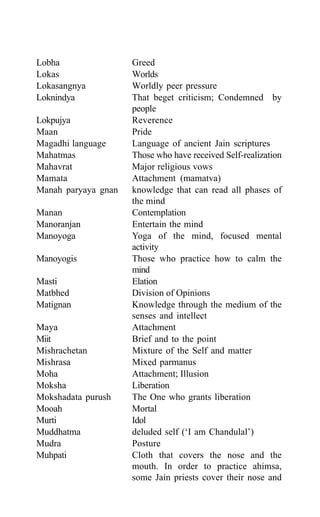
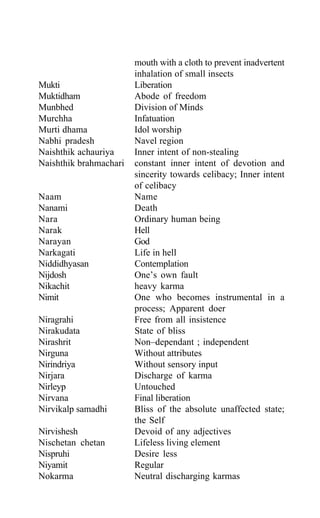
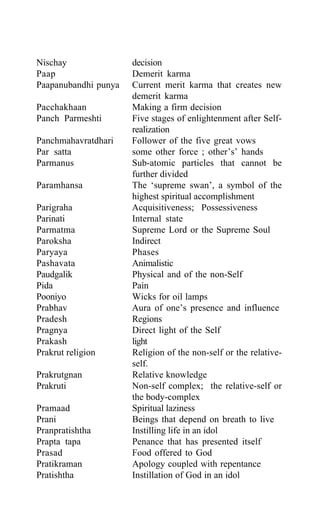
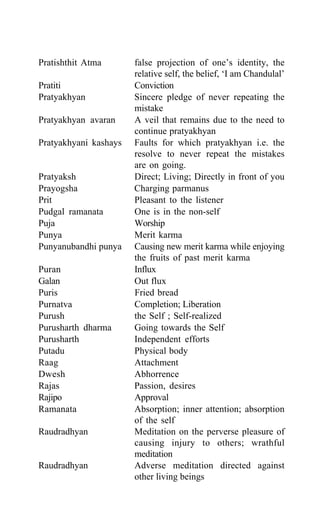
Aptavani - 2
- Dada Bhagwan
8 7
6 5
Originally Compiled in Gujarati by :
Dr. Niruben Amin
Publisher : Mr. Ajit C. Patel
Mahavideh Foundation
Tri-Mandir, Simandhar City,
Ahmedabad-Kalol Highway, Adalaj,
Dist.-Gandhinagar-382421,
Gujarat, India.
Tel. : +91 79 3983 0100
E-Mail : info@dadabhagwan.org
© : All Rights Reserved Dr. Niruben Amin
Tri-Mandir, Simandhar City, Adalaj-382421
Dist.-Gandhinagar-, Gujarat, India.
Edition : 2000 copies, April 2007
Price : Ultimate Humality
(leads to Universal oneness) and
Awareness of "I Don't Know Anything"
Rs. 100.00
Printer : Mahavideh Foundation
Basement, Parshwanath Chambers,
Nr. RBI, Usmanpura,
Ahmedabad-380014
Gujarat, India.
Tel. : +91 79 27542964 / 27540216
Trimantra
(The Three Mantras)
Namo Arihantanam
I bow to the Lord who has annihilated all the inner
enemies of anger, pride, attachment and greed.
Namo Siddhanam
I bow to all the Lord who have attained final liberation.
Namo Aayariyanam
I bow to all the Self-realized masters who unfold the
path of liberation.
Namo Uvazzayanam
I bow to the Self-realized teachers of the path of
liberation.
Namo Loye Savva Saahunam
I bow to all who have attained the Self and are
progressing in this path in the universe.
Eso Pancha Namukkaro
These five salutations.
Saava Paavappanasano
Destroy all the sins.
Mangalanam cha Saavesim
Of all that is auspicious mantras.
Padhamam Havai Mangalam
This is the highest.
Namo Bhagavate Vasudevaya
I bow to the One who has become the Supreme Lord
from a human being.
Namah Shivaaya
I bow to all auspicious beings of this universe who are
the instruments of salvation of the world.
Jai Sat Chit Anand
The Awareness Of The Eternal Is Bliss
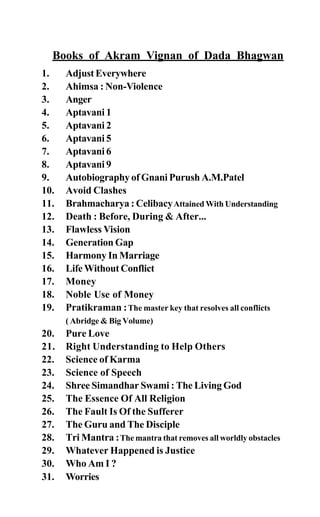
Books of Akram Vignan of Dada Bhagwan
1. AdjustEverywhere
2. Ahimsa : Non-Violence
3. Anger
4. Aptavani 1
5. Aptavani 2
6. Aptavani 5
7. Aptavani 6
8. Aptavani 9
9. Autobiography of Gnani Purush A.M.Patel
10. Avoid Clashes
11. Brahmacharya : CelibacyAttained With Understanding
12. Death : Before, During & After...
13. Flawless Vision
14. Generation Gap
15. Harmony In Marriage
16. Life Without Conflict
17. Money
18. Noble Use of Money
19. Pratikraman :The master key that resolves all conflicts
( Abridge & Big Volume)
20. Pure Love
21. Right Understanding to Help Others
22. Science of Karma
23. Science of Speech
24. Shree Simandhar Swami : The Living God
25. The Essence Of All Religion
26. The Fault Is Of the Sufferer
27. The Guru and The Disciple
28. Tri Mantra :The mantra that removes all worldly obstacles
29. Whatever Happened is Justice
30. Who Am I ?
31. Worries
Note About This Translation
The Gnani Purush Ambalal M. Patel, also commonly
known as Dadashri or Dada, had said that it would be
impossible to translate his satsangs and the knowledge about
the Science of Self-realization verbatim into English because
some of the meanings would be lost in the process. Therefore,
in order to understand precisely the science of Akram Vignan
and Self-realization, He stressed the importance of learning
Gujarati.
Dadashri did however grant his blessings to translate his
words into English and other languages so that spiritual seekers
could benefit to a certain degree and later progress through their
own efforts.
This is a humble attempt to present to the world, the
essence of His Knowledge. This is not a literal translation but
great care has been taken to preserve His original words and the
essence of His message. For certain Gujarati words, several
English words or even sentences are needed to convey the exact
meaning; hence, many Gujarati words have been retained within
the English text for better reading flow. At the first encounter,
the Gujarati word will be italicized followed by an immediate
explanation of its meaning in brackets. Thereafter the Gujarati
word will be used in the text that follows. This serves as a two-
fold benefit: firstly ease of translation and reading and secondly
it will make the reader more familiar with the Gujarati words
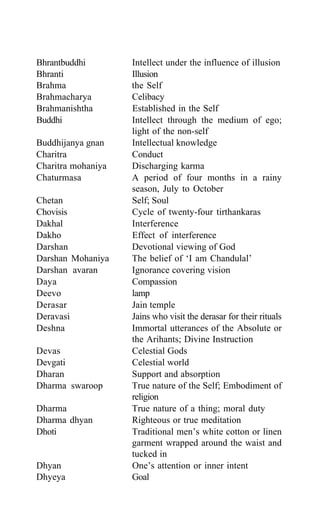
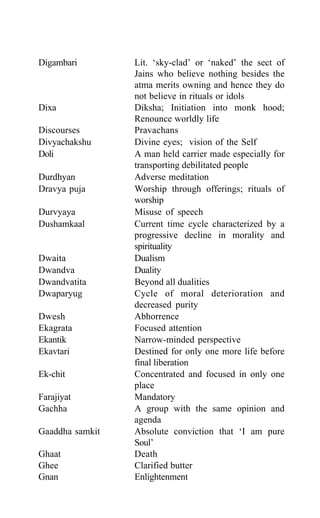
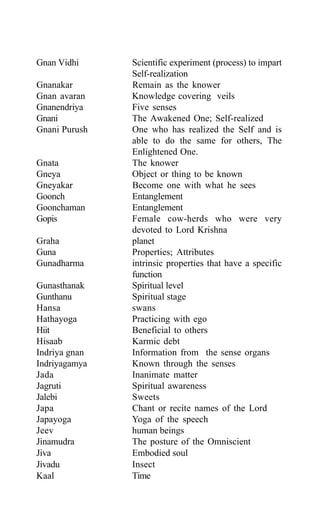
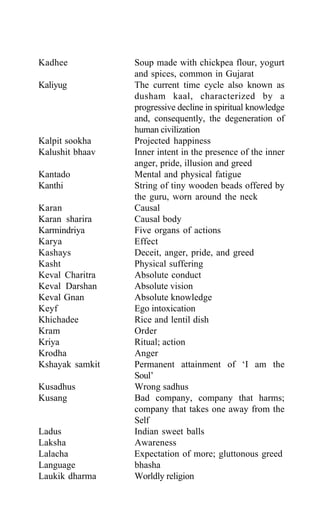
critical for a deeper understanding of this science. A glossary of
all the Gujarati words is provided at the back of the book. For
additional glossary, visit our website at:
www.dadabhagwan.org
Many people have worked diligently towards achieving
this goal and we thank them all. Please note that any errors
encountered in this translation are entirely those of the translators.
5
Note to the reader
The words ‘You’ or ‘Self’ when they begin with an initial
capital ‘Y’ or ‘S’ respectively, refers to the Soul or the real Self
or the Atma. Otherwise, they are used for the non-self also
referred to as the relative-self, ‘Chandulal’ or the prakruti.
Whenever Dadashri uses the name ‘Chandulal’ or the
name of the person Dadashri is addressing, the reader should
insert his or her name for exact understanding.
Whenever Dadashri uses the term ‘we’, he is referring to
the Gnani Purush and ‘Dada Bhagwan’ who is the fully
enlightened Lord within him.
The words Self and Soul are interchangeable. The Soul is
one’s real Self.
6
Introduction to The Gnani
One June evening, in 1958 at around six o’clock, Ambalal
Muljibhai Patel, a family man, and a contractor by profession,
was sitting on a bench on the busy platform number three at
Surat’s train station. Surat is a city in south Gujarat, a western
state in India. What happened within the next forty-eight minutes
was phenomenal. Spontaneous Self-realization occurred within
Ambalal M. Patel. During this event, his ego completely melted
and from that moment onwards, he became completely detached
from all of Ambalal’s thoughts, speech, and actions. He became
the Lord’s living instrument for the salvation of humankind,
through the path of knowledge. He called this Lord, ‘Dada
Bhagwan.’ To everyone he met, he would say, “This Lord,
Dada Bhagwan is fully manifested within me. He also resides
within all living beings. The difference is that within me He is
completely expressed and in you, he has yet to manifest.”
Who are we? What is God? Who runs this world? What
is karma? What is liberation? Etc. All the world’s spiritual
questions were answered during this event. Thus, nature offered
absolute vision to the world through the medium of Shree
Ambalal Muljibhai Patel.
Ambalal was born in Tarasali, a suburb of Baroda and
was later raised in Bhadran, Gujarat. His wife’s name was
Hiraba. Although he was a contractor by profession, his life at
home and his interactions with everyone around him were
exemplary, even prior to his Self-realization. After becoming
Self-realized and attaining the state of a Gnani, (The Awakened
One, Jnani in Hindi), his body became a ‘public charitable trust.’
Throughout his entire life, he lived by the principle that there
should not be any commerce in religion, and in all commerce,
there must be religion. He also never took money from anyone
for his own use. He used the profits from his business to take
his devotees for pilgrimages to various parts of India.
His words became the foundation for the new, direct, and
7
step-less path to Self-realization called Akram Vignan. Through
his divine original scientific experiment (The Gnan Vidhi), he
imparted this knowledge to others within two hours. Thousands
have received his grace through this process and thousands
continue to do so even now. ‘Akram’ means without steps; an
elevator path or a shortcut, whereas ‘Kram’ means an orderly,
step-by-step spiritual path. Akram is now recognized as a direct
shortcut to the bliss of the Self.
Who is Dada Bhagwan ?
When he explained to others who ‘Dada Bhagwan’ is, he
would say:
“What you see here is not ‘Dada Bhagwan.’ What you
see is ‘A. M. Patel.’ I am a Gnani Purush and ‘He’ that is
manifested within me, is ‘Dada Bhagwan’. He is the Lord within.
He is within you and everyone else. He has not yet manifested
within you, whereas within me he is fully manifested. I myself am
not a Bhagwan. I too bow down to Dada Bhagwan within me.”
Current link for attaining the knowledge of Self-
realization (Atma Gnan)
“I am personally going to impart siddhis (special spiritual
powers) to a few people. After I leave, will there not be a need
for them? People of future generations will need this path, will
they not?”
~ Dadashri
Param Pujya Dadashri used to go from town to town,
and country to country, to give satsang and impart the
knowledge of the Self as well as knowledge of harmonious
worldly interaction to all who came to see him. During his final
days, in the fall of 1987, he gave his blessing to Dr. Niruben
Amin and bestowed his special siddhis upon her, to continue his
work. “You will have to become a mother to this whole world,
Niruben” He told her as he blessed her. There was no doubt
in Dadashri’s mind that Niruben was destined to be just that.
She had served him with utmost devotion day and night for over
twenty years. Dadashri in turn had molded her and prepared her
8
to take on this monumental task.
From the time of Pujya Dadashri’s mortal departure on
January 2nd
1988 to her own mortal departure on March 19th
2006, Pujya Niruma as she lovingly came to be called by
thousands remained true to her promise to Dadashri to carry on
his mission of the world’s salvation. She became Dadashri’s
representative of Akram Vignan and became instrumental in
spreading the knowledge of Akram Vignan throughout the
world. She also became an exemplary of pure and unconditional
love. Thousands of people from all walks of life and from all
over the world have attained Self-realization through her and are
established in the experience of the pure Soul, while carrying out
their worldly duties and obligations. They experience freedom
here and now, while living their daily life.
The link of Akram Gnanis now continues with the current
spiritual master Pujya Deepakbhai Desai whom Pujya Dadashri
had also graced with special siddhis to continue to teach the
world about Atmagnan and Akram Vignan. He was further
molded and trained by Pujya Niruma who blessed him to
conduct Gnan Vidhi in 2003. Dadashri had said that Deepakbhai
will become the decorum that will add splendor to the Lord’s
reign. Pujya Deepakbhai, in keeping with Dada’s and Niruma’s
tradition travels extensively within India and abroad, giving
satsangs and imparting the knowledge of the Self to all who
come seeking.
Powerful words in scriptures help the seeker in increasing
his desire for liberation. The knowledge of the Self is the final
goal of all one’s seeking. Without the knowledge of the Self
there is no liberation. This knowledge of the Self (Atma Gnan)
does not exist in books. It exists in the heart of a Gnani. Hence,
the knowledge of the Self can only be acquired by meeting a
Gnani. Through the scientific approach of Akram Vignan, even
today one can attain Atma Gnan, but it can only occur by
meeting a living Atma Gnani and receiving the Atma Gnan.
Only a lit candle can light another candle.
9
EDITORIAL
This precious book is a compilation of the speech of the
Gnani Purush (the Enlightened One) Pujya Shree Dadashri,
whose every word can eradicate the worldly wanderings of life
after life from its very root; whose single roar can awaken the
soul that has been in profound sleep for an infinite time; a being
at whose divine feet comes to halt time, karma and illusion.
Dadashri’s speech is verily the manifestation of the
Goddess of Knowledge; Saraswati. It is the speech of the
vitarag, i.e. the one who is free from all attachments. Vitarag
speech can also be defined according to Dadashri’s aphorism
as, “When the prakruti (the non-self complex) is experienced in
detail, one becomes a Vitarag.” Since it is the speech of the
apta-purush i.e. the one who is trustworthy at all times, it can
never be negated at any time. It is syadvad speech, meaning
speech that is accepted by all and one that does not offend
anyone’s viewpoint. Such a speech that has come forth naturally
for the salvation of the world, based on the evidences of worldly
situation, time, location, and a deep inner intent, is speech that
is extremely difficult to compile. This speech has expressed
outwards having ‘touched’ the fully manifested enlightened Lord
within the Gnani Purush. Humble apologies are offered for any
shortcomings in the compilation of this book of Gnan, i.e.
knowledge that leads to liberation.
This book of Gnan is not a book of religion, it is a book
of practical spiritual science; it is vignan. An attempt has been
made to present to the world the extract of the knowledge of the
inner spiritual science of the Vitarag Lords; the fully Enlightened
ones. This knowledge has come forth from the revered Dadashri
from 1958 onwards. However, the precise understanding of this
knowledge ‘as it is’, can only be attained by a direct meeting
with Him. Nevertheless, as long as His presence (overt or
subtle) prevails in any corner of this world, this book of Gnan
10
will be equally effective. This book will be enormously useful to
spiritual seekers, philosophers, thinkers and those who are truly
inquisitive. Since the language Dadashri uses is simple and easy,
it will give complete results to even a common person. The
humble open-minded reader who studies this great book in
depth and contemplates upon it, will definitely attain samkit; the
right worldly vision. It is my sincere prayers to the prevailing
celestial deities of the Vitarag Lords, for this very goal.
Dr. Niruben Amin
11
PREFACE
By Dr. Niruben Amin
No one except the One who is fully enlightened can
expound the nature of the worldly illusion, which has prevailed
for infinite life times. Such completely Enlightened Ones had
exposed the truth thousands of years ago however, that truth has
been covered up in these terrible times of Kaliyug. What is
more, such fully enlightened beings do not exist in the time cycle
of Kaliyug. Thus, it is indeed a phenomenal wonder that such a
One has arisen in this era. He is the omniscient Shree ‘Dada
Bhagwan’. He has given complete answers about the nature of
this universe, its origin, sustenance and dissolution in only one
sentence:
“The world is the puzzle itself!” - Dadashri
“The world is the puzzle itself, there is no “bapo” (father
figure) who has created it.” How does the entire universe run?
It world runs only by vyavasthit shakti (scientific circumstantial
evidences). Now these scientific circumstantial evidences range
from the gross to the subtlest. The Knower and the Seer of it
all is verily and only the Omniscient one. Hence, only the
Omniscient one can show us the true nature of the universe. That
is why the sage Narsinh Mehta sang:
“Shrushti mandaan chhe sarva eni pere,
“The origin of the universe is beyond comprehension,
Jogi Jogeshwara kok jaaney.”
this is known by the rare Yogi and Yogeshwar (the
Enlightened One).”
What devotee Narsinh Mehta meant by ‘yogis and
Yogeshwars’ is that, only a rare Atmayogi (Self-realized) or an
Atma-Yogeshwar (the One who is fully enlightened), can know
about the beginning of the universe! All other yogis, who are
yogis of the body, yogis of speech, or yogis of the mind; none
12
of them can know this.
The following two sentences that have come forth from
Dadashri in English:
1. “The world is the puzzle itself.”
2. “God has not created this world at all, there is no one
as God up above.”
The above sentences depose ‘God’ from the status of
being the ‘creator of the world’! These two sentences drive
away the wrong notion that falsely accuses Ishwar, Bhagwan,
Allah or God, as being the creator!
What is the foundation on which this worldly life carries
on, life after life? The illusion, the wrong belief of ‘I am
Chandulal’ (reader insert their own name instead of ‘Chandulal’)
is the basis that perpetuates the worldly life. All interactions of
this worldly life occur on the foundation of the false basis of this
vision, knowledge and experience. This false belief establishes
(pratishtha) and creates a new causal body for the next life
(pratishthit atma), and that is the foundation on which this
world exists. Dadashri is the only one who, for the first time
clarifies the nature of the worldly soul (pratishthit atma).
What is religion? That which brings forth ‘results’ is
called religion. When anger, pride, deceit and greed progressively
decrease and eventually become annihilated, that is religion.
What is the meaning of doing darshan (devotional viewing of
God), listening to religious discourses, doing introspective
meditations (samayik), doing pratikramans (apology coupled
with repentance) when not a single such fault decreases in one’s
entire lifetime? How can that be called religion?
There are two types of religions, a relative religion and a
real religion. Relative religion is the religion of the mind, religion
of speech, and the religion of the body. The other religion, the
real religion, is the religion of the Self, that is the religion of the
13
Soul. Jain religion, Vaishnav, Muslim, Christianity etc., are all
relative religions. The real religion, the religion of the Soul, exists
in the heart of only the ‘Gnani Purush’; it cannot be found
anywhere else.
Shrimad Rajchandra has said:
“Look for nothing else. Find only a Satpurush (a Self-
realized person) and surrender all your bhaavs (feelings and
intents) to Him and then be your Self. If after that you do not
attain moksha (liberation), then come and take it from me.”
The religion of the Soul (the Self) can only be attained
from the One who has become fully enlightened. There is
religion elsewhere, but it is all prakrut religion, meaning religion
of the non-self or the relative-self. Chanting the Lord’s name,
saying prayers, doing penance, renouncing, listening to religious
talks and lectures, meditation and repentance, are all prakrut
religions. Where there is complete religion of the Self, there is
only absolute knowledge (keval gnan) and absolute vision
(keval darshan), the result of which is absolute conduct (keval
charitra).
When dharma (true nature of a thing) attains its total
original state, then ‘one’ (the self) verily becomes dharma-
swaroop, the true nature of the Self. - Dadashri
Real religion is scientific in nature; it is not just idle talk.
This is a science. The general understanding that prevails about
religion is not exact religion.
“Dharma i.e. religion is when an element or anything
reverts to its original nature-state.” - Dadashri
To comprehend this scientifically, gold is gold when it has
the properties of gold. Polished or gold plated brass may look
like gold but it can never become gold. Similarly, when an
element is in its own property (state), then it has attained its own
religion (dharma). Therefore, an element cannot be different
14
from its property. When the Soul remains in its own properties
(swa-bhaav i.e. its inherent state) and becomes stable in its own
Self, it can be said that the Soul is in its own religion. This verily
is what the omniscient Lord has called religion of the Self, (swa-
dharma), the real religion.
Religion of the Self lowers one’s ego intoxication (keyf)
and the common religion of the non-self increases it. When one
becomes completely impartial towards one’s own self; when he
‘sees’ his every fault, even the faults at the subtlest level; then he
is considered to be in real religion.
What is the nature of the worldly life? The world is
relative; it is temporary. The world is a total deception; not a
single being in it is your relation. Three fourths of all the
scriptures are meant for creating vairagya (dispassion) towards
the worldly life, whereas only four sentences of the Gnani Purush
will create vairagya in the listener!
“Allya! Have you ever seen a nanami (death)? At the
time of death, are the wife, children, cars, bungalows and
whatever one has earned in his life not forfeited? And what
comes along for the next life? The accounts of karma he created
in this life. Deceit, anger, pride, and greed (kashays), which
create new causes that, will accompany him to his next life. And
then he will have to start earning anew (in the next life) in order
to pay off these debts!” - Dadashri
Another noteworthy point is that Dadashri would create
instant dispassion for the worldly life, when he addresses the
seeker in a jovial manner about the grave reality of this world.
Dadashri : How many children do you have dear lady?
Questioner : Four.
Dadashri: So where are your children from your past life
at this moment?
‘Sansar’ (the worldly life) is derived from the word
15
samsaran, meaning that which is constantly changing. That
which is constantly changing is called the world. All embodied
souls are constantly traveling in this moving path and are
attaining higher life forms. Only after coming to the human form,
is it possible for the embodied soul to return to a lower state
(regress), but at the same time, there is also the benefit that from
this human state, the embodied soul can attain the state of
freedom, the final salvation!
The Gnani Purush gives a description of the world in a
very simple and yet eloquent language through the following
simile. The world is like a horse. People of the world are the
riders of the horse. The rider believing the horse to be weak,
mounts it fearfully, carrying a bale of grass on his own head.
However, in the end the burden still falls on the horse! Similarly,
all of you should put your burden on the horse that is the world,
why carry the burden on your own mind? In the end, the horse
(the world) carries it!
Only the Gnani Purush is capable of uprooting the tree
of this worldly life. How? Without touching anything else, He
puts a pinch of medicine at the main root of the tree of the
worldly life, so that the tree will dry out on its own and be
uprooted.
Who is a satdev? Sat means eternal, Dev means god.
Is it the idol in the temple or the derasar? No. It is the one who
is ‘within’ i.e. the parmatma (the supreme Lord or the supreme
Soul) that resides within every living being. That verily is a
Satdev. Until the realization of that supreme Soul is attained, one
should accept the idol God in the temple, as the Satdev.
Who is a Sad Guru? The final guru is the Gnani Purush.
But, until one meets a Gnani Purush, anyone who is at a higher
spiritual level, even if it is by two degrees, can be one’s guru.
What is Sat Dharma? Dharma means religion. The agnas
(spiritual instructions) of a Gnani Purush is the only sat-dharma.
16
The words that have originated from the Gnani Purush are sat
dharma, not the scriptures. The scriptures give relative religion,
not the real. However until one finds the ‘real pearls’, he will
have to contend with ‘cultured ones’ will he not?
With satdev, sadguru and satdharma, moksha is attained.
What is murti dharma (idol worship)?
What is amurta dharma (worship of the formless)?
Dadashri has given a beautiful explanation of murti
dharma and amurta dharma (the religion of idol worship and
the religion of the worship of the formless, respectively). Many
people, due to misunderstanding, do not believe in idol worship
and are contemptuous towards it. This is a grave mistake. One
should perform idol worship until one attains the religion of the
formless; the religion of the Self. Until the Self is known, isn’t it
necessary to have instruments that will help still the chit?
Moreover, how can one reject the idol when thousands have
done worship of the vitarag Lord in it? The one who has proper
knowledge of the Self will not only, not do so, but neither will
he cause any pain whatsoever through his mind, body and
speech to any living being.
The religion of idol worship is a science of India. It is
a support that sustains people of a certain standard. How can
this support be called wrong? It is appropriate for those who do
not require the religion of idol worship to not accept it, i.e. those
who have gone beyond that standard; those who are completely
enlightened; those who have conquered all inner passions and
remain only in the bliss of the Self. However for such enlightened
beings, there is no such thing as acceptance or non-acceptance
in this world; they know everyone’s viewpoint and conduct
themselves in a way that does not hurt anyone’s viewpoints.
Who can do pran-pratishtha i.e. instillation of ‘life’ in an
idol? Only the Gnani Purush can do so.
17
There are two paths to liberation. One is a Kramic
path, which is a step-by-step path. The other is Akram; a step-
less path. This step-less path is an exceptional path, it is a
wonderful path!
It opens up once every million years! The same Akram
path, which was given by Lord Rushabhdev to the Emperor
Bharat, has been opened up by Dadashri and has become
available to all who have the merit karma. Why Akram? The
answer is, in order to attain the Self (the Soul), even the
emperors gave up their kingdoms, wives and children and
followed the sadguru to the forests. Even then, it was not
certain that they would attain it. This is Akram. It is not such a
painful path. The one who receives the grace of the Gnani
Purush attains the Self in only one hour! After that, there is no
need for any austerities, renunciation or acquisition. Such
practices become redundant after attaining the Self. After Self-
realization, the Gnani’s Agnas (spiritual instructions or directives)
is one’s religion and the Gnani’s Agnas is one’s penance. Lord
Mahavir has said, “Agna is religion. Agna is penance.” In the
Akram path, there are only five Agnas and they are such that
they cause no hindrance in the interactions of the worldly life,
and on the contrary, they prove to be very helpful as a ‘master
key’. With this master key, not a single ‘lock’ in the world can
remain locked!
Although this seems incredulous, it is indeed, a fact; there
are no two views about it. Thousands of people with merit
karmas have attained the Self within one hour and have
experienced it. It is the experience of many that after attaining
Self-realization, the awareness as the Self, is not lost even for a
moment. This is the only ‘cash bank of the divine solution’ in the
world. In this bank, one can present any ‘check’ for cashing in
but he should do so after complete understanding. Your check
can be cashed all the way up to the final Moksha i.e. the ultimate
liberation, lest you should become swooned by the mortal things
18
of the world!
Who can explain the science of prakruti (the non-self
or the relative-self or the body-complex) completely? The one
who has become ‘Purush’, the pure Soul and is constantly the
‘seer’ of the non-self. Such a One can understand the science
of ‘prakruti’ and explain it. How can those, who are immersed
in the prakruti (in the relative-self) themselves; those who have
not awakened as a Purush (the real Self), know or explain the
prakruti? That can only be done by the Gnani Purush. There are
infinite souls and infinite prakrutis and unless one becomes the
Purush, he is constantly dancing to the tune of the prakruti, i.e.
he is just a puppet on a string pulled by prakruti.
In the Kramic path, the prakruti becomes natural in a
step-by-step process and then in the end the natural Soul i.e. the
natural Self is attained. In the Akram path however, the Gnani
Purush directly brings the soul in its natural form and after that,
the prakruti (the relative-self) is to be brought in its natural state.
How can the relative self become natural? The answer is,
whenever the pending ‘files’ (pending karmic accounts) of the
relative self are settled with equanimity, there is liberation, hence
what remains in the end is the relative self in its natural form.
‘There is no decree forbidding one to attain moksha, only
that he has to realize his own Self. Some may have an inclination
towards renouncing, others may have a temperament for
penance, yet others may be in the habit of enjoying sensual
pleasures; whatever the case may be, in order to attain moksha,
one only has to let the prakruti dissolve naturally.’
‘The body complex (the prakruti) is characterized by
puran-galan the phenomenon of input-output, whereas the Self
is not subject to input-output.’ - Dadashri
‘The Vitarag Lords always remained in a state of
observing (seeing and knowing) their own prakruti. The prakruti
dissolves when one remains as the ‘seer’ and the ‘knower.’
19
‘The sign of absolute knowledge (keval Gnan) is when
one is in the state of continuously ‘seeing’ his own prakruti
(relative-self)’. - Dadashri
What is the characteristic of prakruti, the non-self
complex? Prakruti is like a child. If you want to get some work
done by the prakruti, you can do so through persuasion, flattery,
cajoling etc., just as you would with a child. It is easier to
persuade a child thus, whereas, if you become an opponent of
the prakruti, it will become uncontrollable. Therefore, somehow
or other, even by enticing it with a ‘lollipop’, you can get your
work done from it!
Many people refer to the Soul, the Self as nirguna
(without attributes), but that is not correct. From the perspective
of the attributes of the prakruti, the Soul is nirguna but from the
perspective of the attributes of the Soul, the Soul has countless
attributes.
‘Not a single attribute of the prakruti is in the pure Soul,
and not a single attribute of the pure Soul is in the prakruti.’
- Dadashri
‘When the prakruti becomes natural and spontaneous,
the Soul becomes natural and when the Soul becomes natural,
the prakruti becomes natural.’ - Dadashri
The goddesses Ambama, Durgama, and all other Matajis
(mother goddesses) represent divine energies of the non-self. All
the divine Goddesses have laws. They grace those who follow
their laws. Amba mataji symbolizes purity of prakruti. She
graces and blesses the one whose prakruti is pure. What laws
are to be observed to keep Goddess Saraswati, the goddess of
knowledge, happy? It is to never use speech improperly. If one
tells no lies, does not use fraudulent speech or abusive language
in any manner whatsoever, then Goddess Saraswati will be
pleased and as a result, one will attain extraordinary power of
speech! The speech of the Gnani Purush is considered the
20
manifestation of Goddess Saraswati, because it comes out after
having ‘touched’ the Supreme Soul within!
What are the laws of Goddess Lakshmiji, the Goddess of
wealth and prosperity? Her law is that one should not steal
through his mind, body or speech; that is one foremost law of
Goddess Lakshmiji. One should also not go chasing after
Lakshmiji (money or wealth) nor should one obstruct her path.
One should not have contempt for Lakshmiji either. The Gnani
Purush will honor Lakshmiji with flowers when she comes
before Him and He will honor her with flowers even when she
leaves. Those who harbor a desire for wealth, Lakshmiji will
‘visit’ them later than sooner and she visits on time, those who
do not harbor a desire for wealth.
How does one earn wealth? With labor and hard work?!
With intellect (buddhi)?! No! A person earns wealth as a result
of his past merit karma. Not having the knowledge or awareness
of this hidden fact, people boast, “I earned my fortune. I earned
it because of my intellect.” This is a wrong ego. Lakshmiji will
come to you if your intent improves. True wealth, i.e. money that
brings meaningful happiness when it is being spent, will never be
earned if one has deceitful intents. What is more, only true
wealth will give one peace in life. Wealth acquired through
deceitful means will inevitably be lost and in the process, the
pain it will entail will be like the pain from the bites of a thousand
scorpions! The authority over whether one receives wealth or
not is not in one’s own control; it is under the control of some
other entity. Man only needs to do the work as a nimit (become
instrumental in the process); he has to make all the attempts.
One should not become disinterested in money (Lakshmiji)
either and one should definitely not insult money (Lakshmiji).
Anyone who insults Lakshmiji will be without Lakshmiji for
many lives to come and all efforts he makes for Lakshmiji will
be in vain.
Gnani Purush ‘Dada Bhagwan’ gives a new spiritual
21
aphorism to the world.
‘Dishonesty is the best foolishness’ - Dadashri
People have come to completely disregard old aphorisms
like, ‘Honesty is the best policy.’
Those who want to attain moksha will have to follow the
maxim of ‘no-law law’. Once one follows this maxim, he is said
to have become natural and spontaneous. Wherever people try
to gain control through enforcement of laws, people become
resentful towards the law and their prakruti springs back with
even a greater force and becomes uncontrollable, just liked a
compressed spring!
“One day, this world will have to remove all laws! We are
the first ones to start this ‘no law’ status. We will tell the
government ‘look, at our management where there is a ‘no-law
law’!” - Dadashri
Enforcing laws upon the mind spoils it and then its
behavior becomes spoiled. Laws bring forth results related to
restlessness and turmoil. The Self is natural and laws are the
chain that makes one unnatural.
What is true dharma dhyan (righteous or true
meditation)?
Is it doing worship, prayer, penance, samayik
(introspection), repentance and listening to religious talks? No.
All those are overt and tangible acts of rituals; they are material
practices. However, what is of importance and becomes
recorded as one’s karma is where one’s dhyan i.e. one’s
attention or inner intent lies while one is conducting such rituals.
While worshipping God, if one pictures God in his mind along
with the picture of his shop or his business or the shoes he left
outside the temple, how can that be called true meditation
(dharma dhyan)? The Lord does not take into consideration
your external actions but rather your inner attentive intent during
22
all your activities (kriya). The actions being carried out at
present are the result of the meditation (dhyan) done in your
past life. These actions are indicative of your independent efforts
(purusharth) in your previous life, whereas the present day
meditation (inner dhyan) is the independent effort for the next
life, in other words it is the ‘design’ for your next life!
Now, what is dharma dhyan? The effort you make to
change the circumstances that create adverse meditation, is
dharma dhyan. An integral part of dharma dhyan is sincere
alochana, pratikraman and pratyakhyan (sincerely recalling
and acknowledging the wrongful act, repenting for it and
resolving never to repeat it, respectively; collectively referred to
as doing pratikraman). This act of pratikraman however,
cannot be carried out according to one’s own understanding; it
should be done according to the Gnani’s teaching.
How does one change adverse internal meditations of
arta dhyan and raudradhyan? It is to apply the knowledge that
‘these adverse internal meditations are happening because of my
own karma of past life and no one is at fault here.’ On the
contrary, one should repent by saying ‘Others have to endure
pain because of me. I will never do it again’, one should make
a firm decision like this. Pratikraman and pratyakhyan should be
‘shoot on sight’; i.e. they should be done the instant the fault
occurs. Mistakes and faults can only be washed away if
pratikraman and pratyakhyan are done the instant the mistake is
made. When one understands dharma dhyan well, it will bring
instant results.
By giving us great examples that are useful in our
everyday life, Dadashri has made it simple for us to come out
of negative and adverse meditative states and remain in dharma
dhyan. Every person will be able to adjust to this in his or her
own way.
The one in whom all negative passions are gone can
23
attain the status of Godhood. However, rare indeed are those
where no negative passions arise within them, but also through
their being, they do not incite negative passions to arise in others
either. Such beings are the ones the world will worship. As such,
the Gnani Purush is beyond all adjectives; to give Him the
adjective of ‘Bhagwan’ (God) is the same as trying to compare
that which is incomparable and in doing so, we lower His
unparalleled status. Yet, to let the world know about Him,
people use the terms ‘Bhagwan’, ‘Sarvagnya’ etc. What does
sarvagnya mean? It means the One who knows all that is meant
to be known; an Omniscient. There are two types of the
Omniscient (sarvagnya). One is a causal omniscient (karan
sarvagnya) and other is effect omniscient (karya sarvagnya)
i.e. omniscience that has come in one’s worldly conduct.
The Lord regards all ongoing activities in this current life
as activities that have already been completed (they are simply
effects of causes that were created in the past life).
For example, if someone left home to go to Baroda, and
five minutes later, somebody asks you, “Where did he go?”
What answer will you give? You will say, “He has gone to
Baroda.” Now he has barely reached the railway station. Lord
Mahavir regards the action that is in progress, as completed
action (its full causes having been laid in the past life). Thus, the
one who is harboring the causes to become omniscient verily is
called the causal omniscient. Dada Bhagwan is causal omniscient
– karan sarvagnya.
The law of the world is that the one whose mistake is
clearly visible is the one at fault, whereas the law of nature
states, ‘The fault is of the sufferer.’
‘If anyone is hurt even to the slightest extent, you should
believe that it is your fault.’ - Dadashri
The person who lives according to the law ‘fault is of the
sufferer’ does not have to suffer anything in this world; he does
24
not have to suffer any pain that comes at the hands of others (his
nimit). One is bound by his own faults, and he who has broken
the bondage of all faults, becomes the absolute Self! The Vitarag
Lords broke all their bondages of faults and attained moksha!
We have to attain liberation in the same way. The Vitarags
represent our ultimate goal (dhyeya) and the manifest Gnani
Purush is the original connection for that very purpose! To say
‘it is not my fault’ is the biggest fault; it creates a dense layer of
covering over that fault.
Krupaludev has said: “I am a receptacle of infinite faults,
O Compassionate One!”
When one is a ‘vessel of infinite faults’, there are faults at
every step. Alas! Our existence here in this world, is it not the
biggest blunder of all? How can one blame others when he is
himself is full of faults? To find faults in others is a very dense
illusion. There is nothing worse than that.
‘The one, who abolishes even a single fault of his own, is
called God.’
‘In this world, there is no one superior to you. This, I
guarantee you. No father figure (bapo) is your superior. Only
your faults are your superior (boss).’ - Dadashri
Once the answer to the question ‘Who am I?’ is known,
one progresses rapidly on the path of abolishing all faults and
ultimately becomes parmatma, the supreme Self!
The rule of the world is that if someone says something
bad to you, you will see that person as being at fault. You will
question, ‘Why did he say that to me?’ or ‘Why did he do that
to me?’ Thus, you will believe that you have been subjected to
injustice. In fact, justice is not to be sought. Whatever suitable
or unsuitable treatment you receive from others, it is due to your
own karmic account, so where is the need to seek for justice in
this world? Everybody’s worldly interactions (vyavahar) are
25
unfolding according to their own karma from their past life.
Furthermore, whatever is unfolding is precisely the effect of their
own karmic accounts that they themselves created. So in all this,
if one seeks worldly justice or does not accept nature’s account,
how will he escape the beating due to him in doing so?
For the one who understands and accepts ‘this is my
fault’; for the one who has arrived at this stage, there is ‘justice’
and his faults are abolished. But the one who says, “This is not
my fault”, for him there is the worldly life to make him
understand!
The common understanding of pain and pleasure that
people have is in fact not actual pain or pleasure. The Lord says
that it is really the experience of pain (ashata vedaniya) and
experience of pleasure (shata vedaniya) of karma. These
events are for a fixed period of time and by nature are
temporary; these are all circumstances and all circumstances are
temporary. Now as per general understanding, if these karmas
of suffering are believed to be long lasting and given greater
importance, then one will experience greater suffering. All
pleasures and pains of worldly interaction have an end. Only the
bliss of the Self is infinite and eternal and that is the only thing
one needs to attain.
Throughthecommonunderstanding,theillusionaryvaluation
of worldly pleasures and pains create very grave and dangerous
bondages of karma. Amidst such situations, Dadashri has given
the world, very simple, natural and yet exact ‘knowledge-vision’
of the Self. Once this is understood in exactness, it makes one
free from the effect of all pleasures or pains of everyday worldly
life.
‘To be overcome by mental and physical fatigue
(kantado) is a state similar to sleeping on a bed of thorns.’
- Dadashri
Now, who is the fortunate one who has not experienced
26
such fatigue? Many great teachers, priests, saints, ascetics and
men of glory have not been without this feeling of tedium. Only
the Gnani Purush does not have to experience tedium! One
should deal with situations of mental and physical fatigue with
equanimity, instead people try to look for ways to remove it or
escape it. Arey! Going to the cinema, drama or doing other
things makes one regress spiritually and in fact, the tedium is not
removed, it is merely pushed aside for a little while only to return
with double the force. This is because karma that has come into
existence to give result will not spare anyone; one has no choice
but experience its effects.
The difference between people’s understanding of
raag-dwesh (attachment-abhorrence) and the Vitarag’s
understanding of the same is comparable to the difference
between milk and buttermilk. ‘I am Chandulal’ is attachment
(raag). To falsely project one’s self where one is not, is raag.
The one who realizes ‘I am Shuddhatma (I am a pure Soul)’ has
broken all attachments.
In their common understanding when people say ‘I have
a lot of attachment towards this person or that person’, it is not
correct. In fact, the Soul does not have the attribute of
attachment. What appears to be attachment is really attraction of
the parmanus (sub-atomic particles that cannot be further
divided) and what appears to be dwesh (abhorrence), is in fact
repulsion between the sub-atomic particles. This is all the
ingenuity of the pudgal, the non-self complex, but one believes
that attachment and abhorrence are occurring to ‘me’ and hence
one inadvertently declares the Soul as having the attributes of
attachment and abhorrence. The Soul is always vitaragi (without
attachment) and will always remain as one.
‘Love for agnan (ignorance) is raag and love for Gnan
(enlightenment) is Vitarag.” - Dadashri
The foundation of this world is based on vengeance
27
(veyr). If vengeance is eliminated, the worldly life will be
naturally eliminated. There is only one way to become free from
vengeance and that is ‘to settle all files with equanimity’. In this
day and age, to take refuge of this ‘weapon’ is invaluable.
Dadashri has given us this ‘weapon’. Now, the one who goes
to ‘war’ with this ‘weapon’ is a true valiant. Is the worldly life
not but a war? Hence, in this ‘war’ you have to settle all your
files with equanimity. The person, who goes to war with this
weapon of Dadashri, will definitely be triumphant and what will
be his victory? Moksha! Dadashri has referred to the presently
acquired complex of mind, speech and body as a ‘file’ and once
a person comes to attain this inner vision, he attains spiritual
triumph!
In so far as a single charged particle is effective, can
a relation with a receptacle (human being) filled with infinite
particles be without effect? Whether that relation is with good
company or bad company, the effect will definitely be there.
And this ‘satsang’ i.e. association with the eternal; being in the
company of Dadashri, is the only association that liberates one
from attachments to all relations and circumstances. The
meaning of the word ‘satsang’ here has a completely different
connotation as compared to that used elsewhere in the world.
The Gnani Purush, who despite being amidst all circumstances
and association with others, remains eternally in a state free of
all attachment. Anyone who attains satsang with the Gnani
Purush will definitely attain freedom from all attachments. The
satsang of such a Gnani Purush is fresh and new, every day of
the year and every hour of the day.
With satsang, the subatomic particles of kusang
(association with worldly things) will disperse and new and pure
particles will enter.
“If a cooking pot absorbs the odor of asafetida (hinga)
and six months later you cook doodhpaak (dessert of milk, rice,
28
sugar, nuts and cardamom) in it, your doodhpaak will be ruined.
The effect of the odor (‘stain’) of asafetida lingers for six
months, but the ‘stain’ of kusang will ruin your life for infinity!”
- Dadashri
Mantra is a science; it is not a fake speculation.
Especially the Trimantra; it is helpful in destroying obstacles of
the worldly life. Trimantra is impartial; it indicates equanimity for
all religions. The celestial beings that protect all religions are
pleased when we recite the Trimantra. When does a mantra
become effective? It has an immeasurable effect if it is given by
a Gnani Purush! As long as one is involved in life’s interactions,
one should offer all the three mantras at the same time, i.e. the
‘Navkar (Namokar)’, ‘ Namo Bhagavate Vasudevaya,’ and
‘ Namah Shivaya.’ To offer only the Navkar mantra is proper
for the sanyast being (Self-realized). Until one attains the sanyast
state, he should recite all three mantras together. Renunciation
does not mean changing of clothes; it means renunciation of the
non-self i.e. renunciation of one’s identity as being the non-self or
the relative-self and the realization of the Self as being the Soul.
Dadashri explains the current condition of the world.
Dadashri says that, ‘Since 1942, I have been saying that the
whole world is being converted into a mental hospital!’
Madness is evident wherever you look. You ask for one
thing and the answer is about another thing! There is no accord
with one another! Is it not madness to create major clashes over
trivial things?
People disgrace the younger generation of today, but
Dadashri says that only this young generation will make India
famous. And Dadashri’s naturally spoken words are that India
will be a center of the world in the year 2005, and this is
becoming evident now.
Thirty-one years from now, people from other countries
29
will come here to learn how to live life, how much to eat, how
much to sleep and how to live.
‘There are only two things in this world, the pure Soul
and circumstances.’ - Dadashri
“Pure Soul is eternal and circumstances are constantly
changing.”
“Gross circumstances, subtle circumstances, and the
circumstances of speech are of the non-Self and are dependent
on other forces.” - Dadashri
All circumstances that can be experienced through the five
senses are gross circumstances. Circumstances of the mind,
intellect, chit, and ego are subtle. The circumstances of speech
are gross as well as subtle; all these are the non-self and they
are also dependent upon some other force. Speech is a record;
it is physical. The Soul and speech are not related. The Soul is
without speech. Yes, the Soul is the Knower-Seer of what type
of speech is being spoken, where mistakes are made in the
speech etc. Circumstances, by their very nature are prone to
end. If one dwells in the circumstances, he will become
temporary and if he dwells in the Soul, which is eternal, then he
is eternal. Lord Mahavir has said that except for the Soul (the
Self) everything else is a circumstance. The Self is unattached
and free from all circumstances.
There are two types of penance; one is inner penance
and the other is external penance. External penance is visible to
others and inner penance is one that no one else knows about.
One does inner penance within his own self. The result of
external penance is improvement of one’s worldly life and the
result of inner penance is moksha! Everyone knows about
external penance, the inner penance can be learned only from
the Gnani Purush.
‘Real penance is to not let the Self and the non-self
30
become one.’ - Dadashri
To be the Self, is to be in the ‘home department’ and to
be in a place other than the Self is to be in the ‘foreign
department’. The penance that one does to not become the
relative self, is inner penance. The external penance that one
does and the doer-ship that is required in order to do that
penance, is the ego. The Lord has said to settle the penance that
comes across, with equanimity. Penance is not to be carried out
with the doer-ship of the ego! All external penance that is done
nowadays is done by the prakruti (non-Self); where is the Self-
oriented effort (purusharth) in that? Self-oriented effort starts
with inner penance and only after one becomes Self-realized.
The relative self i.e. the prakruti makes a person do penance
and yet his ego claims, “I did the penance!” Whatever penance
is done, it is dependent on the prakruti. If one has the constant
awareness that ‘the real Self is not a doer of anything’, then the
ego would not arise in reaction to penance, otherwise the
reaction to penance is anger, pride and ego.
What is the true definition of renunciation (tyaga)? It
is renunciation that naturally manifests in one’s behavior or
conduct. All other renunciation is done through the ego. ‘That
which has been renounced, will have to be dealt with, later.’
That which is renounced egoistically, will be multiplied a hundred
fold, and will return with hundred times the force. ‘There is no
requirement of renouncing or acquiring in the path of liberation.’
The scriptures themselves have said that for a Gnani the question
of renouncing or acquisition does not even arise. Those
engrossed in their prakruti; whatever they do, whether they
renounce or acquire, they do so according to the dictates of
their prakruti. They merely have the ego of, ‘I renounced!’ And
for those who always remain as the Self, it is not possible for
them to renounce or acquire. It is not the property or the
attribute of the Self to renounce or to acquire. If that were true,
the liberated Souls in the Siddha Kshetra (location where all
31
liberated Souls reside), would be renouncing and acquiring!
How then, can that be called moksha? In fact, it is the non-self
complex (prakruti) that does the renouncing and acquiring but
one merely exercises the ego in the process, ‘I renounced, I
acquired.’ The Lord has not given instructions to renounce any
thing; He has instructed us to renounce the infatuation (murchha)
and the illusion (moha) for it.
‘To become the non-Self is raag, and to be the Self is
renunciation.’ - Dadashri
Only the Vitarag can give the subtlest interpretation of
ahimsa (non-violence). The one who has a constant inner intent
of not hurting any living being in the slightest and this is also
evident in his conduct, is a Vitarag. No living being can kill
another living being, and for that matter no living being can save
another from dying. If ‘Chandulal’ had made the intention
(bhaav) to kill and when the timing for another being to die
arrives, the death of that being will occur at the hands of
Chandubhai. No living being can ever die before it’s time of
death. The intention one makes to kill, is bhaav-maran, and its
effect will come in the next life as one becoming a killer. The
Lord did not say, “Don’t do overt himsa.” He said one should
not do bhaav himsa i.e. make intentions to hurt or kill. This
automatically includes all types of non-violence. It is not
important to harbor mercy for avoidance of killing. It is very
important not to harbor any intent to kill.
There are two types of yogas (yoga means to join or
union). One is Gnan yoga, that is the yoga of the Self and the
other is agnan (ignorance) yoga and that is the yoga of the non-
self. Non-self yoga includes yoga of the mind, body and speech.
What does one unite with? Is it that which one has knowledge
of, or that which one is ignorant about? Until the Self is known,
how can the yoga of the Self be possible? That yoga can only
be called yoga of the body because only the body is known.
32
And with body yoga, one can never attain bliss of nirvikalp
samadhi i.e. the bliss of the absolute unaffected state; the bliss
of the Self. Those with vikalp i.e. the belief of ‘I am Chandulal’
can never attain the state of nirvikalp. Only the Omniscient One
(sarvagnya) who has the experience of the Soul can help others
attain the state of the Self! Only a lit lamp can light all other
lamps.
What is ekagrata (concentration)? Why is it necessary
to do concentration? It is meant for those whose minds have
become restless, unsteady and vagrant (vyagrata). What is the
benefit to the Self in doing so? These laborers, do they need to
practice concentration? The Gnani Purush also does not need to
practice concentration. When one applies the ‘medicine’ of
concentration on his affliction of restlessness, where is the
benefit to the Self in it?
When one does meditation, what should he meditate on?
Without knowing the dhyeya (the goal), what can he meditate
upon? If he has an imaginary goal, how can he reach it?
What is samadhi (sam-adhi = deep meditation and
oneness with the Self)? Is it samadhi when one closes his nostrils
and practices bodily exercises? No. That is called ‘handle
samadhi’. It will work as long as one cranks the ‘handle’ but its
effect goes away later. Can moksha be attained with this kind of
samadhi? Real samadhi is one that prevails in spite of all routine
activities of walking, talking etc. Even when one is fighting, the
samadhi that prevails is the real and exact samadhi. It is true
samadhi when one is not affected by mental, physical or
externally induced distress.
What is the mind? The mind can be known only by the
Gnani Purush. Revered Dadashri, who always remained separate
from the mind, remained as the knower-seer of the mind, has
opened to the world, the exact science of the mind. The mind
is made of knots or tubers. When the external and inner
33
circumstances arise, the tuber in the mind will erupt and sprout.
The ‘sprouting’ of this tuber is the beginning of thought.
Thoughts come and go. The Self is the knower-seer of thoughts.
The mind is the object to be known and the Self is the knower
of the mind. Some people say, “Take away my mind”. If the
mind is removed, one will become absent minded. The mind is
needed in order to attain moksha. The mind is like a boat.
Without that ‘boat’, how can one cross over to the shore of
Moksha when living in the worldly ocean? Some people say it
is the mind that wanders. The mind never wanders outside the
body. What wanders is the chit.
Intellect (buddhi) is the light of the non-self; it is indirect
light. The light of the Self is the direct light. The Self illuminates
both the Self and the non-self. What is the definition of intellect?
‘Knowledge of all the subjects of the world, is included in
the intellect, because it is knowledge associated with the ego
and knowledge without ego, is Gnan.’ - Dadashri
Where there shines the sun of knowledge (Gnan), why
would there be a need for a lamp of the intellect?
The nature of the intellect (buddhi) is to cause inner
turmoil. The Gnani is without intellect; He has no intellect at all!
When the intellect ends, simultaneously the state of absolute
enlightenment arises with all its glory.
The chit is the inner component of the non-self and has the
attributes of knowledge and vision. It is the one that wanders
around without a ticket! While sitting here, the chit shows you
an actual photo of any place that you have seen before. Pure
knowledge + pure vision = to pure chit and that is the pure Soul;
that is the Shuddhatma. Impure knowledge + impure vision =
impure chit. The world is immersed in the infinite chit. Sages are
in a state of ‘many chit’, and the Gnani Purush and the Sat
Purush (those who have knowledge of the Self) are in ‘one chit’.
34
‘Why is the impure chit, impure? It is so because it can
not ‘visualize’ the Self; it can visualize only that which is non-self,
whereas the pure chit can visualize both, the Self and the non-
self!’ - Dadashri
Those who eat without the presence of their chit, suffer
from diseases like heart failure, blood pressure etc. There will be
no diseases if one can keep the chit present while eating.
Anahat Naad (the original sound), Kundalini etc., are all
manifestations and ‘appearances’ in the chit and are all physical.
Some people say, “I see Lord Krishna inside me.” This is
not the Self; it is the phenomenon of the chit. The one that sees
Krishna is the Self. In the end, the vision is to be focused on the
Seer (the Self). People however; put their vision (drashti) in the
object being seen. - Dadashri
The ‘Krishna’ that is ‘seen’ is a scene, and the one who
sees the scene is the ‘seer’; the Soul. The seer indeed is Krishna
himself!
‘I am Chandulal’ is the original ego. When this belief goes,
one attains the egoless state. Then, what remains is the discharge
ego; the dramatic ego. There are two types of discharge egos;
one is attractive and the other is ugly. The ego has ruined
everything; it does not allow one to taste the bliss of the Self.
There can be only one remedy to dissolve this ego and that is
to surrender at the feet of the Gnani Purush!
There are four inner components of the antah-karan (the
inner working machinery) and these are the mind, intellect, chit
and ego. They function like the parliament. The mind shows
‘pamphlets’, the chit sees the scenes, the intellect will side with
one of the two and render a decision - just like the prime
minister does, and the ego, like the president puts its signature
and then the act takes place.
35
Minor religious vows and major religious vows
(anuvrat and mahavrat respectively) are not vows of renouncing
(tyaga) but vows that are inherent in one’s conduct. There is a
vast difference between renunciation and natural conduct. That
which is intrinsic in one’s conduct is called the vow. This means
that one does not even remember what one has renounced; that
is called natural renunciation. The one who gives up smoking
cigarettes naturally, does not even remember it and the one who
gives it up through the exercise of the ego will keep remembering,
‘I gave up smoking’!
The one who despite being immersed in the ocean of
acquisitiveness (parigraha), is not touched by even a single
drop of it, is the true aparigrahi (one with non-acquisitiveness)!
How can one, who is drowning even in a puddle of acquisitiveness,
be called an aparigrahi? Only the Gnani Purush can be a real
aparigrahi!
Who can truly understand and know Yogeshwar
Krishna? Only the Gnani Purush; the One who Himself has
become ‘that’ form (Yogeshwar - the one who has attained the
final union; the ultimate Self), can properly know Yogeshwar
Krishna and can explain exactly what He meant to say. This is
because one Gnani can never be different from another Gnani;
they are one from the real perspective.
At the end of all the four Vedas (Hindu scriptures), what
do the Vedas themselves say? They say, “This is not that…this
is not that; the Soul that you are searching is not here!” After
one reads and grasps the four Vedas, what is the end result?
‘Neti…Neti’ (not this…not this). How can the Soul be
contained in a book? The Gnani Purush can make us experience
the Soul, our real Self; a Self that is such, that it is not
describable, not speak-able, not approachable. The Gnani
Purush does this with sangnya i.e. an association with Gnan.
The Gnani Purush can show us, ‘This is that’ within one hour!
36
The process of recalling a fault or a misdeed,
repentance of it and avowal to not repeat it; when done
properly, can wash away faults in the proper manner and one
becomes that much purer. However, this process is only
beneficial when carried out the instant the fault occurs.
The science of the Vitarag Lords can only be divulged
to all by the one who is a Vitarag himself. Only the Gnani Purush
can open up the innermost meaning of the Vitarags, through a
speech that is acceptable to all and appropriate for the time.
Once that meaning is understood, even the common person can
remain in exact religion (dharma dhyan). The only desire worth
having is the desire for the final liberation.
‘The one, who has an unflinching desire for only moksha
and nothing else, will not be obstructed by any force in this
world. The Gnani will come to his home!’
‘The one who desires moksha, has no ownership of the
pudgal; the non-self complex of the body, speech and mind.
The one, who has ownership of the pudgal, has no desire for
moksha!’
Devotee and God are separate; however, this separation
does not exist in the Gnani Purush.
For how long is devotion (bhakti) needed? Devotion is
needed until one meets a Gnani; once he meets a Gnani Purush,
he has to request final liberation from Him. Devotion to the
Vitarag gives final liberation.
“What is the meaning of ‘God’?” Dadashri gives us the
following explanation:
“Is God (Bhagwan) a name (noun) or an adjective? If it
is a noun, we have to call Him ‘Bhagwan-das’. God is really an
adjective. Just as the word ‘bhagyavan’ (fortunate one) was
derived from the word ‘bhagya’ (fortune), the word ‘Bhagwan’
37
(God) is derived from the word ‘Bhagwat’ (Godly, godlike).
Whosoever attains God like qualities, has the adjective ‘God’
attached.” - Dadashri
Which is the highest bhakti?
‘To remain in the awakened awareness of the absolute
enlightened knowledge as the Self, is the highest bhakti.’
- Dadashri
“Gnanis’ ‘pratishthit atma’ (final remaining discharging
ego) remains in bhakti, and Gnan remains in Gnan (the Self
remains the Self). One remains in the state of the Self
(Shuddhatma), and makes his pratishthit atma (ego) do the
bhakti of Shuddhatma and ‘Dada Bhagwan (fully enlightened
Lord within).’ This is the ultimate bhakti.’ - Dadashri
What is moksha?
Moksha means a sense of freedom, liberation from all
bondages; liberation from all pain and suffering! This is
experienced right here in this life. First there is the experience of
this initial moksha, and then comes the final moksha of the
Siddha; the one who does not have to take another birth.
Moksha can never be attained by putting the body through
suffering. The Self by its very nature is in a state of moksha; but
because of one’s ignorance of the Self, one experiences
bondage. When is the feeling of liberation experienced? It is
when the Gnani Purush, with His infinite energies and spiritual
powers, shakes and awakens the worldly soul. Gnani Purush is
the manifest formless-form and represents moksha in the living
form. Within one hour, He makes one experience the Self. This
is the phenomenal spiritual prowess of Akram Vignan!
Many people are stuck in the belief that, in this day and
age, the path to moksha is closed. As a result of this belief, they
have given up all self-oriented efforts to acquire moksha. In fact,
the path to moksha is open; one can reach all the way up to the
38
‘gates’ of moksha and this has been proven. An analogy of this
is, although in these times, a check for Rs. 100,000 (final
moksha) cannot be obtained, Dadashri gives us a check for Rs.
99,999.99 and many have obtained it! How much loss is there?
There is a loss of only one paisa!
The ‘path to moksha’ is open. One only needs to find it.
‘The one who wants to be free cannot be bound by
anyone and the one who wants to be bound can not be freed
by anyone.’ - Dadashri
What is one bound by? One is bound by ignorance and
one becomes liberated through knowledge; Gnan. The root
cause of all bondage is ignorance.
Dadashri has opened the exact path to moksha. Where
there is a living Gnani Purush, there is no need for scriptures or
rituals. Merely complying with the Gnani’s Agnas is religion; his
Agnas verily is penance. Lord Mahavir has said, ‘Agna is
religion, Agna is penance’.
The Lord also said that after 2500 years, the effect of
Bhasmak Graha (planetary influence) will end and the Vitarag
religion will, once again come in to magnificence. Now the 2500
years are over. With the manifestation of the Gnani Purush, what
harm can come to the Vitarag religion? Moksha will come face
to face when one becomes completely impartial; impartial even
towards one’s own (relative) self!
There are two types of ramanata (absorption; inner
attention; absorption of the self); one is in the non-self (pudgal
ramanata) and the other is that of the Self (atma ramanata).
The one who has not even the slightest absorption in the non-
self will definitely attain the bliss of the Self. One cannot attain
the Self as long as there is even the slightest of involvement with
the non-self. From the moment one is born, he remains only in
pudgal ramanata. Reading the scriptures, turning the rosary,
39
doing repentance or giving religious discourses; all are activities
of the non-self. Only when one becomes absorbed with the Self
(swa-ramanata), can moksha be attained! The one whose
swa-ramanata has commenced, is indeed unattached and non-
acquisitive even though he is immersed in an ocean of
attachment and acquisitiveness. And the one who has not
attained swa-ramanata is completely attached to all material
things, despite having renounced the worldly life and attachment
to all worldly and material things. This is because he is in pudgal
ramanata.
‘Once the detailed study and experience of the prakruti is
completed, one becomes a Vitarag.’ - Dadashri
‘We’ offer my highest obeisances to the eternal
sadguru Dadashri
40
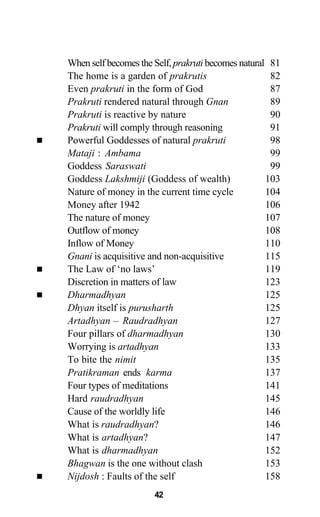
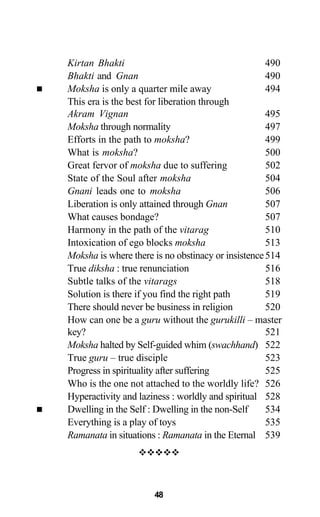
Contents
Page
The reality of this world 1
How alert are you of your own digestive processes?2
Who is the creator of this world? 3
Only solution to solve the worldly puzzle 4
Brahma, Vishnu and Mahesh 4
Not Yamraj (God of Death) but Niyamraj (Natural
Law) 5
Foundation on which the world functions 6
Nature of religion (Dharma) 9
Real Dharma : Relative Dharma 11
How can you do purusharth (true inner endeavor)
without becoming a purush (the Self)? 15
That which increases the keyf (intoxicate the ego) is
relative knowledge 15
How can there be liberation for the one who takes
sides? 18
Nature of worldly life: nature of vairagya (dispassion)22
Only the pure Soul is your true relative 26
Attachment and its consequences 31
Minding one’s own affairs 33
Do Celestial beings have to suffer too? 35
Bliss of an oasis in the middle of the desert 35
Evolution as exposed by Lord Mahavir 38
Who bears the weight, you or the horse? 40
Tree of the worldly life 42
True God : True Guru: True Religion 44
Religion of idols : Religion of the formless 47
Jinamudra - The posture of the Omniscient 55
Gnani instills life in an idol 56
Akram Vignan : The eleventh wonder of the world 58
Prakruti : The relative self 77
41
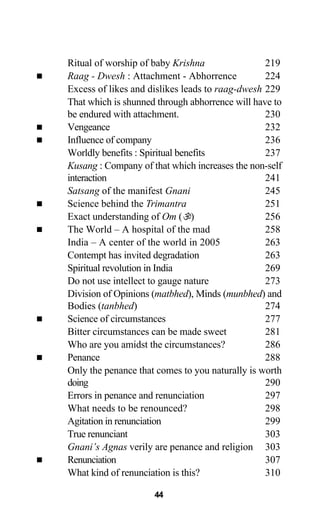
When self becomes the Self, prakruti becomes natural 81
The home is a garden of prakrutis 82
Even prakruti in the form of God 87
Prakruti rendered natural through Gnan 89
Prakruti is reactive by nature 90
Prakruti will comply through reasoning 91
Powerful Goddesses of natural prakruti 98
Mataji : Ambama 99
Goddess Saraswati 99
Goddess Lakshmiji (Goddess of wealth) 103
Nature of money in the current time cycle 104
Money after 1942 106
The nature of money 107
Outflow of money 108
Inflow of Money 110
Gnani is acquisitive and non-acquisitive 115
The Law of ‘no laws’ 119
Discretion in matters of law 123
Dharmadhyan 125
Dhyan itself is purusharth 125
Artadhyan – Raudradhyan 127
Four pillars of dharmadhyan 130
Worrying is artadhyan 133
To bite the nimit 135
Pratikraman ends karma 137
Four types of meditations 141
Hard raudradhyan 145
Cause of the worldly life 146
What is raudradhyan? 146
What is artadhyan? 147
What is dharmadhyan 152
Bhagwan is the one without clash 153
Nijdosh : Faults of the self 158
42
Protecting mistakes 159
Blunders and mistakes 161
Prakruti of a greedy person 162
Your acceptance of your mistakes destroys them 163
Awareness of seeing faults 163
Impartial vision 165
Foundation of mistakes 168
One who complains is the guilty one 169
Consequences of instigation 170
Who is the owner of the universe? 171
Why have attachments towards temporary attributes? 173
Only a Self-realized person can liberate you. 174
Liability of merit and demerit karma 175
The multilayered nature of the faults 176
A red flag? Then stop! 177
True relative religion 177
Natural law : Fault is of the sufferer 180
Absolute independence of all living beings 185
Vyavahar : Worldly interactions 187
Speech unfolds according to vyavahar between
individuals 189
What kind of justice in vyavahar? 191
Completionofworldlyinteractionisthefinalsolution 192
Understanding worldly happiness and misery 195
Life is like that of a bull working in an oil mill 198
Noble is the one who does not let others know of his
suffering 199
Accounts on books 200
When does one find bliss? 202
Behold the One who swallows all the bitterness 204
Real and imaginary pain 206
Abuse of power is sheer stupidity 215
Kantado : displeasure of boredom and fatigue 217
43
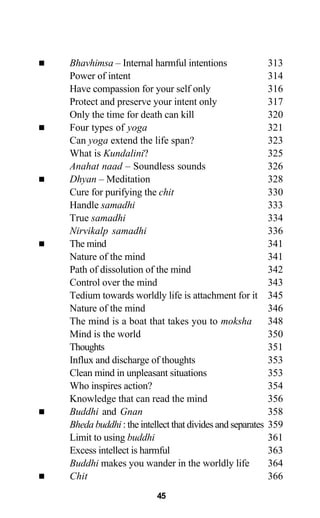
Ritual of worship of baby Krishna 219
Raag - Dwesh : Attachment - Abhorrence 224
Excess of likes and dislikes leads to raag-dwesh 229
That which is shunned through abhorrence will have to
be endured with attachment. 230
Vengeance 232
Influence of company 236
Worldly benefits : Spiritual benefits 237
Kusang : Company of that which increases the non-self
interaction 241
Satsang of the manifest Gnani 245
Science behind the Trimantra 251
Exact understanding of Om ( ) 256
The World – A hospital of the mad 258
India – A center of the world in 2005 263
Contempt has invited degradation 263
Spiritual revolution in India 269
Do not use intellect to gauge nature 273
Division of Opinions (matbhed), Minds (munbhed) and
Bodies (tanbhed) 274
Science of circumstances 277
Bitter circumstances can be made sweet 281
Who are you amidst the circumstances? 286
Penance 288
Only the penance that comes to you naturally is worth
doing 290
Errors in penance and renunciation 297
What needs to be renounced? 298
Agitation in renunciation 299
True renunciant 303
Gnani’s Agnas verily are penance and religion 303
Renunciation 307
What kind of renunciation is this? 310
44
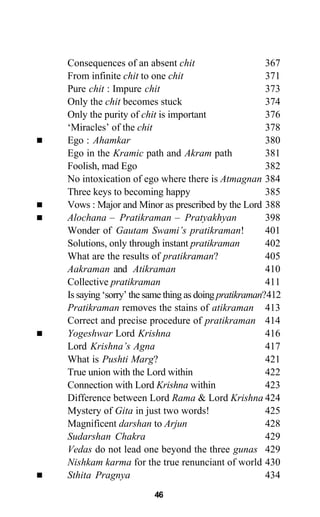
Bhavhimsa – Internal harmful intentions 313
Power of intent 314
Have compassion for your self only 316
Protect and preserve your intent only 317
Only the time for death can kill 320
Four types of yoga 321
Can yoga extend the life span? 323
What is Kundalini? 325
Anahat naad – Soundless sounds 326
Dhyan – Meditation 328
Cure for purifying the chit 330
Handle samadhi 333
True samadhi 334
Nirvikalp samadhi 336
The mind 341
Nature of the mind 341
Path of dissolution of the mind 342
Control over the mind 343
Tedium towards worldly life is attachment for it 345
Nature of the mind 346
The mind is a boat that takes you to moksha 348
Mind is the world 350
Thoughts 351
Influx and discharge of thoughts 353
Clean mind in unpleasant situations 353
Who inspires action? 354
Knowledge that can read the mind 356
Buddhi and Gnan 358
Bheda buddhi : the intellect that divides and separates 359
Limit to using buddhi 361
Excess intellect is harmful 363
Buddhi makes you wander in the worldly life 364
Chit 366
45
Consequences of an absent chit 367
From infinite chit to one chit 371
Pure chit : Impure chit 373
Only the chit becomes stuck 374
Only the purity of chit is important 376
‘Miracles’ of the chit 378
Ego : Ahamkar 380
Ego in the Kramic path and Akram path 381
Foolish, mad Ego 382
No intoxication of ego where there is Atmagnan 384
Three keys to becoming happy 385
Vows : Major and Minor as prescribed by the Lord 388
Alochana – Pratikraman – Pratyakhyan 398
Wonder of Gautam Swami’s pratikraman! 401
Solutions, only through instant pratikraman 402
What are the results of pratikraman? 405
Aakraman and Atikraman 410
Collective pratikraman 411
Is saying ‘sorry’ the same thing as doing pratikraman?412
Pratikraman removes the stains of atikraman 413
Correct and precise procedure of pratikraman 414
Yogeshwar Lord Krishna 416
Lord Krishna’s Agna 417
What is Pushti Marg? 421
True union with the Lord within 422
Connection with Lord Krishna within 423
Difference between Lord Rama & Lord Krishna 424
Mystery of Gita in just two words! 425
Magnificent darshan to Arjun 428
Sudarshan Chakra 429
Vedas do not lead one beyond the three gunas 429
Nishkam karma for the true renunciant of world 430
Sthita Pragnya 434
46
Pragnyashakti 435
Vedanta 441
Swachhand 442
Shaktipat and other relative spiritual practices 443
Kar Bindu Sanyuktam 445
Scriptures of Veda are vehicles to the Self 447
Only a Gnani can make you Brahmanishtha 448
Dwaitadwaita: The Self is beyond all states of duality
and non-duality 452
Moksha through anekant – acceptance of every
perspective 454
Vitarag Marg 458
Follow the Gnani 459
To whom do desires belong? 461
A strong desire for moksha 462
Darshan of the Formless leads to Moksha 463
Vitarag means to be truly shrewd 464
Serious warning against misuse of intellect 465
What is sankalp and vikalp? 467
Destroying your mistakes is the vitarag path 468
Only the one who can swim can save those who are
drowning 471
Vitarag Dharma 472
Revolutionary time in the world 472
Bhakta – Bhakti – Bhagwan 476
[Worshipper or Devotee – worship or devotion – God]
Vyavahar of the Gnani versus a devotee 478
Bhakti and Liberation 482
Aradhana – Viradhana : Devout worship – Disrespect484
One cannot cheat where natural law and order is
involved. 486
Akram Vignan : Bhakti begins after liberation 487
God’s address 488
47
Kirtan Bhakti 490
Bhakti and Gnan 490
Moksha is only a quarter mile away 494
This era is the best for liberation through
Akram Vignan 495
Moksha through normality 497
Efforts in the path to moksha? 499
What is moksha? 500
Great fervor of moksha due to suffering 502
State of the Soul after moksha 504
Gnani leads one to moksha 506
Liberation is only attained through Gnan 507
What causes bondage? 507
Harmony in the path of the vitarag 510
Intoxication of ego blocks moksha 513
Moksha is where there is no obstinacy or insistence514
True diksha : true renunciation 516
Subtle talks of the vitarags 518
Solution is there if you find the right path 519
There should never be business in religion 520
How can one be a guru without the gurukilli – master
key? 521
Moksha halted by Self-guided whim (swachhand) 522
True guru – true disciple 523
Progress in spirituality after suffering 525
Who is the one not attached to the worldly life? 526
Hyperactivity and laziness : worldly and spiritual 528
Dwelling in the Self : Dwelling in the non-Self 534
Everything is a play of toys 535
Ramanata in situations : Ramanata in the Eternal 539
48
1
Aptavani - 2
(When Dada says ‘We’, He is referring to the Gnani Purush
and the fully enlightened Lord within Him)
The reality of this world
What is this world all about? Who created the world?
Why was it created? Who runs it?
The Christians say, ‘God is the creator of this world’. The
Muslims say, ‘Allah made this world’. The Hindus say, ‘God
made this world’. Many Jains too, say that God made this
world. If someone created this world, then he would be called
a creator, and a creator means a ‘potter’. Which sons of God
were going to remain bachelors that he had to create this world?
When even factory owners delegate their work to their
secretaries and sleep peacefully, why would God have to work
so hard? God is not a laborer that he has to toil with his hands
or fix people’s marriages. God is not crazy that he would sit
inside the womb of a water buffalo and create a bull! Besides
if there were a creator of this world, people would have killed
him a long time ago, because what kind of a person would
create a world in which no one is happy? Indeed if such a being
did exist, people would have gone looking for him and they
would have searched him out and sorted him out. But how can
they find any such being when he does not exist.
There is no creator of this world. The world is the puzzle
itself. It has become puzzle some and that is why we call it a
puzzle. The one who solves this puzzle attains the state of the
2 Aptavani-1
supreme Self (parmatma pad) and the one who cannot,
becomes dissolved in the puzzle. Prominent sages, ascetics,
monks, nuns, preceptors etc, have all become dissolved in this
puzzle, just as sugar dissolves in water. Someone may ask,
‘Where is the sugar in the water? Why can’t we see it? We can
assure him that there is sugar in the water but it is dissolved
within the water. In the same way the soul (chetan) is present
in everyone, but it is as a lifeless living element (nischetan
chetan). When it becomes pure (shuddha chetan), then the
puzzle will be solved.
How alert are you of your own digestive processes?
A retired chief engineer of a big chemical company once
came to me and told me, “Dada, my company would not run
without me”. ‘We’ asked him, “What is so special about you
that your company would not run without you?” He said, “I am
very alert in my business. The work would stop if I did not go
in for just one day.” So ‘We’ asked him, “When you eat some
handvo (a baked Gujarati dish) at night, do you go to investigate
within to see how it is being digested as you sleep? Do you
check to see how much bile is secreted, how many other
digestive enzymes are produced? And by the next morning, all
the end products from that handvo will fall into their appropriate
places; blood will go where the blood is, urine will be in its place
and feces in its place. Do you go to check within how everything
falls into place? How alert are you when it comes to your own
body? When you can’t do anything for your own self, what
makes you think you can do anything in other matters? So many
powerful kings have come and gone and yet their kingdoms
continued, so what makes you think everything will stop in your
absence? What alertness are you talking about? Even the
Gnani’s shoe is more alert than you are! It gets the constant
attention of the devotees who keep it shiny. When you were
born, did you have to worry whether your teeth will grow or
not? Do you worry whether the sun will shine tomorrow or not?”
Aptavani-2 3
Who is the creator of this world?
‘The world is the puzzle itself’. Christians, Muslims,
Hindus all say that God is the creator of this world. They are
correct by their viewpoints but incorrect in fact. If you want to
know the facts, you will have to come to ‘us’. ‘We’ give you
assurance and a guarantee that no one has created this world.
There is no one up there in the sky or the heavens, running this
world. Only ‘We’ (the Gnani and the fully enlightened Lord
within) know how this world runs and who runs it. There is not
a single parmanu (subatomic particle that cannot be further
divided) in this universe that ‘We’ have not traversed through
and experienced. From the vantage of both in and out of this
universe, ‘We’ can tell you from all the viewpoints and
perspectives, that there is no one up there running everything.
‘We’ will tell you how this world runs in one simple
sentence. Later you may understand it in complete details. This
world is run by only scientific circumstantial evidences; no
individual entity is running it. Everyone and everything is merely
instrumental in the process of its functioning; no one or thing
controls it independently. Furthermore, God can never be the
doer of anything. If God were the doer, then He would bind
karma and therefore He would have to suffer the consequences
of those karmas. If God too is subject to bondage of karma,
then how can we call him God? Then what difference would
there be between you and God?
Everything you hear is nothing but humbug! People act
according to their own understanding. People think there are no
consequences for their actions and so they continue with lies at
will. This world is not haphazard by any means; the world is a
fact, but it is a relative fact and the Self is the real fact. When
the Gnani Purush places you in the real fact then it becomes your
abode of freedom (muktidham). People believe this world is
without any basis; they think they can enjoy themselves in any
way they want and that no authority is going to question them.
4 Aptavani-2
The fools! This world is not like that. ‘You are whole and sole
responsible for yourself.’ You carry the burden of your previous life
and responsibility of your future life. Make sure that you do not
make even the slightest mistake. God does not interfere in this at all.
Will you not have to understand this world? How long can
you go on living and perpetuating this falsehood? Will you not
have to solve this puzzle? How long will you go on being
trapped in this entanglement?
Only solution to solve the worldly puzzle
The world is the puzzle itself. There are two viewpoints to
solve this puzzle: one is a relative viewpoint and the other is a
real viewpoint. By relative viewpoint, you are Chandulal and by
real viewpoint you are a pure Soul (Shuddhatma). All your
puzzles will be solved if you look at the world with these two
viewpoints. This verily is the divine vision (divyachakshu). But
you will not gain anything until Gnani Purush destroys the sins of
your countless previous lives and gives you realization of your
real Self. Nothing can be attained without a living manifest
enlightened being (pratyaksh pragat purush).
Brahma, Vishnu and Mahesh
Dadashri : Who created this world?
Questioner : Brahma, Vishnu and Mahesh; these three
collectively created the world. Brahma is the creator, Vishnu is
the administrator and Mahesh is the destroyer.
Dadashri : Then who is the father of Brahma, Vishnu and
Mahesh?
Questioner : Shankar is the father.
Dadashri : Then who is the mother?
Questioner : He himself is the mother.
Dadashri : Then why did he create only three and not five?
Aptavani-2 5
Questioner : Because there are three qualities (gunas).
Dadashri : There is no individual by the name of Brahma,
Vishnu or Mahesh. These names represent the three natural
attributes (gunas). In the process of learning about the three
gunas, people misused the information and hence created these
three idols. What was meant to be said was that we need to get
rid of these three gunas of the prakruti (characteristics traits of
the complex of the non-self) in order to become pure.
Questioner : By getting rid of these three gunas?
Dadashri : Yes. Brahma, Vishnu and Mahesh are
symbolic representations of the three gunas and you have to
transcend them. Bliss exists within you but why can you not find
it? You cannot experience it because of obstacles. Who created
these obstacles? Did God create them? No, you yourself
created the obstacles. And these obstacles are such that even
when happiness comes to you, they will not let you experience
it. Otherwise, you are the supreme Lord, but alas you have
created the obstacles, no one else. Only you have created
whatever suffering you have to experience. If there were
someone else who was responsible for creating all the suffering,
people would have caught him and destroyed him by now!
Not Yamraj (God of Death) but Niyamraj (Natural
Law)
Yamraj terrifies many people. How do people depict
Yamraj? They portray him with long horns, large fang-like teeth
riding a buffalo. If that does not terrify people, then what else
would? When a dog howls, people say ‘Jamra is coming.’
Meaning the God of Death is approaching. You fools! There is
not even an insect called Jamra. This Yamraj people refer to is
really an occurring of a precise natural circumstance. Everything
in this world runs precisely in a definite scientific manner. Death
comes as dictated by natural laws. Now, will you have anything
to fear when ‘We’ tell you that Yamraj is the God of natural laws?
* * * * *
6 Aptavani-2
Foundation on which the world functions
What is the beginning of this world? What is the
foundation that supports the starting point of this world? This is
a very deep and a mysterious puzzle about the world. Today the
truth of the origin of the world is being disclosed to the world
through this medium of Dadashri.
Pratishthit Atma (false projection of one’s identity, the
relative self, the belief, ‘I am Chandulal’) is the main foundation
and the origin of the world.
What is the action that continues to perpetuate the
dependency of the worldly being (adhikaran kriya)? It is the
ignorance (agnan) of one’s real identity (the Self). Ignorance of
one’s Self is the force and power behind these actions. The one
who says ‘I am Chandulal’ believes that to be the case and this
belief is in his action as well. This is the illusion that verily
perpetuates the worldly life. This is the adhikaran kriya of the
entire world. One projects and establishes the belief ‘I am
Chandulal’ in a place where one is really not. And hence he acts
and behaves according to this false projection (aropit bhaav),
and furthermore he believes that he is the doer in all that he
does. This false belief is the adhikaran kriya. In other words the
projection ‘I am Chandulal’, ‘this is my body’, ‘I am the doer
in all that is taking place’ is the pratishtha. The pratishthit atma
of this life is the result and creation of karmas and projection
done in the previous life. Now in this life, as the pratishthit atma
discharges due to the prevailing illusion of one’s real identity, the
adhikaran kriya continues and as a result a new pratishthit atma
for the coming life is created. Whatever is charged will inevitably
discharge. No one, absolutely no one can make a slightest
Aptavani-2 7
change in this because it is an effect and no one can obstruct or
prevent an effect.
The pratishthit atma is completely different from the
Shuddhatma (pure Soul). The relationship between the two is
that of gneya-gnata (gneya - object or thing to be known.
Gnata - the knower). In this relationship, if the pure Soul
remains in its state as the knower and the pratishthit soul (the
relative soul) remains in its place as the absolute discharge entity;
gneya- the entity to be simply known, then new karmas will not
be charged. This is when the adhikaran kriya stops completely
and there is no creation of a new pratishthit atma for the coming
life. Then all that remains is the discharge of the pratishthit atma
created due to past mistakes. Nothing will be charged anew and
therefore nothing will have to be discharged.
The Gnani Purush alone can put a stop to this. The Gnani
Purush can dissolve the bhranti ras i.e. the ‘sweet relish’ that
perpetuates the illusion and separate the pure Soul from the
pratishthit atma. He establishes a line of demarcation between
the two. Thereafter, the two always remain separate; their
relationship remains as one of gneya-gnata (that which is to be
known-knower). The one that knows the pratishthit atma as a
gneya is the pure Soul. The pure Soul is swa-parprakashak,
meaning it illuminates the Self as well as the non-self, whereas
the pratishthit soul is par prakashak, meaning it illuminates only
the non-self. Pratishthit atma knows only that which is known
through the senses (indriyagamya), whereas the pure Soul is
the knower of that which is beyond the senses (atiindriya). All
visible actions are that of the pratishthit atma; no part of that
belongs to the Shuddhatma (pure Soul). Knowing (Gnan kriya)
and seeing (darshan kriya) are the only actions of the pure Soul
and eternal bliss is its core attribute (swabhav).
‘I am this’ and ‘this is mine’ is the false projection
(pratishtha) that continues and this binds the pratishthit atma.
8 Aptavani-2
When ‘I’ and ‘mine’ depart, then there is no new pratishtha for
the pratishthit atma; new causes are not created. A new
pratishthit atma is not created and the only thing that remains is
the effect of past causes. What remains when all the remaining
effects are suffered as simply effects? Only the absolute Self!
* * * * *
Aptavani-2 9
Nature of religion (Dharma)
What is the definition of dharma (religion)?
That which reverts to its original nature (dharma) and then
brings forth the result, is called religion. That means it takes hold
within and decreases the kashaya (anger, pride, deceit and
greed) within.
The nature of anger, pride, deceit and greed (kashaya
bhaav) is such that they will not decrease. Rather, they keep
increasing within. They will not decrease by one’s own efforts.
They will decrease through religion (dharma) as defined above.
Where will one attain such a religion? From a Gnani Purush. It
should be a religion certified by the Gnani. Thereafter, use of just
two words of the Gnani Purush, words that are laden with the
energy that brings exact results (vachanbad), words that
awaken and maintain awakened awareness (jagruti), will
shatter the veils of ignorance to release tremendous energies
from within.
That which brings forth results is religion (dharma). That
which does not bring forth a result is not religion (adharma).
What is the result? Religion decreases one’s kashays.
They become lighter, lesser and ultimately they leave. As they
decrease and lessen, one’s inner energy and bliss increases. One
becomes aware of the amazing inner energies that express.
Where did all these energies come from? That is dharma
(religion). If not, the spinning toy (term Dadashri uses for the
plight of the human being who enters one life after the other by
creating karmas through ignorance, the analogy being the
spinning top which stops spinning at death) remains the same
10 Aptavani-2
until the time of death (nanami). How can one call that religion?
What does it mean ‘to become the religion and then bring
forth result’? What result is to be expected? Is it to learn how
to take a vow, discipline, penance? No, none of these. It means
to be rid of anger, pride, illusionary attachment, deceit and greed
(kashays). To be rid of these kashays is called dharma
(religion). Then some say, what about these daily introspective
periods (samayiks), meditation sessions (dhyan), listening to
discourses (pravachans)? Is that not religion? The Lord says,
no that is not religion. The Lord advises you to ask these
teachers of religion if they experience kashays with their
disciples. The master will then reply that none of the disciples
follow their instructions to do samayik and therefore they get
very upset from within. Now, is that dharma? Are they following
religion? No, on the contrary they are only increasing the
kashays.
Religion does not exist in samayiks (introspection) etc.
Religion exists in the expression of meaningful results. Religion
means that which eradicate kashays and their intents. These
kashaya bhaavs cannot be killed even if one tries to; they cannot
be peeled away no matter how much one tries to do so. They
are very resistant to eradication.
When the religion attains its final and full result, then one
becomes the embodiment of religion (dharma swaroop).
* * * * *
Aptavani-2 11
Real Dharma : Relative Dharma
There are two types of dharma: relative and real.
Relative dharma encompasses workings of the mind, the
speech, the body and all other activities of the non-self. Chanting
mantras (japa) is the dharma of speech. Meditation is dharma
of the mind. Bathing, performing religious rituals are the dharma
of the body.
Everything remains within the parameter of its own
dharma. The mind remains in the dharma of the mind, the
intellect remains within its own dharma, the chit remains in the
dharma of the chit, the ego remains in the dharma of the ego, the
ears remain in the dharma of the ears. Ears do the work of
listening; they are not involved in the action of seeing. The eyes
perform the action of seeing and not listening. The nose is
involved in the action of smelling, the tongue plays its role by
tasting and the tactile sense is involved in the feeling of touch.
Every sense is always involved in the function of its own subject
matter (dharma).
When the mind is involved in its dharma, the mind may
have good thoughts or bad thoughts but nonetheless, it is in its
own dharma. When thoughts are good, one says, “My thoughts
are good,” because of the illusion (bhranti). Here one becomes
one with the thoughts (tanmayakar). When thoughts are
negative, he remains separate from the thoughts saying, “I have
these terrible thoughts even when I do not want to.” The
function (dharma) of each component of the antah-karan (the
internal functioning mechanism in every human being composed
of the mind, the intellect, chit and ego) is separate. The function
12 Aptavani-2
of the mind is separate, function of the chit is separate, function
of the intellect is separate and function of the ego is separate.
But one interferes in their functioning and creates a mess! To
become one with thoughts is the illusion. When interference of
becoming the owner of the thought ceases? It is when the Gnani
Purush bestows the knowledge of the Soul; the knowledge of
one’s real Self, one ceases to become one with everything that
takes place within and without. As the Self, one becomes
impartial. Then there will be no support for the mind, the chit,
the intellect, the ego or the body. You become one with them
because of the false projection (aropit bhaav) ‘I am the body’.
Once you attain the Self, you remain separate as the knower
and the seer.
Everyone in the world is practicing relative dharma. They
are engaged in the dharma of the body, the speech and the mind.
They believe the dharma of the mind to be their own dharma.
True dharma is where one believes the Self to be the only
dharma. All others are relative dharmas. Dharma of the Self is
the only real dharma; that is the dharma of the Self (swadharma)
and that is liberation (moksha). One needs to know dharma of
the Self. All others are the dharmas of the non-self.
‘Dada Bhagwan’ within you is the living Lord. He is the
absolute supreme Self (parmatma). This very Lord is fully
manifested within me and within you, He has yet to manifest.
Here there is no religion; here you have to get your work done.
How long will you go on sitting in religious schools? All you have
to do is to get your work done, by that ‘We’ mean you have
to attain the knowledge of your Self from the Gnani Purush. The
Gnani’s lamp is lit, all you have to do is touch the wick of your
lamp to his, and your lamp too will be lit. Very rarely, only once
in a while is there a presence of a Gnani Purush on this earth.
A Gnani of the Akram path (the short-cut path to Self-
realization) comes about once every million years, but when that
happens, it is possible for you to realize your Self (Soul) within
Aptavani-2 13
just one hour! And that is why ‘We’ are telling you to get your
work done. This body is like a bubble, there is no telling when
it may burst. Sitting within is Dada Bhagwan, he is the supreme
Lord; his presence is magnificent and powerful. Therefore,
people will achieve salvation as long as this ‘bubble’ exists. This
is because the supreme Lord within is very pleased with me; the
Lord of the three worlds (lokas) follows my wishes. The Lord
does not have speech, neither does he have hands or feet and
that is why he has surrendered to me and has made me an
instrument (nimit) in this path of salvation of this world. And that
is why ‘We’ are saying, “Get your work done as long as this
bubble remains intact.”
Here, with me, the only dharma is the dharma of the Self.
Here, there is only the path that is free of all contradictions.
Elsewhere in the world, there is practice of relative religions. To
make a false projection of being what you are not, to live as ‘I
am Chandulal,’ to walk the path where good deeds are
advocated and bad ones are denounced; to maintain an obliging
nature towards everyone, even when it is done in the entire life,
all that ultimately remains in the domain of the relative dharma.
And here, if you practice the real dharma, if you realize the Self
even for just a second; then there is liberation. The Lord has
said that if you were to say, ‘I am the Self’, even just once after
becoming the Soul, then you will get your work done.
Otherwise, even if you keep repeating, ‘I am the Soul and the
body and all its entanglements are not mine’, for a million life
times, you will not gain anything. What does the Lord say? He
says, ‘You believe you are Chandulal.’ This has also become
your faith. Your faith is not broken. That belief or knowledge is
not broken and neither is your conduct any different and if you
say, ‘I am the Soul’, then you will never achieve liberation. How
can you say you are the Soul when all the while you remain in
the false belief of ‘I am Chandulal’? How can you say you are
the Soul when you speak as if you are Chandulal? When the
14 Aptavani-2
false projection of your knowledge and vision of being
Chandulal are broken and you are placed in the right belief and
knowledge (of being the pure Soul), only then is liberation
possible.
What do the relative dharmas preach? They tell you to
stop doing bad deeds and do good ones. Good deeds bind
merit (punya) karma and bad deeds bind demerit (paap) karma.
It is not possible to do only good deeds your entire life. If you
call someone names, you create five rupees worth of demerit
karma and if you do philanthropic work, you earn hundred
rupees worth of merit karma. Your demerit karma cannot be
subtracted from the merit karma. If that were possible,
millionaires would not allow any demerit karmas to accumulate.
They would spend their money to pay off their debts of demerit
karma. But this is real justice. And therefore one has to suffer
the consequences of whatever karma is unfolding. Merit karma
will bring you happiness as it unfolds and when your demerit
karma unfolds, you will find its fruits very bitter. You have no
choice, but to taste the fruits of both kinds of karma. Lord says
to plant the seed of the fruit you can afford to taste. If you want
happiness, then plant seeds of merit karma and if you want
unhappiness, then plant seeds of demerit karma; but both merit
and demerit karma are relative dharma, they are not real. In real
dharma, dharma of the Self, liberation from both merit and
demerit karma is attained. Relative dharma will bring you
material happiness and will help you towards the path of
liberation, whereas real dharma will grant you liberation. Here,
with me, you will attain the real dharma which will give you
liberation directly. Only here you will experience the bliss of
liberation. You will experience freedom from physical ailments
(adhi), mental anguish (vyadhi) and miseries imposed upon you
by others (upadhi) and constantly experience the bliss of the
Self (samadhi). Only here does the state of absolute easiness
(nirakudata) exist. There are talks of the Self (atma) and the
Aptavani-2 15
absolute Self (parmatma) here.
How can you do purusharth (true inner endeavor)
without becoming a purush (the Self)?
A prominent professor once came to me. He harbored
the notion ‘I know something’ and ‘I am doing some purusharth.’
‘We’ asked him, “What do you do? What is your purusharth?”
and he replied, “All my efforts are solely for the soul.” ‘We’
asked him, “How can you do purusharth without becoming a
purush? You dance according to the tunes of your relative self
(prakruti) and you say, ‘I danced’.”
‘We’ challenge anyone in this entire world that whatever
he is doing, it is not under his own independent power. Arey!
Even when you go to the toilet to evacuate your bowels, it is not
your own independent doing. Some 250 very prominent doctors
came to satsang in Baroda and ‘We’ asked them, “You claim to
treat your patients who are constipated, but do you think it is
under your control to evacuate their bowels?” They all claimed,
“But indeed we are the ones who help them go to the toilet.”
‘We’ asked them, “When you do not have independent control
over your own bowel movements, how can you have control
over someone else’s? You will realize this when you become
constipated yourself, you will discover that it is not under your
independent control. The prakruti makes one do everything but
the ego within says, ‘I did it’.”
That which increases the keyf (intoxicate the
ego) is relative knowledge
The knowledge of all prominent scholars, of those who
have studied the scriptures extensively, the knowledge of
prominent sages, preceptors and spiritual teachers is all worldly
knowledge; it is relative knowledge (prakrutgnan). The
difference between prakrutgnan and atmagnan (knowledge of
the Self, real knowledge) is like the difference between milk and
buttermilk. How does relative knowledge work? It uses prakruti
16 Aptavani-2
to wash away prakruti; doing this makes the prakruti light. A
person can spend his entire life time washing away his prakruti
(the non-self complex) but if in his next life he falls into bad
company, his prakruti can become very dense again. The Lord
has equated this to an elephant bathing in a muddy pool. When
an elephant bathes in water, he becomes nice and clean but the
moment he comes out of the water, he dusts his body with mud.
Such is the state of the human being. Atmagnan is rare,
extremely, extremely rare. Liberation is merely a word and any
reference to it is mere talk because it is not so easy to attain.
Everyone with prakrutgnan believes, ‘I know everything’. The
pitiful ones! All they know is prakrutgnan; it is all relative
knowledge. What they need to know is atmagnan (knowledge
of the Soul). For so many lifetimes all you have attained is
prakrutgnan and what do you claim? All along the prakruti has
been the doer and yet you claim, ‘I did it’. Prakruti makes you
dance, it makes you wake up in the morning, but you claim, ‘I
woke up’. Even when you sleep, it is the working of the
prakruti. Sometimes you cannot sleep even when you want to
and when the prakruti makes you sleep, you claim, ‘I fell
asleep!’
‘We’ are telling you this with absolute assurance that the
entire world is caught up in prakrutgnan. Whether a person is
reading the scriptures, or reciting Lord Mahavir’s forty-five
Agams or reciting the four Vedas, ‘We’ would still tell him that
he is under the spell of prakrutgnan. The difference between
atmagnan and prakrutgnan is like the difference between milk
and buttermilk; they both look white. But prakrutgnan increases
one’s ego (keyf) whereas atmagnan decreases it. That which
decreases the ego is atmagnan.
Questioner : Does the ego increase by studying scriptures?
Dadashri : Yes, because it is prakrutgnan, it serves to
increase the ego of, ‘I know’. For heaven’s sakes what do you
Aptavani-2 17
know? Your worries and restlessness and their effects on others
has not decreased. Even when someone breaks a simple glass
in your home, you act like your soul is broken. The Gnani, on
the other hand, will remain unaffected even if his diamonds were
to get lost. Prakrutgnan keeps one entrenched in the ego of ‘I
know something’, that is all it does.
In the current time cycle, renowned ascetics, sages and
religious preceptors (acharyas) all dwell in the intoxicated ego
of ‘I know’. When they preach or say anything, they do so at
their own risk and liability. All of them have lost the real path but
alas what can anyone do? They are not at fault. They too desire
liberation and abide by the Lord’s agnas (cardinal directives),
but the current time cycle is very peculiar and that is why they
are caught up in a twisted misunderstanding. Everything is
prakrutgnan and it increases the level of the ego whereas
atmagnan decreases it. It would be good even if they had
constant awareness that they do not have atmagnan, but on the
contrary they go around concealing their ego. They strike back
when ever someone challenges them. When one becomes free
from such intoxication, he will have the world in the palm of his
hands. You are the owner of this world; you yourself are the
Lord of this universe! If these preceptors were to admit, ‘We
don’t know anything about atmagnan’, they can come closer to
their liberation.
Is having the knowledge of prakrutgnan of any use? No,
because atmagnan is needed for liberation. Atmagnan is not
found in books or scriptures; it exists with the Gnani. It is the
task for the one who has nothing left to know in this world, no
scriptures to read and no rosary to turn. If we see someone
reading scriptures or turning the rosary, can we not deduce that
he is still in the process of learning? Can we not deduce that he
is in a certain standard? How can he teach us when he himself
still has to study? Only the one who has become absolute can
be of help to us. All the religions in the world are relative and
18 Aptavani-2
of varying standards. Everyone finds an appropriate standard
depending upon his or her spiritual development. However for
the real religion, religion of the Self, you will have to go ‘out of
standard’. Only after having passed and accepting all the
standards, does one become the supreme Self!
How can there be liberation for the one who
takes sides?
Jainism, Vaishnavism, Shaivism, Swaminarayans, Islam,
Christianity are all relative religions; they are religions of
‘standards’. They are religions of different viewpoints. Whatever
one sees according to his viewpoint, he accepts it as being
correct and gets entrenched in it. When is liberation attained? It
is when absolute vision is attained? When is real knowledge
attained? This happens when there is no conflict of opinion with
anyone in this entire world and when there is no partiality
towards any being. The one who is partial can never attain
moksha. Why does one become partial? People with ego create
sides to support their ego, whereas the impartial Gnani unites
everyone. The Gnanis are always impartial; the vitarag Lords
(fully enlightened supreme beings who have no attachment to
their relative self or the world) are always impartial. They have
no partiality towards any race or creed; they are absolutely and
perfectly impartial. They have oneness with everyone; even with
the minutest living thing.
All beings are ‘packings’ (packages) of one kind or
another. There are all varieties of packing but within them
resides the Self. The ‘material’ within, i.e. the soul within
everyone is exactly the same. However, divisive intellect has
arisen because of the external differences. The Gnani does not
look at the packing at all; he only sees the ‘material’ within. He
constantly sees the soul in the person in front of him. The
Gnani’s vision is the vision that sees only the soul (atma
drashti). Divisiveness and segregation remains because of the
vision that sees only the packages and that is the reason the
Aptavani-2 19
worldly life continues to exist. By being partial, one energizes the
pillars of partiality and divisiveness. You fools! Do you want
liberation or do you want to remain in partiality? Liberation and
taking sides is a contradiction. The Lord himself is impartial and
yet people have become partial. The Jains say, “This is ours, that
is not, that belongs to the Vaishnavs.” The Muslims too say,
“This is ours. This is not, this belongs to the Hindus.” Everyone
in all religions take sides. Here, with the Gnani there is
clarification for people of all religions. Everyone that comes
here, regardless of his or her religious belief, feels no alienation.
They feel as if ‘We’ are talking about their very own religion and
that is because ‘We’ are absolutely impartial. Only here is there
a coming together of all religions.
When people become partial, they move further away
from the Lord within. Not only have people become partial but
they have also created so many different divisions within just one
faith. Even amongst Jains, there are eighty-four different sects
and there are so many factions amongst the Vedantis too. What
is the definition of the Jain dharma? It is when one does not take
sides. What is more, if someone creates divisions, a true Jain
would go to that person to explain things to him in details and
try to overcome any conflict of opinions. The definition of a true
Jain is that even when he is right and the other person is
completely wrong, he would still approach the other person
himself. Many will say to him, “Why do you bother with him
when you are right?” But the one practicing true Jainism will say,
“I am a Jain and that is why I have to approach him.” A Jain
is someone who has no obstinacy about any perspective and
who listens to everyone. He will listen to everyone and will not
allow any viewpoints to cloud his own vision; he remains
focused. He would not resort to deceit, ‘Yours is wrong and
mine is right’. Surely one should listen to that which reaches the
self within, should one not?
Lord Mahavir used to listen even when someone of a
20 Aptavani-2
different religion came to him. But people have created so many
factions within the very religion of Lord Mahavir.
Today, the ascetics and sages too have become partial.
What is the difference between the sages of religious sect and
the sages of the vitarag Lords? The sages of religious sect are
partial; they even fight amongst themselves. Just as two brothers
fight with each other. The sages of the vitarag Lord are impartial
and never interfere in anything. We pay obeisance to the sages
of the vitarag Lords who never take any sides, regardless of
whether they are a Digambari (‘sky-clad’ or ‘naked’ the sect
of Jains who believe nothing besides the atma merits owning and
hence they do not believe in rituals or idols) or a Swetambar
(the Jain sect that believes in idol worship and rituals and visit
derasars). But here the maharaj of one religious sect will not go
to listen to another religious sect. Can they attain liberation if
they are caught up in taking sides? If it is the truth, then it must
be accepted even if it comes from anybody’s home. But where
does truth exist today?
Sages of certain religious sects have quarreled over
whether they should clothe the idol of the Lord or to leave it
naked. What was the reason behind leaving the Lord’s idol
naked? Adorning an idol is an undeveloped ritual, but it attracts
people to come and do the Lord’s darshan, does it not?
Whereas the previous concept is for those who want knowledge,
but nowadays everything is completely turned around. A sage
from one religious sect came to me and told me, “Surely
liberation will come only to us, will it not?” ‘We’ asked him,
“Why do you say that?” and he replied, “Why? Did God not
say, “Nagga ae mokha magga”? (Only the one who sheds his
‘clothes’ will attain liberation)?” ‘We’ told him, “Yes, you are
right, the Lord did say, “Nagga ae mokha magga”, but you
have misunderstood this statement. The Lord said to de-clothe
(unveil) the Self, not the body!”
All this is nothing but misunderstanding. The soul has three
Aptavani-2 21
layers of ‘clothings’: the cloth of the mind, the cloth of speech
and the cloth of the body. These are the ‘clothes’ the Lord was
referring to. A true Digambar is the one who takes off these
clothing and completely exposes the Self. It is the clothing of the
mind, the speech and the body that need to be shed; these
represent the greatest acquisitions (parigraha). These need to
be shed.
Shall ‘We’ tell you what all this taking-sides is like? Is it
possible for a person to think that he is not good looking? If it
were then people would not get along with the mirror at all, but
the fact that they do, is because of their partiality. A truly
beautiful face is that which keeps coming back to the mind
within. Whereas here; one is partial and prejudiced. The aura of
the one who is impartial will exude to all around him. People,
who are partial and prejudiced, repel others wherever they go.
They ‘smell horrible’ (not respected) even in their own homes!
So many people will ask me, “Are you a Jain?” or “Are
you a Vaishnav?” You foolish people! What Jain or what
Vaishnav? I am a vitarag. ‘We’ are in all religions. By calling me
a Jain or a Vaishnav, people create an obstacle for themselves.
They think of me as being partial towards a certain religion, but
if they were to see me doing darshan of Lord Ramchandraji just
once, all their beliefs would be broken. But alas, one needs
merit karma for that too!
* * * * *
22 Aptavani-2
Nature of worldly life : nature of vairagya
(dispassion)
Sansar (the worldly life) is nothing but a betrayal. In it, no
one is related to you. If a person were to clearly understand the
terrible misery of worldly life, he would have an intense desire
for liberation. This terrible misery of the world is a counter
weight for liberation. One feels the intense desire for liberation
as misery increases.
Today, a person may find the world fearfully miserable
and yet because of the illusion he continues to suffer its repeated
blunt beating. He continues to put up with the beatings saying,
‘Things will improve tomorrow’, but does brass ever turn into
gold? No, it will never turn to gold. That is why it is important
to understand its horrible misery for once and for all. As it is,
one is under a false belief that he can derive happiness from the
world; ‘I will be happy if I do this’. Alas! Even here, one is
subject to a beating.
If the Gnani Purush were to merely describe the terrible
misery of this world, one will definitely begin to question, ‘Is the
world so terrible? There is no way to escape from it. We must
solve it once and for all.’ You can become free from the worldly
entanglements through submission. ‘Yes sir. Yes, sir’ is what you
have to do in order to disentangle yourself. This world is such
that it calls for settling all matters with equanimity.
This is a very profound fact that ‘We’ are telling you. The
world perpetuates and remains in existence because of all other
superficial talks.
There is a pot of yogurt sitting on the floor, a cat gets a
Aptavani-2 23
whiff of it and comes to eat it. She tips the pot over and eats
the yogurt. There is still some yogurt left in the pot, so her greed
drives her to push her whole face inside the pot, and she
becomes trapped in it. There is nothing but total darkness inside
and so she runs around trying to get free. Now how can she
escape such a trap? In the same way, the entire world is caught
in such a trap. How can a person escape from his own trap?
The cat can only become free if someone frees her. In the same
way, only a Gnani can free you from the trap of this world, no
one else can. A person can never become free on his own; on
the contrary, he will sink deeper.
I had studied and analyzed this scenario about the cat
when I was young. I used to put a pot of yogurt as bait and
watch it quietly. I did not care whether the yogurt would be
wasted but at least I would be able to see and learn from it. If
one gets a direct experience of this trap, then why would he be
foolish enough to fall in it again? Despite getting her head stuck
in the pot once, if a cat were to see a pot of milk again, she will
forget her previous predicament and do the same thing over
again. Then she will regret it but what can anyone do after the
fact? Even if she has been trapped once, does she remember
she should not repeat the mistake? No, she forgets even when
she is punished. What hope is there for animals when even
human beings forget? This body will never become yours.
Despite this people say, “This is mine, he is mine, she is mine.”
You miserable people, when your body is not your own, how
can anyone else be yours?
You are coming home from Calcutta and on the way you
buy some nice mangos; you have to handle them with care
because you do not have a basket to carry them in. What is
more you have to carry them yourself since you do not have
your servant with you. After you bring them home, you eat them
and you throw away the skin and its stone (seed). For heaven’s
sake! You took so much care to bring the mangos home and
24 Aptavani-2
now you throw them away? The answer is yes because only the
sweet juicy pulp inside was useful. In the same way, when these
human beings turn to skin and bones; when there is no ‘pulp’ left
in them, even their children will kick them!
An old lady and her son lived next door to us. The old
lady was blind but she worked all day long taking care of the
home. One day her son’s boss came to their home. The son was
the boss in the home and the other man was the boss at work!
Both these ‘bosses’ came home. The son thought to himself, if
my boss sees my blind mother, I will loose my reputation and so
he tells her, “Hey you blind woman! Get up, my boss is here.”
He kicks (insults) his mother to impress his boss! The fool! As
if he is some big shot! The dope! Should he be thinking of
protecting his mother or his boss?
Why do people buy mangos? They do so because of the
pulp and its juice. Similarly, this whole world has selfish motives.
That is why only the Lord within is real and so if we have
attained something when we attain liberation, otherwise they will
tell you, “Get up you blind woman!”
Some people complain, “We don’t have any children.”
What are they going to do with children, put them on a
pedestal? Of what use are children when they mistreat their
parents? Instead, it is better not to have any; besides in which
past life did you not have children? All these animals, dogs, cats,
donkeys, cows, buffalo have carried their young around their
necks in their past lives too, have they not? You have attained
this human birth with great difficulty so why don’t you shape up
now at least! Look for the instruments that will help you attain
liberation and get your work done. An old lady will say, “Damn
this worldly life, it is filled with misery”, when her son mistreats
her. We can ask her, “Dear lady, was this worldly life not
miserable before?” The worldly life has always been miserable
but it appears sweet because of illusion (moha) and infatuation
Aptavani-2 25
(murchha). When her son mistreats her, she comes out of her
illusion transiently and finds the worldly life bitter for that
duration, but once again the illusion clouds her perception and
she forgets everything. Those who have no Self-realization
(agnanis) will forget everything all at once, at that time.
Whereas the Gnani, is constantly aware of the reality of the
world, at a glance. The Gnani can constantly see this world
exactly as it is, so where is the scope of any infatuation setting in?
It is because people do not have such awareness that they suffer.
If the mother-in-law is not able to do any work, the
daughter-in-law will tell her to go sit far away; otherwise she will
give the mother-in-law chores that will keep her out of her way.
All along the old lady thought her son would take care of her in
her old age. It is only later that she discovers just how well he
takes care of her! There is no escape if you are bound and there
is no bondage if you are free. Only after you attain knowledge
of the Self, can you escape the worldly bondage.
‘We’ will tell you about an incident that ‘We’ personally
witnessed as a young boy. There was a blind old man. When he
ate his meals, little children around him would put pebbles in his
plate. The old man used to get very frustrated and yell at them.
The children found this very amusing and they would put even
more pebbles in his plate. Alas, this is what the world is like!
There is no telling how many more lifetimes will have to be
suffered this way. If you get the ‘visa’ for Moksha (liberation),
then you will get your work done in at least two or three more
lifetimes. But sadly people do not even have this visa and yet just
look at the amount of attachment (moha) they have for this world!
The cat forces her face in the pot because of greed and
then gets stuck inside. Why does she force her face into the pot?
She does so because of insatiable greed and selfishness. Greed
and selfishness verily are ignorance. So here is what we need to
learn:
26 Aptavani-2
• Who am I?
• What connection do I have with this person here?
• Will these people ever become mine?
These teeth do not become clean even after brushing them
for sixty-five years. Should we then not understand what is true
and what is false? All your life you have scraped your tongue
clean but even then, it does not remain clean. Everyday you
spend time taking care of your teeth but even then they do not
remain loyal to you. Did your tooth not start hurting today? That
is what this world is like. This world is truly like that; it will let
you down in the hour of your need. A daughter-in-law will
massage her mother-in-law’s feet everyday, but when the
daughter-in-law has a stomachache, the mother-in-law will tell
her to take some ajwain seeds! Everyone will give such
suggestions but will the mother-in-law take on the pain of the
daughter-in-law? Tell me, for that matter does your husband or
children take on your pain? This world is such that it works the
bullock until it becomes crippled and then they will take it to a
slaughterhouse. As long as the father earns money, they have
affection for him and when he stops working, they will tell him
to sit on one side. They will even tell him he has no sense. This
is what the world is like! The entire worldly life is one big
betrayal. If there were any good in it, would this Dada not say,
“This much of it is real and worthwhile”? However, in reality it
is nothing but a betrayal. Nothing in this worldly life can ever be
truly yours. Everyone is a living ‘top’ (spinning toy); they will
never let you be in peace. Arey, even if you want to come to
this satsang and do darshan, they will not let you. So the fact
that they do let you come is very good.
Only the pure Soul is your true relative
Dadashri : When you wake up in the middle of the night,
what is the first thing that comes into your awareness?
Aptavani-2 27
Questioner : ‘I am a pure Soul’ and then I see ‘Dada’.
Dadashri : After ‘We’ have given you knowledge of the
Self, how long does that awareness last?
Questioner : It remains constantly, Dada.
Dadashri : The awareness, ‘I am Shuddhatma’ is the
only thing of ours. The Self is the only thing that cares for you.
No one will ask to see how you are doing at night and, no one
will get up for you if you ask for some water; you will have to
get it yourself. If you ask for water, the one who was sleeping
will get up, but another who was awake will not. ‘We’
(Dadashri and the awakened Lord within) constantly see all
these karmic accounts at a time. This worldly life is an absolute
betrayal; no one can ever be yours.
Dadashri : How many children do you have, dear lady?
Questioner : I have four children.
Dadashri : So where are your children from your past
life?
Questioner : Dada, how can we know that?
Dadashri : In every past life, one has suffered a horrible
beating but he forgets it and continues to suffer new beatings. He
leaves behind his children from the past life and clings to the
ones of this life.
If something was truly ‘yours’, it could never be taken
away from you and whatever is taken away from you was never
yours to begin with. Even if you have just one son, he will not
remain yours.
Is there anyone in this world worth having attachment
(moha) for? How can you have attachment for those who
‘smell’? Would you feel attracted to a mango that smells? During
the time of satyug (time cycle of purity in thoughts, speech and
28 Aptavani-2
actions) human beings were ‘fragrant’. Those left behind; the
rejects from that time cycle passed on to Dwaparyug
(subsequent time cycle of moral deterioration and decreased
purity). The rejects of that time cycle went on to Tretayug
(subsequent time cycle of progressive deterioration) and the
rejects of Tretayug are now to be found in this Kaliyug (no unity
in thoughts, speech or actions). Mostly everyone left behind is
a reject from the previous eras. Their food, intellect and thoughts
reflect this as well. What possible happiness can you find here?
Instead just withdraw into the ‘cave of your Shuddhatma (the
pure Soul; your real Self)’ and remain superfluous (superficial)
in your interactions of worldly life. What kind of happiness are
you likely to find where everything just reeks? In the absence of
Self-realization, there is nothing but intense suffering everywhere
you look. If you are Self-realized then just remain in your abode
(cave) and remain superficial in your worldly relationships. If you
interact with people who are very nice to you, and respect you,
call you for tea and snacks, you will fall spiritually because of
attachment. Thus without any reason you will lose time away
from the Self.
All the people that you meet in this life are your accounts
from past life. These people are like the birds that sit together
on a tree and then fly away in different directions. Ultimately the
body is going to burn in a funeral pyre, is it not? The Chakravarti
(emperor) kings left behind their thirteen hundred queens, their
entire empire and all the luxuries in a heartbeat to run after a
Gnani. And yet today, one cannot leave his queen. What is
more, the ‘queens’ of this Kaliyug will attack you first thing in
the morning, “Why the heck do you need to drink tea in the
morning?”
This world in fact is a furnace in which ‘potatoes’ (human
beings) are being roasted from all sides.
If there were any happiness in it, you would read in the
Aptavani-2 29
papers that a certain businessman is happy but truly, no one is
happy. People are roasting from all sides just like potatoes in a
fire. A wife of the rich businessman lost all her bungalows
because she had no insurance. In the end all was lost. Is there
any happiness in it? If there were happiness in money, then why
would these wealthy businessmen toss and turn at night in their
bed? Even the bed squeaks. Where is the happiness in all this?
The emperors had hundreds of wives but even then some of
them would always be sulking.
There was a Vanik (from the business community) man
who would come and sit with me everyday. ‘We’ asked him one
day, “How do you get along with your wife? What would
become of you if your wife were to die?” He replied, “I have
made it very clear to my wife that I will become a widower but
I will not let her become a widow!” My goodness, these Vanik
men are very shrewd. His wife would feel very good that he is
going to live longer than her. He tells his wife she can die a
married woman but he is going to be a widower for sure. Men
have made these rules and that is why they are partial towards
the male. The only difference between a man and a woman are
the ones that are naturally made, but otherwise even she is a
‘Shuddhatma (pure Soul)’ is she not?
One Vanik man was very brave! Robbers were robbing
the homes adjacent to his, and there was much chaos and noise
going on. Upon hearing this, he told his wife, “You cover me up
on this bed with a whole bunch of blankets.” These are the kind
of brave men you have these days!
You got married, you have tasted the fruits of a married
life and now you have to remain vitarag (without attachment or
abhorrence). If you taste a fruit of a mango tree and find the
mango very tart, are you going to sit under the tree in
anticipation that perhaps next year’s crop will be sweet? No,
that tree will always produce tart fruits. In the same token, this
30 Aptavani-2
worldly life will always remain bitter but people forget this
because of moha (illusion). After suffering, the illusion makes
them forget the suffering and they become engulfed in attachment
again. This is exactly like a web; one becomes entangled in it.
But if the Self is realized even for a second, this worldly web will
no longer be a trap. Once the Gnani bestows Self-knowledge
(atmagnan), one becomes free from all the entanglements of
the worldly web and he proceeds towards final liberation
(moksha).
Even if a father is on his deathbed, he lies worrying about
his daughter who is not yet married. He dies worrying and hence
he takes a birth in the animal kingdom, where life is filled with
abuse and ill treatment. Alas! What can anyone do, if as a
human he does not conduct himself properly? And even when
a Gnani Purush tells him, “Ask for it! Ask! ‘We’ will grant you
whatever you want”, he does not even ask for the right thing.
When a ship is sinking, the passengers are given a
warning. As the passengers are being placed in the life-boats,
the old man rushes to get there first. Hey you! You are close to
death now; why not let your younger children go first?
People find this world a beautiful and a harmonious place.
But really it is a factory of death. Death is inevitable with old
age. Whatever spiritual work you accomplish in this life will be
your own and yours to keep.
If a passenger in a train, which has now entered the
outskirts of Mumbai on the way to Mumbai Central Station,
opens up his bedding to go to sleep, people will say that he is
crazy because Mumbai Station is fast approaching. He is foolish
because he is making his bed when he has to disembark. Many
start to play cards even when the train passes Borivalli (suburb)
station. At least get up now, the final station is approaching.
Start packing your belongings, be forewarned, whatever
awareness you maintain, you will benefit from it.
Aptavani-2 31
This worldly life is filled with sheer danger, it is full of
horror and disgust and what is more, it is constantly this way. Is
it not a wonder that people have attachment for it?
Attachment and its consequences
What will you have attachment (moha) for? Fake gold?!
You can afford to have attachment if it were real but truly all
worldly relationships are like the relationship between a seller
and a buyer. Customers will pay only if the goods are of good
quality. If you were to fight just one hour with your husband,
your relationship will break down, how can you have attachment
for such relationships?
A wealthy businessman says he will work to make money
because he wants to pass his inheritance on to his sons. He
resorts to corrupt and devious means in order to make money
and that too in foreign lands, which he will pass on to his
children. The son has a relation with you which is temporary and
he has a big ego. If his relationship with you were real then it
would be beneficial for you to pass on your inheritance but really
that relationship is sustained because of societal pressure. If a
father and son were to get into an argument, they may even end
up in a court! Many sons say they will place their father in the
homes for the elderly. Don’t they put away aging bullocks in
those special places? Similarly they want to send their fathers off
to the homes for the elderly. What a nice name they have given
to such establishments! ‘We’ fail to understand why one is so
stuck in a relationship such as this. If such relationships were
gentle and congenial, one could afford to let things be. Are you
also not aware of incidents where sons have imprisoned their
fathers in order to take over the kingdom?
This world is like an oil mill; the men are like the bullocks
that turn the wheel that works the rig that crushes the seeds for
oil and the women are like the masters of the bullocks. In the
oil rig the bullock master ‘sings’ and here the women ‘sing’. The
32 Aptavani-2
bullock has blinders on his eyes and therefore he remains
engrossed in his own world, as he toils walking round and
round, he thinks ‘we must have reached our destination’, but
when the blinders are removed he realizes he is in the same
place as before. The oil maker then feeds the bullock some oil
cake and the bullock is happy, and here the wife feeds the
husband some handvo (baked spicy dish) and he sleeps
peacefully.
When one enters a hospital for an illness and sees the
suffering there, his moha (attachment) would leave. Alas this
does not remain in his awareness. If it did he would lose his
attachment for this worldly life. When the wife gets a large
pimple on her face, the husband does not like to look at her.
Both wonder what others will think if they see her. Aren’t
people like mangos? They don’t like mangos when their skin
becomes wrinkled. ‘We’ view human beings as mangos because
they become rotten and decay like mangos do. It would be a
different matter if the mangos were never to wrinkle and rot, but
the moment you bring them home, they begin to wrinkle. This
uncle and aunt looked beautiful the day they got married and
now that they have become old, they do not like it. But what can
anyone do? This is India! When mangos are fresh, they look
beautiful all over but what happens when the skin shrivels? The
one who is not able to discern the difference will make do with
it but what happens to the discriminating one? There are nothing
but traps everywhere! He liked her when he married her but
now that her skin is shriveled, he does not. However, this is
India; he has to put up with her even though he does not like it.
Let me tell you what this body is like. Whatever pleasure
it gave in youth, it will give an equivalent amount of pain in one’s
old age. He says, “This is my body”, but it produces suffering
even when he pampers it as his own. The teeth are brushed and
polished every day, and yet they bring pain and suffering. The
eyes hurt, the ears hurt and everything torments. That, which is
Aptavani-2 33
your own, torments you. Such is the worldly life.
Minding one’s own affairs
This world is a huge trap and not even an ounce of it
belongs to you. The house in which you live is yours only if you
pay rent for it. If a sparrow has built a little nest in your house,
do you think she thinks of you as her landlord? No, she thinks
it as her own house because she too lives in that house. A lizard
on your wall too thinks the house belongs to her. Every living
being has a claim of ownership of this world.
The Lord said, “Everyone should mind their own affairs.
I will take care of my own.” There was a group of milkmen who
lived and worked together but they cooked their own meals.
They had set up a camp in an open ground. Each one of them
had their own special cooking clay pot in which they cooked
khichadee (rice and lentil). They would put their cooking pot
over a fire between three stones and left their khichadee to cook
slowly before they went to town to sell their goods, leaving one
person in charge. When they returned in the evening, one of the
milkmen could not remember where he put his cooking pot; he
could not find it. He could not remember which tree he had set
his cooking pot under. He thought for a while and decided that
if he picked up the wrong one, others would think he was
strange so he pondered a little. He then picked up a large stone
and called out, “I am going to break open my cooking pot;
please take care of your own pots.” All the other men reached
out for their own pots and he found his!
We need to take care of our own ‘cooking pots’ as we
proceed in this worldly life. This worldly life is like people
traveling on a boat, each one will go his own way when the
shore comes. And yet you say, “I can’t live without her!” How
will you make progress if you take this approach to life? All
relationships are unfolding of karmic accounts of past life; how
long can you go on living like this? Why this interference (why
34 Aptavani-2
create new accounts)? There is nothing to give and nothing to
take. All you need is a little food for your sustenance, so why
take the weight of the world on your shoulders? And when you
fall sick, no one will come to ask after you. You will have to take
care of yourself. Did you not know from the start that all these
relationships are temporary? We can do everything for them if
they were real, but these are all temporary and relative
relationships and there is no telling when they will fracture. If
relationships were real, then if a father dies, the son too would
die with him. Do you think anyone in the city of Mumbai dies
this way? No, no one does. So should you not realize from the
beginning that all these relationships are relative? Furthermore,
you should not be rigid in these relationships; you could afford
to do so in a real relationship. But what is the point of hanging
on to relationships that may break anytime? So know from the
start that all this is relative, and concentrate on your own
accounts.
That which is temporary, is like clothes. One changes
clothes daily and those ‘clothe’ (body) are changed at the end
of sixty or seventy years. You suffer because you believe you
are the clothes. You have not attained the knowledge of the Self
and that is why you have wandered into territories that are not
your own. You conduct your worldly life under the belief of ‘I
am Chandulal’, and when you come to the final destination,
Chandulal will be left behind and you will have to move on but
along with you will come, all the problems you created in this life
as Chandulal. The path to attain the Self is extremely rare
indeed.
In this worldly life, suffering begins as a blast within at the
most unexpected moment. There is no peace of mind and yet
they live in flats worth hundreds of thousands of rupees. It is a
wonder in itself how these poor creatures manage to live.
However, what else can they do? Should they jump into the
ocean? That too is against the law! They have no choice but
Aptavani-2 35
suffer. People roast in the fire pit of worldly suffering day and
night. Where can they escape? Once they sit with the Gnani
Purush, these flames will quell and they will attain the goal of the
human life for sure. The worldly life is truly like a burning fire.
Some suffer with superficial burns while others suffer the agony
of severe burns. Can happiness even exist in this world? If there
were happiness in this world, would the emperors of the past
abandon their wives and empire in search for liberation? They
were truly aggravated with the worldly life and that is why they
abandoned everything and ran away.
Do Celestial beings have to suffer too?
The celestial beings do not have a childhood. They do not
have to take birth through a mother’s womb. They do not have
to suffer the pain of infancy and childhood. They do not even
have to go to the bathroom or the toilet. There is nothing in their
life that will cause them to feel a sense of detachment and
dispassion (vairagya). They are born as young adults and they
die as young adults. So what causes them unhappiness and
suffering? There is a lot of competitiveness and jealousy in the
celestial world; this person is bigger than me. They do have
attachment (raag) and abhorrence (dwesh) as a result of this.
They suffer intensely because of this attachment and abhorrence
and that is why they too have an intense desire to meet a Gnani
Purush. But they are not likely to die prematurely. They have
tremendous worldly pleasures and happiness but even then, they
feel as if they are in a prison. They too have to suffer inner and
outer turmoil.
Bliss of an oasis in the middle of the desert
Bliss is found only in liberation and for liberation it is not
attachment and abhorrence (raag-dwesh) that need to be rid
but rather the ignorance. Life is the fruit that offers no bliss.
There is sweet juice in it but that juice is of pleasure and pain;
not bliss. There is more pain than pleasure in the juice of life.
36 Aptavani-2
What bliss can there be in such a fruit? All day long you have
to drink the bitter juice and once in a while, it gives you a little
sweetness. Why not drink all the bitterness instead? How can
one afford to be fooled in this way? We could accept it if there
were fifty percent bitterness and fifty percent sweetness. We
could even accept fifty-five percent bitterness but having said
this, the bitterness just seems to increase. There is ninety-five
percent suffering and only five percent pleasure in this worldly
life. For a trace of this pleasure, how can you afford to put up
with a life like this? There is an ocean of bliss within you which
you would experience, provided you are not distracted by a
drop of pleasure of the worldly life. Your memory of worldly
pleasures prevents you from experiencing the bliss within you.
This time cycle is very strange indeed. It is so strange that
one can say even the bitter melons taste sweet. In the current
times all you should do, is do darshan (acknowledge with
reverence) of the Lord within everyone, but keep your distance
from the packing (body complex). No matter how rotten the
external packing is, do darshan of the Lord within and keep
your distance. People may say, he was like an angel, but he too
went on the funeral pyre, albeit one of sandalwood. When a
person dies, if you ask someone to sleep next to that body,
people will refuse to do so even if that person was godlike. That
body was attractive only because of the presence of the Lord
within. That Lord illuminates the Self and the non-self.
Why do women put flowers in their hair? They do so to
disguise the body odor. In this age of Kaliyug the head smells,
the body smells and that is why they put flowers in their hair to
cover the body odor. The women of the past era were padmini,
meaning they had so much fragrance to their body that even if
they were cooking in the kitchen their fragrance would carry
throughout the home. Those women ate food and so do the
women today. The men of the past did not have a fragrance to
them, but they certainly did not smell either! Today the stench is
Aptavani-2 37
just like the stench of the sewers in Bombay. Nowadays there
is no limit to the perfumes and oils people use. The worldly
people today have become such that they consume rotten
mangos after spraying them with scents. The Lord has called
this, ‘abhogya bhogata’ (enjoying that which is not meant for
enjoyment); it means people are enjoying the very things that are
not appropriate for the Self. There is one’s own eternal bliss to
be enjoyed, which one does not. How can he? Everywhere you
look, all you hear are the crows and the cockerels, screech and
crowing!
Critical thinkers will consider whether this worldly path is
worthy of pursuing devotedly. If it is not, they would search for
a Gnani Purush and attain the path of liberation from him. There
are as many paths of religion as there are hairs on the head! Out
of these, there is only one path that leads to liberation, and only
a Gnani can show you this path. The path of liberation is not
ornamental and glamorous as all others are; all other paths are
like dream palaces in the sky.
* * * * *
38 Aptavani-2
Evolution as exposed by Lord Mahavir
The worldly life is constantly evolving (samsaran marg).
The scenery changes at every mile, at every furlong. Human
beings suffer because they become engrossed and entangled in
the scenery. Evolution of all living beings, except human beings,
in the entire universe is a naturally flowing process. Only for
human beings it is not natural and there is suffering in it. These
crows, pigeons, fish etc., do not have any hospitals nor do they
have to take a bath everyday, do they? Yet, they look so clean
and beautiful! Do they have to accumulate or hoard anything?
They are considered ashrit; having dependency on God or
nature, whereas human beings are the only living beings who are
nirashrit i.e. they do not have any dependency on natural
forces. Every human being is without dependency, whether it is
a monk, an ascetic or even the one who renounces the world.
Any living being that has even the slightest of worry about, ‘what
is to become of me?’ is without dependency and support. Those
who do not take support of God or natural forces and hoard
things are all non-dependant (nirashrit) and that is why they
have worries and anxieties.
One has wandered in the worldly life for countless lives.
No living being likes being in bondage; they all have a desire to
be free but what can they do if they cannot find the path of
liberation? Besides in which life has one not been an ascetic?
Whether one is born a Vaishnav or a Jain, one becomes an
ascetic, gets tired of being one and thinks about how nice it
would be to be a family man. Then in his next life he becomes
a married man with a family, but gets tired of that life so he
begins to wish he could be an ascetic and so he becomes an
Aptavani-2 39
ascetic in his subsequent life. In this manner, he has spent
countless lifetimes just wandering back and forth. However, he
would attain liberation if he were to attain the knowledge of the
Self. For this he needs to find a Gnani Purush, who will burn all
his sins in the fire of knowledge and bestow upon him the state
of the Self. Only then can he say, “I am pure Soul.” He cannot
say this without attaining the Self from the Gnani Purush. Without
the realization of the Self in this manner, merely saying the words
would be of no use and may even harm him. That would be
mere knowledge of words.
This life is a balance sheet of one’s countless past lives.
Nevertheless, his experiences have not been in vain, his
experiences do come in use. Once a person falls in a ditch, he
will be very alert if he comes across another one. Experiences
are actually teachers.
Here you have to get your work done and then go to
moksha (attain final liberation). This body will never become
yours so how can anyone else become yours? If this body
becomes helpful in the work of the Gnani, then it is your friend
but if it takes you towards the worldly life, it is a foe and a
betrayal. Everyone is related to the body, no one is related to
the Self. The Self never has any relations. Therefore, this point
is worth understanding. The vitarag Lords understood everything
about the world; they knew everything about it and had
concluded, “I have nothing to do with this world. It does not
appeal to me. It is a betrayal.” We too have to understand this
fact completely and get our work done.
This universe has arisen from six eternal elements; the
worldly life is a manifestation of the interaction of these six
elements. The phases of these elements are constantly changing.
The coming together of these six elements gives rise to the
universal life. These elements are eternal (sat). An eternal
element is with its inherent properties and phases. The visible
40 Aptavani-2
part of it is its changing phase (avastha), and it is called
vibhavik (not original or inherent, but new, arising out of
proximity with another element). This is also called prakrut
avastha. In this state the illusion of, ‘I am this’ arises which is
the foundation of the worldly life. Nothing has become spoilt in
the interaction of the elements. The entire universe exists
because of the coming together of these six eternal elements. It
runs simply due to the company and close proximity (sanyog)
of inanimate matter (jada) and the Self (chetan). Matter (jada)
and the Self (chetan) are together as a mixture, not as a
compound.
Who bears the weight, you or the horse?
‘We’ once paid a surprise visit to a friend of ‘ours’. He
was talking to his wife and ‘We’ heard their conversation.
“What vegetables did you buy?” he asked his wife.
“Okra”, she replied.
“How much were they?” he asked.
“Twelve anaa for a kilo”, she replied.
“How can you pay so much for vegetables? Don’t you
have any sense?” he rebuked her.
‘We’ happened to overhear this and so ‘We’ asked him,
“Why do you go around carrying this ‘two ton weight’ on your
head? Your face looks like you just drank some castor oil!”
Why? If she paid twelve anaas (Indian currency) for a kilo of
okra, that is a burden on the worldly life and you have to put
that weight on the ‘horse of the worldly burden’. Even if you
carry that burden on your head, it really remains on the worldly
‘horse’. We should not be taking this weight on our heads. In
fact, it is because we put this weight on our head that our faces
look as if we drank castor oil and so does the horse’s (worldly
life)!
Aptavani-2 41
One man was riding his pony. He was a heavyset man and
the pony was small and frail. The pony seemed to buckle under
his weight. As they were trudging along, he came across another
man who asked him if he wanted some green grass for his pony.
This fellow was tempted to take the grass since it was free but
at the same time he was concerned about the added weight on
the pony. He thought a little bit and not being too bright, decided
that if he put the bale of grass on his own head, the pony would
not have to carry the extra weight. So he put the bale of grass
on his head and sat on the pony and took off. On the way he
comes across a Vanik gentleman who tells him, “Brother, you
are carrying the bale on your head, but the load still falls on the
pony and that is why both you and the pony look as if you drank
some castor oil!”
This worldly life is like the pony. Thinking the pony to be
a weakling, that man sits on it worrying about the weight the
pony has to bear but his assessment is incorrect. Ultimately the
load falls on the pony alone. Similarly, all of you should put the
load of your worldly life on the worldly pony where it belongs.
Do not sit on the pony of the worldly life with any worries. Do
not have worries as you live your life. The Self, the knower of
the universe has entered the worldly life and lost his knower-
ship; his original abode. Everyone in the world is fooled in this
way. Only the vitarag Lords understood that worries of the
worldly life should not fall on one’s mind; they belong to the
worldly pony. Vitarag Lords were very clever in their calculations
and that is why they attained liberation whereas those with
calculating minds have been left behind to wander.
* * * * *
42 Aptavani-2
Tree of the worldly life
Kavi has sung:
‘Aha! Akram Gnan kadi na suniyu
‘Never before was heard the knowledge of the Akram Path’
Ene khodiyu dhori vruksha mudiyu’
He (Dadashri) has unearthed and destroyed the main root
that perpetuates the worldly life.’
This worldly life is like a huge tree, which even after
countless lives, has not dried up. People try to kill it by cutting
its leaves, but new leaves keep sprouting. Many religions believe
if they cut the leaves, the tree will dry up and die but instead new
leaves keep sprouting. Many say cut out the larger branches and
it will die, but it does not, new branches grow in their place.
Many say cut the trunk, but even then, it does not die. Many say
go beyond and cut out the roots, but the tree grows again. This
is not the real solution to destroy the tree of the worldly life.
How does this tree keep living? The tree has many roots, which
pervade into the ground that helps keep the tree upright but
there is one root, from which the tree derives food and water.
It is called the main root. Only the Gnani Purush has knowledge
of the main root of the tree of worldly life. He cuts out a wedge
from this main root and puts some medicine in it. This is all that
the Gnani Purush does; he does not do anything else. He does
not mess with the leaves, the branches, the trunk or the roots.
He just puts some medicine in the main root after which the tree
of worldly life slowly begins to dry up. After this, it will not
sprout any new leaves.
This worldly life is not to be lived callously; it has to be
Aptavani-2 43
used like an accounting ledger. You have to know which
accounts are deficient and which accounts have worldly
happiness. People keep ledger for their business but not for their
worldly life.
* * * * *
44 Aptavani-2
True God : True Guru: True Religion
Who is the true God (satdev), the true guru (sadguru)
and what is the true religion (satdharma)?
Real God is not the one sitting in derasar (Jain temple) or
temples but the one that resides within you. But until you make
the connection with the God within, the one in the derasar or the
temple is your real God.
Who is the real guru (sadguru)? The ultimate guru is the
Gnani Purush. Until you meet the Gnani, your true guru is the
one that gives you a mantra or instructions for penance and
some knowledge. Here in our path of Akram, satdev, sadguru
and satdharma have a different meaning altogether. Satdev is
the one within you, the one who is eternal and gives you instant
benefits; there are no future credits with this Lord within. All the
benefits are only in ‘cash’; meaning the benefits are instant!
People practice religion and devotional rituals their entire life and
still find no peace within. There is a constant turmoil within them.
And here in the path of Akram, things are completely different.
The more you learn to drink from the inner well of divine grace,
the more you benefit.
You will come across many different religions but you will
not come across a Gnani. And until you meet a Gnani, you will
have to wander life after life and you will never attain liberation.
Until you find the true religion and the true guru, the true God
can never manifest and your kashays (internal enemies of anger,
pride, illusion and greed) will continue to hurt you within.
The worldly life is relative. It is nothing but constant
worldly interactions. The Lord has instructed all those who are
Aptavani-2 45
not Self-realized to establish and revere an external God (idol,
satdev), an external true guru, and follow a true religion. Until
you meet the Gnani Purush, everything you do will be worldly
in nature (giving only worldly benefits).
Questioner : What does the relative satdev mean? Is it
the idol of God?
Dadashri : Yes. When you revere an idol, you are
projecting your devotional intent on that idol. This is in the
relative realm. You, your devotion and the object of your
devotion, all three are in the relative realm.
The Self within is the real God (satdev). The speech of the
Gnani Purush is the true religion (satdharma). The Gnani Purush
himself is really the true guru (sadguru). These three are real and
eternal; the others are relative and worldly in nature. What are
the benefits of worldly devotion? You will bind merit karma
(punya) and will gradually progress spiritually but only the real
elements; the alaukik (beyond the world) satdev, sadguru and
satdharma will liberate you. Otherwise, why would you wander
aimlessly, having met the real guru? What is the reality of this
world? The reality is that people have met their satdev, but that
satdev is not real but a relative satdev. Relative means it is Lord
Mahavir but in the form of an idol. Whereas the real God
(satdev) is the one who lives within; the real God is the pure
Soul within. The pure Soul within is truly Lord Mahavir.
Although some of you have attained realization of the pure
Soul, you have not fully experienced that state yet, and until
then, the Gnani Purush verily is your pure Soul.
Real religion cannot be found in the scriptures. Real
religion is that which comes forth as the speech of the Gnani
Purush. Only when you attain the real religion, real God and the
real guru can you attain liberation. However, until you find the
real, keep the projected real as your anchor. If you cannot find
real pearls, at least wear cultured ones!
46 Aptavani-2
When the vitarag Lords spoke about real God, real guru
and real religion, the acharyas (principal preceptors) of the Jain
faith took that to mean that Lord Mahavir is the real God and
following the scriptures is the real religion. But they did not
understand that an idol of the Lord is a projected image of Lord
Mahavir, it is not the real Mahavir. And dear acharya maharaj,
you too are a projection of the Self (relative self); so the God,
the guru and the religion are all projected (relative). Once the
spoken words are printed in books, they become a projected
religion. Only speech heard directly from the Gnani’s mouth is
real religion. Gnani Purush is the real Guru. What is the real
Guru like? The real Guru gives realization of the Self to others.
The Self then is the real God. And real religion is only the words
that the Gnani utters. Only that which grants you liberation is real
religion, all others are relative religions. What does the real
religion do? It constantly keeps the real and the relative
separate. In the relative religion there is good and bad; they tell
you to do things a certain way. They tell you to perform chants
and rituals of penance. If you ask them why they are telling you
to perform rituals of idols and not of the Self, they will tell you
that rituals of the Self can only be done after attaining the Self,
but until then, this is the only way.
If you ask them is this idol the real God? They will say
yes. For heaven’s sakes! The idols are not real; they are merely
projected as real. Everyone erroneously believes that the
projected gods (idols) are real Gods. Every talk and information
is projected and relative.
Your work is done once you attain the real God, the real
religion and the real guru. Even if you were to meet with the real
guru for just one hour, your work will be done. Your lifetime’s
work will be accomplished if you meet these three for just one
hour.
* * * * *
Aptavani-2 47
Religion of idols : Religion of the formless
Questioner : Do we need idols to know the Soul?
Dadashri : Idols are very necessary. The Lord has
explicitly said that true God, true religion and a true guru are all
necessary, but as long as one does not attain the right
understanding (samkit), as long as one has not attained a true
guru, a true God and a true religion, a relative God is needed.
Once you attain the realization of the Self, then you will need the
real God. If someone were to say, “There is no need for God,”
that is not acceptable. God in the form of an idol is for the
relative perspective and for the real perspective, there is the
formless God.
Questioner : Can an idol make one realize the Self?
Dadashri : Until you attain the realization of the Self, you
need to worship the idol because that idol will take you towards
the Self. Do not shun the idols, because they represent the
vitarag Lords. They are the representation of vitarag Lords and
behind the vitarag Lords there are celestial beings who are
protectors of the path of vitarag Lords.
‘We’ once met a maharaj of one religious sect. ‘We’
asked him, “Maharaj would you mind if ‘We’ ask you a
question? You would not be offended if ‘We’ did, would you?
Can ‘We’ ask you something you may not like? You have
renounced everything so have you attained the energy and the
power to listen to talks which you do not like?”
“Talk to me, there is no harm in talking” he said.
‘We’ told him, “Why do you still cover your mouth with
48 Aptavani-2
a muhpati (a cloth that covers the nose and the mouth. In order
to practice ahimsa, some Jain priests cover their nose and mouth
with a cloth to prevent inadvertent inhalation of small insects).
Once the inner kashays (anger, pride, illusion and greed) are
destroyed, all actions are natural and spontaneous. In addition,
after the kashays are gone, one does not need to perform idol
worship. You claim that idols are inanimate (jada), but you
cannot say that. For that matter you and everyone else are
inanimate too, is that not so? You have not realized the Soul
(chetan), you do not know the Soul, so what else is there? Tell
me have you known the Soul? As long as you have not attained
the realization of the formless (amurta, the Self), are you also
not a murti (idol) - with form yourself? This Navkar Mantra too
is a murti. What you are reciting is also a murti and you are a
murti too.”
Worship of an idol is an indirect (paroksha) form of
worship. As long as you are in the relative realm, worship the
idol. Until you attain the realization of the Self, you cannot call
an idol inanimate (jada). No one has the right to call an idol
inanimate. Muslims claim that idols are inanimate, but they too
worship the tombstone of the messenger of the Lord and all
other tombs; are these also not idols? Tombstones are also
idols. Everything you see through the eyes is an idol. Muslims do
not keep ‘idols’ but they keep little portico image of Mecca, is
that not an idol? In this world, you can see only that which has
a form (murta), the formless (amurta) cannot be seen.
‘We’ asked the maharaj, “Where do you see the animate
(chetan) that you are referring to the idol as being inanimate?
Maharaj if my questioning offends you, ‘We’ will stop.”
The maharaj replied, “No, I am not offended. But this is
the principle that has been established for us.”
‘We’ told him, “You can keep your principle, but why do
you preach it to others? If this is your principle, you should keep
Aptavani-2 49
it to yourself but why are you preaching it to others? Let people
make some spiritual progress. Countless chovisis (the cycle of
twenty-four tirthankaras) have come and gone. Idols have been
around for ages because where else would people of the
elementary religious standard go? Idols are meant for those in
the primary standards of religion not for those seeking knowledge
of the reality (the Self). The idol facilitates focusing of the chit.
These idols are those of the vitarag Lords and people accept
them as such. In addition to that, there is tremendous protection
of these idols and their influence by the celestial beings of the
vitarag Lords. So no one should point fingers at idols. The idols
have become the established visible representation of the vitarag
Lords. Even if someone were to merely utter the name of Lord
Mahavir, it would be enough, because it is the name of the
vitarag Lord. Is it better to utter the name of the vitarag Lord
or the name of some ordinary person? Along with uttering the
name of the Lord, one must also have the awareness of what the
Lord is and what His qualities and attributes are.
One acharya worked towards establishing the importance
of a guru simply because people were becoming increasingly
dependant only on idols. The importance of a guru was declining
in people’s mind along with the negative effect of the changing
time cycle. He conceded that idols were important because they
helped people attain focus in their meditation but a guru was also
necessary. But instead, people have now completely done away
with idols and new paths of devotion to only the guru have been
established.
How can one make disparaging remarks like, “Here goes
the procession of the inanimate idols?” Are such comments
appropriate? How can ridiculing the idols for which people have
tremendous reverence be appropriate? Nevertheless, the idols
will have to be put aside in order to gain awareness of the
importance of a guru. However idols are correct for those who
have not yet been able to have a positive focus on anything in
50 Aptavani-2
life. Where else can those who have not known the formless, not
seen the formless, and not heard the formless; and not even
aware of the existence of the formless, go? Where will they go,
Maharaj?
Maharaj you are calling this idol inanimate, so show me
the animate (chetan) that you have seen. Have you seen the
chetan that you are calling the idol inanimate? You yourself are
inanimate; a mechanical soul!
The maharaj replied, “But the Guru is chetan, is he not?”
‘We’ said, “No. Everything that is seen, heard and
experienced through the five senses is nothing but inanimate. The
Navkar Mantra you recite has a form too. People have
tremendous faith and feelings for the idol of the vitarag Lords,
so do not look upon it with abhorrence.”
“But our principle does not believe in idols!” said the
maharaj.
‘We’ said, “Maharaj, think a little. If what ‘We’ are telling
you is wrong, then ‘We’ will accept it as such. If you feel
offended or hurt, then ‘We’ will do your pratikraman
(apology), but at least think a little! Let the people of the primary
standard be and you do what suits you. One is a true
Sthanakvasi only when he has established the visual form of the
Lord in between the eyebrows (the location of the subtle mind);
when a mental image has been established.”
The Maharaj said, “I am not able to accept what you are
saying.”
‘We’ said, “Maharaj, how can you believe what ‘We’ are
saying? ‘We’ are even willing to accept that you find what ‘We’
are saying is wrong, because a person believes whatever he
does as being the right thing. A butcher cannot see any sin in
what he does, because whatever actions a doer does, they
invariably create a veil (avaran) over the act itself, in the doer.
Aptavani-2 51
Hence the doer loses the ability to discriminate whether the
action is right or wrong. So what can anyone do? When a
person loses discrimination between right and wrong, that
person will not understand the truth even in a hundred thousand
lifetimes, no matter what he does.”
‘We’ were pleading with a tapogachha (one who
believes in penance of physical means in order to attain the
ultimate reality) maharaj, “If you feel offended, you can slander
me all you like, but let me ask you one thing, are you doing
penance for liberation?”
The Maharaj said, “Of course. What else would I be
doing penance for?”
‘We’ said, “The Lord has said, “Penance for liberation
should not be a visible. No one should be able to see your
penance. Your penance is like the heavy workouts in a
gymnasium. Are you doing workouts? How can you call this
penance? This is not the type of penance required for liberation.
The Lord has said ‘no’ to such penance.” The Lord has said
that unless the body becomes natural and spontaneous, neither
will the soul. When the body becomes natural and spontaneous,
so will the soul, or when the soul becomes natural and
spontaneous, so will the body. When either one becomes natural
and spontaneous, so will the other and that is when your work
will be accomplished.
Why have idols been set aside? It is because apathy can
set in, in idol worship. The idol is not going to get angry with
you, is it? The idol is not going to question why you did not do
samayik (introspection on errors committed), will it? At least
the Guru will tell you off! But calling an idol inanimate completely
changes the meaning for its existence. Idols are necessary and
so are the temples. Until one attains the darshan of the formless
(the Self), one cannot let go of the rope that keeps one afloat.
Idol worship is a spiritual science of India. Only if there is an idol
52 Aptavani-2
will there be a temple and only if there is a temple will there be
devotees.
The Lord has said that as long as there is artadhyan
(adverse meditation occurring within one’s relative self) and
raudradhyan (adverse meditation directed against other living
beings), you should do darshan of an idol (murta) because until
then you will not be able to ‘see’ the formless (amurta) one. You
will not be able to see the Shuddhatma, the formless Lord
within.
Questioner : An idol is a piece of stone, how can one
benefit from doing its darshan?
Dadashri : It is helpful to many other people, is it not?
The Lord has said that one should not have a narrow-minded
perspective (ekantik) but a perspective of universal acceptance
(anekantik). Anekantik means if a child is running around
naked, no one will tell him off, but if a fifty-year old man does
the same, people will get angry with him. The old man may
question, “Why are you telling me off? Why are you not saying
anything to this child?” We would tell him, “You sir! You are an
adult. This child is small and at his age what he is doing is
acceptable, whereas at your age, it is not.” In this way it is
necessary to look at everyone with a universal perspective.
Kabir Sahib used to live in a Muslim locality near a
masjid. When it came time for the bangh (Muslim prayer rituals
of reciting the prayers as loudly as possible at predawn
hours)…have you heard them sing the bangh? They put their
fingers in their ears and then they call out the bangh, do they
not? Now Kabir Sahib was very knowledgeable and a
prominent saint, so he proclaimed, “Do you think Allah is deaf
that you are calling out your prayers at the top of your voice?
He hears everything. If you were to put ankle bells on an ant,
he can hear them. So why are you shouting at the top of your
lungs? It really hurts my ears!” The Muslims became very angry
Aptavani-2 53
with him; “You are criticizing our God and our religion!” they
retorted and beat him up!
If Kabir Sahib had come to me complaining, ‘To begin
with they are wrong and then they beat me up!’ ‘We’ would
have said, “Whatever they do is correct. You made a mistake.
You have to understand the other person’s viewpoint before you
speak. To speak before considering the viewpoint of others and
to assess them through your own viewpoint is a very dangerous
mistake. To assume that others have the same view point as
yours is a big mistake.” ‘We’ would further explain to Kabir
Sahib, “The louder they speak, the more their internal veils will
shatter and Allah will hear them. Their veils are much denser
than yours. Yours are like a thin cloth so even if you were to
think in your mind, it will reach the Lord within you. For them,
the louder they sing the better. For them that is correct.” Now
if the Christians were to say their prayers out loud like that, it
would ruin everything. They need a peaceful and quiet
surrounding. No one must utter a word. There is a difference in
everyone’s language and beliefs. So if someone is speaking his
own ‘language’ and we speak to them in our ‘language’, it is
comparable to the incident of Kabir Sahib. Those who do not
understand the principle of anekant will be beaten up like Kabir
Sahib. They take a beating because of their own mistake!
Kabir had tremendous awareness. Many devotees have
awareness but Kabir’s awareness was very keen. There have
only been five to seven devotees with such awareness,
tremendous awareness. Kabir did not become enlightened
although for him the final path to liberation was just around the
corner. Had he found the path, he would have worked wonders!
During the time of Kabir, the Brahmin priests used to
perform yagnas (rituals of sacrificial fire). In one such yagna,
the Brahmins had brought a big goat to sacrifice in the fire. Upon
seeing this Kabir inquired, “Why have you brought this goat
54 Aptavani-2
here?” The Brahmins told Kabir, “What are you doing here? Go
away from here. This is none of your business.” Kabir
understood immediately and spoke, “This goat is alive. He is
healthy. Why are you sacrificing him in the fire? How much pain
he will feel and suffer if you throw him in the fire.” The Brahmins
said, “If we sacrifice him in the fire, he will go to heaven.” Kabir
immediately responded, “Why are you making this goat go to
heaven? Why not sacrifice your father in the fire, he is growing
old, why not secure a life in heaven for him instead?” What a
sentence to utter! It is enough to make anyone’s head spin, is it
not? So the Brahmins beat him up badly. Kabir used to get
beaten wherever he went. To speak a word without understanding
the Lord’s principle of anekant (to accept all viewpoints and
remain in the center. Ekant means to have just one viewpoint),
will beget you a beating! Otherwise, there has never been a
devotee such as Kabir. He was wonderful; he had no worldly
desire. No worldly passion could tempt him; he had become
desire less (nispruhi). However, he had taken a lot of beating
wherever he went because he did not understand the Lord’s
anekant.
It is correct for the Christian to stand quietly in a church.
It is also correct for the Muslim to sing aloud their bangh prayer.
If a Hindu is reciting his prayers quietly in the mind, that too is
correct. He may say his prayers out aloud too. If he does not
say his prayer at all, if he is a little thick, tell him to speak aloud.
Or if he is like the Jain who hardly vocalizes, one can tell him,
“Why are you reciting the Navkar mantra in your mind, say it
out loud so it can be heard.” Say it loud enough to ring the bells
within. There is different medicine for everyone. Every human
being has a different disease and therefore there are different
medicines. What would happen if you to tell me to give
everyone the medicine to throw up? So this is what the world
is like; that is why the Lord has given anekant. He has
established syadvad (principle whereby you hurt no one’s
Aptavani-2 55
beliefs or viewpoint through your mind, speech and action) and
so there will be no difference of opinion with anyone.
Questioner : Why do we have bells in the temples?
Dadashri : The idol has no need for the bell. The bells
are used to help focus the worshiper’s chit; they also help drown
out other noises. The incense and the aromatic dhoop are also
utilized to help people focus.
Jinamudra - The posture of the Omniscient
The vitarag Lords state, “We do not accept anything you
give us and whatever you offer is returned to you with thanks.
If you offer twenty-five cents, you will get many more in return.
If you offer a flower, you will get many more flowers in return
and if you insult us, you will receive many more insults in return.”
Just once surrender your all through your mind, speech and
body to the vitarag Lord and see for yourself the abundant
results. The idol of the vitarag Lord is very unique. Have you
seen such a posture (mudra) in an idol of any others? No other
idol posture is comparable. Whatever the level of one’s spiritual
development, such will be one’s idol.
What is the message of the posture of the idol of the
vitarag Lord? It is saying, “If you want liberation then at least in
this life, sit like me with ceased internal machinery and folded
arms and legs. Even with this posture in life, all your functions
of life will continue well.”
What is there to see in an idol? Is it the stone? Is it the
eyes? The idols are meant to instill internal devotional feelings
(bhaav) in the worshipper: ‘This is the idol of Lord Mahavir!
How wonderful was Lord Mahavir! What vitaragata (absolute
dispassion) he had.’ Nowadays such internal feelings do not
arise within the worshippers and so they have resorted to
decorating the idols. If the idol is decorated beautifully then at
least the chit (inner component of knowledge and vision) will
56 Aptavani-2
remain focused. In case the chit does not remain focused, they
ring bells to drown out the radios and the noise that spills into
the temple from the outside. They employ different methods in
order to focus all the senses. For whatever little time the
worshipers remain focused, even if it is for a fraction of a
second, they will reap that much benefit.
A crowd will gather around two people who are fighting
to see what is going on. Why do people do this? It is because
their chit does not remain focused anywhere, so it will go
anywhere it finds something new to focus on. If the chit does not
remain focused on the Lord’s idol, where else will it remain
focused? There is endless turmoil within everyone and so they
find no peace anywhere. The plight of people today is like that
of a frightened horse that is startled when someone sets off a
firecracker near its legs. These people need compassion. One
needs to have compassion for people, only compassion.
Gnani instills life in an idol
Questioner : After the ritual of pranpratishtha (instilling
life in an idol), does the power of the idol increase?
Dadashri : Yes it does. If one does pranpratishtha on a
hooko (smoking pipe with smoke filtered through water), it too
will become powerful. However, an idol carries projected
feelings of thousands of worshippers. It will give results when life
is instilled in it. Nowadays however, a true pranpratishtha does
not occur. ‘We’ (Dadashri and the fully enlightened Lord within)
are able to perform true pranpratishtha but only when the
circumstance arises. ‘We’ do pratishtha for the salvation of
humanity. The pratishtha performed by others depends upon
their spiritual level and powers. But what kind of bhaav (internal
state) is their pratishtha performed with? It is performed with
kalushit bhaav (in the presence of the inner anger, pride,
illusion and greed). They do pratishtha when their internal
kashays are still present and these negativities have a stronghold
Aptavani-2 57
over them. The priests retaliate at the slightest provocation, so
how effective can their pratishtha be? Only the one in whom all
kashays have gone has the right to perform a pratishtha. Not
only that but such a person must not evoke the slightest kashaya
in other beings. Such a person falls in the category of the Panch
Parmeshti (five stages of enlightenment after Self-realization)
and pratishtha is to be performed only by such a being.
Nevertheless, as the saying goes ‘something is better than
nothing.’ But in reality the pratishtha must be such that after it is
done, the idol will smile at you and converse with you.
Wherever ‘We’ have performed pratishtha, the idols talk and
smile at the worshipper. ‘We’ have a tremendous desire that
such pratishtha be performed in all the temples, but it is not in
‘our’ hands. It is under the control of vyavasthit (scientific
circumstantial evidence) and that is why even the pratishtha that
‘We’ do is according to the dictates of vyavasthit.
‘We’ do pratishtha even within you and that is why you
spontaneously and naturally say, “I am Shuddhatma.” When
even the pratishtha the Gnani performs in an idol of stone gives
results, would it not give results when performed in a living
person who spontaneously exclaims, ‘I am a pure Soul?’
Until you meet a Gnani Purush who gives you the darshan
of the formless God (amurta), you should continue to worship
the idol (murti; the one with form). You should sing songs of
devotion and praise of the Lord. If you continue to worship the
idol, you will meet the idol (the one with the form) and you will
have all the material comforts. But when you meet a Gnani
Purush, you will get the darshan of the formless (amurta) and
that will liberate you. You have done idol worship for countless
past lives, have you not? But the Gnani Purush himself is
murtamurta i.e. one with form and without form, and you will
attain liberation by worshipping Him.
* * * * *
58 Aptavani-2
Akram Vignan : The eleventh wonder of the world
There are two paths to attain liberation.
The original path is the Kramic path. In this path a person
proceeds in an orderly manner. He climbs one step at a time as
he renounces worldly things. But he has to climb each step. The
other path is the Akram path. This path manifests once every
million years and it is indeed, a wonder of this world. In this path
you merely have to sit in an ‘elevator’ and go towards moksha
(final liberation). In this path you are not required to acquire or
renounce anything. It is a path of liberation that requires no
effort; it is an ‘elevator’ path. It is a path for those who have
tremendous punyas. The Gnani grants the ‘stamp of approval’
(Gnan Vidhi) first and then you attain moksha. This path gives
instant benefits. You cannot afford to leave anything pending to
collect from this world. One needs instant ‘cash’ (benefits) and
this path will grant you just that. ‘This is the only cash bank in
the world!’
In the Kramic path if you are in the company of spiritual
people, you will climb five hundred steps but in the company of
just one evil person, you can slip a thousand steps! You cannot
depend on this path which also entails a lot of suffering, whereas
this Akram path is a path of ‘safe-side’. There is no danger of
falling out of the ‘lift’(an elevator) and you can go towards
moksha even while living your worldly life, just as Emperor Bharat
did. He fought battles, enjoyed his royal life and became liberated!
Lord Rushabhdev had one hundred sons. He granted
diksha (initiation into monk hood) which led to moksha for
ninety-nine of his sons. He placed the responsibility of running
Aptavani-2 59
the empire on his eldest son Bharat. Emperor Bharat became
tired of fighting battles and his life in the palace with his thirteen
hundred queens. So he approached Lord Rushabhdev and
asked for diksha and moksha. The Lord said to him, “Who will
take care of the empire if you too leave the empire? Therefore,
you will have to take care of it, but I will grant you ‘Akram
Gnan’, whereby you will not lose your moksha even if you fight
battles or rule the empire with your thirteen hundred queens.”
The Lord bestowed upon him an astonishing Gnan (knowledge).
That verily is the Akram Gnan. And this Gnan, the Gnan of Lord
Rushabhdev is the Gnan ‘We’ bestow upon you in just one hour.
‘We’ grant you this very Gnan and place it in the palm of your
hands! After Gnan you can continue to live your worldly life, get
your children married and do everything. You do not have to
attain anything new nor renounce anything. Whatever needs
renouncing, ‘We’ do it for you. ‘We’ make you renounce your
attachment and ego and help you attain the state of the Self.
Nothing remains to acquire or renounce after that. The ego ‘I
am Chandulal’ is removed and is replaced by the state, ‘I am a
pure Soul’, and all that needs to be acquired and renounced is
accomplished in this.
Emperor Bharat had employed servants twenty-four
hours a day. They would ring a bell every fifteen minutes calling
out, “Bharat beware, beware, beware!” Upon hearing this, if the
emperor were lost in the relative world, he would immediately
come back into awareness of the Self. But today how can you
afford to hire servants when you yourself are working for minor
wages? This is why ‘We’ establish within you, a ‘servant’ that
will stay with you twenty-four hours. This servant will alert you
every moment of the day. ‘We’ establish the force of pragnya
(direct light of the Self) within you and it will constantly keep
knowledge (Gnan) separate from ignorance (agnan).
One does not have the understanding of, ‘Who am I?’ He
knows he exists (astitva) but he does not have the awareness
60 Aptavani-2
of who he is (vastutva). If he were to attain the awareness of
who he really is even for second, he can reach completion-
liberation (purnatva). The Self is natural, the path to acquire the
knowledge (of Who am I?) is straightforward and easy, but a
Gnani Purush is needed to give the knowledge of the Self and
only then can the Self be attained. The Gnani himself is liberated
and has the power to liberate others. He is called the savior, and
the fact that Akram Vignan has arisen in this current time cycle
is a tremendous natural occurrence. This ‘lift’ path has come
about naturally. In this path you can proceed towards liberation
even as you enjoy your worldly life, while eating bhajiya
(fritters) and jalebi (sweets). Without renouncing anything or
practicing any austerities, you can experience the bliss of
liberation. In the Kramic path, one has to do penance, renounce
worldly pleasures and progress one step at a time; he has to
purify his ego in the process. The ego has to be purified to such
an extent that he remains unaffected even when he is shown a
lot of respect and importance. In the Kramic path the Self can
only be attained when the ego is purified to this level. The ego
has to become so pure that ultimately the pure ego and the pure
Soul come together.
Ego and pride are separate things. The belief of ‘I am’ in
the right place (the Self) is not considered ego. To believe what
one is not (I am Chandulal) is ego. The ego becomes absolutely
pure when there is no trace of anger, pride, illusion or greed left.
In the Kramic path a person progresses through acts of
penance; he progresses by attaining the next higher level and
renouncing the lower one; both these actions co-exist in the
Kramic path but no matter what one renounces, the ego always
remains. Not only that, the ego increases with the sense of, ‘I
have renounced.’ The path the world follows is the Kramic path.
In it one moves forward one step at a time. It is a path of
acquisition and renunciation. But there is great danger in it also
because a person regresses tremendously if he mingles in the
Aptavani-2 61
wrong company. That is why people have been wandering life
after life for countless lives.
There is ego in a Self-realized mahatmas of Akram
Vignan but that ego is only ‘dramatic’, because their ‘files’
(worldly obligations) still need to be settled with equanimity.
That is why the drama of Chandulal still remains. Whether one
incurs a profit or a loss, it will not touch the Self (realized
mahatma). All one has to do is act out Chandulal’s drama, with
equanimity and proceed towards liberation.
In the Kramic path one has to decrease his ego
(arambha) and possessiveness (parigraha, mamatva).
Renunciation reduces one’s possessions and that in turn reduces
attachment. This is how the seeker has to progress till the very
end, he will attain liberation provided he does not fall in the
wrong company. Otherwise, just a single association with the
wrong company will make him fall countless steps. In the
Kramic path the ego (I) and possessiveness (my) remains until
the last life, but by whatever amount ‘I’ and ‘my’ reduces, there
is a corresponding amount of reduction in one’s anger, pride,
illusion and greed. Nevertheless, the internal turmoil still prevails
in the seeker till the very end. Whilst in the Akram path; anger,
pride, illusion and greed do not remain at all, and whatever
anger one seemingly experiences is not really anger but the
volatile attribute of the prakruti. It can only be called anger if the
Self becomes one with it. Anger only results when the two (the
Self and the relative self) merge together. The Self that ‘We’
have given you (mahatma) will always remain separate, there will
be reactions of anger, pride etc., but no longer will there be a
tanto (support, link) in it, to prolong the effect. If there is no
prolonged effect in it, it is not called anger.
Greed is a property of the subatomic particle (parmanu)
which becomes attracted and repelled. Prakruti (formed complex)
also gets attracted and repelled. Attachment and abhorrence
62 Aptavani-2
(raag and dwesh) occur only when the Self (Soul) becomes
involved in the attraction and repulsion. If however, the Self
remains separate, then there is no interaction with the prakruti.
The electrical body within our physical body creates a magnetic
field and this magnetism causes attraction in the body. Then one
says, “I am attracted!” If you were the one that is being
attracted, why then do you become attracted against your
wishes?
After ‘We’ make you realize the Self; anger, pride, illusion
and greed no longer remain, but you will have to understand this
in clear detail. This is because the pure Self that ‘We’ have given
you never becomes one (tanmayakar) with the non-self
complex. Nonetheless, because of lack of precise understanding
and because of slipping from one’s state (vyaktitva), there is a
minor interference (dakhal) which results in an effect (dakho).
The effect arises only because of the departure of the Self from
its original place. One must not leave the Self. The harm that
occurs from the Self leaving its place is that one blocks one’s
bliss and an effect is seemingly perceived. In reality the Self that
‘We’ have given you, never moves away, even a bit. It remains
exactly the same, as the continuous conviction (pratiti) of ‘I am
Shuddhatma (pure Soul).’
After this Gnan, the link (tanto, tant) that perpetuated the
kashays is severed. This very link is called anger, pride, illusion
and greed. The one in whom this link is destroyed, these
kashays are destroyed too. The kashays become destitute
(without support) because ‘We’ remove the very foundation on
which they base their support. The Lord has said, “The world
exists on the support of ignorance.” What about the rituals
(kriya) and actions, are they correct or incorrect? The Lord has
said, “Kriya is neither right nor wrong, the support of the
worldly life will fall away on its own once ignorance is
removed.” You can make efforts towards developing good
habits and destroying bad ones but neither the good nor the bad
Aptavani-2 63
habits remain standing on their own energy. They will automatically
fade away once you take away the foundation that supports
them. People keep supporting their good habits and keep trying
to destroy their bad ones, but the foundation that supports the
good and bad habits remains intact nevertheless. And the
worldly life will continue to exist as long as their support remains
intact. There are infinite things in this world and so unless one
steps away from them all (becomes the Self through Gnan), how
will one be able to remove each one of them individually? But
once the support is gone, so will everything else. If the bread
earner in a family of twelve dies, they will say, our support is
gone. The same principle is applicable in liberation. This world
is such that even if you pluck every hair on your head, you will
not attain anything (the Jain monks upon initiation into monk
hood pluck their hair individually off the scalp). There are infinite
things in the world. Instead, it is better that one steps away from
them all (move from the realm of the relative to the realm of the
real). Then there is no problem whether you have a head full of
hair or none!
In the Akram path, the support of ignorance is removed
from the beginning. That is why ‘We’ do not ask you to
renounce anything. The Gnani of the Kramic path is able to
make just one or two disciples renounce and he has to do the
same along with them. In the Kramic path they have to attain the
next new step and renounce the previous one. Whereas, in this
Akram path you have already attained that which needed to be
attained, namely the Self and renounced that which needed to be
renounced, namely attachment and ego. Hence the work is
accomplished. There is no need to pluck hair off the scalp, no
need to do any penance; no fasting is necessary and nothing
further needs to be renounced. In the Kramic path, the seeker
himself becomes the support for the penance. In the Kramic
path the ‘I’ (the seeker) and the ‘pure Soul’ remain separate till
the end. If someone were to tear a page from the seeker’s
64 Aptavani-2
scripture, he feels bad inside, ‘He tore pages from my book!’
On the outside the Maharaj maintains a façade of being a Gnani,
but within him, there always prevails the subtle sense of ‘I-ness’
(ego), but there the ‘I’ and the Self are separate. The Self is not
attained until the end of the path. Furthermore, their feeling of ‘I-
ness’ remains until the very end. What does the Kramic path call
for? It calls for purifying the ego; they have to purify the ego.
One is indeed free, but he is not aware of this. And
because there is a prevalence of wrong belief and wrong
knowledge, one’s conduct is wrong too. He cannot attain the
right knowledge and darshan (vision) through his own efforts;
the wrong belief especially can never be broken. A scientist, a
Gnani purush is required to destroy this wrong belief, and the
Gnani should be fully a realized Gnani, only then can one’s goal
for liberation be accomplished.
The vitarag Lords have shown a short path to liberation
to those who want a short one and a long path to those who
want a long one. They have also shown the way to those who
want to be born as celestials. The path to liberation is very easy;
it is easier than making khichadee (rice and lentil dish)! If it is
difficult, if it requires arduous self-discipline, then it is not the
path of liberation, it is some other path. The path to liberation
only becomes easy and straightforward, if one meets a Gnani
Purush. Then it becomes easier than making khichadee.
A path, which is an absolute short cut, has manifested
here. Otherwise, the path to liberation is such that even if you
cover millions of miles and lifetimes, you would still not find it.
This Gnan is verily the Gnan of the vitarag Lords; the Gnan of
the Omniscient, the only difference is that the method is Akram
(without an orderly succession). It completely changes one’s
knowledge and vision. The awareness (laksha) of the Self is
attained just within one hour, whereas in the Kramic path, no
one attains this awareness until the very end. What efforts and
Aptavani-2 65
labor people have resorted to in order to attain the Self! People
take on such brutal and severe penance just for a momentary
glimpse of the Self. The Gnanis of the Kramic path do not attain
the awareness of the Self until the very end; however their
spiritual awareness (jagruti) remains very keen. Whereas for
you mahatmas (those who have received Self-realization), this
has become so easy and straightforward. After you attained this
Gnan in just one hour, awareness of the Self remains constantly
with you. It will never leave.
Tell me maaji (Dadashri addressing an elderly lady) if you
happen to wake up at two in the morning, what is the first thing
that comes to your mind?
Questioner : ‘I am pure Soul (Shuddhatma)’, that is the
only thing that comes to mind.
Dadashri : Otherwise people will remember worldly
things and people that are dear to them but you remember the
Shuddhatma. One can never attain the awareness of that which
is imperceptible; that is why the Self has been called alakh
niranjan (alakh – imperceptible; that which cannot be known.
Niranjan – no worldly thing can attach to it or bind it), but here
you attain the awareness of the Self in just one hour! Such is the
spiritual power of the Akram Gnani! Such is the grace of the
celestial Gods and Goddesses! Through the grace of these
beings, you are able to attain a phenomenal spiritual state in just
one hour!
An amazing path of liberation has arisen. One can only
benefit if one understands it. Otherwise one is doomed to
wander in vain!
The other path is the science of the Kramic path and this
is the Akram path. The knowledge in both the paths is that of
the Vitarag; there is no difference in the knowledge. After ‘We’
give you the knowledge of the Self, you attain the experience of
66 Aptavani-2
the Self. Beyond that, what else remains to be done? You have
to follow the Agnas (prescribed spiritual instructions after the
Gnan Vidhi) of the Gnani; these Agnas become your religion and
these Agnas is your penance. These Agnas in no way obstruct
your daily worldly life. You can live in this worldly life and yet
remain unaffected by it; such is the science of this Akram path!
This path of Akram is extremely easy, straightforward and
short. It encompasses each and every word of the vitarag Lord.
This path is a direct and experiential path and so just understand
that you can never do enough when you plunge yourself in it.
Otherwise, is there even a remote possibility of finding a solution
to dissolve the tubers and knots of the mind? There are paths
and methods, which focus on stilling the mind (ekagrata) but
none that will dissolve the mind completely. One needs absolute
focused attention to still the mind, but this also increases the ego.
Whereas, here in the Akram path, not only does the mind
become still, but the knots of the mind begin to dissolve and the
ego never interferes in the process. It is as if the ego is retired
on pension!
In the Kramic path there is a problem even if a person
overeats something he likes but not here in the Akram Path! We
do not have any such problems. For us in the Akram path, the
real dharma; the dharma of the Self has been attained (the Self),
and therefore the inner bliss abounds.
No difference has been kept in this path between the guru
and the disciple. ‘We’ have placed you on the same level as
‘us’. From the real perspective, ‘We’ have placed you on the
twelfth spiritual stage (gunthanu) next to us, and that too, in
shukla dhyan (constant awareness as the Self). On what basis
are we calling this state of ours the twelfth spiritual stage? We
call it so because you have attained shukla dhyan; you have
attained the Self! Shukla dhyan is to attain the awareness
(laksha) and a continuous conviction (pratiti) of being the Soul.
Aptavani-2 67
In the Kramic path there is just a trace of this conviction, which
gradually becomes stronger. Then comes a stage where the
conviction becomes firmly established and only when the
conviction becomes complete, one is said to have attained the
state of kshayak samkit (permanent attainment of ‘I am the
Soul’), whereas in this Akram path, the first thing one attains is
the awareness (laksha) of the Soul, and this conviction (pratiti)
will always remain. In this Akram path the awareness is
established first. In the Kramic path even though one attains the
conviction (pratiti) of the Self, he does not attain shukla dhyan,
because in the current time cycle, no one can proceed past the
seventh gunthanu; seventh spiritual stage.
In the Akram path, the Gnani Purush establishes a
continuous link of the right belief (kshayak samkit), which is why
the link of kashays (anger, pride, illusion and greed) cannot
remain. There can only be presence of just one link, either the
one that perpetuates kashays or the one that perpetuates the
Self.
In the Kramic path, only when one attains gaaddha
samkit i.e. shuddha samkit (absolute conviction that ‘I am pure
Soul’), is there a separation between the two (real and relative).
One’s darshan mohaniya, the belief of ‘I am Chandulal’, stops
and what remains is the effects of discharging karma (charitra
mohaniya) i.e. the worldly life. Their efforts go towards are to
completing their discharging karma.
Nowadays however, people try to get rid of their charitra
mohaniya (effect; discharging karma) without destroying their
darshan moha (cause; charging karma), how can that be
possible?
Here in the Akram path, we deal all the discharging
karmas with equanimity. When ‘We’ give you Gnan, ‘We’
destroy your charge karma (darshan mohaniya karma; the belief
of ‘I am Chandulal’) and render your discharge karmas (charitra
68 Aptavani-2
mohaniya) unexciting, whereby they no longer fascinate you. As
a result, no new ‘taste or relish’ arises and hence no new
darshan moha will remain. Darshan mohaniya prevails because
of the allure of the ‘taste’. Charging of new karma ceases when
the effect of karma is rendered insipid and bland!
In the Kramic path, the seeker has to work to render
effects of his discharge karma (charitra mohaniya) insipid and
that is why he has to endure severe penance and renunciation.
This results in charitra mohaniya becoming bland. He has to do
physical and visible penance like fasting, renunciation etc,
whereas in the Akram path, our penance is internal (aantrik). In
internal penance the inner ‘heart’ begins to heat up from 80
degrees, 85 degrees, 95 degrees and ‘We’ know that it is not
going to go beyond 99 degrees, because it is not a hot coal that
is going to catch the fire. This heat of the penance will gradually
decrease. For ‘us’, ‘We’ become the knower of all the phases,
from the beginning of the heat till it cools down. That is our inner
penance. This is the ‘nikal’ of the discharge karma in the Akram
path.
This path of Akram has enough authority to make one an
ekavtari i.e. destined for only one more life before final
liberation, so after this life, only one more life will remain. And
the most one will have to undergo is fifteen more life-times; there
will not be a sixteenth one for sure. And ‘We’ say, even if you
have to take ten more lives, so what? Besides, the coming lives
will be filled with all the luxuries and comforts; you will not have
to face the tough life like this current one. When one comes to
this satsang once and attains the grace of the Gnani Purush and
gets the visa of moksha (Gnan Vidhi) then amazing future lives
are at hand. This life too will become easy. Such is the path of
Akram.
There are only two paths, a worldly path and a spiritual
path. In the worldly path if you have medical questions you
Aptavani-2 69
cannot ask a lawyer and if you have legal questions, you cannot
ask a doctor. But here in the Akram path, you can ask
everything. Ask anything you want to know and here you will
get answers and solutions to all your problems. Here you have
to say, “I come to you seeking knowledge but if you cannot give
me what you have, what is the point?” Those who have no
desire for worldly things and are in search for the truth; it is
possible for them to attain everything here from ‘us’. Here you
can ask and you will get. But alas! You do not even know what
to ask for. Ask for something that will remain with you eternally.
Ask for the eternal. If you ask for temporary things, how long
will they last? Ask for something that will give you eternal peace,
ask so you become eternally free from all worries and suffering
from all sources. You will attain moksha here. If you do not use
your intellect, you will attain this knowledge. This satsang of ours
has been going on for ten years. In our satsang there are
discussions and deliberations, but no disputes or arguments. This
is the only place where the intellect cannot work and has no value.
This is the Akram path and so everything here is out in the
open, you will find immediate solutions to every topic. The
Kramic path however is comparable to the gold thread a
weaver weaves in a fine cloth. He weaves an ounce of gold into
forty pounds of cotton. Similarly, Gautam Swami wove the
entire Lords’ spoken words in the form of sutras (aphorisms),
but how can people of this time cycle extract an ounce of gold
of the Lord’s spoken words from pounds and pounds of
sentences? No one has the capacity to do so. But here, ‘We’
give you only the pure gold. ‘We’ have given all the answers
starting from the point of the state of ignorance to the point of
absolute knowledge (Keval Gnan). How is karma charged?
How is it discharged? How does everything in the universe
work? Who runs the world? Who are you? Who are all these
people? ‘We’ give answers to all such questions here.
What is the nature of this spoken knowledge (shrutagnan)
70 Aptavani-2
here? It is that which one has never heard before. Is this not the
shrutagnan of the vitarag Lords? It verily is. It will take you to
the same destination the vitarag Lords have taken the listeners
to, but their path was different; it was the Kramic path. Whereas
this is the path of Akram Vignan; this path is one wherein it is
worth getting your work done. This is not a place of any religion.
Here all aspects of your work (both real and relative) will be
accomplished. The work is accomplished only where moksha is
readily available. Here you will find knowledge that gives
complete solution and satisfaction in every situation. There must
be complete satisfaction. If this knowledge (Gnan) does not
solve your problems, it means that you do not know how to
resolve things; otherwise there must be complete satisfaction. If
you abide by my Agnas, you will have complete satisfaction. In
this path, it does not matter whether you are clever or not; a
clever person has pride about his cleverness; a scholar of
scriptures will have pride about his ability; a person who
renounces worldly things will have pride about his renunciation.
This false pride (khumari, keyf) in itself is a horrible disease; it
is a grave disease indeed. How can a person with such a disease
help others get rid of their disease? Here, all talks are direct
talks (origin of the Self) of the vitarag Lords; there is not a single
indirect (intellectually mediated) word. They are talks of the
twenty-four tirthankaras. These words that come forth are
applicable collectively to all times: the past, the present and the
future, therefore this is the collective message of all the twenty-
four tirthankaras. Ego laden pride that afflicts ascetics and sages
is a chronic disease. There is no medicine for this terrible
affliction. For that ‘We’ have to ‘operate’ on them using stern
words in order to rid them of their disease. No one here gets
offended because every mahatma here trying to settle his or her
accounts with equanimity and they have been with me for the
past ten years or so. They all have the same viewpoint and
opinion; there is never any difference of opinions here. Even
when they go on a pilgrimage together, there is no discord.
Aptavani-2 71
There are no divisions here; everyone is united. There is single
minded devotion in all. When we go to Aurangabad for satsang,
almost eighty to a hundred people stay in the same home
together, but there is never any dispute amongst anyone.
Everyone lives together, dines together but no one can tell that
so many people are living together. Everything moves along very
smoothly, people have never seen or experienced such unity and
harmony. Nowhere else in the world will you witness anything
like this. A person can attain salvation even if he were to simply
observe something like this. Furthermore, there are no laws
here. Gnan of the vitarag Lords is not where there are laws.
There are no laws to be found where there is absolute
knowledge of the vitarag Lords. Everything runs on absolute
humility despite the fact that there are no laws regulating
anything. Those who want to spend money here do so, and yet
no-body feels any lesser or greater. There is equality amongst
everyone. This path is awe-inspiring; it is truly a wonder, so get
your work done. For the past ten years, they have been writing
down every word ‘We’ have spoken and yet there is no office,
secretary or any rules. Wherever words have been spoken, they
have been recorded and preserved meticulously. And those with
offices have papers missing here and there.
In the Kramic path the rule is that a gnani who has
attained 80% spiritual level will not prostrate in front of a gnani
who has attained a spiritual level of 78%. As the Gnani of the
Akram path, ‘we’ have attained a 100% spiritual level, but ‘we’
would even bow down to a one with a 5% development. What
objection would one have when one has no ego left? ‘Our’
vision is only that of the Self. Why do ‘We’ prostrate in front of
a gnani with a lesser spiritual development? It is to make him
wise and to show him, ‘Maharaj, your way is not correct.’
There is no scope of ego arising within ‘us’ however because it
would do so within him, ‘we’ would not go to them without a
reason. Otherwise, their disease would worsen.
72 Aptavani-2
From the time of Lord Rushabhdev up until now, the
Gnanis of the Kramic path will have two or three disciples. They
will take care of their three disciples. The Gnanis themselves
undergo penance and make their disciples do the same.
According to history, there have not been more than three
disciples. And yet after one million years, this Akram path has
arisen for those with the best of punyas (punya-anubandhi-
punya, effect of merit karma). Nothing can be attained without
a living (pratyaksh) Gnani. Science of the vitarag Lords can be
of no use without a living Gnani. And this is Akram Vignan,
which gives instant results. In the Kramic path, even after
enduring severe penance, one does not experience the reward
instantly, whereas here one does and it is cash.
Who amongst three and a half billions in this world would
not want Gnan such as this? But, this knowledge is not meant
for everyone, it is only for those who are blessed with the best
of punyas. Surely people’s punyas have something to do with
the reason this Akram Gnan arose! This path has come about
for those with tremendous punya as well as for those who have
been the devotees of the Lord; those who have become
completely dependant on Him but have been wandering in vain.
It is also for those who just happen to spontaneously come to
this satsang and ask for this Gnan with a sincere heart; ‘we’ give
Gnan to them. But we do not have to go around telling people
about this Gnan. The salvation of this world will come through
this Dada and the enlightened atmosphere of his mahatmas.
‘We’ are only instrumental in the process and not the doer. Here
for those who have the desire to be free and do darshan of
Dadashri, their darshan reaches all the way to the fully
enlightened Lord within (Dada Bhagwan).
Dada Bhagwan, the manifest Lord within, lives as the first
neighbor of this body, known as A. M. Patel and the speech that
you hear is a tape record. This Akram Vignan is only for a few;
those with a lot of punya will attain it. The liberation through
Aptavani-2 73
Akram Vignan is not for everyone. For others, ‘we’ will give
them the gnan of the Kramic path, and make it easy for them
to progress on that path. With that they will reach the end of
that path. But ‘we’ readily give Gnan to those who end up
spontaneously in this satsang with their ‘passport’ of punya.
The one who attains the grace of Dada has attained
everything.
Everyone that comes here is suffering, some five percent,
some more, but their suffering is all the same. They also bring
such good punyas along with them that all they have to do is sit
in Dada’s lift and go to moksha! One meets Dada after he
accumulates punyas of millions of lifetimes. After that no matter
how severe a depression a person has, it will leave. This verily
is the place to get rid of depression. For those who are trapped
or have depression, this is the place. Here such chronic ailments
leave.
Five hundred years from now people will sing about this
Akram Vignan. They will cherish and sing Kavi’s pados (spiritual
songs of Dada’s Science). Currently people are caught up on a
merry-go-round of their own, but later they will look for this
path. How do these people on a merry-go-round see things?
When we tell them about this Akram path, they will say, “I know
everything.” And if you ask them whether they have worries and
anxieties, they will say, “Everyone has worries.” If you claim to
know everything, then why would you have worries? To know
means to have light. How can you trip and fall or bump into
things when there is light? But they clash every step of the way
and yet they claim they know everything. You poor people,
when will you ever solve your problems? When someone comes
to ‘us’ with arrogance about what he knows, ‘we’ tell him,
“Dear man, your vessel is full. What is the point of adding ‘our’
nectar in it? If ‘we’ did, it will overflow and spill on the ground.
If you come to ‘us’ as an empty pot, ‘we’ will fill it with ‘our’
nectar and only then will ‘our’ nectar help you.”
74 Aptavani-2
Questioner : Dada, will this path of Akram continue in
your absence?
Dadashri : This Akram path will last for a couple of
generations after ‘we’ are gone. (Dadashri came forth with these
words in 1974. Later in 1977, he said that the Akram Path
would continue for as long as there is a presence of true seekers
of liberation in this world). After that, things will be the way they
were. Nevertheless, ‘we’ will be instrumental in raising the
Kramic path to newer heights. There will be new scriptures;
everything will be new. Things will not be in the state of ruins as
they are today.
This is the Akram path. Therefore, within just one hour,
the Gnani breaks your belief of the worldly life as being the
reality and establishes it in the actual reality of the Self. That is
why, Kavi has written:
“Never has there been knowledge like this in a million years.
Forgotten was this real knowledge, never spoken of before.”
This has never happened before and that is precisely why
this path is such a wonder. And if in this path one attains the
ticket of liberation, then his work is done. This path is for those
with a lot of punya. Otherwise even after taking countless taunts
and sufferings from mother-in-laws and husbands, liberation is
not possible. Liberation is not that easy. It is only because there
is a presence of the Gnani Purush that it has become so. The
scriptural writers have emphasized and praised in glorious terms
the Gnani Purush as the giver of liberation.
‘We’ are not the Lord of salvation; ‘we’ are merely
instrumental in the process, and those who have the punya will
reap the benefit without doing anything. This Akram path is the
result of their own good deeds, otherwise where can one even
dream of an Akram path? Only later, when people read about
Akram Vignan in the history books, will they wonder whether
Aptavani-2 75
they were around during the time this Akram path was active.
Then upon further investigation, they will discover that they were
too busy building high-rise apartments. All other circumstances
may come together, but it is not possible for one to become
established on this Akram path. The circumstances that come
together here are that of the eternal (sat). One will realize only
the day after he receives the Self in the Gnan Vidhi.
It has now been twenty-five hundred years since Lord
Mahavir’s nirvana (final liberation), and yet it is amazing to see
such a phenomenal ‘instrument’ manifest as a path to liberation.
Otherwise how is Akram Vignan even possible? Twenty-five
hundred years after Lord Mahavir, these instruments would arise
and this change will occur. People had made a request to the
Lord asking Him to increase His lifespan in order to save
humanity from the destructive effects of the approaching time
cycle and from the influence of the planet Bhasmak on the earth
and on people. But the Lord said no; He said people will have
to suffer till the final degradation of human interaction. When it
will reach to the peak, that too will give results. This difficult time
is now coming to an end. And the end result is this Akram path,
otherwise how can Akram possibly exist?
Occasionally, in a million years, there arises a phenomenal
human being who has to say all this himself. ‘We’ are giving you
this absolute assurance that there is no superior over you. There
is absolutely no one in a position of power over you, so is there
any reason for you to be afraid?
A person, in whom all internal states of easiness and
uneasiness (akudata-vyakudata) cease, is always in a state of
bliss (nirakudata) or antarang pacchakhaan (antarang means
aantrik meaning internal. Pacchakhaan means pratyakhyan,
which is a vow to never err; never to enter the domain of the
non-self). The gnanis of the Kramic path are always in the state
of easiness and uneasiness. The Kramic path is a factory of
76 Aptavani-2
easiness-uneasiness. And this path of Akram Vignan gives one
instant positive results in all situations.
Now there will be new experiences. You have seen
nothing yet from the hill you have climbed. But now you are free
to look and roam around. It will amaze you. Take as much
advantage of it as you want. Each one will gain according to his
spiritual level and understanding. If one is not able to carry the
load himself, ‘we’ will help him. This, Akram Vignan that has
arisen is very extraordinary and unique, so get your work done.
‘The rain, which the entire universe yearned for has fallen
during the spell of torturous and unbearable heat!’ -Kavi
The rain of Gnan has fallen during a time of relentless
suffering. During such a time every human being, be it an ascetic,
an acharya, a monk, a nun or an ordinary person, are all
suffering. It is natural for it to rain during the rainy season, but
to ‘rain’ during the ‘heat wave’ of the current cruel time cycle,
is an exceptional phenomenon indeed! The rain, which would
never otherwise fall, is falling! This is where you have to get your
work done.
The vitarag Lords have two types of Gnan; Kramic and
Akramic; Akramic is the one, which today has arisen around
‘us’.
* * * * *
Aptavani-2 77
Prakruti : The relative self
There is infinite energy in each Soul. There are infinite
Souls and there are infinite prakrutis (non-self complex).
Within there are two components. They are: the Self
(purush) and the non-self (prakruti). When one resides in the
non-self, one is weak. Once the Self is realized, then he is the
supreme Self. Ignorance of the supreme Self is why he is
overcome with weaknesses of anger, pride, illusion (deceit) and
greed.
As the Self we all have the same nature, but as prakruti,
we are all different. Some people may have a sweet disposition,
some temperamental, some may have an angry disposition;
nevertheless these are the faults of the prakruti. A person will be
able to renounce when the prakruti makes him renounce and
when it makes him acquire, he will be able to acquire. One
dances according to the dance of the prakruti, and yet he says,
“I danced.” Is this not an illusion (bhranti)? This is the amazing
thing: it is the effect of past karma that drives one to do things
and yet one claims, “I did this. I did that.” This verily is the
illusion. Unless one becomes the Self, he is merely a top that is
spinning as dictated by his prakruti and his past karma. How can
he claim to be the doer when he has not even realized who he
really is? Who is the doer? Who are you? You do not know this.
So how can you say, “I did it?” You cry because the prakruti
makes you cry, and yet you say, “I am crying.” You laugh when
the prakruti makes you laugh, but you say, “I am laughing.” You
get angry when the prakruti makes you angry but you say, “I am
angry.” Prakruti forces you to do things and yet you say you are
the doer, how can you say that? And yet this is exactly what
78 Aptavani-2
everyone says; that is a wonder in itself.
The phase (avastha) of the prakruti is temporary. All that
is perceived through the five senses are phases of the prakruti.
There are eternal elements (tattva) in the world and these
elements (dravya) have their properties (guna) as well as
phases (avastha, paryaya). The elements are eternal, but their
prakrut phases are temporary.
Prakruti is productive by nature (prasavdharmi), which is
why it has become so prolific.
Questioner : What do you mean by prakruti is
prasavdharmi?
Dadashri : Let me explain. If you put up mirrors all
around this room, you will see a hundred and fifty people in the
reflection. Did someone go in there and create one hundred and
fifty people? Thus one can project into infinity. So countless
more effects are created from just a single effect. Then the
suffering ensues. Everything in this universe is in the form of
vibrations (spandano). Just a single vibration will create
countless new ones. But if one stops emitting vibrations
altogether, none will come back to him in return.
The properties of the prakruti are of the non-self; they are
not of the Self. The world believes the properties of the non-self
as being that of the Self. They will say, “That man is very nice”,
but if that man becomes sick and delirious, they will say, “He is
not a nice man.” Prakrutik properties will disappear in time. The
Lord has said no matter how great a person’s disposition,
whether he is compassionate or ill tempered; they are all traits
of the prakruti. There is no telling when they will change.
Prakruti itself is made up of kapha, pitta and vayu. With the
onset of imbalance in the three properties there is no telling when
a person will become mad; he will have no awareness of what
he is saying. That is why the Lord has said, “You should remain
Aptavani-2 79
within your own intrinsic nature (the Self) and properties
(gunadharma).” If a person drinks sour kadhee, it increases
pitta in the body. There is no telling when the properties of the
non-self may change; the properties of the Self, however remain
constant and never change.
The science of prakruti is amazing. It is worth understanding.
One Ayurvedic doctor told his patient, “Do not eat any bananas;
they have a cooling effect.” Someone overheard the doctor and
so he goes home and tells everyone, “Don’t eat bananas, they
have a cooling effect.” People have no sense; they take things
to such extremes. The doctor’s advice was meant just for that
particular patient, otherwise bananas are good for everyone. But
this man goes around giving incorrect information to everyone.
If you ask him where he obtained this knowledge, he would tell
you that the doctor himself was saying so. You fool! The doctor
was talking to his patient because bananas are not suited to that
patient’s prakruti but why are you doing the same? As far as
your prakruti is concerned, bananas are suitable.
Everyone’s prakruti is different, certain things maybe
suitable for one person’s prakruti and detrimental to another’s.
So one should not go around giving everyone such knowledge.
Do you drink tea?
Questioner : No I do not.
Dadashri : Why not?
Questioner : I do not like the taste of it. I like the taste
of coffee and so I drink coffee.
Dadashri : There is a reason why you do not like tea; it
does not suit your prakruti. That is why if someone offered you
tea and coffee, you would choose coffee and that is why you are
able to drink coffee. When something suites the prakruti, you
say, “I like it” and when something does not suite your prakruti,
80 Aptavani-2
you say, “I don’t like it.” The questions you ask and the
knowledge you attain is all relative knowledge, but what is the
reality of this world? People generally say, “I do not have that
knowledge.” What is the reality? The Self is verily that reality.
Everyone knows the relative viewpoints but will you not have to
know the real viewpoint? Knowing both the real and the relative
is knowledge through pragnya i.e. the direct light of the Self,
and to know just one viewpoint is knowledge through the
intellect or buddhi, which is the indirect light of the Self mediated
through the ego.
When a man abandons his wife and children and becomes
an ascetic, he is not the one who is renouncing, but his prakruti
forces him to do so. It is the prakruti that makes a person
renounce worldly things or undergo penance, but the ego claims,
‘I renounced’ or ‘I am doing penance’ or ‘I am doing samayik’.
Prakruti controls and runs everything until one becomes a
Purush (the Self). Reading scriptures, meditation, doing samayik
etc., is prakrutgnan i.e. it is relative knowledge; it is not
Atmagnan; it is not real knowledge. Prakrutgnan prevails
everywhere in the world. Even the prominent preceptors,
ascetics, sages, are in prakrutgnan; they do not have the
knowledge of the Self. Whatever they know is all prakrutgnan.
They do not have knowledge of Atmagnan. Go to Gnani Purush
if you want Atmagnan. Gnan can only be found with a Gnani,
nowhere else.
Elsewhere they make you leave or change attributes of the
prakruti and its habits. Alas! When will you achieve that?
Whereas here we say that the Soul is eternally free and separate
from the good habits and the bad habits of the prakruti. In the
Akram path we simply walk away from this ‘shop’ of the
relative self by saying, “This shop is not mine”, whereas in other
paths they make you empty the shop one item at a time. How
long would that take? Instead, if you just step down by saying,
“This is not mine”, that would be the end of that!
Aptavani-2 81
When self becomes the Self, prakruti becomes
natural
In this day and age, it is not possible to make the prakruti
natural (sahaj) and that is why ‘we’ give the Self which is natural
and along with that we give you knowledge of how to attain the
natural state of prakruti. Then all that remains is to make the
prakruti natural. Once the self (worldly self) comes to its natural
and rightful state, the Self, then the prakruti will follow suit. This
is the way it is in this current era of this time cycle.
Does this rose flower have to deal with anything (do
nikal, deal with karma)? No, it is in its natural state. Human
beings have become unnatural. Everything is in its innate
natural state, including the Self. Only the prakruti of human
beings has become unnatural and that is why the worldly self
appears unnatural. When the relative self becomes unnatural,
so will the prakruti. Therefore, the self (Chandulal) has to
become natural (the Self) then the prakruti (non-self) too will
become natural.
When the prakruti signals that it wants to sleep, one
forces himself to stay awake. You fool, why don’t you become
natural and spontaneous? To become natural means to act
according to what the prakruti tells you. Prakruti does not
indulge in the pleasures of the senses (vishayee), if it did, we
would see this in the animals too. Indulgence in sense pleasure
is an unnatural characteristic (vikrut) that human beings have
acquired. Prakruti is in a natural state; it needs simple food to
eat, it does not ask for elaborate foods. It asks for a simple meal
of rice and lentils, it does not ask for dhokla (sour and sweet
taste). It wants a balance of all the six tastes or flavors (a
balanced intake) and it can obtain them naturally, but the human
prakruti will start asking for gourmet meals. There is nothing
wrong in the natural (sahaj) state, but it is in the unnatural state.
Gnani Purush remains in his natural state and lets the prakruti
remain in its natural state.
82 Aptavani-2
The home is a garden of prakrutis
Everything that happens in this world is due to the
attributes of the prakruti and not the Soul. Therefore it is
important for all to become familiar with the properties of the
prakruti. The faults within the prakruti see faults in others. The
Self has only to observe the properties of the prakruti. This
prevents worsening of faults within the prakruti.
‘We’ have thousands of mahatmas around ‘us’ and yet
why is that there a wonderful relationship with all? It is because
all the different prakrutis are known. ‘We’ do not touch their
‘thorns’ (negatives); ‘we’ just look at the ‘flower’ (positives)!
If the plumeria flower were to point out faults in the rose
by saying, “You have thorns”, the rose flower would reply, “You
look like nothing” and so there would be quarrels. If these
different prakrutis could talk, the whole garden would be full of
quarrels. In the same way, this worldly life is like a garden. Here
in humans, the prakruti is able to speak and that is why everyone
points out faults in each other and starts quarrelling.
There are innumerable varieties of human prakrutis.
During the golden ages of the past time cycle, everyone’s
prakruti in a given household would be like a rose (beautiful and
gentle), all the prakrutis would be similar, but in this age of
Kaliyug, under one roof you will find one jasmine, one rose, one
sunflower etc., so many different varieties have come together.
All different kinds of prakrutis gather; the young and the old all
come together. A father wants all his children to be ‘roses’, like
him. And if one of the children turns out to be a ‘plumeria’, the
father will say, “This will not do.” You foolish man, just look at
this garden of prakruti! If all of them were ‘roses’ like you, how
could you call it a garden? It would be a rose farm. Do you
want to grow a garden or a farm?
In the present time cycle of Kaliyug, parents may be
tightfisted and the children may be extravagant. Parents complain
Aptavani-2 83
their children are very extravagant, but they just need to be
patient. These extravagant prakrutis will eventually blossom. If
one attains Dada’s vision, there would be no clash between
prakrutis and hence no quarrelling. Every prakruti will blossom
so just be patient and wait. Instead, if a rose bush is blooming
but not the plumeria, one will cut off the limbs of the plumeria
tree. But if they are patient, they will enjoy the fragrance of all
the flowers. Every prakruti will blossom. When people see a
rose bush, but no roses on it, they will say this bush has thorns
so just dig it up. No, the bush has thorns but along with the
thorns, there must be some good qualities to it, such is the law
of nature. So, be patient. There will blossom a rose amongst that
bush of thorns.
Some fathers hit their children. You fools! You cannot hit
children, but you can tell them off provided they listen to you.
Otherwise, in this Kaliyug, if you tell children off, they will get
on the wrong path. You have to make the effort to make them
turn around.
If there is any merit or worth in you (as a parent), then
even a cactus bush will have fragrance! If a prakruti is bad in
one aspect, it is good in another. This is the way it always is.
Its like this, if there were just a drummer in a band, how
can you call it a band? We need a trumpet player, a trombone
player, etc.; we need many different musicians for a band, only
then will the band sound good. There is no telling when a
prakruti will blossom or what kind of flowers it will yield;
therefore you just have to be patient.
Every prakruti has different energies and deficiencies too.
In the Satyug, if one person in a household had a temper,
everyone else did too. Now in this Kaliyug, one person will be
hot tempered, another mild, another will have a different
personality altogether. That is why people cannot get along. The
husband rises early in the morning, the wife gets up late and so
84 Aptavani-2
the bickering will start early in the morning. This is how the
worldly life becomes bitter. However, problems will be solved if
one learns to adjust with different prakrutis.
You can give compliments, you can say ‘the meal is
good’, but do it in a dramatic manner. You can give compliments
to make the other person feel good. But if there is too much salt
in the kadhee and you say, “The kadhee is too salty”, then it will
hurt the other person’s ego. It is acceptable for you to comment
on the kadhee provided you know how to say it, but otherwise
look for other solutions. Discretely add water to it then drink it.
Now that you have this Gnan, drink whatever the world serves
you. Tremendous energies exist within you. Prakruti will drink
the salty kadhee, and You (the Self) are the observer. No one
can act beyond the prakruti. Even before ‘we’ attained this
Gnan, the knowledge and insight of how ‘we’ should adjust to
situations was always at hand. All solutions would be present on
the moment.
Because the world exists, everything else will be there for
sure. Just because there are tiny stones in the wheat, does that
mean one should not buy wheat? No, one should buy the wheat
but pick out the stones and the grit and eat the wheat. Prakruti
becomes stuck wherever it meets with obstacles. So, wherever
the prakruti gets stuck, just focus Your (the Self) light there and
become aware of what those obstacles are. You must see every
mistake of yours. Lord Mahavir too used to observe only his
own prakruti and what it was doing.
When you have to do something against your wishes, all
you need to do is simply know that you have to undertake the
task even though you do not wish to. In this situation it means
the prakruti is ‘riding’ (controlling) you. You should not let
prakruti ride over you. Prakruti was not meant to ride us, which
is why you must make prakruti the ‘horse’ and then ride it and
take the reins in your own hands. If the ‘horse’ does not move,
Aptavani-2 85
then you can hit it with a hunter and tell it to move, then it will.
All the bad habits that you have acquired from countless past
lives are your obstacles and that is why the prakruti has taken
control. The Self is not like that. However the prakruti itself is
saying, “God please take charge”, but because people do not
understand, they give prakruti the upper hand.
Even the most expensive well-bred horse will stop dead
in its tracks upon seeing a green cloth covering a grave. It will
refuse to move and disregard all the prodding from the master.
This sudden break within is an atkan, an inner obstruction. This
verily is the intense temptation of the ‘devil’ within. One will go
that direction knowing well that it is wrong and harmful. People
too have also developed such strong inner obstruction (atkan)
like the horse. They get stuck in situations in life. One will have
to overcome this inner blockade, will he not?
You should not let the prakruti have the upper hand; it
should not even have an option! Instead, you should take charge
and rule with ease.
If someone tells ‘us’ to go to the final station (death), then
‘we’ are ready, and if they say, “Let’s go to a wedding”, then
‘we’ are ready. Prakruti should be kept ready. Instead, people
waste away hours contemplating not to do a certain task, but
end up doing it anyway because they have no choice. It is better
to become natural and spontaneous. Vyavasthit, scientific
circumstantial evidence will not spare anyone, so become
spontaneous and natural.
Kavi has written:
‘Atkan thi latkan, latkan thi bhatkan
‘Atkan will destroy one’s current life, and the effects lead to
countless wandering and suffering in future lives.
Bhatkan ni chhatkan par chhanto charan-raj kan.’
The only way to escape from this wandering is to
86 Aptavani-2
surrender at the feet of the Gnani Purush.’
Once You (the Self) identify your atkan, it starts
disintegrating gradually. The prakruti is amazing, but one does
not know how to extract right work out of it. Instead, one
becomes the prakruti, which is why when the ‘prakruti horse’
runs in a certain direction; he too run with it. Instead why not
take the reigns in your hands and then you can roam wherever
you want with ease.
The prakruti is orderly and regular (niyamit). The mind
does not have any order or regularity (aniyamit). A person
steals a wallet and gets thirty rupees from it. He gives five rupees
to a leper and the remaining twenty-five to his sister. This is what
the mind is like. The nature of the mind is such that one moment
it steals and the next it gives to charity. It is contradictory in
nature but prakruti is without contradiction and predictable. If
you can understand prakruti, you will be able to control it. So
you must try to understand it completely.
There is no problem if prakruti does things within the
social norms. For example people will not condemn you if you
eat snacks and drink tea but there is a problem if the actions of
your prakruti are not accepted by society. If You (the Self) keep
‘seeing’ such a prakruti, it will weaken. The more you observe
it, the more it will dissolve.
If a man comes to fight with you and he has a knife, if you
make an eye contact with him, he will become weak. If you
keep looking into his eyes, he will go away and not return. If he
is strong and your energy weakens against him, he will
overpower you. But here, we have the divine eyes (divyachakshu,
the vision of the Self). When even ordinary eyes can overpower
the other person, what can you not accomplish with your divine
eyes? The divine eyes can dissolve the prakruti!
There is neither a restriction nor an order for anyone to
‘go’ to moksha, but one must become aware of his own Self.
Aptavani-2 87
Some prakrutis may be inclined to renounce, whilst others may
be inclined to take on penance and some may seek pleasures.
Regardless of the nature of the prakruti, only the prakruti needs
to be dissolved for liberation.
After the Lord attained the Self, He used to merely
observe the prakruti. He used to observe the science of the
prakruti, nothing else. He used to observe only his own pudgal
(the non-self complex of thoughts, speech and actions).
The nature of prakruti is that of puran-galan (subject to
inflow and outflow), and the Self is apuran-galan (devoid of
inflow and outflow).
Even prakruti in the form of God
When the prakruti appears Godlike, then one will attain
moksha. When a pickpocket’s prakruti appears Godlike, he will
attain moksha. Picking pockets is the prakruti’s doing. That
prakruti too is God, but it is relative god (potential to become
God), whereas the Self is the real God. One does not have this
viewpoint to see the Lord within the prakruti because of the
intellect (buddhi). The intellect says, “He picked my pocket. He
took my money.” This is because the real view point is absent;
is not known (one is not Self-realized). Otherwise, the Self, the
Supreme Self resides within the pickpocket. This vision
(understanding) is missing. The Lord saw the Self (the Lord) in
the pickpocket, the philanthropist, the sati (widow who chooses
to self-immolate on her husband’s funeral pyre), the prostitute
and the donkey. He saw everyone as equal.
The worldly vision is ‘you’ and ‘I’, whereas the vitarag
only sees everything as the Self and the prakruti. If one eats a
raw mango, he says it is sour; sourness is its prakruti. The
vitarags recognize and understand the differences in all prakrutis
and are unaffected by it and that is why they do not bother
whether a mango is sour or sweet. They are never concerned
about the differences in prakruti, they remain vitarag (unattached)
88 Aptavani-2
and indifferent. The Lord sees the pick pocketing as prakruti,
and giving charity as prakruti as well. He does not have an
opinion that ‘this is right’ or ‘this is wrong’. The opinion is the
raag-dwesh (attachment-abhorrence). Just a slightest vibration
(spandan) will set things in motion. In reality, there is no doer
in anything.
What were the vitarag Lords like? What were they
‘seeing’ at the end? They were ‘seeing’ their own prakrutis.
They ‘saw’ only their own prakrutis; they kept ‘seeing’ how the
prakruti was, whether it was good or bad. This is all they ‘did’.
Looking at other people’s prakruti is the reason this world has
come into existence. Vitarag Lords observed only their own
prakruti, and there is no escape from this world, without doing
so. That is the ultimate sign of keval Gnan (absolute omniscience):
to ‘see’ one’s own prakruti.
Do not forget anyone’s good quality. Forget a hundred of
his bad ones, but do not forget a single good quality of his. The
Vitarag Lords never forgot anyone’s good qualities. If one were
to do so, he will be impeded from the final liberation. Yet, our
Akram Vignan is unique and unparalleled and therefore everything
is possible.
The one who understands every subatomic particle
(parmanu) of the prakruti becomes liberated. Generally, all
devotees are slowly progressing towards liberation. If any
devotee, who wants to be liberated, becomes free of all worldly
desires, he will decidedly encounter a Gnani. Gnan and prakruti
are indeed separate. When the prakruti is obstructed, there will
arise an obstruction. Therefore, ‘see’ this obstruction, by shining
the light of the Self within.
What is the prakruti’s dharma? Just look at how it came
into creation! Even prominent Gnanis have to abide by it. It is
mandatory to understand prakruti and the way it works. Dharma
of the Self is to ‘see’ (drashta) and ‘know’ (gnata) only. All the
Aptavani-2 89
rest is dharma of the prakruti. And what is the dharma of
prakruti like? One prakruti invokes absolute fearlessness,
another invokes severe terror. From the beginning of time one
has encountered only the prakruti. In the end however, this
prakruti will have to become Godlike. This Gnan of ours is such
that the prakruti will become Godlike and You (the Self) will
remain in eternal bliss.
Once one enters prakruti and becomes it, he becomes
trapped and dependant. Once the obstacles of the prakruti are
gone, he becomes the Self, and boundless inner energies arise
within. People claim everything is prakruti, but prakruti has
come into existence because of one’s own mistakes and now it
has taken control and see how it makes one dance. Circumstances
are temporary but one believes them to be permanent.
Prakruti rendered natural through Gnan
Questioner : When prakruti becomes unnatural (vibhavik,
asahaj), emotional, is it because more knots within begin to
erupt? What exactly happens?
Dadashri : Yes, but it happens only when one encounters
the evidence. A person may not collapse even if he feels slightly
dizzy but if the evidences of dizziness persist, he will. Before
Gnan, say if you had to catch a train and when you got to the
station they told you the train would be fifteen minutes late, you
would wait. And later on, they told you the train would be late
by another half an hour so, again you would wait. But what
would happen, if they told you the train would be delayed by
another half an hour?
Questioner : I would become agitated and even curse
the people that work for the railway.
Dadashri : The Gnan tells you that if the train is delayed,
it is vyavasthit. ‘Avastha matra kudrati rachna chhe, jeno koi
bapoye rachnar nathi aney tey vyavasthit chhe - All states of
90 Aptavani-2
the non-self are natural occurrences. No one is independently
responsible for their creation, and that is vyavasthit (scientific
circumstantial evidences).’ When You say this much then, with
the support of these Gnan words, You will be able to remain in
‘your’ natural state. Since the beginning of time, prakruti makes
one asahaj (unnatural and reactive). Now through Gnan, one
brings it to its natural state. In reality, prakruti is sahaj, natural
and spontaneous, but it becomes unnatural due to its tendency
to react to situations and circumstances (vibhavik bhaav),
because of ignorance. It has to be brought back into its natural
state through the support of Gnan. Once the interference
(dakho) into the relative (I am Chandulal), i.e. the worldly self
ceases prakruti becomes sahaj. The Self then remains in bliss as
the knower and the seer.
If Gnan prevails then even if you have to spend entire
night waiting for the train, you will not have any problems.
Whereas a person without Gnan will become so agitated that
within half an hour he will be cursing everyone. Is the train or the
guard going to be affected by his cursing? No, one is only
slinging mud onto his own self. If there is Gnan, then the Self
merely remains the observer of the difficulties that arise in a
difficult situation as well as the ease in an easy situation; that
verily is the sahaj Atma. This Gnan that ‘we’ have given you is
such that it will not agitate you in the least. There would be no
problems even if you were to be hung, because that too is
vyavasthit. If that is going to happen then why not leave the
world laughingly instead of crying?
Prakruti is reactive by nature
The nature of the prakruti is like the touch-me-not plant; the
moment you touch the plant it withdraws its leaves. When you get
frustrated and tell your children, “I am tired of you”, his or her
prakruti will instantly withdraw and pull away just like the plant.
Therefore, you should tell your child, “I am not really tired of you”
and remedy the situation, then he will not withdraw from you.
Aptavani-2 91
When you are feeling tired, you should not say, “I am
tired”, because prakruti will react since that is its nature. Even
if you overeat and get indigestion, you should not say, “I have
a little indigestion”, because prakruti will react accordingly.
Instead you should say, “No the food has been digested nicely.”
When a husband is fed up with his wife he will tell her,
“You make me berserk.” Instantly one has to say within, “No,
not really. Others may lose their mind, but you do not hurt me
in any way.” If one says only this much, the prakruti will not
withdraw (from the wife). If such an internal correction does not
occur, the prakruti will become strong and controlling in nature
and will protest, “Who are you to interfere?” So we must say
the right words, internally.
Prakruti will comply through reasoning
Now that you have attained this Gnan, you should not
waste away a single moment in spiritual apathy. You do not have
to get angry at the prakruti or tell it off, you simply have to say,
“I will give you whatever you want to eat, but please accept this
request of mine.” Tell the body, “Please accept this request of
mine.” If the ego is getting out of control, tell it, “Please accept
this request of mine.”
Questioner : What if you defy the prakruti Dada? What
if you confront it?
Dadashri : No, prakruti will oppose you if you oppose it.
That is what it wants. It is waiting for you to defy it, so it can take
you in its clutches. You should not do that. You have to reason
with it and persuade it. It is like a child, no matter how old the
prakruti, it is like a child. There is no telling where it will do wrong
and upset everything, just like a child. Because it is childlike, you
have to reason with it, explain things to it, coax it, entice it, tempt
it, feed it its’ favorite food in order to get Your work done.
Questioner : You mean we have to pamper it in order to
92 Aptavani-2
get the work done?
Dadashri : No, not pamper it, but by explaining things to
it. Pampering the prakruti is a wrong approach; you have to
make it understand. Keep on doing so until it says ‘yes’ on its
own. You cannot accomplish anything until it understands.
However, do not go against it, it will go off on the wrong track
if you do. If you keep hitting an ox, it will overturn your cart. If
you strike an ox, it will start running. You may think it is
responding to the beating, but you can never tell when it will
overturn your wagon. Instead it is better that you coax it gently.
Prakruti is like a child, no matter how old it is. A person’s
prakruti may behave like a mature adult all his life but there is
no telling when it will turn childlike. It will cry, become indignant,
it will whimper and whine; it does all sorts of thing, does it not?
Questioner : Yes it does.
Dadashri : Since the prakruti is childlike it is easy to
persuade it, is it not?
You need to accomplish your work by reasoning and
explaining things to the prakruti; in fact it is essential and then it
will say ‘yes’ to you, but until it agrees with you, everything you
do will be in vain.
It may say ‘no’ to you for six months unrelentingly, yet in
a matter of only fifteen minutes of making it understand, it will
agree with you. It is like a child, and if it becomes obstinate, it
may never change even in a thousand years. There is a big
difference between the prakruti becoming obstinate and making
it understand. It is a special skill and an art to make it
understand. No matter how obstinate a child may be, if you
have the skills to explain things, then he will understand and
obey. Otherwise the child will throw a tantrum. You must know
how to do this. The presence of the Self within makes us learn
all this easily after knowing the Self. You can attain the art of all
skills, if you look for them. If you look for a solution and wait
Aptavani-2 93
long enough the answer will come to you intuitively, providing
you look within. Instead people do not even bother looking for
the right solution, they have no clue and yet they go around
forcing and pressuring the prakruti.
If sugar is rationed on the market, the nature of the
prakruti is such that it will become restless. It will become
restless and keep goading you, “Let’s go buy sugar. Let’s go
buy some sugar because it is going to be rationed.” You can tell
it that you will go when the rationing starts, but it will not
concede. Prakruti is like a child or like an obstinate old man. As
far as reasoning with it is concerned, it is like a child. You can
talk to it, reason with it and it will understand, just as a child
would. We make it understand by giving it treats and candies.
Questioner : In what sense do you mean the prakruti is
like an old man?
Dadashri : It is like an old man from the perspective that
it will not budge or give in no matter what challenges it has to
face; it will remain firm and obstinate. And if it were to give in, it
will do so in no time. ‘We’ have ‘seen’ this. If the prakruti were
inanimate (jada) it would never let go; it would remain unperturbed,
then it would be regarded as being vitarag (without feeling), but
the prakruti has been touched by chetan (the Self). It is a
mixture of both the animate and the inanimate (mishra chetan).
What is mishra chetan? All the subatomic particles
(parmanus) of the prakruti are called mishrasa (mixed parmanus).
When mishrasa release their effects and dissipate, these
parmanus are called vishrasa (pure parmanus). With bhaav or
intent, the pure parmanus becomes mixed again and this process
(charging) is called prayogsha. (Charging parmanus are called
prayogsha. Atoms ready to give effect and whilst giving effect,
are called mishrasa. After discharge, atoms become pure and
are called vishrasa). The inherent attribute of the parmanus of
the prakruti have attained chetan bhaav due to its close
94 Aptavani-2
proximity of the Self and therefore it is amenable to explanations
and internal conversations. If you speak with this tape recorder
(inanimate object) or shout at it, is it going to understand?
Although people have not realized the Self, their life does
go on does it not? That is because the prakruti is a mixture of
the Self and matter (mishrachetan). Do some people who are
very street-smart not get ripped off, sometimes? Why is that? It
is because of the prakruti; it takes someone who knows how to
reason with the prakruti.
Questioner : Sometimes, it does not work despite
reasoning with them.
Dadashri : That means one does not know how to make
them understand.
Questioner : Many times, despite reasoning with the
prakruti, it does not come around and so I have to reprimand
it. For example, the doctor has told me to eat only two puris
(fried bread) but when they serve mango pulp with puris, the
prakruti will want to eat three puris. At such a time it will not
listen if I try to reason with it, and so I have to scold it. I cannot
sweet-talk with it at that time; I have to be firm with it.
Dadashri : It is like this, the best approach is to explain
things to it, but if that does not work, then you can reprimand
it; but that is the second step. It is fine in matters of the body
but where the mind is concerned, it is not good to reprimand it.
The body is inanimate so there is no problem there, but where
the mind is concerned, you have to reason with it. It is also
better to reason with the body if you know how. The body too
listens to us.
Questioner : The more prakruti becomes natural the
more easily it will agree and listen, is that so Dada?
Dadashri : Yes that is true. What do all these parmanus
say? They are associated with the properties of the Self and so
Aptavani-2 95
they say, “We have not come here for your scolding.” This is all
a science; when You scold the prakruti, you will see results
immediately.
Questioner : Previously when I lived with a Jain ascetic,
I was very strict with my appetite and eating habits. I punished
my appetite tendencies very severely and it took six months
before it succumbed to me. Now I am experiencing a reaction
to that and for the last eight years, if I do not get food on time,
just once, it starts shouting within and on the outside.
Dadashri : Just look at how worn out these people have
become. All the ascetics, sages etc., have become exhausted
because they have tried to suppress and stifle their minds. The
mind is not a thing you can stifle; neither can you let it roam free.
It is wrong to leave it free to roam. Both approaches are wrong.
Questioner : Do both need to be in proportion?
Dadashri : No, not in proportion. If your son’s wife were
to come here, do you not have certain restraint and limitations?
Questioner : Yes Dada, I do.
Dadashri : If your daughter-in-law is passing by and you
stop her in a commanding tone and start questioning her about
her college and her personal activities, it is all harmful. This is
letting the mind run lose. You have to exercise some restraint
over the mind. You must not let your influence over your mind
be lost. That is why you should deal with it in a meaningful
manner. You should not let it run free but neither should you get
upset with it. What would happen if you were to treat the women
in your household like that? They would lose respect for you.
There is a Gujarati saying, ‘If the father-in-law respects
his boundaries, so will the daughter-in-law.’ This is how things
are, so you should deal with the mind in a methodical and a
systematic manner. The mind has overturned everyone and that
96 Aptavani-2
is why the ascetics and sages struggle in all they do. The moment
they become someone’s guru, they tumble so hard that they end
up being a disciple of a disciple, who is a disciple of another
disciple. This is because the mind can easily topple them; the
mind has tremendous power. What does the mind do when a
control of any kind is exercised?
Questioner : It evades control; it becomes unrestrained
and careless.
Dadashri : Because, to do so goes against its nature. The
mind says, “Do not obstruct me.”
Questioner : A guru is needed at that very moment.
Dadashri : Yes, how can anything be accomplished
without a guru? How can a person accomplish anything on his
own?
Questioner : A guru is needed for sure when the mind
is inclined to wander according to its tendencies.
Dadashri : No one has gone to moksha without a guru.
Only the tirthankaras who became spontaneously enlightened
were able to do so, but they too had a guru in their previous life.
Through that guru, they were given the vision of the knowledge
and that is why they had no problems. But ordinary people are
doomed for sure without a guru. If there is no guru overhead,
one will act according his self-guided will and intellect
(swachhand).
The mind should be impressed and in awe of Your
‘presence’. Let me explain to you what this is like. If someone
comes looking to beat up this man here, the moment that person
sees me, he will not be able to do or say anything. Why is that?
It is because of my prabhav; my presence, aura and influence.
I do not have to say anything. The ‘presence (prabhav)’ itself
will do the work. You should be able to have the same prabhav
Aptavani-2 97
over the mind. How can you have such a prabhav over your
mind when you use its help to do something wrong or improper?
As far as possible, your mind, your chit, your intellect and your
ego should have the impression that you have to be respected
and listened to. They must not treat you like a thief. But if you
want to do something wrong and you enlist the help of the mind,
it will know that you are dishonest. If you have the respect of
people in your home, are they likely to go against you?
Questioner : No.
Dadashri : In the same way, your mind should have a
good impression of you, it should respect you. Before you utter
even a word, your mind, chit, intellect and ego should be ready
and completely attentive to you, just as a cobra is the minute it
hears a flute. Such should be your state, aura, influence and
impression. The mind, chit, intellect and ego are made up of
parmanus; they too need some ease and relief and they will
when you have this prabhav and respect from them. But if you
yourself make them do wrong, you lose that prabhav.
Everything you do, eating, drinking, etc., is all prakruti.
There is the Self and the non-self. Prakruti is in between the
two. It may appear to be animate, but really it is inanimate; it is
in a mixture form of the animate and the inanimate. It is not truly
the Self. Ascetics and sages believe it to be the Soul because it
appears as such. But it is not the Soul. The Soul is beyond that.
When you encounter a Gnani Purush, the omniscient (sarvagnya),
and He gives you the Self in your hand, only then is the Self
attained. But otherwise, you cannot get rid of anger, pride,
illusion and greed through what you believe to be the Soul.
This sentence is worth understanding in detail:
“Not a single quality of the prakruti is there in the pure Soul and
not a single quality of the pure Soul is there in the prakruti.”
* * * * *
98 Aptavani-2
Powerful Goddesses of natural prakruti
Ambamata, Durgadevi and such other, are goddesses
who represent naturalness of prakruti. If the prakruti becomes
natural, then the self will become natural or if the self (soul)
becomes natural, then the prakruti will become natural. ‘You’
should make the prakruti do bhakti (devotional activity) of these
goddesses. You as the Self should not be doing the bhakti but
make ‘Chandulal’, the relative self do their bhakti, only then will
the prakruti become natural.
In India, they have many different names for Mataji
(mother goddess). How vast this science must be! Just imagine
how extensive their research must have been that they discovered
goddesses Ambamata (also known as Ambika), Saraswatidevi
and Lakshmidevi. This science made tremendous progress, but
now it is nowhere to be found; nowadays people do not know
how to do darshan of these goddesses.
Goddess Ambika is adhyashakti (original energy force).
She grants energy to the prakruti. Prakruti becomes powerful
and energized by worshipping her. Goddess Ambika can
destroy one’s worldly obstacles, but liberation can only be
attained through Gnan. The four goddesses, Ambika,
Bahucharama, Kadikama (or Kalika) and Bhadrakalima are
present if you know how to do their darshan. These goddesses
cannot destroy one’s sins, but they give energy to the prakruti.
Goddess Ambika gives ‘us’ so much protection. There is
a presence of the Devas (celestial Gods) all around ‘us’ (Dada-
the Gnani Purush and the Lord within). ‘We’ do not take any
steps without first consulting them. The grace of all the Devas
Aptavani-2 99
constantly flows upon my mahatmas and ‘us’.
Mataji : Amba Ma
Goddess Ambikadevi means sahaj (natural) prakruti.
Each goddess has her own rules and they will be pleased if you
abide by those rules. ‘We’ are Goddess Ambika’s one and only
son. If you were to take a message or a note from ‘us’ to her,
she would grant you a favor. If you have a son and a servant,
and if that servant remains loyal to you and abides by your every
rule, would he not be dear to you? He would be. ‘We’ have
never broken or violated any rules of Goddess Ambikama,
Goddess Saraswati and Goddess Lakshmi. ‘We’ always abide
by their rules. That is why all the three Goddesses are constantly
pleased with ‘us’. If you want to please them you too should
abide by their laws.
Questioner : What are Goddesses Ambamataji’s rules?
In my home everyone worships her, but we do not know her
rules.
Dadashri : What does Goddess Ambikama stand for?
She represents natural prakruti so how can she be pleased with
you if you break the natural state of prakruti? This Goddess
Ambika is someone unique; she is the Mother Goddess. In
Bengal she is called Durgama, but really it is Ambika herself.
There are many different names for the Goddess, she is a
powerful Goddess. She is the entire prakruti herself. If the
prakruti becomes natural, so will the Self, without doubt. And
when the self moves towards becoming natural, so will the
prakruti.
Goddess Saraswati
Questioner : What are the rules of Goddess Saraswati?
Dadashri : If you abide by all the rules that apply to
speech, then Goddess Saraswati will be pleased with you. How
100 Aptavani-2
can she be pleased if speech is misused, if lies are spoken, and
if deception is employed in speech? When you speak contrary
to what you feel inside, or when you do not say exactly as how
he feels inside, how can she be pleased? Why is there no power
in one’s speech nowadays? It is because one has not abided by
the rules of speech. Having been born a human, one must have
power of speech and power of mind. Power of the body
(physical energy) is considered to be animalistic (pashavata),
but the power of speech and mind both make the relative self
strong. Nowadays the power of speech has disappeared and
the mind has become fractured. What kind of power is there in
speech today? If a father asks his son to get up, the son will lie
down and be awkward. His own son does not obey him. How
did the power of speech disappear? It disappeared because it
has been misused and abused. If speech is not expended
inappropriately (apvyaya), when it is not used for any selfish
worldly motives (vibhavik), then it will gain energy (vachanbad).
Deceiving or lying to people is wrong use of speech.
There is a big difference between abuse (apvyaya) and misuse
of speech (durvyaya). Apvyaya means unfit in every aspects; a
person abuses his speech in every thing. When lawyers lie in
their testimony for a few rupees, “Yes, I know him very well”,
it is called apvyaya (abuse).
Misuse (durvyaya) of speech is when one uses it to scare
people, animals, tell lies and employ deceit. This is why the
power of speech deteriorates. Power of speech can be attained
if you speak only the truth and also if you do not insist on the
truth. If one lies for selfish purpose the speech and mind will
deteriorate. One may well speak the truth but there must be firm
intentions for the benefit of others behind it. The power of the
speech should be like that of this ‘Dada’. If you to tell someone
to get up, he will do so right away. The power of Dada’s speech
is extraordinary. What are ‘our’ words like? They are not words
of the scriptures; words in the scriptures are inanimate, whereas
Aptavani-2 101
‘our’ words are living. The direct energy of the manifest Self
within these words awakens the Self within the listener, without
fail. It will awaken the Self! Furthermore, they will not hurt
anyone in the least. ‘Our’ words are easy to digest and they do
not cause any ‘indigestion’ later. ‘These’ words are the
complete essence of pure knowledge. Not a single word of the
Gnani will be fruitless. There is tremendous and extraordinary
power in the Gnani’s speech. The world will leap with awe at
every word of the Gnani. Even just one sentence of the Gnani
will take you to moksha. Every word of ‘Ours’ has life (chetan
– the Self) in it. Speech is a record and it is inanimate, but ‘this’
speech expresses after having touched the fully enlightened Lord
within. That is why it has the power to liberate worldly beings;
it has the power of turning the nischetan into chetan i.e. the
relative self into the real Self. All that is needed is the seeker’s
desire for it. If ‘we’ tell a person to jump, he will jump even a
ten-foot hole. This is why many people say, “You are doing
shaktipat (transfer of energy).” No that is not so, but these
words have this inherent energy. If someone is very depressed,
‘we’ nurse and nurture him through ‘these’ eyes. There are
many ways the Gnani Purush can awaken energies. There is
tremendous energy in the words of the Gnani.
Kavi has sung:
“Jagat udaya avatar, deshna tey shrutagnan
Syadvad Gnan-daan, sarvamaanya parman”
When the world is ready to prosper, a Gnani will manifest.
Gnani’s speech when heard is the gift of knowledge which
liberates and this knowledge is accepted by all.
A Gnani manifests when the time is good for the world.
His words (deshna) liberate and represent the knowledge meant
to be heard (shrutagnan). A single sentence of His encompasses
volumes of scriptures.
It is written in the scriptures that one must always speak
102 Aptavani-2
the truth but people say they are not able to do so. People are
looking for scriptures that are applicable to the era of current
this time cycle of Kaliyug so that they can get their work done.
New scriptures will be written that will prevent the deleterious
effect of the current time cycle upon people and take them to
moksha. The ‘medicine’ the scriptures preach to us, to speak
the truth, to be kind, to keep peace etc., is outdated medicine.
Now we will need new medicine. Your intent (bhaav) must be
to speak only the truth, and if you make a mistake, you have to
tell ‘Chandubhai’ to do pratikraman. ‘Our’ words will break all
veils of ignorance; the power of the Gnani’s speech is such that
it gives complete clarification within. You forget the world and the
worldly life when you sit with me here, which verily is moksha.
‘Our’ speech is pratyaksh (direct) Saraswati; it is living
and directly present Saraswati (Goddess of speech). The
Goddess Saraswati you see in pictures, books and scriptures is
an in-direct form (paroksha). If you want to do darshan of the
real presence of Saraswati, you can do so by listening to this
speech.
‘We’ (Gnani Purush and the fully enlightened Lord within)
are not the speaker of everything being said here; ‘We’ are not
the speaker of even a single word. Really, it is your punya (merit
karma) that causes these words to come forth. ‘We’ are able to
assess your punyas based on the speech that comes out. This
speech is a record; ‘We’ have nothing to do with it. What is this
speech like? It is completely syadvad; it is speech that does not
hurt anyone, not in the least, and one that accepts every
viewpoint. Such is this speech, absolutely syadvad.
What is the definition of the worship of Saraswati? It
means to not abuse (apvyaya) the speech in any way or form.
It means to not abuse speech or utter speech that is spoken for
selfish reasons. To lie is to abuse speech.
For a Kshatriya, his word is his bond. A Kshatriya will
Aptavani-2 103
always be true to his word. Currently there is no such person in
the entire city of Bombay! Arey! Leaving aside word of mouth,
nowadays even when people sign documents they will claim,
“This is not my signature!” A true Kshatriya will never go back
on his word.
The poets and bards have such sweet language even
when they worship the Goddess Saraswati in a picture!
Goddess Lakshmiji (Goddess of wealth)
Questioner : What are Goddess Lakshmiji’s rules?
Dadashri : Her rules are that one cannot make or take
money dishonestly. How can Lakshmiji be pleased with you if
you violate this rule? Then it matters little whether you worship
Goddess Lakshmiji to no end. It is of no consequence when you
perform the ritual of washing coins on Lakshmipujan Day prior
to Diwali! Everyone does that too! Do they wash coins in
England?
Questioner : No Dada, no one washes money there.
Dadashri : Even then does Lakshmiji not grace their
homes? What is the meaning in washing coins? Here in India,
people wash them with yogurt also! Everyone washes coins.
When it comes to money, everyone is shrewd; no one lags
behind in doing this. People even come and ask me, “Did you
wash coins today?” ‘We’ ask, “What for?” Whenever Lakshmiji
meets me ‘we’ tell her, “Our home address is 6, Mamani Poda,
Vadodara. You are welcome there anytime it is convenient for
you. It is your home, so you are welcome.” This is all ‘we’ say
to her; ‘we’ never fail to show ‘our’ respect. Where money is
concerned ‘we’ never say ‘we’ have no need for money.
You cannot shun Lakshmiji (money). Many ascetics,
sages, monks etc., will say ‘No! No!’ when someone offers
them money. They are doomed to spend many lifetimes without
a penny when they react this way. You fools, do not shun L
104 Aptavani-2
Lakshmiji in this way otherwise, you will not have the
opportunity to even touch money again. You will not be able to
do even darshan of Lakshmiji in your next life. You cannot shut
it. You cannot afford to shun anything. Shunning Lakshmiji is
same as shunning the interactions of worldly life, that is why ‘we’
say ‘Jai Sat Chit Anand’ to Lakshmiji when she comes to ‘our’
home and also when she leaves. You have to tell her, “This is
your house, come and go as you please.” Lakshmiji says, “The
wealthy businessmen chase me so hard that they have sores on
their feet. When they run after me they fall so many times and
scrape their knees and they tell themselves it is not worth
chasing money. But I entice them again and once more they get
up and start chasing me. This is how I am going to beat them
until they bruise and bleed. Their feet swell and yet they do not
come to their senses.” Lakshmiji is very shrewd.
Nature of money in the current time cycle
Money of today is such that it comes as a result of past
merit karma, but binds new demerit karma (paap-anubandhi
punya) as it leaves; it is money that creates conflicts. Instead it
is better that you have less money, which will at least prevent
conflicts from entering your home. Today, money creates an
atmosphere of conflict wherever it goes. It is better to have a
simple meal of vegetables and bhakhree (Indian bread) than
thirty-two varieties of delicacies. What use is eating food that
creates quarrels while eating? Wealth of current times comes but
it brings quarrels with it. Money of today will create misery and
suffering in its wake. Otherwise, even one rupee that is destined
to bind merit karma (punya-anubandhi-punya) will give peace
and happiness to everyone; it creates an atmosphere whereby
everyone in the home will have positive and religious thoughts.
What is the nature of money? It gives unhappiness when
you earn it, unhappiness when you save it or have to protect it
and unhappiness when you spend it. If a person makes a
hundred thousand rupees, he will have the added burden of
Aptavani-2 105
keeping it safe. He will have to look for a bank where his money
will be safe. If his family or relatives find out he has money, they
will come asking for it. His friends too will say, “Dear friend, do
you not trust me even a little? I want only ten thousand”, and so
he is obliged to give against his wishes. There is unhappiness
when money is in abundance and unhappiness when it is scarce.
It is best to have just enough, otherwise there is unhappiness
even when you spend it.
If a woman sees another woman wearing a new sari, she
immediately starts wishing she had one too. Such thoughts bring
suffering. A person thinks he will keep his savings of forty
thousand rupees in a bank and will not dip into it. He is
comforted in thinking that this amount will remain intact as a
credit. But along with credit there is also an account of debit and
it comes along for the very purpose of taking away from the
credit. When water in a river rises to the brim, it says come and
use my water freely, but here when a surplus (of money) comes
to people, they hold it back. If the river were to have a life, it
too would hoard its waters. You should spend whatever comes
your way, why hoard it? Eat, drink, be merry and make others
merry. The nature of money is that it will increase and decrease;
there will always be an inflow and an outflow (puran – galan).
Whatever the amount of inflow, there will be a corresponding
amount of outflow. If there were no outflow, it would create a
problem. It is because there is an ‘outflow’ that you are able to
eat again! Breathing in is an inward flow and breathing out an
outward flow. The nature of everything in the world is to come
together and disperse. My discovery is: it is best to have neither
famine nor a feast. People waste away during famine and bloat
up in times of prosperity and abundance. An abundance of
money means it will not leave for two or three years. It is better
that money keeps moving and flowing, otherwise it becomes a
source of suffering. ‘We’ never think about money. People who
have not had darshan of Lakshmiji will keep thinking about her.
But within ‘us’ Lakshmi and Narayan (the fully enlightened
106 Aptavani-2
Lord) exist; ‘we’ always respect her if ‘we’ come across
Lakshmiji; ‘we’ never neglect doing so.
Do we not have a saying ‘If you have a son, a daughter-
in-law is bound to come’? If Narayan is with you, then
Lakshmiji is bound to come. We only have to give her our
address with respect and humility. People detain and obstruct
Lakshmiji as they do the new bride who is returning to her
husband after visiting her parents for the first time after her
marriage. (Certain customs prevent the bride from entering her
husband’s house if she does not bring enough gold or dowry
with her). Lakshmiji only asks for respect and humility. Would
there be a shortage of fun and festivities where the Lord resides?
Just as you cannot prevent dirt from getting on to your
hands, Lakshmiji will keep flowing into the hands of people,
depending upon their karma. Those who become blinded by
greed, obstruct this flow of Lakshmiji from every direction. Their
greed makes them blind.
There was a very wealthy businessman. His chit was
constantly occupied in his business and in trying to make money.
His sons and daughters had become wayward. Instead of going
to college and attending classes, they would run around
elsewhere. But did the man even have time to see what was
going on? The fool! He may be making money, but his home had
become infested with a ‘plague’. ‘We’ spoke very candidly for
his sake.
Money after 1942
Questioner : I make ten thousand rupees a month, but
why does it not last?
Dadashri : After 1942, money does not last. Money
after 1942 is tainted with sin and that is why it does not last.
Money after a few years from now will last longer. Even though
‘we’ are Gnani the money that comes ‘our’ way does not last.
Aptavani-2 107
It is fine as long as enough money comes to pay income tax.
Questioner : What should ‘we’ do since it does not last?
Dadashri : That is the nature of money; it will not last.
But you should change its direction of flow. Change its flow from
all other directions to the path of religion. Whatever you spend
towards a worthy cause is worthwhile. Once God (Narayan)
comes into your home so will Lakshmiji, how can she
otherwise? Where there is presence of God, there will be no
quarrel, but there will be quarrels where Lakshmiji alone is
present. People make a lot of money but they spend it on
useless things. Money is only to be spent on a worthy cause at
the hands of a person with merit karma. It requires merit karma
to spend money towards a worthy cause.
After 1942, there is no worth left in the money. Today
money is not being spent in the right places. It would be very
good if it were. Here now, liberation is all that is left for us.
Avanik’s intellect teaches him money tricks. Vaniks will
donate one eighth of what they earn towards religion, because
they think they will be rewarded for doing so. But even God has
learnt about their tricks to make money and so He says, you can
go on making money, but you will not attain liberation.
Nowadays people are throwing their money in the
‘gutters’! Money that binds merit karma is money spent helping
spiritually elevated saints and sages.
When a Kshatriya goes to the temple to do darshan, he
will put whatever money he has in his pocket in the donation
box, but a vanik with his intellect (buddhi), will decide ahead of
time how much he will donate! If he has a rupee note in his
pocket, he will cash it and put ten paisas in the box!
The nature of money
Questioner : How much money should we make?
108 Aptavani-2
Dadashri : There is no hard and fast rule. When people
take a bath in the morning, do they worry ahead of time, ‘What
will I do if I get only one pitcher of water today?’ In the same
token, you should not be worrying about money that way. The
amount of water you are going to get for your bath has already
been decided. If you were to get a bucket and half of water, no
one can increase or decrease this amount. Therefore, make the
effort through your mind, speech and body to earn money, but
do not harbor a desire for it. Money is like a bank balance; you
can draw money out of your account only if you have a balance,
right? To the one who harbors a desire for money, Lakshmiji
tells him, “You were meant to get some money in June, but now
you will get it next July.” It is also a grave mistake to say ‘I don’t
want any money’. You should neither shun Lakshmiji nor harbor
a desire for her. All you need to do is pay obeisance to her and
maintain respect and humility towards her. That humility is
necessary because she resides with the God.
Lakshmiji will come to you without fail when the time is
right but your desire for it will create an obstruction. Lakshmiji
says, “You should carry on with your worldly life, I will send you
money from time to time. I will forward your every draft on time
but at the same time do not harbor desire for me. Whatever you
are destined to receive, I will send to you with interest. Those
who harbor a desire, I will send them money late. Those who
do not harbor a desire will get their money on time.” Lakshmiji
also says, “If you want liberation then take only the money that
is rightfully yours. Do not take anyone else’s money forcefully or
through devious means.” Nevertheless one cannot gain experience
unless money comes and goes randomly and without this
experience of profit and loss, one cannot go to moksha.
Outflow of money
Questioner : Why do we run short of money?
Dadashri : Shortage of money occurs because of
Aptavani-2 109
stealing. Lakshmiji will grace her presence where there is no
stealing through the mind, speech or body. Stealing obstructs
inflow of money. Money and deceit are rivals. When overt
stealing stops, one is born into a morally upright family.
Deceiving people is subtle stealing, that is considered severe
raudradhyan and that results in a life in hell. It is severe
raudradhyan when a cloth merchant overstretches the material
as he measures. There should be absolutely no tricks or deceit
in what one does. A shopkeeper is deceiving his customers
when he smiles and tells his customer that his goods are clean
even when he knows they are contaminated and adulterated.
And if you question his ethics he will say, “This is the only way
to do business.” A man of principles would tell his customers,
“I only wish to sell pure goods, but this is not pure. You can buy
it if you wish.” If the shopkeepers were to say just this much,
they would be alleviated from any karmic liability.
There is so much suffering in Bombay because people
have taken more than their share; they hoard more than what
they are entitled to. A man who should be rightfully taking five
lakhs for himself is hoarding a hundred lakhs.
Questioner : Money is temporary but even so, one
cannot live without it. We need money even before we sit in the
train.
Dadashri : People cannot do without money. But having
money or not is also not under anyone’s control. If money could
be earned through hard work, then all the laborers work so hard
and yet they make just enough to eat, whereas the mill owners
have so much wealth without working at all.
‘We’ know the reasons and the causes behind why
money comes and goes. Money does not come because of hard
work or through the use of intellect (buddhi) or deceit. How
does a person get money? If money were earned through
honesty, then our political ministers would not make even four
110 Aptavani-2
cents! Money comes because of one’s merit karmas. Even a
mad man will make money if he has the punya. ‘We’ will give
you an example of a mad person.
Inflow of Money
A sheth (wealthy man) and his chief accountant were
sitting next to each other in Ahmedabad. There was a wooden
bench with a cushion on it and in front of it was a platter of food
on top of a small table. The sheth was getting ready to dine. Let
me describe to you what he looked like. He sat spread three
feet across over the floor, a foot and half above the floor was
his head. A triangle shaped head with big eyes, a big nose and
lips as fat as a donut! And what else but a telephone sitting next
to him! The phone would ring often and he would talk into it as
he ate. He did not even know how to eat. On the floor scattered
around his plate were pieces of puris and rice. The phone would
ring and he would speak into it, “Buy two thousand.” Next day
he would have made two hundred thousand rupees. The
accountant sat wrecking his brains and the sheth made money
without any efforts. It would appear that he was making money
through his intellect but really that intellect came forth at the right
time because of his merit karmas. His success is due to his
punyas and this becomes evident when we put the sheth and his
accountant together. The accountant is the one with real
intelligence, not the sheth. Where did the sheth’s punya come
from? Was it because he worshipped God with a right
understanding? No, it was because he did not have the right
understanding. If you are benevolent towards others or do
something good for others, you bind punya. Even if you worship
God without the correct understanding, you will get result
(benefits); just like you would if you were to stick your hand in
a fire without understanding the fire. You would still get burnt,
would you not?
This is Akram Gnan. This is where you sit in an elevator
Aptavani-2 111
and experience the bliss of freedom as you enjoy worldly
comforts. In addition, there is no artadhyan or raudradhyan.
Here you will experience the samayik of Pooniya shravak!
(Pooniya shravak, so named after his profession of making
pooniyo, i.e. wicks for oil lamps. He was a devotee of Lord
Mahavir. As he worked, his mind would be on his work but his
chit solely on the Lord. So perfect was his contemplation of the
Lord that it came to be the epitome of all samayiks. His samayik
had such a power that one could prevent a birth in hell).
Otherwise, people’s contemplation is constantly in
artadhyan and raudradhyan but regardless of what they do, the
amount of money they will make will only be the amount that is
coming to them (due to their punya). The Lord has said that
money will come to you if you do dharmadhyan but it will go
away with artadhyan and raudradhyan. Nevertheless, people
resort to the latter two, in order to make more money. A person
can only make money if he has accumulated punya in his karmic
account from the past. You will attain everything through the
grace of this ‘Dada’. Why? It is because His grace breaks all
obstacles in life. Money is always there but it does not come to
you because you have created obstacles in your past life. These
obstacles will be broken through ‘our’ grace and then you will
attain everything. Dada’s grace will destroy all obstacles that
cause diseases of the mind, body and speech, along with all
other pain-inflicting obstacles. All suffering that can be experienced
in the world is destroyed here.
A man may be very wealthy as an owner of two mills, but
his alcoholic son will beat him and shout abuses at him every
day. He can neither bear his pain nor can he say anything out in
the open. This is the kind of suffering people have to suffer. This
worldly life is nothing but a place of pain and suffering. Even the
legendary emperors abandoned their entire empire and ran
away, and yet here people do not feel like leaving even their little
huts! What kind of attachment is this that keeps people bound?
112 Aptavani-2
Everyone is being ‘roasted’ from all directions in the ‘heat’ of
their own physical pain, mental anguish and suffering imposed at
the hands of others. Whether it is a wealthy businessman, an
ordinary man, an ascetic, a man with two wives or a celibate;
they are all suffering. And Akram Vignan is the only soothing
and cooling solace that has come about. Otherwise, it has
become a challenge for everyone to even know how to live life.
This is the only place where peace has begun to take hold.
Questioner : Why does money have so much importance
nowadays?
Dadashri : When a person is trapped and cannot see
things clearly, cannot find ease in life through any other way, he
believes that money will give him happiness. He is convinced of
this and thinks money will get him everything he wants. He is not
to be blamed. To start with he has created karmas, which give
this very effect. In the entire city of Bombay, there are probably
only ten people or so who have money that will bind punya but
all others have money that will bind paap karma and these are
people who have incessant worries.
‘We’ too have a profession in this worldly life. In this
business of worldly interactions ‘we’ too pay income tax.
Despite being in the disreputable business of building contracts
and constructions ‘we’ remain vitarag (unattached) in it. How
are ‘we’ able to remain vitarag in this worldly life? Through
‘Gnan’. People are suffering and are miserable because of their
ignorance. People may have money because of their punyas, but
it is paap-anubandhi-punya money, meaning it will bind demerit
karma even as one spends the money he earned through merit
karma from past life. It will lead one to lower life forms. Punya-
anubandhi-punya money will bind merit karmas as it is being
spent in this life and will take one higher. Money can do both;
it can either take one higher or it can take him lower.
Nowadays human beings are no longer human. Just look
Aptavani-2 113
at the way they die. They die like dogs. This is a result of their
enjoying what was not rightfully theirs. The intellect today has
become deviant (viparit buddhi) and that is why even those who
have money experience so much suffering. Only the right intellect
(samyak buddhi) gives happiness.
The right kind of money i.e. money that brings only
happiness comes when one’s intentions become honorable.
How can it come if he has adulterous intentions? Money
destined to bind demerit karma and unhappiness will gnaw at
every pore in one’s body as it leaves.
Questioner : Yes, but money is necessary and needs to
be acquired, is it not?
Dadashri : Yes, but does that require such negative
adverse meditation (durdhyan)? It is necessary for you to take
a bath everyday, but you do not spoil your inner state (dhyan)
over it do you? Nowadays, some people become perturbed
even when there is shortage of water. All you have to do is
decide beforehand that you will take a bath if water is available
and you won’t if it is not, but you should not spoil your dhyan.
Just as water flows, so does money and when the time comes
it goes away. That is the nature of money. No one in the entire
world has the independent capacity to evacuate his bowels. One
is merely an instrument in all that is happening in this universe.
And in that, where does the need to have adverse internal
meditation for acquiring money lie?
A man sat under a tree in anticipation of eating mangos.
The Lord asked him, “Why are you sitting under this tree?” The
man replied, “To eat mangos.” The Lord said, “But this is a
banyan tree. How will you get a mango here? At least learn to
recognize the ‘trees’. Know and understand your trees and then
you can have expectations of the fruits.” Similarly, if you want
liberation, go to a Gnani purush. People run after Lakshmiji
(money) and by-pass God (Narayan) altogether.
114 Aptavani-2
Staunch devotees will always be short of money because
they are whimsical and become so engrossed in their bhakti that
they become one-track minded. God and devotee are separate;
there is a difference between the two. Devotees can be
whimsical and nutty. The natural principle is that money will
move away from madness. Gnanis are not whimsical, senseless
or crazy when it comes to the worldly life; they are very precise
and perfect. Doing bhakti will lead to a meeting with the Gnani
Purush and one will attain Gnan. Liberation is attained through
Gnan.
The Lord has said that the water which flows in the river
Narmada is within the capacity of its width, but what would
happen if the waters exceeded its capacity? That water will
break the banks of the river and flood the surrounding villages
and towns. This is the same with money; as long as its flow is
within normal limits, it is fine. There is a problem if it falls short
but there is also a problem if it rises higher than its limits. An
excess of money is more of a problem, but in either case, it
creates problems.
The nature of money is such that it will increase one’s
acquisitiveness (parigraha) as it increases. Many people
develop a state of non-acquisitiveness (nispruha, opposite of
parigraha) towards money. Now who can become truly non
desirous of money? This can only happen to the one who has
acquired the Self (saspruha). How can he move towards the
Self without realizing the Self? So he cannot remain hanging in
the middle. If he truly gives up something there needs to be
something that replaces it. So he cannot really become nispruha
without gaining the Self. Therefore, the combination of
renunciation of the non-Self and acquisition of the Self leads to
liberation, otherwise not. ‘We’ are not against money that ‘we’
renounce it. Ignorance needs to be renounced, not money.
Many people shun money. Whatever you shun will never come
back into your life. It is nothing but madness if a person rejects
Aptavani-2 115
and renounces.
Gnani is acquisitive and non-acquisitive
‘We’ are acquisitive (saspruha) as well as non-acquisitive
(nispruha). So was the Lord, but the Lord’s followers have
become non-acquisitive. One should get the work accomplished
as the necessity arises.
Questioner : I do not understand what you mean by
both saspruha-nispruha. Please explain.
Dadashri : ‘We’ have no leanings (‘We’ are nispruha)
towards the worldly life but ‘we’ are acquisitive (‘We’ are
saspruha) in matters related to the Soul. One will attain liberation
when he has both, no intent (bhaav) for the world and all intents
for the Self. Therefore, welcome all circumstances; whichever
one unfolds, detrimental or beneficial, accept them all. Intellect
under the influence of illusion (bhrantbuddhi) will not let you
see the truth. Lord says there is no objection to living the relative
life, but your life must not have contradictions. Abide by
Lakshmiji’s rules. Do not take money that comes from illicit
sources. Allow for natural effort for money, but do not harbor
a desire for it. If you borrow money from someone, pay it back.
You will be able to pay back money you have borrowed if you
tell yourself everyday that you want to pay it back.
One should not spurn money. Many people say, “I do not
need money. I don’t even touch it!” It is fine if they do not touch
money, but when they speak this way with contempt having an
inner intent of spurn and scorn, it is very detrimental. They are
doomed to spend many lives without money. Lakshmiji is vitarag
and inanimate (achetan). One should not spurn it. If you show
contempt towards anything, be it sentient or inanimate, it will
never cross your path again. You can say ‘I am aparigrahi (I
practice non-possession), but you cannot say, “I will never touch
money.” Lakshmiji is the leader of all worldly transactions. All
116 Aptavani-2
the celestial deities have been set up precisely according to
vyavasthit, so you must never spurn any of the deities.
The slightest stealing done through the medium of
thoughts, speech or action, results in such poverty that despite
working very hard one would hardly earn any money. The
biggest obstacle against inflow of money is theft. Being born as
humans, everyone is naturally endowed with special powers
(siddhis), but human beings have wasted away these siddhis and
have become bankrupt. Today, money will not come to him
despite working hard with honesty. This means that in his
previous life he has wasted away the powers a human being is
given for proper use of human birth. The highest siddhi (acquired
energy, power) is a human birth. Higher than this is a birth in a
noble family and that too, in India. Why is this highest result
(siddhi)? It is because such human birth facilitates liberation.
Lakshmiji will remain as long as dishonest means are not
employed. She will leave the moment dishonesty begins.
Let me explain to you what black money (unaccounted
for tax purposes) is like. When there is a heavy rainfall you feel
happy that the water from the rain has cleaned your patio, but
when that water drains away, it will leave mud behind. You will
have to work very hard to wash away all the mud from your
patio. Black money is like the floodwaters; it will make you
miserable as it leaves. ‘We’ have had to caution many wealthy
businessmen in this regard telling them ‘tread with caution’.
Lakshmiji is a Devi (a Goddess). From the perspective of
worldly interactions, she is considered God’s consort. Everything
is very methodical and vyavasthit, but when one becomes
agitated and uneasy he creates obstacles. Wealth will increase if
one were to remain calm and natural. If he is free from turmoil
within and does not have anxieties about, ‘What is going to
happen?’, then money will flow in. Money leaves if such
anxieties and turmoil occur.
Aptavani-2 117
The Lord has said that if the money is meant for you, you
will find it even when you go to plant a tree; you will not have
to dig the entire land for it. You do not have to toil hard for
money. By toiling hard you get the wages of a laborer. It is not
necessary to work hard for money. Even liberation will not come
through hard work. Nevertheless, you still need to go to the
office; you have to do that much work. Do you still not get your
bread whether the wheat ripens in your farm or not? This is the
order of vyavasthit.
The more you keep remembering something, the further it
gets from you. So, do not keep thinking about money. Whatever
you keep remembering the most, further and further it will get
away from you because that is the effect of the Kaliyug; current
era of this time cycle. Whereas during the Satyug a person
would get whatever he wants the moment he thinks about it.
When Lakshmiji leaves, you have to bid her farewell and
welcome her whenever she comes. Do you think she comes
because of your devotional singing? Lakshmiji is not something
you can appease; you have to appease only your wife!
Honesty is the best policy; real truth will never become
untrue. People’s faith however, has been shaken and the effect
of the time cycle is detrimental. Thieves and shoplifters are
usually active during the night and so if you were to open your
shop at night, they are likely to steal from your shop. The current
time cycle belongs to the thieves. But does that mean you have
to change your principles and rules? Keep your shop closed
until the morning but your principles should never be changed.
If a person cheats in the time of food rationing, he takes
pleasures in his cheating and thinks he is benefiting from it, but
only he thinks of it as such, not others.
If everyone in the house tells lies, whom can you trust?
And if you trust one person, should you not trust the rest? But
even in one’s home, one has blind faith. No one has any control;
118 Aptavani-2
no one has the power to say anything. Indeed, if a person were
in control, there would be no sinking ships. But in reality,
everyone is simply a ‘top’; everyone dances according to their
prakruti. Why do ‘we’ say that the control is in ‘other’s’ hands
(par-satta)? We are taken where we like to go but also where
we do not like to go, by circumstances. Because one ends up
going without the desire for it, it is evident that it is all under the
control of some other forces (par-satta).
‘Honesty is the best policy’, unfortunately this sentence
has become a cliché; it has lost its effectiveness and so ‘we’ are
giving you another sentence: ‘Dishonesty is the best foolishness’.
People become frustrated and mad trying to live according to
the former positive saying. Despite the posted warning signs
‘Beware of Thieves’ on the streets, people get robbed. The
warning signs have become ineffective and useless. In the same
manner, some businessmen display the sign, ‘Honesty is the best
policy’ in their businesses and yet they are not honest, so what
is the point? Now we have a need for new scriptures and new
sentences. That is why ‘we’ are telling you to post this sentence:
‘Dishonesty is the best foolishness’.
* * * * *
Aptavani-2 119
The Law of ‘no laws’
Many people ask me, “Dada, why don’t you open an
ashram?” However a Gnani Purush would not take on the
tedious task of starting an ashram. He would do satsang
wherever he finds a room. He would even do satsang under a
tree. In an ashram, one need rules, kitchen, toilets etc. and then
the worldly complications return. So why would ‘we’ take on
such a problem?
People eat and sleep in an ashram just as they do in their
own homes. Some stay in the ashram to do just that. ‘We’ do
not have an ashram. ‘We’ are the owners of the whole universe
and so all the towns are ours wherever ‘we’ go, are they not?
There are no laws in ‘our’ satsangs. Here there is a ‘no-
law law’. Akram means there are no laws. If there is a group
of people with no laws in this world, it is the group of Dada’s
followers. They do not have any laws. The rest of the people in
the world cannot live without laws. The one living without laws
goes to moksha. In the absence of laws, one becomes sahaj
(natural and spontaneous) and in the presence of laws, he
becomes asahaj (unnatural).
An excess or abundance of anything makes one lose
interest in it. Also where there is a control or restriction of
something, when it is rare one’s chit will go there repeatedly. The
chit will be preoccupied with sugar and when and how to get it,
if it were to be rationed. Control is such a thing that it makes the
mind restless. That is why ‘we’ say to decontrol everything, take
away all laws that control. Elsewhere people are preoccupied
with trying to control their mind, which is precisely why the mind
120 Aptavani-2
becomes restless and agitated all day.
The mind is such that it will develop a dislike towards
anything that becomes in excess. So then, how can you control
such a thing? When one tries to control and limit things they like,
then the chit inevitably wanders there only. Such is the nature of
the chit.
If you tell a child, “Do not touch this”, his chit will remain
stuck only there and he will not want anything else you give him.
So, give children what they want. They are not going to take
more than what they are meant to, according to the laws of
vyavasthit. How much are they likely to take outside of
vyavasthit?
We do not have rules here. Rules mean semi-control. If
someone here says, “Why are you late? Come at four o’clock
sharp.” the mind feels controlled, and therefore it will become
damaged and spoilt. How free is the mind in the absence of any
control? When there was a control over the production of
cement, the price of cement went up to 32 rupees! After 1942,
when rationing came into effect, people’s minds became spoilt.
‘We’ do not scold anyone. ‘We’ do not say, “Why did
you bring this?” or “Why did you do this?” ‘We’ have made it
so that no one will be scolded. ‘We’ have imposed the rule of
a no-law law. If a person were cooking with the cooking pot
upside down, ‘we’ would not say anything to them! They will
learn from their experience, will they not? One day, this world
will have to get rid of all the rules and the laws. ‘We’ are the
first one to do something about not having laws. ‘We’ will tell
the Government to come and see how our management runs
without any laws. How smoothly does our ten-day gathering of
100 people in Aurangabad runs without any laws? We eat, we
drink tea and we have snacks! Elsewhere there are so many
rules. This company of ours is a company of people who have
no laws.
Aptavani-2 121
God is not to be found amongst people who have rigid
rules; He is to be found where there are no rules or regulations.
He will even be amongst thieves provided they have no rules. It
is because people have harmony amongst them that God will
grace his presence there. Here in satsang with us, where there are
no rules, people sit as they please, they sit comfortably because
here every one is self-disciplined on their own accord. They
become so disciplined that they do not need to have rules in place.
Where there are no rules, rules are naturally conformed to.
Government makes laws, people make laws, communities
make laws and so everyone is caught in the jaws of the laws.
There should be no laws in religion. Those who get caught in the
web of laws become trapped by the lawyers (who wear black
robes). The black robes themselves tell you they are ill-omen.
One day the world will do away with laws. No courts!
The courts have ruined everything. The black robes (lawyers
and courts) have ruined everything. Excessive laws have turned
everything to poison. Laws have to be reasonable and there
should never be any laws in religion. So then why do we have
Jains and Vaishnavs? How can you call yourself a Jain? How
can you call yourself a Vaishnav? How can you say you have
‘developed’? Laws and rules are necessary for you only if you
are foolish. They are not necessary for you, if you are cultured
and developed. Jains do not need laws; they can discern all the
laws from within. ‘We’ have allowed people to do whatever
they please without any laws. ‘We’ have given them all the
freedom.
A group of us had gone on a 38-day pilgrimage and there
too, we had no laws. We did not have a rule that no one could
fight or quarrel; everyone was free to fight with whomever they
pleased. It was not as if ‘we’ encouraged anyone to fight, but
neither did ‘we’ discourage anyone from doing so. If people
fought, ‘we’ would simply observe them. They would get into
122 Aptavani-2
fights during the daytime and at night they would do pratikraman
(asking for forgiveness as shown by Dada) in ‘our’ presence.
They would create ‘stains’ against each other and then wash
them off. This is a pure vitarag path, and so we have to do
‘cash’ pratikraman (we should pay off our debts with ‘cash’ i.e.
on-the-spot pratikraman for any mistakes we make and not
leave any pending accounts). Here pratikraman is not done
fortnightly or monthly but instantly, the moment faults occur. If
laws and restrictions were imposed, people may not speak up
but it will create confusion and entanglements within them. This
Akram Gnan is such that we have no laws here. As long as ‘we’
are present, ‘we’ have given everyone the freedom of being
without laws.
Everywhere in the world, the ascetics (sadhus and
sanyasis) have laws and rules. They have to sit only in a certain
way and do just certain things. Such rules cause sankalp and
vikalp (determination and complications), whereas the Self is
sahaj, it is natural and spontaneous. Rules and restrictions are
bondage. People make rules in their companies or groups and
these very rules cause bondage. Rules and restrictions are meant
for those who want to go from yama i.e. self-control or self-
restraint towards niyam (rules and regulations and discipline).
Yama is the first level and niyam is the second. We do not need
laws to go to moksha. For moksha, we need to let the self be
natural and spontaneous. When you let the self be natural and
spontaneous, you will experience natural and spontaneous
liberation from within too.
Here, there is no exchange of even a penny. We do not
collect money for ghee for the arti (prayer rituals). We do not
ask for money for printing books and yet it is amazing how
everything functions and moves along. When you involve money
in religion, it becomes a futile undertaking and for that you need
to have laws, offices and endless anxieties. Just see how
peaceful everyone is because there are no laws here. If you go
Aptavani-2 123
to a Jain monastery to listen to a discourse, people do mischief
and play pranks in the background. There they have the law of
‘Keep quiet’ and yet there is mischief – when everyone is doing
samayik some people do mischief and make fun of others and
break their concentration.
People living in this time cycle of dushamkaal (current
time cycle characterized by a progressive decline in morality and
spirituality) are not suitable for such laws. Their minds become
even more spoilt the moment you control them. Elsewhere they
have to maintain written rules even for one rule. Then if
something out of the ordinary were to occur, they would have
to make rules to address that. They have to dig out their old
books of rules and regulations and refer to them.
Discretion in matters of law
A very elderly Jain Maharaj went to spend Chaturmasa
(a period of four months in a rainy season, July to October) in
a Jain monastery. He had hurt his leg and could barely walk.
When the Chaturmasa was over, he was told, “You now have
to do vihar (leave the ashram).” His leg had not healed so he
asked them if he could extend his stay. The head of the
monastery told him that under the rules of the ashram, he had
already spent the maximum time there hence his stay could not
be extended. The old Maharaj had no choice but to leave, so
he said, “Okay, I will go to the village of Chhani; it is four miles
away, I will go there. But I cannot walk four miles, so can you
arrange for a doli (a man held carrier made especially for
transporting debilitated people)?” The sanghpati (head of the
monastery) tells him, “I do not recall having made such
arrangements for anyone before.” He then consulted his past
records and rulebooks but could not find any incident where
such services had been provided for a Maharaj. He told the
Maharaj, “There is no rule for such a provision, what can I do?
How can I break the rules?” Now tell me does everyone have
124 Aptavani-2
difficulty in walking that a provision would be made for such a
rule? Should people not have common sense in dealing with
such situations or is one to hang on to rules with idiotic
obstinacy?
That poor Maharaj came to me and said to me, “Look at
this uncomfortable situation the sangh (company) has put me in.
They keep telling me to leave but no one wants to pay fifty
rupees and arrange for a doli for me. Please help me find a
way.” ‘We’ then made arrangements to pay for the doli. The
sangh sent off the Maharaj with pomp and grandeur. They
arranged a flamboyant procession with a band blaring music and
the sanghpati decked in his fancy turban and clothes lead the
procession!
They spent 500 hundred rupees for the festivities and the
procession to bid the Maharaj farewell but they could not afford
to pay 50 rupees for his doli! If you ask them why, they would
tell you, “There is a rule that allows for paying for the procession
but none for paying for a doli. Such a rule is not to be found
even in our history so how can we make provision for it?”
Now if this is not called avyavahar (discourtesy,
unnatural worldly dealing), then what else can we call it?
We do not have any rules here, but at the same time, we
cannot break other people’s laws and rules. By breaking
someone else’s rules, you become a nimit (instrumental) in
encouraging others adversely. We cannot do such a thing. Really
no one blames you, but if you become instrumental in doing such
a thing, you will incite others to think they too can break their
laws. This is why we should respect other people’s laws.
‘We’ do not have any laws; ‘we’ have only Agnas
(special directives). There are rules and regulations in the relative
world but there are no rules or regulations here.
* * * * *
Glossary
Abhedta Oneness
Abhyudaya Improved worldly interaction and prosperity
Abuddha Without buddhi; without ‘intellect’
Acharyas Principal preceptors
Adeetha tapa Invisible austerity; Invisible penance
Adharma Not religion
Adharmadhyan Absence of dharmadhyan
Adhi Mental suffering
Adwaita Non-dual
Agiyaras The days of observance of fasting
Agnan Ignorance
Agnas Special spiritual directives
Ahamkar Ego
Ahimsak Practicing non-violence towards other
living beings
Aishwarya Divine
Ajampo Restlessness
Ajar amar Ageless and immortal
Akarshan Attraction
Akkarmi Unfortunate one
Akram Vignan Science of step-less path to Self-
realization
Akud Easiness
Alakh niranjan Alakh – imperceptible; that which
cannot be known. Niranjan – No
worldly thing can attach to it or bind it
Alaukik Beyond the world
Alaukik dharma Religion of the Self
Alochana Heart-felt avowal or confession of one’s
guilt or misdeed
Amal Practice
Amarpad Immortal state
Amurta God
Amurta dharma Worship of the formless
Anadi Primitive
Anahat Naad Original sound
Anami Without name
Anant chit Endless or infinite chit
Andhvo A baked Gujarati dish
Anekantik Perspective of universal acceptance
Antahkaran Internal functioning mechanism in every
human being composed of the mind, the
intellect, chit and ego
Antarang pacchakhaan Antarang means internal. Pacchakhaan
means pratyakhyan
Antartapa Internal penance
Anumodan Instigating; to give encouragement
Anushangik Spiritual prosperity leading to liberation
Anuvrat Minor religious vows
Aparigrahi Free from worldly attachment; One
with non-acquisitiveness
Aptajana Trustworthy person
Apta-purush One who is trustworthy at all times
Apujya Not worthy of worship
Apvyaya Inappropriately; Abuse
Aradhana Devout worship
Arambha Ego
Arti Ritual of Lamp waving ceremony
Aropit bhaav False projection
Artadhyan Adverse meditation occurring within
one’s relative self
Asahaj Unnatural
Ashariri bhaav No sense of ownership of the body
Ashata Pain
Ashata vedaniya Experience of pain
Ashubha Wrong things; inauspicious
Aspashtavedan Partial bliss of the Self
Astitva Existence
Atiindriya Beyond the senses
Atikraman Aggression through kashays
Atkan Inner obstruction
Atma drashti Vision that sees only the soul in others
Atma ramanata Dwelling in the Self
Atmadhyan Dhyan of the Self
Atmagnan Knowledge of the Self, real knowledge
Atmaranjan Eternal bliss of the Self
Atmashakti Energy of the Self
Atmayoga Union with the Self; Remain as the Self
Atma-Yogeshwar Fully enlightened one; The Absolute One
Atmayogi Self-realized
Avadhignan Visual or clairvoyance knowledge
Avaran Veil
Avastha Circumstance
Avyavahar Discourtesy, unnatural worldly dealing
Bahyakaran External activity
Bahyatapa External penance
Bandha Bondage
Bangh Muslim prayer rituals of reciting the
prayers as loudly as possible at predawn
hours
Bapo Father figure
Bhaav Inner intent; feeling
Bhaav himsa Intentions to hurt or kill
Bhaav puja Internal worship
Bhagwat Godly; godlike
Bhagwan God
Bhagya Fortune
Bhagyavan Fortunate one
Bhaisthan Greatest areas of danger
Bhajiya Fritters
Bhakhree Indian bread
Bhaktas Worshippers; devotees
Bhakti Devotion
Bhan awareness
Bhasmak Graha Planetary influence
Bhaav himsa Intent of violence; inner intent that
binds karma of violence
Bhavna Intent
Bheda buddhi Divisive intellect
Bhool mistake
Bhrantbuddhi Intellect under the influence of illusion
Bhranti Illusion
Brahma the Self
Brahmacharya Celibacy
Brahmanishtha Established in the Self
Buddhi Intellect through the medium of ego;
light of the non-self
Buddhijanya gnan Intellectual knowledge
Charitra Conduct
Charitra mohaniya Discharging karma
Chaturmasa A period of four months in a rainy
season, July to October
Chetan Self; Soul
Chovisis Cycle of twenty-four tirthankaras
Dakhal Interference
Dakho Effect of interference
Darshan Devotional viewing of God
Darshan Mohaniya The belief of ‘I am Chandulal’
Darshan avaran Ignorance covering vision
Daya Compassion
Deevo lamp
Derasar Jain temple
Deravasi Jains who visit the derasar for their rituals
Deshna Immortal utterances of the Absolute or
the Arihants; Divine Instruction
Devas Celestial Gods
Devgati Celestial world
Dharan Support and absorption
Dharma swaroop True nature of the Self; Embodiment of
religion
Dharma True nature of a thing; moral duty
Dharma dhyan Righteous or true meditation
Dhoti Traditional men’s white cotton or linen
garment wrapped around the waist and
tucked in
Dhyan One’s attention or inner intent
Dhyeya Goal
Digambari Lit. ‘sky-clad’ or ‘naked’ the sect of
Jains who believe nothing besides the
atma merits owning and hence they do
not believe in rituals or idols
Dixa Diksha; Initiation into monk hood;
Renounce worldly life
Discourses Pravachans
Divyachakshu Divine eyes; vision of the Self
Doli A man held carrier made especially for
transporting debilitated people
Durdhyan Adverse meditation
Dravya puja Worship through offerings; rituals of
worship
Durvyaya Misuse of speech
Dushamkaal Current time cycle characterized by a
progressive decline in morality and
spirituality
Dwaita Dualism
Dwandva Duality
Dwandvatita Beyond all dualities
Dwaparyug Cycle of moral deterioration and
decreased purity
Dwesh Abhorrence
Ekagrata Focused attention
Ekantik Narrow-minded perspective
Ekavtari Destined for only one more life before
final liberation
Ek-chit Concentrated and focused in only one
place
Farajiyat Mandatory
Gachha A group with the same opinion and
agenda
Gaaddha samkit Absolute conviction that ‘I am pure
Soul’
Ghaat Death
Ghee Clarified butter
Gnan Enlightenment
Gnan Vidhi Scientific experiment (process) to impart
Self-realization
Gnanakar Remain as the knower
Gnan avaran Knowledge covering veils
Gnanendriya Five senses
Gnani The Awakened One; Self-realized
Gnani Purush One who has realized the Self and is
able to do the same for others, The
Enlightened One.
Gnata The knower
Gneya Object or thing to be known
Gneyakar Become one with what he sees
Goonch Entanglement
Goonchaman Entanglement
Gopis Female cow-herds who were very
devoted to Lord Krishna
Graha planet
Guna Properties; Attributes
Gunadharma intrinsic properties that have a specific
function
Gunasthanak Spiritual level
Gunthanu Spiritual stage
Hansa swans
Hathayoga Practicing with ego
Hiit Beneficial to others
Hisaab Karmic debt
Indriya gnan Information from the sense organs
Indriyagamya Known through the senses
Jada Inanimate matter
Jagruti Spiritual awareness
Jalebi Sweets
Japa Chant or recite names of the Lord
Japayoga Yoga of the speech
Jeev human beings
Jinamudra The posture of the Omniscient
Jiva Embodied soul
Jivadu Insect
Kaal Time
Kadhee Soup made with chickpea flour, yogurt
and spices, common in Gujarat
Kaliyug The current time cycle also known as
dusham kaal, characterized by a
progressive decline in spiritual knowledge
and, consequently, the degeneration of
human civilization
Kalpit sookha Projected happiness
Kalushit bhaav Inner intent in the presence of the inner
anger, pride, illusion and greed
Kantado Mental and physical fatigue
Kanthi String of tiny wooden beads offered by
the guru, worn around the neck
Karan Causal
Karan sharira Causal body
Karmindriya Five organs of actions
Karya Effect
Kashays Deceit, anger, pride, and greed
Kasht Physical suffering
Keval Charitra Absolute conduct
Keval Darshan Absolute vision
Keval Gnan Absolute knowledge
Keyf Ego intoxication
Khichadee Rice and lentil dish
Kram Order
Kriya Ritual; action
Krodha Anger
Kshayak samkit Permanent attainment of ‘I am the
Soul’
Kusadhus Wrong sadhus
Kusang Bad company, company that harms;
company that takes one away from the
Self
Ladus Indian sweet balls
Laksha Awareness
Lalacha Expectation of more; gluttonous greed
Language bhasha
Laukik dharma Worldly religion
Lobha Greed
Lokas Worlds
Lokasangnya Worldly peer pressure
Loknindya That beget criticism; Condemned by
people
Lokpujya Reverence
Maan Pride
Magadhi language Language of ancient Jain scriptures
Mahatmas Those who have received Self-realization
Mahavrat Major religious vows
Mamata Attachment (mamatva)
Manah paryaya gnan knowledge that can read all phases of
the mind
Manan Contemplation
Manoranjan Entertain the mind
Manoyoga Yoga of the mind, focused mental
activity
Manoyogis Those who practice how to calm the
mind
Masti Elation
Matbhed Division of Opinions
Matignan Knowledge through the medium of the
senses and intellect
Maya Attachment
Miit Brief and to the point
Mishrachetan Mixture of the Self and matter
Mishrasa Mixed parmanus
Moha Attachment; Illusion
Moksha Liberation
Mokshadata purush The One who grants liberation
Mooah Mortal
Murti Idol
Muddhatma deluded self (‘I am Chandulal’)
Mudra Posture
Muhpati Cloth that covers the nose and the
mouth. In order to practice ahimsa,
some Jain priests cover their nose and
mouth with a cloth to prevent inadvertent
inhalation of small insects
Mukti Liberation
Muktidham Abode of freedom
Munbhed Division of Minds
Murchha Infatuation
Murti dhama Idol worship
Nabhi pradesh Navel region
Naishthik achauriya Inner intent of non-stealing
Naishthik brahmachari constant inner intent of devotion and
sincerity towards celibacy; Inner intent
of celibacy
Naam Name
Nanami Death
Nara Ordinary human being
Narak Hell
Narayan God
Narkagati Life in hell
Niddidhyasan Contemplation
Nijdosh One’s own fault
Nikachit heavy karma
Nimit One who becomes instrumental in a
process; Apparent doer
Niragrahi Free from all insistence
Nirakudata State of bliss
Nirashrit Non–dependant ; independent
Nirguna Without attributes
Nirindriya Without sensory input
Nirjara Discharge of karma
Nirleyp Untouched
Nirvana Final liberation
Nirvikalp samadhi Bliss of the absolute unaffected state;
the Self
Nirvishesh Devoid of any adjectives
Nischetan chetan Lifeless living element
Nispruhi Desire less
Niyamit Regular
Nokarma Neutral discharging karmas
Nischay decision
Paap Demerit karma
Paapanubandhi punya Current merit karma that creates new
demerit karma
Pacchakhaan Making a firm decision
Panch Parmeshti Five stages of enlightenment after Self-
realization
Panchmahavratdhari Follower of the five great vows
Par satta some other force ; other’s’ hands
Parmanus Sub-atomic particles that cannot be
further divided
Paramhansa The ‘supreme swan’, a symbol of the
highest spiritual accomplishment
Parigraha Acquisitiveness; Possessiveness
Parinati Internal state
Parmatma Supreme Lord or the Supreme Soul
Paroksha Indirect
Paryaya Phases
Pashavata Animalistic
Paudgalik Physical and of the non-Self
Pida Pain
Pooniyo Wicks for oil lamps
Prabhav Aura of one’s presence and influence
Pradesh Regions
Pragnya Direct light of the Self
Prakash light
Prakrut religion Religion of the non-self or the relative-
self.
Prakrutgnan Relative knowledge
Prakruti Non-self complex; the relative-self or
the body-complex
Pramaad Spiritual laziness
Prani Beings that depend on breath to live
Pranpratishtha Instilling life in an idol
Prapta tapa Penance that has presented itself
Prasad Food offered to God
Pratikraman Apology coupled with repentance
Pratishtha Instillation of God in an idol
Pratishthit Atma false projection of one’s identity, the
relative self, the belief, ‘I am Chandulal’
Pratiti Conviction
Pratyakhyan Sincere pledge of never repeating the
mistake
Pratyakhyan avaran A veil that remains due to the need to
continue pratyakhyan
Pratyakhyani kashays Faults for which pratyakhyan i.e. the
resolve to never repeat the mistakes
are on going.
Pratyaksh Direct; Living; Directly in front of you
Prayogsha Charging parmanus
Prit Pleasant to the listener
Pudgal ramanata One is in the non-self
Puja Worship
Punya Merit karma
Punyanubandhi punya Causing new merit karma while enjoying
the fruits of past merit karma
Puran Influx
Galan Out flux
Puris Fried bread
Purnatva Completion; Liberation
Purush the Self ; Self-realized
Purusharth dharma Going towards the Self
Purusharth Independent efforts
Putadu Physical body
Raag Attachment
Dwesh Abhorrence
Rajas Passion, desires
Rajipo Approval
Ramanata Absorption; inner attention; absorption
of the self
Raudradhyan Meditation on the perverse pleasure of
causing injury to others; wrathful
meditation
Raudradhyan Adverse meditation directed against
other living beings
Roonanubandhi Karmically connected
Rotli Indian flat bread, chapatti
Sadguru True guru
Sadhan Tools- rituals, scriptures and guides
Sahaj Natural and spontaneous
Saint sant purush
Sakshatkar Manifests as the Self
Samadhi Deep meditation and one-ness with the
Self
Samarpan bhaav True surrender
Samata Equanimity
Samayik Introspection meditations on errors
committed
Samkit Right understanding
Samsaran Constantly changing or evolving
Samvar Blockage against an inflow of new
karmic matter
Samvatsari Yearly pratikraman
Samyak buddhi Enlightened intellect
Sanatan sookha Eternal bliss
Sanghpati Administrative head of a religious
organization
Sangmeshwar Bhagwan One accepted by all religions
Sangnya An association; Influence
Sanyast Self-realized
Sansar Worldly life
Sanskar Innate tendencies
Santosh Satisfaction
Sanyam Control
Sanyog Circumstance
Sarvagnya Omniscient One
Saspruha One who has acquired the Self
Sat purush Enlightened being
Satdev Sat means eternal, Dev means god
Satdharma True religion
Sati Widow who chooses to self-immolate
on her husband’s funeral pyre
Satkarmi Fortunate one
Satpurush Self-realized person
Satsang Company of the Self and that which
leads to the Self
Sattva Goodness, relative awareness
Satvik Vegetarian
Satvikta Guna of prakruti which is encouraged
Satya Truth
Satyug Time cycle of purity in thoughts, speech
and actions
Avadhi Senses
Seva Service
Shakti Energy; power
Shanka Suspicion
Shata Pleasure
Shata vedaniya Experience of pleasure
Sheelvan A person in whom inner energies have
fully expressed
Shraddha Faith and belief
Shresthi Man of highest quality
Shrutagnan Knowledge meant to be heard; Spoken
knowledge
Shubha Good actions
Shuddhatma Pure Soul
Shukla dhyan Constant awareness as the Self
Siddha Kshetra Location where all liberated Souls reside
Siddhis Special spiritual powers
Sookshmatam Subtlest
sookshma Subtle
Sookshma sharira Subtle body
sookshmatar Subtler
Spandan Vibration
Sutras Aphorisms
Swadharma Religion of the Self
Swabhav Inherent state
Swabhavik Naturally
Swachhand act according his self-guided will and
intellect
Swadharma Dharma of the Self
Swa-parprakashak The Self has the quality that illuminates
both the non-Self as well as the Self
Swaroop Gnan Knowledge of the Self
Swetambar Jain sect that believes in idol worship
and rituals and visit derasars
Syadvad Principle whereby you hurt no one’s
beliefs or viewpoint through your mind,
speech and action
Syadvad That which is accepted by all and one
that does not offend anyone’s viewpoint
Tamas Darkness, relative unawareness, lethargy
Tamasik Non-vegetarian
Tanbhed Division of Bodies
Tanmayakar To become one with
Tanto Lingering effects, link
Tapa Penance
Tapogachha One who believes in physical penance
to attain liberation
Tattva Eternal elements
Trupta No further demand; self-satisfaction
Trutium Third factor, effect
Tyaga Renunciation
Udayakarma Unfolding of his karma
Udirana Discharge of pending karmas
prematurely
Upadhi Miseries imposed upon you by others
Upashraya Place where seekers of liberation gather
Upayog Aawareness
Vachanbad Power of one’s words
Vaikunth Heavenly abode of Lord Vishnu
Vairagya Dispassion
Vakhan Compliments
Vasnas Worldly desires
Vedana Suffering
Veyr Vengeance
Very bhaav Intention to have vengeance
Vibhavik Not original or inherent, but new, arising
out of proximity with another element;
Unnatural; Asahaj
Vihar Leave the ashram
Vikarshan Repulsion
Vikrut Unnatural characteristic
Viparit buddhi Deviant intellect
Viradhana Disrespect
Virati To refrain; to stop
Vishamta Agitation
Vishay Sensual pleasures; Subject matter
Vishayee One who indulges in the pleasures of
the senses
Vishrasa Parmanus release their effects and
dissipate
Vishwadarshan Universal vision
Vismrut Absent from one’s memory
Vitarag The one who is free from all attachments
Vitarag Lords Fully enlightened supreme beings who
have no attachment to their relative self
or the world
Vitaragata Absolute dispassion
Viyog Dissipation
Vrutti Tendencies
Vyadhi Physical suffering
Vyagrata Mental agitation and confusion
Vyagrata Unsteady and vagrant
Vyakhyan Spiritual lectures
Vyaktitva One’s state
Vyavahar Worldly interactions
Vyavasthit shakti Natural energy of scientific
circumstantial evidences
Yagnas Rituals of sacrificial fire
Yama Self-control or self-restraint towards
niyam (rules and regulations and discipline)
Yamraj God of Death
Yoga To join or union
Yogeshwar the one who has attained the final
union; the ultimate Self
Persons to Contact
Dada Bhagwan Parivar
Adalaj : Trimandir, Simandhar City,
Ahmedabad-Kalol Highway, Adalaj,
Dist.: Gandhinagar - 382421, Gujarat, India.
Tel : (079) 39830100, Email : info@dadabhagwan.org
Ahmedabad : "Dada Darshan", 5, Mamtapark Society,
Behind Navgujarat College, Usmanpura,
Ahmedabad- 380 014. Tel. : (079) 27540408
Rajkot : Trimandir, Ahmedabad-Rajkot Highway, Nr. Targhadiya
Chokdi, Maliyasan Village, Rajkot. Tel.: 9274111393
Vadodara : "Dada Mandir", 17, Mama ni pol,
Opp. Raopura Police Station, Salatvada, Vadodara.
Tel. : (0265) 2414142, 9825032901
Bhuj : "Trimandir", B/h Hill garden, Airport Road,Near Sahyog
Nagar, Bhuj (Kutch) Tel. : (02832) 290123
Godhra : "Trimandir", Village Bhamaiya, Opp. FCI Godown,
Godhra, Dist - Pachmahal Tel. : (02672) 262300
Mumbai : Mobile : 9323528901
Kolkata : Mobile : 9330133885
Bangalore : Mobile : 9341948509
U.S.A. : Dada Bhagwan Parivar (USA) +1 877-505-(DADA)3232
Dada Bhagwan Vignan Institute : Dr. Bachu Amin,
100, SW Redbud Lane, Topeka, Kansas 66606
Tel : +1 785 271 0869, Email : bamin@cox.net
U.K. : Satsang Activity Centre,College House, 15 College
Road, Harrow, HA1 1BA, Tel. : +44 7956 476 253
Email : dadabhagwan_uk@yahoo.com
Website : www.dadabhagwan.org
Kenya : +254 722 722 063
Australia : +61 421127947
UAE : +971 557316937
Singapore : +65 81129229
New Zealand : +64 21 0376434
Germany : +49 700 32327474
Aptavani-2 Part -1

Aptavani-2 Part -1

  • 2.
    Aptavani - 2 -Dada Bhagwan 8 7 6 5 Originally Compiled in Gujarati by : Dr. Niruben Amin
  • 3.
    Publisher : Mr.Ajit C. Patel Mahavideh Foundation Tri-Mandir, Simandhar City, Ahmedabad-Kalol Highway, Adalaj, Dist.-Gandhinagar-382421, Gujarat, India. Tel. : +91 79 3983 0100 E-Mail : info@dadabhagwan.org © : All Rights Reserved Dr. Niruben Amin Tri-Mandir, Simandhar City, Adalaj-382421 Dist.-Gandhinagar-, Gujarat, India. Edition : 2000 copies, April 2007 Price : Ultimate Humality (leads to Universal oneness) and Awareness of "I Don't Know Anything" Rs. 100.00 Printer : Mahavideh Foundation Basement, Parshwanath Chambers, Nr. RBI, Usmanpura, Ahmedabad-380014 Gujarat, India. Tel. : +91 79 27542964 / 27540216
  • 4.
    Trimantra (The Three Mantras) NamoArihantanam I bow to the Lord who has annihilated all the inner enemies of anger, pride, attachment and greed. Namo Siddhanam I bow to all the Lord who have attained final liberation. Namo Aayariyanam I bow to all the Self-realized masters who unfold the path of liberation. Namo Uvazzayanam I bow to the Self-realized teachers of the path of liberation. Namo Loye Savva Saahunam I bow to all who have attained the Self and are progressing in this path in the universe. Eso Pancha Namukkaro These five salutations. Saava Paavappanasano Destroy all the sins. Mangalanam cha Saavesim Of all that is auspicious mantras. Padhamam Havai Mangalam This is the highest. Namo Bhagavate Vasudevaya I bow to the One who has become the Supreme Lord from a human being. Namah Shivaaya I bow to all auspicious beings of this universe who are the instruments of salvation of the world. Jai Sat Chit Anand The Awareness Of The Eternal Is Bliss
  • 5.
    Books of AkramVignan of Dada Bhagwan 1. AdjustEverywhere 2. Ahimsa : Non-Violence 3. Anger 4. Aptavani 1 5. Aptavani 2 6. Aptavani 5 7. Aptavani 6 8. Aptavani 9 9. Autobiography of Gnani Purush A.M.Patel 10. Avoid Clashes 11. Brahmacharya : CelibacyAttained With Understanding 12. Death : Before, During & After... 13. Flawless Vision 14. Generation Gap 15. Harmony In Marriage 16. Life Without Conflict 17. Money 18. Noble Use of Money 19. Pratikraman :The master key that resolves all conflicts ( Abridge & Big Volume) 20. Pure Love 21. Right Understanding to Help Others 22. Science of Karma 23. Science of Speech 24. Shree Simandhar Swami : The Living God 25. The Essence Of All Religion 26. The Fault Is Of the Sufferer 27. The Guru and The Disciple 28. Tri Mantra :The mantra that removes all worldly obstacles 29. Whatever Happened is Justice 30. Who Am I ? 31. Worries
  • 6.
    Note About ThisTranslation The Gnani Purush Ambalal M. Patel, also commonly known as Dadashri or Dada, had said that it would be impossible to translate his satsangs and the knowledge about the Science of Self-realization verbatim into English because some of the meanings would be lost in the process. Therefore, in order to understand precisely the science of Akram Vignan and Self-realization, He stressed the importance of learning Gujarati. Dadashri did however grant his blessings to translate his words into English and other languages so that spiritual seekers could benefit to a certain degree and later progress through their own efforts. This is a humble attempt to present to the world, the essence of His Knowledge. This is not a literal translation but great care has been taken to preserve His original words and the essence of His message. For certain Gujarati words, several English words or even sentences are needed to convey the exact meaning; hence, many Gujarati words have been retained within the English text for better reading flow. At the first encounter, the Gujarati word will be italicized followed by an immediate explanation of its meaning in brackets. Thereafter the Gujarati word will be used in the text that follows. This serves as a two- fold benefit: firstly ease of translation and reading and secondly it will make the reader more familiar with the Gujarati words critical for a deeper understanding of this science. A glossary of all the Gujarati words is provided at the back of the book. For additional glossary, visit our website at: www.dadabhagwan.org Many people have worked diligently towards achieving this goal and we thank them all. Please note that any errors encountered in this translation are entirely those of the translators. 5
  • 7.
    Note to thereader The words ‘You’ or ‘Self’ when they begin with an initial capital ‘Y’ or ‘S’ respectively, refers to the Soul or the real Self or the Atma. Otherwise, they are used for the non-self also referred to as the relative-self, ‘Chandulal’ or the prakruti. Whenever Dadashri uses the name ‘Chandulal’ or the name of the person Dadashri is addressing, the reader should insert his or her name for exact understanding. Whenever Dadashri uses the term ‘we’, he is referring to the Gnani Purush and ‘Dada Bhagwan’ who is the fully enlightened Lord within him. The words Self and Soul are interchangeable. The Soul is one’s real Self. 6
  • 8.
    Introduction to TheGnani One June evening, in 1958 at around six o’clock, Ambalal Muljibhai Patel, a family man, and a contractor by profession, was sitting on a bench on the busy platform number three at Surat’s train station. Surat is a city in south Gujarat, a western state in India. What happened within the next forty-eight minutes was phenomenal. Spontaneous Self-realization occurred within Ambalal M. Patel. During this event, his ego completely melted and from that moment onwards, he became completely detached from all of Ambalal’s thoughts, speech, and actions. He became the Lord’s living instrument for the salvation of humankind, through the path of knowledge. He called this Lord, ‘Dada Bhagwan.’ To everyone he met, he would say, “This Lord, Dada Bhagwan is fully manifested within me. He also resides within all living beings. The difference is that within me He is completely expressed and in you, he has yet to manifest.” Who are we? What is God? Who runs this world? What is karma? What is liberation? Etc. All the world’s spiritual questions were answered during this event. Thus, nature offered absolute vision to the world through the medium of Shree Ambalal Muljibhai Patel. Ambalal was born in Tarasali, a suburb of Baroda and was later raised in Bhadran, Gujarat. His wife’s name was Hiraba. Although he was a contractor by profession, his life at home and his interactions with everyone around him were exemplary, even prior to his Self-realization. After becoming Self-realized and attaining the state of a Gnani, (The Awakened One, Jnani in Hindi), his body became a ‘public charitable trust.’ Throughout his entire life, he lived by the principle that there should not be any commerce in religion, and in all commerce, there must be religion. He also never took money from anyone for his own use. He used the profits from his business to take his devotees for pilgrimages to various parts of India. His words became the foundation for the new, direct, and 7
  • 9.
    step-less path toSelf-realization called Akram Vignan. Through his divine original scientific experiment (The Gnan Vidhi), he imparted this knowledge to others within two hours. Thousands have received his grace through this process and thousands continue to do so even now. ‘Akram’ means without steps; an elevator path or a shortcut, whereas ‘Kram’ means an orderly, step-by-step spiritual path. Akram is now recognized as a direct shortcut to the bliss of the Self. Who is Dada Bhagwan ? When he explained to others who ‘Dada Bhagwan’ is, he would say: “What you see here is not ‘Dada Bhagwan.’ What you see is ‘A. M. Patel.’ I am a Gnani Purush and ‘He’ that is manifested within me, is ‘Dada Bhagwan’. He is the Lord within. He is within you and everyone else. He has not yet manifested within you, whereas within me he is fully manifested. I myself am not a Bhagwan. I too bow down to Dada Bhagwan within me.” Current link for attaining the knowledge of Self- realization (Atma Gnan) “I am personally going to impart siddhis (special spiritual powers) to a few people. After I leave, will there not be a need for them? People of future generations will need this path, will they not?” ~ Dadashri Param Pujya Dadashri used to go from town to town, and country to country, to give satsang and impart the knowledge of the Self as well as knowledge of harmonious worldly interaction to all who came to see him. During his final days, in the fall of 1987, he gave his blessing to Dr. Niruben Amin and bestowed his special siddhis upon her, to continue his work. “You will have to become a mother to this whole world, Niruben” He told her as he blessed her. There was no doubt in Dadashri’s mind that Niruben was destined to be just that. She had served him with utmost devotion day and night for over twenty years. Dadashri in turn had molded her and prepared her 8
  • 10.
    to take onthis monumental task. From the time of Pujya Dadashri’s mortal departure on January 2nd 1988 to her own mortal departure on March 19th 2006, Pujya Niruma as she lovingly came to be called by thousands remained true to her promise to Dadashri to carry on his mission of the world’s salvation. She became Dadashri’s representative of Akram Vignan and became instrumental in spreading the knowledge of Akram Vignan throughout the world. She also became an exemplary of pure and unconditional love. Thousands of people from all walks of life and from all over the world have attained Self-realization through her and are established in the experience of the pure Soul, while carrying out their worldly duties and obligations. They experience freedom here and now, while living their daily life. The link of Akram Gnanis now continues with the current spiritual master Pujya Deepakbhai Desai whom Pujya Dadashri had also graced with special siddhis to continue to teach the world about Atmagnan and Akram Vignan. He was further molded and trained by Pujya Niruma who blessed him to conduct Gnan Vidhi in 2003. Dadashri had said that Deepakbhai will become the decorum that will add splendor to the Lord’s reign. Pujya Deepakbhai, in keeping with Dada’s and Niruma’s tradition travels extensively within India and abroad, giving satsangs and imparting the knowledge of the Self to all who come seeking. Powerful words in scriptures help the seeker in increasing his desire for liberation. The knowledge of the Self is the final goal of all one’s seeking. Without the knowledge of the Self there is no liberation. This knowledge of the Self (Atma Gnan) does not exist in books. It exists in the heart of a Gnani. Hence, the knowledge of the Self can only be acquired by meeting a Gnani. Through the scientific approach of Akram Vignan, even today one can attain Atma Gnan, but it can only occur by meeting a living Atma Gnani and receiving the Atma Gnan. Only a lit candle can light another candle. 9
  • 11.
    EDITORIAL This precious bookis a compilation of the speech of the Gnani Purush (the Enlightened One) Pujya Shree Dadashri, whose every word can eradicate the worldly wanderings of life after life from its very root; whose single roar can awaken the soul that has been in profound sleep for an infinite time; a being at whose divine feet comes to halt time, karma and illusion. Dadashri’s speech is verily the manifestation of the Goddess of Knowledge; Saraswati. It is the speech of the vitarag, i.e. the one who is free from all attachments. Vitarag speech can also be defined according to Dadashri’s aphorism as, “When the prakruti (the non-self complex) is experienced in detail, one becomes a Vitarag.” Since it is the speech of the apta-purush i.e. the one who is trustworthy at all times, it can never be negated at any time. It is syadvad speech, meaning speech that is accepted by all and one that does not offend anyone’s viewpoint. Such a speech that has come forth naturally for the salvation of the world, based on the evidences of worldly situation, time, location, and a deep inner intent, is speech that is extremely difficult to compile. This speech has expressed outwards having ‘touched’ the fully manifested enlightened Lord within the Gnani Purush. Humble apologies are offered for any shortcomings in the compilation of this book of Gnan, i.e. knowledge that leads to liberation. This book of Gnan is not a book of religion, it is a book of practical spiritual science; it is vignan. An attempt has been made to present to the world the extract of the knowledge of the inner spiritual science of the Vitarag Lords; the fully Enlightened ones. This knowledge has come forth from the revered Dadashri from 1958 onwards. However, the precise understanding of this knowledge ‘as it is’, can only be attained by a direct meeting with Him. Nevertheless, as long as His presence (overt or subtle) prevails in any corner of this world, this book of Gnan 10
  • 12.
    will be equallyeffective. This book will be enormously useful to spiritual seekers, philosophers, thinkers and those who are truly inquisitive. Since the language Dadashri uses is simple and easy, it will give complete results to even a common person. The humble open-minded reader who studies this great book in depth and contemplates upon it, will definitely attain samkit; the right worldly vision. It is my sincere prayers to the prevailing celestial deities of the Vitarag Lords, for this very goal. Dr. Niruben Amin 11
  • 13.
    PREFACE By Dr. NirubenAmin No one except the One who is fully enlightened can expound the nature of the worldly illusion, which has prevailed for infinite life times. Such completely Enlightened Ones had exposed the truth thousands of years ago however, that truth has been covered up in these terrible times of Kaliyug. What is more, such fully enlightened beings do not exist in the time cycle of Kaliyug. Thus, it is indeed a phenomenal wonder that such a One has arisen in this era. He is the omniscient Shree ‘Dada Bhagwan’. He has given complete answers about the nature of this universe, its origin, sustenance and dissolution in only one sentence: “The world is the puzzle itself!” - Dadashri “The world is the puzzle itself, there is no “bapo” (father figure) who has created it.” How does the entire universe run? It world runs only by vyavasthit shakti (scientific circumstantial evidences). Now these scientific circumstantial evidences range from the gross to the subtlest. The Knower and the Seer of it all is verily and only the Omniscient one. Hence, only the Omniscient one can show us the true nature of the universe. That is why the sage Narsinh Mehta sang: “Shrushti mandaan chhe sarva eni pere, “The origin of the universe is beyond comprehension, Jogi Jogeshwara kok jaaney.” this is known by the rare Yogi and Yogeshwar (the Enlightened One).” What devotee Narsinh Mehta meant by ‘yogis and Yogeshwars’ is that, only a rare Atmayogi (Self-realized) or an Atma-Yogeshwar (the One who is fully enlightened), can know about the beginning of the universe! All other yogis, who are yogis of the body, yogis of speech, or yogis of the mind; none 12
  • 14.
    of them canknow this. The following two sentences that have come forth from Dadashri in English: 1. “The world is the puzzle itself.” 2. “God has not created this world at all, there is no one as God up above.” The above sentences depose ‘God’ from the status of being the ‘creator of the world’! These two sentences drive away the wrong notion that falsely accuses Ishwar, Bhagwan, Allah or God, as being the creator! What is the foundation on which this worldly life carries on, life after life? The illusion, the wrong belief of ‘I am Chandulal’ (reader insert their own name instead of ‘Chandulal’) is the basis that perpetuates the worldly life. All interactions of this worldly life occur on the foundation of the false basis of this vision, knowledge and experience. This false belief establishes (pratishtha) and creates a new causal body for the next life (pratishthit atma), and that is the foundation on which this world exists. Dadashri is the only one who, for the first time clarifies the nature of the worldly soul (pratishthit atma). What is religion? That which brings forth ‘results’ is called religion. When anger, pride, deceit and greed progressively decrease and eventually become annihilated, that is religion. What is the meaning of doing darshan (devotional viewing of God), listening to religious discourses, doing introspective meditations (samayik), doing pratikramans (apology coupled with repentance) when not a single such fault decreases in one’s entire lifetime? How can that be called religion? There are two types of religions, a relative religion and a real religion. Relative religion is the religion of the mind, religion of speech, and the religion of the body. The other religion, the real religion, is the religion of the Self, that is the religion of the 13
  • 15.
    Soul. Jain religion,Vaishnav, Muslim, Christianity etc., are all relative religions. The real religion, the religion of the Soul, exists in the heart of only the ‘Gnani Purush’; it cannot be found anywhere else. Shrimad Rajchandra has said: “Look for nothing else. Find only a Satpurush (a Self- realized person) and surrender all your bhaavs (feelings and intents) to Him and then be your Self. If after that you do not attain moksha (liberation), then come and take it from me.” The religion of the Soul (the Self) can only be attained from the One who has become fully enlightened. There is religion elsewhere, but it is all prakrut religion, meaning religion of the non-self or the relative-self. Chanting the Lord’s name, saying prayers, doing penance, renouncing, listening to religious talks and lectures, meditation and repentance, are all prakrut religions. Where there is complete religion of the Self, there is only absolute knowledge (keval gnan) and absolute vision (keval darshan), the result of which is absolute conduct (keval charitra). When dharma (true nature of a thing) attains its total original state, then ‘one’ (the self) verily becomes dharma- swaroop, the true nature of the Self. - Dadashri Real religion is scientific in nature; it is not just idle talk. This is a science. The general understanding that prevails about religion is not exact religion. “Dharma i.e. religion is when an element or anything reverts to its original nature-state.” - Dadashri To comprehend this scientifically, gold is gold when it has the properties of gold. Polished or gold plated brass may look like gold but it can never become gold. Similarly, when an element is in its own property (state), then it has attained its own religion (dharma). Therefore, an element cannot be different 14
  • 16.
    from its property.When the Soul remains in its own properties (swa-bhaav i.e. its inherent state) and becomes stable in its own Self, it can be said that the Soul is in its own religion. This verily is what the omniscient Lord has called religion of the Self, (swa- dharma), the real religion. Religion of the Self lowers one’s ego intoxication (keyf) and the common religion of the non-self increases it. When one becomes completely impartial towards one’s own self; when he ‘sees’ his every fault, even the faults at the subtlest level; then he is considered to be in real religion. What is the nature of the worldly life? The world is relative; it is temporary. The world is a total deception; not a single being in it is your relation. Three fourths of all the scriptures are meant for creating vairagya (dispassion) towards the worldly life, whereas only four sentences of the Gnani Purush will create vairagya in the listener! “Allya! Have you ever seen a nanami (death)? At the time of death, are the wife, children, cars, bungalows and whatever one has earned in his life not forfeited? And what comes along for the next life? The accounts of karma he created in this life. Deceit, anger, pride, and greed (kashays), which create new causes that, will accompany him to his next life. And then he will have to start earning anew (in the next life) in order to pay off these debts!” - Dadashri Another noteworthy point is that Dadashri would create instant dispassion for the worldly life, when he addresses the seeker in a jovial manner about the grave reality of this world. Dadashri : How many children do you have dear lady? Questioner : Four. Dadashri: So where are your children from your past life at this moment? ‘Sansar’ (the worldly life) is derived from the word 15
  • 17.
    samsaran, meaning thatwhich is constantly changing. That which is constantly changing is called the world. All embodied souls are constantly traveling in this moving path and are attaining higher life forms. Only after coming to the human form, is it possible for the embodied soul to return to a lower state (regress), but at the same time, there is also the benefit that from this human state, the embodied soul can attain the state of freedom, the final salvation! The Gnani Purush gives a description of the world in a very simple and yet eloquent language through the following simile. The world is like a horse. People of the world are the riders of the horse. The rider believing the horse to be weak, mounts it fearfully, carrying a bale of grass on his own head. However, in the end the burden still falls on the horse! Similarly, all of you should put your burden on the horse that is the world, why carry the burden on your own mind? In the end, the horse (the world) carries it! Only the Gnani Purush is capable of uprooting the tree of this worldly life. How? Without touching anything else, He puts a pinch of medicine at the main root of the tree of the worldly life, so that the tree will dry out on its own and be uprooted. Who is a satdev? Sat means eternal, Dev means god. Is it the idol in the temple or the derasar? No. It is the one who is ‘within’ i.e. the parmatma (the supreme Lord or the supreme Soul) that resides within every living being. That verily is a Satdev. Until the realization of that supreme Soul is attained, one should accept the idol God in the temple, as the Satdev. Who is a Sad Guru? The final guru is the Gnani Purush. But, until one meets a Gnani Purush, anyone who is at a higher spiritual level, even if it is by two degrees, can be one’s guru. What is Sat Dharma? Dharma means religion. The agnas (spiritual instructions) of a Gnani Purush is the only sat-dharma. 16
  • 18.
    The words thathave originated from the Gnani Purush are sat dharma, not the scriptures. The scriptures give relative religion, not the real. However until one finds the ‘real pearls’, he will have to contend with ‘cultured ones’ will he not? With satdev, sadguru and satdharma, moksha is attained. What is murti dharma (idol worship)? What is amurta dharma (worship of the formless)? Dadashri has given a beautiful explanation of murti dharma and amurta dharma (the religion of idol worship and the religion of the worship of the formless, respectively). Many people, due to misunderstanding, do not believe in idol worship and are contemptuous towards it. This is a grave mistake. One should perform idol worship until one attains the religion of the formless; the religion of the Self. Until the Self is known, isn’t it necessary to have instruments that will help still the chit? Moreover, how can one reject the idol when thousands have done worship of the vitarag Lord in it? The one who has proper knowledge of the Self will not only, not do so, but neither will he cause any pain whatsoever through his mind, body and speech to any living being. The religion of idol worship is a science of India. It is a support that sustains people of a certain standard. How can this support be called wrong? It is appropriate for those who do not require the religion of idol worship to not accept it, i.e. those who have gone beyond that standard; those who are completely enlightened; those who have conquered all inner passions and remain only in the bliss of the Self. However for such enlightened beings, there is no such thing as acceptance or non-acceptance in this world; they know everyone’s viewpoint and conduct themselves in a way that does not hurt anyone’s viewpoints. Who can do pran-pratishtha i.e. instillation of ‘life’ in an idol? Only the Gnani Purush can do so. 17
  • 19.
    There are twopaths to liberation. One is a Kramic path, which is a step-by-step path. The other is Akram; a step- less path. This step-less path is an exceptional path, it is a wonderful path! It opens up once every million years! The same Akram path, which was given by Lord Rushabhdev to the Emperor Bharat, has been opened up by Dadashri and has become available to all who have the merit karma. Why Akram? The answer is, in order to attain the Self (the Soul), even the emperors gave up their kingdoms, wives and children and followed the sadguru to the forests. Even then, it was not certain that they would attain it. This is Akram. It is not such a painful path. The one who receives the grace of the Gnani Purush attains the Self in only one hour! After that, there is no need for any austerities, renunciation or acquisition. Such practices become redundant after attaining the Self. After Self- realization, the Gnani’s Agnas (spiritual instructions or directives) is one’s religion and the Gnani’s Agnas is one’s penance. Lord Mahavir has said, “Agna is religion. Agna is penance.” In the Akram path, there are only five Agnas and they are such that they cause no hindrance in the interactions of the worldly life, and on the contrary, they prove to be very helpful as a ‘master key’. With this master key, not a single ‘lock’ in the world can remain locked! Although this seems incredulous, it is indeed, a fact; there are no two views about it. Thousands of people with merit karmas have attained the Self within one hour and have experienced it. It is the experience of many that after attaining Self-realization, the awareness as the Self, is not lost even for a moment. This is the only ‘cash bank of the divine solution’ in the world. In this bank, one can present any ‘check’ for cashing in but he should do so after complete understanding. Your check can be cashed all the way up to the final Moksha i.e. the ultimate liberation, lest you should become swooned by the mortal things 18
  • 20.
    of the world! Whocan explain the science of prakruti (the non-self or the relative-self or the body-complex) completely? The one who has become ‘Purush’, the pure Soul and is constantly the ‘seer’ of the non-self. Such a One can understand the science of ‘prakruti’ and explain it. How can those, who are immersed in the prakruti (in the relative-self) themselves; those who have not awakened as a Purush (the real Self), know or explain the prakruti? That can only be done by the Gnani Purush. There are infinite souls and infinite prakrutis and unless one becomes the Purush, he is constantly dancing to the tune of the prakruti, i.e. he is just a puppet on a string pulled by prakruti. In the Kramic path, the prakruti becomes natural in a step-by-step process and then in the end the natural Soul i.e. the natural Self is attained. In the Akram path however, the Gnani Purush directly brings the soul in its natural form and after that, the prakruti (the relative-self) is to be brought in its natural state. How can the relative self become natural? The answer is, whenever the pending ‘files’ (pending karmic accounts) of the relative self are settled with equanimity, there is liberation, hence what remains in the end is the relative self in its natural form. ‘There is no decree forbidding one to attain moksha, only that he has to realize his own Self. Some may have an inclination towards renouncing, others may have a temperament for penance, yet others may be in the habit of enjoying sensual pleasures; whatever the case may be, in order to attain moksha, one only has to let the prakruti dissolve naturally.’ ‘The body complex (the prakruti) is characterized by puran-galan the phenomenon of input-output, whereas the Self is not subject to input-output.’ - Dadashri ‘The Vitarag Lords always remained in a state of observing (seeing and knowing) their own prakruti. The prakruti dissolves when one remains as the ‘seer’ and the ‘knower.’ 19
  • 21.
    ‘The sign ofabsolute knowledge (keval Gnan) is when one is in the state of continuously ‘seeing’ his own prakruti (relative-self)’. - Dadashri What is the characteristic of prakruti, the non-self complex? Prakruti is like a child. If you want to get some work done by the prakruti, you can do so through persuasion, flattery, cajoling etc., just as you would with a child. It is easier to persuade a child thus, whereas, if you become an opponent of the prakruti, it will become uncontrollable. Therefore, somehow or other, even by enticing it with a ‘lollipop’, you can get your work done from it! Many people refer to the Soul, the Self as nirguna (without attributes), but that is not correct. From the perspective of the attributes of the prakruti, the Soul is nirguna but from the perspective of the attributes of the Soul, the Soul has countless attributes. ‘Not a single attribute of the prakruti is in the pure Soul, and not a single attribute of the pure Soul is in the prakruti.’ - Dadashri ‘When the prakruti becomes natural and spontaneous, the Soul becomes natural and when the Soul becomes natural, the prakruti becomes natural.’ - Dadashri The goddesses Ambama, Durgama, and all other Matajis (mother goddesses) represent divine energies of the non-self. All the divine Goddesses have laws. They grace those who follow their laws. Amba mataji symbolizes purity of prakruti. She graces and blesses the one whose prakruti is pure. What laws are to be observed to keep Goddess Saraswati, the goddess of knowledge, happy? It is to never use speech improperly. If one tells no lies, does not use fraudulent speech or abusive language in any manner whatsoever, then Goddess Saraswati will be pleased and as a result, one will attain extraordinary power of speech! The speech of the Gnani Purush is considered the 20
  • 22.
    manifestation of GoddessSaraswati, because it comes out after having ‘touched’ the Supreme Soul within! What are the laws of Goddess Lakshmiji, the Goddess of wealth and prosperity? Her law is that one should not steal through his mind, body or speech; that is one foremost law of Goddess Lakshmiji. One should also not go chasing after Lakshmiji (money or wealth) nor should one obstruct her path. One should not have contempt for Lakshmiji either. The Gnani Purush will honor Lakshmiji with flowers when she comes before Him and He will honor her with flowers even when she leaves. Those who harbor a desire for wealth, Lakshmiji will ‘visit’ them later than sooner and she visits on time, those who do not harbor a desire for wealth. How does one earn wealth? With labor and hard work?! With intellect (buddhi)?! No! A person earns wealth as a result of his past merit karma. Not having the knowledge or awareness of this hidden fact, people boast, “I earned my fortune. I earned it because of my intellect.” This is a wrong ego. Lakshmiji will come to you if your intent improves. True wealth, i.e. money that brings meaningful happiness when it is being spent, will never be earned if one has deceitful intents. What is more, only true wealth will give one peace in life. Wealth acquired through deceitful means will inevitably be lost and in the process, the pain it will entail will be like the pain from the bites of a thousand scorpions! The authority over whether one receives wealth or not is not in one’s own control; it is under the control of some other entity. Man only needs to do the work as a nimit (become instrumental in the process); he has to make all the attempts. One should not become disinterested in money (Lakshmiji) either and one should definitely not insult money (Lakshmiji). Anyone who insults Lakshmiji will be without Lakshmiji for many lives to come and all efforts he makes for Lakshmiji will be in vain. Gnani Purush ‘Dada Bhagwan’ gives a new spiritual 21
  • 23.
    aphorism to theworld. ‘Dishonesty is the best foolishness’ - Dadashri People have come to completely disregard old aphorisms like, ‘Honesty is the best policy.’ Those who want to attain moksha will have to follow the maxim of ‘no-law law’. Once one follows this maxim, he is said to have become natural and spontaneous. Wherever people try to gain control through enforcement of laws, people become resentful towards the law and their prakruti springs back with even a greater force and becomes uncontrollable, just liked a compressed spring! “One day, this world will have to remove all laws! We are the first ones to start this ‘no law’ status. We will tell the government ‘look, at our management where there is a ‘no-law law’!” - Dadashri Enforcing laws upon the mind spoils it and then its behavior becomes spoiled. Laws bring forth results related to restlessness and turmoil. The Self is natural and laws are the chain that makes one unnatural. What is true dharma dhyan (righteous or true meditation)? Is it doing worship, prayer, penance, samayik (introspection), repentance and listening to religious talks? No. All those are overt and tangible acts of rituals; they are material practices. However, what is of importance and becomes recorded as one’s karma is where one’s dhyan i.e. one’s attention or inner intent lies while one is conducting such rituals. While worshipping God, if one pictures God in his mind along with the picture of his shop or his business or the shoes he left outside the temple, how can that be called true meditation (dharma dhyan)? The Lord does not take into consideration your external actions but rather your inner attentive intent during 22
  • 24.
    all your activities(kriya). The actions being carried out at present are the result of the meditation (dhyan) done in your past life. These actions are indicative of your independent efforts (purusharth) in your previous life, whereas the present day meditation (inner dhyan) is the independent effort for the next life, in other words it is the ‘design’ for your next life! Now, what is dharma dhyan? The effort you make to change the circumstances that create adverse meditation, is dharma dhyan. An integral part of dharma dhyan is sincere alochana, pratikraman and pratyakhyan (sincerely recalling and acknowledging the wrongful act, repenting for it and resolving never to repeat it, respectively; collectively referred to as doing pratikraman). This act of pratikraman however, cannot be carried out according to one’s own understanding; it should be done according to the Gnani’s teaching. How does one change adverse internal meditations of arta dhyan and raudradhyan? It is to apply the knowledge that ‘these adverse internal meditations are happening because of my own karma of past life and no one is at fault here.’ On the contrary, one should repent by saying ‘Others have to endure pain because of me. I will never do it again’, one should make a firm decision like this. Pratikraman and pratyakhyan should be ‘shoot on sight’; i.e. they should be done the instant the fault occurs. Mistakes and faults can only be washed away if pratikraman and pratyakhyan are done the instant the mistake is made. When one understands dharma dhyan well, it will bring instant results. By giving us great examples that are useful in our everyday life, Dadashri has made it simple for us to come out of negative and adverse meditative states and remain in dharma dhyan. Every person will be able to adjust to this in his or her own way. The one in whom all negative passions are gone can 23
  • 25.
    attain the statusof Godhood. However, rare indeed are those where no negative passions arise within them, but also through their being, they do not incite negative passions to arise in others either. Such beings are the ones the world will worship. As such, the Gnani Purush is beyond all adjectives; to give Him the adjective of ‘Bhagwan’ (God) is the same as trying to compare that which is incomparable and in doing so, we lower His unparalleled status. Yet, to let the world know about Him, people use the terms ‘Bhagwan’, ‘Sarvagnya’ etc. What does sarvagnya mean? It means the One who knows all that is meant to be known; an Omniscient. There are two types of the Omniscient (sarvagnya). One is a causal omniscient (karan sarvagnya) and other is effect omniscient (karya sarvagnya) i.e. omniscience that has come in one’s worldly conduct. The Lord regards all ongoing activities in this current life as activities that have already been completed (they are simply effects of causes that were created in the past life). For example, if someone left home to go to Baroda, and five minutes later, somebody asks you, “Where did he go?” What answer will you give? You will say, “He has gone to Baroda.” Now he has barely reached the railway station. Lord Mahavir regards the action that is in progress, as completed action (its full causes having been laid in the past life). Thus, the one who is harboring the causes to become omniscient verily is called the causal omniscient. Dada Bhagwan is causal omniscient – karan sarvagnya. The law of the world is that the one whose mistake is clearly visible is the one at fault, whereas the law of nature states, ‘The fault is of the sufferer.’ ‘If anyone is hurt even to the slightest extent, you should believe that it is your fault.’ - Dadashri The person who lives according to the law ‘fault is of the sufferer’ does not have to suffer anything in this world; he does 24
  • 26.
    not have tosuffer any pain that comes at the hands of others (his nimit). One is bound by his own faults, and he who has broken the bondage of all faults, becomes the absolute Self! The Vitarag Lords broke all their bondages of faults and attained moksha! We have to attain liberation in the same way. The Vitarags represent our ultimate goal (dhyeya) and the manifest Gnani Purush is the original connection for that very purpose! To say ‘it is not my fault’ is the biggest fault; it creates a dense layer of covering over that fault. Krupaludev has said: “I am a receptacle of infinite faults, O Compassionate One!” When one is a ‘vessel of infinite faults’, there are faults at every step. Alas! Our existence here in this world, is it not the biggest blunder of all? How can one blame others when he is himself is full of faults? To find faults in others is a very dense illusion. There is nothing worse than that. ‘The one, who abolishes even a single fault of his own, is called God.’ ‘In this world, there is no one superior to you. This, I guarantee you. No father figure (bapo) is your superior. Only your faults are your superior (boss).’ - Dadashri Once the answer to the question ‘Who am I?’ is known, one progresses rapidly on the path of abolishing all faults and ultimately becomes parmatma, the supreme Self! The rule of the world is that if someone says something bad to you, you will see that person as being at fault. You will question, ‘Why did he say that to me?’ or ‘Why did he do that to me?’ Thus, you will believe that you have been subjected to injustice. In fact, justice is not to be sought. Whatever suitable or unsuitable treatment you receive from others, it is due to your own karmic account, so where is the need to seek for justice in this world? Everybody’s worldly interactions (vyavahar) are 25
  • 27.
    unfolding according totheir own karma from their past life. Furthermore, whatever is unfolding is precisely the effect of their own karmic accounts that they themselves created. So in all this, if one seeks worldly justice or does not accept nature’s account, how will he escape the beating due to him in doing so? For the one who understands and accepts ‘this is my fault’; for the one who has arrived at this stage, there is ‘justice’ and his faults are abolished. But the one who says, “This is not my fault”, for him there is the worldly life to make him understand! The common understanding of pain and pleasure that people have is in fact not actual pain or pleasure. The Lord says that it is really the experience of pain (ashata vedaniya) and experience of pleasure (shata vedaniya) of karma. These events are for a fixed period of time and by nature are temporary; these are all circumstances and all circumstances are temporary. Now as per general understanding, if these karmas of suffering are believed to be long lasting and given greater importance, then one will experience greater suffering. All pleasures and pains of worldly interaction have an end. Only the bliss of the Self is infinite and eternal and that is the only thing one needs to attain. Throughthecommonunderstanding,theillusionaryvaluation of worldly pleasures and pains create very grave and dangerous bondages of karma. Amidst such situations, Dadashri has given the world, very simple, natural and yet exact ‘knowledge-vision’ of the Self. Once this is understood in exactness, it makes one free from the effect of all pleasures or pains of everyday worldly life. ‘To be overcome by mental and physical fatigue (kantado) is a state similar to sleeping on a bed of thorns.’ - Dadashri Now, who is the fortunate one who has not experienced 26
  • 28.
    such fatigue? Manygreat teachers, priests, saints, ascetics and men of glory have not been without this feeling of tedium. Only the Gnani Purush does not have to experience tedium! One should deal with situations of mental and physical fatigue with equanimity, instead people try to look for ways to remove it or escape it. Arey! Going to the cinema, drama or doing other things makes one regress spiritually and in fact, the tedium is not removed, it is merely pushed aside for a little while only to return with double the force. This is because karma that has come into existence to give result will not spare anyone; one has no choice but experience its effects. The difference between people’s understanding of raag-dwesh (attachment-abhorrence) and the Vitarag’s understanding of the same is comparable to the difference between milk and buttermilk. ‘I am Chandulal’ is attachment (raag). To falsely project one’s self where one is not, is raag. The one who realizes ‘I am Shuddhatma (I am a pure Soul)’ has broken all attachments. In their common understanding when people say ‘I have a lot of attachment towards this person or that person’, it is not correct. In fact, the Soul does not have the attribute of attachment. What appears to be attachment is really attraction of the parmanus (sub-atomic particles that cannot be further divided) and what appears to be dwesh (abhorrence), is in fact repulsion between the sub-atomic particles. This is all the ingenuity of the pudgal, the non-self complex, but one believes that attachment and abhorrence are occurring to ‘me’ and hence one inadvertently declares the Soul as having the attributes of attachment and abhorrence. The Soul is always vitaragi (without attachment) and will always remain as one. ‘Love for agnan (ignorance) is raag and love for Gnan (enlightenment) is Vitarag.” - Dadashri The foundation of this world is based on vengeance 27
  • 29.
    (veyr). If vengeanceis eliminated, the worldly life will be naturally eliminated. There is only one way to become free from vengeance and that is ‘to settle all files with equanimity’. In this day and age, to take refuge of this ‘weapon’ is invaluable. Dadashri has given us this ‘weapon’. Now, the one who goes to ‘war’ with this ‘weapon’ is a true valiant. Is the worldly life not but a war? Hence, in this ‘war’ you have to settle all your files with equanimity. The person, who goes to war with this weapon of Dadashri, will definitely be triumphant and what will be his victory? Moksha! Dadashri has referred to the presently acquired complex of mind, speech and body as a ‘file’ and once a person comes to attain this inner vision, he attains spiritual triumph! In so far as a single charged particle is effective, can a relation with a receptacle (human being) filled with infinite particles be without effect? Whether that relation is with good company or bad company, the effect will definitely be there. And this ‘satsang’ i.e. association with the eternal; being in the company of Dadashri, is the only association that liberates one from attachments to all relations and circumstances. The meaning of the word ‘satsang’ here has a completely different connotation as compared to that used elsewhere in the world. The Gnani Purush, who despite being amidst all circumstances and association with others, remains eternally in a state free of all attachment. Anyone who attains satsang with the Gnani Purush will definitely attain freedom from all attachments. The satsang of such a Gnani Purush is fresh and new, every day of the year and every hour of the day. With satsang, the subatomic particles of kusang (association with worldly things) will disperse and new and pure particles will enter. “If a cooking pot absorbs the odor of asafetida (hinga) and six months later you cook doodhpaak (dessert of milk, rice, 28
  • 30.
    sugar, nuts andcardamom) in it, your doodhpaak will be ruined. The effect of the odor (‘stain’) of asafetida lingers for six months, but the ‘stain’ of kusang will ruin your life for infinity!” - Dadashri Mantra is a science; it is not a fake speculation. Especially the Trimantra; it is helpful in destroying obstacles of the worldly life. Trimantra is impartial; it indicates equanimity for all religions. The celestial beings that protect all religions are pleased when we recite the Trimantra. When does a mantra become effective? It has an immeasurable effect if it is given by a Gnani Purush! As long as one is involved in life’s interactions, one should offer all the three mantras at the same time, i.e. the ‘Navkar (Namokar)’, ‘ Namo Bhagavate Vasudevaya,’ and ‘ Namah Shivaya.’ To offer only the Navkar mantra is proper for the sanyast being (Self-realized). Until one attains the sanyast state, he should recite all three mantras together. Renunciation does not mean changing of clothes; it means renunciation of the non-self i.e. renunciation of one’s identity as being the non-self or the relative-self and the realization of the Self as being the Soul. Dadashri explains the current condition of the world. Dadashri says that, ‘Since 1942, I have been saying that the whole world is being converted into a mental hospital!’ Madness is evident wherever you look. You ask for one thing and the answer is about another thing! There is no accord with one another! Is it not madness to create major clashes over trivial things? People disgrace the younger generation of today, but Dadashri says that only this young generation will make India famous. And Dadashri’s naturally spoken words are that India will be a center of the world in the year 2005, and this is becoming evident now. Thirty-one years from now, people from other countries 29
  • 31.
    will come hereto learn how to live life, how much to eat, how much to sleep and how to live. ‘There are only two things in this world, the pure Soul and circumstances.’ - Dadashri “Pure Soul is eternal and circumstances are constantly changing.” “Gross circumstances, subtle circumstances, and the circumstances of speech are of the non-Self and are dependent on other forces.” - Dadashri All circumstances that can be experienced through the five senses are gross circumstances. Circumstances of the mind, intellect, chit, and ego are subtle. The circumstances of speech are gross as well as subtle; all these are the non-self and they are also dependent upon some other force. Speech is a record; it is physical. The Soul and speech are not related. The Soul is without speech. Yes, the Soul is the Knower-Seer of what type of speech is being spoken, where mistakes are made in the speech etc. Circumstances, by their very nature are prone to end. If one dwells in the circumstances, he will become temporary and if he dwells in the Soul, which is eternal, then he is eternal. Lord Mahavir has said that except for the Soul (the Self) everything else is a circumstance. The Self is unattached and free from all circumstances. There are two types of penance; one is inner penance and the other is external penance. External penance is visible to others and inner penance is one that no one else knows about. One does inner penance within his own self. The result of external penance is improvement of one’s worldly life and the result of inner penance is moksha! Everyone knows about external penance, the inner penance can be learned only from the Gnani Purush. ‘Real penance is to not let the Self and the non-self 30
  • 32.
    become one.’ -Dadashri To be the Self, is to be in the ‘home department’ and to be in a place other than the Self is to be in the ‘foreign department’. The penance that one does to not become the relative self, is inner penance. The external penance that one does and the doer-ship that is required in order to do that penance, is the ego. The Lord has said to settle the penance that comes across, with equanimity. Penance is not to be carried out with the doer-ship of the ego! All external penance that is done nowadays is done by the prakruti (non-Self); where is the Self- oriented effort (purusharth) in that? Self-oriented effort starts with inner penance and only after one becomes Self-realized. The relative self i.e. the prakruti makes a person do penance and yet his ego claims, “I did the penance!” Whatever penance is done, it is dependent on the prakruti. If one has the constant awareness that ‘the real Self is not a doer of anything’, then the ego would not arise in reaction to penance, otherwise the reaction to penance is anger, pride and ego. What is the true definition of renunciation (tyaga)? It is renunciation that naturally manifests in one’s behavior or conduct. All other renunciation is done through the ego. ‘That which has been renounced, will have to be dealt with, later.’ That which is renounced egoistically, will be multiplied a hundred fold, and will return with hundred times the force. ‘There is no requirement of renouncing or acquiring in the path of liberation.’ The scriptures themselves have said that for a Gnani the question of renouncing or acquisition does not even arise. Those engrossed in their prakruti; whatever they do, whether they renounce or acquire, they do so according to the dictates of their prakruti. They merely have the ego of, ‘I renounced!’ And for those who always remain as the Self, it is not possible for them to renounce or acquire. It is not the property or the attribute of the Self to renounce or to acquire. If that were true, the liberated Souls in the Siddha Kshetra (location where all 31
  • 33.
    liberated Souls reside),would be renouncing and acquiring! How then, can that be called moksha? In fact, it is the non-self complex (prakruti) that does the renouncing and acquiring but one merely exercises the ego in the process, ‘I renounced, I acquired.’ The Lord has not given instructions to renounce any thing; He has instructed us to renounce the infatuation (murchha) and the illusion (moha) for it. ‘To become the non-Self is raag, and to be the Self is renunciation.’ - Dadashri Only the Vitarag can give the subtlest interpretation of ahimsa (non-violence). The one who has a constant inner intent of not hurting any living being in the slightest and this is also evident in his conduct, is a Vitarag. No living being can kill another living being, and for that matter no living being can save another from dying. If ‘Chandulal’ had made the intention (bhaav) to kill and when the timing for another being to die arrives, the death of that being will occur at the hands of Chandubhai. No living being can ever die before it’s time of death. The intention one makes to kill, is bhaav-maran, and its effect will come in the next life as one becoming a killer. The Lord did not say, “Don’t do overt himsa.” He said one should not do bhaav himsa i.e. make intentions to hurt or kill. This automatically includes all types of non-violence. It is not important to harbor mercy for avoidance of killing. It is very important not to harbor any intent to kill. There are two types of yogas (yoga means to join or union). One is Gnan yoga, that is the yoga of the Self and the other is agnan (ignorance) yoga and that is the yoga of the non- self. Non-self yoga includes yoga of the mind, body and speech. What does one unite with? Is it that which one has knowledge of, or that which one is ignorant about? Until the Self is known, how can the yoga of the Self be possible? That yoga can only be called yoga of the body because only the body is known. 32
  • 34.
    And with bodyyoga, one can never attain bliss of nirvikalp samadhi i.e. the bliss of the absolute unaffected state; the bliss of the Self. Those with vikalp i.e. the belief of ‘I am Chandulal’ can never attain the state of nirvikalp. Only the Omniscient One (sarvagnya) who has the experience of the Soul can help others attain the state of the Self! Only a lit lamp can light all other lamps. What is ekagrata (concentration)? Why is it necessary to do concentration? It is meant for those whose minds have become restless, unsteady and vagrant (vyagrata). What is the benefit to the Self in doing so? These laborers, do they need to practice concentration? The Gnani Purush also does not need to practice concentration. When one applies the ‘medicine’ of concentration on his affliction of restlessness, where is the benefit to the Self in it? When one does meditation, what should he meditate on? Without knowing the dhyeya (the goal), what can he meditate upon? If he has an imaginary goal, how can he reach it? What is samadhi (sam-adhi = deep meditation and oneness with the Self)? Is it samadhi when one closes his nostrils and practices bodily exercises? No. That is called ‘handle samadhi’. It will work as long as one cranks the ‘handle’ but its effect goes away later. Can moksha be attained with this kind of samadhi? Real samadhi is one that prevails in spite of all routine activities of walking, talking etc. Even when one is fighting, the samadhi that prevails is the real and exact samadhi. It is true samadhi when one is not affected by mental, physical or externally induced distress. What is the mind? The mind can be known only by the Gnani Purush. Revered Dadashri, who always remained separate from the mind, remained as the knower-seer of the mind, has opened to the world, the exact science of the mind. The mind is made of knots or tubers. When the external and inner 33
  • 35.
    circumstances arise, thetuber in the mind will erupt and sprout. The ‘sprouting’ of this tuber is the beginning of thought. Thoughts come and go. The Self is the knower-seer of thoughts. The mind is the object to be known and the Self is the knower of the mind. Some people say, “Take away my mind”. If the mind is removed, one will become absent minded. The mind is needed in order to attain moksha. The mind is like a boat. Without that ‘boat’, how can one cross over to the shore of Moksha when living in the worldly ocean? Some people say it is the mind that wanders. The mind never wanders outside the body. What wanders is the chit. Intellect (buddhi) is the light of the non-self; it is indirect light. The light of the Self is the direct light. The Self illuminates both the Self and the non-self. What is the definition of intellect? ‘Knowledge of all the subjects of the world, is included in the intellect, because it is knowledge associated with the ego and knowledge without ego, is Gnan.’ - Dadashri Where there shines the sun of knowledge (Gnan), why would there be a need for a lamp of the intellect? The nature of the intellect (buddhi) is to cause inner turmoil. The Gnani is without intellect; He has no intellect at all! When the intellect ends, simultaneously the state of absolute enlightenment arises with all its glory. The chit is the inner component of the non-self and has the attributes of knowledge and vision. It is the one that wanders around without a ticket! While sitting here, the chit shows you an actual photo of any place that you have seen before. Pure knowledge + pure vision = to pure chit and that is the pure Soul; that is the Shuddhatma. Impure knowledge + impure vision = impure chit. The world is immersed in the infinite chit. Sages are in a state of ‘many chit’, and the Gnani Purush and the Sat Purush (those who have knowledge of the Self) are in ‘one chit’. 34
  • 36.
    ‘Why is theimpure chit, impure? It is so because it can not ‘visualize’ the Self; it can visualize only that which is non-self, whereas the pure chit can visualize both, the Self and the non- self!’ - Dadashri Those who eat without the presence of their chit, suffer from diseases like heart failure, blood pressure etc. There will be no diseases if one can keep the chit present while eating. Anahat Naad (the original sound), Kundalini etc., are all manifestations and ‘appearances’ in the chit and are all physical. Some people say, “I see Lord Krishna inside me.” This is not the Self; it is the phenomenon of the chit. The one that sees Krishna is the Self. In the end, the vision is to be focused on the Seer (the Self). People however; put their vision (drashti) in the object being seen. - Dadashri The ‘Krishna’ that is ‘seen’ is a scene, and the one who sees the scene is the ‘seer’; the Soul. The seer indeed is Krishna himself! ‘I am Chandulal’ is the original ego. When this belief goes, one attains the egoless state. Then, what remains is the discharge ego; the dramatic ego. There are two types of discharge egos; one is attractive and the other is ugly. The ego has ruined everything; it does not allow one to taste the bliss of the Self. There can be only one remedy to dissolve this ego and that is to surrender at the feet of the Gnani Purush! There are four inner components of the antah-karan (the inner working machinery) and these are the mind, intellect, chit and ego. They function like the parliament. The mind shows ‘pamphlets’, the chit sees the scenes, the intellect will side with one of the two and render a decision - just like the prime minister does, and the ego, like the president puts its signature and then the act takes place. 35
  • 37.
    Minor religious vowsand major religious vows (anuvrat and mahavrat respectively) are not vows of renouncing (tyaga) but vows that are inherent in one’s conduct. There is a vast difference between renunciation and natural conduct. That which is intrinsic in one’s conduct is called the vow. This means that one does not even remember what one has renounced; that is called natural renunciation. The one who gives up smoking cigarettes naturally, does not even remember it and the one who gives it up through the exercise of the ego will keep remembering, ‘I gave up smoking’! The one who despite being immersed in the ocean of acquisitiveness (parigraha), is not touched by even a single drop of it, is the true aparigrahi (one with non-acquisitiveness)! How can one, who is drowning even in a puddle of acquisitiveness, be called an aparigrahi? Only the Gnani Purush can be a real aparigrahi! Who can truly understand and know Yogeshwar Krishna? Only the Gnani Purush; the One who Himself has become ‘that’ form (Yogeshwar - the one who has attained the final union; the ultimate Self), can properly know Yogeshwar Krishna and can explain exactly what He meant to say. This is because one Gnani can never be different from another Gnani; they are one from the real perspective. At the end of all the four Vedas (Hindu scriptures), what do the Vedas themselves say? They say, “This is not that…this is not that; the Soul that you are searching is not here!” After one reads and grasps the four Vedas, what is the end result? ‘Neti…Neti’ (not this…not this). How can the Soul be contained in a book? The Gnani Purush can make us experience the Soul, our real Self; a Self that is such, that it is not describable, not speak-able, not approachable. The Gnani Purush does this with sangnya i.e. an association with Gnan. The Gnani Purush can show us, ‘This is that’ within one hour! 36
  • 38.
    The process ofrecalling a fault or a misdeed, repentance of it and avowal to not repeat it; when done properly, can wash away faults in the proper manner and one becomes that much purer. However, this process is only beneficial when carried out the instant the fault occurs. The science of the Vitarag Lords can only be divulged to all by the one who is a Vitarag himself. Only the Gnani Purush can open up the innermost meaning of the Vitarags, through a speech that is acceptable to all and appropriate for the time. Once that meaning is understood, even the common person can remain in exact religion (dharma dhyan). The only desire worth having is the desire for the final liberation. ‘The one, who has an unflinching desire for only moksha and nothing else, will not be obstructed by any force in this world. The Gnani will come to his home!’ ‘The one who desires moksha, has no ownership of the pudgal; the non-self complex of the body, speech and mind. The one, who has ownership of the pudgal, has no desire for moksha!’ Devotee and God are separate; however, this separation does not exist in the Gnani Purush. For how long is devotion (bhakti) needed? Devotion is needed until one meets a Gnani; once he meets a Gnani Purush, he has to request final liberation from Him. Devotion to the Vitarag gives final liberation. “What is the meaning of ‘God’?” Dadashri gives us the following explanation: “Is God (Bhagwan) a name (noun) or an adjective? If it is a noun, we have to call Him ‘Bhagwan-das’. God is really an adjective. Just as the word ‘bhagyavan’ (fortunate one) was derived from the word ‘bhagya’ (fortune), the word ‘Bhagwan’ 37
  • 39.
    (God) is derivedfrom the word ‘Bhagwat’ (Godly, godlike). Whosoever attains God like qualities, has the adjective ‘God’ attached.” - Dadashri Which is the highest bhakti? ‘To remain in the awakened awareness of the absolute enlightened knowledge as the Self, is the highest bhakti.’ - Dadashri “Gnanis’ ‘pratishthit atma’ (final remaining discharging ego) remains in bhakti, and Gnan remains in Gnan (the Self remains the Self). One remains in the state of the Self (Shuddhatma), and makes his pratishthit atma (ego) do the bhakti of Shuddhatma and ‘Dada Bhagwan (fully enlightened Lord within).’ This is the ultimate bhakti.’ - Dadashri What is moksha? Moksha means a sense of freedom, liberation from all bondages; liberation from all pain and suffering! This is experienced right here in this life. First there is the experience of this initial moksha, and then comes the final moksha of the Siddha; the one who does not have to take another birth. Moksha can never be attained by putting the body through suffering. The Self by its very nature is in a state of moksha; but because of one’s ignorance of the Self, one experiences bondage. When is the feeling of liberation experienced? It is when the Gnani Purush, with His infinite energies and spiritual powers, shakes and awakens the worldly soul. Gnani Purush is the manifest formless-form and represents moksha in the living form. Within one hour, He makes one experience the Self. This is the phenomenal spiritual prowess of Akram Vignan! Many people are stuck in the belief that, in this day and age, the path to moksha is closed. As a result of this belief, they have given up all self-oriented efforts to acquire moksha. In fact, the path to moksha is open; one can reach all the way up to the 38
  • 40.
    ‘gates’ of mokshaand this has been proven. An analogy of this is, although in these times, a check for Rs. 100,000 (final moksha) cannot be obtained, Dadashri gives us a check for Rs. 99,999.99 and many have obtained it! How much loss is there? There is a loss of only one paisa! The ‘path to moksha’ is open. One only needs to find it. ‘The one who wants to be free cannot be bound by anyone and the one who wants to be bound can not be freed by anyone.’ - Dadashri What is one bound by? One is bound by ignorance and one becomes liberated through knowledge; Gnan. The root cause of all bondage is ignorance. Dadashri has opened the exact path to moksha. Where there is a living Gnani Purush, there is no need for scriptures or rituals. Merely complying with the Gnani’s Agnas is religion; his Agnas verily is penance. Lord Mahavir has said, ‘Agna is religion, Agna is penance’. The Lord also said that after 2500 years, the effect of Bhasmak Graha (planetary influence) will end and the Vitarag religion will, once again come in to magnificence. Now the 2500 years are over. With the manifestation of the Gnani Purush, what harm can come to the Vitarag religion? Moksha will come face to face when one becomes completely impartial; impartial even towards one’s own (relative) self! There are two types of ramanata (absorption; inner attention; absorption of the self); one is in the non-self (pudgal ramanata) and the other is that of the Self (atma ramanata). The one who has not even the slightest absorption in the non- self will definitely attain the bliss of the Self. One cannot attain the Self as long as there is even the slightest of involvement with the non-self. From the moment one is born, he remains only in pudgal ramanata. Reading the scriptures, turning the rosary, 39
  • 41.
    doing repentance orgiving religious discourses; all are activities of the non-self. Only when one becomes absorbed with the Self (swa-ramanata), can moksha be attained! The one whose swa-ramanata has commenced, is indeed unattached and non- acquisitive even though he is immersed in an ocean of attachment and acquisitiveness. And the one who has not attained swa-ramanata is completely attached to all material things, despite having renounced the worldly life and attachment to all worldly and material things. This is because he is in pudgal ramanata. ‘Once the detailed study and experience of the prakruti is completed, one becomes a Vitarag.’ - Dadashri ‘We’ offer my highest obeisances to the eternal sadguru Dadashri 40
  • 42.
    Contents Page The reality ofthis world 1 How alert are you of your own digestive processes?2 Who is the creator of this world? 3 Only solution to solve the worldly puzzle 4 Brahma, Vishnu and Mahesh 4 Not Yamraj (God of Death) but Niyamraj (Natural Law) 5 Foundation on which the world functions 6 Nature of religion (Dharma) 9 Real Dharma : Relative Dharma 11 How can you do purusharth (true inner endeavor) without becoming a purush (the Self)? 15 That which increases the keyf (intoxicate the ego) is relative knowledge 15 How can there be liberation for the one who takes sides? 18 Nature of worldly life: nature of vairagya (dispassion)22 Only the pure Soul is your true relative 26 Attachment and its consequences 31 Minding one’s own affairs 33 Do Celestial beings have to suffer too? 35 Bliss of an oasis in the middle of the desert 35 Evolution as exposed by Lord Mahavir 38 Who bears the weight, you or the horse? 40 Tree of the worldly life 42 True God : True Guru: True Religion 44 Religion of idols : Religion of the formless 47 Jinamudra - The posture of the Omniscient 55 Gnani instills life in an idol 56 Akram Vignan : The eleventh wonder of the world 58 Prakruti : The relative self 77 41
  • 43.
    When self becomesthe Self, prakruti becomes natural 81 The home is a garden of prakrutis 82 Even prakruti in the form of God 87 Prakruti rendered natural through Gnan 89 Prakruti is reactive by nature 90 Prakruti will comply through reasoning 91 Powerful Goddesses of natural prakruti 98 Mataji : Ambama 99 Goddess Saraswati 99 Goddess Lakshmiji (Goddess of wealth) 103 Nature of money in the current time cycle 104 Money after 1942 106 The nature of money 107 Outflow of money 108 Inflow of Money 110 Gnani is acquisitive and non-acquisitive 115 The Law of ‘no laws’ 119 Discretion in matters of law 123 Dharmadhyan 125 Dhyan itself is purusharth 125 Artadhyan – Raudradhyan 127 Four pillars of dharmadhyan 130 Worrying is artadhyan 133 To bite the nimit 135 Pratikraman ends karma 137 Four types of meditations 141 Hard raudradhyan 145 Cause of the worldly life 146 What is raudradhyan? 146 What is artadhyan? 147 What is dharmadhyan 152 Bhagwan is the one without clash 153 Nijdosh : Faults of the self 158 42
  • 44.
    Protecting mistakes 159 Blundersand mistakes 161 Prakruti of a greedy person 162 Your acceptance of your mistakes destroys them 163 Awareness of seeing faults 163 Impartial vision 165 Foundation of mistakes 168 One who complains is the guilty one 169 Consequences of instigation 170 Who is the owner of the universe? 171 Why have attachments towards temporary attributes? 173 Only a Self-realized person can liberate you. 174 Liability of merit and demerit karma 175 The multilayered nature of the faults 176 A red flag? Then stop! 177 True relative religion 177 Natural law : Fault is of the sufferer 180 Absolute independence of all living beings 185 Vyavahar : Worldly interactions 187 Speech unfolds according to vyavahar between individuals 189 What kind of justice in vyavahar? 191 Completionofworldlyinteractionisthefinalsolution 192 Understanding worldly happiness and misery 195 Life is like that of a bull working in an oil mill 198 Noble is the one who does not let others know of his suffering 199 Accounts on books 200 When does one find bliss? 202 Behold the One who swallows all the bitterness 204 Real and imaginary pain 206 Abuse of power is sheer stupidity 215 Kantado : displeasure of boredom and fatigue 217 43
  • 45.
    Ritual of worshipof baby Krishna 219 Raag - Dwesh : Attachment - Abhorrence 224 Excess of likes and dislikes leads to raag-dwesh 229 That which is shunned through abhorrence will have to be endured with attachment. 230 Vengeance 232 Influence of company 236 Worldly benefits : Spiritual benefits 237 Kusang : Company of that which increases the non-self interaction 241 Satsang of the manifest Gnani 245 Science behind the Trimantra 251 Exact understanding of Om ( ) 256 The World – A hospital of the mad 258 India – A center of the world in 2005 263 Contempt has invited degradation 263 Spiritual revolution in India 269 Do not use intellect to gauge nature 273 Division of Opinions (matbhed), Minds (munbhed) and Bodies (tanbhed) 274 Science of circumstances 277 Bitter circumstances can be made sweet 281 Who are you amidst the circumstances? 286 Penance 288 Only the penance that comes to you naturally is worth doing 290 Errors in penance and renunciation 297 What needs to be renounced? 298 Agitation in renunciation 299 True renunciant 303 Gnani’s Agnas verily are penance and religion 303 Renunciation 307 What kind of renunciation is this? 310 44
  • 46.
    Bhavhimsa – Internalharmful intentions 313 Power of intent 314 Have compassion for your self only 316 Protect and preserve your intent only 317 Only the time for death can kill 320 Four types of yoga 321 Can yoga extend the life span? 323 What is Kundalini? 325 Anahat naad – Soundless sounds 326 Dhyan – Meditation 328 Cure for purifying the chit 330 Handle samadhi 333 True samadhi 334 Nirvikalp samadhi 336 The mind 341 Nature of the mind 341 Path of dissolution of the mind 342 Control over the mind 343 Tedium towards worldly life is attachment for it 345 Nature of the mind 346 The mind is a boat that takes you to moksha 348 Mind is the world 350 Thoughts 351 Influx and discharge of thoughts 353 Clean mind in unpleasant situations 353 Who inspires action? 354 Knowledge that can read the mind 356 Buddhi and Gnan 358 Bheda buddhi : the intellect that divides and separates 359 Limit to using buddhi 361 Excess intellect is harmful 363 Buddhi makes you wander in the worldly life 364 Chit 366 45
  • 47.
    Consequences of anabsent chit 367 From infinite chit to one chit 371 Pure chit : Impure chit 373 Only the chit becomes stuck 374 Only the purity of chit is important 376 ‘Miracles’ of the chit 378 Ego : Ahamkar 380 Ego in the Kramic path and Akram path 381 Foolish, mad Ego 382 No intoxication of ego where there is Atmagnan 384 Three keys to becoming happy 385 Vows : Major and Minor as prescribed by the Lord 388 Alochana – Pratikraman – Pratyakhyan 398 Wonder of Gautam Swami’s pratikraman! 401 Solutions, only through instant pratikraman 402 What are the results of pratikraman? 405 Aakraman and Atikraman 410 Collective pratikraman 411 Is saying ‘sorry’ the same thing as doing pratikraman?412 Pratikraman removes the stains of atikraman 413 Correct and precise procedure of pratikraman 414 Yogeshwar Lord Krishna 416 Lord Krishna’s Agna 417 What is Pushti Marg? 421 True union with the Lord within 422 Connection with Lord Krishna within 423 Difference between Lord Rama & Lord Krishna 424 Mystery of Gita in just two words! 425 Magnificent darshan to Arjun 428 Sudarshan Chakra 429 Vedas do not lead one beyond the three gunas 429 Nishkam karma for the true renunciant of world 430 Sthita Pragnya 434 46
  • 48.
    Pragnyashakti 435 Vedanta 441 Swachhand442 Shaktipat and other relative spiritual practices 443 Kar Bindu Sanyuktam 445 Scriptures of Veda are vehicles to the Self 447 Only a Gnani can make you Brahmanishtha 448 Dwaitadwaita: The Self is beyond all states of duality and non-duality 452 Moksha through anekant – acceptance of every perspective 454 Vitarag Marg 458 Follow the Gnani 459 To whom do desires belong? 461 A strong desire for moksha 462 Darshan of the Formless leads to Moksha 463 Vitarag means to be truly shrewd 464 Serious warning against misuse of intellect 465 What is sankalp and vikalp? 467 Destroying your mistakes is the vitarag path 468 Only the one who can swim can save those who are drowning 471 Vitarag Dharma 472 Revolutionary time in the world 472 Bhakta – Bhakti – Bhagwan 476 [Worshipper or Devotee – worship or devotion – God] Vyavahar of the Gnani versus a devotee 478 Bhakti and Liberation 482 Aradhana – Viradhana : Devout worship – Disrespect484 One cannot cheat where natural law and order is involved. 486 Akram Vignan : Bhakti begins after liberation 487 God’s address 488 47
  • 49.
    Kirtan Bhakti 490 Bhaktiand Gnan 490 Moksha is only a quarter mile away 494 This era is the best for liberation through Akram Vignan 495 Moksha through normality 497 Efforts in the path to moksha? 499 What is moksha? 500 Great fervor of moksha due to suffering 502 State of the Soul after moksha 504 Gnani leads one to moksha 506 Liberation is only attained through Gnan 507 What causes bondage? 507 Harmony in the path of the vitarag 510 Intoxication of ego blocks moksha 513 Moksha is where there is no obstinacy or insistence514 True diksha : true renunciation 516 Subtle talks of the vitarags 518 Solution is there if you find the right path 519 There should never be business in religion 520 How can one be a guru without the gurukilli – master key? 521 Moksha halted by Self-guided whim (swachhand) 522 True guru – true disciple 523 Progress in spirituality after suffering 525 Who is the one not attached to the worldly life? 526 Hyperactivity and laziness : worldly and spiritual 528 Dwelling in the Self : Dwelling in the non-Self 534 Everything is a play of toys 535 Ramanata in situations : Ramanata in the Eternal 539 48
  • 50.
    1 Aptavani - 2 (WhenDada says ‘We’, He is referring to the Gnani Purush and the fully enlightened Lord within Him) The reality of this world What is this world all about? Who created the world? Why was it created? Who runs it? The Christians say, ‘God is the creator of this world’. The Muslims say, ‘Allah made this world’. The Hindus say, ‘God made this world’. Many Jains too, say that God made this world. If someone created this world, then he would be called a creator, and a creator means a ‘potter’. Which sons of God were going to remain bachelors that he had to create this world? When even factory owners delegate their work to their secretaries and sleep peacefully, why would God have to work so hard? God is not a laborer that he has to toil with his hands or fix people’s marriages. God is not crazy that he would sit inside the womb of a water buffalo and create a bull! Besides if there were a creator of this world, people would have killed him a long time ago, because what kind of a person would create a world in which no one is happy? Indeed if such a being did exist, people would have gone looking for him and they would have searched him out and sorted him out. But how can they find any such being when he does not exist. There is no creator of this world. The world is the puzzle itself. It has become puzzle some and that is why we call it a puzzle. The one who solves this puzzle attains the state of the
  • 51.
    2 Aptavani-1 supreme Self(parmatma pad) and the one who cannot, becomes dissolved in the puzzle. Prominent sages, ascetics, monks, nuns, preceptors etc, have all become dissolved in this puzzle, just as sugar dissolves in water. Someone may ask, ‘Where is the sugar in the water? Why can’t we see it? We can assure him that there is sugar in the water but it is dissolved within the water. In the same way the soul (chetan) is present in everyone, but it is as a lifeless living element (nischetan chetan). When it becomes pure (shuddha chetan), then the puzzle will be solved. How alert are you of your own digestive processes? A retired chief engineer of a big chemical company once came to me and told me, “Dada, my company would not run without me”. ‘We’ asked him, “What is so special about you that your company would not run without you?” He said, “I am very alert in my business. The work would stop if I did not go in for just one day.” So ‘We’ asked him, “When you eat some handvo (a baked Gujarati dish) at night, do you go to investigate within to see how it is being digested as you sleep? Do you check to see how much bile is secreted, how many other digestive enzymes are produced? And by the next morning, all the end products from that handvo will fall into their appropriate places; blood will go where the blood is, urine will be in its place and feces in its place. Do you go to check within how everything falls into place? How alert are you when it comes to your own body? When you can’t do anything for your own self, what makes you think you can do anything in other matters? So many powerful kings have come and gone and yet their kingdoms continued, so what makes you think everything will stop in your absence? What alertness are you talking about? Even the Gnani’s shoe is more alert than you are! It gets the constant attention of the devotees who keep it shiny. When you were born, did you have to worry whether your teeth will grow or not? Do you worry whether the sun will shine tomorrow or not?”
  • 52.
    Aptavani-2 3 Who isthe creator of this world? ‘The world is the puzzle itself’. Christians, Muslims, Hindus all say that God is the creator of this world. They are correct by their viewpoints but incorrect in fact. If you want to know the facts, you will have to come to ‘us’. ‘We’ give you assurance and a guarantee that no one has created this world. There is no one up there in the sky or the heavens, running this world. Only ‘We’ (the Gnani and the fully enlightened Lord within) know how this world runs and who runs it. There is not a single parmanu (subatomic particle that cannot be further divided) in this universe that ‘We’ have not traversed through and experienced. From the vantage of both in and out of this universe, ‘We’ can tell you from all the viewpoints and perspectives, that there is no one up there running everything. ‘We’ will tell you how this world runs in one simple sentence. Later you may understand it in complete details. This world is run by only scientific circumstantial evidences; no individual entity is running it. Everyone and everything is merely instrumental in the process of its functioning; no one or thing controls it independently. Furthermore, God can never be the doer of anything. If God were the doer, then He would bind karma and therefore He would have to suffer the consequences of those karmas. If God too is subject to bondage of karma, then how can we call him God? Then what difference would there be between you and God? Everything you hear is nothing but humbug! People act according to their own understanding. People think there are no consequences for their actions and so they continue with lies at will. This world is not haphazard by any means; the world is a fact, but it is a relative fact and the Self is the real fact. When the Gnani Purush places you in the real fact then it becomes your abode of freedom (muktidham). People believe this world is without any basis; they think they can enjoy themselves in any way they want and that no authority is going to question them.
  • 53.
    4 Aptavani-2 The fools!This world is not like that. ‘You are whole and sole responsible for yourself.’ You carry the burden of your previous life and responsibility of your future life. Make sure that you do not make even the slightest mistake. God does not interfere in this at all. Will you not have to understand this world? How long can you go on living and perpetuating this falsehood? Will you not have to solve this puzzle? How long will you go on being trapped in this entanglement? Only solution to solve the worldly puzzle The world is the puzzle itself. There are two viewpoints to solve this puzzle: one is a relative viewpoint and the other is a real viewpoint. By relative viewpoint, you are Chandulal and by real viewpoint you are a pure Soul (Shuddhatma). All your puzzles will be solved if you look at the world with these two viewpoints. This verily is the divine vision (divyachakshu). But you will not gain anything until Gnani Purush destroys the sins of your countless previous lives and gives you realization of your real Self. Nothing can be attained without a living manifest enlightened being (pratyaksh pragat purush). Brahma, Vishnu and Mahesh Dadashri : Who created this world? Questioner : Brahma, Vishnu and Mahesh; these three collectively created the world. Brahma is the creator, Vishnu is the administrator and Mahesh is the destroyer. Dadashri : Then who is the father of Brahma, Vishnu and Mahesh? Questioner : Shankar is the father. Dadashri : Then who is the mother? Questioner : He himself is the mother. Dadashri : Then why did he create only three and not five?
  • 54.
    Aptavani-2 5 Questioner :Because there are three qualities (gunas). Dadashri : There is no individual by the name of Brahma, Vishnu or Mahesh. These names represent the three natural attributes (gunas). In the process of learning about the three gunas, people misused the information and hence created these three idols. What was meant to be said was that we need to get rid of these three gunas of the prakruti (characteristics traits of the complex of the non-self) in order to become pure. Questioner : By getting rid of these three gunas? Dadashri : Yes. Brahma, Vishnu and Mahesh are symbolic representations of the three gunas and you have to transcend them. Bliss exists within you but why can you not find it? You cannot experience it because of obstacles. Who created these obstacles? Did God create them? No, you yourself created the obstacles. And these obstacles are such that even when happiness comes to you, they will not let you experience it. Otherwise, you are the supreme Lord, but alas you have created the obstacles, no one else. Only you have created whatever suffering you have to experience. If there were someone else who was responsible for creating all the suffering, people would have caught him and destroyed him by now! Not Yamraj (God of Death) but Niyamraj (Natural Law) Yamraj terrifies many people. How do people depict Yamraj? They portray him with long horns, large fang-like teeth riding a buffalo. If that does not terrify people, then what else would? When a dog howls, people say ‘Jamra is coming.’ Meaning the God of Death is approaching. You fools! There is not even an insect called Jamra. This Yamraj people refer to is really an occurring of a precise natural circumstance. Everything in this world runs precisely in a definite scientific manner. Death comes as dictated by natural laws. Now, will you have anything to fear when ‘We’ tell you that Yamraj is the God of natural laws? * * * * *
  • 55.
    6 Aptavani-2 Foundation onwhich the world functions What is the beginning of this world? What is the foundation that supports the starting point of this world? This is a very deep and a mysterious puzzle about the world. Today the truth of the origin of the world is being disclosed to the world through this medium of Dadashri. Pratishthit Atma (false projection of one’s identity, the relative self, the belief, ‘I am Chandulal’) is the main foundation and the origin of the world. What is the action that continues to perpetuate the dependency of the worldly being (adhikaran kriya)? It is the ignorance (agnan) of one’s real identity (the Self). Ignorance of one’s Self is the force and power behind these actions. The one who says ‘I am Chandulal’ believes that to be the case and this belief is in his action as well. This is the illusion that verily perpetuates the worldly life. This is the adhikaran kriya of the entire world. One projects and establishes the belief ‘I am Chandulal’ in a place where one is really not. And hence he acts and behaves according to this false projection (aropit bhaav), and furthermore he believes that he is the doer in all that he does. This false belief is the adhikaran kriya. In other words the projection ‘I am Chandulal’, ‘this is my body’, ‘I am the doer in all that is taking place’ is the pratishtha. The pratishthit atma of this life is the result and creation of karmas and projection done in the previous life. Now in this life, as the pratishthit atma discharges due to the prevailing illusion of one’s real identity, the adhikaran kriya continues and as a result a new pratishthit atma for the coming life is created. Whatever is charged will inevitably discharge. No one, absolutely no one can make a slightest
  • 56.
    Aptavani-2 7 change inthis because it is an effect and no one can obstruct or prevent an effect. The pratishthit atma is completely different from the Shuddhatma (pure Soul). The relationship between the two is that of gneya-gnata (gneya - object or thing to be known. Gnata - the knower). In this relationship, if the pure Soul remains in its state as the knower and the pratishthit soul (the relative soul) remains in its place as the absolute discharge entity; gneya- the entity to be simply known, then new karmas will not be charged. This is when the adhikaran kriya stops completely and there is no creation of a new pratishthit atma for the coming life. Then all that remains is the discharge of the pratishthit atma created due to past mistakes. Nothing will be charged anew and therefore nothing will have to be discharged. The Gnani Purush alone can put a stop to this. The Gnani Purush can dissolve the bhranti ras i.e. the ‘sweet relish’ that perpetuates the illusion and separate the pure Soul from the pratishthit atma. He establishes a line of demarcation between the two. Thereafter, the two always remain separate; their relationship remains as one of gneya-gnata (that which is to be known-knower). The one that knows the pratishthit atma as a gneya is the pure Soul. The pure Soul is swa-parprakashak, meaning it illuminates the Self as well as the non-self, whereas the pratishthit soul is par prakashak, meaning it illuminates only the non-self. Pratishthit atma knows only that which is known through the senses (indriyagamya), whereas the pure Soul is the knower of that which is beyond the senses (atiindriya). All visible actions are that of the pratishthit atma; no part of that belongs to the Shuddhatma (pure Soul). Knowing (Gnan kriya) and seeing (darshan kriya) are the only actions of the pure Soul and eternal bliss is its core attribute (swabhav). ‘I am this’ and ‘this is mine’ is the false projection (pratishtha) that continues and this binds the pratishthit atma.
  • 57.
    8 Aptavani-2 When ‘I’and ‘mine’ depart, then there is no new pratishtha for the pratishthit atma; new causes are not created. A new pratishthit atma is not created and the only thing that remains is the effect of past causes. What remains when all the remaining effects are suffered as simply effects? Only the absolute Self! * * * * *
  • 58.
    Aptavani-2 9 Nature ofreligion (Dharma) What is the definition of dharma (religion)? That which reverts to its original nature (dharma) and then brings forth the result, is called religion. That means it takes hold within and decreases the kashaya (anger, pride, deceit and greed) within. The nature of anger, pride, deceit and greed (kashaya bhaav) is such that they will not decrease. Rather, they keep increasing within. They will not decrease by one’s own efforts. They will decrease through religion (dharma) as defined above. Where will one attain such a religion? From a Gnani Purush. It should be a religion certified by the Gnani. Thereafter, use of just two words of the Gnani Purush, words that are laden with the energy that brings exact results (vachanbad), words that awaken and maintain awakened awareness (jagruti), will shatter the veils of ignorance to release tremendous energies from within. That which brings forth results is religion (dharma). That which does not bring forth a result is not religion (adharma). What is the result? Religion decreases one’s kashays. They become lighter, lesser and ultimately they leave. As they decrease and lessen, one’s inner energy and bliss increases. One becomes aware of the amazing inner energies that express. Where did all these energies come from? That is dharma (religion). If not, the spinning toy (term Dadashri uses for the plight of the human being who enters one life after the other by creating karmas through ignorance, the analogy being the spinning top which stops spinning at death) remains the same
  • 59.
    10 Aptavani-2 until thetime of death (nanami). How can one call that religion? What does it mean ‘to become the religion and then bring forth result’? What result is to be expected? Is it to learn how to take a vow, discipline, penance? No, none of these. It means to be rid of anger, pride, illusionary attachment, deceit and greed (kashays). To be rid of these kashays is called dharma (religion). Then some say, what about these daily introspective periods (samayiks), meditation sessions (dhyan), listening to discourses (pravachans)? Is that not religion? The Lord says, no that is not religion. The Lord advises you to ask these teachers of religion if they experience kashays with their disciples. The master will then reply that none of the disciples follow their instructions to do samayik and therefore they get very upset from within. Now, is that dharma? Are they following religion? No, on the contrary they are only increasing the kashays. Religion does not exist in samayiks (introspection) etc. Religion exists in the expression of meaningful results. Religion means that which eradicate kashays and their intents. These kashaya bhaavs cannot be killed even if one tries to; they cannot be peeled away no matter how much one tries to do so. They are very resistant to eradication. When the religion attains its final and full result, then one becomes the embodiment of religion (dharma swaroop). * * * * *
  • 60.
    Aptavani-2 11 Real Dharma: Relative Dharma There are two types of dharma: relative and real. Relative dharma encompasses workings of the mind, the speech, the body and all other activities of the non-self. Chanting mantras (japa) is the dharma of speech. Meditation is dharma of the mind. Bathing, performing religious rituals are the dharma of the body. Everything remains within the parameter of its own dharma. The mind remains in the dharma of the mind, the intellect remains within its own dharma, the chit remains in the dharma of the chit, the ego remains in the dharma of the ego, the ears remain in the dharma of the ears. Ears do the work of listening; they are not involved in the action of seeing. The eyes perform the action of seeing and not listening. The nose is involved in the action of smelling, the tongue plays its role by tasting and the tactile sense is involved in the feeling of touch. Every sense is always involved in the function of its own subject matter (dharma). When the mind is involved in its dharma, the mind may have good thoughts or bad thoughts but nonetheless, it is in its own dharma. When thoughts are good, one says, “My thoughts are good,” because of the illusion (bhranti). Here one becomes one with the thoughts (tanmayakar). When thoughts are negative, he remains separate from the thoughts saying, “I have these terrible thoughts even when I do not want to.” The function (dharma) of each component of the antah-karan (the internal functioning mechanism in every human being composed of the mind, the intellect, chit and ego) is separate. The function
  • 61.
    12 Aptavani-2 of themind is separate, function of the chit is separate, function of the intellect is separate and function of the ego is separate. But one interferes in their functioning and creates a mess! To become one with thoughts is the illusion. When interference of becoming the owner of the thought ceases? It is when the Gnani Purush bestows the knowledge of the Soul; the knowledge of one’s real Self, one ceases to become one with everything that takes place within and without. As the Self, one becomes impartial. Then there will be no support for the mind, the chit, the intellect, the ego or the body. You become one with them because of the false projection (aropit bhaav) ‘I am the body’. Once you attain the Self, you remain separate as the knower and the seer. Everyone in the world is practicing relative dharma. They are engaged in the dharma of the body, the speech and the mind. They believe the dharma of the mind to be their own dharma. True dharma is where one believes the Self to be the only dharma. All others are relative dharmas. Dharma of the Self is the only real dharma; that is the dharma of the Self (swadharma) and that is liberation (moksha). One needs to know dharma of the Self. All others are the dharmas of the non-self. ‘Dada Bhagwan’ within you is the living Lord. He is the absolute supreme Self (parmatma). This very Lord is fully manifested within me and within you, He has yet to manifest. Here there is no religion; here you have to get your work done. How long will you go on sitting in religious schools? All you have to do is to get your work done, by that ‘We’ mean you have to attain the knowledge of your Self from the Gnani Purush. The Gnani’s lamp is lit, all you have to do is touch the wick of your lamp to his, and your lamp too will be lit. Very rarely, only once in a while is there a presence of a Gnani Purush on this earth. A Gnani of the Akram path (the short-cut path to Self- realization) comes about once every million years, but when that happens, it is possible for you to realize your Self (Soul) within
  • 62.
    Aptavani-2 13 just onehour! And that is why ‘We’ are telling you to get your work done. This body is like a bubble, there is no telling when it may burst. Sitting within is Dada Bhagwan, he is the supreme Lord; his presence is magnificent and powerful. Therefore, people will achieve salvation as long as this ‘bubble’ exists. This is because the supreme Lord within is very pleased with me; the Lord of the three worlds (lokas) follows my wishes. The Lord does not have speech, neither does he have hands or feet and that is why he has surrendered to me and has made me an instrument (nimit) in this path of salvation of this world. And that is why ‘We’ are saying, “Get your work done as long as this bubble remains intact.” Here, with me, the only dharma is the dharma of the Self. Here, there is only the path that is free of all contradictions. Elsewhere in the world, there is practice of relative religions. To make a false projection of being what you are not, to live as ‘I am Chandulal,’ to walk the path where good deeds are advocated and bad ones are denounced; to maintain an obliging nature towards everyone, even when it is done in the entire life, all that ultimately remains in the domain of the relative dharma. And here, if you practice the real dharma, if you realize the Self even for just a second; then there is liberation. The Lord has said that if you were to say, ‘I am the Self’, even just once after becoming the Soul, then you will get your work done. Otherwise, even if you keep repeating, ‘I am the Soul and the body and all its entanglements are not mine’, for a million life times, you will not gain anything. What does the Lord say? He says, ‘You believe you are Chandulal.’ This has also become your faith. Your faith is not broken. That belief or knowledge is not broken and neither is your conduct any different and if you say, ‘I am the Soul’, then you will never achieve liberation. How can you say you are the Soul when all the while you remain in the false belief of ‘I am Chandulal’? How can you say you are the Soul when you speak as if you are Chandulal? When the
  • 63.
    14 Aptavani-2 false projectionof your knowledge and vision of being Chandulal are broken and you are placed in the right belief and knowledge (of being the pure Soul), only then is liberation possible. What do the relative dharmas preach? They tell you to stop doing bad deeds and do good ones. Good deeds bind merit (punya) karma and bad deeds bind demerit (paap) karma. It is not possible to do only good deeds your entire life. If you call someone names, you create five rupees worth of demerit karma and if you do philanthropic work, you earn hundred rupees worth of merit karma. Your demerit karma cannot be subtracted from the merit karma. If that were possible, millionaires would not allow any demerit karmas to accumulate. They would spend their money to pay off their debts of demerit karma. But this is real justice. And therefore one has to suffer the consequences of whatever karma is unfolding. Merit karma will bring you happiness as it unfolds and when your demerit karma unfolds, you will find its fruits very bitter. You have no choice, but to taste the fruits of both kinds of karma. Lord says to plant the seed of the fruit you can afford to taste. If you want happiness, then plant seeds of merit karma and if you want unhappiness, then plant seeds of demerit karma; but both merit and demerit karma are relative dharma, they are not real. In real dharma, dharma of the Self, liberation from both merit and demerit karma is attained. Relative dharma will bring you material happiness and will help you towards the path of liberation, whereas real dharma will grant you liberation. Here, with me, you will attain the real dharma which will give you liberation directly. Only here you will experience the bliss of liberation. You will experience freedom from physical ailments (adhi), mental anguish (vyadhi) and miseries imposed upon you by others (upadhi) and constantly experience the bliss of the Self (samadhi). Only here does the state of absolute easiness (nirakudata) exist. There are talks of the Self (atma) and the
  • 64.
    Aptavani-2 15 absolute Self(parmatma) here. How can you do purusharth (true inner endeavor) without becoming a purush (the Self)? A prominent professor once came to me. He harbored the notion ‘I know something’ and ‘I am doing some purusharth.’ ‘We’ asked him, “What do you do? What is your purusharth?” and he replied, “All my efforts are solely for the soul.” ‘We’ asked him, “How can you do purusharth without becoming a purush? You dance according to the tunes of your relative self (prakruti) and you say, ‘I danced’.” ‘We’ challenge anyone in this entire world that whatever he is doing, it is not under his own independent power. Arey! Even when you go to the toilet to evacuate your bowels, it is not your own independent doing. Some 250 very prominent doctors came to satsang in Baroda and ‘We’ asked them, “You claim to treat your patients who are constipated, but do you think it is under your control to evacuate their bowels?” They all claimed, “But indeed we are the ones who help them go to the toilet.” ‘We’ asked them, “When you do not have independent control over your own bowel movements, how can you have control over someone else’s? You will realize this when you become constipated yourself, you will discover that it is not under your independent control. The prakruti makes one do everything but the ego within says, ‘I did it’.” That which increases the keyf (intoxicate the ego) is relative knowledge The knowledge of all prominent scholars, of those who have studied the scriptures extensively, the knowledge of prominent sages, preceptors and spiritual teachers is all worldly knowledge; it is relative knowledge (prakrutgnan). The difference between prakrutgnan and atmagnan (knowledge of the Self, real knowledge) is like the difference between milk and buttermilk. How does relative knowledge work? It uses prakruti
  • 65.
    16 Aptavani-2 to washaway prakruti; doing this makes the prakruti light. A person can spend his entire life time washing away his prakruti (the non-self complex) but if in his next life he falls into bad company, his prakruti can become very dense again. The Lord has equated this to an elephant bathing in a muddy pool. When an elephant bathes in water, he becomes nice and clean but the moment he comes out of the water, he dusts his body with mud. Such is the state of the human being. Atmagnan is rare, extremely, extremely rare. Liberation is merely a word and any reference to it is mere talk because it is not so easy to attain. Everyone with prakrutgnan believes, ‘I know everything’. The pitiful ones! All they know is prakrutgnan; it is all relative knowledge. What they need to know is atmagnan (knowledge of the Soul). For so many lifetimes all you have attained is prakrutgnan and what do you claim? All along the prakruti has been the doer and yet you claim, ‘I did it’. Prakruti makes you dance, it makes you wake up in the morning, but you claim, ‘I woke up’. Even when you sleep, it is the working of the prakruti. Sometimes you cannot sleep even when you want to and when the prakruti makes you sleep, you claim, ‘I fell asleep!’ ‘We’ are telling you this with absolute assurance that the entire world is caught up in prakrutgnan. Whether a person is reading the scriptures, or reciting Lord Mahavir’s forty-five Agams or reciting the four Vedas, ‘We’ would still tell him that he is under the spell of prakrutgnan. The difference between atmagnan and prakrutgnan is like the difference between milk and buttermilk; they both look white. But prakrutgnan increases one’s ego (keyf) whereas atmagnan decreases it. That which decreases the ego is atmagnan. Questioner : Does the ego increase by studying scriptures? Dadashri : Yes, because it is prakrutgnan, it serves to increase the ego of, ‘I know’. For heaven’s sakes what do you
  • 66.
    Aptavani-2 17 know? Yourworries and restlessness and their effects on others has not decreased. Even when someone breaks a simple glass in your home, you act like your soul is broken. The Gnani, on the other hand, will remain unaffected even if his diamonds were to get lost. Prakrutgnan keeps one entrenched in the ego of ‘I know something’, that is all it does. In the current time cycle, renowned ascetics, sages and religious preceptors (acharyas) all dwell in the intoxicated ego of ‘I know’. When they preach or say anything, they do so at their own risk and liability. All of them have lost the real path but alas what can anyone do? They are not at fault. They too desire liberation and abide by the Lord’s agnas (cardinal directives), but the current time cycle is very peculiar and that is why they are caught up in a twisted misunderstanding. Everything is prakrutgnan and it increases the level of the ego whereas atmagnan decreases it. It would be good even if they had constant awareness that they do not have atmagnan, but on the contrary they go around concealing their ego. They strike back when ever someone challenges them. When one becomes free from such intoxication, he will have the world in the palm of his hands. You are the owner of this world; you yourself are the Lord of this universe! If these preceptors were to admit, ‘We don’t know anything about atmagnan’, they can come closer to their liberation. Is having the knowledge of prakrutgnan of any use? No, because atmagnan is needed for liberation. Atmagnan is not found in books or scriptures; it exists with the Gnani. It is the task for the one who has nothing left to know in this world, no scriptures to read and no rosary to turn. If we see someone reading scriptures or turning the rosary, can we not deduce that he is still in the process of learning? Can we not deduce that he is in a certain standard? How can he teach us when he himself still has to study? Only the one who has become absolute can be of help to us. All the religions in the world are relative and
  • 67.
    18 Aptavani-2 of varyingstandards. Everyone finds an appropriate standard depending upon his or her spiritual development. However for the real religion, religion of the Self, you will have to go ‘out of standard’. Only after having passed and accepting all the standards, does one become the supreme Self! How can there be liberation for the one who takes sides? Jainism, Vaishnavism, Shaivism, Swaminarayans, Islam, Christianity are all relative religions; they are religions of ‘standards’. They are religions of different viewpoints. Whatever one sees according to his viewpoint, he accepts it as being correct and gets entrenched in it. When is liberation attained? It is when absolute vision is attained? When is real knowledge attained? This happens when there is no conflict of opinion with anyone in this entire world and when there is no partiality towards any being. The one who is partial can never attain moksha. Why does one become partial? People with ego create sides to support their ego, whereas the impartial Gnani unites everyone. The Gnanis are always impartial; the vitarag Lords (fully enlightened supreme beings who have no attachment to their relative self or the world) are always impartial. They have no partiality towards any race or creed; they are absolutely and perfectly impartial. They have oneness with everyone; even with the minutest living thing. All beings are ‘packings’ (packages) of one kind or another. There are all varieties of packing but within them resides the Self. The ‘material’ within, i.e. the soul within everyone is exactly the same. However, divisive intellect has arisen because of the external differences. The Gnani does not look at the packing at all; he only sees the ‘material’ within. He constantly sees the soul in the person in front of him. The Gnani’s vision is the vision that sees only the soul (atma drashti). Divisiveness and segregation remains because of the vision that sees only the packages and that is the reason the
  • 68.
    Aptavani-2 19 worldly lifecontinues to exist. By being partial, one energizes the pillars of partiality and divisiveness. You fools! Do you want liberation or do you want to remain in partiality? Liberation and taking sides is a contradiction. The Lord himself is impartial and yet people have become partial. The Jains say, “This is ours, that is not, that belongs to the Vaishnavs.” The Muslims too say, “This is ours. This is not, this belongs to the Hindus.” Everyone in all religions take sides. Here, with the Gnani there is clarification for people of all religions. Everyone that comes here, regardless of his or her religious belief, feels no alienation. They feel as if ‘We’ are talking about their very own religion and that is because ‘We’ are absolutely impartial. Only here is there a coming together of all religions. When people become partial, they move further away from the Lord within. Not only have people become partial but they have also created so many different divisions within just one faith. Even amongst Jains, there are eighty-four different sects and there are so many factions amongst the Vedantis too. What is the definition of the Jain dharma? It is when one does not take sides. What is more, if someone creates divisions, a true Jain would go to that person to explain things to him in details and try to overcome any conflict of opinions. The definition of a true Jain is that even when he is right and the other person is completely wrong, he would still approach the other person himself. Many will say to him, “Why do you bother with him when you are right?” But the one practicing true Jainism will say, “I am a Jain and that is why I have to approach him.” A Jain is someone who has no obstinacy about any perspective and who listens to everyone. He will listen to everyone and will not allow any viewpoints to cloud his own vision; he remains focused. He would not resort to deceit, ‘Yours is wrong and mine is right’. Surely one should listen to that which reaches the self within, should one not? Lord Mahavir used to listen even when someone of a
  • 69.
    20 Aptavani-2 different religioncame to him. But people have created so many factions within the very religion of Lord Mahavir. Today, the ascetics and sages too have become partial. What is the difference between the sages of religious sect and the sages of the vitarag Lords? The sages of religious sect are partial; they even fight amongst themselves. Just as two brothers fight with each other. The sages of the vitarag Lord are impartial and never interfere in anything. We pay obeisance to the sages of the vitarag Lords who never take any sides, regardless of whether they are a Digambari (‘sky-clad’ or ‘naked’ the sect of Jains who believe nothing besides the atma merits owning and hence they do not believe in rituals or idols) or a Swetambar (the Jain sect that believes in idol worship and rituals and visit derasars). But here the maharaj of one religious sect will not go to listen to another religious sect. Can they attain liberation if they are caught up in taking sides? If it is the truth, then it must be accepted even if it comes from anybody’s home. But where does truth exist today? Sages of certain religious sects have quarreled over whether they should clothe the idol of the Lord or to leave it naked. What was the reason behind leaving the Lord’s idol naked? Adorning an idol is an undeveloped ritual, but it attracts people to come and do the Lord’s darshan, does it not? Whereas the previous concept is for those who want knowledge, but nowadays everything is completely turned around. A sage from one religious sect came to me and told me, “Surely liberation will come only to us, will it not?” ‘We’ asked him, “Why do you say that?” and he replied, “Why? Did God not say, “Nagga ae mokha magga”? (Only the one who sheds his ‘clothes’ will attain liberation)?” ‘We’ told him, “Yes, you are right, the Lord did say, “Nagga ae mokha magga”, but you have misunderstood this statement. The Lord said to de-clothe (unveil) the Self, not the body!” All this is nothing but misunderstanding. The soul has three
  • 70.
    Aptavani-2 21 layers of‘clothings’: the cloth of the mind, the cloth of speech and the cloth of the body. These are the ‘clothes’ the Lord was referring to. A true Digambar is the one who takes off these clothing and completely exposes the Self. It is the clothing of the mind, the speech and the body that need to be shed; these represent the greatest acquisitions (parigraha). These need to be shed. Shall ‘We’ tell you what all this taking-sides is like? Is it possible for a person to think that he is not good looking? If it were then people would not get along with the mirror at all, but the fact that they do, is because of their partiality. A truly beautiful face is that which keeps coming back to the mind within. Whereas here; one is partial and prejudiced. The aura of the one who is impartial will exude to all around him. People, who are partial and prejudiced, repel others wherever they go. They ‘smell horrible’ (not respected) even in their own homes! So many people will ask me, “Are you a Jain?” or “Are you a Vaishnav?” You foolish people! What Jain or what Vaishnav? I am a vitarag. ‘We’ are in all religions. By calling me a Jain or a Vaishnav, people create an obstacle for themselves. They think of me as being partial towards a certain religion, but if they were to see me doing darshan of Lord Ramchandraji just once, all their beliefs would be broken. But alas, one needs merit karma for that too! * * * * *
  • 71.
    22 Aptavani-2 Nature ofworldly life : nature of vairagya (dispassion) Sansar (the worldly life) is nothing but a betrayal. In it, no one is related to you. If a person were to clearly understand the terrible misery of worldly life, he would have an intense desire for liberation. This terrible misery of the world is a counter weight for liberation. One feels the intense desire for liberation as misery increases. Today, a person may find the world fearfully miserable and yet because of the illusion he continues to suffer its repeated blunt beating. He continues to put up with the beatings saying, ‘Things will improve tomorrow’, but does brass ever turn into gold? No, it will never turn to gold. That is why it is important to understand its horrible misery for once and for all. As it is, one is under a false belief that he can derive happiness from the world; ‘I will be happy if I do this’. Alas! Even here, one is subject to a beating. If the Gnani Purush were to merely describe the terrible misery of this world, one will definitely begin to question, ‘Is the world so terrible? There is no way to escape from it. We must solve it once and for all.’ You can become free from the worldly entanglements through submission. ‘Yes sir. Yes, sir’ is what you have to do in order to disentangle yourself. This world is such that it calls for settling all matters with equanimity. This is a very profound fact that ‘We’ are telling you. The world perpetuates and remains in existence because of all other superficial talks. There is a pot of yogurt sitting on the floor, a cat gets a
  • 72.
    Aptavani-2 23 whiff ofit and comes to eat it. She tips the pot over and eats the yogurt. There is still some yogurt left in the pot, so her greed drives her to push her whole face inside the pot, and she becomes trapped in it. There is nothing but total darkness inside and so she runs around trying to get free. Now how can she escape such a trap? In the same way, the entire world is caught in such a trap. How can a person escape from his own trap? The cat can only become free if someone frees her. In the same way, only a Gnani can free you from the trap of this world, no one else can. A person can never become free on his own; on the contrary, he will sink deeper. I had studied and analyzed this scenario about the cat when I was young. I used to put a pot of yogurt as bait and watch it quietly. I did not care whether the yogurt would be wasted but at least I would be able to see and learn from it. If one gets a direct experience of this trap, then why would he be foolish enough to fall in it again? Despite getting her head stuck in the pot once, if a cat were to see a pot of milk again, she will forget her previous predicament and do the same thing over again. Then she will regret it but what can anyone do after the fact? Even if she has been trapped once, does she remember she should not repeat the mistake? No, she forgets even when she is punished. What hope is there for animals when even human beings forget? This body will never become yours. Despite this people say, “This is mine, he is mine, she is mine.” You miserable people, when your body is not your own, how can anyone else be yours? You are coming home from Calcutta and on the way you buy some nice mangos; you have to handle them with care because you do not have a basket to carry them in. What is more you have to carry them yourself since you do not have your servant with you. After you bring them home, you eat them and you throw away the skin and its stone (seed). For heaven’s sake! You took so much care to bring the mangos home and
  • 73.
    24 Aptavani-2 now youthrow them away? The answer is yes because only the sweet juicy pulp inside was useful. In the same way, when these human beings turn to skin and bones; when there is no ‘pulp’ left in them, even their children will kick them! An old lady and her son lived next door to us. The old lady was blind but she worked all day long taking care of the home. One day her son’s boss came to their home. The son was the boss in the home and the other man was the boss at work! Both these ‘bosses’ came home. The son thought to himself, if my boss sees my blind mother, I will loose my reputation and so he tells her, “Hey you blind woman! Get up, my boss is here.” He kicks (insults) his mother to impress his boss! The fool! As if he is some big shot! The dope! Should he be thinking of protecting his mother or his boss? Why do people buy mangos? They do so because of the pulp and its juice. Similarly, this whole world has selfish motives. That is why only the Lord within is real and so if we have attained something when we attain liberation, otherwise they will tell you, “Get up you blind woman!” Some people complain, “We don’t have any children.” What are they going to do with children, put them on a pedestal? Of what use are children when they mistreat their parents? Instead, it is better not to have any; besides in which past life did you not have children? All these animals, dogs, cats, donkeys, cows, buffalo have carried their young around their necks in their past lives too, have they not? You have attained this human birth with great difficulty so why don’t you shape up now at least! Look for the instruments that will help you attain liberation and get your work done. An old lady will say, “Damn this worldly life, it is filled with misery”, when her son mistreats her. We can ask her, “Dear lady, was this worldly life not miserable before?” The worldly life has always been miserable but it appears sweet because of illusion (moha) and infatuation
  • 74.
    Aptavani-2 25 (murchha). Whenher son mistreats her, she comes out of her illusion transiently and finds the worldly life bitter for that duration, but once again the illusion clouds her perception and she forgets everything. Those who have no Self-realization (agnanis) will forget everything all at once, at that time. Whereas the Gnani, is constantly aware of the reality of the world, at a glance. The Gnani can constantly see this world exactly as it is, so where is the scope of any infatuation setting in? It is because people do not have such awareness that they suffer. If the mother-in-law is not able to do any work, the daughter-in-law will tell her to go sit far away; otherwise she will give the mother-in-law chores that will keep her out of her way. All along the old lady thought her son would take care of her in her old age. It is only later that she discovers just how well he takes care of her! There is no escape if you are bound and there is no bondage if you are free. Only after you attain knowledge of the Self, can you escape the worldly bondage. ‘We’ will tell you about an incident that ‘We’ personally witnessed as a young boy. There was a blind old man. When he ate his meals, little children around him would put pebbles in his plate. The old man used to get very frustrated and yell at them. The children found this very amusing and they would put even more pebbles in his plate. Alas, this is what the world is like! There is no telling how many more lifetimes will have to be suffered this way. If you get the ‘visa’ for Moksha (liberation), then you will get your work done in at least two or three more lifetimes. But sadly people do not even have this visa and yet just look at the amount of attachment (moha) they have for this world! The cat forces her face in the pot because of greed and then gets stuck inside. Why does she force her face into the pot? She does so because of insatiable greed and selfishness. Greed and selfishness verily are ignorance. So here is what we need to learn:
  • 75.
    26 Aptavani-2 • Whoam I? • What connection do I have with this person here? • Will these people ever become mine? These teeth do not become clean even after brushing them for sixty-five years. Should we then not understand what is true and what is false? All your life you have scraped your tongue clean but even then, it does not remain clean. Everyday you spend time taking care of your teeth but even then they do not remain loyal to you. Did your tooth not start hurting today? That is what this world is like. This world is truly like that; it will let you down in the hour of your need. A daughter-in-law will massage her mother-in-law’s feet everyday, but when the daughter-in-law has a stomachache, the mother-in-law will tell her to take some ajwain seeds! Everyone will give such suggestions but will the mother-in-law take on the pain of the daughter-in-law? Tell me, for that matter does your husband or children take on your pain? This world is such that it works the bullock until it becomes crippled and then they will take it to a slaughterhouse. As long as the father earns money, they have affection for him and when he stops working, they will tell him to sit on one side. They will even tell him he has no sense. This is what the world is like! The entire worldly life is one big betrayal. If there were any good in it, would this Dada not say, “This much of it is real and worthwhile”? However, in reality it is nothing but a betrayal. Nothing in this worldly life can ever be truly yours. Everyone is a living ‘top’ (spinning toy); they will never let you be in peace. Arey, even if you want to come to this satsang and do darshan, they will not let you. So the fact that they do let you come is very good. Only the pure Soul is your true relative Dadashri : When you wake up in the middle of the night, what is the first thing that comes into your awareness?
  • 76.
    Aptavani-2 27 Questioner :‘I am a pure Soul’ and then I see ‘Dada’. Dadashri : After ‘We’ have given you knowledge of the Self, how long does that awareness last? Questioner : It remains constantly, Dada. Dadashri : The awareness, ‘I am Shuddhatma’ is the only thing of ours. The Self is the only thing that cares for you. No one will ask to see how you are doing at night and, no one will get up for you if you ask for some water; you will have to get it yourself. If you ask for water, the one who was sleeping will get up, but another who was awake will not. ‘We’ (Dadashri and the awakened Lord within) constantly see all these karmic accounts at a time. This worldly life is an absolute betrayal; no one can ever be yours. Dadashri : How many children do you have, dear lady? Questioner : I have four children. Dadashri : So where are your children from your past life? Questioner : Dada, how can we know that? Dadashri : In every past life, one has suffered a horrible beating but he forgets it and continues to suffer new beatings. He leaves behind his children from the past life and clings to the ones of this life. If something was truly ‘yours’, it could never be taken away from you and whatever is taken away from you was never yours to begin with. Even if you have just one son, he will not remain yours. Is there anyone in this world worth having attachment (moha) for? How can you have attachment for those who ‘smell’? Would you feel attracted to a mango that smells? During the time of satyug (time cycle of purity in thoughts, speech and
  • 77.
    28 Aptavani-2 actions) humanbeings were ‘fragrant’. Those left behind; the rejects from that time cycle passed on to Dwaparyug (subsequent time cycle of moral deterioration and decreased purity). The rejects of that time cycle went on to Tretayug (subsequent time cycle of progressive deterioration) and the rejects of Tretayug are now to be found in this Kaliyug (no unity in thoughts, speech or actions). Mostly everyone left behind is a reject from the previous eras. Their food, intellect and thoughts reflect this as well. What possible happiness can you find here? Instead just withdraw into the ‘cave of your Shuddhatma (the pure Soul; your real Self)’ and remain superfluous (superficial) in your interactions of worldly life. What kind of happiness are you likely to find where everything just reeks? In the absence of Self-realization, there is nothing but intense suffering everywhere you look. If you are Self-realized then just remain in your abode (cave) and remain superficial in your worldly relationships. If you interact with people who are very nice to you, and respect you, call you for tea and snacks, you will fall spiritually because of attachment. Thus without any reason you will lose time away from the Self. All the people that you meet in this life are your accounts from past life. These people are like the birds that sit together on a tree and then fly away in different directions. Ultimately the body is going to burn in a funeral pyre, is it not? The Chakravarti (emperor) kings left behind their thirteen hundred queens, their entire empire and all the luxuries in a heartbeat to run after a Gnani. And yet today, one cannot leave his queen. What is more, the ‘queens’ of this Kaliyug will attack you first thing in the morning, “Why the heck do you need to drink tea in the morning?” This world in fact is a furnace in which ‘potatoes’ (human beings) are being roasted from all sides. If there were any happiness in it, you would read in the
  • 78.
    Aptavani-2 29 papers thata certain businessman is happy but truly, no one is happy. People are roasting from all sides just like potatoes in a fire. A wife of the rich businessman lost all her bungalows because she had no insurance. In the end all was lost. Is there any happiness in it? If there were happiness in money, then why would these wealthy businessmen toss and turn at night in their bed? Even the bed squeaks. Where is the happiness in all this? The emperors had hundreds of wives but even then some of them would always be sulking. There was a Vanik (from the business community) man who would come and sit with me everyday. ‘We’ asked him one day, “How do you get along with your wife? What would become of you if your wife were to die?” He replied, “I have made it very clear to my wife that I will become a widower but I will not let her become a widow!” My goodness, these Vanik men are very shrewd. His wife would feel very good that he is going to live longer than her. He tells his wife she can die a married woman but he is going to be a widower for sure. Men have made these rules and that is why they are partial towards the male. The only difference between a man and a woman are the ones that are naturally made, but otherwise even she is a ‘Shuddhatma (pure Soul)’ is she not? One Vanik man was very brave! Robbers were robbing the homes adjacent to his, and there was much chaos and noise going on. Upon hearing this, he told his wife, “You cover me up on this bed with a whole bunch of blankets.” These are the kind of brave men you have these days! You got married, you have tasted the fruits of a married life and now you have to remain vitarag (without attachment or abhorrence). If you taste a fruit of a mango tree and find the mango very tart, are you going to sit under the tree in anticipation that perhaps next year’s crop will be sweet? No, that tree will always produce tart fruits. In the same token, this
  • 79.
    30 Aptavani-2 worldly lifewill always remain bitter but people forget this because of moha (illusion). After suffering, the illusion makes them forget the suffering and they become engulfed in attachment again. This is exactly like a web; one becomes entangled in it. But if the Self is realized even for a second, this worldly web will no longer be a trap. Once the Gnani bestows Self-knowledge (atmagnan), one becomes free from all the entanglements of the worldly web and he proceeds towards final liberation (moksha). Even if a father is on his deathbed, he lies worrying about his daughter who is not yet married. He dies worrying and hence he takes a birth in the animal kingdom, where life is filled with abuse and ill treatment. Alas! What can anyone do, if as a human he does not conduct himself properly? And even when a Gnani Purush tells him, “Ask for it! Ask! ‘We’ will grant you whatever you want”, he does not even ask for the right thing. When a ship is sinking, the passengers are given a warning. As the passengers are being placed in the life-boats, the old man rushes to get there first. Hey you! You are close to death now; why not let your younger children go first? People find this world a beautiful and a harmonious place. But really it is a factory of death. Death is inevitable with old age. Whatever spiritual work you accomplish in this life will be your own and yours to keep. If a passenger in a train, which has now entered the outskirts of Mumbai on the way to Mumbai Central Station, opens up his bedding to go to sleep, people will say that he is crazy because Mumbai Station is fast approaching. He is foolish because he is making his bed when he has to disembark. Many start to play cards even when the train passes Borivalli (suburb) station. At least get up now, the final station is approaching. Start packing your belongings, be forewarned, whatever awareness you maintain, you will benefit from it.
  • 80.
    Aptavani-2 31 This worldlylife is filled with sheer danger, it is full of horror and disgust and what is more, it is constantly this way. Is it not a wonder that people have attachment for it? Attachment and its consequences What will you have attachment (moha) for? Fake gold?! You can afford to have attachment if it were real but truly all worldly relationships are like the relationship between a seller and a buyer. Customers will pay only if the goods are of good quality. If you were to fight just one hour with your husband, your relationship will break down, how can you have attachment for such relationships? A wealthy businessman says he will work to make money because he wants to pass his inheritance on to his sons. He resorts to corrupt and devious means in order to make money and that too in foreign lands, which he will pass on to his children. The son has a relation with you which is temporary and he has a big ego. If his relationship with you were real then it would be beneficial for you to pass on your inheritance but really that relationship is sustained because of societal pressure. If a father and son were to get into an argument, they may even end up in a court! Many sons say they will place their father in the homes for the elderly. Don’t they put away aging bullocks in those special places? Similarly they want to send their fathers off to the homes for the elderly. What a nice name they have given to such establishments! ‘We’ fail to understand why one is so stuck in a relationship such as this. If such relationships were gentle and congenial, one could afford to let things be. Are you also not aware of incidents where sons have imprisoned their fathers in order to take over the kingdom? This world is like an oil mill; the men are like the bullocks that turn the wheel that works the rig that crushes the seeds for oil and the women are like the masters of the bullocks. In the oil rig the bullock master ‘sings’ and here the women ‘sing’. The
  • 81.
    32 Aptavani-2 bullock hasblinders on his eyes and therefore he remains engrossed in his own world, as he toils walking round and round, he thinks ‘we must have reached our destination’, but when the blinders are removed he realizes he is in the same place as before. The oil maker then feeds the bullock some oil cake and the bullock is happy, and here the wife feeds the husband some handvo (baked spicy dish) and he sleeps peacefully. When one enters a hospital for an illness and sees the suffering there, his moha (attachment) would leave. Alas this does not remain in his awareness. If it did he would lose his attachment for this worldly life. When the wife gets a large pimple on her face, the husband does not like to look at her. Both wonder what others will think if they see her. Aren’t people like mangos? They don’t like mangos when their skin becomes wrinkled. ‘We’ view human beings as mangos because they become rotten and decay like mangos do. It would be a different matter if the mangos were never to wrinkle and rot, but the moment you bring them home, they begin to wrinkle. This uncle and aunt looked beautiful the day they got married and now that they have become old, they do not like it. But what can anyone do? This is India! When mangos are fresh, they look beautiful all over but what happens when the skin shrivels? The one who is not able to discern the difference will make do with it but what happens to the discriminating one? There are nothing but traps everywhere! He liked her when he married her but now that her skin is shriveled, he does not. However, this is India; he has to put up with her even though he does not like it. Let me tell you what this body is like. Whatever pleasure it gave in youth, it will give an equivalent amount of pain in one’s old age. He says, “This is my body”, but it produces suffering even when he pampers it as his own. The teeth are brushed and polished every day, and yet they bring pain and suffering. The eyes hurt, the ears hurt and everything torments. That, which is
  • 82.
    Aptavani-2 33 your own,torments you. Such is the worldly life. Minding one’s own affairs This world is a huge trap and not even an ounce of it belongs to you. The house in which you live is yours only if you pay rent for it. If a sparrow has built a little nest in your house, do you think she thinks of you as her landlord? No, she thinks it as her own house because she too lives in that house. A lizard on your wall too thinks the house belongs to her. Every living being has a claim of ownership of this world. The Lord said, “Everyone should mind their own affairs. I will take care of my own.” There was a group of milkmen who lived and worked together but they cooked their own meals. They had set up a camp in an open ground. Each one of them had their own special cooking clay pot in which they cooked khichadee (rice and lentil). They would put their cooking pot over a fire between three stones and left their khichadee to cook slowly before they went to town to sell their goods, leaving one person in charge. When they returned in the evening, one of the milkmen could not remember where he put his cooking pot; he could not find it. He could not remember which tree he had set his cooking pot under. He thought for a while and decided that if he picked up the wrong one, others would think he was strange so he pondered a little. He then picked up a large stone and called out, “I am going to break open my cooking pot; please take care of your own pots.” All the other men reached out for their own pots and he found his! We need to take care of our own ‘cooking pots’ as we proceed in this worldly life. This worldly life is like people traveling on a boat, each one will go his own way when the shore comes. And yet you say, “I can’t live without her!” How will you make progress if you take this approach to life? All relationships are unfolding of karmic accounts of past life; how long can you go on living like this? Why this interference (why
  • 83.
    34 Aptavani-2 create newaccounts)? There is nothing to give and nothing to take. All you need is a little food for your sustenance, so why take the weight of the world on your shoulders? And when you fall sick, no one will come to ask after you. You will have to take care of yourself. Did you not know from the start that all these relationships are temporary? We can do everything for them if they were real, but these are all temporary and relative relationships and there is no telling when they will fracture. If relationships were real, then if a father dies, the son too would die with him. Do you think anyone in the city of Mumbai dies this way? No, no one does. So should you not realize from the beginning that all these relationships are relative? Furthermore, you should not be rigid in these relationships; you could afford to do so in a real relationship. But what is the point of hanging on to relationships that may break anytime? So know from the start that all this is relative, and concentrate on your own accounts. That which is temporary, is like clothes. One changes clothes daily and those ‘clothe’ (body) are changed at the end of sixty or seventy years. You suffer because you believe you are the clothes. You have not attained the knowledge of the Self and that is why you have wandered into territories that are not your own. You conduct your worldly life under the belief of ‘I am Chandulal’, and when you come to the final destination, Chandulal will be left behind and you will have to move on but along with you will come, all the problems you created in this life as Chandulal. The path to attain the Self is extremely rare indeed. In this worldly life, suffering begins as a blast within at the most unexpected moment. There is no peace of mind and yet they live in flats worth hundreds of thousands of rupees. It is a wonder in itself how these poor creatures manage to live. However, what else can they do? Should they jump into the ocean? That too is against the law! They have no choice but
  • 84.
    Aptavani-2 35 suffer. Peopleroast in the fire pit of worldly suffering day and night. Where can they escape? Once they sit with the Gnani Purush, these flames will quell and they will attain the goal of the human life for sure. The worldly life is truly like a burning fire. Some suffer with superficial burns while others suffer the agony of severe burns. Can happiness even exist in this world? If there were happiness in this world, would the emperors of the past abandon their wives and empire in search for liberation? They were truly aggravated with the worldly life and that is why they abandoned everything and ran away. Do Celestial beings have to suffer too? The celestial beings do not have a childhood. They do not have to take birth through a mother’s womb. They do not have to suffer the pain of infancy and childhood. They do not even have to go to the bathroom or the toilet. There is nothing in their life that will cause them to feel a sense of detachment and dispassion (vairagya). They are born as young adults and they die as young adults. So what causes them unhappiness and suffering? There is a lot of competitiveness and jealousy in the celestial world; this person is bigger than me. They do have attachment (raag) and abhorrence (dwesh) as a result of this. They suffer intensely because of this attachment and abhorrence and that is why they too have an intense desire to meet a Gnani Purush. But they are not likely to die prematurely. They have tremendous worldly pleasures and happiness but even then, they feel as if they are in a prison. They too have to suffer inner and outer turmoil. Bliss of an oasis in the middle of the desert Bliss is found only in liberation and for liberation it is not attachment and abhorrence (raag-dwesh) that need to be rid but rather the ignorance. Life is the fruit that offers no bliss. There is sweet juice in it but that juice is of pleasure and pain; not bliss. There is more pain than pleasure in the juice of life.
  • 85.
    36 Aptavani-2 What blisscan there be in such a fruit? All day long you have to drink the bitter juice and once in a while, it gives you a little sweetness. Why not drink all the bitterness instead? How can one afford to be fooled in this way? We could accept it if there were fifty percent bitterness and fifty percent sweetness. We could even accept fifty-five percent bitterness but having said this, the bitterness just seems to increase. There is ninety-five percent suffering and only five percent pleasure in this worldly life. For a trace of this pleasure, how can you afford to put up with a life like this? There is an ocean of bliss within you which you would experience, provided you are not distracted by a drop of pleasure of the worldly life. Your memory of worldly pleasures prevents you from experiencing the bliss within you. This time cycle is very strange indeed. It is so strange that one can say even the bitter melons taste sweet. In the current times all you should do, is do darshan (acknowledge with reverence) of the Lord within everyone, but keep your distance from the packing (body complex). No matter how rotten the external packing is, do darshan of the Lord within and keep your distance. People may say, he was like an angel, but he too went on the funeral pyre, albeit one of sandalwood. When a person dies, if you ask someone to sleep next to that body, people will refuse to do so even if that person was godlike. That body was attractive only because of the presence of the Lord within. That Lord illuminates the Self and the non-self. Why do women put flowers in their hair? They do so to disguise the body odor. In this age of Kaliyug the head smells, the body smells and that is why they put flowers in their hair to cover the body odor. The women of the past era were padmini, meaning they had so much fragrance to their body that even if they were cooking in the kitchen their fragrance would carry throughout the home. Those women ate food and so do the women today. The men of the past did not have a fragrance to them, but they certainly did not smell either! Today the stench is
  • 86.
    Aptavani-2 37 just likethe stench of the sewers in Bombay. Nowadays there is no limit to the perfumes and oils people use. The worldly people today have become such that they consume rotten mangos after spraying them with scents. The Lord has called this, ‘abhogya bhogata’ (enjoying that which is not meant for enjoyment); it means people are enjoying the very things that are not appropriate for the Self. There is one’s own eternal bliss to be enjoyed, which one does not. How can he? Everywhere you look, all you hear are the crows and the cockerels, screech and crowing! Critical thinkers will consider whether this worldly path is worthy of pursuing devotedly. If it is not, they would search for a Gnani Purush and attain the path of liberation from him. There are as many paths of religion as there are hairs on the head! Out of these, there is only one path that leads to liberation, and only a Gnani can show you this path. The path of liberation is not ornamental and glamorous as all others are; all other paths are like dream palaces in the sky. * * * * *
  • 87.
    38 Aptavani-2 Evolution asexposed by Lord Mahavir The worldly life is constantly evolving (samsaran marg). The scenery changes at every mile, at every furlong. Human beings suffer because they become engrossed and entangled in the scenery. Evolution of all living beings, except human beings, in the entire universe is a naturally flowing process. Only for human beings it is not natural and there is suffering in it. These crows, pigeons, fish etc., do not have any hospitals nor do they have to take a bath everyday, do they? Yet, they look so clean and beautiful! Do they have to accumulate or hoard anything? They are considered ashrit; having dependency on God or nature, whereas human beings are the only living beings who are nirashrit i.e. they do not have any dependency on natural forces. Every human being is without dependency, whether it is a monk, an ascetic or even the one who renounces the world. Any living being that has even the slightest of worry about, ‘what is to become of me?’ is without dependency and support. Those who do not take support of God or natural forces and hoard things are all non-dependant (nirashrit) and that is why they have worries and anxieties. One has wandered in the worldly life for countless lives. No living being likes being in bondage; they all have a desire to be free but what can they do if they cannot find the path of liberation? Besides in which life has one not been an ascetic? Whether one is born a Vaishnav or a Jain, one becomes an ascetic, gets tired of being one and thinks about how nice it would be to be a family man. Then in his next life he becomes a married man with a family, but gets tired of that life so he begins to wish he could be an ascetic and so he becomes an
  • 88.
    Aptavani-2 39 ascetic inhis subsequent life. In this manner, he has spent countless lifetimes just wandering back and forth. However, he would attain liberation if he were to attain the knowledge of the Self. For this he needs to find a Gnani Purush, who will burn all his sins in the fire of knowledge and bestow upon him the state of the Self. Only then can he say, “I am pure Soul.” He cannot say this without attaining the Self from the Gnani Purush. Without the realization of the Self in this manner, merely saying the words would be of no use and may even harm him. That would be mere knowledge of words. This life is a balance sheet of one’s countless past lives. Nevertheless, his experiences have not been in vain, his experiences do come in use. Once a person falls in a ditch, he will be very alert if he comes across another one. Experiences are actually teachers. Here you have to get your work done and then go to moksha (attain final liberation). This body will never become yours so how can anyone else become yours? If this body becomes helpful in the work of the Gnani, then it is your friend but if it takes you towards the worldly life, it is a foe and a betrayal. Everyone is related to the body, no one is related to the Self. The Self never has any relations. Therefore, this point is worth understanding. The vitarag Lords understood everything about the world; they knew everything about it and had concluded, “I have nothing to do with this world. It does not appeal to me. It is a betrayal.” We too have to understand this fact completely and get our work done. This universe has arisen from six eternal elements; the worldly life is a manifestation of the interaction of these six elements. The phases of these elements are constantly changing. The coming together of these six elements gives rise to the universal life. These elements are eternal (sat). An eternal element is with its inherent properties and phases. The visible
  • 89.
    40 Aptavani-2 part ofit is its changing phase (avastha), and it is called vibhavik (not original or inherent, but new, arising out of proximity with another element). This is also called prakrut avastha. In this state the illusion of, ‘I am this’ arises which is the foundation of the worldly life. Nothing has become spoilt in the interaction of the elements. The entire universe exists because of the coming together of these six eternal elements. It runs simply due to the company and close proximity (sanyog) of inanimate matter (jada) and the Self (chetan). Matter (jada) and the Self (chetan) are together as a mixture, not as a compound. Who bears the weight, you or the horse? ‘We’ once paid a surprise visit to a friend of ‘ours’. He was talking to his wife and ‘We’ heard their conversation. “What vegetables did you buy?” he asked his wife. “Okra”, she replied. “How much were they?” he asked. “Twelve anaa for a kilo”, she replied. “How can you pay so much for vegetables? Don’t you have any sense?” he rebuked her. ‘We’ happened to overhear this and so ‘We’ asked him, “Why do you go around carrying this ‘two ton weight’ on your head? Your face looks like you just drank some castor oil!” Why? If she paid twelve anaas (Indian currency) for a kilo of okra, that is a burden on the worldly life and you have to put that weight on the ‘horse of the worldly burden’. Even if you carry that burden on your head, it really remains on the worldly ‘horse’. We should not be taking this weight on our heads. In fact, it is because we put this weight on our head that our faces look as if we drank castor oil and so does the horse’s (worldly life)!
  • 90.
    Aptavani-2 41 One manwas riding his pony. He was a heavyset man and the pony was small and frail. The pony seemed to buckle under his weight. As they were trudging along, he came across another man who asked him if he wanted some green grass for his pony. This fellow was tempted to take the grass since it was free but at the same time he was concerned about the added weight on the pony. He thought a little bit and not being too bright, decided that if he put the bale of grass on his own head, the pony would not have to carry the extra weight. So he put the bale of grass on his head and sat on the pony and took off. On the way he comes across a Vanik gentleman who tells him, “Brother, you are carrying the bale on your head, but the load still falls on the pony and that is why both you and the pony look as if you drank some castor oil!” This worldly life is like the pony. Thinking the pony to be a weakling, that man sits on it worrying about the weight the pony has to bear but his assessment is incorrect. Ultimately the load falls on the pony alone. Similarly, all of you should put the load of your worldly life on the worldly pony where it belongs. Do not sit on the pony of the worldly life with any worries. Do not have worries as you live your life. The Self, the knower of the universe has entered the worldly life and lost his knower- ship; his original abode. Everyone in the world is fooled in this way. Only the vitarag Lords understood that worries of the worldly life should not fall on one’s mind; they belong to the worldly pony. Vitarag Lords were very clever in their calculations and that is why they attained liberation whereas those with calculating minds have been left behind to wander. * * * * *
  • 91.
    42 Aptavani-2 Tree ofthe worldly life Kavi has sung: ‘Aha! Akram Gnan kadi na suniyu ‘Never before was heard the knowledge of the Akram Path’ Ene khodiyu dhori vruksha mudiyu’ He (Dadashri) has unearthed and destroyed the main root that perpetuates the worldly life.’ This worldly life is like a huge tree, which even after countless lives, has not dried up. People try to kill it by cutting its leaves, but new leaves keep sprouting. Many religions believe if they cut the leaves, the tree will dry up and die but instead new leaves keep sprouting. Many say cut out the larger branches and it will die, but it does not, new branches grow in their place. Many say cut the trunk, but even then, it does not die. Many say go beyond and cut out the roots, but the tree grows again. This is not the real solution to destroy the tree of the worldly life. How does this tree keep living? The tree has many roots, which pervade into the ground that helps keep the tree upright but there is one root, from which the tree derives food and water. It is called the main root. Only the Gnani Purush has knowledge of the main root of the tree of worldly life. He cuts out a wedge from this main root and puts some medicine in it. This is all that the Gnani Purush does; he does not do anything else. He does not mess with the leaves, the branches, the trunk or the roots. He just puts some medicine in the main root after which the tree of worldly life slowly begins to dry up. After this, it will not sprout any new leaves. This worldly life is not to be lived callously; it has to be
  • 92.
    Aptavani-2 43 used likean accounting ledger. You have to know which accounts are deficient and which accounts have worldly happiness. People keep ledger for their business but not for their worldly life. * * * * *
  • 93.
    44 Aptavani-2 True God: True Guru: True Religion Who is the true God (satdev), the true guru (sadguru) and what is the true religion (satdharma)? Real God is not the one sitting in derasar (Jain temple) or temples but the one that resides within you. But until you make the connection with the God within, the one in the derasar or the temple is your real God. Who is the real guru (sadguru)? The ultimate guru is the Gnani Purush. Until you meet the Gnani, your true guru is the one that gives you a mantra or instructions for penance and some knowledge. Here in our path of Akram, satdev, sadguru and satdharma have a different meaning altogether. Satdev is the one within you, the one who is eternal and gives you instant benefits; there are no future credits with this Lord within. All the benefits are only in ‘cash’; meaning the benefits are instant! People practice religion and devotional rituals their entire life and still find no peace within. There is a constant turmoil within them. And here in the path of Akram, things are completely different. The more you learn to drink from the inner well of divine grace, the more you benefit. You will come across many different religions but you will not come across a Gnani. And until you meet a Gnani, you will have to wander life after life and you will never attain liberation. Until you find the true religion and the true guru, the true God can never manifest and your kashays (internal enemies of anger, pride, illusion and greed) will continue to hurt you within. The worldly life is relative. It is nothing but constant worldly interactions. The Lord has instructed all those who are
  • 94.
    Aptavani-2 45 not Self-realizedto establish and revere an external God (idol, satdev), an external true guru, and follow a true religion. Until you meet the Gnani Purush, everything you do will be worldly in nature (giving only worldly benefits). Questioner : What does the relative satdev mean? Is it the idol of God? Dadashri : Yes. When you revere an idol, you are projecting your devotional intent on that idol. This is in the relative realm. You, your devotion and the object of your devotion, all three are in the relative realm. The Self within is the real God (satdev). The speech of the Gnani Purush is the true religion (satdharma). The Gnani Purush himself is really the true guru (sadguru). These three are real and eternal; the others are relative and worldly in nature. What are the benefits of worldly devotion? You will bind merit karma (punya) and will gradually progress spiritually but only the real elements; the alaukik (beyond the world) satdev, sadguru and satdharma will liberate you. Otherwise, why would you wander aimlessly, having met the real guru? What is the reality of this world? The reality is that people have met their satdev, but that satdev is not real but a relative satdev. Relative means it is Lord Mahavir but in the form of an idol. Whereas the real God (satdev) is the one who lives within; the real God is the pure Soul within. The pure Soul within is truly Lord Mahavir. Although some of you have attained realization of the pure Soul, you have not fully experienced that state yet, and until then, the Gnani Purush verily is your pure Soul. Real religion cannot be found in the scriptures. Real religion is that which comes forth as the speech of the Gnani Purush. Only when you attain the real religion, real God and the real guru can you attain liberation. However, until you find the real, keep the projected real as your anchor. If you cannot find real pearls, at least wear cultured ones!
  • 95.
    46 Aptavani-2 When thevitarag Lords spoke about real God, real guru and real religion, the acharyas (principal preceptors) of the Jain faith took that to mean that Lord Mahavir is the real God and following the scriptures is the real religion. But they did not understand that an idol of the Lord is a projected image of Lord Mahavir, it is not the real Mahavir. And dear acharya maharaj, you too are a projection of the Self (relative self); so the God, the guru and the religion are all projected (relative). Once the spoken words are printed in books, they become a projected religion. Only speech heard directly from the Gnani’s mouth is real religion. Gnani Purush is the real Guru. What is the real Guru like? The real Guru gives realization of the Self to others. The Self then is the real God. And real religion is only the words that the Gnani utters. Only that which grants you liberation is real religion, all others are relative religions. What does the real religion do? It constantly keeps the real and the relative separate. In the relative religion there is good and bad; they tell you to do things a certain way. They tell you to perform chants and rituals of penance. If you ask them why they are telling you to perform rituals of idols and not of the Self, they will tell you that rituals of the Self can only be done after attaining the Self, but until then, this is the only way. If you ask them is this idol the real God? They will say yes. For heaven’s sakes! The idols are not real; they are merely projected as real. Everyone erroneously believes that the projected gods (idols) are real Gods. Every talk and information is projected and relative. Your work is done once you attain the real God, the real religion and the real guru. Even if you were to meet with the real guru for just one hour, your work will be done. Your lifetime’s work will be accomplished if you meet these three for just one hour. * * * * *
  • 96.
    Aptavani-2 47 Religion ofidols : Religion of the formless Questioner : Do we need idols to know the Soul? Dadashri : Idols are very necessary. The Lord has explicitly said that true God, true religion and a true guru are all necessary, but as long as one does not attain the right understanding (samkit), as long as one has not attained a true guru, a true God and a true religion, a relative God is needed. Once you attain the realization of the Self, then you will need the real God. If someone were to say, “There is no need for God,” that is not acceptable. God in the form of an idol is for the relative perspective and for the real perspective, there is the formless God. Questioner : Can an idol make one realize the Self? Dadashri : Until you attain the realization of the Self, you need to worship the idol because that idol will take you towards the Self. Do not shun the idols, because they represent the vitarag Lords. They are the representation of vitarag Lords and behind the vitarag Lords there are celestial beings who are protectors of the path of vitarag Lords. ‘We’ once met a maharaj of one religious sect. ‘We’ asked him, “Maharaj would you mind if ‘We’ ask you a question? You would not be offended if ‘We’ did, would you? Can ‘We’ ask you something you may not like? You have renounced everything so have you attained the energy and the power to listen to talks which you do not like?” “Talk to me, there is no harm in talking” he said. ‘We’ told him, “Why do you still cover your mouth with
  • 97.
    48 Aptavani-2 a muhpati(a cloth that covers the nose and the mouth. In order to practice ahimsa, some Jain priests cover their nose and mouth with a cloth to prevent inadvertent inhalation of small insects). Once the inner kashays (anger, pride, illusion and greed) are destroyed, all actions are natural and spontaneous. In addition, after the kashays are gone, one does not need to perform idol worship. You claim that idols are inanimate (jada), but you cannot say that. For that matter you and everyone else are inanimate too, is that not so? You have not realized the Soul (chetan), you do not know the Soul, so what else is there? Tell me have you known the Soul? As long as you have not attained the realization of the formless (amurta, the Self), are you also not a murti (idol) - with form yourself? This Navkar Mantra too is a murti. What you are reciting is also a murti and you are a murti too.” Worship of an idol is an indirect (paroksha) form of worship. As long as you are in the relative realm, worship the idol. Until you attain the realization of the Self, you cannot call an idol inanimate (jada). No one has the right to call an idol inanimate. Muslims claim that idols are inanimate, but they too worship the tombstone of the messenger of the Lord and all other tombs; are these also not idols? Tombstones are also idols. Everything you see through the eyes is an idol. Muslims do not keep ‘idols’ but they keep little portico image of Mecca, is that not an idol? In this world, you can see only that which has a form (murta), the formless (amurta) cannot be seen. ‘We’ asked the maharaj, “Where do you see the animate (chetan) that you are referring to the idol as being inanimate? Maharaj if my questioning offends you, ‘We’ will stop.” The maharaj replied, “No, I am not offended. But this is the principle that has been established for us.” ‘We’ told him, “You can keep your principle, but why do you preach it to others? If this is your principle, you should keep
  • 98.
    Aptavani-2 49 it toyourself but why are you preaching it to others? Let people make some spiritual progress. Countless chovisis (the cycle of twenty-four tirthankaras) have come and gone. Idols have been around for ages because where else would people of the elementary religious standard go? Idols are meant for those in the primary standards of religion not for those seeking knowledge of the reality (the Self). The idol facilitates focusing of the chit. These idols are those of the vitarag Lords and people accept them as such. In addition to that, there is tremendous protection of these idols and their influence by the celestial beings of the vitarag Lords. So no one should point fingers at idols. The idols have become the established visible representation of the vitarag Lords. Even if someone were to merely utter the name of Lord Mahavir, it would be enough, because it is the name of the vitarag Lord. Is it better to utter the name of the vitarag Lord or the name of some ordinary person? Along with uttering the name of the Lord, one must also have the awareness of what the Lord is and what His qualities and attributes are. One acharya worked towards establishing the importance of a guru simply because people were becoming increasingly dependant only on idols. The importance of a guru was declining in people’s mind along with the negative effect of the changing time cycle. He conceded that idols were important because they helped people attain focus in their meditation but a guru was also necessary. But instead, people have now completely done away with idols and new paths of devotion to only the guru have been established. How can one make disparaging remarks like, “Here goes the procession of the inanimate idols?” Are such comments appropriate? How can ridiculing the idols for which people have tremendous reverence be appropriate? Nevertheless, the idols will have to be put aside in order to gain awareness of the importance of a guru. However idols are correct for those who have not yet been able to have a positive focus on anything in
  • 99.
    50 Aptavani-2 life. Whereelse can those who have not known the formless, not seen the formless, and not heard the formless; and not even aware of the existence of the formless, go? Where will they go, Maharaj? Maharaj you are calling this idol inanimate, so show me the animate (chetan) that you have seen. Have you seen the chetan that you are calling the idol inanimate? You yourself are inanimate; a mechanical soul! The maharaj replied, “But the Guru is chetan, is he not?” ‘We’ said, “No. Everything that is seen, heard and experienced through the five senses is nothing but inanimate. The Navkar Mantra you recite has a form too. People have tremendous faith and feelings for the idol of the vitarag Lords, so do not look upon it with abhorrence.” “But our principle does not believe in idols!” said the maharaj. ‘We’ said, “Maharaj, think a little. If what ‘We’ are telling you is wrong, then ‘We’ will accept it as such. If you feel offended or hurt, then ‘We’ will do your pratikraman (apology), but at least think a little! Let the people of the primary standard be and you do what suits you. One is a true Sthanakvasi only when he has established the visual form of the Lord in between the eyebrows (the location of the subtle mind); when a mental image has been established.” The Maharaj said, “I am not able to accept what you are saying.” ‘We’ said, “Maharaj, how can you believe what ‘We’ are saying? ‘We’ are even willing to accept that you find what ‘We’ are saying is wrong, because a person believes whatever he does as being the right thing. A butcher cannot see any sin in what he does, because whatever actions a doer does, they invariably create a veil (avaran) over the act itself, in the doer.
  • 100.
    Aptavani-2 51 Hence thedoer loses the ability to discriminate whether the action is right or wrong. So what can anyone do? When a person loses discrimination between right and wrong, that person will not understand the truth even in a hundred thousand lifetimes, no matter what he does.” ‘We’ were pleading with a tapogachha (one who believes in penance of physical means in order to attain the ultimate reality) maharaj, “If you feel offended, you can slander me all you like, but let me ask you one thing, are you doing penance for liberation?” The Maharaj said, “Of course. What else would I be doing penance for?” ‘We’ said, “The Lord has said, “Penance for liberation should not be a visible. No one should be able to see your penance. Your penance is like the heavy workouts in a gymnasium. Are you doing workouts? How can you call this penance? This is not the type of penance required for liberation. The Lord has said ‘no’ to such penance.” The Lord has said that unless the body becomes natural and spontaneous, neither will the soul. When the body becomes natural and spontaneous, so will the soul, or when the soul becomes natural and spontaneous, so will the body. When either one becomes natural and spontaneous, so will the other and that is when your work will be accomplished. Why have idols been set aside? It is because apathy can set in, in idol worship. The idol is not going to get angry with you, is it? The idol is not going to question why you did not do samayik (introspection on errors committed), will it? At least the Guru will tell you off! But calling an idol inanimate completely changes the meaning for its existence. Idols are necessary and so are the temples. Until one attains the darshan of the formless (the Self), one cannot let go of the rope that keeps one afloat. Idol worship is a spiritual science of India. Only if there is an idol
  • 101.
    52 Aptavani-2 will therebe a temple and only if there is a temple will there be devotees. The Lord has said that as long as there is artadhyan (adverse meditation occurring within one’s relative self) and raudradhyan (adverse meditation directed against other living beings), you should do darshan of an idol (murta) because until then you will not be able to ‘see’ the formless (amurta) one. You will not be able to see the Shuddhatma, the formless Lord within. Questioner : An idol is a piece of stone, how can one benefit from doing its darshan? Dadashri : It is helpful to many other people, is it not? The Lord has said that one should not have a narrow-minded perspective (ekantik) but a perspective of universal acceptance (anekantik). Anekantik means if a child is running around naked, no one will tell him off, but if a fifty-year old man does the same, people will get angry with him. The old man may question, “Why are you telling me off? Why are you not saying anything to this child?” We would tell him, “You sir! You are an adult. This child is small and at his age what he is doing is acceptable, whereas at your age, it is not.” In this way it is necessary to look at everyone with a universal perspective. Kabir Sahib used to live in a Muslim locality near a masjid. When it came time for the bangh (Muslim prayer rituals of reciting the prayers as loudly as possible at predawn hours)…have you heard them sing the bangh? They put their fingers in their ears and then they call out the bangh, do they not? Now Kabir Sahib was very knowledgeable and a prominent saint, so he proclaimed, “Do you think Allah is deaf that you are calling out your prayers at the top of your voice? He hears everything. If you were to put ankle bells on an ant, he can hear them. So why are you shouting at the top of your lungs? It really hurts my ears!” The Muslims became very angry
  • 102.
    Aptavani-2 53 with him;“You are criticizing our God and our religion!” they retorted and beat him up! If Kabir Sahib had come to me complaining, ‘To begin with they are wrong and then they beat me up!’ ‘We’ would have said, “Whatever they do is correct. You made a mistake. You have to understand the other person’s viewpoint before you speak. To speak before considering the viewpoint of others and to assess them through your own viewpoint is a very dangerous mistake. To assume that others have the same view point as yours is a big mistake.” ‘We’ would further explain to Kabir Sahib, “The louder they speak, the more their internal veils will shatter and Allah will hear them. Their veils are much denser than yours. Yours are like a thin cloth so even if you were to think in your mind, it will reach the Lord within you. For them, the louder they sing the better. For them that is correct.” Now if the Christians were to say their prayers out loud like that, it would ruin everything. They need a peaceful and quiet surrounding. No one must utter a word. There is a difference in everyone’s language and beliefs. So if someone is speaking his own ‘language’ and we speak to them in our ‘language’, it is comparable to the incident of Kabir Sahib. Those who do not understand the principle of anekant will be beaten up like Kabir Sahib. They take a beating because of their own mistake! Kabir had tremendous awareness. Many devotees have awareness but Kabir’s awareness was very keen. There have only been five to seven devotees with such awareness, tremendous awareness. Kabir did not become enlightened although for him the final path to liberation was just around the corner. Had he found the path, he would have worked wonders! During the time of Kabir, the Brahmin priests used to perform yagnas (rituals of sacrificial fire). In one such yagna, the Brahmins had brought a big goat to sacrifice in the fire. Upon seeing this Kabir inquired, “Why have you brought this goat
  • 103.
    54 Aptavani-2 here?” TheBrahmins told Kabir, “What are you doing here? Go away from here. This is none of your business.” Kabir understood immediately and spoke, “This goat is alive. He is healthy. Why are you sacrificing him in the fire? How much pain he will feel and suffer if you throw him in the fire.” The Brahmins said, “If we sacrifice him in the fire, he will go to heaven.” Kabir immediately responded, “Why are you making this goat go to heaven? Why not sacrifice your father in the fire, he is growing old, why not secure a life in heaven for him instead?” What a sentence to utter! It is enough to make anyone’s head spin, is it not? So the Brahmins beat him up badly. Kabir used to get beaten wherever he went. To speak a word without understanding the Lord’s principle of anekant (to accept all viewpoints and remain in the center. Ekant means to have just one viewpoint), will beget you a beating! Otherwise, there has never been a devotee such as Kabir. He was wonderful; he had no worldly desire. No worldly passion could tempt him; he had become desire less (nispruhi). However, he had taken a lot of beating wherever he went because he did not understand the Lord’s anekant. It is correct for the Christian to stand quietly in a church. It is also correct for the Muslim to sing aloud their bangh prayer. If a Hindu is reciting his prayers quietly in the mind, that too is correct. He may say his prayers out aloud too. If he does not say his prayer at all, if he is a little thick, tell him to speak aloud. Or if he is like the Jain who hardly vocalizes, one can tell him, “Why are you reciting the Navkar mantra in your mind, say it out loud so it can be heard.” Say it loud enough to ring the bells within. There is different medicine for everyone. Every human being has a different disease and therefore there are different medicines. What would happen if you to tell me to give everyone the medicine to throw up? So this is what the world is like; that is why the Lord has given anekant. He has established syadvad (principle whereby you hurt no one’s
  • 104.
    Aptavani-2 55 beliefs orviewpoint through your mind, speech and action) and so there will be no difference of opinion with anyone. Questioner : Why do we have bells in the temples? Dadashri : The idol has no need for the bell. The bells are used to help focus the worshiper’s chit; they also help drown out other noises. The incense and the aromatic dhoop are also utilized to help people focus. Jinamudra - The posture of the Omniscient The vitarag Lords state, “We do not accept anything you give us and whatever you offer is returned to you with thanks. If you offer twenty-five cents, you will get many more in return. If you offer a flower, you will get many more flowers in return and if you insult us, you will receive many more insults in return.” Just once surrender your all through your mind, speech and body to the vitarag Lord and see for yourself the abundant results. The idol of the vitarag Lord is very unique. Have you seen such a posture (mudra) in an idol of any others? No other idol posture is comparable. Whatever the level of one’s spiritual development, such will be one’s idol. What is the message of the posture of the idol of the vitarag Lord? It is saying, “If you want liberation then at least in this life, sit like me with ceased internal machinery and folded arms and legs. Even with this posture in life, all your functions of life will continue well.” What is there to see in an idol? Is it the stone? Is it the eyes? The idols are meant to instill internal devotional feelings (bhaav) in the worshipper: ‘This is the idol of Lord Mahavir! How wonderful was Lord Mahavir! What vitaragata (absolute dispassion) he had.’ Nowadays such internal feelings do not arise within the worshippers and so they have resorted to decorating the idols. If the idol is decorated beautifully then at least the chit (inner component of knowledge and vision) will
  • 105.
    56 Aptavani-2 remain focused.In case the chit does not remain focused, they ring bells to drown out the radios and the noise that spills into the temple from the outside. They employ different methods in order to focus all the senses. For whatever little time the worshipers remain focused, even if it is for a fraction of a second, they will reap that much benefit. A crowd will gather around two people who are fighting to see what is going on. Why do people do this? It is because their chit does not remain focused anywhere, so it will go anywhere it finds something new to focus on. If the chit does not remain focused on the Lord’s idol, where else will it remain focused? There is endless turmoil within everyone and so they find no peace anywhere. The plight of people today is like that of a frightened horse that is startled when someone sets off a firecracker near its legs. These people need compassion. One needs to have compassion for people, only compassion. Gnani instills life in an idol Questioner : After the ritual of pranpratishtha (instilling life in an idol), does the power of the idol increase? Dadashri : Yes it does. If one does pranpratishtha on a hooko (smoking pipe with smoke filtered through water), it too will become powerful. However, an idol carries projected feelings of thousands of worshippers. It will give results when life is instilled in it. Nowadays however, a true pranpratishtha does not occur. ‘We’ (Dadashri and the fully enlightened Lord within) are able to perform true pranpratishtha but only when the circumstance arises. ‘We’ do pratishtha for the salvation of humanity. The pratishtha performed by others depends upon their spiritual level and powers. But what kind of bhaav (internal state) is their pratishtha performed with? It is performed with kalushit bhaav (in the presence of the inner anger, pride, illusion and greed). They do pratishtha when their internal kashays are still present and these negativities have a stronghold
  • 106.
    Aptavani-2 57 over them.The priests retaliate at the slightest provocation, so how effective can their pratishtha be? Only the one in whom all kashays have gone has the right to perform a pratishtha. Not only that but such a person must not evoke the slightest kashaya in other beings. Such a person falls in the category of the Panch Parmeshti (five stages of enlightenment after Self-realization) and pratishtha is to be performed only by such a being. Nevertheless, as the saying goes ‘something is better than nothing.’ But in reality the pratishtha must be such that after it is done, the idol will smile at you and converse with you. Wherever ‘We’ have performed pratishtha, the idols talk and smile at the worshipper. ‘We’ have a tremendous desire that such pratishtha be performed in all the temples, but it is not in ‘our’ hands. It is under the control of vyavasthit (scientific circumstantial evidence) and that is why even the pratishtha that ‘We’ do is according to the dictates of vyavasthit. ‘We’ do pratishtha even within you and that is why you spontaneously and naturally say, “I am Shuddhatma.” When even the pratishtha the Gnani performs in an idol of stone gives results, would it not give results when performed in a living person who spontaneously exclaims, ‘I am a pure Soul?’ Until you meet a Gnani Purush who gives you the darshan of the formless God (amurta), you should continue to worship the idol (murti; the one with form). You should sing songs of devotion and praise of the Lord. If you continue to worship the idol, you will meet the idol (the one with the form) and you will have all the material comforts. But when you meet a Gnani Purush, you will get the darshan of the formless (amurta) and that will liberate you. You have done idol worship for countless past lives, have you not? But the Gnani Purush himself is murtamurta i.e. one with form and without form, and you will attain liberation by worshipping Him. * * * * *
  • 107.
    58 Aptavani-2 Akram Vignan: The eleventh wonder of the world There are two paths to attain liberation. The original path is the Kramic path. In this path a person proceeds in an orderly manner. He climbs one step at a time as he renounces worldly things. But he has to climb each step. The other path is the Akram path. This path manifests once every million years and it is indeed, a wonder of this world. In this path you merely have to sit in an ‘elevator’ and go towards moksha (final liberation). In this path you are not required to acquire or renounce anything. It is a path of liberation that requires no effort; it is an ‘elevator’ path. It is a path for those who have tremendous punyas. The Gnani grants the ‘stamp of approval’ (Gnan Vidhi) first and then you attain moksha. This path gives instant benefits. You cannot afford to leave anything pending to collect from this world. One needs instant ‘cash’ (benefits) and this path will grant you just that. ‘This is the only cash bank in the world!’ In the Kramic path if you are in the company of spiritual people, you will climb five hundred steps but in the company of just one evil person, you can slip a thousand steps! You cannot depend on this path which also entails a lot of suffering, whereas this Akram path is a path of ‘safe-side’. There is no danger of falling out of the ‘lift’(an elevator) and you can go towards moksha even while living your worldly life, just as Emperor Bharat did. He fought battles, enjoyed his royal life and became liberated! Lord Rushabhdev had one hundred sons. He granted diksha (initiation into monk hood) which led to moksha for ninety-nine of his sons. He placed the responsibility of running
  • 108.
    Aptavani-2 59 the empireon his eldest son Bharat. Emperor Bharat became tired of fighting battles and his life in the palace with his thirteen hundred queens. So he approached Lord Rushabhdev and asked for diksha and moksha. The Lord said to him, “Who will take care of the empire if you too leave the empire? Therefore, you will have to take care of it, but I will grant you ‘Akram Gnan’, whereby you will not lose your moksha even if you fight battles or rule the empire with your thirteen hundred queens.” The Lord bestowed upon him an astonishing Gnan (knowledge). That verily is the Akram Gnan. And this Gnan, the Gnan of Lord Rushabhdev is the Gnan ‘We’ bestow upon you in just one hour. ‘We’ grant you this very Gnan and place it in the palm of your hands! After Gnan you can continue to live your worldly life, get your children married and do everything. You do not have to attain anything new nor renounce anything. Whatever needs renouncing, ‘We’ do it for you. ‘We’ make you renounce your attachment and ego and help you attain the state of the Self. Nothing remains to acquire or renounce after that. The ego ‘I am Chandulal’ is removed and is replaced by the state, ‘I am a pure Soul’, and all that needs to be acquired and renounced is accomplished in this. Emperor Bharat had employed servants twenty-four hours a day. They would ring a bell every fifteen minutes calling out, “Bharat beware, beware, beware!” Upon hearing this, if the emperor were lost in the relative world, he would immediately come back into awareness of the Self. But today how can you afford to hire servants when you yourself are working for minor wages? This is why ‘We’ establish within you, a ‘servant’ that will stay with you twenty-four hours. This servant will alert you every moment of the day. ‘We’ establish the force of pragnya (direct light of the Self) within you and it will constantly keep knowledge (Gnan) separate from ignorance (agnan). One does not have the understanding of, ‘Who am I?’ He knows he exists (astitva) but he does not have the awareness
  • 109.
    60 Aptavani-2 of whohe is (vastutva). If he were to attain the awareness of who he really is even for second, he can reach completion- liberation (purnatva). The Self is natural, the path to acquire the knowledge (of Who am I?) is straightforward and easy, but a Gnani Purush is needed to give the knowledge of the Self and only then can the Self be attained. The Gnani himself is liberated and has the power to liberate others. He is called the savior, and the fact that Akram Vignan has arisen in this current time cycle is a tremendous natural occurrence. This ‘lift’ path has come about naturally. In this path you can proceed towards liberation even as you enjoy your worldly life, while eating bhajiya (fritters) and jalebi (sweets). Without renouncing anything or practicing any austerities, you can experience the bliss of liberation. In the Kramic path, one has to do penance, renounce worldly pleasures and progress one step at a time; he has to purify his ego in the process. The ego has to be purified to such an extent that he remains unaffected even when he is shown a lot of respect and importance. In the Kramic path the Self can only be attained when the ego is purified to this level. The ego has to become so pure that ultimately the pure ego and the pure Soul come together. Ego and pride are separate things. The belief of ‘I am’ in the right place (the Self) is not considered ego. To believe what one is not (I am Chandulal) is ego. The ego becomes absolutely pure when there is no trace of anger, pride, illusion or greed left. In the Kramic path a person progresses through acts of penance; he progresses by attaining the next higher level and renouncing the lower one; both these actions co-exist in the Kramic path but no matter what one renounces, the ego always remains. Not only that, the ego increases with the sense of, ‘I have renounced.’ The path the world follows is the Kramic path. In it one moves forward one step at a time. It is a path of acquisition and renunciation. But there is great danger in it also because a person regresses tremendously if he mingles in the
  • 110.
    Aptavani-2 61 wrong company.That is why people have been wandering life after life for countless lives. There is ego in a Self-realized mahatmas of Akram Vignan but that ego is only ‘dramatic’, because their ‘files’ (worldly obligations) still need to be settled with equanimity. That is why the drama of Chandulal still remains. Whether one incurs a profit or a loss, it will not touch the Self (realized mahatma). All one has to do is act out Chandulal’s drama, with equanimity and proceed towards liberation. In the Kramic path one has to decrease his ego (arambha) and possessiveness (parigraha, mamatva). Renunciation reduces one’s possessions and that in turn reduces attachment. This is how the seeker has to progress till the very end, he will attain liberation provided he does not fall in the wrong company. Otherwise, just a single association with the wrong company will make him fall countless steps. In the Kramic path the ego (I) and possessiveness (my) remains until the last life, but by whatever amount ‘I’ and ‘my’ reduces, there is a corresponding amount of reduction in one’s anger, pride, illusion and greed. Nevertheless, the internal turmoil still prevails in the seeker till the very end. Whilst in the Akram path; anger, pride, illusion and greed do not remain at all, and whatever anger one seemingly experiences is not really anger but the volatile attribute of the prakruti. It can only be called anger if the Self becomes one with it. Anger only results when the two (the Self and the relative self) merge together. The Self that ‘We’ have given you (mahatma) will always remain separate, there will be reactions of anger, pride etc., but no longer will there be a tanto (support, link) in it, to prolong the effect. If there is no prolonged effect in it, it is not called anger. Greed is a property of the subatomic particle (parmanu) which becomes attracted and repelled. Prakruti (formed complex) also gets attracted and repelled. Attachment and abhorrence
  • 111.
    62 Aptavani-2 (raag anddwesh) occur only when the Self (Soul) becomes involved in the attraction and repulsion. If however, the Self remains separate, then there is no interaction with the prakruti. The electrical body within our physical body creates a magnetic field and this magnetism causes attraction in the body. Then one says, “I am attracted!” If you were the one that is being attracted, why then do you become attracted against your wishes? After ‘We’ make you realize the Self; anger, pride, illusion and greed no longer remain, but you will have to understand this in clear detail. This is because the pure Self that ‘We’ have given you never becomes one (tanmayakar) with the non-self complex. Nonetheless, because of lack of precise understanding and because of slipping from one’s state (vyaktitva), there is a minor interference (dakhal) which results in an effect (dakho). The effect arises only because of the departure of the Self from its original place. One must not leave the Self. The harm that occurs from the Self leaving its place is that one blocks one’s bliss and an effect is seemingly perceived. In reality the Self that ‘We’ have given you, never moves away, even a bit. It remains exactly the same, as the continuous conviction (pratiti) of ‘I am Shuddhatma (pure Soul).’ After this Gnan, the link (tanto, tant) that perpetuated the kashays is severed. This very link is called anger, pride, illusion and greed. The one in whom this link is destroyed, these kashays are destroyed too. The kashays become destitute (without support) because ‘We’ remove the very foundation on which they base their support. The Lord has said, “The world exists on the support of ignorance.” What about the rituals (kriya) and actions, are they correct or incorrect? The Lord has said, “Kriya is neither right nor wrong, the support of the worldly life will fall away on its own once ignorance is removed.” You can make efforts towards developing good habits and destroying bad ones but neither the good nor the bad
  • 112.
    Aptavani-2 63 habits remainstanding on their own energy. They will automatically fade away once you take away the foundation that supports them. People keep supporting their good habits and keep trying to destroy their bad ones, but the foundation that supports the good and bad habits remains intact nevertheless. And the worldly life will continue to exist as long as their support remains intact. There are infinite things in this world and so unless one steps away from them all (becomes the Self through Gnan), how will one be able to remove each one of them individually? But once the support is gone, so will everything else. If the bread earner in a family of twelve dies, they will say, our support is gone. The same principle is applicable in liberation. This world is such that even if you pluck every hair on your head, you will not attain anything (the Jain monks upon initiation into monk hood pluck their hair individually off the scalp). There are infinite things in the world. Instead, it is better that one steps away from them all (move from the realm of the relative to the realm of the real). Then there is no problem whether you have a head full of hair or none! In the Akram path, the support of ignorance is removed from the beginning. That is why ‘We’ do not ask you to renounce anything. The Gnani of the Kramic path is able to make just one or two disciples renounce and he has to do the same along with them. In the Kramic path they have to attain the next new step and renounce the previous one. Whereas, in this Akram path you have already attained that which needed to be attained, namely the Self and renounced that which needed to be renounced, namely attachment and ego. Hence the work is accomplished. There is no need to pluck hair off the scalp, no need to do any penance; no fasting is necessary and nothing further needs to be renounced. In the Kramic path, the seeker himself becomes the support for the penance. In the Kramic path the ‘I’ (the seeker) and the ‘pure Soul’ remain separate till the end. If someone were to tear a page from the seeker’s
  • 113.
    64 Aptavani-2 scripture, hefeels bad inside, ‘He tore pages from my book!’ On the outside the Maharaj maintains a façade of being a Gnani, but within him, there always prevails the subtle sense of ‘I-ness’ (ego), but there the ‘I’ and the Self are separate. The Self is not attained until the end of the path. Furthermore, their feeling of ‘I- ness’ remains until the very end. What does the Kramic path call for? It calls for purifying the ego; they have to purify the ego. One is indeed free, but he is not aware of this. And because there is a prevalence of wrong belief and wrong knowledge, one’s conduct is wrong too. He cannot attain the right knowledge and darshan (vision) through his own efforts; the wrong belief especially can never be broken. A scientist, a Gnani purush is required to destroy this wrong belief, and the Gnani should be fully a realized Gnani, only then can one’s goal for liberation be accomplished. The vitarag Lords have shown a short path to liberation to those who want a short one and a long path to those who want a long one. They have also shown the way to those who want to be born as celestials. The path to liberation is very easy; it is easier than making khichadee (rice and lentil dish)! If it is difficult, if it requires arduous self-discipline, then it is not the path of liberation, it is some other path. The path to liberation only becomes easy and straightforward, if one meets a Gnani Purush. Then it becomes easier than making khichadee. A path, which is an absolute short cut, has manifested here. Otherwise, the path to liberation is such that even if you cover millions of miles and lifetimes, you would still not find it. This Gnan is verily the Gnan of the vitarag Lords; the Gnan of the Omniscient, the only difference is that the method is Akram (without an orderly succession). It completely changes one’s knowledge and vision. The awareness (laksha) of the Self is attained just within one hour, whereas in the Kramic path, no one attains this awareness until the very end. What efforts and
  • 114.
    Aptavani-2 65 labor peoplehave resorted to in order to attain the Self! People take on such brutal and severe penance just for a momentary glimpse of the Self. The Gnanis of the Kramic path do not attain the awareness of the Self until the very end; however their spiritual awareness (jagruti) remains very keen. Whereas for you mahatmas (those who have received Self-realization), this has become so easy and straightforward. After you attained this Gnan in just one hour, awareness of the Self remains constantly with you. It will never leave. Tell me maaji (Dadashri addressing an elderly lady) if you happen to wake up at two in the morning, what is the first thing that comes to your mind? Questioner : ‘I am pure Soul (Shuddhatma)’, that is the only thing that comes to mind. Dadashri : Otherwise people will remember worldly things and people that are dear to them but you remember the Shuddhatma. One can never attain the awareness of that which is imperceptible; that is why the Self has been called alakh niranjan (alakh – imperceptible; that which cannot be known. Niranjan – no worldly thing can attach to it or bind it), but here you attain the awareness of the Self in just one hour! Such is the spiritual power of the Akram Gnani! Such is the grace of the celestial Gods and Goddesses! Through the grace of these beings, you are able to attain a phenomenal spiritual state in just one hour! An amazing path of liberation has arisen. One can only benefit if one understands it. Otherwise one is doomed to wander in vain! The other path is the science of the Kramic path and this is the Akram path. The knowledge in both the paths is that of the Vitarag; there is no difference in the knowledge. After ‘We’ give you the knowledge of the Self, you attain the experience of
  • 115.
    66 Aptavani-2 the Self.Beyond that, what else remains to be done? You have to follow the Agnas (prescribed spiritual instructions after the Gnan Vidhi) of the Gnani; these Agnas become your religion and these Agnas is your penance. These Agnas in no way obstruct your daily worldly life. You can live in this worldly life and yet remain unaffected by it; such is the science of this Akram path! This path of Akram is extremely easy, straightforward and short. It encompasses each and every word of the vitarag Lord. This path is a direct and experiential path and so just understand that you can never do enough when you plunge yourself in it. Otherwise, is there even a remote possibility of finding a solution to dissolve the tubers and knots of the mind? There are paths and methods, which focus on stilling the mind (ekagrata) but none that will dissolve the mind completely. One needs absolute focused attention to still the mind, but this also increases the ego. Whereas, here in the Akram path, not only does the mind become still, but the knots of the mind begin to dissolve and the ego never interferes in the process. It is as if the ego is retired on pension! In the Kramic path there is a problem even if a person overeats something he likes but not here in the Akram Path! We do not have any such problems. For us in the Akram path, the real dharma; the dharma of the Self has been attained (the Self), and therefore the inner bliss abounds. No difference has been kept in this path between the guru and the disciple. ‘We’ have placed you on the same level as ‘us’. From the real perspective, ‘We’ have placed you on the twelfth spiritual stage (gunthanu) next to us, and that too, in shukla dhyan (constant awareness as the Self). On what basis are we calling this state of ours the twelfth spiritual stage? We call it so because you have attained shukla dhyan; you have attained the Self! Shukla dhyan is to attain the awareness (laksha) and a continuous conviction (pratiti) of being the Soul.
  • 116.
    Aptavani-2 67 In theKramic path there is just a trace of this conviction, which gradually becomes stronger. Then comes a stage where the conviction becomes firmly established and only when the conviction becomes complete, one is said to have attained the state of kshayak samkit (permanent attainment of ‘I am the Soul’), whereas in this Akram path, the first thing one attains is the awareness (laksha) of the Soul, and this conviction (pratiti) will always remain. In this Akram path the awareness is established first. In the Kramic path even though one attains the conviction (pratiti) of the Self, he does not attain shukla dhyan, because in the current time cycle, no one can proceed past the seventh gunthanu; seventh spiritual stage. In the Akram path, the Gnani Purush establishes a continuous link of the right belief (kshayak samkit), which is why the link of kashays (anger, pride, illusion and greed) cannot remain. There can only be presence of just one link, either the one that perpetuates kashays or the one that perpetuates the Self. In the Kramic path, only when one attains gaaddha samkit i.e. shuddha samkit (absolute conviction that ‘I am pure Soul’), is there a separation between the two (real and relative). One’s darshan mohaniya, the belief of ‘I am Chandulal’, stops and what remains is the effects of discharging karma (charitra mohaniya) i.e. the worldly life. Their efforts go towards are to completing their discharging karma. Nowadays however, people try to get rid of their charitra mohaniya (effect; discharging karma) without destroying their darshan moha (cause; charging karma), how can that be possible? Here in the Akram path, we deal all the discharging karmas with equanimity. When ‘We’ give you Gnan, ‘We’ destroy your charge karma (darshan mohaniya karma; the belief of ‘I am Chandulal’) and render your discharge karmas (charitra
  • 117.
    68 Aptavani-2 mohaniya) unexciting,whereby they no longer fascinate you. As a result, no new ‘taste or relish’ arises and hence no new darshan moha will remain. Darshan mohaniya prevails because of the allure of the ‘taste’. Charging of new karma ceases when the effect of karma is rendered insipid and bland! In the Kramic path, the seeker has to work to render effects of his discharge karma (charitra mohaniya) insipid and that is why he has to endure severe penance and renunciation. This results in charitra mohaniya becoming bland. He has to do physical and visible penance like fasting, renunciation etc, whereas in the Akram path, our penance is internal (aantrik). In internal penance the inner ‘heart’ begins to heat up from 80 degrees, 85 degrees, 95 degrees and ‘We’ know that it is not going to go beyond 99 degrees, because it is not a hot coal that is going to catch the fire. This heat of the penance will gradually decrease. For ‘us’, ‘We’ become the knower of all the phases, from the beginning of the heat till it cools down. That is our inner penance. This is the ‘nikal’ of the discharge karma in the Akram path. This path of Akram has enough authority to make one an ekavtari i.e. destined for only one more life before final liberation, so after this life, only one more life will remain. And the most one will have to undergo is fifteen more life-times; there will not be a sixteenth one for sure. And ‘We’ say, even if you have to take ten more lives, so what? Besides, the coming lives will be filled with all the luxuries and comforts; you will not have to face the tough life like this current one. When one comes to this satsang once and attains the grace of the Gnani Purush and gets the visa of moksha (Gnan Vidhi) then amazing future lives are at hand. This life too will become easy. Such is the path of Akram. There are only two paths, a worldly path and a spiritual path. In the worldly path if you have medical questions you
  • 118.
    Aptavani-2 69 cannot aska lawyer and if you have legal questions, you cannot ask a doctor. But here in the Akram path, you can ask everything. Ask anything you want to know and here you will get answers and solutions to all your problems. Here you have to say, “I come to you seeking knowledge but if you cannot give me what you have, what is the point?” Those who have no desire for worldly things and are in search for the truth; it is possible for them to attain everything here from ‘us’. Here you can ask and you will get. But alas! You do not even know what to ask for. Ask for something that will remain with you eternally. Ask for the eternal. If you ask for temporary things, how long will they last? Ask for something that will give you eternal peace, ask so you become eternally free from all worries and suffering from all sources. You will attain moksha here. If you do not use your intellect, you will attain this knowledge. This satsang of ours has been going on for ten years. In our satsang there are discussions and deliberations, but no disputes or arguments. This is the only place where the intellect cannot work and has no value. This is the Akram path and so everything here is out in the open, you will find immediate solutions to every topic. The Kramic path however is comparable to the gold thread a weaver weaves in a fine cloth. He weaves an ounce of gold into forty pounds of cotton. Similarly, Gautam Swami wove the entire Lords’ spoken words in the form of sutras (aphorisms), but how can people of this time cycle extract an ounce of gold of the Lord’s spoken words from pounds and pounds of sentences? No one has the capacity to do so. But here, ‘We’ give you only the pure gold. ‘We’ have given all the answers starting from the point of the state of ignorance to the point of absolute knowledge (Keval Gnan). How is karma charged? How is it discharged? How does everything in the universe work? Who runs the world? Who are you? Who are all these people? ‘We’ give answers to all such questions here. What is the nature of this spoken knowledge (shrutagnan)
  • 119.
    70 Aptavani-2 here? Itis that which one has never heard before. Is this not the shrutagnan of the vitarag Lords? It verily is. It will take you to the same destination the vitarag Lords have taken the listeners to, but their path was different; it was the Kramic path. Whereas this is the path of Akram Vignan; this path is one wherein it is worth getting your work done. This is not a place of any religion. Here all aspects of your work (both real and relative) will be accomplished. The work is accomplished only where moksha is readily available. Here you will find knowledge that gives complete solution and satisfaction in every situation. There must be complete satisfaction. If this knowledge (Gnan) does not solve your problems, it means that you do not know how to resolve things; otherwise there must be complete satisfaction. If you abide by my Agnas, you will have complete satisfaction. In this path, it does not matter whether you are clever or not; a clever person has pride about his cleverness; a scholar of scriptures will have pride about his ability; a person who renounces worldly things will have pride about his renunciation. This false pride (khumari, keyf) in itself is a horrible disease; it is a grave disease indeed. How can a person with such a disease help others get rid of their disease? Here, all talks are direct talks (origin of the Self) of the vitarag Lords; there is not a single indirect (intellectually mediated) word. They are talks of the twenty-four tirthankaras. These words that come forth are applicable collectively to all times: the past, the present and the future, therefore this is the collective message of all the twenty- four tirthankaras. Ego laden pride that afflicts ascetics and sages is a chronic disease. There is no medicine for this terrible affliction. For that ‘We’ have to ‘operate’ on them using stern words in order to rid them of their disease. No one here gets offended because every mahatma here trying to settle his or her accounts with equanimity and they have been with me for the past ten years or so. They all have the same viewpoint and opinion; there is never any difference of opinions here. Even when they go on a pilgrimage together, there is no discord.
  • 120.
    Aptavani-2 71 There areno divisions here; everyone is united. There is single minded devotion in all. When we go to Aurangabad for satsang, almost eighty to a hundred people stay in the same home together, but there is never any dispute amongst anyone. Everyone lives together, dines together but no one can tell that so many people are living together. Everything moves along very smoothly, people have never seen or experienced such unity and harmony. Nowhere else in the world will you witness anything like this. A person can attain salvation even if he were to simply observe something like this. Furthermore, there are no laws here. Gnan of the vitarag Lords is not where there are laws. There are no laws to be found where there is absolute knowledge of the vitarag Lords. Everything runs on absolute humility despite the fact that there are no laws regulating anything. Those who want to spend money here do so, and yet no-body feels any lesser or greater. There is equality amongst everyone. This path is awe-inspiring; it is truly a wonder, so get your work done. For the past ten years, they have been writing down every word ‘We’ have spoken and yet there is no office, secretary or any rules. Wherever words have been spoken, they have been recorded and preserved meticulously. And those with offices have papers missing here and there. In the Kramic path the rule is that a gnani who has attained 80% spiritual level will not prostrate in front of a gnani who has attained a spiritual level of 78%. As the Gnani of the Akram path, ‘we’ have attained a 100% spiritual level, but ‘we’ would even bow down to a one with a 5% development. What objection would one have when one has no ego left? ‘Our’ vision is only that of the Self. Why do ‘We’ prostrate in front of a gnani with a lesser spiritual development? It is to make him wise and to show him, ‘Maharaj, your way is not correct.’ There is no scope of ego arising within ‘us’ however because it would do so within him, ‘we’ would not go to them without a reason. Otherwise, their disease would worsen.
  • 121.
    72 Aptavani-2 From thetime of Lord Rushabhdev up until now, the Gnanis of the Kramic path will have two or three disciples. They will take care of their three disciples. The Gnanis themselves undergo penance and make their disciples do the same. According to history, there have not been more than three disciples. And yet after one million years, this Akram path has arisen for those with the best of punyas (punya-anubandhi- punya, effect of merit karma). Nothing can be attained without a living (pratyaksh) Gnani. Science of the vitarag Lords can be of no use without a living Gnani. And this is Akram Vignan, which gives instant results. In the Kramic path, even after enduring severe penance, one does not experience the reward instantly, whereas here one does and it is cash. Who amongst three and a half billions in this world would not want Gnan such as this? But, this knowledge is not meant for everyone, it is only for those who are blessed with the best of punyas. Surely people’s punyas have something to do with the reason this Akram Gnan arose! This path has come about for those with tremendous punya as well as for those who have been the devotees of the Lord; those who have become completely dependant on Him but have been wandering in vain. It is also for those who just happen to spontaneously come to this satsang and ask for this Gnan with a sincere heart; ‘we’ give Gnan to them. But we do not have to go around telling people about this Gnan. The salvation of this world will come through this Dada and the enlightened atmosphere of his mahatmas. ‘We’ are only instrumental in the process and not the doer. Here for those who have the desire to be free and do darshan of Dadashri, their darshan reaches all the way to the fully enlightened Lord within (Dada Bhagwan). Dada Bhagwan, the manifest Lord within, lives as the first neighbor of this body, known as A. M. Patel and the speech that you hear is a tape record. This Akram Vignan is only for a few; those with a lot of punya will attain it. The liberation through
  • 122.
    Aptavani-2 73 Akram Vignanis not for everyone. For others, ‘we’ will give them the gnan of the Kramic path, and make it easy for them to progress on that path. With that they will reach the end of that path. But ‘we’ readily give Gnan to those who end up spontaneously in this satsang with their ‘passport’ of punya. The one who attains the grace of Dada has attained everything. Everyone that comes here is suffering, some five percent, some more, but their suffering is all the same. They also bring such good punyas along with them that all they have to do is sit in Dada’s lift and go to moksha! One meets Dada after he accumulates punyas of millions of lifetimes. After that no matter how severe a depression a person has, it will leave. This verily is the place to get rid of depression. For those who are trapped or have depression, this is the place. Here such chronic ailments leave. Five hundred years from now people will sing about this Akram Vignan. They will cherish and sing Kavi’s pados (spiritual songs of Dada’s Science). Currently people are caught up on a merry-go-round of their own, but later they will look for this path. How do these people on a merry-go-round see things? When we tell them about this Akram path, they will say, “I know everything.” And if you ask them whether they have worries and anxieties, they will say, “Everyone has worries.” If you claim to know everything, then why would you have worries? To know means to have light. How can you trip and fall or bump into things when there is light? But they clash every step of the way and yet they claim they know everything. You poor people, when will you ever solve your problems? When someone comes to ‘us’ with arrogance about what he knows, ‘we’ tell him, “Dear man, your vessel is full. What is the point of adding ‘our’ nectar in it? If ‘we’ did, it will overflow and spill on the ground. If you come to ‘us’ as an empty pot, ‘we’ will fill it with ‘our’ nectar and only then will ‘our’ nectar help you.”
  • 123.
    74 Aptavani-2 Questioner :Dada, will this path of Akram continue in your absence? Dadashri : This Akram path will last for a couple of generations after ‘we’ are gone. (Dadashri came forth with these words in 1974. Later in 1977, he said that the Akram Path would continue for as long as there is a presence of true seekers of liberation in this world). After that, things will be the way they were. Nevertheless, ‘we’ will be instrumental in raising the Kramic path to newer heights. There will be new scriptures; everything will be new. Things will not be in the state of ruins as they are today. This is the Akram path. Therefore, within just one hour, the Gnani breaks your belief of the worldly life as being the reality and establishes it in the actual reality of the Self. That is why, Kavi has written: “Never has there been knowledge like this in a million years. Forgotten was this real knowledge, never spoken of before.” This has never happened before and that is precisely why this path is such a wonder. And if in this path one attains the ticket of liberation, then his work is done. This path is for those with a lot of punya. Otherwise even after taking countless taunts and sufferings from mother-in-laws and husbands, liberation is not possible. Liberation is not that easy. It is only because there is a presence of the Gnani Purush that it has become so. The scriptural writers have emphasized and praised in glorious terms the Gnani Purush as the giver of liberation. ‘We’ are not the Lord of salvation; ‘we’ are merely instrumental in the process, and those who have the punya will reap the benefit without doing anything. This Akram path is the result of their own good deeds, otherwise where can one even dream of an Akram path? Only later, when people read about Akram Vignan in the history books, will they wonder whether
  • 124.
    Aptavani-2 75 they werearound during the time this Akram path was active. Then upon further investigation, they will discover that they were too busy building high-rise apartments. All other circumstances may come together, but it is not possible for one to become established on this Akram path. The circumstances that come together here are that of the eternal (sat). One will realize only the day after he receives the Self in the Gnan Vidhi. It has now been twenty-five hundred years since Lord Mahavir’s nirvana (final liberation), and yet it is amazing to see such a phenomenal ‘instrument’ manifest as a path to liberation. Otherwise how is Akram Vignan even possible? Twenty-five hundred years after Lord Mahavir, these instruments would arise and this change will occur. People had made a request to the Lord asking Him to increase His lifespan in order to save humanity from the destructive effects of the approaching time cycle and from the influence of the planet Bhasmak on the earth and on people. But the Lord said no; He said people will have to suffer till the final degradation of human interaction. When it will reach to the peak, that too will give results. This difficult time is now coming to an end. And the end result is this Akram path, otherwise how can Akram possibly exist? Occasionally, in a million years, there arises a phenomenal human being who has to say all this himself. ‘We’ are giving you this absolute assurance that there is no superior over you. There is absolutely no one in a position of power over you, so is there any reason for you to be afraid? A person, in whom all internal states of easiness and uneasiness (akudata-vyakudata) cease, is always in a state of bliss (nirakudata) or antarang pacchakhaan (antarang means aantrik meaning internal. Pacchakhaan means pratyakhyan, which is a vow to never err; never to enter the domain of the non-self). The gnanis of the Kramic path are always in the state of easiness and uneasiness. The Kramic path is a factory of
  • 125.
    76 Aptavani-2 easiness-uneasiness. Andthis path of Akram Vignan gives one instant positive results in all situations. Now there will be new experiences. You have seen nothing yet from the hill you have climbed. But now you are free to look and roam around. It will amaze you. Take as much advantage of it as you want. Each one will gain according to his spiritual level and understanding. If one is not able to carry the load himself, ‘we’ will help him. This, Akram Vignan that has arisen is very extraordinary and unique, so get your work done. ‘The rain, which the entire universe yearned for has fallen during the spell of torturous and unbearable heat!’ -Kavi The rain of Gnan has fallen during a time of relentless suffering. During such a time every human being, be it an ascetic, an acharya, a monk, a nun or an ordinary person, are all suffering. It is natural for it to rain during the rainy season, but to ‘rain’ during the ‘heat wave’ of the current cruel time cycle, is an exceptional phenomenon indeed! The rain, which would never otherwise fall, is falling! This is where you have to get your work done. The vitarag Lords have two types of Gnan; Kramic and Akramic; Akramic is the one, which today has arisen around ‘us’. * * * * *
  • 126.
    Aptavani-2 77 Prakruti :The relative self There is infinite energy in each Soul. There are infinite Souls and there are infinite prakrutis (non-self complex). Within there are two components. They are: the Self (purush) and the non-self (prakruti). When one resides in the non-self, one is weak. Once the Self is realized, then he is the supreme Self. Ignorance of the supreme Self is why he is overcome with weaknesses of anger, pride, illusion (deceit) and greed. As the Self we all have the same nature, but as prakruti, we are all different. Some people may have a sweet disposition, some temperamental, some may have an angry disposition; nevertheless these are the faults of the prakruti. A person will be able to renounce when the prakruti makes him renounce and when it makes him acquire, he will be able to acquire. One dances according to the dance of the prakruti, and yet he says, “I danced.” Is this not an illusion (bhranti)? This is the amazing thing: it is the effect of past karma that drives one to do things and yet one claims, “I did this. I did that.” This verily is the illusion. Unless one becomes the Self, he is merely a top that is spinning as dictated by his prakruti and his past karma. How can he claim to be the doer when he has not even realized who he really is? Who is the doer? Who are you? You do not know this. So how can you say, “I did it?” You cry because the prakruti makes you cry, and yet you say, “I am crying.” You laugh when the prakruti makes you laugh, but you say, “I am laughing.” You get angry when the prakruti makes you angry but you say, “I am angry.” Prakruti forces you to do things and yet you say you are the doer, how can you say that? And yet this is exactly what
  • 127.
    78 Aptavani-2 everyone says;that is a wonder in itself. The phase (avastha) of the prakruti is temporary. All that is perceived through the five senses are phases of the prakruti. There are eternal elements (tattva) in the world and these elements (dravya) have their properties (guna) as well as phases (avastha, paryaya). The elements are eternal, but their prakrut phases are temporary. Prakruti is productive by nature (prasavdharmi), which is why it has become so prolific. Questioner : What do you mean by prakruti is prasavdharmi? Dadashri : Let me explain. If you put up mirrors all around this room, you will see a hundred and fifty people in the reflection. Did someone go in there and create one hundred and fifty people? Thus one can project into infinity. So countless more effects are created from just a single effect. Then the suffering ensues. Everything in this universe is in the form of vibrations (spandano). Just a single vibration will create countless new ones. But if one stops emitting vibrations altogether, none will come back to him in return. The properties of the prakruti are of the non-self; they are not of the Self. The world believes the properties of the non-self as being that of the Self. They will say, “That man is very nice”, but if that man becomes sick and delirious, they will say, “He is not a nice man.” Prakrutik properties will disappear in time. The Lord has said no matter how great a person’s disposition, whether he is compassionate or ill tempered; they are all traits of the prakruti. There is no telling when they will change. Prakruti itself is made up of kapha, pitta and vayu. With the onset of imbalance in the three properties there is no telling when a person will become mad; he will have no awareness of what he is saying. That is why the Lord has said, “You should remain
  • 128.
    Aptavani-2 79 within yourown intrinsic nature (the Self) and properties (gunadharma).” If a person drinks sour kadhee, it increases pitta in the body. There is no telling when the properties of the non-self may change; the properties of the Self, however remain constant and never change. The science of prakruti is amazing. It is worth understanding. One Ayurvedic doctor told his patient, “Do not eat any bananas; they have a cooling effect.” Someone overheard the doctor and so he goes home and tells everyone, “Don’t eat bananas, they have a cooling effect.” People have no sense; they take things to such extremes. The doctor’s advice was meant just for that particular patient, otherwise bananas are good for everyone. But this man goes around giving incorrect information to everyone. If you ask him where he obtained this knowledge, he would tell you that the doctor himself was saying so. You fool! The doctor was talking to his patient because bananas are not suited to that patient’s prakruti but why are you doing the same? As far as your prakruti is concerned, bananas are suitable. Everyone’s prakruti is different, certain things maybe suitable for one person’s prakruti and detrimental to another’s. So one should not go around giving everyone such knowledge. Do you drink tea? Questioner : No I do not. Dadashri : Why not? Questioner : I do not like the taste of it. I like the taste of coffee and so I drink coffee. Dadashri : There is a reason why you do not like tea; it does not suit your prakruti. That is why if someone offered you tea and coffee, you would choose coffee and that is why you are able to drink coffee. When something suites the prakruti, you say, “I like it” and when something does not suite your prakruti,
  • 129.
    80 Aptavani-2 you say,“I don’t like it.” The questions you ask and the knowledge you attain is all relative knowledge, but what is the reality of this world? People generally say, “I do not have that knowledge.” What is the reality? The Self is verily that reality. Everyone knows the relative viewpoints but will you not have to know the real viewpoint? Knowing both the real and the relative is knowledge through pragnya i.e. the direct light of the Self, and to know just one viewpoint is knowledge through the intellect or buddhi, which is the indirect light of the Self mediated through the ego. When a man abandons his wife and children and becomes an ascetic, he is not the one who is renouncing, but his prakruti forces him to do so. It is the prakruti that makes a person renounce worldly things or undergo penance, but the ego claims, ‘I renounced’ or ‘I am doing penance’ or ‘I am doing samayik’. Prakruti controls and runs everything until one becomes a Purush (the Self). Reading scriptures, meditation, doing samayik etc., is prakrutgnan i.e. it is relative knowledge; it is not Atmagnan; it is not real knowledge. Prakrutgnan prevails everywhere in the world. Even the prominent preceptors, ascetics, sages, are in prakrutgnan; they do not have the knowledge of the Self. Whatever they know is all prakrutgnan. They do not have knowledge of Atmagnan. Go to Gnani Purush if you want Atmagnan. Gnan can only be found with a Gnani, nowhere else. Elsewhere they make you leave or change attributes of the prakruti and its habits. Alas! When will you achieve that? Whereas here we say that the Soul is eternally free and separate from the good habits and the bad habits of the prakruti. In the Akram path we simply walk away from this ‘shop’ of the relative self by saying, “This shop is not mine”, whereas in other paths they make you empty the shop one item at a time. How long would that take? Instead, if you just step down by saying, “This is not mine”, that would be the end of that!
  • 130.
    Aptavani-2 81 When selfbecomes the Self, prakruti becomes natural In this day and age, it is not possible to make the prakruti natural (sahaj) and that is why ‘we’ give the Self which is natural and along with that we give you knowledge of how to attain the natural state of prakruti. Then all that remains is to make the prakruti natural. Once the self (worldly self) comes to its natural and rightful state, the Self, then the prakruti will follow suit. This is the way it is in this current era of this time cycle. Does this rose flower have to deal with anything (do nikal, deal with karma)? No, it is in its natural state. Human beings have become unnatural. Everything is in its innate natural state, including the Self. Only the prakruti of human beings has become unnatural and that is why the worldly self appears unnatural. When the relative self becomes unnatural, so will the prakruti. Therefore, the self (Chandulal) has to become natural (the Self) then the prakruti (non-self) too will become natural. When the prakruti signals that it wants to sleep, one forces himself to stay awake. You fool, why don’t you become natural and spontaneous? To become natural means to act according to what the prakruti tells you. Prakruti does not indulge in the pleasures of the senses (vishayee), if it did, we would see this in the animals too. Indulgence in sense pleasure is an unnatural characteristic (vikrut) that human beings have acquired. Prakruti is in a natural state; it needs simple food to eat, it does not ask for elaborate foods. It asks for a simple meal of rice and lentils, it does not ask for dhokla (sour and sweet taste). It wants a balance of all the six tastes or flavors (a balanced intake) and it can obtain them naturally, but the human prakruti will start asking for gourmet meals. There is nothing wrong in the natural (sahaj) state, but it is in the unnatural state. Gnani Purush remains in his natural state and lets the prakruti remain in its natural state.
  • 131.
    82 Aptavani-2 The homeis a garden of prakrutis Everything that happens in this world is due to the attributes of the prakruti and not the Soul. Therefore it is important for all to become familiar with the properties of the prakruti. The faults within the prakruti see faults in others. The Self has only to observe the properties of the prakruti. This prevents worsening of faults within the prakruti. ‘We’ have thousands of mahatmas around ‘us’ and yet why is that there a wonderful relationship with all? It is because all the different prakrutis are known. ‘We’ do not touch their ‘thorns’ (negatives); ‘we’ just look at the ‘flower’ (positives)! If the plumeria flower were to point out faults in the rose by saying, “You have thorns”, the rose flower would reply, “You look like nothing” and so there would be quarrels. If these different prakrutis could talk, the whole garden would be full of quarrels. In the same way, this worldly life is like a garden. Here in humans, the prakruti is able to speak and that is why everyone points out faults in each other and starts quarrelling. There are innumerable varieties of human prakrutis. During the golden ages of the past time cycle, everyone’s prakruti in a given household would be like a rose (beautiful and gentle), all the prakrutis would be similar, but in this age of Kaliyug, under one roof you will find one jasmine, one rose, one sunflower etc., so many different varieties have come together. All different kinds of prakrutis gather; the young and the old all come together. A father wants all his children to be ‘roses’, like him. And if one of the children turns out to be a ‘plumeria’, the father will say, “This will not do.” You foolish man, just look at this garden of prakruti! If all of them were ‘roses’ like you, how could you call it a garden? It would be a rose farm. Do you want to grow a garden or a farm? In the present time cycle of Kaliyug, parents may be tightfisted and the children may be extravagant. Parents complain
  • 132.
    Aptavani-2 83 their childrenare very extravagant, but they just need to be patient. These extravagant prakrutis will eventually blossom. If one attains Dada’s vision, there would be no clash between prakrutis and hence no quarrelling. Every prakruti will blossom so just be patient and wait. Instead, if a rose bush is blooming but not the plumeria, one will cut off the limbs of the plumeria tree. But if they are patient, they will enjoy the fragrance of all the flowers. Every prakruti will blossom. When people see a rose bush, but no roses on it, they will say this bush has thorns so just dig it up. No, the bush has thorns but along with the thorns, there must be some good qualities to it, such is the law of nature. So, be patient. There will blossom a rose amongst that bush of thorns. Some fathers hit their children. You fools! You cannot hit children, but you can tell them off provided they listen to you. Otherwise, in this Kaliyug, if you tell children off, they will get on the wrong path. You have to make the effort to make them turn around. If there is any merit or worth in you (as a parent), then even a cactus bush will have fragrance! If a prakruti is bad in one aspect, it is good in another. This is the way it always is. Its like this, if there were just a drummer in a band, how can you call it a band? We need a trumpet player, a trombone player, etc.; we need many different musicians for a band, only then will the band sound good. There is no telling when a prakruti will blossom or what kind of flowers it will yield; therefore you just have to be patient. Every prakruti has different energies and deficiencies too. In the Satyug, if one person in a household had a temper, everyone else did too. Now in this Kaliyug, one person will be hot tempered, another mild, another will have a different personality altogether. That is why people cannot get along. The husband rises early in the morning, the wife gets up late and so
  • 133.
    84 Aptavani-2 the bickeringwill start early in the morning. This is how the worldly life becomes bitter. However, problems will be solved if one learns to adjust with different prakrutis. You can give compliments, you can say ‘the meal is good’, but do it in a dramatic manner. You can give compliments to make the other person feel good. But if there is too much salt in the kadhee and you say, “The kadhee is too salty”, then it will hurt the other person’s ego. It is acceptable for you to comment on the kadhee provided you know how to say it, but otherwise look for other solutions. Discretely add water to it then drink it. Now that you have this Gnan, drink whatever the world serves you. Tremendous energies exist within you. Prakruti will drink the salty kadhee, and You (the Self) are the observer. No one can act beyond the prakruti. Even before ‘we’ attained this Gnan, the knowledge and insight of how ‘we’ should adjust to situations was always at hand. All solutions would be present on the moment. Because the world exists, everything else will be there for sure. Just because there are tiny stones in the wheat, does that mean one should not buy wheat? No, one should buy the wheat but pick out the stones and the grit and eat the wheat. Prakruti becomes stuck wherever it meets with obstacles. So, wherever the prakruti gets stuck, just focus Your (the Self) light there and become aware of what those obstacles are. You must see every mistake of yours. Lord Mahavir too used to observe only his own prakruti and what it was doing. When you have to do something against your wishes, all you need to do is simply know that you have to undertake the task even though you do not wish to. In this situation it means the prakruti is ‘riding’ (controlling) you. You should not let prakruti ride over you. Prakruti was not meant to ride us, which is why you must make prakruti the ‘horse’ and then ride it and take the reins in your own hands. If the ‘horse’ does not move,
  • 134.
    Aptavani-2 85 then youcan hit it with a hunter and tell it to move, then it will. All the bad habits that you have acquired from countless past lives are your obstacles and that is why the prakruti has taken control. The Self is not like that. However the prakruti itself is saying, “God please take charge”, but because people do not understand, they give prakruti the upper hand. Even the most expensive well-bred horse will stop dead in its tracks upon seeing a green cloth covering a grave. It will refuse to move and disregard all the prodding from the master. This sudden break within is an atkan, an inner obstruction. This verily is the intense temptation of the ‘devil’ within. One will go that direction knowing well that it is wrong and harmful. People too have also developed such strong inner obstruction (atkan) like the horse. They get stuck in situations in life. One will have to overcome this inner blockade, will he not? You should not let the prakruti have the upper hand; it should not even have an option! Instead, you should take charge and rule with ease. If someone tells ‘us’ to go to the final station (death), then ‘we’ are ready, and if they say, “Let’s go to a wedding”, then ‘we’ are ready. Prakruti should be kept ready. Instead, people waste away hours contemplating not to do a certain task, but end up doing it anyway because they have no choice. It is better to become natural and spontaneous. Vyavasthit, scientific circumstantial evidence will not spare anyone, so become spontaneous and natural. Kavi has written: ‘Atkan thi latkan, latkan thi bhatkan ‘Atkan will destroy one’s current life, and the effects lead to countless wandering and suffering in future lives. Bhatkan ni chhatkan par chhanto charan-raj kan.’ The only way to escape from this wandering is to
  • 135.
    86 Aptavani-2 surrender atthe feet of the Gnani Purush.’ Once You (the Self) identify your atkan, it starts disintegrating gradually. The prakruti is amazing, but one does not know how to extract right work out of it. Instead, one becomes the prakruti, which is why when the ‘prakruti horse’ runs in a certain direction; he too run with it. Instead why not take the reigns in your hands and then you can roam wherever you want with ease. The prakruti is orderly and regular (niyamit). The mind does not have any order or regularity (aniyamit). A person steals a wallet and gets thirty rupees from it. He gives five rupees to a leper and the remaining twenty-five to his sister. This is what the mind is like. The nature of the mind is such that one moment it steals and the next it gives to charity. It is contradictory in nature but prakruti is without contradiction and predictable. If you can understand prakruti, you will be able to control it. So you must try to understand it completely. There is no problem if prakruti does things within the social norms. For example people will not condemn you if you eat snacks and drink tea but there is a problem if the actions of your prakruti are not accepted by society. If You (the Self) keep ‘seeing’ such a prakruti, it will weaken. The more you observe it, the more it will dissolve. If a man comes to fight with you and he has a knife, if you make an eye contact with him, he will become weak. If you keep looking into his eyes, he will go away and not return. If he is strong and your energy weakens against him, he will overpower you. But here, we have the divine eyes (divyachakshu, the vision of the Self). When even ordinary eyes can overpower the other person, what can you not accomplish with your divine eyes? The divine eyes can dissolve the prakruti! There is neither a restriction nor an order for anyone to ‘go’ to moksha, but one must become aware of his own Self.
  • 136.
    Aptavani-2 87 Some prakrutismay be inclined to renounce, whilst others may be inclined to take on penance and some may seek pleasures. Regardless of the nature of the prakruti, only the prakruti needs to be dissolved for liberation. After the Lord attained the Self, He used to merely observe the prakruti. He used to observe the science of the prakruti, nothing else. He used to observe only his own pudgal (the non-self complex of thoughts, speech and actions). The nature of prakruti is that of puran-galan (subject to inflow and outflow), and the Self is apuran-galan (devoid of inflow and outflow). Even prakruti in the form of God When the prakruti appears Godlike, then one will attain moksha. When a pickpocket’s prakruti appears Godlike, he will attain moksha. Picking pockets is the prakruti’s doing. That prakruti too is God, but it is relative god (potential to become God), whereas the Self is the real God. One does not have this viewpoint to see the Lord within the prakruti because of the intellect (buddhi). The intellect says, “He picked my pocket. He took my money.” This is because the real view point is absent; is not known (one is not Self-realized). Otherwise, the Self, the Supreme Self resides within the pickpocket. This vision (understanding) is missing. The Lord saw the Self (the Lord) in the pickpocket, the philanthropist, the sati (widow who chooses to self-immolate on her husband’s funeral pyre), the prostitute and the donkey. He saw everyone as equal. The worldly vision is ‘you’ and ‘I’, whereas the vitarag only sees everything as the Self and the prakruti. If one eats a raw mango, he says it is sour; sourness is its prakruti. The vitarags recognize and understand the differences in all prakrutis and are unaffected by it and that is why they do not bother whether a mango is sour or sweet. They are never concerned about the differences in prakruti, they remain vitarag (unattached)
  • 137.
    88 Aptavani-2 and indifferent.The Lord sees the pick pocketing as prakruti, and giving charity as prakruti as well. He does not have an opinion that ‘this is right’ or ‘this is wrong’. The opinion is the raag-dwesh (attachment-abhorrence). Just a slightest vibration (spandan) will set things in motion. In reality, there is no doer in anything. What were the vitarag Lords like? What were they ‘seeing’ at the end? They were ‘seeing’ their own prakrutis. They ‘saw’ only their own prakrutis; they kept ‘seeing’ how the prakruti was, whether it was good or bad. This is all they ‘did’. Looking at other people’s prakruti is the reason this world has come into existence. Vitarag Lords observed only their own prakruti, and there is no escape from this world, without doing so. That is the ultimate sign of keval Gnan (absolute omniscience): to ‘see’ one’s own prakruti. Do not forget anyone’s good quality. Forget a hundred of his bad ones, but do not forget a single good quality of his. The Vitarag Lords never forgot anyone’s good qualities. If one were to do so, he will be impeded from the final liberation. Yet, our Akram Vignan is unique and unparalleled and therefore everything is possible. The one who understands every subatomic particle (parmanu) of the prakruti becomes liberated. Generally, all devotees are slowly progressing towards liberation. If any devotee, who wants to be liberated, becomes free of all worldly desires, he will decidedly encounter a Gnani. Gnan and prakruti are indeed separate. When the prakruti is obstructed, there will arise an obstruction. Therefore, ‘see’ this obstruction, by shining the light of the Self within. What is the prakruti’s dharma? Just look at how it came into creation! Even prominent Gnanis have to abide by it. It is mandatory to understand prakruti and the way it works. Dharma of the Self is to ‘see’ (drashta) and ‘know’ (gnata) only. All the
  • 138.
    Aptavani-2 89 rest isdharma of the prakruti. And what is the dharma of prakruti like? One prakruti invokes absolute fearlessness, another invokes severe terror. From the beginning of time one has encountered only the prakruti. In the end however, this prakruti will have to become Godlike. This Gnan of ours is such that the prakruti will become Godlike and You (the Self) will remain in eternal bliss. Once one enters prakruti and becomes it, he becomes trapped and dependant. Once the obstacles of the prakruti are gone, he becomes the Self, and boundless inner energies arise within. People claim everything is prakruti, but prakruti has come into existence because of one’s own mistakes and now it has taken control and see how it makes one dance. Circumstances are temporary but one believes them to be permanent. Prakruti rendered natural through Gnan Questioner : When prakruti becomes unnatural (vibhavik, asahaj), emotional, is it because more knots within begin to erupt? What exactly happens? Dadashri : Yes, but it happens only when one encounters the evidence. A person may not collapse even if he feels slightly dizzy but if the evidences of dizziness persist, he will. Before Gnan, say if you had to catch a train and when you got to the station they told you the train would be fifteen minutes late, you would wait. And later on, they told you the train would be late by another half an hour so, again you would wait. But what would happen, if they told you the train would be delayed by another half an hour? Questioner : I would become agitated and even curse the people that work for the railway. Dadashri : The Gnan tells you that if the train is delayed, it is vyavasthit. ‘Avastha matra kudrati rachna chhe, jeno koi bapoye rachnar nathi aney tey vyavasthit chhe - All states of
  • 139.
    90 Aptavani-2 the non-selfare natural occurrences. No one is independently responsible for their creation, and that is vyavasthit (scientific circumstantial evidences).’ When You say this much then, with the support of these Gnan words, You will be able to remain in ‘your’ natural state. Since the beginning of time, prakruti makes one asahaj (unnatural and reactive). Now through Gnan, one brings it to its natural state. In reality, prakruti is sahaj, natural and spontaneous, but it becomes unnatural due to its tendency to react to situations and circumstances (vibhavik bhaav), because of ignorance. It has to be brought back into its natural state through the support of Gnan. Once the interference (dakho) into the relative (I am Chandulal), i.e. the worldly self ceases prakruti becomes sahaj. The Self then remains in bliss as the knower and the seer. If Gnan prevails then even if you have to spend entire night waiting for the train, you will not have any problems. Whereas a person without Gnan will become so agitated that within half an hour he will be cursing everyone. Is the train or the guard going to be affected by his cursing? No, one is only slinging mud onto his own self. If there is Gnan, then the Self merely remains the observer of the difficulties that arise in a difficult situation as well as the ease in an easy situation; that verily is the sahaj Atma. This Gnan that ‘we’ have given you is such that it will not agitate you in the least. There would be no problems even if you were to be hung, because that too is vyavasthit. If that is going to happen then why not leave the world laughingly instead of crying? Prakruti is reactive by nature The nature of the prakruti is like the touch-me-not plant; the moment you touch the plant it withdraws its leaves. When you get frustrated and tell your children, “I am tired of you”, his or her prakruti will instantly withdraw and pull away just like the plant. Therefore, you should tell your child, “I am not really tired of you” and remedy the situation, then he will not withdraw from you.
  • 140.
    Aptavani-2 91 When youare feeling tired, you should not say, “I am tired”, because prakruti will react since that is its nature. Even if you overeat and get indigestion, you should not say, “I have a little indigestion”, because prakruti will react accordingly. Instead you should say, “No the food has been digested nicely.” When a husband is fed up with his wife he will tell her, “You make me berserk.” Instantly one has to say within, “No, not really. Others may lose their mind, but you do not hurt me in any way.” If one says only this much, the prakruti will not withdraw (from the wife). If such an internal correction does not occur, the prakruti will become strong and controlling in nature and will protest, “Who are you to interfere?” So we must say the right words, internally. Prakruti will comply through reasoning Now that you have attained this Gnan, you should not waste away a single moment in spiritual apathy. You do not have to get angry at the prakruti or tell it off, you simply have to say, “I will give you whatever you want to eat, but please accept this request of mine.” Tell the body, “Please accept this request of mine.” If the ego is getting out of control, tell it, “Please accept this request of mine.” Questioner : What if you defy the prakruti Dada? What if you confront it? Dadashri : No, prakruti will oppose you if you oppose it. That is what it wants. It is waiting for you to defy it, so it can take you in its clutches. You should not do that. You have to reason with it and persuade it. It is like a child, no matter how old the prakruti, it is like a child. There is no telling where it will do wrong and upset everything, just like a child. Because it is childlike, you have to reason with it, explain things to it, coax it, entice it, tempt it, feed it its’ favorite food in order to get Your work done. Questioner : You mean we have to pamper it in order to
  • 141.
    92 Aptavani-2 get thework done? Dadashri : No, not pamper it, but by explaining things to it. Pampering the prakruti is a wrong approach; you have to make it understand. Keep on doing so until it says ‘yes’ on its own. You cannot accomplish anything until it understands. However, do not go against it, it will go off on the wrong track if you do. If you keep hitting an ox, it will overturn your cart. If you strike an ox, it will start running. You may think it is responding to the beating, but you can never tell when it will overturn your wagon. Instead it is better that you coax it gently. Prakruti is like a child, no matter how old it is. A person’s prakruti may behave like a mature adult all his life but there is no telling when it will turn childlike. It will cry, become indignant, it will whimper and whine; it does all sorts of thing, does it not? Questioner : Yes it does. Dadashri : Since the prakruti is childlike it is easy to persuade it, is it not? You need to accomplish your work by reasoning and explaining things to the prakruti; in fact it is essential and then it will say ‘yes’ to you, but until it agrees with you, everything you do will be in vain. It may say ‘no’ to you for six months unrelentingly, yet in a matter of only fifteen minutes of making it understand, it will agree with you. It is like a child, and if it becomes obstinate, it may never change even in a thousand years. There is a big difference between the prakruti becoming obstinate and making it understand. It is a special skill and an art to make it understand. No matter how obstinate a child may be, if you have the skills to explain things, then he will understand and obey. Otherwise the child will throw a tantrum. You must know how to do this. The presence of the Self within makes us learn all this easily after knowing the Self. You can attain the art of all skills, if you look for them. If you look for a solution and wait
  • 142.
    Aptavani-2 93 long enoughthe answer will come to you intuitively, providing you look within. Instead people do not even bother looking for the right solution, they have no clue and yet they go around forcing and pressuring the prakruti. If sugar is rationed on the market, the nature of the prakruti is such that it will become restless. It will become restless and keep goading you, “Let’s go buy sugar. Let’s go buy some sugar because it is going to be rationed.” You can tell it that you will go when the rationing starts, but it will not concede. Prakruti is like a child or like an obstinate old man. As far as reasoning with it is concerned, it is like a child. You can talk to it, reason with it and it will understand, just as a child would. We make it understand by giving it treats and candies. Questioner : In what sense do you mean the prakruti is like an old man? Dadashri : It is like an old man from the perspective that it will not budge or give in no matter what challenges it has to face; it will remain firm and obstinate. And if it were to give in, it will do so in no time. ‘We’ have ‘seen’ this. If the prakruti were inanimate (jada) it would never let go; it would remain unperturbed, then it would be regarded as being vitarag (without feeling), but the prakruti has been touched by chetan (the Self). It is a mixture of both the animate and the inanimate (mishra chetan). What is mishra chetan? All the subatomic particles (parmanus) of the prakruti are called mishrasa (mixed parmanus). When mishrasa release their effects and dissipate, these parmanus are called vishrasa (pure parmanus). With bhaav or intent, the pure parmanus becomes mixed again and this process (charging) is called prayogsha. (Charging parmanus are called prayogsha. Atoms ready to give effect and whilst giving effect, are called mishrasa. After discharge, atoms become pure and are called vishrasa). The inherent attribute of the parmanus of the prakruti have attained chetan bhaav due to its close
  • 143.
    94 Aptavani-2 proximity ofthe Self and therefore it is amenable to explanations and internal conversations. If you speak with this tape recorder (inanimate object) or shout at it, is it going to understand? Although people have not realized the Self, their life does go on does it not? That is because the prakruti is a mixture of the Self and matter (mishrachetan). Do some people who are very street-smart not get ripped off, sometimes? Why is that? It is because of the prakruti; it takes someone who knows how to reason with the prakruti. Questioner : Sometimes, it does not work despite reasoning with them. Dadashri : That means one does not know how to make them understand. Questioner : Many times, despite reasoning with the prakruti, it does not come around and so I have to reprimand it. For example, the doctor has told me to eat only two puris (fried bread) but when they serve mango pulp with puris, the prakruti will want to eat three puris. At such a time it will not listen if I try to reason with it, and so I have to scold it. I cannot sweet-talk with it at that time; I have to be firm with it. Dadashri : It is like this, the best approach is to explain things to it, but if that does not work, then you can reprimand it; but that is the second step. It is fine in matters of the body but where the mind is concerned, it is not good to reprimand it. The body is inanimate so there is no problem there, but where the mind is concerned, you have to reason with it. It is also better to reason with the body if you know how. The body too listens to us. Questioner : The more prakruti becomes natural the more easily it will agree and listen, is that so Dada? Dadashri : Yes that is true. What do all these parmanus say? They are associated with the properties of the Self and so
  • 144.
    Aptavani-2 95 they say,“We have not come here for your scolding.” This is all a science; when You scold the prakruti, you will see results immediately. Questioner : Previously when I lived with a Jain ascetic, I was very strict with my appetite and eating habits. I punished my appetite tendencies very severely and it took six months before it succumbed to me. Now I am experiencing a reaction to that and for the last eight years, if I do not get food on time, just once, it starts shouting within and on the outside. Dadashri : Just look at how worn out these people have become. All the ascetics, sages etc., have become exhausted because they have tried to suppress and stifle their minds. The mind is not a thing you can stifle; neither can you let it roam free. It is wrong to leave it free to roam. Both approaches are wrong. Questioner : Do both need to be in proportion? Dadashri : No, not in proportion. If your son’s wife were to come here, do you not have certain restraint and limitations? Questioner : Yes Dada, I do. Dadashri : If your daughter-in-law is passing by and you stop her in a commanding tone and start questioning her about her college and her personal activities, it is all harmful. This is letting the mind run lose. You have to exercise some restraint over the mind. You must not let your influence over your mind be lost. That is why you should deal with it in a meaningful manner. You should not let it run free but neither should you get upset with it. What would happen if you were to treat the women in your household like that? They would lose respect for you. There is a Gujarati saying, ‘If the father-in-law respects his boundaries, so will the daughter-in-law.’ This is how things are, so you should deal with the mind in a methodical and a systematic manner. The mind has overturned everyone and that
  • 145.
    96 Aptavani-2 is whythe ascetics and sages struggle in all they do. The moment they become someone’s guru, they tumble so hard that they end up being a disciple of a disciple, who is a disciple of another disciple. This is because the mind can easily topple them; the mind has tremendous power. What does the mind do when a control of any kind is exercised? Questioner : It evades control; it becomes unrestrained and careless. Dadashri : Because, to do so goes against its nature. The mind says, “Do not obstruct me.” Questioner : A guru is needed at that very moment. Dadashri : Yes, how can anything be accomplished without a guru? How can a person accomplish anything on his own? Questioner : A guru is needed for sure when the mind is inclined to wander according to its tendencies. Dadashri : No one has gone to moksha without a guru. Only the tirthankaras who became spontaneously enlightened were able to do so, but they too had a guru in their previous life. Through that guru, they were given the vision of the knowledge and that is why they had no problems. But ordinary people are doomed for sure without a guru. If there is no guru overhead, one will act according his self-guided will and intellect (swachhand). The mind should be impressed and in awe of Your ‘presence’. Let me explain to you what this is like. If someone comes looking to beat up this man here, the moment that person sees me, he will not be able to do or say anything. Why is that? It is because of my prabhav; my presence, aura and influence. I do not have to say anything. The ‘presence (prabhav)’ itself will do the work. You should be able to have the same prabhav
  • 146.
    Aptavani-2 97 over themind. How can you have such a prabhav over your mind when you use its help to do something wrong or improper? As far as possible, your mind, your chit, your intellect and your ego should have the impression that you have to be respected and listened to. They must not treat you like a thief. But if you want to do something wrong and you enlist the help of the mind, it will know that you are dishonest. If you have the respect of people in your home, are they likely to go against you? Questioner : No. Dadashri : In the same way, your mind should have a good impression of you, it should respect you. Before you utter even a word, your mind, chit, intellect and ego should be ready and completely attentive to you, just as a cobra is the minute it hears a flute. Such should be your state, aura, influence and impression. The mind, chit, intellect and ego are made up of parmanus; they too need some ease and relief and they will when you have this prabhav and respect from them. But if you yourself make them do wrong, you lose that prabhav. Everything you do, eating, drinking, etc., is all prakruti. There is the Self and the non-self. Prakruti is in between the two. It may appear to be animate, but really it is inanimate; it is in a mixture form of the animate and the inanimate. It is not truly the Self. Ascetics and sages believe it to be the Soul because it appears as such. But it is not the Soul. The Soul is beyond that. When you encounter a Gnani Purush, the omniscient (sarvagnya), and He gives you the Self in your hand, only then is the Self attained. But otherwise, you cannot get rid of anger, pride, illusion and greed through what you believe to be the Soul. This sentence is worth understanding in detail: “Not a single quality of the prakruti is there in the pure Soul and not a single quality of the pure Soul is there in the prakruti.” * * * * *
  • 147.
    98 Aptavani-2 Powerful Goddessesof natural prakruti Ambamata, Durgadevi and such other, are goddesses who represent naturalness of prakruti. If the prakruti becomes natural, then the self will become natural or if the self (soul) becomes natural, then the prakruti will become natural. ‘You’ should make the prakruti do bhakti (devotional activity) of these goddesses. You as the Self should not be doing the bhakti but make ‘Chandulal’, the relative self do their bhakti, only then will the prakruti become natural. In India, they have many different names for Mataji (mother goddess). How vast this science must be! Just imagine how extensive their research must have been that they discovered goddesses Ambamata (also known as Ambika), Saraswatidevi and Lakshmidevi. This science made tremendous progress, but now it is nowhere to be found; nowadays people do not know how to do darshan of these goddesses. Goddess Ambika is adhyashakti (original energy force). She grants energy to the prakruti. Prakruti becomes powerful and energized by worshipping her. Goddess Ambika can destroy one’s worldly obstacles, but liberation can only be attained through Gnan. The four goddesses, Ambika, Bahucharama, Kadikama (or Kalika) and Bhadrakalima are present if you know how to do their darshan. These goddesses cannot destroy one’s sins, but they give energy to the prakruti. Goddess Ambika gives ‘us’ so much protection. There is a presence of the Devas (celestial Gods) all around ‘us’ (Dada- the Gnani Purush and the Lord within). ‘We’ do not take any steps without first consulting them. The grace of all the Devas
  • 148.
    Aptavani-2 99 constantly flowsupon my mahatmas and ‘us’. Mataji : Amba Ma Goddess Ambikadevi means sahaj (natural) prakruti. Each goddess has her own rules and they will be pleased if you abide by those rules. ‘We’ are Goddess Ambika’s one and only son. If you were to take a message or a note from ‘us’ to her, she would grant you a favor. If you have a son and a servant, and if that servant remains loyal to you and abides by your every rule, would he not be dear to you? He would be. ‘We’ have never broken or violated any rules of Goddess Ambikama, Goddess Saraswati and Goddess Lakshmi. ‘We’ always abide by their rules. That is why all the three Goddesses are constantly pleased with ‘us’. If you want to please them you too should abide by their laws. Questioner : What are Goddesses Ambamataji’s rules? In my home everyone worships her, but we do not know her rules. Dadashri : What does Goddess Ambikama stand for? She represents natural prakruti so how can she be pleased with you if you break the natural state of prakruti? This Goddess Ambika is someone unique; she is the Mother Goddess. In Bengal she is called Durgama, but really it is Ambika herself. There are many different names for the Goddess, she is a powerful Goddess. She is the entire prakruti herself. If the prakruti becomes natural, so will the Self, without doubt. And when the self moves towards becoming natural, so will the prakruti. Goddess Saraswati Questioner : What are the rules of Goddess Saraswati? Dadashri : If you abide by all the rules that apply to speech, then Goddess Saraswati will be pleased with you. How
  • 149.
    100 Aptavani-2 can shebe pleased if speech is misused, if lies are spoken, and if deception is employed in speech? When you speak contrary to what you feel inside, or when you do not say exactly as how he feels inside, how can she be pleased? Why is there no power in one’s speech nowadays? It is because one has not abided by the rules of speech. Having been born a human, one must have power of speech and power of mind. Power of the body (physical energy) is considered to be animalistic (pashavata), but the power of speech and mind both make the relative self strong. Nowadays the power of speech has disappeared and the mind has become fractured. What kind of power is there in speech today? If a father asks his son to get up, the son will lie down and be awkward. His own son does not obey him. How did the power of speech disappear? It disappeared because it has been misused and abused. If speech is not expended inappropriately (apvyaya), when it is not used for any selfish worldly motives (vibhavik), then it will gain energy (vachanbad). Deceiving or lying to people is wrong use of speech. There is a big difference between abuse (apvyaya) and misuse of speech (durvyaya). Apvyaya means unfit in every aspects; a person abuses his speech in every thing. When lawyers lie in their testimony for a few rupees, “Yes, I know him very well”, it is called apvyaya (abuse). Misuse (durvyaya) of speech is when one uses it to scare people, animals, tell lies and employ deceit. This is why the power of speech deteriorates. Power of speech can be attained if you speak only the truth and also if you do not insist on the truth. If one lies for selfish purpose the speech and mind will deteriorate. One may well speak the truth but there must be firm intentions for the benefit of others behind it. The power of the speech should be like that of this ‘Dada’. If you to tell someone to get up, he will do so right away. The power of Dada’s speech is extraordinary. What are ‘our’ words like? They are not words of the scriptures; words in the scriptures are inanimate, whereas
  • 150.
    Aptavani-2 101 ‘our’ wordsare living. The direct energy of the manifest Self within these words awakens the Self within the listener, without fail. It will awaken the Self! Furthermore, they will not hurt anyone in the least. ‘Our’ words are easy to digest and they do not cause any ‘indigestion’ later. ‘These’ words are the complete essence of pure knowledge. Not a single word of the Gnani will be fruitless. There is tremendous and extraordinary power in the Gnani’s speech. The world will leap with awe at every word of the Gnani. Even just one sentence of the Gnani will take you to moksha. Every word of ‘Ours’ has life (chetan – the Self) in it. Speech is a record and it is inanimate, but ‘this’ speech expresses after having touched the fully enlightened Lord within. That is why it has the power to liberate worldly beings; it has the power of turning the nischetan into chetan i.e. the relative self into the real Self. All that is needed is the seeker’s desire for it. If ‘we’ tell a person to jump, he will jump even a ten-foot hole. This is why many people say, “You are doing shaktipat (transfer of energy).” No that is not so, but these words have this inherent energy. If someone is very depressed, ‘we’ nurse and nurture him through ‘these’ eyes. There are many ways the Gnani Purush can awaken energies. There is tremendous energy in the words of the Gnani. Kavi has sung: “Jagat udaya avatar, deshna tey shrutagnan Syadvad Gnan-daan, sarvamaanya parman” When the world is ready to prosper, a Gnani will manifest. Gnani’s speech when heard is the gift of knowledge which liberates and this knowledge is accepted by all. A Gnani manifests when the time is good for the world. His words (deshna) liberate and represent the knowledge meant to be heard (shrutagnan). A single sentence of His encompasses volumes of scriptures. It is written in the scriptures that one must always speak
  • 151.
    102 Aptavani-2 the truthbut people say they are not able to do so. People are looking for scriptures that are applicable to the era of current this time cycle of Kaliyug so that they can get their work done. New scriptures will be written that will prevent the deleterious effect of the current time cycle upon people and take them to moksha. The ‘medicine’ the scriptures preach to us, to speak the truth, to be kind, to keep peace etc., is outdated medicine. Now we will need new medicine. Your intent (bhaav) must be to speak only the truth, and if you make a mistake, you have to tell ‘Chandubhai’ to do pratikraman. ‘Our’ words will break all veils of ignorance; the power of the Gnani’s speech is such that it gives complete clarification within. You forget the world and the worldly life when you sit with me here, which verily is moksha. ‘Our’ speech is pratyaksh (direct) Saraswati; it is living and directly present Saraswati (Goddess of speech). The Goddess Saraswati you see in pictures, books and scriptures is an in-direct form (paroksha). If you want to do darshan of the real presence of Saraswati, you can do so by listening to this speech. ‘We’ (Gnani Purush and the fully enlightened Lord within) are not the speaker of everything being said here; ‘We’ are not the speaker of even a single word. Really, it is your punya (merit karma) that causes these words to come forth. ‘We’ are able to assess your punyas based on the speech that comes out. This speech is a record; ‘We’ have nothing to do with it. What is this speech like? It is completely syadvad; it is speech that does not hurt anyone, not in the least, and one that accepts every viewpoint. Such is this speech, absolutely syadvad. What is the definition of the worship of Saraswati? It means to not abuse (apvyaya) the speech in any way or form. It means to not abuse speech or utter speech that is spoken for selfish reasons. To lie is to abuse speech. For a Kshatriya, his word is his bond. A Kshatriya will
  • 152.
    Aptavani-2 103 always betrue to his word. Currently there is no such person in the entire city of Bombay! Arey! Leaving aside word of mouth, nowadays even when people sign documents they will claim, “This is not my signature!” A true Kshatriya will never go back on his word. The poets and bards have such sweet language even when they worship the Goddess Saraswati in a picture! Goddess Lakshmiji (Goddess of wealth) Questioner : What are Goddess Lakshmiji’s rules? Dadashri : Her rules are that one cannot make or take money dishonestly. How can Lakshmiji be pleased with you if you violate this rule? Then it matters little whether you worship Goddess Lakshmiji to no end. It is of no consequence when you perform the ritual of washing coins on Lakshmipujan Day prior to Diwali! Everyone does that too! Do they wash coins in England? Questioner : No Dada, no one washes money there. Dadashri : Even then does Lakshmiji not grace their homes? What is the meaning in washing coins? Here in India, people wash them with yogurt also! Everyone washes coins. When it comes to money, everyone is shrewd; no one lags behind in doing this. People even come and ask me, “Did you wash coins today?” ‘We’ ask, “What for?” Whenever Lakshmiji meets me ‘we’ tell her, “Our home address is 6, Mamani Poda, Vadodara. You are welcome there anytime it is convenient for you. It is your home, so you are welcome.” This is all ‘we’ say to her; ‘we’ never fail to show ‘our’ respect. Where money is concerned ‘we’ never say ‘we’ have no need for money. You cannot shun Lakshmiji (money). Many ascetics, sages, monks etc., will say ‘No! No!’ when someone offers them money. They are doomed to spend many lifetimes without a penny when they react this way. You fools, do not shun L
  • 153.
    104 Aptavani-2 Lakshmiji inthis way otherwise, you will not have the opportunity to even touch money again. You will not be able to do even darshan of Lakshmiji in your next life. You cannot shut it. You cannot afford to shun anything. Shunning Lakshmiji is same as shunning the interactions of worldly life, that is why ‘we’ say ‘Jai Sat Chit Anand’ to Lakshmiji when she comes to ‘our’ home and also when she leaves. You have to tell her, “This is your house, come and go as you please.” Lakshmiji says, “The wealthy businessmen chase me so hard that they have sores on their feet. When they run after me they fall so many times and scrape their knees and they tell themselves it is not worth chasing money. But I entice them again and once more they get up and start chasing me. This is how I am going to beat them until they bruise and bleed. Their feet swell and yet they do not come to their senses.” Lakshmiji is very shrewd. Nature of money in the current time cycle Money of today is such that it comes as a result of past merit karma, but binds new demerit karma (paap-anubandhi punya) as it leaves; it is money that creates conflicts. Instead it is better that you have less money, which will at least prevent conflicts from entering your home. Today, money creates an atmosphere of conflict wherever it goes. It is better to have a simple meal of vegetables and bhakhree (Indian bread) than thirty-two varieties of delicacies. What use is eating food that creates quarrels while eating? Wealth of current times comes but it brings quarrels with it. Money of today will create misery and suffering in its wake. Otherwise, even one rupee that is destined to bind merit karma (punya-anubandhi-punya) will give peace and happiness to everyone; it creates an atmosphere whereby everyone in the home will have positive and religious thoughts. What is the nature of money? It gives unhappiness when you earn it, unhappiness when you save it or have to protect it and unhappiness when you spend it. If a person makes a hundred thousand rupees, he will have the added burden of
  • 154.
    Aptavani-2 105 keeping itsafe. He will have to look for a bank where his money will be safe. If his family or relatives find out he has money, they will come asking for it. His friends too will say, “Dear friend, do you not trust me even a little? I want only ten thousand”, and so he is obliged to give against his wishes. There is unhappiness when money is in abundance and unhappiness when it is scarce. It is best to have just enough, otherwise there is unhappiness even when you spend it. If a woman sees another woman wearing a new sari, she immediately starts wishing she had one too. Such thoughts bring suffering. A person thinks he will keep his savings of forty thousand rupees in a bank and will not dip into it. He is comforted in thinking that this amount will remain intact as a credit. But along with credit there is also an account of debit and it comes along for the very purpose of taking away from the credit. When water in a river rises to the brim, it says come and use my water freely, but here when a surplus (of money) comes to people, they hold it back. If the river were to have a life, it too would hoard its waters. You should spend whatever comes your way, why hoard it? Eat, drink, be merry and make others merry. The nature of money is that it will increase and decrease; there will always be an inflow and an outflow (puran – galan). Whatever the amount of inflow, there will be a corresponding amount of outflow. If there were no outflow, it would create a problem. It is because there is an ‘outflow’ that you are able to eat again! Breathing in is an inward flow and breathing out an outward flow. The nature of everything in the world is to come together and disperse. My discovery is: it is best to have neither famine nor a feast. People waste away during famine and bloat up in times of prosperity and abundance. An abundance of money means it will not leave for two or three years. It is better that money keeps moving and flowing, otherwise it becomes a source of suffering. ‘We’ never think about money. People who have not had darshan of Lakshmiji will keep thinking about her. But within ‘us’ Lakshmi and Narayan (the fully enlightened
  • 155.
    106 Aptavani-2 Lord) exist;‘we’ always respect her if ‘we’ come across Lakshmiji; ‘we’ never neglect doing so. Do we not have a saying ‘If you have a son, a daughter- in-law is bound to come’? If Narayan is with you, then Lakshmiji is bound to come. We only have to give her our address with respect and humility. People detain and obstruct Lakshmiji as they do the new bride who is returning to her husband after visiting her parents for the first time after her marriage. (Certain customs prevent the bride from entering her husband’s house if she does not bring enough gold or dowry with her). Lakshmiji only asks for respect and humility. Would there be a shortage of fun and festivities where the Lord resides? Just as you cannot prevent dirt from getting on to your hands, Lakshmiji will keep flowing into the hands of people, depending upon their karma. Those who become blinded by greed, obstruct this flow of Lakshmiji from every direction. Their greed makes them blind. There was a very wealthy businessman. His chit was constantly occupied in his business and in trying to make money. His sons and daughters had become wayward. Instead of going to college and attending classes, they would run around elsewhere. But did the man even have time to see what was going on? The fool! He may be making money, but his home had become infested with a ‘plague’. ‘We’ spoke very candidly for his sake. Money after 1942 Questioner : I make ten thousand rupees a month, but why does it not last? Dadashri : After 1942, money does not last. Money after 1942 is tainted with sin and that is why it does not last. Money after a few years from now will last longer. Even though ‘we’ are Gnani the money that comes ‘our’ way does not last.
  • 156.
    Aptavani-2 107 It isfine as long as enough money comes to pay income tax. Questioner : What should ‘we’ do since it does not last? Dadashri : That is the nature of money; it will not last. But you should change its direction of flow. Change its flow from all other directions to the path of religion. Whatever you spend towards a worthy cause is worthwhile. Once God (Narayan) comes into your home so will Lakshmiji, how can she otherwise? Where there is presence of God, there will be no quarrel, but there will be quarrels where Lakshmiji alone is present. People make a lot of money but they spend it on useless things. Money is only to be spent on a worthy cause at the hands of a person with merit karma. It requires merit karma to spend money towards a worthy cause. After 1942, there is no worth left in the money. Today money is not being spent in the right places. It would be very good if it were. Here now, liberation is all that is left for us. Avanik’s intellect teaches him money tricks. Vaniks will donate one eighth of what they earn towards religion, because they think they will be rewarded for doing so. But even God has learnt about their tricks to make money and so He says, you can go on making money, but you will not attain liberation. Nowadays people are throwing their money in the ‘gutters’! Money that binds merit karma is money spent helping spiritually elevated saints and sages. When a Kshatriya goes to the temple to do darshan, he will put whatever money he has in his pocket in the donation box, but a vanik with his intellect (buddhi), will decide ahead of time how much he will donate! If he has a rupee note in his pocket, he will cash it and put ten paisas in the box! The nature of money Questioner : How much money should we make?
  • 157.
    108 Aptavani-2 Dadashri :There is no hard and fast rule. When people take a bath in the morning, do they worry ahead of time, ‘What will I do if I get only one pitcher of water today?’ In the same token, you should not be worrying about money that way. The amount of water you are going to get for your bath has already been decided. If you were to get a bucket and half of water, no one can increase or decrease this amount. Therefore, make the effort through your mind, speech and body to earn money, but do not harbor a desire for it. Money is like a bank balance; you can draw money out of your account only if you have a balance, right? To the one who harbors a desire for money, Lakshmiji tells him, “You were meant to get some money in June, but now you will get it next July.” It is also a grave mistake to say ‘I don’t want any money’. You should neither shun Lakshmiji nor harbor a desire for her. All you need to do is pay obeisance to her and maintain respect and humility towards her. That humility is necessary because she resides with the God. Lakshmiji will come to you without fail when the time is right but your desire for it will create an obstruction. Lakshmiji says, “You should carry on with your worldly life, I will send you money from time to time. I will forward your every draft on time but at the same time do not harbor desire for me. Whatever you are destined to receive, I will send to you with interest. Those who harbor a desire, I will send them money late. Those who do not harbor a desire will get their money on time.” Lakshmiji also says, “If you want liberation then take only the money that is rightfully yours. Do not take anyone else’s money forcefully or through devious means.” Nevertheless one cannot gain experience unless money comes and goes randomly and without this experience of profit and loss, one cannot go to moksha. Outflow of money Questioner : Why do we run short of money? Dadashri : Shortage of money occurs because of
  • 158.
    Aptavani-2 109 stealing. Lakshmijiwill grace her presence where there is no stealing through the mind, speech or body. Stealing obstructs inflow of money. Money and deceit are rivals. When overt stealing stops, one is born into a morally upright family. Deceiving people is subtle stealing, that is considered severe raudradhyan and that results in a life in hell. It is severe raudradhyan when a cloth merchant overstretches the material as he measures. There should be absolutely no tricks or deceit in what one does. A shopkeeper is deceiving his customers when he smiles and tells his customer that his goods are clean even when he knows they are contaminated and adulterated. And if you question his ethics he will say, “This is the only way to do business.” A man of principles would tell his customers, “I only wish to sell pure goods, but this is not pure. You can buy it if you wish.” If the shopkeepers were to say just this much, they would be alleviated from any karmic liability. There is so much suffering in Bombay because people have taken more than their share; they hoard more than what they are entitled to. A man who should be rightfully taking five lakhs for himself is hoarding a hundred lakhs. Questioner : Money is temporary but even so, one cannot live without it. We need money even before we sit in the train. Dadashri : People cannot do without money. But having money or not is also not under anyone’s control. If money could be earned through hard work, then all the laborers work so hard and yet they make just enough to eat, whereas the mill owners have so much wealth without working at all. ‘We’ know the reasons and the causes behind why money comes and goes. Money does not come because of hard work or through the use of intellect (buddhi) or deceit. How does a person get money? If money were earned through honesty, then our political ministers would not make even four
  • 159.
    110 Aptavani-2 cents! Moneycomes because of one’s merit karmas. Even a mad man will make money if he has the punya. ‘We’ will give you an example of a mad person. Inflow of Money A sheth (wealthy man) and his chief accountant were sitting next to each other in Ahmedabad. There was a wooden bench with a cushion on it and in front of it was a platter of food on top of a small table. The sheth was getting ready to dine. Let me describe to you what he looked like. He sat spread three feet across over the floor, a foot and half above the floor was his head. A triangle shaped head with big eyes, a big nose and lips as fat as a donut! And what else but a telephone sitting next to him! The phone would ring often and he would talk into it as he ate. He did not even know how to eat. On the floor scattered around his plate were pieces of puris and rice. The phone would ring and he would speak into it, “Buy two thousand.” Next day he would have made two hundred thousand rupees. The accountant sat wrecking his brains and the sheth made money without any efforts. It would appear that he was making money through his intellect but really that intellect came forth at the right time because of his merit karmas. His success is due to his punyas and this becomes evident when we put the sheth and his accountant together. The accountant is the one with real intelligence, not the sheth. Where did the sheth’s punya come from? Was it because he worshipped God with a right understanding? No, it was because he did not have the right understanding. If you are benevolent towards others or do something good for others, you bind punya. Even if you worship God without the correct understanding, you will get result (benefits); just like you would if you were to stick your hand in a fire without understanding the fire. You would still get burnt, would you not? This is Akram Gnan. This is where you sit in an elevator
  • 160.
    Aptavani-2 111 and experiencethe bliss of freedom as you enjoy worldly comforts. In addition, there is no artadhyan or raudradhyan. Here you will experience the samayik of Pooniya shravak! (Pooniya shravak, so named after his profession of making pooniyo, i.e. wicks for oil lamps. He was a devotee of Lord Mahavir. As he worked, his mind would be on his work but his chit solely on the Lord. So perfect was his contemplation of the Lord that it came to be the epitome of all samayiks. His samayik had such a power that one could prevent a birth in hell). Otherwise, people’s contemplation is constantly in artadhyan and raudradhyan but regardless of what they do, the amount of money they will make will only be the amount that is coming to them (due to their punya). The Lord has said that money will come to you if you do dharmadhyan but it will go away with artadhyan and raudradhyan. Nevertheless, people resort to the latter two, in order to make more money. A person can only make money if he has accumulated punya in his karmic account from the past. You will attain everything through the grace of this ‘Dada’. Why? It is because His grace breaks all obstacles in life. Money is always there but it does not come to you because you have created obstacles in your past life. These obstacles will be broken through ‘our’ grace and then you will attain everything. Dada’s grace will destroy all obstacles that cause diseases of the mind, body and speech, along with all other pain-inflicting obstacles. All suffering that can be experienced in the world is destroyed here. A man may be very wealthy as an owner of two mills, but his alcoholic son will beat him and shout abuses at him every day. He can neither bear his pain nor can he say anything out in the open. This is the kind of suffering people have to suffer. This worldly life is nothing but a place of pain and suffering. Even the legendary emperors abandoned their entire empire and ran away, and yet here people do not feel like leaving even their little huts! What kind of attachment is this that keeps people bound?
  • 161.
    112 Aptavani-2 Everyone isbeing ‘roasted’ from all directions in the ‘heat’ of their own physical pain, mental anguish and suffering imposed at the hands of others. Whether it is a wealthy businessman, an ordinary man, an ascetic, a man with two wives or a celibate; they are all suffering. And Akram Vignan is the only soothing and cooling solace that has come about. Otherwise, it has become a challenge for everyone to even know how to live life. This is the only place where peace has begun to take hold. Questioner : Why does money have so much importance nowadays? Dadashri : When a person is trapped and cannot see things clearly, cannot find ease in life through any other way, he believes that money will give him happiness. He is convinced of this and thinks money will get him everything he wants. He is not to be blamed. To start with he has created karmas, which give this very effect. In the entire city of Bombay, there are probably only ten people or so who have money that will bind punya but all others have money that will bind paap karma and these are people who have incessant worries. ‘We’ too have a profession in this worldly life. In this business of worldly interactions ‘we’ too pay income tax. Despite being in the disreputable business of building contracts and constructions ‘we’ remain vitarag (unattached) in it. How are ‘we’ able to remain vitarag in this worldly life? Through ‘Gnan’. People are suffering and are miserable because of their ignorance. People may have money because of their punyas, but it is paap-anubandhi-punya money, meaning it will bind demerit karma even as one spends the money he earned through merit karma from past life. It will lead one to lower life forms. Punya- anubandhi-punya money will bind merit karmas as it is being spent in this life and will take one higher. Money can do both; it can either take one higher or it can take him lower. Nowadays human beings are no longer human. Just look
  • 162.
    Aptavani-2 113 at theway they die. They die like dogs. This is a result of their enjoying what was not rightfully theirs. The intellect today has become deviant (viparit buddhi) and that is why even those who have money experience so much suffering. Only the right intellect (samyak buddhi) gives happiness. The right kind of money i.e. money that brings only happiness comes when one’s intentions become honorable. How can it come if he has adulterous intentions? Money destined to bind demerit karma and unhappiness will gnaw at every pore in one’s body as it leaves. Questioner : Yes, but money is necessary and needs to be acquired, is it not? Dadashri : Yes, but does that require such negative adverse meditation (durdhyan)? It is necessary for you to take a bath everyday, but you do not spoil your inner state (dhyan) over it do you? Nowadays, some people become perturbed even when there is shortage of water. All you have to do is decide beforehand that you will take a bath if water is available and you won’t if it is not, but you should not spoil your dhyan. Just as water flows, so does money and when the time comes it goes away. That is the nature of money. No one in the entire world has the independent capacity to evacuate his bowels. One is merely an instrument in all that is happening in this universe. And in that, where does the need to have adverse internal meditation for acquiring money lie? A man sat under a tree in anticipation of eating mangos. The Lord asked him, “Why are you sitting under this tree?” The man replied, “To eat mangos.” The Lord said, “But this is a banyan tree. How will you get a mango here? At least learn to recognize the ‘trees’. Know and understand your trees and then you can have expectations of the fruits.” Similarly, if you want liberation, go to a Gnani purush. People run after Lakshmiji (money) and by-pass God (Narayan) altogether.
  • 163.
    114 Aptavani-2 Staunch devoteeswill always be short of money because they are whimsical and become so engrossed in their bhakti that they become one-track minded. God and devotee are separate; there is a difference between the two. Devotees can be whimsical and nutty. The natural principle is that money will move away from madness. Gnanis are not whimsical, senseless or crazy when it comes to the worldly life; they are very precise and perfect. Doing bhakti will lead to a meeting with the Gnani Purush and one will attain Gnan. Liberation is attained through Gnan. The Lord has said that the water which flows in the river Narmada is within the capacity of its width, but what would happen if the waters exceeded its capacity? That water will break the banks of the river and flood the surrounding villages and towns. This is the same with money; as long as its flow is within normal limits, it is fine. There is a problem if it falls short but there is also a problem if it rises higher than its limits. An excess of money is more of a problem, but in either case, it creates problems. The nature of money is such that it will increase one’s acquisitiveness (parigraha) as it increases. Many people develop a state of non-acquisitiveness (nispruha, opposite of parigraha) towards money. Now who can become truly non desirous of money? This can only happen to the one who has acquired the Self (saspruha). How can he move towards the Self without realizing the Self? So he cannot remain hanging in the middle. If he truly gives up something there needs to be something that replaces it. So he cannot really become nispruha without gaining the Self. Therefore, the combination of renunciation of the non-Self and acquisition of the Self leads to liberation, otherwise not. ‘We’ are not against money that ‘we’ renounce it. Ignorance needs to be renounced, not money. Many people shun money. Whatever you shun will never come back into your life. It is nothing but madness if a person rejects
  • 164.
    Aptavani-2 115 and renounces. Gnaniis acquisitive and non-acquisitive ‘We’ are acquisitive (saspruha) as well as non-acquisitive (nispruha). So was the Lord, but the Lord’s followers have become non-acquisitive. One should get the work accomplished as the necessity arises. Questioner : I do not understand what you mean by both saspruha-nispruha. Please explain. Dadashri : ‘We’ have no leanings (‘We’ are nispruha) towards the worldly life but ‘we’ are acquisitive (‘We’ are saspruha) in matters related to the Soul. One will attain liberation when he has both, no intent (bhaav) for the world and all intents for the Self. Therefore, welcome all circumstances; whichever one unfolds, detrimental or beneficial, accept them all. Intellect under the influence of illusion (bhrantbuddhi) will not let you see the truth. Lord says there is no objection to living the relative life, but your life must not have contradictions. Abide by Lakshmiji’s rules. Do not take money that comes from illicit sources. Allow for natural effort for money, but do not harbor a desire for it. If you borrow money from someone, pay it back. You will be able to pay back money you have borrowed if you tell yourself everyday that you want to pay it back. One should not spurn money. Many people say, “I do not need money. I don’t even touch it!” It is fine if they do not touch money, but when they speak this way with contempt having an inner intent of spurn and scorn, it is very detrimental. They are doomed to spend many lives without money. Lakshmiji is vitarag and inanimate (achetan). One should not spurn it. If you show contempt towards anything, be it sentient or inanimate, it will never cross your path again. You can say ‘I am aparigrahi (I practice non-possession), but you cannot say, “I will never touch money.” Lakshmiji is the leader of all worldly transactions. All
  • 165.
    116 Aptavani-2 the celestialdeities have been set up precisely according to vyavasthit, so you must never spurn any of the deities. The slightest stealing done through the medium of thoughts, speech or action, results in such poverty that despite working very hard one would hardly earn any money. The biggest obstacle against inflow of money is theft. Being born as humans, everyone is naturally endowed with special powers (siddhis), but human beings have wasted away these siddhis and have become bankrupt. Today, money will not come to him despite working hard with honesty. This means that in his previous life he has wasted away the powers a human being is given for proper use of human birth. The highest siddhi (acquired energy, power) is a human birth. Higher than this is a birth in a noble family and that too, in India. Why is this highest result (siddhi)? It is because such human birth facilitates liberation. Lakshmiji will remain as long as dishonest means are not employed. She will leave the moment dishonesty begins. Let me explain to you what black money (unaccounted for tax purposes) is like. When there is a heavy rainfall you feel happy that the water from the rain has cleaned your patio, but when that water drains away, it will leave mud behind. You will have to work very hard to wash away all the mud from your patio. Black money is like the floodwaters; it will make you miserable as it leaves. ‘We’ have had to caution many wealthy businessmen in this regard telling them ‘tread with caution’. Lakshmiji is a Devi (a Goddess). From the perspective of worldly interactions, she is considered God’s consort. Everything is very methodical and vyavasthit, but when one becomes agitated and uneasy he creates obstacles. Wealth will increase if one were to remain calm and natural. If he is free from turmoil within and does not have anxieties about, ‘What is going to happen?’, then money will flow in. Money leaves if such anxieties and turmoil occur.
  • 166.
    Aptavani-2 117 The Lordhas said that if the money is meant for you, you will find it even when you go to plant a tree; you will not have to dig the entire land for it. You do not have to toil hard for money. By toiling hard you get the wages of a laborer. It is not necessary to work hard for money. Even liberation will not come through hard work. Nevertheless, you still need to go to the office; you have to do that much work. Do you still not get your bread whether the wheat ripens in your farm or not? This is the order of vyavasthit. The more you keep remembering something, the further it gets from you. So, do not keep thinking about money. Whatever you keep remembering the most, further and further it will get away from you because that is the effect of the Kaliyug; current era of this time cycle. Whereas during the Satyug a person would get whatever he wants the moment he thinks about it. When Lakshmiji leaves, you have to bid her farewell and welcome her whenever she comes. Do you think she comes because of your devotional singing? Lakshmiji is not something you can appease; you have to appease only your wife! Honesty is the best policy; real truth will never become untrue. People’s faith however, has been shaken and the effect of the time cycle is detrimental. Thieves and shoplifters are usually active during the night and so if you were to open your shop at night, they are likely to steal from your shop. The current time cycle belongs to the thieves. But does that mean you have to change your principles and rules? Keep your shop closed until the morning but your principles should never be changed. If a person cheats in the time of food rationing, he takes pleasures in his cheating and thinks he is benefiting from it, but only he thinks of it as such, not others. If everyone in the house tells lies, whom can you trust? And if you trust one person, should you not trust the rest? But even in one’s home, one has blind faith. No one has any control;
  • 167.
    118 Aptavani-2 no onehas the power to say anything. Indeed, if a person were in control, there would be no sinking ships. But in reality, everyone is simply a ‘top’; everyone dances according to their prakruti. Why do ‘we’ say that the control is in ‘other’s’ hands (par-satta)? We are taken where we like to go but also where we do not like to go, by circumstances. Because one ends up going without the desire for it, it is evident that it is all under the control of some other forces (par-satta). ‘Honesty is the best policy’, unfortunately this sentence has become a cliché; it has lost its effectiveness and so ‘we’ are giving you another sentence: ‘Dishonesty is the best foolishness’. People become frustrated and mad trying to live according to the former positive saying. Despite the posted warning signs ‘Beware of Thieves’ on the streets, people get robbed. The warning signs have become ineffective and useless. In the same manner, some businessmen display the sign, ‘Honesty is the best policy’ in their businesses and yet they are not honest, so what is the point? Now we have a need for new scriptures and new sentences. That is why ‘we’ are telling you to post this sentence: ‘Dishonesty is the best foolishness’. * * * * *
  • 168.
    Aptavani-2 119 The Lawof ‘no laws’ Many people ask me, “Dada, why don’t you open an ashram?” However a Gnani Purush would not take on the tedious task of starting an ashram. He would do satsang wherever he finds a room. He would even do satsang under a tree. In an ashram, one need rules, kitchen, toilets etc. and then the worldly complications return. So why would ‘we’ take on such a problem? People eat and sleep in an ashram just as they do in their own homes. Some stay in the ashram to do just that. ‘We’ do not have an ashram. ‘We’ are the owners of the whole universe and so all the towns are ours wherever ‘we’ go, are they not? There are no laws in ‘our’ satsangs. Here there is a ‘no- law law’. Akram means there are no laws. If there is a group of people with no laws in this world, it is the group of Dada’s followers. They do not have any laws. The rest of the people in the world cannot live without laws. The one living without laws goes to moksha. In the absence of laws, one becomes sahaj (natural and spontaneous) and in the presence of laws, he becomes asahaj (unnatural). An excess or abundance of anything makes one lose interest in it. Also where there is a control or restriction of something, when it is rare one’s chit will go there repeatedly. The chit will be preoccupied with sugar and when and how to get it, if it were to be rationed. Control is such a thing that it makes the mind restless. That is why ‘we’ say to decontrol everything, take away all laws that control. Elsewhere people are preoccupied with trying to control their mind, which is precisely why the mind
  • 169.
    120 Aptavani-2 becomes restlessand agitated all day. The mind is such that it will develop a dislike towards anything that becomes in excess. So then, how can you control such a thing? When one tries to control and limit things they like, then the chit inevitably wanders there only. Such is the nature of the chit. If you tell a child, “Do not touch this”, his chit will remain stuck only there and he will not want anything else you give him. So, give children what they want. They are not going to take more than what they are meant to, according to the laws of vyavasthit. How much are they likely to take outside of vyavasthit? We do not have rules here. Rules mean semi-control. If someone here says, “Why are you late? Come at four o’clock sharp.” the mind feels controlled, and therefore it will become damaged and spoilt. How free is the mind in the absence of any control? When there was a control over the production of cement, the price of cement went up to 32 rupees! After 1942, when rationing came into effect, people’s minds became spoilt. ‘We’ do not scold anyone. ‘We’ do not say, “Why did you bring this?” or “Why did you do this?” ‘We’ have made it so that no one will be scolded. ‘We’ have imposed the rule of a no-law law. If a person were cooking with the cooking pot upside down, ‘we’ would not say anything to them! They will learn from their experience, will they not? One day, this world will have to get rid of all the rules and the laws. ‘We’ are the first one to do something about not having laws. ‘We’ will tell the Government to come and see how our management runs without any laws. How smoothly does our ten-day gathering of 100 people in Aurangabad runs without any laws? We eat, we drink tea and we have snacks! Elsewhere there are so many rules. This company of ours is a company of people who have no laws.
  • 170.
    Aptavani-2 121 God isnot to be found amongst people who have rigid rules; He is to be found where there are no rules or regulations. He will even be amongst thieves provided they have no rules. It is because people have harmony amongst them that God will grace his presence there. Here in satsang with us, where there are no rules, people sit as they please, they sit comfortably because here every one is self-disciplined on their own accord. They become so disciplined that they do not need to have rules in place. Where there are no rules, rules are naturally conformed to. Government makes laws, people make laws, communities make laws and so everyone is caught in the jaws of the laws. There should be no laws in religion. Those who get caught in the web of laws become trapped by the lawyers (who wear black robes). The black robes themselves tell you they are ill-omen. One day the world will do away with laws. No courts! The courts have ruined everything. The black robes (lawyers and courts) have ruined everything. Excessive laws have turned everything to poison. Laws have to be reasonable and there should never be any laws in religion. So then why do we have Jains and Vaishnavs? How can you call yourself a Jain? How can you call yourself a Vaishnav? How can you say you have ‘developed’? Laws and rules are necessary for you only if you are foolish. They are not necessary for you, if you are cultured and developed. Jains do not need laws; they can discern all the laws from within. ‘We’ have allowed people to do whatever they please without any laws. ‘We’ have given them all the freedom. A group of us had gone on a 38-day pilgrimage and there too, we had no laws. We did not have a rule that no one could fight or quarrel; everyone was free to fight with whomever they pleased. It was not as if ‘we’ encouraged anyone to fight, but neither did ‘we’ discourage anyone from doing so. If people fought, ‘we’ would simply observe them. They would get into
  • 171.
    122 Aptavani-2 fights duringthe daytime and at night they would do pratikraman (asking for forgiveness as shown by Dada) in ‘our’ presence. They would create ‘stains’ against each other and then wash them off. This is a pure vitarag path, and so we have to do ‘cash’ pratikraman (we should pay off our debts with ‘cash’ i.e. on-the-spot pratikraman for any mistakes we make and not leave any pending accounts). Here pratikraman is not done fortnightly or monthly but instantly, the moment faults occur. If laws and restrictions were imposed, people may not speak up but it will create confusion and entanglements within them. This Akram Gnan is such that we have no laws here. As long as ‘we’ are present, ‘we’ have given everyone the freedom of being without laws. Everywhere in the world, the ascetics (sadhus and sanyasis) have laws and rules. They have to sit only in a certain way and do just certain things. Such rules cause sankalp and vikalp (determination and complications), whereas the Self is sahaj, it is natural and spontaneous. Rules and restrictions are bondage. People make rules in their companies or groups and these very rules cause bondage. Rules and restrictions are meant for those who want to go from yama i.e. self-control or self- restraint towards niyam (rules and regulations and discipline). Yama is the first level and niyam is the second. We do not need laws to go to moksha. For moksha, we need to let the self be natural and spontaneous. When you let the self be natural and spontaneous, you will experience natural and spontaneous liberation from within too. Here, there is no exchange of even a penny. We do not collect money for ghee for the arti (prayer rituals). We do not ask for money for printing books and yet it is amazing how everything functions and moves along. When you involve money in religion, it becomes a futile undertaking and for that you need to have laws, offices and endless anxieties. Just see how peaceful everyone is because there are no laws here. If you go
  • 172.
    Aptavani-2 123 to aJain monastery to listen to a discourse, people do mischief and play pranks in the background. There they have the law of ‘Keep quiet’ and yet there is mischief – when everyone is doing samayik some people do mischief and make fun of others and break their concentration. People living in this time cycle of dushamkaal (current time cycle characterized by a progressive decline in morality and spirituality) are not suitable for such laws. Their minds become even more spoilt the moment you control them. Elsewhere they have to maintain written rules even for one rule. Then if something out of the ordinary were to occur, they would have to make rules to address that. They have to dig out their old books of rules and regulations and refer to them. Discretion in matters of law A very elderly Jain Maharaj went to spend Chaturmasa (a period of four months in a rainy season, July to October) in a Jain monastery. He had hurt his leg and could barely walk. When the Chaturmasa was over, he was told, “You now have to do vihar (leave the ashram).” His leg had not healed so he asked them if he could extend his stay. The head of the monastery told him that under the rules of the ashram, he had already spent the maximum time there hence his stay could not be extended. The old Maharaj had no choice but to leave, so he said, “Okay, I will go to the village of Chhani; it is four miles away, I will go there. But I cannot walk four miles, so can you arrange for a doli (a man held carrier made especially for transporting debilitated people)?” The sanghpati (head of the monastery) tells him, “I do not recall having made such arrangements for anyone before.” He then consulted his past records and rulebooks but could not find any incident where such services had been provided for a Maharaj. He told the Maharaj, “There is no rule for such a provision, what can I do? How can I break the rules?” Now tell me does everyone have
  • 173.
    124 Aptavani-2 difficulty inwalking that a provision would be made for such a rule? Should people not have common sense in dealing with such situations or is one to hang on to rules with idiotic obstinacy? That poor Maharaj came to me and said to me, “Look at this uncomfortable situation the sangh (company) has put me in. They keep telling me to leave but no one wants to pay fifty rupees and arrange for a doli for me. Please help me find a way.” ‘We’ then made arrangements to pay for the doli. The sangh sent off the Maharaj with pomp and grandeur. They arranged a flamboyant procession with a band blaring music and the sanghpati decked in his fancy turban and clothes lead the procession! They spent 500 hundred rupees for the festivities and the procession to bid the Maharaj farewell but they could not afford to pay 50 rupees for his doli! If you ask them why, they would tell you, “There is a rule that allows for paying for the procession but none for paying for a doli. Such a rule is not to be found even in our history so how can we make provision for it?” Now if this is not called avyavahar (discourtesy, unnatural worldly dealing), then what else can we call it? We do not have any rules here, but at the same time, we cannot break other people’s laws and rules. By breaking someone else’s rules, you become a nimit (instrumental) in encouraging others adversely. We cannot do such a thing. Really no one blames you, but if you become instrumental in doing such a thing, you will incite others to think they too can break their laws. This is why we should respect other people’s laws. ‘We’ do not have any laws; ‘we’ have only Agnas (special directives). There are rules and regulations in the relative world but there are no rules or regulations here. * * * * *
  • 174.
    Glossary Abhedta Oneness Abhyudaya Improvedworldly interaction and prosperity Abuddha Without buddhi; without ‘intellect’ Acharyas Principal preceptors Adeetha tapa Invisible austerity; Invisible penance Adharma Not religion Adharmadhyan Absence of dharmadhyan Adhi Mental suffering Adwaita Non-dual Agiyaras The days of observance of fasting Agnan Ignorance Agnas Special spiritual directives Ahamkar Ego Ahimsak Practicing non-violence towards other living beings Aishwarya Divine Ajampo Restlessness Ajar amar Ageless and immortal Akarshan Attraction Akkarmi Unfortunate one Akram Vignan Science of step-less path to Self- realization Akud Easiness Alakh niranjan Alakh – imperceptible; that which cannot be known. Niranjan – No worldly thing can attach to it or bind it Alaukik Beyond the world Alaukik dharma Religion of the Self Alochana Heart-felt avowal or confession of one’s guilt or misdeed Amal Practice Amarpad Immortal state Amurta God Amurta dharma Worship of the formless Anadi Primitive Anahat Naad Original sound
  • 175.
    Anami Without name Anantchit Endless or infinite chit Andhvo A baked Gujarati dish Anekantik Perspective of universal acceptance Antahkaran Internal functioning mechanism in every human being composed of the mind, the intellect, chit and ego Antarang pacchakhaan Antarang means internal. Pacchakhaan means pratyakhyan Antartapa Internal penance Anumodan Instigating; to give encouragement Anushangik Spiritual prosperity leading to liberation Anuvrat Minor religious vows Aparigrahi Free from worldly attachment; One with non-acquisitiveness Aptajana Trustworthy person Apta-purush One who is trustworthy at all times Apujya Not worthy of worship Apvyaya Inappropriately; Abuse Aradhana Devout worship Arambha Ego Arti Ritual of Lamp waving ceremony Aropit bhaav False projection Artadhyan Adverse meditation occurring within one’s relative self Asahaj Unnatural Ashariri bhaav No sense of ownership of the body Ashata Pain Ashata vedaniya Experience of pain Ashubha Wrong things; inauspicious Aspashtavedan Partial bliss of the Self Astitva Existence Atiindriya Beyond the senses Atikraman Aggression through kashays Atkan Inner obstruction Atma drashti Vision that sees only the soul in others Atma ramanata Dwelling in the Self
  • 176.
    Atmadhyan Dhyan ofthe Self Atmagnan Knowledge of the Self, real knowledge Atmaranjan Eternal bliss of the Self Atmashakti Energy of the Self Atmayoga Union with the Self; Remain as the Self Atma-Yogeshwar Fully enlightened one; The Absolute One Atmayogi Self-realized Avadhignan Visual or clairvoyance knowledge Avaran Veil Avastha Circumstance Avyavahar Discourtesy, unnatural worldly dealing Bahyakaran External activity Bahyatapa External penance Bandha Bondage Bangh Muslim prayer rituals of reciting the prayers as loudly as possible at predawn hours Bapo Father figure Bhaav Inner intent; feeling Bhaav himsa Intentions to hurt or kill Bhaav puja Internal worship Bhagwat Godly; godlike Bhagwan God Bhagya Fortune Bhagyavan Fortunate one Bhaisthan Greatest areas of danger Bhajiya Fritters Bhakhree Indian bread Bhaktas Worshippers; devotees Bhakti Devotion Bhan awareness Bhasmak Graha Planetary influence Bhaav himsa Intent of violence; inner intent that binds karma of violence Bhavna Intent Bheda buddhi Divisive intellect Bhool mistake
  • 177.
    Bhrantbuddhi Intellect underthe influence of illusion Bhranti Illusion Brahma the Self Brahmacharya Celibacy Brahmanishtha Established in the Self Buddhi Intellect through the medium of ego; light of the non-self Buddhijanya gnan Intellectual knowledge Charitra Conduct Charitra mohaniya Discharging karma Chaturmasa A period of four months in a rainy season, July to October Chetan Self; Soul Chovisis Cycle of twenty-four tirthankaras Dakhal Interference Dakho Effect of interference Darshan Devotional viewing of God Darshan Mohaniya The belief of ‘I am Chandulal’ Darshan avaran Ignorance covering vision Daya Compassion Deevo lamp Derasar Jain temple Deravasi Jains who visit the derasar for their rituals Deshna Immortal utterances of the Absolute or the Arihants; Divine Instruction Devas Celestial Gods Devgati Celestial world Dharan Support and absorption Dharma swaroop True nature of the Self; Embodiment of religion Dharma True nature of a thing; moral duty Dharma dhyan Righteous or true meditation Dhoti Traditional men’s white cotton or linen garment wrapped around the waist and tucked in Dhyan One’s attention or inner intent Dhyeya Goal
  • 178.
    Digambari Lit. ‘sky-clad’or ‘naked’ the sect of Jains who believe nothing besides the atma merits owning and hence they do not believe in rituals or idols Dixa Diksha; Initiation into monk hood; Renounce worldly life Discourses Pravachans Divyachakshu Divine eyes; vision of the Self Doli A man held carrier made especially for transporting debilitated people Durdhyan Adverse meditation Dravya puja Worship through offerings; rituals of worship Durvyaya Misuse of speech Dushamkaal Current time cycle characterized by a progressive decline in morality and spirituality Dwaita Dualism Dwandva Duality Dwandvatita Beyond all dualities Dwaparyug Cycle of moral deterioration and decreased purity Dwesh Abhorrence Ekagrata Focused attention Ekantik Narrow-minded perspective Ekavtari Destined for only one more life before final liberation Ek-chit Concentrated and focused in only one place Farajiyat Mandatory Gachha A group with the same opinion and agenda Gaaddha samkit Absolute conviction that ‘I am pure Soul’ Ghaat Death Ghee Clarified butter Gnan Enlightenment
  • 179.
    Gnan Vidhi Scientificexperiment (process) to impart Self-realization Gnanakar Remain as the knower Gnan avaran Knowledge covering veils Gnanendriya Five senses Gnani The Awakened One; Self-realized Gnani Purush One who has realized the Self and is able to do the same for others, The Enlightened One. Gnata The knower Gneya Object or thing to be known Gneyakar Become one with what he sees Goonch Entanglement Goonchaman Entanglement Gopis Female cow-herds who were very devoted to Lord Krishna Graha planet Guna Properties; Attributes Gunadharma intrinsic properties that have a specific function Gunasthanak Spiritual level Gunthanu Spiritual stage Hansa swans Hathayoga Practicing with ego Hiit Beneficial to others Hisaab Karmic debt Indriya gnan Information from the sense organs Indriyagamya Known through the senses Jada Inanimate matter Jagruti Spiritual awareness Jalebi Sweets Japa Chant or recite names of the Lord Japayoga Yoga of the speech Jeev human beings Jinamudra The posture of the Omniscient Jiva Embodied soul Jivadu Insect Kaal Time
  • 180.
    Kadhee Soup madewith chickpea flour, yogurt and spices, common in Gujarat Kaliyug The current time cycle also known as dusham kaal, characterized by a progressive decline in spiritual knowledge and, consequently, the degeneration of human civilization Kalpit sookha Projected happiness Kalushit bhaav Inner intent in the presence of the inner anger, pride, illusion and greed Kantado Mental and physical fatigue Kanthi String of tiny wooden beads offered by the guru, worn around the neck Karan Causal Karan sharira Causal body Karmindriya Five organs of actions Karya Effect Kashays Deceit, anger, pride, and greed Kasht Physical suffering Keval Charitra Absolute conduct Keval Darshan Absolute vision Keval Gnan Absolute knowledge Keyf Ego intoxication Khichadee Rice and lentil dish Kram Order Kriya Ritual; action Krodha Anger Kshayak samkit Permanent attainment of ‘I am the Soul’ Kusadhus Wrong sadhus Kusang Bad company, company that harms; company that takes one away from the Self Ladus Indian sweet balls Laksha Awareness Lalacha Expectation of more; gluttonous greed Language bhasha Laukik dharma Worldly religion
  • 181.
    Lobha Greed Lokas Worlds LokasangnyaWorldly peer pressure Loknindya That beget criticism; Condemned by people Lokpujya Reverence Maan Pride Magadhi language Language of ancient Jain scriptures Mahatmas Those who have received Self-realization Mahavrat Major religious vows Mamata Attachment (mamatva) Manah paryaya gnan knowledge that can read all phases of the mind Manan Contemplation Manoranjan Entertain the mind Manoyoga Yoga of the mind, focused mental activity Manoyogis Those who practice how to calm the mind Masti Elation Matbhed Division of Opinions Matignan Knowledge through the medium of the senses and intellect Maya Attachment Miit Brief and to the point Mishrachetan Mixture of the Self and matter Mishrasa Mixed parmanus Moha Attachment; Illusion Moksha Liberation Mokshadata purush The One who grants liberation Mooah Mortal Murti Idol Muddhatma deluded self (‘I am Chandulal’) Mudra Posture Muhpati Cloth that covers the nose and the mouth. In order to practice ahimsa, some Jain priests cover their nose and
  • 182.
    mouth with acloth to prevent inadvertent inhalation of small insects Mukti Liberation Muktidham Abode of freedom Munbhed Division of Minds Murchha Infatuation Murti dhama Idol worship Nabhi pradesh Navel region Naishthik achauriya Inner intent of non-stealing Naishthik brahmachari constant inner intent of devotion and sincerity towards celibacy; Inner intent of celibacy Naam Name Nanami Death Nara Ordinary human being Narak Hell Narayan God Narkagati Life in hell Niddidhyasan Contemplation Nijdosh One’s own fault Nikachit heavy karma Nimit One who becomes instrumental in a process; Apparent doer Niragrahi Free from all insistence Nirakudata State of bliss Nirashrit Non–dependant ; independent Nirguna Without attributes Nirindriya Without sensory input Nirjara Discharge of karma Nirleyp Untouched Nirvana Final liberation Nirvikalp samadhi Bliss of the absolute unaffected state; the Self Nirvishesh Devoid of any adjectives Nischetan chetan Lifeless living element Nispruhi Desire less Niyamit Regular Nokarma Neutral discharging karmas
  • 183.
    Nischay decision Paap Demeritkarma Paapanubandhi punya Current merit karma that creates new demerit karma Pacchakhaan Making a firm decision Panch Parmeshti Five stages of enlightenment after Self- realization Panchmahavratdhari Follower of the five great vows Par satta some other force ; other’s’ hands Parmanus Sub-atomic particles that cannot be further divided Paramhansa The ‘supreme swan’, a symbol of the highest spiritual accomplishment Parigraha Acquisitiveness; Possessiveness Parinati Internal state Parmatma Supreme Lord or the Supreme Soul Paroksha Indirect Paryaya Phases Pashavata Animalistic Paudgalik Physical and of the non-Self Pida Pain Pooniyo Wicks for oil lamps Prabhav Aura of one’s presence and influence Pradesh Regions Pragnya Direct light of the Self Prakash light Prakrut religion Religion of the non-self or the relative- self. Prakrutgnan Relative knowledge Prakruti Non-self complex; the relative-self or the body-complex Pramaad Spiritual laziness Prani Beings that depend on breath to live Pranpratishtha Instilling life in an idol Prapta tapa Penance that has presented itself Prasad Food offered to God Pratikraman Apology coupled with repentance Pratishtha Instillation of God in an idol
  • 184.
    Pratishthit Atma falseprojection of one’s identity, the relative self, the belief, ‘I am Chandulal’ Pratiti Conviction Pratyakhyan Sincere pledge of never repeating the mistake Pratyakhyan avaran A veil that remains due to the need to continue pratyakhyan Pratyakhyani kashays Faults for which pratyakhyan i.e. the resolve to never repeat the mistakes are on going. Pratyaksh Direct; Living; Directly in front of you Prayogsha Charging parmanus Prit Pleasant to the listener Pudgal ramanata One is in the non-self Puja Worship Punya Merit karma Punyanubandhi punya Causing new merit karma while enjoying the fruits of past merit karma Puran Influx Galan Out flux Puris Fried bread Purnatva Completion; Liberation Purush the Self ; Self-realized Purusharth dharma Going towards the Self Purusharth Independent efforts Putadu Physical body Raag Attachment Dwesh Abhorrence Rajas Passion, desires Rajipo Approval Ramanata Absorption; inner attention; absorption of the self Raudradhyan Meditation on the perverse pleasure of causing injury to others; wrathful meditation Raudradhyan Adverse meditation directed against other living beings
  • 185.
    Roonanubandhi Karmically connected RotliIndian flat bread, chapatti Sadguru True guru Sadhan Tools- rituals, scriptures and guides Sahaj Natural and spontaneous Saint sant purush Sakshatkar Manifests as the Self Samadhi Deep meditation and one-ness with the Self Samarpan bhaav True surrender Samata Equanimity Samayik Introspection meditations on errors committed Samkit Right understanding Samsaran Constantly changing or evolving Samvar Blockage against an inflow of new karmic matter Samvatsari Yearly pratikraman Samyak buddhi Enlightened intellect Sanatan sookha Eternal bliss Sanghpati Administrative head of a religious organization Sangmeshwar Bhagwan One accepted by all religions Sangnya An association; Influence Sanyast Self-realized Sansar Worldly life Sanskar Innate tendencies Santosh Satisfaction Sanyam Control Sanyog Circumstance Sarvagnya Omniscient One Saspruha One who has acquired the Self Sat purush Enlightened being Satdev Sat means eternal, Dev means god Satdharma True religion Sati Widow who chooses to self-immolate on her husband’s funeral pyre Satkarmi Fortunate one
  • 186.
    Satpurush Self-realized person SatsangCompany of the Self and that which leads to the Self Sattva Goodness, relative awareness Satvik Vegetarian Satvikta Guna of prakruti which is encouraged Satya Truth Satyug Time cycle of purity in thoughts, speech and actions Avadhi Senses Seva Service Shakti Energy; power Shanka Suspicion Shata Pleasure Shata vedaniya Experience of pleasure Sheelvan A person in whom inner energies have fully expressed Shraddha Faith and belief Shresthi Man of highest quality Shrutagnan Knowledge meant to be heard; Spoken knowledge Shubha Good actions Shuddhatma Pure Soul Shukla dhyan Constant awareness as the Self Siddha Kshetra Location where all liberated Souls reside Siddhis Special spiritual powers Sookshmatam Subtlest sookshma Subtle Sookshma sharira Subtle body sookshmatar Subtler Spandan Vibration Sutras Aphorisms Swadharma Religion of the Self Swabhav Inherent state Swabhavik Naturally Swachhand act according his self-guided will and intellect Swadharma Dharma of the Self
  • 187.
    Swa-parprakashak The Selfhas the quality that illuminates both the non-Self as well as the Self Swaroop Gnan Knowledge of the Self Swetambar Jain sect that believes in idol worship and rituals and visit derasars Syadvad Principle whereby you hurt no one’s beliefs or viewpoint through your mind, speech and action Syadvad That which is accepted by all and one that does not offend anyone’s viewpoint Tamas Darkness, relative unawareness, lethargy Tamasik Non-vegetarian Tanbhed Division of Bodies Tanmayakar To become one with Tanto Lingering effects, link Tapa Penance Tapogachha One who believes in physical penance to attain liberation Tattva Eternal elements Trupta No further demand; self-satisfaction Trutium Third factor, effect Tyaga Renunciation Udayakarma Unfolding of his karma Udirana Discharge of pending karmas prematurely Upadhi Miseries imposed upon you by others Upashraya Place where seekers of liberation gather Upayog Aawareness Vachanbad Power of one’s words Vaikunth Heavenly abode of Lord Vishnu Vairagya Dispassion Vakhan Compliments Vasnas Worldly desires Vedana Suffering Veyr Vengeance Very bhaav Intention to have vengeance Vibhavik Not original or inherent, but new, arising
  • 188.
    out of proximitywith another element; Unnatural; Asahaj Vihar Leave the ashram Vikarshan Repulsion Vikrut Unnatural characteristic Viparit buddhi Deviant intellect Viradhana Disrespect Virati To refrain; to stop Vishamta Agitation Vishay Sensual pleasures; Subject matter Vishayee One who indulges in the pleasures of the senses Vishrasa Parmanus release their effects and dissipate Vishwadarshan Universal vision Vismrut Absent from one’s memory Vitarag The one who is free from all attachments Vitarag Lords Fully enlightened supreme beings who have no attachment to their relative self or the world Vitaragata Absolute dispassion Viyog Dissipation Vrutti Tendencies Vyadhi Physical suffering Vyagrata Mental agitation and confusion Vyagrata Unsteady and vagrant Vyakhyan Spiritual lectures Vyaktitva One’s state Vyavahar Worldly interactions Vyavasthit shakti Natural energy of scientific circumstantial evidences Yagnas Rituals of sacrificial fire Yama Self-control or self-restraint towards niyam (rules and regulations and discipline) Yamraj God of Death Yoga To join or union Yogeshwar the one who has attained the final union; the ultimate Self
  • 189.
    Persons to Contact DadaBhagwan Parivar Adalaj : Trimandir, Simandhar City, Ahmedabad-Kalol Highway, Adalaj, Dist.: Gandhinagar - 382421, Gujarat, India. Tel : (079) 39830100, Email : info@dadabhagwan.org Ahmedabad : "Dada Darshan", 5, Mamtapark Society, Behind Navgujarat College, Usmanpura, Ahmedabad- 380 014. Tel. : (079) 27540408 Rajkot : Trimandir, Ahmedabad-Rajkot Highway, Nr. Targhadiya Chokdi, Maliyasan Village, Rajkot. Tel.: 9274111393 Vadodara : "Dada Mandir", 17, Mama ni pol, Opp. Raopura Police Station, Salatvada, Vadodara. Tel. : (0265) 2414142, 9825032901 Bhuj : "Trimandir", B/h Hill garden, Airport Road,Near Sahyog Nagar, Bhuj (Kutch) Tel. : (02832) 290123 Godhra : "Trimandir", Village Bhamaiya, Opp. FCI Godown, Godhra, Dist - Pachmahal Tel. : (02672) 262300 Mumbai : Mobile : 9323528901 Kolkata : Mobile : 9330133885 Bangalore : Mobile : 9341948509 U.S.A. : Dada Bhagwan Parivar (USA) +1 877-505-(DADA)3232 Dada Bhagwan Vignan Institute : Dr. Bachu Amin, 100, SW Redbud Lane, Topeka, Kansas 66606 Tel : +1 785 271 0869, Email : bamin@cox.net U.K. : Satsang Activity Centre,College House, 15 College Road, Harrow, HA1 1BA, Tel. : +44 7956 476 253 Email : dadabhagwan_uk@yahoo.com Website : www.dadabhagwan.org Kenya : +254 722 722 063 Australia : +61 421127947 UAE : +971 557316937 Singapore : +65 81129229 New Zealand : +64 21 0376434 Germany : +49 700 32327474