Aptavani - 4
As expounded by the
Gnani Purush "Dada Bhagwan"
8 7
6 5
Originally Compiled in Gujarati by :
Dr. Niruben Amin
Publisher : Mr. Ajit C. Patel
Mahavideh Foundation
Tri-Mandir, Simandhar City,
Ahmedabad-Kalol Highway, Adalaj,
Dist-Gandhinagar-382421,
Gujarat, India.
Tel. : +91 79 3983 0100
E-Mail : info@dadabhagwan.org
© : All Rights Reserved Mr. Deepakbhai Desai
Tri-Mandir, Simandhar City, Adalaj-382421
Dist.-Gandhinagar-, Gujarat, India.
First Edition : 1500 copies, February 2013
Price : Ultimate Humility
(leads to Universal oneness) and
Awareness of "I Don't Know Anything"
Rs. 100.00
Printer : Mahavideh Foundation,
Basement, Parshwanath Chambers,
Nr. RBI, Usmanpura,
Ahmedabad-380014, Gujarat, India.
Tel. : +91 79 27542964
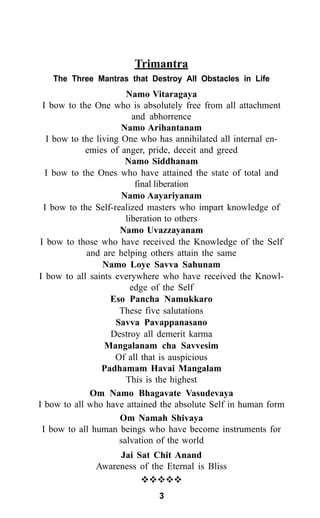
Trimantra
The Three Mantras that Destroy All Obstacles in Life
Namo Vitaragaya
I bow to the One who is absolutely free from all attachment
and abhorrence
Namo Arihantanam
I bow to the living One who has annihilated all internal en-
emies of anger, pride, deceit and greed
Namo Siddhanam
I bow to the Ones who have attained the state of total and
final liberation
Namo Aayariyanam
I bow to the Self-realized masters who impart knowledge of
liberation to others
Namo Uvazzayanam
I bow to those who have received the Knowledge of the Self
and are helping others attain the same
Namo Loye Savva Sahunam
I bow to all saints everywhere who have received the Knowl-
edge of the Self
Eso Pancha Namukkaro
These five salutations
Savva Pavappanasano
Destroy all demerit karma
Mangalanam cha Savvesim
Of all that is auspicious
Padhamam Havai Mangalam
This is the highest
Om Namo Bhagavate Vasudevaya
I bow to all who have attained the absolute Self in human form
Om Namah Shivaya
I bow to all human beings who have become instruments for
salvation of the world
Jai Sat Chit Anand
Awareness of the Eternal is Bliss
™™™™™
3
Note About This Translation
The Gnani PurushAmbalal M. Patel, also commonly known
as Dadashri or Dada, had said that it would be impossible to
translate his satsangs and the knowledge about the Science of
Self-realization verbatim into English because some of the mean-
ings would be lost in the process. Therefore, in order to under-
stand precisely the science ofAkram Vignan and Self-realization
He stressed the importance of learning Gujarati.
Dadashri did however grant his blessings to translate his
words into English and other languages so that spiritual seekers
could benefit to a certain degree and later progress through their
own efforts.
This is a humble attempt to present to the world, the
essence of His Knowledge. This is not a literal translation but
great care has been taken to preserve His original words and the
essence of His message. For certain Gujarati words, several
English words or even sentences are needed to convey the exact
meaning; hence, many Gujarati words have been retained within
the English text for better reading flow.At the first encounter, the
Gujarati word will be italicized followed by an immediate expla-
nation of its meaning in brackets. Thereafter the Gujarati word
will be used in the text that follows. This serves as a two-fold
benefit: firstly ease of translation and reading and secondly it will
make the reader more familiar with the Gujarati words critical
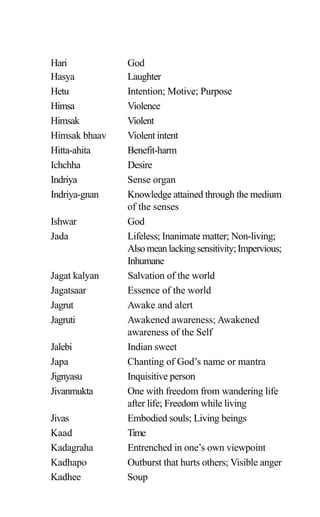
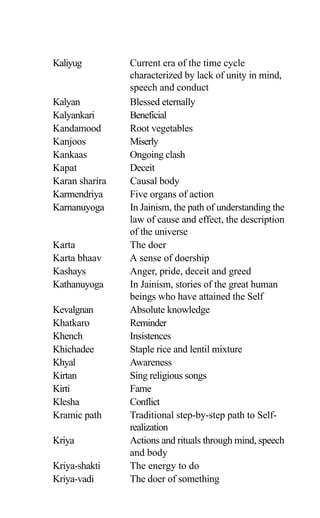
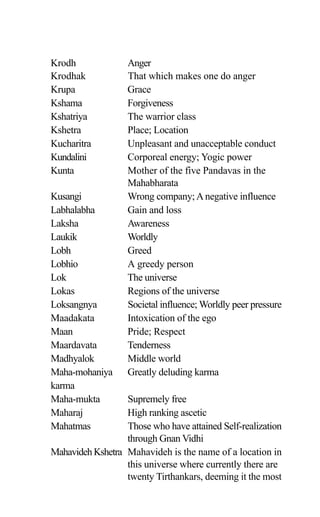
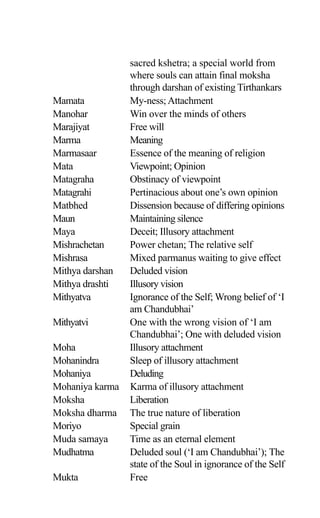
for a deeper understanding of this science. A glossary of all the
Gujarati words is provided at the back of the book. For addi-
tional glossary, visit our website at :
www.dadabhagwan.org
Many people have worked diligently towards achieving
this goal and we thank them all. Please note that any errors
encountered in this translation are entirely those of the translators.
™™™™™
4
Introduction to The Gnani
One June evening, in 1958 at around six o’clock,Ambalal
Muljibhai Patel, a family man, and a contractor by profession,
was sitting on a bench on the busy platform number three at
Surat’s train station. Surat is a city in south Gujarat, a western
state in India. What happened within the next forty-eight minutes
was phenomenal. Spontaneous Self-realization occurred within
Ambalal M. Patel. During this event, his ego completely melted
and from that moment onwards, he became completely detached
from all ofAmbalal’s thoughts, speech, and actions. He became
the Lord’s living instrument for the salvation of humankind, through
the path of knowledge. He called this Lord, ‘Dada Bhagwan.’
To everyone he met, he would say, “This Lord, Dada Bhagwan
is fully manifested within me. He also resides within all living
beings. The difference is that within me He is completely ex-
pressed and in you, he has yet to manifest.”
Who are we? What is God? Who runs this world? What
is karma? What is liberation? Etc.All the world’s spiritual ques-
tions were answered during this event. Thus, nature offered
absolute vision to the world through the medium of ShreeAmbalal
Muljibhai Patel.
Ambalal was born in Tarasali, a suburb of Baroda and
was later raised in Bhadran, Gujarat. His wife’s name was Hiraba.
Although he was a contractor by profession, his life at home and
his interactions with everyone around him were exemplary, even
prior to his Self-realization. After becoming Self-realized and
attaining the state of a Gnani, (The Awakened One, Jnani in
Hindi), his body became a ‘public charitable trust.’
Throughout his entire life, he lived by the principle that
there should not be any commerce in religion, and in all com-
merce, there must be religion. He also never took money from
anyone for his own use. He used the profits from his business to
take his devotees for pilgrimages to various parts of India.
5
His words became the foundation for the new, direct, and
step-less path to Self-realization called Akram Vignan. Through
his divine original scientific experiment (The Gnan Vidhi), he
imparted this knowledge to others within two hours. Thousands
have received his grace through this process and thousands
continue to do so even now. ‘Akram’ means without steps; an
elevator path or a shortcut, whereas ‘Kram’ means an orderly,
step-by-step spiritual path. Akram is now recognized as a direct
shortcut to the bliss of the Self.
Who is Dada Bhagwan?
When he explained to others who ‘Dada Bhagwan’ is, he
would say : “What you see here is not ‘Dada Bhagwan’. What
you see is ‘A. M. Patel.’ I am a Gnani Purush and ‘He’ that is
manifested within me, is ‘Dada Bhagwan’. He is the Lord within.
He is within you and everyone else. He has not yet manifested
within you, whereas within me he is fully manifested. I myself am
not a Bhagwan. I too bow down to Dada Bhagwan within me.”
Current link for attaining the knowledge of
Self-realization (Atma Gnan)
“I am personally going to impart siddhis (special spiritual
powers) to a few people. After I leave, will there not be a need
for them? People of future generations will need this path, will
they not?” ~ Dadashri
Param Pujya Dadashri used to go from town to town, and
country to country, to give satsang and impart the knowledge of
the Self as well as knowledge of harmonious worldly interaction
to all who came to see him. During his final days, in the fall of
1987, he gave his blessing to Dr. NirubenAmin and bestowed his
special siddhis upon her, to continue his work. “You will have to
become a mother to this whole world, Niruben” He told her as
he blessed her.There was no doubt in Dadashri’s mind that Niruben
was destined to be just that. She had served him with utmost
devotion day and night for over twenty years. Dadashri in turn had
molded her and prepared her to take on this monumental task.
6
From the time of Pujya Dadashri’s mortal departure on
January 2 1988 to her own mortal departure on March 19th
2006, Pujya Niruma as she lovingly came to be called by thou-
sands remained true to her promise to Dadashri to carry on his
mission of the world’s salvation. She became Dadashri’s repre-
sentative ofAkram Vignan and became instrumental in spreading
the knowledge ofAkram Vignan throughout the world. She also
became an exemplary of pure and unconditional love. Thou-
sands of people from all walks of life and from all over the world
have attained Self-realization through her and are established in
the experience of the pure Soul, while carrying out their worldly
duties and obligations. They experience freedom here and now,
while living their daily life.
The link ofAkram Gnanis now continues with the current
spiritual master Pujya Deepakbhai Desai whom Pujya Dadashri
had also graced with special siddhis to continue to teach the
world about Atma Gnan and Akram Vignan. He was further
molded and trained by Pujya Niruma who blessed him to con-
duct Gnan Vidhi in 2003. Dadashri had said that Deepakbhai
will become the decorum that will add splendor to the Lord’s
reign. Pujya Deepakbhai, in keeping with Dada’s and Niruma’s
tradition travels extensively within India and abroad, giving
satsangs and imparting the knowledge of the Self to all who
come seeking.
Powerful words in scriptures help the seeker in increasing
his desire for liberation. The knowledge of the Self is the final
goal of all one’s seeking. Without the knowledge of the Self
there is no liberation. This knowledge of the Self (Atma Gnan)
does not exist in books. It exists in the heart of a Gnani. Hence,
the knowledge of the Self can only be acquired by meeting a
Gnani. Through the scientific approach of Akram Vignan, even
today one can attainAtma Gnan, but it can only occur by meeting
a living Atma Gnani and receiving the Atma Gnan. Only a lit
candle can light another candle.
™™™™™
7
8
FOREWORD
The universe undergoes constant changes on the basis of
one evidence interacting with some other evidence (nimit). It is
the spontaneous result of the circumstantial interactions of the
original eternal elements. All living beings (jivas—embodied
souls) desire the nullification of these extra, unintended results
(vishesha parinam), and a return to the steadiness of the Self
(Atma).
The liberation occurs only through an instrument (nimit).
And the one and only nimit that gives such liberation is the
‘Gnani Purush’, in whom the Soul (Atma; Self) has manifested,
and who has the absolute experience of the Self. The fact that
the liberation does occur is the definite experience of countless
people who have met the Gnani Purush (The Enlightened One,
and is able to enlighten others).
The knowledge that is commonly called knowledge, in the
vision of the Gnani Purush, is in fact, intellectual knowledge.
The exact knowledge: the knowledge of the Self (Atma; Soul),
is millions of miles away from the worldly knowledge about the
Self. It is in the form of the science of the Soul (Atmavignan).
The one who knows the science of the Soul becomes free from
wandering life after life (jivanmukta - freedom while living).
Many, who have met the Gnani Purush, have attained a state
of the jivanmukta. The desire is that everyone attains that state.
The Soul is wordless; speechless, and yet the knowledge-
laden words that have arisen, having touched the manifest,
absolute Self (Parmatma) – touch the heart, break down
infinite veils of illusion, and enlighten the self from the initial stage,
all the way to the absolute knowledge (Kevalgnan). That
incomparable speech has been compiled in the Aptavani, and
this is a humble attempt to present it to the seeker of the
knowledge of liberation.
Aptavani in a book-form is the indirect medium, but the
live energy of the presently manifest Gnani Purush will touch
the heart of the reader and lead him to the portal of the right
vision (samyak darshan). This new vision of the awakened
Self, if attained through meeting the Gnani Purush, will
ultimately lead to the experience of the absolute Soul.
In this forth series of Aptavani, is presented a
collection of the spoken knowledge that imparts deep and
resolving explanations which the world has never before known
or imagined. In a simple, straightforward, plain and native
language, that has emanated from the auspicious lips of the most
revered Gnani Purush Dadashri, in whom ‘Dada Bhagwan –
the absolute Self’ became manifest in 1958.
That which the world commonly refers to as awareness;
the Gnani calls ‘sleep’. That, which is perceived as the ‘seer’,
is only the ‘scene’. The one who has the awareness that, ‘I am
aware’ is only the inanimate (non-Self) part. The Self is
completely separate from that.
There is such intense experience of oneness of the
‘relative’ and the ‘real’, that up to ninety-nine percent (almost
towards the end), the two run parallel, in which the original ‘real’
mirrors the illusory ‘relative.’ Their proximity to each other
manifests as one, until the time when the two are separated at
the final link. The secret of all of this is disclosed only by the
‘Gnani Purush’, who himself has had the experience. Only
then, one experiences the great difference between the illusory
awareness (bhrant jagruti), and the awareness of the pure Soul
(Atma jagruti).
For a long time, for the purpose of clarification, attempts
have been made to differentiate between destiny (prarabdha),
and independent effort or free will (purusharth). The difference
has already been told by the experienced ‘Gnanis.’ But because
of the prevalence of the indirect knowledge, its proper
9
understanding has virtually become fragmented. Commonly, the
awareness of ‘doership’ attempts to attain that ‘doership’, and
the results of those attempts, is believed to be independent effort
or free will (purusharth). In the Gnani’s vision, all of that is
completely destiny (prarabdha).
Anything that is experienced through the five senses and
the mind is all destinies (prarabdha). The independent effort
(purusharth) part is subtle, and it is difficult to fathom. The
independent effort of human beings is illusory. Time cycles of
cause and effect remain in motion, uninterrupted, on account of
that illusory independent effort of human beings. When the right
independent effort (purusharth) is done, this comes to an end.
The right independent effort is possible only after one has
become the Self (Purush). This happens after Self-realization.
Right independent effort is continual (akhand), unending
(avirata), and non-dependent (niralumb). A perpetual state of
liberation prevails through the alertness of this effort.
In the universe, there is no shortage of things. However,
they are not attained, because of the obstruction created by
one’s own ‘self’. The secret of these hindrances, and all the
hidden keys that help one to remain aware about them, have
been simply and effortlessly clarified by the manifest ‘Gnani
Purush.’
What is karma? What is it that binds one with karma?
What gives person liberation from karma? Who is the mother
of karma? Who is the father? These and other deeper questions
are very difficult to resolve. The scriptures have told us
everything, but it is like instruction with a pointing of finger.
Because of change in vision, when the indication is towards
North, it is perceived as South, so that the person proceeds in
that direction. How then can one reach one’s destination? Even
the scriptures are not capable of explaining the meaning. Only
the Gnani Purush can give you this. The revered Dadashri has
10
11
explained a very intricate and profound subject like karma, in
a simple and easy way.
By saying for the first time that, speech is a ‘taped
record’, Dadashri has fractured all ownership of speech. How
does this ‘record’ play? How is this ‘record’ made? What are
the results when it is played? He has revealed these, and other
deepest of the deep secrets. With a very simple explanation he
elucidates the entire complex science behind speech!
The underlying mysteries of many similar subjects have
been exposed. Attempts are made to publish as many of them
as possible. It is hoped that for those who are ‘positive’, life-
oriented thinkers, philosophers, ‘seekers’, and those who desire
liberation, this Aptavani (authentic speech of the Gnani
Purush) will impart moment to moment awareness.
In an attempt to convert the direct speech that has
emanated from the very mouth of the auspicious Gnani Purush,
into this indirect presentation, we sincerely ask for forgiveness
for any errors made in its contents.
- Dr. Niruben Amin
™™™™™
12
INTRODUCTION
[1]
Awakened Awareness
One is the Atma (Self) and is capable of illuminating the
entire universe.As the Self, one has infinite energy (anant shakti).
Even so, all the helplessness, suffering, pain and insecurity are
experienced by the ‘self’. How unusual is this! What is the
reason for it? It is because, one is not aware of the Self
(swaroop), One’s own energy (shakti; power), and the realm
(satta) of the Self. Once the Self becomes awakened (jagrut),
there prevails the bliss of the ‘Owner’ of the entire universe.
The whole world is entrapped in asleep to the Self
(bhaavnindra). The lack of awareness, as to what is beneficial
and what is harmful in this world, and in the world hereafter:
anger, pride, deceit, greed; disputes, and worries, are all
perpetuated because of the prevailing bhaavnindra. Whereas
the whole world is preoccupied with the pleasures of the non-
Self complex (pudgal), the Gnani is in the state of the
awareness of the Self, and in the bliss of the Self (Atma-
ramanata). Perfect awareness is the absolute knowledge
(Kevalgnan), when the awareness reaches one hundred percent,
absolute knowledge arises.
Awareness (jagruti) is truly the mother of liberation
(moksha). As the awareness about the worldly life increases,
one realizes its meaningless futility. Ultimately this results in the
highest dispassion towards all worldly pleasures (vairagya).
And the one who has reached the height of awareness of the
knowledge of the senses, is not divisive as a result of differences
of opinions with anyone, but is ‘everywhere adjustable.’
However, the birth of anger, pride, deceit, greed (kashays–
inner enemies) only occurs in the absence of awareness. The
one who has no awareness of kashays is very much in an
ignorant state. The one, who is aware of them, is slightly alert.
13
And the one who ‘washes’ them off after they occur through
repentance (pratikraman) is awake and alert (jagrut). And the
one who is exceptionally alert will turn the kashays around even
before they occur. Furthermore, the one who ‘fuels’the kashays
is terribly ignorant.
The vision that sees one’s own faults is the measure of
awareness. The vision that sees faults of others shrouds one’s
awareness with serious ‘veils’ (coverings). The Gnani sits on
the summit of awareness. His subtler (sookshmatar) and
subtlest (sookshmatam) mistakes, hurt no one; he sees them in
Gnan and he ‘washes’them away. He is faultless (nirdosh) and
he sees the world as being faultless – this is called the state of
awareness. The highest awareness is that while conversing with
someone, he has the continuous awareness (laksha) that the
other person is pure Soul (Shuddhatma).
In the Kramic path, the traditional step-by-step path to
Self-realization, the awareness of the intention (bhaav jagruti,
‘cause’ karma) is considered the best of all; whereas in the path
of Akram Vignan, the current, unique, non-sequential and direct
path to Self-realization, the Self-awareness which is beyond
intent or non-intent (bhaav-abhaav), is easily gained by the
grace of the Gnani! The constant presence of the complete
knowledge in the form of Gnata (the ‘Knower’) and the gneya
(object to be known) is called complete awareness! To
ceaselessly remain in the special directives (Agnas) of the
Gnani Purush is considered a high level of awareness! The
application of seeing pure Soul in every living being is also a high
level of awareness.
Initially, the awareness arises in the worldly interactions
(vyavahar). After that, one ‘sleeps’ in the worldly interactions
and awakens to the awareness of the Self (nischay). When
there is no conflict anywhere, when there is no dissension as a
result of differing opinion, one is said to be in the awareness of
14
the worldly interactions (vyavahar). In this awareness, there are
many kashays; whereas in the awareness of the Self (nischay),
these kashays (anger, pride, deceit and greed) have become
rootless! Being aware of each and every act of the antahkaran
(the inner complex of the self comprised of mind, intellect, chit
and ego), is the true awareness.
In the early stages of awareness, nobody suffers at any
time because of us. Subsequently, we have no suffering at any
time, because of others. In the stages of awareness, there is
natural oneness with the pure Soul.
The awareness of awakening Kundalini (yogic power;
corporeal energy) or traditional methods of meditation do not
help increase awareness, but they do increase the ego.
‘Meditation’ is a form of intoxication primarily for the ego
(maadakata). There is a possibility for awareness to flourish
during a situation of internal ‘burning’ (due to kashays), but the
intoxication of ‘meditation’, covers the awareness with ashes.
It is possible to attain the awareness needed for liberation
through the worship of the Souls with the awareness; beginning
with the one who has just attained the Self, and going all the way
up to the one who has reached the state of absolute knowledge
(Kevalgnan). Through the Gnani’s grace, one can make a
connection with the current living Tirthankar – Shree Simandhar
Swami, who dwells in Mahavideh Kshetra. He has Absolute
Awareness and He is a vital instrument for our liberation
(moksha). Through His continuous worship, it is possible for us
to go there from here, and reside at His lotus feet (in the next
life), and thereafter, attain liberation (moksha).
In the mundane worldly matters, where the world is
awake; the Gnanis are ‘asleep’, and in spiritual matters, where
the world is ‘asleep’, the Gnanis are awake! The worldly
awareness is with the ego; whereas with awareness without the
ego, there is liberation (moksha)!
15
[2]
Dhyan (Meditation)
What is meditation (dhyan)? Meditation is not something
that one has to ‘do’. Meditation (dhyan) happens naturally.
Meditation is a result. What the world calls meditation, is not
meditation (dhyan), but it is concentration (ekagrata).
Vitarags (the fully enlightened beings who have no
attachment or abhorrence), have described four types of
meditation: When someone insults you, and you experience
wrath at that time, the resulting anger is called raudradhyan
(adverse internal meditation that hurts the self and others), and
the effect of this result will hurt the ‘self’and will reach others!
However, if it affects only you and no one else, then it is
artadhyan (adverse internal meditation that hurts the self).
Artadhyan also comprises worries such as, “What will become
of me?” and worries about the future, etc.
In events that cause an effect on us, when a person
regards them as: “This is the manifestation of the unfolding of my
own karma. The other person is simply instrumental (nimit) in
it; he is faultless (nirdosh)”; when such a state results within, it
is called dharmadhyan (virtuous meditation; absence of
artadhyan or raudradhyan). If it remains in one’s awareness
(laksha) that, “I am pure Soul (Shuddhatma)”, and others are
seen as pure Soul, then that is called shukladhyan (meditation
as the Self).
Once the goal (dhyeya) is decided and one becomes
the dhyata (one who meditates on the goal) and when the two
(dhyeya and dhyata) make a connection, then meditation
(dhyan) at the time, is simultaneous and occurs naturally. The
ego is present when the goal (dhyeya) is being decided, but it
is absent during meditation. There is ego in doing actions, but
not in meditation. Doing actions is not meditation, but that which
results from the act of doing is meditation, and here, the ego is
16
absent. Meditation (dhyan) is not ‘done’ (it cannot be ‘done’);
it happens (naturally). Artadhyan and raudradhyan just happen
by themselves. There is no ‘doer’ in dharmadhyan.
Shukladhyan (meditation as the Self) is a natural state.
After artadhyan occurs, if there is the belief that, “I am doing
artadhyan,” then the ego of ‘doership’ is present. The ego is the
dhyata (the one that meditates) in artadhyan, raudradhyan
and dharmadhyan. In shukladhyan, however, the ego is not
the dhyata, so therefore it is a natural state. It is the state of the
Self (Atma-parinati).
For the purpose of attaining moksha, no other meditation
is as important as the meditation of pure Self (Atmadhyan or
shukladhyan). The meditation of the Self (Atma) keeps one in
constant bliss.
To remove attachment-abhorrence, meditation is not
required. If the science of the Vitarag is known, attachment-
abhorrence departs naturally.
[3]
Prarabdha – Purusharth
Without understanding the line of demarcation between
destiny (prarabdha) and self-effort (free will; purusharth),
how can one understand one’s own ‘doership’ or ‘non-
doership’? The whole world is engulfed in this unsolved
problem. Who else can show you the difference between the
two, other than the Gnani Purush, who has attained the exact
state of real purusharth? In the world, in this day and age of
the time, the subtlest differences between destiny and self-
effort have been exposed through the speech of the deeply
revered Gnani Purush Dadashri. It opens up a new way for
the seekers!
Whatever is done through the five senses is not self-effort
(purusharth), but destiny (prarabdha). From morning till
17
evening, a person runs around, preoccupied with his job or
business, respires, reads books and scriptures, meditates, does
chanting of God’s name (japa or mantra) and penance. That is
destiny (prarabdha). After we eat our food, what purusharth
(self-effort) do we make for its digestion? Nature runs our ‘inner
machinery’so pleasantly, without any interference in our part, so
will it not run the ‘outer’ matters as well? But because of the
ignorance about it, one cannot help one’s egoism of, ‘I am the
doer’!
In the running waters of the river Narmada, if a rock turns
into the shape of an idol (shaligram), who did what sort of self-
effort there? And if the other rocks remained stones and sunk in
the ocean, is it because of their ‘laziness’? Who is the ‘doer’
here, and how much ‘doership’ is there? Things happen
according to whatever circumstances one encounters! In the
path of natural and spiritual evolution (samsaran marg), all the
living beings, some after infinite collisions and wanderings, take
birth in India. And there, if one meets the Gnani Purush, and
by his grace, attains the Self-realization, one becomes an idol
(shaligram)! Only after Self-realization does one become the
‘Self’ (Purush) and does the ‘real’ ‘Self-effort’ (purusharth).
Until then, it is called deluded or illusory self-effort (bhrant
purusharth). Real Self-effort is when there is no attachment-
abhorrence in the resultant effect of the non-Self complex
(pudgal).
Because of the existence of ego, the seeds (causes) of
karma are being sown. And when they yield fruits (effects); the
result is either bitter or sweet. Now it is considered deluded
self-effort (bhrant-purusharth) to change an improper ‘effect’
to a proper one! Whatever circumstances that present themselves
is destiny, and self-effort is needed to maintain equanimity. To
maintain steadiness in ‘slippery’circumstances, is self-effort. To
change artadhyan and raudradhyan into dharmadhyan is self-
effort.
18
The ‘Akram Vignani’(the ‘scientist’ of the direct path to
the Self) has removed the web of misunderstanding about
destiny (prarabdha) and self-effort – free will (purusharth) and
unraveled the right understanding about ‘who the doer is’,
through his discovery of vyavasthit shakti (‘Scientific
Circumstantial Evidence’). This helps the Self-realized to reach
the state of the absolute Self! As long as there is the awareness
of, ‘I am the ‘doer’,’the understanding of ‘Scientific Circumstantial
Evidences’is like a golden dagger! Where there is ego; the ‘self’
becomes the ‘doer’. Where there is no ego, the ‘doer’ is
‘Scientific Circumstantial Evidences.’
Pure, applied, awakened awareness of the Self (shuddha
upayog) is the ‘real’ self-effort (purusharth). The victory over
kashays (anger, pride, deceit and greed) is called self-effort
(purusharth). And absolute equanimity (samata) has been
called the state of the Self that arises from Gnan. Self-control
(yama), disciplines (niyam), and restraints (saiyam) have been
called self-efforts. What is the difference between restraints
(saiyam) and penance (tapa)? There is no penance (tapa) in
saiyam; whereas in penance (tapa) there is ‘heat’; the mind is
being heated! To obey the Gnani’s Agnas (special directives
given by the Gnani Purush that sustains the enlightened state
after the Gnan Vidhi) is Self-effort – that is the only religion.
Neither destiny nor self-effort is the higher; the one who
understands them both is the higher, so says the Gnani Purush.
To eat junk food is karma of destiny (effect) and to get
dysentery is the result of destiny karma (effect of effect). Eating
junk food is the result of the accumulated karma (sanchit
karma) of the previous life! So now, how can this result of
destiny karma be changed? Change can only be made while the
accumulating karmas are being ‘charged’ or created.
That which happens in this life (dravya), is all destiny, and
intent (bhaav) is all self-effort. In the state of illusion (non-Self-
19
realized; bhranti), all human beings have continual intent-based
self-effort (bhaav purusharth), on account of which the bonds
of karma for the next life are created; moreover, they
themselves are not even aware of this!
[4]
Shraddha (Faith)
Those who make a mockery of blind faith (andha-
shraddha) do not know how much blind faith they themselves
have! On what faith is the act of drinking water done? What
proof is there that there is no poison in it? What is the proof that
an insect or a tiny lizard has not fallen in the food? Does anyone
inquire about this? Are people not moving on, with blind faith?
Thus, not a single step is taken without blind faith, so how can
one criticize anyone else’s blind faith?
[5]
Opinion
Vision (drashti) is created on the basis of opinions
(abhipraya), and then one ‘sees’ according to that vision. It is
not the fault of the vision if one feels uneasy with a certain
person. The mistake is being made by the opinion that has led
to such a vision (drashti).
The vision with “prejudice” creates the worldly life (the
perpetual cycle of birth and death). In spite of being an
eyewitness to a theft, the one who does not have any
prejudice in vision is a Gnani (the enlightened One). What
proof is there that tomorrow the thief will not become honest
and respectable?
There is nothing to object to. If the senses relish a tasty
mango, but afterward if the memory of it lingers on; it is
detrimental, because behind the memory there is the opinion that
“this mango is good,” and that opinion will result in attachment-
abhorrence (raag-dwesh).
20
A strong opinion focused on one particular thing will result
in a major obstruction (atkan). Comparatively the effect of the
obstruction of many scattered opinions will be significantly
terrible.
“The sensual pleasures (vishay) do not have attachment
- abhorrence; only the belief of the opinion has attachment-
abhorrence.” ~ Dadashri
This quote of the Gnani drives away the notion of doing
relentless exertion to become free from sensual pleasures. By
saying it is ‘like an elephant’s bath’(elephants after bathing in
water, spread dirt on themselves); it makes one alert towards
removing the root cause: the wrong belief about the opinion, of
there being any lasting happiness in the pleasure of the senses.
Once it is decided that opinions are to be broken, they
start to break down. Opinions that are very deeply entrenched,
can be depleted after doing pratikraman (repentance and
asking for forgiveness for the error) everyday for two hours!
The one who has attained the Soul (Atma), the one who has
become Self-realized (Purush), is capable of any endeavor
(purusharth) or extraordinary effort (parakram)!
Whatever one’s opinion, such will be the non-Self
complex of mind, speech and body (pudgal) that forms in the
next life.
It is necessary to detach and remove the opinion, about
the opinion that has remained in a subtle form.
Who makes one make opinions? Only societal influence
(loksangnya; worldly peer pressure), because one’s belief is
based on popular knowledge, and accordingly, the intellect
makes the decision as to how one behaves. Once the
‘knowledge of the Gnani’ (Gnani-sangnya) is followed, the
effect of the knowledge of people (loksangnya) becomes
extinct!
21
The vibrations of even the slightest adverse thought about
another person will reach that person and give results. Here
doing ‘shoot-on-sight’ pratikraman will prevent those vibrations
from reaching that person, or else erases the vibrations that may
have reached that person. And once the opinion is erased,
speech and conduct towards that person become natural, to the
extent that they cannot even ‘touch’the other person. Conversely,
the view with the opinion of seeing faults, casts its shadow on
the mind of the other person. And it is because of that, that one
feels uneasiness in that person’s presence.
To change the opinion, one has to supplant it with its
opposite opinion. To erase the opinion, that someone is a thief,
one has to say that he is an honest and respected man and
ultimately, the vision that he is really ‘pure Soul’ (Shuddhatma)
has to be applied!
Opinion is the reason (cause) for speech with the link of
continual hurt (tantili vani—speech associated with lingering
effect); whereas, suspicion (shanka) is one of the reasons
(cause) for opinion.
“Opinion is dependent upon the receptacle of the
intellect (buddhi no ashaya)” ~ Dadashri
The opinion depends on where the intellect has perceived
happiness to be. If one thinks happiness lies in a French haircut,
one’s opinion for a French haircut develops.
What hinders the state of the infinite bliss of the Self, after
Self-realization in Akram Vignan? – Opinion! Once two to five
major opinions are gone, a state of liberation prevails!
The seed (of karma) is sown, not by action (kriya), but
by motive (hetu–intention behind action); by opinions! The only
opinions worthy of welcome are those for celibacy
(brahmacharya), and for the fact that the physical body is the
greatest of deceivers (dago)! Opinion is made up of subatomic
22
particles (parmanus) of the ego. Opinion shows personalities: it
alters one’s vision completely. There is no objection to ‘lifeless’
opinions; however, opinions backed with insistence, veil the
Gnan.
To be free from the opinions about the inanimate
(achetan) is relatively easy once you decide to do so. Whereas,
even if you give up the opinions about the mishrachetan (power
chetan; the relative self, other living beings), the other person
will still not leave you alone! By forming opinions about other
human beings, whose faces contort with anger and revenge,
what grave results are invited!
Opinion invites obstacles (antaray). There are terrible
perils from the obstacles caused by opinions; they increasingly
bind one in places where one needs to be free.
This human body complex, works according to the
opinion of the ‘charged’ self (pratishthit atma; the relative self),
within which the Self is only giving presence as the One with
devoid of worldly attachment (udaseen bhaav).
[6]
The Blindness of ‘Know-How’
He that knows nothing in this world is a ‘Gnani.’ The
Gnani, who appears to others as ‘highly intelligent’, is actually
abuddha (free from the use of intellect). The Gnani says, “Even
at age seventy, I still do not know how to shave.” Those who
believe that they are “experts” are cheating themselves and
everyone else. No one is capable of becoming an “expert”.
Being an expert, is a natural gift. A Gnani is an expert in the
science of Soul (Atmavignan).
A person has come into this world and brought with him
all that is necessary for the mind, and all that is necessary for the
chit (inner component of knowledge and vision), intellect and
ego. Nature supplies them all. In this, where does one’s own
23
self-effort come in? Therefore, one should keep the chit in its
natural state and not waste its energy. One will have to
understand the essence of this life, yes?
[7]
Obstacles
‘I am Chandubhai’. Once you say this, an obstacle
(antaray) arises. You are the absolute Self (Parmatma) and
you call yourself ‘Chandubhai’? You are the master of the
universe, the owner of infinite energies, and capable of attaining
whatever you want; yet in spite of that, why you cannot get
anything? It is because of obstacles. Obstacles veil the energy
(shakti)!
Desire (ichchha) invites obstacles. When there is no
desire for air, is there any obstacle for it? The Gnani has no
desire (nirichchhak) and is in an obstacle-free state (nirantaray
pad). He does not have ‘want’ for anything at all.
How is an obstacle created? When someone is donating
something and you interfere by saying, ‘Why are you doing
that?’ then in your next life, you may be hindered from receiving
a donation.
In the state of ignorance, one protects hurtful and negative
thoughts when they occur; whereas in the state of Gnan
(knowledge of the Self), one does repentance and ask for
forgiveness (pratikraman) immediately when such thoughts
arise. Approval and support for the good or positive actions
become beneficial for one’s self and for the rest of the world. If
approval and support is given to others, they will reciprocate! If
one calls the other person ‘stupid,’ it will create an obstacle to
one’s own intelligence.
If there is a strong determination (nischay) against the
obstacles arising in the path of liberation (moksha), the energy
of the Self (shakti) will grow. Obstacles occur when there is
24
a lack of determination. Determination (nischay) breaks down
the obstacles (antaray). Once the ultimate determination
(nischay), ‘I am the Self’ is attained, all obstacles come to an
end.
Obstacles that arise because of the worldly intellect are
like knots. And obstacles that arise from the intelligence of
religion are like big complex knots because; they make one
wander around for infinite lives. The belief or sense of, “I know
something” is the biggest obstacle in the path to the Self. It is
evident that nothing is known where there is artadhyan
(adverse internal meditation that hurts the self) or raudradhyan
(adverse internal meditation that hurts the self and others).
The biggest obstacle is one which impedes one’s attainment
of the knowledge of the Self (Gnanantaray). It is one’s inner
sense that says, “In matters of spirituality and Soul, I am the only
one who understands, and everyone else does not understand
anything at all.”
Another obstacle is to interfere in the process whereby
someone’s attainment of Self-knowledge is hindered.
Or even if after meeting a true ‘Gnani’ one thinks, “I have
seen many such ‘Gnanis’.” All of these sow the seeds of
obstacles to the knowledge of the Self (Gnanantaray).
However, even, if a person were to feel, “A ‘Gnani’is close by,
but I am unable to go and see him!” it would break down the
obstacles.
“How can there be moksha within just one hour?” Once
this is vocalized or felt, there will be an obstacle to one’s own
moksha! This universe is such that it cannot be measured by
one’s intellect.
Obstacles to one’s skill are created with, “I don’t know
how to do it.” And with a firm, “Why can’t I know how to do
this?” the obstacles (antaray) will break down.
25
The Gnani Purush can break down obstacles to
knowledge (Gnanantaray) and obstacles to vision
(darshanantaray). Nevertheless, in matters related to the break
down of the ‘religion’ of humility (vinaya dharma), even the
‘Gnani’ is not able to help. There should not be a single
negative thought about the ‘Gnani.’ In order to break the
obstacles that prevent one from meeting the ‘Gnani,’ one can
beseech the Gnani to break down the obstacles through his
prayers (vidhi). Obstacles can be broken through intentions
(bhaav)! Intentions break obstacles. They happen when the
time is right.
For the ‘Atmagnani’ (the Self-realized One), the obstacles
are in the form of circumstances (saiyog) which by their very
nature, have the tendency to dissipate (viyog). The Self has no
circumstance (asaiyogi); therefore, it does not dissipate.
[8]
Contempt – Dismiss with Scorn
There is fear for that which is disdainful (scornful;
tiraskar). Fear is born out of scorn. Disdain for the courts or
for the police, will create fear of them.
Scorn (tiraskar) brings about a ‘mild’ result, whereas,
contempt (tarchhod) creates dreadful obstructions. One should
be extremely aware, and avoid any contempt towards anyone.
For the one who has been contemptuously rejected (tarchhod)
by us will close his doors to us forever. Contemptuous rejection
caused by speech, will inflict deep wounds which will not heal!
Know for sure that a single ‘wound’ of contempt to even one
human being, will impede your moksha. There is grave liability
in contempt.
[9]
The Aura of the Individual
The personality of a ‘Gnani Purush’is extraordinary. His
26
love is nowhere else, but in the Self. He conducts himself as the
Self; completely separate from the mind, speech and body. In
spite of conducting business, his conduct is without attachment
or abhorrence (vitarag). Just look at the achievements of such
an ‘Akram Vignani’ (The scientist of the direct path to
liberation)!
He did not take any vows (vrat), and the only disciplines
(niyam) he observed, were chovihaar (the practice of eating
food before sundown) and drinking boiled water. He also read
and meditated on the ‘Vachanamrut of Shrimad Rajchandra’
and scriptures of all the religions.
This wonderful science of Akram Vignan manifested
naturally! One evening in 1958, while sitting on a bench at the
Surat (city in Gujarat, India) train station before the enlightenment
occurred; amidst the noisy din of the vast crowds, inner stillness
and peace prevailed. Even then, this was still intermingled with the
ego! There was a supreme effulgence of the light of the absolute
Self! In this light of Gnan, he “saw,” the universe in its entirety. He
experienced complete separation from the body, mind and
speech, and attained a state of absolute Knowledge and absolute
Vision (Keval Gnata-Drashta), and eternal bliss (parmanand).
The most glorious day had dawned in the history of the world!
From that day, the ego was gone! The ‘My-ness’
(mamata) was gone!! And from his auspicious mouth flowed
words that were void of any attachment or abhorrence (vitarag
vani). These words, that are proof of absolute spiritual
perfection, symbolize the eleventh wonder of this Kaliyug
(current era of the time cycle characterized by lack of unity in
mind, speech and conduct), Akram Vignan (step-less path to
Self-realization) - Asaiyati Puja (Worship of an enlightened one
living a worldly life; non-ascetic worship); could not remain
hidden from the world. In the course of twenty or so years, this
Akram Vignan (the spiritual science of the step-less path to
27
Self-realization) has been bestowed upon some twenty thousand,
very fortunate persons. And that is a phenomenon in itself!
What is the daily routine of the ‘Gnani’? The ‘Gnani’ is
always present in the “activity” of the Self (Atma-charya; to
dwell in the Self); he is in the state of liberation. By referring to
his own speech as a ‘taped record,’ he severs the ties of
ownership! Such a competent nimit (instrument) will accept any
deficiencies in our qualification for the attainment of Self-
realization.
Without love, devotion (bhakti) cannot begin. God is not
forgotten at any time when devotion is filled with love.
The Gnani Purush, after himself becoming faultless
(nirdosh) and making the vision faultless (nirdosh drashti), sees
the entire world as being faultless. The pure Soul will be
considered ‘faulty’ if the pure Soul has faults. But the pure Soul
is a ‘non-doer’, so how then can the faults be seen? In the
“discharge” of karma, how can anyone be at fault? Even if a
single person is seen as having fault, there is no purity, but only
the knowledge that is prescribed by the senses (indriya-gnan).
Here, the knowledge of the pure Soul (atindriya-gnan) is
absent! A person who hurts others through his intent (bhaav;
thought) commits a fault of Nature; while the one who actually
hurts others, commits a fault of the world. They will both receive
justice for sure. The one, who hurts others with his thoughts,
becomes guilty in the next life; whereas the one, who actually
hurts others in this life, gets punished in this life. This is the way
karma is settled.
There is no problem in saying, “I ate,” but there should be
the knowledge within as to ‘who is eating.’
“What I received is not Atmagnan (knowledge of the
Self), but what has manifested within me, is Atmagnan.”
~ Gnani Purush Dadashri
28
To follow the Gnani’s Agnas (special directives) will
bring about the grace (krupa) of Gnani.
How can you describe such a Gnani when words have
limitations; where one’s understanding falls short, and in the
absence of any comparison, he is himself unfathomable; he
solely resides in the Self, where there is absolutely no room for
the ego, and therefore he lives not in the mind, neither in the
speech, nor in the body; the very places that are host to the ego.
He is free of all anger, pride, deceit and greed. His humility,
although a ‘given’ as far as a Gnani Purush is concerned, is
immaculate. He is egoless; he blesses even those that curse or
insult him. The Gnani is not void of interest (nispruha), but
neither is he with interest (saspruha; with inclination); he is
saspruha-nispruha (with interest-without interest). He is
nispruha towards others’ worldly happiness and saspruha
towards their liberation.
The Gnani’s speech has vitaragata (void of any
attachment). It is not possible for anyone to attain moksha
without listening to such speech! In his speech, there is no
disapproval of anyone’s viewpoint, nor is there any evidence of
his own opinion! There is no opposition to anyone, nor is
anyone told, “This is wrong”. Speech that is syadvaad is
accepted by all and hurts no one. In such speech, there is no
debate (vaad), dispute (vivaad) or discourse (samvaad). It is
purely dependent on the person who is instrumental (nimit;
questioner). The Gnani Purush’s speech arises from great
depths and flows spontaneously and constantly.
[10]
Akram Path
The Gnani Purush, in whom the Lord of the fourteen
regions (lokas) of the universe has manifest, and who is Himself
the embodiment of the absolute Self. Once his grace is received,
there is nothing that needs to be done, but to remain in his
29
Agnas (special directives) and to follow him. Such a Gnani
Purush has manifested in this time period. Once his grace is
bestowed upon the recipient, and through this path of Akram
Vignan (the step-less path to Self-realization) one needs only to
jump on the elevator to the highest peak of Self-knowledge and
reach there within just one hour! Wonderful and amazing is the
accomplishment of this exceptional path!
In this Kalikaal (the current era of the fifth time cycle),
this step-less path has manifested magnificently! This is the
unprecedented stage of spiritual science! Lack of controversy is
evident in the entire speech of the Gnani Purush at all times.
Here is where the wrongful deeds of infinite lifetimes are washed
away within one hour and Self-realization is attained, where the
awareness or non-awareness of one’s readiness for Self-
realization is not heeded, where the seeker attains a state of the
highest of awareness as a result of the auspicious event of
meeting a tremendously powerful instrument (nimit): the Gnani
himself, whereby all the kashays (anger, pride, deceit, greed)
are eradicated, where the ego (ahamkar) and ‘My-ness’
(mamata) end, where no ‘doership’ remains, and where one
only experiences the absolute bliss of the Self. He who bestows
such a state is not a Gnani, but a ‘Scientist’. Just look at the
unimaginable special spiritual power and energy (siddhis) of his
step-less path!
[11]
The Atma and The Ego
“I am ‘Chandubhai’, I am the husband of this woman, I
am the father of this boy, I am a businessman, I am fat, I am fair-
skinned…etc.” These and many such countless ‘wrong beliefs’
have been covering up one’s own ‘right belief’, one’s own pure
vision and pure knowledge. The Gnani Purush fractures those
‘wrong beliefs’, and unveils all the covers: opening that
magnificent portal to ‘right vision’ – Self-realization!
30
The ego is the ‘ignorant’ proclamation of “I did”, where
one is not the ‘doer’. And because of the ego, there is bondage
of karma, bondage of body, bondage of mind, and bondage of
speech. Any bondage of the non-Self complex (pudgal) is
attributed to the ego.
To worship the Soul (Atma) and the absolute Soul
(Parmatma) as being separate, is the way of the worldly,
‘relative’religions. And to worship the Atma and Parmatma as
one (not separate), is the religion that transcends beyond the
world (alaukik); and from the ‘real’ religion comes Moksha! In
the real religion, there is no merit karma (punya) or demerit
karma (sin; paap); there is no ‘doership’ of anything at all!
One becomes ‘certified’ for moksha, when one’s
worldly pleasures and happiness become a heavy load of pain
and suffering! The Gnani Purush gives one moksha, because
the Gnani Purush is the ultimate liberator.
[12]
Arrangement of Vyavasthit
The regulation of the universe happens naturally and on its
own. The ‘Akram Gnani’ calls it “vyavasthit shakti or
scientific circumstantial evidence”. This “scientific circumstantial
evidence” has no control over the six eternal elements in the
universe. All the elements are independent; they do not
recognize each other, they do not obey each other even though
one of them the element of the Self (chetan), is the Parmatma
itself!!!
If surrender and ‘selfless service’ went hand in hand, that
would be excellent. But the result of service is merit karma, and
not moksha. Yes, if there is Self-realization, there is no
‘doership’ and therefore no bondage of karma.
The world is replete with bloodshed, cruelty, violence,
fighting, massacres and the agonizing outcome of world wars.
31
The Gnani Purush sees these as ‘scientific circumstantial
evidences’ (vyavasthit)! Who pays attention to the violence and
death occurring in the ocean amongst the big fish and small fish?
Is that also not ‘scientific circumstantial evidences’?
[13]
Religion of the World: Religion of the Self
Worldly religion is where one receives pleasure from
giving pleasure to others, and if one gives pain, one will receive
pain in return. Do people not get security for their lives when
they follow the rules of traffic laws? If one does hurtful action
(adharma), he will have a ‘collision’ and get into an accident!
Thus, to get the security of happiness, one gives happiness to
others, and therein lays the secret of the “relative” religions! In
the “real” religion (Atma-dharma) however, one has to attain
the Self.
When there is a solution available in all circumstances, it
is called ‘real’ religion. When there is a solution or even a lack
of solution, it is called ‘relative’ religion.
While looking for eternal happiness, and in not finding it,
a living being (jiva), springs into imaginary happiness, and
because that imaginary happiness results in pain, he attempts
various ‘imaginary’ endeavors, only to become more and more
entangled! Eternal bliss exists only within the Self! To attain true
happiness or eternal bliss, one has oneself to become ‘true’. To
attain worldly happiness, however, one has to become ‘worldly’!
Once a living entity enters the passage of flow in the
universe (samsaran marg), it experiences relentless internal
burning and suffering. One’s worldly life ceases when this
‘burning’ is quelled.
As long as there is a balance between inner happiness and
outer happiness, there will be peace in one’s worldly interactions.
The outer happiness is enjoyed at the cost of inner happiness.
32
As a consequence, a person loses his mental stability, to the
extent that he becomes reliant on sleeping pills.
Where there is not the slightest vestige of pain; there is the
Self (the Soul).
With wrong vision (viparit darshan) there is pain: with
the right vision (samyak darshan) there is bliss, bliss, and
nothing but bliss!
Complete surrender under the Gnani’s protection is the
vehicle for moksha; however, for the worldly happiness one
should serve one’s parents and one’s guru.
In people’s understanding, happiness lies in loksangnya
(related to other peoples’beliefs). In the Gnani’s understanding,
happiness lies in the Atma.
Saints (santo) take pleasure in pain whereas the ‘Gnani’
takes pleasure in the Self. Saints proceed believing pain as
pleasure.
To derive pleasure from the body (pudgal; non-Self
complex) is a ‘borrowed’ transaction that you will have to
‘repay’. When the son jumps onto his lap saying,
“Daddy…daddy,” the father enjoys ‘borrowed’ pleasure. But
when the same son grows up and says, “Dad, you have no
sense!” the time has come for that borrowed pleasure to be
‘repaid’! So why not be cautious from the very start? The
pudgal is itself vitarag (without attachments and abhorrence)
but when the ‘self’ (relative self) acquires, the transaction of
borrowing begins!
[14]
The True Understanding of Religion
The traditional worldly (laukik) religions give worldly
happiness and the real (alaukik; beyond the world) religion
gives eternal bliss. All actions carried out in the presence of
33
ignorance of the Self (mithyatva), materialize in the worldly life.
Religion that is beyond the world is not found in renunciation
(tyaag) nor is it found in pleasure (bhoga). ‘That which is
renounced, will be met with ahead.’ One can accumulate as
much burden as one can carry! True renunciation, is that which
helps get rid of artadhyan (adverse internal meditation that hurts
the self), and raudradhyan (adverse internal meditation that
hurts the self and others)!
That which protects you in your troubled times is religion
(dharma)! At the time of artadhyan and raudradhyan, true
religion will be ever present for our protection! For endless
lifetimes, people have followed religion but if they did not
receive any protection in their time of need, how can one call
this following a religion? If one experiences worries, then it can
be said that one has not understood religion at all.
Whatever becomes religion, and yields results, is called
religion. Whenever someone shouts abuse or curses, religion is
there to help us! Religion yields results; whereas non-religion
does not. One, who maintains equanimity in times of trouble,
receives the stamp of approval to attain liberation (moksha).
One does not have to ‘follow’ (ritualized activity) religion;
one has to remain sincere to religion (dharma). While doing the
Lord’s darshan in a temple if at the time the person ‘sees’
(thinks about) his shoes that he left at the entrance, or thinks
about his shop, how can he be considered sincere? True religion
is one that gives one freedom from all types of pain.
The one and only path to moksha is through Gnan
(knowledge), vision (darshan), conduct (charitra) and penance
(tapa): there is no other path.
For infinite lifetimes, one paid devotional observation
(darshan) to the ‘form’ (murta – the physical; tangible form).
If only once, the darshan of the ‘formless’ (amurta) occurs
within a person, the losses of infinite lifetimes are made up.
34
When can all these losses be made up, and that too in this
insolvent Kaliyug (the current fifth era)? That is why one should
just accept the Gnani’s protection (sharanu) and ask him for
liberation. Only then can everything be resolved in a short time.
[15]
Dharma in One’s Conduct
The Lord does not look at the conduct (activity of mind,
speech and body), but He does give significance to the intent
(bhaav). Conduct (aacharan) is “discharge” karma, and the
“charge” (of new karma) happens according to the intent
behind the action.
The constant contemplation of ‘Life as a human should
not go in vain’ will someday bear fruit.
To be free from conflict is the greatest religion. There is
no religion where there are clashes, and there are no clashes
where there is religion.
Show kindness (daya), remain peaceful (shanti), remain
in equanimity (samata). These dictates of religions, are futile in
these current times. What can be done when they cannot be
observed even after millions of attempts? That is why the Gnani
Purush shows us a new path, in a new form; one that is
attainable even by the common person.
When anger, pride, deceit and greed (kashays) happen,
it is not a problem, but one should do repentance (pratikraman)
for them. If you commit a theft, it is not a problem, but you must
do pratikraman for it. If you just abide this one Agna (special
directive) of the Gnani, you will attain the essence of all
religions. There is no other higher religion, than to please the
Gnani. Nothing else pleases the Gnani more than if you follow
his Agnas! Only the Gnani’s Agnas can take one to the ultimate
moksha!
Knowledge itself brings action.As soon as the knowledge
35
that ‘It is fun to steal’ becomes instilled, one will begin to steal.
The action always changes as the knowledge changes! Without
changing the knowledge, the actions will never change, even
after millions of lifetimes!
For knowledge of ignorance (worldly knowledge), the
energies are easily facilitated by the pudgal (body or non-Self
complex). This energy is easily wasted in theft, violence and
carnal pleasure. However, for the attainment of Gnan (knowledge
of the Self), prayer and independent efforts are necessary!
Prayer means asking for the higher meaning of it all, and one can
ask for this from one’s own Self or from the Gnani. In the
‘ignorant’ stage (when one has not attained Self-realization), one
can pray to one’s guru, an image of God, or one’s favorite deity.
A true prayer, done by a person with a pure heart, will always
be successful.
[16]
Relative Religion: Spiritual Science
Where there is impartiality, there is the religion of the
Vitarag (one who is free from attachment and abhorrence). The
Vitarag religion is the religion of siddhants (irrefutable principles
that accomplish the ultimate). That which is experienced by the
senses, is “relative”. And the ‘relative’ has arisen only because
there is the Real! The ‘relative’ is in the form of situations
(avastha) and the ‘real’ is in the form of eternal elements
(tattva swaroop).
Relativity – Mudhatma; the state of the Soul in the
ignorance of the Self involved in religion or non-religion.
Reality – Gnanghan Atma (The Self with Knowledge;
antaratma; the interim soul that is awakened to the Self).
Absolute – Vignanghan Atma (The Soul with the
Knowledge of Science; the Parmatma – The Absolute Soul)
The essence of the world (jagatsaar) is the enjoyment of
36
sensual pleasures. The essence of religion (dharmasaar) is to
be free from artadhyan (adverse internal meditation that hurts
the self) and raudradhyan (adverse internal meditation that
hurts the self and others). The quintessence (marmasaar) of all
this, is moksha. The essence of time and the Atma (samaysaar)
is to be established in the Self.
Religion (dharma) is ‘relative’ and science (vignan) is
‘real’. Science is without controversy; it is with principles that
lead to liberation and automatically effective in itself.
[17]
Knowing God Through the Vision of Gnan
We are not a portion of God; God cannot be fragmented.
We are complete and absolute. It is only a matter of time for the
veil of ignorance to be removed and the Self to express!
If God is in every particle, then where should we look for
Him? Where can we defecate? And if this were so, then there
would be no difference, between the inanimate (jada; lifeless)
and the animate (chetan; living). God is in each and every living
being.
Where the ownership of something is established and if its
removal causes the owner pain, it is called sankalpi-chetan. In
fact, both Gnan (knowledge) and vision (darshan) are present
in the chetan.
[18]
Understanding the Knower
Three things are necessary for the path of moksha:
1. An intense desire to attain the Soul (Atma; Self).
2. An intense desire to meet and know a Gnani Purush.
3. If one cannot meet the Gnani Purush, then to
continue to have the profound intention to meet him.
~ Gnani Purush Dadashri
37
When one says, “I ‘see’ all the living beings in the universe
as Godly forms (Bhagwat swaroop)”, then it would also include
all the ‘relative’ religions of the world. The Self can be studied
(swadhyaya) once the Self is known. Whatever is done without
knowing the Self is the study of paradhyaya (study of the non-
Self)!
It is considered as awakening to the Self, when that which
was believed to be the ‘Knower’ (Gnata) for an infinite period
of time, comes to be known as gneya (that which is to be
known).
Liberation from ignorance of the Self is the religion of
moksha (moksha dharma). After liberation from ignorance, the
science (vignan) that arises is moksha!
[19]
The True Path of Worship
Until the God that sits resplendently within, is experienced
directly (pratyaksh darshan), the indirect (paroksh) prayer of
someone who sits in front of an idol, will reach the present God.
For that reason:
‘Oh Vitarag Lord! You reside within me, but I am unable
to experience that; therefore, I am doing Your darshan. The
Gnani Purush has taught me this, so I am doing the darshan
accordingly. Please grant me Your grace so that I may know
‘my’own ‘Self’.’ ~ Gnani Purush Dadashri
This is how the darshan should be done everywhere.
For the purpose of attaining God, whatever is done
through the five senses, is bhakti (worship). One can attain God
by doing direct worship (pratyaksh bhakti). With indirect
worship (paroksh bhakti), there is a gradual progress upwards.
Direct worship means to worship the one in whom God has
manifested fully. This will result in moksha.
38
There are subtle differences in worship. The chanting of a
name (naam jaap), is overt worship; veneration of the idol is
subtle worship (sookshma bhakti); with dravya (worship with
the external physical substances) is subtler worship, and the
subtlest worship is, that which is done with intent (bhaav).
Does moksha occur by following the path of worship, or
by following the path of knowledge? When one rail of the path
of knowledge is laid and there is another rail of the path of
worship, parallel to it, then this train will reach moksha! As
much knowledge that is attained that much worship will
spontaneously arise. Worship done without the knowledge of
the Self yields its results for the worldly life; however, when both
(Self knowledge and worship) are done together, there is
attainment of moksha! Where the intellect creeps into worship,
it becomes a worldly form of worship (apara-bhakti).
Nevertheless, the highest form of worship is the worship of the
Self (para-bhakti), and the result of that is moksha (Final
Liberation). The manifestation of this highest form of worship is
the priceless gift of the Akram marg (the step-less path to
Liberation)!
[20]
The Guru and The Gnani
Once a person establishes his guru (religious leader,
teacher, guide), that guru should not be denounced even if
circumstances indicate that he may be delirious. Not only should
there be no criticism, but there should not be even a single
negative thought about him; this would be considered a
tremendous disservice. It can take one all the way to hell.
The one who teaches you what is good and what is bad in
the world is a guru. And the one who frees you from good and
bad, and places you in the pure (shuddha), Self, is a Gnani.
How much need is there for a guru? Without a guru, not
39
even the alphabet can be learned. So then, how can one
worship God without a guru? Even if a person wants to go to
a railway station, and is lost, he will need a ‘guru’. A guru is
needed, every step of the way. But for moksha, only a Gnani
is needed!
Where there is no ‘doership’ left, there is the grace of
the Gnani. The one who bestows liberation (mukti) is a
Gnani.
A true worldly guru is the one who points you to the right
path, just like a ‘point man’. Those who change the course of
the path and lead you in the wrong direction are the gurus of
today’s world. ‘Guru’means heavy. And ‘heavy’means that not
only does he drown himself, but he also drowns others who sit
in the same boat with him. If a guru has a ‘guru-key’ (gurukilli);
he does not let his disciples drown. “I am the disciple of the
whole world,” is the gurukilli! The one who does not have the
awareness of, ‘this is my disciple’, even for a second, has the
authority to make disciples.
Once the guru’s place is established in the heart, the true
disciple will not refute any adverse developments in the guru’s
behavior, speech or even his delirious or crazed state. Only
one’s uninterrupted sincerity will take one to moksha! It is very
treacherous to refute the guru after accepting him as your guru.
The guru is the fifth ghati (destroyer) karma. No one should
see anything negative in his guru; otherwise, it is better not to
accept the guru in the first place. It is acceptable for one to not
be devoted to one’s guru, but one must not refute him. Human
beings nowadays, have this affliction from their previous lives:
they cannot remain quiet, they cannot refrain from finding faults
in the guru, or even criticizing him!
You do not make someone a guru; the guru happens to
you. The one who settles and pleases your heart, as soon as you
cast your eyes on him, is the one that should establish the ‘guru’s
40
place’ in your heart. Otherwise, who has developed the ability
to examine and establish the guru?
The one who helps you to walk the auspicious path in this
world is the guru, and the one who gives direct moksha is the
Gnani!
[21]
The Purpose of Penance
How much need is there for chanting of mantra (japa),
penance (tapa) or for vrat (taking religious vows)? Do you use
all the medicines from the pharmacy? Only those that are
prescribed for you are the right ones. However, there is no
reason to say that the other medicines are wrong. There are
other ‘patients’ for whom chanting mantra and penance, etc.,
result in binding auspicious karma.
The current time is not one for doing penance through
insistence or even deliberately. This is the time to do penance
that comes naturally before you, and to settle it with equanimity.
For those people who, because of the lack of the effect of merit
karma, when there is a shortage of grain, kerosene, sugar and
milk, they distress over it day and night: what more penance can
there be?
For the Gnani, renunciation or acquisition is not possible.
He will settle with whatever circumstance that may come before
him! The Lord did not say that the renunciation of material things
is renunciation. He has said that the renunciation of intense
attraction (murchha) for material things is renunciation. God will
only see the root cause of the problem!
The one who can do the agiyaras (observance of
fasting done on the eleventh day of the lunar cycle), in
accordance with the revered Dadashri’s instructions and
approval, will definitely attain salvation. True agiyaras is when
the gnanendriya (Five senses; Sense organs of knowledge
41
namely: hearing-ears, touch-skin, sight-eyes, taste-tongue, and
smell-nose), karmendriya (five organs of action) and the mind
(mun), as the eleventh ‘sense’, are deprived of ‘food’. If the
‘fast’ is done with the right applied awareness (upayog), the
mind, body and speech will be purified! Aayambil, eating food
made from only one variety of grain, should be done with
discretion and limitation, by the person that practices it. It is
useful for a person to fast, if he suffers from indigestion, until
his indigestion is cured.
As a matter of fact, the Self is such, that it cannot be
found through the practice of penance, chanting or fasting.
There is no penance like unodari (eating less food than
what one has appetite for). Dadashri did not fast even once in
his life. Yes, but for his entire life, he did unodari.
What is the result of fasting if after a hundred thousand
fasts, the kashays (anger, pride, deceit and greed) are not gone?
Tremendous loss is incurred if one fasts and does kashays at the
same time. If food is not available till two o’clock, tell the mind,
‘Today is the day for fasting’and remain in equanimity. There is
no other fast like it!
[22]
Worldly Religions
If there is even the subtlest desire in religion, then that
religion is not religion; it is a business!
He who earns in the ‘relative’: loses in the ‘real’. There
should be no robbery in religion. The perils are beyond
imagination.
Without first understanding the siddhants (irrefutable
principles that accomplish the ultimate), that are to be
undertaken with devotion and understanding, how can one do
spiritual practice (sadhana; spiritual endeavor; undergoing
42
self-discipline for spiritual development)? Moksha and partiality
contradict one another. There is no other solution except the
words of the Vitarag. It is impossible to attain moksha
without a Gnani.
[23]
The Goal Is to Attain Moksha
The state of the Siddha is Supreme Soul (Parmatma).
Nothing is to be done there. It is the natural state of being the
Knower-Seer (Gnata-Drashta), and being in the absolute bliss
(parmanand)! There in Siddha gati (location of the Siddhas),
one is in eternal and endless bliss.
Moksha is the ‘feeling’ of liberation. Firstly, there is
freedom from the worldly miseries. And then there is liberation
from all the karma. Moksha is attained from he who is
liberated.
Where there is no beggarly need of any kind, such as
want or desire for wealth, fame, sexual pleasures, disciples,
temples or respect, all the power of the world will become
submissive!
Moksha occurs when there is mistake-free understanding.
The intellect that is involved with the pudgal (body complex) is
indeed the worldly life (sansar), and the intellect that is
submissive only to the Atma (Self) is moksha.
Moksha is not a state to be reached or attained. It is
one’s own natural state. One is already in the state of moksha;
only the awareness of it is lacking. The Gnani Purush awakens
you to the Self within you, and thereafter the experience of
moksha begins!
If there is the easiest thing in this world, it is the way to
moksha. An ox will go from the farm to the home easily, but it
will have to be forcibly pulled to the farm. Moksha is our own
43
home. The world is a ‘farmer’s field’ to be ploughed; except
here, there are the horrible physical difficulties, obstacles, and
the complications of the interfering intellect (buddhi).And in our
own ‘home’, there is no vikalp (the belief of ‘I am Chandubhai’);
there is absolute bliss, and there is no ‘doership’!
The Self has always been free, and has never been bound.
Bondage seemingly appears because of illusion. By the grace of
the Gnani, this illusion is dispelled and the awareness of
liberation occurs!
[24]
Conviction On the Path to Moksha
To attain moksha:
What is the religion? Religion of the Self.
What is the attire? Any that you like.
What is the place? Place of the Vitarag (One who
is free from attachment-
abhorrence)!
In what state? In the state of Vitaragata!
In which sect? Where there is no partiality!
How to identify the One who is continuously the
sadguru? Self; the ultimate guru! His
speech is unprecedented,
unparalleled and yet it leads
one to the experience of the
Self.
What is the conviction There the wandering Soul rests.
(pratiti)?
What is the characteristic A state free of kashays (inner
of moksha? enemies of anger, pride, deceit
and greed).
44
In these times, where is The Revered Gnani Purush
the end? Dadashri.
How to attain it? With absolute humility (param
vinaya).
Where can one attain right From the sadguru, who is free
vision? from kashays.
How can one practice From a kashay-free sadguru.
religion?
What is the tool of Being ready and aware for
religion? liberation.
What is the definition of That which reduces kashays.
religion?
What is the easy way to To serve the kashay-free
moksha? Gnani.
What are the means through Through the Knowledge of the
which to get moksha? Self.
Does the worldly life No, Ignorance of the Self is the
obstruct moksha? obstruction.
In the path to moksha, is Yes, to prevent obstructions in the
there a need to worship the path.
ruling deities?
In Jainism, is the fourth day correct or the fifth, for fasting?
The one that is suitable is correct. Whichever one that
leads to religion (dharma) is correct. The one that causes
adharma is wrong.
Who is considered a Jain? The one who has heard the
speech of the Jina or the Jineshwar (absolute Self-realized).
Having heard it, having faith in it, and following it completely,
is a saint (sadhu). The one who follows it partially is a devout
follower (shravak).
45
[25]
I and My
“Separate ‘I’ and ‘My’ with the Gnani’s ‘separator’. ‘I’
is immortal. ‘My’ is mortal.”
~ Gnani Purush Dadashri
Wherever there is the attachment of ‘My,’ if that
attachment is removed, then in the end the absolute ‘I’ is found.
“‘I’ is God and ‘My’ is illusion.”
~ Gnani Purush Dadashri
The Gnani establishes the line of demarcation between
‘I’ and ‘My.’
[26]
Memory Is Dependent on Raag-Dwesh
Memory is dependent on attachment-abhorrence (raag-
dwesh). One will feel harassment from the memory of attachment
or abhorrence.
The one, who has no memory of anything other than of
the Self, is Vitarag. Because the Gnani is always established in
the Self, he has no memory of the world, but he can ‘see’
everything in his vision. Memory is the energy of the non-Self
complex (pudgal). Vision (darshan) is the energy of the Self.
That which comes in the memory is acquisition (parigraha).
However, if the Gnani comes in one’s memory, that attachment
(raag) is prashasta raag (attachment of the highest quality). It
is this attachment that will remove the ‘My-ness’ (mamata)
from the world, and place it into the Gnani. Therefore, that
attachment becomes the reason for moksha.
When there is no attachment for those who offer flowers,
and no abhorrence for those who utter obscenities, it is called
equanimity (samata). The intention to remain in equanimity
46
(samata bhaav) may lead to an error, but the Knower-Seer
state (Gnata-Drashta) will impart constant awareness.
There is satisfaction (santosh) in the worldly life, but there is
no contentment (trupti). With satisfaction new seeds can be sown.
[27]
Open and Straightforward
True straightforwardness (nikhalasata; purity) is where
there is the Knowledge of the Self (Atmagnan). There is no
need to read the scriptures. There is the need to become pure!
An extraordinary person would be one who is helpful to
every single living being! Such a person rises above the forces
of the non-Self complex (prakruti). Such is the one who attains
true liberation!
[28]
The Laughter of the Liberated One
The liberated smile (mukta hasya) is the permanent
radiance on the face of the completely liberated One (Purush)!
The inner tug of war about various things, and the whims of
etiquette, keep the smile tensed up. The freedom of a smile is
proportionate to the simplicity and fault-free state! Where there
is Vitaragata, there is the entirely liberated smile!
[29]
Worry: Equanimity
Worries create ‘causes’ for a life in the animal kingdom.
When the Gnani is sitting, he touches God; while the
person who sits near the Gnani, is sitting very close to God!
What else can be there, other than pure blissful silence and peace?
[30]
Saiyam Parinam
The Lord does not consider external restraints as saiyam.
When not a single evidence or result of the non-Self arises, then
it is called complete saiyam (control of kashays: anger-pride-
deceit-greed). The result that is there when there is no anger,
pride, deceit or greed is called saiyam parinam (absence of
kashay reaction). It is only through saiyam that the energy of
the Self manifests.
[31]
The Laws of Fulfilling Desires
The nature of the mind is to find something new each day.
When all kinds of desires arise within, Nature says, “All your
requests will be granted, but at our (Nature’s) convenience!” If
something becomes available upon desiring it, then it will take
one on a downward path. On the other hand, if there is a desire
for something that is not easily available; it will take one on an
upward path.
[32]
The Habit of Watching Television (TV)
The human body is attained after great and strenuous
effort and yet, one spends it according to one’s understanding.
Lord Krishna has said the same thing in the Gita that people are
wasting their time in meaningless activities. Because of lack of
understanding, precious human lifetime is snatched away and all
the time is wasted.
[33]
Greed
The one who has everything, but is still searching for
more, is called greedy. The knot of greed is broken by saying,
“Whatever is there for me in the ‘scientific circumstantial
evidence’, let it be.”
[34]
Let Go of the Reins
Even for a moment, one cannot let go of the reins of the
47
‘horses’ of the five senses. On a downward slope, one loosens
the reins, instead of tightening them, and at an incline, instead of
loosening the reins, one tightens them! This is why the Gnani
Purush gives you the practice of handing over the reins to
vyavasthit (‘scientific circumstantial evidence’); while all you
have to do is just ‘see’.
By practicing this every Sunday of the week, you will begin
to understand ‘scientific circumstantial evidence’ in its exactness:
what one’s conduct is like, what type of ‘record’ is playing in
one’s speech. One has to ‘see’all that; ‘see’the mind and ‘see’
the ‘Self’.Absolute knowledge (Kevalgnan) unfolds in relation to
the degree to which the mind, speech and body are ‘seen’ as
separate. One does not have to dismiss or change the activity of
the mind, speech and body; one only has to ‘see’ them! How can
‘discharge’ (dissipation of karma) be changed? When one only
‘sees’ the effects of one’s own pudgal (non-Self complex), one
is in the realm of absolute Knowledge. To continuously ‘see’what
is happening, is the final saiyam of the Gnanis.
[35]
The Theory of Karma
Where there is closure (samadhan), there is religion;
where there is no closure, there is no religion.
What is karma? If you are a ‘Gnani’ (Self-realized), the
karmas are not Yours: if you are ignorant of the Self, then the
karmas are yours.
One is bound by karma because of intent (bhaav): a
sense of ‘doership’ (karta bhaav - the belief of “I am doing”).
The assertion with the belief (aropit bhaav) of, “I did it”, binds
karma. “I am Chandubhai” is in itself karma. The Self is not the
‘doer’ of karma. It appears this way, because of illusion
(bhranti). Once the illusion dissipates, there is no ‘doer’ of
karma, and there is no karma. Who is the ‘doer’ of karma?
Is it the pudgal (non-Self complex) or is it the Self? Neither one
48
of them is the ‘doer’. It is the ego itself does the karma. From
the ‘relative’ viewpoint (vyavahar; worldly perspective), the self
is the ‘doer’, but from the ‘real’viewpoint (nischay) the Self is
not the ‘doer’.
The Self is the ‘doer’ of its own nature (Knowing and
Seeing). But because of the wrong belief, “I am Chandubhai”,
one binds karma. The ego and the intent of ‘doership’ arise in
the presence of the Self. It is because of this that the pudgal
(non-Self complex), becomes active (sakriya). Once the ego is
gone, all this ends! After the Gnani Purush bestows upon you
the knowledge of the Self, you will bind no more karma.
The meaning of the karma of infinite past lives is that it
is not the aggregate of all the karma of all the lives, but it is the
balance of all the karma that is carried forward! A person finds
pleasure in the enjoyment of the effects of merit karma (punya),
and pain when he has to face the effects of demerit karma (paap).
The results of overt (sthool; perceptible) karma, i.e.,
karmas those are experienced with the five senses; are experienced
in the here and now. And the results of subtle (sookshma)
karma, those that are not visible, and those that are not known
even to the ‘doer’, are experienced in the next life.
Giving a donation is an overt karma; its results will surely
be rewarded immediately by people, in the form of praise and
fame. However, at the time the donation was being given, what
was the prevailing inner intent (bhaav) of the giver? Was it, ‘I
have to give this donation, because the mayor pressured me into
it; otherwise, I would not have given anything’? Or was it, ‘If I
had more, I would have given more’? Whatever the prevalent
intention, will determine the results for the next life. The
‘charging’ of subtle karma is done by the opinion or inner intent
(bhaav) behind the visible and overt actions. The visible
karma is in the form of ‘discharge’; they are in the natural
mode of action, and no one is the ‘doer’ of the ‘discharge’
49
karma; whereas, the ‘doer’ of subtle (intent) karma is the
ego. The Akram science, says that through the intent of, “I
did”, one binds karma. Your everyday life is run by ‘scientific
circumstantial evidences’ (vyavasthit shakti), and not by
karma. The karma is already there behind the actions, but
what brings it into action is vyavasthit shakti (scientific
circumstantial evidences). Karma is just one component of the
scientific circumstantial evidences!
The power of the energy of the Self is such, that the
wrong belief gives rise to vikalp; ‘I am this’ and so instantaneously
the subatomic particles (parmanus) which, by their very nature,
are prone to activity, become ‘charged’, and they wrap around
It (the Atma; the Self). This is what is known as karma.
Whatever is done without hesitation, and with complete
unity of the mind, speech and body, results in the binding of
terribly ‘sticky’ karma. It is very difficult to be free of this. The
only way out of this is through alochana (acknowledgment of
mistake), pratikraman (repentance) and pratyakhyan (remorse
and avowal to not repeat the mistake). When you do these
repeatedly over and over, countless number of times, it will free
you from karma.
Whatever karma is done with the belief of ‘I am
Chandubhai’, regardless of whether it is done without expectation
of its outcome (nishkaam), such a karma is binding. Unless one
becomes the ‘non-doer’, how can nishkaam karma be done?
Unless the answer to “Who am I?” is decided, how can one do
nishkaam karma? As long as there is the existence of anger,
pride, deceit and greed, how is nishkaam karma possible?
How can the belief of, “I am doing nishkaam karma,” be
removed? Nishkaam means to do karma without expectation
of its outcome. Who is capable of doing this?
The instigation (anumodana) given to the doing of karma
is of two types. In the first type, the action is done precisely and
50
directly, on the basis of direct or indirect ‘command’ or
instigation (anumodana); this carries more liability. And in the
second type, there is only a “yes, yes” (approval). However, in
the latter, even if the ‘yes’is not there, the action will not differ;
this type of instigation does not carry that much liability. The
wrong type of encouragement or persuasion that may be given
in matters of religion, will bind karma of very serious
consequence.
[36]
Bhaav, Bhaavya and Bhaavak
There are the bhaavako that make one do intentions
(bhaav). The Self however, does not ‘do’intentions. Within us
there are bhaavako that make one ‘do’ intentions (bhaav): a
‘krodhak’, which makes one ‘do’ anger (krodh); a ‘lobhak’,
which makes one ‘do’ greed (lobh); the ‘nindak’ which makes
one ‘do’ hurtful gossip (ninda) and even the ‘chetak’ which
makes one become cautious (chetak). When the bhaavak
makes one ‘do’ the intent (bhaav), the self becomes involved
(bhaavya - one doing the intent). This is because the self has
not become awakened and aware! When the self (bhaavya)
mixes with the one that makes one do bhaav (bhaavak), the
seed for the next life is sown. If he can remain separate, without
mixing with the bhaavak (which makes one do bhaav-
intention), and is restricted to the ‘seeing’, there will be no
bondage of karma. Only this much of science of the Self need
be understood.
The bhaavak the one that makes one do bhaav
(intention) that is not the one who suffers, nor is it a vikalp (false
belief). It is not a part of the antahkaran (the inner complex of
the self: the mind, intellect, chit and ego). Even the inner
instrument of the self (antahkaran) is directed by the bhaavak
(which makes one do intention). When the bhaavak makes one
do intentions, the worldly self (not the realized Self), becomes
51
covered with illusory attachment (murchhit – deluded; unaware
spiritually). That which changes every second, cannot be the
Self. That indeed is the bhaavak.
The level of knowledge one (The Self—pramaata)
possesses is proportionate to the matter to be known (gneya -
projection - prameya). As one’s prosperity and worldly intent
grow, so do one’s projection and projector grow proportionately.
The true projector (pramaata) is the One whose Atma
illuminates the entire universe. This projection (prameya; gneya)
is for the whole universe (lok).
[37]
The Energy of Action: The Energy of Intent
Only the energy of intention (bhaav-shakti) is within
one’s control: the energy of action (kriya-shakti) is not.
Therein, too, it is not worth making intentions for anything
other than those for attaining moksha. Whatever intentions are
done, they are deposited into Nature, and Nature helps bring all the
other circumstances together, to help one bring it into action (effect).
Intent is a very subtle thing that cannot be seen by
anybody except the Gnani! From intent is created a plan that
gives results in the next life. Desire is a result: intent (bhaav) is
the cause. When it is decided that, ‘I do not want anything in this
world’; the intent is sealed. After one attains knowledge of the
Self (Atma; the Soul), the desires that arise are only in the form
of effects.
There is a vast difference between thought and intent
(bhaav). Without Gnan, intent is the only thing that cannot be
truly understood. Thought is an effect. Intent is a cause. After
a very long time, intent (bhaav) materializes into effect
(dravya). Intent goes as input into ‘the computer’, and for it
to materialize into results, all the other circumstances have to
come together.
52
The world cannot help reacting with antagonism or
opposing intent (pratipakshi bhaav) to what has been said
with, “Why did this person say that to me?” However, to the
one who has attained an extraordinary spiritual understanding
and inner vision (parakram bhaav), this same incident will
appear as: “This is an unfolding of my own karma.”Antagonistic
intents, occur when, not just the mind, but the whole antahkaran
(the inner complex of the self comprised of mind, intellect, chit
and ego) become spoilt. If the mind is spoilt it can be restored
by doing pratikraman (repentance and apology).
One does not see any vestige of intent in the Gnani’s
eyes. Not only is there no trace of adverse intent, but there is
absolutely no intent of any kind. Therefore, upon doing darshan
of such a being, one is filled with tranquility and blissful inner
silence (samadhi).
If the ‘form’ for intent was filled out, it would procure a
result instantaneously, after all other ‘evidences’come together. If
a person does not want to get married, and he remains steadfast
in his intention of not getting married, that person will meet with
those very ‘evidences’ (of not getting married)! But if the ‘seed’
(of intent) was never sown to begin with, how would it grow, no
matter how much rain has fallen on the ground? Just as there is
no growth in a rotten seed, an irresolute intent will not materialize
and will be blown away without producing any results.
After attaining the Knowledge of the Self, the cause
karma (bhaavkarma; charge karma) does not occur, and all
that remains is the intent from the previous life (‘effects’ for this
life). The intent for the future (bhaavi), ceases; whereas the
present intent prevails in the Self !
In the ignorant state, one is bhaavatma (state of ‘I am
Chandubhai and these are all my intents’). And in the
enlightened, awakened state of the Self, one is Gnanatma
(Interim state of the Self, ‘I am pure Soul’).
53
The intents that occur in the self has authority to do
intents, go through the self and into Nature, which in turn,
changes them into a non-Self complex that will materialize as an
effect in one’s next life. The Self does not participate in any
‘doership’ or activity (sakriyata) in this at all. Only the ‘scientific
circumstantial evidence’ (vyavasthit) will ‘adjust’ it all.
When the intent to remain in brahmacharya (celibacy)
becomes persistent and constant, one becomes bhaav-swaroop
(absolute intent filled state) in this life, and in one’s unfolding
karma for the next life, will then be one of extraordinary
brahmacharya. With the continual and constant intent of, ‘How
can I bring about the salvation of the world’, one becomes a
bhaavatma of jagat kalyan (salvation of the world). At first,
one becomes the ‘causal’ Tirthankar, and then one becomes
the Tirthankar in ‘effect’. Vikalp (‘I am Chandubhai’) gives
birth to intent (bhaav)! Whatever the subatomic particles
(parmanu) within one demand, scientific circumstantial evidences,
procures everything to fulfill it. Intent is, the winding of the string
around a spinning top (bhaav or ‘cause’), and the unwinding of
the ‘top’ is result (dravya or effect of the cause).
The pure Soul (Shuddhatma) does not have any intent at
all, but the ‘relative self’ (pratishthit atma) does. An intent
translates into form or action, when it becomes strong.
In the Kramic path (the traditional step-by-step path to
Self-realization), one has to keep breaking down the external
‘effect’ (dravya). In the path of Akram Vignan (the step-less
path to Self-realization), the external ‘effect’ (dravya) and the
intentions (bhaav), are both set aside, and thus the state of the
pure Soul (Shuddhatma) prevails.
The ‘intent-mind’ (bhaav-mun, the ‘causal’ mind) arises
because of illusion (bhranti), and the ‘effect-mind’ (dravya-
mun) is ‘physical’. The causes (bhaavkarma) of the previous
life are the effects (dravyakarma) of this life.
54
This ‘effect’ karma (dravyakarma) is in the form of a
‘veil’; a ‘vision’ of eight categories of karma. New intents arise
as a result of viewing through this ‘vision’ (chakshu). These
intents automatically attract the subatomic particles (parmanus)
of the body which latch on to it and bring corresponding effect
(dravya). When the parmanus are caught, they become
prayogsha (charging parmanus), and they remain within, as
mishrasa (mixed–awaiting to give effect) parmanus. These
mixed parmanus leave after yielding bitter or sweet results and
go back to the vishrasa (pure parmanus, in original state)
state! But if one becomes absorbed (tanmayakar) in it at the
time of karmic effect, then the new ‘charging’ of parmanus
(prayogsha) occurs and the cycle continues. Since there is no
involvement or absorption in the Self-realized state, the process
of ‘charging’ comes to a halt.
If a person does something wrong, and it stays on his
conscience/mind as, “This was wrong”, it is considered pratibhaav
(intent of opposition). Gnanis do not have pratibhaav.
[38]
The Power of the Self Is Only in the Domain of the
Self
If one is engrossed in a situation, one will become
confused and entangled. When one remains in the Self, there is
clarity and alertness.
[39]
The Nature of Gnan: The Nature of Time
Every human being is bound by destiny (prarabdha); this
is the reason for life after life. Akram Vignan is such that after
receiving the Knowledge of the Self, there is no binding of
destiny (effect) for the next life.
The Gnani Purush always remains in the present
(vartaman)! Therefore, He is beyond time!
55
[40]
The Nature of Speech
The speech that comes forth comes from a ‘taped record’
(a recorded tape). It is not the self that speaks. However, one
does the ego that says: “I spoke”. The Self does not have the
attribute of speech, and neither does the pudgal (non-Self
complex). Words are a phase of the non-Self complex (pudgal
paryaya). It is similar to the sound that is made by the friction
of the subatomic particles (parmanus) in a horn!
The Gnani’s speech is also a ‘taped record’; it is not
alive. But it emanates after touching the Self (chetan)! The
Gnani’s speech is syadvaad, (that which accepts all viewpoints
and never hurts anyone’s viewpoint) and does not disrupt
anyone’s standard normality whatsoever. It is spoken with
absolute awakened alertness, and it is only for the other
person’s benefit. There is no worldly intent (bhaav) in it,
whatsoever.
By listening to the speech of the Gnani, repeatedly and
joyfully, one’s speech also becomes like that of the Gnani.
When all karmas come to an end, when all the kashays
(anger, pride, deceit, greed) have been eradicated; when the
whole science of the vitarag is present, that is when the
experience of the Self becomes distinctly clear. And when the
role of the ego has ended, and when the entire world is seen as
faultless (nirdosh); that is when the syadvaad speech will arise
with all its grandeur! In the meantime, it is just the talk of intellect
and worldly interaction. And to preach on the path to moksha,
is considered a dangerous liability.
Where there is no discussion (vaad) or controversy
(vivaad) but only syadvaad speech; only such a person can
talk about moksha. There is no discussion or argument when it
comes to understanding the Eternal (Sat).
56
The intent: “What I am saying is true and, therefore,
others should believe it,” is also a horrible disease! Right and
correct speech will be accepted by the other person, with
certainty. And if he does not accept it, then you should let it go.
Speech that is free of mistake only occurs when one does
not have ‘ownership’ of its words. If the sense (or intent) of, “I
spoke so nicely,” is there, then there is definitely ‘ownership’in
the speech.
In religious discussion, one way to defend one’s own self
is through speech. Another way would be to remain in a state
that is free of anger, pride, deceit and greed (kashays) and then
‘convince’ the listener. And if while trying to change the other
person, you yourself become affected by the conversation, you
too will change as a result, which would be yet another way.
The Gnani, whose conduct is vitarag (absolutely free from
attachment and abhorrence) has syadvaad speech, which is
sweet and pleasant, and does not shock or evoke a reaction
within the listener. Such speech, which is completely without
insistence, will touch the hearts of others; only then salvation for
the listener will occur. Such speech is unparalleled as it is replete
with the Gnani’s miraculous spiritual energy. We can attain it as
well, by praying with the intent, “Let my speech also be this way.”
One is said to have energy and power in speech
(vachanbud) when everyone hearing it, conduct themselves with
enthusiasm, according to words! That which destroys the power
of one’s speech is: misuse of speech, threats, lying to protect
oneself and undue insistence. The speech that hurts others’ hearts
will result in one losing the ability to speak in one’s next life.
“I do not want to give the slightest pain to anyone at all.
I pray to attain such power and energy of speech.” The Gnani
fulfills this for that he asks this. When a person remains silent
(maun), where there is room for him to speak up, the energy of
57
penance (tapobud) is attained from this silence. Silence alone is
of no consequence, unless it accompanies the energy of
penance. Gnanis possess the energy of penance of silence
(maun tapobud), and this in itself can bring about salvation for
the whole world. When the expressions of pleasure or
displeasure are not evinced on a person’s face, one should
know that the person no longer has ownership of speech, and
that here, there is absolute liberation.
Without the ego, speech cannot be spoken. Speech is the
open expression of the ego. Only the Gnani Purush’s syadvaad
speech is spoken without the ego. However, when he talks about
other matters, the ego is there, but it is a ‘discharge’ ego.
The attachment and ownership (parigraha) of speech
where a person feels: ‘I spoke very well’ or ‘I am the one who
is speaking’, will sow seeds of karma. This is the speech that
makes one roam around in the cycles of life after life. The
vitarag speech, on the other hand, can bring an end to all that!
How is the ‘taping’ (recording) of this ‘tape-record’
done? A ‘codeword’ is first initiated by ego, and established
within. Then from this ‘codeword’, a ‘shorthand’ is processed,
and after this, it is played and the speech is heard, as it comes
out in ‘full detail.’
When no expression of like or dislike (bhaav-abhaav) is
evident on someone’s face, one should know that the speech
being ‘taped’, is according to one’s intention (bhaav). In
intention, if one simply has the intent to insult someone, then,
when the circumstances come together, the abusive speech will
emit for hours on its own. When the intention arises, it is instantly
imprinted as a ‘codeword’ and then transcribed into ‘shorthand’;
thereafter, it is emitted in ‘full form’!
After the parmanus (subatomic particles) are in close
proximity to the Self, the vibrations of likes and dislikes are created,
58
because of the presence of the Self, and as soon as the ego
becomes involved in it, the vibrations are ‘typed’ up. When prior
intents come into effect to give their results, the ‘taped’ speech, as
a consequence, instantly comes out as speech. The speech that
subsequently issues forth is the exact ‘discharge’ of prior intents.
When the slightest right or wrong is spoken about anyone,
it gets ‘recorded’. The human mind and body, nonetheless, are
themselves also ‘taping’. Even when a negative word is said about
someone who is asleep, that too gets caught up (recorded)! Here,
it is Nature’s machinery! When ill words are spoken, in darkness
or while alone, the person responsible for the utterance will find
himself in a circumstance where he himself will have to listen to
venomous words. As soon as we experience such vibrations
within us, we should dispel them with pratikraman.
Not only what we speak is a ‘taped record’, but what
another person speaks, is also a ‘taped record’. When one
understands this, no one will be afflicted by anyone’s words.
“Gross circumstances, subtle circumstances and the
circumstances of speech are of the non-Self (par), and are
under the influence of the non-Self (paradhin).”
~ Gnani Purush Dadashri
What is the limitation of speech? In spite of having the
understanding of the absolute Vision, one cannot clear more than
one ‘viewpoint’“at a time”; whereas, the Vision can encompass
all the degrees “at a time”!
To attain the knowledge of all the secrets of the universe;
to learn the subtlest knowledge, there is no other option, but to
go to the ‘Atma Gnani Purush.’ For this reason, the scriptural
scribes have referred to the ‘Gnani Purush’, as the embodiment
of the absolute Self (dehadhari Parmatma). One attains the
Self, through his encounter!
- Dr. Niruben Amin
59
CONTENTS
(1)AwakenedAwareness
May One BeAware of His Unchanging Nature 1
WakeUpfromBhaavnindra 1
Awareness of the Non-Self Complex:
Awareness of the Self 2
AbsoluteKnowledgeMeans… 2
Awareness of theWorld: Cause of Suffering 3
PlayingwithToys 4
AwarenessItselfWillResultinMoksha 4
Knowledge Mediated Through the Sense Organs:
Awareness 6
TheVisionThat Sees the Fault of the ‘self’ 8
‘Topmost’Awareness 9
BhaavJagruti:SwabhavJagruti 10
TheBeginningoftheAwakenedAwareness… 10
Yoga and Rituals Do Not Lead toAwareness of the Self 11
Awareness OnlyThrough theWorship of the One with
Awareness 15
AvoidBhaavnindra 15
TrueSamadhiThroughAwakenedAwareness 16
Knowing ‘WhoAm I’Blossoms theAwareness of the Self 17
Non-Doership IsWhereAbsoluteAwareness Lies 18
What Is Upayog? What Is Jagruti ? 19
AwakenedAwarenessThroughAkramVignan 20
InsistenceIsBhaavnindra 21
Awareness Is to Know What Is Beneficial and
HarmfultoYou 21
Where the Gnani IsAwake, theWorld IsAsleep 23
Restlessness Is the Cause of Misery 23
60
(2) Dhyan (Meditation)
The Nature of Dhyan 26
Dhyan:ConnectionbetweenDhyeyaandDhyata 27
Ego – Not in Dhyan but inActions 29
ResultsofDhyan 32
AtmadhyanIsSamadhi 33
(3)Prarabdha–Purusharth
WhatIsPurusharth? 35
HowMuchPurusharthinDigestingFood? 37
HowDoesALivingBeing(Jiva)Evolve? 39
ThenWhatIsTruePurusharth? 42
Prarabdha and Sanchit Karma 43
IllusoryPurusharthandPrarabdhaKarma 44
What Purusharth Should One Do? 45
PurusharthMeansLifewithUpayog 51
TheExactUnderstandingofVyavasthit 52
WhichIsGreater,DestinyorPurusharth? 57
KramicPathIsDependentonIllusoryPurusharth 59
How Does Prarabdha Unfold? 62
ThatWhichBringstheUltimateResultIsPurusharth 64
(4)Shraddha(Faith)
BlindFaith–IgnorantFaith 66
Atma Shraddha – Prabhu Shraddha 67
Faith–Gnan 67
(5)Opinion
TheBlindnessofOpinion 68
Opinion and the Sense Organs 69
Opinions Lead to Obstruction 69
How to Rid Opinion? 69
61
OpinionsWorthWelcoming! 74
The Nature of an Opinion 74
OpinionsAboutHumanBeings 74
(6) The Blindness of ‘Know-How’
The Ego of ‘Know-How’ Prevents ‘Expertise’! 76
TheLedgerofAnalysis! 78
(7) Obstacles
How Is an Obstacle Created? 80
Obstacles on the Path to Moksha 83
CausesofGnanantarayandDarshanantaray 84
(8) Contempt – Dismiss with Scorn
You Fear ThatWhatYou Despise 87
HowHarmfulIsDismissingwithContempt? 88
What Is the Solution forTarchhod? 89
(9) TheAura of the Individual
‘This’GnaniIsVitarag 91
ThePhenomenalVisionof1958! 92
There Is No Method to Gnan 94
The Gnani Gives Proof of Moksha 94
The Great Importance of the Nimit 97
TheSelfandPunya 99
Dharmadhyan 99
Shukladhyan 100
The Mind and The Soul 100
Love andWorship 100
WithFlawlessVisiontheWorldIsFlawless 101
ASeed of Karma Is Sown ifYou Become the Doer 102
DidYou Receive the Knowledge of the Self or
DidItManifest? 103
62
TheScienceofSpeechTellsAll! 104
…WhatAmazingBliss! 104
TheGnaniCultivatesTheSelf’sEnergy 105
Can Gnani Be Compared withAnyone? 105
RecognizingaGnani 106
Aptavani(AuthenticorTrustworthySpeech)-
HowFunctional!! 106
(10)Akram Path
AttainedOnlyThroughtheGraceofGnani 109
Unprecedented and Non-contradictory 110
WorthinessinAkramVignan! 111
SuchanAmazingGnan! 112
(11) TheAtma and The Ego
EternalSelf 115
Nature 115
Who Controls Whom? 115
The Nature of Ego 117
Religion:RelativeandReal 118
Only a Savior Can SaveYou 119
(12)Arrangement of Vyavasthit
‘VyavasthitShakti’ 121
TheTimeCycle 121
Total Surrender in the Service of Others 122
The Formation of Social Order 123
(13) Religion of the World: Religion of the Self
WhichReligionShouldOneAdoptforHappiness? 125
There Is Nothing but BlissWhen the Self IsAttained 126
BlissOnlyinSelf-Realization 127
What Is the Fault of theTime Cycle? 129
63
InternalHappiness–ExternalHappiness 129
EternalBlissWhentheEgoMelts 131
MiseryOnlyComesfromtheMithya Darshan
(DeludedVision) 131
Suffering(Dukh)BecomesBeneficial 132
PhysicalHappiness:BorrowedHappiness 133
(14) The True Understanding of Religion
RoleofReligion 135
Religion:ForRenunciationorIndulgence? 135
DidReligionHelp? 136
BeforeBirthandAfterDeath… 140
UnderstandingRealReligion 141
The Path of Moksha Is… 143
To Be the Self Is the Religion of the Self 145
(15) Dharma in One’s Conduct
Dharma and Conduct 147
TheTrueSuccessofHumanLife 147
Conflict – No Dharma There! 147
Akram Science –ACompletely NewApproach!! 148
AgnaItselfIstheReligion 150
Changes HappenAccording to Knowledge 150
You Have toAsk for the Energies 151
EnergyAttainedThroughPrayer 152
Prayer:InsistenceonTruth! 153
(16) Relative Religion: Spiritual Science
TheDevelopmentofRelativeReligion 155
One Needs the Vitarag Dharma for Moksha 156
TheLimitationsofRelativeReligion 157
The“Thermometer”ofRealReligion 157
64
The Bhavna (Main Intent) for the Path of
Moksha(Liberation) 158
TheAtmaThroughtheStages 159
GnanghanAtma 159
TheVignanghanAtma 161
SectarianViewpointsLieinRelativeReligion 161
TheEssenceofReligion 163
What Is Religion? What Is Science? 164
(17) Knowing GodThrough theVision of Gnan
Is ‘IAm a Part of God’True? 165
Is God Omnipresent? 166
The Life Given to Inanimate Objects by ‘My-ness’ 167
(18) Understanding the Knower
AreYou the Self? DoYou Know the Self? 168
Is It the Mistake of the Soul? 168
Swadhyaya:Paradhyaya 170
UltimatelytheEgoWillHavetobeDissolved 170
Gneya:Gnata 171
Freedom from the Non-Self Is Liberation 173
(19) The True Path of Worship
OnlyFaithWillBeFruitful 174
Can God BeAttainedThroughWorship? 175
Worship:DirectandIndirect 177
Worship: From the Gross to the Subtlest 178
Moksha:ThroughGnanorBhakti? 180
DirectWorship:IndirectWorship 181
(20) The Guru and The Gnani
TheTrueGuru 182
WorldlyGurus 183
65
RelativeReligionIsLikeaCompanion 184
ThereMustNotBeAnyBusinessinReligion 185
WhataMagnificentPrincipleoftheGnaniPurush! 188
TheMeaningofReligion 190
EvenThat Kind ofAwareness Is a GreatAwareness! 190
RecognizingTheGuru 190
(21) The Purpose of Penance
Penance,RenunciationandFasting 192
PenanceThatPresentsNaturally 193
IsThereRenunciationandAcquisitionfortheGnani? 194
TheAwareness of the Pure Soul 195
AgiyarasAccordingtoDada 196
Aayambil:AScientificProcess 198
AppliedAwarenessWhileFasting 199
Dada’sWay of Fasting 202
Unodari forAwareness 203
Fasting, andYet Kashays? 203
IsThereLiberationThroughFasting? 207
‘DoIt’–ButOnlyYourFaithWillBringtheFruits 208
(22) Worldly Religions
WhichReligionIsforMoksha? 210
Religion:PartialorImpartial 211
BusinessTendenciesEveninReligion 212
…Therefore a ReturnTicket to a Lower Life-Form! 213
Only the Gnani Can Make One Realize theAtma 214
WorldlyReligionKeepsYouinDuality 215
ThatWhichProducesInstantResultIsReligion 216
(23) The Goal Is to Attain Moksha
What Is Moksha? 218
66
ThePathofAttainingMoksha 219
MokshaMeansEternalBliss 220
What Is the State as the Siddha? 221
The Nature of Moksha 222
NoLiberationEveninHeaven 223
YouDon’tWanttheTemporaryThing 223
When Does the WorldYield? 225
BecomeFaultless! 225
The Resolve Only for Moksha 226
Moksha:ALocation or a State? 227
Which Is More Difficult, Path of Moksha or
PathofWorldlyLife? 228
What Is a True Seeker? 229
In What Respect Is the Self Unbound? 229
WhoAttains Moksha? 229
(24) Conviction On the Path to Moksha
AttainingMoksha-ClearVisionforThis 231
Moksha Is the ‘self’Knowing the Self 233
(25) I and My
How Can ‘I’ Become Separate? 237
OnlyGnaniGivesOriginalSolutions 239
(26) Memory Is Dependent on Raag-Dwesh
WithIntenseMemoryComesIntenseRaag-Dwesh! 241
ItIsDifficulttoRemember,ItIsDifficulttoForget! 242
The Gnani Is Beyond Use of Memory 243
Prashasta Raag Is a ‘Cause’ for Moksha 244
Memory Is a Huge Parigraha 245
(27)OpenandStraightforward
Nikhalasata Makes One Fearless! 246
67
(28) The Laughter of the Liberated One
FaultlessnessGivesRisetotheLiberatedSmile! 249
TheLiberatedLaughteroftheLiberatedPurush 250
(29)Worry:Equanimity
Who Remembers the Past Now? 252
Taking OverAnother’s Control Leads toWorries! 253
EnteringintoThoughtsIstheObstruction 254
IsTherePeaceinIllusion? 255
BlissinthePresenceoftheGnani 256
NoAttachment-AbhorrenceWhereThere Is
Equanimity 257
Sambhav: Samata – What Is the Difference? 257
TheTenaciousDecisiontoSettleaFilewithEquanimity 258
Equanimity and the Knower-Seer State 258
Desire,Satisfaction,Contentment 259
(30) Saiyam Parinam
WhatIstheExactDefinitionofSaiyam? 261
TheEnergyoftheSelfWillManifestOnlywithSaiyam 262
TakeAdvantageoftheOpportunityofSaiyam 263
Saiyam Is Indeed the Purusharth 263
SaiyamAgainstGreed 264
(31) The Laws of Fulfilling Desires
How Methodical Nature Is! 266
Desire Is Indeed the Obstacle 268
PratyakhyanforDesires 269
(32) The Habit of Watching Television (TV)
…What Is Important atThatTime? 271
PassingTimeorWastingYourLifeAway? 272
68
(33) Greed
Why Be GreedyWhen It Is Not inYour Hands? 273
DoYou Gain or Lose with Greed? 273
WithoutKnowingtheSelf,ContentmentIsNotPossible 273
A Greedy Person Looks for More, Despite Having It! 274
(34) Let Go of the Reins
Then the Practice of ‘Doership’Will GoAway! 275
TheGnani’sProcess 276
The Science of Charge and Discharge of Karma 277
As ‘Discharge’, Others as Faultless 279
In the ‘Dramatic’ There Is No Doership! 279
SaiyamoftheFinalState 280
(35) The Theory of Karma
What Is Karma andWhat Is Dharma inVyavahar? 282
TheWorld Only Knows theTheory of Doership 282
Who Is the ‘Doer’of Karma? 283
Who Removes That Ego? 285
ContinuousBindingofKarmaWhere
There Is Ignorance 286
No Binding of Karma in the Presence of Gnan! 286
LighterKarmasAreBoundThroughRepentance 287
Karma Is Bound Only in the Human Form 288
Karma–ABalanceofManyLifetimes 289
How Is a KarmicAccount Paid Off? 290
Aashrav, Bandh, Samvar and Nirjara 291
The Thermometer for Good or Bad Karma 294
Overt Karma: Subtle Karma 295
LiberationfromWrongDeeds 302
Karma of Paap-Punya 303
69
DefamationBindsKarma 303
The Supreme Power to Destroy Karma 304
HelpbyRememberingGod 305
Karma Binds Even God! 305
TheDivineKarmaoftheGnaniPurush 305
The Nature of Karma 306
KarmaandVyavasthit 307
Beware of the Seeds of Bhaav! 307
ConvictionofDestructionofKarma 308
The Mirror of Life Is the Cause of Karma 308
The Solution to Become Free from ‘Sticky’ Karma 309
What Is ‘Sticky’ Karma? 310
How Can One Create Nishkaam Karma? 311
TheAtma and KarmaAreAlwaysThere 313
To Do, to Make Others Do, and to Incite Others to Do! 313
(36) Bhaav, Bhaavya and Bhaavak
Only the Bhaavak Is the Doer of Bhaav 316
IfYouEnterintoBhaav,ThenYouBecomeBhaavya 316
The Nature of the Bhaavak 317
Worldly Knowledge Is the Bhaavak’s Support! 318
TheBhaavakForeverChangingintheSamsaranPath 320
Liberation IsYours ifYou Do Not Become
OnewiththeBhaav 322
Contained‘self’–ManifestSelf 324
Prameya-Boundary:Pramaata-theSelf 325
(37) The Energy ofAction: The Energy of Intent
The Energy ofAction Is Dependent upon the Non-Self 326
FruitAccordingtoBhaav! 327
TheDifferencebetweenBhaavandIchchha 327
Bhaav Is the Root ofAll the Circumstances 328
70
BhaavAreDifferentandThoughtsAreDifferent 329
OnlyBhaavHasValue! 330
AdverseBhaav 332
The Nature of Bhaav 334
BhaavItselfIstheMainEvidence 335
Dravya-Bhaav 338
BhaavMun:ThePratishthitAtma! 340
Pratibhaav 343
Swabhav – Swa-kshetra: Par-bhaav – Par-kshetra 344
(38) The Power of the Self Is Only in the Domain of the Self
Avastha MaAsvastha – Uneasiness in Condition or
PhasesofEvents 346
Avastha:Paryaya 348
(39) The Nature of Gnan: The Nature of Time
TheOneWhoDeservesSelf-RealizationinAkramVignan 351
TheGnaniRemainsinthePresent 352
TheEternalElementofTime 355
(40) The Nature of Speech
Speech Is Not anAttribute of the Soul! 356
Syadvaad Speech 357
Who Has the Right to Preach? 358
Touched by Saraswati 361
The Powerful Speech of the Gnani Purush 361
Power in the Penance of Silence 362
ALiveTape Recorder –What a Responsibility! 365
Speech Is the Embodiment of Ego 372
NoSolutionWithoutVitaragSpeech 374
The ‘Taping’of Speech 374
The‘ChargingPoint’ofSpeech 376
Where the Lamp Is Lit,YourWork Gets Done! 377
71
Special note to the reader
The word Self, with ‘S’, refers to the awakened Self or
Soul, which is separate from the worldly soul (non-
awakened self), written with ‘s’. The term Shuddhatma
(pure Soul) is used for the awakened Self, after the Gnan
Vidhi given by the Gnani Purush.
Similarly, any word in the middle of a sentence, with an
initial capital or words in inverted commas, e.g. ‘You’,
‘Your’, at the beginning of a sentence, refers to the
awakened Self or Pragnya. This is an important distinction
for the correct understanding of the difference between
the awakened Self or the Self and the non-awakened self
or the worldly self.
Wherever the name ‘Chandubhai’ is mentioned, the
reader should substitute it with his or her name.
Dadashri uses the term ‘We’, ‘us’ or ‘our’ - meaning the
Gnani Purush.
We welcome your comments, suggestions, corrections
and any constructive criticism of this translation so future
editions can be improved. Please e-mail them to:
engtranslation@dadabhagwan.org
™™™™™
72
Aptavani-4 1
Aptavani - 4
(1)
Awakened Awareness
May One Be Aware of His Unchanging Nature
The pratishthit atma arises when the ‘I am’ is instilled in
the non-Self; where there is no Self. The self here, is completely
void of the chetan (life energy). It is mechanical chetan (life
energy). It is not the real Self. It is just ‘machinery’ that will die
without fuel. The entire machinery will stop even if you do not
allow it to breathe. The mechanical chetan (non-Self complex)
is by nature, unsteady and ever-changing. The real chetan, the
Self that is within, is constant and stable. It has never become
unstable: it is as it is. It is itself God; the Lord of the three worlds
(lokas). But only if one realizes this! If one were to realize one’s
own Self, one could even be able to experience the same bliss
that the Lord of the three worlds enjoys. However, people are
in a state of unawareness (ajagruti). It is all a state of
unawareness.
Wake Up from Bhaavnindra
The entire world is in bhaavnindra. Bhaavnindra means
to be asleep and unaware of the Self. The other type of sleep
is the physical sleep (dehanindra), where one sleeps and one
also does not have the awareness of the Self. In the latter, one
is asleep, both to the Self and the non-Self. During physical
sleep, a person is not aware of his body. He becomes aware of
his body when he wakes up; however he is still unaware of the
Self (bhaavnindra). He continually harms himself while in this
2 Aptavani-4
state of unawareness of the Self. Anger, pride, deceit and greed
arise as a result of bhaavnindra. And it is bhaavnindra that is
the cause of slightest hurt to others. The entire world is in
bhaavnindra. Wake up! I have come here to tell you only one
thing, and that is to wake up.
Do you want to remain asleep or do you want to wake
up? How long are you going to remain asleep in this way?
Questioner: I am awake, am I not?
Dadashri: Who says you are awake? If you were
awake, you would not have any conflict with anyone, you would
not have ongoing clashes (kankaas) with anyone, you would not
have dissension because of differing opinions (matbhed) with
anyone, and you would not have any worries (chinta).
Awareness of the Non-Self Complex:
Awareness of the Self
There are two kinds of awareness: One is the awareness
of the pudgal (non-Self complex), and the other is the
awareness of the Self. A person with the awareness of the non-
Self complex (paudgalik jagruti) is engrossed in the pudgal
and the person with the awareness of the Self is absorbed only
in the Self (Atma jagruti). When a person’s awareness of the
pudgal (non-Self complex) continues to increase; as he
becomes increasingly consumed with his ‘relative’ self and his
worldly interactions, he becomes tired and disillusioned. Now he
has the desire for the true bliss of the Self. At this point in time,
all the circumstances, conducive to the awareness of the Self,
convene to facilitate for him the attainment of this state. Once his
eyes open slightly to the awareness of the Self, they will
gradually continue to do so until they are fully open.
Absolute Knowledge Means…
Absolute awakened awareness (jagruti) is the absolute
knowledge (Kevalgnan). There is nothing other than this
Aptavani-4 3
Kevalgnan, and yet it is nothing new. There is not a trace of
unawareness present. It is considered absolute awareness when
there is not even the slightest ‘dozing’ (unawareness of and as
the Self). People in general have the worldly awareness;
however, this awareness is not complete awareness.
Awareness of the World: Cause of Suffering
As a person’s awareness of the worldly life (sansar)
increases to its completion he will not like it all. He will find it
painful. He will see all the misery within it. It is after this, that
he makes an effort towards attaining the awareness of the Self.
As his worldly awareness grows, his material pleasures
become painful and worldly luxuries are deemed as entrapment.
The Emperor Bharat Chakravarti had thirteen hundred queens.
Although he had his own empires, he constantly found them to
be painful and miserable. A person who has reached the
pinnacle of worldly happiness, will also have increased
awareness of the worldly life. This very awareness will be
painful for him. He will then understand that he has to know
something new; something that will bring him permanent
happiness.
Every living being is in search of happiness. As long as
one does not have the real happiness, one will continue to obtain
it from whatever awareness he has from the ‘relative’ pleasures
of the world. However, as worldly pleasure has duality, it will
always be followed by pain. The bliss of the Self, on the other
hand, is beyond duality. Real happiness is beyond duality; once
attained, this bliss never leaves. Real happiness will manifest as
the awareness of the Self increases. Such awareness arises after
one attains the knowledge of the Self (swaroop Gnan), upon
which the awareness of the world will continue to grow. But the
knowledge of the Self is the principle thing. When scientists talk
about awareness, they are primarily referring to the awareness
of the body complex (pudgal). They are clueless about
4 Aptavani-4
spirituality, and the awareness of the Self. They are all in a state
of dormancy on this matter. The entire world is sleeping.
Playing with Toys
Awareness of the pudgal (non-Self complex) means to be
absorbed only in that which is temporary. Hence the entire
world is just ‘playing’ with “toys”.
In this life, it is worth ‘sleeping’with Your eyes open (with
awareness as the Self). You will no longer play with toys, after
you have attained the awareness of the Self. The eternal
awareness is present when one ‘plays’ with that which is
permanent. Otherwise, ‘toys’ continue to break and make you
cry; break and make you cry, over and over again. That is the
nature of all that is temporary. How long do you have to play
with these toys? What happens when you give a child a toy, and
it breaks? He will cry, will he not? Likewise, people play with
‘toys’ (their children and relatives, etc.) and when these ‘toys’
are broken, they too cry. Someone will cry, ‘My son has died!’
Look here! It was just a ‘toy’that broke! A child does not know
that if his toy breaks, he can get another one. The worldly life
is not painful, but unawareness (ajagruti) is.
Questioner: Is moksha a ‘toy’ or not?
Dadashri: No, no, it is not a toy. What is a toy? It is
something that is temporary; it breaks and gets destroyed. This
moksha will never go away. Every living being wants happiness;
he wants eternal happiness. Eternal happiness will never leave.
It will not leave even if someone were to cut your ear off, or
pick your pocket or do anything else to you. That is because the
Self has no liking for the ‘toy’. It has no relation with it.
Awareness Itself Will Result in Moksha
Questioner: Are moksha and awakened awareness
(jagruti) the same?
Aptavani-4 5
Dadashri: Moksha is only through awakened awareness.
What does unawareness (ajagruti) mean? It is unawareness
when, as a result of differences in opinion with others
(matbhed), you have dissension. A person is considered
awakened when he has the awareness of what is beneficial and
what is harmful (for the Self); whereas, the person that does not
have this awareness, is in a state of bhaavnindra. Bhaavnindra
is to sleep with one’s eyes open. And dravyanindra is when
one sleeps with one’s eyes closed. What is the reason for
matbhed? It is bhaavnindra.
Questioner: Does it mean that jagruti and moksha are
one and the same?
Dadashri: The awakened awareness of the Self is
Kevalgnan itself; it is itself liberation. There is no other
difference. But awakened awareness is not the result of
moksha. Moksha is the result of awakened awareness.
‘Awakened awareness is the mother of moksha.’
Some people say to me, “Dada, I do not want to go to
moksha.” When a person tells me something wrong like that, I
say to him, ‘You may not want moksha, but you do want
awareness, do you not?’, and he will answer, ‘Yes, I definitely
want awareness.’ So then I ask him, ‘Do you want to complete
that awareness?’, and he will say, ‘Yes, I want to complete it.’
This way, I give them a ‘ticket’ right away. They will not take
a free ticket, but they will pay money for it! This is how people
are; they do not understand what is beneficial to them, and what
is harmful.
Absolute awareness is itself moksha. Absolute awareness
itself is Kevalgnan. If you have ninety-nine percent awareness,
you add one percent to it, then at a hundred percent there is
kevalgnan.
Experience of the Self means that the experiences you had
6 Aptavani-4
before attaining the Gnan (Knowledge of the Self) and the
experience after Gnan is different. It is a new kind of experience
that continues to grow gradually along with the awareness.
Absolute awareness is absolute experience.
Knowledge Mediated Through the Sense
Organs: Awareness
There are two kinds of knowledge (gnan): Indriya-gnan
(knowledge attained through the medium of the senses) and
atindriya-gnan (knowledge beyond the senses). Indriya-gnan
is limited and atindriya is unlimited. Even in indriya-gnan,
people do not have complete awareness in the worldly life. In
indriya-gnan, a person that is fully aware, would be considered
an elevated sant purush (saint).
Questioner: What is complete awareness of indriya-
gnan?
Dadashri: Five gnanendriya (Five senses; Sense organs
of knowledge namely: hearing-ears, touch-skin, sight-eyes,
taste-tongue, and smell-nose), five karmendriya (functional
organs that facilitate action: the mouth, for eating and speech; the
action of the hands and feet; digestive and excretory organs);
mind (mun), intellect (buddhi), chit, and the ego (ahamkar), all
fall in the category of indriya-gnan.
When a person has complete awareness in indriya-gnan,
his ego will be such, that he will not have any dissension,
because of a difference in opinion (matbhed) with anyone. Even
if someone tries to create matbhed, he will somehow escape
not creating it. If there is a possibility for conflict to occur, he will
ward off the differences. With the awareness of indriya-gnan,
one will not have even the slightest of conflict with anyone. He
will become “everywhere adjustable”; he will not interfere in
worldly interactions.
Even in indriya-gnan, there are two kinds of awareness:
Aptavani-4 7
external and internal.Although one cannot attain the knowledge
that is beyond the senses (atindriya), the sensory (indriya)
knowledge is still there, is it not? There are many scholars of
indriya-gnan, but there are no teachers or colleges for it.
What is the cause of anger, pride, deceit and greed?
What is the cause of matbhed? It is bhaavnindra. What
causes a person to become angry? It is bhaavnindra. What is
the cause behind someone’s greed? It is bhaavnindra.
Bhaavnindra will not allow one to grasp the message of
liberation (updesha). When we become angry, we learn a lesson
(updesha) from it: not to get angry over that incident again. But
despite this, when anger does occur again, it is bhaavnindra.
Getting angry, or becoming greedy is all unawareness
(ajagruti). The anger, pride, deceit and greed will decrease, as
the unawareness (ajagruti) decreases, and the awakened
awareness (jagruti) increases. Unawareness means that there is
no repentance after the anger occurs. A person who repents
after he becomes angry has a little awareness, but more
unawareness. If someone realizes after becoming angry, that it
was wrong, and then ‘washes’ it off with pratikraman
(apology), then that would be some degree of awareness. But
if one does not recognize one’s anger at all, it is a state of
unawareness. How can awareness be called awareness if it
gives rise to the weakness of anger? Anger should not arise in
any situation. Good awareness is one which pacifies anger. Real
awareness (jagruti) however, is one that wards off any
imminent anger. People do not have such awareness at all.
The one percent of awareness that remains in people at
this time, is only at the navel. There is only a state of
unawareness everywhere else. The open region at the navel
(ruchak pradesh) constitutes the only level of awareness that
human beings have. Otherwise, there is no awareness left
whatsoever. Awareness is gone completely. Awareness that
8 Aptavani-4
increases to 360º is called absolute enlightenment (Kevalgnan).
Awareness at 359º is still considered an awakened awareness
(jagruti).
Anger (krodh), pride (maan), deceit (maya), and greed
(lobh) are all unawareness. If someone asks me: “Explain to me,
how is all that unawareness?” Then I will just ask him: “Do you
not want to get rid of your anger, pride, deceit and greed?” As
long as he says, “Yes, I do want to get rid of them,” he has
awareness. But to ‘feed’ anger, pride, deceit and greed is
unawareness. The very things you want to get rid of, will stick
around if you keep feeding. If you stop fueling them for three
years, they will not remain. Humans are unaware (ajagrut), and
so are the animals. So they can both be considered equal, can
they not? Such a being does not benefit from the human life.
The Vision That Sees the Fault of the ‘self’
When a person can see his own faults, then know that he
has attained the awareness; otherwise, everyone walks in his
‘sleep.’ There is no need to worry too much about whether or
not all the mistakes (dosh) are gone, but awareness is crucial.
After attaining awareness, new mistakes will not arise and the
old ones will continue to leave. ‘You’(the Self) just simply ‘see’
how those mistakes arise.
Understand that you are ready for moksha, when you can
see your own mistakes. Without awareness, no one can see his
own faults. But if he needed to, he can easily see two to five
hundred or so faults in others. If your faults are causing harm to
others, You (the Self) should tell ‘Chandubhai’(non-Self), “Do
pratikraman.” No one has ever gone to moksha by hurting
anyone in the slightest degree. If you eat mangoes and fried
bread (puris) every day, there is no problem, but it is not
possible for one to hurt anyone, and then go to moksha. What
you eat or drink here, are of no significance over there. Only
kashays (anger, pride, deceit, greed) are objectionable there;
Aptavani-4 9
moreover, there must be no unawareness. Why is the world
considered as ‘sleeping’? It is because people do not have
awareness of the Self and the non-Self (swa-par). There is no
awareness of benefit or harm (hitta-ahita) left in the ‘relative’
self. For moksha, kashay is objected to.
‘Topmost’ Awareness
‘Our’(the Gnani Purush) awareness is the highest; you
would not even know about it. But when ‘we’ make a mistake
while talking to you, ‘we’ would recognize it and ‘we’ would
immediately “wash” it off. There is a ‘tool’– in the form of
pratikraman – in place for that, which ‘washes’it immediately.
Subtler (sookshmatar) and subtlest (sookshmatam) mistakes
still remain for ‘us’, and they do not harm any living being even
in the slightest extent. I see the whole world as being faultless
(nirdosh). ‘We—the Gnani Purush’ ourselves have become
flawless, and ‘we’ only see the rest of the world as flawless. The
ultimate awareness is to see everyone in the world as faultless.
The absolute Gnan that prevails as Gnata-gneya (Gnata
is the Knower and gneya is that which is to be known) is
absolute awareness, and that is ‘our’ state. Those who have
attained this Gnan from ‘us’, should have such awareness, that
during any incident, all ‘our’ five sentences (the Five Agnas -
Special directives given by the Gnani Purush that sustains the
enlightened state after the Gnan Vidhi) should be present at the
same time, so that they will not experience any agitation from
within. You should constantly see the pure Soul within all living
beings, whether it is a tree, a bird or anything else. When you
have such awareness (jagruti), it is considered awareness of the
highest kind. The awareness which is higher than this, is the one
in which, when I talk to someone named Jayantbhai, there is the
awareness within, that I am talking to Jayantbhai, and in reality
he is a pure Soul. That awareness constantly remains within me
as I speak. Awareness is a very special thing.
10 Aptavani-4
Bhaav Jagruti: Swabhav Jagruti
Questioner: What is bhaav jagruti?
Dadashri: Bhaav jagruti (awareness of intent through,
‘I am Chandubhai’) is applicable in the Kramic path (the
traditional step-by-step path to liberation). In the Akram
path, there is swabhav jagruti (awareness as the Self).
Bhaav jagruti molds the prakruti (the relative self; the non-
Self complex), and swabhav jagruti keeps the Self untainted
and untouched by the prakruti. My Five Agnas (special
directives given by the Gnani Purush that sustains the
enlightened state after the Gnan Vidhi) keep You in the
awareness of the Self (swabhav jagruti). I have removed
your bhaav jagruti. The whole world is trapped in
bhaavnindra; unaware of the Self.
Questioner: So does bhaav jagruti sow the seeds of
karma?
Dadashri: Yes, of course. If you make a charitable
donation with the bhaav of ‘I am Chandubhai,’ then you sow a
seed of karma. But after you have attained the awareness of the
Self, when you say, “I want to make a donation,” you will not
be sowing any seed of karma, because now nirahamkari
(without the ego).
Not knowing one’s Self is called bhaavnindra. To know
the Self is the vision of absolute independence (niralumb
darshan). It is the knowledge of absolute independence
(niralumb Gnan).
The Beginning of the Awakened Awareness…
First, awareness should come in the self, the pudgal.
After one attains Self-realization, being asleep to the pudgal,
leads to an increasing awareness as the Self (Atma jagruti).
Are children likely to make a fuss over spilled milk? No. Why
Aptavani-4 11
is that? It is because of ignorance. As the child grows, he
becomes aware of the pudgal and then his conflicts begin.
Thereafter, comes awareness of the Self. Children do not have
awareness in worldly life interactions (vyavahar jagruti).
Nobody has such awareness. A person with the awareness of
worldly life interactions would not have any dissension on
account of differences of opinion (matbhed) with anyone at
home or outside. He would not clash with anyone.
A person who has awareness of worldly life interaction
(vyavahar jagruti), will not let any circumstances arise, that
would create conflict in his home. The kashays of greed, deceit
and illusory attachment (moha), play a very powerful role in
vyavahar jagruti. In the awareness of the Self (nischay
jagruti), anger, pride, deceit and greed have come to an end.
What does it mean when I talk about sleeping? What does being
awake mean?You will have to understand this, will you not? The
world thinks that people with doctorates (PhD) must be truly
‘aware’. A truly aware person is extraordinary. Jagruti is that
which prevails during every function of the four components of
the antahkaran (the mind, the intellect, the chit and the ego).
What is awakened awareness? Awareness begins when,
under no circumstances, does one, enter into conflict with one’s
own self (artadhyan). The second step is where one does not
create conflict because of others (raudradhyan); such awareness
leads towards the natural and spontaneous bliss (sahaj samadhi).
One should reap the benefits of one’s awareness. How can you
call it awareness when conflict arises? How can you say that
someone is aware (jagrut), when he remotely hurts others? To
create and attain a condition that is free of conflict, is considered
as having done a great purusharth (independent effort).
Yoga and Rituals Do Not Lead to Awareness of
the Self
Questioner: Does doing puja (worship), japa (chants),
12 Aptavani-4
tapa (penance), etc., help towards the awareness of the
Self?
Dadashri: One will get the benefits of whichever goal
he carries out these activities for. If one wants to get married,
but he cannot find a woman, he will find one if he does
worship, and penances, etc. He will receive whatever he does
all that for.
Questioner: Will he not gain any benefit towards his
spiritual (adhyatmik) progress?
Dadashri: He will gain spiritual benefit, if he does it with
a spiritual goal. But no one does it for a spiritual goal. Everyone
wants a cure for his ailment. People are all suffering from the
infernal pain and misery of this world. They are looking for a
cure for their suffering. In this worldly life, people are suffering
from all kinds of miseries. No one is doing anything for the
awareness of the Self. Some have hunger for respect (maan),
some have hunger for fame (kirti), and some have hunger for
disciples. They are hungry because of all this beggarly need
(bheekh). In spirituality; however, there is no expectation for
respect, fame or anything else. Whereas here, people are
absorbed in all that is inauspicious (ashubha); some are looking
for fame, and some for recognition. They are only engrossed in
enjoying sensory pleasures. How many people can be on a
spiritual path like this? Only a rare one. Most people have
hunger for recognition and pride.
If sleep were to stop for just a moment, then there would
be illumination everywhere. A person is considered as being
asleep, when he is engrossed only in his daily routine of living.
I am saying this from the perspective of ultimate knowledge –
that one remains completely engrossed in chanting mantras and
doing penance etc., that one carries out. If one were to awaken
for just a moment, it would be plenty. If a person can see his
own faults and give an impartial judgment, then he is considered
Aptavani-4 13
to have awareness. A person, who is awakened to the Self,
holds the realm of the Self in his hands. Only the one who has
absolute awareness can awaken you to the awareness.
Questioner: What is it when one awakens the kundalini
(corporeal energy; yogic power)?
Dadashri: It is mechanical awareness. It has no connection
with the awareness of the Self. You cannot say that a person has
awareness of the Self, just because his kundalini has been
awakened, can you? That is one kind of intoxication of the ego
(maadakata). With that, a person is able to maintain
concentration (ekagrata), and experience calmness within. One
will need exact awareness of the Self (Gnan jagruti).
Questioner: Everyone who does meditation says that it
is very beneficial. What is it?
Dadashri: Meditation is just intoxication of the ego
(maadakata); a person feels a sense of peace with it. A person
gets respite from his misery through meditation. Do you
experience the awareness of Shuddhatma (pure Soul) since you
attained the Gnan?
Questioner: Dada, that awareness is constantly present.
Dadashri: That itself is the meditation (dhyan). What
other dhyan does a person need to do? Meditation (dhyan)
through pinching one’s nose is not considered meditation.
Questioner: When we do your niddidhyasan (inner
visualization) while at home, is that considered direct (pratyaksh)
or indirect (paroksh)?
Dadashri: That is direct (pratyaksh). As long as I am
present, this photograph of mine is considered pratyaksh. If
dhyan of “I am a pure Soul (Shuddhatma)” does not remain in
a person’s consciousness, but only Dada does, then it is the
same thing because the Gnani Purush is your Atma itself.
14 Aptavani-4
Questioner: Does meditation take one to the state of
shunyata (state of no mind/mindless state, no vibrations)?
Dadashri: No. It increases vibrations (spandano). It
increases egoism.
Questioner: So is there no such thing as the chakras? (A
chakra is believed to be a center of activity within the body that
receives, assimilates and expresses life force energy.)
Dadashri: There is. All those chakras are electrical
installations and by focusing on them, concentration (ekagrata)
arises, the mind improves, and one becomes steady; nevertheless
it also increases the ego. Real Gnan is the only thing that does
not require a “counterweight”. All other things require a
“counterweight”. Whatever you take, you have to give something
in return. Therefore, when you do concentration (ekagrata) or
other such things, the ego will increase and you will incur a loss.
This exact path of Gnan is the only one with a ‘safe-side’, that
will not give rise to anything else.
You should think about the benefits gained from such
meditation. See if your conflicts (clash) have decreased. If they
have, then you have attained relative religion, and if they are
completely destroyed, then You have attained the real religion.
What causes conflicts? It is ignorance of the Self. Whatever
relative religions there are in this world, they all keep you in the
ignorance of the Self.
There are two kinds of dhyan that occur naturally:
artadhyan (adverse internal meditation that hurts the self) and
raudradhyan (adverse internal meditation that hurts the self and
others); whereas dharmadhyan (virtuous meditation) and
shukladhyan (constant awareness as the Self) are considered
purusharth (true independent effort). Atmadhyan (the meditation
as the Self) is itself shukladhyan. Dhyan of “I am pure Soul
(Shuddhatma)” is shukladhyan.
Aptavani-4 15
Awareness Only Through the Worship of the
One with Awareness
Questioner: You make us recite the Trimantra, sing
arati (The ritual of waving lamps in front of an idol or a deity
while singing a hymn), etc., what are they? What is the need for
them?
Dadashri: Whatever I make you recite; I make you
recite the names of those who are absolutely aware of the Self.
I am teaching you the worship of those who have absolute
awareness. Your awareness will increase if you remember those
who have this awareness. These obeisances (Namaskar Vidhi;
The vidhi of salutations) are addressed to those who have
attained awareness and to those who at present have this
awareness. These obeisances pay a greater importance to those
who currently prevail in awareness, than to those who are no
longer here. These obeisances please all who have attained the
awareness. It shows humility and love towards them. It is
scientific. If you do whatever others are doing here, it pleases
the ‘Gnani Purush’. It will ruin everything if you try to be
‘over-wise’ or too smart. Our world (Bharat Kshetra – planet
Earth) is just one world, but the ‘Gnani Purush’ has a
connection with another world like ours (Mahavideh Kshetra –
Mahavideh is the name of a location in this universe where
currently there are twenty Tirthankars, deeming it the most
sacred Kshetra; a special world from where souls can attain final
moksha through the darshan of existing Tirthankars). ‘We’
(Gnani Purush) make a connection for you with those worlds
where presently there live great beings with absolute awareness;
‘we’ make a connection with the ones who have fractionally a
greater awareness than me. You are introduced to Him through
such connection.
Avoid Bhaavnindra
That is why the Gnani Purush tells us that the entire
16 Aptavani-4
world is in bhaavnindra. A person conducts business and goes
about his daily routine, and his preoccupation with making
money. He has lost his ‘sleep’(he has awareness) when it comes
to making money, however for the rest of it, he is in
bhaavnindra (he has no awareness of the Self). That is why
one has not attained even an iota of religion. True religion will
not allow bhaavnindra to occur, even for a moment; not even
in one’s sleep. The world is such that one has all kinds of bhaav
(inner intent) that will arise within; however, in all that,
bhaavnindra must not arise. Dehanindra (physical sleep) is
pardonable; sleep is acceptable.
Questioner: Bhaavnindra does arise, Dada.
Dadashri: How can that be acceptable? You do not fall
asleep when a train is approaching. The train will bring a death
of one lifetime; whereas bhaavnindra will bring the death of
infinite lifetimes. This world is likely to bring about all kinds of
peculiar intents, but You have to understand what is Yours in all
that. If you are in bhaavnindra, then this world will latch on to
you. Whenever bhaavnindra occurs, do pratikraman there.
True Samadhi Through Awakened Awareness
Even writing the most profound religious sentences is
bhaavnindra. Some experience calmness of the body (deha
samadhi), but then they will remain stuck in the layers of the
mind. However, true samadhi (perfect equanimity) is one where
there is awareness of every kind; there is awareness of
everything happening through the mind, body and speech.
Questioner: Where is the bliss in the samadhi of the
mind?
Dadashri: That is mental quiescence. However, true
samadhi is one with complete awareness. An absolutely aware
person’s conduct is of the highest quality in the world. As one’s
jagruti (awakened awareness of the Self) increases, one
Aptavani-4 17
becomes oblivious to the world. Still, such a person will
accomplish great work in the world. The greater the awareness,
the greater will be your experience of bliss. The greater your
level of awareness, the greater your experience of liberation
(moksha). Awakened awareness (jagruti) itself is moksha.
This is the place where you can attain awareness of the Self. I
awaken you here.
Just as a heartbroken person sinks into some deeper
corner of his mind, a person with samadhi (mental samadhi)
sinks deep into some corner of his mind and finds happiness
there. What is real samadhi? It is one where a person has
complete external, as well as internal awareness. He is aware
everywhere. Real samadhi will not leave him even while he is
eating, drinking or sitting around. If the samadhi remains
constantly, even in situations of mental (aadhi), physical
(vyadhi) or external (upadhi) problems, then it is real samadhi.
That is called natural and spontaneous samadhi (sahaj samadhi);
it is the blissful state of the Self (nirvikalp samadhi).
Knowing ‘Who Am I’ Blossoms the Awareness
of the Self
Questioner: Ordinarily, what is considered awareness?
Dadashri: The whole day passes by in which one gets to
eat and drink, according to his karmic account. Because of lack
of awareness, he remains entangled in one thing or another. What
you understand as awareness, is when one is involved in any
worldly subject. That is called “awareness of a subject.” People
in the world have awareness only in sexuality and money matters;
whereas exact awareness is everywhere; it is all encompassing.
Every activity of the world is for attaining ekagrata
(concentration through unity in mind, speech and body resulting
in transient stillness). Any activity that gives rise to restlessness
(vyagra), means that a wrong application has been undertaken.
18 Aptavani-4
Japas (chants) and tapas (penance), etc., are for one’s
concentration (ekagrata). Those who cannot maintain ekagrata
should do these, or do something similar. Bhaavnindra becomes
lighter as one’s concentration (ekagrata) increases. Some
people have thin bhaavnindra, while others have heavy
bhaavnindra. In the latter, even if you were to throw water
over the person’s face and shake him, he will not “awaken”; this
is the kind of thick and heavy bhaavnindra people are in. When
‘we’ give the knowledge of the Self, one’s “eyes” open just a
little (partial awareness). That is when he “sees” that ‘I am
separate from all this.’ Then as he spends more time with ‘us’
his “eyes” continue to open more (increasing awareness), and
eventually he will attain absolute awareness. Therefore, one will
have to know the Self (Atma; the Soul). Without knowing the
Self, no one will attain moksha.
Non-Doership Is Where Absolute Awareness Lies
Questioner: When can one say that he has attained the
Self? Is it when his belief of doership goes away?
Dadashri: When the awareness of “I am doing,” is
destroyed, that is when the Self is known. Experience of the Self
(Atmanubhav) shows the mistakes of the self all day long. Do
you not have the awareness, “I run this worldly life”?
Questioner: That is happening by itself.
Dadashri: When something good happens and someone
gives compliments like, “Look, how well he did this,” one will
take credit and say “I did it,” and when something goes wrong,
one will say, “The unfolding karma has overwhelmed me.” That
is what the whole world says. The sense of ‘doership’ will never
go away; you will become free from everything except your
sense of ‘doership’. Until a person’s ‘doership’ goes away, he
is called egotistic, and ego means an illusion. Anyone in such
complete illusion is not allowed over “there” (moksha).
Aptavani-4 19
Should the awareness of ‘doership’ not be destroyed?
One may say, “I am a pure Soul,” but nothing is gained by that.
It is only when one’s awareness of ‘doership’ is destroyed and
when one attains the awareness of who the real ‘doer’ is, that
one can go forward. How can he otherwise? As long as
‘doership’ exists, there can be no spiritual (adhyatmik) awareness.
Nobody will allow you to enter the gates of moksha until you
are free from ‘doership’.
The illusion of ‘I am Chandubhai’ and the awareness of
‘doership’ should be destroyed. Thereafter, the ‘doership’
remains “dramatic” (acted out as in a play). What is a ‘dramatic’
‘doership’? One will say, “I did that,” just as the character that
plays the role of King Bhartruhari in a drama says, “I am a
King.” But while he is acting out his role, all along he does not
forget that he is really Laxmichand, and that he has to go home
later on and eat his dinner. Similarly, You do not forget that You
are pure Soul (Shuddhatma). And when you say, “I did this,”
it is considered being “dramatic” (staged as in a play). The
awareness of ‘doership’ should be destroyed. People perpetually
recite that they are pure Soul, do they not? As it is so written
in the scriptures; nevertheless, even if one were to sing about
being a pure Soul all day long, one will not accomplish anything.
Besides, people have sang like this throughout their infinite past
lifetimes.
What Is Upayog? What Is Jagruti?
Questioner: Please explain upayog and awakened
awareness (jagruti).
Dadashri: To focus Your awakened awareness on a
particular place is considered upayog. To not let the awareness
slip away from what has been decided, into something else like
profit and loss, and to focus the awareness in one place, is
called upayog. Wherever the awareness remains, is upayog,
but it can be upayog of the good or of the bad (shubhashubha
20 Aptavani-4
upayog). Shuddha (pure) upayog is that which is focused
solely towards the pure Soul. When Your upayog remains in the
Agnas of the Gnani Purush; when you walk around “seeing”
the relative and the real, you should know that the final state has
arrived. But people go around poring over things, “Oh look!
The Steel Trading Co.,” or some other company or, “Oh look
at this,” etc. This type of upayog is called ashubha (inauspicious)
upayog. Upayog towards religion is good, and pure (shuddha)
upayog is a completely different matter!
Awakened Awareness Through Akram Vignan
Worldly awareness is considered paudgalik (of the non-
Self) awareness. A man who has worldly awareness is very
intelligent; he is aware all day. Even if that awareness does not
slack off, it is still considered worldly awareness, the fruit of
which will be a worldly life.And the fruit of “this” awareness (of
the Self) will be kevalgnan. Do not become seduced by
observing the actions of this worldly life. All the actions of the
worldly life will be spent only here in the world. They will yield
ready fruit “cash” here, in this very life. That is why ‘we’ have
not made anyone renounce (tyaag) anything. This science of
Akram has made the discovery about ‘What this world is all
about. And what makes the world run’. This discovery of ‘our’
from countless past lives, ‘we’are disclosing to you here today.
Besides, have you ever heard of anyone attaining moksha within
just one hour? Something that cannot be attained even in millions
of years, ‘we’ are helping you attain that awareness of the Self
within an hour.
This science is such that the whole world will come to
accept it: ‘What is this world? What is it not? What gives the
karmic fruit here in this life? And what gives the fruit there (in
moksha, the realm of the Self)? What part of the body complex
has chetan (the Self) and what part of it is achetan (void of the
Self). Who runs the world?’These are all ‘our’ discoveries.
Aptavani-4 21
Insistence Is Bhaavnindra
As long as a man has insistence (aagraha) of any kind,
he is clearly in bhaavnindra. Insistence is wrong in the path of
moksha. Awareness begins from the moment one understands
this. At present, it is not just insistence that is prevalent in
people, but they have also become pertinacious about their
opinion (matagrahi) and they insist that they are right even
when they are not (duragrahi—obstinate).
Insistence about one’s status, sex, race and color in
society is called kadagraha (entrenched in one’s own viewpoint).
Such kadagraha is not as harmful as the tenacious opinions,
especially in religious matters (matagraha) like: “I am Jain…I
am Vaishnav (Lord Krishna’s follower)…I am Sthanakvasi …I
am Deravasi, I am Digambar”. (Jain denominations) It is laden
with great liability.
Awareness Is to Know What Is Beneficial and
Harmful to You
The path of the Vitarag says that if you tell anyone, ‘You
are wrong’, then you yourself are wrong. The other person’s
vision differs from yours, and that is why he sees it that way.
How can he be at fault there? If a blind man bumps into a wall,
could you scold him by saying, “Hey, can you not see where you
are going?” For goodness sake! He bumped into the wall
because he could not see! This is how the world ‘sleeps with
open eyes’. All the activities that take place are done in a state
of sleep (in ignorance). It is all happening in a ‘dream’ and they
believe that they are doing all those things. But these activities in
the ‘dream’will not help you. Your activities will have to come
from the one who is awake (jagrut). People are asleep with
their eyes open.
Who is the one with the awareness (jagrut)? It is he who
has the awareness of what is beneficial and what is harmful to
22 Aptavani-4
self. The whole world believes that they have awareness of what
is beneficial and what is harmful for them, but that is not called
the true awareness. Those who are caught up, day and night, in
searching for ways to make money, regardless of the means, are
doing so according to societal influence (loksangnya; Knowledge
arising from association with the worldly people). They are
completely preoccupied, day and night, with making money.
Look, they have started businesses of working ‘under the table.’
How can there be black-marketing in India? Any action carried
out in secrecy, will take one to a lower life-form. Anyone born
in India has already brought with him some worldly awareness.
When we combine this worldly awareness with the current time
cycle of Kaliyug (current era of the time cycle characterized by
lack of unity in mind, speech and conduct), people cannot
become free from pain and misery. If this were Satyug (era of
unity in mind, speech and acts) then people would become free
from suffering.
Young children have awareness only related with their
toys. Similarly, people today have an awareness of the income
tax and sales tax. Throughout their day they continue to have the
awareness for money. Is this becoming for an Indian? If an
Indian man were to attain complete awareness, he could make
the entire world dance on his finger. But unfortunately, they
covet money and sex. They covet that which is not rightfully
theirs. But they do not realize that when they die, Nature
confiscates the bank balances to their names. Confiscation by
Nature, means that you are not even entitled to any ‘refund’.
The government would at least give you some refund, if it were
to confiscate your property. But this is Nature’s confiscation, so
should you not do something about it?
You may not understand anything about the Self, but at
least do something for the next life (par-lok). Make sure that
you do not do anything that will ruin the next life (par-lok). The
current life is already ruined. There is nothing of any worth in it.
Aptavani-4 23
If one were to even think about what is beneficial and what is
not, in what he has to take with him into his next life, it would
be more than enough.
Where the Gnani Is Awake, the World Is Asleep
Questioner: Lord Krishna has said, ‘Where the world is
awake; I sleep, and I am awake; where the world ‘sleeps’.’ I
do not understand that statement. Please explain that.
Dadashri: The world is awake in worldly matters; that is
where Krishna (the Self) ‘sleeps’, and where the world is
‘asleep’ (in the matters of the Self), Krishna is awake.
Eventually, one will have to come into this spiritual awareness
(adhyatmik jagruti). Worldly awareness is the awareness
through ego (ahamkari jagruti): awareness without ego
(nirahamkari jagruti) is moksha.
Restlessness Is the Cause of Misery
Humans have two kinds of awareness: one is the
awareness of stillness (sthirata), and the other is the awareness
of restlessness (chanchalata). Man has sunk deep into the
awareness of restlessness, but he has not attained even one
percent of the awareness of stillness. Some have ten percent,
some have fifteen percent, some have twenty percent, and some
have thirty percent awareness of restlessness. Awareness of
restlessness leads one to an animal life-form; whereas the
awareness of stillness will take one to moksha.
Awareness that increases stillness, is real awareness. In
America, people have become very restless; they are suffocating
in terrible misery. Their pain (dukh) will not go away, even
through lamentation or suicide. Such are the pains one is giving
rise to. They are caught in their own web. Before long, people
will start to complain. At the moment they are doing a lot of
egoism.As the restlessness increases, one’s entrapment increases.
What can they do when the restlessness occurs? If there is no
24 Aptavani-4
facility for an emergency telephone on the highway at the sixty-
seventh mile mark, they will complain that they want a phone
installed there. If you ask why, they will tell you that it is because
there is already a phone on the first and the third furlong, but
there is none on the second furlong. Look how much agitation
they have. That is madness. There is so much to eat and drink
and yet the whole world is sunk in madness. People are in
nothing but misery and pain. They are permanently miserable!
There is no happiness, not even for a moment. Until the energy
of stillness arises within, how can a person be happy (sukh)?
Questioner: Is it possible to find stillness between two
thoughts?
Dadashri: Such stillness is useless. It is the stillness of the
“packing” (body; non-Self complex), which is of no use. That is
not considered stillness. Stillness should be unshakable. Stillness
should not leave even if there is a looming threat over your head
of an atom bomb about to fall. That is true stillness. People’s
minds are restless (chanchal). Whereas my mind moves on
steadily. It is like where you have to shake hands with two
thousand people. You shake hands with one person at a time
and you keep moving along as you shake hands with them. That
is how it is for me; the thoughts of the mind ‘shake hands’ and
move on. No single thought will remain in one place, not even
for a second. And for you, the thoughts get stuck for fifteen
minutes to half an hour at a time. Do they do that or not?
Questioner: Yes, they do.
Dadashri: I too, have a mind. I would be considered
‘absent minded’ if I did not. My mind is very solid and steady
(prakhar). It will not be affected even if there is a threat of an
atom bomb in the next hour. There is not the slightest
restlessness. It moves on at a steady pace. And your mind is like
a fly hovering around a lump of sugar. It hovers around
something it sees.
Aptavani-4 25
Questioner: How can we get rid of such restlessness
(chanchalata)?
Dadashri: After attaining Gnan, there is no need for You
to get rid of restlessness, is there?You (the Self) just have to keep
‘seeing.’I have given you this Gnan, so You have to keep ‘seeing’
what the restlessness does. However, others (without Gnan)
become involved with the mind. They dance along with their
minds. Hey! Why don’tYou just keep ‘seeing’it as it dances? But
no, you dance along with it. You join in with its dance when you
have a pleasant thought, and when you have a bad thought, you
fight with it by saying, “Why did you come?” When you have a
bad thought, You will know that the mind is bad, and that is why
the thoughts are also bad. When bad thoughts arise, then
depression occurs. And when good thoughts arise, there is
elevation. I am trying to prepare You in such a way, that no one
in the world can depress you. On the contrary, the one who
comes to depress you, will himself go back feeling depressed.
Questioner: Is this stillness like the state of dreamless
sleep (shushupti)?
Dadashri: There is nothing like stillness. Do we not stop
the engine to cool it down when it gets hot? That is how it
remains non-active during deep sleep. The mind gets heated all
day and then it stops. Sleep cools down all the ‘machinery’.
Questioner: Is the desire to attain Gnan considered
awareness of the Self?
Dadashri: That is called the coming together of
circumstances for the awareness of the Self. First, the desire to
attain the knowledge of the Self arises; that is one circumstance
in itself, then comes the encounter with the Gnani Purush. Your
work can only be done when the circumstance (saiyog) to attain
the knowledge of the Self arises, however, it is all dependent
upon ‘scientific circumstantial evidences’.
™™™™™
26 Aptavani-4
(2)
Dhyan (Meditation)
The Nature of Dhyan
Questioner: Why is meditation (dhyan) not mentioned in
Jainism?
Dadashri: All four dhyans do appear in the Jain religion.
They occur on their own. Dhyan is not something one has to do.
Questioner: What is dhyan?
Dadashri: Dhyan simultaneously occurs while one is
doing worldly activities. But to do the dhyan, wouldn’t you have
to sit in one place?
Questioner: Yes.
Dadashri: That is called concentration (ekagrata).
Dhyan constantly takes place in everyone. What is dhyan? If
someone says to you, “You do not have any sense,” you will
experience raudradhyan. It will happen naturally. If someone
were to push you around, it will come about.
Questioner: How does this dhyan occur? What is its
stage?
Dadashri: If someone were to say to you, “You have
ruined everything,” its internal effect on you, the anger that it
incites, is raudradhyan.
Whenever the mind says, “What will happen to me?” that
is called artadhyan. When you hear about the rationing of sugar
and the mind says, “The sugar is being rationed. We did not buy
Aptavani-4 27
any, so now what are we going to do?” is all artadhyan.
Artadhyan and raudradhyan are perpetually occurring every
day. People have failed to understand dharmadhyan.
Shukladhyan is the fourth type of dhyan, which is the direct
cause of moksha.
Questioner: What is it when people do dhyan for their
peace of mind?
Dadashri: What kind of dhyan do they do?
Questioner: They meditate, don’t they?
Dadashri: That leads to intoxication of the ego
(maadakata); one does not gain much from it.
Questioner: Then how is it beneficial?
Dadashri: That which is beneficial, is the knowledge of
the Self: when you know and experience the answer to, ‘Who
am I?’, knowing this will give you permanent peace. Nothing will
affect You, whether someone picks your pocket or does
anything to you.
Questioner: Can dhyan be done without sitting still in
one place?
Dadashri: Dhyan occurs on its own while you are
carrying out your ordinary daily mundane activities. People have
artadhyan and raudradhyan day and night. Even the dhyan
that takes one to Devgati (life as a celestial being) and the
dhyan that leads to moksha, can be performed while carrying
out one’s daily activities.
Dhyan: Connection between Dhyeya and Dhyata
Dhyan – meditation.
Dhyeya – the goal for which the meditation is being done.
Dhyata – the one who “meditates” – can be relative or real.
28 Aptavani-4
Questioner: What is the origin of dhyan?
Dadashri: Dhyan is that first one determines one’s goal
(dhyeya), so the connection with the goal is dhyan. Dhyan
will remain as long as that connection is maintained. If you
decide to go to Mumbai, when you buy a ticket, your dhyan
for Mumbai will remain naturally, while you are sitting in the
train.
In dhyan (meditation), the dhyata (one who meditates on
the goal) has to be determined, and the goal (dhyeya) has to be
decided. You are the dhyata, and that which has been decided;
is the goal (dhyeya). Maintaining the connection between the
two is called dhyan. When dhyeya and dhyata become
absorbed (tanmayakar) with each other, then it is called dhyan.
You are evidently the dhyata so what do you have as your goal
(dhyeya)?
Questioner: The ‘concentration’ that I have to do, it has
to be done on the ‘Swa’ (the Self), right?
Dadashri: Yes, you have to focus your concentration
(meditate) only on the ‘Swa’ (the Self). But unless you
understand what ‘Swa’really is, how will you do it? Won’t you
have to understand what it is first? The ‘Swa’ is not found in
books, neither has it been written in scripture. It may have been
written in word form, but the Self is not in the form of a word.
So then how can you determine the Self as your goal?
Questioner: Can’t we just use supposition to decide it?
Dadashri: When you want to go to Ahmedabad, and
through just supposition, you head South instead of North, how
will that work through supposition? Supposition should have its
limits. Supposition should stay within its boundary, and not
outside of it.
Meditation (dhyan) can only occur when a person
acknowledges the goal (dhyeya), and he himself becomes the
Aptavani-4 29
dhyata (one who meditates). You have to become the one who
meditates and knows the aim of your meditation.
You become the dhyata as, ‘I am Chandubhai,’do you not?
‘Chandubhai’ is your name. How can you become a dhyata?
Questioner: By the way of ‘I am Shuddhatma (I am
pure Soul)’.
Dadashri: Shuddhatma, but who is that? Have you
realized that?
Questioner: No.
Dadashri: Then it is all wrong if you say so without
realizing the Self.You have to realize the Self.You should at least
have that pratiti (conviction). Even if you have not realized the
Self, that conviction (pratiti) must be there, and the pratiti
should be such that it should never falter. From the moment you
become aware that ‘I am Shuddhatma,’ that dhyan will
automatically remain; You do not have to do anything. Wherever
you have to do anything, it is all dependent upon circumstances.
It will happen if the circumstances are right; otherwise it will not.
And once You attain the awareness of being the pure Soul
(Shuddhatma), the dhyan will arise on its own.
If you have a diamond and you store it at a special place,
and you are the only one who knows its whereabouts, then you
are aware of where it is. So that is where your dhyan (focus;
meditation) will be at. Your dhyan will be there, even if you are
sitting at your in-law’s home. It is still there in the form of a
conviction (pratiti), even when you forget about it. Otherwise,
it is definitely there in your awareness (khyal), at the back of
your mind.Awareness (khyal; laksha) is the “brother” of dhyan.
Ego – Not in Dhyan but in Actions
Questioner: How should I do dhyan? I want to learn
because I don’t do it right.
30 Aptavani-4
Dadashri: Are you the one that does the dhyan or does
someone else do it?
Questioner: I do it.
Dadashri: Does it ever happen, that you can’t do it?
Questioner: Yes, it does.
Dadashri: There is a reason for it. As long as you are
‘Chandubhai,’no work gets done correctly. How true is it, that
you are ‘Chandubhai’?
Questioner: A hundred percent.
Dadashri: As long as you have this wrong belief of, ‘I
am ‘Chandubhai’, for that length of time the egoism of, “I did
this much, I did this,” will be there. Wherever you “do”
something, it gives rise to the egoism of ‘doership’ there. And
as this egoism increases, it will drive the Lord (the Self) further
away. If you want to know (experience) the state of the
absolute Self (Parmatma), it will only happen if the egoism
goes away.
Dhyan is something which no one knows how to do.
Anything that has to be “done”, is done through ego and
therefore, it is not dhyan. It is ekagrata (concentration). Dhyan
is where the ego is absent. It cannot be done through the ego.
Dhyan is something that has to be understood, it is not
something that has to be “done”. There is a great deal of
difference between dhyan and ekagrata. You need ego for
ekagrata. Dhyan is untouched by the ego. If the ego increases
or decreases, does that not remain in your dhyan?
Questioner: Yes.
Dadashri: To be aware of whether the ego increased or
decreased is called dhyan. Even in artadhyan and raudradhyan,
the ego is not used.
Aptavani-4 31
Questioner: There is ego in dharmadhyan (absence of
artadhyan or raudradhyan), is there not?
Dadashri: There is no ego in that either. There is no ego
in dhyan. But there is ego in kriya (action).
Questioner: Is the ego not a nimit (instrumental evidence)
in artadhyan and raudradhyan?
Dadashri: Not just a nimit, but actions also belong to
the ego. Action is not dhyan. But the result that arises from the
action, is dhyan. And the dhyan resulting from that has no ego.
When artadhyan occurs there is no, “I am doing artadhyan”
in it, and that is why there is no ego in such a dhyan.
When the ego is used in other places, (in mundane
matters, away from the Self), it gives rise to dhyan.
Questioner: There is no ego in dhyan, and there is no
‘doership’ in it, so then how does it bind us?
Dadashri: After artadhyan occurs, when one’s belief is:
“I did artadhyan,” one then becomes the ‘doer’ there, and
consequently binds karma.
Questioner: You said that dhyan arises when the goal
(dhyeya) is decided and one becomes a dhyata. The ego is not
needed in that, is it?
Dadashri: The ego may or may not be involved. If the
dhyata (one who meditates is egoless), then shukladhyan
(meditation as the Self) itself will arise. Otherwise, dharmadhyan,
artadhyan or raudradhyan will occur.
Questioner: The state of dhyata can be egotistic or non-
egotistic, but there is no ego in the dhyan that occurs as a
consequence of it.
Dadashri: Yes and there will be moksha when it results
in shukladhyan.
32 Aptavani-4
Questioner: Does the ego play a part in deciding the
goal (dhyeya)?
Dadashri: It is the ego that decides the goal (dhyeya).
Once you have the goal (dhyeya) of moksha, and a dhyata that
is egoless, then that is shukladhyan.
Questioner: Is there a subtle presence of the ego in the
dhyeya of dharmadhyan?
Dadashri: Yes, there is. Dharmadhyan cannot occur
without the ego’s presence.
Questioner: Would you say that artadhyan,
raudradhyan and dharmadhyan, are states of the pudgal
(non-Self complex)?
Dadashri: Yes, those are states of the pudgal, and
shukladhyan is a state of the Self.
Questioner: So could you say that shukladhyan is the
result of the Self?
Dadashri: Yes.
Questioner: Is it true that karmas that arise in
shukladhyan will be good, and those that occur in dharmadhyan
will be slightly inferior?
Dadashri: If one has shukladhyan, in the Kramic path,
then there will not be any charging of karma. This is the Akram
path, and the karma here, have no ‘doership’. They occur in the
form of ‘discharge’. You have attained this Gnan without even
having to discharge your karma first!
Results of Dhyan
Dhyan yields its fruit (consequences). What are the fruits
of raudradhyan? It gives rise to an evil disposition within a
person.
Aptavani-4 33
Questioner: Does karma occur according to one’s
tendencies (vruttis)?
Dadashri: That is true. But where do the tendencies first
arise? They arise from dhyan. Artadhyan and raudradhyan
are dhyans that will transport one to an animal life-form, or a
life-form in hell. Then one has to experience the effects of those
karmas over there.
Questioner: Is the “shoot-on-sight” pratikraman
(pratikraman done the instant a fault is “seen”) a way to turn
a dhyan around?
Dadashri: Yes, that is turning the dhyan itself.
Questioner: To “shoot” means that one destroys the
pudgal. It means that one is interfering with that which
vyavasthit (scientific circumstantial evidence) had in store. So
what will the next life be like?
Dadashri: Even that will be exactly the same. Whatever
the ‘link’ is, it will be the same (i.e., the discharge of karma is
according to the charge).
Questioner: If a person turns things around through
“shooting”, does the lifespan of the tendencies (vruttis) remain
the same or is it reduced?
Dadashri: That lifespan was meant to end here; therefore,
all the circumstantial evidences come together, and it ends. The
“top” (the relative self) spins in the opposite direction.
Atmadhyan Is Samadhi
Meditation on the Self (Atmadhyan): that is the true
dhyan. There is no telling where all the other forms of dhyan
that people practice, will lead them. That is concentration
(ekagrata). What did the Lord say? He has said that one
should keep dhyan on one’s khichadee (i.e. food), and dhyan
34 Aptavani-4
on one’s husband; if not, then keep the dhyan of the Self. Aside
from these dhyans, all other forms of dhyan have no
significance. Besides, why would you want to go overboard with
all the others? For this samadhi of the Self, why would you
want to do all the other dhyans? If you come into the Self, you
will have constant samadhi.
They tell you to do meditation (dhyan), where you have
to sit in one spot, and focus on the inhaling and exhaling of
breathing. Now would you be able to do that meditation if you
were running a fever? Dhyan is not overt and visible; words or
actions are.
Should you have to do dhyan to decrease your attachment-
abhorrence (raag-dwesh)? To reduce the attachment-abhorrence
(raag-dwesh), you have to know the Science of the Vitarag.
™™™™™
Aptavani-4 35
(3)
Prarabdha – Purusharth
What Is Purusharth?
Dadashri: What purusharth (independent effort; free
will effort) do you do?
Questioner: Of business.
Dadashri: That is not considered purusharth. If a
person were truly doing purusharth, he would bring in only
profits, but do you also not incur losses? You cannot call that
purusharth. That is just a ‘wound rope’ (karma from past life)
which is unwinding (discharging). How can you call that a
purusharth? If you are doing the purusharth, then why do you
incur a loss?
Questioner: That does happen too. And sometimes it is
even damaging.
Dadashri: No, the one doing the purusharth will never
incur a loss. Who is the one saying, “I am doing purusharth”?
All the people in the world are “tops” (spinning tops). A
person’s prakruti (non-Self complex of mind, speech and
body) is making him ‘dance’, and yet he will say that he is
“dancing”. If you gave him a powerful electrical shock, his bones
and entrails would explode. Even reading books and scriptures
is not purusharth. It is all evidential effort (naimitik purusharth;
his current purusharth is one of the evidences of his karma
discharge).
No one has understood what real purusharth is. “I am,
36 Aptavani-4
I am”, you say, but you do not even have the independent
power to go to vacate your bowels at will. You are a
“bhammardo” (A spinning top. Dadashri uses this analogy to
describe the charging and discharging of karma: the winding of
the string is the ‘causal’ karma – charged in the past life, and
the unwinding string is the ‘effect’ karma – discharged in the
present life)! It is because of your nose that you are able to
breathe. You do not even have control over your own breathing.
This “top” does not even have the independent power and
energy to breathe in and out. You say, “I am breathing,” so who
does the breathing while you are asleep?
You know what happens when you pinch your nose for a
while, don’t you? This machinery is so arranged that it draws its
breath from within. And it is the very same machinery that
throws the breath out. Nevertheless, people still say, “I am
taking a deep breath”, and “I am taking a shallow breath.” You
do not even have the awareness of who you are. The string is
merely being wound (charging of karma) around the top
(bhammardo) here, and as the top spins, the string unwinds
(discharging of karma); but you say, “I am spinning.” No one
in this world has the power to vacate his own bowels at will.
Even I don’t. You keep saying, “Purusharth, purusharth”. Are
you talking about the purusharth of the one who is living, or the
one who is dead? How can one do purusharth without first
becoming a Purush (the Self)? That which you believe to be the
Soul (Self) is actually the energized or charged non-Self
(nischetan chetan). Who does the purusharth?
Questioner: I am the one doing it, am I not?
Dadashri: But who is this ‘I’? This ‘I’ (that you know)
is the ‘top’ itself. So how is this ‘top’ supposed to do any
purusharth? If you could do purusharth, you would never let
yourself die, but who is to say when this ‘top’ will topple over
onto its side. This ‘top’ says to the doctor, “Sir (Saheb), please
Aptavani-4 37
save me.” You fool, the doctor’s mother is dead, his father is
dead; he could not even save them, so how is he going to save
you? If the doctor’s father has phlegm stuck in his throat, you
would say to him, “You have done so many surgeries on
people’s stomachs to remove tumors, so why don’t you just
remove this phlegm clot?”And he would reply, “No, if I did that,
it will kill him.” They make idle claims such as, “I saved that
patient…” You louts! You have every right to say that, if you are
never going to die! First, put an end to your funeral pyre
(nanami)! Therefore, understand all this.
How Much Purusharth in Digesting Food?
Take this snack for instance that is in front of us. Tell me
how much purusharth is needed to eat it? If you need
purusharth for eating, then that purusharth and the worldly
purusharth (routine activities) are the same. Do you have to do
any purusharth when you eat?
Questioner: No.
Dadashri: The fact is that, for eating you have to do
naimitik purusharth (evidence-based effort); you have to
move your hands and your mouth. The teeth will chew the
food nicely and the tongue will also do its job, as long as you
do not interfere. But you interfere in it by saying, “I am doing
the purusharth of eating.” Now if the tongue tried to do the
purusharth of eating, it would get crushed many a time,
between the thirty-two teeth. But the tongue does not interfere,
and it does not say, “I am doing the purusharth.” During
meals, provided that one does not attempt to do purusharth
in the ‘mill’ (chewing complex), the activity of eating can
happen naturally and nicely. All you have to do is to “know”
and “see”. Everything will happen naturally. In the evening,
don’t you go to sleep after you have eaten some savory
cake (handvo)? So in order to digest it, what purusharth do
you do?
38 Aptavani-4
Questioner: To digest my food, I have to move about,
and walk around.
Dadashri: Those actions are simply instrumental (nimit)
for digestion. And when you are asleep, your breathing
continues well, so that you wake up feeling refreshed. Although
you are sleeping, the right amounts of digestive juices, bile, etc.,
are being released for digestion. Who goes in there to regulate
them? Just as everything runs automatically within the body,
everything on the outside also runs automatically.All you have to
do is to make a naimitik (instrumental; as one of the evidences)
effort. As it is, everything is arranged according to scientific
circumstantial evidence (vyavasthit).
From birth, one brings all of one’s suffering, accolades
and insults, repute, ill-repute, etc., but it is the ego that is the
problem. A person believes himself to be the ‘doer’ of any
activity that is being done. Is there anything in all of this that has
to be done? One only has to know the Atma (the Self) in all
this. When you eat something, the internal activities take place
naturally. In the same way, that which occurs externally, also
happens naturally. How much food, how many steps, how to
walk, how much to walk, all happens by itself. When a person
does the egoism; he is simply being too smart when he believes
that he is doing the purusharth. Without first becoming the
Purush (the Self), the purusharth cannot be done. The Gnani
Purush must first instill in you, the awareness of the alakh (the
unknowable; imperceptible): the Self.
In Mumbai, people’s purusharth is their determination to
do this and to do that! Mumbai is still the same. So many
businessmen have died there as a result of their arrogance. As
long as Mumbai prospers, no one can do anything. No one has
the power to stop Mumbai’s prosperity; nor to prevent its
destruction. While you people have set out to do the purusharth!!
You are nothing but a small fish in a big pond.
Aptavani-4 39
The word “purusharth” is a word that comes from the
language of illusion. It is not a word that is found in the
language of truth. It is just like saying, “I am his brother-in-
law”. It is not a real word. In that respect, the language is
different altogether.
How Does A Living Being (Jiva) Evolve?
Questioner: Through what purusharth has the jiva (a
living being) evolved?
Dadashri: I will explain that to you. Our Narmada River
flows over its mud and rocks. Where there are rocks and
boulders, its current is particularly strong, that the water’s force
breaks off the fragments from the rocks’ edges. These fragments
of rock end up as large stones and small pebbles cast out to sea.
When these rocks and stones first start out, their edges are so
sharp and jagged that they could easily cut you and make you
bleed. This is because freshly-cut, broken stones that fall in the
river are sharp. I will explain to you what the purusharth of
these living beings (jivas) is. As the river flows in its course, it
drags and pulls these stones along with it. These stones
constantly collide and abrade with each other. And after about
ten or fifteen miles, they are smooth and shiny. They look as if
they have been polished and made to look like marble. Even
then however, they still have their edges and corners.And by the
time they pass through the Bhadbhooja area, they become so
rounded that when people go on to a pilgrimage, they are asked
to, ‘Bring home a “shaligram” for worship’. (Shaligrams are
symbolic round stones that represent the lingam in the worship
of Lord Shiva). So people worship these rounded stones. And
this is how all the living beings perpetually collide with one
another. Nature continually makes them collide, and at the same
time, they are also becoming rounder (they are evolving;
become well rounded).
Questioner: So one does not have to do anything?
40 Aptavani-4
Dadashri: You do not have to do anything. What can a
“top” do? What can one do when he does not even have control
over his own bowel movement? The stones that become round,
from colliding around over and over, people now say are
shaligrams, and place them in temples! Those that became
shaligrams end up as idols for worship, while the rest end up
in the sea. A person having taken birth in India is himself a
‘stone’ that has become round. If such people meet a Gnani
Purush and attain the Self, they themselves become the idols of
worship, while the others are cast into the sea! Without
becoming Self-realized, there is no purusharth. Until a person
attains samkit (realization of the Self), he will be discharging his
karma, while simultaneously binding new karma (akaam
nirjara).
The purusharth that people commonly refer to, is the
purusharth of illusion. Illusory purusharth means that one has
to take another birth. The purusharth of illusion implies another
birth for a being.
I have drawn an analogy for you of how the stones
originate, their journey, and where they end up. It is very much
like the process of the human life in this world. There is no
beginning for the avyavahar jivas (unnamed embodied souls):
only infinity. But the origin of the process of human worldly life
begins from here, just like the moment the stone falls into the
river. Avyavahar rashi means that the embodied soul has not
been given a name yet (embodied souls in an unnamed state).
From the moment it attains a name, such as ‘rose’ or ‘jasmine’,
or ‘ant’ etc., the embodied soul is said to have come into
vyavahar rashi (an identified embodied soul). (From this point
in time the living entity derives its name and becomes incorporated
into the flow of the worldly life.) They naturally get pushed and
shoved forward. There is a natural arrangement all the way until
it becomes a ‘kernel’ (the end).
Aptavani-4 41
Questioner: Is there a reason as to why one stone goes
into the ocean and another becomes a shaligram?
Dadashri: There is no reason behind it. It depends on
each one’s circumstance. Don’t you see that because you
encountered the circumstance (saiyog) to meet ‘Dada’, you are
now able to stay in the absolute bliss (parmanand)? It is simply
because of the circumstance you encountered. Have you had to
do anything else, afterward? Did you have to spin a wheel or
anything like that? Otherwise, when will this process of worldly
life come to an end?
These stones, small or large, are the same when they fall
into the river, but who separates them out to be smoother? It is
scientific circumstantial evidence that does this. Today, the
stones may be here and next year they may be on the other side.
They do not even have to walk or do anything else, and yet they
become shaligrams! That is exactly the state of these embodied
souls (jivas). These are all like stones; when the Atma is taken
away, they are just stones!
Questioner: Is there any purusharth in circumstances?
Dadashri: Only the one who has himself become a
Purush (the Self), can do purusharth. Lord Krishna has said,
‘Odhavaji, what can the weak achieve?’ What does the greatest
Jain spiritual master (acharya) Anandghanji say? He says, ‘Hey
Ajitnath! You have become a Purush. It is because you have
conquered your anger, pride, deceit and greed, which is why
you are called unconquered (ajit; invincible), whilst I am weak
as they have conquered me.’ When such a great acharya
considers himself to be weak, then there is nothing to be said for
the rest of us, is there?
All these activities continue on ‘mechanically’: the wheat
will grow, the wheat will come into the market, it will be ground
into flour, and then it will be made into a loaf of bread. It all
42 Aptavani-4
continues to happen mechanically. The ‘mechanical’‘evidences’
are full of cycles of creation and destruction.
Then What Is True Purusharth?
The truth is that the real purusharth is needed. Not the
prakruti’s (non-Self complex), but the purusharth of the
Purush (of the Self). The purusharth that takes place in the
world is that of the prakruti. All the samayik one does,
pratikraman one does, dhyan (meditation) one does, kirtan
(sing religious songs), is all the purusharth of the pudgal (non-
Self complex)! Real purusharth, however, comes after one
becomes a Purush (the Self). Only then will it reach its precise
goal.
This ‘Dada’ has seen both Gnan (knowledge of the Self)
and agnan (relative knowledge) as being separate, and that is
exactly what he is showing you. Thereafter, the Purush (the
Self) will come into the domain of the Self, at which point, the
pragnyashakti (the liberating energy of the Self) takes over and
becomes the guide; maintaining one’s alertness. Until then, one
remains in the religion and realm of the prakruti.
Questioner: Can a true inner intent (bhaav) be considered
as purusharth?
Dadashri: Like-dislike (bhaav-abhaav) is all karma.
And to come into the Self (swabhav-bhaav) is the real
purusharth. Swabhav-bhaav means You; the Self, who is not
the ‘doer’of anything. There is no bhaav in it. In that state, You
remain the ‘Knower-Seer’ (Gnata-Drashta), and in eternal
bliss (parmanand).
Everyone comes into swabhav-bhaav (the Self) after
attaining the Self. Chetan (the Self) purusharth (spiritual effort)
arises after You become a Purush; also called swabhavik
purusharth. And when one comes into absolute Parmatma
purusharth, one oneself becomes the absolute Self (Parmatma).
Aptavani-4 43
All relative work is accomplished only when all the
circumstances come together. That is vyavasthit. The Gnani
says that until now you were in bhrant (illusory) purusharth,
and now that you have attained the knowledge of the Self, get
busy with the ‘real’ purusharth where circumstances are not
needed. Nothing is needed in real purusharth; whereas in the
relative purusharth, you will need all the circumstances: you will
need the mind, the body and the speech. What is the
purusharth of the Self? It is where no raag-dwesh occurs in
the state of pudgal (non-Self complex); even if someone were
to kill you.
Prarabdha and Sanchit Karma
Questioner: What is the difference between destiny
(naseeb) and vyavasthit?
Dadashri: ‘Destiny’ (naseeb), fortune-misfortune, fate or
decision (takdir-tadbir), and prarabdha-purusharth, are all
terms which pertain to an illusory language; these words come
from a ‘lower’language. That is the language of the kindergarten
level. It is not on the level of Gnan. ‘Vyavasthit’is found on the
Gnan level. Do people not say, “It will happen if it is in the
prarabdha (ordained)”? However, some may argue, “How can
it be achieved without purusharth (independent effort)?” So
knowledge should be such that no one can raise any objection
to it. People use these words erroneously, without even
understanding what prarabdha is or what purusharth is.
Falling sick is not prarabdha karma. What does the
Lord consider to be prarabdha karma? It is that when you
eat junk food, you are eating it because of your prarabdha
karma, and the result of it will be dysentery (this is essentially
an effect of an effect). That which makes you eat, even when
you do not want to, is your prarabdha karma and the
dysentery you get from it, is the fruit of that karma (effect of
effect).
44 Aptavani-4
Questioner: How can we stop ourselves from eating
junk food? During that time, is it the prarabdha karma or
sanchit karma (accumulated karma to be worked out in
future) that is in effect?
Dadashri: Sanchit karmas come from your past life as
prarabdha karma in this life, and that is why one ‘feels like
eating this and eating that’, and so one continues to eat tangy
and spicy things. This puts stress on one’s power of ‘vitality’so
that one is unable to digest the food properly. Therefore, the
toxins keep collecting in one place. There are certain parts of the
body where the ‘vitality power’ throws these toxins. Doctors
can destroy them through ‘Rays’ (radiation) or dissolving them
with chemicals.
Illusory Purusharth and Prarabdha Karma
In the worldly life, that which people believe is purusharth,
is not purusharth at all. If such a huge mistake such as this,
goes on in India and everywhere else, what will happen to the
people? You will have to understand the difference between
prarabdha and purusharth from a Gnani Purush.
What do people consider purusharth? They consider
getting up early in the morning is purusharth. A person will say,
“Yesterday I got up late, but I got up early today. Then I had
tea, went to the toilet, had a shower, and then immediately went
to my work, where I stayed the entire day.” He calls this
purusharth. But that is destiny (prarabdha; ordained).Activities,
such as running around, meeting people, going to the bank, etc.,
are all prarabdha. Now tell me, what do you think people
understand is prarabdha? That which is prarabdha, they call
purusharth. So then tell me when does purusharth happen? Is
this not worth understanding? If you understand the difference
between prarabdha and purusharth from the Gnani Purush,
then your problems will be solved.
Aptavani-4 45
After attaining this Gnan, You do not have prarabdha or
purusharth. You have become the Self and so for You,
everything is vyavasthit. For the rest of the world, the world is
not vyavasthit. It is because they themselves are in a state of
illusion (bhranti), that they cannot help doing dakho (interfering).
If you are offered tea and there is no sugar in it, you will
understand that it is vyavasthit and deal with it with equanimity,
but you will not interfere. Whereas what do others do?
Questioner: They will kick up a fuss.
Dadashri: It is because You have become ‘Purush’ that
You have purusharth. However, for others in the world, without
purusharth there is no place, is there? For them it is illusory
purusharth; nevertheless, it is still a purusharth. But shouldn’t
that have to be known as well? In the Kramic path, one has to
progress towards moksha, by way of illusory purusharth. Now
what do people say in general? ‘I expanded this shop. I did
great business. I studied. I came first’ – they consider all this as
their purusharth; however, it is really all destiny (prarabdha).
Should such a mistake not be rectified?
Questioner: It should be.
Dadashri: It is fine if You do not correct it, since You
already have vyavasthit in Your hands, is that not so? But when
will others understand?
What Purusharth Should One Do?
If everything is prarabdha, then what is purusharth? Do
you ever wonder about this?
Questioner: I have not thought about it.
Dadashri: If you had decided the night before that you
wanted to wake up early the next morning, but you oversleep,
you should not say to the others, “Why did you not wake me
up when you knew I had to catch a train?” You do not need to
46 Aptavani-4
make such a fuss. They would have forgotten even if you had
asked them to wake you. Is there a need for you to make a fuss,
when your waking up late is prarabdha itself? Now what is the
purusharth that you need to do? Your decision that you must
get up early is the purusharth. And if in case, your tea comes
without any sugar, decide to yourself that it is because of your
prarabdha that you got sugarless tea. No one should be
blamed. So request for some sugar or else decide to yourself
that you do not want to ask for it at all. Do one of the two.
The bhaav (inner intent) that you do is the purusharth;
however, it is considered a relative purusharth. What can one
call ‘real’ purusharth? It is the paarinamic bhaav (intent as or
of the Self) that arises, that is called ‘real’purusharth. All day
long, these people go around doing their samayik, pratikraman,
japa, tapa, dhyan, and rituals, etc., and yet it is all done in their
sleep (in the state of ignorance of the Self). You cannot call that
purusharth. Should the one doing purusharth be awake or
asleep?
Questioner: Awake.
Dadashri: The world considers prarabdha as purusharth.
There are probably just a few people who are awake. They are
the ones who know and understand that, ‘It must be this way.’
The remainder, however, have no clue about the difference
between prarabdha and purusharth.
Questioner: Is this all not a mistake?
Dadashri: Actually, it is not a mistake. And why not?
That is what I am going to explain to you. The differentiation
between prarabdha and purusharth that people have formerly
made, is correct up to the point, where there is unity of mind,
speech and body. And that is that they would speak what was
on their minds and they would act that way too. But in this era
of the current time cycle, that unity of the mind, body and
Aptavani-4 47
speech is broken, and that is why the differences between
purusharth and prarabdha prove wrong. It is not completely
wrong, but it is ‘relative’ truth.
Questioner: I understand prarabdha, but I still do not
understand purusharth properly.
Dadashri: Circumstances coming together is prarabdha,
and to maintain equanimity when that circumstance is negative or
painful, is called purusharth. Whatever circumstance arises, is
all prarabdha. When you pass with a ‘first class’ grade, it is
prarabdha. And when another person fails to get a ‘first class’,
it is also prarabdha. From these words, recognize that any
circumstance that you encounter is all prarabdha. Waking up in
the morning is also a circumstance. If you wake up at seven
thirty, then it is considered a circumstance of seven thirty. That
is called prarabdha.
Questioner: If a man speaks negatively about me, right
in front of me and I make an effort (purusharth) to maintain
equanimity towards him is that really prarabdha or not?
Dadashri: What happens is that when a person encounters
a negative circumstance, like an insult, he does not do
purusharth there, but he instead returns the insults and displays
expressions of disgust and all that. If someone insults you, and
you perceive it as being the fruit of your own karma; the other
person is just an instrument (nimit) and that he is faultless, then
it can be considered the purusharth that follows the Lord’s
agna (special directive). Maintaining equanimity at that time is
purusharth.
Questioner: For those that do not have the right vision of
the Self (samyak darshan), is this the only purusharth for them?
Dadashri: Yes. For the people at large, that is purusharth.
And what kind of purusharth is it? It is a ‘relative’ purusharth.
Because, in their worldly life (sansar) they have ‘relative’ gnan.
48 Aptavani-4
Some of it comes from what they hear. Some of it comes from
reading books. All that is ‘relative’ gnan. When there is
influence of ‘relative’ knowledge it is considered ‘relative’
purusharth. Here, if it is influenced by real Gnan, then it is
considered ‘real’ purusharth; nevertheless, people do make
some purusharth in the world. It has not become utterly
fruitless!
You can at least find maybe two or three out of a
thousand who do such a purusharth! But they cannot
understand completely whether they should call it prarabdha or
purusharth! For them, the purusharth occurs by itself. One
has no concept about the ‘grade’ of that, and what ‘grade’ ‘this’
is. All that people know of prarabdha and purusharth is: “‘I
have to go at eleven o’clock’. ‘How did I get late?’ ‘Why did
you spill the soup?’And ‘he did this’ and ‘he did that’.” Alas,
the spilling of the soup is considered a circumstance. From this,
there are only two separate things that occur in the worldly life:
saiyog (the coming together of circumstances) and viyog (the
dissipation of the circumstances). However many circumstances
there are, that many will definitely dissipate. And whatever the
saiyog, to maintain equanimity in it, is the purusharth. It is not
considered purusharth when someone showers you with
flowers, and your ego inflates. Whatever happens naturally is
prarabdha. Have you ever done a purusharth whereby you
maintained your orderly composure, even after you had been
showered with flowers?
Questioner: No, I was not aware that it is called
purusharth.
Dadashri: That is why I say, understand prarabdha and
purusharth. One is not aware of the purusharth that does take
place; it happens naturally, even during sleep.
Questioner: Does prarabdha come according to what
was charged in the past life?
Aptavani-4 49
Dadashri: Whatever was charged in the past life, it is
discharging now in the form of circumstances. And should a
negative circumstance occur, to turn it around into a positive
would be the purusharth. It is easy to slip down, anyone can
do that. Would you call that purusharth? To stop yourself from
slipping is the purusharth. People are just walking around
blindly colliding with each other, thinkingsomething of themselves!
Will you not have to understand all this? When something
completely false has been taken to be true, where will it all end?
Can something that cannot be resolved, ever come to an end?
And this knowledge of ‘vyavasthit’ is not meant for
everybody, because the ego is still with them. Now, the ego
comes under the control of ‘vyavasthit’, but when it claims the
‘doership’, it interferes (does dakho) in vyavasthit. Moreover,
one ruins one’s happiness by interfering in vyavasthit. It would
be very beneficial for one to not interfere through the ego and
do the purusharth with equanimity. Even then one who is not
Self-realized cannot believe in vyavasthit. Vyavasthit is only
there after one becomes the pure Self (shuddha); one
understands it after Self-realization! The world is vyavasthit
indeed, there are no two ways about it, but when the ego says
that it is vyavasthit, then interfering occurs. When people have
so grossly misinterpreted prarabdha, how can we even begin to
talk about all the other crutches people use?
Questioner: Can prarabdha be changed through the
grace of the Gnani Purush?
Dadashri: Yes, he can, but in what way? The bitterness
of the suffering can be lessened, but the suffering itself cannot be
eliminated altogether.
When you do not have Self-realization, if you become
angry with someone or someone gets angry with you, you will
feel bad or feel depressed or even aggravated with that person.
If you change your inner approach at such a time, then it is
50 Aptavani-4
considered your purusharth. You can say that such a person is
awake. You can only do purusharth when you have the
awareness, right? It is because one is ‘asleep’ that one is unable
to do purusharth. That is what is called bhaavnindra.
This is all prarabdha. It is the prakruti that forces you to
dance. It makes the actively restless one, dance faster and the
lazy one, dance slower. The active one says, ‘This prarabdhavadi
(lazy) is lazy and I am purusharthvadi (industrious).’ Really
speaking, you have bound energetic prarabdha; whereas, the
other person has bound lazy prarabdha. They are both
dependent on circumstance. If a person’s business is running
well, he is considered purusharthi (industrious), and if it is not,
people will say he is prarabdhavadi (lazy)! In fact, it is not like
that. Prarabdha (effect) means that it is “free of cost”.
Purusharth (cause) means that it is something that takes you
further; it is something that is earned.
So, not only did he lose saiyam (self-control over
passions like anger, pride, deceit and greed), but you lost yours
as well. Therefore, you will both go on to a lower life-form
(adhogati). Now if you maintain self-control (saiyam), you will
not acquire a lower life-form, as here you will not slip up. The
other person may have slipped, but where is your purusharth
when you slip along with him?
It is very important to understand this prarabdha-
purusharth. How can you call it purusharth, if today you are
in the same rut as you were in yesterday? Still it is not as if that
there is no purusharth at all. At the most, perhaps just two to
five people in a thousand may have purusharth. It is a very low
percentage and they too do not even know that it is purusharth.
They just believe that the one hurrying around is the only one
doing the purusharth. People think of purusharth as running
around from place to place, working frantically, and not sitting
idle. They will say things like, ‘He is a very purusharthi (hard
Aptavani-4 51
working) person. He is a very purusharthi person.’ Hey! These
‘tops’ were born to run around all day! How can you call that
purusharth?
Purusharth Means Life with Upayog
Purusharth means a life with applied awakened awareness
(upayog). Here (amongst the Self-realized) we have pure
applied awareness as the Self (shuddha upayog); while
everywhere else, there is auspicious awareness (shubha upayog).
That which has become inauspicious (ashubha) is turned into
auspicious (shubha) through their applied awareness (upayog).
So that whatever self-control (saiyam) you might perceive in
people, is all natural. They do not realize that they are doing
purusharth. That is the nature of their prakruti. That which
occurs naturally, cannot be called purusharth. You know that
this is purusharth and the rest is prarabdha. Real purusharth
starts after one becomes a Purush (Self-realized). You would
call this ‘real’ purusharth, and the other is ‘relative’ purusharth.
Questioner: What is the difference between samata
(equanimity; without attachment or abhorrence) and saiyam
(self-control)?
Dadashri: Self-control (saiyam) is purusharth and
equanimity (samata) is an attribute attained through Gnan. Yam
(following rules and regulations) is considered purusharth, niyam
(following principles) is considered purusharth, and saiyam
(discipline; self-control) is also considered purusharth. We are
not talking about the visible saiyam. Purusharth is never visible.
Questioner: What is the difference between saiyam
(discipline; self-control) and penance (tapa)?
Dadashri: They are indeed different. In saiyam there is
no suffering involved. In penance however, there is suffering.
Someone may tell you that in your eating, you have no self-
control. However, when you start to eat normal amounts, that
52 Aptavani-4
saiyam will return. In penance, you have to ‘heat’ your mind up.
You have to make it ‘burn’ in the fire of penance. But ‘ours’
(Akram science) is a different kind of penance. The penance
that we have is the penance of ‘Gnan (knowledge of the Self),
darshan (vision of the Self), charitra (conduct as the Self) and
tapa (penance as the Self)’. Our penance is ‘done’ during the
times when the body experiences pain (ashata). This is because
as long there is charged karma in past life (puran; ‘causes’),
you will have to do penance until its discharge (galan) is
completely done. Will you gain anything by complaining and
fussing? The tapa (penance) has to continue even when your
heart wrenches in agony, to the point where it makes you
scream out loud. What does penance mean? What is the
ultimate penance? To not allow the ‘home department’(the Self)
and the ‘foreign department’ (the non-Self) to become one, is
what the Lord regards as the ultimate penance.
If the wrong type of purusharth is done, it may even
become undone.You yourself are “wholly and solely” responsible
for what you do. If you want to do the right thing, then do the
right thing. And if you want to do the wrong thing, then do the
wrong thing. This Gnan is such that you will not experience any
worries. Worries can kill a person. A man was telling me that
unless he had worries, he could not get his work done, so to
leave his worries alone. So I said to him, “Very well, do not take
my Gnan then. Just come to satsang (a gathering of Self-
realized beings) as you are.” He was thinking that he would only
be able to work if he had worries, and that without them, he
could not work. He did not know whether he was doing it or
someone else. According to his understanding, he was the one
doing. He just believed that he did it all.
The Exact Understanding of Vyavasthit
Questioner: What is the relationship between prarabdha
and vyavasthit?
Aptavani-4 53
Dadashri: There is no difference if you look at it. But
since people have applied a wrong meaning to prarabdha, I
explained it to you in a different way. But vyavasthit is much
higher than prarabdha. What vyavasthit says is that you
continue doing what you do and leave the rest, including its
fruit, to ‘me’. On the other hand, prarabdha does not tell you
this; therefore, vyavasthit is a complete thing. If you lean on
this fact throughout your life, you will not encounter difficulties.
Prarabdha used to be accurate, but it has become the wrong
kind of support for people, so can anyone do anything about
that?
Questioner: I think that the word prarabdha refers to an
individual and vyavasthit is in reference to entirety. Is that right?
Dadashri: No, it is not like that. Prarabdha is in
reference to an individual, but vyavasthit goes beyond that.
Prarabdha happens first and then there is vyavasthit. Vyavasthit
gives you a detailed explanation of the individual as well as the
entirety.
I have given a detailed explanation on the knowledge of
vyavasthit. What is the world like? How does it run? I have
exposed everything. I have exposed it all, for your benefit, so
that you feel at peace and do not have any sankalp (‘My-ness’)
or vikalp (‘I am Chandubhai’). Vyavasthit cannot be understood
in the Kramic path. The entire Kramic path is based on the
ego; therefore one cannot say “vyavasthit”. When a person
becomes the ‘doer’ himself, he will never accept vyavasthit as
being the ‘doer’. He only believes, ‘It is I who does everything.’
If you asked him, ‘If you were the one doing it, then why did
you make such a loss?’And he will answer, ‘Sir, it all depends
on prarabdha.’ People will call it both, prarabdha and
purusharth.
How many years has it been since you received Gnan?
54 Aptavani-4
Questioner: Three years.
Dadashri: So have you seen anything wrong with
vyavasthit in the last three years?
Questioner: No, nothing at all.
Dadashri: One can have doubts and uncertainties about
Hari (God) as to, “Why did He do it this way?” There is no one
by the name of “Hari” out there. It is just a crutch. Saints and
sages have come up with the word, because people need some
kind of assurance, don’t they? Ours is Akram Vignan;
therefore, I have exposed everything ‘as it is’, and revealed the
part that runs on its own. Therefore, there is no need for you to
worry about anything. Just look at how the hair grows on its
own! The mustache grows by itself! You can have a French cut
whenever you want to. Just in case someone lops off your
mustache, do not get anxious! And do not get upset with the
perpetrator either. The mustache will grow back within a month.
So it is not something you need to get aggravated about. If your
child dies, you should not worry, as this is vyavasthit. If you
suffer a loss, you should not worry. And even if you make a
profit, you should not become over elated. All of it is done by
vyavasthit.
You are not the doer. Just as the night and day; sunrise
and sunset and everything else, is so exact and regulated, so is
the mind; under the control of vyavasthit. I have disclosed all
of this. Just to disclose this very thing; what it actually is, has
been the search of my countless past lives. If I say it is destiny
(effect, prarabdha), then I will be able to sleep easily. But when
you say that it is purusharth (effort, free will), then should you
do the purusharth to wake up early or stay in bed late? I did
not approve of this uncertainty. Then what are the facts? So I
said, “Vyavasthit!” And so, that was all right!
After giving this knowledge of vyavasthit, it is possible
Aptavani-4 55
for one to live completely as a Gnani, one’s vikalp (‘I am
Chandubhai’) and sankalp (‘My-ness’) will not arise. When you
get a letter regarding your income tax, saying that you have to
pay a penalty, you will immediately understand that it is
vyavasthit. If it is in your vyavasthit, then of course you will
be fined. Otherwise, what else is he going to do, since he does
not even have the independent control to empty his own bowels
at will? No one is able to do anything in this world. And if it is
meant to be so in your vyavasthit, then nothing is going to let
you off, so why should you be afraid?
Whatever is in your karmic account, it will never let go
of you. What can your poor boss do there? He is merely an
instrument (a nimit). You will create animosity and vengeance
(veyr) for the boss, blaming him for everything, and complaining
that he is the only one who is like that; always after you. Alas,
it is not the boss that is after you; it is your karma. By not
understanding this, people are just creating vengeance.
As long as one becomes the ‘doer’, he will never
understand ‘who the doer (karta) is’. If one understands who
the ‘doer’ is, then one will not remain as the ‘doer’. See, You
do not have to do anything, do You?
Questioner: No.
Dadashri: The Kramic path means that the ego is there,
and with it, there is also the will of God. How can the two exist
together? That is why Lord Mahavir (last Tirthankar) proclaimed,
that one is the ‘doer’ in vyavahar (life’s interactions). As long
as you have the ego (‘I am Chandubhai’), then you are indeed
the ‘doer’, and if You do not have the ego, then vyavasthit is
the ‘doer’.
Questioner: Dada, if one believes that God is the ‘doer’
(karta), then can’t he just live his life with the understanding that
he is the ‘non-doer’ (akarta)?
56 Aptavani-4
Dadashri: No, how can you ever become a ‘non-doer’?
If you become a non-doer, then how can it be possible for you
to renounce (tyaag) anything? ‘God’s will’ is just there to
appease your own mind. If you drop a cup, you will say that it
was ‘God’s will.’ But how can it be ‘God’s will’ when there is
nobody out there, who goes by the name of God? Does anyone
have the right to interfere in your affairs? Why would God need
to do anything in my work? Is he my superior? But just look at
all this fallacy that has carried on until now.
The Gnani Purush never uses anything as a crutch.
Many say that it is the fruit of their karma. ‘We’ have given
You this beautiful “vyavasthit” so that you will not experience
any difficulties. ‘We’ have examined this vyavasthit before
giving it to you. It is all one hundred percent vyavasthit!
Otherwise, you will get on the wrong path. ‘We’ are saying
that it is vyavasthit as far as it relates to worldly matters.
What ‘we’ have given You, will run things for you from now
on. You have to remain in the purusharth dharma (religion of
the Self). You may ask whether this will work for you or not.
‘We’ tell you that it is vyavasthit, so do not even pay any
attention to it there. This mind, body and speech are under the
control of vyavasthit. All you have to do is simply ‘see’ what
the body does. Keep ‘seeing’ what ‘Chandubhai’ does. And
You just have to keep following ‘our’ Five Agnas (special
directives). Now tell me, hasn’t this been given to you so
simply and directly?
Questioner: Is remaining in the Five Agnas considered
purusharth?
Dadashri: Yes, to remain in the Agnas is itself purusharth;
it is the religion (dharma; duty) and it is also the penance
(tapa). The Agnas contain everything. Therefore, You do not
have to do anything. Once you meet a Gnani Purush, You only
have to remain in his Agnas.
Aptavani-4 57
Which Is Greater, Destiny or Purusharth?
Questioner: Which is the greater of the two, destiny
(bhagya) or effort (purusharth)?
Dadashri: He that understands destiny and purusharth,
is greater. People do not know this. What do you consider
purusharth to be? Have you experienced destiny (bhagya)?
Questioner: I believe that everything happens through
destiny (bhagya).
Dadashri: Where have you seen free will (purusharth)?
Questioner: What happens routinely is purusharth
(free-will effort).
Dadashri: What is destiny (prarabdha)?
Questioner: A miracle, like getting to do your darshan,
I consider destiny (a bhagya).
Dadashri: Would you call your coming here, a
purusharth?
Questioner: Yes, that would be called a purusharth.
Dadashri: This is it. People do not realize the difference
between free will (purusharth) and destiny (prarabdha).
They speak this way because of illusion (bhranti). Illusion is a
type of vision, is it not? Which is why, they see that this is
prarabdha and that is purusharth through the illusion.
Purusharth, in fact, is not visible. Whatever you see, is all
prarabdha. Purusharth continues to occur, but you are
unaware of it. If purusharth were visible, everyone would turn
things around for the better.
Questioner: How does purusharth occur?
Dadashri: Purusharth occurs from within, which is
known as bhaav purusharth (it creates a cause). Now, people
58 Aptavani-4
use the word bhaav, but they do not understand it. Dravya
(everything visible; karmic effect) is prarabdha. And inner
intent (bhaav) is purusharth.
Questioner: Do the karmas we do, happen because of
destiny (bhagya) or is destiny created by karma?
Dadashri: Karma happens because of destiny (effect;
prarabdha), however, when the karma occurs, you are not
aware of the inner intent (bhaav) that arises at the time, which
is the purusharth that continues within in a subtle way. Those
(bhaav) are the ‘causes’ and these are all the ‘effects’. ‘Effects’
are all prarabdha (destiny). Your coming here is prarabdha,
your asking questions is prarabdha, your listening here is
prarabdha, whereas, the purusharth is what goes on within
you. Everything from birth until death, is mandatory (farajiyat).
And that which is mandatory, is destiny (prarabdha). You have
no choice about marriage, becoming widowed, being educated,
having a job or a business, etc. One man’s business will not
succeed even when it is an honest business and another man’s
business will be very successful in spite of ongoing dishonesty.
That is all prarabdha. The gross (sthool) or visible part, is all
prarabdha and the subtle (sookshma) part is all purusharth.
Questioner: Does destiny continue to change or does it
remain the same? If you have good karma, is it possible for
your destiny to change?
Dadashri: Whatever changes you perceive to be on
account of good karma, that makes you think that it was what
you did that saved you, it was really something that was destined
to happen. Or else it would not have happened. Therefore, it is
all prarabdha and it cannot be changed.
Questioner: Although people have bound good karma,
they still have to suffer the pain (dukh) that comes their way,
don’t they?
Aptavani-4 59
Dadashri: If they did not have to suffer the pain in spite
of their good karma, where would they go? Everyone has to
suffer his or her pain. The experience can be pleasant (shata)
or it can be unpleasant (ashata). When one’s daughter gets
married, one has experience of pleasure (shata-vedaniya), but
after the marriage, when the son-in-law comes to ask for money,
it gives rise to unpleasant experience (ashata-vedaniya). All the
external experiences of pleasure or pain are in the control of
vyavasthit, and the inner happiness that prevails is the
purusharth.
Kramic Path Is Dependent on Illusory
Purusharth
What is prarabdha? It is not in our hands (satta). It is
under the control of another, and yet if we believe that it is in our
control, that is our purusharth. “I did this, I did that”. Although
you are not the one doing it, you claim that you are. This is your
misconception which is a purusharth. It is called an illusory
effort (bhrant purusharth). And from the moment the awareness
that, ‘I am not the doer’ arises, the illusory effort (bhrant
purusharth) stops and the purusharth towards moksha
begins.
Questioner: Will the feeling of “I am not the ‘doer’”
occur only if it is in the destiny?
Dadashri: It will only occur if it is in the destiny.
However, it will not work just by saying that it is all in the
destiny. After attaining the Atma (the Self), the real purusharth
begins. If not, there is always the illusory effort! There is the
illusory effort of the illusion (that ‘I am Chandubhai’), and there
is the real purusharth of Gnan (that ‘I am pure Soul’). Both
continue to occur. The purusharth of Gnan will take You to
moksha, and the purusharth of the illusion will make you
wander around interminably in the worldly life.
60 Aptavani-4
Questioner: Prayatna (effort), prarabdha and
purusharth – are all three the same?
Dadashri: Prarabdha and prayatna are the same thing.
They are both ‘children’ of the same ‘parents’. And what is
considered real purusharth? It is that which is not mixed. It is
integral. It does not need anything else. In real purusharth, You
are not dependent on anything. It can be done whenever You
want to do it; whereas, for the so-called purusharth of this
worldly life, you can only get to the station if your legs are in good
shape (healthy).You can only function properly, providing you do
not have a headache. So you can say that everything is dependent
on other factors. It is with expectations (sapeksha). Whereas,
real purusharth is independent and without expectation. You will
find solutions to everything, if you come into real purusharth.
Questioner: I was on the Kramic path, and today my
focus (dhyan) has turned towards the Akram path. So should
I consider that as my purusharth or the effect of my destiny?
Dadashri: That is considered fruition of your merit
karma (punya). Your destiny (bhagya- unfolding of karma)
brought you here. Then ‘we’ gave you Gnan. Which made you
a Purush, and now having become a Purush, Your purusharth
has begun. As long as there is the belief of ‘I am doing’, it
cannot be considered purusharth. After you attained the
knowledge of the Self, You have learnt how to ‘See and Know’.
After You know that You are the Knower (Gnata) and
Chandubhai is gneya (the object to be known), the real
purusharth begins.
There is only the Self (Atma) and the non-Self (prakruti).
The prakruti is dependent on karmic effect (prarabdha).
Because of kriya (actions of the prakruti) the inner intent
(bhaav) naturally arises. This inner intent (bhaav) is the
purusharth for the next life. But people do not know that it is
Aptavani-4 61
illusory effort (bhrant purusharth)! That which charges karma
for the next life is illusory effort (bhrant purusharth) and all the
rest is prarabdha (effect of karma in this life). Of course, inner
intent (bhaav) is bound to arise, is it not?
Wouldn’t you have to make the bhaav to get married? It
is because of the bhaav from your previous life, that you have
such desires now. Because you charged such a bhaav, this is
what has come about. This is why inner intent (bhaav) is said
to be purusharth and dravya (what comes into effect) is
considered prarabdha. But people take this in their own
language (interpret) by calling effect (dravya), a purusharth;
while having no understanding whatsoever, of the bhaav
(‘charge’) purusharth.
Here in the path of Akram, both effect (dravya) and
cause (bhaav) have been classed as ‘discharge’. The Kramic
path is dependent on cause (bhaav). In the Akram path we
have entered into our swabhav (the Self), which means that the
others are in par-bhaav (nature of the non-Self). We have put
cause (bhaav) aside, so that all that remains for You now, is to
settle all effects (dravya) with equanimity.
Questioner: So one cannot consider it a purusharth
until he knows the Self?
Dadashri: You cannot say that you are doing real
purusharth. However, you can still do the illusory (bhrant)
purusharth. If you have unity of mind, speech and body, then
through the illusory purusharth a karmic seed will be sown.
That is considered vyavahar (worldly) purusharth. A person
says exactly what is on his mind, and acts according to what his
mind and speech dictate. If he becomes involved in activity
which is shubha (auspicious), he will benefit from his worldly
purusharth. If he proceeds in this way, he will eventually meet
with the right circumstances to allow him to attain the Self. That
is why shubha has been praised. This illusory purusharth is
62 Aptavani-4
considered one kind of purusharth. I will explain to you why
this is called an illusory purusharth.
The Kramic path is such that if you tell someone to sit
down and do chanting (japa), he would sit down to do japa.
The chanting (japa) happens because of prarabdha, but it is the
bhaav (subtlest inner intent) that occurs at the time, that sows
the karmic seed for the next life, which is called purusharth.
Therefore, while experiencing the prarabdha, it gives rise to
purusharth. While enjoying his prarabdha, the seed of
purusharth is sown within. This is because he believes, ‘I am
the doer’. Otherwise, you would not be sowing the seeds while
going through prarabdha and you would still attain moksha.
But you still have the bhaav of doership which is why there is
a great deal of emphasis placed on prarabdha and on kriya
(rituals and actions). It is because behind that, the purusharth
is occurring automatically.
The Kramic path today is fractured. If a person sits down
to do religious chanting (japa), and while he is chanting, at the
same time he is, creating bhaav in his mind, thinking: ‘My father
is useless, my father is useless... he bothers me; he provokes
me.’ So he has something different on his mind, he says
something different and his actions are different. What was
Kramic path like until now? It was to do purusharth while
going through the prarabdha. And what is the Akram path?
Straight, direct purusharth! Through the grace of the Gnani
Purush, You become Purush (the Self) and then the real
purusharth arises. You attain complete awareness as the Self;
and absolute light. Thereafter, You will never forget the Self,
even for a second.
How Does Prarabdha Unfold?
Questioner: But does prarabdha only occur if one does
purusharth?
Dadashri: That is not purusharth. Those are all naimitik
Aptavani-4 63
(apparent doer; instrumental) efforts. You simply continue
making those efforts.
Questioner: Is this just the naimitik karma of prarabdha
(effect)?
Dadashri: It happens because of prarabdha. It only
happens through the inspiration of prarabdha.
Questioner: What is prarabdha?
Dadashri: Prarabdha (effect of karma) means the
bhaavkarma (‘cause’) was created in the past life. That cause
(bhaavkarma) gets fed into this ‘computer’and it is issued into
the universe where it encounters Nature. Then, along with all the
other natural causes that come together, we receive it here as a
visible effect of that. It is ‘Vyavasthit shakti’ that brings the
‘effect’ here. Then you have to get up when it makes you get up,
and walk the way it makes you walk. Even the good and bad
thoughts arise as a consequence of this very process. This is a
very subtle phenomenon.
Questioner: Is the current prarabdha, the fruit of the
‘cause’ (bhaav) from our previous life?
Dadashri: Yes. It is the fruit of the ‘cause’ (bhaav) from
the previous life. And the new ‘causes’ (bhaavs) that occur
today, are the ‘causes’ for the next life.
Questioner: Do these new intents (bhaavs) that arise
today not give fruit here in this very lifetime?
Dadashri: No, they will not give fruition here. New
bhaavs are ‘causes’, the effects of which will be experienced in
the next life. And so, the cycle of cause and effect, effect and
cause, continues for endless lifetimes. Unless the Gnani Purush
stops the ‘causes’, and puts an end to one’s ‘doership’ of the
cause karma (bhaavkarma), this cycle of cause and effect will
go on and on...
64 Aptavani-4
That Which Brings the Ultimate Result Is
Purusharth
Questioner: Can prarabdha be changed through a
strong purusharth?
Dadashri: If it is only the purusharth, then it can be
changed. But you have to know what purusharth is, don’t you?
Without knowing that, what good is it? If out of this money, one
of the bills is genuine and the other is fake; however you cannot
distinguish the one that is genuine, so you take the fake bill with
you. Who will cash it for you? What do you call a purusharth?
Questioner: Whatever we do for religion and moksha is
purusharth!
Dadashri: That is not called purusharth. That is just
something you do that is beneficial (hitkari). And anything you
do other than that, is detrimental (ahitkari). Hence, all that is
either beneficial or detrimental, but what is purusharth?
Whatever you succeed in doing (safada) is purusharth.
Questioner: Some say that you can attain prarabdha
only if you work for it, and some say that you get an opportunity
to work, only if it is in your prarabdha. What is the truth in this?
Dadashri: Whatever you see through your eyes, hear
through your ears, smell through your nose, taste through your
tongue, feel through your skin; whatever you can experience
through the five senses, is all prarabdha. Now tell me, how can
anyone understand this?
Questioner: Then there is a need for purusharth, isn’t
there?
Dadashri: Actually, all this is nothing but prarabdha.
People did not understand real purusharth and so they created
bhrant (illusory) purusharth. Such purusharth is like an
‘illusion’. It is not easy to find something like purusharth. If it
Aptavani-4 65
were easy to find purusharth, everyone would do purusharth
and go to moksha tomorrow! But all they do is keep trying to
change prarabdha and, therefore, all their efforts are wasted.
But I show them the real purusharth in no time, and that is why
their efforts are rewarded. Purusharth is that which accomplishes
the goal; otherwise one can make all the efforts one wants over
countless lifetimes, and still not attain anything. They are the toils
of agnanis (those who are not Self-realized)! Agnanis can
never get rid of their agnan (ignorance of the Self).
™™™™™
66 Aptavani-4
(4)
Shraddha (Faith)
Blind Faith – Ignorant Faith
A superintendent of a large farm once told me that he did
not believe in blind faith (andha-shraddha). I made a mental note
of what he said. Then while we were strolling in his farm, we came
across a patch of land that was fifty feet wide, and covered with
tall grass. As we crossed the patch, he leaped along with four-
foot long strides. I asked him, “You had no idea that there might
be snakes or scorpions in the grass, so how come you put your
feet in it?” What tremendous blind faith that is!
Without blind faith you cannot even eat, board a ship or
sit in a taxi! With what sort of faith (shraddha) do you sit in a
taxi? You do not have faith in the fact that there will not be an
accident. When you drink water at home, do you ever check to
see whether any lizards or insects have fallen into your tank or
whether your neighbors have dumped germicides in it? Therefore,
it is not possible to do anything without blind faith (andha-
shraddha).
What you understand or call blind faith, is not really blind
faith. It is ignorant faith (agnya-shraddha). The entire world lies
in ignorant faith. When children play with dolls and toys, it is
with ignorant faith; likewise, there is ignorant faith in religion.
Gnani Purush alone is without blind faith. His physical body
however, is in blind faith. Shortly, even ‘we’will go home and
drink water without checking it, but ‘we’ do not have the
ownership of this body.
Aptavani-4 67
Atma Shraddha – Prabhu Shraddha
Questioner: What is the difference between faith in the
Self (Atma shraddha) and faith in God (prabhu shraddha)?
Dadashri: In prabhu shraddha, there is a belief that,
‘the Lord is separate and I am separate.’ And in Atma
shraddha, one becomes the Self, and then worships the Self.
This is direct (pratyaksh) worship and the other is considered
indirect (paroksh) worship. The one who has not attained the
Self, does not realize that the Lord he refers to, is his own Soul.
That is why he worships in the name of Lord, but it reaches his
own Soul indirectly.
Faith – Gnan
Questioner: Can one attain Gnan without faith (shraddha)
or not?
Dadashri: Even ignorance cannot be attained without
faith. Faith is a ‘cause’ and Gnan is the ‘result’.
After attaining the knowledge of the Self, what shouldYou
become? You should become the embodiment of faith! People
will have faith in you at the mere sight of you. It is indeed very
rare to find such a model of faith!
™™™™™
68 Aptavani-4
(5)
Opinion
The Blindness of Opinion
If a poker player came here, you may have an opinion
about him that, ‘here is a poker player sitting’, which will make
you feel uneasy. While others will not have a problem with it.
Why is that?
Questioner: It is because others are not aware that he is
a poker player.
Dadashri: Others know of that, but they do not form an
opinion (abhipraya) about him; whereas you do, which is why
it bothers you. You should let go of those opinions. You are the
one who formed this opinion; therefore, it is your own fault, and
that is why it bothers you. The other person does not tell you
to form opinions about him. If it bothers you, then it is indeed
the result of your own fault.
Questioner: Is it considered prejudice (purvagraha) to
form an opinion about something without knowing the facts?
Dadashri: No, it is not like that. This man is always
donating money, and to believe that he will donate money today
as well, is ‘prejudice’. If a man comes to upset you every day,
but today he has come to invite you for dinner; the very moment
you see him, you will think to yourself that he has come to upset
you, that is ‘prejudice’.
This worldly life (sansar) is founded on prejudice. Let go
of the prior judgments, as they will keep changing. Even if a thief
Aptavani-4 69
steals in front of your eyes, do not have prejudice towards him.
For you never know that tomorrow he may even become an
honest man. I do not have any prejudice, not even for a moment.
Opinion and the Sense Organs
The senses (indriya) will definitely accept (like) a mango
if it is very tasty. You will immediately grab it and start eating it
when it comes in front of you. But why is it that you remember
the mango even after you have eaten it? That is because you had
formed an opinion that, ‘the mango is very tasty’. It is not the
senses that make you think about it; the poor senses will eat
anything you put in front of them. It is your opinion that creates
attachment (raag) and abhorrence (dwesh). You become
spontaneous and natural (sahaj) when you become free of
opinions.
Attachment and abhorrence happen the moment you form
an opinion. Where there is no opinion, there is no attachment or
abhorrence.
Opinions Lead to Obstruction
Questioner: What should we do if we cannot get rid of
previously formed opinions?
Dadashri: When you form a very strong opinion about
something, it becomes a major obstruction (atkan) for you. It is
easy to get rid of those opinions that are spread about, but it is
very difficult to get rid of those opinions that create an
obstruction for you. It is a serious ailment. It is not the vishays
(pleasures of the senses) themselves, that have attachment or
abhorrence, but the underlying belief in opinion, that is indeed
attachment-abhorrence (raag-dwesh).
How to Rid Opinion?
Questioner: How do we get rid of an entrenched
opinion?
70 Aptavani-4
Dadashri: It will begin to leave, the moment you make a
decision to get rid of it. If it is an entrenched opinion, it will come
to an end if you “dig” into it for two hours every day. After
attaining the Self, You have attained purusharth dharma (the
religion of the Self), and purusharth dharma can go all the way
up to super effort (parakram), which is capable of eradicating
and destroying any kind of obstacle (atkan). But You have to
know what caused the opinion in the first place, and then you
must do pratikraman for it.
How heavenly your home would become, if everyone in
it got rid of their opinions about each other!
Questioner: What if we have an opinion about someone’s
prakruti, and we believe that if we did not say anything to him,
he would not change?
Dadashri: As long as you have the opinion that,
‘Nothing can be achieved without getting angry with him,’ then
should he get into trouble with you, you will not refrain yourself
from rebuking him, because the previous ‘reactions’ are bound
to occur. Although you may have decided to rid yourself of
your opinion about him, those reactions from the past will still
linger on for a while. They will remain for you and for him as
well.
Questioner: Opinions annoy me over and over again.
Dadashri: You should try to not have an opinion even
about that opinion.
Questioner: Who makes opinions?
Dadashri: When a mango comes in front of you,
according to your own prakruti, your senses (indriya) may like
it. It is not the nature of the sense organs to form a good or a
bad opinion about anything. Worldly influence (loksangnya)
plays a huge role in this. A person forms opinions of, “This is
Aptavani-4 71
good and that is bad,” based on what other people say. Then
the intellect (buddhi) makes a decision and it starts working.
Through Gnani’s influence (Gnani’s sangnya), worldly influence
(loksangnya) is eliminated and you are liberated from those
opinions.
If you have even the slightest positive or negative thought
about someone, you should erase it immediately. If that thought
lingers on for even a moment, it will reach the other person, and
then it will proliferate. The thought will grow inside the other
person, within four hours, twelve hours or even after two days.
Therefore, these vibrations should not drift in that direction.
Questioner: What can we do about that?
Dadashri: You should erase it immediately through
pratikraman. If you cannot do pratikraman, then remember
‘Dada’or whomever your God may be and briefly say, “These
thoughts that I am having are not right; they are not my
thoughts.”
When your opinion about the other person breaks, you
will be able to happily talk to him and that will also make him
happy. But when you perceive him through your opinion, you
see his faults, then your mind casts its shadow on his mind. So
when he approaches you or comes to your house, you do not
like it and that picture instantly gets imprinted within him.
What does one have to do to change one’s opinion? If a
person is a thief, in your mind you should keep saying, “He is
an honest man, he is an honest man.” Say to yourself, ‘he is a
good man, he is a pure Soul (Shuddhatma), and I have a wrong
opinion about him’. This is how you should turn it around from
within.
Spoken words are ruined because of opinions, and that is
why they are harsh. When you express harsh words, the other
person will also use harsh words towards you.
72 Aptavani-4
You should not have suspicion (shanka) towards anyone.
Suspicion is the result of opinions that have been formed.
Why do boys wear their hair long these days? In their
opinion they look good with long hair. And what if you ask this
young man to grow his hair long? He will think that it looks bad
on him. This is just a collection of opinions. Opinions are
dependent on the intellect’s whims. Opinions are the result of
where the intellect (buddhi) believes happiness lies. They
depend upon what the person has brought forth in the receptacle
of intellect (buddhi no ashaya) from his past life.
If someone has deceived you, you should not keep
recalling it. Just look at what that person is doing today;
otherwise, it would be considered prejudice. To remember the
past, is very detrimental.
Questioner: But shouldn’t we keep it in mind (dhyan)?
Dadashri: That will happen anyway. If you keep it in
awareness (dhyan), then it becomes a prejudice. The prejudices
will ruin your worldly life (sansar) once again. You should
remain vitarag (free from attachment). You will naturally be
aware of the past; nevertheless, it is not a helpful thing. It was
because of the way your karma was unfolding, that he
behaved the way he did towards you. If your karma is good,
he will behave well towards you. Therefore, do not have
prejudice. How are you to know, if the person who cheated
you before, has come today to bring you a profit? It is up to
you if you want to deal with him or not, but you should not
have any prejudice! However, when the time comes, where
you have to deal with him, do not have any prejudice against
him.
Questioner: Does having opinion destroy vitaragata
(state of absolute detachment)?
Dadashri: Yes, you should not have opinions. Opinion
Aptavani-4 73
belongs to the non-Self and You have to ‘know’that it is wrong,
and that it is harmful. You bind opinion through your own fault,
your own mistake and your own viewpoint. What right do you
have to form an opinion?
Questioner: If we form an opinion that we cannot erase
it, do we bind karma?
Dadashri: If you have attained this Akram Vignan and
you have the knowledge of separation between the Self and the
non-Self, then You will not bind karma. And yes, if you do not
do pratikraman for the opinion, it will continue to have an
effect on the other person, and he will not have a good feeling
about you. You will not bind karma if you live with a clear inner
intent (bhaav; conscience) and with pratikraman, even its
effect will disappear. Purusharth is to ‘divide’by seven if it was
‘multiplied’ by seven.
Everything, from birth to death, is in the hands of
‘scientific circumstantial evidence’ (vyavasthit) so what is the
point in having opinions? Having attained the knowledge of the
Self, and after attaining the Gnata-gneya connection (where
you remain the Knower of all that is to be known), ridding
yourself of the few remaining opinions, you pass ‘with honors’!
You cannot see things as they are because of opinions,
and you cannot experience the bliss of liberation, because
opinion shrouds it. When you have no opinion left, you can
become faultless (nirdosh). Once you attain the knowledge of
the Self, You are considered free (mukta), even if you do have
opinions, but you are not yet supremely free (maha-mukta).
Your experience of infinite bliss is halted because of opinions.
The ‘causes’ that you had of the past life, come into effect
in this life. But to give opinion about the ‘effect’ that ‘this is good’
or ‘this is bad’ causes attachment and abhorrence (raag-dwesh).
Causes are not bound by actions; they are bound by opinions.
74 Aptavani-4
Opinions Worth Welcoming!
There is nothing wrong with enjoying something, but you
should not form an opinion about it. You should not even have
an opinion like, ‘I do not have a problem now’. Even if you
happen to lie, there is no problem with that, but your opinion
should be to tell only the truth.
There is no problem with abrahmacharya (sexuality), but
you should not have an opinion about it. The opinion should only
be for brahmacharya (absolutely free from any sexual impulses
of the mind, speech and body). The opinion to have is, “this
body is a betrayal (dago).” Any kind of opinion increases the
burden. Whatever the opinion, with it comes a burden!
If you have an opinion about someone, he will have one
about you. If you get rid of your opinion, then his opinion will
also go away on its own.
The Nature of an Opinion
Questioner: Is opinion the pratishthit ahamkar (instilled
ego)?
Dadashri: Yes. Opinion is made up of subatomic
particles (parmanus) of the ego. Opinions show individuality.
One’s vision completely changes through opinion.
There is no problem with opinions that are ‘lifeless’ and
when they do not tug, as these can be dealt with quickly. But
opinions backed by insistence, create a shroud of ignorance
over one’s knowledge.
Opinions About Human Beings
There is not much harm in forming an opinion about non-
living things (jada); you will not have much difficulty in getting rid
of it. But I caution you about forming opinions about
mishrachetan (power chetan; human beings).
Aptavani-4 75
Every man has formed an opinion about his wife, and this
causes conflicts.
‘I am Chandulal’ is an opinion, is it not? You believe
yourself to be who you are not and not what you really are.
You have formed strong opinions about everyone in your
family. For that reason, you must not form opinions about
anyone; about ‘mishrachetan’ who appears to sulk one minute
and smile the next. Opinion itself is the obstacle (antaray).
Demerit karma (paap) can be destroyed, but the obstacles
created by opinions are detrimental only to yourself. They create
entanglements with the very things you want to be free of.
Your own actions may seem bitter to you, but they are the
actions of the pudgal (non-Self). You have piled up your stock
of opinions through your own free will. Each of us has his own
reactions based on his own opinions.
The pure Soul (Shuddhatma) is certainly there, but it is
the opinion that is created by the pratishthit atma (self charged
in the past life) that operates the “machinery” (the non-Self).
Except for the Shuddhatma, the rest is all ‘machinery’.
™™™™™
76 Aptavani-4
(6)
The Blindness of ‘Know-How’
The Ego of ‘Know-How’ Prevents ‘Expertise’!
I do not know how to write. I do not even know how to
hold a pen. I do not know how to do anything. When one does
not know how to do anything related to sansar (the mundane),
one is called a Gnani. I am considered abuddha (one who
does not use intellect).
Questioner: You call yourself abuddha (without intellect),
but to me you seem extremely intelligent (prabuddha).
Dadashri: But I am telling you everything from my own
experience. I am seventy years old, but I still do not know how
to shave. People think they know how to shave, but that is
nothing but egoism. There must be just a few people who know
how to shave. Even I realize that I myself have no idea about
how properly to hold the razor or angle the blade. I have not
become expert at that. As long as you are not an expert, you
can only say, you do not know how to do it.
Questioner: You have not seen any benefit in becoming
an expert, have you?
Dadashri: It is not a question of benefit, but I am telling
you ‘just as it is’, and that is that I do not know how to shave.
You may wonder how that is possible. To say that you know
how, is wrong. It is just egoism. Many do not even know how
to use a blade; they cannot even tell whether or not the blade
has become dull. Everything continues on with such laxity and
ignorance.
Aptavani-4 77
Questioner: What do you mean by expert?
Dadashri: Man cannot become an expert. To be an
expert is a natural gift. In this Atmavignan (Science of the
Soul), I have become an expert, and even that is a natural gift.
Otherwise, how can a man become a Gnani? That is why I say,
“This is but natural.”
As a matter of fact, I do not even know how to walk.
People may say, ‘Dada walks very nicely’! But since I am
looking through the perspective of Gnan (Gnan drashti), I am
aware that I do not know how to walk.
Questioner: But everything about you appears ideal
to us.
Dadashri: It may seem that way, but I see it through
Gnan, I see through ultimate ‘glasses’ (spectacles). And with
that ultimate light, all this appears imperfect.
Many people tell me that they have learned to eat
properly after sitting with me. However, I know that I myself do
not know how to eat. I have in my awareness, a picture of how
I am eating and how my conduct (charitra) should be while I
eat. But who has such ability? It is the one that has the
natural gift.
It is not possible for one to have an ego and become an
expert at the same time. The ego stops from becoming an
expert.
That is why when ‘we’ tell you that ‘we’ are abuddha,
‘we’ are saying that from experience, and not arbitrarily.
Nevertheless, if it appears prabuddha (extremely intelligent) to
you, then it is your own perception (drashti; vision). Where is
my vision? Did you understand this? ‘Our’vision is the ultimate
vision.
I used to consider myself an expert in my business. After
78 Aptavani-4
Gnan, I saw the people doing business through an unprejudiced,
impartial vision. That is when I realized that I did not know
anything. This is nothing but egoism. Just because five people
believe it and accept it, does that make you an expert?
Questioner: Your statement of “I am abuddha” is fine
through your vision, but what about through the worldly vision?
Dadashri: “I am intelligent” and this Gnan of the Self
cannot co-exist. ‘We’ have the full light of Gnan; therefore,
there is no need at all for the intellect, is there? ‘The intellect
(buddhi) makes you emotional and Gnan keeps you in motion’.
I have become oblivious to worldly life (sansar). I do not
even know how to sign my own name. I have not written
anything in the last fifteen or twenty years, and so I have
forgotten how to write. It is possible to automatically forget this
worldly life. You do not need to try all these different
experiments. It will be forgotten when you break free from its
familiarity (parichaya). Therefore, you should get rid of its
familiarity. Routine, worldly life interaction (vyavahar) is not a
problem; the problem lies in its familiarity.
The Ledger of Analysis!
What have you brought along with you from your
previous life? You have brought everything that is necessary for
‘Chandubhai’ (the ‘relative’ self): all that is necessary for the
mind, all that is necessary for the chit, for the intellect, and all
that is necessary for the ego. Now Nature supplies all those
things to you, and yet you claim that you yourself are doing it.
When everything is already ready, what can you say that you
have done? To do something for which nothing is ready, is
considered a purusharth (self effort).
You have already come prepared with: this shop, this
office, wife, and the children from your past life. This is the
karmic account. The Atma (Self) has no father, nor son. It is
Aptavani-4 79
because of the result of accounts of ‘give and take’ (karma) that
they have all come together. Because they do not know how to
move forward, they just till and delve along. I am telling you that
it has already been ‘tilled’and it is ready. You don’t need to pay
too much attention to it. Just keep your chit natural (sahaj) in
all this, and do everything else. You have brought with you, from
your past life, all the ‘mandatory stations’ from birth until death.
When it is to your liking, you claim that it is your own wish and
free will (marajiyat), and when it is not, you say it is mandatory
(farajiyat).
In fact, everything is mandatory. Will you not have to
know all this? How long can you let this fallacy continue? Should
you not find some kind of analysis? You need to keep the
‘ledger’of your analysis with you.
If you went out to buy vegetables, for you it would be
mandatory (farajiyat). However, if along the way you come
across someone who greets you with respect, your ego
becomes inflated! Will you not incur a loss here? Therefore, you
will not need to look at a ‘ledger’and figure out where you are
incurring a loss.
When you attend a wedding and someone says, “Welcome
sir” it will inflate your ego and the ‘Seer’ (jonaaro) will
understand that this ‘sir’ has incurred a loss. The other person
is obliged to greet you with a “welcome,” but you should not
become weak at that moment. You should become so smart that
you do not incur a loss anywhere. You may have lost once, you
may have lost twice, or you may have lost twenty times;
nevertheless you will eventually have to decide whether they are
greeting you or the You within. God is sitting within. And He is
the pure Soul (Shuddhatma).
™™™™™
80 Aptavani-4
(7)
Obstacles
How Is an Obstacle Created?
Questioner: The worldly life is such that there is nothing
but obstacles (antaray) in it.
Dadashri: You are a Parmatma (the absolute Self), but
you do not reap the full benefit of your position. That is because
there are nothing but obstacles. An obstacle is created the
moment you say, ‘I am Chandubhai.’This is because God (the
Self within) says, “Are you calling me Chandu?” Although you
may have said it in ignorance, even then an obstacle is created.
If you were to unknowingly put your hand into a fire, would you
be spared the effects?
The Parmatma is sitting within you. There is infinite
energy within at your disposal. But however many obstacles you
create, that much energy gets concealed.
Whenever you desire something, an obstacle arises. An
obstacle arises towards whatever you desire. Do you have a
desire for air? That is why obstacle for air does not arise. But
there is some desire for water which is why obstacles arise
for it.
The Gnani Purush does not have a desire for anything
and that is why he is in an obstacle-free (nirantaray) state.
Everything comes spontaneously and naturally to him. The
Gnani does not lack nor desire anything. You are Parmatma if
your beggarly desires go away. Through beggary comes
bondage.
Aptavani-4 81
You create obstacles for everything by yourself. Whatever
you have brought with you in your ‘receptacle of intellect’
(buddhi no ashaya), you will receive even without desiring it,
provided there are no obstacles against it.
There is everything in this world, but why do these things
not come to you? It is because your obstacles are hindering you.
Questioner: How do these obstacles happen?
Dadashri: If this man is giving out some snacks to
someone and you say, “Why don’t you leave it, it will only go
to waste,” you can say that an obstacle has been created. When
someone is donating some money and you say to him, “Why are
you giving him money? He is likely to squander it away,” and so
you create an obstacle towards charity. Then, regardless of
whether or not that person gives the money, you still created an
obstacle. Then, when you encounter difficult times, there will be
no one there to help you.
Questioner: What if the obstacles were not created
through speech, but through the mind?
Dadashri: The effect of spoken words is realized in this
life, and those drawn by the mind will come into effect in the
next life.
So all these obstacles have been created by one’s own
self; otherwise, is there anything that the Self does not have?
Everything in the world is ready, and waiting for it. “Can we
come, can we come?” they are asking. However, it is the
obstacles that tell them, “No, you cannot come.” So the
obstacles do not allow them to come to you.
Questioner: So we should stay vigilant (jagruti) that no
negative thoughts arise.
Dadashri: That cannot be possible. Negative thoughts
will not stop coming. You have to erase them, that is your job.
82 Aptavani-4
You have the thought, ‘he should not be giving it to him,’but the
Gnan springs up to remind you that you are creating obstacles.
So you must quickly erase it. If one did not have Gnan, what
would one do? If you ask him, ‘Why were you thinking that
way?’and he will say, “What do you know? I have to think that
way,” moreover, he doubles the damage. What can a crazy ego
not do? He is shooting himself in the foot. We however, can
erase all this. When you repent (do prashchyataap) in your
mind, ask for forgiveness (pratikraman), and vow never to
speak that way again (pratyakhyan), you can erase it. You can
make changes to a letter before you mail it. And if you start
thinking that it is good to give donations, then the previous
(negative thought) one gets erased.
Questioner: What if we encourage and support good
deeds?
Dadashri: Then it benefits the giver as well as you. If you
do not give encouragement then you will not find anyone to
encourage you. However, as far as the Gnanis are concerned,
all this is worth discarding. It is all for augmenting worldly life
(sansar). Nevertheless, for those who do not have Self-
realization (Atmagnan), it is a tool for a wonderful worldly life.
I will explain to you how obstacles are created in this
worldly life.At work if you call your assistant ‘stupid,’then you
would create an obstacle towards your own intelligence! Now,
the entire world is entrapped in such obstacles and one’s own
existence in it is being wasted away. You do not have the ‘right’
to call anyone stupid. When you utter such things, the other
person will tell you the same thing as well, and so he would be
binding an obstacle for himself too! Now tell me, how can the
world stop creating such obstacles? By calling others ‘worthless’,
you create an obstacle towards your own worth. If you do
pratikraman immediately for it, then it is erased before the
obstacle is created.
Aptavani-4 83
Cardamom is expensive, cloves are expensive, betel nut is
expensive and that is why people do not eat them. They do not
get to eat these, because they had created obstacles towards
them. Seven members in a household, are eating shrikhand
(yogurt pudding), while one of them has to eat rustic bread and
buttermilk because the doctor has warned him that he may die
if he ate shrikhand. Why do such obstacles happen? It is
because he had previously scornfully rejected that food when it
was served to him.
Obstacles on the Path to Moksha
When you encounter obstacles on the path to moksha,
your energy manifests even more. Therefore, even when you
encounter an obstacle, maintain your firm decision (nischay)
that, “Nobody has the power to stop me”; have such an inner
intent. You do not have to utter it because to speak it is ego.
Your lack of firm decision (nischay) is itself the obstacle.
This obstacle can be destroyed through a firm decision. Don’t all
obstacles get destroyed with the nischay for the Self (Atma)?
There is not much of a problem with obstacles created by
the intellect (buddhi) in worldly matters, but when it comes to
the intellect in religious matters, it creates great obstacles. Such
obstacles make you wander endlessly from one birth to another.
In ‘relative’ religious matters, the obstacles for many of the male
ascetics (sadhus), female ascetics (sadhvis), spiritual masters
(acharyas) have been destroyed; however they still have many
obstacles that pertain to ‘real’ religion; the religion of the Self
(Atma-dharma).
How are obstacles in religion created? “I know something,”
is the greatest obstacle. In religion, when can you say that you
know something? It is when you never stumble; when you never
have any artadhyan (adverse internal meditation that hurts the
self) or raudradhyan (adverse internal meditation that hurts the
84 Aptavani-4
self and others). And not even a hint of raudradhyan should
rise, nor even the potential for it to arise; is called “Knowing.”
Hence the Lord says, that as long as artadhyan and raudradhyan
occur one should say, “I do not know anything; the Gnani
Purush knows.” Until then, do not take on any responsibility. It
is a grave responsibility and you will end up getting off at the
wrong “station”. God calls this (to say “I know”) the greatest
Gnanantaray (obstacle against knowledge of the Self) of all.
Obstacles against money and donations can be destroyed, but
it is not easy to destroy obstacles against knowledge of the Self.
Causes of Gnanantaray and Darshanantaray
Questioner: What causes Gnanantaray (obstacle against
knowledge of the Self) and darshanantaray (obstacle against
vision of the Self)?
Dadashri: In religion, when you say anything negative like,
“You do not understand anything at all, I understand everything,”
you create Gnanantaray and darshanantaray. Or, if someone is
attaining Atmagnan (knowledge of the Self) and you create an
obstacle against it, then you create a Gnanantaray. If someone
tells you, “A Gnani has come, come along if you want to,” and
you say, “I have seen many so-called Gnani Purush”, you create
an obstacle. Now, being a human, one cannot refrain from saying
such things, can one?! If however, you are unable to go, but you
feel, “the Gnani Purush has come, but I cannot go to him”, then
the obstacle is destroyed. It is because one lacks understanding,
that one is not aware that he is creating obstacles.
Every spoken word carries danger, so if you do not know
how to speak, it is best to stay quiet! Especially where it
concerns religion, it is very risky. The perils of worldly life
(sansar) can be easily removed.
Why does a person not know how to sing a spiritual song
(pad)? It is because he created an obstacle by saying, “I will
Aptavani-4 85
never know how to sing.” You create an obstacle for yourself by
simply saying that. And if you say, “Sure, I know how to sing!”
then the obstacle will disappear. You do not have to go anywhere
to learn things; you have come here already knowing them.
Questioner: Would one know how to sing if he says, “I
know how to sing”?
Dadashri: No. Not “I know how to sing,” but in your
mind, you should have a strong conviction, “Why not, why
should I not know how to sing?”
So many people say, “How can there be such a thing as
Akram Gnan? How is it possible to attain moksha in just an
hour?” The moment you say that, you create obstacles. You can
never tell what is possible in this world, so it is not worth using
your intellect (buddhi) to assess it, because it has clearly
happened and that is (ability to attain Gnan within one hour) a
fact. These obstacles prevail particularly for Atmavignan
(science of the Self; spiritual science): the very last ‘station’.
Those who have managed to remove their obstacles for
the paroksh (indirect), they have the obstacles for the pratyaksh
(direct). Which is why they only come across the paroksh.
Generally, obstacles for the pratyaksh are immense, however, if
they are destroyed, the reward is an end to the wandering of life
after life.
Questioner: How can one destroy Gnanantaray and
darshanantaray?
Dadashri: The Gnani Purush can destroy them for you.
He can destroy ignorance of the Self, as well as remove the
obstacles for you. But there are certain obstacles that even
Gnani cannot remove.
Questioner: What are those obstacles?
Dadashri: Wherever there is a violation of humility
86 Aptavani-4
(vinaya). Humility is foremost a thing for the path of moksha.
There should not be even a single negative thought about the
Gnani Purush.
Questioner: What should I do when I have the inner
intent (bhaav) to come here, but the pudgal maya (illusory
attachment to the worldly things) prevents me?
Dadashri: That itself is obstructing karma (antaray
karma). If your inner intent (bhaav) is strong, then one day it
will come to an end. Antaray karma is achetan (lifeless) and
your inner intent (bhaav) is now joined with the chetan
(animate; alive), so as a result, the obstacles can be destroyed.
And during the vidhis (special energizing blessings of the Gnani
Purush) if you keep asking the Gnani Purush to destroy your
obstacles, he will. The power and energy of the Gnani Purush’s
words (vachanbud) will destroy your obstacles. If you feel a
deep regret for not being able to attend satsang (assembly of
Self-realized persons), then your obstacles will be destroyed.
Questioner: Can obstacles break on their own accord,
or do you need purusharth (Self-effort) to destroy them?
Dadashri: They are destroyed through your inner intent
(bhaav). When the time comes for the obstacles to be
destroyed, that is when the inner intent will arise within.
Once you receive ‘this’ Gnan, all your obstacles are
destroyed. This is because obstacles are created through the
ego that says, “I am something.” When the antaray karma is
broken, it does not take long at all. How far apart are the Atma
and moksha? Not at all. The obstacles that lie between the two,
is the distance between them.
After attaining the Self, the obstacle is in the form of a
circumstance (saiyog), and circumstances by nature dissociate
(viyog); whereas ‘You’, Shuddhatma (the pure Soul) are not a
circumstance (asaiyogi);You are eternal (aviyogi; no dissipation).
™™™™™
Aptavani-4 87
(8)
Contempt – Dismiss with Scorn
You Fear That What You Despise
You will fear anyone or anything that you have contempt
for. Why do you fear the policeman? It is because you have
scorn for him. Whatever you disdain, will cause you fear. If
you have scorn for mosquitoes, they will not leave you alone
at night.
If you have contempt for courts or lawyers, you will have
a fear of entering the courthouse.
Why do you not fear someone you know? It is because
you do not feel any scorn for him.
Questioner: Does contempt come first, or does fear
come first?
Dadashri: First there is contempt. It is not fear that
comes first. How is that? Somewhere, you may have heard that
policemen are really bad. So you have a prior knowledge
because of which you develop contempt for them. That scorn
gives rise to fear which increases gradually over time. Then
when you see a policeman, you become nervous, even if he
approaches to ask you for an address.
Questioner: If scorn (tiraskar) gives rise to fear then
what does attachment (raag) lead to?
Dadashri: Infatuation (murchha; illusory attachment) and
unconsciousness occur. When both of these go away, you
become vitarag.
88 Aptavani-4
How Harmful Is Dismissing with Contempt?
Questioner: What is the difference between scorn
(tiraskar) and tarchhod (dismissing with contempt)?
Dadashri: At times, one may not even be aware of scorn
(tiraskar). Scorn is a completely mild thing, whereas tarchhod
(dismissing with contempt) is fierce and it can instantly cause a
person to ‘bleed’. This bleeding is not of the physical body. It
is the mind that bleeds.
Questioner: What are the consequences of tarchhod
and tiraskar?
Dadashri: You may not even discern the consequence of
tiraskar, but that of tarchhod is huge. Tarchhod causes all
kinds of obstacles. So it will not allow you to attain things, and
it will create all sorts of misery. What can tarchhod not do? It
has given rise to the entire world. That is why I tell you one
thing, and that is, “Let go of your enmity and vengeance (veyr)
and beware that you are not contemptuous towards anyone”.
My chit is very attentive when it comes to tarchhod
(dismissing with contempt). If I have to walk home late at night,
I am very careful about not disturbing any sleeping dog, with the
noise of my shoes. Isn’t there a soul within them as well? I
would not even be scornful with the person who lovingly gave
me ‘poison’.
On the path of the vitarag, you should not oppose or do
tarchhod (dismissing with contempt) towards anyone.Avitarag
will never oppose anyone, whether it be a thief, a villain, a
scoundrel or anyone else. If you tell someone, “You are in the
wrong business,” then he will feel the tarchhod. And when you
do that, you will not be able to see God within him. God tells
you to see the person through elemental vision (tattva drashti).
If you see him through the situational vision (avastha drashti),
you will only spoil things for yourself. What if you throw a stone
Aptavani-4 89
in the mud? Is it going to mess up the mud? The mud is already
soiled, but you will get splattered. Hence the Vitarags were
very clever indeed; they would move around without contempt
for any living being.
Tarchhod closes all the doors. The person you dismiss
with contempt (tarchhod) will never again open his door to you.
Questioner: We experience both, tarchhod and tiraskar,
in each and every moment, of our worldly life.
Dadashri: Yes, isn’t everyone experiencing the same
thing? They are responsible for the world’s misery. A person’s
speech may be so vile and negative that he will even say things
like, “Let there be famine”!
Questioner: Nowadays there are ‘kings’ of such negative
speech.
Dadashri: From what ‘we’ have seen of the past lives,
‘we’are incredulous about the amount of damage that tarchhod
can do! That is why we should behave in a way that shows no
scorn, even for the simple laborer. Ultimately, to take revenge
for the contempt, one may even bite you as a snake. Tarchhod
will take its revenge at any cost!
Physical scars may heal, but the scars caused by speech
do not heal throughout a person’s entire lifetime. Many scars will
not heal even after a hundred lifetimes.
What Is the Solution for Tarchhod?
Questioner: What should we do to make sure that we
do not have to suffer the consequences of tarchhod (dismissing
with contempt)?
Dadashri: There is no solution for that other than to keep
doing pratikraman. You have to do that until the other person’s
mind comes around. And should you come face to face with
90 Aptavani-4
him, then ask for his forgiveness nicely, “My friend, I am sorry
that I was wrong. I am such a fool. I have no sense.” And so
his scars will begin to heal. A person likes it, when you criticize
yourself, and that will heal his scars.
If you want to be happy in life, then don’t do tarchhod
(to spurn with contempt) towards anyone! Who are you doing
tarchhod to? To God Himself! As God resides in every being.
The insult does not reach the person: the insult reaches God!
God takes the results of everything in the world. Therefore, do
things that He can accept, and that do not make you look bad
in His eyes. It is not possible for anyone to attain moksha by
spurning even a single living being with contempt (tarchhod).
™™™™™
Aptavani-4 91
(9)
The Aura of the Individual
‘This’ Gnani Is Vitarag
Questioner: What do you love the most?
Dadashri: I do not love anything except the Atma (Soul;
Self).
Questioner: Tell us about your spiritual thoughts and
experiences.
Dadashri: I remain completely separate from the mind,
body and speech. Nevertheless, I have not attained absolute
knowledge (kevalgnan). Owing to the effects of the prevailing
time cycle, I am still four degrees short of attaining it (the full 360
degrees).
Questioner: How do you manage to live in such a
detached state, from this worldly life (sansar)?
Dadashri: With complete vitaragata (state of absolute
detachment). I do business; I pay income tax, sales tax and all
that. Even with all the ‘swords’ of the worldly life hanging over
my head, I remain vitarag. This vitaragata would remain, even
if someone were to cut off my hand.
Questioner: Despite having all this, do you feel the
importance of business?
Dadashri: Nothing is important to me, but I still have to
do it. It is like being taken away by the policeman and made to
do something against your will.
92 Aptavani-4
Questioner: What happens when you make a profit in
your business?
Dadashri: I do not have those sorts of tendencies. I have
never had thoughts about making a profit; everything happens
spontaneously and naturally. I do not have any kinds of desires
either. I have attained a state that is desire-free.
Questioner: Since when have you attained such a state?
Dadashri:All my life, I had virtually spent in dharmadhyan
(virtuous meditation), but in 1958, the Gnan manifested within
me!
Questioner: How much spiritual pursuit (sadhana) was
there behind the manifestation of the Gnan?
Dadashri: ‘This’ (Gnan) is the fruit of the sadhana
(spiritual seeking) from countless past lives; however, it is still
there even in this life. And besides this, I also had acquired high
moral and spiritual values from my mother.
Questioner: Did you ever practice rules or rituals, fast or
take any vows?
Dadashri: I have never fasted even for the sake of it.
Granted, throughout my life I have observed the penance of
unodari (eating less than what one’s hunger demands). I strictly
followed the practices of chovihaar (eating before dark); I only
drank boiled water, and I avoided kandamood (root vegetables,
specifically onions, garlic and potatoes).
The Phenomenal Vision of 1958!
Questioner: The vision (darshan) you had at Surat
station in 1958, what was it like?
Dadashri: I felt as though I had become completely
detached from this body.
Questioner: How did that separation feel?
Aptavani-4 93
Dadashri:Absolute separation; it is a completely different
state altogether! It is not possible to describe it!!
Questioner: Did you feel that something was going to
happen prior to that moment?
Dadashri: I was experiencing a lot of peace. But it was
the kind of peace associated with the ego; that is of no use. That
kind of peace, even people who are not Self-realized, can
experience.
Questioner: During that time on the station, had you ever
felt such a bliss before?
Dadashri: With the attributes of Gnata (Knower),
Drashta (Seer) and Parmanand (Supremely blissful), I had
become separate. I was not in my body, I was not in my speech,
nor was I in my mind. That was how detached I had become.
That is indeed the attainment of Gnan (the Self-knowledge).
Gnan is the Atma (the Soul; the Self) itself.
Questioner: Does the light of Gnan- after its
manifestation- stay the same for you, or does it keep increasing?
Dadashri: ‘Ours’ is the ‘experienced Gnan’ in which
there cannot be two kinds of light. There is only one kind of
constant light. ‘We’have complete, precise and clear experience
(spashta anubhav) of the Self. Until you have the clear
experience of the Self (spashta anubhav), the Gnan will
continue to increase. Once you have that clear exact experience
(spashta anubhav), the Gnan is complete.
Questioner: How can someone who studies spirituality,
know that he has reached the absolute state?
Dadashri: Such a person’s speech will be vitarag
(detached and without abhorrence towards anything), his
expression will be vitarag, and conduct will be vitarag.
Everything about him is vitarag. He has no attachment for, nor
94 Aptavani-4
abhorrence towards anything; whether you insult him or
shower him with flowers. His speech is syadvaad, which
means that it does not hurt anyone’s religion or anyone’s
viewpoint at all.
There Is No Method to Gnan
Questioner: You move around in a liberated state, but
how did you acquire the special powers (siddhi)?
Dadashri: Just like you, many people ask me the same
question, and I have to say to them, “Do you want to imitate
me? You will just waste your efforts, if you try to imitate me.”
‘This is but natural.’ Even the Gnan that manifested within me
happened on the bench where I sat, amidst the terrible hustle
and bustle of the Surat station.
Questioner: You say that Gnan that manifested was “but
natural”. Can you explain what you mean by that?
Dadashri: “But natural” Gnan happens to only few
people. If someone says, “I did it myself,” then that Gnan
remains incomplete. This Gnan happened ‘naturally’ on its own.
If one did it himself, then the vikalp (the ego of ‘I am
Chandubhai’), would decrease by 80 percent, but 20 percent
would still remain. But this is the Science of the Vitarag, which
means that it is a 100 percent nirvikalp (ego-less state).
The Gnani Gives Proof of Moksha
Questioner: What do you do on a daily basis?
Dadashri: I constantly live in my moksha; even at this
present moment I am in my moksha. The speech that is emitting,
comes from a ‘recorded tape’. I am not its owner. I just see
whether that speech comes out ‘right or wrong’.
Questioner: When your ‘tape’ within is not saying
anything, does it mean that it is just gone ‘blank’?
Aptavani-4 95
Dadashri: The audible ‘tape’ keeps on playing, and
simultaneously the ‘tape’ of subtle (inaudible) speech is also
playing.
Questioner: Can the Gnani Purush change one’s
parmanus (subatomic particles)? Or do they change because of
his presence?
Dadashri: After you have put yogurt in the milk, the
Gnani cannot do anything. If you had asked before you put in
the yogurt (i.e. charging karma), it would have been possible;
however, nothing can be done about it after the fact The Gnani
can annihilate all karma – that is all he is capable of. The Gnani
can change some aspects of things. And that I can do for you.
Questioner: What do you mean when you say, ‘putting
yogurt in milk’?
Dadashri: You have no choice but suffer the effects of
karmas that have become solidified like ice. The Gnani can
destroy karmas that are in the form of water and vapor.
Nevertheless, his inner intent is always just naimitik (instrumental),
and therefore he remains as the non-doer (akarta).
Questioner: What is moksha?
Dadashri: Moksha is liberation from all types of pain
(dukh), and the attainment of eternal bliss. Moksha is the feeling
of liberation.
Questioner: What causes bondage?
Dadashri: Ignorance of the Self.
Questioner: Is moksha a location or a state?
Dadashri: It is a state, but not this state that you are
familiar with: it is a natural state.
Questioner: Does moksha mean independence?
96 Aptavani-4
Dadashri: Yes, real independence – where there is no
superior and no “underhand” (subordinate).
Questioner: Is it possible to attain such an independent
state in the worldly life (sansar)?
Dadashri: Why not? I have attained it. I am living proof
that it is possible to attain such a state, even while living in the
worldly life (sansar). You will get some ‘encouragement’from
seeing me, that it is attainable even while living in the worldly life
(sansar).
Questioner: What is the difference between darshan
(vision as the Self) and Gnan?
Dadashri: Darshan is the main vehicle for moksha.
Gnan is the extension (vishesha) of darshan. When Gnan and
darshan come together, it gives rise to conduct (charitra).
What is Gnan? It is that which has been known and understood
through darshan (understanding through the vision as the Self).
When that understanding “fits” within, and when one is able to
make others understand; when such a state arises, it is called
Gnan. The real work is done by darshan.
Questioner: Is there a relationship between Gnan and
Shuddhatma?
Dadashri: Shuddhatma is really the Gnanswaroop (the
Gnan; the state of the Self). Absolute Gnanswaroop is
Parmatma swaroop (The absolute state of the Self).
Questioner: Who binds the karma if the Atma (the Self)
does not do anything?
Dadashri: The ego that says, “I did this,” is itself the one
that binds karma.
Questioner: What is the difference between the Knower
(gnayak) and an inquisitive person (jignyasu)?
Aptavani-4 97
Dadashri: There is a tremendous difference. You cannot
make a connection between the two. Gnayak is one’s Self that
has become Parmatma (absolute Self); whereas jignyasu has
to make a guru, and he has to keep searching. Inquisitiveness
has arisen within and, therefore, he becomes a purusharthi (one
making the effort), but the gnayak is verily the God.
Questioner: What is the difference between mumukshu
and jignyasu?
Dadashri: Mumukshu is one who only desires moksha
and jignyasu means that one still has a desire for happiness and
so one gets it from wherever one can.
Questioner: What does it mean to see within the
universe and outside the universe?
Dadashri: One is said to be inside the universe, when
one is tanmayakar (to become one) with the gneyas (that
which is to be known). And when one is outside of the universe,
it means that one just sees the gneyas as gneyas.
Questioner: What is ‘absolute’ science?
Dadashri: Science that is nirlep (absolutely detached)
from agnan (ignorance of the Self) is ‘absolute’ science.
Questioner: Has the word “Atma” been in existence
from time immemorial?
Dadashri: Yes, since time immemorial. Gnan and its
ways have been the same since time immemorial.
The Great Importance of the Nimit
Questioner: Do we need a nimit (a person who is
instrumental) in order to realize the Self?
Dadashri: Nothing can happen without a nimit. Only as
an exception, can it happen without a nimit to someone rare.
98 Aptavani-4
And when it does, they are called swayam-buddha (spontaneous
Self-realization). Even those who are swayam-buddha, would
had to have met a Gnani in their past life. Nothing can happen
without a nimit. One must have upadaan (spiritual readiness) as
well as a nimit.
‘Upadaan nu naam lai ae je tajey nimit;
‘One who abandons the nimit, emphasizing one’s own
readiness exclusively;
Paame nahi siddhattva ne, rahe bhrantima sthita.’
Does not attain liberation and remains established in
illusion.’ ~ Shrimad Rajchandra
Therefore, you need a nimit first. Even if one’s upadaan
is not awakened, Gnan will awaken it. But without a nimit,
nothing can be done.
Questioner: What if you have a hundred percent
conviction that the experience of the Self does not ever happen
through a nimit (another person)?
Dadashri: Then you will never experience the Self. You
may have tremendous upadaan, but if you cannot find a nimit,
then you will never experience the Self. The nimit is vital!
Questioner: So, we have to accept that that experience
of the Self can only happen through a nimit?
Dadashri: Here is how it is. Everyone must keep his
upadaan awakened, and many do. But what can they do
without a nimit? There is no other way.
Questioner: Does one meet a nimit through his merit
karma (punya) or through his purusharth (effort)?
Dadashri: Through his merit karma (punya). Otherwise,
even if he does purusharth of running from one upashraya
(place where monks stay for a short time) to another for infinite
Aptavani-4 99
lives, he will still not find a nimit. Whereas with merit karma;
he may meet him (the nimit) on the street. There one needs
punya-anubandhi-punya (merit karma that binds more new
merit karma, these are the highest kind of merit karma).
The Self and Punya
Questioner: Does the Atma (Self) have a connection
with merit karmas (punya)?
Dadashri: There is no connection. However, as long as
one believes, ‘I am doing this,’ there is a connection. When the
‘right belief’, “I am not the ‘doer’,” is established, then there is
no longer a connection between the Atma (the Self) and punya
(merit karma).
Questioner: What should one do in order to increase
one’s merit karma (punya)?
Dadashri: You must be obliging towards others all day
long. Using your mind, body and speech with unity, for the sake
of others is called merit karma (punya).
Questioner: What if, while doing good for others, we
ruin things for ourselves.
Dadashri: You will not spoil anything for yourself; I
‘guarantee’ you that.
Questioner: The current times are such that no matter
what you do, whether you do the prayer beads, or you do
chanting of mantra (japa), you do penance (tapa), or worship,
etc., there is still no peace – what is that?
Dadashri: That only means that you have not found the
right path yet; therefore, change the path.
Dharmadhyan
Questioner: What is considered dharmadhyan?
100 Aptavani-4
Dadashri: When someone insults you, and you become
angry, that is raudradhyan. Now if someone insults you and at
that moment your Gnan tells you that he is just a nimit and,
‘This is simply the fruit of my own unfolding karma, so no one
is at fault here’; you realize this and you do not get angry, then
that is dharmadhyan. To turn artadhyan (adverse internal
meditation that hurts the self) and raudradhyan (adverse
internal meditation that hurts the self and others) around is
dharmadhyan.
Shukladhyan
Questioner: What is shukladhyan?
Dadashri: Shukladhyan means to have constant
awareness of, “I am Shuddhatma.” It should not be piecemeal
awareness; it should be continuous. Shukladhyan means the
meditation (dhyan) of the eternal element (Soul) and
dharmadhyan is the meditation of situation (avastha); of that
which is not eternal.
The Mind and The Soul
Questioner: What is the difference between the mind
and the Atma (the Self)?
Dadashri: The mind is made up of tubers (gaanth),
formed from the vibrations created as a consequence of
ignorance of the Self. It (tuber) erupts in the form of a thought.
The mind is gross, it is nischetan chetan (mechanical; non-Self;
lifeless life) and the Self is chaitanya Parmatma (absolute Self;
Life energy).
Love and Worship
Questioner: Of the two, which is higher, love (prem) or
worship (bhakti)?
Dadashri: You are talking about the love for God and not
Aptavani-4 101
the worldly love, right? Worship can only come about if there is
love for God, and not otherwise. Worship without love is not
considered worship.
Questioner: What is considered premlakshana bhakti
(worship with love of God)?
Dadashri: True premlakshana bhakti is the love of
God. It is where you will not forget God the whole day long.
Even while you are counting money, you have God on your
mind; that is love for God.At the moment there is still more love
for money. To forget God at the time your daughter is getting
married is illusory attachment (moha); it is infatuation (murchha).
Premlakshana bhakti is very high worship; God Himself makes
His presence there.
With Flawless Vision the World Is Flawless
Questioner: How can we attain faultlessness
(nirdoshata)?
Dadashri: When you ‘see’ the entire world as being
faultless (nirdosh). I have become faultless (nirdosh) through
seeing the entire world as faultless. The one who does good and
the one who does bad, in my eyes, are both faultless.
Questioner: In the ‘relative’ perspective, when you do
something wrong, isn’t it apparent who is at fault (doshit)?
Dadashri: When is one considered to be at fault
(doshit)? It is when his Shuddhatma (the pure Soul) ‘is doing’
something wrong. But the Shuddhatma is the ‘non-doer’. It is
not possible for the Shuddhatma ‘to do’ anything. This is
discharge of karma and you see him at fault (doshit) in it. You
should do pratikraman for any faults that you see in others. As
long as you see fault in any living being in this world, know that
you have not yet attained inner purification (shuddhikaran).
Until then, it is sensory knowledge (indriya-gnan).
102 Aptavani-4
Questioner: Is bitterness a kind of ego?
Dadashri: Bitterness and sweetness are both the fruit of
karma, and they will be there only as long as the ego is there.
The fruit of the ego that does good, will be sweet, and the fruit
of the ego that does bad, will be bitter.
Questioner: Who creates all the confusion in this world?
Dadashri: Ignorance of the Self.
Questioner: Who is the greater; the one asking for
forgiveness, or the one who forgives?
Dadashri: Even the horse and cart carriage drivers, taxi
drivers, or potters come to ask for forgiveness. However, they
have not given forgiveness themselves. So the one who forgives,
has greater value. It is very difficult to forgive. ‘Ours’(Dada’s)
is natural and spontaneous (sahaj) forgiveness (kshama). You
are automatically forgiven for any mistakes you make, whether
you ask for forgiveness or not.
A Seed of Karma Is Sown if You Become the
Doer
Questioner: What is the difference between a man who
thinks about killing someone and a man who actually kills
someone?
Dadashri: The one who thinks about it, is guilty in the
eyes of Nature, and the one who actually kills someone, is guilty
in the eyes of the world. A man who kills someone in this life
was already guilty (of having bhaav and planting a seed of
killing) from his previous life. His punishment will be in this life,
in the form of a jail sentence, or harassment and humiliation by
other people. That karma will come to end, provided he does
not sow any new seeds.
Questioner: Is there a method to planting these ‘seeds’
Aptavani-4 103
(cause of karma)? Is there a way of knowing which seed will
be sown and which seed will not?
Dadashri: Yes. When you say things like, “This was a
great snack” and “I ate it”, then a seed is sown. There is nothing
wrong in saying, “I ate,” but you should ‘know’who the ‘eater’
is. You should know, “I (the Self) am not eating, the eater (the
non-Self) is eating.” Hence, you sow the seeds when you
become ‘the doer’.
Did You Receive the Knowledge of the Self or
Did It Manifest?
Questioner: What is the difference between ‘attaining the
state that you are in’ and ‘attaining moksha’?
Dadashri: There is no difference. I have indeed attained
moksha. If you attained the state I am in, even you would attain
moksha. You do not have to look for it outside, for it is inside
you.
Questioner: You tell us that we should realize who we
are, so how can we do that?
Dadashri: You have to come to me. You have to say that
you want to know who You are, so that I can help you do that.
Questioner: Is the Gnan that we have received from you
the Atmagnan (knowledge of the Self) itself?
Dadashri: What you have received is not the Atmagnan.
It is that which has manifested within you is the Atmagnan.
When you repeat what I ask you to repeat, it destroys all your
demerit karma (paap) and the Gnan begins to emanate within
you. Has it not manifested within you?
Questioner (Mahatma): Yes, it has.
Questioner: What should one do to attain the grace
(krupa) of the Gnani Purush?
104 Aptavani-4
Dadashri: The Gnani himself knows when you are
following his Agnas. The Gnani wants nothing else. He will be
pleased if you abide by the ‘laws’ (Agnas; special directives) of
the place that you want to go to, nothing else.
The Science of Speech Tells All!
Questioner: For how long has your link of spiritual effort
(sadhana) been going on?
Dadashri: Innumerable people throughout the ages have
had this common link. These are all just links. That day in 1958,
this Gnan came about. And then it had to come forth. In order
for it to emerge, it will always find a link (nimit). I have attained
356 degrees of Gnan, but it has not come out yet. Only the
Gnan of the lower degrees has come out. It will be quite a
phenomenon for this era, the day this Gnan emerges in its full
356 degrees.
Questioner: To extract the 356 degree Gnan, will we
not need people who are more apt; qualified people?
Dadashri: Yes, you need such people for this. If
someone like that comes along, then the Gnan will come out
really fast. As such people come along, higher Gnan will
emerge. To bring it out, is not in my hands. This (Dada’s speech)
is just a “record.” The ‘record’ will play, as more apt people
come along!
… What Amazing Bliss!
Questioner: Did you realize that you had attained Gnan
when it happened?
Dadashri: Did I indeed?! At the time, I felt as though I
was sitting in Siddha Gati (abode of the Absolute liberated
Souls, located at the crest of the universe), experiencing infinite
bliss, so how would I not realize it? Although I was sitting on a
bench, I was still experiencing the bliss of the Siddha Gati. The
Aptavani-4 105
gentleman who was my attendant, who sat beside me at the
time, also attained moksha. This Akram Vignan that has
manifested is something quite amazing!
The Gnani Cultivates The Self’s Energy
Questioner: When we do Charan Vidhi (the special
inner blessings received by direct touching of the feet of the
Gnani with the forehead) at Your feet, what does it really mean?
Dadashri: The Charan Vidhi separates the Self from the
non-Self within, thus bliss expresses within. All weaknesses
(kashays) go away. There is tremendous energy (shakti) at the
feet of the Gnani.
Can Gnani Be Compared with Anyone?
Questioner: Is there no comparison to a Gnani?
Dadashri: There is no comparison to a Gnani. Who is
a Gnani? Not everyone is considered a Gnani. One is a Gnani
if he does not have the slightest ownership of the mind, of the
speech or of the body; he who constantly remains as the Self
and he who does not have even a trace of ego.
Questioner: Does the Gnani have the highest humility
(namrata)?
Dadashri: Even an ordinary person has humility, but the
Gnani does not have an ego at all. There is no ego, even when
someone insults him.
Questioner: Does the Gnani have no interest (nispruha)?
Dadashri: The Gnani is not nispruha. There are many
people who are nispruhi. There are many who say, “I do not
need anything,” but that is an ego of not having interest. The
Gnani Purush is saspruha-nispruha, which means that he is
uninterested in material pleasure and interested only in the Self
(saspruha).
106 Aptavani-4
Questioner: Does spruha mean desire?
Dadashri: Spruha does not mean only one kind of
desire, but many kinds of desires. When one has countless
desires for the enjoyment of all kinds of temporary pleasures, it
is called spruha.
Questioner: Can you predict the future?
Dadashri: I would not say that, but if you have any
troubles, I can make you completely free of worry.
Recognizing a Gnani
Questioner: How can one recognize a Gnani?
Dadashri: If you provoke him and he does not strike
back, then you should know that he is indeed a real Gnani.
Wouldn’t you have to test him? If you see any anger, pride,
deceit and greed in him, you should immediately move to a
different ‘shop’ (spiritual guide).
Questioner: If I put a Gnani to the test it would be
disrespectful and he would feel insulted. And say he is a real
Gnani, then wouldn’t I be held accountable for that error (dosh)?
Dadashri: If you did meet a true Gnani, he would only
keep giving you his blessings, regardless of anything unbecoming
that you may do. But if he gets angry and strikes back, then you
should ask him to forgive you and go buy him a cheap pair of
spectacles as a conciliatory gift. If that does not pacify him, tell him,
‘Your Holiness, my mind is little crazy. Just before I came here, my
wife and I had a fight at home.’This will make him happy. So then
he will be happy. How long will you waste your time there?
Aptavani (Authentic or Trustworthy Speech) -
How Functional !!
Questioner: When we read your Aptavani, its effect is
so wonderful that we want to keep reading it.
Aptavani-4 107
Dadashri: These words are of the Gnani Purush and
they are fresh. Its phases (paryaya) are current and therefore all
your phases change as you read it, and bliss (anand) continues
to express. Some can even attain samkit (the right vision) in this
way. This is because this speech is the speech of the Vitarag.
Speech is only worthy if it is without attachment or abhorrence,
and not otherwise. The speech of the Lord was without
attachment and abhorrence, and its effect is still going on after
2500 years. Therefore, even the speech of the Gnani Purush
is effective; it will be for at least two to four generations for sure.
For liberation, there is no solution without the speech of
a Vitarag.
Questioner: I have read both parts of the Aptavani.
Nowhere, throughout the entire book, is there any criticism, nor
any mention of destroying any person.
Dadashri: Self-realized persons do not criticize anyone.
It is not in them to destroy or construct anything. Why would
you want to destroy and create? Why would you oppose
anything? Opposition is a kind of ego. It is considered a ‘mad’
ego!
Religion is something that has no discordance. Such a
religion is like nectar. Discord is poison.
Questioner: While I am reading the Aptavani, I can see
Dada!
Dadashri: Yes… You will see ‘Dada’. You will see the
‘exact’ Dada. Whenever you wish, you can see ‘Dada’ and it is
possible to reap the benefit. The one you see in front of you is
not ‘Dada.’ He is a Patel from the town of Bhadran. Even the
one who speaks is not ‘Dada’, but a ‘recorded tape’ that is
speaking. ‘Dada’ is ‘Dada’: within whom sits the Vitarag; the
Lord of the fourteen worlds!! He is the one who has manifested
within me and whom even I worship. The one who is manifest
108 Aptavani-4
within me is ‘Dada.’ He has manifested within. So many people
will be forever blessed. Even when he places his hands on you,
you will be eternally blessed (kalyan). This is Akram Vignan.
At the present time, it is not likely that the Kramic path will
work.
™™™™™
Aptavani-4 109
(10)
Akram Path
Attained Only Through the Grace of Gnani
Questioner: The Akram marg that you speak of, may
be fine and easy for a Gnani like you. But for us ordinary
people, who have to live and work in the worldly life (sansar),
it is a bit difficult. How can we deal with that?
Dadashri: When God; the Lord of the fourteen worlds,
is Himself manifested within the Gnani Purush, what could you
possibly not accomplish from meeting such a Gnani Purush?
You do not have to do anything with your own energy (shakti).
It will all happen through his grace. Grace accomplishes
everything. Therefore, whatever you ask for here, you will get.
All you have to do is to remain in the Gnani’s Agnas.
Questioner: But don’t we have to bring about the
salvation of our own Atma (Self) through our own atma (non-
realized self)?
Dadashri: That is true, but that is a discussion that
belongs to the Kramic path. This is Akram Vignan. Therefore,
you have to extract your work directly from a living God, and
it will remain every moment, not just for one or two hours.
Questioner: So, if we hand everything over to him, does
that mean that he will take care of everything for us?
Dadashri: He does everything; you do not have to do
anything. ‘Doing’binds karma. All you have to do is to get on
the “lift” (the elevator) and abide by the Five Agnas. And after
110 Aptavani-4
you get on the lift, you must not jump around or stick your
hand out. That is all you have to do. Rarely does such a path
come along and it is only meant for the punyashadis (those
with tremendous merit karma). This is an exceptional path.
Only once every million years does such an exceptional path
come about! It is considered the eleventh wonder of the
world! When one acquires a ticket for this phenomenal path,
his work is done.
Unprecedented and Non-contradictory
Questioner: Did you initiate this concept of attaining
moksha through Akram Vignan or was it in existence before?
Dadashri: It comes every million years. It is not
absolutely new, but it seems new, because it has not appeared
in any books in the last million years, which is why it has been
called unprecedented. It has never been read, heard or known
before that is how unprecedented it is.
Questioner: Please talk about any scientific basis if there
is behind the Gnan that you give.
Dadashri: This is all science (vignan), non-contradictory
science. What is the foundation of science? It destroys all your
demerit karma (paap). Without that, you cannot have the exact
experience of the Self (sakshatkar), without which there is no
moksha. That exact experience of the Self should remain
constantly. It will not change even for a moment. It will remain
automatically, without You having to remember it.
Putting aside the notion of knowing the Self, people have
made tremendous endeavors to even establish faith (shraddha)
in the Self; just to have conviction of, ‘I am Atma (the Soul)’.
But it is difficult to attain such faith in this strange era of the
current time cycle. Now, to attain the experience of the Self
from a Gnani Purush, in such times, is itself the inherent
special energies (siddhis) of Akram Gnan. All this is possible
Aptavani-4 111
because the Gnani Purush receives the grace from all the
celestial beings and the entire universe, who are well pleased
with him.
Worthiness in Akram Vignan!
Questioner: Can a nimit oblige a seeker who does not
have the spiritual readiness or qualification (upadaan)? If so,
then to what extent and in what way?
Dadashri: In the kramic path, the nimit cannot oblige
you without your readiness or qualification (upadaan). This
Akram Gnani can help anyone. One’s eligibility is one’s
encounter with him- Gnani Purush. This is Akram Vignan. It
is one that can give you liberation within one hour. That which
was not possible in a million lifetimes, you can attain within just
one hour! It gives you immediate results. Kramic means that
you climb “step-by-step”, one step at a time, and as you climb
upwards, you have to let go of your acquisitions (parigraha)
along your way.
Questioner: For whatever wrong we do through our
own deeds, can a sadguru (ultimate guru) destroy them through
the Akram Path?
Dadashri: Yes, he can destroy everything.
Questioner: One’s own atma (the self) cannot destroy
the fault, but a sadguru can do that?
Dadashri: The Gnani Purush can do everything. What
can he not do? He can do everything because he is not the
‘doer’. The one who is the ‘doer’ cannot do anything. The
Gnani Purush is not a ‘doer’at all; He is simply an instrumental
(nimit).
Questioner: Can one’s own atma not do it?
Dadashri: If your own atma could do it, then you would
112 Aptavani-4
not have been wandering around until now, would you have?
Without a nimit, nothing will ever take place. One’s atma
cannot do anything. How can the one who is bound, free himself
on his own?
Questioner: Of all those who became gnanis in the past,
did any of them show such an Akram path?
Dadashri: Yes, it was shown. Lord Rushabhdev had
revealed it to King Bharat. The king lived a worldly life with his
thirteen hundred queens, and despite this, attained moksha.And
to the other ninety-nine sons He gave the Kramic path.
Questioner: That must have been because of King
Bharat’s worthiness. How can we be as worthy for that?
Dadashri: In this Akram Vignan, one’s worthiness is not
even an issue. All you have to do is meet me. And if you ask
me to grace you, then that is all you need.
Such an Amazing Gnan!
This is my natural gift. This was my intense search, but
now it is “scientific circumstantial evidence.” The light has
occurred naturally, so come and light up your lamp too.
Questioner: In this Akram path, once a person reaches
the seventh floor, can he drop down to the fourth or the fifth
floor?
Dadashri: No, he cannot come down. But if a person
wants to deliberately ruin everything and fall, then who can stop
him? Otherwise, no one can take him down against his wishes.
Moksha should be attained here only. We do not want
deferred moksha, on “credit”. Moksha means the feeling of
liberation. You do not have any worries, nothing affects you, and
there is no one superior over you; this is what you will
experience. This will come into your experience. Without the
Aptavani-4 113
experience, it is futile. Anything without the experience will be
muddled. You need “cash”. So “this is the cash bank of divine
solution”.
Questioner: Life is short of years and the road to
moksha is long. But since finding this Akram, I feel so much
joy.
Dadashri: This is something that never happens, but
now that it has, just get your “work” done. Of course, there
will be great joy. Even I felt such great joy from the wonderful
Gnan that manifested in me. It gave rise to tremendous
siddhis (special energies)! This is because there is nothing in
this world that I have a beggarly desire for (bheekh). I did not
have any bheekh for respect (maan), for money, for fame, for
sex, nor did I have any beggarly desire for disciples or of
building temples. I did not have beggarly desire of any kind, in
this world. This is why I attained this state! Still, it is ‘scientific
circumstantial evidence’. Now, it is on account of this state that
I am in, that you are able to attain the very same state. You
become like the one whose niddidhyasan (envisioning) you
do.
Questioner: Is it because of a connection from the past
life that one attains Akram?
Dadashri: This is the only way through which you are
able to meet me. This meeting with the Gnani Purush happens
as a result of the unfolding of your merit karma (punyas) of
infinite past lives.
All others are considered Kramic paths. The Kramic
path is the ‘relative’ path. ‘Relative’ means that it yields worldly
fruit, and takes you ‘step by step’ towards moksha. Through
renunciation and penance one has to eventually purify the ego;
thereupon you will arrive at the gate of moksha. When you have
cleansed the ego of all its anger, pride, deceit, greed, sexuality
114 Aptavani-4
and all worldly desires, the gate of moksha will open to you.
The Kramic path is a very difficult path indeed! And here, on
the Akram path, the Gnani Purush purifies your ego for you.
He takes away your ego and your mamata (‘My-ness’), so
then what else remains? Then you experience your Self. Your
work is done, only when You have the experience of the Self.
™™™™™
Aptavani-4 115
(11)
The Atma and The Ego
Eternal Self
Questioner: Where did the Self (chetan) come from?
Where does it originate?
Dadashri: It has no origin, neither does it have an end.
These are just the phases and stages (avastha) of a living being
(jiva). The phases (avastha) will keep changing, but the Self
(vastu) remains the same.
Nature
Questioner: What is nature?
Dadashri: Nature means “scientific circumstantial
evidences”.
Questioner: All these scientific circumstantial evidences
that come together, isn’t there some sort of energy (shakti)
behind it?
Dadashri: It is not a living energy; it is an inanimate
energy. It is an energy that is a mixture of jada (inanimate
matter; non-Self) and chetan (life-energy; the Self) in which
jada happens to be in vishesha bhaav (extra-expression of
intent). In all this, the Self has remained the same from time
immemorial.
Who Controls Whom?
Questioner: Does the embodied soul (jiva) exert control
over the body, or does the body exert control over the jiva?
116 Aptavani-4
Dadashri: That is the question! At the moment, the
embodied soul (jiva) has absolutely no control over the body.
Why is that? It is because it has the wrong belief of ‘I am
Chandubhai’ and that is the greatest wrong belief of all.
Questioner: One has to believe that for the sake of
worldly interactions.
Dadashri: There is nothing wrong in believing that for the
sake of worldly interactions (vyavahar). But if someone insults
you, do you not accept it right away? Does it affect you or not?
Questioner: It does.
Dadashri: Then you are not ‘Chandubhai’ just for the
sake of worldly interactions, but you really are ‘Chandubhai’.
That is how the wrong belief has set in. Just because people call
you ‘Chandubhai,’ you too believe yourself to be that. Then you
believe, ‘I am her husband, I am this boy’s father, I am like
this…I am a collector, etc.’ How many such beliefs do you
have?
Questioner: Many.
Dadashri: It is because of this wrong belief that the body
exerts ‘control’ over the embodied soul (jiva; self). If these
wrong beliefs go away, then the body has absolutely no ‘control’
over the jiva. The Atma (the Self) itself has infinite energy, but
it is trapped because of these wrong beliefs. How can you get
rid of these wrong beliefs? They will go away when the Gnani
Purush gives you the ‘right belief’; otherwise referred to as
samyak darshan (right vision of the Self) in our scriptures.
Nothing will be attained by believing, ‘I am Chandubhai.’
In reality you are not ‘Chandubhai.’You are ‘Chandubhai’
‘by the relative viewpoint’. You should enquire who you are, ‘by
the real viewpoint’, should you not? So at the present moment
it is your body that has control over you. Not just the body, but
Aptavani-4 117
the mind as well. The mind is completely physical.All these have
control over you at this time. Oh, forget the body having control
over the embodied soul (jiva), what about a pimple that breaks
out on the body and starts to throb! Even that controls the jiva.
The Nature of Ego
Questioner: Which one goes through birth and death
(the coming and going; avagaman), the Soul or the body?
Dadashri: Neither the body, nor the Soul, undergoes
birth and death (avagaman). Only the ego does. This body
comes with all its necessities, but it is mainly the ego that comes
and goes. The cycles of birth and death come to an end, for the
one whose ego has ended.
Questioner: What is a true definition of ego?
Dadashri: The world has not understood the real meaning
of the ego. It is not how they understand it. Each understands it
according to his own language (bhasha; interpretation). Isn’t
everyone’s ‘language’different? But it will not do, as far as the
language of God goes. You will be put to the test, because ‘there’
(in matters of liberation), it will not work.
Ego means that although one does not do anything, one
asserts, ‘I am the doer’ (ahamkar). That is the false assertion
(aropit bhaav; false imposition). It is called ego. The primary
thing is the ego, and from it arises all kinds of words like: maan
(pride), abhimaan (excessive pride due to material possessions),
garva (ego of doership), ghemaraji (pompous display without
any substance), etc. What kind of a thing is abhimaan? In it the
aropit bhaav (false assertion) which is the ego, is there, but
when someone shows off by saying, “I have four bungalows and
I have two cars,” it is called abhimaan.
To claim to do something when one is not the doer is
called egoism (ahamkar).
118 Aptavani-4
Questioner: The Gita (The Bhagavad Gita, The sacred
text of knowledge given by Lord Krishna toArjun at Mahabharata
war) mentions that the ego is the principle thing; therefore, it
must have existed before the origin of everything, right?
Dadashri: It is a thing before the utpatti (origin,
beginning). What the Gita says is right. The ego does not come
after utpatti. Primarily it is the ego that comes first and then
comes the origination. You will realize the fruit of whatever
karma you have done with ego in this life, in the next life. In
truth, it is someone else that is the ‘doer’, but it is through your
illusion (bhranti), that you believe you have ‘done’ it. If you
yourself were the doer, then you would not allow yourself to die
(nanami). No one has the independent power and energy
(shakti) to evacuate his bowels. Nevertheless, he does have
other powers, but they have not yet manifested. And he who
says, ‘I am doing’, is outside of his ‘own’ (the Self’s) power
(shakti). Don’t people say, “I ate, I drank, or I am hungry”? If
you are hungry, then why don’t you put out that hunger?And he
would say, ‘No, I cannot satisfy my hunger without putting some
food in my stomach.’
The ego arises first, and then the body is formed;
thereafter, all the other external results (parinam) eventuate.
Karma is created by the ego and this is the consequence of that.
This mind, body and speech are the fruits (consequences). The
ego is the ‘cause’ and the mind, body and speech are the
‘effect’. ‘Cause and effect’, ‘effect and cause’: this is how
everything continues. The Gnani Purush can stop the causes,
so only the effect is left.And so there will never again be another
effective body.
Religion: Relative and Real
There are two kinds of religions (dharma) in the world:
One is to know the Atma (the Self) and the Parmatma
(absolute Self) as one (abheda). And the other is to know the
Aptavani-4 119
Atma and the Parmatma as separate, that is to say, ‘I and
Bhagwan (God) are separate.’
In the first kind of religion, the awareness is that the Atma
(the Self) is itself the Parmatma (absolute Self). This is the
‘real’ religion, after which one attains liberation. When you have
experience of the Atma being the Parmatma, you attain
liberation.
And as long as there is the awareness (bhaan) that the
Atma and the Parmatma are separate, one binds merit (punya)
and demerit (paap) karma. And that is why a ‘causal’ body
(karan sharira) continues to be formed, and one wanders
around for infinite lives. It is an illusory belief to go on saying that
God is separate and ‘I’ am separate. In truth, you and God are
one, but you do not understand this. You cannot seem to find
someone who can make you understand that You and the
Parmatma (absolute Self) are one and the same. When you
find such a person, he will give You the awareness of that
oneness. It is your weakness that makes you see God as being
separate from you, which is why you are in the form of a living
being (jiva). Because there is no weakness in God, your
weaknesses will go away, and thereafter You will have the
perpetual, exact experience that You yourself are the God.
It is when people continue to call him ‘Chandu, Chandu,’
and that affects him and he believes, ‘I am Chandu.’ The effect
of illusion (bhranti) does not budge. Otherwise, the Self is
indeed the absolute Self.
Only a Savior Can Save You
Questioner: What should one do to attain the state of the
absolute Self (Parmatma)?
Dadashri: For that, you must attain the Gnani Purush’s
grace, and if you want to get to that stage gradually, you have
to obtain the Agna (directive) from the Gnani Purush. And if
120 Aptavani-4
he does grant you his grace, then you can attain that state within
an hour.
Otherwise, attain it gradually. Those people that are in no
hurry; those who still have worldly desires to experience the
pleasures of the senses, they can attain it slowly.And those who
experience pain even in worldly pleasures, and who cannot even
endure happiness, qualify for liberation. The Gnani Purush then
liberates them. This is because the Gnani Purush has himself
become a savior (tarantaaran). He has crossed the ocean of
the worldly life and he can help others across as well.
Questioner: If we have such guru’s grace (guru-krupa),
then we would not have to work so hard.
Dadashri: All the effort you are making right now is all
going to go to waste. It is not a complete waste, but a task that
would generally take an hour, will waste a whole year. And if
you have a guru above you, he will take you only as far as he
has reached; whereas a Gnani Purush has been all the way,
and so he will take you all the way as well.
™™™™™
Aptavani-4 121
(12)
Arrangement of Vyavasthit
‘Vyavasthit Shakti’
Questioner: There is some energy regulating the world.
Is it the vyavasthit shakti?
Dadashri: That is the vyavasthit shakti. How is its
regulation (niyantran)? If you want to elevate water (say into a
water tank) you have to use a pump (requires effort).And what if
you want to empty the tank? You do not have to do anything.
Someone may ask why? It is because it is the nature of water to
flow downwards.This regulation occurs naturally, in the same way.
Questioner: Does vyavasthit control all the eternal
elements that exist in the world?
Dadashri: Nothing has any control over anything else.
This is an ‘uncontrolled’ group; each one is independent of the
other. Vyavasthit is something for you to know and understand.
They themselves are not concerned about anything. Vyavasthit
is Your ticket to reach the ‘station’ of moksha. With this ticket
you can move forward. No one is under the control of another;
they are all independent. In all of this, the Atma (Soul) is
Parmatma (supreme Soul); it is chetan (life-force). Nevertheless,
the other elements (five eternal elements) do not pay heed to it.
All the other elements say: “You may be Parmatma, but what
is it got to do with us? You are separate and so are we!”
The Time Cycle
Questioner: How did the ages of Satyug (period of unity
122 Aptavani-4
in mind, speech and body) and Kaliyug (current era of the time
cycle characterized by lack of unity in mind, speech and
conduct) come about?
Dadashri: This is a time cycle. Just like this rotating wheel.
As it is on a downward turn, that is where we are at in our time
cycle. Therefore this is an age of descending part of the cycle.
And after this, there will come the ascending part of the cycle.
Questioner: So then where is the fault of the one who
does demerit karma (paap) and the one who does merit karma
(punya)?
Dadashri: There is no fault at all. Really, no one is at fault
(doshit), but it is you that says, “I did this,” whether it is right
or wrong. You yourself have to suffer on account of the
assertion. You don’t do it of your own accord. Although you
may not want to do it, Nature coerces you to. It all happens
through naimitik (instrumental) jolt. What is the age of Satyug
and all the other ages like? If you went out to buy some
chickpeas during the daytime, you might be able to get a bag or
two, but what if you went out at two-thirty at night, how many
chickpeas will you come across then? That is how this is.
Everything happens according to the time.
Total Surrender in the Service of Others
Questioner: So isn’t there anything left for us to do for
this world?
Dadashri: There has never been anything for you to do;
it is just the ego that has arisen. Only humans have the ego of
‘doership’.
Questioner: This lady is a doctor. When a poor patient
comes to her, she feels compassion (empathy; anukampa)
towards him and treats him. So then, according to what you are
saying, there is no question about compassion, is there?
Aptavani-4 123
Dadashri: Even that compassion is natural, but then in it,
one has the ego of, ‘How compassionate I am!’ There is no
problem as long as you do not have such an ego, but you cannot
stop doing such egoism, can you?
Questioner: In serving the world, is it not our duty to
employ the intent (bhaav) that we are serving the Lord
(Parmatma)?
Dadashri: Yes. For that, your fruit will be merit karma
(punya), but not moksha.
Questioner: Can we not get moksha even if we handed
over our fruit directly to the Parmatma?
Dadashri: No one can hand over the fruit (punya) like
that.
Questioner: What if we mentally surrender them?
Dadashri: If you surrender like that, no one will accept
the fruit or give it. The surrendering is just for namesake. Only
you are the one who receives the fruit. The justice that prevails
in Nature’s domain says, ‘The fault is of the sufferer.’
Questioner: What if one no longer has the belief, “I am
the doer”?
Dadashri: If the ‘doership’ goes away and he attains
knowledge of the Self, then he will not bind any karma.
The Formation of Social Order
Questioner: In this world, so many people go around
hurting and killing others, and in the process, they are creating
a new kind of social order. What happens then?
Dadashri: In the oceans we have, have you witnessed all
the attacks that occur in them? Have you seen enormous fish
weighing hundreds of tons fight in the ocean?
124 Aptavani-4
Questioner: So is the fighting just going to carry on like
that?
Dadashri: Yes. That is Nature’s doing. No one else does
anything in all this, the poor things! It is vyavasthit that makes
them do it. All these wars and battles are natural. If you do not
like the worldly life (sansar), then become a ‘non-doer’and do
according to what the Gnani Purush tells you, and Your
problem will be solved. No one in the world has any control in
all this; not even the control to go to the toilet. Things will only
happen when the circumstances in Nature are right.
Questioner: This world continues to become ‘luxurious’.
It is becoming jada (inhumane).
Dadashri: When was it ever not luxurious? Only as far
as one had not seen anything. That means, that until they had not
seen anything they were nirmohi (free from illusory attachment).
In these villages, nothing of the sort had ever been seen before,
right?
Questioner: Is it like becoming celibate just because you
cannot find a wife?
Dadashri: The moha (illusory attachment) that you see
around you, is the moha of ‘looking’, and from this moha arises
gnan (knowledge). One is exhausted after relentless stumbling
and defeat in the worldly life. And hence, out of that moha
(illusory attachment), vairagya (a state of dispassion towards
the worldly life) is borne.
™™™™™
Aptavani-4 125
(13)
Religion of the World: Religion of the Self
Which Religion Should One Adopt for
Happiness?
Questioner: What is religion (dharma)? Who has to
practice religion? What is the purpose of practicing religion?
Dadashri: All the religions that are out there, are all
worldly (vyavaharik; secular) religions. Vyavaharik means that
they are for carrying out the worldly life. The Vaishnav religion,
the Jain religion, the Shiva religion, etc., are all religions that
pertain to the worldly interaction (vyavahar).
Now isn’t there a code of conduct for the vehicle drivers
on the road? Their ‘dharma’ (code of conduct) says that any
collision with another vehicle will be fatal. It says that you are at
grave risk if you collide; therefore, do not collide with anyone.
Do not cause any harm or trouble (traas) to anyone. That is the
law governing (dharma of) the vehicles and traffic. The
vyavahar dharma also says the same: not to give suffering to
others. If you want happiness, then you should give happiness to
others. If that person does not give you any happiness, then
there will be others who will. And if you hurt others, then
definitely anyone will hurt you. This is called vyavaharik
(worldly) dharma.
The real religion is the nature of one’s own Self. That is
the religion of the Self (Atma-dharma); it is the religion of
your natural state, wherein there is supreme bliss. The real
religion begins to work on its own, from the moment the
126 Aptavani-4
Gnani Purush gives You the Self-realization; whereas in the
worldly religion (vyavahar dharma) one has to practice the
religion and learn it.
There Is Nothing but Bliss When the Self Is
Attained
Questioner: What is that thing that applies to both
religion and the worldly life, and gives happiness?
Dadashri: If a person comes to me (Dada) and attains
Gnan (knowledge of the Self), he will experience happiness in
everything. And if a person has obstacles (antaray) and does
not want to take Gnan from me, he will still experience
happiness if he asks me everything and understands how the
worldly life (sansar) runs, and what it is all about.
In true religion (dharma) there is always resolution
(samadhan). In relative religion, there is some degree of
resolution and some degree of unsolved issues, it is the first step.
Then one enters the real religion, where there must be resolution
(samadhan) in every circumstance. Only if you have resolution
(samadhan), can you have peace, right?
What do all the living beings (jivas) search for? They are
looking for happiness, but the happiness is short-lived. People
go out to weddings and to the theater for entertainment, but their
misery returns to them again. When unhappiness follows
happiness, how can you call it happiness? It is the happiness of
murchha (unconscious infatuation). Happiness should be
permanent. This is nothing but temporary happiness; an imaginary
happiness. What is every soul (atma) searching for? It is looking
for happiness; happiness that is eternal. People believe, ‘It
(happiness) will come from this or it will come from that. I will
buy this. I will do that, I will build a bungalow, then I will be
happy, I will buy a car, then I will be happy.’ They keep on
doing this but no happiness comes their way. On the contrary,
Aptavani-4 127
they sink deeper and deeper into the mire of confusion.
Happiness lies within. It lies in the Self itself. Therefore, if you
attain the Self, you attain the happiness.
It is ten-thirty at night and you are going to sleep, but all
of a sudden you remember, ‘The promissory note of the two
hundred rupees that you had loaned was due today. Now what
is going to happen?’Would you be able to fall asleep after that?
At such a time, will you not need something to ease your mind?
Without solutions, a man can go insane or increase his blood
pressure and develop heart problems. If he can find a solution,
he can be at peace.
Bliss Only in Self-Realization
Questioner: You have spoken about temporary happiness
(anand) and permanent happiness (anand). But how can we tell
the difference between them if we have not yet experienced that
happiness?
Dadashri: You will not know the difference at all. Until
you attain permanent happiness, you will consider this as
happiness.
If you put an ant, that typically lives in cow dung, into a
flower, it will die. This is because it is used to its happiness: living
in dung. Its prakruti (inherent nature) is only familiar with that.
On the other hand, if you put an ant that lives in a flower, into
cow dung, it will not like it.
People will say that happiness lies in money, but there are
some ascetics (sadhus) who will not accept money even if you
offered it to them. Even if you come to give me all the gold in
the world, I would not take it, because I do not find any
happiness in money or wealth at all. Therefore, happiness does
not lie in money. If there was happiness in money, then everyone
would derive the same experience from it. Whereas the Atma’s
(of the Self) happiness can be experienced by everyone. This is
128 Aptavani-4
because it is real happiness, and it is eternal happiness. You
cannot even imagine the magnitude of such happiness!
Where there is no other talk except of the Atma and the
Parmatma (Supreme Soul), there lies the true happiness. This
is where there is not even the slightest discussion related to the
worldly life (sansar), such as how one can gain and profit in life,
or how one can attain even good qualities. People seek to
cultivate good qualities. These qualities, both good and bad,
belong to the part which is the non-Self, and they are temporary.
Nonetheless, people need them. Everyone needs something
different depending upon his expectations. However, a person
who wants the state of absolute vitaragata (state of absolute
detachment), will have to go beyond all the good and bad
qualities and know ‘who the Self is’. After knowing that, all his
concerns should be directed towards the Atma (Self) and
Parmatma (absolute Self). And this will give rise to a state of
complete vitaragata.
Questioner: Time passes us by and we still cannot find
real happiness.
Dadashri: To get real happiness, you must first become
real (the Self) yourself. And if you want ‘worldly’ (sansari)
happiness, then you should become ‘worldly’ (sansari). The
nature of worldly happiness is that it is puran-galan (input-
output). It comes and goes. It has duality (pleasure and pain).
Permanent happiness is experienced once you attain the
understanding and the realization of “Who am I?”
Questioner: When will we find happiness in the worldly
life ?
Dadashri: There can never be any happiness in the
worldly life. But if you adopt good measures, then you will
experience some happiness, and if you adopt measures based
on Gnan, you will have permanent bliss.
Aptavani-4 129
At present, there is ninety-nine percent pains and misery
(dukh) and only one percent happiness (sukh). In Satyug (era
of unity in mind, speech and body) there was only happiness.
What Is the Fault of the Time Cycle?
Questioner: Do happiness and misery occur because of
time?
Dadashri: This is a samsaran marg (a path of evolution for
every living entity).All these living beings (jivas) are flowing along
in this stream. They are progressing. How can you measure
progress? When visible matter (dravya; effect of karma), location
(kshetra), time (kaad) and intent (bhaav) come together, the
action becomes visible. Time is evident and therefore, people give
more credence to time. How much of our own ‘doership’ can we
attribute to our coming into this Kaliyug (the current era of the time
cycle characterized by lack of unity in mind, speech and body);
dushamkaal (current time cycle characterized as a time of lack of
unity in people’s thought, speech and action;An era of moral and
spiritual decline)? What part did we play in all that?
The entire world is experiencing relentless, unlimited inner
turmoil and suffering. When someone says, “Chandubhai has no
sense at all,” it affects you inside.And you feel the inner burning
(antardaah). What is this inner burning (antardaah)? This is
when the parmanus (the subatomic particles) ignite and burn, and
when one parmanu is about to burn out, it ignites a second one,
which then ignites a third one, and so on... This carries on
constantly. They burn just like the electricity, and you have to
suffer it as pain. When excessive parmanus ignite, people will
say, “My jiva keeps burning (I am tormented).” How can you
bear all that? When one’s inner burning (antardaah) goes away,
the drum beat of liberation will sound.
Internal Happiness – External Happiness
Today’s worldly science has become ‘out of balance’. It
130 Aptavani-4
has exceeded normal limits and turned into ‘poison’. In this day
and age, it is on account of this worldly science (bhautik
vignan) that we have unlimited external happiness. While on the
other hand, the inner happiness has dried up! There should be
a balance in external and internal happiness. If there are slight
ups and downs, it is acceptable, but they should be within limit.
If your worldly happiness decreases, you can make do with it,
but today the inner happiness has completely disappeared. In
America, it has completely gone. People over there, take up to
twenty sleeping pills to get to sleep! America has attained
limitless external happiness, but at the same time they have
sacrificed their inner happiness. What kind of science would you
call that?!!
People run around on the outside in search for inner
peace, but how can they find it that way? You will only find
peace on the outside, if you have peace within. Therefore, you
must believe that there is happiness within. Only then can you
attain inner peace.
God (Bhagwan) has asked you to keep an eye on the
gauge which measures the inner and the outer happiness. If inner
happiness goes down and your external happiness goes up, then
know that you are doomed. A little fluctuation up and down, is
acceptable, but what will become of you if your inner happiness
goes completely down? People have increased their external
happiness so much. A man will buy apartments that are worth
millions, have copious amounts to eat and drink, crates upon
crates of fruit; wherefore he ends up with high blood pressure
and heart attacks, and his wife with diabetes. Doctors have put
‘muzzles over their mouths’ (placed dietary restrictions). So who
is going to eat all this? The rats, his servants and his cook will
eat and drink and get plump! When you enter his expensive
apartment, you feel as if you have entered a morgue (cemetery).
And even when you converse with him, he talks with sheer ego.
He serves you expensive tea, but in the absence of real inner
Aptavani-4 131
intent (bhaav), even gold, no matter how good it is, loses its
worth. And from the look on his face, he appears as if he has
forgotten how to smile. What kind of gift of external happiness
is this?
Inner happiness brings forth contentment (trupti) and
external happiness increases one’s greed. Inner peace cannot
remain where one’s intellect (buddhi) is self-serving.
Eternal Bliss When the Ego Melts
However far one has walked in the wrong direction, the
ego increases by that much. And by however much the ego
decreases, that much happiness prevails. My ego is completely
gone and that is why I experience eternal happiness. True
happiness is that which prevails even amidst suffering. Even
when someone insults you, you still experience that happiness,
and think to yourself, ‘Wow, what happiness!’
There is nothing but supreme bliss in the Atma (Self), but
because of passion-laden intent (kalushit bhaav), this bliss
becomes covered. Where does this bliss come from? Does it
come from vishays (objects of sensual pleasures)? Does it
come from fame (respect; maan)? Does it come from anger
(krodh)? Does it come from greed (lobh)? When it does not
come from any of these, then you should realize that it is samkit
(the right understanding).
The Atma (Self) exists where there is no pain or sorrow.
Misery Only Comes from the Mithya Darshan
(Deluded Vision)
Misery (dukh) exists in the worldly life (sansar) only
because one creates the misery (dukh); otherwise, there is no
such thing as misery.
There is everything in this world, but why do we have
miseries? It is because of wrong vision. Right understanding
132 Aptavani-4
(samyak samjan) is to look for happiness even in the midst of
pain and misery.
Any suffering (dukh; unhappiness) that you do not fear,
you will not have to face. Neither a robber nor even God will
come to you.
The Lord says that if you want moksha, you should go to
a Gnani Purush, and if you want happiness in your worldly life
(sansar), then you should serve your parents and your guru. It
is possible to receive lasting happiness through caring for one’s
parents.
It is loksangnya (societal influence and association) to
believe that happiness is where other people believe that it is.
And to believe that happiness lies only in the Atma (the Self) is
considered Gnani’s sangnya (association with the Gnani).
A man prays to God every day, ‘Oh Lord! Make me
happy, make me happy.’And another man, when he prays he
says, ‘Oh Lord! Let everyone in my family be happy.’When he
says “my family,” that also includes him. The second man will be
the happier of the two, while the first man’s plea goes to waste.
You have the inner intent (bhaav) for the world’s salvation, and
therefore you are also included in that salvation.
Suffering (Dukh) Becomes Beneficial
Questioner: Kunta (mother of the five Pandavas in the
Mahabharata) asked for pain (dukh) and not for happiness, so
that she could be reminded of God. What is the significance of
this?
Dadashri: Say we keep the door to the home closed at
all times. No sooner do you close the door after one person
leaves, someone else knocks on the door. And when that person
leaves, and you close the door after him, a third person comes
knocking. This goes on the whole day. It would be worth
Aptavani-4 133
keeping it shut, if no one were to knock for three or more hours.
Then why not just leave it open! In the same way, if you have
one misery after another, just ‘say’ to the misery: “The door is
open, so you can come and go as you please.”
What did all those who became saints’ experience? They
used to experience misery! Happiness and unhappiness are
vikalp (wrong belief of the ‘relative’). So ‘change’ the vikalp
around. Call happiness unhappiness; and unhappiness happiness.
Leave your door open for whichever one that wants to come in.
Physical Happiness: Borrowed Happiness
Let go of your expectations of pudgal sukh (pleasures of
the non-Self complex- mind, speech and body); it is just
borrowed happiness. Pudgal happiness is not ‘free of cost’: it
comes at a price. It will have to be repaid. How long can you
stay happy on borrowed happiness? When can you borrow
money? When you face shame and disgrace. But one has
borrowed happiness from wherever he can, and so now he has
to pay it back in the form of unhappiness (dukh). Whether it is
through physical, mental or verbal suffering.
When your son calls out to you, “Daddy, daddy,” it
should sound bitter to you. If it sounds sweet, and makes you
feel good, it means that you have borrowed happiness which will
have to be repaid in the form of unhappiness. When your son
grows up he will say to you, “You have no sense.” That is when
you will wonder ‘what happened?’ It is only because you
borrowed it that you now have to repay. He is collecting on
what (happiness) he gave you in the past. So, you should watch
out from the very start! I had stopped the practice of borrowing
happiness. Oh ho! There is infinite bliss in the Self, so why
should you fall into that putrid garbage?
You cannot bear it when people at home, or outside, say
anything unpleasant to you, which is why I tell you that, speech
134 Aptavani-4
is a ‘record’. In this time cycle (kaad), records will play badly.
Regardless of however long or how much the other person’s
‘record’ plays, but if you consider it a ‘record’ and continue to
listen, and the other person gets tired, then realize that you have
indeed digested the real Gnan. Kashays (anger, pride, deceit
and greed) can never be conquered through kashays. They can
only be conquered through equanimity (samata).
There should be no desire (bhavna) towards eating or
anything else. Hey! Not even for pudgalik sukh (body’s
pleasures). That would be borrowed happiness that you cannot
afford. And when collection time comes around, you will not be
able to pay it back. The pudgal itself is vitarag. The moment
you bring it, the borrowing of happiness begins.
™™™™™
Aptavani-4 135
(14)
The True Understanding of Religion
Role of Religion
Questioner: Where is religion?
Dadashri: There are two kinds of religions. One is
laukik (worldly), and the other is alaukik (religion beyond the
world; of the Self). Laukik (worldly) religion gives rise to
worldly happiness. Any deeds that are carried out with
mithyatva (illusion; wrong belief of ‘I am Chandubhai’) are
considered worldly religions, the fruit of which is the worldly life
(sansar). You are rewarded with worldly happiness, but you will
not get moksha. And when you come into the alaukik religion,
and the mithyatva (illusion) breaks, you can say that you have
found the path to moksha!
How can the mithya drashti (illusory vision) be destroyed?
The Gnani Purush explains to you in the Gnan, that all these
are wrong beliefs, and he ‘fractures’ those wrong beliefs, and
instills within your understanding the lasting right belief of
samyak darshan (right vision of the Self). When the Gnani’s
grace (krupa) befalls you, and you attain samyak darshan
(vision of the Self), after which you will attain samyak Gnan
(knowledge of the Self) which will continue to manifest into
samyak charitra (conduct of the Self).
Religion: For Renunciation or Indulgence?
Questioner: Is there religion in tyaag (renunciation) or
bhoga (pleasures)?
136 Aptavani-4
Dadashri: Religion can neither be in renunciation nor in
pleasure. They are both wrong beliefs. The one who renounces
(tyaag) anything, will take it up (grahan) again. Isn’t there the
saying, ‘Tyaage so aage’(Whatever you renounce will return to
you a hundred-fold)? Therefore, whatever you renounce, it will
come back to you in plentitude. And then when you acquire it
again (grahan) you will experience difficulties, which will lead
you again to desire renunciation. This is because when you
acquire too much, you get tired of it.
Questioner: So, should one do renunciation (tyaag), or
should one not do tyaag?
Dadashri: How much should you renounce? However
much of a burden you can carry on your head, is the amount that
you should keep, and then you can renounce the rest of it.
Despite this, people still continue augmenting their burden.
Anything that causes artadhyan (adverse internal meditation
that hurts the self) and raudradhyan (adverse internal meditation
that hurts the self and others) is the excess amount, which you
should renounce. True renunciation is when it does not cause
you any artadhyan or raudradhyan.
Did Religion Help?
If you were pick-pocketed and lost five thousand rupees,
you would become very stressed. When you report it to a
policeman, you will say, “Just look officer, he cut it (the pocket)
from here and here.” This is because you believe, ‘I am
Chandubhai and my pocket was picked’. Whereas this man sitting
here (Dada referring to a mahatma, Pravinbhai; one who has
attained the Self), will go straight home without saying a thing to
anyone. This is because ‘he’ (the Self) is not ‘Pravinbhai’ (a
mahatma), and the pocket is not ‘his’. So why would he have
any upadhi (externally induced stress)? That is called liberation
(mukti). When the worldly life (sansar) does not touch You, that
is liberation. But stress affects you, does it not?
Aptavani-4 137
Questioner: Absolutely, from all sides.
Dadashri: All your life you have practiced religion. Hey!
You have practiced it throughout your countless past lives, but
it never became your relative (sago; someone helpful to you).
Religion that abandons you, even before ‘your pocket is
picked’, cannot be called religion. That which stays with you at
each and every minute is called religion. Religion gives you
protection, it gives you peace and it gives you samadhi
(unaffected in mental, physical or externally induced problems).
It will not make you worry. If you have worries, then it is not
called religion.
What do you worry about? Do you worry about your
daughter growing up? Your daughter has matured, because of
her own body, so why are you making such a big deal over it?
Do girls not mature? Even these plants grow with age! In this
case, your anxiety increases as your daughter is growing up.
One man, whose daughter had not grown at all, complained that
she was too short! This is what he was worried about. These
are how worried people become. Now how do you deal with
such people? They have nothing but anxieties! If a girl is really
smart, they will say that she is ‘over-wise’, and if she is not that
smart, they will call her dumb. You cannot please them in any
way!
Does your religion abandon you when someone insults
you?
Questioner: Yes, it does.
Dadashri: Although you worship God every day, the
instant someone insults you even the slightest bit, it abandons
you?
Questioner: While I am in the act of worship and doing
my prayer beads, if someone were to insult me, it would
certainly leave, Sir.
138 Aptavani-4
Dadashri: It can only be called religion if it gives you
inner stillness. It comes to aid you in situations like when
someone insults you.All this is nothing but unnecessary running
and rushing around. People have worn down the steps of
temples and derasars (Jain temples), and even the marble
stones have been worn away. But nothing has been accomplished.
If religion does not help you, then you cannot call it religion. If
I did you a favor five times, you would stand by me when I need
you, whereas here, you practice religion every day and it does
not stand by you, but leaves quickly, even before the time you
most need it. How can you call that religion?
One reads religious books every day, he reads so many
of them that his mind becomes like a book. The mind itself turns
into a book! What has the Lord said? He said that one should
know the Atma. Instead, all people keep knowing, is books!
What good is that? You do so much in your life, but artadhyan
(adverse internal meditation that hurts the self) and raudradhyan
(adverse internal meditation that hurts the self and others) still
continue! Now what will you do? You have indeed been greatly
cheated. All your life, you have been cheated by anger, pride,
deceit and greed, and now you are left with nothing. What will
you do in times of hardship?
One practices religion for innumerable lifetimes, but it has
been a fruitless endeavor, and one’s adharma (irreligion;
inauspicious and hurtful actions) increases. At the slightest
provocation like, “Chandubhai has no sense,” he explodes. Even
while doing samayik (meditative introspection), or turning
prayer beads, he blows up at the slightest provocation. Does
that happen or not?
Questioner: Yes, it happens.
Dadashri: Why would that happen, Sir? Isn’t it
because your equanimity (samata) is not there? Otherwise,
when you can maintain equanimity amidst upadhi (externally
Aptavani-4 139
induced problems), you will hear the resounding trumpets of
moksha.
Questioner: How can we maintain equanimity?
Dadashri: What do you mean how can it be maintained?
Just look at this man (mahatma), does he have equanimity
(samata) or not? Why don’t you just ask him? There has to be
equanimity during times of upadhi (externally induced misery);
otherwise how can you call it a religion? What you have
practiced so far cannot be called true religion. You can say it is
indeed real religion when it is present even when someone insults
you or picks your pocket. Religion does not help you, does it?
Questioner: No, it does not.
Dadashri: That means that you have not been sincere to
religion. In this Kaliyug (the current era of the time cycle
characterized by lack of unity in mind, speech and body) no one
is sincere to religion. When a person cannot stay sincere to his
brother or his wife, how is he to remain sincere to his religion?
People go to worship every day with their little silver boxes. So
I asked God, “Lord! So many come to worship you every day
and yet why are you not pleased with them?” And the Lord
says, “They all come and do darshan (devotional viewing) of
me, but at the same time they are thinking about the slippers they
have left outside the temple, that someone might come and steal,
and alas, they are even preoccupied with thoughts about their
shops and businesses. So tell me, am I at fault here? How can
I be pleased with them?”
So then, people ask me, ‘How should we do darshan
(worship)?’ Then I explain it to them: ‘When you go for your
worship, say to your shoes, “I am telling you, as per Dada
Bhagwan’s agna (directive) that you can leave if you want to,
or you can stay if you like”.’ Do this, and then you can do your
darshan. And when you return and discover that your shoes are
140 Aptavani-4
gone, just think as if they have eloped. And if they are still there,
put them on. Do not spoil both situations! Just for the sake of
fifty or a hundred rupees, why spoil your relationship with God?!
Questioner: But isn’t this an everyday occurrence?
Dadashri: They do not disappear every day. It is just a
fear one has.
Questioner: They are likely to go!
Dadashri: It is only the one who thinks too much about
them, that loses them. His shoes are more likely to disappear.
For someone like me, who never thinks about his shoes, they
stay in place, where I left them. They would never go anywhere.
That is a law. Religion protects!
Questioner: If we have faith in religion, will it protect us?
Dadashri: How can you keep faith? When your intention
(daanat) is wrong, how can you maintain faith? Your intention
has to be clean, just like the Kshatriya (the warrior class).
Wasn’t Bhagwan (Lord Mahavir) also a Kshatriya? A person
with clean intention would tell his shoes, “Go if you want to, I
am off to worship God.” You, on the other hand, want this, and
want that too!
Before Birth and After Death…
‘Janma pahela chaalto ne mooa pachhi chaalshe
Atke na koi di vyavahar re
Sapeksha sansar re…’
‘The worldly life went on before birth and it will continue
after death
Worldly dealings will never stop
Relative is the worldly life…’
~ Navneet
Aptavani-4 141
What is there left for you to do? Worldly interaction was
going on before your birth and it will go on even after you are
no more. You are needlessly stuck in the belief that you are
running everything! The world runs and it will continue to run.
You just eat, drink and go to sleep. Relax and go take a stroll
on the Juhu beach! Why must you be so restless? You are
relentlessly spending your entire day just running around working
in restlessness, as though you are never going to ‘end up on
pyre’ (die)! Of course, if you were to live for yet another five
hundred or a thousand years more, you could understand why
someone would say, ‘Let him be restless, the poor man still has
another thousand years to get through!’ But there is no telling
when you will ‘go on the pyre’ or when you will drop off after
a heart failure. One may have passed all one’s exams at school,
but one fails here!
Understanding Real Religion
A person practices his religion every day, but all day long
he runs around in turmoil and restlessness. The Lord tells us that
it can be called religion if it brings results. If all devotees just
thought about this much, they would start wondering about why
their religion has not yielded anything for them. No matter how
much soap they use, the clothing still stays the same. So is it the
soap’s fault, or the one that uses it, or the clothing itself?! If
artadhyan (adverse internal meditation that hurts the self) and
raudradhyan (adverse internal meditation that hurts the self and
others) continue to occur with the same intensity, wouldn’t you
realize that there is a mistake somewhere?
Do you understand what artadhyan and raudradhyan
mean?
Questioner: No, would you please explain?
Dadashri: If five people came to your home as guests, at
eleven o’clock at night, would it affect you at all?
142 Aptavani-4
Questioner: It depends on who the guests are. If I liked
my guests, it would not bother me, but if I did not like the guest,
I would think, ‘Why has he come so late at night?’
Dadashri: The pleasure you experience when you see
the guests that you like, is also artadhyan. And when the guest
that you dislike shows up and you think to yourself, ‘What is he
doing here?’, is also artadhyan. Although you are annoyed to
see the guests, you still say to them, ‘Come in, come on in.’You
only say this because you want to save face and protect your
reputation (aabaru). All for the sake of protecting their
reputation, these so-called ‘respectable’ people, are spoiling
their lives to come!
Why not instead just ask them up front, ‘So what are you
doing here?’This way, you will not spoil the rest of this life and
the next. Nevertheless, you invite them in, ‘Do come in please.’
Then you quietly go and ask the wife, “When did they say they
were leaving? They have come with big suitcases!” ‘How would
I know’she will reply, ‘they are your friends anyway. Nothing
to do with me.’ Hey! They have just got here, and already you
are thinking, ‘When are they leaving? When will they leave?’
What is wrong with just letting them stay a few days or even a
fortnight?
When will this suffering (dukh) ever end? How can
religion ever produce any results? Even if there are eleven
visitors, religion would gently say, “Welcome, come in,” without
any other hassle and without resentment. If you have any
resentment in your mind, your guests will surely recognize it from
your face. This is what you would call artadhyan. The fruit of
artadhyan is Tiryancha gati (birth in animal life-form).
What is raudradhyan? You initially turn red when
someone insults you. If someone says, “Chandubhai has no
sense,” you are instantly offended, and the intellect will arise.
That is called raudradhyan. When you feel aggravated, then
Aptavani-4 143
that is called raudradhyan. And the fruit of raudradhyan will
be Narak gati (a life in hell). Now tell me, would the Lord have
spoken justly or unjustly? The Lord would not have spoken
unjustly, now would he? The vitarag Lord would never be
unjust.
Now, why can a person not tolerate insult or hurt? It is
because, ‘he has not known religion, has not listened to religion,
nor has had faith in religion.’ He has not heard real religion yet.
If he listens to the religion (dharma) and establishes faith in it,
then the religion would help him. However, religion does not
wait, does it now? You are not the only one who has this
problem. Real religion is that which frees you from all kinds of
suffering (dukh). How can you call it a religion when it increases
one’s suffering?
The Path of Moksha Is…
There is only one path to moksha (ultimate liberation),
and not two. When you look, you will see that there is only one
path that leads to moksha. Gnan (knowledge of the Self),
darshan (vision of the Self), charitra (conduct) and tapa
(internal penance) are the four pillars of moksha. And when you
look, you will notice that they are always the same four pillars.
Then the roads that lead to them may be different. Some are
Kramic paths, in which one does chanting and penance (japa-
tapa) for one’s progress; climbing up cumbersomely one step at
a time.
Another one is the Akram marg, which does not require
you to climb any steps, but simply puts you on an elevator (lift)!
Go for whichever path that suits you. Do you want to take the
lift, or would you rather climb?
Questioner: Wouldn’t it be easier and straightforward to
take the lift?
Dadashri: Then come to me, and within an hour you will
144 Aptavani-4
have it in your hands. Thereafter, You will have no worries
(chinta), upadhi (suffering from outside) and the samadhi (the
state in which no situation in the relative world affects the inner
bliss) will prevail at all times. That is when you will realize that
you are ready for moksha. There is nothing to worry about, so
get your daughters married and your sons married. It is all good.
There will be no problem. All you have to do is remain in my
Agnas (directives). Will you be able to stay in my Agnas?
Questioner: Why not? This is all I need. The other
happiness is just temporary.
Dadashri: For infinite lifetimes you have only enjoyed the
transitory happiness. For millions of lifetimes you have been like
this, and you are still like this today. In fact, you are even worse.
As long as you have artadhyan and raudradhyan, you cannot
call yourself a true devotee of God. These devotees may appear
wise and passive, but if you irritate them even slightly, they will
strike back! You would not call them true devotees. They may
have done darshan (see or visit with devotion) of God’s murti
(stone effigy of idol), but they have failed to recognize the God
that sits within the idol. Haven’t they been doing darshan of
idols over innumerable lifetimes? They have not recognized God,
have they? When it comes to God, people do His darshan very
superficially, but when they eat, they chew their food slowly and
deliberately to see if there is any cardamom or nutmeg in it.
Moreover, this has gotten worse! Now sir, when do you plan on
going to moksha?
Questioner: Now will you show us what the solution is?
Dadashri: The solution is for you to ask the Gnani
Purush, ‘Sir, give me liberation.’ But you do not even say a
thing, do you? You do not even have the desire for liberation!
Shouldn’t you have to ask for it? If you went into a jewelry shop
and just browsed around without asking anything, how would
the jeweler know what you want? So, for moksha, divine vision
Aptavani-4 145
or whatever else you may want, just fill out a tender (order; list).
‘We’will give you everything in just one hour.
To Be the Self Is the Religion of the Self
Questioner: What is religion (dharma)? That is what I
want to understand.
Dadashri: That which holds you up, and never lets you
fall, is religion. At the moment you are not even aware that you
are falling.All people of this Kaliyug (the current era of the time
cycle characterized by lack of unity in mind, speech and body)
are slipping; they are gradually heading towards a lower life-
form.
Dharma (religion) does not just have one meaning. How
many kinds of religion are there? There are all kinds of religion,
ranging from a single degree all the way up to three hundred
sixty degrees. For each and every person’s viewpoint, there is
a religion, which is why there is matbhed (difference of opinion).
What is the religion (dharma) that is going on in our country?
It is one that stops one from doing bad deeds and encourages
good deeds.
Questioner: So is that called religion (dharma)?
Dadashri: No. It cannot be called real religion. What is
the dharma of this gold? Does it ever rust? So it means that
dharma is when one maintains one’s swabhav (inherent
properties). Therefore, You are the Atma (Self), and when you
remain as the Atma, only then it is called dharma. This is just
dehadhyas (‘I am the body’): Stopping wrong deeds and
making one do good deeds. All of it is illusion (bhranti). Good
deeds are illusion (bhranti), and bad deeds are illusion
(bhranti) also; however, I am not asking you to stop your good
deeds. They can be turned from bad to the good. It is all well
and good, but still the illusion does not go away. Only after the
illusion goes away, does the real religion begin!
146 Aptavani-4
Dharma is that which brings you into your own nature
(the nature of the Self). Therefore, you are the Atma (the Self).
What is your nature (swabhav)? It is parmanand (eternal
bliss). IfYou remain within this state of infinite bliss, nothing from
the outside can affect you. That is called dharma; it will help
You reach moksha and give you liberation.
™™™™™
Aptavani-4 147
(15)
Dharma in One’s Conduct
Dharma and Conduct
Questioner: I cannot put religion into practice (aacharan),
Dada.
Dadashri: God does not place value on conduct; he
values intent (hetu; goal). That which manifests as conduct, the
Lord has called nokarma (neutral karma). These are very mild
karmas. A conduct coupled with intent is a completely different
thing altogether! If you only give a penny, but you give it with a
true heart, then it would be called dharma (religion). Anything
that instills stillness is dharma. The Gnani Purush has stillness
so whoever comes to him and ties his ‘boat’ to the Gnani; He
will also become still.
The True Success of Human Life
Questioner: What should one do so that this human life
does not go to waste?
Dadashri: If throughout your day, you contemplate, ‘This
human life should not go to waste,’ then you will succeed.
Instead of worrying about this human birth, people worry about
money. Making any effort is not in your hands, but inner intent
(bhaav) is. Effort is under the control of something else. You
receive fruits for your inner intent (bhaav). In fact, even inner
intent (bhaav) is controlled by some other energy, but when you
do inner intent, you will receive its fruits.
Conflict – No Dharma There!
Conflict (klesha) is a terrible disease of the worldly life
148 Aptavani-4
(sansar). That which does not give rise to conflict is called
dharma. In sansar, there is nothing wrong with eating and
drinking, but the conflict that occurs should not be there. God
says that it is fine if you do not go to moksha, but it would be
better to live in the worldly life (sansar), provided it is free of
conflict. Conflict is a dangerous disease, it is even worse than
tuberculosis. If conflict does not go away, then you don’t know
what religion is. That is what the Lord had said. Conflicts will
take you to a life in the animal kingdom.
Therefore, you need to know two things: Live your
worldly life as long as you have no conflict; otherwise, find
yourself a path to moksha. Where there is even the slightest
conflict, there is no dharma (religion), and where there is
religion, there is no conflict at all. Conflict is a disease of the
mind which will ruin your life to come. If the body is ailing, it will
not spoil the next life; we see to that when we treat it with
remedies. Then shouldn’t we look for remedies to treat the
disease of conflict? You must quickly look into that and see what
caused the conflict!
Akram Science – A Completely New Approach!!
The entire worldly life (sansar) is the result of
misunderstanding. If I tell people to, ‘Have compassion, keep
peace, and tell the truth’, they will say, ‘Only You can have
compassion, we cannot.’ For thousands of years, the scriptures
have sung the same tune: ‘Tell the truth, have compassion, be
peaceful, and do not get angry.’ To this, people say: We want
nothing more than to speak the truth, but we just cannot. We
never want to get angry, but it happens anyway. So your
scriptures are worthless to us. And so they have just put away
their ‘scriptural textbooks’ on the top shelf!
I intend to give the world a completely new ‘science’. To
have compassion, to speak the truth, to be at peace, are all
‘effects’. People have the knowledge of ‘effects’, but no one
Aptavani-4 149
has the knowledge about ‘causes’. That is ignorance. I would
like to give you some clarification about ‘causes’.Anything that
makes things ‘open to sky’ is called Gnan. Gnan should
produce results (kriyakari; effective). And for it to be effective,
the Gnan has to come from knowledge that comes from
experience. Scriptural knowledge just leads to aimless wandering.
Any ‘relative’ religion should be one that procures results.
There is going to be a natural change in all the religions,
and this Akram path will find such a simple path, that everyone
will find this dharma very easy to follow and reap instant
benefits. What is dharma? It is that which produces results. Just
as rice pudding satisfies hunger, when ‘we’give you knowledge
of the Self, it will give such an inner happiness that has never
before been attained in any lifetime, or in any time cycle. There
may be external ashata (pain experience; turmoil; uneasiness),
but the shata (comfortable and pleasant) within, will remain all
the time. In the world people always have external shata
(comfortable and pleasant), but no one has internal shata.
Our science says that we do not have problems with you
stealing, or telling a lie, but do the pratikraman (apology) for
it, in this way. I would not tell a thief that he should not steal.
I would tell him that he should understand the consequences of
his act of stealing, and be mindful.All this stealing, telling lies and
getting angry is done because it is mandatory (farajiyat) –it
happens. On the contrary, if you admonish someone, not to do
something again, he will do it even more. In his mind, the thief
will decide, ‘I will definitely steal. Who are you to tell me what
to do!’Therefore, explain things to him with love.All ‘diseases’
can be abolished through love. You will find it from the Gnani
Purush or from His ‘followers’ (mahatmas).
You will need forgiveness (kshama) towards anger
(krodh), natural frankness (rujuta) towards deceit (kapat), and
tenderness (maardavata) towards pride (maan). Let anger
150 Aptavani-4
occur if it comes. If pride and greed happen, let them happen,
but do pratikraman for it and turn it around. When you do that,
you are doing the highest dharmadhyan (virtuous meditation).
Don’t be afraid if you have thoughts of kucharitra (unpleasant
and unacceptable conduct), there is nothing wrong with these
thoughts. But make sure that you do pratikraman. This is a ‘lift’
marg (a speedy path to liberation). You can move faster ahead.
From the moment you come into dharmadhyan (virtuous
meditation), your interactions with the world will begin to appear
immaculate. If you experience thoughts that are of kucharitra
(negative or harmful conduct) you should say to them, “Come in.
Have some tea. You are here, but from now on I will do what
the Gnani Purush shows me.” This is called the forth pillar of
dharmadhyan.
Agna Itself Is the Religion
So now, what religion do we follow? What does it mean
to follow the Agnas of the Gnani Purush, and what is religion?
It means to remain as the Self. The religion of the world is to
abide by the Agnas of the Lord.
There is no greater religion in the world than to keep the
Gnani Purush happy. And it is entirely in your hands to please
him (rajipo). As You rise higher through my Agnas, my rajipo
for You will increase. The Lord has said that if you please the
Gnani and learn to fulfill his wishes, there is moksha for you!
If you follow just one of my Agnas, that Agna will take You all
the way to moksha.
Changes Happen According to Knowledge
A tailor was convinced in his gnan (knowledge) that it is
beneficial for him to catch mice in a cage and then release them
to the crows, who will feed on them, and in doing that at least
another will reap some benefit from it. Now because of such
knowledge, for his part, he will end up killing mice. I changed
Aptavani-4 151
that knowledge for him, and faithfully he began to believe that
killing mice is indeed harmful, thereafter that gnan will start to
appear in his actions. Faith should change through gnan
(knowledge), it should change through understanding. One does
not have to pay attention to conduct (charitra). Conduct will
not change as long as there is an ‘effect’ (of ‘cause’ from past
life) behind it. Now when he goes to kill a mouse, he will feel
that it is wrong to kill. And although he may end up killing it
because of the ‘effect’ (left from the previous ‘cause’), he will
now continue to feel that it is wrong.
This gnan (relative knowledge) pertains to the shubha-
ashubha (auspicious-inauspicious). There is no such thing in
shuddha (pure) Gnan. It (gnan) may or may not manifest in
one’s actions, but should never slip away. Gnan should remain
intact – ‘exactly’ as it is – through one’s conviction and faith.
One only needs to know the real Gnan, thereafter the faith
towards that Gnan should never waver. And whatever the
ensuing conduct may be, is of no significance.
Questioner: Do things happen ‘exactly’ through
vachanbud (energy and power of words)?
Dadashri: You can change one’s actions through
vachanbud. With vachanbud you can prevent someone from
doing something wrong.
You Have to Ask for the Energies
If you have faith in the relative knowledge (agnan), then
the action (kriya) will last a very long time; however, if there is
less faith in the relative knowledge, that action (kriya) will be
gone in no time. And if the agnan itself is slight, then the kriya
will go even sooner. In order to know agnan, (worldly or
relative knowledge) one expends the pudgal shakti (the
energies of the non-Self complex of mind, speech and body).
And in order to know the Gnan (knowledge of the Self), one
152 Aptavani-4
has to pray and ask for the strength (shakti; energy). The
pudgal automatically gives you the energy for the knowledge of
agnan, just like that, but for Gnan, you do not receive that kind
of energy.
You continuously and spontaneously receive pudgal
shakti (energy from the non-Self complex) for things such as,
asatya (untruth), chori (stealing), abrahmacharya (sexuality),
etc. Against that, on the other hand, for the satya (truth),
brahmacharya (celibacy) one has to ask for the energy. After
you know through Gnan-darshan (knowledge-vision), if you
ask for energy with faith and conviction, you will receive it. It is
agnan (ignorance) that will take you down, and for that the
body’s energies will always keep flowing. Gnan is what will
raise you up, and carry you higher. Gnan opposes the pudgal’s
tendencies (to bring you down) and therefore you have to ask
for the energy so that you can go higher.
Energy Attained Through Prayer
Questioner: In order to rise, how do we ask for energy
and whom do we ask?
Dadashri: From your own Shuddhatma (pure Soul); or
the Gnani Purush you can ask for energy (shakti), and if you
have not attained Self-realization, then you can ask your guru,
the idol of your deity, or whomever you believe in, to grant you
the energy. You should make a list of all the faults that you see
in yourself and then ask for energy. Through gnan (knowledge)
and faith (shraddha) you have to decide that something is
wrong, and that it is indeed a wrong thing. Do pratikraman for
it and ask the Gnani Purush for the energy to never do it again,
and it (the wrong) will go away.
The larger ‘knots’ (of karma) can be dissolved through
samayik (meditative introspection as the Self ‘seeing’ the self)
and smaller faults can be removed through prayers. Anything
Aptavani-4 153
that has occurred in the absence of prayer can be eliminated
through prayer. All this has arisen out of agnan (ignorance of the
Self). Paudgalik (of the non-Self complex) energies can be
removed with prayer. It is easy to slip, and it is difficult to climb
up. This is because, slipping involves paudgalik energies.
Questioner: What is prayer (prarthana)?
Dadashri: Pra + arthana = prarthana. Pra means
extra. It means to ask God for a greater meaning.
Questioner: Are the prayers of the world fruitful?
Dadashri: A prayer should be a true prayer, and a
person who makes such a prayer is very rare indeed.
Questioner: Can there be one out of a hundred?
Dadashri: Yes, there can be, if the one who is praying is
pure at heart; his prayer would be a true prayer. However, at the
time of praying, if his chit (inner component of gnan –
knowledge and darshan – vision) is absent then his prayer
cannot be considered a true prayer.
Questioner: Who should we pray for and how should
we pray?
Dadashri: Prayer means that one is searching for one’s
own self. God resides within the person himself, and because he
does not realize this, he goes to temples and derasars to
worship (bhakti) Him. Such worship is indirect devotion
(paroksh bhakti).
Prayer: Insistence on Truth!
Questioner: If one person strictly follows a path of
steadfast truth, while another does prayers, which one of the
two is right? Which one will find God first?
Dadashri: The one who prays.
154 Aptavani-4
Questioner: Is it not said that, ‘Truth is itself God’
(Satya ej Ishwar chhe)?
Dadashri: This truth is not God. This truth can be
altered. Isn’t the belief that, ‘I am Chandubhai,’ also false? This
truth is temporary; it is not the real truth. Real truth is that which
is permanent; which is indeed the only truth. It is itself in the form
of sat chit anand – that verily is the only “truth” and that is in
the form of eternal-awareness-bliss (sat-chit-anand; the
awareness of the eternal is bliss).
What is the world’s truth like? You may say, ‘I lent this
man some money, he is cunning, and he will not pay me back.’
And someone else might say to you, ‘why do you keep whining?
Why don’t you go home, eat something and relax or go to
sleep? Why are you squabbling?’And if you tell him, ‘I have to
do that, because I am right,’ then you are the one who is more
at fault. What should truth be like? It should be ordinary (or
average). It should be an honest truth, and it should not deceive
or cheat anyone. It should not involve stealing. It only requires
morality and nothing else.All those have stubbornly raised their
tails and insisted on their own truth have only ended up in the
sea!
To insist on the truth is poisonous, and it is also poisonous
to insist on the non-truth.
Questioner: When you give distinctions about truth, can
you also do the same about prayer? Is there such a thing as
deceitful prayer?
Dadashri: Prayer should be completely true, it must not
be careless. When a parrot says, “Aayarama-gayarama,
Rama-Rama” (the Lord’s name), does it say it with understanding
or without understanding? In the same way, prayer should be
done thoughtfully and with understanding; it should be heartfelt.
™™™™™
Aptavani-4 155
(16)
Relative Religion: Spiritual Science
The Development of Relative Religion
Relative religion is not a natural (swabhavik) religion;
whereas real religion is natural (swabhavik) and it gives natural
happiness. When one knows the answer to, ‘Who am I?’ and
‘Who runs all this?’ his moha (illusory attachment) will dissipate.
Otherwise, it is just moha: ‘This is my sister, this is my aunt...’
Even one’s moha for one’s aunt does not go away! If you get
burnt, people just ask about you, but there is not any real feeling
involved.
All the relative religions in the world are contradictory. A
relative religion is like trying to wash a garment (dhoti) clean. To
clean it, you have to use soap, but then the soap leaves its own
residue behind. And to get rid of the soap scum, you have to
add Tinopal (whitening agent), but then the Tinopal leaves its
own residue. Likewise, the gurus of this world remove your dirt,
but leave theirs behind on you. All the relative religions do is
remove ‘dirt’ with ‘dirt’.
One has not heard, known or had faith in the knowledge
of the Vitarags (the absolutely enlightened beings who are free
from all attachment). If this would have happened, one’s work
would have been accomplished. Vitarag Gnan cannot be
attained without a vitaragi Purush (Self-realized being, who is
free from all the worldly attachments). Indirect (paroksh;
through ignorance of the Self) worship gives rise to the worldly
life (sansar); whereby you bind merit karma. Hence, the
156 Aptavani-4
worldly life will appear sweet so that one sinks deeper into it.
It would be better if it were bitter instead.
Relative religions tell you to do good deeds. Even if you
do the deed with ego, it is still considered good, because the
fruit of it will be merit karma (punya). You reap what you sow.
If you sow wheat; you will get wheat, and if you sow millet, you
will get millet. Therefore, only sow what is suitable for you. You
must get rid of your bad thoughts. But what people do instead
is they sow good seeds (deeds) and they also sow seeds from
the jujube bush (bad deeds)! So now the jujube bushes are
sprouting everywhere. The ‘relative’ is a ‘mixture’, and the real
is independent. Changes occur in the relative. Anything that has
been altered or adulterated in any way is ‘relative’; whereas the
‘real’ is pure. Whichever way you ‘slice’ the ‘relative’, would
you be able to find any ‘slice’ of real in it? The Vitarags have
said that there is much more beyond what you are doing.
Nevertheless, these are paths and people will gradually progress
in this way. Everyone believes that his religion is the ultimate
religion; nonetheless, his belief that his religion is right for him, is
what will make him ‘develop’ further.
One Needs the Vitarag Dharma for Moksha
Gnan is endless. However, there is no other Gnan
(knowledge) beyond that which the Vitarags have conquered.
The Vitarag never loses. Perhaps at times the body loses, the
mind loses or the speech loses; but never the Vitarag. The
Vitarags are so wise! The religion of the Vitarag is based on
siddhant (irrefutable principles of Self-realization) which is why
it yields immediate results (‘cash’ fruit). It gives you the ‘cash’
fruit of moksha!
The Lord, who is the giver of moksha, is impartial
(nishpakshapati). The Vitarag Bhagwan within you is impartial.
A Vitarag religion is a religion that is 360 degrees, which means
that it is a complete religion. It is a true religion, it has substance,
Aptavani-4 157
and it is impartial. There is nothing wrong in partiality, because
it will keep you in a ‘standard’. Whereas impartiality is ‘out of
standard’. ‘This’ (Akram Vignan) is a science; it is not a
religion. The Hindu religion, the Jain religion, and Christianity,
are all religions. There is only one science, but there are many
religions.
The Limitations of Relative Religion
The religions of the world are ‘relative’ religions, which
help in ‘relative’ matters. They help direct you towards the
‘real’.
Questioner: Dada, what are the limitations of the relative
religion that you speak of?
Dadashri: Whatever you experience through your five
senses is within the prescribed limits of the ‘relative’.
Questioner: Does the ‘relative’ have any connection with
the ‘real’?
Dadashri: Of course it does! It is because of the ‘real’
that the relative came about. It is because of its affiliation to the
‘real’that the ‘relative’has arisen. This has created a phase.And
the phase that has come about is temporary.
Questioner: As long as one has not attained the ‘real’, is
there a need for the ‘relative’?
Dadashri: Until one attains the ‘real’, everything is
‘relative’. Only after one attains the ‘real’, does the ‘relative’
become separated.
The “Thermometer” of Real Religion
Dadashri: What do you do nowadays?
Questioner: I am reading the books of Shrimad
Rajchandra (also known as Krupadudev, Gnani Purush of the
Kramic path who became enlightened) and studying religion.
158 Aptavani-4
Dadashri: Just reading books will not do anything. Where
that is concerned, you must be free of all kashays (anger, pride,
deceit, greed). If you heard someone say, ‘Chandubhai has no
sense’, would you feel hurt? Would it affect you?
Questioner: Yes.
Dadashri: So those words have hurt you. Understand
that as long as words hurt you, you have not attained religion at
all. It is fine if you are hurt from being struck by a rock; you can
easily treat the wound. However, feeling hurt from words is not
the fruit of real religion. The fruit of religion is when words do
not hurt you. Shouldn’t you have something that indicates how
much your fever has gone up or down?
The Bhavna (Main Intent) for the Path of
Moksha (Liberation)
There are three things required for the path of moksha:
1. An intense desire to attain the Atma (Self).
2. An intense desire to meet a Gnani Purush.
3. If one has not yet encountered a Gnani Purush,
then one should have a strong inner intent (bhavna) for the
encounter to take place.
Firstly, you must have the inner intent (bhavna) for the
Gnani Purush, and once you find him, you will attain the
benefits. This is the main path. The rest is all vyavahar dharma
(religion of worldly interactions). If there is any real religion
(nischay) in the relative religion, then it is only these three
precepts above. Understanding just this, will give you solutions.
‘With utmost reverence and devotion, I bow to the ‘real
Self’in all living beings of this universe. The real Self within all
living beings is divine and, therefore, I see the divine Self in all
living beings.’
Aptavani-4 159
If one understands only this statement, then it can be said
that one has indeed attained religion.
All these religions are relative ‘religions’. ‘Relative’
religions mean that they remove worldly pain, and bring worldly
happiness. They do not give you moksha (liberation). ‘Relative’
means a viewpoint. Each viewpoint encompasses millions of
people.
The Atma Through the Stages
That which keeps pushing adharma (irreligion) away is
dharma (religion). It is called dharmadharma. Wherever there
is adharma, there is always dharma. This is precisely why
dharma exists: to get rid of adharma. The Soul has three states:
1. Dharmadharma atma (mudhatma) – One who
believes this relative world as real. The one who is asleep
(without any awakened awareness, ajagrut) in this world.
2. Gnanghan Atma (antaratma) – The one who has just
awakened to the Self (jagrut), interim state of the Self, ‘I am
pure Soul.’
3. Vignanghan Atma (Parmatma) – The absolute Self,
continuously and constantly aware.
Gnanghan Atma
When can it be called a siddhant (irrefutable principle
toward the attainment of Truth, the Self)? When a person
progresses from the state of dharmadharma (in duality of
relative religion) and attains the grace of the Gnani Purush, he
arrives at the state of a Gnanghan Atma (the Self). The Atma
is Gnanghan (only knowledge), and it is eternal. Gnanghan
means the knowledge of the distinction between ‘what is real’
(the Self) and ‘what is relative’ (the non-Self)! This means that
as one begins to recognize the difference between the permanent
and temporary, he comes into the ‘theory of reality’and attains
160 Aptavani-4
moksha. The person, then attains the awareness of Shuddhatma
(the pure Soul) and alakh niranjan (the rare state of attainment
of the Atma), his work is done.
This worldly life (sansar) is ‘relative’, and You (the Self)
are ‘real’. So stay on the side of the ‘real’ and do nikal (settle
with equanimity) with the ‘relative’. Will you not have to
exorcize the ‘demons’ (kashay) that have taken ‘possession’ in
you for so long? This is a science. And in science there cannot
be matbhed. Matbhed exists in dharmadharma (i.e. in
‘relative’religions).All the religions out there have matbhed and
vikalp (false belief). For how long are they considered vikalp?
For as long as there is dharmadharma atma (mudhatma;
deluded soul ‘I am Chandubhai’). That which keeps pushing
away adharma is dharma. Hey! If you do not get along with
adharma, then live without attachment and abhorrence (raag-
dwesh)!
But can one live that way? One lives with abhorrence for
adharma and attachment towards dharma! The dharmadharma
soul is a state of delusion; a state of wrong belief. ‘Relative’
religions are considered dharmadharma. It is good to practice
‘relative’religion, one’s life ahead will be better; one will eat better
and things will run well. But all these are just temporary comforts.
Going to moksha does not mean that you have to push
aside adharma or anything else. In order to go to moksha, you
have to settle both dharma and adharma with equanimity.
Dharmadharma is the nature of the body, mind, intellect and
the prakruti (‘relative’ inherent nature); whereas the Atma’s
nature is vitarag. If you want to maintain the nature of vitarag,
then do not fall in love with dharma and do not bicker with
adharma.
“All these ‘relatives’ (non-Self) are ‘temporary’, and the
‘real’ (the Self) is permanent.”
The Gnani Purush can give you Gnanghan Atma (pure
Aptavani-4 161
Soul), which lifts you out of the state of dharmadharma
(relative religion). As long as there is dharmadharma atma,
there will be aimless wandering life after life. The fruit of dharma
is worldly happiness (sukh) and the fruit of adharma is worldly
misery (dukh). Through dharma, one attains more of the
worldly life (sansar). And when You come into “theory of
reality,” You attain the Gnanghan Atma. What lies beyond that?
The “Theory of Absolutism”! That is Vignanghan Atma (the
absolute Self).
The Vignanghan Atma
Gnan means Atma (the Self), and Vignan means
Parmatma (The absolute Self). This is a science. The science
of Atma-Parmatma is a siddhant (incontrovertible principle
that verily leads to the ultimate, the absolute Self). The siddhant
is immaculate; not the slightest of change can be made to it, and
it can take you right through on to the other side – ultimate
moksha. After having attained Gnanghan Atma, and after
attaining the eternal state,You have to then know the Vignanghan
Atma. Vignanghan means, that one sees the ‘I Am’ in all that
lives. When you “see” that, it is Vignanghan Atma – although
one is bound, one remains free! The Gnani Purush is
Vignanghan Atma! He is not just in the ‘Theory of Absolutism,’
but he is in the “Theorem of Absolutism.” It is because of the
‘awakening’of the entire world’s merit karma (punya) that this
‘Akram Vignan’ has come about, and the Vignanghan Atma
has been illuminated.
The entire world exists in the form of science, but because
it has not known this, it is in the pursuit of religion. If only people
would understand the science that this is all it is, and how it
works, they would be set free. It is this very incomprehension
that is extremely puzzling!
Sectarian Viewpoints Lie in Relative Religion
Jainism, Hinduism, Islam, Zoroastrianism and Christianity,
162 Aptavani-4
are all ‘relative’ religions. Those religions and ‘this’ (religion of
the Self) have nothing to do with each other. This is the ‘real’
thing.Arelative religion means that it leads you forward ‘step by
step’. Even then, it is still a ‘relative’ religion (dharma); it is not
‘real’. Where there are sects and viewpoints; not a single
religion can be real. Where there is sectarianism (gachha) or
viewpoint (mata), there is no passage to moksha. Partiality
(paksha) and moksha are contradictory to one another. There
is an even greater karmic bondage with viewpoint among sects
(gachha-mata), than for someone living in the worldly life!
Moksha (liberation) is attained through the Vitarag
dharma (religion of Vitarags). Religious sect (sampradaya) is
considered as ekantik (adhering to a single viewpoint). The
Vitarag religion is not ekantik; it is anekantik (accepting of all
viewpoints). The Vitarag exists on the outside of all sects. The
Vitarag dharma is void of matbhed (difference of opinions).
‘Ours’ (Akram Vignan) is anekantik path (accepts all
viewpoints). Here there are Parsis, Jains, Muslims and Hindus.
The discussions here are acceptable to all. The speech here is
syadvaad (embraced by all). In a religion where there is just
one single viewpoint, just one kind of people will flock to it.And
they will all share the same common views; no one else will go
there. The Vitarag’s speech can put an end to all misery. As
long as there is disagreement and sectarianism; not withstanding
the path of moksha, one has not even attained religion. One has
understood nothing.
Questioner: When can it be said that one has understood?
Dadashri: When conflicts and worries are gone, then you
can say that you have understood. If conflicts or worries do not
arise within a person, whether someone insults him, or slaps him,
or even if as soon as he gets into a car, he is told to get out of
it, then he is said to have understood. Otherwise, how can you
consider him as having any understanding?
Aptavani-4 163
The Essence of Religion
There are two kinds of saar (essence; substance) in the
world. Dharmasaar (essence of religion) and samaysaar
(essence of the smallest fraction of time; the Self).
What do we call religion (dharma)? If one attains the
essence of religion (dharmasaar), then one is said to have
attained religion. What is the essence of religion (dharmasaar)?
It is when one does not have any artadhyan (adverse internal
meditation that hurts the self) or raudradhyan (adverse internal
meditation that hurts the self and others). A person can eat,
drink, go out, make money or do anything else, but as long as
he has no artadhyan or raudradhyan, it is considered
dharmasaar, and marmasaar (essence of the meaning of
religion), would be liberation. The essence (saar) derived from
the meaning of religion (dharma): which is marmasaar, is called
liberation (mukti).
What is the essence of all the religions? It is to see
whether or not artadhyan and raudradhyan are dispelled. If
they have not gone, then one is not in religion. Have they
decreased? To which a person would respond ‘yes’. If they
have decreased, then maybe we can say that he is in religion
(dharma). However, if they have not decreased, but occur
more and more, it would not be right to say that he is in
religion.
What is the essence of religion (dharmasaar)? It is when
if you are provoked, you do not see fault in the other person.
What is the essence of the world (jagatsaar)? Pleasures of the
senses (vishay sukh). What is the essence of religion
(dharmasaar)? It is where artadhyan and raudradhyan do
not occur. Dharmasaar is the principal essence of the world.
Any religion where you do not attain dharmasaar is wrong.
Then regardless of whichever faith you follow, be it Jain or
Hindu, it is all wrong.
164 Aptavani-4
When swa-parinati (the natural state of the Self) arises,
it means samaysaar (essence of time) has arisen.
What Is Religion? What Is Science?
There is a difference between religion and science.
Science has siddhant (irrefutable principles) and religions are all
‘relative’; their fruits are ‘relative’ and even their actions are
‘relative’. Anything that you do with the underlying belief of, ‘I
am Chandubhai’is religion. But to know something precisely, ‘as
it is’, is called science. When you have become nihshank (free
from doubt), and after having realized your own Self, and seeing
things ‘as they are’, it would be called science (vignan).
Science is always non-contradictory. It will show everything ‘as
it is’, as it will only show the facts.
Questioner: Can you explain that in detail?
Dadashri: It is like this: Say, ‘You are Chandubhai’. If
you insult someone, then it would be adharma (irreligion), and
if you gave someone something good to eat and drink and put
his mind at ease, then it would be called religion (dharma).And
if you hurt someone, or make someone feel bad or uneasy, it
would be called adharma. ‘Relative’ (non-Self) things give rise
to the ‘relative’ and the ‘real’ (the Self) never gives rise to the
‘relative’. The ‘real’ only arises from the ‘real’. The only thing
that remains is the realization of the ‘real’ (the Self). At the
moment, you have the illusory beliefs that: ‘All things run
because of my power (shakti), God did this, my horoscope
(stars) is not in my favor...’When in fact, the real ‘doer’is some
other entity.
™™™™™
Aptavani-4 165
(17)
Knowing God Through the Vision of Gnan
Is ‘I Am a Part of God’ True?
Dadashri: Who are you?
Questioner: I am a part of God (Ishwar).
Dadashri: People have been lead astray with these
discussions about one being a part or fraction of God. How can
one be a fraction of God? How can you divide God into pieces?
The Atma (Soul; Self) is asaiyogi – it has no connections with
any circumstance. You can cut something that is saiyog, into
pieces. The Atma is a natural (swabhavik) thing; you cannot
divide the innate nature (swabhav) into pieces. You (the Self)
are verily whole, but you are shrouded by veils of ignorance.
When one says, “I am a fraction of God,” what one is really
trying to say, is that a fraction of gnan (knowledge) has
manifested within him, and that a fraction of ignorance has been
unveiled.
The sun is full, but the amount of light you get from it
depends upon how much of it gets covered by clouds.
Likewise, You (the Self) are ‘full’ and complete, but you have
been covered up. In the beginning, there is the one-sensed
organism (ekendriya jiva) which has a fraction of the total veil
uncovered. If you hit it hard or cut it, it would feel pain, but
if you swore at it or gave it some tea, it would not feel
anything. Then the two-sensed organisms (beindriya) like
crustaceans (shells and oysters), also fall into this category.
Then there are the three-sensed organisms (tranindriya) like
166 Aptavani-4
moths. Then they become organism with four senses
(charindriya). And those with the five-sensed living beings
(panchindriya) have exposed the five senses, as that much of
the covering has been unveiled. Nevertheless, the God (Atma;
Self) within each and every single one is in a fully complete
form, except that the coverings are still there. When the Self
becomes completely unveiled, then you yourself are the
Parmatma (absolute Self). Anything that is divisible has
fragments. The Atma is indivisible. Its infinite locations
(pradesh) are indivisible in form.
Without being awakened (jagruti), one cannot become
aware of one’s Self. When a person becomes fully awakened,
he becomes aware of the Self (Shuddhatma), and through that
awareness comes the realization that he himself is God (Ishwar;
Parmatma), in every sense of the word. He will begin to
experience this and in all his actions that follow thereafter, there
will be no pain (dukh) whatsoever.
Is God Omnipresent?
Dadashri: Where does God live?
Questioner: God is omnipresent. He is in every grain.
Dadashri: Then there is no need to go looking for him,
is there? So if God is everywhere, then where would you go to
the toilet? If God is everywhere, then there is no such distinction
between animate (chetan) and inanimate (jada), is there? So it
is not like that. There is animate and there is inanimate. If all
there are just grains of wheat, then what is there left to winnow
(separate)? If you can tell what the wheat is, then you will be
able to pick out the pieces of grit from it. And you will even
manage the winnowing if you can recognize what the pieces of
grit are. In the same way, if you know the Self; you will know
the non-Self. And even if you recognize the non-Self, then you
will know the Self. But when people keep saying that God is
everywhere, then why bother to seek him?
Aptavani-4 167
The Life Given to Inanimate Objects by ‘My-
ness’
People say that there is God in every grain, in this and in
that. Isn’t there a difference between what the person is trying
to say and the way the listener understands the message?
Questioner: Of course, there has to be!
Dadashri: I will explain to you what the expectation
(apeksha) behind a message is. There are two divisions in this
world: The Atma (Self) and the anatma (the non-Self). This
table here has no chetan (life) in it. But because this table
belongs to ‘Chandubhai’, it means that it has become vested
with the chetan bhaav (living intent). That is sankalpi chetan,
or the extension of life through ‘My-ness’; it is given life because
of Chandubhai’s belief that he is its owner. If you took the table
away from him, without asking, then to such an extent, you
would be at fault. However, if you paid him for it first and then
smashed it and destroyed it, then in that case, you would not be
at fault. The chetan tattva (element of chetan; the Self) is that
in which there is knowledge (Gnan) and vision (darshan).
™™™™™
168 Aptavani-4
(18)
Understanding the Knower
Are You the Self? Do You Know the Self?
Dadashri: What is your name?
Questioner: Chandubhai.
Dadashri: Are you really ‘Chandubhai’ or do you
doubt it?
Questioner: It is a name given to this body.
Dadashri: Then who are you?
Questioner: Atma.
Dadashri: What is Atma? What do you mean by Atma?
Are you referring to this body, these bangles or the brain, when
you say Atma? What can we call Atma? Will you not have to
realize what the Atma is? You will have to know the Atma (Self;
Soul), will you not? You will have to attain knowledge about the
Self, will you not?
Questioner: The antaratma (the one within).
Dadashri: Yes. The antaratma is fine, but don’t you also
have to know about its attributes and nature (gunadharma)?
Whether it eats and drinks, or not? Or would it burn if someone
were to set it on fire?
Is It the Mistake of the Soul?
What are the attributes of the Soul? Is worrying one of its
Aptavani-4 169
attributes? Or is doing kashay (anger, pride, deceit or greed),
one of its attributes?
Questioner: That is not the Atma’s attribute. It does
kashays only by mistake.
Dadashri: If the Atma (Soul) makes mistakes, how can
you even call it Atma? The Atma (the Self) itself is Parmatma
(the Absolute Self). How can it ever make a mistake? Wouldn’t
that make us superior to the Atma, if we pointed out its
mistakes? The statement that “the soul makes a mistake” in itself
means that the Soul makes mistakes and you are pure, without
any mistake. The Soul itself is the absolute Soul; it is vitarag
(absolutely free from all attachment and abhorrence). It is
because you have not been awakened to your own swaroop
(the Self) that you believe, ‘I am Chandubhai.’ I am Chandubhai
- is an aropit bhaav (falsely projected belief); it is an imagining
(kalpit); it is a ‘relative’ bhaav.
So in reality, who would You be? Then who are You
really? This ‘Chandubhai’ is ‘relative’. In the ‘relative’, there are
all sorts of wrong beliefs (vikalp): ‘I am his daughter, I am her
masi (aunt; mother’s sister), and I am her kaki (aunt; paternal
uncle’s wife) etc...’ There are many such ‘wrong beliefs’.
Whereas in the ‘real’there is no vikalp. If You come to ‘realize
the real’, then You will know that you have become aware of
Your own swaroop (the Self) and You are ready for liberation
(moksha). You have never attained the awareness of the ‘real’
(Self). To attain the awareness of the Self (Atma) is considered
as having right belief (samkit) or right vision (samyak darshan).
You have never attained right belief (samkit), because if you
had, you would not still be sitting here! Without samkit, you
would not have even a moment of inner peace and you would
remain in illusion all the time. When you are getting married, you
become infatuated (murchhit), but then afterward, the novelty
wears off. This is mohanindra (sleep of illusory attachment).
170 Aptavani-4
Swadhyaya: Paradhyaya
Dadashri: What do you read?
Questioner: Jain swadhyaya (study of the Self), sutras,
and I give lectures etc. I do all that.
Dadashri: The one doing the swadhyaya is really doing
paradhyaya (study of the non-Self). If you did swadhyaya
(study of the Self), just once, then from there on, you would
find a solution to everything. Everything that is taking place in
the world is paravalumban (dependent upon the non-Self)
and this dependency may be correct. With swavalumban
(dependency on the Self) there is liberation, and paravalumban
(dependency on the non-Self) will lead to relentless wandering
life after life.
Ultimately the Ego Will Have to be Dissolved
Human nature considers that adopting a path which is
shubha-ashubha (auspicious-inauspicious) is religion (dharma).
Every religion talks about doing good and avoiding the bad. The
Jain religion relegates such discussions of shubha-ashubha to a
lower level; there is no discussion about it whatsoever. In their
spiritual readings and discussions, they refer to the works and
hear the discourses of elevated individuals such as those who
have gone on to become the highest Gnanis, the absolutely
enlightened beings and superlative men. And from this, arises
one’s intent (bhaav), to become just like these great men. This
is the essence of the Jain religion, but people have instead
entered into shubha-ashubha (doing good and avoiding the
bad)!
Jainism comprises four Anuyogas (paths that lead to the
Self): Kathanuyoga (stories of the great human beings who
have attained the Self), Charananuyoga (the path of surrender
and devotion), Karananuyoga (the path of understanding the
law of cause and effect, the description of the universe) and
Aptavani-4 171
Dravyanuyoga (the philosophy of the essence of life and
liberation through scriptures).
Vedanta (philosophy taught by the Vedas, the most
ancient scriptures of India) also has four yoga (paths that lead
to the Self): Bhaktiyoga (cultivation of a devotional relationship
with God through prayer), Karmayoga (The path to God
through selfless service to others), Rajyoga (attuning the mind to
God and truth through concentration and meditation), Gnanyoga
(approach to God through discrimination and reason).
The Lord had said that if you are a Jain, you should read
these four anuyogas, and the followers of Vedanta, should read
the four yogas. In so doing, you will find the Atma (the Self).
In the shubhashubha (doing good deeds and avoiding bad
deeds), the ego increases. And through kathanuyoga (listening
to narrations of stories about great beings that have attained the
Self) the ego does not increase. And by hearing stories of great
accomplishments of people like Vastupal-Tejpal (two brothers
in the thirteenth century, who built a temple dedicated to the 22nd
Tirthankar Lord Neminath), one is inspired by the likes of such
people and wants to emulate their ways. These days, only the
egos have increased. How much ego should a Jain have? Only
as much as would be required to run his household and
business. Instead, they have started nothing but chaos!
Gneya: Gnata
“Anaadithi ‘gneya’ ney ja ‘gnata’ samaji vartey lok.”
‘Since time immemorial, people have believed gneya as
the Gnata. And that is how they pass the life.’
~ Navneet
Over infinite past lives, what has people’s religion been?
They have practiced religion through the notion that the gneya
(that which is to be known, the non-Self) is the Gnata
(Knower). The spiritual teacher (acharya) is the gneya and the
172 Aptavani-4
Self is the Gnata. But because of illusion (bhranti) he perceives
himself as the gneya. He believes that he is indeed the acharya:
‘I gave that discourse, I read the scripture, I did the penance
and the renunciation of my worldly goods.’However, the ‘doer’
(the non-Self) is not the Knower (the Self) and the Knower is
not the ‘doer’. The ‘doer’ (karta) and the Knower (jaananaar)
have never become one; they are not one and they never will be
one. And yet he claims, ‘I am the acharya and I gave the
discourse.’ Whereupon I know what ‘station’ he was stuck at!
You are sitting at Matunga station (Mumbai railway) and
you say that the next station is Kolkata, when in fact; it is Mahim
(suburb station on the way to Kolkata). You can wander around
for countless lives and still you will not arrive at Kolkata.
The Knower (Gnata) is the Self, and the object to be
known (gneya) is the non-Self. ‘Chandubhai’ is the object to be
known (gneya). ‘I am his brother’is gneya, ‘he is owner of this
business’ is gneya, ‘he is the owner of this house’ is gneya and
You are Gnata.
If You remain the Knower of all that is to be known, then
You will experience samadhi (blissful state; the state of the Self).
What is ‘your’ dharma (religion; function)? It is to remain the
Knower of all that is happening, and to remain as the Knower-
Seer, and in absolute bliss (parmanandi)! What is dharma (true
nature of a thing)? If gold is in its own dharma, it means that it
stays within the properties of its nature. It would not be gold’s
dharma if it displayed the attributes of brass. That would be
called par-dharma (the nature of the other). You have become
Chandubhai, believing that the body’s dharma is your own
dharma, and dharma of the antahkaran (the inner complex of
the self comprised of mind, intellect, chit and ego) is your
dharma. That is par-dharma (the nature of the non-Self).
One can never attain moksha (liberation) through par-
dharma. Moksha is attained through swa-dharma (being the
Aptavani-4 173
Self). At any given time, gold will always remain in its own
dharma. The wrong belief that ‘I am Chandubhai’ is an Illusion,
and moreover, when you say that you are: ‘his father-in-law, his
son, his father, his lawyer when in court, and when you are in your
shop, you are the boss’– is all illusion (bhranti). You are indeed
yourself Shuddhatma (pure Soul), but it is this false imputation
(aropit bhaav), that does not allow you to understand this.
Freedom from the Non-Self Is Liberation
Moksha dharma (the true nature of liberation) is to
become free from ignorance. In this path of liberation, I make
everyone free from ignorance, so that one becomes engaged in
the Gnan. When ignorance ceases; science (vignan) manifests.
But without a Gnani, that cannot be possible; one’s dehadhyas
(belief of ‘I am this body’), would never leave. Freedom from
dehadhyas is liberation itself. One needs only a fraction of
contact with Gnan to attain the complete Gnan. If just a
fraction of ‘science’ is discerned, then it will become complete.
This is because Gnan (Knowledge) is a ‘science’, and
ignorance is not a science. When can a fraction of the ‘science’
(vignan) arise? It is when you ask the One that has traveled the
path and knows it well, so that you find your way.And so if you
ask the Gnani Purush that knows ‘this’, you will attain the path.
This is not a religion; it is a science. This is the ‘real’ religion.
This (path) is not always around. Here, the Lord of the fourteen
worlds has manifested within me. This body is like a bubble; one
can never tell when it will burst. While you have your body, You
must get your work done! I have the same light within me that
the Vitarags had. It is possible to find complete solutions
through this Gnani Purush, so get Your work done. I will say
this much, and I am free, my work is done. I am vitarag, so I
will not write letters to invite you to come.
Dharma (religion) is that which liberates you from all
bondage. That which gives you true liberation is called dharma.
™™™™™
Aabaru Reputation
Aacharan Conduct; Put into practice
Aadhi Mental suffering
Aaghaat Shock
Aagraha Insistence
Aasakti Attachment
Aashrav Influx of karmic matter
Aayambil Eating food made from only one variety
of grain; Jain practice of eating bland
food and only once a day
Abandha Unbound
Abheda As one
Abhimaan Excessive pride due to material
possessions
Abhipraya Opinion
Abrahmacharya Sexuality
Abuddha One who does not use intellect
Achar Still; Immovable and unchanging
Acharya Spiritual master
Achetan Void of the Self; Lifeless; The non-Self
Adharma Any hurt caused to others; Non- religion;
Irreligion; Inauspicious and hurtful
actions; (kashay)
Adhyatmik Spiritual
Adhyatmik jagruti Spiritual awareness
Agiyaras Observance of fasting done on the
eleventh day of the lunar cycle; Fasting
on the eleventh day of the lunar fortnight
Agna Special directives given by the Gnani
Purush that sustains the enlightened state
after the Gnan Vidhi; Special directive
Agnan Ignorance of the Self; Worldly or relative
knowledge
GLOSSARY
Agnan bhaav The intent of the non-Self, ‘I am
Chandulal’
Agnani One who is not Self-realized; Ignorant
of the Self
Agnya-shraddha Ignorant faith
Ahamkar Ego; I am the “doer”
Ahamkari jagruti Awareness through ego
Ahimsak Non-violent
Ajagrut Unaware; Without awakened awareness
Ajagruti Unawareness
Ajampo Internal turmoil and restlessness
Akarta Non-doer
Akhand Continual
Akram marg The step-less path to Liberation
Akram Vignan The spiritual science of the step-less
path to Self-realization; Step-less,
direct path to Self-realization
Akram Vignani The scientist of the direct path to
liberation
Alakh The unknowable; Imperceptible
Alaukik Beyond the world; The Real
Alochana Recall transgression; Confession;
Acknowledgment of mistake
Alok The part which is outside the universe
Amarpad Immortal state
Amurta Formless
Anaadi Since time immemorial
Anand Bliss
Anant shakti Infinite energy
Anatma The non-Self
Andha-shraddha Blind faith
Anekant Perspective of universal acceptance
Anekantik Accepting of all viewpoints and accepted
by all
Antahkaran The inner complex of the self comprised
of mind, intellect, chit and ego
Antaratma The interim soul that is awakened to the
Self; Interim state of the Self, ‘I am pure
Soul’
Antaray Obstacle
Antaray karma Obstructing karma
Antardaah Inner burning
Anubandh Discharge of karma; Effect
Anukampa Compassion; Empathy
Anumodana Instigation; Instigating and encouraging
others into doing something
Anupcharik That which is happening effortless
Anuyoga Paths that lead to the Self
Apara-bhakti Indirect worship of the Self
Aparigrahi Free from acquisitiveness
Aptavani Authentic speech of the Gnani Purush
Aradhak pad The state of being worshipped
Aradhana To worship
Arati The ritual of waving lamps in front of an
idol or a deity while singing a hymn
Ardha-saiyam Partial freedom from reaction to kashay
Aropit bhaav False assertion; Imposition of the wrong
belief of ‘I am Chandubhai’
Artadhyan Adverse internal meditation that hurts
the self
Artata Inner suffering
Asaiyam Expression of kashay
Asaiyogi No connection with any circumstance
Asaradata Inflexibility and unnaturalness
Asatya Untruth
Ashanti A state of restlessness
Ashata Painful; Unpleasant
Ashata vedaniya Unpleasant experience; Painful situation
Ashaya Intention
Ashubha Inauspicious
Ashubha upayog Inauspicious applied awareness
Astitva Existence
Asvastha Uneasiness and restlessness
Atikraman Aggression through thoughts, speech or
action
Atindriya Beyond the senses
Atindriya-gnan Knowledge beyond the senses
Atkan Major obstruction
Atma The Self; Soul
Atma-charya To dwell in the Self
Atma-dharma Religion of the Self
Atmadhyan The meditation as the Self; Meditation
of the Self
Atmagnan Knowledge of the Self
Atmagnani The Self-realized One; The Knower of
the Self
Atma jagruti Awareness of the pure Soul (Self
awareness)
Atmanubhav Experience of the Self
Atma-parinati State of the Self
Atma-ramanata Bliss of the Self
Atma shanti Peace of the Self
Atma shraddha Faith in the Self
Atmavignan Science of the Soul
Atyaag Acquisition
Avagaman Coming and going
Avastha Situations
Avastha drashti Situational vision
Avirata Unending
Aviyogi No dissipation; Eternal
Avyavahar jivas Unnamed embodied souls
Avyavahar rashi Embodies souls in an unnamed state
Bandh Binding of karma
Beej Gnan Seed of Gnan
Bhaav Inner intent
Bhaav-abhaav Like-dislike; Intent – non-intent; Positive
and negative; Good intent and bad intent
Bhaavak It is the one that makes you do the
intentions
Bhaavatma ‘I am Chandulal’; Relative self
Bhaav jagruti Awareness of intent through, ‘I am
Chandubhai’
Bhaavkarma Cause karma; Charge karma
Bhaav-mun The causal mind; Charging mind
Bhaavnindra Asleep to the Self; Unaware of the Self
Bhaav purusharth Intent-based self-effort
Bhaav-shakti Energy of intention
Bhaav-swaroop Absolute intent filled state
Bhaavya One doing the intent
Bhagwan God
Bhagwat swaroop Godly form
Bhagya Destiny
Bhakta Devotee
Bhakti Worship; Devotion
Bhaktiyoga Cultivation of a devotional relationship
with God through prayer
Bhammardo A spinning top
Bharat Kshetra Planet earth
Bhasha Language
Bhav Life
Bhavna Desire
Bhavsthiti State of development
Bhed Division
Bhed buddhi Intellect that creates division
Bhed Gnan Knowledge that separates the Self from
the non-Self
Bheekh Beggarly desire
Bhoga Pleasure
Bhranti Illusion
Bhrant jagruti Illusory awareness
Bhrant purusharth Illusory effort
Bodha beej Beginning of Gnan
Brahmacharya Celibacy;Absolutely free from any sexual
impulses of the mind, speech and body
Buddhi Intellect
Buddhi-gamya Intellectual
Buddhi no ashaya Receptacle of intellect
ChaitanyaParmatma Absolute Self, Life energy
Chakra A chakra is believed to be a center of
activity within the body that receives,
assimilates and expresses life force
energy
Chakshu Vision
Chanchal Restless
Chanchalata Restlessness
Charananuyoga The path of surrender and devotion
Charitra Conduct
Charitrabud Strength of conduct
Chetak Makes one become cautious
Chetan The Self; Animate; Life energy
Chetan shakti Energy of the Self
Chetan tattva Element of the Self
Chinta Worries
Chit Inner component of knowledge and
vision
Chori Stealing
Chovihaar Practice of eating food before sundown
Daanat Intention
Dago Betrayal; Deception
Dakho Interference
Darshan Vision; Devotional viewing; InAkram
Vignan it is vision as the Self
Darshanantaray Obstacles to vision as the Self
Darshan kriya Vision; To See and remain as the Self
Daya Kindness
Deha-buddhi To be in the non-Self
Dehadhari Parmatma The embodiment of the absolute Self
Dehadhyas Belief ‘I am the body’
Deha Samadhi Calmness of the body
Derasar Jain temple
Devas and Devis Celestial deities
Devgati Life as a celestial being
Dharma Religion; Duty; True nature of a thing
Dharmadharma Relative religion
Dharmadharma atma Deluded soul; One who believes this
relative world as real; The one who is
asleep (without any awakened
awareness) in this world
Dharmadhyan Virtuous meditation
Dharmasaar Essence of religion
Dhyan Meditation; Focus; Awareness
Dhyata One who meditates on the goal
Dhyeya Goal
Divya Divine
Divyachakshu Vision of the Self ; Divine vision
Dosh Fault; Error; Mistake
Doshit At fault
Drashta Seer
Drashti Vision
Drashti-gamya That which is visible
Drashya Image; Object to be seen
Dravya Physical matter/element; Effect of karma
Dravya-atma Discharge pratishthit soul; One behaves
as a Tirthankar in the next life
Dravya-bhaav Past life cause ready at the time of effect
in this life; Discharge intent ready for
next life
Dravyakarma Effect karma; Subtle discharging karma
Dravya kriya Visible physical action
Dravya mun Discharging mind; Effect mind
Dravyanuyoga In Jainism, the philosophy of the essence
of life and liberation through scriptures
Dukh Pain; Misery; Unhappiness
Duragrahi Obstinate
Dushamkaal (Same as Kaliyug), current time cycle
characterized as a time of lack of unity
in people’s thought, speech and action;
An era of moral and spiritual decline
Ekagrata Concentration
Ekantik Individualized perspective; Narrow-
minded; Partial; Adhering to a single
viewpoint
Ekendriya jiva One-sensed organism
Farajiyat Mandatory
Gaanth Knot; Tuber
Gachha Sect
Galan Discharge; Output
Ganadhars Chief disciples of Tirthankars
Garbha avastha State in the womb
Garva Ego of doership
Ghadbhanj An activity of construction and
destruction
Ghati Destroyer
Ghemaraji Pompous display without any substance
Gnan Knowledge of the Self
Gnanantaray Obstacles against Knowledge of the
Self
Gnanatma Interim state of the Self, ‘I am pure
Soul’
Gnan-Darshan Knowledge-Vision
Gnanendriya Five senses; Sense organs of knowledge
namely: hearing-ears, touch-skin, sight-
eyes, taste-tongue, and smell-nose
GnanghanAtma The Self with Knowledge; The interim
state of the soul, ‘I am pure Soul’
Gnani Purush The Enlightened One, and is able to
enlighten others
Gnanis Those who are Self-realized
Gnani-sangnya Knowledge of the Gnani
Gnan jagruti Awareness of the Self
Gnan kriya To know and remain as the Self
Gnanswaroop The state of the Self
Gnan-syadvaad Speech that flows in the state of Gnan
Gnata The Knower
Gnayak The Knower
Gneya The object to be known
Grahan Acquisition
Granthi Tuber; Knot
Gunadharma Attributes and nature
Gurukilli Guru-key
Guru krupa Guru’s grace
Hari God
Hasya Laughter
Hetu Intention; Motive; Purpose
Himsa Violence
Himsak Violent
Himsak bhaav Violent intent
Hitta-ahita Benefit-harm
Ichchha Desire
Indriya Sense organ
Indriya-gnan Knowledge attained through the medium
of the senses
Ishwar God
Jada Lifeless; Inanimate matter; Non-living;
Also mean lacking sensitivity; Impervious;
Inhumane
Jagat kalyan Salvation of the world
Jagatsaar Essence of the world
Jagrut Awake and alert
Jagruti Awakened awareness; Awakened
awareness of the Self
Jalebi Indian sweet
Japa Chanting of God’s name or mantra
Jignyasu Inquisitive person
Jivanmukta One with freedom from wandering life
after life; Freedom while living
Jivas Embodied souls; Living beings
Kaad Time
Kadagraha Entrenched in one’s own viewpoint
Kadhapo Outburst that hurts others; Visible anger
Kadhee Soup
Kaliyug Current era of the time cycle
characterized by lack of unity in mind,
speech and conduct
Kalyan Blessed eternally
Kalyankari Beneficial
Kandamood Root vegetables
Kanjoos Miserly
Kankaas Ongoing clash
Kapat Deceit
Karan sharira Causal body
Karmendriya Five organs of action
Karnanuyoga In Jainism, the path of understanding the
law of cause and effect, the description
of the universe
Karta The doer
Karta bhaav A sense of doership
Kashays Anger, pride, deceit and greed
Kathanuyoga In Jainism, stories of the great human
beings who have attained the Self
Kevalgnan Absolute knowledge
Khatkaro Reminder
Khench Insistences
Khichadee Staple rice and lentil mixture
Khyal Awareness
Kirtan Sing religious songs
Kirti Fame
Klesha Conflict
Kramic path Traditional step-by-step path to Self-
realization
Kriya Actions and rituals through mind, speech
and body
Kriya-shakti The energy to do
Kriya-vadi The doer of something
Krodh Anger
Krodhak That which makes one do anger
Krupa Grace
Kshama Forgiveness
Kshatriya The warrior class
Kshetra Place; Location
Kucharitra Unpleasant and unacceptable conduct
Kundalini Corporeal energy; Yogic power
Kunta Mother of the five Pandavas in the
Mahabharata
Kusangi Wrong company;Anegative influence
Labhalabha Gain and loss
Laksha Awareness
Laukik Worldly
Lobh Greed
Lobhio A greedy person
Lok The universe
Lokas Regions of the universe
Loksangnya Societal influence; Worldly peer pressure
Maadakata Intoxication of the ego
Maan Pride; Respect
Maardavata Tenderness
Madhyalok Middle world
Maha-mohaniya Greatly deluding karma
karma
Maha-mukta Supremely free
Maharaj High ranking ascetic
Mahatmas Those who have attained Self-realization
through Gnan Vidhi
Mahavideh Kshetra Mahavideh is the name of a location in
this universe where currently there are
twenty Tirthankars, deeming it the most
sacred kshetra; a special world from
where souls can attain final moksha
through darshan of existing Tirthankars
Mamata My-ness;Attachment
Manohar Win over the minds of others
Marajiyat Free will
Marma Meaning
Marmasaar Essence of the meaning of religion
Mata Viewpoint; Opinion
Matagraha Obstinacy of viewpoint
Matagrahi Pertinacious about one’s own opinion
Matbhed Dissension because of differing opinions
Maun Maintaining silence
Maya Deceit; Illusory attachment
Mishrachetan Power chetan; The relative self
Mishrasa Mixed parmanus waiting to give effect
Mithya darshan Deluded vision
Mithya drashti Illusory vision
Mithyatva Ignorance of the Self; Wrong belief of ‘I
am Chandubhai’
Mithyatvi One with the wrong vision of ‘I am
Chandubhai’; One with deluded vision
Moha Illusory attachment
Mohanindra Sleep of illusory attachment
Mohaniya Deluding
Mohaniya karma Karma of illusory attachment
Moksha Liberation
Moksha dharma The true nature of liberation
Moriyo Special grain
Muda samaya Time as an eternal element
Mudhatma Deluded soul (‘I am Chandubhai’); The
state of the Soul in ignorance of the Self
Mukta Free
Mukta hasya Liberated smile (the permanent radiance
on the face of the completely liberated
One—Purush); The smile and the
laughter of the liberated One
Mukti Liberation; Freedom
Mumukshu Desirous for only moksha; Seeker of
moksha
Mun Mind
Mundapo To begin
Murchha Intense attraction; Infatuation; Infatuation
due to attachment
Murchhit Illusory state; Deluded; Unaware
spiritually
Murta Form; The physical; Tangible form
Naam Name
Naam jaap Chanting of a name
Naam-smaran Recitation of a name of God
Naimitik Instrumental; As one of the evidences;
Apparent doer
Naimitik purusharth Evidence-based effort; Evidential effort
Namaskar Vidhi The vidhi of salutations; Obeisance to all
the Gods
Namrata Humility
Nanami Funeral pyre
Narak gati A life in hell
Naseeb Destiny
Niddidhyasan Inner visualization; Envisioning
Nihshank Free from doubt
Nikachit Sticky
Nikachit karma Heavy and ‘sticky’ karma that one has
no choice but suffer its effect
Nikal To settle
Nikhalas Open and straightforward; Candid and
guileless; Frank and honest
Nikhalasata Straightforwardness; Purity
Nimit A person who is instrumental; Instrument;
Evidence
Ninda Criticize or slander a person in their
absence; Do gossip
Nindak That which makes one ‘do’ hurtful
gossip
Niragrahi Non-insistent; Free from insistence
Nirahamkari Without ego; Egoless
Nirakudata Dwelling in the stillness of the Self,
which is the natural state of the Siddha
Lords (the absolutely liberated Ones)
Niralumb Non-dependent
Niralumb darshan The vision of absolute independence
Niralumb Gnan The knowledge of absolute independence
Nirantaray Obstacle-free
Nirantaray pad An obstacle-free state
Nirdosh Faultless
Nirdoshata Faultlessness
Nirdosh drashti Faultless vision
Nirgranth Free from tubers; Without knots
Nirichchhak Desire-free state
Nirjara Discharging of karma
Nirlep Absolutely detached; Untouched
Nirmohi One who is free from illusory attachment
Nirvikalp Egoless state; The state of the Self
Nirvikalp Samadhi The blissful state of the Self
Nischay Related to the Self; The Self; Real
viewpoint;Also meaning Strong
determination; Firm decision
Nischay jagruti Awareness of the Self
Nischetan chetan Mechanical self; Lifeless life; Energized
or charged non-Self complex;
Mechanical
Nishkaam Without desires
Nishkaami One doing without expectation
Nishkaam karma Karma done without expectation of
rewards
Nishpakshapati Impartial
Nispruha Without interest
Niyam Disciplines
Niyantran Regulation
Niyanu Strong resolution
Nokarma Neutral karma
Nokashay Neutral kashays
Nondha Mental note
Paap Sin; Demerit karma
Paarinamic bhaav Intent as or of the Self
Pacchakhaan Making a firm decision not to eat certain
food
Pad Spiritual song
Paksha Partiality
Pakshapati Partial
Pala A second, which is made up of many
samaya—smallest division of time
Par Of the non-Self
Para-bhakti Direct worship of the Self
Parabrahma The Self
Paradhin Under the influence of the non-Self
Paradhyaya Study of the non-Self
Parakram Extraordinary effort as the Self
Parakram bhaav Extraordinary spiritual understanding and
inner vision
Param trupti Absolute contentment
Param vinaya Absolute humility
Paravalumban Dependency on the non-Self
Par-bhaav The state of the non-Self
Parbharyu Belongs to the non-Self
Par-dharma The nature of the non-Self, The nature
of the other
Parichaya Familiarity
Parigraha Acquisitiveness;Attachment and
ownership
Parishah Internal suffering of the mind; Internal
suffering
Par-kshetra The non-Self location
Par-lok The next life
Parmanand Eternal bliss;Absolute bliss
Parmanandi In absolute bliss; Supremely blissful
Parmanus Subatomic particles
Parmartha samkit Ultimate vision of the Self
Parmatma Supreme Soul; Absolute Self
Parmatma Purusharth Staying continuously as the Self,
“Knowing” and “Seeing”
Parmatma swaroop The absolute state of the Self
Parmeshwar Absolute God
Paroksh Indirect
Par-parinam Results of the non-Self
Paryaya Phase
Paudgalik Of the non-Self complex
Paudgalik jagruti Awareness of the non-Self complex
Prabhu shraddha Faith in God
Prabhu smaran Remembrance of God
Prabuddha Extremely intelligent
Pradesh Locations; Region
Pragnyashakti The liberating energy of the Self
Prakhar Solid and steady
Prakrut avastha Situations of the non-Self
Prakruti The relative self; The non-Self complex;
Also means inherent nature
Pramaata The Knower (Gnata)
Praman Level
Prameya The object to be known (Gneya);
Projection or boundary
Prarabdha Destiny; Ordained; Effect
Prarabdhavadi Lazy
Prarthana Prayer
Prasanna That which pleases others
Prashasta raag Attachment of the highest kind – it leads
to the Self
Prashchyataap Repentance
Pratibhaav Intent of opposition; Sense of opposition;
Remorse
Pratikraman Repentance and asking for forgiveness
for the error; Repentance and apology
Pratipakshi bhaav Adverse intent; Attacking intent;
Opposing intent
Pratishthit atma The charged self; The relative self
Pratiti Conviction
Pratyaghaat Reaction to shock
Pratyakhyan Remorse and avowal to not repeat the
mistake
Pratyaksh Direct
Pratyaksh bhakti Direct worship
Pravrutti Worldly activity
Prayatna Effort
Prayogsha New charging of parmanus
Prem Love
Premlakshanabhakti Worship with love of God
Pudgal The non-Self complex of mind, speech
and body
Pudgal maya Illusory attachment to the worldly things
Pudgal paryaya Phase of the non-Self complex
Pudgal shakti Energies of the non-Self complex
Pudgal sukh Pleasures of the non-Self complex
Puja Worship
Punarjanma Rebirth
Punya Merit karma
Punya- Merit karma that binds more new merit
-anubandhi-punya karma
Punyashadis Those with tremendous merit karma
Puraava Evidences
Puran Charged in past life; Causes; Input
Puran-galan Input-output
Puris Kind of fried bread
Purnatva The state of being complete; Absolute
state; Absoluteness
Purush The Self; The Self-realized One
Purusharth Independent effort; Free will
Purusharth dharma Be the Self through the Five Agnas;
Religion of the Self
Purusharthi Industrious; One making the effort; Hard
working
Purusharthvadi Industrious
Purvagraha Prejudice
Purva viradhak jiva The one has opposed and criticized in
the past life
Raag Attachment
Raag-dwesh Attachment-abhorrence
Rajipo To please
Ranchhodji Lord Krishna
Raudradhyan Adverse internal meditation that hurts
the self and others
Rotli Flat unleavened wheat bread
Rotlo Dense, rustic unleavened millet flat-
bread
Ruchak Pradesh Appropriate regions
Rujuta Natural frankness
Rundapo To end
Saar Essence; Substance
Sachar Changing
Sacharachar Sachar is that which is going to perish
(temporary) and moves, and that which
is eternal is immovable and unchanging
is called achar
Sadhan Tool
Sadhana Spiritual endeavor; Undergoing self-
discipline for spiritual development;
Spiritual practice
Sadhya The ultimate goal; The Self
Sadgnan Right knowledge
Sadguru Ultimate guru
Sadhus Male ascetics
Sadhvis Female ascetics
Safada Succeed in doing
Sahaj Spontaneous and natural
Sahajanand Swami The Godhead of the Swaminarayan
religion in the Swaminarayan sect of
Hinduism
Sahaj samadhi Natural and spontaneous bliss
Saiyam Control over passions like anger, pride,
deceit and greed; Absence of kashay
(anger-pride-deceit-greed); Kashay free
state; Also means self-control; self-
discipline
Saiyamit Natural and without kashays
Saiyamit mun Disciplined mind
Saiyam parinam Absence of kashay reaction
Saiyog Circumstances
Sakaam For the purpose of attaining liberation
Sakriya Active
Sakriyata Activity
Sakshatkar Exact experience of the Self
Samadhan Closure; Resolution
Samashti Universal
Samata Equanimity; No attachment-abhorrence;
Absolute sameness
Samata bhaav Intention to remain in equanimity
Samaya The smallest fraction of time; The smallest
division of time; The time it takes for
one subatomic particle to leave its space
and to move into another space is called
‘samaya’
Samayik Meditative introspection; Being the Self
and ‘seeing’ the self
Samaysaar Essence of the smallest fraction of time;
The Self
Sambhav Intent of equanimity
Sambhave nikal To settle with equanimity
Samkit Right vision; Right belief
Samkiti Self-realized
Sampradaya Religious sect
Sampurna saiyam Complete discipline
Samsaran Constantly evolving
Samsaran marg Path of natural and spiritual evolution;A
path of evolution for every living entity
Samvaad Discourse
Samvar Blockage; Stoppage of charging new
karma
Samyak charitra Conduct of the Self
Samyak darshan Right vision; Enlightened view; Vision of
the Self
Samyak Gnan Knowledge of the Self
Samyak samjan Right understanding
Samyaktva Right understanding; Right vision
Sanchit karma Accumulated karma
Sankalp My-ness
Sankalpi-chetan The extension of life in a non-living thing
through ‘My-ness’
Sankalp-vikalp Worries and doubts
Sansar The worldly life
Sansar-bhaav Worldly intent
Sansari Worldly
Santo Saints
Santosh Satisfaction
Sapeksha Depends on context: With expectations;
Relative
Sarad Flexible; Straightforward
Saradata Straightforwardness
Sarvagnya Knower of all elements
Sarva-vyaapak All-pervading; Omnipresent
Saspruha With interest
Sat The Eternal; The Self
Sat-chit-anand The awareness of the eternal is bliss
Satsang Gathering of Self-realized beings
Satta Realm
Satya Truth
Satyug Era of unity in mind, speech and acts
Seva Service
Shakti Energy; Strength; Power
Shaligram A rock turns into the shape of an idol;
Shaligrams are symbolic round stones
that represent the lingam in the worship
of Lord Shiva
Shalya Internal torment
Shanka Suspicion
Shanti Peace
Sharanu Protection
Shata Pleasant
Shata vedaniya Experience of pleasure
Sheth Wealthy businessman
Shiva The Self; The absolute
Shraddha Faith
Shree Simandhar Current living Tirthankar
Swami
Shrikhand Yogurt pudding
ShrimadRajchandra Also known as Krupadudev, Gnani
Purush of the Kramic path who became
enlightened
Shrutagnan Scriptural knowledge through listening
Shubha Auspicious
Shuddha Pure
Shuddhatma Pure Soul
Shuddha upayog Pure applied awareness as the Self
Shuddhikaran Inner purification
Shukladhyan Meditation as the Self
Shunyata State of no mind/mindless state,
no vibrations
Shushupti Dreamless sleep
Siddha Absolutely liberated One;‘siddha’ also
means: To accomplish
Siddha gati Location of the Siddhas; Abode of the
absolute liberated Souls
Siddha kshetra Location at the crest of the universe
where all liberated Souls ascend and
reside eternally
Siddhantik Involving principle
Siddhants Irrefutable principles that accomplish the
ultimate
Siddhis Special spiritual energies
Smaran shakti Memory power
Smruti Memory
Sookshma Subtle
Sookshmatam Subtlest
Sookshmatar Subtler
Spandano Vibrations
Spashta vedan Clear and distinct experience
Spruha Desires
Sthapana Instillation of an idol
Sthirata Stillness
Sthool Gross; Overt
Sthool karma Karma experienced with the five senses
Sthool maun Overt silence
Sukh Happiness
Swa The Self
Swabhav Innate nature; Also nature of the Self
Swabhav-bhaav The Self
Swabhavik Natural
Swabhavikpurusharth ‘Effort’to remain as the Self, “Knowing”
and “Seeing”
Swabhav jagruti Awareness as the Self
Swabhav karma Natural state of “Knowing” and “Seeing”
Swachhand To understand and do according to
one’s own intellect
Swa-dharma Being the Self
Swadhyaya Study of the Self
Swavalumban Dependency on the Self
Swanubhav Experience of the Self
Swa-parinati The natural state of the Self
Swa-purusharth Constant awareness and conduct as the
Self
Swaroop The Self
Swaroop Gnan Knowledge of the Self
Swayam-buddha Spontaneous Self-realization
Swayam kriyakari Works by itself
Syadvaad Speech that is accepted by all and hurts
none; Speech which accepts all
viewpoints and never hurts anyone’s
viewpoint
Taal Beats and rhythm of the drums
Tanmayakar To become absorbed; To become
engrossed
Tantili vani Speech associated with lingering effect;
Speech with the link of continual hurt
Tapa Penance
Tapobud Energy of penance
Tarantaaran A Savior; He has crossed the ocean of
the worldly life and he can help others
across as well
Tarchhod Contempt; Dismissing with contempt;
Contemptuous rejection
Tattva Eternal element
Tattva drashti Elemental vision
Tattva swaroop Form of eternal element
Tiraskar Scorn
Tirthankar Absolutely enlightened One; The
Absolute Savior
Tiryancha gati Lower life-forms;Animal life-form
Trupti Contentment
Trushna Desire
Tyaag Renunciation
Tyaagi Renouncing the worldly life
Udaseen bhaav Devoid of worldly attachment
Udaseenta Indifference
Udaya-bhaav Intent that arises due to the unfolding of
past karma
Unodari Eating less food than what one has
appetite for
Upadhi Externally induced problems
Upadaan Spiritual readiness
Upashraya A short-term monastic domicile; Jain
Monastery
Upayog Applied awareness; Focused
concentration
Updesha Spiritual discourse; Preach
Upmaan Insult
Vaad Debate
Vachanbud The energy and power of words
Vaikunth God’s abode
Vairagya Dispassion towards the worldly life
Vani Speech
Vaniks Business class
Vartan Conduct
Vastu Eternal element; The Self
Vastupal-Tejpal Two brothers in the thirteenth century,
who built a temple dedicated to the 22nd
Tirthankar Lord Neminath
Vastutva Elemental substance; The Self; Self-
realization
Vedanta Philosophy taught by the Vedas, the
most ancient scriptures of India
Veyr Enmity; Vengeance
Vibhav Attribute that is not of the Self; ‘I am
Chandulal’; Extra intent
Vidhi Special energizing blessings of the Gnani
Purush; The prayers which are given in
Charan Vidhi
Vignan Science
VignanghanAtma The Absolute Soul
Vikalp The belief of ‘I am Chandulal’
Vinaya Humility
Vinaya dharma Religion of humility
Viparit darshan Wrong vision
Viradhana Negative talk; Criticism and opposition
Vishamta Attachment-abhorrence
Vishay Sense pleasures
Vishay sukh Pleasures of the senses
Vishesha Extra
Vishesha bhaav Extra-expression of intent
Vishesha parinam Extra result
Vishrasa Pure parmanus
Vismruti Not remembering
Vitarag The fully enlightened beings who have
no attachment or abhorrence
Vitaragata Void of any attachment
Vitarag bhaav Complete non-attachment from within
Vitaragi Purush Self-realized being, who is free from all
the worldly attachments
Vitarag vani Speech that is free of attachment or
abhorrence
Vivaad Dispute; Controversy
Viyog Dissipation of the circumstances
Vrat Vows
Vruttis Tendencies
Vyaapak Which makes one bring about
pervasiveness
Vyaapya The property of being all pervasive
Vyadhi Physical suffering
Vyagra Restlessness
Vyashti Individual
Vyavahar Worldly interactions; Also means from
relative viewpoint; Worldly perspective
Vyavahar dharma Worldly religion
Vyavahar jagruti Awareness of worldly life interactions
Vyavasthit Scientific circumstantial evidence
Vyavasthit shakti The energy of scientific circumstantial
evidence
Yama self-control
Yogi Purush One who has attained the final union
with the Self
Y
ug Era
™ ™ ™ ™ ™
Books of Akram Vignan of Dada Bhagwan
1. Adjust Everywhere
2. Ahimsa : Non-Violence
3. Anger
4. Aptavani - 1
5. Aptavani - 2
6. Aptavani - 4
7. Aptavani - 5
8. Aptavani - 6
9. Aptavani - 9
10. Autobiography of Gnani Purush A.M.Patel
11. Avoid Clashes
12. Brahmacharya : Celibacy Attained With Understanding
13. Death : Before, During & After...
14. Flawless Vision
15. Generation Gap
16. Harmony In Marriage
17. Life Without Conflict
18. Money
19. Noble Use of Money
20. Pratikraman : The master key that resolves all conflicts
( Abridge & Big Volume)
21. Pure Love
22. Right Understanding to Help Others
23. Science of Karma
24. Science of Speech
25. Shree Simandhar Swami : The Living God
26. The Essence Of All Religion
27. The Fault Is Of the Sufferer
28. The Guru and The Disciple
29. Tri Mantra : The mantra that removes all worldly obstacles
30. Whatever Happened is Justice
31. Who Am I ?
32. Worries
'Dadavani' Magazine is published Every month
Website : www.dadabhagwan.org
Kenya : +254 722 722 063
Australia : +61 421127947
UAE : +971 557316937
Singapore : +65 81129229
New Zealand : +64 21 0376434
Germany : +49 700 32327474
Persons to Contact
Dada Bhagwan Parivar
Adalaj : Trimandir, Simandhar City,
Ahmedabad-Kalol Highway, Adalaj,
Dist.: Gandhinagar - 382421, Gujarat, India.
Tel : (079) 39830100, Email : info@dadabhagwan.org
Ahmedabad : "Dada Darshan", 5, Mamtapark Society,
Behind Navgujarat College, Usmanpura,
Ahmedabad- 380 014. Tel. : (079) 27540408
Rajkot : Trimandir,Ahmedabad-Rajkot Highway, Nr. Targhadiya
Chokdi, Maliyasan Village, Rajkot. Tel.: 9274111393
Vadodara : "Dada Mandir", 17, Mama ni pol (Street),
Opp. Raopura Police Station, Salatvada, Vadodara.
Tel. : (0265) 2414142
Bhuj : "Trimandir", B/h Hill Garden, Airport Road,
Near Sahyog Nagar, Bhuj (Kutch). Tel. : (02832) 290123
Godhra : "Trimandir", Village-Bhamaiya, Opp. FCI Godown,
Godhra, Dist - Pachmahal. Tel. : (02672) 262300
Mumbai : Mobile : 9323528901
Kolkata : Mobile : 9330133885
Bangalore : Mobile : 9590979099
U.S.A. : Dada BhagwanVignan Institute :
100, SW Redbud Lane, Topeka, Kansas 66606
Tel. : +1 877-505-DADA (3232) ,
Email : info@us.dadabhagwan.org
U.K.: Satsang Activity Centre,College House, 15 College
Road, Harrow, HA1 1BA, Tel. :+44 330-111-DADA (3232)
Email : info@uk.dadabhagwan.org
Aptavani-4 Part - 1

Aptavani-4 Part - 1

  • 2.
    Aptavani - 4 Asexpounded by the Gnani Purush "Dada Bhagwan" 8 7 6 5 Originally Compiled in Gujarati by : Dr. Niruben Amin
  • 3.
    Publisher : Mr.Ajit C. Patel Mahavideh Foundation Tri-Mandir, Simandhar City, Ahmedabad-Kalol Highway, Adalaj, Dist-Gandhinagar-382421, Gujarat, India. Tel. : +91 79 3983 0100 E-Mail : info@dadabhagwan.org © : All Rights Reserved Mr. Deepakbhai Desai Tri-Mandir, Simandhar City, Adalaj-382421 Dist.-Gandhinagar-, Gujarat, India. First Edition : 1500 copies, February 2013 Price : Ultimate Humility (leads to Universal oneness) and Awareness of "I Don't Know Anything" Rs. 100.00 Printer : Mahavideh Foundation, Basement, Parshwanath Chambers, Nr. RBI, Usmanpura, Ahmedabad-380014, Gujarat, India. Tel. : +91 79 27542964
  • 4.
    Trimantra The Three Mantrasthat Destroy All Obstacles in Life Namo Vitaragaya I bow to the One who is absolutely free from all attachment and abhorrence Namo Arihantanam I bow to the living One who has annihilated all internal en- emies of anger, pride, deceit and greed Namo Siddhanam I bow to the Ones who have attained the state of total and final liberation Namo Aayariyanam I bow to the Self-realized masters who impart knowledge of liberation to others Namo Uvazzayanam I bow to those who have received the Knowledge of the Self and are helping others attain the same Namo Loye Savva Sahunam I bow to all saints everywhere who have received the Knowl- edge of the Self Eso Pancha Namukkaro These five salutations Savva Pavappanasano Destroy all demerit karma Mangalanam cha Savvesim Of all that is auspicious Padhamam Havai Mangalam This is the highest Om Namo Bhagavate Vasudevaya I bow to all who have attained the absolute Self in human form Om Namah Shivaya I bow to all human beings who have become instruments for salvation of the world Jai Sat Chit Anand Awareness of the Eternal is Bliss ™™™™™ 3
  • 5.
    Note About ThisTranslation The Gnani PurushAmbalal M. Patel, also commonly known as Dadashri or Dada, had said that it would be impossible to translate his satsangs and the knowledge about the Science of Self-realization verbatim into English because some of the mean- ings would be lost in the process. Therefore, in order to under- stand precisely the science ofAkram Vignan and Self-realization He stressed the importance of learning Gujarati. Dadashri did however grant his blessings to translate his words into English and other languages so that spiritual seekers could benefit to a certain degree and later progress through their own efforts. This is a humble attempt to present to the world, the essence of His Knowledge. This is not a literal translation but great care has been taken to preserve His original words and the essence of His message. For certain Gujarati words, several English words or even sentences are needed to convey the exact meaning; hence, many Gujarati words have been retained within the English text for better reading flow.At the first encounter, the Gujarati word will be italicized followed by an immediate expla- nation of its meaning in brackets. Thereafter the Gujarati word will be used in the text that follows. This serves as a two-fold benefit: firstly ease of translation and reading and secondly it will make the reader more familiar with the Gujarati words critical for a deeper understanding of this science. A glossary of all the Gujarati words is provided at the back of the book. For addi- tional glossary, visit our website at : www.dadabhagwan.org Many people have worked diligently towards achieving this goal and we thank them all. Please note that any errors encountered in this translation are entirely those of the translators. ™™™™™ 4
  • 6.
    Introduction to TheGnani One June evening, in 1958 at around six o’clock,Ambalal Muljibhai Patel, a family man, and a contractor by profession, was sitting on a bench on the busy platform number three at Surat’s train station. Surat is a city in south Gujarat, a western state in India. What happened within the next forty-eight minutes was phenomenal. Spontaneous Self-realization occurred within Ambalal M. Patel. During this event, his ego completely melted and from that moment onwards, he became completely detached from all ofAmbalal’s thoughts, speech, and actions. He became the Lord’s living instrument for the salvation of humankind, through the path of knowledge. He called this Lord, ‘Dada Bhagwan.’ To everyone he met, he would say, “This Lord, Dada Bhagwan is fully manifested within me. He also resides within all living beings. The difference is that within me He is completely ex- pressed and in you, he has yet to manifest.” Who are we? What is God? Who runs this world? What is karma? What is liberation? Etc.All the world’s spiritual ques- tions were answered during this event. Thus, nature offered absolute vision to the world through the medium of ShreeAmbalal Muljibhai Patel. Ambalal was born in Tarasali, a suburb of Baroda and was later raised in Bhadran, Gujarat. His wife’s name was Hiraba. Although he was a contractor by profession, his life at home and his interactions with everyone around him were exemplary, even prior to his Self-realization. After becoming Self-realized and attaining the state of a Gnani, (The Awakened One, Jnani in Hindi), his body became a ‘public charitable trust.’ Throughout his entire life, he lived by the principle that there should not be any commerce in religion, and in all com- merce, there must be religion. He also never took money from anyone for his own use. He used the profits from his business to take his devotees for pilgrimages to various parts of India. 5
  • 7.
    His words becamethe foundation for the new, direct, and step-less path to Self-realization called Akram Vignan. Through his divine original scientific experiment (The Gnan Vidhi), he imparted this knowledge to others within two hours. Thousands have received his grace through this process and thousands continue to do so even now. ‘Akram’ means without steps; an elevator path or a shortcut, whereas ‘Kram’ means an orderly, step-by-step spiritual path. Akram is now recognized as a direct shortcut to the bliss of the Self. Who is Dada Bhagwan? When he explained to others who ‘Dada Bhagwan’ is, he would say : “What you see here is not ‘Dada Bhagwan’. What you see is ‘A. M. Patel.’ I am a Gnani Purush and ‘He’ that is manifested within me, is ‘Dada Bhagwan’. He is the Lord within. He is within you and everyone else. He has not yet manifested within you, whereas within me he is fully manifested. I myself am not a Bhagwan. I too bow down to Dada Bhagwan within me.” Current link for attaining the knowledge of Self-realization (Atma Gnan) “I am personally going to impart siddhis (special spiritual powers) to a few people. After I leave, will there not be a need for them? People of future generations will need this path, will they not?” ~ Dadashri Param Pujya Dadashri used to go from town to town, and country to country, to give satsang and impart the knowledge of the Self as well as knowledge of harmonious worldly interaction to all who came to see him. During his final days, in the fall of 1987, he gave his blessing to Dr. NirubenAmin and bestowed his special siddhis upon her, to continue his work. “You will have to become a mother to this whole world, Niruben” He told her as he blessed her.There was no doubt in Dadashri’s mind that Niruben was destined to be just that. She had served him with utmost devotion day and night for over twenty years. Dadashri in turn had molded her and prepared her to take on this monumental task. 6
  • 8.
    From the timeof Pujya Dadashri’s mortal departure on January 2 1988 to her own mortal departure on March 19th 2006, Pujya Niruma as she lovingly came to be called by thou- sands remained true to her promise to Dadashri to carry on his mission of the world’s salvation. She became Dadashri’s repre- sentative ofAkram Vignan and became instrumental in spreading the knowledge ofAkram Vignan throughout the world. She also became an exemplary of pure and unconditional love. Thou- sands of people from all walks of life and from all over the world have attained Self-realization through her and are established in the experience of the pure Soul, while carrying out their worldly duties and obligations. They experience freedom here and now, while living their daily life. The link ofAkram Gnanis now continues with the current spiritual master Pujya Deepakbhai Desai whom Pujya Dadashri had also graced with special siddhis to continue to teach the world about Atma Gnan and Akram Vignan. He was further molded and trained by Pujya Niruma who blessed him to con- duct Gnan Vidhi in 2003. Dadashri had said that Deepakbhai will become the decorum that will add splendor to the Lord’s reign. Pujya Deepakbhai, in keeping with Dada’s and Niruma’s tradition travels extensively within India and abroad, giving satsangs and imparting the knowledge of the Self to all who come seeking. Powerful words in scriptures help the seeker in increasing his desire for liberation. The knowledge of the Self is the final goal of all one’s seeking. Without the knowledge of the Self there is no liberation. This knowledge of the Self (Atma Gnan) does not exist in books. It exists in the heart of a Gnani. Hence, the knowledge of the Self can only be acquired by meeting a Gnani. Through the scientific approach of Akram Vignan, even today one can attainAtma Gnan, but it can only occur by meeting a living Atma Gnani and receiving the Atma Gnan. Only a lit candle can light another candle. ™™™™™ 7
  • 9.
    8 FOREWORD The universe undergoesconstant changes on the basis of one evidence interacting with some other evidence (nimit). It is the spontaneous result of the circumstantial interactions of the original eternal elements. All living beings (jivas—embodied souls) desire the nullification of these extra, unintended results (vishesha parinam), and a return to the steadiness of the Self (Atma). The liberation occurs only through an instrument (nimit). And the one and only nimit that gives such liberation is the ‘Gnani Purush’, in whom the Soul (Atma; Self) has manifested, and who has the absolute experience of the Self. The fact that the liberation does occur is the definite experience of countless people who have met the Gnani Purush (The Enlightened One, and is able to enlighten others). The knowledge that is commonly called knowledge, in the vision of the Gnani Purush, is in fact, intellectual knowledge. The exact knowledge: the knowledge of the Self (Atma; Soul), is millions of miles away from the worldly knowledge about the Self. It is in the form of the science of the Soul (Atmavignan). The one who knows the science of the Soul becomes free from wandering life after life (jivanmukta - freedom while living). Many, who have met the Gnani Purush, have attained a state of the jivanmukta. The desire is that everyone attains that state. The Soul is wordless; speechless, and yet the knowledge- laden words that have arisen, having touched the manifest, absolute Self (Parmatma) – touch the heart, break down infinite veils of illusion, and enlighten the self from the initial stage, all the way to the absolute knowledge (Kevalgnan). That incomparable speech has been compiled in the Aptavani, and this is a humble attempt to present it to the seeker of the knowledge of liberation.
  • 10.
    Aptavani in abook-form is the indirect medium, but the live energy of the presently manifest Gnani Purush will touch the heart of the reader and lead him to the portal of the right vision (samyak darshan). This new vision of the awakened Self, if attained through meeting the Gnani Purush, will ultimately lead to the experience of the absolute Soul. In this forth series of Aptavani, is presented a collection of the spoken knowledge that imparts deep and resolving explanations which the world has never before known or imagined. In a simple, straightforward, plain and native language, that has emanated from the auspicious lips of the most revered Gnani Purush Dadashri, in whom ‘Dada Bhagwan – the absolute Self’ became manifest in 1958. That which the world commonly refers to as awareness; the Gnani calls ‘sleep’. That, which is perceived as the ‘seer’, is only the ‘scene’. The one who has the awareness that, ‘I am aware’ is only the inanimate (non-Self) part. The Self is completely separate from that. There is such intense experience of oneness of the ‘relative’ and the ‘real’, that up to ninety-nine percent (almost towards the end), the two run parallel, in which the original ‘real’ mirrors the illusory ‘relative.’ Their proximity to each other manifests as one, until the time when the two are separated at the final link. The secret of all of this is disclosed only by the ‘Gnani Purush’, who himself has had the experience. Only then, one experiences the great difference between the illusory awareness (bhrant jagruti), and the awareness of the pure Soul (Atma jagruti). For a long time, for the purpose of clarification, attempts have been made to differentiate between destiny (prarabdha), and independent effort or free will (purusharth). The difference has already been told by the experienced ‘Gnanis.’ But because of the prevalence of the indirect knowledge, its proper 9
  • 11.
    understanding has virtuallybecome fragmented. Commonly, the awareness of ‘doership’ attempts to attain that ‘doership’, and the results of those attempts, is believed to be independent effort or free will (purusharth). In the Gnani’s vision, all of that is completely destiny (prarabdha). Anything that is experienced through the five senses and the mind is all destinies (prarabdha). The independent effort (purusharth) part is subtle, and it is difficult to fathom. The independent effort of human beings is illusory. Time cycles of cause and effect remain in motion, uninterrupted, on account of that illusory independent effort of human beings. When the right independent effort (purusharth) is done, this comes to an end. The right independent effort is possible only after one has become the Self (Purush). This happens after Self-realization. Right independent effort is continual (akhand), unending (avirata), and non-dependent (niralumb). A perpetual state of liberation prevails through the alertness of this effort. In the universe, there is no shortage of things. However, they are not attained, because of the obstruction created by one’s own ‘self’. The secret of these hindrances, and all the hidden keys that help one to remain aware about them, have been simply and effortlessly clarified by the manifest ‘Gnani Purush.’ What is karma? What is it that binds one with karma? What gives person liberation from karma? Who is the mother of karma? Who is the father? These and other deeper questions are very difficult to resolve. The scriptures have told us everything, but it is like instruction with a pointing of finger. Because of change in vision, when the indication is towards North, it is perceived as South, so that the person proceeds in that direction. How then can one reach one’s destination? Even the scriptures are not capable of explaining the meaning. Only the Gnani Purush can give you this. The revered Dadashri has 10
  • 12.
    11 explained a veryintricate and profound subject like karma, in a simple and easy way. By saying for the first time that, speech is a ‘taped record’, Dadashri has fractured all ownership of speech. How does this ‘record’ play? How is this ‘record’ made? What are the results when it is played? He has revealed these, and other deepest of the deep secrets. With a very simple explanation he elucidates the entire complex science behind speech! The underlying mysteries of many similar subjects have been exposed. Attempts are made to publish as many of them as possible. It is hoped that for those who are ‘positive’, life- oriented thinkers, philosophers, ‘seekers’, and those who desire liberation, this Aptavani (authentic speech of the Gnani Purush) will impart moment to moment awareness. In an attempt to convert the direct speech that has emanated from the very mouth of the auspicious Gnani Purush, into this indirect presentation, we sincerely ask for forgiveness for any errors made in its contents. - Dr. Niruben Amin ™™™™™
  • 13.
    12 INTRODUCTION [1] Awakened Awareness One isthe Atma (Self) and is capable of illuminating the entire universe.As the Self, one has infinite energy (anant shakti). Even so, all the helplessness, suffering, pain and insecurity are experienced by the ‘self’. How unusual is this! What is the reason for it? It is because, one is not aware of the Self (swaroop), One’s own energy (shakti; power), and the realm (satta) of the Self. Once the Self becomes awakened (jagrut), there prevails the bliss of the ‘Owner’ of the entire universe. The whole world is entrapped in asleep to the Self (bhaavnindra). The lack of awareness, as to what is beneficial and what is harmful in this world, and in the world hereafter: anger, pride, deceit, greed; disputes, and worries, are all perpetuated because of the prevailing bhaavnindra. Whereas the whole world is preoccupied with the pleasures of the non- Self complex (pudgal), the Gnani is in the state of the awareness of the Self, and in the bliss of the Self (Atma- ramanata). Perfect awareness is the absolute knowledge (Kevalgnan), when the awareness reaches one hundred percent, absolute knowledge arises. Awareness (jagruti) is truly the mother of liberation (moksha). As the awareness about the worldly life increases, one realizes its meaningless futility. Ultimately this results in the highest dispassion towards all worldly pleasures (vairagya). And the one who has reached the height of awareness of the knowledge of the senses, is not divisive as a result of differences of opinions with anyone, but is ‘everywhere adjustable.’ However, the birth of anger, pride, deceit, greed (kashays– inner enemies) only occurs in the absence of awareness. The one who has no awareness of kashays is very much in an ignorant state. The one, who is aware of them, is slightly alert.
  • 14.
    13 And the onewho ‘washes’ them off after they occur through repentance (pratikraman) is awake and alert (jagrut). And the one who is exceptionally alert will turn the kashays around even before they occur. Furthermore, the one who ‘fuels’the kashays is terribly ignorant. The vision that sees one’s own faults is the measure of awareness. The vision that sees faults of others shrouds one’s awareness with serious ‘veils’ (coverings). The Gnani sits on the summit of awareness. His subtler (sookshmatar) and subtlest (sookshmatam) mistakes, hurt no one; he sees them in Gnan and he ‘washes’them away. He is faultless (nirdosh) and he sees the world as being faultless – this is called the state of awareness. The highest awareness is that while conversing with someone, he has the continuous awareness (laksha) that the other person is pure Soul (Shuddhatma). In the Kramic path, the traditional step-by-step path to Self-realization, the awareness of the intention (bhaav jagruti, ‘cause’ karma) is considered the best of all; whereas in the path of Akram Vignan, the current, unique, non-sequential and direct path to Self-realization, the Self-awareness which is beyond intent or non-intent (bhaav-abhaav), is easily gained by the grace of the Gnani! The constant presence of the complete knowledge in the form of Gnata (the ‘Knower’) and the gneya (object to be known) is called complete awareness! To ceaselessly remain in the special directives (Agnas) of the Gnani Purush is considered a high level of awareness! The application of seeing pure Soul in every living being is also a high level of awareness. Initially, the awareness arises in the worldly interactions (vyavahar). After that, one ‘sleeps’ in the worldly interactions and awakens to the awareness of the Self (nischay). When there is no conflict anywhere, when there is no dissension as a result of differing opinion, one is said to be in the awareness of
  • 15.
    14 the worldly interactions(vyavahar). In this awareness, there are many kashays; whereas in the awareness of the Self (nischay), these kashays (anger, pride, deceit and greed) have become rootless! Being aware of each and every act of the antahkaran (the inner complex of the self comprised of mind, intellect, chit and ego), is the true awareness. In the early stages of awareness, nobody suffers at any time because of us. Subsequently, we have no suffering at any time, because of others. In the stages of awareness, there is natural oneness with the pure Soul. The awareness of awakening Kundalini (yogic power; corporeal energy) or traditional methods of meditation do not help increase awareness, but they do increase the ego. ‘Meditation’ is a form of intoxication primarily for the ego (maadakata). There is a possibility for awareness to flourish during a situation of internal ‘burning’ (due to kashays), but the intoxication of ‘meditation’, covers the awareness with ashes. It is possible to attain the awareness needed for liberation through the worship of the Souls with the awareness; beginning with the one who has just attained the Self, and going all the way up to the one who has reached the state of absolute knowledge (Kevalgnan). Through the Gnani’s grace, one can make a connection with the current living Tirthankar – Shree Simandhar Swami, who dwells in Mahavideh Kshetra. He has Absolute Awareness and He is a vital instrument for our liberation (moksha). Through His continuous worship, it is possible for us to go there from here, and reside at His lotus feet (in the next life), and thereafter, attain liberation (moksha). In the mundane worldly matters, where the world is awake; the Gnanis are ‘asleep’, and in spiritual matters, where the world is ‘asleep’, the Gnanis are awake! The worldly awareness is with the ego; whereas with awareness without the ego, there is liberation (moksha)!
  • 16.
    15 [2] Dhyan (Meditation) What ismeditation (dhyan)? Meditation is not something that one has to ‘do’. Meditation (dhyan) happens naturally. Meditation is a result. What the world calls meditation, is not meditation (dhyan), but it is concentration (ekagrata). Vitarags (the fully enlightened beings who have no attachment or abhorrence), have described four types of meditation: When someone insults you, and you experience wrath at that time, the resulting anger is called raudradhyan (adverse internal meditation that hurts the self and others), and the effect of this result will hurt the ‘self’and will reach others! However, if it affects only you and no one else, then it is artadhyan (adverse internal meditation that hurts the self). Artadhyan also comprises worries such as, “What will become of me?” and worries about the future, etc. In events that cause an effect on us, when a person regards them as: “This is the manifestation of the unfolding of my own karma. The other person is simply instrumental (nimit) in it; he is faultless (nirdosh)”; when such a state results within, it is called dharmadhyan (virtuous meditation; absence of artadhyan or raudradhyan). If it remains in one’s awareness (laksha) that, “I am pure Soul (Shuddhatma)”, and others are seen as pure Soul, then that is called shukladhyan (meditation as the Self). Once the goal (dhyeya) is decided and one becomes the dhyata (one who meditates on the goal) and when the two (dhyeya and dhyata) make a connection, then meditation (dhyan) at the time, is simultaneous and occurs naturally. The ego is present when the goal (dhyeya) is being decided, but it is absent during meditation. There is ego in doing actions, but not in meditation. Doing actions is not meditation, but that which results from the act of doing is meditation, and here, the ego is
  • 17.
    16 absent. Meditation (dhyan)is not ‘done’ (it cannot be ‘done’); it happens (naturally). Artadhyan and raudradhyan just happen by themselves. There is no ‘doer’ in dharmadhyan. Shukladhyan (meditation as the Self) is a natural state. After artadhyan occurs, if there is the belief that, “I am doing artadhyan,” then the ego of ‘doership’ is present. The ego is the dhyata (the one that meditates) in artadhyan, raudradhyan and dharmadhyan. In shukladhyan, however, the ego is not the dhyata, so therefore it is a natural state. It is the state of the Self (Atma-parinati). For the purpose of attaining moksha, no other meditation is as important as the meditation of pure Self (Atmadhyan or shukladhyan). The meditation of the Self (Atma) keeps one in constant bliss. To remove attachment-abhorrence, meditation is not required. If the science of the Vitarag is known, attachment- abhorrence departs naturally. [3] Prarabdha – Purusharth Without understanding the line of demarcation between destiny (prarabdha) and self-effort (free will; purusharth), how can one understand one’s own ‘doership’ or ‘non- doership’? The whole world is engulfed in this unsolved problem. Who else can show you the difference between the two, other than the Gnani Purush, who has attained the exact state of real purusharth? In the world, in this day and age of the time, the subtlest differences between destiny and self- effort have been exposed through the speech of the deeply revered Gnani Purush Dadashri. It opens up a new way for the seekers! Whatever is done through the five senses is not self-effort (purusharth), but destiny (prarabdha). From morning till
  • 18.
    17 evening, a personruns around, preoccupied with his job or business, respires, reads books and scriptures, meditates, does chanting of God’s name (japa or mantra) and penance. That is destiny (prarabdha). After we eat our food, what purusharth (self-effort) do we make for its digestion? Nature runs our ‘inner machinery’so pleasantly, without any interference in our part, so will it not run the ‘outer’ matters as well? But because of the ignorance about it, one cannot help one’s egoism of, ‘I am the doer’! In the running waters of the river Narmada, if a rock turns into the shape of an idol (shaligram), who did what sort of self- effort there? And if the other rocks remained stones and sunk in the ocean, is it because of their ‘laziness’? Who is the ‘doer’ here, and how much ‘doership’ is there? Things happen according to whatever circumstances one encounters! In the path of natural and spiritual evolution (samsaran marg), all the living beings, some after infinite collisions and wanderings, take birth in India. And there, if one meets the Gnani Purush, and by his grace, attains the Self-realization, one becomes an idol (shaligram)! Only after Self-realization does one become the ‘Self’ (Purush) and does the ‘real’ ‘Self-effort’ (purusharth). Until then, it is called deluded or illusory self-effort (bhrant purusharth). Real Self-effort is when there is no attachment- abhorrence in the resultant effect of the non-Self complex (pudgal). Because of the existence of ego, the seeds (causes) of karma are being sown. And when they yield fruits (effects); the result is either bitter or sweet. Now it is considered deluded self-effort (bhrant-purusharth) to change an improper ‘effect’ to a proper one! Whatever circumstances that present themselves is destiny, and self-effort is needed to maintain equanimity. To maintain steadiness in ‘slippery’circumstances, is self-effort. To change artadhyan and raudradhyan into dharmadhyan is self- effort.
  • 19.
    18 The ‘Akram Vignani’(the‘scientist’ of the direct path to the Self) has removed the web of misunderstanding about destiny (prarabdha) and self-effort – free will (purusharth) and unraveled the right understanding about ‘who the doer is’, through his discovery of vyavasthit shakti (‘Scientific Circumstantial Evidence’). This helps the Self-realized to reach the state of the absolute Self! As long as there is the awareness of, ‘I am the ‘doer’,’the understanding of ‘Scientific Circumstantial Evidences’is like a golden dagger! Where there is ego; the ‘self’ becomes the ‘doer’. Where there is no ego, the ‘doer’ is ‘Scientific Circumstantial Evidences.’ Pure, applied, awakened awareness of the Self (shuddha upayog) is the ‘real’ self-effort (purusharth). The victory over kashays (anger, pride, deceit and greed) is called self-effort (purusharth). And absolute equanimity (samata) has been called the state of the Self that arises from Gnan. Self-control (yama), disciplines (niyam), and restraints (saiyam) have been called self-efforts. What is the difference between restraints (saiyam) and penance (tapa)? There is no penance (tapa) in saiyam; whereas in penance (tapa) there is ‘heat’; the mind is being heated! To obey the Gnani’s Agnas (special directives given by the Gnani Purush that sustains the enlightened state after the Gnan Vidhi) is Self-effort – that is the only religion. Neither destiny nor self-effort is the higher; the one who understands them both is the higher, so says the Gnani Purush. To eat junk food is karma of destiny (effect) and to get dysentery is the result of destiny karma (effect of effect). Eating junk food is the result of the accumulated karma (sanchit karma) of the previous life! So now, how can this result of destiny karma be changed? Change can only be made while the accumulating karmas are being ‘charged’ or created. That which happens in this life (dravya), is all destiny, and intent (bhaav) is all self-effort. In the state of illusion (non-Self-
  • 20.
    19 realized; bhranti), allhuman beings have continual intent-based self-effort (bhaav purusharth), on account of which the bonds of karma for the next life are created; moreover, they themselves are not even aware of this! [4] Shraddha (Faith) Those who make a mockery of blind faith (andha- shraddha) do not know how much blind faith they themselves have! On what faith is the act of drinking water done? What proof is there that there is no poison in it? What is the proof that an insect or a tiny lizard has not fallen in the food? Does anyone inquire about this? Are people not moving on, with blind faith? Thus, not a single step is taken without blind faith, so how can one criticize anyone else’s blind faith? [5] Opinion Vision (drashti) is created on the basis of opinions (abhipraya), and then one ‘sees’ according to that vision. It is not the fault of the vision if one feels uneasy with a certain person. The mistake is being made by the opinion that has led to such a vision (drashti). The vision with “prejudice” creates the worldly life (the perpetual cycle of birth and death). In spite of being an eyewitness to a theft, the one who does not have any prejudice in vision is a Gnani (the enlightened One). What proof is there that tomorrow the thief will not become honest and respectable? There is nothing to object to. If the senses relish a tasty mango, but afterward if the memory of it lingers on; it is detrimental, because behind the memory there is the opinion that “this mango is good,” and that opinion will result in attachment- abhorrence (raag-dwesh).
  • 21.
    20 A strong opinionfocused on one particular thing will result in a major obstruction (atkan). Comparatively the effect of the obstruction of many scattered opinions will be significantly terrible. “The sensual pleasures (vishay) do not have attachment - abhorrence; only the belief of the opinion has attachment- abhorrence.” ~ Dadashri This quote of the Gnani drives away the notion of doing relentless exertion to become free from sensual pleasures. By saying it is ‘like an elephant’s bath’(elephants after bathing in water, spread dirt on themselves); it makes one alert towards removing the root cause: the wrong belief about the opinion, of there being any lasting happiness in the pleasure of the senses. Once it is decided that opinions are to be broken, they start to break down. Opinions that are very deeply entrenched, can be depleted after doing pratikraman (repentance and asking for forgiveness for the error) everyday for two hours! The one who has attained the Soul (Atma), the one who has become Self-realized (Purush), is capable of any endeavor (purusharth) or extraordinary effort (parakram)! Whatever one’s opinion, such will be the non-Self complex of mind, speech and body (pudgal) that forms in the next life. It is necessary to detach and remove the opinion, about the opinion that has remained in a subtle form. Who makes one make opinions? Only societal influence (loksangnya; worldly peer pressure), because one’s belief is based on popular knowledge, and accordingly, the intellect makes the decision as to how one behaves. Once the ‘knowledge of the Gnani’ (Gnani-sangnya) is followed, the effect of the knowledge of people (loksangnya) becomes extinct!
  • 22.
    21 The vibrations ofeven the slightest adverse thought about another person will reach that person and give results. Here doing ‘shoot-on-sight’ pratikraman will prevent those vibrations from reaching that person, or else erases the vibrations that may have reached that person. And once the opinion is erased, speech and conduct towards that person become natural, to the extent that they cannot even ‘touch’the other person. Conversely, the view with the opinion of seeing faults, casts its shadow on the mind of the other person. And it is because of that, that one feels uneasiness in that person’s presence. To change the opinion, one has to supplant it with its opposite opinion. To erase the opinion, that someone is a thief, one has to say that he is an honest and respected man and ultimately, the vision that he is really ‘pure Soul’ (Shuddhatma) has to be applied! Opinion is the reason (cause) for speech with the link of continual hurt (tantili vani—speech associated with lingering effect); whereas, suspicion (shanka) is one of the reasons (cause) for opinion. “Opinion is dependent upon the receptacle of the intellect (buddhi no ashaya)” ~ Dadashri The opinion depends on where the intellect has perceived happiness to be. If one thinks happiness lies in a French haircut, one’s opinion for a French haircut develops. What hinders the state of the infinite bliss of the Self, after Self-realization in Akram Vignan? – Opinion! Once two to five major opinions are gone, a state of liberation prevails! The seed (of karma) is sown, not by action (kriya), but by motive (hetu–intention behind action); by opinions! The only opinions worthy of welcome are those for celibacy (brahmacharya), and for the fact that the physical body is the greatest of deceivers (dago)! Opinion is made up of subatomic
  • 23.
    22 particles (parmanus) ofthe ego. Opinion shows personalities: it alters one’s vision completely. There is no objection to ‘lifeless’ opinions; however, opinions backed with insistence, veil the Gnan. To be free from the opinions about the inanimate (achetan) is relatively easy once you decide to do so. Whereas, even if you give up the opinions about the mishrachetan (power chetan; the relative self, other living beings), the other person will still not leave you alone! By forming opinions about other human beings, whose faces contort with anger and revenge, what grave results are invited! Opinion invites obstacles (antaray). There are terrible perils from the obstacles caused by opinions; they increasingly bind one in places where one needs to be free. This human body complex, works according to the opinion of the ‘charged’ self (pratishthit atma; the relative self), within which the Self is only giving presence as the One with devoid of worldly attachment (udaseen bhaav). [6] The Blindness of ‘Know-How’ He that knows nothing in this world is a ‘Gnani.’ The Gnani, who appears to others as ‘highly intelligent’, is actually abuddha (free from the use of intellect). The Gnani says, “Even at age seventy, I still do not know how to shave.” Those who believe that they are “experts” are cheating themselves and everyone else. No one is capable of becoming an “expert”. Being an expert, is a natural gift. A Gnani is an expert in the science of Soul (Atmavignan). A person has come into this world and brought with him all that is necessary for the mind, and all that is necessary for the chit (inner component of knowledge and vision), intellect and ego. Nature supplies them all. In this, where does one’s own
  • 24.
    23 self-effort come in?Therefore, one should keep the chit in its natural state and not waste its energy. One will have to understand the essence of this life, yes? [7] Obstacles ‘I am Chandubhai’. Once you say this, an obstacle (antaray) arises. You are the absolute Self (Parmatma) and you call yourself ‘Chandubhai’? You are the master of the universe, the owner of infinite energies, and capable of attaining whatever you want; yet in spite of that, why you cannot get anything? It is because of obstacles. Obstacles veil the energy (shakti)! Desire (ichchha) invites obstacles. When there is no desire for air, is there any obstacle for it? The Gnani has no desire (nirichchhak) and is in an obstacle-free state (nirantaray pad). He does not have ‘want’ for anything at all. How is an obstacle created? When someone is donating something and you interfere by saying, ‘Why are you doing that?’ then in your next life, you may be hindered from receiving a donation. In the state of ignorance, one protects hurtful and negative thoughts when they occur; whereas in the state of Gnan (knowledge of the Self), one does repentance and ask for forgiveness (pratikraman) immediately when such thoughts arise. Approval and support for the good or positive actions become beneficial for one’s self and for the rest of the world. If approval and support is given to others, they will reciprocate! If one calls the other person ‘stupid,’ it will create an obstacle to one’s own intelligence. If there is a strong determination (nischay) against the obstacles arising in the path of liberation (moksha), the energy of the Self (shakti) will grow. Obstacles occur when there is
  • 25.
    24 a lack ofdetermination. Determination (nischay) breaks down the obstacles (antaray). Once the ultimate determination (nischay), ‘I am the Self’ is attained, all obstacles come to an end. Obstacles that arise because of the worldly intellect are like knots. And obstacles that arise from the intelligence of religion are like big complex knots because; they make one wander around for infinite lives. The belief or sense of, “I know something” is the biggest obstacle in the path to the Self. It is evident that nothing is known where there is artadhyan (adverse internal meditation that hurts the self) or raudradhyan (adverse internal meditation that hurts the self and others). The biggest obstacle is one which impedes one’s attainment of the knowledge of the Self (Gnanantaray). It is one’s inner sense that says, “In matters of spirituality and Soul, I am the only one who understands, and everyone else does not understand anything at all.” Another obstacle is to interfere in the process whereby someone’s attainment of Self-knowledge is hindered. Or even if after meeting a true ‘Gnani’ one thinks, “I have seen many such ‘Gnanis’.” All of these sow the seeds of obstacles to the knowledge of the Self (Gnanantaray). However, even, if a person were to feel, “A ‘Gnani’is close by, but I am unable to go and see him!” it would break down the obstacles. “How can there be moksha within just one hour?” Once this is vocalized or felt, there will be an obstacle to one’s own moksha! This universe is such that it cannot be measured by one’s intellect. Obstacles to one’s skill are created with, “I don’t know how to do it.” And with a firm, “Why can’t I know how to do this?” the obstacles (antaray) will break down.
  • 26.
    25 The Gnani Purushcan break down obstacles to knowledge (Gnanantaray) and obstacles to vision (darshanantaray). Nevertheless, in matters related to the break down of the ‘religion’ of humility (vinaya dharma), even the ‘Gnani’ is not able to help. There should not be a single negative thought about the ‘Gnani.’ In order to break the obstacles that prevent one from meeting the ‘Gnani,’ one can beseech the Gnani to break down the obstacles through his prayers (vidhi). Obstacles can be broken through intentions (bhaav)! Intentions break obstacles. They happen when the time is right. For the ‘Atmagnani’ (the Self-realized One), the obstacles are in the form of circumstances (saiyog) which by their very nature, have the tendency to dissipate (viyog). The Self has no circumstance (asaiyogi); therefore, it does not dissipate. [8] Contempt – Dismiss with Scorn There is fear for that which is disdainful (scornful; tiraskar). Fear is born out of scorn. Disdain for the courts or for the police, will create fear of them. Scorn (tiraskar) brings about a ‘mild’ result, whereas, contempt (tarchhod) creates dreadful obstructions. One should be extremely aware, and avoid any contempt towards anyone. For the one who has been contemptuously rejected (tarchhod) by us will close his doors to us forever. Contemptuous rejection caused by speech, will inflict deep wounds which will not heal! Know for sure that a single ‘wound’ of contempt to even one human being, will impede your moksha. There is grave liability in contempt. [9] The Aura of the Individual The personality of a ‘Gnani Purush’is extraordinary. His
  • 27.
    26 love is nowhereelse, but in the Self. He conducts himself as the Self; completely separate from the mind, speech and body. In spite of conducting business, his conduct is without attachment or abhorrence (vitarag). Just look at the achievements of such an ‘Akram Vignani’ (The scientist of the direct path to liberation)! He did not take any vows (vrat), and the only disciplines (niyam) he observed, were chovihaar (the practice of eating food before sundown) and drinking boiled water. He also read and meditated on the ‘Vachanamrut of Shrimad Rajchandra’ and scriptures of all the religions. This wonderful science of Akram Vignan manifested naturally! One evening in 1958, while sitting on a bench at the Surat (city in Gujarat, India) train station before the enlightenment occurred; amidst the noisy din of the vast crowds, inner stillness and peace prevailed. Even then, this was still intermingled with the ego! There was a supreme effulgence of the light of the absolute Self! In this light of Gnan, he “saw,” the universe in its entirety. He experienced complete separation from the body, mind and speech, and attained a state of absolute Knowledge and absolute Vision (Keval Gnata-Drashta), and eternal bliss (parmanand). The most glorious day had dawned in the history of the world! From that day, the ego was gone! The ‘My-ness’ (mamata) was gone!! And from his auspicious mouth flowed words that were void of any attachment or abhorrence (vitarag vani). These words, that are proof of absolute spiritual perfection, symbolize the eleventh wonder of this Kaliyug (current era of the time cycle characterized by lack of unity in mind, speech and conduct), Akram Vignan (step-less path to Self-realization) - Asaiyati Puja (Worship of an enlightened one living a worldly life; non-ascetic worship); could not remain hidden from the world. In the course of twenty or so years, this Akram Vignan (the spiritual science of the step-less path to
  • 28.
    27 Self-realization) has beenbestowed upon some twenty thousand, very fortunate persons. And that is a phenomenon in itself! What is the daily routine of the ‘Gnani’? The ‘Gnani’ is always present in the “activity” of the Self (Atma-charya; to dwell in the Self); he is in the state of liberation. By referring to his own speech as a ‘taped record,’ he severs the ties of ownership! Such a competent nimit (instrument) will accept any deficiencies in our qualification for the attainment of Self- realization. Without love, devotion (bhakti) cannot begin. God is not forgotten at any time when devotion is filled with love. The Gnani Purush, after himself becoming faultless (nirdosh) and making the vision faultless (nirdosh drashti), sees the entire world as being faultless. The pure Soul will be considered ‘faulty’ if the pure Soul has faults. But the pure Soul is a ‘non-doer’, so how then can the faults be seen? In the “discharge” of karma, how can anyone be at fault? Even if a single person is seen as having fault, there is no purity, but only the knowledge that is prescribed by the senses (indriya-gnan). Here, the knowledge of the pure Soul (atindriya-gnan) is absent! A person who hurts others through his intent (bhaav; thought) commits a fault of Nature; while the one who actually hurts others, commits a fault of the world. They will both receive justice for sure. The one, who hurts others with his thoughts, becomes guilty in the next life; whereas the one, who actually hurts others in this life, gets punished in this life. This is the way karma is settled. There is no problem in saying, “I ate,” but there should be the knowledge within as to ‘who is eating.’ “What I received is not Atmagnan (knowledge of the Self), but what has manifested within me, is Atmagnan.” ~ Gnani Purush Dadashri
  • 29.
    28 To follow theGnani’s Agnas (special directives) will bring about the grace (krupa) of Gnani. How can you describe such a Gnani when words have limitations; where one’s understanding falls short, and in the absence of any comparison, he is himself unfathomable; he solely resides in the Self, where there is absolutely no room for the ego, and therefore he lives not in the mind, neither in the speech, nor in the body; the very places that are host to the ego. He is free of all anger, pride, deceit and greed. His humility, although a ‘given’ as far as a Gnani Purush is concerned, is immaculate. He is egoless; he blesses even those that curse or insult him. The Gnani is not void of interest (nispruha), but neither is he with interest (saspruha; with inclination); he is saspruha-nispruha (with interest-without interest). He is nispruha towards others’ worldly happiness and saspruha towards their liberation. The Gnani’s speech has vitaragata (void of any attachment). It is not possible for anyone to attain moksha without listening to such speech! In his speech, there is no disapproval of anyone’s viewpoint, nor is there any evidence of his own opinion! There is no opposition to anyone, nor is anyone told, “This is wrong”. Speech that is syadvaad is accepted by all and hurts no one. In such speech, there is no debate (vaad), dispute (vivaad) or discourse (samvaad). It is purely dependent on the person who is instrumental (nimit; questioner). The Gnani Purush’s speech arises from great depths and flows spontaneously and constantly. [10] Akram Path The Gnani Purush, in whom the Lord of the fourteen regions (lokas) of the universe has manifest, and who is Himself the embodiment of the absolute Self. Once his grace is received, there is nothing that needs to be done, but to remain in his
  • 30.
    29 Agnas (special directives)and to follow him. Such a Gnani Purush has manifested in this time period. Once his grace is bestowed upon the recipient, and through this path of Akram Vignan (the step-less path to Self-realization) one needs only to jump on the elevator to the highest peak of Self-knowledge and reach there within just one hour! Wonderful and amazing is the accomplishment of this exceptional path! In this Kalikaal (the current era of the fifth time cycle), this step-less path has manifested magnificently! This is the unprecedented stage of spiritual science! Lack of controversy is evident in the entire speech of the Gnani Purush at all times. Here is where the wrongful deeds of infinite lifetimes are washed away within one hour and Self-realization is attained, where the awareness or non-awareness of one’s readiness for Self- realization is not heeded, where the seeker attains a state of the highest of awareness as a result of the auspicious event of meeting a tremendously powerful instrument (nimit): the Gnani himself, whereby all the kashays (anger, pride, deceit, greed) are eradicated, where the ego (ahamkar) and ‘My-ness’ (mamata) end, where no ‘doership’ remains, and where one only experiences the absolute bliss of the Self. He who bestows such a state is not a Gnani, but a ‘Scientist’. Just look at the unimaginable special spiritual power and energy (siddhis) of his step-less path! [11] The Atma and The Ego “I am ‘Chandubhai’, I am the husband of this woman, I am the father of this boy, I am a businessman, I am fat, I am fair- skinned…etc.” These and many such countless ‘wrong beliefs’ have been covering up one’s own ‘right belief’, one’s own pure vision and pure knowledge. The Gnani Purush fractures those ‘wrong beliefs’, and unveils all the covers: opening that magnificent portal to ‘right vision’ – Self-realization!
  • 31.
    30 The ego isthe ‘ignorant’ proclamation of “I did”, where one is not the ‘doer’. And because of the ego, there is bondage of karma, bondage of body, bondage of mind, and bondage of speech. Any bondage of the non-Self complex (pudgal) is attributed to the ego. To worship the Soul (Atma) and the absolute Soul (Parmatma) as being separate, is the way of the worldly, ‘relative’religions. And to worship the Atma and Parmatma as one (not separate), is the religion that transcends beyond the world (alaukik); and from the ‘real’ religion comes Moksha! In the real religion, there is no merit karma (punya) or demerit karma (sin; paap); there is no ‘doership’ of anything at all! One becomes ‘certified’ for moksha, when one’s worldly pleasures and happiness become a heavy load of pain and suffering! The Gnani Purush gives one moksha, because the Gnani Purush is the ultimate liberator. [12] Arrangement of Vyavasthit The regulation of the universe happens naturally and on its own. The ‘Akram Gnani’ calls it “vyavasthit shakti or scientific circumstantial evidence”. This “scientific circumstantial evidence” has no control over the six eternal elements in the universe. All the elements are independent; they do not recognize each other, they do not obey each other even though one of them the element of the Self (chetan), is the Parmatma itself!!! If surrender and ‘selfless service’ went hand in hand, that would be excellent. But the result of service is merit karma, and not moksha. Yes, if there is Self-realization, there is no ‘doership’ and therefore no bondage of karma. The world is replete with bloodshed, cruelty, violence, fighting, massacres and the agonizing outcome of world wars.
  • 32.
    31 The Gnani Purushsees these as ‘scientific circumstantial evidences’ (vyavasthit)! Who pays attention to the violence and death occurring in the ocean amongst the big fish and small fish? Is that also not ‘scientific circumstantial evidences’? [13] Religion of the World: Religion of the Self Worldly religion is where one receives pleasure from giving pleasure to others, and if one gives pain, one will receive pain in return. Do people not get security for their lives when they follow the rules of traffic laws? If one does hurtful action (adharma), he will have a ‘collision’ and get into an accident! Thus, to get the security of happiness, one gives happiness to others, and therein lays the secret of the “relative” religions! In the “real” religion (Atma-dharma) however, one has to attain the Self. When there is a solution available in all circumstances, it is called ‘real’ religion. When there is a solution or even a lack of solution, it is called ‘relative’ religion. While looking for eternal happiness, and in not finding it, a living being (jiva), springs into imaginary happiness, and because that imaginary happiness results in pain, he attempts various ‘imaginary’ endeavors, only to become more and more entangled! Eternal bliss exists only within the Self! To attain true happiness or eternal bliss, one has oneself to become ‘true’. To attain worldly happiness, however, one has to become ‘worldly’! Once a living entity enters the passage of flow in the universe (samsaran marg), it experiences relentless internal burning and suffering. One’s worldly life ceases when this ‘burning’ is quelled. As long as there is a balance between inner happiness and outer happiness, there will be peace in one’s worldly interactions. The outer happiness is enjoyed at the cost of inner happiness.
  • 33.
    32 As a consequence,a person loses his mental stability, to the extent that he becomes reliant on sleeping pills. Where there is not the slightest vestige of pain; there is the Self (the Soul). With wrong vision (viparit darshan) there is pain: with the right vision (samyak darshan) there is bliss, bliss, and nothing but bliss! Complete surrender under the Gnani’s protection is the vehicle for moksha; however, for the worldly happiness one should serve one’s parents and one’s guru. In people’s understanding, happiness lies in loksangnya (related to other peoples’beliefs). In the Gnani’s understanding, happiness lies in the Atma. Saints (santo) take pleasure in pain whereas the ‘Gnani’ takes pleasure in the Self. Saints proceed believing pain as pleasure. To derive pleasure from the body (pudgal; non-Self complex) is a ‘borrowed’ transaction that you will have to ‘repay’. When the son jumps onto his lap saying, “Daddy…daddy,” the father enjoys ‘borrowed’ pleasure. But when the same son grows up and says, “Dad, you have no sense!” the time has come for that borrowed pleasure to be ‘repaid’! So why not be cautious from the very start? The pudgal is itself vitarag (without attachments and abhorrence) but when the ‘self’ (relative self) acquires, the transaction of borrowing begins! [14] The True Understanding of Religion The traditional worldly (laukik) religions give worldly happiness and the real (alaukik; beyond the world) religion gives eternal bliss. All actions carried out in the presence of
  • 34.
    33 ignorance of theSelf (mithyatva), materialize in the worldly life. Religion that is beyond the world is not found in renunciation (tyaag) nor is it found in pleasure (bhoga). ‘That which is renounced, will be met with ahead.’ One can accumulate as much burden as one can carry! True renunciation, is that which helps get rid of artadhyan (adverse internal meditation that hurts the self), and raudradhyan (adverse internal meditation that hurts the self and others)! That which protects you in your troubled times is religion (dharma)! At the time of artadhyan and raudradhyan, true religion will be ever present for our protection! For endless lifetimes, people have followed religion but if they did not receive any protection in their time of need, how can one call this following a religion? If one experiences worries, then it can be said that one has not understood religion at all. Whatever becomes religion, and yields results, is called religion. Whenever someone shouts abuse or curses, religion is there to help us! Religion yields results; whereas non-religion does not. One, who maintains equanimity in times of trouble, receives the stamp of approval to attain liberation (moksha). One does not have to ‘follow’ (ritualized activity) religion; one has to remain sincere to religion (dharma). While doing the Lord’s darshan in a temple if at the time the person ‘sees’ (thinks about) his shoes that he left at the entrance, or thinks about his shop, how can he be considered sincere? True religion is one that gives one freedom from all types of pain. The one and only path to moksha is through Gnan (knowledge), vision (darshan), conduct (charitra) and penance (tapa): there is no other path. For infinite lifetimes, one paid devotional observation (darshan) to the ‘form’ (murta – the physical; tangible form). If only once, the darshan of the ‘formless’ (amurta) occurs within a person, the losses of infinite lifetimes are made up.
  • 35.
    34 When can allthese losses be made up, and that too in this insolvent Kaliyug (the current fifth era)? That is why one should just accept the Gnani’s protection (sharanu) and ask him for liberation. Only then can everything be resolved in a short time. [15] Dharma in One’s Conduct The Lord does not look at the conduct (activity of mind, speech and body), but He does give significance to the intent (bhaav). Conduct (aacharan) is “discharge” karma, and the “charge” (of new karma) happens according to the intent behind the action. The constant contemplation of ‘Life as a human should not go in vain’ will someday bear fruit. To be free from conflict is the greatest religion. There is no religion where there are clashes, and there are no clashes where there is religion. Show kindness (daya), remain peaceful (shanti), remain in equanimity (samata). These dictates of religions, are futile in these current times. What can be done when they cannot be observed even after millions of attempts? That is why the Gnani Purush shows us a new path, in a new form; one that is attainable even by the common person. When anger, pride, deceit and greed (kashays) happen, it is not a problem, but one should do repentance (pratikraman) for them. If you commit a theft, it is not a problem, but you must do pratikraman for it. If you just abide this one Agna (special directive) of the Gnani, you will attain the essence of all religions. There is no other higher religion, than to please the Gnani. Nothing else pleases the Gnani more than if you follow his Agnas! Only the Gnani’s Agnas can take one to the ultimate moksha! Knowledge itself brings action.As soon as the knowledge
  • 36.
    35 that ‘It isfun to steal’ becomes instilled, one will begin to steal. The action always changes as the knowledge changes! Without changing the knowledge, the actions will never change, even after millions of lifetimes! For knowledge of ignorance (worldly knowledge), the energies are easily facilitated by the pudgal (body or non-Self complex). This energy is easily wasted in theft, violence and carnal pleasure. However, for the attainment of Gnan (knowledge of the Self), prayer and independent efforts are necessary! Prayer means asking for the higher meaning of it all, and one can ask for this from one’s own Self or from the Gnani. In the ‘ignorant’ stage (when one has not attained Self-realization), one can pray to one’s guru, an image of God, or one’s favorite deity. A true prayer, done by a person with a pure heart, will always be successful. [16] Relative Religion: Spiritual Science Where there is impartiality, there is the religion of the Vitarag (one who is free from attachment and abhorrence). The Vitarag religion is the religion of siddhants (irrefutable principles that accomplish the ultimate). That which is experienced by the senses, is “relative”. And the ‘relative’ has arisen only because there is the Real! The ‘relative’ is in the form of situations (avastha) and the ‘real’ is in the form of eternal elements (tattva swaroop). Relativity – Mudhatma; the state of the Soul in the ignorance of the Self involved in religion or non-religion. Reality – Gnanghan Atma (The Self with Knowledge; antaratma; the interim soul that is awakened to the Self). Absolute – Vignanghan Atma (The Soul with the Knowledge of Science; the Parmatma – The Absolute Soul) The essence of the world (jagatsaar) is the enjoyment of
  • 37.
    36 sensual pleasures. Theessence of religion (dharmasaar) is to be free from artadhyan (adverse internal meditation that hurts the self) and raudradhyan (adverse internal meditation that hurts the self and others). The quintessence (marmasaar) of all this, is moksha. The essence of time and the Atma (samaysaar) is to be established in the Self. Religion (dharma) is ‘relative’ and science (vignan) is ‘real’. Science is without controversy; it is with principles that lead to liberation and automatically effective in itself. [17] Knowing God Through the Vision of Gnan We are not a portion of God; God cannot be fragmented. We are complete and absolute. It is only a matter of time for the veil of ignorance to be removed and the Self to express! If God is in every particle, then where should we look for Him? Where can we defecate? And if this were so, then there would be no difference, between the inanimate (jada; lifeless) and the animate (chetan; living). God is in each and every living being. Where the ownership of something is established and if its removal causes the owner pain, it is called sankalpi-chetan. In fact, both Gnan (knowledge) and vision (darshan) are present in the chetan. [18] Understanding the Knower Three things are necessary for the path of moksha: 1. An intense desire to attain the Soul (Atma; Self). 2. An intense desire to meet and know a Gnani Purush. 3. If one cannot meet the Gnani Purush, then to continue to have the profound intention to meet him. ~ Gnani Purush Dadashri
  • 38.
    37 When one says,“I ‘see’ all the living beings in the universe as Godly forms (Bhagwat swaroop)”, then it would also include all the ‘relative’ religions of the world. The Self can be studied (swadhyaya) once the Self is known. Whatever is done without knowing the Self is the study of paradhyaya (study of the non- Self)! It is considered as awakening to the Self, when that which was believed to be the ‘Knower’ (Gnata) for an infinite period of time, comes to be known as gneya (that which is to be known). Liberation from ignorance of the Self is the religion of moksha (moksha dharma). After liberation from ignorance, the science (vignan) that arises is moksha! [19] The True Path of Worship Until the God that sits resplendently within, is experienced directly (pratyaksh darshan), the indirect (paroksh) prayer of someone who sits in front of an idol, will reach the present God. For that reason: ‘Oh Vitarag Lord! You reside within me, but I am unable to experience that; therefore, I am doing Your darshan. The Gnani Purush has taught me this, so I am doing the darshan accordingly. Please grant me Your grace so that I may know ‘my’own ‘Self’.’ ~ Gnani Purush Dadashri This is how the darshan should be done everywhere. For the purpose of attaining God, whatever is done through the five senses, is bhakti (worship). One can attain God by doing direct worship (pratyaksh bhakti). With indirect worship (paroksh bhakti), there is a gradual progress upwards. Direct worship means to worship the one in whom God has manifested fully. This will result in moksha.
  • 39.
    38 There are subtledifferences in worship. The chanting of a name (naam jaap), is overt worship; veneration of the idol is subtle worship (sookshma bhakti); with dravya (worship with the external physical substances) is subtler worship, and the subtlest worship is, that which is done with intent (bhaav). Does moksha occur by following the path of worship, or by following the path of knowledge? When one rail of the path of knowledge is laid and there is another rail of the path of worship, parallel to it, then this train will reach moksha! As much knowledge that is attained that much worship will spontaneously arise. Worship done without the knowledge of the Self yields its results for the worldly life; however, when both (Self knowledge and worship) are done together, there is attainment of moksha! Where the intellect creeps into worship, it becomes a worldly form of worship (apara-bhakti). Nevertheless, the highest form of worship is the worship of the Self (para-bhakti), and the result of that is moksha (Final Liberation). The manifestation of this highest form of worship is the priceless gift of the Akram marg (the step-less path to Liberation)! [20] The Guru and The Gnani Once a person establishes his guru (religious leader, teacher, guide), that guru should not be denounced even if circumstances indicate that he may be delirious. Not only should there be no criticism, but there should not be even a single negative thought about him; this would be considered a tremendous disservice. It can take one all the way to hell. The one who teaches you what is good and what is bad in the world is a guru. And the one who frees you from good and bad, and places you in the pure (shuddha), Self, is a Gnani. How much need is there for a guru? Without a guru, not
  • 40.
    39 even the alphabetcan be learned. So then, how can one worship God without a guru? Even if a person wants to go to a railway station, and is lost, he will need a ‘guru’. A guru is needed, every step of the way. But for moksha, only a Gnani is needed! Where there is no ‘doership’ left, there is the grace of the Gnani. The one who bestows liberation (mukti) is a Gnani. A true worldly guru is the one who points you to the right path, just like a ‘point man’. Those who change the course of the path and lead you in the wrong direction are the gurus of today’s world. ‘Guru’means heavy. And ‘heavy’means that not only does he drown himself, but he also drowns others who sit in the same boat with him. If a guru has a ‘guru-key’ (gurukilli); he does not let his disciples drown. “I am the disciple of the whole world,” is the gurukilli! The one who does not have the awareness of, ‘this is my disciple’, even for a second, has the authority to make disciples. Once the guru’s place is established in the heart, the true disciple will not refute any adverse developments in the guru’s behavior, speech or even his delirious or crazed state. Only one’s uninterrupted sincerity will take one to moksha! It is very treacherous to refute the guru after accepting him as your guru. The guru is the fifth ghati (destroyer) karma. No one should see anything negative in his guru; otherwise, it is better not to accept the guru in the first place. It is acceptable for one to not be devoted to one’s guru, but one must not refute him. Human beings nowadays, have this affliction from their previous lives: they cannot remain quiet, they cannot refrain from finding faults in the guru, or even criticizing him! You do not make someone a guru; the guru happens to you. The one who settles and pleases your heart, as soon as you cast your eyes on him, is the one that should establish the ‘guru’s
  • 41.
    40 place’ in yourheart. Otherwise, who has developed the ability to examine and establish the guru? The one who helps you to walk the auspicious path in this world is the guru, and the one who gives direct moksha is the Gnani! [21] The Purpose of Penance How much need is there for chanting of mantra (japa), penance (tapa) or for vrat (taking religious vows)? Do you use all the medicines from the pharmacy? Only those that are prescribed for you are the right ones. However, there is no reason to say that the other medicines are wrong. There are other ‘patients’ for whom chanting mantra and penance, etc., result in binding auspicious karma. The current time is not one for doing penance through insistence or even deliberately. This is the time to do penance that comes naturally before you, and to settle it with equanimity. For those people who, because of the lack of the effect of merit karma, when there is a shortage of grain, kerosene, sugar and milk, they distress over it day and night: what more penance can there be? For the Gnani, renunciation or acquisition is not possible. He will settle with whatever circumstance that may come before him! The Lord did not say that the renunciation of material things is renunciation. He has said that the renunciation of intense attraction (murchha) for material things is renunciation. God will only see the root cause of the problem! The one who can do the agiyaras (observance of fasting done on the eleventh day of the lunar cycle), in accordance with the revered Dadashri’s instructions and approval, will definitely attain salvation. True agiyaras is when the gnanendriya (Five senses; Sense organs of knowledge
  • 42.
    41 namely: hearing-ears, touch-skin,sight-eyes, taste-tongue, and smell-nose), karmendriya (five organs of action) and the mind (mun), as the eleventh ‘sense’, are deprived of ‘food’. If the ‘fast’ is done with the right applied awareness (upayog), the mind, body and speech will be purified! Aayambil, eating food made from only one variety of grain, should be done with discretion and limitation, by the person that practices it. It is useful for a person to fast, if he suffers from indigestion, until his indigestion is cured. As a matter of fact, the Self is such, that it cannot be found through the practice of penance, chanting or fasting. There is no penance like unodari (eating less food than what one has appetite for). Dadashri did not fast even once in his life. Yes, but for his entire life, he did unodari. What is the result of fasting if after a hundred thousand fasts, the kashays (anger, pride, deceit and greed) are not gone? Tremendous loss is incurred if one fasts and does kashays at the same time. If food is not available till two o’clock, tell the mind, ‘Today is the day for fasting’and remain in equanimity. There is no other fast like it! [22] Worldly Religions If there is even the subtlest desire in religion, then that religion is not religion; it is a business! He who earns in the ‘relative’: loses in the ‘real’. There should be no robbery in religion. The perils are beyond imagination. Without first understanding the siddhants (irrefutable principles that accomplish the ultimate), that are to be undertaken with devotion and understanding, how can one do spiritual practice (sadhana; spiritual endeavor; undergoing
  • 43.
    42 self-discipline for spiritualdevelopment)? Moksha and partiality contradict one another. There is no other solution except the words of the Vitarag. It is impossible to attain moksha without a Gnani. [23] The Goal Is to Attain Moksha The state of the Siddha is Supreme Soul (Parmatma). Nothing is to be done there. It is the natural state of being the Knower-Seer (Gnata-Drashta), and being in the absolute bliss (parmanand)! There in Siddha gati (location of the Siddhas), one is in eternal and endless bliss. Moksha is the ‘feeling’ of liberation. Firstly, there is freedom from the worldly miseries. And then there is liberation from all the karma. Moksha is attained from he who is liberated. Where there is no beggarly need of any kind, such as want or desire for wealth, fame, sexual pleasures, disciples, temples or respect, all the power of the world will become submissive! Moksha occurs when there is mistake-free understanding. The intellect that is involved with the pudgal (body complex) is indeed the worldly life (sansar), and the intellect that is submissive only to the Atma (Self) is moksha. Moksha is not a state to be reached or attained. It is one’s own natural state. One is already in the state of moksha; only the awareness of it is lacking. The Gnani Purush awakens you to the Self within you, and thereafter the experience of moksha begins! If there is the easiest thing in this world, it is the way to moksha. An ox will go from the farm to the home easily, but it will have to be forcibly pulled to the farm. Moksha is our own
  • 44.
    43 home. The worldis a ‘farmer’s field’ to be ploughed; except here, there are the horrible physical difficulties, obstacles, and the complications of the interfering intellect (buddhi).And in our own ‘home’, there is no vikalp (the belief of ‘I am Chandubhai’); there is absolute bliss, and there is no ‘doership’! The Self has always been free, and has never been bound. Bondage seemingly appears because of illusion. By the grace of the Gnani, this illusion is dispelled and the awareness of liberation occurs! [24] Conviction On the Path to Moksha To attain moksha: What is the religion? Religion of the Self. What is the attire? Any that you like. What is the place? Place of the Vitarag (One who is free from attachment- abhorrence)! In what state? In the state of Vitaragata! In which sect? Where there is no partiality! How to identify the One who is continuously the sadguru? Self; the ultimate guru! His speech is unprecedented, unparalleled and yet it leads one to the experience of the Self. What is the conviction There the wandering Soul rests. (pratiti)? What is the characteristic A state free of kashays (inner of moksha? enemies of anger, pride, deceit and greed).
  • 45.
    44 In these times,where is The Revered Gnani Purush the end? Dadashri. How to attain it? With absolute humility (param vinaya). Where can one attain right From the sadguru, who is free vision? from kashays. How can one practice From a kashay-free sadguru. religion? What is the tool of Being ready and aware for religion? liberation. What is the definition of That which reduces kashays. religion? What is the easy way to To serve the kashay-free moksha? Gnani. What are the means through Through the Knowledge of the which to get moksha? Self. Does the worldly life No, Ignorance of the Self is the obstruct moksha? obstruction. In the path to moksha, is Yes, to prevent obstructions in the there a need to worship the path. ruling deities? In Jainism, is the fourth day correct or the fifth, for fasting? The one that is suitable is correct. Whichever one that leads to religion (dharma) is correct. The one that causes adharma is wrong. Who is considered a Jain? The one who has heard the speech of the Jina or the Jineshwar (absolute Self-realized). Having heard it, having faith in it, and following it completely, is a saint (sadhu). The one who follows it partially is a devout follower (shravak).
  • 46.
    45 [25] I and My “Separate‘I’ and ‘My’ with the Gnani’s ‘separator’. ‘I’ is immortal. ‘My’ is mortal.” ~ Gnani Purush Dadashri Wherever there is the attachment of ‘My,’ if that attachment is removed, then in the end the absolute ‘I’ is found. “‘I’ is God and ‘My’ is illusion.” ~ Gnani Purush Dadashri The Gnani establishes the line of demarcation between ‘I’ and ‘My.’ [26] Memory Is Dependent on Raag-Dwesh Memory is dependent on attachment-abhorrence (raag- dwesh). One will feel harassment from the memory of attachment or abhorrence. The one, who has no memory of anything other than of the Self, is Vitarag. Because the Gnani is always established in the Self, he has no memory of the world, but he can ‘see’ everything in his vision. Memory is the energy of the non-Self complex (pudgal). Vision (darshan) is the energy of the Self. That which comes in the memory is acquisition (parigraha). However, if the Gnani comes in one’s memory, that attachment (raag) is prashasta raag (attachment of the highest quality). It is this attachment that will remove the ‘My-ness’ (mamata) from the world, and place it into the Gnani. Therefore, that attachment becomes the reason for moksha. When there is no attachment for those who offer flowers, and no abhorrence for those who utter obscenities, it is called equanimity (samata). The intention to remain in equanimity
  • 47.
    46 (samata bhaav) maylead to an error, but the Knower-Seer state (Gnata-Drashta) will impart constant awareness. There is satisfaction (santosh) in the worldly life, but there is no contentment (trupti). With satisfaction new seeds can be sown. [27] Open and Straightforward True straightforwardness (nikhalasata; purity) is where there is the Knowledge of the Self (Atmagnan). There is no need to read the scriptures. There is the need to become pure! An extraordinary person would be one who is helpful to every single living being! Such a person rises above the forces of the non-Self complex (prakruti). Such is the one who attains true liberation! [28] The Laughter of the Liberated One The liberated smile (mukta hasya) is the permanent radiance on the face of the completely liberated One (Purush)! The inner tug of war about various things, and the whims of etiquette, keep the smile tensed up. The freedom of a smile is proportionate to the simplicity and fault-free state! Where there is Vitaragata, there is the entirely liberated smile! [29] Worry: Equanimity Worries create ‘causes’ for a life in the animal kingdom. When the Gnani is sitting, he touches God; while the person who sits near the Gnani, is sitting very close to God! What else can be there, other than pure blissful silence and peace? [30] Saiyam Parinam The Lord does not consider external restraints as saiyam.
  • 48.
    When not asingle evidence or result of the non-Self arises, then it is called complete saiyam (control of kashays: anger-pride- deceit-greed). The result that is there when there is no anger, pride, deceit or greed is called saiyam parinam (absence of kashay reaction). It is only through saiyam that the energy of the Self manifests. [31] The Laws of Fulfilling Desires The nature of the mind is to find something new each day. When all kinds of desires arise within, Nature says, “All your requests will be granted, but at our (Nature’s) convenience!” If something becomes available upon desiring it, then it will take one on a downward path. On the other hand, if there is a desire for something that is not easily available; it will take one on an upward path. [32] The Habit of Watching Television (TV) The human body is attained after great and strenuous effort and yet, one spends it according to one’s understanding. Lord Krishna has said the same thing in the Gita that people are wasting their time in meaningless activities. Because of lack of understanding, precious human lifetime is snatched away and all the time is wasted. [33] Greed The one who has everything, but is still searching for more, is called greedy. The knot of greed is broken by saying, “Whatever is there for me in the ‘scientific circumstantial evidence’, let it be.” [34] Let Go of the Reins Even for a moment, one cannot let go of the reins of the 47
  • 49.
    ‘horses’ of thefive senses. On a downward slope, one loosens the reins, instead of tightening them, and at an incline, instead of loosening the reins, one tightens them! This is why the Gnani Purush gives you the practice of handing over the reins to vyavasthit (‘scientific circumstantial evidence’); while all you have to do is just ‘see’. By practicing this every Sunday of the week, you will begin to understand ‘scientific circumstantial evidence’ in its exactness: what one’s conduct is like, what type of ‘record’ is playing in one’s speech. One has to ‘see’all that; ‘see’the mind and ‘see’ the ‘Self’.Absolute knowledge (Kevalgnan) unfolds in relation to the degree to which the mind, speech and body are ‘seen’ as separate. One does not have to dismiss or change the activity of the mind, speech and body; one only has to ‘see’ them! How can ‘discharge’ (dissipation of karma) be changed? When one only ‘sees’ the effects of one’s own pudgal (non-Self complex), one is in the realm of absolute Knowledge. To continuously ‘see’what is happening, is the final saiyam of the Gnanis. [35] The Theory of Karma Where there is closure (samadhan), there is religion; where there is no closure, there is no religion. What is karma? If you are a ‘Gnani’ (Self-realized), the karmas are not Yours: if you are ignorant of the Self, then the karmas are yours. One is bound by karma because of intent (bhaav): a sense of ‘doership’ (karta bhaav - the belief of “I am doing”). The assertion with the belief (aropit bhaav) of, “I did it”, binds karma. “I am Chandubhai” is in itself karma. The Self is not the ‘doer’ of karma. It appears this way, because of illusion (bhranti). Once the illusion dissipates, there is no ‘doer’ of karma, and there is no karma. Who is the ‘doer’ of karma? Is it the pudgal (non-Self complex) or is it the Self? Neither one 48
  • 50.
    of them isthe ‘doer’. It is the ego itself does the karma. From the ‘relative’ viewpoint (vyavahar; worldly perspective), the self is the ‘doer’, but from the ‘real’viewpoint (nischay) the Self is not the ‘doer’. The Self is the ‘doer’ of its own nature (Knowing and Seeing). But because of the wrong belief, “I am Chandubhai”, one binds karma. The ego and the intent of ‘doership’ arise in the presence of the Self. It is because of this that the pudgal (non-Self complex), becomes active (sakriya). Once the ego is gone, all this ends! After the Gnani Purush bestows upon you the knowledge of the Self, you will bind no more karma. The meaning of the karma of infinite past lives is that it is not the aggregate of all the karma of all the lives, but it is the balance of all the karma that is carried forward! A person finds pleasure in the enjoyment of the effects of merit karma (punya), and pain when he has to face the effects of demerit karma (paap). The results of overt (sthool; perceptible) karma, i.e., karmas those are experienced with the five senses; are experienced in the here and now. And the results of subtle (sookshma) karma, those that are not visible, and those that are not known even to the ‘doer’, are experienced in the next life. Giving a donation is an overt karma; its results will surely be rewarded immediately by people, in the form of praise and fame. However, at the time the donation was being given, what was the prevailing inner intent (bhaav) of the giver? Was it, ‘I have to give this donation, because the mayor pressured me into it; otherwise, I would not have given anything’? Or was it, ‘If I had more, I would have given more’? Whatever the prevalent intention, will determine the results for the next life. The ‘charging’ of subtle karma is done by the opinion or inner intent (bhaav) behind the visible and overt actions. The visible karma is in the form of ‘discharge’; they are in the natural mode of action, and no one is the ‘doer’ of the ‘discharge’ 49
  • 51.
    karma; whereas, the‘doer’ of subtle (intent) karma is the ego. The Akram science, says that through the intent of, “I did”, one binds karma. Your everyday life is run by ‘scientific circumstantial evidences’ (vyavasthit shakti), and not by karma. The karma is already there behind the actions, but what brings it into action is vyavasthit shakti (scientific circumstantial evidences). Karma is just one component of the scientific circumstantial evidences! The power of the energy of the Self is such, that the wrong belief gives rise to vikalp; ‘I am this’ and so instantaneously the subatomic particles (parmanus) which, by their very nature, are prone to activity, become ‘charged’, and they wrap around It (the Atma; the Self). This is what is known as karma. Whatever is done without hesitation, and with complete unity of the mind, speech and body, results in the binding of terribly ‘sticky’ karma. It is very difficult to be free of this. The only way out of this is through alochana (acknowledgment of mistake), pratikraman (repentance) and pratyakhyan (remorse and avowal to not repeat the mistake). When you do these repeatedly over and over, countless number of times, it will free you from karma. Whatever karma is done with the belief of ‘I am Chandubhai’, regardless of whether it is done without expectation of its outcome (nishkaam), such a karma is binding. Unless one becomes the ‘non-doer’, how can nishkaam karma be done? Unless the answer to “Who am I?” is decided, how can one do nishkaam karma? As long as there is the existence of anger, pride, deceit and greed, how is nishkaam karma possible? How can the belief of, “I am doing nishkaam karma,” be removed? Nishkaam means to do karma without expectation of its outcome. Who is capable of doing this? The instigation (anumodana) given to the doing of karma is of two types. In the first type, the action is done precisely and 50
  • 52.
    directly, on thebasis of direct or indirect ‘command’ or instigation (anumodana); this carries more liability. And in the second type, there is only a “yes, yes” (approval). However, in the latter, even if the ‘yes’is not there, the action will not differ; this type of instigation does not carry that much liability. The wrong type of encouragement or persuasion that may be given in matters of religion, will bind karma of very serious consequence. [36] Bhaav, Bhaavya and Bhaavak There are the bhaavako that make one do intentions (bhaav). The Self however, does not ‘do’intentions. Within us there are bhaavako that make one ‘do’ intentions (bhaav): a ‘krodhak’, which makes one ‘do’ anger (krodh); a ‘lobhak’, which makes one ‘do’ greed (lobh); the ‘nindak’ which makes one ‘do’ hurtful gossip (ninda) and even the ‘chetak’ which makes one become cautious (chetak). When the bhaavak makes one ‘do’ the intent (bhaav), the self becomes involved (bhaavya - one doing the intent). This is because the self has not become awakened and aware! When the self (bhaavya) mixes with the one that makes one do bhaav (bhaavak), the seed for the next life is sown. If he can remain separate, without mixing with the bhaavak (which makes one do bhaav- intention), and is restricted to the ‘seeing’, there will be no bondage of karma. Only this much of science of the Self need be understood. The bhaavak the one that makes one do bhaav (intention) that is not the one who suffers, nor is it a vikalp (false belief). It is not a part of the antahkaran (the inner complex of the self: the mind, intellect, chit and ego). Even the inner instrument of the self (antahkaran) is directed by the bhaavak (which makes one do intention). When the bhaavak makes one do intentions, the worldly self (not the realized Self), becomes 51
  • 53.
    covered with illusoryattachment (murchhit – deluded; unaware spiritually). That which changes every second, cannot be the Self. That indeed is the bhaavak. The level of knowledge one (The Self—pramaata) possesses is proportionate to the matter to be known (gneya - projection - prameya). As one’s prosperity and worldly intent grow, so do one’s projection and projector grow proportionately. The true projector (pramaata) is the One whose Atma illuminates the entire universe. This projection (prameya; gneya) is for the whole universe (lok). [37] The Energy of Action: The Energy of Intent Only the energy of intention (bhaav-shakti) is within one’s control: the energy of action (kriya-shakti) is not. Therein, too, it is not worth making intentions for anything other than those for attaining moksha. Whatever intentions are done, they are deposited into Nature, and Nature helps bring all the other circumstances together, to help one bring it into action (effect). Intent is a very subtle thing that cannot be seen by anybody except the Gnani! From intent is created a plan that gives results in the next life. Desire is a result: intent (bhaav) is the cause. When it is decided that, ‘I do not want anything in this world’; the intent is sealed. After one attains knowledge of the Self (Atma; the Soul), the desires that arise are only in the form of effects. There is a vast difference between thought and intent (bhaav). Without Gnan, intent is the only thing that cannot be truly understood. Thought is an effect. Intent is a cause. After a very long time, intent (bhaav) materializes into effect (dravya). Intent goes as input into ‘the computer’, and for it to materialize into results, all the other circumstances have to come together. 52
  • 54.
    The world cannothelp reacting with antagonism or opposing intent (pratipakshi bhaav) to what has been said with, “Why did this person say that to me?” However, to the one who has attained an extraordinary spiritual understanding and inner vision (parakram bhaav), this same incident will appear as: “This is an unfolding of my own karma.”Antagonistic intents, occur when, not just the mind, but the whole antahkaran (the inner complex of the self comprised of mind, intellect, chit and ego) become spoilt. If the mind is spoilt it can be restored by doing pratikraman (repentance and apology). One does not see any vestige of intent in the Gnani’s eyes. Not only is there no trace of adverse intent, but there is absolutely no intent of any kind. Therefore, upon doing darshan of such a being, one is filled with tranquility and blissful inner silence (samadhi). If the ‘form’ for intent was filled out, it would procure a result instantaneously, after all other ‘evidences’come together. If a person does not want to get married, and he remains steadfast in his intention of not getting married, that person will meet with those very ‘evidences’ (of not getting married)! But if the ‘seed’ (of intent) was never sown to begin with, how would it grow, no matter how much rain has fallen on the ground? Just as there is no growth in a rotten seed, an irresolute intent will not materialize and will be blown away without producing any results. After attaining the Knowledge of the Self, the cause karma (bhaavkarma; charge karma) does not occur, and all that remains is the intent from the previous life (‘effects’ for this life). The intent for the future (bhaavi), ceases; whereas the present intent prevails in the Self ! In the ignorant state, one is bhaavatma (state of ‘I am Chandubhai and these are all my intents’). And in the enlightened, awakened state of the Self, one is Gnanatma (Interim state of the Self, ‘I am pure Soul’). 53
  • 55.
    The intents thatoccur in the self has authority to do intents, go through the self and into Nature, which in turn, changes them into a non-Self complex that will materialize as an effect in one’s next life. The Self does not participate in any ‘doership’ or activity (sakriyata) in this at all. Only the ‘scientific circumstantial evidence’ (vyavasthit) will ‘adjust’ it all. When the intent to remain in brahmacharya (celibacy) becomes persistent and constant, one becomes bhaav-swaroop (absolute intent filled state) in this life, and in one’s unfolding karma for the next life, will then be one of extraordinary brahmacharya. With the continual and constant intent of, ‘How can I bring about the salvation of the world’, one becomes a bhaavatma of jagat kalyan (salvation of the world). At first, one becomes the ‘causal’ Tirthankar, and then one becomes the Tirthankar in ‘effect’. Vikalp (‘I am Chandubhai’) gives birth to intent (bhaav)! Whatever the subatomic particles (parmanu) within one demand, scientific circumstantial evidences, procures everything to fulfill it. Intent is, the winding of the string around a spinning top (bhaav or ‘cause’), and the unwinding of the ‘top’ is result (dravya or effect of the cause). The pure Soul (Shuddhatma) does not have any intent at all, but the ‘relative self’ (pratishthit atma) does. An intent translates into form or action, when it becomes strong. In the Kramic path (the traditional step-by-step path to Self-realization), one has to keep breaking down the external ‘effect’ (dravya). In the path of Akram Vignan (the step-less path to Self-realization), the external ‘effect’ (dravya) and the intentions (bhaav), are both set aside, and thus the state of the pure Soul (Shuddhatma) prevails. The ‘intent-mind’ (bhaav-mun, the ‘causal’ mind) arises because of illusion (bhranti), and the ‘effect-mind’ (dravya- mun) is ‘physical’. The causes (bhaavkarma) of the previous life are the effects (dravyakarma) of this life. 54
  • 56.
    This ‘effect’ karma(dravyakarma) is in the form of a ‘veil’; a ‘vision’ of eight categories of karma. New intents arise as a result of viewing through this ‘vision’ (chakshu). These intents automatically attract the subatomic particles (parmanus) of the body which latch on to it and bring corresponding effect (dravya). When the parmanus are caught, they become prayogsha (charging parmanus), and they remain within, as mishrasa (mixed–awaiting to give effect) parmanus. These mixed parmanus leave after yielding bitter or sweet results and go back to the vishrasa (pure parmanus, in original state) state! But if one becomes absorbed (tanmayakar) in it at the time of karmic effect, then the new ‘charging’ of parmanus (prayogsha) occurs and the cycle continues. Since there is no involvement or absorption in the Self-realized state, the process of ‘charging’ comes to a halt. If a person does something wrong, and it stays on his conscience/mind as, “This was wrong”, it is considered pratibhaav (intent of opposition). Gnanis do not have pratibhaav. [38] The Power of the Self Is Only in the Domain of the Self If one is engrossed in a situation, one will become confused and entangled. When one remains in the Self, there is clarity and alertness. [39] The Nature of Gnan: The Nature of Time Every human being is bound by destiny (prarabdha); this is the reason for life after life. Akram Vignan is such that after receiving the Knowledge of the Self, there is no binding of destiny (effect) for the next life. The Gnani Purush always remains in the present (vartaman)! Therefore, He is beyond time! 55
  • 57.
    [40] The Nature ofSpeech The speech that comes forth comes from a ‘taped record’ (a recorded tape). It is not the self that speaks. However, one does the ego that says: “I spoke”. The Self does not have the attribute of speech, and neither does the pudgal (non-Self complex). Words are a phase of the non-Self complex (pudgal paryaya). It is similar to the sound that is made by the friction of the subatomic particles (parmanus) in a horn! The Gnani’s speech is also a ‘taped record’; it is not alive. But it emanates after touching the Self (chetan)! The Gnani’s speech is syadvaad, (that which accepts all viewpoints and never hurts anyone’s viewpoint) and does not disrupt anyone’s standard normality whatsoever. It is spoken with absolute awakened alertness, and it is only for the other person’s benefit. There is no worldly intent (bhaav) in it, whatsoever. By listening to the speech of the Gnani, repeatedly and joyfully, one’s speech also becomes like that of the Gnani. When all karmas come to an end, when all the kashays (anger, pride, deceit, greed) have been eradicated; when the whole science of the vitarag is present, that is when the experience of the Self becomes distinctly clear. And when the role of the ego has ended, and when the entire world is seen as faultless (nirdosh); that is when the syadvaad speech will arise with all its grandeur! In the meantime, it is just the talk of intellect and worldly interaction. And to preach on the path to moksha, is considered a dangerous liability. Where there is no discussion (vaad) or controversy (vivaad) but only syadvaad speech; only such a person can talk about moksha. There is no discussion or argument when it comes to understanding the Eternal (Sat). 56
  • 58.
    The intent: “WhatI am saying is true and, therefore, others should believe it,” is also a horrible disease! Right and correct speech will be accepted by the other person, with certainty. And if he does not accept it, then you should let it go. Speech that is free of mistake only occurs when one does not have ‘ownership’ of its words. If the sense (or intent) of, “I spoke so nicely,” is there, then there is definitely ‘ownership’in the speech. In religious discussion, one way to defend one’s own self is through speech. Another way would be to remain in a state that is free of anger, pride, deceit and greed (kashays) and then ‘convince’ the listener. And if while trying to change the other person, you yourself become affected by the conversation, you too will change as a result, which would be yet another way. The Gnani, whose conduct is vitarag (absolutely free from attachment and abhorrence) has syadvaad speech, which is sweet and pleasant, and does not shock or evoke a reaction within the listener. Such speech, which is completely without insistence, will touch the hearts of others; only then salvation for the listener will occur. Such speech is unparalleled as it is replete with the Gnani’s miraculous spiritual energy. We can attain it as well, by praying with the intent, “Let my speech also be this way.” One is said to have energy and power in speech (vachanbud) when everyone hearing it, conduct themselves with enthusiasm, according to words! That which destroys the power of one’s speech is: misuse of speech, threats, lying to protect oneself and undue insistence. The speech that hurts others’ hearts will result in one losing the ability to speak in one’s next life. “I do not want to give the slightest pain to anyone at all. I pray to attain such power and energy of speech.” The Gnani fulfills this for that he asks this. When a person remains silent (maun), where there is room for him to speak up, the energy of 57
  • 59.
    penance (tapobud) isattained from this silence. Silence alone is of no consequence, unless it accompanies the energy of penance. Gnanis possess the energy of penance of silence (maun tapobud), and this in itself can bring about salvation for the whole world. When the expressions of pleasure or displeasure are not evinced on a person’s face, one should know that the person no longer has ownership of speech, and that here, there is absolute liberation. Without the ego, speech cannot be spoken. Speech is the open expression of the ego. Only the Gnani Purush’s syadvaad speech is spoken without the ego. However, when he talks about other matters, the ego is there, but it is a ‘discharge’ ego. The attachment and ownership (parigraha) of speech where a person feels: ‘I spoke very well’ or ‘I am the one who is speaking’, will sow seeds of karma. This is the speech that makes one roam around in the cycles of life after life. The vitarag speech, on the other hand, can bring an end to all that! How is the ‘taping’ (recording) of this ‘tape-record’ done? A ‘codeword’ is first initiated by ego, and established within. Then from this ‘codeword’, a ‘shorthand’ is processed, and after this, it is played and the speech is heard, as it comes out in ‘full detail.’ When no expression of like or dislike (bhaav-abhaav) is evident on someone’s face, one should know that the speech being ‘taped’, is according to one’s intention (bhaav). In intention, if one simply has the intent to insult someone, then, when the circumstances come together, the abusive speech will emit for hours on its own. When the intention arises, it is instantly imprinted as a ‘codeword’ and then transcribed into ‘shorthand’; thereafter, it is emitted in ‘full form’! After the parmanus (subatomic particles) are in close proximity to the Self, the vibrations of likes and dislikes are created, 58
  • 60.
    because of thepresence of the Self, and as soon as the ego becomes involved in it, the vibrations are ‘typed’ up. When prior intents come into effect to give their results, the ‘taped’ speech, as a consequence, instantly comes out as speech. The speech that subsequently issues forth is the exact ‘discharge’ of prior intents. When the slightest right or wrong is spoken about anyone, it gets ‘recorded’. The human mind and body, nonetheless, are themselves also ‘taping’. Even when a negative word is said about someone who is asleep, that too gets caught up (recorded)! Here, it is Nature’s machinery! When ill words are spoken, in darkness or while alone, the person responsible for the utterance will find himself in a circumstance where he himself will have to listen to venomous words. As soon as we experience such vibrations within us, we should dispel them with pratikraman. Not only what we speak is a ‘taped record’, but what another person speaks, is also a ‘taped record’. When one understands this, no one will be afflicted by anyone’s words. “Gross circumstances, subtle circumstances and the circumstances of speech are of the non-Self (par), and are under the influence of the non-Self (paradhin).” ~ Gnani Purush Dadashri What is the limitation of speech? In spite of having the understanding of the absolute Vision, one cannot clear more than one ‘viewpoint’“at a time”; whereas, the Vision can encompass all the degrees “at a time”! To attain the knowledge of all the secrets of the universe; to learn the subtlest knowledge, there is no other option, but to go to the ‘Atma Gnani Purush.’ For this reason, the scriptural scribes have referred to the ‘Gnani Purush’, as the embodiment of the absolute Self (dehadhari Parmatma). One attains the Self, through his encounter! - Dr. Niruben Amin 59
  • 61.
    CONTENTS (1)AwakenedAwareness May One BeAwareof His Unchanging Nature 1 WakeUpfromBhaavnindra 1 Awareness of the Non-Self Complex: Awareness of the Self 2 AbsoluteKnowledgeMeans… 2 Awareness of theWorld: Cause of Suffering 3 PlayingwithToys 4 AwarenessItselfWillResultinMoksha 4 Knowledge Mediated Through the Sense Organs: Awareness 6 TheVisionThat Sees the Fault of the ‘self’ 8 ‘Topmost’Awareness 9 BhaavJagruti:SwabhavJagruti 10 TheBeginningoftheAwakenedAwareness… 10 Yoga and Rituals Do Not Lead toAwareness of the Self 11 Awareness OnlyThrough theWorship of the One with Awareness 15 AvoidBhaavnindra 15 TrueSamadhiThroughAwakenedAwareness 16 Knowing ‘WhoAm I’Blossoms theAwareness of the Self 17 Non-Doership IsWhereAbsoluteAwareness Lies 18 What Is Upayog? What Is Jagruti ? 19 AwakenedAwarenessThroughAkramVignan 20 InsistenceIsBhaavnindra 21 Awareness Is to Know What Is Beneficial and HarmfultoYou 21 Where the Gnani IsAwake, theWorld IsAsleep 23 Restlessness Is the Cause of Misery 23 60
  • 62.
    (2) Dhyan (Meditation) TheNature of Dhyan 26 Dhyan:ConnectionbetweenDhyeyaandDhyata 27 Ego – Not in Dhyan but inActions 29 ResultsofDhyan 32 AtmadhyanIsSamadhi 33 (3)Prarabdha–Purusharth WhatIsPurusharth? 35 HowMuchPurusharthinDigestingFood? 37 HowDoesALivingBeing(Jiva)Evolve? 39 ThenWhatIsTruePurusharth? 42 Prarabdha and Sanchit Karma 43 IllusoryPurusharthandPrarabdhaKarma 44 What Purusharth Should One Do? 45 PurusharthMeansLifewithUpayog 51 TheExactUnderstandingofVyavasthit 52 WhichIsGreater,DestinyorPurusharth? 57 KramicPathIsDependentonIllusoryPurusharth 59 How Does Prarabdha Unfold? 62 ThatWhichBringstheUltimateResultIsPurusharth 64 (4)Shraddha(Faith) BlindFaith–IgnorantFaith 66 Atma Shraddha – Prabhu Shraddha 67 Faith–Gnan 67 (5)Opinion TheBlindnessofOpinion 68 Opinion and the Sense Organs 69 Opinions Lead to Obstruction 69 How to Rid Opinion? 69 61
  • 63.
    OpinionsWorthWelcoming! 74 The Natureof an Opinion 74 OpinionsAboutHumanBeings 74 (6) The Blindness of ‘Know-How’ The Ego of ‘Know-How’ Prevents ‘Expertise’! 76 TheLedgerofAnalysis! 78 (7) Obstacles How Is an Obstacle Created? 80 Obstacles on the Path to Moksha 83 CausesofGnanantarayandDarshanantaray 84 (8) Contempt – Dismiss with Scorn You Fear ThatWhatYou Despise 87 HowHarmfulIsDismissingwithContempt? 88 What Is the Solution forTarchhod? 89 (9) TheAura of the Individual ‘This’GnaniIsVitarag 91 ThePhenomenalVisionof1958! 92 There Is No Method to Gnan 94 The Gnani Gives Proof of Moksha 94 The Great Importance of the Nimit 97 TheSelfandPunya 99 Dharmadhyan 99 Shukladhyan 100 The Mind and The Soul 100 Love andWorship 100 WithFlawlessVisiontheWorldIsFlawless 101 ASeed of Karma Is Sown ifYou Become the Doer 102 DidYou Receive the Knowledge of the Self or DidItManifest? 103 62
  • 64.
    TheScienceofSpeechTellsAll! 104 …WhatAmazingBliss! 104 TheGnaniCultivatesTheSelf’sEnergy105 Can Gnani Be Compared withAnyone? 105 RecognizingaGnani 106 Aptavani(AuthenticorTrustworthySpeech)- HowFunctional!! 106 (10)Akram Path AttainedOnlyThroughtheGraceofGnani 109 Unprecedented and Non-contradictory 110 WorthinessinAkramVignan! 111 SuchanAmazingGnan! 112 (11) TheAtma and The Ego EternalSelf 115 Nature 115 Who Controls Whom? 115 The Nature of Ego 117 Religion:RelativeandReal 118 Only a Savior Can SaveYou 119 (12)Arrangement of Vyavasthit ‘VyavasthitShakti’ 121 TheTimeCycle 121 Total Surrender in the Service of Others 122 The Formation of Social Order 123 (13) Religion of the World: Religion of the Self WhichReligionShouldOneAdoptforHappiness? 125 There Is Nothing but BlissWhen the Self IsAttained 126 BlissOnlyinSelf-Realization 127 What Is the Fault of theTime Cycle? 129 63
  • 65.
    InternalHappiness–ExternalHappiness 129 EternalBlissWhentheEgoMelts 131 MiseryOnlyComesfromtheMithyaDarshan (DeludedVision) 131 Suffering(Dukh)BecomesBeneficial 132 PhysicalHappiness:BorrowedHappiness 133 (14) The True Understanding of Religion RoleofReligion 135 Religion:ForRenunciationorIndulgence? 135 DidReligionHelp? 136 BeforeBirthandAfterDeath… 140 UnderstandingRealReligion 141 The Path of Moksha Is… 143 To Be the Self Is the Religion of the Self 145 (15) Dharma in One’s Conduct Dharma and Conduct 147 TheTrueSuccessofHumanLife 147 Conflict – No Dharma There! 147 Akram Science –ACompletely NewApproach!! 148 AgnaItselfIstheReligion 150 Changes HappenAccording to Knowledge 150 You Have toAsk for the Energies 151 EnergyAttainedThroughPrayer 152 Prayer:InsistenceonTruth! 153 (16) Relative Religion: Spiritual Science TheDevelopmentofRelativeReligion 155 One Needs the Vitarag Dharma for Moksha 156 TheLimitationsofRelativeReligion 157 The“Thermometer”ofRealReligion 157 64
  • 66.
    The Bhavna (MainIntent) for the Path of Moksha(Liberation) 158 TheAtmaThroughtheStages 159 GnanghanAtma 159 TheVignanghanAtma 161 SectarianViewpointsLieinRelativeReligion 161 TheEssenceofReligion 163 What Is Religion? What Is Science? 164 (17) Knowing GodThrough theVision of Gnan Is ‘IAm a Part of God’True? 165 Is God Omnipresent? 166 The Life Given to Inanimate Objects by ‘My-ness’ 167 (18) Understanding the Knower AreYou the Self? DoYou Know the Self? 168 Is It the Mistake of the Soul? 168 Swadhyaya:Paradhyaya 170 UltimatelytheEgoWillHavetobeDissolved 170 Gneya:Gnata 171 Freedom from the Non-Self Is Liberation 173 (19) The True Path of Worship OnlyFaithWillBeFruitful 174 Can God BeAttainedThroughWorship? 175 Worship:DirectandIndirect 177 Worship: From the Gross to the Subtlest 178 Moksha:ThroughGnanorBhakti? 180 DirectWorship:IndirectWorship 181 (20) The Guru and The Gnani TheTrueGuru 182 WorldlyGurus 183 65
  • 67.
    RelativeReligionIsLikeaCompanion 184 ThereMustNotBeAnyBusinessinReligion 185 WhataMagnificentPrincipleoftheGnaniPurush!188 TheMeaningofReligion 190 EvenThat Kind ofAwareness Is a GreatAwareness! 190 RecognizingTheGuru 190 (21) The Purpose of Penance Penance,RenunciationandFasting 192 PenanceThatPresentsNaturally 193 IsThereRenunciationandAcquisitionfortheGnani? 194 TheAwareness of the Pure Soul 195 AgiyarasAccordingtoDada 196 Aayambil:AScientificProcess 198 AppliedAwarenessWhileFasting 199 Dada’sWay of Fasting 202 Unodari forAwareness 203 Fasting, andYet Kashays? 203 IsThereLiberationThroughFasting? 207 ‘DoIt’–ButOnlyYourFaithWillBringtheFruits 208 (22) Worldly Religions WhichReligionIsforMoksha? 210 Religion:PartialorImpartial 211 BusinessTendenciesEveninReligion 212 …Therefore a ReturnTicket to a Lower Life-Form! 213 Only the Gnani Can Make One Realize theAtma 214 WorldlyReligionKeepsYouinDuality 215 ThatWhichProducesInstantResultIsReligion 216 (23) The Goal Is to Attain Moksha What Is Moksha? 218 66
  • 68.
    ThePathofAttainingMoksha 219 MokshaMeansEternalBliss 220 WhatIs the State as the Siddha? 221 The Nature of Moksha 222 NoLiberationEveninHeaven 223 YouDon’tWanttheTemporaryThing 223 When Does the WorldYield? 225 BecomeFaultless! 225 The Resolve Only for Moksha 226 Moksha:ALocation or a State? 227 Which Is More Difficult, Path of Moksha or PathofWorldlyLife? 228 What Is a True Seeker? 229 In What Respect Is the Self Unbound? 229 WhoAttains Moksha? 229 (24) Conviction On the Path to Moksha AttainingMoksha-ClearVisionforThis 231 Moksha Is the ‘self’Knowing the Self 233 (25) I and My How Can ‘I’ Become Separate? 237 OnlyGnaniGivesOriginalSolutions 239 (26) Memory Is Dependent on Raag-Dwesh WithIntenseMemoryComesIntenseRaag-Dwesh! 241 ItIsDifficulttoRemember,ItIsDifficulttoForget! 242 The Gnani Is Beyond Use of Memory 243 Prashasta Raag Is a ‘Cause’ for Moksha 244 Memory Is a Huge Parigraha 245 (27)OpenandStraightforward Nikhalasata Makes One Fearless! 246 67
  • 69.
    (28) The Laughterof the Liberated One FaultlessnessGivesRisetotheLiberatedSmile! 249 TheLiberatedLaughteroftheLiberatedPurush 250 (29)Worry:Equanimity Who Remembers the Past Now? 252 Taking OverAnother’s Control Leads toWorries! 253 EnteringintoThoughtsIstheObstruction 254 IsTherePeaceinIllusion? 255 BlissinthePresenceoftheGnani 256 NoAttachment-AbhorrenceWhereThere Is Equanimity 257 Sambhav: Samata – What Is the Difference? 257 TheTenaciousDecisiontoSettleaFilewithEquanimity 258 Equanimity and the Knower-Seer State 258 Desire,Satisfaction,Contentment 259 (30) Saiyam Parinam WhatIstheExactDefinitionofSaiyam? 261 TheEnergyoftheSelfWillManifestOnlywithSaiyam 262 TakeAdvantageoftheOpportunityofSaiyam 263 Saiyam Is Indeed the Purusharth 263 SaiyamAgainstGreed 264 (31) The Laws of Fulfilling Desires How Methodical Nature Is! 266 Desire Is Indeed the Obstacle 268 PratyakhyanforDesires 269 (32) The Habit of Watching Television (TV) …What Is Important atThatTime? 271 PassingTimeorWastingYourLifeAway? 272 68
  • 70.
    (33) Greed Why BeGreedyWhen It Is Not inYour Hands? 273 DoYou Gain or Lose with Greed? 273 WithoutKnowingtheSelf,ContentmentIsNotPossible 273 A Greedy Person Looks for More, Despite Having It! 274 (34) Let Go of the Reins Then the Practice of ‘Doership’Will GoAway! 275 TheGnani’sProcess 276 The Science of Charge and Discharge of Karma 277 As ‘Discharge’, Others as Faultless 279 In the ‘Dramatic’ There Is No Doership! 279 SaiyamoftheFinalState 280 (35) The Theory of Karma What Is Karma andWhat Is Dharma inVyavahar? 282 TheWorld Only Knows theTheory of Doership 282 Who Is the ‘Doer’of Karma? 283 Who Removes That Ego? 285 ContinuousBindingofKarmaWhere There Is Ignorance 286 No Binding of Karma in the Presence of Gnan! 286 LighterKarmasAreBoundThroughRepentance 287 Karma Is Bound Only in the Human Form 288 Karma–ABalanceofManyLifetimes 289 How Is a KarmicAccount Paid Off? 290 Aashrav, Bandh, Samvar and Nirjara 291 The Thermometer for Good or Bad Karma 294 Overt Karma: Subtle Karma 295 LiberationfromWrongDeeds 302 Karma of Paap-Punya 303 69
  • 71.
    DefamationBindsKarma 303 The SupremePower to Destroy Karma 304 HelpbyRememberingGod 305 Karma Binds Even God! 305 TheDivineKarmaoftheGnaniPurush 305 The Nature of Karma 306 KarmaandVyavasthit 307 Beware of the Seeds of Bhaav! 307 ConvictionofDestructionofKarma 308 The Mirror of Life Is the Cause of Karma 308 The Solution to Become Free from ‘Sticky’ Karma 309 What Is ‘Sticky’ Karma? 310 How Can One Create Nishkaam Karma? 311 TheAtma and KarmaAreAlwaysThere 313 To Do, to Make Others Do, and to Incite Others to Do! 313 (36) Bhaav, Bhaavya and Bhaavak Only the Bhaavak Is the Doer of Bhaav 316 IfYouEnterintoBhaav,ThenYouBecomeBhaavya 316 The Nature of the Bhaavak 317 Worldly Knowledge Is the Bhaavak’s Support! 318 TheBhaavakForeverChangingintheSamsaranPath 320 Liberation IsYours ifYou Do Not Become OnewiththeBhaav 322 Contained‘self’–ManifestSelf 324 Prameya-Boundary:Pramaata-theSelf 325 (37) The Energy ofAction: The Energy of Intent The Energy ofAction Is Dependent upon the Non-Self 326 FruitAccordingtoBhaav! 327 TheDifferencebetweenBhaavandIchchha 327 Bhaav Is the Root ofAll the Circumstances 328 70
  • 72.
    BhaavAreDifferentandThoughtsAreDifferent 329 OnlyBhaavHasValue! 330 AdverseBhaav332 The Nature of Bhaav 334 BhaavItselfIstheMainEvidence 335 Dravya-Bhaav 338 BhaavMun:ThePratishthitAtma! 340 Pratibhaav 343 Swabhav – Swa-kshetra: Par-bhaav – Par-kshetra 344 (38) The Power of the Self Is Only in the Domain of the Self Avastha MaAsvastha – Uneasiness in Condition or PhasesofEvents 346 Avastha:Paryaya 348 (39) The Nature of Gnan: The Nature of Time TheOneWhoDeservesSelf-RealizationinAkramVignan 351 TheGnaniRemainsinthePresent 352 TheEternalElementofTime 355 (40) The Nature of Speech Speech Is Not anAttribute of the Soul! 356 Syadvaad Speech 357 Who Has the Right to Preach? 358 Touched by Saraswati 361 The Powerful Speech of the Gnani Purush 361 Power in the Penance of Silence 362 ALiveTape Recorder –What a Responsibility! 365 Speech Is the Embodiment of Ego 372 NoSolutionWithoutVitaragSpeech 374 The ‘Taping’of Speech 374 The‘ChargingPoint’ofSpeech 376 Where the Lamp Is Lit,YourWork Gets Done! 377 71
  • 73.
    Special note tothe reader The word Self, with ‘S’, refers to the awakened Self or Soul, which is separate from the worldly soul (non- awakened self), written with ‘s’. The term Shuddhatma (pure Soul) is used for the awakened Self, after the Gnan Vidhi given by the Gnani Purush. Similarly, any word in the middle of a sentence, with an initial capital or words in inverted commas, e.g. ‘You’, ‘Your’, at the beginning of a sentence, refers to the awakened Self or Pragnya. This is an important distinction for the correct understanding of the difference between the awakened Self or the Self and the non-awakened self or the worldly self. Wherever the name ‘Chandubhai’ is mentioned, the reader should substitute it with his or her name. Dadashri uses the term ‘We’, ‘us’ or ‘our’ - meaning the Gnani Purush. We welcome your comments, suggestions, corrections and any constructive criticism of this translation so future editions can be improved. Please e-mail them to: engtranslation@dadabhagwan.org ™™™™™ 72
  • 74.
    Aptavani-4 1 Aptavani -4 (1) Awakened Awareness May One Be Aware of His Unchanging Nature The pratishthit atma arises when the ‘I am’ is instilled in the non-Self; where there is no Self. The self here, is completely void of the chetan (life energy). It is mechanical chetan (life energy). It is not the real Self. It is just ‘machinery’ that will die without fuel. The entire machinery will stop even if you do not allow it to breathe. The mechanical chetan (non-Self complex) is by nature, unsteady and ever-changing. The real chetan, the Self that is within, is constant and stable. It has never become unstable: it is as it is. It is itself God; the Lord of the three worlds (lokas). But only if one realizes this! If one were to realize one’s own Self, one could even be able to experience the same bliss that the Lord of the three worlds enjoys. However, people are in a state of unawareness (ajagruti). It is all a state of unawareness. Wake Up from Bhaavnindra The entire world is in bhaavnindra. Bhaavnindra means to be asleep and unaware of the Self. The other type of sleep is the physical sleep (dehanindra), where one sleeps and one also does not have the awareness of the Self. In the latter, one is asleep, both to the Self and the non-Self. During physical sleep, a person is not aware of his body. He becomes aware of his body when he wakes up; however he is still unaware of the Self (bhaavnindra). He continually harms himself while in this
  • 75.
    2 Aptavani-4 state ofunawareness of the Self. Anger, pride, deceit and greed arise as a result of bhaavnindra. And it is bhaavnindra that is the cause of slightest hurt to others. The entire world is in bhaavnindra. Wake up! I have come here to tell you only one thing, and that is to wake up. Do you want to remain asleep or do you want to wake up? How long are you going to remain asleep in this way? Questioner: I am awake, am I not? Dadashri: Who says you are awake? If you were awake, you would not have any conflict with anyone, you would not have ongoing clashes (kankaas) with anyone, you would not have dissension because of differing opinions (matbhed) with anyone, and you would not have any worries (chinta). Awareness of the Non-Self Complex: Awareness of the Self There are two kinds of awareness: One is the awareness of the pudgal (non-Self complex), and the other is the awareness of the Self. A person with the awareness of the non- Self complex (paudgalik jagruti) is engrossed in the pudgal and the person with the awareness of the Self is absorbed only in the Self (Atma jagruti). When a person’s awareness of the pudgal (non-Self complex) continues to increase; as he becomes increasingly consumed with his ‘relative’ self and his worldly interactions, he becomes tired and disillusioned. Now he has the desire for the true bliss of the Self. At this point in time, all the circumstances, conducive to the awareness of the Self, convene to facilitate for him the attainment of this state. Once his eyes open slightly to the awareness of the Self, they will gradually continue to do so until they are fully open. Absolute Knowledge Means… Absolute awakened awareness (jagruti) is the absolute knowledge (Kevalgnan). There is nothing other than this
  • 76.
    Aptavani-4 3 Kevalgnan, andyet it is nothing new. There is not a trace of unawareness present. It is considered absolute awareness when there is not even the slightest ‘dozing’ (unawareness of and as the Self). People in general have the worldly awareness; however, this awareness is not complete awareness. Awareness of the World: Cause of Suffering As a person’s awareness of the worldly life (sansar) increases to its completion he will not like it all. He will find it painful. He will see all the misery within it. It is after this, that he makes an effort towards attaining the awareness of the Self. As his worldly awareness grows, his material pleasures become painful and worldly luxuries are deemed as entrapment. The Emperor Bharat Chakravarti had thirteen hundred queens. Although he had his own empires, he constantly found them to be painful and miserable. A person who has reached the pinnacle of worldly happiness, will also have increased awareness of the worldly life. This very awareness will be painful for him. He will then understand that he has to know something new; something that will bring him permanent happiness. Every living being is in search of happiness. As long as one does not have the real happiness, one will continue to obtain it from whatever awareness he has from the ‘relative’ pleasures of the world. However, as worldly pleasure has duality, it will always be followed by pain. The bliss of the Self, on the other hand, is beyond duality. Real happiness is beyond duality; once attained, this bliss never leaves. Real happiness will manifest as the awareness of the Self increases. Such awareness arises after one attains the knowledge of the Self (swaroop Gnan), upon which the awareness of the world will continue to grow. But the knowledge of the Self is the principle thing. When scientists talk about awareness, they are primarily referring to the awareness of the body complex (pudgal). They are clueless about
  • 77.
    4 Aptavani-4 spirituality, andthe awareness of the Self. They are all in a state of dormancy on this matter. The entire world is sleeping. Playing with Toys Awareness of the pudgal (non-Self complex) means to be absorbed only in that which is temporary. Hence the entire world is just ‘playing’ with “toys”. In this life, it is worth ‘sleeping’with Your eyes open (with awareness as the Self). You will no longer play with toys, after you have attained the awareness of the Self. The eternal awareness is present when one ‘plays’ with that which is permanent. Otherwise, ‘toys’ continue to break and make you cry; break and make you cry, over and over again. That is the nature of all that is temporary. How long do you have to play with these toys? What happens when you give a child a toy, and it breaks? He will cry, will he not? Likewise, people play with ‘toys’ (their children and relatives, etc.) and when these ‘toys’ are broken, they too cry. Someone will cry, ‘My son has died!’ Look here! It was just a ‘toy’that broke! A child does not know that if his toy breaks, he can get another one. The worldly life is not painful, but unawareness (ajagruti) is. Questioner: Is moksha a ‘toy’ or not? Dadashri: No, no, it is not a toy. What is a toy? It is something that is temporary; it breaks and gets destroyed. This moksha will never go away. Every living being wants happiness; he wants eternal happiness. Eternal happiness will never leave. It will not leave even if someone were to cut your ear off, or pick your pocket or do anything else to you. That is because the Self has no liking for the ‘toy’. It has no relation with it. Awareness Itself Will Result in Moksha Questioner: Are moksha and awakened awareness (jagruti) the same?
  • 78.
    Aptavani-4 5 Dadashri: Mokshais only through awakened awareness. What does unawareness (ajagruti) mean? It is unawareness when, as a result of differences in opinion with others (matbhed), you have dissension. A person is considered awakened when he has the awareness of what is beneficial and what is harmful (for the Self); whereas, the person that does not have this awareness, is in a state of bhaavnindra. Bhaavnindra is to sleep with one’s eyes open. And dravyanindra is when one sleeps with one’s eyes closed. What is the reason for matbhed? It is bhaavnindra. Questioner: Does it mean that jagruti and moksha are one and the same? Dadashri: The awakened awareness of the Self is Kevalgnan itself; it is itself liberation. There is no other difference. But awakened awareness is not the result of moksha. Moksha is the result of awakened awareness. ‘Awakened awareness is the mother of moksha.’ Some people say to me, “Dada, I do not want to go to moksha.” When a person tells me something wrong like that, I say to him, ‘You may not want moksha, but you do want awareness, do you not?’, and he will answer, ‘Yes, I definitely want awareness.’ So then I ask him, ‘Do you want to complete that awareness?’, and he will say, ‘Yes, I want to complete it.’ This way, I give them a ‘ticket’ right away. They will not take a free ticket, but they will pay money for it! This is how people are; they do not understand what is beneficial to them, and what is harmful. Absolute awareness is itself moksha. Absolute awareness itself is Kevalgnan. If you have ninety-nine percent awareness, you add one percent to it, then at a hundred percent there is kevalgnan. Experience of the Self means that the experiences you had
  • 79.
    6 Aptavani-4 before attainingthe Gnan (Knowledge of the Self) and the experience after Gnan is different. It is a new kind of experience that continues to grow gradually along with the awareness. Absolute awareness is absolute experience. Knowledge Mediated Through the Sense Organs: Awareness There are two kinds of knowledge (gnan): Indriya-gnan (knowledge attained through the medium of the senses) and atindriya-gnan (knowledge beyond the senses). Indriya-gnan is limited and atindriya is unlimited. Even in indriya-gnan, people do not have complete awareness in the worldly life. In indriya-gnan, a person that is fully aware, would be considered an elevated sant purush (saint). Questioner: What is complete awareness of indriya- gnan? Dadashri: Five gnanendriya (Five senses; Sense organs of knowledge namely: hearing-ears, touch-skin, sight-eyes, taste-tongue, and smell-nose), five karmendriya (functional organs that facilitate action: the mouth, for eating and speech; the action of the hands and feet; digestive and excretory organs); mind (mun), intellect (buddhi), chit, and the ego (ahamkar), all fall in the category of indriya-gnan. When a person has complete awareness in indriya-gnan, his ego will be such, that he will not have any dissension, because of a difference in opinion (matbhed) with anyone. Even if someone tries to create matbhed, he will somehow escape not creating it. If there is a possibility for conflict to occur, he will ward off the differences. With the awareness of indriya-gnan, one will not have even the slightest of conflict with anyone. He will become “everywhere adjustable”; he will not interfere in worldly interactions. Even in indriya-gnan, there are two kinds of awareness:
  • 80.
    Aptavani-4 7 external andinternal.Although one cannot attain the knowledge that is beyond the senses (atindriya), the sensory (indriya) knowledge is still there, is it not? There are many scholars of indriya-gnan, but there are no teachers or colleges for it. What is the cause of anger, pride, deceit and greed? What is the cause of matbhed? It is bhaavnindra. What causes a person to become angry? It is bhaavnindra. What is the cause behind someone’s greed? It is bhaavnindra. Bhaavnindra will not allow one to grasp the message of liberation (updesha). When we become angry, we learn a lesson (updesha) from it: not to get angry over that incident again. But despite this, when anger does occur again, it is bhaavnindra. Getting angry, or becoming greedy is all unawareness (ajagruti). The anger, pride, deceit and greed will decrease, as the unawareness (ajagruti) decreases, and the awakened awareness (jagruti) increases. Unawareness means that there is no repentance after the anger occurs. A person who repents after he becomes angry has a little awareness, but more unawareness. If someone realizes after becoming angry, that it was wrong, and then ‘washes’ it off with pratikraman (apology), then that would be some degree of awareness. But if one does not recognize one’s anger at all, it is a state of unawareness. How can awareness be called awareness if it gives rise to the weakness of anger? Anger should not arise in any situation. Good awareness is one which pacifies anger. Real awareness (jagruti) however, is one that wards off any imminent anger. People do not have such awareness at all. The one percent of awareness that remains in people at this time, is only at the navel. There is only a state of unawareness everywhere else. The open region at the navel (ruchak pradesh) constitutes the only level of awareness that human beings have. Otherwise, there is no awareness left whatsoever. Awareness is gone completely. Awareness that
  • 81.
    8 Aptavani-4 increases to360º is called absolute enlightenment (Kevalgnan). Awareness at 359º is still considered an awakened awareness (jagruti). Anger (krodh), pride (maan), deceit (maya), and greed (lobh) are all unawareness. If someone asks me: “Explain to me, how is all that unawareness?” Then I will just ask him: “Do you not want to get rid of your anger, pride, deceit and greed?” As long as he says, “Yes, I do want to get rid of them,” he has awareness. But to ‘feed’ anger, pride, deceit and greed is unawareness. The very things you want to get rid of, will stick around if you keep feeding. If you stop fueling them for three years, they will not remain. Humans are unaware (ajagrut), and so are the animals. So they can both be considered equal, can they not? Such a being does not benefit from the human life. The Vision That Sees the Fault of the ‘self’ When a person can see his own faults, then know that he has attained the awareness; otherwise, everyone walks in his ‘sleep.’ There is no need to worry too much about whether or not all the mistakes (dosh) are gone, but awareness is crucial. After attaining awareness, new mistakes will not arise and the old ones will continue to leave. ‘You’(the Self) just simply ‘see’ how those mistakes arise. Understand that you are ready for moksha, when you can see your own mistakes. Without awareness, no one can see his own faults. But if he needed to, he can easily see two to five hundred or so faults in others. If your faults are causing harm to others, You (the Self) should tell ‘Chandubhai’(non-Self), “Do pratikraman.” No one has ever gone to moksha by hurting anyone in the slightest degree. If you eat mangoes and fried bread (puris) every day, there is no problem, but it is not possible for one to hurt anyone, and then go to moksha. What you eat or drink here, are of no significance over there. Only kashays (anger, pride, deceit, greed) are objectionable there;
  • 82.
    Aptavani-4 9 moreover, theremust be no unawareness. Why is the world considered as ‘sleeping’? It is because people do not have awareness of the Self and the non-Self (swa-par). There is no awareness of benefit or harm (hitta-ahita) left in the ‘relative’ self. For moksha, kashay is objected to. ‘Topmost’ Awareness ‘Our’(the Gnani Purush) awareness is the highest; you would not even know about it. But when ‘we’ make a mistake while talking to you, ‘we’ would recognize it and ‘we’ would immediately “wash” it off. There is a ‘tool’– in the form of pratikraman – in place for that, which ‘washes’it immediately. Subtler (sookshmatar) and subtlest (sookshmatam) mistakes still remain for ‘us’, and they do not harm any living being even in the slightest extent. I see the whole world as being faultless (nirdosh). ‘We—the Gnani Purush’ ourselves have become flawless, and ‘we’ only see the rest of the world as flawless. The ultimate awareness is to see everyone in the world as faultless. The absolute Gnan that prevails as Gnata-gneya (Gnata is the Knower and gneya is that which is to be known) is absolute awareness, and that is ‘our’ state. Those who have attained this Gnan from ‘us’, should have such awareness, that during any incident, all ‘our’ five sentences (the Five Agnas - Special directives given by the Gnani Purush that sustains the enlightened state after the Gnan Vidhi) should be present at the same time, so that they will not experience any agitation from within. You should constantly see the pure Soul within all living beings, whether it is a tree, a bird or anything else. When you have such awareness (jagruti), it is considered awareness of the highest kind. The awareness which is higher than this, is the one in which, when I talk to someone named Jayantbhai, there is the awareness within, that I am talking to Jayantbhai, and in reality he is a pure Soul. That awareness constantly remains within me as I speak. Awareness is a very special thing.
  • 83.
    10 Aptavani-4 Bhaav Jagruti:Swabhav Jagruti Questioner: What is bhaav jagruti? Dadashri: Bhaav jagruti (awareness of intent through, ‘I am Chandubhai’) is applicable in the Kramic path (the traditional step-by-step path to liberation). In the Akram path, there is swabhav jagruti (awareness as the Self). Bhaav jagruti molds the prakruti (the relative self; the non- Self complex), and swabhav jagruti keeps the Self untainted and untouched by the prakruti. My Five Agnas (special directives given by the Gnani Purush that sustains the enlightened state after the Gnan Vidhi) keep You in the awareness of the Self (swabhav jagruti). I have removed your bhaav jagruti. The whole world is trapped in bhaavnindra; unaware of the Self. Questioner: So does bhaav jagruti sow the seeds of karma? Dadashri: Yes, of course. If you make a charitable donation with the bhaav of ‘I am Chandubhai,’ then you sow a seed of karma. But after you have attained the awareness of the Self, when you say, “I want to make a donation,” you will not be sowing any seed of karma, because now nirahamkari (without the ego). Not knowing one’s Self is called bhaavnindra. To know the Self is the vision of absolute independence (niralumb darshan). It is the knowledge of absolute independence (niralumb Gnan). The Beginning of the Awakened Awareness… First, awareness should come in the self, the pudgal. After one attains Self-realization, being asleep to the pudgal, leads to an increasing awareness as the Self (Atma jagruti). Are children likely to make a fuss over spilled milk? No. Why
  • 84.
    Aptavani-4 11 is that?It is because of ignorance. As the child grows, he becomes aware of the pudgal and then his conflicts begin. Thereafter, comes awareness of the Self. Children do not have awareness in worldly life interactions (vyavahar jagruti). Nobody has such awareness. A person with the awareness of worldly life interactions would not have any dissension on account of differences of opinion (matbhed) with anyone at home or outside. He would not clash with anyone. A person who has awareness of worldly life interaction (vyavahar jagruti), will not let any circumstances arise, that would create conflict in his home. The kashays of greed, deceit and illusory attachment (moha), play a very powerful role in vyavahar jagruti. In the awareness of the Self (nischay jagruti), anger, pride, deceit and greed have come to an end. What does it mean when I talk about sleeping? What does being awake mean?You will have to understand this, will you not? The world thinks that people with doctorates (PhD) must be truly ‘aware’. A truly aware person is extraordinary. Jagruti is that which prevails during every function of the four components of the antahkaran (the mind, the intellect, the chit and the ego). What is awakened awareness? Awareness begins when, under no circumstances, does one, enter into conflict with one’s own self (artadhyan). The second step is where one does not create conflict because of others (raudradhyan); such awareness leads towards the natural and spontaneous bliss (sahaj samadhi). One should reap the benefits of one’s awareness. How can you call it awareness when conflict arises? How can you say that someone is aware (jagrut), when he remotely hurts others? To create and attain a condition that is free of conflict, is considered as having done a great purusharth (independent effort). Yoga and Rituals Do Not Lead to Awareness of the Self Questioner: Does doing puja (worship), japa (chants),
  • 85.
    12 Aptavani-4 tapa (penance),etc., help towards the awareness of the Self? Dadashri: One will get the benefits of whichever goal he carries out these activities for. If one wants to get married, but he cannot find a woman, he will find one if he does worship, and penances, etc. He will receive whatever he does all that for. Questioner: Will he not gain any benefit towards his spiritual (adhyatmik) progress? Dadashri: He will gain spiritual benefit, if he does it with a spiritual goal. But no one does it for a spiritual goal. Everyone wants a cure for his ailment. People are all suffering from the infernal pain and misery of this world. They are looking for a cure for their suffering. In this worldly life, people are suffering from all kinds of miseries. No one is doing anything for the awareness of the Self. Some have hunger for respect (maan), some have hunger for fame (kirti), and some have hunger for disciples. They are hungry because of all this beggarly need (bheekh). In spirituality; however, there is no expectation for respect, fame or anything else. Whereas here, people are absorbed in all that is inauspicious (ashubha); some are looking for fame, and some for recognition. They are only engrossed in enjoying sensory pleasures. How many people can be on a spiritual path like this? Only a rare one. Most people have hunger for recognition and pride. If sleep were to stop for just a moment, then there would be illumination everywhere. A person is considered as being asleep, when he is engrossed only in his daily routine of living. I am saying this from the perspective of ultimate knowledge – that one remains completely engrossed in chanting mantras and doing penance etc., that one carries out. If one were to awaken for just a moment, it would be plenty. If a person can see his own faults and give an impartial judgment, then he is considered
  • 86.
    Aptavani-4 13 to haveawareness. A person, who is awakened to the Self, holds the realm of the Self in his hands. Only the one who has absolute awareness can awaken you to the awareness. Questioner: What is it when one awakens the kundalini (corporeal energy; yogic power)? Dadashri: It is mechanical awareness. It has no connection with the awareness of the Self. You cannot say that a person has awareness of the Self, just because his kundalini has been awakened, can you? That is one kind of intoxication of the ego (maadakata). With that, a person is able to maintain concentration (ekagrata), and experience calmness within. One will need exact awareness of the Self (Gnan jagruti). Questioner: Everyone who does meditation says that it is very beneficial. What is it? Dadashri: Meditation is just intoxication of the ego (maadakata); a person feels a sense of peace with it. A person gets respite from his misery through meditation. Do you experience the awareness of Shuddhatma (pure Soul) since you attained the Gnan? Questioner: Dada, that awareness is constantly present. Dadashri: That itself is the meditation (dhyan). What other dhyan does a person need to do? Meditation (dhyan) through pinching one’s nose is not considered meditation. Questioner: When we do your niddidhyasan (inner visualization) while at home, is that considered direct (pratyaksh) or indirect (paroksh)? Dadashri: That is direct (pratyaksh). As long as I am present, this photograph of mine is considered pratyaksh. If dhyan of “I am a pure Soul (Shuddhatma)” does not remain in a person’s consciousness, but only Dada does, then it is the same thing because the Gnani Purush is your Atma itself.
  • 87.
    14 Aptavani-4 Questioner: Doesmeditation take one to the state of shunyata (state of no mind/mindless state, no vibrations)? Dadashri: No. It increases vibrations (spandano). It increases egoism. Questioner: So is there no such thing as the chakras? (A chakra is believed to be a center of activity within the body that receives, assimilates and expresses life force energy.) Dadashri: There is. All those chakras are electrical installations and by focusing on them, concentration (ekagrata) arises, the mind improves, and one becomes steady; nevertheless it also increases the ego. Real Gnan is the only thing that does not require a “counterweight”. All other things require a “counterweight”. Whatever you take, you have to give something in return. Therefore, when you do concentration (ekagrata) or other such things, the ego will increase and you will incur a loss. This exact path of Gnan is the only one with a ‘safe-side’, that will not give rise to anything else. You should think about the benefits gained from such meditation. See if your conflicts (clash) have decreased. If they have, then you have attained relative religion, and if they are completely destroyed, then You have attained the real religion. What causes conflicts? It is ignorance of the Self. Whatever relative religions there are in this world, they all keep you in the ignorance of the Self. There are two kinds of dhyan that occur naturally: artadhyan (adverse internal meditation that hurts the self) and raudradhyan (adverse internal meditation that hurts the self and others); whereas dharmadhyan (virtuous meditation) and shukladhyan (constant awareness as the Self) are considered purusharth (true independent effort). Atmadhyan (the meditation as the Self) is itself shukladhyan. Dhyan of “I am pure Soul (Shuddhatma)” is shukladhyan.
  • 88.
    Aptavani-4 15 Awareness OnlyThrough the Worship of the One with Awareness Questioner: You make us recite the Trimantra, sing arati (The ritual of waving lamps in front of an idol or a deity while singing a hymn), etc., what are they? What is the need for them? Dadashri: Whatever I make you recite; I make you recite the names of those who are absolutely aware of the Self. I am teaching you the worship of those who have absolute awareness. Your awareness will increase if you remember those who have this awareness. These obeisances (Namaskar Vidhi; The vidhi of salutations) are addressed to those who have attained awareness and to those who at present have this awareness. These obeisances pay a greater importance to those who currently prevail in awareness, than to those who are no longer here. These obeisances please all who have attained the awareness. It shows humility and love towards them. It is scientific. If you do whatever others are doing here, it pleases the ‘Gnani Purush’. It will ruin everything if you try to be ‘over-wise’ or too smart. Our world (Bharat Kshetra – planet Earth) is just one world, but the ‘Gnani Purush’ has a connection with another world like ours (Mahavideh Kshetra – Mahavideh is the name of a location in this universe where currently there are twenty Tirthankars, deeming it the most sacred Kshetra; a special world from where souls can attain final moksha through the darshan of existing Tirthankars). ‘We’ (Gnani Purush) make a connection for you with those worlds where presently there live great beings with absolute awareness; ‘we’ make a connection with the ones who have fractionally a greater awareness than me. You are introduced to Him through such connection. Avoid Bhaavnindra That is why the Gnani Purush tells us that the entire
  • 89.
    16 Aptavani-4 world isin bhaavnindra. A person conducts business and goes about his daily routine, and his preoccupation with making money. He has lost his ‘sleep’(he has awareness) when it comes to making money, however for the rest of it, he is in bhaavnindra (he has no awareness of the Self). That is why one has not attained even an iota of religion. True religion will not allow bhaavnindra to occur, even for a moment; not even in one’s sleep. The world is such that one has all kinds of bhaav (inner intent) that will arise within; however, in all that, bhaavnindra must not arise. Dehanindra (physical sleep) is pardonable; sleep is acceptable. Questioner: Bhaavnindra does arise, Dada. Dadashri: How can that be acceptable? You do not fall asleep when a train is approaching. The train will bring a death of one lifetime; whereas bhaavnindra will bring the death of infinite lifetimes. This world is likely to bring about all kinds of peculiar intents, but You have to understand what is Yours in all that. If you are in bhaavnindra, then this world will latch on to you. Whenever bhaavnindra occurs, do pratikraman there. True Samadhi Through Awakened Awareness Even writing the most profound religious sentences is bhaavnindra. Some experience calmness of the body (deha samadhi), but then they will remain stuck in the layers of the mind. However, true samadhi (perfect equanimity) is one where there is awareness of every kind; there is awareness of everything happening through the mind, body and speech. Questioner: Where is the bliss in the samadhi of the mind? Dadashri: That is mental quiescence. However, true samadhi is one with complete awareness. An absolutely aware person’s conduct is of the highest quality in the world. As one’s jagruti (awakened awareness of the Self) increases, one
  • 90.
    Aptavani-4 17 becomes obliviousto the world. Still, such a person will accomplish great work in the world. The greater the awareness, the greater will be your experience of bliss. The greater your level of awareness, the greater your experience of liberation (moksha). Awakened awareness (jagruti) itself is moksha. This is the place where you can attain awareness of the Self. I awaken you here. Just as a heartbroken person sinks into some deeper corner of his mind, a person with samadhi (mental samadhi) sinks deep into some corner of his mind and finds happiness there. What is real samadhi? It is one where a person has complete external, as well as internal awareness. He is aware everywhere. Real samadhi will not leave him even while he is eating, drinking or sitting around. If the samadhi remains constantly, even in situations of mental (aadhi), physical (vyadhi) or external (upadhi) problems, then it is real samadhi. That is called natural and spontaneous samadhi (sahaj samadhi); it is the blissful state of the Self (nirvikalp samadhi). Knowing ‘Who Am I’ Blossoms the Awareness of the Self Questioner: Ordinarily, what is considered awareness? Dadashri: The whole day passes by in which one gets to eat and drink, according to his karmic account. Because of lack of awareness, he remains entangled in one thing or another. What you understand as awareness, is when one is involved in any worldly subject. That is called “awareness of a subject.” People in the world have awareness only in sexuality and money matters; whereas exact awareness is everywhere; it is all encompassing. Every activity of the world is for attaining ekagrata (concentration through unity in mind, speech and body resulting in transient stillness). Any activity that gives rise to restlessness (vyagra), means that a wrong application has been undertaken.
  • 91.
    18 Aptavani-4 Japas (chants)and tapas (penance), etc., are for one’s concentration (ekagrata). Those who cannot maintain ekagrata should do these, or do something similar. Bhaavnindra becomes lighter as one’s concentration (ekagrata) increases. Some people have thin bhaavnindra, while others have heavy bhaavnindra. In the latter, even if you were to throw water over the person’s face and shake him, he will not “awaken”; this is the kind of thick and heavy bhaavnindra people are in. When ‘we’ give the knowledge of the Self, one’s “eyes” open just a little (partial awareness). That is when he “sees” that ‘I am separate from all this.’ Then as he spends more time with ‘us’ his “eyes” continue to open more (increasing awareness), and eventually he will attain absolute awareness. Therefore, one will have to know the Self (Atma; the Soul). Without knowing the Self, no one will attain moksha. Non-Doership Is Where Absolute Awareness Lies Questioner: When can one say that he has attained the Self? Is it when his belief of doership goes away? Dadashri: When the awareness of “I am doing,” is destroyed, that is when the Self is known. Experience of the Self (Atmanubhav) shows the mistakes of the self all day long. Do you not have the awareness, “I run this worldly life”? Questioner: That is happening by itself. Dadashri: When something good happens and someone gives compliments like, “Look, how well he did this,” one will take credit and say “I did it,” and when something goes wrong, one will say, “The unfolding karma has overwhelmed me.” That is what the whole world says. The sense of ‘doership’ will never go away; you will become free from everything except your sense of ‘doership’. Until a person’s ‘doership’ goes away, he is called egotistic, and ego means an illusion. Anyone in such complete illusion is not allowed over “there” (moksha).
  • 92.
    Aptavani-4 19 Should theawareness of ‘doership’ not be destroyed? One may say, “I am a pure Soul,” but nothing is gained by that. It is only when one’s awareness of ‘doership’ is destroyed and when one attains the awareness of who the real ‘doer’ is, that one can go forward. How can he otherwise? As long as ‘doership’ exists, there can be no spiritual (adhyatmik) awareness. Nobody will allow you to enter the gates of moksha until you are free from ‘doership’. The illusion of ‘I am Chandubhai’ and the awareness of ‘doership’ should be destroyed. Thereafter, the ‘doership’ remains “dramatic” (acted out as in a play). What is a ‘dramatic’ ‘doership’? One will say, “I did that,” just as the character that plays the role of King Bhartruhari in a drama says, “I am a King.” But while he is acting out his role, all along he does not forget that he is really Laxmichand, and that he has to go home later on and eat his dinner. Similarly, You do not forget that You are pure Soul (Shuddhatma). And when you say, “I did this,” it is considered being “dramatic” (staged as in a play). The awareness of ‘doership’ should be destroyed. People perpetually recite that they are pure Soul, do they not? As it is so written in the scriptures; nevertheless, even if one were to sing about being a pure Soul all day long, one will not accomplish anything. Besides, people have sang like this throughout their infinite past lifetimes. What Is Upayog? What Is Jagruti? Questioner: Please explain upayog and awakened awareness (jagruti). Dadashri: To focus Your awakened awareness on a particular place is considered upayog. To not let the awareness slip away from what has been decided, into something else like profit and loss, and to focus the awareness in one place, is called upayog. Wherever the awareness remains, is upayog, but it can be upayog of the good or of the bad (shubhashubha
  • 93.
    20 Aptavani-4 upayog). Shuddha(pure) upayog is that which is focused solely towards the pure Soul. When Your upayog remains in the Agnas of the Gnani Purush; when you walk around “seeing” the relative and the real, you should know that the final state has arrived. But people go around poring over things, “Oh look! The Steel Trading Co.,” or some other company or, “Oh look at this,” etc. This type of upayog is called ashubha (inauspicious) upayog. Upayog towards religion is good, and pure (shuddha) upayog is a completely different matter! Awakened Awareness Through Akram Vignan Worldly awareness is considered paudgalik (of the non- Self) awareness. A man who has worldly awareness is very intelligent; he is aware all day. Even if that awareness does not slack off, it is still considered worldly awareness, the fruit of which will be a worldly life.And the fruit of “this” awareness (of the Self) will be kevalgnan. Do not become seduced by observing the actions of this worldly life. All the actions of the worldly life will be spent only here in the world. They will yield ready fruit “cash” here, in this very life. That is why ‘we’ have not made anyone renounce (tyaag) anything. This science of Akram has made the discovery about ‘What this world is all about. And what makes the world run’. This discovery of ‘our’ from countless past lives, ‘we’are disclosing to you here today. Besides, have you ever heard of anyone attaining moksha within just one hour? Something that cannot be attained even in millions of years, ‘we’ are helping you attain that awareness of the Self within an hour. This science is such that the whole world will come to accept it: ‘What is this world? What is it not? What gives the karmic fruit here in this life? And what gives the fruit there (in moksha, the realm of the Self)? What part of the body complex has chetan (the Self) and what part of it is achetan (void of the Self). Who runs the world?’These are all ‘our’ discoveries.
  • 94.
    Aptavani-4 21 Insistence IsBhaavnindra As long as a man has insistence (aagraha) of any kind, he is clearly in bhaavnindra. Insistence is wrong in the path of moksha. Awareness begins from the moment one understands this. At present, it is not just insistence that is prevalent in people, but they have also become pertinacious about their opinion (matagrahi) and they insist that they are right even when they are not (duragrahi—obstinate). Insistence about one’s status, sex, race and color in society is called kadagraha (entrenched in one’s own viewpoint). Such kadagraha is not as harmful as the tenacious opinions, especially in religious matters (matagraha) like: “I am Jain…I am Vaishnav (Lord Krishna’s follower)…I am Sthanakvasi …I am Deravasi, I am Digambar”. (Jain denominations) It is laden with great liability. Awareness Is to Know What Is Beneficial and Harmful to You The path of the Vitarag says that if you tell anyone, ‘You are wrong’, then you yourself are wrong. The other person’s vision differs from yours, and that is why he sees it that way. How can he be at fault there? If a blind man bumps into a wall, could you scold him by saying, “Hey, can you not see where you are going?” For goodness sake! He bumped into the wall because he could not see! This is how the world ‘sleeps with open eyes’. All the activities that take place are done in a state of sleep (in ignorance). It is all happening in a ‘dream’ and they believe that they are doing all those things. But these activities in the ‘dream’will not help you. Your activities will have to come from the one who is awake (jagrut). People are asleep with their eyes open. Who is the one with the awareness (jagrut)? It is he who has the awareness of what is beneficial and what is harmful to
  • 95.
    22 Aptavani-4 self. Thewhole world believes that they have awareness of what is beneficial and what is harmful for them, but that is not called the true awareness. Those who are caught up, day and night, in searching for ways to make money, regardless of the means, are doing so according to societal influence (loksangnya; Knowledge arising from association with the worldly people). They are completely preoccupied, day and night, with making money. Look, they have started businesses of working ‘under the table.’ How can there be black-marketing in India? Any action carried out in secrecy, will take one to a lower life-form. Anyone born in India has already brought with him some worldly awareness. When we combine this worldly awareness with the current time cycle of Kaliyug (current era of the time cycle characterized by lack of unity in mind, speech and conduct), people cannot become free from pain and misery. If this were Satyug (era of unity in mind, speech and acts) then people would become free from suffering. Young children have awareness only related with their toys. Similarly, people today have an awareness of the income tax and sales tax. Throughout their day they continue to have the awareness for money. Is this becoming for an Indian? If an Indian man were to attain complete awareness, he could make the entire world dance on his finger. But unfortunately, they covet money and sex. They covet that which is not rightfully theirs. But they do not realize that when they die, Nature confiscates the bank balances to their names. Confiscation by Nature, means that you are not even entitled to any ‘refund’. The government would at least give you some refund, if it were to confiscate your property. But this is Nature’s confiscation, so should you not do something about it? You may not understand anything about the Self, but at least do something for the next life (par-lok). Make sure that you do not do anything that will ruin the next life (par-lok). The current life is already ruined. There is nothing of any worth in it.
  • 96.
    Aptavani-4 23 If onewere to even think about what is beneficial and what is not, in what he has to take with him into his next life, it would be more than enough. Where the Gnani Is Awake, the World Is Asleep Questioner: Lord Krishna has said, ‘Where the world is awake; I sleep, and I am awake; where the world ‘sleeps’.’ I do not understand that statement. Please explain that. Dadashri: The world is awake in worldly matters; that is where Krishna (the Self) ‘sleeps’, and where the world is ‘asleep’ (in the matters of the Self), Krishna is awake. Eventually, one will have to come into this spiritual awareness (adhyatmik jagruti). Worldly awareness is the awareness through ego (ahamkari jagruti): awareness without ego (nirahamkari jagruti) is moksha. Restlessness Is the Cause of Misery Humans have two kinds of awareness: one is the awareness of stillness (sthirata), and the other is the awareness of restlessness (chanchalata). Man has sunk deep into the awareness of restlessness, but he has not attained even one percent of the awareness of stillness. Some have ten percent, some have fifteen percent, some have twenty percent, and some have thirty percent awareness of restlessness. Awareness of restlessness leads one to an animal life-form; whereas the awareness of stillness will take one to moksha. Awareness that increases stillness, is real awareness. In America, people have become very restless; they are suffocating in terrible misery. Their pain (dukh) will not go away, even through lamentation or suicide. Such are the pains one is giving rise to. They are caught in their own web. Before long, people will start to complain. At the moment they are doing a lot of egoism.As the restlessness increases, one’s entrapment increases. What can they do when the restlessness occurs? If there is no
  • 97.
    24 Aptavani-4 facility foran emergency telephone on the highway at the sixty- seventh mile mark, they will complain that they want a phone installed there. If you ask why, they will tell you that it is because there is already a phone on the first and the third furlong, but there is none on the second furlong. Look how much agitation they have. That is madness. There is so much to eat and drink and yet the whole world is sunk in madness. People are in nothing but misery and pain. They are permanently miserable! There is no happiness, not even for a moment. Until the energy of stillness arises within, how can a person be happy (sukh)? Questioner: Is it possible to find stillness between two thoughts? Dadashri: Such stillness is useless. It is the stillness of the “packing” (body; non-Self complex), which is of no use. That is not considered stillness. Stillness should be unshakable. Stillness should not leave even if there is a looming threat over your head of an atom bomb about to fall. That is true stillness. People’s minds are restless (chanchal). Whereas my mind moves on steadily. It is like where you have to shake hands with two thousand people. You shake hands with one person at a time and you keep moving along as you shake hands with them. That is how it is for me; the thoughts of the mind ‘shake hands’ and move on. No single thought will remain in one place, not even for a second. And for you, the thoughts get stuck for fifteen minutes to half an hour at a time. Do they do that or not? Questioner: Yes, they do. Dadashri: I too, have a mind. I would be considered ‘absent minded’ if I did not. My mind is very solid and steady (prakhar). It will not be affected even if there is a threat of an atom bomb in the next hour. There is not the slightest restlessness. It moves on at a steady pace. And your mind is like a fly hovering around a lump of sugar. It hovers around something it sees.
  • 98.
    Aptavani-4 25 Questioner: Howcan we get rid of such restlessness (chanchalata)? Dadashri: After attaining Gnan, there is no need for You to get rid of restlessness, is there?You (the Self) just have to keep ‘seeing.’I have given you this Gnan, so You have to keep ‘seeing’ what the restlessness does. However, others (without Gnan) become involved with the mind. They dance along with their minds. Hey! Why don’tYou just keep ‘seeing’it as it dances? But no, you dance along with it. You join in with its dance when you have a pleasant thought, and when you have a bad thought, you fight with it by saying, “Why did you come?” When you have a bad thought, You will know that the mind is bad, and that is why the thoughts are also bad. When bad thoughts arise, then depression occurs. And when good thoughts arise, there is elevation. I am trying to prepare You in such a way, that no one in the world can depress you. On the contrary, the one who comes to depress you, will himself go back feeling depressed. Questioner: Is this stillness like the state of dreamless sleep (shushupti)? Dadashri: There is nothing like stillness. Do we not stop the engine to cool it down when it gets hot? That is how it remains non-active during deep sleep. The mind gets heated all day and then it stops. Sleep cools down all the ‘machinery’. Questioner: Is the desire to attain Gnan considered awareness of the Self? Dadashri: That is called the coming together of circumstances for the awareness of the Self. First, the desire to attain the knowledge of the Self arises; that is one circumstance in itself, then comes the encounter with the Gnani Purush. Your work can only be done when the circumstance (saiyog) to attain the knowledge of the Self arises, however, it is all dependent upon ‘scientific circumstantial evidences’. ™™™™™
  • 99.
    26 Aptavani-4 (2) Dhyan (Meditation) TheNature of Dhyan Questioner: Why is meditation (dhyan) not mentioned in Jainism? Dadashri: All four dhyans do appear in the Jain religion. They occur on their own. Dhyan is not something one has to do. Questioner: What is dhyan? Dadashri: Dhyan simultaneously occurs while one is doing worldly activities. But to do the dhyan, wouldn’t you have to sit in one place? Questioner: Yes. Dadashri: That is called concentration (ekagrata). Dhyan constantly takes place in everyone. What is dhyan? If someone says to you, “You do not have any sense,” you will experience raudradhyan. It will happen naturally. If someone were to push you around, it will come about. Questioner: How does this dhyan occur? What is its stage? Dadashri: If someone were to say to you, “You have ruined everything,” its internal effect on you, the anger that it incites, is raudradhyan. Whenever the mind says, “What will happen to me?” that is called artadhyan. When you hear about the rationing of sugar and the mind says, “The sugar is being rationed. We did not buy
  • 100.
    Aptavani-4 27 any, sonow what are we going to do?” is all artadhyan. Artadhyan and raudradhyan are perpetually occurring every day. People have failed to understand dharmadhyan. Shukladhyan is the fourth type of dhyan, which is the direct cause of moksha. Questioner: What is it when people do dhyan for their peace of mind? Dadashri: What kind of dhyan do they do? Questioner: They meditate, don’t they? Dadashri: That leads to intoxication of the ego (maadakata); one does not gain much from it. Questioner: Then how is it beneficial? Dadashri: That which is beneficial, is the knowledge of the Self: when you know and experience the answer to, ‘Who am I?’, knowing this will give you permanent peace. Nothing will affect You, whether someone picks your pocket or does anything to you. Questioner: Can dhyan be done without sitting still in one place? Dadashri: Dhyan occurs on its own while you are carrying out your ordinary daily mundane activities. People have artadhyan and raudradhyan day and night. Even the dhyan that takes one to Devgati (life as a celestial being) and the dhyan that leads to moksha, can be performed while carrying out one’s daily activities. Dhyan: Connection between Dhyeya and Dhyata Dhyan – meditation. Dhyeya – the goal for which the meditation is being done. Dhyata – the one who “meditates” – can be relative or real.
  • 101.
    28 Aptavani-4 Questioner: Whatis the origin of dhyan? Dadashri: Dhyan is that first one determines one’s goal (dhyeya), so the connection with the goal is dhyan. Dhyan will remain as long as that connection is maintained. If you decide to go to Mumbai, when you buy a ticket, your dhyan for Mumbai will remain naturally, while you are sitting in the train. In dhyan (meditation), the dhyata (one who meditates on the goal) has to be determined, and the goal (dhyeya) has to be decided. You are the dhyata, and that which has been decided; is the goal (dhyeya). Maintaining the connection between the two is called dhyan. When dhyeya and dhyata become absorbed (tanmayakar) with each other, then it is called dhyan. You are evidently the dhyata so what do you have as your goal (dhyeya)? Questioner: The ‘concentration’ that I have to do, it has to be done on the ‘Swa’ (the Self), right? Dadashri: Yes, you have to focus your concentration (meditate) only on the ‘Swa’ (the Self). But unless you understand what ‘Swa’really is, how will you do it? Won’t you have to understand what it is first? The ‘Swa’ is not found in books, neither has it been written in scripture. It may have been written in word form, but the Self is not in the form of a word. So then how can you determine the Self as your goal? Questioner: Can’t we just use supposition to decide it? Dadashri: When you want to go to Ahmedabad, and through just supposition, you head South instead of North, how will that work through supposition? Supposition should have its limits. Supposition should stay within its boundary, and not outside of it. Meditation (dhyan) can only occur when a person acknowledges the goal (dhyeya), and he himself becomes the
  • 102.
    Aptavani-4 29 dhyata (onewho meditates). You have to become the one who meditates and knows the aim of your meditation. You become the dhyata as, ‘I am Chandubhai,’do you not? ‘Chandubhai’ is your name. How can you become a dhyata? Questioner: By the way of ‘I am Shuddhatma (I am pure Soul)’. Dadashri: Shuddhatma, but who is that? Have you realized that? Questioner: No. Dadashri: Then it is all wrong if you say so without realizing the Self.You have to realize the Self.You should at least have that pratiti (conviction). Even if you have not realized the Self, that conviction (pratiti) must be there, and the pratiti should be such that it should never falter. From the moment you become aware that ‘I am Shuddhatma,’ that dhyan will automatically remain; You do not have to do anything. Wherever you have to do anything, it is all dependent upon circumstances. It will happen if the circumstances are right; otherwise it will not. And once You attain the awareness of being the pure Soul (Shuddhatma), the dhyan will arise on its own. If you have a diamond and you store it at a special place, and you are the only one who knows its whereabouts, then you are aware of where it is. So that is where your dhyan (focus; meditation) will be at. Your dhyan will be there, even if you are sitting at your in-law’s home. It is still there in the form of a conviction (pratiti), even when you forget about it. Otherwise, it is definitely there in your awareness (khyal), at the back of your mind.Awareness (khyal; laksha) is the “brother” of dhyan. Ego – Not in Dhyan but in Actions Questioner: How should I do dhyan? I want to learn because I don’t do it right.
  • 103.
    30 Aptavani-4 Dadashri: Areyou the one that does the dhyan or does someone else do it? Questioner: I do it. Dadashri: Does it ever happen, that you can’t do it? Questioner: Yes, it does. Dadashri: There is a reason for it. As long as you are ‘Chandubhai,’no work gets done correctly. How true is it, that you are ‘Chandubhai’? Questioner: A hundred percent. Dadashri: As long as you have this wrong belief of, ‘I am ‘Chandubhai’, for that length of time the egoism of, “I did this much, I did this,” will be there. Wherever you “do” something, it gives rise to the egoism of ‘doership’ there. And as this egoism increases, it will drive the Lord (the Self) further away. If you want to know (experience) the state of the absolute Self (Parmatma), it will only happen if the egoism goes away. Dhyan is something which no one knows how to do. Anything that has to be “done”, is done through ego and therefore, it is not dhyan. It is ekagrata (concentration). Dhyan is where the ego is absent. It cannot be done through the ego. Dhyan is something that has to be understood, it is not something that has to be “done”. There is a great deal of difference between dhyan and ekagrata. You need ego for ekagrata. Dhyan is untouched by the ego. If the ego increases or decreases, does that not remain in your dhyan? Questioner: Yes. Dadashri: To be aware of whether the ego increased or decreased is called dhyan. Even in artadhyan and raudradhyan, the ego is not used.
  • 104.
    Aptavani-4 31 Questioner: Thereis ego in dharmadhyan (absence of artadhyan or raudradhyan), is there not? Dadashri: There is no ego in that either. There is no ego in dhyan. But there is ego in kriya (action). Questioner: Is the ego not a nimit (instrumental evidence) in artadhyan and raudradhyan? Dadashri: Not just a nimit, but actions also belong to the ego. Action is not dhyan. But the result that arises from the action, is dhyan. And the dhyan resulting from that has no ego. When artadhyan occurs there is no, “I am doing artadhyan” in it, and that is why there is no ego in such a dhyan. When the ego is used in other places, (in mundane matters, away from the Self), it gives rise to dhyan. Questioner: There is no ego in dhyan, and there is no ‘doership’ in it, so then how does it bind us? Dadashri: After artadhyan occurs, when one’s belief is: “I did artadhyan,” one then becomes the ‘doer’ there, and consequently binds karma. Questioner: You said that dhyan arises when the goal (dhyeya) is decided and one becomes a dhyata. The ego is not needed in that, is it? Dadashri: The ego may or may not be involved. If the dhyata (one who meditates is egoless), then shukladhyan (meditation as the Self) itself will arise. Otherwise, dharmadhyan, artadhyan or raudradhyan will occur. Questioner: The state of dhyata can be egotistic or non- egotistic, but there is no ego in the dhyan that occurs as a consequence of it. Dadashri: Yes and there will be moksha when it results in shukladhyan.
  • 105.
    32 Aptavani-4 Questioner: Doesthe ego play a part in deciding the goal (dhyeya)? Dadashri: It is the ego that decides the goal (dhyeya). Once you have the goal (dhyeya) of moksha, and a dhyata that is egoless, then that is shukladhyan. Questioner: Is there a subtle presence of the ego in the dhyeya of dharmadhyan? Dadashri: Yes, there is. Dharmadhyan cannot occur without the ego’s presence. Questioner: Would you say that artadhyan, raudradhyan and dharmadhyan, are states of the pudgal (non-Self complex)? Dadashri: Yes, those are states of the pudgal, and shukladhyan is a state of the Self. Questioner: So could you say that shukladhyan is the result of the Self? Dadashri: Yes. Questioner: Is it true that karmas that arise in shukladhyan will be good, and those that occur in dharmadhyan will be slightly inferior? Dadashri: If one has shukladhyan, in the Kramic path, then there will not be any charging of karma. This is the Akram path, and the karma here, have no ‘doership’. They occur in the form of ‘discharge’. You have attained this Gnan without even having to discharge your karma first! Results of Dhyan Dhyan yields its fruit (consequences). What are the fruits of raudradhyan? It gives rise to an evil disposition within a person.
  • 106.
    Aptavani-4 33 Questioner: Doeskarma occur according to one’s tendencies (vruttis)? Dadashri: That is true. But where do the tendencies first arise? They arise from dhyan. Artadhyan and raudradhyan are dhyans that will transport one to an animal life-form, or a life-form in hell. Then one has to experience the effects of those karmas over there. Questioner: Is the “shoot-on-sight” pratikraman (pratikraman done the instant a fault is “seen”) a way to turn a dhyan around? Dadashri: Yes, that is turning the dhyan itself. Questioner: To “shoot” means that one destroys the pudgal. It means that one is interfering with that which vyavasthit (scientific circumstantial evidence) had in store. So what will the next life be like? Dadashri: Even that will be exactly the same. Whatever the ‘link’ is, it will be the same (i.e., the discharge of karma is according to the charge). Questioner: If a person turns things around through “shooting”, does the lifespan of the tendencies (vruttis) remain the same or is it reduced? Dadashri: That lifespan was meant to end here; therefore, all the circumstantial evidences come together, and it ends. The “top” (the relative self) spins in the opposite direction. Atmadhyan Is Samadhi Meditation on the Self (Atmadhyan): that is the true dhyan. There is no telling where all the other forms of dhyan that people practice, will lead them. That is concentration (ekagrata). What did the Lord say? He has said that one should keep dhyan on one’s khichadee (i.e. food), and dhyan
  • 107.
    34 Aptavani-4 on one’shusband; if not, then keep the dhyan of the Self. Aside from these dhyans, all other forms of dhyan have no significance. Besides, why would you want to go overboard with all the others? For this samadhi of the Self, why would you want to do all the other dhyans? If you come into the Self, you will have constant samadhi. They tell you to do meditation (dhyan), where you have to sit in one spot, and focus on the inhaling and exhaling of breathing. Now would you be able to do that meditation if you were running a fever? Dhyan is not overt and visible; words or actions are. Should you have to do dhyan to decrease your attachment- abhorrence (raag-dwesh)? To reduce the attachment-abhorrence (raag-dwesh), you have to know the Science of the Vitarag. ™™™™™
  • 108.
    Aptavani-4 35 (3) Prarabdha –Purusharth What Is Purusharth? Dadashri: What purusharth (independent effort; free will effort) do you do? Questioner: Of business. Dadashri: That is not considered purusharth. If a person were truly doing purusharth, he would bring in only profits, but do you also not incur losses? You cannot call that purusharth. That is just a ‘wound rope’ (karma from past life) which is unwinding (discharging). How can you call that a purusharth? If you are doing the purusharth, then why do you incur a loss? Questioner: That does happen too. And sometimes it is even damaging. Dadashri: No, the one doing the purusharth will never incur a loss. Who is the one saying, “I am doing purusharth”? All the people in the world are “tops” (spinning tops). A person’s prakruti (non-Self complex of mind, speech and body) is making him ‘dance’, and yet he will say that he is “dancing”. If you gave him a powerful electrical shock, his bones and entrails would explode. Even reading books and scriptures is not purusharth. It is all evidential effort (naimitik purusharth; his current purusharth is one of the evidences of his karma discharge). No one has understood what real purusharth is. “I am,
  • 109.
    36 Aptavani-4 I am”,you say, but you do not even have the independent power to go to vacate your bowels at will. You are a “bhammardo” (A spinning top. Dadashri uses this analogy to describe the charging and discharging of karma: the winding of the string is the ‘causal’ karma – charged in the past life, and the unwinding string is the ‘effect’ karma – discharged in the present life)! It is because of your nose that you are able to breathe. You do not even have control over your own breathing. This “top” does not even have the independent power and energy to breathe in and out. You say, “I am breathing,” so who does the breathing while you are asleep? You know what happens when you pinch your nose for a while, don’t you? This machinery is so arranged that it draws its breath from within. And it is the very same machinery that throws the breath out. Nevertheless, people still say, “I am taking a deep breath”, and “I am taking a shallow breath.” You do not even have the awareness of who you are. The string is merely being wound (charging of karma) around the top (bhammardo) here, and as the top spins, the string unwinds (discharging of karma); but you say, “I am spinning.” No one in this world has the power to vacate his own bowels at will. Even I don’t. You keep saying, “Purusharth, purusharth”. Are you talking about the purusharth of the one who is living, or the one who is dead? How can one do purusharth without first becoming a Purush (the Self)? That which you believe to be the Soul (Self) is actually the energized or charged non-Self (nischetan chetan). Who does the purusharth? Questioner: I am the one doing it, am I not? Dadashri: But who is this ‘I’? This ‘I’ (that you know) is the ‘top’ itself. So how is this ‘top’ supposed to do any purusharth? If you could do purusharth, you would never let yourself die, but who is to say when this ‘top’ will topple over onto its side. This ‘top’ says to the doctor, “Sir (Saheb), please
  • 110.
    Aptavani-4 37 save me.”You fool, the doctor’s mother is dead, his father is dead; he could not even save them, so how is he going to save you? If the doctor’s father has phlegm stuck in his throat, you would say to him, “You have done so many surgeries on people’s stomachs to remove tumors, so why don’t you just remove this phlegm clot?”And he would reply, “No, if I did that, it will kill him.” They make idle claims such as, “I saved that patient…” You louts! You have every right to say that, if you are never going to die! First, put an end to your funeral pyre (nanami)! Therefore, understand all this. How Much Purusharth in Digesting Food? Take this snack for instance that is in front of us. Tell me how much purusharth is needed to eat it? If you need purusharth for eating, then that purusharth and the worldly purusharth (routine activities) are the same. Do you have to do any purusharth when you eat? Questioner: No. Dadashri: The fact is that, for eating you have to do naimitik purusharth (evidence-based effort); you have to move your hands and your mouth. The teeth will chew the food nicely and the tongue will also do its job, as long as you do not interfere. But you interfere in it by saying, “I am doing the purusharth of eating.” Now if the tongue tried to do the purusharth of eating, it would get crushed many a time, between the thirty-two teeth. But the tongue does not interfere, and it does not say, “I am doing the purusharth.” During meals, provided that one does not attempt to do purusharth in the ‘mill’ (chewing complex), the activity of eating can happen naturally and nicely. All you have to do is to “know” and “see”. Everything will happen naturally. In the evening, don’t you go to sleep after you have eaten some savory cake (handvo)? So in order to digest it, what purusharth do you do?
  • 111.
    38 Aptavani-4 Questioner: Todigest my food, I have to move about, and walk around. Dadashri: Those actions are simply instrumental (nimit) for digestion. And when you are asleep, your breathing continues well, so that you wake up feeling refreshed. Although you are sleeping, the right amounts of digestive juices, bile, etc., are being released for digestion. Who goes in there to regulate them? Just as everything runs automatically within the body, everything on the outside also runs automatically.All you have to do is to make a naimitik (instrumental; as one of the evidences) effort. As it is, everything is arranged according to scientific circumstantial evidence (vyavasthit). From birth, one brings all of one’s suffering, accolades and insults, repute, ill-repute, etc., but it is the ego that is the problem. A person believes himself to be the ‘doer’ of any activity that is being done. Is there anything in all of this that has to be done? One only has to know the Atma (the Self) in all this. When you eat something, the internal activities take place naturally. In the same way, that which occurs externally, also happens naturally. How much food, how many steps, how to walk, how much to walk, all happens by itself. When a person does the egoism; he is simply being too smart when he believes that he is doing the purusharth. Without first becoming the Purush (the Self), the purusharth cannot be done. The Gnani Purush must first instill in you, the awareness of the alakh (the unknowable; imperceptible): the Self. In Mumbai, people’s purusharth is their determination to do this and to do that! Mumbai is still the same. So many businessmen have died there as a result of their arrogance. As long as Mumbai prospers, no one can do anything. No one has the power to stop Mumbai’s prosperity; nor to prevent its destruction. While you people have set out to do the purusharth!! You are nothing but a small fish in a big pond.
  • 112.
    Aptavani-4 39 The word“purusharth” is a word that comes from the language of illusion. It is not a word that is found in the language of truth. It is just like saying, “I am his brother-in- law”. It is not a real word. In that respect, the language is different altogether. How Does A Living Being (Jiva) Evolve? Questioner: Through what purusharth has the jiva (a living being) evolved? Dadashri: I will explain that to you. Our Narmada River flows over its mud and rocks. Where there are rocks and boulders, its current is particularly strong, that the water’s force breaks off the fragments from the rocks’ edges. These fragments of rock end up as large stones and small pebbles cast out to sea. When these rocks and stones first start out, their edges are so sharp and jagged that they could easily cut you and make you bleed. This is because freshly-cut, broken stones that fall in the river are sharp. I will explain to you what the purusharth of these living beings (jivas) is. As the river flows in its course, it drags and pulls these stones along with it. These stones constantly collide and abrade with each other. And after about ten or fifteen miles, they are smooth and shiny. They look as if they have been polished and made to look like marble. Even then however, they still have their edges and corners.And by the time they pass through the Bhadbhooja area, they become so rounded that when people go on to a pilgrimage, they are asked to, ‘Bring home a “shaligram” for worship’. (Shaligrams are symbolic round stones that represent the lingam in the worship of Lord Shiva). So people worship these rounded stones. And this is how all the living beings perpetually collide with one another. Nature continually makes them collide, and at the same time, they are also becoming rounder (they are evolving; become well rounded). Questioner: So one does not have to do anything?
  • 113.
    40 Aptavani-4 Dadashri: Youdo not have to do anything. What can a “top” do? What can one do when he does not even have control over his own bowel movement? The stones that become round, from colliding around over and over, people now say are shaligrams, and place them in temples! Those that became shaligrams end up as idols for worship, while the rest end up in the sea. A person having taken birth in India is himself a ‘stone’ that has become round. If such people meet a Gnani Purush and attain the Self, they themselves become the idols of worship, while the others are cast into the sea! Without becoming Self-realized, there is no purusharth. Until a person attains samkit (realization of the Self), he will be discharging his karma, while simultaneously binding new karma (akaam nirjara). The purusharth that people commonly refer to, is the purusharth of illusion. Illusory purusharth means that one has to take another birth. The purusharth of illusion implies another birth for a being. I have drawn an analogy for you of how the stones originate, their journey, and where they end up. It is very much like the process of the human life in this world. There is no beginning for the avyavahar jivas (unnamed embodied souls): only infinity. But the origin of the process of human worldly life begins from here, just like the moment the stone falls into the river. Avyavahar rashi means that the embodied soul has not been given a name yet (embodied souls in an unnamed state). From the moment it attains a name, such as ‘rose’ or ‘jasmine’, or ‘ant’ etc., the embodied soul is said to have come into vyavahar rashi (an identified embodied soul). (From this point in time the living entity derives its name and becomes incorporated into the flow of the worldly life.) They naturally get pushed and shoved forward. There is a natural arrangement all the way until it becomes a ‘kernel’ (the end).
  • 114.
    Aptavani-4 41 Questioner: Isthere a reason as to why one stone goes into the ocean and another becomes a shaligram? Dadashri: There is no reason behind it. It depends on each one’s circumstance. Don’t you see that because you encountered the circumstance (saiyog) to meet ‘Dada’, you are now able to stay in the absolute bliss (parmanand)? It is simply because of the circumstance you encountered. Have you had to do anything else, afterward? Did you have to spin a wheel or anything like that? Otherwise, when will this process of worldly life come to an end? These stones, small or large, are the same when they fall into the river, but who separates them out to be smoother? It is scientific circumstantial evidence that does this. Today, the stones may be here and next year they may be on the other side. They do not even have to walk or do anything else, and yet they become shaligrams! That is exactly the state of these embodied souls (jivas). These are all like stones; when the Atma is taken away, they are just stones! Questioner: Is there any purusharth in circumstances? Dadashri: Only the one who has himself become a Purush (the Self), can do purusharth. Lord Krishna has said, ‘Odhavaji, what can the weak achieve?’ What does the greatest Jain spiritual master (acharya) Anandghanji say? He says, ‘Hey Ajitnath! You have become a Purush. It is because you have conquered your anger, pride, deceit and greed, which is why you are called unconquered (ajit; invincible), whilst I am weak as they have conquered me.’ When such a great acharya considers himself to be weak, then there is nothing to be said for the rest of us, is there? All these activities continue on ‘mechanically’: the wheat will grow, the wheat will come into the market, it will be ground into flour, and then it will be made into a loaf of bread. It all
  • 115.
    42 Aptavani-4 continues tohappen mechanically. The ‘mechanical’‘evidences’ are full of cycles of creation and destruction. Then What Is True Purusharth? The truth is that the real purusharth is needed. Not the prakruti’s (non-Self complex), but the purusharth of the Purush (of the Self). The purusharth that takes place in the world is that of the prakruti. All the samayik one does, pratikraman one does, dhyan (meditation) one does, kirtan (sing religious songs), is all the purusharth of the pudgal (non- Self complex)! Real purusharth, however, comes after one becomes a Purush (the Self). Only then will it reach its precise goal. This ‘Dada’ has seen both Gnan (knowledge of the Self) and agnan (relative knowledge) as being separate, and that is exactly what he is showing you. Thereafter, the Purush (the Self) will come into the domain of the Self, at which point, the pragnyashakti (the liberating energy of the Self) takes over and becomes the guide; maintaining one’s alertness. Until then, one remains in the religion and realm of the prakruti. Questioner: Can a true inner intent (bhaav) be considered as purusharth? Dadashri: Like-dislike (bhaav-abhaav) is all karma. And to come into the Self (swabhav-bhaav) is the real purusharth. Swabhav-bhaav means You; the Self, who is not the ‘doer’of anything. There is no bhaav in it. In that state, You remain the ‘Knower-Seer’ (Gnata-Drashta), and in eternal bliss (parmanand). Everyone comes into swabhav-bhaav (the Self) after attaining the Self. Chetan (the Self) purusharth (spiritual effort) arises after You become a Purush; also called swabhavik purusharth. And when one comes into absolute Parmatma purusharth, one oneself becomes the absolute Self (Parmatma).
  • 116.
    Aptavani-4 43 All relativework is accomplished only when all the circumstances come together. That is vyavasthit. The Gnani says that until now you were in bhrant (illusory) purusharth, and now that you have attained the knowledge of the Self, get busy with the ‘real’ purusharth where circumstances are not needed. Nothing is needed in real purusharth; whereas in the relative purusharth, you will need all the circumstances: you will need the mind, the body and the speech. What is the purusharth of the Self? It is where no raag-dwesh occurs in the state of pudgal (non-Self complex); even if someone were to kill you. Prarabdha and Sanchit Karma Questioner: What is the difference between destiny (naseeb) and vyavasthit? Dadashri: ‘Destiny’ (naseeb), fortune-misfortune, fate or decision (takdir-tadbir), and prarabdha-purusharth, are all terms which pertain to an illusory language; these words come from a ‘lower’language. That is the language of the kindergarten level. It is not on the level of Gnan. ‘Vyavasthit’is found on the Gnan level. Do people not say, “It will happen if it is in the prarabdha (ordained)”? However, some may argue, “How can it be achieved without purusharth (independent effort)?” So knowledge should be such that no one can raise any objection to it. People use these words erroneously, without even understanding what prarabdha is or what purusharth is. Falling sick is not prarabdha karma. What does the Lord consider to be prarabdha karma? It is that when you eat junk food, you are eating it because of your prarabdha karma, and the result of it will be dysentery (this is essentially an effect of an effect). That which makes you eat, even when you do not want to, is your prarabdha karma and the dysentery you get from it, is the fruit of that karma (effect of effect).
  • 117.
    44 Aptavani-4 Questioner: Howcan we stop ourselves from eating junk food? During that time, is it the prarabdha karma or sanchit karma (accumulated karma to be worked out in future) that is in effect? Dadashri: Sanchit karmas come from your past life as prarabdha karma in this life, and that is why one ‘feels like eating this and eating that’, and so one continues to eat tangy and spicy things. This puts stress on one’s power of ‘vitality’so that one is unable to digest the food properly. Therefore, the toxins keep collecting in one place. There are certain parts of the body where the ‘vitality power’ throws these toxins. Doctors can destroy them through ‘Rays’ (radiation) or dissolving them with chemicals. Illusory Purusharth and Prarabdha Karma In the worldly life, that which people believe is purusharth, is not purusharth at all. If such a huge mistake such as this, goes on in India and everywhere else, what will happen to the people? You will have to understand the difference between prarabdha and purusharth from a Gnani Purush. What do people consider purusharth? They consider getting up early in the morning is purusharth. A person will say, “Yesterday I got up late, but I got up early today. Then I had tea, went to the toilet, had a shower, and then immediately went to my work, where I stayed the entire day.” He calls this purusharth. But that is destiny (prarabdha; ordained).Activities, such as running around, meeting people, going to the bank, etc., are all prarabdha. Now tell me, what do you think people understand is prarabdha? That which is prarabdha, they call purusharth. So then tell me when does purusharth happen? Is this not worth understanding? If you understand the difference between prarabdha and purusharth from the Gnani Purush, then your problems will be solved.
  • 118.
    Aptavani-4 45 After attainingthis Gnan, You do not have prarabdha or purusharth. You have become the Self and so for You, everything is vyavasthit. For the rest of the world, the world is not vyavasthit. It is because they themselves are in a state of illusion (bhranti), that they cannot help doing dakho (interfering). If you are offered tea and there is no sugar in it, you will understand that it is vyavasthit and deal with it with equanimity, but you will not interfere. Whereas what do others do? Questioner: They will kick up a fuss. Dadashri: It is because You have become ‘Purush’ that You have purusharth. However, for others in the world, without purusharth there is no place, is there? For them it is illusory purusharth; nevertheless, it is still a purusharth. But shouldn’t that have to be known as well? In the Kramic path, one has to progress towards moksha, by way of illusory purusharth. Now what do people say in general? ‘I expanded this shop. I did great business. I studied. I came first’ – they consider all this as their purusharth; however, it is really all destiny (prarabdha). Should such a mistake not be rectified? Questioner: It should be. Dadashri: It is fine if You do not correct it, since You already have vyavasthit in Your hands, is that not so? But when will others understand? What Purusharth Should One Do? If everything is prarabdha, then what is purusharth? Do you ever wonder about this? Questioner: I have not thought about it. Dadashri: If you had decided the night before that you wanted to wake up early the next morning, but you oversleep, you should not say to the others, “Why did you not wake me up when you knew I had to catch a train?” You do not need to
  • 119.
    46 Aptavani-4 make sucha fuss. They would have forgotten even if you had asked them to wake you. Is there a need for you to make a fuss, when your waking up late is prarabdha itself? Now what is the purusharth that you need to do? Your decision that you must get up early is the purusharth. And if in case, your tea comes without any sugar, decide to yourself that it is because of your prarabdha that you got sugarless tea. No one should be blamed. So request for some sugar or else decide to yourself that you do not want to ask for it at all. Do one of the two. The bhaav (inner intent) that you do is the purusharth; however, it is considered a relative purusharth. What can one call ‘real’ purusharth? It is the paarinamic bhaav (intent as or of the Self) that arises, that is called ‘real’purusharth. All day long, these people go around doing their samayik, pratikraman, japa, tapa, dhyan, and rituals, etc., and yet it is all done in their sleep (in the state of ignorance of the Self). You cannot call that purusharth. Should the one doing purusharth be awake or asleep? Questioner: Awake. Dadashri: The world considers prarabdha as purusharth. There are probably just a few people who are awake. They are the ones who know and understand that, ‘It must be this way.’ The remainder, however, have no clue about the difference between prarabdha and purusharth. Questioner: Is this all not a mistake? Dadashri: Actually, it is not a mistake. And why not? That is what I am going to explain to you. The differentiation between prarabdha and purusharth that people have formerly made, is correct up to the point, where there is unity of mind, speech and body. And that is that they would speak what was on their minds and they would act that way too. But in this era of the current time cycle, that unity of the mind, body and
  • 120.
    Aptavani-4 47 speech isbroken, and that is why the differences between purusharth and prarabdha prove wrong. It is not completely wrong, but it is ‘relative’ truth. Questioner: I understand prarabdha, but I still do not understand purusharth properly. Dadashri: Circumstances coming together is prarabdha, and to maintain equanimity when that circumstance is negative or painful, is called purusharth. Whatever circumstance arises, is all prarabdha. When you pass with a ‘first class’ grade, it is prarabdha. And when another person fails to get a ‘first class’, it is also prarabdha. From these words, recognize that any circumstance that you encounter is all prarabdha. Waking up in the morning is also a circumstance. If you wake up at seven thirty, then it is considered a circumstance of seven thirty. That is called prarabdha. Questioner: If a man speaks negatively about me, right in front of me and I make an effort (purusharth) to maintain equanimity towards him is that really prarabdha or not? Dadashri: What happens is that when a person encounters a negative circumstance, like an insult, he does not do purusharth there, but he instead returns the insults and displays expressions of disgust and all that. If someone insults you, and you perceive it as being the fruit of your own karma; the other person is just an instrument (nimit) and that he is faultless, then it can be considered the purusharth that follows the Lord’s agna (special directive). Maintaining equanimity at that time is purusharth. Questioner: For those that do not have the right vision of the Self (samyak darshan), is this the only purusharth for them? Dadashri: Yes. For the people at large, that is purusharth. And what kind of purusharth is it? It is a ‘relative’ purusharth. Because, in their worldly life (sansar) they have ‘relative’ gnan.
  • 121.
    48 Aptavani-4 Some ofit comes from what they hear. Some of it comes from reading books. All that is ‘relative’ gnan. When there is influence of ‘relative’ knowledge it is considered ‘relative’ purusharth. Here, if it is influenced by real Gnan, then it is considered ‘real’ purusharth; nevertheless, people do make some purusharth in the world. It has not become utterly fruitless! You can at least find maybe two or three out of a thousand who do such a purusharth! But they cannot understand completely whether they should call it prarabdha or purusharth! For them, the purusharth occurs by itself. One has no concept about the ‘grade’ of that, and what ‘grade’ ‘this’ is. All that people know of prarabdha and purusharth is: “‘I have to go at eleven o’clock’. ‘How did I get late?’ ‘Why did you spill the soup?’And ‘he did this’ and ‘he did that’.” Alas, the spilling of the soup is considered a circumstance. From this, there are only two separate things that occur in the worldly life: saiyog (the coming together of circumstances) and viyog (the dissipation of the circumstances). However many circumstances there are, that many will definitely dissipate. And whatever the saiyog, to maintain equanimity in it, is the purusharth. It is not considered purusharth when someone showers you with flowers, and your ego inflates. Whatever happens naturally is prarabdha. Have you ever done a purusharth whereby you maintained your orderly composure, even after you had been showered with flowers? Questioner: No, I was not aware that it is called purusharth. Dadashri: That is why I say, understand prarabdha and purusharth. One is not aware of the purusharth that does take place; it happens naturally, even during sleep. Questioner: Does prarabdha come according to what was charged in the past life?
  • 122.
    Aptavani-4 49 Dadashri: Whateverwas charged in the past life, it is discharging now in the form of circumstances. And should a negative circumstance occur, to turn it around into a positive would be the purusharth. It is easy to slip down, anyone can do that. Would you call that purusharth? To stop yourself from slipping is the purusharth. People are just walking around blindly colliding with each other, thinkingsomething of themselves! Will you not have to understand all this? When something completely false has been taken to be true, where will it all end? Can something that cannot be resolved, ever come to an end? And this knowledge of ‘vyavasthit’ is not meant for everybody, because the ego is still with them. Now, the ego comes under the control of ‘vyavasthit’, but when it claims the ‘doership’, it interferes (does dakho) in vyavasthit. Moreover, one ruins one’s happiness by interfering in vyavasthit. It would be very beneficial for one to not interfere through the ego and do the purusharth with equanimity. Even then one who is not Self-realized cannot believe in vyavasthit. Vyavasthit is only there after one becomes the pure Self (shuddha); one understands it after Self-realization! The world is vyavasthit indeed, there are no two ways about it, but when the ego says that it is vyavasthit, then interfering occurs. When people have so grossly misinterpreted prarabdha, how can we even begin to talk about all the other crutches people use? Questioner: Can prarabdha be changed through the grace of the Gnani Purush? Dadashri: Yes, he can, but in what way? The bitterness of the suffering can be lessened, but the suffering itself cannot be eliminated altogether. When you do not have Self-realization, if you become angry with someone or someone gets angry with you, you will feel bad or feel depressed or even aggravated with that person. If you change your inner approach at such a time, then it is
  • 123.
    50 Aptavani-4 considered yourpurusharth. You can say that such a person is awake. You can only do purusharth when you have the awareness, right? It is because one is ‘asleep’ that one is unable to do purusharth. That is what is called bhaavnindra. This is all prarabdha. It is the prakruti that forces you to dance. It makes the actively restless one, dance faster and the lazy one, dance slower. The active one says, ‘This prarabdhavadi (lazy) is lazy and I am purusharthvadi (industrious).’ Really speaking, you have bound energetic prarabdha; whereas, the other person has bound lazy prarabdha. They are both dependent on circumstance. If a person’s business is running well, he is considered purusharthi (industrious), and if it is not, people will say he is prarabdhavadi (lazy)! In fact, it is not like that. Prarabdha (effect) means that it is “free of cost”. Purusharth (cause) means that it is something that takes you further; it is something that is earned. So, not only did he lose saiyam (self-control over passions like anger, pride, deceit and greed), but you lost yours as well. Therefore, you will both go on to a lower life-form (adhogati). Now if you maintain self-control (saiyam), you will not acquire a lower life-form, as here you will not slip up. The other person may have slipped, but where is your purusharth when you slip along with him? It is very important to understand this prarabdha- purusharth. How can you call it purusharth, if today you are in the same rut as you were in yesterday? Still it is not as if that there is no purusharth at all. At the most, perhaps just two to five people in a thousand may have purusharth. It is a very low percentage and they too do not even know that it is purusharth. They just believe that the one hurrying around is the only one doing the purusharth. People think of purusharth as running around from place to place, working frantically, and not sitting idle. They will say things like, ‘He is a very purusharthi (hard
  • 124.
    Aptavani-4 51 working) person.He is a very purusharthi person.’ Hey! These ‘tops’ were born to run around all day! How can you call that purusharth? Purusharth Means Life with Upayog Purusharth means a life with applied awakened awareness (upayog). Here (amongst the Self-realized) we have pure applied awareness as the Self (shuddha upayog); while everywhere else, there is auspicious awareness (shubha upayog). That which has become inauspicious (ashubha) is turned into auspicious (shubha) through their applied awareness (upayog). So that whatever self-control (saiyam) you might perceive in people, is all natural. They do not realize that they are doing purusharth. That is the nature of their prakruti. That which occurs naturally, cannot be called purusharth. You know that this is purusharth and the rest is prarabdha. Real purusharth starts after one becomes a Purush (Self-realized). You would call this ‘real’ purusharth, and the other is ‘relative’ purusharth. Questioner: What is the difference between samata (equanimity; without attachment or abhorrence) and saiyam (self-control)? Dadashri: Self-control (saiyam) is purusharth and equanimity (samata) is an attribute attained through Gnan. Yam (following rules and regulations) is considered purusharth, niyam (following principles) is considered purusharth, and saiyam (discipline; self-control) is also considered purusharth. We are not talking about the visible saiyam. Purusharth is never visible. Questioner: What is the difference between saiyam (discipline; self-control) and penance (tapa)? Dadashri: They are indeed different. In saiyam there is no suffering involved. In penance however, there is suffering. Someone may tell you that in your eating, you have no self- control. However, when you start to eat normal amounts, that
  • 125.
    52 Aptavani-4 saiyam willreturn. In penance, you have to ‘heat’ your mind up. You have to make it ‘burn’ in the fire of penance. But ‘ours’ (Akram science) is a different kind of penance. The penance that we have is the penance of ‘Gnan (knowledge of the Self), darshan (vision of the Self), charitra (conduct as the Self) and tapa (penance as the Self)’. Our penance is ‘done’ during the times when the body experiences pain (ashata). This is because as long there is charged karma in past life (puran; ‘causes’), you will have to do penance until its discharge (galan) is completely done. Will you gain anything by complaining and fussing? The tapa (penance) has to continue even when your heart wrenches in agony, to the point where it makes you scream out loud. What does penance mean? What is the ultimate penance? To not allow the ‘home department’(the Self) and the ‘foreign department’ (the non-Self) to become one, is what the Lord regards as the ultimate penance. If the wrong type of purusharth is done, it may even become undone.You yourself are “wholly and solely” responsible for what you do. If you want to do the right thing, then do the right thing. And if you want to do the wrong thing, then do the wrong thing. This Gnan is such that you will not experience any worries. Worries can kill a person. A man was telling me that unless he had worries, he could not get his work done, so to leave his worries alone. So I said to him, “Very well, do not take my Gnan then. Just come to satsang (a gathering of Self- realized beings) as you are.” He was thinking that he would only be able to work if he had worries, and that without them, he could not work. He did not know whether he was doing it or someone else. According to his understanding, he was the one doing. He just believed that he did it all. The Exact Understanding of Vyavasthit Questioner: What is the relationship between prarabdha and vyavasthit?
  • 126.
    Aptavani-4 53 Dadashri: Thereis no difference if you look at it. But since people have applied a wrong meaning to prarabdha, I explained it to you in a different way. But vyavasthit is much higher than prarabdha. What vyavasthit says is that you continue doing what you do and leave the rest, including its fruit, to ‘me’. On the other hand, prarabdha does not tell you this; therefore, vyavasthit is a complete thing. If you lean on this fact throughout your life, you will not encounter difficulties. Prarabdha used to be accurate, but it has become the wrong kind of support for people, so can anyone do anything about that? Questioner: I think that the word prarabdha refers to an individual and vyavasthit is in reference to entirety. Is that right? Dadashri: No, it is not like that. Prarabdha is in reference to an individual, but vyavasthit goes beyond that. Prarabdha happens first and then there is vyavasthit. Vyavasthit gives you a detailed explanation of the individual as well as the entirety. I have given a detailed explanation on the knowledge of vyavasthit. What is the world like? How does it run? I have exposed everything. I have exposed it all, for your benefit, so that you feel at peace and do not have any sankalp (‘My-ness’) or vikalp (‘I am Chandubhai’). Vyavasthit cannot be understood in the Kramic path. The entire Kramic path is based on the ego; therefore one cannot say “vyavasthit”. When a person becomes the ‘doer’ himself, he will never accept vyavasthit as being the ‘doer’. He only believes, ‘It is I who does everything.’ If you asked him, ‘If you were the one doing it, then why did you make such a loss?’And he will answer, ‘Sir, it all depends on prarabdha.’ People will call it both, prarabdha and purusharth. How many years has it been since you received Gnan?
  • 127.
    54 Aptavani-4 Questioner: Threeyears. Dadashri: So have you seen anything wrong with vyavasthit in the last three years? Questioner: No, nothing at all. Dadashri: One can have doubts and uncertainties about Hari (God) as to, “Why did He do it this way?” There is no one by the name of “Hari” out there. It is just a crutch. Saints and sages have come up with the word, because people need some kind of assurance, don’t they? Ours is Akram Vignan; therefore, I have exposed everything ‘as it is’, and revealed the part that runs on its own. Therefore, there is no need for you to worry about anything. Just look at how the hair grows on its own! The mustache grows by itself! You can have a French cut whenever you want to. Just in case someone lops off your mustache, do not get anxious! And do not get upset with the perpetrator either. The mustache will grow back within a month. So it is not something you need to get aggravated about. If your child dies, you should not worry, as this is vyavasthit. If you suffer a loss, you should not worry. And even if you make a profit, you should not become over elated. All of it is done by vyavasthit. You are not the doer. Just as the night and day; sunrise and sunset and everything else, is so exact and regulated, so is the mind; under the control of vyavasthit. I have disclosed all of this. Just to disclose this very thing; what it actually is, has been the search of my countless past lives. If I say it is destiny (effect, prarabdha), then I will be able to sleep easily. But when you say that it is purusharth (effort, free will), then should you do the purusharth to wake up early or stay in bed late? I did not approve of this uncertainty. Then what are the facts? So I said, “Vyavasthit!” And so, that was all right! After giving this knowledge of vyavasthit, it is possible
  • 128.
    Aptavani-4 55 for oneto live completely as a Gnani, one’s vikalp (‘I am Chandubhai’) and sankalp (‘My-ness’) will not arise. When you get a letter regarding your income tax, saying that you have to pay a penalty, you will immediately understand that it is vyavasthit. If it is in your vyavasthit, then of course you will be fined. Otherwise, what else is he going to do, since he does not even have the independent control to empty his own bowels at will? No one is able to do anything in this world. And if it is meant to be so in your vyavasthit, then nothing is going to let you off, so why should you be afraid? Whatever is in your karmic account, it will never let go of you. What can your poor boss do there? He is merely an instrument (a nimit). You will create animosity and vengeance (veyr) for the boss, blaming him for everything, and complaining that he is the only one who is like that; always after you. Alas, it is not the boss that is after you; it is your karma. By not understanding this, people are just creating vengeance. As long as one becomes the ‘doer’, he will never understand ‘who the doer (karta) is’. If one understands who the ‘doer’ is, then one will not remain as the ‘doer’. See, You do not have to do anything, do You? Questioner: No. Dadashri: The Kramic path means that the ego is there, and with it, there is also the will of God. How can the two exist together? That is why Lord Mahavir (last Tirthankar) proclaimed, that one is the ‘doer’ in vyavahar (life’s interactions). As long as you have the ego (‘I am Chandubhai’), then you are indeed the ‘doer’, and if You do not have the ego, then vyavasthit is the ‘doer’. Questioner: Dada, if one believes that God is the ‘doer’ (karta), then can’t he just live his life with the understanding that he is the ‘non-doer’ (akarta)?
  • 129.
    56 Aptavani-4 Dadashri: No,how can you ever become a ‘non-doer’? If you become a non-doer, then how can it be possible for you to renounce (tyaag) anything? ‘God’s will’ is just there to appease your own mind. If you drop a cup, you will say that it was ‘God’s will.’ But how can it be ‘God’s will’ when there is nobody out there, who goes by the name of God? Does anyone have the right to interfere in your affairs? Why would God need to do anything in my work? Is he my superior? But just look at all this fallacy that has carried on until now. The Gnani Purush never uses anything as a crutch. Many say that it is the fruit of their karma. ‘We’ have given You this beautiful “vyavasthit” so that you will not experience any difficulties. ‘We’ have examined this vyavasthit before giving it to you. It is all one hundred percent vyavasthit! Otherwise, you will get on the wrong path. ‘We’ are saying that it is vyavasthit as far as it relates to worldly matters. What ‘we’ have given You, will run things for you from now on. You have to remain in the purusharth dharma (religion of the Self). You may ask whether this will work for you or not. ‘We’ tell you that it is vyavasthit, so do not even pay any attention to it there. This mind, body and speech are under the control of vyavasthit. All you have to do is simply ‘see’ what the body does. Keep ‘seeing’ what ‘Chandubhai’ does. And You just have to keep following ‘our’ Five Agnas (special directives). Now tell me, hasn’t this been given to you so simply and directly? Questioner: Is remaining in the Five Agnas considered purusharth? Dadashri: Yes, to remain in the Agnas is itself purusharth; it is the religion (dharma; duty) and it is also the penance (tapa). The Agnas contain everything. Therefore, You do not have to do anything. Once you meet a Gnani Purush, You only have to remain in his Agnas.
  • 130.
    Aptavani-4 57 Which IsGreater, Destiny or Purusharth? Questioner: Which is the greater of the two, destiny (bhagya) or effort (purusharth)? Dadashri: He that understands destiny and purusharth, is greater. People do not know this. What do you consider purusharth to be? Have you experienced destiny (bhagya)? Questioner: I believe that everything happens through destiny (bhagya). Dadashri: Where have you seen free will (purusharth)? Questioner: What happens routinely is purusharth (free-will effort). Dadashri: What is destiny (prarabdha)? Questioner: A miracle, like getting to do your darshan, I consider destiny (a bhagya). Dadashri: Would you call your coming here, a purusharth? Questioner: Yes, that would be called a purusharth. Dadashri: This is it. People do not realize the difference between free will (purusharth) and destiny (prarabdha). They speak this way because of illusion (bhranti). Illusion is a type of vision, is it not? Which is why, they see that this is prarabdha and that is purusharth through the illusion. Purusharth, in fact, is not visible. Whatever you see, is all prarabdha. Purusharth continues to occur, but you are unaware of it. If purusharth were visible, everyone would turn things around for the better. Questioner: How does purusharth occur? Dadashri: Purusharth occurs from within, which is known as bhaav purusharth (it creates a cause). Now, people
  • 131.
    58 Aptavani-4 use theword bhaav, but they do not understand it. Dravya (everything visible; karmic effect) is prarabdha. And inner intent (bhaav) is purusharth. Questioner: Do the karmas we do, happen because of destiny (bhagya) or is destiny created by karma? Dadashri: Karma happens because of destiny (effect; prarabdha), however, when the karma occurs, you are not aware of the inner intent (bhaav) that arises at the time, which is the purusharth that continues within in a subtle way. Those (bhaav) are the ‘causes’ and these are all the ‘effects’. ‘Effects’ are all prarabdha (destiny). Your coming here is prarabdha, your asking questions is prarabdha, your listening here is prarabdha, whereas, the purusharth is what goes on within you. Everything from birth until death, is mandatory (farajiyat). And that which is mandatory, is destiny (prarabdha). You have no choice about marriage, becoming widowed, being educated, having a job or a business, etc. One man’s business will not succeed even when it is an honest business and another man’s business will be very successful in spite of ongoing dishonesty. That is all prarabdha. The gross (sthool) or visible part, is all prarabdha and the subtle (sookshma) part is all purusharth. Questioner: Does destiny continue to change or does it remain the same? If you have good karma, is it possible for your destiny to change? Dadashri: Whatever changes you perceive to be on account of good karma, that makes you think that it was what you did that saved you, it was really something that was destined to happen. Or else it would not have happened. Therefore, it is all prarabdha and it cannot be changed. Questioner: Although people have bound good karma, they still have to suffer the pain (dukh) that comes their way, don’t they?
  • 132.
    Aptavani-4 59 Dadashri: Ifthey did not have to suffer the pain in spite of their good karma, where would they go? Everyone has to suffer his or her pain. The experience can be pleasant (shata) or it can be unpleasant (ashata). When one’s daughter gets married, one has experience of pleasure (shata-vedaniya), but after the marriage, when the son-in-law comes to ask for money, it gives rise to unpleasant experience (ashata-vedaniya). All the external experiences of pleasure or pain are in the control of vyavasthit, and the inner happiness that prevails is the purusharth. Kramic Path Is Dependent on Illusory Purusharth What is prarabdha? It is not in our hands (satta). It is under the control of another, and yet if we believe that it is in our control, that is our purusharth. “I did this, I did that”. Although you are not the one doing it, you claim that you are. This is your misconception which is a purusharth. It is called an illusory effort (bhrant purusharth). And from the moment the awareness that, ‘I am not the doer’ arises, the illusory effort (bhrant purusharth) stops and the purusharth towards moksha begins. Questioner: Will the feeling of “I am not the ‘doer’” occur only if it is in the destiny? Dadashri: It will only occur if it is in the destiny. However, it will not work just by saying that it is all in the destiny. After attaining the Atma (the Self), the real purusharth begins. If not, there is always the illusory effort! There is the illusory effort of the illusion (that ‘I am Chandubhai’), and there is the real purusharth of Gnan (that ‘I am pure Soul’). Both continue to occur. The purusharth of Gnan will take You to moksha, and the purusharth of the illusion will make you wander around interminably in the worldly life.
  • 133.
    60 Aptavani-4 Questioner: Prayatna(effort), prarabdha and purusharth – are all three the same? Dadashri: Prarabdha and prayatna are the same thing. They are both ‘children’ of the same ‘parents’. And what is considered real purusharth? It is that which is not mixed. It is integral. It does not need anything else. In real purusharth, You are not dependent on anything. It can be done whenever You want to do it; whereas, for the so-called purusharth of this worldly life, you can only get to the station if your legs are in good shape (healthy).You can only function properly, providing you do not have a headache. So you can say that everything is dependent on other factors. It is with expectations (sapeksha). Whereas, real purusharth is independent and without expectation. You will find solutions to everything, if you come into real purusharth. Questioner: I was on the Kramic path, and today my focus (dhyan) has turned towards the Akram path. So should I consider that as my purusharth or the effect of my destiny? Dadashri: That is considered fruition of your merit karma (punya). Your destiny (bhagya- unfolding of karma) brought you here. Then ‘we’ gave you Gnan. Which made you a Purush, and now having become a Purush, Your purusharth has begun. As long as there is the belief of ‘I am doing’, it cannot be considered purusharth. After you attained the knowledge of the Self, You have learnt how to ‘See and Know’. After You know that You are the Knower (Gnata) and Chandubhai is gneya (the object to be known), the real purusharth begins. There is only the Self (Atma) and the non-Self (prakruti). The prakruti is dependent on karmic effect (prarabdha). Because of kriya (actions of the prakruti) the inner intent (bhaav) naturally arises. This inner intent (bhaav) is the purusharth for the next life. But people do not know that it is
  • 134.
    Aptavani-4 61 illusory effort(bhrant purusharth)! That which charges karma for the next life is illusory effort (bhrant purusharth) and all the rest is prarabdha (effect of karma in this life). Of course, inner intent (bhaav) is bound to arise, is it not? Wouldn’t you have to make the bhaav to get married? It is because of the bhaav from your previous life, that you have such desires now. Because you charged such a bhaav, this is what has come about. This is why inner intent (bhaav) is said to be purusharth and dravya (what comes into effect) is considered prarabdha. But people take this in their own language (interpret) by calling effect (dravya), a purusharth; while having no understanding whatsoever, of the bhaav (‘charge’) purusharth. Here in the path of Akram, both effect (dravya) and cause (bhaav) have been classed as ‘discharge’. The Kramic path is dependent on cause (bhaav). In the Akram path we have entered into our swabhav (the Self), which means that the others are in par-bhaav (nature of the non-Self). We have put cause (bhaav) aside, so that all that remains for You now, is to settle all effects (dravya) with equanimity. Questioner: So one cannot consider it a purusharth until he knows the Self? Dadashri: You cannot say that you are doing real purusharth. However, you can still do the illusory (bhrant) purusharth. If you have unity of mind, speech and body, then through the illusory purusharth a karmic seed will be sown. That is considered vyavahar (worldly) purusharth. A person says exactly what is on his mind, and acts according to what his mind and speech dictate. If he becomes involved in activity which is shubha (auspicious), he will benefit from his worldly purusharth. If he proceeds in this way, he will eventually meet with the right circumstances to allow him to attain the Self. That is why shubha has been praised. This illusory purusharth is
  • 135.
    62 Aptavani-4 considered onekind of purusharth. I will explain to you why this is called an illusory purusharth. The Kramic path is such that if you tell someone to sit down and do chanting (japa), he would sit down to do japa. The chanting (japa) happens because of prarabdha, but it is the bhaav (subtlest inner intent) that occurs at the time, that sows the karmic seed for the next life, which is called purusharth. Therefore, while experiencing the prarabdha, it gives rise to purusharth. While enjoying his prarabdha, the seed of purusharth is sown within. This is because he believes, ‘I am the doer’. Otherwise, you would not be sowing the seeds while going through prarabdha and you would still attain moksha. But you still have the bhaav of doership which is why there is a great deal of emphasis placed on prarabdha and on kriya (rituals and actions). It is because behind that, the purusharth is occurring automatically. The Kramic path today is fractured. If a person sits down to do religious chanting (japa), and while he is chanting, at the same time he is, creating bhaav in his mind, thinking: ‘My father is useless, my father is useless... he bothers me; he provokes me.’ So he has something different on his mind, he says something different and his actions are different. What was Kramic path like until now? It was to do purusharth while going through the prarabdha. And what is the Akram path? Straight, direct purusharth! Through the grace of the Gnani Purush, You become Purush (the Self) and then the real purusharth arises. You attain complete awareness as the Self; and absolute light. Thereafter, You will never forget the Self, even for a second. How Does Prarabdha Unfold? Questioner: But does prarabdha only occur if one does purusharth? Dadashri: That is not purusharth. Those are all naimitik
  • 136.
    Aptavani-4 63 (apparent doer;instrumental) efforts. You simply continue making those efforts. Questioner: Is this just the naimitik karma of prarabdha (effect)? Dadashri: It happens because of prarabdha. It only happens through the inspiration of prarabdha. Questioner: What is prarabdha? Dadashri: Prarabdha (effect of karma) means the bhaavkarma (‘cause’) was created in the past life. That cause (bhaavkarma) gets fed into this ‘computer’and it is issued into the universe where it encounters Nature. Then, along with all the other natural causes that come together, we receive it here as a visible effect of that. It is ‘Vyavasthit shakti’ that brings the ‘effect’ here. Then you have to get up when it makes you get up, and walk the way it makes you walk. Even the good and bad thoughts arise as a consequence of this very process. This is a very subtle phenomenon. Questioner: Is the current prarabdha, the fruit of the ‘cause’ (bhaav) from our previous life? Dadashri: Yes. It is the fruit of the ‘cause’ (bhaav) from the previous life. And the new ‘causes’ (bhaavs) that occur today, are the ‘causes’ for the next life. Questioner: Do these new intents (bhaavs) that arise today not give fruit here in this very lifetime? Dadashri: No, they will not give fruition here. New bhaavs are ‘causes’, the effects of which will be experienced in the next life. And so, the cycle of cause and effect, effect and cause, continues for endless lifetimes. Unless the Gnani Purush stops the ‘causes’, and puts an end to one’s ‘doership’ of the cause karma (bhaavkarma), this cycle of cause and effect will go on and on...
  • 137.
    64 Aptavani-4 That WhichBrings the Ultimate Result Is Purusharth Questioner: Can prarabdha be changed through a strong purusharth? Dadashri: If it is only the purusharth, then it can be changed. But you have to know what purusharth is, don’t you? Without knowing that, what good is it? If out of this money, one of the bills is genuine and the other is fake; however you cannot distinguish the one that is genuine, so you take the fake bill with you. Who will cash it for you? What do you call a purusharth? Questioner: Whatever we do for religion and moksha is purusharth! Dadashri: That is not called purusharth. That is just something you do that is beneficial (hitkari). And anything you do other than that, is detrimental (ahitkari). Hence, all that is either beneficial or detrimental, but what is purusharth? Whatever you succeed in doing (safada) is purusharth. Questioner: Some say that you can attain prarabdha only if you work for it, and some say that you get an opportunity to work, only if it is in your prarabdha. What is the truth in this? Dadashri: Whatever you see through your eyes, hear through your ears, smell through your nose, taste through your tongue, feel through your skin; whatever you can experience through the five senses, is all prarabdha. Now tell me, how can anyone understand this? Questioner: Then there is a need for purusharth, isn’t there? Dadashri: Actually, all this is nothing but prarabdha. People did not understand real purusharth and so they created bhrant (illusory) purusharth. Such purusharth is like an ‘illusion’. It is not easy to find something like purusharth. If it
  • 138.
    Aptavani-4 65 were easyto find purusharth, everyone would do purusharth and go to moksha tomorrow! But all they do is keep trying to change prarabdha and, therefore, all their efforts are wasted. But I show them the real purusharth in no time, and that is why their efforts are rewarded. Purusharth is that which accomplishes the goal; otherwise one can make all the efforts one wants over countless lifetimes, and still not attain anything. They are the toils of agnanis (those who are not Self-realized)! Agnanis can never get rid of their agnan (ignorance of the Self). ™™™™™
  • 139.
    66 Aptavani-4 (4) Shraddha (Faith) BlindFaith – Ignorant Faith A superintendent of a large farm once told me that he did not believe in blind faith (andha-shraddha). I made a mental note of what he said. Then while we were strolling in his farm, we came across a patch of land that was fifty feet wide, and covered with tall grass. As we crossed the patch, he leaped along with four- foot long strides. I asked him, “You had no idea that there might be snakes or scorpions in the grass, so how come you put your feet in it?” What tremendous blind faith that is! Without blind faith you cannot even eat, board a ship or sit in a taxi! With what sort of faith (shraddha) do you sit in a taxi? You do not have faith in the fact that there will not be an accident. When you drink water at home, do you ever check to see whether any lizards or insects have fallen into your tank or whether your neighbors have dumped germicides in it? Therefore, it is not possible to do anything without blind faith (andha- shraddha). What you understand or call blind faith, is not really blind faith. It is ignorant faith (agnya-shraddha). The entire world lies in ignorant faith. When children play with dolls and toys, it is with ignorant faith; likewise, there is ignorant faith in religion. Gnani Purush alone is without blind faith. His physical body however, is in blind faith. Shortly, even ‘we’will go home and drink water without checking it, but ‘we’ do not have the ownership of this body.
  • 140.
    Aptavani-4 67 Atma Shraddha– Prabhu Shraddha Questioner: What is the difference between faith in the Self (Atma shraddha) and faith in God (prabhu shraddha)? Dadashri: In prabhu shraddha, there is a belief that, ‘the Lord is separate and I am separate.’ And in Atma shraddha, one becomes the Self, and then worships the Self. This is direct (pratyaksh) worship and the other is considered indirect (paroksh) worship. The one who has not attained the Self, does not realize that the Lord he refers to, is his own Soul. That is why he worships in the name of Lord, but it reaches his own Soul indirectly. Faith – Gnan Questioner: Can one attain Gnan without faith (shraddha) or not? Dadashri: Even ignorance cannot be attained without faith. Faith is a ‘cause’ and Gnan is the ‘result’. After attaining the knowledge of the Self, what shouldYou become? You should become the embodiment of faith! People will have faith in you at the mere sight of you. It is indeed very rare to find such a model of faith! ™™™™™
  • 141.
    68 Aptavani-4 (5) Opinion The Blindnessof Opinion If a poker player came here, you may have an opinion about him that, ‘here is a poker player sitting’, which will make you feel uneasy. While others will not have a problem with it. Why is that? Questioner: It is because others are not aware that he is a poker player. Dadashri: Others know of that, but they do not form an opinion (abhipraya) about him; whereas you do, which is why it bothers you. You should let go of those opinions. You are the one who formed this opinion; therefore, it is your own fault, and that is why it bothers you. The other person does not tell you to form opinions about him. If it bothers you, then it is indeed the result of your own fault. Questioner: Is it considered prejudice (purvagraha) to form an opinion about something without knowing the facts? Dadashri: No, it is not like that. This man is always donating money, and to believe that he will donate money today as well, is ‘prejudice’. If a man comes to upset you every day, but today he has come to invite you for dinner; the very moment you see him, you will think to yourself that he has come to upset you, that is ‘prejudice’. This worldly life (sansar) is founded on prejudice. Let go of the prior judgments, as they will keep changing. Even if a thief
  • 142.
    Aptavani-4 69 steals infront of your eyes, do not have prejudice towards him. For you never know that tomorrow he may even become an honest man. I do not have any prejudice, not even for a moment. Opinion and the Sense Organs The senses (indriya) will definitely accept (like) a mango if it is very tasty. You will immediately grab it and start eating it when it comes in front of you. But why is it that you remember the mango even after you have eaten it? That is because you had formed an opinion that, ‘the mango is very tasty’. It is not the senses that make you think about it; the poor senses will eat anything you put in front of them. It is your opinion that creates attachment (raag) and abhorrence (dwesh). You become spontaneous and natural (sahaj) when you become free of opinions. Attachment and abhorrence happen the moment you form an opinion. Where there is no opinion, there is no attachment or abhorrence. Opinions Lead to Obstruction Questioner: What should we do if we cannot get rid of previously formed opinions? Dadashri: When you form a very strong opinion about something, it becomes a major obstruction (atkan) for you. It is easy to get rid of those opinions that are spread about, but it is very difficult to get rid of those opinions that create an obstruction for you. It is a serious ailment. It is not the vishays (pleasures of the senses) themselves, that have attachment or abhorrence, but the underlying belief in opinion, that is indeed attachment-abhorrence (raag-dwesh). How to Rid Opinion? Questioner: How do we get rid of an entrenched opinion?
  • 143.
    70 Aptavani-4 Dadashri: Itwill begin to leave, the moment you make a decision to get rid of it. If it is an entrenched opinion, it will come to an end if you “dig” into it for two hours every day. After attaining the Self, You have attained purusharth dharma (the religion of the Self), and purusharth dharma can go all the way up to super effort (parakram), which is capable of eradicating and destroying any kind of obstacle (atkan). But You have to know what caused the opinion in the first place, and then you must do pratikraman for it. How heavenly your home would become, if everyone in it got rid of their opinions about each other! Questioner: What if we have an opinion about someone’s prakruti, and we believe that if we did not say anything to him, he would not change? Dadashri: As long as you have the opinion that, ‘Nothing can be achieved without getting angry with him,’ then should he get into trouble with you, you will not refrain yourself from rebuking him, because the previous ‘reactions’ are bound to occur. Although you may have decided to rid yourself of your opinion about him, those reactions from the past will still linger on for a while. They will remain for you and for him as well. Questioner: Opinions annoy me over and over again. Dadashri: You should try to not have an opinion even about that opinion. Questioner: Who makes opinions? Dadashri: When a mango comes in front of you, according to your own prakruti, your senses (indriya) may like it. It is not the nature of the sense organs to form a good or a bad opinion about anything. Worldly influence (loksangnya) plays a huge role in this. A person forms opinions of, “This is
  • 144.
    Aptavani-4 71 good andthat is bad,” based on what other people say. Then the intellect (buddhi) makes a decision and it starts working. Through Gnani’s influence (Gnani’s sangnya), worldly influence (loksangnya) is eliminated and you are liberated from those opinions. If you have even the slightest positive or negative thought about someone, you should erase it immediately. If that thought lingers on for even a moment, it will reach the other person, and then it will proliferate. The thought will grow inside the other person, within four hours, twelve hours or even after two days. Therefore, these vibrations should not drift in that direction. Questioner: What can we do about that? Dadashri: You should erase it immediately through pratikraman. If you cannot do pratikraman, then remember ‘Dada’or whomever your God may be and briefly say, “These thoughts that I am having are not right; they are not my thoughts.” When your opinion about the other person breaks, you will be able to happily talk to him and that will also make him happy. But when you perceive him through your opinion, you see his faults, then your mind casts its shadow on his mind. So when he approaches you or comes to your house, you do not like it and that picture instantly gets imprinted within him. What does one have to do to change one’s opinion? If a person is a thief, in your mind you should keep saying, “He is an honest man, he is an honest man.” Say to yourself, ‘he is a good man, he is a pure Soul (Shuddhatma), and I have a wrong opinion about him’. This is how you should turn it around from within. Spoken words are ruined because of opinions, and that is why they are harsh. When you express harsh words, the other person will also use harsh words towards you.
  • 145.
    72 Aptavani-4 You shouldnot have suspicion (shanka) towards anyone. Suspicion is the result of opinions that have been formed. Why do boys wear their hair long these days? In their opinion they look good with long hair. And what if you ask this young man to grow his hair long? He will think that it looks bad on him. This is just a collection of opinions. Opinions are dependent on the intellect’s whims. Opinions are the result of where the intellect (buddhi) believes happiness lies. They depend upon what the person has brought forth in the receptacle of intellect (buddhi no ashaya) from his past life. If someone has deceived you, you should not keep recalling it. Just look at what that person is doing today; otherwise, it would be considered prejudice. To remember the past, is very detrimental. Questioner: But shouldn’t we keep it in mind (dhyan)? Dadashri: That will happen anyway. If you keep it in awareness (dhyan), then it becomes a prejudice. The prejudices will ruin your worldly life (sansar) once again. You should remain vitarag (free from attachment). You will naturally be aware of the past; nevertheless, it is not a helpful thing. It was because of the way your karma was unfolding, that he behaved the way he did towards you. If your karma is good, he will behave well towards you. Therefore, do not have prejudice. How are you to know, if the person who cheated you before, has come today to bring you a profit? It is up to you if you want to deal with him or not, but you should not have any prejudice! However, when the time comes, where you have to deal with him, do not have any prejudice against him. Questioner: Does having opinion destroy vitaragata (state of absolute detachment)? Dadashri: Yes, you should not have opinions. Opinion
  • 146.
    Aptavani-4 73 belongs tothe non-Self and You have to ‘know’that it is wrong, and that it is harmful. You bind opinion through your own fault, your own mistake and your own viewpoint. What right do you have to form an opinion? Questioner: If we form an opinion that we cannot erase it, do we bind karma? Dadashri: If you have attained this Akram Vignan and you have the knowledge of separation between the Self and the non-Self, then You will not bind karma. And yes, if you do not do pratikraman for the opinion, it will continue to have an effect on the other person, and he will not have a good feeling about you. You will not bind karma if you live with a clear inner intent (bhaav; conscience) and with pratikraman, even its effect will disappear. Purusharth is to ‘divide’by seven if it was ‘multiplied’ by seven. Everything, from birth to death, is in the hands of ‘scientific circumstantial evidence’ (vyavasthit) so what is the point in having opinions? Having attained the knowledge of the Self, and after attaining the Gnata-gneya connection (where you remain the Knower of all that is to be known), ridding yourself of the few remaining opinions, you pass ‘with honors’! You cannot see things as they are because of opinions, and you cannot experience the bliss of liberation, because opinion shrouds it. When you have no opinion left, you can become faultless (nirdosh). Once you attain the knowledge of the Self, You are considered free (mukta), even if you do have opinions, but you are not yet supremely free (maha-mukta). Your experience of infinite bliss is halted because of opinions. The ‘causes’ that you had of the past life, come into effect in this life. But to give opinion about the ‘effect’ that ‘this is good’ or ‘this is bad’ causes attachment and abhorrence (raag-dwesh). Causes are not bound by actions; they are bound by opinions.
  • 147.
    74 Aptavani-4 Opinions WorthWelcoming! There is nothing wrong with enjoying something, but you should not form an opinion about it. You should not even have an opinion like, ‘I do not have a problem now’. Even if you happen to lie, there is no problem with that, but your opinion should be to tell only the truth. There is no problem with abrahmacharya (sexuality), but you should not have an opinion about it. The opinion should only be for brahmacharya (absolutely free from any sexual impulses of the mind, speech and body). The opinion to have is, “this body is a betrayal (dago).” Any kind of opinion increases the burden. Whatever the opinion, with it comes a burden! If you have an opinion about someone, he will have one about you. If you get rid of your opinion, then his opinion will also go away on its own. The Nature of an Opinion Questioner: Is opinion the pratishthit ahamkar (instilled ego)? Dadashri: Yes. Opinion is made up of subatomic particles (parmanus) of the ego. Opinions show individuality. One’s vision completely changes through opinion. There is no problem with opinions that are ‘lifeless’ and when they do not tug, as these can be dealt with quickly. But opinions backed by insistence, create a shroud of ignorance over one’s knowledge. Opinions About Human Beings There is not much harm in forming an opinion about non- living things (jada); you will not have much difficulty in getting rid of it. But I caution you about forming opinions about mishrachetan (power chetan; human beings).
  • 148.
    Aptavani-4 75 Every manhas formed an opinion about his wife, and this causes conflicts. ‘I am Chandulal’ is an opinion, is it not? You believe yourself to be who you are not and not what you really are. You have formed strong opinions about everyone in your family. For that reason, you must not form opinions about anyone; about ‘mishrachetan’ who appears to sulk one minute and smile the next. Opinion itself is the obstacle (antaray). Demerit karma (paap) can be destroyed, but the obstacles created by opinions are detrimental only to yourself. They create entanglements with the very things you want to be free of. Your own actions may seem bitter to you, but they are the actions of the pudgal (non-Self). You have piled up your stock of opinions through your own free will. Each of us has his own reactions based on his own opinions. The pure Soul (Shuddhatma) is certainly there, but it is the opinion that is created by the pratishthit atma (self charged in the past life) that operates the “machinery” (the non-Self). Except for the Shuddhatma, the rest is all ‘machinery’. ™™™™™
  • 149.
    76 Aptavani-4 (6) The Blindnessof ‘Know-How’ The Ego of ‘Know-How’ Prevents ‘Expertise’! I do not know how to write. I do not even know how to hold a pen. I do not know how to do anything. When one does not know how to do anything related to sansar (the mundane), one is called a Gnani. I am considered abuddha (one who does not use intellect). Questioner: You call yourself abuddha (without intellect), but to me you seem extremely intelligent (prabuddha). Dadashri: But I am telling you everything from my own experience. I am seventy years old, but I still do not know how to shave. People think they know how to shave, but that is nothing but egoism. There must be just a few people who know how to shave. Even I realize that I myself have no idea about how properly to hold the razor or angle the blade. I have not become expert at that. As long as you are not an expert, you can only say, you do not know how to do it. Questioner: You have not seen any benefit in becoming an expert, have you? Dadashri: It is not a question of benefit, but I am telling you ‘just as it is’, and that is that I do not know how to shave. You may wonder how that is possible. To say that you know how, is wrong. It is just egoism. Many do not even know how to use a blade; they cannot even tell whether or not the blade has become dull. Everything continues on with such laxity and ignorance.
  • 150.
    Aptavani-4 77 Questioner: Whatdo you mean by expert? Dadashri: Man cannot become an expert. To be an expert is a natural gift. In this Atmavignan (Science of the Soul), I have become an expert, and even that is a natural gift. Otherwise, how can a man become a Gnani? That is why I say, “This is but natural.” As a matter of fact, I do not even know how to walk. People may say, ‘Dada walks very nicely’! But since I am looking through the perspective of Gnan (Gnan drashti), I am aware that I do not know how to walk. Questioner: But everything about you appears ideal to us. Dadashri: It may seem that way, but I see it through Gnan, I see through ultimate ‘glasses’ (spectacles). And with that ultimate light, all this appears imperfect. Many people tell me that they have learned to eat properly after sitting with me. However, I know that I myself do not know how to eat. I have in my awareness, a picture of how I am eating and how my conduct (charitra) should be while I eat. But who has such ability? It is the one that has the natural gift. It is not possible for one to have an ego and become an expert at the same time. The ego stops from becoming an expert. That is why when ‘we’ tell you that ‘we’ are abuddha, ‘we’ are saying that from experience, and not arbitrarily. Nevertheless, if it appears prabuddha (extremely intelligent) to you, then it is your own perception (drashti; vision). Where is my vision? Did you understand this? ‘Our’vision is the ultimate vision. I used to consider myself an expert in my business. After
  • 151.
    78 Aptavani-4 Gnan, Isaw the people doing business through an unprejudiced, impartial vision. That is when I realized that I did not know anything. This is nothing but egoism. Just because five people believe it and accept it, does that make you an expert? Questioner: Your statement of “I am abuddha” is fine through your vision, but what about through the worldly vision? Dadashri: “I am intelligent” and this Gnan of the Self cannot co-exist. ‘We’ have the full light of Gnan; therefore, there is no need at all for the intellect, is there? ‘The intellect (buddhi) makes you emotional and Gnan keeps you in motion’. I have become oblivious to worldly life (sansar). I do not even know how to sign my own name. I have not written anything in the last fifteen or twenty years, and so I have forgotten how to write. It is possible to automatically forget this worldly life. You do not need to try all these different experiments. It will be forgotten when you break free from its familiarity (parichaya). Therefore, you should get rid of its familiarity. Routine, worldly life interaction (vyavahar) is not a problem; the problem lies in its familiarity. The Ledger of Analysis! What have you brought along with you from your previous life? You have brought everything that is necessary for ‘Chandubhai’ (the ‘relative’ self): all that is necessary for the mind, all that is necessary for the chit, for the intellect, and all that is necessary for the ego. Now Nature supplies all those things to you, and yet you claim that you yourself are doing it. When everything is already ready, what can you say that you have done? To do something for which nothing is ready, is considered a purusharth (self effort). You have already come prepared with: this shop, this office, wife, and the children from your past life. This is the karmic account. The Atma (Self) has no father, nor son. It is
  • 152.
    Aptavani-4 79 because ofthe result of accounts of ‘give and take’ (karma) that they have all come together. Because they do not know how to move forward, they just till and delve along. I am telling you that it has already been ‘tilled’and it is ready. You don’t need to pay too much attention to it. Just keep your chit natural (sahaj) in all this, and do everything else. You have brought with you, from your past life, all the ‘mandatory stations’ from birth until death. When it is to your liking, you claim that it is your own wish and free will (marajiyat), and when it is not, you say it is mandatory (farajiyat). In fact, everything is mandatory. Will you not have to know all this? How long can you let this fallacy continue? Should you not find some kind of analysis? You need to keep the ‘ledger’of your analysis with you. If you went out to buy vegetables, for you it would be mandatory (farajiyat). However, if along the way you come across someone who greets you with respect, your ego becomes inflated! Will you not incur a loss here? Therefore, you will not need to look at a ‘ledger’and figure out where you are incurring a loss. When you attend a wedding and someone says, “Welcome sir” it will inflate your ego and the ‘Seer’ (jonaaro) will understand that this ‘sir’ has incurred a loss. The other person is obliged to greet you with a “welcome,” but you should not become weak at that moment. You should become so smart that you do not incur a loss anywhere. You may have lost once, you may have lost twice, or you may have lost twenty times; nevertheless you will eventually have to decide whether they are greeting you or the You within. God is sitting within. And He is the pure Soul (Shuddhatma). ™™™™™
  • 153.
    80 Aptavani-4 (7) Obstacles How Isan Obstacle Created? Questioner: The worldly life is such that there is nothing but obstacles (antaray) in it. Dadashri: You are a Parmatma (the absolute Self), but you do not reap the full benefit of your position. That is because there are nothing but obstacles. An obstacle is created the moment you say, ‘I am Chandubhai.’This is because God (the Self within) says, “Are you calling me Chandu?” Although you may have said it in ignorance, even then an obstacle is created. If you were to unknowingly put your hand into a fire, would you be spared the effects? The Parmatma is sitting within you. There is infinite energy within at your disposal. But however many obstacles you create, that much energy gets concealed. Whenever you desire something, an obstacle arises. An obstacle arises towards whatever you desire. Do you have a desire for air? That is why obstacle for air does not arise. But there is some desire for water which is why obstacles arise for it. The Gnani Purush does not have a desire for anything and that is why he is in an obstacle-free (nirantaray) state. Everything comes spontaneously and naturally to him. The Gnani does not lack nor desire anything. You are Parmatma if your beggarly desires go away. Through beggary comes bondage.
  • 154.
    Aptavani-4 81 You createobstacles for everything by yourself. Whatever you have brought with you in your ‘receptacle of intellect’ (buddhi no ashaya), you will receive even without desiring it, provided there are no obstacles against it. There is everything in this world, but why do these things not come to you? It is because your obstacles are hindering you. Questioner: How do these obstacles happen? Dadashri: If this man is giving out some snacks to someone and you say, “Why don’t you leave it, it will only go to waste,” you can say that an obstacle has been created. When someone is donating some money and you say to him, “Why are you giving him money? He is likely to squander it away,” and so you create an obstacle towards charity. Then, regardless of whether or not that person gives the money, you still created an obstacle. Then, when you encounter difficult times, there will be no one there to help you. Questioner: What if the obstacles were not created through speech, but through the mind? Dadashri: The effect of spoken words is realized in this life, and those drawn by the mind will come into effect in the next life. So all these obstacles have been created by one’s own self; otherwise, is there anything that the Self does not have? Everything in the world is ready, and waiting for it. “Can we come, can we come?” they are asking. However, it is the obstacles that tell them, “No, you cannot come.” So the obstacles do not allow them to come to you. Questioner: So we should stay vigilant (jagruti) that no negative thoughts arise. Dadashri: That cannot be possible. Negative thoughts will not stop coming. You have to erase them, that is your job.
  • 155.
    82 Aptavani-4 You havethe thought, ‘he should not be giving it to him,’but the Gnan springs up to remind you that you are creating obstacles. So you must quickly erase it. If one did not have Gnan, what would one do? If you ask him, ‘Why were you thinking that way?’and he will say, “What do you know? I have to think that way,” moreover, he doubles the damage. What can a crazy ego not do? He is shooting himself in the foot. We however, can erase all this. When you repent (do prashchyataap) in your mind, ask for forgiveness (pratikraman), and vow never to speak that way again (pratyakhyan), you can erase it. You can make changes to a letter before you mail it. And if you start thinking that it is good to give donations, then the previous (negative thought) one gets erased. Questioner: What if we encourage and support good deeds? Dadashri: Then it benefits the giver as well as you. If you do not give encouragement then you will not find anyone to encourage you. However, as far as the Gnanis are concerned, all this is worth discarding. It is all for augmenting worldly life (sansar). Nevertheless, for those who do not have Self- realization (Atmagnan), it is a tool for a wonderful worldly life. I will explain to you how obstacles are created in this worldly life.At work if you call your assistant ‘stupid,’then you would create an obstacle towards your own intelligence! Now, the entire world is entrapped in such obstacles and one’s own existence in it is being wasted away. You do not have the ‘right’ to call anyone stupid. When you utter such things, the other person will tell you the same thing as well, and so he would be binding an obstacle for himself too! Now tell me, how can the world stop creating such obstacles? By calling others ‘worthless’, you create an obstacle towards your own worth. If you do pratikraman immediately for it, then it is erased before the obstacle is created.
  • 156.
    Aptavani-4 83 Cardamom isexpensive, cloves are expensive, betel nut is expensive and that is why people do not eat them. They do not get to eat these, because they had created obstacles towards them. Seven members in a household, are eating shrikhand (yogurt pudding), while one of them has to eat rustic bread and buttermilk because the doctor has warned him that he may die if he ate shrikhand. Why do such obstacles happen? It is because he had previously scornfully rejected that food when it was served to him. Obstacles on the Path to Moksha When you encounter obstacles on the path to moksha, your energy manifests even more. Therefore, even when you encounter an obstacle, maintain your firm decision (nischay) that, “Nobody has the power to stop me”; have such an inner intent. You do not have to utter it because to speak it is ego. Your lack of firm decision (nischay) is itself the obstacle. This obstacle can be destroyed through a firm decision. Don’t all obstacles get destroyed with the nischay for the Self (Atma)? There is not much of a problem with obstacles created by the intellect (buddhi) in worldly matters, but when it comes to the intellect in religious matters, it creates great obstacles. Such obstacles make you wander endlessly from one birth to another. In ‘relative’ religious matters, the obstacles for many of the male ascetics (sadhus), female ascetics (sadhvis), spiritual masters (acharyas) have been destroyed; however they still have many obstacles that pertain to ‘real’ religion; the religion of the Self (Atma-dharma). How are obstacles in religion created? “I know something,” is the greatest obstacle. In religion, when can you say that you know something? It is when you never stumble; when you never have any artadhyan (adverse internal meditation that hurts the self) or raudradhyan (adverse internal meditation that hurts the
  • 157.
    84 Aptavani-4 self andothers). And not even a hint of raudradhyan should rise, nor even the potential for it to arise; is called “Knowing.” Hence the Lord says, that as long as artadhyan and raudradhyan occur one should say, “I do not know anything; the Gnani Purush knows.” Until then, do not take on any responsibility. It is a grave responsibility and you will end up getting off at the wrong “station”. God calls this (to say “I know”) the greatest Gnanantaray (obstacle against knowledge of the Self) of all. Obstacles against money and donations can be destroyed, but it is not easy to destroy obstacles against knowledge of the Self. Causes of Gnanantaray and Darshanantaray Questioner: What causes Gnanantaray (obstacle against knowledge of the Self) and darshanantaray (obstacle against vision of the Self)? Dadashri: In religion, when you say anything negative like, “You do not understand anything at all, I understand everything,” you create Gnanantaray and darshanantaray. Or, if someone is attaining Atmagnan (knowledge of the Self) and you create an obstacle against it, then you create a Gnanantaray. If someone tells you, “A Gnani has come, come along if you want to,” and you say, “I have seen many so-called Gnani Purush”, you create an obstacle. Now, being a human, one cannot refrain from saying such things, can one?! If however, you are unable to go, but you feel, “the Gnani Purush has come, but I cannot go to him”, then the obstacle is destroyed. It is because one lacks understanding, that one is not aware that he is creating obstacles. Every spoken word carries danger, so if you do not know how to speak, it is best to stay quiet! Especially where it concerns religion, it is very risky. The perils of worldly life (sansar) can be easily removed. Why does a person not know how to sing a spiritual song (pad)? It is because he created an obstacle by saying, “I will
  • 158.
    Aptavani-4 85 never knowhow to sing.” You create an obstacle for yourself by simply saying that. And if you say, “Sure, I know how to sing!” then the obstacle will disappear. You do not have to go anywhere to learn things; you have come here already knowing them. Questioner: Would one know how to sing if he says, “I know how to sing”? Dadashri: No. Not “I know how to sing,” but in your mind, you should have a strong conviction, “Why not, why should I not know how to sing?” So many people say, “How can there be such a thing as Akram Gnan? How is it possible to attain moksha in just an hour?” The moment you say that, you create obstacles. You can never tell what is possible in this world, so it is not worth using your intellect (buddhi) to assess it, because it has clearly happened and that is (ability to attain Gnan within one hour) a fact. These obstacles prevail particularly for Atmavignan (science of the Self; spiritual science): the very last ‘station’. Those who have managed to remove their obstacles for the paroksh (indirect), they have the obstacles for the pratyaksh (direct). Which is why they only come across the paroksh. Generally, obstacles for the pratyaksh are immense, however, if they are destroyed, the reward is an end to the wandering of life after life. Questioner: How can one destroy Gnanantaray and darshanantaray? Dadashri: The Gnani Purush can destroy them for you. He can destroy ignorance of the Self, as well as remove the obstacles for you. But there are certain obstacles that even Gnani cannot remove. Questioner: What are those obstacles? Dadashri: Wherever there is a violation of humility
  • 159.
    86 Aptavani-4 (vinaya). Humilityis foremost a thing for the path of moksha. There should not be even a single negative thought about the Gnani Purush. Questioner: What should I do when I have the inner intent (bhaav) to come here, but the pudgal maya (illusory attachment to the worldly things) prevents me? Dadashri: That itself is obstructing karma (antaray karma). If your inner intent (bhaav) is strong, then one day it will come to an end. Antaray karma is achetan (lifeless) and your inner intent (bhaav) is now joined with the chetan (animate; alive), so as a result, the obstacles can be destroyed. And during the vidhis (special energizing blessings of the Gnani Purush) if you keep asking the Gnani Purush to destroy your obstacles, he will. The power and energy of the Gnani Purush’s words (vachanbud) will destroy your obstacles. If you feel a deep regret for not being able to attend satsang (assembly of Self-realized persons), then your obstacles will be destroyed. Questioner: Can obstacles break on their own accord, or do you need purusharth (Self-effort) to destroy them? Dadashri: They are destroyed through your inner intent (bhaav). When the time comes for the obstacles to be destroyed, that is when the inner intent will arise within. Once you receive ‘this’ Gnan, all your obstacles are destroyed. This is because obstacles are created through the ego that says, “I am something.” When the antaray karma is broken, it does not take long at all. How far apart are the Atma and moksha? Not at all. The obstacles that lie between the two, is the distance between them. After attaining the Self, the obstacle is in the form of a circumstance (saiyog), and circumstances by nature dissociate (viyog); whereas ‘You’, Shuddhatma (the pure Soul) are not a circumstance (asaiyogi);You are eternal (aviyogi; no dissipation). ™™™™™
  • 160.
    Aptavani-4 87 (8) Contempt –Dismiss with Scorn You Fear That What You Despise You will fear anyone or anything that you have contempt for. Why do you fear the policeman? It is because you have scorn for him. Whatever you disdain, will cause you fear. If you have scorn for mosquitoes, they will not leave you alone at night. If you have contempt for courts or lawyers, you will have a fear of entering the courthouse. Why do you not fear someone you know? It is because you do not feel any scorn for him. Questioner: Does contempt come first, or does fear come first? Dadashri: First there is contempt. It is not fear that comes first. How is that? Somewhere, you may have heard that policemen are really bad. So you have a prior knowledge because of which you develop contempt for them. That scorn gives rise to fear which increases gradually over time. Then when you see a policeman, you become nervous, even if he approaches to ask you for an address. Questioner: If scorn (tiraskar) gives rise to fear then what does attachment (raag) lead to? Dadashri: Infatuation (murchha; illusory attachment) and unconsciousness occur. When both of these go away, you become vitarag.
  • 161.
    88 Aptavani-4 How HarmfulIs Dismissing with Contempt? Questioner: What is the difference between scorn (tiraskar) and tarchhod (dismissing with contempt)? Dadashri: At times, one may not even be aware of scorn (tiraskar). Scorn is a completely mild thing, whereas tarchhod (dismissing with contempt) is fierce and it can instantly cause a person to ‘bleed’. This bleeding is not of the physical body. It is the mind that bleeds. Questioner: What are the consequences of tarchhod and tiraskar? Dadashri: You may not even discern the consequence of tiraskar, but that of tarchhod is huge. Tarchhod causes all kinds of obstacles. So it will not allow you to attain things, and it will create all sorts of misery. What can tarchhod not do? It has given rise to the entire world. That is why I tell you one thing, and that is, “Let go of your enmity and vengeance (veyr) and beware that you are not contemptuous towards anyone”. My chit is very attentive when it comes to tarchhod (dismissing with contempt). If I have to walk home late at night, I am very careful about not disturbing any sleeping dog, with the noise of my shoes. Isn’t there a soul within them as well? I would not even be scornful with the person who lovingly gave me ‘poison’. On the path of the vitarag, you should not oppose or do tarchhod (dismissing with contempt) towards anyone.Avitarag will never oppose anyone, whether it be a thief, a villain, a scoundrel or anyone else. If you tell someone, “You are in the wrong business,” then he will feel the tarchhod. And when you do that, you will not be able to see God within him. God tells you to see the person through elemental vision (tattva drashti). If you see him through the situational vision (avastha drashti), you will only spoil things for yourself. What if you throw a stone
  • 162.
    Aptavani-4 89 in themud? Is it going to mess up the mud? The mud is already soiled, but you will get splattered. Hence the Vitarags were very clever indeed; they would move around without contempt for any living being. Tarchhod closes all the doors. The person you dismiss with contempt (tarchhod) will never again open his door to you. Questioner: We experience both, tarchhod and tiraskar, in each and every moment, of our worldly life. Dadashri: Yes, isn’t everyone experiencing the same thing? They are responsible for the world’s misery. A person’s speech may be so vile and negative that he will even say things like, “Let there be famine”! Questioner: Nowadays there are ‘kings’ of such negative speech. Dadashri: From what ‘we’ have seen of the past lives, ‘we’are incredulous about the amount of damage that tarchhod can do! That is why we should behave in a way that shows no scorn, even for the simple laborer. Ultimately, to take revenge for the contempt, one may even bite you as a snake. Tarchhod will take its revenge at any cost! Physical scars may heal, but the scars caused by speech do not heal throughout a person’s entire lifetime. Many scars will not heal even after a hundred lifetimes. What Is the Solution for Tarchhod? Questioner: What should we do to make sure that we do not have to suffer the consequences of tarchhod (dismissing with contempt)? Dadashri: There is no solution for that other than to keep doing pratikraman. You have to do that until the other person’s mind comes around. And should you come face to face with
  • 163.
    90 Aptavani-4 him, thenask for his forgiveness nicely, “My friend, I am sorry that I was wrong. I am such a fool. I have no sense.” And so his scars will begin to heal. A person likes it, when you criticize yourself, and that will heal his scars. If you want to be happy in life, then don’t do tarchhod (to spurn with contempt) towards anyone! Who are you doing tarchhod to? To God Himself! As God resides in every being. The insult does not reach the person: the insult reaches God! God takes the results of everything in the world. Therefore, do things that He can accept, and that do not make you look bad in His eyes. It is not possible for anyone to attain moksha by spurning even a single living being with contempt (tarchhod). ™™™™™
  • 164.
    Aptavani-4 91 (9) The Auraof the Individual ‘This’ Gnani Is Vitarag Questioner: What do you love the most? Dadashri: I do not love anything except the Atma (Soul; Self). Questioner: Tell us about your spiritual thoughts and experiences. Dadashri: I remain completely separate from the mind, body and speech. Nevertheless, I have not attained absolute knowledge (kevalgnan). Owing to the effects of the prevailing time cycle, I am still four degrees short of attaining it (the full 360 degrees). Questioner: How do you manage to live in such a detached state, from this worldly life (sansar)? Dadashri: With complete vitaragata (state of absolute detachment). I do business; I pay income tax, sales tax and all that. Even with all the ‘swords’ of the worldly life hanging over my head, I remain vitarag. This vitaragata would remain, even if someone were to cut off my hand. Questioner: Despite having all this, do you feel the importance of business? Dadashri: Nothing is important to me, but I still have to do it. It is like being taken away by the policeman and made to do something against your will.
  • 165.
    92 Aptavani-4 Questioner: Whathappens when you make a profit in your business? Dadashri: I do not have those sorts of tendencies. I have never had thoughts about making a profit; everything happens spontaneously and naturally. I do not have any kinds of desires either. I have attained a state that is desire-free. Questioner: Since when have you attained such a state? Dadashri:All my life, I had virtually spent in dharmadhyan (virtuous meditation), but in 1958, the Gnan manifested within me! Questioner: How much spiritual pursuit (sadhana) was there behind the manifestation of the Gnan? Dadashri: ‘This’ (Gnan) is the fruit of the sadhana (spiritual seeking) from countless past lives; however, it is still there even in this life. And besides this, I also had acquired high moral and spiritual values from my mother. Questioner: Did you ever practice rules or rituals, fast or take any vows? Dadashri: I have never fasted even for the sake of it. Granted, throughout my life I have observed the penance of unodari (eating less than what one’s hunger demands). I strictly followed the practices of chovihaar (eating before dark); I only drank boiled water, and I avoided kandamood (root vegetables, specifically onions, garlic and potatoes). The Phenomenal Vision of 1958! Questioner: The vision (darshan) you had at Surat station in 1958, what was it like? Dadashri: I felt as though I had become completely detached from this body. Questioner: How did that separation feel?
  • 166.
    Aptavani-4 93 Dadashri:Absolute separation;it is a completely different state altogether! It is not possible to describe it!! Questioner: Did you feel that something was going to happen prior to that moment? Dadashri: I was experiencing a lot of peace. But it was the kind of peace associated with the ego; that is of no use. That kind of peace, even people who are not Self-realized, can experience. Questioner: During that time on the station, had you ever felt such a bliss before? Dadashri: With the attributes of Gnata (Knower), Drashta (Seer) and Parmanand (Supremely blissful), I had become separate. I was not in my body, I was not in my speech, nor was I in my mind. That was how detached I had become. That is indeed the attainment of Gnan (the Self-knowledge). Gnan is the Atma (the Soul; the Self) itself. Questioner: Does the light of Gnan- after its manifestation- stay the same for you, or does it keep increasing? Dadashri: ‘Ours’ is the ‘experienced Gnan’ in which there cannot be two kinds of light. There is only one kind of constant light. ‘We’have complete, precise and clear experience (spashta anubhav) of the Self. Until you have the clear experience of the Self (spashta anubhav), the Gnan will continue to increase. Once you have that clear exact experience (spashta anubhav), the Gnan is complete. Questioner: How can someone who studies spirituality, know that he has reached the absolute state? Dadashri: Such a person’s speech will be vitarag (detached and without abhorrence towards anything), his expression will be vitarag, and conduct will be vitarag. Everything about him is vitarag. He has no attachment for, nor
  • 167.
    94 Aptavani-4 abhorrence towardsanything; whether you insult him or shower him with flowers. His speech is syadvaad, which means that it does not hurt anyone’s religion or anyone’s viewpoint at all. There Is No Method to Gnan Questioner: You move around in a liberated state, but how did you acquire the special powers (siddhi)? Dadashri: Just like you, many people ask me the same question, and I have to say to them, “Do you want to imitate me? You will just waste your efforts, if you try to imitate me.” ‘This is but natural.’ Even the Gnan that manifested within me happened on the bench where I sat, amidst the terrible hustle and bustle of the Surat station. Questioner: You say that Gnan that manifested was “but natural”. Can you explain what you mean by that? Dadashri: “But natural” Gnan happens to only few people. If someone says, “I did it myself,” then that Gnan remains incomplete. This Gnan happened ‘naturally’ on its own. If one did it himself, then the vikalp (the ego of ‘I am Chandubhai’), would decrease by 80 percent, but 20 percent would still remain. But this is the Science of the Vitarag, which means that it is a 100 percent nirvikalp (ego-less state). The Gnani Gives Proof of Moksha Questioner: What do you do on a daily basis? Dadashri: I constantly live in my moksha; even at this present moment I am in my moksha. The speech that is emitting, comes from a ‘recorded tape’. I am not its owner. I just see whether that speech comes out ‘right or wrong’. Questioner: When your ‘tape’ within is not saying anything, does it mean that it is just gone ‘blank’?
  • 168.
    Aptavani-4 95 Dadashri: Theaudible ‘tape’ keeps on playing, and simultaneously the ‘tape’ of subtle (inaudible) speech is also playing. Questioner: Can the Gnani Purush change one’s parmanus (subatomic particles)? Or do they change because of his presence? Dadashri: After you have put yogurt in the milk, the Gnani cannot do anything. If you had asked before you put in the yogurt (i.e. charging karma), it would have been possible; however, nothing can be done about it after the fact The Gnani can annihilate all karma – that is all he is capable of. The Gnani can change some aspects of things. And that I can do for you. Questioner: What do you mean when you say, ‘putting yogurt in milk’? Dadashri: You have no choice but suffer the effects of karmas that have become solidified like ice. The Gnani can destroy karmas that are in the form of water and vapor. Nevertheless, his inner intent is always just naimitik (instrumental), and therefore he remains as the non-doer (akarta). Questioner: What is moksha? Dadashri: Moksha is liberation from all types of pain (dukh), and the attainment of eternal bliss. Moksha is the feeling of liberation. Questioner: What causes bondage? Dadashri: Ignorance of the Self. Questioner: Is moksha a location or a state? Dadashri: It is a state, but not this state that you are familiar with: it is a natural state. Questioner: Does moksha mean independence?
  • 169.
    96 Aptavani-4 Dadashri: Yes,real independence – where there is no superior and no “underhand” (subordinate). Questioner: Is it possible to attain such an independent state in the worldly life (sansar)? Dadashri: Why not? I have attained it. I am living proof that it is possible to attain such a state, even while living in the worldly life (sansar). You will get some ‘encouragement’from seeing me, that it is attainable even while living in the worldly life (sansar). Questioner: What is the difference between darshan (vision as the Self) and Gnan? Dadashri: Darshan is the main vehicle for moksha. Gnan is the extension (vishesha) of darshan. When Gnan and darshan come together, it gives rise to conduct (charitra). What is Gnan? It is that which has been known and understood through darshan (understanding through the vision as the Self). When that understanding “fits” within, and when one is able to make others understand; when such a state arises, it is called Gnan. The real work is done by darshan. Questioner: Is there a relationship between Gnan and Shuddhatma? Dadashri: Shuddhatma is really the Gnanswaroop (the Gnan; the state of the Self). Absolute Gnanswaroop is Parmatma swaroop (The absolute state of the Self). Questioner: Who binds the karma if the Atma (the Self) does not do anything? Dadashri: The ego that says, “I did this,” is itself the one that binds karma. Questioner: What is the difference between the Knower (gnayak) and an inquisitive person (jignyasu)?
  • 170.
    Aptavani-4 97 Dadashri: Thereis a tremendous difference. You cannot make a connection between the two. Gnayak is one’s Self that has become Parmatma (absolute Self); whereas jignyasu has to make a guru, and he has to keep searching. Inquisitiveness has arisen within and, therefore, he becomes a purusharthi (one making the effort), but the gnayak is verily the God. Questioner: What is the difference between mumukshu and jignyasu? Dadashri: Mumukshu is one who only desires moksha and jignyasu means that one still has a desire for happiness and so one gets it from wherever one can. Questioner: What does it mean to see within the universe and outside the universe? Dadashri: One is said to be inside the universe, when one is tanmayakar (to become one) with the gneyas (that which is to be known). And when one is outside of the universe, it means that one just sees the gneyas as gneyas. Questioner: What is ‘absolute’ science? Dadashri: Science that is nirlep (absolutely detached) from agnan (ignorance of the Self) is ‘absolute’ science. Questioner: Has the word “Atma” been in existence from time immemorial? Dadashri: Yes, since time immemorial. Gnan and its ways have been the same since time immemorial. The Great Importance of the Nimit Questioner: Do we need a nimit (a person who is instrumental) in order to realize the Self? Dadashri: Nothing can happen without a nimit. Only as an exception, can it happen without a nimit to someone rare.
  • 171.
    98 Aptavani-4 And whenit does, they are called swayam-buddha (spontaneous Self-realization). Even those who are swayam-buddha, would had to have met a Gnani in their past life. Nothing can happen without a nimit. One must have upadaan (spiritual readiness) as well as a nimit. ‘Upadaan nu naam lai ae je tajey nimit; ‘One who abandons the nimit, emphasizing one’s own readiness exclusively; Paame nahi siddhattva ne, rahe bhrantima sthita.’ Does not attain liberation and remains established in illusion.’ ~ Shrimad Rajchandra Therefore, you need a nimit first. Even if one’s upadaan is not awakened, Gnan will awaken it. But without a nimit, nothing can be done. Questioner: What if you have a hundred percent conviction that the experience of the Self does not ever happen through a nimit (another person)? Dadashri: Then you will never experience the Self. You may have tremendous upadaan, but if you cannot find a nimit, then you will never experience the Self. The nimit is vital! Questioner: So, we have to accept that that experience of the Self can only happen through a nimit? Dadashri: Here is how it is. Everyone must keep his upadaan awakened, and many do. But what can they do without a nimit? There is no other way. Questioner: Does one meet a nimit through his merit karma (punya) or through his purusharth (effort)? Dadashri: Through his merit karma (punya). Otherwise, even if he does purusharth of running from one upashraya (place where monks stay for a short time) to another for infinite
  • 172.
    Aptavani-4 99 lives, hewill still not find a nimit. Whereas with merit karma; he may meet him (the nimit) on the street. There one needs punya-anubandhi-punya (merit karma that binds more new merit karma, these are the highest kind of merit karma). The Self and Punya Questioner: Does the Atma (Self) have a connection with merit karmas (punya)? Dadashri: There is no connection. However, as long as one believes, ‘I am doing this,’ there is a connection. When the ‘right belief’, “I am not the ‘doer’,” is established, then there is no longer a connection between the Atma (the Self) and punya (merit karma). Questioner: What should one do in order to increase one’s merit karma (punya)? Dadashri: You must be obliging towards others all day long. Using your mind, body and speech with unity, for the sake of others is called merit karma (punya). Questioner: What if, while doing good for others, we ruin things for ourselves. Dadashri: You will not spoil anything for yourself; I ‘guarantee’ you that. Questioner: The current times are such that no matter what you do, whether you do the prayer beads, or you do chanting of mantra (japa), you do penance (tapa), or worship, etc., there is still no peace – what is that? Dadashri: That only means that you have not found the right path yet; therefore, change the path. Dharmadhyan Questioner: What is considered dharmadhyan?
  • 173.
    100 Aptavani-4 Dadashri: Whensomeone insults you, and you become angry, that is raudradhyan. Now if someone insults you and at that moment your Gnan tells you that he is just a nimit and, ‘This is simply the fruit of my own unfolding karma, so no one is at fault here’; you realize this and you do not get angry, then that is dharmadhyan. To turn artadhyan (adverse internal meditation that hurts the self) and raudradhyan (adverse internal meditation that hurts the self and others) around is dharmadhyan. Shukladhyan Questioner: What is shukladhyan? Dadashri: Shukladhyan means to have constant awareness of, “I am Shuddhatma.” It should not be piecemeal awareness; it should be continuous. Shukladhyan means the meditation (dhyan) of the eternal element (Soul) and dharmadhyan is the meditation of situation (avastha); of that which is not eternal. The Mind and The Soul Questioner: What is the difference between the mind and the Atma (the Self)? Dadashri: The mind is made up of tubers (gaanth), formed from the vibrations created as a consequence of ignorance of the Self. It (tuber) erupts in the form of a thought. The mind is gross, it is nischetan chetan (mechanical; non-Self; lifeless life) and the Self is chaitanya Parmatma (absolute Self; Life energy). Love and Worship Questioner: Of the two, which is higher, love (prem) or worship (bhakti)? Dadashri: You are talking about the love for God and not
  • 174.
    Aptavani-4 101 the worldlylove, right? Worship can only come about if there is love for God, and not otherwise. Worship without love is not considered worship. Questioner: What is considered premlakshana bhakti (worship with love of God)? Dadashri: True premlakshana bhakti is the love of God. It is where you will not forget God the whole day long. Even while you are counting money, you have God on your mind; that is love for God.At the moment there is still more love for money. To forget God at the time your daughter is getting married is illusory attachment (moha); it is infatuation (murchha). Premlakshana bhakti is very high worship; God Himself makes His presence there. With Flawless Vision the World Is Flawless Questioner: How can we attain faultlessness (nirdoshata)? Dadashri: When you ‘see’ the entire world as being faultless (nirdosh). I have become faultless (nirdosh) through seeing the entire world as faultless. The one who does good and the one who does bad, in my eyes, are both faultless. Questioner: In the ‘relative’ perspective, when you do something wrong, isn’t it apparent who is at fault (doshit)? Dadashri: When is one considered to be at fault (doshit)? It is when his Shuddhatma (the pure Soul) ‘is doing’ something wrong. But the Shuddhatma is the ‘non-doer’. It is not possible for the Shuddhatma ‘to do’ anything. This is discharge of karma and you see him at fault (doshit) in it. You should do pratikraman for any faults that you see in others. As long as you see fault in any living being in this world, know that you have not yet attained inner purification (shuddhikaran). Until then, it is sensory knowledge (indriya-gnan).
  • 175.
    102 Aptavani-4 Questioner: Isbitterness a kind of ego? Dadashri: Bitterness and sweetness are both the fruit of karma, and they will be there only as long as the ego is there. The fruit of the ego that does good, will be sweet, and the fruit of the ego that does bad, will be bitter. Questioner: Who creates all the confusion in this world? Dadashri: Ignorance of the Self. Questioner: Who is the greater; the one asking for forgiveness, or the one who forgives? Dadashri: Even the horse and cart carriage drivers, taxi drivers, or potters come to ask for forgiveness. However, they have not given forgiveness themselves. So the one who forgives, has greater value. It is very difficult to forgive. ‘Ours’(Dada’s) is natural and spontaneous (sahaj) forgiveness (kshama). You are automatically forgiven for any mistakes you make, whether you ask for forgiveness or not. A Seed of Karma Is Sown if You Become the Doer Questioner: What is the difference between a man who thinks about killing someone and a man who actually kills someone? Dadashri: The one who thinks about it, is guilty in the eyes of Nature, and the one who actually kills someone, is guilty in the eyes of the world. A man who kills someone in this life was already guilty (of having bhaav and planting a seed of killing) from his previous life. His punishment will be in this life, in the form of a jail sentence, or harassment and humiliation by other people. That karma will come to end, provided he does not sow any new seeds. Questioner: Is there a method to planting these ‘seeds’
  • 176.
    Aptavani-4 103 (cause ofkarma)? Is there a way of knowing which seed will be sown and which seed will not? Dadashri: Yes. When you say things like, “This was a great snack” and “I ate it”, then a seed is sown. There is nothing wrong in saying, “I ate,” but you should ‘know’who the ‘eater’ is. You should know, “I (the Self) am not eating, the eater (the non-Self) is eating.” Hence, you sow the seeds when you become ‘the doer’. Did You Receive the Knowledge of the Self or Did It Manifest? Questioner: What is the difference between ‘attaining the state that you are in’ and ‘attaining moksha’? Dadashri: There is no difference. I have indeed attained moksha. If you attained the state I am in, even you would attain moksha. You do not have to look for it outside, for it is inside you. Questioner: You tell us that we should realize who we are, so how can we do that? Dadashri: You have to come to me. You have to say that you want to know who You are, so that I can help you do that. Questioner: Is the Gnan that we have received from you the Atmagnan (knowledge of the Self) itself? Dadashri: What you have received is not the Atmagnan. It is that which has manifested within you is the Atmagnan. When you repeat what I ask you to repeat, it destroys all your demerit karma (paap) and the Gnan begins to emanate within you. Has it not manifested within you? Questioner (Mahatma): Yes, it has. Questioner: What should one do to attain the grace (krupa) of the Gnani Purush?
  • 177.
    104 Aptavani-4 Dadashri: TheGnani himself knows when you are following his Agnas. The Gnani wants nothing else. He will be pleased if you abide by the ‘laws’ (Agnas; special directives) of the place that you want to go to, nothing else. The Science of Speech Tells All! Questioner: For how long has your link of spiritual effort (sadhana) been going on? Dadashri: Innumerable people throughout the ages have had this common link. These are all just links. That day in 1958, this Gnan came about. And then it had to come forth. In order for it to emerge, it will always find a link (nimit). I have attained 356 degrees of Gnan, but it has not come out yet. Only the Gnan of the lower degrees has come out. It will be quite a phenomenon for this era, the day this Gnan emerges in its full 356 degrees. Questioner: To extract the 356 degree Gnan, will we not need people who are more apt; qualified people? Dadashri: Yes, you need such people for this. If someone like that comes along, then the Gnan will come out really fast. As such people come along, higher Gnan will emerge. To bring it out, is not in my hands. This (Dada’s speech) is just a “record.” The ‘record’ will play, as more apt people come along! … What Amazing Bliss! Questioner: Did you realize that you had attained Gnan when it happened? Dadashri: Did I indeed?! At the time, I felt as though I was sitting in Siddha Gati (abode of the Absolute liberated Souls, located at the crest of the universe), experiencing infinite bliss, so how would I not realize it? Although I was sitting on a bench, I was still experiencing the bliss of the Siddha Gati. The
  • 178.
    Aptavani-4 105 gentleman whowas my attendant, who sat beside me at the time, also attained moksha. This Akram Vignan that has manifested is something quite amazing! The Gnani Cultivates The Self’s Energy Questioner: When we do Charan Vidhi (the special inner blessings received by direct touching of the feet of the Gnani with the forehead) at Your feet, what does it really mean? Dadashri: The Charan Vidhi separates the Self from the non-Self within, thus bliss expresses within. All weaknesses (kashays) go away. There is tremendous energy (shakti) at the feet of the Gnani. Can Gnani Be Compared with Anyone? Questioner: Is there no comparison to a Gnani? Dadashri: There is no comparison to a Gnani. Who is a Gnani? Not everyone is considered a Gnani. One is a Gnani if he does not have the slightest ownership of the mind, of the speech or of the body; he who constantly remains as the Self and he who does not have even a trace of ego. Questioner: Does the Gnani have the highest humility (namrata)? Dadashri: Even an ordinary person has humility, but the Gnani does not have an ego at all. There is no ego, even when someone insults him. Questioner: Does the Gnani have no interest (nispruha)? Dadashri: The Gnani is not nispruha. There are many people who are nispruhi. There are many who say, “I do not need anything,” but that is an ego of not having interest. The Gnani Purush is saspruha-nispruha, which means that he is uninterested in material pleasure and interested only in the Self (saspruha).
  • 179.
    106 Aptavani-4 Questioner: Doesspruha mean desire? Dadashri: Spruha does not mean only one kind of desire, but many kinds of desires. When one has countless desires for the enjoyment of all kinds of temporary pleasures, it is called spruha. Questioner: Can you predict the future? Dadashri: I would not say that, but if you have any troubles, I can make you completely free of worry. Recognizing a Gnani Questioner: How can one recognize a Gnani? Dadashri: If you provoke him and he does not strike back, then you should know that he is indeed a real Gnani. Wouldn’t you have to test him? If you see any anger, pride, deceit and greed in him, you should immediately move to a different ‘shop’ (spiritual guide). Questioner: If I put a Gnani to the test it would be disrespectful and he would feel insulted. And say he is a real Gnani, then wouldn’t I be held accountable for that error (dosh)? Dadashri: If you did meet a true Gnani, he would only keep giving you his blessings, regardless of anything unbecoming that you may do. But if he gets angry and strikes back, then you should ask him to forgive you and go buy him a cheap pair of spectacles as a conciliatory gift. If that does not pacify him, tell him, ‘Your Holiness, my mind is little crazy. Just before I came here, my wife and I had a fight at home.’This will make him happy. So then he will be happy. How long will you waste your time there? Aptavani (Authentic or Trustworthy Speech) - How Functional !! Questioner: When we read your Aptavani, its effect is so wonderful that we want to keep reading it.
  • 180.
    Aptavani-4 107 Dadashri: Thesewords are of the Gnani Purush and they are fresh. Its phases (paryaya) are current and therefore all your phases change as you read it, and bliss (anand) continues to express. Some can even attain samkit (the right vision) in this way. This is because this speech is the speech of the Vitarag. Speech is only worthy if it is without attachment or abhorrence, and not otherwise. The speech of the Lord was without attachment and abhorrence, and its effect is still going on after 2500 years. Therefore, even the speech of the Gnani Purush is effective; it will be for at least two to four generations for sure. For liberation, there is no solution without the speech of a Vitarag. Questioner: I have read both parts of the Aptavani. Nowhere, throughout the entire book, is there any criticism, nor any mention of destroying any person. Dadashri: Self-realized persons do not criticize anyone. It is not in them to destroy or construct anything. Why would you want to destroy and create? Why would you oppose anything? Opposition is a kind of ego. It is considered a ‘mad’ ego! Religion is something that has no discordance. Such a religion is like nectar. Discord is poison. Questioner: While I am reading the Aptavani, I can see Dada! Dadashri: Yes… You will see ‘Dada’. You will see the ‘exact’ Dada. Whenever you wish, you can see ‘Dada’ and it is possible to reap the benefit. The one you see in front of you is not ‘Dada.’ He is a Patel from the town of Bhadran. Even the one who speaks is not ‘Dada’, but a ‘recorded tape’ that is speaking. ‘Dada’ is ‘Dada’: within whom sits the Vitarag; the Lord of the fourteen worlds!! He is the one who has manifested within me and whom even I worship. The one who is manifest
  • 181.
    108 Aptavani-4 within meis ‘Dada.’ He has manifested within. So many people will be forever blessed. Even when he places his hands on you, you will be eternally blessed (kalyan). This is Akram Vignan. At the present time, it is not likely that the Kramic path will work. ™™™™™
  • 182.
    Aptavani-4 109 (10) Akram Path AttainedOnly Through the Grace of Gnani Questioner: The Akram marg that you speak of, may be fine and easy for a Gnani like you. But for us ordinary people, who have to live and work in the worldly life (sansar), it is a bit difficult. How can we deal with that? Dadashri: When God; the Lord of the fourteen worlds, is Himself manifested within the Gnani Purush, what could you possibly not accomplish from meeting such a Gnani Purush? You do not have to do anything with your own energy (shakti). It will all happen through his grace. Grace accomplishes everything. Therefore, whatever you ask for here, you will get. All you have to do is to remain in the Gnani’s Agnas. Questioner: But don’t we have to bring about the salvation of our own Atma (Self) through our own atma (non- realized self)? Dadashri: That is true, but that is a discussion that belongs to the Kramic path. This is Akram Vignan. Therefore, you have to extract your work directly from a living God, and it will remain every moment, not just for one or two hours. Questioner: So, if we hand everything over to him, does that mean that he will take care of everything for us? Dadashri: He does everything; you do not have to do anything. ‘Doing’binds karma. All you have to do is to get on the “lift” (the elevator) and abide by the Five Agnas. And after
  • 183.
    110 Aptavani-4 you geton the lift, you must not jump around or stick your hand out. That is all you have to do. Rarely does such a path come along and it is only meant for the punyashadis (those with tremendous merit karma). This is an exceptional path. Only once every million years does such an exceptional path come about! It is considered the eleventh wonder of the world! When one acquires a ticket for this phenomenal path, his work is done. Unprecedented and Non-contradictory Questioner: Did you initiate this concept of attaining moksha through Akram Vignan or was it in existence before? Dadashri: It comes every million years. It is not absolutely new, but it seems new, because it has not appeared in any books in the last million years, which is why it has been called unprecedented. It has never been read, heard or known before that is how unprecedented it is. Questioner: Please talk about any scientific basis if there is behind the Gnan that you give. Dadashri: This is all science (vignan), non-contradictory science. What is the foundation of science? It destroys all your demerit karma (paap). Without that, you cannot have the exact experience of the Self (sakshatkar), without which there is no moksha. That exact experience of the Self should remain constantly. It will not change even for a moment. It will remain automatically, without You having to remember it. Putting aside the notion of knowing the Self, people have made tremendous endeavors to even establish faith (shraddha) in the Self; just to have conviction of, ‘I am Atma (the Soul)’. But it is difficult to attain such faith in this strange era of the current time cycle. Now, to attain the experience of the Self from a Gnani Purush, in such times, is itself the inherent special energies (siddhis) of Akram Gnan. All this is possible
  • 184.
    Aptavani-4 111 because theGnani Purush receives the grace from all the celestial beings and the entire universe, who are well pleased with him. Worthiness in Akram Vignan! Questioner: Can a nimit oblige a seeker who does not have the spiritual readiness or qualification (upadaan)? If so, then to what extent and in what way? Dadashri: In the kramic path, the nimit cannot oblige you without your readiness or qualification (upadaan). This Akram Gnani can help anyone. One’s eligibility is one’s encounter with him- Gnani Purush. This is Akram Vignan. It is one that can give you liberation within one hour. That which was not possible in a million lifetimes, you can attain within just one hour! It gives you immediate results. Kramic means that you climb “step-by-step”, one step at a time, and as you climb upwards, you have to let go of your acquisitions (parigraha) along your way. Questioner: For whatever wrong we do through our own deeds, can a sadguru (ultimate guru) destroy them through the Akram Path? Dadashri: Yes, he can destroy everything. Questioner: One’s own atma (the self) cannot destroy the fault, but a sadguru can do that? Dadashri: The Gnani Purush can do everything. What can he not do? He can do everything because he is not the ‘doer’. The one who is the ‘doer’ cannot do anything. The Gnani Purush is not a ‘doer’at all; He is simply an instrumental (nimit). Questioner: Can one’s own atma not do it? Dadashri: If your own atma could do it, then you would
  • 185.
    112 Aptavani-4 not havebeen wandering around until now, would you have? Without a nimit, nothing will ever take place. One’s atma cannot do anything. How can the one who is bound, free himself on his own? Questioner: Of all those who became gnanis in the past, did any of them show such an Akram path? Dadashri: Yes, it was shown. Lord Rushabhdev had revealed it to King Bharat. The king lived a worldly life with his thirteen hundred queens, and despite this, attained moksha.And to the other ninety-nine sons He gave the Kramic path. Questioner: That must have been because of King Bharat’s worthiness. How can we be as worthy for that? Dadashri: In this Akram Vignan, one’s worthiness is not even an issue. All you have to do is meet me. And if you ask me to grace you, then that is all you need. Such an Amazing Gnan! This is my natural gift. This was my intense search, but now it is “scientific circumstantial evidence.” The light has occurred naturally, so come and light up your lamp too. Questioner: In this Akram path, once a person reaches the seventh floor, can he drop down to the fourth or the fifth floor? Dadashri: No, he cannot come down. But if a person wants to deliberately ruin everything and fall, then who can stop him? Otherwise, no one can take him down against his wishes. Moksha should be attained here only. We do not want deferred moksha, on “credit”. Moksha means the feeling of liberation. You do not have any worries, nothing affects you, and there is no one superior over you; this is what you will experience. This will come into your experience. Without the
  • 186.
    Aptavani-4 113 experience, itis futile. Anything without the experience will be muddled. You need “cash”. So “this is the cash bank of divine solution”. Questioner: Life is short of years and the road to moksha is long. But since finding this Akram, I feel so much joy. Dadashri: This is something that never happens, but now that it has, just get your “work” done. Of course, there will be great joy. Even I felt such great joy from the wonderful Gnan that manifested in me. It gave rise to tremendous siddhis (special energies)! This is because there is nothing in this world that I have a beggarly desire for (bheekh). I did not have any bheekh for respect (maan), for money, for fame, for sex, nor did I have any beggarly desire for disciples or of building temples. I did not have beggarly desire of any kind, in this world. This is why I attained this state! Still, it is ‘scientific circumstantial evidence’. Now, it is on account of this state that I am in, that you are able to attain the very same state. You become like the one whose niddidhyasan (envisioning) you do. Questioner: Is it because of a connection from the past life that one attains Akram? Dadashri: This is the only way through which you are able to meet me. This meeting with the Gnani Purush happens as a result of the unfolding of your merit karma (punyas) of infinite past lives. All others are considered Kramic paths. The Kramic path is the ‘relative’ path. ‘Relative’ means that it yields worldly fruit, and takes you ‘step by step’ towards moksha. Through renunciation and penance one has to eventually purify the ego; thereupon you will arrive at the gate of moksha. When you have cleansed the ego of all its anger, pride, deceit, greed, sexuality
  • 187.
    114 Aptavani-4 and allworldly desires, the gate of moksha will open to you. The Kramic path is a very difficult path indeed! And here, on the Akram path, the Gnani Purush purifies your ego for you. He takes away your ego and your mamata (‘My-ness’), so then what else remains? Then you experience your Self. Your work is done, only when You have the experience of the Self. ™™™™™
  • 188.
    Aptavani-4 115 (11) The Atmaand The Ego Eternal Self Questioner: Where did the Self (chetan) come from? Where does it originate? Dadashri: It has no origin, neither does it have an end. These are just the phases and stages (avastha) of a living being (jiva). The phases (avastha) will keep changing, but the Self (vastu) remains the same. Nature Questioner: What is nature? Dadashri: Nature means “scientific circumstantial evidences”. Questioner: All these scientific circumstantial evidences that come together, isn’t there some sort of energy (shakti) behind it? Dadashri: It is not a living energy; it is an inanimate energy. It is an energy that is a mixture of jada (inanimate matter; non-Self) and chetan (life-energy; the Self) in which jada happens to be in vishesha bhaav (extra-expression of intent). In all this, the Self has remained the same from time immemorial. Who Controls Whom? Questioner: Does the embodied soul (jiva) exert control over the body, or does the body exert control over the jiva?
  • 189.
    116 Aptavani-4 Dadashri: Thatis the question! At the moment, the embodied soul (jiva) has absolutely no control over the body. Why is that? It is because it has the wrong belief of ‘I am Chandubhai’ and that is the greatest wrong belief of all. Questioner: One has to believe that for the sake of worldly interactions. Dadashri: There is nothing wrong in believing that for the sake of worldly interactions (vyavahar). But if someone insults you, do you not accept it right away? Does it affect you or not? Questioner: It does. Dadashri: Then you are not ‘Chandubhai’ just for the sake of worldly interactions, but you really are ‘Chandubhai’. That is how the wrong belief has set in. Just because people call you ‘Chandubhai,’ you too believe yourself to be that. Then you believe, ‘I am her husband, I am this boy’s father, I am like this…I am a collector, etc.’ How many such beliefs do you have? Questioner: Many. Dadashri: It is because of this wrong belief that the body exerts ‘control’ over the embodied soul (jiva; self). If these wrong beliefs go away, then the body has absolutely no ‘control’ over the jiva. The Atma (the Self) itself has infinite energy, but it is trapped because of these wrong beliefs. How can you get rid of these wrong beliefs? They will go away when the Gnani Purush gives you the ‘right belief’; otherwise referred to as samyak darshan (right vision of the Self) in our scriptures. Nothing will be attained by believing, ‘I am Chandubhai.’ In reality you are not ‘Chandubhai.’You are ‘Chandubhai’ ‘by the relative viewpoint’. You should enquire who you are, ‘by the real viewpoint’, should you not? So at the present moment it is your body that has control over you. Not just the body, but
  • 190.
    Aptavani-4 117 the mindas well. The mind is completely physical.All these have control over you at this time. Oh, forget the body having control over the embodied soul (jiva), what about a pimple that breaks out on the body and starts to throb! Even that controls the jiva. The Nature of Ego Questioner: Which one goes through birth and death (the coming and going; avagaman), the Soul or the body? Dadashri: Neither the body, nor the Soul, undergoes birth and death (avagaman). Only the ego does. This body comes with all its necessities, but it is mainly the ego that comes and goes. The cycles of birth and death come to an end, for the one whose ego has ended. Questioner: What is a true definition of ego? Dadashri: The world has not understood the real meaning of the ego. It is not how they understand it. Each understands it according to his own language (bhasha; interpretation). Isn’t everyone’s ‘language’different? But it will not do, as far as the language of God goes. You will be put to the test, because ‘there’ (in matters of liberation), it will not work. Ego means that although one does not do anything, one asserts, ‘I am the doer’ (ahamkar). That is the false assertion (aropit bhaav; false imposition). It is called ego. The primary thing is the ego, and from it arises all kinds of words like: maan (pride), abhimaan (excessive pride due to material possessions), garva (ego of doership), ghemaraji (pompous display without any substance), etc. What kind of a thing is abhimaan? In it the aropit bhaav (false assertion) which is the ego, is there, but when someone shows off by saying, “I have four bungalows and I have two cars,” it is called abhimaan. To claim to do something when one is not the doer is called egoism (ahamkar).
  • 191.
    118 Aptavani-4 Questioner: TheGita (The Bhagavad Gita, The sacred text of knowledge given by Lord Krishna toArjun at Mahabharata war) mentions that the ego is the principle thing; therefore, it must have existed before the origin of everything, right? Dadashri: It is a thing before the utpatti (origin, beginning). What the Gita says is right. The ego does not come after utpatti. Primarily it is the ego that comes first and then comes the origination. You will realize the fruit of whatever karma you have done with ego in this life, in the next life. In truth, it is someone else that is the ‘doer’, but it is through your illusion (bhranti), that you believe you have ‘done’ it. If you yourself were the doer, then you would not allow yourself to die (nanami). No one has the independent power and energy (shakti) to evacuate his bowels. Nevertheless, he does have other powers, but they have not yet manifested. And he who says, ‘I am doing’, is outside of his ‘own’ (the Self’s) power (shakti). Don’t people say, “I ate, I drank, or I am hungry”? If you are hungry, then why don’t you put out that hunger?And he would say, ‘No, I cannot satisfy my hunger without putting some food in my stomach.’ The ego arises first, and then the body is formed; thereafter, all the other external results (parinam) eventuate. Karma is created by the ego and this is the consequence of that. This mind, body and speech are the fruits (consequences). The ego is the ‘cause’ and the mind, body and speech are the ‘effect’. ‘Cause and effect’, ‘effect and cause’: this is how everything continues. The Gnani Purush can stop the causes, so only the effect is left.And so there will never again be another effective body. Religion: Relative and Real There are two kinds of religions (dharma) in the world: One is to know the Atma (the Self) and the Parmatma (absolute Self) as one (abheda). And the other is to know the
  • 192.
    Aptavani-4 119 Atma andthe Parmatma as separate, that is to say, ‘I and Bhagwan (God) are separate.’ In the first kind of religion, the awareness is that the Atma (the Self) is itself the Parmatma (absolute Self). This is the ‘real’ religion, after which one attains liberation. When you have experience of the Atma being the Parmatma, you attain liberation. And as long as there is the awareness (bhaan) that the Atma and the Parmatma are separate, one binds merit (punya) and demerit (paap) karma. And that is why a ‘causal’ body (karan sharira) continues to be formed, and one wanders around for infinite lives. It is an illusory belief to go on saying that God is separate and ‘I’ am separate. In truth, you and God are one, but you do not understand this. You cannot seem to find someone who can make you understand that You and the Parmatma (absolute Self) are one and the same. When you find such a person, he will give You the awareness of that oneness. It is your weakness that makes you see God as being separate from you, which is why you are in the form of a living being (jiva). Because there is no weakness in God, your weaknesses will go away, and thereafter You will have the perpetual, exact experience that You yourself are the God. It is when people continue to call him ‘Chandu, Chandu,’ and that affects him and he believes, ‘I am Chandu.’ The effect of illusion (bhranti) does not budge. Otherwise, the Self is indeed the absolute Self. Only a Savior Can Save You Questioner: What should one do to attain the state of the absolute Self (Parmatma)? Dadashri: For that, you must attain the Gnani Purush’s grace, and if you want to get to that stage gradually, you have to obtain the Agna (directive) from the Gnani Purush. And if
  • 193.
    120 Aptavani-4 he doesgrant you his grace, then you can attain that state within an hour. Otherwise, attain it gradually. Those people that are in no hurry; those who still have worldly desires to experience the pleasures of the senses, they can attain it slowly.And those who experience pain even in worldly pleasures, and who cannot even endure happiness, qualify for liberation. The Gnani Purush then liberates them. This is because the Gnani Purush has himself become a savior (tarantaaran). He has crossed the ocean of the worldly life and he can help others across as well. Questioner: If we have such guru’s grace (guru-krupa), then we would not have to work so hard. Dadashri: All the effort you are making right now is all going to go to waste. It is not a complete waste, but a task that would generally take an hour, will waste a whole year. And if you have a guru above you, he will take you only as far as he has reached; whereas a Gnani Purush has been all the way, and so he will take you all the way as well. ™™™™™
  • 194.
    Aptavani-4 121 (12) Arrangement ofVyavasthit ‘Vyavasthit Shakti’ Questioner: There is some energy regulating the world. Is it the vyavasthit shakti? Dadashri: That is the vyavasthit shakti. How is its regulation (niyantran)? If you want to elevate water (say into a water tank) you have to use a pump (requires effort).And what if you want to empty the tank? You do not have to do anything. Someone may ask why? It is because it is the nature of water to flow downwards.This regulation occurs naturally, in the same way. Questioner: Does vyavasthit control all the eternal elements that exist in the world? Dadashri: Nothing has any control over anything else. This is an ‘uncontrolled’ group; each one is independent of the other. Vyavasthit is something for you to know and understand. They themselves are not concerned about anything. Vyavasthit is Your ticket to reach the ‘station’ of moksha. With this ticket you can move forward. No one is under the control of another; they are all independent. In all of this, the Atma (Soul) is Parmatma (supreme Soul); it is chetan (life-force). Nevertheless, the other elements (five eternal elements) do not pay heed to it. All the other elements say: “You may be Parmatma, but what is it got to do with us? You are separate and so are we!” The Time Cycle Questioner: How did the ages of Satyug (period of unity
  • 195.
    122 Aptavani-4 in mind,speech and body) and Kaliyug (current era of the time cycle characterized by lack of unity in mind, speech and conduct) come about? Dadashri: This is a time cycle. Just like this rotating wheel. As it is on a downward turn, that is where we are at in our time cycle. Therefore this is an age of descending part of the cycle. And after this, there will come the ascending part of the cycle. Questioner: So then where is the fault of the one who does demerit karma (paap) and the one who does merit karma (punya)? Dadashri: There is no fault at all. Really, no one is at fault (doshit), but it is you that says, “I did this,” whether it is right or wrong. You yourself have to suffer on account of the assertion. You don’t do it of your own accord. Although you may not want to do it, Nature coerces you to. It all happens through naimitik (instrumental) jolt. What is the age of Satyug and all the other ages like? If you went out to buy some chickpeas during the daytime, you might be able to get a bag or two, but what if you went out at two-thirty at night, how many chickpeas will you come across then? That is how this is. Everything happens according to the time. Total Surrender in the Service of Others Questioner: So isn’t there anything left for us to do for this world? Dadashri: There has never been anything for you to do; it is just the ego that has arisen. Only humans have the ego of ‘doership’. Questioner: This lady is a doctor. When a poor patient comes to her, she feels compassion (empathy; anukampa) towards him and treats him. So then, according to what you are saying, there is no question about compassion, is there?
  • 196.
    Aptavani-4 123 Dadashri: Eventhat compassion is natural, but then in it, one has the ego of, ‘How compassionate I am!’ There is no problem as long as you do not have such an ego, but you cannot stop doing such egoism, can you? Questioner: In serving the world, is it not our duty to employ the intent (bhaav) that we are serving the Lord (Parmatma)? Dadashri: Yes. For that, your fruit will be merit karma (punya), but not moksha. Questioner: Can we not get moksha even if we handed over our fruit directly to the Parmatma? Dadashri: No one can hand over the fruit (punya) like that. Questioner: What if we mentally surrender them? Dadashri: If you surrender like that, no one will accept the fruit or give it. The surrendering is just for namesake. Only you are the one who receives the fruit. The justice that prevails in Nature’s domain says, ‘The fault is of the sufferer.’ Questioner: What if one no longer has the belief, “I am the doer”? Dadashri: If the ‘doership’ goes away and he attains knowledge of the Self, then he will not bind any karma. The Formation of Social Order Questioner: In this world, so many people go around hurting and killing others, and in the process, they are creating a new kind of social order. What happens then? Dadashri: In the oceans we have, have you witnessed all the attacks that occur in them? Have you seen enormous fish weighing hundreds of tons fight in the ocean?
  • 197.
    124 Aptavani-4 Questioner: Sois the fighting just going to carry on like that? Dadashri: Yes. That is Nature’s doing. No one else does anything in all this, the poor things! It is vyavasthit that makes them do it. All these wars and battles are natural. If you do not like the worldly life (sansar), then become a ‘non-doer’and do according to what the Gnani Purush tells you, and Your problem will be solved. No one in the world has any control in all this; not even the control to go to the toilet. Things will only happen when the circumstances in Nature are right. Questioner: This world continues to become ‘luxurious’. It is becoming jada (inhumane). Dadashri: When was it ever not luxurious? Only as far as one had not seen anything. That means, that until they had not seen anything they were nirmohi (free from illusory attachment). In these villages, nothing of the sort had ever been seen before, right? Questioner: Is it like becoming celibate just because you cannot find a wife? Dadashri: The moha (illusory attachment) that you see around you, is the moha of ‘looking’, and from this moha arises gnan (knowledge). One is exhausted after relentless stumbling and defeat in the worldly life. And hence, out of that moha (illusory attachment), vairagya (a state of dispassion towards the worldly life) is borne. ™™™™™
  • 198.
    Aptavani-4 125 (13) Religion ofthe World: Religion of the Self Which Religion Should One Adopt for Happiness? Questioner: What is religion (dharma)? Who has to practice religion? What is the purpose of practicing religion? Dadashri: All the religions that are out there, are all worldly (vyavaharik; secular) religions. Vyavaharik means that they are for carrying out the worldly life. The Vaishnav religion, the Jain religion, the Shiva religion, etc., are all religions that pertain to the worldly interaction (vyavahar). Now isn’t there a code of conduct for the vehicle drivers on the road? Their ‘dharma’ (code of conduct) says that any collision with another vehicle will be fatal. It says that you are at grave risk if you collide; therefore, do not collide with anyone. Do not cause any harm or trouble (traas) to anyone. That is the law governing (dharma of) the vehicles and traffic. The vyavahar dharma also says the same: not to give suffering to others. If you want happiness, then you should give happiness to others. If that person does not give you any happiness, then there will be others who will. And if you hurt others, then definitely anyone will hurt you. This is called vyavaharik (worldly) dharma. The real religion is the nature of one’s own Self. That is the religion of the Self (Atma-dharma); it is the religion of your natural state, wherein there is supreme bliss. The real religion begins to work on its own, from the moment the
  • 199.
    126 Aptavani-4 Gnani Purushgives You the Self-realization; whereas in the worldly religion (vyavahar dharma) one has to practice the religion and learn it. There Is Nothing but Bliss When the Self Is Attained Questioner: What is that thing that applies to both religion and the worldly life, and gives happiness? Dadashri: If a person comes to me (Dada) and attains Gnan (knowledge of the Self), he will experience happiness in everything. And if a person has obstacles (antaray) and does not want to take Gnan from me, he will still experience happiness if he asks me everything and understands how the worldly life (sansar) runs, and what it is all about. In true religion (dharma) there is always resolution (samadhan). In relative religion, there is some degree of resolution and some degree of unsolved issues, it is the first step. Then one enters the real religion, where there must be resolution (samadhan) in every circumstance. Only if you have resolution (samadhan), can you have peace, right? What do all the living beings (jivas) search for? They are looking for happiness, but the happiness is short-lived. People go out to weddings and to the theater for entertainment, but their misery returns to them again. When unhappiness follows happiness, how can you call it happiness? It is the happiness of murchha (unconscious infatuation). Happiness should be permanent. This is nothing but temporary happiness; an imaginary happiness. What is every soul (atma) searching for? It is looking for happiness; happiness that is eternal. People believe, ‘It (happiness) will come from this or it will come from that. I will buy this. I will do that, I will build a bungalow, then I will be happy, I will buy a car, then I will be happy.’ They keep on doing this but no happiness comes their way. On the contrary,
  • 200.
    Aptavani-4 127 they sinkdeeper and deeper into the mire of confusion. Happiness lies within. It lies in the Self itself. Therefore, if you attain the Self, you attain the happiness. It is ten-thirty at night and you are going to sleep, but all of a sudden you remember, ‘The promissory note of the two hundred rupees that you had loaned was due today. Now what is going to happen?’Would you be able to fall asleep after that? At such a time, will you not need something to ease your mind? Without solutions, a man can go insane or increase his blood pressure and develop heart problems. If he can find a solution, he can be at peace. Bliss Only in Self-Realization Questioner: You have spoken about temporary happiness (anand) and permanent happiness (anand). But how can we tell the difference between them if we have not yet experienced that happiness? Dadashri: You will not know the difference at all. Until you attain permanent happiness, you will consider this as happiness. If you put an ant, that typically lives in cow dung, into a flower, it will die. This is because it is used to its happiness: living in dung. Its prakruti (inherent nature) is only familiar with that. On the other hand, if you put an ant that lives in a flower, into cow dung, it will not like it. People will say that happiness lies in money, but there are some ascetics (sadhus) who will not accept money even if you offered it to them. Even if you come to give me all the gold in the world, I would not take it, because I do not find any happiness in money or wealth at all. Therefore, happiness does not lie in money. If there was happiness in money, then everyone would derive the same experience from it. Whereas the Atma’s (of the Self) happiness can be experienced by everyone. This is
  • 201.
    128 Aptavani-4 because itis real happiness, and it is eternal happiness. You cannot even imagine the magnitude of such happiness! Where there is no other talk except of the Atma and the Parmatma (Supreme Soul), there lies the true happiness. This is where there is not even the slightest discussion related to the worldly life (sansar), such as how one can gain and profit in life, or how one can attain even good qualities. People seek to cultivate good qualities. These qualities, both good and bad, belong to the part which is the non-Self, and they are temporary. Nonetheless, people need them. Everyone needs something different depending upon his expectations. However, a person who wants the state of absolute vitaragata (state of absolute detachment), will have to go beyond all the good and bad qualities and know ‘who the Self is’. After knowing that, all his concerns should be directed towards the Atma (Self) and Parmatma (absolute Self). And this will give rise to a state of complete vitaragata. Questioner: Time passes us by and we still cannot find real happiness. Dadashri: To get real happiness, you must first become real (the Self) yourself. And if you want ‘worldly’ (sansari) happiness, then you should become ‘worldly’ (sansari). The nature of worldly happiness is that it is puran-galan (input- output). It comes and goes. It has duality (pleasure and pain). Permanent happiness is experienced once you attain the understanding and the realization of “Who am I?” Questioner: When will we find happiness in the worldly life ? Dadashri: There can never be any happiness in the worldly life. But if you adopt good measures, then you will experience some happiness, and if you adopt measures based on Gnan, you will have permanent bliss.
  • 202.
    Aptavani-4 129 At present,there is ninety-nine percent pains and misery (dukh) and only one percent happiness (sukh). In Satyug (era of unity in mind, speech and body) there was only happiness. What Is the Fault of the Time Cycle? Questioner: Do happiness and misery occur because of time? Dadashri: This is a samsaran marg (a path of evolution for every living entity).All these living beings (jivas) are flowing along in this stream. They are progressing. How can you measure progress? When visible matter (dravya; effect of karma), location (kshetra), time (kaad) and intent (bhaav) come together, the action becomes visible. Time is evident and therefore, people give more credence to time. How much of our own ‘doership’ can we attribute to our coming into this Kaliyug (the current era of the time cycle characterized by lack of unity in mind, speech and body); dushamkaal (current time cycle characterized as a time of lack of unity in people’s thought, speech and action;An era of moral and spiritual decline)? What part did we play in all that? The entire world is experiencing relentless, unlimited inner turmoil and suffering. When someone says, “Chandubhai has no sense at all,” it affects you inside.And you feel the inner burning (antardaah). What is this inner burning (antardaah)? This is when the parmanus (the subatomic particles) ignite and burn, and when one parmanu is about to burn out, it ignites a second one, which then ignites a third one, and so on... This carries on constantly. They burn just like the electricity, and you have to suffer it as pain. When excessive parmanus ignite, people will say, “My jiva keeps burning (I am tormented).” How can you bear all that? When one’s inner burning (antardaah) goes away, the drum beat of liberation will sound. Internal Happiness – External Happiness Today’s worldly science has become ‘out of balance’. It
  • 203.
    130 Aptavani-4 has exceedednormal limits and turned into ‘poison’. In this day and age, it is on account of this worldly science (bhautik vignan) that we have unlimited external happiness. While on the other hand, the inner happiness has dried up! There should be a balance in external and internal happiness. If there are slight ups and downs, it is acceptable, but they should be within limit. If your worldly happiness decreases, you can make do with it, but today the inner happiness has completely disappeared. In America, it has completely gone. People over there, take up to twenty sleeping pills to get to sleep! America has attained limitless external happiness, but at the same time they have sacrificed their inner happiness. What kind of science would you call that?!! People run around on the outside in search for inner peace, but how can they find it that way? You will only find peace on the outside, if you have peace within. Therefore, you must believe that there is happiness within. Only then can you attain inner peace. God (Bhagwan) has asked you to keep an eye on the gauge which measures the inner and the outer happiness. If inner happiness goes down and your external happiness goes up, then know that you are doomed. A little fluctuation up and down, is acceptable, but what will become of you if your inner happiness goes completely down? People have increased their external happiness so much. A man will buy apartments that are worth millions, have copious amounts to eat and drink, crates upon crates of fruit; wherefore he ends up with high blood pressure and heart attacks, and his wife with diabetes. Doctors have put ‘muzzles over their mouths’ (placed dietary restrictions). So who is going to eat all this? The rats, his servants and his cook will eat and drink and get plump! When you enter his expensive apartment, you feel as if you have entered a morgue (cemetery). And even when you converse with him, he talks with sheer ego. He serves you expensive tea, but in the absence of real inner
  • 204.
    Aptavani-4 131 intent (bhaav),even gold, no matter how good it is, loses its worth. And from the look on his face, he appears as if he has forgotten how to smile. What kind of gift of external happiness is this? Inner happiness brings forth contentment (trupti) and external happiness increases one’s greed. Inner peace cannot remain where one’s intellect (buddhi) is self-serving. Eternal Bliss When the Ego Melts However far one has walked in the wrong direction, the ego increases by that much. And by however much the ego decreases, that much happiness prevails. My ego is completely gone and that is why I experience eternal happiness. True happiness is that which prevails even amidst suffering. Even when someone insults you, you still experience that happiness, and think to yourself, ‘Wow, what happiness!’ There is nothing but supreme bliss in the Atma (Self), but because of passion-laden intent (kalushit bhaav), this bliss becomes covered. Where does this bliss come from? Does it come from vishays (objects of sensual pleasures)? Does it come from fame (respect; maan)? Does it come from anger (krodh)? Does it come from greed (lobh)? When it does not come from any of these, then you should realize that it is samkit (the right understanding). The Atma (Self) exists where there is no pain or sorrow. Misery Only Comes from the Mithya Darshan (Deluded Vision) Misery (dukh) exists in the worldly life (sansar) only because one creates the misery (dukh); otherwise, there is no such thing as misery. There is everything in this world, but why do we have miseries? It is because of wrong vision. Right understanding
  • 205.
    132 Aptavani-4 (samyak samjan)is to look for happiness even in the midst of pain and misery. Any suffering (dukh; unhappiness) that you do not fear, you will not have to face. Neither a robber nor even God will come to you. The Lord says that if you want moksha, you should go to a Gnani Purush, and if you want happiness in your worldly life (sansar), then you should serve your parents and your guru. It is possible to receive lasting happiness through caring for one’s parents. It is loksangnya (societal influence and association) to believe that happiness is where other people believe that it is. And to believe that happiness lies only in the Atma (the Self) is considered Gnani’s sangnya (association with the Gnani). A man prays to God every day, ‘Oh Lord! Make me happy, make me happy.’And another man, when he prays he says, ‘Oh Lord! Let everyone in my family be happy.’When he says “my family,” that also includes him. The second man will be the happier of the two, while the first man’s plea goes to waste. You have the inner intent (bhaav) for the world’s salvation, and therefore you are also included in that salvation. Suffering (Dukh) Becomes Beneficial Questioner: Kunta (mother of the five Pandavas in the Mahabharata) asked for pain (dukh) and not for happiness, so that she could be reminded of God. What is the significance of this? Dadashri: Say we keep the door to the home closed at all times. No sooner do you close the door after one person leaves, someone else knocks on the door. And when that person leaves, and you close the door after him, a third person comes knocking. This goes on the whole day. It would be worth
  • 206.
    Aptavani-4 133 keeping itshut, if no one were to knock for three or more hours. Then why not just leave it open! In the same way, if you have one misery after another, just ‘say’ to the misery: “The door is open, so you can come and go as you please.” What did all those who became saints’ experience? They used to experience misery! Happiness and unhappiness are vikalp (wrong belief of the ‘relative’). So ‘change’ the vikalp around. Call happiness unhappiness; and unhappiness happiness. Leave your door open for whichever one that wants to come in. Physical Happiness: Borrowed Happiness Let go of your expectations of pudgal sukh (pleasures of the non-Self complex- mind, speech and body); it is just borrowed happiness. Pudgal happiness is not ‘free of cost’: it comes at a price. It will have to be repaid. How long can you stay happy on borrowed happiness? When can you borrow money? When you face shame and disgrace. But one has borrowed happiness from wherever he can, and so now he has to pay it back in the form of unhappiness (dukh). Whether it is through physical, mental or verbal suffering. When your son calls out to you, “Daddy, daddy,” it should sound bitter to you. If it sounds sweet, and makes you feel good, it means that you have borrowed happiness which will have to be repaid in the form of unhappiness. When your son grows up he will say to you, “You have no sense.” That is when you will wonder ‘what happened?’ It is only because you borrowed it that you now have to repay. He is collecting on what (happiness) he gave you in the past. So, you should watch out from the very start! I had stopped the practice of borrowing happiness. Oh ho! There is infinite bliss in the Self, so why should you fall into that putrid garbage? You cannot bear it when people at home, or outside, say anything unpleasant to you, which is why I tell you that, speech
  • 207.
    134 Aptavani-4 is a‘record’. In this time cycle (kaad), records will play badly. Regardless of however long or how much the other person’s ‘record’ plays, but if you consider it a ‘record’ and continue to listen, and the other person gets tired, then realize that you have indeed digested the real Gnan. Kashays (anger, pride, deceit and greed) can never be conquered through kashays. They can only be conquered through equanimity (samata). There should be no desire (bhavna) towards eating or anything else. Hey! Not even for pudgalik sukh (body’s pleasures). That would be borrowed happiness that you cannot afford. And when collection time comes around, you will not be able to pay it back. The pudgal itself is vitarag. The moment you bring it, the borrowing of happiness begins. ™™™™™
  • 208.
    Aptavani-4 135 (14) The TrueUnderstanding of Religion Role of Religion Questioner: Where is religion? Dadashri: There are two kinds of religions. One is laukik (worldly), and the other is alaukik (religion beyond the world; of the Self). Laukik (worldly) religion gives rise to worldly happiness. Any deeds that are carried out with mithyatva (illusion; wrong belief of ‘I am Chandubhai’) are considered worldly religions, the fruit of which is the worldly life (sansar). You are rewarded with worldly happiness, but you will not get moksha. And when you come into the alaukik religion, and the mithyatva (illusion) breaks, you can say that you have found the path to moksha! How can the mithya drashti (illusory vision) be destroyed? The Gnani Purush explains to you in the Gnan, that all these are wrong beliefs, and he ‘fractures’ those wrong beliefs, and instills within your understanding the lasting right belief of samyak darshan (right vision of the Self). When the Gnani’s grace (krupa) befalls you, and you attain samyak darshan (vision of the Self), after which you will attain samyak Gnan (knowledge of the Self) which will continue to manifest into samyak charitra (conduct of the Self). Religion: For Renunciation or Indulgence? Questioner: Is there religion in tyaag (renunciation) or bhoga (pleasures)?
  • 209.
    136 Aptavani-4 Dadashri: Religioncan neither be in renunciation nor in pleasure. They are both wrong beliefs. The one who renounces (tyaag) anything, will take it up (grahan) again. Isn’t there the saying, ‘Tyaage so aage’(Whatever you renounce will return to you a hundred-fold)? Therefore, whatever you renounce, it will come back to you in plentitude. And then when you acquire it again (grahan) you will experience difficulties, which will lead you again to desire renunciation. This is because when you acquire too much, you get tired of it. Questioner: So, should one do renunciation (tyaag), or should one not do tyaag? Dadashri: How much should you renounce? However much of a burden you can carry on your head, is the amount that you should keep, and then you can renounce the rest of it. Despite this, people still continue augmenting their burden. Anything that causes artadhyan (adverse internal meditation that hurts the self) and raudradhyan (adverse internal meditation that hurts the self and others) is the excess amount, which you should renounce. True renunciation is when it does not cause you any artadhyan or raudradhyan. Did Religion Help? If you were pick-pocketed and lost five thousand rupees, you would become very stressed. When you report it to a policeman, you will say, “Just look officer, he cut it (the pocket) from here and here.” This is because you believe, ‘I am Chandubhai and my pocket was picked’. Whereas this man sitting here (Dada referring to a mahatma, Pravinbhai; one who has attained the Self), will go straight home without saying a thing to anyone. This is because ‘he’ (the Self) is not ‘Pravinbhai’ (a mahatma), and the pocket is not ‘his’. So why would he have any upadhi (externally induced stress)? That is called liberation (mukti). When the worldly life (sansar) does not touch You, that is liberation. But stress affects you, does it not?
  • 210.
    Aptavani-4 137 Questioner: Absolutely,from all sides. Dadashri: All your life you have practiced religion. Hey! You have practiced it throughout your countless past lives, but it never became your relative (sago; someone helpful to you). Religion that abandons you, even before ‘your pocket is picked’, cannot be called religion. That which stays with you at each and every minute is called religion. Religion gives you protection, it gives you peace and it gives you samadhi (unaffected in mental, physical or externally induced problems). It will not make you worry. If you have worries, then it is not called religion. What do you worry about? Do you worry about your daughter growing up? Your daughter has matured, because of her own body, so why are you making such a big deal over it? Do girls not mature? Even these plants grow with age! In this case, your anxiety increases as your daughter is growing up. One man, whose daughter had not grown at all, complained that she was too short! This is what he was worried about. These are how worried people become. Now how do you deal with such people? They have nothing but anxieties! If a girl is really smart, they will say that she is ‘over-wise’, and if she is not that smart, they will call her dumb. You cannot please them in any way! Does your religion abandon you when someone insults you? Questioner: Yes, it does. Dadashri: Although you worship God every day, the instant someone insults you even the slightest bit, it abandons you? Questioner: While I am in the act of worship and doing my prayer beads, if someone were to insult me, it would certainly leave, Sir.
  • 211.
    138 Aptavani-4 Dadashri: Itcan only be called religion if it gives you inner stillness. It comes to aid you in situations like when someone insults you.All this is nothing but unnecessary running and rushing around. People have worn down the steps of temples and derasars (Jain temples), and even the marble stones have been worn away. But nothing has been accomplished. If religion does not help you, then you cannot call it religion. If I did you a favor five times, you would stand by me when I need you, whereas here, you practice religion every day and it does not stand by you, but leaves quickly, even before the time you most need it. How can you call that religion? One reads religious books every day, he reads so many of them that his mind becomes like a book. The mind itself turns into a book! What has the Lord said? He said that one should know the Atma. Instead, all people keep knowing, is books! What good is that? You do so much in your life, but artadhyan (adverse internal meditation that hurts the self) and raudradhyan (adverse internal meditation that hurts the self and others) still continue! Now what will you do? You have indeed been greatly cheated. All your life, you have been cheated by anger, pride, deceit and greed, and now you are left with nothing. What will you do in times of hardship? One practices religion for innumerable lifetimes, but it has been a fruitless endeavor, and one’s adharma (irreligion; inauspicious and hurtful actions) increases. At the slightest provocation like, “Chandubhai has no sense,” he explodes. Even while doing samayik (meditative introspection), or turning prayer beads, he blows up at the slightest provocation. Does that happen or not? Questioner: Yes, it happens. Dadashri: Why would that happen, Sir? Isn’t it because your equanimity (samata) is not there? Otherwise, when you can maintain equanimity amidst upadhi (externally
  • 212.
    Aptavani-4 139 induced problems),you will hear the resounding trumpets of moksha. Questioner: How can we maintain equanimity? Dadashri: What do you mean how can it be maintained? Just look at this man (mahatma), does he have equanimity (samata) or not? Why don’t you just ask him? There has to be equanimity during times of upadhi (externally induced misery); otherwise how can you call it a religion? What you have practiced so far cannot be called true religion. You can say it is indeed real religion when it is present even when someone insults you or picks your pocket. Religion does not help you, does it? Questioner: No, it does not. Dadashri: That means that you have not been sincere to religion. In this Kaliyug (the current era of the time cycle characterized by lack of unity in mind, speech and body) no one is sincere to religion. When a person cannot stay sincere to his brother or his wife, how is he to remain sincere to his religion? People go to worship every day with their little silver boxes. So I asked God, “Lord! So many come to worship you every day and yet why are you not pleased with them?” And the Lord says, “They all come and do darshan (devotional viewing) of me, but at the same time they are thinking about the slippers they have left outside the temple, that someone might come and steal, and alas, they are even preoccupied with thoughts about their shops and businesses. So tell me, am I at fault here? How can I be pleased with them?” So then, people ask me, ‘How should we do darshan (worship)?’ Then I explain it to them: ‘When you go for your worship, say to your shoes, “I am telling you, as per Dada Bhagwan’s agna (directive) that you can leave if you want to, or you can stay if you like”.’ Do this, and then you can do your darshan. And when you return and discover that your shoes are
  • 213.
    140 Aptavani-4 gone, justthink as if they have eloped. And if they are still there, put them on. Do not spoil both situations! Just for the sake of fifty or a hundred rupees, why spoil your relationship with God?! Questioner: But isn’t this an everyday occurrence? Dadashri: They do not disappear every day. It is just a fear one has. Questioner: They are likely to go! Dadashri: It is only the one who thinks too much about them, that loses them. His shoes are more likely to disappear. For someone like me, who never thinks about his shoes, they stay in place, where I left them. They would never go anywhere. That is a law. Religion protects! Questioner: If we have faith in religion, will it protect us? Dadashri: How can you keep faith? When your intention (daanat) is wrong, how can you maintain faith? Your intention has to be clean, just like the Kshatriya (the warrior class). Wasn’t Bhagwan (Lord Mahavir) also a Kshatriya? A person with clean intention would tell his shoes, “Go if you want to, I am off to worship God.” You, on the other hand, want this, and want that too! Before Birth and After Death… ‘Janma pahela chaalto ne mooa pachhi chaalshe Atke na koi di vyavahar re Sapeksha sansar re…’ ‘The worldly life went on before birth and it will continue after death Worldly dealings will never stop Relative is the worldly life…’ ~ Navneet
  • 214.
    Aptavani-4 141 What isthere left for you to do? Worldly interaction was going on before your birth and it will go on even after you are no more. You are needlessly stuck in the belief that you are running everything! The world runs and it will continue to run. You just eat, drink and go to sleep. Relax and go take a stroll on the Juhu beach! Why must you be so restless? You are relentlessly spending your entire day just running around working in restlessness, as though you are never going to ‘end up on pyre’ (die)! Of course, if you were to live for yet another five hundred or a thousand years more, you could understand why someone would say, ‘Let him be restless, the poor man still has another thousand years to get through!’ But there is no telling when you will ‘go on the pyre’ or when you will drop off after a heart failure. One may have passed all one’s exams at school, but one fails here! Understanding Real Religion A person practices his religion every day, but all day long he runs around in turmoil and restlessness. The Lord tells us that it can be called religion if it brings results. If all devotees just thought about this much, they would start wondering about why their religion has not yielded anything for them. No matter how much soap they use, the clothing still stays the same. So is it the soap’s fault, or the one that uses it, or the clothing itself?! If artadhyan (adverse internal meditation that hurts the self) and raudradhyan (adverse internal meditation that hurts the self and others) continue to occur with the same intensity, wouldn’t you realize that there is a mistake somewhere? Do you understand what artadhyan and raudradhyan mean? Questioner: No, would you please explain? Dadashri: If five people came to your home as guests, at eleven o’clock at night, would it affect you at all?
  • 215.
    142 Aptavani-4 Questioner: Itdepends on who the guests are. If I liked my guests, it would not bother me, but if I did not like the guest, I would think, ‘Why has he come so late at night?’ Dadashri: The pleasure you experience when you see the guests that you like, is also artadhyan. And when the guest that you dislike shows up and you think to yourself, ‘What is he doing here?’, is also artadhyan. Although you are annoyed to see the guests, you still say to them, ‘Come in, come on in.’You only say this because you want to save face and protect your reputation (aabaru). All for the sake of protecting their reputation, these so-called ‘respectable’ people, are spoiling their lives to come! Why not instead just ask them up front, ‘So what are you doing here?’This way, you will not spoil the rest of this life and the next. Nevertheless, you invite them in, ‘Do come in please.’ Then you quietly go and ask the wife, “When did they say they were leaving? They have come with big suitcases!” ‘How would I know’she will reply, ‘they are your friends anyway. Nothing to do with me.’ Hey! They have just got here, and already you are thinking, ‘When are they leaving? When will they leave?’ What is wrong with just letting them stay a few days or even a fortnight? When will this suffering (dukh) ever end? How can religion ever produce any results? Even if there are eleven visitors, religion would gently say, “Welcome, come in,” without any other hassle and without resentment. If you have any resentment in your mind, your guests will surely recognize it from your face. This is what you would call artadhyan. The fruit of artadhyan is Tiryancha gati (birth in animal life-form). What is raudradhyan? You initially turn red when someone insults you. If someone says, “Chandubhai has no sense,” you are instantly offended, and the intellect will arise. That is called raudradhyan. When you feel aggravated, then
  • 216.
    Aptavani-4 143 that iscalled raudradhyan. And the fruit of raudradhyan will be Narak gati (a life in hell). Now tell me, would the Lord have spoken justly or unjustly? The Lord would not have spoken unjustly, now would he? The vitarag Lord would never be unjust. Now, why can a person not tolerate insult or hurt? It is because, ‘he has not known religion, has not listened to religion, nor has had faith in religion.’ He has not heard real religion yet. If he listens to the religion (dharma) and establishes faith in it, then the religion would help him. However, religion does not wait, does it now? You are not the only one who has this problem. Real religion is that which frees you from all kinds of suffering (dukh). How can you call it a religion when it increases one’s suffering? The Path of Moksha Is… There is only one path to moksha (ultimate liberation), and not two. When you look, you will see that there is only one path that leads to moksha. Gnan (knowledge of the Self), darshan (vision of the Self), charitra (conduct) and tapa (internal penance) are the four pillars of moksha. And when you look, you will notice that they are always the same four pillars. Then the roads that lead to them may be different. Some are Kramic paths, in which one does chanting and penance (japa- tapa) for one’s progress; climbing up cumbersomely one step at a time. Another one is the Akram marg, which does not require you to climb any steps, but simply puts you on an elevator (lift)! Go for whichever path that suits you. Do you want to take the lift, or would you rather climb? Questioner: Wouldn’t it be easier and straightforward to take the lift? Dadashri: Then come to me, and within an hour you will
  • 217.
    144 Aptavani-4 have itin your hands. Thereafter, You will have no worries (chinta), upadhi (suffering from outside) and the samadhi (the state in which no situation in the relative world affects the inner bliss) will prevail at all times. That is when you will realize that you are ready for moksha. There is nothing to worry about, so get your daughters married and your sons married. It is all good. There will be no problem. All you have to do is remain in my Agnas (directives). Will you be able to stay in my Agnas? Questioner: Why not? This is all I need. The other happiness is just temporary. Dadashri: For infinite lifetimes you have only enjoyed the transitory happiness. For millions of lifetimes you have been like this, and you are still like this today. In fact, you are even worse. As long as you have artadhyan and raudradhyan, you cannot call yourself a true devotee of God. These devotees may appear wise and passive, but if you irritate them even slightly, they will strike back! You would not call them true devotees. They may have done darshan (see or visit with devotion) of God’s murti (stone effigy of idol), but they have failed to recognize the God that sits within the idol. Haven’t they been doing darshan of idols over innumerable lifetimes? They have not recognized God, have they? When it comes to God, people do His darshan very superficially, but when they eat, they chew their food slowly and deliberately to see if there is any cardamom or nutmeg in it. Moreover, this has gotten worse! Now sir, when do you plan on going to moksha? Questioner: Now will you show us what the solution is? Dadashri: The solution is for you to ask the Gnani Purush, ‘Sir, give me liberation.’ But you do not even say a thing, do you? You do not even have the desire for liberation! Shouldn’t you have to ask for it? If you went into a jewelry shop and just browsed around without asking anything, how would the jeweler know what you want? So, for moksha, divine vision
  • 218.
    Aptavani-4 145 or whateverelse you may want, just fill out a tender (order; list). ‘We’will give you everything in just one hour. To Be the Self Is the Religion of the Self Questioner: What is religion (dharma)? That is what I want to understand. Dadashri: That which holds you up, and never lets you fall, is religion. At the moment you are not even aware that you are falling.All people of this Kaliyug (the current era of the time cycle characterized by lack of unity in mind, speech and body) are slipping; they are gradually heading towards a lower life- form. Dharma (religion) does not just have one meaning. How many kinds of religion are there? There are all kinds of religion, ranging from a single degree all the way up to three hundred sixty degrees. For each and every person’s viewpoint, there is a religion, which is why there is matbhed (difference of opinion). What is the religion (dharma) that is going on in our country? It is one that stops one from doing bad deeds and encourages good deeds. Questioner: So is that called religion (dharma)? Dadashri: No. It cannot be called real religion. What is the dharma of this gold? Does it ever rust? So it means that dharma is when one maintains one’s swabhav (inherent properties). Therefore, You are the Atma (Self), and when you remain as the Atma, only then it is called dharma. This is just dehadhyas (‘I am the body’): Stopping wrong deeds and making one do good deeds. All of it is illusion (bhranti). Good deeds are illusion (bhranti), and bad deeds are illusion (bhranti) also; however, I am not asking you to stop your good deeds. They can be turned from bad to the good. It is all well and good, but still the illusion does not go away. Only after the illusion goes away, does the real religion begin!
  • 219.
    146 Aptavani-4 Dharma isthat which brings you into your own nature (the nature of the Self). Therefore, you are the Atma (the Self). What is your nature (swabhav)? It is parmanand (eternal bliss). IfYou remain within this state of infinite bliss, nothing from the outside can affect you. That is called dharma; it will help You reach moksha and give you liberation. ™™™™™
  • 220.
    Aptavani-4 147 (15) Dharma inOne’s Conduct Dharma and Conduct Questioner: I cannot put religion into practice (aacharan), Dada. Dadashri: God does not place value on conduct; he values intent (hetu; goal). That which manifests as conduct, the Lord has called nokarma (neutral karma). These are very mild karmas. A conduct coupled with intent is a completely different thing altogether! If you only give a penny, but you give it with a true heart, then it would be called dharma (religion). Anything that instills stillness is dharma. The Gnani Purush has stillness so whoever comes to him and ties his ‘boat’ to the Gnani; He will also become still. The True Success of Human Life Questioner: What should one do so that this human life does not go to waste? Dadashri: If throughout your day, you contemplate, ‘This human life should not go to waste,’ then you will succeed. Instead of worrying about this human birth, people worry about money. Making any effort is not in your hands, but inner intent (bhaav) is. Effort is under the control of something else. You receive fruits for your inner intent (bhaav). In fact, even inner intent (bhaav) is controlled by some other energy, but when you do inner intent, you will receive its fruits. Conflict – No Dharma There! Conflict (klesha) is a terrible disease of the worldly life
  • 221.
    148 Aptavani-4 (sansar). Thatwhich does not give rise to conflict is called dharma. In sansar, there is nothing wrong with eating and drinking, but the conflict that occurs should not be there. God says that it is fine if you do not go to moksha, but it would be better to live in the worldly life (sansar), provided it is free of conflict. Conflict is a dangerous disease, it is even worse than tuberculosis. If conflict does not go away, then you don’t know what religion is. That is what the Lord had said. Conflicts will take you to a life in the animal kingdom. Therefore, you need to know two things: Live your worldly life as long as you have no conflict; otherwise, find yourself a path to moksha. Where there is even the slightest conflict, there is no dharma (religion), and where there is religion, there is no conflict at all. Conflict is a disease of the mind which will ruin your life to come. If the body is ailing, it will not spoil the next life; we see to that when we treat it with remedies. Then shouldn’t we look for remedies to treat the disease of conflict? You must quickly look into that and see what caused the conflict! Akram Science – A Completely New Approach!! The entire worldly life (sansar) is the result of misunderstanding. If I tell people to, ‘Have compassion, keep peace, and tell the truth’, they will say, ‘Only You can have compassion, we cannot.’ For thousands of years, the scriptures have sung the same tune: ‘Tell the truth, have compassion, be peaceful, and do not get angry.’ To this, people say: We want nothing more than to speak the truth, but we just cannot. We never want to get angry, but it happens anyway. So your scriptures are worthless to us. And so they have just put away their ‘scriptural textbooks’ on the top shelf! I intend to give the world a completely new ‘science’. To have compassion, to speak the truth, to be at peace, are all ‘effects’. People have the knowledge of ‘effects’, but no one
  • 222.
    Aptavani-4 149 has theknowledge about ‘causes’. That is ignorance. I would like to give you some clarification about ‘causes’.Anything that makes things ‘open to sky’ is called Gnan. Gnan should produce results (kriyakari; effective). And for it to be effective, the Gnan has to come from knowledge that comes from experience. Scriptural knowledge just leads to aimless wandering. Any ‘relative’ religion should be one that procures results. There is going to be a natural change in all the religions, and this Akram path will find such a simple path, that everyone will find this dharma very easy to follow and reap instant benefits. What is dharma? It is that which produces results. Just as rice pudding satisfies hunger, when ‘we’give you knowledge of the Self, it will give such an inner happiness that has never before been attained in any lifetime, or in any time cycle. There may be external ashata (pain experience; turmoil; uneasiness), but the shata (comfortable and pleasant) within, will remain all the time. In the world people always have external shata (comfortable and pleasant), but no one has internal shata. Our science says that we do not have problems with you stealing, or telling a lie, but do the pratikraman (apology) for it, in this way. I would not tell a thief that he should not steal. I would tell him that he should understand the consequences of his act of stealing, and be mindful.All this stealing, telling lies and getting angry is done because it is mandatory (farajiyat) –it happens. On the contrary, if you admonish someone, not to do something again, he will do it even more. In his mind, the thief will decide, ‘I will definitely steal. Who are you to tell me what to do!’Therefore, explain things to him with love.All ‘diseases’ can be abolished through love. You will find it from the Gnani Purush or from His ‘followers’ (mahatmas). You will need forgiveness (kshama) towards anger (krodh), natural frankness (rujuta) towards deceit (kapat), and tenderness (maardavata) towards pride (maan). Let anger
  • 223.
    150 Aptavani-4 occur ifit comes. If pride and greed happen, let them happen, but do pratikraman for it and turn it around. When you do that, you are doing the highest dharmadhyan (virtuous meditation). Don’t be afraid if you have thoughts of kucharitra (unpleasant and unacceptable conduct), there is nothing wrong with these thoughts. But make sure that you do pratikraman. This is a ‘lift’ marg (a speedy path to liberation). You can move faster ahead. From the moment you come into dharmadhyan (virtuous meditation), your interactions with the world will begin to appear immaculate. If you experience thoughts that are of kucharitra (negative or harmful conduct) you should say to them, “Come in. Have some tea. You are here, but from now on I will do what the Gnani Purush shows me.” This is called the forth pillar of dharmadhyan. Agna Itself Is the Religion So now, what religion do we follow? What does it mean to follow the Agnas of the Gnani Purush, and what is religion? It means to remain as the Self. The religion of the world is to abide by the Agnas of the Lord. There is no greater religion in the world than to keep the Gnani Purush happy. And it is entirely in your hands to please him (rajipo). As You rise higher through my Agnas, my rajipo for You will increase. The Lord has said that if you please the Gnani and learn to fulfill his wishes, there is moksha for you! If you follow just one of my Agnas, that Agna will take You all the way to moksha. Changes Happen According to Knowledge A tailor was convinced in his gnan (knowledge) that it is beneficial for him to catch mice in a cage and then release them to the crows, who will feed on them, and in doing that at least another will reap some benefit from it. Now because of such knowledge, for his part, he will end up killing mice. I changed
  • 224.
    Aptavani-4 151 that knowledgefor him, and faithfully he began to believe that killing mice is indeed harmful, thereafter that gnan will start to appear in his actions. Faith should change through gnan (knowledge), it should change through understanding. One does not have to pay attention to conduct (charitra). Conduct will not change as long as there is an ‘effect’ (of ‘cause’ from past life) behind it. Now when he goes to kill a mouse, he will feel that it is wrong to kill. And although he may end up killing it because of the ‘effect’ (left from the previous ‘cause’), he will now continue to feel that it is wrong. This gnan (relative knowledge) pertains to the shubha- ashubha (auspicious-inauspicious). There is no such thing in shuddha (pure) Gnan. It (gnan) may or may not manifest in one’s actions, but should never slip away. Gnan should remain intact – ‘exactly’ as it is – through one’s conviction and faith. One only needs to know the real Gnan, thereafter the faith towards that Gnan should never waver. And whatever the ensuing conduct may be, is of no significance. Questioner: Do things happen ‘exactly’ through vachanbud (energy and power of words)? Dadashri: You can change one’s actions through vachanbud. With vachanbud you can prevent someone from doing something wrong. You Have to Ask for the Energies If you have faith in the relative knowledge (agnan), then the action (kriya) will last a very long time; however, if there is less faith in the relative knowledge, that action (kriya) will be gone in no time. And if the agnan itself is slight, then the kriya will go even sooner. In order to know agnan, (worldly or relative knowledge) one expends the pudgal shakti (the energies of the non-Self complex of mind, speech and body). And in order to know the Gnan (knowledge of the Self), one
  • 225.
    152 Aptavani-4 has topray and ask for the strength (shakti; energy). The pudgal automatically gives you the energy for the knowledge of agnan, just like that, but for Gnan, you do not receive that kind of energy. You continuously and spontaneously receive pudgal shakti (energy from the non-Self complex) for things such as, asatya (untruth), chori (stealing), abrahmacharya (sexuality), etc. Against that, on the other hand, for the satya (truth), brahmacharya (celibacy) one has to ask for the energy. After you know through Gnan-darshan (knowledge-vision), if you ask for energy with faith and conviction, you will receive it. It is agnan (ignorance) that will take you down, and for that the body’s energies will always keep flowing. Gnan is what will raise you up, and carry you higher. Gnan opposes the pudgal’s tendencies (to bring you down) and therefore you have to ask for the energy so that you can go higher. Energy Attained Through Prayer Questioner: In order to rise, how do we ask for energy and whom do we ask? Dadashri: From your own Shuddhatma (pure Soul); or the Gnani Purush you can ask for energy (shakti), and if you have not attained Self-realization, then you can ask your guru, the idol of your deity, or whomever you believe in, to grant you the energy. You should make a list of all the faults that you see in yourself and then ask for energy. Through gnan (knowledge) and faith (shraddha) you have to decide that something is wrong, and that it is indeed a wrong thing. Do pratikraman for it and ask the Gnani Purush for the energy to never do it again, and it (the wrong) will go away. The larger ‘knots’ (of karma) can be dissolved through samayik (meditative introspection as the Self ‘seeing’ the self) and smaller faults can be removed through prayers. Anything
  • 226.
    Aptavani-4 153 that hasoccurred in the absence of prayer can be eliminated through prayer. All this has arisen out of agnan (ignorance of the Self). Paudgalik (of the non-Self complex) energies can be removed with prayer. It is easy to slip, and it is difficult to climb up. This is because, slipping involves paudgalik energies. Questioner: What is prayer (prarthana)? Dadashri: Pra + arthana = prarthana. Pra means extra. It means to ask God for a greater meaning. Questioner: Are the prayers of the world fruitful? Dadashri: A prayer should be a true prayer, and a person who makes such a prayer is very rare indeed. Questioner: Can there be one out of a hundred? Dadashri: Yes, there can be, if the one who is praying is pure at heart; his prayer would be a true prayer. However, at the time of praying, if his chit (inner component of gnan – knowledge and darshan – vision) is absent then his prayer cannot be considered a true prayer. Questioner: Who should we pray for and how should we pray? Dadashri: Prayer means that one is searching for one’s own self. God resides within the person himself, and because he does not realize this, he goes to temples and derasars to worship (bhakti) Him. Such worship is indirect devotion (paroksh bhakti). Prayer: Insistence on Truth! Questioner: If one person strictly follows a path of steadfast truth, while another does prayers, which one of the two is right? Which one will find God first? Dadashri: The one who prays.
  • 227.
    154 Aptavani-4 Questioner: Isit not said that, ‘Truth is itself God’ (Satya ej Ishwar chhe)? Dadashri: This truth is not God. This truth can be altered. Isn’t the belief that, ‘I am Chandubhai,’ also false? This truth is temporary; it is not the real truth. Real truth is that which is permanent; which is indeed the only truth. It is itself in the form of sat chit anand – that verily is the only “truth” and that is in the form of eternal-awareness-bliss (sat-chit-anand; the awareness of the eternal is bliss). What is the world’s truth like? You may say, ‘I lent this man some money, he is cunning, and he will not pay me back.’ And someone else might say to you, ‘why do you keep whining? Why don’t you go home, eat something and relax or go to sleep? Why are you squabbling?’And if you tell him, ‘I have to do that, because I am right,’ then you are the one who is more at fault. What should truth be like? It should be ordinary (or average). It should be an honest truth, and it should not deceive or cheat anyone. It should not involve stealing. It only requires morality and nothing else.All those have stubbornly raised their tails and insisted on their own truth have only ended up in the sea! To insist on the truth is poisonous, and it is also poisonous to insist on the non-truth. Questioner: When you give distinctions about truth, can you also do the same about prayer? Is there such a thing as deceitful prayer? Dadashri: Prayer should be completely true, it must not be careless. When a parrot says, “Aayarama-gayarama, Rama-Rama” (the Lord’s name), does it say it with understanding or without understanding? In the same way, prayer should be done thoughtfully and with understanding; it should be heartfelt. ™™™™™
  • 228.
    Aptavani-4 155 (16) Relative Religion:Spiritual Science The Development of Relative Religion Relative religion is not a natural (swabhavik) religion; whereas real religion is natural (swabhavik) and it gives natural happiness. When one knows the answer to, ‘Who am I?’ and ‘Who runs all this?’ his moha (illusory attachment) will dissipate. Otherwise, it is just moha: ‘This is my sister, this is my aunt...’ Even one’s moha for one’s aunt does not go away! If you get burnt, people just ask about you, but there is not any real feeling involved. All the relative religions in the world are contradictory. A relative religion is like trying to wash a garment (dhoti) clean. To clean it, you have to use soap, but then the soap leaves its own residue behind. And to get rid of the soap scum, you have to add Tinopal (whitening agent), but then the Tinopal leaves its own residue. Likewise, the gurus of this world remove your dirt, but leave theirs behind on you. All the relative religions do is remove ‘dirt’ with ‘dirt’. One has not heard, known or had faith in the knowledge of the Vitarags (the absolutely enlightened beings who are free from all attachment). If this would have happened, one’s work would have been accomplished. Vitarag Gnan cannot be attained without a vitaragi Purush (Self-realized being, who is free from all the worldly attachments). Indirect (paroksh; through ignorance of the Self) worship gives rise to the worldly life (sansar); whereby you bind merit karma. Hence, the
  • 229.
    156 Aptavani-4 worldly lifewill appear sweet so that one sinks deeper into it. It would be better if it were bitter instead. Relative religions tell you to do good deeds. Even if you do the deed with ego, it is still considered good, because the fruit of it will be merit karma (punya). You reap what you sow. If you sow wheat; you will get wheat, and if you sow millet, you will get millet. Therefore, only sow what is suitable for you. You must get rid of your bad thoughts. But what people do instead is they sow good seeds (deeds) and they also sow seeds from the jujube bush (bad deeds)! So now the jujube bushes are sprouting everywhere. The ‘relative’ is a ‘mixture’, and the real is independent. Changes occur in the relative. Anything that has been altered or adulterated in any way is ‘relative’; whereas the ‘real’ is pure. Whichever way you ‘slice’ the ‘relative’, would you be able to find any ‘slice’ of real in it? The Vitarags have said that there is much more beyond what you are doing. Nevertheless, these are paths and people will gradually progress in this way. Everyone believes that his religion is the ultimate religion; nonetheless, his belief that his religion is right for him, is what will make him ‘develop’ further. One Needs the Vitarag Dharma for Moksha Gnan is endless. However, there is no other Gnan (knowledge) beyond that which the Vitarags have conquered. The Vitarag never loses. Perhaps at times the body loses, the mind loses or the speech loses; but never the Vitarag. The Vitarags are so wise! The religion of the Vitarag is based on siddhant (irrefutable principles of Self-realization) which is why it yields immediate results (‘cash’ fruit). It gives you the ‘cash’ fruit of moksha! The Lord, who is the giver of moksha, is impartial (nishpakshapati). The Vitarag Bhagwan within you is impartial. A Vitarag religion is a religion that is 360 degrees, which means that it is a complete religion. It is a true religion, it has substance,
  • 230.
    Aptavani-4 157 and itis impartial. There is nothing wrong in partiality, because it will keep you in a ‘standard’. Whereas impartiality is ‘out of standard’. ‘This’ (Akram Vignan) is a science; it is not a religion. The Hindu religion, the Jain religion, and Christianity, are all religions. There is only one science, but there are many religions. The Limitations of Relative Religion The religions of the world are ‘relative’ religions, which help in ‘relative’ matters. They help direct you towards the ‘real’. Questioner: Dada, what are the limitations of the relative religion that you speak of? Dadashri: Whatever you experience through your five senses is within the prescribed limits of the ‘relative’. Questioner: Does the ‘relative’ have any connection with the ‘real’? Dadashri: Of course it does! It is because of the ‘real’ that the relative came about. It is because of its affiliation to the ‘real’that the ‘relative’has arisen. This has created a phase.And the phase that has come about is temporary. Questioner: As long as one has not attained the ‘real’, is there a need for the ‘relative’? Dadashri: Until one attains the ‘real’, everything is ‘relative’. Only after one attains the ‘real’, does the ‘relative’ become separated. The “Thermometer” of Real Religion Dadashri: What do you do nowadays? Questioner: I am reading the books of Shrimad Rajchandra (also known as Krupadudev, Gnani Purush of the Kramic path who became enlightened) and studying religion.
  • 231.
    158 Aptavani-4 Dadashri: Justreading books will not do anything. Where that is concerned, you must be free of all kashays (anger, pride, deceit, greed). If you heard someone say, ‘Chandubhai has no sense’, would you feel hurt? Would it affect you? Questioner: Yes. Dadashri: So those words have hurt you. Understand that as long as words hurt you, you have not attained religion at all. It is fine if you are hurt from being struck by a rock; you can easily treat the wound. However, feeling hurt from words is not the fruit of real religion. The fruit of religion is when words do not hurt you. Shouldn’t you have something that indicates how much your fever has gone up or down? The Bhavna (Main Intent) for the Path of Moksha (Liberation) There are three things required for the path of moksha: 1. An intense desire to attain the Atma (Self). 2. An intense desire to meet a Gnani Purush. 3. If one has not yet encountered a Gnani Purush, then one should have a strong inner intent (bhavna) for the encounter to take place. Firstly, you must have the inner intent (bhavna) for the Gnani Purush, and once you find him, you will attain the benefits. This is the main path. The rest is all vyavahar dharma (religion of worldly interactions). If there is any real religion (nischay) in the relative religion, then it is only these three precepts above. Understanding just this, will give you solutions. ‘With utmost reverence and devotion, I bow to the ‘real Self’in all living beings of this universe. The real Self within all living beings is divine and, therefore, I see the divine Self in all living beings.’
  • 232.
    Aptavani-4 159 If oneunderstands only this statement, then it can be said that one has indeed attained religion. All these religions are relative ‘religions’. ‘Relative’ religions mean that they remove worldly pain, and bring worldly happiness. They do not give you moksha (liberation). ‘Relative’ means a viewpoint. Each viewpoint encompasses millions of people. The Atma Through the Stages That which keeps pushing adharma (irreligion) away is dharma (religion). It is called dharmadharma. Wherever there is adharma, there is always dharma. This is precisely why dharma exists: to get rid of adharma. The Soul has three states: 1. Dharmadharma atma (mudhatma) – One who believes this relative world as real. The one who is asleep (without any awakened awareness, ajagrut) in this world. 2. Gnanghan Atma (antaratma) – The one who has just awakened to the Self (jagrut), interim state of the Self, ‘I am pure Soul.’ 3. Vignanghan Atma (Parmatma) – The absolute Self, continuously and constantly aware. Gnanghan Atma When can it be called a siddhant (irrefutable principle toward the attainment of Truth, the Self)? When a person progresses from the state of dharmadharma (in duality of relative religion) and attains the grace of the Gnani Purush, he arrives at the state of a Gnanghan Atma (the Self). The Atma is Gnanghan (only knowledge), and it is eternal. Gnanghan means the knowledge of the distinction between ‘what is real’ (the Self) and ‘what is relative’ (the non-Self)! This means that as one begins to recognize the difference between the permanent and temporary, he comes into the ‘theory of reality’and attains
  • 233.
    160 Aptavani-4 moksha. Theperson, then attains the awareness of Shuddhatma (the pure Soul) and alakh niranjan (the rare state of attainment of the Atma), his work is done. This worldly life (sansar) is ‘relative’, and You (the Self) are ‘real’. So stay on the side of the ‘real’ and do nikal (settle with equanimity) with the ‘relative’. Will you not have to exorcize the ‘demons’ (kashay) that have taken ‘possession’ in you for so long? This is a science. And in science there cannot be matbhed. Matbhed exists in dharmadharma (i.e. in ‘relative’religions).All the religions out there have matbhed and vikalp (false belief). For how long are they considered vikalp? For as long as there is dharmadharma atma (mudhatma; deluded soul ‘I am Chandubhai’). That which keeps pushing away adharma is dharma. Hey! If you do not get along with adharma, then live without attachment and abhorrence (raag- dwesh)! But can one live that way? One lives with abhorrence for adharma and attachment towards dharma! The dharmadharma soul is a state of delusion; a state of wrong belief. ‘Relative’ religions are considered dharmadharma. It is good to practice ‘relative’religion, one’s life ahead will be better; one will eat better and things will run well. But all these are just temporary comforts. Going to moksha does not mean that you have to push aside adharma or anything else. In order to go to moksha, you have to settle both dharma and adharma with equanimity. Dharmadharma is the nature of the body, mind, intellect and the prakruti (‘relative’ inherent nature); whereas the Atma’s nature is vitarag. If you want to maintain the nature of vitarag, then do not fall in love with dharma and do not bicker with adharma. “All these ‘relatives’ (non-Self) are ‘temporary’, and the ‘real’ (the Self) is permanent.” The Gnani Purush can give you Gnanghan Atma (pure
  • 234.
    Aptavani-4 161 Soul), whichlifts you out of the state of dharmadharma (relative religion). As long as there is dharmadharma atma, there will be aimless wandering life after life. The fruit of dharma is worldly happiness (sukh) and the fruit of adharma is worldly misery (dukh). Through dharma, one attains more of the worldly life (sansar). And when You come into “theory of reality,” You attain the Gnanghan Atma. What lies beyond that? The “Theory of Absolutism”! That is Vignanghan Atma (the absolute Self). The Vignanghan Atma Gnan means Atma (the Self), and Vignan means Parmatma (The absolute Self). This is a science. The science of Atma-Parmatma is a siddhant (incontrovertible principle that verily leads to the ultimate, the absolute Self). The siddhant is immaculate; not the slightest of change can be made to it, and it can take you right through on to the other side – ultimate moksha. After having attained Gnanghan Atma, and after attaining the eternal state,You have to then know the Vignanghan Atma. Vignanghan means, that one sees the ‘I Am’ in all that lives. When you “see” that, it is Vignanghan Atma – although one is bound, one remains free! The Gnani Purush is Vignanghan Atma! He is not just in the ‘Theory of Absolutism,’ but he is in the “Theorem of Absolutism.” It is because of the ‘awakening’of the entire world’s merit karma (punya) that this ‘Akram Vignan’ has come about, and the Vignanghan Atma has been illuminated. The entire world exists in the form of science, but because it has not known this, it is in the pursuit of religion. If only people would understand the science that this is all it is, and how it works, they would be set free. It is this very incomprehension that is extremely puzzling! Sectarian Viewpoints Lie in Relative Religion Jainism, Hinduism, Islam, Zoroastrianism and Christianity,
  • 235.
    162 Aptavani-4 are all‘relative’ religions. Those religions and ‘this’ (religion of the Self) have nothing to do with each other. This is the ‘real’ thing.Arelative religion means that it leads you forward ‘step by step’. Even then, it is still a ‘relative’ religion (dharma); it is not ‘real’. Where there are sects and viewpoints; not a single religion can be real. Where there is sectarianism (gachha) or viewpoint (mata), there is no passage to moksha. Partiality (paksha) and moksha are contradictory to one another. There is an even greater karmic bondage with viewpoint among sects (gachha-mata), than for someone living in the worldly life! Moksha (liberation) is attained through the Vitarag dharma (religion of Vitarags). Religious sect (sampradaya) is considered as ekantik (adhering to a single viewpoint). The Vitarag religion is not ekantik; it is anekantik (accepting of all viewpoints). The Vitarag exists on the outside of all sects. The Vitarag dharma is void of matbhed (difference of opinions). ‘Ours’ (Akram Vignan) is anekantik path (accepts all viewpoints). Here there are Parsis, Jains, Muslims and Hindus. The discussions here are acceptable to all. The speech here is syadvaad (embraced by all). In a religion where there is just one single viewpoint, just one kind of people will flock to it.And they will all share the same common views; no one else will go there. The Vitarag’s speech can put an end to all misery. As long as there is disagreement and sectarianism; not withstanding the path of moksha, one has not even attained religion. One has understood nothing. Questioner: When can it be said that one has understood? Dadashri: When conflicts and worries are gone, then you can say that you have understood. If conflicts or worries do not arise within a person, whether someone insults him, or slaps him, or even if as soon as he gets into a car, he is told to get out of it, then he is said to have understood. Otherwise, how can you consider him as having any understanding?
  • 236.
    Aptavani-4 163 The Essenceof Religion There are two kinds of saar (essence; substance) in the world. Dharmasaar (essence of religion) and samaysaar (essence of the smallest fraction of time; the Self). What do we call religion (dharma)? If one attains the essence of religion (dharmasaar), then one is said to have attained religion. What is the essence of religion (dharmasaar)? It is when one does not have any artadhyan (adverse internal meditation that hurts the self) or raudradhyan (adverse internal meditation that hurts the self and others). A person can eat, drink, go out, make money or do anything else, but as long as he has no artadhyan or raudradhyan, it is considered dharmasaar, and marmasaar (essence of the meaning of religion), would be liberation. The essence (saar) derived from the meaning of religion (dharma): which is marmasaar, is called liberation (mukti). What is the essence of all the religions? It is to see whether or not artadhyan and raudradhyan are dispelled. If they have not gone, then one is not in religion. Have they decreased? To which a person would respond ‘yes’. If they have decreased, then maybe we can say that he is in religion (dharma). However, if they have not decreased, but occur more and more, it would not be right to say that he is in religion. What is the essence of religion (dharmasaar)? It is when if you are provoked, you do not see fault in the other person. What is the essence of the world (jagatsaar)? Pleasures of the senses (vishay sukh). What is the essence of religion (dharmasaar)? It is where artadhyan and raudradhyan do not occur. Dharmasaar is the principal essence of the world. Any religion where you do not attain dharmasaar is wrong. Then regardless of whichever faith you follow, be it Jain or Hindu, it is all wrong.
  • 237.
    164 Aptavani-4 When swa-parinati(the natural state of the Self) arises, it means samaysaar (essence of time) has arisen. What Is Religion? What Is Science? There is a difference between religion and science. Science has siddhant (irrefutable principles) and religions are all ‘relative’; their fruits are ‘relative’ and even their actions are ‘relative’. Anything that you do with the underlying belief of, ‘I am Chandubhai’is religion. But to know something precisely, ‘as it is’, is called science. When you have become nihshank (free from doubt), and after having realized your own Self, and seeing things ‘as they are’, it would be called science (vignan). Science is always non-contradictory. It will show everything ‘as it is’, as it will only show the facts. Questioner: Can you explain that in detail? Dadashri: It is like this: Say, ‘You are Chandubhai’. If you insult someone, then it would be adharma (irreligion), and if you gave someone something good to eat and drink and put his mind at ease, then it would be called religion (dharma).And if you hurt someone, or make someone feel bad or uneasy, it would be called adharma. ‘Relative’ (non-Self) things give rise to the ‘relative’ and the ‘real’ (the Self) never gives rise to the ‘relative’. The ‘real’ only arises from the ‘real’. The only thing that remains is the realization of the ‘real’ (the Self). At the moment, you have the illusory beliefs that: ‘All things run because of my power (shakti), God did this, my horoscope (stars) is not in my favor...’When in fact, the real ‘doer’is some other entity. ™™™™™
  • 238.
    Aptavani-4 165 (17) Knowing GodThrough the Vision of Gnan Is ‘I Am a Part of God’ True? Dadashri: Who are you? Questioner: I am a part of God (Ishwar). Dadashri: People have been lead astray with these discussions about one being a part or fraction of God. How can one be a fraction of God? How can you divide God into pieces? The Atma (Soul; Self) is asaiyogi – it has no connections with any circumstance. You can cut something that is saiyog, into pieces. The Atma is a natural (swabhavik) thing; you cannot divide the innate nature (swabhav) into pieces. You (the Self) are verily whole, but you are shrouded by veils of ignorance. When one says, “I am a fraction of God,” what one is really trying to say, is that a fraction of gnan (knowledge) has manifested within him, and that a fraction of ignorance has been unveiled. The sun is full, but the amount of light you get from it depends upon how much of it gets covered by clouds. Likewise, You (the Self) are ‘full’ and complete, but you have been covered up. In the beginning, there is the one-sensed organism (ekendriya jiva) which has a fraction of the total veil uncovered. If you hit it hard or cut it, it would feel pain, but if you swore at it or gave it some tea, it would not feel anything. Then the two-sensed organisms (beindriya) like crustaceans (shells and oysters), also fall into this category. Then there are the three-sensed organisms (tranindriya) like
  • 239.
    166 Aptavani-4 moths. Thenthey become organism with four senses (charindriya). And those with the five-sensed living beings (panchindriya) have exposed the five senses, as that much of the covering has been unveiled. Nevertheless, the God (Atma; Self) within each and every single one is in a fully complete form, except that the coverings are still there. When the Self becomes completely unveiled, then you yourself are the Parmatma (absolute Self). Anything that is divisible has fragments. The Atma is indivisible. Its infinite locations (pradesh) are indivisible in form. Without being awakened (jagruti), one cannot become aware of one’s Self. When a person becomes fully awakened, he becomes aware of the Self (Shuddhatma), and through that awareness comes the realization that he himself is God (Ishwar; Parmatma), in every sense of the word. He will begin to experience this and in all his actions that follow thereafter, there will be no pain (dukh) whatsoever. Is God Omnipresent? Dadashri: Where does God live? Questioner: God is omnipresent. He is in every grain. Dadashri: Then there is no need to go looking for him, is there? So if God is everywhere, then where would you go to the toilet? If God is everywhere, then there is no such distinction between animate (chetan) and inanimate (jada), is there? So it is not like that. There is animate and there is inanimate. If all there are just grains of wheat, then what is there left to winnow (separate)? If you can tell what the wheat is, then you will be able to pick out the pieces of grit from it. And you will even manage the winnowing if you can recognize what the pieces of grit are. In the same way, if you know the Self; you will know the non-Self. And even if you recognize the non-Self, then you will know the Self. But when people keep saying that God is everywhere, then why bother to seek him?
  • 240.
    Aptavani-4 167 The LifeGiven to Inanimate Objects by ‘My- ness’ People say that there is God in every grain, in this and in that. Isn’t there a difference between what the person is trying to say and the way the listener understands the message? Questioner: Of course, there has to be! Dadashri: I will explain to you what the expectation (apeksha) behind a message is. There are two divisions in this world: The Atma (Self) and the anatma (the non-Self). This table here has no chetan (life) in it. But because this table belongs to ‘Chandubhai’, it means that it has become vested with the chetan bhaav (living intent). That is sankalpi chetan, or the extension of life through ‘My-ness’; it is given life because of Chandubhai’s belief that he is its owner. If you took the table away from him, without asking, then to such an extent, you would be at fault. However, if you paid him for it first and then smashed it and destroyed it, then in that case, you would not be at fault. The chetan tattva (element of chetan; the Self) is that in which there is knowledge (Gnan) and vision (darshan). ™™™™™
  • 241.
    168 Aptavani-4 (18) Understanding theKnower Are You the Self? Do You Know the Self? Dadashri: What is your name? Questioner: Chandubhai. Dadashri: Are you really ‘Chandubhai’ or do you doubt it? Questioner: It is a name given to this body. Dadashri: Then who are you? Questioner: Atma. Dadashri: What is Atma? What do you mean by Atma? Are you referring to this body, these bangles or the brain, when you say Atma? What can we call Atma? Will you not have to realize what the Atma is? You will have to know the Atma (Self; Soul), will you not? You will have to attain knowledge about the Self, will you not? Questioner: The antaratma (the one within). Dadashri: Yes. The antaratma is fine, but don’t you also have to know about its attributes and nature (gunadharma)? Whether it eats and drinks, or not? Or would it burn if someone were to set it on fire? Is It the Mistake of the Soul? What are the attributes of the Soul? Is worrying one of its
  • 242.
    Aptavani-4 169 attributes? Oris doing kashay (anger, pride, deceit or greed), one of its attributes? Questioner: That is not the Atma’s attribute. It does kashays only by mistake. Dadashri: If the Atma (Soul) makes mistakes, how can you even call it Atma? The Atma (the Self) itself is Parmatma (the Absolute Self). How can it ever make a mistake? Wouldn’t that make us superior to the Atma, if we pointed out its mistakes? The statement that “the soul makes a mistake” in itself means that the Soul makes mistakes and you are pure, without any mistake. The Soul itself is the absolute Soul; it is vitarag (absolutely free from all attachment and abhorrence). It is because you have not been awakened to your own swaroop (the Self) that you believe, ‘I am Chandubhai.’ I am Chandubhai - is an aropit bhaav (falsely projected belief); it is an imagining (kalpit); it is a ‘relative’ bhaav. So in reality, who would You be? Then who are You really? This ‘Chandubhai’ is ‘relative’. In the ‘relative’, there are all sorts of wrong beliefs (vikalp): ‘I am his daughter, I am her masi (aunt; mother’s sister), and I am her kaki (aunt; paternal uncle’s wife) etc...’ There are many such ‘wrong beliefs’. Whereas in the ‘real’there is no vikalp. If You come to ‘realize the real’, then You will know that you have become aware of Your own swaroop (the Self) and You are ready for liberation (moksha). You have never attained the awareness of the ‘real’ (Self). To attain the awareness of the Self (Atma) is considered as having right belief (samkit) or right vision (samyak darshan). You have never attained right belief (samkit), because if you had, you would not still be sitting here! Without samkit, you would not have even a moment of inner peace and you would remain in illusion all the time. When you are getting married, you become infatuated (murchhit), but then afterward, the novelty wears off. This is mohanindra (sleep of illusory attachment).
  • 243.
    170 Aptavani-4 Swadhyaya: Paradhyaya Dadashri:What do you read? Questioner: Jain swadhyaya (study of the Self), sutras, and I give lectures etc. I do all that. Dadashri: The one doing the swadhyaya is really doing paradhyaya (study of the non-Self). If you did swadhyaya (study of the Self), just once, then from there on, you would find a solution to everything. Everything that is taking place in the world is paravalumban (dependent upon the non-Self) and this dependency may be correct. With swavalumban (dependency on the Self) there is liberation, and paravalumban (dependency on the non-Self) will lead to relentless wandering life after life. Ultimately the Ego Will Have to be Dissolved Human nature considers that adopting a path which is shubha-ashubha (auspicious-inauspicious) is religion (dharma). Every religion talks about doing good and avoiding the bad. The Jain religion relegates such discussions of shubha-ashubha to a lower level; there is no discussion about it whatsoever. In their spiritual readings and discussions, they refer to the works and hear the discourses of elevated individuals such as those who have gone on to become the highest Gnanis, the absolutely enlightened beings and superlative men. And from this, arises one’s intent (bhaav), to become just like these great men. This is the essence of the Jain religion, but people have instead entered into shubha-ashubha (doing good and avoiding the bad)! Jainism comprises four Anuyogas (paths that lead to the Self): Kathanuyoga (stories of the great human beings who have attained the Self), Charananuyoga (the path of surrender and devotion), Karananuyoga (the path of understanding the law of cause and effect, the description of the universe) and
  • 244.
    Aptavani-4 171 Dravyanuyoga (thephilosophy of the essence of life and liberation through scriptures). Vedanta (philosophy taught by the Vedas, the most ancient scriptures of India) also has four yoga (paths that lead to the Self): Bhaktiyoga (cultivation of a devotional relationship with God through prayer), Karmayoga (The path to God through selfless service to others), Rajyoga (attuning the mind to God and truth through concentration and meditation), Gnanyoga (approach to God through discrimination and reason). The Lord had said that if you are a Jain, you should read these four anuyogas, and the followers of Vedanta, should read the four yogas. In so doing, you will find the Atma (the Self). In the shubhashubha (doing good deeds and avoiding bad deeds), the ego increases. And through kathanuyoga (listening to narrations of stories about great beings that have attained the Self) the ego does not increase. And by hearing stories of great accomplishments of people like Vastupal-Tejpal (two brothers in the thirteenth century, who built a temple dedicated to the 22nd Tirthankar Lord Neminath), one is inspired by the likes of such people and wants to emulate their ways. These days, only the egos have increased. How much ego should a Jain have? Only as much as would be required to run his household and business. Instead, they have started nothing but chaos! Gneya: Gnata “Anaadithi ‘gneya’ ney ja ‘gnata’ samaji vartey lok.” ‘Since time immemorial, people have believed gneya as the Gnata. And that is how they pass the life.’ ~ Navneet Over infinite past lives, what has people’s religion been? They have practiced religion through the notion that the gneya (that which is to be known, the non-Self) is the Gnata (Knower). The spiritual teacher (acharya) is the gneya and the
  • 245.
    172 Aptavani-4 Self isthe Gnata. But because of illusion (bhranti) he perceives himself as the gneya. He believes that he is indeed the acharya: ‘I gave that discourse, I read the scripture, I did the penance and the renunciation of my worldly goods.’However, the ‘doer’ (the non-Self) is not the Knower (the Self) and the Knower is not the ‘doer’. The ‘doer’ (karta) and the Knower (jaananaar) have never become one; they are not one and they never will be one. And yet he claims, ‘I am the acharya and I gave the discourse.’ Whereupon I know what ‘station’ he was stuck at! You are sitting at Matunga station (Mumbai railway) and you say that the next station is Kolkata, when in fact; it is Mahim (suburb station on the way to Kolkata). You can wander around for countless lives and still you will not arrive at Kolkata. The Knower (Gnata) is the Self, and the object to be known (gneya) is the non-Self. ‘Chandubhai’ is the object to be known (gneya). ‘I am his brother’is gneya, ‘he is owner of this business’ is gneya, ‘he is the owner of this house’ is gneya and You are Gnata. If You remain the Knower of all that is to be known, then You will experience samadhi (blissful state; the state of the Self). What is ‘your’ dharma (religion; function)? It is to remain the Knower of all that is happening, and to remain as the Knower- Seer, and in absolute bliss (parmanandi)! What is dharma (true nature of a thing)? If gold is in its own dharma, it means that it stays within the properties of its nature. It would not be gold’s dharma if it displayed the attributes of brass. That would be called par-dharma (the nature of the other). You have become Chandubhai, believing that the body’s dharma is your own dharma, and dharma of the antahkaran (the inner complex of the self comprised of mind, intellect, chit and ego) is your dharma. That is par-dharma (the nature of the non-Self). One can never attain moksha (liberation) through par- dharma. Moksha is attained through swa-dharma (being the
  • 246.
    Aptavani-4 173 Self). Atany given time, gold will always remain in its own dharma. The wrong belief that ‘I am Chandubhai’ is an Illusion, and moreover, when you say that you are: ‘his father-in-law, his son, his father, his lawyer when in court, and when you are in your shop, you are the boss’– is all illusion (bhranti). You are indeed yourself Shuddhatma (pure Soul), but it is this false imputation (aropit bhaav), that does not allow you to understand this. Freedom from the Non-Self Is Liberation Moksha dharma (the true nature of liberation) is to become free from ignorance. In this path of liberation, I make everyone free from ignorance, so that one becomes engaged in the Gnan. When ignorance ceases; science (vignan) manifests. But without a Gnani, that cannot be possible; one’s dehadhyas (belief of ‘I am this body’), would never leave. Freedom from dehadhyas is liberation itself. One needs only a fraction of contact with Gnan to attain the complete Gnan. If just a fraction of ‘science’ is discerned, then it will become complete. This is because Gnan (Knowledge) is a ‘science’, and ignorance is not a science. When can a fraction of the ‘science’ (vignan) arise? It is when you ask the One that has traveled the path and knows it well, so that you find your way.And so if you ask the Gnani Purush that knows ‘this’, you will attain the path. This is not a religion; it is a science. This is the ‘real’ religion. This (path) is not always around. Here, the Lord of the fourteen worlds has manifested within me. This body is like a bubble; one can never tell when it will burst. While you have your body, You must get your work done! I have the same light within me that the Vitarags had. It is possible to find complete solutions through this Gnani Purush, so get Your work done. I will say this much, and I am free, my work is done. I am vitarag, so I will not write letters to invite you to come. Dharma (religion) is that which liberates you from all bondage. That which gives you true liberation is called dharma. ™™™™™
  • 247.
    Aabaru Reputation Aacharan Conduct;Put into practice Aadhi Mental suffering Aaghaat Shock Aagraha Insistence Aasakti Attachment Aashrav Influx of karmic matter Aayambil Eating food made from only one variety of grain; Jain practice of eating bland food and only once a day Abandha Unbound Abheda As one Abhimaan Excessive pride due to material possessions Abhipraya Opinion Abrahmacharya Sexuality Abuddha One who does not use intellect Achar Still; Immovable and unchanging Acharya Spiritual master Achetan Void of the Self; Lifeless; The non-Self Adharma Any hurt caused to others; Non- religion; Irreligion; Inauspicious and hurtful actions; (kashay) Adhyatmik Spiritual Adhyatmik jagruti Spiritual awareness Agiyaras Observance of fasting done on the eleventh day of the lunar cycle; Fasting on the eleventh day of the lunar fortnight Agna Special directives given by the Gnani Purush that sustains the enlightened state after the Gnan Vidhi; Special directive Agnan Ignorance of the Self; Worldly or relative knowledge GLOSSARY
  • 248.
    Agnan bhaav Theintent of the non-Self, ‘I am Chandulal’ Agnani One who is not Self-realized; Ignorant of the Self Agnya-shraddha Ignorant faith Ahamkar Ego; I am the “doer” Ahamkari jagruti Awareness through ego Ahimsak Non-violent Ajagrut Unaware; Without awakened awareness Ajagruti Unawareness Ajampo Internal turmoil and restlessness Akarta Non-doer Akhand Continual Akram marg The step-less path to Liberation Akram Vignan The spiritual science of the step-less path to Self-realization; Step-less, direct path to Self-realization Akram Vignani The scientist of the direct path to liberation Alakh The unknowable; Imperceptible Alaukik Beyond the world; The Real Alochana Recall transgression; Confession; Acknowledgment of mistake Alok The part which is outside the universe Amarpad Immortal state Amurta Formless Anaadi Since time immemorial Anand Bliss Anant shakti Infinite energy Anatma The non-Self Andha-shraddha Blind faith Anekant Perspective of universal acceptance Anekantik Accepting of all viewpoints and accepted by all
  • 249.
    Antahkaran The innercomplex of the self comprised of mind, intellect, chit and ego Antaratma The interim soul that is awakened to the Self; Interim state of the Self, ‘I am pure Soul’ Antaray Obstacle Antaray karma Obstructing karma Antardaah Inner burning Anubandh Discharge of karma; Effect Anukampa Compassion; Empathy Anumodana Instigation; Instigating and encouraging others into doing something Anupcharik That which is happening effortless Anuyoga Paths that lead to the Self Apara-bhakti Indirect worship of the Self Aparigrahi Free from acquisitiveness Aptavani Authentic speech of the Gnani Purush Aradhak pad The state of being worshipped Aradhana To worship Arati The ritual of waving lamps in front of an idol or a deity while singing a hymn Ardha-saiyam Partial freedom from reaction to kashay Aropit bhaav False assertion; Imposition of the wrong belief of ‘I am Chandubhai’ Artadhyan Adverse internal meditation that hurts the self Artata Inner suffering Asaiyam Expression of kashay Asaiyogi No connection with any circumstance Asaradata Inflexibility and unnaturalness Asatya Untruth Ashanti A state of restlessness
  • 250.
    Ashata Painful; Unpleasant Ashatavedaniya Unpleasant experience; Painful situation Ashaya Intention Ashubha Inauspicious Ashubha upayog Inauspicious applied awareness Astitva Existence Asvastha Uneasiness and restlessness Atikraman Aggression through thoughts, speech or action Atindriya Beyond the senses Atindriya-gnan Knowledge beyond the senses Atkan Major obstruction Atma The Self; Soul Atma-charya To dwell in the Self Atma-dharma Religion of the Self Atmadhyan The meditation as the Self; Meditation of the Self Atmagnan Knowledge of the Self Atmagnani The Self-realized One; The Knower of the Self Atma jagruti Awareness of the pure Soul (Self awareness) Atmanubhav Experience of the Self Atma-parinati State of the Self Atma-ramanata Bliss of the Self Atma shanti Peace of the Self Atma shraddha Faith in the Self Atmavignan Science of the Soul Atyaag Acquisition Avagaman Coming and going Avastha Situations Avastha drashti Situational vision
  • 251.
    Avirata Unending Aviyogi Nodissipation; Eternal Avyavahar jivas Unnamed embodied souls Avyavahar rashi Embodies souls in an unnamed state Bandh Binding of karma Beej Gnan Seed of Gnan Bhaav Inner intent Bhaav-abhaav Like-dislike; Intent – non-intent; Positive and negative; Good intent and bad intent Bhaavak It is the one that makes you do the intentions Bhaavatma ‘I am Chandulal’; Relative self Bhaav jagruti Awareness of intent through, ‘I am Chandubhai’ Bhaavkarma Cause karma; Charge karma Bhaav-mun The causal mind; Charging mind Bhaavnindra Asleep to the Self; Unaware of the Self Bhaav purusharth Intent-based self-effort Bhaav-shakti Energy of intention Bhaav-swaroop Absolute intent filled state Bhaavya One doing the intent Bhagwan God Bhagwat swaroop Godly form Bhagya Destiny Bhakta Devotee Bhakti Worship; Devotion Bhaktiyoga Cultivation of a devotional relationship with God through prayer Bhammardo A spinning top Bharat Kshetra Planet earth Bhasha Language Bhav Life
  • 252.
    Bhavna Desire Bhavsthiti Stateof development Bhed Division Bhed buddhi Intellect that creates division Bhed Gnan Knowledge that separates the Self from the non-Self Bheekh Beggarly desire Bhoga Pleasure Bhranti Illusion Bhrant jagruti Illusory awareness Bhrant purusharth Illusory effort Bodha beej Beginning of Gnan Brahmacharya Celibacy;Absolutely free from any sexual impulses of the mind, speech and body Buddhi Intellect Buddhi-gamya Intellectual Buddhi no ashaya Receptacle of intellect ChaitanyaParmatma Absolute Self, Life energy Chakra A chakra is believed to be a center of activity within the body that receives, assimilates and expresses life force energy Chakshu Vision Chanchal Restless Chanchalata Restlessness Charananuyoga The path of surrender and devotion Charitra Conduct Charitrabud Strength of conduct Chetak Makes one become cautious Chetan The Self; Animate; Life energy Chetan shakti Energy of the Self Chetan tattva Element of the Self
  • 253.
    Chinta Worries Chit Innercomponent of knowledge and vision Chori Stealing Chovihaar Practice of eating food before sundown Daanat Intention Dago Betrayal; Deception Dakho Interference Darshan Vision; Devotional viewing; InAkram Vignan it is vision as the Self Darshanantaray Obstacles to vision as the Self Darshan kriya Vision; To See and remain as the Self Daya Kindness Deha-buddhi To be in the non-Self Dehadhari Parmatma The embodiment of the absolute Self Dehadhyas Belief ‘I am the body’ Deha Samadhi Calmness of the body Derasar Jain temple Devas and Devis Celestial deities Devgati Life as a celestial being Dharma Religion; Duty; True nature of a thing Dharmadharma Relative religion Dharmadharma atma Deluded soul; One who believes this relative world as real; The one who is asleep (without any awakened awareness) in this world Dharmadhyan Virtuous meditation Dharmasaar Essence of religion Dhyan Meditation; Focus; Awareness Dhyata One who meditates on the goal Dhyeya Goal Divya Divine Divyachakshu Vision of the Self ; Divine vision
  • 254.
    Dosh Fault; Error;Mistake Doshit At fault Drashta Seer Drashti Vision Drashti-gamya That which is visible Drashya Image; Object to be seen Dravya Physical matter/element; Effect of karma Dravya-atma Discharge pratishthit soul; One behaves as a Tirthankar in the next life Dravya-bhaav Past life cause ready at the time of effect in this life; Discharge intent ready for next life Dravyakarma Effect karma; Subtle discharging karma Dravya kriya Visible physical action Dravya mun Discharging mind; Effect mind Dravyanuyoga In Jainism, the philosophy of the essence of life and liberation through scriptures Dukh Pain; Misery; Unhappiness Duragrahi Obstinate Dushamkaal (Same as Kaliyug), current time cycle characterized as a time of lack of unity in people’s thought, speech and action; An era of moral and spiritual decline Ekagrata Concentration Ekantik Individualized perspective; Narrow- minded; Partial; Adhering to a single viewpoint Ekendriya jiva One-sensed organism Farajiyat Mandatory Gaanth Knot; Tuber Gachha Sect Galan Discharge; Output Ganadhars Chief disciples of Tirthankars
  • 255.
    Garbha avastha Statein the womb Garva Ego of doership Ghadbhanj An activity of construction and destruction Ghati Destroyer Ghemaraji Pompous display without any substance Gnan Knowledge of the Self Gnanantaray Obstacles against Knowledge of the Self Gnanatma Interim state of the Self, ‘I am pure Soul’ Gnan-Darshan Knowledge-Vision Gnanendriya Five senses; Sense organs of knowledge namely: hearing-ears, touch-skin, sight- eyes, taste-tongue, and smell-nose GnanghanAtma The Self with Knowledge; The interim state of the soul, ‘I am pure Soul’ Gnani Purush The Enlightened One, and is able to enlighten others Gnanis Those who are Self-realized Gnani-sangnya Knowledge of the Gnani Gnan jagruti Awareness of the Self Gnan kriya To know and remain as the Self Gnanswaroop The state of the Self Gnan-syadvaad Speech that flows in the state of Gnan Gnata The Knower Gnayak The Knower Gneya The object to be known Grahan Acquisition Granthi Tuber; Knot Gunadharma Attributes and nature Gurukilli Guru-key Guru krupa Guru’s grace
  • 256.
    Hari God Hasya Laughter HetuIntention; Motive; Purpose Himsa Violence Himsak Violent Himsak bhaav Violent intent Hitta-ahita Benefit-harm Ichchha Desire Indriya Sense organ Indriya-gnan Knowledge attained through the medium of the senses Ishwar God Jada Lifeless; Inanimate matter; Non-living; Also mean lacking sensitivity; Impervious; Inhumane Jagat kalyan Salvation of the world Jagatsaar Essence of the world Jagrut Awake and alert Jagruti Awakened awareness; Awakened awareness of the Self Jalebi Indian sweet Japa Chanting of God’s name or mantra Jignyasu Inquisitive person Jivanmukta One with freedom from wandering life after life; Freedom while living Jivas Embodied souls; Living beings Kaad Time Kadagraha Entrenched in one’s own viewpoint Kadhapo Outburst that hurts others; Visible anger Kadhee Soup
  • 257.
    Kaliyug Current eraof the time cycle characterized by lack of unity in mind, speech and conduct Kalyan Blessed eternally Kalyankari Beneficial Kandamood Root vegetables Kanjoos Miserly Kankaas Ongoing clash Kapat Deceit Karan sharira Causal body Karmendriya Five organs of action Karnanuyoga In Jainism, the path of understanding the law of cause and effect, the description of the universe Karta The doer Karta bhaav A sense of doership Kashays Anger, pride, deceit and greed Kathanuyoga In Jainism, stories of the great human beings who have attained the Self Kevalgnan Absolute knowledge Khatkaro Reminder Khench Insistences Khichadee Staple rice and lentil mixture Khyal Awareness Kirtan Sing religious songs Kirti Fame Klesha Conflict Kramic path Traditional step-by-step path to Self- realization Kriya Actions and rituals through mind, speech and body Kriya-shakti The energy to do Kriya-vadi The doer of something
  • 258.
    Krodh Anger Krodhak Thatwhich makes one do anger Krupa Grace Kshama Forgiveness Kshatriya The warrior class Kshetra Place; Location Kucharitra Unpleasant and unacceptable conduct Kundalini Corporeal energy; Yogic power Kunta Mother of the five Pandavas in the Mahabharata Kusangi Wrong company;Anegative influence Labhalabha Gain and loss Laksha Awareness Laukik Worldly Lobh Greed Lobhio A greedy person Lok The universe Lokas Regions of the universe Loksangnya Societal influence; Worldly peer pressure Maadakata Intoxication of the ego Maan Pride; Respect Maardavata Tenderness Madhyalok Middle world Maha-mohaniya Greatly deluding karma karma Maha-mukta Supremely free Maharaj High ranking ascetic Mahatmas Those who have attained Self-realization through Gnan Vidhi Mahavideh Kshetra Mahavideh is the name of a location in this universe where currently there are twenty Tirthankars, deeming it the most
  • 259.
    sacred kshetra; aspecial world from where souls can attain final moksha through darshan of existing Tirthankars Mamata My-ness;Attachment Manohar Win over the minds of others Marajiyat Free will Marma Meaning Marmasaar Essence of the meaning of religion Mata Viewpoint; Opinion Matagraha Obstinacy of viewpoint Matagrahi Pertinacious about one’s own opinion Matbhed Dissension because of differing opinions Maun Maintaining silence Maya Deceit; Illusory attachment Mishrachetan Power chetan; The relative self Mishrasa Mixed parmanus waiting to give effect Mithya darshan Deluded vision Mithya drashti Illusory vision Mithyatva Ignorance of the Self; Wrong belief of ‘I am Chandubhai’ Mithyatvi One with the wrong vision of ‘I am Chandubhai’; One with deluded vision Moha Illusory attachment Mohanindra Sleep of illusory attachment Mohaniya Deluding Mohaniya karma Karma of illusory attachment Moksha Liberation Moksha dharma The true nature of liberation Moriyo Special grain Muda samaya Time as an eternal element Mudhatma Deluded soul (‘I am Chandubhai’); The state of the Soul in ignorance of the Self Mukta Free
  • 260.
    Mukta hasya Liberatedsmile (the permanent radiance on the face of the completely liberated One—Purush); The smile and the laughter of the liberated One Mukti Liberation; Freedom Mumukshu Desirous for only moksha; Seeker of moksha Mun Mind Mundapo To begin Murchha Intense attraction; Infatuation; Infatuation due to attachment Murchhit Illusory state; Deluded; Unaware spiritually Murta Form; The physical; Tangible form Naam Name Naam jaap Chanting of a name Naam-smaran Recitation of a name of God Naimitik Instrumental; As one of the evidences; Apparent doer Naimitik purusharth Evidence-based effort; Evidential effort Namaskar Vidhi The vidhi of salutations; Obeisance to all the Gods Namrata Humility Nanami Funeral pyre Narak gati A life in hell Naseeb Destiny Niddidhyasan Inner visualization; Envisioning Nihshank Free from doubt Nikachit Sticky Nikachit karma Heavy and ‘sticky’ karma that one has no choice but suffer its effect Nikal To settle Nikhalas Open and straightforward; Candid and guileless; Frank and honest
  • 261.
    Nikhalasata Straightforwardness; Purity NimitA person who is instrumental; Instrument; Evidence Ninda Criticize or slander a person in their absence; Do gossip Nindak That which makes one ‘do’ hurtful gossip Niragrahi Non-insistent; Free from insistence Nirahamkari Without ego; Egoless Nirakudata Dwelling in the stillness of the Self, which is the natural state of the Siddha Lords (the absolutely liberated Ones) Niralumb Non-dependent Niralumb darshan The vision of absolute independence Niralumb Gnan The knowledge of absolute independence Nirantaray Obstacle-free Nirantaray pad An obstacle-free state Nirdosh Faultless Nirdoshata Faultlessness Nirdosh drashti Faultless vision Nirgranth Free from tubers; Without knots Nirichchhak Desire-free state Nirjara Discharging of karma Nirlep Absolutely detached; Untouched Nirmohi One who is free from illusory attachment Nirvikalp Egoless state; The state of the Self Nirvikalp Samadhi The blissful state of the Self Nischay Related to the Self; The Self; Real viewpoint;Also meaning Strong determination; Firm decision Nischay jagruti Awareness of the Self Nischetan chetan Mechanical self; Lifeless life; Energized or charged non-Self complex; Mechanical
  • 262.
    Nishkaam Without desires NishkaamiOne doing without expectation Nishkaam karma Karma done without expectation of rewards Nishpakshapati Impartial Nispruha Without interest Niyam Disciplines Niyantran Regulation Niyanu Strong resolution Nokarma Neutral karma Nokashay Neutral kashays Nondha Mental note Paap Sin; Demerit karma Paarinamic bhaav Intent as or of the Self Pacchakhaan Making a firm decision not to eat certain food Pad Spiritual song Paksha Partiality Pakshapati Partial Pala A second, which is made up of many samaya—smallest division of time Par Of the non-Self Para-bhakti Direct worship of the Self Parabrahma The Self Paradhin Under the influence of the non-Self Paradhyaya Study of the non-Self Parakram Extraordinary effort as the Self Parakram bhaav Extraordinary spiritual understanding and inner vision Param trupti Absolute contentment Param vinaya Absolute humility Paravalumban Dependency on the non-Self Par-bhaav The state of the non-Self
  • 263.
    Parbharyu Belongs tothe non-Self Par-dharma The nature of the non-Self, The nature of the other Parichaya Familiarity Parigraha Acquisitiveness;Attachment and ownership Parishah Internal suffering of the mind; Internal suffering Par-kshetra The non-Self location Par-lok The next life Parmanand Eternal bliss;Absolute bliss Parmanandi In absolute bliss; Supremely blissful Parmanus Subatomic particles Parmartha samkit Ultimate vision of the Self Parmatma Supreme Soul; Absolute Self Parmatma Purusharth Staying continuously as the Self, “Knowing” and “Seeing” Parmatma swaroop The absolute state of the Self Parmeshwar Absolute God Paroksh Indirect Par-parinam Results of the non-Self Paryaya Phase Paudgalik Of the non-Self complex Paudgalik jagruti Awareness of the non-Self complex Prabhu shraddha Faith in God Prabhu smaran Remembrance of God Prabuddha Extremely intelligent Pradesh Locations; Region Pragnyashakti The liberating energy of the Self Prakhar Solid and steady Prakrut avastha Situations of the non-Self
  • 264.
    Prakruti The relativeself; The non-Self complex; Also means inherent nature Pramaata The Knower (Gnata) Praman Level Prameya The object to be known (Gneya); Projection or boundary Prarabdha Destiny; Ordained; Effect Prarabdhavadi Lazy Prarthana Prayer Prasanna That which pleases others Prashasta raag Attachment of the highest kind – it leads to the Self Prashchyataap Repentance Pratibhaav Intent of opposition; Sense of opposition; Remorse Pratikraman Repentance and asking for forgiveness for the error; Repentance and apology Pratipakshi bhaav Adverse intent; Attacking intent; Opposing intent Pratishthit atma The charged self; The relative self Pratiti Conviction Pratyaghaat Reaction to shock Pratyakhyan Remorse and avowal to not repeat the mistake Pratyaksh Direct Pratyaksh bhakti Direct worship Pravrutti Worldly activity Prayatna Effort Prayogsha New charging of parmanus Prem Love Premlakshanabhakti Worship with love of God Pudgal The non-Self complex of mind, speech and body
  • 265.
    Pudgal maya Illusoryattachment to the worldly things Pudgal paryaya Phase of the non-Self complex Pudgal shakti Energies of the non-Self complex Pudgal sukh Pleasures of the non-Self complex Puja Worship Punarjanma Rebirth Punya Merit karma Punya- Merit karma that binds more new merit -anubandhi-punya karma Punyashadis Those with tremendous merit karma Puraava Evidences Puran Charged in past life; Causes; Input Puran-galan Input-output Puris Kind of fried bread Purnatva The state of being complete; Absolute state; Absoluteness Purush The Self; The Self-realized One Purusharth Independent effort; Free will Purusharth dharma Be the Self through the Five Agnas; Religion of the Self Purusharthi Industrious; One making the effort; Hard working Purusharthvadi Industrious Purvagraha Prejudice Purva viradhak jiva The one has opposed and criticized in the past life Raag Attachment Raag-dwesh Attachment-abhorrence Rajipo To please Ranchhodji Lord Krishna Raudradhyan Adverse internal meditation that hurts the self and others
  • 266.
    Rotli Flat unleavenedwheat bread Rotlo Dense, rustic unleavened millet flat- bread Ruchak Pradesh Appropriate regions Rujuta Natural frankness Rundapo To end Saar Essence; Substance Sachar Changing Sacharachar Sachar is that which is going to perish (temporary) and moves, and that which is eternal is immovable and unchanging is called achar Sadhan Tool Sadhana Spiritual endeavor; Undergoing self- discipline for spiritual development; Spiritual practice Sadhya The ultimate goal; The Self Sadgnan Right knowledge Sadguru Ultimate guru Sadhus Male ascetics Sadhvis Female ascetics Safada Succeed in doing Sahaj Spontaneous and natural Sahajanand Swami The Godhead of the Swaminarayan religion in the Swaminarayan sect of Hinduism Sahaj samadhi Natural and spontaneous bliss Saiyam Control over passions like anger, pride, deceit and greed; Absence of kashay (anger-pride-deceit-greed); Kashay free state; Also means self-control; self- discipline Saiyamit Natural and without kashays
  • 267.
    Saiyamit mun Disciplinedmind Saiyam parinam Absence of kashay reaction Saiyog Circumstances Sakaam For the purpose of attaining liberation Sakriya Active Sakriyata Activity Sakshatkar Exact experience of the Self Samadhan Closure; Resolution Samashti Universal Samata Equanimity; No attachment-abhorrence; Absolute sameness Samata bhaav Intention to remain in equanimity Samaya The smallest fraction of time; The smallest division of time; The time it takes for one subatomic particle to leave its space and to move into another space is called ‘samaya’ Samayik Meditative introspection; Being the Self and ‘seeing’ the self Samaysaar Essence of the smallest fraction of time; The Self Sambhav Intent of equanimity Sambhave nikal To settle with equanimity Samkit Right vision; Right belief Samkiti Self-realized Sampradaya Religious sect Sampurna saiyam Complete discipline Samsaran Constantly evolving Samsaran marg Path of natural and spiritual evolution;A path of evolution for every living entity Samvaad Discourse Samvar Blockage; Stoppage of charging new karma
  • 268.
    Samyak charitra Conductof the Self Samyak darshan Right vision; Enlightened view; Vision of the Self Samyak Gnan Knowledge of the Self Samyak samjan Right understanding Samyaktva Right understanding; Right vision Sanchit karma Accumulated karma Sankalp My-ness Sankalpi-chetan The extension of life in a non-living thing through ‘My-ness’ Sankalp-vikalp Worries and doubts Sansar The worldly life Sansar-bhaav Worldly intent Sansari Worldly Santo Saints Santosh Satisfaction Sapeksha Depends on context: With expectations; Relative Sarad Flexible; Straightforward Saradata Straightforwardness Sarvagnya Knower of all elements Sarva-vyaapak All-pervading; Omnipresent Saspruha With interest Sat The Eternal; The Self Sat-chit-anand The awareness of the eternal is bliss Satsang Gathering of Self-realized beings Satta Realm Satya Truth Satyug Era of unity in mind, speech and acts Seva Service Shakti Energy; Strength; Power Shaligram A rock turns into the shape of an idol;
  • 269.
    Shaligrams are symbolicround stones that represent the lingam in the worship of Lord Shiva Shalya Internal torment Shanka Suspicion Shanti Peace Sharanu Protection Shata Pleasant Shata vedaniya Experience of pleasure Sheth Wealthy businessman Shiva The Self; The absolute Shraddha Faith Shree Simandhar Current living Tirthankar Swami Shrikhand Yogurt pudding ShrimadRajchandra Also known as Krupadudev, Gnani Purush of the Kramic path who became enlightened Shrutagnan Scriptural knowledge through listening Shubha Auspicious Shuddha Pure Shuddhatma Pure Soul Shuddha upayog Pure applied awareness as the Self Shuddhikaran Inner purification Shukladhyan Meditation as the Self Shunyata State of no mind/mindless state, no vibrations Shushupti Dreamless sleep Siddha Absolutely liberated One;‘siddha’ also means: To accomplish Siddha gati Location of the Siddhas; Abode of the absolute liberated Souls
  • 270.
    Siddha kshetra Locationat the crest of the universe where all liberated Souls ascend and reside eternally Siddhantik Involving principle Siddhants Irrefutable principles that accomplish the ultimate Siddhis Special spiritual energies Smaran shakti Memory power Smruti Memory Sookshma Subtle Sookshmatam Subtlest Sookshmatar Subtler Spandano Vibrations Spashta vedan Clear and distinct experience Spruha Desires Sthapana Instillation of an idol Sthirata Stillness Sthool Gross; Overt Sthool karma Karma experienced with the five senses Sthool maun Overt silence Sukh Happiness Swa The Self Swabhav Innate nature; Also nature of the Self Swabhav-bhaav The Self Swabhavik Natural Swabhavikpurusharth ‘Effort’to remain as the Self, “Knowing” and “Seeing” Swabhav jagruti Awareness as the Self Swabhav karma Natural state of “Knowing” and “Seeing” Swachhand To understand and do according to one’s own intellect Swa-dharma Being the Self
  • 271.
    Swadhyaya Study ofthe Self Swavalumban Dependency on the Self Swanubhav Experience of the Self Swa-parinati The natural state of the Self Swa-purusharth Constant awareness and conduct as the Self Swaroop The Self Swaroop Gnan Knowledge of the Self Swayam-buddha Spontaneous Self-realization Swayam kriyakari Works by itself Syadvaad Speech that is accepted by all and hurts none; Speech which accepts all viewpoints and never hurts anyone’s viewpoint Taal Beats and rhythm of the drums Tanmayakar To become absorbed; To become engrossed Tantili vani Speech associated with lingering effect; Speech with the link of continual hurt Tapa Penance Tapobud Energy of penance Tarantaaran A Savior; He has crossed the ocean of the worldly life and he can help others across as well Tarchhod Contempt; Dismissing with contempt; Contemptuous rejection Tattva Eternal element Tattva drashti Elemental vision Tattva swaroop Form of eternal element Tiraskar Scorn Tirthankar Absolutely enlightened One; The Absolute Savior Tiryancha gati Lower life-forms;Animal life-form
  • 272.
    Trupti Contentment Trushna Desire TyaagRenunciation Tyaagi Renouncing the worldly life Udaseen bhaav Devoid of worldly attachment Udaseenta Indifference Udaya-bhaav Intent that arises due to the unfolding of past karma Unodari Eating less food than what one has appetite for Upadhi Externally induced problems Upadaan Spiritual readiness Upashraya A short-term monastic domicile; Jain Monastery Upayog Applied awareness; Focused concentration Updesha Spiritual discourse; Preach Upmaan Insult Vaad Debate Vachanbud The energy and power of words Vaikunth God’s abode Vairagya Dispassion towards the worldly life Vani Speech Vaniks Business class Vartan Conduct Vastu Eternal element; The Self Vastupal-Tejpal Two brothers in the thirteenth century, who built a temple dedicated to the 22nd Tirthankar Lord Neminath Vastutva Elemental substance; The Self; Self- realization Vedanta Philosophy taught by the Vedas, the most ancient scriptures of India
  • 273.
    Veyr Enmity; Vengeance VibhavAttribute that is not of the Self; ‘I am Chandulal’; Extra intent Vidhi Special energizing blessings of the Gnani Purush; The prayers which are given in Charan Vidhi Vignan Science VignanghanAtma The Absolute Soul Vikalp The belief of ‘I am Chandulal’ Vinaya Humility Vinaya dharma Religion of humility Viparit darshan Wrong vision Viradhana Negative talk; Criticism and opposition Vishamta Attachment-abhorrence Vishay Sense pleasures Vishay sukh Pleasures of the senses Vishesha Extra Vishesha bhaav Extra-expression of intent Vishesha parinam Extra result Vishrasa Pure parmanus Vismruti Not remembering Vitarag The fully enlightened beings who have no attachment or abhorrence Vitaragata Void of any attachment Vitarag bhaav Complete non-attachment from within Vitaragi Purush Self-realized being, who is free from all the worldly attachments Vitarag vani Speech that is free of attachment or abhorrence Vivaad Dispute; Controversy Viyog Dissipation of the circumstances Vrat Vows
  • 274.
    Vruttis Tendencies Vyaapak Whichmakes one bring about pervasiveness Vyaapya The property of being all pervasive Vyadhi Physical suffering Vyagra Restlessness Vyashti Individual Vyavahar Worldly interactions; Also means from relative viewpoint; Worldly perspective Vyavahar dharma Worldly religion Vyavahar jagruti Awareness of worldly life interactions Vyavasthit Scientific circumstantial evidence Vyavasthit shakti The energy of scientific circumstantial evidence Yama self-control Yogi Purush One who has attained the final union with the Self Y ug Era ™ ™ ™ ™ ™
  • 275.
    Books of AkramVignan of Dada Bhagwan 1. Adjust Everywhere 2. Ahimsa : Non-Violence 3. Anger 4. Aptavani - 1 5. Aptavani - 2 6. Aptavani - 4 7. Aptavani - 5 8. Aptavani - 6 9. Aptavani - 9 10. Autobiography of Gnani Purush A.M.Patel 11. Avoid Clashes 12. Brahmacharya : Celibacy Attained With Understanding 13. Death : Before, During & After... 14. Flawless Vision 15. Generation Gap 16. Harmony In Marriage 17. Life Without Conflict 18. Money 19. Noble Use of Money 20. Pratikraman : The master key that resolves all conflicts ( Abridge & Big Volume) 21. Pure Love 22. Right Understanding to Help Others 23. Science of Karma 24. Science of Speech 25. Shree Simandhar Swami : The Living God 26. The Essence Of All Religion 27. The Fault Is Of the Sufferer 28. The Guru and The Disciple 29. Tri Mantra : The mantra that removes all worldly obstacles 30. Whatever Happened is Justice 31. Who Am I ? 32. Worries 'Dadavani' Magazine is published Every month
  • 276.
    Website : www.dadabhagwan.org Kenya: +254 722 722 063 Australia : +61 421127947 UAE : +971 557316937 Singapore : +65 81129229 New Zealand : +64 21 0376434 Germany : +49 700 32327474 Persons to Contact Dada Bhagwan Parivar Adalaj : Trimandir, Simandhar City, Ahmedabad-Kalol Highway, Adalaj, Dist.: Gandhinagar - 382421, Gujarat, India. Tel : (079) 39830100, Email : info@dadabhagwan.org Ahmedabad : "Dada Darshan", 5, Mamtapark Society, Behind Navgujarat College, Usmanpura, Ahmedabad- 380 014. Tel. : (079) 27540408 Rajkot : Trimandir,Ahmedabad-Rajkot Highway, Nr. Targhadiya Chokdi, Maliyasan Village, Rajkot. Tel.: 9274111393 Vadodara : "Dada Mandir", 17, Mama ni pol (Street), Opp. Raopura Police Station, Salatvada, Vadodara. Tel. : (0265) 2414142 Bhuj : "Trimandir", B/h Hill Garden, Airport Road, Near Sahyog Nagar, Bhuj (Kutch). Tel. : (02832) 290123 Godhra : "Trimandir", Village-Bhamaiya, Opp. FCI Godown, Godhra, Dist - Pachmahal. Tel. : (02672) 262300 Mumbai : Mobile : 9323528901 Kolkata : Mobile : 9330133885 Bangalore : Mobile : 9590979099 U.S.A. : Dada BhagwanVignan Institute : 100, SW Redbud Lane, Topeka, Kansas 66606 Tel. : +1 877-505-DADA (3232) , Email : info@us.dadabhagwan.org U.K.: Satsang Activity Centre,College House, 15 College Road, Harrow, HA1 1BA, Tel. :+44 330-111-DADA (3232) Email : info@uk.dadabhagwan.org