Forward Looking Statements
Thispresentation contains forward-looking statements about, among other things, trend analyses and statements regarding future events, future financial performance, anticipated growth, industry prospects,
environmental, social and governance goals, our strategies, expectation or plans regarding our investments, including strategic investments or acquisitions, our beliefs or expectations regarding our competition, our
intentions regarding use of future earnings or dividends, and the expected timing of product releases and enhancements. The achievement or success of the matters covered by such forward-looking statements
involves risks, uncertainties and assumptions. If any such risks or uncertainties materialize or if any of the assumptions prove incorrect, Salesforce’s results could differ materially from the results expressed or implied by
these forward-looking statements. The risks and uncertainties referred to above include those factors discussed in Salesforce’s reports filed from time to time with the Securities and Exchange Commission, including,
but not limited to: our ability to maintain security levels and service performance that meet the expectations of our customers, and the resources and costs required to avoid unanticipated downtime and prevent,
detect and remediate performance degradation and security breaches; the expenses associated with our data centers and third-party infrastructure providers; our ability to secure additional data center capacity; our
reliance on third-party hardware, software and platform providers; uncertainties regarding AI technologies and its integration into our product offerings; the effect of evolving domestic and foreign government
regulations, including those related to the provision of services on the Internet, those related to accessing the Internet, and those addressing data privacy, cross-border data transfers and import and export controls;
current and potential litigation involving us or our industry, including litigation involving acquired entities, and the resolution or settlement thereof; regulatory developments and regulatory investigations involving us or
affecting our industry; our ability to successfully introduce new services and product features, including any efforts to expand our services; the success of our strategy of acquiring or making investments in
complementary businesses, joint ventures, services, technologies and intellectual property rights; our ability to complete, on a timely basis or at all, announced transactions; our ability to realize the benefits from
acquisitions, strategic partnerships, joint ventures and investments, and successfully integrate acquired businesses and technologies; our ability to compete in the markets in which we participate; the success of our
business strategy and our plan to build our business, including our strategy to be a leading provider of enterprise cloud computing applications and platforms; our ability to execute our business plans; our ability to
continue to grow unearned revenue and remaining performance obligation; the pace of change and innovation in enterprise cloud computing services; the seasonal nature of our sales cycles; our ability to limit
customer attrition and costs related to those efforts; the success of our international expansion strategy; the demands on our personnel and infrastructure resulting from significant growth in our customer base and
operations, including as a result of acquisitions; our ability to preserve our workplace culture, including as a result of our decisions regarding our current and future office environments or remote work policies; our
dependency on the development and maintenance of the infrastructure of the Internet; our real estate and office facilities strategy and related costs and uncertainties; fluctuations in, and our ability to predict, our
operating results and cash flows; the variability in our results arising from the accounting for term license revenue products; the performance and fair value of our investments in complementary businesses through our
strategic investment portfolio; the impact of future gains or losses from our strategic investment portfolio, including gains or losses from overall market conditions that may affect the publicly traded companies within
our strategic investment portfolio; our ability to protect our intellectual property rights; our ability to maintain and enhance our brands; the impact of foreign currency exchange rate and interest rate fluctuations on our
results; the valuation of our deferred tax assets and the release of related valuation allowances; the potential availability of additional tax assets in the future; the impact of new accounting pronouncements and tax
laws; uncertainties affecting our ability to estimate our tax rate; uncertainties regarding our tax obligations in connection with potential jurisdictional transfers of intellectual property, including the tax rate, the timing of
transfers and the value of such transferred intellectual property; uncertainties regarding the effect of general economic, business and market conditions, including inflationary pressures, general economic downturn or
recession, market volatility, increasing interest rates, changes in monetary policy and the prospect of a shutdown of the U.S. federal government; the potential impact of financial institution instability; the impact of
geopolitical events, including the ongoing armed conflict in Europe; uncertainties regarding the impact of expensing stock options and other equity awards; the sufficiency of our capital resources; our ability to execute
our share repurchase program; our ability to comply with our debt covenants and lease obligations; the impact of climate change, natural disasters and actual or threatened public health emergencies; expected
benefits of and timing of completion of the restructuring plan and the expected costs and charges of the restructuring plan, including, among other things, the risk that the restructuring costs and charges may be
greater than we anticipate, our restructuring efforts may adversely affect our internal programs and ability to recruit and retain skilled and motivated personnel, our restructuring efforts may be distracting to employees
and management, our restructuring efforts may negatively impact our business operations and reputation with or ability to serve customers, and our restructuring efforts may not generate their intended benefits to the
extent or as quickly as anticipated; and our ability to achieve our aspirations, goals and projections related to our environmental, social and governance initiatives, including our ability to comply with emerging
corporate responsibility regulations.
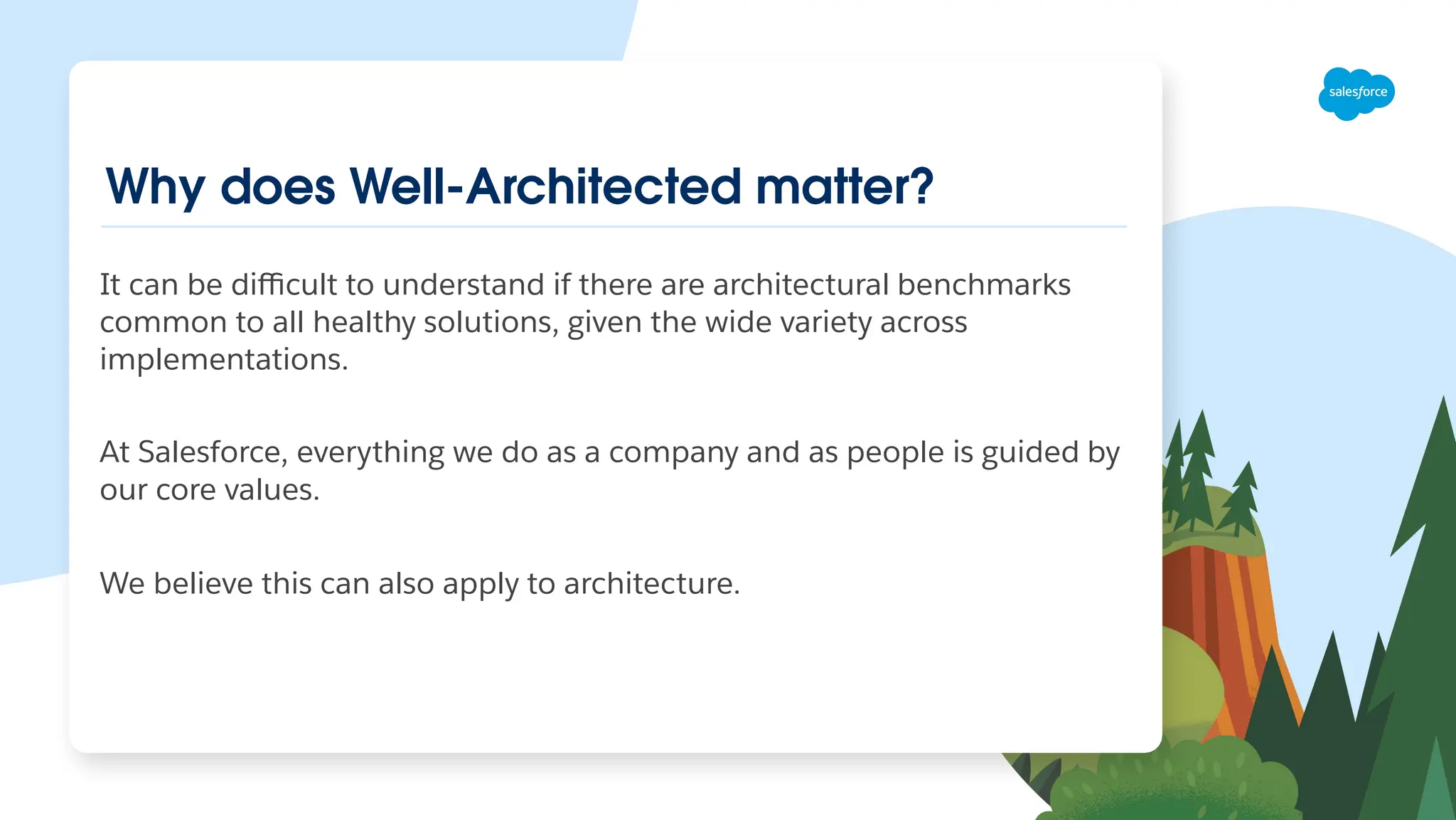
Why does Well-Architectedmatter?
It can be difficult to understand if there are architectural benchmarks
common to all healthy solutions, given the wide variety across
implementations.
At Salesforce, everything we do as a company and as people is guided by
our core values.
We believe this can also apply to architecture.
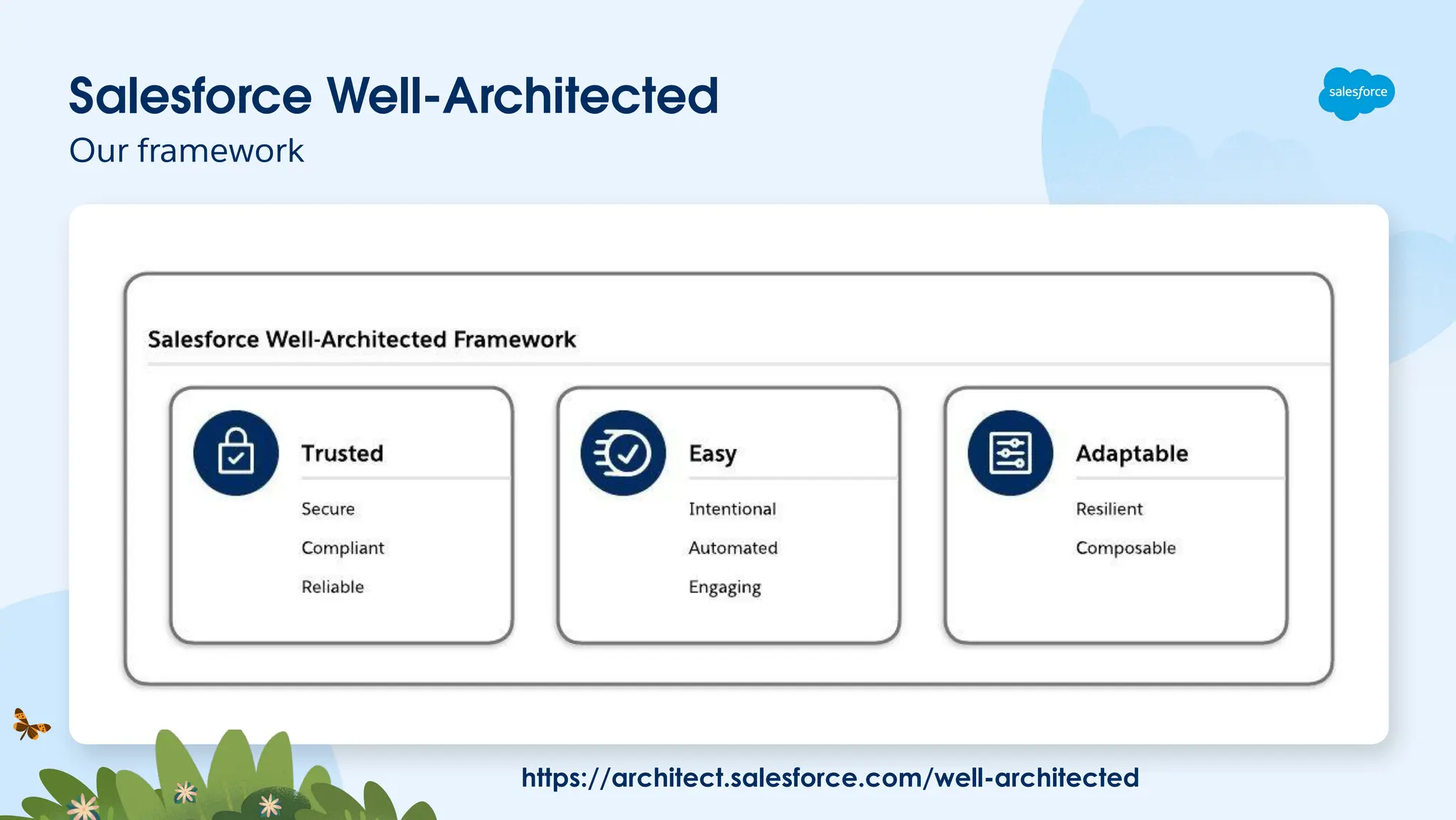
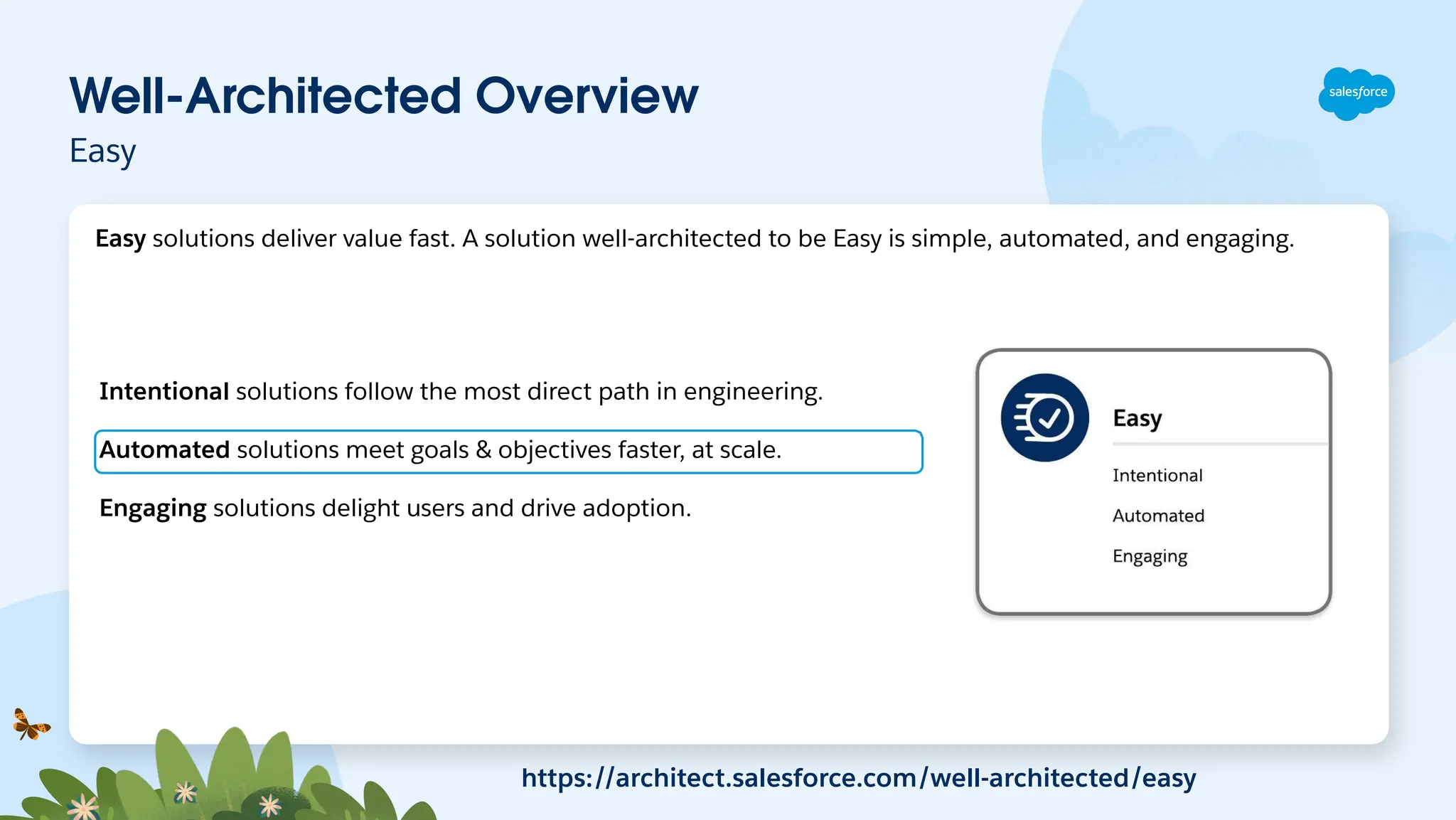
Well-Architected Overview
Easy
Intentional solutionsfollow the most direct path in engineering.
Automated solutions meet goals & objectives faster, at scale.
Engaging solutions delight users and drive adoption.
https://architect.salesforce.com/well-architected/easy
Easy solutions deliver value fast. A solution well-architected to be Easy is simple, automated, and engaging.
9.
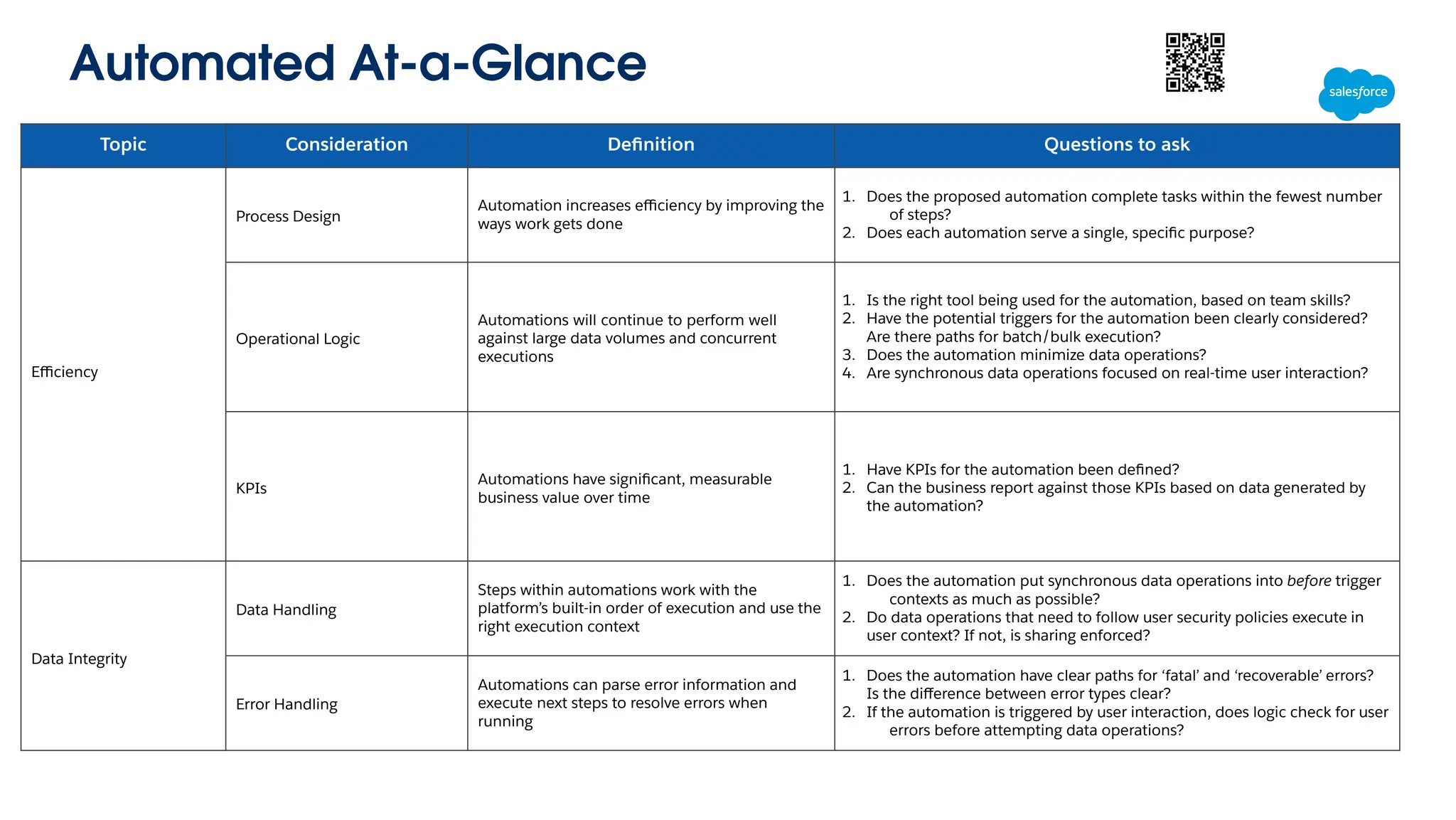
Automated At-a-Glance
Topic ConsiderationDefinition Questions to ask
Efficiency
Process Design
Automation increases efficiency by improving the
ways work gets done
1. Does the proposed automation complete tasks within the fewest number
of steps?
2. Does each automation serve a single, specific purpose?
Operational Logic
Automations will continue to perform well
against large data volumes and concurrent
executions
1. Is the right tool being used for the automation, based on team skills?
2. Have the potential triggers for the automation been clearly considered?
Are there paths for batch/bulk execution?
3. Does the automation minimize data operations?
4. Are synchronous data operations focused on real-time user interaction?
KPIs
Automations have significant, measurable
business value over time
1. Have KPIs for the automation been defined?
2. Can the business report against those KPIs based on data generated by
the automation?
Data Integrity
Data Handling
Steps within automations work with the
platform’s built-in order of execution and use the
right execution context
1. Does the automation put synchronous data operations into before trigger
contexts as much as possible?
2. Do data operations that need to follow user security policies execute in
user context? If not, is sharing enforced?
Error Handling
Automations can parse error information and
execute next steps to resolve errors when
running
1. Does the automation have clear paths for ‘fatal’ and ‘recoverable’ errors?
Is the difference between error types clear?
2. If the automation is triggered by user interaction, does logic check for user
errors before attempting data operations?
Scenario
Dream Travel isa travel & hospitality company that uses
Salesforce. They want to improve the experience for customers
dealing with delays when traveling.
There are 2 challenges.
You’ll spend equal amounts of time solving these two problems.
Make sure to save room on your board to diagram both!
Cheat
Sheet
12.
Challenge 1
Current Policies& Process
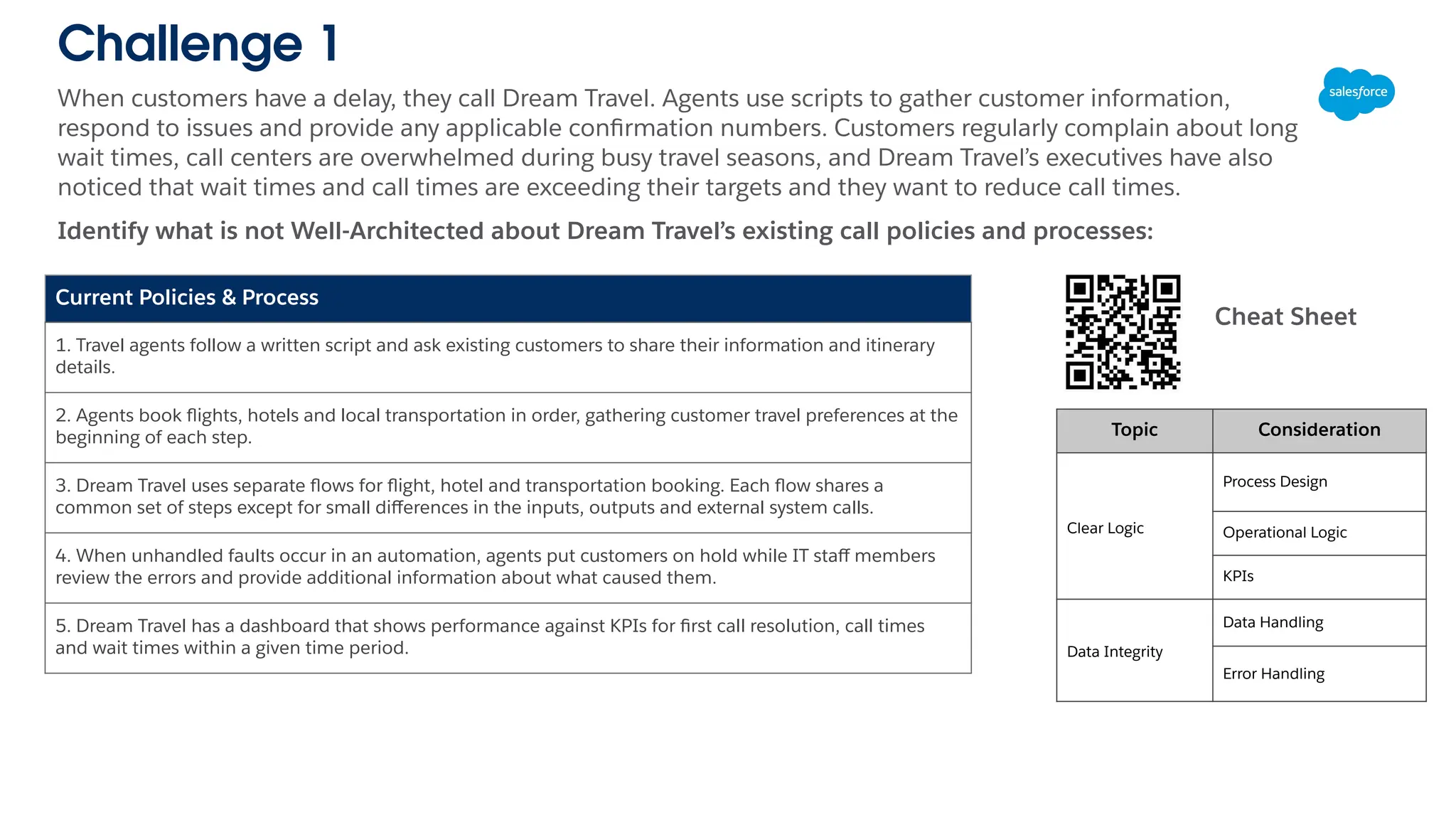
1. Travel agents follow a written script and ask existing customers to share their information and itinerary
details.
2. Agents book flights, hotels and local transportation in order, gathering customer travel preferences at the
beginning of each step.
3. Dream Travel uses separate flows for flight, hotel and transportation booking. Each flow shares a
common set of steps except for small differences in the inputs, outputs and external system calls.
4. When unhandled faults occur in an automation, agents put customers on hold while IT staff members
review the errors and provide additional information about what caused them.
5. Dream Travel has a dashboard that shows performance against KPIs for first call resolution, call times
and wait times within a given time period.
Topic Consideration
Clear Logic
Process Design
Operational Logic
KPIs
Data Integrity
Data Handling
Error Handling
When customers have a delay, they call Dream Travel. Agents use scripts to gather customer information,
respond to issues and provide any applicable confirmation numbers. Customers regularly complain about long
wait times, call centers are overwhelmed during busy travel seasons, and Dream Travel’s executives have also
noticed that wait times and call times are exceeding their targets and they want to reduce call times.
Identify what is not Well-Architected about Dream Travel’s existing call policies and processes:
Cheat Sheet
13.
Potential Solution 1
Policyor Process
Well-
Architected?
Well-Architected Alignment
1. Travel agents follow a written script and ask existing
customers to share their information and itinerary details.
No
Dream Travel should store and search for existing customer data rather than
asking customers to provide it on each call. Process Design
2. Agents book flights, hotels and local transportation in
order, gathering customer travel preferences at the
beginning of each step.
No
Agents should retrieve existing customer information from the system and
collect all new customer travel preferences upfront. Process Design
3. Dream Travel uses separate flows for flight, hotel and
transportation booking. Each flow shares a common set
of steps except for small differences in the inputs, outputs
and external system calls.
No Each flow serves a single, specific purpose. Process Design
4. When unhandled faults occur in an automation, agents
put customers on hold while IT staff members review the
errors and provide additional information about what
caused them.
No
Processes should use fault paths to show details about non-recoverable errors
to agents, and where possible, recoverable errors fail silently. Error Handling
5. Dream Travel has a dashboard that shows performance
against KPIs for first call resolution, call times and wait
times within a given time period .
Yes All metrics related to KPIs are included in at least one report or dashboard KPIs
14.
Readouts
What wasn’t Well-Architectedin the
challenge?
How does your solution solve the
business problem?
What is Well-Architected about your
solution?
15.
Challenge 2
Dream Travelwants to add functionality into their existing customer portal to allow customers to submit
help requests without calling a travel agent. They started to draft a solution, but need some help.
Identify how to make the automation Well-Architected.
Cheat
Sheet
Topic Consideration
Clear Logic
Process Design
Operational Logic
KPIs
Data Integrity
Data Handling
Error Handling
16.
Potential Solution 2
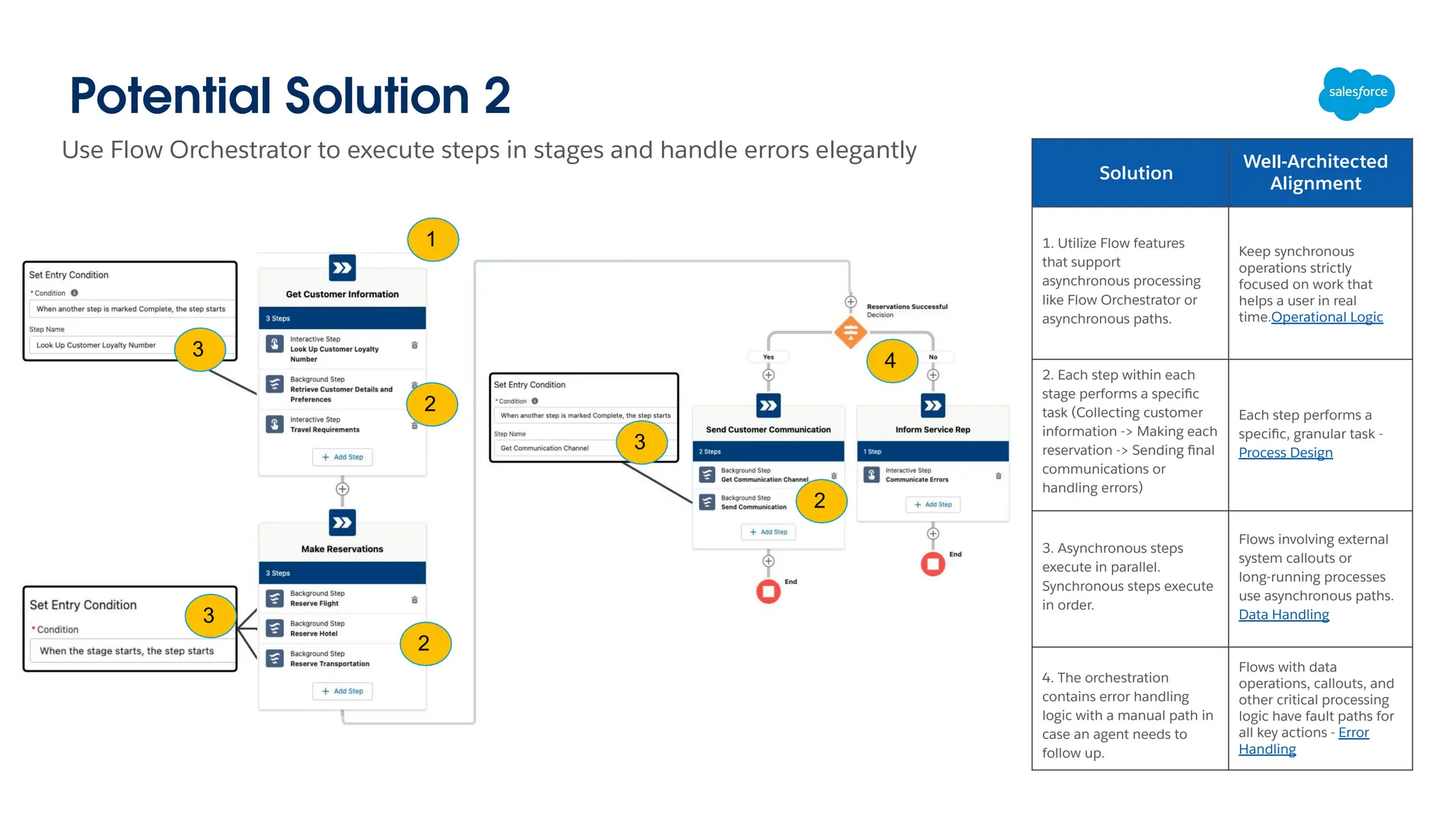
UseFlow Orchestrator to execute steps in stages and handle errors elegantly
1
2
3
4
2
2
3
3
Solution
Well-Architected
Alignment
1. Utilize Flow features
that support
asynchronous processing
like Flow Orchestrator or
asynchronous paths.
Keep synchronous
operations strictly
focused on work that
helps a user in real
time.Operational Logic
2. Each step within each
stage performs a specific
task (Collecting customer
information -> Making each
reservation -> Sending final
communications or
handling errors)
Each step performs a
specific, granular task -
Process Design
3. Asynchronous steps
execute in parallel.
Synchronous steps execute
in order.
Flows involving external
system callouts or
long-running processes
use asynchronous paths.
Data Handling
4. The orchestration
contains error handling
logic with a manual path in
case an agent needs to
follow up.
Flows with data
operations, callouts, and
other critical processing
logic have fault paths for
all key actions - Error
Handling
17.
Potential Solution 2(Alternate)
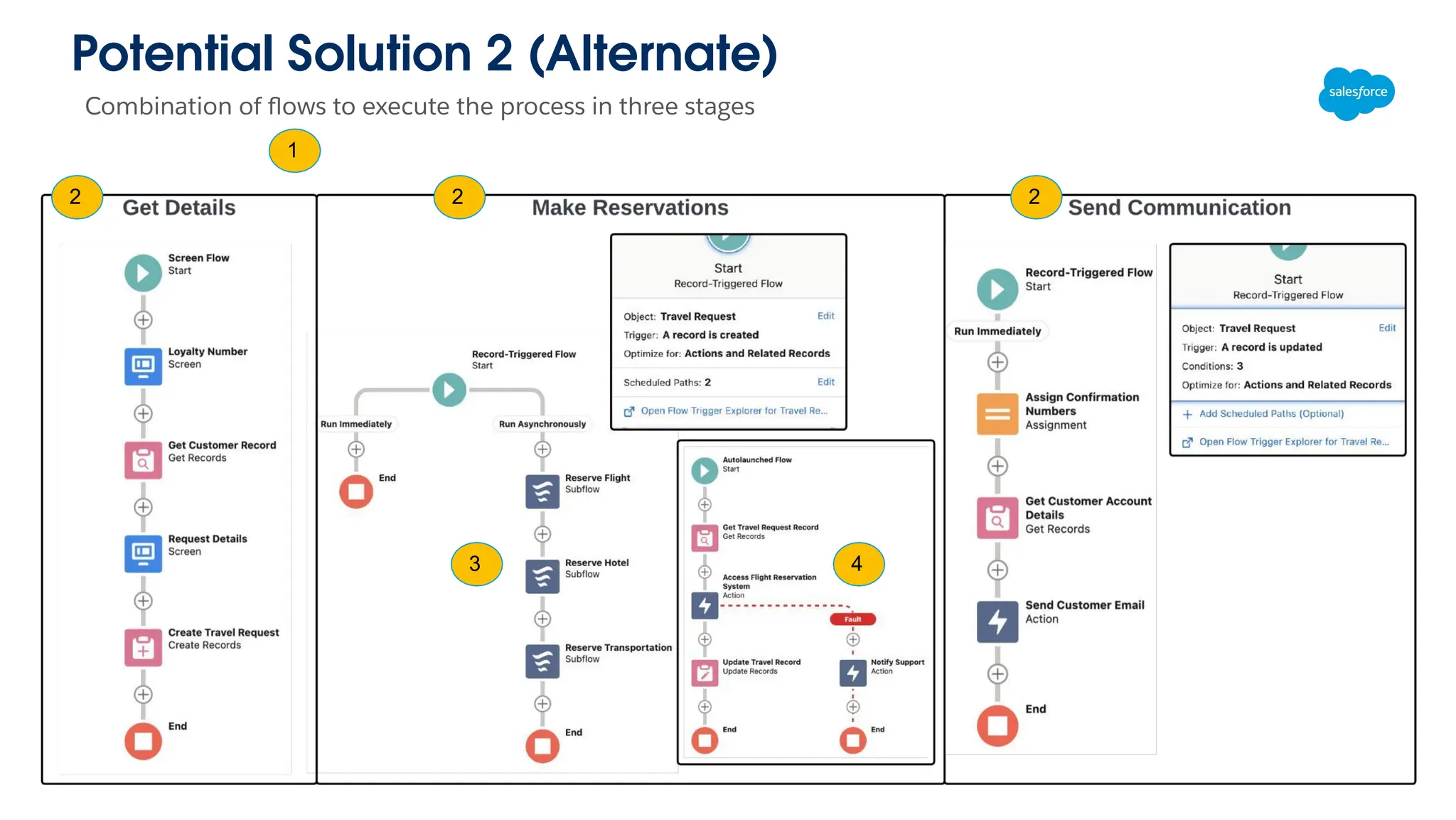
Combination of flows to execute the process in three stages
2
4
3
2 2
1
18.
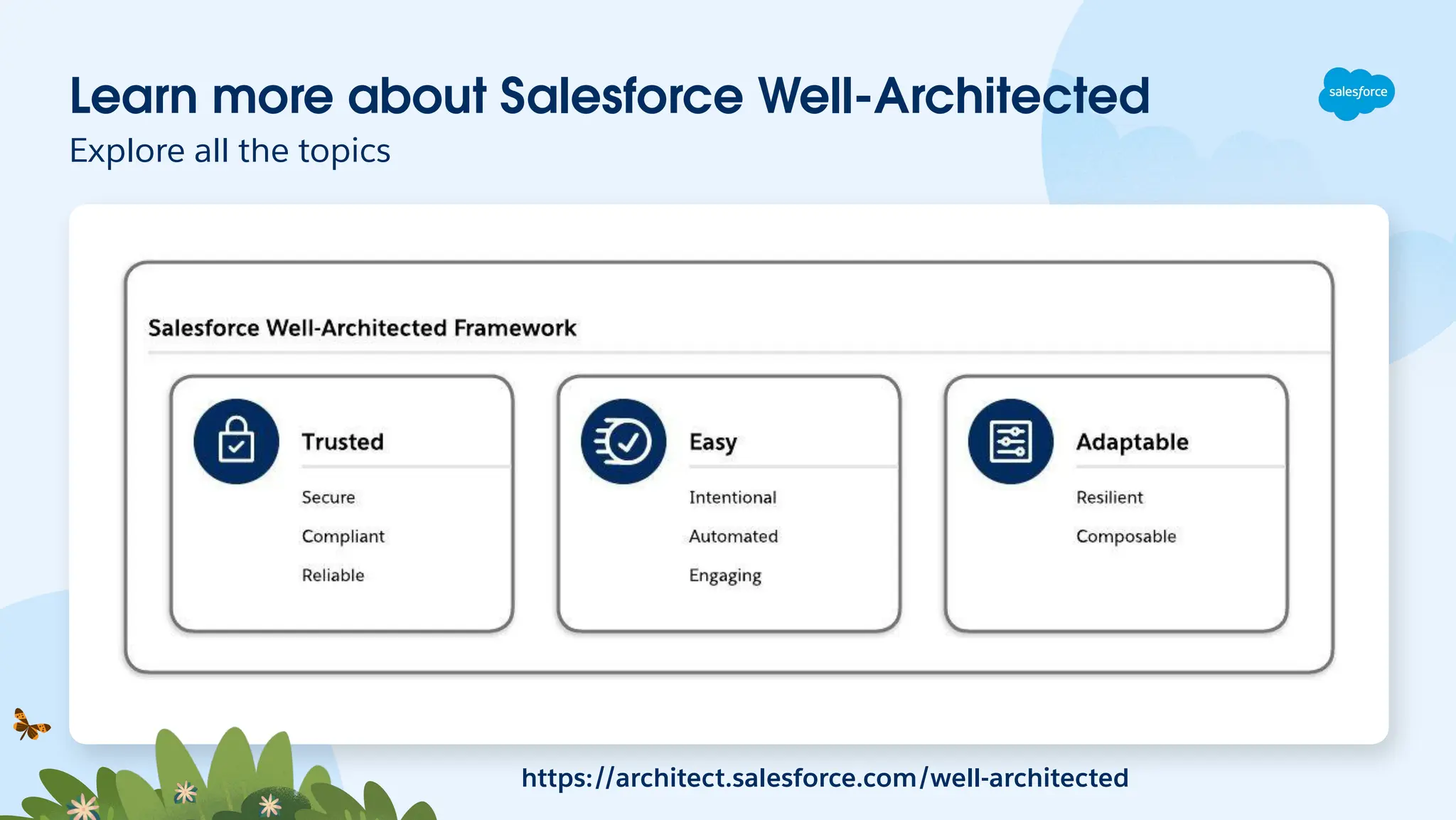
Learn more aboutSalesforce Well-Architected
Explore all the topics
https://architect.salesforce.com/well-architected