BY
STEWART ILONDANGA
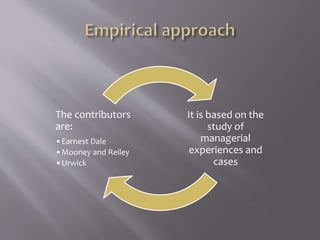
It is based on the
study of
managerial
experiences and
cases
The contributors
are:
•Earnest Dale
•Mooney and Reiley
•Urwick
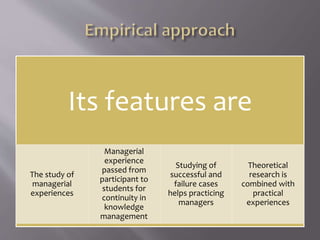
Its features are
The study of
managerial
experiences
Managerial
experience
passed from
participant to
students for
continuity in
knowledge
management
Studying of
successful and
failure cases
helps practicing
managers
Theoretical
research is
combined with
practical
experiences
The use of empirical approach is when
learning through experience of others
The limitations are
•No contribution for the development of
management as a discipline
•It has situations of the past not the same as present
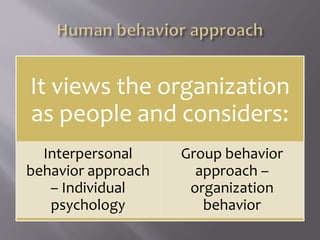
It views the organization
as people and considers:
Interpersonal
behavior approach
– Individual
psychology
Group behavior
approach –
organization
behavior
The
features
include
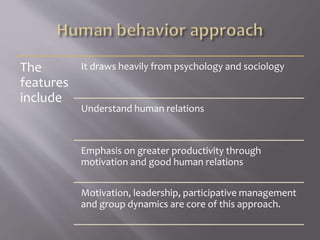
It draws heavily from psychology and sociology
Understand human relations
Emphasis on greater productivity through
motivation and good human relations
Motivation, leadership, participative management
and group dynamics are core of this approach.
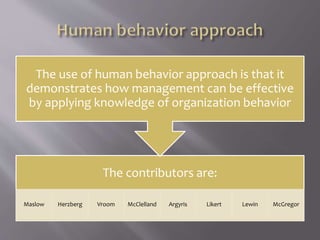
The contributors are:
Maslow Herzberg Vroom McClelland Argyris Likert Lewin McGregor
The use of human behavior approach is that it
demonstrates how management can be effective
by applying knowledge of organization behavior
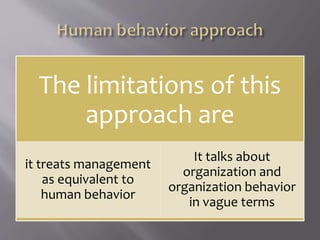
The limitations of this
approach are
it treats management
as equivalent to
human behavior
It talks about
organization and
organization behavior
in vague terms
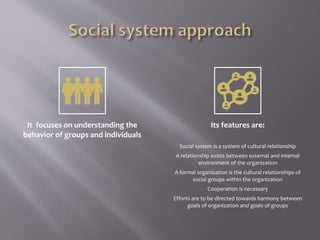
It focuses on understanding the
behavior of groups and individuals
Its features are:
Social system is a system of cultural relationship
A relationship exists between external and internal
environment of the organization
A formal organization is the cultural relationships of
social groups within the organization
Cooperation is necessary
Efforts are to be directed towards harmony between
goals of organization and goals of groups
The contributors are
Pareto
Chester Barnard
Its use is that organizational decisions should not
be based on desires of one group alone but
should reflect the interests of all parties
Its limitations are
•It is broader than management and
its practice
•It overlooks many management
concepts principles and techniques
that are important to practicing
managers
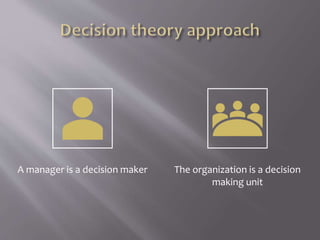
A manager is a decision maker The organization is a decision
making unit
Its features are
•Management is decision making
•Members of an organization are decision makers and
problem solvers
•Decision making is the control point in management
•Increasing efficiency is through the quality of the
decision
•Management information systems, process and
techniques of decision making are the subject matter
of study
The contributors are
•Simon
•Cyert
•Forrester
It is used as a tool
for making suitable
decisions in
organizations
The
limitations
are
Does not take the total
view of management
Decision making is one
aspect of management
Management is a logical entity Management actions are through
mathematical symbols, relationships and
measurable data
Its features are
•Problem solving mechanism with the help of
mathematical tools and techniques
•Problems are expressed in mathematical symbols
•Variables in management are quantified
•The scope of management is decision making,
system analysis and some aspect of human
behavior
•Management tools are operations research,
simulation e.t.c.
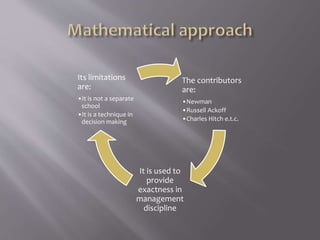
The contributors
are:
•Newman
•Russell Ackoff
•Charles Hitch e.t.c.
It is used to
provide
exactness in
management
discipline
Its limitations
are:
•It is not a separate
school
•It is a technique in
decision making
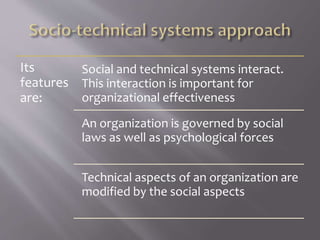
Its
features
are:
Social and technical systems interact.
This interaction is important for
organizational effectiveness
An organization is governed by social
laws as well as psychological forces
Technical aspects of an organization are
modified by the social aspects
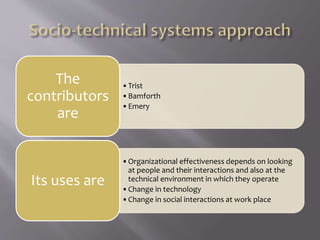
•Trist
•Bamforth
•Emery
The
contributors
are
•Organizational effectiveness depends on looking
at people and their interactions and also at the
technical environment in which they operate
•Change in technology
•Change in social interactions at work place
Its uses are
It’s limitations are:
•Lack of total managerial view
•Concentrate on factory or other
production system
•No new contribution
•People are aware about the role of
technology of the social system of the
work place.
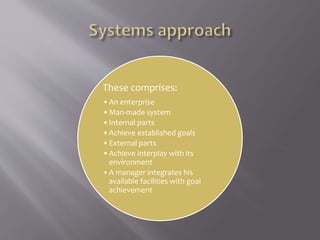
These comprises:
•An enterprise
•Man-made system
•Internal parts
•Achieve established goals
•External parts
•Achieve interplay with its
environment
•A manager integrates his
available facilities with goal
achievement
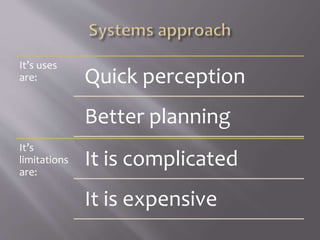
It’s uses
are: Quick perception
Better planning
It’s
limitations
are:
It is complicated
It is expensive
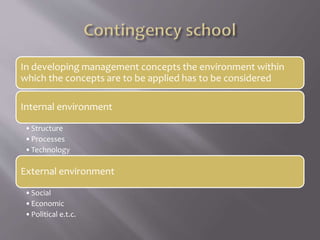
In developing management concepts the environment within
which the concepts are to be applied has to be considered
Internal environment
•Structure
•Processes
•Technology
External environment
•Social
•Economic
•Political e.t.c.
It’s features are:
•Appropriateness of a
managerial technique
depends on situation
•If – Then approach
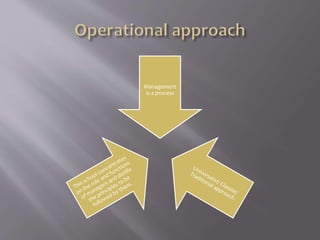
Management
is a process
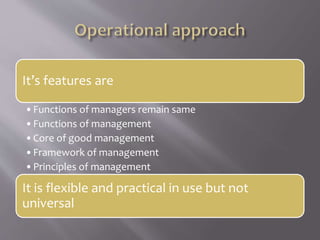
It’s features are
•Functions of managers remain same
•Functions of management
•Core of good management
•Framework of management
•Principles of management
It is flexible and practical in use but not
universal
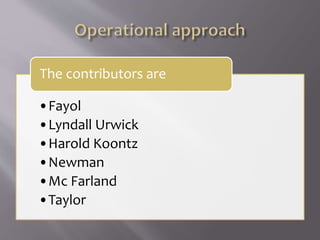
•Fayol
•Lyndall Urwick
•Harold Koontz
•Newman
•Mc Farland
•Taylor
The contributors are

approaches to management.pptx

  • 1.
  • 2.
    It is basedon the study of managerial experiences and cases The contributors are: •Earnest Dale •Mooney and Reiley •Urwick
  • 3.
    Its features are Thestudy of managerial experiences Managerial experience passed from participant to students for continuity in knowledge management Studying of successful and failure cases helps practicing managers Theoretical research is combined with practical experiences
  • 4.
    The use ofempirical approach is when learning through experience of others The limitations are •No contribution for the development of management as a discipline •It has situations of the past not the same as present
  • 5.
    It views theorganization as people and considers: Interpersonal behavior approach – Individual psychology Group behavior approach – organization behavior
  • 6.
    The features include It draws heavilyfrom psychology and sociology Understand human relations Emphasis on greater productivity through motivation and good human relations Motivation, leadership, participative management and group dynamics are core of this approach.
  • 7.
    The contributors are: MaslowHerzberg Vroom McClelland Argyris Likert Lewin McGregor The use of human behavior approach is that it demonstrates how management can be effective by applying knowledge of organization behavior
  • 8.
    The limitations ofthis approach are it treats management as equivalent to human behavior It talks about organization and organization behavior in vague terms
  • 9.
    It focuses onunderstanding the behavior of groups and individuals Its features are: Social system is a system of cultural relationship A relationship exists between external and internal environment of the organization A formal organization is the cultural relationships of social groups within the organization Cooperation is necessary Efforts are to be directed towards harmony between goals of organization and goals of groups
  • 10.
    The contributors are Pareto ChesterBarnard Its use is that organizational decisions should not be based on desires of one group alone but should reflect the interests of all parties
  • 11.
    Its limitations are •Itis broader than management and its practice •It overlooks many management concepts principles and techniques that are important to practicing managers
  • 12.
    A manager isa decision maker The organization is a decision making unit
  • 13.
    Its features are •Managementis decision making •Members of an organization are decision makers and problem solvers •Decision making is the control point in management •Increasing efficiency is through the quality of the decision •Management information systems, process and techniques of decision making are the subject matter of study
  • 14.
    The contributors are •Simon •Cyert •Forrester Itis used as a tool for making suitable decisions in organizations
  • 15.
    The limitations are Does not takethe total view of management Decision making is one aspect of management
  • 16.
    Management is alogical entity Management actions are through mathematical symbols, relationships and measurable data
  • 17.
    Its features are •Problemsolving mechanism with the help of mathematical tools and techniques •Problems are expressed in mathematical symbols •Variables in management are quantified •The scope of management is decision making, system analysis and some aspect of human behavior •Management tools are operations research, simulation e.t.c.
  • 18.
    The contributors are: •Newman •Russell Ackoff •CharlesHitch e.t.c. It is used to provide exactness in management discipline Its limitations are: •It is not a separate school •It is a technique in decision making
  • 19.
    Its features are: Social and technicalsystems interact. This interaction is important for organizational effectiveness An organization is governed by social laws as well as psychological forces Technical aspects of an organization are modified by the social aspects
  • 20.
    •Trist •Bamforth •Emery The contributors are •Organizational effectiveness dependson looking at people and their interactions and also at the technical environment in which they operate •Change in technology •Change in social interactions at work place Its uses are
  • 21.
    It’s limitations are: •Lackof total managerial view •Concentrate on factory or other production system •No new contribution •People are aware about the role of technology of the social system of the work place.
  • 22.
    These comprises: •An enterprise •Man-madesystem •Internal parts •Achieve established goals •External parts •Achieve interplay with its environment •A manager integrates his available facilities with goal achievement
  • 23.
    It’s uses are: Quickperception Better planning It’s limitations are: It is complicated It is expensive
  • 24.
    In developing managementconcepts the environment within which the concepts are to be applied has to be considered Internal environment •Structure •Processes •Technology External environment •Social •Economic •Political e.t.c.
  • 25.
    It’s features are: •Appropriatenessof a managerial technique depends on situation •If – Then approach
  • 26.
  • 27.
    It’s features are •Functionsof managers remain same •Functions of management •Core of good management •Framework of management •Principles of management It is flexible and practical in use but not universal
  • 28.

Editor's Notes