Congressional Budget Office
Transportation Research Board
International Transportation and Economic Development Conference
Washington, D.C.
June 7, 2018
Chad Shirley
Deputy Assistant Director for Microeconomic Studies
Approaches to Making
Infrastructure Spending More
Productive
This presentation draws on information published in Congressional Budget Office, The Macroeconomic and Budgetary Effects of
Federal Investment (June 2016), www.cbo.gov/publication/51628, and Approaches to Making Federal Highway Spending More
Productive (February 2016), www.cbo.gov/publication/50150.
1
CBO
The Macroeconomic
Effects of Federal
Investment
2
CBO
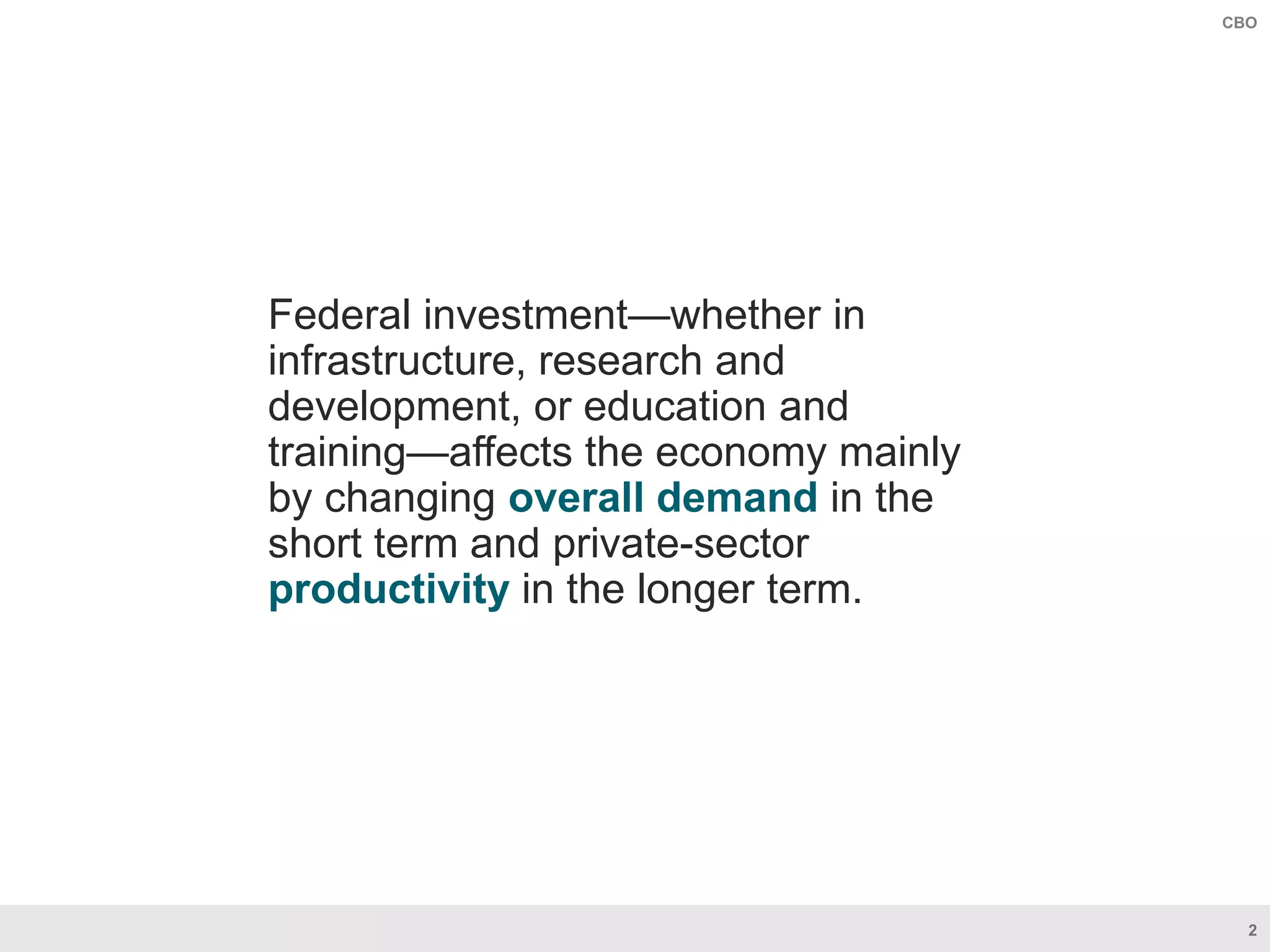
Federal investment—whether in
infrastructure, research and
development, or education and
training—affects the economy mainly
by changing overall demand in the
short term and private-sector
productivity in the longer term.
3
CBO
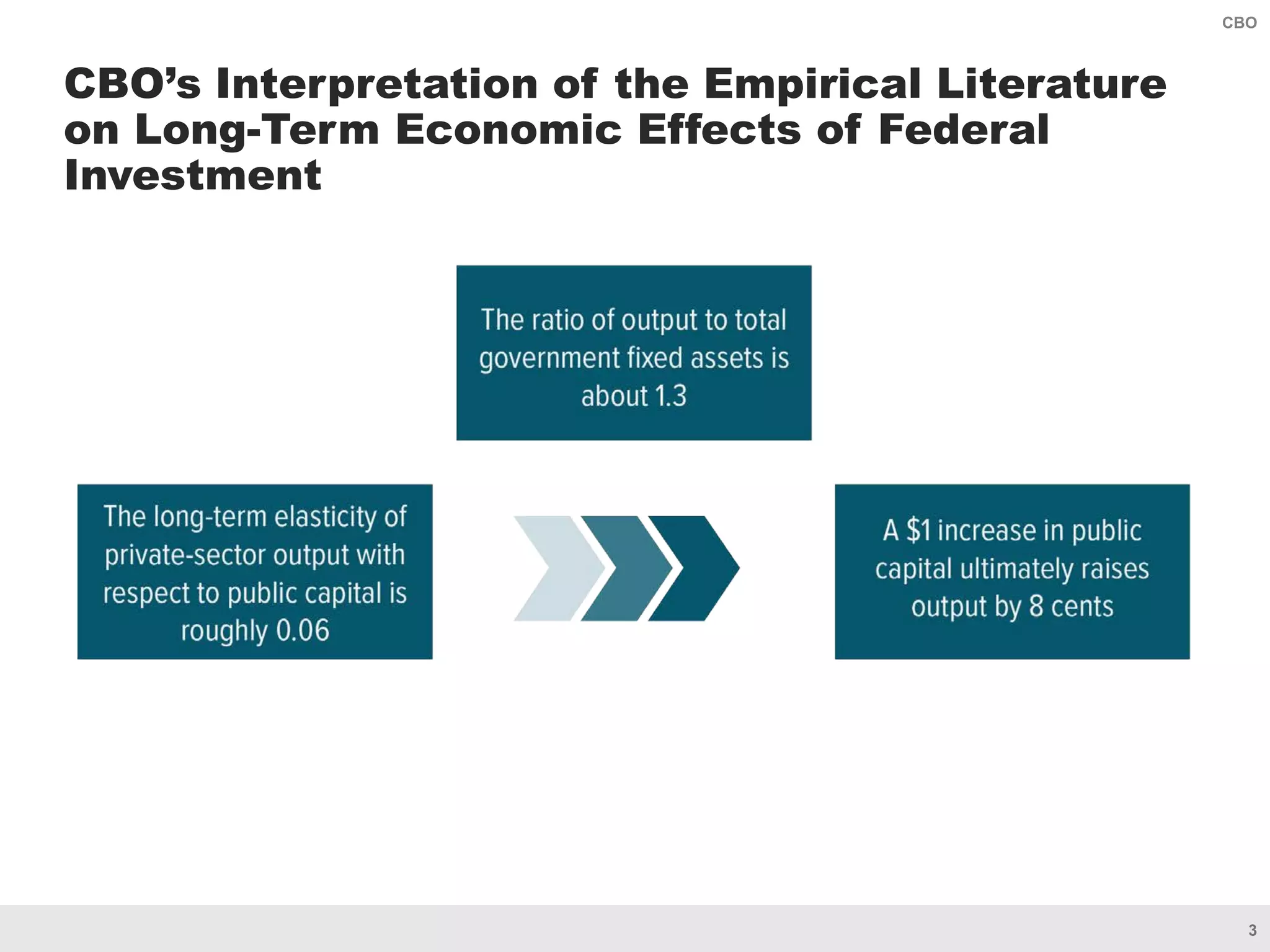
CBO’s Interpretation of the Empirical Literature
on Long-Term Economic Effects of Federal
Investment
4
CBO
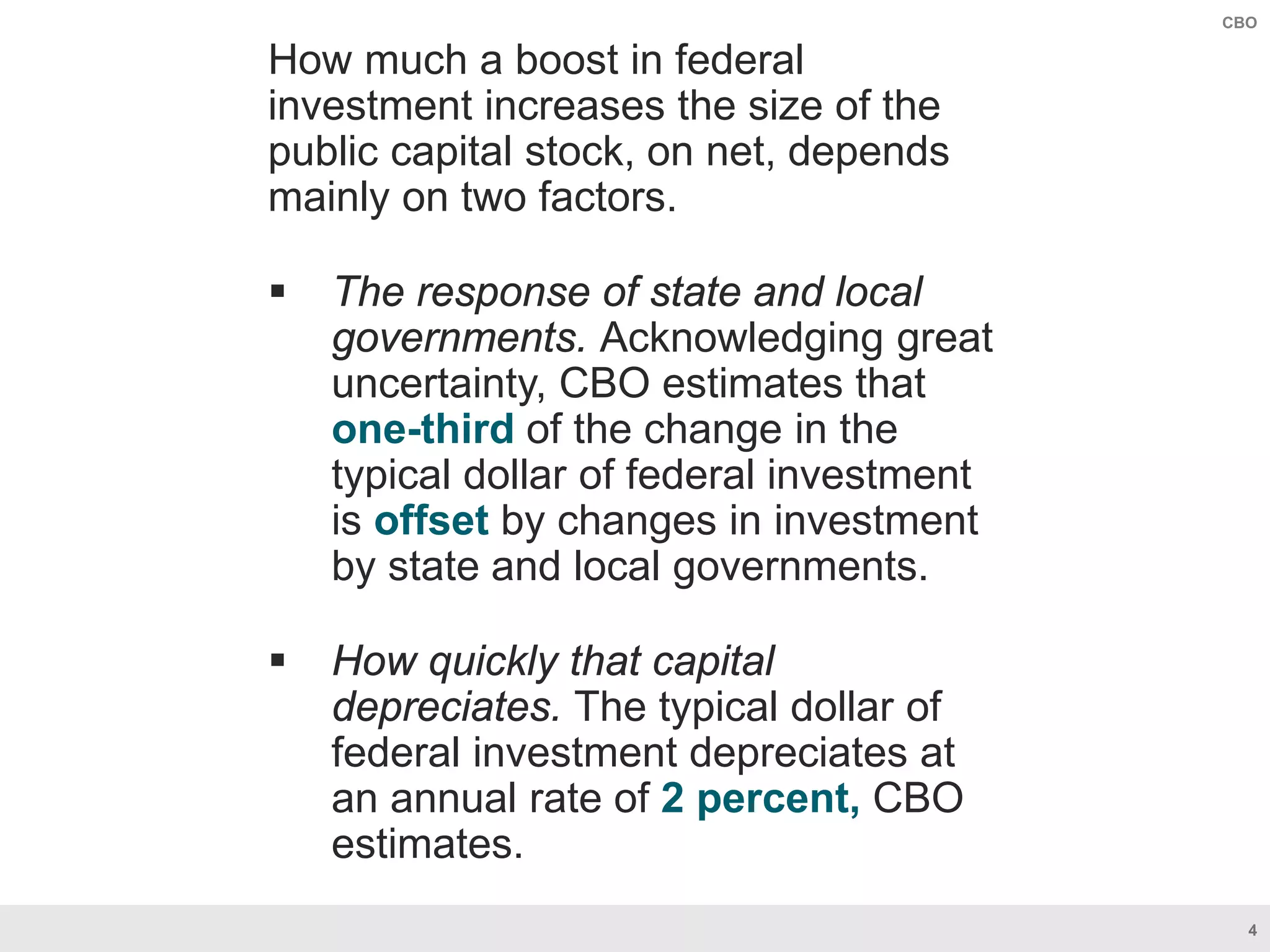
How much a boost in federal
investment increases the size of the
public capital stock, on net, depends
mainly on two factors.
 The response of state and local
governments. Acknowledging great
uncertainty, CBO estimates that
one-third of the change in the
typical dollar of federal investment
is offset by changes in investment
by state and local governments.
 How quickly that capital
depreciates. The typical dollar of
federal investment depreciates at
an annual rate of 2 percent, CBO
estimates.
5
CBO
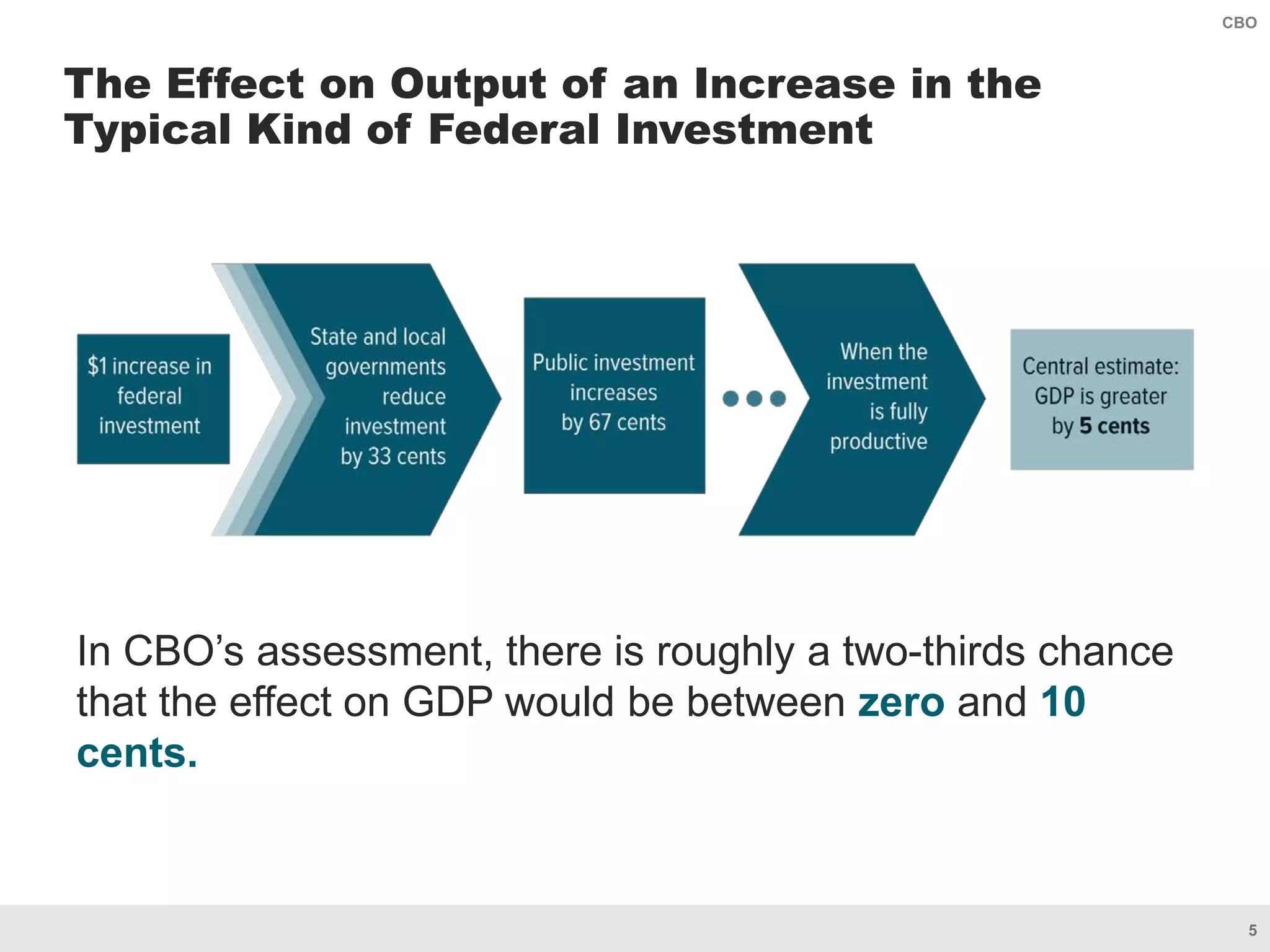
The Effect on Output of an Increase in the
Typical Kind of Federal Investment
In CBO’s assessment, there is roughly a two-thirds chance
that the effect on GDP would be between zero and 10
cents.
6
CBO
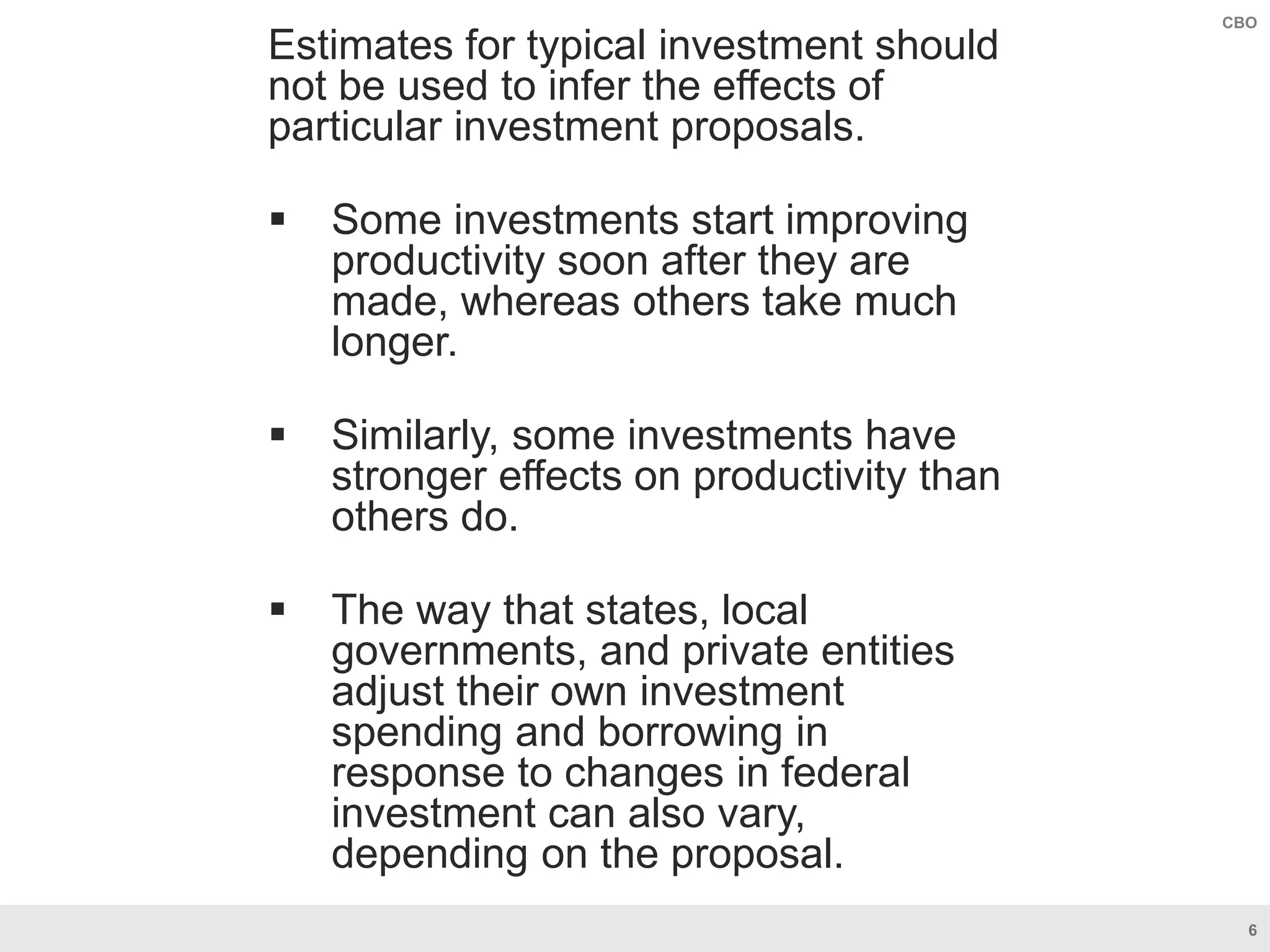
Estimates for typical investment should
not be used to infer the effects of
particular investment proposals.
 Some investments start improving
productivity soon after they are
made, whereas others take much
longer.
 Similarly, some investments have
stronger effects on productivity than
others do.
 The way that states, local
governments, and private entities
adjust their own investment
spending and borrowing in
response to changes in federal
investment can also vary,
depending on the proposal.
7
CBO
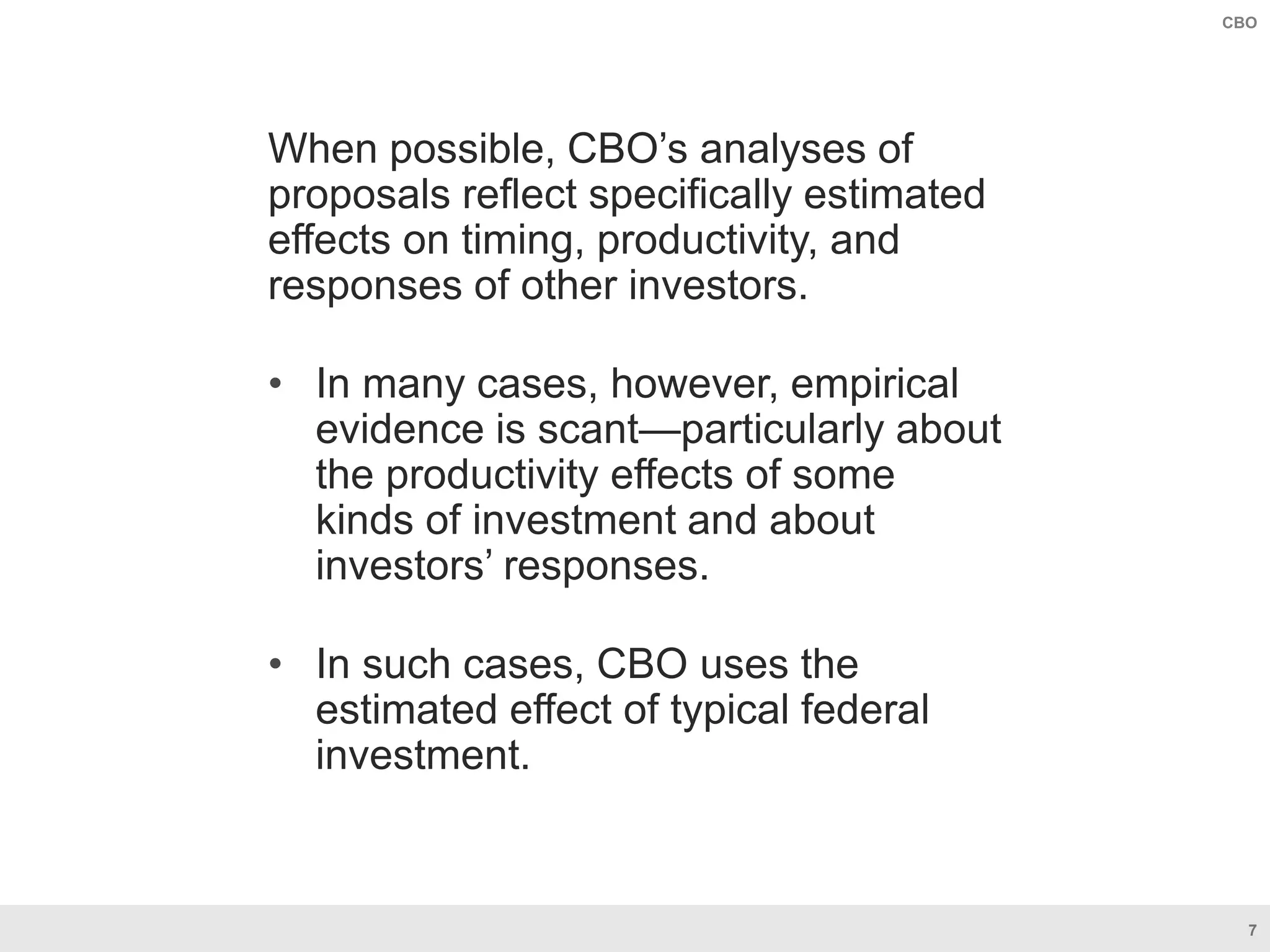
When possible, CBO’s analyses of
proposals reflect specifically estimated
effects on timing, productivity, and
responses of other investors.
• In many cases, however, empirical
evidence is scant—particularly about
the productivity effects of some
kinds of investment and about
investors’ responses.
• In such cases, CBO uses the
estimated effect of typical federal
investment.
8
CBO
Approaches to Making
Infrastructure Spending
More Productive
9
CBO
The construction of the Interstate System
has been associated with sizable gains in
productivity, especially for industries that
use the road system intensively.
However, subsequent capital spending on
roads has had a much smaller impact.
10
CBO
Research highlights particular
contributions of infrastructure
investment to economic activity.
 Projects serving ports and airports
may increase international trade.
 Facilitating growth of urban (or
metropolitan) areas may increase
interactions among businesses and
individuals (agglomeration effects).
 Repairing and rehabilitating
existing roads may preserve public
capital stock.
Greater emphasis on those types of
investment could increase the
productivity of federal spending.
11
CBO
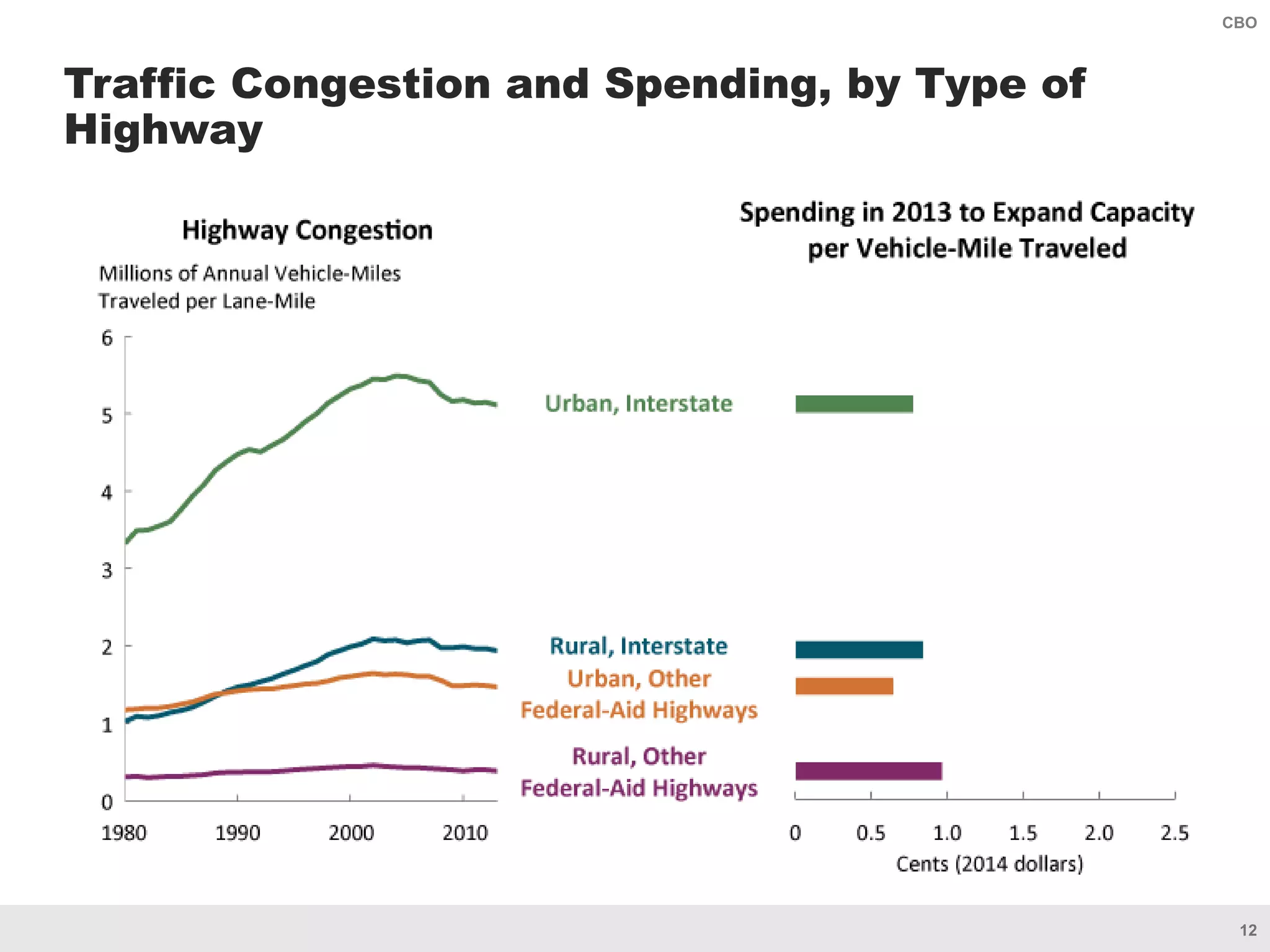
The allocation of federal highway funding
is only loosely related to how heavily
highways are used.
12
CBO
Traffic Congestion and Spending, by Type of
Highway
13
CBO
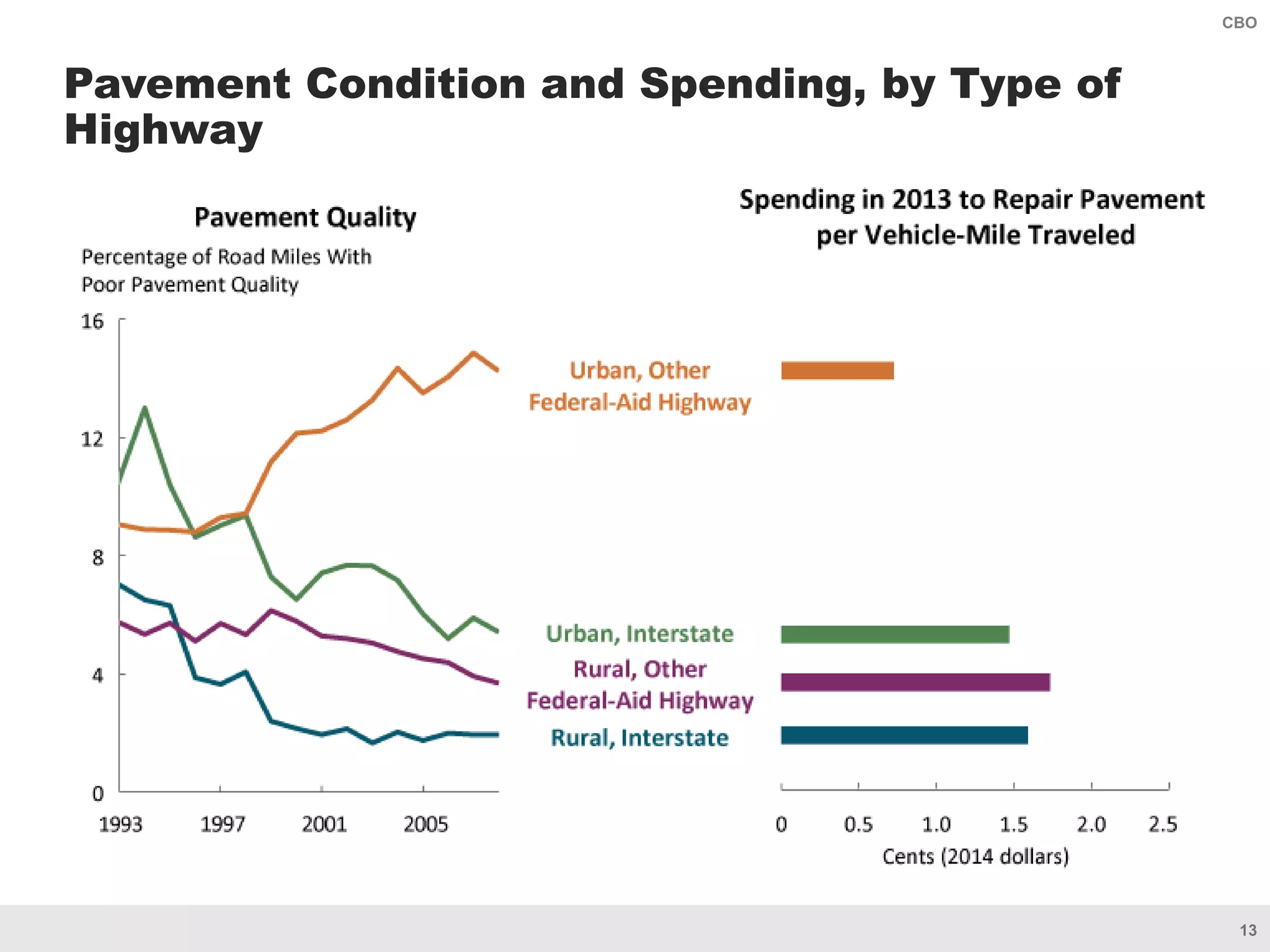
Pavement Condition and Spending, by Type of
Highway
14
CBO
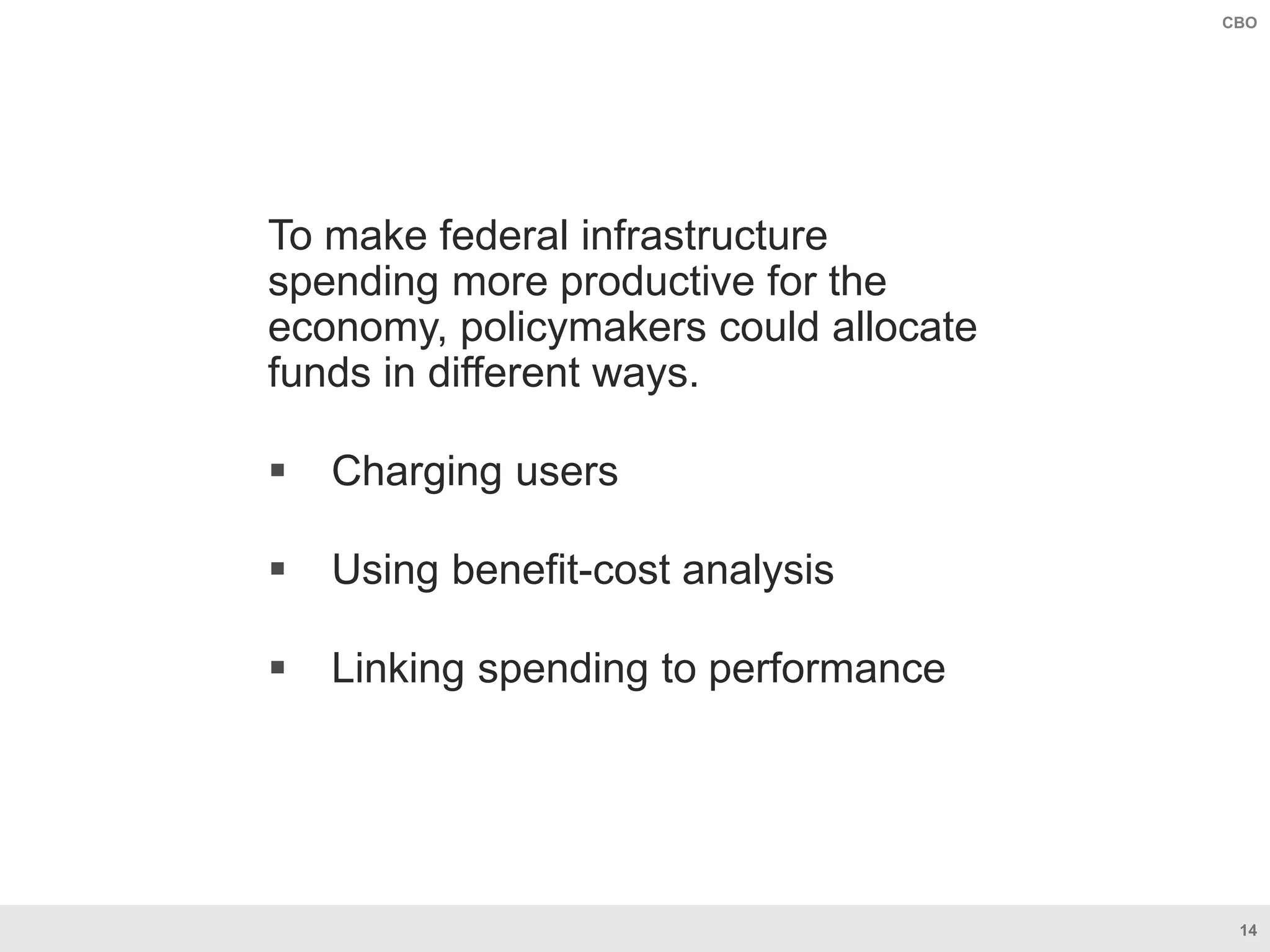
To make federal infrastructure
spending more productive for the
economy, policymakers could allocate
funds in different ways.
 Charging users
 Using benefit-cost analysis
 Linking spending to performance

Approaches to Making Infrastructure Spending More Productive

  • 1.
    Congressional Budget Office TransportationResearch Board International Transportation and Economic Development Conference Washington, D.C. June 7, 2018 Chad Shirley Deputy Assistant Director for Microeconomic Studies Approaches to Making Infrastructure Spending More Productive This presentation draws on information published in Congressional Budget Office, The Macroeconomic and Budgetary Effects of Federal Investment (June 2016), www.cbo.gov/publication/51628, and Approaches to Making Federal Highway Spending More Productive (February 2016), www.cbo.gov/publication/50150.
  • 2.
  • 3.
    2 CBO Federal investment—whether in infrastructure,research and development, or education and training—affects the economy mainly by changing overall demand in the short term and private-sector productivity in the longer term.
  • 4.
    3 CBO CBO’s Interpretation ofthe Empirical Literature on Long-Term Economic Effects of Federal Investment
  • 5.
    4 CBO How much aboost in federal investment increases the size of the public capital stock, on net, depends mainly on two factors.  The response of state and local governments. Acknowledging great uncertainty, CBO estimates that one-third of the change in the typical dollar of federal investment is offset by changes in investment by state and local governments.  How quickly that capital depreciates. The typical dollar of federal investment depreciates at an annual rate of 2 percent, CBO estimates.
  • 6.
    5 CBO The Effect onOutput of an Increase in the Typical Kind of Federal Investment In CBO’s assessment, there is roughly a two-thirds chance that the effect on GDP would be between zero and 10 cents.
  • 7.
    6 CBO Estimates for typicalinvestment should not be used to infer the effects of particular investment proposals.  Some investments start improving productivity soon after they are made, whereas others take much longer.  Similarly, some investments have stronger effects on productivity than others do.  The way that states, local governments, and private entities adjust their own investment spending and borrowing in response to changes in federal investment can also vary, depending on the proposal.
  • 8.
    7 CBO When possible, CBO’sanalyses of proposals reflect specifically estimated effects on timing, productivity, and responses of other investors. • In many cases, however, empirical evidence is scant—particularly about the productivity effects of some kinds of investment and about investors’ responses. • In such cases, CBO uses the estimated effect of typical federal investment.
  • 9.
  • 10.
    9 CBO The construction ofthe Interstate System has been associated with sizable gains in productivity, especially for industries that use the road system intensively. However, subsequent capital spending on roads has had a much smaller impact.
  • 11.
    10 CBO Research highlights particular contributionsof infrastructure investment to economic activity.  Projects serving ports and airports may increase international trade.  Facilitating growth of urban (or metropolitan) areas may increase interactions among businesses and individuals (agglomeration effects).  Repairing and rehabilitating existing roads may preserve public capital stock. Greater emphasis on those types of investment could increase the productivity of federal spending.
  • 12.
    11 CBO The allocation offederal highway funding is only loosely related to how heavily highways are used.
  • 13.
    12 CBO Traffic Congestion andSpending, by Type of Highway
  • 14.
    13 CBO Pavement Condition andSpending, by Type of Highway
  • 15.
    14 CBO To make federalinfrastructure spending more productive for the economy, policymakers could allocate funds in different ways.  Charging users  Using benefit-cost analysis  Linking spending to performance