OBJECTIVES
• Develop techniquesin effective teaching of history
• Develop competence and skills in historical research
as manifested in a well-prepared lecture on historical
topic
3.
HISTORY
Is theinterpretation of the past in the
words of a historian
What is HistoricalInterpretation
is the process by which we describe, analyze,
evaluate and create an explanation of past events.
we base our interpretation on primary(firsthand)
and secondary(scholarly) historical sources.
It requires synthesizing(combining) a variety of
evidence, primary and secondary(critical thinking)
6.
Making sense ofthe past: Historical
Interpretation
According to Geoffrey Barraclough defines
history “as the attempt to discover, based on
fragmentary evidence, the significant things
about the past.
7.
Making sense ofthe past: Historical
Interpretation
Interpretations of the past, therefore vary
according to who reads the primary source,
when it was read, and how it was read
8.
Making sense ofthe past: Historical
Interpretation
Interpretations of historical events change over
time; thus, it is an important skill us to track
these changes in an attempt to understand the
past
9.
Making sense ofthe past: Historical
Interpretation
It is very important to subject to evaluation not
only the primary source, but also the historical
interpretation of the same, to ensure that the
current interpretation is reliable to support our
acceptance of events of the past.
10.
Another view ofHistorical Interpretation
(adapted from Richard Drew_UK)
Purposeful, thoughtful efforts
Representations
Past Events
HISTORICAL METHOD
III. THEPAST- THE EVIDENCE
Evidences that are supplied be critical
analysis and evaluation
15.
HISTORICAL METHOD
III. THEPAST- THE EVIDENCE
Evidences that are supplied by critical
analysis and evaluation
16.
HISTORICAL METHOD
IV. THEPRESENT-HISTORIAN
The historian should draw inferences and
establish chains of causation and
consequences or effect.
17.
HISTORICAL METHOD
V. THEHISTORIAN WRITES A HISTORY
History can be written only by those who find
and accept a sense of direction in history
itself.
18.
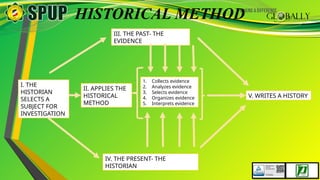
HISTORICAL METHOD
I. THE
HISTORIAN
SELECTSA
SUBJECT FOR
INVESTIGATION
II. APPLIES THE
HISTORICAL
METHOD
1. Collects evidence
2. Analyzes evidence
3. Selects evidence
4. Organizes evidence
5. Interprets evidence
III. THE PAST- THE
EVIDENCE
IV. THE PRESENT- THE
HISTORIAN
V. WRITES A HISTORY
19.
With multiperspectivity asan approach
to history, we must understand that
historical interpretations contain
discrepancies, contradictions,
ambiguities, and are often the focus of
dissent.
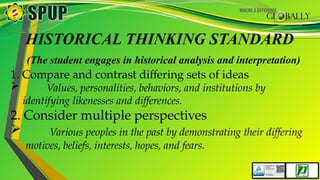
HISTORICAL THINKING STANDARD
(Thestudent engages in historical analysis and interpretation)
1. Compare and contrast differing sets of ideas
Values, personalities, behaviors, and institutions by
identifying likenesses and differences.
2. Consider multiple perspectives
Various peoples in the past by demonstrating their differing
motives, beliefs, interests, hopes, and fears.
22.
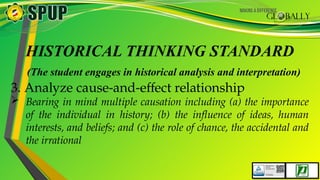
HISTORICAL THINKING STANDARD
(Thestudent engages in historical analysis and interpretation)
3. Analyze cause-and-effect relationship
Bearing in mind multiple causation including (a) the importance
of the individual in history; (b) the influence of ideas, human
interests, and beliefs; and (c) the role of chance, the accidental and
the irrational
23.
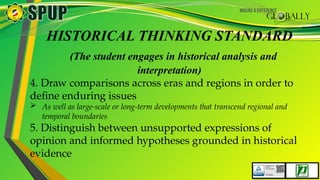
HISTORICAL THINKING STANDARD
(Thestudent engages in historical analysis and
interpretation)
4. Draw comparisons across eras and regions in order to
define enduring issues
As well as large-scale or long-term developments that transcend regional and
temporal boundaries
5. Distinguish between unsupported expressions of
opinion and informed hypotheses grounded in historical
evidence
24.
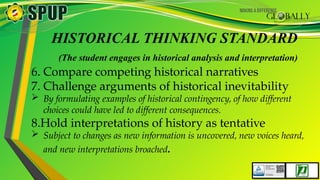
HISTORICAL THINKING STANDARD
(Thestudent engages in historical analysis and interpretation)
6. Compare competing historical narratives
7. Challenge arguments of historical inevitability
By formulating examples of historical contingency, of how different
choices could have led to different consequences.
8.Hold interpretations of history as tentative
Subject to changes as new information is uncovered, new voices heard,
and new interpretations broached.
25.
HISTORICAL THINKING STANDARD
(Thestudent engages in historical analysis and interpretation)
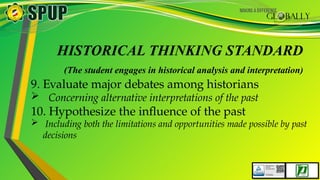
9. Evaluate major debates among historians
Concerning alternative interpretations of the past
10. Hypothesize the influence of the past
Including both the limitations and opportunities made possible by past
decisions








![Historical Research presentation [Autosaved].pptx](https://cdn.slidesharecdn.com/ss_thumbnails/historicalresearchpresentationautosaved-250530021312-a5c2398d-thumbnail.jpg?width=640&height=640&fit=bounds)


