Understanding History
and The Philippines
Presented by:
Prof. Ezri M. Coda Jr, MSPsych
Learning Objectives
 Define history
 Analyze the process of historical analysis
 Differentiate different views of history
 Differentiate sources of history
 Discuss Historical Criticism
 Recall salient facts about the Philippines
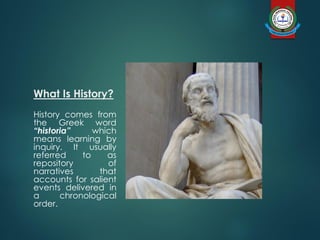
What Is History?
History comes from
the Greek word
“historia” which
means learning by
inquiry. It usually
referred to as
repository of
narratives that
accounts for salient
events delivered in
a chronological
order.
Historians constructs history as they
investigate events, it can either be:
 Factual history refers to
how historians present a
plain narrative of
information about
events using basic and
infallible information and
evidences such as what
happened, who are the
person involved, when
and where the event
took place.
 Speculative history on
the other hand concerns
about providing a
narrative that goes
beyond empirical data.
It answers the question
why the event took
place and how did it
happen.
Historiography – is a concept of the
reconstruction of the events from the past
based from gathered data though historical
method.
Process of Historical
Analysis:
1. Selecting a subject to
investigate
2. Collection of sources
3. Validate the
relevance and validity
of the sources
gathered
4. Extract part of the
sources gathered that
is relevant to the
narrative of the
subject being studied.
Views of History
History as Linear
History as Cyclic
History as Dialectic
History as Linear
of Progressive
Those who claim to
be linear believe
that there is a
chain of events
written in
chronological
order, and the
events that
happened in the
past are very
unlikely to take
place in the future.
History as
Cyclic
The cyclic theory of
time has been held
in regard to the
three fields of
religion, of history
(both human and
cosmic), and of
personal life. That this
view arose from the
observation of
recurrences in the
environment
(Ibn Khaldun,
Herodotus,
Thucydides, Petrarch
& Machiavelli
believed that history
is cyclical)
History as
Dialectic
The most influential
philosophical
framework today is
Hegel's theory of
dialectics. Each of us
plays a part in the
process of history,
which involves
everyone and
everything. Hegel's
central thesis is that
history is not a
question of times,
places, or things, but
rather of 'logic.
Historical Data
Historical data is
information gathered
about past
occurrences and
conditions relating to
a specific topic. These
are remnants of the
past, which can either
be artifacts, remains,
or eyewitness
accounts.
Written Sources
of History
Narrative or Literary
Sources – are writings
or tracts of
chronological events
presented in narrative
form which aims to
provide information
coming from various
motives.
Examples: Biography,
Memoirs, Panegyric, &
Hagiography)
Written Sources
of History
Diplomatic Sources
– Most of the
historians refer to
these documents as
the purest and best
source of
information.
Examples: Mortgage
agreement, jurisprudence,
court rulings, pact, treaties,
and alike)
Written Sources
of History
Social Documents – it
pertains to economic,
social, political or
judicial significance.
They are records kept
by bureaucracies.
Examples:
parliamentary
proceedings records,
civil registry, research
findings, records of
census
Non-written Sources of
History
Material Evidence Oral Evidence
Pottery, jewelries, dwellings, graves,
churches, roads, and others that tell
a story about the past.
These are stories by old folks through
tales, sagas of ancient people, and the
folk songs or even popular rituals.
Primary and Secondary
Sources
Primary sources – are original,
first-hand account of an event
or period that are usually
written or made during or close
to the event of period. These
sources are original and
factual, not interpretive. Their
main function is to provide
facts.
Secondary Sources – are
materials made by people
long after events being
described had taken place to
provide valuable
interpretations of historical
events. A secondary source
analyzes and interprets primary
sources.
Historical
Criticism
It aims to unravel
the original
meaning of the text
in its historical
context and its
literal sense as well
as to establish a
reconstruction of
historical situation of
the author and
recipients of the
text.
Historical Criticism
Methodologies
 Source criticism – analyze and studies the source
of information.
 Form criticism – aims to determine a unit’s original
form and historical context of the literary tradition.
 Redaction criticism - regards the author of the text
as editor of the source material.
 Tradition criticism – attempts to trace the
developmental stages of the oral tradition from its
historical emergence to its literary presentation.
 Canonical Tradition – focuses on biblical
interpretation.
Historical Criticism
 External Criticism
determines the
authenticity of the
source.
 Internal Criticism
Determines the
historicity of the facts
contained in the
document. It
Origin of the Philippines
• Land Bridge Theory
(Philippines as once part
of Mainland Asia)
• Volcanic Origin proposed
by Bailey Willis
• Legend of Mu or Lemuria
• Legend of Manaul
(Mythical Bird)
• Continental Drift Theory
Origin of Filipino People
Creation Theory (Biblical)
Migration Theory (H.O. Beyer)
First – Dawnmen (through
land bridges)
Second – Aetas or Negritos
(through land bridges)
Third – Indonesians (through
boat)
Fourth – Malay (through
boat)
Evolution Theory
Sikalak & Sikbahay (Malakas at
Maganda)
Pre-colonial
Philippines
Spanish Rule
(1565 – 1898)
333 years
American Rule
(1898 – 1946)
48 years
Japanese
Occupation
(1941 - 1946)
5 years
Self Rule
1946 –
Present
Presidents
Aguinaldo
Quezon
Laurel
Osmeña
Roxas
Quirino
Magsaysay
Garcia
Macapagal
Marcos
Aquino
Ramos
Estrada
Arroyo
Aquino
Digong
Bongbong

Introduction.pdf

  • 1.
    Understanding History and ThePhilippines Presented by: Prof. Ezri M. Coda Jr, MSPsych
  • 2.
    Learning Objectives  Definehistory  Analyze the process of historical analysis  Differentiate different views of history  Differentiate sources of history  Discuss Historical Criticism  Recall salient facts about the Philippines
  • 3.
    What Is History? Historycomes from the Greek word “historia” which means learning by inquiry. It usually referred to as repository of narratives that accounts for salient events delivered in a chronological order.
  • 6.
    Historians constructs historyas they investigate events, it can either be:  Factual history refers to how historians present a plain narrative of information about events using basic and infallible information and evidences such as what happened, who are the person involved, when and where the event took place.  Speculative history on the other hand concerns about providing a narrative that goes beyond empirical data. It answers the question why the event took place and how did it happen.
  • 7.
    Historiography – isa concept of the reconstruction of the events from the past based from gathered data though historical method. Process of Historical Analysis: 1. Selecting a subject to investigate 2. Collection of sources 3. Validate the relevance and validity of the sources gathered 4. Extract part of the sources gathered that is relevant to the narrative of the subject being studied.
  • 8.
    Views of History Historyas Linear History as Cyclic History as Dialectic
  • 9.
    History as Linear ofProgressive Those who claim to be linear believe that there is a chain of events written in chronological order, and the events that happened in the past are very unlikely to take place in the future.
  • 10.
    History as Cyclic The cyclictheory of time has been held in regard to the three fields of religion, of history (both human and cosmic), and of personal life. That this view arose from the observation of recurrences in the environment (Ibn Khaldun, Herodotus, Thucydides, Petrarch & Machiavelli believed that history is cyclical)
  • 11.
    History as Dialectic The mostinfluential philosophical framework today is Hegel's theory of dialectics. Each of us plays a part in the process of history, which involves everyone and everything. Hegel's central thesis is that history is not a question of times, places, or things, but rather of 'logic.
  • 12.
    Historical Data Historical datais information gathered about past occurrences and conditions relating to a specific topic. These are remnants of the past, which can either be artifacts, remains, or eyewitness accounts.
  • 13.
    Written Sources of History Narrativeor Literary Sources – are writings or tracts of chronological events presented in narrative form which aims to provide information coming from various motives. Examples: Biography, Memoirs, Panegyric, & Hagiography)
  • 14.
    Written Sources of History DiplomaticSources – Most of the historians refer to these documents as the purest and best source of information. Examples: Mortgage agreement, jurisprudence, court rulings, pact, treaties, and alike)
  • 15.
    Written Sources of History SocialDocuments – it pertains to economic, social, political or judicial significance. They are records kept by bureaucracies. Examples: parliamentary proceedings records, civil registry, research findings, records of census
  • 16.
    Non-written Sources of History MaterialEvidence Oral Evidence Pottery, jewelries, dwellings, graves, churches, roads, and others that tell a story about the past. These are stories by old folks through tales, sagas of ancient people, and the folk songs or even popular rituals.
  • 17.
    Primary and Secondary Sources Primarysources – are original, first-hand account of an event or period that are usually written or made during or close to the event of period. These sources are original and factual, not interpretive. Their main function is to provide facts. Secondary Sources – are materials made by people long after events being described had taken place to provide valuable interpretations of historical events. A secondary source analyzes and interprets primary sources.
  • 18.
    Historical Criticism It aims tounravel the original meaning of the text in its historical context and its literal sense as well as to establish a reconstruction of historical situation of the author and recipients of the text.
  • 19.
    Historical Criticism Methodologies  Sourcecriticism – analyze and studies the source of information.  Form criticism – aims to determine a unit’s original form and historical context of the literary tradition.  Redaction criticism - regards the author of the text as editor of the source material.  Tradition criticism – attempts to trace the developmental stages of the oral tradition from its historical emergence to its literary presentation.  Canonical Tradition – focuses on biblical interpretation.
  • 20.
    Historical Criticism  ExternalCriticism determines the authenticity of the source.  Internal Criticism Determines the historicity of the facts contained in the document. It
  • 24.
    Origin of thePhilippines • Land Bridge Theory (Philippines as once part of Mainland Asia) • Volcanic Origin proposed by Bailey Willis • Legend of Mu or Lemuria • Legend of Manaul (Mythical Bird) • Continental Drift Theory
  • 25.
    Origin of FilipinoPeople Creation Theory (Biblical) Migration Theory (H.O. Beyer) First – Dawnmen (through land bridges) Second – Aetas or Negritos (through land bridges) Third – Indonesians (through boat) Fourth – Malay (through boat) Evolution Theory Sikalak & Sikbahay (Malakas at Maganda)
  • 26.
    Pre-colonial Philippines Spanish Rule (1565 –1898) 333 years American Rule (1898 – 1946) 48 years Japanese Occupation (1941 - 1946) 5 years Self Rule 1946 – Present
  • 27.