Applying Systems Thinking
In Scrum
Ranan Bhattacharya
Co-Author: Prince Kumar Mishra
1st – 3rd December, 2017 | Westin, Hyderabad, INDIA
Royal Dutch Shell plc
Royal Dutch Shell plc is incorporated in England and Wales, has its headquarters in The Hague and is listed on the London, Amsterdam, and New York stock exchanges. Shell companies have operations in
more than 100 countries and territories with businesses including oil and gas exploration and production; production and marketing of Liquefied Natural Gas and Gas to Liquids; manufacturing, marketing and
shipping of oil products and chemicals and renewable energy projects. For further information, visit http://www.shell.com
Disclaimer statement
This announcement contains forward-looking statements concerning the financial condition, results of operations and businesses of Royal Dutch Shell. All statements other than statements of historical fact are,
or may be deemed to be, forward-looking statements. Forward-looking statements are statements of future expectations that are based on management’s current expectations and assumptions and involve
known and unknown risks and uncertainties that could cause actual results, performance or events to differ materially from those expressed or implied in these statements. Forward-looking statements include,
among other things, statements concerning the potential exposure of Royal Dutch Shell to market risks and statements expressing management’s expectations, beliefs, estimates, forecasts, projections and
assumptions. These forward-looking statements are identified by their use of terms and phrases such as ‘‘anticipate’’, ‘‘believe’’, ‘‘could’’, ‘‘estimate’’, ‘‘expect’’, ‘‘intend’’, ‘‘may’’, ‘‘plan’’, ‘‘objectives’’, ‘‘outlook’’,
‘‘probably’’, ‘‘project’’, ‘‘will’’, ‘‘seek’’, ‘‘target’’, ‘‘risks’’, ‘‘goals’’, ‘‘should’’ and similar terms and phrases. There are a number of factors that could affect the future operations of Royal Dutch Shell and could cause
those results to differ materially from those expressed in the forward-looking statements included in this Report, including (without limitation): (a) price fluctuations in crude oil and natural gas; (b) changes in
demand for the Group’s products; (c) currency fluctuations; (d) drilling and production results; (e) reserve estimates; (f) loss of market and industry competition; (g) environmental and physical risks; (h) risks
associated with the identification of suitable potential acquisition properties and targets, and successful negotiation and completion of such transactions; (i) the risk of doing business in developing countries and
countries subject to international sanctions; (j) legislative, fiscal and regulatory developments including potential litigation and regulatory effects arising from recategorisation of reserves; (k) economic and
financial market conditions in various countries and regions; (l) political risks, project delay or advancement, approvals and cost estimates; and (m) changes in trading conditions. All forward-looking statements
contained in this presentation are expressly qualified in their entirety by the cautionary statements contained or referred to in this section. Readers should not place undue reliance on forward-looking statements.
Each forward-looking statement speaks only as of the date of this document, 1st December 2017. Neither Royal Dutch Shell nor any of its subsidiaries undertake any obligation to publicly update or revise any
forward-looking statement as a result of new information, future events or other information. In light of these risks, results could differ materially from those stated, implied or inferred from the forward-looking
statements contained in this document.
The United States Securities and Exchange Commission (SEC) permits oil and gas companies, in their filings with the SEC, to disclose only proved reserves that a company has demonstrated by actual
production or conclusive formation tests to be economically and legally producible under existing economic and operating conditions. We use certain terms in this presentation, such as “oil in place" that the
SEC's guidelines strictly prohibit us from including in filings with the SEC. U.S. Investors are urged to consider closely the disclosure in our Form 20-F, File No 1-32575 and disclosure in our Forms 6-K file
No, 1-32575, available on the SEC website www.sec.gov. You can also obtain these forms from the SEC by calling 1-800-SEC-0330.
Disclaimer: The views, thoughts, and opinions expressed in this presentation belong solely to the author,
and not necessarily to the author’s employer, organization, committee or other group or individual
A system must be managed. It will not manage
itself. Left to themselves, components become
selfish, competitive. We can not afford the
destructive effect of competition.”
―W. Edwards Deming
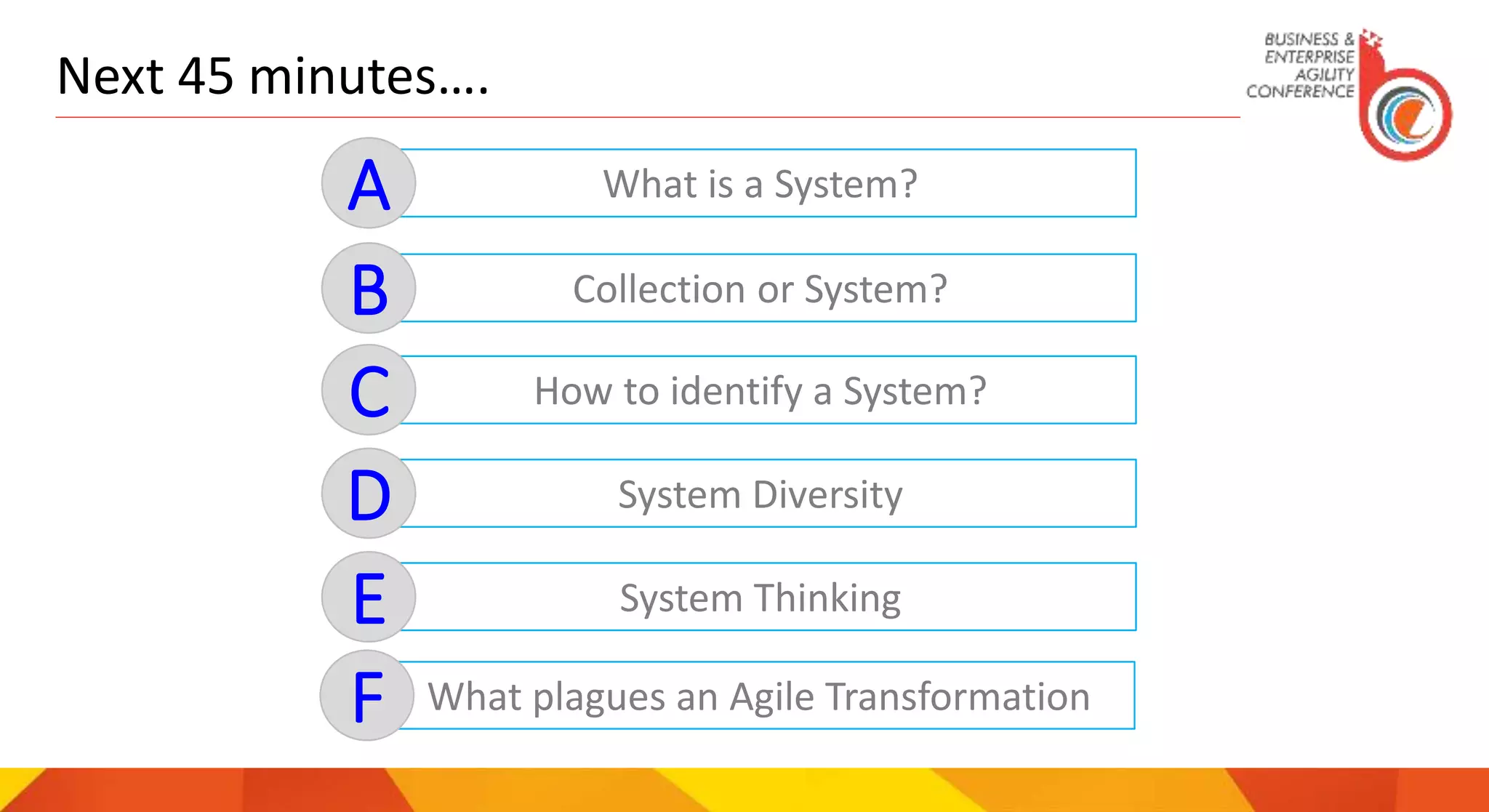
Next 45 minutes….
What is a System?A
Collection or System?B
How to identify a System?C
System DiversityD
System ThinkingE
What plagues an Agile TransformationF
What is a System?
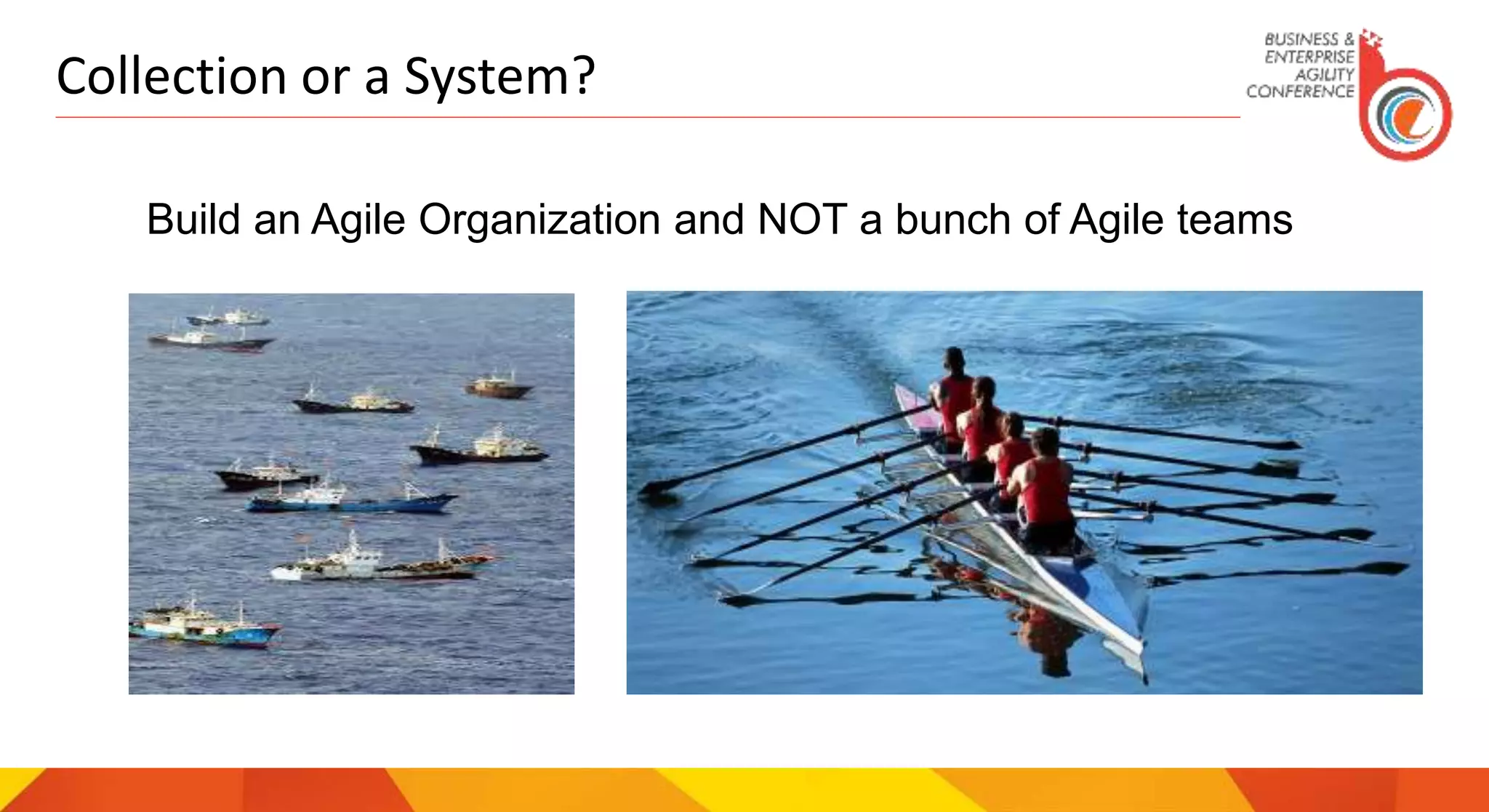
Collection or a System?
Build an Agile Organization and NOT a bunch of Agile teams
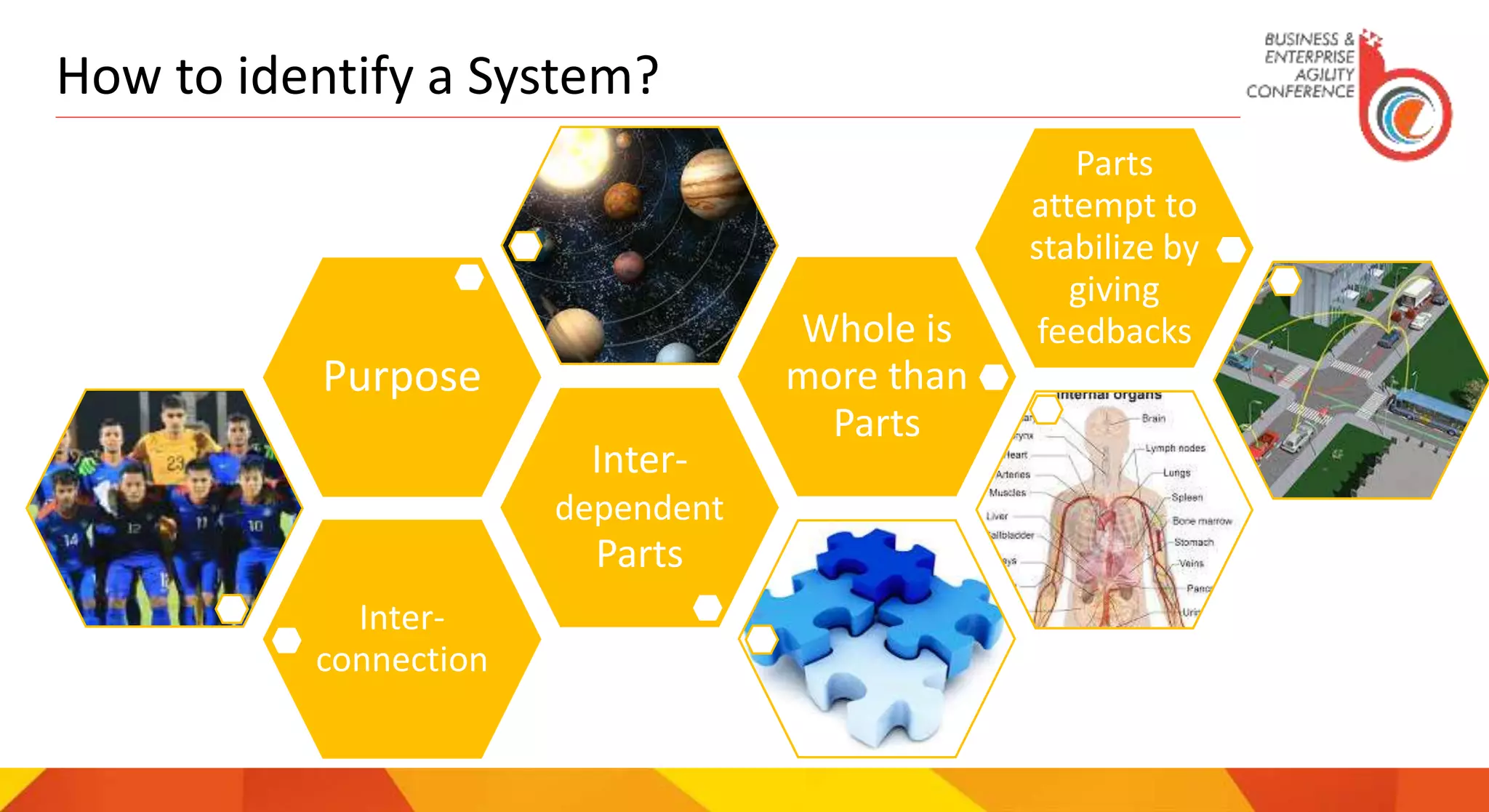
How to identify a System?
Inter-
connection
Inter-
dependent
Parts
Purpose
Whole is
more than
Parts
Parts
attempt to
stabilize by
giving
feedbacks
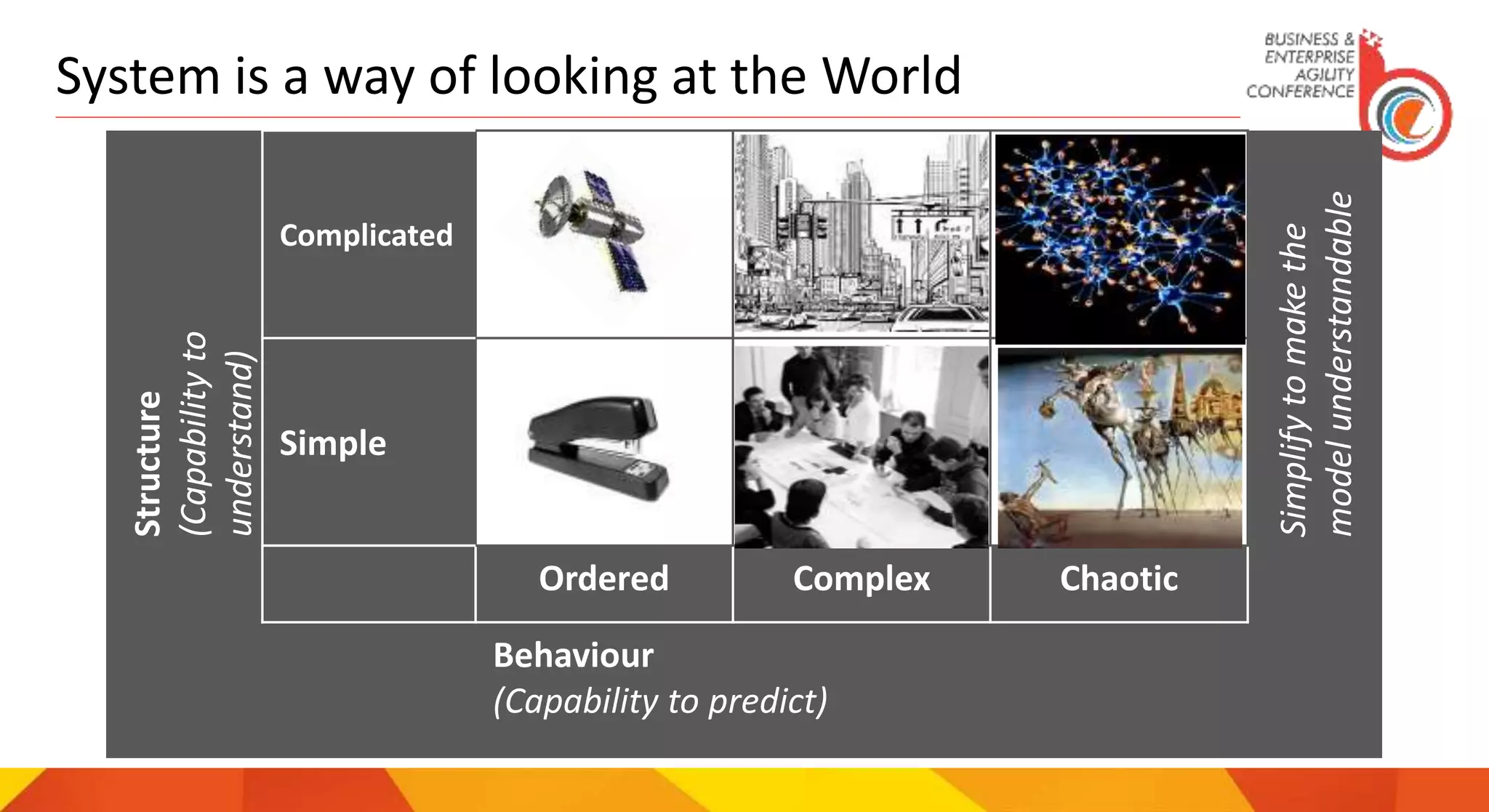
Structure
(Capabilityto
understand) Complicated
Simplifytomakethe
modelunderstandable
Simple
Ordered Complex Chaotic
Behaviour
(Capability to predict)
System is a way of looking at the World
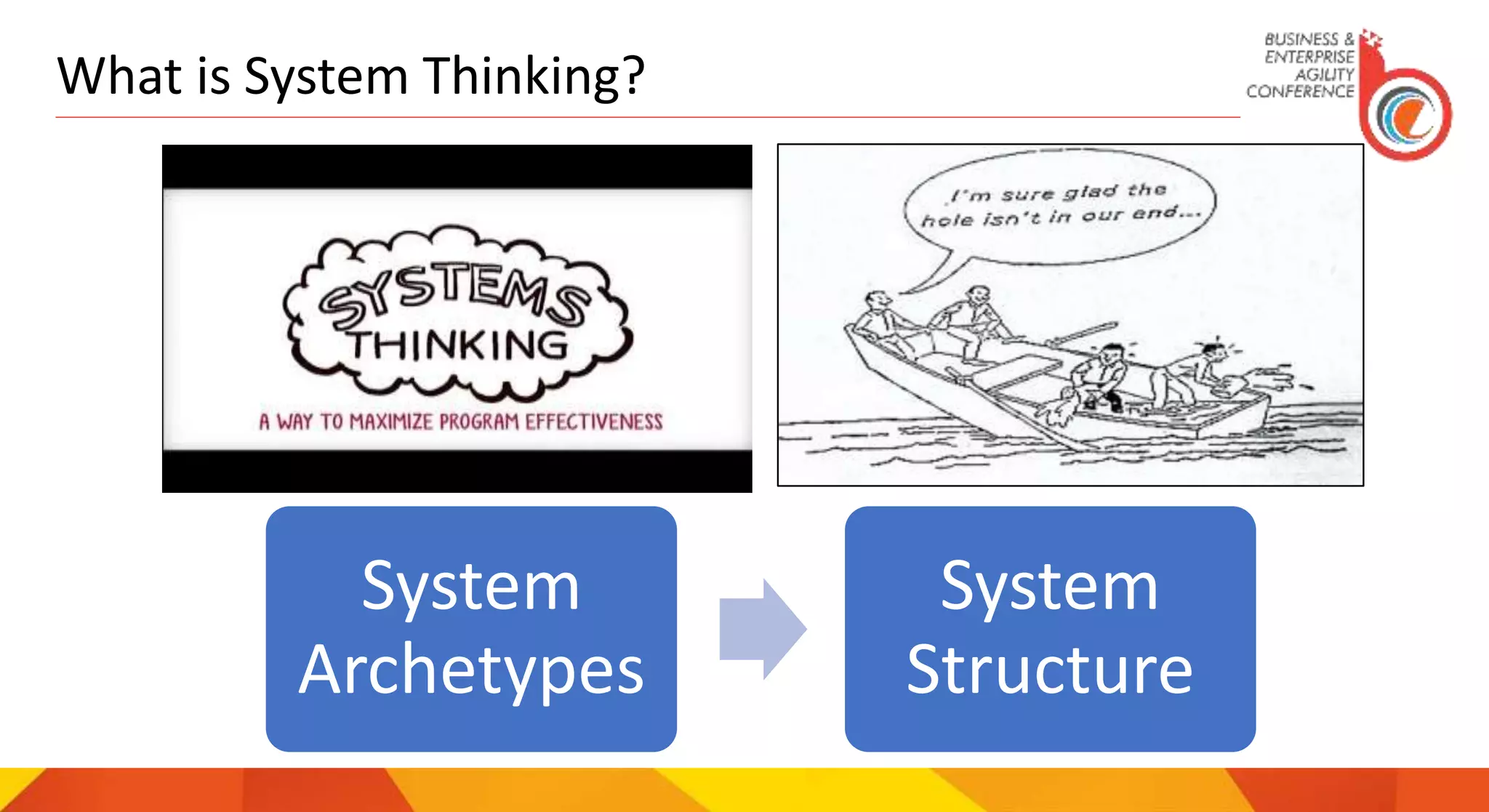
What is System Thinking?
System
Archetypes
System
Structure
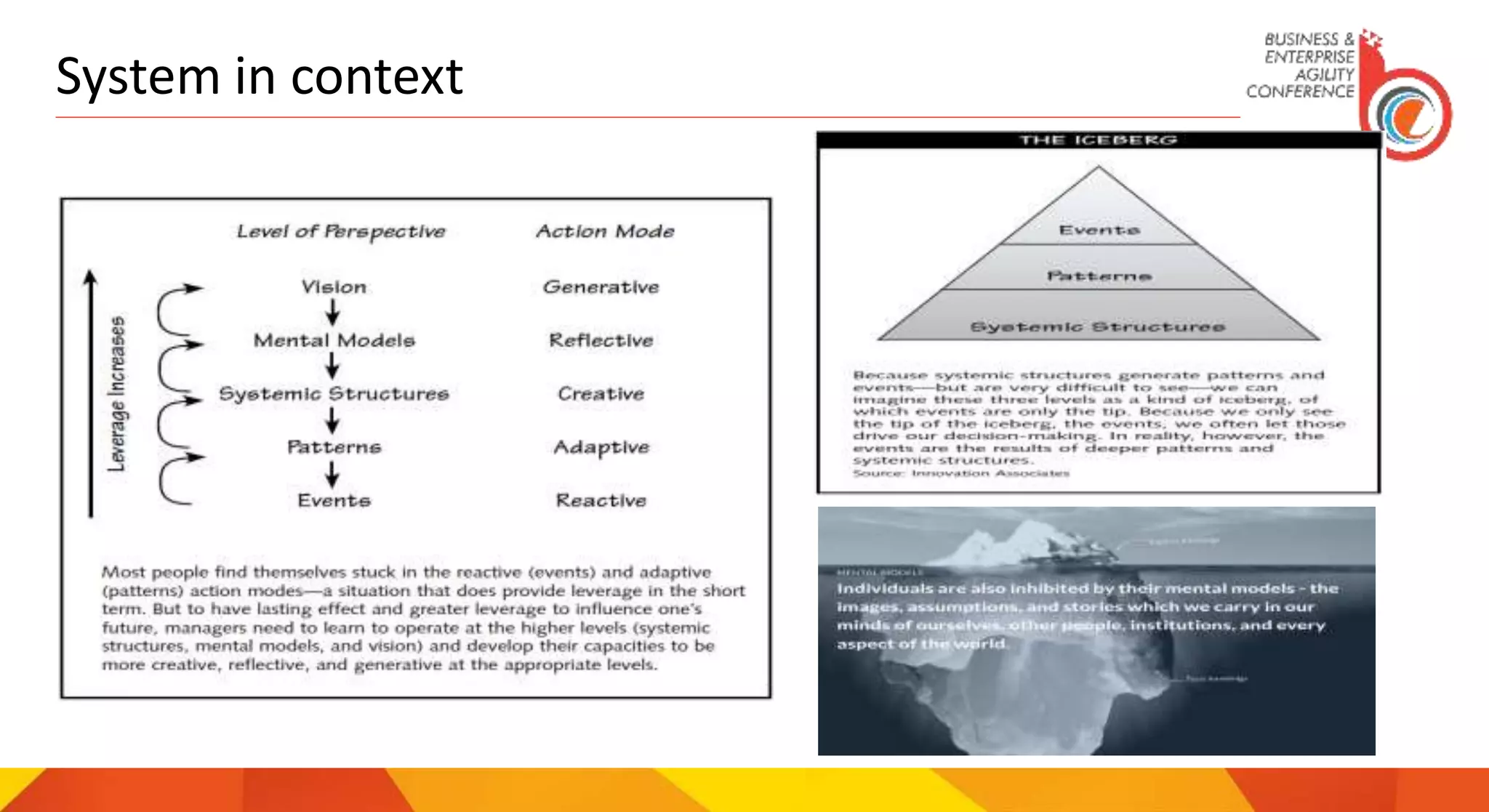
System in context
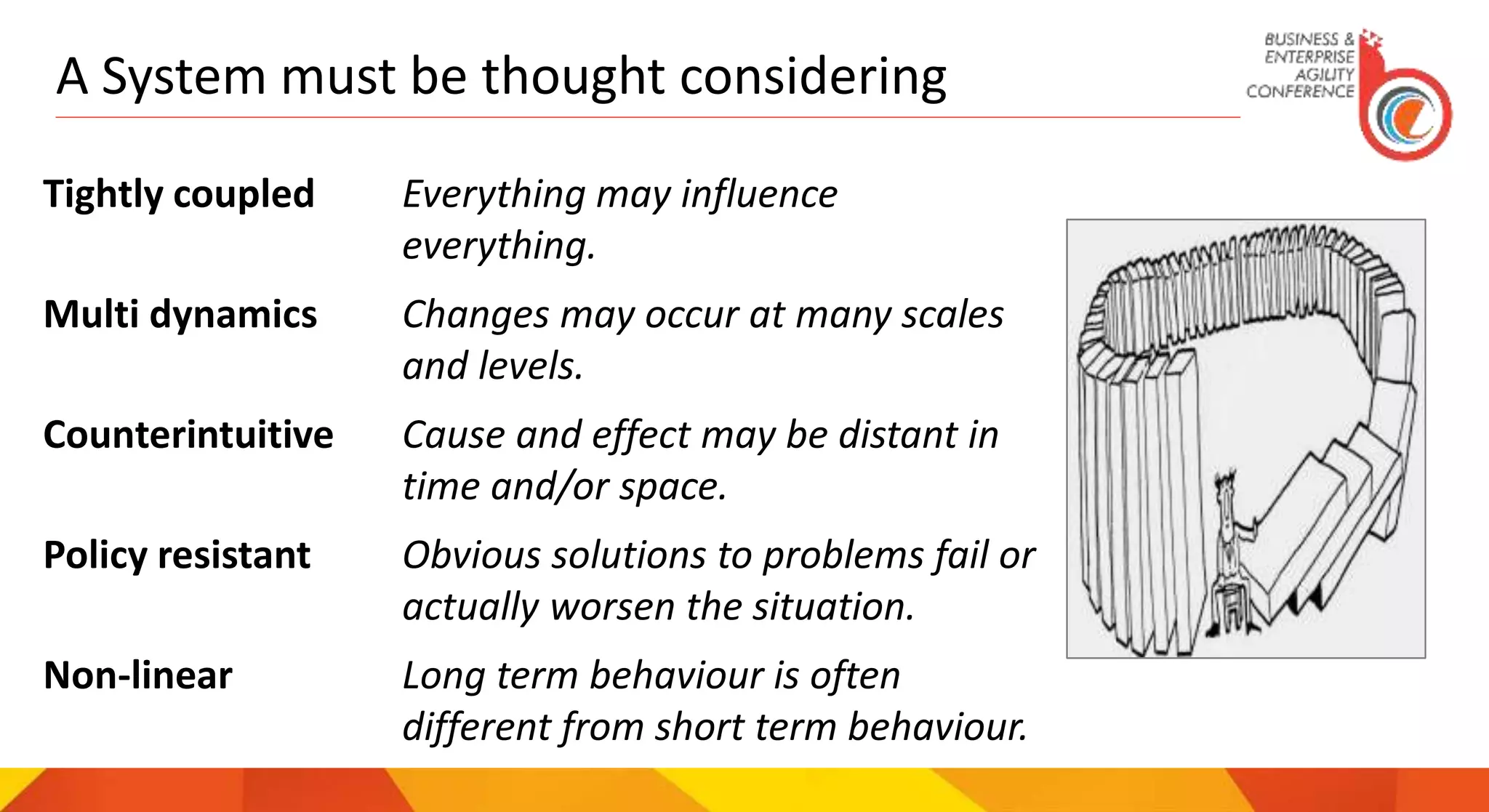
A System must be thought considering
Tightly coupled Everything may influence
everything.
Multi dynamics Changes may occur at many scales
and levels.
Counterintuitive Cause and effect may be distant in
time and/or space.
Policy resistant Obvious solutions to problems fail or
actually worsen the situation.
Non-linear Long term behaviour is often
different from short term behaviour.
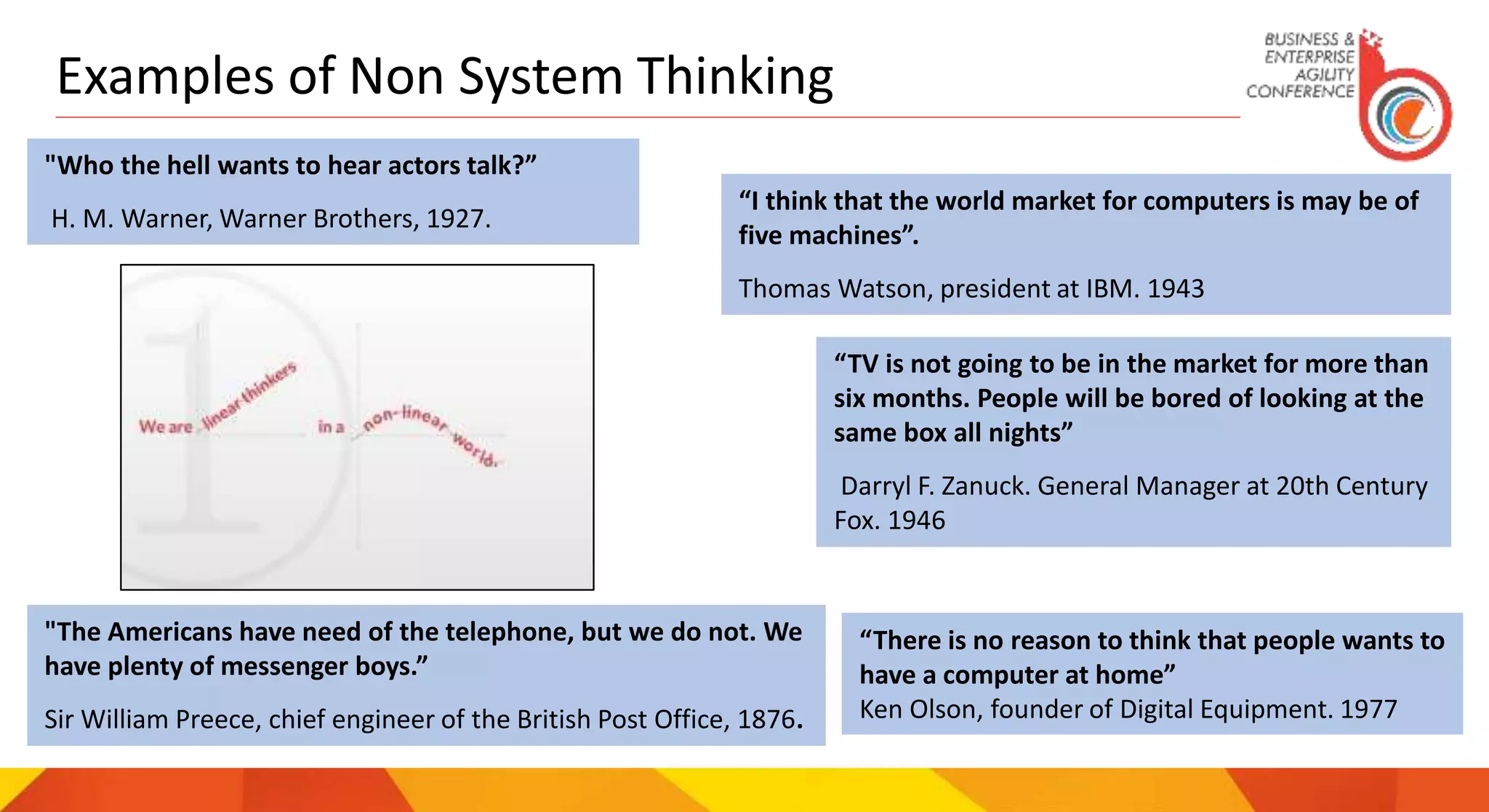
Examples of Non System Thinking
"Who the hell wants to hear actors talk?”
H. M. Warner, Warner Brothers, 1927.
“I think that the world market for computers is may be of
five machines”.
Thomas Watson, president at IBM. 1943
“TV is not going to be in the market for more than
six months. People will be bored of looking at the
same box all nights”
Darryl F. Zanuck. General Manager at 20th Century
Fox. 1946
"The Americans have need of the telephone, but we do not. We
have plenty of messenger boys.”
Sir William Preece, chief engineer of the British Post Office, 1876.
“There is no reason to think that people wants to
have a computer at home”
Ken Olson, founder of Digital Equipment. 1977
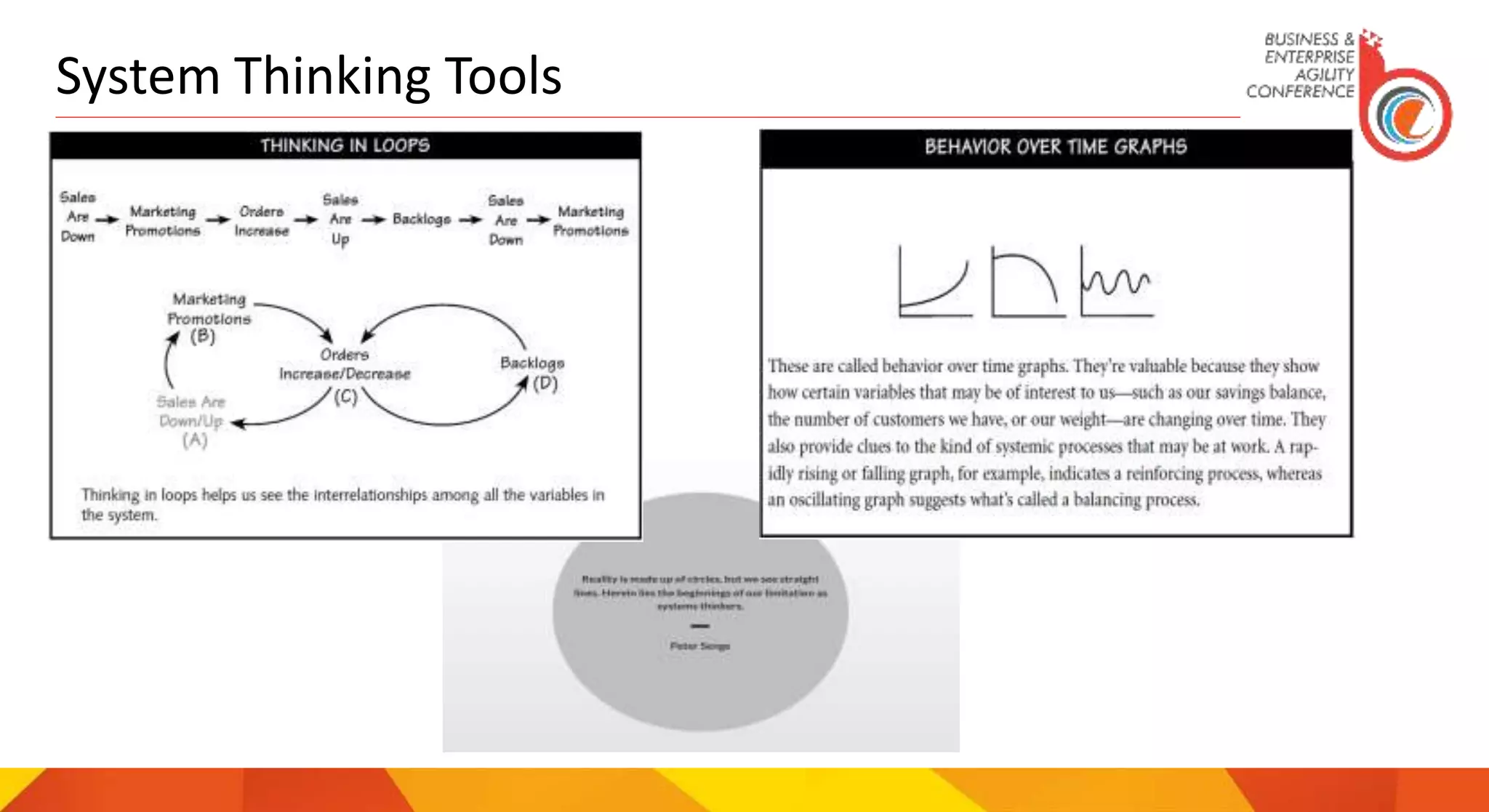
System Thinking Tools
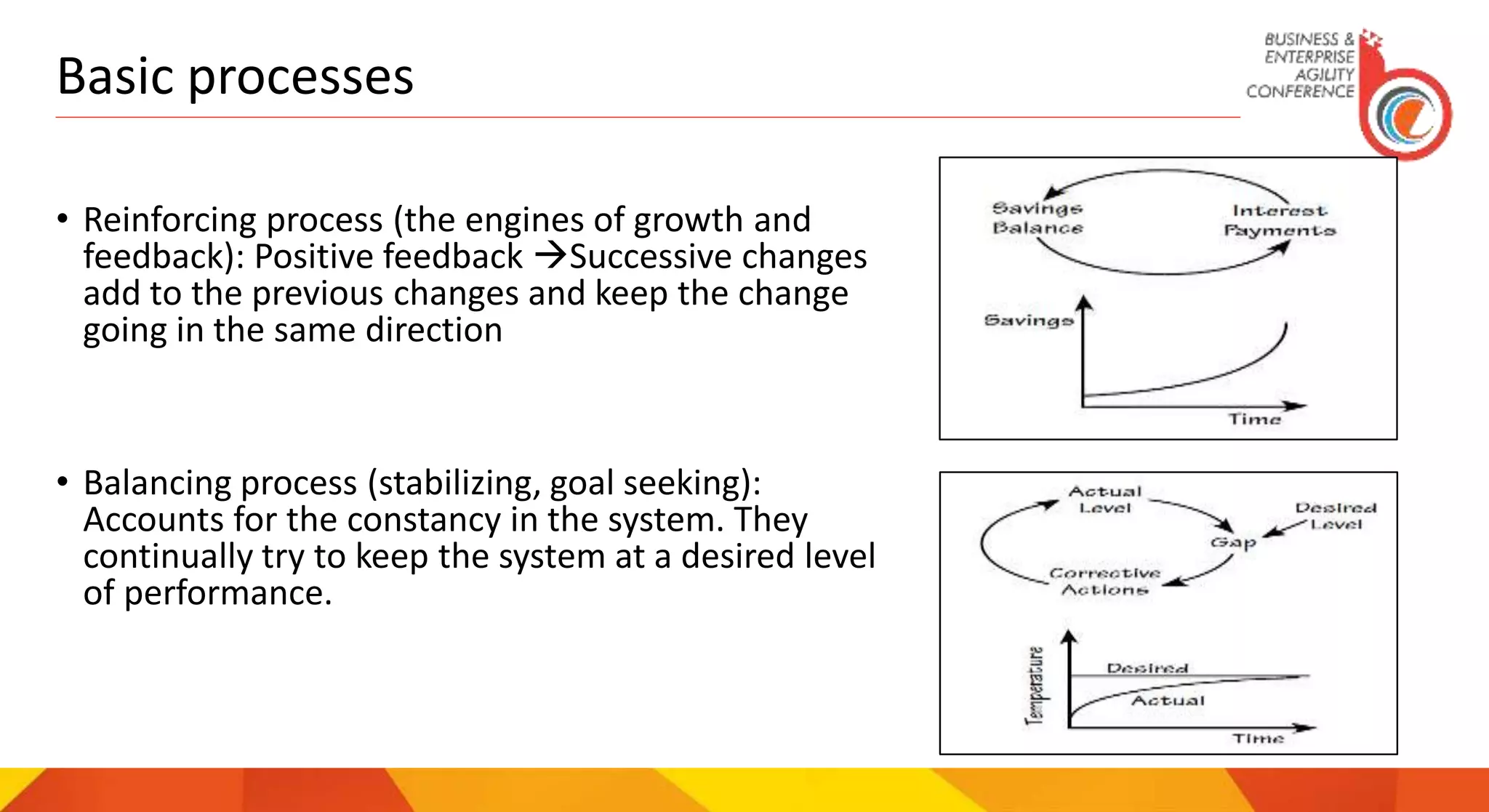
Basic processes
• Reinforcing process (the engines of growth and
feedback): Positive feedback Successive changes
add to the previous changes and keep the change
going in the same direction
• Balancing process (stabilizing, goal seeking):
Accounts for the constancy in the system. They
continually try to keep the system at a desired level
of performance.
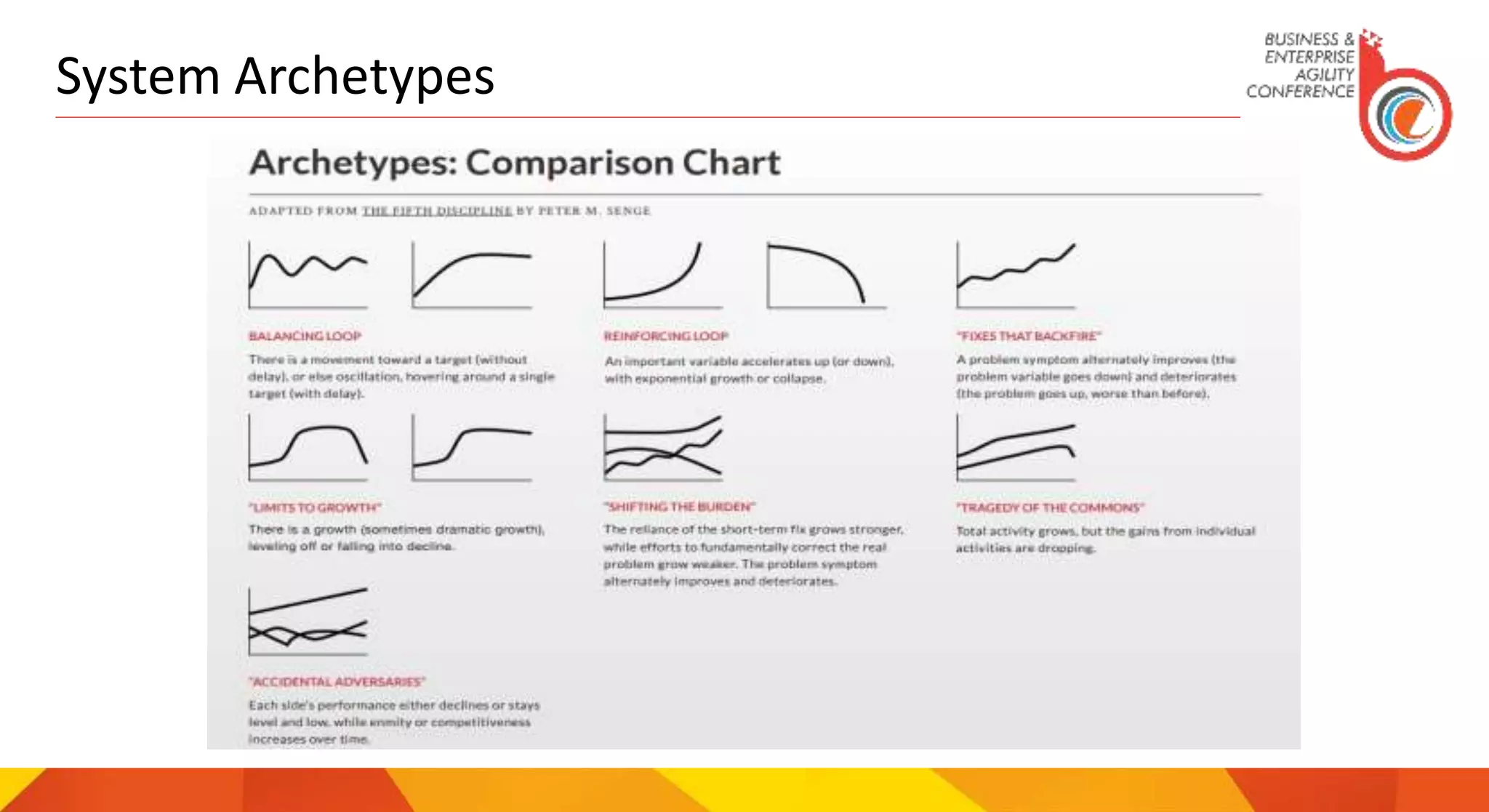
System Archetypes
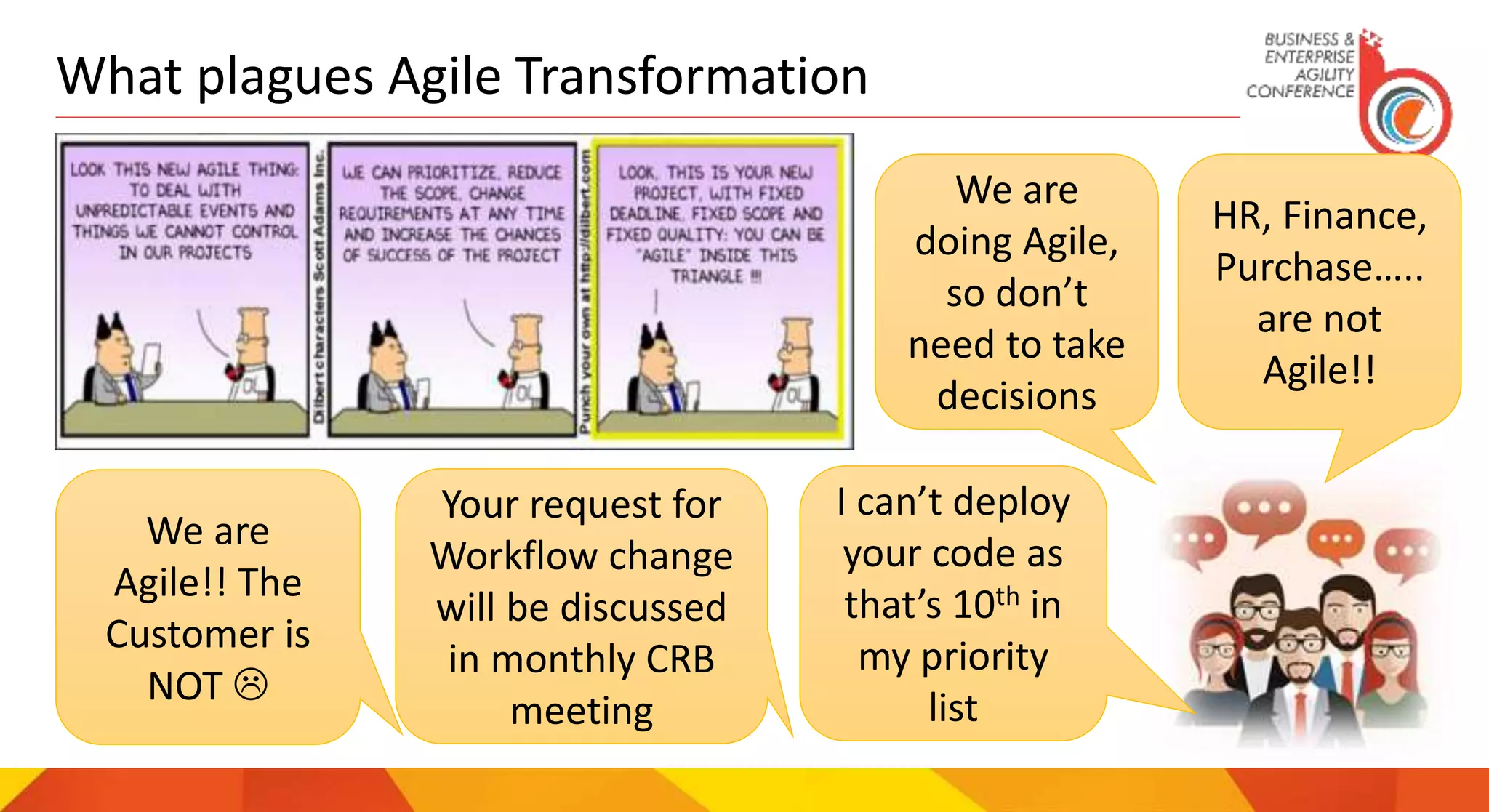
What plagues Agile Transformation
We are
doing Agile,
so don’t
need to take
decisions
HR, Finance,
Purchase…..
are not
Agile!!
I can’t deploy
your code as
that’s 10th in
my priority
list
Your request for
Workflow change
will be discussed
in monthly CRB
meeting
We are
Agile!! The
Customer is
NOT 
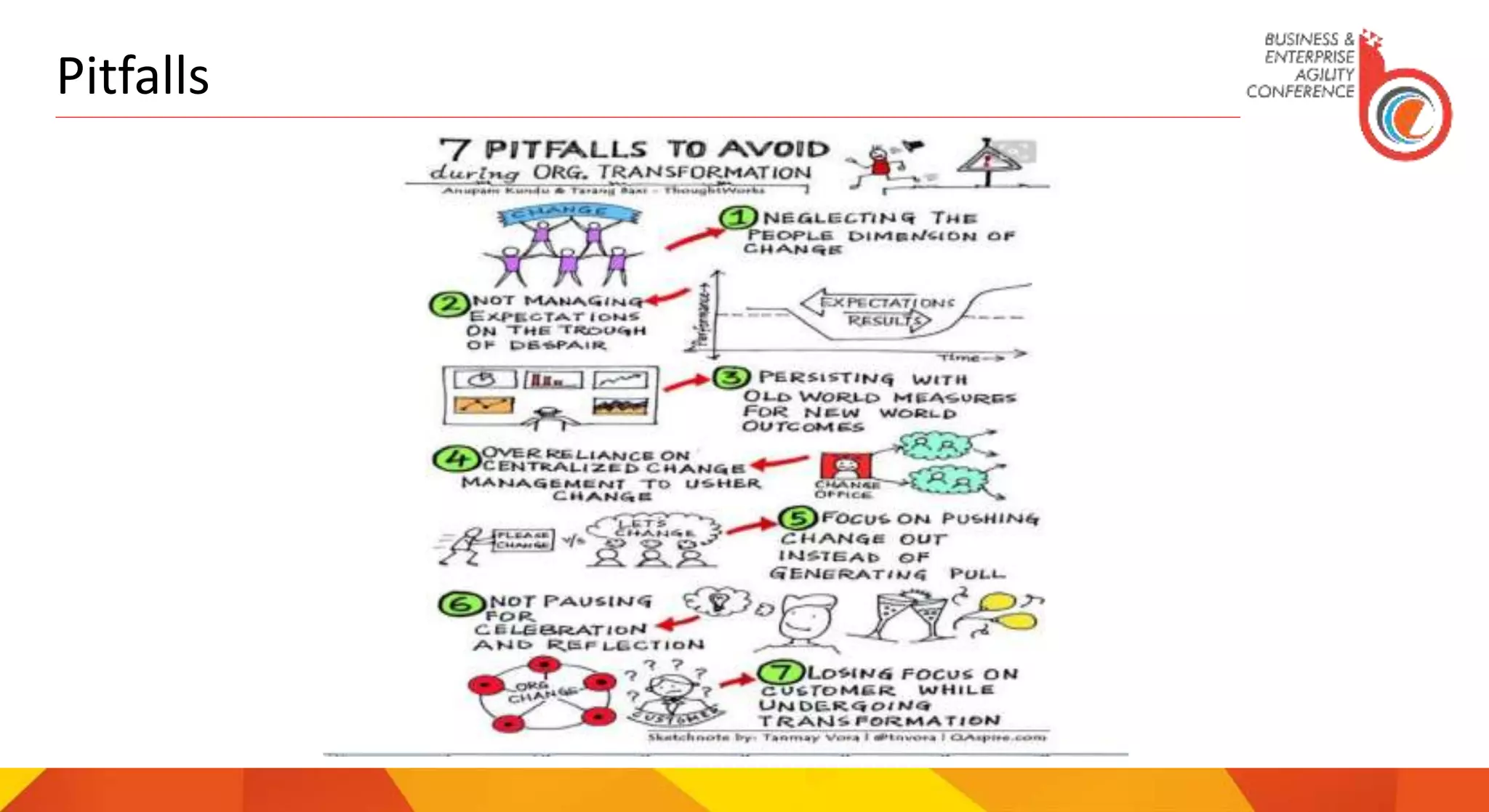
Pitfalls
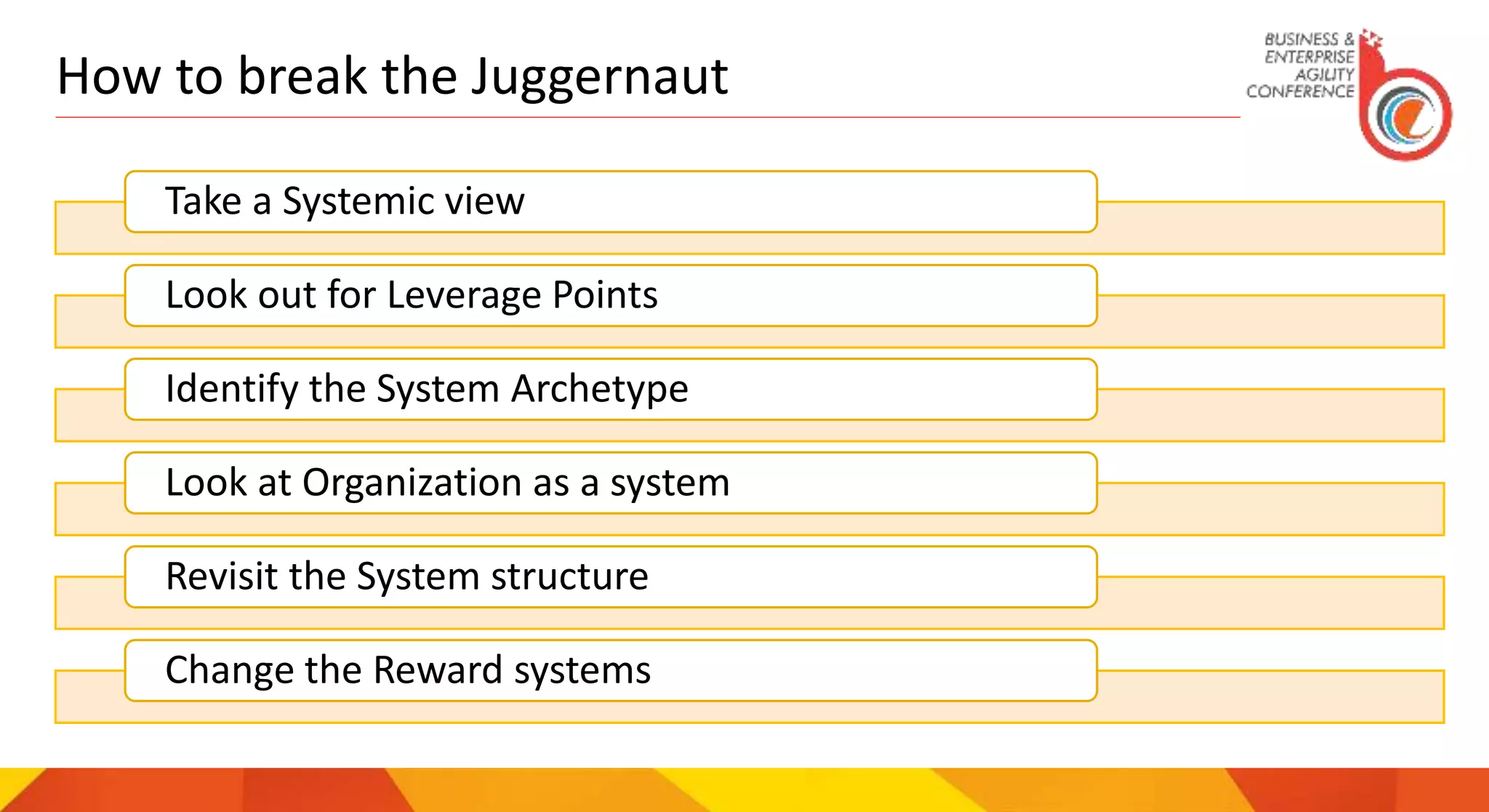
How to break the Juggernaut
Take a Systemic view
Look out for Leverage Points
Identify the System Archetype
Look at Organization as a system
Revisit the System structure
Change the Reward systems
Ranan Bhattacharya
Senior Agile Coach
9980936123
rananb@gmail.com
https://in.linkedin.com/in/rananbhattacharya
Thank You

"Applying systems thinking to Scrum"

  • 1.
    Applying Systems Thinking InScrum Ranan Bhattacharya Co-Author: Prince Kumar Mishra 1st – 3rd December, 2017 | Westin, Hyderabad, INDIA
  • 2.
    Royal Dutch Shellplc Royal Dutch Shell plc is incorporated in England and Wales, has its headquarters in The Hague and is listed on the London, Amsterdam, and New York stock exchanges. Shell companies have operations in more than 100 countries and territories with businesses including oil and gas exploration and production; production and marketing of Liquefied Natural Gas and Gas to Liquids; manufacturing, marketing and shipping of oil products and chemicals and renewable energy projects. For further information, visit http://www.shell.com Disclaimer statement This announcement contains forward-looking statements concerning the financial condition, results of operations and businesses of Royal Dutch Shell. All statements other than statements of historical fact are, or may be deemed to be, forward-looking statements. Forward-looking statements are statements of future expectations that are based on management’s current expectations and assumptions and involve known and unknown risks and uncertainties that could cause actual results, performance or events to differ materially from those expressed or implied in these statements. Forward-looking statements include, among other things, statements concerning the potential exposure of Royal Dutch Shell to market risks and statements expressing management’s expectations, beliefs, estimates, forecasts, projections and assumptions. These forward-looking statements are identified by their use of terms and phrases such as ‘‘anticipate’’, ‘‘believe’’, ‘‘could’’, ‘‘estimate’’, ‘‘expect’’, ‘‘intend’’, ‘‘may’’, ‘‘plan’’, ‘‘objectives’’, ‘‘outlook’’, ‘‘probably’’, ‘‘project’’, ‘‘will’’, ‘‘seek’’, ‘‘target’’, ‘‘risks’’, ‘‘goals’’, ‘‘should’’ and similar terms and phrases. There are a number of factors that could affect the future operations of Royal Dutch Shell and could cause those results to differ materially from those expressed in the forward-looking statements included in this Report, including (without limitation): (a) price fluctuations in crude oil and natural gas; (b) changes in demand for the Group’s products; (c) currency fluctuations; (d) drilling and production results; (e) reserve estimates; (f) loss of market and industry competition; (g) environmental and physical risks; (h) risks associated with the identification of suitable potential acquisition properties and targets, and successful negotiation and completion of such transactions; (i) the risk of doing business in developing countries and countries subject to international sanctions; (j) legislative, fiscal and regulatory developments including potential litigation and regulatory effects arising from recategorisation of reserves; (k) economic and financial market conditions in various countries and regions; (l) political risks, project delay or advancement, approvals and cost estimates; and (m) changes in trading conditions. All forward-looking statements contained in this presentation are expressly qualified in their entirety by the cautionary statements contained or referred to in this section. Readers should not place undue reliance on forward-looking statements. Each forward-looking statement speaks only as of the date of this document, 1st December 2017. Neither Royal Dutch Shell nor any of its subsidiaries undertake any obligation to publicly update or revise any forward-looking statement as a result of new information, future events or other information. In light of these risks, results could differ materially from those stated, implied or inferred from the forward-looking statements contained in this document. The United States Securities and Exchange Commission (SEC) permits oil and gas companies, in their filings with the SEC, to disclose only proved reserves that a company has demonstrated by actual production or conclusive formation tests to be economically and legally producible under existing economic and operating conditions. We use certain terms in this presentation, such as “oil in place" that the SEC's guidelines strictly prohibit us from including in filings with the SEC. U.S. Investors are urged to consider closely the disclosure in our Form 20-F, File No 1-32575 and disclosure in our Forms 6-K file No, 1-32575, available on the SEC website www.sec.gov. You can also obtain these forms from the SEC by calling 1-800-SEC-0330. Disclaimer: The views, thoughts, and opinions expressed in this presentation belong solely to the author, and not necessarily to the author’s employer, organization, committee or other group or individual
  • 3.
    A system mustbe managed. It will not manage itself. Left to themselves, components become selfish, competitive. We can not afford the destructive effect of competition.” ―W. Edwards Deming
  • 4.
    Next 45 minutes…. Whatis a System?A Collection or System?B How to identify a System?C System DiversityD System ThinkingE What plagues an Agile TransformationF
  • 5.
    What is aSystem?
  • 6.
    Collection or aSystem? Build an Agile Organization and NOT a bunch of Agile teams
  • 7.
    How to identifya System? Inter- connection Inter- dependent Parts Purpose Whole is more than Parts Parts attempt to stabilize by giving feedbacks
  • 8.
    Structure (Capabilityto understand) Complicated Simplifytomakethe modelunderstandable Simple Ordered ComplexChaotic Behaviour (Capability to predict) System is a way of looking at the World
  • 9.
    What is SystemThinking? System Archetypes System Structure
  • 10.
  • 11.
    A System mustbe thought considering Tightly coupled Everything may influence everything. Multi dynamics Changes may occur at many scales and levels. Counterintuitive Cause and effect may be distant in time and/or space. Policy resistant Obvious solutions to problems fail or actually worsen the situation. Non-linear Long term behaviour is often different from short term behaviour.
  • 12.
    Examples of NonSystem Thinking "Who the hell wants to hear actors talk?” H. M. Warner, Warner Brothers, 1927. “I think that the world market for computers is may be of five machines”. Thomas Watson, president at IBM. 1943 “TV is not going to be in the market for more than six months. People will be bored of looking at the same box all nights” Darryl F. Zanuck. General Manager at 20th Century Fox. 1946 "The Americans have need of the telephone, but we do not. We have plenty of messenger boys.” Sir William Preece, chief engineer of the British Post Office, 1876. “There is no reason to think that people wants to have a computer at home” Ken Olson, founder of Digital Equipment. 1977
  • 13.
  • 14.
    Basic processes • Reinforcingprocess (the engines of growth and feedback): Positive feedback Successive changes add to the previous changes and keep the change going in the same direction • Balancing process (stabilizing, goal seeking): Accounts for the constancy in the system. They continually try to keep the system at a desired level of performance.
  • 15.
  • 16.
    What plagues AgileTransformation We are doing Agile, so don’t need to take decisions HR, Finance, Purchase….. are not Agile!! I can’t deploy your code as that’s 10th in my priority list Your request for Workflow change will be discussed in monthly CRB meeting We are Agile!! The Customer is NOT 
  • 17.
  • 18.
    How to breakthe Juggernaut Take a Systemic view Look out for Leverage Points Identify the System Archetype Look at Organization as a system Revisit the System structure Change the Reward systems
  • 19.
    Ranan Bhattacharya Senior AgileCoach 9980936123 rananb@gmail.com https://in.linkedin.com/in/rananbhattacharya Thank You

Editor's Notes

  • #9 System has 2 dimensions – Structure Behavior Predictable - Unpredictable Meteorite is unpredictable but Space craft is programmed People have their own intelligence – Less predictability Traffic system – too many components Simple system – Strategy is different than Chaotic system Check the components of an organization and try to understand if its Ordered, Complex, Chaotic
  • #11 As leverage increases – effort decreases
  • #17 Organizational silos Lack of shared vision, resulting in different priorities for interdependent taks
  • #19 Take a systemic view draw the system diagram Look out for leverage points an area where a small change can yield large improvement in the system Identify the system archetype may help in identifying the leverage points Look at the organization As a system, Look for (and address) causes not the symptoms. Structure influences behavior Todays problems come from yesterday’s solutions localized solutions merely shift the problem from one part of the system to the other The harder you push, the harder the system pushes back Compensating feedback: When well intentioned interventions result in responses from the system that offsets the benefits of the interventions.