Introduction to 5S
Introduction to 5S
Contents
2. What is 5S?
3. Planning Stage
4. Implementing Stage
5. Sustaining Stage
1. Objectives of 5S program?
Objectives of a 5S Program

Developing Kaizen-minded people at
workplace(workplace standardization).

Developing managers and supervisors
for practical leadership.

Improving infrastructures for
introduction of advanced Kaizen
technologies.
01-4
What is 5S ?
• The beginning of a healthy, comfortable and productive
life for everyone at work.
• Company-wide participation program involving everyone
in the organization.
• A very effective approach for motivating people, and
improving productivity and the work environment .
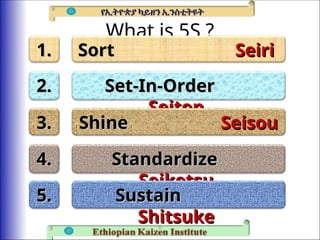
• 5S is an acronym for five Japanese words that are Seiri,
Seiton, Seiso, Seiketsu and Shitsuke.
01-5
What is 5S ?
6
Sort
Sort Seiri
Seiri
Set-In-Order
Set-In-Order
Seiton
Seiton
Shine
Shine Seisou
Seisou
Standardize
Standardize
Seiketsu
Seiketsu
Sustain
Sustain
Shitsuke
Shitsuke
1.
1.
2.
2.
3.
3.
4.
4.
5.
5.
What is 5S ?
7
 Remove all items from the workplace that
are not needed for current production or
administrative operation.
 Keep “only what is needed, only in the
amount needed, and only when it is needed”.
Keep it
Red Tag Discard
No Tag
Sort
Sort
1.
1.
What is 5S ?
01-8
Why Sort is important?
 Space, time, money,
energy and other
resources can be
managed and used
most effectively
 Problem and
annoyances in the work
flow are reduced.
 Communication
between employees is
improved.
 Product quality and
Productivity is
enhanced.
What is 5S ?
9
Arranging needed items in the way easy to
use and labeling them so that easy to find
and put away(visual management)
Set-In-Order
Set-In-Order
2.
2.
What is 5S ?
 Arrange needed items so;
 it is easy to use.
 label them so that anyone can find them easily and
put them agin.
 Set-in-order is important because it eliminates;
 Time spent searching for an item
 Motion wests
 Difficulty returning item to its original place
 Excess inventory
 Reduce damage
 safety
01-10
Set in order
What is 5S ?
 There are two strategies correspond to set-
in-order;
1. Visual Control
2. Motion Economy
01-11
What is 5S ?
 A visual control is any communication
device used in the work environment that
tells us at a glance how work should be
done.
 We can implement standardization in such a
way that all standards are identified by
visual control.
01-12
1. Visual Control Strategy
What is 5S ?
 common visual control techniques;
1. Signboard strategy
2. Painting strategy
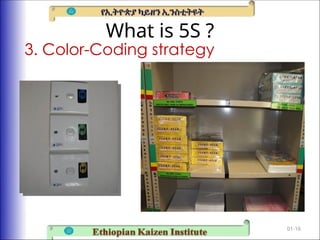
3. Color-code strategy
4. Outlining strategy
5. Visual Management Board
(Kaizen board) Strategy
01-13
Visual Control Techniques
What is 5S ?
1. Signboard strategy
signboards are used to identify what, where
and how many
There are three types of signboards
• Location indicator
• Item indicator
• Amount indicator
01-14
What is 5S ?
2. Painting strategy
Is a method for identifying locations on floors
and walk ways
01-15
What is 5S ?
3. Color-Coding strategy
01-16
What is 5S ?
4. Outlining strategy
01-17
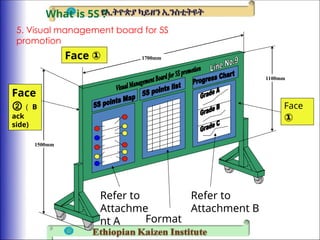
5. Visual management board for 5S
promotion
1100mm
1700mm
1500mm
Refer to
Attachme
nt A Format
Refer to
Attachment B
Face
①
Face
②( B
ack
side)
Face ①
What is 5S ?
Face
②( B
ack
side)
⑨
①
② ⑲
A
Photograph
Face
①
Removable
board
Face ② Photograph
of the 5S
points
Size:
Approx.3 cm X4 c
What is 5S ?
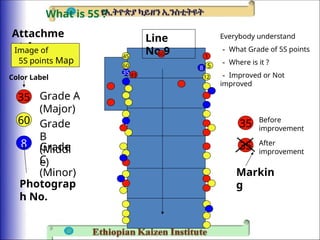
Attachme
nt A
Image of
5S points Map
Line
No.9
60
1
43
8
45
12
5
60
35
8
60
35
Color Label
Grade A
(Major)
Grade
B
(Middl
e)
Grade
C
(Minor)
Photograp
h No.
Everybody understand
- What Grade of 5S points
- Where is it ?
- Improved or Not
improved
35
35
Before
improvement
After
improvement
Markin
g
What is 5S ?
What is 5S ?
 The process of removing motion waste
involves eliminating unnecessary motion
from existing operation.
 By locating items in the best location
possible, we can minimize motion waste.
 Even more important than removing motion
waste is asking “why it occurs in the first
place”.
01-21
2. Motion Economy Strategy
What is 5S ?
 Below are three examples of elimination
motion waste;
1. Keep frequently needed items close to you
and seldom needed items away.
2. Frequently needed items are arranged for
easy retrieval ergonomically.
3. Keep the processes close to each other and
eliminate zig-zag motion between them. 5S
map can be used to do the analysis.
01-22
Implement Motion Economy
Tool Box
Ex: 30 Second Rule
What is 5S ?
What is 5S ?
24
Shine
Shine Seisou
Seisou
3.
3.
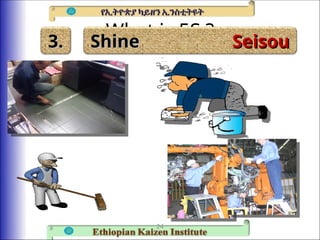
What is Shine
 Shine means keep everything swept and
clean.
 Shine is a way to keep everything in top
condition so, when someone needs to use
something, it is ready to be used.
 When Shine, we can’t avoid inspecting the
item at the same time. Therefore Shine and
Inspect come together.
Page 25 of 65
What is 5S ?
Benefits from Shine
 Clean and comfortable workplace.
 Increase visibility to defects when it occurs.
 Helps to maintain safer workplace.
 Good working environment increase morale.
 Early detection of machinery and equipment
failure.
Page 26 of 65
What is 5S ?
What is 5S ?
27
Standardize
Standardize
Seiketsu
Seiketsu
4.
4.
What is Standardize
 Standardize is the method you use to maintain
the first three pillars (Sort, Set in order and Shine)
 Make it a rule to perform given work in the given
manner.
 Standardize is different from the first three pillars
because it is a method used to sustain the first
three pillars rather than housekeeping activity.
Page 28 of 65
What is 5S ?
Benefits from Standardize
 The basic purposes are to;
1. Lead to workplace standardization
 prevent setbacks in the first three pillars
 Make implementing them a daily habit
 Ensure that all the three pillars are maintained in their
fully implemented state.
2. Lead to work standardization
 Muda elimination
 Quality improvements
 Cost improvements
 Delivery time improvements
 Process improvements
Page 29 of 65
What is 5S ?
What is 5S ?
01-30
Sustain
Sustain
Shitsuke
Shitsuke
5.
5.
Means making a habit of properly maintaining
correct procedures
Some techniques to sustain
 5S Slogan
 5S poster
 5S newsletter and kaizen board
 5S audit
 awarding systems
 Big cleaning day
 5S month
 Benchmarking tour
Page 31 of 65
What is 5S ?
What is next ?
32
What is 5S ?
2. Planning Stage
1. 5S organization structure
2. Recognition of current
condition
3. Deciding activity range
4. Goal setting
5. Planning stage
6. Budgeting
7. Kick-off
33
Steps for planning
Planning Stage
01-34
1. 5S Organizational Structure
5S Promotion office duties
 Prepare over all 5S implementation plan at
company level.
 Follow up standardize 5S activities at the
company.
Perform any other 5S related activities.
Organize Training
01-35
Planning Stage
Planning Stage
2. Recognition of current condition
by using 5S Checklist and
Photography (Next page)
36
Planning Stage
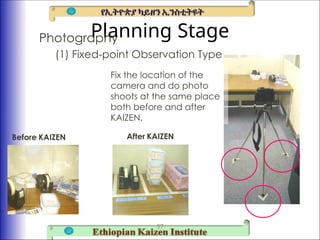
Photography
(1) Fixed-point Observation Type
37
Fix the location of the
camera and do photo
shoots at the same place
both before and after
KAIZEN.
Before KAIZEN After KAIZEN
Planning Stage
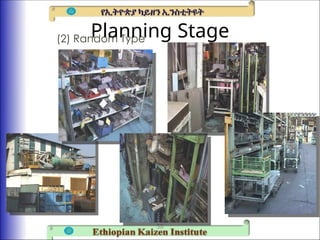
(2) Random Type
38
Planning Stage
3. Decide Activity range
39
Company
-wide
Limiting to
Production
Division
Limiting
to Shop
Limiting
to group
Selecting
model shop
Others
Variety of Alternatives
Planning Stage
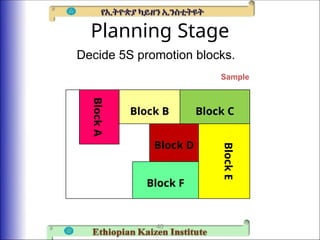
Decide 5S promotion blocks.
40
Sample
Block C
Block
E
Block F
Block B
Block D
Block
A
Planning Stage
4. Goal setting
41
5S
5S
Committee
Committee
Recognition
Of current
condition
1
Evaluation
2
Setting goal
3
Post
4
Planning Stage
5. Planning
1) Overall promotion plan
42
Timing
Items 1w 2w 3w 4w 1w 2w 3w 4w 1w 2w 3w 4w 1w 2w 3w 4w 1w 2w 3w 4w 1w 2w 3w 4w
◆ ◆ ◆ ◆
Prepare standard tools in advance rega rdless of stage .
◆ ◆ ◆ ◆
Prepare standard tools in advance rega rdless of stage .
◆
Provide ove ra ll 5S training in introductory period.
◆ ◆ ◆ ◆
Provide 5S training prior to the start of each s
tage of 5S.
Ta ke photographs be fore/a fter ea ch stage.
◆ ◆ ◆ ◆ ◆
Photographs on later s tages can be the
evaluation obje cts for 5S aw arding.
Seiton
Seiso
Seiketsu
Shitsuke
Pre paration of
te xtbook for 5S
introductory
training
5S introductory
tra ining
5S tra ining
Photogra phy
Preparation of 5S
Tools
Basic plan
(stage)
Preparation
Seiri
Date of issue:
Issued by 5S Promotion Office
Overall Plan for 5S Promotion
Month 1 Month 2 Month 3 Month 4 Month 5 Month 6
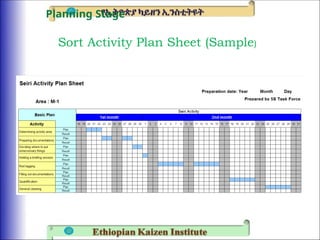
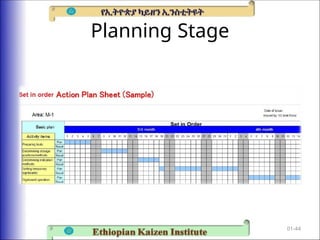
Sort Activity Plan Sheet (Sample)
Planning Stage
Planning Stage
01-44
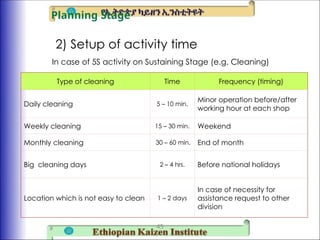
Type of cleaning Time Frequency (timing)
Daily cleaning 5 – 10 min.
Minor operation before/after
working hour at each shop
Weekly cleaning 15 – 30 min. Weekend
Monthly cleaning 30 – 60 min. End of month
Big cleaning days 2 – 4 hrs. Before national holidays
Location which is not easy to clean 1 – 2 days
In case of necessity for
assistance request to other
division
45
2) Setup of activity time
In case of 5S activity on Sustaining Stage (e.g. Cleaning)
Planning Stage
Planning Stage
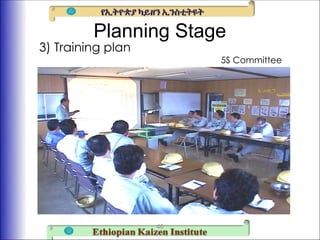
3) Training plan
46
5S Committee
Planning Stage
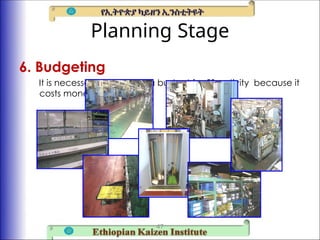
6. Budgeting
It is necessary to prepare a budget for 5S activity because it
costs money.
47
Planning Stage
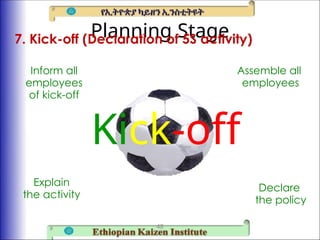
7. Kick-off (Declaration of 5S activity)
48
Inform all
employees
of kick-off
Declare
the policy
Explain
the activity
Assemble all
employees
Kick-off
Planning Stage
Promotion declaration of 5S activity
49
Implementation Stage
Implementing
Sort Activity
01-50
Implementation Stage
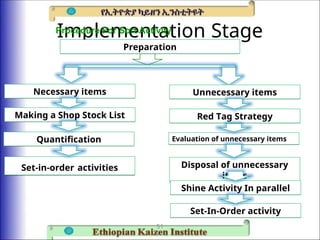
Procedure For Sort Activity
51
Preparation
Necessary items
Quantification
Set-in-order activities
Making a Shop Stock List
Unnecessary items
Evaluation of unnecessary items
Disposal of unnecessary
items
Red Tag Strategy
Shine Activity In parallel
Set-In-Order activity
Implementation Stage
Implementing Set-
In-Order Activity
01-52
Implementation Stage
Procedure For Set- in- order Activity
53
Set targets for Set-In-Order Activity
Implementation of Set-In-Order
Decision of schedule and work allocation
Preparation of tools for Set-In-Order Activity
Decision of location, Storage, Indication method
Implementation Stage
Implementing
Shine Activity
01-54
Implementation Stage
55
Determine shine target area
Start to shine
Preparing proper tools for shine
Determine shine methods
Determine shine assignments
Implementation Stage
Implementing
Standardize
Activity
01-56
Implementation Stage
Standardize means to set up rules for Sort,
Set-in-order and Shine Activities
It is all about
“Make up the rules and follow
them!”
Standards for Sort
Red Tag Rules
• When to Red Tag
• How to Red Tag
• What’s go on the Red Tag
• more…
Rules for the Red Tag Holding Area
• When to clear out
• How to dispose of items
• more…
Implementation Stage
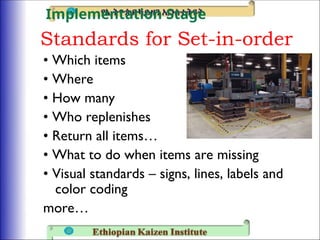
Standards for Set-in-order
• Which items
• Where
• How many
• Who replenishes
• Return all items…
• What to do when items are missing
• Visual standards – signs, lines, labels and
color coding
more…
Implementation Stage
Standards for Shine
 Clean and Inspect (C&I)
 Show the task, person responsible, items
needed, frequency, desired workplace
 Where to keep cleaning supplies,
how to replenish when finished
more…
Implementation Stage
Implementing
Sustain Activity
01-61
Let’s sustain the gains !
The Questions Is
“How to Sustain ?
62
Let’s sustain the gains !
63
1. Patrolling
a. Top management Patrol
Must
 Check Up the activities Comprehensively
 Give emphasis on sustaining of the activity
 consider committees feedback
Let’s sustain the gains !
64
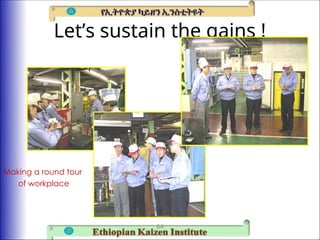
Making a round tour
of workplace
Let’s sustain the gains !
65
b. 5S Committee members and Promotion
office Patrol
Must
 Evaluate “5S Check List”
 Record problems on”5S check
findings”
 Tack picture of 5S problems
Let’s sustain the gains !
c. Mutual patrol
 Check mutually among 5S groups
d. Self patrol
 5S leader and members check the results of
activity by themselves.
e. Checklist patrol
 Point out the problems by themselves at site as
well as evaluate the results and encourage members to
urge KAIZEN.
f. Camera patrol
 Visibly highlight the problems and progress of the activity
using photographs.
66
2. Use Slogan and Poster of 5S Activity
• It encourage all the participants.
< Samples of slogan >
“Refresh yourself and workplaces by 5S
activity.”
“Let's maintain current 5S activity and
KAIZEN for tomorrow”
“We polish “Our Minds” as well us our
factories”
< Sample of poster >
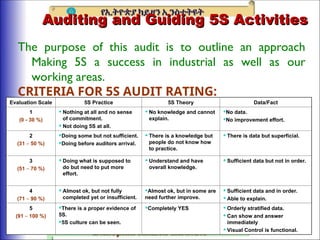
Auditing and Guiding 5S Activities
The purpose of this audit is to outline an approach
Making 5S a success in industrial as well as our
working areas.
CRITERIA FOR 5S AUDIT RATING:
Evaluation Scale 5S Practice 5S Theory Data/Fact
1
(0 - 30 %)
 Nothing at all and no sense
of commitment.
 Not doing 5S at all.
 No knowledge and cannot
explain.
No data.
No improvement effort.
2
(31 – 50 %)
Doing some but not sufficient.
Doing before auditors arrival.
 There is a knowledge but
people do not know how
to practice.
 There is data but superficial.
3
(51 – 70 %)
 Doing what is supposed to
do but need to put more
effort.
 Understand and have
overall knowledge.
 Sufficient data but not in order.
4
(71 – 90 %)
 Almost ok, but not fully
completed yet or insufficient.
Almost ok, but in some are
need further improve.
 Sufficient data and in order.
 Able to explain.
5
(91 – 100 %)
There is a proper evidence of
5S.
5S culture can be seen.
Completely YES  Orderly stratified data.
 Can show and answer
immediately
 Visual Control is functional.
Let’s sustain the gains !
3. Awarding System
01-70
Promotion results must be shared by all the members, and
awarding for 5S promotion results according to evaluation
is recommended.
Conclusion
Conclusion
71
Objectives of 5S
Objectives of 5S
Create a safe workplace
Create a safe workplace
Create a comfortable workplace
Create a comfortable workplace
Create an efficient workplace
Create an efficient workplace
Subject of 5S
Subject of 5S
5S of place
5S of place
5S of material
5S of material
5S of information
5S of information
5S of mind
5S of mind
The end!
01-72
Thank you for
your attention!

applying five S principles to do effective work.ppt

  • 2.
  • 3.
    Contents 2. What is5S? 3. Planning Stage 4. Implementing Stage 5. Sustaining Stage 1. Objectives of 5S program?
  • 4.
    Objectives of a5S Program Objectives of a 5S Program  Developing Kaizen-minded people at workplace(workplace standardization).  Developing managers and supervisors for practical leadership.  Improving infrastructures for introduction of advanced Kaizen technologies. 01-4
  • 5.
    What is 5S? • The beginning of a healthy, comfortable and productive life for everyone at work. • Company-wide participation program involving everyone in the organization. • A very effective approach for motivating people, and improving productivity and the work environment . • 5S is an acronym for five Japanese words that are Seiri, Seiton, Seiso, Seiketsu and Shitsuke. 01-5
  • 6.
    What is 5S? 6 Sort Sort Seiri Seiri Set-In-Order Set-In-Order Seiton Seiton Shine Shine Seisou Seisou Standardize Standardize Seiketsu Seiketsu Sustain Sustain Shitsuke Shitsuke 1. 1. 2. 2. 3. 3. 4. 4. 5. 5.
  • 7.
    What is 5S? 7  Remove all items from the workplace that are not needed for current production or administrative operation.  Keep “only what is needed, only in the amount needed, and only when it is needed”. Keep it Red Tag Discard No Tag Sort Sort 1. 1.
  • 8.
    What is 5S? 01-8 Why Sort is important?  Space, time, money, energy and other resources can be managed and used most effectively  Problem and annoyances in the work flow are reduced.  Communication between employees is improved.  Product quality and Productivity is enhanced.
  • 9.
    What is 5S? 9 Arranging needed items in the way easy to use and labeling them so that easy to find and put away(visual management) Set-In-Order Set-In-Order 2. 2.
  • 10.
    What is 5S?  Arrange needed items so;  it is easy to use.  label them so that anyone can find them easily and put them agin.  Set-in-order is important because it eliminates;  Time spent searching for an item  Motion wests  Difficulty returning item to its original place  Excess inventory  Reduce damage  safety 01-10 Set in order
  • 11.
    What is 5S?  There are two strategies correspond to set- in-order; 1. Visual Control 2. Motion Economy 01-11
  • 12.
    What is 5S?  A visual control is any communication device used in the work environment that tells us at a glance how work should be done.  We can implement standardization in such a way that all standards are identified by visual control. 01-12 1. Visual Control Strategy
  • 13.
    What is 5S?  common visual control techniques; 1. Signboard strategy 2. Painting strategy 3. Color-code strategy 4. Outlining strategy 5. Visual Management Board (Kaizen board) Strategy 01-13 Visual Control Techniques
  • 14.
    What is 5S? 1. Signboard strategy signboards are used to identify what, where and how many There are three types of signboards • Location indicator • Item indicator • Amount indicator 01-14
  • 15.
    What is 5S? 2. Painting strategy Is a method for identifying locations on floors and walk ways 01-15
  • 16.
    What is 5S? 3. Color-Coding strategy 01-16
  • 17.
    What is 5S? 4. Outlining strategy 01-17
  • 18.
    5. Visual managementboard for 5S promotion 1100mm 1700mm 1500mm Refer to Attachme nt A Format Refer to Attachment B Face ① Face ②( B ack side) Face ① What is 5S ?
  • 19.
    Face ②( B ack side) ⑨ ① ② ⑲ A Photograph Face ① Removable board Face② Photograph of the 5S points Size: Approx.3 cm X4 c What is 5S ?
  • 20.
    Attachme nt A Image of 5Spoints Map Line No.9 60 1 43 8 45 12 5 60 35 8 60 35 Color Label Grade A (Major) Grade B (Middl e) Grade C (Minor) Photograp h No. Everybody understand - What Grade of 5S points - Where is it ? - Improved or Not improved 35 35 Before improvement After improvement Markin g What is 5S ?
  • 21.
    What is 5S?  The process of removing motion waste involves eliminating unnecessary motion from existing operation.  By locating items in the best location possible, we can minimize motion waste.  Even more important than removing motion waste is asking “why it occurs in the first place”. 01-21 2. Motion Economy Strategy
  • 22.
    What is 5S?  Below are three examples of elimination motion waste; 1. Keep frequently needed items close to you and seldom needed items away. 2. Frequently needed items are arranged for easy retrieval ergonomically. 3. Keep the processes close to each other and eliminate zig-zag motion between them. 5S map can be used to do the analysis. 01-22 Implement Motion Economy
  • 23.
    Tool Box Ex: 30Second Rule What is 5S ?
  • 24.
    What is 5S? 24 Shine Shine Seisou Seisou 3. 3.
  • 25.
    What is Shine Shine means keep everything swept and clean.  Shine is a way to keep everything in top condition so, when someone needs to use something, it is ready to be used.  When Shine, we can’t avoid inspecting the item at the same time. Therefore Shine and Inspect come together. Page 25 of 65 What is 5S ?
  • 26.
    Benefits from Shine Clean and comfortable workplace.  Increase visibility to defects when it occurs.  Helps to maintain safer workplace.  Good working environment increase morale.  Early detection of machinery and equipment failure. Page 26 of 65 What is 5S ?
  • 27.
    What is 5S? 27 Standardize Standardize Seiketsu Seiketsu 4. 4.
  • 28.
    What is Standardize Standardize is the method you use to maintain the first three pillars (Sort, Set in order and Shine)  Make it a rule to perform given work in the given manner.  Standardize is different from the first three pillars because it is a method used to sustain the first three pillars rather than housekeeping activity. Page 28 of 65 What is 5S ?
  • 29.
    Benefits from Standardize The basic purposes are to; 1. Lead to workplace standardization  prevent setbacks in the first three pillars  Make implementing them a daily habit  Ensure that all the three pillars are maintained in their fully implemented state. 2. Lead to work standardization  Muda elimination  Quality improvements  Cost improvements  Delivery time improvements  Process improvements Page 29 of 65 What is 5S ?
  • 30.
    What is 5S? 01-30 Sustain Sustain Shitsuke Shitsuke 5. 5. Means making a habit of properly maintaining correct procedures
  • 31.
    Some techniques tosustain  5S Slogan  5S poster  5S newsletter and kaizen board  5S audit  awarding systems  Big cleaning day  5S month  Benchmarking tour Page 31 of 65 What is 5S ?
  • 32.
    What is next? 32 What is 5S ?
  • 33.
    2. Planning Stage 1.5S organization structure 2. Recognition of current condition 3. Deciding activity range 4. Goal setting 5. Planning stage 6. Budgeting 7. Kick-off 33 Steps for planning
  • 34.
    Planning Stage 01-34 1. 5SOrganizational Structure
  • 35.
    5S Promotion officeduties  Prepare over all 5S implementation plan at company level.  Follow up standardize 5S activities at the company. Perform any other 5S related activities. Organize Training 01-35 Planning Stage
  • 36.
    Planning Stage 2. Recognitionof current condition by using 5S Checklist and Photography (Next page) 36
  • 37.
    Planning Stage Photography (1) Fixed-pointObservation Type 37 Fix the location of the camera and do photo shoots at the same place both before and after KAIZEN. Before KAIZEN After KAIZEN
  • 38.
  • 39.
    Planning Stage 3. DecideActivity range 39 Company -wide Limiting to Production Division Limiting to Shop Limiting to group Selecting model shop Others Variety of Alternatives
  • 40.
    Planning Stage Decide 5Spromotion blocks. 40 Sample Block C Block E Block F Block B Block D Block A
  • 41.
    Planning Stage 4. Goalsetting 41 5S 5S Committee Committee Recognition Of current condition 1 Evaluation 2 Setting goal 3 Post 4
  • 42.
    Planning Stage 5. Planning 1)Overall promotion plan 42 Timing Items 1w 2w 3w 4w 1w 2w 3w 4w 1w 2w 3w 4w 1w 2w 3w 4w 1w 2w 3w 4w 1w 2w 3w 4w ◆ ◆ ◆ ◆ Prepare standard tools in advance rega rdless of stage . ◆ ◆ ◆ ◆ Prepare standard tools in advance rega rdless of stage . ◆ Provide ove ra ll 5S training in introductory period. ◆ ◆ ◆ ◆ Provide 5S training prior to the start of each s tage of 5S. Ta ke photographs be fore/a fter ea ch stage. ◆ ◆ ◆ ◆ ◆ Photographs on later s tages can be the evaluation obje cts for 5S aw arding. Seiton Seiso Seiketsu Shitsuke Pre paration of te xtbook for 5S introductory training 5S introductory tra ining 5S tra ining Photogra phy Preparation of 5S Tools Basic plan (stage) Preparation Seiri Date of issue: Issued by 5S Promotion Office Overall Plan for 5S Promotion Month 1 Month 2 Month 3 Month 4 Month 5 Month 6
  • 43.
    Sort Activity PlanSheet (Sample) Planning Stage
  • 44.
  • 45.
    Type of cleaningTime Frequency (timing) Daily cleaning 5 – 10 min. Minor operation before/after working hour at each shop Weekly cleaning 15 – 30 min. Weekend Monthly cleaning 30 – 60 min. End of month Big cleaning days 2 – 4 hrs. Before national holidays Location which is not easy to clean 1 – 2 days In case of necessity for assistance request to other division 45 2) Setup of activity time In case of 5S activity on Sustaining Stage (e.g. Cleaning) Planning Stage
  • 46.
    Planning Stage 3) Trainingplan 46 5S Committee
  • 47.
    Planning Stage 6. Budgeting Itis necessary to prepare a budget for 5S activity because it costs money. 47
  • 48.
    Planning Stage 7. Kick-off(Declaration of 5S activity) 48 Inform all employees of kick-off Declare the policy Explain the activity Assemble all employees Kick-off
  • 49.
  • 50.
  • 51.
    Implementation Stage Procedure ForSort Activity 51 Preparation Necessary items Quantification Set-in-order activities Making a Shop Stock List Unnecessary items Evaluation of unnecessary items Disposal of unnecessary items Red Tag Strategy Shine Activity In parallel Set-In-Order activity
  • 52.
  • 53.
    Implementation Stage Procedure ForSet- in- order Activity 53 Set targets for Set-In-Order Activity Implementation of Set-In-Order Decision of schedule and work allocation Preparation of tools for Set-In-Order Activity Decision of location, Storage, Indication method
  • 54.
  • 55.
    Implementation Stage 55 Determine shinetarget area Start to shine Preparing proper tools for shine Determine shine methods Determine shine assignments
  • 56.
  • 57.
    Implementation Stage Standardize meansto set up rules for Sort, Set-in-order and Shine Activities It is all about “Make up the rules and follow them!”
  • 58.
    Standards for Sort RedTag Rules • When to Red Tag • How to Red Tag • What’s go on the Red Tag • more… Rules for the Red Tag Holding Area • When to clear out • How to dispose of items • more… Implementation Stage
  • 59.
    Standards for Set-in-order •Which items • Where • How many • Who replenishes • Return all items… • What to do when items are missing • Visual standards – signs, lines, labels and color coding more… Implementation Stage
  • 60.
    Standards for Shine Clean and Inspect (C&I)  Show the task, person responsible, items needed, frequency, desired workplace  Where to keep cleaning supplies, how to replenish when finished more… Implementation Stage
  • 61.
  • 62.
    Let’s sustain thegains ! The Questions Is “How to Sustain ? 62
  • 63.
    Let’s sustain thegains ! 63 1. Patrolling a. Top management Patrol Must  Check Up the activities Comprehensively  Give emphasis on sustaining of the activity  consider committees feedback
  • 64.
    Let’s sustain thegains ! 64 Making a round tour of workplace
  • 65.
    Let’s sustain thegains ! 65 b. 5S Committee members and Promotion office Patrol Must  Evaluate “5S Check List”  Record problems on”5S check findings”  Tack picture of 5S problems
  • 66.
    Let’s sustain thegains ! c. Mutual patrol  Check mutually among 5S groups d. Self patrol  5S leader and members check the results of activity by themselves. e. Checklist patrol  Point out the problems by themselves at site as well as evaluate the results and encourage members to urge KAIZEN. f. Camera patrol  Visibly highlight the problems and progress of the activity using photographs. 66
  • 67.
    2. Use Sloganand Poster of 5S Activity • It encourage all the participants. < Samples of slogan > “Refresh yourself and workplaces by 5S activity.” “Let's maintain current 5S activity and KAIZEN for tomorrow” “We polish “Our Minds” as well us our factories”
  • 68.
    < Sample ofposter >
  • 69.
    Auditing and Guiding5S Activities Auditing and Guiding 5S Activities The purpose of this audit is to outline an approach Making 5S a success in industrial as well as our working areas. CRITERIA FOR 5S AUDIT RATING: Evaluation Scale 5S Practice 5S Theory Data/Fact 1 (0 - 30 %)  Nothing at all and no sense of commitment.  Not doing 5S at all.  No knowledge and cannot explain. No data. No improvement effort. 2 (31 – 50 %) Doing some but not sufficient. Doing before auditors arrival.  There is a knowledge but people do not know how to practice.  There is data but superficial. 3 (51 – 70 %)  Doing what is supposed to do but need to put more effort.  Understand and have overall knowledge.  Sufficient data but not in order. 4 (71 – 90 %)  Almost ok, but not fully completed yet or insufficient. Almost ok, but in some are need further improve.  Sufficient data and in order.  Able to explain. 5 (91 – 100 %) There is a proper evidence of 5S. 5S culture can be seen. Completely YES  Orderly stratified data.  Can show and answer immediately  Visual Control is functional.
  • 70.
    Let’s sustain thegains ! 3. Awarding System 01-70 Promotion results must be shared by all the members, and awarding for 5S promotion results according to evaluation is recommended.
  • 71.
    Conclusion Conclusion 71 Objectives of 5S Objectivesof 5S Create a safe workplace Create a safe workplace Create a comfortable workplace Create a comfortable workplace Create an efficient workplace Create an efficient workplace Subject of 5S Subject of 5S 5S of place 5S of place 5S of material 5S of material 5S of information 5S of information 5S of mind 5S of mind
  • 72.
    The end! 01-72 Thank youfor your attention!

Editor's Notes

  • #3 今日はこの順番で話をします。 ここで、まず、5S活動が3つのステージで進めることを覚えてください。
  • #6 5Sとは、整理、整頓、清掃、清潔、躾をローマ字に変え頭文字のSを取って5Sと呼びます。 それぞれの目的を理解して活動をすすめましょう。
  • #7 整理とは 『要る物と要らない物とに区分し、要らない物を処分すること』 レストランで捨てる物が、誤ってお客様に出したら信用問題なります。 生産現場でも要る物、要らない物が混在していたなら品質に影響します。 整理のポイント ①短期間で一斉に行ってください ②不要品置き場を屋内に確保してください ③思い切って処分してください
  • #9 整頓とは 『要る物がすぐ取り出せる置き場所、置き方を決め、表示を確実にすること』 レストランも生産現場も必要なものだけがあり、すぐ取り出せることが最も重要です 整頓のポイント ①作業性、安全性、美観などを考慮して置き場所、置き方を決めてください ②表示を徹底して行ってください ③ロケーション(所、番地)決めてください
  • #24 清掃とは 『身の回りの物や機械設備を綺麗に掃除し、細部まで点検すること』 単に清掃しているだけでなく、綺麗に掃除しながら細部まで点検しています。 清掃のポイント ①短時間でこまめに清掃するようにします ②全員で個人別に平等に分担して、清掃を行うようにしてください ③綺麗に清掃しながら、汚れ発生源を突き止めることです ④対策を行ってください
  • #27 清潔とは 『整理、整頓、清掃を徹底して実行し、汚れのない綺麗な状態を維持すること』 レストランでも生産現場でも、不要品はすぐ処分する。必要な物だけ身近にあり、使い終わったら元に戻す。そして常に清掃されている。 これらが維持されていることが大切です。 清潔のポイント ①機械設備、床などはピカピカに磨いてください ②色彩管理を取入れ清潔感を出すようにすると更に良いです ③身だしなみを清潔にしてください 例えば、ある自動車会社では、汚れやすい職場に白色のユニホームを取入れ、汚れ発生源対策に結び付けている会社があります。 服が汚れる原因をつきとめて対策に結び付けているということです。
  • #32 管理者の役割は ①常に5S活動に関心を示すこと ②5S活動に対し自ら率先垂範で行動すること ③5S点検パトロールを継続的に実施すること ④計画的に5S教育を行うこと です。
  • #33 5S活動に取掛かる前に、このような計画を決めなければなりません。
  • #37 定点観測型とは 写真撮影する対象と、撮影点(位置、方向)を決めておき、活動前と活動後を撮影するやり方です 狙い 活動前と活動後の写真を並べて対比させ、変化の有様がはっきり分かるようにする為です 写真の掲示は、多くの人の目につきやすい場所を選んでください
  • #38 問題指摘型 ・5S推進区内を巡回して、5Sとして問題があると思う場所を写真で記録す方法です ・前回指摘(写真撮影)された対象が、その後どの様に改善されたかを撮影 します ・写真は必ず、前回分と今回分とを並べて対比させ、変化の有様がはっきり分かるようにしてください ・写真の掲示は、多くの人の目につきやすい場所を選んでください
  • #39 これは一般的な例ですが 会社、または工場として5S活動範囲を決めることが重要です。 今回のパイロットプロジェクトでは、モデル工程を選定した、活動を一通り体験する方法で実践します。 これは、私が実施してきた活動の中で最も効果を発揮できる方法と感じているからです。
  • #40 5S推進ブロック化を決めてください 1、組織区分図の作成  ・5S推進区レイアウト図に、区分けします(部、課、係など)  ・課などは更に工程別に細分します 2、人員配置  ・区分図に推進リーダー、メンバーを配置します 3、共用部分の分担決めも行います この時に、できるだけ、範囲に差がでないように工夫してください。 これは、ブロックを細分化し、各ブロックに責任者を置くことで、指示系統を短縮する目的もあります。
  • #41 目標の設定 5S委員会は、 5S推進区の現状把握を行い、評価して、目標値を立て、皆が目に付く場所に掲示してください 現状把握から、現実的な目標を設定し計画を作成することで、活動が継続されるようにする工夫です。 目標のないマラソンを走るのは大変難しいのと同じで、このような活動では必ず目標と計画を作成することが重要です。
  • #42 計画の立案ですが 5S計画で大切なことは、計画を明確にして進めることです ・5S全体計画 ・5S導入時の計画(計画段階) ・5S実行時の計画(実行段階、維持段階) この三つの計画を立てることです 計画を3つにわけることで、活動が遅れた場合のフォローアップを容易にすることも目的となります。
  • #45 活動時間の設定 ・会社、工場として5S活動時間を設定してください ・初めて5S活動を導入する職場と、維持段階に入っている職場とでは、 活動時間の設定方法はおのずと違ってきます こういった計画も作成し不備が生じた際に話し合って変更することも重要です。 また、最も重要な事は、決めた計画は絶対に実施することです。 よく、生産活動が忙しくなると、清掃を実施しない企業がありますが、これが5S活動が停滞してしまう原因の一つです。 絶対に計画を実施するこいうことを守ってください。
  • #46 教育計画 ・5S委員会のメンバーが集まり、5S活動を導入するにあたって、計画段階、 実行段階、維持段階でどのような教育が必要かを話し合って決めてくださ い ・皆が意見を出し合い、決まったことについて共有化することが大切です また、活動の目的が理解されていなければ、協力を得ることは困難です。 必ず、理解を得られるように努力することが重要です。
  • #47 予算 自分達の職場が、異常なのか、正常なのかが見える姿にするためには、5Sを行い(看板を作成、ラベルを統一、清掃用具を準備、美観を考慮 床面の補修、改善するための資材の購入)などと5Sにはお金が掛かりますので必ず予算化してください
  • #48 キックオフは、トップの決意表明が最も重要ですしたがって、5S推進事務局が予め段取りします。 キックオフでは、経営者が5Sを実施するという強い意志と絶対に継続させるという決意を全従業員の前で宣言してください。
  • #49 キックオフを開催する場所 予め、掲示板を用意して、掲示板の前でトップの決意表明を行う 掲示板には、組織表、全体計画、標語、5Sグラフなどを掲示し、5S推進事務局が概要説明を行ってください。 5S活動を実施するのですから、掲示物も意思を持って、相手に伝わるように考えて掲示することが重要です。
  • #51 整理活動は このような手順で準備し、進めていきます 整理を行う上で、条件を設定することが最も重要です。 ここで、整理をカードを使用して体験したいと思います。 <カード演習> 1.カードを配布します。このカードを整理してください。 (整理が実施できない⇒なぜ整理が出来ないかを聞きます。) 条件が無明確で整理が出来ない事を確認します。 2.3人家族でキッチンで使用するものという条件で再び整理を実施します。 3.要・不要の判断ができたら、不要と判断されたものを層別します。 ①使用できないもの ②使用していないもの ③重複しているもの に分けて票を作成する。 4.結果を不要品処分リストに記入しリストを完成させます。 この時、グループごとにどのような結果になったかを発表させます。 どうして違いが出来たかを話し合い、3人家族キッチンで使用するという条件では、結果にバラつきがあることを確認。 整理の条件は、より明確に掲示する必要があることを確認します。 5.要品として判別されたものを、要品手持ちリストに記入します。 これが、せっかく整理したものが後戻りしないための工夫であることを説明します。 多くの会社で、これを作成しないため、せっかく整理した職場にいつのまにかモノが増えてしまうのです。 では、活動手順を説明します。 まず、整理の準備です。 ここまで実施できたら、一斉清掃を実施します。 目的は、今まで実施したことのない部分を含めて徹底的に清掃することで、理想の職場状態に近づけます。 ここまで実施し、管理者が決定したレベルに到達したら次の整頓活動に移ります。
  • #53 整頓活動についても このような手順で準備しながら進めていきます 整頓活動の計画を作成し、計画に基づいて活動を実施します。 まず、整頓を実施する対象物を明確にします。 ただし、今まで実施されていなかったような職場では、例げいなく全てのモノを対象とする必要があります。
  • #55 清掃活動は このような手順で進めていきます まず、全員が清掃活動に参加できるように必要な数の清掃道具を準備します。 時間、分担範囲を決めます。 清掃道具は、誰かが管理してくれると思われる場合が多く、結果、無管理状態になることがあります。 必ず、管理責任者を明確にすることが重要です。 今までの経験では、どのように運用するかマニュアルを作成し運用することが良いと思います。
  • #62 パトロールには 四つのパトロールがあります 1,2は、計画に対して進捗がどうなっていて、どこに問題点があるかをパトロールします。 3,4はパトロールを通じて、他部署との差異を確認し、レベルの高いところと自分の部署を確認し、見る目を養います。 5,6は、異常があった場合を指摘し、次の活動につなげること、そしてその証拠を残しておくことが目的となります。
  • #63 ◇定期的にパトロールを実施する 1、大局的な視点に立って  ・形にとらわれない自由な立場でチェックする 2、躾にウエイトをかけて  ・定着化に重大な影響があるので、決められたルール、規律が守られているかなど多面的に見る 3、5S委員会へのフィードバックを考える  ・5S全体について、自由な視点に立ったコメントを残す  
  • #64 計画的にトップのパトロールを実施する
  • #65 ◇定期的にパトロールを実施する
  • #66 定期的にパトロールを実施する