Applied math Multiplication
Multiplication
• Multiplication is the same as repeatedly adding
the same number together, for example, 5 × 12
is the same as 12 + 12 + 12 + 12 + 12, but the
process is less time consuming. Multiplications
are used to calculate fluid balance charts where
the same volume has been given repeatedly and
when calculating drug doses that are prescribed
per kilogram of body weight.
• When multiplying two or more numbers
together, the calculation can be performed in
any order, so 25 × 4 gives the same answer as 4 ×
25.
nizarmuhammad432@gmail.com 2
nizarmuhammad432@gmail.com 3
Self test
nizarmuhammad432@gmail.com 4
Multiplying decimals
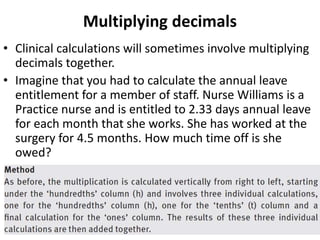
• Clinical calculations will sometimes involve multiplying
decimals together.
• Imagine that you had to calculate the annual leave
entitlement for a member of staff. Nurse Williams is a
Practice nurse and is entitled to 2.33 days annual leave
for each month that she works. She has worked at the
surgery for 4.5 months. How much time off is she
owed?
5
nizarmuhammad432@gmail.com 6
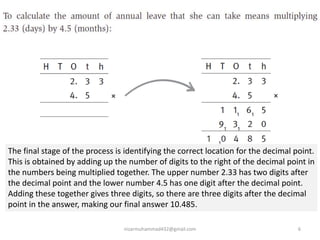
The final stage of the process is identifying the correct location for the decimal point.
This is obtained by adding up the number of digits to the right of the decimal point in
the numbers being multiplied together. The upper number 2.33 has two digits after
the decimal point and the lower number 4.5 has one digit after the decimal point.
Adding these together gives three digits, so there are three digits after the decimal
point in the answer, making our final answer 10.485.
nizarmuhammad432@gmail.com 7
Self assessment test for decimal multiplication:
1. To help with the development of her academic work, a lecturer has agreed to
provide Student Nurse Vipond with 0.75 hours of supervision each week for the
next 8.5 weeks. How much supervision will she receive?
2. Student Nurse Jones has to complete an assignment over the next week. She has
calculated that if she writes 2.5 pages per day for 5.5 days, she will achieve more
than the minimum of 12 pages. Is she correct?
3. A patient with heart failure and fluid retention needs to lose 0.75 litres of fluid per
day for the next 2.5 days. How much fluid will they lose in total?
4. A seriously ill patient is having their urine output measured hourly. They have
excreted 0.06 litres of urine per hour over the last 3.5 hours. What is the total
urine output over the 3.5 hours?
5. A patient is set the weight loss target of 1.25 kg per month for 2.5 months. How
much weight in total should the patient lose over the 2.5 months?
nizarmuhammad432@gmail.com 8
Self assessment questions (continued)
6. A trauma patient has been receiving intravenous fluid at a
rate of 0.25 litres of fluid per hour for the last 4.5 hours.
How much intravenous fluid have they received in total?
7. A registered nurse earns 10.86$ per hour. How much will
she earn for 18.25 hours work?

Applied math multiplication

  • 1.
  • 2.
    Multiplication • Multiplication isthe same as repeatedly adding the same number together, for example, 5 × 12 is the same as 12 + 12 + 12 + 12 + 12, but the process is less time consuming. Multiplications are used to calculate fluid balance charts where the same volume has been given repeatedly and when calculating drug doses that are prescribed per kilogram of body weight. • When multiplying two or more numbers together, the calculation can be performed in any order, so 25 × 4 gives the same answer as 4 × 25. nizarmuhammad432@gmail.com 2
  • 3.
  • 4.
  • 5.
    Multiplying decimals • Clinicalcalculations will sometimes involve multiplying decimals together. • Imagine that you had to calculate the annual leave entitlement for a member of staff. Nurse Williams is a Practice nurse and is entitled to 2.33 days annual leave for each month that she works. She has worked at the surgery for 4.5 months. How much time off is she owed? 5
  • 6.
    nizarmuhammad432@gmail.com 6 The finalstage of the process is identifying the correct location for the decimal point. This is obtained by adding up the number of digits to the right of the decimal point in the numbers being multiplied together. The upper number 2.33 has two digits after the decimal point and the lower number 4.5 has one digit after the decimal point. Adding these together gives three digits, so there are three digits after the decimal point in the answer, making our final answer 10.485.
  • 7.
    nizarmuhammad432@gmail.com 7 Self assessmenttest for decimal multiplication: 1. To help with the development of her academic work, a lecturer has agreed to provide Student Nurse Vipond with 0.75 hours of supervision each week for the next 8.5 weeks. How much supervision will she receive? 2. Student Nurse Jones has to complete an assignment over the next week. She has calculated that if she writes 2.5 pages per day for 5.5 days, she will achieve more than the minimum of 12 pages. Is she correct? 3. A patient with heart failure and fluid retention needs to lose 0.75 litres of fluid per day for the next 2.5 days. How much fluid will they lose in total? 4. A seriously ill patient is having their urine output measured hourly. They have excreted 0.06 litres of urine per hour over the last 3.5 hours. What is the total urine output over the 3.5 hours? 5. A patient is set the weight loss target of 1.25 kg per month for 2.5 months. How much weight in total should the patient lose over the 2.5 months?
  • 8.
    nizarmuhammad432@gmail.com 8 Self assessmentquestions (continued) 6. A trauma patient has been receiving intravenous fluid at a rate of 0.25 litres of fluid per hour for the last 4.5 hours. How much intravenous fluid have they received in total? 7. A registered nurse earns 10.86$ per hour. How much will she earn for 18.25 hours work?