Key terms ofT&D
Knowledge is created by a
firm’s knowledge assets,
that is, its human Capital
which has long been
recognized as one of the key
sources of competitive
advantage
Human Capital
Training refers to the
planned acquisition of the
knowledge, skills, and
abilities (KSA) to carry out a
specific task or job in a
vocational setting
Training
Learning is defined as the
process of assimilating new
knowledge and skills in
consequence of experience
or practice that will bring
about relatively permanent
changes in behavior
Learning
Development in an
organizational context
ensures that employees
possess the KSA required to
fulfill future roles in the
organization
Development
3.
Organizational learning isby no means a new concept.
Argyris and Schon suggested a three-level model of
organizational learning:
Three-level model
Single-loop
Double-loop
Triple-loop
4.
The Fifth Discipline
Personal
mastery
Systems
thinking
Sharedvisions
Mental models
Team learning
One of the most influential proponents of the
learning organization is Peter Senge. In his book
The Fifth Discipline, he puts forward five
interrelated disciplines that an organization
should cultivate among its employees to engender
learning and success
5.
The system modelof T&D
Identify T&D
needs
Design T&D
solutions
Implement
T&D solutions
Evaluate T&D
effectiveness
• KSA gap
• Prioritizing objectives
• Wide array of T&D methods
• Choosing most appropriate one
• How?
• By whom?
• When?
• Cyclical evaluation
process
• Appropriate matrix
must be used
6.
Identifying T&D
Needs Functionsof TNA
Identify gap between existing
and desired KSA
Integration of employee T&D activities with
the business need
Assess the validity of initiatives
Assist in prioritizing T&D
objectives
Determine the actual training
needs
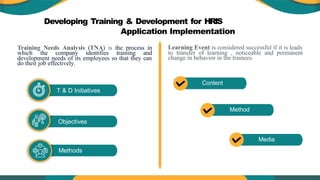
Developing Training &Development for HRIS
Application Implementation
Training Needs Analysis (TNA) is the process in
which the company identifies training and
development needs of its employees so that they can
do their job effectively.
T & D Initiatives
Objectives
Methods
Learning Event is considered successful if it is leads
to transfer of learning , noticeable and permanent
change in behavior in the trainees.
Content
Method
Media
9.
Kolb’s Learning Cycle
Concrete Experience
Reflective Observation
Abstract Conceptualization
Active Experimentation
Honey and
Mumford
Activist
Reflector
Theorist
Pragmatist
Visual
Aural
Read/Write
Kinesthetic
Fleming and
Mills
Developing Training & Development for HRIS
Application Implementation
Different Learning Style According to Different
Person
10.
Developing Training &Development for HRIS
Application Implementation
Off-the-job training
It is relatively inexpensive and while off-the-job
methods may provide greater exposure to expert
knowledge, they may also be more time
consuming and may not encourage knowledge
transfer.
Simulation
Role Play
Case
study
Business
games
Workshop
On-the-job training
It usually involve peer observation and can be
informal, structured or unstructured although
successful learning outcomes are more likely to
occur in a structured rather than an unstructured
environment.
Observation
Mentoring
Coaching
Job rotation
Apprenticeship
Self – directed
learning
Advantages and
Disadvantages ofE-
learning
Advantages
Cost Advantages
Improves computer skills
High degree of learner control
Interactive and easy feedback
Consistent content etc.
Disadvantages
Basic computer skills necessary
Not suitable for certain content
Privacy concerns
Technical difficulties impede access
etc.
13.
Shortcomings of E-
learning
Technicaldifficulties
Limited socialization
opportunities
The need effective time management
skill
Lack of human
touch
Lack of face to face
interaction
14.
• Lack ofNecessary Expertise System
• Less Focus on Cost Savings
• Application Strategy not aligning with
Needs Analysis
• Underutilization and Dissatisfaction
Implementation
Issues
Implementation
Stage
Design
Stage
15.
Implementing T &
D
a.Method
b. Module
c. Training Design
a.
Materials
b.
Guidelines
c. Budgets
a.
Period
b.
Duration
c. Placement
a.
Mentor
b.
Supervisor
c. Transfer of
Learning
Schem
e
Resource
s
Timelin
e
Facilitator
Implementation
Plan
Training metrics andcost-benefit analysis
Critical factors in HR development
evaluation
• Occurs within a complex, dynamic, and variable
environment.
• Evaluation is essentially a political activity.
• Ought to be purposeful, planned, and
systematic.
Evaluating Training success (Kirkpatrick’s evaluation
taxonomy)
Reaction,
Satisfaction
Learning
and
application
Implementa
tion
Business
Impact
ROI
Intangibles
19.
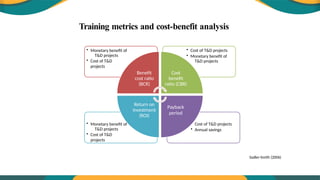
Training metrics andcost-benefit analysis
• Cost of T&D projects
• Annual savings
• Monetary benefit of
T&D projects
• Cost of T&D
projects
• Cost of T&D projects
• Monetary benefit of
T&D projects
• Monetary benefit of
T&D projects
• Cost of T&D
projects
Benefit
cost ratio
(BCR)
Cost
benefit
ratio (CBR)
Payback
period
Return on
Investment
(ROI)
Sadler-Smith (2006)
20.
Training metrics andcost-benefit analysis
Steps for converting soft and hard data into monetary values
on ROI methods
Focus on single unit
Determine value for each unit
Calculate performance change (attributable to training)
Obtain annual monetary value of change
Determine the annual value (change value times unit value)
21.
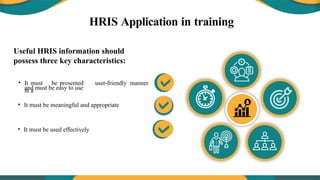
HRIS Application intraining
• It must be meaningful and appropriate
• It must be used effectively
• It must be presented
in a
user-friendly manner
and must be easy to use
Useful HRIS information should
possess three key characteristics:
HRIS T&D
Applications:
Implementation Issues
Aligne-learning strategy with
T&D strategy
Create corporate culture
Assess HRIS T&D projects based
on their suitability
.Carefully plan HRIS T&D
projects
Involve line managers and employees
in HRIS T&D projects
25.
HRIS T&D Applications:
ImplementationIssues
.
.
.
Match HRIS T&D applications and e-learning
initiatives
Establish a suitable evaluation strategy
Promote the benefits and create a sense of urgency
Reward employees for their use of e-learning.
Ensure that e-learning and T&D systems