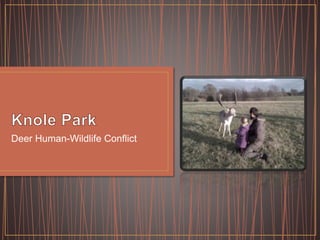
Deer Human-Wildlife Conflict
• Situated in Sevenoaks, Kent. (TQ545538)
• Kent's last remaining medieval deer park
• 1, 000 acre deer park owned the National
• Part of Kent Downs Area of Outstanding Natural Beauty
• Site of Special Scientific Interest
• Site includes habitats such as parkland, woodland, acidic
grassland, wildlife ponds
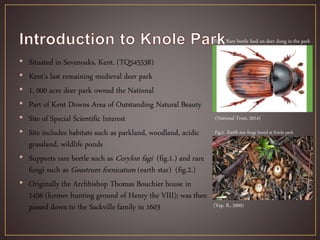
• Supports rare beetle such as Cerylon fagi (fig.1.) and rare
fungi such as Geastrum fornicatum (earth star) (fig.2.)
• Originally the Archbishop Thomas Bouchier house in
1456 (former hunting ground of Henry the VIII); was then
passed down to the Sackville family in 1603
Fig.1. Rare beetle feed on deer dung in the park
(National Trust, 2014)
Fig.2. Earth star fungi found at Knole park
(Yap, B., 2009)
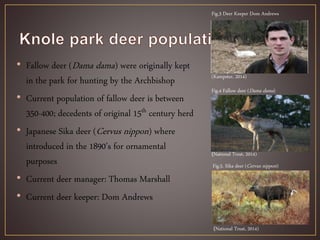
• Fallow deer (Dama dama) were originally kept
in the park for hunting by the Archbishop
• Current population of fallow deer is between
350-400; decedents of original 15th century herd
• Japanese Sika deer (Cervus nippon) where
introduced in the 1890’s for ornamental
purposes
• Current deer manager: Thomas Marshall
• Current deer keeper: Dom Andrews
Fig.5. Sika deer (Cervus nippon)
Fig.4 Fallow deer (Dama dama)
(National Trust, 2014)
Fig.3 Deer Keeper Dom Andrews
(Kampster, 2014)
• Public feeding deer and dogs let lose harassing deer
• Lack of acknowledgement of the threats dogs pose to deer; with attacks
leading to slow painful deaths and abortion in pregnant ewes
• Picnics and food availability from members of the public; leading to
conditioning
• Deer not feed can become aggressive posing a risk to people;
particularly young children
• Deer’s crossing roads with potential for collision or blocking vehicle
access
• Deer are £1,000 to purchase, plus additional husbandry costs
• Increasing deer vehicle accidents (DVA’S), and the associated economic and animal welfare costs,
has led to further research including environmental and ecological factors leading to such
incidents (Steiner, et al., 2014).
• GPS monitoring has been carried out to identify deer movements and home ranges and risks
zones in relation to seasons, habitat characteristics, deer behaviour, speed limit and road design
(Meisingset, et al., 2014).
• GIS has been utilised to map sites of DVA’s in the City of Edmonton, Alberta, to identify areas of
high collision incidents; the study revealed that collisions where more likely in areas of dense
vegetation and less likely in areas with a 40m buffer of absent vegetation (Found and Boyce, 2011)
• Also been applied in Spain for investigation of Roe Deer (Caprelous caprelous) and Wild Boar
(Sus scrofa) collisions (Rodríguez-Morales, 2013).
• Mitigation methods include; warning signs on roads, speed limits, fencing, reflectors, chemical
repellents, and one way gates (Found and Boyce, 2011; Meisingset, et al, 2014).
• Animal welfare and behaviour considerations are required (Putmam, 1997; Goddard, et al., 2001)
Fig.6 GIS use to plot frequencies and locations of DVA’s Fig.7 Spatial patterns of Roe Deer and Wild Boar RTA’S
(Found and Boyce, 2011) (Rodríguez-Morales, 2013).
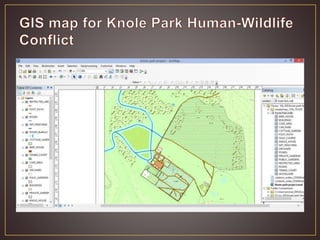
• Tracing features and digitisation of a map can identify key conflict areas, e.g. roads and car park
• The Buffer tool can be used to establish a uniform area in which mitigation fencing can be placed (Ormsby,
2011)
• Previous studies have stated that a vegetation free buffer of >40m reduces deer-vehicle collisions (Found and
Boyce, 2011).
• However, it is recommended that fencing does not exceed beyond high risk areas as fencing can disrupt
habitat connectivity; a buffer of 20m could therefore be selected for fencing (Ascensãoa, et a., 2013; Goddard,
et al., 2011; Putmam, 1997)
• Fencing can lead to undesired behaviour (e.g. pacing) and can be costly (Goddard, et al., 2011; Putmam, 1997)
• Partial fencing of roads is suggested to be the most effective mitigation (Ascensãoa, et al, 2013)
Advantages of the buffer tool
• Area of focus identified in which fencing can be put into place to reduce collisions (Ormsby, 2011)
• Cost and time effective (Longley, et al, 2011)
Disadvantages of the buffer tool
• Human-wildlife issues, deer behaviour and welfare could be over looked outside the buffer (Goddard, et al.,
2001)
• Establishment of fencing can be costly and time consuming (Ascensãoa, et al., 2013; Goddard, et al., 2001;
Putman, 1997)
• Deer-vehicle collisions are one of many human-wildlife
conflict issues that can be investigated with GIS
(Kempster, 2014; Word Press, 2013).
• GIS can be used to put appropriate mitigation methods
in place and monitor human-wildlife conflict issues;
including conflict with domestic dogs and public
feeding deer (Found and Boyce, 2014; Ormsby, 2001).
• The buffer tool can be used to create a uniform area in
which deer fencing can be established (Ormsby, 2001)
• However Knole park must be considered as a whole
outside the buffer zone as well as deer welfare and
habitat connectivity; this can be investigated using GIS
(Ascensãoa, et al, 2013; Goddard, et al., 2011).
Watch the Fallow and Sika deer roam the parkland
(National Trust, 2014)
• Ascensãoa, F., Clevengerb, A., Santos-Reisa, M., Urbanoc, P., Jacksond, N., Wildlife–vehicle collision mitigation: Is partial
fencing the answer? An agent-based model approach. Ecological Modelling. 257: 36–43
• Banks, G. (2012). Lost thoughts; beer; pizza; Knole Park; wild deer and tame animals. Blogspot (image) 28th of January.
Available at http://thebeardedwhelk.blogspot.co.uk/2012/01/lost-thoughts-beer-pizza-knole-park.html (Accessed 18/11/14)
• Found, R., and Boyce, M.S., (2011). Predicting deer–vehicle collisions in an urban area. Journal of Environmental Management.
92 (10) 2486–2493.
• Goddard, P.J., Summers, R.W., Macdonald A.J., Murray, C., Fawcett, A.R., (2001). Behavioural responses of red deer to fences
of five different designs. Applied Animal Behaviour Science. 73: 289-298.
• Heritage Lottery Fund, (2014) Inspired by Knole. (online) Available at http://www.hlf.org.uk/our-projects/inspired-knole (Accessed
23/11/14)
• Kempster, D (2014) Knole Park warden: "Dogs off leads are killing deer“ Sevenoaks Chronicle (online) 15th of March. Available
at http://www.sevenoakschronicle.co.uk/Knole-Park-warden-Dogs-leads-killing-deer/story-20815246-detail/story.html (Accessed
19/11/14).
• Longley, P.A., Goodchild, M.F., Maguire, D.W., Rhind, D.W., 2011. Geographical Information Systems and Science. Hoboken,
United States of America John Wiley and Sons, Inc.
• Meisingset, E.L., Loe, L.E., Brekkum, O. and Mysterud, A., (2014).Targeting mitigation efforts: The role of speed limit and road
edge clearance for deer–vehicle collisions. The Journal of Wildlife Management. 78 (4) 679-688
• National Trust, (2014). Knole Park as a SSSI (online) Available at http://www.nationaltrust.org.uk/article-1355787055062/
(Accessed 28/11/14)
• National Trust, (2014) Knole Park. (online) Available at http://www.nationaltrust.org.uk/article-1356396648674/ (Accessed
19/11/14)
• National Trust, (2014) Heritage Lottery Fund helps secure future of Knole (online) Available at
http://www.nationaltrust.org.uk/article-1355795867055/ (Accessed 23/11/14)
• National Trust, (2014). More of a town then a house: six hundred years of history (online) Available at
http://www.nationaltrust.org.uk/knole/ (Accessed 23/11/2014)
• National Trust, (2014). This nationally rare beetle feeds on the dung of deer in the park (image online) Available at
http://www.nationaltrust.org.uk/article-1355787055062/ (Accessed 18/11/14)
• Ormsby, T., Napoleon, E., Burke, R., Groess, C., Feaster, L., 2004. Getting To Know ArcGIS Desktop. Second Edition.
Relands, California. ESRI Press.
• Punnet, R.J., (1997). Deer and Road Traffic Accidents: Options for Management. Environmental Management. 51:43-57.
• Rodríguez-Morales, B., Díaz-Varela, E.,R., and Marey-Pérez, M.F., 2013. Spatiotemporal analysis of vehicle collisions
involving wild boar and roe deer in NW Spain. Accident Analysis & Prevention. 60:121–133
• Steiner, W., Leisch, F., Hackländer, K., (2014). A review on the temporal pattern of deer–vehicle accidents: Impact of
seasonal, diurnal and lunar effects in cervids. Accident Analysis & Prevention. 66; 168–181
• Wild Wild Things (2013). Knole Knowledge – The Fallow Rut. Wordpress.com (blog) January 22nd. Available at
https://wildwildthings.wordpress.com/tag/knole-park/ (Accessed 18/11/14)
• Yap, B. (2009) Earth-star fungi (image online) Available at
http://www.asknature.org/strategy/73c05a5fc23701e97bc54ce39cd5dd58#.VGssiU0qWM8 Ask Nature. (Accessed 18/11/14)
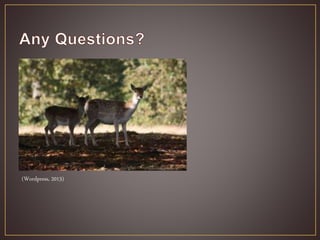
(Wordpress, 2013)

Application of GIS Software

  • 1.
  • 2.
    • Situated inSevenoaks, Kent. (TQ545538) • Kent's last remaining medieval deer park • 1, 000 acre deer park owned the National • Part of Kent Downs Area of Outstanding Natural Beauty • Site of Special Scientific Interest • Site includes habitats such as parkland, woodland, acidic grassland, wildlife ponds • Supports rare beetle such as Cerylon fagi (fig.1.) and rare fungi such as Geastrum fornicatum (earth star) (fig.2.) • Originally the Archbishop Thomas Bouchier house in 1456 (former hunting ground of Henry the VIII); was then passed down to the Sackville family in 1603 Fig.1. Rare beetle feed on deer dung in the park (National Trust, 2014) Fig.2. Earth star fungi found at Knole park (Yap, B., 2009)
  • 3.
    • Fallow deer(Dama dama) were originally kept in the park for hunting by the Archbishop • Current population of fallow deer is between 350-400; decedents of original 15th century herd • Japanese Sika deer (Cervus nippon) where introduced in the 1890’s for ornamental purposes • Current deer manager: Thomas Marshall • Current deer keeper: Dom Andrews Fig.5. Sika deer (Cervus nippon) Fig.4 Fallow deer (Dama dama) (National Trust, 2014) (National Trust, 2014) Fig.3 Deer Keeper Dom Andrews (Kampster, 2014)
  • 4.
    • Public feedingdeer and dogs let lose harassing deer • Lack of acknowledgement of the threats dogs pose to deer; with attacks leading to slow painful deaths and abortion in pregnant ewes • Picnics and food availability from members of the public; leading to conditioning • Deer not feed can become aggressive posing a risk to people; particularly young children • Deer’s crossing roads with potential for collision or blocking vehicle access • Deer are £1,000 to purchase, plus additional husbandry costs
  • 5.
    • Increasing deervehicle accidents (DVA’S), and the associated economic and animal welfare costs, has led to further research including environmental and ecological factors leading to such incidents (Steiner, et al., 2014). • GPS monitoring has been carried out to identify deer movements and home ranges and risks zones in relation to seasons, habitat characteristics, deer behaviour, speed limit and road design (Meisingset, et al., 2014). • GIS has been utilised to map sites of DVA’s in the City of Edmonton, Alberta, to identify areas of high collision incidents; the study revealed that collisions where more likely in areas of dense vegetation and less likely in areas with a 40m buffer of absent vegetation (Found and Boyce, 2011) • Also been applied in Spain for investigation of Roe Deer (Caprelous caprelous) and Wild Boar (Sus scrofa) collisions (Rodríguez-Morales, 2013). • Mitigation methods include; warning signs on roads, speed limits, fencing, reflectors, chemical repellents, and one way gates (Found and Boyce, 2011; Meisingset, et al, 2014). • Animal welfare and behaviour considerations are required (Putmam, 1997; Goddard, et al., 2001)
  • 6.
    Fig.6 GIS useto plot frequencies and locations of DVA’s Fig.7 Spatial patterns of Roe Deer and Wild Boar RTA’S (Found and Boyce, 2011) (Rodríguez-Morales, 2013).
  • 7.
    • Tracing featuresand digitisation of a map can identify key conflict areas, e.g. roads and car park • The Buffer tool can be used to establish a uniform area in which mitigation fencing can be placed (Ormsby, 2011) • Previous studies have stated that a vegetation free buffer of >40m reduces deer-vehicle collisions (Found and Boyce, 2011). • However, it is recommended that fencing does not exceed beyond high risk areas as fencing can disrupt habitat connectivity; a buffer of 20m could therefore be selected for fencing (Ascensãoa, et a., 2013; Goddard, et al., 2011; Putmam, 1997) • Fencing can lead to undesired behaviour (e.g. pacing) and can be costly (Goddard, et al., 2011; Putmam, 1997) • Partial fencing of roads is suggested to be the most effective mitigation (Ascensãoa, et al, 2013) Advantages of the buffer tool • Area of focus identified in which fencing can be put into place to reduce collisions (Ormsby, 2011) • Cost and time effective (Longley, et al, 2011) Disadvantages of the buffer tool • Human-wildlife issues, deer behaviour and welfare could be over looked outside the buffer (Goddard, et al., 2001) • Establishment of fencing can be costly and time consuming (Ascensãoa, et al., 2013; Goddard, et al., 2001; Putman, 1997)
  • 9.
    • Deer-vehicle collisionsare one of many human-wildlife conflict issues that can be investigated with GIS (Kempster, 2014; Word Press, 2013). • GIS can be used to put appropriate mitigation methods in place and monitor human-wildlife conflict issues; including conflict with domestic dogs and public feeding deer (Found and Boyce, 2014; Ormsby, 2001). • The buffer tool can be used to create a uniform area in which deer fencing can be established (Ormsby, 2001) • However Knole park must be considered as a whole outside the buffer zone as well as deer welfare and habitat connectivity; this can be investigated using GIS (Ascensãoa, et al, 2013; Goddard, et al., 2011). Watch the Fallow and Sika deer roam the parkland (National Trust, 2014)
  • 10.
    • Ascensãoa, F.,Clevengerb, A., Santos-Reisa, M., Urbanoc, P., Jacksond, N., Wildlife–vehicle collision mitigation: Is partial fencing the answer? An agent-based model approach. Ecological Modelling. 257: 36–43 • Banks, G. (2012). Lost thoughts; beer; pizza; Knole Park; wild deer and tame animals. Blogspot (image) 28th of January. Available at http://thebeardedwhelk.blogspot.co.uk/2012/01/lost-thoughts-beer-pizza-knole-park.html (Accessed 18/11/14) • Found, R., and Boyce, M.S., (2011). Predicting deer–vehicle collisions in an urban area. Journal of Environmental Management. 92 (10) 2486–2493. • Goddard, P.J., Summers, R.W., Macdonald A.J., Murray, C., Fawcett, A.R., (2001). Behavioural responses of red deer to fences of five different designs. Applied Animal Behaviour Science. 73: 289-298. • Heritage Lottery Fund, (2014) Inspired by Knole. (online) Available at http://www.hlf.org.uk/our-projects/inspired-knole (Accessed 23/11/14) • Kempster, D (2014) Knole Park warden: "Dogs off leads are killing deer“ Sevenoaks Chronicle (online) 15th of March. Available at http://www.sevenoakschronicle.co.uk/Knole-Park-warden-Dogs-leads-killing-deer/story-20815246-detail/story.html (Accessed 19/11/14). • Longley, P.A., Goodchild, M.F., Maguire, D.W., Rhind, D.W., 2011. Geographical Information Systems and Science. Hoboken, United States of America John Wiley and Sons, Inc. • Meisingset, E.L., Loe, L.E., Brekkum, O. and Mysterud, A., (2014).Targeting mitigation efforts: The role of speed limit and road edge clearance for deer–vehicle collisions. The Journal of Wildlife Management. 78 (4) 679-688 • National Trust, (2014). Knole Park as a SSSI (online) Available at http://www.nationaltrust.org.uk/article-1355787055062/ (Accessed 28/11/14) • National Trust, (2014) Knole Park. (online) Available at http://www.nationaltrust.org.uk/article-1356396648674/ (Accessed 19/11/14)
  • 11.
    • National Trust,(2014) Heritage Lottery Fund helps secure future of Knole (online) Available at http://www.nationaltrust.org.uk/article-1355795867055/ (Accessed 23/11/14) • National Trust, (2014). More of a town then a house: six hundred years of history (online) Available at http://www.nationaltrust.org.uk/knole/ (Accessed 23/11/2014) • National Trust, (2014). This nationally rare beetle feeds on the dung of deer in the park (image online) Available at http://www.nationaltrust.org.uk/article-1355787055062/ (Accessed 18/11/14) • Ormsby, T., Napoleon, E., Burke, R., Groess, C., Feaster, L., 2004. Getting To Know ArcGIS Desktop. Second Edition. Relands, California. ESRI Press. • Punnet, R.J., (1997). Deer and Road Traffic Accidents: Options for Management. Environmental Management. 51:43-57. • Rodríguez-Morales, B., Díaz-Varela, E.,R., and Marey-Pérez, M.F., 2013. Spatiotemporal analysis of vehicle collisions involving wild boar and roe deer in NW Spain. Accident Analysis & Prevention. 60:121–133 • Steiner, W., Leisch, F., Hackländer, K., (2014). A review on the temporal pattern of deer–vehicle accidents: Impact of seasonal, diurnal and lunar effects in cervids. Accident Analysis & Prevention. 66; 168–181 • Wild Wild Things (2013). Knole Knowledge – The Fallow Rut. Wordpress.com (blog) January 22nd. Available at https://wildwildthings.wordpress.com/tag/knole-park/ (Accessed 18/11/14) • Yap, B. (2009) Earth-star fungi (image online) Available at http://www.asknature.org/strategy/73c05a5fc23701e97bc54ce39cd5dd58#.VGssiU0qWM8 Ask Nature. (Accessed 18/11/14)
  • 12.

Editor's Notes

  • #4 Do I need to reference here?
  • #5 Do I need to reference here?