a p p l i c at i o n N o t e


                                                               ICP-Mass Spectrometry


                                                               Author
                                                               Kenneth Ong
                                                               PerkinElmer, Inc.
                                                               Singapore


Determination
of Impurities in                             Introduction
                                             Tetramethylammonium hydroxide (TMAH) is widely
Semiconductor-Grade                          used as a basic solvent in the development of acidic

TMAH with the                                photoresist in the semiconductor photolithography
                                             process and in liquid crystal display (LCD)

NexION 300S ICP-MS                           manufacturing. Its wide usage in these demanding
                                             applications has made the analysis of impurities
                                             in TMAH more and more critical. SEMI Standard
                                             C46-03061 specifies limits for 25% TMAH with
    contamination limits to less than 10 ppb for each element. TMAH, however, is not commonly
    used in its concentrated form; in fact, most applications would have the concentration
    between 1 and 3%.

    With its ability to determine analytes rapidly at the ultra trace (ng/L or parts-per-trillion)
    level in various process chemicals, inductively coupled plasma mass spectrometry (ICP-MS)
    has become an indispensable analytical tool for quality control. It is, however, extremely
    important to address the significant matrix-derived polyatomic interferences, as well as
    matrix suppression effects, due to carbon content. These issues are especially prominent
    when analyzing organic solvents directly. Although cool plasma has been shown to be
    effective in reducing argon-based interferences, it is even more prone to matrix suppression
    than hot plasma. Additionally, the low plasma energy may result in preferential formation
    of other polyatomic interferences which are not seen under hot plasma conditions. Collision
    cells using multipoles and nonreactive gases have proven useful in reducing polyatomic
    interferences. However, kinetic energy discrimination results in the loss of sensitivity, which
is an issue when analyzing ng/L levels. Reaction mode is          preparation consisted of a five-fold dilution with pure water,
    another technique which uses a reactive gas, such as NH3,         resulting in a 5% (W/W) solution. Standard solutions were
    to selectively react with the polyatomic interference and         made from a 10 mg/L multi-element standard (PerkinElmer
    a quadrupole mass filter to create dynamic bandpass to            Pure, PerkinElmer, Shelton, CT USA). The instrument used
    prevent undesirable by-product ions formation, thereby            for this experiment was a NexION 300S ICP-MS (PerkinElmer,
    removing the polyatomic interference effectively without          Shelton, CT USA). Instrumental parameters and sample
    suppressing the analytes’ signal.                                 introduction components are shown in Table 1.

    This application note demonstrates the ability of PerkinElmer’s
                                                                      Results
    NexION® 300S ICP-MS to remove interferences so that trace
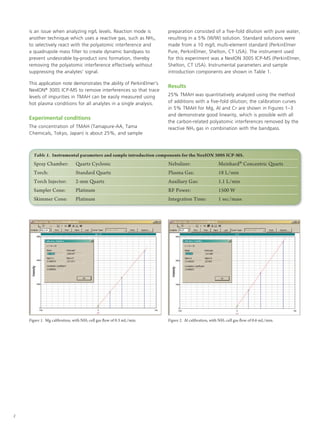
    levels of impurities in TMAH can be easily measured using         25% TMAH was quantitatively analyzed using the method
    hot plasma conditions for all analytes in a single analysis.      of additions with a five-fold dilution; the calibration curves
                                                                      in 5% TMAH for Mg, Al and Cr are shown in Figures 1–3
                                                                      and demonstrate good linearity, which is possible with all
    Experimental conditions
                                                                      the carbon-related polyatomic interferences removed by the
    The concentration of TMAH (Tamapure-AA, Tama                      reactive NH3 gas in combination with the bandpass.
    Chemicals, Tokyo, Japan) is about 25%, and sample


      Table 1. Instrumental parameters and sample introduction components for the NexION 300S ICP-MS.
      Spray Chamber:	          Quartz Cyclonic	                       Nebulizer:	                   Meinhard® Concentric Quartz
      Torch:	                  Standard Quartz	                       Plasma Gas: 	                 18 L/min
      Torch Injector:	         2-mm Quartz	                           Auxiliary Gas:	               1.1 L/min
      Sampler Cone:	           Platinum	                              RF Power:	                    1500 W
      Skimmer Cone:	           Platinum	                              Integration Time:	            1 sec/mass


    Figure 1. Mg calibration, with NH3 cell gas flow of 0.3 mL/min.   Figure 2. Al calibration, with NH3 cell gas flow of 0.6 mL/min.


2
Table 2. Detection limits (DLs), background equivalent
                                                                          concentrations (BECs), and 20 ng/L spike recoveries for all
                                                                          analytes in 5% TMAH (units in ng/L).
                                                                          		 Cell Gas Flow*	 	          DL	 BEC	 20 ppt
                                                                          Analyte	Mass	 (mL/min)	 RPq	 (ppt)	(ppt)	Recovery
                                                                          Li	         7	           0	     0.25	0.06	 ND	 98%
                                                                          Be	         9	           0	     0.25	0.08	 ND	 97%
                                                                          B	         11	           0	     0.25	0.8	 5.9	 99%
                                                                          Na	        23	           0	     0.25	0.9	 7.0	 104%
                                                                          Mg	        24	           0.3	   0.5	0.4	3.0	 111%
                                                                          Al	        27	           0.6	   0.5	2	 10	 94%
                                                                          K	         39	           0.6	   0.5	1	 17	105%

Figure 3. Cr calibration, with NH3 cell gas flow of 0.6 mL/min.
                                                                          Ca	        40	           1	     0.5	 0.4	19.4	 98%
                                                                          Ti	        48	           0.3	   0.5	1	 6	 90%
                                                                          V	         51	           0.6	   0.5	 0.07	ND	 102%
The detection limits (DLs) and background equivalent                      Cr	        52	           0.6	   0.5	0.5	5.1	 95%
concentrations (BECs) were both determined in 5% TMAH,
                                                                          Mn	        55	           0.6	   0.7	0.1	1.0	 102%
while accounting for the sensitivities in 5% TMAH. DLs
were calculated by multiplying the standard deviation by                  Fe	        56	           0.6	   0.5	1	 33	 99%
three, and BECs were determined by measuring the signal                   Co	        59	           0.3	   0.5	0.4	3.4	 115%
intensities. Recoveries were determined from 20 ng/L                      Ni	        60	           0.3	   0.7	2	 4	 108%
spikes. The results are summarized in Table 2.                            Cu	        63	           0	     0.25	1	 5	 93%
                                                                          Zn	        64	           0.3	   0.65	0.9	27.3	 106%
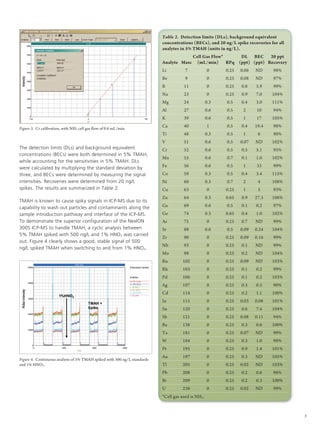
TMAH is known to cause spiky signals in ICP-MS due to its
capability to wash out particles and contaminants along the               Ga	        69	           0.6	   0.5	0.1	0.2	 97%
sample introduction pathway and interface of the ICP-MS.                  Ge	        74	           0.3	   0.65	0.4	 1.0	 102%
To demonstrate the superior configuration of the NexION                   As	        75	           0	     0.25	0.7	 ND	 99%
300S ICP-MS to handle TMAH, a cyclic analysis between                     Sr	        88	           0.6	   0.5	 0.09	0.24	 104%
5% TMAH spiked with 500 ng/L and 1% HNO3 was carried
                                                                          Zr	        90	           0	     0.25	0.09	0.16	 99%
out. Figure 4 clearly shows a good, stable signal of 500
                                                                          Nb	        93	           0	     0.25	0.1	 ND	 99%
ng/L spiked TMAH when switching to and from 1% HNO3.
                                                                          Mo	        98	           0	     0.25	0.2	 ND	 104%
                                                                          Ru	       102	           0	     0.25	0.09	 ND	 103%
                                                                          Rh	       103	           0	     0.25	0.1	 0.2	 99%
                                                                          Pd	       106	           0	     0.25	0.1	 0.2	 103%
                                                                          Ag	       107	           0	     0.25	0.3	 0.5	 90%
                                                                          Cd	       114	           0	     0.25	0.2	 1.1	 100%
                                                                          In	       115	           0	     0.25	0.03	0.08	 101%
                                                                          Sn	       120	           0	     0.25	0.6	 7.4	 104%
                                                                          Sb	       121	           0	     0.25	0.08	0.11	 94%
                                                                          Ba	       138	           0	     0.25	0.3	 0.6	 100%
                                                                          Ta	       181	           0	     0.25	0.07	 ND	 99%
                                                                          W	        184	           0	     0.25	0.3	 1.0	 98%
                                                                          Pt	       195	           0	     0.25	0.9	 1.4	 101%
                                                                          Au	       197	           0	     0.25	0.3	 ND	 105%
Figure 4. Continuous analysis of 5% TMAH spiked with 500 ng/L standards
and 1% HNO3.                                                              Tl	       205	           0	     0.25	0.02	 ND	 103%
                                                                          Pb	       208	           0	     0.25	0.2	 0.6	 98%
                                                                          Bi	       209	           0	     0.25	0.2	 0.3	 100%
                                                                          U	        238	           0	     0.25	0.02	 ND	 99%
                                                                          *Cell gas used is NH3.


                                                                                                                                        3
Conclusion
The NexION® 300S ICP-MS is shown to be robust and
suitable for the routine quantification of ultratrace impurities
at the ng/L level in TMAH. It has also been shown that by
using the Reaction mode in the Universal Cell, the argon-
and carbon-based polyatomic spectral interferences can be
eliminated, allowing for the determination of many of the
traditionally problematic elements with good spike recovery
and precision. By means of computer controlled switching
between Standard and Reaction modes, interference-free
analysis using hot plasma conditions for all analytes is
possible during a single sample run.


References
1.	SEMI Standard C46-0306, Guideline for Tetramethyl-
   ammonium hydroxide, available from http://www.semi.
   org/en/index.htm


PerkinElmer, Inc.
940 Winter Street
Waltham, MA 02451 USA	
P: (800) 762-4000 or
(+1) 203-925-4602
www.perkinelmer.com


For a complete listing of our global offices, visit www.perkinelmer.com/ContactUs

Copyright ©2012, PerkinElmer, Inc. All rights reserved. PerkinElmer® is a registered trademark of PerkinElmer, Inc. All other trademarks are the property of their respective owners.

010283_01

Application Note:Determination of Impurities in Semiconductor-Grade TMAH with the NexION 300S ICP-MS

  • 1.
    a p pl i c at i o n N o t e ICP-Mass Spectrometry Author Kenneth Ong PerkinElmer, Inc. Singapore Determination of Impurities in Introduction Tetramethylammonium hydroxide (TMAH) is widely Semiconductor-Grade used as a basic solvent in the development of acidic TMAH with the photoresist in the semiconductor photolithography process and in liquid crystal display (LCD) NexION 300S ICP-MS manufacturing. Its wide usage in these demanding applications has made the analysis of impurities in TMAH more and more critical. SEMI Standard C46-03061 specifies limits for 25% TMAH with contamination limits to less than 10 ppb for each element. TMAH, however, is not commonly used in its concentrated form; in fact, most applications would have the concentration between 1 and 3%. With its ability to determine analytes rapidly at the ultra trace (ng/L or parts-per-trillion) level in various process chemicals, inductively coupled plasma mass spectrometry (ICP-MS) has become an indispensable analytical tool for quality control. It is, however, extremely important to address the significant matrix-derived polyatomic interferences, as well as matrix suppression effects, due to carbon content. These issues are especially prominent when analyzing organic solvents directly. Although cool plasma has been shown to be effective in reducing argon-based interferences, it is even more prone to matrix suppression than hot plasma. Additionally, the low plasma energy may result in preferential formation of other polyatomic interferences which are not seen under hot plasma conditions. Collision cells using multipoles and nonreactive gases have proven useful in reducing polyatomic interferences. However, kinetic energy discrimination results in the loss of sensitivity, which
  • 2.
    is an issuewhen analyzing ng/L levels. Reaction mode is preparation consisted of a five-fold dilution with pure water, another technique which uses a reactive gas, such as NH3, resulting in a 5% (W/W) solution. Standard solutions were to selectively react with the polyatomic interference and made from a 10 mg/L multi-element standard (PerkinElmer a quadrupole mass filter to create dynamic bandpass to Pure, PerkinElmer, Shelton, CT USA). The instrument used prevent undesirable by-product ions formation, thereby for this experiment was a NexION 300S ICP-MS (PerkinElmer, removing the polyatomic interference effectively without Shelton, CT USA). Instrumental parameters and sample suppressing the analytes’ signal. introduction components are shown in Table 1. This application note demonstrates the ability of PerkinElmer’s Results NexION® 300S ICP-MS to remove interferences so that trace levels of impurities in TMAH can be easily measured using 25% TMAH was quantitatively analyzed using the method hot plasma conditions for all analytes in a single analysis. of additions with a five-fold dilution; the calibration curves in 5% TMAH for Mg, Al and Cr are shown in Figures 1–3 and demonstrate good linearity, which is possible with all Experimental conditions the carbon-related polyatomic interferences removed by the The concentration of TMAH (Tamapure-AA, Tama reactive NH3 gas in combination with the bandpass. Chemicals, Tokyo, Japan) is about 25%, and sample Table 1. Instrumental parameters and sample introduction components for the NexION 300S ICP-MS. Spray Chamber: Quartz Cyclonic Nebulizer: Meinhard® Concentric Quartz Torch: Standard Quartz Plasma Gas: 18 L/min Torch Injector: 2-mm Quartz Auxiliary Gas: 1.1 L/min Sampler Cone: Platinum RF Power: 1500 W Skimmer Cone: Platinum Integration Time: 1 sec/mass Figure 1. Mg calibration, with NH3 cell gas flow of 0.3 mL/min. Figure 2. Al calibration, with NH3 cell gas flow of 0.6 mL/min. 2
  • 3.
    Table 2. Detectionlimits (DLs), background equivalent concentrations (BECs), and 20 ng/L spike recoveries for all analytes in 5% TMAH (units in ng/L). Cell Gas Flow* DL BEC 20 ppt Analyte Mass (mL/min) RPq (ppt) (ppt) Recovery Li 7 0 0.25 0.06 ND 98% Be 9 0 0.25 0.08 ND 97% B 11 0 0.25 0.8 5.9 99% Na 23 0 0.25 0.9 7.0 104% Mg 24 0.3 0.5 0.4 3.0 111% Al 27 0.6 0.5 2 10 94% K 39 0.6 0.5 1 17 105% Figure 3. Cr calibration, with NH3 cell gas flow of 0.6 mL/min. Ca 40 1 0.5 0.4 19.4 98% Ti 48 0.3 0.5 1 6 90% V 51 0.6 0.5 0.07 ND 102% The detection limits (DLs) and background equivalent Cr 52 0.6 0.5 0.5 5.1 95% concentrations (BECs) were both determined in 5% TMAH, Mn 55 0.6 0.7 0.1 1.0 102% while accounting for the sensitivities in 5% TMAH. DLs were calculated by multiplying the standard deviation by Fe 56 0.6 0.5 1 33 99% three, and BECs were determined by measuring the signal Co 59 0.3 0.5 0.4 3.4 115% intensities. Recoveries were determined from 20 ng/L Ni 60 0.3 0.7 2 4 108% spikes. The results are summarized in Table 2. Cu 63 0 0.25 1 5 93% Zn 64 0.3 0.65 0.9 27.3 106% TMAH is known to cause spiky signals in ICP-MS due to its capability to wash out particles and contaminants along the Ga 69 0.6 0.5 0.1 0.2 97% sample introduction pathway and interface of the ICP-MS. Ge 74 0.3 0.65 0.4 1.0 102% To demonstrate the superior configuration of the NexION As 75 0 0.25 0.7 ND 99% 300S ICP-MS to handle TMAH, a cyclic analysis between Sr 88 0.6 0.5 0.09 0.24 104% 5% TMAH spiked with 500 ng/L and 1% HNO3 was carried Zr 90 0 0.25 0.09 0.16 99% out. Figure 4 clearly shows a good, stable signal of 500 Nb 93 0 0.25 0.1 ND 99% ng/L spiked TMAH when switching to and from 1% HNO3. Mo 98 0 0.25 0.2 ND 104% Ru 102 0 0.25 0.09 ND 103% Rh 103 0 0.25 0.1 0.2 99% Pd 106 0 0.25 0.1 0.2 103% Ag 107 0 0.25 0.3 0.5 90% Cd 114 0 0.25 0.2 1.1 100% In 115 0 0.25 0.03 0.08 101% Sn 120 0 0.25 0.6 7.4 104% Sb 121 0 0.25 0.08 0.11 94% Ba 138 0 0.25 0.3 0.6 100% Ta 181 0 0.25 0.07 ND 99% W 184 0 0.25 0.3 1.0 98% Pt 195 0 0.25 0.9 1.4 101% Au 197 0 0.25 0.3 ND 105% Figure 4. Continuous analysis of 5% TMAH spiked with 500 ng/L standards and 1% HNO3. Tl 205 0 0.25 0.02 ND 103% Pb 208 0 0.25 0.2 0.6 98% Bi 209 0 0.25 0.2 0.3 100% U 238 0 0.25 0.02 ND 99% *Cell gas used is NH3. 3
  • 4.
    Conclusion The NexION® 300SICP-MS is shown to be robust and suitable for the routine quantification of ultratrace impurities at the ng/L level in TMAH. It has also been shown that by using the Reaction mode in the Universal Cell, the argon- and carbon-based polyatomic spectral interferences can be eliminated, allowing for the determination of many of the traditionally problematic elements with good spike recovery and precision. By means of computer controlled switching between Standard and Reaction modes, interference-free analysis using hot plasma conditions for all analytes is possible during a single sample run. References 1. SEMI Standard C46-0306, Guideline for Tetramethyl- ammonium hydroxide, available from http://www.semi. org/en/index.htm PerkinElmer, Inc. 940 Winter Street Waltham, MA 02451 USA P: (800) 762-4000 or (+1) 203-925-4602 www.perkinelmer.com For a complete listing of our global offices, visit www.perkinelmer.com/ContactUs Copyright ©2012, PerkinElmer, Inc. All rights reserved. PerkinElmer® is a registered trademark of PerkinElmer, Inc. All other trademarks are the property of their respective owners. 010283_01