APPLICATIONANDDATASECURITY
Makerere University
Faculty of Technology
College of Design, Art and Technology
By Stephen Senkomago Musoke
http://ssmusoke.com
O c t o b e r 2 0 1 9
WHY ME?
 Self taught software tinkerer who loves growing techies
 Working hard at a normal regular family life
 My fair share of failed, successful, mind blowing and soul
haunting projects
 Served clients in UK, US, Australia, Europe, South Africa
 12 years setting up, growing & running a Ugandan
custom software development shop
 Executive management stint - Worked in and ran a large
international custom software service provider in South
Africa & Uganda
 4 years back to full time software delivery practice 2
APPLICATIONSECURITY
3
Do not under-estimate the
need for security at all levels
everyone is out to get you
~Stephen Senkomago Musoke
4
PRINCIPLES  Confidentiality – access is to only the
data a user needs
 Integrity – data is not altered outside
pre-defined protocols
 Availability – systems are accessible and
useable to those users who need them,
when they need them
5
Security is a
measure of
quality that has
to be baked into
software not
bolted on
Simplicity is the
ultimate
sophistication
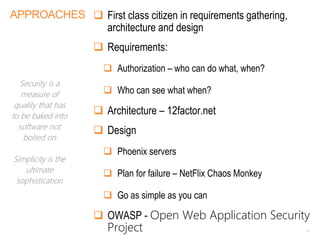
APPROACHES  First class citizen in requirements gathering,
architecture and design
 Requirements:
 Authorization – who can do what, when?
 Who can see what when?
 Architecture – 12factor.net
 Design
 Phoenix servers
 Plan for failure – NetFlix Chaos Monkey
 Go as simple as you can
 OWASP - Open Web Application Security
Project 6
Security is a
measure of
quality that has
to be baked into
software not
bolted on
Simplicity is the
ultimate
sophistication
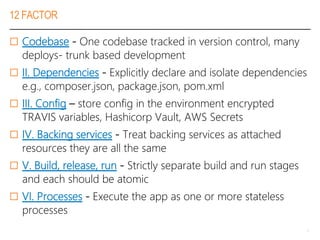
12 FACTOR
 Codebase - One codebase tracked in version control, many
deploys- trunk based development
 II. Dependencies - Explicitly declare and isolate dependencies
e.g., composer.json, package.json, pom.xml
 III. Config – store config in the environment encrypted
TRAVIS variables, Hashicorp Vault, AWS Secrets
 IV. Backing services - Treat backing services as attached
resources they are all the same
 V. Build, release, run - Strictly separate build and run stages
and each should be atomic
 VI. Processes - Execute the app as one or more stateless
processes
7
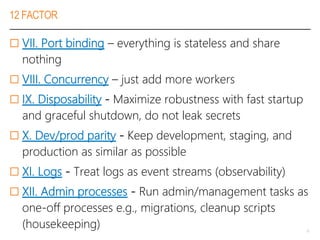
12 FACTOR
 VII. Port binding – everything is stateless and share
nothing
 VIII. Concurrency – just add more workers
 IX. Disposability - Maximize robustness with fast startup
and graceful shutdown, do not leak secrets
 X. Dev/prod parity - Keep development, staging, and
production as similar as possible
 XI. Logs - Treat logs as event streams (observability)
 XII. Admin processes - Run admin/management tasks as
one-off processes e.g., migrations, cleanup scripts
(housekeeping) 8
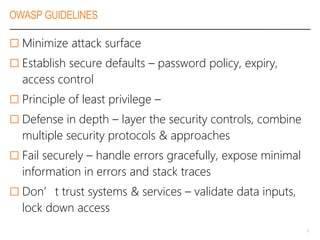
OWASP GUIDELINES
 Minimize attack surface
 Establish secure defaults – password policy, expiry,
access control
 Principle of least privilege –
 Defense in depth – layer the security controls, combine
multiple security protocols & approaches
 Fail securely – handle errors gracefully, expose minimal
information in errors and stack traces
 Don’t trust systems & services – validate data inputs,
lock down access
9
OWASP GUIDELINES
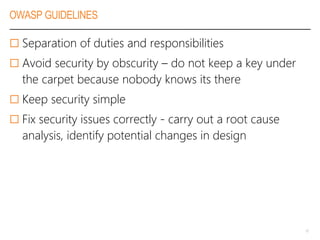
 Separation of duties and responsibilities
 Avoid security by obscurity – do not keep a key under
the carpet because nobody knows its there
 Keep security simple
 Fix security issues correctly - carry out a root cause
analysis, identify potential changes in design
10
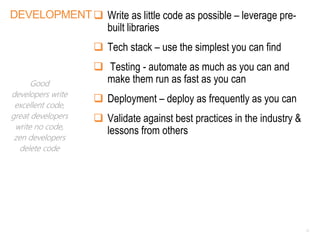
DEVELOPMENT Write as little code as possible – leverage pre-
built libraries
 Tech stack – use the simplest you can find
 Testing - automate as much as you can and
make them run as fast as you can
 Deployment – deploy as frequently as you can
 Validate against best practices in the industry &
lessons from others
11
Good
developers write
excellent code,
great developers
write no code,
zen developers
delete code
PRODUCTION
SYSTEM
SECURITY
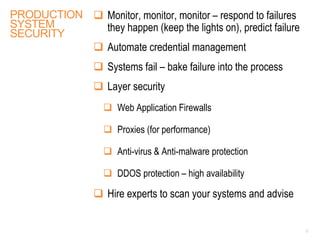
 Monitor, monitor, monitor – respond to failures
they happen (keep the lights on), predict failure
 Automate credential management
 Systems fail – bake failure into the process
 Layer security
 Web Application Firewalls
 Proxies (for performance)
 Anti-virus & Anti-malware protection
 DDOS protection – high availability
 Hire experts to scan your systems and advise
12
PRODUCTION
SYSTEM
SECURITY
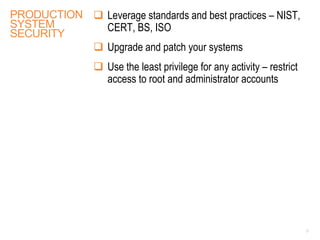
 Leverage standards and best practices – NIST,
CERT, BS, ISO
 Upgrade and patch your systems
 Use the least privilege for any activity – restrict
access to root and administrator accounts
13
DATA
SECURITY
 Secure your data at rest, in transit and storage
 Encrypt what you need
 TLS, SSL & HTTPS
 Encrypted backups???
 Datensparsamkeit – only collect and handle the
data that you need – do you need that PII, that
extra data on days visited or just aggregate
 Backup your data
 Verify the backups by restoring them
14
Trust but verify
IN CLOSING
Security is not a one off event but a continuous activity
Security is built in layers – one on top of another
Security is complex and difficult, use experts, standards and best
practices for ”your” environment & needs
AND MOST OF ALL
Security is every-body’s responsibility
1
5
THANK YOU
For questions or suggestions
@ssmusoke
http://ssmusoke.com

Application and Data Security in the Software Development Lifecycle

  • 1.
    APPLICATIONANDDATASECURITY Makerere University Faculty ofTechnology College of Design, Art and Technology By Stephen Senkomago Musoke http://ssmusoke.com O c t o b e r 2 0 1 9
  • 2.
    WHY ME?  Selftaught software tinkerer who loves growing techies  Working hard at a normal regular family life  My fair share of failed, successful, mind blowing and soul haunting projects  Served clients in UK, US, Australia, Europe, South Africa  12 years setting up, growing & running a Ugandan custom software development shop  Executive management stint - Worked in and ran a large international custom software service provider in South Africa & Uganda  4 years back to full time software delivery practice 2
  • 3.
  • 4.
    Do not under-estimatethe need for security at all levels everyone is out to get you ~Stephen Senkomago Musoke 4
  • 5.
    PRINCIPLES  Confidentiality– access is to only the data a user needs  Integrity – data is not altered outside pre-defined protocols  Availability – systems are accessible and useable to those users who need them, when they need them 5 Security is a measure of quality that has to be baked into software not bolted on Simplicity is the ultimate sophistication
  • 6.
    APPROACHES  Firstclass citizen in requirements gathering, architecture and design  Requirements:  Authorization – who can do what, when?  Who can see what when?  Architecture – 12factor.net  Design  Phoenix servers  Plan for failure – NetFlix Chaos Monkey  Go as simple as you can  OWASP - Open Web Application Security Project 6 Security is a measure of quality that has to be baked into software not bolted on Simplicity is the ultimate sophistication
  • 7.
    12 FACTOR  Codebase- One codebase tracked in version control, many deploys- trunk based development  II. Dependencies - Explicitly declare and isolate dependencies e.g., composer.json, package.json, pom.xml  III. Config – store config in the environment encrypted TRAVIS variables, Hashicorp Vault, AWS Secrets  IV. Backing services - Treat backing services as attached resources they are all the same  V. Build, release, run - Strictly separate build and run stages and each should be atomic  VI. Processes - Execute the app as one or more stateless processes 7
  • 8.
    12 FACTOR  VII.Port binding – everything is stateless and share nothing  VIII. Concurrency – just add more workers  IX. Disposability - Maximize robustness with fast startup and graceful shutdown, do not leak secrets  X. Dev/prod parity - Keep development, staging, and production as similar as possible  XI. Logs - Treat logs as event streams (observability)  XII. Admin processes - Run admin/management tasks as one-off processes e.g., migrations, cleanup scripts (housekeeping) 8
  • 9.
    OWASP GUIDELINES  Minimizeattack surface  Establish secure defaults – password policy, expiry, access control  Principle of least privilege –  Defense in depth – layer the security controls, combine multiple security protocols & approaches  Fail securely – handle errors gracefully, expose minimal information in errors and stack traces  Don’t trust systems & services – validate data inputs, lock down access 9
  • 10.
    OWASP GUIDELINES  Separationof duties and responsibilities  Avoid security by obscurity – do not keep a key under the carpet because nobody knows its there  Keep security simple  Fix security issues correctly - carry out a root cause analysis, identify potential changes in design 10
  • 11.
    DEVELOPMENT Write aslittle code as possible – leverage pre- built libraries  Tech stack – use the simplest you can find  Testing - automate as much as you can and make them run as fast as you can  Deployment – deploy as frequently as you can  Validate against best practices in the industry & lessons from others 11 Good developers write excellent code, great developers write no code, zen developers delete code
  • 12.
    PRODUCTION SYSTEM SECURITY  Monitor, monitor,monitor – respond to failures they happen (keep the lights on), predict failure  Automate credential management  Systems fail – bake failure into the process  Layer security  Web Application Firewalls  Proxies (for performance)  Anti-virus & Anti-malware protection  DDOS protection – high availability  Hire experts to scan your systems and advise 12
  • 13.
    PRODUCTION SYSTEM SECURITY  Leverage standardsand best practices – NIST, CERT, BS, ISO  Upgrade and patch your systems  Use the least privilege for any activity – restrict access to root and administrator accounts 13
  • 14.
    DATA SECURITY  Secure yourdata at rest, in transit and storage  Encrypt what you need  TLS, SSL & HTTPS  Encrypted backups???  Datensparsamkeit – only collect and handle the data that you need – do you need that PII, that extra data on days visited or just aggregate  Backup your data  Verify the backups by restoring them 14 Trust but verify
  • 15.
    IN CLOSING Security isnot a one off event but a continuous activity Security is built in layers – one on top of another Security is complex and difficult, use experts, standards and best practices for ”your” environment & needs AND MOST OF ALL Security is every-body’s responsibility 1 5
  • 16.
    THANK YOU For questionsor suggestions @ssmusoke http://ssmusoke.com