


Advanced dynamic analysis
for leak detection
Jim Clause
Chris Friesen - Manager
Analysis Tools Group
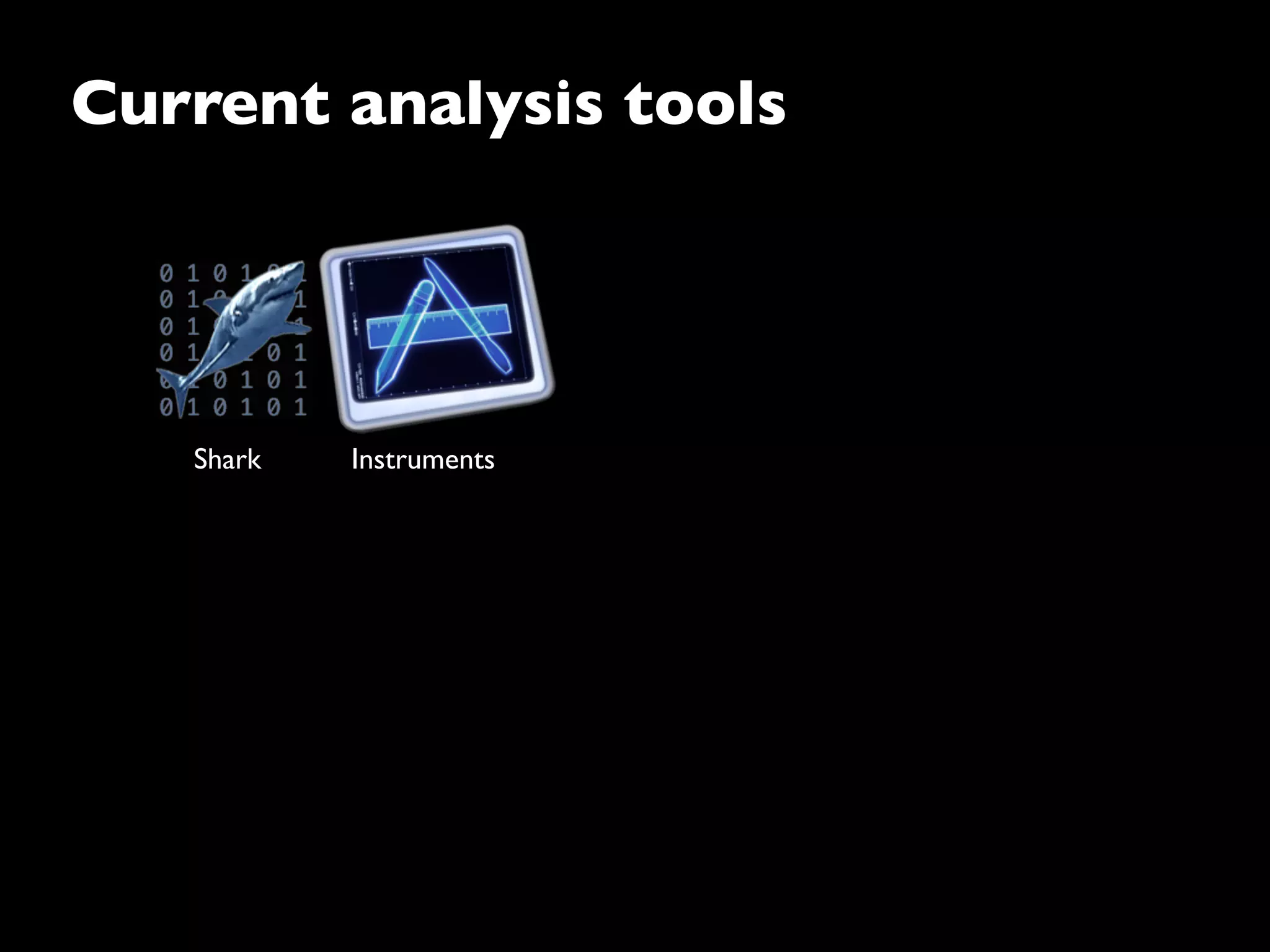
Current analysis tools
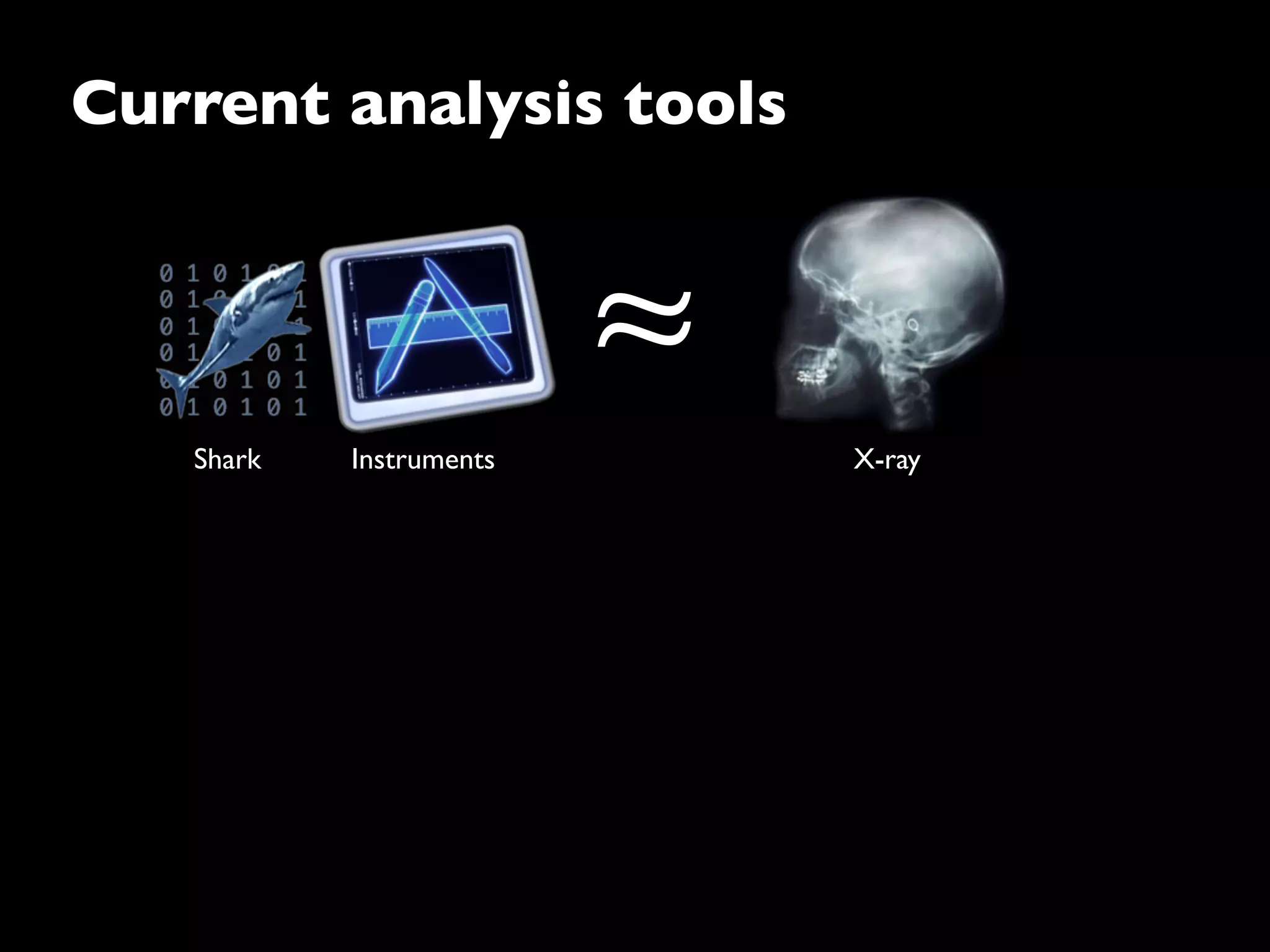
Shark Instruments
≈
X-ray
Current analysis tools
Shark Instruments
≈
X-ray
MRI
Current analysis tools
Shark Instruments
≈
X-ray
MRI
Current analysis tools
Shark Instruments
≈?
≈
X-ray
MRI
Current analysis tools
Shark Instruments
C
A
B
312
Z
3
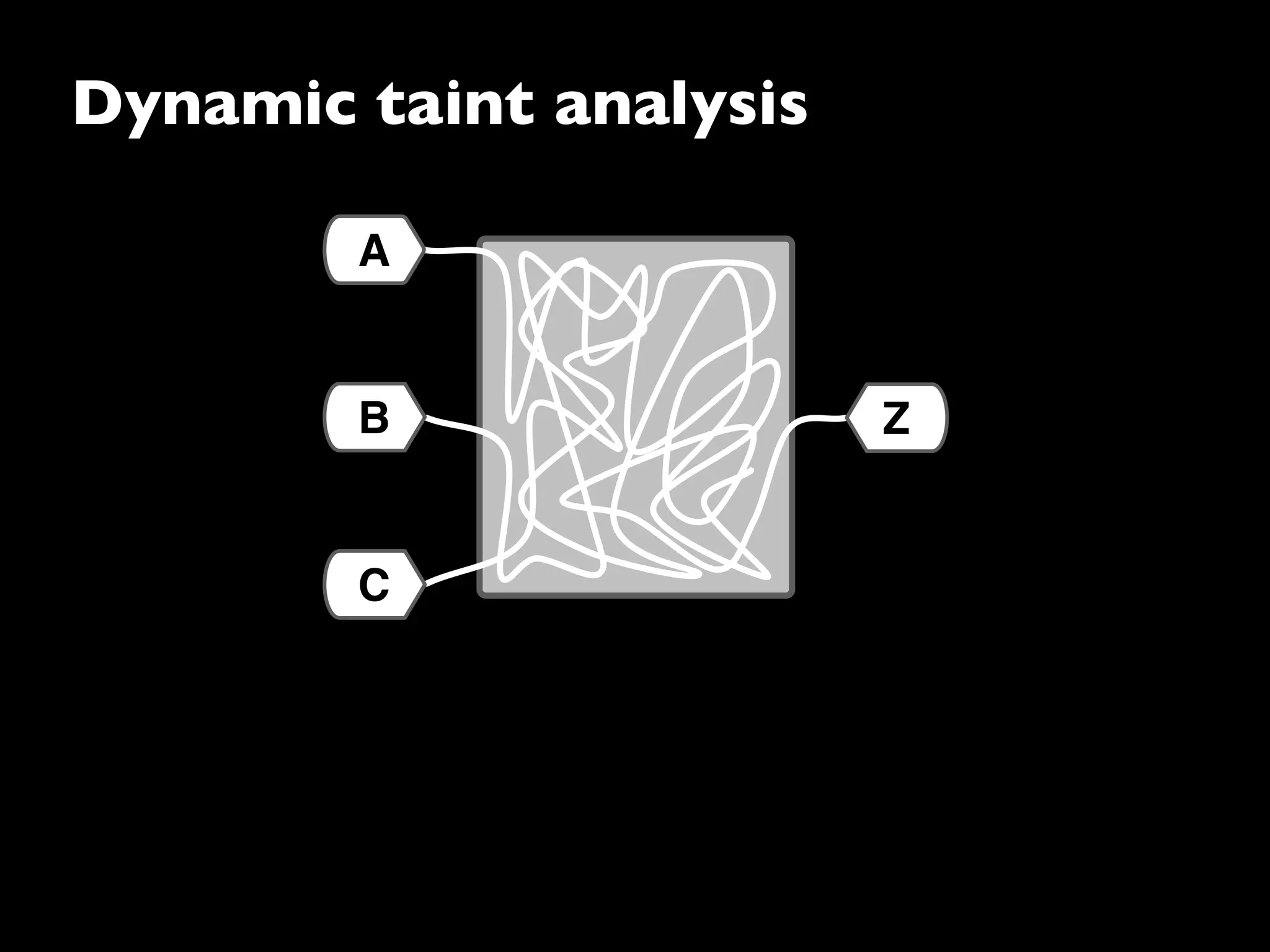
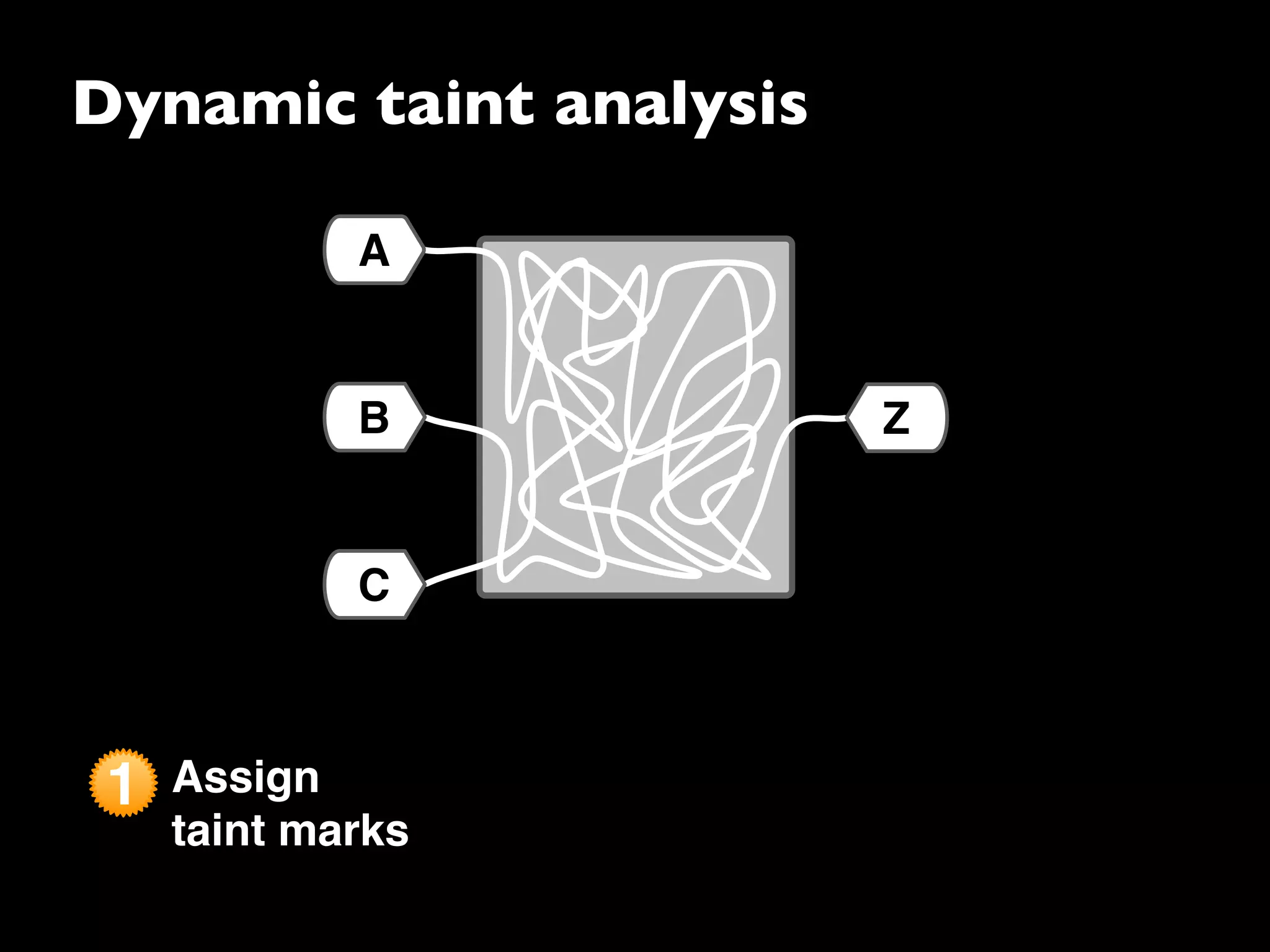
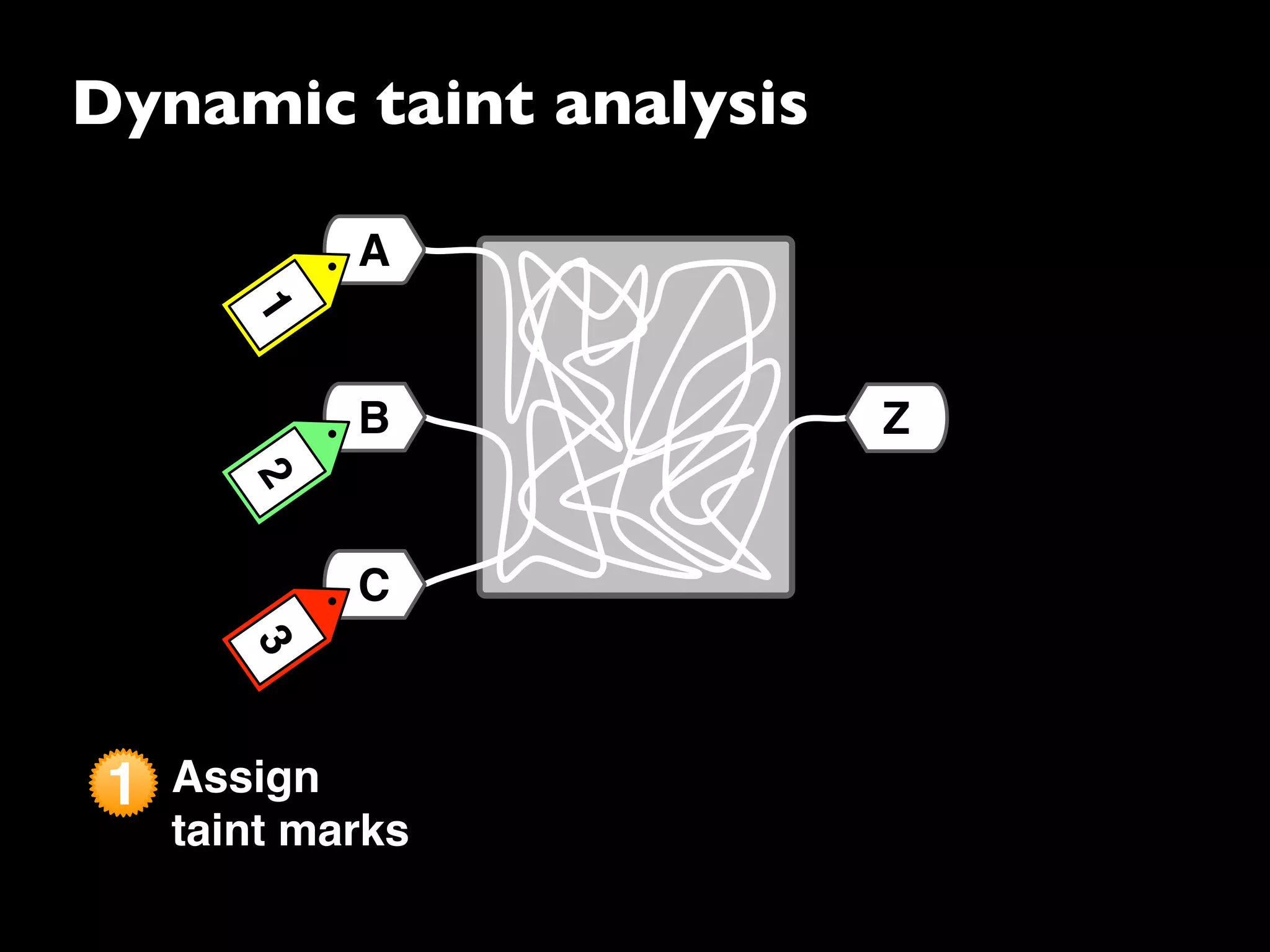
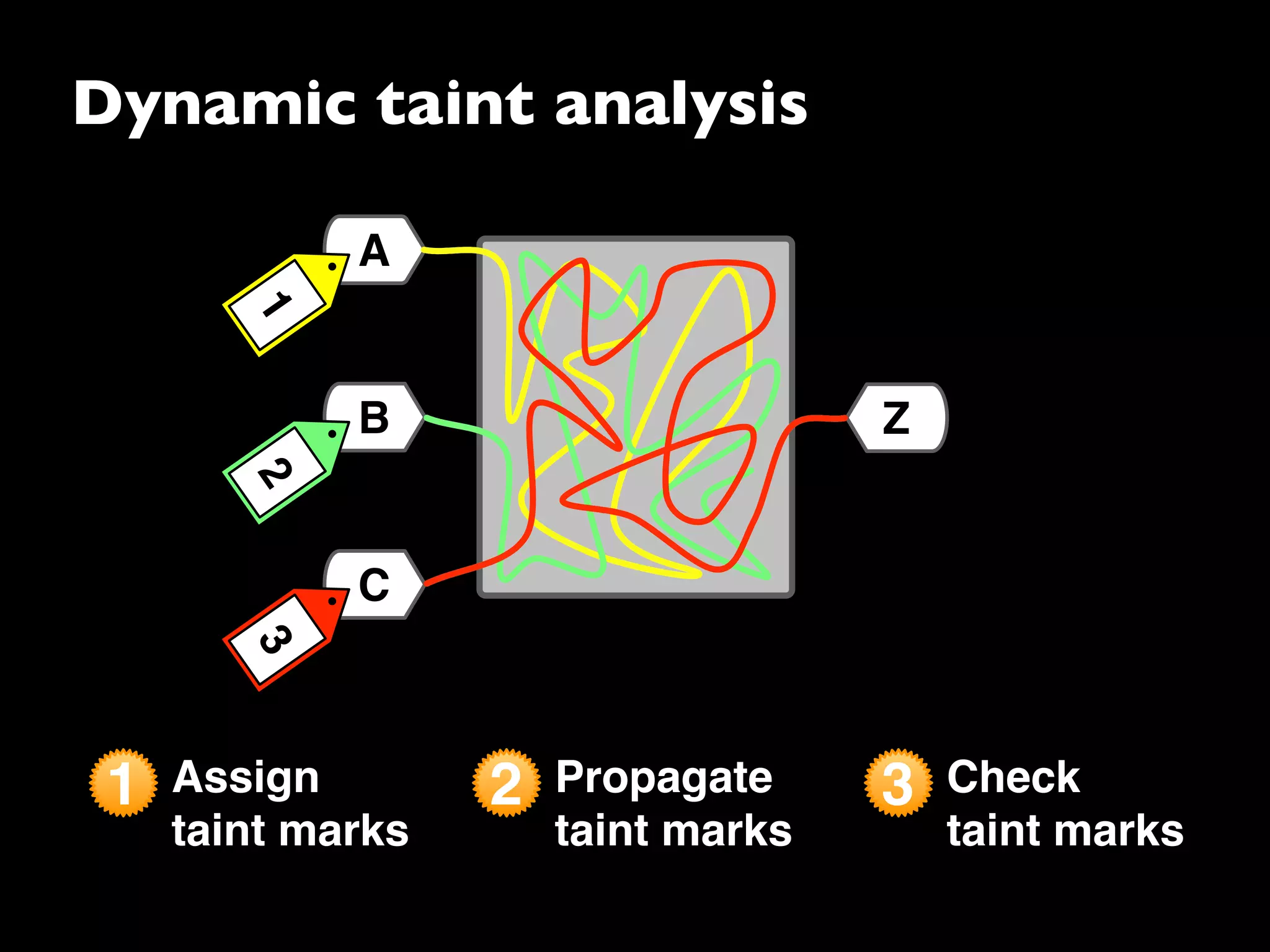
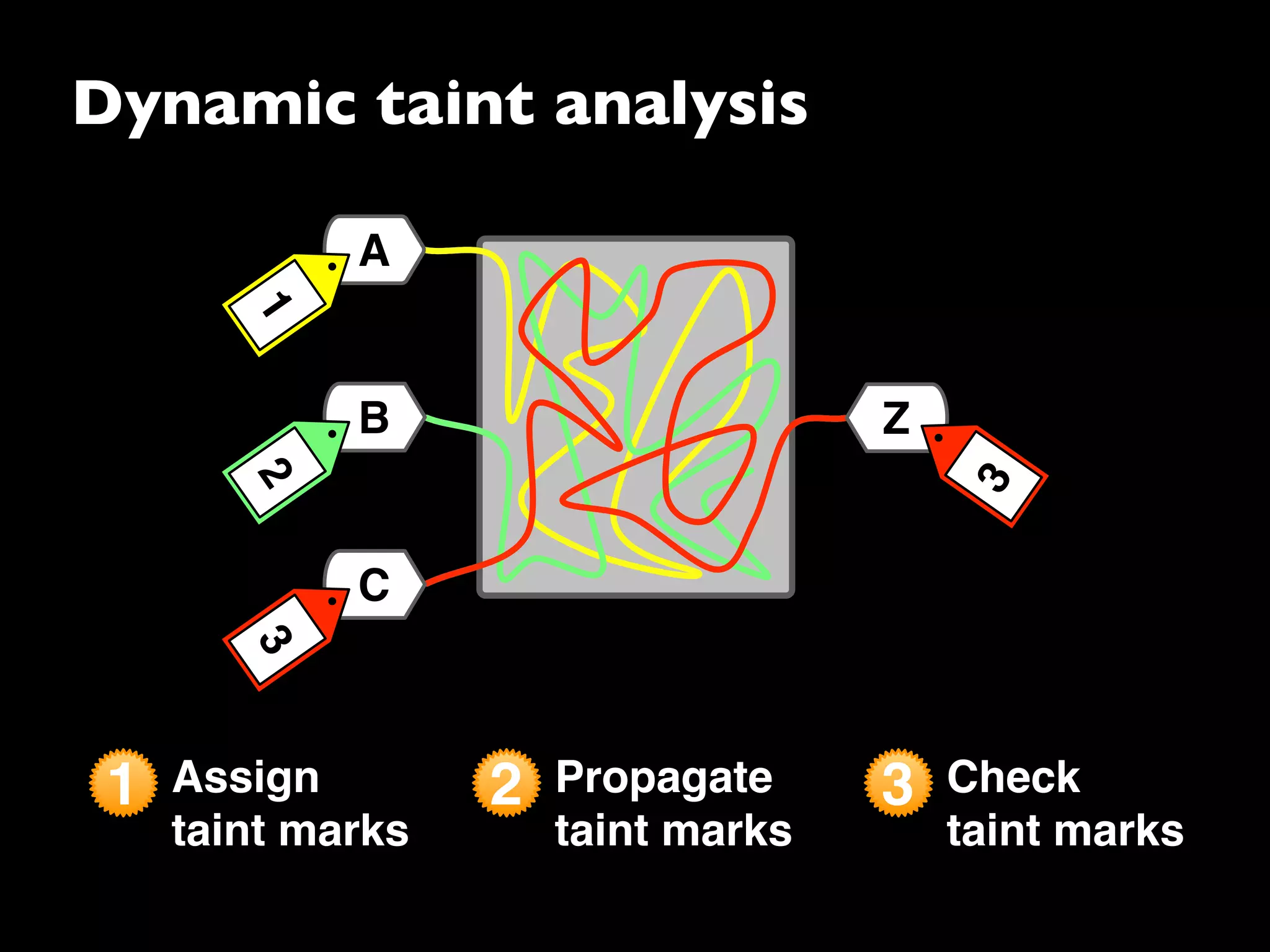
Dynamic taint analysis
≈
Dynamic taint analysis
C
A
B Z
Dynamic taint analysis
1 Assign
taint marks
C
A
B Z
Dynamic taint analysis
1 Assign
taint marks
C
A
B
312
Z
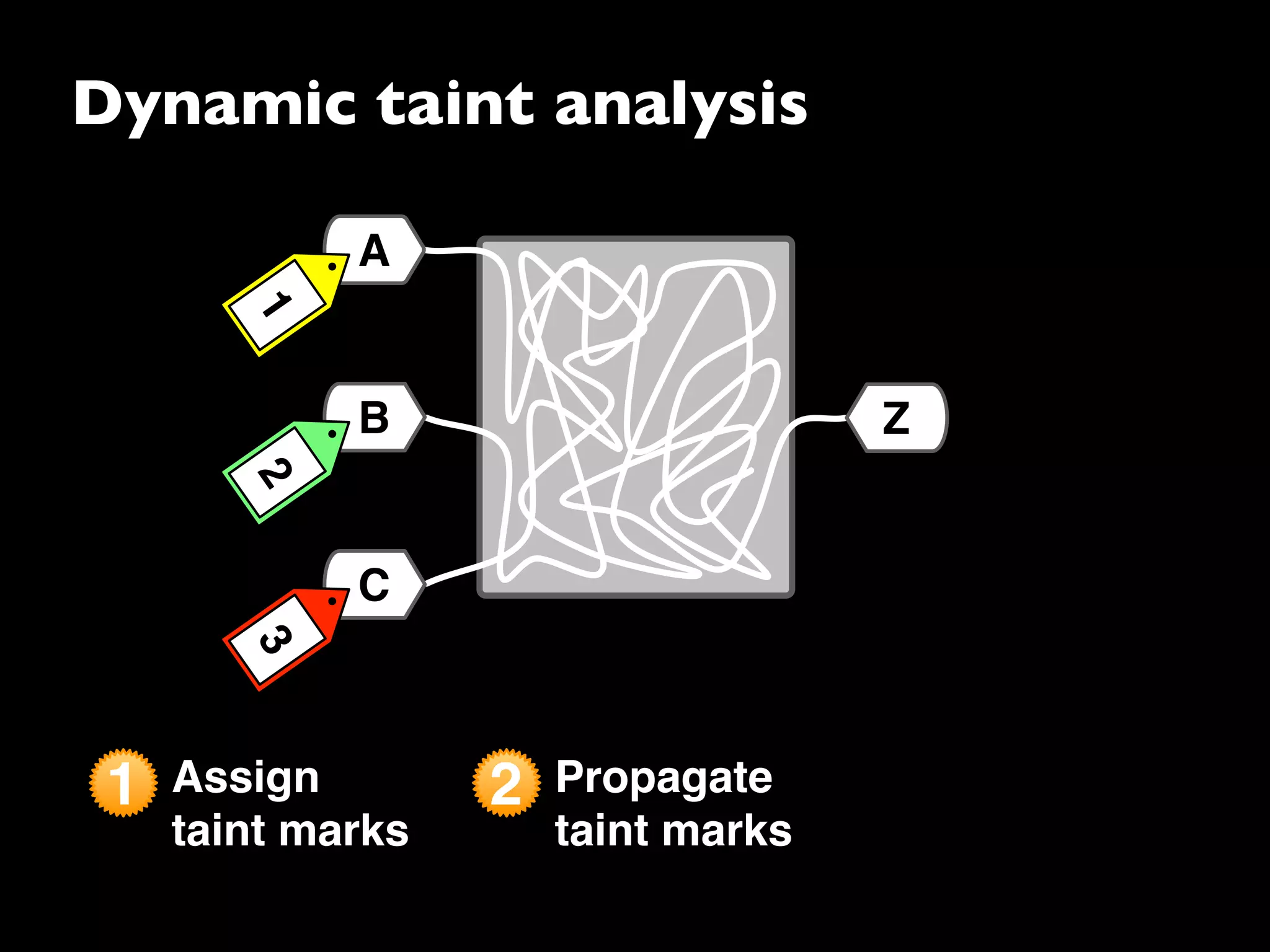
Dynamic taint analysis
1 Assign
taint marks
2 Propagate
taint marks
C
A
B
312
Z
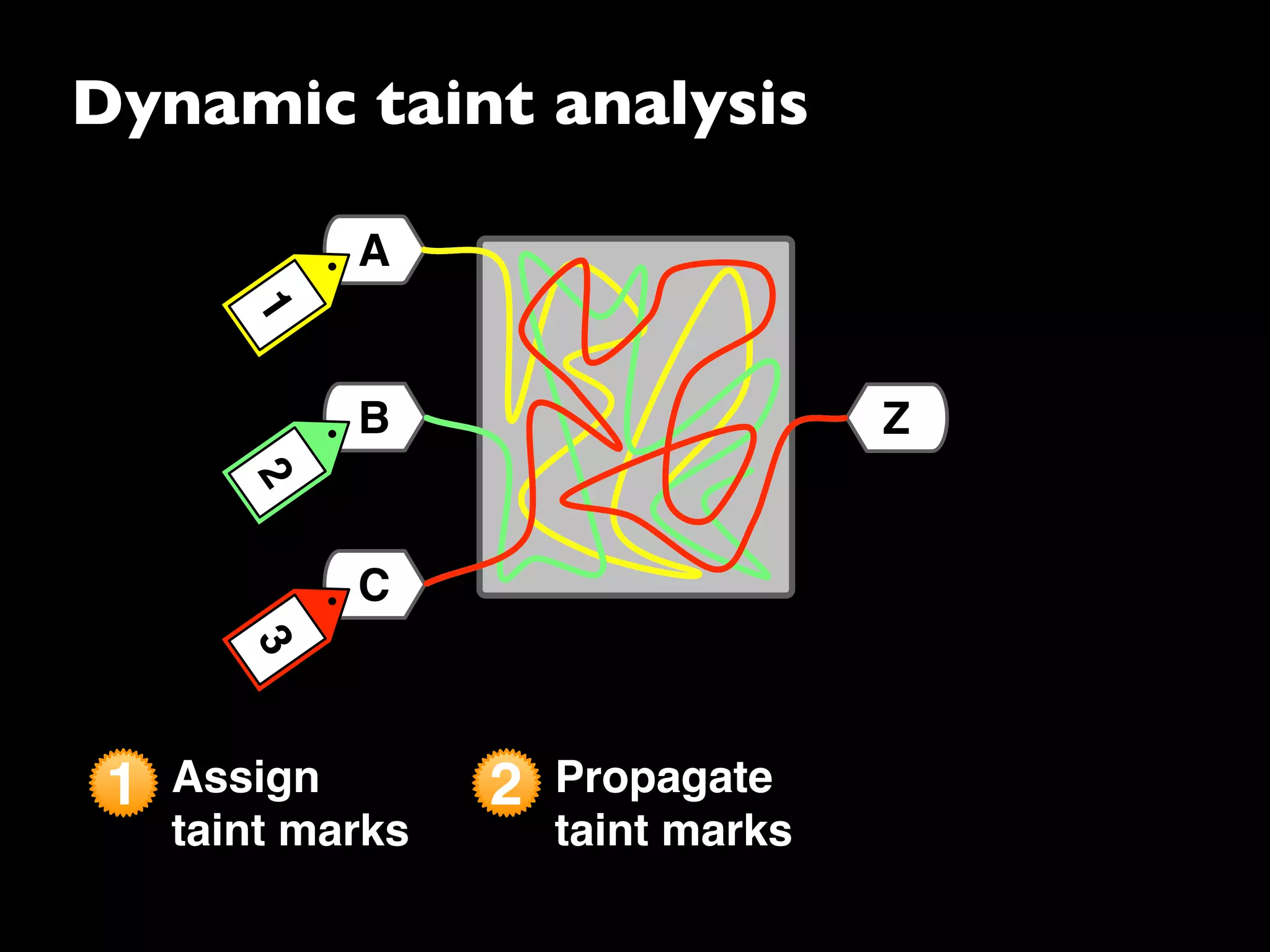
Dynamic taint analysis
1 Assign
taint marks
2 Propagate
taint marks
C
A
B
312
Z
Dynamic taint analysis
1 Assign
taint marks
3 Check
taint marks
2 Propagate
taint marks
C
A
B
312
Z
Dynamic taint analysis
1 Assign
taint marks
3 Check
taint marks
2 Propagate
taint marks
C
A
B
312
Z
C
A
B
312
Z
3
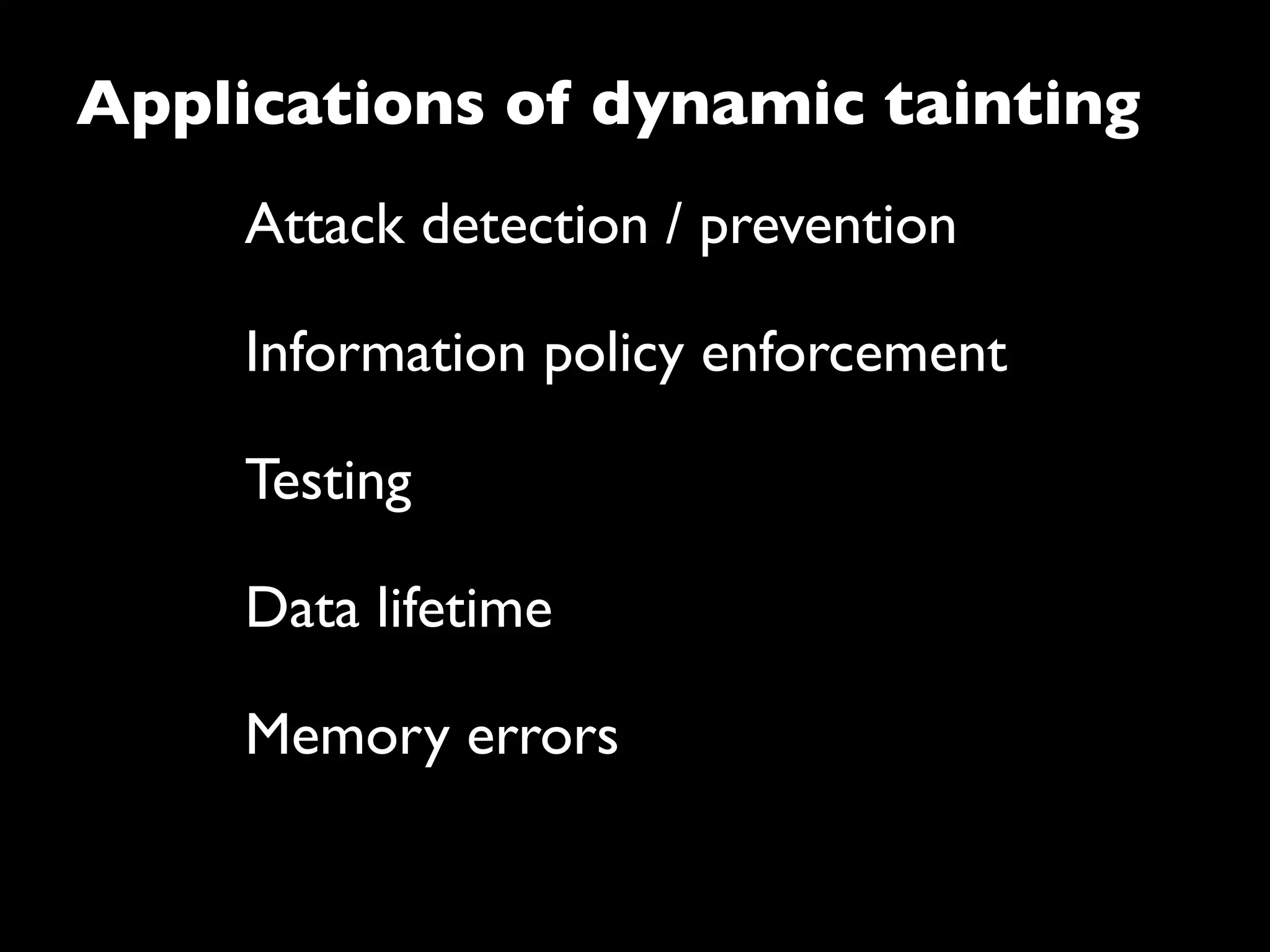
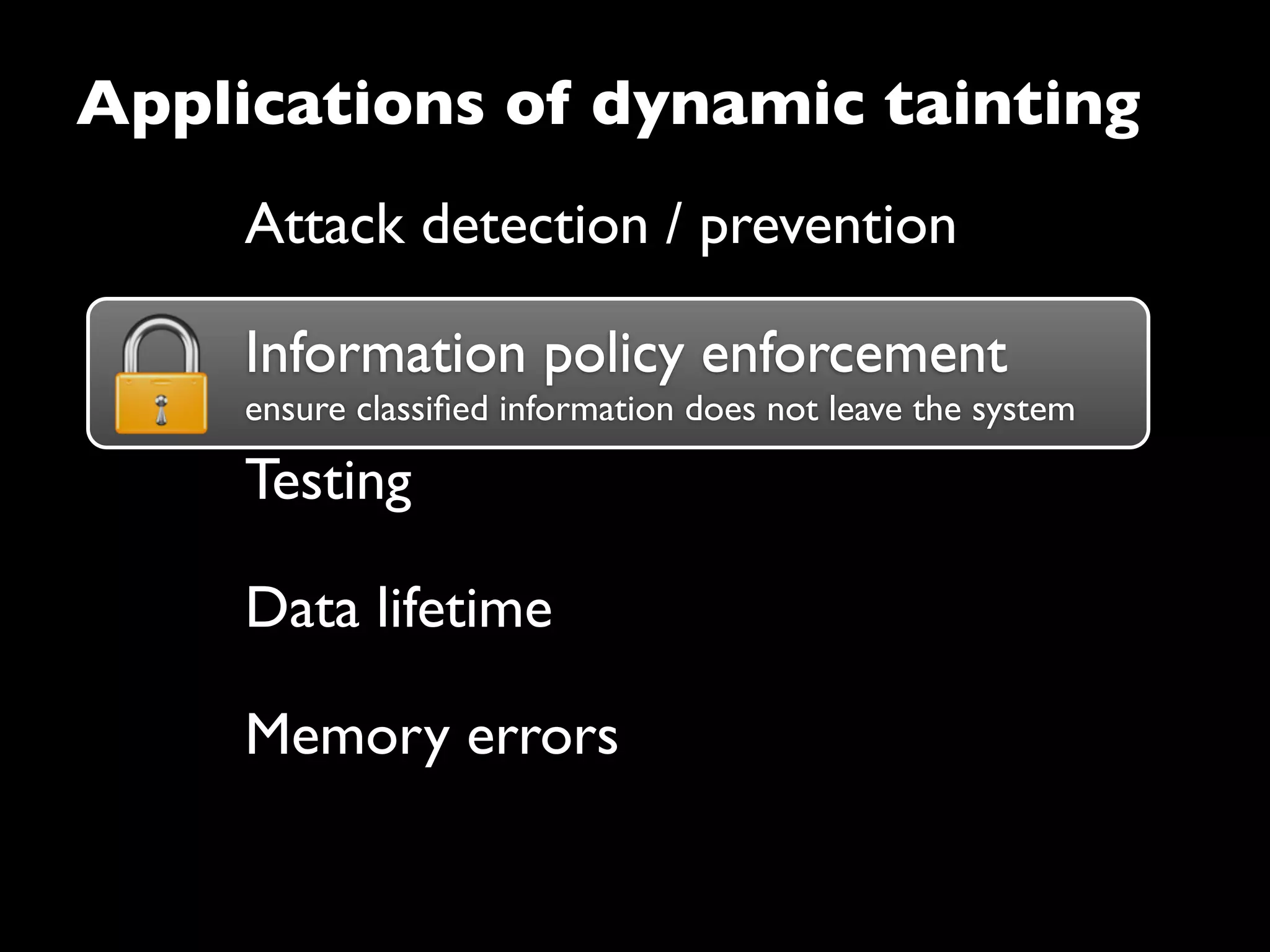
Attack detection / prevention
Information policy enforcement
Testing
Data lifetime
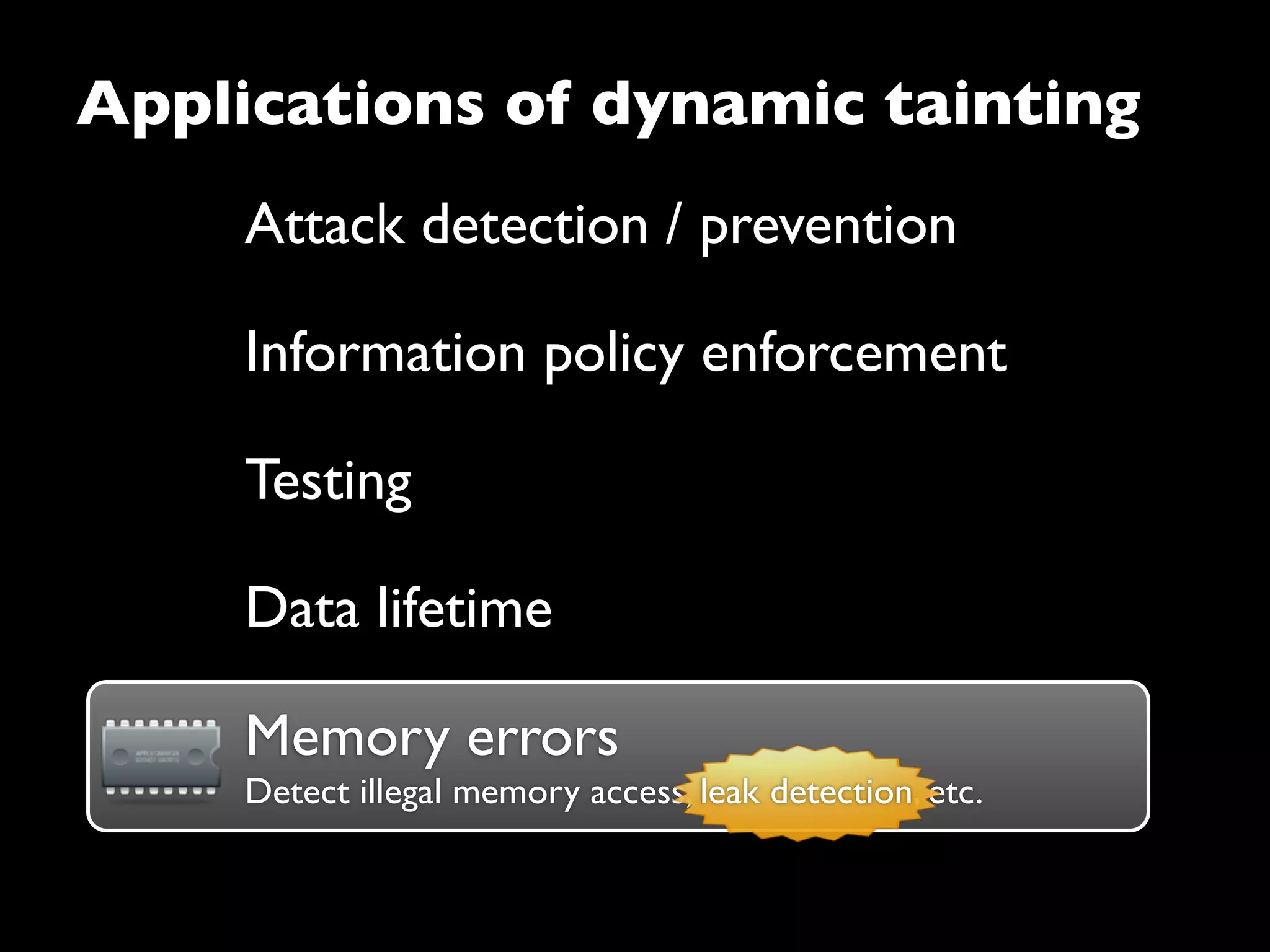
Applications of dynamic tainting
Memory errors
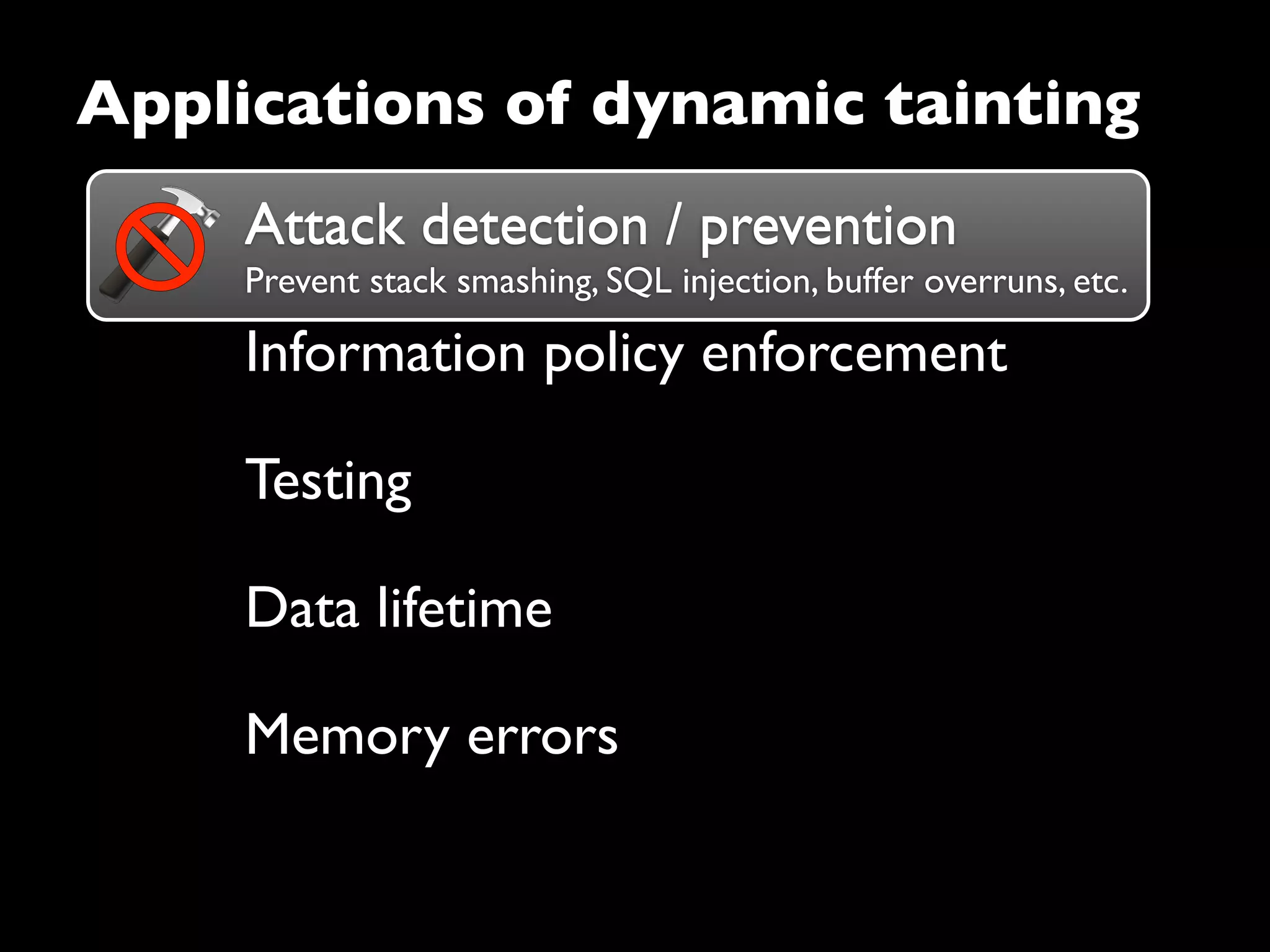
Attack detection / prevention
Prevent stack smashing, SQL injection, buffer overruns, etc.
Attack detection / prevention
Information policy enforcement
Testing
Data lifetime
Applications of dynamic tainting
Memory errors
Information policy enforcement
ensure classified information does not leave the system
Attack detection / prevention
Information policy enforcement
Testing
Data lifetime
Applications of dynamic tainting
Memory errors
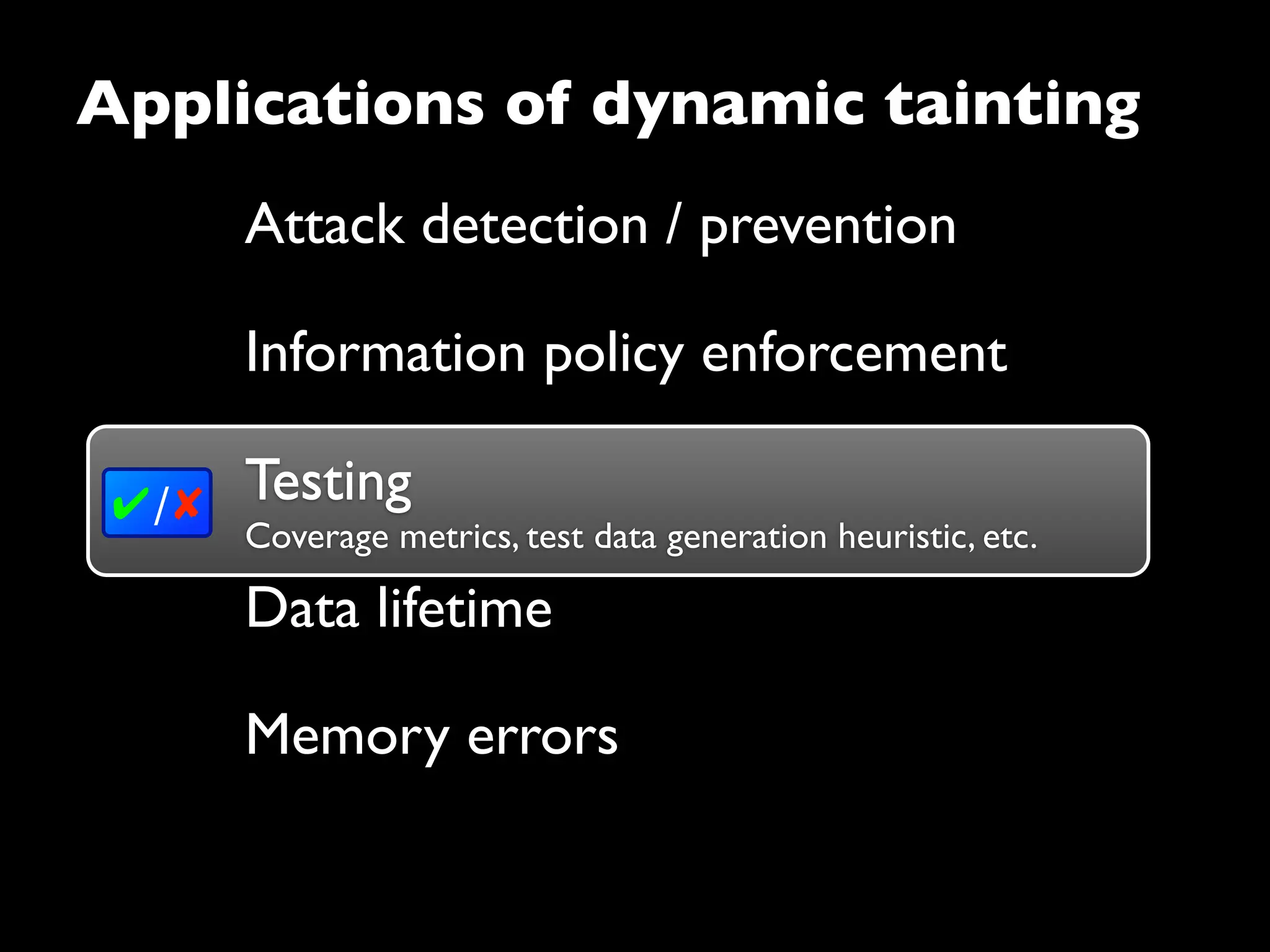
Testing
Coverage metrics, test data generation heuristic, etc.
✔/✘
Attack detection / prevention
Information policy enforcement
Testing
Data lifetime
Applications of dynamic tainting
Memory errors
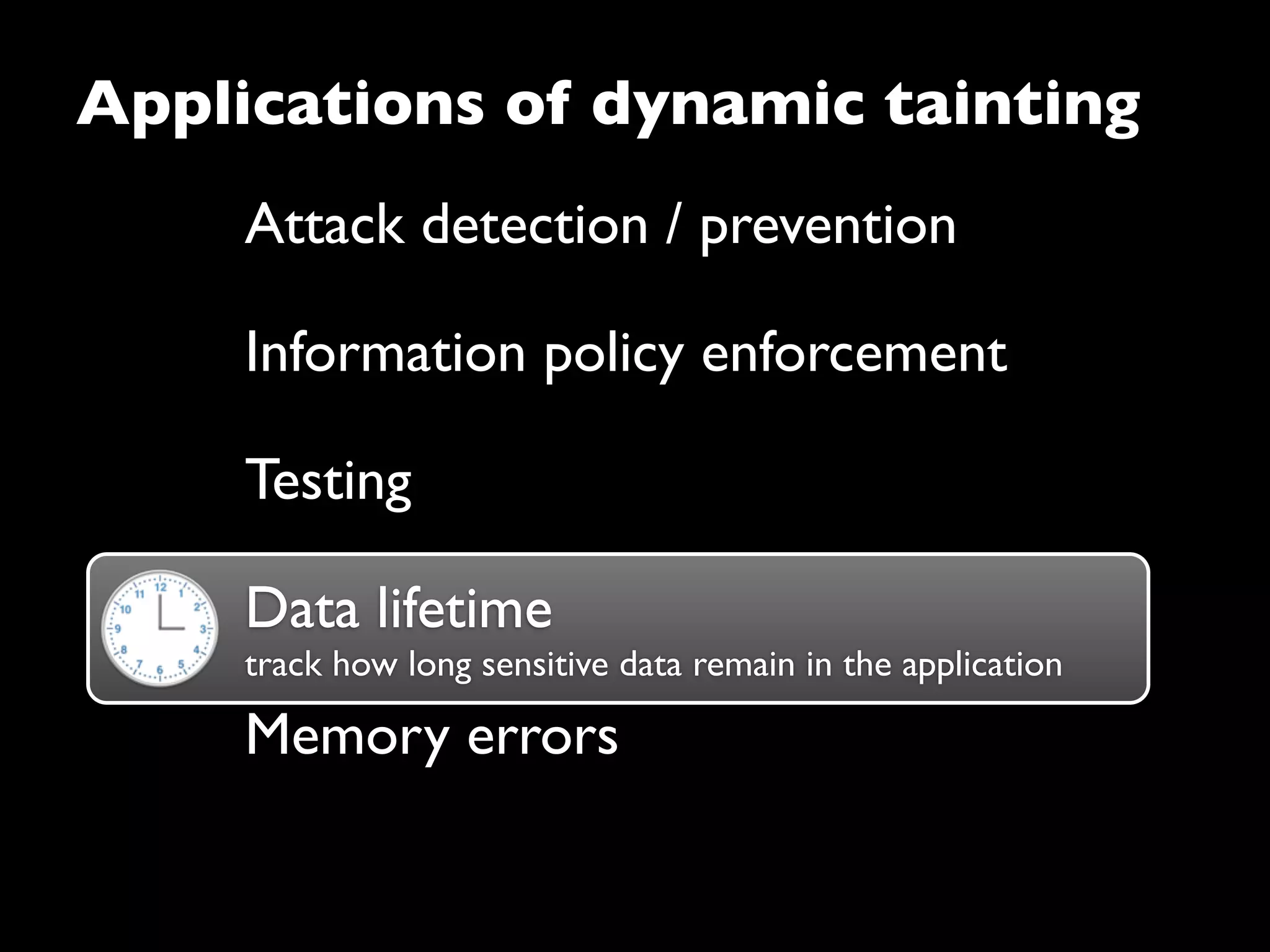
Data lifetime
track how long sensitive data remain in the application
Attack detection / prevention
Information policy enforcement
Testing
Data lifetime
Applications of dynamic tainting
Memory errors
Attack detection / prevention
Information policy enforcement
Testing
Data lifetime
Applications of dynamic tainting
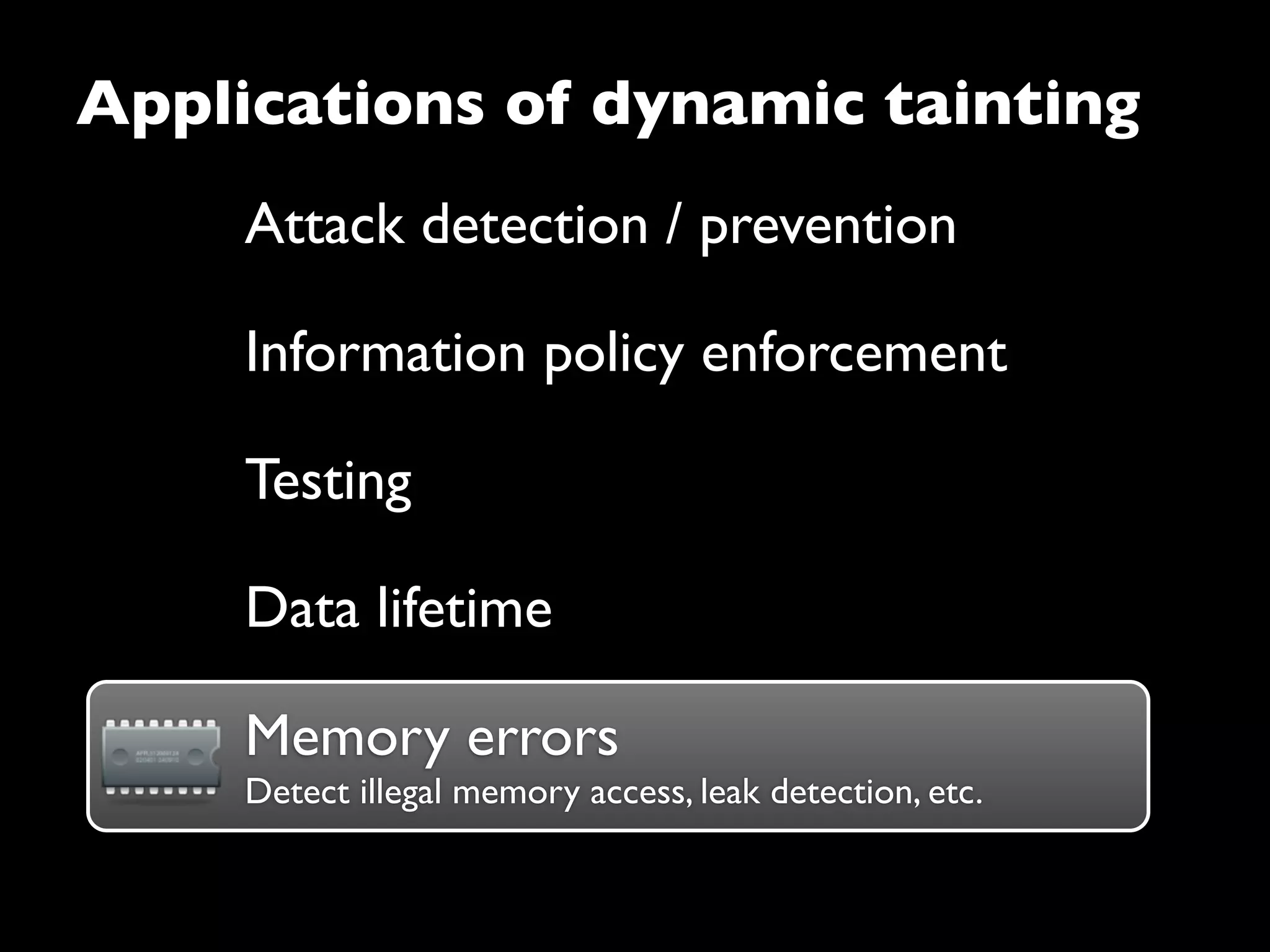
Memory errorsMemory errors
Detect illegal memory access, leak detection, etc.
Attack detection / prevention
Information policy enforcement
Testing
Data lifetime
Applications of dynamic tainting
Memory errorsMemory errors
Detect illegal memory access, leak detection, etc.leak detection
Detecting leaks is easy, fixing them is hard
@interface Container:NSObject {
	 id _object;
}
@end
@implementation Container
- (void) dealloc {
	 //[_object release];
	 [super dealloc];
}
- (void) setObject:(id)obj {
	 [_object release];
	 _object = [obj retain];
}
@end
Detecting leaks is easy, fixing them is hard
@interface Container:NSObject {
	 id _object;
}
@end
@implementation Container
- (void) dealloc {
	 //[_object release];
	 [super dealloc];
}
- (void) setObject:(id)obj {
	 [_object release];
	 _object = [obj retain];
}
@end
Container *create() {
	 Container *c =
	 	 [[Container alloc] init];
	 NSObject *o =
	 	 [[NSObject alloc] init];
	 [c setObject:o];
	 [o release];
	
	 return c;
}
int main(...) {
	 Container *c = create();
	 …
	 [c release];
}
Detecting leaks is easy, fixing them is hard
@interface Container:NSObject {
	 id _object;
}
@end
@implementation Container
- (void) dealloc {
	 //[_object release];
	 [super dealloc];
}
- (void) setObject:(id)obj {
	 [_object release];
	 _object = [obj retain];
}
@end
Container *create() {
	 Container *c =
	 	 [[Container alloc] init];
	 NSObject *o =
	 	 [[NSObject alloc] init];
	 [c setObject:o];
	 [o release];
	
	 return c;
}
int main(...) {
	 Container *c = create();
	 …
	 [c release];
}
leaks:
This object is leaked
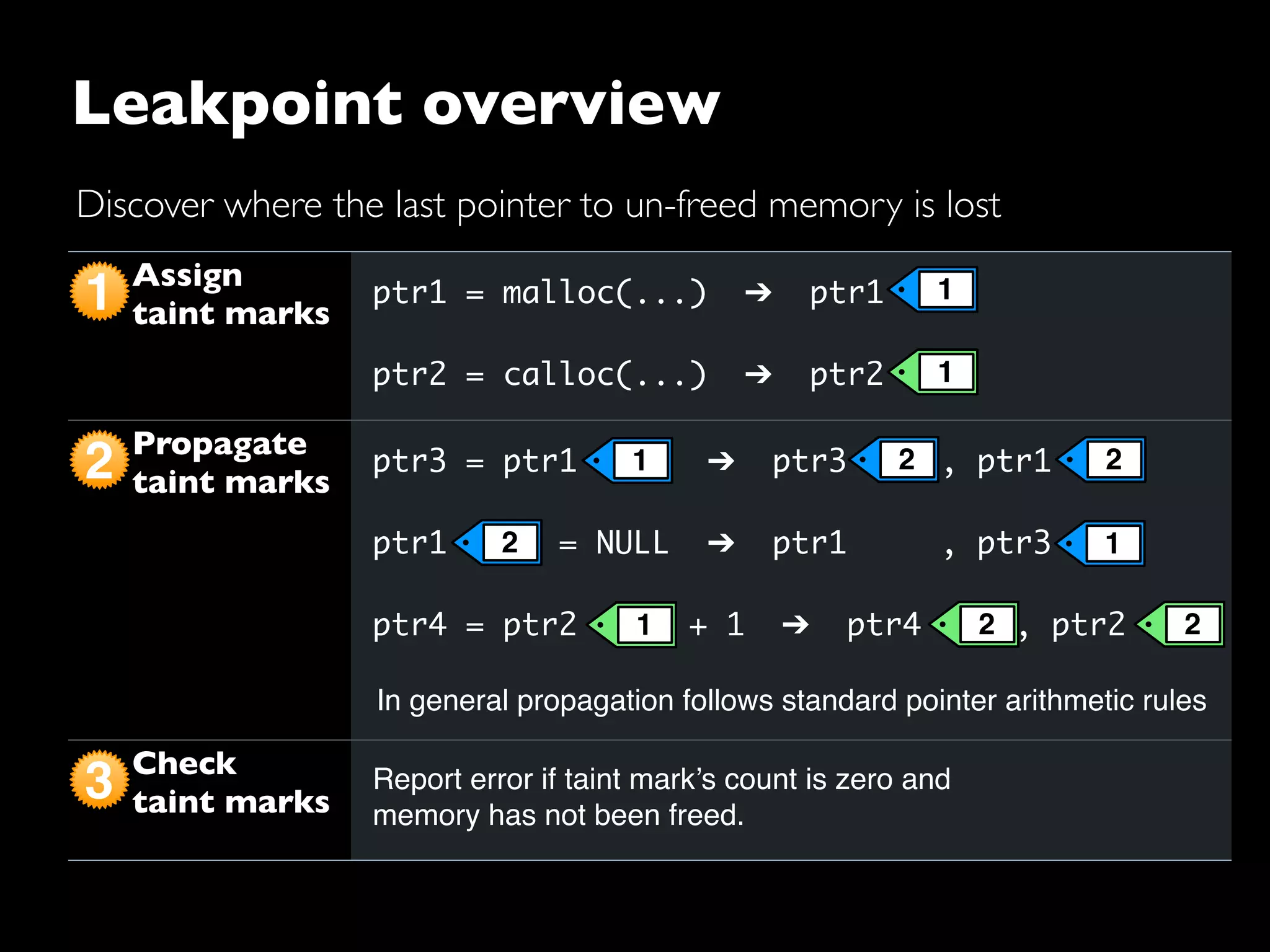
Leakpoint overview
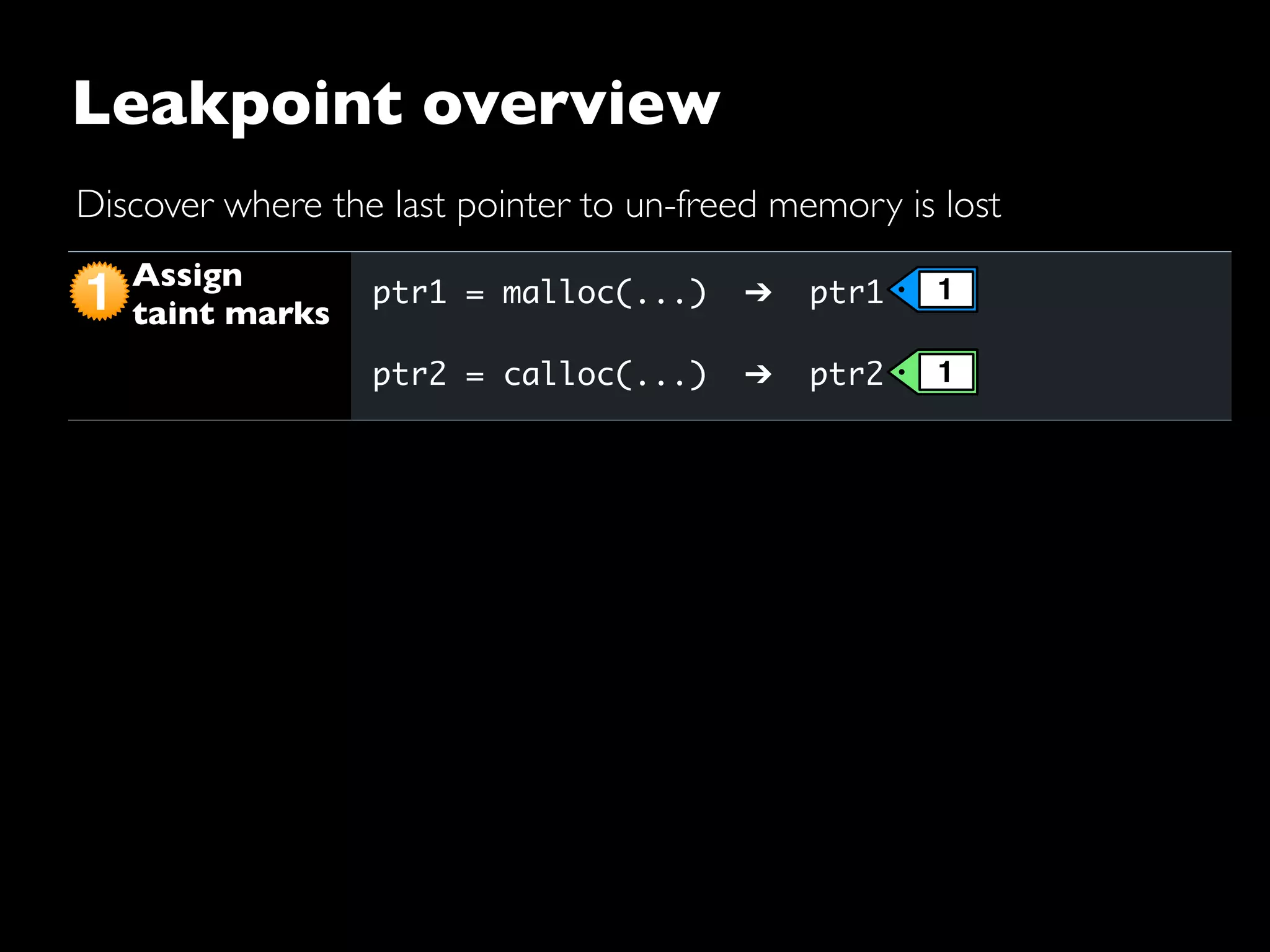
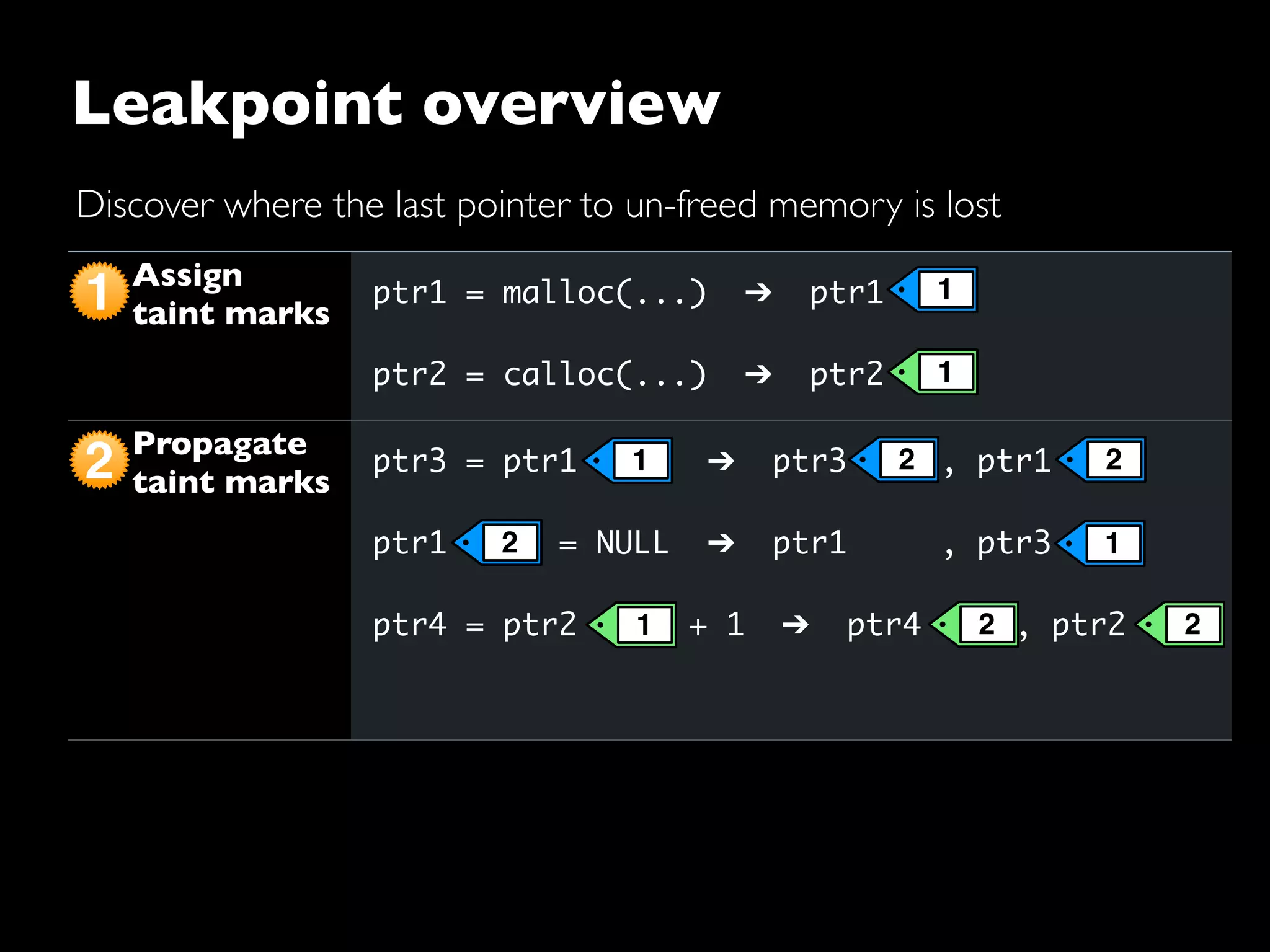
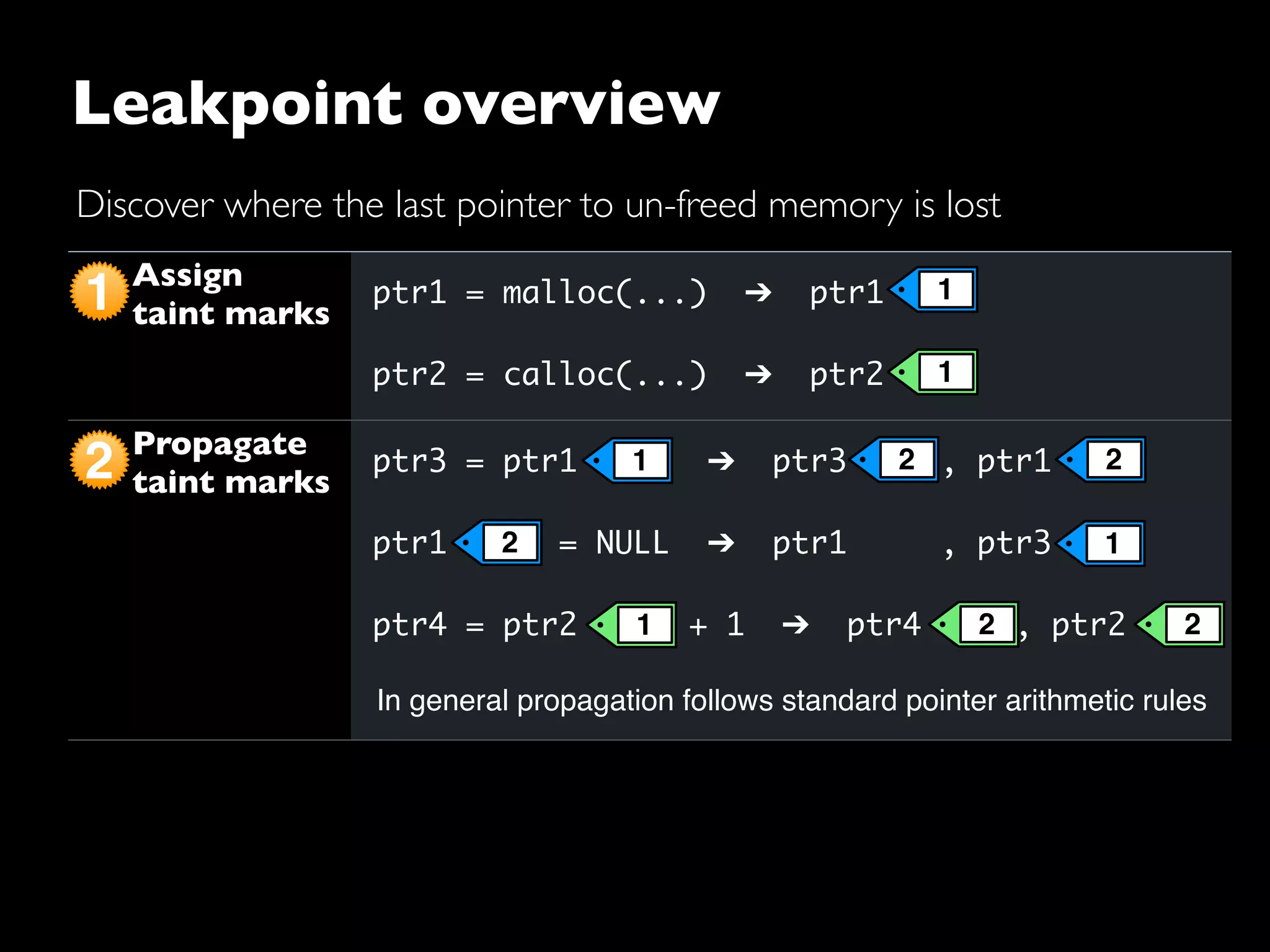
Discover where the last pointer to un-freed memory is lost
Leakpoint overview
Assign
taint marks
Propagate
taint marks
Check
taint marks
ptr1 = malloc(...) ➔ ptr1
ptr2 = calloc(...) ➔ ptr2
ptr3 = ptr1 ➔ ptr3 , ptr1
ptr1 = NULL ➔ ptr1 , ptr3
ptr4 = ptr2 + 1 ➔ ptr4 , ptr2
Report error if taint mark’s count is zero and
memory has not been freed.
1 1
1
Discover where the last pointer to un-freed memory is lost
Leakpoint overview
Assign
taint marks
Propagate
taint marks
Check
taint marks
ptr1 = malloc(...) ➔ ptr1
ptr2 = calloc(...) ➔ ptr2
ptr3 = ptr1 ➔ ptr3 , ptr1
ptr1 = NULL ➔ ptr1 , ptr3
ptr4 = ptr2 + 1 ➔ ptr4 , ptr2
Report error if taint mark’s count is zero and
memory has not been freed.
2
1 1
1
1 2
2
2
1
1 2 2
Discover where the last pointer to un-freed memory is lost
Leakpoint overview
Assign
taint marks
Propagate
taint marks
Check
taint marks
ptr1 = malloc(...) ➔ ptr1
ptr2 = calloc(...) ➔ ptr2
ptr3 = ptr1 ➔ ptr3 , ptr1
ptr1 = NULL ➔ ptr1 , ptr3
ptr4 = ptr2 + 1 ➔ ptr4 , ptr2
Report error if taint mark’s count is zero and
memory has not been freed.
2
1 1
1
1 2
2
2
1
1 2 2
In general propagation follows standard pointer arithmetic rules
Discover where the last pointer to un-freed memory is lost
Leakpoint overview
Assign
taint marks
Propagate
taint marks
Check
taint marks
ptr1 = malloc(...) ➔ ptr1
ptr2 = calloc(...) ➔ ptr2
ptr3 = ptr1 ➔ ptr3 , ptr1
ptr1 = NULL ➔ ptr1 , ptr3
ptr4 = ptr2 + 1 ➔ ptr4 , ptr2
Report error if taint mark’s count is zero and
memory has not been freed.
2
3
1 1
1
1 2
2
2
1
1 2 2
In general propagation follows standard pointer arithmetic rules
Discover where the last pointer to un-freed memory is lost
@interface Container:NSObject {
	 id _object;
}
@end
@implementation Container
- (void) dealloc {
	 [super dealloc];
}
- (void) setObject:(id)obj {
	 [_object release];
	 _object = [obj retain];
}
@end
Container *create() {
	 Container *c =
	 	 [[Container alloc] init];
	 NSObject *o =
	 	 [[NSObject alloc] init];
	 [c setObject:o];
	 [o release];
	
	 return c;
}
int main(...) {
	 Container *c = create();
	 …
	 [c release];
}
Detecting leaks is easy, fixing them is easier
@interface Container:NSObject {
	 id _object;
}
@end
@implementation Container
- (void) dealloc {
	 [super dealloc];
}
- (void) setObject:(id)obj {
	 [_object release];
	 _object = [obj retain];
}
@end
Container *create() {
	 Container *c =
	 	 [[Container alloc] init];
	 NSObject *o =
	 	 [[NSObject alloc] init];
	 [c setObject:o];
	 [o release];
	
	 return c;
}
int main(...) {
	 Container *c = create();
	 …
	 [c release];
}
leakpoint:
This object is leaked
Detecting leaks is easy, fixing them is easier
@interface Container:NSObject {
	 id _object;
}
@end
@implementation Container
- (void) dealloc {
	 [super dealloc];
}
- (void) setObject:(id)obj {
	 [_object release];
	 _object = [obj retain];
}
@end
Container *create() {
	 Container *c =
	 	 [[Container alloc] init];
	 NSObject *o =
	 	 [[NSObject alloc] init];
	 [c setObject:o];
	 [o release];
	
	 return c;
}
int main(...) {
	 Container *c = create();
	 …
	 [c release];
}
leakpoint:
Last reference was lost here
leakpoint:
This object is leaked
Detecting leaks is easy, fixing them is easier
@interface Container:NSObject {
	 id _object;
}
@end
@implementation Container
- (void) dealloc {
	 [super dealloc];
}
- (void) setObject:(id)obj {
	 [_object release];
	 _object = [obj retain];
}
@end
Container *create() {
	 Container *c =
	 	 [[Container alloc] init];
	 NSObject *o =
	 	 [[NSObject alloc] init];
	 [c setObject:o];
	 [o release];
	
	 return c;
}
int main(...) {
	 Container *c = create();
	 …
	 [c release];
}
	 [_object release];
leakpoint:
Last reference was lost here
leakpoint:
This object is leaked
Detecting leaks is easy, fixing them is easier
Leakpoint implementation
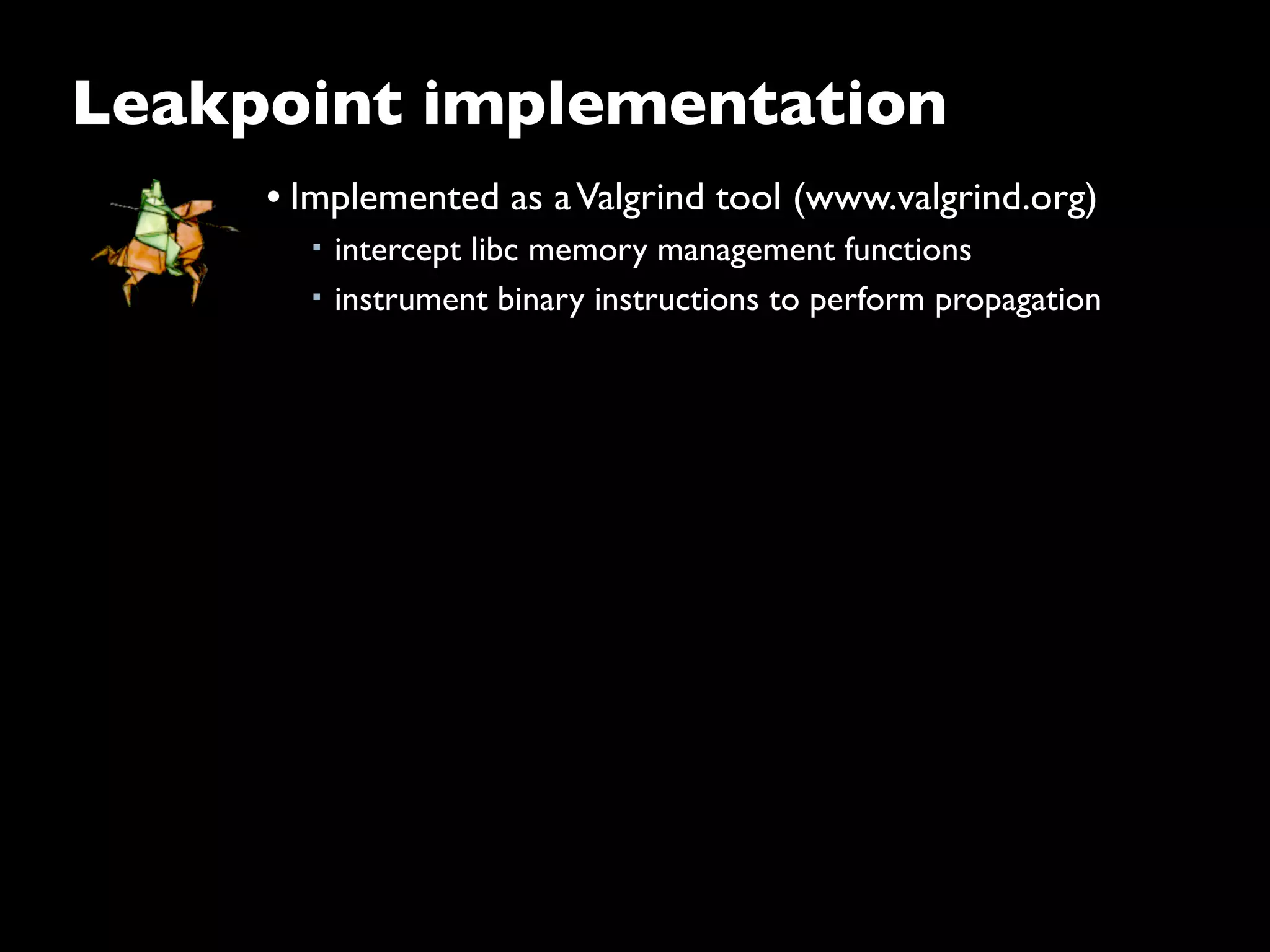
• Implemented as aValgrind tool (www.valgrind.org)
■ intercept libc memory management functions
■ instrument binary instructions to perform propagation
Lost pointer to 0x1C93AC0 (16 bytes)
 allocated at:
  at calloc+105
  by _internal_class_createInstanceFromZone+149
  by _internal_class_createInstance+31
  by +[NSObject allocWithZone:]+155 (NSObject.m:445)
  by +[NSObject alloc]+41 (NSObject.m:432)
  by create+97 (main.m:29)
  by main+17 (main.m:38)
 leaked at:
  at free+103
  by _internal_object_dispose+81
  by NSDeallocateObject+223 (NSObject.m:207)
  by -[Container dealloc]+53 (container.m:13)
  by main+43 (main.m:40)
Leakpoint implementation
• Implemented as aValgrind tool (www.valgrind.org)
■ intercept libc memory management functions
■ instrument binary instructions to perform propagation
leaks
Lost pointer to 0x1C93AC0 (16 bytes)
 allocated at:
  at calloc+105
  by _internal_class_createInstanceFromZone+149
  by _internal_class_createInstance+31
  by +[NSObject allocWithZone:]+155 (NSObject.m:445)
  by +[NSObject alloc]+41 (NSObject.m:432)
  by create+97 (main.m:29)
  by main+17 (main.m:38)
 leaked at:
  at free+103
  by _internal_object_dispose+81
  by NSDeallocateObject+223 (NSObject.m:207)
  by -[Container dealloc]+53 (container.m:13)
  by main+43 (main.m:40)
Leakpoint implementation
• Implemented as aValgrind tool (www.valgrind.org)
■ intercept libc memory management functions
■ instrument binary instructions to perform propagation
leakpoint
leaks
Lost pointer to 0x1C93AC0 (16 bytes)
 allocated at:
  at calloc+105
  by _internal_class_createInstanceFromZone+149
  by _internal_class_createInstance+31
  by +[NSObject allocWithZone:]+155 (NSObject.m:445)
  by +[NSObject alloc]+41 (NSObject.m:432)
  by create+97 (main.m:29)
  by main+17 (main.m:38)
 leaked at:
  at free+103
  by _internal_object_dispose+81
  by NSDeallocateObject+223 (NSObject.m:207)
  by -[Container dealloc]+53 (container.m:13)
  by main+43 (main.m:40)
Leakpoint implementation
• Implemented as aValgrind tool (www.valgrind.org)
■ intercept libc memory management functions
■ instrument binary instructions to perform propagation
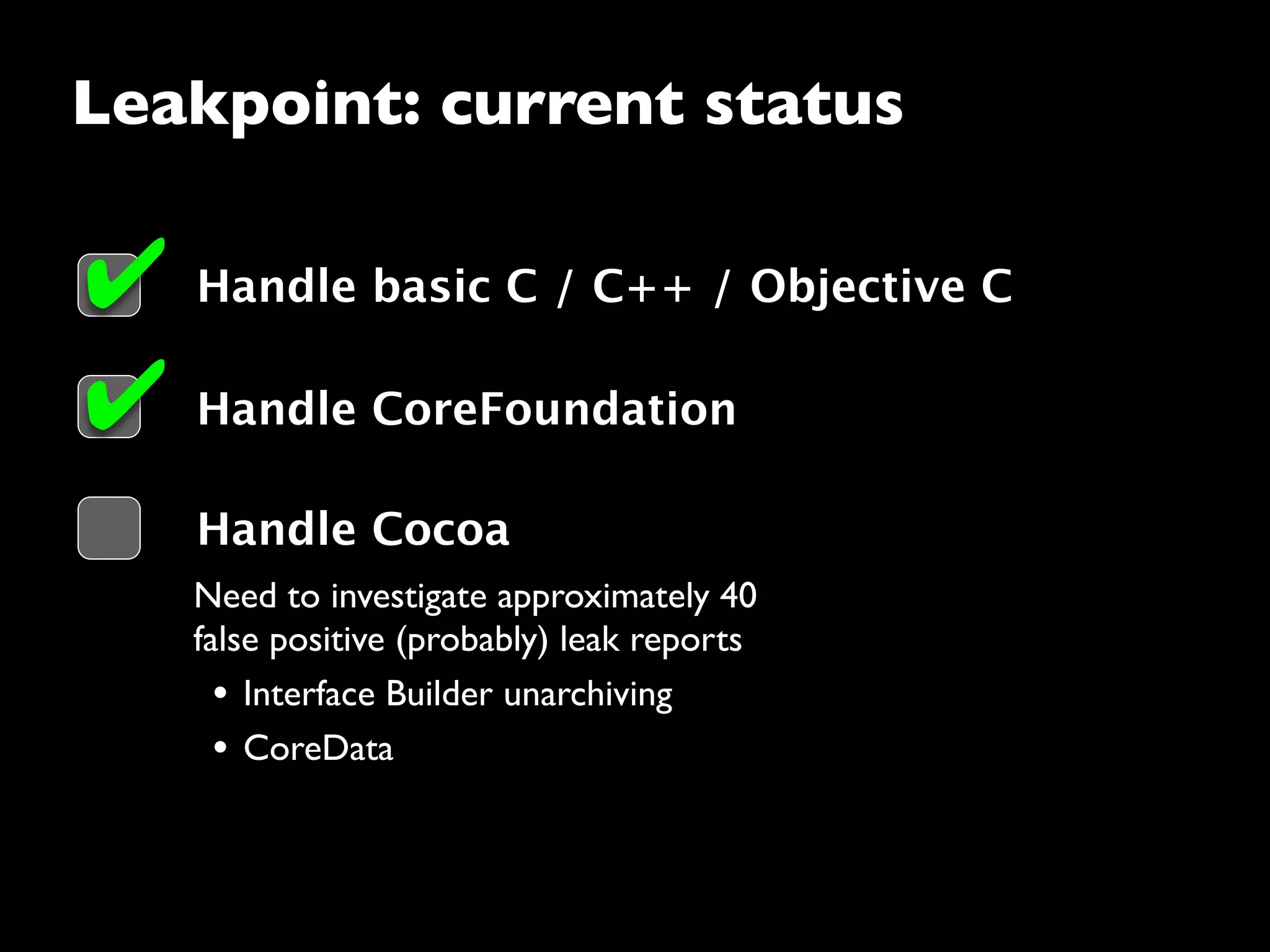
Leakpoint: current status
Handle basic C / C++ / Objective C
Leakpoint: current status
Handle basic C / C++ / Objective C✔
Leakpoint: current status
Handle basic C / C++ / Objective C✔
Handle CoreFoundation
Leakpoint: current status
Handle basic C / C++ / Objective C✔
Handle CoreFoundation✔
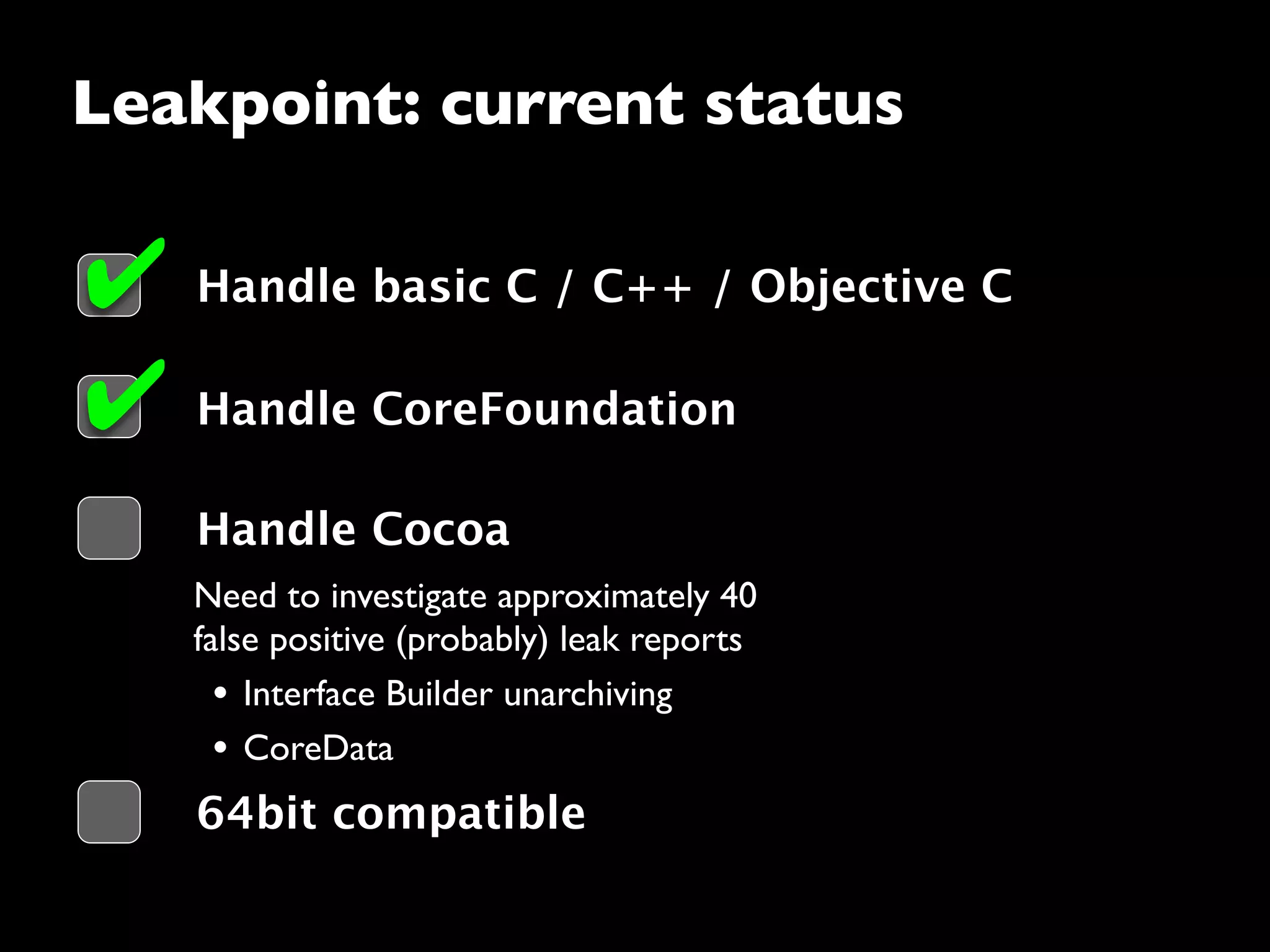
Leakpoint: current status
Handle basic C / C++ / Objective C
Handle Cocoa
✔
Handle CoreFoundation✔
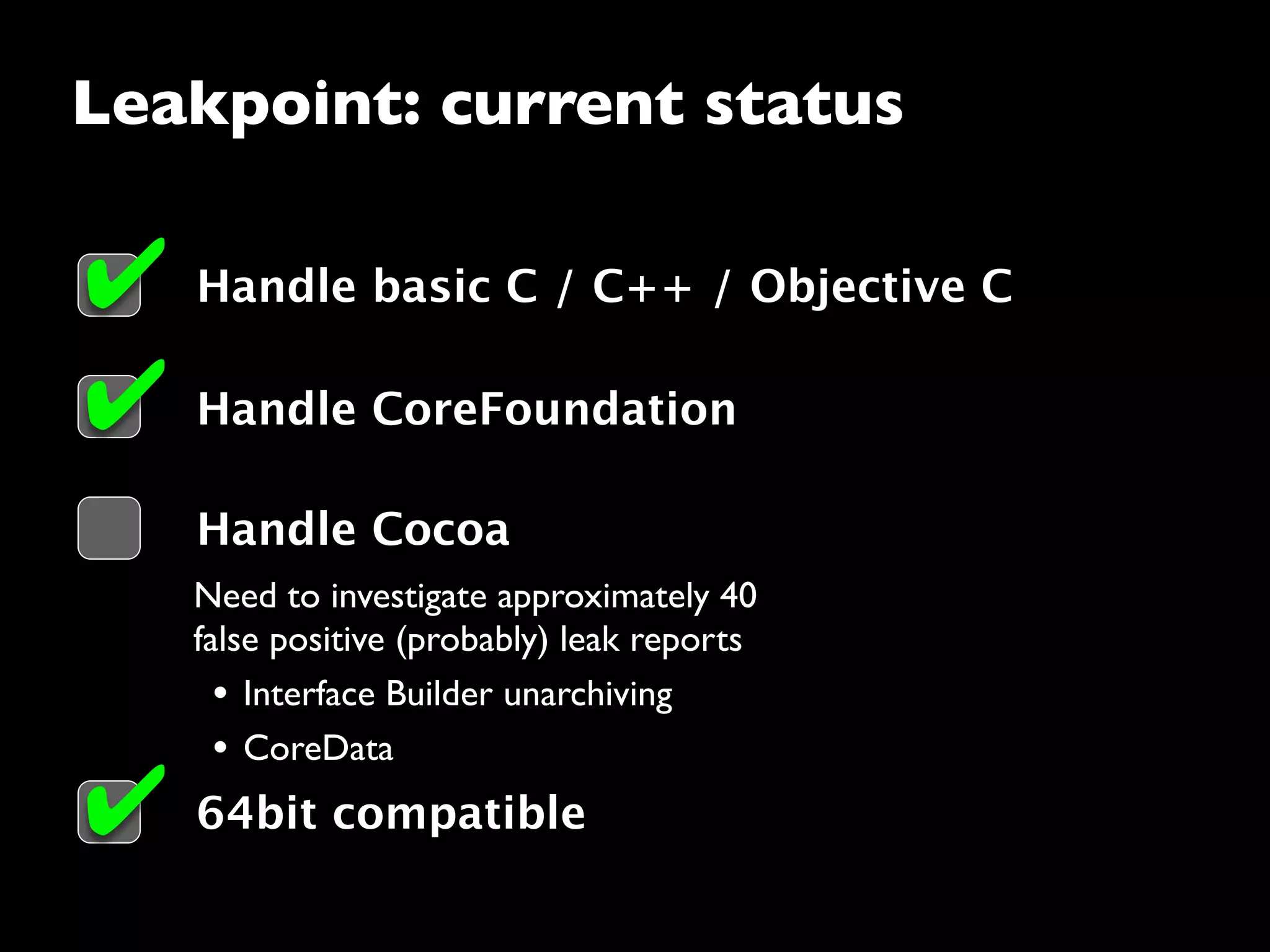
Need to investigate approximately 40
false positive (probably) leak reports
• Interface Builder unarchiving
• CoreData
Leakpoint: current status
Handle basic C / C++ / Objective C
Handle Cocoa
✔
Handle CoreFoundation✔
Need to investigate approximately 40
false positive (probably) leak reports
• Interface Builder unarchiving
• CoreData
Leakpoint: current status
Handle basic C / C++ / Objective C
Handle Cocoa
✔
Handle CoreFoundation✔
64bit compatible
Need to investigate approximately 40
false positive (probably) leak reports
• Interface Builder unarchiving
• CoreData
Leakpoint: current status
Handle basic C / C++ / Objective C
Handle Cocoa
✔
Handle CoreFoundation✔
64bit compatible✔
A real leak?: _NSImageMalloc
void *_NSImageMalloc(NSZone* zone, size_t size) {
// allocate storage aligned to 32 bytes. we do this by
// allocating an extra 32 bytes, finding the address in the proper
// location and storing the delta in one of the previous 32 bytes.
void *unaligned = NSZoneMalloc(zone, size + BITMAP_DATA_ALIGNMENT);
if(unaligned != NULL) {
uintptr_t aligned = ((uintptr_t)unaligned + BITMAP_DATA_ALIGNMENT)
& ~(BITMAP_DATA_ALIGNMENT - 1);
(unsigned char*)aligned[-1] = aligned - (uintptr_t) unaligned;
return (void*)aligned;
}
else {
return NULL;
}
}
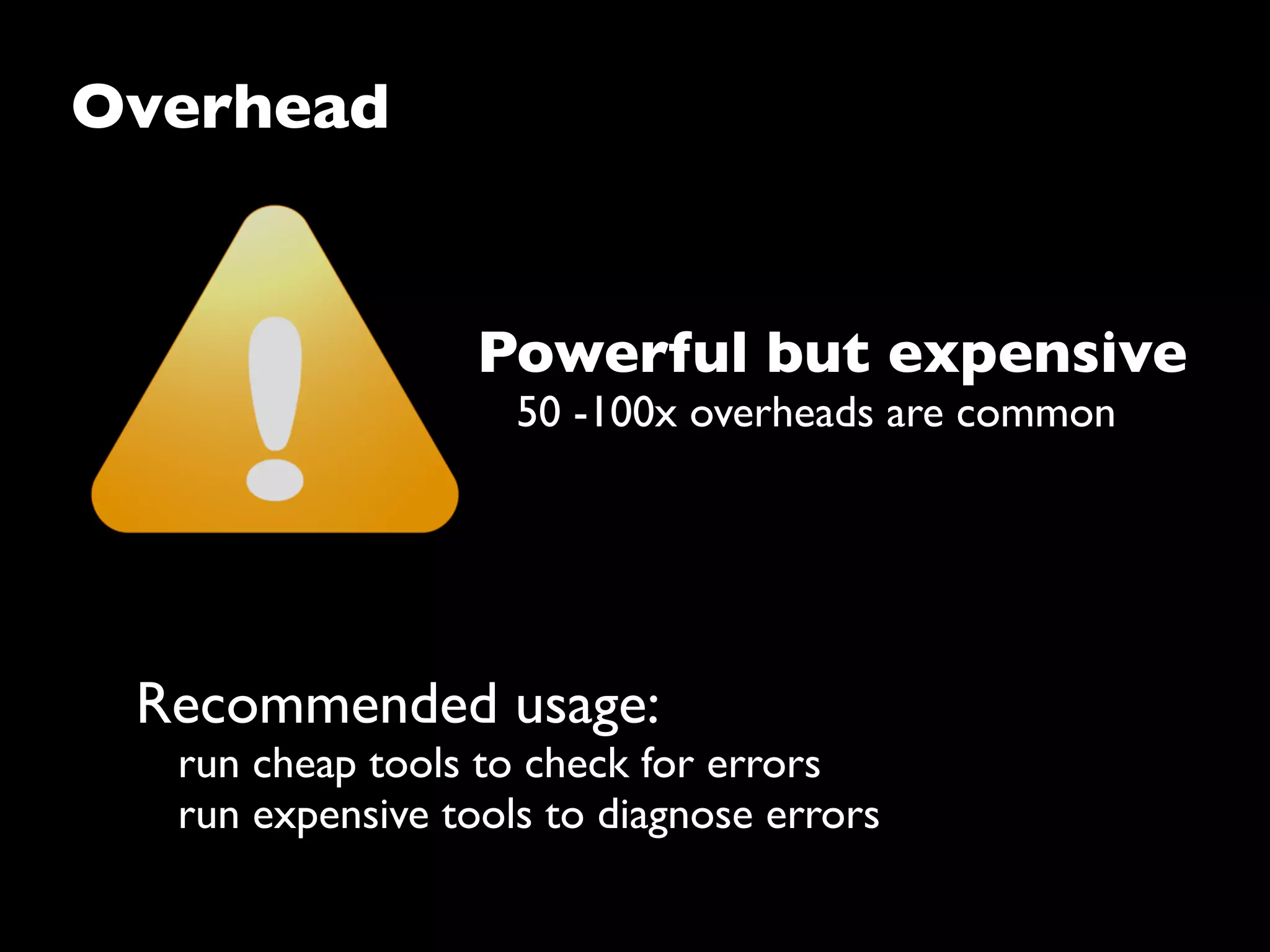
Overhead
Powerful but expensive
50 -100x overheads are common
Overhead
Powerful but expensive
50 -100x overheads are common
Recommended usage:
run cheap tools to check for errors
run expensive tools to diagnose errors
Future work
+ Leakpoint
( )
Future work
Impact
+ Leakpoint
( )
Future work
• Apple
■ new leak detection tool
■ experience with dynamic taint analysis
Impact
+ Leakpoint
( )
Future work
• Apple
■ new leak detection tool
■ experience with dynamic taint analysis
• Me
■ experience withValgrind
■ experience analyzing large commercial code base
Impact
+ Leakpoint
( )
Questions?

Advanced Dynamic Analysis for Leak Detection (Apple Internship 2008)

  • 1.
    Advanced dynamic analysis forleak detection Jim Clause Chris Friesen - Manager Analysis Tools Group
  • 2.
  • 3.
  • 4.
  • 5.
  • 6.
    ≈ X-ray MRI Current analysis tools SharkInstruments C A B 312 Z 3 Dynamic taint analysis ≈
  • 7.
  • 8.
    Dynamic taint analysis 1Assign taint marks C A B Z
  • 9.
    Dynamic taint analysis 1Assign taint marks C A B 312 Z
  • 10.
    Dynamic taint analysis 1Assign taint marks 2 Propagate taint marks C A B 312 Z
  • 11.
    Dynamic taint analysis 1Assign taint marks 2 Propagate taint marks C A B 312 Z
  • 12.
    Dynamic taint analysis 1Assign taint marks 3 Check taint marks 2 Propagate taint marks C A B 312 Z
  • 13.
    Dynamic taint analysis 1Assign taint marks 3 Check taint marks 2 Propagate taint marks C A B 312 Z C A B 312 Z 3
  • 14.
    Attack detection /prevention Information policy enforcement Testing Data lifetime Applications of dynamic tainting Memory errors
  • 15.
    Attack detection /prevention Prevent stack smashing, SQL injection, buffer overruns, etc. Attack detection / prevention Information policy enforcement Testing Data lifetime Applications of dynamic tainting Memory errors
  • 16.
    Information policy enforcement ensureclassified information does not leave the system Attack detection / prevention Information policy enforcement Testing Data lifetime Applications of dynamic tainting Memory errors
  • 17.
    Testing Coverage metrics, testdata generation heuristic, etc. ✔/✘ Attack detection / prevention Information policy enforcement Testing Data lifetime Applications of dynamic tainting Memory errors
  • 18.
    Data lifetime track howlong sensitive data remain in the application Attack detection / prevention Information policy enforcement Testing Data lifetime Applications of dynamic tainting Memory errors
  • 19.
    Attack detection /prevention Information policy enforcement Testing Data lifetime Applications of dynamic tainting Memory errorsMemory errors Detect illegal memory access, leak detection, etc.
  • 20.
    Attack detection /prevention Information policy enforcement Testing Data lifetime Applications of dynamic tainting Memory errorsMemory errors Detect illegal memory access, leak detection, etc.leak detection
  • 21.
    Detecting leaks iseasy, fixing them is hard
  • 22.
    Detecting leaks iseasy, fixing them is hard @interface Container:NSObject { id _object; } @end @implementation Container - (void) dealloc { //[_object release]; [super dealloc]; } - (void) setObject:(id)obj { [_object release]; _object = [obj retain]; } @end
  • 23.
    Detecting leaks iseasy, fixing them is hard @interface Container:NSObject { id _object; } @end @implementation Container - (void) dealloc { //[_object release]; [super dealloc]; } - (void) setObject:(id)obj { [_object release]; _object = [obj retain]; } @end Container *create() { Container *c = [[Container alloc] init]; NSObject *o = [[NSObject alloc] init]; [c setObject:o]; [o release]; return c; } int main(...) { Container *c = create(); … [c release]; }
  • 24.
    Detecting leaks iseasy, fixing them is hard @interface Container:NSObject { id _object; } @end @implementation Container - (void) dealloc { //[_object release]; [super dealloc]; } - (void) setObject:(id)obj { [_object release]; _object = [obj retain]; } @end Container *create() { Container *c = [[Container alloc] init]; NSObject *o = [[NSObject alloc] init]; [c setObject:o]; [o release]; return c; } int main(...) { Container *c = create(); … [c release]; } leaks: This object is leaked
  • 25.
    Leakpoint overview Discover wherethe last pointer to un-freed memory is lost
  • 26.
    Leakpoint overview Assign taint marks Propagate taintmarks Check taint marks ptr1 = malloc(...) ➔ ptr1 ptr2 = calloc(...) ➔ ptr2 ptr3 = ptr1 ➔ ptr3 , ptr1 ptr1 = NULL ➔ ptr1 , ptr3 ptr4 = ptr2 + 1 ➔ ptr4 , ptr2 Report error if taint mark’s count is zero and memory has not been freed. 1 1 1 Discover where the last pointer to un-freed memory is lost
  • 27.
    Leakpoint overview Assign taint marks Propagate taintmarks Check taint marks ptr1 = malloc(...) ➔ ptr1 ptr2 = calloc(...) ➔ ptr2 ptr3 = ptr1 ➔ ptr3 , ptr1 ptr1 = NULL ➔ ptr1 , ptr3 ptr4 = ptr2 + 1 ➔ ptr4 , ptr2 Report error if taint mark’s count is zero and memory has not been freed. 2 1 1 1 1 2 2 2 1 1 2 2 Discover where the last pointer to un-freed memory is lost
  • 28.
    Leakpoint overview Assign taint marks Propagate taintmarks Check taint marks ptr1 = malloc(...) ➔ ptr1 ptr2 = calloc(...) ➔ ptr2 ptr3 = ptr1 ➔ ptr3 , ptr1 ptr1 = NULL ➔ ptr1 , ptr3 ptr4 = ptr2 + 1 ➔ ptr4 , ptr2 Report error if taint mark’s count is zero and memory has not been freed. 2 1 1 1 1 2 2 2 1 1 2 2 In general propagation follows standard pointer arithmetic rules Discover where the last pointer to un-freed memory is lost
  • 29.
    Leakpoint overview Assign taint marks Propagate taintmarks Check taint marks ptr1 = malloc(...) ➔ ptr1 ptr2 = calloc(...) ➔ ptr2 ptr3 = ptr1 ➔ ptr3 , ptr1 ptr1 = NULL ➔ ptr1 , ptr3 ptr4 = ptr2 + 1 ➔ ptr4 , ptr2 Report error if taint mark’s count is zero and memory has not been freed. 2 3 1 1 1 1 2 2 2 1 1 2 2 In general propagation follows standard pointer arithmetic rules Discover where the last pointer to un-freed memory is lost
  • 30.
    @interface Container:NSObject { id _object; } @end @implementation Container - (void) dealloc { [super dealloc]; } - (void) setObject:(id)obj { [_object release]; _object = [obj retain]; } @end Container *create() { Container *c = [[Container alloc] init]; NSObject *o = [[NSObject alloc] init]; [c setObject:o]; [o release]; return c; } int main(...) { Container *c = create(); … [c release]; } Detecting leaks is easy, fixing them is easier
  • 31.
    @interface Container:NSObject { id _object; } @end @implementation Container - (void) dealloc { [super dealloc]; } - (void) setObject:(id)obj { [_object release]; _object = [obj retain]; } @end Container *create() { Container *c = [[Container alloc] init]; NSObject *o = [[NSObject alloc] init]; [c setObject:o]; [o release]; return c; } int main(...) { Container *c = create(); … [c release]; } leakpoint: This object is leaked Detecting leaks is easy, fixing them is easier
  • 32.
    @interface Container:NSObject { id _object; } @end @implementation Container - (void) dealloc { [super dealloc]; } - (void) setObject:(id)obj { [_object release]; _object = [obj retain]; } @end Container *create() { Container *c = [[Container alloc] init]; NSObject *o = [[NSObject alloc] init]; [c setObject:o]; [o release]; return c; } int main(...) { Container *c = create(); … [c release]; } leakpoint: Last reference was lost here leakpoint: This object is leaked Detecting leaks is easy, fixing them is easier
  • 33.
    @interface Container:NSObject { id _object; } @end @implementation Container - (void) dealloc { [super dealloc]; } - (void) setObject:(id)obj { [_object release]; _object = [obj retain]; } @end Container *create() { Container *c = [[Container alloc] init]; NSObject *o = [[NSObject alloc] init]; [c setObject:o]; [o release]; return c; } int main(...) { Container *c = create(); … [c release]; } [_object release]; leakpoint: Last reference was lost here leakpoint: This object is leaked Detecting leaks is easy, fixing them is easier
  • 34.
    Leakpoint implementation • Implementedas aValgrind tool (www.valgrind.org) ■ intercept libc memory management functions ■ instrument binary instructions to perform propagation
  • 35.
    Lost pointer to0x1C93AC0 (16 bytes)  allocated at:   at calloc+105   by _internal_class_createInstanceFromZone+149   by _internal_class_createInstance+31   by +[NSObject allocWithZone:]+155 (NSObject.m:445)   by +[NSObject alloc]+41 (NSObject.m:432)   by create+97 (main.m:29)   by main+17 (main.m:38)  leaked at:   at free+103   by _internal_object_dispose+81   by NSDeallocateObject+223 (NSObject.m:207)   by -[Container dealloc]+53 (container.m:13)   by main+43 (main.m:40) Leakpoint implementation • Implemented as aValgrind tool (www.valgrind.org) ■ intercept libc memory management functions ■ instrument binary instructions to perform propagation
  • 36.
    leaks Lost pointer to0x1C93AC0 (16 bytes)  allocated at:   at calloc+105   by _internal_class_createInstanceFromZone+149   by _internal_class_createInstance+31   by +[NSObject allocWithZone:]+155 (NSObject.m:445)   by +[NSObject alloc]+41 (NSObject.m:432)   by create+97 (main.m:29)   by main+17 (main.m:38)  leaked at:   at free+103   by _internal_object_dispose+81   by NSDeallocateObject+223 (NSObject.m:207)   by -[Container dealloc]+53 (container.m:13)   by main+43 (main.m:40) Leakpoint implementation • Implemented as aValgrind tool (www.valgrind.org) ■ intercept libc memory management functions ■ instrument binary instructions to perform propagation
  • 37.
    leakpoint leaks Lost pointer to0x1C93AC0 (16 bytes)  allocated at:   at calloc+105   by _internal_class_createInstanceFromZone+149   by _internal_class_createInstance+31   by +[NSObject allocWithZone:]+155 (NSObject.m:445)   by +[NSObject alloc]+41 (NSObject.m:432)   by create+97 (main.m:29)   by main+17 (main.m:38)  leaked at:   at free+103   by _internal_object_dispose+81   by NSDeallocateObject+223 (NSObject.m:207)   by -[Container dealloc]+53 (container.m:13)   by main+43 (main.m:40) Leakpoint implementation • Implemented as aValgrind tool (www.valgrind.org) ■ intercept libc memory management functions ■ instrument binary instructions to perform propagation
  • 38.
  • 39.
    Leakpoint: current status Handlebasic C / C++ / Objective C
  • 40.
    Leakpoint: current status Handlebasic C / C++ / Objective C✔
  • 41.
    Leakpoint: current status Handlebasic C / C++ / Objective C✔ Handle CoreFoundation
  • 42.
    Leakpoint: current status Handlebasic C / C++ / Objective C✔ Handle CoreFoundation✔
  • 43.
    Leakpoint: current status Handlebasic C / C++ / Objective C Handle Cocoa ✔ Handle CoreFoundation✔
  • 44.
    Need to investigateapproximately 40 false positive (probably) leak reports • Interface Builder unarchiving • CoreData Leakpoint: current status Handle basic C / C++ / Objective C Handle Cocoa ✔ Handle CoreFoundation✔
  • 45.
    Need to investigateapproximately 40 false positive (probably) leak reports • Interface Builder unarchiving • CoreData Leakpoint: current status Handle basic C / C++ / Objective C Handle Cocoa ✔ Handle CoreFoundation✔ 64bit compatible
  • 46.
    Need to investigateapproximately 40 false positive (probably) leak reports • Interface Builder unarchiving • CoreData Leakpoint: current status Handle basic C / C++ / Objective C Handle Cocoa ✔ Handle CoreFoundation✔ 64bit compatible✔
  • 47.
    A real leak?:_NSImageMalloc void *_NSImageMalloc(NSZone* zone, size_t size) { // allocate storage aligned to 32 bytes. we do this by // allocating an extra 32 bytes, finding the address in the proper // location and storing the delta in one of the previous 32 bytes. void *unaligned = NSZoneMalloc(zone, size + BITMAP_DATA_ALIGNMENT); if(unaligned != NULL) { uintptr_t aligned = ((uintptr_t)unaligned + BITMAP_DATA_ALIGNMENT) & ~(BITMAP_DATA_ALIGNMENT - 1); (unsigned char*)aligned[-1] = aligned - (uintptr_t) unaligned; return (void*)aligned; } else { return NULL; } }
  • 48.
    Overhead Powerful but expensive 50-100x overheads are common
  • 49.
    Overhead Powerful but expensive 50-100x overheads are common Recommended usage: run cheap tools to check for errors run expensive tools to diagnose errors
  • 50.
  • 51.
  • 52.
    Future work • Apple ■new leak detection tool ■ experience with dynamic taint analysis Impact + Leakpoint ( )
  • 53.
    Future work • Apple ■new leak detection tool ■ experience with dynamic taint analysis • Me ■ experience withValgrind ■ experience analyzing large commercial code base Impact + Leakpoint ( )
  • 54.