Aplicações Clínicas da
Espiritualidade
duas perspectivas em diálogo
Declaração de Conflito de
Interesse
• Tenho fé religiosa.
• Sou cristão.
• Faço parte do Movimento dos Focolares, um
movimento internacional de leigos, de origem
católica, de caráter ecumênico (diversas
igrejas), interreligioso (também budistas,
muçulmanos, judeus, hindus), e de pessoas
com credos humanistas não religiosos, como
ateus ou agnósticos.
Por que conflito?
• Não posso estar seguro de que o desejo de
que as evidências dêem suporte à minha fé
religiosa não influenciem minhas análises. No
entanto, não creio em vencer debates, e sim
em buscar a verdade!
• Como lido com este possível conflito?
• Buscando uma análise crítica e confiando que
o Rodrigo e vocês não vão deixar eu me
atrapalhar.
O que espero/não espero
• Espero demonstrar que é um campo de
estudo relevante e, quem sabe, estimular
interessados a formar um Grupo (GT) na
SBMFC para buscar tornar o tema mais bem
conhecido e útil para APS.
• Não espero parecer saber muito sobre o
tema. Recém comecei a estudá-lo.
• Não espero demonstrar nada sobre Deus. Ele
não é um objeto/sujeito de estudo científico.
Definindo para refletir:
espiritualidade X religião
• Religião envolve crenças, práticas e rituais
concernentes ao “sagrado”, pensado como
Deus ou a Realidade Primeira, vividas no seio
de tradições que congregam e organizam
pessoas.
• Como nesta definição não se incluem
“resultados”, religião pode ser correlacionada
com desfechos em saúde.
Definindo para refletir:
espiritualidade X religião
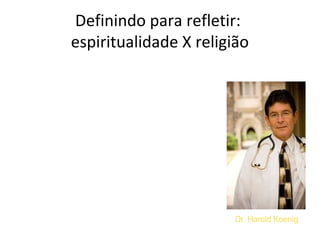
“ Espiritualidade é a busca pessoal
pelo entendimento de respostas a
questões sobre a vida, seu
significado e relações com o
sagrado e transcendente, que
pode ou não estar relacionada a
propostas de uma determinada
religião.”
Dr. Harold KoenigKoenig HG, McCullough M, Larson DBB. Handbook of religion and
health: a century of research reviewed. New York: Oxford University
press; 2001.
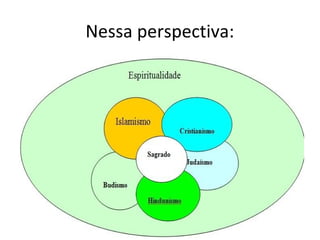
Nessa perspectiva:
Como medir espiritualidade?
• Definir espiritualidade de um modo vago demais
(“valorizar conexões humanizadas”, “ser
otimista”) traz confusão entre preditor e
desfecho nas pesquisas.
• Pessoas que não se identificam com a
espiritualidade, como ateus humanistas, podem
reivindicar as mesma definições vagas para si.
• Em aplicação clínica, espiritualidade pode ser
definida de modo flexível, compartilhado com as
pessoas. Para pesquisa, é difícil definir e medir.
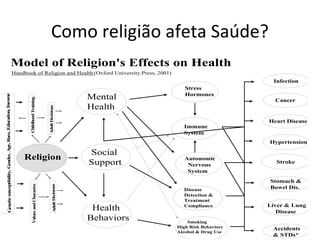
Como religião afeta Saúde?
Religion
Mental
Health
Social
Support
Health
Behaviors
Stress
Hormones
Immune
System
Autonomic
Nervous
System
Disease
Detection &
Treatment
Compliance
Smoking
High Risk Behaviors
Alcohol & Drug Use
Infection
Cancer
Heart Disease
Hypertension
Stomach &
Bowel Dis.
Accidents
& STDs*
Geneticsusceptibility,Gender,Age,Race,Education,Income
Liver & Lung
Disease
Stroke
ChildhoodTraining
AdultDecisions
ValuesandCharacter
AdultDecisions
Model of Religion's Effects on Health
Handbook of Religion and Health (Oxford University Press, 2001)
Vejamos alguns estudos
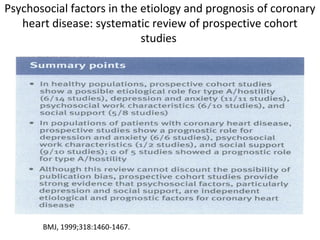
Psychosocial factors in the etiology and prognosis of coronary
heart disease: systematic review of prospective cohort
studies
BMJ, 1999;318:1460-1467.
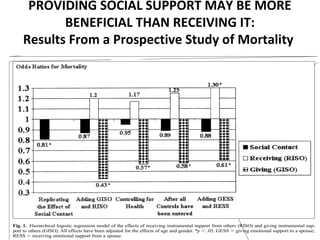
PROVIDING SOCIAL SUPPORT MAY BE MORE
BENEFICIAL THAN RECEIVING IT:
Results From a Prospective Study of Mortality
PSYCHOLOGICAL SCIENCE
S.L. Brown et al.
Fig. 1. Hierarchical logistic regression model of the effects of receiving instrumental support from others (RISO) and giving instrumental sup-
port to others (GISO). All effects have been adjusted for the effects of age and gender. *p .05. GESS giving emotional support to a spouse;
RESS receiving emotional support from a spouse.
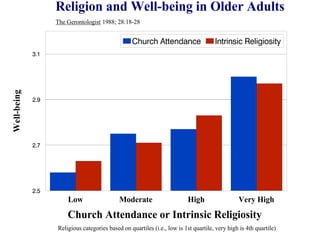
Religion and Well-being in Older Adults
Religious categories based on quartiles (i.e., low is 1st quartile, very high is 4th quartile)
Low Moderate High Very High
Church Attendance or Intrinsic Religiosity
Well-being
The Gerontologist 1988; 28:18-28
Religion and Well-being in Older Adults
Religious categories based on quartiles (i.e., low is 1st quartile, very high is 4th quartile)
Low Moderate High Very High
Church Attendance or Intrinsic Religiosity
Well-being The Gerontologist 1988; 28:18-28
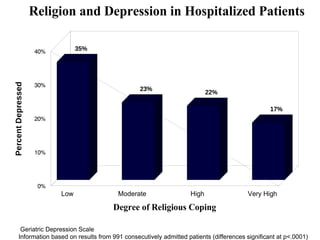
Religion and Depression in Hospitalized Patients
Geriatric Depression Scale
Information based on results from 991 consecutively admitted patients (differences significant at p<.0001)
35%
23%
22%
17%
Low Moderate High Very High
Degree of Religious Coping
PercentDepressed
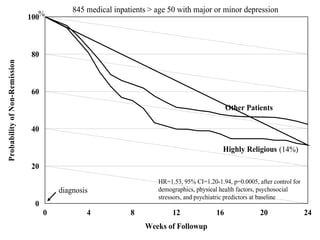
0 4 8 12 16 20 24
Weeks of Followup
0
20
40
60
80
100
ProbabilityofNon-Remission %
Other Patients
Highly Religious (14%)
diagnosis
845 medical inpatients > age 50 with major or minor depression
HR=1.53, 95% CI=1.20-1.94, p=0.0005, after control for
demographics, physical health factors, psychosocial
stressors, and psychiatric predictors at baseline
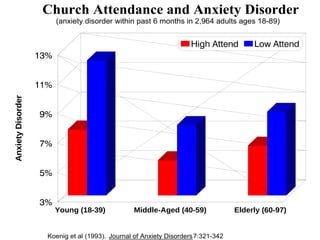
Church Attendance and Anxiety Disorder
(anxiety disorder within past 6 months in 2,964 adults ages 18-89)
Koenig et al (1993). Journal of Anxiety Disorders7:321-342
Young (18-39) Middle-Aged (40-59) Elderly (60-97)
AnxietyDisorder
Low Attendance High Attendance Low Attendance High Attendance
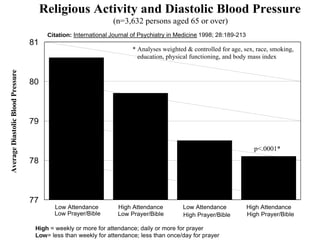
77
78
79
80
81
AverageDiastolicBloodPressure
* Analyses weighted & controlled for age, sex, race, smoking,
education, physical functioning, and body mass index
Low Prayer/Bible Low Prayer/Bible High Prayer/Bible High Prayer/Bible
p<.0001*
Religious Activity and Diastolic Blood Pressure
(n=3,632 persons aged 65 or over)
High = weekly or more for attendance; daily or more for prayer
Low= less than weekly for attendance; less than once/day for prayer
Citation: International Journal of Psychiatry in Medicine 1998; 28:189-213
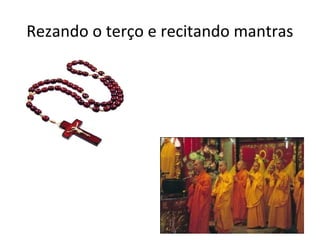
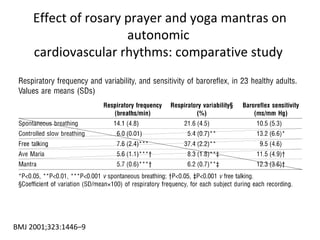
Rezando o terço e recitando mantras
Effect of rosary prayer and yoga mantras on
autonomic
cardiovascular rhythms: comparative study
BMJ 2001;323:1446–9
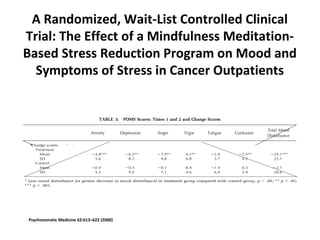
A Randomized, Wait-List Controlled Clinical
Trial: The Effect of a Mindfulness Meditation-
Based Stress Reduction Program on Mood and
Symptoms of Stress in Cancer Outpatients
Psychosomatic Medicine 62:613–622 (2000)
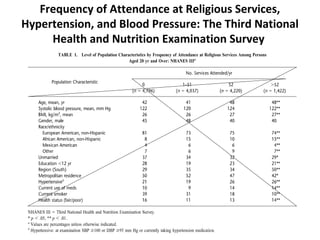
Frequency of Attendance at Religious Services,
Hypertension, and Blood Pressure: The Third National
Health and Nutrition Examination Survey
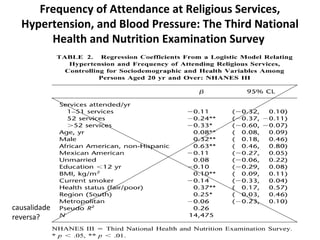
Frequency of Attendance at Religious Services,
Hypertension, and Blood Pressure: The Third National
Health and Nutrition Examination Survey
causalidade
reversa?
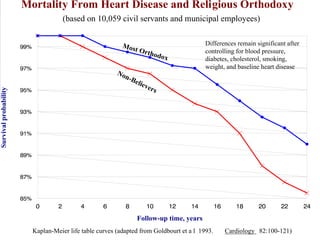
Mortality From Heart Disease and Religious Orthodoxy
(based on 10,059 civil servants and municipal employees)
Kaplan-Meier life table curves (adapted from Goldbourt et a l 1993. Cardiology 82:100-121)
Follow-up time, years
Survivalprobability
Most Orthodox
Non-Believers
Differences remain significant after
controlling for blood pressure,
diabetes, cholesterol, smoking,
weight, and baseline heart disease
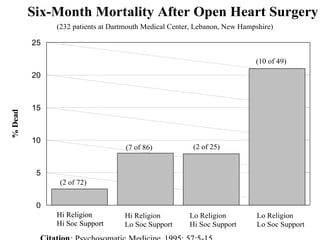
Six-Month Mortality After Open Heart Surgery
0
5
10
15
20
25
%Dead
(2 of 72)
(7 of 86) (2 of 25)
(10 of 49)
(232 patients at Dartmouth Medical Center, Lebanon, New Hampshire)
Hi Religion
Hi Soc Support
Hi Religion
Lo Soc Support
Lo Religion
Hi Soc Support
Lo Religion
Lo Soc Support
Hi Religion
Hi Soc Support
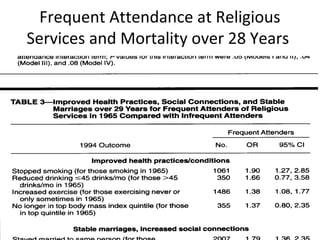
Frequent Attendance at Religious
Services and Mortality over 28 Years
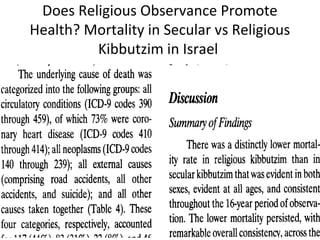
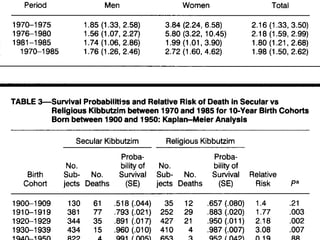
Does Religious Observance Promote
Health? Mortality in Secular vs Religious
Kibbutzim in Israel
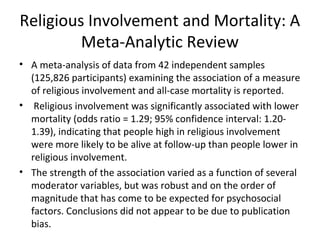
Religious Involvement and Mortality: A
Meta-Analytic Review
• A meta-analysis of data from 42 independent samples
(125,826 participants) examining the association of a measure
of religious involvement and all-case mortality is reported.
• Religious involvement was significantly associated with lower
mortality (odds ratio = 1.29; 95% confidence interval: 1.20-
1.39), indicating that people high in religious involvement
were more likely to be alive at follow-up than people lower in
religious involvement.
• The strength of the association varied as a function of several
moderator variables, but was robust and on the order of
magnitude that has come to be expected for psychosocial
factors. Conclusions did not appear to be due to publication
bias.
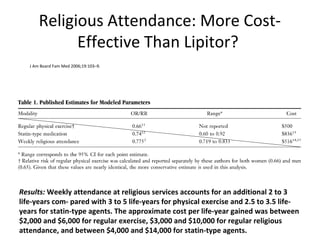
Religious Attendance: More Cost-
Effective Than Lipitor?
J Am Board Fam Med 2006;19:103–9.
Results: Weekly attendance at religious services accounts for an additional 2 to 3
life-years com- pared with 3 to 5 life-years for physical exercise and 2.5 to 3.5 life-
years for statin-type agents. The approximate cost per life-year gained was between
$2,000 and $6,000 for regular exercise, $3,000 and $10,000 for regular religious
attendance, and between $4,000 and $14,000 for statin-type agents.
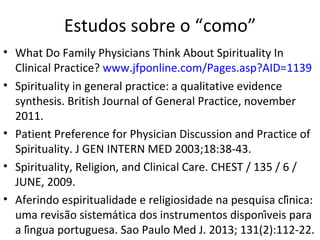
Estudos sobre o “como”
• What Do Family Physicians Think About Spirituality In
Clinical Practice? www.jfponline.com/Pages.asp?AID=1139
• Spirituality in general practice: a qualitative evidence
synthesis. British Journal of General Practice, november
2011.
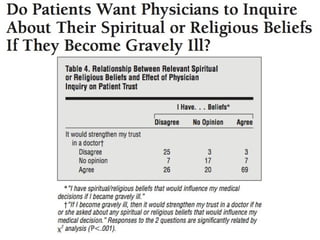
• Patient Preference for Physician Discussion and Practice of
Spirituality. J GEN INTERN MED 2003;18:38-43.
• Spirituality, Religion, and Clinical Care. CHEST / 135 / 6 /
JUNE, 2009.
• Aferindo espiritualidade e religiosidade na pesquisa clínica:
uma revisão sistemática dos instrumentos disponíveis para
a língua portuguesa. Sao Paulo Med J. 2013; 131(2):112-22.
Sugestão de Abordagem
• Na entrevista inicial de cada novo paciente, ou
em momentos oportunos de pacientes em
seguimento:
• “Existe algo a respeito de crenças espirituais
ou fé a respeito que tu gostarias que eu
estivesse ciente ou levasse em conta no
cuidado de tua saúde?”
Resumindo
• Espiritualidade/religião afetam a saúde,
aparentemente de modo positivo.
• As pessoas parecem desejar que seu médico
de família conheça suas necessidades
espirituais.
• Os médicos de família tem estudado,
pesquisado e publicado a respeito.
• No Brasil, desejamos conhecer isso melhor?
• Lista passando…
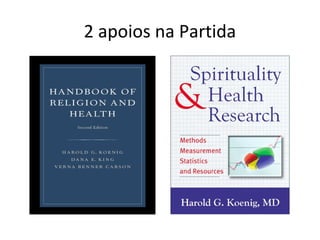
2 apoios na Partida
Muito obrigado!
• enofilho@uol.com.br
• Coordenação Depto Educação Permanente –
Diretoria Científica da SBMFC

Aplicações clínicas da espiritualidade

  • 1.
  • 2.
    Declaração de Conflitode Interesse • Tenho fé religiosa. • Sou cristão. • Faço parte do Movimento dos Focolares, um movimento internacional de leigos, de origem católica, de caráter ecumênico (diversas igrejas), interreligioso (também budistas, muçulmanos, judeus, hindus), e de pessoas com credos humanistas não religiosos, como ateus ou agnósticos.
  • 3.
    Por que conflito? •Não posso estar seguro de que o desejo de que as evidências dêem suporte à minha fé religiosa não influenciem minhas análises. No entanto, não creio em vencer debates, e sim em buscar a verdade! • Como lido com este possível conflito? • Buscando uma análise crítica e confiando que o Rodrigo e vocês não vão deixar eu me atrapalhar.
  • 4.
    O que espero/nãoespero • Espero demonstrar que é um campo de estudo relevante e, quem sabe, estimular interessados a formar um Grupo (GT) na SBMFC para buscar tornar o tema mais bem conhecido e útil para APS. • Não espero parecer saber muito sobre o tema. Recém comecei a estudá-lo. • Não espero demonstrar nada sobre Deus. Ele não é um objeto/sujeito de estudo científico.
  • 5.
    Definindo para refletir: espiritualidadeX religião • Religião envolve crenças, práticas e rituais concernentes ao “sagrado”, pensado como Deus ou a Realidade Primeira, vividas no seio de tradições que congregam e organizam pessoas. • Como nesta definição não se incluem “resultados”, religião pode ser correlacionada com desfechos em saúde.
  • 6.
    Definindo para refletir: espiritualidadeX religião “ Espiritualidade é a busca pessoal pelo entendimento de respostas a questões sobre a vida, seu significado e relações com o sagrado e transcendente, que pode ou não estar relacionada a propostas de uma determinada religião.” Dr. Harold KoenigKoenig HG, McCullough M, Larson DBB. Handbook of religion and health: a century of research reviewed. New York: Oxford University press; 2001.
  • 7.
  • 8.
    Como medir espiritualidade? •Definir espiritualidade de um modo vago demais (“valorizar conexões humanizadas”, “ser otimista”) traz confusão entre preditor e desfecho nas pesquisas. • Pessoas que não se identificam com a espiritualidade, como ateus humanistas, podem reivindicar as mesma definições vagas para si. • Em aplicação clínica, espiritualidade pode ser definida de modo flexível, compartilhado com as pessoas. Para pesquisa, é difícil definir e medir.
  • 9.
    Como religião afetaSaúde? Religion Mental Health Social Support Health Behaviors Stress Hormones Immune System Autonomic Nervous System Disease Detection & Treatment Compliance Smoking High Risk Behaviors Alcohol & Drug Use Infection Cancer Heart Disease Hypertension Stomach & Bowel Dis. Accidents & STDs* Geneticsusceptibility,Gender,Age,Race,Education,Income Liver & Lung Disease Stroke ChildhoodTraining AdultDecisions ValuesandCharacter AdultDecisions Model of Religion's Effects on Health Handbook of Religion and Health (Oxford University Press, 2001)
  • 10.
  • 11.
    Psychosocial factors inthe etiology and prognosis of coronary heart disease: systematic review of prospective cohort studies BMJ, 1999;318:1460-1467.
  • 12.
    PROVIDING SOCIAL SUPPORTMAY BE MORE BENEFICIAL THAN RECEIVING IT: Results From a Prospective Study of Mortality PSYCHOLOGICAL SCIENCE S.L. Brown et al. Fig. 1. Hierarchical logistic regression model of the effects of receiving instrumental support from others (RISO) and giving instrumental sup- port to others (GISO). All effects have been adjusted for the effects of age and gender. *p .05. GESS giving emotional support to a spouse; RESS receiving emotional support from a spouse.
  • 13.
    Religion and Well-beingin Older Adults Religious categories based on quartiles (i.e., low is 1st quartile, very high is 4th quartile) Low Moderate High Very High Church Attendance or Intrinsic Religiosity Well-being The Gerontologist 1988; 28:18-28 Religion and Well-being in Older Adults Religious categories based on quartiles (i.e., low is 1st quartile, very high is 4th quartile) Low Moderate High Very High Church Attendance or Intrinsic Religiosity Well-being The Gerontologist 1988; 28:18-28
  • 14.
    Religion and Depressionin Hospitalized Patients Geriatric Depression Scale Information based on results from 991 consecutively admitted patients (differences significant at p<.0001) 35% 23% 22% 17% Low Moderate High Very High Degree of Religious Coping PercentDepressed
  • 15.
    0 4 812 16 20 24 Weeks of Followup 0 20 40 60 80 100 ProbabilityofNon-Remission % Other Patients Highly Religious (14%) diagnosis 845 medical inpatients > age 50 with major or minor depression HR=1.53, 95% CI=1.20-1.94, p=0.0005, after control for demographics, physical health factors, psychosocial stressors, and psychiatric predictors at baseline
  • 16.
    Church Attendance andAnxiety Disorder (anxiety disorder within past 6 months in 2,964 adults ages 18-89) Koenig et al (1993). Journal of Anxiety Disorders7:321-342 Young (18-39) Middle-Aged (40-59) Elderly (60-97) AnxietyDisorder
  • 17.
    Low Attendance HighAttendance Low Attendance High Attendance 77 78 79 80 81 AverageDiastolicBloodPressure * Analyses weighted & controlled for age, sex, race, smoking, education, physical functioning, and body mass index Low Prayer/Bible Low Prayer/Bible High Prayer/Bible High Prayer/Bible p<.0001* Religious Activity and Diastolic Blood Pressure (n=3,632 persons aged 65 or over) High = weekly or more for attendance; daily or more for prayer Low= less than weekly for attendance; less than once/day for prayer Citation: International Journal of Psychiatry in Medicine 1998; 28:189-213
  • 18.
    Rezando o terçoe recitando mantras
  • 19.
    Effect of rosaryprayer and yoga mantras on autonomic cardiovascular rhythms: comparative study BMJ 2001;323:1446–9
  • 20.
    A Randomized, Wait-ListControlled Clinical Trial: The Effect of a Mindfulness Meditation- Based Stress Reduction Program on Mood and Symptoms of Stress in Cancer Outpatients Psychosomatic Medicine 62:613–622 (2000)
  • 21.
    Frequency of Attendanceat Religious Services, Hypertension, and Blood Pressure: The Third National Health and Nutrition Examination Survey
  • 22.
    Frequency of Attendanceat Religious Services, Hypertension, and Blood Pressure: The Third National Health and Nutrition Examination Survey causalidade reversa?
  • 23.
    Mortality From HeartDisease and Religious Orthodoxy (based on 10,059 civil servants and municipal employees) Kaplan-Meier life table curves (adapted from Goldbourt et a l 1993. Cardiology 82:100-121) Follow-up time, years Survivalprobability Most Orthodox Non-Believers Differences remain significant after controlling for blood pressure, diabetes, cholesterol, smoking, weight, and baseline heart disease
  • 24.
    Six-Month Mortality AfterOpen Heart Surgery 0 5 10 15 20 25 %Dead (2 of 72) (7 of 86) (2 of 25) (10 of 49) (232 patients at Dartmouth Medical Center, Lebanon, New Hampshire) Hi Religion Hi Soc Support Hi Religion Lo Soc Support Lo Religion Hi Soc Support Lo Religion Lo Soc Support Hi Religion Hi Soc Support
  • 25.
    Frequent Attendance atReligious Services and Mortality over 28 Years
  • 26.
    Does Religious ObservancePromote Health? Mortality in Secular vs Religious Kibbutzim in Israel
  • 28.
    Religious Involvement andMortality: A Meta-Analytic Review • A meta-analysis of data from 42 independent samples (125,826 participants) examining the association of a measure of religious involvement and all-case mortality is reported. • Religious involvement was significantly associated with lower mortality (odds ratio = 1.29; 95% confidence interval: 1.20- 1.39), indicating that people high in religious involvement were more likely to be alive at follow-up than people lower in religious involvement. • The strength of the association varied as a function of several moderator variables, but was robust and on the order of magnitude that has come to be expected for psychosocial factors. Conclusions did not appear to be due to publication bias.
  • 29.
    Religious Attendance: MoreCost- Effective Than Lipitor? J Am Board Fam Med 2006;19:103–9. Results: Weekly attendance at religious services accounts for an additional 2 to 3 life-years com- pared with 3 to 5 life-years for physical exercise and 2.5 to 3.5 life- years for statin-type agents. The approximate cost per life-year gained was between $2,000 and $6,000 for regular exercise, $3,000 and $10,000 for regular religious attendance, and between $4,000 and $14,000 for statin-type agents.
  • 31.
    Estudos sobre o“como” • What Do Family Physicians Think About Spirituality In Clinical Practice? www.jfponline.com/Pages.asp?AID=1139 • Spirituality in general practice: a qualitative evidence synthesis. British Journal of General Practice, november 2011. • Patient Preference for Physician Discussion and Practice of Spirituality. J GEN INTERN MED 2003;18:38-43. • Spirituality, Religion, and Clinical Care. CHEST / 135 / 6 / JUNE, 2009. • Aferindo espiritualidade e religiosidade na pesquisa clínica: uma revisão sistemática dos instrumentos disponíveis para a língua portuguesa. Sao Paulo Med J. 2013; 131(2):112-22.
  • 32.
    Sugestão de Abordagem •Na entrevista inicial de cada novo paciente, ou em momentos oportunos de pacientes em seguimento: • “Existe algo a respeito de crenças espirituais ou fé a respeito que tu gostarias que eu estivesse ciente ou levasse em conta no cuidado de tua saúde?”
  • 33.
    Resumindo • Espiritualidade/religião afetama saúde, aparentemente de modo positivo. • As pessoas parecem desejar que seu médico de família conheça suas necessidades espirituais. • Os médicos de família tem estudado, pesquisado e publicado a respeito. • No Brasil, desejamos conhecer isso melhor? • Lista passando…
  • 34.
    2 apoios naPartida
  • 35.
    Muito obrigado! • enofilho@uol.com.br •Coordenação Depto Educação Permanente – Diretoria Científica da SBMFC