Spiritual Care Volunteering
Belonging, Peace, Hope & Love
UHSCC 2
University Hospitals Seidman Cancer Center
11100 Euclid Ave., Cleveland, OH 44106
Spiritual Care Volunteer Program
Belonging,Peace,Hope & Love
Rev. Sally Wile, M.Div., Spiritual Care Coordinator
Melody J. Reese, Spiritual Care Intern
UHSCC 3
May 2014
Table of Contents
Why is a Spiritual Care Volunteer Program Needed? ………….…………………5
History…………………………………………………………….……………….5
Spirituality or Religion………………………….…………………………………6
Spirituality in Healthcare: A Shifting Paradigm……….…………….…………….7
Why Spiritual Care? …………………………………………………………….…8
Seidman Cancer Center’s Spiritual Care Vision……………………………………8
Seidman Cancer Center’s Spiritual Care Mission …………………………………8
Initiating a Spiritual Care Volunteer Program ……………………………………..8
Who are the Volunteers?……………………………………………………………8
Volunteer Requirements…………………………………………………………….9
Duties and Responsibilities…………………………………………………………9
Volunteers are Prohibited From……………………………………………………10
First Steps to Becoming a Volunteer………………….…………………………...10
Training Module One: An Overview………………………………………….…..11
Training Module Two: The Caring Visit…………………………………………..12
Training Module Three: Communication………………………………………….14
Training Module Four: The Personal Dimensions of Caring………………………16
Continuing Education Requirement……………………………………………..…16
Screening, History-Gathering, and Assessment Tools……………………………..16
Resource Library…………………………………………………………….……..19
Appendices
UHSCC 4
(A) Skills of Emotional Competence………………………………………....…..28
(B) Spiritual Care Volunteer Application………………………………………...…..….29
(C) Spiritual Care Volunteer Questionnaire…………………………………...………...30
(D) Spiritual Care Volunteer Interview Questions……………………………...……….31
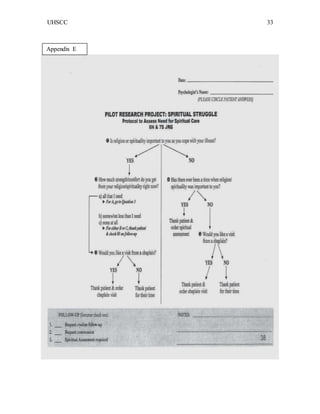
(E) Screening for Spiritual Struggle Tool………………………………………………..32
(F) FICA: A Spiritual History Tool……………………………………………………...34
(G) FACT: A Spiritual History Tool…………………………………………………….35
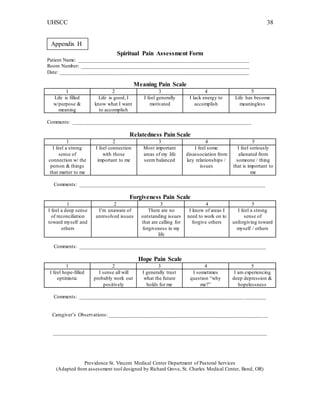
(H) Spiritual Pain Assessment Form……………………………….………………….…38
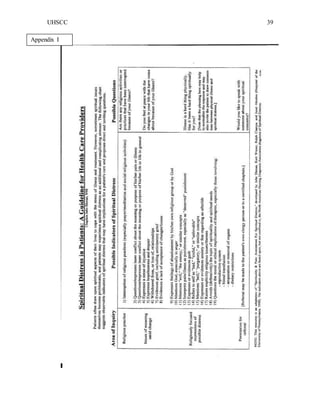
(I) Spiritual Distress in Patients: A Guideline for Health Care Providers…………….....39
References………………………………………………………………………………..40
UHSCC 5
Why is a Spiritual Care Volunteer Program Needed?
In the United States, the projection for 2014 is that 1,665,540 individuals will
receive a cancer diagnosis, which equates to more than 4,500 new cancer diagnoses each
day (Siegel, Ma, Zou, Jemal, 2014). American men have a one in two chance of
developing cancer during their lifetime while American women have a one in three
chance of developing cancer during their lifetime (ACS, 2010). Over the past two
decades, because of the advances in cancer prevention, early detection, and treatment
there has been a steady decline in the cancer death rate (Siegel et al., 2014).
University Hospitals Seidman Cancer Center UHSCC) is committed to the
prevention, detection, and treatment of cancer. Beyond prevention, detection, and
treatment, UHSCC is dedicated to the whole person, which includes the human spirit.
Cancer is a traumatic life event that often causes patients to seek deeper meaning
in life, asking questions such as “Why is this happening to me?” and “What does it all
mean?” Spirituality, a vital part of the human experience, serves to help individuals
explore these existential questions.
History
Since the 1940s when University Hospitals (UH) was part of the Cleveland
Cancer Consortium, UH has contributed major clinical and scientific cancer treatment
advances; it was through Robert Livingston Ireland Jr. (February 1, 1985 – April 21,
1981) that, in 1981, the UH cancer program received significant support from the state of
Ohio. In 1982, the UH cancer program was named Ireland Cancer Center in honor of Mr.
Ireland. During that same year, UH merged with Case Western Reserve University, their
respective clinical and laboratory research resources formed a broader-based cancer
UHSCC 6
center. From its beginning, the mission of UH Ireland Cancer Center was “to provide the
highest standards of care for cancer patients, to make new discoveries about treating the
disease through clinical research and to reach out to the community through educational
efforts and information on the effectiveness of early screening” (www.uhhospitals.org).
In 2011, UH embarked on a new era of patient care by opening a 120-bed hospital
that consolidated all of UH Ireland Cancer Center’s services into one building. Renamed,
it became the Seidman Cancer Center (SCC) in honor of Jane and Lee Seidman, who
donated $42 million in support of Vision 2010: The UH Difference strategic initiative.
Philanthropic leadership and ongoing support strengthen UHSCC in the continuing fight
against cancer.
Spirituality or Religion
Spirituality
On February 17-18, 2009, in Pasadena, California, Consensus Conference
sponsored by the Archstone Foundation of Long Beach, California was held. The guiding
premise of the conference was the belief that spiritual care is pivotal to quality palliative
care. Participants were recruited by invitation. A representative sample of 40 national
leaders included physicians, nurses, psychologists, social workers, chaplains and clergy,
other spiritual care providers, and health care administration. These invitees came to a
consensus driven definition of spirituality within the context of the health care
environment. Critical elements of the definition included (a) meaning, (b) connectedness
to spirituality as an aspect of humanity, and (c) searching for the significant or the scared.
The following definition is a product of the Consensus Conference:
UHSCC 7
Spirituality is the aspect of humanity that refers to the way individuals
seek and express meaning and purpose and the way they experience their
connectedness to the moment, to self, to others, to nature, and to the
significant or sacred. (Puchalski et.al., 2009, p. 887).
Religion
Religion encompasses the values, beliefs, and practices that people adopt to meet
their spiritual needs. One definition of religion is that it is “an organized system of
beliefs, practices, rituals, and symbols designed to facilitate closeness to the sacred or
transcendent, God, higher power, or ultimate truth or reality” (Vachon, 2008, p. 219). An
individual’s experience with religion ranges from extremely positive to extremely
negative (Anandarajah & Hight, 2001). All people do not experience or express
spirituality in the context of religion. Spirituality transcends religion in that religion is a
means of accessing, directing, or opening to the spiritual.
Spirituality in Healthcare: A Shifting Paradigm
Throughout history, the connection between spirituality/religion and healthcare
remained strong until the Enlightenment when the scientific revolution changed
healthcare by taking the focus away from the spiritual/religious realm and promoting a
more technological and biomedical model of care (Considine, 2007). According to
Considine (2007), currently, there is a paradigm shift happening in the healthcare system;
the goal is to advance reintegration of spirituality into the healthcare setting. SCC is
supportive of this shift, as treatment involves the whole person.
UHSCC 8
Why Spiritual Care?
Researchers have suggested that for many patients spirituality and religion are key
components when it comes to determining health-outcomes, including higher survival
rates (Peterson, 2011). According to Peterson (2011), for cancer patients, specifically,
spirituality/religion can reduce depression and enhance quality of life.
Seidman Cancer Center’s Spiritual Care Vision
Spiritual Care at Seidman Cancer Center is a service that helps patients, their
families, and staff to draw on a spiritual perspective, which facilitates a sense of
belonging, peace, hope, and love. (Reverend Sally Wile, Personal Communicatione)
Seidman Cancer Center’s Spiritual Care Mission
Seidman Cancer Center is committed to helping patients discover or access
meaning in the midst of life-limiting or life-threatening illness, enhancing their quality of
life, and addressing their anxiety and/or depression. Seidman Cancer Center is
committed to ensuring that those individuals who are in spiritual distress receive the
spiritual care they need. (Reverend Sally Wile, M.Div., SCC, 2014, February).
Initiating a Spiritual Care Volunteer Program
At SCC, approximately 250 individuals receive inpatient or outpatient treatment
on any given day. Currently, because there is no formal spiritual care volunteer program
in place, it can be argued that some of SCC’s patients’ spiritual needs may go unmet. The
proposed volunteer program is intended to support the vision and mission of SCC.
Who are the Volunteers?
Volunteers targeted for this program need competency in a number of areas. They
must possess the character strengths of humility, compassion, empathy, integrity,
UHSCC 9
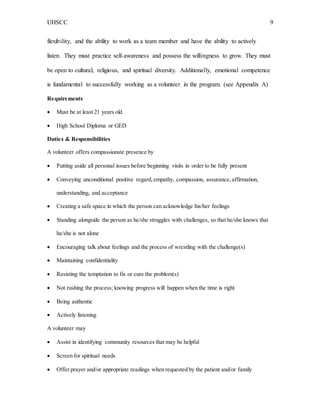
flexibility, and the ability to work as a team member and have the ability to actively
listen. They must practice self-awareness and possess the willingness to grow. They must
be open to cultural, religious, and spiritual diversity. Additionally, emotional competence
is fundamental to successfully working as a volunteer in the program. (see Appendix A)
Requirements
 Must be at least 21 years old
 High School Diploma or GED
Duties & Responsibilities
A volunteer offers compassionate presence by
 Putting aside all personal issues before beginning visits in order to be fully present
 Conveying unconditional positive regard,empathy, compassion, assurance,affirmation,
understanding, and acceptance
 Creating a safe space in which the person can acknowledge his/her feelings
 Standing alongside the person as he/she struggles with challenges, so that he/she knows that
he/she is not alone
 Encouraging talk about feelings and the process of wrestling with the challenge(s)
 Maintaining confidentiality
 Resisting the temptation to fix or cure the problem(s)
 Not rushing the process; knowing progress will happen when the time is right
 Being authentic
 Actively listening
A volunteer may
 Assist in identifying community resources that may be helpful
 Screen for spiritual needs
 Offer prayer and/or appropriate readings when requested by the patient and/or family
UHSCC 10
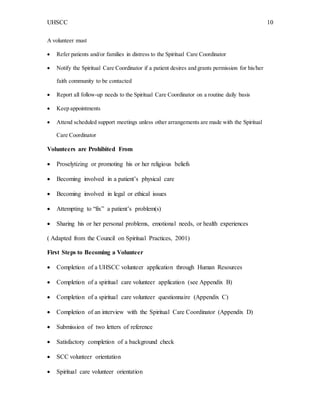
A volunteer must
 Refer patients and/or families in distress to the Spiritual Care Coordinator
 Notify the Spiritual Care Coordinator if a patient desires and grants permission for his/her
faith community to be contacted
 Report all follow-up needs to the Spiritual Care Coordinator on a routine daily basis
 Keep appointments
 Attend scheduled support meetings unless other arrangements are made with the Spiritual
Care Coordinator
Volunteers are Prohibited From
 Proselytizing or promoting his or her religious beliefs
 Becoming involved in a patient’s physical care
 Becoming involved in legal or ethical issues
 Attempting to “fix” a patient’s problem(s)
 Sharing his or her personal problems, emotional needs, or health experiences
( Adapted from the Council on Spiritual Practices, 2001)
First Steps to Becoming a Volunteer
 Completion of a UHSCC volunteer application through Human Resources
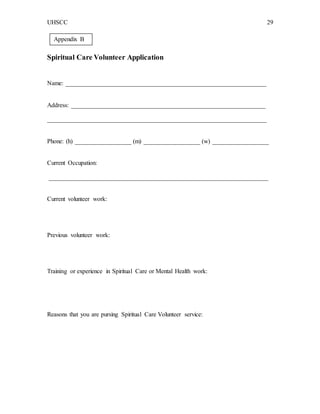
 Completion of a spiritual care volunteer application (see Appendix B)
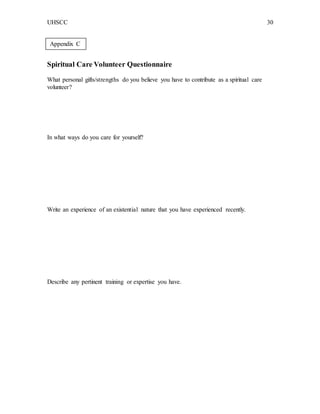
 Completion of a spiritual care volunteer questionnaire (Appendix C)
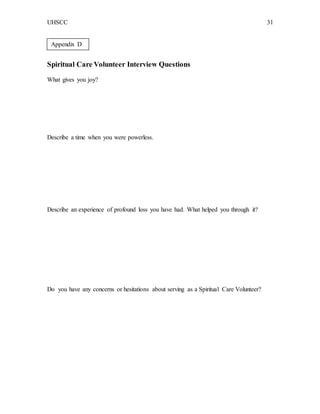
 Completion of an interview with the Spiritual Care Coordinator (Appendix D)
 Submission of two letters of reference
 Satisfactory completion of a background check
 SCC volunteer orientation
 Spiritual care volunteer orientation
UHSCC 11
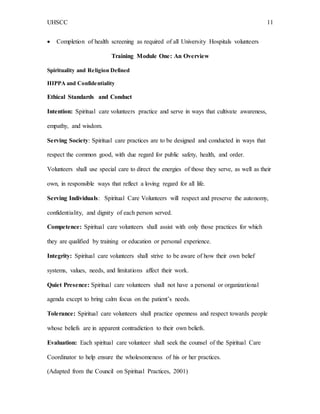
 Completion of health screening as required of all University Hospitals volunteers
Training Module One: An Overview
Spirituality and Religion Defined
HIPPA and Confidentiality
Ethical Standards and Conduct
Intention: Spiritual care volunteers practice and serve in ways that cultivate awareness,
empathy, and wisdom.
Serving Society: Spiritual care practices are to be designed and conducted in ways that
respect the common good, with due regard for public safety, health, and order.
Volunteers shall use special care to direct the energies of those they serve, as well as their
own, in responsible ways that reflect a loving regard for all life.
Serving Individuals: Spiritual Care Volunteers will respect and preserve the autonomy,
confidentiality, and dignity of each person served.
Competence: Spiritual care volunteers shall assist with only those practices for which
they are qualified by training or education or personal experience.
Integrity: Spiritual care volunteers shall strive to be aware of how their own belief
systems, values, needs, and limitations affect their work.
Quiet Presence: Spiritual care volunteers shall not have a personal or organizational
agenda except to bring calm focus on the patient’s needs.
Tolerance: Spiritual care volunteers shall practice openness and respect towards people
whose beliefs are in apparent contradiction to their own beliefs.
Evaluation: Each spiritual care volunteer shall seek the counsel of the Spiritual Care
Coordinator to help ensure the wholesomeness of his or her practices.
(Adapted from the Council on Spiritual Practices, 2001)
UHSCC 12
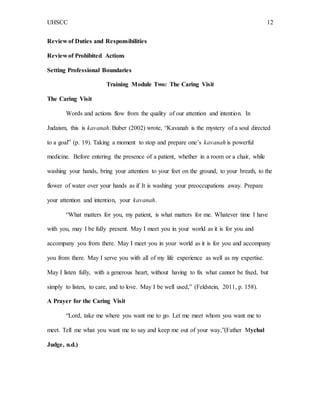
Review of Duties and Responsibilities
Review of Prohibited Actions
Setting Professional Boundaries
Training Module Two: The Caring Visit
The Caring Visit
Words and actions flow from the quality of our attention and intention. In
Judaism, this is kavanah. Buber (2002) wrote, “Kavanah is the mystery of a soul directed
to a goal” (p. 19). Taking a moment to stop and prepare one’s kavanah is powerful
medicine. Before entering the presence of a patient, whether in a room or a chair, while
washing your hands, bring your attention to your feet on the ground, to your breath, to the
flower of water over your hands as if It is washing your preoccupations away. Prepare
your attention and intention, your kavanah.
“What matters for you, my patient, is what matters for me. Whatever time I have
with you, may I be fully present. May I meet you in your world as it is for you and
accompany you from there. May I meet you in your world as it is for you and accompany
you from there. May I serve you with all of my life experience as well as my expertise.
May I listen fully, with a generous heart, without having to fix what cannot be fixed, but
simply to listen, to care, and to love. May I be well used,” (Feldstein, 2011, p. 158).
A Prayer for the Caring Visit
“Lord, take me where you want me to go. Let me meet whom you want me to
meet. Tell me what you want me to say and keep me out of your way,”(Father Mychal
Judge, n.d.)
UHSCC 13
Remember
Reflect on each visit and your feelings, as preparation for the next visit. Be
prepared to speak your own from your heart.
Volunteers Will
 Always take the appropriate precautions against contagious disease
 Always wash hands before and after each visit
 Maintain confidentiality
 Speak in a natural tone of voice
 Bring a calm presence and the understanding that silent presence can often be very
meaningful and reassuring
 Follow the patient’s lead where prayer is concerned
 Refer the patient/family to the Spiritual Care Coordinator when in spiritual distress
Volunteers Will Not
 Talk about your own past illnesses or hospital experiences
 Force the patient to talk.
 Question the patient about the details of the illness
 Assume that the patient is unaware of your conversation with family members just
because the patient is asleep or in a coma
 Whisper to family members or to medical personnel within sight of the patient
 Sit, lean on, or jar the bed
 Visit when ill
 Visit when in a rush
 Visit during mealtimes
UHSCC 14
 Tell the family how to decide when presented with medical options
 Criticize the hospital, the treatment, or the medical personnel
 Promise that God will heal them
(Adapted from Collins, 2007)
What is Spiritual Distress?
Existential Questions of Life
 Why is this happening? Why is it happening to me?
 What does it all mean?
 How do I make sense of everything?
 How do I feel about the changes in my life?
 What gives me comfort and hope?
 What do I call “good” in my life? What do I call “bad”?
 What am I grateful for?
 What do I trust? Whom do I trust?
 Who is my beloved community that loves me and is loved by me, no matter what?
 What or who – beyond myself – do I believe is important in my life?
Setting Professional Boundaries
Training Module Three: Communication
Active listening
o Do
 Show genuine interest in what the speaker is saying
 Provide unconditional regard
 Express empathy
UHSCC 15
 Cultivate the ability to be silent when needed
o Do Not
 Interrupt
 Prod for more information and coerce the speaker to discuss something they
would prefer not to
 Provide advice
 Preach to the speaker on how they should feel, what they should do, etc.
Nonverbal communication
o Facial expression
o Voice
o Posture
o Clothing
o Gestures
Attending Skills
o Contact
o Posture
o Gestures
o Environment
o Interested silence
Responding skills
o Acknowledgement responses
o Reflecting content
o Reflecting meaning
UHSCC 16
o Summarizing
Observation Skills
Setting professional boundaries
Training Module Four: The Personal Dimensions of Caring
Cultural Competency
Loss, Death, and Grief
Understanding a Patient’s / Family’s Stress
o Common and uncommon reactions to stress
o Practical stress reduction techniques
Self-care
o Clarifying your own feelings and attitudes
o Filling your own well
Community Resources
Setting Professional Boundaries
Continuing Education Requirement
Read Arthur H. Becker’s (1985) book, The Compassionate Visitor: Resources for
Ministering to People Who Are Ill for ongoing reflection and discussion with the SCC.
What are Screening, History-Gathering, and Assessment Tools?
Hodge (2006) reported that in 2001, the Joint Commission on Accreditation of
Healthcare Organizations (JCAHO) revised its standards to require the use of spiritual
assessment tools. Stewart (2014) explained that “affirming the relevance of exploring
spirituality with patients promotes a comprehensive and patient-centered model of care
UHSCC 17
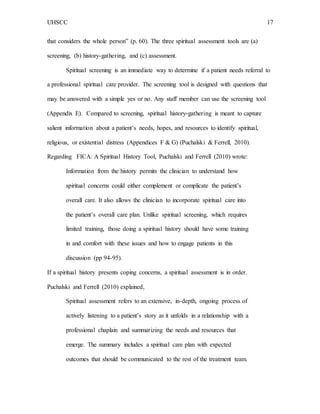
that considers the whole person” (p. 60). The three spiritual assessment tools are (a)
screening, (b) history-gathering, and (c) assessment.
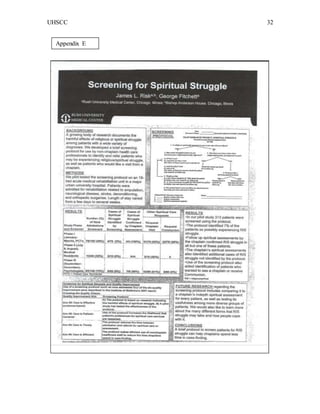
Spiritual screening is an immediate way to determine if a patient needs referral to
a professional spiritual care provider. The screening tool is designed with questions that
may be answered with a simple yes or no. Any staff member can use the screening tool
(Appendix E). Compared to screening, spiritual history-gathering is meant to capture
salient information about a patient’s needs, hopes, and resources to identify spiritual,
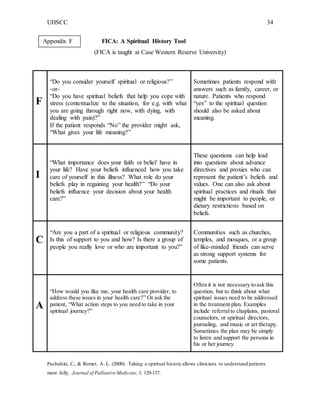
religious, or existential distress (Appendices F & G) (Puchalski & Ferrell, 2010).
Regarding FICA: A Spiritual History Tool, Puchalski and Ferrell (2010) wrote:
Information from the history permits the clinician to understand how
spiritual concerns could either complement or complicate the patient’s
overall care. It also allows the clinician to incorporate spiritual care into
the patient’s overall care plan. Unlike spiritual screening, which requires
limited training, those doing a spiritual history should have some training
in and comfort with these issues and how to engage patients in this
discussion (pp 94-95).
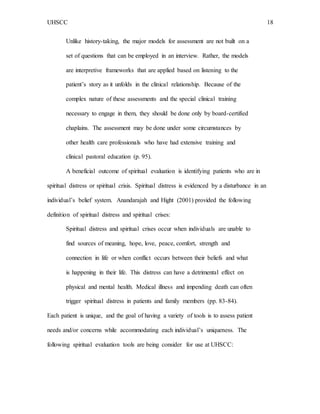
If a spiritual history presents coping concerns, a spiritual assessment is in order.
Puchalski and Ferrell (2010) explained,
Spiritual assessment refers to an extensive, in-depth, ongoing process of
actively listening to a patient’s story as it unfolds in a relationship with a
professional chaplain and summarizing the needs and resources that
emerge. The summary includes a spiritual care plan with expected
outcomes that should be communicated to the rest of the treatment team.
UHSCC 18
Unlike history-taking, the major models for assessment are not built on a
set of questions that can be employed in an interview. Rather, the models
are interpretive frameworks that are applied based on listening to the
patient’s story as it unfolds in the clinical relationship. Because of the
complex nature of these assessments and the special clinical training
necessary to engage in them, they should be done only by board-certified
chaplains. The assessment may be done under some circumstances by
other health care professionals who have had extensive training and
clinical pastoral education (p. 95).
A beneficial outcome of spiritual evaluation is identifying patients who are in
spiritual distress or spiritual crisis. Spiritual distress is evidenced by a disturbance in an
individual’s belief system. Anandarajah and Hight (2001) provided the following
definition of spiritual distress and spiritual crises:
Spiritual distress and spiritual crises occur when individuals are unable to
find sources of meaning, hope, love, peace, comfort, strength and
connection in life or when conflict occurs between their beliefs and what
is happening in their life. This distress can have a detrimental effect on
physical and mental health. Medical illness and impending death can often
trigger spiritual distress in patients and family members (pp. 83-84).
Each patient is unique, and the goal of having a variety of tools is to assess patient
needs and/or concerns while accommodating each individual’s uniqueness. The
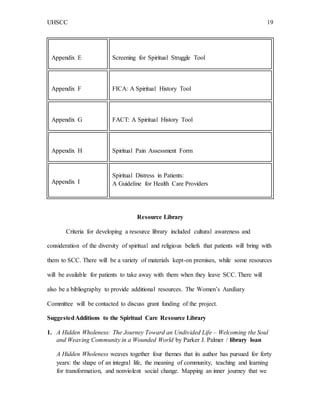
following spiritual evaluation tools are being consider for use at UHSCC:
UHSCC 19
Appendix E Screening for Spiritual Struggle Tool
Appendix F FICA: A Spiritual History Tool
Appendix G FACT: A Spiritual History Tool
Appendix H Spiritual Pain Assessment Form
Appendix I
Spiritual Distress in Patients:
A Guideline for Health Care Providers
Resource Library
Criteria for developing a resource library included cultural awareness and
consideration of the diversity of spiritual and religious beliefs that patients will bring with
them to SCC. There will be a variety of materials kept-on premises, while some resources
will be available for patients to take away with them when they leave SCC. There will
also be a bibliography to provide additional resources. The Women’s Auxiliary
Committee will be contacted to discuss grant funding of the project.
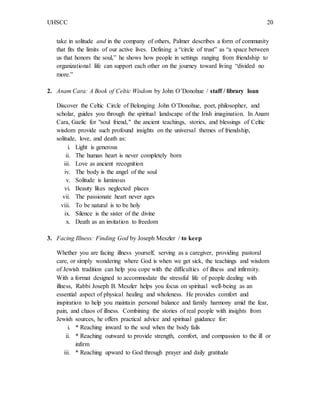
SuggestedAdditions to the Spiritual Care Resource Library
1. A Hidden Wholeness: The Journey Toward an Undivided Life – Welcoming the Soul
and Weaving Community in a Wounded World by Parker J. Palmer / library loan
A Hidden Wholeness weaves together four themes that its author has pursued for forty
years: the shape of an integral life, the meaning of community, teaching and learning
for transformation, and nonviolent social change. Mapping an inner journey that we
UHSCC 20
take in solitude and in the company of others, Palmer describes a form of community
that fits the limits of our active lives. Defining a “circle of trust” as “a space between
us that honors the soul,” he shows how people in settings ranging from friendship to
organizational life can support each other on the journey toward living “divided no
more.”
2. Anam Cara: A Book of Celtic Wisdom by John O’Donohue / staff / library loan
Discover the Celtic Circle of Belonging John O’Donohue, poet, philosopher, and
scholar, guides you through the spiritual landscape of the Irish imagination. In Anam
Cara, Gaelic for "soul friend," the ancient teachings, stories, and blessings of Celtic
wisdom provide such profound insights on the universal themes of friendship,
solitude, love, and death as:
i. Light is generous
ii. The human heart is never completely born
iii. Love as ancient recognition
iv. The body is the angel of the soul
v. Solitude is luminous
vi. Beauty likes neglected places
vii. The passionate heart never ages
viii. To be natural is to be holy
ix. Silence is the sister of the divine
x. Death as an invitation to freedom
3. Facing Illness: Finding God by Joseph Meszler / to keep
Whether you are facing illness yourself, serving as a caregiver, providing pastoral
care, or simply wondering where God is when we get sick, the teachings and wisdom
of Jewish tradition can help you cope with the difficulties of illness and infirmity.
With a format designed to accommodate the stressful life of people dealing with
illness, Rabbi Joseph B. Meszler helps you focus on spiritual well-being as an
essential aspect of physical healing and wholeness. He provides comfort and
inspiration to help you maintain personal balance and family harmony amid the fear,
pain, and chaos of illness. Combining the stories of real people with insights from
Jewish sources, he offers practical advice and spiritual guidance for:
i. * Reaching inward to the soul when the body fails
ii. * Reaching outward to provide strength, comfort, and compassion to the ill or
infirm
iii. * Reaching upward to God through prayer and daily gratitude
UHSCC 21
4. Faith, Hope, & Healing: Inspiring Lessons Learned From People Living With Cancer
by Bernie S. Siegel, and Jennifer Sander / library loan
In this collection of first-person accounts, doctor and author Siegel (Love, Medicine,
and Miracles) brings together almost three dozen cancer patients (or close relations
of) to share their stories and the lessons they’ve learned. Many entries tackle the
moment of diagnosis (the first, from survivor Angela Passidomo Trafford, opens with
the line, “How many times do I have to have cancer?!”), while others pick up at the
moment the diagnosis first hits home; still others focus on the end, like Ann Martin
Bowler, whose sick brother passed days after a reinvigorating near-death experience.
Lynn Zeller contributes a list of the “eight practices” she discovered through cancer
that have led to a “wonderfully expanded experience of life” (including a focus on
gratitude, mindfulness, and the idea that the universe “is in a conspiracy for my
good”); Edwina Ford focuses on her afflicted husband’s admiration, and efforts on
behalf, of Lance Armstrong’s post-surgery Tour de France comeback. For each piece,
Siegel provides a reflection and a moral (“Life’s difficulties are what teach us to
grow”) that clarify and encourage. Anyone struggling with cancer will find many
relatable voices and, in Siegel, a compassionate expert commentator. (Apr.)
(Publishers Weekly, April 20, 2009)
5. Faith: Trusting Your Own Deepest Experience by Sharon Salzberg / library loan
In this beautifully written work, one of America's most beloved meditation teachers
offers discerning wisdom on understanding faith as a healing quality. Through the
teachings of Buddha and insight gained from her lifelong spiritual quest, Salzberg
provides us with a road map for cultivating a feeling of peace that can be practiced by
anyone of any tradition.
6. Guideposts / to keep
Every day, Daily Guideposts offers a short Scripture verse for reflection,
accompanied by a true, first-person devotion, told in an informal, conversational
style, that shares the ways God speaks to us in the ordinary events of life, and a brief
prayer to focus the reader's own prayers and apply the day's message.
7. Healing of Soul: Healing of Body by Rabi Simkha Y. Weintraub (Ed.) / staff /
library loan
A source of solace for those who are facing illness, as well as those who care for
them. The ten Psalms which form the core of this healing resource were originally
selected 200 years ago by Rabbi Nachman of Breslov as a complete remedy. Today,
for anyone coping with illness, they continue to provide a wellspring of strength.
With a focus on openness, honesty, and personal reflection, the reader is led into the
heart, and the healing strength, of each Psalm. To all who are living with the pain and
UHSCC 22
uncertainty of physical illness, these Psalms and the inspiring commentaries that
accompany them offer an anchor of spiritual comfort. Includes: A healing resource
for personal use. Ten complete remedy Psalms, newly translated. Inspiring
introductions & commentaries by eminent spiritual leaders reflecting different
movements and backgrounds.
8. Help Thanks Wow: The Three Essential Prayers by Anne Lamott / staff
Readers of all ages have followed and cherished Anne Lamott’s funny and perceptive
writing about her own faith through decades of trial and error. And in her new book,
Help, Thanks, Wow, she has coalesced everything she knows about prayer to these
fundamentals. It is these three prayers – asking for assistance from a higher power,
appreciating what we have that is good, and feeling awe at the world around us – that
can get us through the day and can show us the way forward. In Help, Thanks, Wow,
Lamott recounts how she came to these insights, explains what they mean to her and
how they have helped, and explores how others have embraced these same ideas.
Insightful and honest as only Anne Lamott can be, Help, Thanks, Wow is the
everyday faith book that new Lamott readers will love and longtime Lamott fans will
treasure.
9. Jesus Calling by Sarah Young / to keep
Uniquely inspired treasures from heaven for every day of the year by missionary
Sarah Young. Jesus Calling is a devotional filled with uniquely inspired treasures
from heaven for every day of the year. After many years of writing in her prayer
journal, missionary Sarah Young decided to listen to God with pen in hand, writing
down whatever she believed He was saying to her. It was awkward at first, but
gradually her journaling changed from monologue to dialogue. She knew her
writings were not inspired as Scripture is, but journaling helped her grow closer to
God. Others were blessed as she shared her writings, until people all over the world
were using her messages. They are written from Jesus' point of view, thus the title
Jesus Calling. It is Sarah's fervent prayer that our Savior may bless readers with His
presence and His peace in ever deeper measure.
10. Life, Faith, and Cancer by Rabbi Douglas J. Kohn / bibliography
When the diagnosis of illness shatters the veneer of our normal, comfortable,
predictable course of life, we are embittered and confused. Why me?; is a question
that reverberates uncontrollably in our heads. Cancer, especially, provokes such a
response. With time, Why me is replaced by, What now?; Today, more and more
UHSCC 23
people are surviving cancer. How do we keep going afterward? How do we maintain
the connection to Judaism and God that we once had? Do we need to rethink
everything we once unwaveringly believed in? This moving volume of essays written
by rabbis, cantors, and other Jewish professionals who have all experienced cancer
deal with these questions and many more. Their personal stories are interwoven with
Jewish texts and teachings. Part I. Diagnosis: So, You ve Got Cancer 1. Discovering
Vulnerability Rabbi Sue Elwell 2. Not Knowing Could Be Your Biggest Heath Risk
Joy Wasserman 3. Why Me Rabbi Doug Kohn 4. Facing Mortality Rabbi Michael
Balinky 5. Learning and Discovering Systems of Support Rabbi Hirshel Jaffe, Rabbi
James Rudin, and Marcia Rudin 6. Developing a New Reality Rabbi Elaine Zecher
Part II Treatment 7. How to Pursue : The Obligation to Heal Rabbi William Cutter 8.
Facing Treatment Rabbi Stacia Deutsch 9. Leaving it Behind Harriet Levine 10. A
Spiritual Dimension Cantorial Soloist Diane Becker Kransnick 11. Convention and
Experimental Options Rabbi Andrew Sklarz 12. Beginning Recovery, Finding
Blessings Cantor Vicki Axe Part III Recovery 13. A New Routine, A New Me -
Rebecca Meyer Carr 14. The Lump, The Bump, or the Swallow: Is it Cancer? Rabbi
Randi Musnitsky 15. Cancer Time: A Month, Six Months, Twelve Months Rabbi
Jonathan M. Brown 16. We, The Licky Ones Rabbi Myra Soifer 17. Surviving the
Valley: A Journey without a Beginning Rabbi Stanley Davids 18. Our Sacramental
Personality Rabbi Gary Phillip Zola 19. The New Can Become Holy Rabbi Yael
Ridberg
11. Listening to Your Life: Daily Meditations with Frederick Buechner by Frederick
Buechner / library loan
Daily meditations taken from the works of an acclaimed novelist, essayist, and
preacher who "has articulated what he sees with a freshness and clarity and energy
that hails our stultified imaginations."--The New York Times Book Review
12. Lovingkindness: The Revolutionary Art of Happiness by Sharon Salzberg (Buddhism)
/ staff
Throughout our lives we long to love ourselves more deeply and find a greater sense
of connection with others. Our fear of intimacy—both with others and with
ourselves—creates feelings of pain and longing. But these feelings can also awaken
in us the desire for freedom and the willingness to take up the spiritual path. In this
inspiring book, Sharon Salzberg, one of America's leading spiritual teachers, shows
us how the Buddhist path of lovingkindness can help us discover the radiant, joyful
heart within each of us. This practice of lovingkindness is revolutionary because it
has the power to radically change our lives, helping us cultivate true happiness in
ourselves and genuine compassion for others. The Buddha described the nature of
UHSCC 24
such a spiritual path as "the liberation of the heart, which is love." The author draws
on simple Buddhist teachings, wisdom stories from various traditions, guided
meditation practices, and her own experience from twenty-five years of practice and
teaching to illustrate how each one of us can cultivate love, compassion, joy, and
equanimity—the four "heavenly abodes" of traditional Buddhism.
13. Malignant: Medical ethicists confront cancer by Rebecca Dresser / staff
"You have cancer." Words no one wants to hear, but heard by millions every year.
Millions more hear the equally shattering news that a loved one has cancer. Both are
life-changing messages. For the people writing this book, cancer was not only a
personal crisis, it was also an education. Experts on medical ethics, personal
experience with cancer showed them how little they understood of the real world of
serious illness. Despite years of teaching and writing about treatment decision-
making and patient autonomy, they were unprepared for many of the problems they
faced. They discovered that the rights and wrongs of cancer care were more
complicated than they had anticipated. Ethics outside the hospital walls took on
unexpected significance as they discovered the astonishing generosity, and the
unintentional cruelty, that cancer provokes in others. Cancer was a test of personal
character, too, as patients accustomed to control became dependent on others and
caregivers shouldered unfamiliar and difficult responsibilities. In chapters on cancer
diagnosis, treatment choices, and research participation, the authors examine medical
ethics from the personal point of view. In chapters on family caregiving, cancer
interactions, and cancer support groups, they consider ethics outside the medical
setting. In chapters on mortality and survivorship, they reflect on cancers personal
moral teachings. Cancer is an unavoidable feature of modern life. Readers will come
away with a deeper understanding of what it is like to have cancer, better equipped to
respond to cancer in their own lives and the lives of others. The book also offers
insights to doctors and nurses seeking to improve cancer treatment and to medical
ethicists seeking to make their work more relevant to patients and caregivers.
14. Our Daily Bread / to keep
Since it was first published in 1956, Our Daily Bread has become the resource for
which RBC Ministries is best known. The daily devotional thoughts published in Our
Daily Bread help readers spend time each day in God’s Word.
15. People Skills: How to Assert Yourself, Listen to Others, and Resolve Conflicts by
Robert Bolton / staff
UHSCC 25
People Skills is a communication-skills handbook that can help you eliminate these
and other communication problems. Author Robert Bolton describes the twelve most
common communication barriers, showing how these “roadblocks” damage
relationships by increasing defensiveness, aggressiveness, or dependency. He
explains how to acquire the ability to listen, assert yourself, resolve conflicts, and
work out problems with others. These are skills that will help you communicate
calmly, even in stressful emotionally charged situations.
16. Psalms and Compassions: A Jesuit’s Journey through Cancer by Timothy Brown /
library loan
Immediately following his return from a ten-day student service project in Mexico in
January 1998, Fr. Brown was diagnosed with colon cancer. He turned to the Book of
Psalms as a source of strength throughout his illness and recovery. This book is the
fruit of that experience. A compilation of Psalms, meditations, rare and original
prayers, and commentaries, Psalms and Compassions is dedicated to all who are
experiencing pain and suffering of any kind, and to all who care for them.
17. Reflections of the 23rd Psalm by Ken Kurtis (DVD) / to keep
18. Sacred Intentions: Morning Inspiration to Strengthen the Spirit Based on the Jewish
Wisdom Tradition by Kerry M. Olitzky & Lori Forman / library loan
A daily inspirational companion of comfort, reassurance and hope, grounded in the
wisdom and strength of Judaism. To help you start each day of the year on a positive
note, there is an inspiring quote from a Jewish source and a brief, striking reflection
on it through which you can gain new understanding and perspective. You'll turn to
Sacred Intentions again and again for optimism, hope and renewal. With a wealth of
contributions by over 40 respected and inspiring spiritual leaders from all parts of the
Jewish community, this lovely book will help you start the day with a powerful
positive attitude.
19. The Book of Awakening: Having the life you want by being present to the life you
have by Mark Nepo / staff / library loan
Philosopher-poet and cancer survivor, Mark Nepo opens a new season of freedom
and joy--an escape from deadening, asleep-at-the wheel sameness--that is both
profound and clarifying. His spiritual daybook is a summons to reclaim aliveness,
liberate the self, take each day one at a time, and to savor the beauty offered by life's
unfolding. Reading his poetic prose is like being given second sight, exposing the
reader to life's multiple dimensions, each one drawn with awe and affection. The
Book of Awakening is the result of his journey of the soul and will inspire others to
UHSCC 26
embark on their own. Nepo speaks of spirit and friendship, urging readers to stay vital
and in love with this life, no matter the hardships. Encompassing many traditions and
voices, Nepo's words offer insight on pain, wonder, and love. Each entry is
accompanied by an exercise that will surprise and delight the reader in its mind-
waking ability.
20. The Helping Relationship Process and Skills (8th ed.) by Lawrence M. Brammer /
staff
The Helping Relationship is a book for learning and teaching basic philosophy,
helping skills, and processes that are essential grounding for most professions and for
all human-contact occupations. The Helping Relationship presents and illustrates
skills in the order in which they are used in the helping process. The primary
emphasis in the helping process is to promote self-help, such as coping competence,
to solve one's own problems and draw on one's own inner strengths. For social
workers, counselors, business managers, nurses and anyone involved in the helping
professions.
21. The Four Agreements: A Practical Guide to Personal Freedom by Don Miguel Ruiz /
staff
Sit at the foot of a native elder and listen as great wisdom of days long past is passed
down. In The Four Agreements shamanic teacher and healer Don Miguel Ruiz
exposes self-limiting beliefs and presents a simple yet effective code of personal
conduct learned from his Toltec ancestors. Full of grace and simple truth, this
handsomely designed book makes a lovely gift for anyone making an elementary
change in life, and it reads in a voice that you would expect from an indigenous
shaman. The four agreements are these: Be impeccable with your word. Don't take
anything personally. Don't make assumptions. Always do your best. It's the how and
why one should do these things that make The Four Agreements worth reading and
remembering. --P. Randall Cohan
22. The Human Side of Cancer: Living with Hope, Coping with Uncertainty by Jimmie
Holland & Sheldon Lewis / library loan
For more than twenty years, Dr. Holland has pioneered the study of psychological
problems of cancer patients and their families -- whom she calls "the real experts." In
The Human Side of Cancer, she shares what she has learned from all of them about
facing this life-threatening illness and what truly helps along the cancer journey. This
book is the next best thing to sitting in Dr. Holland's office and talking with her about
the uncertainty and anxiety elicited by this disease. And it is a book that inspires hope
-- through stories of the simple courage of ordinary people confronting cancer.
UHSCC 27
23. The Untethered Soul by Michael A. Singer / staff / bibliography
What would it be like to free yourself from limitations and soar beyond your
boundaries? What can you do each day to discover inner peace and serenity? The
Untethered Soul—now a New York Times bestseller—offers simple yet profound
answers to these questions. Whether this is your first exploration of inner space, or
you’ve devoted your life to the inward journey, this book will transform your
relationship with yourself and the world around you. You’ll discover what you can do
to put an end to the habitual thoughts and emotions that limit your consciousness. By
tapping into traditions of meditation and mindfulness, author and spiritual teacher
Michael A. Singer shows how the development of consciousness can enable us all to
dwell in the present moment and let go of painful thoughts and memories that keep us
from achieving happiness and self-realization. Co-published with the Institute of
Noetic Sciences (IONS) The Untethered Soul begins by walking you through your
relationship with your thoughts and emotions, helping you uncover the source and
fluctuations of your inner energy. It then delves into what you can do to free yourself
from the habitual thoughts, emotions, and energy patterns that limit your
consciousness. Finally, with perfect clarity, this book opens the door to a life lived in
the freedom of your innermost being.
UHSCC 28
Skills of Emotional Competence
1. Awareness of your own emotional state, including feeling multiple emotions and
the possibility that you are in emotional states without being aware of them
1. Ability to read other people’s emotions in standard ways
2. Ability to use emotion words
3. Capacity to feel other people’s feelings – empathy
4. Awareness that experience and expression may not correspond
5. Awareness of what emotions are expected in different situations
6. Ability to take personal information into account when trying to understand an
individual’s emotions
7. Awareness that your emotional expressions may affect others and the ability to
use your expressions for your own goals
8. Capacity for coping effectively with distressing emotions using various strategies
– regulation
9. Awareness that emotion is key to relationships, especially the sharing of emotion
10. Capacity to manage, overall, to feel the way you want to feel, including accepting
your emotional experiences
(Planalp, S., 2013)
Appendix A
UHSCC 29
Spiritual Care Volunteer Application
Name: ________________________________________________________________
Address: ______________________________________________________________
______________________________________________________________________
Phone: (h) __________________ (m) __________________ (w) __________________
Current Occupation:
______________________________________________________________________
Current volunteer work:
Previous volunteer work:
Training or experience in Spiritual Care or Mental Health work:
Reasons that you are pursing Spiritual Care Volunteer service:
Appendix B
UHSCC 30
Spiritual Care Volunteer Questionnaire
What personal gifts/strengths do you believe you have to contribute as a spiritual care
volunteer?
In what ways do you care for yourself?
Write an experience of an existential nature that you have experienced recently.
Describe any pertinent training or expertise you have.
Appendix C
UHSCC 31
Spiritual Care Volunteer Interview Questions
What gives you joy?
Describe a time when you were powerless.
Describe an experience of profound loss you have had. What helped you through it?
Do you have any concerns or hesitations about serving as a Spiritual Care Volunteer?
Appendix D
UHSCC 32
Appendix E
UHSCC 33
Appendix E
UHSCC 34
FICA: A Spiritual History Tool
(FICA is taught at Case Western Reserve University)
F
“Do you consider yourself spiritual or religious?”
-or-
“Do you have spiritual beliefs that help you cope with
stress (contextualize to the situation, for e.g. with what
you are going through right now, with dying, with
dealing with pain)?”
If the patient responds “No” the provider might ask,
“What gives your life meaning?”
Sometimes patients respond with
answers such as family, career, or
nature. Patients who respond
“yes” to the spiritual question
should also be asked about
meaning.
I
“What importance does your faith or belief have in
your life? Have your beliefs influenced how you take
care of yourself in this illness? What role do your
beliefs play in regaining your health?” “Do your
beliefs influence your decision about your health
care?”
These questions can help lead
into questions about advance
directives and proxies who can
represent the patient’s beliefs and
values. One can also ask about
spiritual practices and rituals that
might be important to people, or
dietary restrictions based on
beliefs.
C
“Are you a part of a spiritual or religious community?
Is this of support to you and how? Is there a group of
people you really love or who are important to you?”
Communities such as churches,
temples, and mosques, or a group
of like-minded friends can serve
as strong support systems for
some patients.
A
“How would you like me, your health care provider, to
address these issues in your health care?” Or ask the
patient, “What action steps to you need to take in your
spiritual journey?”
Often it is not necessary to ask this
question, but to think about what
spiritual issues need to be addressed
in the treatment plan. Examples
include referralto chaplains, pastoral
counselors, or spiritual directors,
journaling, and music or art therapy.
Sometimes the plan may be simply
to listen and support the persona in
his or her journey.
Puchalski, C., & Romer, A. L. (2000). Taking a spiritual history allows clinicians to understand patients
more fully. Journal of Palliative Medicine,3, 129-137.
Appendix F
UHSCC 35
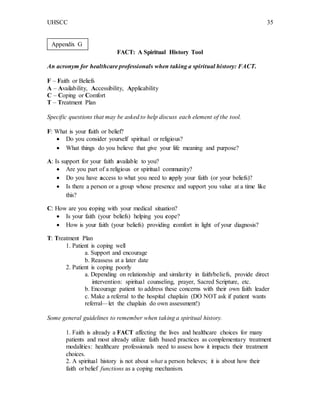
FACT: A Spiritual History Tool
An acronym for healthcare professionals when taking a spiritual history: FACT.
F – Faith or Beliefs
A – Availability, Accessibility, Applicability
C – Coping or Comfort
T – Treatment Plan
Specific questions that may be asked to help discuss each element of the tool.
F: What is your faith or belief?
 Do you consider yourself spiritual or religious?
 What things do you believe that give your life meaning and purpose?
A: Is support for your faith available to you?
 Are you part of a religious or spiritual community?
 Do you have access to what you need to apply your faith (or your beliefs)?
 Is there a person or a group whose presence and support you value at a time like
this?
C: How are you coping with your medical situation?
 Is your faith (your beliefs) helping you cope?
 How is your faith (your beliefs) providing comfort in light of your diagnosis?
T: Treatment Plan
1. Patient is coping well
a. Support and encourage
b. Reassess at a later date
2. Patient is coping poorly
a. Depending on relationship and similarity in faith/beliefs, provide direct
intervention: spiritual counseling, prayer, Sacred Scripture, etc.
b. Encourage patient to address these concerns with their own faith leader
c. Make a referral to the hospital chaplain (DO NOT ask if patient wants
referral—let the chaplain do own assessment!)
Some general guidelines to remember when taking a spiritual history.
1. Faith is already a FACT affecting the lives and healthcare choices for many
patients and most already utilize faith based practices as complementary treatment
modalities: healthcare professionals need to assess how it impacts their treatment
choices.
2. A spiritual history is not about what a person believes; it is about how their
faith orbelief functions as a coping mechanism.
Appendix G
UHSCC 36
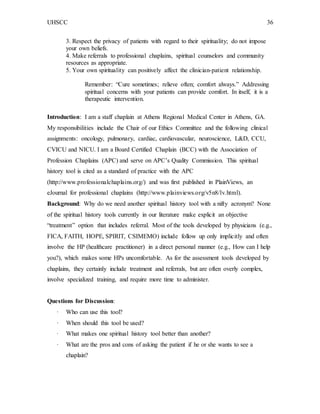
3. Respect the privacy of patients with regard to their spirituality; do not impose
your own beliefs.
4. Make referrals to professional chaplains, spiritual counselors and community
resources as appropriate.
5. Your own spirituality can positively affect the clinician-patient relationship.
Remember: “Cure sometimes; relieve often; comfort always.” Addressing
spiritual concerns with your patients can provide comfort. In itself, it is a
therapeutic intervention.
Introduction: I am a staff chaplain at Athens Regional Medical Center in Athens, GA.
My responsibilities include the Chair of our Ethics Committee and the following clinical
assignments: oncology, pulmonary, cardiac, cardiovascular, neuroscience, L&D, CCU,
CVICU and NICU. I am a Board Certified Chaplain (BCC) with the Association of
Profession Chaplains (APC) and serve on APC’s Quality Commission. This spiritual
history tool is cited as a standard of practice with the APC
(http://www.professionalchaplains.org/) and was first published in PlainViews, an
eJournal for professional chaplains (http://www.plainviews.org/v5n8/lv.html).
Background: Why do we need another spiritual history tool with a nifty acronym? None
of the spiritual history tools currently in our literature make explicit an objective
“treatment” option that includes referral. Most of the tools developed by physicians (e.g.,
FICA, FAITH, HOPE, SPIRIT, CSIMEMO) include follow up only implicitly and often
involve the HP (healthcare practitioner) in a direct personal manner (e.g., How can I help
you?), which makes some HPs uncomfortable. As for the assessment tools developed by
chaplains, they certainly include treatment and referrals, but are often overly complex,
involve specialized training, and require more time to administer.
Questions for Discussion:
· Who can use this tool?
· When should this tool be used?
· What makes one spiritual history tool better than another?
· What are the pros and cons of asking the patient if he or she wants to see a
chaplain?
UHSCC 37
· How can using a spiritual history tool such as FACT facilitate cross-cultural and
cross-linguistic spiritual care?
· What is the role of spiritual care in healthcare today?
· How should spiritual care be provided in healthcare settings? By whom?
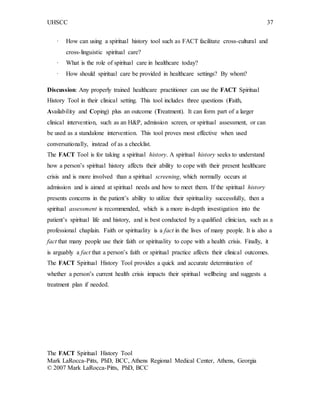
Discussion: Any properly trained healthcare practitioner can use the FACT Spiritual
History Tool in their clinical setting. This tool includes three questions (Faith,
Availability and Coping) plus an outcome (Treatment). It can form part of a larger
clinical intervention, such as an H&P, admission screen, or spiritual assessment, or can
be used as a standalone intervention. This tool proves most effective when used
conversationally, instead of as a checklist.
The FACT Tool is for taking a spiritual history. A spiritual history seeks to understand
how a person’s spiritual history affects their ability to cope with their present healthcare
crisis and is more involved than a spiritual screening, which normally occurs at
admission and is aimed at spiritual needs and how to meet them. If the spiritual history
presents concerns in the patient’s ability to utilize their spirituality successfully, then a
spiritual assessment is recommended, which is a more in-depth investigation into the
patient’s spiritual life and history, and is best conducted by a qualified clinician, such as a
professional chaplain. Faith or spirituality is a fact in the lives of many people. It is also a
fact that many people use their faith or spirituality to cope with a health crisis. Finally, it
is arguably a fact that a person’s faith or spiritual practice affects their clinical outcomes.
The FACT Spiritual History Tool provides a quick and accurate determination of
whether a person’s current health crisis impacts their spiritual wellbeing and suggests a
treatment plan if needed.
The FACT Spiritual History Tool
Mark LaRocca-Pitts, PhD, BCC, Athens Regional Medical Center, Athens, Georgia
© 2007 Mark LaRocca-Pitts, PhD, BCC
UHSCC 38
Spiritual Pain Assessment Form
Patient Name: _________________________________________________________________
Room Number: ________________________________________________________________
Date: ________________________________________________________________________
Meaning Pain Scale
1 2 3 4 5
Life is filled
w/purpose &
meaning
Life is good, I
know what I want
to accomplish
I feel generally
motivated
I lack energy to
accomplish
Life has become
meaningless
Comments: ____________________________________________________________________
Relatedness Pain Scale
1 2 3 4 5
I feel a strong
sense of
connection w/ the
person & things
that matter to me
I feel connection
with those
important to me
Most important
areas of my life
seem balanced
I feel some
disassociation from
key relationships /
issues
I feel seriously
alienated from
someone / thing
that is important to
me
Comments: ____________________________________________________________________
Forgiveness Pain Scale
1 2 3 4 5
I feel a deep sense
of reconciliation
toward myself and
others
I’m unaware of
unresolved issues
There are no
outstanding issues
that are calling for
forgiveness in my
life
I know of areas I
need to work on to
forgive others
I feel a strong
sense of
unforgiving toward
myself / others
Comments: ____________________________________________________________________
Hope Pain Scale
1 2 3 4 5
I feel hope-filled
optimistic
I sense all will
probably work out
positively
I generally trust
what the future
holds for me
I sometimes
question “why
me?”
I am experiencing
deep depression &
hopelessness
Comments: ____________________________________________________________ ________
Caregiver’s Observations: ________________________________________________________ __
______________________________________________________________________________
Providence St. Vincent Medical Center Department of Pastoral Services
(Adapted from assessment tool designed by Richard Grove, St. Charles Medical Center, Bend, OR)
Appendix H
UHSCC 39
Appendix I
UHSCC 40
References
ACS, American Cancer Society. (2010). Cancer statistics 2010: A presentation from the
American Cancer Society. Retrieved from
http://www.cancer.org/research/cancerfactsfigures/cancer-facts-and-figures-2010
Anandarajah, G., & Hight, E. (2001). Spirituality and medical practice: Using the HOPE
questions as a practical tool for spiritual assessment. American Family Physician,
63, 81-88.
Becker, A. H. (1985). The compassionate visitor: Resources for ministering to people
who are ill. Minneapolis, MN: Augsburg Publishing House.
Buber, M. (2002). The legend of the Baal-Shem. New York, NY: Routledge.
Collins, G. R. (2007). Christian counseling: A comprehensive guide. (3rd ed.).Nashville,
TN: Thomas Nelson.
Considine, J. R. (2007). The dilemmas of spirituality in the caring professions: Care-
provider spiritual orientation and the communication of care. Communication
Studies, 58, 227-242.
Council on Spiritual Practices. (2001). Code of Ethics for Spiritual Guides. Retrieved
from http://www.csp.org/code.html
Feldstein, B.D. (2011) Bridging with the sacred: Reflections of an MD chaplin. Journal
of Pain and Symptom Management, 42, 155-161.
Hodge, D. R. (2006). A template for spiritual assessment: A review of the JCAHO
requirements and guidelines for implementation. Social Work, 51, 317-326.
UHSCC 41
Judge, M. (n.d.) Retrieved from
http://www.worldprayers.org/archive/prayers/invocations/lord_take_me_where_y
ou.html
Peterson, J. L. (2011). The case for connection: Spirituality and social support for women
living with HIV/AIDS. Journal of Applied Communication Research, 39, 352-
369.
Planalp, S. (Fall 2013). Skills of emotional competence [Handout]. Adapted from Saarni,
C. (1999). The development of emotional competence. New York: Guilford.
Puchalski, C., & Romer, A. L. (2000). Taking a spiritual history allows clinicians to
understand patients more fully. Journal of Palliative Medicine, 3, 129-137.
Puchalski, C., Ferrell, B., Virani, R., Otis-Green, S., Barid, P., Bull, J., Chochinov, H.,
Handzo, G., Nelson-Becker, H., Prince-Paul, M., Pugliese, K., Sulmasy, D.
(2009). Improving the quality of spiritual care as a dimension of palliative care:
The report of the Consensus Conference. Journal of Palliative Medicine, 12, 885-
904.
Puchalski, C. M., & Ferrell, B. (2010). Making health care whole: Integrating spirituality
into patient care. West Conshohocken, PA: Templeton Press.
Siegel, R., Ma, J., Zou, A., Jemal, A. (2014). Cancer statistics, 2014. CA Cancer Journal,
64, 9-29. doi: 10.3322/caa.21208
Stewart, M. (2014). Spiritual assessment: A patient-centered approach to oncology social
work practice. Social Work in Health Care, 53, 59-73.
UHSCC 42
Vachon, M. L. S. (2008). Meaning, spirituality, and wellness in cancer survivors.
Seminars in Oncology Nursing, 24, 218-225.
University Hospitals Seidman Cancer Center (n.d.). Spiritual care. Retrieved from
http://www.uhhospitals.org/seidman/about/history-of-uh-cancer-program

UHSCC SCVolunteerProgram

  • 1.
  • 2.
    UHSCC 2 University HospitalsSeidman Cancer Center 11100 Euclid Ave., Cleveland, OH 44106 Spiritual Care Volunteer Program Belonging,Peace,Hope & Love Rev. Sally Wile, M.Div., Spiritual Care Coordinator Melody J. Reese, Spiritual Care Intern
  • 3.
    UHSCC 3 May 2014 Tableof Contents Why is a Spiritual Care Volunteer Program Needed? ………….…………………5 History…………………………………………………………….……………….5 Spirituality or Religion………………………….…………………………………6 Spirituality in Healthcare: A Shifting Paradigm……….…………….…………….7 Why Spiritual Care? …………………………………………………………….…8 Seidman Cancer Center’s Spiritual Care Vision……………………………………8 Seidman Cancer Center’s Spiritual Care Mission …………………………………8 Initiating a Spiritual Care Volunteer Program ……………………………………..8 Who are the Volunteers?……………………………………………………………8 Volunteer Requirements…………………………………………………………….9 Duties and Responsibilities…………………………………………………………9 Volunteers are Prohibited From……………………………………………………10 First Steps to Becoming a Volunteer………………….…………………………...10 Training Module One: An Overview………………………………………….…..11 Training Module Two: The Caring Visit…………………………………………..12 Training Module Three: Communication………………………………………….14 Training Module Four: The Personal Dimensions of Caring………………………16 Continuing Education Requirement……………………………………………..…16 Screening, History-Gathering, and Assessment Tools……………………………..16 Resource Library…………………………………………………………….……..19 Appendices
  • 4.
    UHSCC 4 (A) Skillsof Emotional Competence………………………………………....…..28 (B) Spiritual Care Volunteer Application………………………………………...…..….29 (C) Spiritual Care Volunteer Questionnaire…………………………………...………...30 (D) Spiritual Care Volunteer Interview Questions……………………………...……….31 (E) Screening for Spiritual Struggle Tool………………………………………………..32 (F) FICA: A Spiritual History Tool……………………………………………………...34 (G) FACT: A Spiritual History Tool…………………………………………………….35 (H) Spiritual Pain Assessment Form……………………………….………………….…38 (I) Spiritual Distress in Patients: A Guideline for Health Care Providers…………….....39 References………………………………………………………………………………..40
  • 5.
    UHSCC 5 Why isa Spiritual Care Volunteer Program Needed? In the United States, the projection for 2014 is that 1,665,540 individuals will receive a cancer diagnosis, which equates to more than 4,500 new cancer diagnoses each day (Siegel, Ma, Zou, Jemal, 2014). American men have a one in two chance of developing cancer during their lifetime while American women have a one in three chance of developing cancer during their lifetime (ACS, 2010). Over the past two decades, because of the advances in cancer prevention, early detection, and treatment there has been a steady decline in the cancer death rate (Siegel et al., 2014). University Hospitals Seidman Cancer Center UHSCC) is committed to the prevention, detection, and treatment of cancer. Beyond prevention, detection, and treatment, UHSCC is dedicated to the whole person, which includes the human spirit. Cancer is a traumatic life event that often causes patients to seek deeper meaning in life, asking questions such as “Why is this happening to me?” and “What does it all mean?” Spirituality, a vital part of the human experience, serves to help individuals explore these existential questions. History Since the 1940s when University Hospitals (UH) was part of the Cleveland Cancer Consortium, UH has contributed major clinical and scientific cancer treatment advances; it was through Robert Livingston Ireland Jr. (February 1, 1985 – April 21, 1981) that, in 1981, the UH cancer program received significant support from the state of Ohio. In 1982, the UH cancer program was named Ireland Cancer Center in honor of Mr. Ireland. During that same year, UH merged with Case Western Reserve University, their respective clinical and laboratory research resources formed a broader-based cancer
  • 6.
    UHSCC 6 center. Fromits beginning, the mission of UH Ireland Cancer Center was “to provide the highest standards of care for cancer patients, to make new discoveries about treating the disease through clinical research and to reach out to the community through educational efforts and information on the effectiveness of early screening” (www.uhhospitals.org). In 2011, UH embarked on a new era of patient care by opening a 120-bed hospital that consolidated all of UH Ireland Cancer Center’s services into one building. Renamed, it became the Seidman Cancer Center (SCC) in honor of Jane and Lee Seidman, who donated $42 million in support of Vision 2010: The UH Difference strategic initiative. Philanthropic leadership and ongoing support strengthen UHSCC in the continuing fight against cancer. Spirituality or Religion Spirituality On February 17-18, 2009, in Pasadena, California, Consensus Conference sponsored by the Archstone Foundation of Long Beach, California was held. The guiding premise of the conference was the belief that spiritual care is pivotal to quality palliative care. Participants were recruited by invitation. A representative sample of 40 national leaders included physicians, nurses, psychologists, social workers, chaplains and clergy, other spiritual care providers, and health care administration. These invitees came to a consensus driven definition of spirituality within the context of the health care environment. Critical elements of the definition included (a) meaning, (b) connectedness to spirituality as an aspect of humanity, and (c) searching for the significant or the scared. The following definition is a product of the Consensus Conference:
  • 7.
    UHSCC 7 Spirituality isthe aspect of humanity that refers to the way individuals seek and express meaning and purpose and the way they experience their connectedness to the moment, to self, to others, to nature, and to the significant or sacred. (Puchalski et.al., 2009, p. 887). Religion Religion encompasses the values, beliefs, and practices that people adopt to meet their spiritual needs. One definition of religion is that it is “an organized system of beliefs, practices, rituals, and symbols designed to facilitate closeness to the sacred or transcendent, God, higher power, or ultimate truth or reality” (Vachon, 2008, p. 219). An individual’s experience with religion ranges from extremely positive to extremely negative (Anandarajah & Hight, 2001). All people do not experience or express spirituality in the context of religion. Spirituality transcends religion in that religion is a means of accessing, directing, or opening to the spiritual. Spirituality in Healthcare: A Shifting Paradigm Throughout history, the connection between spirituality/religion and healthcare remained strong until the Enlightenment when the scientific revolution changed healthcare by taking the focus away from the spiritual/religious realm and promoting a more technological and biomedical model of care (Considine, 2007). According to Considine (2007), currently, there is a paradigm shift happening in the healthcare system; the goal is to advance reintegration of spirituality into the healthcare setting. SCC is supportive of this shift, as treatment involves the whole person.
  • 8.
    UHSCC 8 Why SpiritualCare? Researchers have suggested that for many patients spirituality and religion are key components when it comes to determining health-outcomes, including higher survival rates (Peterson, 2011). According to Peterson (2011), for cancer patients, specifically, spirituality/religion can reduce depression and enhance quality of life. Seidman Cancer Center’s Spiritual Care Vision Spiritual Care at Seidman Cancer Center is a service that helps patients, their families, and staff to draw on a spiritual perspective, which facilitates a sense of belonging, peace, hope, and love. (Reverend Sally Wile, Personal Communicatione) Seidman Cancer Center’s Spiritual Care Mission Seidman Cancer Center is committed to helping patients discover or access meaning in the midst of life-limiting or life-threatening illness, enhancing their quality of life, and addressing their anxiety and/or depression. Seidman Cancer Center is committed to ensuring that those individuals who are in spiritual distress receive the spiritual care they need. (Reverend Sally Wile, M.Div., SCC, 2014, February). Initiating a Spiritual Care Volunteer Program At SCC, approximately 250 individuals receive inpatient or outpatient treatment on any given day. Currently, because there is no formal spiritual care volunteer program in place, it can be argued that some of SCC’s patients’ spiritual needs may go unmet. The proposed volunteer program is intended to support the vision and mission of SCC. Who are the Volunteers? Volunteers targeted for this program need competency in a number of areas. They must possess the character strengths of humility, compassion, empathy, integrity,
  • 9.
    UHSCC 9 flexibility, andthe ability to work as a team member and have the ability to actively listen. They must practice self-awareness and possess the willingness to grow. They must be open to cultural, religious, and spiritual diversity. Additionally, emotional competence is fundamental to successfully working as a volunteer in the program. (see Appendix A) Requirements  Must be at least 21 years old  High School Diploma or GED Duties & Responsibilities A volunteer offers compassionate presence by  Putting aside all personal issues before beginning visits in order to be fully present  Conveying unconditional positive regard,empathy, compassion, assurance,affirmation, understanding, and acceptance  Creating a safe space in which the person can acknowledge his/her feelings  Standing alongside the person as he/she struggles with challenges, so that he/she knows that he/she is not alone  Encouraging talk about feelings and the process of wrestling with the challenge(s)  Maintaining confidentiality  Resisting the temptation to fix or cure the problem(s)  Not rushing the process; knowing progress will happen when the time is right  Being authentic  Actively listening A volunteer may  Assist in identifying community resources that may be helpful  Screen for spiritual needs  Offer prayer and/or appropriate readings when requested by the patient and/or family
  • 10.
    UHSCC 10 A volunteermust  Refer patients and/or families in distress to the Spiritual Care Coordinator  Notify the Spiritual Care Coordinator if a patient desires and grants permission for his/her faith community to be contacted  Report all follow-up needs to the Spiritual Care Coordinator on a routine daily basis  Keep appointments  Attend scheduled support meetings unless other arrangements are made with the Spiritual Care Coordinator Volunteers are Prohibited From  Proselytizing or promoting his or her religious beliefs  Becoming involved in a patient’s physical care  Becoming involved in legal or ethical issues  Attempting to “fix” a patient’s problem(s)  Sharing his or her personal problems, emotional needs, or health experiences ( Adapted from the Council on Spiritual Practices, 2001) First Steps to Becoming a Volunteer  Completion of a UHSCC volunteer application through Human Resources  Completion of a spiritual care volunteer application (see Appendix B)  Completion of a spiritual care volunteer questionnaire (Appendix C)  Completion of an interview with the Spiritual Care Coordinator (Appendix D)  Submission of two letters of reference  Satisfactory completion of a background check  SCC volunteer orientation  Spiritual care volunteer orientation
  • 11.
    UHSCC 11  Completionof health screening as required of all University Hospitals volunteers Training Module One: An Overview Spirituality and Religion Defined HIPPA and Confidentiality Ethical Standards and Conduct Intention: Spiritual care volunteers practice and serve in ways that cultivate awareness, empathy, and wisdom. Serving Society: Spiritual care practices are to be designed and conducted in ways that respect the common good, with due regard for public safety, health, and order. Volunteers shall use special care to direct the energies of those they serve, as well as their own, in responsible ways that reflect a loving regard for all life. Serving Individuals: Spiritual Care Volunteers will respect and preserve the autonomy, confidentiality, and dignity of each person served. Competence: Spiritual care volunteers shall assist with only those practices for which they are qualified by training or education or personal experience. Integrity: Spiritual care volunteers shall strive to be aware of how their own belief systems, values, needs, and limitations affect their work. Quiet Presence: Spiritual care volunteers shall not have a personal or organizational agenda except to bring calm focus on the patient’s needs. Tolerance: Spiritual care volunteers shall practice openness and respect towards people whose beliefs are in apparent contradiction to their own beliefs. Evaluation: Each spiritual care volunteer shall seek the counsel of the Spiritual Care Coordinator to help ensure the wholesomeness of his or her practices. (Adapted from the Council on Spiritual Practices, 2001)
  • 12.
    UHSCC 12 Review ofDuties and Responsibilities Review of Prohibited Actions Setting Professional Boundaries Training Module Two: The Caring Visit The Caring Visit Words and actions flow from the quality of our attention and intention. In Judaism, this is kavanah. Buber (2002) wrote, “Kavanah is the mystery of a soul directed to a goal” (p. 19). Taking a moment to stop and prepare one’s kavanah is powerful medicine. Before entering the presence of a patient, whether in a room or a chair, while washing your hands, bring your attention to your feet on the ground, to your breath, to the flower of water over your hands as if It is washing your preoccupations away. Prepare your attention and intention, your kavanah. “What matters for you, my patient, is what matters for me. Whatever time I have with you, may I be fully present. May I meet you in your world as it is for you and accompany you from there. May I meet you in your world as it is for you and accompany you from there. May I serve you with all of my life experience as well as my expertise. May I listen fully, with a generous heart, without having to fix what cannot be fixed, but simply to listen, to care, and to love. May I be well used,” (Feldstein, 2011, p. 158). A Prayer for the Caring Visit “Lord, take me where you want me to go. Let me meet whom you want me to meet. Tell me what you want me to say and keep me out of your way,”(Father Mychal Judge, n.d.)
  • 13.
    UHSCC 13 Remember Reflect oneach visit and your feelings, as preparation for the next visit. Be prepared to speak your own from your heart. Volunteers Will  Always take the appropriate precautions against contagious disease  Always wash hands before and after each visit  Maintain confidentiality  Speak in a natural tone of voice  Bring a calm presence and the understanding that silent presence can often be very meaningful and reassuring  Follow the patient’s lead where prayer is concerned  Refer the patient/family to the Spiritual Care Coordinator when in spiritual distress Volunteers Will Not  Talk about your own past illnesses or hospital experiences  Force the patient to talk.  Question the patient about the details of the illness  Assume that the patient is unaware of your conversation with family members just because the patient is asleep or in a coma  Whisper to family members or to medical personnel within sight of the patient  Sit, lean on, or jar the bed  Visit when ill  Visit when in a rush  Visit during mealtimes
  • 14.
    UHSCC 14  Tellthe family how to decide when presented with medical options  Criticize the hospital, the treatment, or the medical personnel  Promise that God will heal them (Adapted from Collins, 2007) What is Spiritual Distress? Existential Questions of Life  Why is this happening? Why is it happening to me?  What does it all mean?  How do I make sense of everything?  How do I feel about the changes in my life?  What gives me comfort and hope?  What do I call “good” in my life? What do I call “bad”?  What am I grateful for?  What do I trust? Whom do I trust?  Who is my beloved community that loves me and is loved by me, no matter what?  What or who – beyond myself – do I believe is important in my life? Setting Professional Boundaries Training Module Three: Communication Active listening o Do  Show genuine interest in what the speaker is saying  Provide unconditional regard  Express empathy
  • 15.
    UHSCC 15  Cultivatethe ability to be silent when needed o Do Not  Interrupt  Prod for more information and coerce the speaker to discuss something they would prefer not to  Provide advice  Preach to the speaker on how they should feel, what they should do, etc. Nonverbal communication o Facial expression o Voice o Posture o Clothing o Gestures Attending Skills o Contact o Posture o Gestures o Environment o Interested silence Responding skills o Acknowledgement responses o Reflecting content o Reflecting meaning
  • 16.
    UHSCC 16 o Summarizing ObservationSkills Setting professional boundaries Training Module Four: The Personal Dimensions of Caring Cultural Competency Loss, Death, and Grief Understanding a Patient’s / Family’s Stress o Common and uncommon reactions to stress o Practical stress reduction techniques Self-care o Clarifying your own feelings and attitudes o Filling your own well Community Resources Setting Professional Boundaries Continuing Education Requirement Read Arthur H. Becker’s (1985) book, The Compassionate Visitor: Resources for Ministering to People Who Are Ill for ongoing reflection and discussion with the SCC. What are Screening, History-Gathering, and Assessment Tools? Hodge (2006) reported that in 2001, the Joint Commission on Accreditation of Healthcare Organizations (JCAHO) revised its standards to require the use of spiritual assessment tools. Stewart (2014) explained that “affirming the relevance of exploring spirituality with patients promotes a comprehensive and patient-centered model of care
  • 17.
    UHSCC 17 that considersthe whole person” (p. 60). The three spiritual assessment tools are (a) screening, (b) history-gathering, and (c) assessment. Spiritual screening is an immediate way to determine if a patient needs referral to a professional spiritual care provider. The screening tool is designed with questions that may be answered with a simple yes or no. Any staff member can use the screening tool (Appendix E). Compared to screening, spiritual history-gathering is meant to capture salient information about a patient’s needs, hopes, and resources to identify spiritual, religious, or existential distress (Appendices F & G) (Puchalski & Ferrell, 2010). Regarding FICA: A Spiritual History Tool, Puchalski and Ferrell (2010) wrote: Information from the history permits the clinician to understand how spiritual concerns could either complement or complicate the patient’s overall care. It also allows the clinician to incorporate spiritual care into the patient’s overall care plan. Unlike spiritual screening, which requires limited training, those doing a spiritual history should have some training in and comfort with these issues and how to engage patients in this discussion (pp 94-95). If a spiritual history presents coping concerns, a spiritual assessment is in order. Puchalski and Ferrell (2010) explained, Spiritual assessment refers to an extensive, in-depth, ongoing process of actively listening to a patient’s story as it unfolds in a relationship with a professional chaplain and summarizing the needs and resources that emerge. The summary includes a spiritual care plan with expected outcomes that should be communicated to the rest of the treatment team.
  • 18.
    UHSCC 18 Unlike history-taking,the major models for assessment are not built on a set of questions that can be employed in an interview. Rather, the models are interpretive frameworks that are applied based on listening to the patient’s story as it unfolds in the clinical relationship. Because of the complex nature of these assessments and the special clinical training necessary to engage in them, they should be done only by board-certified chaplains. The assessment may be done under some circumstances by other health care professionals who have had extensive training and clinical pastoral education (p. 95). A beneficial outcome of spiritual evaluation is identifying patients who are in spiritual distress or spiritual crisis. Spiritual distress is evidenced by a disturbance in an individual’s belief system. Anandarajah and Hight (2001) provided the following definition of spiritual distress and spiritual crises: Spiritual distress and spiritual crises occur when individuals are unable to find sources of meaning, hope, love, peace, comfort, strength and connection in life or when conflict occurs between their beliefs and what is happening in their life. This distress can have a detrimental effect on physical and mental health. Medical illness and impending death can often trigger spiritual distress in patients and family members (pp. 83-84). Each patient is unique, and the goal of having a variety of tools is to assess patient needs and/or concerns while accommodating each individual’s uniqueness. The following spiritual evaluation tools are being consider for use at UHSCC:
  • 19.
    UHSCC 19 Appendix EScreening for Spiritual Struggle Tool Appendix F FICA: A Spiritual History Tool Appendix G FACT: A Spiritual History Tool Appendix H Spiritual Pain Assessment Form Appendix I Spiritual Distress in Patients: A Guideline for Health Care Providers Resource Library Criteria for developing a resource library included cultural awareness and consideration of the diversity of spiritual and religious beliefs that patients will bring with them to SCC. There will be a variety of materials kept-on premises, while some resources will be available for patients to take away with them when they leave SCC. There will also be a bibliography to provide additional resources. The Women’s Auxiliary Committee will be contacted to discuss grant funding of the project. SuggestedAdditions to the Spiritual Care Resource Library 1. A Hidden Wholeness: The Journey Toward an Undivided Life – Welcoming the Soul and Weaving Community in a Wounded World by Parker J. Palmer / library loan A Hidden Wholeness weaves together four themes that its author has pursued for forty years: the shape of an integral life, the meaning of community, teaching and learning for transformation, and nonviolent social change. Mapping an inner journey that we
  • 20.
    UHSCC 20 take insolitude and in the company of others, Palmer describes a form of community that fits the limits of our active lives. Defining a “circle of trust” as “a space between us that honors the soul,” he shows how people in settings ranging from friendship to organizational life can support each other on the journey toward living “divided no more.” 2. Anam Cara: A Book of Celtic Wisdom by John O’Donohue / staff / library loan Discover the Celtic Circle of Belonging John O’Donohue, poet, philosopher, and scholar, guides you through the spiritual landscape of the Irish imagination. In Anam Cara, Gaelic for "soul friend," the ancient teachings, stories, and blessings of Celtic wisdom provide such profound insights on the universal themes of friendship, solitude, love, and death as: i. Light is generous ii. The human heart is never completely born iii. Love as ancient recognition iv. The body is the angel of the soul v. Solitude is luminous vi. Beauty likes neglected places vii. The passionate heart never ages viii. To be natural is to be holy ix. Silence is the sister of the divine x. Death as an invitation to freedom 3. Facing Illness: Finding God by Joseph Meszler / to keep Whether you are facing illness yourself, serving as a caregiver, providing pastoral care, or simply wondering where God is when we get sick, the teachings and wisdom of Jewish tradition can help you cope with the difficulties of illness and infirmity. With a format designed to accommodate the stressful life of people dealing with illness, Rabbi Joseph B. Meszler helps you focus on spiritual well-being as an essential aspect of physical healing and wholeness. He provides comfort and inspiration to help you maintain personal balance and family harmony amid the fear, pain, and chaos of illness. Combining the stories of real people with insights from Jewish sources, he offers practical advice and spiritual guidance for: i. * Reaching inward to the soul when the body fails ii. * Reaching outward to provide strength, comfort, and compassion to the ill or infirm iii. * Reaching upward to God through prayer and daily gratitude
  • 21.
    UHSCC 21 4. Faith,Hope, & Healing: Inspiring Lessons Learned From People Living With Cancer by Bernie S. Siegel, and Jennifer Sander / library loan In this collection of first-person accounts, doctor and author Siegel (Love, Medicine, and Miracles) brings together almost three dozen cancer patients (or close relations of) to share their stories and the lessons they’ve learned. Many entries tackle the moment of diagnosis (the first, from survivor Angela Passidomo Trafford, opens with the line, “How many times do I have to have cancer?!”), while others pick up at the moment the diagnosis first hits home; still others focus on the end, like Ann Martin Bowler, whose sick brother passed days after a reinvigorating near-death experience. Lynn Zeller contributes a list of the “eight practices” she discovered through cancer that have led to a “wonderfully expanded experience of life” (including a focus on gratitude, mindfulness, and the idea that the universe “is in a conspiracy for my good”); Edwina Ford focuses on her afflicted husband’s admiration, and efforts on behalf, of Lance Armstrong’s post-surgery Tour de France comeback. For each piece, Siegel provides a reflection and a moral (“Life’s difficulties are what teach us to grow”) that clarify and encourage. Anyone struggling with cancer will find many relatable voices and, in Siegel, a compassionate expert commentator. (Apr.) (Publishers Weekly, April 20, 2009) 5. Faith: Trusting Your Own Deepest Experience by Sharon Salzberg / library loan In this beautifully written work, one of America's most beloved meditation teachers offers discerning wisdom on understanding faith as a healing quality. Through the teachings of Buddha and insight gained from her lifelong spiritual quest, Salzberg provides us with a road map for cultivating a feeling of peace that can be practiced by anyone of any tradition. 6. Guideposts / to keep Every day, Daily Guideposts offers a short Scripture verse for reflection, accompanied by a true, first-person devotion, told in an informal, conversational style, that shares the ways God speaks to us in the ordinary events of life, and a brief prayer to focus the reader's own prayers and apply the day's message. 7. Healing of Soul: Healing of Body by Rabi Simkha Y. Weintraub (Ed.) / staff / library loan A source of solace for those who are facing illness, as well as those who care for them. The ten Psalms which form the core of this healing resource were originally selected 200 years ago by Rabbi Nachman of Breslov as a complete remedy. Today, for anyone coping with illness, they continue to provide a wellspring of strength. With a focus on openness, honesty, and personal reflection, the reader is led into the heart, and the healing strength, of each Psalm. To all who are living with the pain and
  • 22.
    UHSCC 22 uncertainty ofphysical illness, these Psalms and the inspiring commentaries that accompany them offer an anchor of spiritual comfort. Includes: A healing resource for personal use. Ten complete remedy Psalms, newly translated. Inspiring introductions & commentaries by eminent spiritual leaders reflecting different movements and backgrounds. 8. Help Thanks Wow: The Three Essential Prayers by Anne Lamott / staff Readers of all ages have followed and cherished Anne Lamott’s funny and perceptive writing about her own faith through decades of trial and error. And in her new book, Help, Thanks, Wow, she has coalesced everything she knows about prayer to these fundamentals. It is these three prayers – asking for assistance from a higher power, appreciating what we have that is good, and feeling awe at the world around us – that can get us through the day and can show us the way forward. In Help, Thanks, Wow, Lamott recounts how she came to these insights, explains what they mean to her and how they have helped, and explores how others have embraced these same ideas. Insightful and honest as only Anne Lamott can be, Help, Thanks, Wow is the everyday faith book that new Lamott readers will love and longtime Lamott fans will treasure. 9. Jesus Calling by Sarah Young / to keep Uniquely inspired treasures from heaven for every day of the year by missionary Sarah Young. Jesus Calling is a devotional filled with uniquely inspired treasures from heaven for every day of the year. After many years of writing in her prayer journal, missionary Sarah Young decided to listen to God with pen in hand, writing down whatever she believed He was saying to her. It was awkward at first, but gradually her journaling changed from monologue to dialogue. She knew her writings were not inspired as Scripture is, but journaling helped her grow closer to God. Others were blessed as she shared her writings, until people all over the world were using her messages. They are written from Jesus' point of view, thus the title Jesus Calling. It is Sarah's fervent prayer that our Savior may bless readers with His presence and His peace in ever deeper measure. 10. Life, Faith, and Cancer by Rabbi Douglas J. Kohn / bibliography When the diagnosis of illness shatters the veneer of our normal, comfortable, predictable course of life, we are embittered and confused. Why me?; is a question that reverberates uncontrollably in our heads. Cancer, especially, provokes such a response. With time, Why me is replaced by, What now?; Today, more and more
  • 23.
    UHSCC 23 people aresurviving cancer. How do we keep going afterward? How do we maintain the connection to Judaism and God that we once had? Do we need to rethink everything we once unwaveringly believed in? This moving volume of essays written by rabbis, cantors, and other Jewish professionals who have all experienced cancer deal with these questions and many more. Their personal stories are interwoven with Jewish texts and teachings. Part I. Diagnosis: So, You ve Got Cancer 1. Discovering Vulnerability Rabbi Sue Elwell 2. Not Knowing Could Be Your Biggest Heath Risk Joy Wasserman 3. Why Me Rabbi Doug Kohn 4. Facing Mortality Rabbi Michael Balinky 5. Learning and Discovering Systems of Support Rabbi Hirshel Jaffe, Rabbi James Rudin, and Marcia Rudin 6. Developing a New Reality Rabbi Elaine Zecher Part II Treatment 7. How to Pursue : The Obligation to Heal Rabbi William Cutter 8. Facing Treatment Rabbi Stacia Deutsch 9. Leaving it Behind Harriet Levine 10. A Spiritual Dimension Cantorial Soloist Diane Becker Kransnick 11. Convention and Experimental Options Rabbi Andrew Sklarz 12. Beginning Recovery, Finding Blessings Cantor Vicki Axe Part III Recovery 13. A New Routine, A New Me - Rebecca Meyer Carr 14. The Lump, The Bump, or the Swallow: Is it Cancer? Rabbi Randi Musnitsky 15. Cancer Time: A Month, Six Months, Twelve Months Rabbi Jonathan M. Brown 16. We, The Licky Ones Rabbi Myra Soifer 17. Surviving the Valley: A Journey without a Beginning Rabbi Stanley Davids 18. Our Sacramental Personality Rabbi Gary Phillip Zola 19. The New Can Become Holy Rabbi Yael Ridberg 11. Listening to Your Life: Daily Meditations with Frederick Buechner by Frederick Buechner / library loan Daily meditations taken from the works of an acclaimed novelist, essayist, and preacher who "has articulated what he sees with a freshness and clarity and energy that hails our stultified imaginations."--The New York Times Book Review 12. Lovingkindness: The Revolutionary Art of Happiness by Sharon Salzberg (Buddhism) / staff Throughout our lives we long to love ourselves more deeply and find a greater sense of connection with others. Our fear of intimacy—both with others and with ourselves—creates feelings of pain and longing. But these feelings can also awaken in us the desire for freedom and the willingness to take up the spiritual path. In this inspiring book, Sharon Salzberg, one of America's leading spiritual teachers, shows us how the Buddhist path of lovingkindness can help us discover the radiant, joyful heart within each of us. This practice of lovingkindness is revolutionary because it has the power to radically change our lives, helping us cultivate true happiness in ourselves and genuine compassion for others. The Buddha described the nature of
  • 24.
    UHSCC 24 such aspiritual path as "the liberation of the heart, which is love." The author draws on simple Buddhist teachings, wisdom stories from various traditions, guided meditation practices, and her own experience from twenty-five years of practice and teaching to illustrate how each one of us can cultivate love, compassion, joy, and equanimity—the four "heavenly abodes" of traditional Buddhism. 13. Malignant: Medical ethicists confront cancer by Rebecca Dresser / staff "You have cancer." Words no one wants to hear, but heard by millions every year. Millions more hear the equally shattering news that a loved one has cancer. Both are life-changing messages. For the people writing this book, cancer was not only a personal crisis, it was also an education. Experts on medical ethics, personal experience with cancer showed them how little they understood of the real world of serious illness. Despite years of teaching and writing about treatment decision- making and patient autonomy, they were unprepared for many of the problems they faced. They discovered that the rights and wrongs of cancer care were more complicated than they had anticipated. Ethics outside the hospital walls took on unexpected significance as they discovered the astonishing generosity, and the unintentional cruelty, that cancer provokes in others. Cancer was a test of personal character, too, as patients accustomed to control became dependent on others and caregivers shouldered unfamiliar and difficult responsibilities. In chapters on cancer diagnosis, treatment choices, and research participation, the authors examine medical ethics from the personal point of view. In chapters on family caregiving, cancer interactions, and cancer support groups, they consider ethics outside the medical setting. In chapters on mortality and survivorship, they reflect on cancers personal moral teachings. Cancer is an unavoidable feature of modern life. Readers will come away with a deeper understanding of what it is like to have cancer, better equipped to respond to cancer in their own lives and the lives of others. The book also offers insights to doctors and nurses seeking to improve cancer treatment and to medical ethicists seeking to make their work more relevant to patients and caregivers. 14. Our Daily Bread / to keep Since it was first published in 1956, Our Daily Bread has become the resource for which RBC Ministries is best known. The daily devotional thoughts published in Our Daily Bread help readers spend time each day in God’s Word. 15. People Skills: How to Assert Yourself, Listen to Others, and Resolve Conflicts by Robert Bolton / staff
  • 25.
    UHSCC 25 People Skillsis a communication-skills handbook that can help you eliminate these and other communication problems. Author Robert Bolton describes the twelve most common communication barriers, showing how these “roadblocks” damage relationships by increasing defensiveness, aggressiveness, or dependency. He explains how to acquire the ability to listen, assert yourself, resolve conflicts, and work out problems with others. These are skills that will help you communicate calmly, even in stressful emotionally charged situations. 16. Psalms and Compassions: A Jesuit’s Journey through Cancer by Timothy Brown / library loan Immediately following his return from a ten-day student service project in Mexico in January 1998, Fr. Brown was diagnosed with colon cancer. He turned to the Book of Psalms as a source of strength throughout his illness and recovery. This book is the fruit of that experience. A compilation of Psalms, meditations, rare and original prayers, and commentaries, Psalms and Compassions is dedicated to all who are experiencing pain and suffering of any kind, and to all who care for them. 17. Reflections of the 23rd Psalm by Ken Kurtis (DVD) / to keep 18. Sacred Intentions: Morning Inspiration to Strengthen the Spirit Based on the Jewish Wisdom Tradition by Kerry M. Olitzky & Lori Forman / library loan A daily inspirational companion of comfort, reassurance and hope, grounded in the wisdom and strength of Judaism. To help you start each day of the year on a positive note, there is an inspiring quote from a Jewish source and a brief, striking reflection on it through which you can gain new understanding and perspective. You'll turn to Sacred Intentions again and again for optimism, hope and renewal. With a wealth of contributions by over 40 respected and inspiring spiritual leaders from all parts of the Jewish community, this lovely book will help you start the day with a powerful positive attitude. 19. The Book of Awakening: Having the life you want by being present to the life you have by Mark Nepo / staff / library loan Philosopher-poet and cancer survivor, Mark Nepo opens a new season of freedom and joy--an escape from deadening, asleep-at-the wheel sameness--that is both profound and clarifying. His spiritual daybook is a summons to reclaim aliveness, liberate the self, take each day one at a time, and to savor the beauty offered by life's unfolding. Reading his poetic prose is like being given second sight, exposing the reader to life's multiple dimensions, each one drawn with awe and affection. The Book of Awakening is the result of his journey of the soul and will inspire others to
  • 26.
    UHSCC 26 embark ontheir own. Nepo speaks of spirit and friendship, urging readers to stay vital and in love with this life, no matter the hardships. Encompassing many traditions and voices, Nepo's words offer insight on pain, wonder, and love. Each entry is accompanied by an exercise that will surprise and delight the reader in its mind- waking ability. 20. The Helping Relationship Process and Skills (8th ed.) by Lawrence M. Brammer / staff The Helping Relationship is a book for learning and teaching basic philosophy, helping skills, and processes that are essential grounding for most professions and for all human-contact occupations. The Helping Relationship presents and illustrates skills in the order in which they are used in the helping process. The primary emphasis in the helping process is to promote self-help, such as coping competence, to solve one's own problems and draw on one's own inner strengths. For social workers, counselors, business managers, nurses and anyone involved in the helping professions. 21. The Four Agreements: A Practical Guide to Personal Freedom by Don Miguel Ruiz / staff Sit at the foot of a native elder and listen as great wisdom of days long past is passed down. In The Four Agreements shamanic teacher and healer Don Miguel Ruiz exposes self-limiting beliefs and presents a simple yet effective code of personal conduct learned from his Toltec ancestors. Full of grace and simple truth, this handsomely designed book makes a lovely gift for anyone making an elementary change in life, and it reads in a voice that you would expect from an indigenous shaman. The four agreements are these: Be impeccable with your word. Don't take anything personally. Don't make assumptions. Always do your best. It's the how and why one should do these things that make The Four Agreements worth reading and remembering. --P. Randall Cohan 22. The Human Side of Cancer: Living with Hope, Coping with Uncertainty by Jimmie Holland & Sheldon Lewis / library loan For more than twenty years, Dr. Holland has pioneered the study of psychological problems of cancer patients and their families -- whom she calls "the real experts." In The Human Side of Cancer, she shares what she has learned from all of them about facing this life-threatening illness and what truly helps along the cancer journey. This book is the next best thing to sitting in Dr. Holland's office and talking with her about the uncertainty and anxiety elicited by this disease. And it is a book that inspires hope -- through stories of the simple courage of ordinary people confronting cancer.
  • 27.
    UHSCC 27 23. TheUntethered Soul by Michael A. Singer / staff / bibliography What would it be like to free yourself from limitations and soar beyond your boundaries? What can you do each day to discover inner peace and serenity? The Untethered Soul—now a New York Times bestseller—offers simple yet profound answers to these questions. Whether this is your first exploration of inner space, or you’ve devoted your life to the inward journey, this book will transform your relationship with yourself and the world around you. You’ll discover what you can do to put an end to the habitual thoughts and emotions that limit your consciousness. By tapping into traditions of meditation and mindfulness, author and spiritual teacher Michael A. Singer shows how the development of consciousness can enable us all to dwell in the present moment and let go of painful thoughts and memories that keep us from achieving happiness and self-realization. Co-published with the Institute of Noetic Sciences (IONS) The Untethered Soul begins by walking you through your relationship with your thoughts and emotions, helping you uncover the source and fluctuations of your inner energy. It then delves into what you can do to free yourself from the habitual thoughts, emotions, and energy patterns that limit your consciousness. Finally, with perfect clarity, this book opens the door to a life lived in the freedom of your innermost being.
  • 28.
    UHSCC 28 Skills ofEmotional Competence 1. Awareness of your own emotional state, including feeling multiple emotions and the possibility that you are in emotional states without being aware of them 1. Ability to read other people’s emotions in standard ways 2. Ability to use emotion words 3. Capacity to feel other people’s feelings – empathy 4. Awareness that experience and expression may not correspond 5. Awareness of what emotions are expected in different situations 6. Ability to take personal information into account when trying to understand an individual’s emotions 7. Awareness that your emotional expressions may affect others and the ability to use your expressions for your own goals 8. Capacity for coping effectively with distressing emotions using various strategies – regulation 9. Awareness that emotion is key to relationships, especially the sharing of emotion 10. Capacity to manage, overall, to feel the way you want to feel, including accepting your emotional experiences (Planalp, S., 2013) Appendix A
  • 29.
    UHSCC 29 Spiritual CareVolunteer Application Name: ________________________________________________________________ Address: ______________________________________________________________ ______________________________________________________________________ Phone: (h) __________________ (m) __________________ (w) __________________ Current Occupation: ______________________________________________________________________ Current volunteer work: Previous volunteer work: Training or experience in Spiritual Care or Mental Health work: Reasons that you are pursing Spiritual Care Volunteer service: Appendix B
  • 30.
    UHSCC 30 Spiritual CareVolunteer Questionnaire What personal gifts/strengths do you believe you have to contribute as a spiritual care volunteer? In what ways do you care for yourself? Write an experience of an existential nature that you have experienced recently. Describe any pertinent training or expertise you have. Appendix C
  • 31.
    UHSCC 31 Spiritual CareVolunteer Interview Questions What gives you joy? Describe a time when you were powerless. Describe an experience of profound loss you have had. What helped you through it? Do you have any concerns or hesitations about serving as a Spiritual Care Volunteer? Appendix D
  • 32.
  • 33.
  • 34.
    UHSCC 34 FICA: ASpiritual History Tool (FICA is taught at Case Western Reserve University) F “Do you consider yourself spiritual or religious?” -or- “Do you have spiritual beliefs that help you cope with stress (contextualize to the situation, for e.g. with what you are going through right now, with dying, with dealing with pain)?” If the patient responds “No” the provider might ask, “What gives your life meaning?” Sometimes patients respond with answers such as family, career, or nature. Patients who respond “yes” to the spiritual question should also be asked about meaning. I “What importance does your faith or belief have in your life? Have your beliefs influenced how you take care of yourself in this illness? What role do your beliefs play in regaining your health?” “Do your beliefs influence your decision about your health care?” These questions can help lead into questions about advance directives and proxies who can represent the patient’s beliefs and values. One can also ask about spiritual practices and rituals that might be important to people, or dietary restrictions based on beliefs. C “Are you a part of a spiritual or religious community? Is this of support to you and how? Is there a group of people you really love or who are important to you?” Communities such as churches, temples, and mosques, or a group of like-minded friends can serve as strong support systems for some patients. A “How would you like me, your health care provider, to address these issues in your health care?” Or ask the patient, “What action steps to you need to take in your spiritual journey?” Often it is not necessary to ask this question, but to think about what spiritual issues need to be addressed in the treatment plan. Examples include referralto chaplains, pastoral counselors, or spiritual directors, journaling, and music or art therapy. Sometimes the plan may be simply to listen and support the persona in his or her journey. Puchalski, C., & Romer, A. L. (2000). Taking a spiritual history allows clinicians to understand patients more fully. Journal of Palliative Medicine,3, 129-137. Appendix F
  • 35.
    UHSCC 35 FACT: ASpiritual History Tool An acronym for healthcare professionals when taking a spiritual history: FACT. F – Faith or Beliefs A – Availability, Accessibility, Applicability C – Coping or Comfort T – Treatment Plan Specific questions that may be asked to help discuss each element of the tool. F: What is your faith or belief?  Do you consider yourself spiritual or religious?  What things do you believe that give your life meaning and purpose? A: Is support for your faith available to you?  Are you part of a religious or spiritual community?  Do you have access to what you need to apply your faith (or your beliefs)?  Is there a person or a group whose presence and support you value at a time like this? C: How are you coping with your medical situation?  Is your faith (your beliefs) helping you cope?  How is your faith (your beliefs) providing comfort in light of your diagnosis? T: Treatment Plan 1. Patient is coping well a. Support and encourage b. Reassess at a later date 2. Patient is coping poorly a. Depending on relationship and similarity in faith/beliefs, provide direct intervention: spiritual counseling, prayer, Sacred Scripture, etc. b. Encourage patient to address these concerns with their own faith leader c. Make a referral to the hospital chaplain (DO NOT ask if patient wants referral—let the chaplain do own assessment!) Some general guidelines to remember when taking a spiritual history. 1. Faith is already a FACT affecting the lives and healthcare choices for many patients and most already utilize faith based practices as complementary treatment modalities: healthcare professionals need to assess how it impacts their treatment choices. 2. A spiritual history is not about what a person believes; it is about how their faith orbelief functions as a coping mechanism. Appendix G
  • 36.
    UHSCC 36 3. Respectthe privacy of patients with regard to their spirituality; do not impose your own beliefs. 4. Make referrals to professional chaplains, spiritual counselors and community resources as appropriate. 5. Your own spirituality can positively affect the clinician-patient relationship. Remember: “Cure sometimes; relieve often; comfort always.” Addressing spiritual concerns with your patients can provide comfort. In itself, it is a therapeutic intervention. Introduction: I am a staff chaplain at Athens Regional Medical Center in Athens, GA. My responsibilities include the Chair of our Ethics Committee and the following clinical assignments: oncology, pulmonary, cardiac, cardiovascular, neuroscience, L&D, CCU, CVICU and NICU. I am a Board Certified Chaplain (BCC) with the Association of Profession Chaplains (APC) and serve on APC’s Quality Commission. This spiritual history tool is cited as a standard of practice with the APC (http://www.professionalchaplains.org/) and was first published in PlainViews, an eJournal for professional chaplains (http://www.plainviews.org/v5n8/lv.html). Background: Why do we need another spiritual history tool with a nifty acronym? None of the spiritual history tools currently in our literature make explicit an objective “treatment” option that includes referral. Most of the tools developed by physicians (e.g., FICA, FAITH, HOPE, SPIRIT, CSIMEMO) include follow up only implicitly and often involve the HP (healthcare practitioner) in a direct personal manner (e.g., How can I help you?), which makes some HPs uncomfortable. As for the assessment tools developed by chaplains, they certainly include treatment and referrals, but are often overly complex, involve specialized training, and require more time to administer. Questions for Discussion: · Who can use this tool? · When should this tool be used? · What makes one spiritual history tool better than another? · What are the pros and cons of asking the patient if he or she wants to see a chaplain?
  • 37.
    UHSCC 37 · Howcan using a spiritual history tool such as FACT facilitate cross-cultural and cross-linguistic spiritual care? · What is the role of spiritual care in healthcare today? · How should spiritual care be provided in healthcare settings? By whom? Discussion: Any properly trained healthcare practitioner can use the FACT Spiritual History Tool in their clinical setting. This tool includes three questions (Faith, Availability and Coping) plus an outcome (Treatment). It can form part of a larger clinical intervention, such as an H&P, admission screen, or spiritual assessment, or can be used as a standalone intervention. This tool proves most effective when used conversationally, instead of as a checklist. The FACT Tool is for taking a spiritual history. A spiritual history seeks to understand how a person’s spiritual history affects their ability to cope with their present healthcare crisis and is more involved than a spiritual screening, which normally occurs at admission and is aimed at spiritual needs and how to meet them. If the spiritual history presents concerns in the patient’s ability to utilize their spirituality successfully, then a spiritual assessment is recommended, which is a more in-depth investigation into the patient’s spiritual life and history, and is best conducted by a qualified clinician, such as a professional chaplain. Faith or spirituality is a fact in the lives of many people. It is also a fact that many people use their faith or spirituality to cope with a health crisis. Finally, it is arguably a fact that a person’s faith or spiritual practice affects their clinical outcomes. The FACT Spiritual History Tool provides a quick and accurate determination of whether a person’s current health crisis impacts their spiritual wellbeing and suggests a treatment plan if needed. The FACT Spiritual History Tool Mark LaRocca-Pitts, PhD, BCC, Athens Regional Medical Center, Athens, Georgia © 2007 Mark LaRocca-Pitts, PhD, BCC
  • 38.
    UHSCC 38 Spiritual PainAssessment Form Patient Name: _________________________________________________________________ Room Number: ________________________________________________________________ Date: ________________________________________________________________________ Meaning Pain Scale 1 2 3 4 5 Life is filled w/purpose & meaning Life is good, I know what I want to accomplish I feel generally motivated I lack energy to accomplish Life has become meaningless Comments: ____________________________________________________________________ Relatedness Pain Scale 1 2 3 4 5 I feel a strong sense of connection w/ the person & things that matter to me I feel connection with those important to me Most important areas of my life seem balanced I feel some disassociation from key relationships / issues I feel seriously alienated from someone / thing that is important to me Comments: ____________________________________________________________________ Forgiveness Pain Scale 1 2 3 4 5 I feel a deep sense of reconciliation toward myself and others I’m unaware of unresolved issues There are no outstanding issues that are calling for forgiveness in my life I know of areas I need to work on to forgive others I feel a strong sense of unforgiving toward myself / others Comments: ____________________________________________________________________ Hope Pain Scale 1 2 3 4 5 I feel hope-filled optimistic I sense all will probably work out positively I generally trust what the future holds for me I sometimes question “why me?” I am experiencing deep depression & hopelessness Comments: ____________________________________________________________ ________ Caregiver’s Observations: ________________________________________________________ __ ______________________________________________________________________________ Providence St. Vincent Medical Center Department of Pastoral Services (Adapted from assessment tool designed by Richard Grove, St. Charles Medical Center, Bend, OR) Appendix H
  • 39.
  • 40.
    UHSCC 40 References ACS, AmericanCancer Society. (2010). Cancer statistics 2010: A presentation from the American Cancer Society. Retrieved from http://www.cancer.org/research/cancerfactsfigures/cancer-facts-and-figures-2010 Anandarajah, G., & Hight, E. (2001). Spirituality and medical practice: Using the HOPE questions as a practical tool for spiritual assessment. American Family Physician, 63, 81-88. Becker, A. H. (1985). The compassionate visitor: Resources for ministering to people who are ill. Minneapolis, MN: Augsburg Publishing House. Buber, M. (2002). The legend of the Baal-Shem. New York, NY: Routledge. Collins, G. R. (2007). Christian counseling: A comprehensive guide. (3rd ed.).Nashville, TN: Thomas Nelson. Considine, J. R. (2007). The dilemmas of spirituality in the caring professions: Care- provider spiritual orientation and the communication of care. Communication Studies, 58, 227-242. Council on Spiritual Practices. (2001). Code of Ethics for Spiritual Guides. Retrieved from http://www.csp.org/code.html Feldstein, B.D. (2011) Bridging with the sacred: Reflections of an MD chaplin. Journal of Pain and Symptom Management, 42, 155-161. Hodge, D. R. (2006). A template for spiritual assessment: A review of the JCAHO requirements and guidelines for implementation. Social Work, 51, 317-326.
  • 41.
    UHSCC 41 Judge, M.(n.d.) Retrieved from http://www.worldprayers.org/archive/prayers/invocations/lord_take_me_where_y ou.html Peterson, J. L. (2011). The case for connection: Spirituality and social support for women living with HIV/AIDS. Journal of Applied Communication Research, 39, 352- 369. Planalp, S. (Fall 2013). Skills of emotional competence [Handout]. Adapted from Saarni, C. (1999). The development of emotional competence. New York: Guilford. Puchalski, C., & Romer, A. L. (2000). Taking a spiritual history allows clinicians to understand patients more fully. Journal of Palliative Medicine, 3, 129-137. Puchalski, C., Ferrell, B., Virani, R., Otis-Green, S., Barid, P., Bull, J., Chochinov, H., Handzo, G., Nelson-Becker, H., Prince-Paul, M., Pugliese, K., Sulmasy, D. (2009). Improving the quality of spiritual care as a dimension of palliative care: The report of the Consensus Conference. Journal of Palliative Medicine, 12, 885- 904. Puchalski, C. M., & Ferrell, B. (2010). Making health care whole: Integrating spirituality into patient care. West Conshohocken, PA: Templeton Press. Siegel, R., Ma, J., Zou, A., Jemal, A. (2014). Cancer statistics, 2014. CA Cancer Journal, 64, 9-29. doi: 10.3322/caa.21208 Stewart, M. (2014). Spiritual assessment: A patient-centered approach to oncology social work practice. Social Work in Health Care, 53, 59-73.
  • 42.
    UHSCC 42 Vachon, M.L. S. (2008). Meaning, spirituality, and wellness in cancer survivors. Seminars in Oncology Nursing, 24, 218-225. University Hospitals Seidman Cancer Center (n.d.). Spiritual care. Retrieved from http://www.uhhospitals.org/seidman/about/history-of-uh-cancer-program