Download to read offline

![580
The Influence of
Prayer Coping on
Mental Health among
Cardiac Surgery
Patients
The Role of Optimism and
Acute Distress
AMY L. AI
University of Washington/University of Michigan, USA
CHRISTOPHER PETERSON
University of Michigan, USA
TERRENCE N. TICE
University of Michigan, USA
BU HUANG
University of Washington, USA
WILLARD RODGERS
University of Michigan, USA
STEVEN F. BOLLING
University of Michigan, USA
Abstract
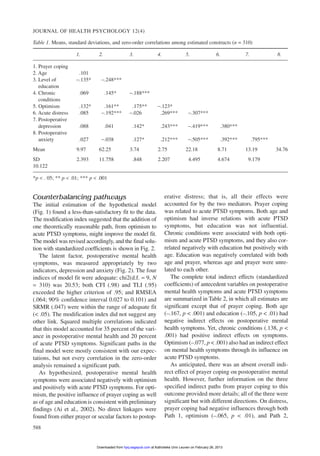
To address the inconsistent findings
and based on Hegel’s dialectic
contradictive principle, this study
tested a parallel mediation model that
may underlie the association of using
prayer for coping with cardiac surgery
outcomes. Three sequential interviews
were conducted with 310 patients
who underwent open-heart surgery.
A structural equation model
demonstrated that optimism mediated
the favorable effect of prayer coping.
Prayer coping was also related to
preoperative stress symptoms, which
had a counterbalance effect on
outcomes. Age was associated with
better preoperative mental health, but
age-related chronic conditions were
associated with poor outcomes; both
of these were mediated through the
same mediators.
Journal of Health Psychology
Copyright © 2007 SAGE Publications
Los Angeles, London, New Delhi
and Singapore
www.sagepublications.com
Vol 12(4) 580–596
DOI: 10.1177/1359105307078164
Keywords
■ acute stress disorder
■ anxiety
■ cardiovascular disease
■ depression
■ open-heart surgery
■ optimism
■ prayer coping
■ preoperative PTSD symptoms
ACKNOWLEDGEMENTS. Amy L. Ai, PhD, was supported by National
Institute on Aging Grant 1 RO3 AGO 15686–01, National Center for
Complementary and Alternative Medicine Grant P50 AT00011, a grant from
the John Templeton Foundation and the Hartford Geriatric Faculty Scholar’s
Program. The opinions expressed in this article are those of the authors and
do not necessarily reflect the views of the National Institutes of Health and
these organizations.
COMPETING INTERESTS: None declared.
ADDRESS. Correspondence should be directed to:
AMY L. AI, PHD, National Cancer Institute, 6130 Executive Blvd, MSC 7326,
Room 4052, Bethesda, MD 20892–7326, USA.
[email: moserr@mail.nih.gov]
at Katholieke Univ Leuven on February 26, 2013hpq.sagepub.comDownloaded from](https://image.slidesharecdn.com/the-influence-of-prayer-coping-on-patients-170221173351/85/The-influence-of-prayer-coping-on-patients-2-320.jpg)
![Durkheim, E. (1973/1912). Elementary forms of religious
life. In R. N. Bellah (Ed.), On morality and society:
Selected writings (pp. 187–223). Chicago, IL:
University of Chicago Press.
Ehrenreich, J. H. (2003). Understanding PTSD: Forgetting
‘trauma’. Journal of Social Issues, 3, 15–28.
ENRICHD Investigators. (2003). Enhancing Recovery in
Coronary Heart Disease (ENRICHD): Baseline charac-
teristics. American Journal of Cardiology, 88, 316–322.
Eriksson, J. (1988). Psychosomatic aspects of coronary
artery bypass graft surgery: A prospective study of 101
male patients. Acta Psychiatrica Scandinavica,
77(Suppl. 340), 1–112.
Exline, J. J., & Rose, E. (2005). Religious and spiritual
struggles. In R. F. Paloutzian & C. L. Park (Eds.),
Handbook of the psychology of religion (pp. 315–330).
New York: Guilford.
Fleet, R. P., Arsenault, A., Lespérance, F. et al. (2001).
Panic disorder in coronary artery disease patients ins
associate with reversible myocardial perfusion defects
during panic challenge with 35% CO2 [abstract].
Psychosomatic Medicine, 63, 187.
Freud, S. (1928/1953). Chapters 3, 4 and 8. In E. Jones
(Ed.), The future of illusion (pp. 25–35, 36–42 and
70–78). Trans. W. D. Robson-Scott. New York:
Liveright Publishing Corporation.
George, L. K., Ellison, C. G., & Larson, D. B. (2002).
Explaining the relationships between religious involve-
ment and health. Psychological Inquiry, 13, 190–200.
Haley, K. C., Koenig, H. G., & Bruchett, B. M. (2001).
Relationship between private religious activity and
physical functioning in older adults. Journal of Religion
& Health, 40, 305–312.
Hays, J. C., Landerman, L. R., Blazer, D. G., Koenig,
H. G., Carroll, J. W., & Musick, M. A. (1998). Aging,
health, and the ‘electronic church’. Journal of Aging and
Health, 10(4), 458–482.
Hegel, G. W. F. (1807/1977). Phenomenology of spirit.
Trans. A.V. Miller. New York: Oxford University Press.
Helm, H. M., Hays, J. C., Flint, E. P., Koenig, H. G., &
Blazer, D. G. (2000). Does private religious activity
prolong survival? A six-year follow-up study of 3,851
older adults. Journals of Gerontology—Series A,
Biological Sciences and Medical Sciences, 55A(7),
M400–M405.
Hood, R. W., Jr, Spilka, B., Hunsberger, B., & Gorsuch, R.
(1996). Religion, coping, and adjustment. In The psy-
chology of religion: An empirical approach (2nd edn, pp.
377–405). New York: Guilford Press.
Hu, L., & Bentler, P. M. (1999). Cutoff criteria for fit
indexes in covariance structure analysis: Conventional
criteria versus new alternatives. Structural Equation
Modeling, 6, 1–55.
Isaacowitz, D. M., & Seligman, M. E. P. (2001). Is
pessimistic a risk factor for depressive mood among
community-dwelling older adults? Behaviour Research
& Therapy, 39, 255–272.
James, W. (1902/1958). The varieties of religious experi-
ence: A study in human nature. New York: The New
American Library.
Jarvinen, O., Saarinen, T., Julkunen, J., Huhtala, H., &
Tarkka, M. R. (2003). Changes in health-related quality
of life and functional capacity following coronary artery
bypass graft surgery. European Journal of Cardio-
thoracic Surgery, 24(5), 750–756.
Jaycox, L. H., Marshall, G. N., & Orlando., M. (2003).
Predictors of acute distress among young adults injured
by community violence. Journal of Traumatic Stress,
16, 237–245.
Koenig, H. G., McCullough, M., & Larson, D. B. (2001).
Handbook of religion and health. New York: Oxford
University Press.
Krantz, D. S., Sheps, D. S., Carney, R. M., & Natelson,
B. H. (2000). Effects of mental stress in patients with
coronary artery disease: Evidence and clinical implica-
tions. Journal of the American Medical Association,
283, 1800–1802.
Krause, N. (2002). Church-based social support and health
in old age: Exploring variations by race. Journal of
Geronotology: Social Sciences, 57B, S332–S347.
Leithner, K., Maar, A., Fischer-Kern, M., Hilger, E.,
Loffler-Stastka, H., & Ponocny-Seliger, E. (2004).
Affective states of women following a prenatal diagno-
sis: Predictors of a negative psychological outcome.
Ultrasound in Obstetrics and Gynecology, 23(3),
240–246.
Leor, J., Poole, W. K., & Kloner, R. A. (1996). Sudden car-
diac death triggered by an earthquake. New England
Journal of Medicine, 334, 413–419.
Leuba, J. H. (1993). God or man? A study of the value of
God to man. New York: Henry Holt & Company.
Levin, J. S., & Taylor, R. J. (1997). Age differences in pat-
terns and correlates of the frequency of prayer. The
Gerontologist, 37, 75–88.
MacKinnon, D. P., Lockwood, C. M., Hoffman, J. M.,
West, S. G., & Sheets, V. (2002). A comparison of
methods to test mediation and other intervening vari-
able effects. Psychological Methods, 7, 83–104.
McCullough, M. E., Hoyt, W. T., Larson, D. B., Koenig,
H. G., & Thoresen, C. (2000). Religious involvement
and mortality: A meta-analytic review. Health
Psychology, 19, 211–222.
McCullough, M. E., & Larson, D. B. (1999). Religion and
depression: A review of the literature. Twin Research, 2,
126–136.
Meisel, S. R., Kutz, I., Dayan, K. I., Pauzner, H.,
Chetboun, I., Arbel, Y., & David D. (1991). Effects of
Iraqui missile war on incidence of acute myocardial
infarction and sudden death in Israeli civilians. Lancet,
338, 660–661.
Meisenhelder, J. B., & Chandler, E. N. (2001). Frequency
of prayer and functional health in Presbyterian pastors.
Journal for the Scientific Study of Religion, 40,
323–329.
JOURNAL OF HEALTH PSYCHOLOGY 12(4)
594
at Katholieke Univ Leuven on February 26, 2013hpq.sagepub.comDownloaded from](https://image.slidesharecdn.com/the-influence-of-prayer-coping-on-patients-170221173351/85/The-influence-of-prayer-coping-on-patients-16-320.jpg)

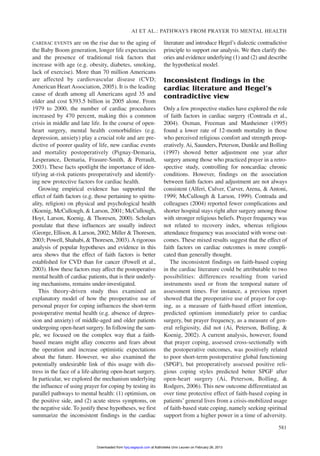
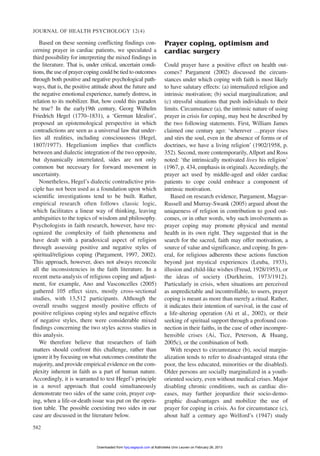
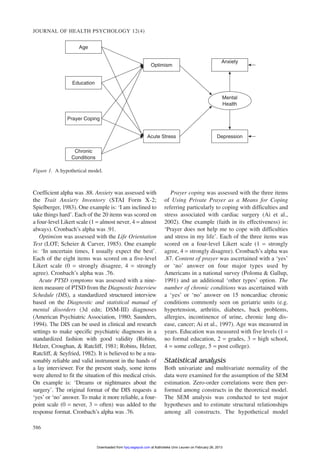
This study aimed to explain the inconsistent findings regarding the influence of prayer coping on mental health outcomes after cardiac surgery. The researchers hypothesized that prayer coping could influence outcomes through both positive and negative pathways - increasing optimism but also acute distress. They tested a model showing that prayer coping was positively associated with optimism, which predicted better outcomes, but also linked to higher preoperative stress symptoms, which counterbalanced the outcomes. The study drew on Hegel's dialectic view that contradictions can underlie realities and proposed prayer coping may influence outcomes through parallel positive and negative mediators.


