The New API Pattern
Owen Rubel
What is an API?
“ An API is Standardized Input/Output (I/O) to and from a Separation of Concern
(usually being Business Logic).”
In Short :
What is Separation Of Concern?
“ In computer science, separation of concerns (SoC) is a design principle for
separating a computer program into distinct sections, such that each section
addresses a separate concern. A concern is a set of information that affects the
code of a computer program” (ex HTML, CSS, JS)
- Source : Separation Of Concern, Wikipedia
About The OLD API Pattern
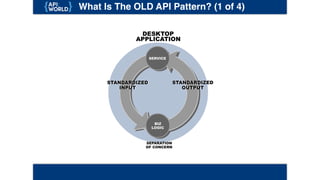
• API’s were created in 70’s to standardize information exchanged between
services
• 70’s pattern was designed for centralized architecture; distributed architectures
didn't exist.
• Web API’s were based on 70’s pattern; Roy Fielding based his dissertation on
this pre-existing pattern.
• Web API’s were integrated into MVC frameworks and tools; it is now used
everywhere.
What Is The OLD API Pattern? (1 of 4)
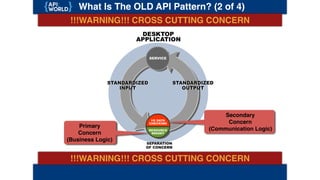
What Is The OLD API Pattern? (2 of 4)
!!!WARNING!!! CROSS CUTTING CONCERN
Primary
Concern
(Business Logic)
Secondary
Concern
(Communication Logic)
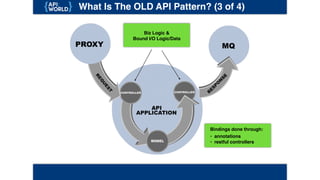
What Is The OLD API Pattern? (3 of 4)
• annotations
• restful controllers
Bindings done through:
Biz Logic &
Bound I/O Logic/Data
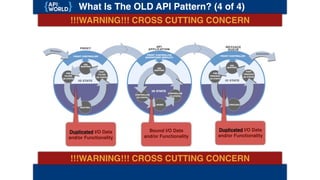
What Is The OLD API Pattern? (4 of 4)
Bound I/O Data
and/or Functionality
Duplicated I/O Data
and/or Functionality
Duplicated I/O Data
and/or Functionality
!!!WARNING!!! CROSS CUTTING CONCERN
What Is A Cross Cutting Concern
“Cross-cutting concerns can be directly responsible for tangling, or system inter-
dependencies, within a program. Because procedural and functional language
constructs consist entirely of procedure calling, there is no semantic through
which two goals (the capability to be implemented and the related cross-cutting
concern) can be addressed simultaneously.[3] As a result, the code
addressing the cross-cutting concern must be scattered, or duplicated,
across the various related locations, resulting in a loss of modularity.[2]”
- Source : Cross Cutting Concern, Wikipedia
Cross Cutting Concern Examples
• Synchronization (*)
• Real-time constraints
• Error detection and correction
• Product features
• Memory management
• Data validation (*)
• Persistence (*)
• Transaction processing
• Internationalization and localization which includes Language localisation
• Information security
• Caching (*)
• Logging (*)
• Monitoring
• Business rules (*)
• Code mobility
• Domain-specific optimizations (*)
* issues specifically affecting old API pattern
when applied to distributed architecture
Issues of Architectural Cross Cutting Concern With IO
This causes:
• Dropped Threads
• Duplicitous code/data
• Higher I/O overhead
• Lack of synchronization of duplicitous code/data
• Polluted Business Rules
• Polluted Security Rules
• Polluted Domain Rules
• Polluted Endpoint Logic
• Polluted Logging
• and more
Why Did This Happen?
• Distributed Architectures are a New Pattern and people did not examine
old patterns that share I/O before applying them. They also did not
question people who applied old patterns to new ones.
• People ASSUMED the resource was the endpoint; since it is I/O that is
shared, communication is the endpoint. It is communication that would route
back to itself during an automated batch job… not the controller. The
controller hands the resource OFF to the communication layer
So How Do We Fix?
The NEW API Pattern: Abstracting API Layer
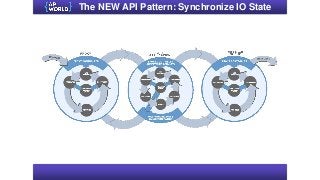
The NEW API Pattern: Synchronize IO State
Solution
This allows:
• Central Piece of architecture (where REQUEST AND RESPONSE are
handled) to be ‘Single Version of Truth’ (SOV)
• All services to sync data from SOV
• Failure of SOV to not affect synchronization of data
• Reload on the fly to occur through SOV and update ALL subscribed services
Additional Improvements of New Pattern
• Dramatic Code reduction By Reducing Duplication
• Automation of nearly all aspects of API
• Nearly 0% downtime for changes to endpoint data and rules
• New API Patterns (ie API Chaining (tm) )
Questions?

Apiworld

  • 1.
    The New APIPattern Owen Rubel
  • 2.
    What is anAPI? “ An API is Standardized Input/Output (I/O) to and from a Separation of Concern (usually being Business Logic).” In Short :
  • 3.
    What is SeparationOf Concern? “ In computer science, separation of concerns (SoC) is a design principle for separating a computer program into distinct sections, such that each section addresses a separate concern. A concern is a set of information that affects the code of a computer program” (ex HTML, CSS, JS) - Source : Separation Of Concern, Wikipedia
  • 4.
    About The OLDAPI Pattern • API’s were created in 70’s to standardize information exchanged between services • 70’s pattern was designed for centralized architecture; distributed architectures didn't exist. • Web API’s were based on 70’s pattern; Roy Fielding based his dissertation on this pre-existing pattern. • Web API’s were integrated into MVC frameworks and tools; it is now used everywhere.
  • 5.
    What Is TheOLD API Pattern? (1 of 4)
  • 6.
    What Is TheOLD API Pattern? (2 of 4) !!!WARNING!!! CROSS CUTTING CONCERN !!!WARNING!!! CROSS CUTTING CONCERN Primary Concern (Business Logic) Secondary Concern (Communication Logic)
  • 7.
    What Is TheOLD API Pattern? (3 of 4) • annotations • restful controllers Bindings done through: Biz Logic & Bound I/O Logic/Data
  • 8.
    What Is TheOLD API Pattern? (4 of 4) Bound I/O Data and/or Functionality Duplicated I/O Data and/or Functionality Duplicated I/O Data and/or Functionality !!!WARNING!!! CROSS CUTTING CONCERN !!!WARNING!!! CROSS CUTTING CONCERN
  • 9.
    What Is ACross Cutting Concern “Cross-cutting concerns can be directly responsible for tangling, or system inter- dependencies, within a program. Because procedural and functional language constructs consist entirely of procedure calling, there is no semantic through which two goals (the capability to be implemented and the related cross-cutting concern) can be addressed simultaneously.[3] As a result, the code addressing the cross-cutting concern must be scattered, or duplicated, across the various related locations, resulting in a loss of modularity.[2]” - Source : Cross Cutting Concern, Wikipedia
  • 10.
    Cross Cutting ConcernExamples • Synchronization (*) • Real-time constraints • Error detection and correction • Product features • Memory management • Data validation (*) • Persistence (*) • Transaction processing • Internationalization and localization which includes Language localisation • Information security • Caching (*) • Logging (*) • Monitoring • Business rules (*) • Code mobility • Domain-specific optimizations (*) * issues specifically affecting old API pattern when applied to distributed architecture
  • 11.
    Issues of ArchitecturalCross Cutting Concern With IO This causes: • Dropped Threads • Duplicitous code/data • Higher I/O overhead • Lack of synchronization of duplicitous code/data • Polluted Business Rules • Polluted Security Rules • Polluted Domain Rules • Polluted Endpoint Logic • Polluted Logging • and more
  • 12.
    Why Did ThisHappen? • Distributed Architectures are a New Pattern and people did not examine old patterns that share I/O before applying them. They also did not question people who applied old patterns to new ones. • People ASSUMED the resource was the endpoint; since it is I/O that is shared, communication is the endpoint. It is communication that would route back to itself during an automated batch job… not the controller. The controller hands the resource OFF to the communication layer
  • 13.
    So How DoWe Fix?
  • 14.
    The NEW APIPattern: Abstracting API Layer
  • 15.
    The NEW APIPattern: Synchronize IO State
  • 16.
    Solution This allows: • CentralPiece of architecture (where REQUEST AND RESPONSE are handled) to be ‘Single Version of Truth’ (SOV) • All services to sync data from SOV • Failure of SOV to not affect synchronization of data • Reload on the fly to occur through SOV and update ALL subscribed services
  • 17.
    Additional Improvements ofNew Pattern • Dramatic Code reduction By Reducing Duplication • Automation of nearly all aspects of API • Nearly 0% downtime for changes to endpoint data and rules • New API Patterns (ie API Chaining (tm) )
  • 18.

Editor's Notes

  • #15 Abstract API data/function from Biz Logic to a ‘interceptor’ layer and add localized cache (interceptors are also know as ‘filters’ in Ruby and Python)
  • #16 Use web hooks to get all services subscribed to API server so the can subscribe to CENTRALIZED cache and receive updates. This keeps all services in ‘syched’ state.