API Testing Basics
What is API?
API (Application Programming Interface) is a computing interface
which enables communication and data exchange between two
separate software systems.
API Testing
API TESTING is a software testing type that validates Application
Programming Interfaces (APIs). The purpose of API Testing is to
the functionality, reliability, performance, and security of the
programming interfaces. In API Testing, instead of using standard
inputs(keyboard) and outputs, you use software to send calls to the
API, get output, and note down the system’s response. API tests are
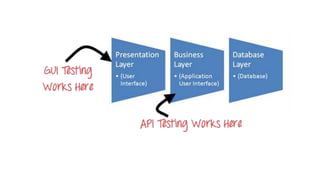
very different from GUI Tests and won’t concentrate on the look and
feel of an application. It mainly concentrates on the business logic
layer of the software architecture.
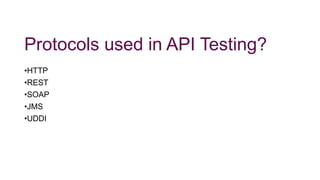
Protocols used in API Testing?
•HTTP
•REST
•SOAP
•JMS
•UDDI
Webservices
Web services are a type of API, which must be accessed through a network
connection. All webservices are API.
SOAP
SOAP is the acronym for Simple Object Access Protocol. SoapUI is an open-
source web service / API automation tools widely used in the software industry. You can
do functional, load, security and compliance tests on your API using
SoapUI. It is a XML based protocol for communicating between two
different systems.
REST
REST was designed specifically for working with components such as
media components, files, or even objects on a particular hardware
device. Any web service that is defined on the principles of REST can
be called a RestFul web service. A Restful service would use the
normal HTTP verbs of GET, POST, PUT and DELETE for working with
the required components. REST stands for Representational State
Transfer.
REST permits different data format such as Plain text, HTML, XML,
JSON, etc. But the most preferred format for transferring data is
CRUD
CRUD is a cycle for keeping records current and permanent. The principles of the CRUD cycle are defined
as CREATE, READ/RETRIEVE, UPDATE, and DELETE.
We can achieve CRUD operations in Leapwork by using the HTTP Request block.
1. CREATE:
It is used to generate new records. Use the POST method to create a resource.
2. READ:
Using the GET method to implement the “R” in CRUD is straightforward. It reads the data based on input parameters.
3. UPDATE:
Use the PUT method to create or overwrite a resource identified by a URI computed by the client. It is used to modify the
records.
4. DELETE:
It deletes a record where specified. When a resource is no longer useful, it can send a DELETE request to the resource’s
URI and delete that record.
Thank you 

API Testing Basics.pptx

  • 1.
  • 2.
    What is API? API(Application Programming Interface) is a computing interface which enables communication and data exchange between two separate software systems.
  • 3.
    API Testing API TESTINGis a software testing type that validates Application Programming Interfaces (APIs). The purpose of API Testing is to the functionality, reliability, performance, and security of the programming interfaces. In API Testing, instead of using standard inputs(keyboard) and outputs, you use software to send calls to the API, get output, and note down the system’s response. API tests are very different from GUI Tests and won’t concentrate on the look and feel of an application. It mainly concentrates on the business logic layer of the software architecture.
  • 5.
    Protocols used inAPI Testing? •HTTP •REST •SOAP •JMS •UDDI
  • 6.
    Webservices Web services area type of API, which must be accessed through a network connection. All webservices are API.
  • 7.
    SOAP SOAP is theacronym for Simple Object Access Protocol. SoapUI is an open- source web service / API automation tools widely used in the software industry. You can do functional, load, security and compliance tests on your API using SoapUI. It is a XML based protocol for communicating between two different systems.
  • 8.
    REST REST was designedspecifically for working with components such as media components, files, or even objects on a particular hardware device. Any web service that is defined on the principles of REST can be called a RestFul web service. A Restful service would use the normal HTTP verbs of GET, POST, PUT and DELETE for working with the required components. REST stands for Representational State Transfer. REST permits different data format such as Plain text, HTML, XML, JSON, etc. But the most preferred format for transferring data is
  • 9.
    CRUD CRUD is acycle for keeping records current and permanent. The principles of the CRUD cycle are defined as CREATE, READ/RETRIEVE, UPDATE, and DELETE. We can achieve CRUD operations in Leapwork by using the HTTP Request block. 1. CREATE: It is used to generate new records. Use the POST method to create a resource. 2. READ: Using the GET method to implement the “R” in CRUD is straightforward. It reads the data based on input parameters. 3. UPDATE: Use the PUT method to create or overwrite a resource identified by a URI computed by the client. It is used to modify the records. 4. DELETE: It deletes a record where specified. When a resource is no longer useful, it can send a DELETE request to the resource’s URI and delete that record.
  • 10.