API Management – an Infosys Perspective 
Ravish Rao, Senior Technology Architect 
No matter what industry you’re in, internet is changing your priorities. The growth in mobile apps, cloud 
services, internet of things and external developer community, has driven enterprises to open up 
internal data and resources through APIs. An API is the cornerstone of what is widely seen as the next 
iteration of business development, where having a well-developed API is poised to be the way in which 
business relationship are established and maintained in a online, 24/7 digital economy. For example, 
Expedia gets over $2 billion of its revenue by selling hotel rooms via its affiliate API program. Similarly, 
by cultivating an external developer base, Netflix is able to offer service on more than 800 physical 
devices, at a fraction of the cost of internal development. 
Unfortunately most companies treat their API as an afterthought or a checkbox on their project list 
rather than a core IT feature that drives business strategy. As a result, APIs are not well designed and 
end up costing both the company and its API users thousands of dollars in ongoing change requests. It 
is very important to get API definition (API catalog, operations, signature, security, etc.) correct the 
very first time. Frequent major revisions to the API definition can cause your internal/external partners 
and developer community to look around for alternate API providers. 
Why build API? Common reasons we hear out clients tell us: 
• Partnering with other businesses to extend market. 
• Scaling Development and Empowering Users – B2C for new revenue stream. 
• Device Proliferation – new ways to engage with customers. 
• Establish Governance in SOA initiative – improve internal development efficiency. 
Most API management platforms provide comprehensive solution, offering features such as: 
• API development and runtime platform 
• Portal for API discovery and subscription 
• API security and protocol mediation 
• Memory management and caching for 
service performance 
• Usage analytics 
• On-premise and On-cloud option 
• API lifecycle management and versioning 
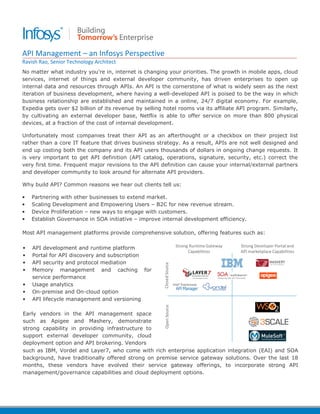
Early vendors in the API management space 
such as Apigee and Mashery, demonstrate 
strong capability in providing infrastructure to 
support external developer community, cloud 
deployment option and API brokering. Vendors 
such as IBM, Vordel and Layer7, who come with rich enterprise application integration (EAI) and SOA 
background, have traditionally offered strong on premise service gateway solutions. Over the last 18 
months, these vendors have evolved their service gateway offerings, to incorporate strong API 
management/governance capabilities and cloud deployment options.
Relevance of API management in the Retail vertical 
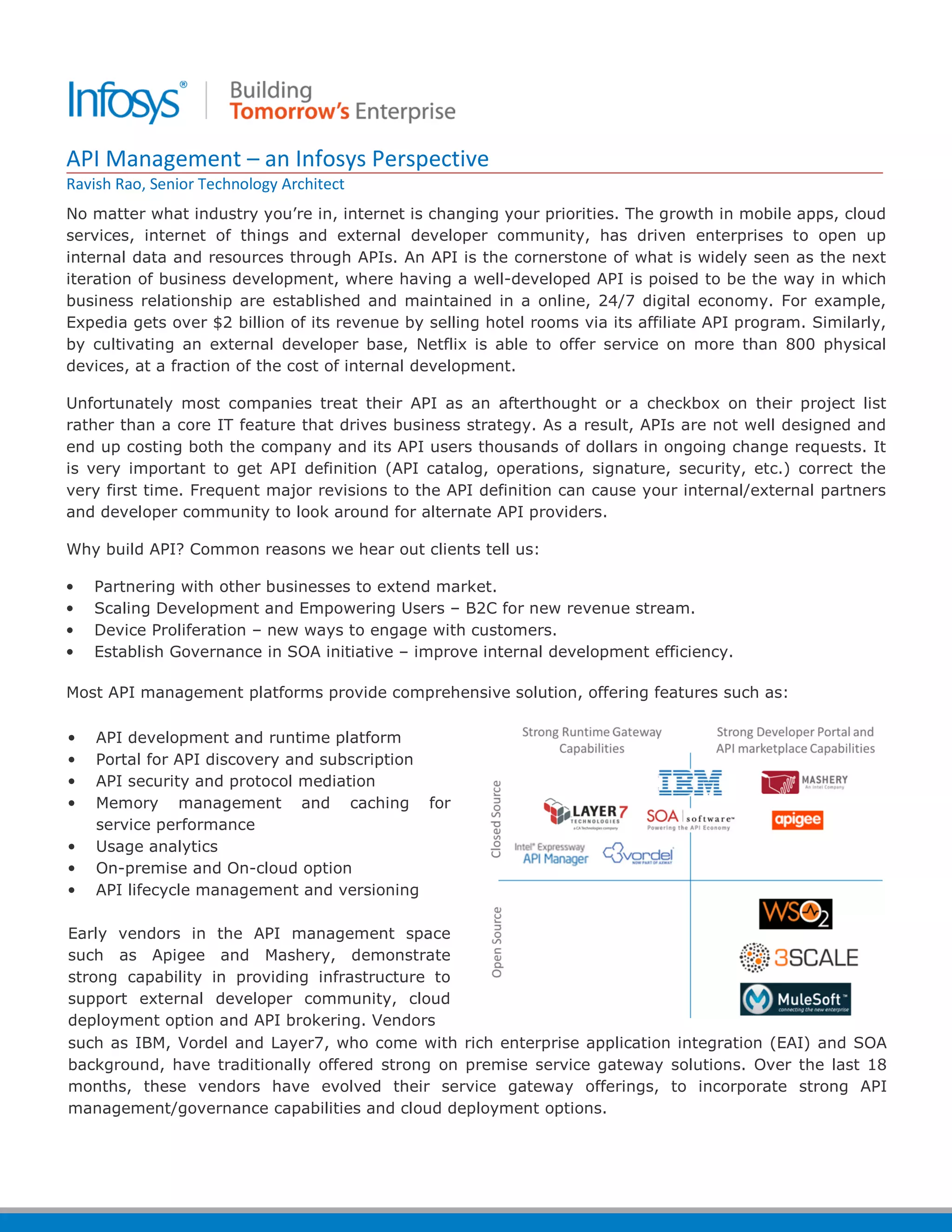
The diagram to the left shows various 
deployment options available. The 
deployment option that best suits your 
company will depend upon your 
companies API business model, cloud 
adoption roadmap, current application 
landscape, and existing investment on 
service/SOA infrastructure. Most 
vendors offer cloud and on premise 
deployment model, with options to 
interoperate your APIs across the 
models without making code changes. 
In 2013, 30% of e-commerce traffic came from the mobile channel. Retailers are also increasingly 
collaborating by exchanging data with other retailers/partners to cross sell merchandise. This trend is 
forcing IT departments to quickly extend capability of existing systems to support new emerging 
channels. Adding to this complexity, legacy channels such as brick and mortar, online website, were 
initially established as independent lines of business with separate logistics, inventory management and 
customer policies. As a result, beyond the initial impetus of garnering increased revenues through new 
channels, providing a seamless customer experience across these channels is a challenge. 
Infosys has been helping retailers address this challenge by leveraging its Omni channel Integration 
Hub solution. In this solution, API management plays a key role as the enabler to deliver business 
services to various channels. To contextualize this better, diagram below gives common application 
layout seen at most retailing companies. 
• How to meter API usage by business partners. 
Traditionally, access to enterprise 
business services hosted on internal 
ecommerce and order fulfillment systems, 
was restricted within the boundaries of an 
enterprise. The advent of new channels 
has posed the following IT challenges: 
• How to assemble API's leveraging 
investments already made in 
developing business services (e.g.: 
create order, inventory lookup web 
services), for the legacy channel. 
• How to host, secure and provide 
access control to business services 
when exposed to the internet. 
• How to document, socialize and 
market API's. 
An API management platform such as IBM API Management, deployed in the DMZ or the cloud, 
provides the design time and runtime capabilities needed to address the above mentioned retail vertical 
challenges.
IBM API Management 
IBM API Management provides organizations with the tools for assembling, securing and socializing web 
APIs. Key Capabilities of IBM API Management solution is: 
• Configuration, No coding – easy API assembly, API versioning, quick developer portal configuration 
with socialization capability. Client registration, client id and key management. 
• Leverages IBM Data Power for API runtime infrastructure. DataPower gives the security and 
mediations capabilities. 
• Out of the box API usage analytics which can be used to derive business insight. 
• Strong on premise solution and revamped cloud offering to be released in mid-2014. 
Infosys POV on IBM API Management 
IBM’s API management solution has evolved continuously since it was initially introduced in mid-2012. 
The initial offering provided a cloud based deployment option which ran on IBM’s Cast Iron Live 
infrastructure. The subsequent v2 release in mid-2013 provided an on premise solution that leveraged 
IBM DataPower for runtime service gateway and IBM Cast Iron for API assembly. One also needs to 
stand up two additional nodes, one for the API portal (called the management node) and other for 
analytics. We anticipate next release of IBM API Management to simply the products component 
architecture. The API assembly capabilities provided by Cast Iron node will be merged into the 
DataPower node. Similarly the Analytics node will be merged with the management node. This greatly 
simplifies the deployment and maintenance cost of the solution. We recommend deploying the gateway 
node in the DMZ and the management node be deployed behind the internal firewall. All portal traffic 
going to the management node can be proxy via the web application policy on the gateway node. 
IBM DataPower is the industry leader in 
providing secured service gateway 
infrastructure. For organizations that 
have already deployed IBM DataPower, 
upgrading to API Management stack will 
provide additional capability to drive 
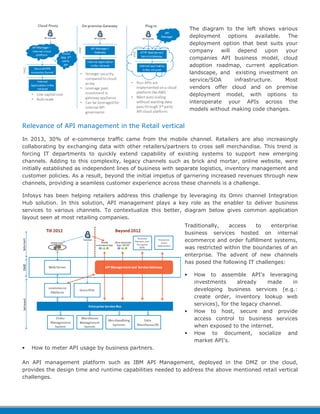
revenue and market reach. The table 
gives the list of capabilities IBM API 
Management stack brings to your IT 
infrastructure compared to DataPower. 
Advanced Optimization (AO) capability of 
DataPower can be used to self-load 
balance API requests across multiple 
DataPower nodes. We recommend 
complex message transformation be achieved by using multi-protocol gateway service in a separate 
domain within the DataPower node. 
API Management can also serve as a good option for organizations looking to implement governance to 
their internal SOA initiative. 
IBM is expected to revamp its cloud API Management offering. This is an option if you are looking at: 
• Reducing capital expense 
• Experimenting the market with API offering 
• Unclear of the infrastructure sizing or having seasonal spike in transaction volume.
Our accelerators and frameworks for IBM API Management 
• Partner with IBM on the API Management vnext beta program. 
• Security Framework - guidelines on implementing security using DataPower 
• Administration Framework - achieve routine DataPower admin activities through SOMA and CLI 
scripts 
• Error Handling, Logging and Automated Deployment framework 
• Reusable artefacts that can save effort and reduce build, testing time considerably. Ex: DataPower 
SSO solution, DataPower design pattern references, highly reusable configuration sets and 
DataPower Performance Testing tool etc. 
• Templates and Checklist - Architecture templates, Integration requirement and Detailed Design 
templates, Data Mapping templates and Review checklists. 
Case Study 
A leading fashion retailer is working on launching a mobile shopping application in under 6 months. A 
decision was made to leverage existing functionality of its e-commerce website and order fulfillment 
services hosted by legacy order management system. Integration challenges put forward are: 
• Provide security while exposing key real-time business services as APIs, at the edge of the 
network. 
• APIs should mediate between frontend RESTFful JSON protocol and backend JSP/SOAP web 
services. 
• Support OAuth, Key Management and Single Sign On (SSO) across website and mobile application. 
• API response caching to reduce impact on the legacy application capacity. 
Infosys helped the customer evaluate various API management solutions in the market. IBM API 
Management was chosen as the product stack to support the solution. Infosys is currently working 
with the retailer to setup IBM API Management infrastructure and is also responsible for developing 
APIs on the new stack. 
IBM BPM and Integration Practice at Infosys 
• 1000+ consultants with 800+ IBM certifications in Architecture, Technology and Development. 
• Strong capability on IBM products – IBM BPM, WODM, Business Modeler, DataPower, IBM API 
Management, IIB, WMQ, WTX, WebSphere Cast Iron Cloud Integration, InfoSphere DataStage. 
• 45+ active customers, 30+ large programs (100+ interfaces) implementation. 
• Engagement Models – Traditional and non-linear, outcome based models. 
• Solutions, frameworks and pre-build accelerators for various industries vertical. 
• Premier business partnership with IBM provides us access to partner channels, events, beta 
programs, education, certifications and project consulting.

API Management point of view

  • 1.
    API Management –an Infosys Perspective Ravish Rao, Senior Technology Architect No matter what industry you’re in, internet is changing your priorities. The growth in mobile apps, cloud services, internet of things and external developer community, has driven enterprises to open up internal data and resources through APIs. An API is the cornerstone of what is widely seen as the next iteration of business development, where having a well-developed API is poised to be the way in which business relationship are established and maintained in a online, 24/7 digital economy. For example, Expedia gets over $2 billion of its revenue by selling hotel rooms via its affiliate API program. Similarly, by cultivating an external developer base, Netflix is able to offer service on more than 800 physical devices, at a fraction of the cost of internal development. Unfortunately most companies treat their API as an afterthought or a checkbox on their project list rather than a core IT feature that drives business strategy. As a result, APIs are not well designed and end up costing both the company and its API users thousands of dollars in ongoing change requests. It is very important to get API definition (API catalog, operations, signature, security, etc.) correct the very first time. Frequent major revisions to the API definition can cause your internal/external partners and developer community to look around for alternate API providers. Why build API? Common reasons we hear out clients tell us: • Partnering with other businesses to extend market. • Scaling Development and Empowering Users – B2C for new revenue stream. • Device Proliferation – new ways to engage with customers. • Establish Governance in SOA initiative – improve internal development efficiency. Most API management platforms provide comprehensive solution, offering features such as: • API development and runtime platform • Portal for API discovery and subscription • API security and protocol mediation • Memory management and caching for service performance • Usage analytics • On-premise and On-cloud option • API lifecycle management and versioning Early vendors in the API management space such as Apigee and Mashery, demonstrate strong capability in providing infrastructure to support external developer community, cloud deployment option and API brokering. Vendors such as IBM, Vordel and Layer7, who come with rich enterprise application integration (EAI) and SOA background, have traditionally offered strong on premise service gateway solutions. Over the last 18 months, these vendors have evolved their service gateway offerings, to incorporate strong API management/governance capabilities and cloud deployment options.
  • 2.
    Relevance of APImanagement in the Retail vertical The diagram to the left shows various deployment options available. The deployment option that best suits your company will depend upon your companies API business model, cloud adoption roadmap, current application landscape, and existing investment on service/SOA infrastructure. Most vendors offer cloud and on premise deployment model, with options to interoperate your APIs across the models without making code changes. In 2013, 30% of e-commerce traffic came from the mobile channel. Retailers are also increasingly collaborating by exchanging data with other retailers/partners to cross sell merchandise. This trend is forcing IT departments to quickly extend capability of existing systems to support new emerging channels. Adding to this complexity, legacy channels such as brick and mortar, online website, were initially established as independent lines of business with separate logistics, inventory management and customer policies. As a result, beyond the initial impetus of garnering increased revenues through new channels, providing a seamless customer experience across these channels is a challenge. Infosys has been helping retailers address this challenge by leveraging its Omni channel Integration Hub solution. In this solution, API management plays a key role as the enabler to deliver business services to various channels. To contextualize this better, diagram below gives common application layout seen at most retailing companies. • How to meter API usage by business partners. Traditionally, access to enterprise business services hosted on internal ecommerce and order fulfillment systems, was restricted within the boundaries of an enterprise. The advent of new channels has posed the following IT challenges: • How to assemble API's leveraging investments already made in developing business services (e.g.: create order, inventory lookup web services), for the legacy channel. • How to host, secure and provide access control to business services when exposed to the internet. • How to document, socialize and market API's. An API management platform such as IBM API Management, deployed in the DMZ or the cloud, provides the design time and runtime capabilities needed to address the above mentioned retail vertical challenges.
  • 3.
    IBM API Management IBM API Management provides organizations with the tools for assembling, securing and socializing web APIs. Key Capabilities of IBM API Management solution is: • Configuration, No coding – easy API assembly, API versioning, quick developer portal configuration with socialization capability. Client registration, client id and key management. • Leverages IBM Data Power for API runtime infrastructure. DataPower gives the security and mediations capabilities. • Out of the box API usage analytics which can be used to derive business insight. • Strong on premise solution and revamped cloud offering to be released in mid-2014. Infosys POV on IBM API Management IBM’s API management solution has evolved continuously since it was initially introduced in mid-2012. The initial offering provided a cloud based deployment option which ran on IBM’s Cast Iron Live infrastructure. The subsequent v2 release in mid-2013 provided an on premise solution that leveraged IBM DataPower for runtime service gateway and IBM Cast Iron for API assembly. One also needs to stand up two additional nodes, one for the API portal (called the management node) and other for analytics. We anticipate next release of IBM API Management to simply the products component architecture. The API assembly capabilities provided by Cast Iron node will be merged into the DataPower node. Similarly the Analytics node will be merged with the management node. This greatly simplifies the deployment and maintenance cost of the solution. We recommend deploying the gateway node in the DMZ and the management node be deployed behind the internal firewall. All portal traffic going to the management node can be proxy via the web application policy on the gateway node. IBM DataPower is the industry leader in providing secured service gateway infrastructure. For organizations that have already deployed IBM DataPower, upgrading to API Management stack will provide additional capability to drive revenue and market reach. The table gives the list of capabilities IBM API Management stack brings to your IT infrastructure compared to DataPower. Advanced Optimization (AO) capability of DataPower can be used to self-load balance API requests across multiple DataPower nodes. We recommend complex message transformation be achieved by using multi-protocol gateway service in a separate domain within the DataPower node. API Management can also serve as a good option for organizations looking to implement governance to their internal SOA initiative. IBM is expected to revamp its cloud API Management offering. This is an option if you are looking at: • Reducing capital expense • Experimenting the market with API offering • Unclear of the infrastructure sizing or having seasonal spike in transaction volume.
  • 4.
    Our accelerators andframeworks for IBM API Management • Partner with IBM on the API Management vnext beta program. • Security Framework - guidelines on implementing security using DataPower • Administration Framework - achieve routine DataPower admin activities through SOMA and CLI scripts • Error Handling, Logging and Automated Deployment framework • Reusable artefacts that can save effort and reduce build, testing time considerably. Ex: DataPower SSO solution, DataPower design pattern references, highly reusable configuration sets and DataPower Performance Testing tool etc. • Templates and Checklist - Architecture templates, Integration requirement and Detailed Design templates, Data Mapping templates and Review checklists. Case Study A leading fashion retailer is working on launching a mobile shopping application in under 6 months. A decision was made to leverage existing functionality of its e-commerce website and order fulfillment services hosted by legacy order management system. Integration challenges put forward are: • Provide security while exposing key real-time business services as APIs, at the edge of the network. • APIs should mediate between frontend RESTFful JSON protocol and backend JSP/SOAP web services. • Support OAuth, Key Management and Single Sign On (SSO) across website and mobile application. • API response caching to reduce impact on the legacy application capacity. Infosys helped the customer evaluate various API management solutions in the market. IBM API Management was chosen as the product stack to support the solution. Infosys is currently working with the retailer to setup IBM API Management infrastructure and is also responsible for developing APIs on the new stack. IBM BPM and Integration Practice at Infosys • 1000+ consultants with 800+ IBM certifications in Architecture, Technology and Development. • Strong capability on IBM products – IBM BPM, WODM, Business Modeler, DataPower, IBM API Management, IIB, WMQ, WTX, WebSphere Cast Iron Cloud Integration, InfoSphere DataStage. • 45+ active customers, 30+ large programs (100+ interfaces) implementation. • Engagement Models – Traditional and non-linear, outcome based models. • Solutions, frameworks and pre-build accelerators for various industries vertical. • Premier business partnership with IBM provides us access to partner channels, events, beta programs, education, certifications and project consulting.