APPETITE BASED FEEDING CONTROL SYSTEM

Keywords: oxygen saturation, feed, salmon, fish, farming

Background
Feed cost accounts for approximately 50 percent of the total production cost in the salmon
farming industry. By introducing knowledge on the relationship between fish feeding
behaviour and sea water oxygen saturation, an automated feeding system will make a major
contribution for enhancement of the fish farming industry. The Automatic Appetite Based Feeding
Control System for Aquaculture Farming Industry project has a strong academic foundation, and is
fortunate to be situated in the world leading sea-farming regions, Stavanger and Bergen.

Description
Cage fish farmes are continuosly looking for ways to increase production efficiency. Reducing
feed cost is one of their top priorities as it is the single most costly factor. Effeceint feeding
today relies on experienced farmes using manual input from videocameras to start and stop
feeding. An unpredictable method as fish are often not observable due to dept distribution and
poor water transparency. The sub optimal efficinecy will also vary greatly between different
farmers. Previous atempts to automate the process have not been sucecessfull, among other
using pellet counters in the bottom of the cages.

Applications and benefits
The cage salmon farming industry will be provided with an “intelligent” feeding software
program that selects the amount of feed and feed supply rate. The process is to estimate
appetitive behaviour and feeding behaviour of the fish from changes in saturation of dissolved
oxygen during feeding sessions. The software will be connected to automated feeding systems
and signal feeding start and stop. The benefits of the system are:

- Reducing feed cost through improved feed conversion
ratios
- Improving growth rate through ensuring sufficient feeding
in situations when fish appetite is higher that assumed, but
fish-feeding behaviour is not easily observed by surface
observations
- Reducing labour cost through automation
- Reducing pollution and eutrophication through reduced
feed wastage
- Partly unpredictably and fish are often not observable due
to deep distribution and poor water transparency
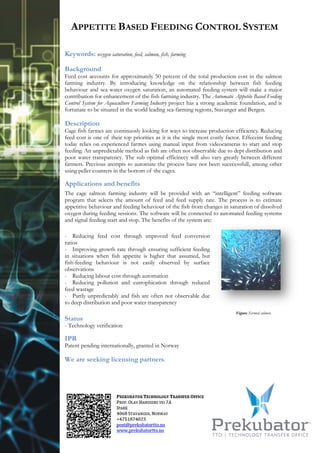
                                                                             Figure Farmed salmon.
Status
- Technology verification

IPR
Patent pending internationally, granted in Norway

We are seeking licensing partners.

Apetite based feeding control system tp

  • 1.
    APPETITE BASED FEEDINGCONTROL SYSTEM Keywords: oxygen saturation, feed, salmon, fish, farming Background Feed cost accounts for approximately 50 percent of the total production cost in the salmon farming industry. By introducing knowledge on the relationship between fish feeding behaviour and sea water oxygen saturation, an automated feeding system will make a major contribution for enhancement of the fish farming industry. The Automatic Appetite Based Feeding Control System for Aquaculture Farming Industry project has a strong academic foundation, and is fortunate to be situated in the world leading sea-farming regions, Stavanger and Bergen. Description Cage fish farmes are continuosly looking for ways to increase production efficiency. Reducing feed cost is one of their top priorities as it is the single most costly factor. Effeceint feeding today relies on experienced farmes using manual input from videocameras to start and stop feeding. An unpredictable method as fish are often not observable due to dept distribution and poor water transparency. The sub optimal efficinecy will also vary greatly between different farmers. Previous atempts to automate the process have not been sucecessfull, among other using pellet counters in the bottom of the cages. Applications and benefits The cage salmon farming industry will be provided with an “intelligent” feeding software program that selects the amount of feed and feed supply rate. The process is to estimate appetitive behaviour and feeding behaviour of the fish from changes in saturation of dissolved oxygen during feeding sessions. The software will be connected to automated feeding systems and signal feeding start and stop. The benefits of the system are: - Reducing feed cost through improved feed conversion ratios - Improving growth rate through ensuring sufficient feeding in situations when fish appetite is higher that assumed, but fish-feeding behaviour is not easily observed by surface observations - Reducing labour cost through automation - Reducing pollution and eutrophication through reduced feed wastage - Partly unpredictably and fish are often not observable due to deep distribution and poor water transparency Figure Farmed salmon. Status - Technology verification IPR Patent pending internationally, granted in Norway We are seeking licensing partners.