APA Documentation Style
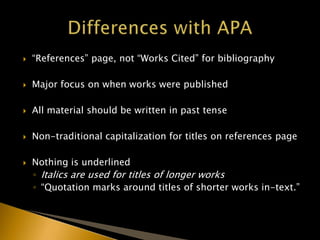
 “References” page, not “Works Cited” for bibliography
 Major focus on when works were published
 All material should be written in past tense
 Non-traditional capitalization for titles on references page
 Nothing is underlined
◦ Italics are used for titles of longer works
◦ “Quotation marks around titles of shorter works in-text.”
APA Format
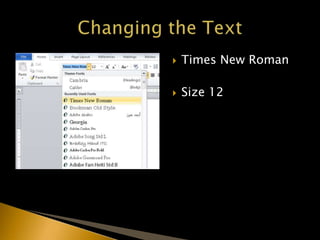
 Times New Roman
 Size 12
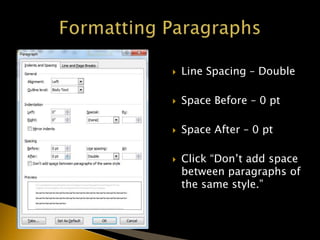
 Line Spacing – Double
 Space Before – 0 pt
 Space After – 0 pt
 Click “Don’t add space
between paragraphs of
the same style.”
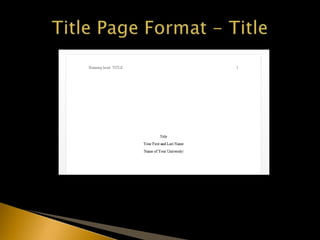
 Running Head
 Page Number
 Title of Paper
 Your First and Last Name
 Name of University
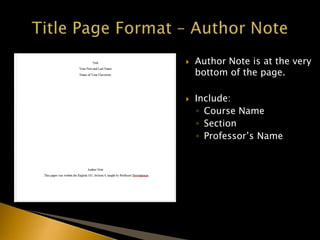
 Author’s Note
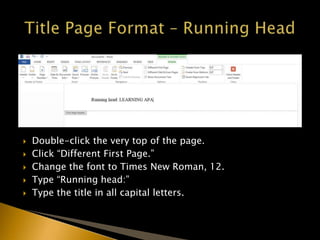
 Double-click the very top of the page.
 Click “Different First Page.”
 Change the font to Times New Roman, 12.
 Type “Running head:”
 Type the title in all capital letters.
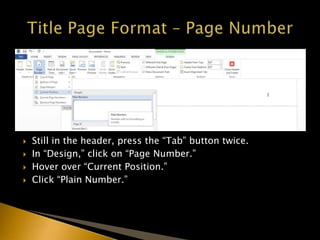
 Still in the header, press the “Tab” button twice.
 In “Design,” click on “Page Number.”
 Hover over “Current Position.”
 Click “Plain Number.”
 Author Note is at the very
bottom of the page.
 Include:
◦ Course Name
◦ Section
◦ Professor’s Name
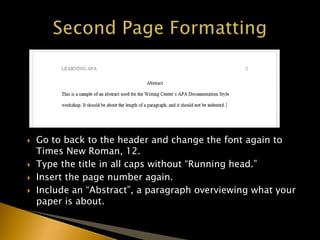
 Go to back to the header and change the font again to
Times New Roman, 12.
 Type the title in all caps without “Running head.”
 Insert the page number again.
 Include an “Abstract”, a paragraph overviewing what your
paper is about.
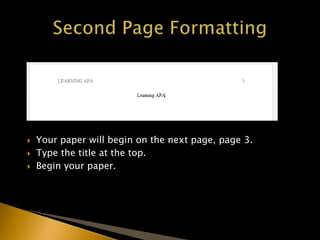
 Your paper will begin on the next page, page 3.
 Type the title at the top.
 Begin your paper.
Why Do We Need APA Citations?
 It’s ethical.
 It generates interest.
 It strengthens your argument.
 It helps others find your sources.
 Is taking credit for someone else’s
work/ideas.
 To avoid this, cite anything that doesn’t come
out of your own head.
 Anything that is not common knowledge
must be cited.
What to Cite
 Direct Quotes
 Paraphrases
 Theories or ideas unique to a specific author
 The specific argument of the author
 Facts
 Articles of studies quoted within your text
 Uncommon knowledge
 When the author has said it best
◦ When the wording is too specific or detailed to
reword
◦ When specialized language is used
 To illustrate the writing style of the author
 When focusing on the meaning rather than the
exact words
 To condense paragraphs into a sentence or two
 To show you understand what you’ve read
When Don’t I Have to Cite Sources?
 Proverbs, axioms, and common sayings
◦ Ex: “A day late and a dollar short.”
 Well-known quotes
◦ Ex: “The body politic.”
 Common knowledge
◦ Ex: George Washington was the first president of
the United States.
In-Text/Parenthetical Citations
 Direct Quotes
 Paraphrases
 Theories or ideas unique to a specific author
 The specific argument of the author
 Facts
 Articles of studies quoted within your text
 Direct Quotes
 Paraphrases
 Theories or ideas unique to a specific author
 The specific argument of the author
 Facts
 Articles of studies quoted within your text
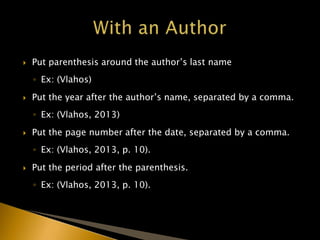
 Put parenthesis around the author’s last name
◦ Ex: (Vlahos)
 Put the year after the author’s name, separated by a comma.
◦ Ex: (Vlahos, 2013)
 Put the page number after the date, separated by a comma.
◦ Ex: (Vlahos, 2013, p. 10).
 Put the period after the parenthesis.
◦ Ex: (Vlahos, 2013, p. 10).
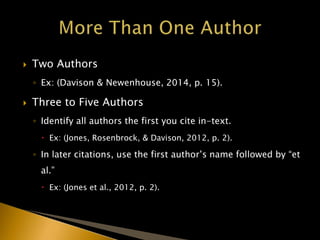
 Two Authors
◦ Ex: (Davison & Newenhouse, 2014, p. 15).
 Three to Five Authors
◦ Identify all authors the first you cite in-text.
 Ex: (Jones, Rosenbrock, & Davison, 2012, p. 2).
◦ In later citations, use the first author’s name followed by “et
al.”
 Ex: (Jones et al., 2012, p. 2).
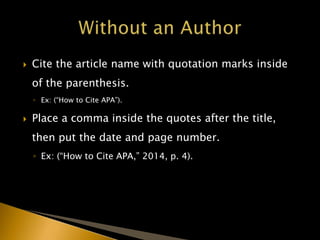
 Cite the article name with quotation marks inside
of the parenthesis.
◦ Ex: (“How to Cite APA”).
 Place a comma inside the quotes after the title,
then put the date and page number.
◦ Ex: (“How to Cite APA,” 2014, p. 4).
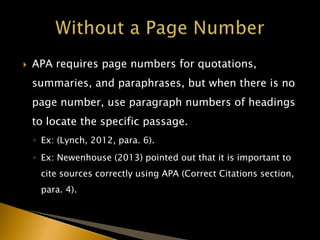
 APA requires page numbers for quotations,
summaries, and paraphrases, but when there is no
page number, use paragraph numbers of headings
to locate the specific passage.
◦ Ex: (Lynch, 2012, para. 6).
◦ Ex: Newenhouse (2013) pointed out that it is important to
cite sources correctly using APA (Correct Citations section,
para. 4).
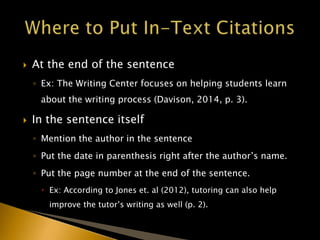
 At the end of the sentence
◦ Ex: The Writing Center focuses on helping students learn
about the writing process (Davison, 2014, p. 3).
 In the sentence itself
◦ Mention the author in the sentence
◦ Put the date in parenthesis right after the author’s name.
◦ Put the page number at the end of the sentence.
 Ex: According to Jones et. al (2012), tutoring can also help
improve the tutor’s writing as well (p. 2).
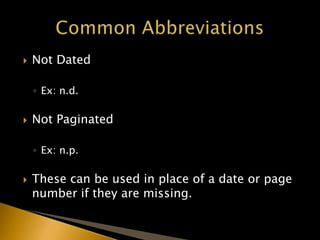
 Not Dated
◦ Ex: n.d.
 Not Paginated
◦ Ex: n.p.
 These can be used in place of a date or page
number if they are missing.
Citing Indirect Sources and
Block Quotes
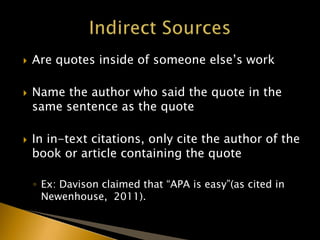
 Are quotes inside of someone else’s work
 Name the author who said the quote in the
same sentence as the quote
 In in-text citations, only cite the author of the
book or article containing the quote
◦ Ex: Davison claimed that “APA is easy”(as cited in
Newenhouse, 2011).
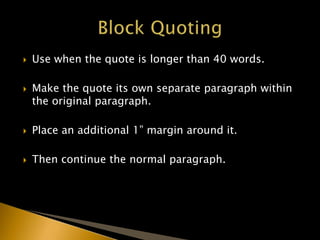
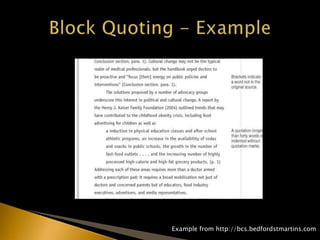
 Use when the quote is longer than 40 words.
 Make the quote its own separate paragraph within
the original paragraph.
 Place an additional 1” margin around it.
 Then continue the normal paragraph.
Example from http://bcs.bedfordstmartins.com/
Personal Communication and
Sacred Texts
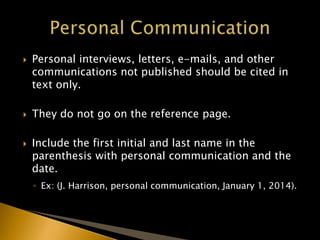
 Personal interviews, letters, e-mails, and other
communications not published should be cited in
text only.
 They do not go on the reference page.
 Include the first initial and last name in the
parenthesis with personal communication and the
date.
◦ Ex: (J. Harrison, personal communication, January 1, 2014).
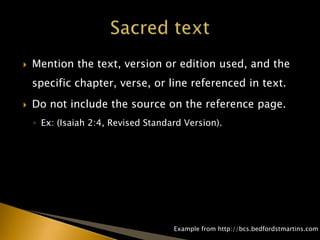
 Mention the text, version or edition used, and the
specific chapter, verse, or line referenced in text.
 Do not include the source on the reference page.
◦ Ex: (Isaiah 2:4, Revised Standard Version).
Example from http://bcs.bedfordstmartins.com/
References Page
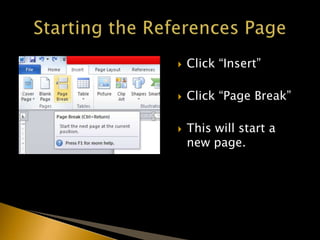
 Click “Insert”
 Click “Page Break”
 This will start a
new page.
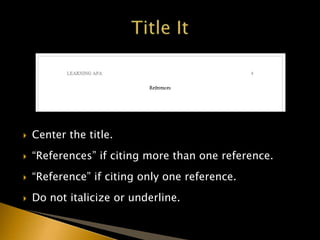
 Center the title.
 “References” if citing more than one reference.
 “Reference” if citing only one reference.
 Do not italicize or underline.
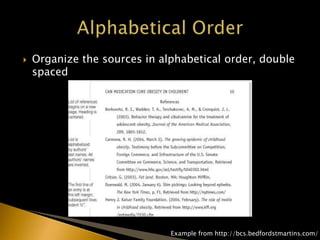
 Organize the sources in alphabetical order, double
spaced
Example from http://bcs.bedfordstmartins.com/
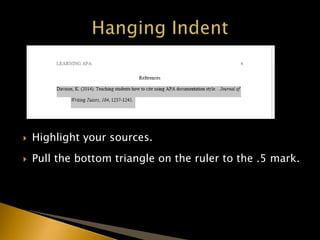
 Highlight your sources.
 Pull the bottom triangle on the ruler to the .5 mark.
 Only the first letter in the first word of the title is
capitalized.
◦ Ex: Teaching documentation styles
 The first letter in the subtitle (after the colon)
capitalized.
◦ Ex: Teaching documentation styles: Citing made easy
 All proper nouns (i.e., Christmas) are capitalized.
 All other words are lower case.
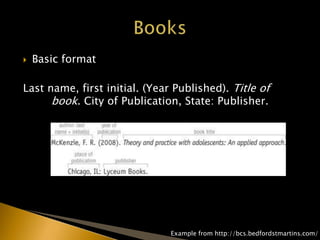
 Basic format
Last name, first initial. (Year Published). Title of
book. City of Publication, State: Publisher.
Example from http://bcs.bedfordstmartins.com/
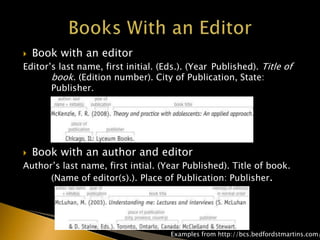
 Book with an editor
Editor’s last name, first initial. (Eds.). (Year Published). Title of
book. (Edition number). City of Publication, State:
Publisher.
 Book with an author and editor
Author’s last name, first intial. (Year Published). Title of book.
(Name of editor(s).). Place of Publication: Publisher.
Examples from http://bcs.bedfordstmartins.com/
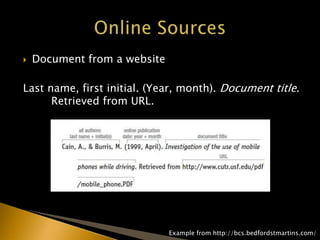
 Document from a website
Last name, first initial. (Year, month). Document title.
Retrieved from URL.
Example from http://bcs.bedfordstmartins.com/
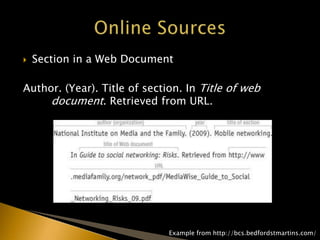
 Section in a Web Document
Author. (Year). Title of section. In Title of web
document. Retrieved from URL.
Example from http://bcs.bedfordstmartins.com/
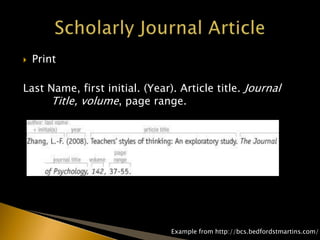
 Print
Last Name, first initial. (Year). Article title. Journal
Title, volume, page range.
Example from http://bcs.bedfordstmartins.com/
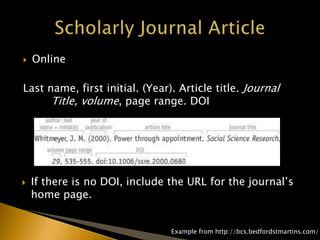
 Online
Last name, first initial. (Year). Article title. Journal
Title, volume, page range. DOI
 If there is no DOI, include the URL for the journal’s
home page.
Example from http://bcs.bedfordstmartins.com/
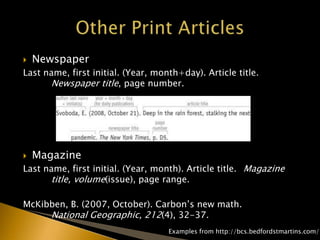
 Newspaper
Last name, first initial. (Year, month+day). Article title.
Newspaper title, page number.
 Magazine
Last name, first initial. (Year, month). Article title. Magazine
title, volume(issue), page range.
McKibben, B. (2007, October). Carbon’s new math.
National Geographic, 212(4), 32-37.
Examples from http://bcs.bedfordstmartins.com/
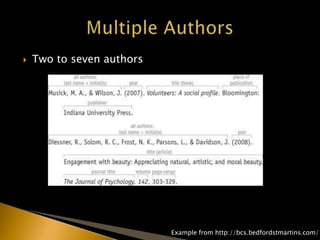
 Two to seven authors
Example from http://bcs.bedfordstmartins.com/
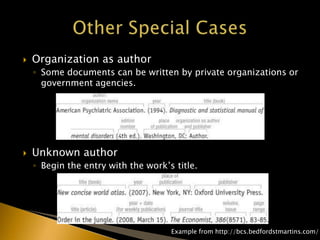
 Organization as author
◦ Some documents can be written by private organizations or
government agencies.
 Unknown author
◦ Begin the entry with the work’s title.
Example from http://bcs.bedfordstmartins.com/
Bedford St. Martin’s APA Style
http://bcs.bedfordstmartins.com/resdoc5e/RES5e_ch09_o.ht
ml
American Psychological Association. (2009).
Publication manual of the American
Psychological Association (6th ed.). Washington,
DC: American Psychological Association.
Good Luck!

APA Documentation

  • 1.
  • 2.
     “References” page,not “Works Cited” for bibliography  Major focus on when works were published  All material should be written in past tense  Non-traditional capitalization for titles on references page  Nothing is underlined ◦ Italics are used for titles of longer works ◦ “Quotation marks around titles of shorter works in-text.”
  • 3.
  • 4.
     Times NewRoman  Size 12
  • 5.
     Line Spacing– Double  Space Before – 0 pt  Space After – 0 pt  Click “Don’t add space between paragraphs of the same style.”
  • 6.
     Running Head Page Number  Title of Paper  Your First and Last Name  Name of University  Author’s Note
  • 7.
     Double-click thevery top of the page.  Click “Different First Page.”  Change the font to Times New Roman, 12.  Type “Running head:”  Type the title in all capital letters.
  • 8.
     Still inthe header, press the “Tab” button twice.  In “Design,” click on “Page Number.”  Hover over “Current Position.”  Click “Plain Number.”
  • 10.
     Author Noteis at the very bottom of the page.  Include: ◦ Course Name ◦ Section ◦ Professor’s Name
  • 11.
     Go toback to the header and change the font again to Times New Roman, 12.  Type the title in all caps without “Running head.”  Insert the page number again.  Include an “Abstract”, a paragraph overviewing what your paper is about.
  • 12.
     Your paperwill begin on the next page, page 3.  Type the title at the top.  Begin your paper.
  • 13.
    Why Do WeNeed APA Citations?
  • 14.
     It’s ethical. It generates interest.  It strengthens your argument.  It helps others find your sources.
  • 15.
     Is takingcredit for someone else’s work/ideas.  To avoid this, cite anything that doesn’t come out of your own head.  Anything that is not common knowledge must be cited.
  • 16.
  • 17.
     Direct Quotes Paraphrases  Theories or ideas unique to a specific author  The specific argument of the author  Facts  Articles of studies quoted within your text  Uncommon knowledge
  • 18.
     When theauthor has said it best ◦ When the wording is too specific or detailed to reword ◦ When specialized language is used  To illustrate the writing style of the author
  • 19.
     When focusingon the meaning rather than the exact words  To condense paragraphs into a sentence or two  To show you understand what you’ve read
  • 20.
    When Don’t IHave to Cite Sources?
  • 21.
     Proverbs, axioms,and common sayings ◦ Ex: “A day late and a dollar short.”  Well-known quotes ◦ Ex: “The body politic.”  Common knowledge ◦ Ex: George Washington was the first president of the United States.
  • 22.
  • 23.
     Direct Quotes Paraphrases  Theories or ideas unique to a specific author  The specific argument of the author  Facts  Articles of studies quoted within your text
  • 24.
     Direct Quotes Paraphrases  Theories or ideas unique to a specific author  The specific argument of the author  Facts  Articles of studies quoted within your text
  • 25.
     Put parenthesisaround the author’s last name ◦ Ex: (Vlahos)  Put the year after the author’s name, separated by a comma. ◦ Ex: (Vlahos, 2013)  Put the page number after the date, separated by a comma. ◦ Ex: (Vlahos, 2013, p. 10).  Put the period after the parenthesis. ◦ Ex: (Vlahos, 2013, p. 10).
  • 26.
     Two Authors ◦Ex: (Davison & Newenhouse, 2014, p. 15).  Three to Five Authors ◦ Identify all authors the first you cite in-text.  Ex: (Jones, Rosenbrock, & Davison, 2012, p. 2). ◦ In later citations, use the first author’s name followed by “et al.”  Ex: (Jones et al., 2012, p. 2).
  • 27.
     Cite thearticle name with quotation marks inside of the parenthesis. ◦ Ex: (“How to Cite APA”).  Place a comma inside the quotes after the title, then put the date and page number. ◦ Ex: (“How to Cite APA,” 2014, p. 4).
  • 28.
     APA requirespage numbers for quotations, summaries, and paraphrases, but when there is no page number, use paragraph numbers of headings to locate the specific passage. ◦ Ex: (Lynch, 2012, para. 6). ◦ Ex: Newenhouse (2013) pointed out that it is important to cite sources correctly using APA (Correct Citations section, para. 4).
  • 29.
     At theend of the sentence ◦ Ex: The Writing Center focuses on helping students learn about the writing process (Davison, 2014, p. 3).  In the sentence itself ◦ Mention the author in the sentence ◦ Put the date in parenthesis right after the author’s name. ◦ Put the page number at the end of the sentence.  Ex: According to Jones et. al (2012), tutoring can also help improve the tutor’s writing as well (p. 2).
  • 30.
     Not Dated ◦Ex: n.d.  Not Paginated ◦ Ex: n.p.  These can be used in place of a date or page number if they are missing.
  • 31.
    Citing Indirect Sourcesand Block Quotes
  • 32.
     Are quotesinside of someone else’s work  Name the author who said the quote in the same sentence as the quote  In in-text citations, only cite the author of the book or article containing the quote ◦ Ex: Davison claimed that “APA is easy”(as cited in Newenhouse, 2011).
  • 33.
     Use whenthe quote is longer than 40 words.  Make the quote its own separate paragraph within the original paragraph.  Place an additional 1” margin around it.  Then continue the normal paragraph.
  • 34.
  • 35.
  • 36.
     Personal interviews,letters, e-mails, and other communications not published should be cited in text only.  They do not go on the reference page.  Include the first initial and last name in the parenthesis with personal communication and the date. ◦ Ex: (J. Harrison, personal communication, January 1, 2014).
  • 37.
     Mention thetext, version or edition used, and the specific chapter, verse, or line referenced in text.  Do not include the source on the reference page. ◦ Ex: (Isaiah 2:4, Revised Standard Version). Example from http://bcs.bedfordstmartins.com/
  • 38.
  • 39.
     Click “Insert” Click “Page Break”  This will start a new page.
  • 40.
     Center thetitle.  “References” if citing more than one reference.  “Reference” if citing only one reference.  Do not italicize or underline.
  • 41.
     Organize thesources in alphabetical order, double spaced Example from http://bcs.bedfordstmartins.com/
  • 42.
     Highlight yoursources.  Pull the bottom triangle on the ruler to the .5 mark.
  • 43.
     Only thefirst letter in the first word of the title is capitalized. ◦ Ex: Teaching documentation styles  The first letter in the subtitle (after the colon) capitalized. ◦ Ex: Teaching documentation styles: Citing made easy  All proper nouns (i.e., Christmas) are capitalized.  All other words are lower case.
  • 44.
     Basic format Lastname, first initial. (Year Published). Title of book. City of Publication, State: Publisher. Example from http://bcs.bedfordstmartins.com/
  • 45.
     Book withan editor Editor’s last name, first initial. (Eds.). (Year Published). Title of book. (Edition number). City of Publication, State: Publisher.  Book with an author and editor Author’s last name, first intial. (Year Published). Title of book. (Name of editor(s).). Place of Publication: Publisher. Examples from http://bcs.bedfordstmartins.com/
  • 46.
     Document froma website Last name, first initial. (Year, month). Document title. Retrieved from URL. Example from http://bcs.bedfordstmartins.com/
  • 47.
     Section ina Web Document Author. (Year). Title of section. In Title of web document. Retrieved from URL. Example from http://bcs.bedfordstmartins.com/
  • 48.
     Print Last Name,first initial. (Year). Article title. Journal Title, volume, page range. Example from http://bcs.bedfordstmartins.com/
  • 49.
     Online Last name,first initial. (Year). Article title. Journal Title, volume, page range. DOI  If there is no DOI, include the URL for the journal’s home page. Example from http://bcs.bedfordstmartins.com/
  • 50.
     Newspaper Last name,first initial. (Year, month+day). Article title. Newspaper title, page number.  Magazine Last name, first initial. (Year, month). Article title. Magazine title, volume(issue), page range. McKibben, B. (2007, October). Carbon’s new math. National Geographic, 212(4), 32-37. Examples from http://bcs.bedfordstmartins.com/
  • 51.
     Two toseven authors Example from http://bcs.bedfordstmartins.com/
  • 52.
     Organization asauthor ◦ Some documents can be written by private organizations or government agencies.  Unknown author ◦ Begin the entry with the work’s title. Example from http://bcs.bedfordstmartins.com/
  • 53.
    Bedford St. Martin’sAPA Style http://bcs.bedfordstmartins.com/resdoc5e/RES5e_ch09_o.ht ml American Psychological Association. (2009). Publication manual of the American Psychological Association (6th ed.). Washington, DC: American Psychological Association.
  • 54.